This letter was written by James Madison Campbell (1840-1891) of Selma, Liberty Township, Delaware county, Indiana. His parents were Samuel Graham Campbell (1797-1873) and Elisabeth Goings (1804-1882). He wrote the letters to his older sister, Jane Campbell (1835-1906). James enlisted as a musician in Co. K, 19th Indiana Infantry on 29 July 1861. He mustered out as a corporal on 28 July 1864 after three years service. The 19th Indiana was, of course, part of the famed Iron Brigade or “Black Hat” Brigade during the Civil War.
Serving with him in the same company was his older brother, William Harrison Campbell (1838-1912), who also wrote several letters home. They can be found at—1861-62: William Harrison Campbell to Jane Campbell.
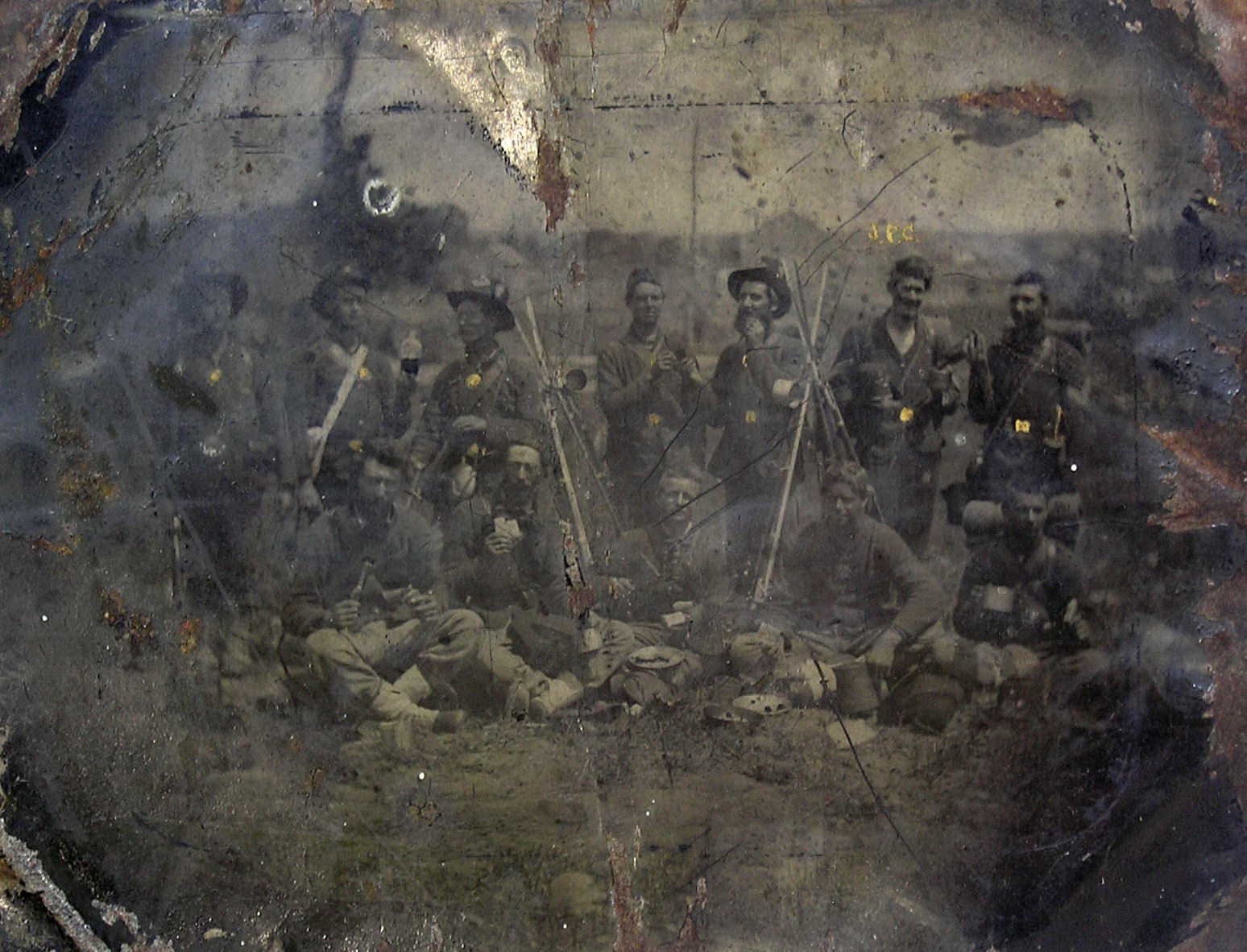
Some of the boys of Co. K, 19th Indiana Infantry after the Battle of Antietam
T R A N S C R I P T I O N
Fort Baker, Virginia September 22, 1861
Dear Sister,
I received yours of the fifteenth instant and was sorry to hear that you was so uneasy about Will and I. Will got here last Tuesday week and on Wednesday following he went out with us to the fight but unfortunately we were too late by about two minutes to get into the fight for it was over before we got there though there were several shots fired from the cannon after we got on the ground where they were fighting.
A word of explantation with regard to the fight. In the morning there was five companies of our regiment went to the town of Lewinsville in company with the 3rd Vermont on a kind of scouting expedition and after they had finished their work and started back to the camp and had not come but a short distance when the Rebels opened fire on them from the brush and thickets where they were concealed. Our men immediately returned the fire and fired several rounds but to little effect, when there was a brass 32-pounder brought on the field and opened fire on the Rebels and the first shot struck one of the caissons and knocked it off the wheels and killed nine men. They fired twice at the artillery, then turned it and fired in another direction at a cavalry company and made great destruction among them.
The number of Rebels killed was about thirty and a great many wounded. Our loss was four killed and five wounded (some say seven). There was some firing last night among the pickets and we hear this morning that there was a Captain in the California Regiment killed 1 and four Rebels also. This is about all the fighting that has been here that I know of.
There is a great deal of sickness among the soldiers at present and been several deaths but there has been no deaths in Co. K but several sick and not dangerous. Capt. Williams is getting better. Ben Harter is about well again. Will Orr is better. Crack East is well. James Goings is better. Brother Will is well and I am as stout and hearty as a buck and can jump twice as far, I expect. Our boys are all getting better. You need not be uneasy about us for we are as safe here as if we were at home. No more at present, — J. M. Campbell
Tell Marthy Black if she wants to kiss me, I will give her an opportunity when I come back.
1 Capt. James W. Lingenfelter (1836-1861) of Co. B, 1st California Regiment was killed in the skirmish near Lewinsville, Fairfax county, Virginia, on 21 September 1861. At the time of his death, Cap. Lingenfelter was in command of a scouting party, when finding himself surrounded by a body of rebels, and scorning to retreat, he was shot in the head and immediately killed.
I could not find an image of Asa but here is one of John D. M. VanVleet, of Co. H, 107th New York Infantry (AI generated from tintype)
Asa Brownell (1833-1918) was 29 years old when he enlisted on 28 July 1862 at Addison to serve three years in Co. F, 107th New York Infantry (the “Campbell Guards”). He mustered in as a corporal. During the Battle of Antietam when the 107th New York advanced with Mansfield’s 12th Corps through Miller’s Cornfield mid-morning, Asa received a gunshot wound and was sent to hospitals in New York City and Philadelphia to be treated before returning to the ranks in 1863. He mustered out as a corporal on 28 July 1865 at Elmira, N. Y. His military records suggest that he stood 5 feet 8 inches tall, had grey eyes, dark hair, and was a farmer by occupation.
In the 1860 US Census, Asa was enumerated in Woodhull, Steuben county, New York, in the residence of James Brownell (b. 1787) and his wife, Lois Bancroft (1794-1876). It isn’t clear whether these were his parents or grandparents.
T R A N S C R I P T I O N
Camp 107th N. Y. Vols Wartrace Creek, Tennessee November 11th 1863
Dear Sister,
It is with usual pleasure that I improve these leisure moments in writing a few lines to you. Yours of the 1st of November reached me in safety night before last and was heartily welcome as all your letters are. I was very glad to get some stamps for I had used the last one that I had and had been obliged to borrow some. Your letter found me well and this leaves me in the enjoyment of a good degree of health.
The last letter which I wrote you, I believe it was written at Fosterville at which place we stayed six days—just long enough to get some fireplaces in the board shanties which were already put up there, but Thursday morning we left our shanties and with our furniture, bedding, and provisions on back, started out into the world to seek us another home. But as good luck would have it, we did not have to go but about 8 miles and had it not been for the rain which fell all the time, it would not have been a bad trip. We travelled on the railroad all the way and got here a little after noon. There had been five companies of the 13th N. J. here and they had some poor excuses for board shanties which we stayed in until Saturday when we had orders to move camp in order to get on drier ground. And since that time, the most of the boys with the exception of a few who put up their board shanties again, have been busy getting up good log shanties. Mine is nearly finished now except the fireplace and I guess my tent mates will get that started today. I am on picket so that I cannot work at [it] myself.
You think we are beyond the reach of cold weather. It is not so although I presume it is not so cold here as it is in York State. Yet we ave some very cold nights here although the days are mostly warm. I am very much [ ] in the appearance of the Southern States. The people here seem to be at least fifty years behind in arts, science, literature, and everything that goes to make up an enlightened people. Occasionally one will find a person who has either been [born] and bred at the North or else received their education at some northern school and the class of people very different from those—especially the poorer class who have been born and bred at the South. But I see that I am getting my sheet full so I will close. Write often. From one who is proud to call you sister, — A. B.
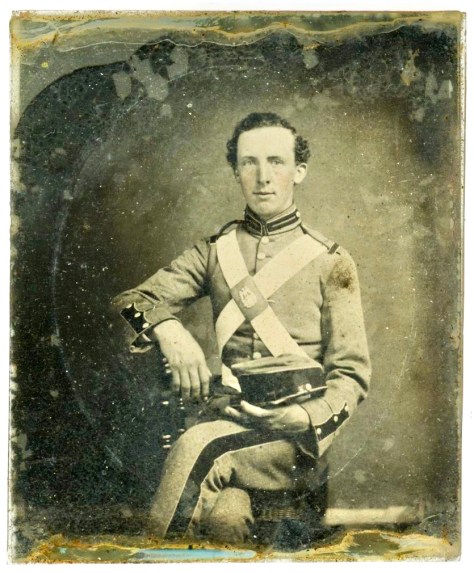
Sixth-plate ambrotype of an enlisted man of 21st New York Infantry in 1861. The 21st New York Infantry, or 1st Buffalo regiment, was recruited in Buffalo, and was the outgrowth of the 74th NYSM. It was mustered into the US service May 20, 1861, at Elmira, for three months and left there for Washington on June 18, 1861. The uniforms acquired by the 21st NY were originally purchased for the 74th NYSM from A. & G. Arnoux, of New York, by the Buffalo City Council. As that militia regiment was not required for three months’ service in 1861, the City Council sold the uniforms to the State which in turn issued them to the Buffalo Regiment on May 21. A report in the Buffalo Daily Courier of June 5 stated, “The uniforms of the 21st are at least 25 per cent better in quality [than State clothing] and one hundred in color.” According to Brigadier General H.R. White, who visited the military camp near Elmira, at this time, the 21st New York wore a “neat and finely fitting gray uniform… It is the same style as the regular State uniform—jacket, cap and pants alike—but fits the men beautifully.” In his regimental history, J. Harrison Mills described the uniform as consisting of “a cap, jacket and pants of gray cloth, trimmed with black, and an overcoat of bluish black lined with red.” After escorting the Buffalo Regiment to the railroad depot on their departure for Washington, D.C., a man in the 27th New York remarked that they “looked well, and very neat in their gray uniforms.” When the 21st reached the Federal capital on June 19, it was reported to be wearing “dark gray jackets, pants, and cap, trimmed with black.” Written in pencil in the case is “From O.[liver] B.[enton] Evans Gallery, Buffalo.” (Ron Field Collection)
The following letter was written by Irish emigrant Myron W. Herbert (1833-1903) of Niagara county who served early in the war as a private in Co. E, 21st New York Infantry and later transferred to the U. S. Navy. According to his military file, 28 year-old Myron enlisted on 12 May 1861 and deserted on 13 July 1862. He was described as a 5′ 6″ tall, blue-eyed, brown-haired farmer.
In the pension application Myron filed in 1890 while living in Brockport, Monroe county, New York, he claimed that he had received a gunshot wound to the left ankle and over his left eye while with the 21st New York and was honorably discharged at Washington on 26 October 1862. He then claimed he served as a Landsman in the Navy aboard the Flag Ship Black Hawk and was discharged after two years at Mound City, Illinois. However, the pension was denied when a review of the rolls found no one by that name serving aboard the Black Hawk. Sadly, Myron died in the poor house in Niagara county in 1903.
T R A N S C R I P T I O N
Camp Rogers [Upton’s Hill, Va.] October 21st 1861
Dear Mother,
Once more I sit down to pen a few lines to you fondly hoping that this letter will find you on better health than it leaves me. I have been in the hospital about two weeks but I am somewhat better now with the prospect of getting well. I was taken with the chills and fever but I think the doctor broke them too quick on me and set me into the dropsy on the liver. You would scarce believe what a change there has been in my looks in two weeks time. I was as fat and healthy as could be [and] now I am as poor as a crow. I can’t eat anything and can hardly walk around. But I am in hopes to be able to attend to my duty before long.
The doctor had orders to discharge all the soldiers that would be sick for some little time yet and the rest to send to Washington City to the General Hospital immediately so I think that the army will advance in a few days. I don’t know whether they will send me to Washington or not. If I am able to go with the regiment, I shall for I prefer going than to go to Washington. But it will depend entirely when they go. It is the opinion of a good many that we will go down the river and if we do, we will see some hot times.
The enemy has all left Fairfax and gone back, but how far it is not ascertained. They do that to draw our troops into Manassas Junction but probably McClellan knows what he is about—at least I think so.
I had a letter from James the other day. He was well. He said in his letter that he had just received a letter from home. Poor fellow. I wonder where he calls home. Perhaps it is where [ ] is beyond the grave. I had a letter from Thomas the other day. I see that he is one of the true soldiers. He is determined to see the glorious stars and stripes wave yet over a free country. May the God of Heaven protect him. But [what about] Hank? What shall I say in honor of his cause? Does he prefer to save himself and live under a rebel government? or does he wish to remain with his wife and let others fight for liberty for him? I did not know that there was one in our family that would turn their back on the flag that had always protected them. For shame on such men. I can pick out better men among the camp women that goes with the regiments than he is.
Well Mother, how do you get along and how does all the rest? I have not received any answer to Achsah’s letter yet and I do wish you would send me the Lockport papers. You could just as well as not. Well Mother, goodbye for this time. It is raining or I should sit out-of-doors for a while yet. I guess I will lay down a spell. Give my love to all kind friends and don’t forget to write. I am getting tired and must stop writing so goodbye and believe me. Your son yet, — Myron W. Herbert
I could not find an image of Fred but here is one of Edward Williams of Co. H, 10th Rhode Island Infantry (LOC)
1st Lt. Joseph Langford Bennett (1838-1898) of Co. A, 10th Rhode Island Infantry wrote this letter following the death of William Frederick (“Fred”) Atwood (1845-1862), a corporal serving in his company. Fred was the 17 year-old son of William and Emeline Atwood, a recent graduate of the Providence high school. Fred was described by his comrades as having a “genial temperament and generous disposition, which drew around him a circle of personal friends.” Though the lieutenant pledged to “deposit your son’s remains in Rhode Island soil with our own hands,” it does not appear that ever occurred. According to the regimental history, his body remained buried “in a retired and beautiful spot near the Soldiers’ Home, overlooking the Capitol which his youthful footsteps had hastened to defend.” Strangely, Fred’s father enlisted a few months later in the 11th Rhode Island Infantry and he too sickened and died—buried in Arlington Cemetery across the Potomac river from his son.
The 10th Rhode Island regiment was mustered into Federal service for three months in the summer of 1862. It was sworn in at Providence on May 26, 1862 and then moved to Washington, D. C. from May 27 to 29 where it was attached to Sturgis’ Command as part of the Military District of Washington. It saw duty at Camp Frieze, Tennallytown until June 26. With Sturgis, the regiment marched across the Potomac into Virginia, but returned to Washington when Jackson’s threat to the city subsided.
After a few days, on Monday morning, June 30, the 10th was detached from Sturgis’ troops and ordered to relieve the 59th New York in the seven forts and three batteries it had been occupying. These defenses of Washington were north and west of the city.
Company A was sent to Fort Franklin. This position guarded the Baltimore and Ohio Canal, the Baltimore & Ohio Railroad, and the Washington Aqueduct—the new water supply for the city. the U. S. Army Engineers had designed Fort Franklin to protect the city’s receiving reservoir (as conveyed by the Aqueduct) as well as the Potomac river shoreline.
T RA N S C R I P T I O N
Fort Franklin Headquarters Co. A, 10th Regt. Rhode Island Vol. July 2nd 1862
Dear Sir,
Capt. Taber telegraphed you on Sunday, June 29th, that your son Wm. F. Atwood, (a member of our company) died on the said 29th of June and that his body would be sent home to you. Unfortunately circumstances occured which forbade us the melancholy pleasure of fulfilling our designs. Your son was buried on Monday, June 30th at 4 p.m. in the Soldier Retreat. Capt. Taber knows the precise spot in which he lies and we shall at the earliest opportunity bring his body to Providence.
In regard to your son’s death, he would say that it was one of perfect peace. He did not suffer at all, but on the contrary was perfectly free from pain. The Surgeon states that he died from inflammation of the bowels. During his stay in the General [Seminary] Hospital at Georgetown, he received the best of care. One of the most experienced nurses remained with [him] during the night previous to his death. His last request was that he might be buried at home. We did all that we could at the time but we could not get his body home short of five days and the government allows but seven dollars for the whole expense while the actual expense is over one hundred dollars. And unfortunately, while engaged in contriving some way to transport the body, Capt. Taber was ordered back to camp to move his company to this fort. He consequently had no alternative but to comply with said orders.
As a company, we shall see that the body is removed to Providence and interred with all the honors of a soldier and patriot. It may be pleasing to you to know that as a man and soldier, he had no superior. He was regarded by all of his company as an amiable and desirable companion. None mourn his loss more than me. Our company is thrown into the most profound gloom by the loss of our beloved companion. As officers, we feel that one of the ornaments of our company has been removed by the hand of divine Providence and although we mourn his loss, we know that God doeth all things well.
We should have notified you sooner but it was entirely beyond our power. Any questions you may ask, or any information you may desire, we will do out best to satisfy. Please direct to the Capt. at Washington, D. C. By order of Capt. Wm. E. Tabor, Jr., I remain, with much respect, yours to command, – Lieut. Bennett
P. S. If you will send a written order to Capt. Taber authorizing him to take charge of the effects of your son, he can and will do so, until such a time as he can forward them to you.
Our company have all desired to be remembered to you in this the time of bereavement. Rest assured we will do all in our power an we expect to deposit your son’s remains in Rhode Island soil with our own hands. Truly yours, — Bennett, 1st Lt. Co. A, 10th Regt. R. I. V.
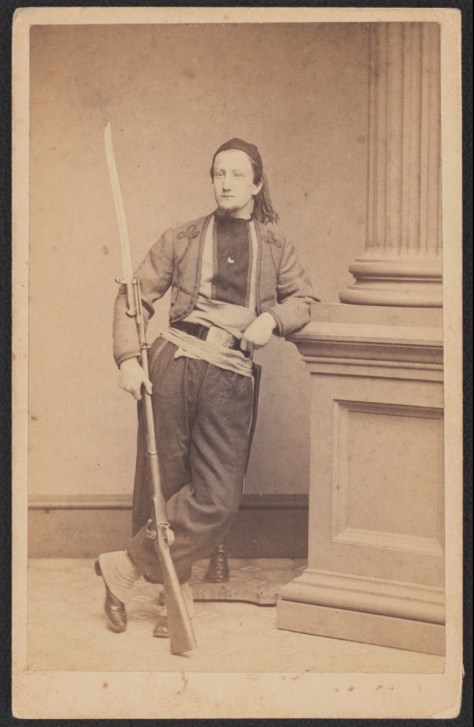
Believed to be a member of the Keystone Zouaves (Collection of Al and Claudia Niemiec)
James Rumbaugh wrote the following four letters while serving in Co. F, 76th Pennsylvania Infantry (a.k.a., the “Keystone Zouaves”).. He was drafted into the regiment on 13 July 1863 as a private and was discharged on 23 May 1865. We learn from James’ letters that he was wounded on 7 May 1864 when participating in Butler’s operations on the south side of the James River near Petersburg. According to the regimental history, the brigade in which the regiment was placed, commanded by Col. Barton, embarked upon transports, and headed as if for an expedition to West Point and White House; but suddenly changing direction proceeded down the York, and up the James, landing at Bermuda Hundred. It moved towards the Petersburg and Weldon Railroad, destroying several miles of the track, under heavy fire. The rebels were forced back to Drury’s Bluff, where they were reinforced, and the object of the reconnoissance being accomplished, the brigade was withdrawn. The Seventy-sixth lost sixty-five in killed, wounded and missing.
James wrote the letters to David Henri Dunmire (1844-1901) of Armstrong county, Pennsylvania. He was the son of David and Sarah (Heffelfinger) Dormire.
[Note: These letters are from the personal collection of Don Andrew and were made available for transcription and publication on Spared & Shared by express consent.]
Letter 1
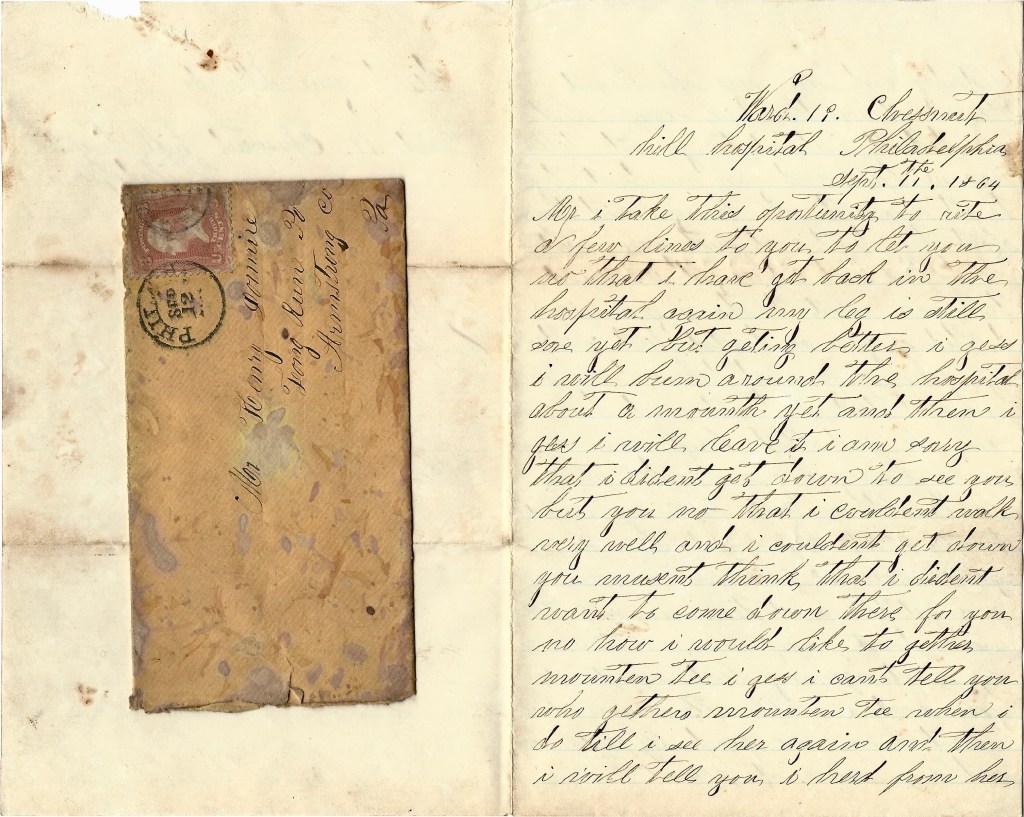
Addressed to Mr. Henry Dormire, Maysville, Armstrong county, Penna.
Hilton Head, South Carolina March 28th, 1864
Well Henry, I thought it time I would write a few lines to you to find out how you was getting along. This leaves me in good health and I hope it may find you enjoying the same blessing.
They have got me on an island down here and if the rebels get after me, I can’t run like I could when I was stealing apples. I haint got so much room to get out of the way.
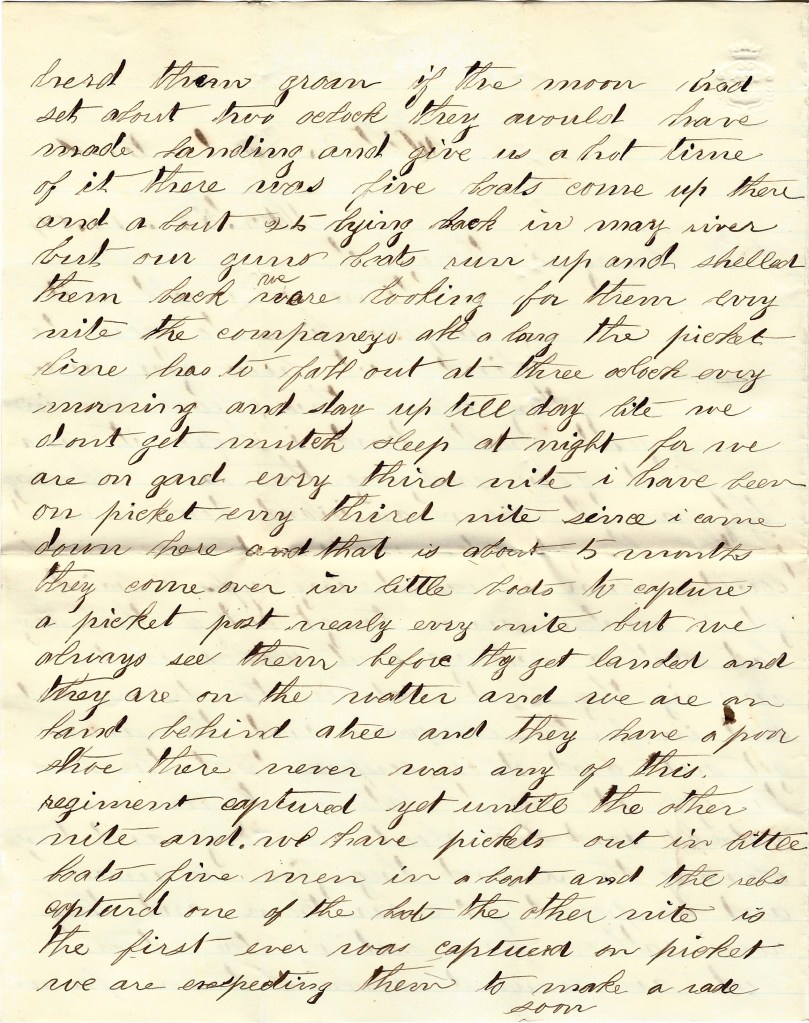
Last Sabbath a week ago about four o’clock in the morning, they heard boats in the stream and sent in for the companies and the men got out and it is supposed that the rebs thought it was too late for them [to] make an attack, and was about leaving and they challenged them and they gave no answer and we opened fire on them and they were rather far out in the stream but we wounded some of them for we heard them groan. If the moon had set about two o’clock, they would have made landing and give us a hot time of it. There was five boats come up there and about 25 lying back in May River, but our gunboats run up and shelled them back. We are looking for them every night.
The company all along the picket line has to fall out at three o’clock every morning and stay up till daylight. We don’t get much sleep at night for we are on guard every third night. I have been on picket every third night since I came down here and that is about five months. They come over in little boats to capture a picket post nearly every night but we always see them before they get landed and they are on the water and we are on land behind a tree and they have a poor show. There never was any of this regiment captured yet until the other night and we have pickets out in little boats—five men in a boat—and the rebs captured one of the boats the other night. [It] is the first ever was captured on picket. We are expecting them to make a raid soon.
Well Henry, we have very nice and warm weather. Everything is green here—only the niggers and they are black as you please. There is towns of them here and they have a few chickens now but not many. If a chicken wants to live out half its days or have good health, it musn’t crow before daylight or it will lose its feathers. We have stole all the chickens, all the ducks, and sweet potatoes that we wanted and that ain’t all we got. But the other I won’t tell you about.
Well Henry, I am tired writing till I see whether you get this or not, and if you get this, please answer it, and then I will let you know more about things the next time. Excuse bad writing and spelling. So l will close by sending my best respects to you and all enquiring friends. Please answer my letter. Tell me all the news. Henry, write soon. — James Rumbaugh
Direct your letter to Hilton Head, S C., Co. F, 76th Regt. Penn. Vols.
Letter 2
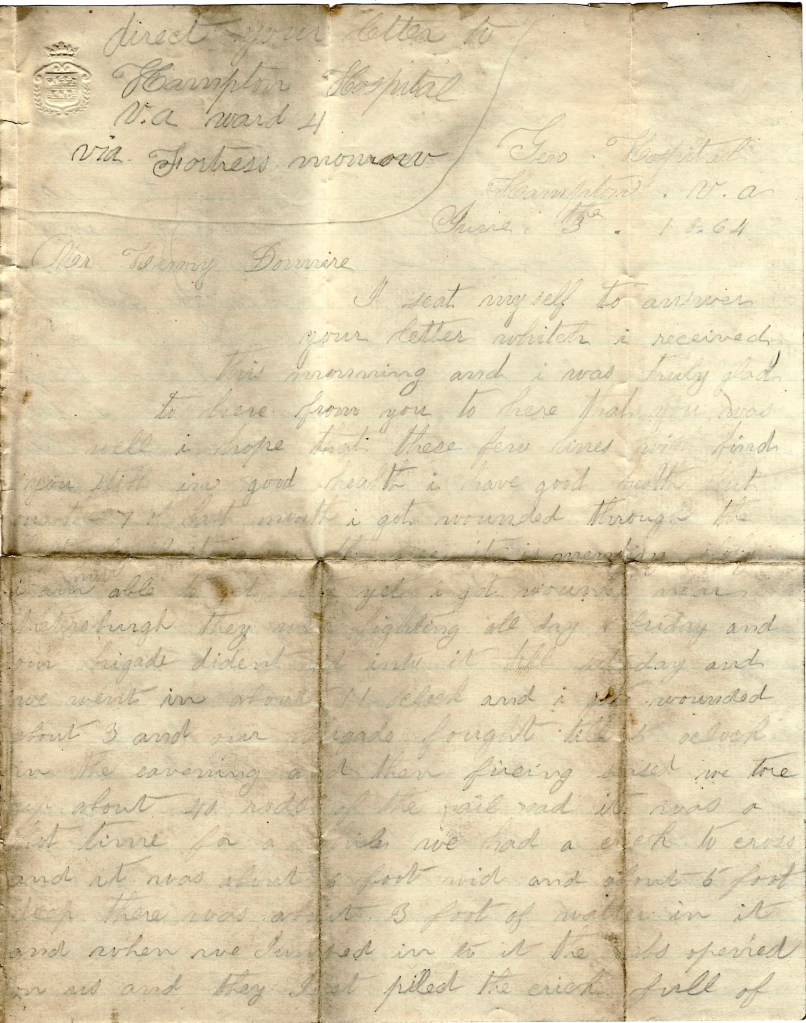
General Hospital Hampton, Virginia June 3, 1864
Mr. Henry Dunmire,
I seat myself to answer your letter which I received this morning and I was truly glad to hear from you to hear that you was well. I hope that these few lines will find you still in good health.
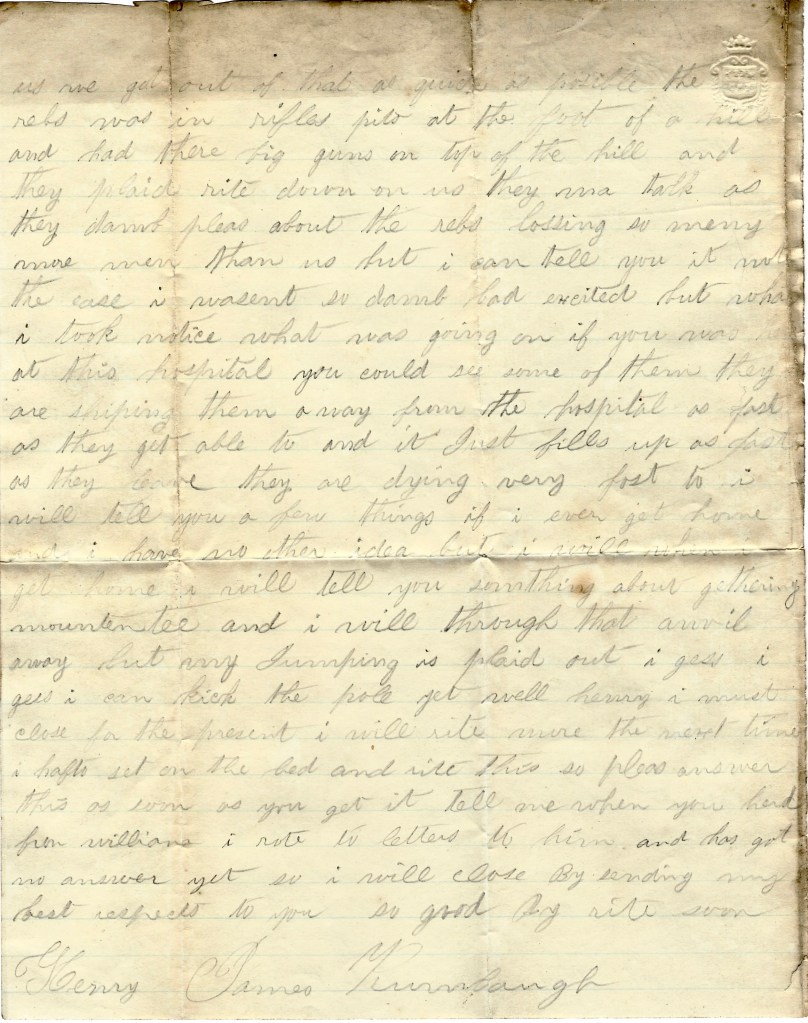
I have good health but on the 7th of last month I got wounded through the left leg just above the knee. It is mending slowly. I am not able to get out yet, I got wounded near Petersburg. They were fighting all day and Friday and our brigade didn’t get into it till Saturday and we went in about 11 o’clock and I got wounded about 3 and our brigade fought till 5 o’clock in the evening and then firing ceased. We tore up about 40 rods of the [Petersburg & Weldon] Railroad. It was a hot time for a while. We had a crick to cross and it was about 6 foot wide and about 5 foot deep. There was about 3 foot of water in it and when we jumped into it, the Rebs opened on us and they just piled the crick full of us. We got out of that as quick as possible. The Rebs was in rifle pits at the foot of a hill and had their big guns on the top of the hill and they played right down on us.
They may talk as they damn please about the Rebs losing so many more men than us but I can tell you it’s not the case. I wasn’t so damn bad excited but what I took notice what was going on. If you was at this hospital, you could see some of them. They are shipping them away from the hospital as fast as they get able to and it just fills up as fast as they leave. They are dying very fast too. I will tell you a few things if I ever get home and I have no other idea but I will.
When I get home, I will tell you something about gathering mountain tea and I will throw that anvil away. But my jumping is played out I guess. I guess I can kick the pole yet. Well, Henry, I must close for the present. I will write more the next time. I have to sit on the bed and write this so please answer this as soon as you get it. Tell me when you heard from William. I wrote two letters to him and have got no answer yet. So I will close by sending my best respects to you.
So goodbye/ Write soon. — James Rumbaugh
Letter 3
Ward 19, Chestnut Hill Hospital Philadelphia, [Pennsylvania] September 11, 1864
I take this opportunity to write a few lines to you to let you know that I have got back in the hospital again. My leg is still sore yet but getting better. I guess I will be around the hospital about a month yet and then I guess I will leave it. I am sorry that I didn’t get down to see you but you know that I couldn’t walk very well and I couldn’t get down. You mustn’t think that I didn’t want to come down there for you know how I would like to gather mountain tea. I guess I can’t tell you who gathers mountain tea when I do till I see her again and then I will tell you. I heard from her yesterday and she says she hasn’t been out on the hill since I left not didn’t intend to go out till I came back. And you needn’t try to get her out.
Well, Henry, I just thought about the draft and that you might be drafted, and I thought I would tell you what to do if you were drafted. If you are drafted, just shoulder up your farm and take a drink for me and start, but write and tell me who all is drafted before you leave.
Well, Henry, I guess I will close for this time, not having much to write but hoping to hear from you soon. So please write as soon as you get this and tell me all the news. Don’t forget. So I will close by sending my best respects to you and I will write more the next time. So goodbye. Write soon. Nothing more at the present. Direct your letter to Ward 19, Chestnut Hill Hospital, Philadelphia. — James Runbaugh
To Henry Dormire
Letter 4
Chestnut Hill Hospital Philadelphia, Penn. January 31, 1865
Dear friend,
I take this opportunity to answer your welcome letter that came to hand this morning and I was truly glad to hear from you to hear that you was well. This leaves me well and I hope that these few lines may find you enjoying the same blessing. I am still in the hospital yet and I don’t know when I will leave this. They have sent a great many away from this hospital in the last week. There is only about 18 hundred in this hospital now and Oh God, how I am waiting to be paid off and then I am going to have a big spree or die on the way and I don’t know. It may be I will take a furlough and come home to see how many of you fellows is drafted.
Well, Henry, I got right up in dust when I heard that Bill McClellan was married. I suppose he didn’t make her say quack, quack like he did the goose but he would hold so tight to her as he did to the heifer, only the tail hold wouldn’t be as long. I expect he felt as big as Old Bob Townsend. I don’t hardly think he felt as big as Old Hunter.
Well, Henry, the next time you get your hands on them again, I want you to do more than that or let them be for you will just put them in the [ ] for somebody else and get them spoilt for they will et someone at them and they won’t know when it is done well after that.
Well, Henry, you must excuse me for this time for I have a pass to go to the City and the train will soon be here and I will have to go on this train or not get going this day. Well, Henry, please excuse me for his time and write soon. Don’t forget to write. I will close by sending y best respects. From your friend, — James Rumbaugh
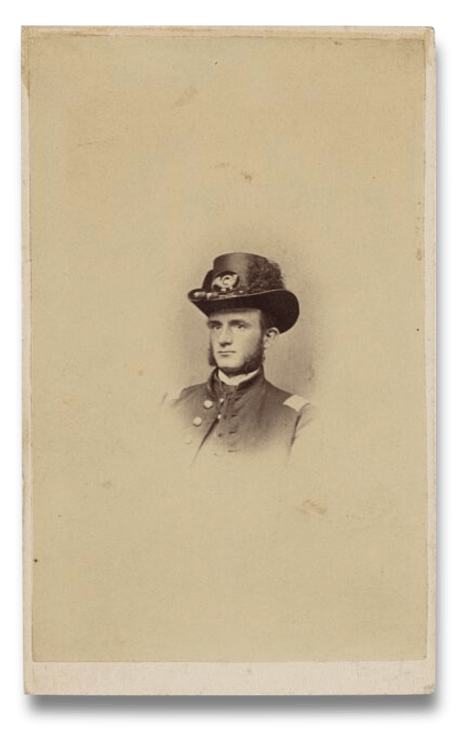
I could not find an image of John Stevens but here is one of John Robert Mills (1826-1885) who served in the same company. He rose through the ranks and was eventually commissioned 2nd Lieutenant.
John D. Stevens (1836-1921) was serving as a private in Co. K, 60th New York State Volunteers when he wrote this letter in mid-March 1862 from Camp Goodrich. He enlisted on 2 October 1861 at Ogdensburgh. In April 1863 he was promoted to Corporal, just before he was taken prisoner at the Battle of Chancellorsville. After he was paroled, he returned to his regiment and was with them until receiving a gun shot wound in his left hand on 19 June 1864 during the Battle of Kennesaw Mountain and sent to a hospital for the remainder of his service.
John was the son of Sylvester Stevens (1812-1898) and Eleanor Downing (1818-1888) of Hermon, Saint Lawrence county, New York.
60th N. Y. Regiment State Vol. Camp Goodrich March 13th 1862
Dear Uncle Henry,
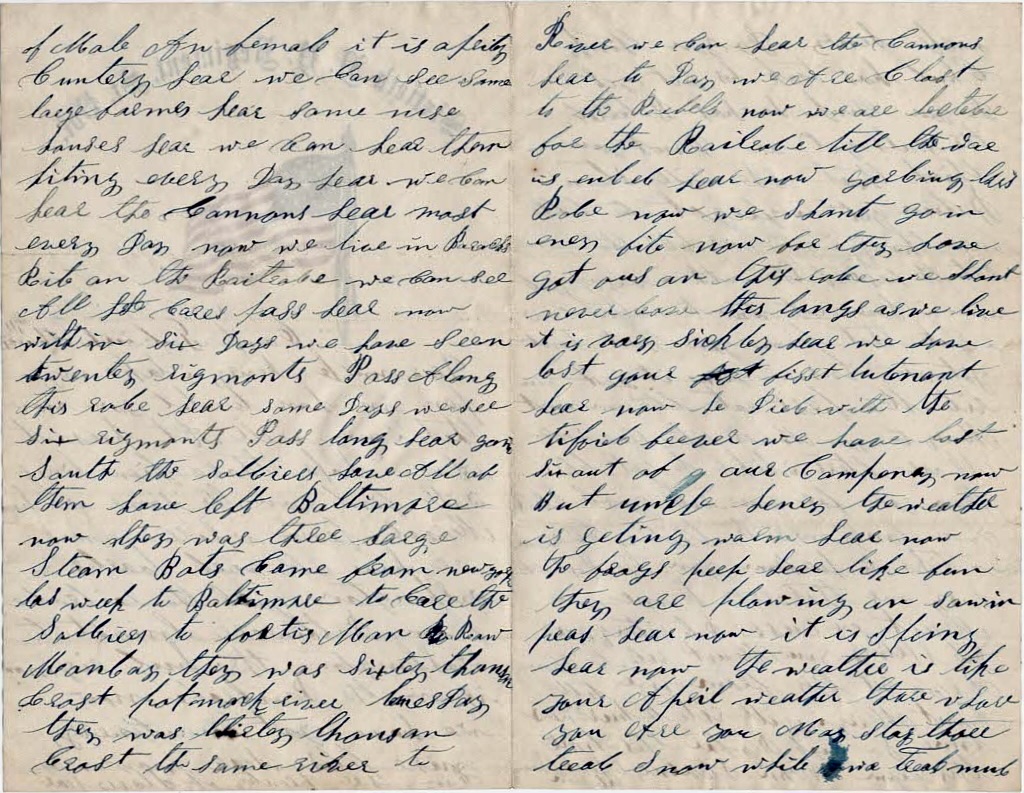
I take my pen in hand to let you know that I am well at present and I hope that these few lines will find you the same. We have moved from where we was. We have moved back to towards Washington. Took the railroad from Baltimore almost to Washington. The whole regiment is on the railroad now. We have got in a very nice place here now. We can see plenty of slaves here of mail and female. It is a pretty country here. We can see some large farms here, some nice houses here. We can hear them fighting every day here. We can hear the cannons here most every day now.
We live in barracks right on the railroad. We can see all the cars pass here now. Within six days we have seen twenty regiments pass along this road here. Some days we see six regiments pass along here going south. The soldiers have all of them have left Baltimore now. There was three large steamboats came from New York last week to Baltimore to carry the soldiers to Fortress Monroe Monday. There was sixty thousand crossed the Potomac since Tuesday. They was eighty thousand crossed the same river.
We can hear the cannons here today. We are close to the Rebels now. We are [ ] guarding this road now [so] we shan’t go in any fight now for they have got us on this road. We shan’t never have the chance as we have live. It is very sickly here. We have lost our 1st Lieutenant here now to die with the typhoid fever. We have lost six out of our company now. But Uncle Henry, the weather is getting warm here now. The frogs peep here like fun. They are plowing and sowing peas here now. It is spring here now. The weather is like your April weather there…
Uncle Henry, do you think Chub has took his [ ] yet. Do you think he has [ ] the walls yet? …I forgot to tell one thing. I got your letter that you wrote the first of the month. It was a good one. I have wrote two to mother since I got that from you but don’t get no answer from it yet. You write me first rate letters. Mary must write the same. I like to get letters from you for you write good letters, and long ones too. That is the reason I like to hear from you the best of any one that writes to me. You must excuse bad writing and bad spelling. You must write to [me] soon as you get this from me. Tell Aunt Mary I will write to her next time. Soodbye for this time. This from John Stevens
Henry Baker (1843-1911), the son of Henry Baker, Sr. (1808-Aft1860) and Anna P. (1814-Aft1860) of Hopewell, Mercer county, New Jersey, wrote the following letter in September 1861 from Wesleyan University—a Methodist affiliated college in Middletown, Connecticut. Shorty after he graduated he 1864, he was ordained a minister of the Methodist Episcopal Church and he remained in the profession for 45 years.
Henry wrote the letter to his cousin, Sarah (“Sallie”) B. Taylor (1840-18xx), the daughter of Samuel Buell Taylor (1809-1870) and Margaret Head (1812-1880) of Upper Makefield, Bucks county, Pennsylvania.
T R A N S C R I P T I O N
Addressed to Miss Sallie B. Taylor, Taylorsville, Bucks county, Penn.
Middletown [Connecticut] Sunday afternoon, September 22, [1861]
Dear Sallie,
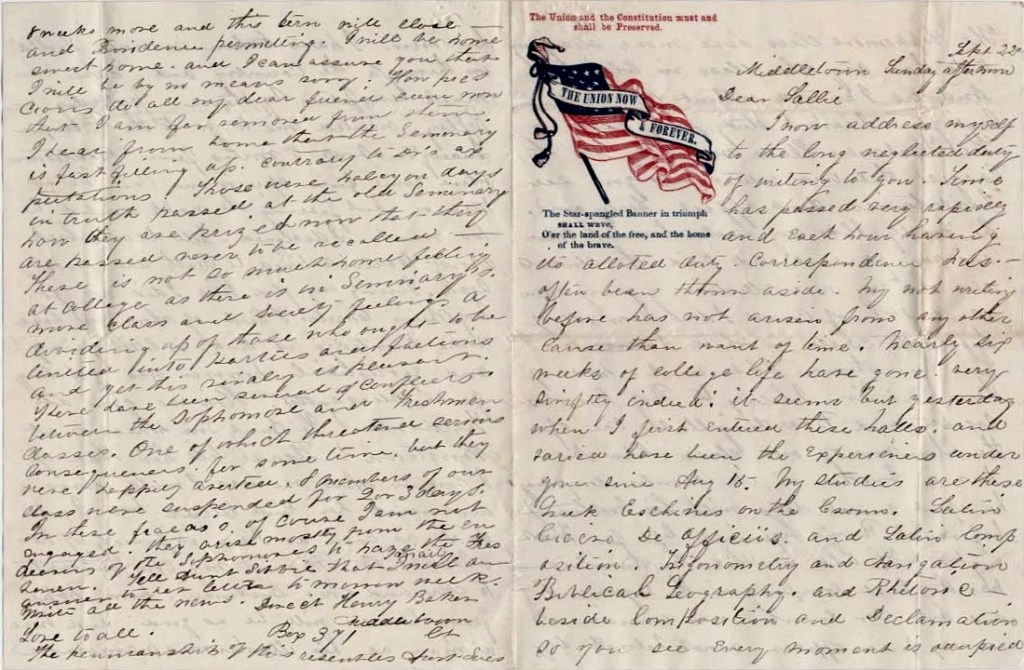
I now address myself to the long neglected duty of writing to you. Time has passed very rapidly and each hour having its allotted duty, correspondence has often been thrown aside, My not writing before has not arisen from any other cause than want of time. Nearly six weeks of college life have gone very swiftly indeed. It seems but yesterday when I first entered these halls and varied have been the experiences undergone since August 15th. My studies are these—Greek Aeschines on the Crown, Latin Cicero De Officiis, and Latin Composition, Trigonometry and Navigation Biblical Geography and Rhetoric, beside Composition and Declamation, so you see every moment is occupied.
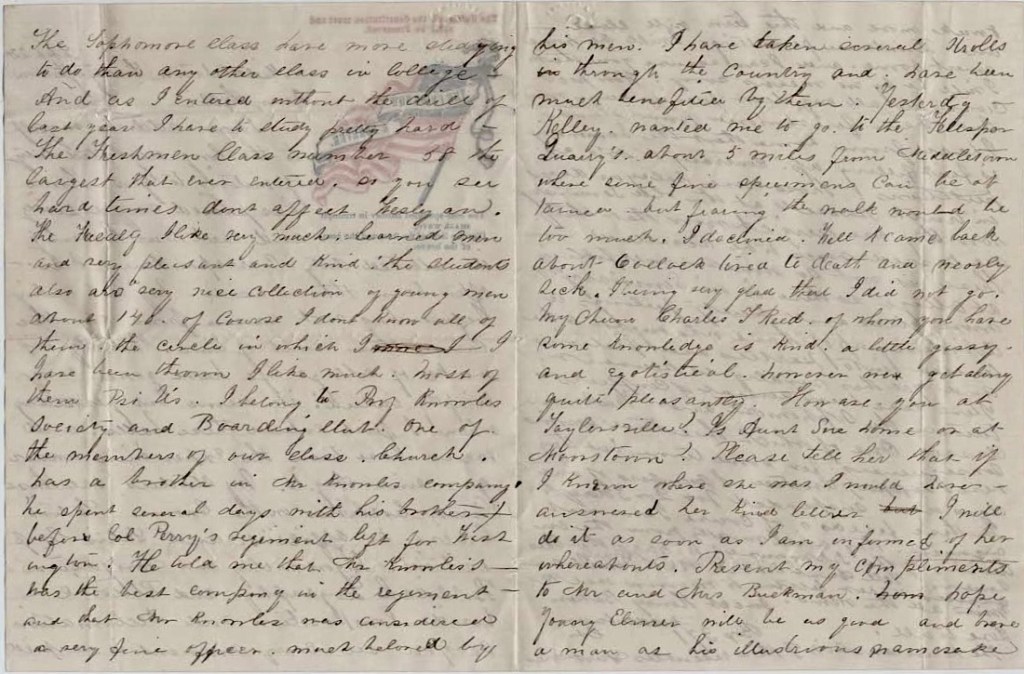
The Sophomore class have more studying to do than any other class in college. And as I entered without the drill of last year, I have to study pretty hard. The Freshman Class number 58, the largest that ever entered. So you see hard times don’t affect Wesleyan.
The faculty I like very much—learned men and very pleasant and kind. The students also are a very nice collection of young men, about 140. Of course I don’t know all of them. The circle in which I have been thrown I like much. Most of the Psi U’s.
Capt. Daniel C. Knowles, Co. D, 48th N. Y. Vols.
I belong to Prof. Knowles Society and Boarding Club. One of the members of our class—[Charles Washburn] Church—has a brother in Mr. [Capt. Daniel C.] Knowles’s Company. He spent several days with his brother before Col. [James H.] Perry’s regiment [48th New York Vols.] left for Washington. He told me that Mr. Knowles’s was the best company in the regiment and that Mr. Knowles was considered a very fine officer, much beloved by his men.
I have taken several strolls through the country and have been much benefited by them. Yesterday, Kelley wanted me to go to the Feldspar [or White Rock] Quarries about five miles from Middletown where some fine specimens can be obtained, but fearing the walk would be too much, I declined. Well, Kelley came back about 6 o’clock tired to death and nearly sick, I being very glad that I did not go.
My chum, Charles T. Reed, of whom you have some knowledge is kind; a little gassy and egotistical however. We get along quite pleasantly. How are you at Taylorsville? Is Aunt Sue home or at Moorstown? Please tell her that if I knew where she was, I would have answered her kind letter. I will do it as soon as I am informed of her whereabouts. Preset my compliments to Mr. and Mrs. Buckman. Hope young Elmer will be as good and half a man as his illustrious namesake.
Eight weeks more and this term will close and Providence permitting, I will be home, sweet home, and I can assure you that I will be by no means sorry. How precious do all my dear friends seem now that I am far removed from them. I hear from home that the [Pennington] Seminary is fast filing up, contrary to Dr.’s expectations. Those were halcyon days in truth passed at the Old Seminary. How they are prized now that they are passed, never to be recalled. There is not so much home feeling at college as there is in Seminaries. More class and society feelings a dividing up of those who ought to be united into parties and factions and yet this rivalry is pleasant. There have been several of conflicts between the Sophomore and Freshman classes, one of which threatened serious consequences for some time, but they were happily averted. Eight members of our class were suspended for two or three days. In these fracas’s of course, I am not engaged. They arise mostly from the endeavors of the Sophomores to haze the Freshmen.
Tell Aunt Sybil that I will answer to her letter tomorrow week. Write all the news. Direct to Henry Baker, Box 371, Middletown, Ct.
Love to all. The penmanship of htis resembles Aunt Sue’s.
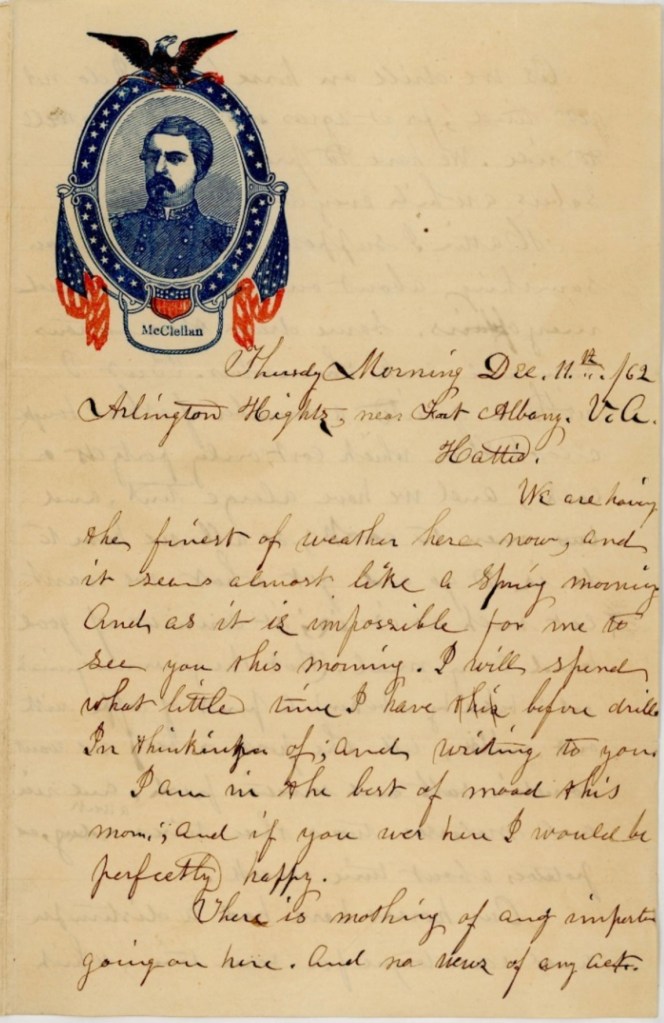
Albert Balcom (1835-1895) wrote this letter in mid-December 1862 from Arlington Heights, Va., while serving in Co. D, 8th New York Cavalry. Albert was from Sherburne (Chenango county) where he was a farmer prior to his enlistment in the fall of 1862. He mustered in on 20 September 1862 and was with the regiment until January 1864 when he was transferred to the 6th Veteran Reserve Corps.
Albert was the son of Francis Balcom (1813-1876) and Dinah Elmina Freeman (1812-1902). He was married to Harriet Amanda Shaw (1841-1896) in November 1861.
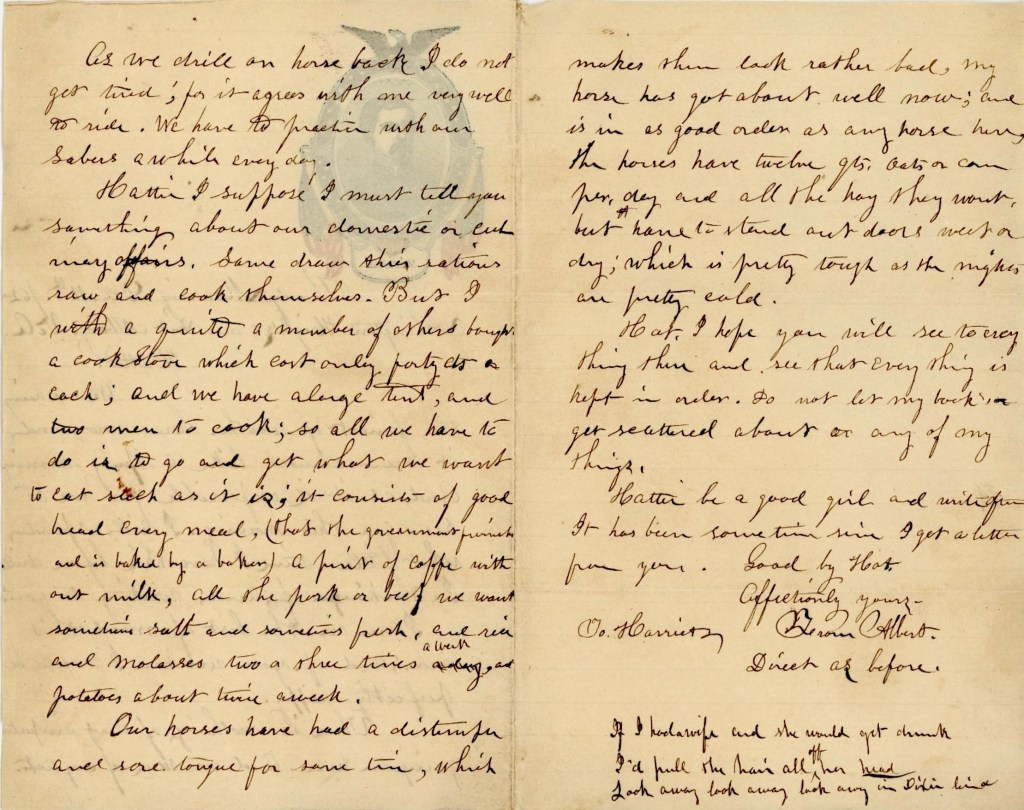
T R A N S C R I P T I O N
Addressed to Mrs. A. Balcom, Sherburne, New York
Thursday morning, December 11th 1862 Arlington Heights near Fort Albany, Va.
Hattie,
We are having the finest of weather here now, and it seems almost like a spring morning. And as it is impossible for me to see you this morning, I will spend what little time I have before drills in thinking of and writing to you. I am in the best of mood this morning and if you were here, I would be perfectly happy.
There is nothing of any importance going on here and no news of any account. As we drill on horseback, I do not get tired for it agrees with me very well to ride. We have to practice with our sabers a while every day.
Hattie, I suppose I must tell you something about our domestic or culinary affairs. Some draw their rations raw and cook themselves. But I with quite a number of others bought a cook stove which cost only 40 cents each and we have a large tent and two men to cook, so all we have to do is to go and get what we want to eat such as it is. It consists of good bread every meal (that the government furnishes and is baked by a baker), a pint of coffee without milk, all the pork or bef we want, sometimes salt[ed] and sometimes fresh, and rice and molasses two or three times a week, and potatoes about twice a week.
Our horses have had a distemper and sore tongue for some time which makes them look rather bad. My horse has got about well now and is in as good order as any horse here. The horses have twelve quarts oats or corn per day and all the hay they want, but have to stand out doors set or dry which is pretty tough as the nights are pretty cold.
Hattie, I hope you will see to everything there and see that everything is kept in order. Do not let my books get scattered about or any of my things. Hattie, be a good girl and write me. It has been some time since I got a letter from you. Goodbye Hat. Affectionately yours, From Albert
Direct as before.
If I had a wife and she would get drunk I’d pull the hair all of her head Look away, look away, look away in Dixie land.
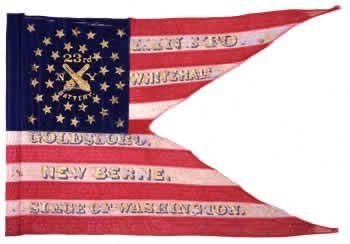
The NYS Battle Flag Collection includes one flag carried by the 23rd Independent Battery, a silk, swallowtail guidon in the “stars and stripes” pattern prescribed in General Order No. 4, dated January 18, 1862. The canton includes 34 gold painted stars in the typical, two-concentric circles, additional star in each corner, pattern.
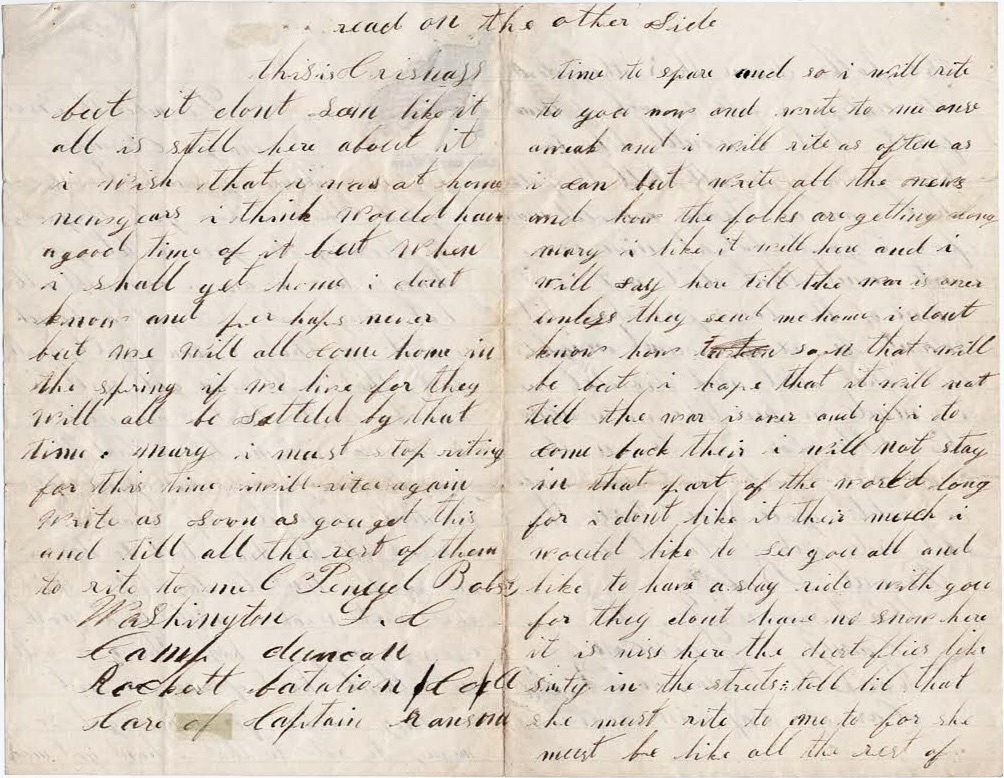
The following letter was written by Penuel Bobst (1839-1873), the son of Michael Bobst (1801-1866) and Elizabeth Wagner (1804-1862) of Pendleton, Niagara county, New York. Penuel enlisted on 7 November 1861 in Battery A, New York Rocket Battalion (later designated 23rd N. Y. Battery). At the time of his enlistment, he was described as a 5′ 9″ tall, brown haired, hazel-eyed single farmer. He began his service as a wagoner but was later reduced to a private and was promoted to corporal about the time of his reenlistment in January 1865. He mustered out of the battery on 14 July 1865 at Buffalo, New York.
The New York Battalion holds the distinction of being the first officially designated rocket unit and was uniquely positioned as the sole such entity within the Union army. Secretary of War Cameron sought the expertise of Thomas William Lion—an English soldier of fortune—to deliberate on the rockets developed by the British General Sir William Congreve in the early 1800s. Consequently, Secretary Cameron sanctioned the establishment of a “Rocket Battalion,” appointing Lion as its commander. The operational specifics were delegated to Brigadier General William Farquhar Barry, the newly appointed Chief of Artillery of the Army of the Potomac. The unit was aptly named “General Barry’s Battalion.” Both the rockets and the 160 soldiers recruited from upstate New York were untested, embodying a pioneering spirit. The first company consisted of Captain Alfred Ransom’s Battery from Niagara County, which would later be identified as the 23rd Independent Battery, New York Light Artillery.
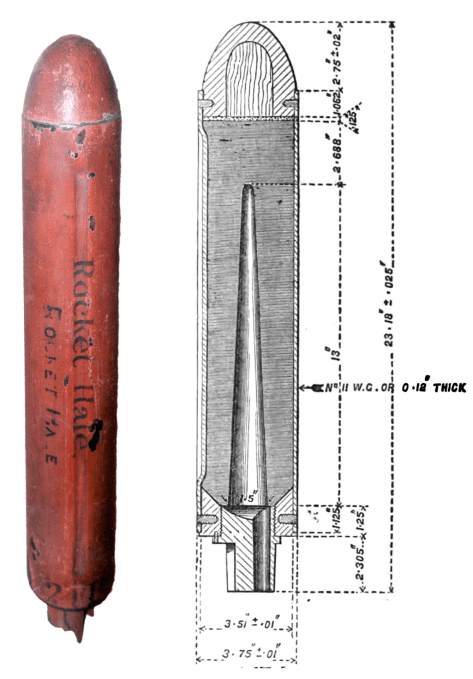
William Hale’s rotary rocket (Smithsonian Institution)
The New York Rocket Battalion departed from Albany, N.Y., arriving in Washington, D.C., on December 10, 1861. The unit was stationed at Camp Duncan, situated approximately a mile east of the unfinished Capitol, on the sodden terrain allocated for General Barry’s artillery. On New Year’s Day, 1862, Camp Duncan was officially renamed Camp Congreve. Major Lion was equipped with rockets engineered by the British civil engineer William Hale. These rockets varied in length from 12 to 20 inches, with diameters ranging from 2.25 to 3 inches. The launchers consisted of wrought iron tubes, measuring 8 feet in length and supported by tripods. They also tried firing using eight breechloading cannon designed to fire Hale rockets.
Testing revealed that Major Lion’s rockets were impractical for military use, however, so at New Berne, N.C., General Jesse Reno ultimately dismissed Major Lion and the “Rocket Battalion” was thereafter assigned 3-inch rifled Rodman steel guns. The Battalion fought valiantly with its artillery, particularly during engagements in North Carolina. It retained the designation “New York Rocket Battalion” until February 11, 1863, when Special Order No. 81 from Albany officially redefined the unit as the 23rd and 24th Independent Batteries of Light Artillery, New York Volunteers. It remained for future conflicts to enhance the development of rockets and launchers. (See: A brief history of Rocketry—Early Rockets to Goddard]
[Note: His given name is sometimes spelled Pennel in records.]
T R A N S C R I P T I O N
December 25, 1861 Merry Christmas
Dear Friends,
I am glad that I have got the privilege of writing to you to let you know how I am. I am well—all but my right [foot] has got a blister on it so that I can hardly walk but that will soon get well, I think. Besides that, I as well as I ever was in my life. I think that I will have to have it opened if it don’t break itself. I have been around all the time till today. I am in the tent today. but I think that next week I will be at work again. Mary, I hope that you will not think hard of me for not writing sooner for I have got so many to write to that I hant got much time to spare and so I will write to you now and [if you] will write to me once a week, I will write to you as often as I can. But write all the news and how the folks are getting along.
Mary, I like it well here and I will stay here till the war is over unless they send me home. I don’t know how soon that will be but I hope that it will not [be] till the war is over. And if I do come back there, I will not stay in that part of the world long ffor I don’t like it there much. I would like to see you all and like to have a sleigh ride with you for they don’t have no snow here, It is nice here [but] the dust flies like sixty in the streets.
Tell Lil that she must write to me for she must be like all the rest of the folks down there, They don’t write unless I write to each of them first. But I would like to hear from you all. Tell the folks that I am as steady [as] an old man for I go to bed at nine every night and that did not suit some of the boys for they did want to run around nights but that did not trouble me. I made a mistake in writing this letter for I wrote on the wrong side but that son’t make no odds. You must tear turn the best side out.
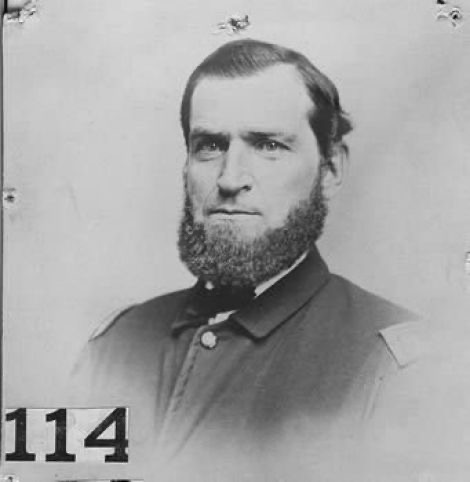
Capt. Alfred Ransom
Direct to Penuel Bobst, Washington D. C., Camp Duncan, Rockett Battalion, Co. A, care of Captain [Alfred] Ransom
This is Christmas but it don’t seem like it. All is still here about. I wish that I was at home New Years. I think I would have a good time of it. But when I shall get home, I don’t know and perhaps never. But we will all come home in the spring if we live for they will all be settled by that time.
Mary, I must stop writing for this time. I will write again. Write as soon as you get this and tell all the rest of them to write to me. C. Penuel Bobst, Washington D. C., Camp Duncan, Rocket Battalion Co. A, Care of Captain Ransom
The following letter was written by Percival C. Bishop (1842-1921) who was 21 when he enlisted on 27 September 1864 in Co. I, 175th Ohio Infantry. He mustered out of the service at Columbia, Tennessee, on 19 June 1865. The regiment was organized for one year’s service on October 11, 1864, under Colonel Daniel W. McCoy. It proceeded at once to Nashville. During Hood’s invasion it performed garrison duty at Columbia, Tennessee. One of the Regiment’s outposts was captured, after strong resistance, by Hood’s troops. At Franklin the regiment was positioned near the Carter Cotton Gin and when the Confederate line broke through, they were ordered to counterattack with a bayonet charge, driving the Patrick Cleyburne’s Division before it. They played a more significant role in winning the battle than they were given credit for. Its loss in this engagement was 161. It occupied Fort Negley during the battle of Nashville, and afterwards guarded the Railroad near Columbia. The Regiment was finally mustered out July 13, 1865.
Percival was the son of Reuben Bishop (1810-1875) and Mary Cooper (1815-1895) of Perry, Wood county, Ohio.
See video for good sketch of the 175th Ohio at the Battle of Franklin. See letter by Joseph Tuttle Garner of Co. A, 175th Ohio for a description of the Battle of Franklin.
T R A N S C R I P T I O N
Post Hospital Columbia, Tennessee March 24, 1865
Dear Cousin,
It is with becoming reverence that I seat myself to try to answer your much beloved letter which I received a few days ago and was pleased to know that you were well and all the rest well. I am not very well yet. I have had the bilious fever since I wrote to you before but am pretty near well again now. This is the reason I have not written to you before, because I was not able to answer it sooner.
Well Amanda, I hope when this reaches you, it will find you and all the rest well and enjoying yourselves. Well Amanda, you spoke of a soldier’s life as being a hard one. Well, I tell you, it is, that is so. Since I left home I have seen a good deal—some pretty hard times and some very good ones too. Our regiment has always been so fortunate as to be stationed at one place—only while Old Hood run us back to Nashville. So you can see that we have never had no hard marching to do. We have never been engaged in but one battle and that was at Franklin and it was a very hard one. Our regiment lost 150 men killed and wounded.
Well, Amanda, as for a soldier’s life, I like it very well while I am well. But when one gets sick, then it is hard. I am on detached duty now here in the hospital and expect to stay here as long as our regiment does stay at this place which I suppose will be until our time expires. I have a very good place to stay here and a plenty to eat and am enjoying myself very well as soldiers will.
I suppose you are a having good times now a making sugar. Well I hope you may. I should like to be there to eat some of the sugar but I can not now and if nothing happens, I will come and see you all when my time is out.
Well, I must close for his time. Give my love to all of your folks and take a share for yourself. Tell Seymour I will write to him soon. So goodbye. Write soon. From your cousin, — P. C. Bishop
To Miss Amanda Aldrich
Dear Aunt,
It is with the greatest of pleasure that I seat myself to answer your kind letter which I received the other day and it found me sick with the bilious fever. But I am now almost well again. Well Aunt, I hope when this reaches you it will find you well and enjoying yourself. Well, as for a soldier, I am enjoying myself very well now. It is very pleasant weather down here now and I hain’t much to do and have a plenty to eat and a good place to stay.
Well Aunt, you must take all the comfort you can and when this cruel war is over and I get home, I shall come and see you all and if I don’t get to come, I will try and live so that we can meet in heaven above. Well, I must close for this time. So goodbye. Write soon. From your nephew, — P. C. Bishop to Aunt Cynthia Aldrich
Direct to Percival C. Bishop, Co. I, 175th OVV, in care of [Capt.] Abram Houghland


















 Spared & Shared 23