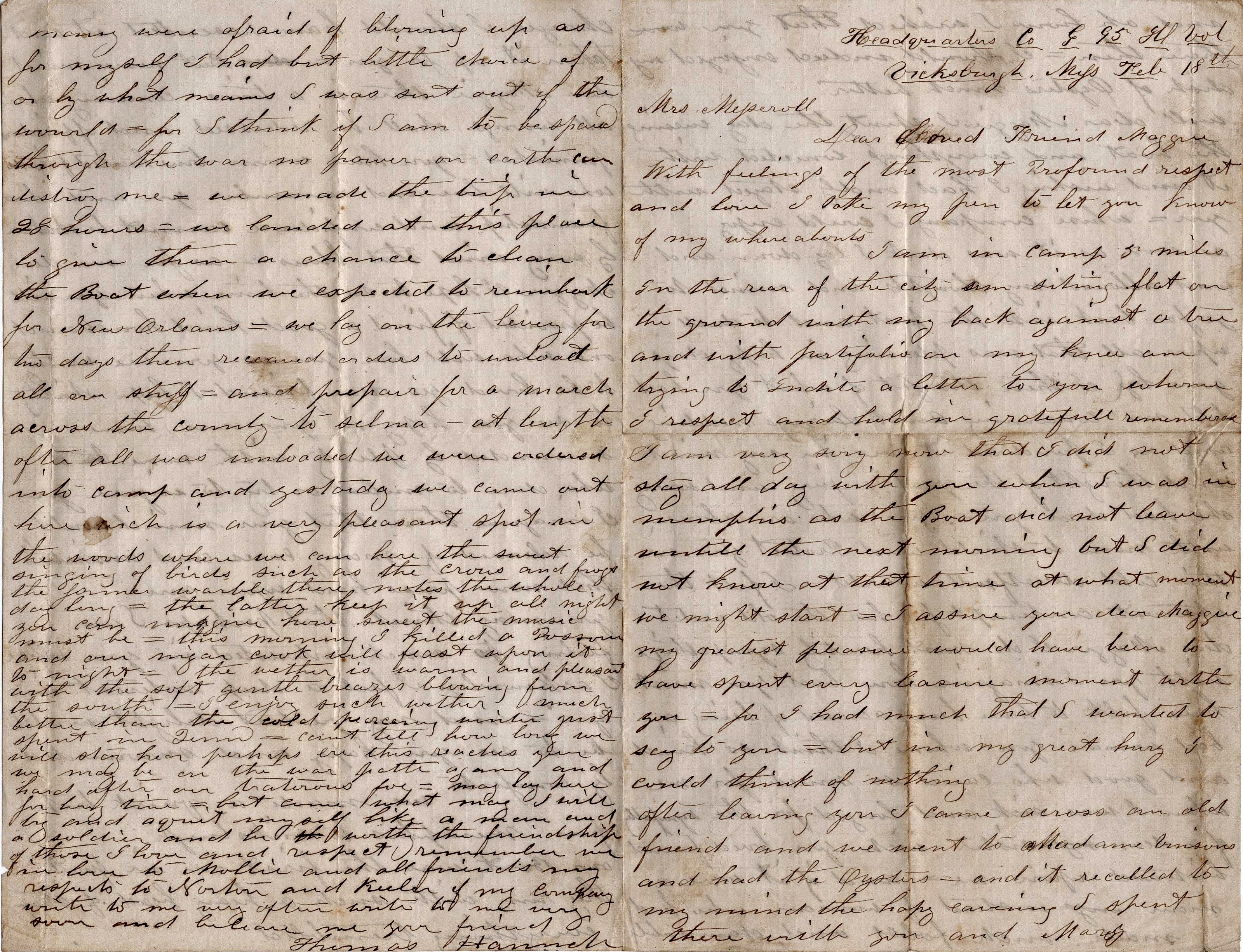
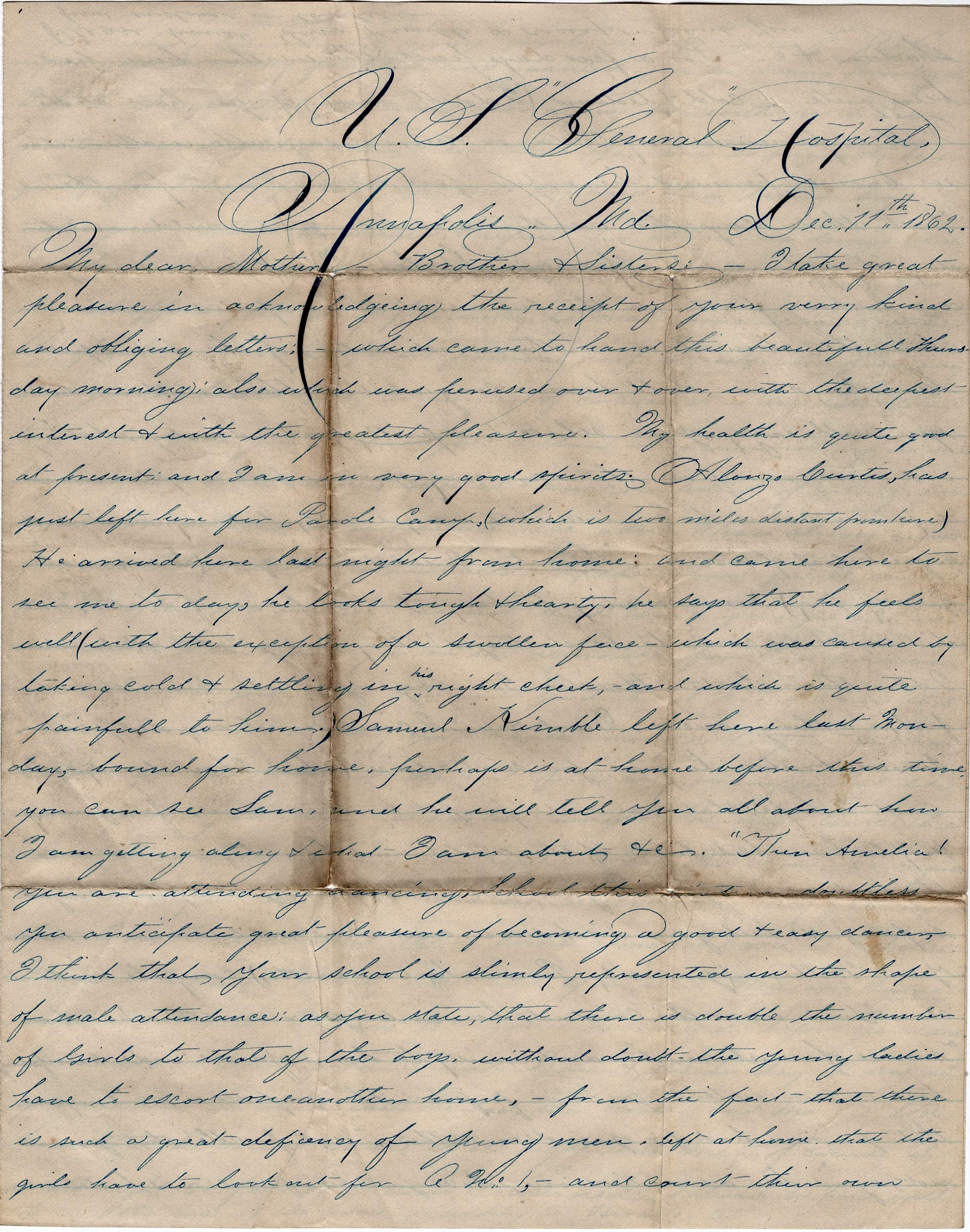
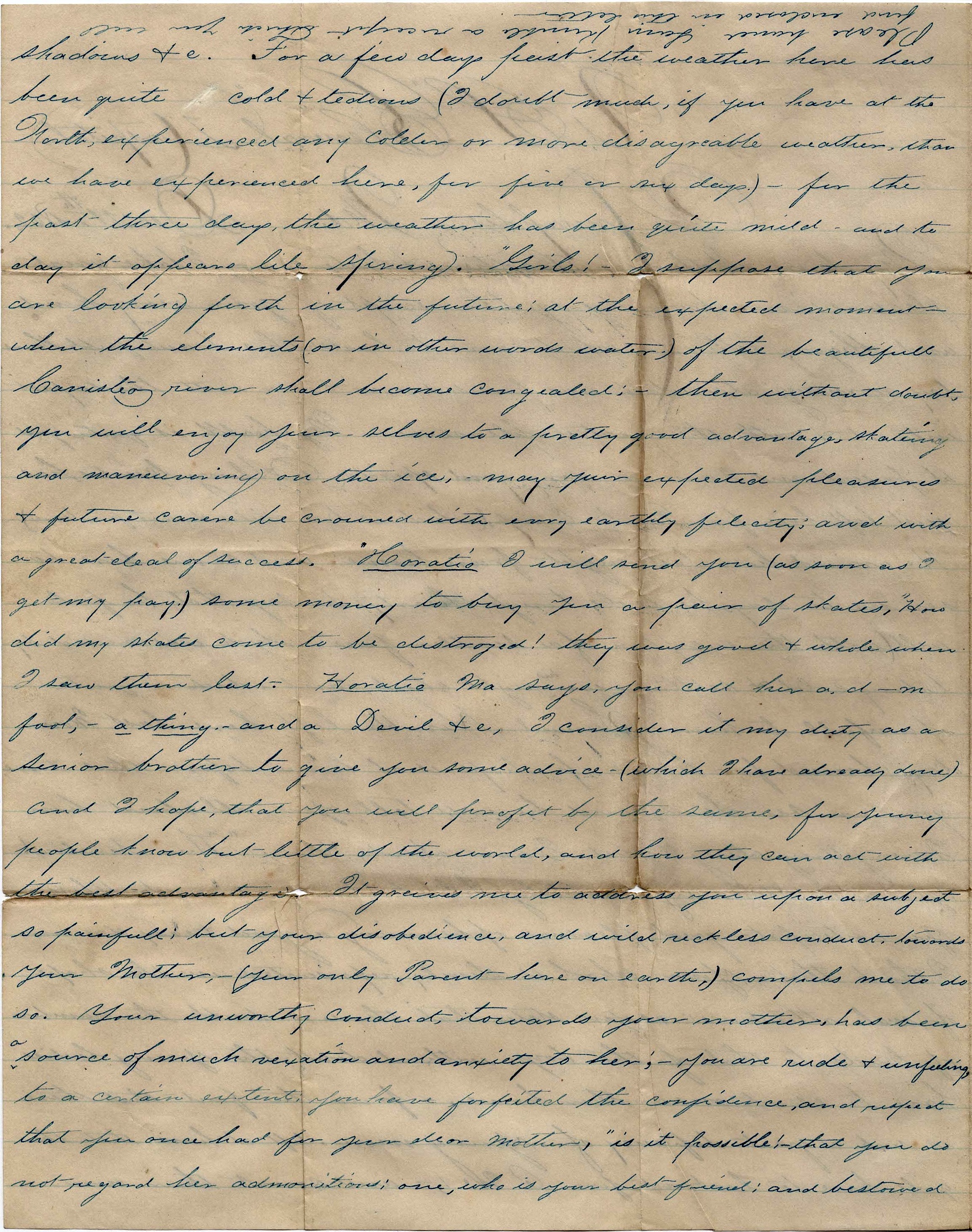
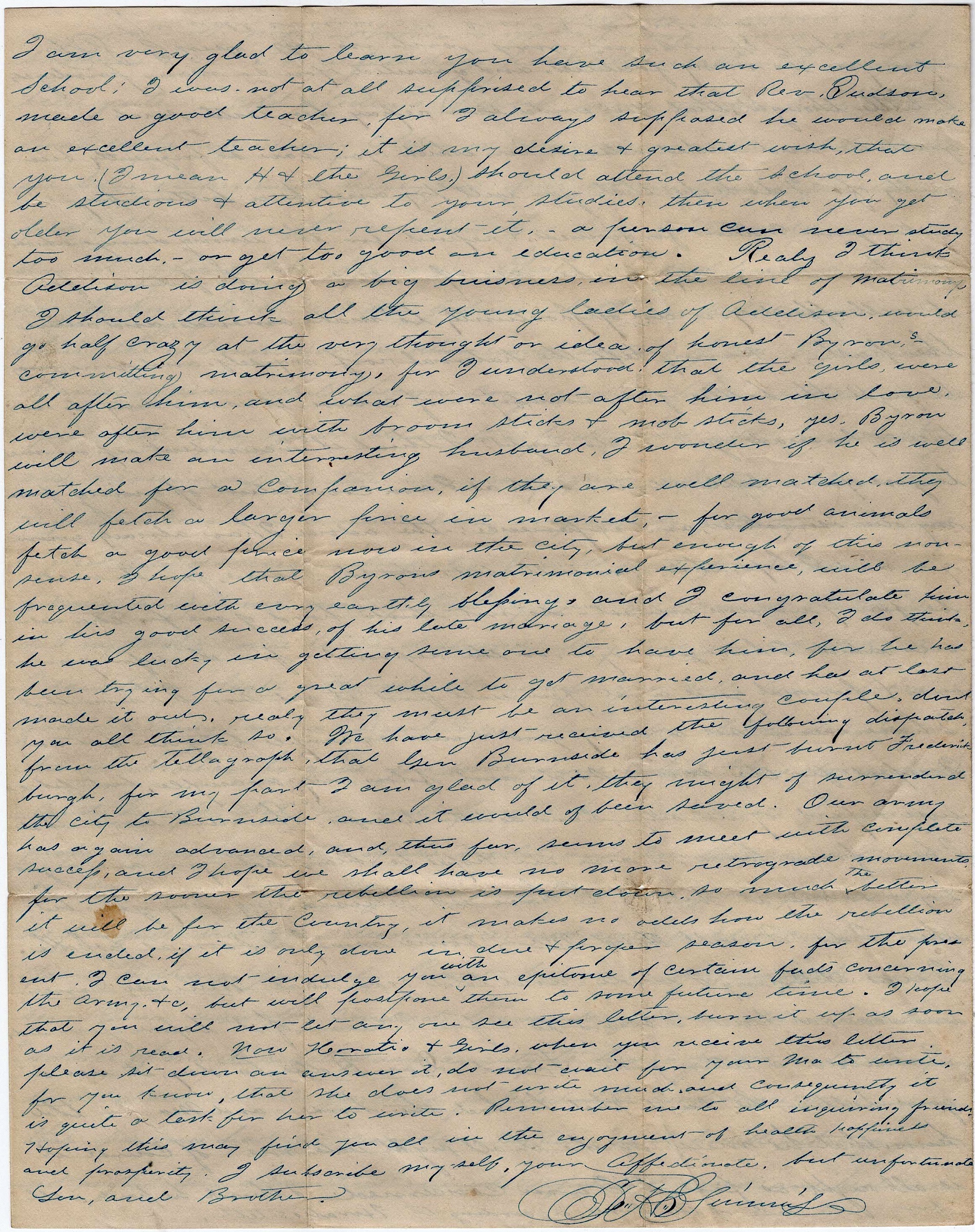
The following letter was written by Daniel Crist Kitchel (1842-1928), the son of Daniel Kitchel (1795-1855) and Eliza Crist of Liberty, Union county, Indiana. At the time of the 1860 US Census, Daniel was living with and working as a farm hand for Enoch Coddington in Brownsville, Union county.
According to muster rolls, Daniel enlisted in Co. C, 8th Indiana Infantry in September 1861 and mustered out three years later at Indianapolis. He signed this letter as a sergeant but the date of his promotion isn’t recorded.
Daniel married Mary Ellen Babb (1845-1915) in 1869. When 86 year-old Daniel died in 1928, he had 39 grandchildren and 6 great-grandchildren.
T R A N S C R I P T I O N
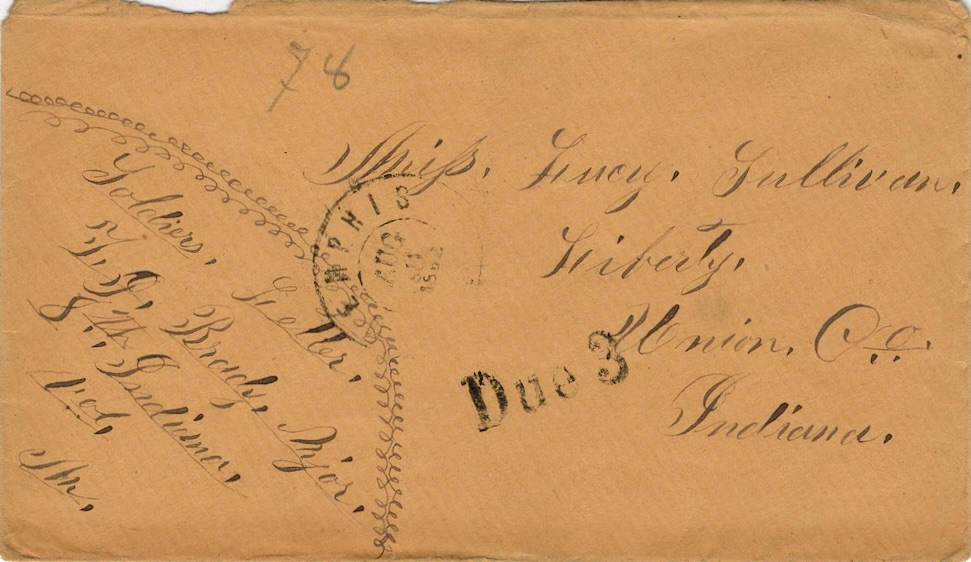
Addressed to Miss Lucy Sullivan, Liberty, Union County, Indiana
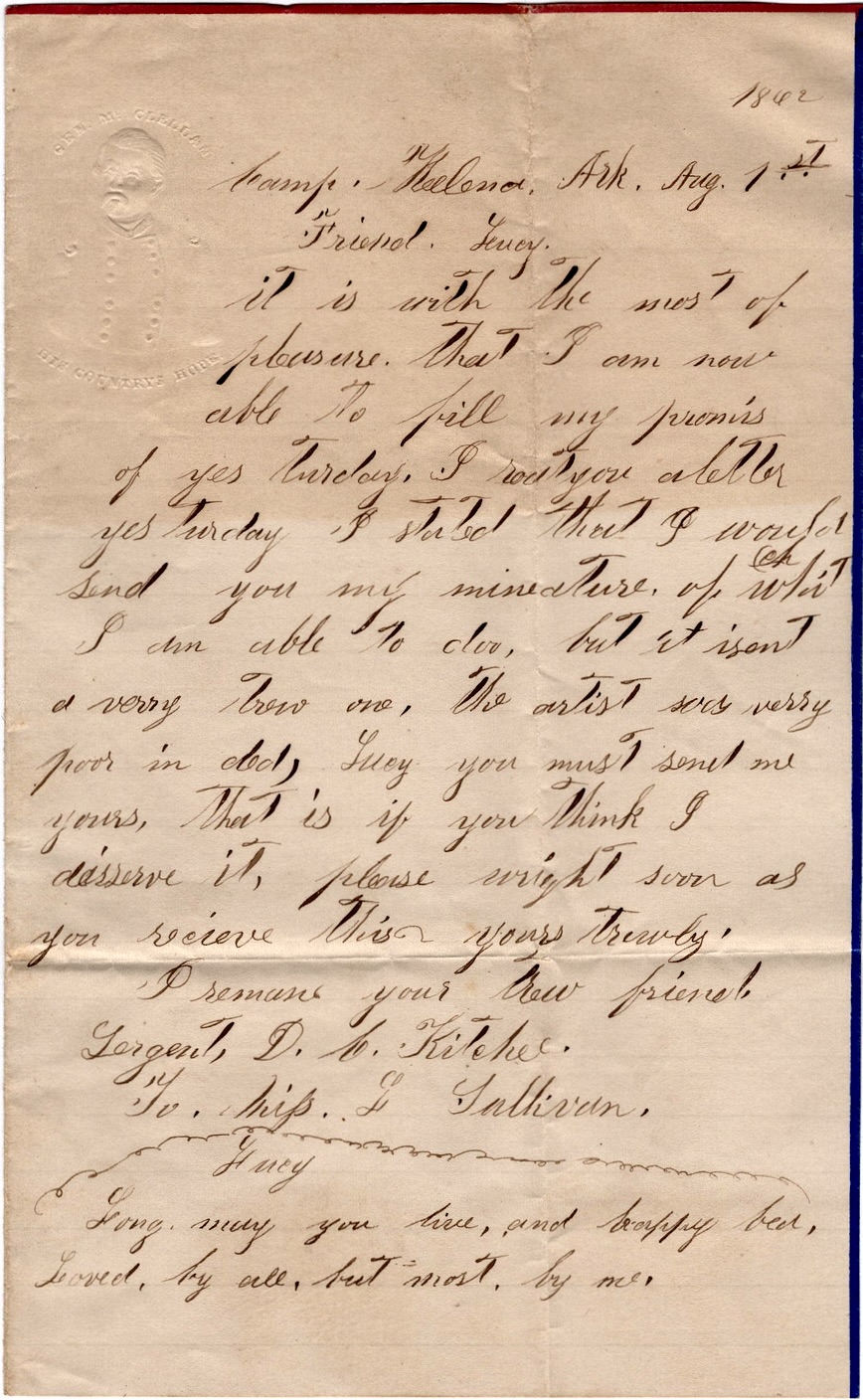
Camp Helena, Arkansas August 1, 1862
Friend Lucy,
It is with the most of pleasure that I am now able to fill my promise of yesterday. I wrote you a letter yesterday [and] I stated that I would send you my miniature of which I am able to do but it isn’t a very true one. The artist was very poor indeed. Lucy you must send me yours—that is, if you think I deserve it. Please write soon as you receive this. Yours truly, I remain your new friend, Sergeant D. C. Kirchel
To Miss L. Sullivan
Lucy, long may you live and happy, beloved by all, by most by me.
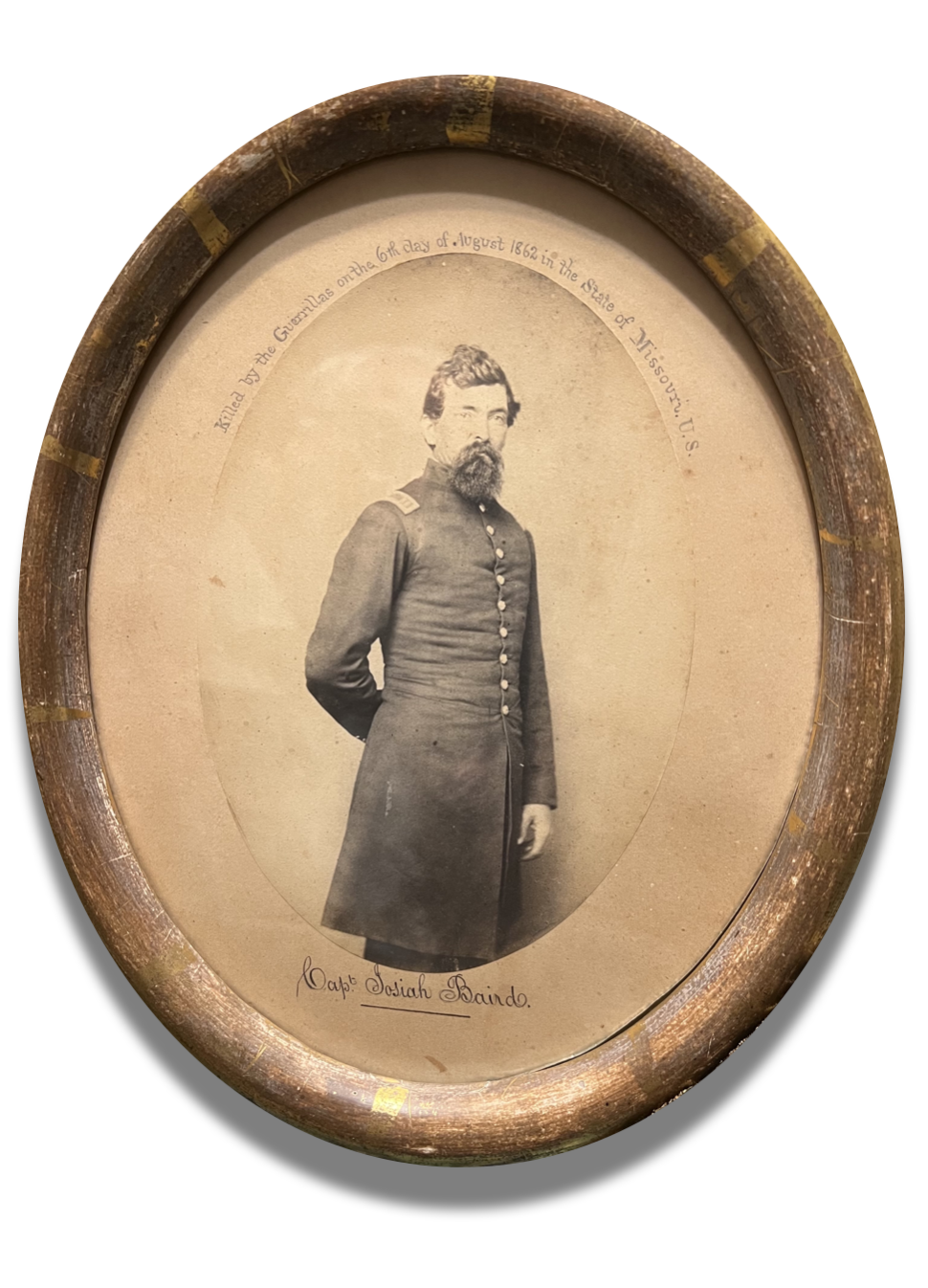
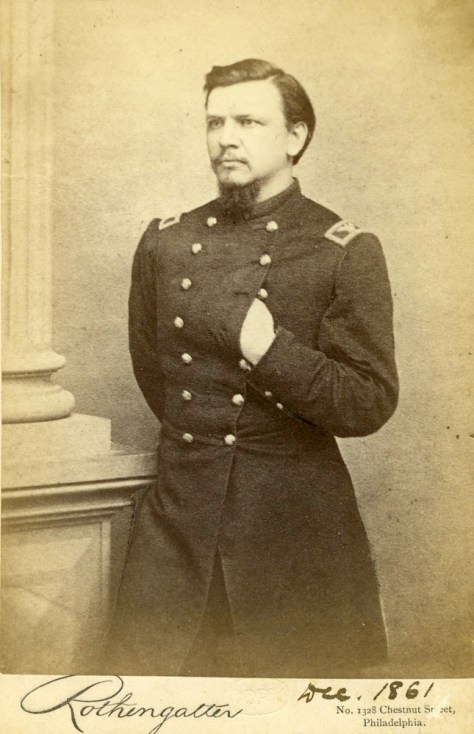
Capt. Josiah Baird, Co. D, 2nd Missouri Cavalry or “Merrill’s Horse” (Courtesy of John Baird)
Recently I was sent transcripts of Civil War letters written by Capt. Josiah Baird, Co. D, Merrill’s Horse, St. Louis, MO. These transcripts were made from the original letters about 1960 by Grace Baird—a Baird family descendant—and passed on to me by John Baird, Grace’s grandson. Earlier this year, John had sent me letters written by a younger brother of Josiah’s named Robert Baird who served in Co. H, 49th Pennsylvania Infantry [See—1862: Robert Baird to his Family]. He also sent me a letter by another brother named Henry Baird, who died in the H. L. Hunley submarine accident [See—1861: Henry Baird to William Baird]. Most of Josiah’s letters were written to a fourth brother named John Baird.
In the previously published Baird family letters on Spared & Shared, I was provided with scanned copies of the original documents to verify the accuracy of Grace Baird’s transcriptions completed 65 years ago. Regrettably, the whereabouts of Josiah’s original letters remains elusive to the descendants of the Baird family except for the one dated 28 December 1861. Nonetheless, I have chosen to publish these transcriptions for several reasons. Firstly, having examined Grace’s transcriptions of other family letters, I can confidently vouch for her expertise in this undertaking, giving me little cause to question the accuracy of her work. Secondly, there exists a considerable community of Civil War enthusiasts who have a keen interest in the Merrill Horse Regiment; Josiah’s letters from the war are substantiated and enriched by transcriptions of pre-war correspondence, which offer valuable insights into the challenges faced in Missouri prior to the conflict.
Background
Josiah Baird was the 10th child (8th son) and 7th living son of William and Nancy Harlison Baird. Josiah was born in the old family home near Pleasant Gap, Centre Co. Pa, on Aug 3, 1826. The family farm has since become a Pennsylvania State fish hatchery. Josiah grew up with his brothers and one sister—William being 20 years old when Josiah was born—John 18, James 15, Eliza 14, Samuel 11, Robinson 7 and Henry 2.
The first we hear about Josiah is when he was 20 years old, from a letter dated May 2, 1846 and written by a David B. Larimore, New Wilmington, Mercer Co. Pa. to John and Hannah Baird. The salutation was “Dear Cousins” but to date the relationship has not been determined. His mother was Eliza Baird and father David Larimer or Larimore, but even Margaret Ellen Baird McClelland did not know the connection, for in her notes she wrote, “Who was Eliza Baird.” In this letter he say he is “anxious to hear how Samuel is and whether he had got able to work or not. How are you getting along with your barn building and if Josiah went to a trade. Also how is William getting along building his house.”
Josiah evidently took up the trade of carpentry and cabinet making for several years later we hear he had a little cabinet shop on the property where he and his family lived in Clearfield, County seat of Clearfield Co. Pa.
On Dec 29, 1852, Josiah was united in marriage to Mary Fetterman Merrill, daughter of Wm. Merrill, Esq. by Alex McLeod, rector of St. Andrews Church, Clearfield. He was 26 and she was 15. She was born May 11, 1837.
The 1st letter we have from him was dated July 1853, Clearfield, and written to his brother John at Bellefonte in which he states they are all well and that he was very busy. He wants Hannah to save some butter and lard for him for he said, “It is impossible to get butter here without going 20 miles for it and paying twenty cents a pound and lard is not to be had here at all. Times is pretty hard here now. The money matter is suspended till Spring. Give my respects to Father and Mother and all the friends. Mary joins in sending her love to you & Hannah, Father & Mother, your brother, — Josiah Baird.”
Josiah’s next letter was dated, Clearfield, Sept 26, 1855. “Dear Brother, I take the pleasant opportunity in answering your letter which I received this evening. It was better than 2 weeks on the road. I was very sorry to hear of Mother’s illness, but I hope these few lines may find her much better. [She died Sept 23, 1855]. If I had got your letter last week I would have gone over. I will wait until I hear from you. You must write as soon as you get this letter and let me know if Mother is getting well and if Henrietta has a bad turn. The dystantery [dysentery] is very bad in Clearfield. There has been more deaths in Clearfield this season than there has been for many years. We are all well at present. William Henry is pretty well again. He had a very hard turn of dystantery. Mary joins in sending our love to all of you. I remain yours, — Josiah Baird. P. S. If Mother gets worse you must let me know and I will come over to see her.
Josiah’s next letter to John was written on September 3, 1857 at Clearfield, Pa. and refers to the hard times caused by the Financial Panic of 1857. “I take the opportunity of writing to you to let you know that we are all well at present in Clearfield. I have not heard from home for some time. I believe I wrote last. I received a letter from Henry last week [this is the Henry Baird who died in the H. L. Hundley submarine accident in Charleston Harbor, October 15, 1863]. They were all well in Mobile. He says times are very dull in Mobile this summer but he says the prospects for the winter season is better. We have trying times in Clearfield. At the present time, it is feared that our lumbermen will all fail. There was four of the merchants went to Philadelphia last week for money and returned without it. They say they can’t pay a dollar. The most of the money that is in Clearfield is New York money and the news came last night that they had all failed or suspended. If that is the case, it is still worse for Clearfield than the failing of the Pennsylvania banks. I don’t know how it is going to terminate. There must be a change soon or else there is going to be trying times here soon…I expect to come home some time this fall or winter. I will finish my work in about 2 months. I am preparing to go West in the Spring if times will admit. Mary joins in sending love to Father & Hannah, yourself and the rest of the friends. Wm Henry is growing to be quite a large boy. We can send him to the stores & shops on errands. Nothing more at present but remain your affectionate brother, — Josiah Baird.”
On May 11, 1858, Josiah wrote a letter to his father from Clearfield, Pa. It reads in part: “I take up my pen to inform you how I am getting along in the getting ready to go West. Times is a great deal harder than I thought or when I was to see you last. I have fell short considerably of what I expected to go West with. I have tried to get money on a loan. I offered 15% but could not raise it. If you could raise me $50 for 3 or 4 months, I would be willing to pay 10% rather than not get it. I have a lien that I can half collect in 4 months which I could raise the money for you in that time. I have rented my house and has taken no work so I am obliged to do something. I can’t afford to pay board and do nothing. There is no work to be had now. Had I known this 2 months ago I might have had some jobs. We are all well. Mary joins in sending her love to you, John & Hannah. Nothing more but remains. Your affectionate son, Josiah Baird”
Sometime in the summer of 1858, Josiah again addressed his father in a letter datelined from Chillicothe, Livingston county, Missouri: “I take the present opportunity of informing you of my whereabouts and my prospects. I am enjoying good health at present and I hope these few lines find you all enjoying the same blessing. I have been very sick since I left home. When I was in Iowa, I had an attack of fever but a very light turn. I was amongst strangers but not without friends. Had it not been for the Odd Fellows, I expect I would have had a very hard time of it. They moved me from the Hotel to a private house and nursed me well. It cost me but three dollars. Since I got well, I feel better than I have for a year. I have gained 10 lbs in 2 weeks. I have been to work in this place for 2 weeks. I commenced working for $1.75 per day. I am now making $2.00. I am paying $2.50 per week board. I have taken two jobs—a church and a storeroom. I will commence them in two weeks if I have luck and not disappointed in hands. I will clear $500 on them. I am getting double the amount for the church that I could in Penn. and can hire hands as cheap here as I could there and board is not any higher here than in Clearfield.
Chillocothe is a very pretty place. It is situated on the Hannibal & St Joseph railroad and in a good farming country but not very well farmed. The city stands on a high rolling prairie and not over one half mile from timber. In fact, the timber comes to the edge of the city. Lots can be bought from $125.00 up to $300 & $500. There is a hotel going up 100 x 175, four stories high. If I had been here sooner I would have had the job and may get the managing of it yet. The man that is doing it is working by the day & is no mechanic. Land is rising very fast in this section of the state. There are a great many Eastern men coming here. Land joining the city is worth from $25 to $50 per acre. Three or four miles it can be bought from $12 to $15 according to location. There is some as pretty land in this country as ever I saw. I passed over some prairie coming to this place that can’t be beat in any state that can be bought for $6 per acre within 3 miles of the railroad and within 10 miles of this city. I think a man could do well in this country to going to the cultivating of fruit. The farmers have been very dilatory in the way of raising fruit. I have seen but one or two orchards.
I must give you a history of my travels from Bloomington to this place. I gave it in Wm’s letter to that place. When I left Bloomington, Macon Co, Mo., there were 9 of us. The road was so bad we were afraid to ride in the stage so we hired an ox team. An ox team in this country is from three to six yoke. We had three. Well, there was five ladies in the party and three men besides myself, and there was not any of the party that had ever seen many hardships. They had all been raised in the city—Cincinnati. We got along very well the first six miles then we came to the Chariton River. Were ferried over. The Ferryman told us that we would have to hire a pilot to take us across the bottom. We gave a man $2 to ride before the oxen. We got about one mile when the oxen stalled. Then we had two miles to go. There was no other but get out and wade for it. I got out in water up to the waist. The balance of the men got out and we tried to make the oxen pull the ladies, but they could not do it so three of them got out & waded 2 miles in water to the waist. I began to think traveling in the West was pretty hard. After we got over that place, we had four other creeks to cross at which I had to make a raft to take the ladies across and swim the team. We sent the oxen back and got a horse team at Linneus, the count seat of Linn Co. We were five days coming sixty miles. Part of the road was very good and we came over some very nice country but along the streams it is hard country. Probably you have heard a great deal about the people of Missouri and the border ruffins. I see nothing wrong with the people as far as I have travelled in this state. Never hear Kansas mentioned. I have never been asked my politics since I came here. I still remain your affectionate son, — Josiah Baird.”
As Civil War loomed, Josiah struck up a more frequent correspondence with his brother John. Writing from Chillicothe, Missouri on 4 February 1861, Josiah wrote: “Times are very hard in this country at present and no prospect of getting better soon. Provisions are cheap but no money to buy them with. Money is worth from 4 to 5 per cent a month. If the National difficulties is not settled soon, I don’t know what will become of us in this portion of Missouri. Almost all the people here have got all their means invested in lands & they can’t turn it into money now. There is a great many leaving. Some going north & some going south—more going south than north. There is a great many want to go if they had the means to go with. We have an election in this state on the 18th of this month to elect delegates to a state convention to decide whether we will go with the balance of the southern states. We have some seceders in this state but there is a large majority in favor of the Union. We are going to see hard times unless there is a union of all the states. I have been idle for 3 months and it is hard to tell how much longer it will be. There is nothing doing nor won’t be till this difficulty is settled. If I could sell, I would leave the border for awhile.”
Then, two weeks later, 20 February 1861, Josiah wrote his brother again: “We are having very exciting times in this state at present, and I don’t think theworst has come yet. We had an election last Monday to elect delegates to a state convention. There is 3 from each sectional district. The district we are in has elected Union candidates by 2000 majority. The seceders are very much down in the mouth (the old snake killers as they are called000that means the old settlers). The Union men are not in favor of going out of the Union until all constitutional remedies are exhausted. The secession candidates are for immediate secession. The old citizens brand every Eastern man as an Abolitionist—it don’t matter what his political views are. I have seen some hard fights over it and came very near it myself. I was attacked on the day of the election by some three or four cutthroats, but when they saw I would not run, they drew their revolvers but was a little too drunk to use them. I happened to be armed with a colt revolver and a ten-inch bone knife. When they saw me draw my weapons they ran. I was very glad I got clear of using them. My opinion is Missouri will stay in the Union if all the balance go out, although there will be some hot times and a great many lives lost.”
On 20 May 1861, Josiah wrote to John: “No doubt you have heard there has been a fight in this state at St Louis between the United States troops and the State Militia or I might say the Missouri Secessionists. Six hundred of the latter was taken prisoners. It created quite an excitement in the interior. The secessionists in part of the state are for driving out all the Union men out of the state and in a great many places they have driven them out. I know of twenty in our neighborhood that were made to leave. In this city the secessionists have the majority but the union men have the pluck. We won’t be driven out. We will die first. If I could have collected my money I would have left this state until the troubles were over but that is out of the question now. Every thing is at a stand still and nothing doing, nor no money in the country. I don’t expect to be able to do anything this summer. There is no credit here now—especially a northern man. If I had a team I would have put in a crop this season, but I had none and I would not go in debt for one here.”
A month later, on 17 June 1861, Josiah wrote to John: “Hurrah for the Union & the Stars & Stripes. We are having hot times here now. Our city was taken in possession by the United States troops on Friday last – 600 landed here on the cars about 12 o’clock. Before the cars stopped they were half way through the city on a double quick time. The secessionists troop saw them come. They took to the brush and has not been heard of since. Ha Ha. So much for Southern chivalry. There is about 60,000 troops in this state from Illinois & Iowa. They have taken possession of all the principal cities in the state.
“My life has been threatened by half a dozen. I am not afraid. The stars & stripes float over my house. They will float there til I die.“
Josiah Baird, 17 June 1861
The Governor [Sterling Price] called for 50,000 state troops. After he issued his proclamation, he left for the South—him & all his officers. If he is caught he will be hung to the first tree. We have had a great deal of treachery with the officers of the state to force us out of the Union, but thank God they were caught in time to save the state from destruction. I have very hard getting along. I have not collected a dollar for nine months. I will loose about one thousand dollars by men running off & going south. If I could only raise money enough to send Mary home, I could get along. I would go into the army. I can get a commission as captain. Mary is very near scared to death. My life has been threatened by half a dozen. I am not afraid. The stars & stripes float over my house. They will float there til I die. I will have to close. I must send this by hand to Illinois. Our respects to all. Good by. — Josiah“
Two weeks later on 5 July 1861, Josiah again wrote from Chillcothe, Missouri: “We have still a great deal of excitement here. We don’t know what day there will be an attack upon the city by the Rebels. We are taking prisoners every day—spies sent into camp. We have 1,000 men stationed in & within six miles of this city on the railroad. We are trying to get up a regiment of men in this county for home guard, but to be sworn in for three years. I am elected captain of one of the companies. If we get into service & should happen to get into an engagement we will not show much quarter to the Rebels. We have lived long enough with them to know if they got the upper hand, we would have to hang, but fortunately the boot is on the other leg. I think some of them will smell hemp. They have formed guerrilla parties all over the state. They stole 1,000 horses & mules in our county all from Union men. I don’t know whether I will live to see it or not but nevertheless, it will come to pass. This state will be white yet. We had a splendid old Fourth of July. The morning of the 3rd the secessionists said we could not get up a celebration on the Fourth. We went to work after dinner was over. We had dinner on the Fourth for 1,000 men & had a glorious time generally. The Iowa 3rd Regiment is a fine looking lot of men with uniforms. Iowa is doing nobly. We are without a state government. Our governor has run off & gone to Arkansas. It is to be hoped he never will come back.”
Two weeks later, on 16 July 1861, Josiah shared even more troubling news: “I once more take the liberty of addressing you to give you the news of the day. When I wrote you last we had not had any fighting in North Missouri. We are having it now plenty and to spare. The Rebels commenced by burning bridges on the Hannibal & St Joseph R.R. at Monroe—100 miles from this place. They burnt the station depot & 3 trains of cars, 2 bridges & tore up considerable track. They had a fight with the troops. Col Smith of the Illinois commanded the government troops. General Harris the Rebels. The fight lasted 48 hours. There were 700 of our boys & 3600 of the Rebels. There were six of our boys wounded (none killed). They are all doing well. The Rebels lost, killed & wounded 120 – 60 horses taken & 50 stand of arms. Yesterday the Rebels fired into a train on the North Mo. R.R. killing one and wounding six. They lost ten killed, 20 wounded. We captured 40 horses. In all the fighting in North Missouri, we have lost 1 killed 20 wounded. You will see it in the papers.
Mary started this morning to Illinois. I sent her to Jacksonville. There were 5 ladies going there. If I had money I would have sent her home to Clearfield. I will be compelled to stay and see it out. I started Mary with barely enough to pay her fare there (Illinois). I have to borrow & pay a dollar a week for it. She is amongst strangers where she is. I must get her home somehow. I will try and get out of these rebels what I have lost by them. I have a company of 100 men as true as ever mounted a horse. We will be mustered into service as soon as we can equip. I have not time to write a long letter. I have just come in from a scout & am nervous. You said you could send me a draft. Yours truly, Josiah Baird”
Civil War Letters
Letter 1
Benton Barracks, St Louis, Mo. September 21, 1861
Dear Brother,
I take the present opportunity of writing you a few lines in a hurry. I am ordered to get my command ready for an hours notice. Where I am going, I do not know. I have been appointed Captain, commanding the first squadron in the regiment.
Lewis Merrill, 1855 West Point graduate.
Our Col. is a splendid officer. He was a graduate of West Point and since that time has been in service of the United States for 12 years. His name is Lewis Merrill—was born in Union Co. Pa. His father was a lawyer and practiced in Bellefonte a number of years ago. You will know our regiment by the name of Merrill’s Horse. It is an independent regiment. If you look at the papers you will probably hear from us. Mrs Baird is in Jacksonville, Ill. I wish she was at home. I will have to wait till I get a payment from the government. My wage is $143 per month.
I had a letter from Robert yesterday. I was surprised to see him in service. We are all needed and more too. Missouri is all in the hands of secessionists but St Louis & Jefferson City. Write often. Direct to Josiah Baird, Captain Co. D, Regt. Merrill’s Horse, St. Louis, Mo.
I will have my letters forwarded from St Louis. Give my love to Father and all the friends.
Letter 2
Camp Merrill Jefferson City, Mo. October 8, 1861
Dear Brother: I received your kind letter yesterday. It found me well. I have not time to write you a long letter. I am just waiting for transportation. My squadron is sent on detached services. I am going up the south side of the Osage River. I cross at Osage Bluff and proceed to St. Thomas. From there Barnett Station [and] from there Iberia, Tuscumbia (both in Miller Co.) & cross the river. Then to Stone House. From there to Syracuse (Morgan Co.) on the Pacific R.R. and rejoin the regiment. I expect to get into a fight before I join the regiment. I have 130 men. At Iberia there is from three to six hundred secessionists. I feel confident of routing them. I will let you hear from me on this event. It will take me two weeks to make the trip. I have a team of ten wagons with me. If I have to lose, I will destroy my wagons. We had a stampede with our horses last Thursday. We lost 50 and 4 or 5 men hurt badly.
I appreciate your advice and will try to live up to it if it is in my power. Give my love to father, your lady & all the balance of the friends. Your affectionate Brother,– Josiah
Direct to Capt. Baird, Co D., Merrill’s Horse, St Louis, Mo.
Letter 3
Camp McKinstry Springfield, Missouri November 7, 1861
Dear Brother,
Itake pleasure in writing you a few lines to let you know how we are getting along in Missouri. We expected to fight in this place when we came in. When we got here, the enemy was fifty miles off. When we got to Quincy [Hickory Co.], 80 miles north of this, we was met by a messenger stating that Price was advancing on Springfield [Mo.] with 50,000 men. Fremont was there with 15,000. We marched 80 miles without halting. When we got in, the report was “the enemy’s pickets was within 10 miles, still advancing.” I told our Colonel I would bet him any amount they were not within fifty. The General was going to have me arrested for disputing his word. I told him I still stuck to what I said. He said he had reliable information that there was an advance of five thousand of the enemy at the old battle grounds (that is where Gen. Lyons was killed). We marched down and made a reconnaissance for five miles around but saw no enemy. The night before we got there, there had been four hundred passed through but did not stop.
Fremont has been superseded. What movement Hunter will make, I don’t know. I hope we will pursue the enemy into Arkansas and make them fight. We have got an army now that can clean them out so that they cannot organize in Missouri again. A soldier sees some pretty hard times but takes in consideration the cause. We stand it without grumbling. For my own part, I have fared very well. I have had good health. It rather got me to ride 80 miles without getting out of the saddle but [when I] think of poor regiments of infantry marching the same on foot, carrying a musket & knapsack & blankets, I can’t say a word. There is 40,000 troops at this place and 140 pieces of artillery.
Mary is in Clearfield. Give my love to all the friends. Write often. Direct to Capt. Baird, Merrill’s Horse, St. Thomas [Cole Co., Mo.]. The battleground at Wilson Creek is four miles long. A great many ladies & nurses are there yet. From your Brother, — Josiah
Letter 4
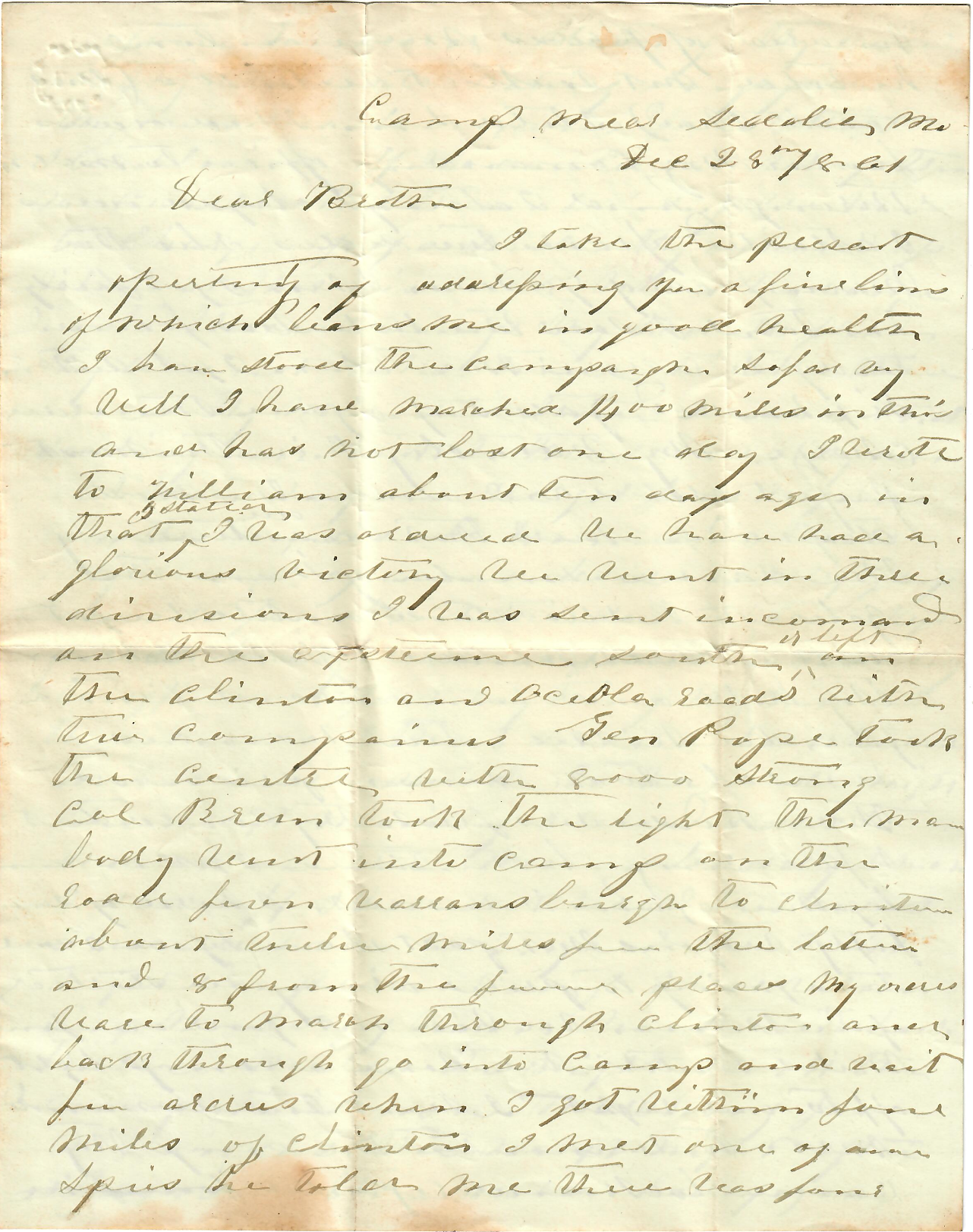
Camp near Sedalia, Missouri December 28, 1861
Dear Brother,
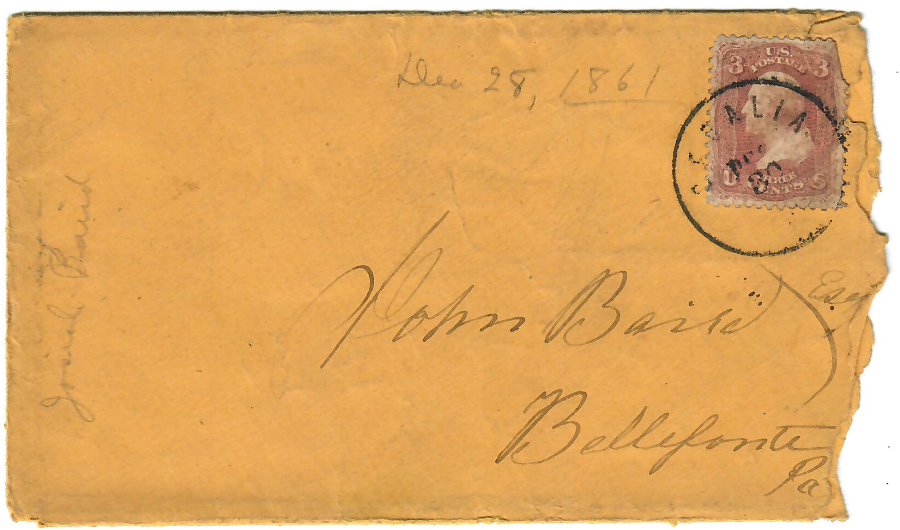
I take the present opportunity of addressing you a few lines which leaves me in good health. I have stood the campaign so far very well. I have marched 1400 miles in this and has not lost one day. I wrote to Wm. about ten days ago. In that I stated I was ordered. We have had a glorious victory. We went in three divisions. I was sent in command on the extreme southern or left on the Clinton [Henry Co.] and Osceola [St Clair Co.] roads with two companies. Gen. Royce took the center with 8,000 strong. Col. Brim took the right. The main body went into camp on the road from Warrensburg [Johnson Co.] to Clinton, about twelve miles from the latter and 8 from the former place. My orders were to march through Clinton and back through, go into camp and wait for orders.
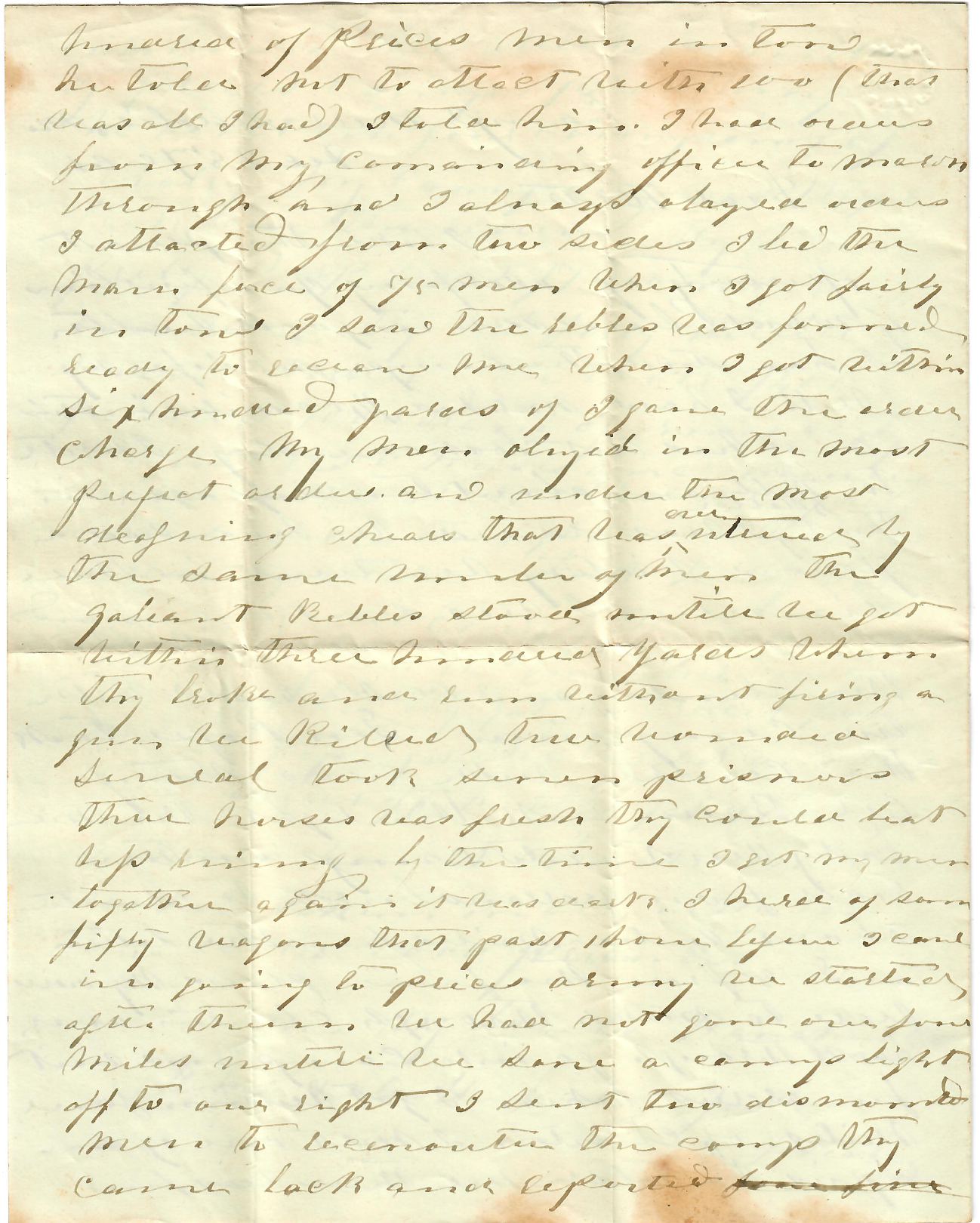
I got within four miles of Clinton. I met one of our spies. He told me there was four hundred of Price’s men in town. He told me not to attack with 100 men (that was all I had). I told him I had orders from my commanding officer to march through and I always obeyed orders. I attacked from two sides. I led the main force of 75 men. When I got fairly in town I saw the rebels was formed ready to redan me. When I got within six hundred yards, I gave the order, “Charge!” My men obeyed in the most perfect order and under the most deafening cheers that was ever uttered by the same number of men. The gallant Rebels stood until we got within three hundred yards when they broke & ran without firing a gun. We killed two, wounded several, and took some prisoners.
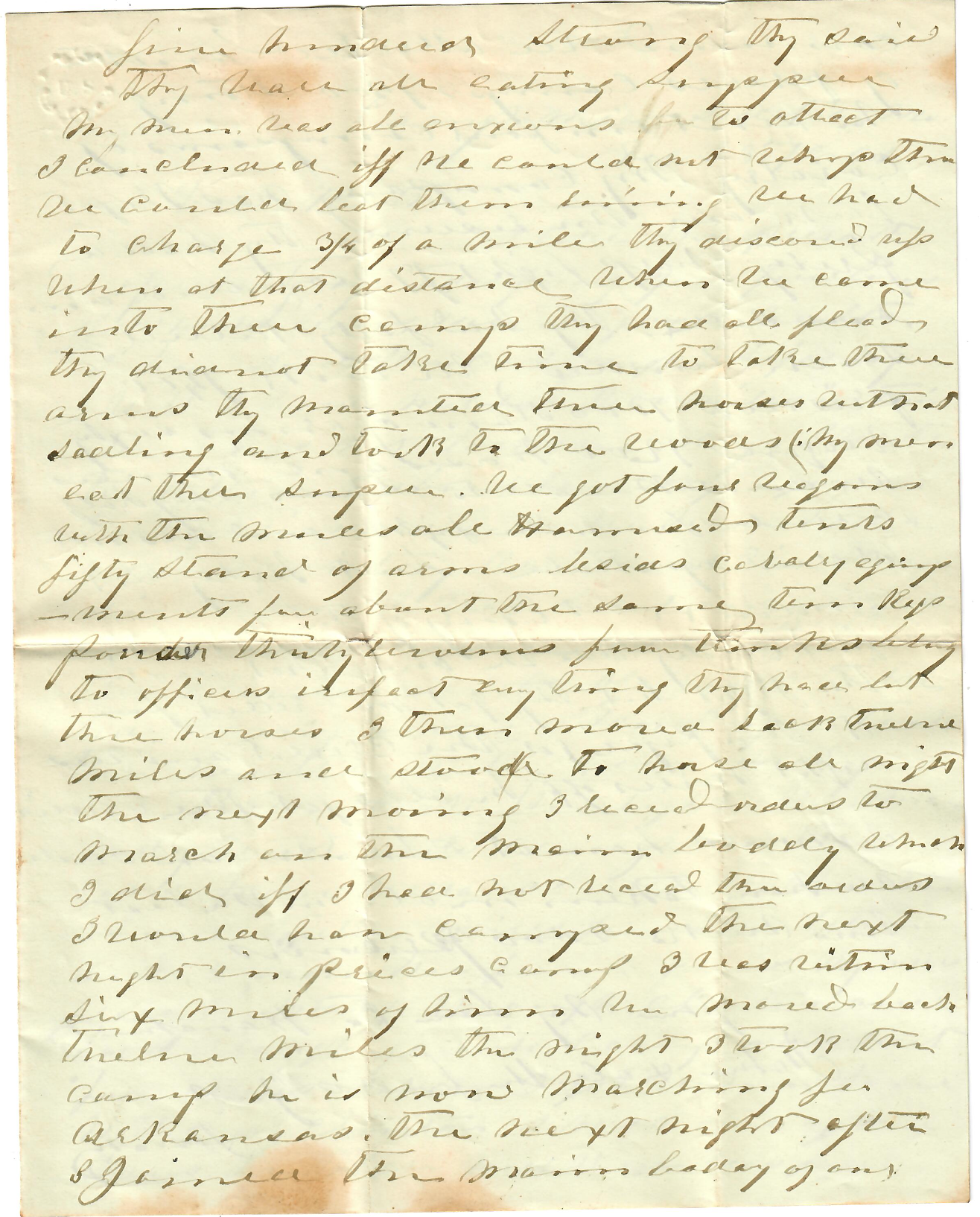
Their horses was fresh. They could beat us running. By the time I got my men together again it was dark. I heard of some fifty wagons that passed one hour before. I came in going to Price’s army. We started after them. We had not gone over four miles until we saw a camp light off to our right. I sent two dismounted men to reconnoiter the camp. They came back & reported five hundred strong. They said the men were eating supper. My men was all anxious to attack. I concluded if we could not whip them, we could beat them running. We had to charge ¾ of a mile. They discovered us when at that distance. When we came into their camp they had all fled. They didn’t take time to take their arms. They mounted their horses without saddling and took to the woods. My men ate their supper.
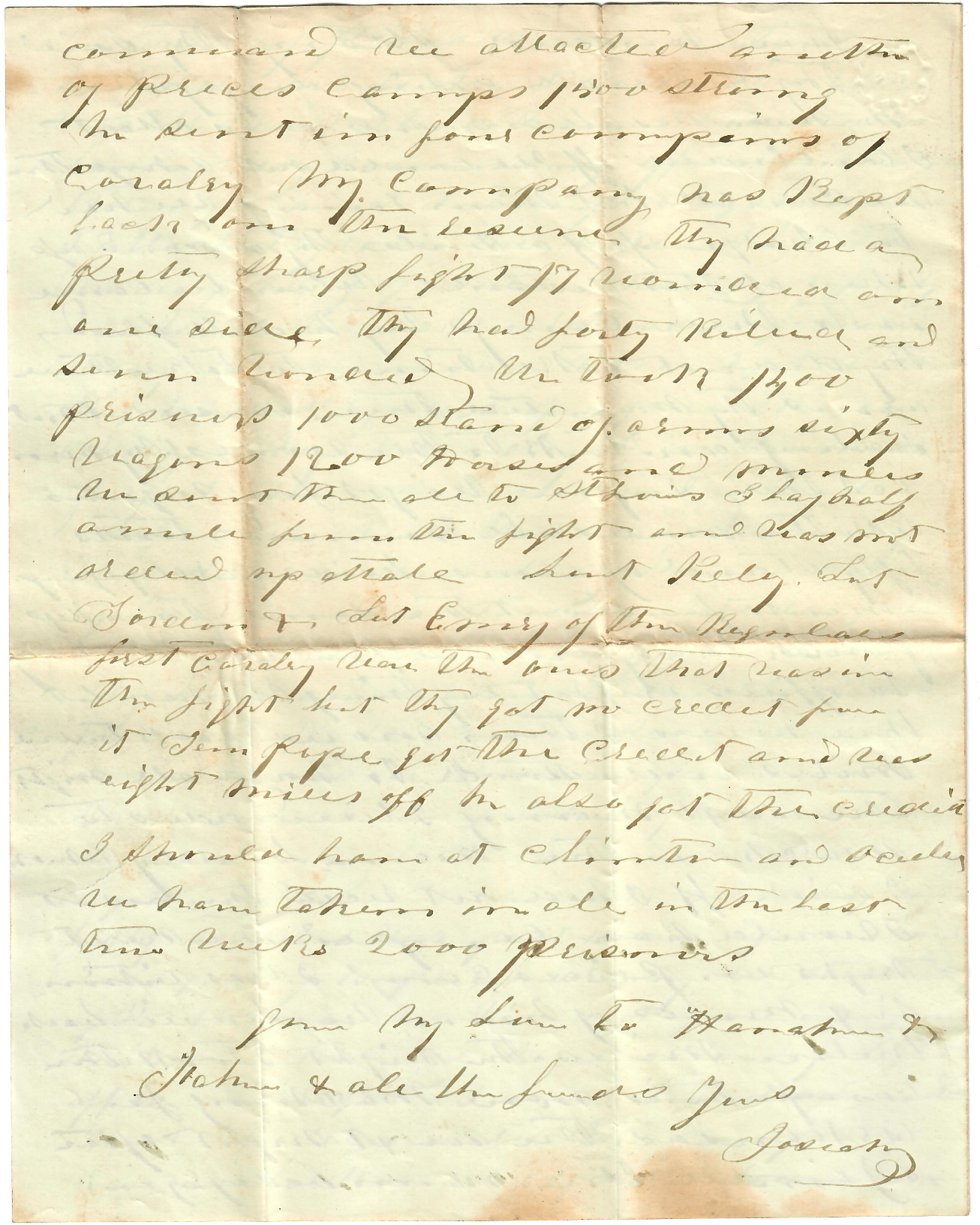
We got four wagons with the mules all harnessed, tents, fifty stands of arms besides cavalry equipment for about the same, ten kegs of powder, thirty [ ], four trunks belonging to officers, in fact, everything they had but their horses. I then moved back twelve miles and stood to horse all night. The next morning I received orders to march on the main body which I did. If I had not received the orders I would have camped the next night in Price’s camp. I was within six miles of him. We moved back twelve miles the night we took their camp. He is now marching for Arkansas. The next night after I joined the main body of our command we attack another of Price’s camps, 1500 strong. We sent in four companies of cavalry. My company was kept back on the reserve. They had a pretty sharp fight—seventeen wounded on our side. They had forty killed and seven wounded. We took 1400 prisoners, 1,000 stands of arms, sixty wagons, 1200 horses & mules. We sent them all to St Louis. I lay half a mile from the fight and was not ordered up at all. Lieut. Kelly, Lieut. Jordon & Lieut. Emory of the Regular first cavalry was the ones that was in the fight, but they got no credit from it. Gen. Royce got the credit and was eight miles off. He also got the credit I should have had at Clinton & Osceola. We have taken in all in the last two weeks 2000 prisoners.Give my love to Hannah & Father & all the friends. — Yours, Josiah
Letter 5
Camp Marshall Sedalia, Missouri January 28, 1862
Dear Brother,
I am laying in camp today trying to keep dry, but it is as much as a bargain. We are having a very wet time—mud knee deep and upwards. This the first wet time we have had since I came in the army. I am trying very hard to get a furlough for thirty days to get clear of the mud. If I accomplish it, I will be to see you. We have run the Rebels across the Osage River and I don’t think they will get back this winter. The river is rising very fast. They will all starve if they leave the state. I was in another little fight since Silver Creek but it didn’t amount to anything. No person hurt on either side. They surrendered without firing a gun. Secession is very nearly played out in Missouri. We will go south in five or six weeks to Memphis. Our Regiment has been applied for from different places—Washington, Virginia, Kentucky and Cairo. I think we will go down the Mississippi. I wish I could send my horse to you to recruit for me. I have rode him 2,000 miles in four months and he is not four years old yet. If I can get him some place to recruit till spring, he would stand the service next summer. I have three of them, all full blood. Two I got on the battlefield of Silver Creek, a black mare and a saddle I got with her. I was offered three hundred dollars for her. I intend to send her to Gardner Thompson in the spring to raise me a colt. There was five hundred contraband horses sold here last week from one to fifteen dollars. If I had been layed off I would have spent the last dollar in horses, sent them to Illinois and give one half for keeping them after then doubling my money. There is plenty of horses and guns here now. I have four hundred dollar shot guns. I intend to have one apiece for all my friends by Spring. There is nothing new in the Department of the West.
Give my love to Father, Hannah & the children, Wm’s family, &c. Yours truly, –Josiah Direct to Capt Baird, Co. D, Merrill’s Horse, In the field, St. Louis, Mo.
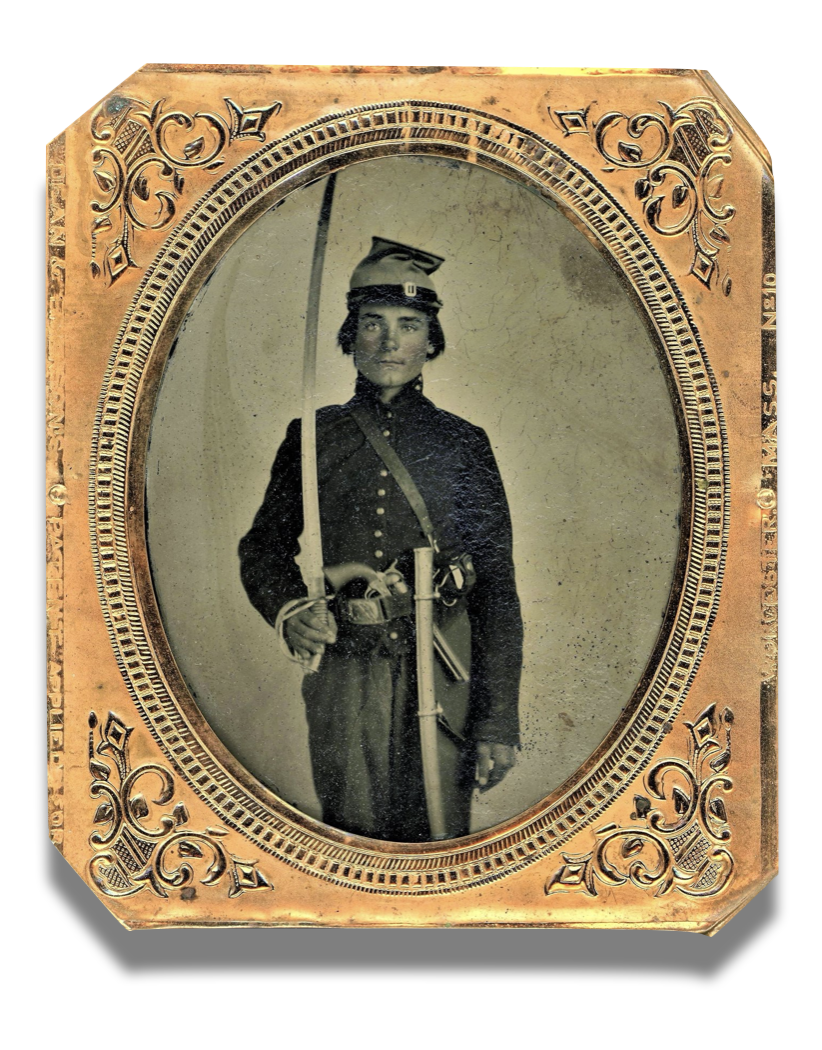
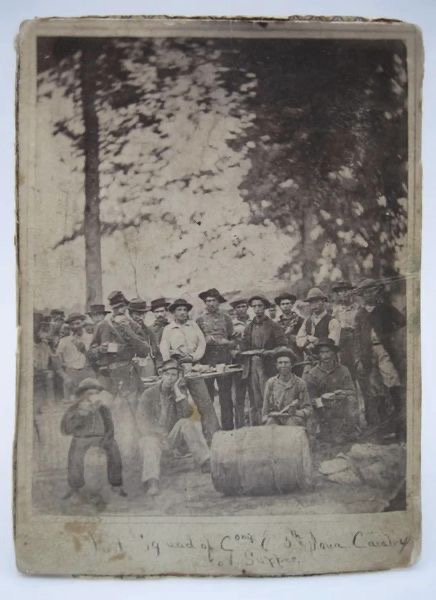
This young man was a member of the 2nd Missouri Cavalry, Merrill’s Horse. He’s wearing a cavalry shell jacket with the standard tape job as well as the extra “horse head” piping you also see on jackets worn by troopers in some of the low-numbered Ohio cavalry regiments, including the 1st Ohio Cavalry. Probably the most visible piping is on the cuff (yellow appears dark in hard images). His forage cap—specified by Merrill—was a sky blue color with a strip of orange welt around the circumference of the crown. (Dan Binder Collection)
Death of Capt. Josiah W. Baird
Capt. Josiah W. Baird, a townsman of Clearfield Pa. and Commander of Company D of Merrill’s Horse was slain on Sat, Sept 6, 1862 in an engagement with a guerrilla band near Glasgow Mo. [Howard Co.]. 1 Mrs. Baird who was on a visit to her husband, accompanied by Dr. R. W. Landis, Chaplain of the Regiment, and the body of the captain returned to her home Friday evening. The community was taken by surprise as no notice of the disaster had reached it (the telegram which had been sent announcing the fact having failed to arrive, and only a short time before letters had been received here from Capt. Baird himself.
The facts of his death appear to have been these. Word was brought to the camp at Glasgow on Saturday morning that a guerrilla band was lurking in the brush some 8 or 10 miles north of Glasgow and Capt. Baird and a portion of his command were detailed along with some of the State Militia to proceed against them. Having reached the place, the advance was fired into by the enemy and Capt. Baird, having ordered his men to dismount, advanced at their head into the brush where the guerrillas were concealed. In the first charge of the enemy upon his advance, Capt. Baird fell mortally wounded. The femoral artery having been severed, he survived but a few moments. As he sank down, however, he discharged his revolver twice at the foe who were now in sight and animated his men to the charge. The guerrillas were entirely cut up and defeated and the man who shot Capt. Baird fell pierced by four balls.
The captain was greatly beloved by his men and highly esteemed by the officers of the regiment. No braver man or patriot has fallen in this war. He was born Aug 3, 1826. The obsequies were attended on Saturday. The whole community for miles around appeared to be present and the funeral was the largest ever seen in this place. A detail of military and the band accompanied the body to the church and then to the grave and it seemed to us that nothing could excel the exquisitely fine performance of the band on the occasion. The Rev. John M. Galloway, Pastor of the Presbyterian Church, assisted by Dr Landis conducted the services.
Headquarters, Reg’t Merrill’s Horse. Macon City, Mo. Oct 19th 1862
1 CIVIL WAR INCIDENTS IN HOWARD COUNTY, PART I: 1861-1863 Compiled by William Lay
“One battle was fought on September 6, 1862, on the old Fristoe farm about four miles northwest of Armstrong. Fourteen rebels were on their way from Macon to join Price’s army. They were attempting to miss Glasgow, but someone reported them to the Federal soldiers stationed there. The rebels stopped at the old Fristoe home and went to the woods for dinner. While two of the group were gone to the well for water the Federal soldiers charged on to the other soldiers from out of a cornfield. The rebel captain offered to surrender but Captain Beard [Capt. J. W. Baird] of the Federals said. ‘We take no prisoners.’ The group from Glasgow included 40 Federals under Beard and about 40 of the state militia under Morgan. When Beard ordered the charge the rebel leader said for each to care for himself. All ran for cover except two who stood their ground. The name of one of these men was George Teeters [from Randolph County and only 17 years old at the time]. The Federals started firing and shots flew thick and fast for a few minutes. The rebel who stood with Teeters wounded Captain Beard and then the two gave up. The Federals fatally wounded Teeters and would have shot his companion if Morgan had not refused to do so. The Federals also captured the two men who had gone to the well. Beard was taken to the Fristoe house, where he soon died. Teeters body was not touched until permission was obtained from Glasgow to bury him. With $40 obtained from his pockets and some money that they contributed, the neighbors bought a suit of clothes and a casket and buried him. When the battle site was examined soon afterwards many shots were discovered high up in the trees on the opposite bank of the small creek. Many thought these shots were fired by Morgan’s men, many of whom were really southern sympathizers forced to fight in the state militia.” (Article by William A. Markland in the Bicentennial Boonslick History, Boonslick Historical Society, 1976, p. 96)
The following letter was written by James B. Simpson (1832-1908) of Co. B, 114th Pennsylvania Infantry. James was working as an upholsterer in Philadelphia when he volunteered as a corporal in August 1862 and mustered out in May 1865 as a 1st Sergeant. In 1892 he lived in Medford, Massachusetts. He died following “an attack of epilepsy” as he was “assisting in the decoration of a soldier’s monument in Oak Grove cemetery.”
[Note: The following letter is from the private collection of Greg Herr and was offered for transcription and publication on Spared & Shared by express consent. I did not correct the spelling or add punctuation to this letter.]
T R A N S C R I P T I O N
Addressed to James Markland, No. 237 South Street Philadelphia Penn
Head Quarters Army Potomac June 8th [1864]
Friend Markland,
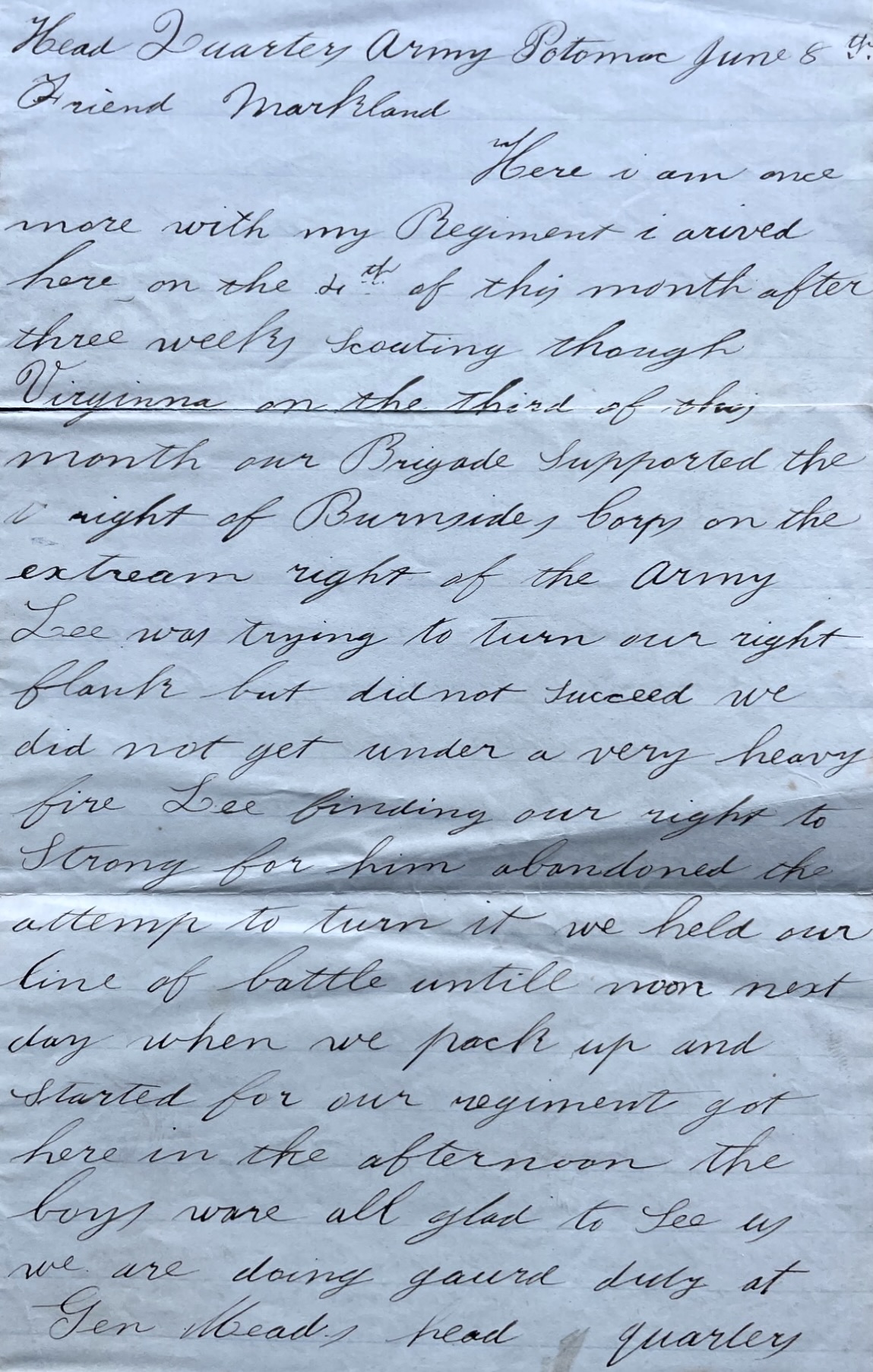
Here i am once more with my Regiment i arived here on the 4th of this month after three weeks scouting through Virginna on the third of this month our Brigade supported the right of Burnsides Corps on the extream right of the Army Lee was trying to turn our right flank but did not succeed we did not get under a very heavy fire Lee finding our right to strong for him abandoned the attemp to turn it we held our line of battle untill noon next day when we pack up and started for our regiment got here in the afternoon the boys ware all glad to see us we are doing guard duty at Gen. Meads head quarters
[The] talk [of] Burnsides nigers fighting is all nonsense they have not been under fire yet and i don’t think Grant will put them in a fight you have not heird tell of any of them being wounded have you. their has been some of the hardest kind of fighting sence this campaign comenced the first two days fighting of Jonneys got the best of us but after that it was all up with them the seige of Richmond is a bout comenced head quarters is about 12 miles from Richmond the rebs have a very strong posision but i think Grant will make kite out.
give my respects to all my old friends i am in bully health and i hope you are the same i remain your friend J. B. Simpson
Gabriel Theodore Harrower (1816-1895) wrote the following letter while serving as the Colonel of the 161st New York Infantry, fighting in the Department of the Gulf, and taking part in the Siege of Port Hudson. Gabriel was a native of Chenango county, the son of Benjamin Harrower (1791-1861) and Dinah Mersereau (1794-1869). He came to Lindley with his parents as a small child, attended schools there, and as he grew older became an active member of the Free Soil Party and later the Republican Party. He was sheriff of Steuben county in the early 1850s and Supervisor of the town of Lindley. In 1859, he married Helen (“Nellie”) Parkhurst and had several children. After the war he became a member of the NY State Senate.
[Note: This letter is from the personal collection of Greg Herr who offered it for transcription and publication on Spared & Shared by express consent.]
T R A N S C R I P T I O N
Headquarters 161st Regt. N. Y. V. Store Plain 2.5 miles from Port Hudson May 22nd 1863
My dear Nell,
I received your letter last night at this place which was the scene of our first battle. We moved from our old encampment yesterday morning on this plain with about 5,000 men and three batteries of artillery. Suddenly we encountered the enemy strongly posted with artillery commanding the road. The battle began about 9 a.m. by a furious cannonade. Almost the first fire, a shell burst right over my head and the fragments flew in every direction, fortunately hitting no one. I was ordered to bring up my regiment to the front to support our batteries which occupied the road. We lay there for two long hours with shells and grape shot falling among and around us like hailstones but we could not fire a gun as we were too far off to effect anything with rifles. It was a grand and awful sight and sound, easier imagined than described. It was one continuous crash. Shrieking of shells mingled with crashing of trees.
Col. William R. Miles commanded Mile’s Legion
At last the enemy gave way and retired to a second position and the battery moved up with my regiment deployed on its right to support it and soon occupied the first position of the enemy. We had scarcely got into position when they opened upon us again with renewed energy. We lay flat on the ground and as silent spectators viewed the artillery duel—for the second time. After about an hour, the celebrated Legion of Miles 1 came out of the woods where they had been concealed and attacked three regiments on the left of where we were with great fury. Then the roar of musketry begun and raged with great fury for an hour when the 48th Massachusetts broke and fled. New York then come to the rescue. The 116th charged with the bayonet in gallant style and the Rebels broke and fled and the battle was won. And we weren’t without much to eat and no drink but swamp water. We laid ourselves down and slept on the field with arms by our side ready for the attack. I kept my faithful horse all saddled under the same tree where I slept.
Today reinforcements have come and all is quiet. Our regiment had none killed. Total killed and wounded about 150. The Rebel loss much heavier. Your letter came before I had got off my horse. I opened it and found Kittie’s hair and shed a [tear] of joy and thankfulness.
The General rode up to our regiment and paid us all a handsome compliment. Said he, never saw Regulars behave better, and was proud to know that he had such troops. I was much gratified at his remarks and was too full to make any response. Port Hudson will soon fall and I don’t believe they can give us much of a battle. So many troops are coming to our assistance. I cannot give you a particular description today but will the first opportunity.
I am well and in god spirits. The Doctor stood it pretty well. I don’t get all your letters. I can’t hear from my Mother. Won’t you write me about her. I am sorry Ross is so poorly and can but hope he will get better as the weather gets warm. Remember me to all. Tell Ritter Pa has got that pretty curl and carries it near his heart. You say Sue is better. I did not know she was sick before. Remember me in love to the children. Tell Mr. Lumpkin I will write him soon. I must close. Goodbye my dear wife. I will write soon again. Good night. Believe me as ever your faithful husband. — G. T. Harrower
1 Miles’ Legion was a Confederate unit during the American Civil War, formed in 1862 in Louisiana under Colonel William R. Miles. It was a combined cavalry and infantry force that fought at the Battle of Plains Store and the Siege of Port Hudson, which was its last major engagement. The infantry battalion was captured at Port Hudson and did not reorganize, while the cavalry component continued to fight until disbanding in the spring of 1865.
Following are two July 1861 letters written by members of Co. A, 1st Regiment Virginia Infantry (3 Months). The first letter was written by John I. McCook and the second letter was by Capt. Mountford Samuel Stokely (1836-1902), both residents of Steubenville, Jefferson county, Ohio. Mountford (or “Mont”) was an 1857 graduate of Marietta College. In 1860 he was working as a lawyer in Steubenville. John I. McCook (b. 1843) was the son of Brigadier General George Wythe McCook (1821-1877), an attorney in Steubenville just prior to the Civil War.
These letters were written a month after the Battle of Philippi in which the Federal forces under General Kelley had routed the Confederates in the first land battle of the war.
Letter 1
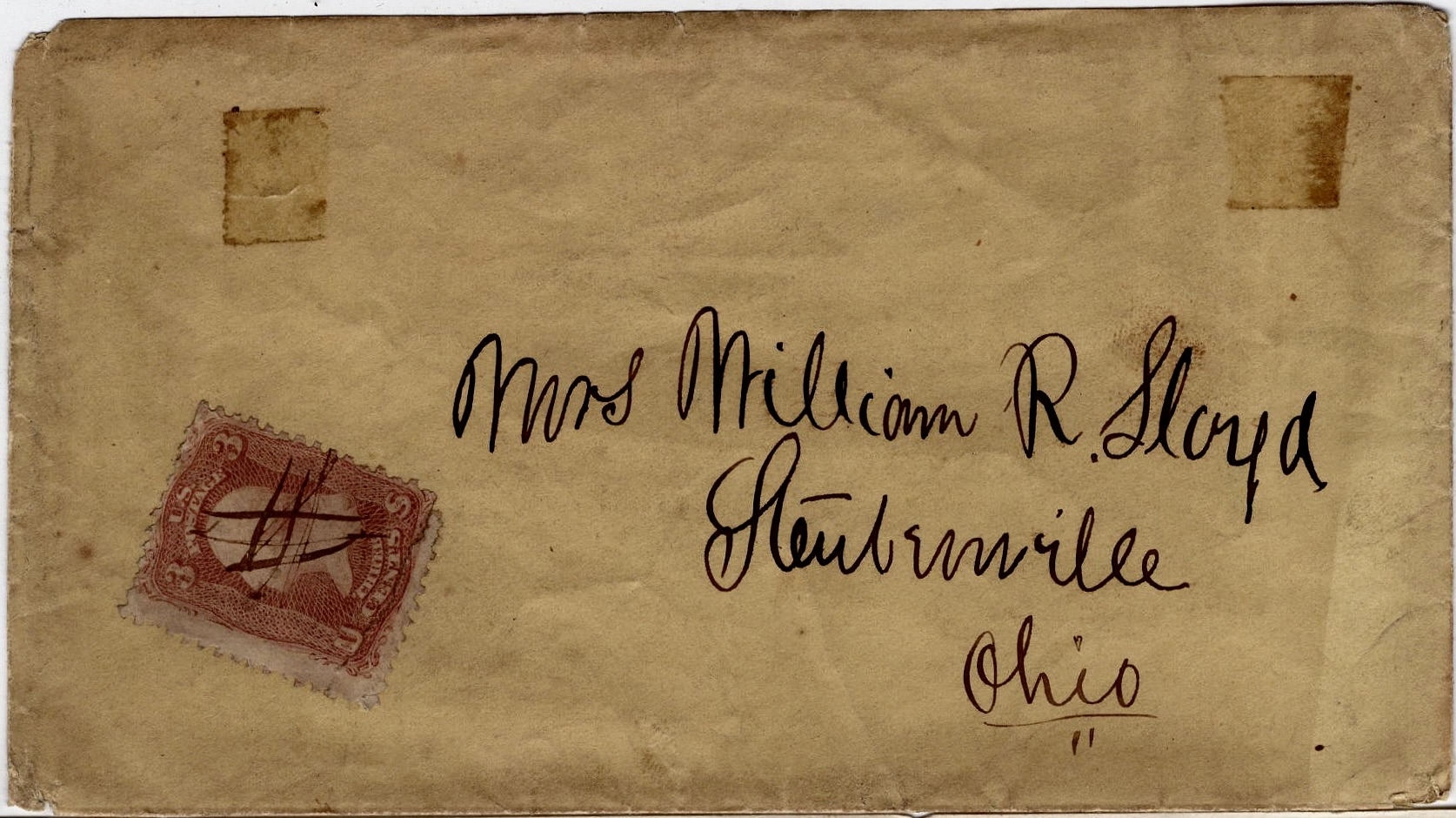
Addressed to Mrs. William R. Lloyd, Steubenville, Ohio
[Editor’s note: This letter was written by John I. McCook]
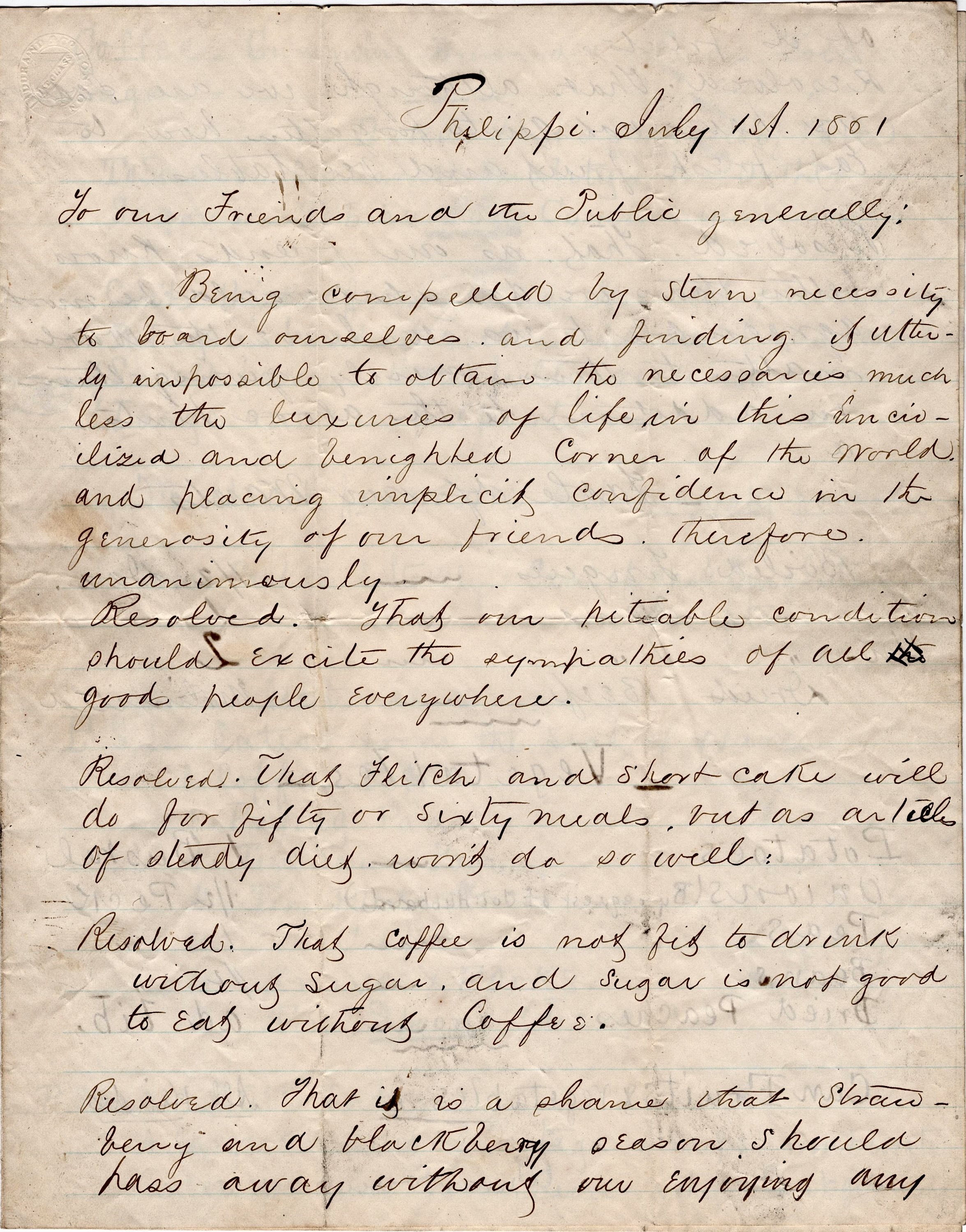
Philippi [Virginia] July 1st 1861
To our friends and the public generally:
Being compelled by stern necessity to board ourselves and finding sutlery impossible to obtain the necessaries much less the luxuries of life in this uncivilized and benighted corner of the world, and placing implicit confidence in the generosity of our friends, therefore, unanimously
Resolved. That our pitiable condition should excite the sympathies of all good people everywhere.
Resolved. That Flitch and short cake will do for fifty or sixty meals but as articles of steady diet, won’t do so well.
Resolved. That coffee is not fit to drink without sugar and sugar is not good to eat without coffee.
Resolved. That it is a shame that strawberry and blackberry season should pass away without our enjoying any of its fruits.
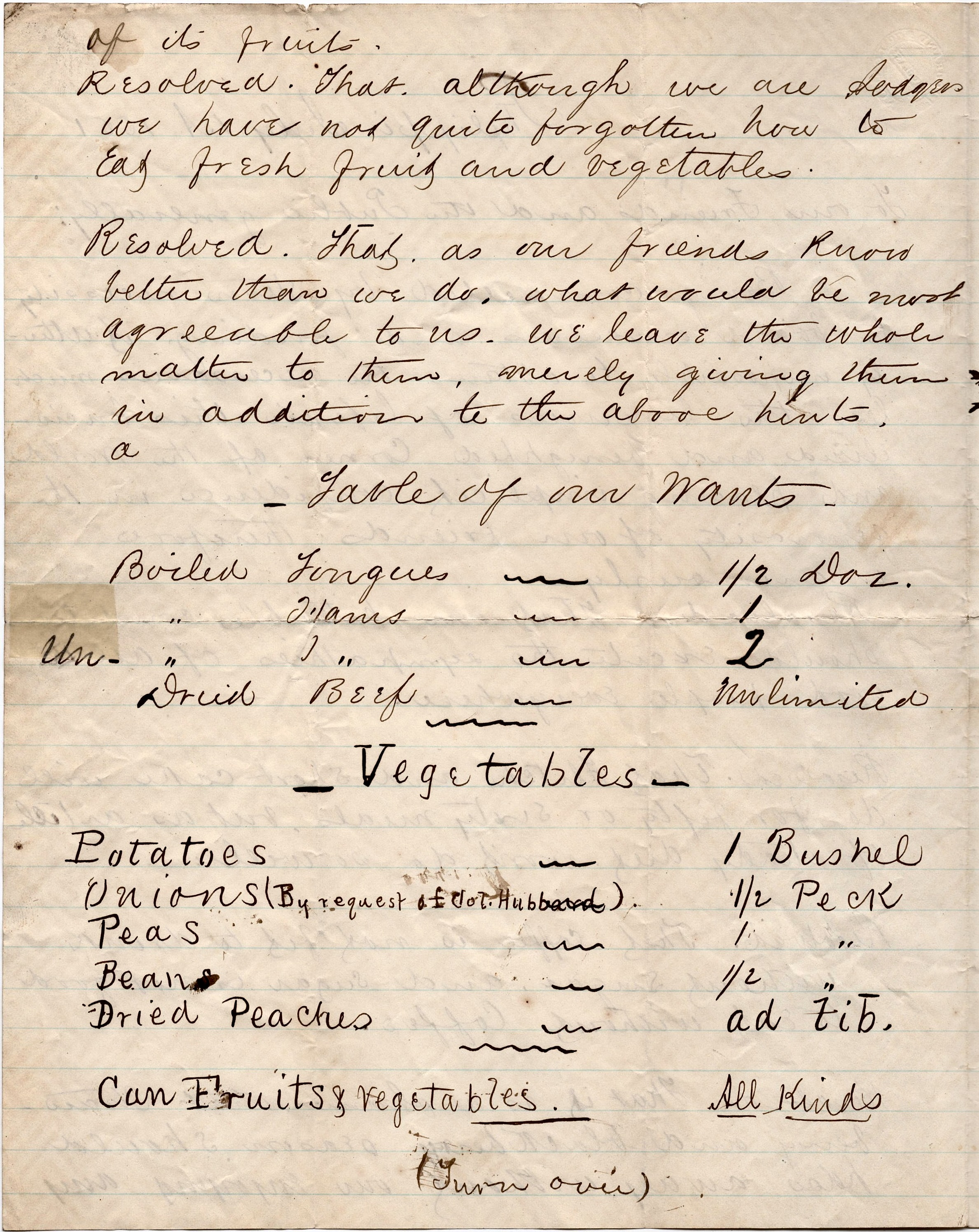
Resolved. That although we are soldiers, we have not quite forgotten how to eat fresh fruit and vegetables.
Resolved. That as our friends know better than we do what would be most agreeable to us, we leave the whole matter to them, merely giving them in addition to the above hints.
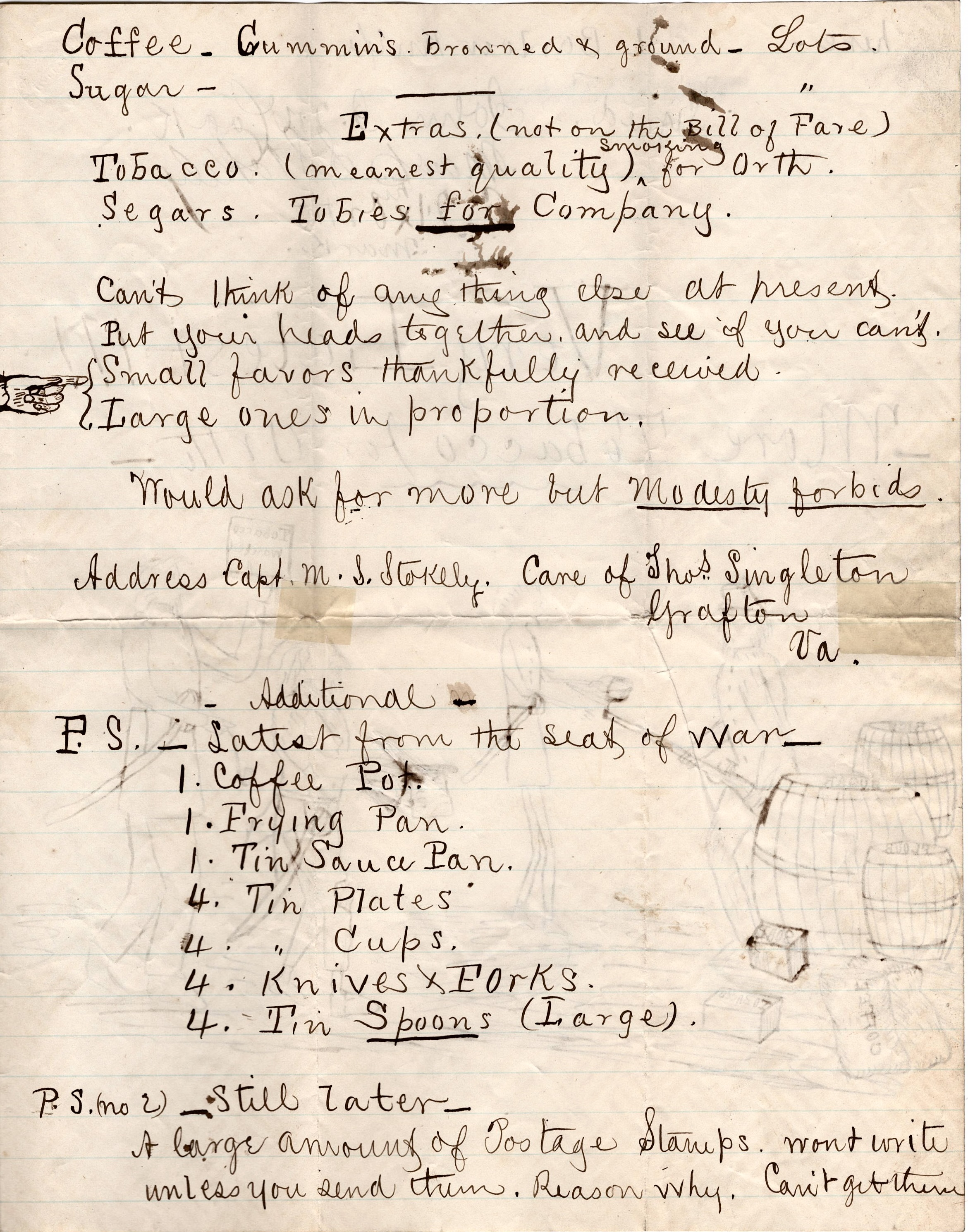
Can Fruits & Vegetables—All kinds Coffee—Cummin’s browned & ground—lots
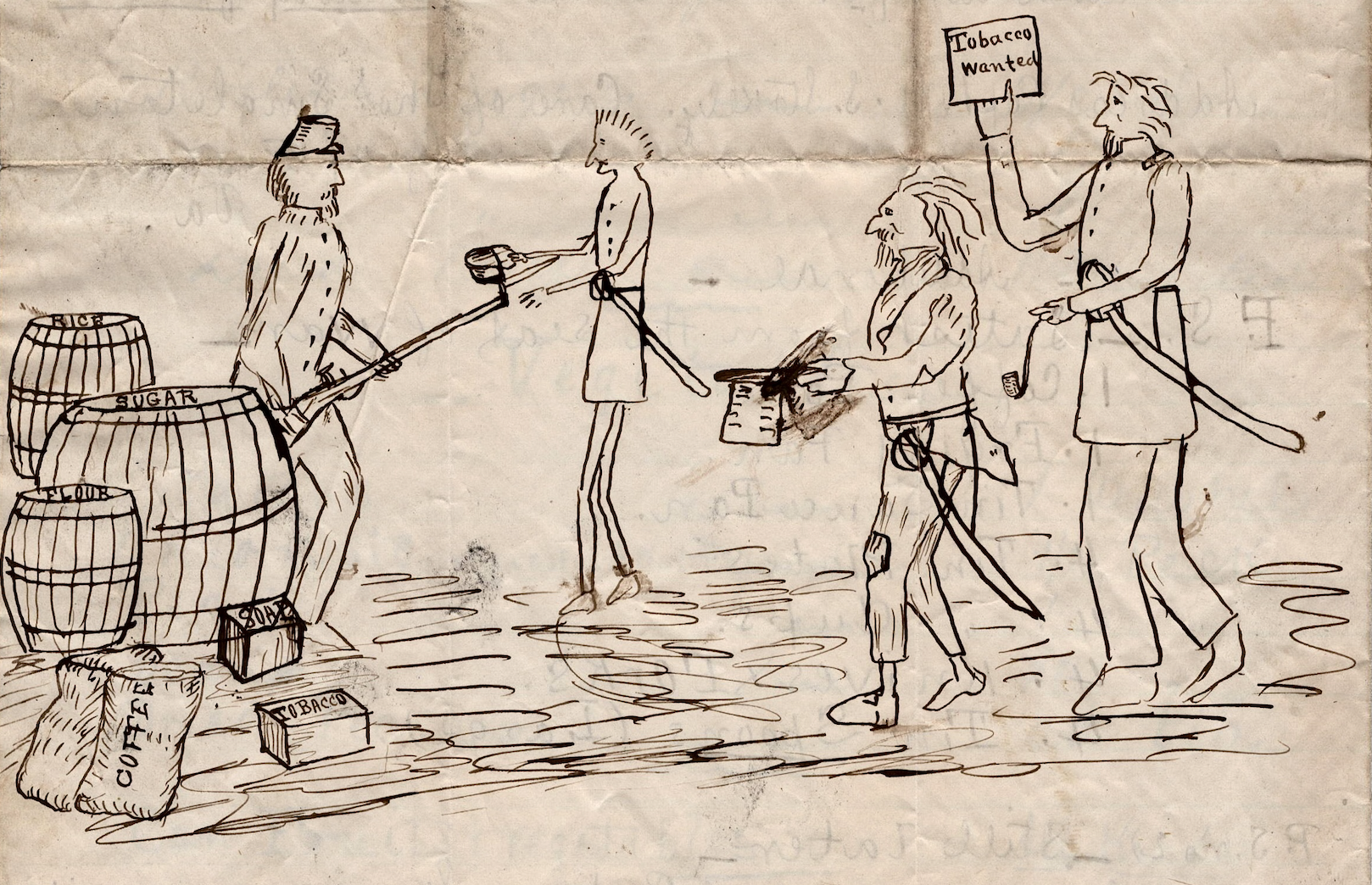
Extras (not on the Bill of Fare) Tobacco (meanest quality smoking) for Orth Segars—Tobies for company
Can’t think if anything else at present. Put your heads together and see if you can’t. Small favors thankfully received. Large ones in proportion. Would ask for more but modesty forbids.
Address to Capt. M. S. Stokely, care of Thos. Singleton, Grafton, Virginia
Additional
P. S. — Latest from the seat of war. 1 coffee pot 1 frying pan 1 tin sauce pan 4 tin plates 4 tin cups 4 knives and forks 4 tin spoons (large)
P. S. S. — Still later
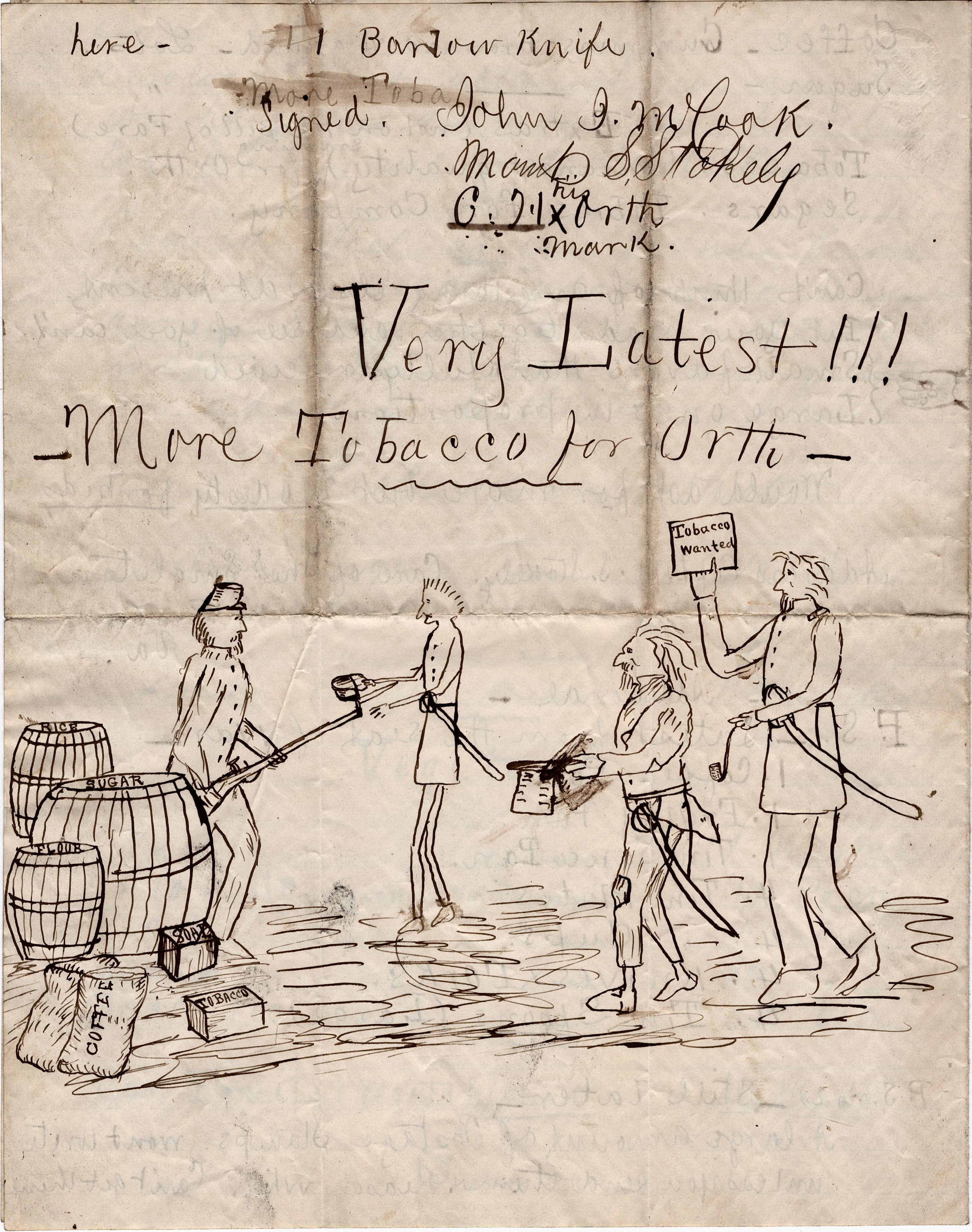
A large amount of postage stamps. Won’t write unless you send them. Reason why. Can’t get them here. 1 Barlow knife.
Signed, John I. McCook, Mont. S. Stokely, G. H. Orth (his mark)
Very latest—More tobacco for Orth
Letter 2
[Editor’s note: This letter was written by Mountford S. Stokely]
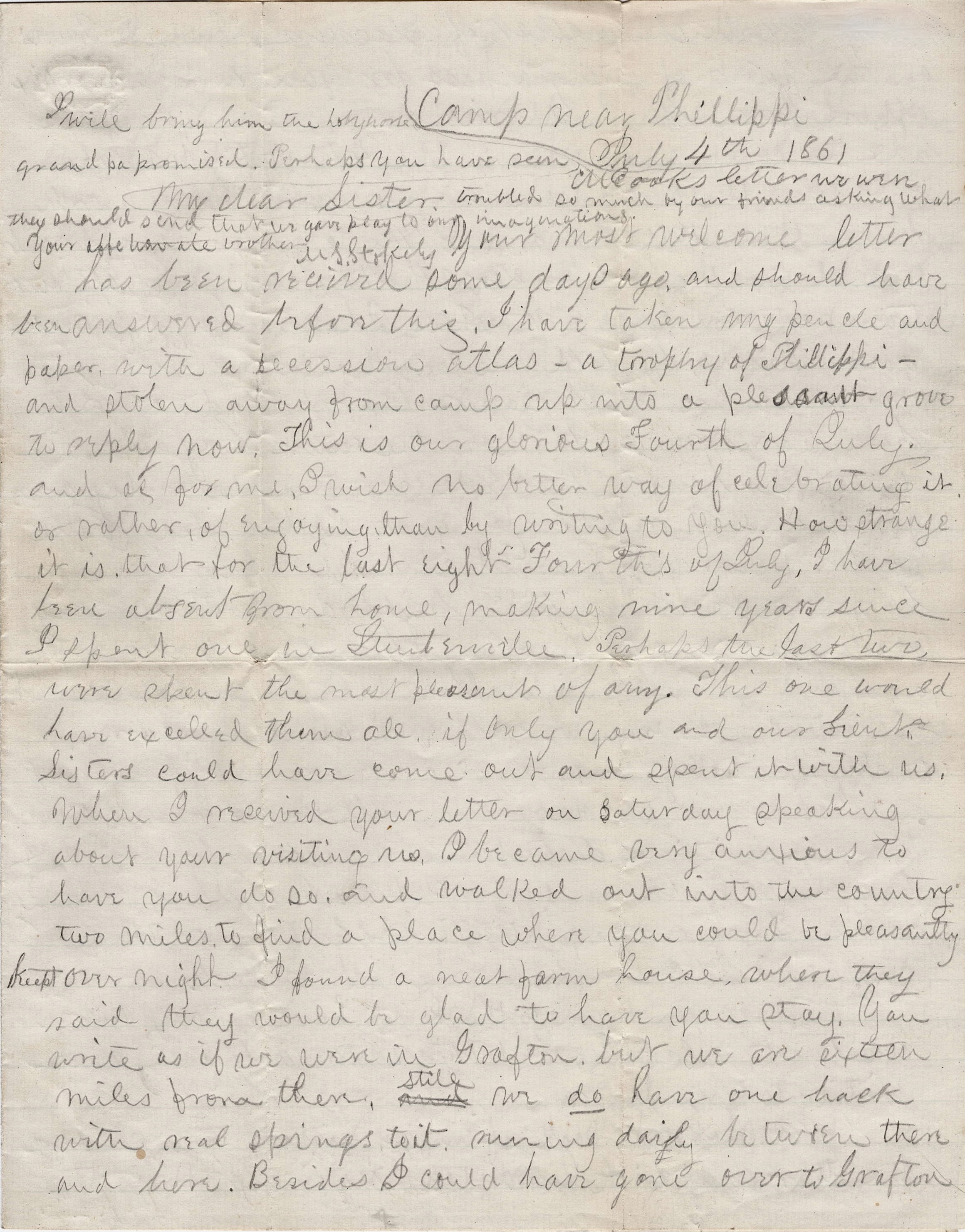
Camp near Philippi July 4, 1861
My dear sister,
Your most welcome letter has been received some days ago and should have been answered before this. I have taken my pencil and paper with a secession atlas—a trophy of Philippi—and stolen away from camp up into a pleasant grove to reply now. This is our glorious Fourth of July and as for me, I wish no better way of celebrating it, or rather, of enjoying than by writing to you. How strange it us that for the last eight Fourths of July I have been absent from home, making nine years since I spent one in Steubenville. Perhaps the last two were spent the most pleasant of any. This one would have excelled them all if only you and our Lieutenant’s sisters could have come out and spent it with us.
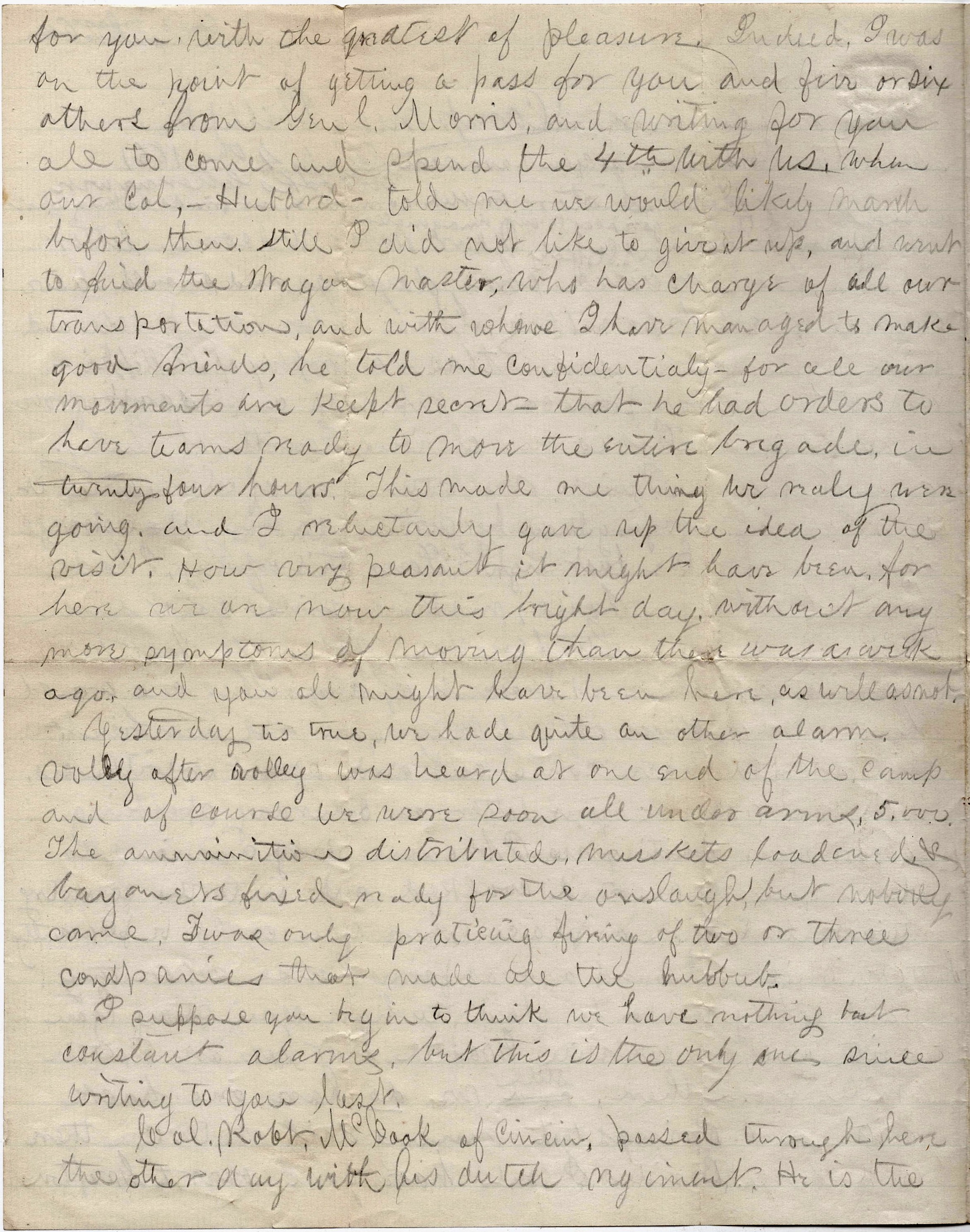
When I received your letter on Saturday speaking about your visiting us, I became very anxious to have you do so and walked out into the country two miles to find a place where you could be pleasantly kept over night. I found a neat farm house where they said they would be glad to have you stay. You write as if you were in Grafton but we are 16 miles from there. Still we do have one hack with real springs to it running daily between there and here. Besides, I could have gone over to Grafton for you with the greatest of pleasure. Indeed, I was on the point of getting a pass for you and five or six others from General Morris and writing for you all to come and spend the 4th of July with us, when our Col. [Henry B.] Hubbard told me we would likely march before then. Still I did not like to give it up and went to find the wagon master who has charge of all our transportation, and with whom I have managed to make good friends. He told me confidentially—for all our movements are kept secret—that he had orders to have teams ready to move the entire brigade in 24 hours. This made me think we really were going and I reluctantly gave up the idea of the visit. How very pleasant it might have been for here we are now this bright day without any more symptoms of moving than there was a week ago, and you all might have been here as well as not.
Yesterday, tis true, we had quite another alarm. Volley after volley was heard at one end of the camp and of course we were soon all under arms, 5000. The ammunition distributed, muskets loaded & bayonets fixed, ready for the onslaught, but nobody came. T’was only practicing firing of two or three companies that made all the hubbub.
I suppose you begin to think we have nothing but constant alarms, but this is the only one since writing to you last.
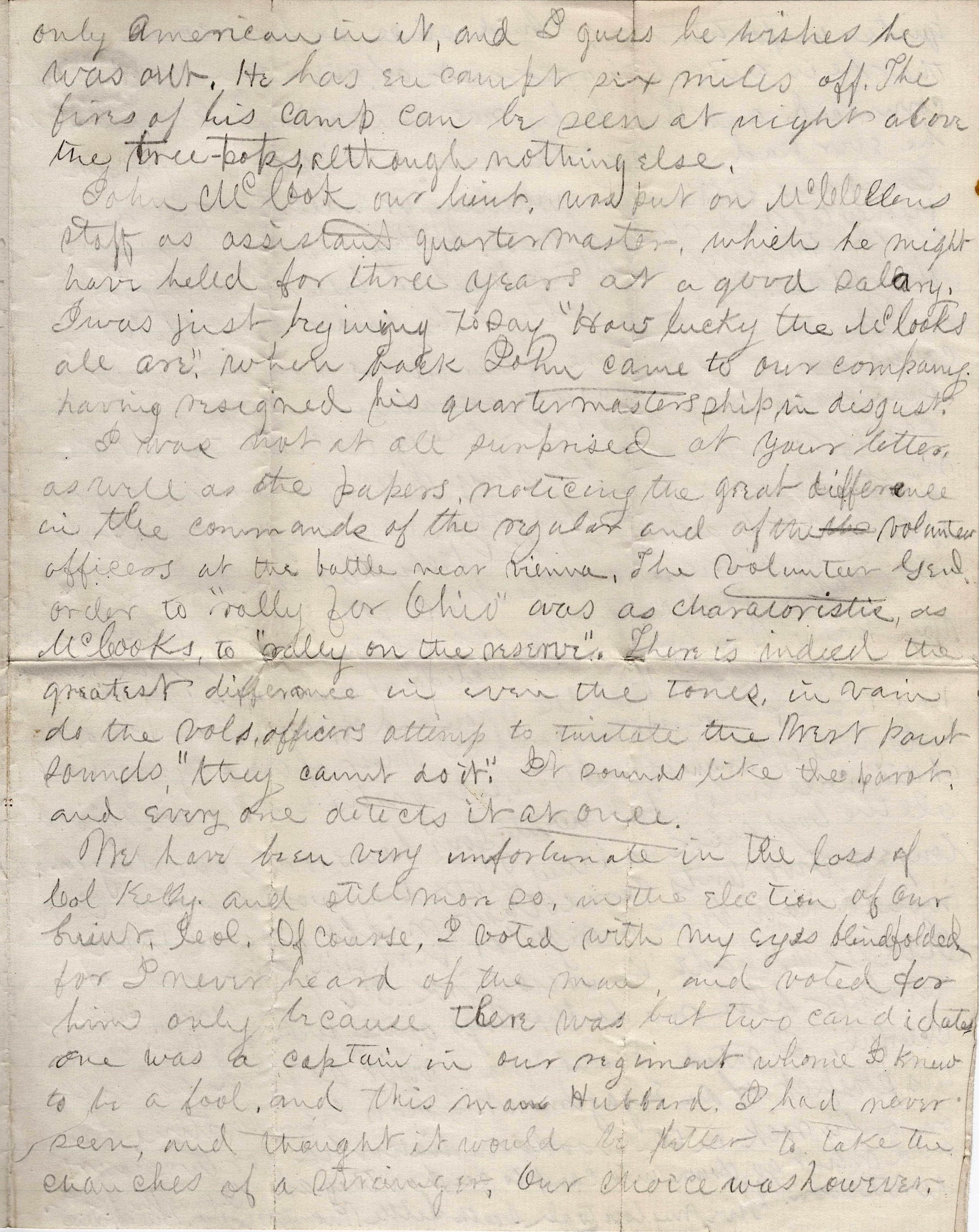
Col. Robert McCook of Cincinnati passed through here the other day with his Dutch regiment. He is the only American in it and I guess he wishes he was out. He has encamped six miles off. The fires of his camp can be seen at night above the treetops although nothing else.
John McCook, our Lieutenant, was put on McClellan’s staff as assistant quartermaster which he might have held for three years at a good salary. I was just beginning to say “How lucky the McCooks all are,” when back John came to our company, having resigned his quartermastership in disgust.
I was not at all surprised at your letter as well as the papers noticing the great difference in the commands of the regular and of the volunteer officers at the Battle of Vienna. The volunteer General Order to “Rally for Ohio” was as characteristic as McCook’s to “Rally to the Reserve.” There is indeed the greatest difference in even the tones. In vain do the volunteer officers attempt to imitate the West Point sounds, “They can’t do it.” It sounds like the parrot and everyone detects it at once.
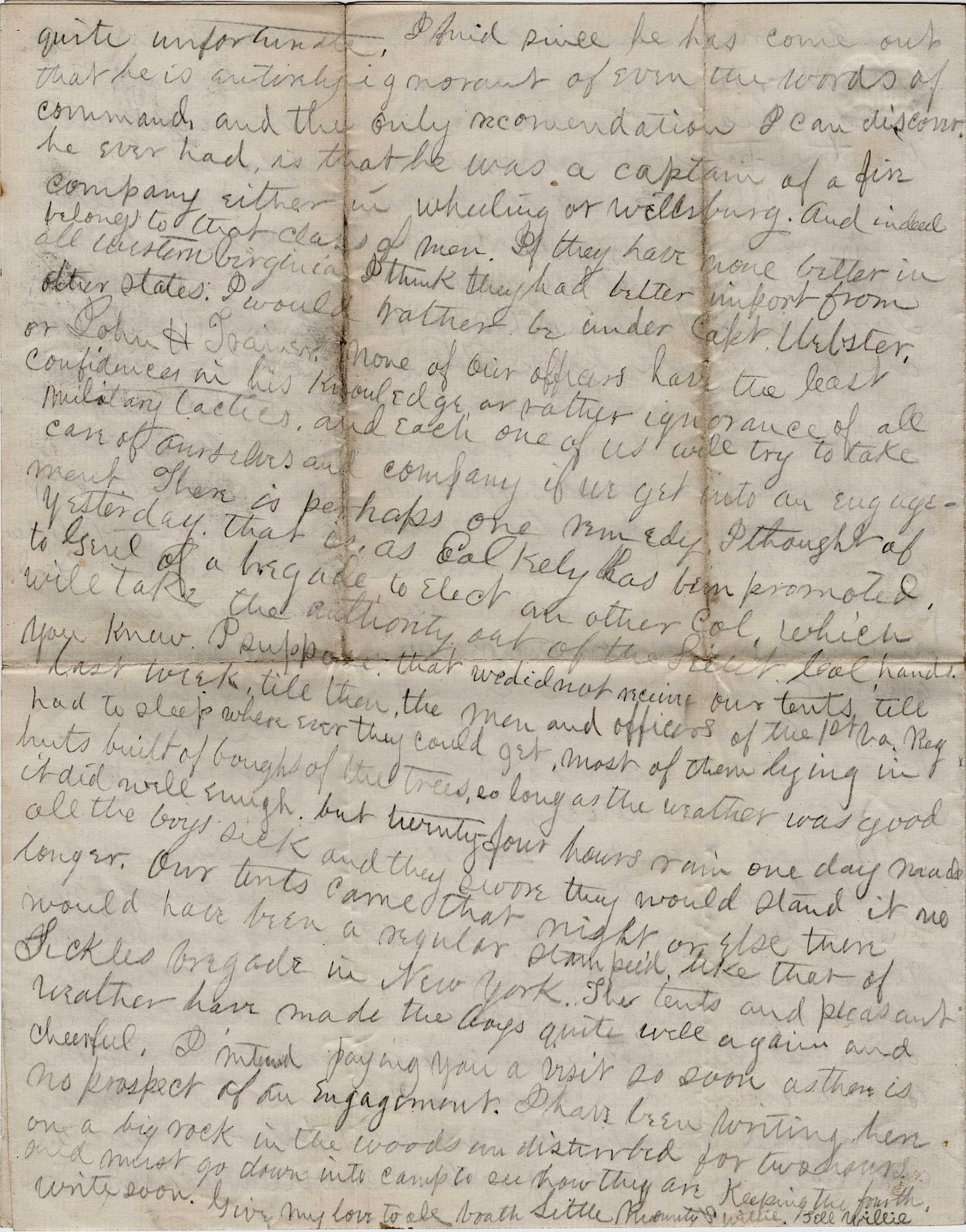
We have been very unfortunate in the loss of Col. [Benjamin Franklin] Kelley and still more so in the election of our Lieut. Colonel. Of course I voted with my eyes blindfolded for I never heard of the man and voted for him only because there was but two candidates. One was a captain in our regiment whom I knew to be a fool and this man [Henry Baldwin] Hubbard. I had never seen and thought it would be better to take the chances of a stranger. Our choice was, however, quite unfortunate. I find since he has come out that he is entirely ignorant of even the words of command, and the only recommendation I can discover he ever had is that he was a captain of a fire company either in Wheeling or Wellsburg. And indeed belongs to that class of men. If they have none better in all Western Virginia, I think they had better import from other states. I would rather be under Capt. Webster or John H. Trainer. None of our officers have the least confidences in his knowledge or rather ignorance of all military tactics and each one of us will try to take care of ourselves and company if we get into an engagement, There is perhaps one remedy I thought of yesterday. That ism as Col. Kelley has been promoted to General of a brigade, to elect another Colonel which will take the authority out of the Lieutenant Colonel’s hands, you know.
I suppose that we did not receive our tents till last week. Till then the men and officers of the 1st Virginia Regiment had to sleep wherever they could get, most of them lying in huts built of boughs of the trees. So long as the weather was good, it did well enough. But 24 hours rain one day made all the boys sick and they swore they would stand it no longer. Our tents came that night or else there would have been a regular stampede, like that of Sickles Brigade in New York. The tents and pleasant weather have made the boys quite well again and cheerful.
I intend paying you a visit as soon as there is no prospect of an engagement. I have been writing here on a big rock in the woods undisturbed for two hours and must go down into camp to see how they are keeping the Fourth. Give my love to all, both little Monty and Willie. Tell Willie I will bring him the hobby horse Grandpa promised. Perhaps you have see McCook’s letter. We were troubled so much by our friends asking what they should send that we gave play to any imaginations. Your affectionate brother, — M. S. Stokely
Following are five Civil War letters by Josiah S. Bevington (1844-1885) who enlisted at the age of 18 in August 1862 to serve as a private in Co. A, 102nd Ohio Volunteer Infantry (OVI). He mustered out with his company at war’s end. Josiah was the son of Reason W. Bevington (1817-1887) and Ruth A. Coil (1818-1893). After his service, Josiah married Catharine A. Mumaw in October 1866 and lived in Berlin, Holmes county, Ohio. Josiah was killed in a railroad accident at west Freedom, Ohio in January 1885 when he was 40 years old.
Letter 1
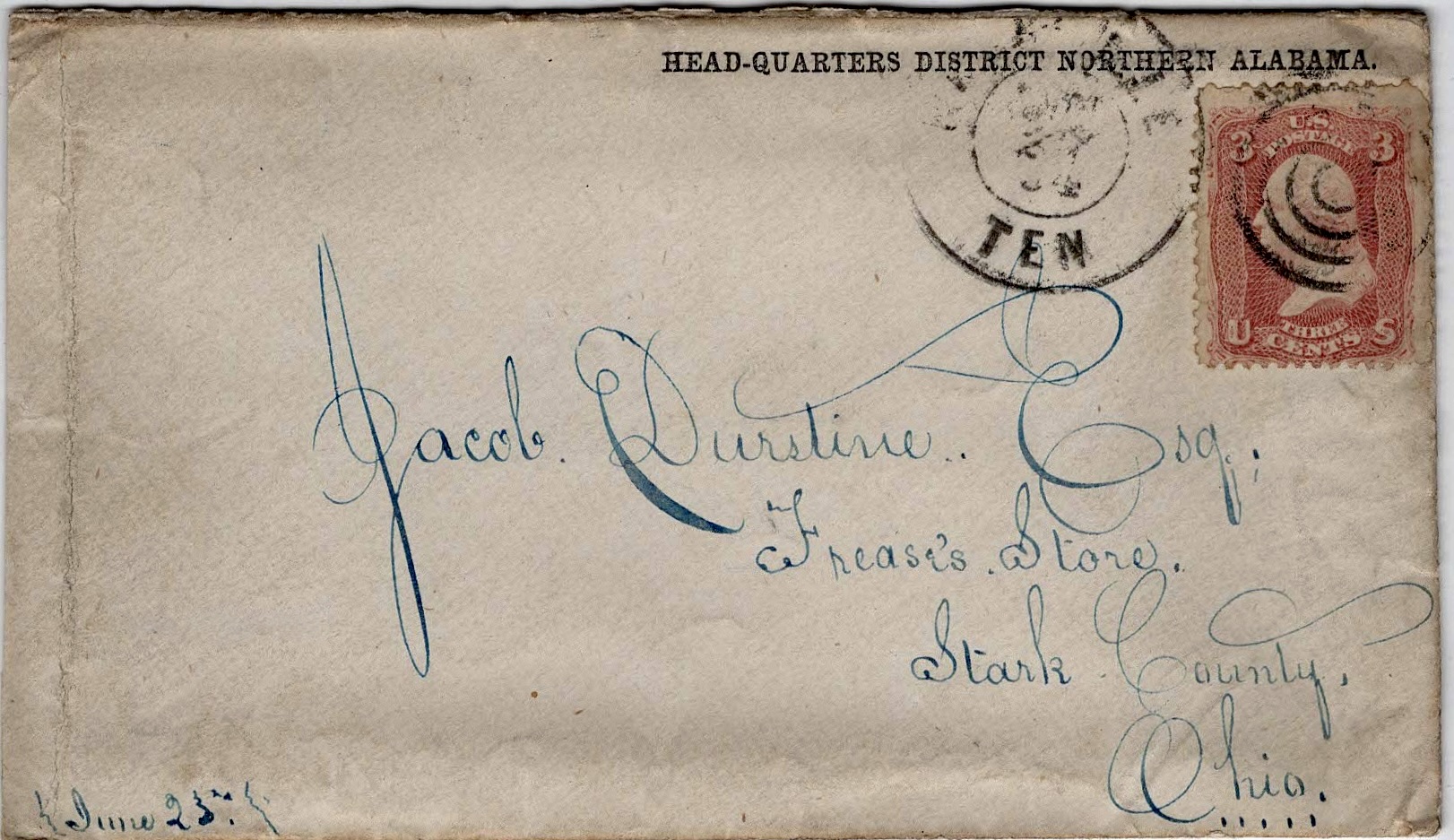
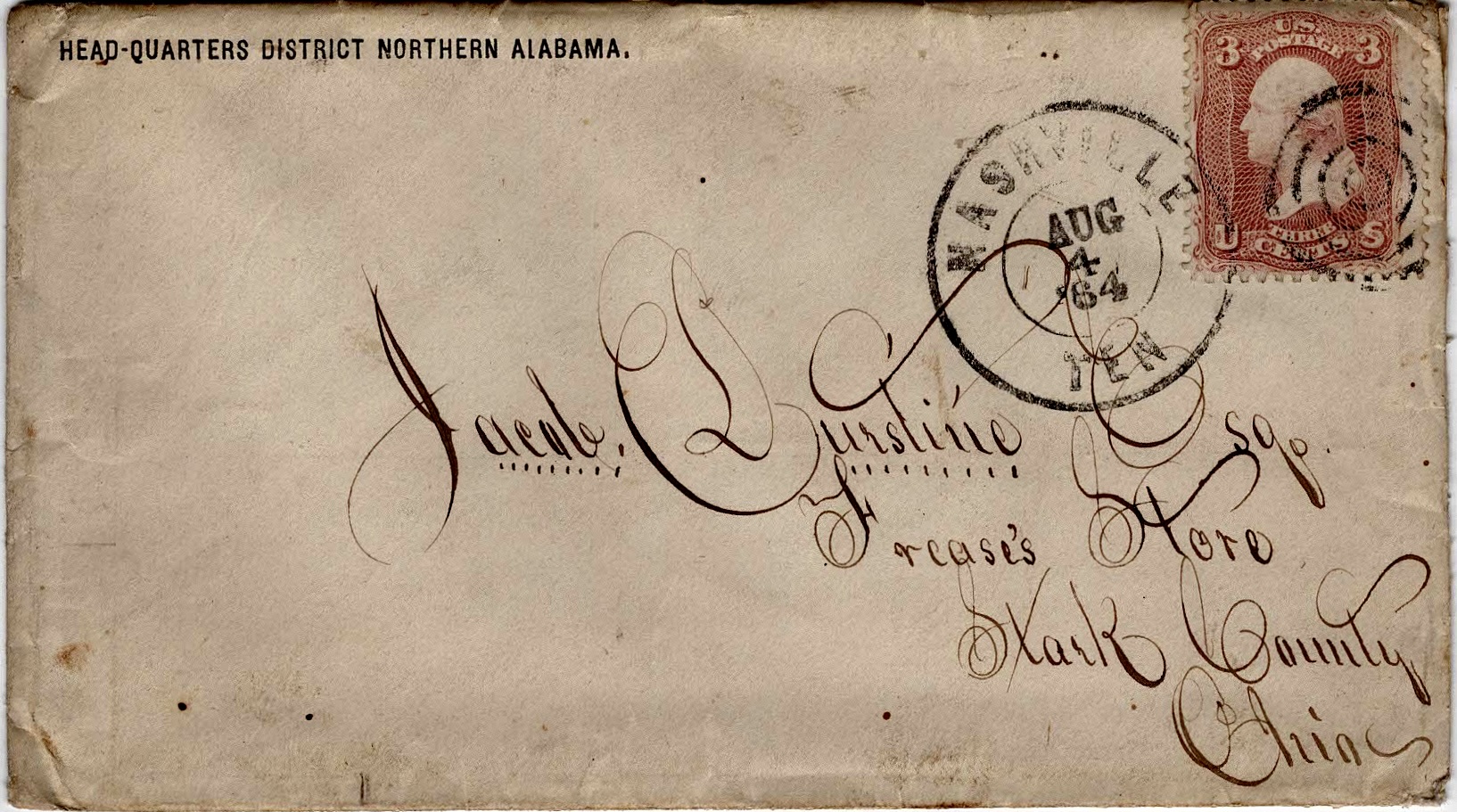
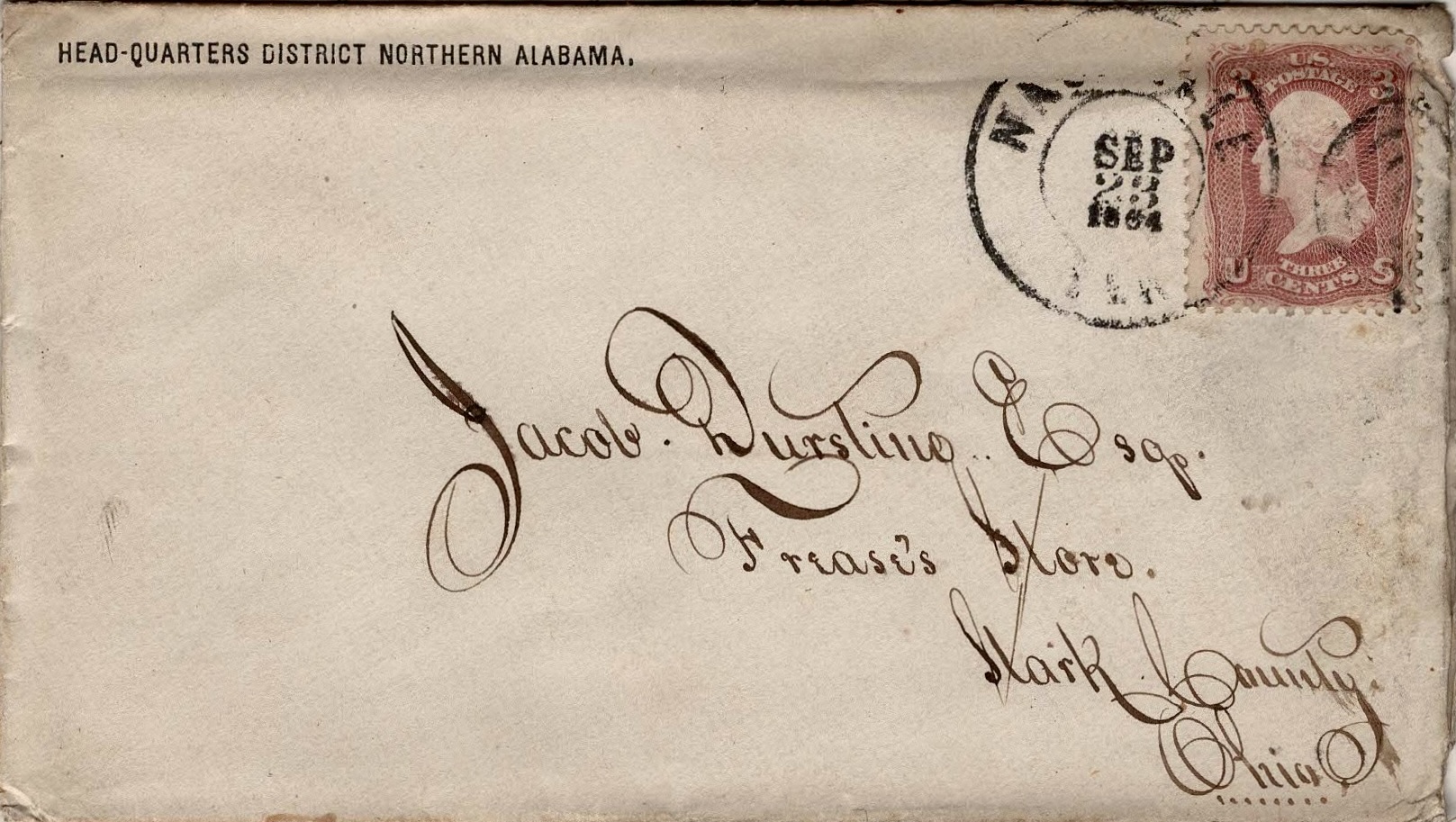
Addressed to Jacob Durstine, Esq., Frease’s Store, Stark county, Ohio
Decatur [Alabama] June 25th 1864
Jacob Dustine, Esq.,
Worthy sir, your letter of April 10th just came to hand last eve and as it has been so long delayed, I will answer immediately and in part make up for the season of silence. However, if I had received it sooner, I should have answered sooner but as it is, it must remain. The reason for the delay in my receiving it was because of its being directed to the regiment and they have been moving about considerable and their mail did not reach them, But as it happened, our regimental mail came to the P.O. at this place andone of the boys looked over it to see if there were any for us and found mine. Otherwise I would not have received it for some time longer. But to something important interesting.
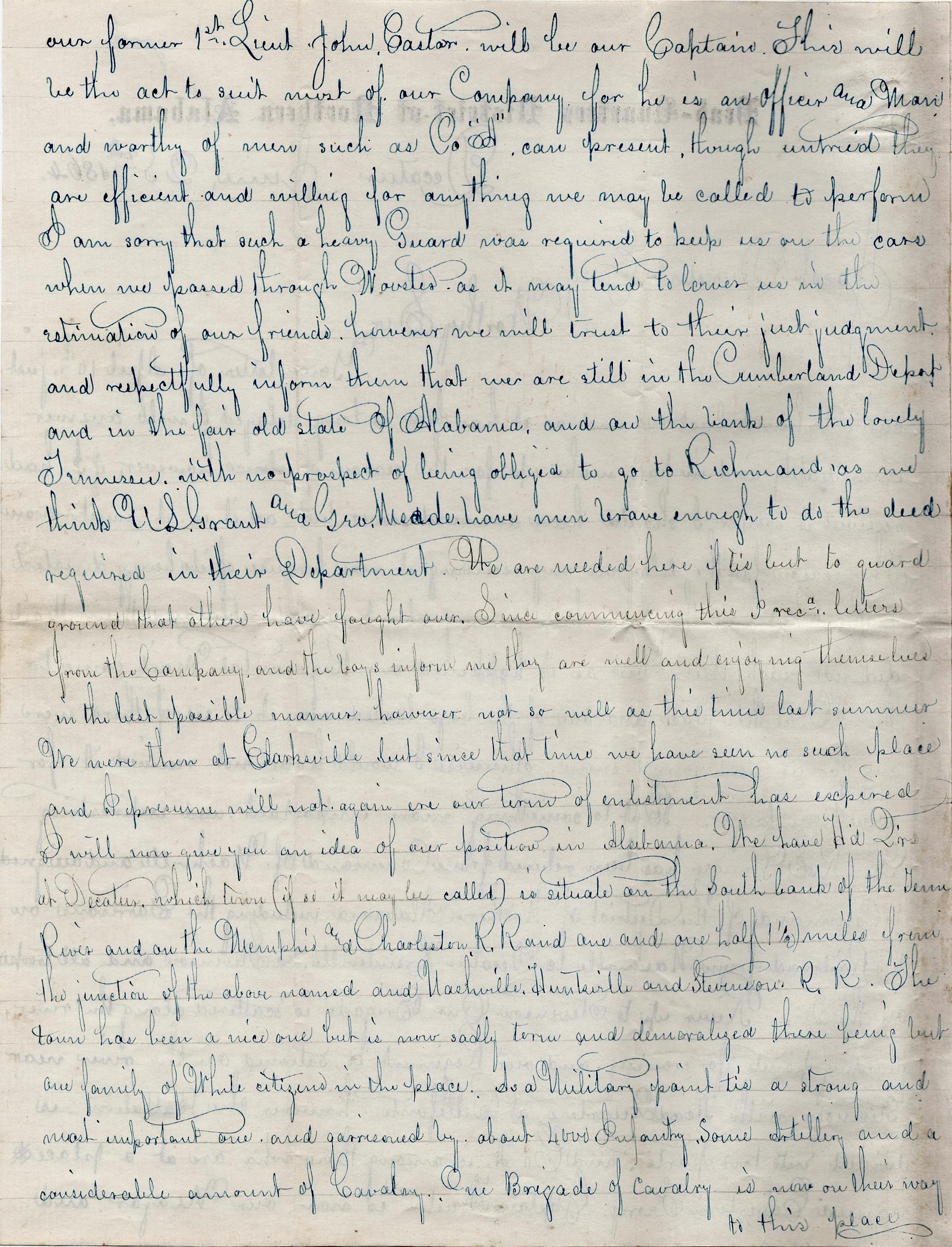
Gen. R[obert] S[eaman] Granger has been relieved from command of Nashville and assigned to command of the “District of Northern Alabama” including the garrisons on the railroad from Nashville to Decatur, Huntsville, and Stevenson, and all troops on the Tennessee River up to Stevenson. Our Brigade is scattered along the river guarding points of crossing and our regiment is stationed in the river near Stevenson with headquarters at Bellefonte. However, the Battalion is divided into two parts and Co. A is among those who are at a place named Carpenter’s Ferry. Captain Huston is now our Major and our former 1st Lieutenant John Castor will be our Captain. This will be the act to suit most of our company for he is an officer and man and worthy of men such as Co. A can present. Though untried, they are efficient and willing for anything we may be called to perform.
I am sorry that such a heavy guard was required to keep us on the cars when we passed through Wooster as it may tend to lower us in the estimation of our friends, However, we will trust to their just judgement and respecfully inform them that we are still in the Cumberland Dept and in the fair old state of Alabama, and on the bank of the lovely Tennessee with no prospect of being obliged to go to Richmond as we think U. S. Grant and George Meade have men brave enough to do the deed required in their Department. We are needed here if tis but to guard ground that others have fought over.
Since commencing this, I received letters from the company and the boys inform me they are well and enjoy themselves in the best possible manner. However, not so well as this time last summer. We were then at Clarksville but since that time we have seen no such place and I presume will not again ere our term of enlistment has expired.
I will give you an idea of our position in Alabama. We have Headquarters at Decatur, which town (if so it may be called) is situated on the south bank of the Tennessee river and on the Memphis & Charleston Railroad and one and one-half miles from the junction of the above named and Nashville, Huntsville, and Stevenson Railroad. The town has been a nice one but is now sadly torn sand demoralized, there being but one family of white citizens in the place. As a military point, ’tis a strong and important one and garrisoned by about 4,000 infantry, some artillery, and a considerable amount of cavalry. Our Brigade of Cavalry is now on their way to this place.
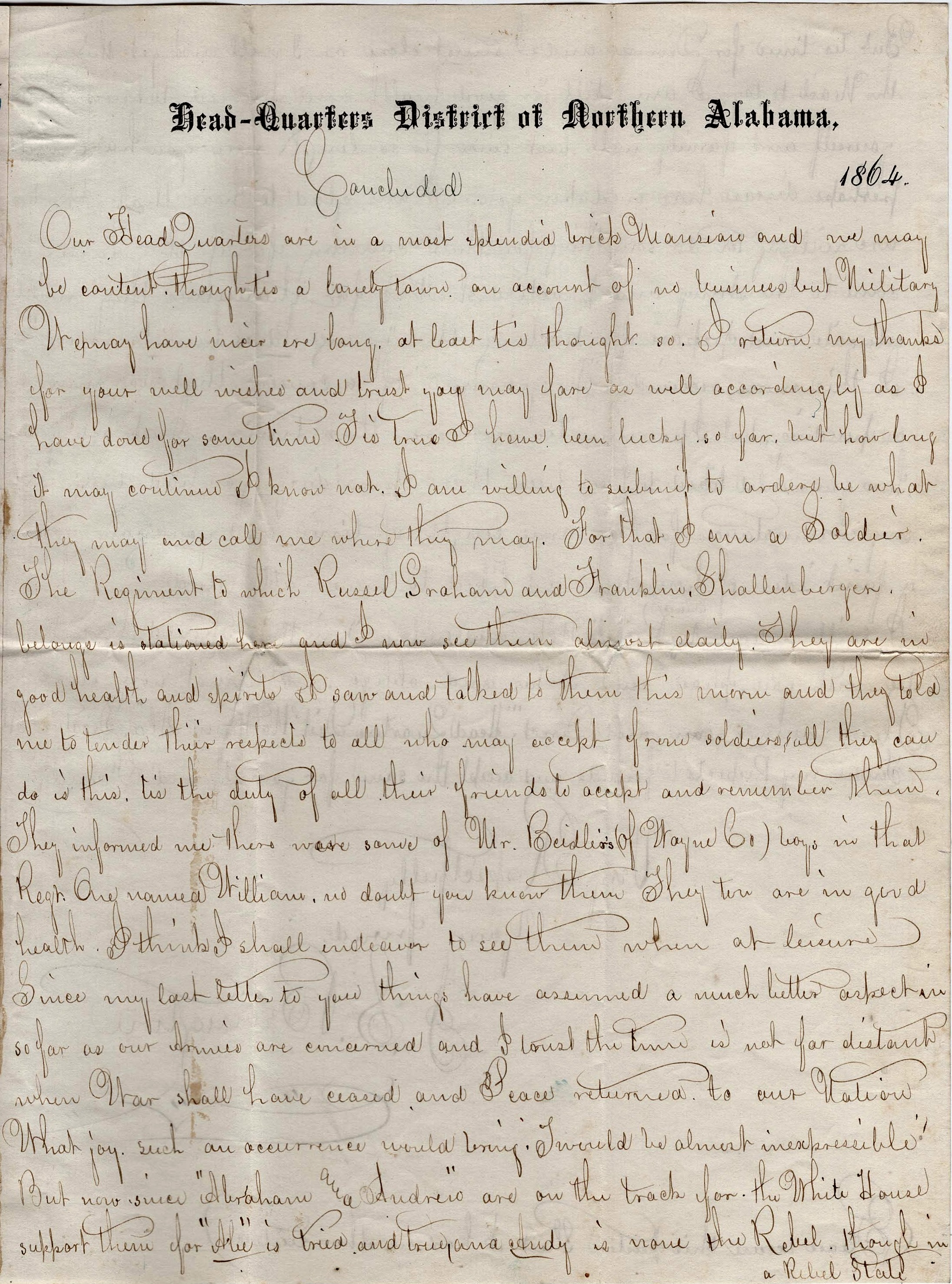
Our Headquarters are in a most splendid brick mansion and we may be content though tis a lonely town on account of no business but military. We may have nicer ere long—at least tis thought so. I return my thanks for your well wishes and trust you may fare as well accordingly as I have done some some time. Tis true, I have been lucky so far, but how long it may continue, I know not. I am willing to submit to orders, be what they may and calle me where they may. For that I am a soldier.
The regiment [9th Ohio Cavalry] to which Russel Graham and Franklin Shallenberger belong is stationed here and I now see them almost daily. They are in good health and spirits. I saw and talked to them this morn and they told me to tender their respects to all who may accept from soldiers. All they can do is this—’tis the duty of all their friends to accept and remember them. They informed me there was some of Mr.Bendure’s (of Wayne county) boys in that regiment. One named William. No doubt you know them. They too are in good health. I think I shall endeavor to see them when at leisure.
Since my last letter to you, things have assumed a much better aspect in so far as our armies are concerned and I trust the time is not far distant when war shall have ceased and peace returned to our Nation. What joy such an occurrence would bring. T’would be almost inexpressible. But now since “Abraham and Andrew” are on the track for the White House, support them for “Abe” is tried and true, and Andy is none the Rebel though in a Rebel state.
But tis time for dinner and I must close or I will not get this in the mail today. I am still in good health and pleased to know that yourself and family are well but since tis so long since you have written, perhaps disease has overtaken you. I am glad to hear that the boys are willing to do something for their country for if they cannot come to the Army and practice shooting for themselves, they will educate and prepare for teaching the “young ideas how to shoot.” I this morning received a “programme” of a concert that was announced as pending, but I presume tis over ere this time. Just ask yourself how you would liked to have been there providing you had been in my circumstances for the same length of time and you can form of a faint idea of how I should like to have attended.
I will endeavor to answer Rachel’s note and enclose it in this. Should she not yet be with you, please send it to her and oblige. I must now close. Please answer soon and direct, “Headquarters Dist. Northern Alabama”, Decatur, Alabama” Tender my respects to friends and accept the same for yourself and family. Very respectfully your friend, — J. S. Bevington
Letter 2
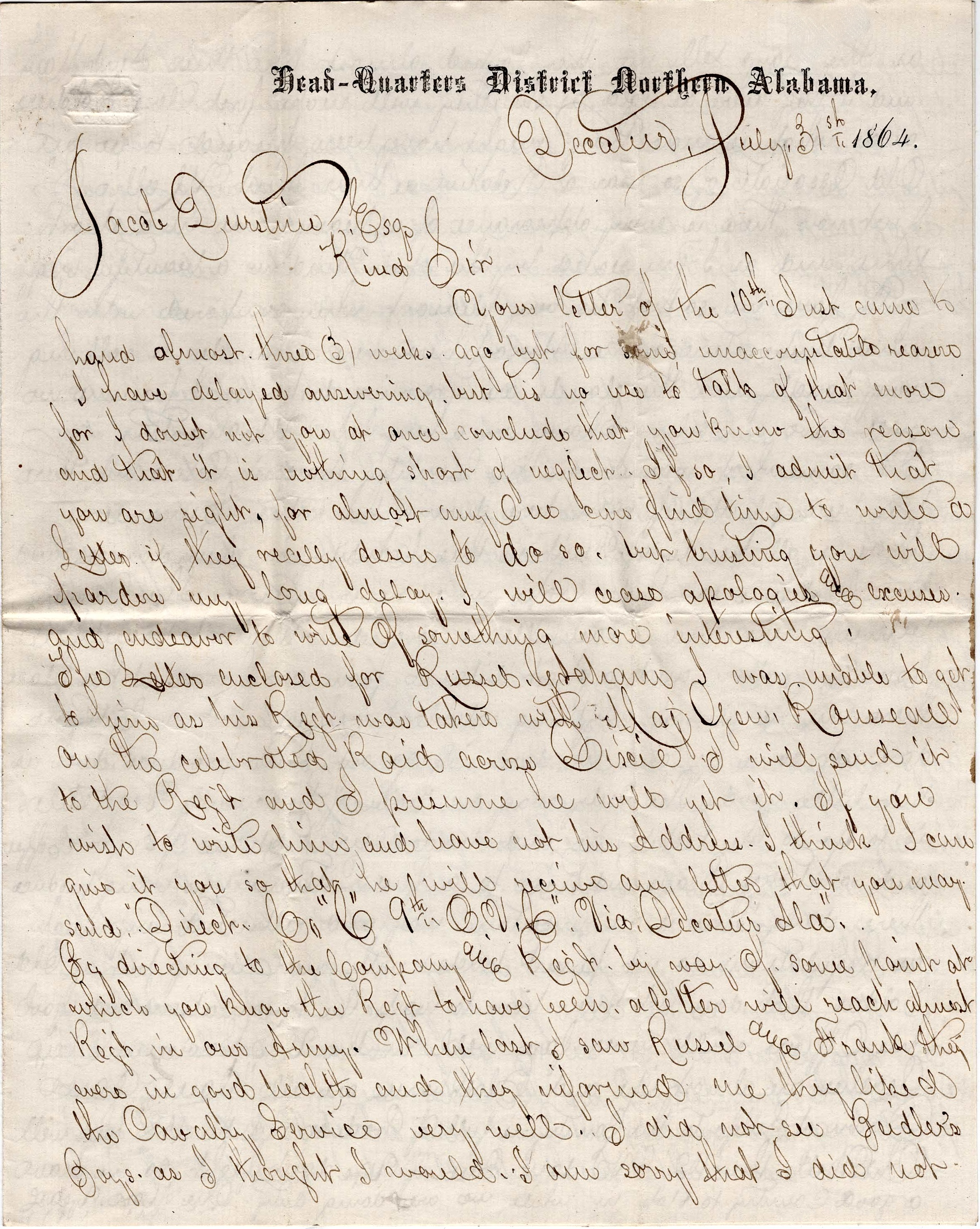
Decatur, [Alabama] July 31st, 1864
Jacob Durstine, Esq.
Kind Sir, your letter of the 10th just came to hand almost three weeks ago but for varied unaccountable reasons I have delayed answering. But tis no use to talk of that more for I doubt not you at once conclude that you know the reason and that it is nothing short of neglect. If so, I admit that you are right for almost anyone can find time to write a letter if they really desire to do so. But trusting you will pardon my long delay, I will cease apologies and excuses and endeavor to write of something more interesting.
The letter enclosed for Russel Graham I was unable to get to him as his regiment [9th Ohio Cavalry] was taken with Maj. Gen. Rousseau on the celebrated raid across Dixie. I will send it to the regiment and I presume he will get it. If you wish to write him and have not his address, I think I can give it to you so that he will receive any letter that you may send. Direct to Co. C, 9th O. V. C. via Decatur, Alabama. By directing to the company and regiment by way of some point at which you know the regiment to have been, a letter will reach almost any regiment in our army. When last I saw Russel and Frank, they were in good health and they informed me they liked the cavalry service very well. I did not see Beidler’s boys as I thought I would. I am sorry that I did not as the Boys tell me they looked almost like their Aunt Mary and if they were as bold as she, they would make first class soldiers. And what is more, they might have been pleased to see an Old Associate of so near a relative as their “Aunt Mollie B.”
Just now there is every appearance of a heavy rain in a short time and as I am seated by the open window, a beautiful breeze gently fans me so that tis very pleasant when compared with the usual temperature of the atmosphere here. Thunder is rolling very loudly and the clouds are growing darker so I presume we will have a cooling shower in a very few moments. ‘Tis somewhat warmer in this country than in Ohio but there has been plenty of rain here during the entire summer. There is all kinds of fruit in this country in abundance, and the citizens say their crops were never better. The country between here and Nashville is covered with most beautiful corn and cotton and a short distance from our lines at this place there can be almost anything eatable procured. But as citizens dare not come in and we dare not go out, their produce does us but little good. The only way we have of procuring vegetables is to go to the picket lines and trade our rations of sugar and coffee and sometimes beans and rice to a few citizens who bring produce there daily. This is an uncertain way and restricted very much as regulations do not permit trade with an enemy. But an old soldier that does not know how to work the “regulations” and fool his officers will never fare well in the U. S. Service in Dixie.
Peaches are almost ripe and blackberries are all [ ]. Down at Bellefonte the country is full of produce and the 102nd fares well. Oh well, the 102nd OVI don’t care if we don’t fight so we have a good country to stop in while we are doing duty. One more year.
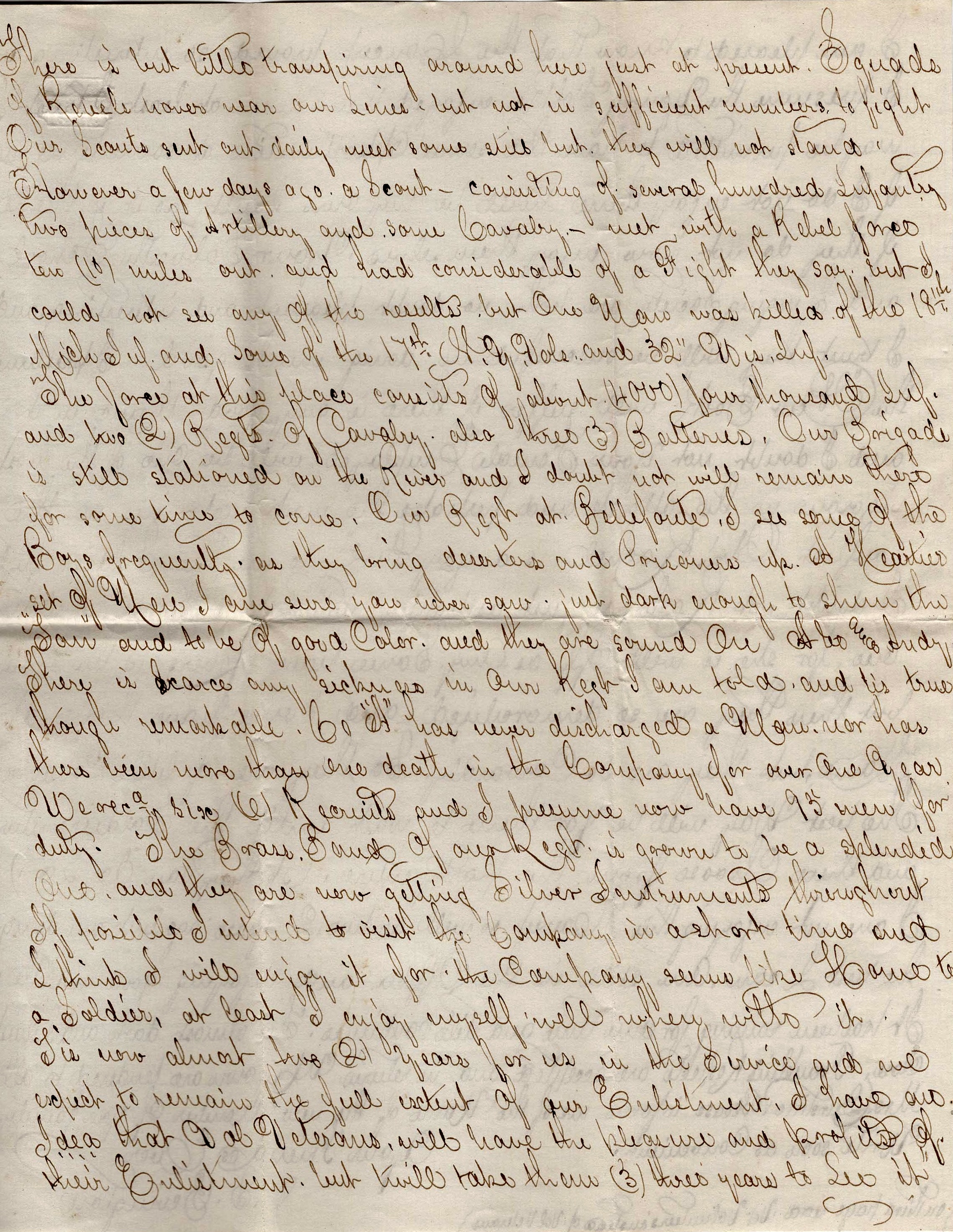
There is but little transpiring around here just at present. Squads of Rebels hover near our lines but not in sufficient numbers to fight. Our scouts sent out daily meet some still but they will not stand. However, a few days ago a Scout consisting of several hundred infantry, two pieces of artillery, and some cavalry met with a Rebel force ten miles out and had considerable of a fightm they say, but I could not see any of the results but one man was killed of the 18th Michigan infantry and some of the 17th New York Volunteers and 32nd Wisconsin.
The force at this place consists of about four thousand infantry and two regiments of cavalry, Also three batteries, Our Brigade is still stationed on the river and I doubt not will remain there for some time to come. Our regiment [is] at Bellefonte. I see some of the Boys frequently as they bring deserters and prisoners up, A heartier set of men I am sure you never saw—just dark enough to shun the “Tan” and to be of good color and they are sound on Abe & Andy.
There is scarce any sickness in our regiment, I am told, and ’tis true though remarkable. Co. A has never discharged a man nor has there been more than one death in the company for over one year. We received six recruits ands I presume now have 93 men for duty. The Brass Band of our regiment is grown to be a splendid one and they are now getting silver instruments throughout. If possible, I intend to visit the company in a short time and I think I will enjoy it for the company seems like home to a soldier—at least I enjoy myself well when with it.
‘Tis almost two years for us in the service and we expect to remain the full extent of our enlistment. I have an idea that volunteer veterans will have the pleasure and profits of their enlistment, but t’will take their three years to see it.
I am pleased to know that the concert proved so interesting and I presume the young folks enjoyed themselves, at least I trust I may be permitted to have the same opportunities at some time, and if I do not enjoy them, t’will be my own fault as it is theirs if they do not enjoy themselves. Your Sabbath School and Singing Society are both no doubt pleasant and interesting and I trust they will be successful in doing much good. I presume the “New Book” will suffer if there is any good music in it and I doubt not your Female employee will be one of the most vigorous in the attack and perhaps the most victories in the conflict.
Oh! Rachel is a gay girl, to use the soldier style. I doubt not Rach is just as happy without a “Beau” as with one for she is well off as any. Some have lovers in the army but then they are so demoralized and some have them at home, but they are so cowardly. So they are of little consequence. The best way will be for them to wait until the soldiers return and then choose from the party entire. (If they can do so.) I am not enjoying the harvest so well as two years ago but am doing the best I can. Am still in the office and enjoying good heath. It has been raining for some time and still continues. ‘Tis almost dark and I must close. Franklin’s respects are accepted and in return my own are tendered to all. Mrs. Durstine, please inform me of the name of the new member of your family. Write soon as convenient. Your friend as ever, — J. S. Bevington
Letter 3
Headquarters District Northern Alabama Decatur September 19, 1864
Mr. Jack Durstine,
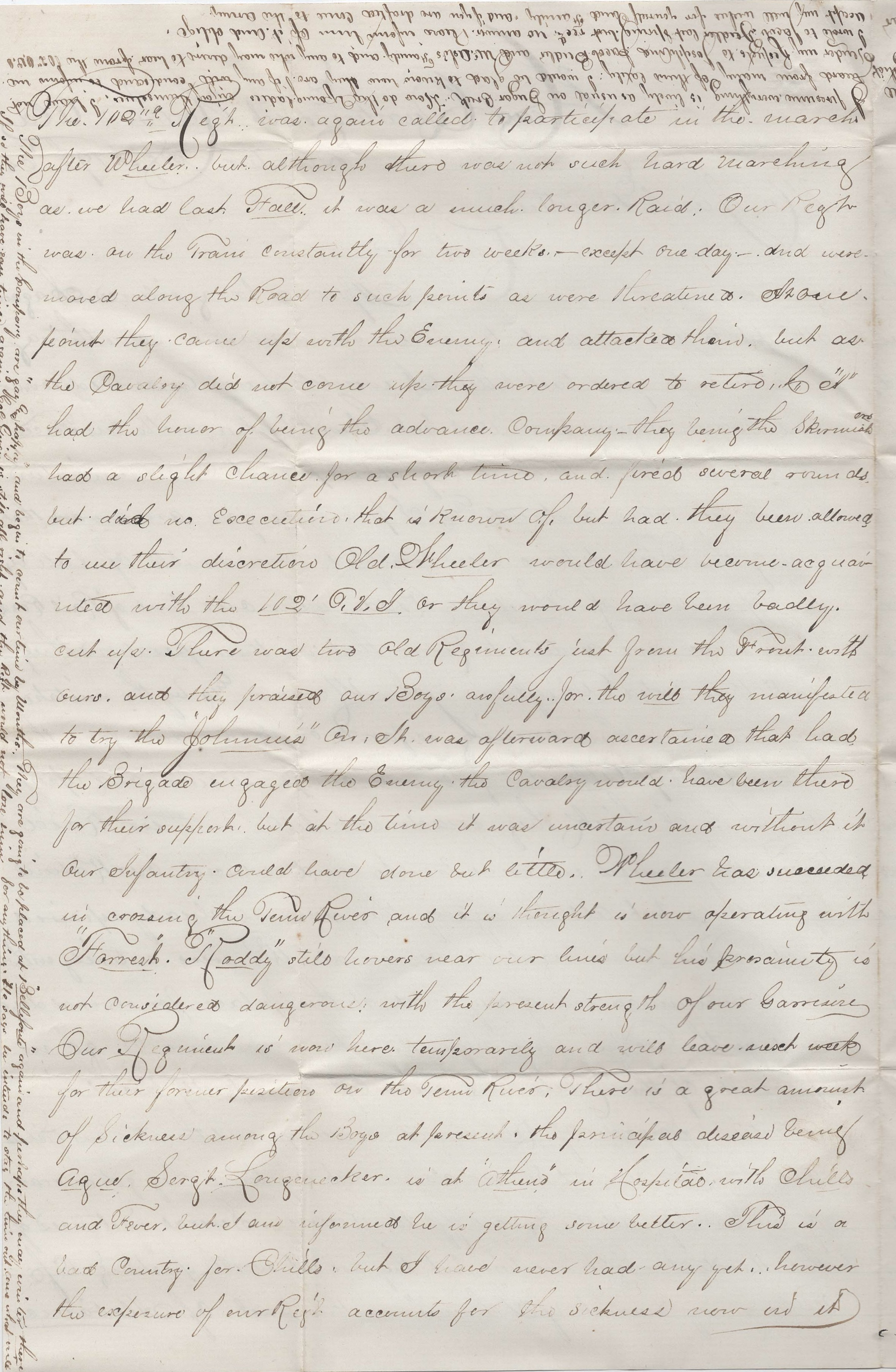
Kind sir, after a long silence I again attempt to communicate to you in some manner something in answer to your last letter. I would have answered sooner had circumstances permitted but Gen. Wheeler with his forces is a circumstance that is very apt to prevent communication where he takes a stand and I presume you are aware that we of this District have been troubled considerable of late by the operations of Wheeler & Roddy upon our line of railroad. However, we are content to know that in their operations they lost their noted chieftain John Morgan and by the mistake committed in their coming so far to the our rear and from their main army Atlanta fell into our possession and upon the whole I think they made but little in their raid. True, they caused us some trouble and reduced our rations for a time, but all the injury they done is already repaired and trains come regularly as usual. We were entirely without communication of any kind at this place for several days and as the troops were near all taken from here to go in pursuit of the Rebels, we were left in a pretty peculiar situation. Squads of Rebs would come up and threaten our pickets and then there would be an alarm. At one time they got in rear of our cavalry videttes and cut off the reserve. Several instances of their threats I might mention but they are not worth speaking of. We have any amount of “Johnnies” in this part of Alabama.
The 102nd [Ohio] Regiment was again called to participate in the march after Wheeler but although there was not such hard marching as we had last fall, it was a much longer raid. Our regiment was on the train constantly for two weeks—except one day—and were moved along the road to such points as were threatened. At one point they came up with the enemy and attacked them but as the cavalry did not come up, they were ordered to retire. Co. A had the honor of being the advance company, they being the skirmishers had a slight chance for a short time and fired several rounds, but did no execution that is known of, but had they been allowed to use their discretion Old Wheeler would have become acquainted with the 102nd O. V. I. or they would have been badly cut ip. There was two old regiments just from the front with ours and they praised our Boys awfully for the will they manifested to try the “Johnnies.” As it was afterward ascertained that had the Brigade engaged the enemy, the cavalry would have been there for their support but at the time it was uncertain and without it, our infantry could have done but little.
Wheeler has succeeded in crossing the Tennessee River and it is thought is now operating with “Forrest.” “Roddy” still hovers near our lines but his proximity is not considered dangerous with the present strength of our garrison. Our regiment is now here temporarily and will leave next week for their forever position on the Tennessee River. There is a great amount of sickness among the Boys at present, the principal disease being ague. Sergt. [John] Longenecker is at Athens in hospital with chills and fever, but I am informed he is getting some better. This is a bad country for chills but I have never had any yet. However, the exposure of our regiment accounts for the sickness now in it.
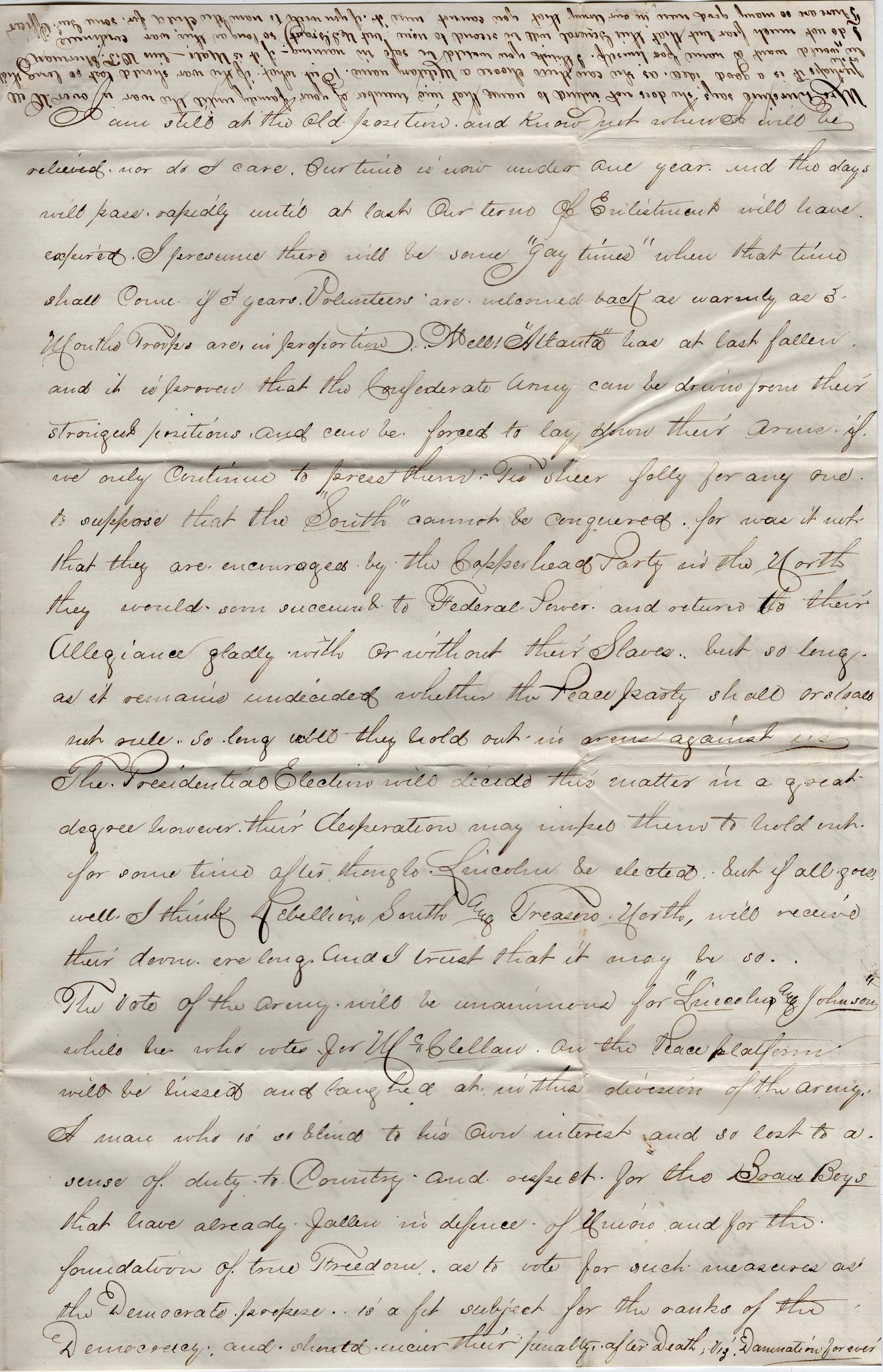
I am still at the old position and know not when I will be relieved nor do I care. Our time is now under one year and the days will pass rapidly until at last our time of enlistment will leave expired. I presume there will be some “gay times” when that time shall come if 3 years volunteers are welcomed back as warmly as 3 months troops are in proportion.
Well, Atlanta has at last fallen and it is proven that the Confederate army can be driven from their strongest positions and can be forced to lay down their arms if we only continue to press them. ‘Tis sheer folly for any one to suppose that the South cannot be conquered for was it not that they are encouraged by the Copperhead Party in the North, they would soon succumb to Federal power and return to their allegiance gladly with or without their slaves. But so long as it remains undecided whether the Peace party shall or shall not rule, so long will they hold out in arms against us.
The Presidential election will decide this matter is a great degree. However, their desperation may impel them to hold out for some time after though Lincoln be elected. But if all goes well, I think Rebellion South & Treason North will receive their doom ‘ere long, and I trust that it may be so. The vote of the army will be unanimous for “Lincoln & Johnson” while he who votes for McClellan on the Peace platform will be hissed and laughed at in this division of the army. A man who is so blind to his own interest and so lost to a sense of duty to country and subject for the Brave Boys that have already fallen in defense of the Union and for the foundation of Freedom as to vote for such measures as the Democrats propose is a fit subject for the ranks of the Democracy and should incur their penalty after death—viz: Damnation forever.
One feature in the movement of the people North at present I oppose and ever will. It is this. Troops are called for to reinforce our armies and instead of men coming voluntarily as they should, every act is resorted to to clear those liable to duty in the army from this call. To this end, recruiting agents are sent here to the South to fill the quotas of states, counties and towns in the North. Refugees from the Southern armies are recruited. Negroes are recruited, and anything that will exempt one man is taken. The duty of a good citizen is to fight for his country when she requires it and if he loves his country and her privileges, he will not barter away the sacred duty of defending her in her dark hour. Therefore I think and say that she who will see that sacred privilege bartered in this manner, and Negroes go as substitutes for white men, and still claim to be loyal and sacrificing is a traitor of deepest dye. I am in favor of Negro troops, but I want them accredited to the General Government and not to states or individuals. Again I ask, is it just, is it showing respect to old soldiers who are serving their three years for $100 bounty to place beside them in the ranks a hireling recruit when so many such enter the service for mere love of the [ ]?
I am sorry to know that such is the case in my own county and town but I look forward to a time when the war will have ceased and I trust that those who are guilty of that which I have stated may receive their punishment. Perhaps you may think me rough, but I speak the sentiments of those with who I am entirely acquainted and if I am too strong for anyone to stand it, they can just inform me. I am willing to serve this term and then, if necessary, another one. But God forbid that ever I should stoop to barter away my birthright—the only thing I have, the privilege of serving my country. I give this freely. Please give to any just as freely who may wish to know the sentiments of an untoried soldier. Please answer soon. Yours very truly, — J. S. Bevington
Letter 4
Huntsville, Alabama
arch 26th 1865
Mr. Jacob Durstine,
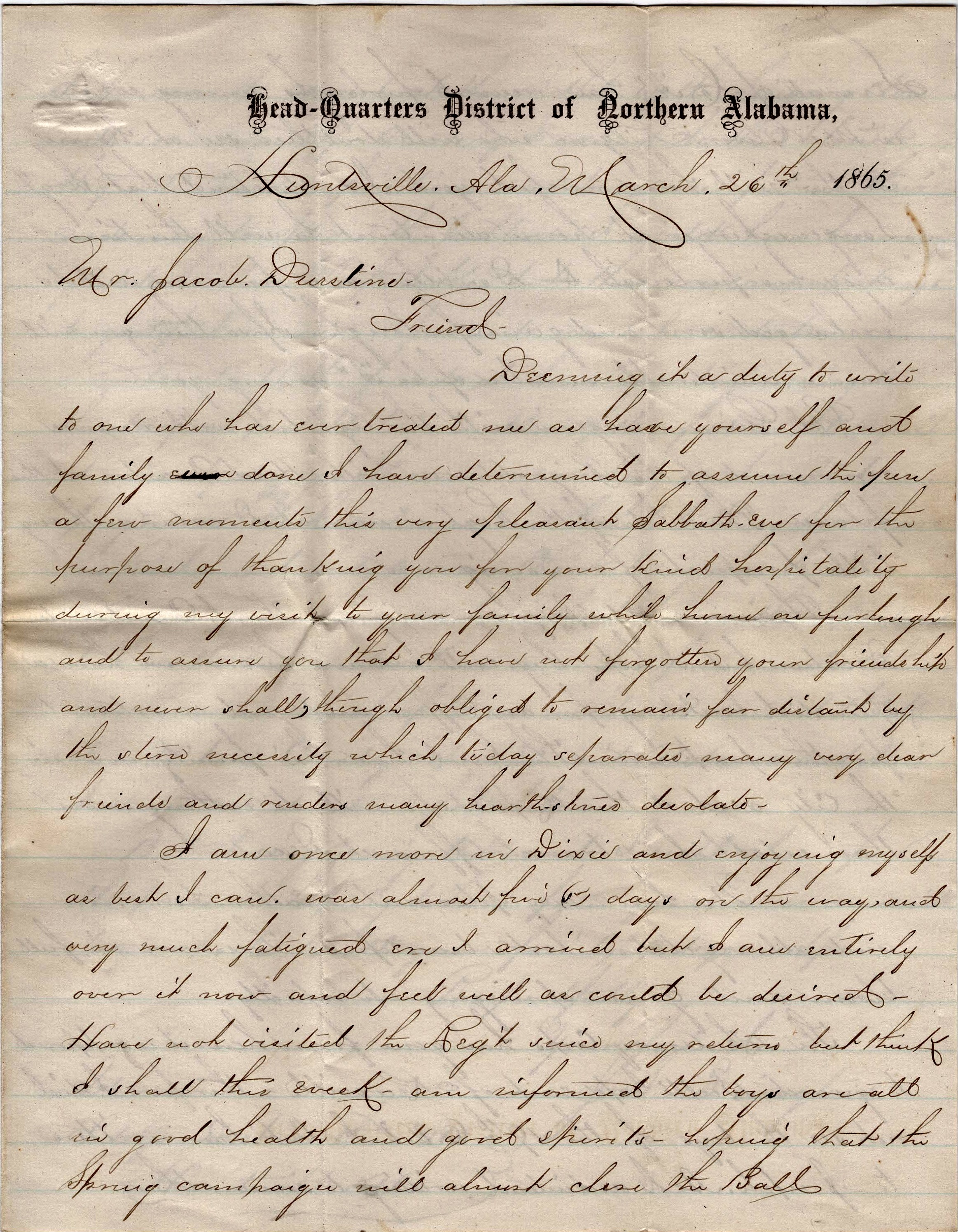
Friend, deeming it a duty to write to one who has ever treated me as have yourself and family done, I have determined to assume to the pen a few moments this very pleasant Sabbath eve for the purpose of thanking you for your kind hospitality during my visit to your family while home on furlough as to assure you that I have not forgotten your friends and never shall though obliged to remain far distant by the stern necessity which today separates many very dear friends and render many hearthstones desolate.
I am once more in Dixie and enjoying myself as best I can. Was almost five days on the way, and very much fatigued ere I arrived but I am entirely over it now and feel well as could be desired. Have not visited the regiment since my return but think I shall this week. Am informed the boys are all in good health and good spirits. Hoping that the Spring campaign will almost close the ball.
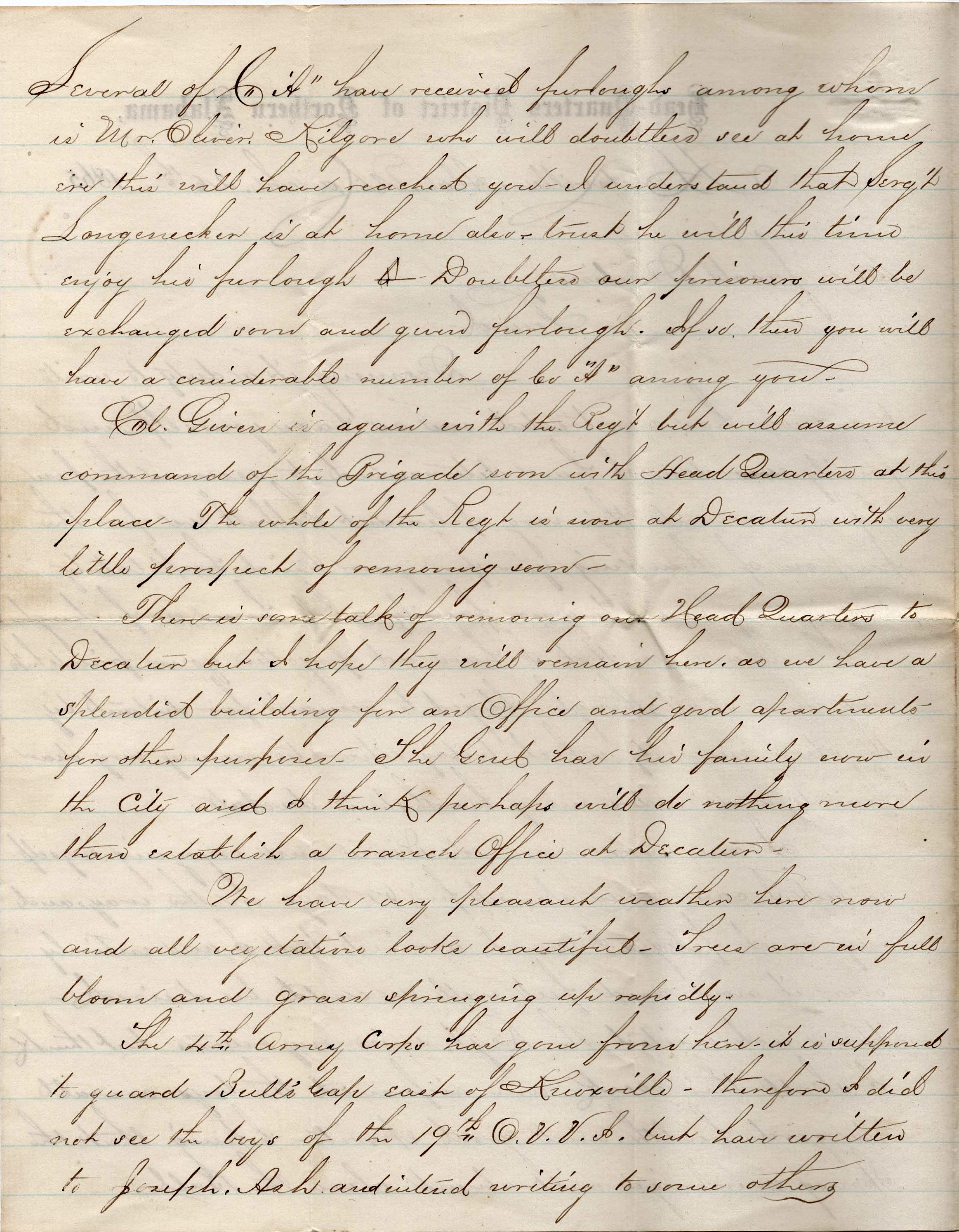
Several of Co. A have received furloughs among whom is Mr. Oliver Kilgore who [you] will doubtless see at home ere this will have reached you. I understand that Sergt. Longenecker is at home also. Trust he will this time enjoy his furlough. Doubtless our prisoners will be exchanged soon and given furlough. If so, then you will have a considerable number of Co. A among you.
Col. Given is again with the regiment but will assume command of the Brigade soon with Headquarters at this place. The whole of the regiment is now at Decatur with very little prospect of removing soon.
There is some talk of moving our Headquarters to Decatur but I hope they will remain here as we have a splendid building for an office and good apartments for other purposes. The General has his family now in the City and I think perhaps will do nothing more than establish a branch office at Decatur.
We have very pleasant weather here now and all vegetation looks beautiful. Trees are in full bloom and grass springing up rapidly.
The 4th Army Corps has gone from here—it is supposed to guard Bull’s Gap east of Knoxville. Therefore, I did not see the boys of the 19th OVI but have written to Joseph Ash and intend writing to some others.
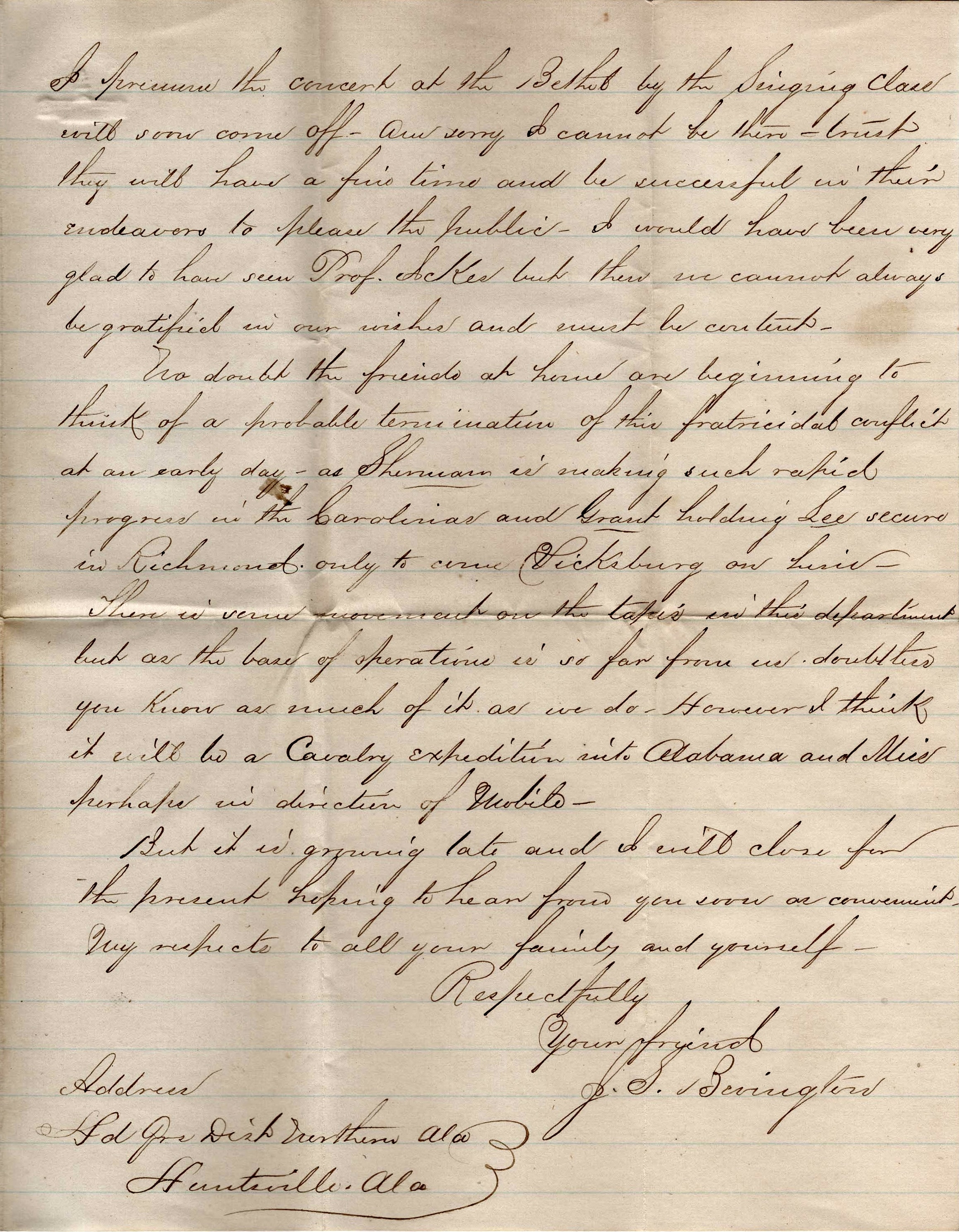
I presume the concert at the Bethel by the singing choir will soon come off. Am sorry I cannot be there. Trust they will have a fine time and be successful in their endeavors to please the public. I would have been very glad to have seen Prof. Aches but then we cannot always be gratified in our wishes and must be content.
No doubt the friends at home are beginning to think of a probable termination of this fratricidal conflict at an early day—as Sherman is making such rapid progress in the Carolinas and Grant holding Lee secure in Richmond only to come Vicksburg on him. There is some movement on the topic in this department but as the base of operations is so far from us, doubtless you know as much of it as we do. However, I think it will be a Cavalry expedition into Alabama and Mississippi perhaps in direction of Mobile.
But it is growing late and I will close for the present hoping to hear from you soon as convenient. My respects to all your family and yourself. Respectfully your friend, — J. S. Bevington
Letter 5
Huntsville [Alabama] May 16, 1865
Esteemed sir,
Yours of the 2nd received the 9th inst. and read with pleasure, but I a, sorry that I am again compelled to beg apology for delay. However, think you will accept my poor excuse knowing as you do that the war is over—or—as the boys say, “School’s out” and we intend coming home soon and would suggest that huge preparations be made to receive us.
Well, you of course know by this time where I am and what I am doing, what my sentiments are the manner in which I express them. But I venture to aver that you don’t know what a job it is for me to write a letter with the perspiration dropping from my brow and the gnats keeping me brushing them away almost constantly. But I must stop this or I will detract from the favorable description I have already given of Huntsville. But I must in justice to myself and you assure you that it is some warmer here than is really desirable but as the war is over and Jeff Davis none up, I have concluded to endure a few more days and then—oh! some man will want harvest hands but unless the powers that he can be persuaded that our services are indispensable to a gathering of the grain and in consequence muster us out of the service, I fear their wants wil not be supplied.
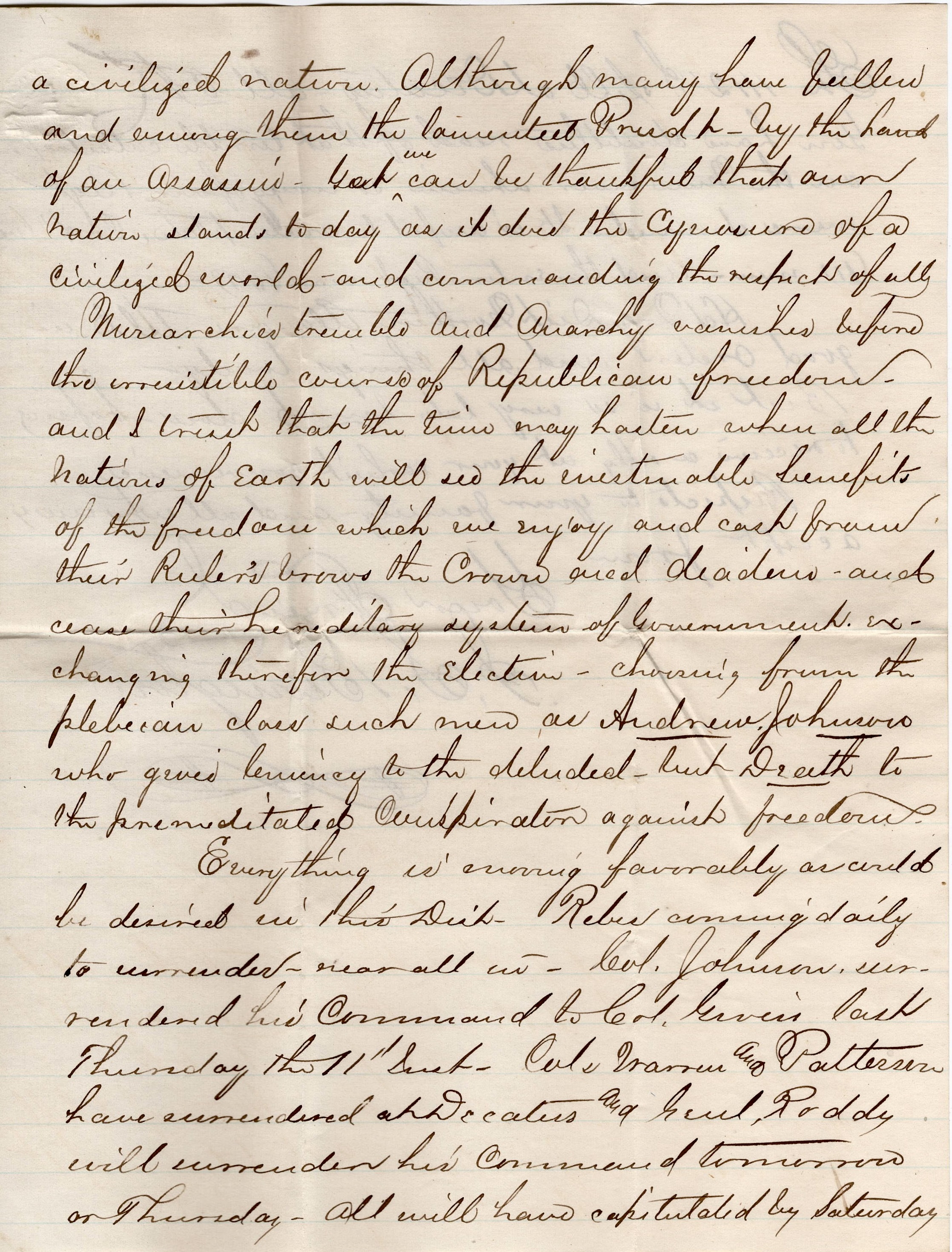
But enough of this ridiculous. It appears that our country has at last emerged from the troubled waters of civil strife and are purified by the immersion—however, allow to remark here that you must not infer that I admit the divinity of immersion as the only source whereby the unclean are cleansed—and now stand for to the astonished world to vindicate the doctrines that man is capable of self government and to promulgate the sentence of treason and traitors in the overthrow of rebellion and execution of instigators and perpetrators of the foulest deeds that ever disgraced the history of a civilized nation. Although many have fallen and among them the lamented President by the hand of an assassin, yet we can be thankful that our nation stands today as it does—the cynosure of a civilized world and commanding the respect of all. Monarchies tremble and anarchy vanishes before the irresistible course of Republican freedom. And I trust that the time may hasten when all the nations of Earth will see the inestimable benefits of th freedom which we enjoy and cast from their Ruler’s brows the crown and diadem and cease their hereditary system of government, exchanging therefor the election—choosing from the plebeian class such men as Andrew Johnson who gives leniency to the deluded, but death to the premeditated conspirator against freedom.
Everything is moving favorably as could be desired in this district. Rebs coming daily to surrender. Near all in Col. Johnson surrendered his command to Col. Given last Thursday the 11st. inst. Col. Warren and Patterson have surrendered at Decatur and Gen. Roddy will surrender his command tomorrow or Thursday. All will have capitulated by Saturday.
The 102nd [OVI] still at Decatur. All OK. You have doubtless read of that terrible catastrophe on the Mississippi river [see Sultana Disaster] wherein so many of our regiment were drowned. It is awful to contemplate. Co. A lost 11 men and the entire regiment near 100.
Headquarters District of Northern Alabama are still in good order and all things lovely. But it is very late and I must close hoping to receive a reply at your earliest convenience. Respects to your family and all who may acceptaccept from your friend, — J. S. Bevington
The following letter was written by George O. Wheeler (1844-1922) of Locust Grove township, Jefferson county, Iowa, a native of Waitsfield, Vermont), who enlisted on 22 December 1863 in Co. G, 5th Iowa Infantry. He was transferred with the veterans to Co. I, 5th Iowa Cavalry when the two regiments were consolidated in the fall of 1864 and mustered out of the regiment in August 1865 at Nashville.
George died 18 March 1922 at Des Moines, Iowa.
First Squad of Co. E, 5th Iowa Cavalry. The verso has an inscription from George Wolf, a member of the company. called. 1864 (Iowa Civil War Images)
T R A N S C R I P T I O N
Camp of the 5th Iowa Cavalry Near Nashville, Tennessee [November 1864]
Friend Steven,
It has been quite a while since I wrote to you. We left this place for Louisville the 27th of October. There we drew horses and started back and arrived here last week. We were 13 days on the march, nine of which were very rainy & I was very wet most of the time with plenty of mud spattered over my clothes to make it agreeable. On arriving in camp, I found eleven letters & twenty-six newspapers in the mail line & as a matter of course opened the letters first. I was a little surprised to see yours & Mrs. Stevens’ as I did not hardly expect you would have time to write but the letters were all the more welcome & I was glad to hear from you.
Since my last letter to you, my health has improved & I am once more well. I was weighed while in Louisville & weighed 140 lbs.
We are camped three miles from the city on the railroad leading to Huntsville, Alabama. We are to draw new arms in the morn and will have the saber, Spencer carbine, and no revolvers. The carbine is a seven shooter & I do not want to be troubled with a revolver. After all I have seen of the service, I am not yet sick of it & I would have enlisted in the Navy ere this & informed Mother of my intention of so doing but she begged me not to so hard that I have concluded to wait a while and make her a visit before so doing & explain the matter to her. Then perhaps she will feel better on the subject.
Tell Mr. Martin that I feel a little ashamed of myself for not paying him before I left home last spring but I did not think of it, but will not forget to send it as soon as I am paid which will not be long. It is true it is not much but I always believe in doing as I promise. And besides, a person who has to work for a living wants what is their own. If I could borrow it, I would send it in this letter but the Boys have all spent their money. It is impossible to borrow.
Last eve as we were marching through the streets of Nashville on our way to camp, I heard a person enquiring for Old Co. G, 5th Infantry. On looking around I discovered Wildrous Boll. I stopped & shook hands with him & noticed that he was not looking very well. On enquiring the cause, he informed me that he had been wounded not long since. I was ordered forward and was obliged to leave him with only a few words. I told him I would see him again & I will. Where I stopped the street was very narrow and so crowded that there was barely room to allow of two marching through & my stopping caused all of the column in the rear to wait & the surly Captain ordered me forward. I intend to get a pass & go to the city & hunt him up as I want to see him & apologize for leaving him so abruptly. I would not have done so if not forced to.
Your buying a horse and paying $160 for him and having him killed so soon is rather rough but such things will happen & I trust it is all for the best. In regard to investing my money, I will send some more soon & you may invest it in which way you think best. If I were up there, I could find a way to invest it. As it is, I am not posted & do not know where to invest it so it will pay. Use your own judgement & I will be satisfied & will pay you for your trouble & be very much obliged in the bargain.
I have written a long letter & hoping to hear from you soon, will close. Very respectfully, your obedient servant, –Geo. O. Wheeler
Thomas Hannah, Jr. (1835-1865) was born 11 February 1835 in or near Montreal, Quebec, Canada. He was the first child of Thomas and Jane Hannah. There were 3 brothers and 1 sister. Thomas emigrated from Canada to Massillion, Ohio when he was quite young. He married Elizabeth Marshall in 1855 and shortly after their marriage moved to Belvidere, Illinois to join the Hannah family, who now resided there. The Hannah’s were farmers. In 1862, Thomas became a naturalized U. S. citizen. Thomas and Elizabeth’s first child died in infancy. Their second son Jesse was born in 1860, followed in 1862 by Thomas. This same year, Thomas joined the army for three years and was mustered out in 1865. From 26 January 1863 to 30 July 1864, he served as Ward Master at Adams Hospital in Memphis. He was wounded at Spanish Fort in 1865 and died October 22, 1865.
Thomas wrote these letters to 32 year-old Margaret Meseroll (1833-1934), a native of New Brunswick, Canada, with whom he became acquainted while working at the Adams Hospital in Memphis. “Maggie” served for two years and six months at Adams General Hospital No. 2 and Gayoso Hospital, Memphis, Tennessee, as a regular ‘Commissioned nurse,” hired by Mary Livermore under the auspices of the US Sanitary Commission. In her later years, Maggie recalled with horror the treatment of maimed soldiers carried into the hospital from the Sultana steamboat disaster. Maggie was married in 1866 to Sanford E. Hayes. She died in 1934 at the age of 101.
Thomas’ letters from Memphis were transcribed by his great, great grandson, Michael Bryan Fiske, and have been posted here: Civil War Letters from Memphis.
Dear loved friend Maggie. With feelings of the most profound respect and love I take my pen to let you know of my whereabouts. I am in camp 5 miles in the rear of the city. Am sitting flat on the ground with my back against a tree and with portfolio on my knee. Am trying to write a letter to you whom I respect and hold in grateful remembrance. I am very sorry now that I did not stay all day with you when I was in Memphis as the boat did not leave until the next morning but I did not know at that time at what moment we might start. I assure you, dear Maggie, my greatest pleasure would have been have spent every leisure moment with you for I had much that I wanted to say to you. But in my great hurry, I could think of nothing.
After leaving you, I came across an old friend and we went to Madame Vinson’s and had the oysters, and it recalled to my mind the happy evening I spent there with you and Mary. And oh! how I wished that you were there then. I should indeed enjoyed my dish of oysters much better.
Well, dear Maggie, I spent the day cursing the boat and everything connected with it and wishing I had only stayed with you whose company I could enjoy. As soon as it was dark, I lay down and allowed my thoughts and mind to go far back into the past and to dwell upon all that was pleasing in happy days gone by (I then thought of what you had told me concerning Aunt Lizzey’s wedding and as I pondered it over in my mind and thought of the great injury and wrong she had drove you—you who are alone with none to shield and protect you in this cold, deceitful world—I felt the utmost contempt for her, the old wretch. Dear Maggie, I do most heartily sympathize with you. I imagine how bad you must have felt to have been accused of being a bad woman—you whom I think so kind and good who cared so much for me when I was sick and longed for the sympathy of a dear sister which you, loved friend, bestowed upon me. And if it were a man instead of woman who had made such false and damnable charges, I should have resented it and taken it up for you.
But never mind, dear Maggie. There is a time coming when all wrongs shall be redressed and offenders punished. You have warm, true-hearted friends who will live and remember you and whose friendship and confidence cannot be shaken by every wind that blows. As for me, dear Maggie, I hope to see the time when you will be provided of, find a good, kind husband—one who will love you as you are worthy to be loved. Yes, dear friend, I hope shortly to see you happy in your own home surrounded by plenty with none who dare to molest or try to injure you. I imagine then that your mind would be relieved of many cares and anxieties that now press hard upon you.
You may think that perhaps I am feeling too much interested in your welfare. I acknowledge I feel a deep interest in you and my greatest delight would be to see you happy and surrounded by comforts.
We made a quick trip from Memphis to Vicksburg. Our boat was the first one in port. They run with such a heavy head of steam [that] everything trembled. Many were afraid of blowing up. As for myself, I had but little choice of or by what means I was sent out of the world for I think if I am to be spared through the war, no power on earth can destroy me. We made the trip in 28 hours. We landed at this place to give them a chance to clean the boat when we expected to reembark for New Orleans. We lay on the levy for two days, then received orders to unload all our stuff and prepare for a march across the country to Selma. At length, all was unloaded. We were ordered into camp and yesterday we came out here which is a very pleasant spot in the woods where we can hear the sweet singing of birds such as the crows and frogs. The former warble their notes the whole day long. the latter keep it up all night. You can imagine how sweet the music must be.
This morning I killed a possum and our nigger cook will feast upon it tonight. The weather is warm and pleasant with the soft gentle breezes blowing from the south. I enjoy such weather, much better than the cold piercing winter just spent in Tennessee. Can’t tell how long we will stay here. Perhaps ere this reaches you, we may be on the war path again and hard after our traitorous foe. May lay here for a long time. But come what may, I will try and acquit myself like a man and a soldier and be worthy the friendship of those I love and respect. Remember me in love and respect. Remember me in love to Mollie and all friends, My respects to Norton and Keeler of my company. Write to me very often. Write to me very soon and believe me your friend, — Thomas Hannah
Letter 2
Camped in the Mud in a Sinking Condition Near New Orleans, Louisiana
My loved friend,
As Amost Norton is writing to the hospital [Adams Hospital, Memphis], I embrace the opportunity with pleasure to send a few lines along to you, my dear friend. I wrote to you from Vicksburg giving you all the particulars up to that time.
We landed at this place the 22nd. It has rained ever since and no prospect of it stopping yet. We are camped on a low, flat plowed field that is now deluged with water. You have heard of the Louisiana low lands? Well here we are sitting in the mud with alligators, lizards, turtles, and other reptiles crawling around while the frogs are singing all round even in our beds and I am expecting every moment to see some monster of the deep poke up his head to pull me under.
This morning Norton and myself and three others thought we would lay in our beds as it was raining. We lay there till the water came in around us two inches deep. We then turned out in the storm. I looked around for some high spot to fly to for refuge but could see nothing but water. We then started for the woods, cut brush and trees to lay upon and keep us up. Norton asked me what you would think could you see us. I told him you would feel worse than we did ourselves. I know you would, dear Maggie. I am glad our friends cannot realize what we have to endure.
We do not expect to remain here long but expect soon to be out on the ocean sailing—the sooner the better. I was in hopes we would be paid at Vicksburg but am disappointed once more.
I have nothing more but mud to write about. I will bring my letter to a close by wishing to be remembered in love to Mollie and my friends at the Adams [Hospital]. Tell them to simply address their letters to the company and regiment for we are changing round so much we don’t know half the time to what army we belong. Tell Keeler of my company to hurry back to the regiment for I miss the rations he supplied me with when here. Hoping soon to hear from you, I hasten to subscribe myself your friends, — Thomas Hannah
to Miss Margaritte Meseroll, Gayoso Hospital, Memphis, Tenn.
This letter was written by Thomas H. Guinnip (1839-1873) who was 22 years year old when he enlisted on 18 May 1861 at Addison to serve two years as private in Co. E, 34th New York Infantry. He mustered out with the company on 30 June 1863, at Albany, N. Y. He was sick and absent from the regiment most of the fall of 1862 and detailed in the discharge office at Washington D. C. in January 1863.
The 34th New York Infantry mustered into the U. S. service at Albany June 15, 1861, for two years. It left the state for Washington on July 3; was quartered at Kalorama heights until July 28, when it moved to Seneca mills and was there assigned to Gen. Stone’s brigade. The regiment moved to Edwards ferry on Oct. 21, to Poolesville, Md., Oct. 23, and there established Camp McClellan, which was occupied until Feb. 24, 1862, when orders were received to move to Harper’s Ferry.
Thomas was the son of Parley Guinnip (18xx-1857) and Eliza M. Smith (1816-1876) of Addison, Steuben county, New York.
T R A N S C R I P T I O N
U. S. General Hospital December 11, 1862
My dear Mother, Brother & Sisters,
I take great pleasure in acknowledging the receipt of your very kind letters which come to hand this beautiful Thursday morning; also which was perused over & over with the deepest interest & with the greatest pleasure. My health is quite good at present and I am in very good sprits. Alonzo Curtis has just left for Parole Camp (which is two miles distant from here). He arrived here last night from home and came here to see me today. He looks tough and hearty. He says that he feels well (with the exception of a swollen face which was caused by taking cold and settling in his right cheek, and which is quite painful to him). Samuel Kimball left here last Monday bound for home. Perhaps is at home before this time. You can see Sam and he will tell you all about how I am getting along & what I am about, &c.
Then Amelia! you are attending dancing school this winter and doubtless you anticipate great pleasure of becoming a good & easy dancer. I think that your school is slimly represented in the shape of male attendance. As you state that there is double the number of girls to that of the boys, without doubt the young ladies have to escort one another home. From the fact that there is such a great deficiency of young men left at home, that the girls have to look out for A No. 1, and court their own shadows, &c.
For a few days past the weather here has been quite cold & tedious (I doubt much if you have at the North experienced any colder or more disagreeable weather than we have experienced here for five or six days), for the past three days the weather has been quite mild, and today it appears like spring.
Girls! I suppose that you are looking forth in the future at the expected moment when the elements (or in other words water) of the beautiful Canisteo River shall become congealed. Then without doubt, you will enjoy yourselves to a pretty good advantage skating and maneuvering on the ice. May your expected pleasures & future [ ] be crowded with every earthly felicity. and with a great deal of success.
Horatio, I will send (as soon as I get my pay) some money to buy you a pair of skates. How did my skates come to be destroyed! they was good & whole when I saw them last. Horatio, Ma says you call her a damn fool, a thing and a Devil, &c. I consider it my duty as a senior brother to give you some advice (which I have already done) and I hope that you will profit by the same, for youg people know but little of the world, and how they can act with the best advantage. It grieves me to address you upon a subject so painful, but your disobedience and wild, reckless conduct towards your Mother (your only parent here on earth) compels me to do so. Your unworthy conduct towards your mother has been a source of much vexation and anxiety to her. You are rude and unfeeling to a certain extent. You have forfeited the confidence and respect that you once had for your dear mother. Is it possible that you do not regard her admonitions; one, who is your best friend; and bestows upon you so many facilities and granted you so many privileges. I little thought that you would ever repay her with such ingratitude and wicked acts in which you have so frequently been guilty of. I do hope that you wil try and be a better boy. Ask your mother’s forgiveness & repent for the wrong doings which you have been guilty of. Be more penitent in the future for it will afford you an opportunity to make amens and retrieve the past. Having left the paternal roof myself and gone away to fight the battles of my country, of course it is my duty to entice & persuade you to do right. I think it incumbent upon me to give you a little advice, such as I am confident of giving from my own observation and experience. The advice I have already given you and I hope that you will abide by the same for it will be for your own interest. Do not think hard of me for the advice which I have given you, or the reproval for it is for your own and personal good, and you will find it out so. I know that I have never set a very good and wise example to you, but now I repeat for the same, so do not follow my example but likewise repent yourself and do better hereafter. The next time that I hear from home, I am in hope to hear that you are a good boy. So may it be.
I have not received my pay yet but when I do. I will send ma some money as soon as possible. I was thinking I wrote and told you that William Hance was dead, at least I meant to, for I heard of it before you did. I received a letter from friend Dan Hollis today. It was a good letter. He said that he has the horse . And Mat told him that he must make it all right with me. Of course it is all right as far as I am concerned. I think he paid well for the use of the horse, according to Horatio’s tell.
I am very glad to learn you have such an excellent school. I was not at all surprised to hear that Rev. Judson made a good teacher for I always supposed he would make an excellent teacher. It is my desire to& greatest wish that you (I mean Horatio and the girls) should attend the school and be studious and attentive to your studies. Then when you get older, you will never repent it. A person can never study too much, or get too good an education.
Really, I think Addison is doing a big business in the line of matrimony. I should think all the young ladies of Addison would go half crazy at the very thought or idea of honest Byron’s committing matrimony, for I understand that the girls were all after him, and what were not after him in love were after him with broom sticks and mob sticks. Yes, Byron will make an interesting husband. I wonder if he is well matched for a companion. If they are well matched, they will fetch a larger price in marketm for good animals fetch a god price now in the city. But enough of htis nonsense. I hope that Byron’s matrimonial experience will be frequented with every earthly blessing and I congratulate him in his good success of his late marriage. But for all, I do think he was lucky in getting someone to have him, for he has been trying for a great while to get married and has at last made it out. Really, they must be an interesting couple, don’t you all think so?
We have just received the following dispatch from the telegraph that Gen. Burnside has just burnt Fredericksburg. For my part, I am glad of it. They might have surrendered the city to Burnside and it would have been saved. Our army has again advanced and thus far seems to meet with complete success and I hope we shall have no more retrograde movements for the sooner the rebellion is put down, so much the better it will be for the country. It makes no odds how the rebellion is ended if it is only done in due and proper season. For the present, I cannot indulge you with an epitome of certain facts concerning the army, &c. but will postpone them to some future time. I hope that you will not let anyone see this letter. Burn it up as soon as it is read. Now Horatio & girls, when you receive this letter, please sit down and answer it. Do not wait for your Ma to write for you know that she does not write much and consequently it is quite a task for her to write. Remember me to all enquiring friends, hoping this may find you all in the enjoyment of health, happiness and prosperity. I subscribe myself your affectionate, but unfortunate son and brother, — T H. Guinnip
I could not find an image of Joseph but here is one of Absalom E. Dillingham of Co. B, 8th Georgia Infantry. (Georgia Confederate Images)
The following letter was written by Joseph Oliver Davis (1841-1891) of Chatham county, Georgia, who enlisted in Co. B (“Oglethorpe Light Infantry”), 8th Georgia Volunteer Infantry in August 1861. Muster Rolls inform us that he was elected to sergeant on the 23rd April 1864, some five weeks after this letter was written from a hospital in Liberty, Virginia. He appears to have returned to his regiment in time for the spring campaign of 1864 because he was admitted to the Jackson Hospital in Richmond, Virginia, on 9 May with a slight Minié ball wound to his left hand received on 6 May 1864 in the Wilderness. He was later wounded severely by a Minié ball to his right arm and right side on 30 September 1864 in the Battle of Chaffin’s Farm. He was said to be among the 139 enlisted men left in the 8th Georgia who surrendered at Appomattox on 9 April 1865.
Joseph was the son of John Edward Davis (1805-1883) and Elizabeth Amanda Schaffer (1819-1854) of Savannah, Chatham county, Georgia. In 1877, long after the war, Joseph married Elmira Isabel Futch. The couple lie side by side in Taylors Creek Cemetery in Liberty county, Georgia. The inscription on his headstone states: “We Miss Thee From Our Home Dear Father, We Miss The From Thy Place, A Shadow O’er of Life Is Cast, We Miss The Sunshine Of Thy Face, We Miss Thy Kind & Willing Hand, Thy Fond & Earnest Care, Our Home Is Dark Without Thee, We Miss Thee Everywhere. In Memoriam, Joseph O. Davis, Born March 30, 1841, Died Sept. 26, 1891. A Kind Husband, A Devoted Father, A True Friend & A Useful & Respected Citizen. Death Claimed Him And Our Hearts Are Sad.”
T R A N S C R I P T I O N
Liberty [Virginia] March 15th 1864
My dear Cousin,
Your very interesting letter of 24th February was welcomed by me yesterday which I hasten to answer though there is no news whatever to write you. I am at a hospital at this place on account of chills which seem to bother me a great deal and I know they can’t kill anybody so I will let them rip. I heard that Mr. Champion had gone in since with the Chatham Artillery and had already gone to Florida with them. 1 How do they like it down there—though I suppose it is very pleasant there in the winter. I have heard from Henry but once since he was unfortunate enough to fall into the hands of the Yanks, but I hope he is doing well as the refugees tell me that most of the citizens in Knoxville are loyal to the South. I have made up my mind never to take a prisoner as long as I have a gun and bayonet in my hands.
I am very glad to hear that Cousin Georgia has recovered and hope the rest are all well. I suppose there was great excitement about the money in Savannah as there was in these parts, some refusing to take notes of any size but it suited us very well for if I wanted to buy anything and they would not chance the bills, I took what I wanted and kept the money though I thought it my duty to do so for it was the money that the C. S. paid us for service.
I think the spring campaign will open in a month or so and then I will draw a furlough on a plantation but as I don’t want to leave right away, would prefer a furlough. Have you made up your mind to be a farmer or have you given up the idea. I shall bring this foolishness to a close as it is bed time. With love to all, I am affectionately your cousin, — Joseph Davis
1 The Chatham Light Artillery was formed in Savannah in the spring of 1862. In March 1864, the unit joined Colquitt’s Brigade to go to Florida to counter the Union invasion there and they played a prominent role in the Battle of Olustee on 20 February 1864.