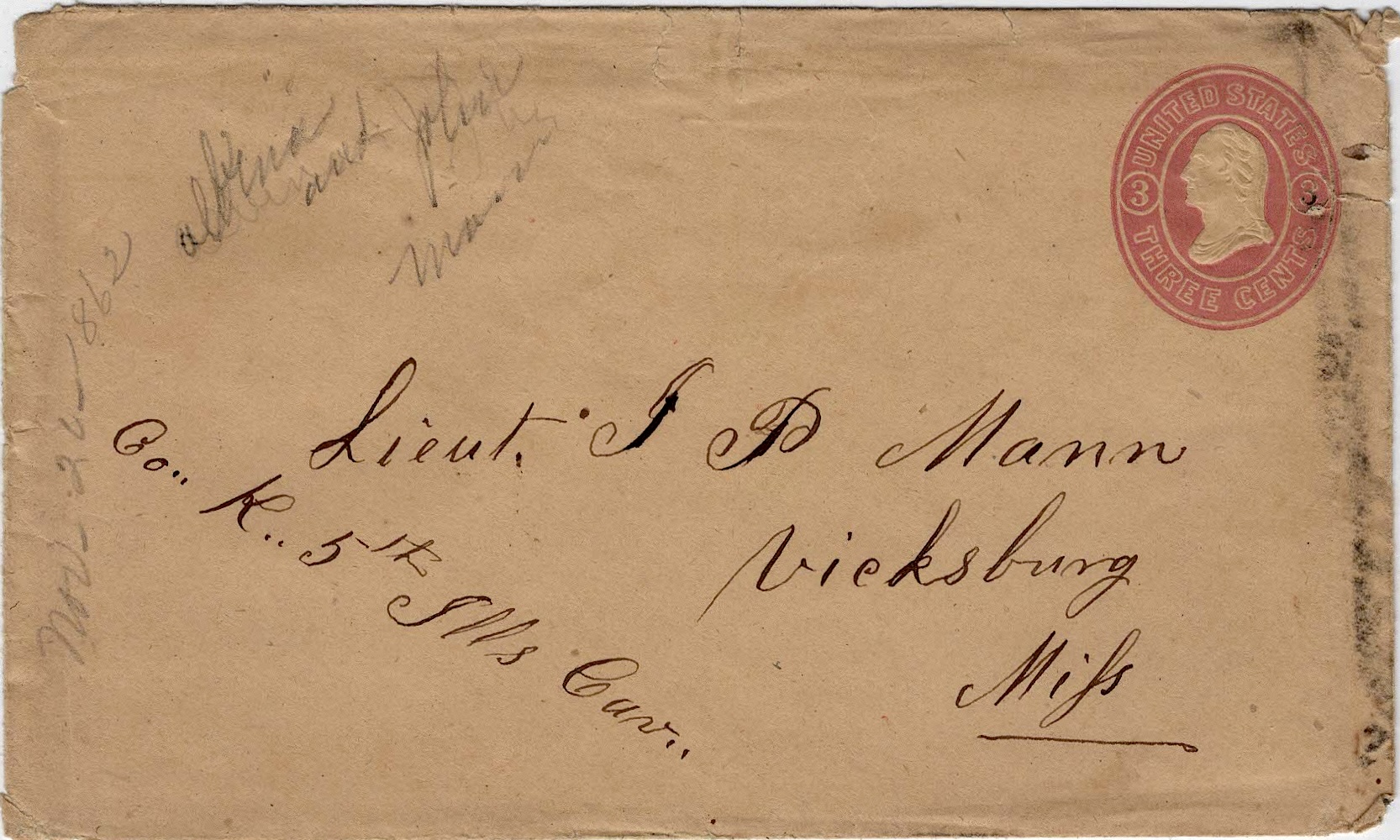
The following Illinois home front letter was written by John Beattie Mann (1796-1881) and Albina Bloomer Balch (1797-1882) of Randolph County to their son, 41 year-old John Preston Mann (1822-1908) who was serving in the 5th Illinois Cavalry. The letter was datelined from the family homestead they called “Pleasant Hill” near Kaskaskia on 20 November 1863. John was a blacksmith by trade, having moved to Randolph county, Illinois, from Rockville, Parke county, Indiana, in 1827 and settling at Pleasant Hill in 1831.
John and Albina had five sons that volunteered to serve the Union cause in the Civil War, They were John Preston (“J. P.”) Mann (b. 1822) of the 5th Illinois Cavalry—to whom they addressed this letter, Robert “Clinton” Mann (b. 1824) who served in the 22nd Illinois Infantry and was mortally wounded in the Battle of Chickamauga, James “Luther” Mann (b. 1826) who served briefly in the 80th Illinois Infantry, Jonathan [“Jonta”] Balch Mann (b. 1828) who served in the 80th Illinois Infantry, and Calvin Anderson Mann (b. 1833) who served in the 5th Illinois Cavalry. All survived except Clinton.
When John and Albina settled in Randolph county in the late 1820s, Kaskaskia was the county seat. It remained so until the flood of 1844 forced the relocation of the county seat to Chester—a Mississippi river port about halfway between Cape Girardeau and St. Louis. During the Civil War, the citizens of Randolph county were deeply divided, many of the residents having come from and still had relatives living in Kentucky or other slave-holding states. Located in the region called “Little Egypt,” Randolph county was characterized by strong Democratic (“Copperhead”) sentiment and anti-war agitation. A sizable German population helped to turn public sentiment around in the middle of the war, as stated in this letter.
T R A N S C R I P T I O N
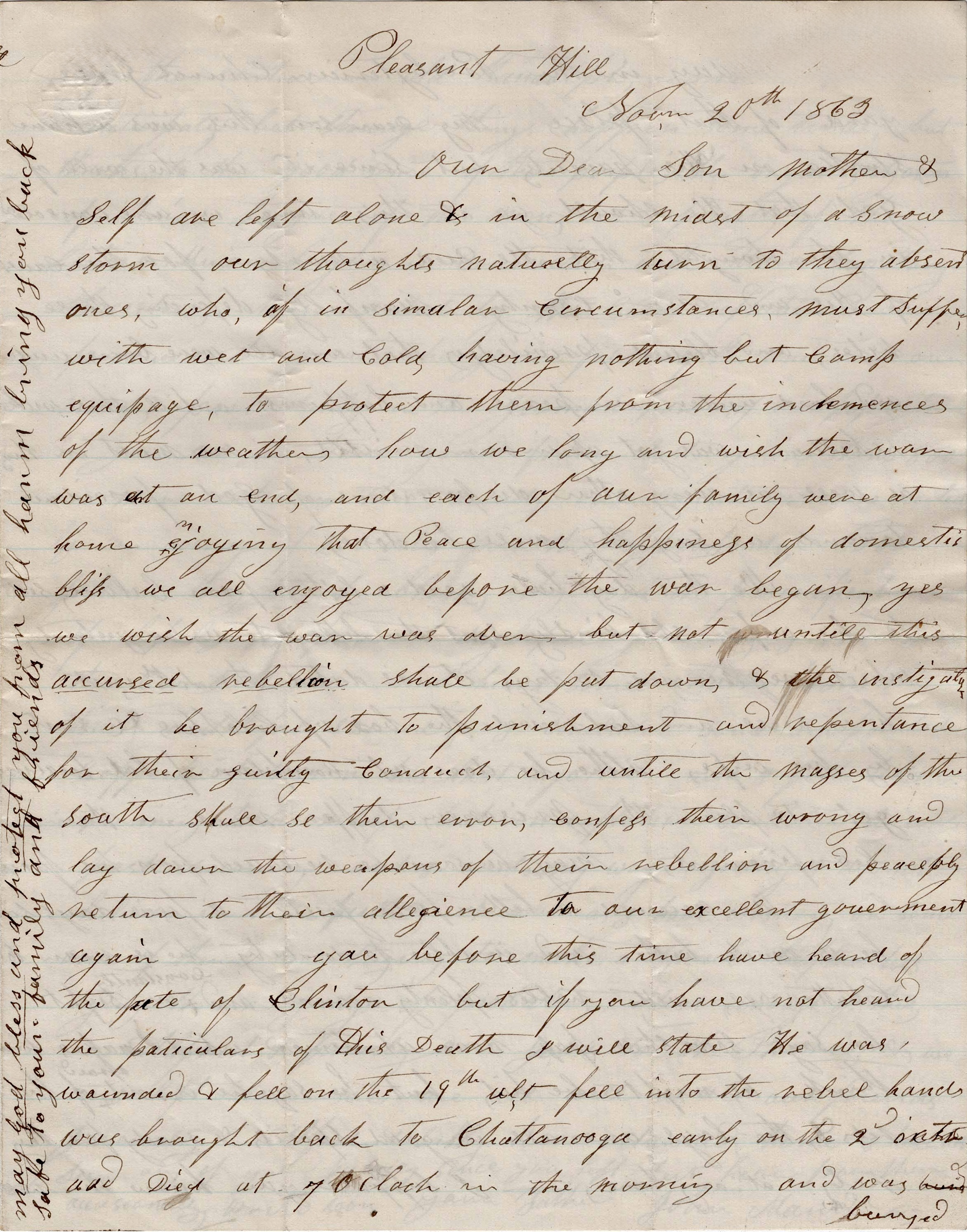
Pleasant Hill [near Kaskaskia, Illinois]
November 20, 18633
Our dear son,
Mother and self are left alone & in the midst of a snow storm, our thoughts naturally turn to the absent ones, who, if in similar circumstances, must suffer with wet and cold, having nothing but camp equipage to protect them from the inclemencies of the weather. How we long and wish the war was at an end and each of our family were at home enjoying that peace and happiness of domestic bliss we all enjoyed before the war began. Yes, we wish the war was over but not until this accursed rebellion shall be put down & the instigators of it be brought to punishment and repentance for their guilty conduct, and until the masses of the South shall see their error, confess their wrong, and lay down the weapons of their rebellion and peaceably return to their allegiance to our excellent government again.
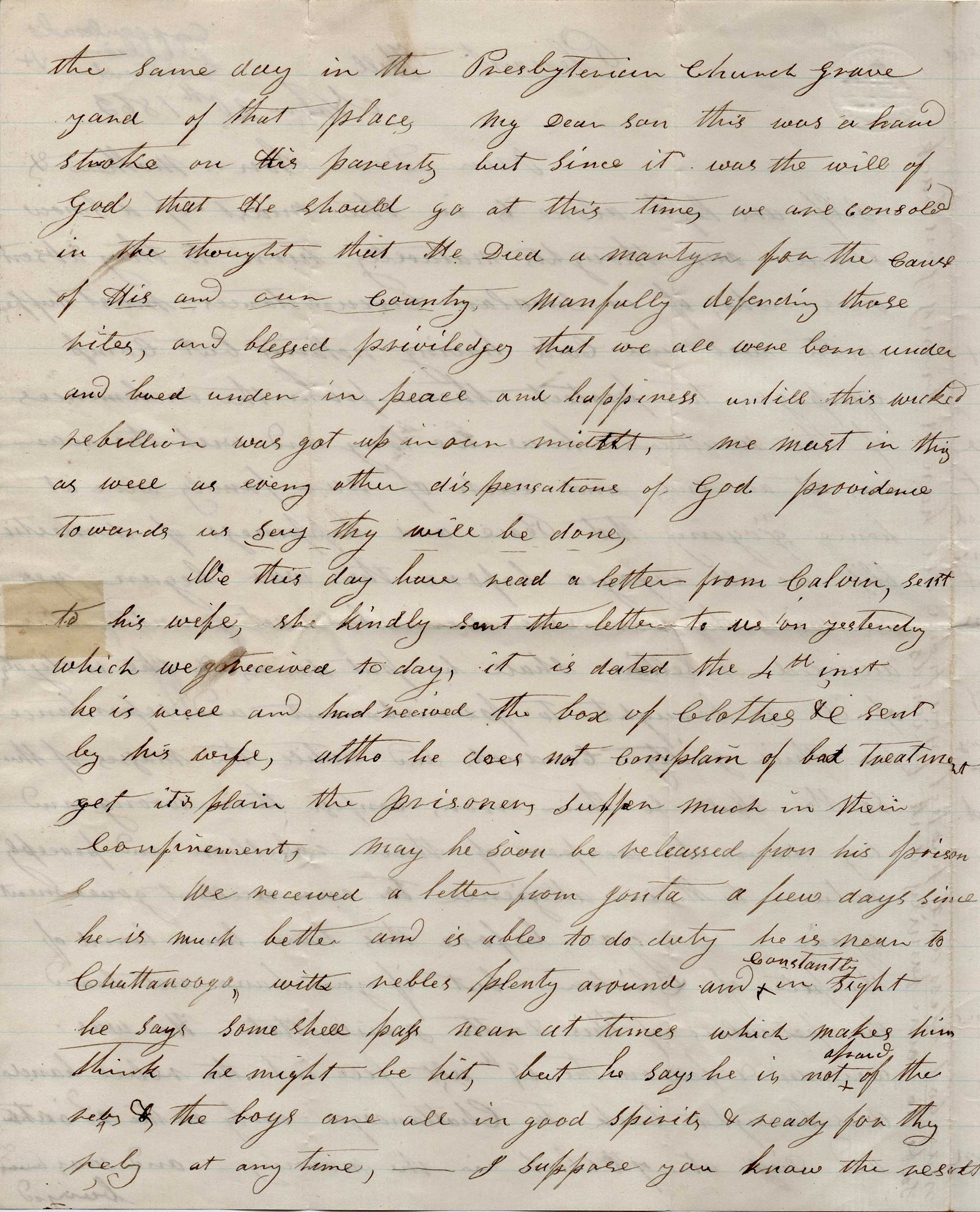
You before this time have heard of the fate of [your brother] Clinton but if you have not heard the particulars of his death, I will state. He was wounded on the 19th ult. [at the Battle of Chickamauga], fell into the rebel hands, was brought back to Chattanooga early on the 2nd October, and died at 7 o’clock in the morning and was buried the same day in the Presbyterian Church grave yard of that place. My dear son, this was a hard stroke on his parents but since it was the will of God that he should go at this time, we are consoled in the thought that he died a martyr for the cause of his and our own country, manfully defending those rights and blessed privileges that we all were born under and lived under in peace and happiness until this wicked rebellion rebellion was got up under our midst. We must in this—as well as every other dispensation of God’s providence towards us—say, “thy will be done.”
We this day have read a letter from [your brother] Calvin sent to his wife. She kindly sent the letter to us on yesterday which we received today. It is dated the 4th inst. He is well and had received the box of clothes &c. sent by his wife. Although he does not complain of bad treatment [at Libby Prison], yet it’s plain the prisoners suffer much in their confinement. May he soon be released from his prison.
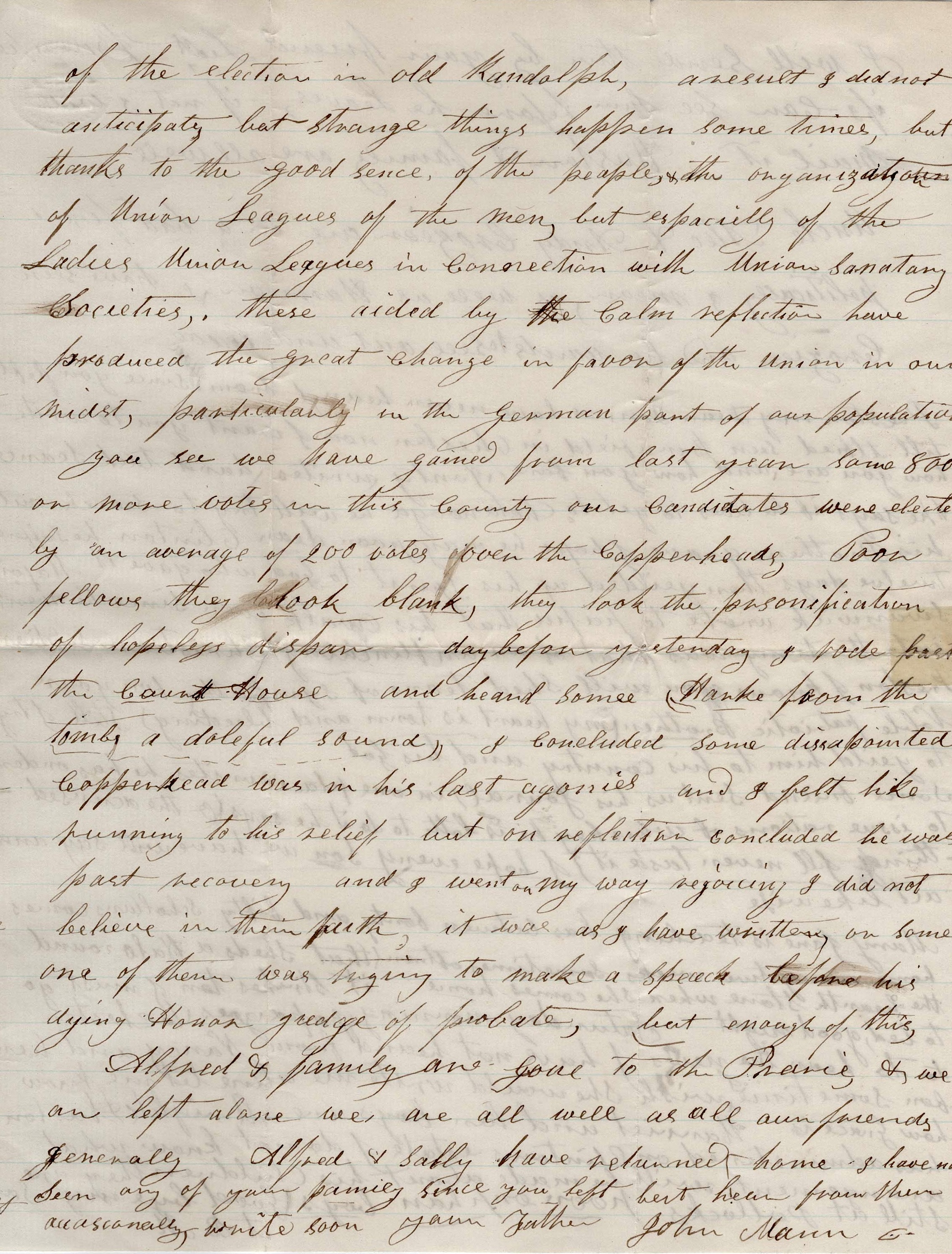
We received a letter from [your brother] Jonta [Jonathan] a few days since. He is much better and is able to do duty. He is near to Chattanooga with rebels plenty around and constantly in sight. He says some shells pass near at times which makes him think he might be hit but he says he is not afraid of the rebs & the boys are all in good spirits & ready for the Rebs at any time.
I suppose you know the result of the election in Old Randolph [County]—a result I did not anticipate but strange things happen some times. But thank s to the good sense of the people, the Organization of Union Leagues of the men, but especially of the Ladies Union Leagues in connection wit hthe Union Sanitary Societies, these aided by calm reflection have produced the great change in favor of the Union in our midst, particularly in the German part of the population. You see we have gained from last year some 800 or more votes inn this county, Our candidates were elected by an average of 200 votes over the Copperheads. Poor fellows! They look blank. They took the personification of hopeless despair.
Day before yesterday I rode past the Court House and heard some Hark from the tombs—a doleful sound. I concluded some disappointed Copperhead was in his last agonies and I felt like running to his relief. But on reflection, concluded he was past recovery and I went on my way rejoicing. I did not believe in their [ ]. It was as I have written, as if someone of them was trying to make a speech before his dying honor judge of probate—but enough of this.
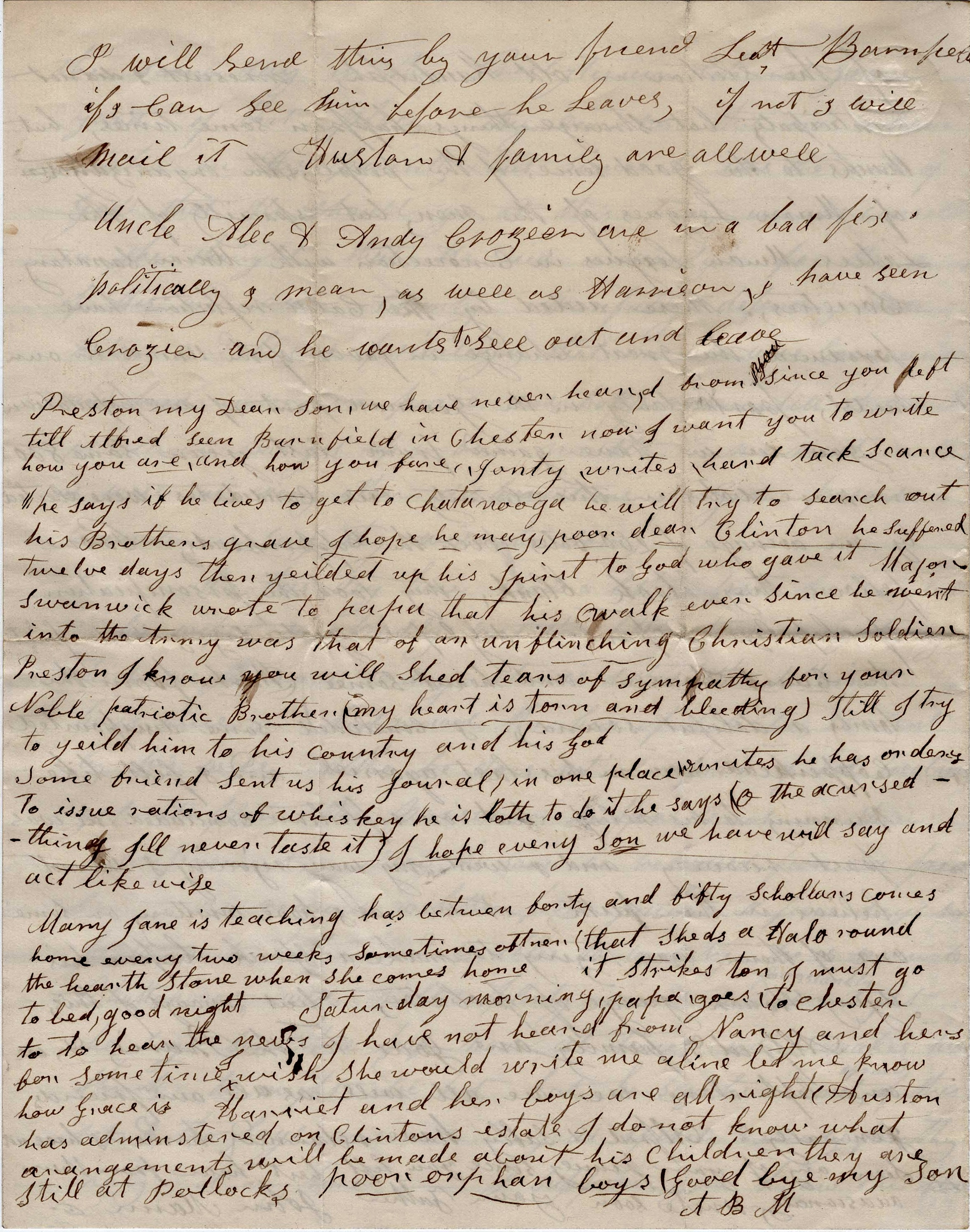
I will send this by your friend, Lt. [Thomas Henry] Barnfield if I can see him before he leaves. If not, I will mail it. Houston and family are all well. Uncle Alec & Andy Crozier are in a bad fix—politically I mean, as well as Harrison. I have seen Crozier and he wants to sell out and leave. [Your father]
[in another hand]
Preston, my dear son, we have never heard from you since you left till Alfred seen Barnfield in Chester. Now I want you to write how you are and how you fare. Junty writes that hard tack is scarce. He says if he lives to get to Chattanooga, he will try to search out his brother’s grave. I hope he may. Poor dear Clinton. He suffered twelve days, then yielded up his spirit to God who gave it. Major [Frank] Swanwick wrote to papa that his walk, ever since he went into the Army, was that of an unflinching Christian soldier. Preston, I know you will shed tears of sympathy for your noble, patriotic brother (my heart is torn and bleeding). Still I try to yield him to his country and his God. Some fried sent us his journal. In one place he writes he has orders to issue rations of whiskey. He is loathe to do it [and] he says, “Oh the accursed thing! I’ll never taste it.” I hope every son we have will say and act likewise.
Mary Jane is teaching. Has between forty and fifty scholars. Comes home every two weeks—sometimes oftener (that sheds a halo round the hearth stone when she comes home.) It strikes ten [and] I must go to bed. Good night.
Saturday morning. Papa goes to Chester to hear the news. I have not heard from Nancy and hers for some time. I wish she would write me a line and let me know how Grace is. Harriet and her boys are all right. Houston has administered on Clinton’s estate. I do not know what arrangements will be made about his children. They are still at Pollock’s. Poor orphan boys. Goodbye my son, — A. B. M.