1863: George William Dickinson to Caroline (Dickinson) Carpenter

The following letter was written by George William Dickinson (1843-1933) of Co. M, 2nd New York (“Harris Light”) Cavalry. George enlisted in August 1861 at NYC to serve three years. He was subsequently transferred to Co. A (no date) and finally mustered out of the service while on detachment in June 1865 at Alexandria, Virginia.

The following information was posted on a website called Civil War Quilts: George was son of Elbert Dickinson (1814-1874) and Susan Dove (1816-1892) of Queens, New York. Several stories about George’s war experiences survive in newspaper articles but any follow up leads to dead ends. He was either wounded at Hanover Court House or Bull Run, captured at Pawmunkey River towards the end of the war when he was held ten days in Libby Prison in Richmond, Virginia. George was married in the summer of 1862 to Sarah Marie Carpenter (1843-1933), both age 19. Within a month, her husband was off to war, shortly to be shot in the lungs. The bullet worked its way out to become a souvenir but he suffered periodic hemorrhages the rest of his long life, which he attributed to the wound. Twentieth-century newspaper articles and old Civil War veterans may have been confused about places and dates, exaggerating scars and exploits. Sarah’s parents were Jackson and Sarah Craft Carpenter of Sea Cliff on Long Island’s Northern shore, families descended from mid-18th-century settlers. She and George had four children, two boys John & Daniel, and two girls Annie Conrad Abbott and Susan Dickinson Conrad. Towards the end of the 20th century, George obtained a job as caretaker at an estate owned by Charles M. Pratt, a Standard Oil heir who built a family compound and gardens in Glen Cove a few miles east of Oyster Bay. 

George wrote the letter to his sister, Caroline Matilda (Dickinson) Carpenter (1845-1885), the wife of Latting Carpenter of Rosyln, Queens county, New York. The couple were married in March 1863.

Transcription

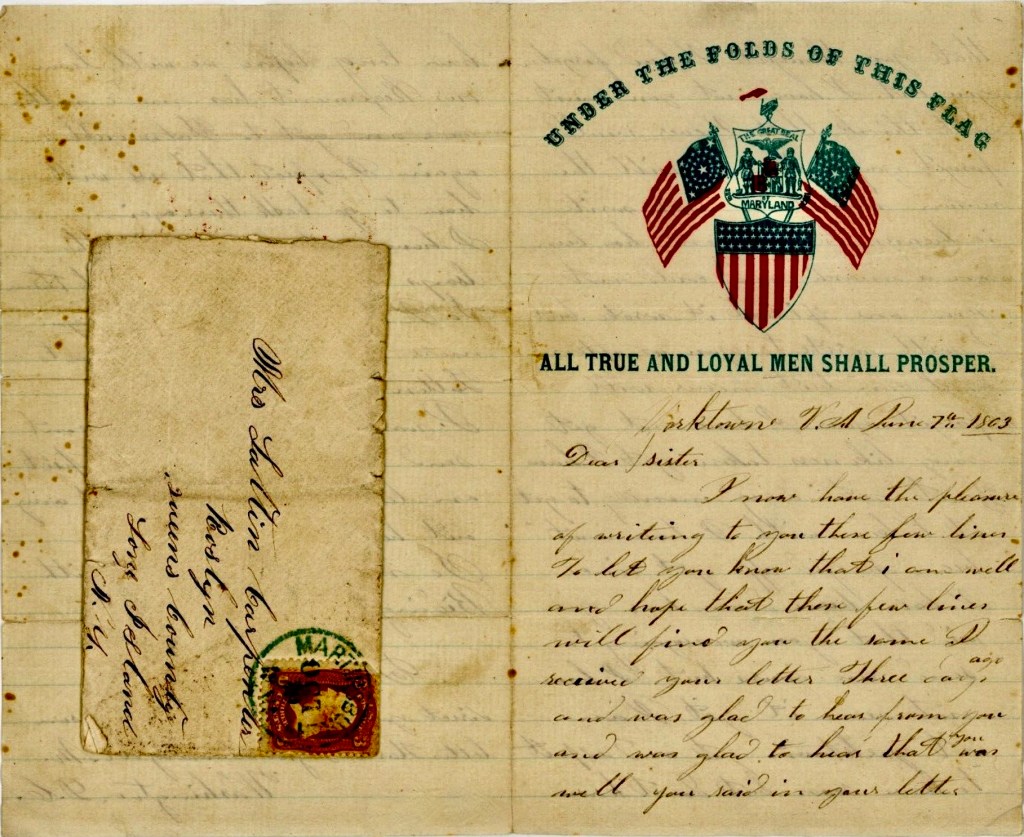
Addressed to Mrs. Lattin Carpenter, Roslyn, Queens county, Long Island, New York

Yorktown, Virginia
June 7th 1863

Dear sister,

I now have the pleasure of writing to you these few lines to let you know that I am well and hope that these few lines will find you the same. I received your letter three days ago and was glad to hear that you was well. You said in your letter that you thought I had forgotten you but I have not. You must not think that I ever would forget you for I never will. The reason why I did not write is because the regiment has been on a march and I could not send one if I had it wrote, but I will write to you as often as I can. But I never will forget you.

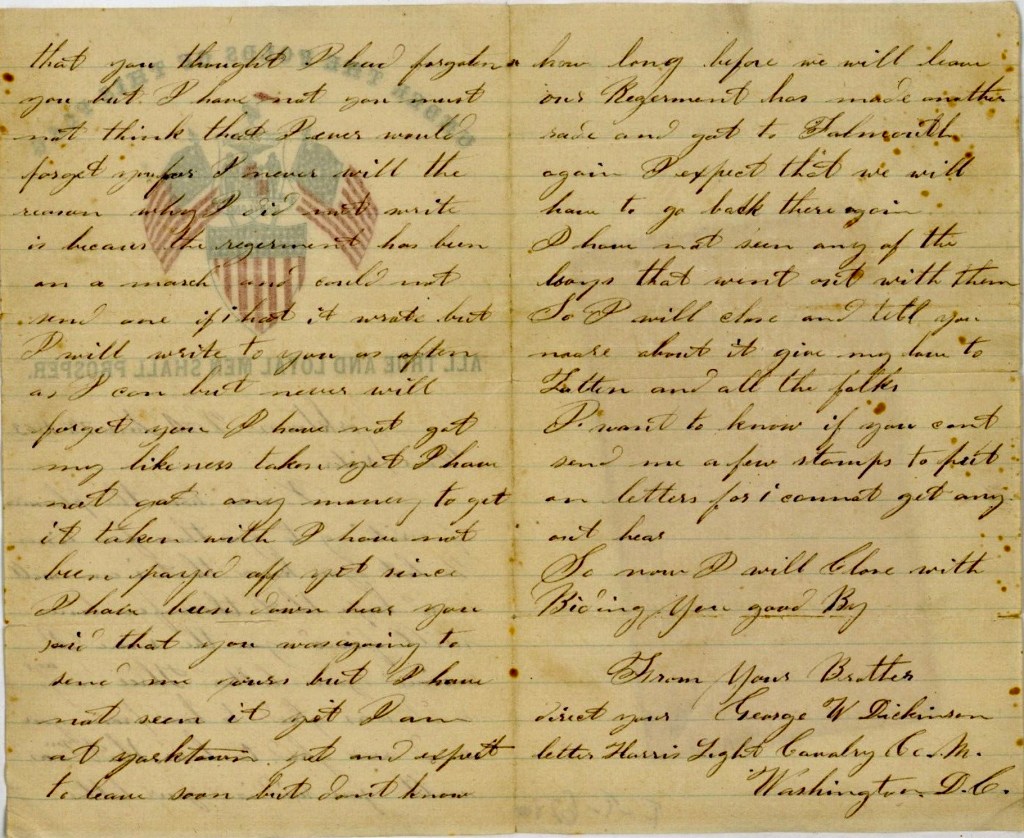
I have not got my likeness taken yet. I have not got any money to get it taken with. I have not been paid off yet since I have been down here. You said that you was a going to send me yours but I have not seen it yet.

I am at Yorktown yet and expect to leave soon but don’t know how long before we will leave. Our regiment has made another raid and got to Falmouth again and I expect that we will have to go back there again. I have not seen any of the boys that went out with them. So I will close and tell you no more about it.

Give my love to Father and all the folks. I want to know if you can’t send me a few stamps to put on letters for I cannot get any out here. So now I will close with bidding you goodbye.

From your brother. Direct your letter to George W. Dickinson, Harris Light Cavalry, Co. M, Washington D. C.
1862: Wellington to his Father

This letter was signed by a soldier named “Wellington” and addressed to his father but beyond that, I’ve not been able to identify him. He appears to have been in temporary duty with his squadron in Iuka while the remainder of his regiment was stationed in Tuscumbia. He also informs us that he anticipated being issued revolving rifles soon which led me to believe he might be with the 2nd Iowa Cavalry but I could not find a member by that name.

Transcription

Iuka [Mississippi]
August 30, 1862

My Dear Father,

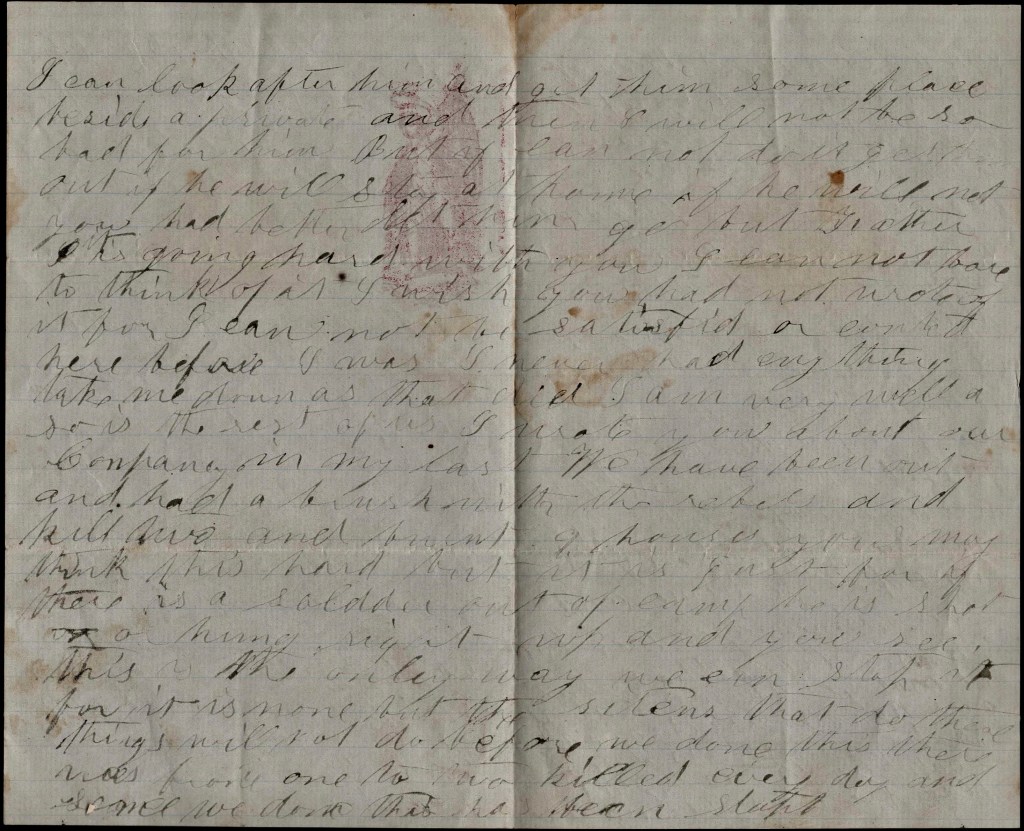
I have just received your letter of 24th and I never was so surprised to think that Cap has enlisted. Now Father, do get him home. I wrote you for a commission. Get it in that regiment if you can. If [not], let it alone. But Father, get him home. He may stand it. There is barely a chance. You know that you thought that I could not stand it but I have stood it as well as any man. But if I can get a place in that regiment, I can look after him and get him some place beside a private and then it will not be so bad for him. But if you can not do it, get him out if he will stay at home. If he will not, you had better let him go but Father, it is going hard with you. I cannot bare to think of it. I wish you had not wrote of it for I cannot be satisfied or content here. Before I was. I never had anything take me down as that did.

I am very well and so is the rest of us. I wrote you about our company in my last. We have been out and had a brush with the rebels and killed two and burnt nine houses. You may think this hard but it is just for if there is a soldier out of camp, he is shot or hung right up and you see this is the only way we can stop it for it is none but the citizens that do these things. Before we done this, there was from one to two killed every day and since we done this, it has been stopped.

We have a good deal of scouting to do but I like it for we have a chance to see a good deal of country. I do not know how long we will stay here but think we will go to our regiment at Tuscumbia but do not know when. We expect to get revolving rifles pretty soon. I have wrote you three letters. I write every time I get one from home and sometimes oftener but I am afraid that you do not get them. All of our teams are drove by darkeys. It is a good help. From Wellington

1861: Orvill Baxter to his Uncle Jabe

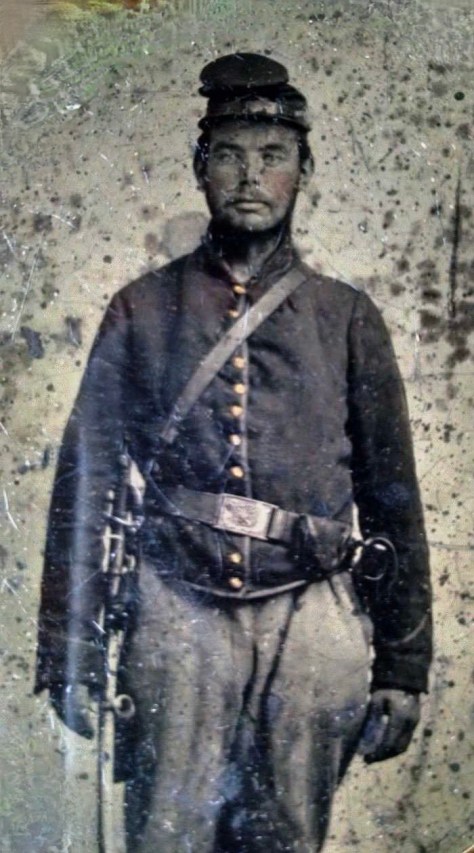
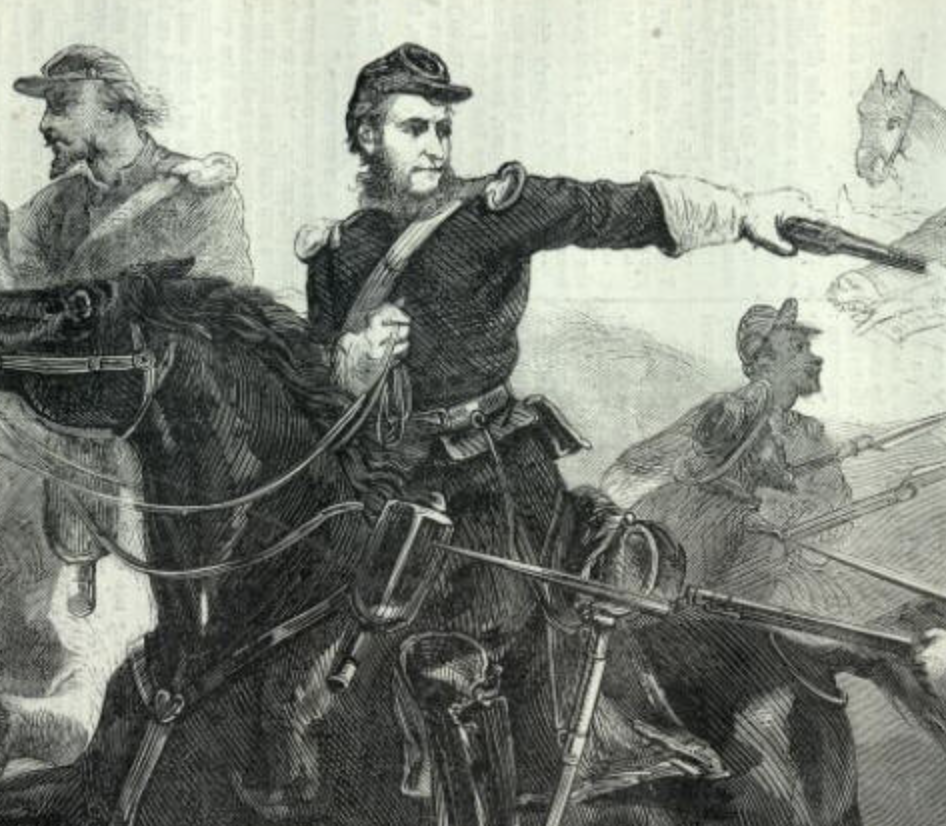
I could not find an image of Orvill but here is a tintype of Rob Chase of Co. D, 3rd New York Cavalry. (Ancestry.com)

The following letter was written by 19 year-old Orville Baxter (1842-1862) of Co. G, 3rd New York Cavalry. Orvill enlisted at Rodman and served in the regiment until 14 November 1862 when he died of disease at New Bern, North Carolina. Orvill was the son of Benjamin B. Baxter (1797-1858) and Lucy Chamberlin (1805-1866) of Jefferson county, New York.

When Orvill wrote this letter in early December 1861, the regiment was attached to Stone’s Division of the Army of the Potomac, stationed near Poolesville, Maryland.

Transcription

Camp near Poolesville, Maryland
December 8, 1861

Dear Uncle,

I take my pen in hand to let you know that I am well and in good health and hope this will find you the same. I’ve written to you but I have not had any answer. I would like to hear from you very well. I have wrote to most all of our folks on the hill but I don’t get but a damn few answers. Maybe they don’t want to write. If they don’t, they can go to hell. I am here and they are there but Uncle Jabe, I don’t want you to go back on me for I want to hear from you and your folks. Tell Uncle Oliver that I am just as round as a peach. Tell the dumb shit fool that I have wrote to him once or [twice] but I don’t get any answer somehow or ruther.

It is very fine weather here yet. We have not had any snow to amount to anything. We expect to stay in our small tents this winter. We can do it and be comfortable. We have pretty good times here now. We drill only once a day but it is not likely that we will drill much longer for it is so damn muddy that we all have to have a general wash after it. It is a sight to see five or six hundred horses on the field at once and making a charge. All hell cannot stop some of the horses. They are as wild as the devil, some of them. We was on drill today and one man fell off his horse and three or four run over him and fell down and there was a fine old pile of them in a hurry. The one that gets up and away first is the best fellow.

There, the belly organ has sounded and I shall have to stop writing now but write soon as you get this and let me know how you are a getting along. Direct your letters to Orvill Baxter, Company G, [James Henry] Van Alen Cavalry.

1863: Margaret Vail (Kelley) Lester to Thomas Benton Kelley

How Margaret might have looked in 1863

The following letter was written by 33 year-old Margaret Vail (Kelley) Lester (1830-1917), the daughter of David Kelley (1806-1876) and his first wife, Charity Herrick (1806-1832) of Danby, Rutland county, Vermont. David Kelley later moved to DuPage county, Illinois. Margaret was married in April 1848 in DuPage county, Illinois, to James Franklin Lester (1824-1899). In the 1860 US Census, Margaret and James were residing in Marengo, McHenry county, Illinois, where James was employed as a farm laborer and a carpenter. An obituary for Margaret (The Daily Times, Davenport, Iowa, June 28, 1918) informs us that Margaret was born at Danby Four Corners, Vermont, and came to Illinois with her parents when she was 15 years old. She had been educated in the Castleon Seminary in Vermont and entered the teaching profession. Once married, the couple had two children—Emma Frances who died at the age of 16, and James Henry who died in 1917.

Margaret wrote the letter to her half-brother, Thomas Benton Kelley who was serving in Co. E, 8th Illinois Cavalry at the time.

What truly shines in this letter is Margaret’s bold articulation of the argument for women’s equality, challenging the status quo with fierce clarity.

Transcription

November 26, 1863

My dear neglected brother,

Thanksgiving eve & I cannot rest on my pillow another night before I pen you a few broken lines. I have written so little for a year back. It has become a task instead of a pleasure. Is it a possible thing? I will call it a task. No dear, brother, it is not so. But I have apparently made it so. But noble sir, I am with you in imagination, hour after hour, & many a meal do I feel as if my dear good brothers could share with me.

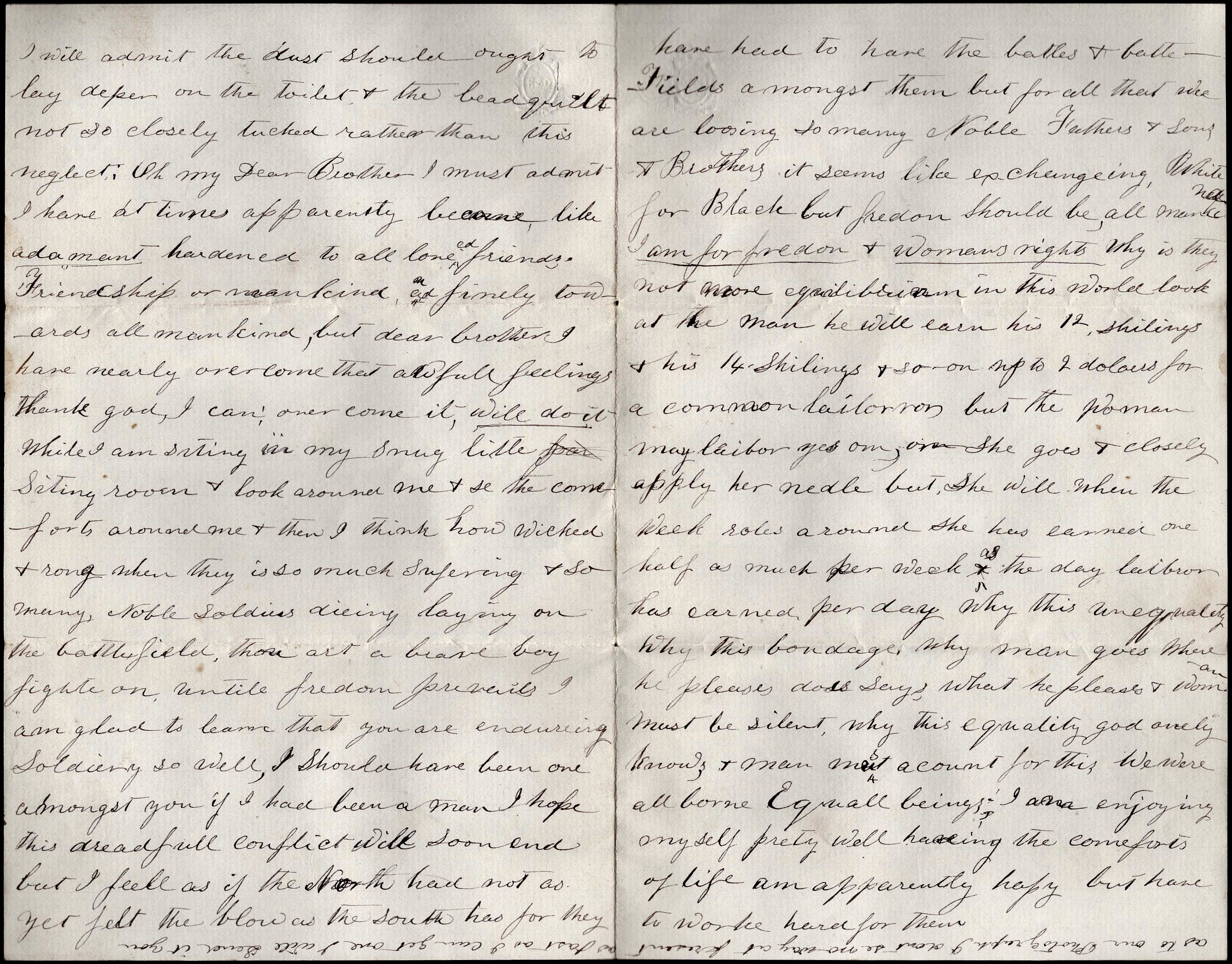
Oh, I have written many & many imagined epistles to you. I am almost sure sometimes I never will be forgiven for my cold neglect. But a promise for the future. My best wishes to Mary. I expect she feels my cold neglect, but come here & see what I have to pass through with & you would not wonder. I will admit the dust should ought to lay deeper on the toilet & the bed quilt not so closely tucked rather than this neglect.

Oh my dear brother, I must admit I have at times apparently become like adamant hardened to all loved friends, friendship or mankind, and finally towards all mankind. But dear brother, I have nearly overcome that awful feelings. Thank God, I can overcome it. Will do it. While I am sitting in my snug little sitting room & look around me & see the comforts around me. And then I think how wicked & wrong when there is so much suffering & so many noble soldiers dying, laying on the battlefield.

Thou art a brave boy. Fight on until freedom prevails. I am glad to learn that you are enduring soldiery so well. I should have been one amongst you if I had been a man. I hope this dreadful conflict will soon end but I feel as if the North had not as yet felt the blow as the South has, for they have had to have the battles & battle fields amongst them. But for all that, we are losing so many noble fathers & sons & brothers. It seems like exchanging White for Black. But freedom should be [for] all mankind. I am for freedom & Womans’ rights. Why is there not more equilibrium in this world? Look at the man. He will earn his 12 shillings & his 14 shillings & so on, up to 2 dollars for a common laborer, but the woman may labor, yes, on and on she goes, & closely apply her needle, but she will, when the week rolls around, she has earned one half as much per week as the day laborer has earned per day. Why this inequality? Why this bondage? Why man goes where he pleases? Does say what he pleases & a woman must be silent? Why this inequality? God only knows & man must account for this. We were all borne equal beings & I am enjoying myself pretty well, having the comforts of life, am apparently happy, but have to work hard for them.

I will return to my thanksgiving supper. We were invited out to one of our neighbors to supper. Enjoyed it much—the whole family. I hope my dear brother was where he could enjoy the necessary comforts if no more. Be patient, for thou shalt be blessed by well doing. Henry’s folks I hardly have seen or heard from for the last three months as usual. I guess the babe, Jane Charity, has been sick all the fall.

I have one boarder & a great deal company & it does seem as if I never should have any respite. Besides, Emma & myself take in work. She goes to school & her studies are crushing her. She is not very stout. She is very industrious. She often speaks of you & of Mary & Mittie, but she is not at home or she would write. She will write soon. Her correspondence is quite extensive. Emma is one good girl & Henry is another T. B. Kelley right over. He would go to the war & who would blame me if I was old enough. That is him to a dot. I have not seen father for nearly a year. It is a year last fall since I was home. E[mma] & Henry was there this fall. Mother, I guess, carries on the hotel & Father stays on the farm a great deal. E. Parish’s sister says mother has the blues. Gets quite hystericky. I believe Pa is a going to move Annetta back to the depot somewhere. I shall go to Henry’s before long. Come home as soon as your time is out or as soon soon as you can.

I hope you will excuse James for not writing. It is not for any ill will. Pleas accept his best wishes. He has a brother at Fort Jackson. Edson [Sportnoble?] was brought home a corps. He was poisoned by the physician by a sponge that was used by a man with erysipelas which caused his death. The doctor’s brother-in-law wanted his office. From your sister M [ ] Lester. My best wishes to M. E. Jones. Tell him we thank him for his photograph & Emma will write to you both soon. Goodbye.

As to our photograph, I don’t see no way at present. As fast as I can get one, I will send it you.

1862: Alexander Black to his Friends

The following letter was written by 21 year-old Alexander Black who enlisted in Co. E, 21st Missouri Infantry. The regiment, once filled with 10 companies totaling 962 men, was mustered into the Union army at Canton on February 12, 1862. A little over a month later, on March 27, 1862, Alexander died of typhoid fever at Hannibal, Missouri.

Transcription

Canton, Missouri
February 16, 1862

My dear friends,

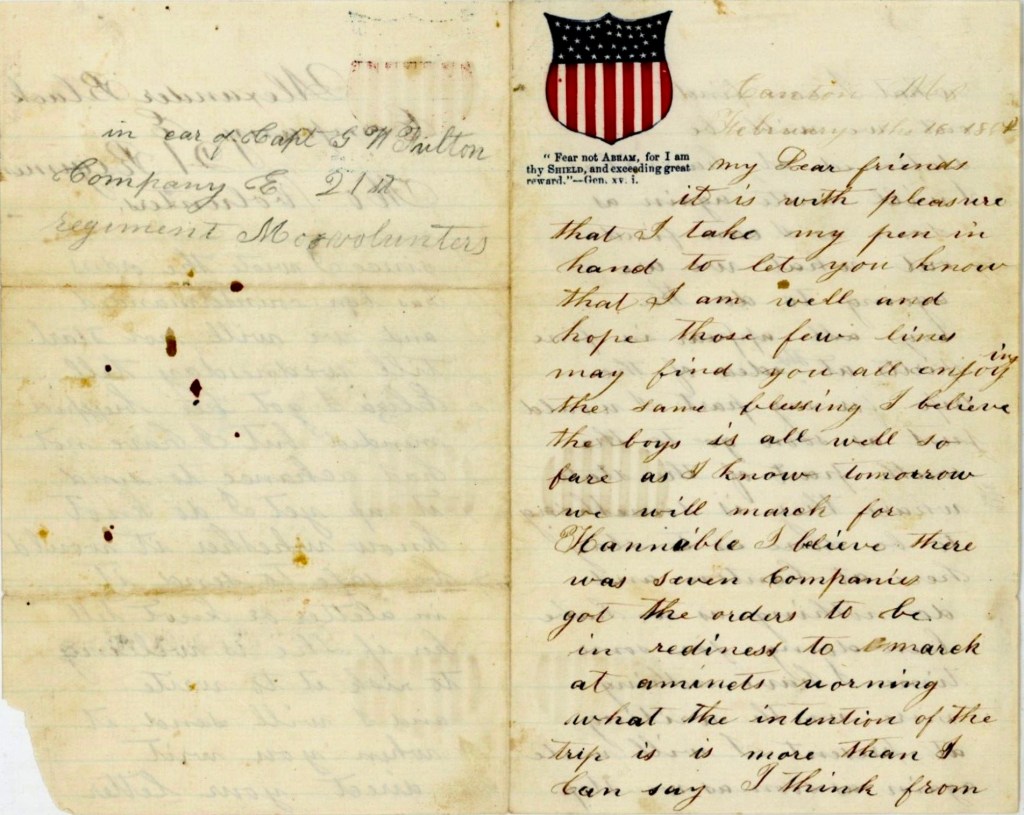
It is with pleasure that I take my pen in hand to let you know that I am well and hope these few lines may find you all enjoying the same blessing. I believe the boys is all well so far as I know. Tomorrow we will march for Hannibal. I believe there are seven companies for the orders to be in readiness to march at a minute’s warning. What the intention of the trip is is more than I can say. I think from what I can find out, we will be stationed at Hannibal.

Capt. George W. Fulton, Co. E, 21st Missouri Infantry

I will write again as soon as I can find out what we are a going to do. The boys all appear in fine spirits at the idea of the trip. For my part, I would just as soon go to the south part of the state where they is something to be done as to stay here at Canton and do nothing as we have been doing for some time.

I have nothing more worth writing at present. I will write again as soon as we stop.

Since I wrote, the orders has been countermanded and we will not start till Wednesday. Tell Eliza I got the breast pin mended but I have not had a chance to send it up yet. I do not know whether it would be safe to send it in a letter or not. Tell her if she is willing to risk it, to write and I will send it. When you write, direct your letter to Alexander Black, Company E, 21st Regiment Missouri Volunteers, in care of Capt. G[eorge] W. Fulton

1862: Alexander Derr Peebles to Matthew H. Karr

The following letter was written by an indignant 18-year-old Alexander Derr Peebles (1843-1913), the son of Robert E. Peebles and Eliza Derr from Pana, Shelby County, Illinois. In May 1865, he entered into matrimony with Amy Downs in Shelby County, and in 1882, they moved to a farm in Kansas, ultimately establishing their residence in Eureka, Greenwood County, Kansas.

Alexander wrote the letter to his friend, Pvt. Matthew H. Karr (1839-1862) of Co. B, 14th Illinois Infantry. Most likely Matthew received this letter, but it may have been his last. He died from injuries and exposure on the battlefield at Shiloh on 11 April 1862. His parents were Charles and Jerusha (Harvey) Kerr of Shelby county, Illinois. Mathew’s sister Nancy Karr (b. 1845) is mentioned in the letter.

Transcription

Shelby county, Illinois
March 10, 1862

Mr. M. H. Karr—sir,

I take my pen in hand to let you know that I am well at this time and hope these few lines may find you. the same. John Rhoads was married the next Sunday after you left here. 1 Nancy is well. I was up there yesterday. I had a fine time with her.

Now I must tell you what happened last night. Dick Riggs was up to see Jane, the God-damned Sarl top. I wish he was in hell. I got the mitten by God from her. He is a God damned greenhorn as well as myself. I wish you had a been here last night and seen the fun. Almon Simmons is here on a furlough but it going back this week to Fort Donelson.

I don’t think Jane wanted to slight me but I think she was put up to it by that God damned pewter bollocks Dick Riggs. If he did that, I will break his neck. He was there all day with her. I thought [it] strange that she was not at meeting with the girls. I began to smell a mice so I went up to see what was up and they all looked as mad as hell. Jane looked like she did not know what to do. When I asked here if I could stay, she could not say at first and at last she whispered no. So I left.

I have not much to write. I will write to you again. So no more at present but write soon. — A. D. Peebles

Direct [to] Pana, [Illinois]

To M. H. Karr

1 Shelby county marriage records inform us that John Rhodes was married to Lurany Myers on 23 February 1862.

1862: Charles Morrison to Timothy Chase

How Charley might have looked in 1862.

The following letter was initiated by 13 year-old Charles (“Charley”) H. Morrison (1848-1868), the son of Calvin Morrison (1812-Aft1880) and Ann Maria Dodge (1822-1903) of Charlestown, Middlesex county, Massachusetts. It was concluded by Charley’s mother, Ann. Also mentioned in the letter is Charley’s older brother, James “Roscoe” Morrison (b. 1842). Charley’s father was employed as a teamster in Charlestown in 1860. According to Massachusetts Death Records, Charley died of consumption in 1868.

Charley wrote the letter to his friend, Timothy Chase.

Transcription

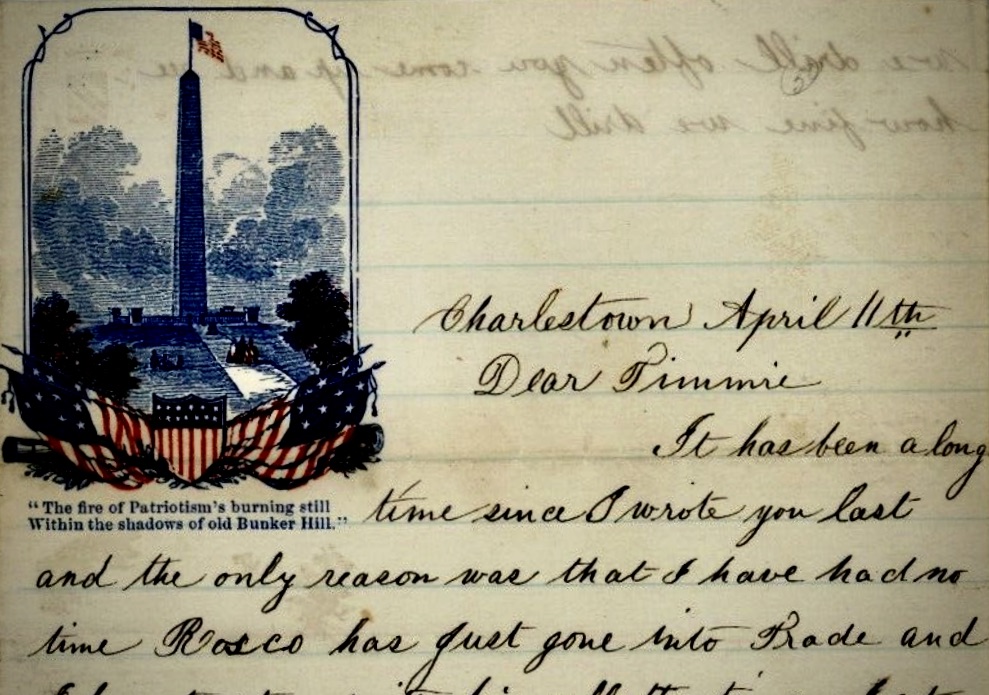
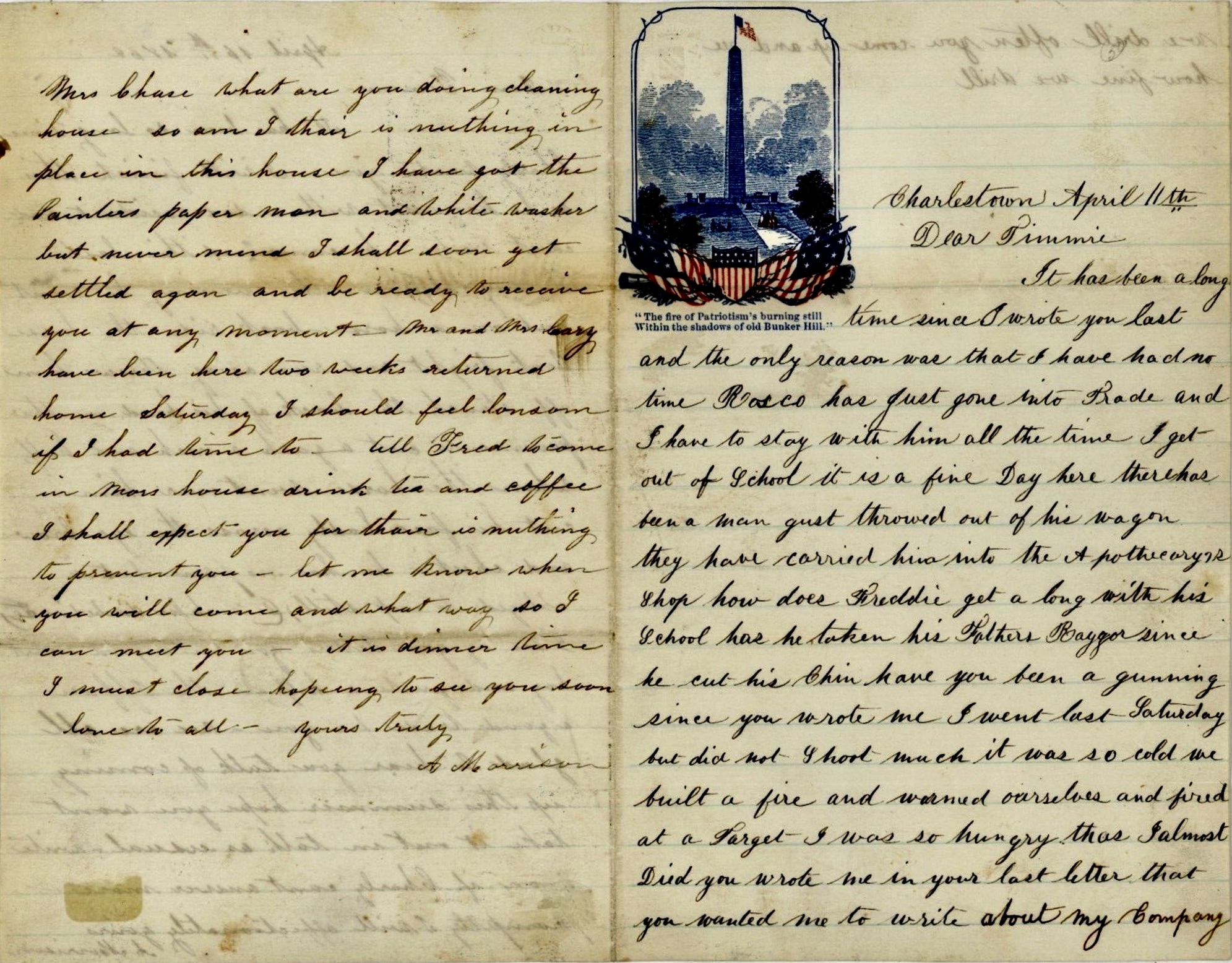
Patriotic stationery with image of Bunker Hill, “The fire of Patriotism’s burning still…”

Charlestown [Massachusetts]
April 11th [1862]

Dear Timmie,

It has been a long time since I wrote you last and the only reason was that I have had no time. Rosco has just gone into trade and I have to stay with him all the time. I got out of school. It is a fine day here. There has been a man just throwed out of his wagon. They have carried him into the Apothecary’s Shop.

How does Freddie get along with his school? Has he taken his Father’s razor since he cut his chin? Have you been a gunning since you wrote me? I went out last Saturday but did not shoot much. It was so cold we built a fire and warmed ourselves and fired at a target. I was so hungry that I almost died. You wrote me in your last letter that you wanted me to write about my company. We drill often. You come up and see how fine we drill.

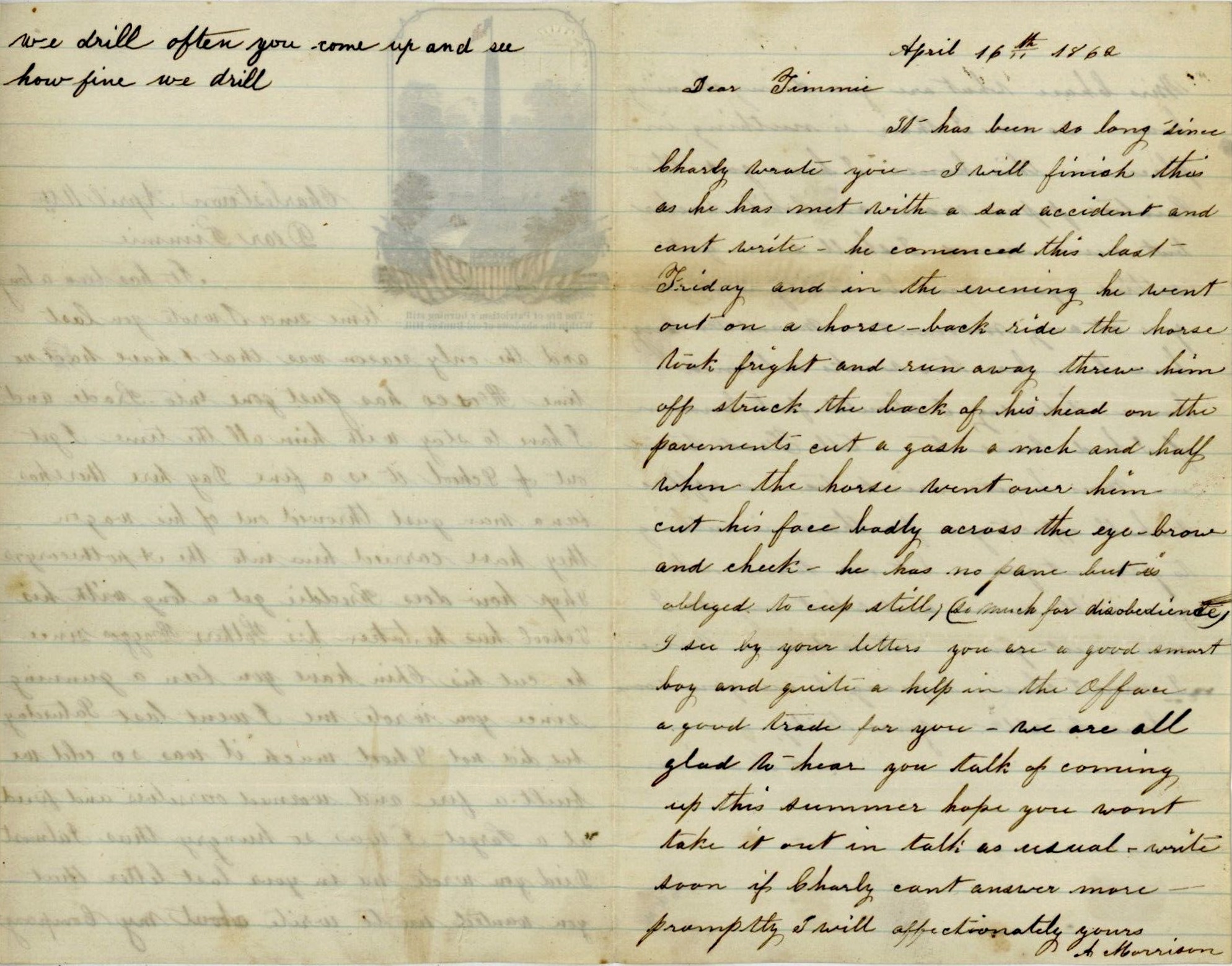
April 16, 1862

Dear Timmie,

It has been so long since Charley wrote you. I will finish this as he has met with a sad accident and can’t write. He commenced this last Friday and in the evening he went out on a horseback ride. The horse took fright and run away, threw him off, struck the back of his head on the pavements, cut a gash an inch and a half, when the horse went over him, cut his face badly across the eyebrow and cheek. He has no pain but it obliged to keep still (so much for disobedience).

I see by your letters you are a good smart boy and quite a help in the office—a good trade for you. We are all glad to hear you talk of coming up this summer. Hope you won’t take it out in talk as usual. Write soon. If Charley can’t answer more prompletly, I will. Affectionately yours, — A. Morrison

Mrs. Chase, what are you doing cleaning house? So am I. There is nothing in place in this house. I have got the painters, paper man and white washer, but never mind. I shall soon get settled again and be ready to receive you at any moment. Mr. and Mrs. Cary have been here two weeks. Returned home Saturday. I should feel lonesome if I had time to. Tell Fred to come in Mors house, drink tea and coffee. I shall expect you for there is nothing to prevent you. Let me know when you will come and what way so I can meet you. It is dinner time. I must close hoping to see you soon. Love to all. Yours truly, — A. Morrison

1862: Waldo Spear to his Parents

The following letter was written by Waldo Spear (1843-1907), the son of Hiram Spear (1810-1872) and Lucy C. Ripley (1806-1893) of Springfield, Bradford county, Pennsylvania. Waldo enlisted in Co. C, 7th Pennsylvania Cavalry on 1 November 1861. He was taken prisoner at Gallatin on 25 August 1862 and was paroled due to his injuries. Following his release, he was detailed a courier of the 2nd Cavalry Division, Army of the Cumberland. He continued in this capacity until he was discharged in November 1864.

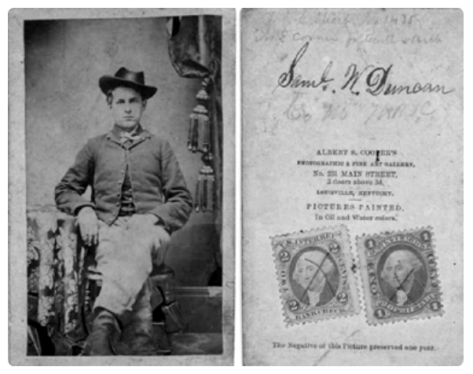
I could not find an image of Waldo but here is one of PVT. Samuel W. Duncan of Co. M, 7th Pennsylvania Cavalry (Photo Sleuth)

Waldo’s letter gives us an account of the Battle of Lebanon—a relatively small affair that took place in and near Lebanon, Tennessee on May 5, 1862. We learn that Waldo was not a witness to the event because he had been detailed to guard the baggage, but he relates how the regiment won the praise of General Ebenezer Dumont led the Union troopers into Lebanon and then pursued Colonel John Hunt Morgan’s Confederate cavalry all the way to the Tennessee river. Dumont’s force consisted of detachments from the 1st Kentucky Cavalry under Colonel Frank Lane Wolford, the 4th Kentucky Cavalry under Colonel Green Clay Smith, and the 7th Pennsylvania Cavalry under Colonel Wynkoop. Morgan’s force was the 2nd Kentucky Cavalry Regiment. Dumont surprised Morgan early on the morning of May 5, 1862. A 15-mile running battle ensued in which the Confederates were forced to retreat. During the fighting Confederate sympathizers in the town fired upon the Union Cavalry. Many of the remaining Confederates barricaded within the buildings surrendered when Dumont threatened to set the town on fire.

See also—1862: Waldo Spear to his Parents & Brothers.

Note: This letter is from the personal collection of Greg Herr and was transcribed and published on Spared & Shared by express consent.

Transcription

Murfreesboro [Tennessee]
May 9th, [1862]

Dear Parents,

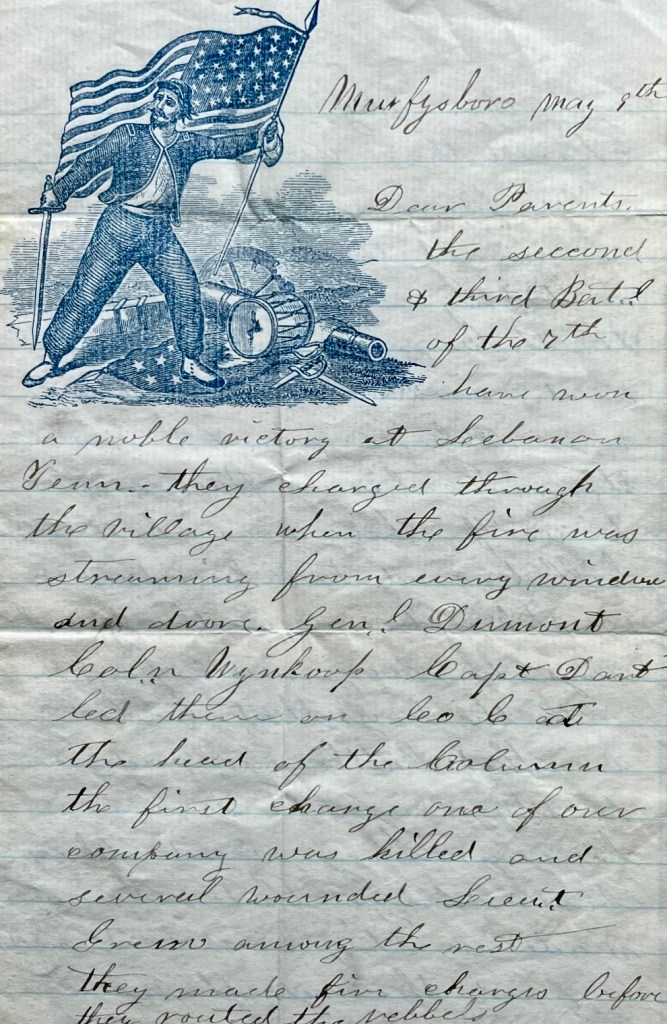
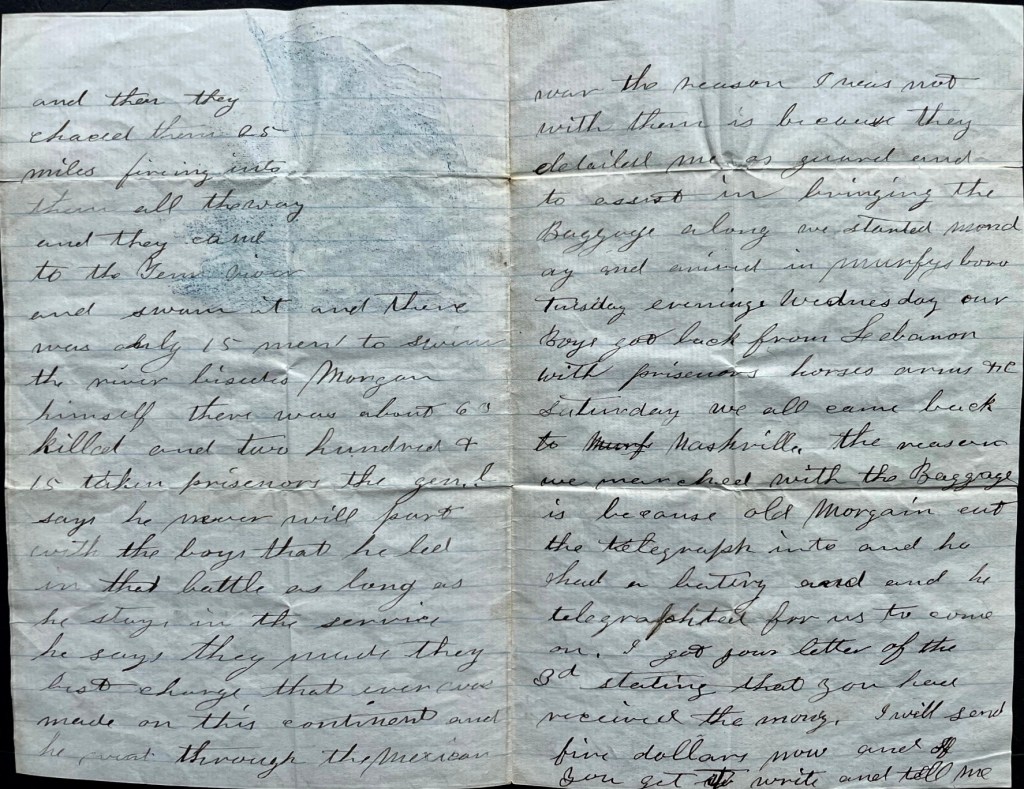
The second and third Battalion of the 7th have won a noble victory at Lebanon, Tennessee. They charged through the village when the fire was streaming from every window and door. Gen. Dumont, Colonel Wynkoop, Capt. Dartt led them on, Company C at the head of the column. The first charge one of our company was killed and several wounded—Lieut. Greir among the rest. They made five charges before they routed the rebels and then they chased them 25 miles, firing into them all the way and they came to the Tennessee River and swam it and there was only 15 men to swim the river besides Morgan himself. There was about 63 killed and two hundred & 15 taken prisoners. The General says he never will part with the boys that he led in that battle as long as he stays in the service. He says they made the best charge that ever was made on this continent and he went through the Mexican War.

The reason I was not with them is because they detailed me as guard and to assist in bringing the baggage along. We started Monday and arrived in Murfreesboro Tuesday evening. Wednesday our Boys got back from Lebanon with prisoners, horses, arms, &c. Saturday we all came back to Nashville. The reason we marched with the baggage is because Old Morgan cut the telegraph in two and he had a battery and he telegraphed for us to come on.

I got a letter of the 3rd stating that you have received the money. I will send five dollars now and if you get it, write and tell me. If I can get a paper, I will send it to you if it has an account of the battle in it. I am enjoying good health and living in hopes that we may see more fighting before the war is closed for I will not die in the battlefield unless I was born to.

This is the most even country I have ever seen. We saw one range of mountains just before we got to Murfreesboro. They must have been 30 miles from us at least. The forest trees are oak, spruce, and some maple. If you get any account of our battle in the papers, I wish you would send it. — Waldo Spear, Co. C, 7th Pennsylvania Vol. [Cavalry]. Camp Worth, Nashville.

1862: Augustus Smith to Sister Jane

The following letter was written by Augustus Smith (1839-1864), the son of Harry Smith (1802-1887) and Almira Naramore (1806-1899). He was born in Underhill, Vermont.

Augustus was a single, 22 year-old farmer residing in New Ipswich, New Hampshire when he enlisted on 23 December 1861 in Co. M, 1st New England Cavalry (1st Rhode Island) under Capt. William P. Ainsworth. He was sick in General Hospital from May 1862 until Aug. 1862; June 18, 1863, taken prisoner near Middleburg, VA; subsequently paroled at Annapolis, MD; Jan. 5, 1864, re – mustered as a veteran volunteer at Catlett’s Station, VA and transferred to New Hampshire Cavalry by order dated Jan. 7, 1864; died Oct. 6, 1864 at Columbia Furnace, Shenandoah Co. VA, age 25y, 3m; burial at Church Street Cemetery, Swanton Franklin Co. Vermont.

Transcription

Camp Arnold
Pawtucket, Rhode Island
February 16, 1862

Sister Jane,

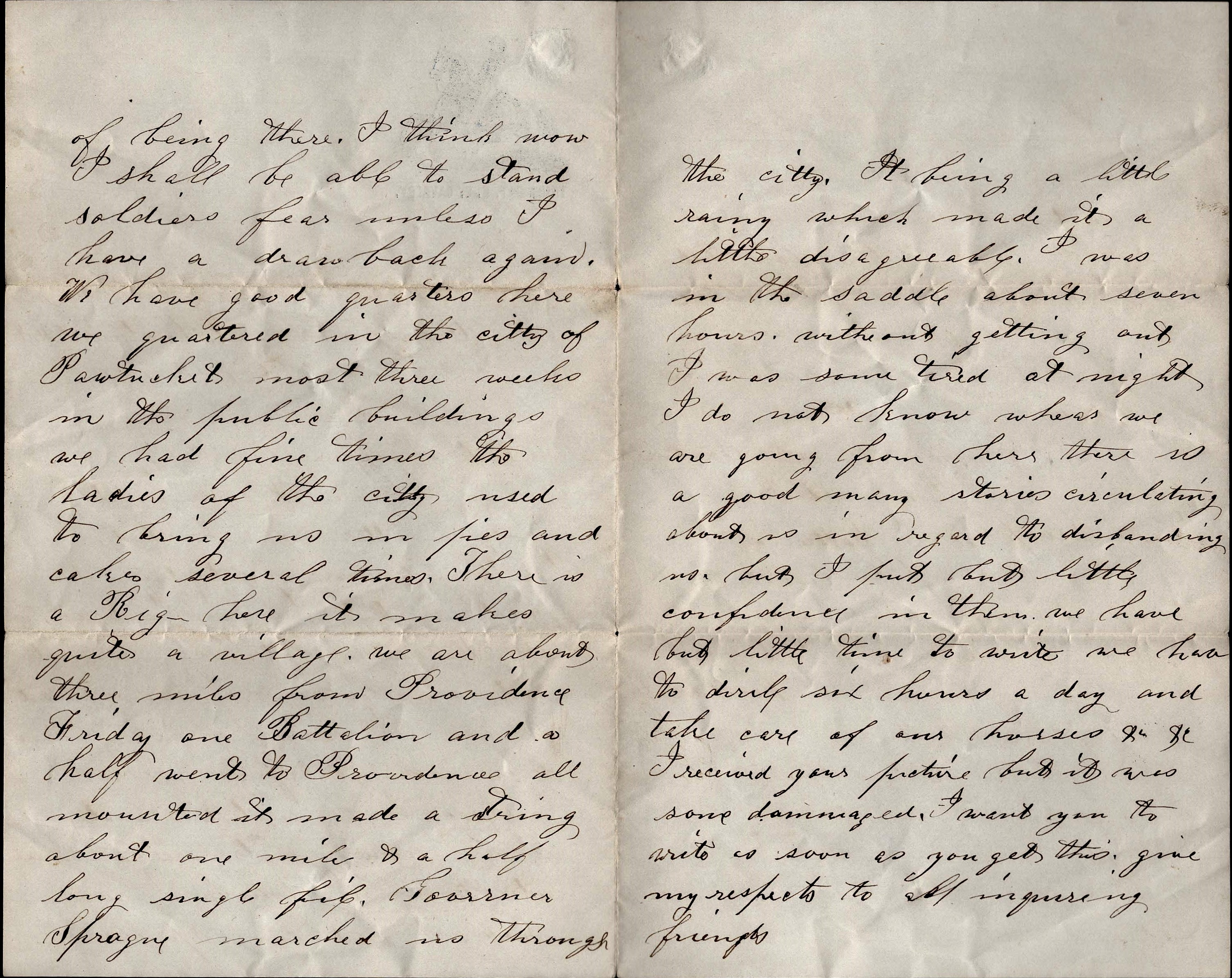
I received your letter of the 9th with pleasure yesterday. I had waited long and anxious. I have nothing to write but our camp news as that is all I hear. I have been sick about five weeks since I enlisted but am now quite well. I was at Rollins while I was sick. I had two spells of being there. I think now I shall be able to stand soldier’s fare unless I have a draw back again.

We have good quarters here. We quartered in the city of Pawtucket most three weeks in the public buildings. We had fine times. The ladies of the city used to bring us in pies and cakes several times. There is a regiment here. It makes quite a village. We are about three miles from Providence.

Friday one battalion and a half went to Providence all mounted. It made a string about one mile & a half long single file. Governor Sprague marched us through the city. It being a little rainy which made it a little disagreeable. I was in the saddle about seven hours without getting out. I was some tired at night. I do not know where we are going from here. There is a good many stories circulating about us in regard to disbanding us but I put but little confidence in them. We have but little time to write. We have to drill six hours a day and take care of our horses &c., &c.

I received your picture but it was some damaged. I want you to write as soon as you get this. Give my respects to all inquiring friends. Write all the news and a good long letter for that is what we soldiers like. Yours as ever, — Augustus

Address: Camp Arnold, Pawtucket, R.I. Troop M, 3rd Battalion, N.E. Cavalry, Commanded by Capt. Wm. P. Ainsworth

1862: Samuel Hall to E. A. Meek

The following letter was written by Samuel Hall (1836-1863) of Marshall, Marshall county, Iowa. Samuel was married in Fulton county, Indiana to Mary Elizabeth Meredith (1831-1899) in 1855 and in the 1860 US Census he was enumerated in Jefferson township of Marshall county with his wife Mary and two sons, Isaac (age 2) and Leonard (age 7 months). He was a farmer. Samuel enlisted in 13 August 1862 and was mustered in as a private in Co. K, 23rd Iowa Infantry on 1 September 1862. He became ill in the service and in an attempt to see his wife and children before he died, he battled his way home and, according to family tradition, knocked on the door and died on the threshold. His date of death was recorded as 27 August 1863. He was 27 years old.

I could not find an image of Samuel but here is one of George W. Grigsby who served in Co. B, 23rd Iowa Infantry. (Iowa Civil War Images)

The 23rd Iowa was organized at Des Moines and ordered to St. Louis, Missouri, where they were attached to the Department of Missouri. Their duty was at Camp Patterson when this letter was written in November 1862. In his letter, Samuel describes the march from Camp Patterson to Pitman’s Ferry on the Current River, the skirmish there with Confederates, and the march to Pocahontas before marching back to Camp. Patterson. The Skirmish at Pitman’s Ferry is described below from official reports:

On October 27, 1862, Union Colonel William Dewey surprised Confederate Colonel John Q. Burbridge’s Brigade at Pitman’s Ferry (Randolph County). Dewey’s rapid combined-arms attack temporarily won control of the ferry and allowed for the reconnoitering of the Pocahontas (Randolph County) area.

“Near 8:00 a.m. October 27, the Confederate force reported to be Burbridge’s Brigade aligned for battle on the Arkansas side of the river. Dewey formed his line straddling the road about 100 yards from the ferry in Missouri. Deploying his artillery in the center, Federal troops began firing on the Confederate artillery deploying over the river, effectively scattering it and weakening the determination of the defenders. The Twenty-third Iowa positioned itself on the bank to deliver cover fire for the Twenty-fifth Missouri, which crossed the river and lightly skirmished with the Confederates, forcing them to retreat.

In possession of the ferry, Dewey ordered his exhausted men into camp, as they had covered sixty-five miles in two and a half days. On October 29, Dewey linked with Lazear at Bollinger’s Mill, about fifteen miles inside Randolph County, before sending reconnoitering parties toward Pocahontas. On October 30, Dewey began his return to Camp Patterson, reaching the site on November 2.”  [Source: Skirmish at Pitman’s Ferry, October 27, 1862, Encyclopedia Arkansas]

Transcription

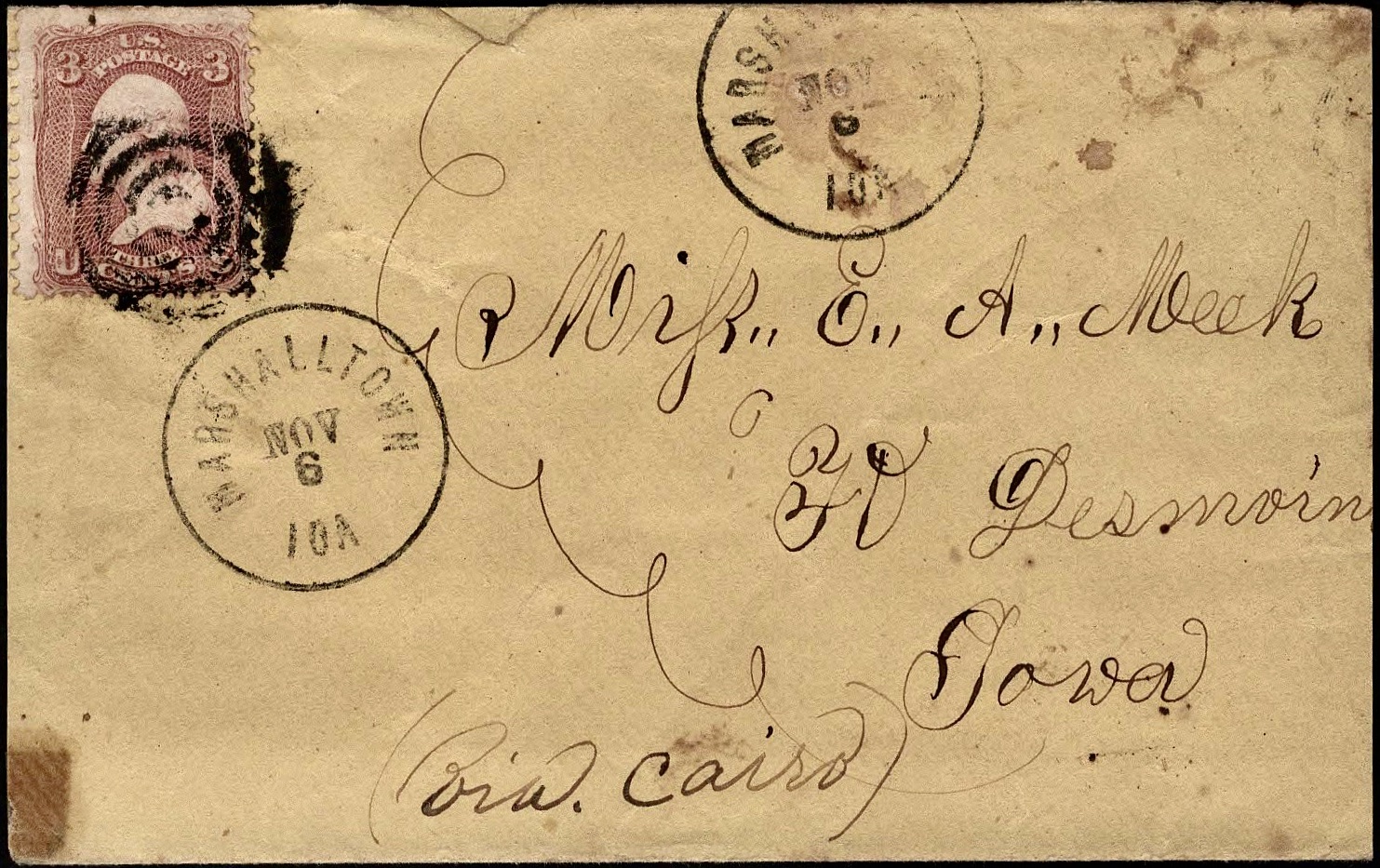
Addressed to Miss E. A. Meek, Des Moines, Iowa (via Cairo)

Camp Patterson
November 4, 1862

I once more sit down to let you know that I am well at present and I hope this letter will find you the same.

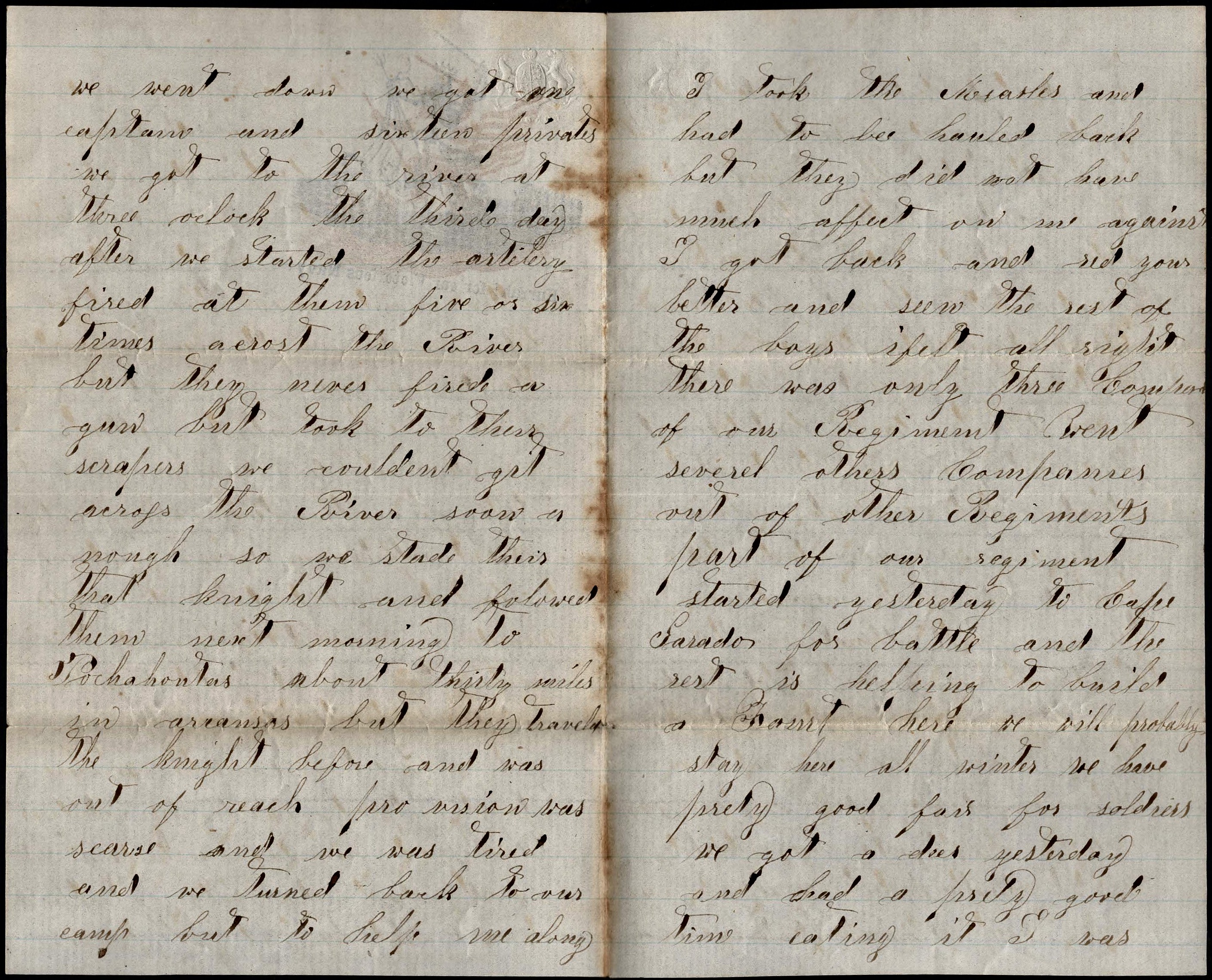
We left this camp the 25th of October for Pitman’s Ferry on Current River 80 miles from camp. We was called up in the night about twelve o’clock and they told us to fix for eight days march to rout four thousand Rebels. We marched night and day till we got there. We took their pickets as we went down. We got one Captain and sixteen privates. We got to the river at three o’clock the third day after we started. The artillery fired at them five or six times across the river but they never fired a gun but took to their scrapers. We couldn’t get across the river soon enough so we stayed there that night and followed them next morning to Pocahontas about thirty miles in Arkansas, but they traveled the night before and was out of reach. Provision was scarce and we was tired and we turned back to our camp. But to help me along, I took the measles adn had to be hauled back. But they did not have much effect on me against I got back and read your letter and seen the rest of the boys. I felt alright. There was only three companies of our regiment went.

Several other companies out of other regiments [with] part of our regiment started yesterday to Cape Girardeau for battle and the rest is helping to build a fort here. We will probably stay here all winter. We have pretty good fare for soldiers. We got a deer yesterday and had a pretty good time eating it. I was weighed today and I weighed 150 pounds. My weight is 150 for common. I wrote to William and you not long ago. I am going to write to George Randle this evening if I can. I would like to see the folks and would like to have been at that little bust up at our house. How I would [have] made them [funnybeans?] fly. But that [is] nothing.

The Colonel had a dance and I was there and the girls was all over in a minute and back again. Who wouldn’t be a soldier? But that isn’t half. Write soon. — Samuel H. to Miss Meeks