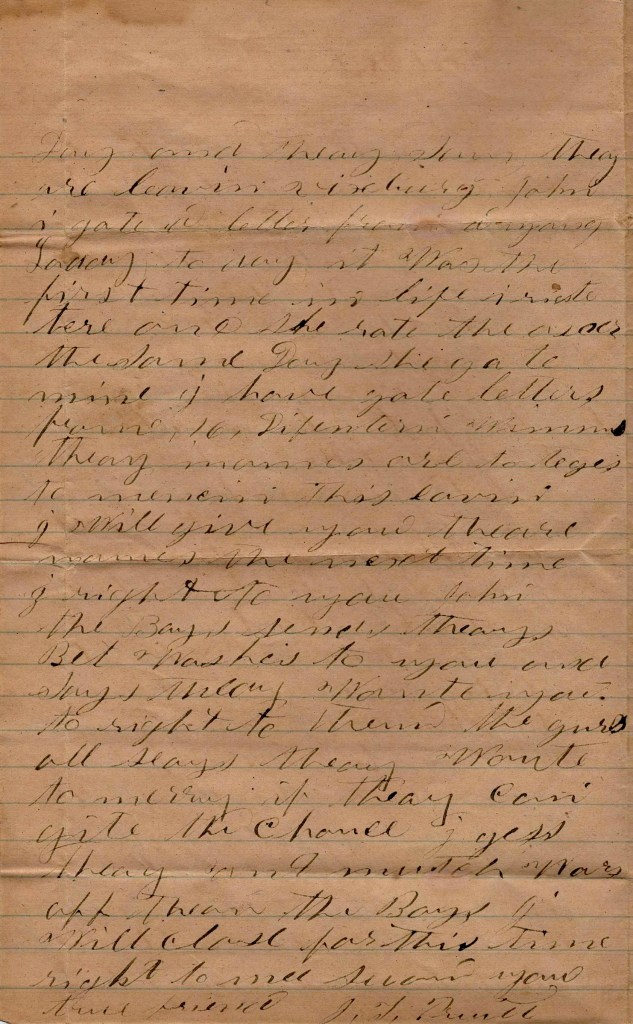
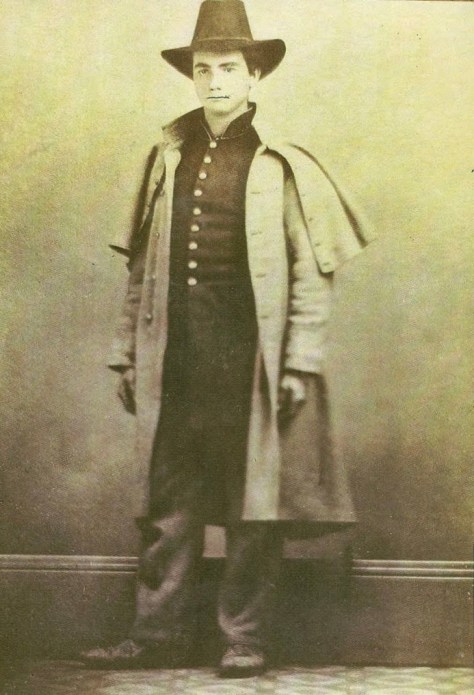
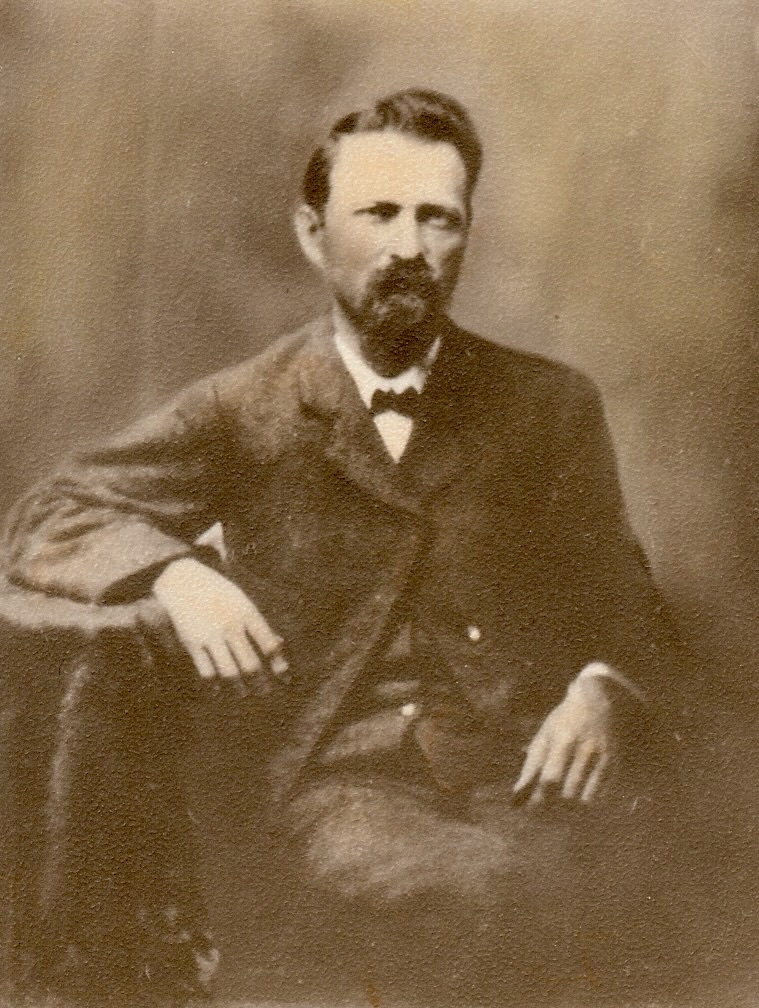
These two letters were written to friends and family back home by James T. Pruitt and Elijah B. Hughes—members of Co. F, 31st Mississippi Infantry while encamped at Snyder’s Bluff overlooking the Yazoo River in 1 March 1863. The 31st Mississippi was organized a year earlier using the 6th Mississippi Infantry as its nucleus.
James T. Pruitt (1840-1918) was born in Lawrence county, Alabama, but was living in Pontotoc county, Mississippi when he enlisted in the 31st Mississippi. He married Frances J. Cypert (1841-1907) in 1865. Elijah B. Hughes (b. 1845) was the son of John Hughes (1799-Aft1860) and Mary Parker (1800-1845) of Cambellton, Itawamba county, Mississippi.
This letter is a good example of two soldiers from the same company sharing a sheet of stationery during a time when it was scarce in the Confederacy.
T R A N S C R I P T I O N
Snyder’s Bluff March 1, 1863
Dear old friend,
I seat myself to drop you a few lines to inform you I [am] well, hoping when these few lines come to hand they may find you enjoying the same blessing. John, I han’t got anything of importance to write to you. We have been running about a good deal since I saw you. It looks like we have to do all the running about. I don’t think we will get in any fight here soon. We are 15 miles above Vicksburg on the Yazoo river. They are preparing for the enemy. We are ready for them any time they come. There was a Yankee came across the river today and they said they are leaving Vicksburg.
John, I got a letter from a young lady today. It was the first time in my life I wrote her one. She wrote the answer the same day she got mine. I have got letters from 16 different women. Their names are too tedious to mention this evening. I will give you their names the next time I write to you.
John, the boys send their best wishes to you and says they want you to write to them. The girls all say they want to marry if they can get the chance. I guess they ain’t much worse off than the boys. I will close for this time. Write to me soon. Your true friend, — J. T. Pruitt
March 1st 1863
Dear brother,
I seat myself this evening to pen you a few lines to let you know that I am getting along. I am well and doing as well as could be expected under the present circumstances that are around me at this time. I have just got well. I have had the chills and fever. We had to march from Jackson here in the mud and water and it made me sick. But I think that I am about straight now.
I received your kind letter yesterday and it gave me great satisfaction to hear from you and to hear that you was well. B. F. H. is well. He is on guard now at this time. He has been sick also but is improving as fast as could be expected. I received a letter from home about three weeks ago. They wrote to me that sister Elizabeth was very sick. I have not heard from home since that time but I have wrote home since that time. I sent my letters by Redden Stephens 1 while I was at Jackson, Miss. We stayed there about two weeks, I believe. Direct your letters to Vicksburg when you write to me—if you ever write any while I stay here at this place. Give my best respects to all the boys. Tell D. C. and Samuel Stephens that if they don’t write to me, that I will treat them with the same respect. My time is up and so is my paper. John, please answer this.
Your brother until death, — E[lijah] B. Hughes
to J. B. Hughes
1 Redden Byrd Stephens (1826-1891) was a farmer in Itawamba, Mississippi, who had probably visited the encampment of the 31st Mississippi while at Jackson.
This letter was written by Edward M. Brown of Co. E, 21st Ohio Volunteer Infantry. He was 22 years old when he enlisted on 29 August 1861 to serve three years. He was appointed Corporal on 17 July 1863 and taken prisoner at the Battle of Chickamauga on 20 September 1863. He died at Andersonville Prison on 2 October 1864 after a year’s confinement.
Edward wrote his letter from the company encampment at a guard post placed near a bridge on the Nashville & Decatur railroad between Elk River and Decatur, Alabama. Co. I was stationed at Elk River, Co. K at Decatur Junction, and Co. E four miles up the road from the Junction. The Headquarters of the regiment was at Athens, Alabama, at this time.
T R A N S C R I P T I O N
Fort Brewster, Swan Creek at RR Bridge July 25, 1862
Friend John,
After some delay on account of having orders to be ready to leave in five minutes for the last 6 or 8 days. Yet I have not forgotten you nor never will John. I am well, also the boys in our company, and in good spirits. We are as yet at the RR bridge having good times under the circumstances, although as I said, we have been under marching orders for several days and that is one of the hardest ways of camp life—to be on suspense.
The weather is fine. We get rain every few days now. That makes it more pleasant in cooling the air. We are feasting as usual. We have all that is good for us to eat such as peaches, green corn, berries, &c. &c. and milk at 25 cents a gallon. You spoke of [Wilson S.] Musser. 1 He is well now. I told him about what Harley said and he laughed and said that he had written last to home and never received one from Harley a joke on Harley, ha ha ha. Wilson [Musser] has been unlucky for the last four or five months. Has been poorly most of the time but is quite hearty now and cheerful. Is well liked in the company.
Samuel Fletcher Cheney (1829-1911)
S[amuel] Hull is hearty and most of the boys from our parts. We are looking for our Lieutenant S[amuel] F[letcher] Cheney of Defiance who is at home on furlough. Also [Finlay] Britten and Warts of Hicksville. We are waiting patiently for their arrival, expecting to hear some good news from there. But supper is ready and I will finish afterward. Supper over. Had corn, coffee, and hard bread. And while eating, the train passed and Lieutenant S. F. Cheney came. On that account, I will not finish tonight. Boys are in swimming now and I must go in also as this is the hour appointed for swimming.
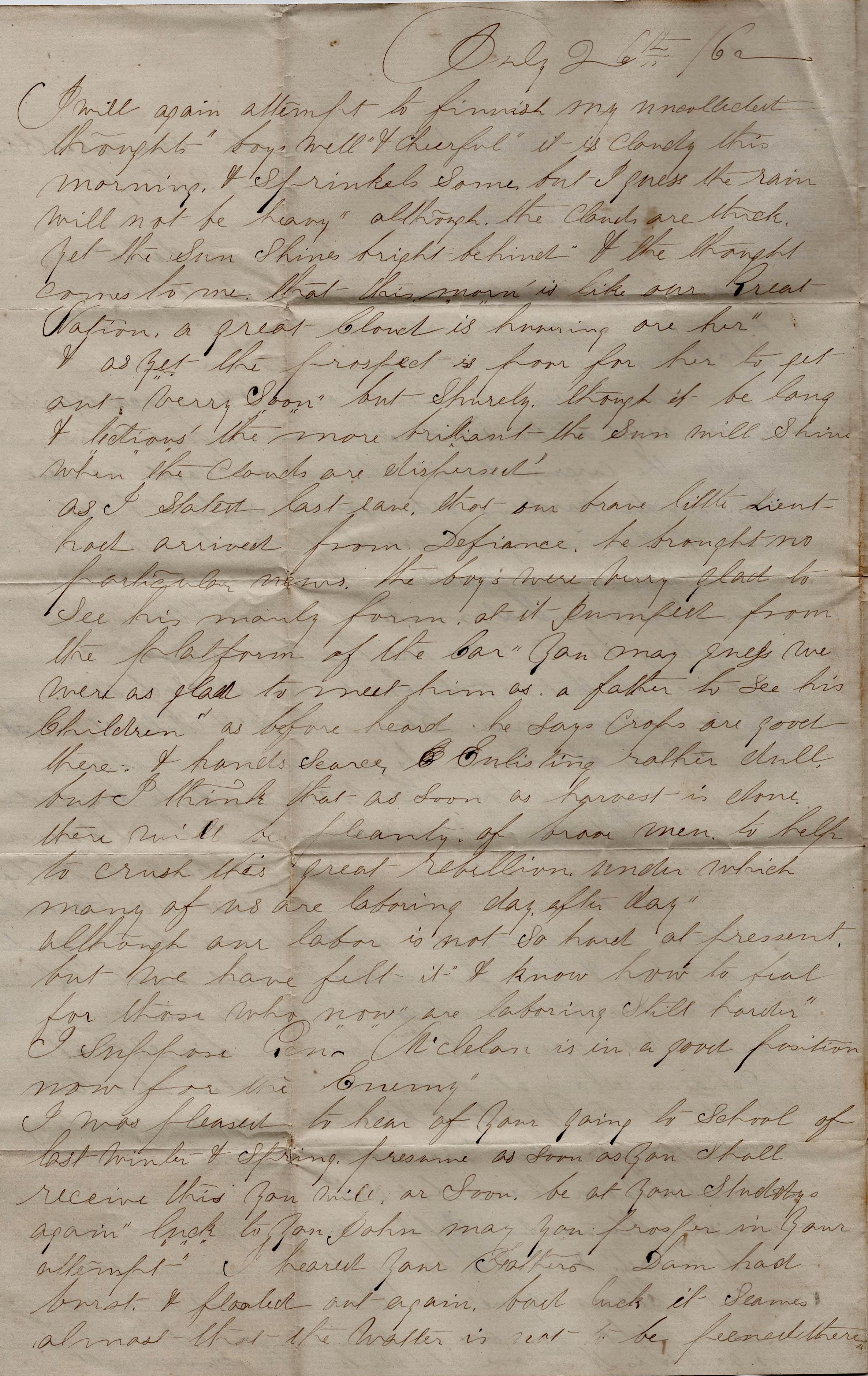
July 26, ’62. I will again attempt to finish my uncollected thoughts. Boys well and cheerful. It is cloudy this morning and sprinkles some but I guess the rain will not be heavy although the clouds are thick. Yet the sun shines bright behind and the thought comes to me that this morn is like our great nation. A great cloud is hovering over her and as yet the prospect is poor for her to get out very soon. But surely though it be long and tedious, the more brilliant the sun will shine when the clouds are dispersed.
As I stated last eve that our brave little lieutenant [Cheney] had arrived from Defiance, he brought no particular news. The boys were very glad to see his manly form as it jumped from the platform of the car. You may guess we were as glad to meet him as a father to see his children. As before heard, he says crops are good there and hands scarce. Enlisting rather dull, but I think that as soon as harvest is done, there will be plenty of brave men to help to crush this great rebellion under which many of us are laboring day after day. Although our labor is not so hard at present, but we have felt it and know how to feel for those who now are laboring still harder. I suppose General McClellan is in a good position now for the enemy.
I was pleased to hear of your going to school of last winter and spring and presume as soon as you shall receive this, you will—or soon be—at your studies again. Luck to you, John. May you prosper in your attempt. I heard your father’s dam had burst and floated out again. Bad luck. It seems almost that the water is not to be feared there.
It is now almost time for the morning train to come. There, I just heard the whistle some 4 miles south of here. The boys are in front of my little bush cot jumping, but the ground is rather hard, although the excitement must be kept up in some way—sometimes in jumping, running, wrestling, &c. as we have not much reading matter here. Sometimes get a paper. Sometimes can get some interesting book—[the] life of some of our old soldiers that have parted this life long, long ago.
The moral feeling in camp is about “as usual.” I have not heard a sermon in about eight months, yet, as ever, I am trying to live so that if my maker calls me, I can go with joy and not grief. I will be glad when they will come—when peace will again cover our beautiful land. When (soldiers), friends, and loved ones can enjoy the word of our heavenly master according to the dictates of our own conscience, none daring to molest or make us afraid. John, don’t you think it would be pleasant to arise Sabbath morn, dress and go to Sunday school and church, where the word of God is preached in its purity? Surely it would be. But not withstanding all these privations, I am willing to stay [and] endure the privations of a soldier’s life as long as needful and reap the rewards in some future day—that is, if I am permitted to live through. And that I trust to God, the father of all good.
The train just passed going towards Athens. Had some cannon on board. Capt. [Lewis E.] Brewster and Sergeant [George T.] Squire came after, having been at Huntsville on business.
The sun is beginning to shine. The air is cool and pleasant now and has been for several days. The weather is cooler there this summer than has been for many years. The thermometer has not been over 95 degrees since we have been here which is the 9th of May and Lieutenant Cheney said it stood at that in Defiance one day when he was there. And there is a cool breeze blowing most of the time which we do not have or so much so in Ohio.
The corn is coming out well since the rain we have had of late, so we have all we want to use. Can stand on the peak of some hill and see corn for miles. As for cotton, it is late for the time of the season but will produce a tolerable fair crop. It is in bloom now. There is not much of it raised this season. The so-called Pres. Davis ordered the planters to not plant more cotton than they wanted for their own use but put in plenty of grain to help the army. The wheat was nothing of importance, but here the corn will be very good and as Davis said, it will help the army—-but the USA instead of the CSA.
But fearing I am wearing your patience with my unconnected thoughts, I will close by saying remember me to all with respect. Hoping to hear from you soon. I remain yours truly, — E. M. Brown
Co. E 21st Regt. OVI USA, 9th Brig. 3rd Div., in care of Capt. S. B. Brewster, via Nashville TN.
1 Wilson S. Musser was 19 when he enlisted in Co. E, 21st OVI on 29 August 1861. He was killed on 31 December 1862 in the Battle of Stones River.
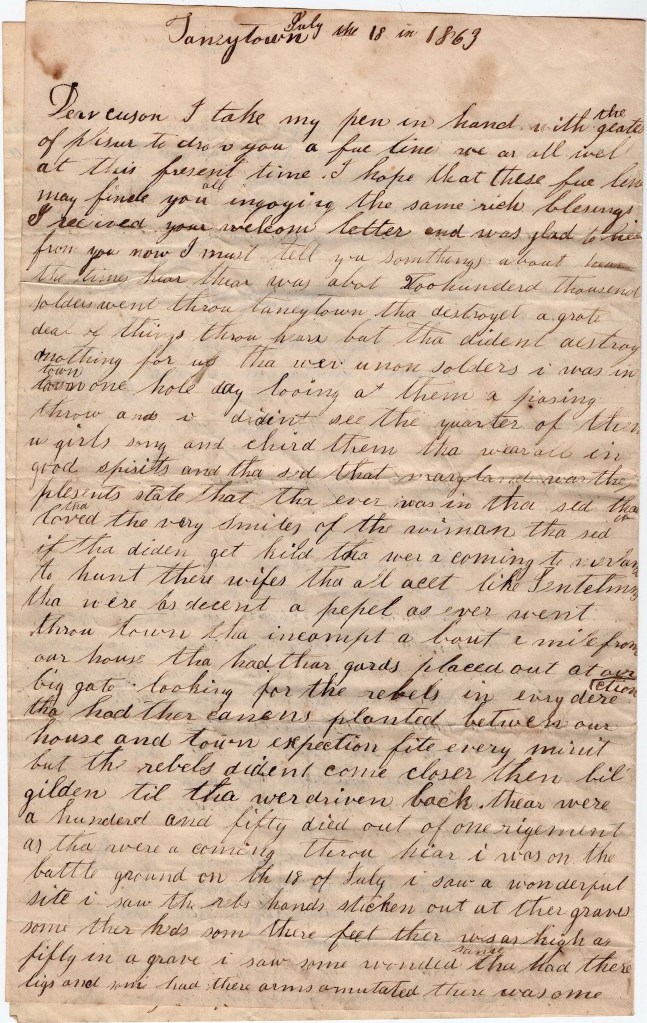
The following letter was written by 18 year-old Adalaide Barbara Fair (1845-1912), the daughter of Charles T. Fair (1810-1888) and Elizabeth (“Eliza”) Slaybaugh (1815-1887) of Taneytown, Carroll county, Maryland. Adalaide was married in 1869 to Thomas Angell (1838-1906). Adalaide’s husband served in Co. G, 3rd Maryland Potomac Home Brigade from April 1862 to April 1865.
Adalaide wrote the letter to Matilda (“Tilly”) Cline (1836-1922), the daughter of John Kline (1800-1882) and Maria Magdalena Slaybaugh (1804-1866) of Menallen township, Adams county, Pennsylvania. Tilly was married in October 1863 to Jacob Crum (1836-1922).
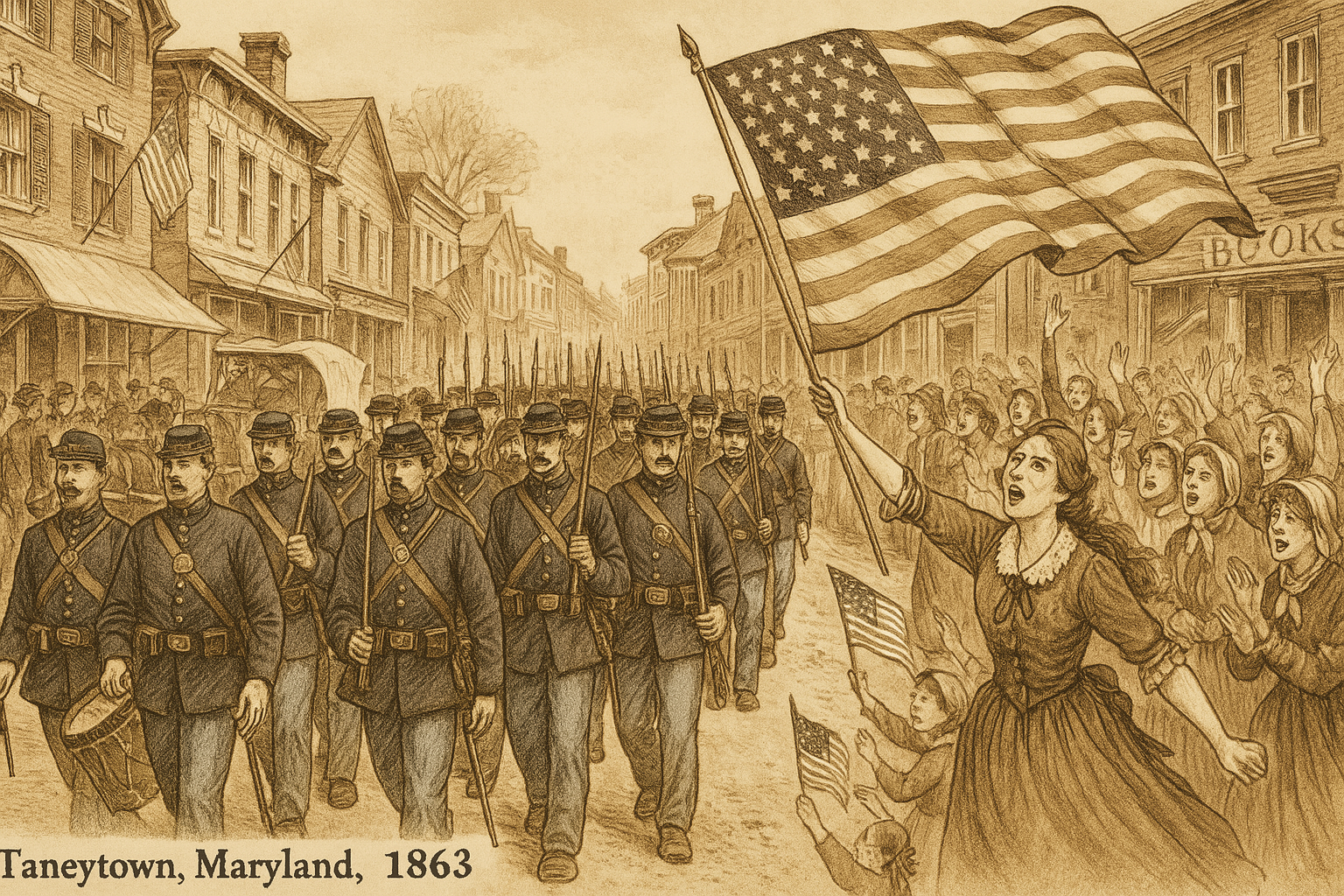
Adalaide’s letter offers a detailed and poignant account of the movement of Union troops through the village of Taneytown, Maryland, located approximately 13 miles south of Gettysburg. Moreover, she recounts her visit to the Gettysburg battlefield, where she observed the hastily dug graves of Confederate soldiers, their remains partially exposed due to the relentless rains of the past few weeks.
“Oh Union boys, ain’t you happy, as you go marching home?”
T R A N S C R I P T I O N
Taneytown [Carroll county, Maryland] July 18, 1863
Dear Cousin,
I take my pen in hand with the greatest of pleasure to drop you a few lines. We are all well at this present time, I hope that these few lines may find you all enjoying the same rich blessings. I received your welcome letter and was glad to hear from you.
Now I must tell you something about the times here. There was about two hundred thousand soldiers went through Taneytown. They destroyed a great deal of things through here but they didn’t destroy nothing for us. They were Union soldiers. I was in town one whole day looking at them a passing through and I didn’t see the quarter of them. Us girls sang and cheered them. They were all in good spirits and they said that Maryland was the pleasantest state that they ever was in. They said that they loved the very smiles of the women. They said if they didn’t get killed, they were a coming to Maryland to hunt their wives. They all acted like gentlemen. They were as decent a people as ever went through town. They encamped about a mile from our house. They had their guards placed out at our big gate looking for the rebels in every direction. They had their cannons planted between our house and town expecting a fight every minute but the rebels didn’t come closer than Bill Gilden till they were driven back.
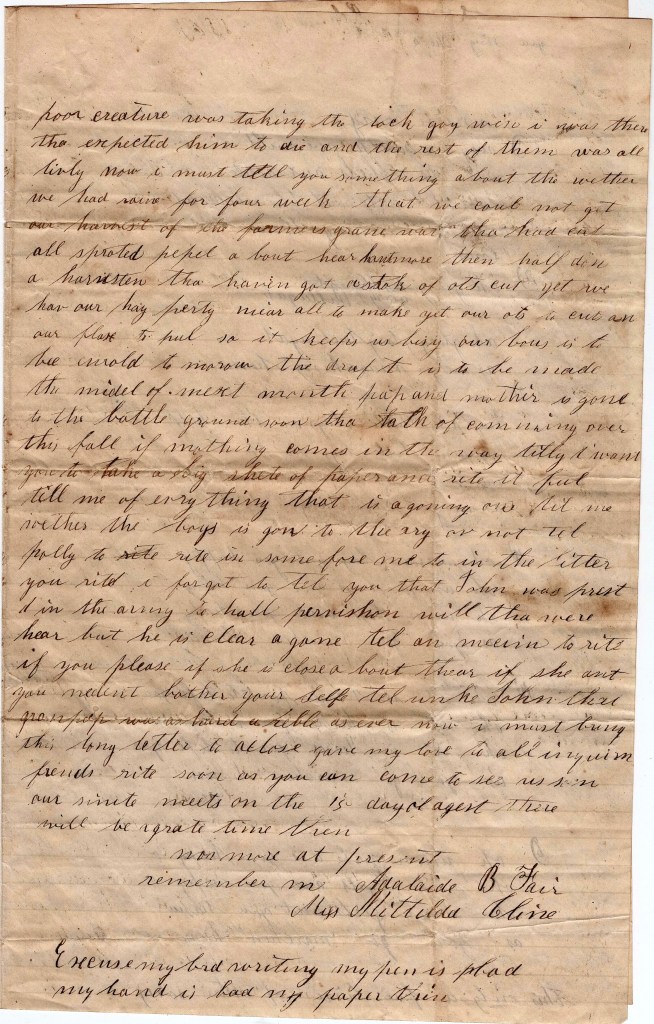
There were a hundred and fifty died out of one regiment as they were a coming through here. I was on the battleground on the 18th of July. I saw a wonderful sight. I saw the rebs hands sticking out of their graves, some their heads, some their feet. There was as high as fifty in a grave. I saw some wounded. They had their legs and some had their arms amputated. There was one poor creature was taking the lock jaw when I was there. They expected him to die and the rest of them was all lively.
Now I must tell you something about the weather. We had rain for four weeks that we could not get out harvest off. The farmers grain war___, they had eat all sproted [?] people about here. Han’t more than half done a harvesting. They haven’t got a stack of oats cut yet. We have our hay pretty near all to make yet, our oats to cut, our flax to pull, so it keeps us busy.
Our beaus is to be enrolled tomorrow. The draft is to be made the middle of next month. Pap and mother is going to the battle ground soon. They talk of coming over this fall if nothing comes in the way. Tilly, I want you to take a big sheet of paper and write it full. Tell me everything that is a going on. Tell me whether the boys is gone to the army or not. Tell Polly to write in some for me too in the letter you write. I forgot to tell you that John was pressed in the army to haul provision while they were here but he is clear again. Tell Aunt Maria to write if you please if she is close about there. If she and you needn’t bother yourself. Tell Uncle John that Grandpap was as hard a pebble as ever. Not I must bring this long letter to a close. Gove my love to all inquiring friends. Write soon as you can. Come to see us soon. Our Sinod meets on the 15th day of August. There will be a great time then. No more at present. Remember me. — Adalaide B. Fair
To Miss Matilda Cline
Excuse bad writing, My ped is bad. My hand is bad. My paper thin.
The following letter was written by Charles H. Bayles of Co. H, 43rd Ohio Infantry who enlisted on 9 December 1861 to serve three years. He was a lowly private when he wrote this letter shortly after the Battle of New Madrid in March 1862. He was promoted to corporal in September 1863. In July 1864, while at Tuscaloosa, Alabama, he requested authority to raise a cavalry company of 40 or 50 men in the regiment who were willing to continue to serve but were having difficulty remaining foot soldiers. This request was apparently denied. He remained with the regiment and was promoted to Sergeant before mustering out on 13 July 1865 as a veteran.
Charles’ letter gives a summary of the artillery dual on 13 March 1862 between Pope’s army and the Confederate gunners at New Madrid— a duel that lasted for most of the day. Meanwhile, Pope’s infantry were slowly advancing their trenches in the normal pattern for a formal siege, slowly getting closer to the Confederate defensive lines. That night the Confederate defenders of New Madrid abandoned the town and withdrew to Island No. 10.
Map of New Madrid and Island No. 10 on the Mississippi River.
T R A N S C R I P T I O N
Patriotic stationery used by Charles to write his letter. Features McClellan on horseback with the quote, “Stand by me, and I’ll stand by you.”
Missouri March 16, 1862
I thought that I would write a few lines today. It is Sunday today. We had a fight at New Madrid the 13th of March. We placed our battery on a ridge about a half of a mile from their fort. Our troops entrenched all night of the 12th and early in the morning of the 13th, our battery 1 commenced firing upon the enemy at day break. Our troops marched down at 2 o’clock at night. At morning it commenced. They commenced firing upon us. The firing was kept up all day long. They killed eight of our army and wounded 8. They cut part of their town down to get range on us. We throwed shells into the fort. It is thought that we killed 2 or 3 hundred of the Secesh. They throwed them from the gunboats into the river as fast. We killed them about one hundred was found in their entrenchments. They had some guns 12 feet long, besides four or five gunboats. I should thought that they would never left such a fort as that.
The firing was kept up from daylight till dark and then the firing ceased. Our infantry laid back a half a mile from our battery. The cannon balls struck all round us. We was in a small piece of woods. They steered at us. The cannon balls cut trees a foot through right in two. They throwed shells at us and balls and canister shot. The ground was covered with cannon balls. Our Lieutenant-Colonel’s horse was shot through the body with a piece of shell. The Lieutenant shot holding him by the halter. There was not one of our company hurt at all but the cannon balls whizzed through the air like thunder. They dropped on our right and on our left. A cannon ball struck one of the boys in the company to our right in the breast. It cut him in two. The firing ceased at night.
Our company was sent out on picket at night. The next morning we calculated to go into them again but that same night they left the town. Everything was left. About 20 cannons was left in the fort. They had a strong fort.
I will write the particulars next time. Direct to Cairo, Illinois. 43rd [Ohio] Regiment, — Charles Bayles
To B. Bayles
I guess the war is about to a close.
1 This was probably the 11th Ohio Independent Light Artillery Battery that was attached to Pope’s Army.
The following letter was written by James M. Covert (b. 1842) who enlisted at Venango county as a private in April 1861 in Co. C, 10 Pennsylvania Reserves (39th Pennsylvania Volunteers). At the time of his enlistment, he was described as a 5 foot 8 inch tall, blue-eyes, dark-haired shoemaker from Butler county, Pennsylvania. He reenlisted in December 1863 and was taken prisoner at Bethesda Church on 30 May 1864. After his exchange, he was transferred to the 191st Pennsylvania to finish out his enlistment.
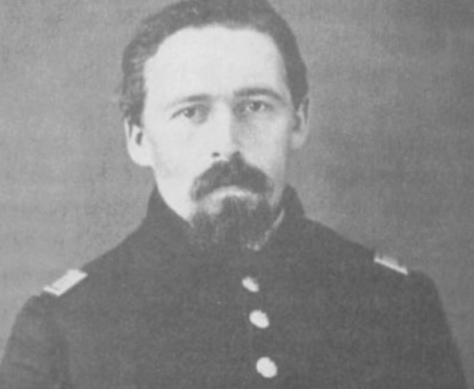
I could not find an image of James but here is a tintype of Joseph Alvin Weaver (1839-1910) who also served in the 39th Pennsylvania Regiment and was in the fight at Dranesville. The image was taken on the day of his enlistment in 1861. (Ancestry.com)
T R A N S C R I P T I O N
Camp Pierpont [near Langley, Va.] December 26th [1861]
Dear Sister,
I received your letter and was glad to hear from you and to hear that you were all well. I am well at present, hoping these few lines may find you enjoying the same blessing.
Since I wrote to you we have had a little fight. On Friday last we started–that is the 3rd Brigade and the Kane Rifle Company [“Bucktails”] with Easton’s Battery of 4 cannon, and three or four companies of artillery. We were out 12 miles. That was where we was to get the forage. We [had] three and a half companies of the 10th [Pennsylvania Reserves] Regiment with the wagons. Then we went on to Dranesville where we was attacked by the rebels. They had four regiments of infantry, 4 pieces of cannon, [and] 700 cavalry. We fought for one and a half hours, They retreated, leaving the dead and wounded on the field. We killed 160 of them. I do not know how many wounded or how many prisoners we took.
The Battle of Dranesville, Va., December 20th 1861, was little more than a skirmish but was cited as the first Federal victory of the war on Southern soil. The action itself centered around the intersection of the Georgetown and Leesburg Pikes.
We only lost 7 men, 48 wounded. They took 2,000 bushels of corn & things too numerous to mention. We took also 70 guns & overcoats and blankets without number. They never got so completely routed since the war began in so short a time. The first shells they throwed was at out regiment & never touched a man. John West [?] is well. Looks stout as any man in the company.
You must not be so down hearted as you say you are. Let things to come be right and all will be well. Do not fret yourself about your misfortune. It will not make it any better cheery. Do not let your spirits go down. If folks laugh, let them laugh. It does not hurt you. Make this life as happy as possible and try and secure your place in the next.
The weather is getting pretty cold here. We had a dull Christmas. One day here is just like another one. I hope the rebellion will be put doen ere long. I got a letter from cousin Jacob [ ]. They live in Jefferson City. They are all well at present. They looked for an attack on that city pretty soon. I will close my letter by sending my respects to Mr. and Mrs. Jennings and yourself. Goodbye, — J. M. Covert
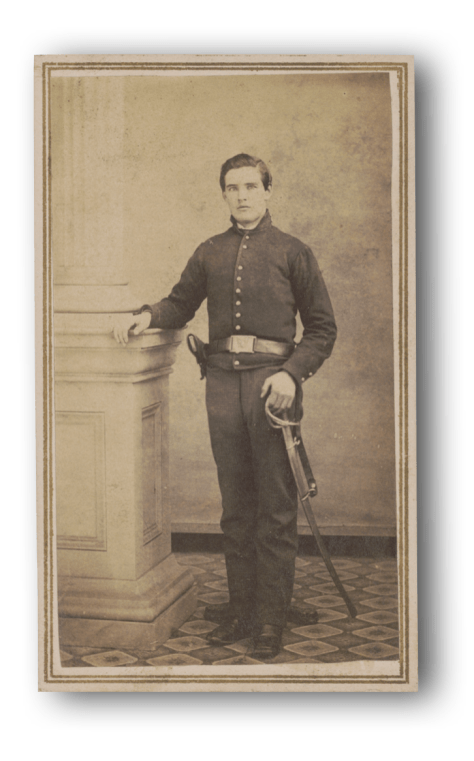
I could not find an image of Samuel but here is a cdv of James S. Bendle of the 6th Michigan Cavalry (LOC)
The following letter was written by Samuel Sherburne (1841-1864) who enlisted as a private in Co. D, 6th Michigan Cavalry on 22 October 1862 at Byron, Michigan. He was taken prisoner and sent Richmond where he died of chronic bronchitis at General Hospital on 12 April 1864. The regiment was assigned to what became the Michigan Brigade during the early part of the Gettysburg Campaign in June 1863. It saw its first actions under General Custer at Hanover, Hunterstown, and Gettysburg. Armed with Spencer Repeating Rifles, the 6th provided superior firepower against the lightly armed Confederate cavalry.
T R A N S C R I P T I O N
Washington D. C. December 14, 1862
Dear Brother,
I thought tonight I would write a few lines & let you know where I be and that I am well and I hope these few lines will find you the same.
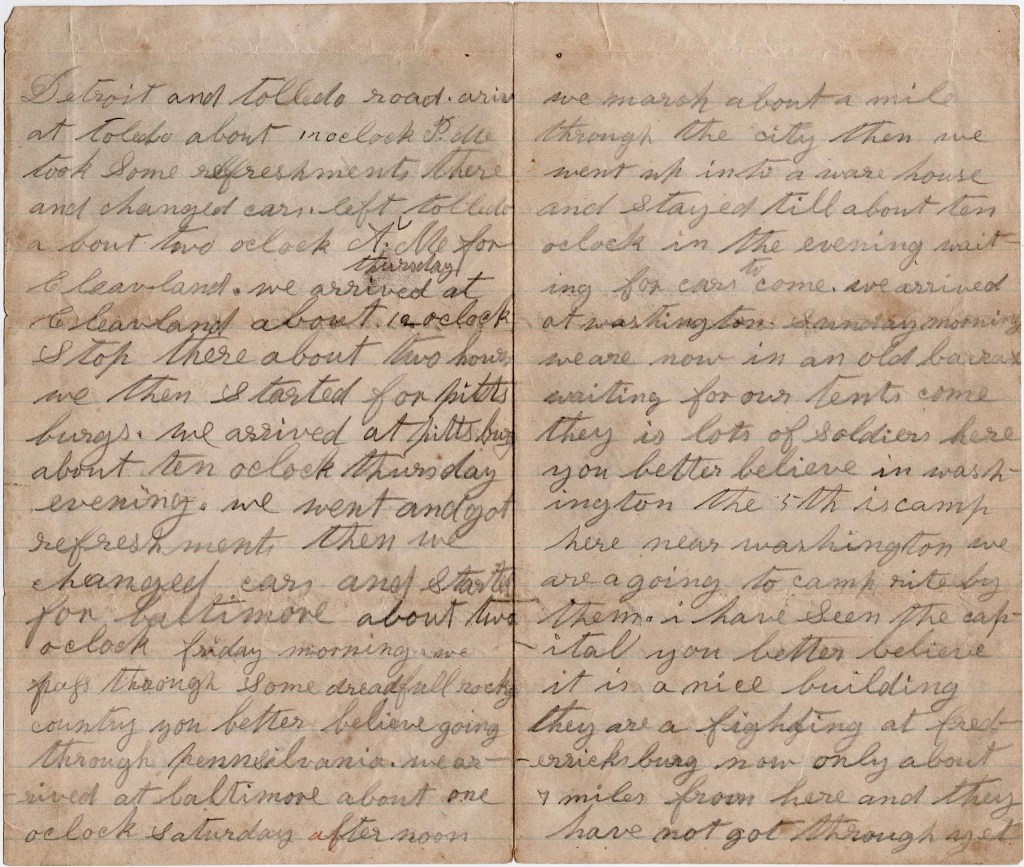
We started from Gand Rapids Camp Kellogg at 5 o’clock a.m., marched over to the jail and got some prisoners, and then we marched down to the depot and got aboard of the cars. Left Grand Rapids at 10 o’clock a.m., arrived at Detroit Junction about 7 o’clock p.m., then we went onto the Detroit & Toledo Railroad. Arrived at Toledo about 12 o’clock p.m.. took some refreshments there and changed cars, left Toledo about two o’clock a.m. for Cleveland. We arrived Thursday at Cleveland about 12 o’clock. Stopped there about two hours, then started for Pittsburgh about ten o’clock Thursday evening. We went and got refreshments, then we changed cars and started for Baltimore about two o’clock Friday morning. We passed through some dreadful rocky country, you better believe, going through Pennsylvania.
We arrived at Baltimore about one o’clock Saturday afternoon. We marched about a mile through the city, then we went into a warehouse and stayed till about ten o’clock in the evening waiting for cars to come. We arrived at Washington Sunday morning. We are now in old barracks waiting for our tents to come. There is lots of soldiers here, you better believe, in Washington. The 5th [Michigan Cavalry] is camped here near Washington. We are a going to camp right by them.
I have seen the [U. S.] Capitol. You better believe it is a nice building. They are a fighting at Fredericksburg now, only about 7 miles [more like 50 miles] from here, and they have not got through yet. Col. [Francis William] Kellogg says we shall have our pay as quick as we get camp. There is not hardly a man in our company got any money but I have got money yet and have had all the while. Tell mother she must not maker herself any trouble about me for I may live all through the war and arrive home once more. I shall stand my chance amongst the rest to not get killed. You must be good to mother and help her all you can.
The cars run over a soldier yesterday here. They run over his legs and arm, He was drunk adn there was one died on the cars. I cannot think of any more at present, Give my love to all the girls. So goodbye. — Samuel Sherburne
I could not find an image of Norman but here is one of Samuel C. Atwater who served in Co. I, 41st OVI.(Ohio Memory)
This letter was written by Norman Chaffin (1839-1926) who was 22 years old when he enlisted in September 1861 to serve three years in Co. C, 41st Ohio Volunteer Infantry (OVI). He mustered out of the regiment on a surgeon’s disability certificate on 4 October 1864.
Norman was the son of Simon Chaffin (1808-1886) and Catharine Mowrer (1816-1902) of Wayne county, Ohio. He was married in 1866 to Catharine Ann Erwin (1848-1940).
Norman wrote the letter to Mary Jane Stirk (b. 1841), the daughter of Henry Stirk (1816-1904) and Eliza Jane Bodine (1821-1902). Mary Jane (“Jennie”) married Allen Ludwig Mohler (1844-1926) in 1867.
T R A N S C R I P T I O N
October 5, 1863
Friend Jane,
I received your kind and encouraging letter on the 2nd of October and was well pleased with its contents. I am glad to see that you with the rest of the family is getting along well. Your letter found me well and in fine spirits. I see by the your letter that you are having some fine times tending political or in other words Union meetings. I am glad to see that you are so patriotic. I would to God that the people of the North was also. I think times would be different. I should love to attend a good Union meeting once more. I think I could enjoy myself well. I just received a letter from friend Joe McGonagle. He is at Madison, Indiana. He is troubled with the rheumatism. He as not walked a step since the 16th of August. I feel sorry for him. He has a hard time of it.
I see by your letter that the young people of Old Wayne will get married if the war does go on. I presume William is a married man, The last letter I got from him he said he was going to get married on the 29th of September. Peace and plenty go with them. I guess that the East Union ladies willl all be married before I get back. If they are, I will try and find one somewhere else if there is any to be found, and I think there will [be] some left. I got a letter from home a few days ago. They was all well.
Friend, I must tell you something but perhaps you know all about it before this time. Miss Mary Jane Anderson 1 has got a young son so we can call her mother now. She fooled around once too often. I pity her but whose fault is it (her own). She was a girl that would believe anything that a young man would tell her. She did not know when she had a friend that could be trusted so she trusted all. I know how the boys used to lie to her and what few times I kept her company I told her over and over not to be taken in by them. I tried to give her good advice. Where is she now? I wonder if she minds what Norman told her.
I will close. Give my respects to all enquiring friends and keep a large share for yourself. Respectfully yours. From your friend, — N. Chaffin
to Miss Mollie J. Stirk
Direct to Co. C, 41st OVI, Chattanooga, Tenn., 2nd Brigade, 2nd Division, 21st Army Corps.
If you want to write to Joe McGonagle, direct to the U. S. Hospital, 2nd Section, Ward 7, Madison, Indiana
1 In the 1850 US Census, Mary Jane Anderson (b. 1842) was enumerated in East Union, Wayne county, Ohio, in the household of her mother, 34 year old Jane (Orr) Anderson. In the 1860 US Census, she was enumerated in the household of her grandfather, 68 year-old Samuel Orr with her mother and three siblings, still in East Union. She married Cornelius A. Franks (1843-1919) on 29 October 1863 and moved to Gratiot county, Michigan.
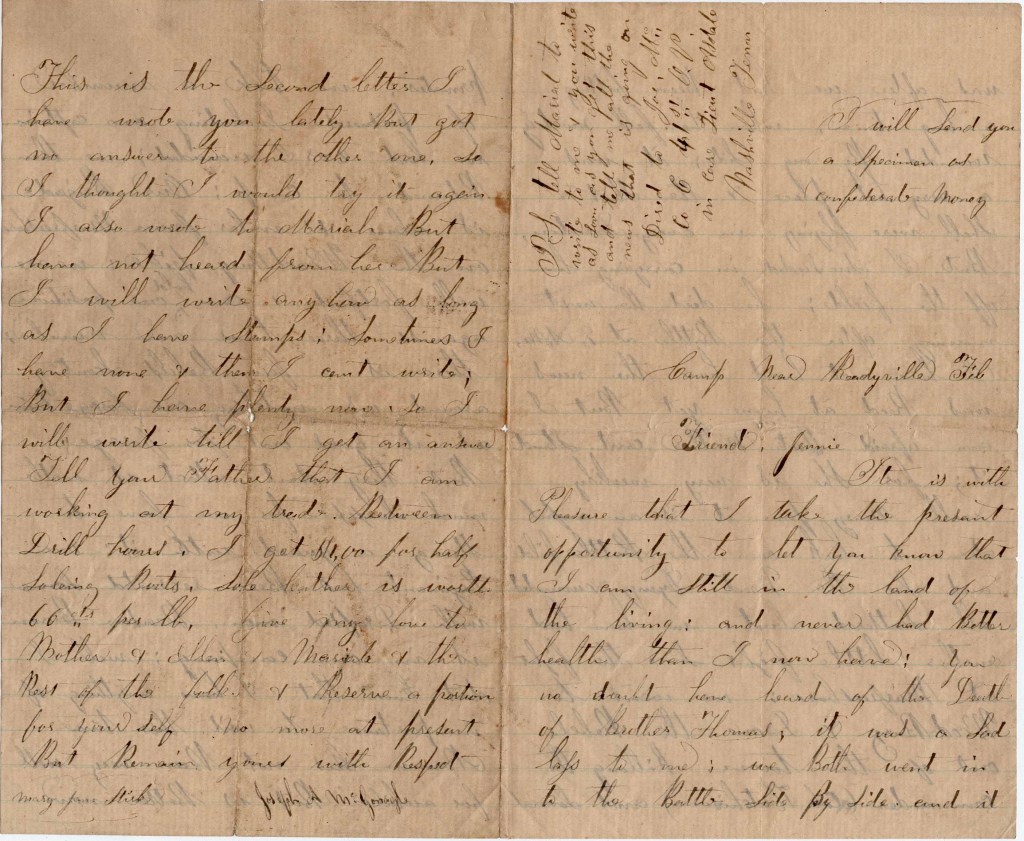
These letters were written by Joseph Alexander McGonagle [or McGonigal] (1842-1893) who enlisted on 19 September 1861 to serve three years in Co. C, 41st Ohio Volunteer Infantry (OVI). His older brother Thomas McGonagle eventually joined him in the same company. As we learn from the letters, however, Thomas was mortally wounded in the fighting at Stones River on 31 December 1862. He died the next morning, 1 January 1863. and now lies buried in the Stones River National Cemetery (Grave No. 2237).
Joseph mustered out of the 41st OVI in September 1864 but later reenlisted in January 1865 as a corporal in Co. C, 192nd Ohio Volunteers. He left the service for good in September 1865.
The McGonagle brothers were born in Wayne county, Ohio, the sons of Isabella Lisle and Robert McGonagle (he died in 1855). Thomas never married. Joseph’s first wife was Caroline Radabaugh; married in 1867 in Putnam county, Ohio. His second wife was Anna Reece; married in 1878. Joseph died and was buried in Palmer, Merrick county, Nebraska.
Joseph wrote both letters to Mary Jane Stirk (b. 1841), the daughter of Henry Stirk (1816-1904) and Eliza Jane Bodine (1821-1902). Mary Jane (“Jennie”) married Allen Ludwig Mohler (1844-1926) in 1867.
Letter 1
Camp near Readyville [Tennessee] February
Friend Jennie,
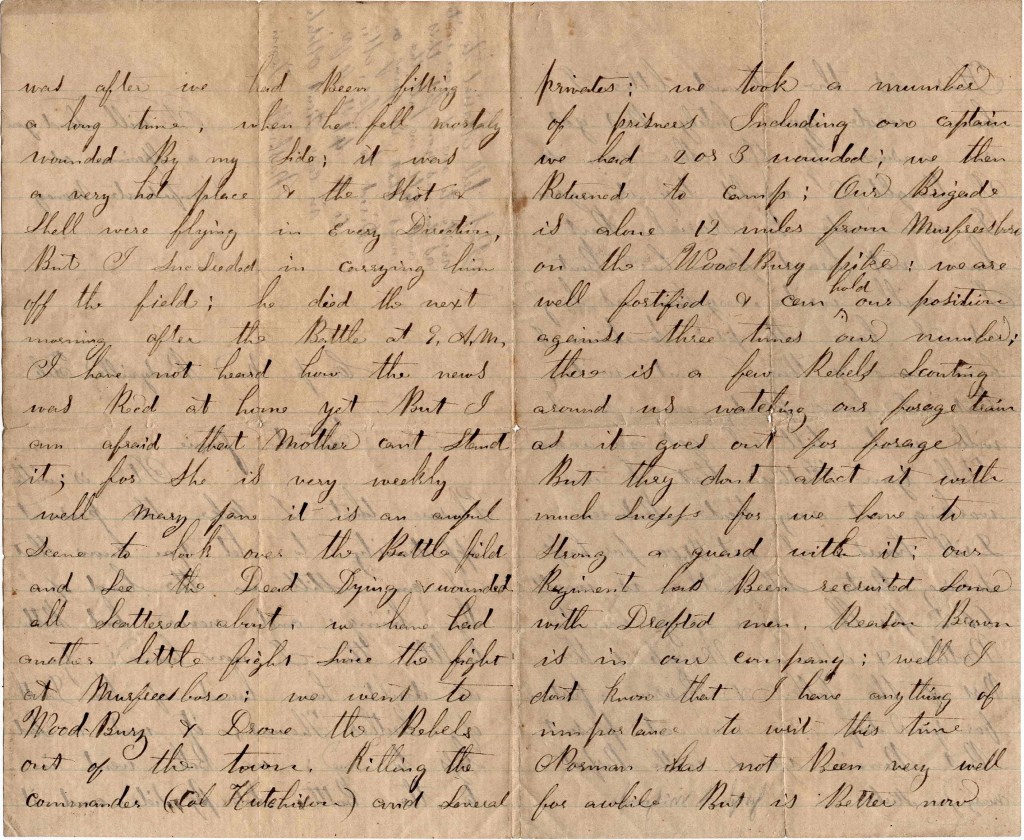
It is with pleasure that I take the present opportunity to let you know that I am still in the land of the living and never had better health than I now have. You no doubt have heard of the death of brother Thomas. It was a sad loss to me. We both went into the battle side by side and it was after we had been fighting a long time when he fell, mortally wounded by my side. It was a very hot place & the shot and shell were flying in every direction. But I succeeded in carrying him off the field. He died the next morning after the battle at 9 a.m. 1
I have not heard how the news was received at home yet but I am afraid that Mother can’t stand it for she is very weakly. Well Mary Jane, it is an awful scene to look over the battlefield and see the dead, dying, and wounded all scattered about. We have had another little fight since the fight at Murfreesboro, We went to Woodbury and drove the Rebels out of the town, killing the commander (Col. [John B.] Hutchenson [of 2nd Kentucky Cavalry]) and several privates. We took a number of prisoners including one captain. We ha two or three wounded. We then returned to camp.
Our Brigade is alone 12 miles from Murfreesboro on the Woodbury Pike. We are well fortified & can hold our position against three times our number. There is a few Rebels scouting around us watching our forage train as it goes out for forage. But they don’t attack it with much success for we have too strong a guard with it. Our regiment has been recruited some with drafted men. Reason Brown is in our company.
Well, I don’t know that I have anything of importance to write this time. Norman [Chaffin] has not been very well for while but is better now. This is the second letter I have wrote you lately but got no answer to the other one. I thought I would try it again. I also wrote to Mariah but have not heard from her but I will write anyhow as long as I have stamps. Sometimes I have none & then I can’t write. But I have plenty now so I will write till I get an answer.
Tell your father that I am working at my trade between drill hours. I get $1 for half soling boots. Sole leather is worth 66 cents per lb. Give my love to Mother & Ellen and Mariah & the rest of the folks & reserve a portion for yourself. No more at present but remain yours with respect. — Joseph McGonagle
to Mary Jane Stirk
P. S. Tell Mariah to write to me & you write as soon as you get this and tell me all the news that is going on. Direct to Joe. Mc., Co. C, 41st O. V. in care of Lieut. [Samuel B.] Asdell, Nashville, Tenn.
1 For an excellent summary of the 41st Ohio and their defense of the piece of ground called Hell’s Half Acre in the Battle of Stones River, please see my friend Dam Masters’ excellent article, “Summoning Hell’s Half Acre: The 41st Ohio in the Round Forest” in Civil War Chronicles, 22 April 2020.
Letter 2
Chattanooga [Tennessee] March 23, 1864
Friend Jennie,
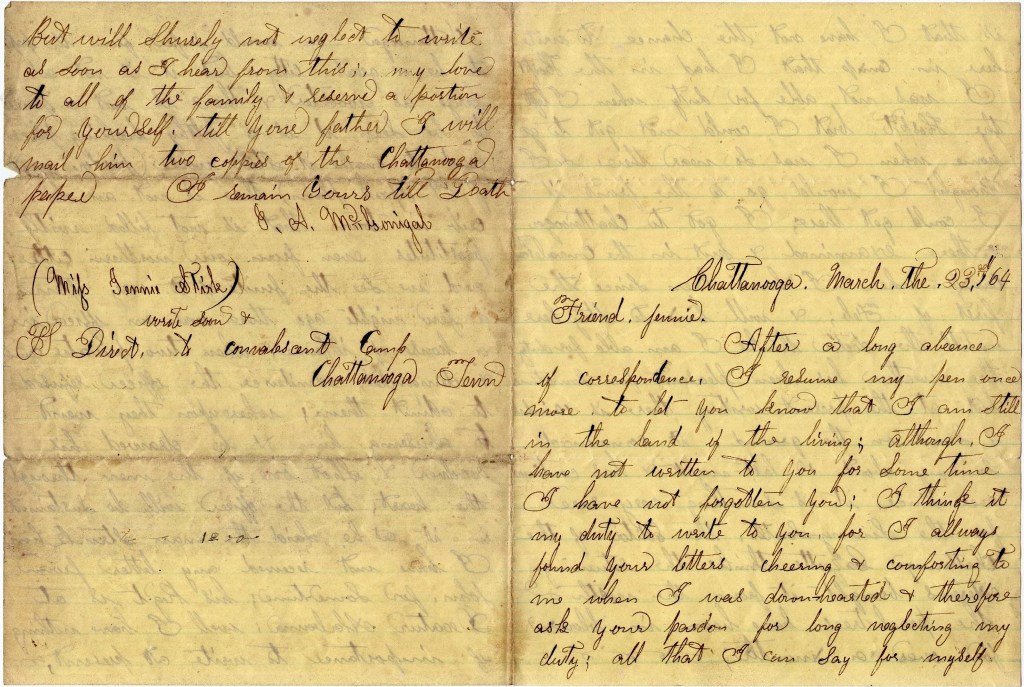
After a long absence of correspondence, I resume my pen once more to let you know that I am still in the land of the living. Although I have not written to you in some time, I have not forgotten you. I think it my duty to write to you for I always found your letters cheering and comforting to me when I was down-hearted & therefore ask your pardon for long neglecting my duty. All that I can say for myself is that I have not the chance to write here in camp that I had in the hospital.
I was not able for duty when I left the hospital but I could not get to go home when I was so near there so I thought I would go to the front if I could get there. I got to Chattanooga & there examined and put in the Convalescent Camp where I have been since the first of February and will have to stay here until the doctor thinks I am able for duty.
The weather has been pleasant for some time but at the present writing, there is ten inches of snow on the ground. It commenced about 12 last night and has continued ever since. It is something very rare for the Sunny South. The editor of the Chattanooga Gazette thinks the returning veterans brought it from the North. The peach trees have been in bloom for over a month.
Chattanooga you would infer from the paper to be a great city, but it is not as large as Wooster & there is not a fence to be seen. It is a filthy looking place and to make it still worse (pardon me if I speak plain) there is not an old crib in town that is not filled with prostitutes even from our northern cities and we see the fruits of it very often. A few nights ago there was an officer in a house of ill fame. When two privates came and demanded admittance, the officer refused to admit them whereupon they went to abusing him and he showed his revolver & shot one of the men through the heart. But the officer will be sustained in it as he said the man struck him.
I have not received ant letter from John for some time. His regiment is at Decatur, Alabama.
Well, I have nothing of importance to write at present, but will surely not neglect to write as soon as I hear from this. My love to all of the family & reserve a portion for yourself. Tell your father I will mail him two copies of the Chattanooga paper. I remain yours till death, — J. A. McGonagle
To Miss Jennie Stirk
P. S. Direct to Convalescent Camp, Chattanooga, Tenn.
The following letter was written by Amos B. Currier (1822-1899) who enlisted at Le Roy on 25 August 1862 to serve three years in Co. I , 151st New York Volunteers. At the time of his enlistment, he was described as a 5 foot 10 inch tall, blue-eyed, dark-haired blacksmith who was born in Wyoming county, New York. He was made a corporal at the time of his muster but was later reduced to ranks and transferred to Co. D in December 1864 with the consolidation of companies. He mustered out of the regiment on 26 June 1865 at Washington D. C.
In the 1860 US Census, 38 year-old Amos was enumerated in Allegany, Cattaraugus, New York, with his 35 year-old wife Amanda M. (Baldwin) Currier (1825-1900), and 13 year-old son, John G. Currier (1847-1893). His trade was recorded as “blacksmith.” After the war, Amos settled in Cuba, Alleghany county where he resumed his trade.
T R A N S C R I P T I O N
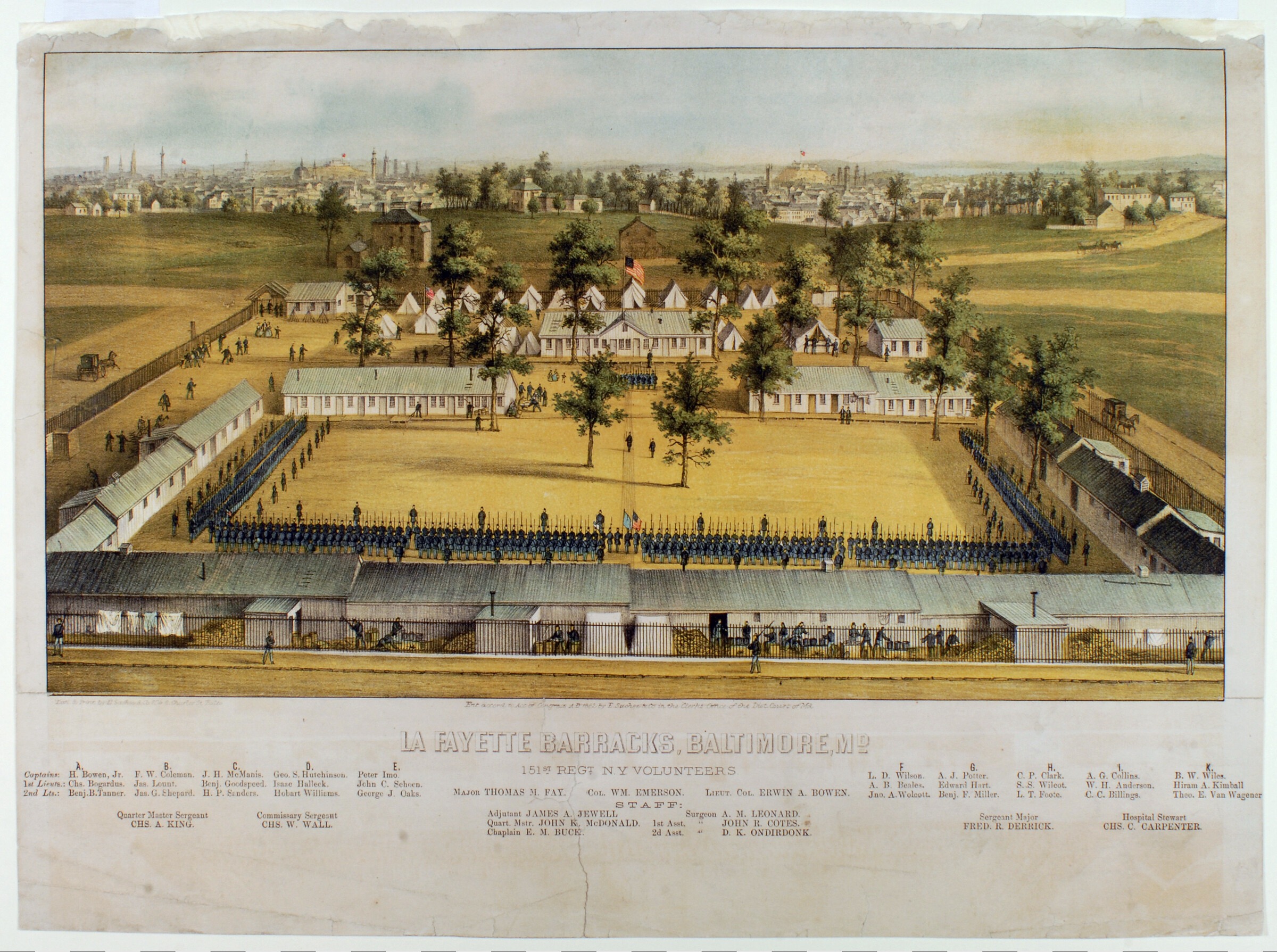
La Fayette Barracks, Baltimore, Maryland, 151st New York Volunteers
Headquarters 151st [New York] Regt., Co. I Camp La Fayette, Baltimore, Md. November 12th 1862
Dear wife,
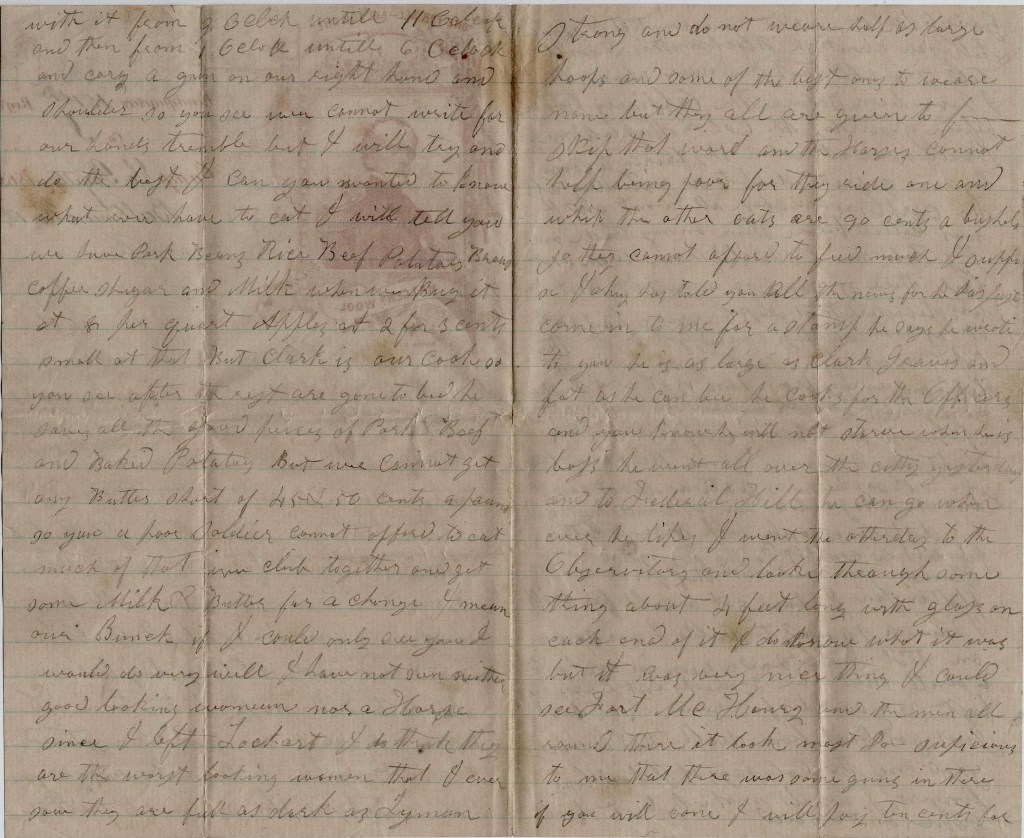
I received your letter on Monday morning and I tell you, it was welcome too. If I ever got anything that done me good, it was that for I began to think you had forgot you had a friend in Baltimore and one that is nearer than that, It seemed strange that you should all forget the directions but I will forgive you this time. I was glad to hear you was well for I was sure you was sick. I should have answered yours the same day but we have to drill most of the time and when we are off, our arms are tired and cannot write. I have to carry a gun that weighs 11 pounds and to practice with it from 9 o’clock until 11 o’clock, and then from 1 o’clock until 6 o’clock and carry a gun on our right hand and shoulder so you see we cannot write for our hands tremble but I will try and do the best I can.
You wanted to know what we have to eat. I will tell you. We have pork, beans, rice, beef, potatoes, coffee, sugar, and milk when we buy it at 8 per quart. Apples at 2 for three cents, small at that. But Clark is our cook so you see after the rest are gone to bed, he saves all the good pieces of pork, beef, and baked potatoes. But we cannot get any butter short of 45 and 50 cents a pound. So you [see], a poor soldier cannot afford to eat much of that. We club together and get some milk & butter for a change—I mean our bunch.
If I could only see you, I would do very well. I have not seen any good looking women nor a horse since I left Lockport. I do think they are the worst looking women that I ever saw. They are full as dark as Lyman Strong and do not wear half as large hoops and some of the best ones to wear none. But they all are given to f___ —skip that word. And the horses cannot help being poor for they ride one and whip the other. Oats are 90 cents a bushel so they cannot afford to feed much, I suppose. Johnny has told you all the news for he has just come in to me for a stamp, He says he wrote to you. He is as large as Clark Graves and fat as he can be. He cooks for the officers and you know he will not starve where he is. He went all over the city yesterday and to Federal Hill, He can go wherever he likes. I went the other day to the Observatory and looked through something about 4 feet long with glass on each end of it, I do not know what it was but it was a very nice thing & could see Fort McHenry and the men all round there. It looked most suspicious to me that there was something going in there. If you will come, I will pay ten cents for you to look through it.
You wanted I should tell you about the blacksmiths. I will tell you all that I know about it. I have been before the officers twice before yesterday, The Colonel and Major told me I should have it when [ ] to going. Thy have a great deal to do. Yesterday all the captains and [ ] all want and I was called before them on my trade and they told me I should have without fail, There is some 18 wants it but it was deiced that A. B. Currier has got it as soon as they could get to it. The captain was afraid it was going to take me away from him. If it was, he should go against it for he saw he could not spare me out of his company for I was his right hand man. Some blarney there, you will say, but his actions do not say so. But the Major told him it would not make any difference—only help me to better pay and a credit to the regiment. Some more blarney. You need not [say] this for it may flatter you.
I have got a call for drill. I have a squad to drill. I am some on that. Never had a gun in my hand to drill, not over two weeks, but learn very fast. So goodbye for now. 11 o’clock. Just got back from drill. Had a very good one. The colonel says if I had long fingers, I would make the best drill officer on the field. I have not got our pay yet….Goodbye and lots of kisses from your own, — A. B. C.
The following letter was written by David Hopkins (1838-1895), the son of William Hopkins (1805-1863) and Emma Hopkins (1808-1868) of Richland county, South Carolina. David wrote the letter from his farm in Canton, Madison county, Mississippi, to his widowed mother in South Carolina. After her husband William Hopkins died in 1863, his wife struggled to get by and to take care of what was left of the plantation. The Federal troops burned much of it but did not burn the main house when they saw a Masonic plaque on the wall. The sons were kept busy trying to run the other family plantations, including those in Mississippi.
David was married in 1859 to Adeline (“Addie”) M. Rembert. David’s obituary reads: David Hopkins was born at the old family homestead near Hopkins, on November 11, 1836. When the war came on he went forth to fight for the beloved Southland in Capt. Meighan’s Company C, Second South Carolina Cavalry, commanded by Col. Thomas J. Lipscomb. He fought throughout the war, distinguishing himself for his bravery. Mr. Hopkins was always a planter. Just after the war he removed to Mississippi, where he remained for fourteen years and then returned to the old homestead, where he has since resided. He married early in life a Miss Rembert of Sumter county, who with his only surviving child, Dr. James Hopkins, the county auditor, remain to mourn the loss. His only other child, a son, died several years ago.
This letter is from a private collection (RM) and was offered for transcription and publication on Spared & Shared by express consent. See also 1861: James Hopkins to William Hopkins from the same collection.
T R A N S C R I P T I O N
April 20, 1868
Dear Mother,
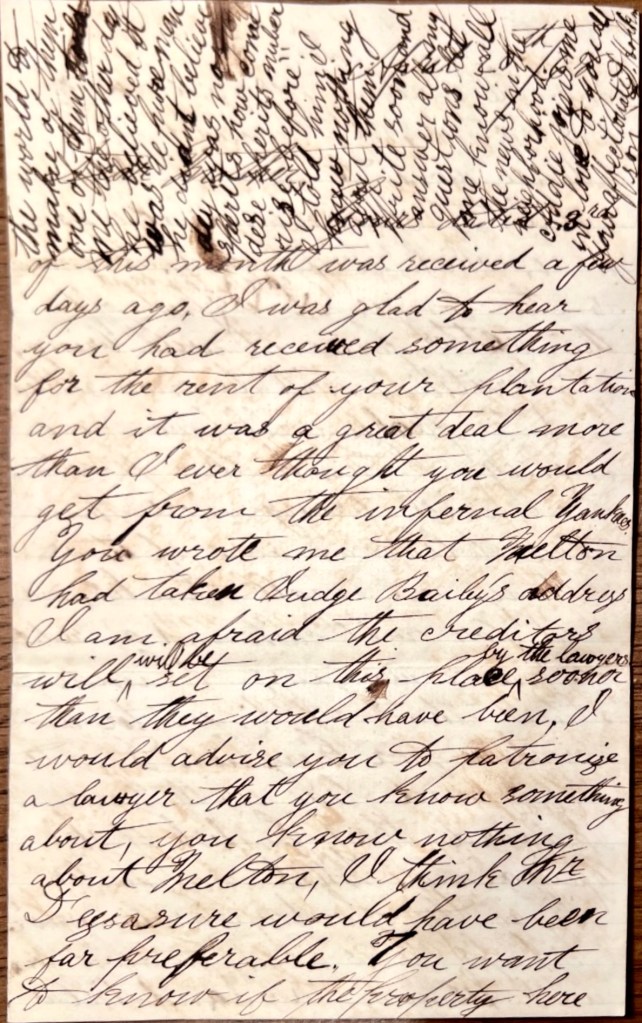
Yours dated 3rd of this month was received a few days ago. I was glad to hear you had received something for the rent of your plantation and it was a great deal more than I ever thought you would get from the infernal Yankees. You wrote me that Melton had taken Judge Bailey’s address. I am afraid the creditors will be set on this place by the lawyers sooner than they would have been. I would advise you to patronize a lawyer that you know something about. You know nothing about Melton. I think Mr. D’ysasure would have been far preferable.
You want to know if the property here has been administered on. It has not, and I would not advise you to have it done until the creditors make you do so which will be time enough as the longer the sale of this land is put off, the better the price will be more settled and the people will have more money. I think the plantation will bring more than three dollars an acre if it is cut up in small tracks and sold for part cash and a credit of one or two years.
I understand that Ned Gunter has written for [brother] English to go to Alabama and live with him. I heard that English [Hopkins] spoke of going. What is Gunter going to South Carolina for? Perhaps he is going to close down with his four thousand dollar bond. I would find out what that bond was for and see if father’s name is to it. Is Dr. Diseker living with you this year?
How many freedmen are you working? and how many brother I___? What negroes have you got? Is Glasgow with you yet? I hope you have got rid of Silvy and her mulatto set. Who cooks for you? What has become of Monday and my friend Josh? I expect Tom Robertson will have him for one of his aide-de-camps mounted on a long-eared Jack[mule]; wisdom personified.
“Said that he was thirsty as he had just risen from the grave and had not drank any water since the Battle of Corinth when he was killed.”
The days of miracle have come again in this country. The Confederate dead are rising from their graves and walking out of the graveyards from two or three to fifty in a band, and this happens all over the country. They are called the Klu Klux Klan and nobody knows who belongs to the Klan. They are over the whole country. One of them rode up to house and asked a negro for a cup of water. He drank it and several more. Finally he called for a bucket full. He dispatched that and several more buckets full. Said he was very thirsty as he had just risen from his grave and had not drank any water since the Battle of Corinth where he was killed. The negro run off as hard as he could, bellowing with all his might to save him.
I heard that a white man was killed about 7 or 8 miles from here two or three days ago. He was a notorious horse thief and had just stolen one. Nobody knows who killed him but it is thought the Klu Klux Klan did it. They have also ordered another man off that I knew. He lives about 6 miles from here. He had a negro wife and had perjured himself in court. He is going to leave as quick as possible. The negroes do not know what in the world to make of them. One of them told me the other day he believed it was “de foreman. He didn’t believe dey was no spirits. How come dese spirits nuber rise before.” I told him I knew nothing about them.
Write soon and answer all my questions. Let me know all the news in the neighborhood. Addie joins me in love to you all. Your affectionate son, — D. Hopkins