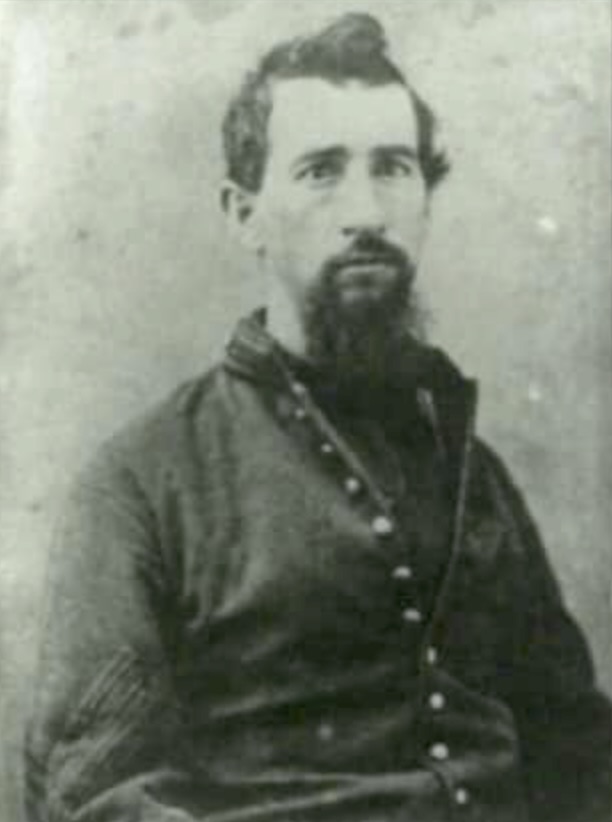
These letters were written by Daniel Markham (1837-1910), the son of Uriah Markham (1803-1848) and Elizabeth Adams (1803-18xx) of Brown county, Ohio. Daniel and his brother, Archibald (“Archie”) H. Markham (1835-1911), both served in Co. H, 2nd Illinois Cavalry.
Daniel wrote all of these letters to his cousin, Sarah Annette Markham (b. 1840), the daughter of Horace Marcum (b. 1791) of Knox county, Illinois.
Transcription
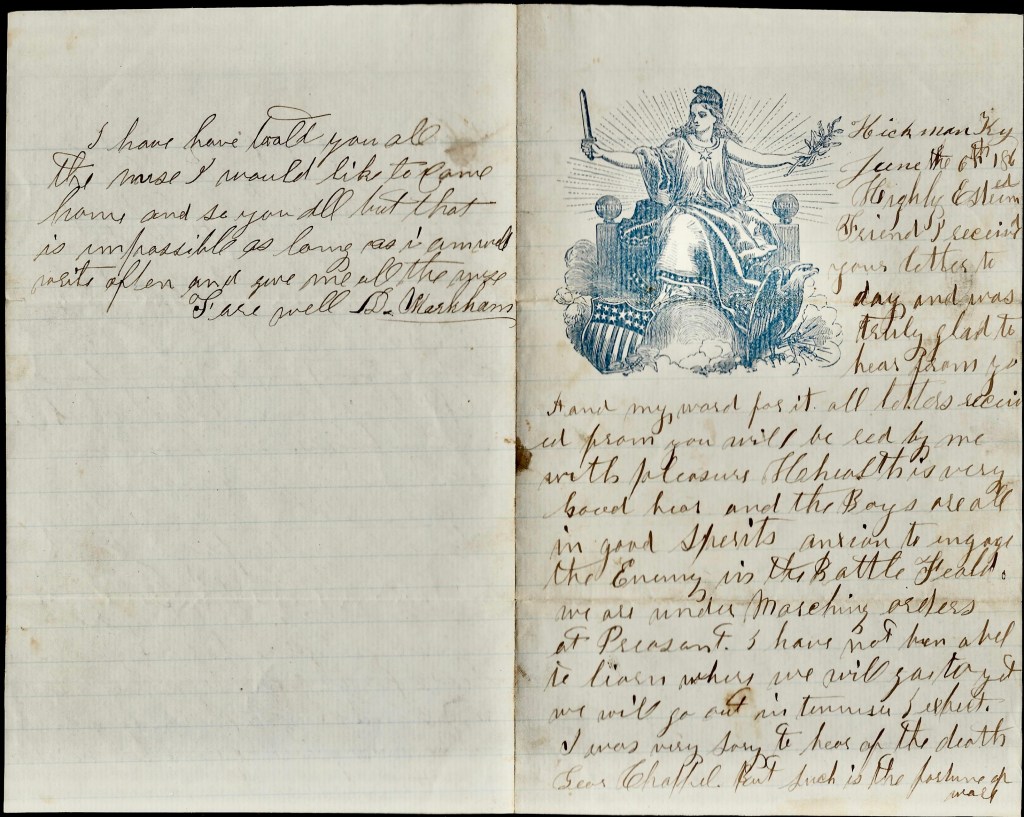
Patriotic Letterhead on stationery used by Markham
Hickman , Kentucky June 6, 1862
Highly Esteemed Friend,
I received your letter today and was truly glad to hear from you and [you have] my word for it, all letters received from you will be read by me with pleasure. My health is very good here and the boys are all in good spirits, anxious to engage the enemy in the battlefield. We are under marching orders at present. I have not been able to learn where we will go to yet. We will go out in Tennessee I expect. I was very sorry to hear of the death of George Chappel. But such is the fortune of many.
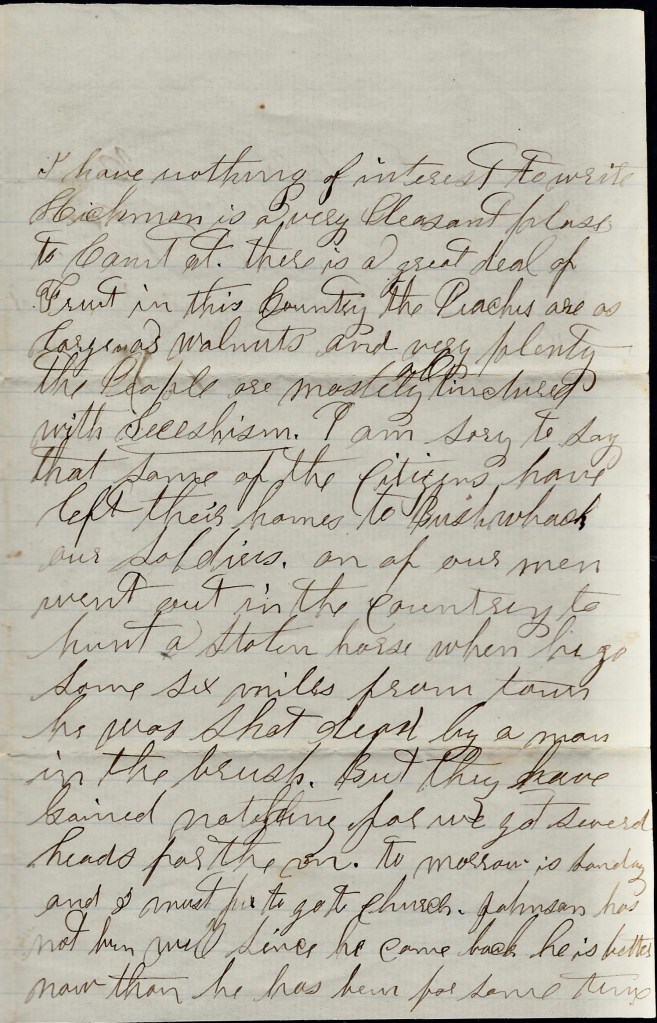
I have nothing of interest to write. Hickman is a very pleasant place to camp at. There is a great deal of fruit in this country. The peaches are as large as walnuts and very plenty. The people are mostly tinctured with seceshism. I am sorry to say that some of the citizens have left their homes to bushwhack our soldiers. One of our men went out in the country to hunt a stolen horse. When he had gone some six miles from town, he was shot dead by a man in the brush. But they have gained nothing for we got several heads for the one.
Tomorrow is Sunday and I must go to church. Johnson has not been well since he came back. He is better now than he has been for some time. I have told you all the news. I would like to come home and see you all but that is impossible as long as I am well. Write often and give me all the news. Farewell, — D. Markham
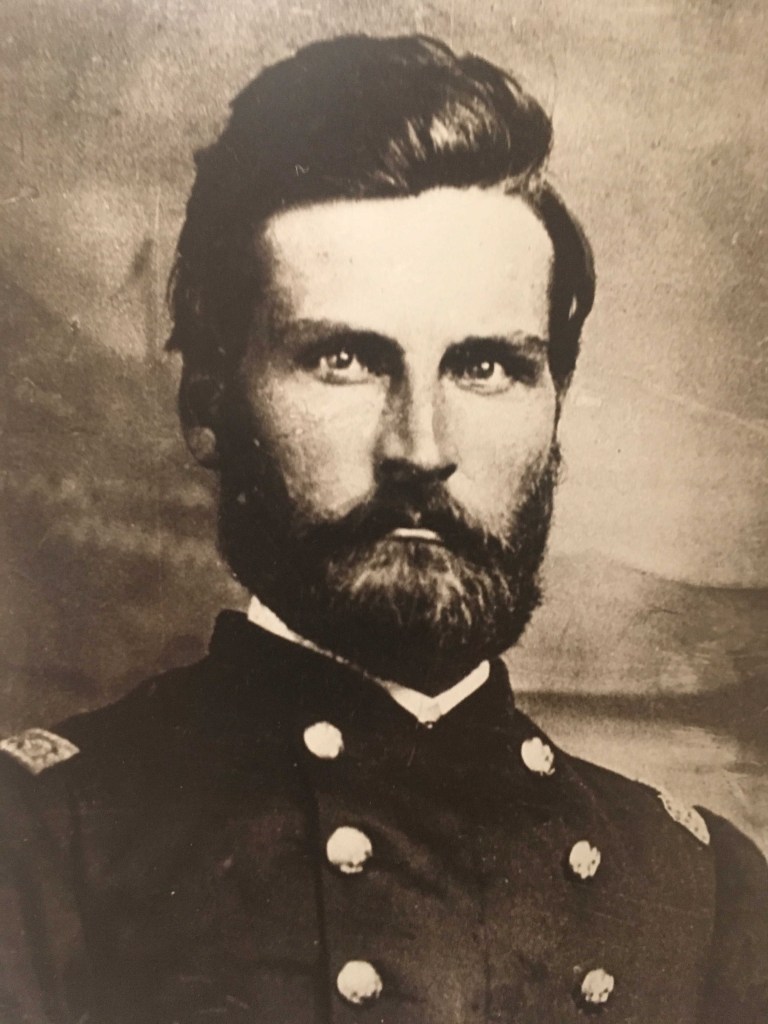
I could not find an image of Willard but here is one of Quartermaster Sergeant Erastus Holmes of the 5th Indiana Cavalry who also spent months in Andersonville Prison (John Sickle’s Collection)
These letters (some partial and unsigned) were written by Pvt. Willard J. Smith (1835-1868) of Co. I, 5th Indiana Cavalry. Willard enlisted in the regiment on 9 August 1862 and he mustered out of the regiment on 23 June 1865.
Willard wrote the letters to younger brother James Hall Smith (1839-1909), the son of John W. Smith (1808-1877) and Electa A. Jackson (1810-1864) of Boone township, Porter county, Indiana.
From Willard’s letter of May 22, 1865, we learn that he spent the winter of 1864/65 in Andersonville Prison with a number of other members of the 5th Indiana Cavalry—several of whom died there. Willard himself was reported to have died at Andersonville on August 15, 1864, but inconsistently also reports him to have been mustered out of the regiment on 15 June 1865. Most of the 5th Indiana Cavalry regiment was captured during Stoneman’s Raid at Sunshine Church, Hillsboro, between July 30-31, 1864.
Though Willard survived the ordeal of Andersonville Prison, his health must have been irreparably broken as he died on 14 October 1868 at the age of 33. His gravestone in Fleming Cemetery does not even recognize his military service, let alone his confinement at Andersonville.
Letter 1
November the 23, 1862
Well Jim, this is Sunday morning & I hain’t anything to do only to write to you. The first thing I have to tell you is that I am well & hope that these few lines will find you all the same. We are going to have an election this afternoon to elect another captain. Our captain [Ephraim N. Banks] has been promoted to regimental surgeon. He is going to the 54th [Indiana] Regiment. He will leave us tonight. I have to have him leave the worst way because he is the right kind of a man. We are going to put Dock Macon [John T. McKean] in his place and the orderly in [Arthur M.] Buell’s place. I think Mr. Buell will be shoved clear out of the company. I hope so at any rate. ¹
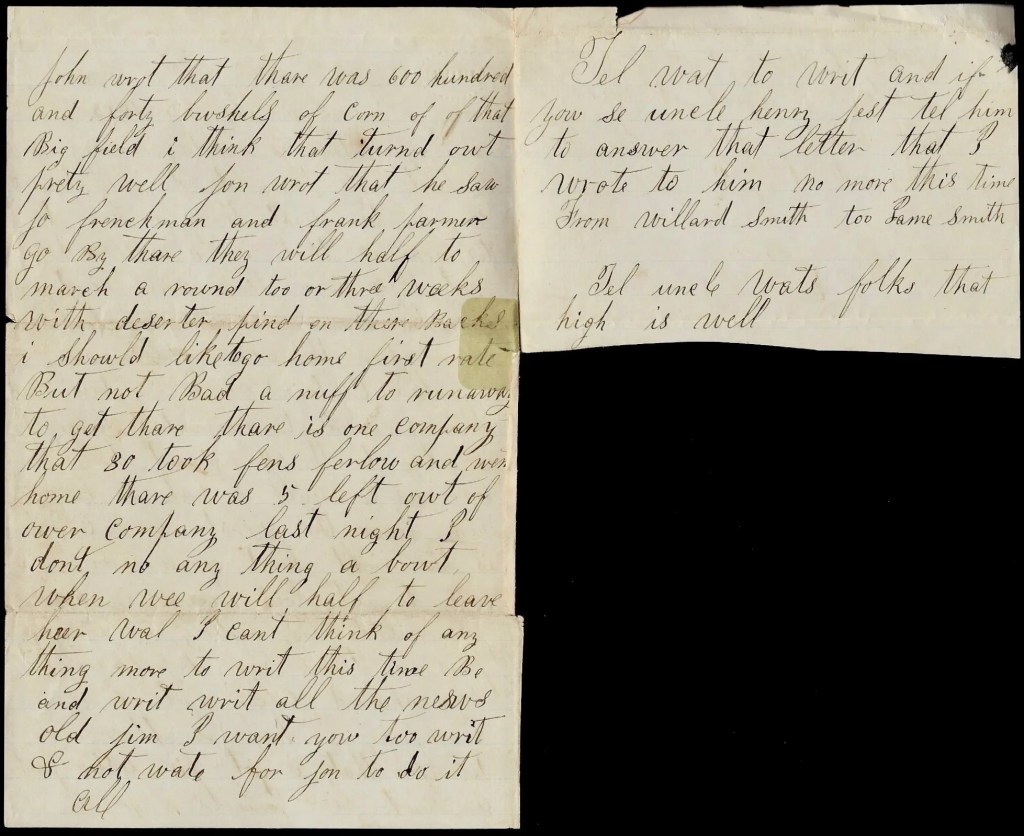
Tell John that I got his letter just about five minutes ago. John wrote that there was 600 and 40 bushels of corn off that big field. I think that turned out pretty well. John wrote that he saw Joe Frenchman and Frank Farmer go by there. They will have to march around two or three weeks with “deserter” pinned on their backs. I should like to go home first rate but not bad enough to run away to get there. There is one company that 30 took French furlough and went home. There was 5 left out of our company last night.
I don’t know anything about when we will have to leave here. Well, I can’t think of anything more to write this time. Be [good] and write all the news, old Jim. I want you to write & not wait for John to do it all.
Tell Wat ² to write and if you see Uncle Henry, just tell him to answer that letter that I wrote to him. No more this time.
From Willard Smith
to James Smith
Tell Uncle Wat’s folks that high is well.
¹ Arthur M. Buell resigned his 1st Lieutenant’s commission on 1 December 1862. Apparently he was roundly disliked by the men. He was replaced by Edgar L. Morse of Lowell, Indiana, and eventually became captain.
² Waterman J. Smith (1832-1901) was Willard’s older brother. “Wat” served in Co. D, 23rd Indiana Infantry.
Letter 2
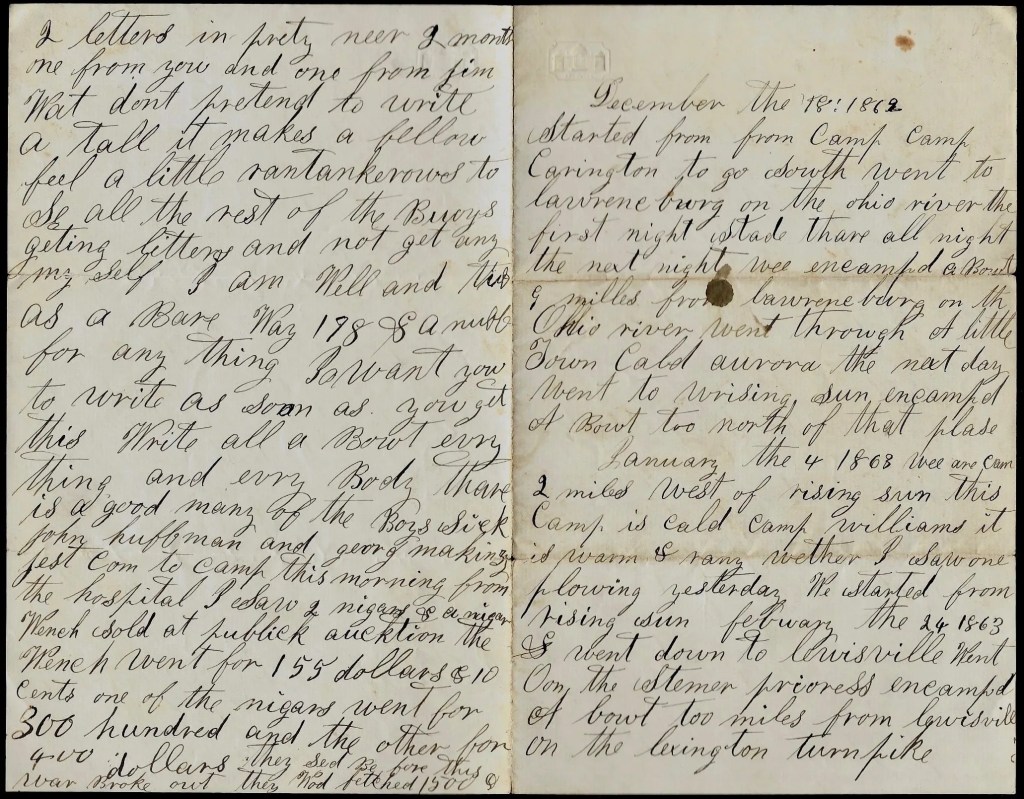
December the 18, 1862
Started from camp Carington to go south. Went to Lawrenceburg on the Ohio River the first night, stayed there all night. The next night we encamped about 9 miles from Lawrenceburg on the Ohio River. Went through a little town called Aurora. The next day went to Rising Sun. Encamped about two [miles] north of that place.
January 4, 1863, we are camped two miles west of Rising Sun. This camp is called Camp Williams. It is warm & rainy weather. I saw one plowing yesterday. We started from Rising Sun February the 24, 1863 & went down to Louisville. Went on the steamer Princess. Encamped about two miles from Louisville on the Lexington turnpike.
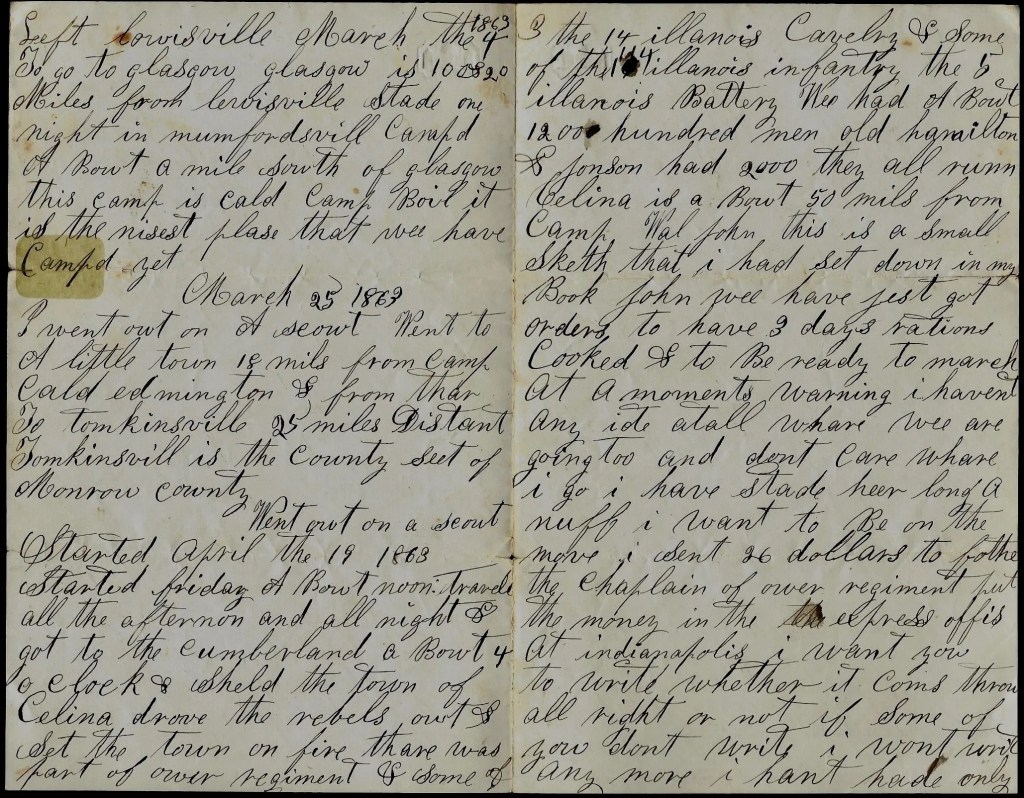
Left Louisville March the 4, 1863 to go to Glasgow. Glasgow is 100 & 20 miles from Louisville. Stayed one night in Mumfordsville. Camped about a mile south of Glasgow. This camp is called Camp Boyle. It is the nicest place that we have camped yet.
March 25, 1863, I went out on a scout. Went to a little town 18 miles from camp called Edmington & from there to Tompkinsville 25 miles distant. Tompkinsville is the County Seat of Monroe County.
Went out on a scout. Started April the 19, 1863. Started Friday about noon. Travelled all the afternoon and all night & got to the Cumberland about 4 o’clock & shelled the town of Celina, drove the rebels out & set the town on fire. There was part of our regiment & some of the 14th Illinois Cavalry & some of the 14 Illinois Infantry [and] the 5th Illinois Battery. We had about 1200 men. Old Hamilton and Johnson had 2,000. They all run. Celina is about 50 miles from camp.
Well, John, this a small sketch that I had set down in my book. John, we have just got orders to have 3 days rations cooked & to be ready to march at a moment’s warning. I haven’t any idea at all where we are going to and don’t care where I go. I have stayed here long enough.
I sent 26 dollars to Father. The Chaplain [Amos D. Cunningham] of our regiment put the money in the express office at Indianapolis. I want you to write whether it comes through all right or not. If some of you don’t write, I won’t write anymore. I hain’t had only 2 letters in pretty near 2 months—one from you and one from Jim. Wat don’t pretend to write at all. It makes a fellow feel a little rantankerous to see all the rest of the boys getting letters and not get any myself.
I am well and thick as a bear. Weigh 178 and enough for anything. I want you to write as soon as you get this. Write all about everything and everybody. There is a good many of the boys sick. John Huffman and George Mckinsey just came to camp this morning from the hospital. I saw 2 niggers & a nigger wench sold at public auction. The wench went for 155 dollars & 10 cents. One of the niggers went for 300 hundred and the other for 400 dollars. They said before this war broke out they would have fetched $1500 dollars.
Letter 3
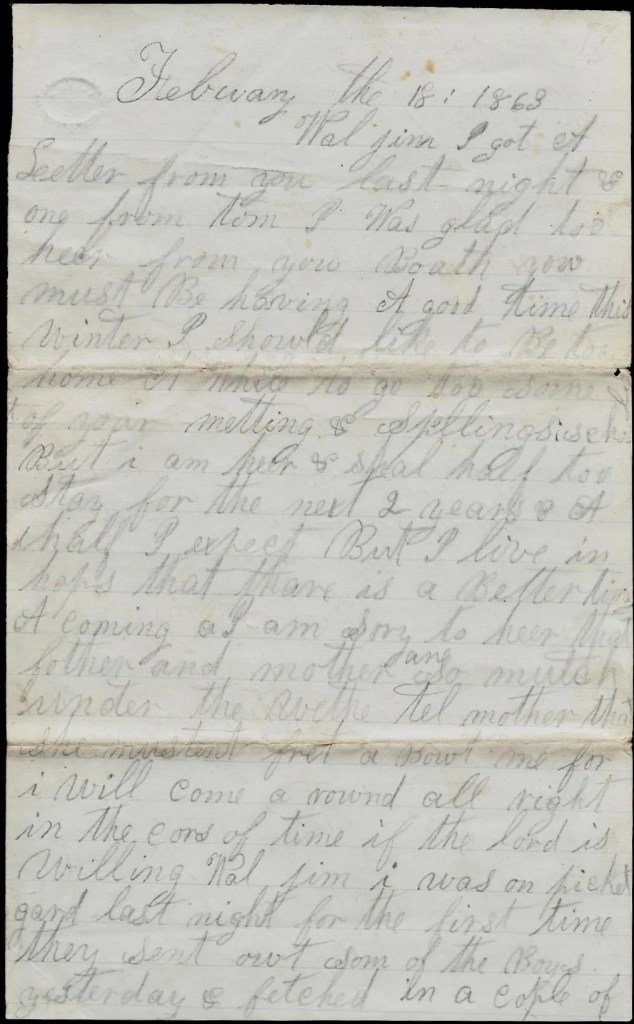
February 18, 1863
Well Jim, I got a letter from you last night & one from Tom. I was glad to hear from you both. You must be having a good time this winter. I should like to be to home awhile to go to some of your meetings and spelling schools, but I am here & shall have to stay for the next two years and a half, I expect. But I live in hopes that there is a better time a coming. I am sorry to hear that Father and Mother are so much under the weather. Tell Mother that she mustn’t fret about me for I will come around all right in the course of time if the Lord is willing.
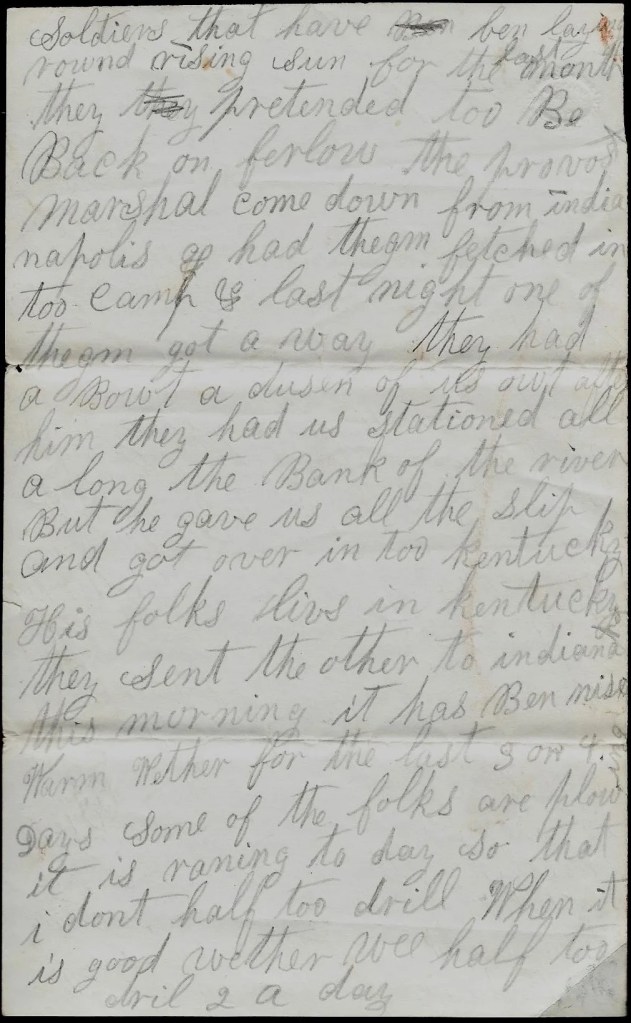
Well Jim, I was on picket guard last night for the first time. They sent out some of the boys yesterday & fetched in a couple of soldiers that have been laying around Rising Sun for the last month. They pretended to be back on furlough. The Provost Marshal came down from Indianapolis & had them fetched in to camp & last night one of them got away. They had about a dozen of us stationed all along the bank of the river but he gave us all the slip and got over into Kentucky. His folks live in Kentucky. They sent the other to Indiana this morning.
It has been nice warm weather for the last 3 or 4 days. Some of the folks are plowing. It is raining today so that I don’t have to drill. When it is good weather, we have to drill twice a day.
Letter 4
Camp Chase, Ohio May the 22, 1865
Mr. John,
It has been over a year since I have took a pen to try to write. I thought I wouldn’t write at all but I wanted to hear from home so bad that I couldn’t wait any longer, so I thought I would write. I don’t know whether they will discharge me here or give me a furlough. I may not have to stay here more than a week and I may have to stay three months. This military is rather uncertain business.
I landed here Saturday the 20th and who should I find but Jim Marsh and Frank Parmer. You can’t think how much good it done me to them and to hear from home. They say you all thought I had done up the spout. But thank the Lord, I am in the land of the living and able to eat my rations yet.
I was paroled and got through to our lines the 28th of April. Come into our lines at Jacksonville, Florida. That was the happiest day of my life. I staid in Andersonville, Georgia, last winter. Was sent to Jacksonville, to Annapolis, Maryland, and there I drew 9 months ration money—the hardest earned money that ever I got in my life. I drew 67 dollars and a half, the first money that I have had in a year. Jim Marsh says that [my brothers] Wat 1 and Jim have both enlisted and gone soldiering. I hope they may never have the misfortune to fall into the rebels hands. If they ever do, I hope they will fare better than I did.
Well John, it has been so long since I wrote that I can’t write. Write as soon as you get this and write all about everybody and everything. Write what regiment they belong to and how Uncle Henry’s folks get along and all about it.
From Willard Smith
to Brother John & all the rest of the folks.
1Waterman J. Smith (1832-1901) was Willard’s older brother. “Wat” served in Co. D, 23rd Indiana Infantry.
I could not find an image of Benjamin but here is Luther H. Worden who served in Congress. E, 8th NY Heavy Artillery (Photo Sleuth)
The following letter was written by Benjamin Joseph Rose (1819-1864) of Lewiston, Niagara County, New York, who enlisted in late July 1862 to serve three years in Co. B, 8th New York Heavy Artillery. Except for the brief excursion described in this letter, the unit garrisoned the forts in Baltimore harbor until May 1864 when they were ordered to participate as infantrymen in Grant’s Overland Campaign. Write to a friend back home, Benjamin stated emphatically, “I am quite certain I shall never fall in battle. My impression is that I will come home as good as I went.” But it was not to be. He was killed on the battlefield at Cold Harbor on 3 June 1864.
Benjamin was married to Louisa Minerva Bull (1819-1880) in April 1845 and when he died, he had three dependent children besides his wife.
[Note: This letter is from the personal collection of Greg Herr and was offered for transcription and publication on Spared & Shared by express consent.]
Transcription
Fort McHenry [Baltimore, Maryland] February 25, 1864
Dear Brother Orton,
I sit down this morning to write a few lines to you in reply to your letter which was received in due time. I am well as usual, thank the good Lord. I would have written before but a few days after I received your letter, our regiment was ordered to Virginia, and being in camp most of the time, and very uncomfortable quarters, and extreme cold weather, and all the confusion—I found it very difficult to write. Our little expedition—what I saw and heard, will be the main subject of this communication.
Engine House (in foreground) at Harper’s Ferry where John Brown was captured.
We were ordered on the first day of the month to get ready for Harpers Ferry, and about nine on the evening were in the cars and on our way. I saw none of the country between Baltimore and the Ferry either way as it was night both times we went over the road, but we made slow time, as it was sunrise when we were at the Ferry—a distance of 84 miles. John Brown’s raid on Harpers Ferry you have not forgotten. The place gives unmistakable signs of hard times. Many fine buildings are in ruins. Any quantity of gun barrels and other implements of war that are ruined are still to be seen. I saw where Brown was captured and where he was confined until he went to Charlestown for trial and execution. I must pass over a considerable that might be interesting to you. Harpers Ferry is strongly fortified now. Two regiments of men I think could effectually prevent any army from coming down the Shenandoah Valley.
We soon learned that our destination was beyond this place. We soon reached Martinsburg. All the railroad property here was destroyed. The buildings covered a large area of ground, all in ruins. The Village is quite pleasant and the country around is good for farming. I noticed a great deal of good wheat on the ground, sheep and cattle in the fields, but strange enough, not a barn worthy of the name is to be seen. The winters are so mild that cattle run out in the fields all winter. But the country changes as we go up the river. It soon became very mountainous. In some places the scenery is most grand. Mountains piled on mountains, with the Potomac winding its serpentine course between them. The railroad is equally crooked. In many places the locomotive can be seen for a mile at a time, in many places small streams make down between the mountains, making a huge chasm a thousand feet deep where it is possible a road runs into the country.
Nothing of importance occurred until we got within about twenty miles of Cumberland when we heard that the rebs had made a dash on the railroad and had burned a bridge that day. From here on we went very cautiously. At length we arrived at Patterson’s Creek. Here was the scene of the raid. A few cavalry had made a dash through an open country and had surprised and captured an entire company of the 54th Pennsylvania Regiment that was stationed there to guard the bridge over the creek at that place. One man was killed. The poor fellows paid dear for their carelessness. They had no pickets whatever. They did not see them until they were within a few rods of them. The rebs set fire to the bridge and all the railroad property at the place. They burned a house that belonged to a man that worked for the Co., and burned the quarters of the soldiers they had taken. When we got there, everything was mostly consumed. 1
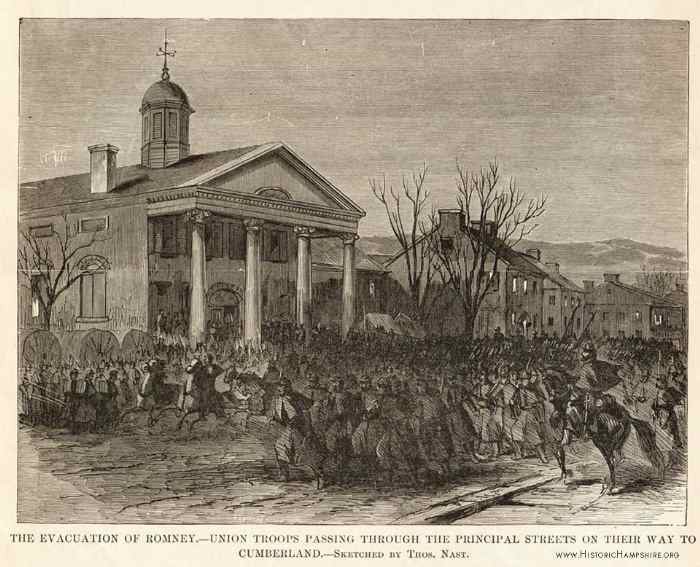
We then fell back to the South Green Spring Run. The next Friday we were ordered to journey a distance of 18 miles. We performed the journey in 7 hours carrying heavy knapsacks and three days rations besides 40 rounds of cartridges, I never was so completely exhausted in my life. Romney’s the county seat of Hampshire County, Western Virginia. It has been held alternately by both armies. Although beautifully located and well laid out and adorned with many fine buildings, it is in ruins a great deal of it. The jail is a mass of ruins. The court house—a fine building—has been used as a stable for cavalry horses. Also a fine church. I shall always regret that I did not pay it a visit and obtain some old relic. There are bushels of documents (so the boys say) on the floor in one room. Some of them date back to the time of George the Second—over two hundred years old.
The Court House in Romney (at left) earlier in the war.
The next day we fell back to Springfield, a village halfway from the “Run” to Romney. We were quartered for the night in a small brick church. Springfield is about like Pekin but much older, has had two churches and a schoolhouse, but the hand of war has been laid heavily upon it. One church was used for a guard house. The prisoners set it on fire. Everything was burned but the orchestra. The walls were not injured. The church in which we were quartered never had been occupied by soldiers. It was a plain, neat little building. Directly in front of the church was an old burying ground. The whole had been surrounded by a fence but it has disappeared. The burying ground is a common now. The tombstones are common mountain stone. The inscriptions, I think, are home made. I saw one that dated back to 1793 but whether the dead were Christian or infidels, dare not appear. There was nothing on the tombstones about their religious faith. All public houses in both places are closed. Some of the boys did not like it very much. They could not get nary drop of the critter. No, not a meal of victuals. It was a hard living up here.
Sunday morning we fell back to Green Spring Run where we remained until the 19th when we returned to Fort McHenry without even seeing a rebel or effecting anything that we know of. We had some very cold weather and suffered some. Still we were all glad that we went. We saw some of the country and that was a satisfaction. I cannot help thinking God was in it all for after we had left the fort a few hours, a government transport anchored out in the bay with an order for one regiment to go to New Orleans but fortunately (I think) we were on our way for Virginia.
Our regiment is now a full Artillery Regiment. I think we are destined to leave here in the spring. We may, however, stay here and garrison the three forts as we are just about strong enough. But the Lord only knows what disposition will be made of us. But I am quite certain I shall never fall in battle. My impression is that I will come home as good as I went. Our time is now half out. 18 months looks like a long time. Still it will soon roll around.
I long for the Society that I left behind. I feel a great want of your Monday evening prayer meetings. They were the most spiritual meeting I ever attended. I shall rejoice when I can meet with the Church of Pekin again. We have three meetings in the week here but there is but little spirituality among the worshippers. A lifeless form is the order here to a great extent. There are some that love God truly. Brother McRernin and Rowan and two or three others have the power as well as the form of Godliness. Sometimes indeed our meetings are quite spiritual but somehow the spirit is stayed in many instances. There is not that freedom here as at home—at least I do not have it. It may be the fault is in me. Perhaps it is. Still I feel that God upholds me and sometimes gives me large measure of grace. I praise God that I am upheld by HIs spirit. I am still trying to serve Go and get to heaven. I expect, I believe, that God will take me there in His own good time. I want you to pray for me. Remember me to all the Church—especially Mother Van Slyke. I often think of her. Remember me to Brother Austin. I should like to hear from him. Remember me to Mr. Daybush and family. I would write to them but I suppose Emery Wilcox writes frequently to John about everything that transpires worth writing about. The weather was very mild in February except a few days. There was not an hour’s rain in the whole month. But this morning, March the 1st, it is snowing but not cold.
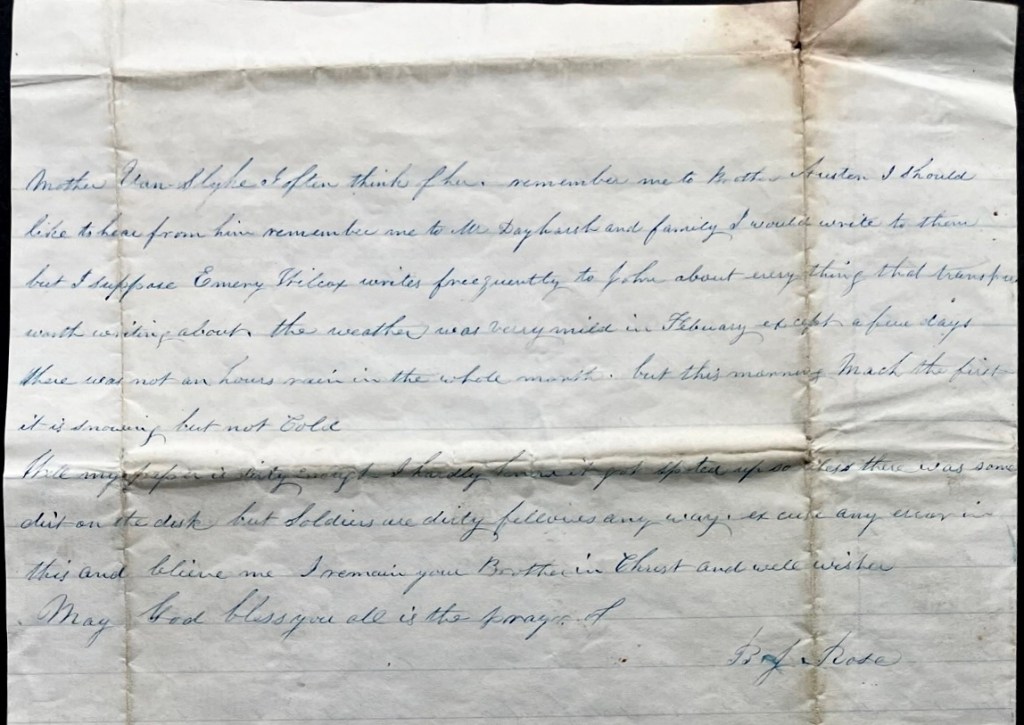
Well, my paper is dirty enough. I hardly [know] how it got spotted up so unless there was some dirt on the desk. But soldiers are dirty fellows anyway. Excuse any errors in this and believe me I remain your Brother in Christ and well wisher. May God bless you all is the prayer of, — B. J. Rose
1 “On February 2, 1864, I was stationed at Cumberland, Md. On that day Co. F, Capt. John W. Hibler, 54th Pennsylvania Volunteers, with 57 men of my brigade, was stationed at Patterson’s Creek bridge, Baltimore and Ohio Railroad, and a detachment of the company at the North Branch bridge as pickets. I had warned Captain Hibler to be on the alert and to keep scouts well out, but it seems that General Rosser (rebel), with from 400 to 500 cavalry, succeeded in penetrating to Patterson’s Creek bridge on the 2d of February. His advance guard were dressed in Federal uniforms, and succeeded in getting up to Captain Hibler’s by representing themselves as part of the Ringgold Cavalry (Union), and thus successively captured all the pickets on the Patterson’s Creek road, and then rapidly dashed into camp while the men were at dinner. A slight skirmish ensued, in which we had 1 man killed, 1 mortally and 3 slightly wounded. The rebels captured 1 captain and 36 men, with all the camp and garrison equipage of the company, 40 Enfield rifles, and 4,000 rounds of rifle cartridges. They then set fire to the Patterson’s Creek bridge, Baltimore and Ohio Railroad, and thence went to the North Branch bridge, Baltimore and Ohio Railroad, and fired it, the guard at the latter bridge making their escape. I may here say that as there was known to be a large Union force some 18 miles south and west of Patterson’s Creek, and part of the Ringgold Cavalry there, taken in connection with the fact that the rebels wore our uniform and claimed to be Union cavalry, may, in a measure, account for the pickets being deceived. Neither the Patterson’s Creek bridge nor the North Branch bridge were protected by block-houses, and the only protection for them was the company of infantry which the rebels captured.” — Col. J. M. Campbell, Commanding 1st Brigade
I could not find an image of George but here is John S. Ford of Co. C, 10th Vermont Infantry (Photo Sleuth)
Despite the 9th New Hampshire Regiment stationery, this letter was written by George Pliney Risdon (1844-1871) of Co. H, 10th VermontInfantry. George was the son of Alvah C. Risdon (1798-1877) and Diana Buxton (1800-1865) of Danby, Rutland, Vermont. George enlisted in the regiment on 1 September 1862 and was transferred to the Veteran Reserve Corps on 1 October 1864. He mustered out of the service on 4 July 1865.
George was married on 6 April 1871 to Adelaide E. Johnson (1847-1916) and died later that same year on 26 November in Manchester, Bennington county, Vermont.
Transcription
Camp near Seneca Creek Montgomery county, Maryland October 27, 1862
Dear Father & Mother,
I now seat myself once more to write in answer to your letter which I received the 23rd and was glad to hear that you are all well. It is evening now and I am in our tent. George A. has just come in with a big Johnny cake that he has just made and is now eating it. It is first rate. George is well and so is myself. I was on guard yesterday and last night and it rained all the time like suds. I had a gay old time, don’t you think I did. The money and those stamps came through all right and I was very glad to see them both. I have not much news to write. What war news there is, you get first.
We shall know where we are a going to stay through the winter and then George A. and I will want you and his folks to send a box. You can put the things in one and the same box. Croff is a going to send for a box but I don’t want any of my things to come with his. I would like that cap to sleep in tonight.
Dan Woods thinks he will get his discharge and come home soon. He is as well as usual. He fell and hurt him[self] at Brattleboro [Vermont] and will get his discharge on that account. This war will probably be finished up so that we can come home next summer some time.
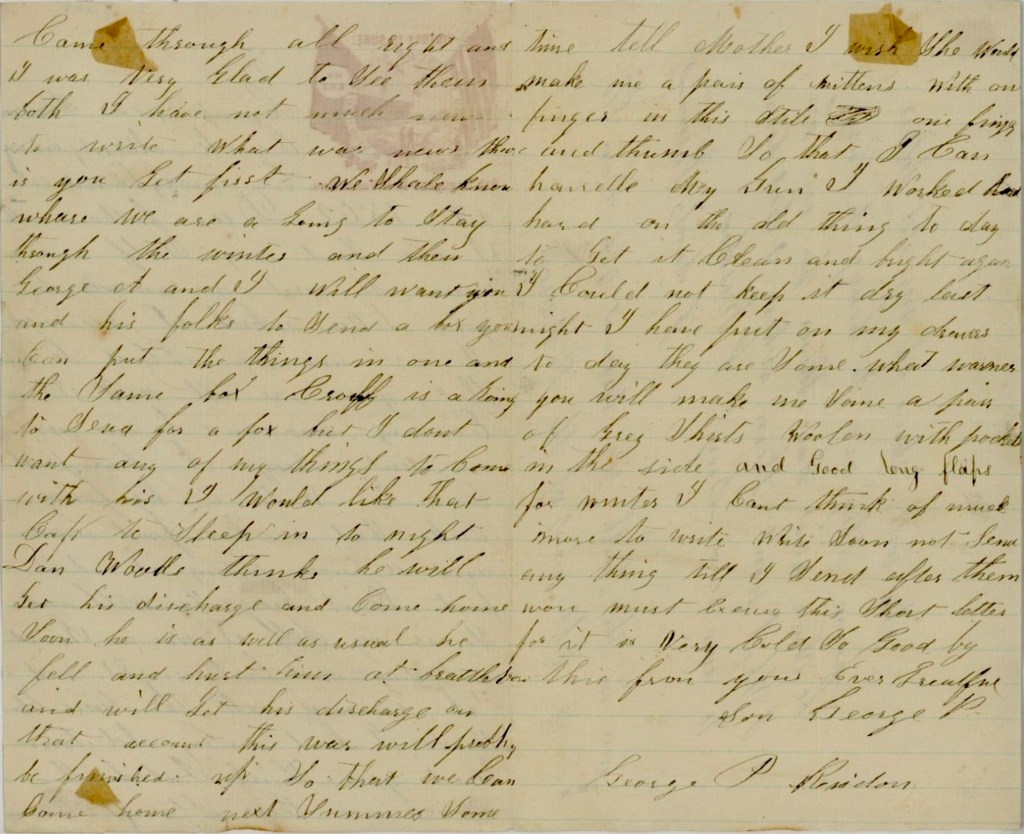
Tell Mother I wish she would make me a pair of mittens with one finger in this style—one finger and thumb so that I can handle my gun. I worked hard on the old thing today to get it clean and bright again. I could not keep it dry last night. I have put on my drawers today. They are somewhat warmer. You will make me some, a pair of grey shirts, woolen with pockets in the side, and good, long flaps for winter.
I can’t think of much more to write. Write soon. Do not send anything till I send after them. No more. You must excise this short letter for it is very cold. So goodbye. This from your ever grateful son, — George P. Risdon
I will [send] some of my old letters home. They are too heavy to carry. Be sure and save them for me for I shall want them when I get home to read—George P. Risdon, now in the 10th Regt. Vermont Vols. Company H on the left wing of the battalion.
The following letter was written in mid-June 1865 by Richard Welling Burt (1823-1911) of Peoria, Illinois. He was the son of Foght Burt (1799-1886) and Eliabeth Welling (1803-1877). He wrote the letter to his first wife, Mahola Evans (1826-1873) while serving as Captain of Co. H, 76th Ohio Infantry.
Capt., Richard W. Burt, 76th Ohio
“The following biographical sketch came from a county history: Richard W. Burt, United States storekeeper, resides 816 Sanford street, was born in Warwick, Orange county, N. Y., in 1823. His parents, Foght and Elizabeth Burt, were natives of same county. In 1834 they removed to Coshocton county, Ohio. When the war with Mexico began, Mr. Burt enlisted in Co. B, 3rd Ohio, June 4, 1846, and remained in the service a year. He married Malona Evans, a native of Ohio, in January, 1848, and settled in Coshocton county. In 1853, he established the Progressive Age, a weekly Republican newspaper; was one of the first to advocate the principles embraced by the party, and was one of its founders. At the end of three years Burt sold the paper and embarked in the coal trade at Newark, Ohio, continuing till he went into the army, in December, 1861, as a member of Co. G, 76th Infantry, which he helped to recruit, and went out as its 2d Lieutenant. He was promoted to 1st Lieutenant of Co. I, after the Battle of Arkansas Post, and when the regiment veteranized in April, 1864, became Captain of Co. H. At the Battle of Resaca, Ga., he received a gunshot wound in the mouth, losing most of his teeth; participated in thirty battles and skirmishes, and traveled with the regiment 10,000 miles. He was the weekly correspondent of the Newark North American during the war. Soon after his discharge, in July, 1865, was breveted Major for gallant conduct. He came to Peoria in 1865; engaged nine years in the grocery and feed business; was appointed to present position over four years ago. Mrs. Burt, by whom he had four children, three living, died in January, 1873. Mr. Burt married Betsey M. Cotton nee Barnum, a native of New York, in 1876. He is a member of A. F. & A. M., G. A. R., and Mexican War Veteran Association, and he and wife are members of M. E. Church.”
Transcription
Louisville, Kentucky June 13, 1865
Dear Wife,
I have just returned from the Paymaster, and before I left I put $1000 in the Express Office directed to Mrs. Capt. Richard W. Burt, Peoria, Illinois, which I wish to deposit with you for a few months for safe keeping. I don’t know but you had as well invest it in 7.30 bonds if you can do so to advantage. Advise with Isaac on the subject. It would be as well perhaps to keep it yourself about how much money you have for various reasons that I need not mention here.
There is some talk now that we are going to St. Louis before long, that Gen. Sherman will have his Headquarters there and take the 15th Corps with him. If we go there, it will be but a short trip for me to come and see you, or you and the children to come and see me, so I hope we may come there.
I got a new tent last night and will soon be a little better fixed than I have been since we came here. I got more pay than I expected as officers get higher pay since the 1st of March. It is about $150 per month now which is more than I could be making at home perhaps. The camp is full of all kinds of peddlers this afternoon, and of course the boys are distributing their money pretty freely buying pies and cakes, pocketbooks, suspenders, photographs, and every kind of invention to get money.
15th Army Corp Badge
On this letter sheet and envelope you will see our 15th Corps Badge. I weat just such a looking one on my hat, made of silver. As soon as I can get a box, I will express those things home that I spoke of in my last letter.
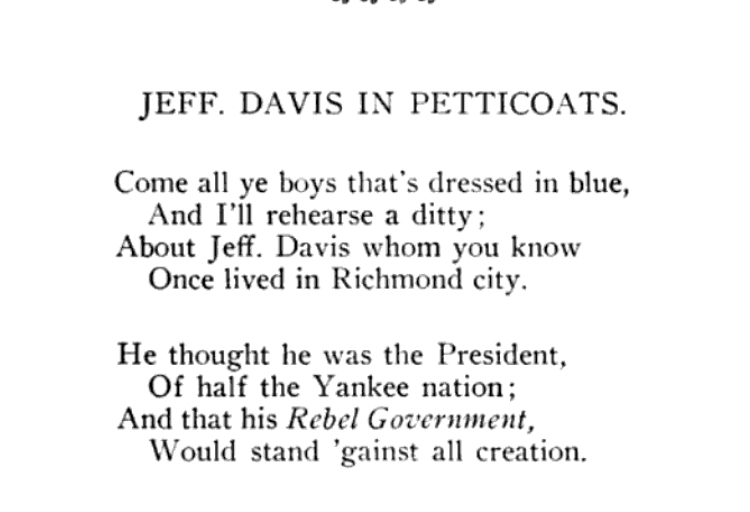
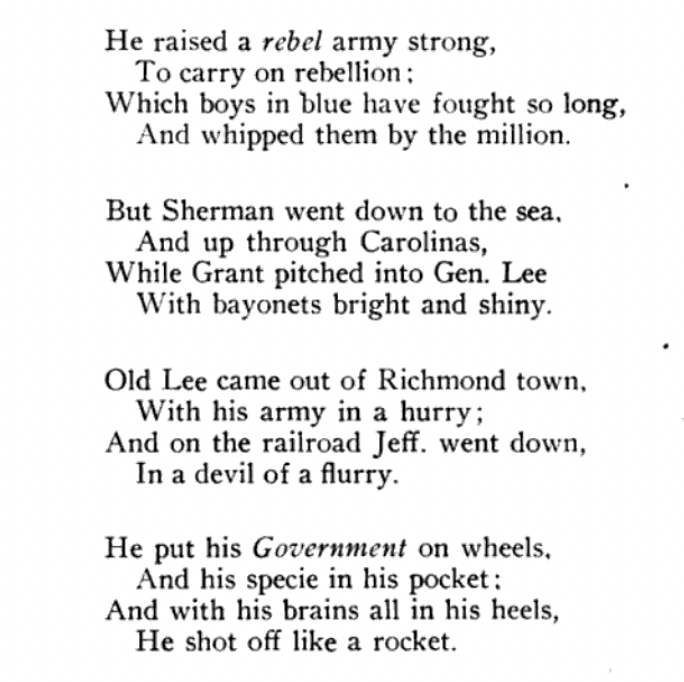
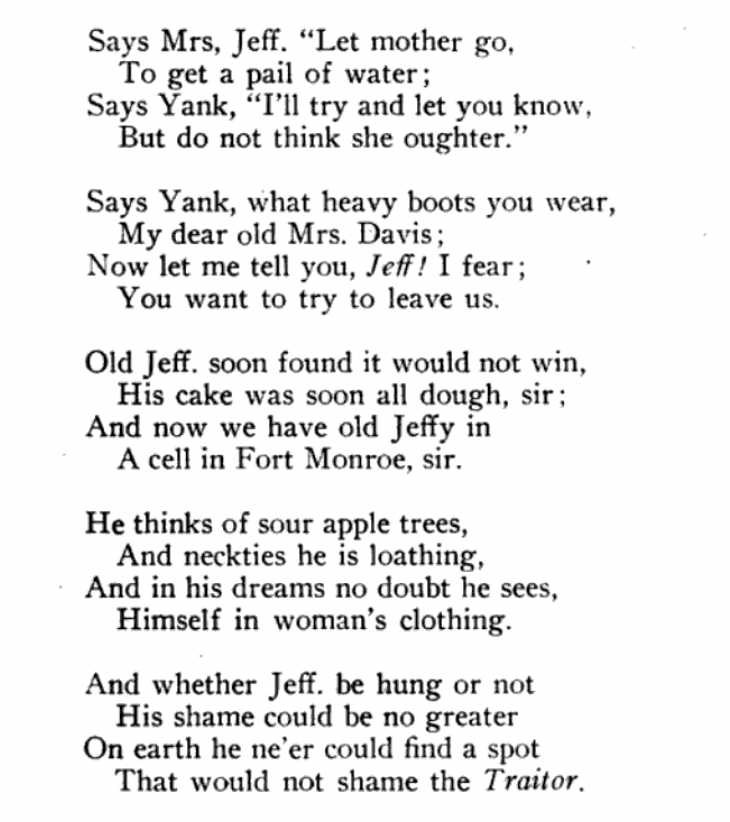
The weather is very warm and sultry and it makes me sweat to write. Excuse me for not writing a full sheet this time. Enclosed I send you a picture of Jeff in petticoats. I have composed a new song on the subject which I think of getting printed. 1
Your affectionate husband, — R. W. Burt
1 Capt. Richard Welling Burt published his songs in 1906 under the title of “War Songs, Poems, and Odes” which he dedicated to his comrades of the Mexican and Civil War.The song he composed just prior to the date of this letter appears in the book on page 19 which he called, “Jeff Davis in Petticoats.” (see Below)
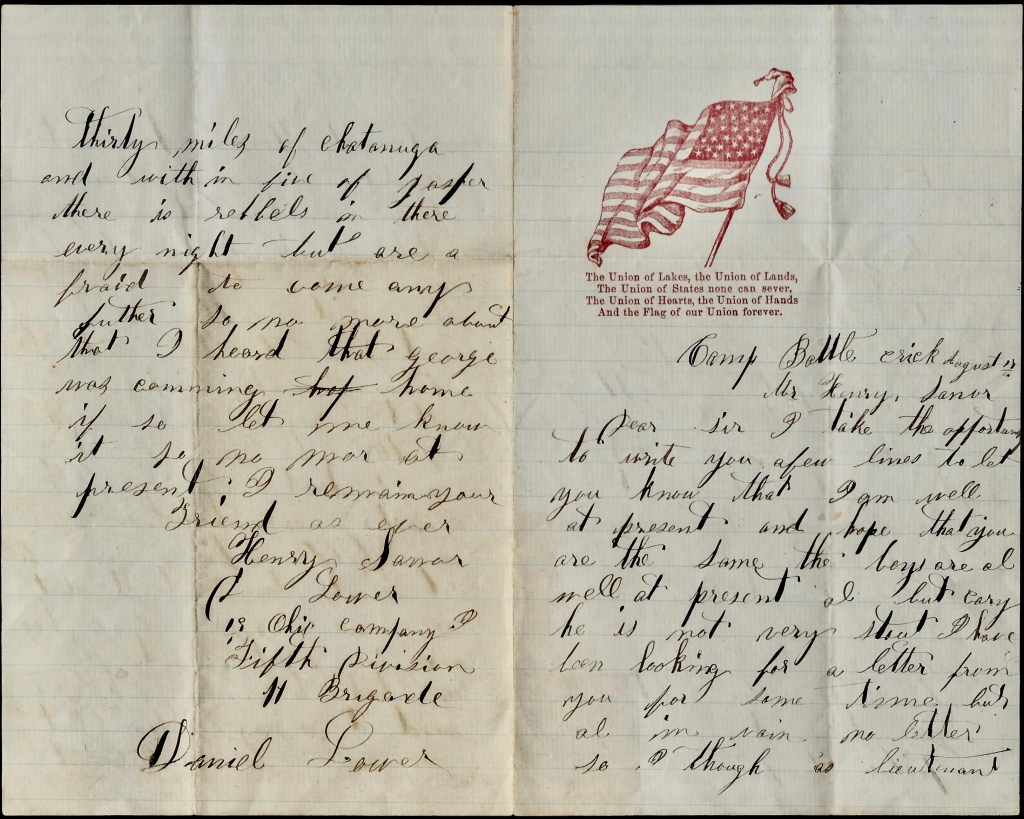
The following letter was written by Daniel Lower of Co. I, 19th Ohio Infantry. He was mustered into the regiment for three years service and mustered out in August 1864 at Marietta, Georgia. The regiment was organized at Alliance, Ohio, and once mustered, attached to the 11th Brigade, Army of the Ohio, to December 1861. In August 1862 when this letter was penned, the regiment was attached to the 11th Brigade, 5th Division of the Army of Ohio. This letter was datelined from the regiment’s encampment on Battle Creek in Northern Alabama following their long march in Buell’s Campaign in Northern Alabama and middle Tennessee.
Daniel C. Lower (1842-1905) was the orphaned son of George W. Lower (1806-1864) and Mary Beaman Beaumont (1808-1856) of Columbiana county, Ohio. The recipient of this letter was Henry Sanor. He was probably the Henry Sanor (1827-1893) that married Daniel’s older sister Betsy Lower (1830-1913). Henry was a farmer in West Township, Columbiana county, Ohio. It should be noted that Daniel’s surname appears as “Laueere” in the regimental record for some reason.
Transcription
Camp Battle Creek [Alabama] August 17, [1862]
Mr. Henry Sanor, dear sir,
I take the opportunity to write you a few lines to let you know that I am well at present and hope that you are the same. The Boys are all well at present—all but Cary. He is not very stout. I have been looking for a letter from you for some time but all in vain. No letter. So I thought as Lieutenant Firestone is coming home, I thought I would write and send a few lines with him.
We are encamped in sight of the rebels. The Tennessee [river] is between us so that we dare not shoot at them. Now I want to write and send your letter with Firestone and give me all the news in the neighborhood. I wrote in my last letter that I wanted you to send me a few postage stamps as we cannot get them here. It would be a great accommodation if you would send me a few. Tell J. H. to write to me as I think I wrote the last letter.
I have not much to write this time. [Isaac] Frank Rish us as stout as ever and much better. He weighs about one hundred and sixty. He is a bester [?]. We had to live on half rations for a while. It went damned hard but we came across a hog once in a while and then we had to run or kill it and it was very seldom that we ran. We are [with]in about thirty miles of Chattanooga and within five of Jasper. There is rebels in there every night but are afraid to come any further. So no more about that.
I heard that George was coming home. If so, let me know it. So no more at present. I remain your friend as ever, Henry Sanor.
[From] Daniel Lower, 19th Ohio, Company D. 5th Division, 11th Brigade
I could find no image of David but here is an Ambrotype thought to be John Cramer of Co, A, 20th OVI. (Ohio Memory)
The following letters were written by David Harrison Thomas (1838-1863), the son of Welsh emigrants Owen Thomas (1800-1868) and Mary Thomas (1813-1893) of Radnor, Delaware county, Ohio. David enlisted on 2 October 1861 to serve three years in Co. D, 20th Ohio Volunteer Infantry. The regiment was reorganized at Columbus, Ohio, from August 19 through September 21, 1861, and mustered in for three years service on October 21, 1861, under the command of Colonel Charles Whittlesey.
According to a “Graves Registration Card,” David died of wounds received 25 May 1863 at Vicksburg—a gunshot wound to the spine. He was mustered out of the regiment on the day he died, 10 June 1863, and his body lies buried at the National Cemetery in Vicksburg.
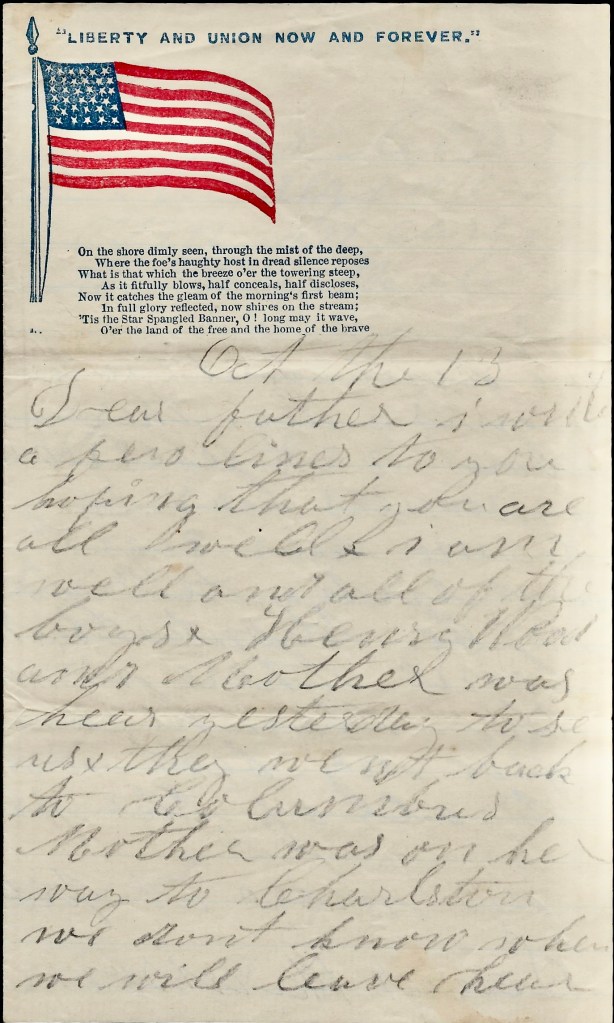
Letter 1
October 13, [1861]
Dear Father,
I will pen a few lines to you hoping that you are all well. I am well and all of the boys. Henry Wood and Mother was here yesterday to see us. They went back to Columbus. Mother was on her way to Charleston.
We don’t know when we will leave here. We drill about 4 to 6 hours a day. There is about 225 secessionist prisoners here. They came here ragged and dirty.
Tell Joseph to be contented at home. There is more there than he can do. Give my best word to all of the friends.
No more at present. — David Harrison Thomas
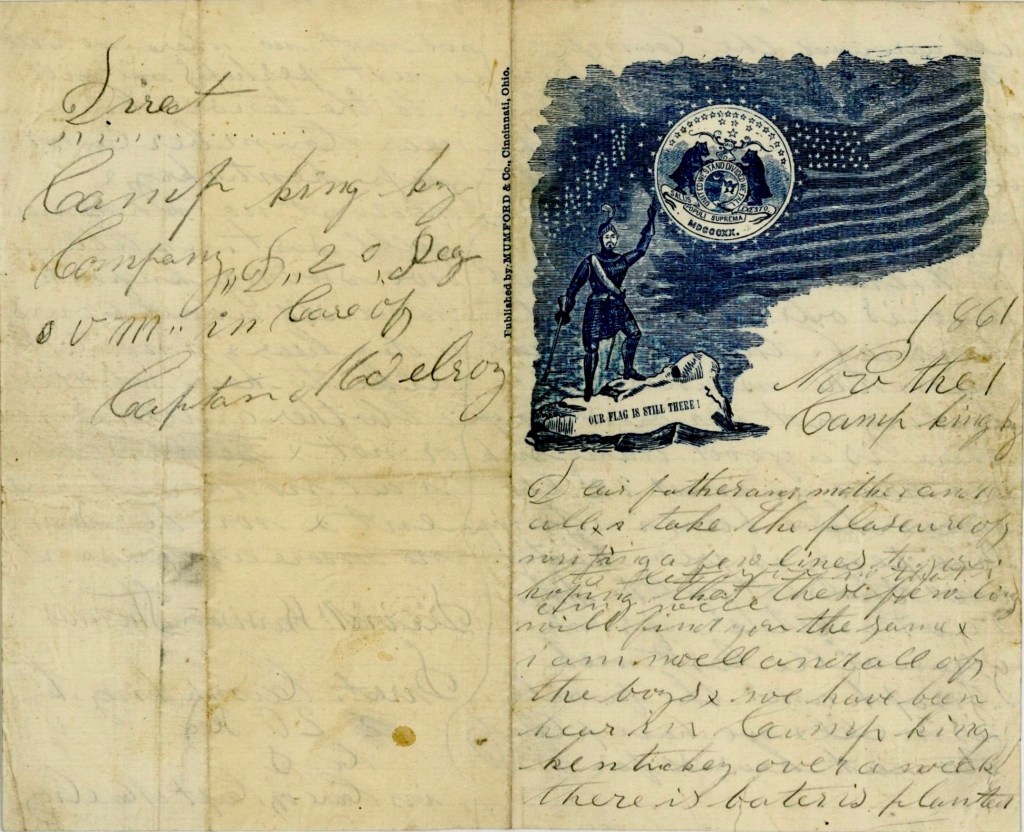
Direct letter to 20th Regiment OVM in care of Capt. [Charles H.] McElroy [Co. D]
Letter 2
Camp King, Kentucky November the 1st 1862
Dear Father and Mother and All,
I take the pleasure of writing a few lines to you to let you know that I am well and hoping that these few lines will find you the same. I am well and all of the boys. We have been here in Camp King, Kentucky, over a week. There is batteries planted all around the camp. There is about 800 hundred here. It is very hilly around here. Our company was on picket guard last night. We did not come across any secessionists. [Charles] Whittlesey is our Colonel. [Manning Ferguson] Force is our Lieutenant-Colonel. They are brave men.
Manning F. Force commanded the 20th OVI at Vicksburg in 1863.
The measles is breaking out in our camp. There is a good many sick. I have gained 12 pounds since I have been in camp. Price Peny is very hearty and the rest of the boys. I got a letter from Granville last week. Joseph and the family is well. We have plenty to eat here so far. We do not know where we will go next. Perhaps we will go to the Tennessee line near Cumberland Gap, Kentucky. We don’t know when we will start until we swing knapsack.
We drill about 6 hours a day here. I would like to hear whether Mother arrived safe or not. No more at present. Write soon. — David Harrison Thomas
Direct to Camp King, Ky., 20th [Ohio] Regiment, Co. D, in care of Capt. [Charles H.] McElroy
The following letter was written by Shatteen Claude Mitchell, Jr. (1839-1864), the son of Shatteen C. Mitchell (1802-1866) and Mahala Jane Burdett (1805-1852) who had an estate in Griffin, Spalding county, Georgia, called Double Cabins Plantation. Shatten wrote the letter to his wife, Chloe Bartlett (1844-1905) with whom he married in May 1861. Chloe was the daughter of Dr. Myron Bartlett who founded the Macon Telegraph newspaper in the 1820s.
Shatteen enlisted in Co. I (the “Stark Volunteers”), 13th Georgia Infantry and was commissioned Jr. 2nd Lieutenant on 8 July 1861. We learn from the letter that he was promoted to 1st Lieutenant of his company on February 1863, and was elevated to captain a year later. Sadly, he was killed in action at the Battle of Third Winchester in September 1864. His cenotaph in Griffin, Georgia, claims that “his remains rest in the consecrated mound of the Unknown” somewhere near Winchester, Virginia.
I note that Shatteen signed his letter, “Chlovis Claude” which I assume was intended to shelter the couple’s identity should the love letter end up in the wrong hands.
[Note: The following letter is from the private collection of Greg Herr and was offered for transcription and publication on Spared & Shared by express consent.]
Transcription
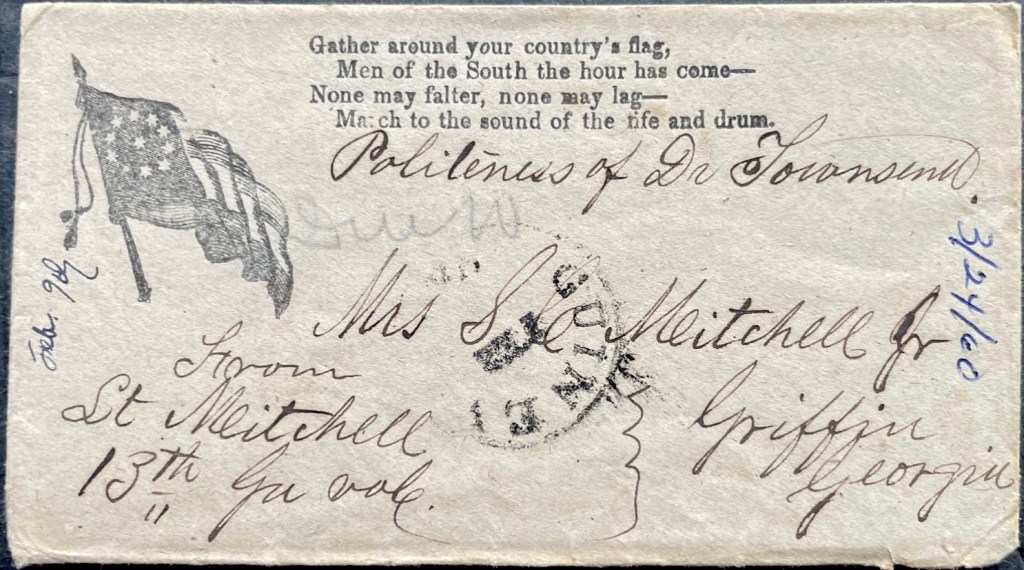
Confederate Patriotic Envelope with poem, “Gather around your country’s flag, Men of the South the hour has come—; None may falter, none may lag—, March to the sound of the fife and drum.”
Camp near Port Royal Monday, February 9th 1863
My own darling,
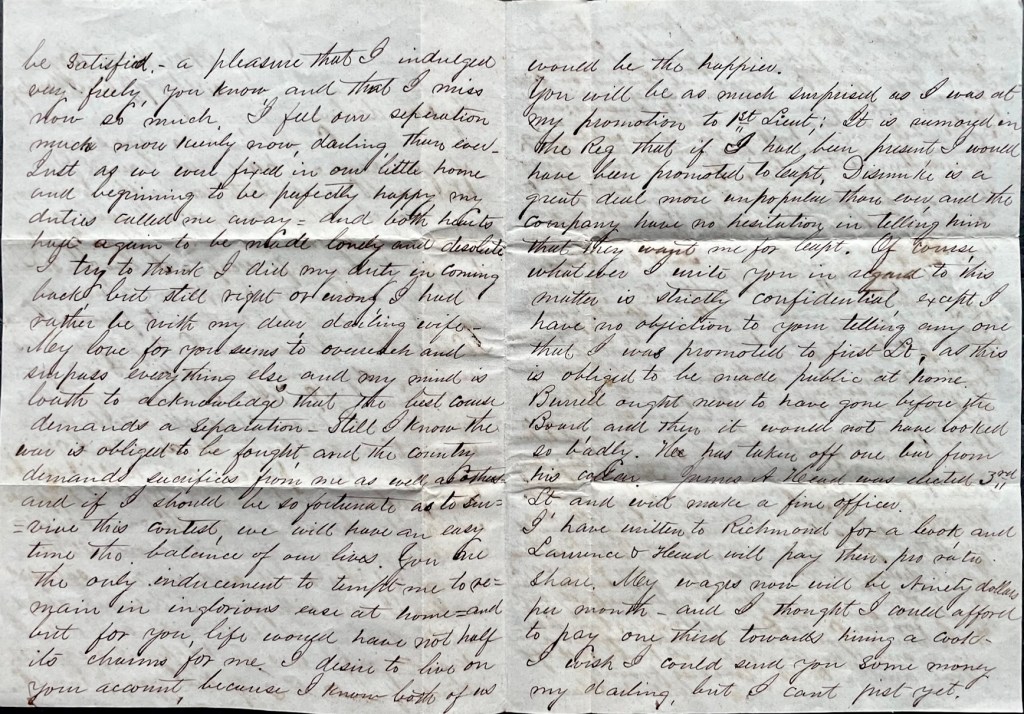
I have no news since mine of yesterday. I have just learned Dr. Townsend would start for Griffin tomorrow and concluded I had as well write you a short letter by him. I never let an opportunity to write to my wife escape. I love you so much that my inclination prompts me to write every day—and if I had nothing to prevent, I would. It is such a pleasure for me to get your letters and I judge you by yourself, It is a good rule—ain’t it? When I measure your love by mine, I know it is all absorbing in its nature—endless in its duration—giving your own heart pleasure and happiness as well as infusing into mine a degree of happiness which it seems to me no other man ever felt. I love you my dear wife above all the things of this world, and am never satisfied unless I am with you. I dreamed about little darling all last night, and when I kissed you, I was so happy.
I frequently think if I could only kiss you, I would be satisfied—a pleasure that I indulged very freely, you know, and that I miss so much. I feel our separation much more keenly now, darling, than ever. Just as we were fixed in our little home and beginning to be perfectly happy, my duties called me away, and both hearts had again to be made only and desolate. I try to think I did my duty in coming back, but still right or wrong, I had rather be with my dear darling wife.
My love for you seems to overreach and surpass everything else and my mind is loath to acknowledge that the best course demands a separation. Still I know the war is obliged to be fought, and the country demands sacrifices from me as well as others, and if I should be so fortunate as to survive this contest, we will have an easy time the balance of our lives. You are the only inducement to tempt me to remain in inglorious ease at home, and but for you, life would have not half its charms for me. I desire to live on your account, because I know both of us would be the happier.
Capt. Frederick D. Dismuke of Co, I, 13th Georgia (American Civil War Museum)
You will be as much surprised as I was at my promotion to 1st Lieutenant. It is rumored in the regiment that if I had been present, I would have been promoted to Captain. [Frederick D.] Dismuke is a great deal more unpopular than ever and the company have no hesitation in telling him that they want me for Captain. Of course whatever I write you in regard to this matter is strictly confidential, except I have no objection to your telling anyone that I was promoted to 1st Lieutenant as this is obliged to be made public at home. Burrell ought never to have gone before the Board and then it would not have looked so badly. He has taken off one bar from his collar. James A. Head was elected 3rd Lieutenant and will make a fine officer.
I have written to Richmond for a cook and Laurence & Heind will pay their pro ratio share. My wages now will be ninety dollars per month and I thought I could afford to pay one third towards hiring a cook. I wish I could send you some money, my darling, but I can’t just yet.
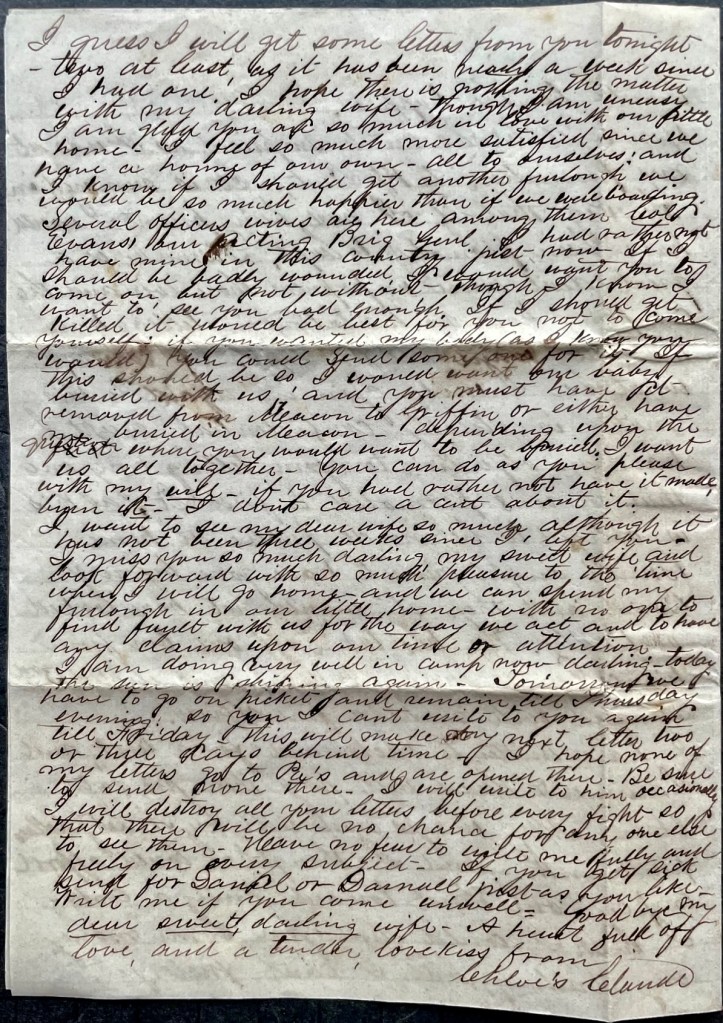
I guess I will get some letters from you tonight—two at least, as it has been nearly a week since I had one. I hope there is nothing the matter with my darling wife though I am uneasy. I am glad you are so much in love with our little home. I feel so much more satisfied since we have a home of our own—all to ourselves. And I know if I should get another furlough, we would be so much happier than if we were boarding. Several officers wives are here. Among them Col. Evans, our Acting Brig. General. I had rather not have mine in this country just now. If I should be badly wounded, I would want you to come on but not without, though I know I want to see you bad enough. If I shoiuld get killed, it would be best for you not to come yourself if you wanted my body (as I know you would). You could send someone for it. If this should be so, I would want our baby buried with us and you must have it removed from Macon to Griffin, or either have me buried in Macon—depending upon the question where you want to be buried. I want us all together. You can do as you please with my will. If you had rather not have it made, burn it. I don’t care a cent about it.
I want to see my dear wife so much although it has not been three weeks since I left you. I miss you so much darling, my sweet wife, and look forward with so much pleasure to the time when I will go home—and we can spend my furlough in our little home with no one to find fault with us for the way we act and to have any claims upon our time or attention.
I am doing very well in camp now darling. Today the sun is shining again. Tomorrow we have to go on picket and remain till Thursday evening so you [see], I can’t write to you again till Friday. This will make my next letter two or three days behind time. I hope none of my letters go to Pa’s and are opened there. Be sure to send none there. I will write to him occasionally. I will destroy all your letters before every fight so that there will be no chance of anyone else to see them. Have no fear to write me fully and freely on every subject. If you get sick, send for Daniel or Darnell just as you like. Write me if you are unwell. Goodbye my dear sweet darling wife. A heart full of love and a tender love kiss from— Chlovis Caude
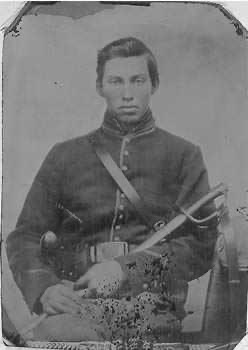
The following letter was written by Edwin Wight (1844-1863), the son of Benjamin Wight (1813-1891) and Jerusha Lyons (1815-1899) of Centerville, Allegany county, New York.
Edwin’s older brother, Daniel Wight, 5th New York Cavalry
When 18 years old, Edwin enlisted in Co. F, 19th New York Cavalry. He was mustered into the service on 3 September 1862 for three years. However, he was killed at Manassas Junction on 17 October 1863.
According to muster rolls, Edwin stood 5′ 9.5″ tall, had brown eyes, and black hair. He was paid a bounty of $50 for his enlistment by the town of Centerville. His remains were initially buried at Manassas Junction but were later removed to Arlington Cemetery, Site 8499.
Edwin had an older brother named Daniel Wight (1841-1864) who also gave his life during the war. He served in Co. F, 5th New York Cavalry. He was taken a prisoner-of-war at Reams Station on 29 June 1864 and died while in captivity at Columbia, South Carolina.
Transcription
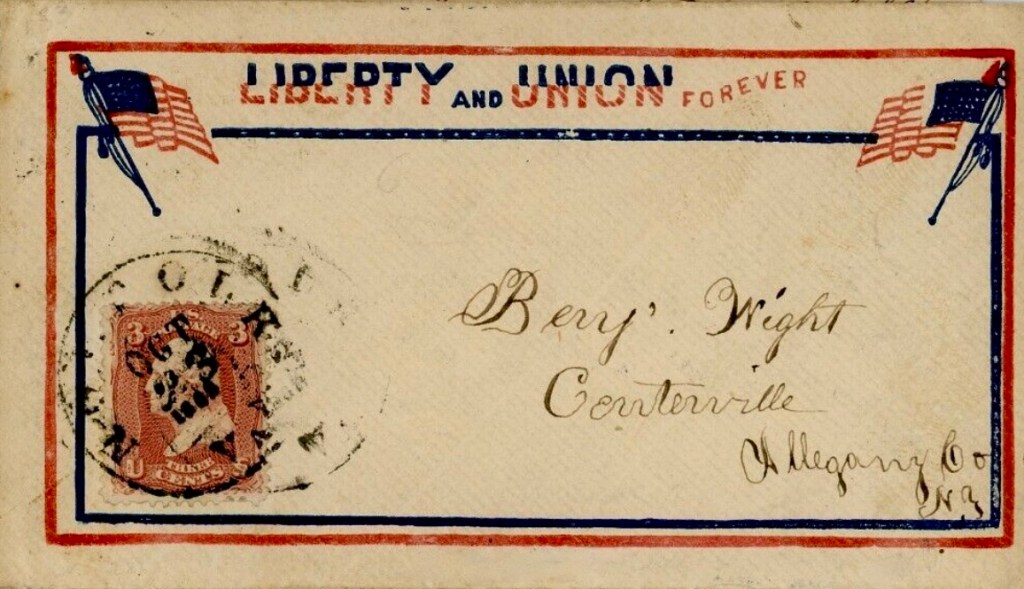
Addressed to Benj. Wight, Centerville, Allegany county, New York
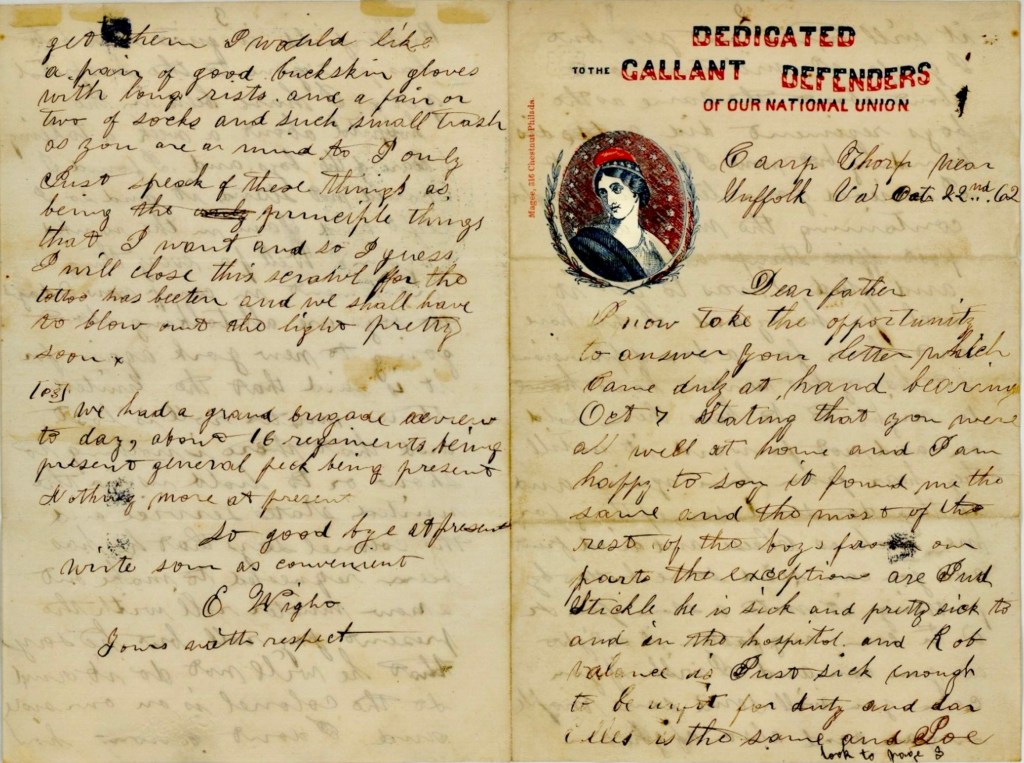
Camp Thorp near Suffolk, Va. October 22nd 1862
Dear father,
I now take the opportunity to answer your letter which came duly to hand bearing October 7th stating that you were all well at home and I am happy to say iyt found me the same and the most of the rest of the boys from our parts. The exceptions are Jud[son] Stickle. He is sick and pretty sick too, and in the hospital. And Rob[ert] Valance is just sick enough to be unfit for duty and Dar[win] Ellis is the same and Joe Butterfield is quite sick but has not gone to the hospital yet. I have been in the hospital about a week a taking care of the boys and I found I could not stand it and so I left and I am in the ranks again.
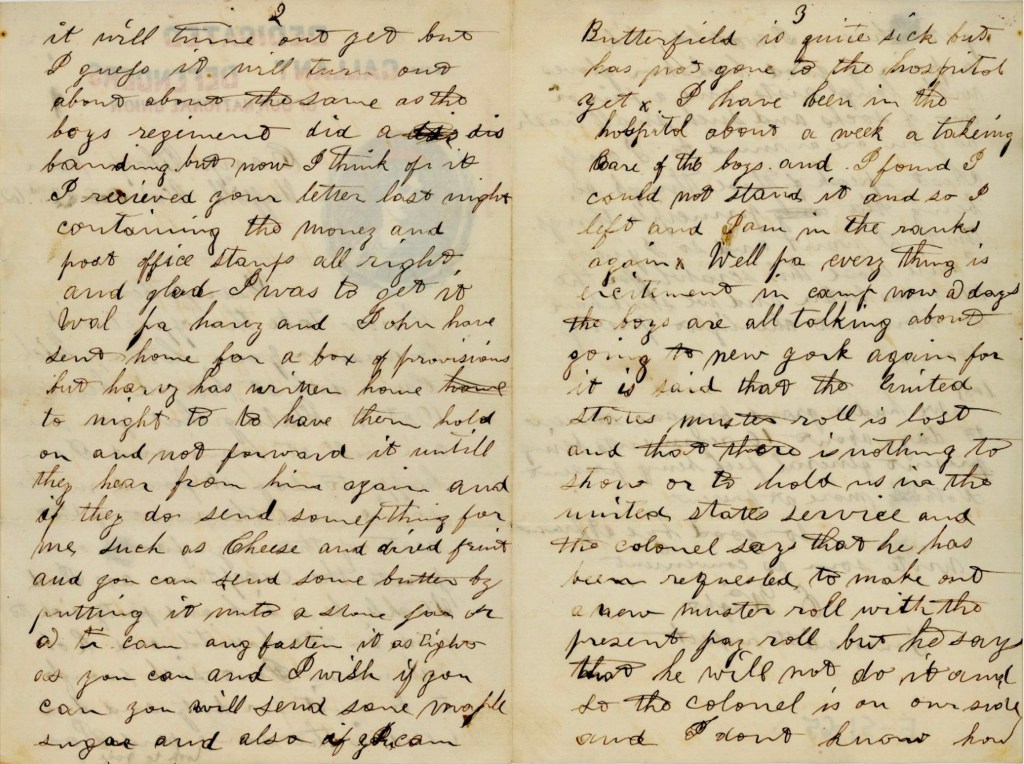
Well, pa, everything is excitement in camp now-a-days. The boys are all talking about going to New York again for it is said that the United States muster roll is lost and that there is nothing to show or hold us in the United States service and the Colonel says that he has been requested to make out a new muster roll with the present pay roll but he says that he will not do it and so the Colonel is on our side and I don’t know how it will turn out yet. But I guess it will turn out about the same as the boys regiment did a disbanding but now I think of it.
I received your letter last night containing the money and post office stamps all right and glad I was to get it. Well, pa, Harvey and John have sent home for a box of provisions but Harvey has written home tonight to have them hold on and not forward it until they hear from him again and if they do, send something for me such as cheese and dried fruit. And you can send some butter by putting it into a stone jar or a tin can and fasten it as tight as you can. And I wish you would send some maple sugar and also, if you can get them, I would like a pair of good buckskin gloves with long wrists and a pair or two of socks and such small trash as you are a mind to. I only just speak of these things as being the principal things that I want and so I guess I will close this scrawl for the tattoo has beaten and we shall have to blow out the light pretty soon.
P. S. We had a grand brigade review today. About 16 regiments being present. General Peck being present. Nothing more at present.
So goodbye at present. Write soon as convenient. — E. Wight
I have not yet learned the identity of this soldier whom I believe was probably from Ashtabula county, Ohio, and served in a three-month’s organization early in the Civil War, possibly the 19th OVI. More research is needed.
Transcription
Camp Goddard 1 Zanesville, Ohio June 12th 1861
Dear Etta,
I received your dear letter last night and at the same time Sam got one from Ellen. I have been waiting all of this week for a letter from our folks but have till this time heard nothing from them. Darling, you must excuse poor writing this time. I have been sick 2 to 3 days last week and although well now, I don’t feel quite so strong as I did before. I won’t be so nervous in a day or two. I hope you are well, darling. I beg of you to take better care of your (dear) self. I know it is carelessness with you. If you are real careful, dearest, and not look so much on the dark side of war, you will surely get well and I hope keep so. Since I heard you was sick, I couldn’t rest well nights not be contented day times. I always thought of you and I knew that your carelessness wouldn’t help you any in your sickness.
Darling, you must not get mad at what I say to you for you know I mean it all well and what I say to you is for your own good and also for mine so if you love me truly, my darling, and want me to feel contented here and keep in good health, then for my sake, take the best care of yourself for my sake and for your good.
We are still in this confounded camp and waiting for marching orders. I do wish they would call us in to action. We all want to go to Virginia but don’t know when we will go. The Government of this fine state is rather misusing us. We have not received our pay yet although our first month has long gone by. Our colonel started to Columbus last night to see about it and if possible get us away from here. The talk today is that all three-months men will be paid off and then sent home—that is, those who won’t go in for three years. I won’t go in for three years under any such mean government as this state has now got. I had thought of going in for three years under the U. S. Navy. It would be a good deal more healthy on the water than on land and although I have not said I would go, I can’t enlist till I get a consent from our folks and tat will be hard work for me to get it, and then further, I won’t go until I am insured that our aid is needed more than it now is.
I want you to advise me, dear one. I won’t go if you, Darling, says no. I don’t know how I can stay away from you, my dearest love, till my first campaign is up. But the next would be so much longer. Well, I will come to see you when my three months are up and then by that time I will know better and then both of us can talk it over. I won’t do anything about enlisting for three years till I see you so you can’t say I done as I wanted to without asking you.
I make awful poor work of this letter but I know you will excuse it considering where it comes from. I will do better next time.
Capt. Harvey J. Covell
Now about news. I am surely surprised to hear that H[arvey] J. Covell 2 has been telling such lies about us. He ought to be ashamed of himself. I had a letter from him day before yesterday and he don’t like it as well there as he did when in our company. They had to build their barracks themselves and in the rain as well. They have a rather poor camp ground.
Dear Etta, kiss little Lilly for me and Fanny and Orson. [unsigned].
1 Camp Goddard in Zanesville. The camp’s first building, a barracks, was finished on May 15, 1861. Just two days later, Camp Goddard already contained nearly two thousand volunteer soldiers. The camp remained in use only during 1861.
2 Harvey J. Covell (1835-1883) was the son of Silas Covell (1789-1853) and Eunice Latimer (1796-1865) of Rock Creek, Morgan township, Ashtabula county, Ohio. On June 1, 1861, Harvey joined the 23rd Ohio Infantry as a sergeant in Co. B. He later was commissioned a captain in Co. B, 6th USCT. See 1861: Harvey J. Covell to Louisa Olive Woolsey.























 Spared & Shared 23