The following letter was written by Conrad Dumond, Jr., the son of Johannes Conrad Dumond (1799-1877) and Jane Van Benschoten (1812-1839) of Kingston, Ulster county, New York. After his mother died, his father remarried to Silvia Warren. By the time of the 1860 US Census, Conrad was working as a farm laborer in Hurley, New York.
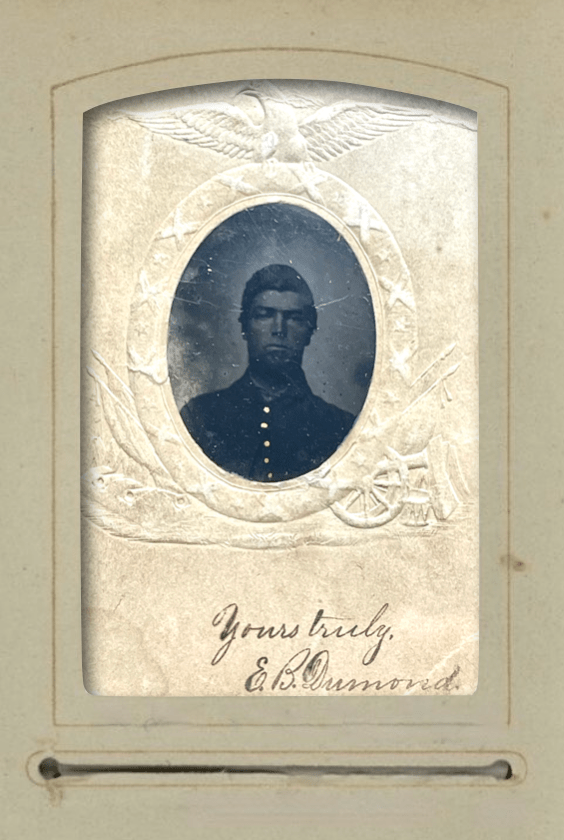
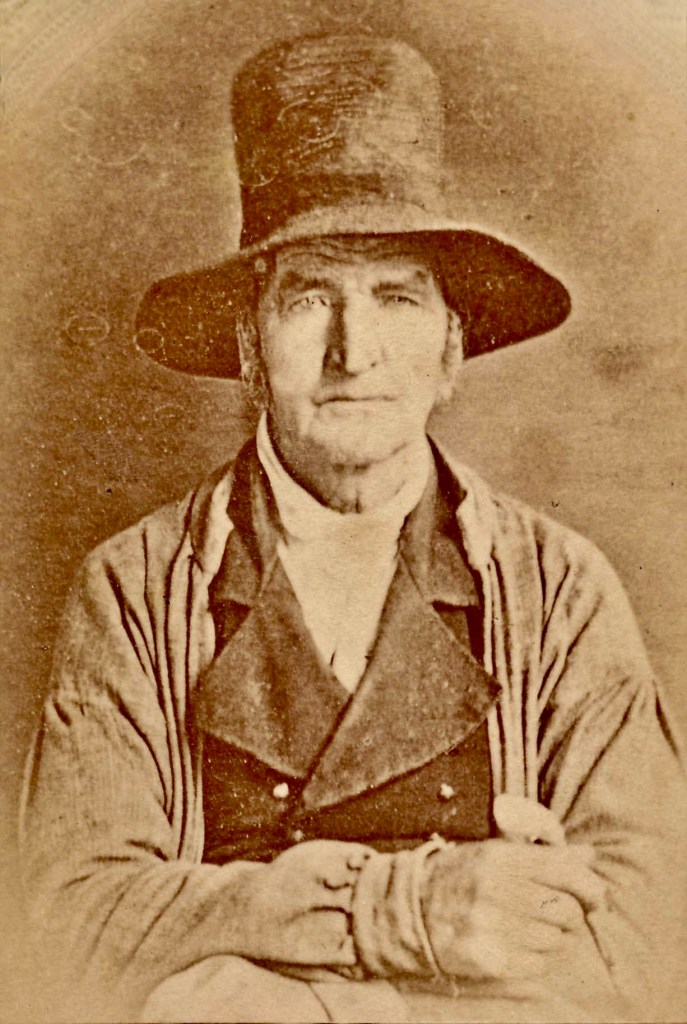
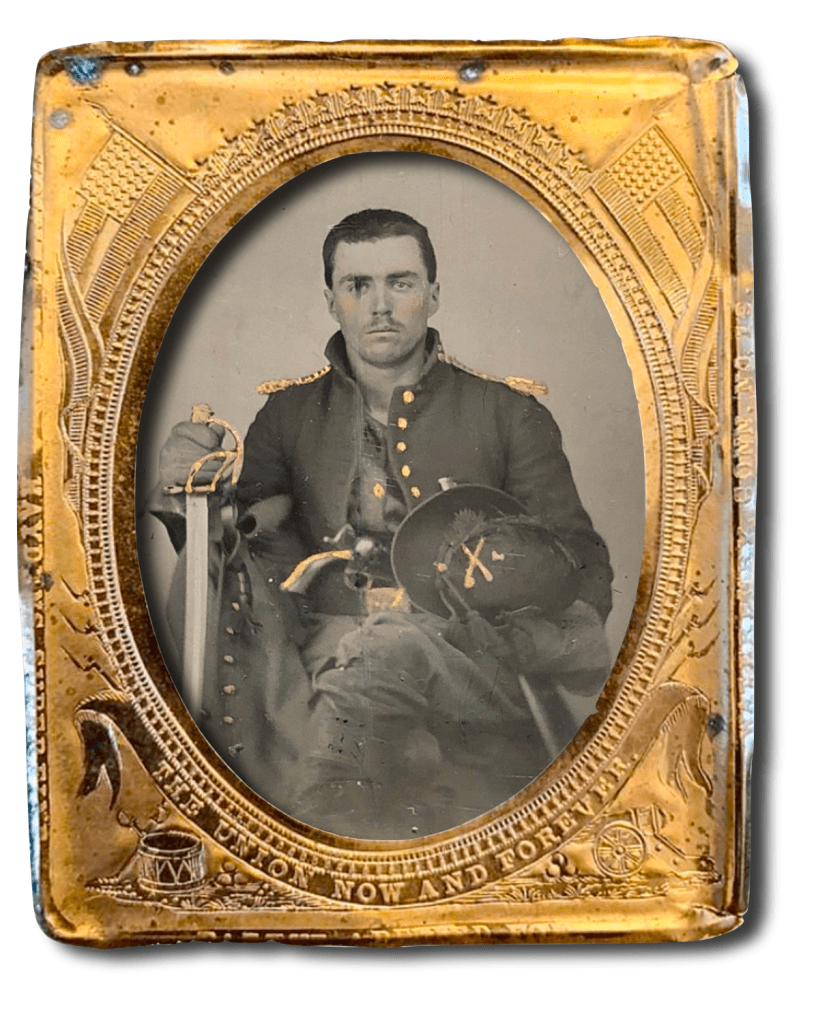
I could not find an image of Conrad but here is one of Edward B. Dumond, his cousin, who served in the same company (Kyle A. Williams Collection)
In August 1862, when he was 24 years old, he enlisted as a private in Co. A, 120th New York Infantry. When Conrad wrote this letter from Harewood Hospital in early May 1863, we learn he had suffered some type of injury that momentarily crippled him. His muster record confirms his absence from the regiment in April and May 1863 but yields no additional information. The following year, on 10 October, he was taken prisoner in action at James City, Virginia, and sent to Andersonville where he literally starved to death on 14 August 1864.
Conrad wrote the letter to his Uncle Phillip Dumond (1817-1892), a farmer of Hurley, Ulster county, New York. Phillip’s son, Edward Brown Dumond (b. 1843), also served with Conrad in the same company. Edward was wounded during the siege of Petersburg on 31 August 1864 and lost his left arm.
[Note: This letter is from the personal collection of Kyle A. Williams and was offered for transcription and publication on Spared & Shared by express consent.]
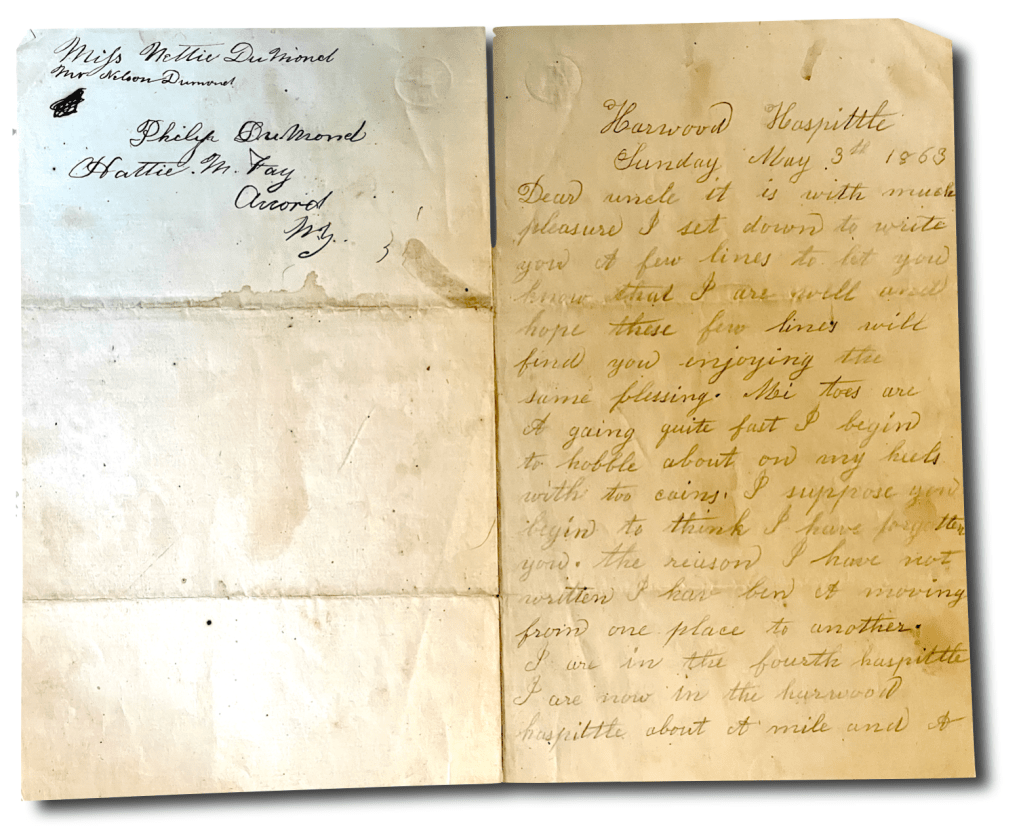
Transcription
Harewood Hospital Sunday, May 3rd 1863
Dear Uncle,
It is with much pleasure I sit down to write you a few lines to let you know that I am well and hope these few lines will find you enjoying the same blessing. My toes are a gaining quite fast. I begin to hobble about on my heels with the canes.
I suppose you begin to think I have forgotten you. The reason I have not written, I have been a moving from one place to another. I are in the fourth hospital. I are now in the Harewood Hospital about a mile and a half from the village of Washington. It is a very nice place. I have good care taken of me and a plenty to eat. I have not been paid off yet. I have six months pay due now. I have not heard from Eddy in quite a while.
The news is the Army of the Potomac are a fighting. I would like to see you all very much. I wish I was there while I was lame. Tell grandfather I would like to see him very much and to have a smoke with him. I could tell him something about war if I was there but I live in hopes this time will soon come when I can come home and see peace again and to hear the sound of the church bell again and to be seated around the communing table again.
I must close by asking an interest in your prayers. Give my love to all my enquiring friends and keep a god share for yourself. Write as soon as you get this. So goodbye for this time. Hoping to hear from you soon.
From Conrad Dumond, Jr. to Philip Dumond
Direct your letters to Harewood Hospital, Barracks Number 2, Washington D. C.
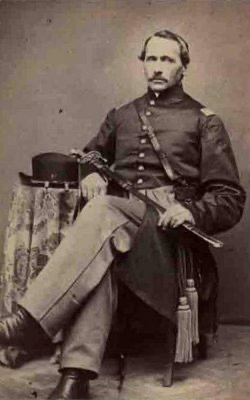
The following letter was written by Isaac Cochran Richardson (1821-1911), the son of David Richardson (1781-1864) and Susan Cochran (1785-1863) of Londonderry, Windham county, Vermont. Isaac was married in 1846 to Esther Langdell (1822-1882) and the couple lived in Nashua, Hillsborough county, New Hampshire when Isaac enlisted as a corporal in Co. B, 10th New Hampshire Infantry. In early March 1864, Isaac was promoted to sergeant in Co. K, and in February 1865 he was commissioned a 1st Lieutenant.
When Isaac wrote the following letter from Fort Halleck (near Suffolk, Va.) in May 1863, he was still a corporal in Co. B.
[Note: This letter is from the private collection of Greg Herr and was offered for transcription and publication on Spared & Shared by express consent.]
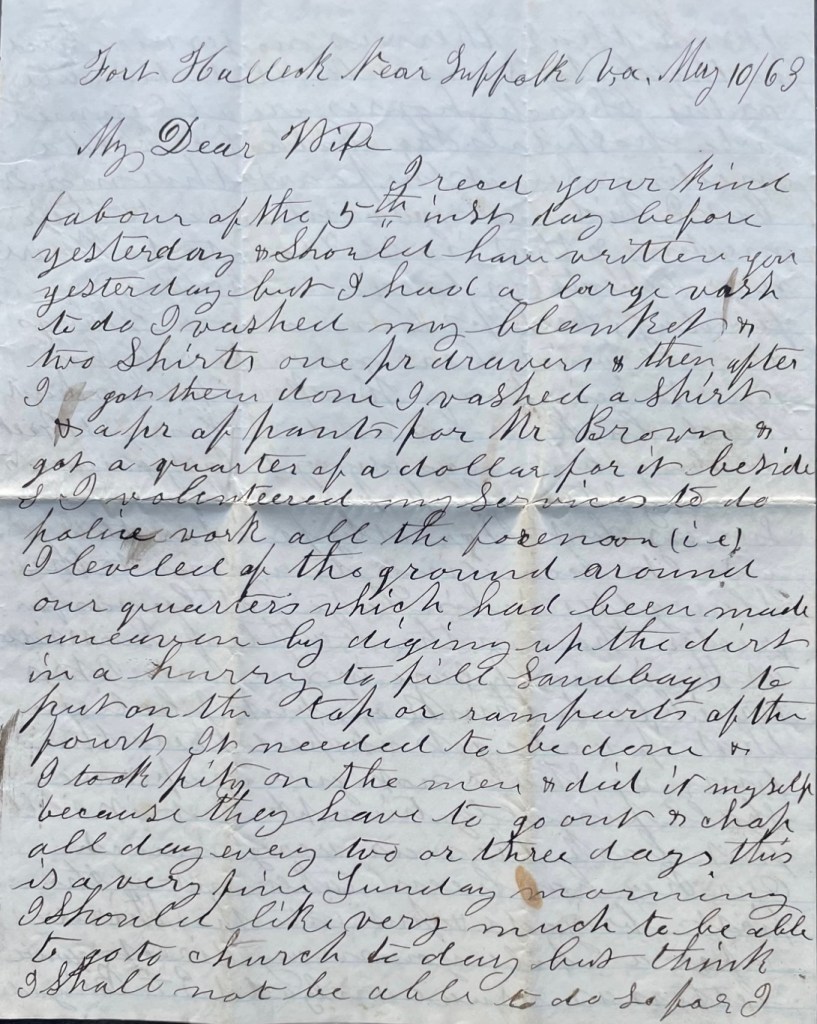
Transcription
Fort Halleck near Suffolk, Va. May 10, 1863
My dear wife,
I received your kind favor of the 5th inst. day before yesterday & should have written you yesterday but I had a large wash to do. I washed my blanket and two shirts, one pair drawers, and then after I got them done, I washed a shirt and a pair of pants for Mr. Brown & got a quarter of a dollar for it besides. I volunteered my services to do police work all the forenoon, (i.e.) I leveled up the ground around our quarters which had been made uneven by digging up the dirt in a hurry to fill sandbags to put on the top or ramparts of the fort. It needed to be done & I took pity on the men & did it myself because they have to go out & chop all day every two or three days.
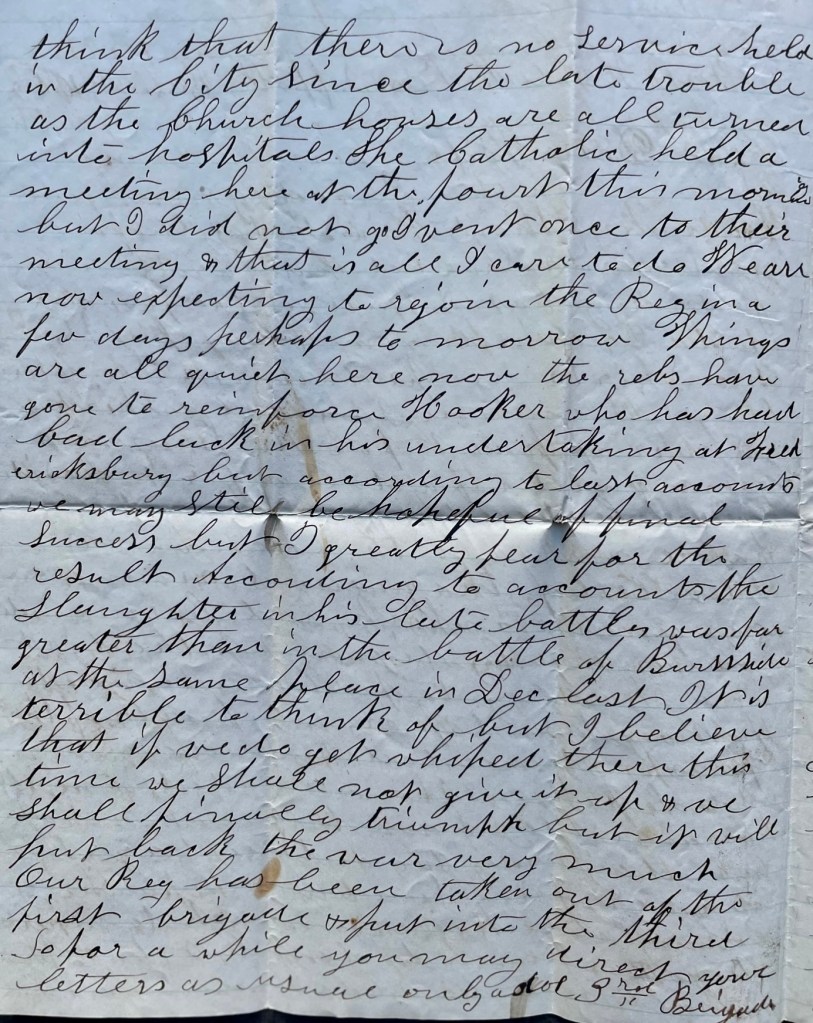
This is a very fine Sunday morning. I should like very much to be able to go to church today but I think I shall not be able to do so for I think that there is no service held in the City since the late trouble as the church houses are all turned into hospitals. The Catholics held a meeting here at the fort this morning but I did not go. I went once to their meeting & that is all I care to do.
We are now expecting to rejoin the regiment in a few days—perhaps tomorrow. Things are all quiet here now. The rebs have gone to reinforce Hooker who has had bud luck in his undertaking at Fredericksburg but according to last accounts, we may still be hopeful of final success. But I greatly fear for the result. According to accounts, the slaughter in his late battles was far greater than in the battle of Burnside’s. Terrible to think of. But I believe that [even] if we do get whipped there this time, we shall not give up & we shall finally triumph. But it will put back the war very much.
Our regiment has been taken out of the 1st Brigade and put into the 3rd. So for a while you may direct your letters as usual, only add 3rd Brigade, 3rd Division, 9th Army Corps. We are in the same brigade with the 13th [New Hampshire]. I think I shall visit the 13th this afternoon & perhaps ave another good sing with Charles Kittredge & others. We do not know yet whether we shall or not go to Kentucky.
When Mr. Eaton gets home, you may hand him that letter & let him do as he sees fit with it. I notice in the Telegraph a notice of Mr. Prescott’s Concert. How I should like to be there to hear & enjoy it & participate in it. I wrote to Calvin and Mother a few days ago. Also to Harvey & Sargeant. I received letters from Harvey & Calvin both on the same day. One of them I sent to you (Harvey’s). Calvin’s health is good. Weighs 200. Mr. Davis is very kind to send you The Watchman gratis. I wrote William since I wrote you last. I received all the papers you sent. Flora’s not excepted. Also three stamps & some envelopes, all of which were welcome, thrice welcome.
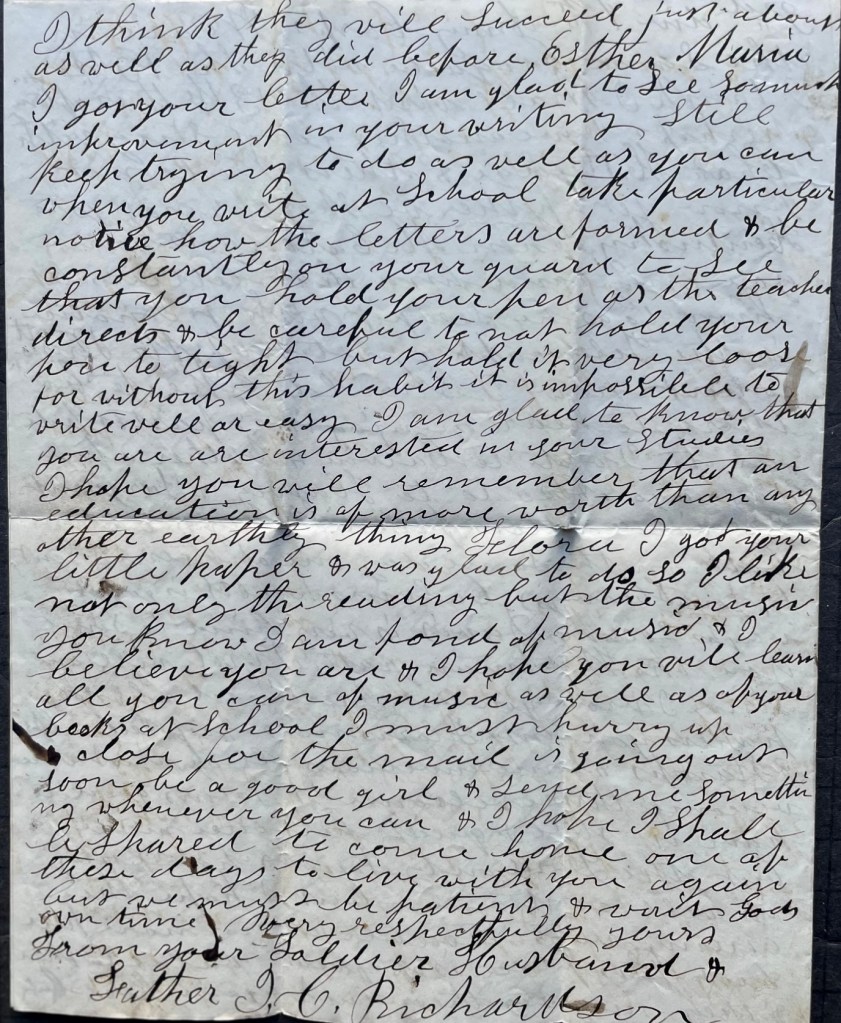
It seems good to have it still & quiet here once more but the Lord only knows how long it will continue. But I hope the enemy will trouble us no more here. But this place is of great value to them and they may try their luck again here but I think they will succeed just about as well as they did before.
Esther Maria, I got your letter. I am glad to see so much improvement in your writing. Still keep trying to do as well as you can when you write at school. Take particular notice how the letters are formed & be constantly on your guard to see that you hold your pen as the teacher directs & be careful to not hold your pen too tight but hold it very loose for without this habit, it is impossible to write well or easy. I am glad to know that you are interested in your studies. I hope you will remember that an education is of more worth than any other earthly thing.
Flora, I got your little paper & was glad to do so. I like not only the reading but the music. You know I am fond of music & I believe you are & I hope you will learn all you can of music as well as of your books at school. I must hurry up and close for the mail is going out soon. Be a good girl and send me something whenever you can & I hope I shall be spared to come home one of these days to live with you again. But we must be patient and wait God’s own time. Very respectfully yours. From your soldier husband & father, — I. C. Richardson
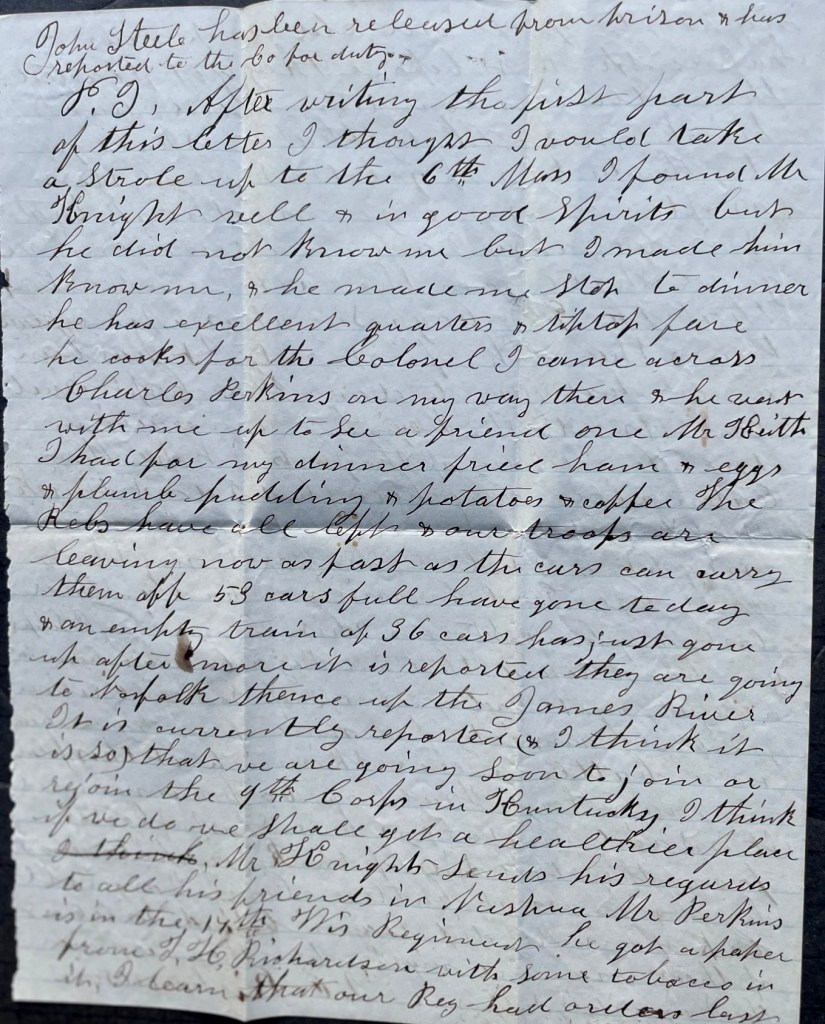
P. S. After writing the first part of this letter, I thought I would take a stroll up to the 6th Massachusetts. I found Mr. Knight well & in good spirits, but he did not know me. But I made him know me & he made me stop to dinner. He has excellent quarters & tiptop fare. He cooks for the Colonel. I came across Charles Perkins on my way there and he went with me up to see a friend—one Mr. Keith. I had for my dinner fried ham & eggs, and plum pudding and potatoes & coffee.
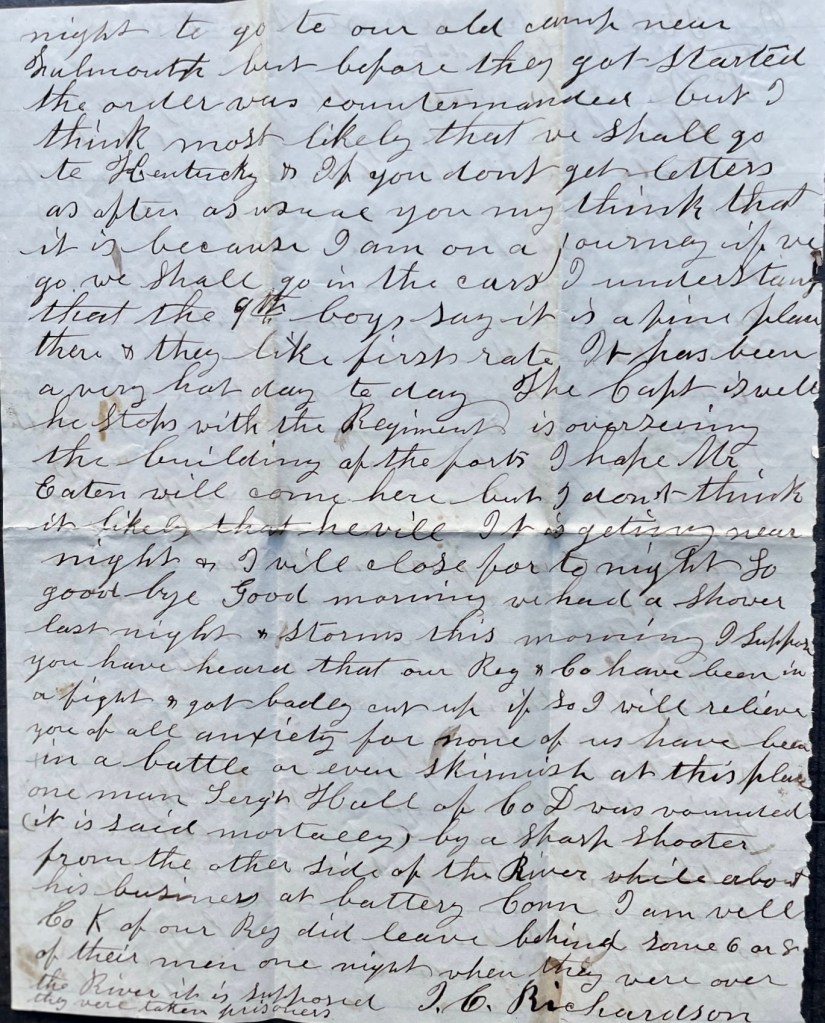
The Rebs have all left & our troops are leaving now as fast as the cars can carry them off. 53 cars full have gone today and an empty train of 36 cars has just gone up after more. It is reported they are going to Norfolk, thence up the James River. It is currently reported (and I think it is so) that we are going soon to join or rejoin the 9th Corps in Kentucky. I think if we do, we shall get a healthier place. Mr. Knight sends his regards to all his friends in Nashua. Mr. Perkins is in the 17th Wisconsin Regiment. He got a paper from T. H. Richardson with some tobacco in it. I learn that our regiment had orders last night to go to our old camp near Falmouth but before they got started, the order was countermanded. But I think most likely that we shall go to Kentucky & if you don’t get letters as often as usual, you may think that it is because I am on a journey. If we go, we shall go in the cars. I understand that the 9th boys say it is a fine place there and they like it first rate.
It has been a very hot day today. The Capt. is well. He stops with the regiment. Is overseeing the building of the forts. I hope Mr. Eaten will come here but I don’t think it likely that he will. It is getting near night and I will close for tonight. So goodbye.
Good morning. We had a shower last night & storms this morning. I suppose you have heard that our regiment & company have been in a fight and got badly cut up. If so, I will relieve you of all anxiety for none of us have been in a battle or even skirmish at this place. One man, Sergt. [John A.] Hall of Co. D, was wounded (it is said mortally) by a sharp shooter from the other side of the river while about his business at Battery Connecticut. I am well. Co. K of our regiment did leave behind some 6 or 8 of their men one night when they were over the river. It is supposed they were taken prisoners. — I. C. Richardson
The following letter was written by Alonzo Kinsley (1836-1910), the son of Ben Alva Kinsley (1796-1870) and Catherine Montague (1798-1849) of Fletcher, Franklin county, Vermont. He wrote the letter to his old brother, Daniel Kinsley (1829-1923)—messenger for the courts at Worcester, Massachusetts for fifty years—who married Harriett Newell Mudgett (1834-1900) in 1854. Several of Alonzo’s siblings are also mentioned in his letter. They include Rufus Kinsley (1831-1911) who served in Co. F, 8th Vermont Infantry and later as 2nd Lieutenant in the 74th USCT (See, “Diary of a Christian Soldier: Rufus Kinsley and the Civil War“, David C. Rankin, Cambridge University Press, 2004); Jason W. Kinsley (1833-1903) who served in Co. K, 1st Iowa Cavalry; and William Lyon Kinsley (1844-1901) who also served in Co. F, 8th Vermont Infantry. William was wounded at Cedar Creek (Virginia) on October 19, 1864, and promoted to Corporal in January 1865. He was wounded again at Petersburg on April 2, 1865, and mustered out on June 19, 1865.
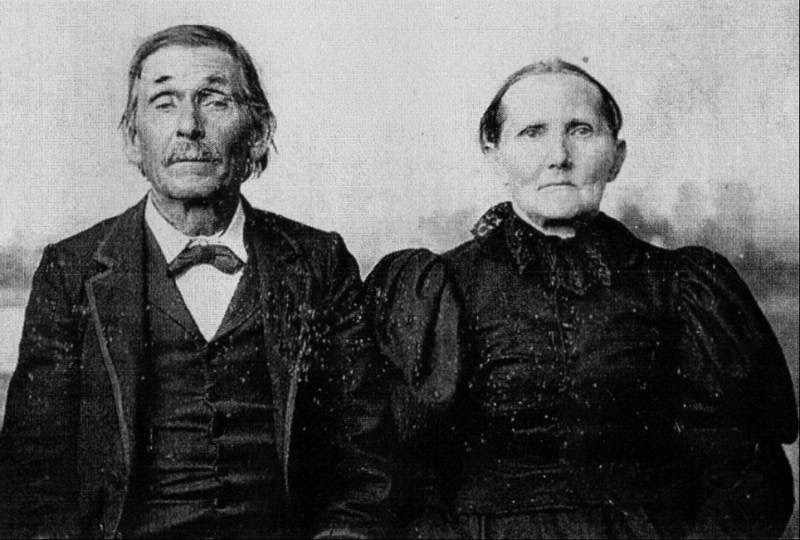
Alonzo’s father, Ben Alva Kinsley (1796-1870)
Like his brothers, Alonzo Kinsley also served in the Union army. He enlisted in Co. H, 2nd Vermont Infantry, on 20 June 1861 and a month later at Bull Run, he was wounded. The nature of his wound is not given in the regimental history but a letter dated 20 August 1861 by Chester K. Leach, a comrade in the same company, states that, “Alonzo Kinsley has a failing about his lungs he can hardly talk I think his getting hit at Bulls Run in the breast is the first cause & now when he takes cold he can hardly talk, but he will not give up as long as he can stir.” See “Dear Wife, the Civil War Letters of Chester K. Leach“] Alonzo’s health must have plagued him during the war for when he wrote this letter to his brother in December 1863, he was working as a hospital steward at the US General Hospital in Annapolis—a detail typically assigned to soldiers recuperating from wounds or illness and incapable of standing the rigors of the field.
There is little hint of Alonzo’s political views in this letter except to state that he favored Lincoln’s reelection. It’s not clear if he held the same views as his brother Rufus whose diary reveals that he was a dedicated evangelical abolitionist soldier and believed that the war and its consequences were divine retribution for the sin of slavery. He believed that the Civil War was not actually about saving the Union, but about freeing slaves.
[Note: This letter is from the personal collection of Jill Duffy and was offered for transcription and publication on Spared & Shared by express consent.]
Transcription
Addressed to Mr. Daniel Kinsley, Worcester, Massachusetts
U. S. General Hospital Annapolis, Maryland December 15, 1863
Brother Daniel,
I was not a little surprised to receive a letter from you last week, for as I had heard nothing from you since last August, I thought perhaps you had either enlisted, or gone to Canada to avoid the draft.
It seems you have some idea of enlisting if the quota is not raised before the time appointed for the draft to commence. Well, act according to your own judgment. I certainly would not undertake to advise you either way in regard to such a matter, but this seems to be a very favorable time for those to enlist who are in a situation to leave home.
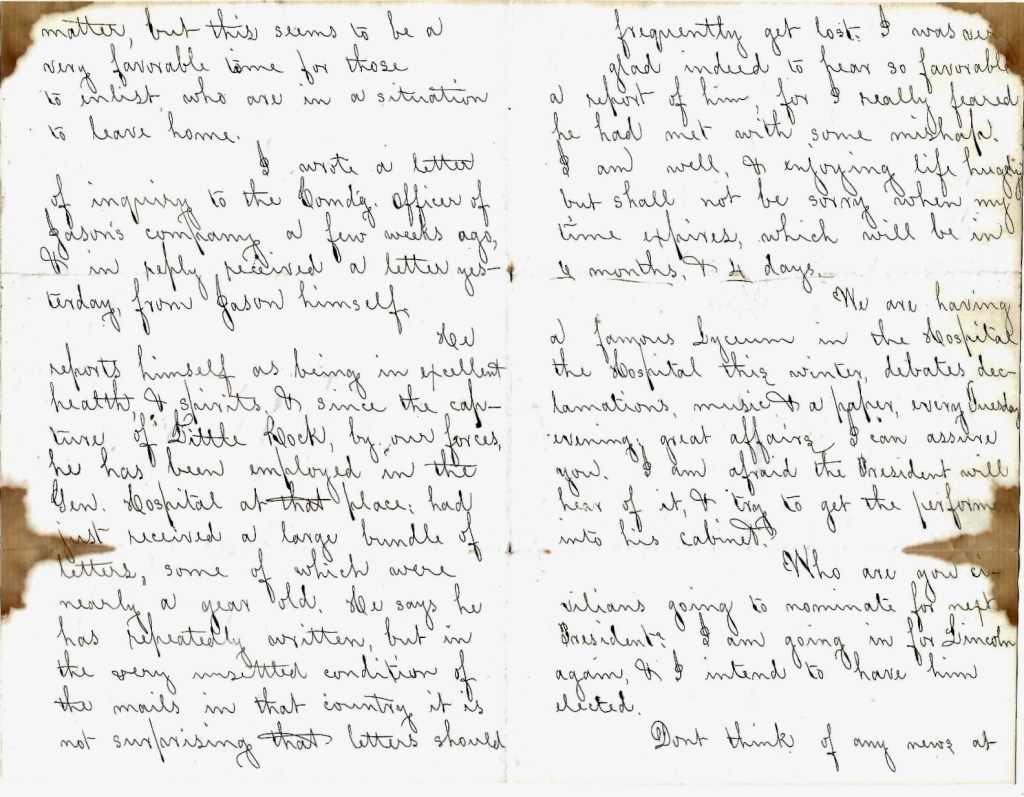
I wrote a letter of inquiry to the Commanding Officer of Jason’s company a few weeks ago and in reply received a letter yesterday from Jason himself. He reports himself as being in excellent health and spirits, & since the capture of Little Rock by our forces, he has been employed in the General Hospital at that place, had just received a large bundle of letters, some of which were nearly a year old. He says he has repeatedly written, but in the very unsettled condition of the mails in that country, it is not surprising that letters should frequently get lost. I was very glad indeed to hear so favorable a report of him, for I really feared he had met with some mishap.
I am well & enjoying life hugely but shall not be sorry when my time expires, which will be in 6 months & 4 days.
We are having a famous Lyceum in the hospital this winter—debates, declamations, music, & a paper every Tuesday evening; great affairs, I can assure you. I am afraid the President will hear of it & try to get the performers into his cabinet.
Who are you civilians going to nominate for next President? I am going in for Lincoln again & I intend to have him elected. Don’t think of any news at present except that Dr. Vanderkieft has promised to muster me as acting Hospital Steward from the 1st of November which will increase my pay $8 per month & with the State pay, will amount to $28 a month.
Fine pleasant weather. No snow & no very cold snaps.
Remember me to Mary. Ann Loving, and other friends. Has Josie got well yet? Hope you & Harriet will find time to write a little oftener. — Alonzo
William writes that Rufus has got a commission in a Colored Regt. & that he had declined the offer of a similar commission.
The following letter came to me for transcription, author unknown. The sender and receiver appear to be “J. S. D.” and “E. D.” Names of soldiers mentioned in the letter were from Spalding county, Georgia, and regiments raised there included the 51st and 53rd Georgia Infantry. My hunch is the letter was written by Joel S. Duffell (1818-1866) who enlisted as a private on 4 March 1862 in Co. I, 51st Georgia. He was appointed 5th Sergeant in January 1862 and promoted to 2nd Sergeant on 1 June 1864.
Joel was born in 1819 and appears to have had a couple of different wives; he was married to his second wife, Martha Rice in 1855 in Henry county, Alabama. The letter was addressed to Liz who was undoubtedly the Elizabeth D. to whom the letter was addressed but I cannot account for her in census records. She may have been a wife, a sister, or some other relative. He does mention “Mattie” which could be a nickname for Martha. Joel’s father was no longer living in 1863 but the “Pap” might refer to his father-in-law.
At Gettysburg, the 51st and 53rd Georgia Regiments were brigaded together in Brigadier General Paul J. Semmes Brigade of Major General Lafayette McLaws Division of Longstreet’s 1st Corps. They took part in the fight on Rose Hill and on into the wheat field in support of Kershaw and Anderson late in the afternoon of July 2, 1863. On 4 July 1863 the Confederates began their retreat from Gettysburg and made their way to Hagerstown, Maryland, where this letter was scribbled in pencil on 8 July. The Confederates finally crossed the Potomac on the night of 13 July, delayed by high waters.
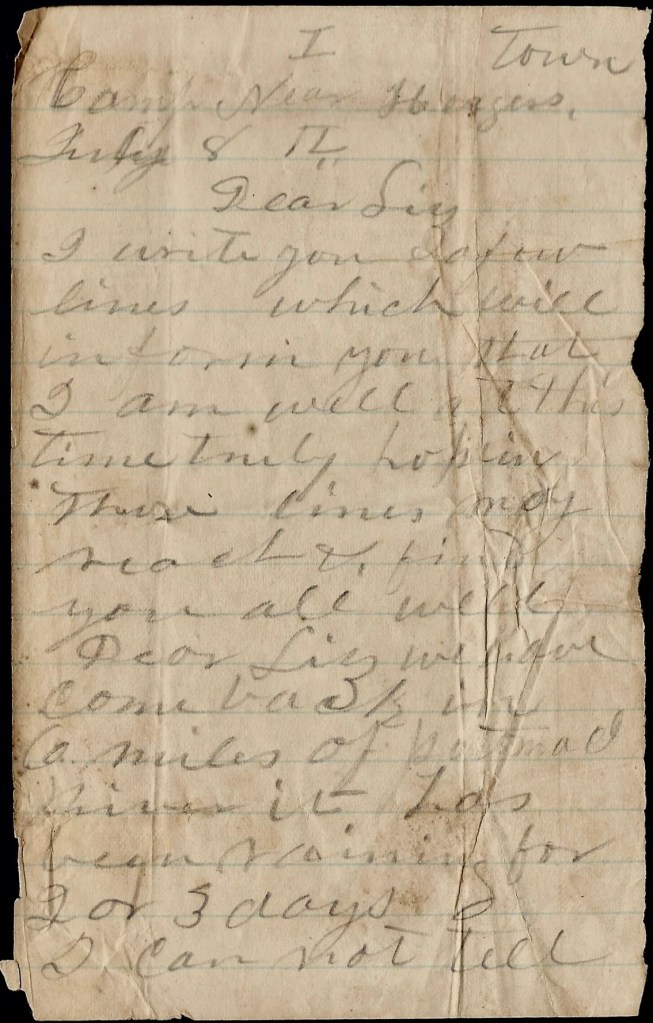
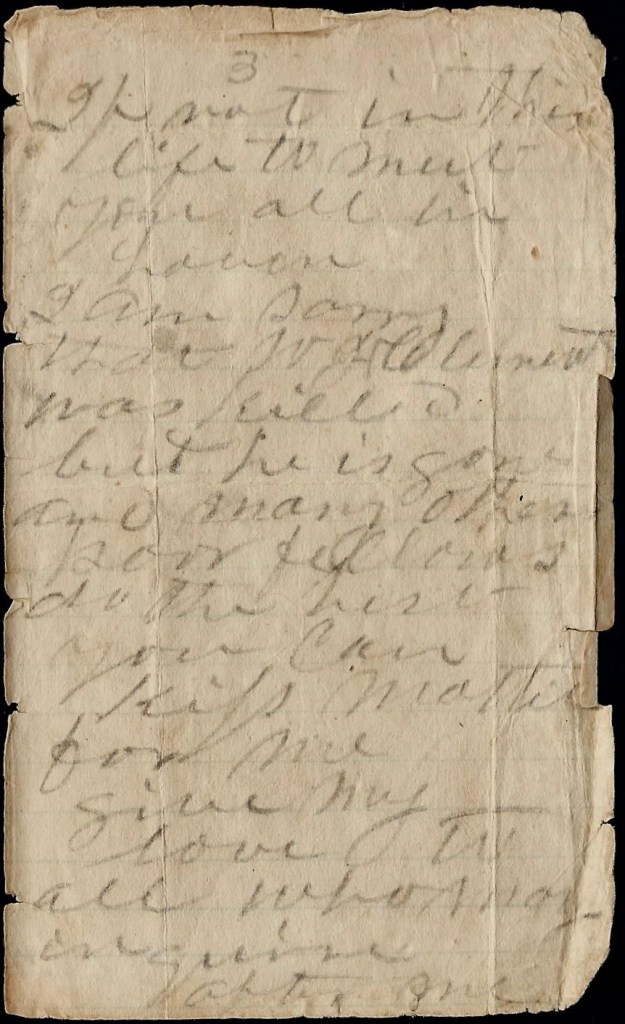
I write you a few lines which will inform you that I am well at this time truly hoping these lines may reach & find you all well. Dear Liz, we have come back [with]in 6 miles of Potomac River. It has been raining for 2 or 3 days. I cannot tell whether we will cross back soon or not. We had a terrible fight at Gettysburg. I would be glad if I had time to write more but I have not. I wrote some days ago but have not sent it off yet. Two letters come for me some days past but have not received them yet. I trust God will spare me to see you all again—if not in this life, to meet you all in heaven.
I am sorry that W. J. Clements 1 was killed but he is gone and many other poor fellows. Do the best you can. Kiss mother for me. Give my love to all who may inquire after me.
We have hard times now. I saw B. F. Mottes [?]. He was shocked by a [ ]. Crock Akins wounded in leg. 2 Wiley Childers not hurt. 3 J. Brown 4 not hurt. Liz, I must close. Goodbye for this time. I hope to see you again.
J. S. D. to E. D.
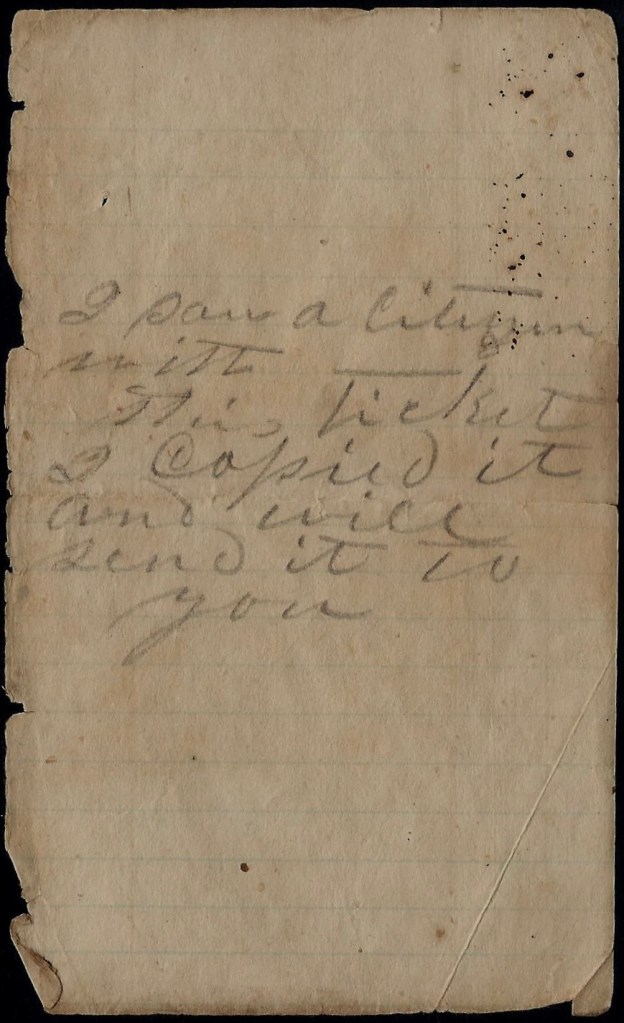
I saw a citizen with this ticket. I copied it and will send it to you.
Peace Ticket for the Next President’s Election
Jeff Davis of Mississippi for President Vallandingham of Ohio for Vice President All Negroes to be sent South Abe Lincoln to be sent to the Devil.
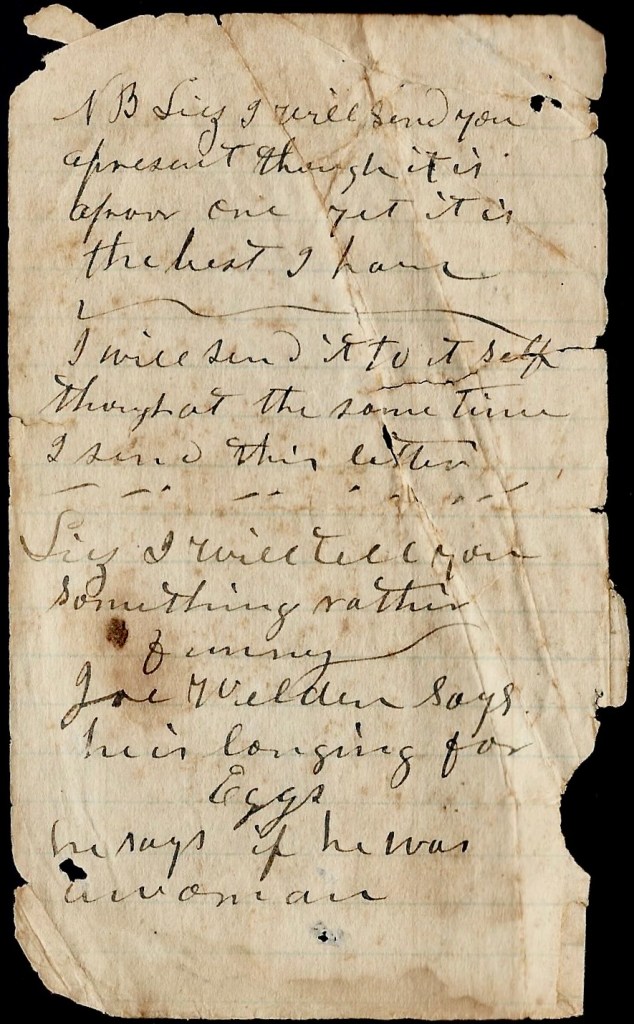
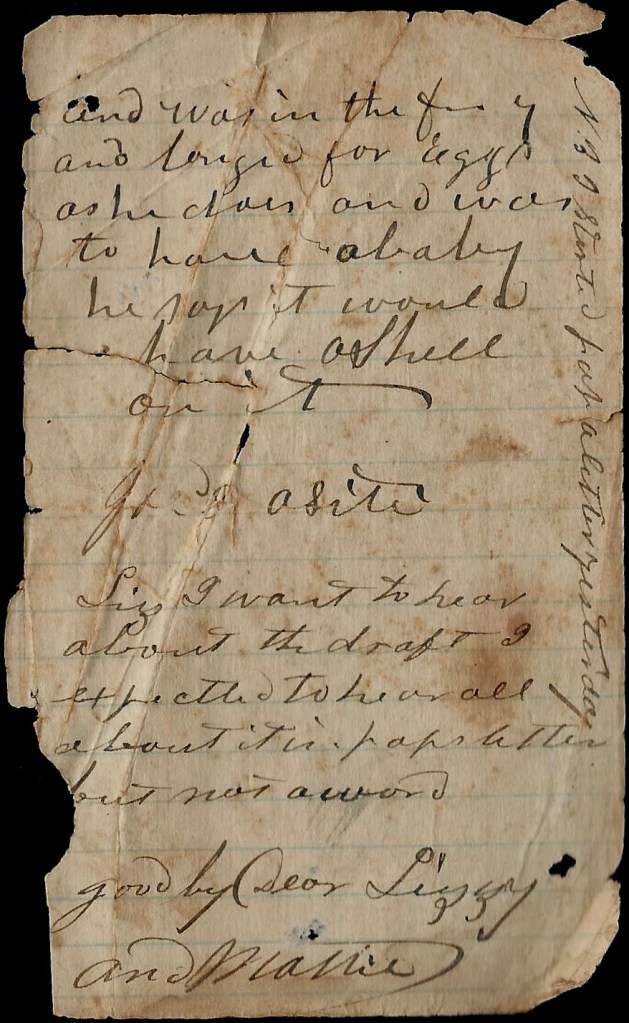
N. B. Liz, I will send you a present though it is a poor one. Yet it is the best I have. I will send it to itself though at the same time I send this letter. Liz, I will tell you something rather funny. Joe Weldon 5 says he is longing for eggs. He says if he was a woman and was in the [family way?] and longed for eggs as he does and was to have a baby, he says it would have a shell on it.
Liz, I want to hear about the draft. I expected to hear all about it in Pap’s letter but not a word. Goodbye dear Lizzy and Mattie
N. B. I started Pap a letter yesterday.
1 William J. Clements enlisted in Co. C, 13th Georgia Infantry in July 1861. He was killed two years later at Gettysburg. He was from Spalding county, Georgia.
2 Possibly Private Elisha Clay Akins (1831-1906) of Griffin, Spalding county, Georgia who enlisted on 28 April 1862 in Co. A, 53rd Georgia Infantry, and was wounded in the right leg at Gettysburg. He was taken prisoner and exchanged in September 1863.
3 Wiley Thomas Childers (1842-1921) served in Co A, 53rd Georgia Infantry. He was taken prisoner at Knoxville, TN, on 29 November 1863 and spent the remainder of the war at the Rock Island Prison in Illinois.
4 The roster of Co. A, 53rd Georgia Infantry includes a “Private J. P. Brown.”
5 Possibly J. S. Weldon (or Welden) who enlisted as a private in April 1862 to serve as a musician in Co. A, 53rd George Infantry.
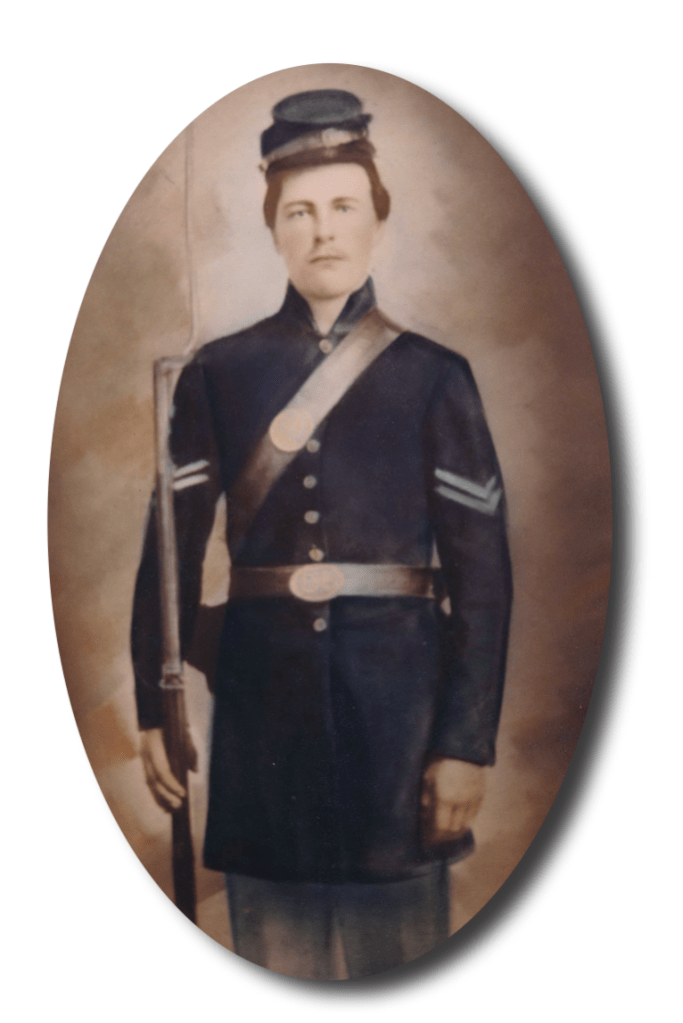
I could not find an image of Ross but here is Corp. David Henderson who served in Congress. H, 122nd OVI. David died at Andersonville Prison on 23 October 1864.
The following short letter was written by Ross Coyle (1844-1863) who enlisted as a private on 9 October 1862 in Co. B, 122nd Ohio Volunteer Infantry (OVI). He was wounded in the fighting at Mine Run, Virginia, on 27 November 1863 and died of his wounds on 4 December 1863 at Locust Grove, Virginia. The U.S. Register of Deaths of Volunteers informs us that he died was “wounded in the right side, penetrating chest.” A Family History informs us that he was “wounded at the Battle of Mine Run, Va., and taken back to Brandy Station, Culpepper county, Va., where he died, and was buried under a cedar tree, beside the railroad.”
Ross was the son of William W. Coyle (1816-1911) and Mary Ann Walker (1824-1908) of Ross, Jefferson county, Ohio. In the 1860 US Census, 16 year-old Ross was enumerated in his parent’s household learning the carpenter’s trade from his father.
Transcription
Dear Mother,
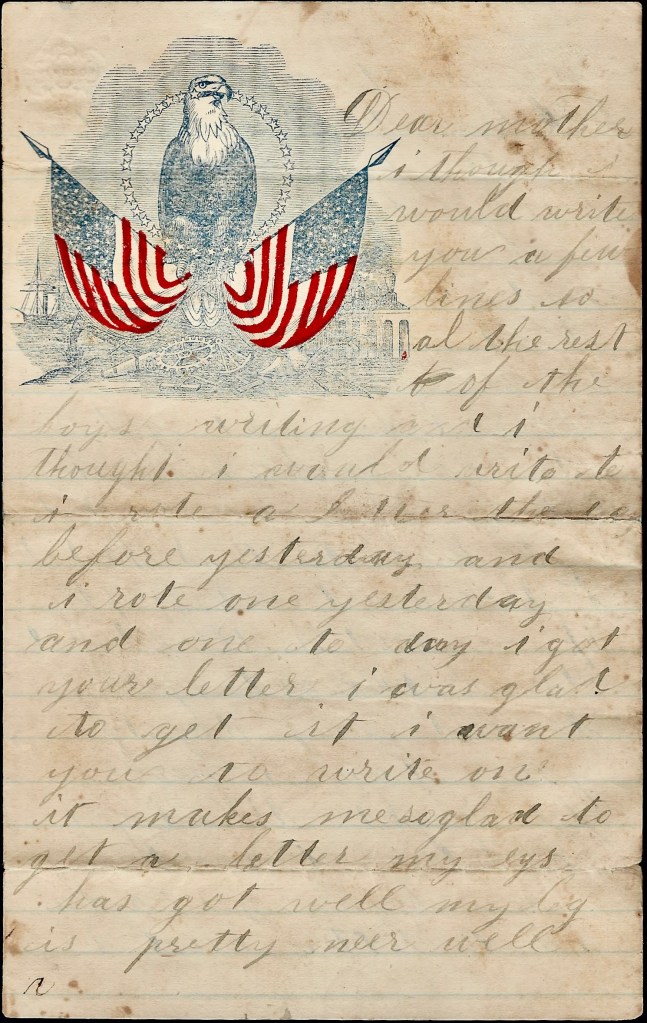
I thought I would write you a few lines as all the rest of the boys [are] writing and I thought I would too. I wrote a letter the day before yesterday and I wrote one yesterday and one today. I got your letter. I was glad to get it. I want you to write one. It makes me so glad to get a letter. My eyes has got well. My leg is pretty near well.
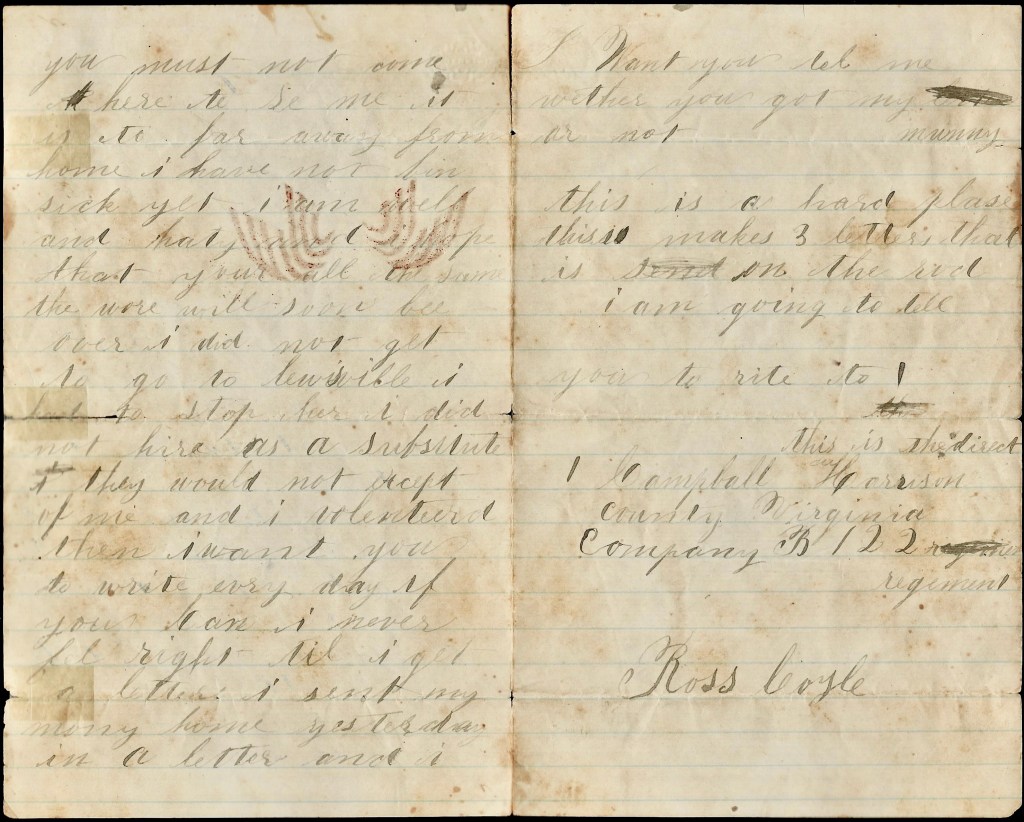
You must not come here to see me. It is too far away from home. I have not been sick yet. I am well and hearty and I hope that you’re all the same. The war will soon be over.
I did not get to go to Louisville. I had to stop here. I did not hire as a substitute. They would not accept of me and I volunteered then. I want you to write every day if you can. I never feel right till I get a letter. I sent my money home yesterday in a letter and I want you tell me whether you got my money or not. This is a hard place. This makes 3 letters that is on the road. I am going to tell you to write. This is the direct:
Campbell, Harrison County Virginia, Company B, 122nd Regiment
The following letter was written by Ebenezer H. Martin of Union, Broom county, New York, who claimed to be 30 years old when he enlisted as a private on 21 November 1861 to serve three years in the 16th Independent Battery, New York Light Artillery. Census records from 1850 and 1860 suggest that he was born in 1826, however, so he would have been 35 years old when he enlisted. We learn from Ebenezer’s letter that he was detailed as a hospital warden or steward while in the service but he did not survive the war. He died of chronic diarrhea on 31 December 1863 while at Union, New York, where he was buried.
Though the letter is not accompanied with an envelope and he does not name the letter’s recipient, it was most surely sent to his second wife, Mary J. (Spencer) Martin. Ebenezer and Mary had two children Ida Jane Martin (b. 1854) and William Wallace Martin (b. 1856). Ebenezer’s first wife’s name was Lodasca who died in April 1853.. They were married in Truxton, New York, on 31 December 1849. They had one daughter named Edna, born 1853, who also filed for a pension after learning of her biological father’s death.
Transcription
16th Independent Battery, New York Vols. 1st Brigade, Reserve Army Corps Cloud’s Mill, Virginia 1 July 15th [1862]
I received your letter today and was glad to hear from you. Since I wrote before, I have moved about half a mile nearer to Alexandria. I am now in sight of five regiments—three of cavalry and two of infantry. And on the hill there is a large quantity of soldiers. Some have been to Richmond. The rest have just come from the North. There is about seven hundred sick and wounded soldiers in Fairfax Seminary and the surrounding buildings.
We got our pay the sixth and it ought to be in the Broom county bank by this time. It is late and I am tired and sleepy so no more tonight.
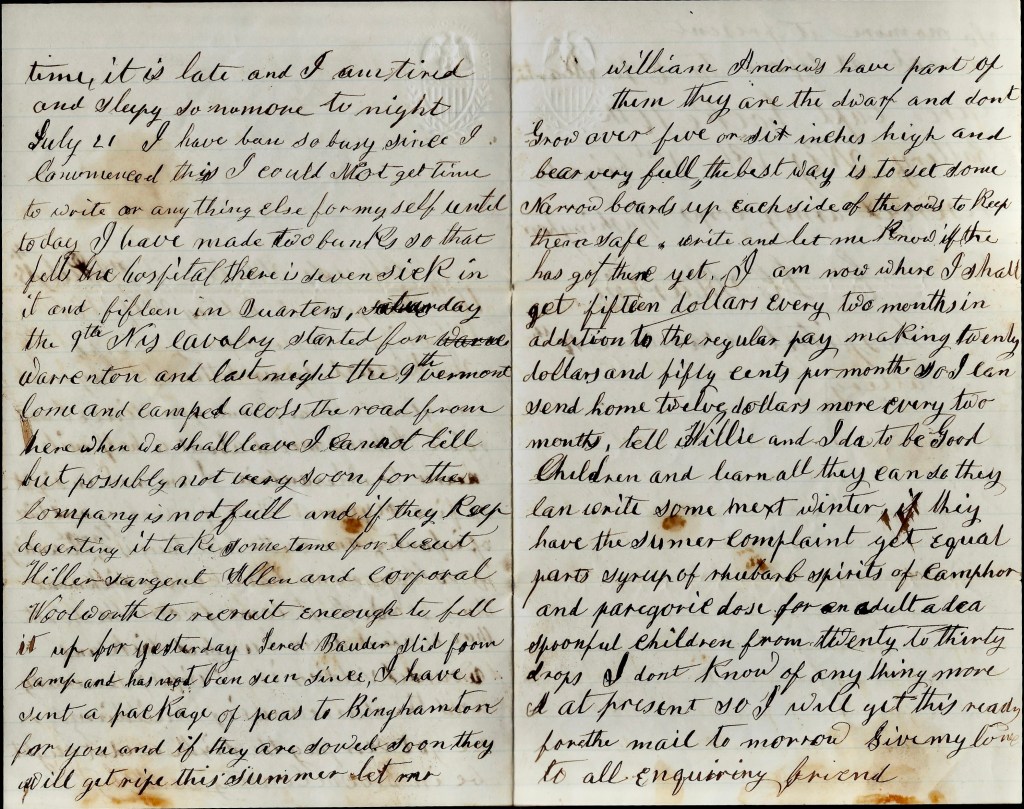
July 21st. I have been so busy since I commenced this I could not get time to write or anything else for myself until today. I have made two bunks so that fills the hospital. There is seven sick in it and fifteen in quarters. Saturday the 9th New York Cavalry started for Warrenton and last night the 9th Vermont came and camped across the road from here. When we shall leave, I cannot tell but possibly not very soon for the company is not full and if they keep deserting, it takes some time to fill it up for yesterday Jered Bauder 2 slid from camp and has not been seen since.
I have sent a package of peas to Binghamton for you and if they are sowed soon, they will get ripe this summer. Let Mr. William Andrews have part of them. They are the dwarf and don’t grow over five or six inches high and bear very full. The best way is to set some narrow boards up each side of the rows to keep them safe. Write and let me know if they has got there yet.
I am now where I shall get fifteen dollars every two months in addition to regular pay, making twenty dollars and fifty cents per month so I can send home twelve dollars more every two months. Tell Willie and Ida to be good children and learn all they can so they can write some next winter. If they have the summer complaint, get equal parts syrup of rhubarb, spirits of camphor, and paregoric. Dose for an adult a spoonful; children twenty to thirty drops. I don’t know of anything more at present so I will get this ready for the mail tomorrow. Give my love to all enquiring friends. So no more at present.
Direct as before to E. H. Martin, Care of Capt. Locke, 16th Battery, NY Vols. 1st Brigade, Reserve Army Corps, Washington.
— E. H. Martin, Hospital warden, 16th Battery
1 Cloud’s Mill, one of several in the City of Alexandria before the Civil War, existed for over a century. It was identified most frequently as Cloud’s Mill, although James Cloud actually owned it less than thirty years. An 1813 deed refers to a Triadelphia Mill, a name which also appears on an 1879 and a 1915 map. However, Cloud’s is the name used on most deeds and maps, especially during the Civil War when the mill also is described as a landmark in letters written by Confederate and Union soldiers. It was located on the north side of Little River Turnpike, somewhere between the present Shops at Foxchase shopping center and North Pickett Street.” [A History of Cloud’s Mill in Alexandria, Virginia by Jean A. Beiro.]
2 Jered R. Bauder of Binghamton enlisted on 21 January 1862 when he was 18 years old. He deserted on 12 July 1862 at Cloud Mills.
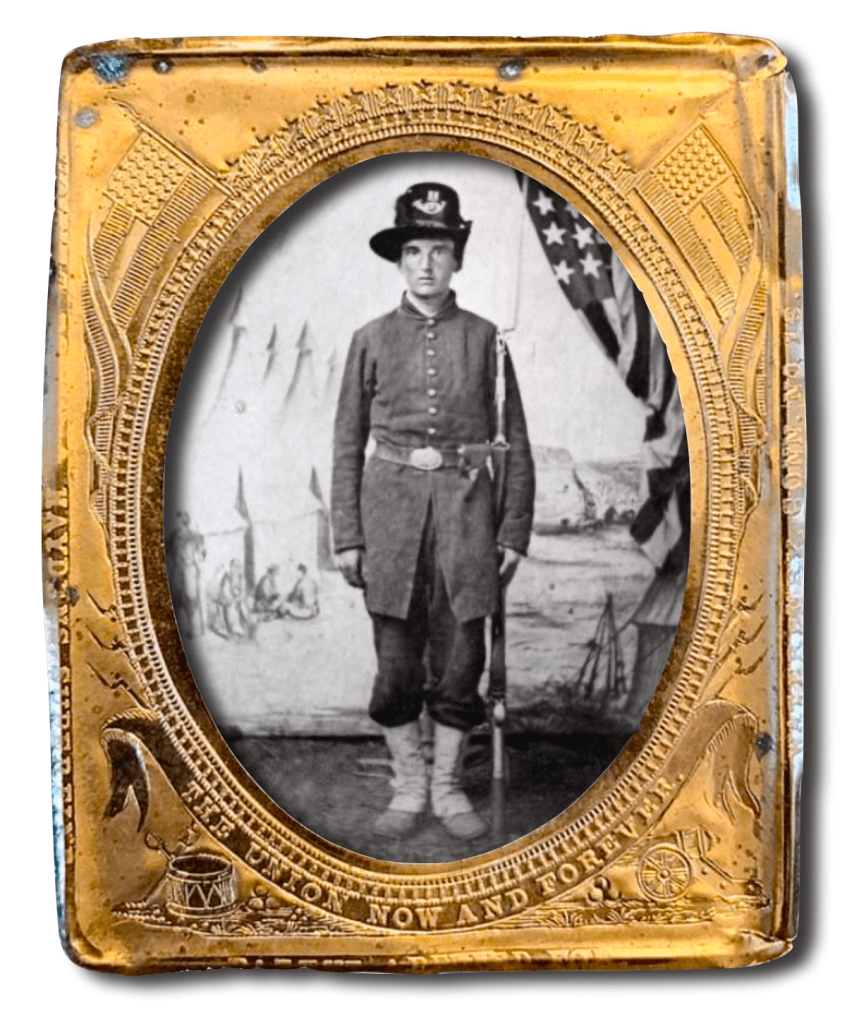
Elon Francis Brown, Co. H, 2nd Wisconsin Vols.(Wisconsin Historical Society
The following letters were written by Elon Francis Brown (1839-1869), the son of James Brown (1799-1856) and Malvina F. Howe (1809-1897) of Sun Prairie, Dane county, Wisconsin. Elon wrote the letters to his sister, Malvina S. (Brown) McCrea (1833-1884) and her husband Daniel McCrea (1824-Aft1863) of Monroe, Adams county, Wisconsin.
Elon was 22 years old when he enlisted on 19 May 1861 to serve as a private in Co. H, 2nd Wisconsin Volunteers. He was wounded in the Battle of Antietam on 17 September 1864 but recovered and in late July 1864 he was commissioned a Captain in Co. D, 45th USCT. He remained with the 45th USCT until 4 November 1864 when he was mustered out of the service.
Elon’s letter of March 1864 is particularly poignant as it describes visiting the grave of his younger brother, James B. Brown (1844-1862) who enlisted in September 1861 to serve in Co. B, 7th Wisconsin (Iron Brigade) and was mortally wounded in the fighting at Brawner’s Farm on 28 August 1862. He died on 16 December 1862 and was buried in the National Cemetery at the Soldiers’ Home in D. C., Grave No. 2447.
It should be noted that Elon kept diaries while he was in the service. Two are archived at:
1—Elon’s Diary (April 28-June 27, 1863) giving his experiences in the battles of Chancellorsville, Fredericksburg, Second Bull Run, and a later description of Gettysburg can be found at the University of Wisconsin, Madison. Also includes a sketch map of northeastern Virginia and Maryland. The photographs are of Brown in his uniform and a portrait of Brown. Also included is a notebook in which Brown recorded items of interest such as population statistics of the “loyal” and “disloyal” states, poems and sayings, various Civil War reports and chronicles, and historic world events generally relating to world conflicts.
2—Elon F[rancis] Brown. “Daily Journal,” transcribed with additional notes and explanations from pocket memoranda kept while a member of Co. H, 2nd Regiment, Wisconsin Infantry. The transcription was done while Brown lay wounded in a U. S. Army hospital in Frederick, Maryland, beginning March 15, 1864. It covers the years 1863-4. 214 p. Microfilmed from the original in the pos- session of Leonard Lipman, through Frank Sperduto. Rutgers University.
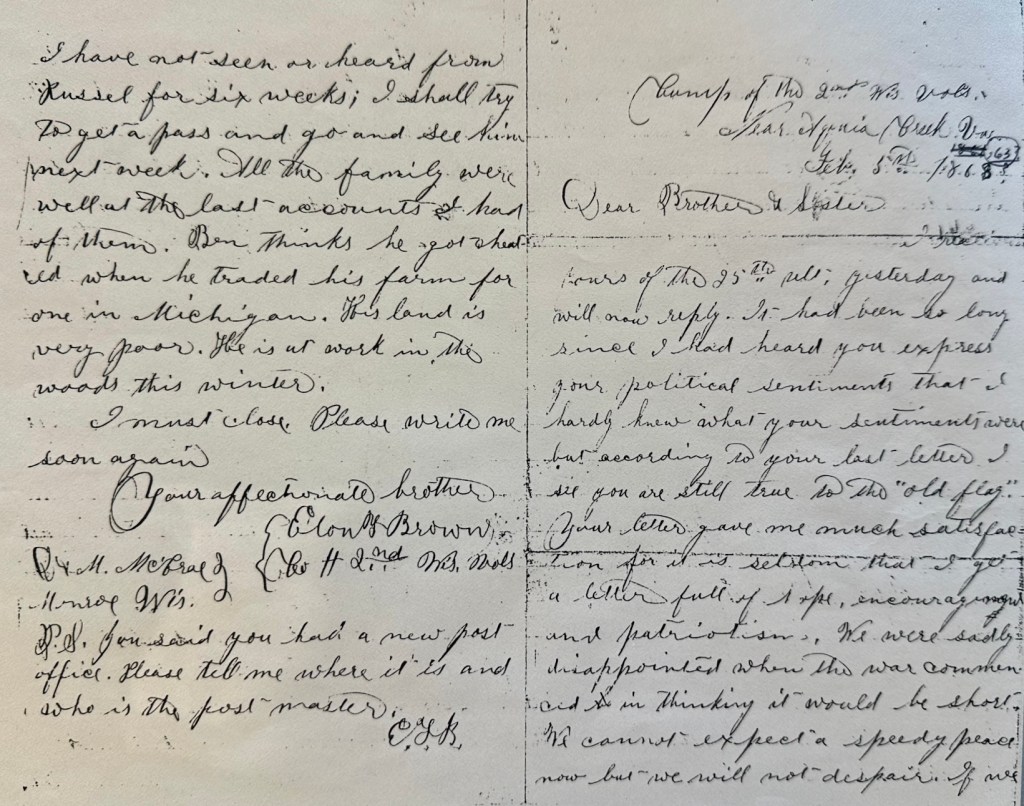
[Note: The following photocopies of Elon’s letters are archived at the Kenosha Civil War Museum and were made available for transcription and publication on Spared & Shared by express consent.]
Letter 1
Camp of the 2nd Wisconsin Vols. Near Aquia Creek, Va. February 5, 1863
Dear Brother & Sister,
I received yours of the 25th ult. yesterday and will now reply. It had been so long since I had heard you express your political sentiments that I hardly knew what your sentiments were, but according to your last letter I see you are still true to the “old flag.” Your letter gave me much satisfaction for it is seldom that I get a letter full of hope, encouragement, and patriotism. We were sadly disappointed when the war commenced in thinking it would be short. We cannot expect a speedy peace now but we will not despair. If we persevere, we will save our country at last. It is far better that we have a long war now that a dishonorable peace that will result in eternal war.
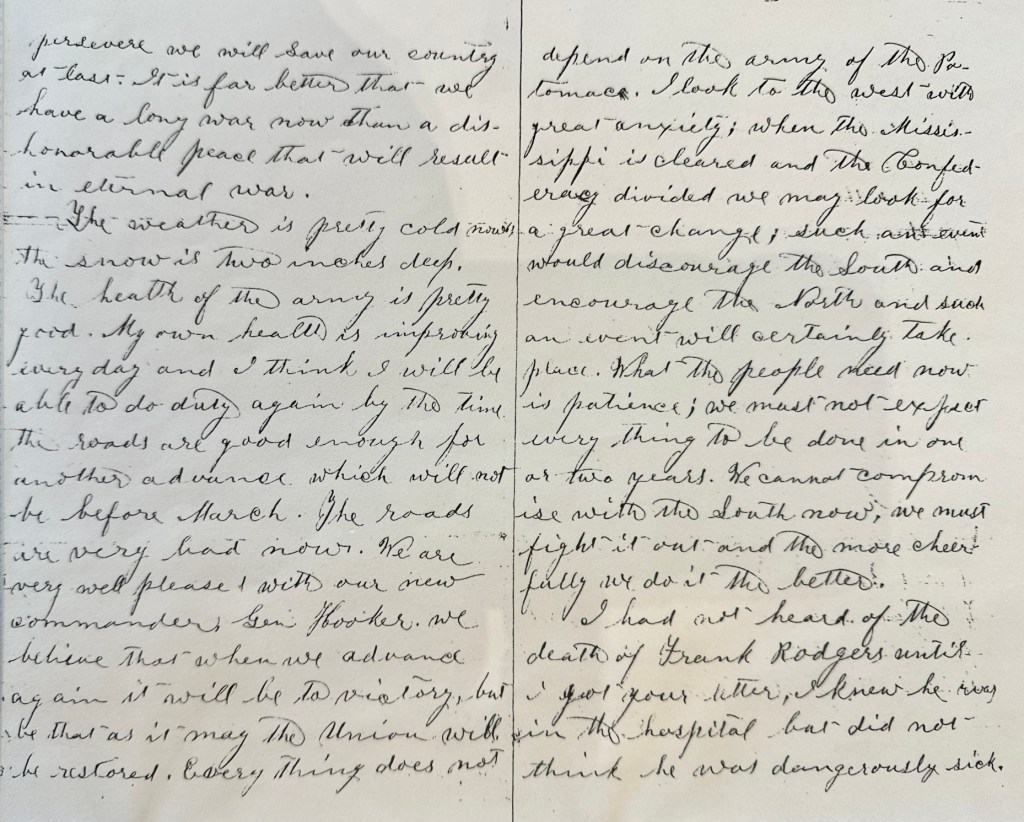
The weather is pretty cold now. The snow is two inches deep. The health of the army is pretty good. My own health is improving every day and I think I will be able to do duty again by the time the roads are good enough for another advance which will not be before March. The roads are very bad now.
We are very well pleased with our new commander, Gen. Hooker. We believe that when we advance again, it will be to victory. But be that as it may, the Union will be restored. Everything does not depend on the Army of the Potomac. I look to the West with great anxiety. When the Mississippi is cleared and the Confederacy divided, we may look for a great change. Such an event would discourage the South and encourage the North and such an event will certainly take place. What the people need now is patience. We must not expect everything to be done in one or two years. We cannot compromise with the South now. We must fight it out and the more cheerfully we do it the better.
I had not heard of the death of Frank Rodgers until I got your letter. I knew he was in the hospital but did not think he was dangerously sick. I have not seen or heard from Russell for six weeks. I shall try to get a pass and go and see him next week. All the family were well at the last accounts I had of them. Ben thinks he got cheated when he traded his farm for one in Michigan. His land is very poor. He is at work in the woods this winter.
I must close. Please write me soon again. Your affectionate brother, – Elon F. Brown, Co. H, 2nd Wisconsin Vols.
D. & M. McCrae, Monroe, Wisconsin
P. S. You said you had a new post office. Please tell me where it is and who is the post master. — E. F. B.
Letter 2
Camp 2nd Wisconsin Vols. Near Aquia Creek, Va. March 1st 1863
Dear Brother & Sister,
I have just received your letters of the 14th & 16th of February containing the sorrowful—aye—heart-rending news of the death of our sister. I know not what to write—my heart is stunned and I as myself is it reality. The tidings were so unexpected that the blow struck with double force. I feel as if weeping would relieve me but the fountain of my tears are dry. Alas! How fragile and short and brittle is the thread that binds us to earth adn liable to snap at any moment. Our sister has but gone a short time before us; we must all soon try the realities of that untried world from which no traveler ever yet returned. But we need not go in the dark; our great Creator has given us a “light to our feet and a lamp to our path” if we will only accept it. He has given us His hold word which contains a guide through life and a guide through the “dark valley and shadow of death.” We are reminded by our sister’s death that life at longest will be short. Let us then take warning. The admonition is to us and it speaks in thundering tones, “Prepare for all must go.” Shall we turn unmoved from the scene and wait another and another of our number falls before we think of preparing? No! Let us give our hearts to God now adn “halt between two opinions” no longer. One great struggle with “self”, one firm resolve, a casting all on the strong arm of God and all is over and we rest in a Savior’s arms. Accept it now; the morrow may be too late. God grant that in your answer I may be able to read the glowing words, “Let others do as they may, but as for me and my house, we will serve God.”
McCrae, I recollect the last time I saw you. Your mind was almost made up to become a Christian but you were putting it off for a more “convenient season.” That season will never come. Delay no longer. Now is the time. God help you.
You say you had not received an answer to your last letter when you wrote. I answered it February 5th and I presume you have received it before now.
I have not seen Russell for nearly three months though I have been trying to get a pass to go and see him for some time. I think I will have a chance to see him soon. I heard from him a short time ago; he was sick then but I did not hear what the matter was.
My health is now quite good and I think I could stand a pretty hard march. The roads, however, are in very bad condition and an advance will be impossible for some time. There is a rumor in camp that our corps is to be sent to South Carolina this spring. I do not give much credit to the report, yet it may be true. I am sure I don’t care whether it is true or not. I had a leave go there as anywhere else. We are sure of hard fare and hard fighting wherever we go.
Vina, will you please write the particulars of Lucinda’s death to Eliza. I know but very little about it and it would be improper for me to write it if I did. I do not know the feeling between you and Eliza but if old differences are not forgotten, I ask that they may be. Let us be as brothers and sisters should be and not like strangers. Eliza’s address is: Pent Water, Ocean county, Michigan.
Give my love to the children. George is old enough to write me a letter. I would like to have him do so. With many wishes for your welfare, I remain your loving brother, — Elon F. Brown, Co. H, 2nd Wisconsin Vols
[to] D & M. McCrae
Letter 3
U. S. Gen. Hospital Frederick, Maryland March 18th, 1864
My Dear Sister,
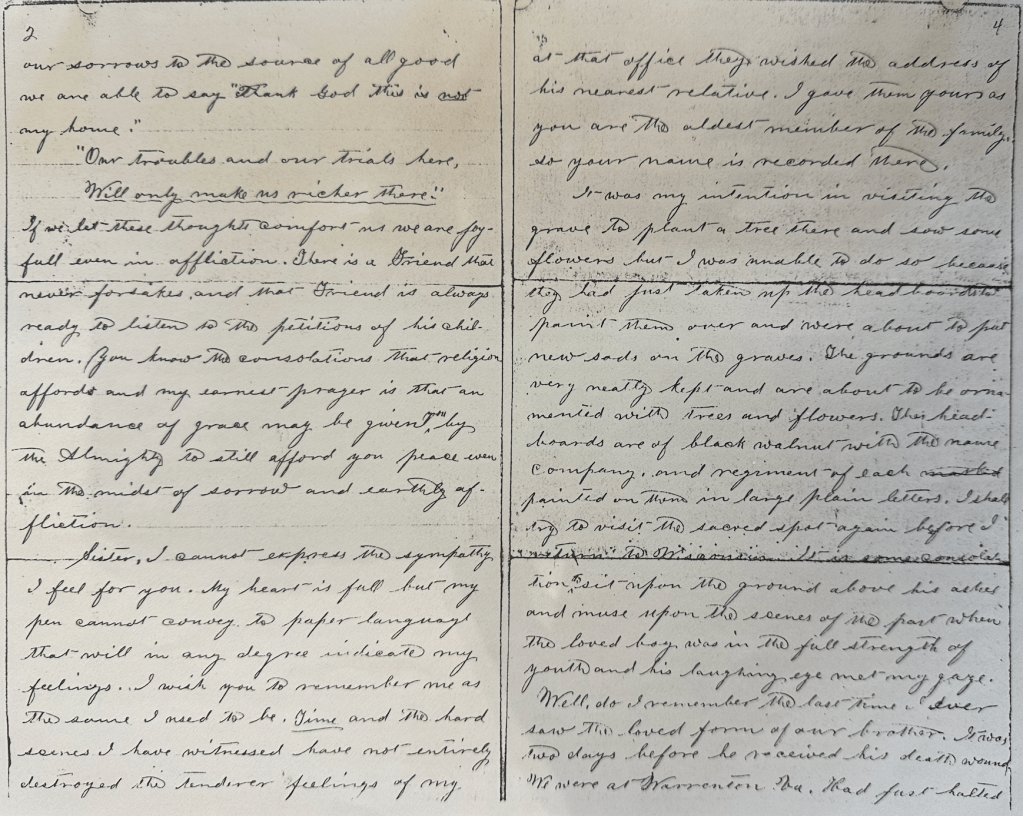
Your very affectionate and welcome letter was received late last evening and early this morning I seat myself to reply. I cannot express in words my thanks for the treasure it contains, for, my dear sister, the assurances of your remembrance and sisterly love awaking as it does emotions of the tenderest kind, is a treasure which cannot be over-prized. It was with deep sorrow that I read your account of your sickness as well as that of little Alice. Tis truly hard to be thus alone and in such affliction, and one comfort only can we have in such cases; that is the thought that this earth, this vale of sorrow, is not our final abode. If we look up through our sorrows to the source of all good, we are able to say, “Thank God this is not my home.”
“Our troubles and our trials here, Will only make us richer there.”
If we let these thoughts comfort us, we are joyful even in affliction. There is a Friend that never forsakes, adn that Friend is always ready to listen to the petitions of his children. You know the consolations that religion affords and my earnest prayer is that an abundance of grace may be given you by the Almighty to still afford you peace even in the midst of sorrow and earthly affliction.
“Time and the hard scenes I have witnessed have not entirely destroyed the tender feelings of my nature and my heart still beats with the same love toward my brothers and sisters that it did when we all met around the same fireside, and passed the hours in childish prattle, knowing nothing of the coldness of this world.”
— Elon F. Brown, 18 March 1864
Sister, I cannot express the sympathy I feel for you. My heart is full. But my pen cannot convey to paper language that will in any degree indicate my feelings. I wish you to remember me as the same I used to be. Time and the hard scenes I have witnessed have not entirely destroyed the tender feelings of my nature and my heart still beats with the same love toward my brothers and sisters that it did when we all met around the same fireside, and passed the hours in childish prattle, knowing nothing of the coldness of this world. Those days have flown but brighter ones are coming. O let us rejoice that we may yet meet and spend an eternity of bliss together.
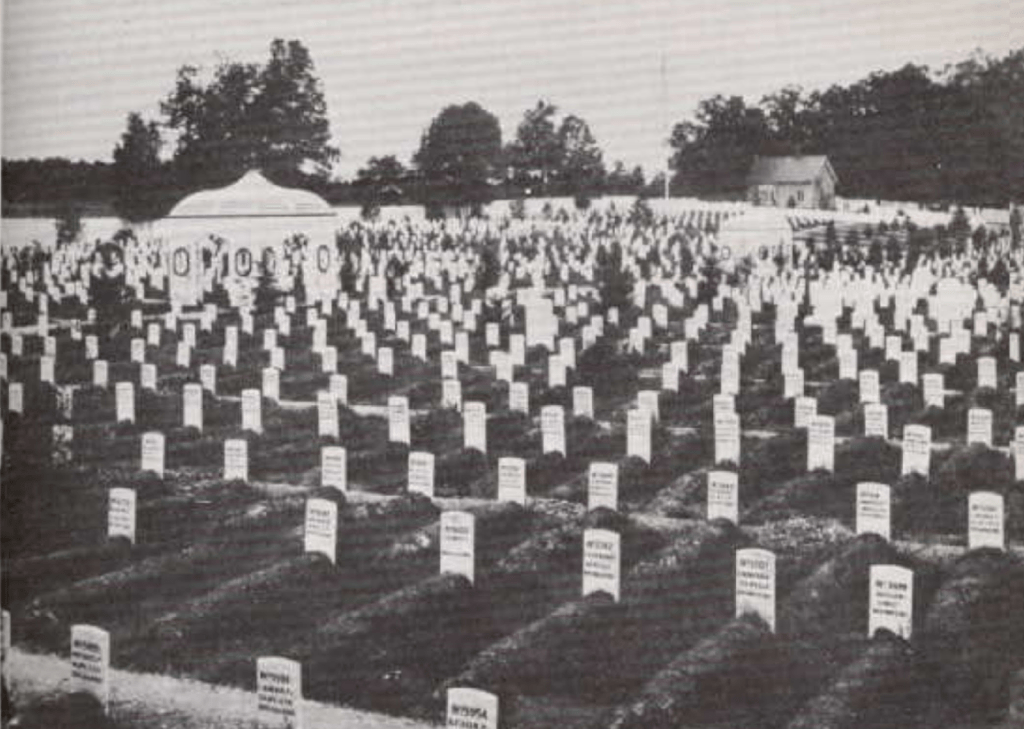
Since I last wrote you I have been to Washington where I spent six days. Nearly two days of that time I spent looking for the grave of our brother James. I at last found it and now have the number of it so that I can visit it again without trouble if I have an opportunity. He is buried in Grave No. 11, Range 2, Block 3 W at the Old Soldiers’ Home burial ground about three miles north of the Capitol at Washington D. C. I also got a certificate of his death and burial at the Burial REcord Office. In filling up the books at that office they wished the address of his nearest relative. I gave them yours as you are the oldest member of the family so your name is recorded there.
It was my intention in visiting the grave to plant a tree there and sow some flowers but I was unable to do so because they had just taken up the head boards to paint them over and were about to put new sods on the graves. The grounds are very neatly kept and are about to be ornamented with trees and flowers. Their headboards are of black walnut with the name, company, and regiment of each painted on them in large plain letters. I shall try to visit the sacred spot again before I return to Wisconsin. It is some consolation to sit upon the ground above his ashes and muse upon the scenes of the past when the loved boy was in the full strength of youth and his laughing eye met my gaze.
Well do I remember the last time I ever saw the loved form of our brother. It was two days before he received his death wound. We were at Warrenton, Virginia. Had just halted after a hard march of fifteen miles. We were then in the immediate presence of the enemy and for three days had been almost constantly skirmishing with them. You recollect it was on the “Pope Retreat.” As soon as we halted he came over where I was (his regiment was just across the road from mine) and we walked out to one side and had about half an hour’s conversation. The bugle sounded and we had to separate and hurry to our arms. We shook hands as we parted for we expected to move forward into battle immediately. I turned again and looked at him thinking, “shall I ever see him again?” He also turned again and looked at me and I doubt not his feelings were the same as mine. We had to hurry to our posts and our eyes never met again. Nor can they meet until the grave is opened and we rise clothed in the robes of heaven.
Your reference to the death scene when our sister passed away was touching [missing page]
My dear sister, I thought I had finished on the last half sheet but I think of a thousand things more to say and I must mention a few of them. My health is now pretty good and I shall leave the hospital by the middle of next week, I think. So when you get this, you may consider me as fit for duty. I may possibly be mistaken about going away and so you may direct your letter as before and if I am gone, it will be forwarded to me. I am now on the last three months of my three years term of service. That will soon be gone but whether I shall then return to Wisconsin, I can’t tell. I am very anxious to see you and all the rest of the family but you know I wish to go to school two or three years and I think I can do better in New England than Wisconsin and I have not money to spend in traveling for pleasure. I don’t know yet what I will do but must make up my mind soon. I received a letter from Robert last night. It was rather strange that I.. [missing page]
Pardon me for sending these scraps of paper. I thought I could finish on half a sheet but I could not. I have enough more to say to fill another sheet but here is enough to tire you out once. I hope you will be able to read it though it is poorly written. I shall write again in a few weeks. Let me hear from you soon again if possible.
View of the Soldiers’ Home National Cemetery in 1864 (Library of Congress)
This letter was written by Harvey Annis Smith (1836-1917), the son of Clement Smith (1794-1875) and Lucy Farnam (1794-1876) of Enfield, Grafton, New Hampshire. In 1857, Harvey was enrolled at the Kimball Union Academy. In 1860, at the age of 23, he was enumerated in his parent’s home in Enfield, his occupation given as “College Student.” By 1870, he had relocated to Wyanet, Bureau county, Illinois, and was employed as a school teacher. He was married by then to Alice Seville Jefferson (1843-1934). By 1880, the couple had relocated to Rushville, Schuyler county, Illinois where Harvey was employed as the high school principal. In 1900, the Harvey and Alice were residing in San Bernardino, California, and in the grocery business. He died in Santa Clara in 1917.
Book Cover, The Last Hurrah”
Harvey wrote the letter to Sally M. Merrill (1834-1909), the daughter of Joshua & Hannah Merrill of Bradford, Orange county, Vermont. In the 1860 US Census, she was enumerated in her father’s household and employed as a 26 year-old single school teacher. In 1867, she married Caleb J. Heath (b. 1815-Bef1900) and moved to Warren, Grafton county, New Hampshire.
The content of the letter pertains to the Price’s Missouri Expedition (sometimes called Price’s Raid) led by Confederate Gen. Sterling Price, known to his men and others as “Old Pap.” We learn from the letter that Harvey was employed by the Christian Commission and coincidentally entered Missouri at the same time that Price’s army turned westward up the Missouri River valley away from St. Louis, Harvey following in its wake. Though some of what Harvey relates to his friend Sally is hearsay, much of it was witnessed with his own eyes and ears.
Readers are referred to Kyle S. Sinisi’s book, The Last Hurrah, Sterling Price’s Missouri Expedition of 1864, which provides a comprehensive summary of the expedition.
Transcription
Warrensberg, MO. October 29, 1864
Miss Sally Merrill, Bradford, Vermont
My highly esteemed friend of the pleasant past,
As I have been chasing Price out of the state & had no convenient way to bring along writing materials, please excuse the pencil, and accept a few lines from one who ever kindly remembers you. Instead of teaching, I came to this department as a Delegate of the U.S. Christian Commission. I reached St. Louis a little before Price threatened that city and he passed by. Ever since, I have been just at his heels till I reached here—the terminus of the R.R. I had an order from Rosecrans for a government train to take my supplies through but as every train was overloaded, I came to a dead halt here. I have been waiting a week now for the arrival of a train & ambulance from St. Louis which will be here today. We shall then go first to Independence where we have one delegate doing what he can. Two delegates are going up the river with supplies on a boat dispatched for that purpose. What wounded are able to ride are to be brought to this place. This is Rosie’s [Rosecrans’] headquarters.
Pap [Price] marched through an extensive tract of country unobstructed when there were many chances of retarding his movement for days till our forces could have caught him. There was but one place that he could cross the Osage & a good chance to have blockaded him by felling trees. We had a large force at Jefferson City who lay in their entrenchments & let “Old Pap” go down into the bottom! cross over!! come up the steep, high, bank of the Osage!!! & then after he had chosen his ground & got all ready, sent out a small force to skirmish with him till Pap passed his wagon train of 400 heavily loaded wagons by!!! And the city was saved!!! If they had fought him on the river, they had their barracks to fall back into if it had been possible for them to cross. A. J. Smith was behind him with an immense force if he could have been held in check a day or two. Such has been the generalship all the way till they got to Independence.
But we have glorious news from them now. Marmaduke with 1500 of his men are expected to be marched through here tomorrow. You will have more particular news by telegraph ‘ere this reaches you so I will not particularize. I hope it will prove as complete a rout as Phil gave Longstreet. This raid has made many a strong secesh good Union men. You can have no conception of the desolation of the country. Nearly all the good horses & cattle were taken off by Price. Stores & houses cleaned out of all clothing & eatables, fields foraged till nothing is left for the inhabitants to live on. It took 40 good beeves per day to feed Price’s army, & when three times as many of our troops go over the same route, you may be assured that not much remains, though our army is fed mostly by rations brought from St. Louis, save the beef. Pap said he was going to fortify Boonville & winter there, but as soon as he had eaten all they had, he was off. I was in town the same day he left.
Missouri has the elements of self-destruction within itself, for unless they have foreign aid, they will depopulate their country. Everyone that ever had a grudge against another is bound to bushwhack him. Every summer the woods is full of such men. No citizen knows when he goes out from home whether he will live to get home again & when he retires at night, it is with the fear that he will be killed before morning. Such terror only the people of the border states know. Many try to be friendly to both sides & find but little favor any while, whilst others are decided & will fight at any odds. One instance occurred at Sedalia where I stopped two days. A young man living there was arrested by the Rebels when they were there. Three of them undertook to take him because he was said to favor the Federals, but he shot two of them and wounded the third. Some others then came up & shot him & after he fell, he raised up & wounded another with his revolver. Night before last, a Union man fired upon a party of 15 Union men with desperation because they told him they were confederates. It was dark & he could not see who they were. Even if he could, about half of the Rebs are now dressed in Federal uniforms.
I don’t know what will be done with such prisoners as there are so many of them. It is General Rosecrans’ order that they be shot according to rules of war. Our army take no guerrillas now unless it be to torture them as our men receive no mercy from them. One of them by name of Cole was arrested by the 45th Missouri troops. He cut a major’s throat and got away but was soon retaken. He said he had killed 30 men & two women & wanted to live to kill 4 more among whom was a brother & a sister. They run a bayonet through his side & legs & bruised his head with their muskets and then hung him. The boys were so enraged they wanted to give him all the misery they could. It takes the southern soldiers for revenge. When Bill Anderson destroyed the train on the Northern Missouri R.R., he took Major Johnson & 124 men & shot them all but one who got away though wounded. [See Centralia Massacre]
Some guerrilla barbarity occurs nearly every day. The Northern people know but little of the real horror the people here have continually from fear. I have seen none of the barbarities with my own eyes yet, nor have I been assailed by any rebels, but I like to have got shot yesterday by a Union soldier. The ball passed within a few inches of my ear about as high as my ear but it was not intended for me I presume. Soldiers are often careless. I expect to go back to Illinois in about two weeks & hope to receive a letter from you then. I have not received a letter for two months & have given up the idea of getting any here.
The college building at Henry was still at my acceptance when I left Illinois but I fear it is too big an undertaking for me alone. They waited till very late at Tiskilwa to see if I would not conclude to come back. I don’t know what I shall go at when I get back. I have some notion of going on another trip farther south. If I do not now, I presume I may next year if the war don’t close before. I have come to the belief that Old Abe is far preferable to the Chicago platform. Yours in true friendship—Harvey A. Smith, Tiskilwa, Illinois
The following letter was written by Charles Wilber (1840-1922) who mustered into Co. G, 1st Michigan Cavalry, in September 1861 when he was 20 years old. Charles was residing in Pontiac before he enlisted. He enlisted as a private and mustered out as a sergeant in 1865.
Sixth Plate Ambrotype of Richard Alcott of Co. L, 1st Michigan Cavalry. He was KIA at Battle of Cedar Mountain in August 1862. (Seth Goodhart Collection)
Charles’ 1922 death certificate (Reno, Nevada) states that his father’s name was Herman Wilber but I believe that it was Hiram or Horace (b. 1805) and his mother’s name was Malinda Roberts. The vital information on Malinda’s death was provided by Sanford H. Wilber (1833-1917)—the oldest child of the family and the one to whom Charles addressed this letter. In 1860, Charles lived with his parents at White Lake, Oakland county, Michigan in 1860. Sanford was married to Lucretia Jane Downer (1829-1901). At the time of this letter, Sanford was working at a sawmill in Oakland county, Michigan.
Charles mentions another brother in this letter named William. William Wilber (1838-1862) enlisted as a private in Co. F, 1st Michigan Infantry and was killed on 30 August 1862 at the 2nd Battle of Bull Run.
[This letter is from the personal collection of Greg Herr and was made available for transcription and publication on Spared & Shared by express consent.]
Transcription
Charleston, Virginia March 3, 1862
Well, Sanford, I once more write to you to let you know my welfare. We crossed the [Potomac] river last week and stayed one night in Harper’s Ferry and then we came down to Charleston in the morning. There was some rebel troops here but we soon put them to flight and took possession of the town and captured one horse from them. We have been staying here ever since. We have been out scouting every day. The first day (that was the day we came here) we took 50 barrels of flour and 10 horses, two wagons and drivers, and then at night they drove in our pickets and took two of our men of our company. Then the next day we took two more of their men and horses and they got one of our horses. And yesterday we took one man. He was in a farm house. We surrounded it and took him out and have him in jail. It makes the people stare when we go into the houses after the men.
We don’t have much time to write and if we had, there has not been any mail here till yesterday. The people here are hard up for groceries. There has not been any here since last June. Everything that they have to eat is eaten without salt. We have lived right well since we came here. Our flour that we took and their bakery and we run that and there is a good supply of poultry here and then we have a hog and a sheep once and a while and sometimes twice in a while.
Well, I’ll be damned if I feel like writing this morning. I don’t see what is the reason for I feel as well as I ever did in my life and there is enough to write about. But somehow or other I don’t feel like writing. You can see that by the way I write.
I guess William is sick of his bargain by the way he writes. There has been some talk of their regiment coming here. I hope they will and then I could cheer him up for I think he is rather down at the mouth and I don’t blame him for it for if we had stayed at Washington till this time, I should have been dead for it is a sickly hole there [even] if the President does live there. There is no place like this for we have everything our own way and no one to opoose us. I like it better than I did at Harper’s Ferry for there was not any chickens there for the people had all left. There is not seven families in the whole place on this side of the river.
I wish you would send me some envelopes for there is not any here and my things all got stole on the raid here. Joe Robert Bachman and myself had ours in a box and the box was broke open and taken out—all our shirts and stockings. All we have left is what we have on our backs. But we will not suffer for there is enough here and I’ll have some of them. If I don’t, I’ll lose my guess. Well, I have written about enough for this time. You must write often and I write as often as I can.
Direct the same as before and they will be sent on here or anywhere that we go. No more at present. I remain your affectionate brother, — Charles Wilber
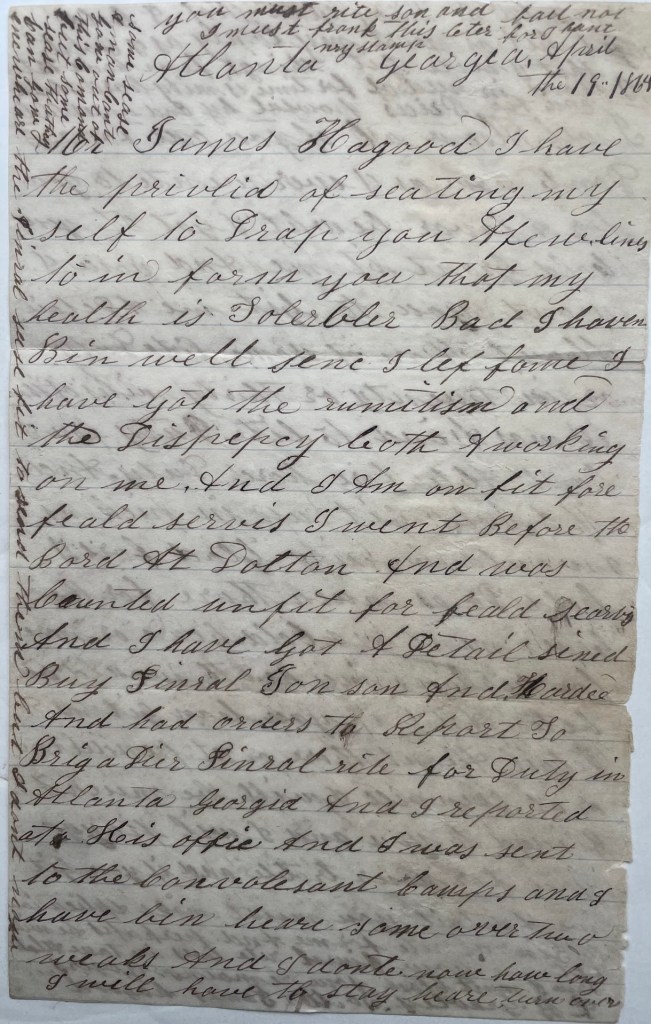
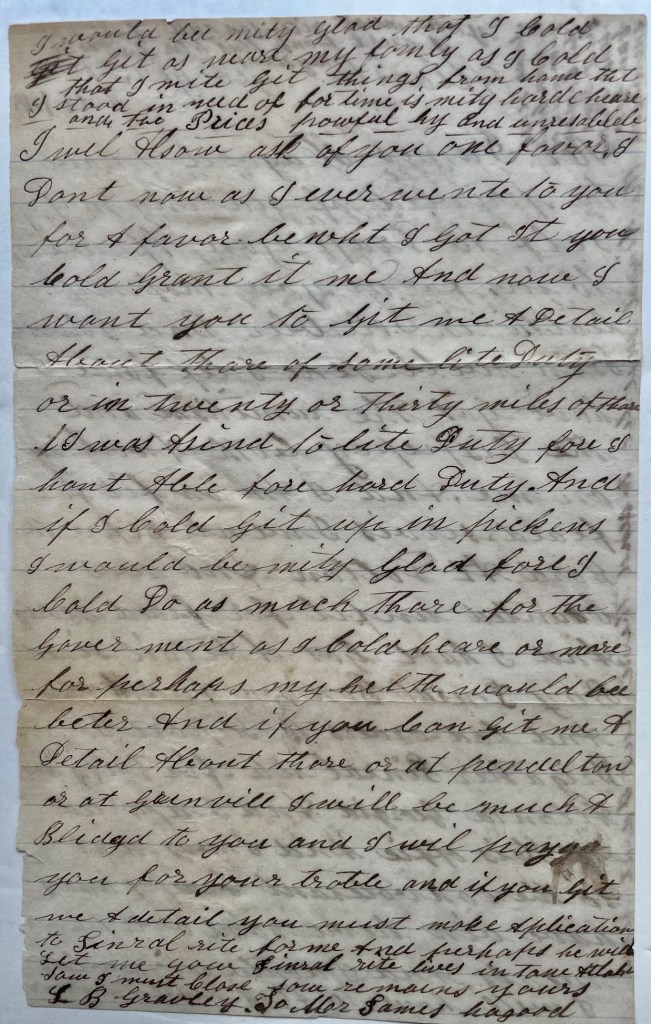
The following letter was written by Luntford Ballenger Gravley (1829-1922) of Twelve Mile, Pickens, South Carolina. He was the son of Joseph Lontford Gravely (1803-1886) and Mary Elizabeth Ann Gilstrap (1810-1874). He was married in 1854 to Naomi Winchester (1834-1924).
During the Civil War, Luntford enlisted as a private in Ferguson’s Co. Light Artillery in April 1863. On 2 April 1864 at Dalton (as stated in his letter), he was determined to be unfit for field service and ordered to report to Gen. [Ambrose] Wright in Atlanta.
The letter was written to James Earle Hagood (1826-1904) in Pickens. In 1856, Hagood was elected the clerk of the circuit court in Pickens District and he held the position until 1868 when the district was divided. He became a lawyer and a cotton grower.
[Note: This letter is from the personal collection of Greg Herr and was offered for transcription and publication on Spared & Shared by express consent.]
Transcription
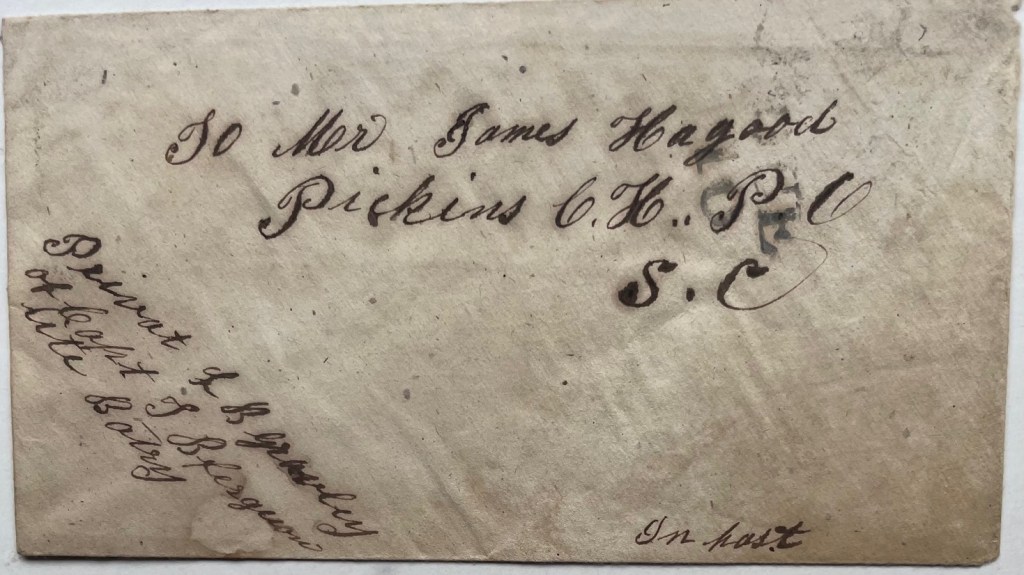
Addressed to Mr. James Hagood, Pickins Court House, South Carolina
Atlanta, Georgia April 19, 1864
Mr. James Hagood,
I have the privilege of seating myself to drop you a few lines to inform you that my health is tolerable bad. I haven’t been well since I left home. I have got the rheumatism and the dyspepsia both a working on me and I am unfit for field service. I went before the board at Dalton and was counted unfit for field service and I have got a detail assigned by General Johnston and Hardee and had orders to report to Brigadier General Wright for duty in Atlanta, Georgia. And I reported at his office and I was sent to the Convalescent Camps and I have been here some over two weeks and I don’t know how long I will have to stay here. I would be mighty glad that I could get as near my family as I could that I might get things from home that I stood in need of for times is mighty hard here and the prices powerful high and unreasonable.
I will now ask of you one favor, I don’t know as I ever went to you for a favor but what I got it. You could grant it me. And now I want you to get me a detail about there of some light duty or in twenty or thirty miles of there. I was assigned to light duty for I han’t able for hard duty. And if I could get up in Pickens, I would be mighty glad for I could do as much there for the government as I could here or more for perhaps my health would be better. And if you can get me a detail all out there or at Pendleton or at Greenville, I will be much obliged to you and I will pay you for your trouble. And if I get me a detail, you must makke application to General Wright for me and perhaps he will let me go. General Wright lives in town Atlanta.


















 Spared & Shared 23