
The following letter was written by John B. Martin who served as the clerk of the court of Pleas and Quarter Sessions for Montgomery county, North Carolina, in the 1830s. I could find very little else about him. Ironically, this letter may tell us more about him and his political beliefs than any other existing document. He wrote the letter to an old friend, John McNeill, of Washington, Alabama.
Martin’s opening is deeply personal and nostalgic, but he quickly launches into politics which forms the heart of the letter. The election results he reports reflect local and state political contests in North Carolina during the era of President Andrew Jackson. Martin identifies himself as generally Democratic and originally supportive of Jackson, but he strongly criticizes several of Jackson’s actions. These include Jackson’s frequent firing and replacing of officeholders (the “spoils system”), his attacks on John C. Calhoun, and especially Jackson’s removal of federal bank deposits during the Bank War. He also condemns Jackson’s “protest to the Senate,” referring to Jackson’s constitutional clash with Congress in 1834.
One of the most revealing parts of the letter is Martin’s defense of “states’ rights” and partial sympathy toward nullification. Nullification was the controversial idea, advanced mainly by South Carolina politicians like Calhoun, that states could reject federal laws they believed unconstitutional. Martin argues that nullification had done good by restraining the federal government and “northern mad men,” showing early sectional tensions between North and South decades before the Civil War. Although he stops short of radical extremism, he clearly fears centralized federal power and executive overreach. This reflects a growing Southern political identity in the Jacksonian era.
Martin also harshly criticizes Martin Van Buren, calling him a manipulative political schemer who had misled Jackson. His comments show divisions even within Jackson’s own Democratic coalition.
[Editor’s Note: My thanks to Abbey Weber Jones who prepared the first draft of this transcript for Spared & Shared.]
T R A N S C R I P T I O N
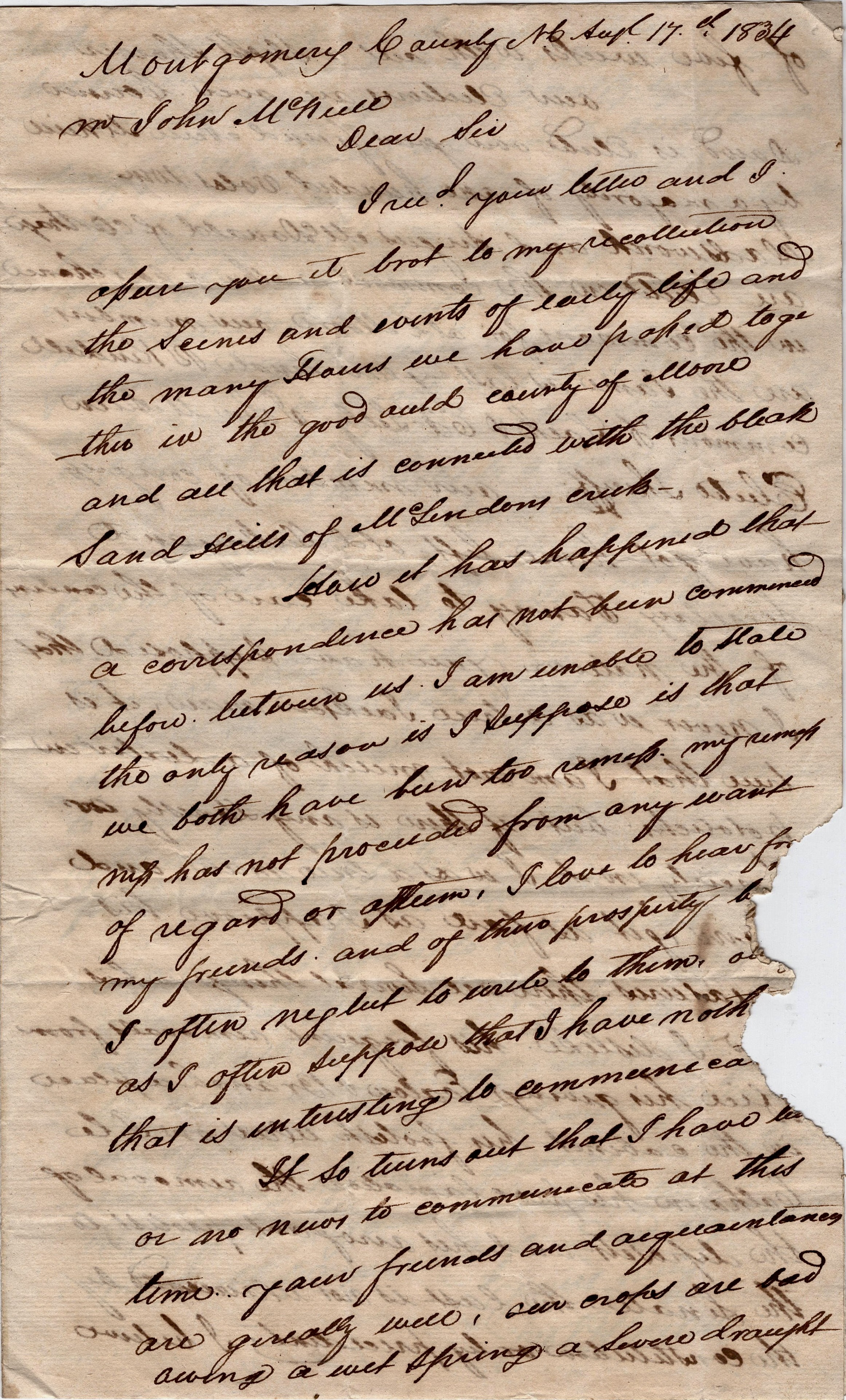
Montgomery County, North Carolina
Aug 17th 1834
Mr John McNeill,
Dear Sir, I received your letter and I assure you it brought to my recollection the scenes and events of early life and the many hours we have passed together in the good old county of Moore and all that is connected with the bleak Sand Hills of McLendon’s creek.
How it has happened that a correspondence has not been commenced before between us I am unable to state. The only reason, I suppose, is that we both have been too remiss. My remissness has not proceeded from any want of regard or esteem. I love to hear from my friends and of their prosperity but I often neglect to write to them as I often suppose that I have nothing that is interesting to communicate.
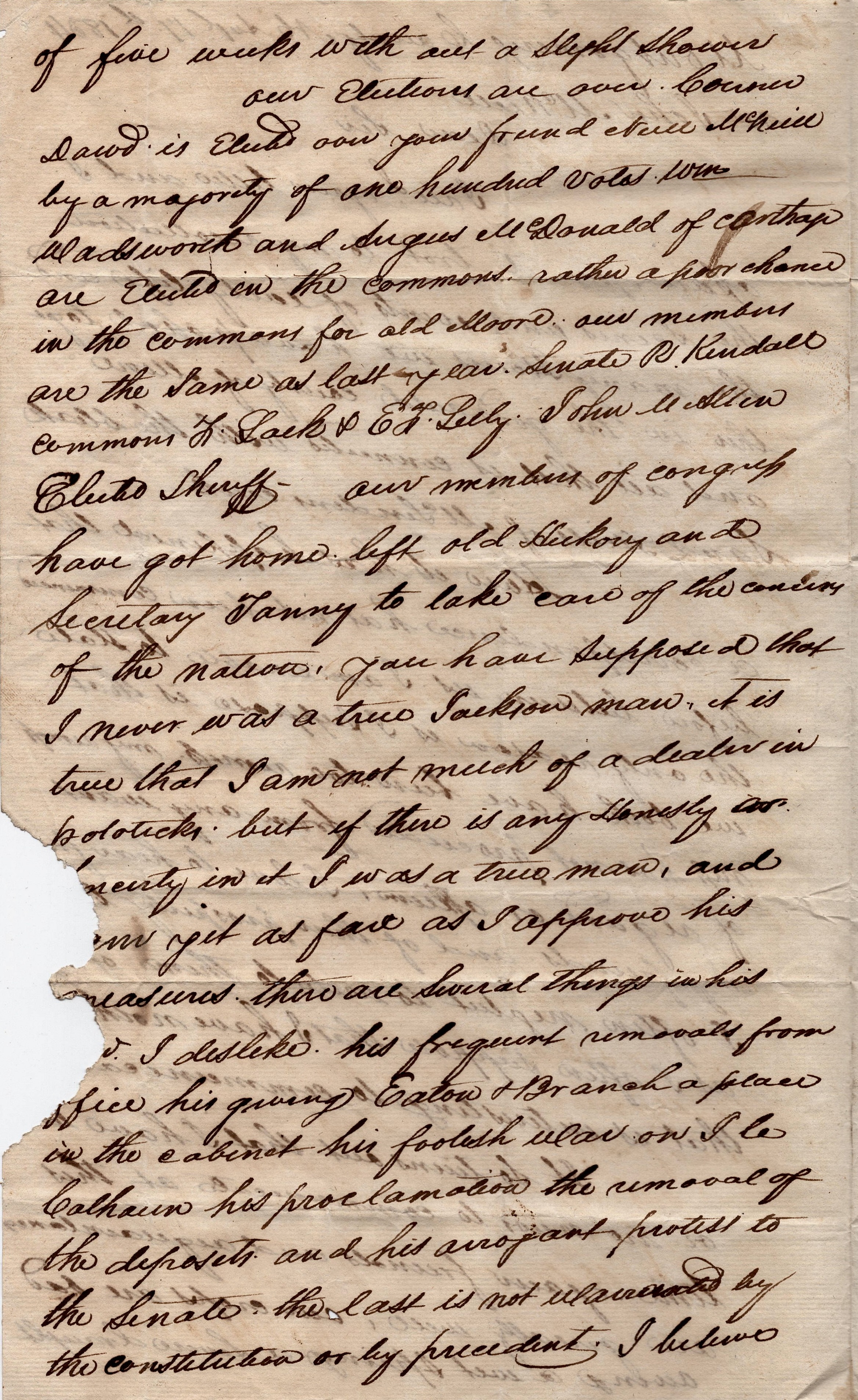
It so turns out that I have little or no news to communicate at this time. Your friends and acquaintances are generally well. Our crops are bad owing [to] a wet spring [and] a severe drought of five weeks without a slight shower.
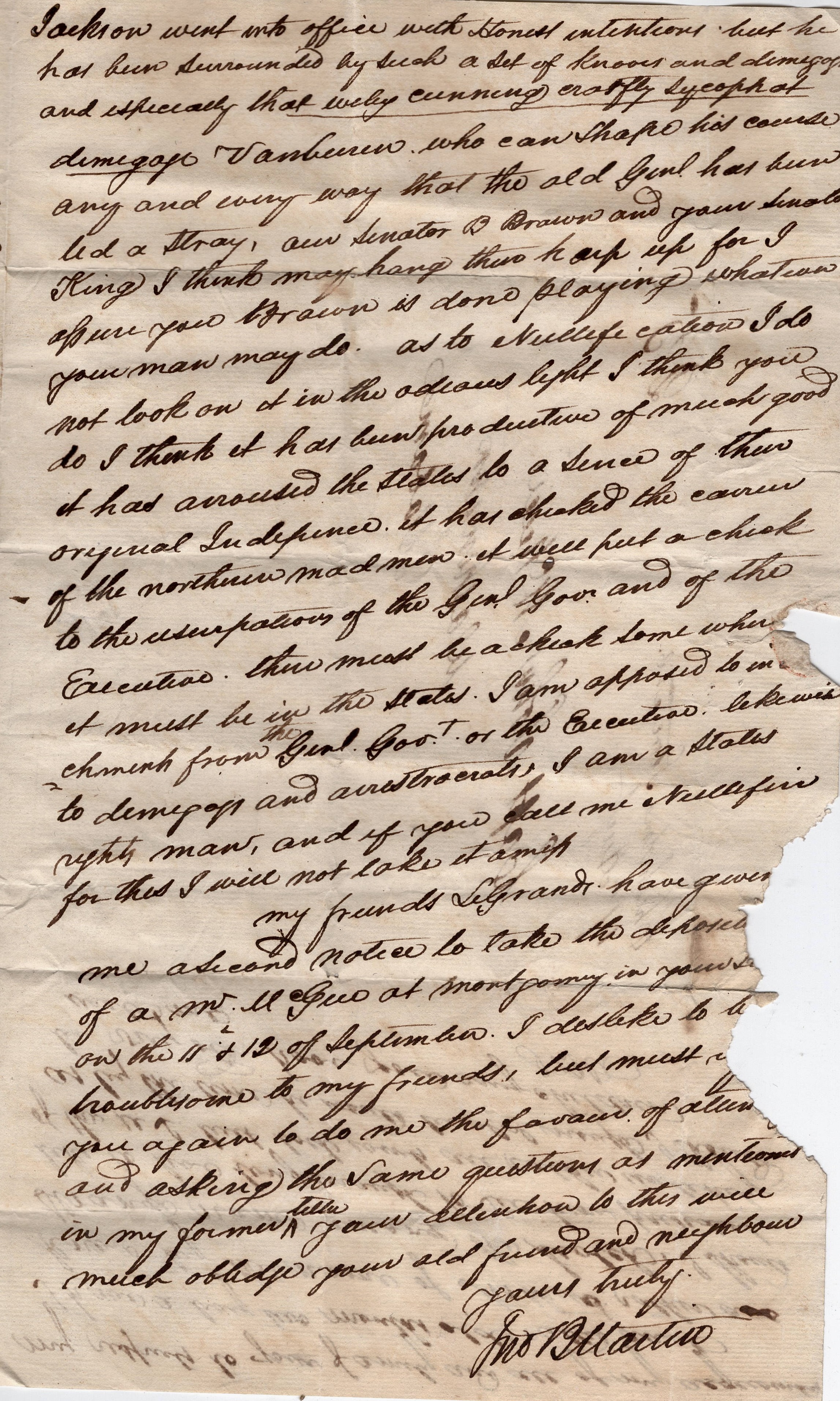
Our elections are over. Connor Dowd is elected over your friend Neill McNeill by a majority of one hundred votes. Wm. Wadsworth and Angus McDonald of Carthage are elected in the commons. Rather a poor chance in the commons for old Moore. Our members are the same as last year. Senate R[euben] Kendall, commons, F. Lack + E. F. Seely, John M. Allen elected Sheriff. Our members of Congress have got home [and] left Old Hickory [Andrew Jackson] and Secretary Tanny [Roger B. Taney] to take care of the concerns of the nation. You have supposed that I never was a true Jackson man. It is true that I am not much of a dealer in politics, but if there is any honesty or sincerity in it, I was a true man and Dem[ocrat] yet as far as I approve his measures. [But] there are several things in his [paper torn] I dislike—his frequent removals from office, his giving [John] Eaton & [John] Branch a place in the cabinet, his foolish war on J. C. Calhoun, his proclamation [for] the removal of the deposits, and his arrogant protest to the Senate. The last is not ________ted by the constitution or by precedent. I believe Jackson went into office with honest intentions but he has not been surrounded by such a set of knaves and demagogs—and especially that wily, cunning, crafting sycophant demagogue [Martin] Van Buren who can shape his cause any and every way that the old General has been led astray.
Our senator B[edford] Brown and your Senator [William Rufus] King I think may hang their harp up for I assure you, Brown is done playing whatever your man may do. As to nullification, I do not look on it in the odious light I think you do. I think it has been productive of much good. It has aroused the states to a sense of their original Independence. It has checked the career of the northern mad men. It will put a check to the usurpations of the general government and of the Executive. There must be a check somewhere and it must be in the states. I am opposed to encroachment from the general government or the Executive. Likewise to demagogues and aristocrats. I am a states rights man, and if you call me nullifier for this, I will not take it amiss.
My friends LeGrand have given me a second notice to take the deposition of a Mr. McGee at Montgomery in your state on the 11th & 12th of September. I dislike to be troublesome to my friends, but must ask you again to do me the favor of attending and asking the same questions as mentioned in my former letter. Your attention to this will much oblige your old friend and neighbor. Yours truly, — Jno B. Martin
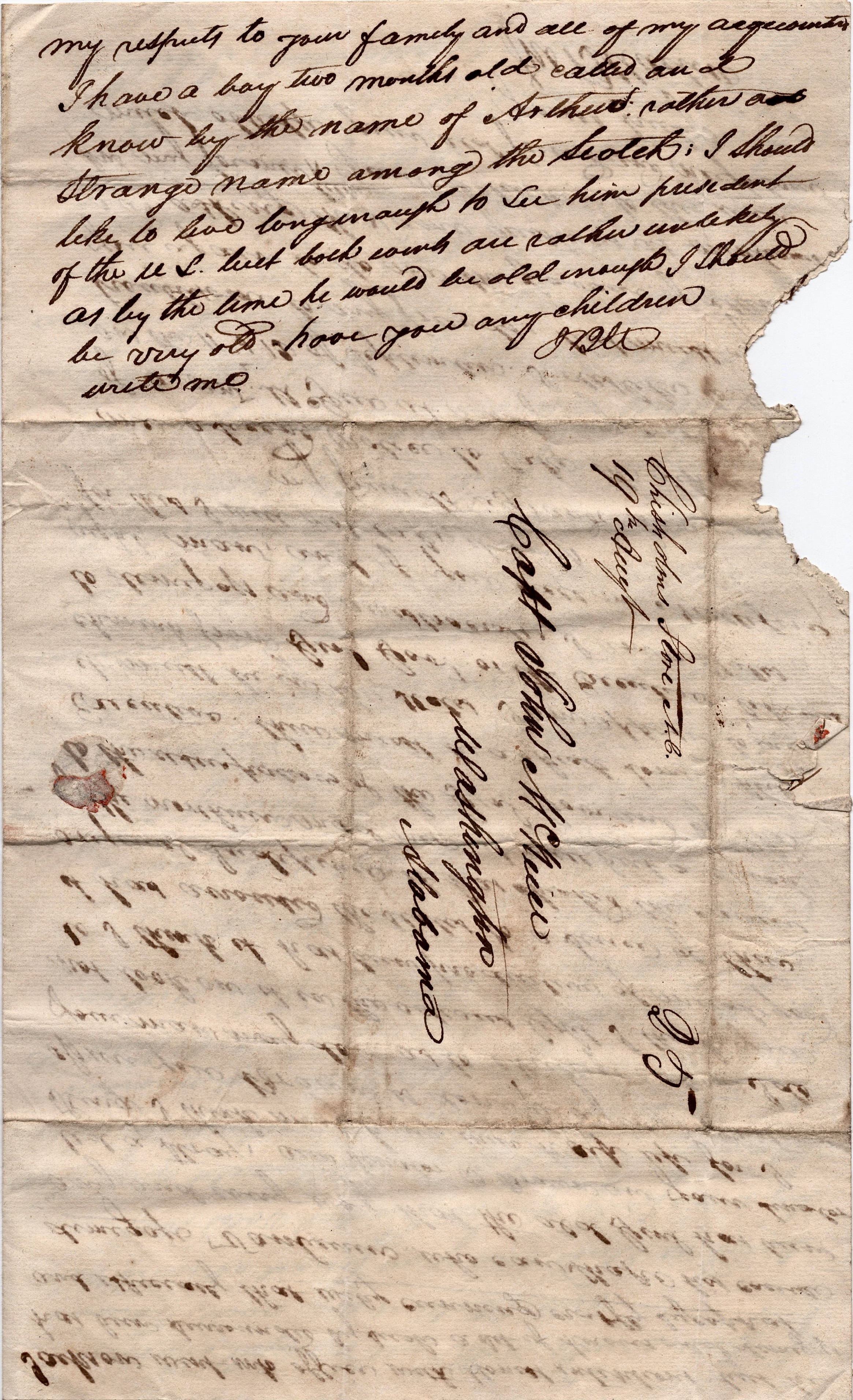
My respects to your family and all of my acquaintances. I have a boy two months old called and know[n] by the name of Arthur—rather a strange name among the Scotch. I should like to live long enough to see him President of the U. S. but both wants are rather unlikely as by the time he would be old enough, I should be very old. Have you any children? Write me. — J. B. M.