
The following nine letters were written by Edmund A. Blackmar (1841-1873), the son of Joseph Blackmar (1788-1874) and Mahala Munyan (1797-1862) of Thompson, Windham county, Connecticut. Edmund enlisted in January 1862 to serve as a private in Co. E, 13th Connecticut Infantry. He was quickly promoted to corporal. On 21 May 1863 he was taken prisoner at Washington, Louisiana, but was quickly paroled, and mustered out on 6 January 1865 after three years service. After the war, he settled in Thompson where he became a merchant but died in 1873 at the age of 32. Military records generally spell his given name as “Edmond” but his signature and cemetery records spell it Edmund. He was married to Olive Salyes (1844-1916) after the war.
Edmund’s correspondence provides limited insight into the conflict in Louisiana; however, it reveals that despite his assertion that his “spirits remained high,” his enthusiasm for the war had significantly waned after three years of service. In his letter dated 12 July 1864, he expressed his eagerness to leave the army, stating he yearned for a place where he could live in peace and retirement, free from the cacophony of the bugle and drum, viewing the uniformed soldiers with a sense of disdain and abhorrence. He candidly remarked that he held little regard for the war itself. Additionally, it is noteworthy that he admired Gen. George B. McClellan, a surprising sentiment considering he had never served under his command. During his tenure with the regiment, they were deployed in Louisiana within the Department of the Gulf, and by 1864, they had become part of Gen. Sheridan’s Army of the Shenandoah.
Most of these letters were directed to Edmund’s older brother, Lemuel K. Blackmar (1819-1900) who was a miller in Thompson, Connecticut. Throughout his letters, Edmund enquires about his older brother William Blackmar who served in the 11th Connecticut Infantry, Co. G. William entered the service in November 1861 and was mustered out on 4 December 1864. He was wounded on 9 May 1864 at Swift’s Creek, Virginia. Like Edmund, he entered the service as a private and mustered out as a corporal.
Letter 1
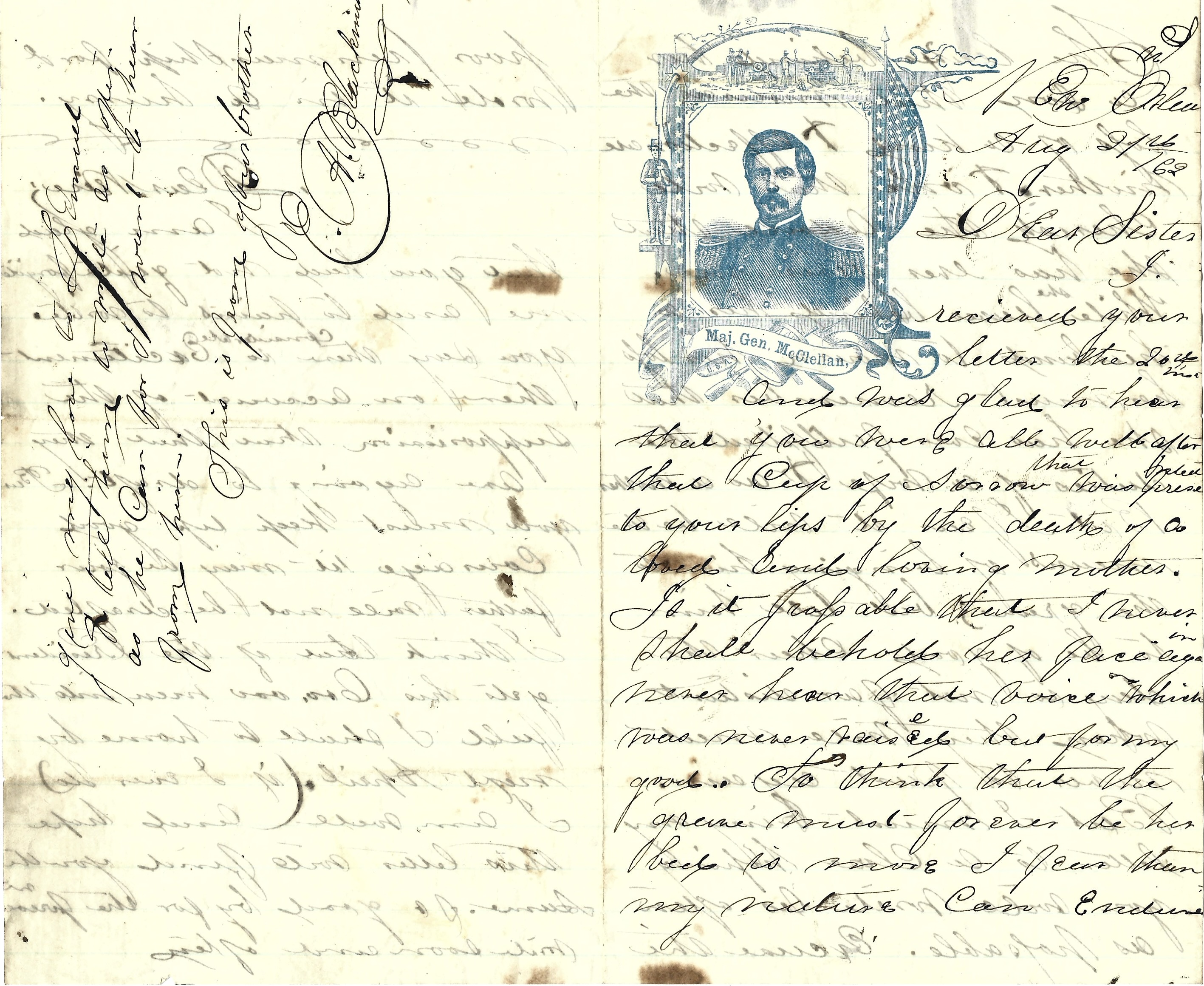
New Orleans
August 21, 1862
Dear Sister,
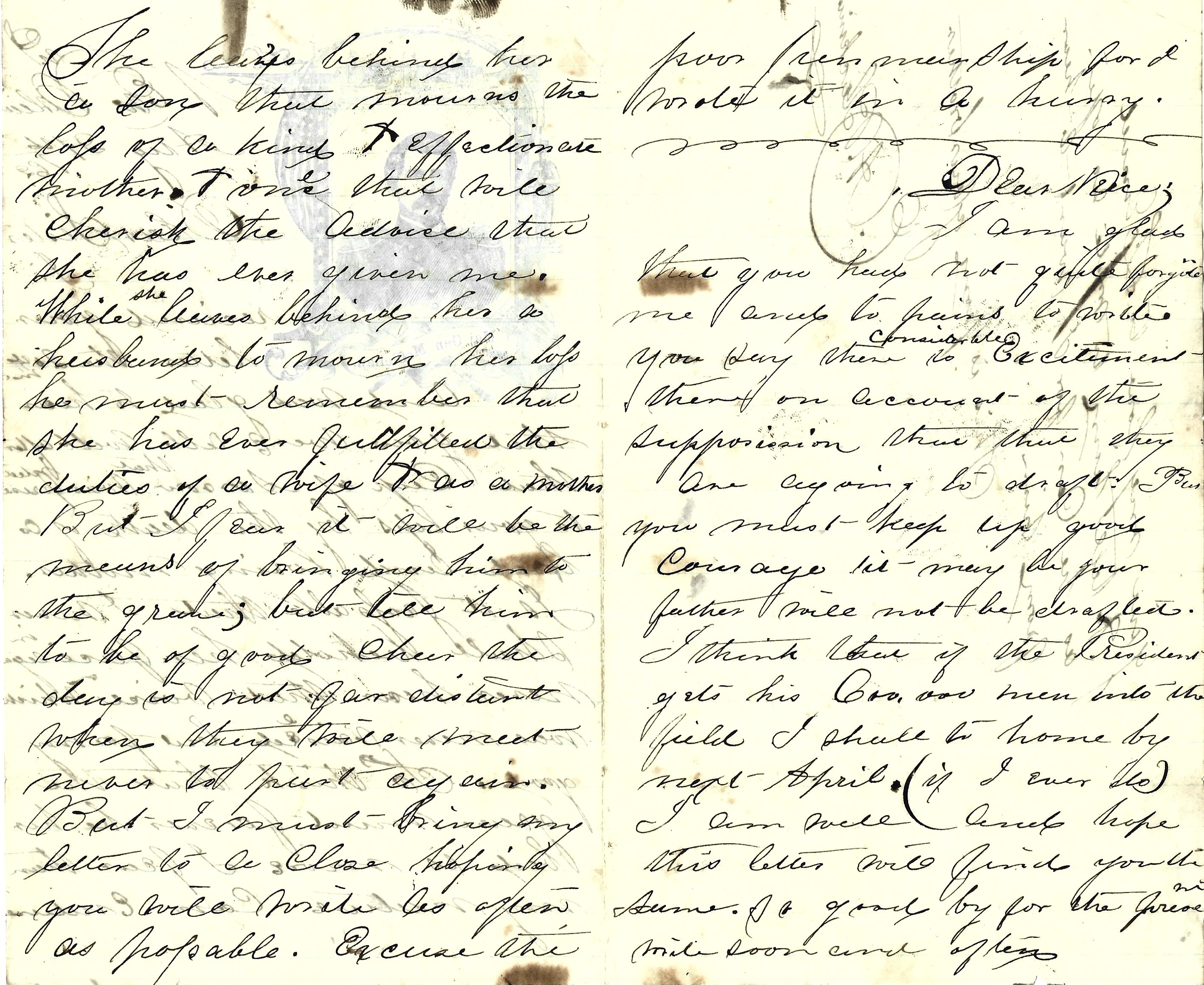
I received your letter the 20th inst. and was glad to hear that you were all well after that cup of sorrow that was presented to your lips by the death of a loved and loving mother. Is it possible that I never shall behold her face again, never hear that voice which was never raised but for my good. To think that the grave must forever be her bed is more I fear than my nature can endure. She leaves behind her a son that mourns the loss of a kind and affectionate mother and one that will cherish the advice that she has ever given me. While she leaves behind her husband to mourn her loss, he must remember that she has ever fulfilled the duties of a wife and as a mother. But I fear it will be the means of bringing him to the grave; but tell him to be of good cheer. The day is not far distant when they will meet never to part again.
But I must bring my letter to a close hoping you will write as often as possible. Excuse the poor penmanship for I wrote it in a hurry.
Dear Niece, I am glad that you had not quite forgotten me and took pains to write. You say there is considerable excitement there on account of the supposition there that they are agoing to draft. But you must keep up good courage. It may be your father will not be drafted. I think that if the President gets his 600,000 men into the field, I shall be home by next April (if I ever do). I am well and hope this letter will find you the same. So goodbye for the present. Write soon and often.
Give my love to Lemuel & tell him to write us often as he can for I want to hear from him. This is from your brother, — E. A. Blackmar
Letter 2
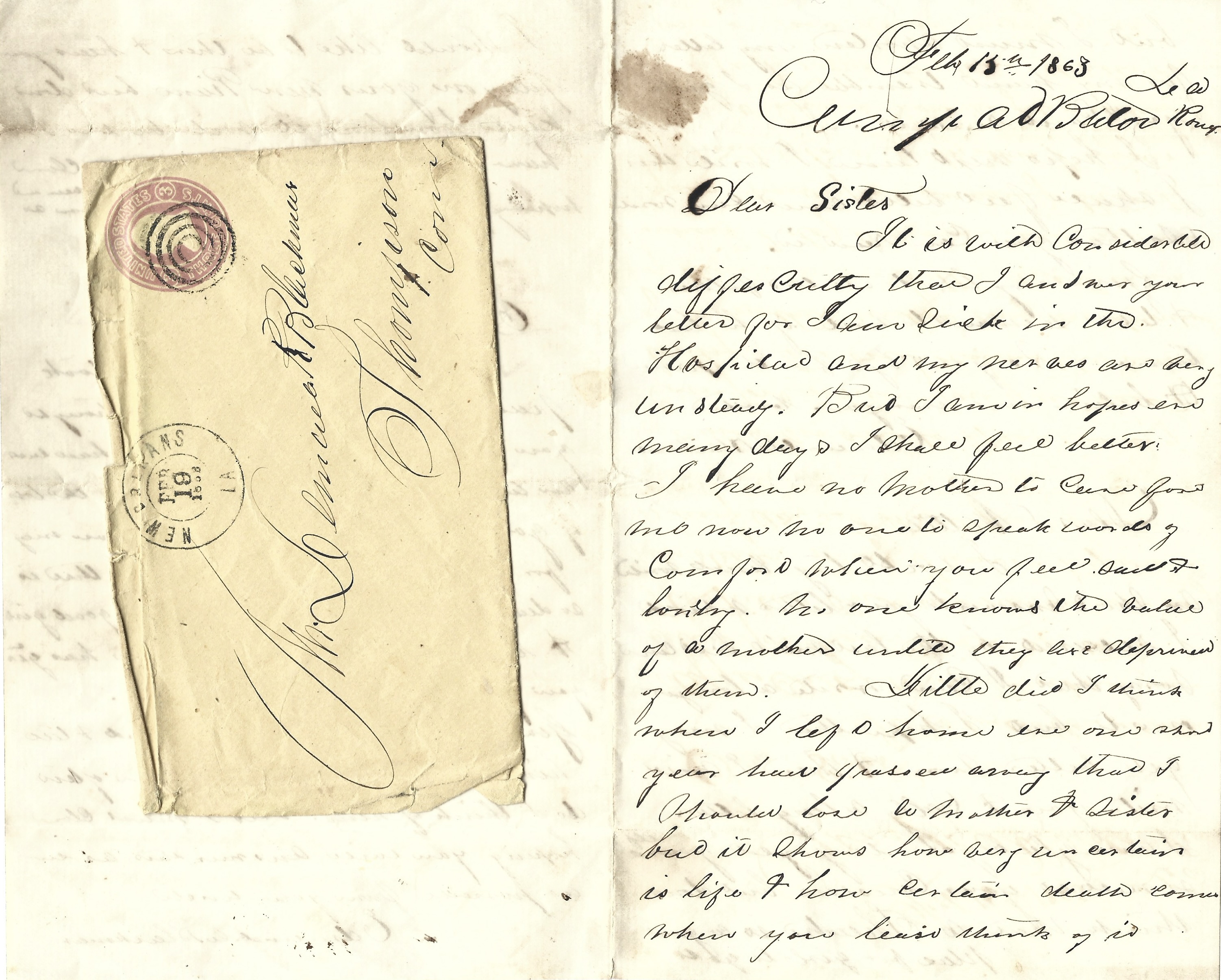
Camp at Baton Rouge, La.
February 15th 1863
Dear Sister,
It is with considerable difficulty that I address your letter for I am sick in the hospital and my nerves are very unsteady. But I am in hopes ere many days I shall feel better.
I have no mother to care for me now—no one to speak words of comfort when you feel sad and lonely. No one knows the value of a mother until they are deprived of them. Little did I think when I left home ere one short year had passed away that I should lose a mother and sister. But it shows how very uncertain is life and how certain death comes when you least think of it.
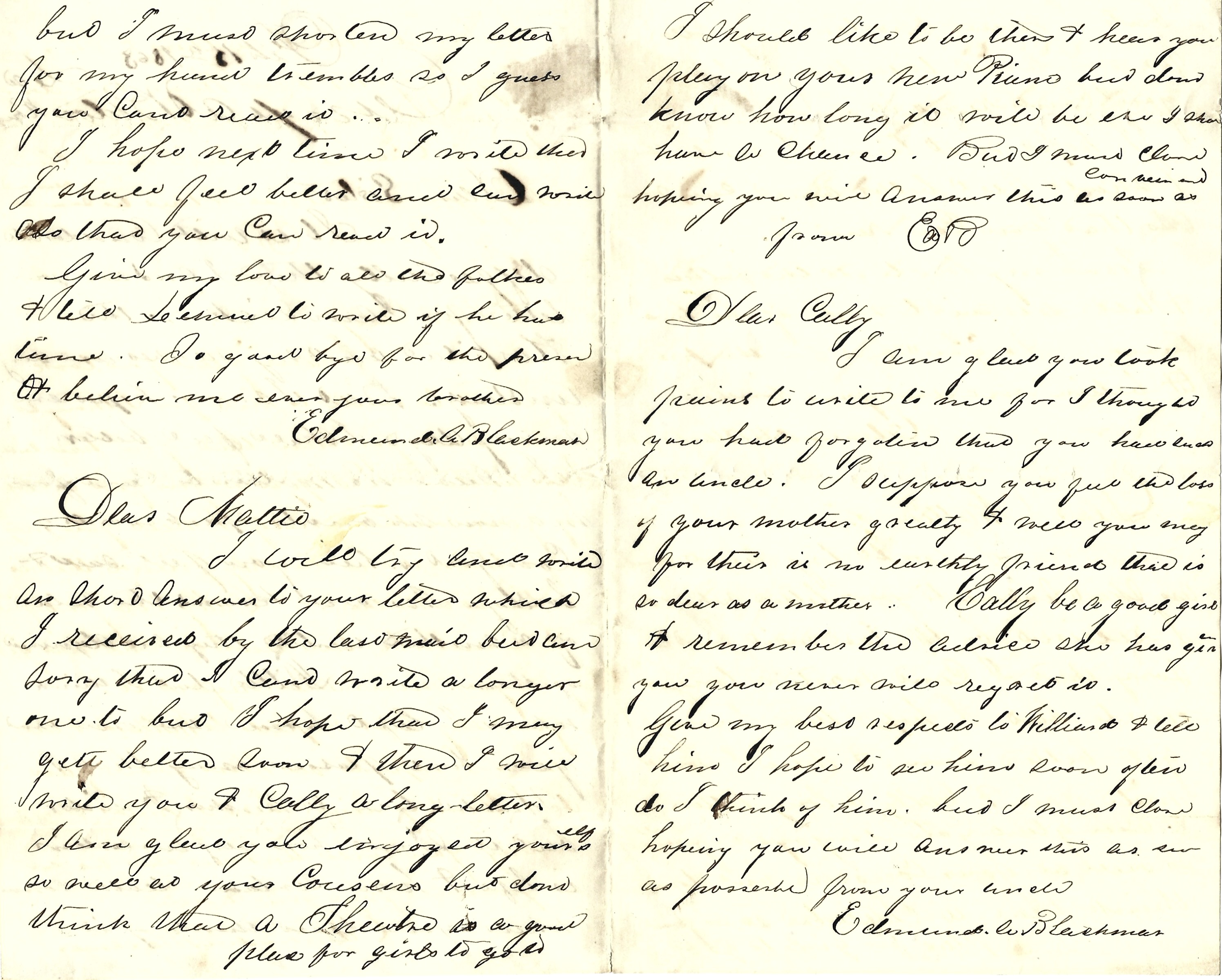
But I must shorten my letter for my hand trembles so I guess you can’t read it. I hope next time I write that I shall feel better and can writes to that you can read it. Give my love to all the folks and tell Lemuel to write if he has time. So goodbye for the present. Believe me ever your brother, — Edmund A. Blackmar
Dear Mattie,
I will try and write a short answer to your letter which I received by the last mail, but am sorry that i can’t write a longer one to [you] but I hope that I may get better soon and then I will write you & Cally a long letter. I am glad you enjoyed yourself so well at your cousins but don’t think that a theatre is a good place for girls to go to. I should like o be there & hear you play on your new piano but don’t know how long it will be ere I should have a chance. But I must close hoping you will answer this as soon as convenient. From Ed. B.
Dear Cally, I am glad you took pains to write to me for I thought you had forgotten that you had such an uncle. I suppose you feel the loss of your mother greatly and well you may for there is no earthly friend that is so dear as a mother. Cally, be a good girl and remember the advice she has given you—you never will regret it. Give my respects to Wiliard and tell him I hope to see him soon. Often do I think of him. But I must close hoping you will answer this as soon as possible. From your uncle, — Edmund A. Blackmar
Letter 3
New Orleans [Louisiana]
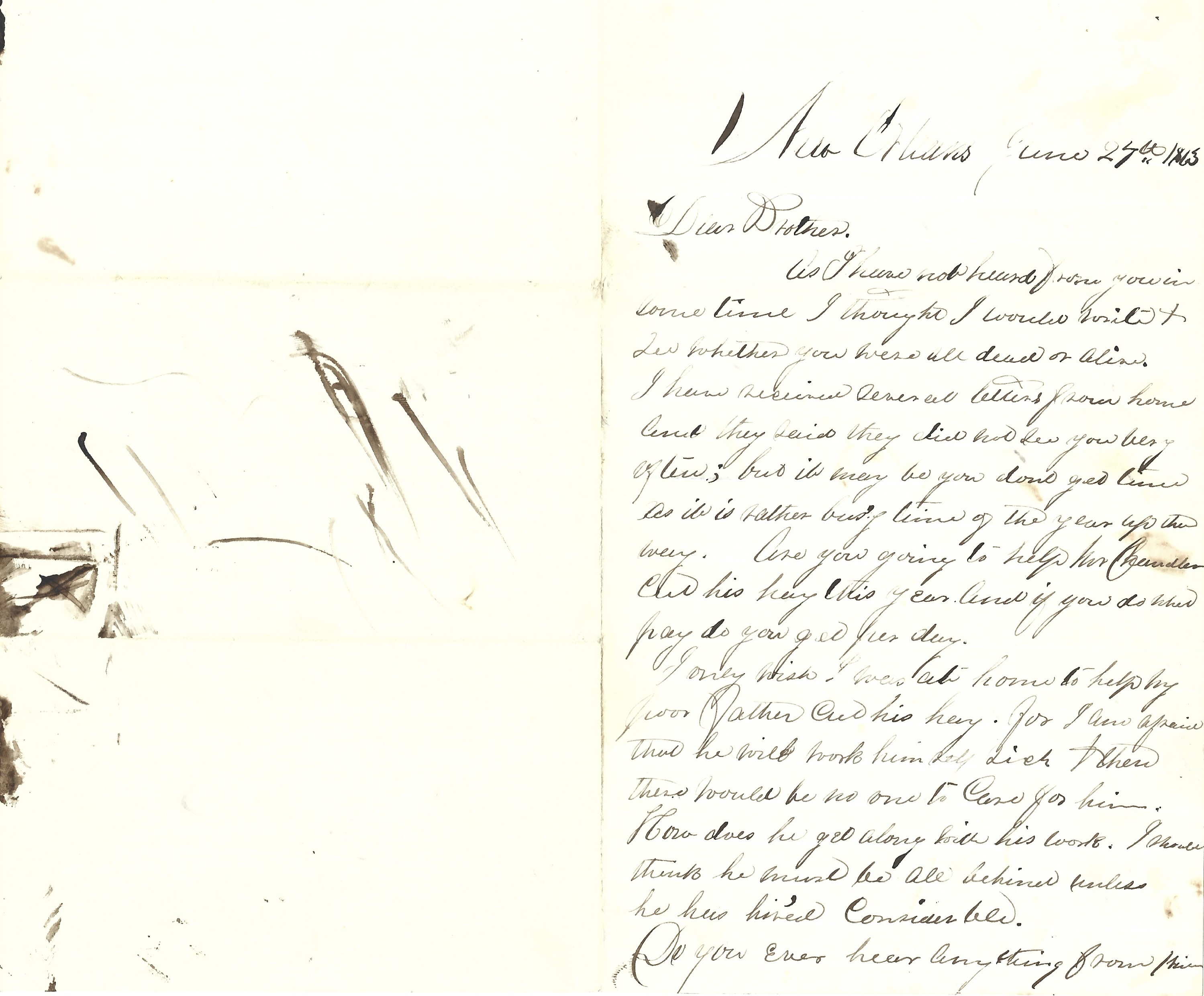
June 27th 1863
Dear Brother,
As I have not heard from you in some time, I thought I would write & see whether you were all dead or alive. I have received several letters from home and they said they did not see you very often, but it may be you don’t get time as it is [a] rather busy time of the year up that way. Are you going to help Mr. Chandler cut his hay this year? And if you do, what pay do you get per day?
I only wish I was at home to help my poor father cut his hay for I am afraid that he will work himself sick & then there would be no one to care for him. How does he get along with his work? I should think he must be all behind unless he has hired considerable.
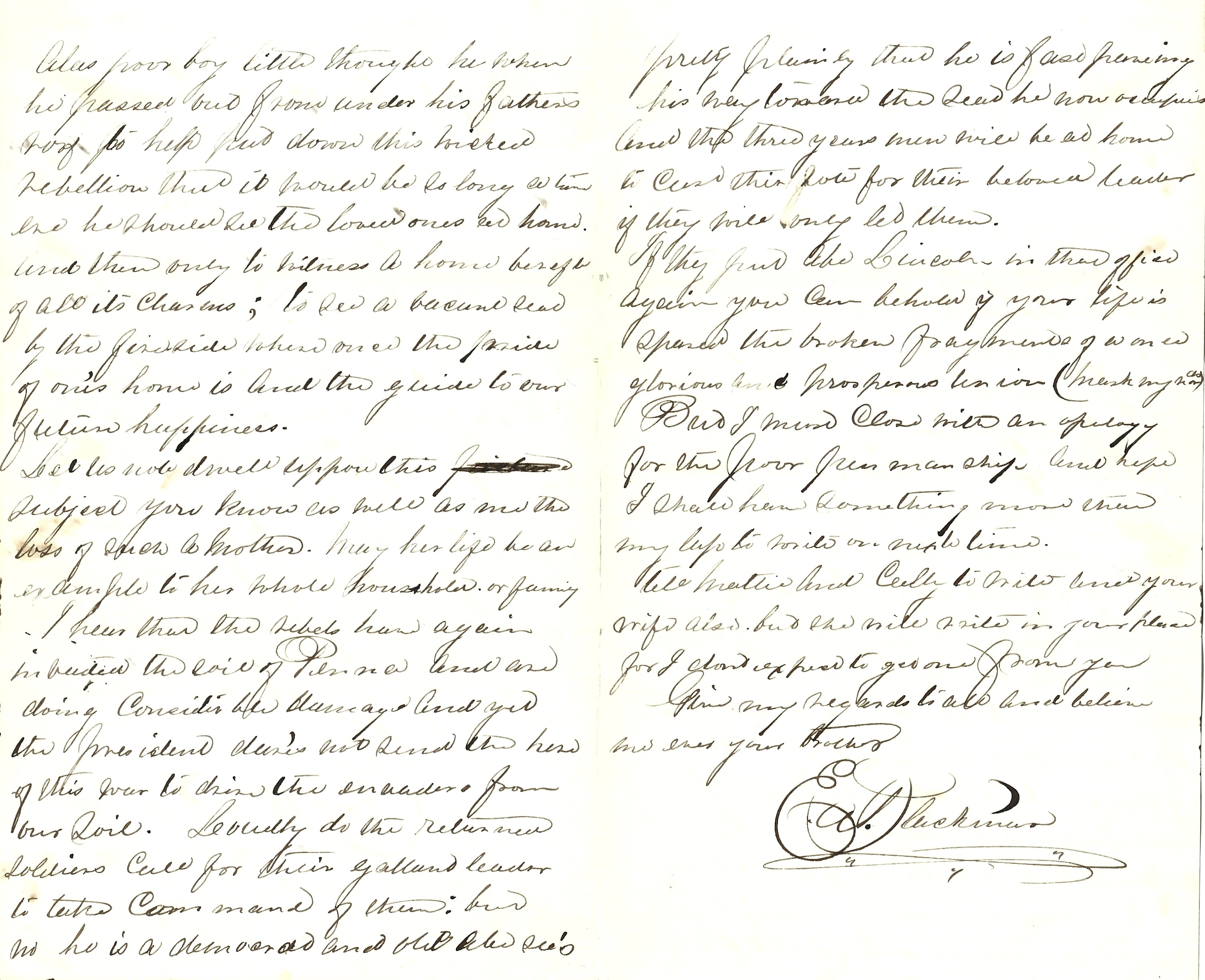
Do you ever hear anything from William? Alas, poor boy. Little thought he when he passed out from under his father’s roof to help put down this rebellion that it would be so long a time ere he should see the loved ones at home and then only to witness a home bereft of all its charms; to see a vacant seat by the fireside where once the pride of one’s home is and the guide to our future happiness.
Let us not dwell upon this subject. You know as well as me the loss of such a mother. May her life be an example to her whole household, or family.
I hear that the rebels have again invaded the soil of Pennsylvania and are doing considerable damage and yet the President dares not send the hero of this war [McClellan] to drive the invaders from our soil. Loudly do the returned soldiers call for their gallant leader to take command of them—but no, he is a Democrat and Old Abe sees pretty plainly that he is fast paving his way toward the seat he now occupies. And the three-year’s men will be at home to cast their vote for their beloved leader if they will only let them.
If they find Abe Lincoln in that office again, you can behold, if your life is spared, the broken fragments of a once glorious and prosperous Union (mark my word).
But I must close with an apology for the poor penmanship and hope I shall have something more than my lap to write on next time. Tell Mattie and Cally to write and your wife also. But she will write in your place for I don’t expect to get one from you. Give my regards to all and believe me ever your brother, — E. A. Blackmar
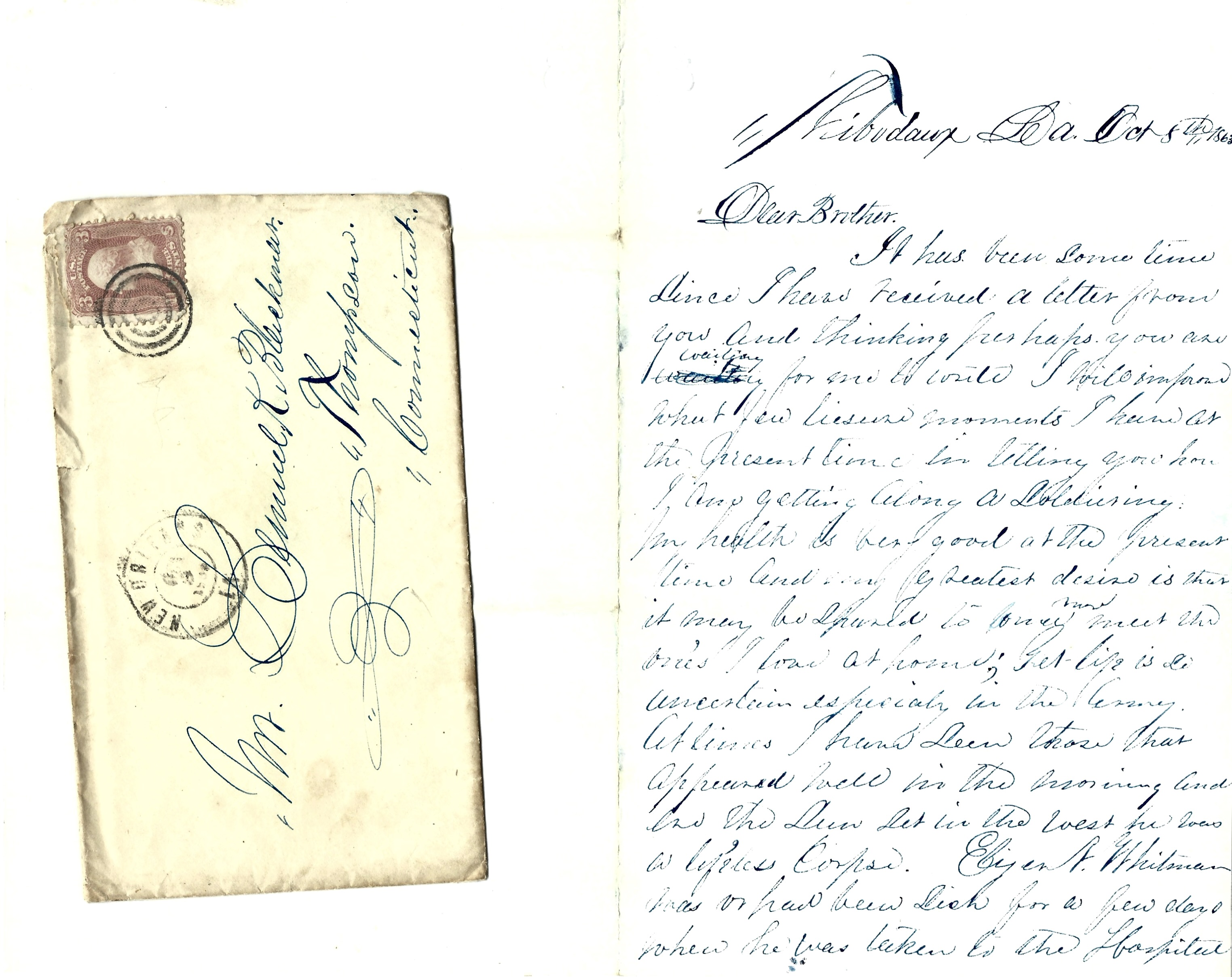
Letter 4
Thibodaux, Louisiana
October 8th, 1863
Dear Brother,
It has been some time since I have received a letter from you and thinking perhaps you are waiting for me to write, I will improve what few leisure moments I have at the present time in telling you how I am getting along a soldiering.
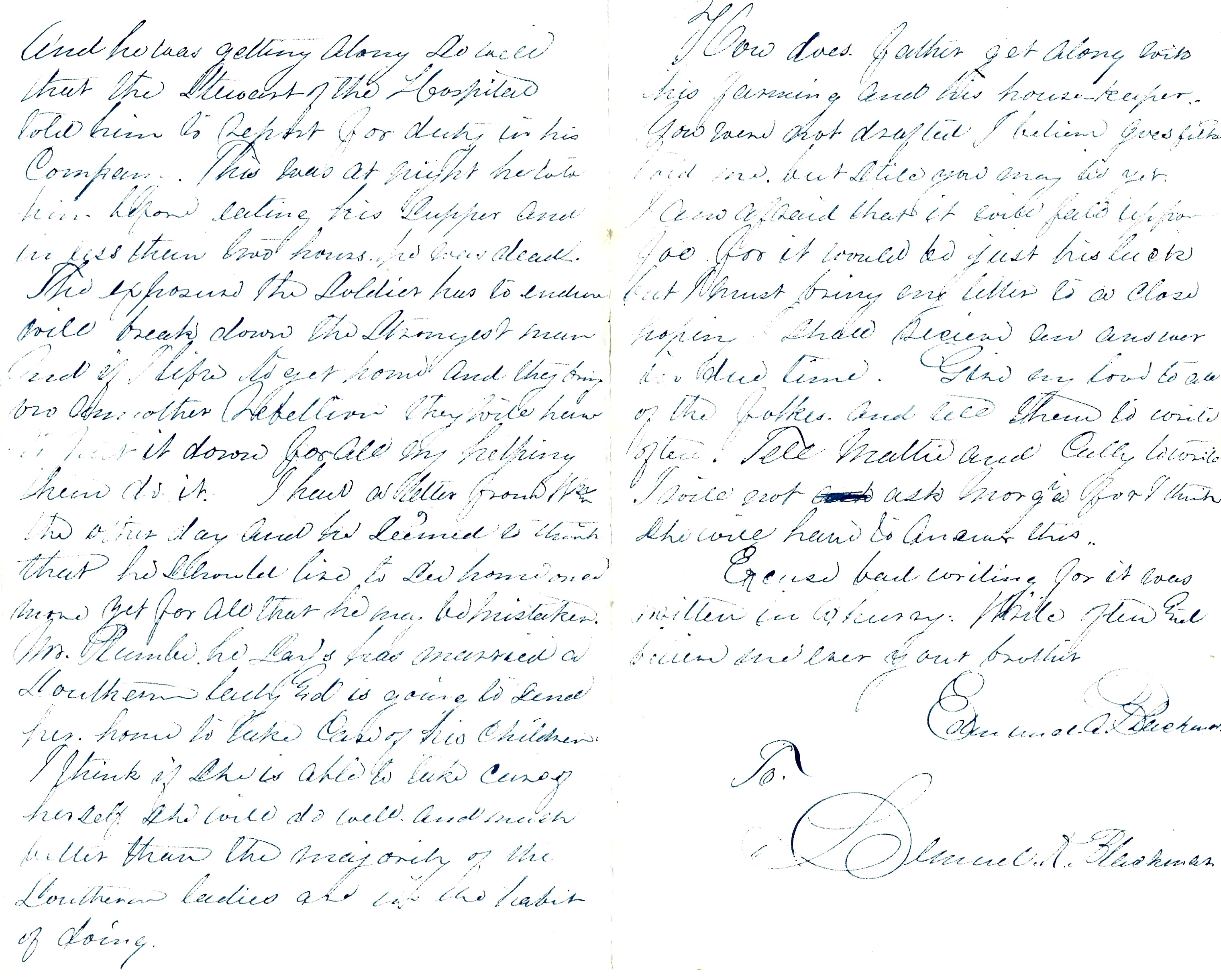
My health is very good at the present time and my greatest desire is that it may be spared to once more meet the ones I love at home. Yet life is so uncertain—especially in the army. At times I have seen those that appeared well in the morning and ere the sun set in the West, he was a lifeless corpse. Elijah N. Whitman was or had been sick for a few days when he was taken to the hospital and he was getting along so well that the steward of the hospital told him to report for duty in his company. This was at night he told him, before eating his supper, and in less than two hours he was dead. The exposures the soldier has to endure will break down the strongest man. And if I live to get home and they bring me another rebellion, they will have to put it down for all my helping them do it.
I had a letter from William the other day and he seemed to think that he should live to see home once more. Yet for all that, he may be mistaken. Mr. Plumber, he says, has married a Southern lady and is going to send her home to take care of the children. I think if she is able to take care of herself, she will do well and much better than the majority of the Southern ladies are in the habit of doing.
How does father get along with his farming and his housekeeper? You were not drafted. I believe Joe’s folks told me. But still you may yet. I am afraid that it could fall upon Joe for it would be just his luck. But I must bring my letter to a close, hoping I shall receive an answer in due time. Give my love to all of the folks and tell them to write often. Tell Mattie and Cally to write. I will not ask Margie for I think she will have to answer this.
Excuse bad writing for it was written in a hurry. Write often and believe me ever your brother, — Edmond A. Blackmar
Letter 5
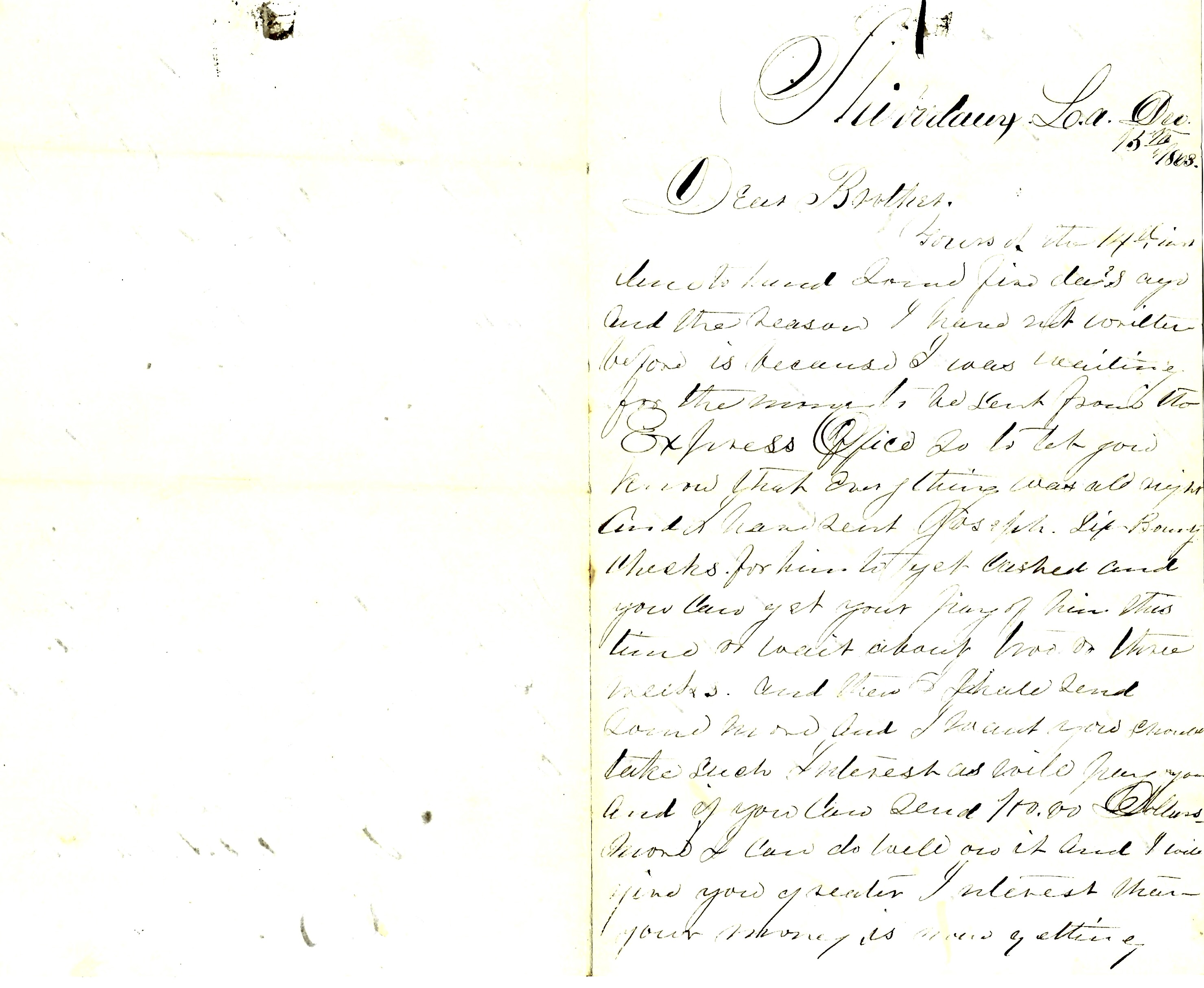
Thibodaux, Louisiana
December 15, 1863
Dear Brother,
Yours of the 14th ult. came to hand a few days ago and the reason I have not written before is because I was waiting for the mail to be sent from the Express Office so to let you know that everything was all right and I have sent Joseph his bounty checks for him to get cashed and you can get your pay of him this time or wait about two or three weeks and then I shall send home more and I want you should take such interest as will pay you and if you can send 100 dollars more I can do well on it and I will give you greater interest than your money is now getting. And there is not much risk to run if you get it insured. I had to pay $6 on that package and I would like to have that money as soon as it could possibly be got here. For by the time it arrived, they would be rather short of [ ] and they would perhaps take less.
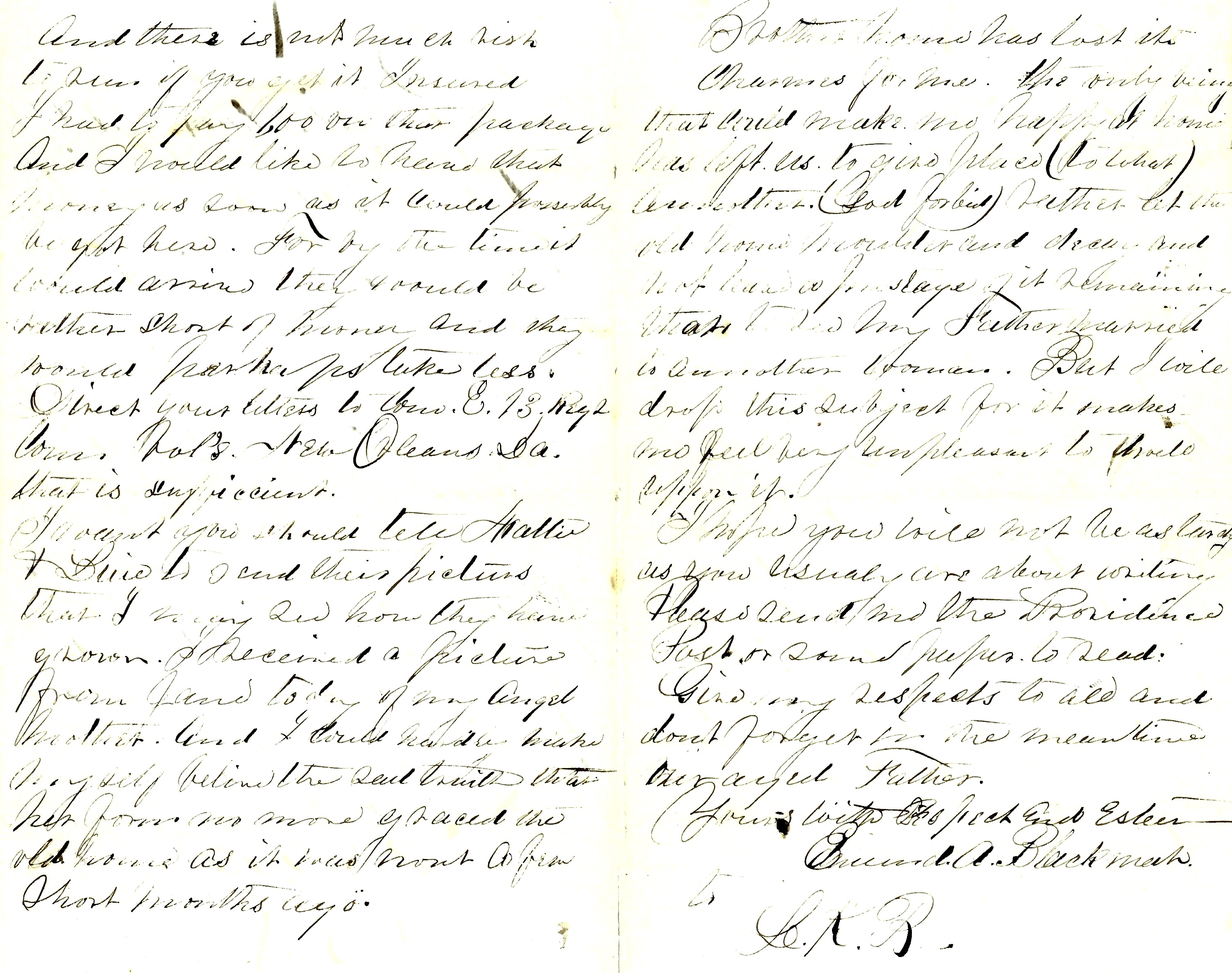
Direct your letters to Co. E, 13th Regt. Conn. Vols, New Orleans, La. That is sufficient.
I want you should tell Mattie and Luie to send their pictures that I may see how they have grown. I received a picture from Jane today of my anglel Mother and I could hardly make myself believe the sad truth that her form no more graced the old home as it was wont a few short months ago.
Brother, home has lost its charms for me. The only being that could make me happy at home has left us to give place (to what) another (God forbid). Rather let the old home moulder and decay and not leave a vestige of it remaining than to see my father married to another woman. But I will drop this subject for it makes me feel very unpleasant to dwell upon it.
I hope you will not be as tardy as you usually are about writing. Please send me the Providence Post or some paper to read. Give my respects to all and don’t forget in the meantime our aged father. Yours with respect and esteem, — Edmond A. Blackmar
to L. K. B
Letter 6
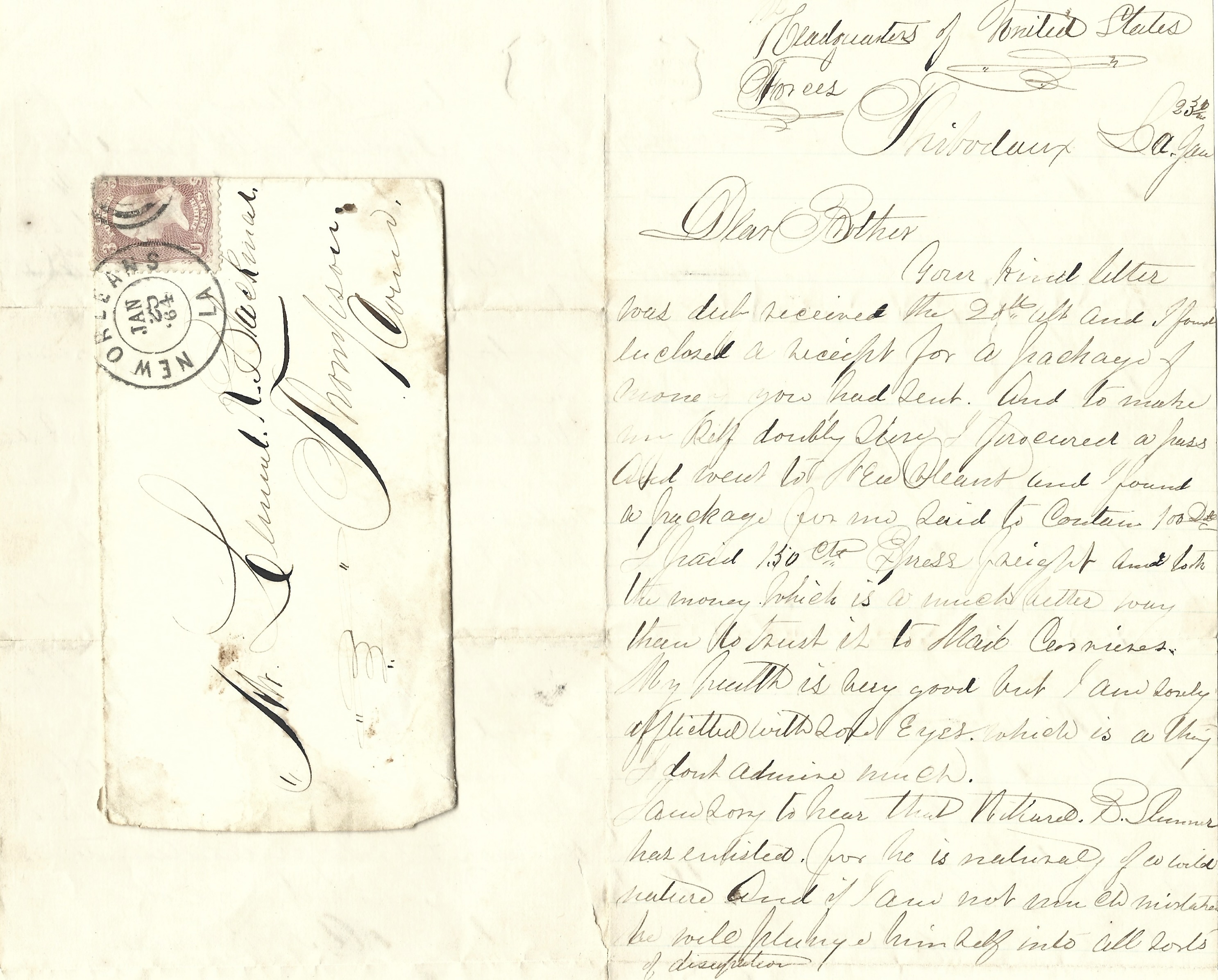
Headquarters of United States Forces
Thibodaux, Louisiana
January 23, [1864]
Dear Brother,
Your kind letter was received the 20th ult. and I found enclosed a receipt for a package of money you had sent. And to make myself doubly sure, I procured a pass and went over to New Orleans and I found a package for me said to contain 100 dollars. I paid $1.50 Express freight and took the money which is a much better way than to trust it to mail carriers.
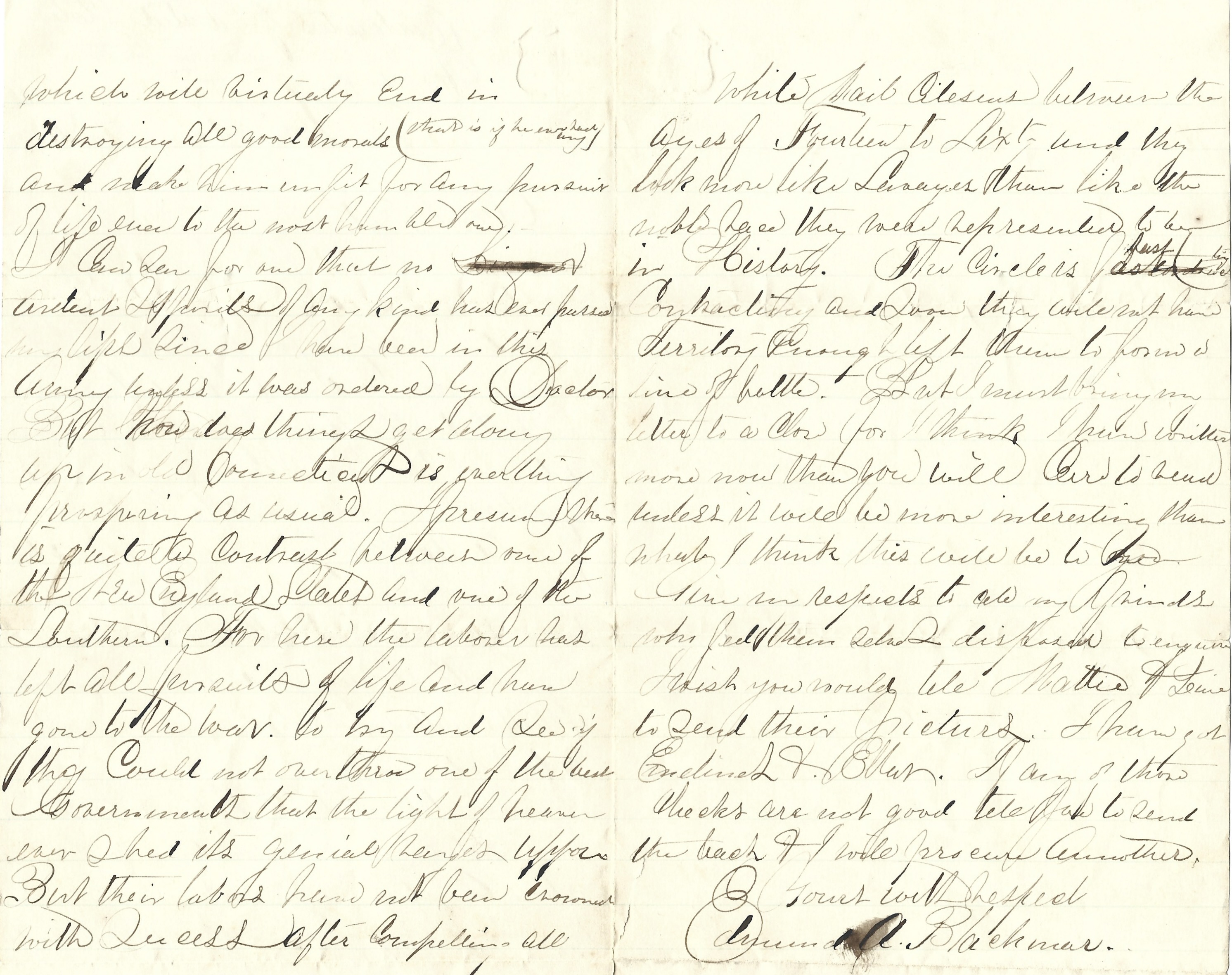
My health is very good but I am sorely afflicted either sore eyes which is a thing I don’t admire much. I am sorry to hear that Willard B. Sumner has enlisted for he is naturally of so wild nature and if I am not much mistaken, he will plunge himself into all sorts of description which will virtually end in destroying all good morals (that is, if he ever had any) and make him unfit for any pursuit of life—even to the most humble one.
I can say for one that no ardent spirits of any kind has ever passed my lips since I have been in this army unless it was ordered by doctor. But how does things get along up in old Connecticut? Is everything prospering as usual? I presume there is quite a contrast between one of the New England States and one of the Southern for here the laborer has left all pursuits of life and have gone to war to try and see if they could not overthrow one of the best governments that the light of heaven ever shed its genial light upon. But their labors have not been crowned with success. After compelling all white male citizens between the ages of fourteen and sixty and they look now like savages than like the noble face they were represented to be in history. The circle is fast contracting and soon they will not have territory enough left them to form a line of battle.
But I must bring my letter to a close for I thin kI have written more than you will care to read unless it would be more interesting than what I think this will be to you. Give my respects to all my friends who feel themselves disposed to enquirer. I wish you would tell Mattie and Luie to send their pictures. I have got Emdinah & Ellen. If any of those checks are not good, tell J__ to send them back & I will procure another. Yours with respect, — Edmond A. Blackmar
Letter 7
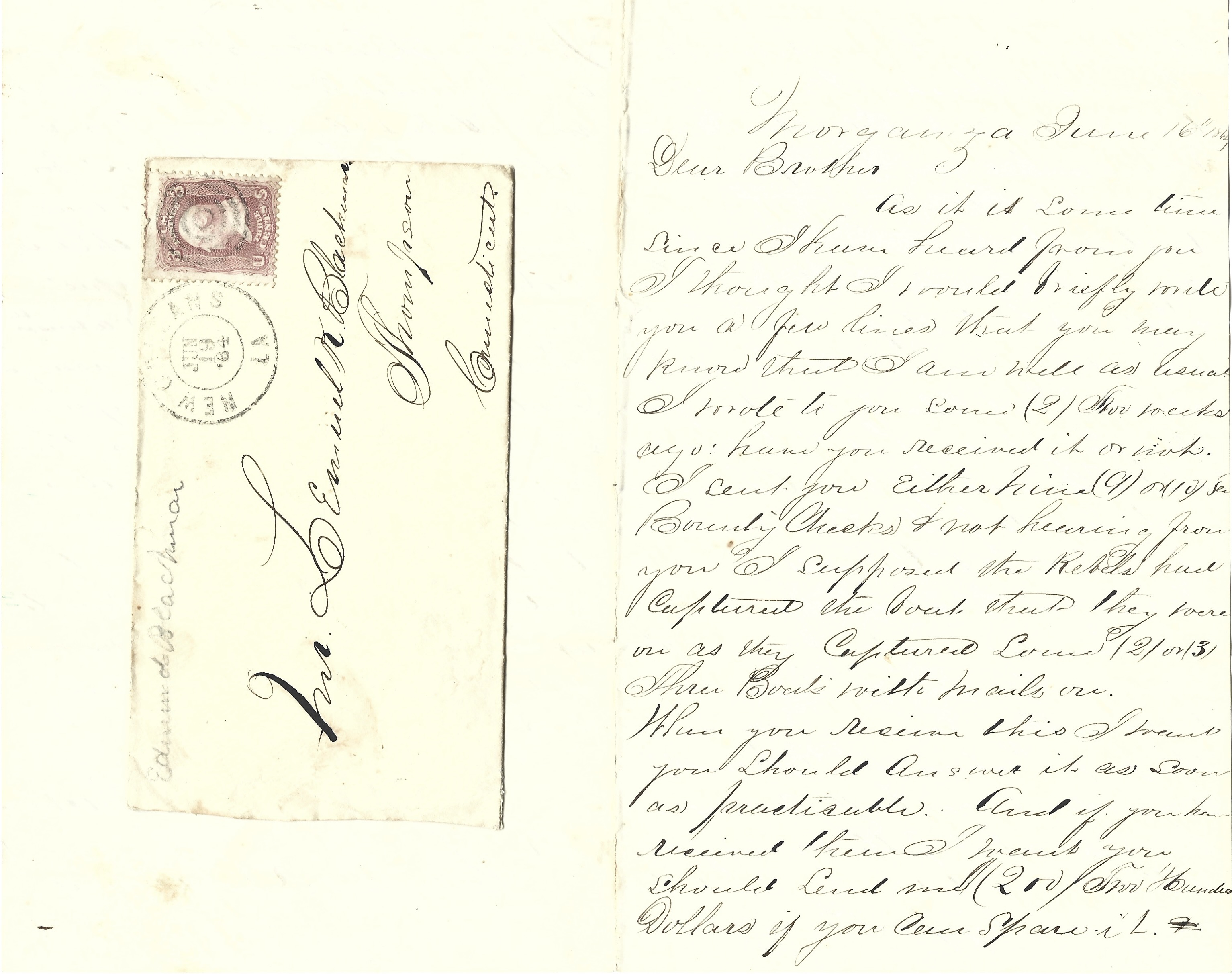
Morganza
June 16, 1864
Dear Brother,
As it is some time since I have heard from you, I thought I would briefly write a few lines that you may know that I am well as usual. I wrote to you some two weeks ago; have you received it or not? I sent you either nine or ten bounty checks and not hearing from you, I supposed the Rebels had captured the boat that they were on as they captured some two or three boats with mails on.
When you receive this, I want you should answer it as soon as practicable. And if you have received them, I want you should lend me two hundred dollars if you can spare it—that is, if you have received those last checks I sent and if not, don’t send me but $100 unless you can spare more. For what little time I have got to I want to make it pay. I have only about seven months and fifteen days to stop.
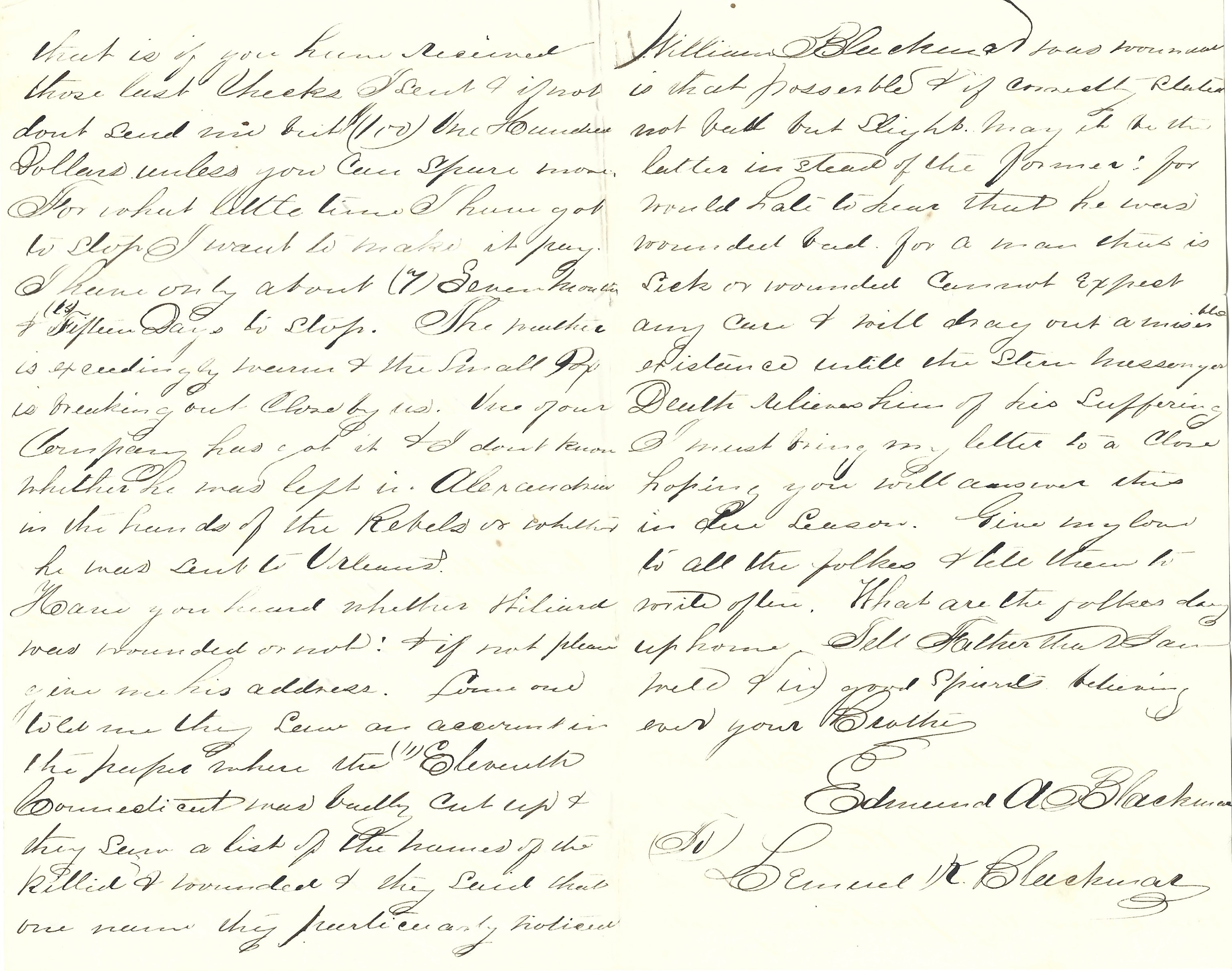
The weather is exceedingly warm and the small pox is breaking out close by us. One of our company has got it and I don’t know whether he was left in Alexandrea in the hands of the Rebels or whether he was sent to Orleans.
Have you heard whether Wiliard was wounded or not? And if not, please give me his address. Someone told me they saw an account in the paper where the 11th Connecticut was badly cut up & they saw a list of the names of the killed and wounded and they said that one name they particularly noticed William Blackmar was wounded. Is that possible? And if correctly stated, not bad but slight. May it be the latter instead of the former, for I would hate to hear that he was wounded bad for a man that is sick or wounded cannot expect any care & will drag out a miserable existence until the stern messenger Death relieves him of his suffering.
I must bring my letter to a close hoping you will answer this in due season. Give my love to all the folks & tell them to write often. What are the folks doing up home? Tell father that I am well and in good spirits. Believing ever your brother, — Edmund A. Blackmar
To Lemuel K. Blackmar
Letter 8
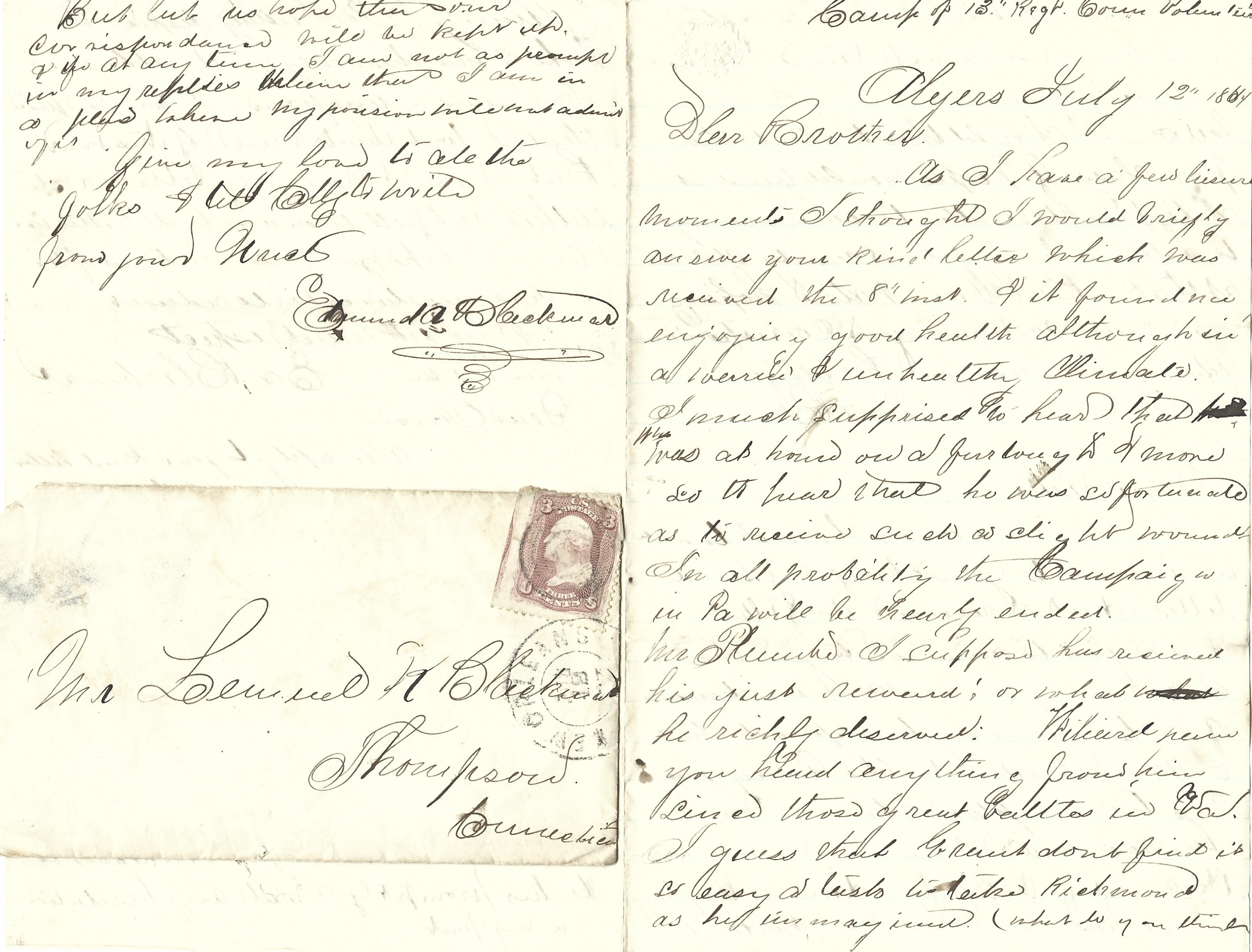
Camp of the 13th Regt. Conn. Volunteers
Alyers [Algiers—opposite New Orleans, La.]
July 12, 1864
Dear Brother,
As I have a few leisure moments, I thought I would briefly answer your kind letter which was received the 8th inst. It found me enjoying good health although in a varied and unhealthy climate. I [was] much surprised to hear that William was at home on a furlough & even more so to hear that he was so fortunate as to receive such a slight wound. In all probability, the campain in Pennsylvania will be nearly ended. Mr. Plumb, I suppose, has received his just deserves. Wiliard—have you heard anything from him since those great battles in Virginia? I guess that Grant don’t find it so easy a task to take Richmond as he imagined (what do you think?). But I must bring my letter to a close for I have not much time. I must endeavor to answer Maggie and Mollie’s letter. I should think that the poor class of people would find it a difficult matter to earn enough to obtain a living & a scanty subsistence at that. But I must close hoping you will continue your correspondence. Believing me ever your brother, — Ed. Blackmar
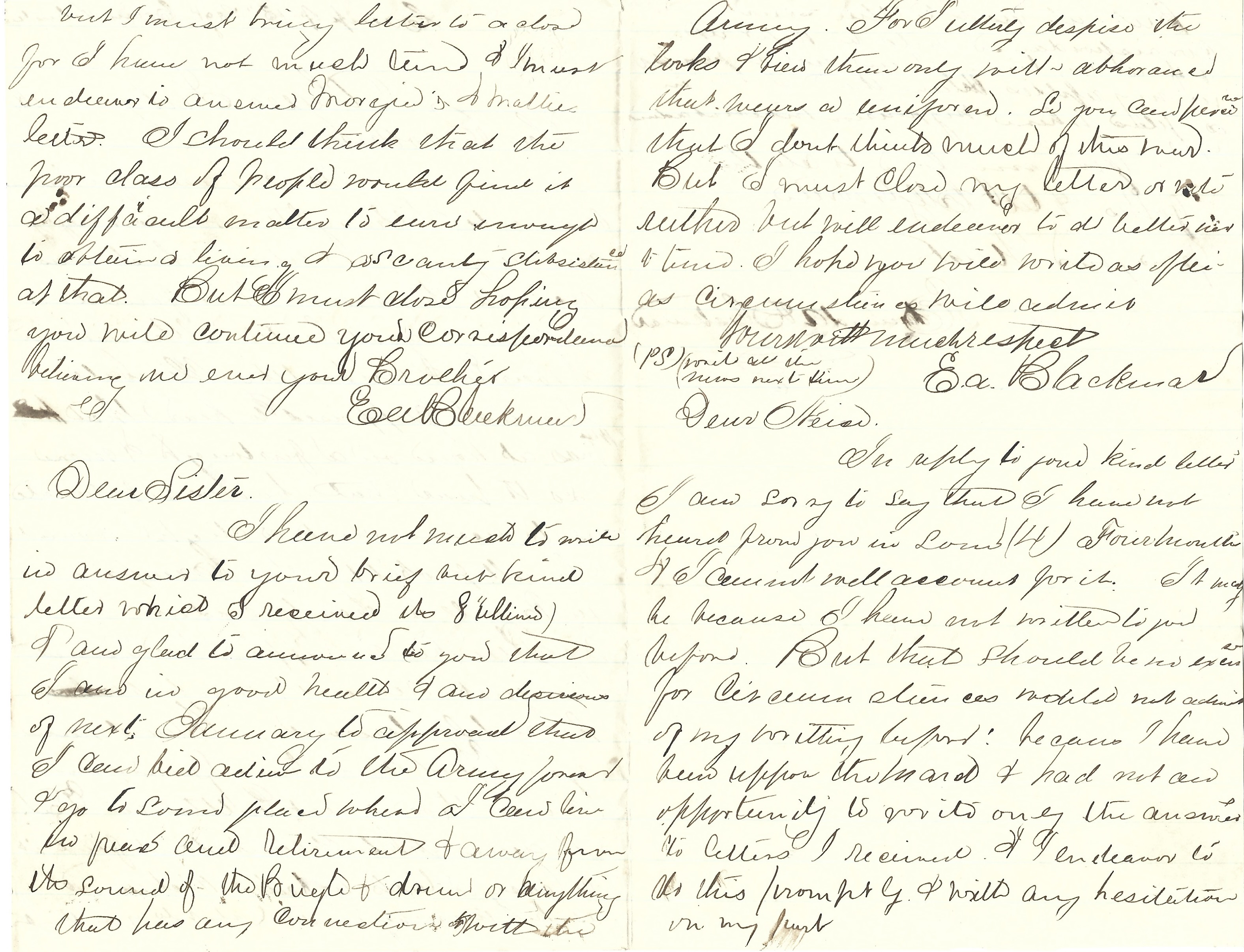
Dear Sister, I have not much to write in answer to your brief but kind letter which I received the 8th ultimo. I am glad to answer to you that I am in good health and am desirous of next January to bid adieu to the army and go to some place where I can live in peace and retirement and away from the sound of the bugle and drum or anything that has any connection with the army for I despise the looks and view them only with abhorrence that wear a uniform. So you can perceive that I don’t think much of this war. But I must close my letter but endeavor to do better next time. I hope you will write as often as circumstances will admit. Yours with much respect, — E. A. Blackmar
Dear Niece, in reply to your kind letter I am sorry to say that I have not heard from you in some four months & I cannot well account for it. It may be because I have not written to you before. But that should be no excuse for circumstances would not admit of my writing before because I have been upon the march & had not an opportunity to wrote—only the answers to letters I received. I endeavor to do this promptly and with[out] any hesitation on my part. But let us hope that our correspondence will be kept up & if at any time I am not as prompt in my replies, believe that I am in a place where my position will not admit it. Give my love to all the folks and tell Cally to write. From your Uncle. — Edmund A. Blackmar
Letter 9
Camp in the Shenandoah Valley
September 5, 1864
Dear Brother,
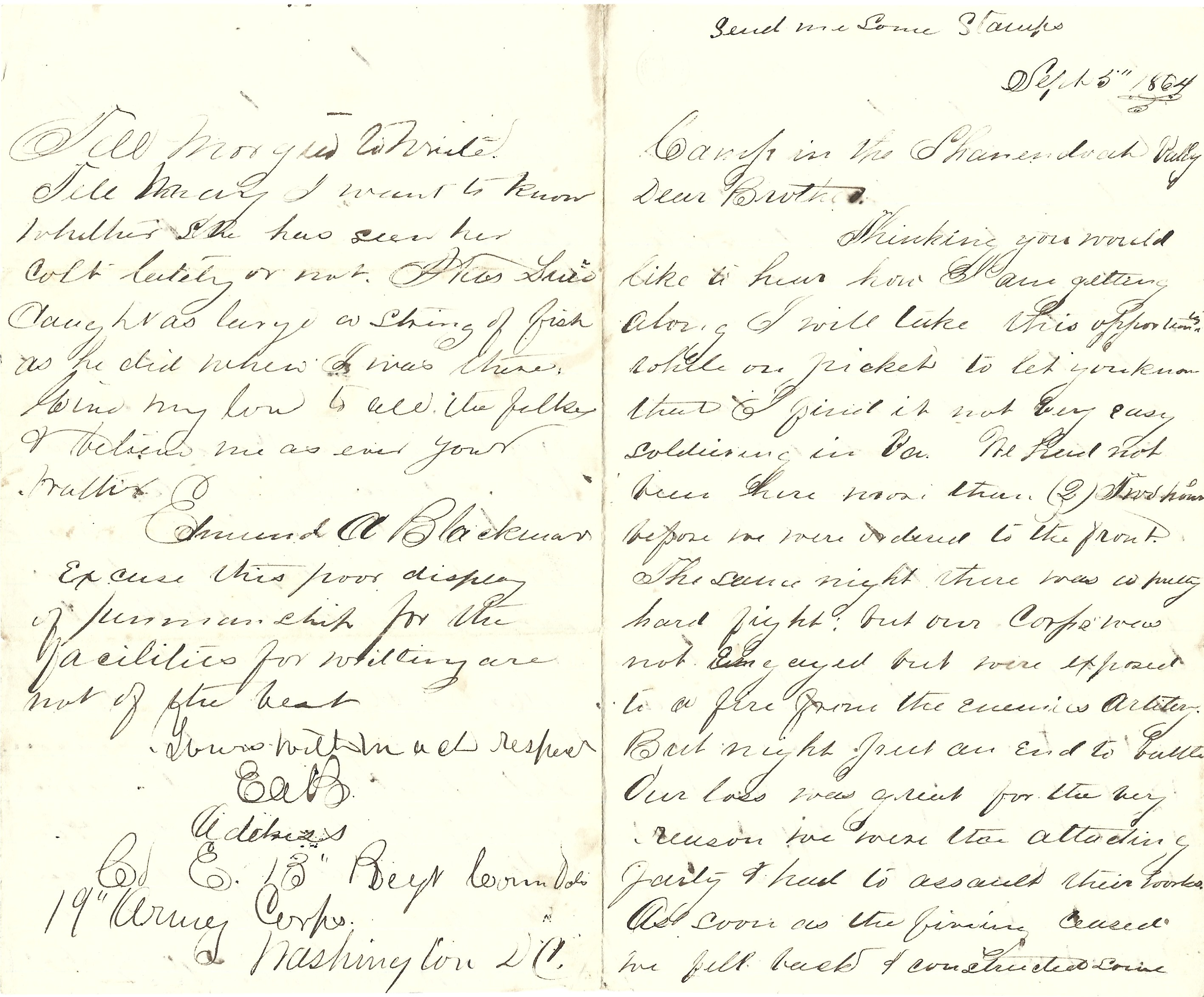
Thinking you would like to hear how I am getting along, I will take this opportunity while on picket to let you know that I find it not very easy soldiering in Virginia. We had not been here more than two hours before we were ordered to the front. The same night there was a pretty hard fight but our Corps were not engaged but were exposed to a fire from the enemy’s artillery But night put an end to battle. Our loss was great for the very reason we were the attacking party and had to assault their works. As soon as the firing ceased, we fell back and constructed some earthworks and are now acting on the defensive. 1
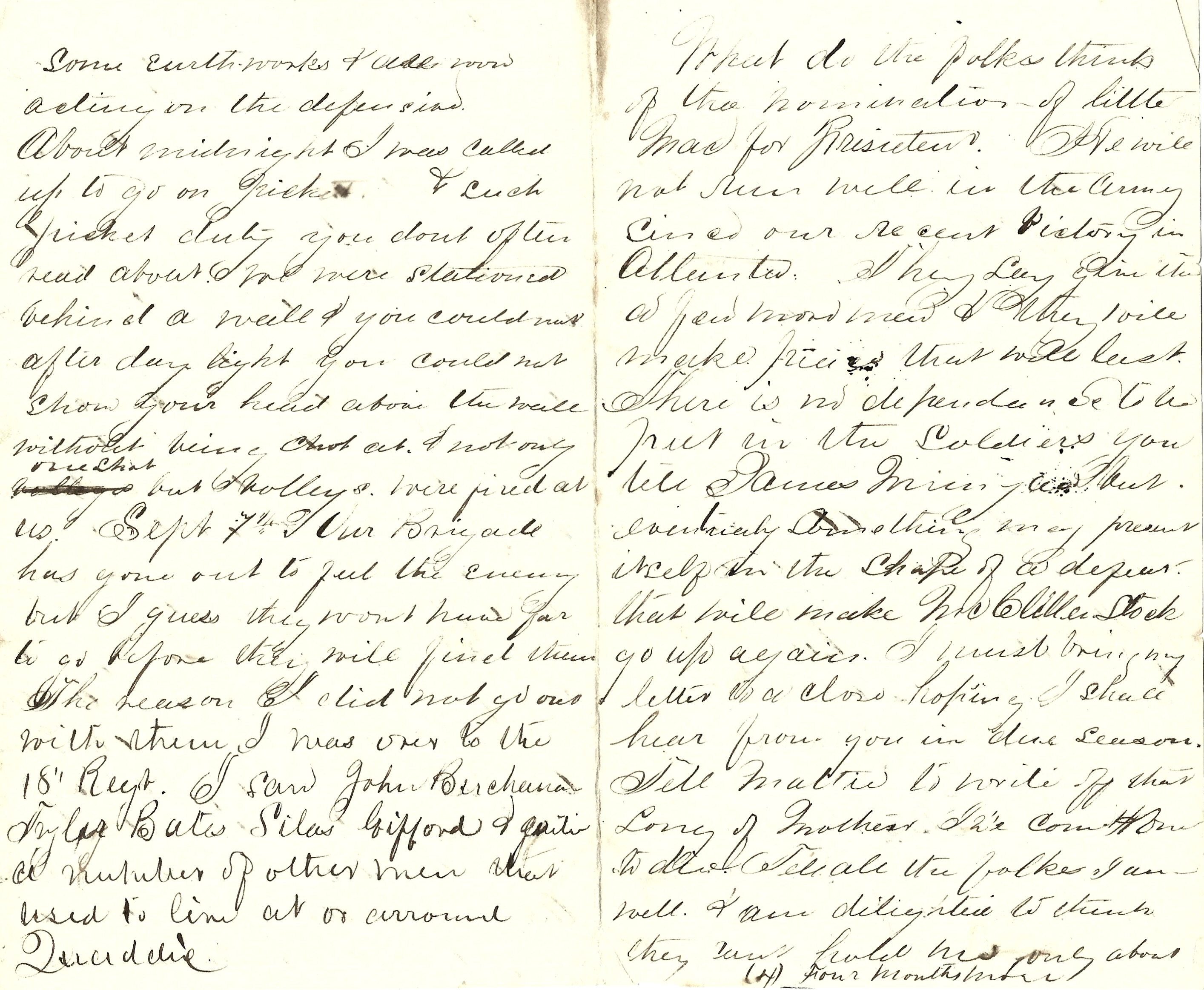
About midnight I was called up to go on picket & such picket duty you don’t often read about. We were stationed behind a wall &, after daylight, you could not show your head above the wall without being shot at. And not only one shot, but 6 volleys were fired at us.
September 7th. Our Brigade has gone out to feel the enemy but I guess they won’t have far to go before they will find them. The reason I did not go out with them, I was over to the 18th Regt. I saw John Buchanan, Tyler Bates, Silas Gifford and quite a number of other men that used to live out at or around Quaddick [CT].
What do the folks think of the nomination [by the Democrats] of Little Mac for President? He will not run well in the army since our recent victory in Atlanta. They say give them a few more men & they will make peace that will last. There is no dependence to be put in the soldiers. you tell James M___, but eventually something may present itself in the shape of a defeat that will make McClellan’s stock go up again.
I must bring my letter to a close hoping I shall hear from you in due season. Tell Mattie to write off that long [ ] f Mother [ ]. Tell all the folks I am well and am delighted to think they can’t hold me only about four months more. Tell M___ to write. Tell Mary I want to know whether she has seen her colt lately or not. Has Luis caught as large a string of fish as he did when I was there? Give my love to all the folks and believe me as ever your brother. — Edmund A. Blackmar
Excuse this poor display of penmanship for the facilities for writing are not of the best. Yours with much respect , — E. A. B.
Address Co. E, 13th Regt. Conn. Vols., 19th Army Corps, Washington D. C.
1 This engagement was fought on the road between Berryville and Winchester, Va.