

Benjamin Franklin Hulburd (1822-1864) was the youngest son of William Hulburd (1774-1846) and Susan Conger (1784-1860) of Waterville—an isolated village just 25 miles or so south of the Canadian border in the heavily wooded, mountainous and scenic region of Vermont. Residents here, in the days long before tourism created a viable industry, were hard-pressed to make a living. Subsistence farming predominated.
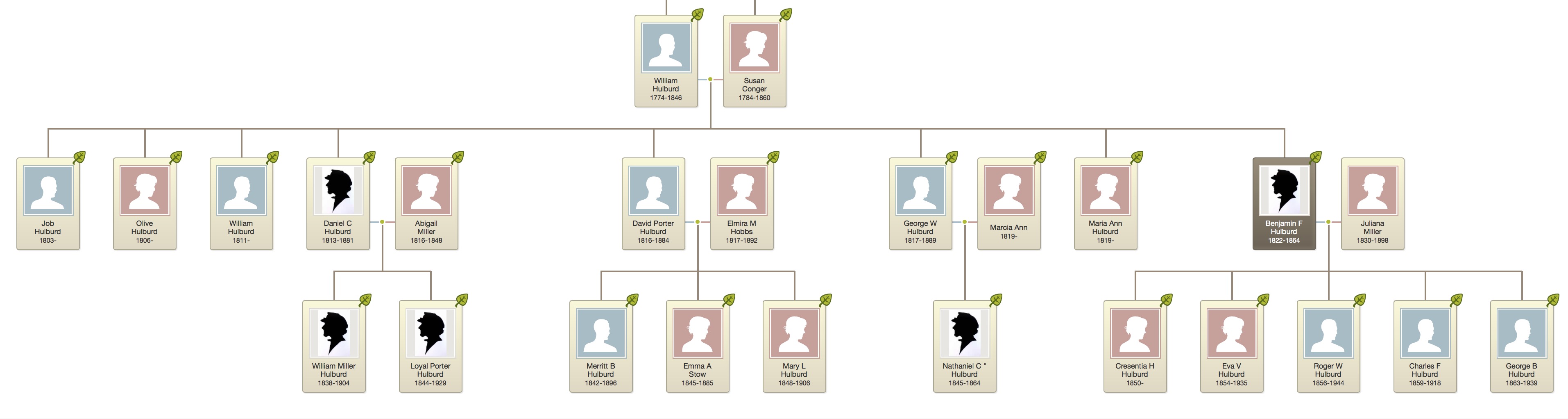
Sometime just before 1850, Benjamin married Juliana Miller (1830-1898) who became his helpmate about the farm and together they raised five children—Cresentia (b. 1850 but died before the Civil War), Eva (b. 1854), Roger (b. 1856), Charles (b. 1859), and George (b. 1863). All of Benjamin’s letters included in this collection were written to his wife and their children’s names are naturally mentioned frequently, as well as a few other extended family names. The following abbreviated family tree was created in Ancestry.com for the purpose of illustrating the family relationships of the principal people mentioned in these letters.
When the Civil War erupted in 1861, Benjamin was already nearly 40 years old. This advanced age did not prevent him from offering his services as a soldier, however. And though a patriot, Benjamin’s motivation for leaving his family and risking his life seems to have been primarily driven by financial need—an opportunity to earn double the income he would have earned by remaining home on the farm.
Many of the men who enlisted initially in 1861 from this area of Vermont became members of the 2nd Vermont Infantry. This included Benjamin’s brother, Daniel C. Hulburd (1813-1881), and his nephew, Loyal Porter Hulburd (1844-1929). They were members of Company H. Though he may have wished to join the 2nd Vermont too, Benjamin resisted the temptation to go. Perhaps he thought the war would be over soon enough and that his wife and young family needed him at home. But the war dragged on beyond everyone’s expectations, and when more men from this region were recruited in March 1862, Benjamin joined the next wave of volunteers who were mustered into the 7th or 8th Vermont Regiments for three years service.
It was Benjamin’s misfortune to be placed in the 7th Vermont which came to be known as the “hard luck” regiment. Nothing, it seems, ever went their way and the regiment lost nearly half its members from disease against only 13 battle casualties. The first 28 letters of this collection are the letters Benjamin wrote while serving with the 7th Vermont. The letters take the reader from New York Harbor to Ship Island (off the gulf coast of Mississippi), to New Orleans, and to Pensacola where Benjamin was discharged for disability sometime early in 1863 after only about one year of service.
From his letters we know that Benjamin returned to his family in time for spring planting in 1863 and that he worked on his farm all year until very late in 1863 when he offered his services to the country again, this time re-enlisting to fill the ranks of the 2nd Vermont Infantry. He joined them in winter camp at Brandy’s Station, Virginia, in January 1864 and was with them through the series of battles that came to be known at Grant’s Overland Campaign in the spring and summer of 1864. There are an additional 54 letters Benjamin wrote while serving in the 2nd Vermont.
Benjamin was with the 2nd Vermont (part of Wright’s 6th Corps) when they were sent post haste from City Point, Virginia, back to the Nation’s capitol to prevent Confederate Gen. Jubal Early’s men from seizing the city. After that threat was thwarted, the men of the 2nd Vermont participated in Sheridan’s Shenandoah Valley Campaign and it was during the Battle of Cedar Creek on 19 October 1864 that Benjamin was killed.
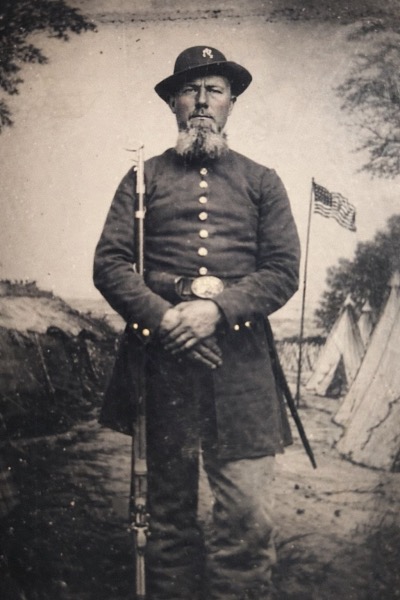
Benjamin’s Civil War letters are a delight to read and add rich insight to the service of the boys in both the 7th and the 2nd Vermont Regiments. Benjamin’s advanced age offers a more mature perspective on the war than is normally encountered in the letters of a private.
A word about the collection of letters. Hulburd’s letters were kept by the family for at least a hundred years and before they were sold, they were transcribed and typed copies were retained. The original letters have undoubtedly been sold and resold, broken up and distributed such that the whereabouts of every letter isn’t known—or even if they all still survive. Years ago I transcribed a couple dozen of them that were in the possession of one collector. The archives at the University of Vermont claims to have six of Benjamin Hulburd’s letters, including “accounts of battles of Wilderness, Spotsylvania, Opequon, Third Winchester, and Petersburg.” A few weeks ago, I was offered the typed copies kept by the family, and although they don’t include photocopies of the originals, they include all of the original letters which I decided to post here with the others I had previously transcribed so that the entire collection would be available in one virtual archive. My thank to Paul S. LeBlanc for gifting me the family copies.
SEVENTH VERMONT INFANTRY
Letter 1
March 14, [1862]
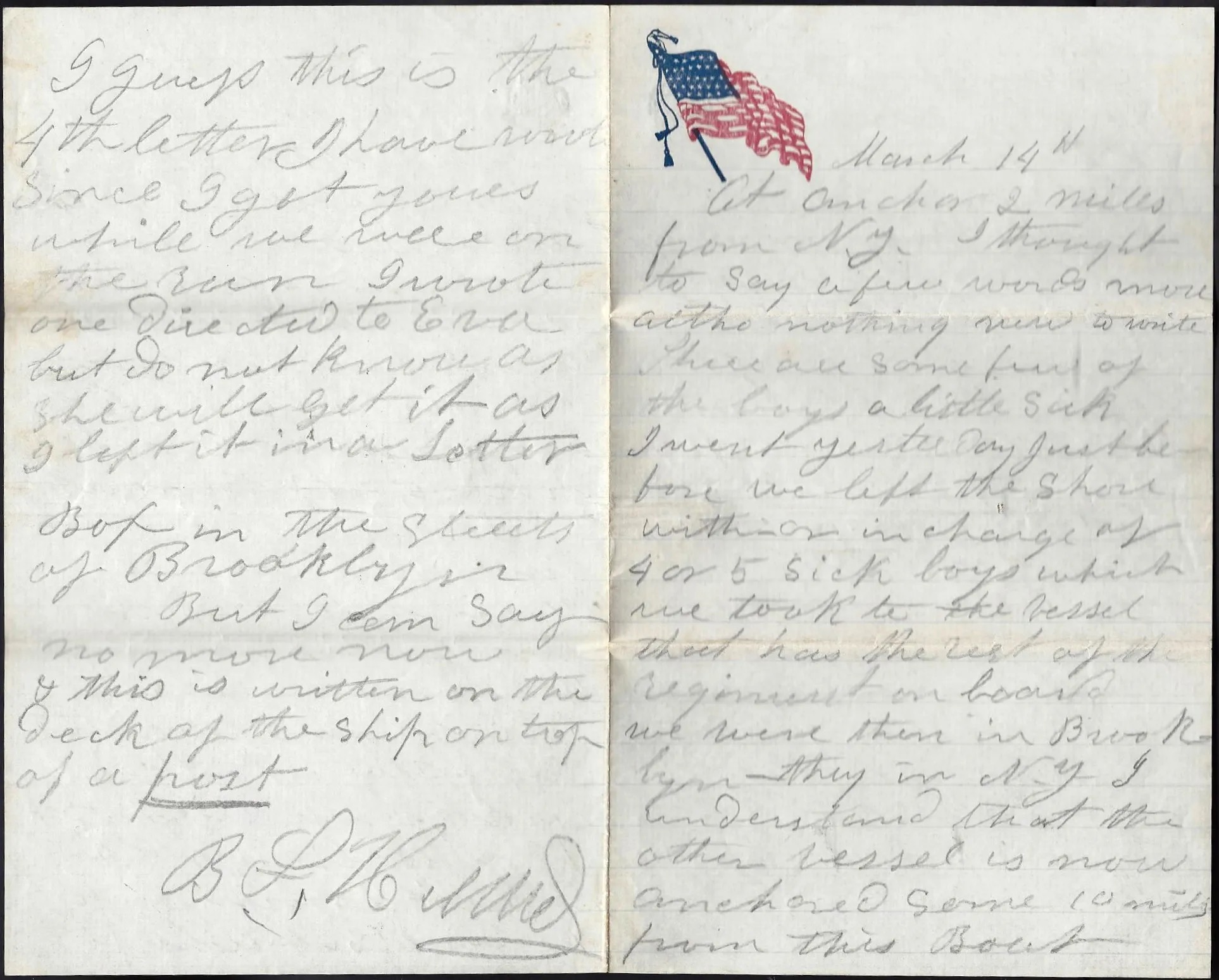
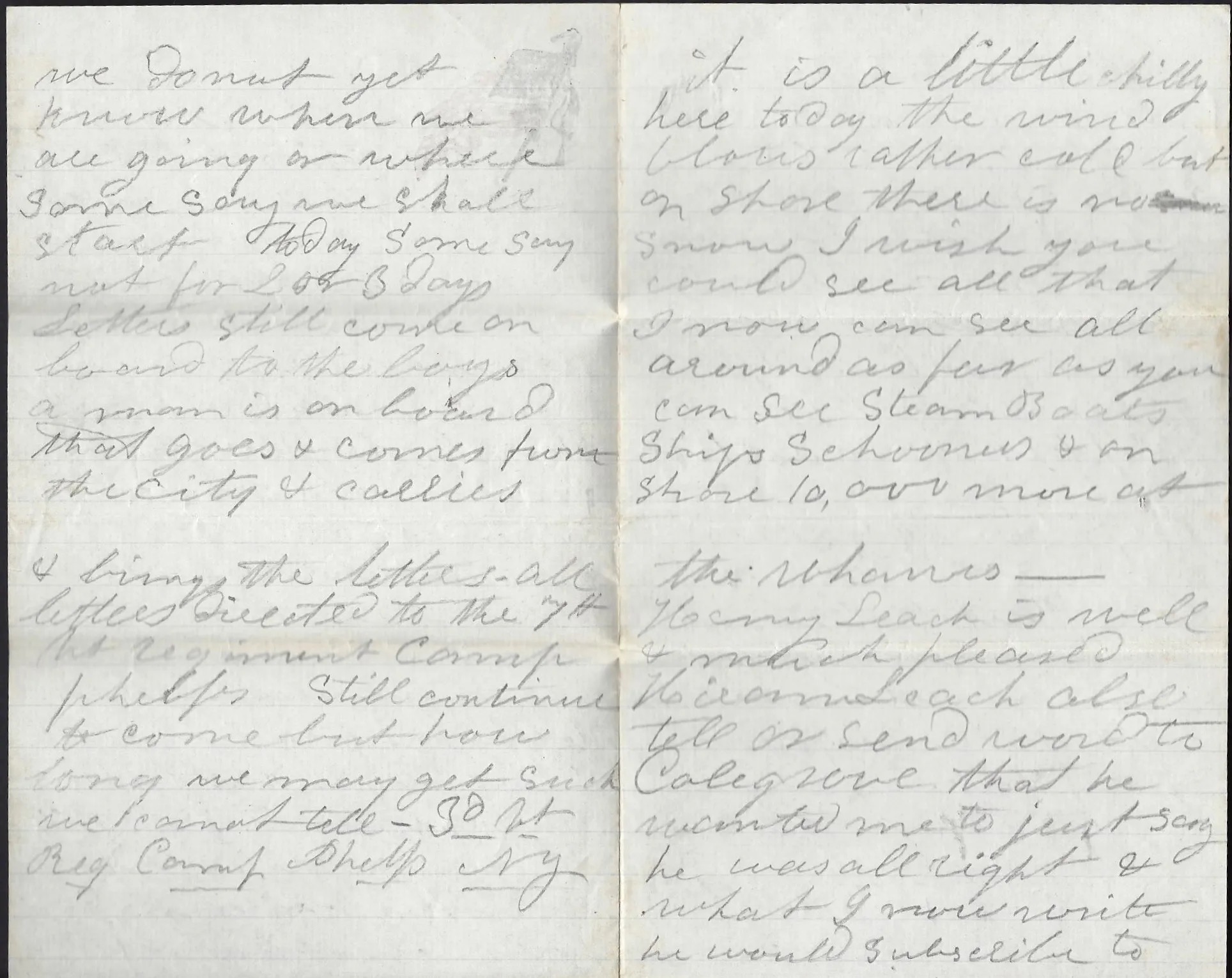
At Anchor 2 miles from New York [City]
I thought to say a few words more altho nothing new to write. There are some few of the boys a little sick. I went yesterday just before we left the shore with & in charge of 4 or 5 sick boys which we took to the vessel that has the rest of the regiment on board. We were then in Brooklyn — they in New York. I understand that the other vessel is now anchored some ten miles from this boat. ¹
We don’t yet know when we are going or where. Some say we shall start today. Some say not for 2 or 3 days. Letters still come on board to the boys. A man is on board that goes & comes from the city & carries & brings the letters. All letters directed to the 7th Regiment, Camp Phelps, still continue to come but how long we may get such, we cannot tell. 3d Vt. Reg., Camp Phelps, N.Y.
It is a little chilly here today. The wind blows rather cold but on shore there is no snow. I wish you could see all that I now can see. All around as far as you can see [are] steamboats, ships, schooners, & on shore 10,000 more are at the wharfs.
Henry Leach is well & much pleased. Hiram Leach also. Tell or send word to Colegrove that he wanted me to just say he was all right & what I now write he would subscribe to.
I guess this is the 4th letter I have wrote since I got yours while we were on the run. I wrote one directed to [our daughter] Eva but do not know as she will get it as I left it in a letter box in the streets of Brooklyn. But I can say no more & this is written on the deck of the ship on top of a post.
— B. F. Hulburd
¹ The regimental history tells us that the regiment was transported to Ship Island, Mississippi, on two vessels — the Premier and the Tammerline. Hulburd made the voyage on the Tammerline which arrived 10 April 1862, 5 days after the Premier.
“The two Gulf-bound regiments embarked on four sailing ships leaving Boston and New York between March 9 and 14, and arrived at Ship Island, off the southern shore of Mississippi, between April 7 and 10. After enduring three weeks of storms and seasickness, many men set down their trembling feet on the warm sand of Ship Island, barren though it was, with a great sense of relief.” [Source: A War of the People: Vermont Civil War Letters by Jeffrey D. Marshall, p. 57]
Letter 2
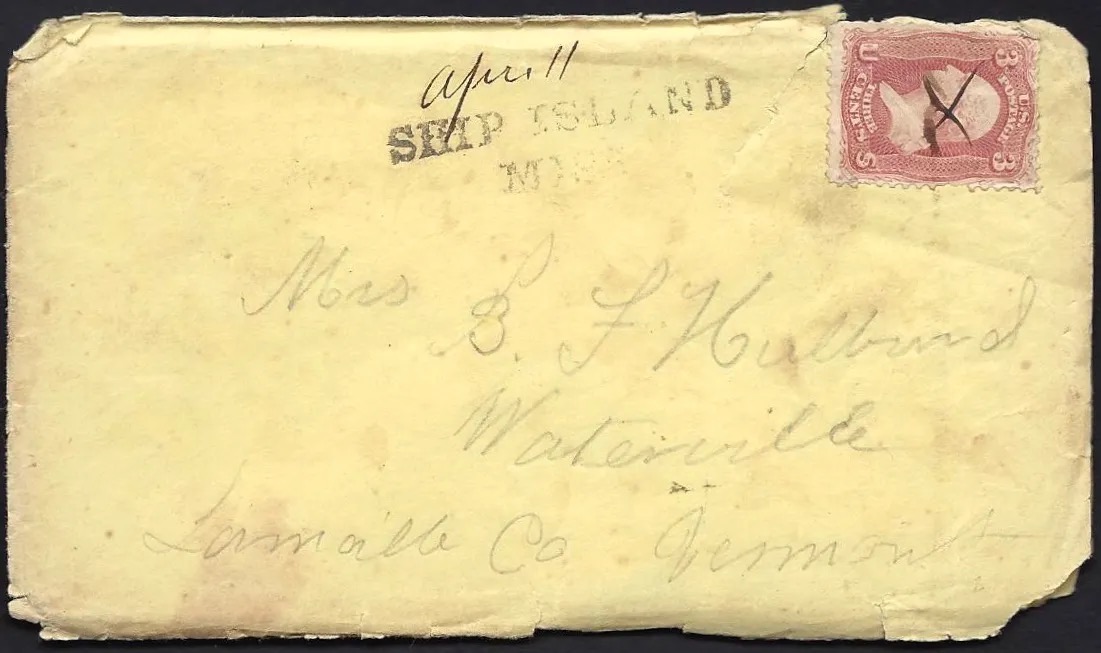
Ship Island [Mississippi]
April 10 [1862]
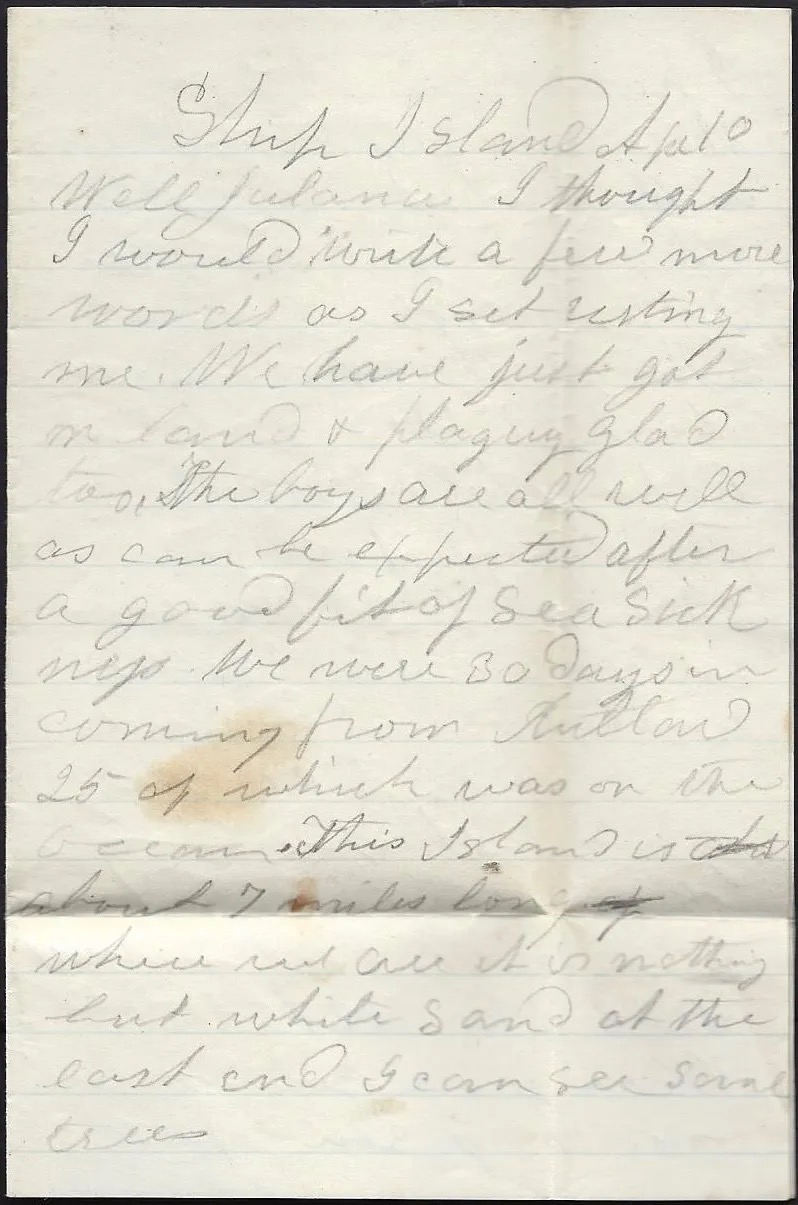
Well Juliana, I thought I would write a few more words as I sit resting me. We have just got on land & plagey glad too. The boys are all well as can be expected after a good fit of sea sickness. We were 30 days in coming from Rutland, 25 of which was on the ocean.
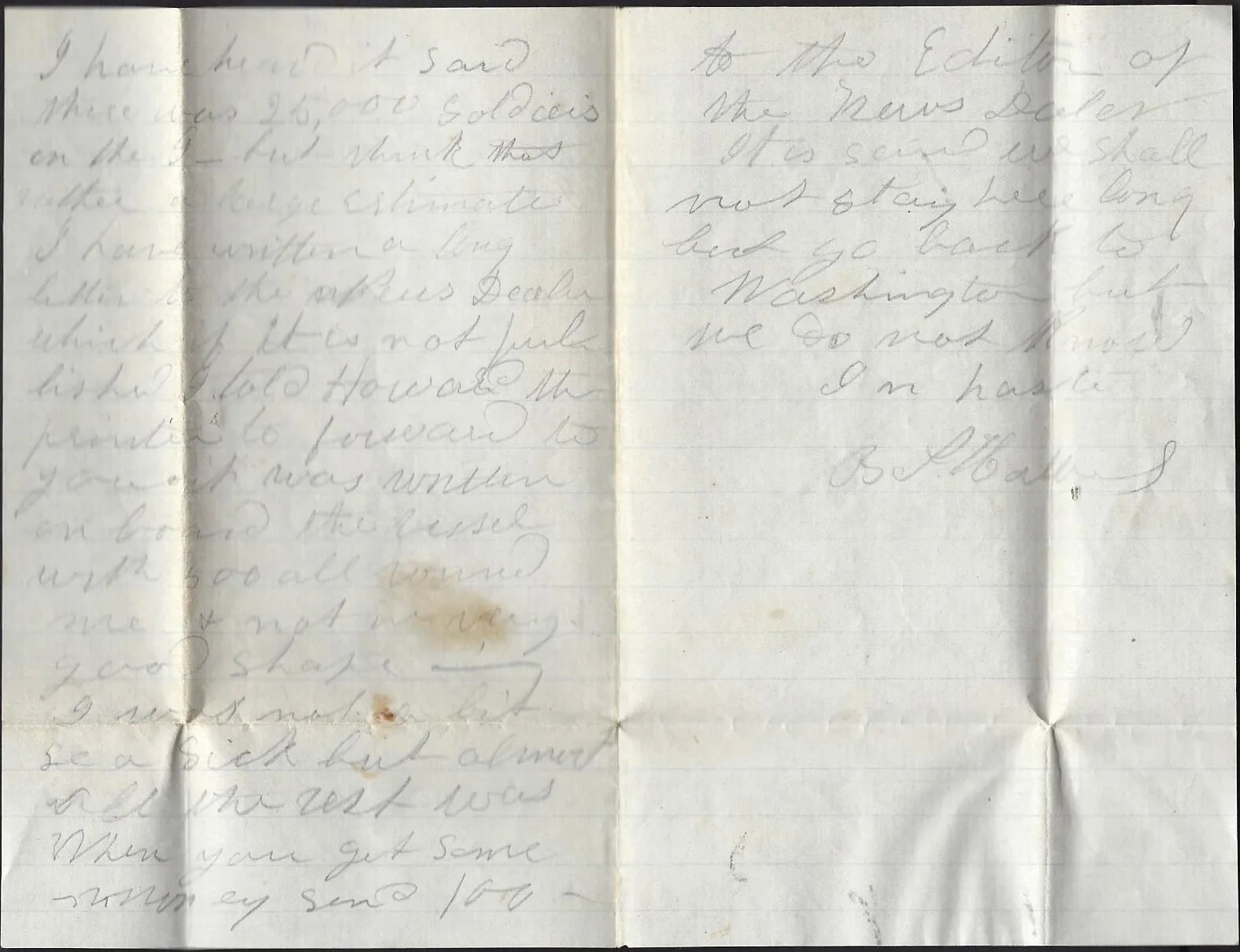
This island is about 7 miles long where we are. It is nothing but white sand. At the east end, I can see some trees. I have heard it said there was 25,000 soldiers on the Island but think that rather a large estimate.
I have written a long letter to the [Lamoille] News Dealer [newspaper] which if is not published, I told Howard the printer to forward to you. It was written on board the vessel with 500 all round me & not in very good shape. ¹ I was not a bit seasick but almost all the rest was. When you get some money, send $1.00 to the Editor of the News Dealer.
It is said we shall not stay here long but go back to Washington but we do not know.
In haste, — B. F. Hulburd
¹ Hulburd’s letter to the editor of the Lamoille News Dealer was published on 29 March 1862:
MR. EDITOR: I presume that abler pens than mine have given you an account of the journey from Rutland to the place of our destination. But to break the monotony of the voyage, I take a very uncomfortable position, and will pen a few words, which, if you think worthy of notice, are at your disposal.
We left Rutland on Monday, March 10 after noon, and without accident arrived at N.Y. the day following at noon, where we were provided an excellent dinner, served up at the barracks, furnished, as I understand, by the Vermonters in the city. After dinner, the different companies formed on the park, and were kept standing till 5 P.M., when the regiment was divided. The right wing, under command of Col. Geo. T. Roberts, went on board a vessel lying in N.Y., and the left wing, under the command of Lieut. Col. V.S. Fullam, crossed over at the Fulton Ferry, to Brooklyn, and went on board the vessel that was to take us to Ship Island, or somewhere else, we, the soldiers, knew not where. The vessel (a merchantman called the “Tamerlane”), had just been fitted up expressly for our convenience and–comfort (?), there being about 250 bunks or berths built up between decks, situated a few feet below the surface of the water, ventilated by two hatchways situated about seventy-five feet apart, and lighted by three or four lanterns, which only served to render “darkness visible.” This room, 28 by 175 feet, was the sleeping room for some five hundred men, We remained at the wharf in Brooklyn from Tuesday evening till Friday noon, March 16, when the anchor was raised, and a “steam-tug” towed us out eight or ten miles, through the “narrows,” and then the broad ocean was before us.
The wind at this time being favorable, Monday morning no land was to be seen; neither up to the present time has the sight of land greeted our eyes.
Sunday night, and Monday morning, the first and second days, could be seen many elongated and visages, and heaving bosoms, arising, however, not so much from thoughts of leaving friends at home, as from the motion of the vessel; and many were so much affected that they could not remain on deck, but betook themselves to their bunks; and upon going down, one could discover, from certain gurgling sounds, that the fountains of the deep were being broken up. This state of things continued for two or three days, rendering our sleeping apartments anything but a pleasant place of resort; and being destitute of certain articles indispensable to a sick room, it made the place intolerable. Luckily for me, I passed the grand ordeal, and came out unscathed.
On Thursday morning, the fifteenth day from N.Y., was performed the mournful rites of burial at sea. Mr. George N. Willey, (the one who formerly worked in your office), a member of the Northfield Company, having died suddenly the night before. His body, with heavy weights placed at his feet, was sewed up in his blanket, and placed upon a board, one end of which was placed on the side of the vessel, projecting over, the other end being supported by two of the sailors, while the Rev. Mr. Townshend, of Co. E., offered an appropriate prayer. The end of the board was then gently raised, and the body slid off, and immediately sank beneath the swelling waves, there to remain till “The sea shall give up the dead that are therein.”
Our fare since we came on board, has been rather tough. There is not quite enough, such as it is, and is rather poor what there is of it. But through the exertions of Capt. Landon, who is ever mindful of the wants of his men, and who is beloved by all, we have the assurance of better fare for the future. The weather today is hot and sultry, with scarcely a breath of air. Consequently we are making no headway. At 3 o’clock P.M. the thermometer standing at 82 in the shade, several of the men went in to bathe, but the cry, “A shark! A shark!” from the captain of the vessel, made them hasten back on board, the last one being drawn in just in time, for the large back-fin of the monster was to be seen by the side of the vessel. A large hook was immediately baited and thrown over, which he seized and was fastened. Several shots from the officers soon silenced his sharkship, and he was drawn on board. It proved to be a young one, only seven feet in length.
March 31: Sixteen days at sea. Passed the Bahama Isles on our right, the largest of which is Turk’s Island, or at least the largest we saw. I can give but little account of it, as we were, probably, when nearest to it, one mile distant. There appeared to be one place of some note, say about the size of Hyde Park. There were several vessels lying there being loaded with salt, that being its only source of wealth; and of that there appeared to be an endless amount. This island, with a neighboring one of less magnitude, contain, as I understand, some 3000 inhabitants. The buildings were all of one story and flat roof. There was a little boat came out to us with five men (negroes). Who took several letters for our men, on shore, to be forwarded the first opportunity. They stated that there were no springs on the island, they securing and using rain water.
The next day we passed another group of islands, called, as near as I can spell it, the Incguas, of considerate size, yet not inhabited to any extent, except those that have charge of the light houses.
April 2d: Eighteen days out. Passed the island of Cuba, which in the distance, looked like home, as I could see old “Mansfield Mountain,” or one that nearly resembles it. As I saw but little on the island. I will not attempt anything respecting it, being on duty at the time we passed it. The wind at the time being favorable, we made good headway for the last 48 hours, 8 or 9 miles an hour. In passing Key West and the Florida Reefs, there was a heavy wind or sudden squall struck us at the very entrance of the Narrows, and the way the ship reeled and pitched, made some us wish we were on shore. The wind howling through the rigging, the waves roaring and dashing in on the breakers on either side, and above all could be heard the hoarce voice of the Captain, steadily giving his orders to the sailors, and they in the rigging, “taking in sail, with their, “Yo, heave O,” was truly interesting, yet fearful scene. As I was walking my beat, between the hours of twelve and two at night, I could not help looking up at the North Star, and thinking that in that direction, far, far in the distance was my own humble home, my wife, and my dear little one; yet not for one moment did I regret the steps I have taken, for I feel I am in the line of duty.
Thursday, April 2d: The wind has died away, and a gentle breeze is now wafting us along at the rate of 8 miles an hour. The dangers which threatened us last night are passed, and the Captain says that in four days we shall be at Ship Island. The weather is very warm, the thermometer ranging from 80 to 90 degrees, and the men are obliged to remain on the deck through the day, with three pints of water measured out to them daily, makes our situation a little unpleasant. The men, or some of them, I have seen pay the sailors 25 cents for a plate of boiled rice, or hash, or a small piece of fried meat, or a piece of jonny-cake. The sutler on board is taking all the spare change from some of the boys, with his crackers at 12 cents a dozen, and other things in proportion. Yet one company have wisely shielded themselves from temptation, having allotted $1175 per month to the State Treasury, or to their families, which is more than any other company has done.
April 10. Thirty days from Rutland, twenty-five at sea. We have just anchored at Ship Island. I can give you no description of it, or any particulars at this time. The health of the regiment is good, there being but a few sick, and those few but slightly indisposed. Our long, tiresome, and dangerous journey is terminated. Of everything that has transpired in our nation in her present struggle, since March 14, we are entirely ignorant. What there is on shore for us, or what our future trials and labors, is known only to Him in whose hands are the destinies of nations. Yet I have the confidence that the “same Almighty Being who so wisely protected our pious and venerable forefathers, in their struggle, will be mindful of us, the offsprings.
Now, in conclusion, let me say to you and your thousands of readers, that it is a source of satisfaction to think in our days of toil and privation that “When at eve, thou are gazing on the gay blazing”
“And when you bow before the throne,
In humble, grateful prayer;
At morn or eve, by night or noon,
We are remembered there.
Adieu, — B. F. HULBURD, Co. E. 7th Reg., Waterville, Vt.
Letter 3
[Editor’s Note: This transcript was provided to me by Paul S. LeBlanc whose Uncle George P. Hulburd transcribed them from the originals in the 1960s.]
Ship Island
April 25, 1862
Juliana,
Yours of March 22d was received yesterday. I was glad to hear so favorably from home. It found me in perfect health. Likewise the rest of the boys from Waterville are well. I understand a steamer leaves here tomorrow and as it rains some and the boys are all in their tents only what are on guard and they have to grin and bear it. There are 17 that tents in our tent and most all writing.
We have just been to dinner. We had fried pork and bread for we have a plenty to eat. Have a loaf of bread every other day, good coffee or tea twice a day, and meat for breakfast and dinner. We got very good water by digging 3 feet altho the island at this end is nothing but clean white dry sand so white that I have at first thought when looking out in the morning that the ground was covered with snow. It is about 10 miles across over to the Mississippi shore. The island is about ½ mile wide at this place and 8 long wider at the upper end, 75 miles from New Orleans west from this and about the same distance from Fort Jackson (I think I called this last named place in a letter to George, Fort Royal through mistake).
We are not permitted to write any thing in particular in relation to the movements or the men at this time and indeed we know but little of what is going on away from here, not having heard any news in particular for 6 or 8 weeks.
A Connecticut regiment is just leaving for New Orleans. they have been packing up today and we invited them to take supper with us. They have this minute given us three cheers and started.
I can go to the seashore and in an hour be back with a good string of fish. I went out last night and got a lot of “pounts” or catfish as they are called here and today I went again and got a mess of whitefish. There are a great many kinds of seafowls, ducks, teal gull, and pelicans. The Black Devil has come in just now with another prize. It is dark and I must stop. — B. F H.
Letter 4
[Editor’s Note: This transcript was provided to me by Paul S. LeBlanc whose Uncle George P. Hulburd transcribed them from the originals in the 1960s.]
Ship Island
May 4, 1862
Juliana,
Stone tells me that he is going home and I thought I would write a few lines altho he may not go for some days yet. My health remains good yet my weight is 196 or the same as a barrel of flour. Stone has not been able to do anything of amount since he came and there are a few more of the same sort left yet but as yet have not got discharged.
I don’t know how long we shall stop here. There are some signs of our leaving soon. A part of the regiment have already gone somewhere—to New Orleans I suppose, but they did not know certain when they left. New Orleans is in our hands as you have probably heard before this. Fort Jackson we got after some hard fighting. Some few from each of our companies went up with the expedition. I wanted to go but could not have the privilege. Our folks lost about 60 men in the scrape. We could hear the firing here and that is as near as I have come to getting killed yet.
There is rumors here that we shall be in Vermont before the middle of June but we cannot tell. I have not had but one letter since I got here dated 22d March. I have written 4 or 5 or more. I believe that the mail has not been in but 3 times since we came. I should like to step in tonight and see the folks and Roger and Eva first rate but cannot.
Our work is not very hard at this place now. We drill an hour from ½ past 7 till ½ past 8 in the morning, from ½ past 9 till ½ past 11 A.M., and from 4 till 6 P.M., roll call at 6 A.M. and 9 P.M. The rest of the time, if not detailed for extra duty, we lay around in our tents. Colegrove is on duty today. He wanted I should say for him that he was well—Leach and the rest of the boys are well.
Eva, be a good girl as I know you will go to school and learn all you can so that I shall be surprised when I come home. Roger, I know you will be a good boy. Be careful and not cut your feet with your little ax. You must help Eva drive the cow to the pasture and do other chores to help your ma and Eva and when I come home, I will bring you something neat.
6 o’clock. The labors of the day are past and I have just come off from dress parade—not much tired, but it is hard traveling in the sand.
We know not how long we shall stay here but letters directed to Ship Island—N. Y. Washington or any where come here—7th Vt. Reg. Co. E but say Ship Island.
In haste, — P. F. Fulburd
Letter 5
[Editor’s Note: This transcript was provided to me by Paul S. LeBlanc whose Uncle George P. Hulburd transcribed them from the originals in the 1960s.]
Ship Island
May 7, 1862
A continuation of the letter I commenced the 4th. I understand now that Henry Leach’s discharge is made out and he is going home by and by so I will fill another sheet. I am still tough as a knot altho there is not a day but what at some of our drills some of the boys fall out of the ranks and some mornings 10 or 15 will come out at the “surgeon’s call” and post off to see the Dr. if they can’t be excused from duty for the day. About every member of the Co. has made applications to be excused for the day but myself. I have not seen him on that business since I came here but it does make me sweat like a cuss, the thermometer standing at 102 in the shade.
I have just eat dinner we had some curious stuff. It was all kinds of vegetables, cabbages, turnips, carrots, beets, potatoes, &c. that had been boiled or prepared some way and pressed into a kind of a cheese and dried. It is kept in this way a long time, then make a soup of it and it is a most excellent dish. I eat about 15 lbs. of it or less.
A few days ago the Capt. called for me to come to his quarters. I went [and] he told me that he had recommended me to the Col. and that the Col. had appointed me a Corporal so you see that I am on the gain. I should not [have] accepted the appointment had it not relieved me from the liability of being called upon for extra duty such as preparing wood or working on the wharf, &c. &c. We have just heard that the boys that left here from this regiment a few days ago had no trouble but found the place they went to take deserted, not a person being left and their guns all spiked. I think there is not much to contend with out this way.
More and more talk about our leaving here soon. Where? don’t know. Some say home to Vermont, some say up the Mississippi. Any place, I don’t care where I am enough for it. I have not felt the first symptoms of the phthisis since I was at home nor seen any women since I left—nay except 2 or 3 that are on the island. We have not been paid off yet don’t know when we shall be. Some say not till we get back others say soon. I suppose you have got the 7 dollars for April, and May will soon be due. — B. F. Hulburd
Letter 6
[Editor’s Note: This transcript was provided to me by Paul S. LeBlanc whose Uncle George P. Hulburd transcribed them from the originals in the 1960s.]
Camp Parapet
June 9, 1862
Juliana,
I thought I would write a few lines at this time as we are under marching orders with everything packed ready to start at a moment’s notice for some place, we know not where but expect it is Vicksburg, Mississippi, about 3 or 400 miles up the river. We were ordered yesterday morning to get ready but I should not wonder if the orders were countermanded yet and we not go. Henry Leach is discharged and will start in a few days for home. I had written 2 letters to mail but I have handed them to him you may get them—or you may get this first. Our letters get through after a fashion. Yours of May 1st I got the 20th of May. Westcot and some others the 28th of May got theirs written from the first to the middle of April, &c. I would say for the present, direct to New Orleans and if we move, the mail for us will follow the 7th Vt. Reg. if properly directed.
My health is good yet. I don’t know why it should be for most all of the boys complain of diarrhea. I went to the surgeons call this morning to see him “doctor em.” First, “What ails you?” “My gut ache and I have a diarrhea.” “Steward give him some of that dysentery medicine.” Next “What ails you?” “I feel weak and my stomach is out of fix.” Steward give him some quinine—cordial—tonic—blue pills &c. &c.
The surgeon says the water we drink is the cause—it is river water tolerable cool and good tasting but it is so rily that you cannot see the bottom of a pail full of it. We sometimes put in a little alum to settle it and from a pail full we will get a tea cup full of mud. I have not lost a meal of victuals since I burnt up that medicine in Rutland. I want you should write often as you can conveniently and tell all the news of the day. I have no news to write. We lay here doing nothing and nothing to do but if we go up the river, we may have a little fun, but probably not much as the rebels. As fast as our people move up, they fall back. I think a few thousand men in this section are doing more than all the hosts there on the Potomac but we do not get news very full from there very often. I cannot say much more at present.
I understand there was a large mail from Vermont came into the city last night if so we shall get it tonight or tomorrow. I hope to hear from home by it. Talk to the children for me. I should like to step in tonight and see my little tow head and Eve and all of you but I cannot so I will say good night. — B. F. Hulburd
Francis Shaupan wants I should say that he is well and lively and all right. Send word to his wife that it is so.
Letter 7
[Editor’s Note: This transcript was provided to me by Paul S. LeBlanc whose Uncle George P. Hulburd transcribed them from the originals in the 1960s.]
Camp Parapet
Carrolton, Louisiana
June 9, 1862
If it was not for making you feel bad, I would tell you what accommodations and care the sick had on our trip from New Orleans to this place. I will say a little but one should see to know. Some 50 or more were put into a long narrow passage stowed in as thick as you ever saw a flock of sheep lay mostly on the floor which was wet and nasty as some people’s hog pen. Some had mattresses, some a blanket under them. Occasionally a heavy wave would strike the boat and the water come over the sides of the boat and run in among the sick keeping the floor constantly wet. What medical attendance they had I can’t say. I saw the surgeon and I told him it was a devilish shame and that folks might say what they was a mind to about the treatment our sick prisoners received at the hands of the rebels I thought this worse than I ever read. Said he, “you look on the dark side of the picture.” Said I, “It is a dark picture to look at.” Said he, “This voyage will be a benefit to them and when we get up to Pensacola in a few days they will flesh up and be as tough as ever.” I hope they will.
The Brigade that we are now in is commanded by Brigadier Gen. Neal Dow, the originator of the Maine Liquor Law. What kind officer he makes, I do not know. He was a very popular man at home among the temperance class but the rummies hated him.
I don’t know what to say about Joel. He came out of the hospital about 2 weeks ago, appeared better, but when we landed here, he was taken to the hospital again. You said he wrote that I was drawn out of shape with the rheumatics but I am as straight as a pickerel and one of his legs is quite crooked and pains him a good deal. He told me when I wrote to Daniel to say that he was about as usual and that is all you need to say I have written about him. Albert Townsend is here—not well, but better. The old man was left at the hospital at New Orleans. Hiram Leach is here and well. so is Volney Gilmore. Dr. Burgess is not very well but keeps about.
Tell me what Henry Leach brought home for me. Did you get the little bottle I sent? Did he get anything for the children? I will write no more at present. How often we shall get a mail I can’t say. If you direct to this place by the way of N. O. it will be here oftener. Kiss the babies. — B. F. Hubbard
Letter 8
[Editor’s Note: This transcript was provided to me by Paul S. LeBlanc whose Uncle George P. Hulburd transcribed them from the originals in the 1960s.]
Baton Rouge, Louisiana
June 13, 1862
Feeling a little lazy this afternoon, I thought I would write a few lines not knowing how soon it will be mailed.
We left Camp Parapet on the night of the 10th on board a steamboat and arrived at this place the next day, a little after noon—distance 140 miles from New Orleans. Nothing of interest occurred on the way nor has there since we arrived at this place. We started with 3 days rations in our sacks viz. 18 crackers (hard) and a piece of meat about as large as [illegible] that but we had a nice cup of coffee made soon after we got here yesterday noon. Our first meal today [was] a good mess of beans. We get along very well about our living—only when we move and then it comes rather tough.
It is a very pleasant place here. We are quartered in the U. S. Arsenal, our tents we left down the river. How long we shall stop here, I cannot say. The report in camp this morning was that McClellan was beaten with great loss at Richmond, Va. Soon it was said that he was victorious but met with heavy loss. How it is, we don’t know. There is not much doing here—only the pickets have a time of it once in a while. The other night a Col. of one of the Wisconsin Regts. was fired upon by a Lieut. of a guerrilla band and was wounded and has since died. The same Lieut. shot his own son, mistaking him for one of our pickets, but the Wisconsin boys have him and 10 or 12 of his men under lock and key now. Somehow the 7th Vt. has not made its mark yet. How soon we shall be called on, we can’t tell but I expect that we shall prove ourselves no cowards.
Write as often as you please for I don’t expect to get the letters altho they are forwarded to us as we move but come very irregular. H. W. Leach is discharged and some others of the boys altho Gen. Butler has not signed their discharge or had not when we left. They stopped down the river and expected to leave for New Orleans and from there home in a few days but—”heavy bodies move slow.”
Love to the children. Yours in haste, –B. F. Hulburd, 7th Vt. Reg., Co. E,
New Orleans
“The end of June found the Vermont Brigade involved in a seven-day series of battles, too busy and tired to write home. In the Gulf Department, the Seventh Vermont Infantry joined an ill-advised expedition to capture Vicksburg, by now the only major obstacle to federal control of the Mississippi River. Both campaigns would take a heavy toll in lives and morale.” [Source: A War of the People: Vermont Civil War Letters by Jeffrey D. Marshall, page 72]
Falling back to Baton Rouge, the 7th Vermont’s Colonel George T. Roberts was killed during an attack on 5 August 1862 by Confederate General John C. Breckinridge that was finally repulsed after several hours of fighting. Looking for a scapegoat, General Butler called out the 7th Vermont afterwards, charging that it retreated in disorder, that it fired on a neighboring regiment, and that cowardice prevented it from coming to the requested aid of an Indiana regiment. All in all, it was another “hard luck” campaign for the 7th Vermont.
Letter 9
Editor’s Note: This transcript was provided to me by Paul S. LeBlanc whose Uncle George P. Hulburd transcribed them from the originals in the 1960s.]
Baton Rouge, Louisiana
July 28, 1862
Juliana,
I am now going to write the toughest letter you have had yet. I have wrote some that I think you never got. I may repeat some things written before. We left Camp Parapet near the 10th of June and came to this place and stopped till the 27th when we went aboard a steamer and went some 300 miles up the river and stopped opposite Vicksburg. It was rumored when we first came here that Gen. Williams—a thing that commands one division of Butler’s Brigade, that the 7th Vermont was the toughest looking regiment he had seen, but he could kill them out. While here, he put them on extra drill one hour with the knapsacks on under an almost scorching sun and then took us up to Vicksburg and kept us on the boats and in the woods for a month on excessive drills and other useless labor, and in that month we—the regiment—lost about 25 men. Luckily for me I was sick all the time and did no duty and thus escaped. I say I was sick the day we went on board the boat for Vicksburg. I was taken worse (having been lame for a few days) and I expect I came very near having the rheumatic fever. There was 2 days I have no recollections of. I had good care taken of me. The steward of the boat gave me a good berth on the boat and occasionally a good meal with a little whiskey—the first I had seen since I left New York. The Captain furnished me with some and it done me a great deal of good at the time. I waked up at one time and I found the Capt. and Col. rubbing me. Another similar case cannot be found in the regiment. The Captain tended close to me till he was taken unwell and had to leave me but I had got so I could attend upon myself. I took but a plagey little doctor’s stuff.
One morning as I was walking round, the surgeon came to me and said, “Hulburd, I believe a little whiskey would strengthen you some,” and gave me a ½ pint. I am now hearty and well with an appetite like a horse. I have not yet returned to duty on account of lameness. I have not had the first symptom of phthisis since I left Vermont.
Of the particulars of our stay up the river, I shall not be able to say much. Our men were fired upon several times—or the men on board the gunboats in the river—by the sharp shooters from the rebel side, but the grape and canister from the boats soon scattered them with the loss as I heard of 400 or 500 men. A few nights ago, one of our steamers left our landing there and came down the river a few miles and when returning about 3 o’clock in the morning, were fired upon from a battery on shore. Some 3 or 4 balls went through the boats, killing one man of our regiment—a captain of the Swanton Company. When we went up the river, we drove some 4 or 500 rebels from a place called Grand Gulf—a village something like Waterville in size. At 8 in the evening, the boys commenced and by 12 o’clock, every building was burned to the ground. It was a grand sight but it looked rather hard, although I was so sick at the time that I did not enjoy it much.
On our way back to this place the other day, at that place and one other place, we were fired on from the shore but their balls did us no harm. We were well protected as every steamer—9 in all—had a gunboat on our side fastened to her with several large twenty 24 gun boats on the lead and following up behind. While up the river and indeed the time the regiment last drilled, it could not raise 200 effective men, some companies going out on parade with [only] 12 and 15 men, and it was hard work to get well men enough from some companies for guard duty. The men are dying off very fast now in our regiment—say averaging 3 in 2 days. To begin with, I will (list) among the deaths in our company, Lieut. R. T. Cull is buried today. Miles Fletcher was buried about 2 weeks ago. Geo W. Hanley of Johnson and one Marshall—Babcock from Johnson, Doane from Bakersfield and a fellow from Huntington. We are a shaky looking crew of us now, I tell you. I lost but little flesh myself—probably fell from 180 to 160. There is strong talk now that this regiment is a going to be taken to Fortress Monroe, Virginia, and stationed there to recruit up. If so, I shall be comparatively most home.
We were paid off yesterday two months pay. I got 4.00—the first money I had had for 3 months. You will probably get 22.00 now soon as the papers can be arranged and forwarded to the State Treasury. I have heard that we were to never been homesick yet I should like first rate to be there….[rest of letter missing]
Letter 10
Editor’s Note: This transcript was provided to me by Paul S. LeBlanc whose Uncle George P. Hulburd transcribed them from the originals in the 1960s.]
Baton Rouge, Louisiana
July 30, 1862
Baton Rouge is a very handsome city regularly laid out into streets crossing each other at right angles, well ornamented with shade trees so that one can not see a place till you are there, but the inhabitants are skinning our boys. I went this morning and bought a quart of milk for 10 cents and a small loaf of bread for 20 and I had a glorious meal. Tonight they ask 20 cts. a quart for milk, butter 50 cts., good cheese 25, potatoes $4 per bushel, onions decent ones 5 for 5 cts., which is their smallest change. Some of the boys will buy a few potatoes at 2 and 3 cents apiece and onions eggs at 4 cts. a piece a small mackerel or 2 which will weigh about ½ of a pound and get up quite a meal which in the end costs about 60 cents. I have been to a tavern once and paid 50 cents for a good meal which done me $1 worth of good. Altho it was a plain farmer’s meal, it went to the right spot. I think must have gained 10 lbs. that day.
As I have no conveniences for writing, I want mother, Heman, Juliana, and Sam to understand when I do write, I intend it for all and wish them to answer the same as if directed to them. It looks tough to see so many sick lying around the hospital and quarters. 6 or 7 have died since yesterday morning. Some few others that won’t live till tomorrow night.
My thanks to Mary Ann McElroy. Borrow no trouble about me — B. F. H.
I (got) last night 2 letters June 3d and 22 which had been delayed at Camp Parapet — one of the boys left there came up here and brought up 8 bushel of letters and papers. H. W. Leach is there yet but I have just heard that all left there were coming to this place — 140 miles. If so I don’t think we shall go to Fortress Monroe at present. 2 more in our Reg. died last night. We Watervillians are all well. Hiram Leach is not very smart tho nothing serious. Respects to all. Love to children. I am tough and courageous. — B. F. Hulburd
Falling back to Baton Rouge, the 7th Vermont’s Colonel George T. Roberts was killed during an attack on 5 August 1862 by Confederate General John C. Breckinridge that was finally repulsed after several hours of fighting. Looking for a scapegoat, General Butler called out the 7th Vermont afterwards, charging that it retreated in disorder, that it fired on a neighboring regiment, and that cowardice prevented it from coming to the requested aid of an Indiana regiment. All in all, it was another “hard luck” campaign for the 7th Vermont.
I can only find a partial letter describing the 5 August 1862 attack by Breckinridge on Baton Rouge, which follows. It may have been a part of the letter Hulburd wrote on 22 August 1862.
Letter 11
….Now a few words about the fight we had at Baton Rouge only I did not have the privilege of participating in it on account of my lameness. I loaded up my instrument and started but had to give it up and we sick and cripples were ordered to fall back as fast as we could. I stopped in the camp till the balls fell around me like hail stones, then slowly waddled off while the balls would zip by my head.
The rebels under Ex-Vice President Breckenridge numbering some 7 or 8000 opened fire on us on the morning of the 5th. By some fault or failure on the part of our picket guard, no alarm was given until the enemy were close upon us. Then they opened upon one of the Indiana Regiments, the fire was immediately returned, and the 7th Vermont then poured in upon them, likewise other Regiments, which they stood like heroes and immediately gave our men another volley, when we fell back in order to draw them from the woods in which they were, our men occupying open ground. Having partially succeeded in drawing them from the woods, our infantry let in upon them and a battery of 5 pieces that could give them 40 guns a minute with their grape and canister and chain shot made tremendous havoc among them. Our men would not number more than 4000; our loss near 150. The rebels left from 600 to 800 dead on the field which we had to cover up or darkies that we set about it.
There are so many things that I want to write that when I begin (I) fill a sheet without saying [what] I want to…
Letter 12
Editor’s Note: This transcript was provided to me by Paul S. LeBlanc whose Uncle George P. Hulburd transcribed them from the originals in the 1960s.]
New Orleans, Louisiana
August 15, 1862
Well, Juliana, as there is now some prospect of Henry Leach’s going home sometime, I thought I would begin in season and write a little and send by him. Yet it may be a long time before you get it. I am now in the hospital being rather unfit for duty in consequence of lameness in my legs and arms. Since my sick spell up at Vicksburg, I have been troubled somewhat with the rheumatics as above stated. I have not done duty (only at the table) for over two months. My appetite is tremendous. I can eat anything from a raw dog up to a boiled owl. I have seen some rather pinching times, yet I am gaining flesh. I did not know but I might get my discharge but I am gaining so fast that I shall not ask for it at present. Yet should my lameness continue and I remain unfit for service, I may make application for it bye and bye.
There are about 800 in this hospital and there are three or four others in the city. But how many inmates they have, I cannot tell. Probably not as many in each as in this, which is a very large building—a ground plan of which I will send. There are from 2 to 4 deaths daily here. Some of the boys get a little better and get a pass to go out in the city and fill up with pies and cakes and melons and whiskey and come back and die before morning. I might tell you some pretty tough stories but guess I won’t now. Simply say I have two months more in a few days but I think we shall not be paid off again till the first of Sept. when 4 months pay will be due.
How do you get along about getting your money and &c.? I got yours of July 8th the 26th. Write again soon. Direct to the 7th Vermont, Co. E, and it will come to me. Borrow no trouble about me for I shall come out “right side up with care.”
Figs here by the thousands and other things which I don’t touch. — B. F. H.
Eva Roger, how do you do?
Letter 13
Editor’s Note: This transcript was provided to me by Paul S. LeBlanc whose Uncle George P. Hulburd transcribed them from the originals in the 1960s.]
New Orleans, Louisiana
August 19, 1862
Juliana,
I have just read yours of the 4th inst. I was truly glad to hear from home of your good health and prosperity. You say you have written 8 letters to me directed to New Orleans. I think that I have read but 7 letters since I landed at Ship Island. Our regiment and my company have been split up and scattered for the last two or three months and the letters that have come to New Orleans for us have been lost before they reached our different quarters.
I wrote you once from Vicksburg but I learned that the steamer that carried the mail up the river was fired into and burned by the rebels so of course you never got that letter. Yours found me tough and hearty, only I have not got entirely over my lameness but think it is improving. Tell Mary that the pepper she sent me was the very thing I wanted. I had but a few minutes before the letter was handed me been reading that “same piece in the paper” and I wished that I had some sent me—now I will have some “pepper tea.” I am still at the hospital at New Orleans but think now that I shall go up the river to Baton Rouge this week tho our Capt. says that perhaps I had better stop here a few days—he has been here sick but leaves day after tomorrow for his Co. We were paid off about the 12 or 15th of July for 2 months only I recd.
Will you tell Heman, Sam, Mother, Juliana, George and all the rest that interest themselves in my case at all that they are at perfect liberty to write to me the same as though my letters were directed to them. When I write to you, I mean all and I presume [your] conveniences for writing are as great as mine. I now sit on my blanket rolled up in a wad on the floor writing on a piece of paste board about ¼ the size of my paper on my knee. How does the cows do? Who cuts the hay if anybody? How much is there of it? Is there India wheat on the knoll this year? What garden sauce have you a growing? Did you sow them peas that I got over to Mr. Nye’s last fall. If so, save some seed. I have not eat a green thing this season—only 2 or 3 messes of parsley that I boiled for greens and I picked 8 or 10 ears of corn and roasted and boiled (them). Please answer all these questions and tell me all the rest of such items. Tell Maria she need not worry about me for I have not been ½ as bad off as she “imagined.”
Now my little children what shall I say to you? Your mother says you are good little children. I am glad to hear that. I will remember you when I come home. I have not got shells and such things as Mr. McF. sent home. I can not carry them in my knapsack but I shall buy something and bring you (it). Good by children. Direct as before. — B. F. Hulburd
Letter 14
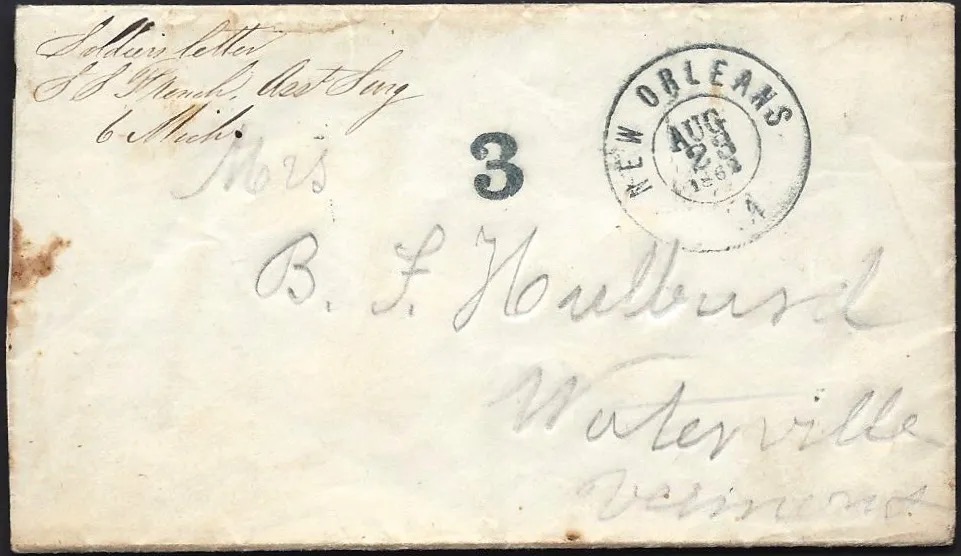
New Orleans [Louisiana]
August 22nd [1862]
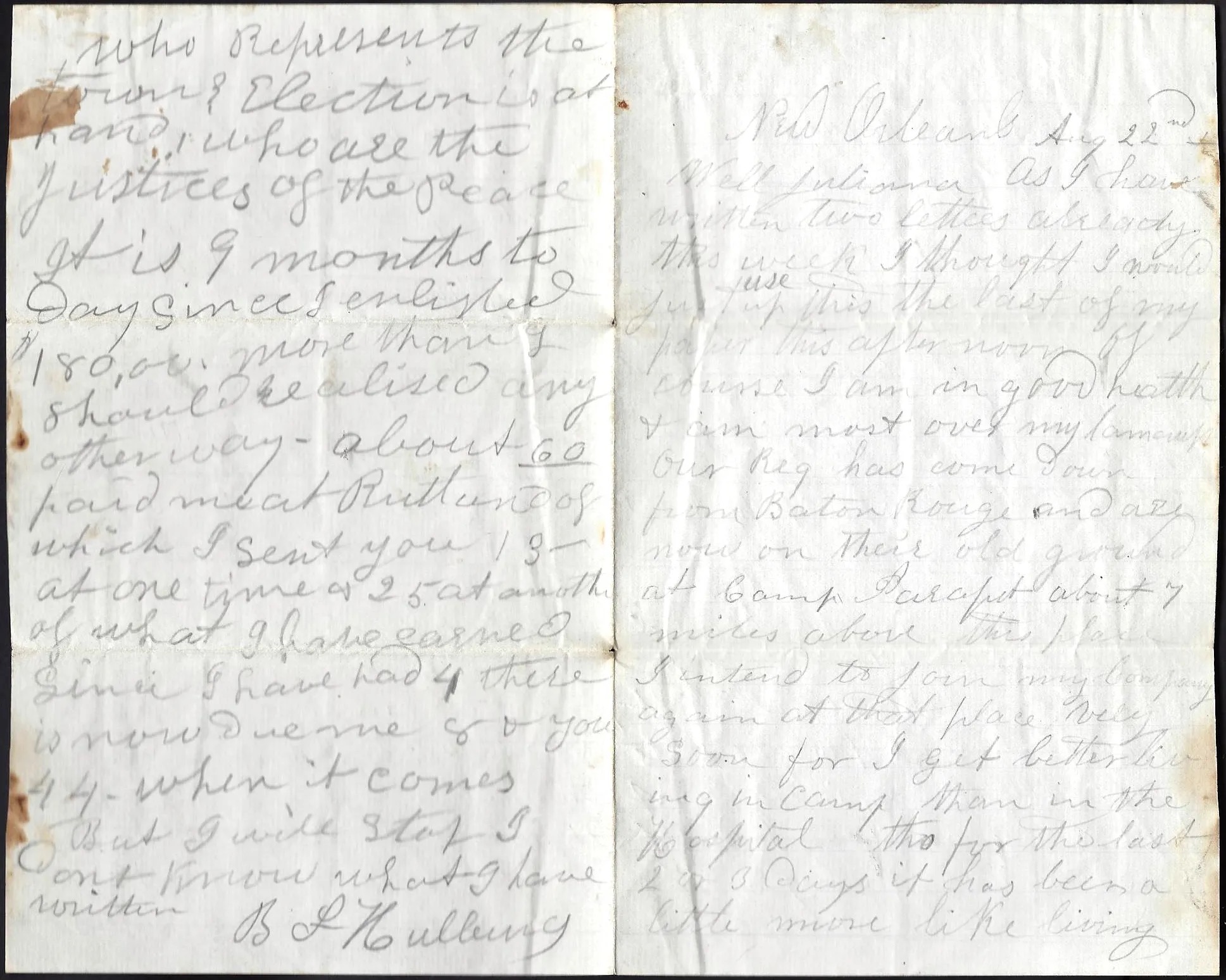
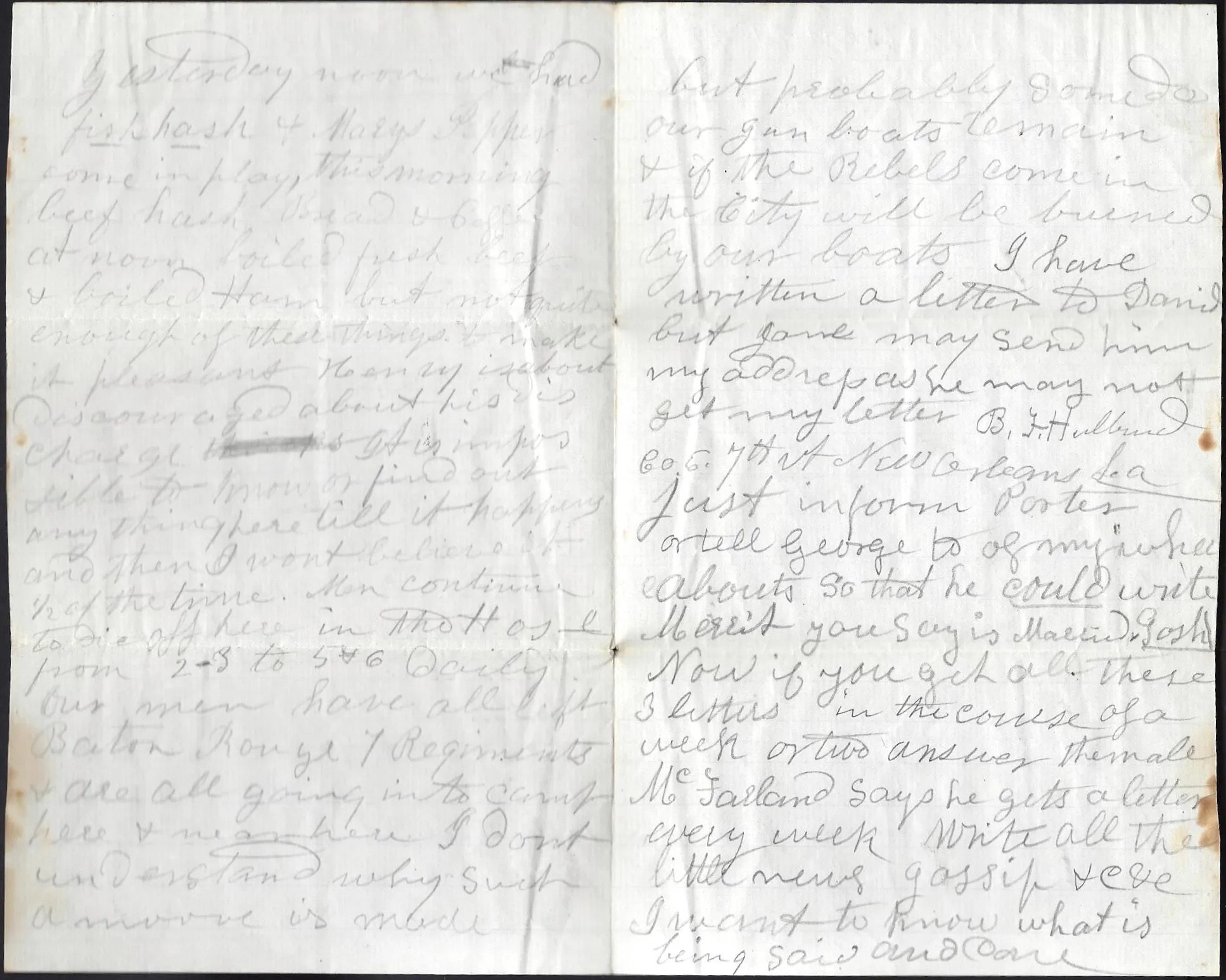
Well Juliana, as I have written two letters already this week, I thought I would just use up this the last of my paper this afternoon. Of course I am in good health & am most over my lameness.
Our regiment has come down from Baton Rouge and are now on their old ground at Camp Parapet about 7 miles above this place. I intend to join my company again at that place very soon for I get better living in camp than in the hospital, tho for the last 2 or 3 days it has been a little more like living. Yesterday noon we had fish hash & Mary’s Pepper come in play. This morning beef hash, bread & coffee. At noon boiled fresh beef & boiled ham but not quite enough of these things to make it pleasant. Henry is about discouraged about his discharge. It is impossible to know or find out anything here till it happens and then I won’t believe it ½ of the time. Men continue to die off here in the hospital — from 2-3 to 5 & 6 daily. Our men have all left Baton Rouge — 7 Regiments — & are all going into camp here & near here. I don’t understand why such a move is made but probably some do. Our gunboats remain & if the Rebels come in, the City will be burned by our boats.
I have written a letter to David but Jane may send him my address as he may not get my letter. B. F. Hulburd, Co. E, 7th Vermont, New Orleans, La. Just inform Porter or tell George too of my whereabouts so that he could write.
Merrit [Hulburd], you say, is married. Gosh! Now if you get all these 3 letters in the course of a week or two, answer them all. McFarland says he gets a letter every week. Write all the little news, gossip, &c. &c. I want to know what is being said and done. Who represents the town? Election is at hand. Who are the Justices of the Peace?
It is 9 months today since I enlisted. $180.00 more than I should realized any other way. About 60 paid me at Rutland of which I sent you 13.00 at one time & 25 at another of what I have earned. Since I have had 4, there is now due me 8 & you 44. When it comes. But I will stop. I don’t know what I have written.
— B. F. Hulburd
¹ Rev. Merritt Hulburd was Benjamin’s 19 year-old nephew, a Methodist Minister like his father.
Letter 15
[Editor’s Note: This transcript was provided to me by Paul S. LeBlanc whose Uncle George P. Hulburd transcribed them from the originals in the 1960s.]
Camp Williams, 3 miles from New Orleans
August 31, 1862
Juliana,
As the mail leaves in a day or two, I thought I would write a few lines today Sunday and send (it) out. I am looking for a letter from you soon as I sent out two or three letters one week some two weeks ago. I left the hospital last Thursday and came into camp with the company. My health is good at present—have got mostly over my lameness. I think I shall let up again now.
I will tell you what we had for breakfast and how it was cooked. It was baked pork and beans. The cook boiled them for an hour—dug a hole in the ground two feet deep kept a hot fire for 3 or 4 hours then set the kettles down on the coals put a large dripping pan over them and piled on a lot of coals then covered over the hole and let it remain till morning when he took out two kettles full of the nicest baked beans that I ever saw without any exceptions. We have our rations of beans once every 5 days. I’ll bet I eat some of them beans as I left the hospital about starved.
Our fare there was the hardest that I have seen. I suppose that they thought there that the sick did not want much to eat but I never had such an appetite as I had there and could get nothing only what was on our plates when we went to the table excepting we eat what some would leave. Our fare there was cold coffee a slice 4.00—well that is all gone.
The Capt. says that we shall be paid up 2 months more in a few days and I want to be with the company at that time. You will then receive $22 more—keep enough to make yourself not only comfortable but get some of the superfluities of life but pay C. C. C. as fast as convenient.
Cole Grove—Noel, Henry Leach—Lock &c. are here. Henry and some others are waiting for their discharge but they are not made out yet. They have not done duty since the first of May and I cannot see why they have not been sent home—but “heavy bodies move slow.” But steps are being taken now that will tell soon who are to be discharged and who put back to duty. If a person has been unfit for duty 2 months and the probabilities are that he will not be able for 3 months to return to duty—he is to be sent home.
I went before 4 doctors yesterday to be examined for a discharge but I look so plaguey tough in my countenance that I think my chances are very favorable to stop a while longer in the army which certainly is my desire if I am able. Don’t think by this that I do not want to be at home. O how I should like to sit down with you and the children to the table today noon to a dish of johnny cake and milk and butter.
Henry Leach went in next to be examined after me. He said the Drs. were talking my case over. Some were for puting me down as one that should be discharged for said they if he has got the rheumatic on him now it is doubtful whether he will be able to do duty at present. I don’t want you to think that I am “hard up” for it ain’t so. I am “all around” where they will allow a fellow to go. We can not go around in the city for the officers of the hospital won’t let us out of the yard for fear we shall eat or drink something that will hurt us.
I wrote you last Sunday and gave a short account of the Battle at Baton Rouge the 5th inst. I have read the rebels account of it and they claim a great victory. Gen. Breckenridge says they drove our men from their ground through the town and in some cases even in to the river. Now that is all a lie. It is true that our men fell back at first and drew the enemy from the woods at which time they came into our camp. It is true they destroyed some property and burned a few tents but in their account of the matter they say they destroyed a ½ million of dollars worth of property and occupied grounds through the day etc. etc.
Well there was about 300 that occupied the ground all day and night and the next day our men found means to get them under ground. It is secretly acknowledged by them here as being the heaviest blow that they ever had in this part of the country. Their “Ram” which our gunboats in the river here sent to “Davies Locker” as the old saying is was their greatest hope but his days were few and are numbered and if our fleet up north a little will serve one that I learn the rebels have built there they will do one good thing. I get but little news from the army there but from what I can learn our men are being worsted.
Now a few words about something else. Maria wants to know if I want money or if I had money if I could get anything that would make me comfortable. Now in the first place our rations when we draw full rations is enough and is wholesome yet it is not such a table as I find even at home. With money enough one could live like a prince. We can get Irish potatoes for 10 cents a pound sweet ” ” from 5 to 7 cents butter .50 cheese .40 and so on.
My $4.00 that I had went in about a week. I was just getting well then and wanted every thing I see. I went to the hotel 4 mornings and got my breakfast 50 cts. a meal. I eat my money’s worth I guess yet it was a plain table no pies or cakes simply cold wheat bread and butter coffee and first rate good meat with a very few potatoes.
I bought a mackerel for 15 cents 50 potatoes for 5 cents ½ doz. eggs for 25 cents 1 pound butter for 10 cents and took my ration of bread made me some toast and I had an allfired good supper—my potatoes were about the size of bullets.
I shall not tell you any tough stories now wait till I am there. I have seen the waiters and nurses here carrying the sick their food a tin cup of tea and a piece of dry bread. There is an institution here of “The Sisters of Charity” many of whom visit this hospital every day and go among the sickest and dying ministering comfort and consolation to them. They bring in toast and tea and ice water and many other necessities.
I had for breakfast two hard crackers plate of boiled rice and sugar pint of coffee. Dinner ’bout 2 quarts of pea soup meat bread and water—good.
Eve and Roger, when I come I will fetch you something. If H. Leach comes home soon I will send something. — B. F. Hulburd
Letter 16
Camp Williams, 3 miles from New Orleans
August 31 [1862]
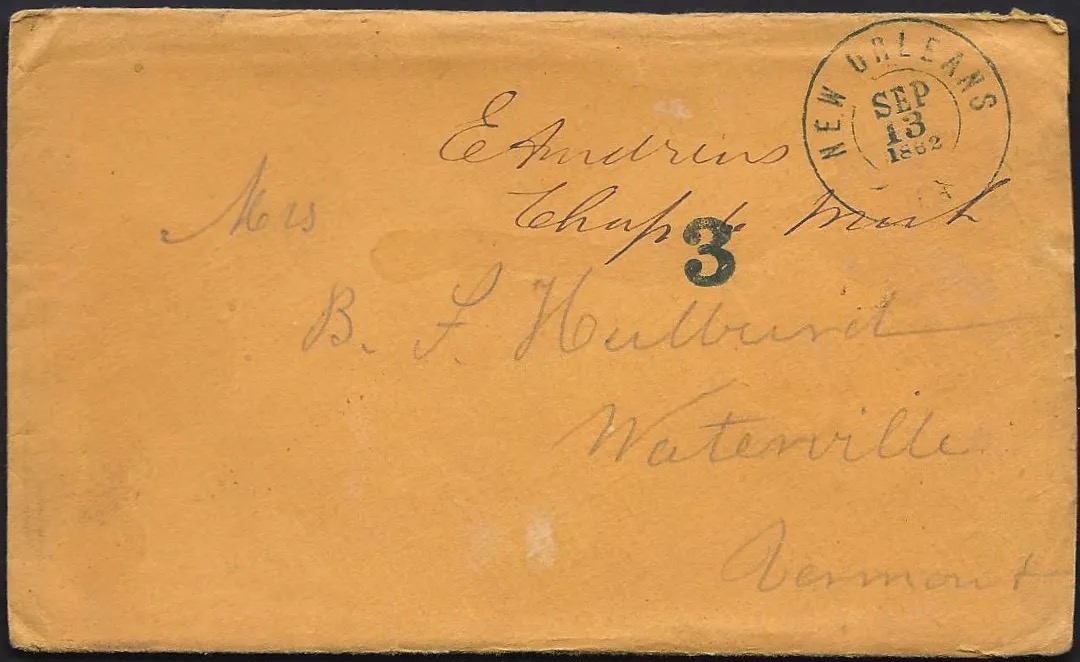
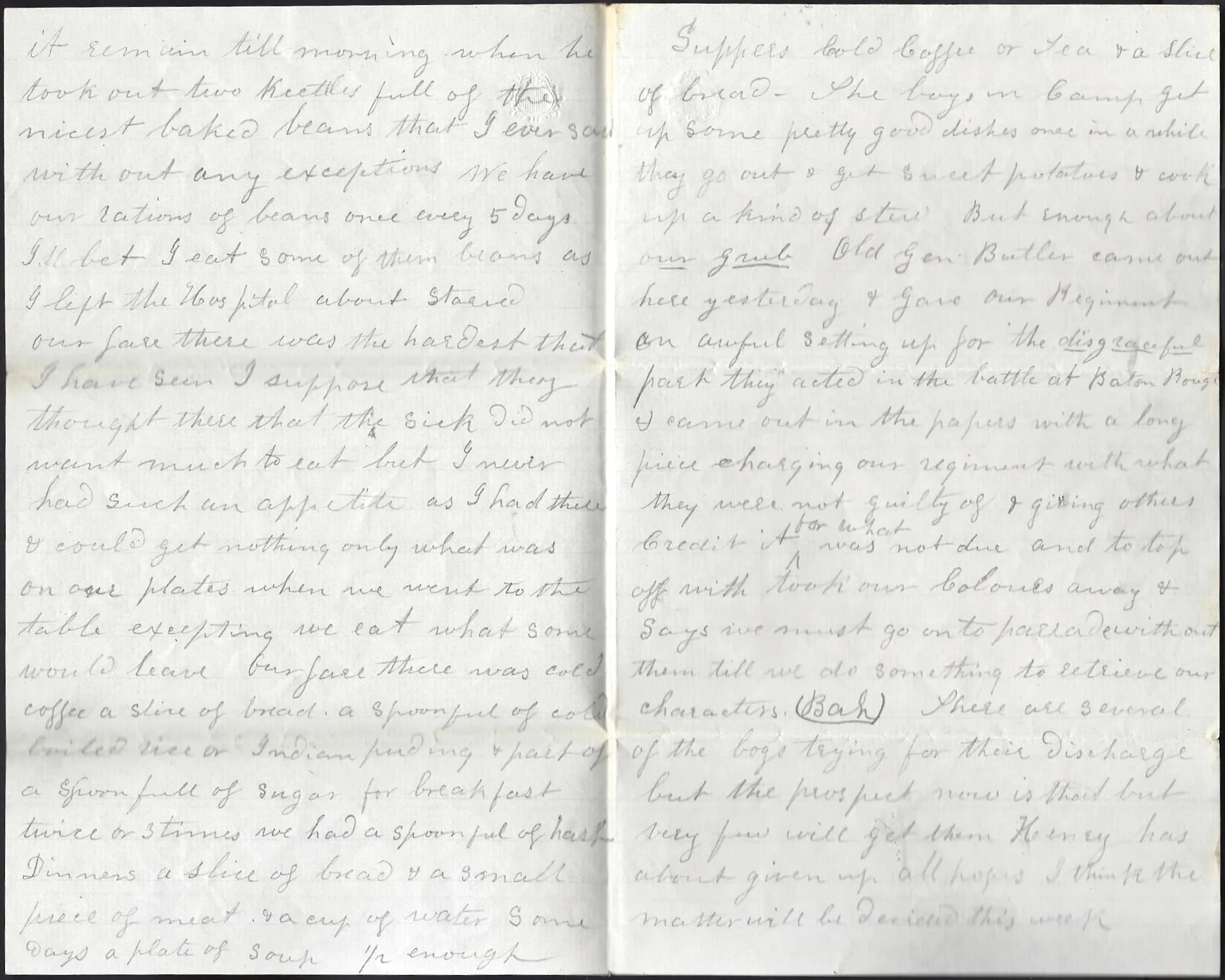
Juliana, I would write a few lines today — Sunday — & send out. I am looking for a letter from you soon as I sent out two or three letters one week some two weeks ago. I left the hospital last Thursday & came into camp with the company. My health is good at present — have got mostly over my lameness. I think I shall fat up again now. I will tell you what we had for breakfast and how it was cooked. It was baked pork & beans. The cook boiled them for an hour, dug a hole in the ground two feet deep, kept a hot fire for 3 or 4 hours, then set the kettles down on the coals, put a large dripping pan over them & piled on a lot of coals, then covered over the hole & let it remain till morning when he took out two kettles full of the nicest baked beans that I ever saw without any exceptions.
We have our rations of beans once every 5 days. I’ll bet I eat some of them beans as I left the hospital about starved. Our fare there was the hardest that I have seen. I suppose that they thought there that the sick did not want much to eat but I never had such an appetite as I had there & could get nothing — only what was on our plates when we went to the table excepting we eat what some would leave. Our fare there was cold boiled rice or Indian pudding & part of a spoonful of sugar for breakfast twice or 3 times. We had a spoonful of hash dinners, a slice of bread, & a small piece of meat, & a cup of water — some days a plate of soup ½ enough. Suppers — cold coffee or tea & a slice of bread.
The boys in camp get up some pretty good dishes once in awhile. They got out & get sweet potatoes & cook up a kind of stew. But enough about our grub.
Old Gen. Butler came out here yesterday & gave our regiment an awful setting up for the disgraceful part they acted in the Battle of Baton Rouge & came out in the papers with a long piece charging our regiment with what they were not guilty of & giving others credit for what was not due, and to top off with, took our Colonels away & says we must go on to parade without them till we do something to retrieve our characters (Bah!). ¹
There are several of the boys trying for their discharge but the prospect now is that but very few will get them. Henry has about given up all hopes. I think the matter will be decided this week.
There is some talk that the rebels will make an attack upon New Orleans before long, but I think there is not much danger of it at present. Old Gen. [John Wolcott] Phelps has sent word that he is ready for them. He with several regiments is on the river at Camp Parapet 5 miles up from New Orleans. The Vermont 8th & several others across the river opposite New Orleans. Several regiments at this place 3 miles below so we are prepared for them, let them come which way they will, but I guess they won’t come at all.
I had a letter from [my brother] Daniel a few days ago. He was well & [his sons] Loyal & William at the time. ² I had written to him a few days before I got his. I don’t know as he will get mine as it was not directed right. Nothing more this time. Write soon & often.
Direct to New Orleans. We are to be paid this week. — B. F. H.
¹ Gen. Butler’s criticism of the conduct of the 7th Vermont at the Battle of Baton Rouge was delivered before the regiment while in formation at dress parade on Saturday, 30 August 1862. “According to Sergeant Rollin Green, Butler spoke ‘in the most cutting & sarcastic way. He said ‘you will have to stand in the next fight cant run for I have sent home all the ships. There is not enough boats left in the harbor to carry a corporals guard.’ He talked to us as tho’ we were all cowards. I tell you my blood boiled.’ Lieutenant Dickinson fumed, ‘We have been disgraced deliberately and falsely as I pledge my honor to show if ever the opportunity is given.’” [Source: Rollin M. Green to friend, 2 September 1862, Rollin M. Green Papers; John Q. Dickinson to Dugald Stewart, 1 September 1862, Stewart Family Papers.]
² Daniel Campbell Hulburd (1814-1881) enlisted with Co H, 2nd Vermont Infantry, at the age of 47.
Letter 17
[Editor’s Note: This transcript was provided to me by Paul S. LeBlanc whose Uncle George P. Hulburd transcribed them from the originals in the 1960s.]
Camp Williams, 3 miles from New Orleans
September 9, 1862
Juliana,
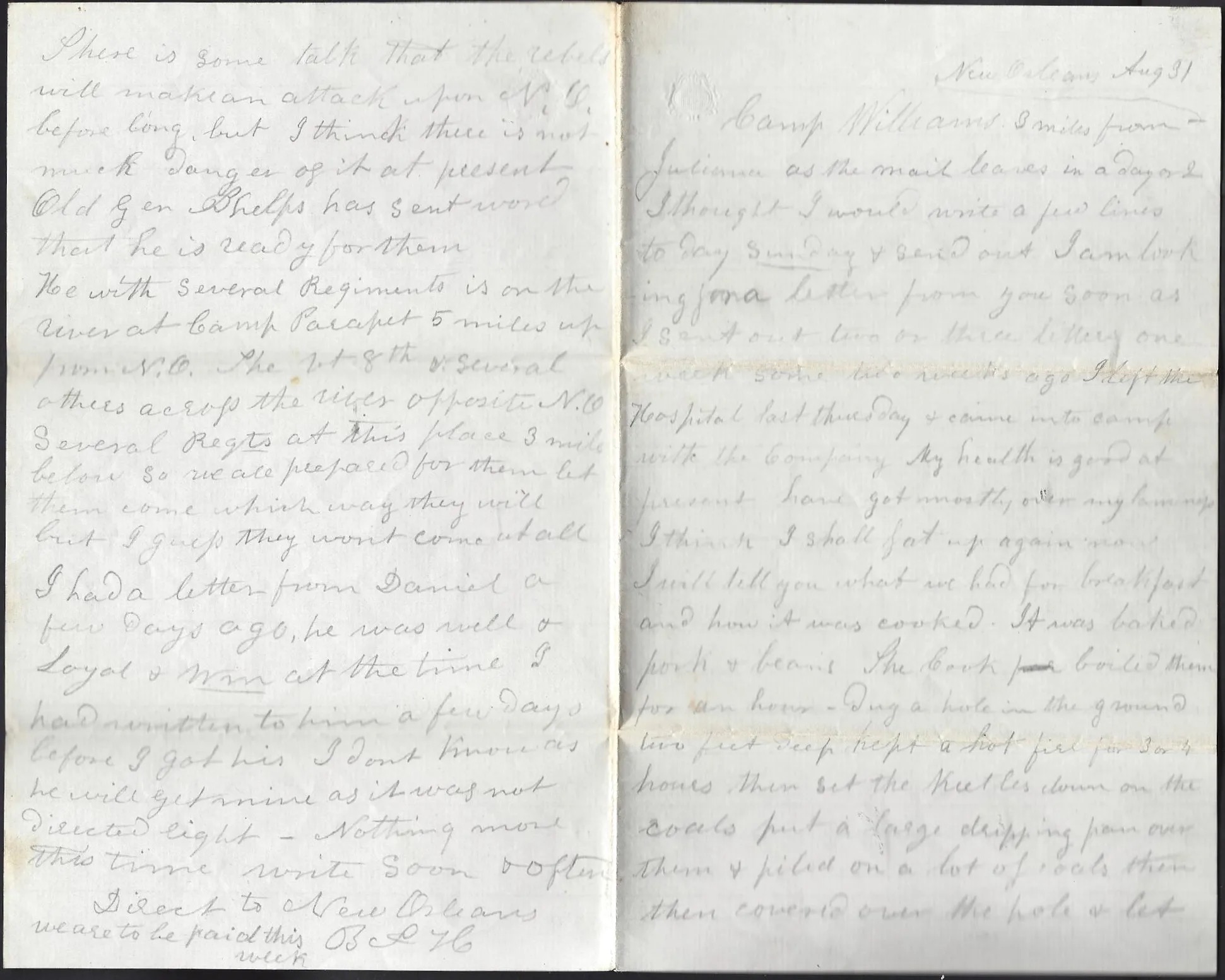
I just heard that there were lots of letters lying in the office not mailed because not paid. I have sent out 2 or 3 in that shape and I don’t know but you have been living without hearing from me. In great haste I take my “position” to write a very few words. My health is tolerable good altho I am rather weak yet. I received yours about a week ago in answer to mine written July 30th. Since then I have wrote 5 or 6 letters. There was a mail came into camp last night. The boys most all had letters but me. I had none. I understand there is more mail in the city for this company. I may get one yet.
I want you should write every week. Others get letters as often. Write all the little news. Who represents the town this year? Who are the justices? &c. &c.? Little facts about the garden and all that I would ask about.
We begin to live again in camp and if we do not have to pack up and move again right off we shall be comparatively comfortable. I have not learned as Cull’s box has come or not. Henry sent to the city today to find out. There are a good many New Yorkers come into camp and I get considerable news from them. I had a letter from Daniel the other day or 2 weeks ago. He was well, also Lol. and Wm.
There are but a very few of the men discharged. I understand Henry Leach fails to get one also. Most all applicants from this company.
Some 3 or 4 companies of infantry and one battery went out on a scout a few days ago about 40 miles up the river and run afoul a nest of rebels. Succeeded in taking between 30 and 40 prisoners and 300 horses cavalry with all their trappings.
I want you should send me some postage stamps as it is next to impossible to get any here. In the letters I wrote I wrote over some 12 pages which I do not know as you got. This is done in very great haste and throwed together as it happens as the boy waits that is to take them to New Orleans. — B. F. Hulburd
Letter 18
[Editor’s Note: This transcript was provided to me by Paul S. LeBlanc whose Uncle George P. Hulburd transcribed them from the originals in the 1960s.]
New Orleans, Louisiana
September 18, 1862
Juliana,
I keep writing and send out most of my letters but I get none from you. I have written 5 or 6 that I have not had any answers from. I understood a while ago that there were several letters lying in the office that had not been sent off because the postage was not pre paid and thinking that some that I had written might be among them I immediately wrote again. So I think I have written since Aug 6th. I reall want to hear from home as the last I heard from you was written in answer to mine of July 30th. Your bundle sent in Mrs. Cull’s box came safe. I was glad of the “little stuff” but the shirt &c. you had better kept. I shall send the shirt back by Henry. I have written a few lines which he will take when he comes. I don’t know how soon that will be. Sometime it is next week then tomorrow he won’t know till they start.
We were to be paid off last week, then it was next Monday, now it is tomorrow. There is talk here now that the allotment that we made or the allotment roll that we signed has some defect about it and when we are paid we shall draw the full amount. Have you got the 22 dollars for March and April? It is talked here that for those two months they to whom it was allotted will get that only by an order from the men on the State Treasurer and the next 4 months which is now due will be paid over to us. If so I shall have $44 allotted you but I shall send it by express to you or a part of it say $35. You will see by the letter I send by Leach why I save out any. However it is a matter of uncertainty yet about our being paid up in full.
I have no particular news to write at this time nothing of interest going on now. Today is a very wet rainy day. We are curled up in our tents but Oh! the mud outside. Take two or three steps and you will lift up a ½ bushel of it. I have not gone on duty yet but probably shall now in a few days as my health is rapidly improving. I said something in some of my letters that I might possibly be discharged but I shall not make any effort if I am able to (do) duty. When the troubles will be settled and we all sent home I cannot tell but trust it will come in good time but how God only knows. I begin to think it will never be accomplished by the success of our arms but by mediation or foreign interference.
Now as I have written several times I want to know all the news. The two last mails brought letters for most all the boys but me. I heard today that there is a large mail down to the city for us, if so I may have one letter there. I have not had any letter from Porter nor anybody else, only one from you once in about 40 days. I reckon I am thought something of. Maria, Mary, and Mary Ann McElroy is all that I owe any thanks. Now I shall not write again till I hear from somebody.
I have more truck than I can carry…[rest of letter missing?]
Letter 19
New Orleans, Louisiana
October 14, 1862
Juliana
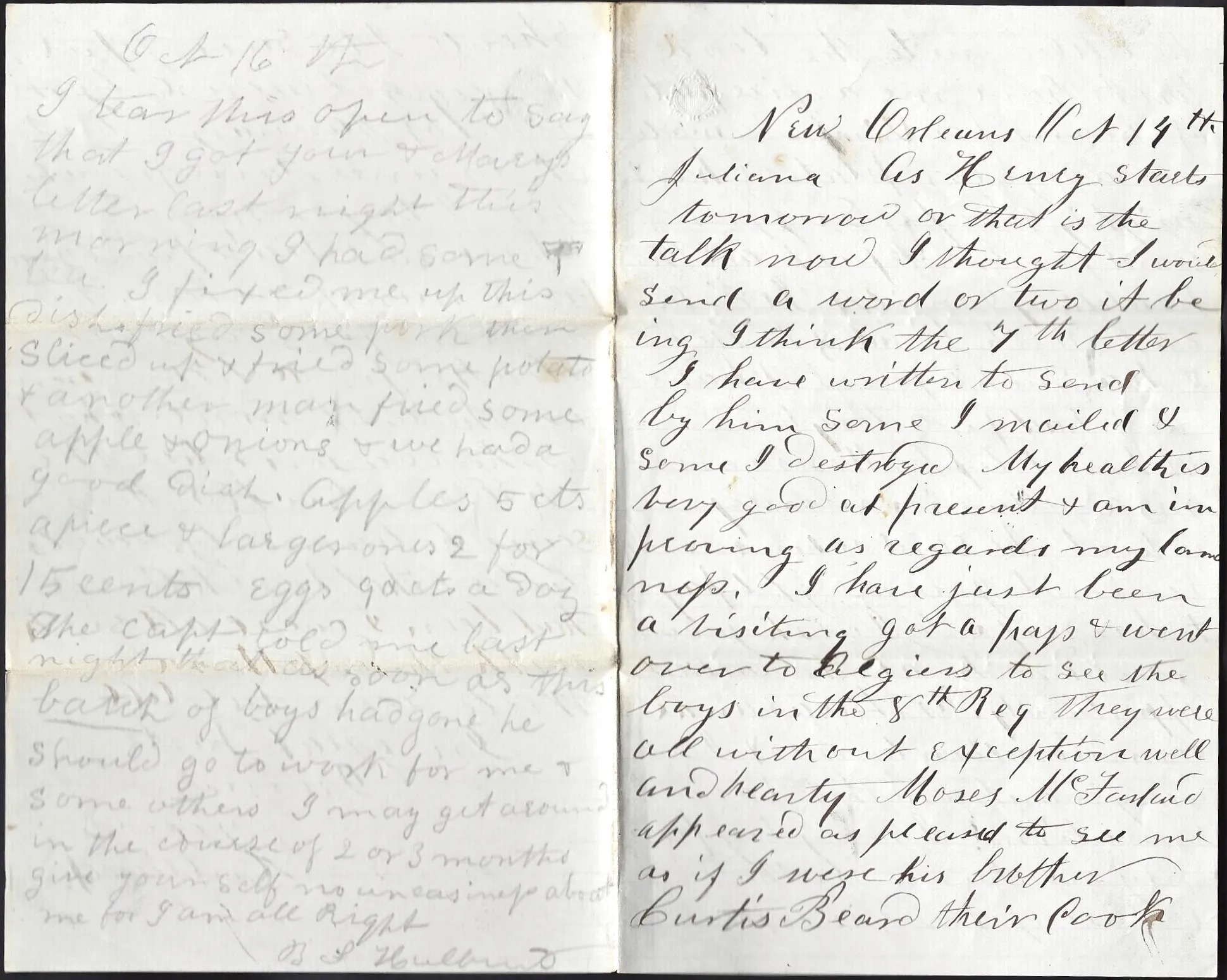
As Henry starts tomorrow — or that is the talk now — I thought I would send a word or two, it being I think the 7th letter I have written to send by him. Some I mailed & some I destroyed.
My health is very good at present & am improving as regards my lameness. I have just been a visiting. Got a pass & went over to Algiers to see the boys in the 8th [Vermont] Regiment. They were all without exception well and hearty. Moses McFarland appeared as pleased to see me as if I were his brother. Curtis Beard –their cook — he called me to the cook tent [and] gave me a nice plate of beans for dinner. Made me a regular plate of hash, mighty good for supper, and for breakfast all the pudding & milk I could eat, with bread & butter & tea. Such a feast I have not had for a long time. When I left, Moses gave me a dollar in money which he said when convenient you might pay to his wife & I wish you would do it at the earliest opportunity, as it was an accommodation to me & I may want another favor sometime.
I may try for my discharge in the course of 2 or 3 weeks. Should I be successful I may get around by the first of January, but it is uncertain yet whether I try or not.
I have not heard from you for a month. We have had no mail for 8 days but I looked for a letter from at the last mail. What is the reason? Are the children sick? Moses says he learned by Beards letters that his children had been & were all sick with the diphtheria.
Write soon. Tell all. In great haste. I remain yours, — B. F. Hulburd
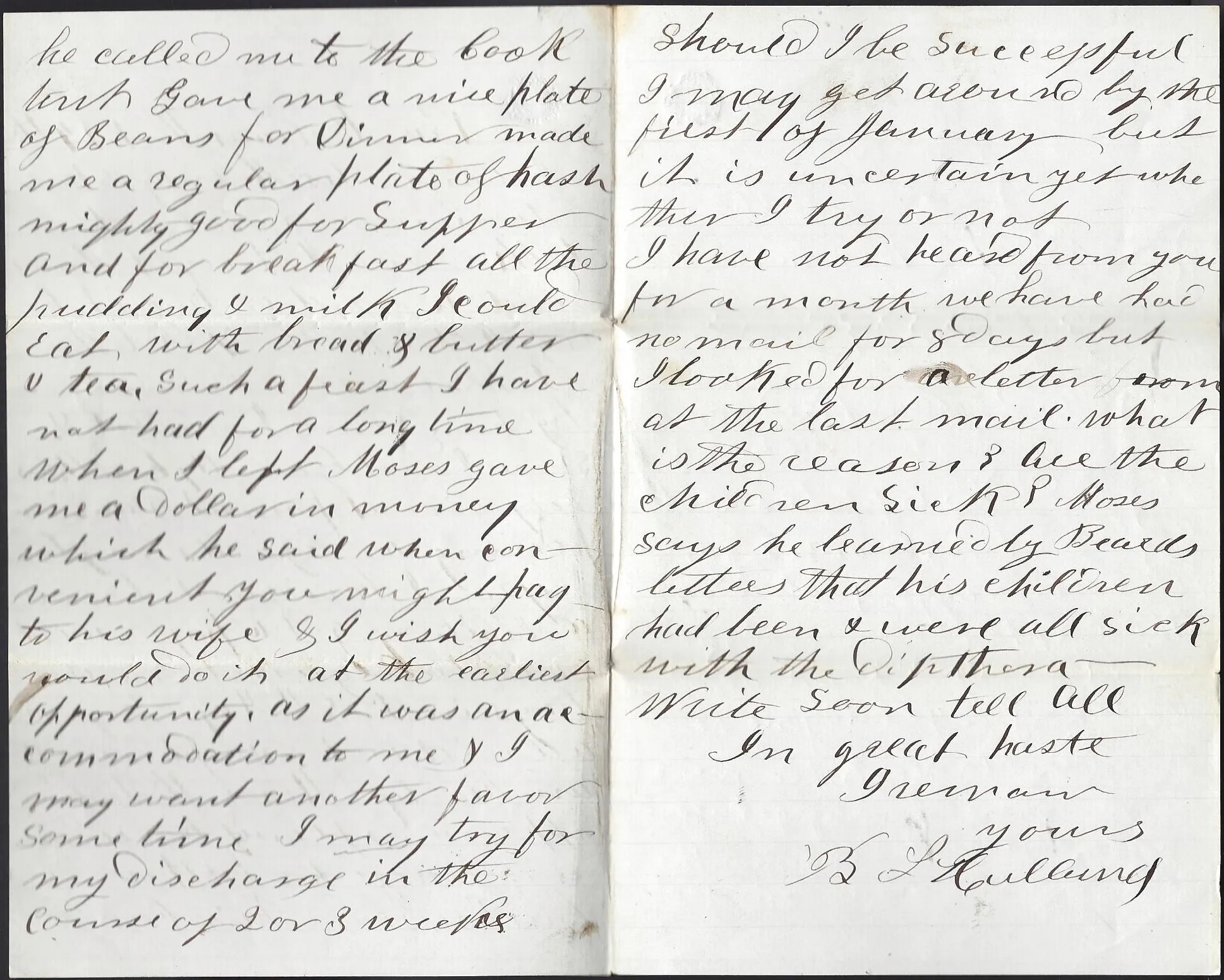
October 16th
I tear this open to say that I got yours & Mary’s letter last night. This morning I had some tea. I fixed me up this dish — fried some pork, then sliced up & fried some potato, & another man friend some apple & onions, & we had a good dish. Apples 5 cts a piece & larger ones 2 for 15 cents. Eggs 90 cts a dozen.
The Captain told me last night that as soon as this batch of boys has gone, he should go to work [on a discharge] for me & some others. I may get around [home] in the course of 2 or 3 months. Give yourself no uneasiness about me for I am all right. — B. F. Hulburd
New Orleans [Louisiana]
October 20th
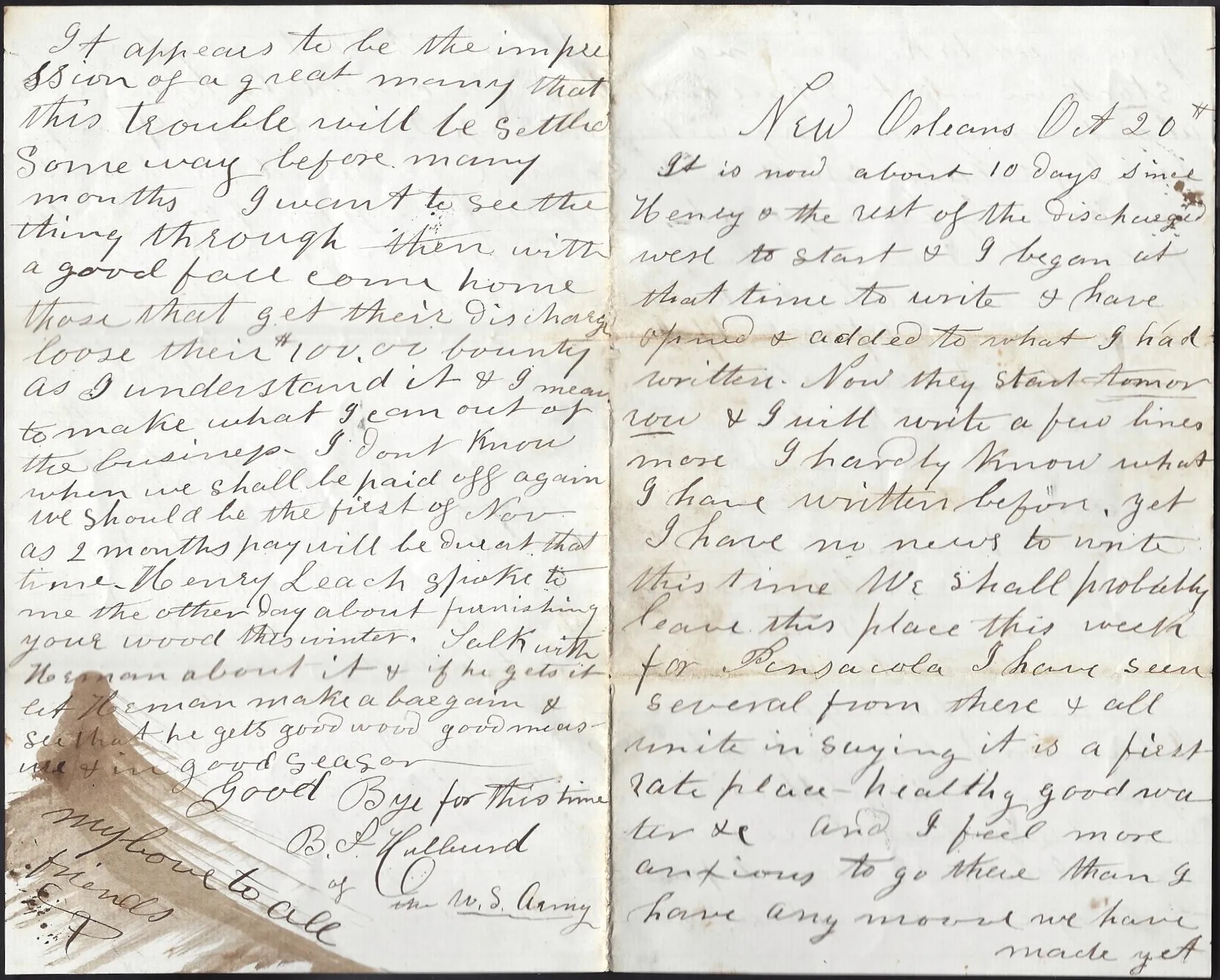
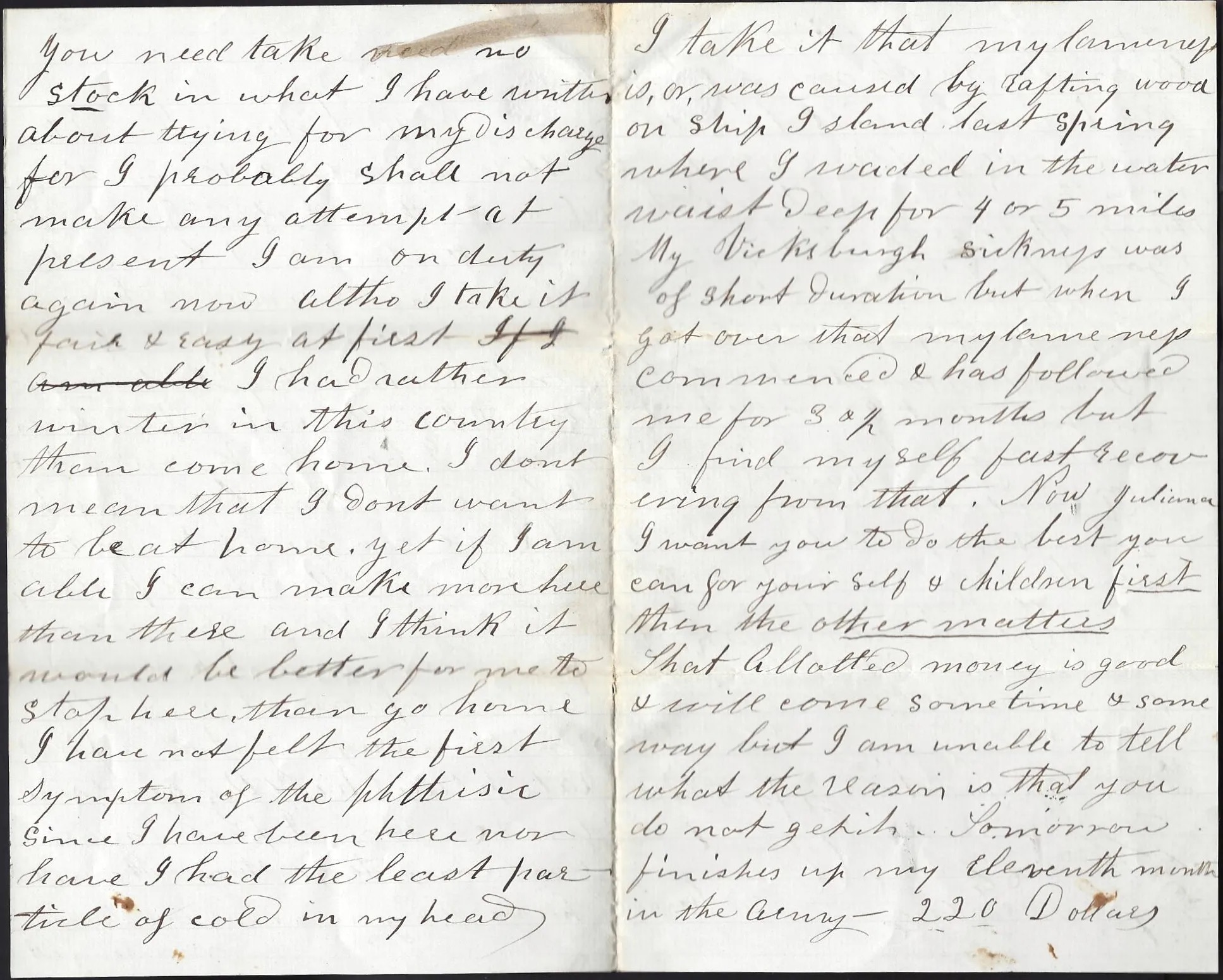
It is now about 10 days since Henry & the rest of the discharged were to start & I began at that time to write. I have opened & added to what I had written. Now they start tomorrow & I will write a few lines more. I hardly know what I have written before, yet I have no news to write this time.
We shall probably leave this place this week for Pensacola. I have seen several from there & all unite in saying it is a first rate place — healthy, good water, &c. — and I feel more anxious to go there than I have any move we have made yet. You need take no stock in what I have written about trying for my discharge for I probably shall not make any attempt at present. I am on duty again now altho I take it fair & easy at first. I had rather winter in this country than come home. I don’t mean that I don’t want to be at home, yet if I am able, I can make more here than there and I think it would be better for me to stop here than go home.
I have not felt the first symptom of the phthisis since I have been here nor have I had the least particle of cold in my head. I take it that my lameness is, or, was caused by rafting wood on Ship Island last spring where I waded in the water waist deep for 4 or 5 miles. ¹ My Vicksburg sickness was of short duration but when I got over that, my lameness commenced & has followed me for 3½ months but I find myself fast recovering from that.
Now Juliana, I want you to do the best you can for yourself & children first, then the other matters. That allotted money is good & will come sometime & some way but I am unable to tell what the reason is that you do not get it. Tomorrow finishes up my eleventh month in the army — 220 dollars.
It appears to be the impression of a great many that this trouble will be settled some way before many months. I want to see the thing through, then with a good face come home. Those that get their discharge lose their $100.00 bounty as I understand it, & I mean to make what I can out of the business. I don’t know when we shall be paid off again. We should be the first of November as 2 months pay will be due at that time.
Henry Leach ² spoke to me the other day about furnishing your wood this winter. Talk with Heman [Miller] about it & if he gets it, let Heman make a bargain & see that he gets good wood, good measure, & in good season.
Goodbye for this time, — B. F. Hulburd of the U.S. Army
My love to all friends.
¹ The origin of Hulburd’s lameness might also have been attributed to the drilling of the regiment on Ship Island where the soldiers, loaded down with all of their gear, were marched around morning and evening, in sand so loose that they would “sink ankle deep every step.” Even the surgeon of the 7th Vermont complained that the deep sand made the “battalion drill difficult and dangerous.” [Source: Vint Anderson, 21st Indiana Infantry]
² Henry Waterhouse Leach (1825-1863), the son of Tertius Leach, was discharged for disability from the 7th Vermont Infantry on 15 October 1862. He died a little over a year later in Waterville, Vermont, on 9 December 1863.
Letter 20
[Editor’s Note: This transcript was provided to me by Paul S. LeBlanc whose Uncle George P. Hulburd transcribed them from the originals in the 1960s.]
New Orleans, [Louisiana]
October 20, 1862
It is now about 10 days since Henry and the rest of the discharged were to start and I began at that time to write and have opened and added to what I had written. Now they start tomorrow and I will write a few lines more. I hardly know what I have written before, yet I have no news to write this time.
We shall probably leave this place this week for Pensacola. I have seen several from there and all unite in saying it is a first rate place—healthy, good water, &c., and I feel more anxious to go there than I have any move we have made yet. You need take no stock in what I have written about trying for my discharge for I probably shall not make any attempt at present. I am on duty again now altho I take it fair and easy at first. I had rather winter in this country than come home. I don’t mean that I don’t want to be at home, yet if I am able I can make more here than there and I think it would be better for me to stop here than go home. I have not felt the first symptom of the phthisic since I have been here nor have I had the least particle of cold in my head. I take it that my lameness is, or, was caused by rafting wood on Ship Island last spring where I waded in the water waist deep for 4 or 5 miles. My Vicksburg sickness was of short duration but when I got over that, my lameness commenced and has followed me for 3 and ½ months but I find myself fast recovering from that.
Now Julians, I want you to do the best you can for yourself and children first then the other matters. That allotted money is good and will come some time and some way but I am unable to tell what the reason is that you do not get it. Tomorrow finishes up my eleventh month in the army—220 dollars. It appears to be the impression of a great many that this trouble will be settled some way before many months. I want to see the thing through then with a good fall come home. Those that get their discharge lose their $100 bounty as I understand it and I mean to make what I can out of the business. I don’t know when we shall be paid off again. We should be the first of Nov. as 2 months pay will be due at that time. Henry Leach spoke to me the other day about furnishing your wood this winter. Talk with Heman about it and if he gets it let Heman make a bargain and see that he gets good wood good measure and in good season.
Good bye for this time. –B. F. Hulburd of the U.S. Army
My love to all friends.
“Gen. Butler became aware that the commander of the forts south of Pensacola, Fla., was not happy with the conduct and performance of one of his regiments, so 7th Vermont was sent there in exchange for the 6th New York Volunteer Infantry (Wilson’s Zouaves). The Regt. boarded the steam tugboat “Nassau” on Nov. 13th, 1862, arriving in Escambia Bay the next day. The Regt. would perform garrison duties at Fort Barrancas and Fort Pickens from November 1862 until August 1864.” [Source: Wikipedia]
When the 7th Vermont Regiment arrived in Pensacola on November 14, 1862, they were set to work immediately “constructing a stockade, skirting a sort of chevaux de frieze, in front of [their] quarters.” According to Colonel William C. Holbrook, the 7th Vermont Regiment spent much of their time “completing other unique barricades and defenses [including] a most comical affair in the shape of a redoubt [constructed] of wood and sand near [St. Michael’s] cemetery.” The Vermont troops were also instructed “to destroy the headstones and monuments in this ancient ‘Burial Acre,’ and to demolish the fences surrounding it lest the enemy should beprotected, or our fire obstructed thereby.” However, according to Colonel Holbrook, “[s]o unnecessary an act of vandalism excited great ridicule and disgust [among the soldiers, that] the order for its execution was never fully carried out.” [Source: Holbrook, Narrative of the 7th Vermont]
Enos Fletcher, another soldier in Co. E, wrote to the Editor of the LaMoille News Dealer the following account of the 7th Vermont Regiment’s arrival in Pensacola: “..[When] we arrived at the harbor, or rather the wharf of Pensacola…we were welcomed by the troops, who came out with field music and dress uniforms to meet us. The contrast between our poor regiment, and their fine platoons, and vigorous and well executed evolutions, was rather remarkable. We secured good quarters in Pensacola, the same day, which was the 15th of Nov. We occupy the quarters of the 6th New York, which regiment left soon after our arrival in New Orleans. We find the place very much as it was recommended to be — quite healthy for those who best stood the storm on the gulf, or were the healthiest on getting here. Many of the invalids on that small boat, so poor a place for so many, and especially in a storm, have since been laid beneath the sands, and more are daily following. Every effort is made, that can be made, tenderly to care for the sick. For one surgeon the task of attending to so many invalids was very great. Surgeon Blanchard has been in a good degree relived of his weary and unequal labors. The arrival of Surgeon Foster and Langdon from the north was an event we had some time looked for and was very welcome. These gentlemen have the respect of all though they have been here but a short time. Their careful and faithful attendance on duty promises well for their success in restoring the regiment to a better state of health, aided by better circumstances. I have long thought that doctors of a right stamp had it in their power to do more good than men of any other profession, and my recent experience and observation confirms my former opinion. May they be kept in good health that we loose not the benefit of their learning, skill and faithfulness. Some few changes have been made among the officers since I last wrote, the most important of which is the election of Major Holbrook, as Colonel. It may be said without flattery, that though the 7th has been unfortunate in most things, it was not so in securing so good a Col. Though very young, Vermont may look upon him as satisfactory in the best sense to the regiment, upon which he confers honor, and as promising for the future. Though a soldier, he is not destitute of an amiable and feeling mind.” [published 5 February 1863]
Letter 21
[Editor’s Note: This transcript was provided to me by Paul S. LeBlanc whose Uncle George P. Hulburd transcribed them from the originals in the 1960s.]
Pensacola, Florida
November 16, 1862
Well Juliana, in another state I seat myself on my knapsack to write a very few words. My health is good yet and I am over my lameness. We left New Orleans Thursday last about noon in a steamer and came down to the mouth of the river where they anchored till the next morning (a hard wind blowing so they did not like to put out to sea) when we started again and arrived here yesterday about 2 P.M. We should have had a very pleasant voyage if it had not rained most all the time and the wind blowing quite hard which kept us pretty well shook up, the boat rocking, rearing, and pitching like a drunken man which made ¾ the boys sea sick, but I stood it like a sailor. The boat was so filled that ¾ of us had to lay on top of the boat day and night. Got wet through both nights but took no cold and indeed I have not had a cold since I left home. I can safely say I never felt better in my life than at present—only my legs swell a little occasionally, but that is nothing serious for it is a common thing with many of the men. I don’t think it is the scurvy so don’t be scart.
We are now in the most pleasant situation that we have been in since I left home. We are quartered in good, nice buildings with a pretty little brook running through the yard its pebbly bottom and all around it looks a little natural it being the only running water I have seen out here except the Mississippi River and that could hardly be called water compared with our sweet little brook. This is called the most healthy place any portion of this division of the army have been stationed at and the boys here look like it. Don’t know how long we shall stop here but probably till spring.
Everything is as high priced here as in New Orleans. I guess not having had occasion to buy anything yet or money to pay for it. We probably when we get settled down here fare better than before as we shall have better conveniences and the best of water. I wrote to Daniel the day before we left New Orleans but was obliged to do it in great haste as we had orders to fix for this move. Just as I began to write the night before we left, the mail came in and I got a letter from you, Emily, and Abby. Glad to get them. Write soon. Direct to the 7th Vt. Co. E, Pensacola via New Orleans. No mail direct here oftener then once in 5-6 or 8 weeks. — B. F. Hulburd
Letter 22
Pensacola [Florida]
November 23d 1862
Juliana,
I wrote to you lasts Sunday. Whether the letter has left the office, I cannot tell but I learn that a mail leaves this place tomorrow. I thought I would say a few words more. I date this letter 2 days ahead for that closes my first year in the service — 240 dollars for 6 months work, one month at home, 5 months not fit for duty, yet I was about all the time. I am getting somewhat big again, weighing about 180 pounds now. [I was] 145 the 1st of August.
I am very much pleased with our present situation. We are quartered in a large splendid house built by a rich old rebel but never occupied by him for it was taken possession of by our troops when this place was taken some year ago. I can not give much description of the place. I should think it [Pensacola] was about as large as St. Albans [Vermont] altho the buildings are rather scattering. Some few nice buildings but generally rather of an ordinary style & finish. There is but very little business being done here now. The place is completely ruined by the war. I am now sitting in a nicely finished room by a good fire in the fireplace, on a box sent to Noel [Westcott] writing. Our furniture consists of one old chair & a little old kind of a book cupboard & spittoon. We begin to live again having got about over moving & tonight we had a horseload of provision come. For supper had cold beans, warm baked bread & butter, & some of the best tea we have drawn since we came out here.
There has three of our company died since we come out here & indeed, in the last 3 days, but they were taken from the hospital when we came from New Orleans. One of them was Albert Townsend, one was the cook that worked with Willy while he worked at the cooking, & the other a young fellow from Hyde Park. But I think generally the men are more healthy already than when we came here.
Francis Shawpan ¹ wants I should say for him that he is well & is on duty again & wants his wife to write & send him some postage stamps & he will write home. He wants to know if she got the ten dollars he sent home. Noel [Westcott] is in the hospital yet — have not heard from him since he went there. Micajah Townsend ² was left at New Orleans in the hospital. How he is, I cannot tell. Dr. [James M.] Barnes went to the hospital yesterday. He is pretty low with dysentery & he fears erysipelas in his foot & leg — case doubtful. ³
Some other things I would write but must stop. I will take another small piece of paper & tell a dream I had last night.
Extract of a Dream
It seemed as though I was at home (the first time I had dreampt of being there). I sat just forward the bedroom door in my “old arm chair” with Roger on one knee, Charley on the other, Eva between my legs, & — what is his name — O Georgy in the cradle before me. I had just kissed Eva, Roger & Charley, and the baby began to bawl when I was awakened by the hollering of the sergeant, “Turn out, boys,” to roll call. Kiss the children for me. — B. F. Hulburd
Write soon. Direct to Pensacola, Florida by the way of N. O. or to New Orleans. In either case, I will get them but if directed to Pensacola, the letters may lie in the office at New York till a boat comes directly here which is not very often, but from New Orleans every week or two.
In haste, — B. F. Hulburd
¹ Francis Shawpan (1821-1889) enlisted in November 1861 from Waterville, Vermont.
² Micajah Townsend (1812-1862) was already dead when Hulburd wrote this letter. He died at Saint James Hospital in New Orleans on 14 November 1862, the day after the 7th Vermont Infantry sailed to Pensacola.
³ James M. Barnes (1821-1862) died on 1 December 1862 and is buried in Barrancas National Cemetery at Pensacola.
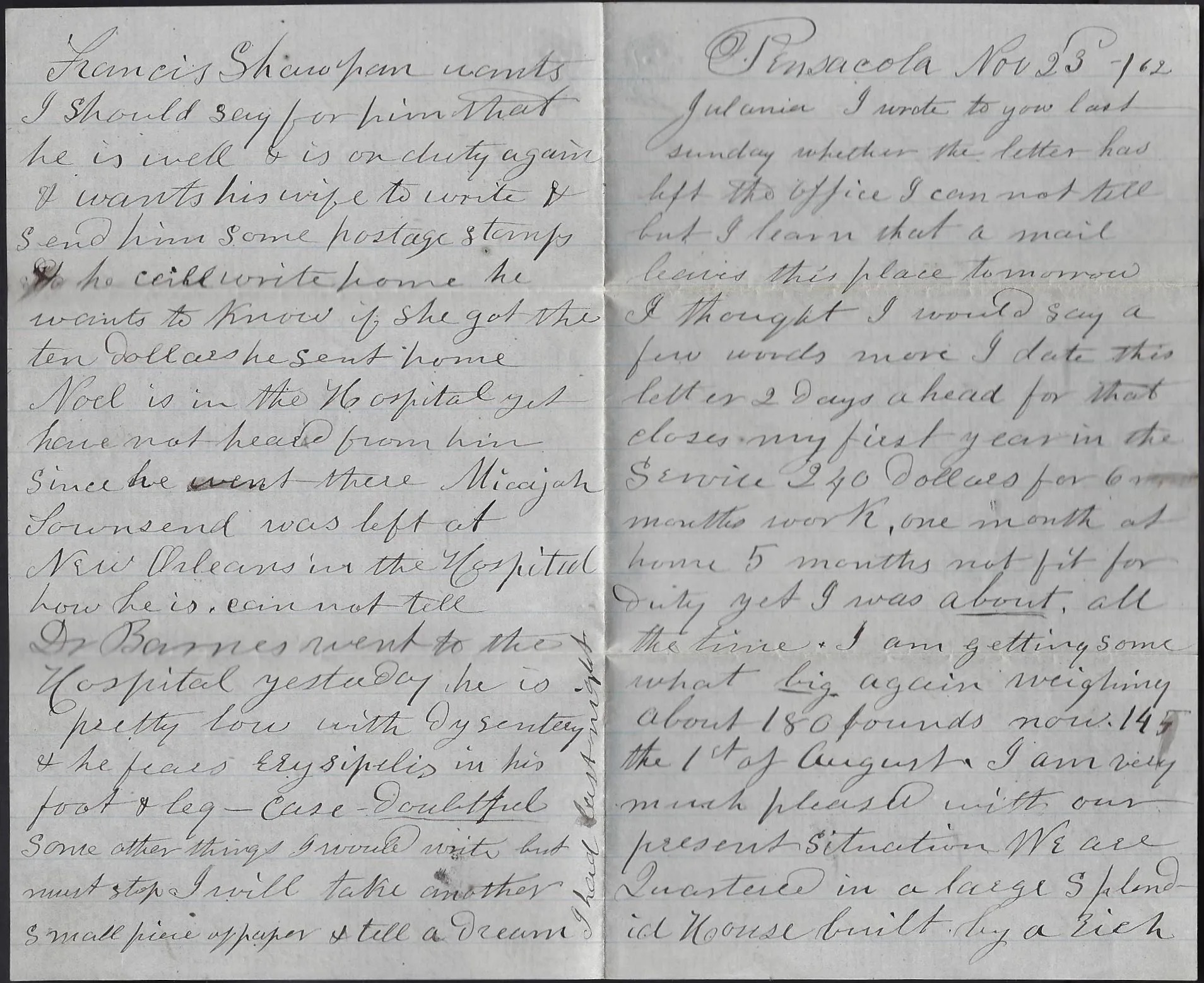
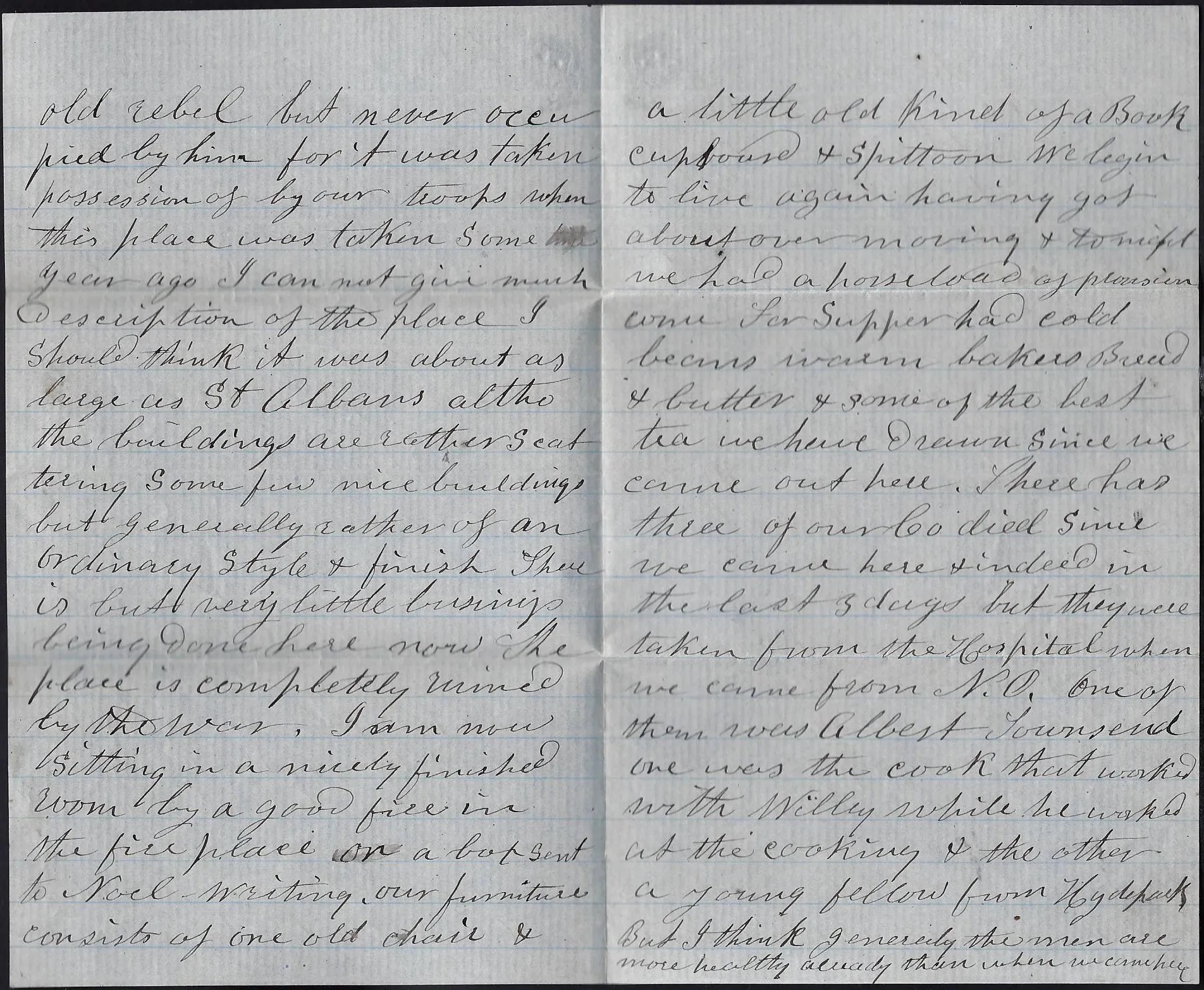
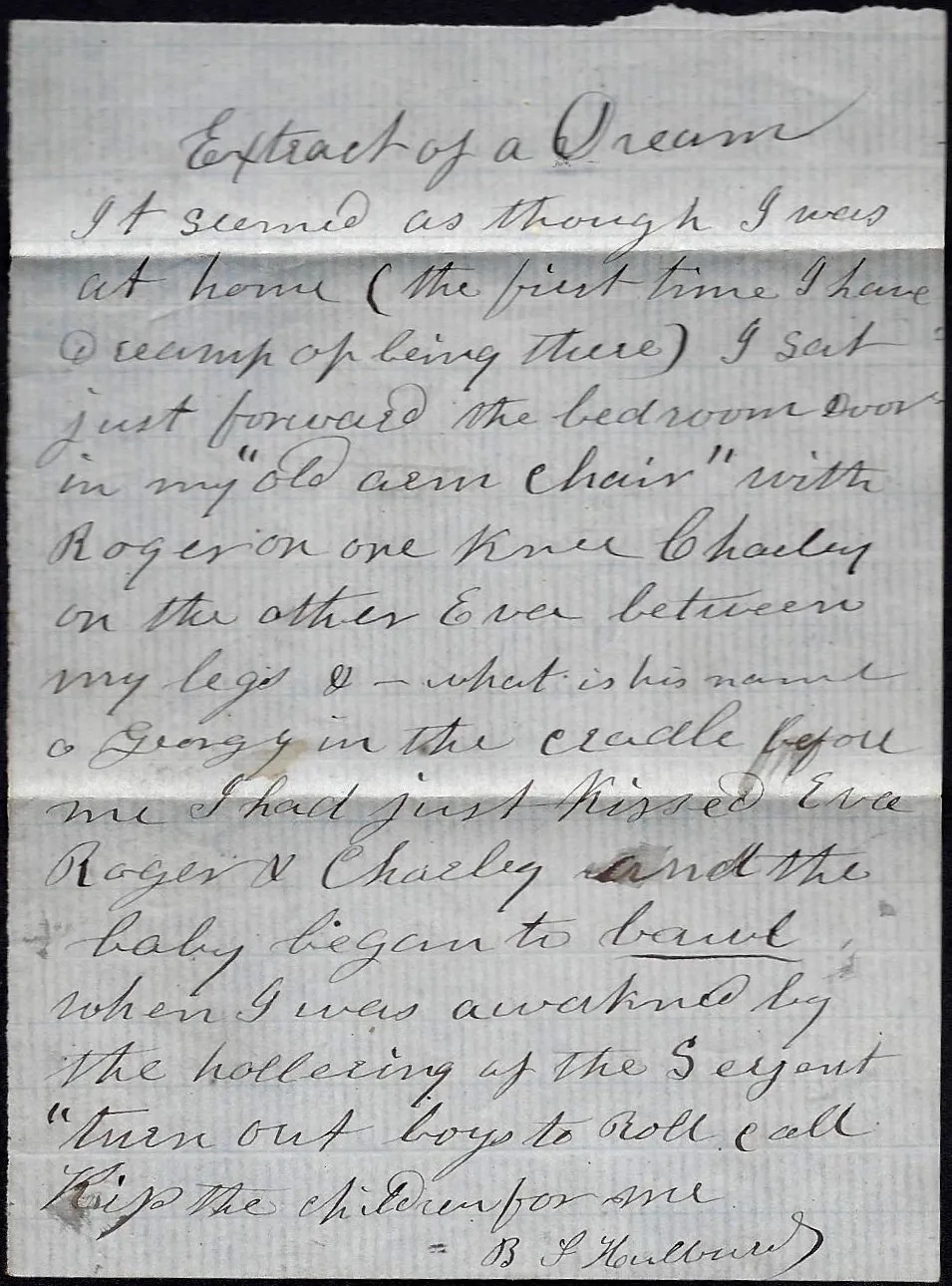
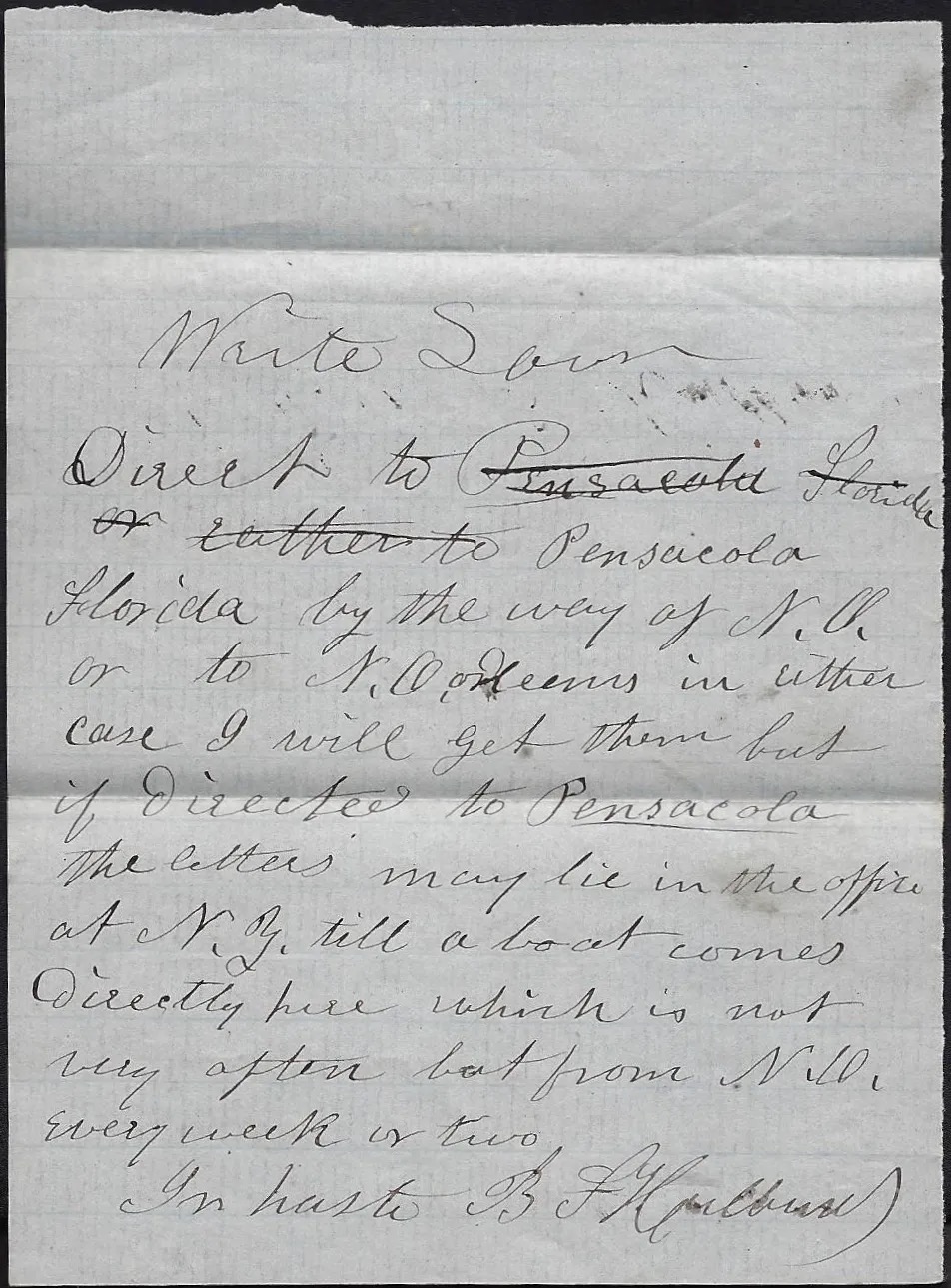
Letter 23
[Editor’s Note: This transcript was provided to me by Paul S. LeBlanc whose Uncle George P. Hulburd transcribed them from the originals in the 1960s.]
Pensacola, Florida
December 5, 1862
Juliana,
As I am doing nothing and have nothing to do I thought I would write again a few lines to pass away the time yet nothing of importance to write. I wrote about a week ago acknowledging the receipt of yours and also George’s letter of the 7th ult. I am still in the enjoyment [of] good health which is more than many of the men can say. When we left New Orleans, we left from our company some 8 or 10 sick in the hospital, unable to come with us. Since then two have come from there and joined us again. Two at the hospital at New Orleans have died — Charles Balch from Johnson and Micajah Townsend. Three have died in the hospital at this place —Albert Townsend, a fellow from Hyde Park and on the 1st inst., Mr. Barnes died. Barnes’ disease [was] chronic diarrhea, I believe. We have now lost 33 men certain and the last I heard there was one at New Orleans they thought their case doubtful.
There is now considerable talk of our going somewhere north, possibly to Vermont, but I think it doubtful about our going as far north as that before spring as many of the men are not in a situation to stand the severities of a northern winter. Our new surgeon has arrived. He excuses every one that attends the “surgeon’s call” for he says we are not fit for duty. There was an instance where our old surgeon would not excuse one man who in 3 hours after was dead. I have not been on duty but 3 or 4 times since the 13th of June.
We have no company drills now excepting about ½ hour a day and what is called “dress parade.” At sunset guard duty is all that we have to do which takes 2 or 3 men each day. I think that we shall fare a little better now than when we drilled 4 hours and it took 8 and 10 men for guard. You say that you write about every week but I don’t get any letters—only about once a month. There is a regular line of boats run from here to New Orleans now so the mail will come here regular.
I was told when I first came here that they had no mail oftener than once in 5 or 6 weeks. You keep saying “Get your discharge and come home.” It is more of a job than you think for to get discharged as Terry may tell you. I heard our old surgeon say he would not sign another discharge for 6 months not as long as the men had two legs on their bodies but since our new surgeon has come he talks different.
I am very well contented here have not seen a homesick hour since I left Vermont but have often thought I should like to be there. If we go north I shall get a furlough and come home for a few days or weeks perhaps but I cannot say anything about discharge. If we leave here it will not probably [be] for 3 or 4 weeks—it may be longer, cannot tell. We expect a mail tomorrow night. Hope I shall get a letter. But I must close. You need not pay Fletcher’s wife but little at a time as that is as I get it. We some expect to be paid off in a few days — uncertain. [unsigned]
Letter 24
[Editor’s Note: This transcript was provided to me by Paul S. LeBlanc whose Uncle George P. Hulburd transcribed them from the originals in the 1960s.]
Pensacola, Florida
December 16, 1862
Juliana,
I have but a moment to write as I understand the mail for the north closes in an hour. I have waited for a letter for some time but get none since the one wrote Nov. 9th. We have had no mail for the last 10 days but are looking for one every day. I guess I will have one then when the mail does come. My health remains good. We have nothing to do here now only guard duty 3 or 4 from the company daily. I have not been detailed for guard since we have been here 1 month. Dress parade at sunset and inspection Sundays neither of which have I been on since here. I have got to go to the cook room now and fry some nut cakes. We get up some real good ones about twice a week. We are living better lately than formerly or at times at least. Our Capt. says we must get up a grand supper for Christmas and I expect we shall. Oysters are plenty but rather high a cent apiece fresh plenty and tolerable cheap — butter 50¢ milk 25 cents, qt. No news — don’t know when or where we shall go next.
Tell Henry Leach that Adjt. Porter is our Capt., Geo Brown 1st Lieut. and Quarter Master Sergt. Jones is 2nd Lieut. Chas Sheldon is plaguey mad. Tell Leach blast his picture to write he said he would. Tell him Harvey Irish and Stephen H. Leach is dead. 36 now from this company. — B. F. Hulburd
Roger — Eva — Charley and baby.
As the mail leaves tomorrow I will add a few lines more. I feel considerable plaguey mad tonight—consequently rather uncomfortable. I don’t know but it is all for nothing but circumstances look a little suspicious. The cause is this. There has accumulated in the quartermaster’s office somewhere between 450 and 500 dollars that belonged to our company which we could draw in cash and get what necessities we wanted. The company thought to let the officers take and get potatoes, onions butter cheese etc. We have had somewhere near 100 dollars and the rest is not to be found just now. Possibly all may come out right but fear not. We have some officers whose honesty I doubt.
It is as warm as June tonight. Some signs of a thunder shower. For “dress parade” tonight we had 3 privates, one sergeant, and we had 2 men on guard making 6 men for duty. The rest are sick or excused from duty. This is what there is now of 100 men that left Rutland nine months ago tough and hearty. You must have Heman make a bargain with Henry Leach or someone to furnish wood—say 12 cords put up in good shape. Shawpan says say I am smart and fat. Nothing more this time. I will close by subscribing myself yours—more than anybody else’s, — B. F. Hulburd
I send a letter about every mail. I get one about every other mail, but the mail does not come oftener than once in 10 days. Eva and Roger you little rogues how do you do. I should think you would write to me. I have written to both of you. Be good children. Kiss Charley and the baby for me. — B. F. Hulburd, Pensacola, Florida
Letter 25
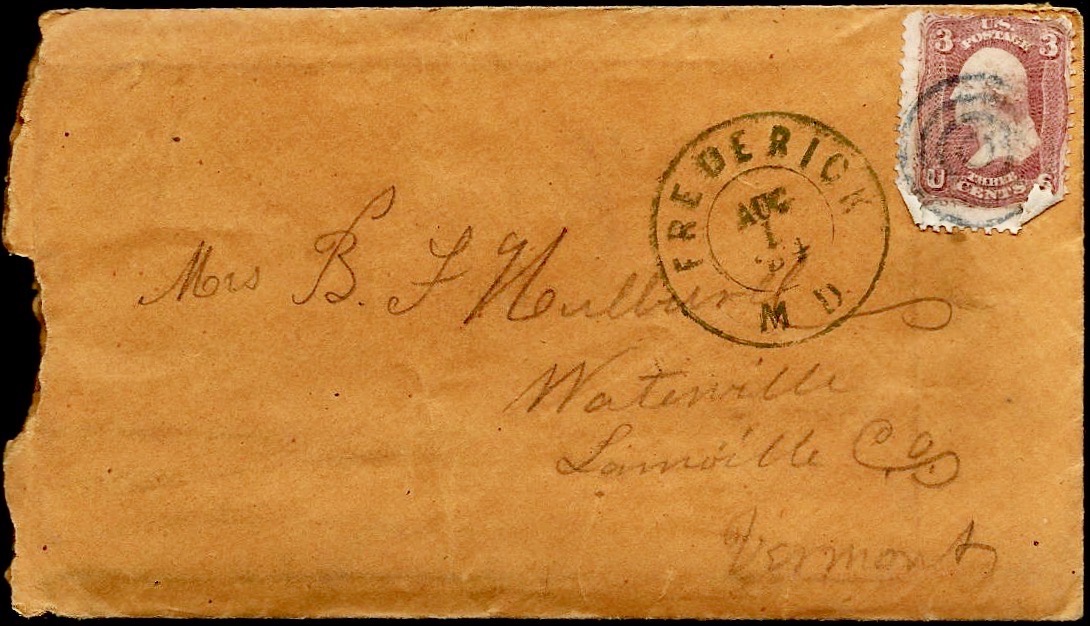
Pensacola, Florida
January 1, 1863
I have just received yours of the 8th of December & was truly glad to hear from home & the children once more, I also received a letter from Juliana & Heman for which please tender them my thanks. Yours found me in first rate health though I still am on the list of excused ones.
I have no news at this time to write as we are doing nothing—only lying around our quarters reading some & enjoying ourselves finely. We today heard of General Burnside’s hard luck in Virginia. I hardly know what to think of the affair. If it is as bad as we hear, it is a hard blow for us there. We have it that he lost 12,000 men in the battle [of Fredericksburg]. We shall probably have more particulars in today’s mail.
We have just been mustered in for two months pay. There is now due us 4 months pay and we probably shall be paid off now in a few days but can’t tell. I wrote you about paying E. Fletcher’s wife some money for what I borrowed of Enos. He has furnished me with what I have had for the last three months. I told him I thought I would want about $10.00. He said I might have it. He has furnished it a little at a time till I have had $9.00. He told me the last time I saw him that he had written home “that I had had ten dollars,” & he would let me have the other dollar in a day or two. I have not seen him for most two weeks. He works in the hospital. You may pay her for me with what you have paid enough to make $8.00 & when we are paid off I will settle with Enos for the rest. You say you have paid $4.25 when you can conveniently, pay $3.75 more if a dollar at a time is as handy, do so for that is the way I got it—a little at a time. And I told Enos that I had wrote you to pay it so & he says all right. When I see him next, I will tell him what I have wrote now about my settling with him for the other $2.00 if I should get the other dollar, which I probably shall not get as we shall be paid off before a great while. I presume I might have got along and not got any of him but there was a while when dry bread and salt beef went hard for breakfast, dinner & supper. And as the camp was fill of peddlers & cooking tents where a person could get a first rate good meal by paying enough for it. I bought a bottle of brandy $1.50, two bottles of bitters at $2.25, two or three meals at 50 cents a meal. The rest went for apples at 5 cents apiece, oranges three for five cents, oysters 15 cents per dozen, & that is the way that the nine dollars has gone that I had of him. What money I drawed at the last pay day I used up before I got it for when I first got out of the hospital (?) at New Orkeans I lived for a few days as I was about starved. You may think that I might have done with less. I shall try and get along for the next two or three months.
We live now first rate. I fry a good large batch of nut cakes about three times a week. They are good too, I tell you. We are going to have great supper tonight out of company funds—oysters, baked fish, beef, &c. &c.
I wish that you could be out here and spend the winter. It is so warm & pleasant. The weather is warm like September with us. I have not seen any frost but three or four mornings. There was a little last night but today it is nice and pleasant. The birds are singing & the butterflies are flying around as thick as you please. There is but little vegetation. It is a sandy, barren country about here. This place formerly contained some 4,000 inhabitants. Probably now not 1,000.
Our regiment—or what there is left of it—went out on a kind of scout the other day. Went out about 7 miles but made no discoveries but learned that there was a small force of rebels on about 8 miles further. It is possible that they may be routed before many days but don’t know.
I do not hardly know what to say about Noel Westcott as I have not seen him for 3 or 4 days. The last time I saw him he told me he felt the best he had for several days. He has been in the hospital for seven or eight weeks. I have my doubts about his getting about again very soon. His lameness is better but he has had the scurvy the worst way. Sores in his head. He is quite thin & poor. He told me to write a few words for him the last time I wrote & he said, “Tell as good story as you can.” He said if the new doctor had not come as he did, he should have been under the sod before this but feels in hopes he shall get about again in time. He was baptized a few days ago. I sent the letter his Mother wrote to him just now by one of our men in the hospital who was here.
I can’t but be thankful to our Heavenly Father that I am in the enjoyment of so good a degree of health & strength while so many of my fellows are suffering. I do not know that I ever enjoyed better health than at present aside from my lameness & that is not bad—only it unfits me for duty, &c.
There, I have just come in from the cook room where I have been engaged for about two hours opening oysters for supper. There are now in camp of our company 36 members & we calculate on quite a dish now soon. Roast pig, baked beef and oysters & we calculate to eat some.
We have been in this place 7 weeks—two weeks longer than we have stopped at any one place since we left Rutland. How much longer we shall stop here or where we move next of course is unknown to us. The excitement about going North has about died away & rumors are beginning to circulate through camp that we are going back to New Orleans & up the river again to Baton Rouge, &c. I take no stock in any of these rumors & believe nothing faster than it takes place. There is a possibility that I shall be discharged this spring yet I do not calculate on any such thing. Yet should that happen, there is a possibility that I should get a ——
Now Eva & Roger, I was glad to hear that you were both well. I do want to see you very much but I can not just yet but hope to again by and by. Be good children & mind all that your mother, grandmother tells you & not run about the house and make a great noise.
In haste, I remain yours, more than anybody else’s, — B. F. Hulburd
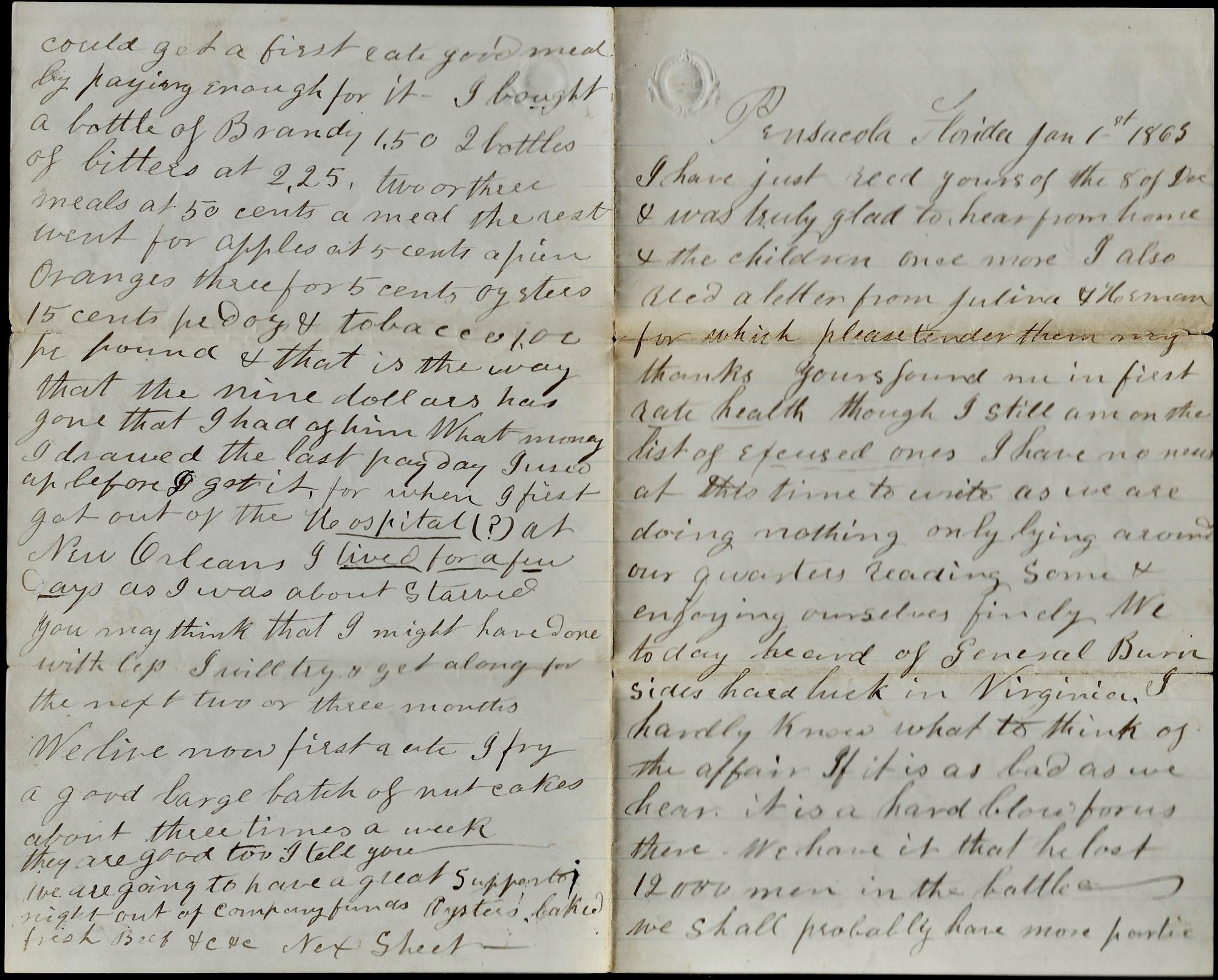
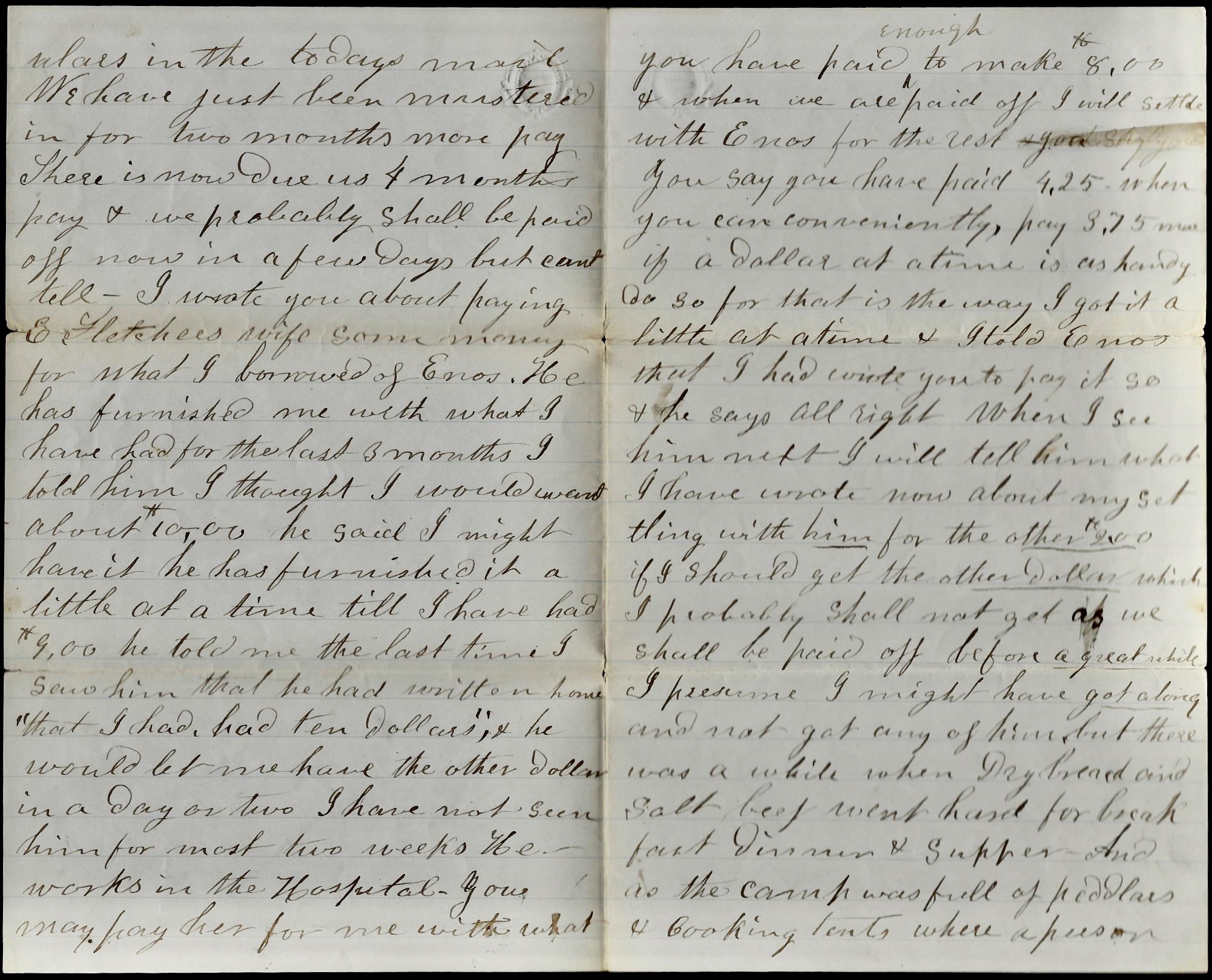
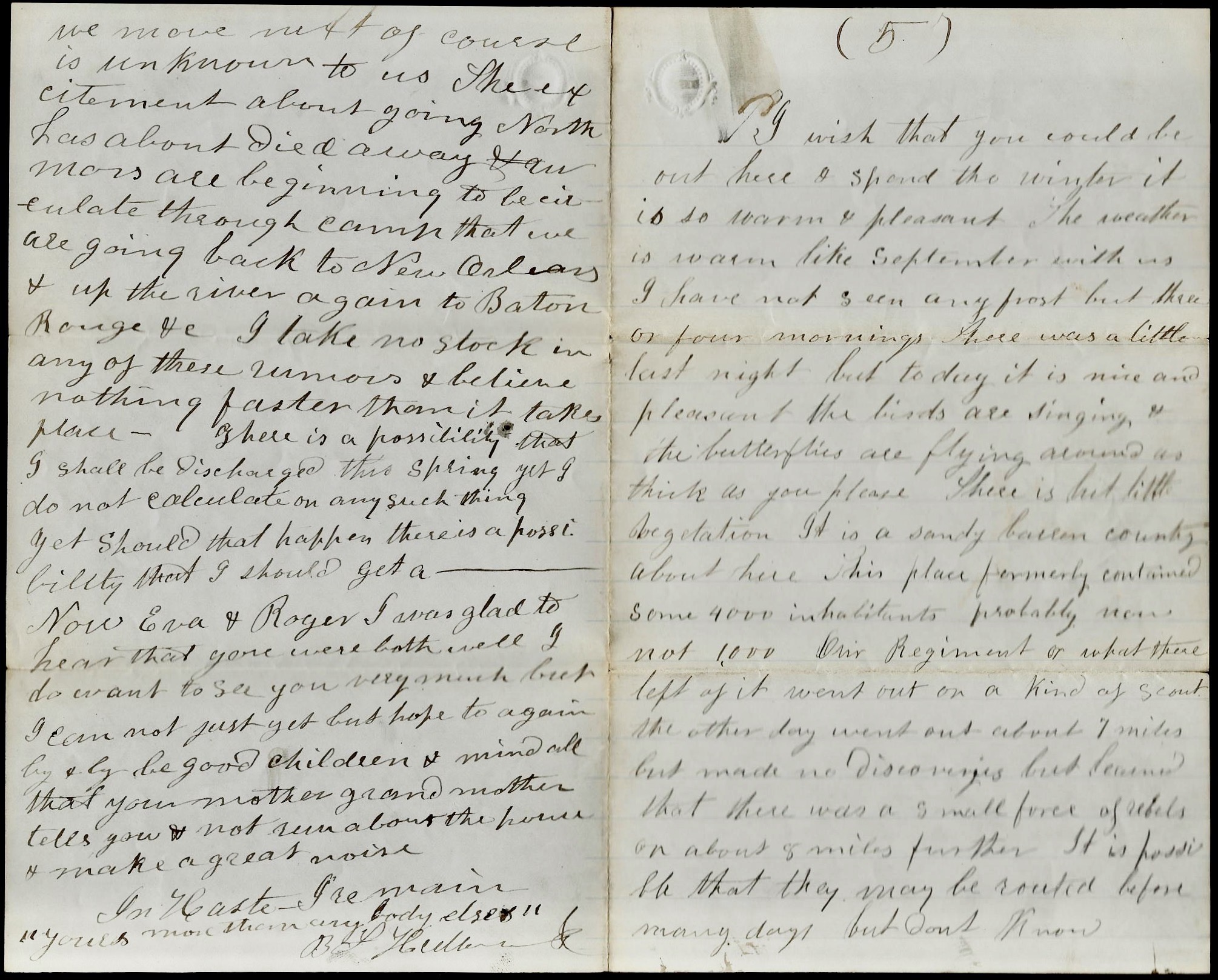
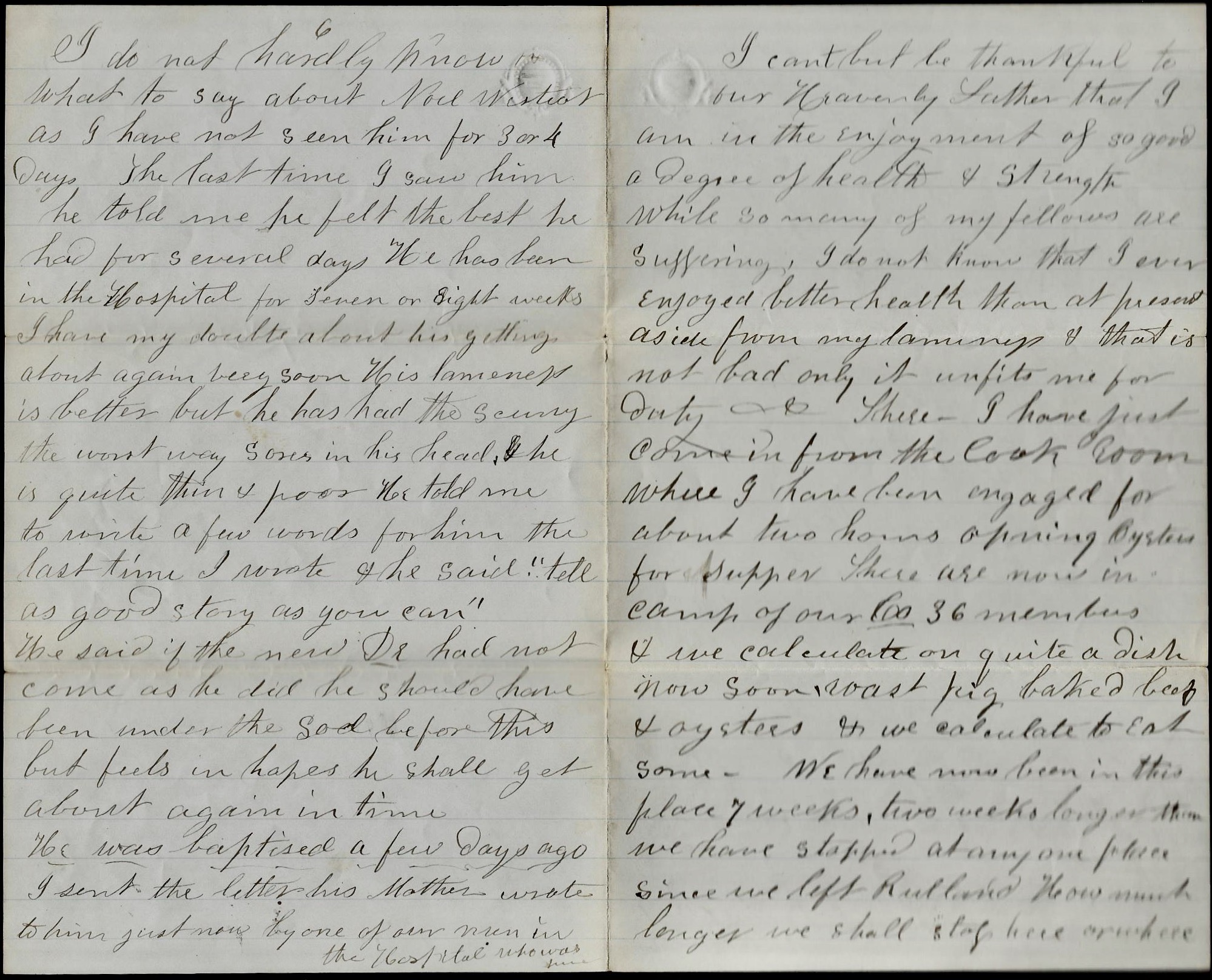
Letter 26
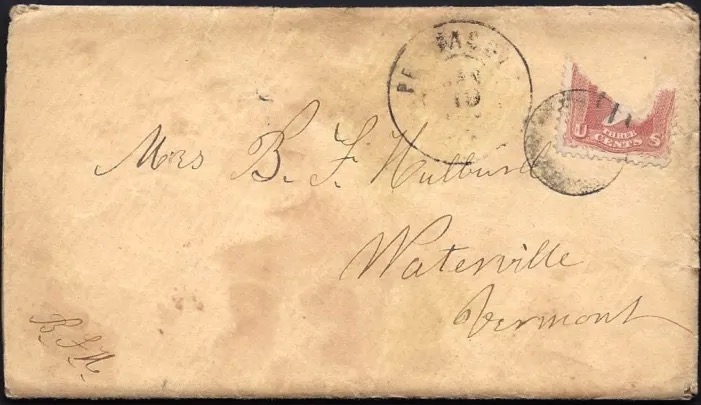
Pensacola, Florida
January 11, 1863
Sunday morning in all its beauty dawns upon us & I wish I could just step in home & with you & the children walk over to meeting, but that wish is vain. The morning is warm & pleasant like a September morning — a little “white frost” to be seen this morning. Yesterday we had a good, smart thunder shower. I can’t make it seem like January.
My health is good but still I am lame. There are a few to be discharged in a few days — about 30 from the regiment — but there are so many worse cases than mine that I shall not come off in this batch and indeed, I think it doubtful about my making an effort at present. I am very well satisfied as I am. Now I am here, I intend to make all out of it I can. I have now been in the service almost 14 months. Shall have been the 23rd of this month amounting to $280.00 which is double what I should have realized had I stayed at home. I know that I am needed at home with my family, but I am satisfied with the hands they are in. I guess with Heman [Miller] on one side & George [Hulburd] on the other, you will get along somehow with Mother with you. I fear nothing yet.
I do want to see you & the children very much but the time will come when I shall be permitted to. I hate mightily to ask for my discharge — [me being] a great fat stout fellow weighing yesterday 176 pounds –when there are a plenty of others in our company that it would take two to make a shadow. There is three from a company that the surgeon is a going to take to New Orleans this week or next before the “Medical Director” for examination & if his signature is procured & that of Gen. Banks (not Butler now), they will be sent home. The three from this company are Noel Westcott ¹ & one from Johnson & one from Hyde Park. You may tell Westcott’s folks that Noel remains in the hospital yet just about the same, but say nothing about the discharge as he may not get it & again if he does, he may not live to get home.
Our old surgeon is at present standing a court marshal. Some of the charges brought against him are abusing the sick in hospital, being hired to sign the discharge of an officer, striking a sick man at surgeon’s call, &c. How the matter will terminate remains to be seen. He may get clear but these things it is said can be proved and some of them I know to be true for I see it. ² The First and Second Surgeons came here about the first of December. Dr. [Henry H.] Langdon from Burlington and Dr. [Elihu] Foster from Orange County, I think, are two fine men & gentlemen. They say if they could have been with the regiment from the time we first landed at Ship Island, more than one hundred that are now in their graves would be in Vermont alive. That may be. Should the case now pending go against Dr. [Enoch] Blanchard, one of these two will be appointed Head Surgeon. I think that those of the boys that were not down sick when we came to this place are a great deal better than they have been for months. Before, wrestling, playing ball, running races is what we seldom have, if ever, seen since we landed, till since we came here — except one at New Orleans.
The Colonel got up a scrape, bought a pig, got it shaved, & greased & promised $5.00 to the one that would catch it, shoulder it, & bring it to the Colonel. It made some sport but the thing was done. For certain reasons, I did not run.
I will now tell you a little about the discipline of and in the army. No drinking or drunkness is allowed (yet some of the officers get sensibly tight but if a private does, he is punished as hereinafter described), no quarreling or profane swearing is allowed according to the army regulations, yet not always punished. But when it is noticed, this is the punishment: standing on the head of a barrel two hours, and off two, for 12 hours, or stand tied up by the thumbs to the limb of a tree two hours and off four, or carry a bag of sand weighing 30 pounds two hours and off four. Three men from our company are on a barrel today. Simpson is one of them, with Charles Hogan for quarreling. Francis says a man is not smart if he joins the army and goes through without getting in the guard house.
We have had no mail since the 30th of Dec. Expect one tomorrow yet I dread to hear the news it will probably bring if there is any truth in the rumors of the day—defeat on the Potomac Va., trouble and quarreling in Congress, the blockade opened at Charleston, South Carolina, and we hear of rebel success in Texas. Galveston—a place that has been in our hands, now in possession of the enemy, the taking of one of our gun boats at that place and now cruising in the gulf under our flag. It is sickening yet we are not disheartened.
But enough of this. What shall I say next? I don’t know as I can give you any instructions in relation to affairs there. Have Heman or George bargain with someone for some good wood and you pay $ down on delivery or as soon as you can and the remainder say the first of May as that will possibly be about next government payday. It is true that returns may be made to the State Treasury for the 4 months from Sept. 1st up to Jan. 1st. Pay C. C. tolerable fast but don’t distress yourself. That town money is next in importance. [If] there are a few little concerns let [them] lay till these are square. If I am not at home live yourself dress the children well. After C. C. is paid pay as you can spare from time to time a little on the town note so Geo will feel better and Manchester easier and save a little by so that when I do come I can have a “three cent bender.” As I wrote before, you need not pay E. Fletcher’s wife only eight dollars in all as I will settle with him for all above that sum. I understand that flour at Mobile 50 miles from here is $40 per barrel salt, $30 per bushel, a common calico dress $5.00 and other things in about the same proportion. How that is I don’t know. The place is held by the rebels and our fleet blockades the city.
I guess that I will wait till the mail comes before I finish this and see if I get a letter from you. If I do I shall not be disappointed and if I do not I shall not. I wish you could be here for a few hours just to see this place the fort just behind us Pensacola Bay in front with its gunboats laying a little out from shore and a large sandy plain on either side for miles — we in the centre with what I will call a brush fence running from the water, around us back to the bay again at a point some two miles from its commencement, over which it is next to impossible for an army to get without getting scratched beside being in some little danger of getting shot. Wait for the wagon or boat.
January 17th—No mail yet. I wrote the first day of Jan. but guess the letter has not left the place yet so I will finish this and send it to the P. O. as the mail will soon leave after one arrives. I shall expect a letter. Noel Westcot is dead. He died yesterday (16). I went and dug his grave. He became very much emaciated, nothing but skin and bones! Eva, here is some of my hair it is rather short. All well, — B. F. Hulburd
¹ Noel B. Westcott (1835-1863) enlisted in February 1862 in Company E. He died on 16 January 1863 and is buried in Barrancas National Cemetery in Pensacola.
² Dr. Enoch Blanchard had several charges brought against him. The first charge reads: “The said Enoch Blanchard appropriated to his own use or to the use of his private mess, potatoes or other vegetables and provisions, belonging to and bought for the said hospital with money from funds of said hospital.” He was also charged with “conduct unbecoming” for striking Pvt. James O. Dodge and for abusing other patients “in a shameful manner.” The final charge, neglect of duty, asserted that Blanchard failed to visit the hospital for seventy-two hours. On all of these counts, the court found him not guilty. Blanchard stayed with the regiment until at least February 1865. [Source: Tarnished Scapels: The Court-martials of Fifty Union Surgeons by Thomas Power Lowry & Jack D. Welsh, pages 103-105]
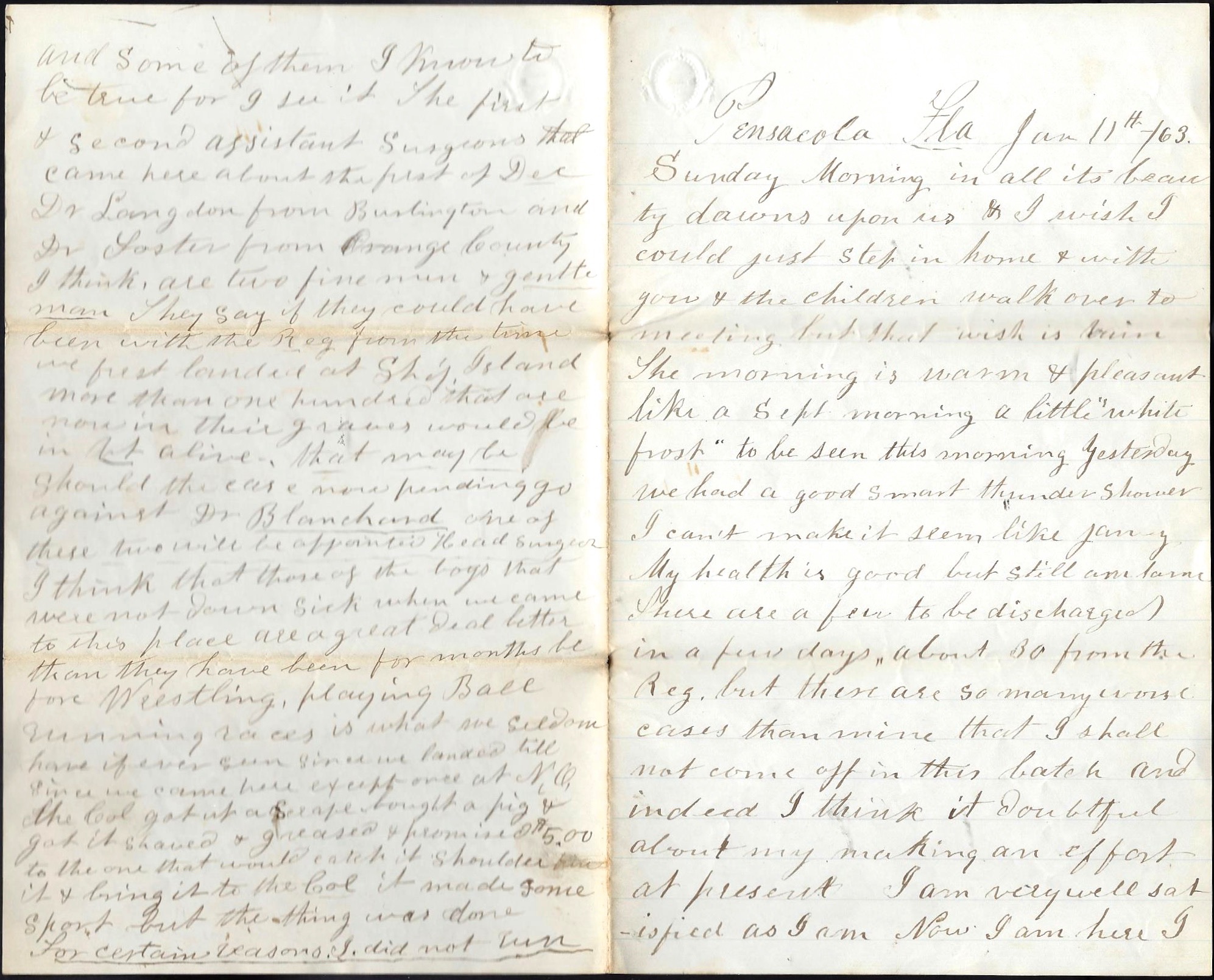
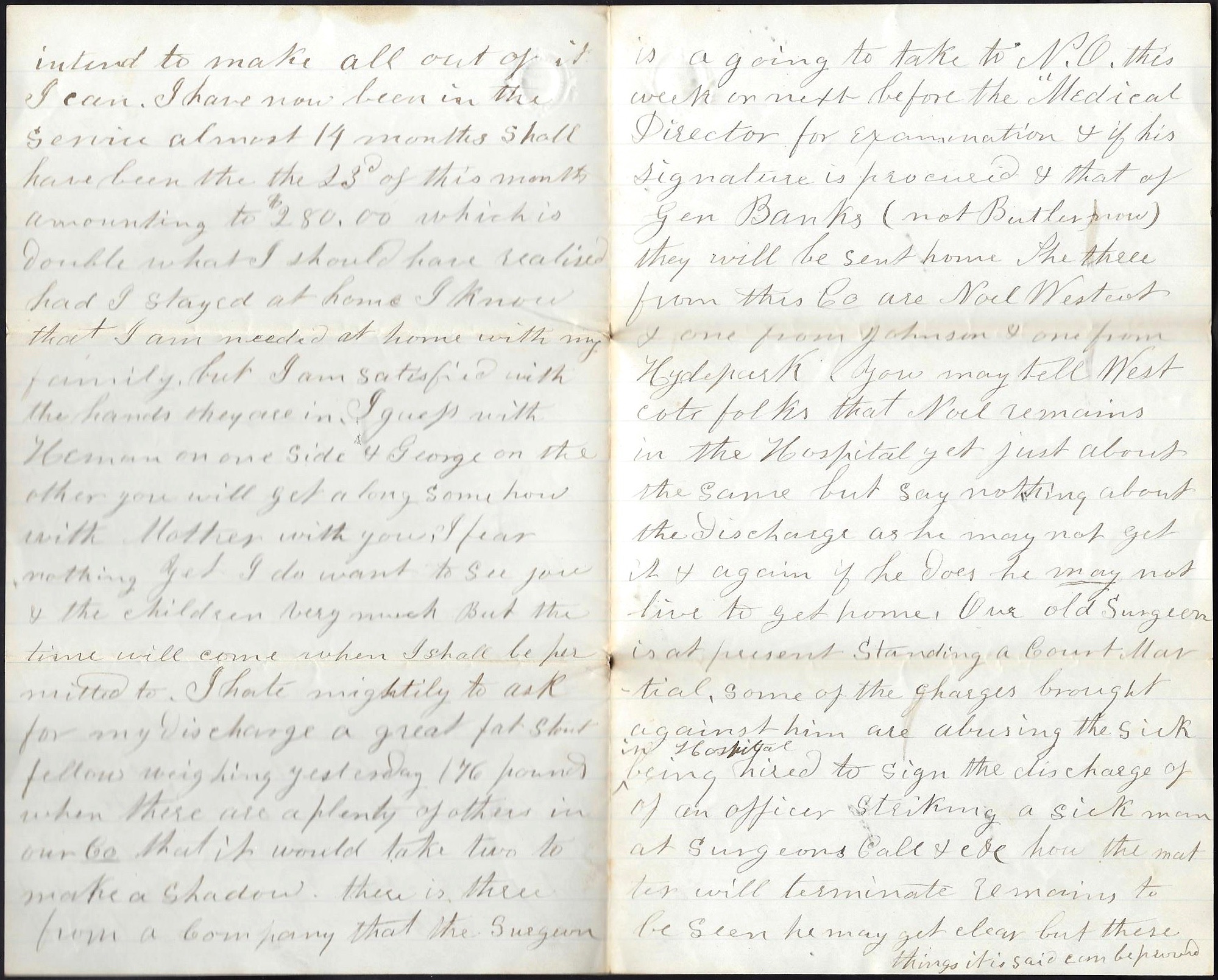
Letter 27
[Editor’s Note: This transcript was provided to me by Paul S. LeBlanc whose Uncle George P. Hulburd transcribed them from the originals in the 1960s.]
Pensacola, Florida
February 1, 1863
Juliana,
I have just received your letters one dated Dec. 28 and the other Jan. 8th and was truly glad to hear from home again and to learn that you were all well. I was a little fearful that I should have bad news when next I heard from home but the Lord has been better unto us than “all our fears.” Through His goodness and mercy I can say that I am in the enjoyment of perfect health at present yet my lameness prevents me from doing daily duty as a soldier. Yet I am not idle as there are many things that I do around our quarters.
I spoke to the Capt. the other day and told him I was sick of lying around in this shape and as there was no likelihood of my being any better I thought I had better be discharged. He said that he thought we should go north some where by the first of March and then all disabled ones would be sent home but he knows no more about that than I do. Yet I am willing to stay if they say so. We know nothing about how long we shall stop here or where we go next.
The boys here now as a general thing are very healthy altho many that came here sick have died yet the remainder are a great deal more healthy than when they came. Hiram Leach has gained 20 pounds in two weeks. He looks as tough as I ever saw him.
I have nothing new to write at this time or time to write much beside as the boat leaves again soon. We have not been paid off yet for the last 5 months and of course you will not have any government pay since Sept. until after we are paid again and returns made to the State Treasury. I wrote you awhile ago to pay Fletcher’s wife $9.00 afterwards to pay but 8.00 If you have paid 9 all right, if not, you need pay but 8 and he and I will make all right. I got the General’s likeness. Should think he looked like Charley.
Give my respects to E. Shattuck and tell him I thank him. Love to the children. Did Daniel get a letter from me about the middle of Dec.? Tell him to write. Where is loyal and Wm.? etc. etc. — B. F. H.
Letter 28
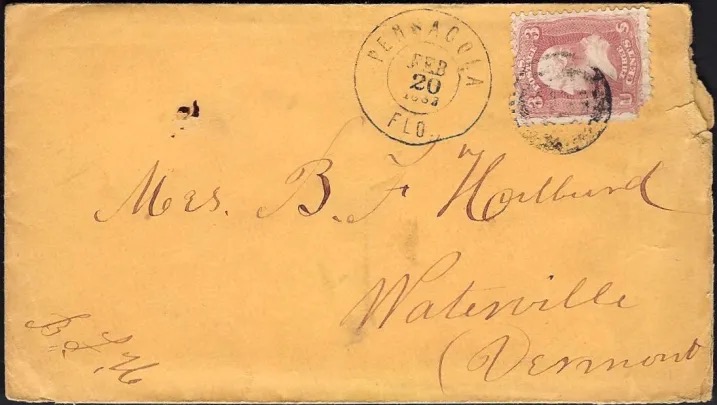
Pensacola, Florida
February 19th 1863
Juliana,
I have just received yours of January 25th & was glad to hear from home once more & especially that you & the children were all well. I received a letter from you yesterday dated September 21st. I was glad to get that if it was old. I also received a letter from Nason Chaffee & I want you to tell him I thank him sincerely for it & will try to answer it soon.
We have just had orders to move again. We are to go to Fort Pickens only 7 miles from this place & there wait further orders. The regiment have gone but I am left here for a few days to assist about the hospital. Shall probably be here 10 days or a fortnight before joining the regiment.
My bodily health never was better than at present, yet I am still on the “sick list” or excused ones on account of my lameness. You have probably heard before of Noel [Westcott]’s death. He died I think I wrote you on the 16th of January. That is the last death that has occurred in our company. The boys have recruited up & feel well as a general thing & are ready for another Vicksburg Scout or Baton Rouge “Run.” (Our colors have been restored to us, as you have undoubtedly learned. I think I wrote you something about it some time ago as in your September letter that I got yesterday & I will refer you to that to let you know what our Col. told Gen. Butler when he said we might carry them again. Said the Colonel: “by your orders, we were deprived of them; by your orders, we will take them — but not by your permission.” You have probably seen Butler’s order, issued after a court of inquiry called by our officers, & we exonerated from the charge of deserting our colors & running. I have time to write but little now. ¹
We have a fine chaplain. ² He holds meetings around with the companies week day evenings, altho the mode of conducting the meetings I don’t really like. Yet we get use to it. We all kneel down & all read prayers, sing, chant, &c. &c. Our Captain invites his company into his room after roll call at ½ past 8 evenings & he reads prayers & we all kneel & say Amen.
More Anon. Love to the children. — B. F. Hulburd
¹ William Cune Holbrook (1842-1904), the son of Vermont Governor Frederick Holbrook (1813-1909), was commissioned colonel of the 7th Vermont Infantry after the death of Col. George T. Roberts in August 1862 during the Battle of Baton Rouge. Not liking the unjust charges brought against the 7th Vermont by Butler, Gov. Holbrook of Vermont stepped into the middle of the court of inquiry. General Butler, in something close to an apology, conveyed to the Governor that since the regiment’s colors were not lost to the enemy, and the surviving officers of those who actually participated in the battle behaved with gallantry, the regiment’s colors would be restored to the regiment, now commanded by the Governor’s son. “However, when they had their flag restored in November, Butler banished Holbrook and his regiment to duty at Fort Pickens across the bay from Pensacola, Florida.” [Source: The Indiana Jackass Regiment in the Civil War by Phillip E. Faller, p. 82]
² The chaplain of the 7th Vermont Infantry was William Cyprian Hopkins (1834-1910) — an Episcopalian. His structured form of service was somewhat different than the Methodist form of service to which Benjamin was accustomed.
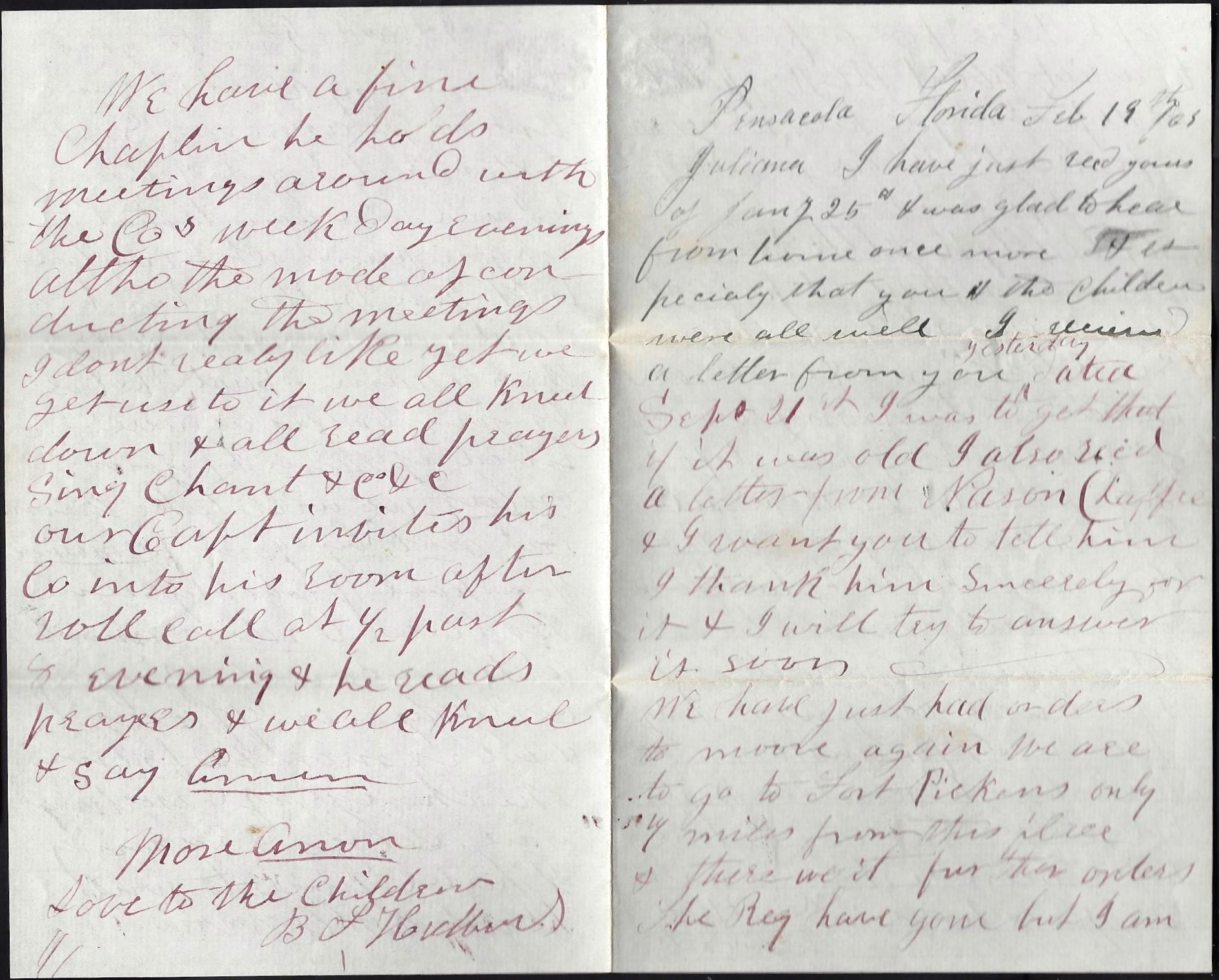
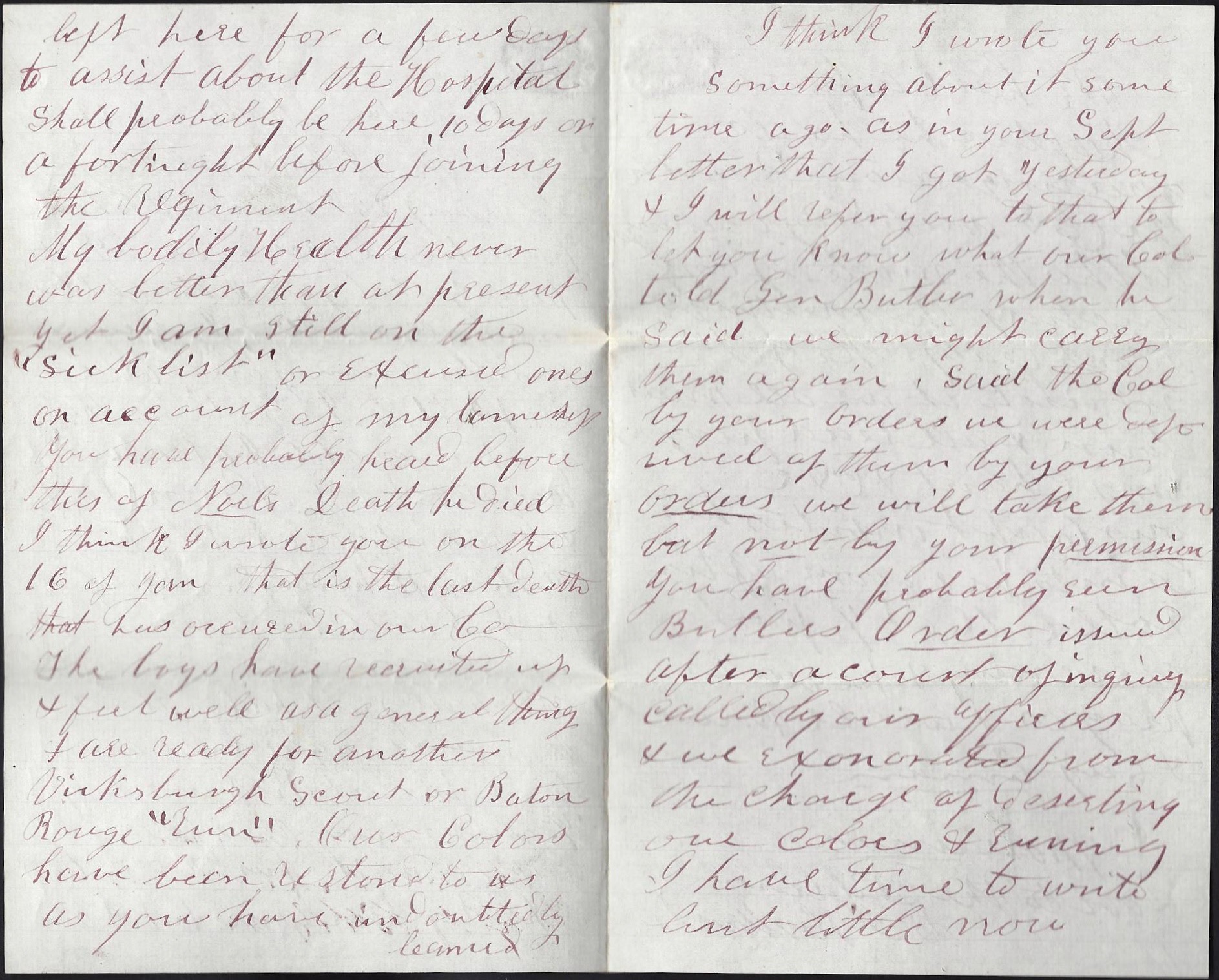
Benjamin Franklin Hulburd received a disability discharge from the 7th Vermont Infantry sometime in the early spring of 1863 and returned to Waterville, Maine. From one of his letters we know that he returned home in time for spring planting on his farm. He re-enlisted in December 1863 with Co. H, 2nd Vermont Infantry — the same in which his brother Daniel had previously served and in which his nephew, Daniel’s son, Loyal P. Hulburd was still serving as the orderly sergeant.
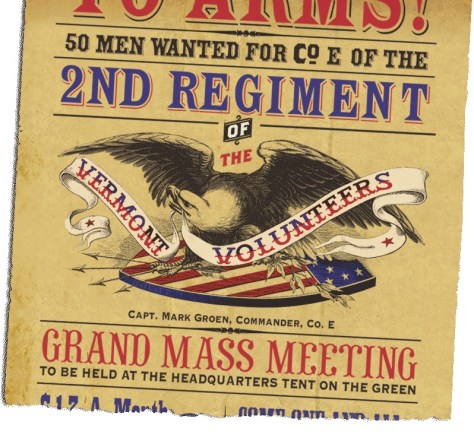
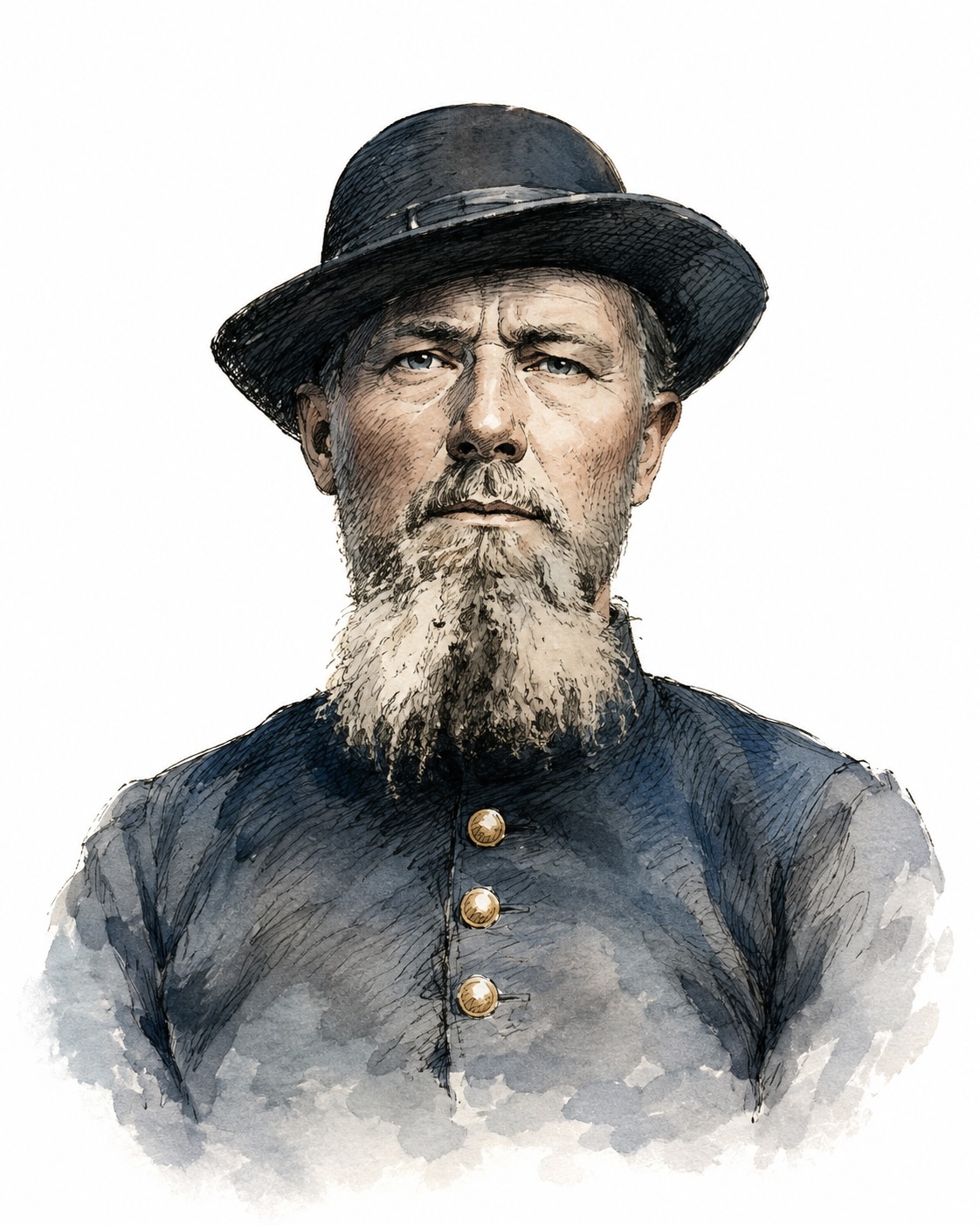
2ND VERMONT INFANTRY
Letter 29
[Editor’s Note: This transcript was provided to me by Paul S. LeBlanc whose Uncle George P. Hulburd transcribed them from the originals in the 1960s.]
Brattleboro, Vermont
December 21, 1863
Women and Children
I am here, have been examined accepted and mustered into the U. S. Service. How soon I shall be sent off I can not at present say but understand that Thursday is the day set for our exodus. They are sending off some everyday. Those that are going into the 11th Reg. and some others, and they are flocking in here every day by hundreds. They are paid off just before they get in the cars. I shall receive $75 here on leaving and a paper that will draw my $300 from Stowe.
I shall appoint Heman to get that for me and will send a part of mine home. You may dispose of it as you please. Pay—I guess $50 dollars of the town money and interest E. H. Shattuck what I am owing him and Wilbur and Henry Smilie that $20 I borrowed of him certain and all the taxes that are against me which I presume are as much as $6. If the Clarks come there to board, get or take 12 or 15 cords of wood. But do as you are a mind to about taking them. Fix up the children warm. I have got 2 pair of drawers, 2 shirts, overcoat and rubber blanket.
Get Eva some ear rings, Roger and Charley something new, for I am the same as out of debt. Should you want anything before the money comes, tell Ed to let you have it. I will write when I get through—when I am paid off I shall have time to write but will send the papers and money in the cold and haste. Yours, — B. F. Hulburd
Letter 30
[Editor’s Note: This transcript was provided to me by Paul S. LeBlanc whose Uncle George P. Hulburd transcribed them from the originals in the 1960s.]
Brattleboro, Vermont
U. S. Barracks 1
December 23, 1863
I wrote a little the other day and I did not know then nor do I yet when we shall leave but thought I would say a few words more. As I said, we shall not be paid off until just as we are ready to start. I shall then get about eighty dollars, a part of which I shall send home. I shall allot to you $10 per month of my government pay and the seven dollars state pay. The select men of the town will see to that. Tell George or someone to look to that a little as I enlisted from Stowe and they might think that the select men from that town must see to the getting of it which I understand is not the case but they of the town where the family reside. But it is necessary that the fact should be stated by them to the State Treasurer.
My certificate of muster and power of attorney I shall send to Heman. Tell him to go to C. F. Douglass of Stowe and present the same and he will get the money $300.
Our fare here is not quite as good as I found at Rutland yet it is passable here. I have had a very lame neck for a few days but it is almost well now. It commenced growing worse the day I was examined and the next day I could not move my head. Had it been one day earlier I might have been rejected but as it was when I stood before them as naked as when I was born they viewed my fair proportions and asked me not a question.
But I am called to go and sign the pay roll and must stop. I am to have pay for my board from the day of enlistment up to the time of muster 5 – 11 at 30 cents per day. State pays the proportion of the $1 for the same time.
To all, — B. F. Hulburd
Start tomorrow. When I get through I’ll write. As I shall have no time after being paid off. I leave with Z. W. A. Leach $50 which he will forward by express. When you get it, acknowledge the receipt of it to him for he says he shall be anxious to know. Direct Z. W. A. Leach, Box 34, Brattleboro, Invalid Corps.
Tell Heman when he goes to Stowe to have Gillett go with him to Esq. Butler or some other man and ascertain whether it is necessary that there should be a government stamp or revenue stamp on the power of attorney or order for the money before presenting it to the select men. If so see that it is done.
Letter 31
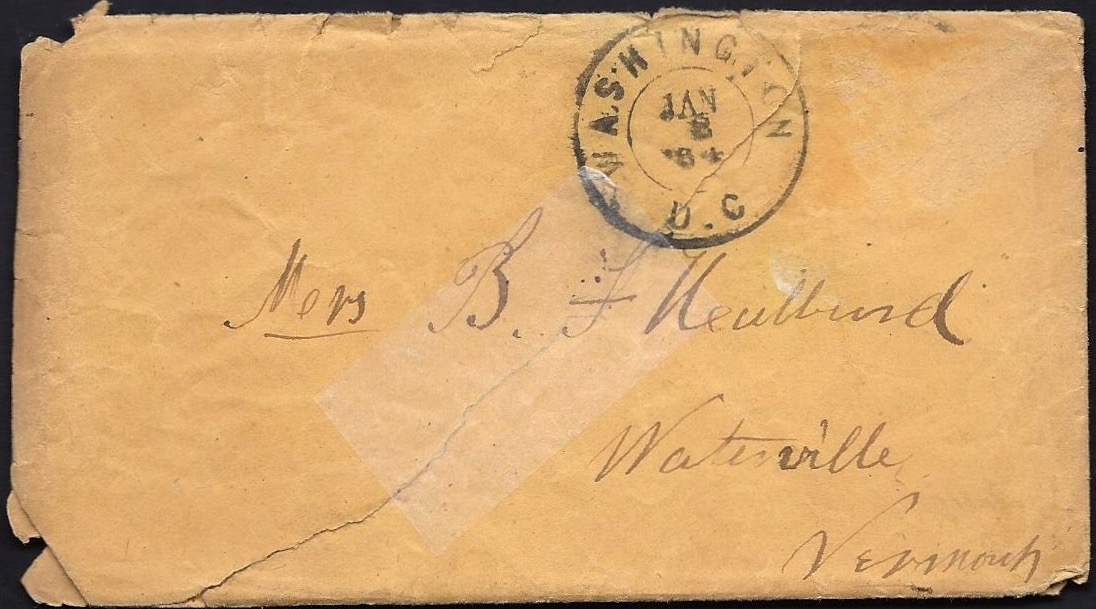
Camp near Brandy Station, Virginia
January 7th 1864
Women folks and children,
I take this opportunity to write a few lines and several words home. I have finally got here without harm. My health is first rate. Got a little cold at Brattleboro, had sore throat & stiff neck a few days but have entirely got over all and am now perfectly well in every respect.
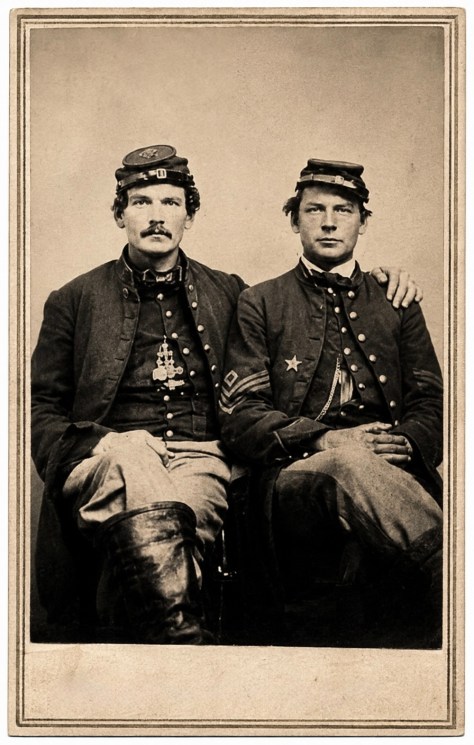
Got here the night before last. Found Loyal well and expecting me with a grand supper waiting for me, eat, went to bed, & yesterday went about a mile [to] see William [Hulburd]. ¹ Had a high old time. Am today in camp doing nothing. The boys have got some very good tents about 7 feet by 12—4 or 5 to a tent. The walls to the tents are logs about 4 feet high, then tent cloth roofs. They are very comfortable with a fireplace altho the weather is very cold out—the coldest I ever saw in Virginia. The boys are all fat and hearty.
I saw Elbridge Wilbur ² yesterday—tough as an Indian. Loyal had a letter from Juliana a few days before I got here & one from his father the night I came. I learn that Sam had dissolved with the woman and taken up his abode at our house. You may write now if you have not already written as I have heard nothing from home since I left—only from Daniel to Loyal.
I have nothing new to write at present. The regiment with some others are under marching orders but probably the orders will be countermanded & remain here through the winter. I want you to write & tell all the news & particulars about matters & things generally. I have written as much as a ½ dozen letters home since I left and 1 to Porter & one [to] Emily Hulburd. Shall write no more till I get some myself.
Children, I have nothing new to say to you. Be good children & Eva you must write to me plaguey quick.
In haste, — B. F. Hulburd, Direct to Co. H, 2nd Vermont, Washington D. C.
Daniel is going to send Loyal a box. If you should want to put anything in it, maybe you could yet. I don’t know as I want anything in particular. — B. F. H.
Send occasionally a paper & [Lamoille] News Dealer.
¹ William Hulburd (1838-1904) was Loyal Hulburd’s older brother. William was a member of Battery C, 4th U.S. Artillery.
² Elbridge B. Wilbur (1840-1926) of Watertown, Vermont, served in Co. E, 3rd Vermont Infantry. He mustered into the service in July 1861 and mustered out in July 1864.
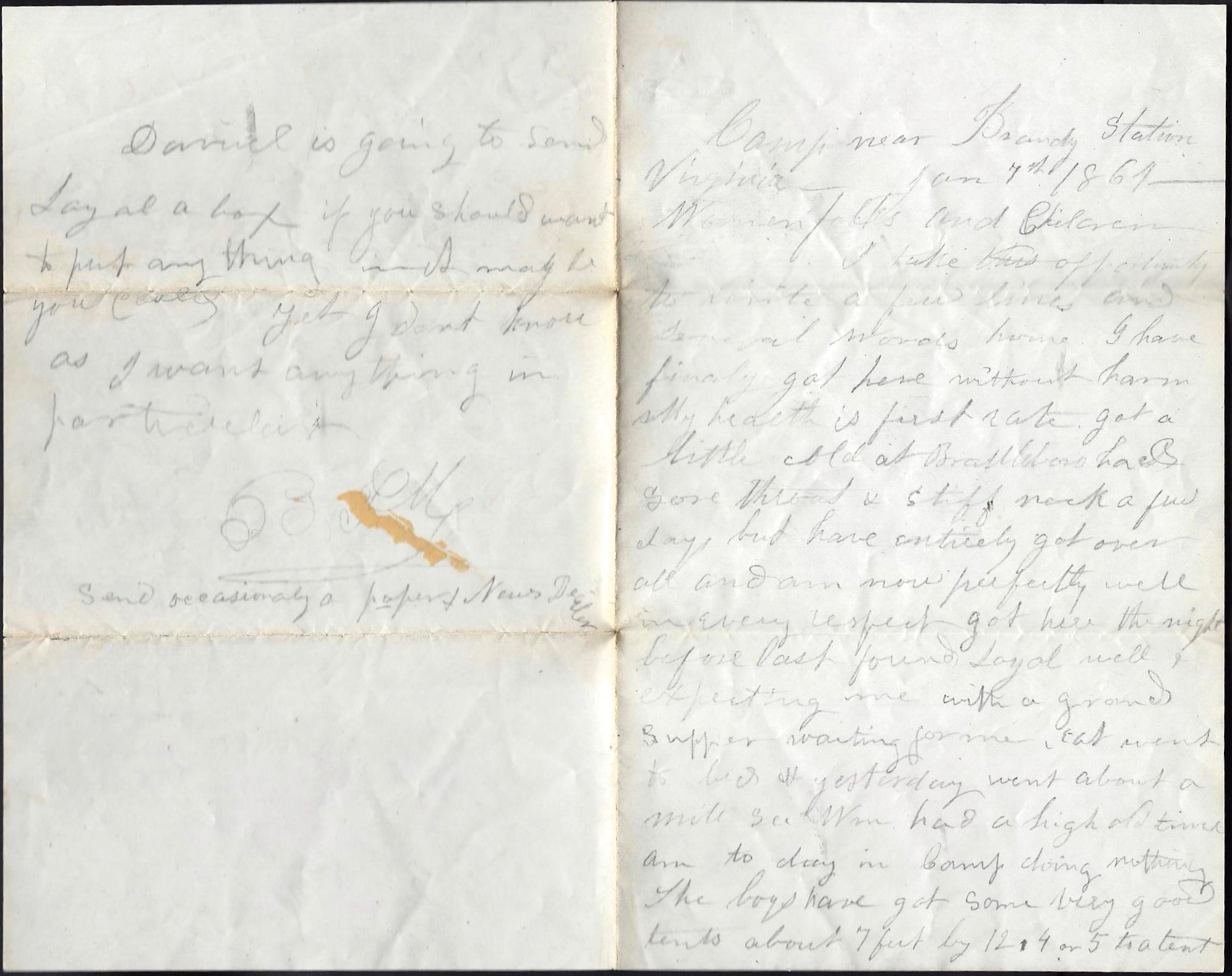
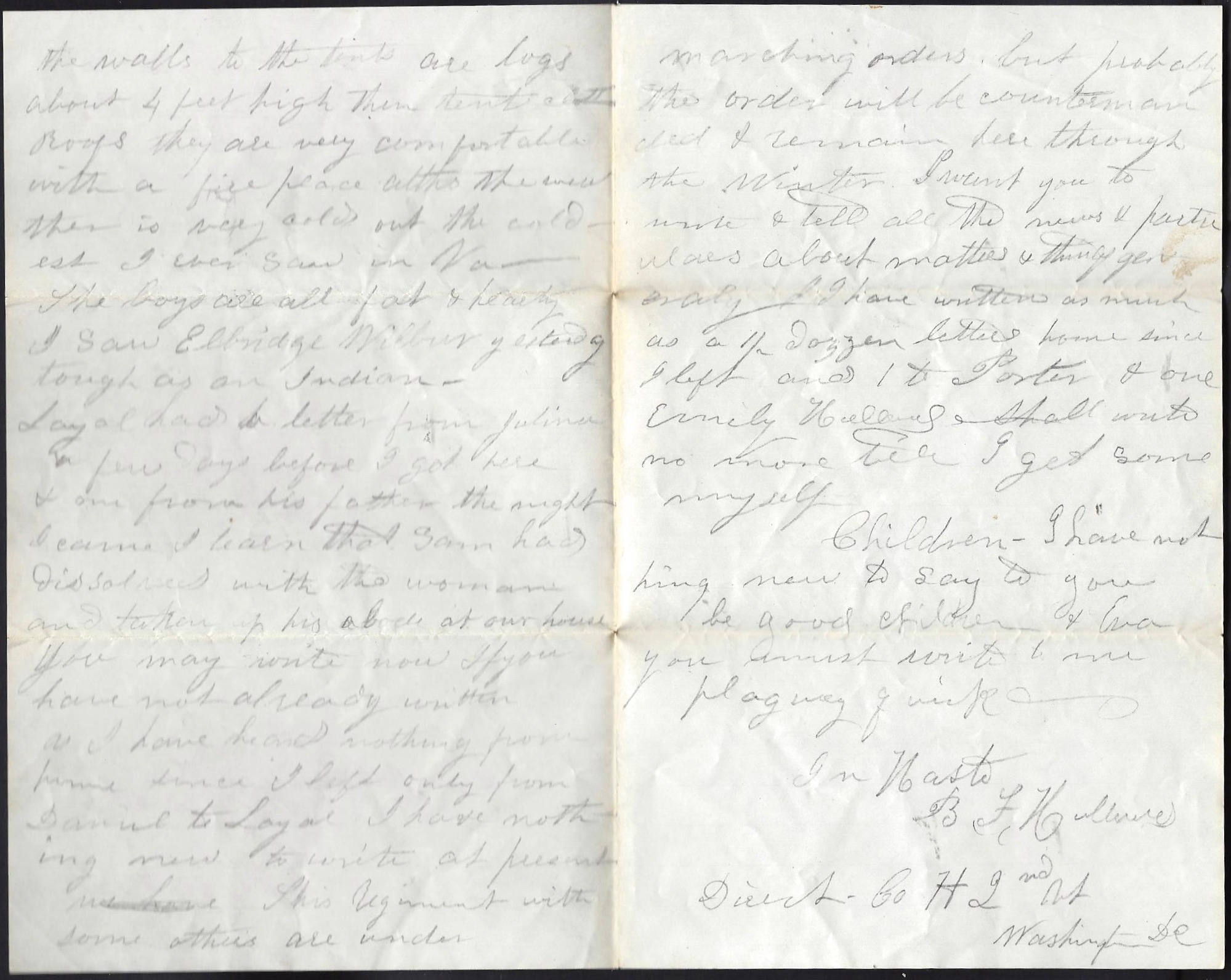
Letter 32
Camp near Brandy Station
February 8th 1864
Juliana,
I wrote to Sam 2 or 3 days ago & a few lines to you at the same time. I have nothing in particular new to write at this time. Have just come off guard & have nothing to do today so I thought I would write a little.
The night after I wrote to Sam, about midnight or a little after, we had orders to be packed up & ready to march (with 3 days rations) by 8 o’clock in the morning. So we got ready to start but as yet we have had no orders to march and probably the order will be countermanded. Have not as yet heard the particular reasons for the order but there was a skirmish of some kind on the Rapidan [River] some 10 or 12 miles from here as we heard cannonading all the afternoon and at sunset we could hear the musketry very plain. ¹ What the cause was, or the effect & result, we as yet have not heard. Shall know today. There was a rumor came into our camp that our men had taken 2,000 prisoners but that needs confirmation. The Vt. Cavalry was engaged, I understood, but what other regiments, I have not heard.
I said I had just came off guard. Went out yesterday morning 9 o’clock, off at 11 — on 3 — off 5 again at 9 P.M. off 11 on 3 this morning, off at 5. My post was forward of the stables to keep about 30 mules from running away — a very important post as the mules were all fastened and could not easily get away.
You may do as you think best about trying to have any sugar made this spring. If Sam is a mind to & can get any wood drawn to the sugar place, he may tap it & call it on in some shape, hire him or anyway you think best. There can be nearly wood enough picked up for the season — some of the remnants of the old fence. The nails are in an old teapot over the window in shed, I think, & the spouts are in the buckets over to the barn. The children will want to help make sugar & if Sam is around too, he may tap it or not as you in your superior judgement think best.
Loyal’s box has come — everything all right. There is two other boys in this tent. One had just had a box come when I got there & in about two weeks the other had one. They shared theirs with us & I occasionally would get something from the sutler for my part & so we have lived like kings. The tobacco was first rate. I guess it come from Eds. I paid 1.25 for one plug & 0.90 for another same size but not as good as that. I wish I had something to send the children but can get nothing here. Have not seen a woman since I have been here. Don’t think of much more now.
How does all the children? Eva, ain’t you going to write me again? I keep your letter but the rest I burn up. Roger, can’t you say something? Charley, tell Mam something to write. Does the girl talk any yet &c &c &c.
From B. F. Hulburd
P. S. I learn that the cars on which were several soldiers returning who had been home on furloughs run off the bridge across the Potomac at Washington last night killing several — one in this company. Have not heard all particulars. ²
¹ The Army of the Potomac engaged the Confederates at Morton’s Ford on the Rapidan River during the day 5 February 1864. Musketry fire began about 5 o’clock in the evening and continued until dark.
² “The following are among the soldiers killed and wounded by the railroad accident near Washington yesterday: L. C. Perkins, Co. H, 2d Vermont Regiment, seriously injured, and died after being taken to the hospital; W. A. McKinsley, Co. E, 3d Vermont Regiment, leg badly crushed, amputation necessary; J. P. Gage, 3d Vermont Regiment, badly bruised internally; Mathew Hopkins, 3d Vermont regiment, shoulder bruised.” [Telegraphic News to the Boston Post]
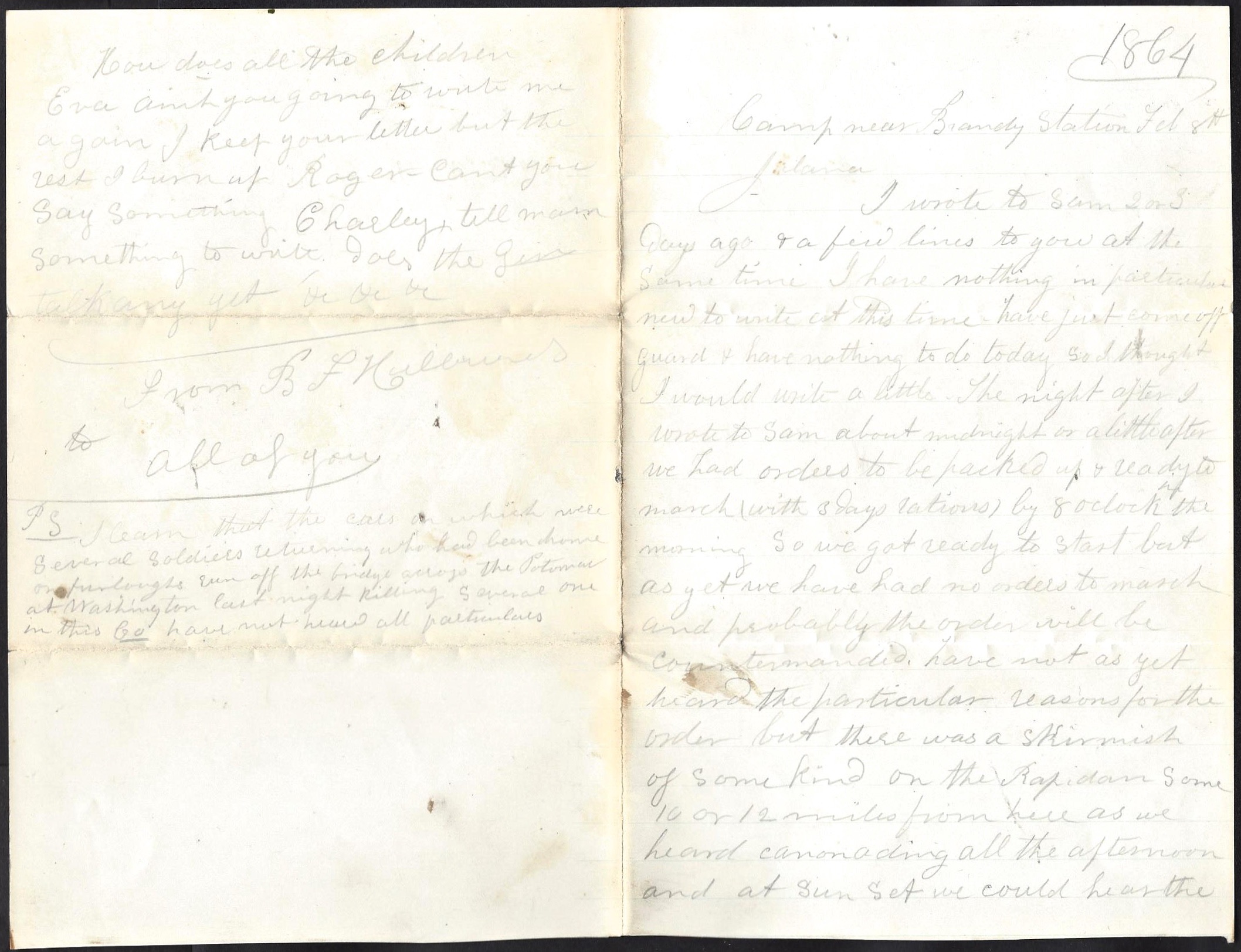
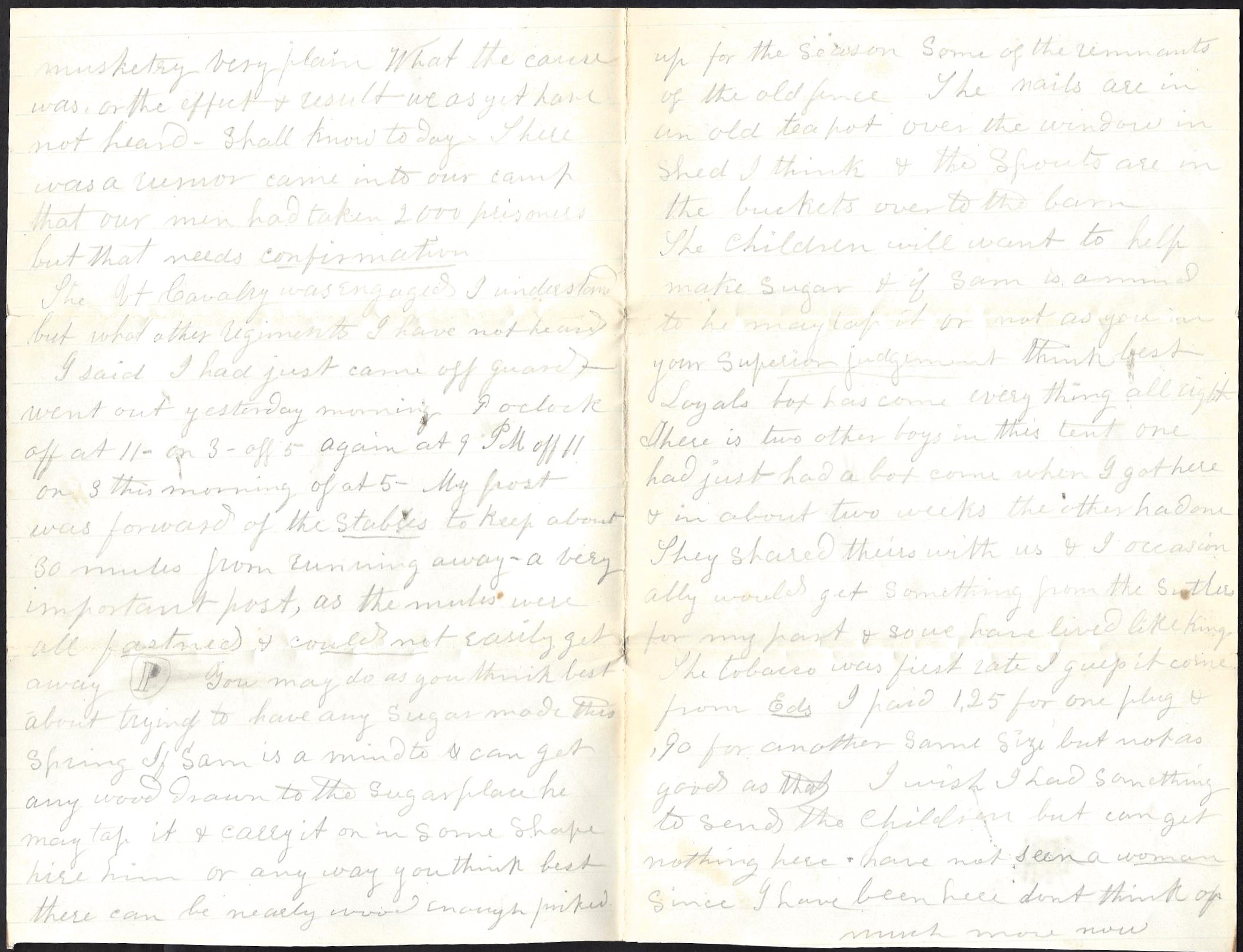
Letter 33
[Editor’s Note: This transcript was provided to me by Paul S. LeBlanc whose Uncle George P. Hulburd transcribed them from the originals in the 1960s.]
Camp near Brandy Station
February 19, 1864
Juliana,
I thought I would write a few lines at this time or commence one and finish hereafter. I have had a letter every Thursday night since I came here till last night. I did not get any but may yet tonight or tomorrow as the mail comes in every night. I came in from off picket last night. Had been out 3 days and it was 3 most all-fired cold days too. We went on at 10 o’clock at night and were relieved every two hours—then curl up for 4 hours—then go on again—so for 3 days carried out our coffee, sugar, pork and bread, would broil our pork, make a all-fired strong cup of coffee, eat, drink and was merry. After coming off I went and got some potatoes and filled up the fireplace with them. After they was roasted, took down the towel, put them in it, then took hold of each end of the towel and would yank one way then the other and shake the ashes off as we did in “Auld Lang Syne.” But didn’t I get up a meal, fried pork with a water gravy better than some would make with milk.
Gosh it has been for a few days the coldest I ever saw out this way and seldom colder out that way. I commenced a letter to Eva the other day on the song sheet of ‘Ellsworth’ but the mail carrier came just as I commenced and I had to stop and seal it up and send it off without writing much but she must write me a long letter. I will wait now till Sunday to finish this and see if I do not get a letter by that time.
February 20th—Had letter last night. Most all-fired cold this morning. This morning we had a first rate pan of beef steak. Last night I made a dish of bean porridge and it was the best dish I have had for a long time. I have got a tooth that I must have pulled. Tell Sam I wish he and Dr. Rowe were to take it out for me. Just come in from 1 hour’s drill, growing warm fast. This morning some of the cavalry pickets came in with 28 guerrillas, prisoners taken last night with horses. I have got to fix up now for inspection tomorrow morning. I don’t think of much more to say now so I will wind up. — B. F. Hulburd
There—since I wrote the other page, I have put a patch on my pants, made a pot full of bean porridge that was nice too, ate that with bread, butter, applesauce and a toast, have shaved up and blacked up my boots so you can see your face, scoured up my gun and equipments ready for inspection tomorrow morning and pitched 3 games of quoits. Loyal says tell Julane that there is a fellow that answers to his name down here. All well.
I don’t know as I have anything in particular to say to the children. I will send them a paper again by and by. The little paper sent to Eva and the little books are such as are distributed around in camp. — B. F. Hulburd
Letter 34
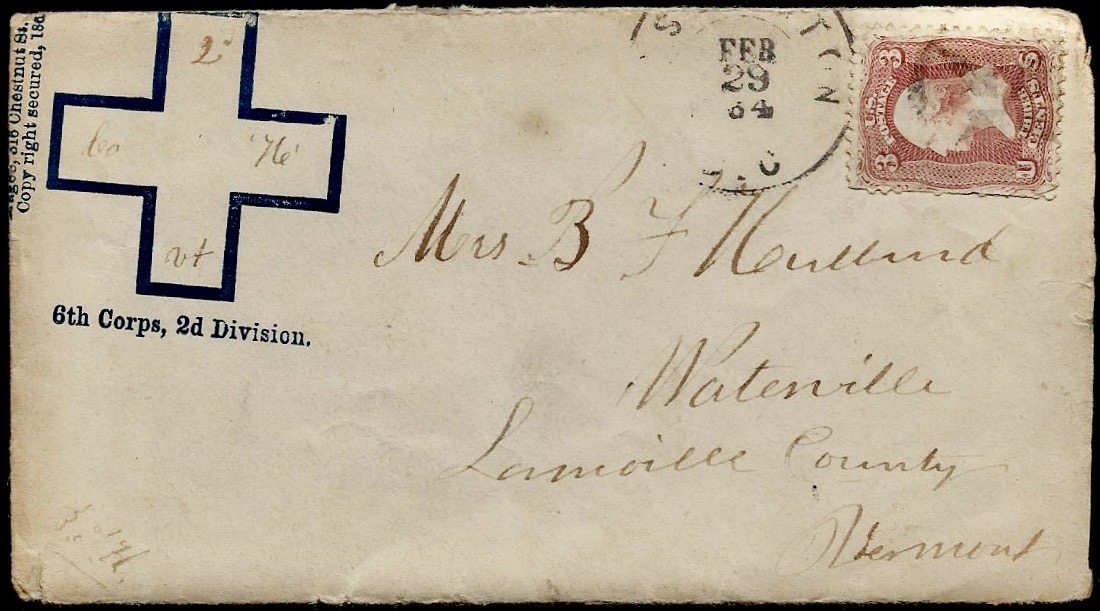
In Camp
February 27, 1864
I take this opportunity to write a few words but don’t know how soon I shall have a chance to send it. I received yours last night. Was glad to hear again from home. I am well as usual & it is generally very healthy throughout the camp. Have been quite busy this week. Been out on three views. First the whole of the 6th Corps—about 30 regiments—reviewed by Gen. Sedgwick, a splendid affair. Second, the Vermont Brigade—the 2nd, 3rd, 4th, 5th, 6/7th Vermont Regiments by Col. Grant so that his wife might see us. And yesterday again the same regiments by Gov. Smith of St. Albans.
Last night about 10 o’clock we had orders to be ready at 5 A. M. this morning to march with 5 days rations. At 9 o’clock the boys started. How many have gone, I have not learned but the Vermont Brigade—5 regiments—have started for some place. I and three others in this company & a like number from all the other companies are left to “guard the camp.”
The boys will probably get a sight of the “gray backs” before they come back. I wanted to go but as I was named as one to stay, I did not manifest any unwillingness to stop behid. It is a fine morning like May but not scarcely a green thing to be seen. Everything “trodden under foot of men.” I suffered some for two days & one night with a lame tooth but last night I had it drawn. It did not come quite as hard as the one that Dr. Howe & Sam worked on.
I am real lonesome here today sitting alone in my tent & hardly anyone to bee seen out. I have just had my dinner & I tell you, it was a dinner too. I found at the cook stand potatoes which I clipped & boiled, fried some nice pork & fresh beef in the fat. Then I took & put 3 large spoonfuls of flour in the fat & stirred it up so that it was a good thick dough. Then put in half pint of water & stirred it until it was all mixed, then put it on the fire & let it boil. It thickened up most as thick as pudding & it was better than any cream gravy I ever saw (try it!).
We shall probably be on the march before a great while as the weather is fine. Don’ know what this movement is for. If things turn out favorable, the men may not come back but we be ordered to go on after them. We now cannot tell what a day may bring forth. You can write as heretofore & direct the same as the mail will be forwarded to the regiment wherever it is although we can not hear from each other as often as now for we are only about two miles from the railroad station & here the mail comes in to us every night.
I want you to knit me a good wide heavy pair of suspenders & send to me when convenient. I can put on the trimmings. It will not cost more than two postage stamps to send them by mail.
I was mustered into U. S. Service December 18th. Was paid off my state pay ($3) the 24th. That was a portion of the $7 that accrued from the time I enlisted (viz) December 5th up to that time December 18th. So the 18th or 20th is about the time it will fall due each month. I will write again as soon as I learn anything in relation to the move that is to be made. You will probably hear by the papers the result of the present move. — B. F. Hulburd
Thank you Eva. How are you boys? Roger’s Confederate Money.
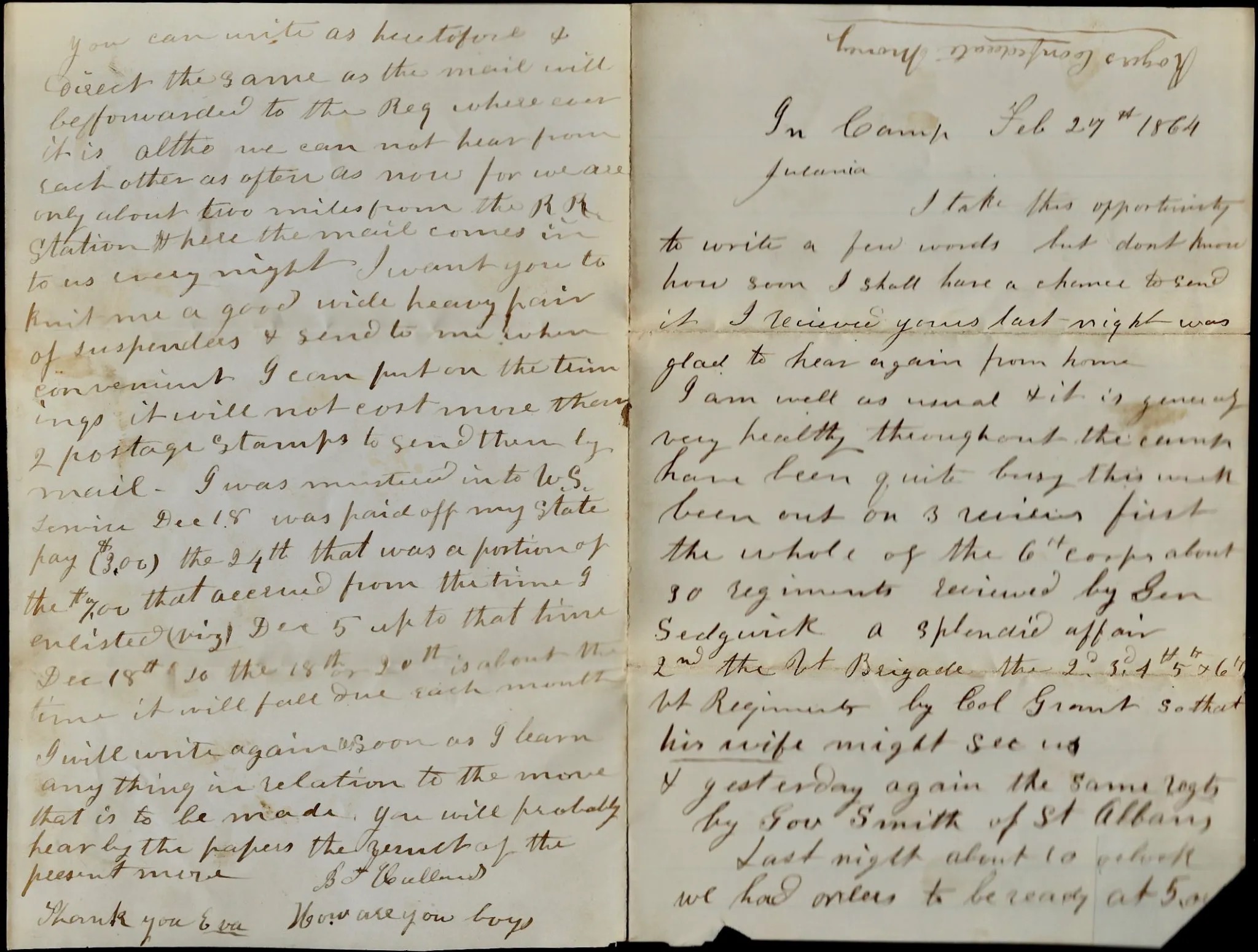
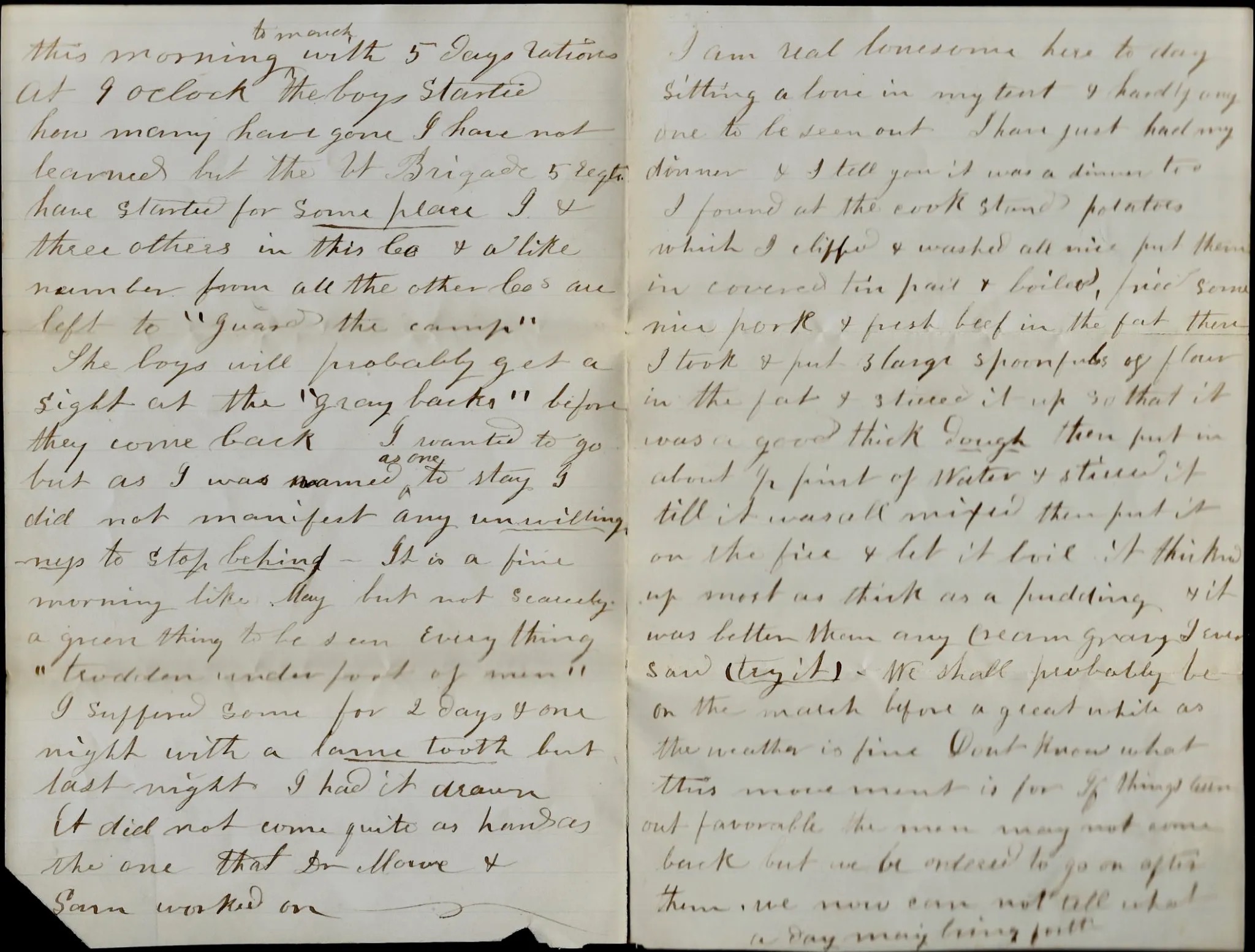
Letter 35
[Editor’s Note: This transcript was provided to me by Paul S. LeBlanc whose Uncle George P. Hulburd transcribed them from the originals in the 1960s.]
Same Place
March 6, 1864
In great haste I seat myself at this time to write just a word. The mail man will be here in a moment and I shall hurry and be short. Have come in today from 4 days picketing. Had good comfortable time. Come home all right. Found no letter but tonight yours got along. As I have but a moment I must stop. Our boys all got back safe. Was out 4 days, went out about 30 miles. The man hollers. Mail to go out.
Write again soon. Affectionately, — B. F. Hulburd
Letter 36
[Editor’s Note: This transcript was provided to me by Paul S. LeBlanc whose Uncle George P. Hulburd transcribed them from the originals in the 1960s.]
In camp
March 12, 1864
Juliana,
I received yours of the 6th last night and accompanying the same were “the suspenders,” all in good shape with the paper. I am still in the enjoyment of good health as ever and it is a general time of health in camp, at least so far as this regiment is concerned. There having been but 2, 3 or 4 deaths since I came here; disease—measles and afterward typhoid fever. I wrote a very few lines last Sunday after I came in from picket but did not have time to only just begin before the mail man came along so I sealed it up and sent it off. I have written to Julina this week and Wm. told me he [did] the same day. Loyal sent his photograph (“fortergraph”) with Wm’s. I don’t know but I may get mine taken by and by, but they do not take photographs much around here—mostly Ambrotypes.
It seems that our men have been a little worsted down in Georgia and Florida but I guess we shall not be called off that way. We may have work to do nearer by in the course of time but we may not be called out of camp before the first or middle of April. We have had considerable rain for a few days past and it is rather muddy now and bad marching. I understand that orders have been issued for all women (officer’s wives) to leave the camp and no more be allowed to come in this spring which looks a little like getting ready to march sometime. The order is a good one anyway and I wish that every officer that takes his wife or mistress—I don’t know which—into camp should be cashiered and sent home in disgrace. We have been called out and marched off some two miles, the whole Brigade, just to give some of the officers a chance to let their cussed women see us.
I do not think I get all the papers you send. I think I have not had any but twice, two at each time, till last night with the suspenders and both times they were out of the wrappers, the sealing wax having broken off and left them open. I want you to be sure and send me March the 9th News Dealer, if it has the town officers for Waterville in it. There is some of the News Dealers come into camp from the office every week. I see most of them but sometimes I miss one.
Have just got a blouse and a new pair of pants. I wish I could send home my old clothes that I shall have to throw away when we come to march but I don’t think it would pay. Tell Julina if she don’t answer my letter I shall [not] strain myself as hard another time to write. Respects to all, — B. F. Hulburd
Letter 37
[Editor’s Note: This transcript was provided to me by Paul S. LeBlanc whose Uncle George P. Hulburd transcribed them from the originals in the 1960s.]
In camp
March 20, 1864
Well Roger, I suppose I must write to you and Eva this time but you must let your [mother] read it too for she will want to know what I have written. I wrote a short letter to her last night and sent my pictures—one for her and the little one for one of you and I will send one in this so Eva can have one and you one. I thought when I wrote last night we should be on the move by this time. We had orders to be ready to start out a moment’s notice but the orders was countermanded.
I have been off today with about 400 men fixing a spot of ground for a review next week. We expect Gen. Grant to review us and we expect President Lincoln too. The ground fixed is on the plantation of John M[inor] Botts. He owns a plantation of about 30,000 acres. I could stand and look almost over it. I expect it will be a grand time but a hard days work.

There probably will be some where from 50 to 75,000 soldiers out on the occasion. I will tell you something what a review is. Well in the first place the men must all be neat and clean and their guns must be as bright as a needle. Then the officer that reviews us with all his staff officers on their horses ride along by in front of us and then in our rear. The regiments are all in four divisions like this. [sketch] Then after the officer has ridden by he places himself with his staff officers a little ways off and we all march by him in this manner. [sketch] When we get by him then we march off home.
I should like to see your pictures but I guess you had not better send them for I might lose them. I guess I will send two in this letter and you may give Aunt Maria one. You may keep the one that shows five coat buttons. I had 4 taken at one sitting and then I had the large one taken. They cost me 50 cents apiece. How much did they all cost Eva? I think probably now that we be on the move in a few days after the review comes off, but I will try and write most as often as I do now but I do not suppose I can get letters as often as now. I got a great long one from Emily last night too. I will send a few lines that she put on a little strip of paper to finish up with.
Now Roger you must see to the spring work. You must do as you think best with that piece over to the other barn. Plant it to corn or potatoes and don’t you think it would be best to break up a small piece behind the barn. Just leave a road next to Thom Stevens’ fence and plant that to potatoes and the other to corn again. I guess the worms won’t eat it as bad as they did last year. I guess you had not better pasture anybody’s cow this summer. I don’t get but few News Dealers. (3 months state pay due now) — B. F. Hulburd
Letter 38
[Editor’s Note: This transcript was provided to me by Paul S. LeBlanc whose Uncle George P. Hulburd transcribed them from the originals in the 1960s.]
In camp [In Culpeper county, near Brandy Station]
March 23, 1864
I seat myself at this time to commence a letter [and] shall finish [it] the last of the week after I see whether I get a letter or not. My health is very good. Still there are some few sick in the hospital with the measles, 4 or 5 from Co. H. Aside from that, it is generally very healthy here now. I am a little lame today caused by working rather hard at a game of football. It wrenches a fellow some but then there is fun in it. The 2nd Vermont and the 6th encamped about ½ mile apart are having a battle today. The 6th challenged the 2nd for a game at snow balling. We had a rather severe snow storm last night. The snow fell nearly a foot deep but is going fast today.
I sat down two or three weeks ago and wrote over to Littleton to she that was Philena Hulburd. Last night I got a long letter of 6 pages. She was awful glad to hear from “one that she supposed had long since forgotten her.” She has a family of 2 boys, one 10 and one 6 years. She said she told that my letter was from a cousin and no one knew to the contrary yet. This storm has caused the review to be put off till the last of the week. I will wait now till the last of the week. Our Major is going out to lead our regiment in the battle that is raging furiously between the 2nd and 6th and I will go and see the fun.
Their battle is over and the 2nd drove the 6th from about midway between the two camps clear into theirs. We took several prisoners among whom were one Capt. and two Lieutenants. When we got them into their camp they surrendered and we returned to our own camp. Got supper, had some new sugar melted over and waxed it on snow.
25th March—Yours came last night but no papers. Other folks get papers but I have had but 5 come, two twice and one with the suspenders. The others were loose, the wrappers having come apart. I have got a good night cap made of a trousers leg. If I can send home a great coat and drawers I will but think it doubtful. Loyal says that he shan’t carry any bundle home with him when he goes and as for sending anything by express it would cost about all it is worth.
Tell Chaffee when he writes to me to make a statement of the taxes for the Spring. You say it is over 9 dollars and that does not include any tax voted this spring at town meeting. Have you got any state pay yet? Don’t know how soon we shall be paid off, probably not till into April and then only up to the 1st of March as I had one month’s pay in advance I shall not have only about a month’s and a half pay and fifty dollars bounty.
It is all-fired cold this morning. I can not write and I don’t know but the mail has left this morning. — B. F. Hulburd
Letter 39
[Editor’s Note: This transcript was provided to me by Paul S. LeBlanc whose Uncle George P. Hulburd transcribed them from the originals in the 1960s.]
Still in Camp [In Culpeper county, near Brandy Station]
April 10, 1864
Juliana,
I received yours of the 4th last (Friday) night. It found me in good health as usual. You talk as though I looked poor. I stepped on the scales yesterday and I weighed 200 pounds just. No, my health is first rate good this spring. We are still here in camp and I don’t know how long we shall stay. It has been very wet here for some 3 or 4 weeks, rain and snow. It rained hard today and is quite muddy. One or two pleasant days and the mud dries up considerably then another wet day makes it bad again.
Orders have been issued for the men to pack up our extra truck that we cannot carry on a march and have it sent to Washington where it is to be kept for another winter but it probably would never be seen again or not much of it at least. I have a good dress coat and a good great coat. I should like it if they were at home but cannot say as yet what I shall do with them. I don’t want anything sent from home for I can get all I want here at a few days notice and I don’t want to lug around any more than I am obliged to for when we get 5 or 8 days rations on our backs and our equipments, it makes about load enough to carry from 15 to 25 miles a day without much other truck to carry.
I have just come off guard this morning. Had good day yesterday and night. Just as I come off it commenced to rain and has rained hard for 3 or 4 hours I guess for I have slept about three of them. Anyway it cuts it down now. I was quite highly complimented yesterday while on post. The Brigade Officer of the day passed me in the morning. As he approached, I saluted him. He returned the salutation and passed on. In the P. M. he was passing me again and I saluted him. He did the same and then came up to me and says, I guess the 7th Vermont done a good deal of guard duty at New Orleans? I said they did some. I can tell, he says—a man that understands his business. I have noticed you today and I wish there was more in this regiment that understood it as well as you do and, says he, I shall remember it in you hereafter too. Said I, thank you, and he passed on.
We have orders to drill now 4 hours a day but it is so wet that we don’t ½ of the time more [than] one or two. Loyal had a long letter from Emily last night. She and Mary were well. I don’t get any papers now. I have written to the State Treasurer and perhaps sometime the matter will be arranged so you will get the State pay the 18th of this month $28. In haste, — B. F. Hulburd
Respects to all.
Letter 40
[Editor’s Note: This transcript was provided to me by Paul S. LeBlanc whose Uncle George P. Hulburd transcribed them from the originals in the 1960s.]
In Camp [near Brandy Station]
April 14, 1864
Juliana,
Yours was read last night. Found me all right and well. We still are in camp but shall probably leave now soon. We have packed up our extra baggage and it is to be sent to Washington till another winter. I thought that it would be doubtful about ever getting it so I have put up my overcoat and dress coat in a box and it will lay there till June when Loyal goes home. He will take them home. I put in an old pair of pants that were quite dirty and ragged and the cotton shirt I wore away from home. When I want another overcoat, &c., I can draw them here just as well as though I sent them to Washington and lost them there.
I have written to the State Treasurer once and shall today send him a certificate from the Capt. stating that I am a member of his company when enlisted and mustered into the service and then I think all will come out right.
We have more drilling now than formerly—4 hours a day. Yesterday we went out on Brigade review—5 regiments 2, 3, 4, 5, 6 Vermont. We were ordered to be as neat and clean as possible, boots blacked, brasses polished and just before we went out we had a pair of white gloves given us. Every man in the 5 regiments had them. They looked rather neat. Where we shall go when we break up camp of course I cannot tell, but guess the determination is to take Richmond. Old Gen. Grant—the Hero of Vicksburg—has an army of countless legions and I expect something will be done this spring that will stay done. There will probably be some hard fighting but the Old Flag is bound to move.
I have not time to write more at present so I will close. I put in a little jack knife in my overcoat for Charlie, if it ever gets through, and rolled up a ½ candle (such as are furnished us) in my old shirt. My old pants and overcoat are very dirty as I wore them when on picket and laying on the ground dirtied them a very little. If they get through, you can cut them up for the boys. If you want some of my photographs you can send one off and get it photographed. Get a ½ dozen or a dozen for 2 or 3 dollars. I see that there is a photo gallery at Hyde Park. Loyal’s were taken at St. Albans. In haste, — B. F. H.
I may write again Sunday but after we start on our march it may not be as convenient for me to write as often as now, but you can write as often as you are a mind to. — B. F. H.
Letter 41
[Editor’s Note: This transcript was provided to me by Paul S. LeBlanc whose Uncle George P. Hulburd transcribed them from the originals in the 1960s.]
In camp [In Culpeper county, near Brandy Station]
April 16, 1864
Yours was read last night. Found me well as usual. It is a rainy day today and we all hands stay in our tents excepting those on guard who have to stand it two hours on, then off 4. I have got to go on picket tomorrow. We go now about 7 miles from camp, stay out 3 days, have to be on post probably from 12 to 18 hours in the time, 2 hours on then relieved for 4 hours, then go on again. We carry our rations with us and cook them as we want.
I had a line from J. B. Page last night, State Treasurer. He says my name is not on the rolls yet. I have sent him a Certificate signed by the Co. Commander stating my case, the time of my enlistment, muster, &c. and think all will be right by and by.
I have nothing new to write at this time as there is nothing going on. Drills 3 times a day and a review about once a week and weekly inspections. Find out what all of that tax was that you lately paid. I cannot think what it is all for. When I left there was but about 5 dollars due and I don’t think what new tax has come up. It certainly can’t be the this year’s town tax for the list was not taken till the first of April and it does not seem as though the State Tax could be as much but possibly it was. Respects to all, — B. F. Hulburd
J. M. Hulburd, Phebe Miller, Eva, Roger, Charlie, General, &c. &c. &c. &c.
Letter 42
[Editor’s Note: This transcript was provided to me by Paul S. LeBlanc whose Uncle George P. Hulburd transcribed them from the originals in the 1960s.]
Still in Camp [In Culpeper county, near Brandy Station]
April 21, 1864
Well Juliana, I am here yet and am as just about as tough as an Indian. I think that when I wrote before, I was just going out on picket. Well I have been out, gone about 4 days—did not see anything of the rebs. Our line was on the ground where they had a fight last fall. On the post where I stood was 14 dead horses in sight and pieces of shell and flattened bullets lay on the ground purty thick. It was where there had been a skirmish between some of our men and some of the reb. cavalry.
I missed while on picket of a Grand Review—or escaped it–altho it would been harder than picket duty. Yet I should like to have been there. There was probably some 35 or 40,000 soldiers out together at the time and old Gen. Grant to look them over.
My duty on the 3 days picket at the time was like this. There was 40 from the 2nd Vermont and a like number from the 3rd, 4th, 5th, 6th Vermont regiments. Went some 7 miles. There we were divided into squads of 24 and scattered. Then each 24 broke into 3 squads of 8, each with a corporal and sergent with each 8. Then each squad of 8 were stationed about 50 rods from each other on a line thus 8 – 8 – 8 – 8 – 8 – 8.
There we lay in a [pine] bough house or temporary tent. Then once in 2 hours, one of these 8 men would go out from 25 to 50 rods in front and walk back and forth 2 hours, then be relieved and he would go to the tent and stay 14 hours and then go again &c. But I cannot particularize.
Today I was off. I saw a review of artillery. To be short there was about 50 cannon, 600 horses, and men to go with them. There was a train review in front of our camp a few days ago, probably 150 covered wagons to carry ammunition, each wagon drawn by 6 mules. That looked nice. But it is drill time and I must stop.
This ring I got in a package of paper and envelopes—pure brass. Have had another letter from another Hubbard girl. Littleton. Jerusha Parker got married, had a child—don’t know how long he lived, but in one week she, her husband and child all died with diphtheria.
Can’t write any more now—expect a letter tonight from you. Don’t know how soon we shall march, but very soon. In haste, — B. F. Hulburd
I will send a letter from Elmina.
Letter 43
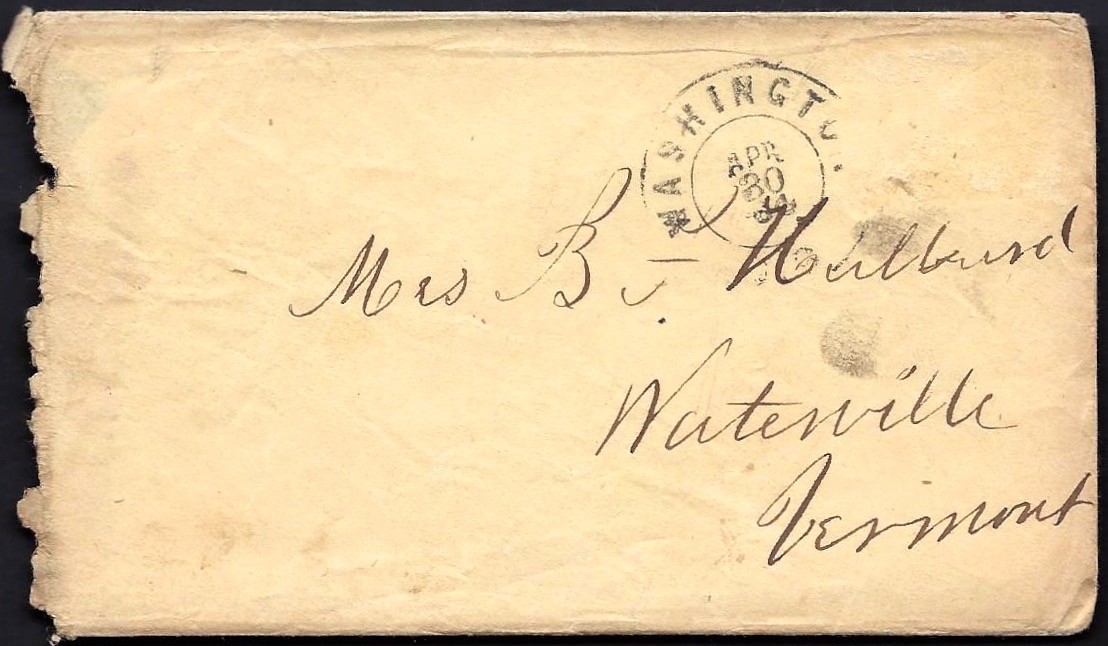
In Camp yet [near Brandy Station, Va.]
April 28th 1864
Juliana,
I have just got yours of the 24th inst. Glad to hear from there again that all were as well as they are. Yours found me in the best of health & spirits. I sometimes feel a little old & lame but nothing to speak of.
We are still in camp [but] shall probably leave in the course of 10 days or a fortnight. But we of course shall know nothing about it till a few hours before starting. Orders were read on dress parade last night to the effect that the regiments whose time expires this season will be discharged reckoning from the time of their being mustered into the service — so the boys in this regiment will have to stay till the 20th of June instead of the first.
We have had no very warm weather yet — quite cool for this country & season.
Loyal had a letter from Emily a day or two since. He thinks he shall go that way when he goes home. William was here today. His company have moved. They are now about 4 & ½ miles from here.
I had a line from the State Treasurer last night stating that they had got my name & money had been drawn. I would rather like to be at home for a time this spring but there is no use in thinking about it. I wish you to give my best respects to Capt. McFarland. Should be extremely happy to see him. Tell him I believe there is one letter my due — at least I hope he will find time to write & give me a word of encouragement.
I thought I should finish what I was going to write on the other ½ sheet. I would just say that I should like to read the News Dealers as they do not come to the company now. If you roll the papers up in good shape, they will come through, I think. Other papers come & I know of no reason why mine should not.
Joe Holmes got here the next Thursday after you saw him. His regiment will have to stay till the middle of July.
I don’t know about that ground out to the barn. I think if the manure on it would make it bring good corn, but do as you are a mind to. I should not want that piece at home plowed up for a year or two for it is so foul & it will bring double the hay than the other.
I have no time to write more now as the mailman is waiting for the mail. Love to the children.
— B. F. H.
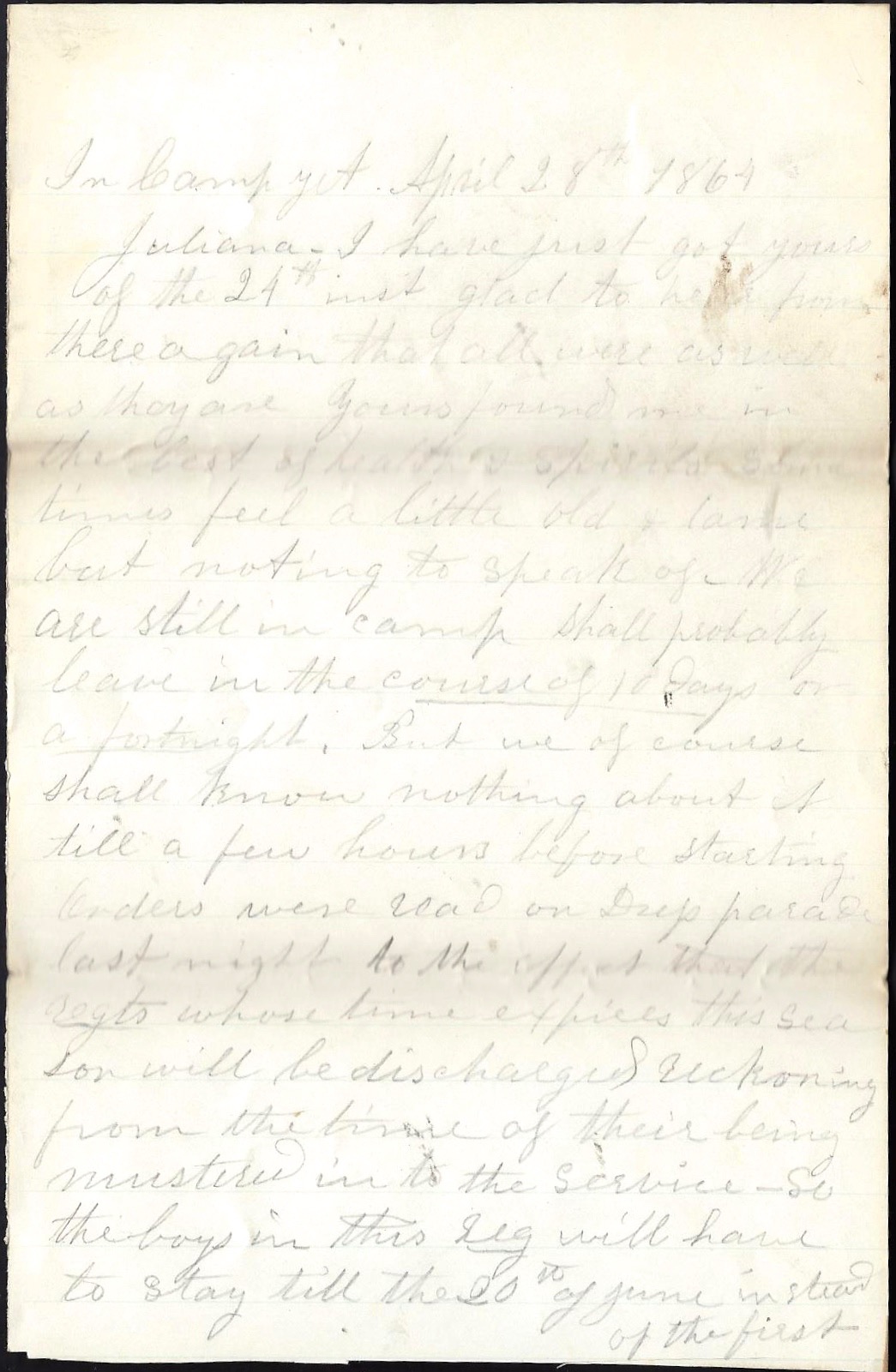
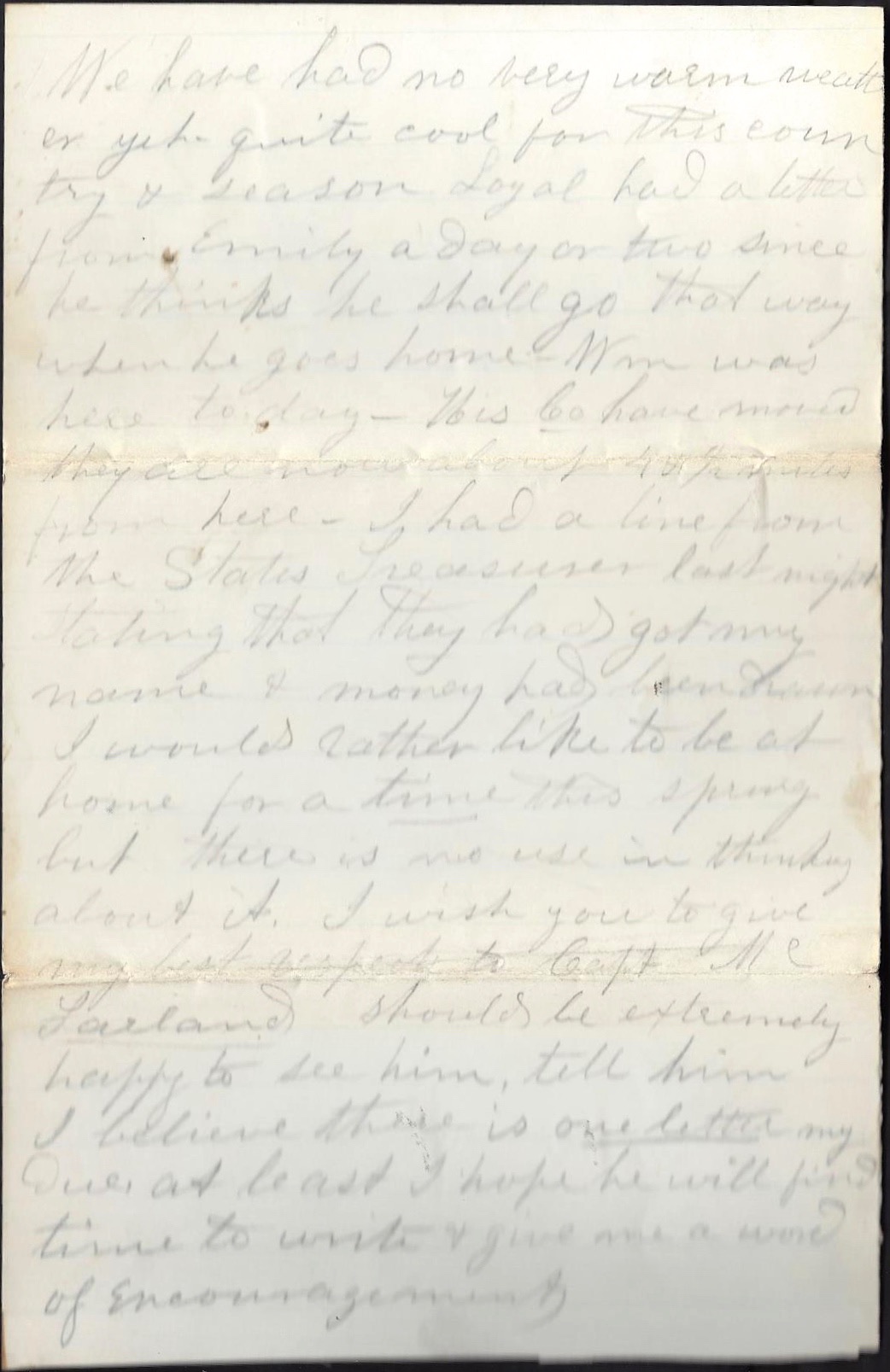
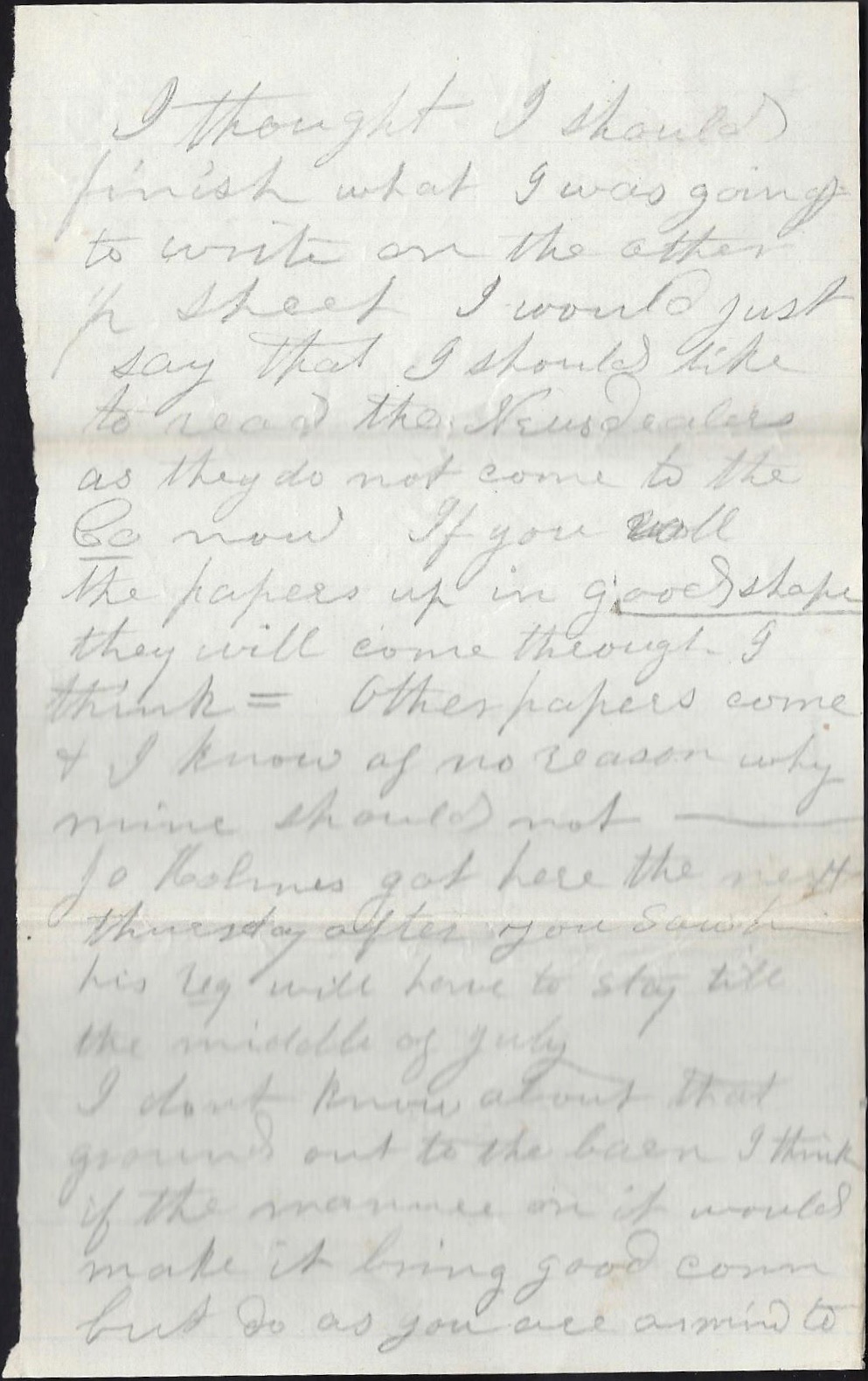
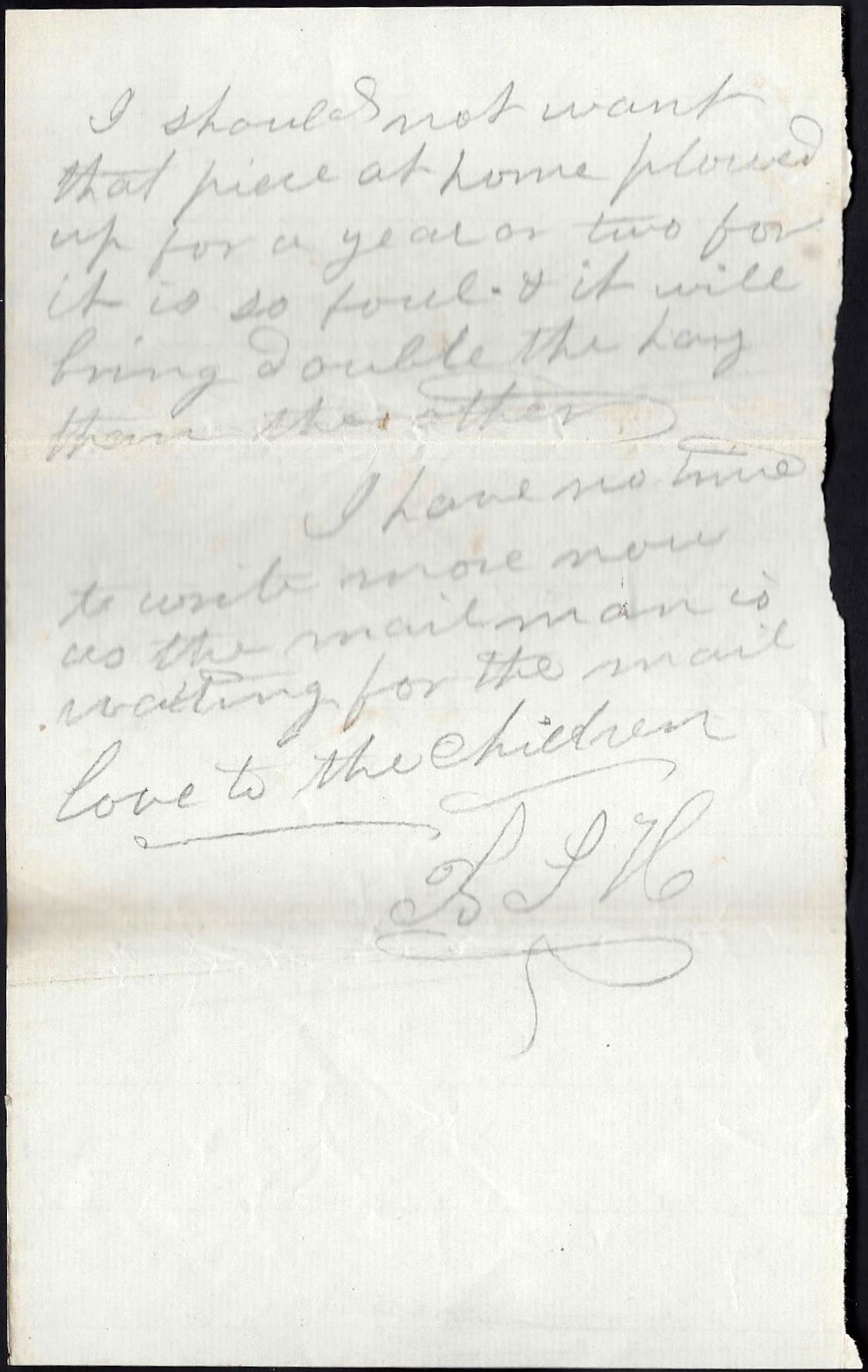
Letter 44
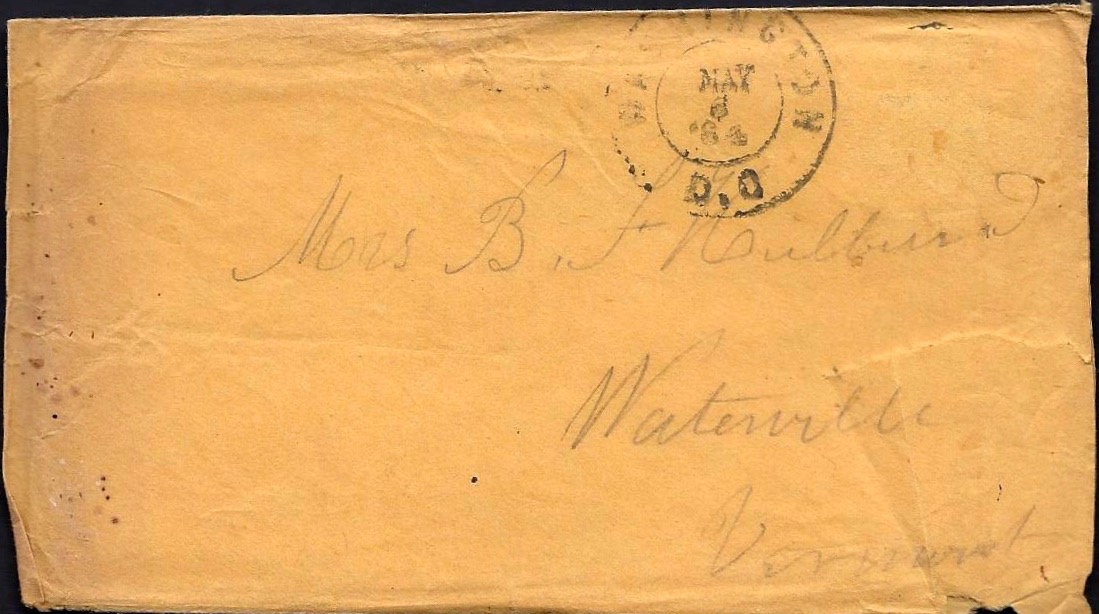
In Camp [near Brandy Station, Va.]
May 1st, 1864
I have just come off guard & I thought I would sit down and write a few lines as probably I may not have another opportunity for some few days for in all probability we shall move from here in 2 or 3 days. Other divisions and corps around are moving camps some 4 or 5 miles to the front preparatory to a march & we shall probably go as soon as Tuesday or Wednesday. When we all take up our line of march & where our Spring Campaign will open, we of course can not tell. But when it does begin, there will doubtless be some “tall” fighting.
As near as we can learn (yet soldiers are not supposed to know anything), Gen. Grant is making preparations for a masterly stroke somewhere & probably some of the heaviest battles of the war—& I hope some of the last—will be fought this spring & in this department. If we are successful here this spring, I think that the main fighting will be over, but if not—why—2 or 3 years it may be more of war. It does seem we had men enough in this Army (of the Potomac) to annihilate all rebeldom. One can travel miles here & on every little hill & rise of ground as far as one can see, he will see acres & acres [of] white tents & lines of teams miles in length.
I shall write as often as I can conveniently send a letter when we march, but probably it may be at times weeks that it will be impossible to send or get a letter. But you will direct as usual till further orders.
May 2nd. Start tomorrow probably as things look now.
Do as you think best about the ground, but I should not think best to plow up what I seeded down last spring. If don’t plant corn, plant potatoes out by the barn. Goodbye children. — B. F. H.
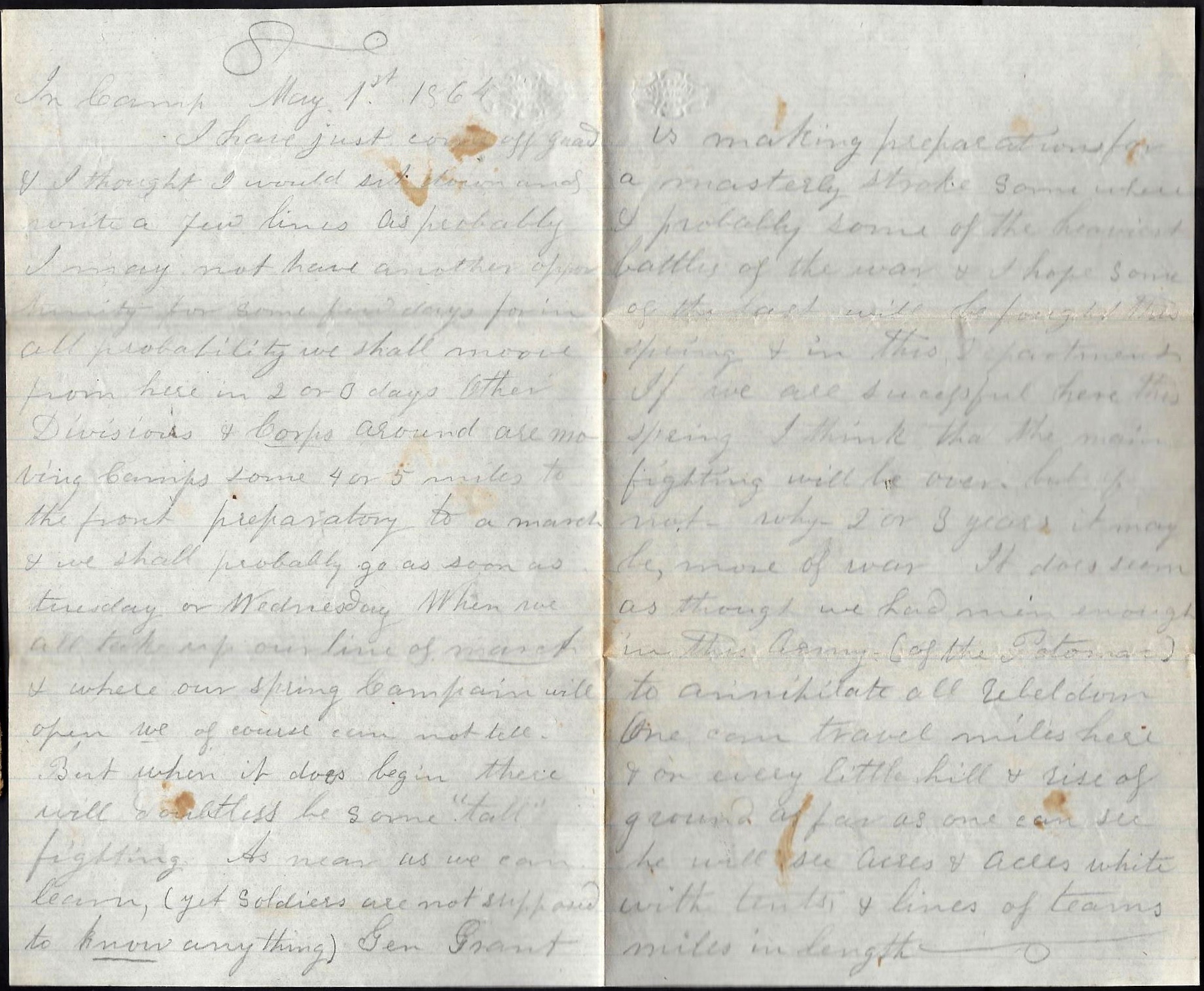
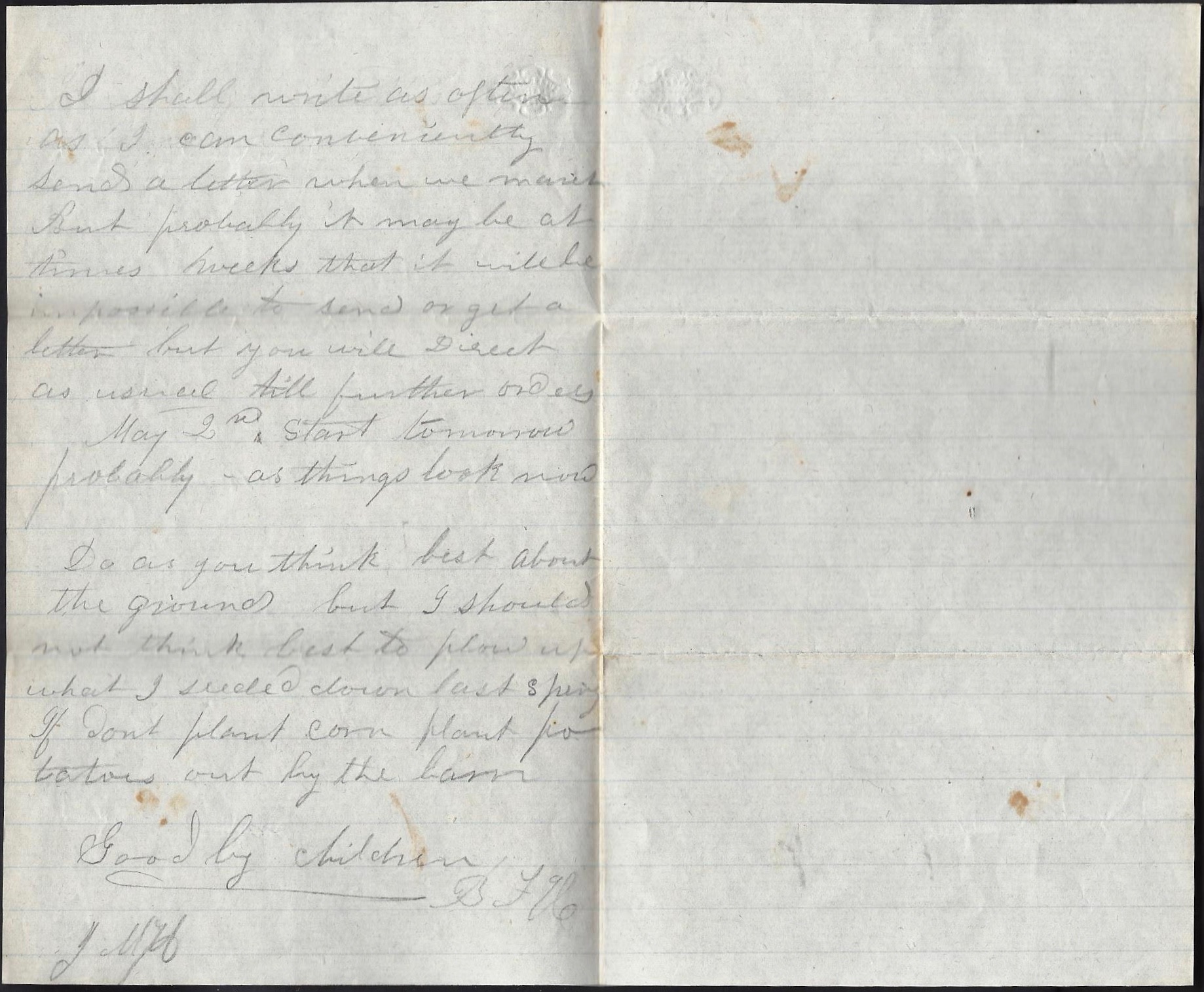
Letter 45
[Editor’s Note: This transcript was provided to me by Paul S. LeBlanc whose Uncle George P. Hulburd transcribed them from the originals in the 1960s.]
In the field,
May 15, 1864
In the greatest possible haste I say I am well. Will write again as soon as I can. Been in 3 plaguey hot battles. Come out all right. Don’t know when I can write again. Borrow no trouble, if not for 2 weeks. Get no mail. — B. F. H.
Letter 46
[Editor’s Note: This transcript was provided to me by Paul S. LeBlanc whose Uncle George P. Hulburd transcribed them from the originals in the 1960s.]
Out in the Field
May 16, 1864
Well, Juliana, I thought I would write a little more today. I have much to write but must wait till I have a better opportunity. Then I will tell you some things that will make you shudder. I cannot be particular now but suffice it to say we have had nine days fighting—our regiment engaged 4 days—myself 3. You have probably heard about it before this. Suffice it to say, we left camp with 63 men in our company bearing arms. Now we have 16—7 or 8 killed, the remainder wounded and gone to hospital. Our Colonel was killed the first day, also Lieut. Col. Our regiment left camp with 650 men with arms; now numbers 175, the rest killed and wounded.
There probably never wasin all the annals of warfare such desperate fighting as on three of the days mentioned. We made one charge on their works where we ran about 30 rods across an open field to the edge of a wood where the rebs lay behind their breastworks right in the face of their fire and drove them from it, took possession and about 2,000 prisoners. I cannot write more this time but when I get a chance I will tell all? No—not a millionth part for all is indescribable.
Fred Marshall is among the killed. Loyal had a ball strike him in the breast but it passed through a limb of a tree before it [hit] him so it did not break the skin, but made him quite lame. I got a scratch across the back of my hand but whether from a ball or some other way, I was so fierce, I could not tell.
We probably shall not see any more as fierce fighting as this but hard work is ahead. I think I shall come out all right. I get no mail now as none is brought in to the lines, only Headquarters. Can send out only occasionally. — B. F. Hulburd
Homefront Letter
[Editor’s Note: This transcript was provided to me by Paul S. LeBlanc whose Uncle George P. Hulburd transcribed them from the originals in the 1960s.]
Waterville [Vermont]
May 15, 1864
My Dear Husband,
I do not know hardly how to write hearing of your terrible battle that you have had. I do not know whether you are in the land of living or not but I do hope that you are spared. I heard yesterday that the 2nd Vermont was cut up as bad as the 4th [but] daily news is not much to depend upon. It has created great excitement about here. When I first heard of it, I thought I should go distracted. You do not know how Eva and Roger felt. I says to them that I felt as though as pa would come home again to us. Eva says God can take care of pa if he is a mind to. Poor children, they think pa can go through everything because you have been away so much and come home. Mother feels bad. Says Ben never will come home. I says to her I feel as though he would. I cannot have it other ways. Daniel says he thinks that Loyal is dead. Poor man, he feels bad. I saw Betsy Page today, she felt bad. She said she expected that her brother was dead or taken prisoner. He was in the 4th Vermont Regt. The report is that they was all killed but 10, them was taken prisoners. I do hope this war will close this spring….
Letter 47
[Editor’s Note: This transcript was provided to me by Paul S. LeBlanc whose Uncle George P. Hulburd transcribed them from the originals in the 1960s.]
Somewhere in the Woods
May 21, 1864
Juliana, I came off picket last night, found 3 letters—glad to hear. Found me well, only a little tired. I stand the marches and banging round better than I even hoped. I expect Loyal is at Hospital somewhere — not badly hurt. You need not pay Mrs. Herrin that till she will pay for her boys tearing down my fence and wall last summer or I come back. Tom and I have had a little dicker, not much. Don’t know what I am owing him, not much anyway. Must leave for some business immediately.
Love to children, — B. F. Hulburd
I am out of paper. At our first battle I lost everything but that was not much. I have made it up by picking up things. I lost my knapsack at our first fight. There was not much in it—only my blankets—but I have picked up good ones again. My paper and envelopes was all else of consequence. In haste, B. F. H.
God will take care of me, Eva.
Letter 48
[Editor’s Note: This transcript was provided to me by Paul S. LeBlanc whose Uncle George P. Hulburd transcribed them from the originals in the 1960s.]
Camp in the field
May 26, 1864
Dear Wife and Children and Friends,
I improve a passing moment at this time in writing a few lines to let you know that “I still live” and in the enjoyment of perfect health. I am almost astonished at the manner in which I have stood the campaign thus far. The marches we have made, altho not very long, but hard night and day marching, fighting and working throwing up breastworks, getting them fairly completed, then leaving for some other place. We are now somewhere about 20 miles from Spotsylvania Court House following up the Rebs who are retreating towards Richmond. They have now made a stand about 2 miles from here. Our guns have thrown a few shells over to them but get no answer.
I have with others been strangely protected thus far and trust I shall be through the campaign. Men on my right and left, behind and in front of me have fallen yet, I am unharmed. The last fight I was in, a shell struck within four feet of me and burst killing 3 men and wounding 4, covering me with dirt but receiving no injury. It is strange with what indifference such things are viewed. It seemed to create no more consternation than if it had been a snowball.
It was rather a sorry sight the morning after one fight to go and look over the breastworks where our men fought so near the Rebs as to strike at one another with their guns. The Rebs lay on their side of the works in places 3 and 4 deep and our men across an open field where they charged upon their (Rebs) works, lay scattered around like logs and nearer the works it showed how great the cost of that charge. On one occasion when some 800 prisoners were sent back under a guard, the guard informed our Division Commander that there were about a 1,000 more prisoners the Vermon Brigade had sent in. He said, “I wonder what in Hell that Brigade can’t do?” In what papers I have seen, I do not think that our Division have had sufficient credit for what they have done. We are now encamped on a large plantation and crossed others in coming here with fields of 50 and 75 acres of corn up ankle high and wheat all headed out but nothing now is left of it that will ever amount to anything.
There is a rumor now in our camp that we leave tonight and work around after the Rebs by some flank movement. We make a great many movements that I don’t understand the whys and wherefores but we have got a man to direct who I think does understand his business. But I must stop writing and get my dinner. We draw our hardtack once in two or three days, sugar and coffee the same and fresh beef killed every other day. Our rations are good and sufficient, tobacco scarce. I paid $1.00 for half as much as you sent me.
Well my children I can’t say much to you this time but when I get a good chance I will write to you. Eva you must write. Roger, you and Charlie must be good children. Good bye. I got 2 papers, send more. In haste, — B. F. Hulburd
Letter 49
[Editor’s Note: This transcript was provided to me by Paul S. LeBlanc whose Uncle George P. Hulburd transcribed them from the originals in the 1960s.]
Camp in the field
18 miles from Spotsylvania Court House
May 26, 1864
Wife and children and friends generally,
I again improve a passing moment in writing to you. My health is still first rate and strength holds out remarkably. I stand this extraordinary campaign far beyond my expectations, marching and countermarching and fighting and working night and day. We lay still ½ day yesterday. Called out in the night to throw up breastworks and today or at this present time are lying still but may be called on to “fall in” within 10 minutes. The Rebs are on the retreat for Richmond and we following up. They have made a stand, it seems, some two miles from here and may stand a brush before they leave. Our guns occasionally throw a few shells over but have not been answered yet. We are encamped now on a large plantation and passed over others in coming here with 50 or 75 acres of corn ankle high and wheat all headed out but was trampled all to nothing before our columns had all crossed them.
I have not heard from Loyal since he went to hospital. He probably will not be back to this regiment again. Saw Nathan yesterday. He is tough and smart. Night before last when we halted there was but 5 men in our Co. to stack arms, the rest “fell out by the way.” Making forced march with 8 days rations and other loading beside gun and equipments and the excessive heat was too much but all came up next morning. Got 2 papers. Send more. Will write better by and bye. Love to children. Respects to all. — B. F. Hulburd
May 29th—I wrote this at time of date but it got mislaid and I wrote another same day and sent it. Found this and thought I would put it in this time.
Letter 50
[Editor’s Note: This transcript was provided to me by Paul S. LeBlanc whose Uncle George P. Hulburd transcribed them from the originals in the 1960s.]
May 29th 1864
Dear wife,
We are now lying still for a part of a day and perhaps more, so I thought I would write a few words. I wrote 3 or 4 days ago from a point some 35 or 40 miles from this. Soon after finishing that letter we had orders to pack up and march which we did all night, mud and water almost knee deep, and all the next day. Second night camped near the Pamunkey River, next morning over and are now on the Peninsula at a place called Liberty Springs 18 or 20 miles from Richmond. It looks as though Grant and Lee were trying to see which would get there first. There has been no fighting for a few days except some few cavalry skirmishes, maybe soon.
My health is good. Feel somewhat old and worn out but a day or two of rest and I will be as good as new. Just saw Nathan, never see him look so tough. I have time to [write] no more now. Shall be glad when we get somewhere so I can. Have not heard from Loyal since he left and went to hospital. He gets rid of a hard job this spring.
Write often and send papers. I have had 3 letters from you since we started on this march and they all came at one time. Love to children, your mother, Heman and all. In great haste and under rather disagreeable circumstances I remain yours. — B. F. Hulburd
I have not been homesick nor sorry I reenlisted yet. — B. F. H.
Letter 51
[Editor’s Note: This transcript was provided to me by Paul S. LeBlanc whose Uncle George P. Hulburd transcribed them from the originals in the 1960s.]
June 1, 1864
No particular news. Don’t know what is ahead. Borrow no trouble. On the march 12 miles from Richmond. All well. No time to write. Had none from your last mail. Health good.
Letter 52
[Editor’s Note: This transcript was provided to me by Paul S. LeBlanc whose Uncle George P. Hulburd transcribed them from the originals in the 1960s.]
In the field somewhere near a place called Coal [Cold] Harbor, Va.
June 6, 1864
Wife and children and all interested,
I improve the present opportunity (if it can be called such) in writing a few lines to let you know that “I still live.”
I will just state briefly my and our position. Here we are behind our breastworks built of logs and banked up on the front side about as high as our shoulders, heavy enough to stop balls. In front of us and at a distance of not more than 30 rods [165 yards] is the front line of the Rebs’ rifle pits. When we can see a head sticking up ,we shoot at it. So also they do the same. How far these lines extend each way from us, I cannot tell, as I have seen neither end of them but it is for miles each way. We have 5 lines of them, say from 5 to 15 rods apart.
Our Reg. and the 4th Vermont on the portion of the lines our Division occupy are in front today and were night before last and yesterday. Shall be relieved today and go back to the first or second line. Occasionally one of our men got hit. Three fell in my sight yesterday but how bad they were wounded, I am unable to say. Have not heard from them since they were taken off. How long we shall be kept in this position, cannot tell. Neither side wishes to make an advance. There is constant firing back and forth. Now there is a pine tree in my front, say 20 feet from me, that I can count 58 ball holes in it and they are a spat-spatting on all sides of me. I just this minute made me a good cup of coffee and fried some pork and hardtack while the balls are whizzing over head like bees, yet I can lie down and sleep like all possessed right under it. It is a kind of second nature and does not trouble me as I keep kind o’ humble.
I reckon there will be musick around here before many days. I learn there are several seige guns come up and I think Grant intends sending over a few shells to them soon. They make a terrific noise but I had a little rather hear them coming than the little minnie ball when there is no protection in my front. I understand that Gen. Grant is not a going to ask the men to make another charge at present. It costs too many men. I have been in 2 charges where it would seem impossible for a single person to go, much less a regiment or brigade, but as yet am without a scratch.
My health is first rate good and I stand the marches far better than I expected and Loyal says he is altogether astonished at my powers of endurance. I don’t want you to be over anxious or concerned on my account. I trust in Him that “doeth all things well” and have strong faith that I [will] come out safe yet, altho when I have looked back through some scenes which I have passed and almost shuddered at the thought, when called upon again under similar circumstances, I have started “fearing no evil.”
I have nothing to say in relation to matters and things at home. I guess you will see to them well enough. I guess you had better hire Lowater or someone to cut the grass by the day and not let that out upon shares. Tell Tom Stevens to write to me and when I get to a place where I can I will give him a long one. How do you get along now-a-days? Do you have money enough? I don’t know how soon we shall be paid off. If before I will send some by Loyal when he goes. He is with the company now. Have not seen Nathan for 2 or 3 days. Just saw Wilder Magoon and some other old acquaintances. Send extra sheet of paper and envelopes. Send a news paper well folded and directed with a paper or plug of tobacco in it. Love to children and all enquiring after, — B. F. Hulburd
J. N. H. — I got yours of May 25 day before yesterday.
2 o’clock p.m.— Since writing the other sheet our mail man came onto the field and brought our mail. I got yours of May 29th. Glad. Since I finished the other sheet we have been relieved and moved back to the rear ½ mile with a partial assurance of one or two days rest. Have put up my tent and I think you would laugh to see me write. Spread out my blanket, lay on my back one foot drawn up so as to crook my knee, the heel of other foot resting on my knee which brings the other knee up near my face, paper on knee &c.
Flag of truce just came in from the enemy. Don’t know what for. Some of the prisoners we lately took, among which were 1 or 2 officers, say Gen. Lee is mortally wounded. Others say he is sick. Hardly believe either story. Mail leaves soon, must stop writing. A little thread, found spool unwound, part put in my needle book. Here is the rest. In haste, — B. F. H.
Henry Page slightly wounded. Joseph Holmes severely in head. — B. F. H.
Letter 53
[Editor’s Note: This transcript was provided to me by Paul S. LeBlanc whose Uncle George P. Hulburd transcribed them from the originals in the 1960s.]
In the field
Sunday and partially still, June 12, 1864
Juliana,
I take this opportunity just to write a line to let you know that I am still alive and well knowing that you are in continual suspense and painful anxiety respecting me or my fate.
We have been in this place about 8 or 10 days. No regular fighting except the day we got here—only continual firing back and forth on the picket and front lines. What has been a going on to our right or left I am ignorant of—except we hear heavy cannonading occasionally. There has been considerable shelling for the last few days. I know not how many have been killed since our stop here but our loss has been quite severe. By “our, we, us” etc. I mean the Vermont Brigade—2nd, 3rd, 4th, 5th, 6th and 11th Vt. Regts. and other regts. composing the 2nd Division of the 6th Corps.
One man from our company that had been home on a furlough and just reenlisted came back the next day after arriving here was killed by a shell. He stood not more than 8 feet from me at the time. Daniel knew him—J[oseph] C. Felton [of Fairfax, Vermont]. I have been strangely preserved thus far and hope for the future. The talk is now that we are to move tonight to the left. What the effect of the move will be of course, I don’t know.
Be not over anxious about me. I have a little watch that I shall send home by Loyal for you or Roger or any of you. It does not keep the best of time but think it would if cleaned. I anxiously look for a letter but have had none this week. The mail is brought in regular now every day. I have not written for 5 or 6 days, wrote the day I got your last.
The mailman is here and I must close. Write soon, — B. F. Hulburd
Love to all. Eva, Roger, Charlie, Gen., your mother and all friends.
Letter 54
[Editor’s Note: This transcript was provided to me by Paul S. LeBlanc whose Uncle George P. Hulburd transcribed them from the originals in the 1960s.]
Charles City
June 14, 1864
Juliana,
I again “curl up” to write a very few words. I received yours of the 9th last night. Glad to hear from home again. It found me in the enjoyment of perfect health, only somewhat tired having marched all night and all day, yet making not more than 25 miles. We stopped where we were when I wrote last about a week or ten days, made a charge on enemy works the night we got there. After that there was skirmishing everyday till Sunday last when we left quietly at night and came to this place. Have just halted, may start again in an hour. Some say we are going to Harrison’s Landing some 6 miles from here.
We have been [with]in about 7 or 8 miles of Richmond, but I suppose found the enemy’s works too strong to warrant an attack [and] have concluded to try them from some other point. This is what I suppose. A private is not supposed to know anything but go where ordered. It is now 40 days since we broke camp at Brandy Station and I guess as much as 30 of them we have been exposed to the enemy’s fire. In one place, if a person showed his head above the breastworks, he was sure to have a bullet whiz by or through it. One would have to see the trees to form any kind of an idea of the work of the balls and shells. Trees one foot thick cut off by shells and small ones by bullets and the larger trees filled full of them. I got accustomed to it so I could lay and sleep sound as a log, squat low and make my coffee and fry my meat as though nothing was going on. I can throw my blanket on the ground and roll up in it and sleep as well as in a bed. Have not had the first cold since I left camp.
Loyal, if nothing happens, will start in less than a week for home. I should rather like to go but am not in the least homesick. I cannot particularize now but when Loyal comes, he will tell stories altho he was absent 15 days and got rid of the fiercest fight. Yet he was in the Wilderness—the 2 first battles—and can tell about them.
I saw Nathan this morning and gave him the line Ann sent. I never saw him look so tough as he does now and he stands the marches like a horse. I am surprised at myself in the marches—stand them like a hero. Have just been to a brook and washed up. You would not known me before I washed. I was so dirty marching in the dust so thick that one could hardly see his hand before him. We have thus far had sufficient rations except one or two days we got out and was so far ahead of the teams that we could not get them. Sometimes carry 5 days rations. Supposed to have two by us all the time. Once we had 8 days in our sacks and marched night and day, yet I flourish under it and enjoy life.
But I must close. May the good Lord spare us all and in due time I be returned to my family and home—the rebellion crushed, the Nation at peace is my daily prayer. Write often and in each letter send extra envelope, stamps and sheet of paper as my means at present are about used up. Kiss all the children for me and believe me as ever. Yours, — B. F. Hulbird.
This is the ½ of your sheet and I will write a few more lines. If you have sent any newspapers lately I have not got them. I got 2 just before or just after we left camp. Since then I have not got any. I wish you would send some for I want to read from the county. I should like to have read all about the fuss in Stowe. Do up one or two in a good stout wrapper and put in a small plug of tobacco. I have to pay $2 for such a plug as you sent me. Put in some of the small papers or little plugs. I don’t know when we shall be paid again. In a few days there will be 4 months due. I shall get no more bounty till the first pay day after 6 months from the first of March which will be the first of Sept. Do you get your State pay regular? What is Daniel doing to the shop? How does the garden look? What have you got planted in the garden and what sowed? And a lot of other questions that you think I should like to know about. What are the folks all doing? How about C. Atwell, J. H. Page, Mrs. Townsend and Co.?
3 o’clock, still here. May move tonight and may stop here all night. Can’t tell. No signs of any rebs near here now. Some expect to cross the James River in a day or two. If so we may find some. Our loss in all since May 5th killed and wounded has been very severe. Think the Rebs is as heavy. For the last 10 days I have heard set at 7,000.
Letter 55
[Editor’s Note: This transcript was provided to me by Paul S. LeBlanc whose Uncle George P. Hulburd transcribed them from the originals in the 1960s.]
Two miles from Petersburgh, Va.
June 18, 1864
Julania,
I thought to write a line and inform you that I am yet alive and well. I think if you were here you would not think of writing at present. Night before last we marched all night and yesterday—gracious how hot it was and dusty. Arrived at this place at 6 o’clock p.m. Our regiment immediately went on picket. Slept none all night and such musketry and cannonading, beat anything I scarcely ever heard. The Rebs undertook to recapture some works that our men had taken and Gen. Lee said must be retaken if it cost his whole army, but they were repulsed. We were relieved at 11 o’clock and the rest of the day I have been a spectator and the cannonading that is now going on and the musketry makes the ground tremble.
Our men are after a fort on the skirts of the city—a place formerly of 15 or 20,000 inhabitants. I shall probably sleep some tonight but have not been sleepy today. I have just been out watching our artillery and seeing them send their shells a mile or so and planting them right onto the Rebs’ works. It is said that we have some two hundred pieces of artillery here. Our men took 15 cannons from the Rebs yesterday and a large number of prisoners. Several came into our lines today and they looked pleased enough. Some say they have had enough of the war. Others would fight again if they had a chance.
Loyal will tell more than I can write and I will leave it for him to tell the stories when he gets there. Tomorrow finishes his time. I would like it if it was so I could go home with him but as I can’t, I shan’t feel bad but patiently wait my appointed time. I enjoy myself here as well as anywhere away from home and family and I think I shall stop till I get ready to leave. Once in a while the chances of my escape look a little scaly but the same Hand that has shielded thus far is able still to protect and there is my trust. Give yourself no uneasiness on my account. I have not had the least cold or phlegm since a light touch when I first came out. I can lay on the wet ground or dry sand, roll up in my blankets and sleep as sound and have as pleasant dreams as at home.
Give my love to all the children and any who may take the trouble to enquire after me. Write often for I don’t get a letter but about once in two weeks. I found a lot of paper today in a lost knapsack, so I am supplied. What is Sam doing? Tell Loyal to send papers once a week with tobacco. Just as ever, — B. F. Hulburd
Has Daniel fixed the shed? Just as finished this I got a letter and two papers, letter June 13.
The 2nd Vermont Infantry was with the Vermont Brigade in fighting near Petersburg, Virginia, in June 1864. The following letter was written just after the Battle of Jerusalem Plank Road (or the First Battle of the Weldon Railroad) which was fought on June 21-23, 1864. It was a series of battles during the Siege of Petersburg aimed at extending the Union siege lines to the west and cutting the rail lines supplying Petersburg. Two infantry corps of the Union Army of the Potomac attempted to sever the railroad, but were attacked and driven off by the Confederate Army of Northern Virginia’s Third Corps, principally the division of Brig. Gen. William Mahone. The inconclusive battle left the Weldon Railroad temporarily in Confederate hands, but the Union Army began to extend its fortifications to the west, starting to increase the pressure of the siege. [Source: Wikiipedia]
Letter 56
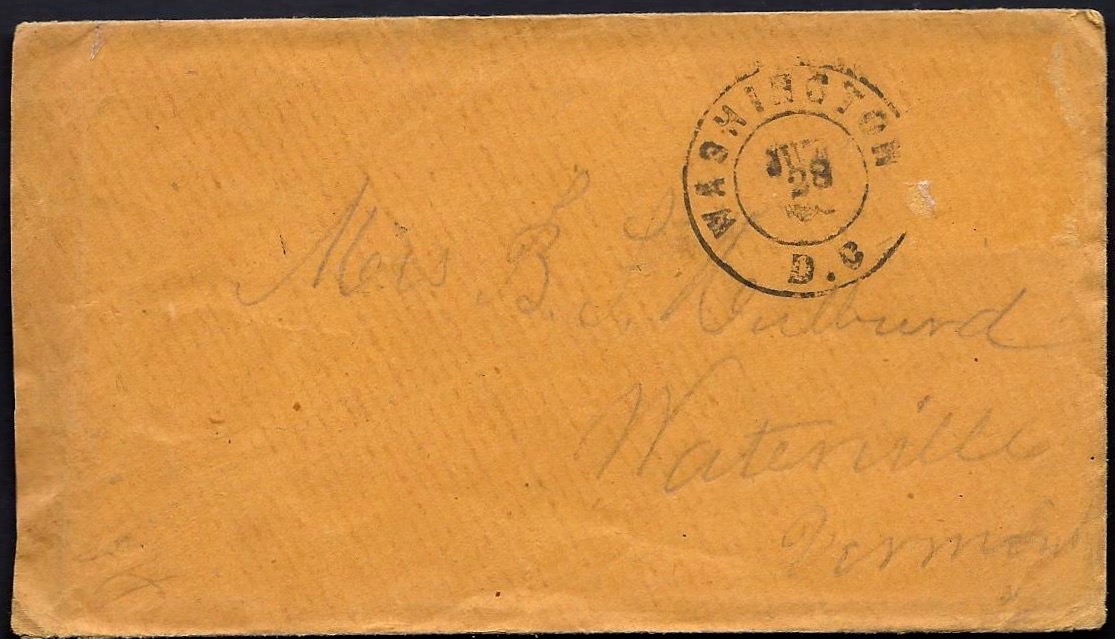
In the field [near Petersburg, Va.]
June 24th 1864
Well Juliana, I have 2 other tough news this morning but of everything, I cannot write positively. Yours of the 20th, tobacco & all, came safe. Maria’s tea also. Glad to get the same. I am well & hearty. Just eat my breakfast, Had tea potatoes pork fried bread &c.
We left the place we were in when Loyal ¹ left Tuesday night, marched all night. Did not get more than 8 miles. Came to this place—a point on the railroad—formed our lines, sent out pickets, skirmishers, & pioneers who destroyed about 2 miles of railroad, who were driven back—all that were not killed or taken prisoners. We threw up breastworks in about 15 minutes, planted ourselves behind them expecting an immediate charge upon us as our picket said the rebs had strong skirmish lines & 2 or 3 lines of battle. We lay waiting to pay them off when they presented the charge but it seems they fell back after taking a host of prisoners. We lay till about 10 o’clock, then all left & fell back perhaps a mile & a half or two miles. What our next move will be, I of course can’t tell. On the whole, I call it a hard blow for us but still I don’t know but good will come out of it as a large force of the enemy must have come here & I don’t know but what those of our left where we came from have taken the advantage of the time & attacked Petersburg. I cannot particularize—only we have had smart fighting here—gained nothing—lost heavily.
Now for the rumors of the morning. In the first place, probabilities. The 4th Vermont Regiment was out on skirmish line—not more than ¼ come in—the rest prisoners. About ½ of the 11th Vermont out but very few returned as yet. There is but little doubt but what Nathan ² is prisoner as his company was out & as yet none come in. I understand that about 8 companies of 11 was detailed & went out. I saw [Albert J.] Bedell of Nathan’s company. He tells me this. He was cooking for the company & did not go out. They may come in yet or some of them as they are scattering in to the 4th some this morning, but a large number—probably all—on the way to Richmond [prisons] or will be soon. Tell [my brother] George that it may all come out right with Nathan yet.
There is something going on to our right this morning—probably near Petersburg—as there is heavy cannonading in that direction. Would you like to know how I feel when I am in a fight or expect to go in? Well a fellow don’t have any particular. I sit or lie & chew tobacco if I have it. I always dread a skirmish line the worst. In that case, a line of men are sent way out in the front to see what is there with nothing to protect them—only their guns. They are placed about 5 or 6 paces apart, advance cautiously &c. Loyal will tell you all about it as I find I am using up paper & writing nothing. — B. F. Hulburd
A few words to the children. Well Eva, how do you do. Pretty well I guess. You are a good little girl. I am glad of it. I want you to write. If you will, I will write you by and by. Roger, how are you? I wish I could see you. Ma’am says you are a naughty boy & won’t mind & run away. Is it so? If you do, I shall let Eva have that watch instead of you. Charley, I guess you are a nice little fellow & your ma’am must get you something. I wish I could see you tonight. You might sleep with me.
But I sweat so I must stop. See how I dirty the paper. I wash my clothes occasionally & get new ones when I want. Just washed my socks & shirt. Have tolerable good water most of the time. Plenty to eat. Bread fresh, beef salt, pork-beans, potatoes occasionally, &c. Coffee good. I may go to Richmond myself soon but I borrow no trouble & I don’t want you to. Shall come out all right by and by I guess. God Speed the night. It is awful hot today. Guess we shall lie still till night anyway. I remain yours, — B. F. Hulburd
¹ Loyal Porter Hulburd (1844-1929) was Benjamin’s nephew. Loyal was wounded during the Battle of Spotsylvania on 12 May 1864 and was mustered out of the 2nd Vermont on 28 June 1864 at the end of his term of service.
² Nathan C. Hulburd (1844-1864) was Benjamin’s nephew, son of Daniel Campbell Hulburd (1814-1881). Nathan was mustered into Co. A, 11th Vermont Infantry, in January 1864 and was taken prisoner at the Weldon Railroad on 23 June 1864. He died in Andersonville Prison on 23 September 1864. The 11th Vermont was originally recruited as an infantry regiment but was changed to a Heavy Artillery unit to man the defenses on the north side of Washington D.C. During the Overland Campaign of 1864, the 11th Vermont was taken into the field as an infantry unit though they still wore their artillery uniforms trimmed with red piping.
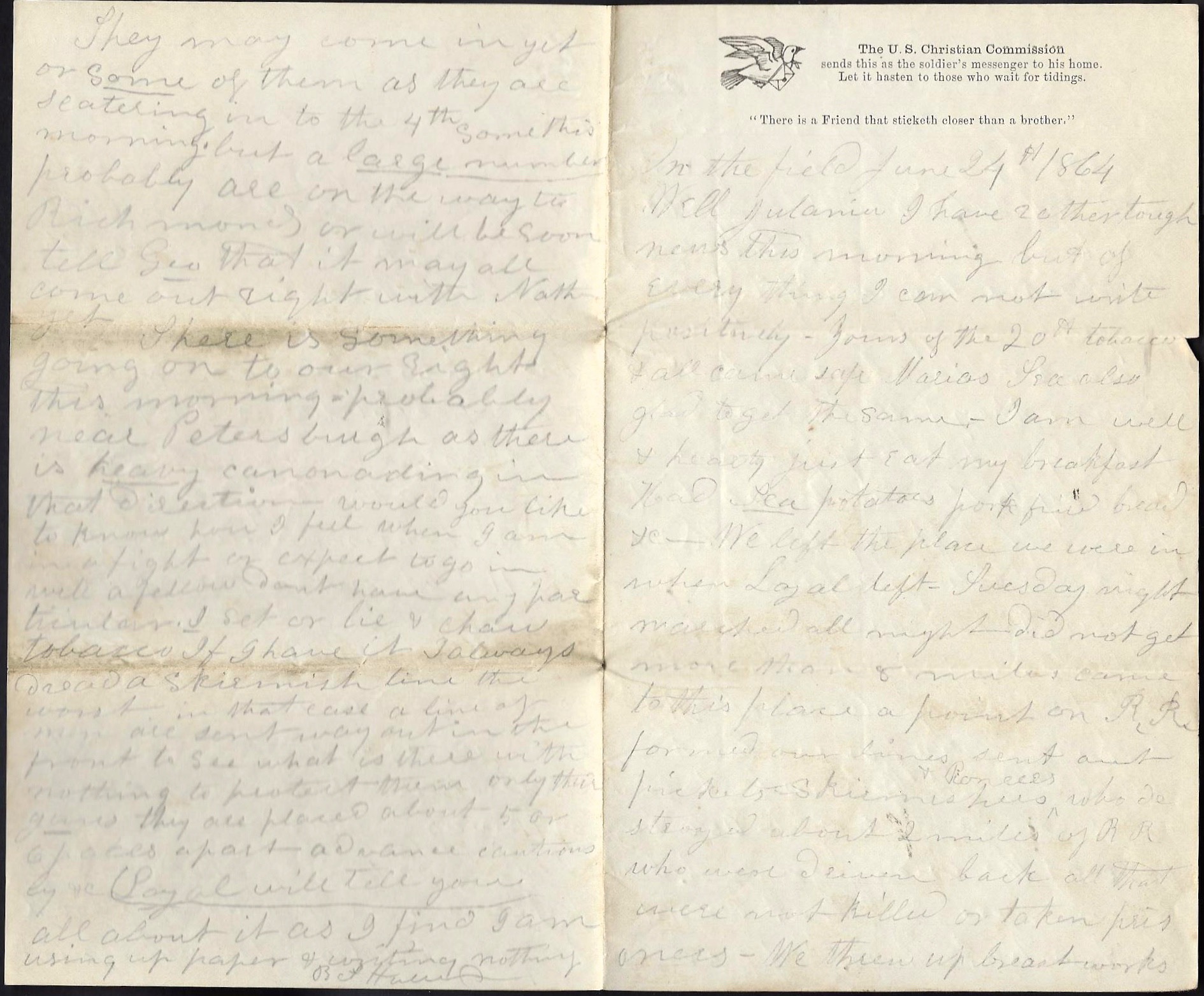
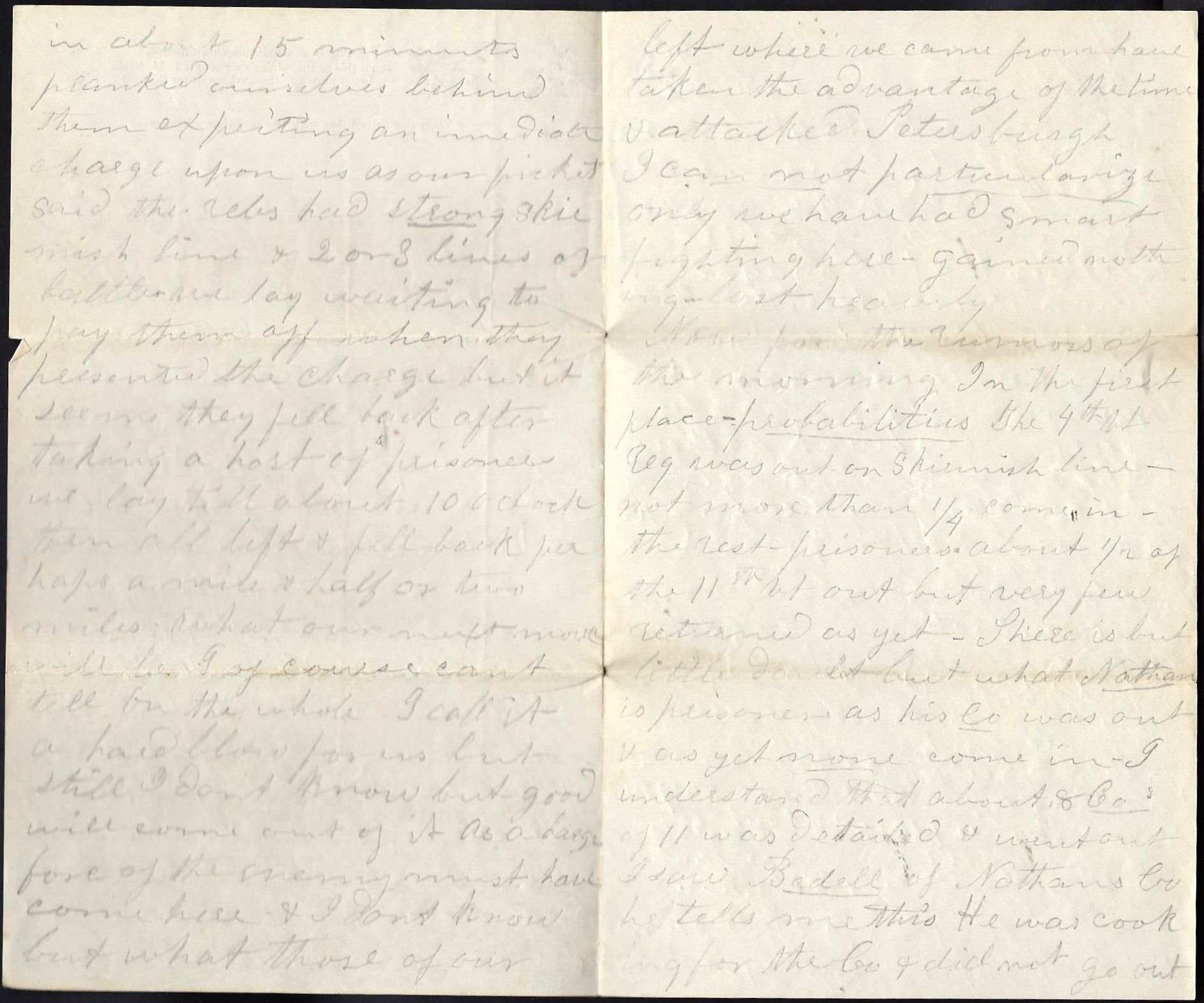
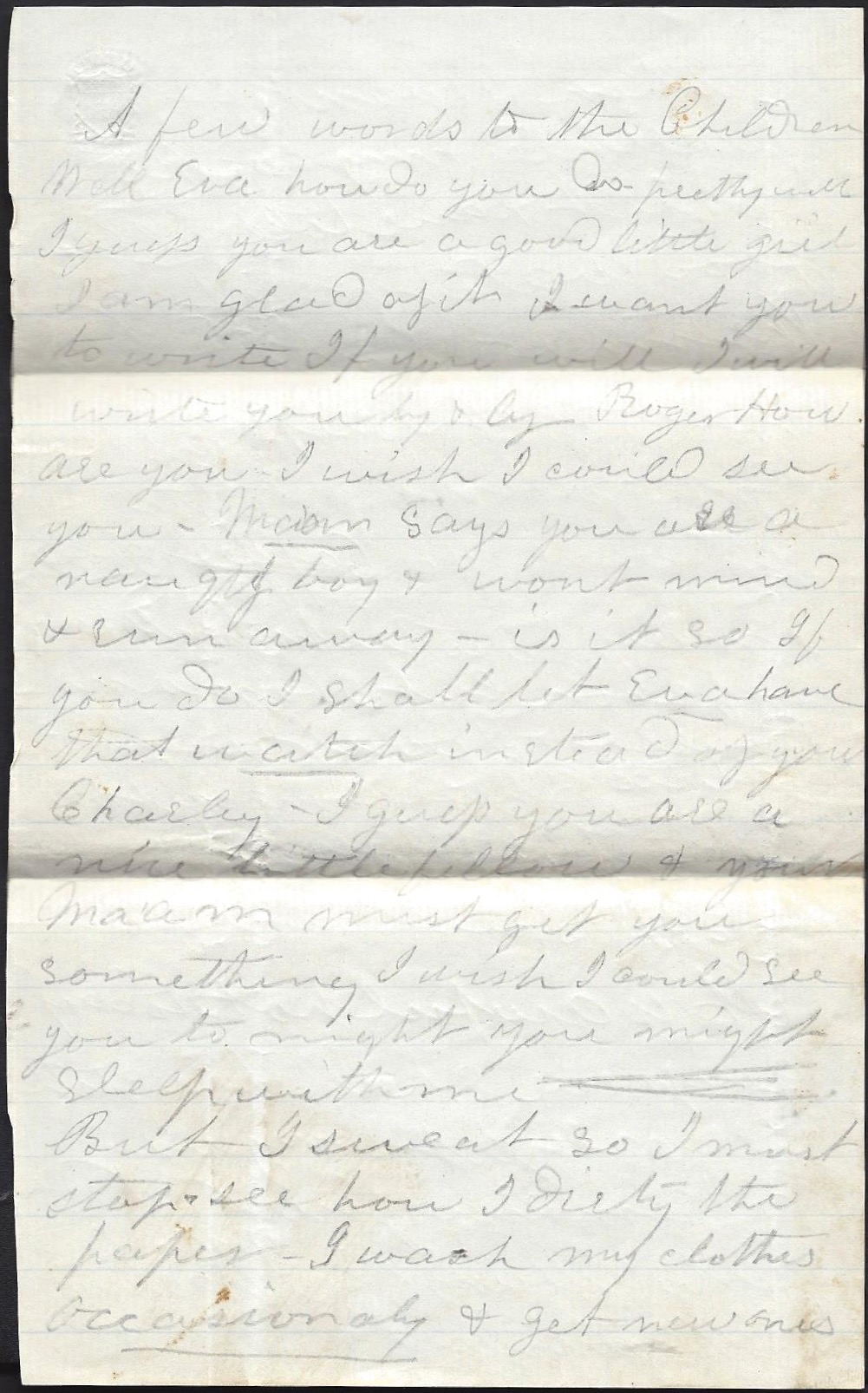
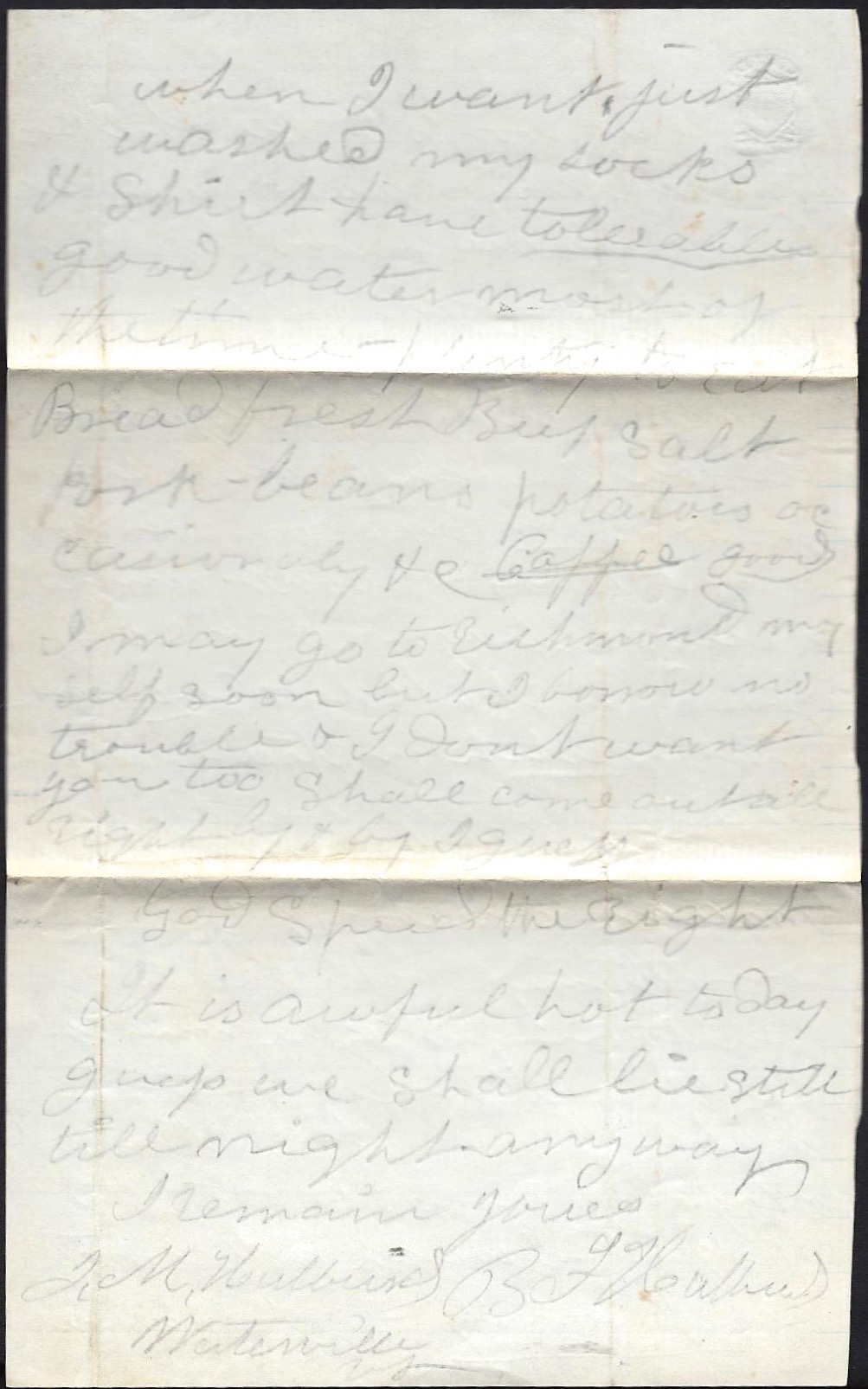
Letter 57
[Editor’s Note: This transcript was provided to me by Paul S. LeBlanc whose Uncle George P. Hulburd transcribed them from the originals in the 1960s.]
Camp in the Field
June 26, 1864
Reverend and dear sir,
I trust you will pardon the liberty I take in addressing you and receive this as from an old friend. I was thinking this morning who of a number I should write to and finally concluded I would write a few lines to you and give a very brief history of our campaign from the time we broke camp the 4th of May up to this time altho I presume that you have a clearer view of our track from the papers than I could give, especially in one brief letter.
On the 4th of May we commenced this campaign unprecedented almost in the annals of history. The 5th was commenced the memorable fight in the “Wilderness.” We had heard skirmishing in our front for some little time but about one o’clock p.m. we were formed in three lines of battle and marched forward through the dense undergrowth till even we were aware we were in the immediate vicinity of the enemy, say within twenty rods of them and received their murderous volley. We immediately lay down and began to return the fire. We lay in that position for two long hours using from 60 to 100 rounds of ammunition to a man when we were relieved by a second line which had been lying behind a little ridge in our rear and they likewise by the third line till darkness put an end to the slaughter, when we fell back about ½ mile where had been thrown up some hasty fortifications where we camped for the night. Out of 63 men that went into the fight 25 were present to answer at the roll call that night in our company.
Early dawn found us preparing to go forward and meet the enemy again. On this occasion we marched over the ground where we fought the day before and what a sight! “Such heaps of dead. Such numbers slain, foe mixed with foe promiscuously.” The fighting was as fierce as on the day before, the rebs at first falling back and our lines advancing until we were unexpectedly so far advanced upon their centre partially flanked on our left [that] seeing our situation we immediately commenced a retreat in ‘good order’. Had the enemy have followed up the little advantage gained it is hard telling what the consequences might have been but our men rallied on reaching a certain point, reformed and at 5 o’clock p.m. when they charged upon us we were prepared to receive them altho it was bravely made and maintained for two hours. They were at length forced to retire leaving their dead on the field which told plainly how fearful had been the cost.
From this place we marched to the vicinity of Spottsylvania Court House where if possible the contest was more severe than either of the previous days—where our men charged upon the enemy works on several occasions. In one instance we lying one side of their breast works and they on the other. If either could see a head above them [he] would strike at it with his musket or fire upon him as was most convenient. The field over which we charged was strewn with the dead. The ditches behind their works were filled, actually filled three and four deep with their dead and dying. I will not attempt a description. My pen would fail and to one that never witnessed such a scene their fancy and imagination would fall far short of the reality.
Since that time up to the present in our marches for about 50 days hardly a day but we have been under fire or within hearing of musketry, at Cold Harbor especially, where for 10 days the musketry and cannonading was kept up almost incessantly at which place our loss is estimated at 8,000. From Cold Harbor we marched to or in front of Petersburg where we stopped for about a week, from there to this place probably about 8 miles from Petersburg. I am unable to give the length of our lines, probably from 10 to 12 miles. Neither do I know where our right or left rest. We (the 6th Corps) I think are a little left of the centre. Far on our right last night there was hard fighting as the musketry was plainly to be heard and it was continued nearly the whole of the night. In consequence of some mismanagement we lost some 600 or 800 prisoners a day or two since. Our skirmish line was advanced some mile and a half or two miles without any support. The enemy came upon them in force and the 4th Vermont lost some 150, the 11th some 400 who were taken prisoners. I do not say that the officer who had charge of the line had been too free with his commissary but others say so.
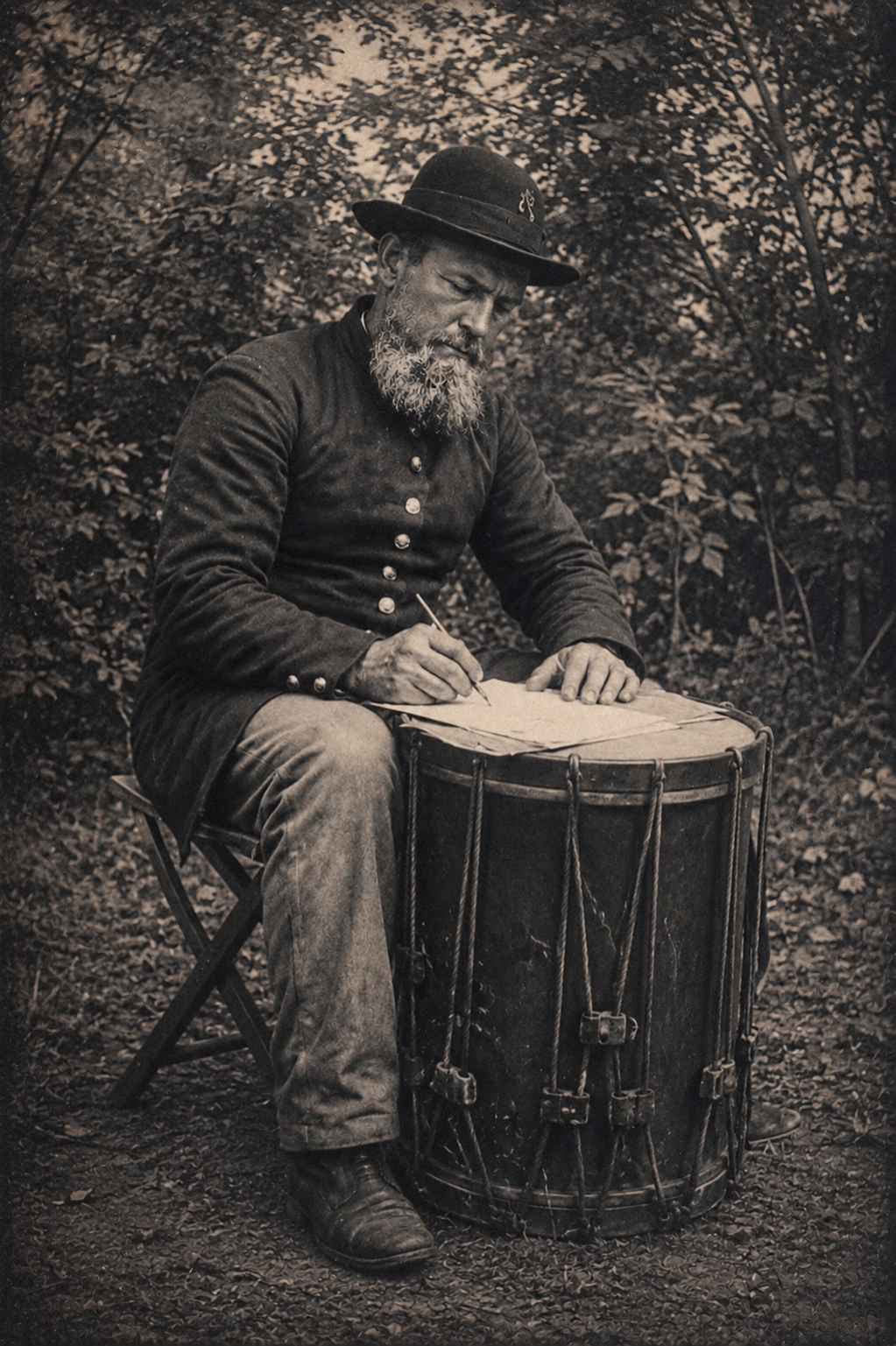
I find on looking over what I have written that it amounts to mere nothing, but I trust that you if you knew the circumstances under which it is executed would overlook all imperfections. Seated on my knapsack, writing on a drum head and entirely surrounded by my comrades in arms who are enjoying a day of rest renders it rather unpleasant writing to say the least. I have seen my comrades fall on my right hand and on my left, in my front and rear, yet up to the present time I have been strangely preserved having escaped without a scratch. How this campaign will terminate I can not tell but I in my weakness and short sightedness can not discover as we are making very rapid strides toward Richmond, we having been within 10 miles of the city, now we are from 25 to 30. I am sorry to send such a soiled sheet but it is the best I have. Bro. Wheelock — write me.
With sentiments of respect I remain yours, — B. F. Hulburd
Letter 58
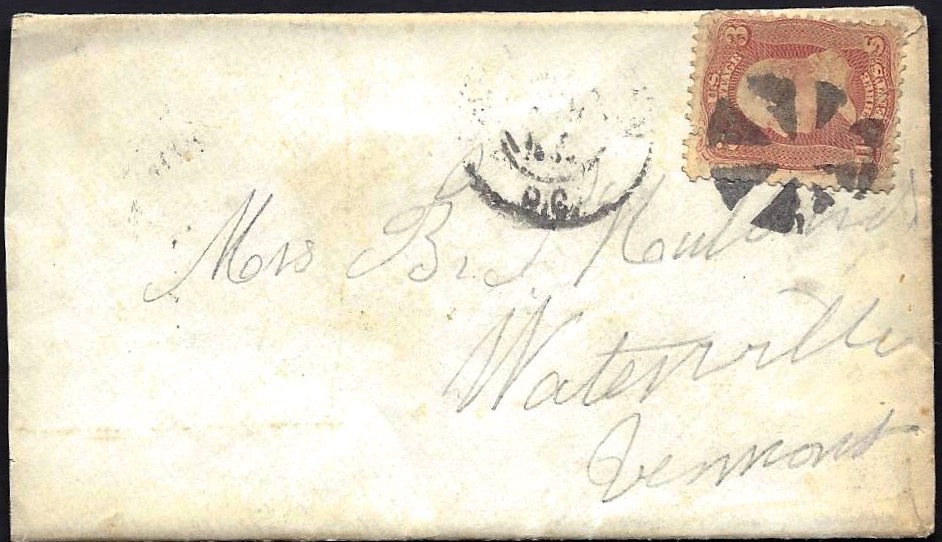
Camp in the field [near Petersburg, Va.]
June 27, 1864
Juliana,
Having had a little resting spell & lying still yet, I thought I would improve a few moments in writing as heretofore I have always wrote upon the run. We, Vermont 2d, have been in this place now this is the fourth day without being called upon for anything. The 2nd, 5th, & 11th Vermont are here together with the other regiments composing the 2nd Division of the 6th Corps behind good fortifications with our tents up for a shade having a good rest, altho it seems there is constant fighting on our right — probably in the vicinity of Petersburg I should think by the sound of the cannonading. We are in some 8 or 10 miles from there having comparatively easy times. Rations drawn every other day — one day soft bread & one of “hard tack.” Fresh beef every day, salt pork, coffee, sugar every other day, & now once a week beans & potatoes. There is a noble good spring of water close by—as large one as I have seen in these parts. Good water. Loyal will tell what we have drank some of the time since we started. Also, he will tell better than I can write how we manage to do our cooking.
Some of the time when on a march, we go rather dirty, not having a chance to change or a change to put on. I lately drew shirts and pants & shoes. I don’t calculate to get but a little at a time for I don’t want to carry them so I get one thing at a time.
Did [my nephew] Loyal find the box he & I sent off last Spring? If so, I guess you found a dirty lot of trash. If the things did come, you can take the overcoat for the boys again. When you write, tell all that is going on that would interest me. Let Mrs. Hellen go. You need say nothing to her about that matter. If I ever see Rob, I will talk to him about it. If Philip Glad ever says anything about a note he has against me in favor of Hotchkiss, you need not know anything about it. If it is like to outlaw perhaps he may sue, thus renew it. I never have learned whether you paid Flagg all that he claimed or not. I could not think how he honestly could have so large an account against me as he claimed.
We shall be mustered for pay day after tomorrow. Don’t know how soon we shall be paid but think likely the fore part of July. I will send the money or a check home. Shall keep but little anyway for a person cannot get anything for his money here—everything is so high—and my eatings is sufficient for the present. Only tobacco that you may send. I think one hand a week done up nicely would come without trouble, such plug as you send is from 50 to 75 cents here.
I feel sorry about [my nephew] Nathan [Hulburd] but guess he will stand captivity as well as most anyone for camp life agreed with him. I don’t know as I ever see him look tougher than now. I expect Ed Page is gone up too. I have used up this sheet & wrote nothing. Respects to all enquirers. Eva write.
— B. F. Hulburd
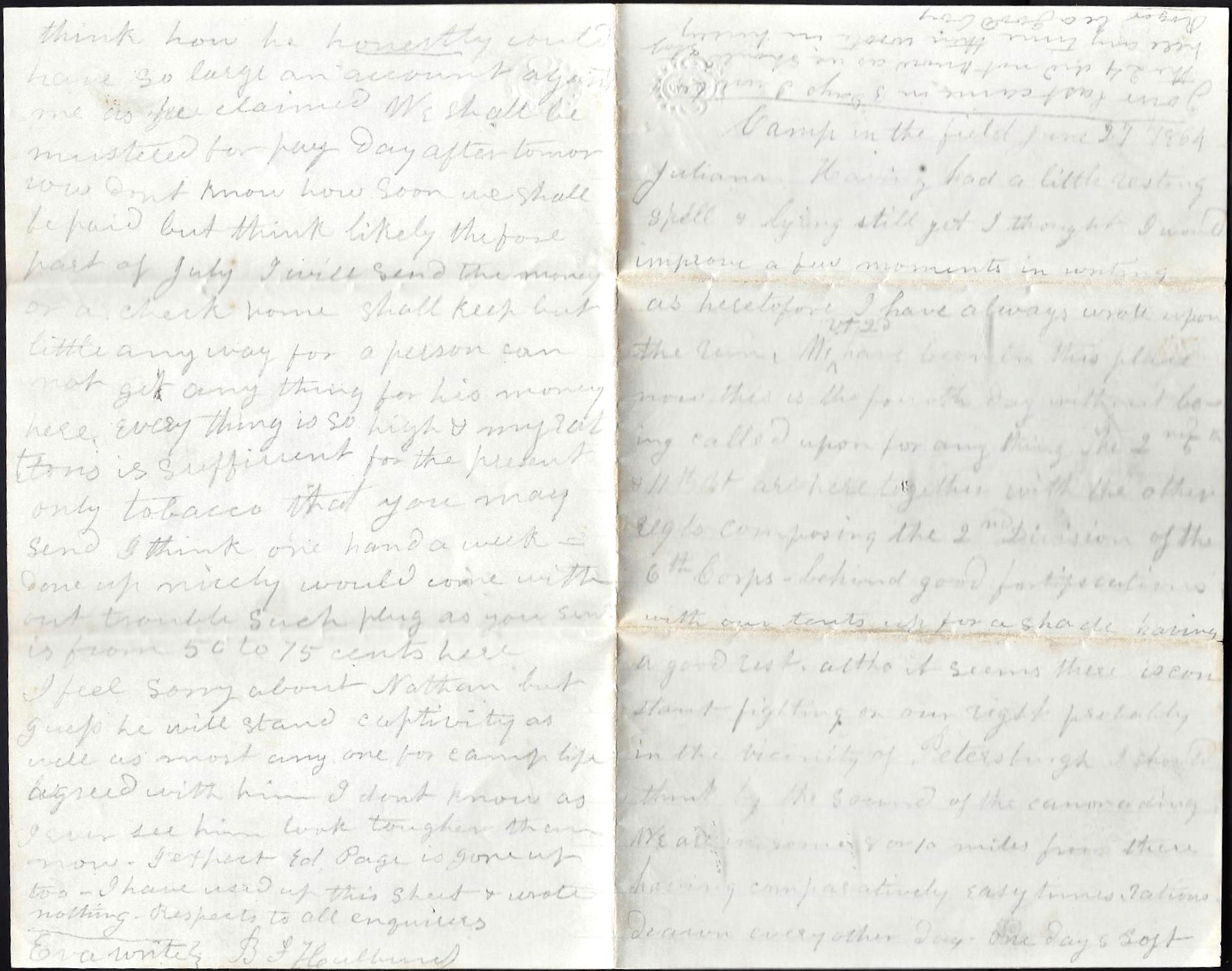
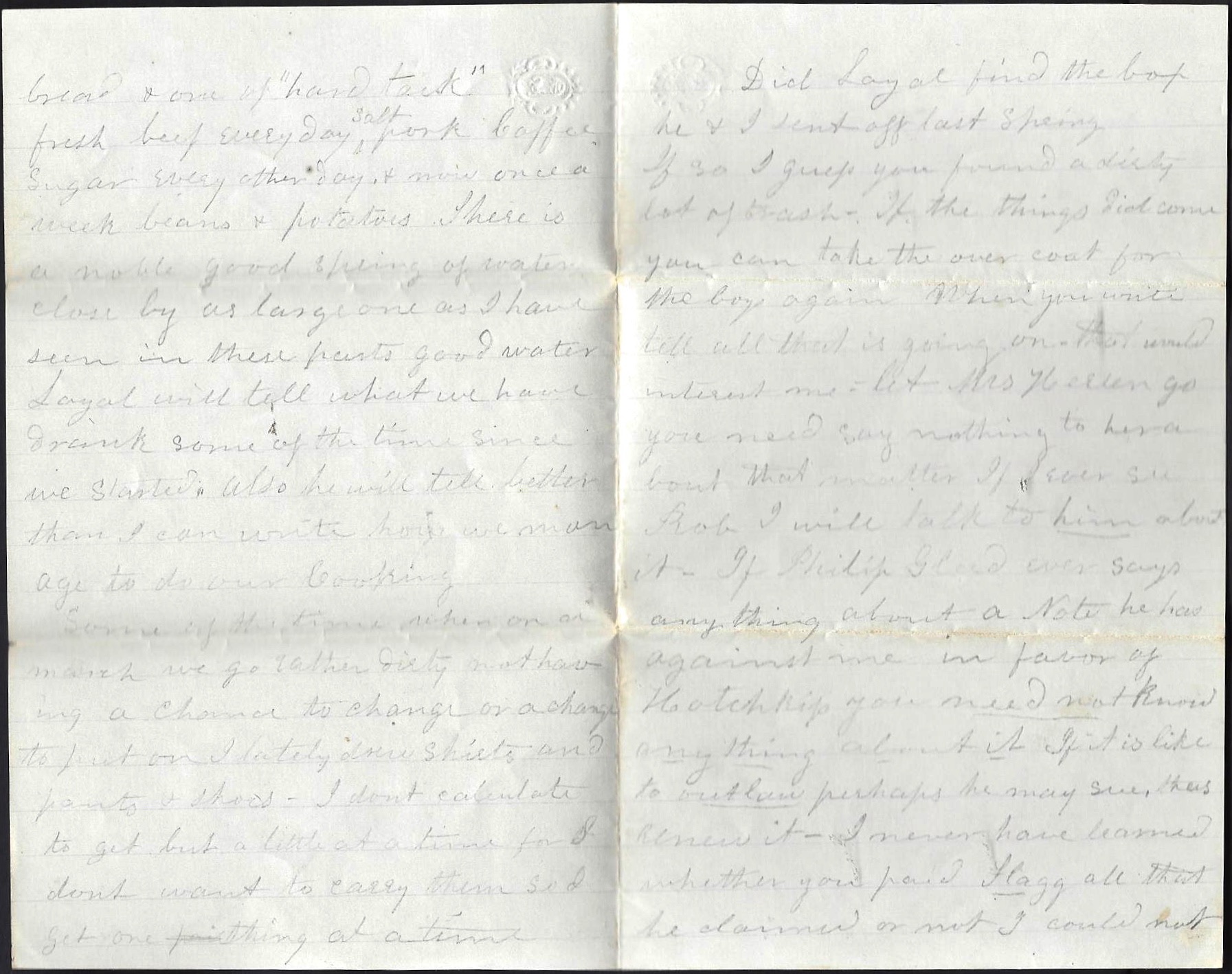
Letter 59
[Editor’s Note: This transcript was provided to me by Paul S. LeBlanc whose Uncle George P. Hulburd transcribed them from the originals in the 1960s. I believe the original of this letter is in the Vermont Historical Society Library]
Camp near Petersburg, [Virginia]
July 3, 1864
Juliana,
I have just come in from picket where I have been 6 days. I found yours of June 25. It found me well. I also found the mailman waiting for the mail so I have no time to write. Health first rate. Enough to eat all right. Papers come. Send me a News Dealer every week and roll up a plug of tobacco tight. The other came in good shape and is all chawed up. Guess we shall be paid this week. Have had no fighting for a week in our division.
No time to write more now. I will write again if I get a chance this week.
— B. F. Hulburd
Write immediately respects to all
Sorry for Nathan H. Eaton taken at the same time.
When I got the other scrawl finished the mail carrier was gone so will write a little more. I said I had just got off pickett. I have been out 6 days. There was near 100 men from the Vermont Brigade detailed and we went out a mile and half and divided equal—½ went on post the rest remained in reserve. We went on post 3 in a place. One would go out 20 or 30 rods in front, stand 2 hours, then one of the others, and so on for 24 hours. Then the reserve would relieve us for 24 hours and we fell back and lay still 24 hours. This is the way of that. Last night I went in a snug 50 acre lot, left the gate open, took two strips of boards, spread out my blanket and tent, undressed and got into bed, and slept till morning. First time I have slept so since I left home.
Have just eat my dinner had fried pork soft bread fried in the fat and a grand good cup of coffee. If I ever get home, won’t I have coffee! Ok? Our cook is preparing beans for supper. We are now in our tents thrown up for shade. May stop a week — may have orders to march in an hour. Such is soldier’s life. But I can write no more. — B. F. Hulburd, Co. H. 2nd Vt. Vols.
Letter 60
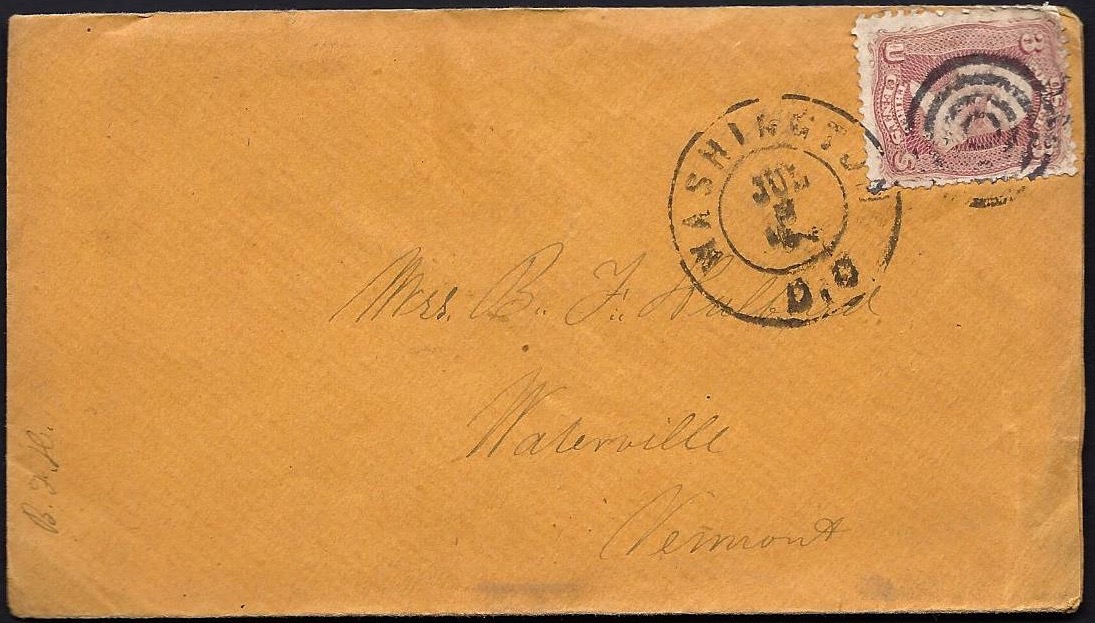
Camp near Petersburg
July 5th [1864]
Juliana,
I thought to write this second epistle unto you in which I propose to stir up your mind by way of remembrance. I wrote Sunday that the probabilities were that we should be paid off soon. The probabilities now are that we shall not be paid till perhaps the fore part or middle of September. Now that makes all the difference in the world with me. Now Juliana, I want you to send me a little money—say $3. I guess I can get along with that if you will send a plug of tobacco every week. I want to get some little things occasionally & cannot get them very well without the money. I have had but 25 cents for a long time & now have but 5 & all I can get with that is a stamp & sheet of paper & I propose having a slice of cheese occasionally & a few such things as occasion requires. If I am not paid till September, I shall then have due me & receive from $125 to $150.00. If as some say the soldiers pay is increased from and after the first of May & I get my full pay, I shall have 150 dollars. I don’t know how that is I have never seen or read that that is the case but some say we have 15 dollars per month after the first of May instead of 13.
I wrote to Porter yesterday & I think now if he wants to know anything about me, he will probably write me to find out.
We have just fixed up our camp all neat & clean. Probably fixing to move soon as that is always the case. We have orders to march soon after we get such a job done. They keep a pestering away all the time off on our right—probably toward Petersburg. The rebs, I understand, made a charge on our works in that vicinity a night or two since but were repulsed with great loss. Our loss 6 wounded.
Health good. All right. Write soon. Send $3.00 if you have to borrow it, paper, & tobacco &c. — B. F. Hulburd
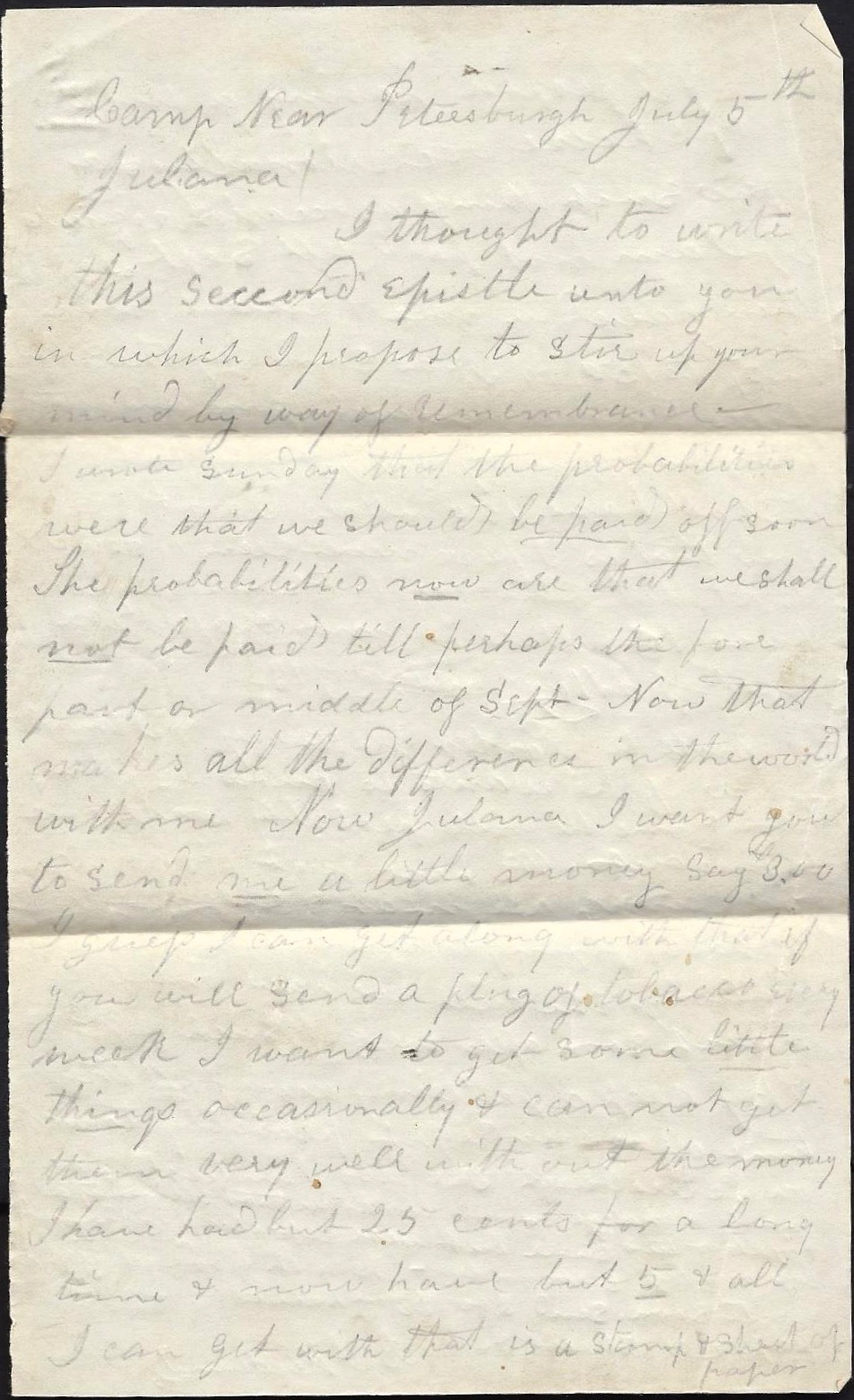
Letter 61
Camp in the field
July 8, 1864
Juliana,
I have just got yours July 4th. It found me in usual health altho I had had a spell of the colic last night but have got over it this morning and feel as well as new. We are lying in the same vicinity where we were ten days ago but have to pick up and move a little way, then back again so as to have the thing military. There is a rumor now in camp that we have got to go to Harpers Ferry but I guess not yet. There seems to be quite an excitement in that direction.
I have seen Mr. Bedell. He knows nothing in particular about Nathan’s capture as he was not out with the company that day. He told me he would write George. I saw another of the same company that was out but got away. He says he saw Nathan but a few minutes before they were flanked and he was all right then. There was some 40 of the company that were taken and the Capt. and one Lieut. Stearns among them. Heman Eaton of the 4th Vermont, also Ed Page I have not seen or heard from. The weather is most scorching hot but we got our tents up and shaded so that we keep quite comfortable.
I do not learn as there is much being done about here just now. Way off to the right on our lines they are a banging away every night but I do not hear as it amounts to much. We had a general inspection yesterday and there was 10 privates out in our company. One company in the 3d [Vermont] Regiment had [only] the Capt. and one private—and he was the Capt’s waiter.
I am glad that you got them things for I was afraid Loyal would not get them. I have no more to write now. Write and send tobacco. I got yours. I think if you would put in one of the smallest sized plugs in a news paper rolled up tight it would come without extra postage. — B. F. H.
I heard yesterday that the boys that were taken prisoners the other day were kept at Petersburg so that our people would not shell the city and again that they had been sent off south of course we know nothing positive in relation to them. Some that were taken in the “Wilderness” we learn are in Lynchburg, Va. There was not a great number of the 11th [Vermont] boys killed at the time of the capture of these—tell George. — B. F. H.
“At 8:45 p.m. on July 9, just a few hours after Wallace’s defeat at Monocacy, Halleck had relayed an order from Grant to Maj. Gen. Horatio Wright, the 44-year-old commander of the Army of the Potomac’s 6th Corps, outside Richmond. The order instructed him to bring the remaining two divisions of his corps “at once” to City Point, get them into troop transport ships and report to Halleck once they arrived in Washington. The ships made it to the old Sixth St. Wharf in Washington at noon on the 11th—just as Early was contemplating Fort Stevens for the first time and an attack on the “feebly manned” post and city.
But Early held back. The heat and long march had taken its toll on his men. “When we reached the right of the enemy’s fortifications” at Fort Stevens, Early informed Lee three days later, “the men were almost completely exhausted and not in a condition to make an attack.” By the time Early felt his men were ready, it was too late. Union 6th Corps men had been rushed into place at Fort Stevens, rendering any prospect of a successful assault remote at best.
So Early decided not invade to Washington, and the Point Lookout raid was called off. But Early stuck around the capital for two days to cause other kinds of trouble. He and his men engaged Union forces outside Fort Stevens and Fort Reno in 48 intermittent hours of skirmishing that caused some 300 Union casualties and an equal, if not larger, number on the Confederate side.
Lincoln made brief appearances to see what was happening for himself at Fort Stevens on July 11 and 12. On the 12th, while Lincoln was standing on the parapet at Fort Stevens, a Union officer next to him was shot by a Confederate sharpshooter firing from a tree on what is now the grounds of the Walter Reed Army Hospital. That marked the first—and only—time in American history that a sitting U.S. president came under hostile fire in a military engagement.
Early on Wednesday morning, July 13, Early took his troops back into Virginia. The Union forces did not give chase. The “great rebel raid,” New York Times correspondent William Swinton reported on the front page of the newspaper’s July 15 editions, “is over.” It “abruptly ends the boldest, and probably the most successful of all the rebel raids.” [Source: The Rebels are Upon Us, by Marc Leepson, The Cleveland Civil War Roundtable.]
Letter 62
Washington D. C.
July 12th [1864]
Well Juliana, I am here now 150 miles, or such a matter, from where I was 2 days ago. Got here last night by steamer from City Point—9 miles from Petersburg. March to City Point Saturday night, took steamer 4 P.M. & got here 4 P.M. yesterday. All excitement—skirmishing within 6 miles of [Washington] City. In 5 days the rebs got nearer Washington than our men have to Richmond in 3 years. Guess we can hold them. Can’t tell how much force we have. [The First and Second Divisions of Horatio G. Wright’s] 6th Corps came from Petersburg.
Can write but little this time & no news that you will not get in the papers before this reaches you. Feel a little old today but all right.
I understand the rebs made a charge on the fort where Nathan was last winter yesterday. Thousand stories—don’t know what to believe. Only know that skirmishing is going on now for I can see it & occasionally our men from the forts around throw shells to the rebs. Don’t know where we shall be put but probably somewhere. In haste. — B. F. H.
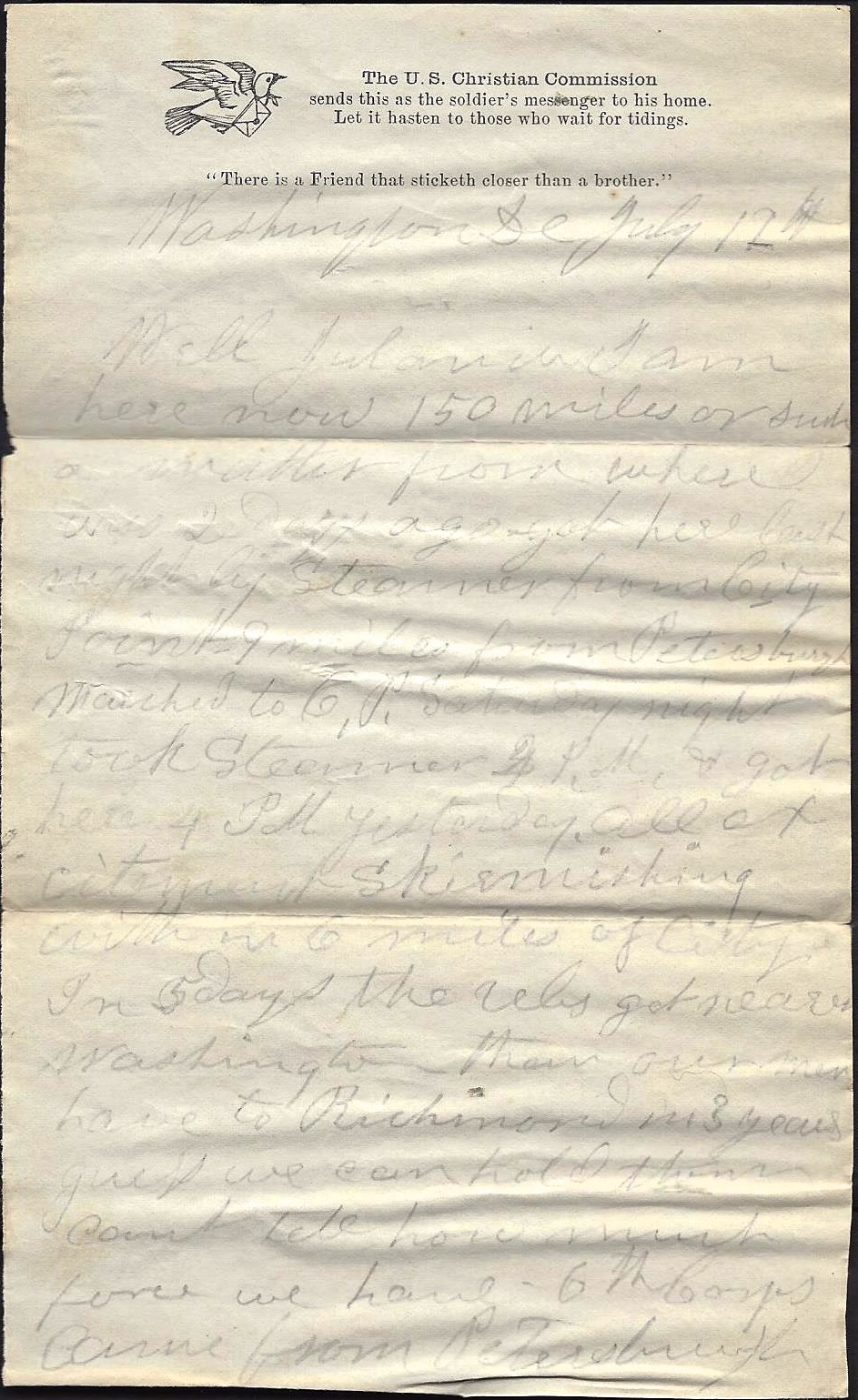
Letter 63
[Editor’s Note: This transcript was provided to me by Paul S. LeBlanc whose Uncle George P. Hulburd transcribed them from the originals in the 1960s.]
In Camp near Georgetown
July 23, 1864
Wife and friends,
In haste I seat myself at this time just to say one word. When I last wrote we were on the march. We left Washington July 13th, crossed the Potomac by wading it where it was ½ of a mile wide, marched 4 days, crossed the Blue Ridge, the Shenandoah River, then turned round and came back another direction to this place where we arrived today at 3 o’clock after a most tedious absence of marching and counter marching and moving about day and night for 10 days, marching probably some 100 miles short of rations some of the time but the country through which we passed is now minus of a goodly number of hogs, hens, turkeys, geese, and a large number of swarms of bees and some of the nicest honey I ever saw. It looked almost wicked to see the fields of wheat and corn we destroyed on our march. Don’t know how long shall stop here or where we shall go next probably back to Petersburg and toward Richmond, but can’t tell anything about it.
I have no letters since I wrote. Last July 3d was the last I had. We had no mail on our march shall probably get one tonight and I shall look for some then. I will send this out and if we stop here a day or two will write again and be a little more particular. I stood the march first rate. At some of the haltings myself and one other private were all beside one sergeant and one corporal but what fell out and came up afterward—Health first rate. — B. F. Hulburd
Letter 64
In Camp near Georgetown
July 25th [1864]
Juliana,
I sent out a letter yesterday morning, wrote another this morning, sent that out containing $105.00, and as it is a cold, rainy morning, I thought I would write a little more.
We expected last night to move today but I guess we shall not. We may, however, have orders in minutes & in 20 be packed up & on the move for some place. The men that were wounded in the “Wilderness” & have been to the hospitals are continually coming back to their different regiments & companies. Glad to see them.
You may do as you think best about the water. Find out how much Chaffee is ___ to ask a ___ to put down the logs & dig the ditch & all. Perhaps you might get George to furnish the logs. If not, [let] Chaffee find them & do all the work. I know that it [is] very much more convenient to have the water brought than it now is & a new pump will cost ½ as much as the work bringing the water. And how about the cows? Shall you try to winter both? I mean this winter to get a furlough & come home if I can — that is, if I live till that time & I guess I shall. Does not the receipt you got off Howard for the Lamoille News Dealer pay for it up to the last of this year? or up to the end of Vol. 4? I think it does.
There are lots of sutlers round camp now. I have paid them but 50 cents yet — for cheese, cakes, & raisins, but am going out soon & see if I can’t get a good drink of cider or strong beer.
Our last march was rather a tough one but the boys stood it like good fellows. Don’t know as it amounted to much, only we drove the rebs back again out of Maryland a good distance into Virginia. Yet we did not get in sight of them but the head of our column (which was some 8 or 10 miles long) came up with them and had one or two brushes with them. I presume our next move will be to Petersburg again where we will hold them till they slip out again & get out here to Washington, Harpers Ferry, or some point around here.
I guess I will let you see the last letter I had from Littleton. I shall answer it in the course of a few weeks. Eva, I am much obliged to you for your letter. Write again. How is it Roger? How do you get along with the work & catching squirrels? Is it a gray one or a red squirrel you have got? Charley, how do you stand it? Can you do much at haying this season? What do you think about the crops &c.? You & Roger must try & do the best you can & help your mother & grandma’am about the house.
Write soon & often. I get letters in two days & 100 dollars will do for a week or 10 days to come. — B. F. Hulburd
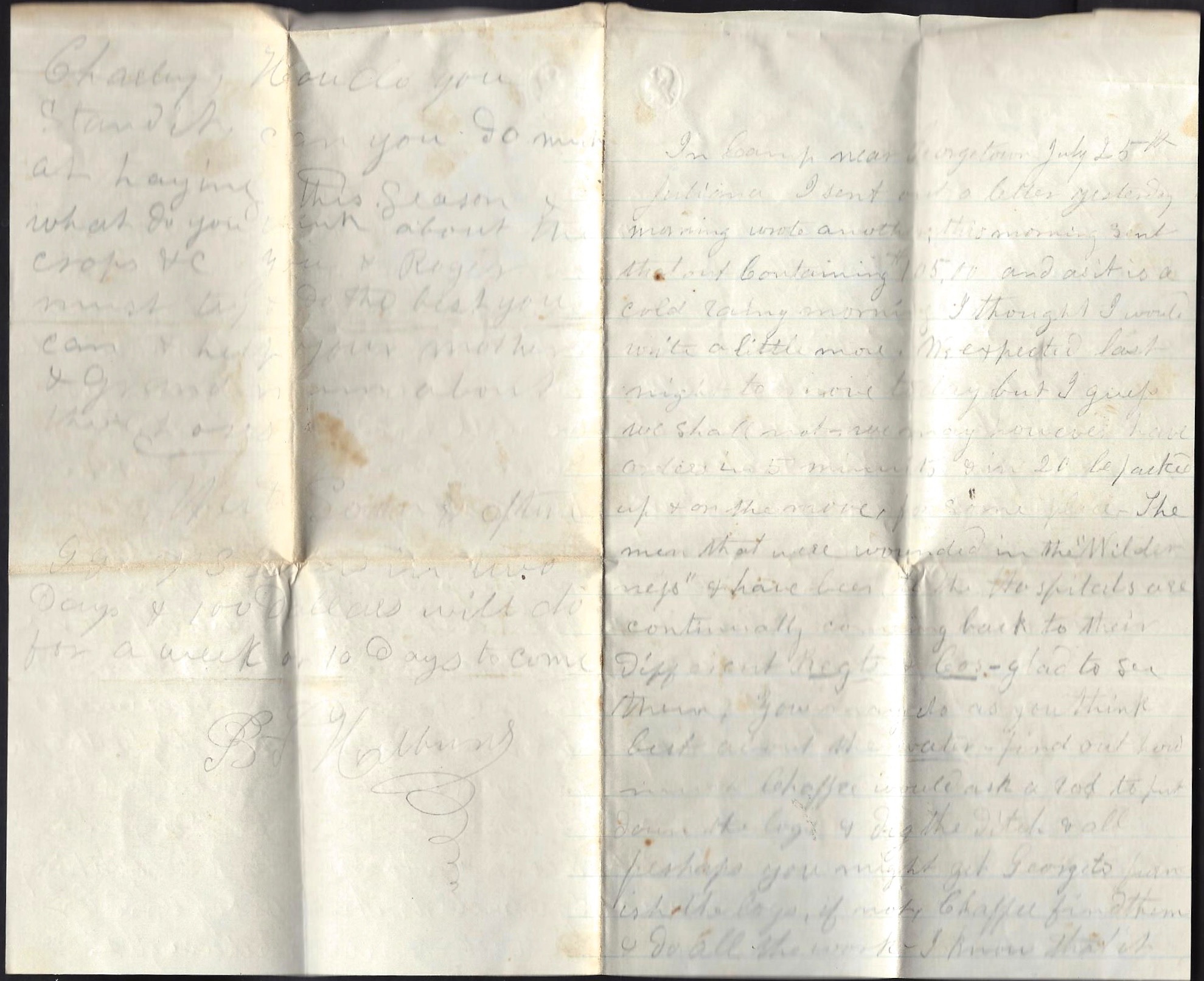
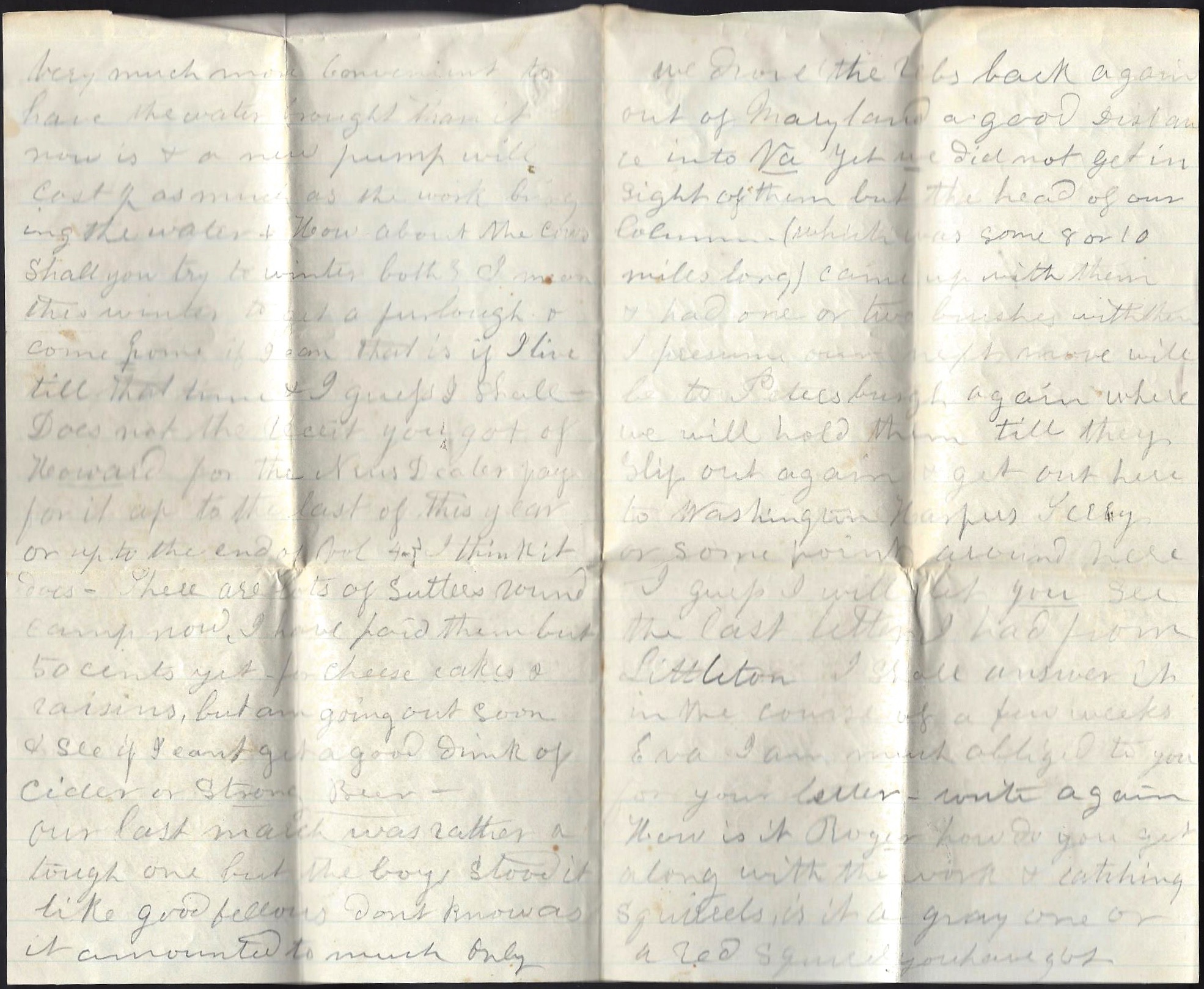
Letter 65
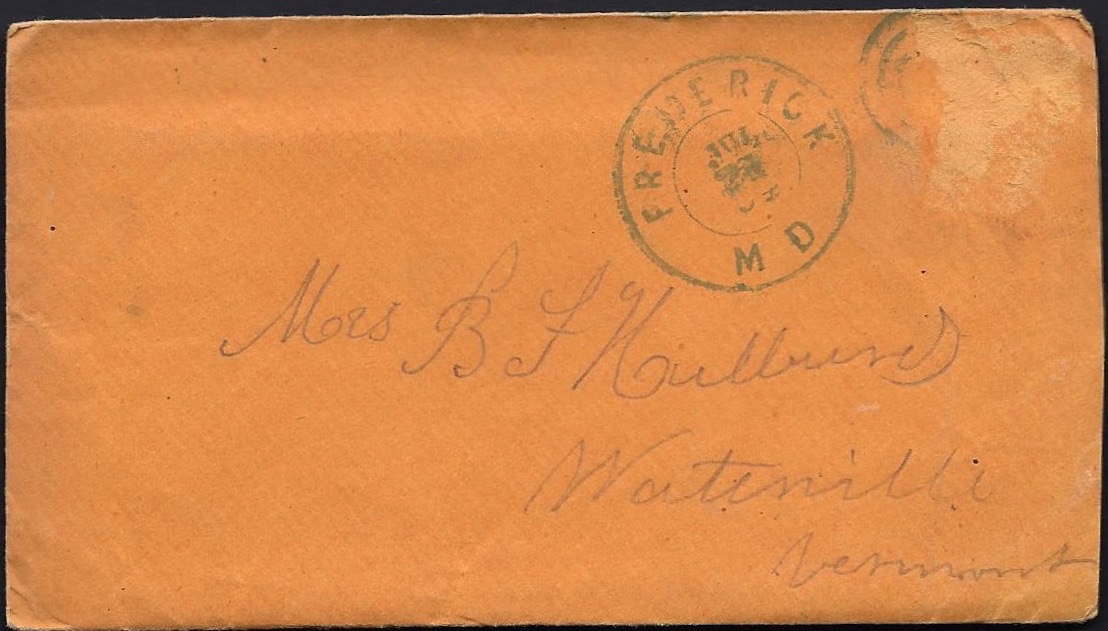
Thirty miles from Georgetown
[near Hyattstown, Maryland]
July 27th [1864]
Juliana,
I guess I will write a little more today. I sent out two letters day before yesterday from camp near Georgetown. Yesterday morning we had orders to pack up & march & we have had 2 hard days march. Altho we started about noon yesterday, camped at sunset, started ½ past 5 this morning, and camped at 3 p.m., marching about 30 miles — perhaps a little less. Yet the heat has been oppressive & fast marching with very brief halts. I am some tired and I am a little fearful that our regiment will have to go on picket tonight — just duty enough to spoil a night’s rest.
I rather expect we shall have to go or all bound for Harpers ferry or somewhere else — no knowing where. It is said the rebs are making for Harpers Ferry & I guess we are a going there to head them a little more than a day’s march.
Now Juliana, if that 105 dollars comes through safe, I guess I shall want you to send that 5.00 back to me again. I will tell you I drawed 118 dollars before I was paid, which was 2 hours before I got your 5 dollars. I borrowed 2 dollars which I paid leaving 116.00. Just after I had sent off my letter, Capt. McFarland came to me & would have taken 25 or 50 dollars & let his wife paid you. I let him have 10.00 which left me but 6.00. Well I paid 1.50 for tobacco, 1.00 for 2 pound of cheese & pies & cakes, took a little more 5 or 6 glasses or strong beer some more, & I am ahead a little short, although not out yet. You may send 5.00 & Mrs. McFarland will pay you the 10.00. She had sent him some but it was states bills which are not current here. When I want, I will send for more tobacco for I think it cheaper than to buy it here. Such plugs as you send cost 40 & 50 cents here. I think you said 28 was the price that you paid for them & 4 cents fetches them through.
I guess you may get me a good piece of ____ that will make a good pocket handkerchief. I don’t want a silk one for I may lose it.
Our man is collecting up the mail & I will stop. So goodbye for this time.
I don’t know what town we are in but we have passed Rockville about 20 miles and a village called Hyattstown near here. In haste. — B. F. H.
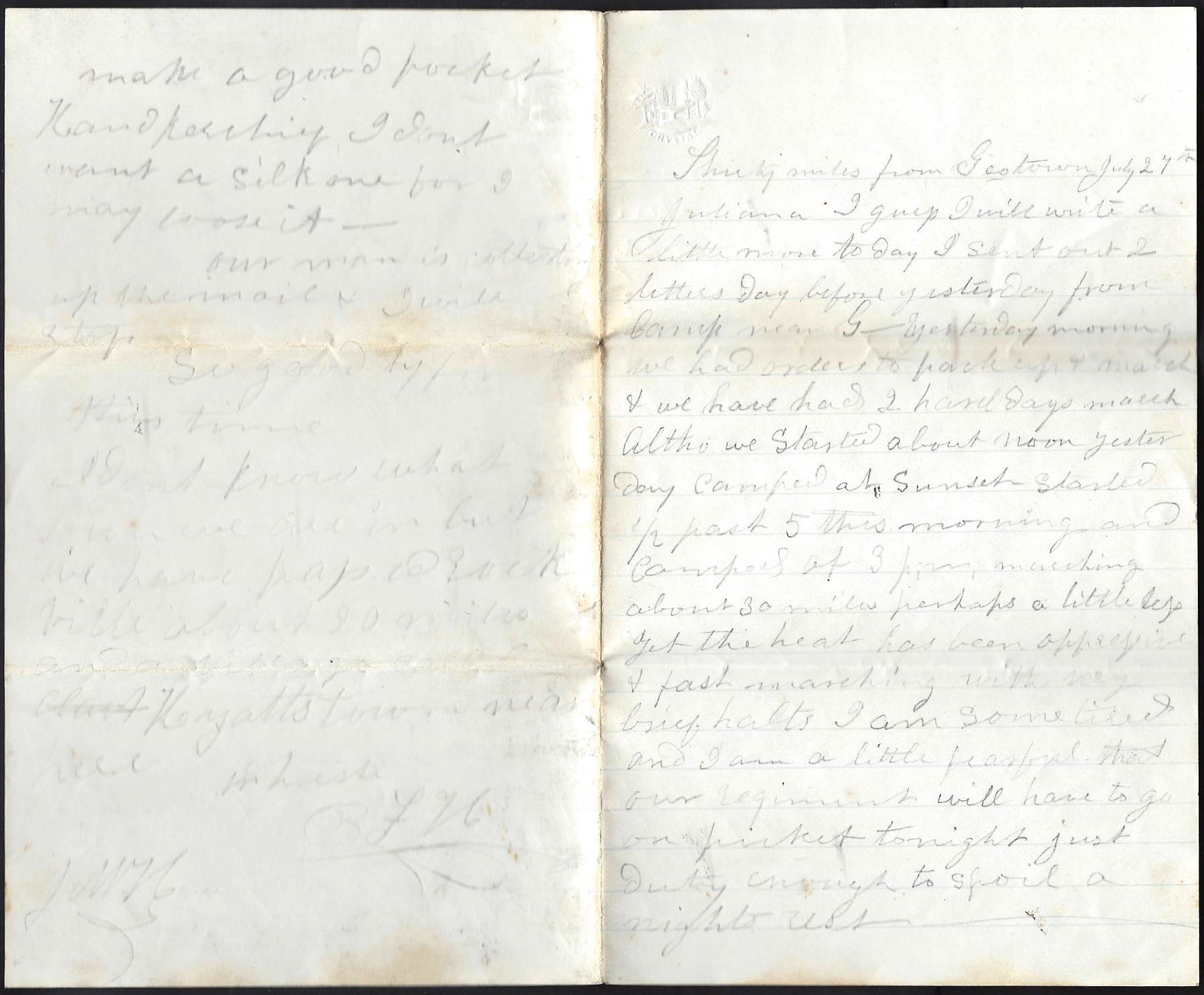
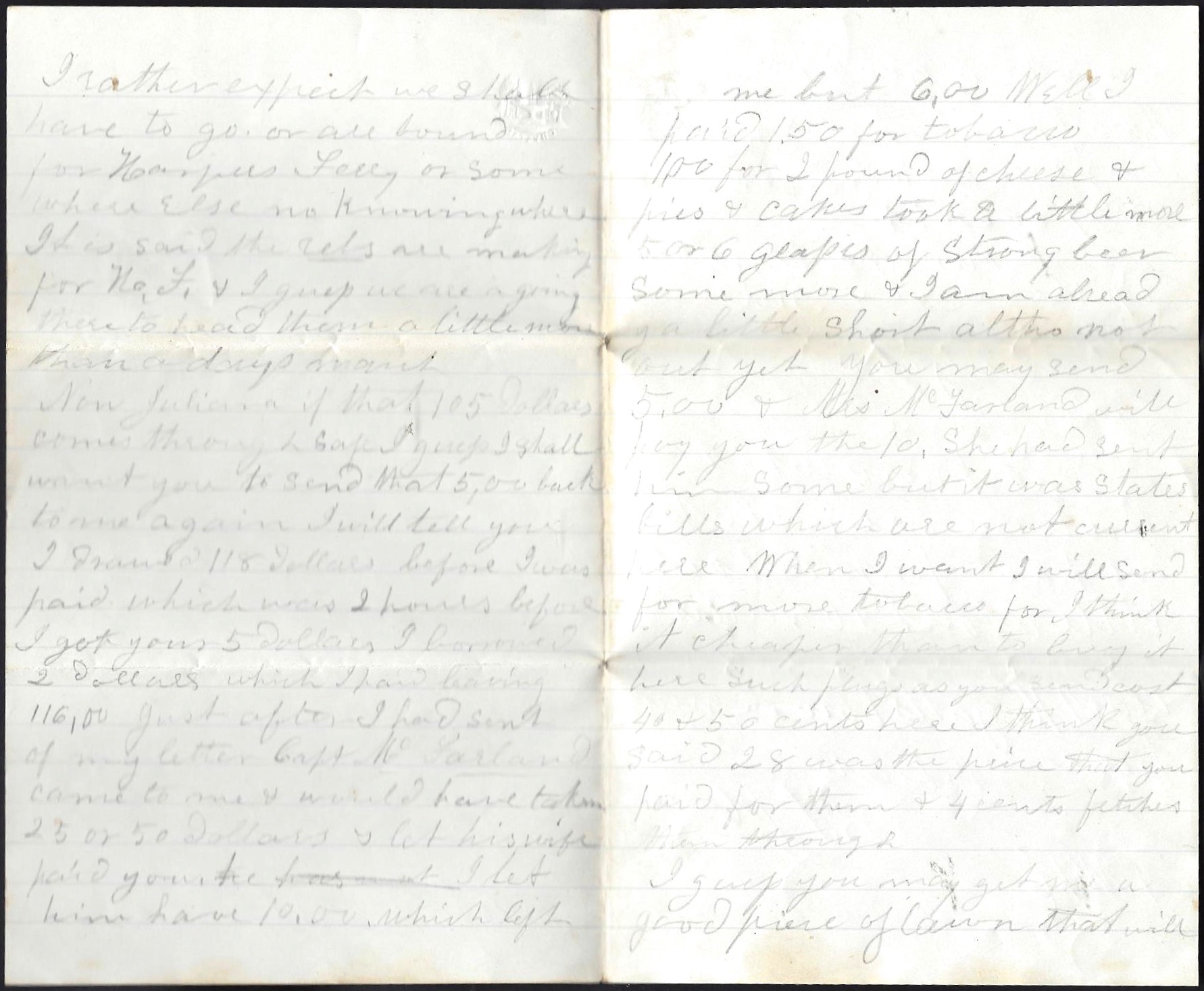
Letter 66
Harpers Ferry
July 30th [1864]
Dear wife & children,
In great haste I will write a few lines at this time to let you know that I am alive & kicking yet. I wrote 3 or 4 letters last week & the fore part of this & I guess you have got some of them. Our long march accounts for your not getting any letter for the week before you wrote. We had no mail for 8 or 10 days nor a chance to send out any. We have had quite another march from Georgetown to this place. It has been rather tough but I stood it. We were blessed with good water most of the way. How long we shall stop, can’t tell — probably not a great while [till we] move somewhere soon. Have seen nothing of any rebs in this vicinity (only a host of prisoners back a mile) yet it is said they are in front in considerable force. If so, we may meet them by and by.
I don’t want you should sell that dress coat that I sent home just yet. I may want it sometime. Every coat is not made of as good cloth.
Just got yours of July 23d. I shall want to hear when or whether the money comes safe or not. I came out last Sunday with a new clean suit of clothes—blouse, shirt, pants & socks—so all is right on that score.
I fell out yesterday on our march ¹ & stopped at a house & paid 75 cents for a dinner. First time [I] had set at a table since the 12th of December. Had boiled potatoes, onions, cabbage, and boiled ham, fried bacon, bread, butter, warm biscuit & applesauce & I don’t think I felt as well for eating.
I can’t write very much of interest now. We are moving round & it seems to no purpose but perhaps some of these marches may be reckoned of importance when counting up means put in operation to crush the rebellion after the thing is done.
In relation to the water works & the keeping of the cow, I think I have written do as you think best.
I wish you could for a moment stand where we are now encamped [and] see the encampments around. To one not accustomed to such sights, it is truly sublime. On the opposite side of the river on “Maryland Heights”—a mountain about like that one you can see “Old Bald Mountain” towards Bakersfield. On the top is a host of tents & two or 3 one hundred pound guns—that is a gun that carries a ball that weighs 100 pounds for 5 or 6 miles. I can’t give any kind of description if I begin so I will stop right here. If you get that 105.00, send me 5 & get 10 off Tyronin [McFarland] as I wrote before.
In haste, — B. F. Hulburd
Love to children
¹ Melvin Hyde, the surgeon of the 2nd Vermont, wrote his wife that the march of 29 July “was the most severe that the 6th Corps ever had.” He went on to say that the heat was so dreadful that “the boys fell out of the ranks in every direction at every step and several of them died with sunstroke and exhaustion.”
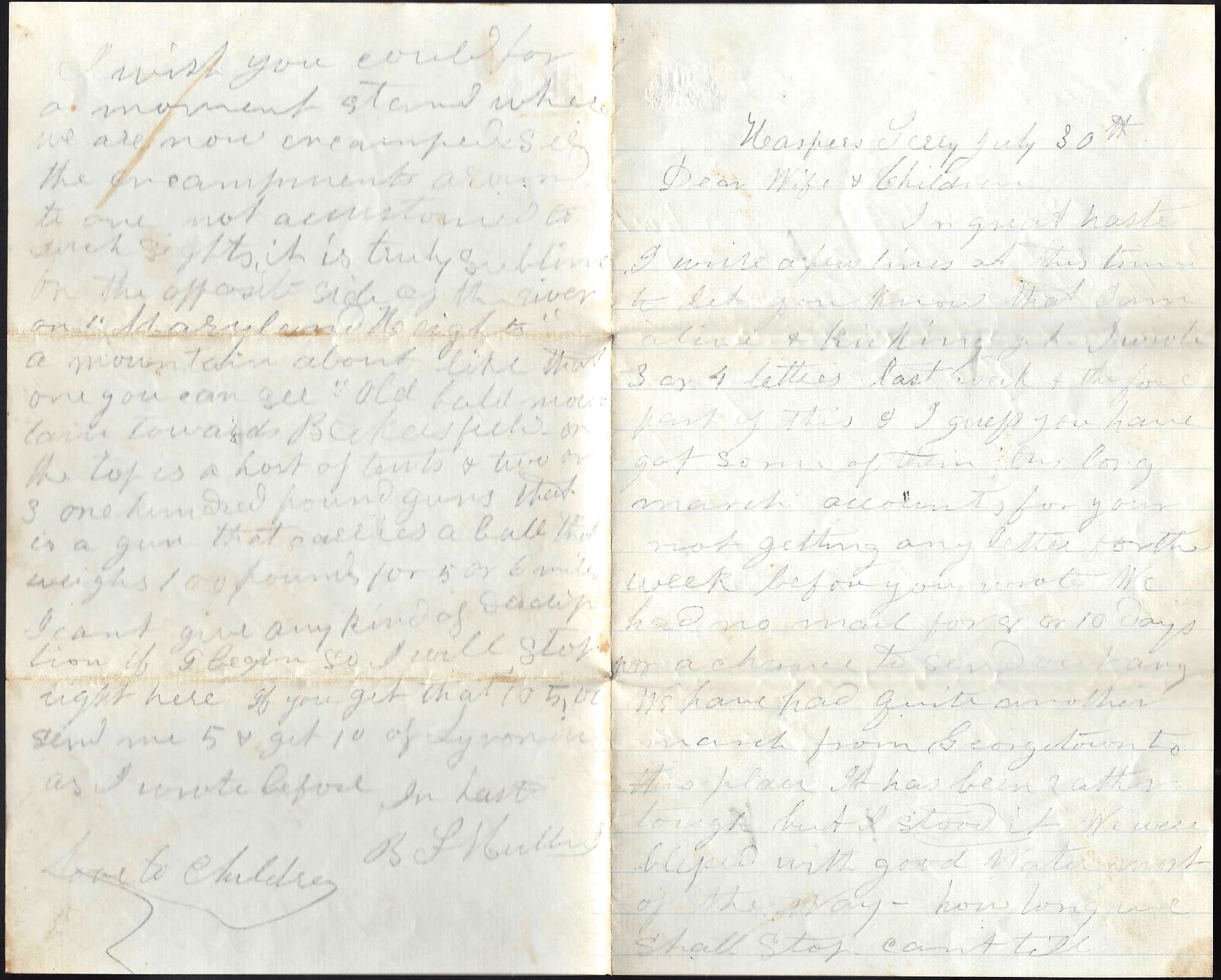
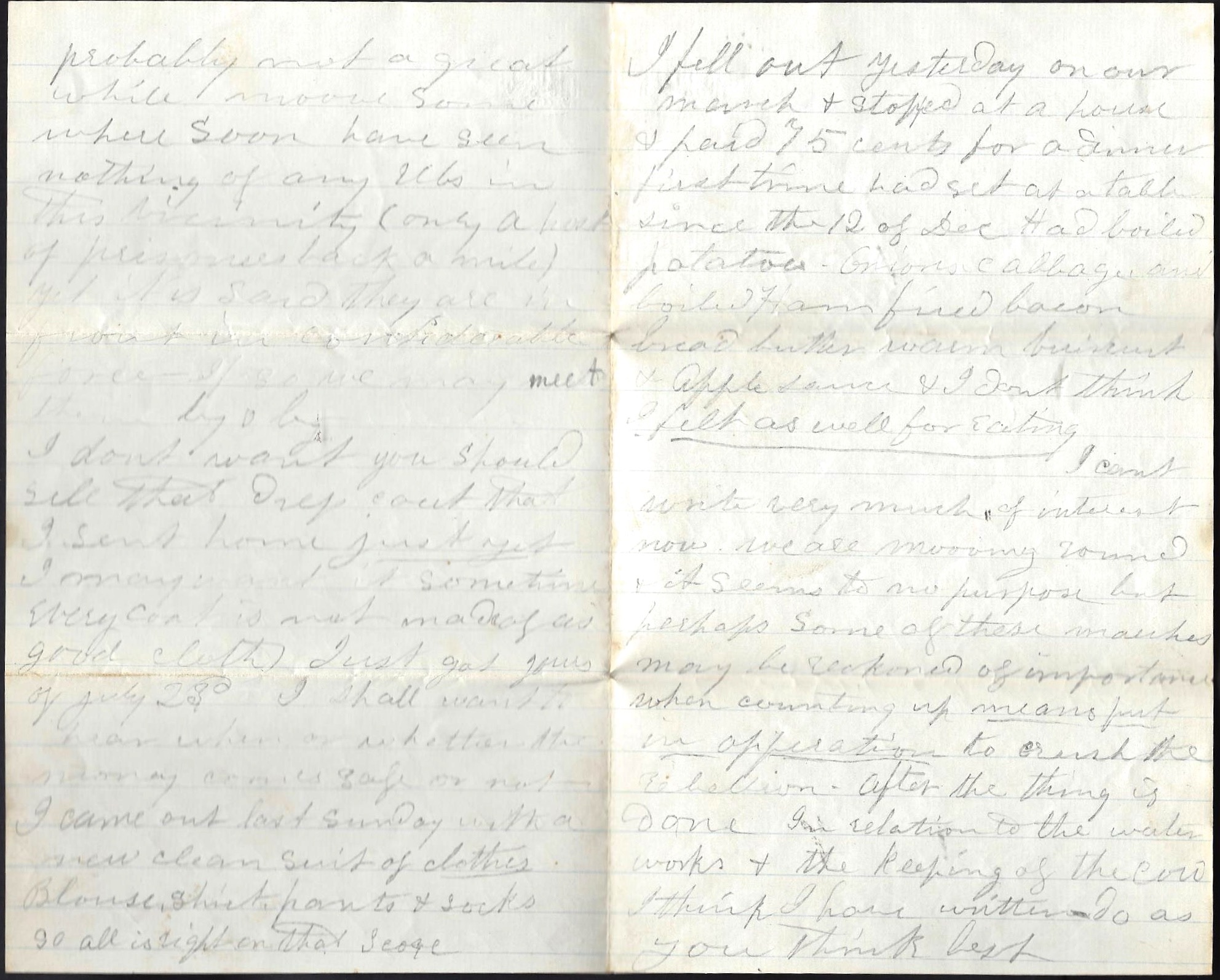
Letter 67
[Editor’s Note: This transcript was provided to me by Paul S. LeBlanc whose Uncle George P. Hulburd transcribed them from the originals in the 1960s. I believe the original of this letter is in the Vermont Historical Society Library]
Near Frederick, [Maryland]
August 2nd, 1864
Juliana,
I have just got yours of––mailed the 30th glad of it. Nothing new to write had just sealed up a letter to Daniel as the mail come in—particulars in that. I am as tough as a knot-stand the extraordinary heat like a salamander, can march day and night like a horse
Eva may dry me a bag of berries and keep them until next winter. It is getting dark—send me that money if you please––I will send you a letter you must not let anybody read. — B. F. H.
Letter 68
[Editor’s Note: This transcript was provided to me by Paul S. LeBlanc whose Uncle George P. Hulburd transcribed them from the originals in the 1960s. I believe the original of this letter is in the Vermont Historical Society Library]
Way up on the top of a hill 3 miles southwest of Harpers Ferry
(where we was one week ago but left after stopping about 12 hours and went back 18 miles and then turned and came back again)
Aug. 7, 1864
My Little Woman,
I thought to write a few lines today thinking perhaps you would be pleased to hear from me once again in the first place. Secondly, my health never was better than it is this summer and it always was good you know. I wish I could tell you some of our marches—where, when, and how—since we landed at Washington about 10 of July, but I can’t. But we have marched and counter-marched back and forth and probably traveled some 200 miles and it has amounted to just about as much as it would to turn up and—against the northwest wind. Probably some day these little miles will be remembered to our credit—but as the scriptures declare, “Cast thy bread upon the waters and after many days the blessing comes.”
Well, at present I can’t tell anything about our present or future prospects. I am almost discouraged, but yet I do not complain. I am better off than thousands and of course am thankful. I suppose we ( the 6th Corps) are here now to keep the Rebs out of Harpers Ferry—but after we hear that they have crossed the river below us and gone into Maryland and Pennsylvania and burned some few villages, we may have orders to hurry down and prevent it. I wish I had been at Petersburg to have witnessed Gen. Grant’s great failure there. ¹
You may think by the way I write that I am not perfectly pleased with everything that happens. Well as far as I am personally concerned, I have great reason to be thankful—but “bye-gosh, heavy bodies move slow.” But it is a private’s place to “stand still” (not exactly) but go ahead—but as yet—as a Nation we do not see the “Salvation of the Lord.” But trust he will “show” it unto us some early “day.” Let a person “see” and he will begin to “understand.”
So much for the present position and condition of national affairs—now for private matters. Well, Juliana, I have nothing new to say that I know of only “go ahead.” Perhaps I may be there again in the course of “human events.” I will just say that since I last wrote, we have moved around forward and back and forward again without apparently accomplishing anything. Where our next move will be, I can’t tell—but probably up or down (I don’t know which) the Shenandoah Valley. But honestly, God only knows the end from the beginning. I have no letters from Littleton since the last I sent you. What think ye?
I don’t think of much more to say this time. Write often and I will—once a week. Love to the children. Visited Capt. McFarland today. He and all the Waterville boys in the 8th were well. — B. F. Hulburd
¹ This is a reference to the Battle of the Crater on July 30, 1864.
Letter 69
[Editor’s Note: This transcript was provided to me by Paul S. LeBlanc whose Uncle George P. Hulburd transcribed them from the originals in the 1960s. I believe the original of this letter is in the Vermont Historical Society Library]
Near Harpers Ferry, Virginia
August 9, 1864
Just a word or two at this time. I got yours of the 4th and 5th both today. Handkerchief and tobacco did not come—may[be] tomorrow. We are still lying at this place. Have been quite still for 5 days so we shall have to____again one of these hot days.
Health good and feel first-rate. You must do as you are a mind to about the cow—you had better contrive to salt down a or of beef this fall. Use the money as prudent as you please for you may not get much more till January when the next installment of the bounty comes due.
Tell Sam the best thing he can do is to go to Cambridge or some of the towns that pay a good bounty and enlist for one year. If I was there and know what I do after seeing what I have seen, I should do it ( if the woman was willing).
It has been awful hot here this summer and not scarcely any rain. I asked a favor of our Capt. yesterday which he said he would try to help me to but I think it rather doubtful about my having it granted—viz: If there were any details from this company to go to Vernon on recruiting service this fall, that I might be favorably remembered but it will probably be given to someone longer in the regiment. No time for more respects to all. Saw Moses yesterday and the other Waterville boys are well. Write often. — B. F. Hulburd
Roger, how do you do? Eva don’t you make fun. Money came safe.
Letter 70
[Editor’s Note: This transcript was provided to me by Paul S. LeBlanc whose Uncle George P. Hulburd transcribed them from the originals in the 1960s.]
Near Charlestown
August 19, 1864
Juliana,
I have but just a moment. We have moved back within 6 miles of Harpers Ferry got here last night after marching all day without any thing to eat. Have now 4 days rations.
Going to start for some place soon but don’t know where.
Weather a little cooler – stand march first rate – have had no mail this week – or since Sunday – expect one now soon – may not come going to send out one now. — B. F. Hulburd
Mail man is collecting the mail. Goodbye.
On Sunday morning the 21st of August, 1864, the men of the 2nd Vermont were encamped near Charlestown. Just before their morning inspection, they were attacked unexpectedly by Maj. Gens. Robert Rodes and Stephen Ramseur’s divisions. Gen. Lewis A. Grant threw out the 3rd, 4th and 6th Vermont regiments as skirmishers while the 2nd, 5th, and 11th Vermont regiments fell in behind as support. “As soon as the battle lines were formed, the Vermont Brigade moved out… Directly beyond the field in which they had formed was a hill that sloped toward them and was covered with a large cornfield. The corn was so high that it almost entirely hid the advancing rebels, but without regard to the numbers they faced, the Vermonters fired a volley into the green mass and plowed blindly ahead. Just as the men entered the cornfield, Pvt. Jonathan Camp, a 44 year-old farmer from Pownal in the 2nd Vermont’s Co. A, went down mortally wounded. He left a wife and seven children at home in Vermont. Sgt, James C. Hutchinson was another 2nd Vermont boy who would never emerge from that hateful cornfield. Hutchinson, a young man from Roxbury, joined Co. H in the fall of 1861…” [Source: The Second Vermont Volunteer Infantry Regiment by Paul G. Zeller, page 212]
In the Battle of Charlestown the Federals lost 250 men. The Vermont Brigade suffered the most losses with 24 men killed and 100 wounded. The 2nd Vermont lost a total of five men killed and 13 wounded…The two mules that had been carrying ammunition to the Vermonters delivered approximately 56,000 rounds during the battle. [Source: Ibid, page 214] In a description of the fighting below, Benjamin claims to have fired 185 rounds himself.
Letter 71
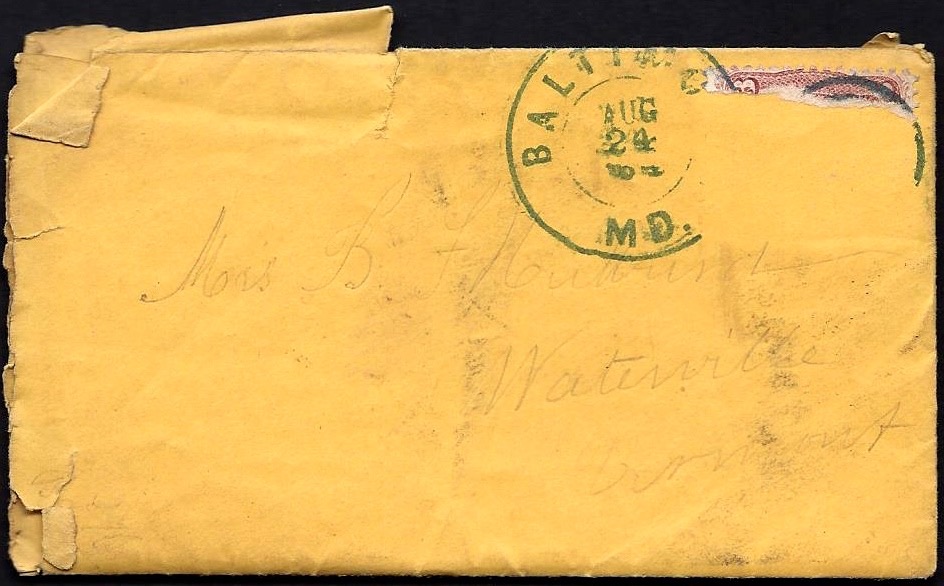
Three miles from Harpers Ferry
August 22, 1864
I wrote day before yesterday but I guess it did not go out till this morning & I intended to have this go today but was too late. Now it may not go for two or three days but I will commence & finish another time.
Well “I still live” but since I last wrote, we have had pretty tolerable warm work. Yesterday (Sunday) morning about 9 o’clock, the rebs attacked our picket line. The Old Vermont Brigade was immediately sent to the front to skirmish. We moved forward at a double quick [and] got our position. Altho our pickets had been driven back a little from their lines, you must judge whether I worked any or not. I stood in my tracks & loaded & fired 185 shots without stopping but a few minutes once or twice when I waited for cartridges. It is said that our brigade lost in killed & wounded about 250. I should think that was a rather high figure but it is possible. Tell Loyal that Sgt. [James C.] Hutchinson was shot dead & Lucius Loveland lost an arm. That was all the casualties in Co. H.
About 3 o’clock in the morning (this morning) our forces withdrew to this place—“Bolivar Heights”—& think we have a position that can be held against any odds. There is at present a little cavalry skirmishing in the distance but I don’t think they will commence an attack here. Would not wonder of they slipped off down the river & the next we heard of them they were in Maryland again.
Tell Lowater & Sam to come on this fall. Come to this company. We have a fine fellow for captain (Capt. Bass). Tell Loyal [that] Companies H & D are together now. Bass captain, Pratt Stone, 1st lieutenant, Prouty acting adjutant.
I will lay down now & take a nap & possibly may write more before I send this out. — B. F. Hulburd
Love to the children.
My hands sweat so I cannot keep a clean sheet of paper.
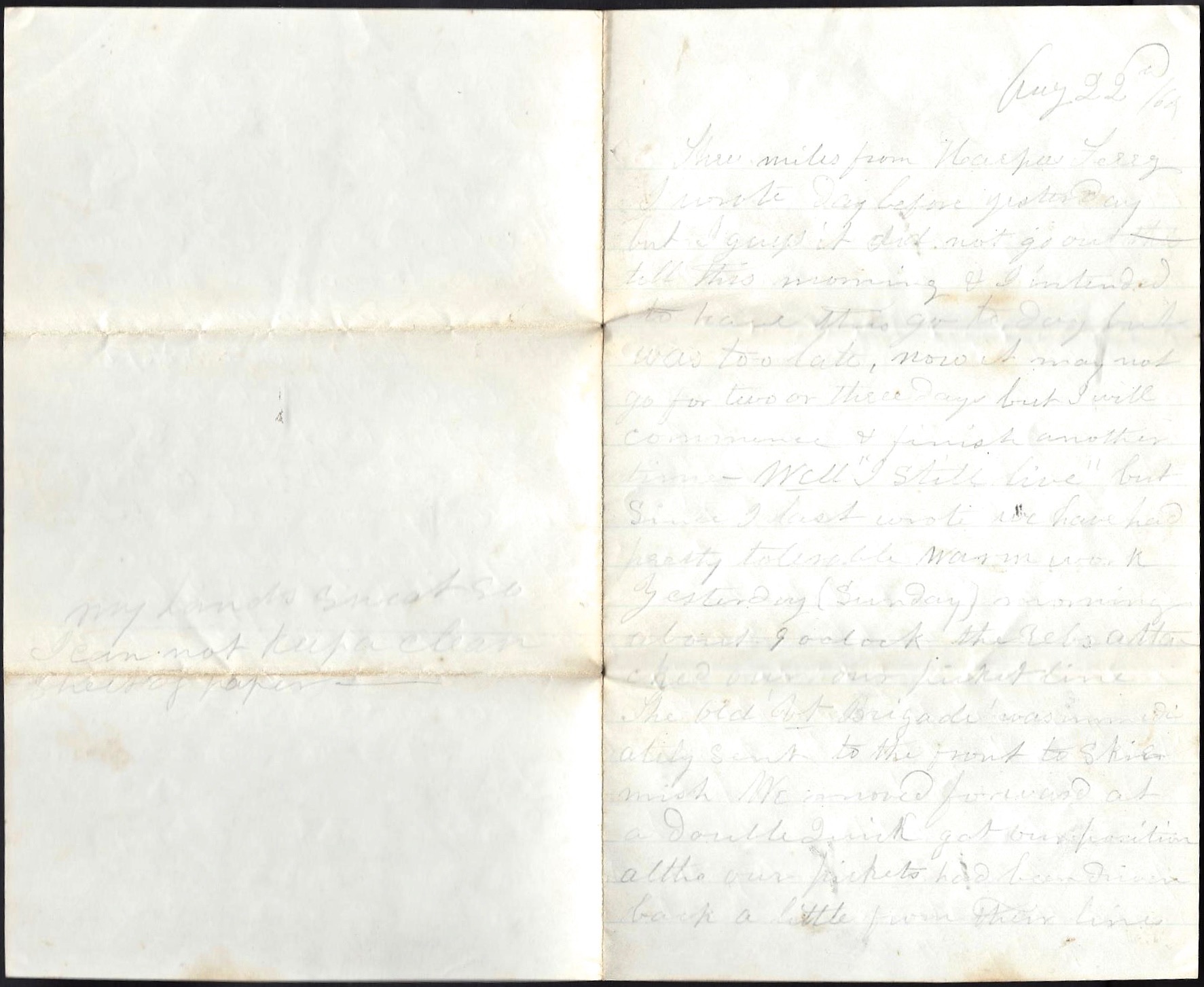
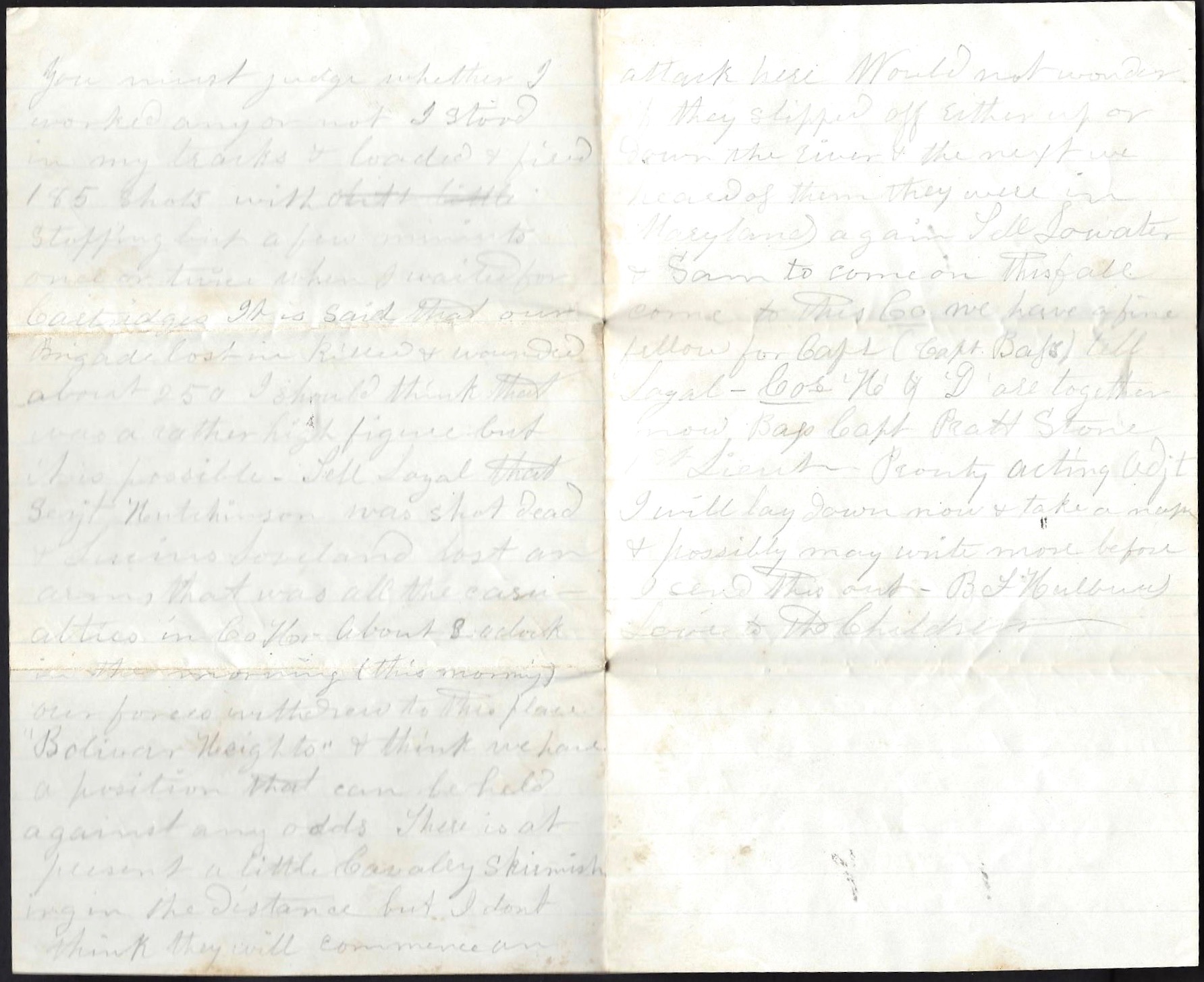
Letter 72
[Editor’s Note: This transcript was provided to me by Paul S. LeBlanc whose Uncle George P. Hulburd transcribed them from the originals in the 1960s.]
In Camp near Harpers Ferry
Aug. 25, 1864
Juliana,
I have just got yours of the 22d. It found me in good health as usual. We have laid here now three days but what next can’t tell. Have a strong position and have been fortifying since we came here. There is quite a large force of the Rebs within 4 or 5 miles has been some little skirmishing going on every day since we came. We left near Charlestown Sunday night after fighting all day, the Rebs following us up rather close. But here we make a stand and they as I said 4 or 5 miles back. There may be a fight here but I hardly think the Rebs will attack us here any more than make a feint as it were to draw attention while their main force will slip off some where—cross over into Maryland or some where else as formerly.
I believe I told you about our fight Sunday. I think our loss was set rather high—probably 175 killed and wounded would cover the loss. I don’t know as I hit any body but I sent 185 bullets at them—had fair sight at them and I intended to take good aim. The balls whistled around rather thick but generally rather high. Our lines were on a hill near the top, would rise up and could see over—fire—then squat down and load, then would be out of sight.
We have had a good smart shower today but it does not seem to cool the air much. Send more tobacco as my money is getting low again and a person can put in his eye all that he gets for a dollar here. Tell Sam to be sure and enlist it is the best thing he can do. I certainly would if I were there now notwithstanding the experience I have had this season. I wish he and Lowater would come out here. $1000 is quite a temptation—one month more and my time is one-fourth gone and you have had 550 dollars. Can you tell where it has gone to? I should like to just look into the back room and see how it looks. I always intended to finish it up and now is the best time I ever had. Do as you think best about that piazza. Probably it is as good a time as shall have—if you do it have it done in as cheap a manner as possible. May be I shall be at home sometime to see it. I rather run of the notion that I shall.
How does J. Holmes get along? Ask Loyal what in thunder the reason is he don’t write.
It is getting dark and my knapsack begins to ache and I must stop. Shall be mustered for pay (2 months) in a week but may not be paid for two months to come. Five more of the boys that were wounded on the first days fight got along back to the Co. from the hospital last night. They keep coming most every day to this and other regiments.
Eve, Hoger, Charley and the Geo. In Haste, — B. F. Hulburd
Letter 73
[Editor’s Note: This transcript was provided to me by Paul S. LeBlanc whose Uncle George P. Hulburd transcribed them from the originals in the 1960s.]
Camp of the 2nd Vt. Reg. near Charlestown
September 1st, 1864
Juliana,
Having a little leisure at this time. I will improve it in writing a few lines yet I must do it in a hurry as I shall have to go out on inspection soon. I came in from picket last night where I had been 5 days. Had a good time altho one day I thought we were going to have a little business to attend to as there was heavy skirmishing by our cavalry a short distance in front and I thought at first our cavalry were being driven back, but near night the Rebs fell back and the firing ceased and at dark all was quiet.
The night after our fight we fell back to the heights near Harpers Ferry and lay there one week the Rebs followed us up and stopped 4 or 5 days when they fell back and we after them one day took position and have been here now 4 days. 3 of it I have been on picket. My post was the same ground exactly that I occupied a week before when I sent my compliments to the Rebs in the shape of 125 bullets. It is said that the Vermont Brigade fired on that occasion 35,000 cartridges = 2,187½ lbs. of lead. It has been said that as a general thing that for every person slain in battle his weight of lead is expended. But it was ascertained that at the first volley the 2nd Vermont fired on this occasion one of the Georgia regiments numbered 27 the less. Our sharp shooters got into a large brick house just in rear of our lines annoyed the enemy very much. They soon brought a battery to bear upon the house and sent 6 or 8 shells thro’ it. The dust would scarcely clear away before our boys would use the holes made by the shells for port holes and the smoke from their rifles would be seen issuing out of them.
There was a family of 3 or 4 women and girls in the house tho’ advised to leave stuck by finally going down cellar but at last a shell came in at the cellar window when they finally skedaddled all unhurt. There was but one man killed I believe and 2 or 3 wounded in the house. What is before us of course we cannot tell. May have a general engagement here somewhere in this valley by and by, but I guess not. I think our object here two fold. First keep the Rebs out of Maryland and Penn. and secondly hold a Reb force here that might otherwise be sent back to Petersburg to reinforce Lee. But I don’t know. I sometimes get almost discouraged—but “heavy bodies move slow” like myself. My health is first rate good. My lolling serape was not much any way got over it in a day or two. I don’t think I am quite as fleshy as when I left camp last spring yet I am about fat enough now.
Got a letter from Geo. while on picket also your tobacco 4 plugs. You must be careful. If such stuff is seen, it subjects it to letter postage but that came for the 4 cts. Put it in a News Dealer in good shape with the paper in sight at one end and I will risk it. I have heard nothing reliable or otherwise in relation to the boys captured in June—only what I have written. Tell Geo. that I guess that “Bedell” can’t write. He told me some weeks ago that he had had a letter and Geo. wanted he should write but he guessed I had better and perhaps he would by and by but I don’t think he can write. Send me the News Dealers with election returns—tell me who the justices are in town etc. etc.
I will enclose my last. Don’t you think it a very feeling letter? I don’t know as I ought to have opened any correspondence last spring as perhaps I have caused her to feel bad over again. You may read but don’t you show it.
I understand Darius Holmes was wounded but have learned no particulars. Have been to see Capt. McFarland today. He always appears extremely glad to see me. Says he is writing home today and will speak of my call.
Write soon. I shall look some for a letter tonight it is my day but I don’t know but you intended George’s letter and the tobacco to answer this week. Have had no letter from Daniel yet or Royal since he went home. Tell Royal that 4 or 5 hospital boys came in last night. Sore-footed Fletcher Robinson after failing to get a transfer to the Invalid Corps is sent back. — B. F. Hulburd
When at eve thou covert
By the star thou lovest
Often remember me
And at eve when gazing
On the gay hearth blazing
Often remember me
Letter 74
Camp 2nd Vermont Regiment
September 7, 1864
Juliana,
I began a letter about a week ago and thought to have finished it about this time not knowing when I should have a chance to send it but last night the mail was going out. I caught it up and sent it along without adding anything and indeed I had nothing of importance to add nor anything of interest at this time to write. We are “lying in wait” at present. Our object chiefly I think to hold the Rebs here but they are dodging about and keep us on the alert. We are now some 10 miles from Charlestown.
Moved here the 2nd inst. Called up Sunday night at midnight, packed up, started off, went about a mile, halted, threw up a line of breastworks, got them finished at daylight, then had to give them up to another division of the Corps and we went back to where we started from, put up our tents again and are here yet. When we shall move again can’t tell. May have orders to move in an hour.
Have just been off and washed up self, shirt and socks. On my way back to camp visited large orchard and cornfield, boiled corn, fried pork and fried apple, coffee and hardtack for supper.
Sept. 8, 1864—Still here lazy as you please. Rainy today, lying in my tent on a pile of unthreshed wheat straw. It looks wicked to see the destruction we make of wheat etc.
Isaac Manning’s boy from the 11th Reg. just called on me. He got here from home a few days since. He said that he had talked with the Lieut. of Co. A about Nathan. He is very sure that he, Nathan, was captured on the occasion and not among the killed as Geo. may fear. Tell Geo. not to worry too much about him. He may come out all right yet. I see by the papers that there is now a fair prospect of an exchange of prisoners being made soon and I think it about time that something was being done in that direction.
If you can give me William’s address, I wish you would for I have lost it. Have not heard from him since the day before we left camp last spring. You need send me no more paper or envelopes as I have a good supply on hand at present. A few stamps would not come amiss for I am about out. Tobacco is always acceptable. I get all the papers you send, send every week.
Tell Volney Gilmore to write me. Is he going back and the rest? Is Sam coming or going to come out here or anywhere? Lowater is he coming? Tell Heman that I want to have him send me out a case of boots by and by. I think I might make well on them. I will let him know when. If we go into winter quarters early I shall send for them. — B. F. H.
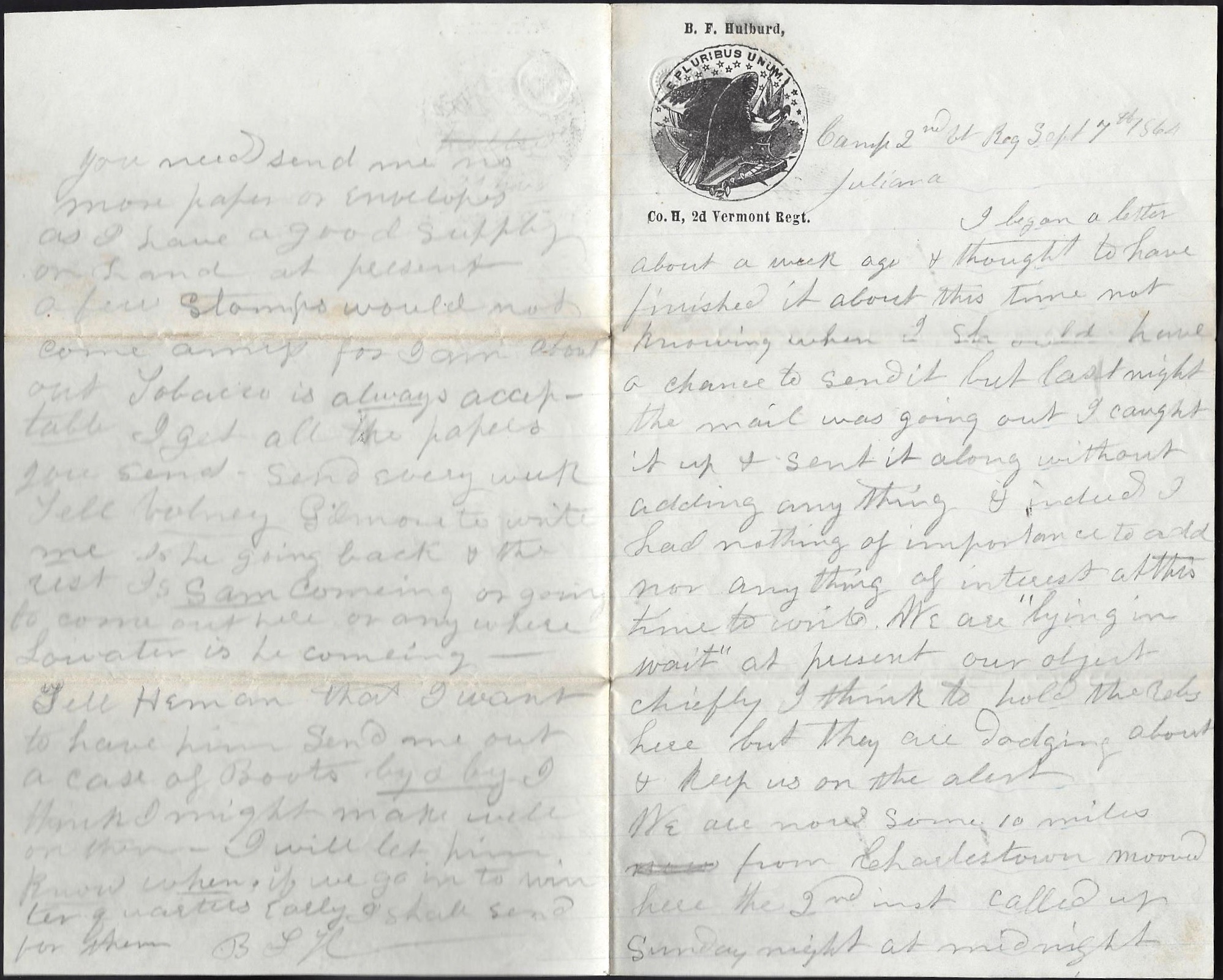
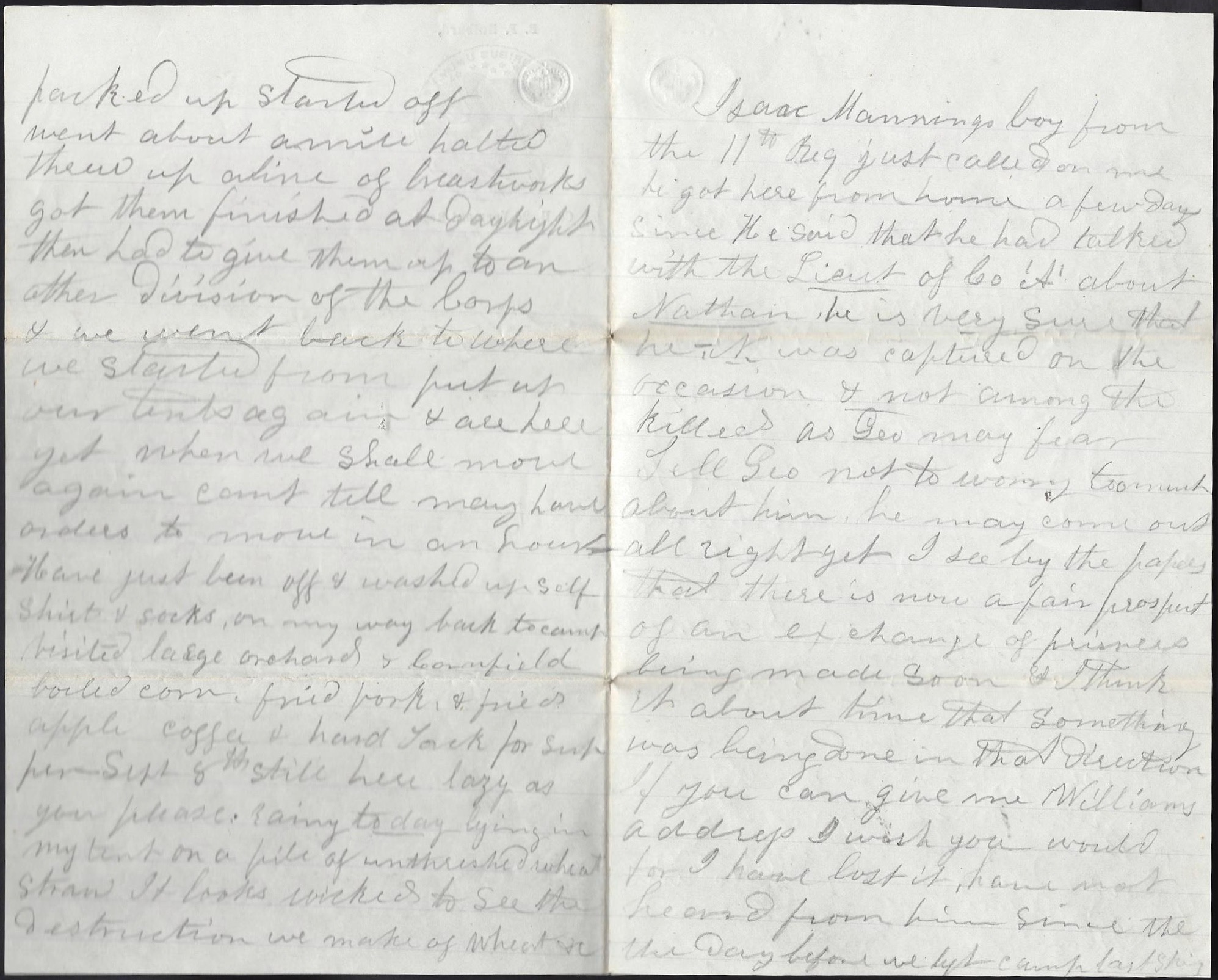
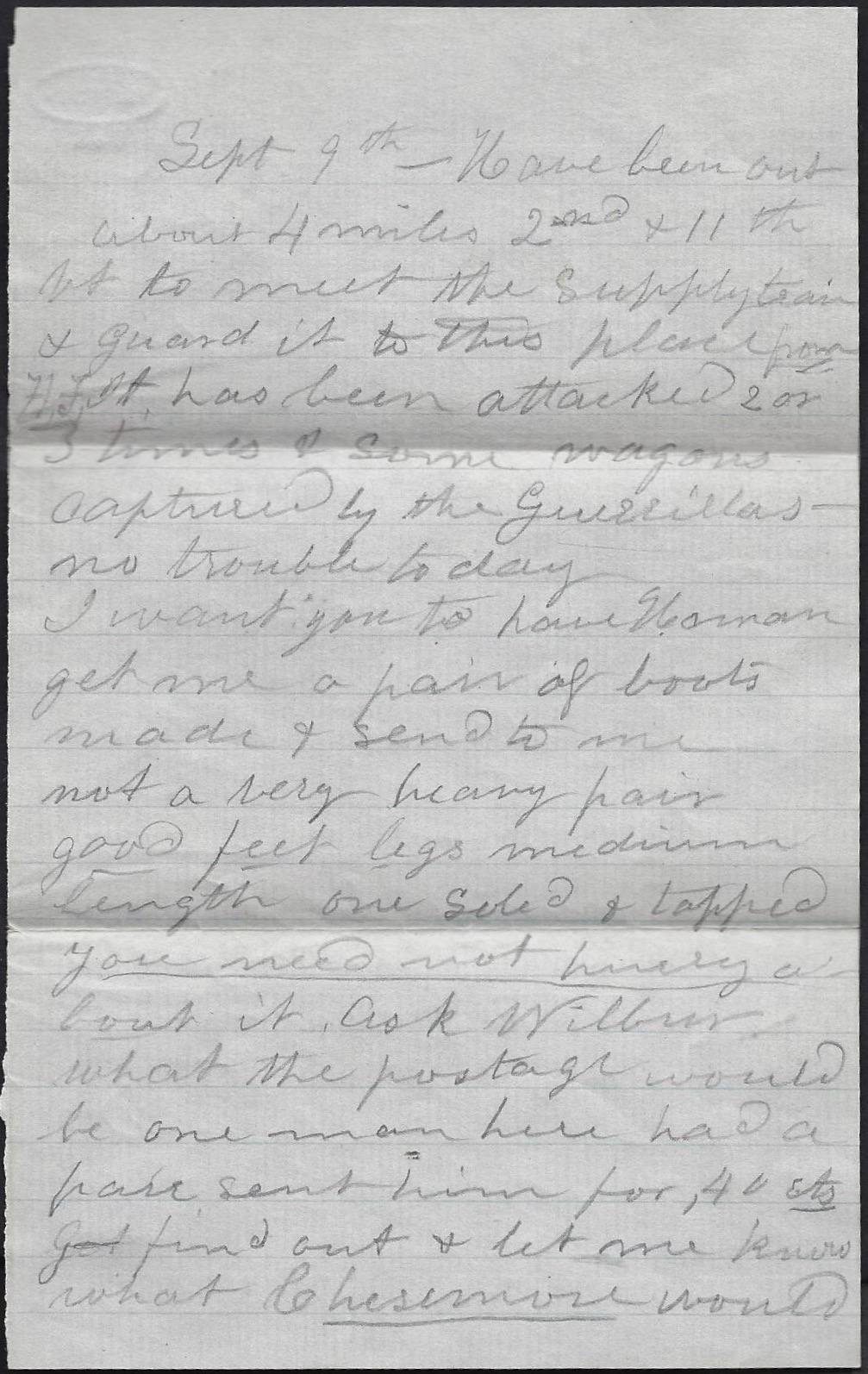
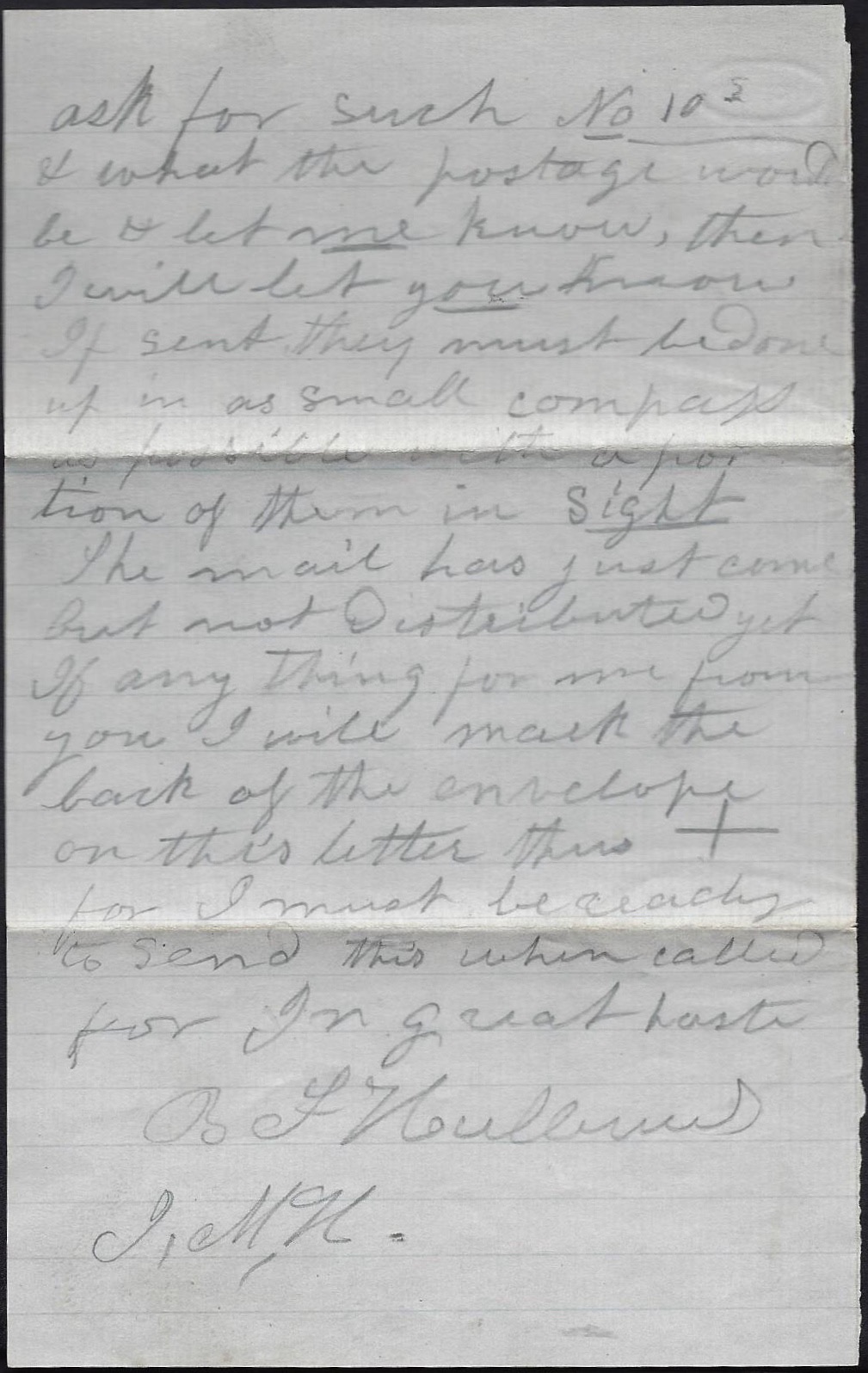
Letter 75
[Editor’s Note: This transcript was provided to me by Paul S. LeBlanc whose Uncle George P. Hulburd transcribed them from the originals in the 1960s.]
September 9th, 1864
Have been out about 4 miles. 2nd and 11th Vermont to meet the supply train and guard it to this place from Harpers Ferry. It has been attacked 2 or 3 times and some wagons captured by the guerrillas. No trouble today. I want you to have Heman get me a pair of boots made and send to me not a very heavy pair, good feet, legs medium length, one soled and tapped. You need not hurry about it. Ask Wilbur what the postage would be. One man here had a pair sent him for 40¢. Find out and let me know what Chesemore would ask for such no. 10s and what the postage would be and let me know, then I will let you know. If sent they must be done up in as small compass as possible with a portion of them in sight.
The mail has just come but not distributed yet. If anything for me from you I will mark the back of the envelope on this letter thus + for I must be ready to send this when called for.
In great haste, — B. F. Hulburd
Letter 76
[Editor’s Note: This transcript was provided to me by Paul S. LeBlanc whose Uncle George P. Hulburd transcribed them from the originals in the 1960s.]
Camp 2nd Vermont
September 10, 1864
Juliana,
I sent out a letter last night after yours of the 5th came to hand. You probably saw my X on the back showing its receipt. Being at liberty today I thought I would write a little more. I am a going “to be in want” by and by. I don’t care if you send me one pair of footings before cold weather sets in and I guess if you can knit a pair of gloves you may. Coarse yarn but single (yarn double and twisted) tolerable long wrists and the wrists seamed so they will sit snug.
I spoke about some boots. If Heman gets any I want a pair of no. 10’s coarse fine the best of leather legs tolerable length single soled and tapped. If Harvey was at home he would know how to fit me but think that Chesemore can fit me. I want a first rate good pair—no particular hurry for any of these articles—by the first of Nov. will do. You can find out about the prices and let me know.
We have been mustered for pay again, but don’t know how soon we shall be paid off. I probably shall not be able to send much money home till say the middle of Jan. My present dues are only about 30 dollars. I expect I have over run a dollar or two on my clothing bill which is to be settled up to the 1st of this month, when we are paid the excess is deducted from the pay—if not all taken up the remainder is paid in money. I think I have over run about $3.00. 3.50 pr. month
Letter 77
[Editor’s Note: This transcript was provided to me by Paul S. LeBlanc whose Uncle George P. Hulburd transcribed them from the originals in the 1960s.]
In Camp close by a place called Rippon 4 miles from
Charleston 17 from Harpers Ferry
September 15, 1864
Juliana,
I seat myself on a pile of straw tonight to answer a package of tobacco that I received tonight a little before sundown. I was out from camp on special business when the mail came in when I got back 4 plugs of tobacco was handed me but there was no letter. It being my night for mail was a little disappointed but think it will come next mail. We get it now only twice a week.
Well, I have gone through with my—“prolegomena” (don’t you see I understand Greek). I will talk about something else—well in the first place secondly—my health is most superabundant as usual. We are doing not much of any thing now days—go on picket as a regiment once in 12 or 15 days for 3 days—occasionally go out 4 or 5 miles to meet and guard our supply trains coming in to keep off the cussed guerrillas who frequently attack and capture a part of them and leave us—minus a few hard tack.
Another thing we have done yesterday morning. We were called up at 3 o’clock with orders to start at 5—got ready and started not knowing where we was a going. The 2nd Division of the 6th Corps only went—three brigades or about 10 or 12 Regiments as we are, numbering perhaps 4,000 men went about 6 miles, got where the guns began to rattle—our skirmishers being ahead of us—(by some miracle the 2nd Vermont was not on the skirmish line). We halted in line of battle about 11 A. M. and lay till sunset and let the skirmishers work they holding their lines. At dark we fell back and as soon as it was dark enough for them with safety to leave, they came back. We got into our camp about ½ past 10 at night—the loss through the day might be 3 killed and 10 or 12 wounded on our side. The Rebs loss we know nothing about—only we got 150 prisoners. We lay back to support the skirmish line should they need help, or should the enemy attempt to advance but as they held their ground we laid still till about 3 o’clock p.m. the rebs began to shell the woods where we lay—then we hustled around a little, but the shells went a little too high or passed between our legs so but one or two were hurt.
Can’t tell when this will go out. It may not for 3 days and if one comes in for me the next mail I will acknowledge it thus “/” on the envelope—no chance to write after the mail comes in before it goes out again. — B. F. Hulburd
Had a letter from Elaine today. Porter’s folks all well. We have been drawing some clothing today and I wish I could send home some that is thrown away such as pants, shirts, blouses & worn but it is useless to try to do any such thing—I got today a pair of shoes, 1 shirt (knit good) is allowed.
That coat I sent home I sent for my own wear. If I get tipped over out here then you may sell it or make Roger some thing of it. I swapped and got the coat and I know what it is. I wore it last winter and I weighed 198 lbs. it was a little tight when buttoned but large enough. The time is now gone by for picking up such stuff as cool weather will be along by and by. But if I had had a chance to send, I might last spring when we broke camp and for the first weeks campaign picked up blankets overcoats and dress coats and new ones too more than three pair of horses could draw.
If I could have the interest on what has been wasted in this army this summer I could buy out Waterville. I intend now to try and do something this winter after getting into winter quarters. If I was only at liberty, I might clear $500 this winter with fifty dollars capital as well as not. If we go into quarters in a good locality, I shall try and do something. If I had a case of boots about the time of being paid off, I could do well with them but as there is no express boxes brought to the army when on the move that will be impracticable but when we go into winter qrs. think I shall send to Heman for a case.
I don’t see how in thunder folks are a going to live there this winter. I want you to fix up yourself and the children comfortable even if it takes most all, don’t pinch yourselves nor go cold. How does the wood hold out? Speak in season for 12 or 15 cords or as much as you think best. I presume that that will be as much as 2.50 or 3.00 pr. cord this winter. If Park Page is getting wood stove length perhaps it would be as well to get it of him. Have Heman or Geo. or Daniel make a contract to be delivered by such a time piled up in good shape so that it can be measured all at one time, say 25 cords of stove wood by the first of Feb. or any way as you think best.
It would be rather agreeable and pleasant to be at home with my family this winter but I know of no place where I should be as contented away from home as in the army and it certainly pays the best take it through the year and it agrees with me. It is curious I have this season in our marches when we have marched all night I would be all in a wash of sweat when we halted for a little rest. I would lie right down on the wet ground drop to sleep, sleep 10 or 15 minutes wake up shivering but have never taken the least cold nor have I had any since I came out here only a slight cold I took while on my way from Brattleboro. My health is first rate good not the first symptom of the tisic once in a while feel a little old. And I trust that for all these blessings, for mercies vouchsafed and for preserving grace I am truly thankful to the Giver of all good, and I find comfort and consolation in daily offering up my heart’s oblations to Him and commending to his Fatherly care the interests of my family. Altho I make no profession of religion yet I am trying to live as a man should live.
September 16th—It is a beautiful day nice cool breeze and pleasant doing nothing today. I have to go on camp guard tonight have been down to a brook this forenoon and washed my shirt, pantaloons, and blouse so I look and feel quite respectable again. Just had dinner had beans today. Drew rations yesterday. Had for supper last night fried bacon soft bread and tea—the first I think we have had this summer but I did not like it like coffee — that is my drink now. Send papers. I got no papers either last night or letter only my tobacco guess they will come up tomorrow.
Did you take the children to the caravan? (why not?)
September 17th— Beautiful morning doing nothing. A letter due me from Juliana—one from Daniel—shall carry this to office today mail comes in tomorrow—not time ½ out today, gone quick. — B. F. H.
What the plague is the reason Sam did not come out. He misses it awfully in not coming.
Letter 78
[Editor’s Note: This transcript was provided to me by Paul S. LeBlanc whose Uncle George P. Hulburd transcribed them from the originals in the 1960s.]
Near Strasburgh
September 21, 1864
Juliana,
As I have just a moment to write I will improve it and say a few words. Through the mercy of God I am still alive and sound altho somewhat lame from excessive fatigue in our late fight which probably you have heard of before this. I cannot say much at this time about it but we gave the Rebs a hard whipping on the occasion but our own loss quite severe. I do not know how many killed but the Vermont Brigade lost in wounded 247. The loss in killed in the 2nd Vermont Regiment was not very severe but a good many wounded. Co. H had 7 wounded, 1 missing—supposed killed.
The fight commenced by our cavalry at sunrise. We broke camp at one started at two a.m., marched some 7 or 8 miles, got to the field about ½ past 10, formed in line of battle and lay still near 12 under a terrible shelling. At that time we rose and charged upon them across a field say 3/4 of a mile under a perfect shower of lead and iron. We soon had the fun of seeing a whole line of Rebs on the run, teams and all, but our Brigade got where they brought in a fire raking and we fell back in good order nearly ½ mile. The 8th and 19 Corps on our right made an advance and after a desperate fight, the Rebs were forced back we then advanced again and the cavalry on our left and the way the Rebs cut was a caution. We captured over 3,500 prisoners and 5 pieces
Perhaps I may have a chance to write a little more, if I do I will — so good night. — B. F. Hulburd
Letter 79
[Editor’s Note: This transcript was provided to me by Paul S. LeBlanc whose Uncle George P. Hulburd transcribed them from the originals in the 1960s.]
Encamped near a place called Edinburg
Sept. 23, 1864
Well Juliane, we have had very interesting times for a few days past. As I wrote last, we broke camp at 2 o’clock Monday morning the 19th marched till 10 halted near Winchester and had a great fight and won a glorious victory. Started Tuesday morning, went to Strasburgh 18 miles, came up with the enemy, halted at night, next morning moved round and finally got into position about 9 o’clock at night, worked all night putting up breast works rather expecting an attack in the course of the day.
We lay all day right in sight of the rebs lines, the two lines of pickets in sight firing back and forth all day. Our generals, Major Gen. Sheridan, commander of all the forces here, and 4 or 5 Brigadier Gen’s sat looking through their glasses at them. I could see they were rather undecided what to do. Sheridan was for attacking them, some of the Brigadiers somewhat against it. One said (Gen. Wright) it was a hard looking hole. Sheridan said he would not give a chaw of tobacco for all the Rebs there was there. But at 5 o’clock the thing was decided—we must make a charge. We immediately formed and went at them by certain movements I will not attempt to explain. The bullets soon flew pretty thick around us but it was for a short time for they were surprised in their rear by the 8th Corps and you ought to see them run. I cannot now tell of artillery.
There were some awful sights on the field that would shock the nerves of such as are unaccustomed to witness the scenes of a battlefield. I was helping to carry back a fellow who was shot through the leg and broke it. We was as careful as we could be with him—probably hurt him some. Told him to keep up good pluck. Said he, you do well and struck in and sung “Rally round the flag boys” shouting the battle cry of freedom.
We followed the Rebs from Winchester to this place—they came back that night (as some citizens said) “on a slow gallop.” We came on the next morning. They occupy the same ground they did when we were here 6 weeks ago—a narrow pass in the mountain strongly fortified. We are about a mile farther forward than then. What we shall do next of course I cannot tell. We have just had read a dispatch from the President thanking Gen. Sheridan and his men for the brilliant victory of the 19th of September.
Can write no more now. If I have a chance to write more before this goes, I will.
September 23d (Woodstock) another great victory yesterday—no time for more—after the Rebs. — B. F. H.
Letter 80
[Editor’s Note: This transcript was provided to me by Paul S. LeBlanc whose Uncle George P. Hulburd transcribed them from the originals in the 1960s.]
….the result perhaps I shall be able to before I finish this letter.
Our loss was very small only 2 killed in our regiment but the 3d Division of the 6th Corps suffered quite severely the Reb loss I have not learned but not as great in killed as on Tuesday. It is stated that we took in all 26 pieces of artillery and a host of prisoners. We followed them up all night they being a little the fleetest game. Some of us today at 3 o’clock we got to this place they some 5 miles ahead and have halted and I don’t know but are a going to dispute our farther progress. 24th Gun Cavalry engaged them today and have halted them out. Smart skirmishing all the afternoon the main army on the retreat as fast as possible rear guard disputing our advance.
September 25th—The Rebs have escaped us we cannot overtake them. We tonight have halted at a quite a place called Lurayburgh I believe distant from Harpers Ferry some 90 miles. We have driven old Early from the valley of the Shenandoah have gained two the greatest and most decisive victories of the war and ain’t you proud to think that I had a hand in it? We are now so far from home that our mail reaches us only once in 4 or 5 and 6 days. I got no letter last week shall look for one not till towards the last of the present. Tell me whether Hiram Leach reenlisted also Volney Gilmore and who else. My health is excellent appetite good eat about 3 lbs. of fresh beef a day with a dozen hard tack and 1 qt. of coffee. — B. F. Hulburd
September 27th—I have just heard that the mail will leave in a half hour. I thought to finish and send this out. We have had no mail now for several days don’t know when we shall get any probably not for a week. We have been lying still 2 days now probably move tomorrow have been waiting for our supply train to come up. Have heard nothing from the Rebs today.
I expect they have gone on to Lynchburgh some 50 or 60 miles where they expect to be reinforced and stand us another pull. We are getting recruits now quite fast some 8 or 1000 joined the Brigade at this place.
I have no news to write — so will stop as you will get more from the papers than I can tell about the past. Clothe yourself and children warm for the winter.
Send me nothing till you hear from me more about it.
Eva, Roger and Charley I want to see you very much but I can’t just yet. I want you to be careful of the clothes your mother gets you. — B. F. Hulburd
Letter 81
[Editor’s Note: This transcript was provided to me by Paul S. LeBlanc whose Uncle George P. Hulburd transcribed them from the originals in the 1960s.]
Mount Crawford
September 30, 1864
Dear Wife and Children,
I take this opportunity to write a few lines but don’t know when I shall finish or get a chance to send this out. We came to this place yesterday about 6 or 8 miles from where I last wrote which was Lansingburgh or some such a name. Probably shall leave here in the course of the day or tomorrow. I know nothing of the position of the enemy at present. They have had an awful hard drive for a few days past and where they have or will haul up we can not tell. Our cavalry are scouring the country around. They just went past where I write with I should think over 1000 head of cattle and as many sheep they picked up. I also learned that they burned some 3 or 4000 bushel of wheat last night a short distance from this and also that at Culpepper near Brandy Station some 50 miles from here — (perhaps more) they had captured 6000 bbls. of flour and hold the same.
We have been doing a great business of late in this valley but Oh what a destruction of property. Millions and million would not and time never can restore to this valley what this season has cost it. There are some connected with this army whose only object is plunder they will enter the houses of old and defenseless women and strip it of everything they take a fancy too—things that is of no sort of use to themselves they will bring a way and destroy. But I thank God I can say that I up to this time have touched nothing that did not belong to me if I except occasionally a sheep or fat pig that came in our way, and fruit and green corn may have suffered some, but that is all.
I have not been under a roof since I arrived in camp last June (once at Harpers Ferry got a dinner). We are now so far from our base of supplies (Harpers Ferry) that our trains can scarcely get our rations as fast as we consume them consequently we resort to means at hand to lengthen out our grub. I will tell you one measure we adopted and I guess you will smile. We were encamped for two or three days near a thundering great corn field just out of the “milk”—that is the corn was. We completely stripped the field, took the ears of corn and grated them up into just the handsomest meal you ever saw. Taking our tin plates punching holes through the bottom making a grater we would then make johnny cakes slap jacks and hasty puddings and you better believe they were tall eating having a plenty of good fresh beef, pork or mutton and fat to go with it together with that most necessary article—coffee. I never was so hearty in my life as now—tough as an Indian.
October 1st—We last night moved back to our former camp Lansingburgh where we are bound I can’t tell. We are lying still today and it is lucky for it is a rainy wet day but our tents keep us perfectly dry. I went to see Moses Mc. yesterday. He was or appeared really glad to see me had not seen him for 3 or 4 weeks. He said he had thought of me every day since our two last battles did not know but I was hit. His regiment suffered considerably in the first day’s fight. His company had 12, I think he told me, killed and wounded. Among the wounded was Kirk Brown (Sam Brown’s son) and Marshall Wells, Wells is dead and at last accounts Brown was not expected to live.
And I learn that Augustus Tyler’s son in the 11th Vermont was severely wounded and Wilder Magoon told me that John Andrews was severely wounded. I have escaped unharmed so far. I was just grazed by a ball from a “spherical case” which is a round shell filled with little balls about the size of a musket ball the shell explodes and sends its contents in every direction. Just drawed blood but I did not feel it. I am good for 90 days yet by the blessing of Heaven.
Roger, can’t you fix around and get 2 or 3 bushel of butnuts this fall so that you can have them to crack this winter. You must be careful of your boots. Have you kept them copper toes or have you and Charley got to have new ones this fall? Eva you are a good girl, now how do you get along for things, does your mother get you things that you want? Write and tell me all about it. — B. F. Hulburd
October 2nd 1864—I have just got yours of Sept 18th and the tea with 2 papers glad to get them, T and all. Nothing new today, laying still. A large detail from our regiment have gone out today on a kind of scout to hunt up a few Guerrillas said to be hid on the mountain some 5 or 6 miles out.
Hope you took the children to the caravan. Don’t get mail oftener than once a week now. Them suspenders are just about as good as new. Need not hurry about sending socks etc. Have not been paid of yet don’t much expect to now till fore part of Nov. If you keep me supplied with tobacco I shall not want for money a great deal. Our Capt. give me an order on sutler so I got some things and a little tobacco. Can write no more this time. Write as often as you can. Come [?] you write and tell me what you are doing and
what you have seen. — B. F. Hulburd
Letter 82
[Editor’s Note: This transcript was provided to me by Paul S. LeBlanc whose Uncle George P. Hulburd transcribed them from the originals in the 1960s.]
In Camp at Harrisonburgh instead of Lansingburgh as I called it
October 3, 1864
Woman and children,
I sent out a letter yesterday. Don’t know when I can send out this but I thought I would begin a letter and write as opportunities allow me so to do. We are under orders now to be ready to march at a moment’s notice. We may have notice in 5 minutes and we may not today. We drew rations yesterday for 4 days. I have been eating ever since I got up before light it is now about 10—have drank 3 pts. coffee, eat about a dozen hard tack, ½ lb. salt pork, and 2 lbs. fresh beef. Think now I can stand it till dinner which will soon be ready when I shall have another pt. coffee.
I have been rather hard on clothes since I came out. I have had in all one overcoat (sent home) 3 pr. cotton flannel drawers, 6 shirts, 2 blouses, 2 pair pants, 2 pair shoes, one rubber blanket, and one wool. Do have now 4 very good shirts one pr. drawers 3 decent pair socks and blouse good for some time yet likewise 1 pair pants that will stand me a month or two yet and good shoes—lost my blankets in our fight in the Wilderness but picked up another better woolen one shortly after which I now keep shall have to draw me a rubber one before long. So you will see that I do not suffer for clothing, only in carrying it on our marches to which if you add two ½ tents then my gun cartridge box and 40 cartridges haversack 4 days rations canteen of water it all makes quite a load.
I will notify you when I want you to send anything in clothing line. Can you knit me a night cap? Let it be red, white, and blue—bright, pure and deep. Get some of this “tidy yarn” ain’t that what they call it? Don’t want a tall peaked one nor one that sits tight to my head all over but shaped something like this [sketch] if you can jog off square fast enough. I will now wait a day or 2 before I write more and see what changes time may bring.
Well, I have eat my dinner—roast beef, hard tack, and a pint and a half of coffee and as there is no prospect of a move this p.m., I will still continue. Harrisonburgh—the place near where we are now encamped—is quite a large and respectable looking village from where we lay. I have not been in the village. When we came here we found quite a number of our wounded men who were taken prisoners when Gen. Hunter went through here early in the summer together with a lot of their own wounded both of whom were cared for by the citizens. Our men as fast as they were able were sent south. You have probably long before this read the account of our late fight and victories and have learned more than I could tell. Some people think that a private that was in an action could tell all about it but he sees but a very little of what is done the whole length of the lines some 2, 3 or 5 miles in length. I may I should say a regiment in our front on the dead run and we after them. Other parts of our lines charged upon batteries and captured them so each could tell a different story but it would take these all together to make up the great whole. But if I ever get out of this and get home I can tell some stories to my children and perhaps to their children yet.
I have used up this sheet and will now stop. Receive letters very regular from Porter or Elmine for which I feel very thankful. Now wait a few days for more. — B. F. H. to J. and Children and Mother
Eva, I want you and Roger and Charlie to learn a little hymn I send and if the Gen. is large enough learn it to him.
October 5th—Well as we are still lying in camp at same place and feeling a little lazy, I pick up my paper and pencil again though nothing new to write. Yesterday some 6 or 8 of our boys went out on a foraging expedition. Come in last night bringing in some 100 lbs. of honey jars of preserves jelly and some other stuff that they did not know what to call it half way between jell and boiled cider which they found in a house 5 or 6 miles off. They went in without ceremony and took what they wanted. Today 10 or 12 from our company have gone out again. That is business I don’t follow. One of the officers on Gen. Sheridan’s staff with a couple of his orderlies were out also on a kind of scout when they were surprised and captured by a party of guerrillas. The Capt. whose name was Meiggs and one of the orderlies was killed, the other made his escape. I rather wonder that there is not more of these little nasty foraging parties snapped up. I have but little sympathy for them any way for we have men that will commit as great outrages upon the citizens here as ever was practiced by the Rebs in their raids into Maryland
and Penn. Such acts are not allowed by the army regulations but the officers “wink” at them if they are favorably remembered in the division of the spoils. Shall look for a mail some tonight. If I have a chance will write more after it comes, otherwise + an envelope will show that I receive yours, — B. F. H.
Letter 83
[Editor’s Note: This transcript was provided to me by Paul S. LeBlanc whose Uncle George P. Hulburd transcribed them from the originals in the 1960s.]
Eddinburg
We are now 2 hard days march from where I last wrote on our way back toward Harpers Ferry. How far we shall go or where can’t tell.
Expect train to meet us to night if so shall expect letter. No time to write now have just halted for the night and am hungry must get my supper.
Our boys came in the other night from their foraging expedition brought in 100 lbs. honey, 8 jars of splendid apple butter, nice fixing a load of potatoes, onions, beets, cabbages, and 3 all-fired fat sheep. Eat a part of it next morning but had orders to move and had to leave part of the mutton and vegetables. — B. F. Hulburd
This letter was written by Elmira (Hobbs) Hulburd (1817-1892), the wife of Rev. David Porter Hulburd — an older brother of Benjamin Franklin Hulburd. She wrote the letter to Juliana, the widow of Benjamin Hulburd who was killed at the Battle of Cedar Creek on 19 October 1864.
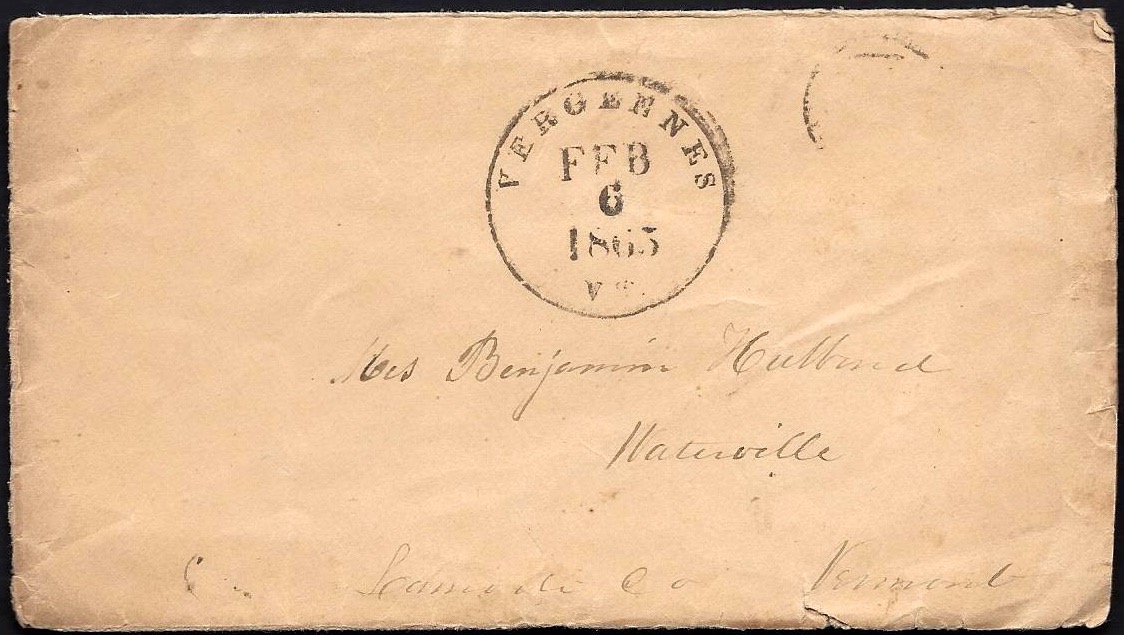
Home [Vergennes, Vermont]
January 29th 1865
Dear Sister Juliana,
Yours came to hand a few days since and was perused with mournful interest. Though I know not the heart of a widow by sad experience, yet I believe I can heartily sympathize with you in your loneliness & bereavement; and had I been near enough would have gladly borne a part of the tender of care when your children were sick. Thanks to a kind Providence that spared to you the son who was the subject of so much anxiety. May he live to reward all your toil and care. We were much disappointed that we could not go to Waterville when expected but knew of course you would know how to make allowances without thinking us indifferent. We shall improve the first opportunity afforded us for leaving home by sleighing (if consistent with higher duties). My dear husband has more than one man ought to do on his hands but you know he can not relieve himself at will, and must suit himself to circumstances as to visiting.
He has complained lately of a rheumatic affection in his left arm, otherwise is very well this winter. He is absent as usual. When he is here, speaks often of his friends—especially of you and the children since brother Benjamin’s death. It is an earnest prayer that the blessing of God may rest upon you as a family and upon your dear mother who so kindly watches over your interests. There is no one in this world that can care for you like her. I believe you appreciate the favor of her company and her kindness. May she live to see the children grow up in favor both with God and man. Tell them how anxious we are to hear of their good behavior to the Grandmother as well as their mother. Hope they will write to us soon as they can and how they get along and we will write to them and come to see them soon as we can. And when they get old enough to leave home, shall be glad to have them come to see us. May the Lord preserve their youthful and infant feet from falling into temptation and bless them forever.
It seems very aggravating to think over the circumstances of Nathan’s death ¹ — so long sick and in prison with such “barbarians”—but it is all over now and we have no doubt his sufferings only served to work out for him a “far more exceeding weight of glory” so that our sympathies are with the living ones that mourn his loss. How gladly would we hasten to relieve them if in our power and how gladly do we commend them to One who is able to bind up their broken hearts and to heal their wounded spirits. We were thankful to know of Mary’s recovery to health and sister Maria’s account as well as her own. I had hoped to see them this winter and may possibly yet (if the Lord wills).
Our children are none of them very well. [Our son] Merritt ² is in New York yet. His wife keeps house in Sandy Hill and the churches are hoping he will be recovered so as to preach to them another year under the new rule that allows them three years instead of two, but it is very doubtful in our minds as yet. He was persuaded to preach one sermon a few weeks since in New York and was laid up some weeks in consequence of the effort. [Our daughter] Emma [Stow] is just able to wait on herself and baby but is weak and scarcely able to do that.
[Our daughter] Mary is better of her cough since she came back from Poultney but is not well. My mother [Abigail (Shepard) Hobbs] is about as she has been for years—coughs badly but is able to take care of her own room. Miss Hodgson lives with us yet.
We have a great amount of snow and cold weather. The roads are drifted badly. Much love to all.
Yours affectionately, — Elmira A. [Hobbs] Hulburd
¹ Nathaniel (“Nathan”) C. Hulburd (1845-1864) was the son of Daniel Campbell Hulburd (1814-1881) and Abigail Miller (1816-1848). Nathan was a nephew of Benjamin Franklin Hulburd. Nathan served in Co. A, 1st Vermont Heavy Artillery and was taken prisoner on 23 June 1864 and died three months later at Andersonville Prison on 23 September 1864.
² Merritt Hulburd (1842-1896) was the son of Rev. David Porter Hulburd of Monkton, Vermont. Merrit followed in his father’s footsteps and in 1861, at the age of 18 he was stationed at Shushan, New York. The following year he married Cornelia McEchron. They later moved to Sandy Hill where their daughter was born.
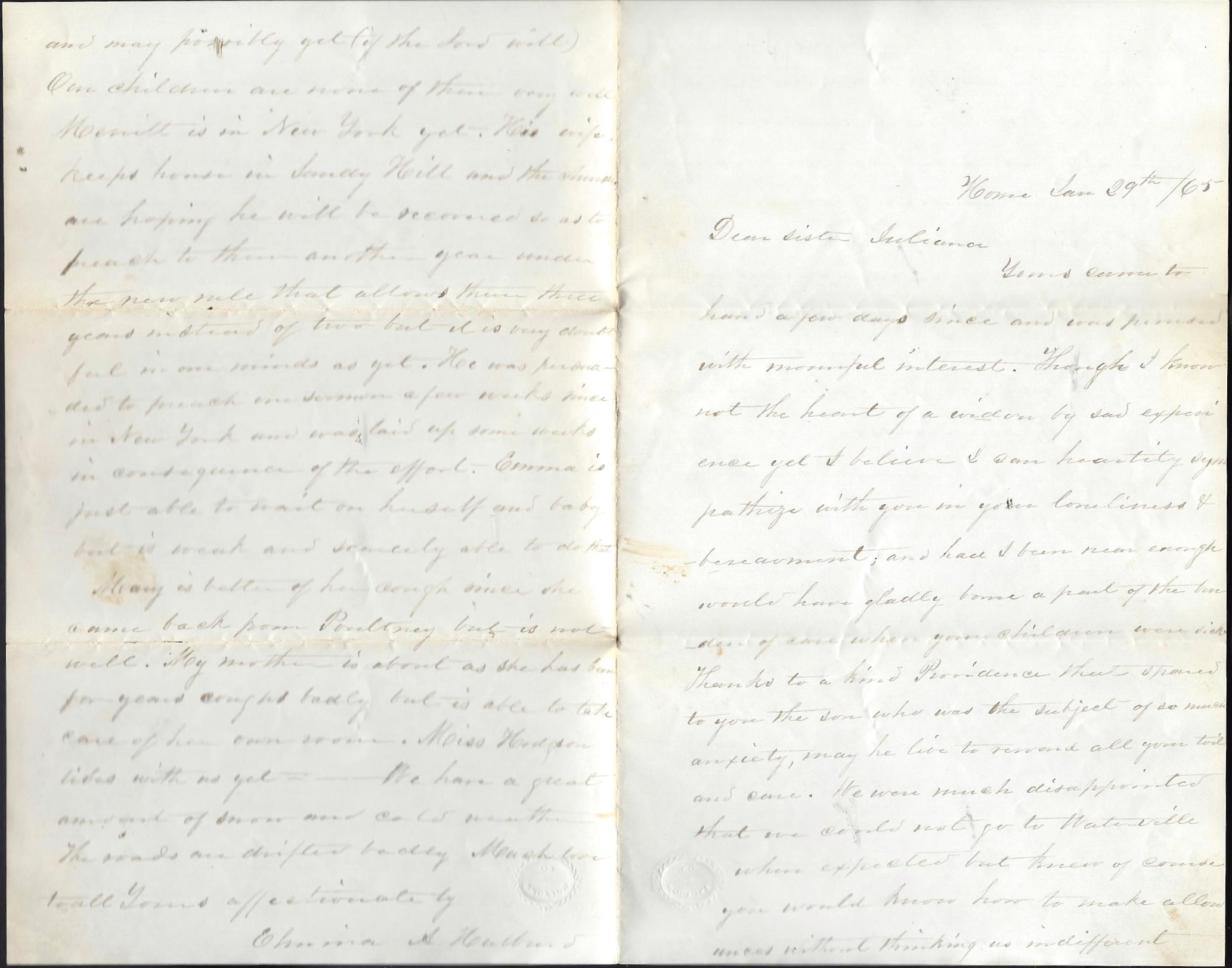
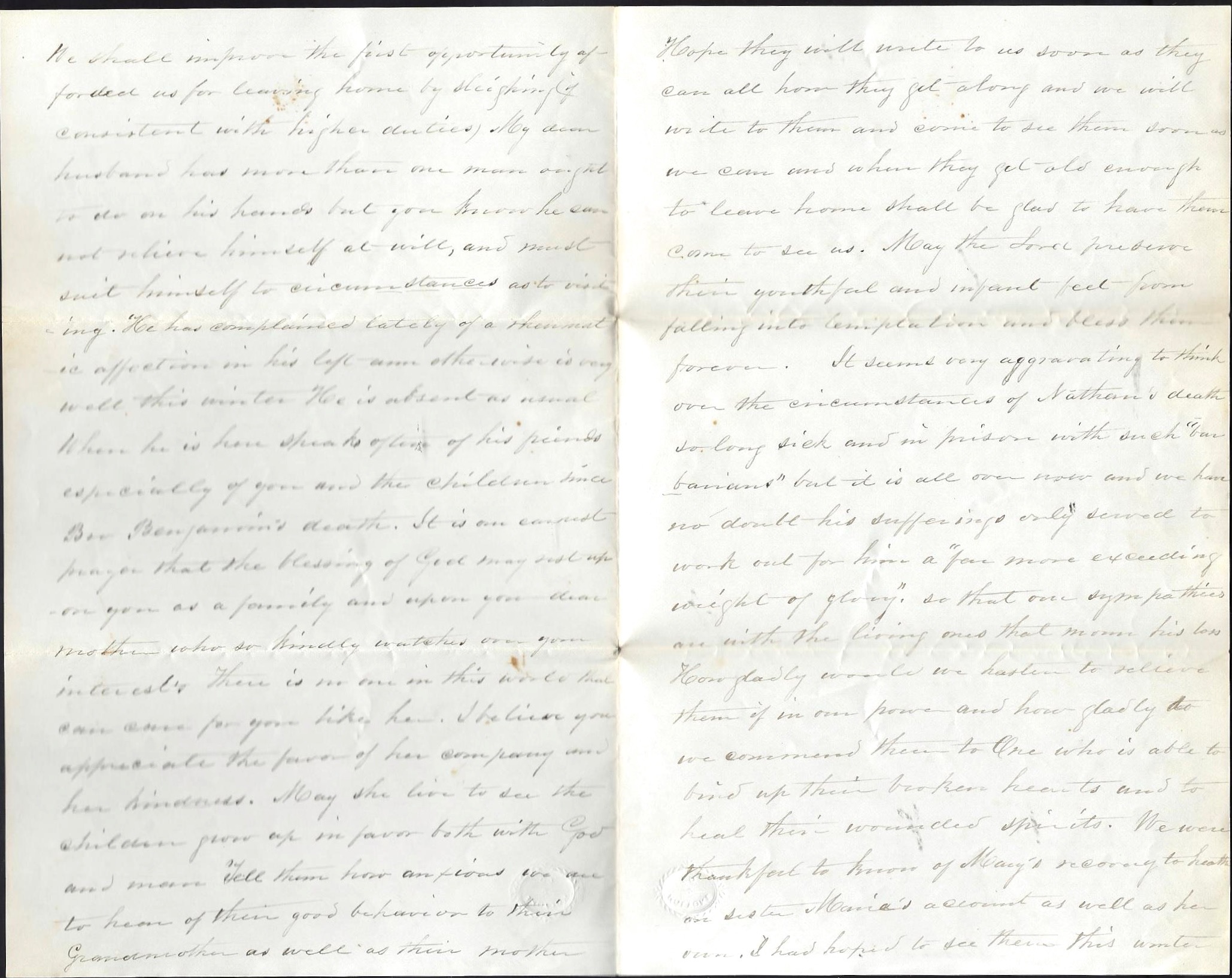
 Spared & Shared 23