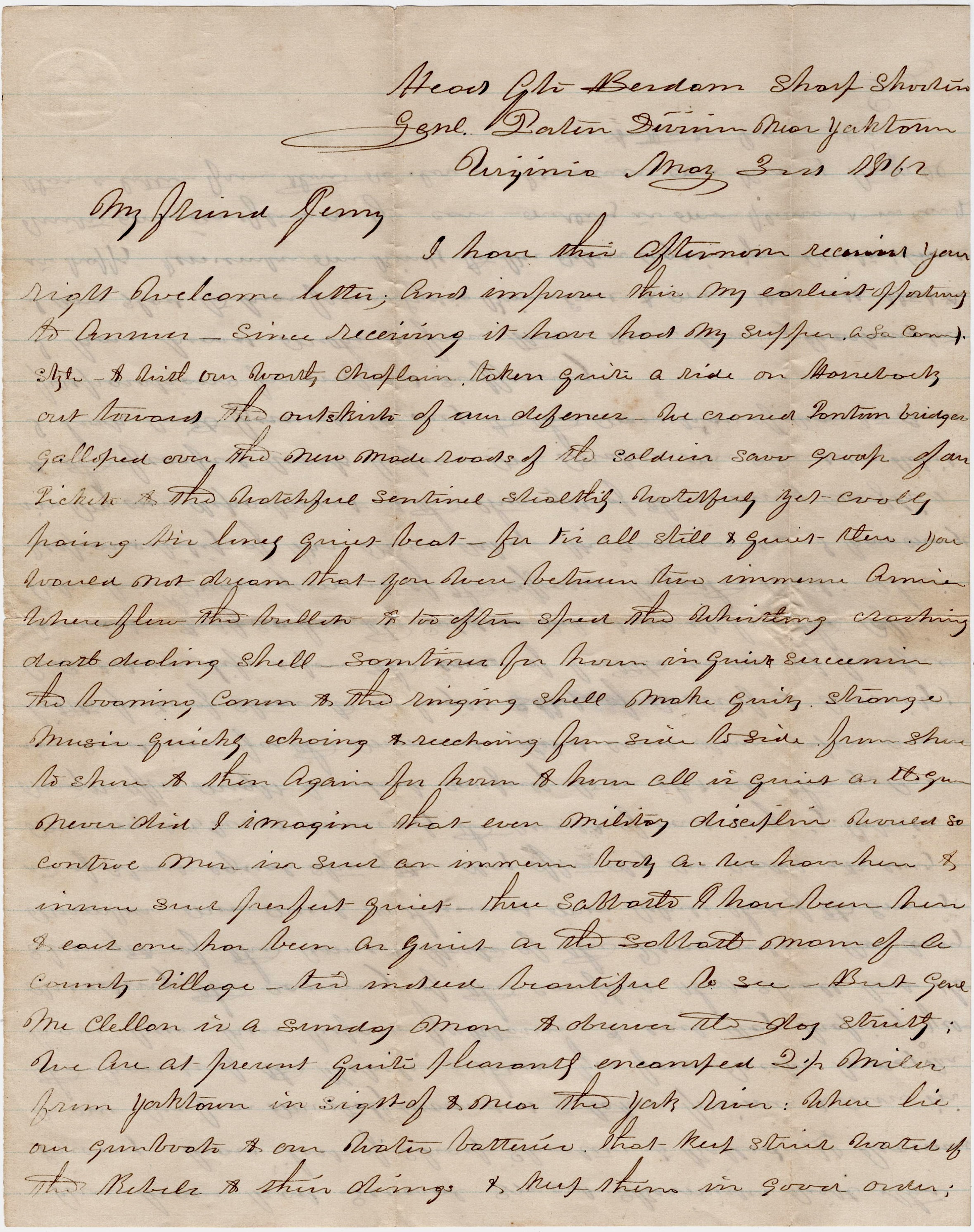
The following letters were written by Guy C. Marshall (1829-1862) who was practicing medicine in New York City from 1856 through 1861 when he volunteered to served as the Regimental Surgeon of Berdan’s Sharp Shooters.
On 27 May 1862, during the Battle of Hanover Court House, Dr. Marshall was operating on wounded soldiers at a field hospital when their position was over run by Martindale’s Confederate Brigade. But Marshall did not abandon his patients, He remained at his post and was taken a prisoner. He never rejoined his regiment again. He was sent to Libby Prison in Richmond where he witnessed treatment so severe that he complained to President Jefferson Davis who retaliated by taking away any privileges he might have otherwise enjoyed. This led to his demise. He died on 25 July 1862.
The initial letter was composed during the author’s tenure as a physician in New York City, yet it conveys the profound sense of an impending conflict—mere weeks prior to the Battle of Bull Run. The subsequent letter emerged from the Union’s siege lines before Yorktown, describing the very day on which the Rebel army would abandon their fortifications under the cover of darkness.
Letter 1
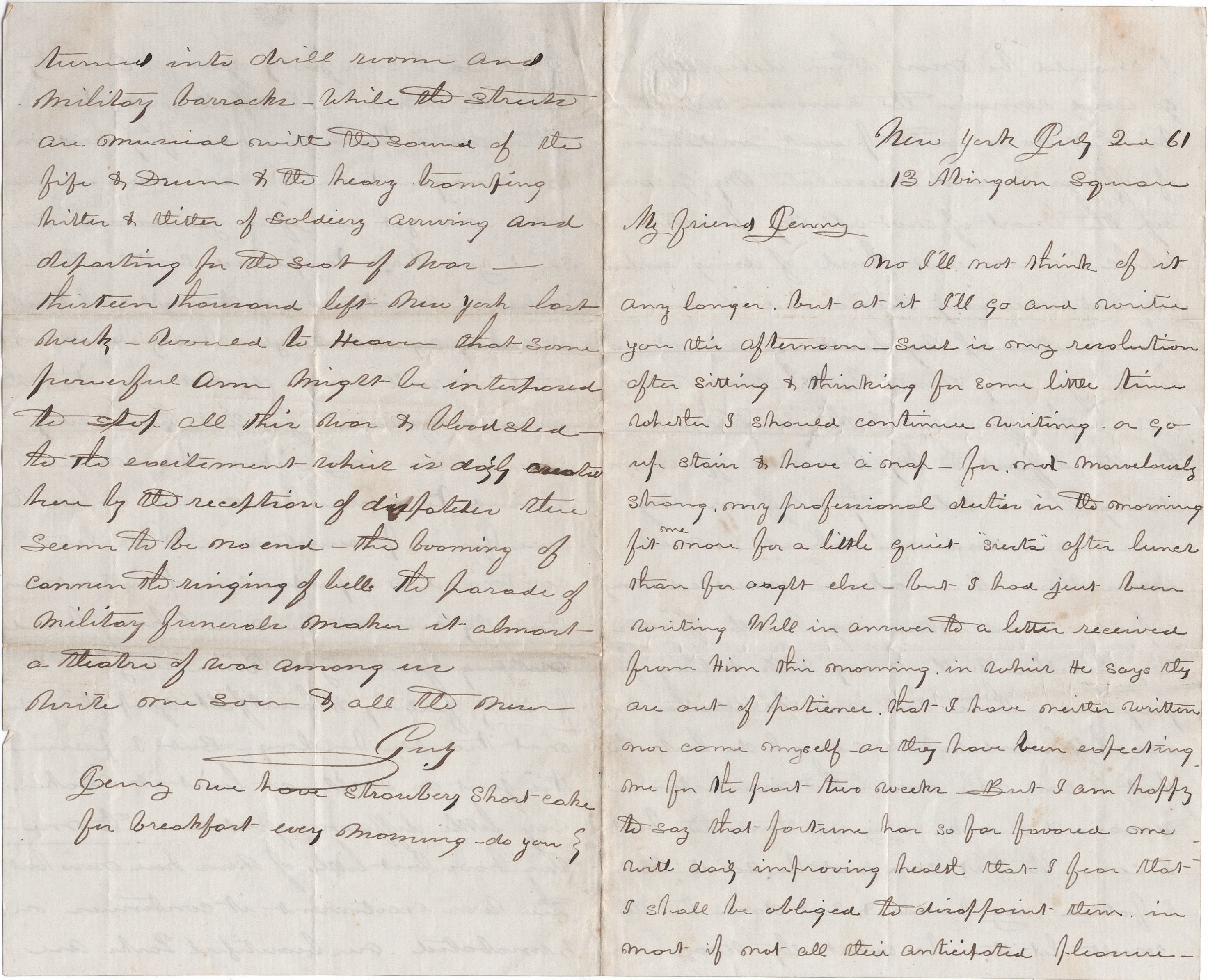
13 Abingdon Square
New York [City]
July 2nd 1861
My friend Jenny,
No, I’ll not think of it any longer, but at it I’ll go and write you this afternoon—such is my resolution after sitting & thinking for some little time whether I should continue writing or go upstairs & have a nap—for not marvelously strong, ny professional duties in the morning fot me more a little quiet “siesta” after lunch than for aught else. But I have just been writing Will in answer to a letter received from him this morning in which he says they are out of patience, that I have neither written nor come myself, as they have been expecting me for the past two weeks. But I am happy to say that fortune has so far favored me with daily improving health that I fear that I shall be obliged to disappoint them in most if not all their anticipated pleasure.
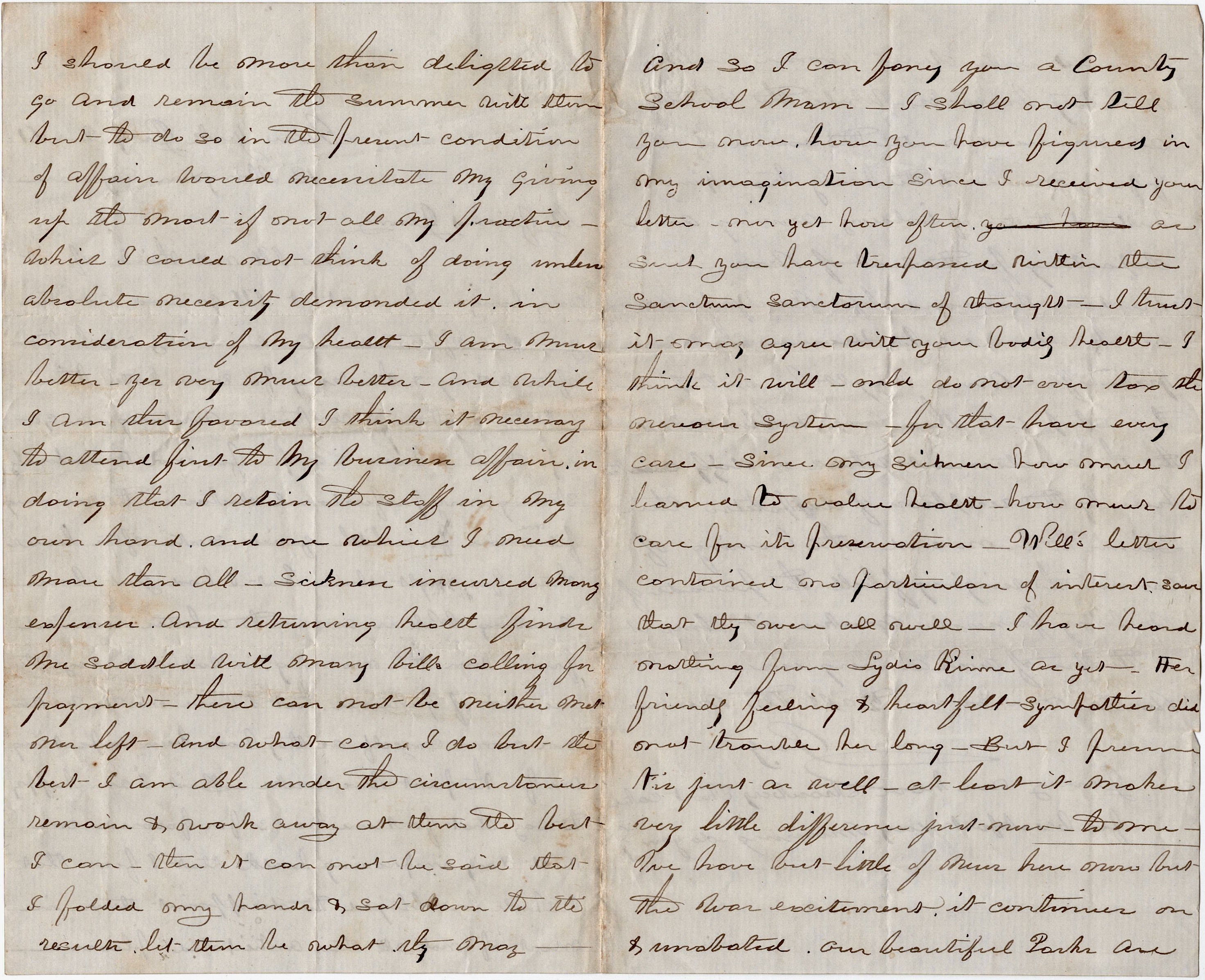
I should be more than delighted to go and remain the summer with them but to do so in the present condition of affairs would necessitate my giving ip the most if not all my practice which I could not think of doing unless absolute necessity demanded it, in consideration of my health. I am much better—yes, very much better—and while I am thus favored, I thin it necessary to attend first to my business affairs. In doing that, I retain the staff in my own hand and one which I need more than all—sickness incurred money expenses. And returning health finds me saddled with many bills calling for payment. These cannot be neither met nor left—and what can I do but the best I am able under the circumstances [than to] remain and work away at them the best I can. Then it cannot be said that I folded my hands & sat down to the results, let them be what they may.
And so I can fancy you a County School Ma’am. I shall not tell you now, however, how you have figured in my imagination since I received your letter, nor yet how often as such you have trespassed within the sanctum sanctorum of thought. I trust it may agree with your bodily health. I think it will, and do not over tax the nervous system—for that have every care. Since my sickness, how much I learned to value health. How much to care for its preservation.
Will’s letter contained no particulars of interest save that they were all well. I have heard nothing from Lydia Rime as yet. Her friends feeling & heartfelt sympathies did not trouble her long. But I found tis just as well—at least it makes very little difference just now to me.
We have but little news here now but this war excitement—it continues on and unabated. Our beautiful parks are turned into drill room and military barracks while the streets are musical with the sound of the fife and drum & the heavy tramping hither & thither of soldiers arriving and departing for the seat of war. Thirteen thousand left New York last week. Wound to Heaven that some powerful arm might be interposed to stop all this war & bloodshed—to the excitement which is daily created here by the reception of dispatches there seem to be no end—the booming of cannon, the ringing of bells, the parade of military funerals makes it almost a theatre of war among us.
Write soon & all the news. — Guy
Jenny, we have strawberry shortcake for breakfast every morning. Do you?
Letter 2
Headquarters Berdan Sharp Shooters
Gen. Porter’s Division near Yorktown, Virginia
[Saturday] May 3rd, 1862
My friend Jenny,
I have this afternoon received your right welcome letter and improve this my earliest opportunity to answer. Since receiving it, have had my supper a la camp style & visit our worthy chaplain, taken quite a ride on horseback out toward the outskirts of our defenses, We crossed pontoon bridges, galloped over the new made roads of the soldiers, saw a group of our pickets & the watchful sentinel stealthily watchful, yet cooly pacing his lonely quiet beat—for tis all still & quiet there. You would not dream that you were between two immense armies where flew the bullets & too often sped the whistling, crashing death-dealing shell—sometimes for hours in quick succession. The booming cannon and the ringing shell make quite strange music—quickly echoing and re-echoing from side to side from shore to shore and then again for hour to hour all is quiet as the gun never did. I imagine that even military discipline would so control men in such an immense body as we have here & [ ] such perfect quiet. Three Sabbaths I have been here & each one has been as quiet as the Sabbath morn of a country village—to indeed beautiful to see—but Gen. McClellan is a Sunday man & observes the day strictly.
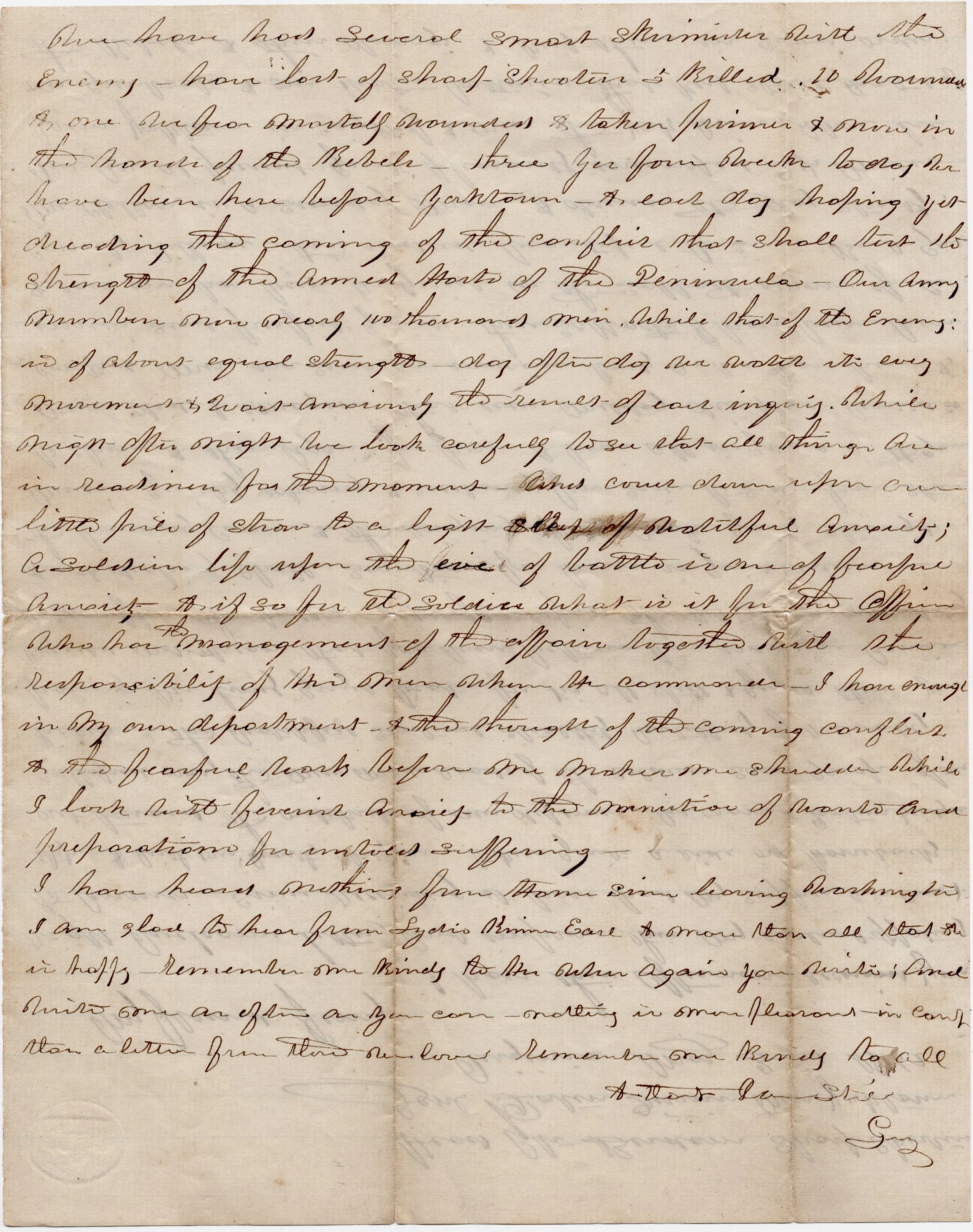
We are at present quite pleasantly encamped 2.5 miles from Yorktown in sight & near the York River where lie our gunboats & our water batteries that keep strict watch of the Rebels and their doings & keep them in good order. We have had several smart skirmishes with the enemy—have lost of sharp shooters 5 killed, 10 wounded, & one we fear mortally wounded & taken prisoner & now in the hands of the Rebels. Three, yes four weeks today we have been here before Yorktown & each day hoping yet dreading the coming of the conflict that shall test the strength of the armed hosts of the Peninsula. Our army numbers now nearly 100 thousand men while that of the enemy is of about equal strength. 1
Day after day we watch its every movement & wait anxiously the result of each inquiry. While night after night we look carefully to see that all things are in readiness for the moment and cover down upon our little pile of straw to a light sleep of watchful anxiety. A soldier’s life upon the eve of battle is one of fearful anxiety and if so for the soldier, what is it for the officer who has management of the affair together with the responsibility of the men whom he commands? I have enough in my own department & the thought of the coming conflict & the fearful work before me makes me shudder while I look with feverish anxiety to the minutia of wants and preparations for untold suffering.
I have heard nothing from home since leaving Washington. I am glad to hear from Lydia, K___. Earl & more than all that [ ]. Remember me kindly to her when again you write. And write soon and often as you can. Nothing is more pleasant in camp than a letter from those we love. Remember me kindly to all and that I am still, — Guy
1 This passage in Guy’s letter confirms that right up until Confederate Gen. Magruder evacuated his fortifications at Yorktown, he managed to delude Gen. McClellan into believing that he had at least twice as man men he had, if not three times. The lack of reliable intelligence led McClellan into a month-long siege instead of an immediate attack.