This letter was written by Joseph Bloomfield Osborn (1842-1876), the son of Joseph Miller Osborn (1806-1876) and Martha Williams (1807-1871) of Bloomfield, Essex county, New Jersey. Joseph wrote the letter while an ordinary seaman serving aboard the USS Vanderbilt in 1865. Prior to his service in the US Navy, he was a member of Co. F, 26th New Jersey Infantry. The USS Vanderbilt was a heavy side-wheel steamer cruiser built by Cornelius Vanderbilt for transatlantic passage but made available to the US Government at the start of the Civil War. In January 1865, she joined in the heavy naval bombardment against Fort Fisher.
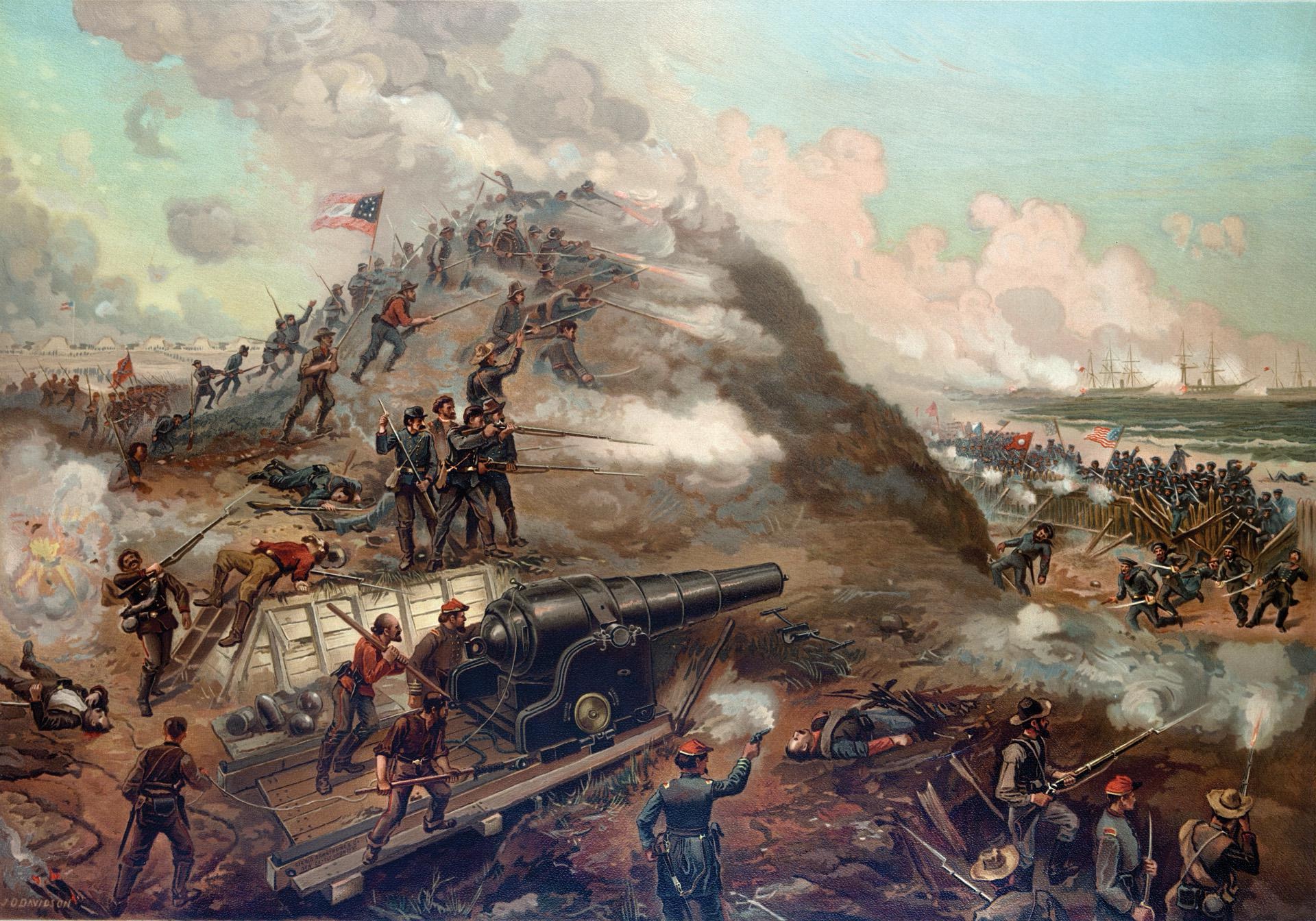
In addition to bombarding the forts from the sea, a landing party of some 1600 to 200 US sailors and 400 marines assaulted the northeast salient of Fort Fisher. “Three successive waves of sailors and marines were to attack the eastern seawall, but instead the assault went forward in a single unorganized mass. 2,000 sailors and marines crashed into the Confederate defenses. The battle was intense and furious. Although greatly outnumbered, the Rebel soldiers clung tenaciously to their defenses. Marines were meant to use rifle fire from nearby trenches to cover the assault armed only with pistols and cutlasses. Though this assault failed to carry the fort, their presence took the attention of the fort’s defenders leading to success by the infantry forces assaulting the opposite side. Its capture sealed off of one of the Confederacy’s last major ports.
Joseph’s 4-page letter describes the bombardment of Fort Fisher on January 15, 1865 and in particular the assault on the fort by the landing party of selected or volunteer sailors and marines. One of the landing party was Joseph’s close friend and shipmate Thomas Cosgrove of Bloomfield, New Jersey, who volunteered in spite of the dangerous mission, determined “to enter the fort or to die in the attempt.” Joseph gives us an account of his friend’s death, carrying the US Flag to the top of the sandhill and partly through the breach in the palisades [see US Genwebsites].
Apparently a number of Joseph’s letters are archived and on microfilm in the Library of Congress and are characterized as an “excellent but little known collection.” See Joseph Bloomfield Osborn papers, 1862-1865.
T R A N S C R I P T I ON
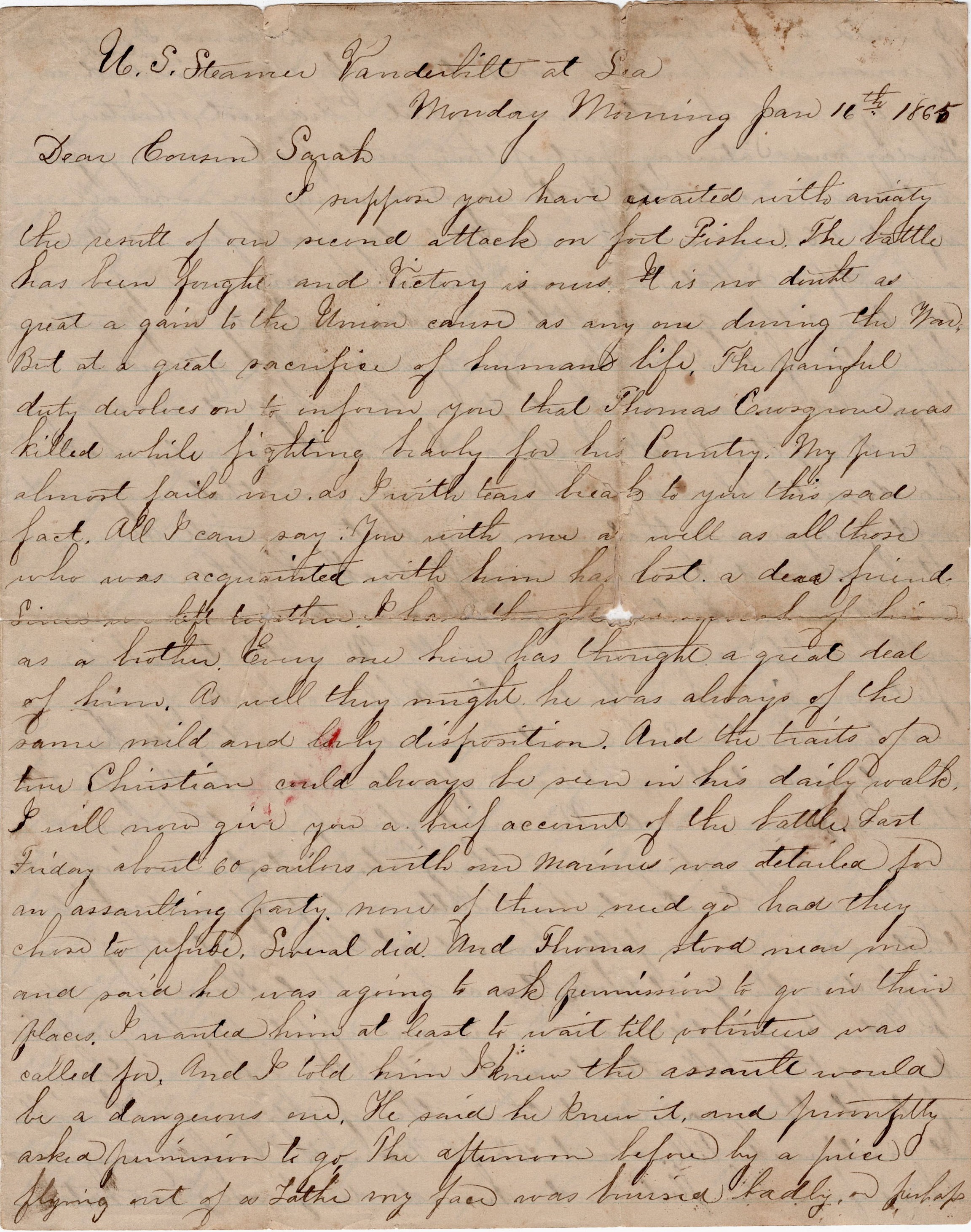
U. S. Steamer Vanderbilt at Sea
Monday morning, January 16th 1865
Dear Cousin Sarah,
I suppose you have waited with anxiety the result of or second attack on Fort Fisher. The battle has been fought and Victory is ours. It is no doubt as great a gain to the Union cause as any one during the war. But at a great sacrifice of human life. The painful duty devolves on [me] to inform you that Thomas Cosgrove was killed while fighting bravely for his country. My pen almost fails me as I with tears break to you this sad fact. All I can say, you, with me as well as all those who was acquainted with him has lost a dear friend. Since we left together, I have thought a good deal of him as a brother, Everyone here has thought a great deal of him. As well they might. He was always of the same, mild and lively disposition. And the traits of a true Christian could always be seen in his daily walk.
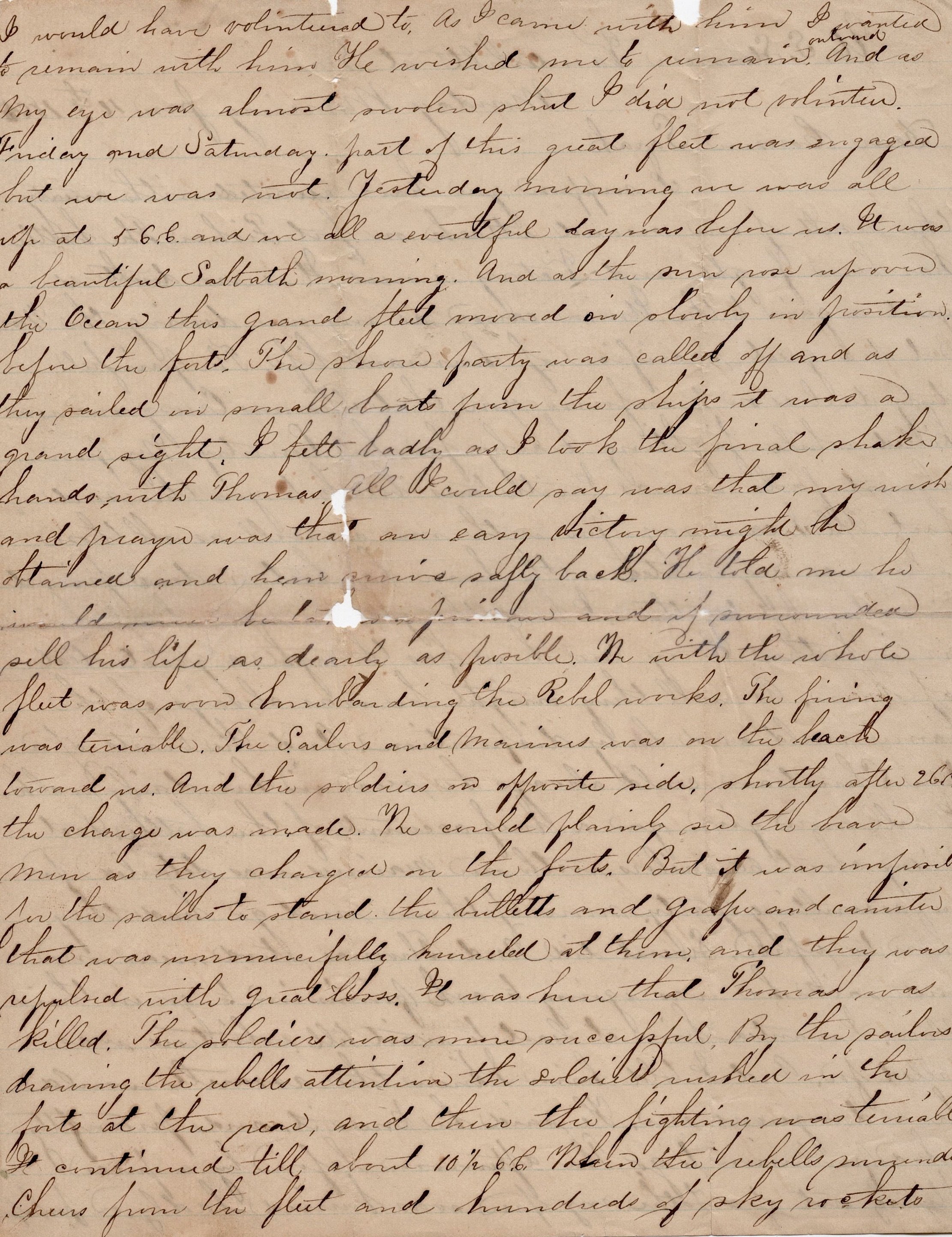
I will now give you a brief account of the battle. Last Friday about 60 sailors with our marines was detailed for an assaulting party. None of them need go had they chosen to refuse. Several did and Thomas stood near me and said he was agoing to ask permission to go in their places. I wanted him at least to wait till volunteers was called for and I told him I knew the assault would be a dangerous one. He said he knew it and promptly asked permission to go. The afternoon before by a piece flying out of a lathe, my face was bruised badly or perhaps I would have volunteered too. As I came with him, I wanted to remain with him. He wished me to remain on board and as my eye was almost swollen shut, I did not volunteer.
Friday and Saturday part of this great fleet was engaged but we was not. Yesterday morning we was all up at 5 o’clock and we all [saw] an eventful day was before us, It was a beautiful Sabbath morning. And as the sun rose up over the Ocean, this grand fleet moved on slowly in position before the forts. The shore party was called off and as they sailed in small boats from the ships, it was a grand sight. I felt badly as I took the final shake of hands with Thomas. All I could say was that my wish and prayer was that an easy victory might be obtained and him arrive safely back. He told me he would never be taken a prisoner and if wounded, sell his life as dearly as possible.
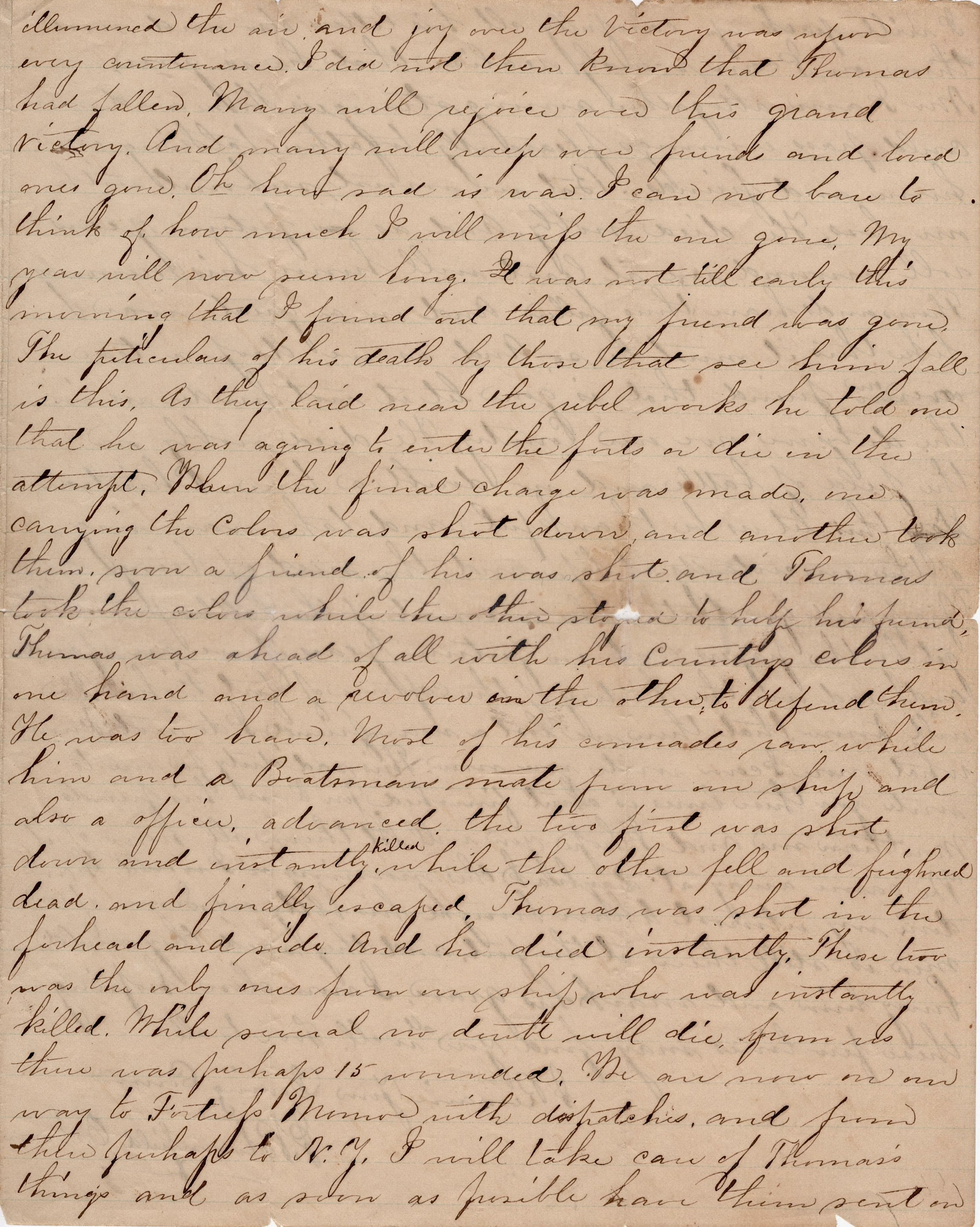
We with the whole fleet was soon bombarding the Rebel works. The firing was terrible. The sailors and marines was on the beach toward us and the soldiers on opposite side. Shortly after 2 o’clock, the charge was made. We could plainly see the brave men as they charged on the forts. But it was impossible for the sailors to stand the bullets and grape and canister that was unmercifully hurled at them and they was repulsed with great loss. It was here that Thomas was killed. The soldiers was more successful. By the sailors drawing the Rebel’s attention, the soldiers rushed in the forts at the rear and then the fighting was terrible. It continued till about 10.30 o’clock. When the rebels surrendered, cheers from the fleet and hundreds of sky rockets illumined the air and joy over the victory was upon every countenance. I did not then know that Thomas had fallen. Many will rejoice over this grand victory and many will weep over friends and loved ones gone. Oh how sad is war. I cannot bear to think of how much I will miss the one gone. My year will now seem long.
It was not till early this morning that I found out that my friend was gone. The particulars of his death by those that see him fall is this. As they laid near the rebel works, he told me that he was agoing to enter the forts or die in the attempt. When the final charge was made, one carrying the colors was shot down and Thomas took the colors while the other stopped to help his friend. Thomas was ahead of all with his country’s colors in one hand and a revolver in the other to defend them. He was too brave. Most of his comrades ran while him and a Boatsman mate from our ship and also a officer advanced. The two first was shot down and instantly killed while the other fell and feigned dead and finally escaped.
Thomas was shot in the forehead and side and he died instantly. These two was the only ones from our ship who was instantly killed while several, no doubt, will [yet] die from us. There was perhaps 15 wounded.
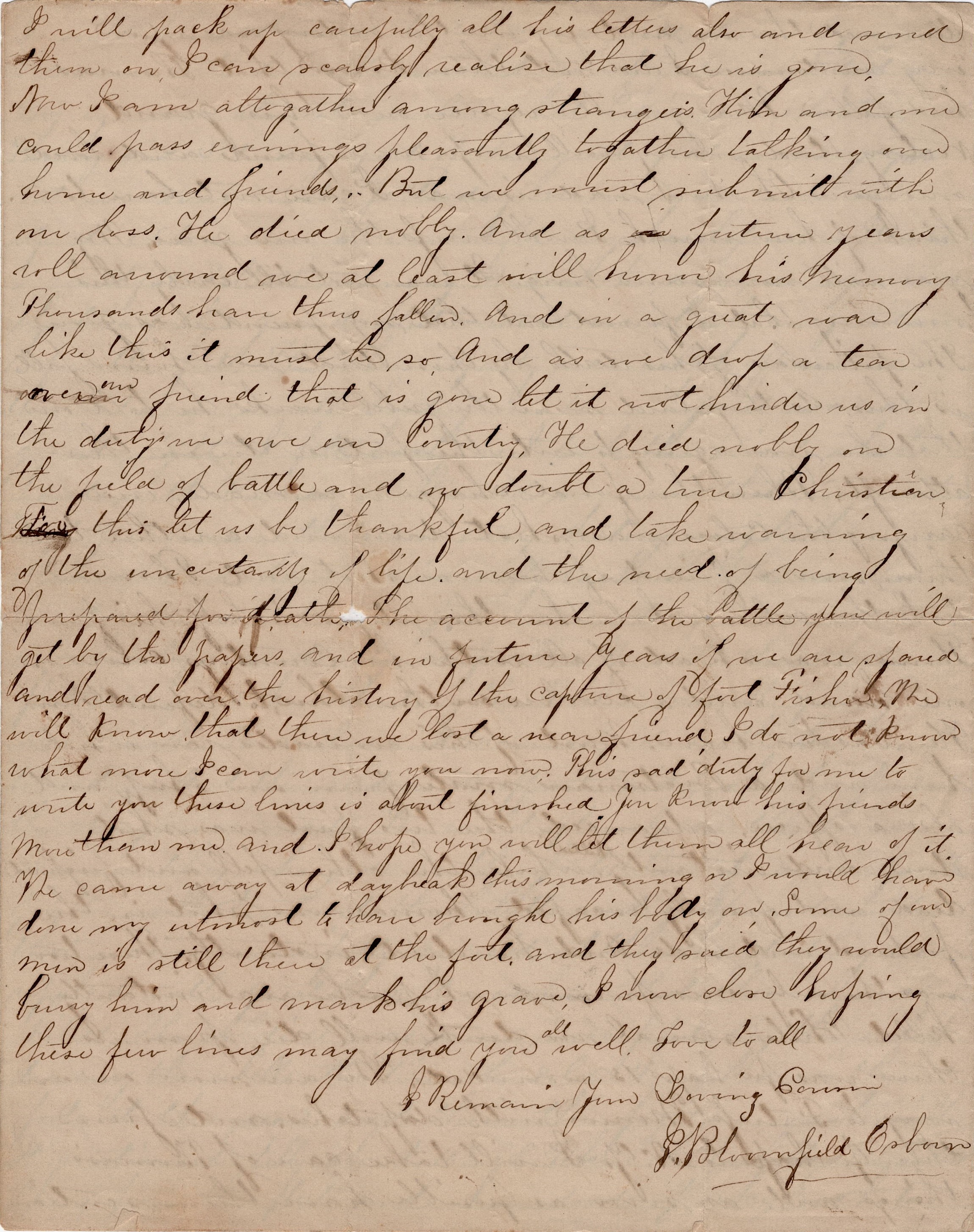
We are now on our way to Fortress Monroe with dispatches and from there perhaps to New York City. I will take care of Thomas’ things and as soon as possible have them sent. I will pack up carefully all his letters also and send them on. I can scarcely realize that he is gone. Now I am altogether among strangers. Him and me could pass evenings pleasantly together talking over home and friends. But we must submit with our loss. He died nobly. And as future years roll around, we at least will honor his memory. Thousands have thus fallen. And in a great war like this, it must be so. And as we drop a tear over our friend that is gone, let it not hinder us in the duty we owe our country. He died nobly on the field of battle and no doubt a true Christian. For this, let us be thankful and take warning of the uncertainty of life and the need of being prepared for death.
The account of the battle you will get by the papers and in future years, if we are spared and read over the history of the capture of Fort Fisher, we will know that then we lost a near friend. I do not know what more I can write you now. This sad duty for me to write you these lines is about finished. You know his friends more than me and I hope you will let them all hear of it. We came away at daybreak this morning or I would have done my utmost to have brought his body on. Some of our men is still there at the fort and they said they would bury him and mark his grave. I now close hoping these few lines may find you all well. Love to all.
I remain your loving cousin, — J. Bloomfield Osborn