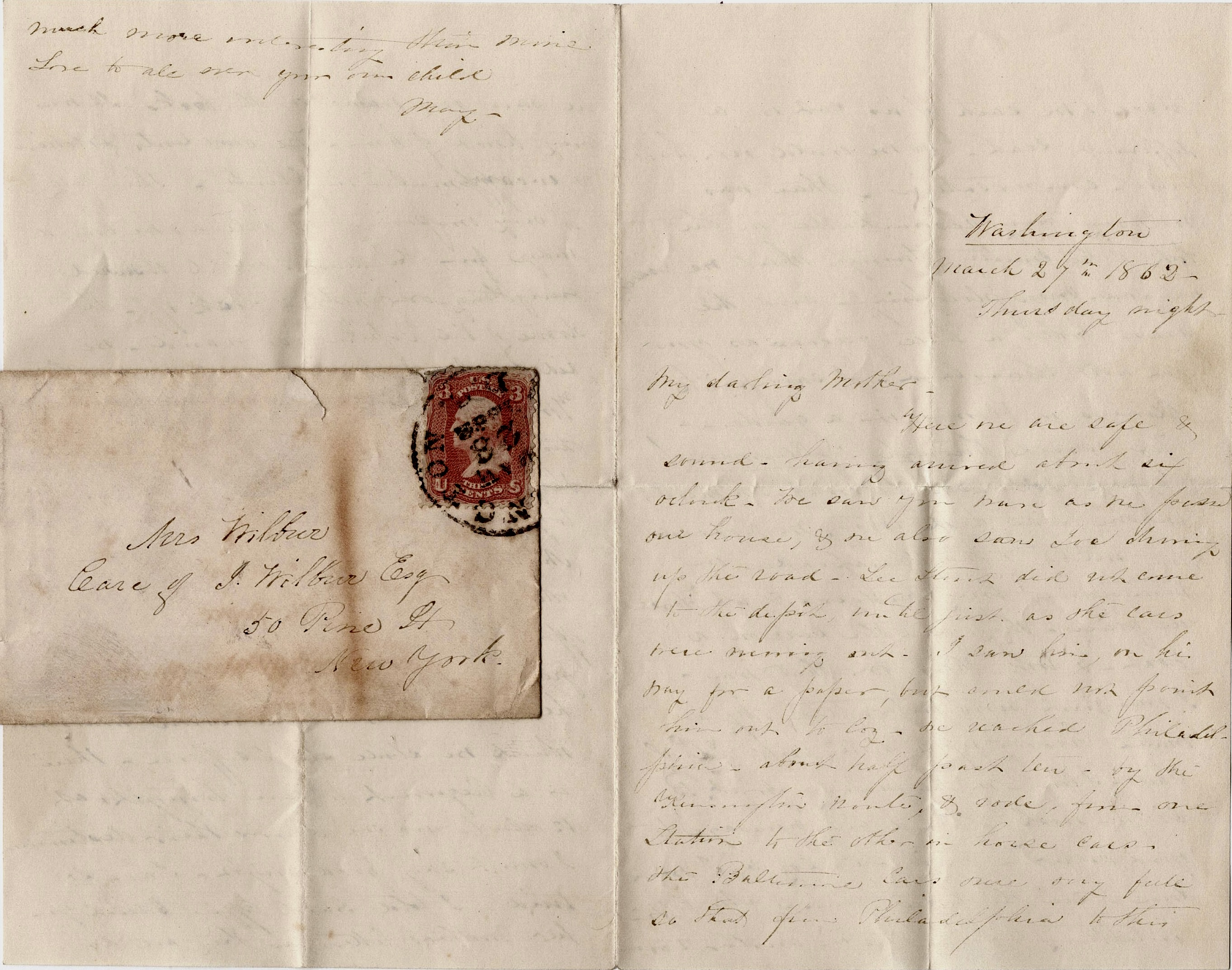
The following letter was written by Mary Masters Wilbur (1834-1917) to her mother, Sarah (Masters) Wilbur—the wife of Jeremiah Wilbur (1804-1876) of the New York City firm of Wilbur & Price, 50 Pine Street. The family made their home in Brooklyn. Jeremiah Wilbur was a sibling of Rachel Wilbur (b. 1903) who married Johnathan Harrison Lambdin (1798-1825). Their daughter Sarah (b. 1820) married Edmund Coffin about 1840 in Manhattan, N. Y. City, and resided in Greenburgh, New York.
Most of the aforementioned family information was gleaned from a biographical sketch of the family attached to the Masters-Taylor, Wilbur Papers, 1796-1857, housed at the University of Michigan. It reads, “Jeremiah Wilbur (born c.1805) and his sister Rachel Wilbur were both born in New Jersey. Jeremiah Wilbur, his wife Sarah Masters Wilbur, and their three children lived in New York City, where Jeremiah worked for his father-in-law’s firm of Masters & Markoe. Rachel Wilbur was married in 1818 to Jonathan Harrison Lambdin (1798-1825); they had three daughters. Both of Jonathan Lambdin’s business ventures in Pittsburg had failed by the time of his death in 1825, and his widow Rachel Lambdin and her young daughters returned to her family in New Jersey.”
T R A N S C R I P T I ON
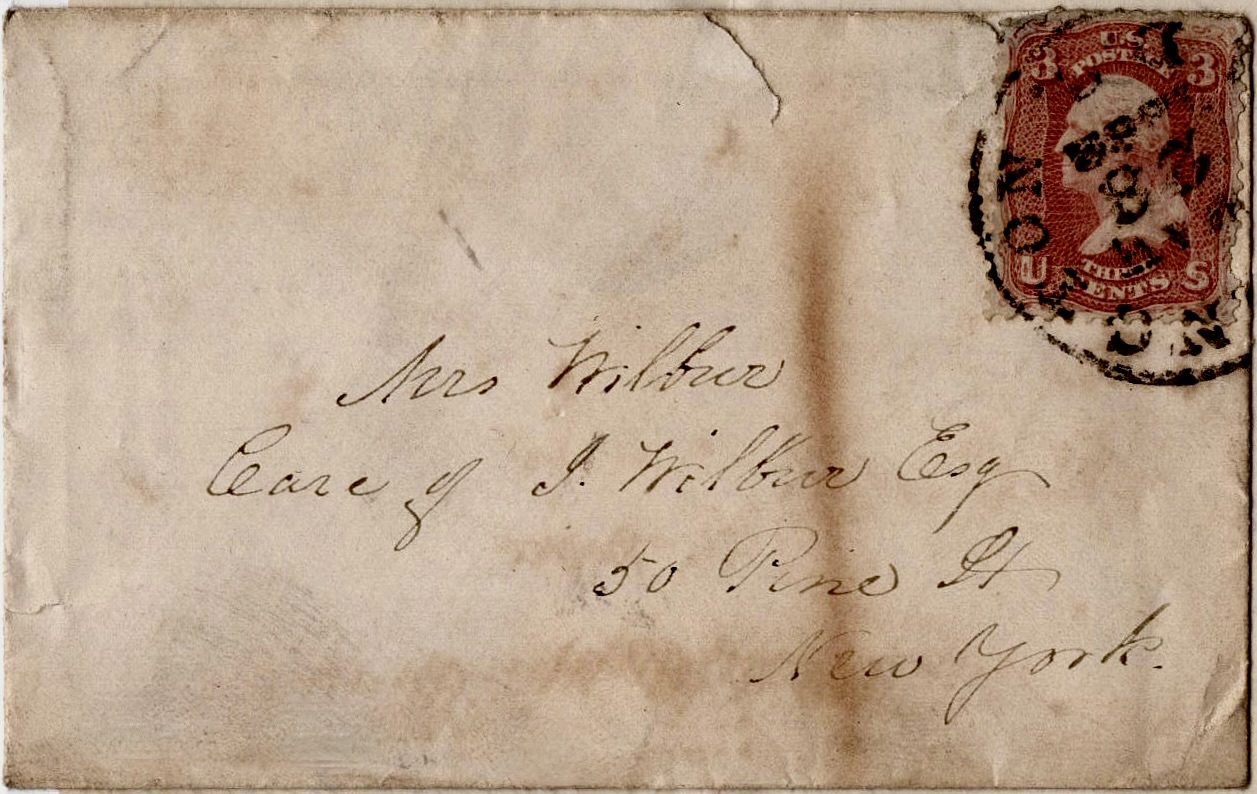
Washington, [D. C.]
Thursday night, March 27th 1862
My darling Mother,
Here we are safe & sound, having arrived about six o’clock. We saw you wave as we passed our house & we also saw Lee driving up the road. Lee Stout did not come to the depot until just as the cars were running out. I saw him on his way for a paper but could not point him out to Coz. We reached Philadelphia about half past ten by the Kensington route & rode from one station to the other in horse cars. The Baltimore cars were very full so that from Philadelphia to this place we each of us sat in a different seat so we could not have much conversation.
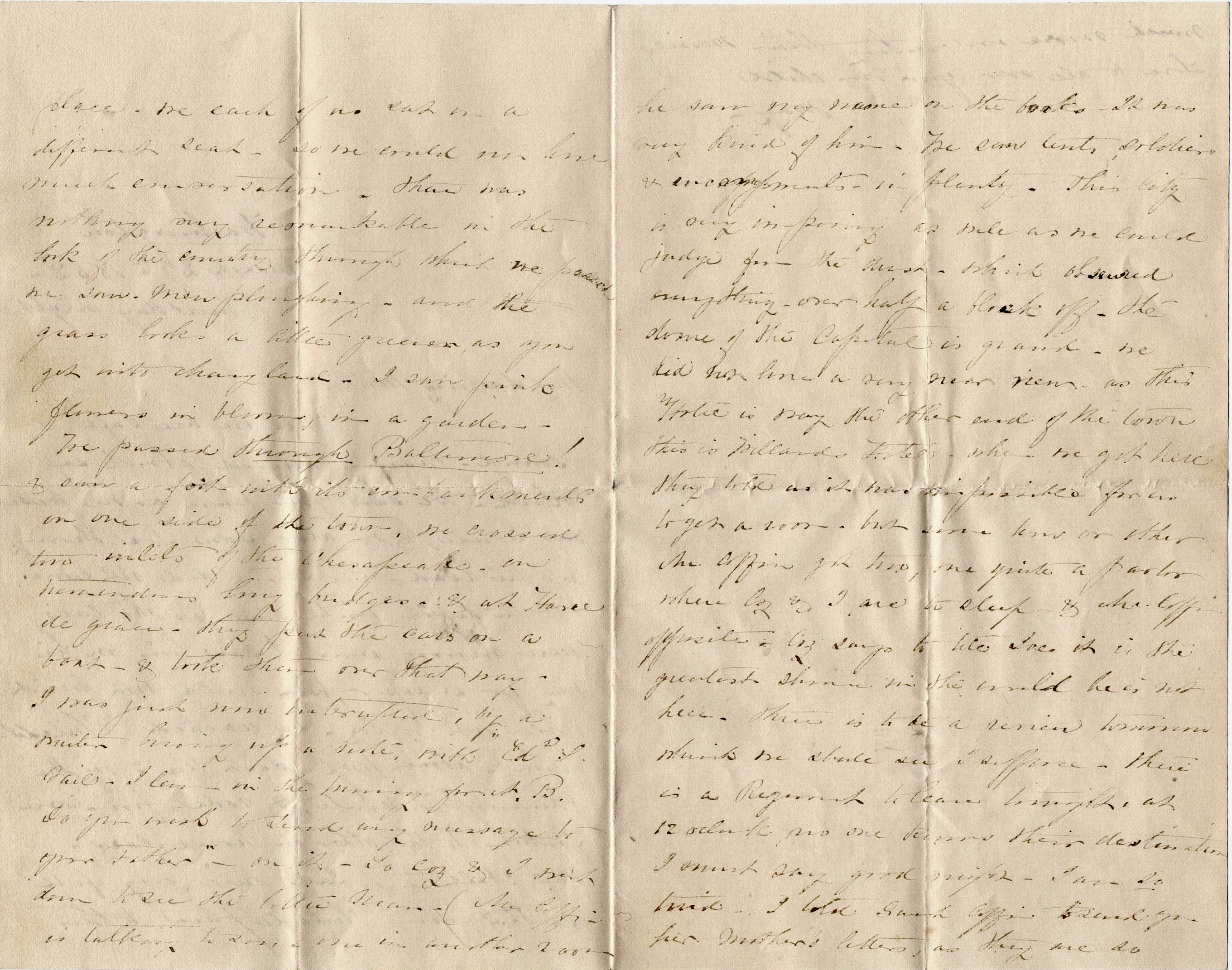
There was nothing very remarkable in the look of the country through which we passed. We saw men plowing and the grass looks a little green as you get into Maryland. I saw pink flowers in bloom in a garden.
We passed through Baltimore! and saw a fort with its embankments on one side of the town. We crossed two inlets of the Chesapeake on tremendous long bridges & at Havre de Grace, they put the cars on a boat & took them over that way.
I was just now interrupted by a waiter bring up a note with “Edw S. Vails. I leave in the morning for it. B. Do you wish to send any message to your Father?” [written] on it. So Coz & I went down to see the little man. Mr. Coffin is talking to someone in another room. He saw my name on the books. It was very kind of him.
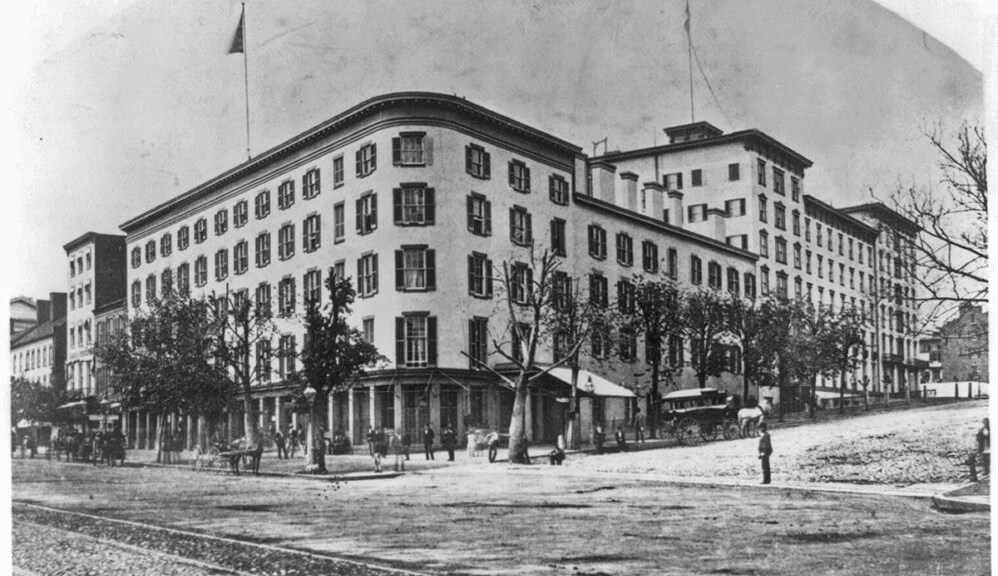
We saw tents, soldiers and encampments in plenty. This City is very imposing as well as we could judge for the dust which obscured everything over a half a block off. The dome of the Capitol is grand. We did not have a very near view as this hotel is way the other end of town. This is Willard’s Hotel. When we got here, they told us it was impossible for us to get a room, but somehow or other, the Mr. Coffin got two—one quite a parlor where Coz and I are to sleep, & Mr. Coffin opposite. Coz says to tell Joe it is the greatest shame in the world he is not here. There is to be a review tomorrow. 1 Think we shall see, I suppose. There is a regiment to leave tonight at 12 o’clock. No one knows their destination. 2
I must say good night. I am so tired. I told Sarah Coffin to send you her Mother’s letters as they are so much more interesting than mine. Love to all. Ever your own child, — Mary
1 General Irvin McDowell’s Corps (the Department of the Rappahannock) held a review just outside of Washington D. C. on 28 March 1862.
2 The regiment leaving Washington D. C. at midnight on March 27th 1862 might have been the 10th Massachusetts Infantry. They left by boat for Hampton Roads to participate in McClellan’s Peninsula Campaign.