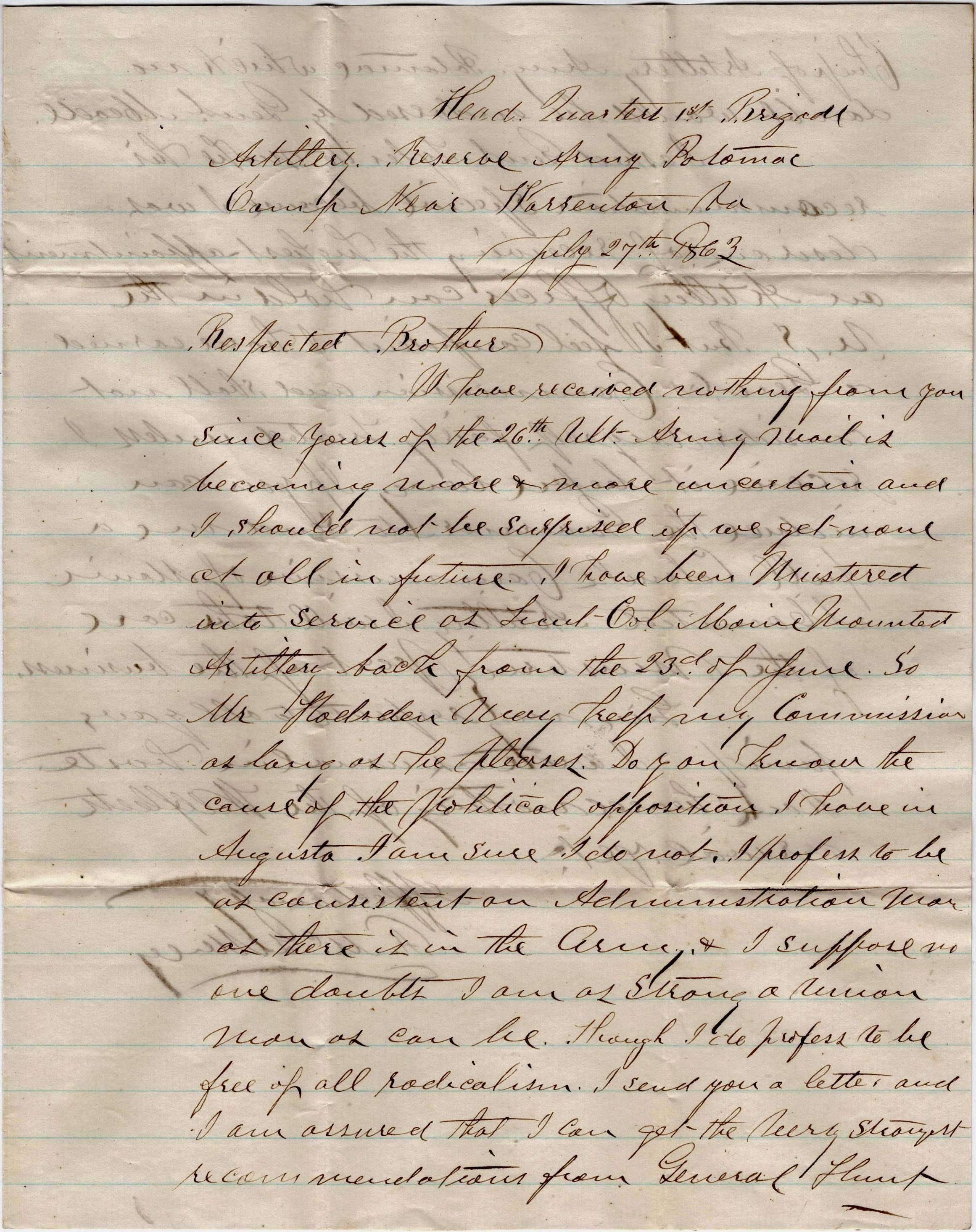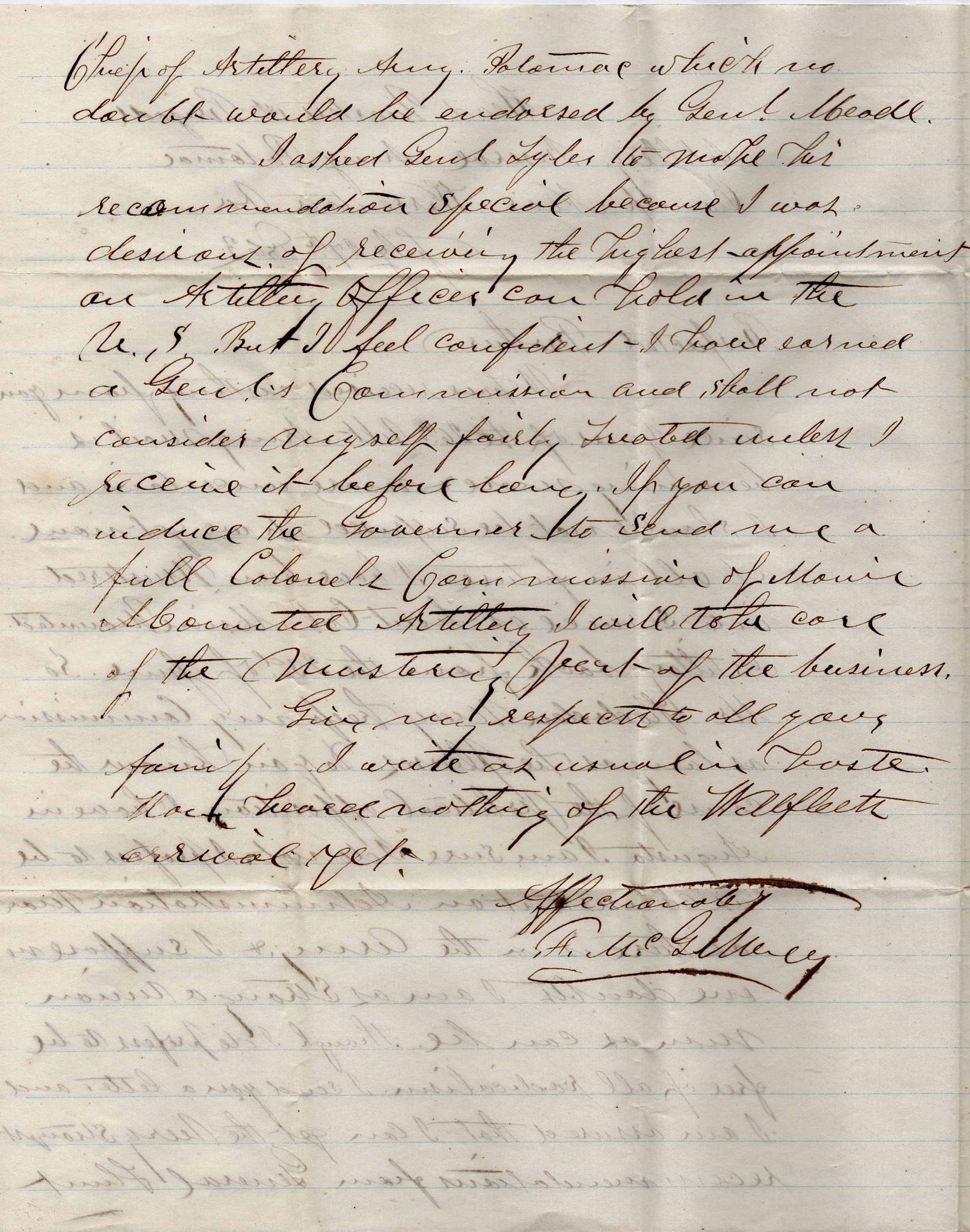
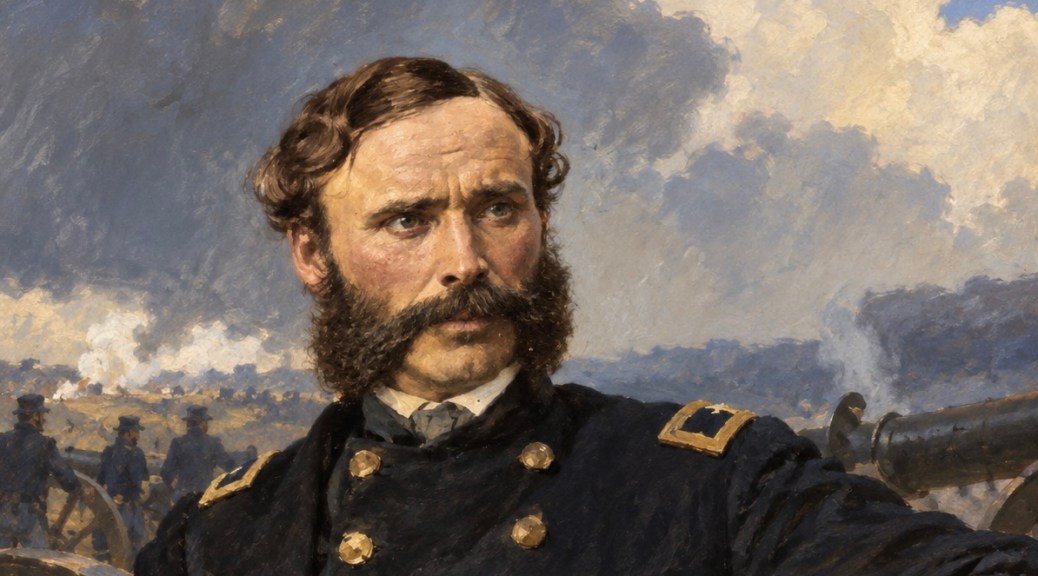
Freeman McGilvery, (1823-1864), “the progeny of Scot-Irish immigrants, was born on October 27, 1823 to Robert and Elizabeth Chase McGilvery in the hamlet of Prospect, Maine. Growing up in the Down East area south of Bar Harbor, it was only natural that he would be drawn to a life at sea. He left home at age eleven as a sailor “to earn a livelihood for himself and his indigent friends.” Trained early in hard work and industry, McGilvery was soon self-reliant. Before the war, he had amassed a significant fortune as a “master mariner.” After working at sea and traveling to places from Brazil to Hawaii, he engaged in the mercantile business. When it failed, he again took to the sea. By the time the clouds of war amassed, McGilvery had married and was considered “master of one of the finest ships of the Old Bay State” of Massachusetts. He was in Rio de Janeiro when he learned of the Confederate firing on Fort Sumter. He immediately set out for home, and arrived months after the war had begun. It seems odd that McGilvery offered his services to the artillery branch of the Union army rather than the Navy. He began the war with the rank of captain, and recruited enough men to form the 6th Maine Battery in early 1862.” [Source: Freeman McGilvery: Devoted to the Union by Diana Loski]
In the first of 3 letters from this small collection of McGilvery’s letters, he informs his brother that his 6th Maine Battery was snubbed in receiving credit for the role they played in the Battle of Cedar Mountain—its first engagement. This was primarily due to false reports distributed by other officers and published in the Bangor Daily News. McGilvery’s outrage led him to write Maine Governor Israel Washburn and let him know that “my brave men retain all the credit due them.” The truth was that his battery fought in a highly exposition on the Union left where they had to fight an artillery duel against Confederate batteries that held higher ground. They did not panic and flee as some reported but held their position, leaving multiple dead or exhausted soldiers on the field.
When the 2nd letter was written on 3 May 1863, the 6th Maine Battery was stationed on duty at Dumfries, Virginia, under the command of Lieut. Edwin B. Dow, McGilvery having been promoted to Major in February 1863. Though they missed the Battle of Chancellorsville which was underway at the time, McGilvery’s letter written from the Union supply base at Aquia Landing, roughly 15 to 20 miles away, speaks of the heavy cannonading that was taking place. It may have been the artillery duel that occurred between Hazel Grove and the Chancellor House, or from the heavy bombardment against Confederate positions on Marye’s Heights, possibly both, as they occurred simultaneously. Miraculously he reports hearing cannon firing at “more than one a second” during the morning hours.
During the Battle of Gettysburg, McGilvery played a monumental role in saving the Union line on July 2, 1863, through his brilliant and decisive command of artillery. After the Third Corps line collapsed at the Peach Orchard, McGilvery recognized a critical, unprotected gap on Cemetery Ridge that the advancing Confederates were poised to exploit. Acting quickly—without waiting for orders—he assembled a makeshift line of roughly 39 cannon—including the heroic, sacrificial stand of the 9th Massachusetts Battery—to buy precious time. His makeshift artillery line—now often referred to as McGilvery’s Plum Run Line—successfully halted the Confederate assault under General William Barksdale, anchoring the Union center until infantry reinforcements could arrive. McGilvery’s rapid tactical assessment and aggressive use of artillery proved to be one of the most critical, yet frequently overlooked, turning points of the entire battle. McGilvery’s third letter was written nearly four weeks after the Battle of Gettysburg and speaks of his promotion to Lieutenant Colonel of the Maine Mounted Artillery.
McGilvery finally got the commission as Colonel he sought in September 1863 and he continued to command the Artillery Reserve Brigade until the Overland Campaign where he served with distinction. He was promoted to Chief of Artillery for the 10th Corps in August 1864 but he died from an overdose of anesthesia in early September 1864 during a routine operation to remove a finger wound that had festered.
In July 2015, I transcribed five letters by a sergeant named Edward (“Ned”) Wiggin, Jr. who served under McGilvery in the 6th Maine Battery. He rose in rank to lieutenant and eventually captain of the battery. His five letters include:
“On a stormy Sunday in camp,” Camp Augusta, Me., 16 March 1862
“A regular cure for sore eyes,” Portland, Me., 21 March 1862
“Our whereabouts and howabouts,” Fort Buffalo, Va., 17 April 1862
“The blow crushes many fond hopes,” Fort Buffalo, Va., 4 May 1862
“We shall live in the saddle after this,” Washington D. C., 4 June 1862
Letter 1
Near Culpepper [Virginia]
August 16th 1862
Dear Brother,
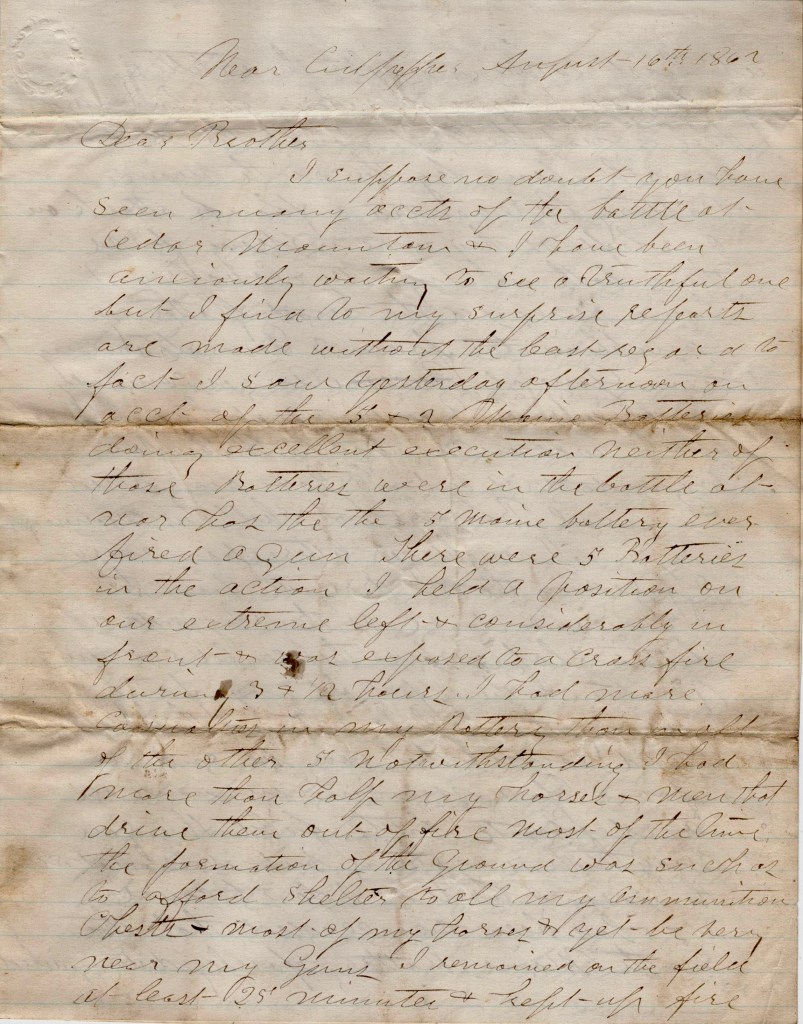
I suppose no doubt you have seen many accounts of the battle at Cedar Mountain & I have been anxiously waiting to see a truthful one but I find to my surprise reports are made without the least regard to fact. I saw yesterday afternoon an account of the 5th & 2nd Maine Batteries doing excellent execution. Neither of those batteries were in the battle at [Cedar Mountain] nor has the 5th Maine Battery ever fired a gun. There were five batteries in the action. I held a position on our extreme left & considerably in front & was exposed to a cross fire during three and a half hours. I had more casualties in my battery than in all of the other five, notwithstanding I had more than half my horses & men that drive them out of fire most of the time. The formation of the ground was such as to afford shelter to all my ammunition chests & most of my horses & yet be very near my guns. I remained on the field at least 25 minutes & kept up fire at least 20 minutes after the artillery fire had ceased all along our lines and there is not the least doubt the excellent work done by the Sixth Maine Battery prevented a flank attack on our left as they were in strong force there, both in infantry & cavalry.
I have received the most flattering compliments from 3 Generals, among them General [Christopher C.] Augur, commanding the division. Gen. Augur sent his compliment as he was on his way to Washington wounded. As yet I have not met General [Nathaniel] Banks but shall this morning.
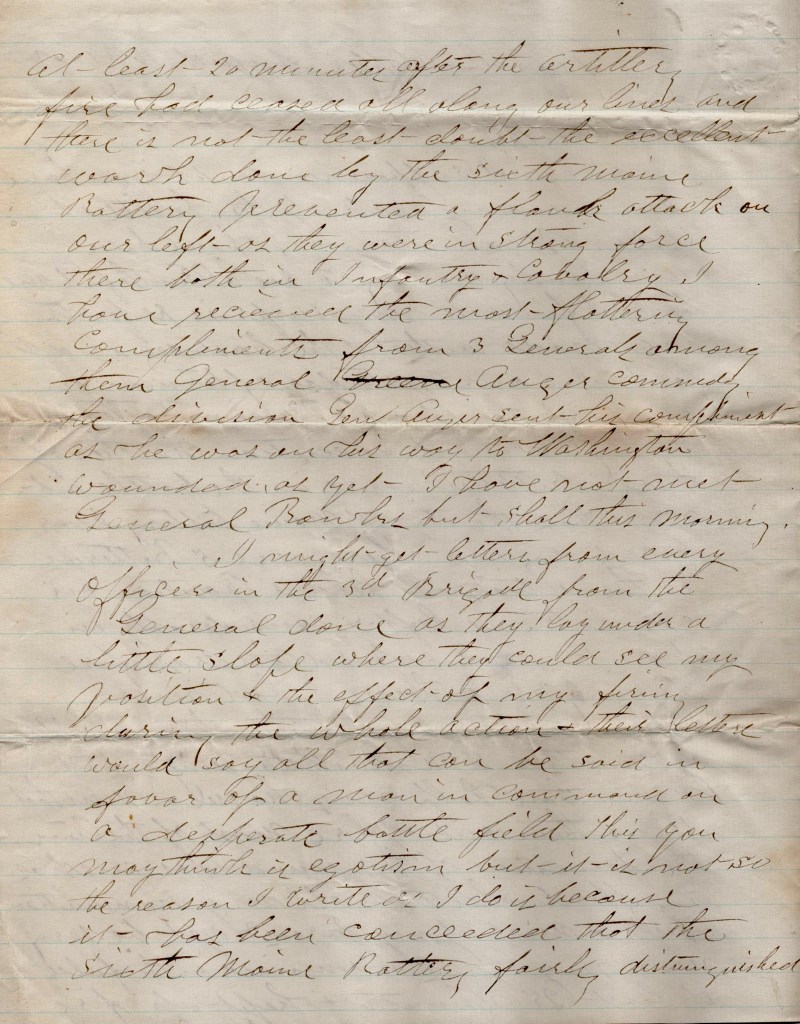
I might get letters from every officer in the 3rd Brigade from the General down as they lay under a little slope where they could see my position & the effect of my firing during the whole action. Their letters would say all that can be said in favor of a man in command on a desperate battlefield. This you may think is egotism but it is not so. The reason I write as I do is because it has been conceded that the Sixth Maine Battery fairly distinguished itself as its losses prove it sustained the principle part of the enemy’s artillery fire & held its position to the last & when my two last guns were retired, they were nearly surrounded by the enemy’s sharp shooters.
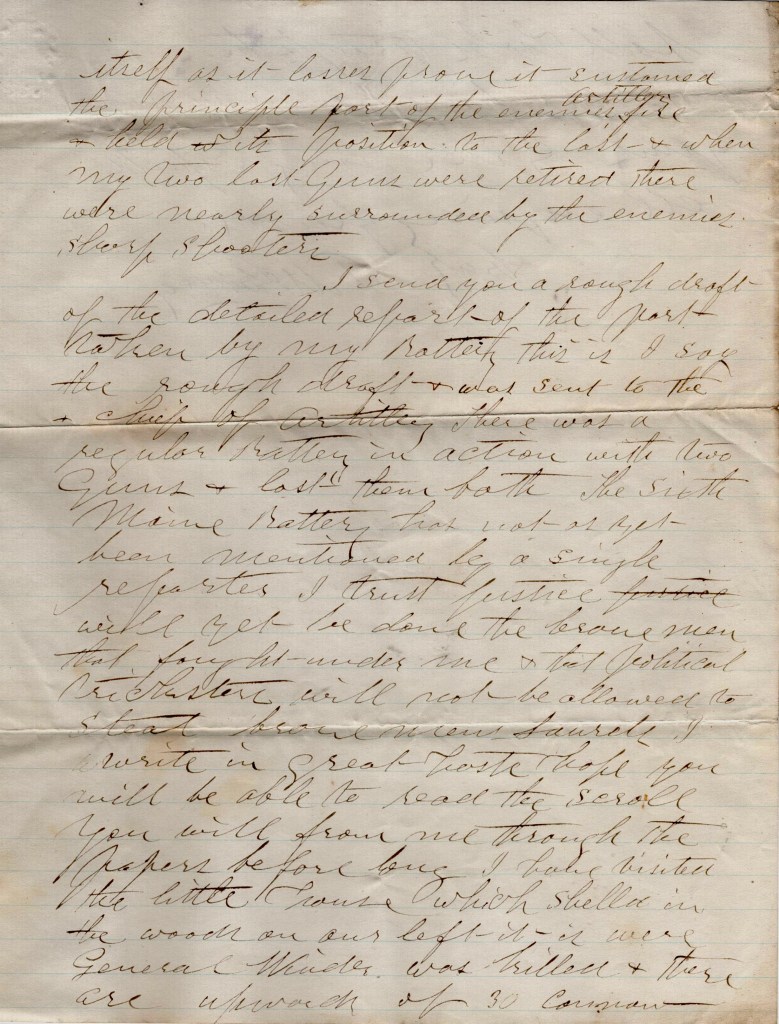
I send you a rough draft of the detailed report of the part taken by my battery. This is I say the rough draft & was sent to the Chief of Artillery. There was a Regular Battery in action with two guns & lost them both. The Sixth Maine has not as yet been mentioned by a single reporter. I trust justice will yet be done the brave men that fought under me & that political tricksters will not be allowed to steal brave men’s laurels.
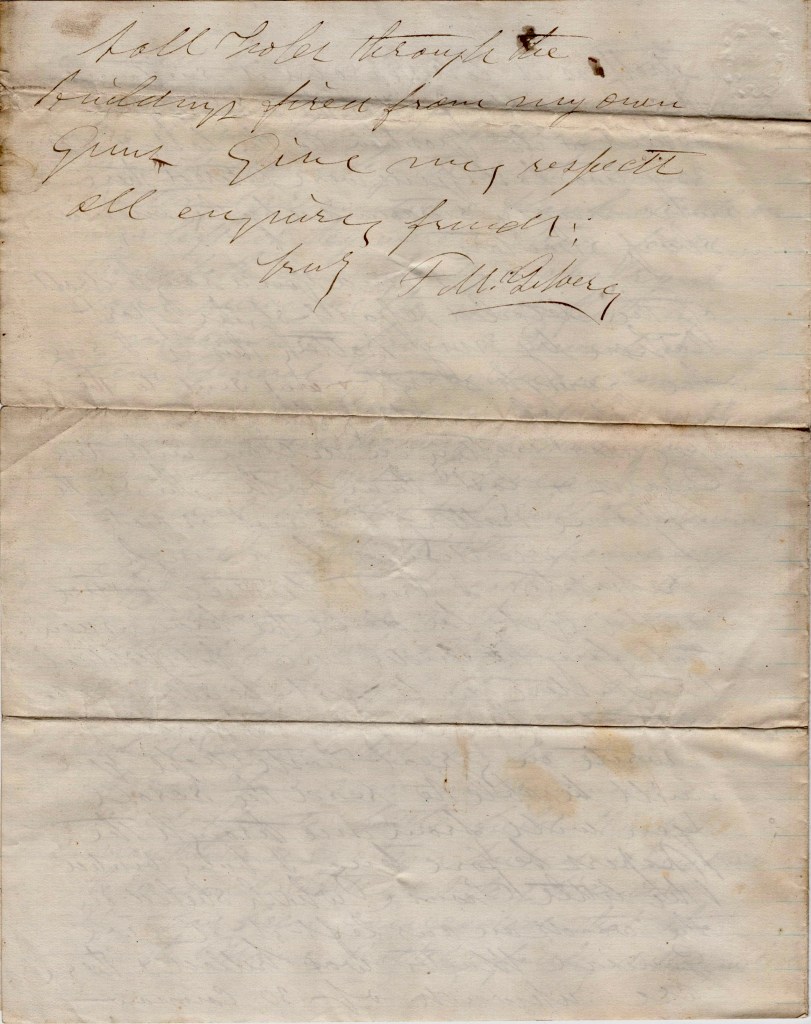
I write in great haste. Hope you will be able to read the scrawl. You will [hear] from me through the papers before long. I have visited the little house which [we] shelled in the woods on our left. It is where [Major] Gen. Winder was killed & there are upwards of 30 cannon ball holes through the buildings fired from my own guns. 1
Give my respects to all enquiring friends. Fraternally, — F. McGilvery
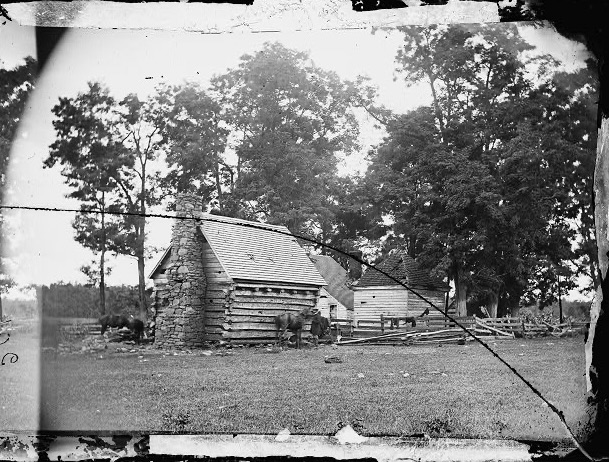
1 The buildings McGilvery refers to were no doubt the farmstead of Rev. Philip Slaughter which was riddled with cannon balls from the 6th Maine Battery. Confederate Gen. Charles S. Winder was not using the house as a formal headquarters but he was struck by a shell fragment nearby and mortally wounded. The Library of Congress holds a photograph with the caption. “Battlefield of Cedar Mountain House riddled with cannon balls in which Gen. Winder was killed” (pictured above).
Letter 2
Headquarters Artillery Defenses
Aquia Landing, Potomac Bridge & [ ] Bridge &c. Va.
May 3rd, 1863
Respected Brother,
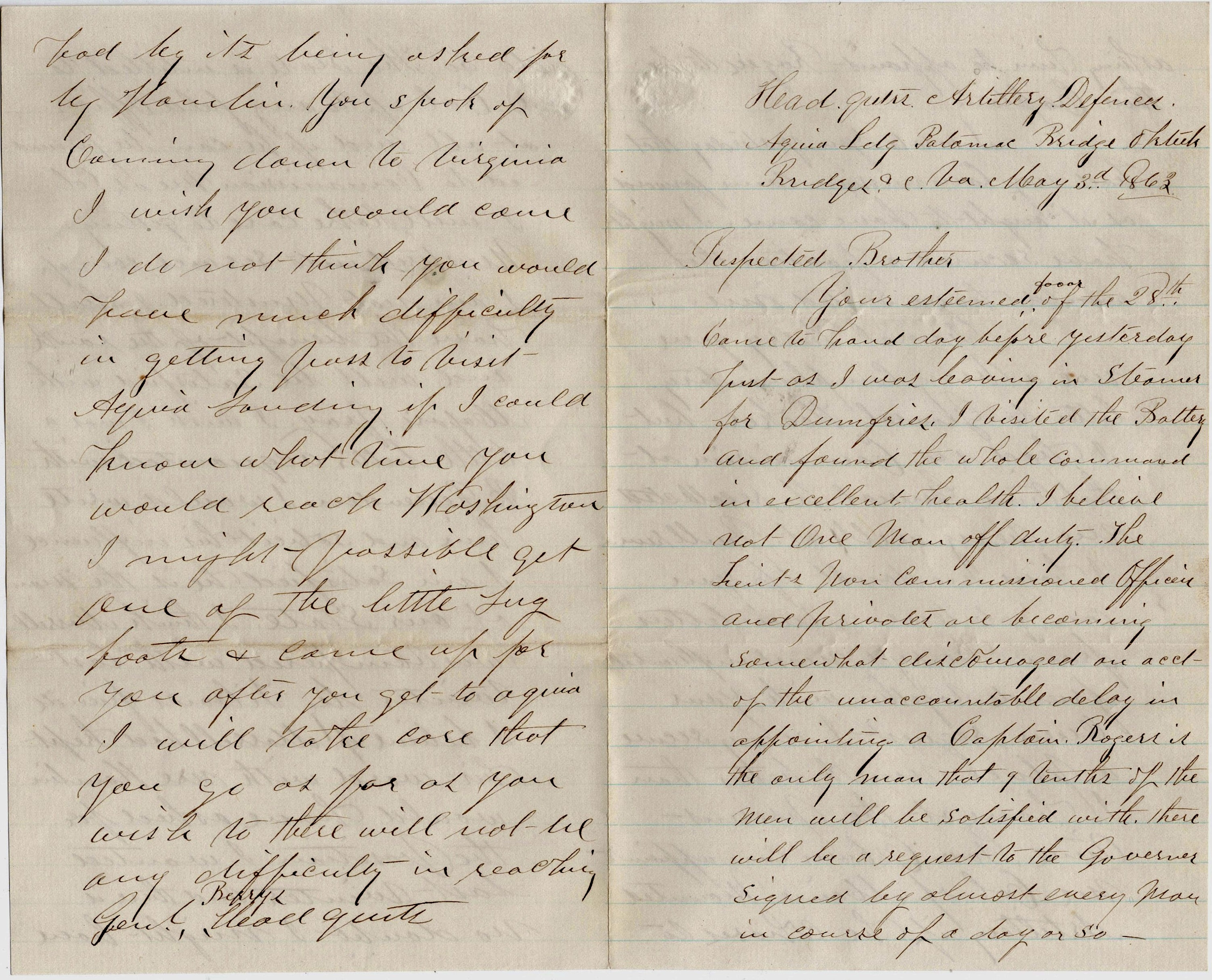
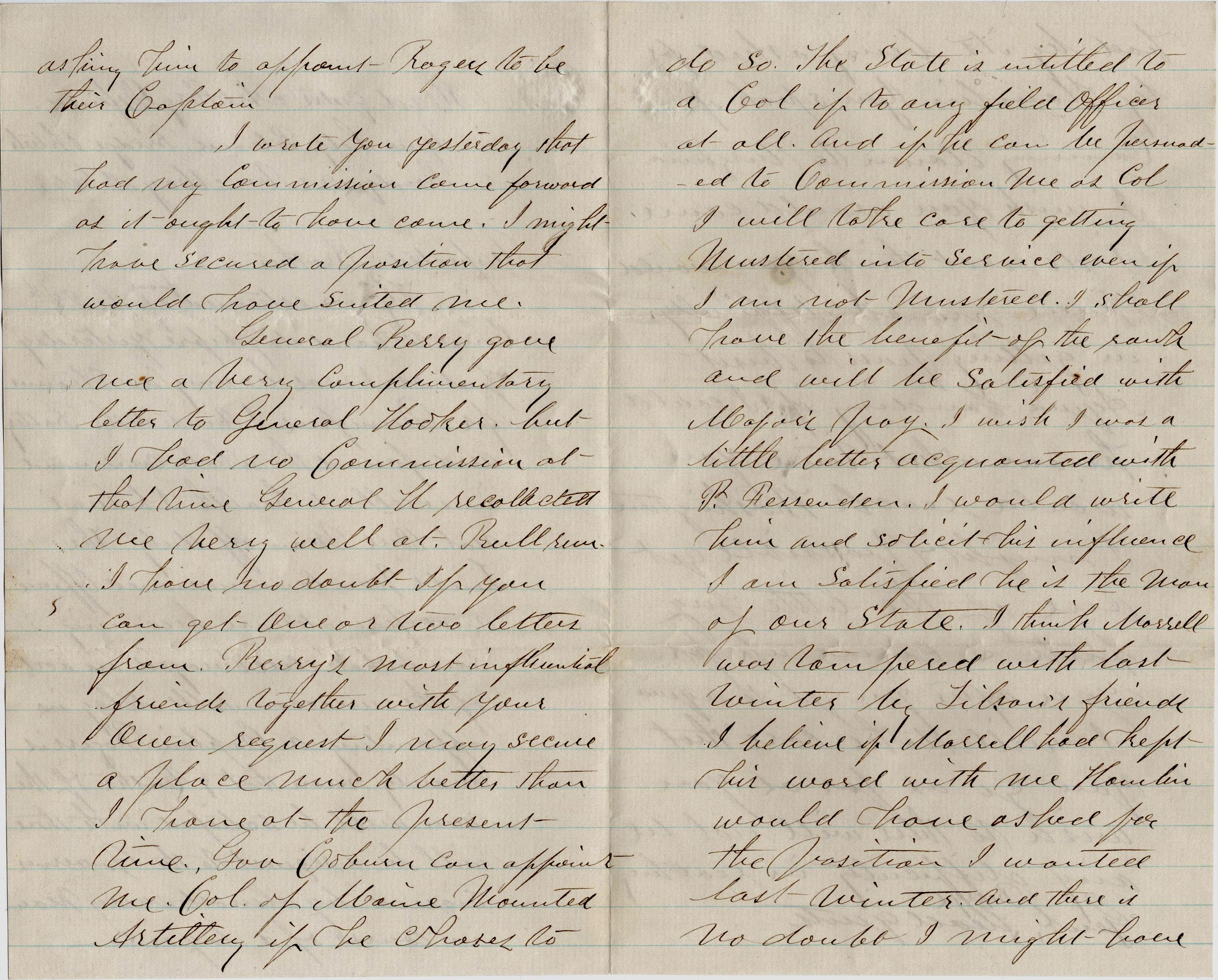
Your esteemed favor of the 28th came to hand day before yesterday just as I was leaving in steamer for Dumfries. I visited the Battery and found the whole command in excellent health. I believe not one man off duty, The lieutenants, non-commissioned officers, and privates are becoming somewhat discouraged on account of the unaccountable delay in appointing a captain. Rogers is the only man that nine tenths of the men will be satisfied with. There will be a request to the Governor signed by almost every man in course of a day or so asking him to appoint Rogers to be their captain.
I wrote to you yesterday that had my commission come forward as it ought to have come, I might have secured a position that would have suited me. General [Hiram G.] Berry gave me a very complimentary letter to Gen. Hooker but I had no commission at that time. General Hooker recollected me very well at [Second] Bull Run. I have no doubt if you can get one or two letters from Berry’s most influential friends together with your own request, I may secure a place much better than I have at the present time. Gov. [Abner] Coburn can appoint me Colonel of Maine Mounted Artillery if he chooses to do so. The state is entitled to a Colonel if to any field officer at all. And if he can be persuaded to commission me as Colonel, I will take care to getting mustered into service. Even if I am not mustered, I shall have the benefit of the rank and will be satisfied with Major’s pay.
I wish I was a little better acquainted with P. Fessenden. I would write him and solicit his influence. I am satisfied he is the man of our state. I think Morrill was tampered with last winter by Tilson’s friends. I believe if Morrill had kept his word with me, [Vice President] Hamlin would have asked for the position I wanted last winter and there is no doubt I might have had by its being asked for by Hamlin.
You spoke of coming down to Virginia. I wish you would come. I do not think you would have much difficulty in getting a pass to visit Aquia Landing. If I could know what time you would reach Washington, I might possibly get one of the little tug boats & come up for you. After you get to Aquia, I will take care that you go as far as you wish to. There will not be any difficulty in reaching Gen. [Hiram G.] Berry’s Headquarters. 1
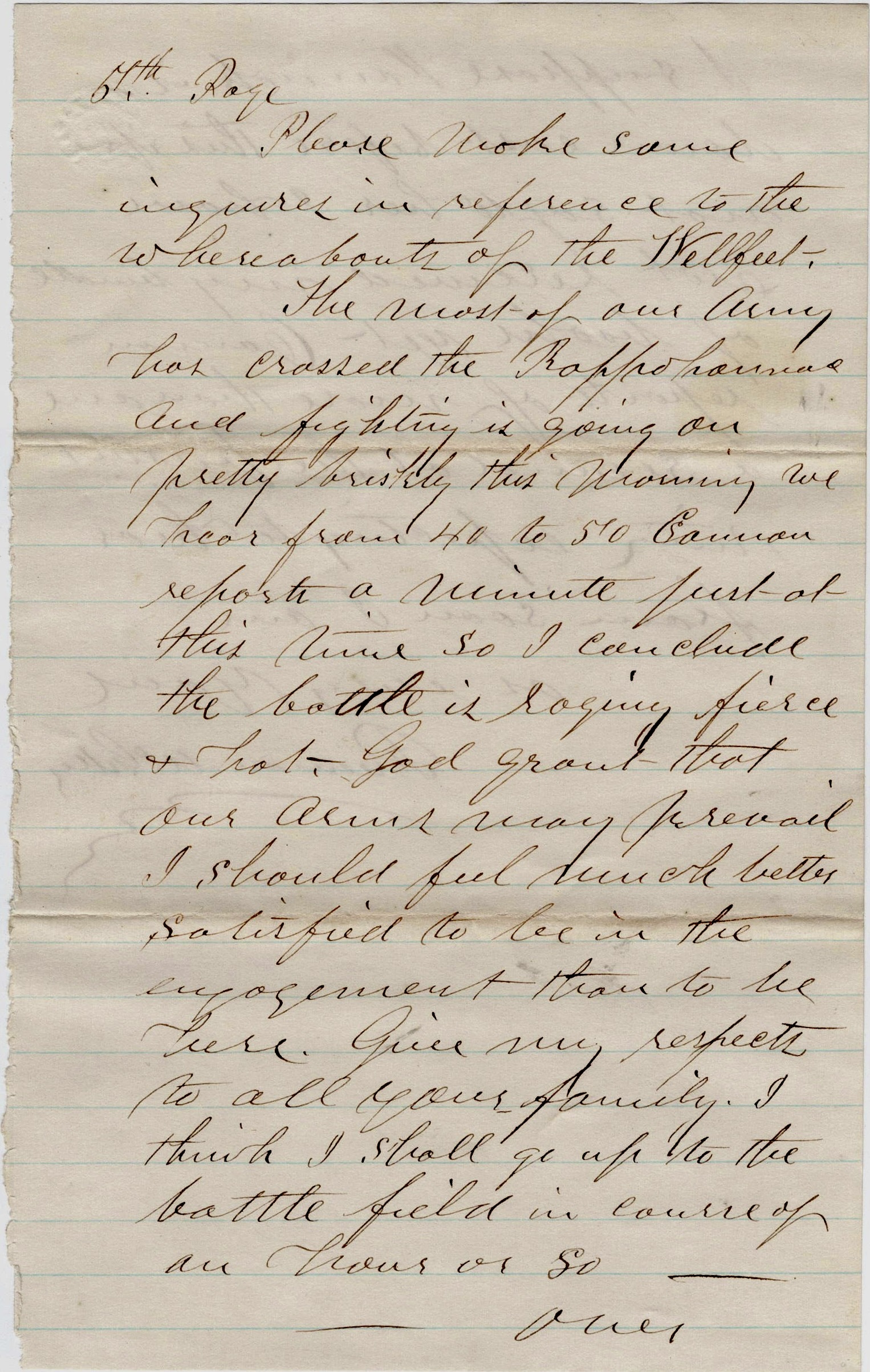
Please make some enquiries in reference to the whereabouts of the Wellfeet.
The most of our army has crossed the Rappahannock and fighting is going on pretty briskly this morning. We hear from 40 to 50 cannon reports a minute just at this time so I conclude that battle is raging fierce and hot. God grant that our arms may prevail. I should feel much better satisfied to be in the engagement than to be here. Give my respects to all your family. I think I shall go up to the battlefield in course of an hour or so.
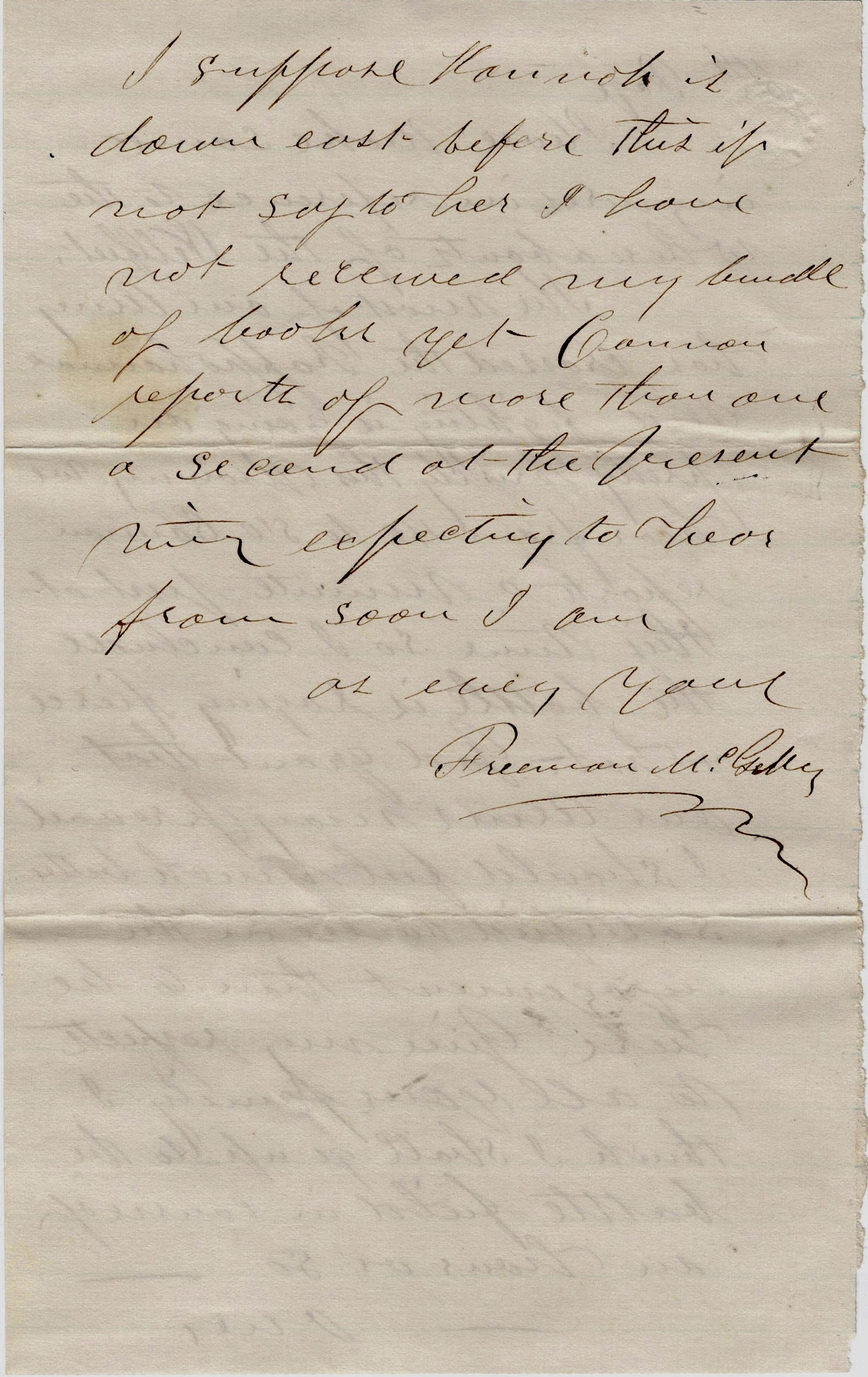
I suppose Hannah is down East before this. If not, say to her I have not received my bundle of books yet. Cannon reports of more than one a second at the present time. Expecting to hear from [you] soon. I am as ever yours, — Freeman McGilvery
1 Ironically, Gen. Hiram G. Berry was killed by at sharpshooter early in the morning on 3 May 1863—the very day that McGilvery wrote this letter. Berry entered the Battle of Chancellorsville in command of the 2nd Division of the III Corps.
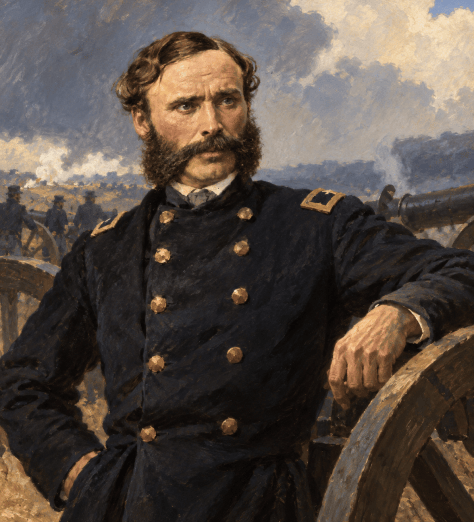
Letter 3
Headquarters 1st Brigade
Artillery Reserve, Army of the Potomac
Camp near Warrenton, Virginia
July 27th 1863
Respected Brother,
I have received nothing from you since yours of the 26th ult. Army mail is becoming more & more uncertain and I should not be surprised if we get none at all in future. I have been mustered into service as Lieut. Colonel Maine Mounted Artillery, back from the 23rd of June. So Mr. [John L.] Hodsdon [Adj. Gen. of Maine] may keep my commission as long as he pleases. Do you know the cause of the political opposition I have in Augusta? I am sure I do not. I profess to be as consistent an Administration man as there is in the army & I suppose no one doubts I am as strong a Union man as can be though I do profess to be free of all radicalism.
i send you a letter and I am assured that I can get the very strongest recommendation from General Hunt, Chief of Artillery, Army of the Potomac, which no doubt would be endorsed by Gen. Meade.
I asked Gen. [Robert O.] Tyler to make his recommendation special because I was desirous of receiving the highest appointment an Artillery officer can hold in the U. S. but I feel confident I have earned a General’s commission and shall not consider myself fairly treated unless I receive it before long. If you can induce the Governor to send me a fill Colonel’s commission of Maine Mounted Artillery, I will take care of the mustering part of the business.
Give my respects to all your family. I write as usual in haste. Have heard nothing of the Wellfleets arrival yet.
Affectionately, — F. McGilvery