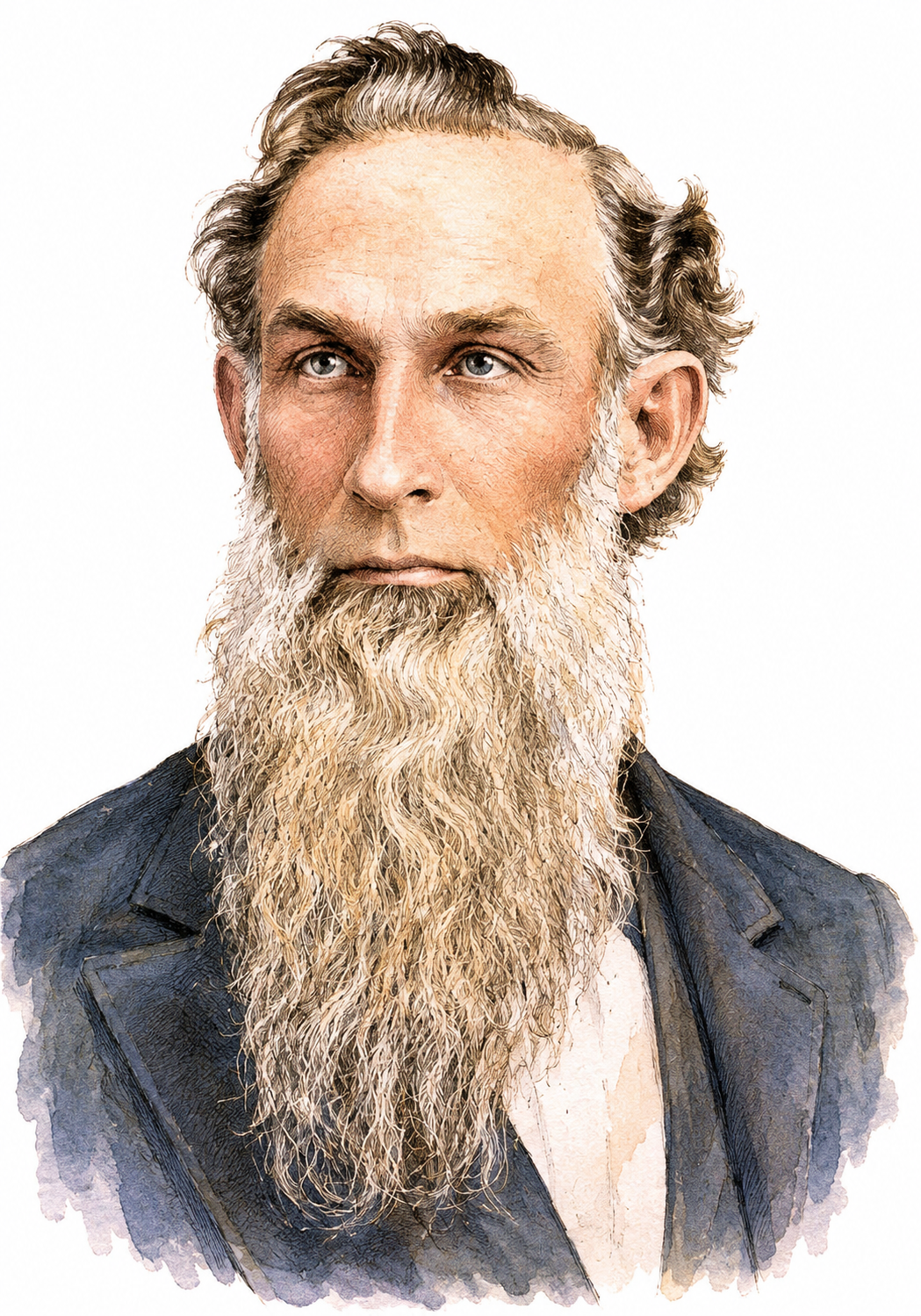
The following letter was written by Lewis E. Childs (1835-1889) who entered the service at Ypsilanti on 24 August 1861 at 1st Lieutenant of Co. I, 11th Michigan Infantry. Through the influence of his uncle, he was promoted to Captain of Co. H on 12 March 1862; was wounded and taken prisoner at the Battle of Chickamauga on 20 September 1863. Exchanged and mustered out of the service on 30 September 1864.
After the war, Lewis married Fanny Richardson (1842-1900) and worked at the Board of Trade in Detroit. He then was engaged in the produce and greenhouse business at Ypsilanti where he died at the age of 53.
Lewis was the son of Aaron Childs (1806-1882) and Hannah From Bemis (1814-1896) of Washtenaw county. He wrote the letter to his uncle, James Webster Childs (1826-1882), a Washtenaw county civil leader and politician who served two terms in the Michigan Legislature and then in the Michigan Senate.
[Editor’s Note: The photocopy of this letter was sent to me for transcription and publication on Spared & Shared by Janet Buchanan, a descendant relative of the Childs family.]
T R A N S C R I P T I O N
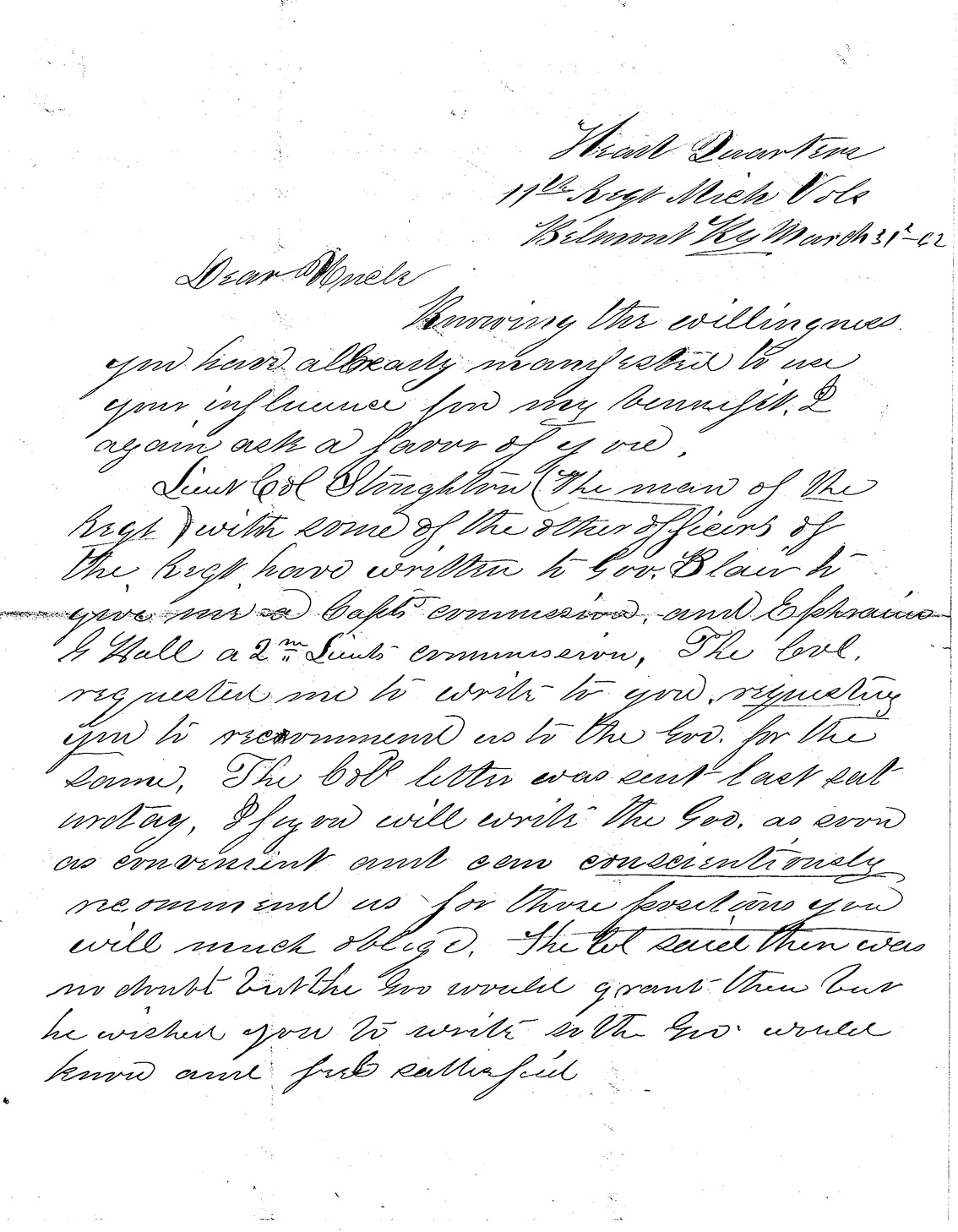
Head Quarters, 11th Regt. Michigan Vols.
Belmont, Kentucky
March 21, 1862
Dear Uncle,
Knowing the willingness you have already manifested to use your influence for my benefit, I again ask a favor of you. Lieut. Col. [William Lewis] Stoughton (the man of the regt.) with some of the other officers of the regient have written to Gov. [Austin] Blair to give me a captain’s commission, and Ephraim G. Hall a 2nd lieutenant’s commission. The Col. requested me to write to you requesting you to recommend us to the Governor for the same. The Col’s letter was sent last Saturday. If you will write the Gov. as soon as convenient and can conscientiously recommend us for those for those positions, you will much oblige. The Col. said there was no doubt but the Gov. would grant them but he wished you to write so the Gov. would know and feel satisfied.
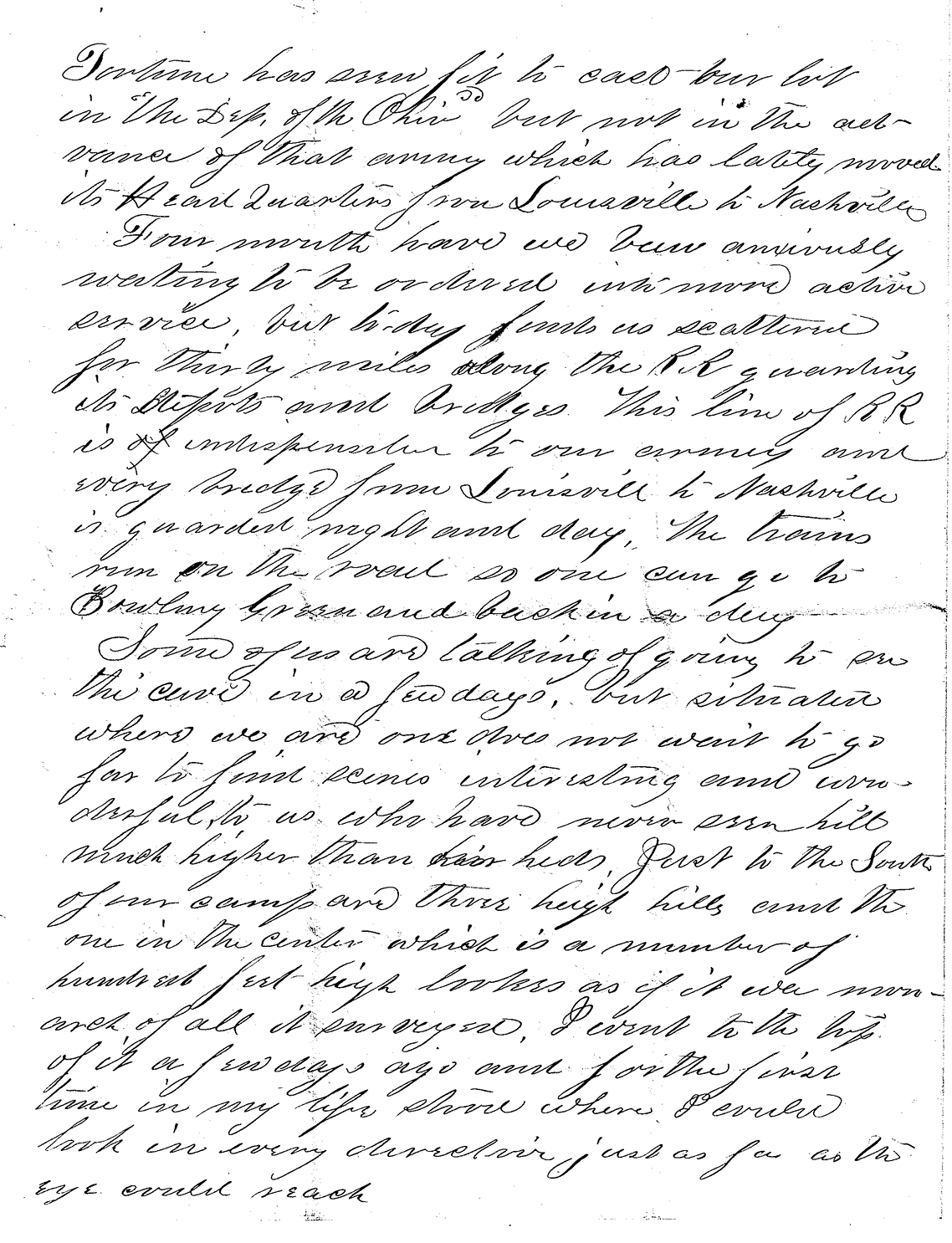
Fortune has seen fit to cast out lot in “the Dept. of the Ohio” but not in the advance of that army which has lately moved its Headquarters from Louisville to Nashville. Four months have we been anxiously waiting to be ordered into more active service, but today finds us scattered for thirty miles along the railroad guarding its depots and bridges. This line of railroad is indispensable to our army and every bridge from Louisville to Nashville is guarded night and day. The trains run on the road so one can go to Bowling Green and back in a day.
Some of us are talking of going to see the cave in a few days but situated where we are, one does not wait to go for to find scenes interesting and wonderful to us who have never seen a hill much higher than our heads. Just to the south of our camp are three high hills and the one in the center, which is a number of hundred feet higher, looks as if it were monarch of all it surveyed. I went to the top of it a few days ago and for the first time in my life, stood where I could look in every direction just as far as the eye could reach. 1
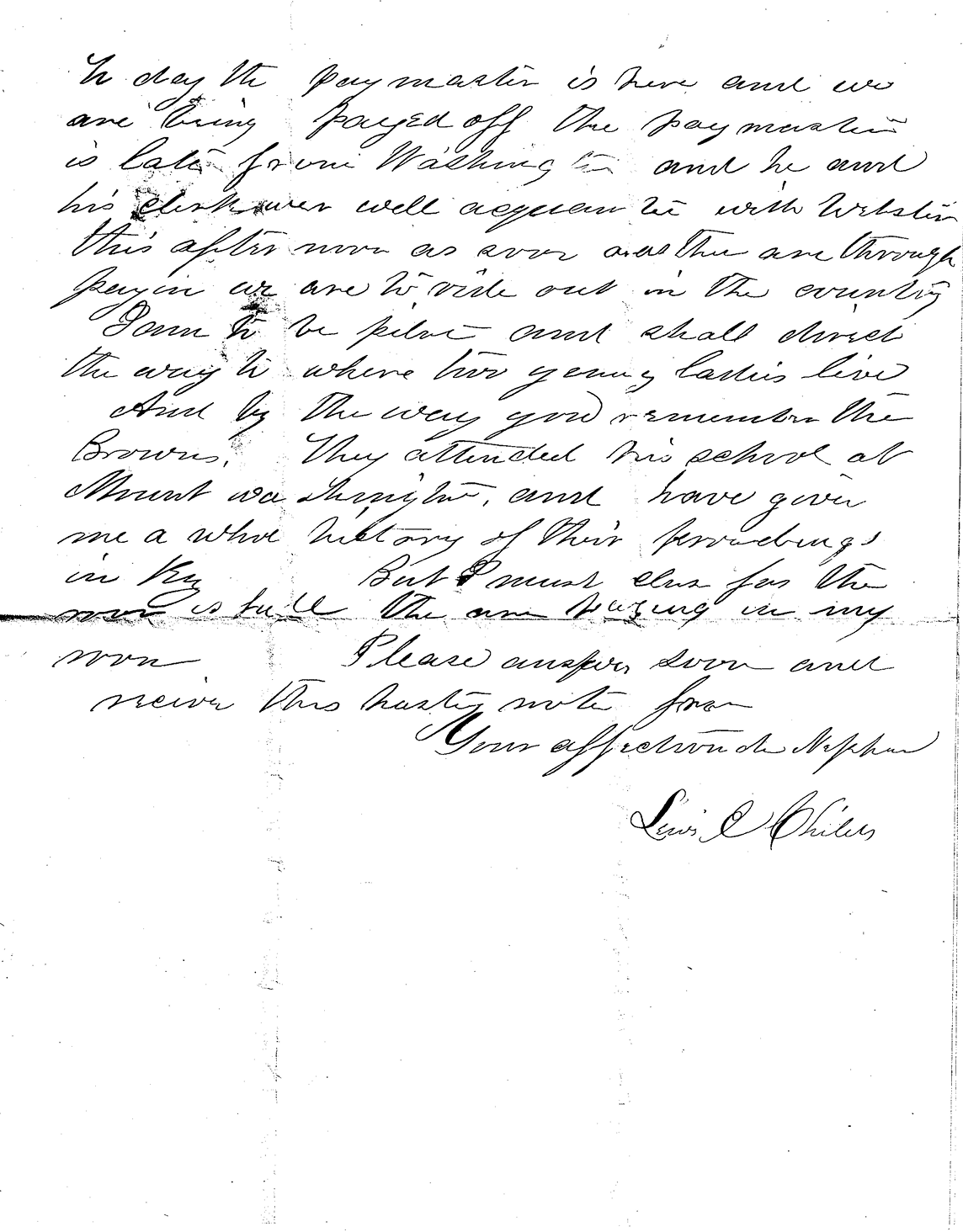
Today the paymaster is here and we are being paid off. The paymaster is late from Washington and he and his clerk were well acquainted with Webster. This afternoon as soon as they are through paying [us], we are to ride out in the country. I am to be pilot and shall direct the way to where two young ladies live.
And by the way, you remember the Browns? They attended his school at Mount Washington and have given me a whole history of their proceedings in Kentucky. But I must close for the room is full—they are paying in my room. 2 Please answer soon and receive this hasty note from your affectionate nephew. — Lewis E. Childs
1 Lewis is probably referring to the Bullitt County “Knobs” immediately around Belmont Furnace where the 11th Michigan was stationed in March 1862. Belmont Furnace was located on the Louisville & Nashville Railroad. The highest knob—Dobbins Knob—is about three miles southwest of Belmont Furnace. The geography of the area was quite a dramatic departure from that of southern Michigan. The cave that Lewis refers to was probably the Mammoth Cave which was a popular site for soldiers to visit during the Civil War.
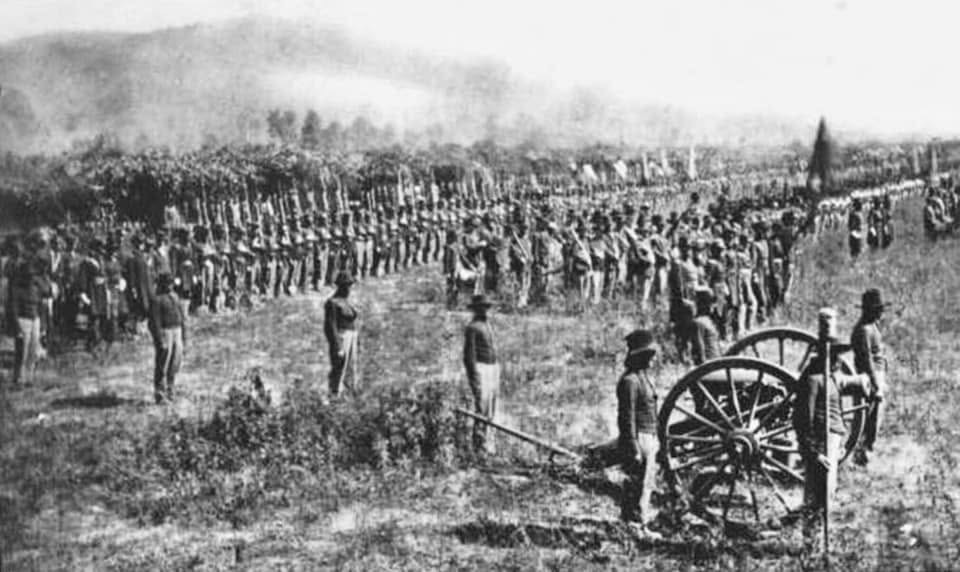
2 The 11th Michigan Infantry was assigned to railroad guard duty in March 1862 and the main objective of those posted at Belmont was to protect the L&N Railroad Bridge located roughly 3/4 of a mile from the Belmont Furnace village. Because the iron-producing furnace had shut down in 1861 and was deserted, the Union soldiers did not have to live entirely in tents. Many of the men, at least the officers, were quartered in the workmen’s cottages left behind by the furnace laborers.