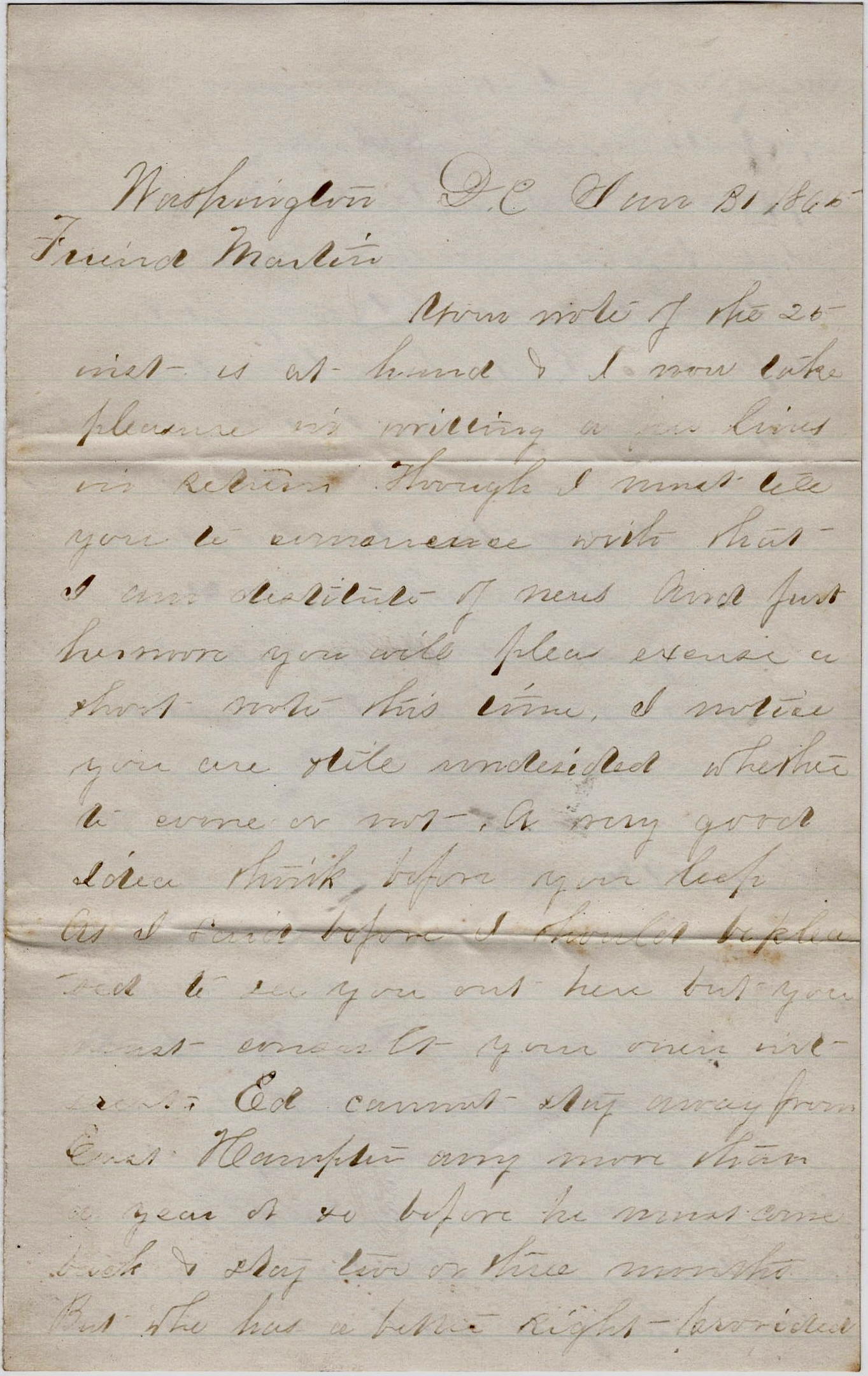
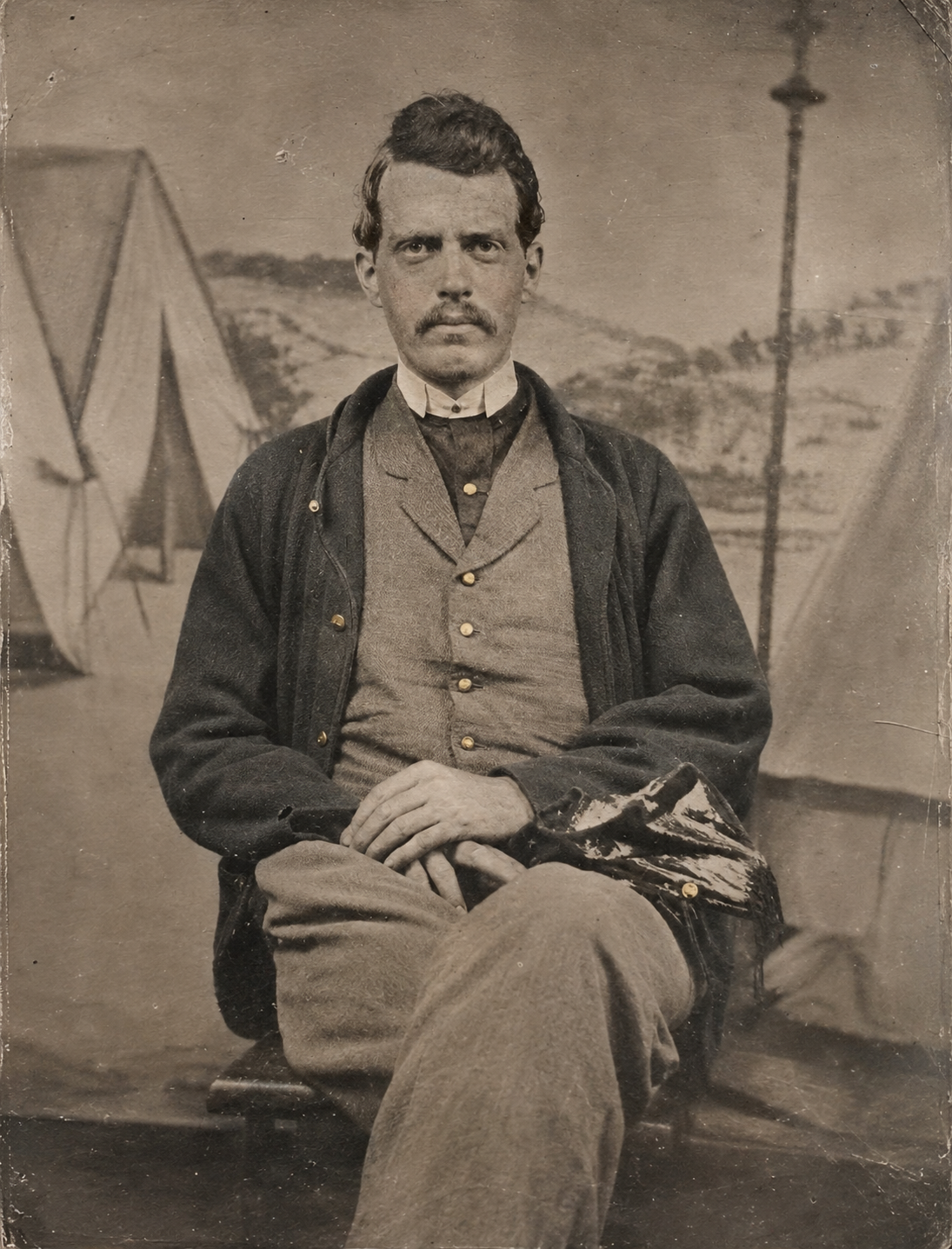
This letter was written by Hubert Edgar Carpenter (1839-1902), the son of Anson Carpenter (1806-1856) and Diantha Skinner (1811-1873) of East Hampton, Connecticut.
Hubert’s obituary states that “he served his country valiantly in the Civil War, enlisting at Chatham, August 14th 1862 and serving in Co. H, 21st Connecticut Infantry until April 13th 1865 when he was transferred to Co. F, 20th Regiment, Veteran Reserve Corps. He was wounded June 3rd 1864 at the Battle of Cold Harbor, receiving a bad wound over his left eye, being hit by a piece of bursting shell. June 30, 1865, he was honorably discharged.
After the war he represented Chatham in the State Legislature 1878-79 and was a justice of the peace for a time as well as the post master through three administrations. He was married to Annie Hodge (1844-1928) in October 1865.
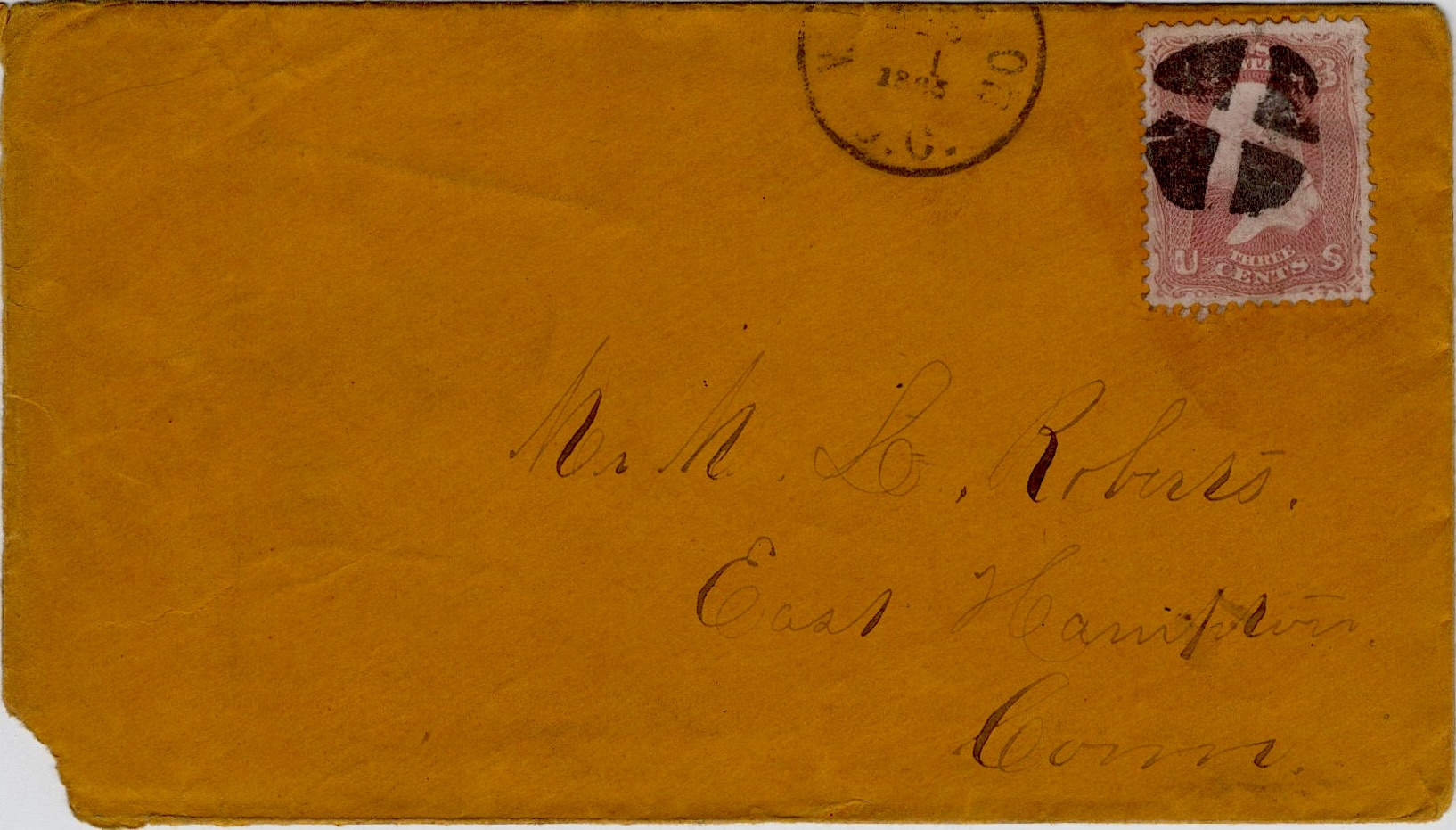
Hubert wrote the letter to his friend and future brother-in-law, Martin Leonard Roberts (1839-1910) of East Hampton, Middlesex county, Connecticut. Martin married Ruth Ann Carpenter (1853-1937). Martin was a member of the Connecticut Legislature in 1869 and served as the postal clerk at New Haven for many years.
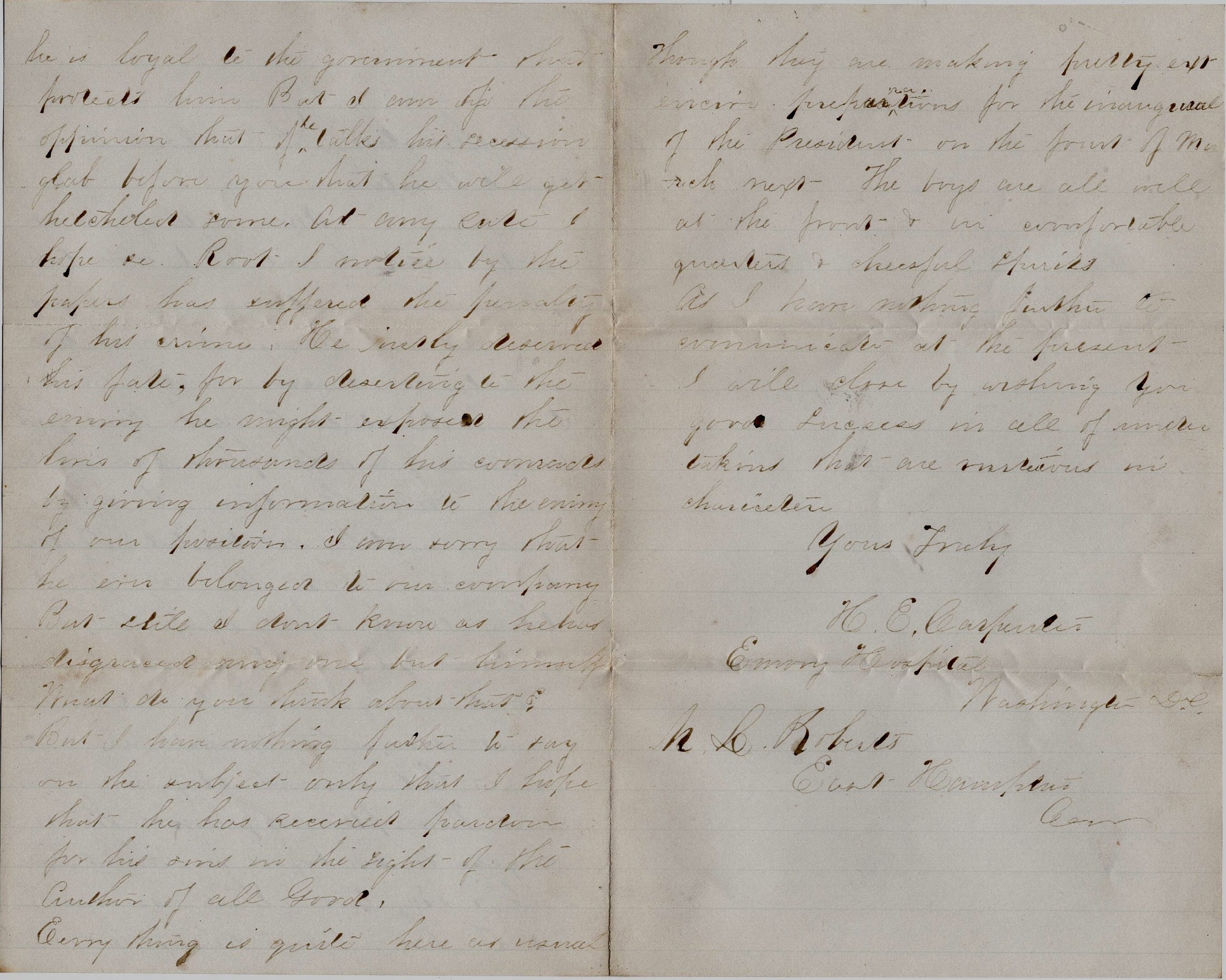
T R A N S C R I P T I O N
[Emory Hospital] Washington D. C.
January 31, 1865
Friend Martin,
Your note of the 25th inst. is at hand & I now take pleasure in writing a few lines in return though I must tell you to commence with that I am destitute of news and just humor. You will please excuse a short note this time.
I notice you are still undecided whether to come or not. A very good idea—think before you leap. As I said before, I should be pleased to see you out here but you must consult your own interests. Ed cannot stay away from East Hampton any more than a year or so before he must come back & stay two or three months. But who has a better right provided he is loyal to the government that protects him. But I am of the opinion that if he talks his secession glab before you that he will get hitch-holed some. At any rate, I hope so.
[Newell W.] Root, I notice by the papers, has suffered the penalty of his crime. He justly received his fate for by deserting to the enemy, he might expose the lives of thousands of his comrades by giving information to the enemy of our position. I am sorry that he ever belonged to our company. But still I don’t know as he has disgraced anyone but himself. What do you think about that? But I have nothing further to say on the subject—only that I hope that he has received pardon for his sins in the sight of the Author of All Good. 1
Everything is quiet here as usual though they are making pretty extensive preparations for the inaugural of the President on the Fourth of March next. The boys are all well at the front & in comfortable quarters & cheerful spirits.
As I have nothing further to communicate at the present, I will close by wishing you good success in all of undertakings that are virtuous in character. Yours truly, — H. E. Carpenter, Emory Hospital
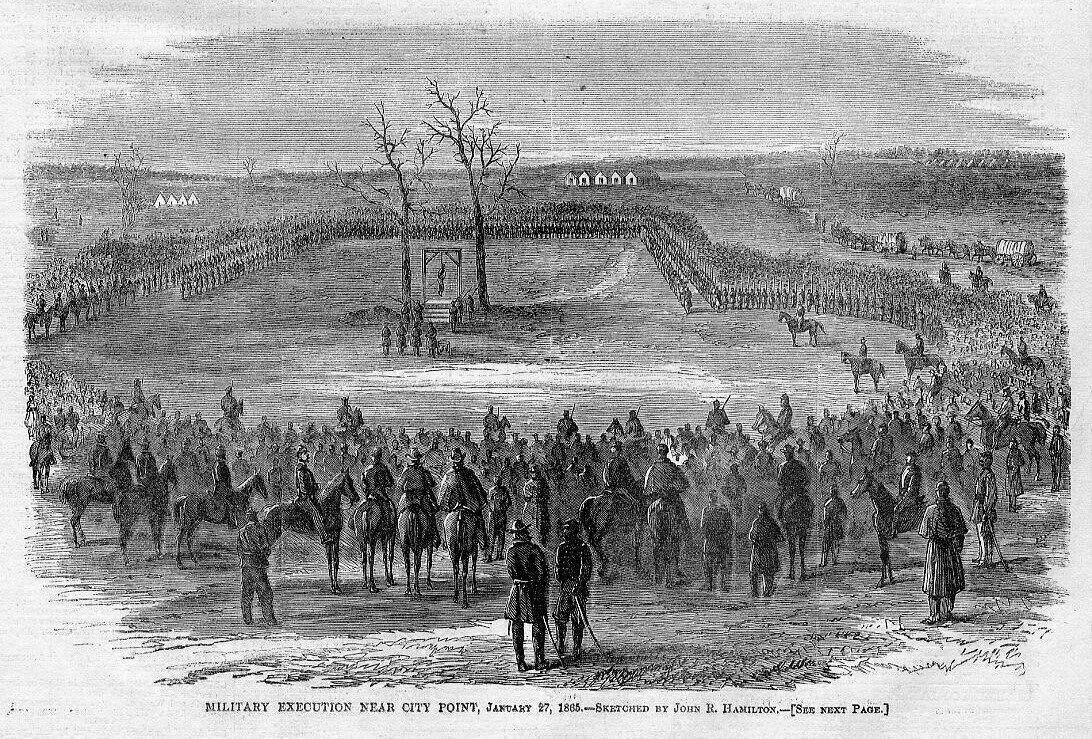
1 Newell W. Root served with Hubert in Co. H, 21st Connecticut Infantry. His alias was George H. Harris. From the Petersburg Project we learn that Newell was influenced by Lee’s General Order No. 65 which promised leniency and assistance to Union defectors. Root deserted to Richmond, and with a group of 170 men made his way to Louisa, Kentucky, where he attempted to claim he was a Confederate deserter fleeing to the Union. He was arrested and a military court martial sentenced him to death. On January 25, 1865, President Lincoln asked Grant to review the case but based on the report, responded, “I do not interfere further in the case” and Root was subsequently executed by hamging. His execution was depicted in Harper’s Weekly. It should be noted that Root is often identified as having served in the 1st Connecticut Heavy Artillery which is false; he served in the 21st Connecticut Infantry.