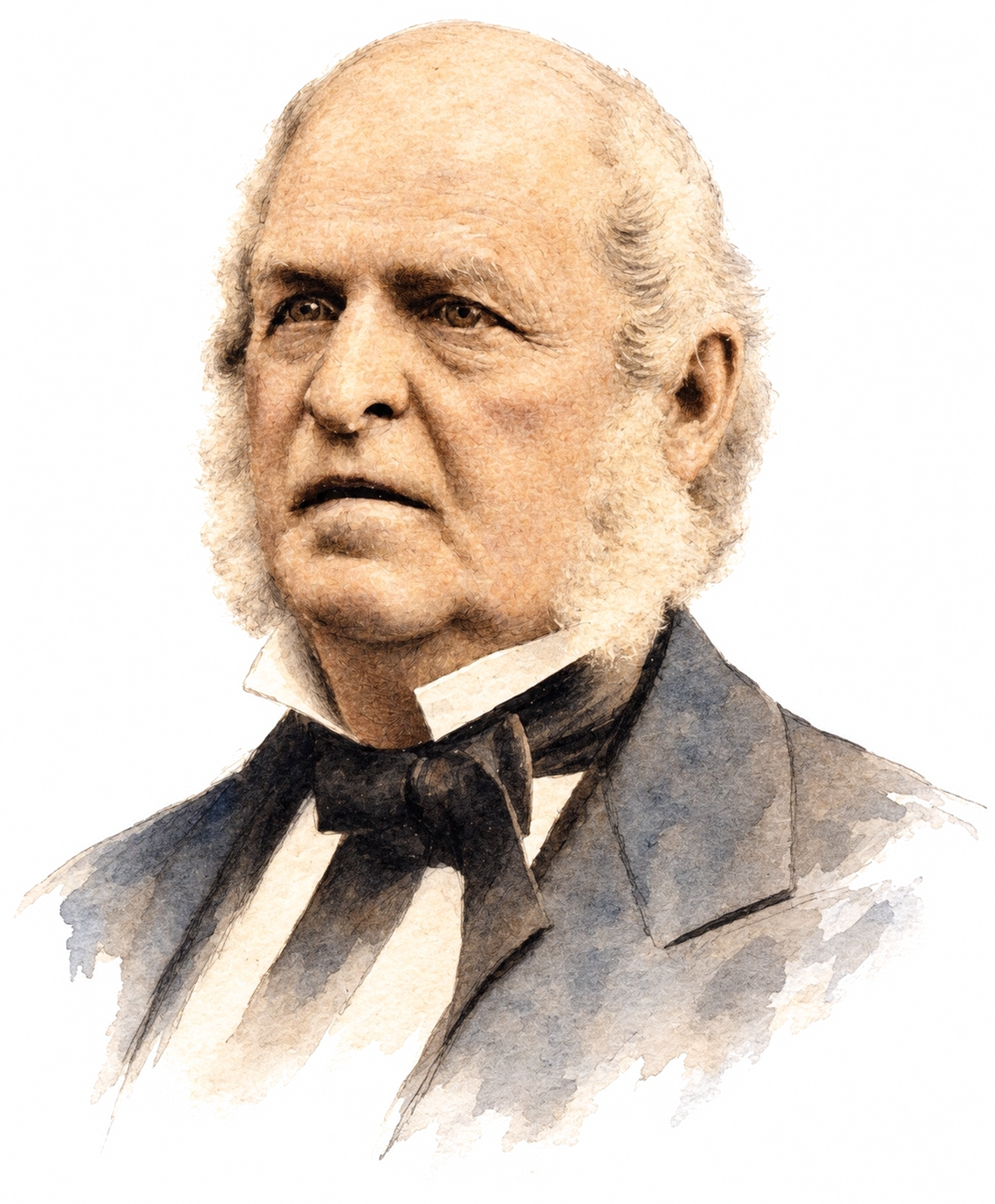
The following “after action” report was composed by Col. Jason Marsh of the 74th Illinois Infantry although this handwritten copy was probably penned by his adjutant, Anton Nieman. Marsh’s lengthy battle report describes his regiment’s movements and engagements during the Battle of Stones River. His original report, submitted to Col. P. Sidney Post’s brigade of Brigadier General Jefferson C. Davis’s division, can be found in the Official Records, Series I, Volume XX, Part 1, pages 274-276, with Post’s brigade report beginning several pages earlier.
Marsh was a long time Rockford attorney before the war and the Battle of Stones River was his first opportunity to command his regiment in battle. His troops were inexperienced and considering the situation, performed reasonably well, even in their retreat from the field. Marsh’s report is not surprisingly highly complimentary of the regiments actions during the battle but there are no published accounts condemning his leadership or questioning his personal courage at Stones River.
T R A N S C R I P T I O N
Headquarters 74th Illinois Vols.
In camp near Murfreesboro
January 7, 1863
Col. P. Sidney Post, Commanding 1st Brigade
Colonel, I have the honor to report that the 74th Illinois Vols. under my command left camp near Nashville on the 26th ult. early in the morning for Murfreesboro in the advance Brigade, coming up in the afternoon near Nolansville with the enemy apparently in considerable force, mainly of cavalry & artillery. My command was immediately formed in line of battle & advanced. A brisk cannonading was opened on both sides, the enemy’s shot & shell frequently reaching within our lines occupying an exposed position within short range, but no damage was done. The enemy soon falling back, a brisk pursuit was kept up until night when we bivouacked without fires, keeping up constant & thorough watch against surprise through the night.
The next day being exceedingly rainy, we marched but about fives miles without special incident & bivouacked for the night, my regiment meeting the inclemency of the weather & discomfort of the march with the fortitude & cheerfulness of veteran soldiers. Resting in camp over the Sabbath, I resumed the march early Monday morning by a cross road leading from Nolansville to the Murfreesboro Turnpike. bivouacking at night in a drenching rain on short rations after an exceedingly toilsome days march over an almost impassible road.
The next morning I had my command in line at 3 o’clock, standing at their arms until daylight when resuming the march in the direction of Murfreesboro, we came up with the enemy about noon & a slight firing was kept up between skirmishers during the day—our column slowly and cautiously advancing—the enemy retreating—just at night near the edge of a cedar thicket as our line was advancing. The enemy opened a brisk fire from a masked battery within short range, making it necessary for the entire line to fall back a short distance to a line of battle selected for the operations of the day following.
My regiment being directly in range of the enemy’s fire, M[oses] C. Felmly, Corp., Co. K, was killed & J[ohn] B. Caspares, Corp. of same company was seriously wounded. A strong picket guard was thrown out about 30 rods in front which occasionally drew fire from the enemy’s pickets & their camp fires being not more than three quarters of a mile distant extending along the further edge of a cornfield a long distance beyond the extreme right of our Division indicated a strong force of the enemy massed on our front & right. My command was formed in line of battle close behind a narrow strip of cedar thickets nearly covering our front & skirting a strip of open level ground about 20 rods wide to the cornfield occupied by the enemy’s pickets. Being thus satisfied of the close proximity of the enemy in strong force & apprehending an attack at any moment, I deemed it necessary to use the utmost precaution against surprise & accordingly in addition to general instructions to bivouac without fires & to maintain a cautious quiet vigilance, I ordered my command to stack arms & each man to rest at the butt of his musket & without using his shelter tent. Although the night was dark, chilly, and somewhat rainy & the morn cold, wet, weary, & hungry, I deemed it objectionable to use their shelter tents, not only because of the hindrance in case of a sudden attack, but even in a dark night, they would be some guide to the enemy to trace our lines.
Atr a little before 4 o’clock a.m., my men were quietly waked up, formed into line, and remained standing at their arms until moved by subsequent orders. As soon as it became sufficiently light to observe objects at a distance, I could plainly discern the enemy moving in three heavy columns across my front to the right. Our column striking out of the cornfield & moving defiantly along the edge of the open ground not more than 60 to 80 rods from, & about parallel with my line. It was plainly seen that the fore of my skirmishers took effect in their ranks & in emptying saddles to which, however, the enemy seemed to pay no attention. This movement continued from a half to an hour when a brisk discharge of musketry at considerable distance to my right indicated a rapid advance of the enemy on the right flank at the same time their columns were advancing in overwhelming force directly in front & extending to the left as far as could be seen.
At this time my command was ordered to fall back & to change front to the rearm or nearly so, forming behind a fence. This movement was executed in good order & without the least confusion or faltering. In the course of 10 or 15 minutes, the enemy’s line approached but as previously instructed or ordered, my command reserved their fire until within short range, when they opened with terrible effect upon the advancing ranks, and holding them completely in check until they had delivered 10 or 15 rounds. I maintained this position until the regiments on the right and left of me had fallen back 30 to 40 rods & the enemy’s line directly in front breaking & deploying right & left & about to flank me, I ordered a retreat which was effected in tolerable order—at least without the least appearance of a panic.
From this point, having fallen back in a straight line between a half & three quarters of a mile, I effected a stand with a considerable portion of my regiment but could maintain it only long enough to deliver a few shots. I should here mention that early in te morning three companies of my command had been thrown out as skirmishers, who in consequence of the first charge of line, & of their fidelity & bravery in discharging their duty had been cut off from the regiment & unable to rally upon it until at this point 1sty Lieut. Leffingwell in command of Co. A came up with a few of his men & rendered most efficient aid in rallying the regiment. I commend his conduct on this occasion as indicating an efficient, faithful & brave officer.
Falling back from this line a short distance, I succeeded in rallying about half of the regiment in the rear of the reserve force which was now driving the enemy back. When being ordered to form on the Brigade, my command had no further part in the fighting of the day except that two companies of my regiment were sent out just at night as skirmishers under command of 1st Lieut. Blakesley who rendered important service in a brilliant skirmish with a large cavalry force.
The day following, my regiment was put in line of battle at an early hour & stood at their arms till near night, momentarily expecting to make or receive an attack.
On Friday, just at night, my command was put in rapid march across Stones River to the extreme left where a fierce battle was raging, but was closed just before our arrival by the retreat of the enemy. Late in the evening we bivouacked here without fires in such close proximity to the enemy’s lines as to produce frequent skirmishing between the pickets during the night which was intensely dark & stormy. Remaining here through the following day & night, suffering the severities of an almost uninterrupted storm without fires or shelter until 4 o’clock Sunday morning, I returned with my command to the camp previously occupied.
The hardships, privations, & exposures in the march from Louisville to Crab Orchard & then to Nashville have been regarded unendurable by new troops & yet while they sink into utter insignificance compared with those of our march & engagements during these eight days. I have the gratification of knowing that my regiment has met & endured them with the utmost promptness, fortitude, & cheerfulness facing he enemy in the heat of battle with the coolness, courage, and determination of experienced soldiers & true patriots, ready at every call to face new dangers without faltering, undergoing the most extraordinary labors & exposures without murmuring & evincing under all circumstances a spirit of subordination & discipline worthy of the highest commendation. I have also the pleasure to say that during all these trying hardships, the general health of the men has been better than at any time since we left Louisville.
While I have such occasion to commend the fidelity, bravery, & good conduct of all the officers of my command (save one), I should feel to do justice were I to omit to make special note of the cool persistent courage of Capt. J[onathan] H. Douglass in remaining at his post under hte fire of the enemy & of his promptness & efficiency in forming & maintaining the lines during the day. It is not to be presumed that all the meritorious acts of privates will come within the personal observation of the commander of a regiment but having been eye witness of the fearless bravery & enthusiastic zeal of private Chas. A. Allen of Co. E during the operations of Wednesday as well as at other times, I commend him as worthy of promotion. I desire also to acknowledge my obligations to Maj. Dutcher, & Adjutant Nieman for their constant & able assistance during this eventful period. The casualties in my command as more fully stated in the report herewith forwarded are kiled, 8; wounded, 35; missing, 42; total 85.
I have the honor to be very respectfully your obedient servant, — Jason Marsh, Col. Commanding 74th Illinois Vols.
A[nton] Nieman, Adjutant

