My passion is studying American history leading up to & including the Civil War. I particularly enjoy reading, transcribing & researching primary sources such as letters and diaries.
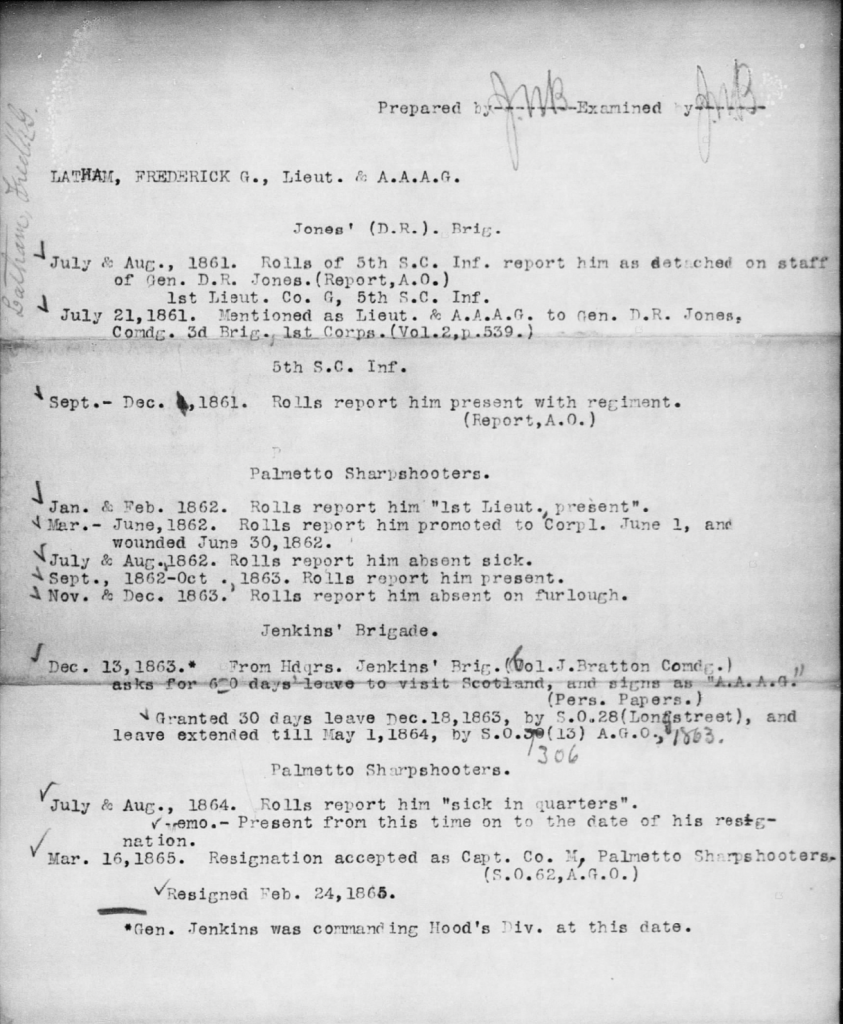
F. G. Latham’s Service Record in Co. M, Palmetto Sharpshooters (Fold 3)
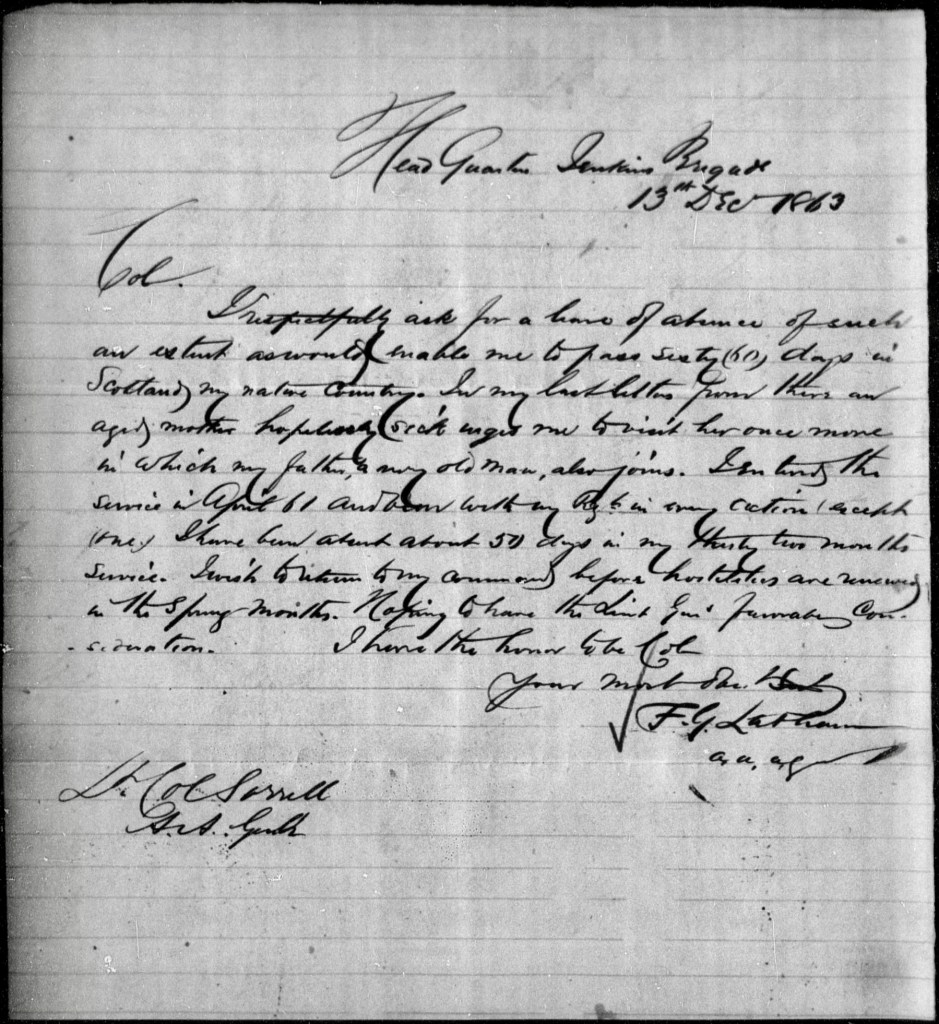
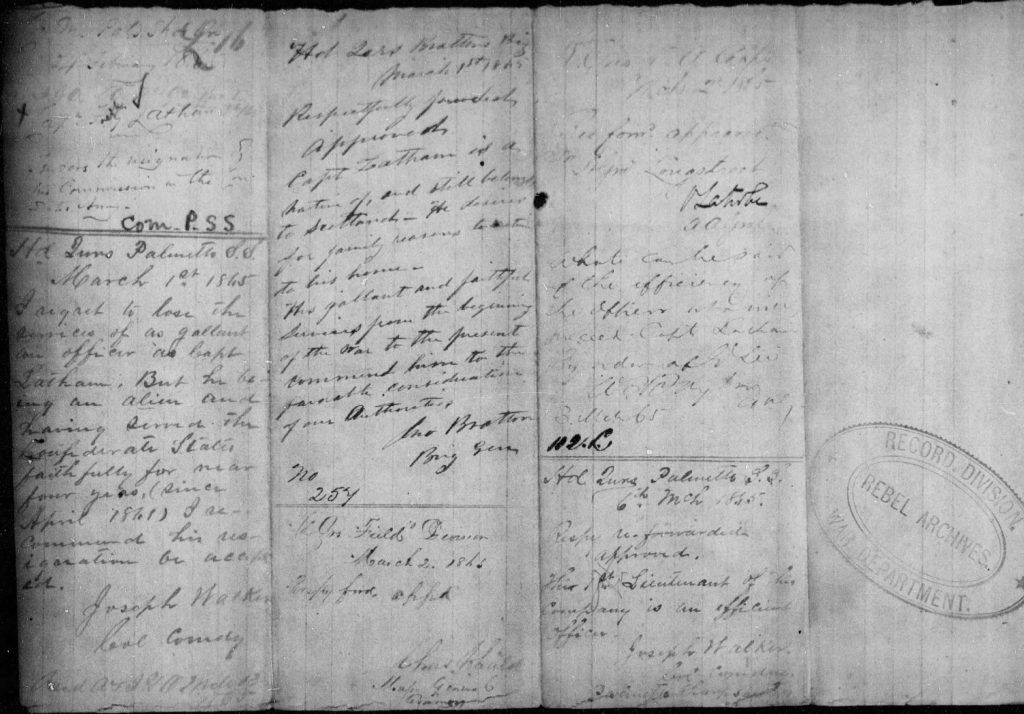
The following letter was penned by Frederick Graham Latham (1823-1903) who came to Spartanburg, South Carolina, from Moneydie, Scotland some time in the 1850s. During the Civil War, he was elected Captain in the Palmetto Sharpshooters, Co. M (the “Pacolet Guards”). The letter was penned in December 1863 and requests a leave of absence to visit his dying mother in Scotland. It can be found in the Civil War Service Records of the National Archives.
Fred’s great-great granddaughter, Shelly Aliene DeStaffino-Hunter, asked me to transcribe the letter. She informs me that Fred had 5 children out of wedlock with her great-great-grandmother, Rebecca Eleanor Ramsey (1848-1929). Family oral history has it that Fred did not want to marry Rebecca for some reason so she later married an Italian named Joe DeStaffino.
I respectfully ask for a leave of absence of such as extent as would enable me to pass sixty (60) days in Scotland, my native country. In my last letter from there an aged mother hopelessly sick urges me to visit her once more in which my father, a very old man, also joins. I entered the service in April 61 and been with my regiment in every action (except one). I have been absent about 50 days in my thirty-two months service. I wish to return to my command before hostilities are renewed in the Spring months.
Hoping to have the Lieut. General’s favorable consideration, I have the honor to be Colonel, your most obedient servant, — F. G. Latham, A.A.A.G.
William Spencer Pike (1821-1875), partnered with Samuel Hart as agents of the Baton Rouge Penitentiary (from Bergeron Collection)
The following letter was penned by Benjamin “Webster” Clark (1832-1885) who enlisted as a private in Co. F, 4th Louisiana Infantry and was promoted to Color Sergeant in late May 1861, and to 1st Lieutenant/Adjutant of the Regiment in May 1862. In the spring of 1864 he became the Lieut.-Colonel of the 1st Cavalry Battalion, Louisiana State Guards, and eventually made Colonel of the 8th Louisiana Cavalry Regiment. He was paroled at Natchitoches, La., on 6 June 1865.
Webster was the son of Samuel M. D. Clark (1800-1854) and Maria Glover (1814-18xx) of West Baton Rouge Parish, Louisiana. He was married after the war to Bessie Williams (1849-1894).
Webster wrote the letter to Roy Mason Hooe of King George county, Virginia who entered the Confederate service as a Lieutenant/Adjutant to Gen. Daniel Ruggles and was promoted to Captain in late December 1861. He later served in Chalmer’s Cavalry Division. He returned as a Major on Gen. Ruggle’s staff in 1865. Prior to the Civil War, Roy served as a Midshipman, 4th Class in the US Navy.
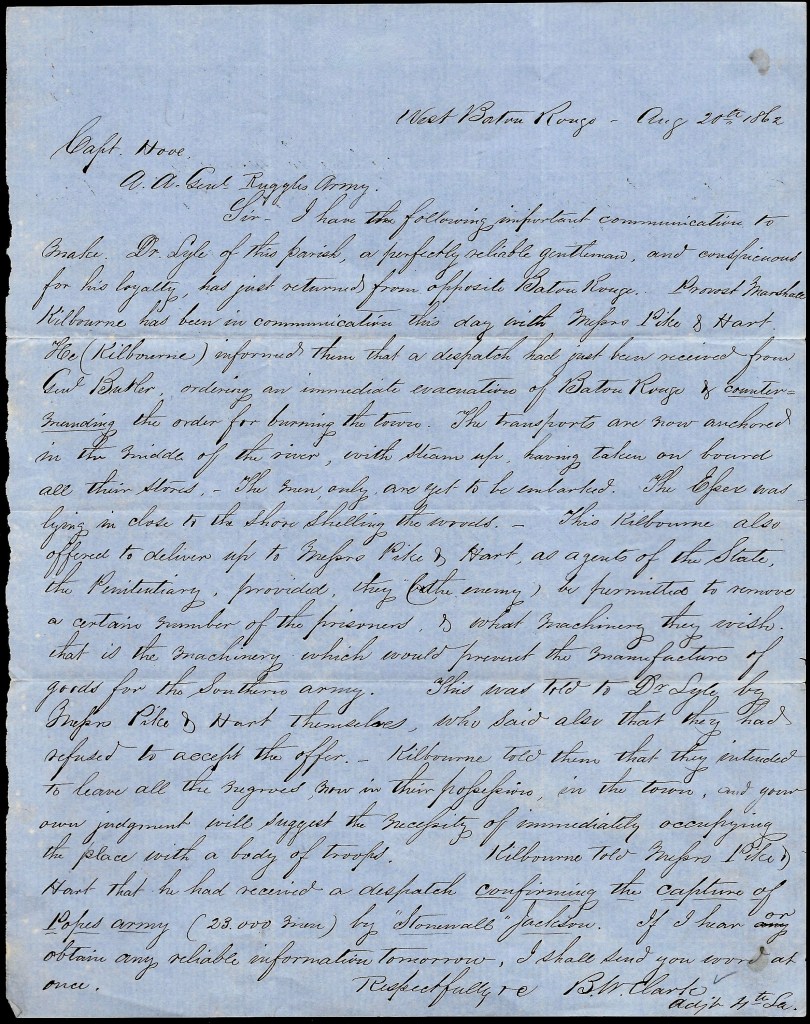
Sir, I have the following important communication to make. Dr. Lyle of this parish, a perfectly reliable gentleman, and conspicuous for his loyalty, has just returned from opposite Baton Rouge. Provost Marshal Kilbourne 1 has been in communication this day with Messrs. Pike & Hart. 2 He (Kilbourne) informed them that a dispatch had just been received from Gen. Butler, ordering an immediate evacuation of Baton Rouge & countermanding the order for burning the town. The transports are now anchored in the middle of the river with steam up, having taken on board all their stores. The men only are yet to be embarked. The Essex was lying in close to the shore shelling the woods.
The USS Essex at Baton Rouge, Louisiana, 1862 (Library of Congress)
This Kilbourne also offered to deliver up to Messers. Pike & Hart, as agents of the State, the Penitentiary, provided they (they enemy) be permitted to remove a certain number of the prisoners & what machinery they wish—that is, the machinery which would prevent the manufacture of goods for the Southern army. This was told to Dr. Lyle by Messrs. [W. S.] Pike & [S. M.] Hart themselves who said also that they had refused to accept the offer. Kilbourne told them that they intended to leave all the negroes now in their possession in the town and your own judgement will suggest the necessity of immediately occupying the place with a body of troops. Kilbourne told Messrs. Pike & Hart that he had received a dispatch confirming the capture of Pope’s Army (23,000 men) by “Stonewall” Jackson. If I hear or obtain any reliable information tomorrow, I shall send you word at once.
Respectfully, &c. — B. W. Clark, Adjt. 4th Louisiana
1 Possibly James G. Kilbourne, Asst. Quartermaster, 4th Louisiana Infantry Native Guard (Union).
2 Samuel M. (“Major”) Hart and William Spencer Pike were lessees of the Louisiana Penitentiary from 1857 to 1862. After the expiration of their lease, they continued for a time to administer the affairs of the institution as agents. Hart & Pike utilized convict labor to manufacture textile goods and paid the State half of their profits.The factory was completely destroyed during the Civil War, however.
The following letters were written by Charles Carroll Morey (1840-1865) of Royalton, Vermont, who entered the service on 20 June 1861 as a corporal in Co. E, 2nd Vermont Infantry, was promoted to sergeant in February 1862, and was commissioned the Captain of Co. C on 11 July 1864. He was wounded on 21 August 1864 at Charles Town, West Virginia, but was with his company on 2 April 1865 when he was killed in the final battle at Petersburg on 2 April 1865.
Charles was the son of Reuben Morey, Jr. (1809-1868) and Mary Louise Blasdel (1813-1847). After Reuben’s first wife died in 1847, he married Rosetta Morse Brown (1817-1877). Reuben was a merchant in Royalton, Windsor county, Vermont.
Letter 1
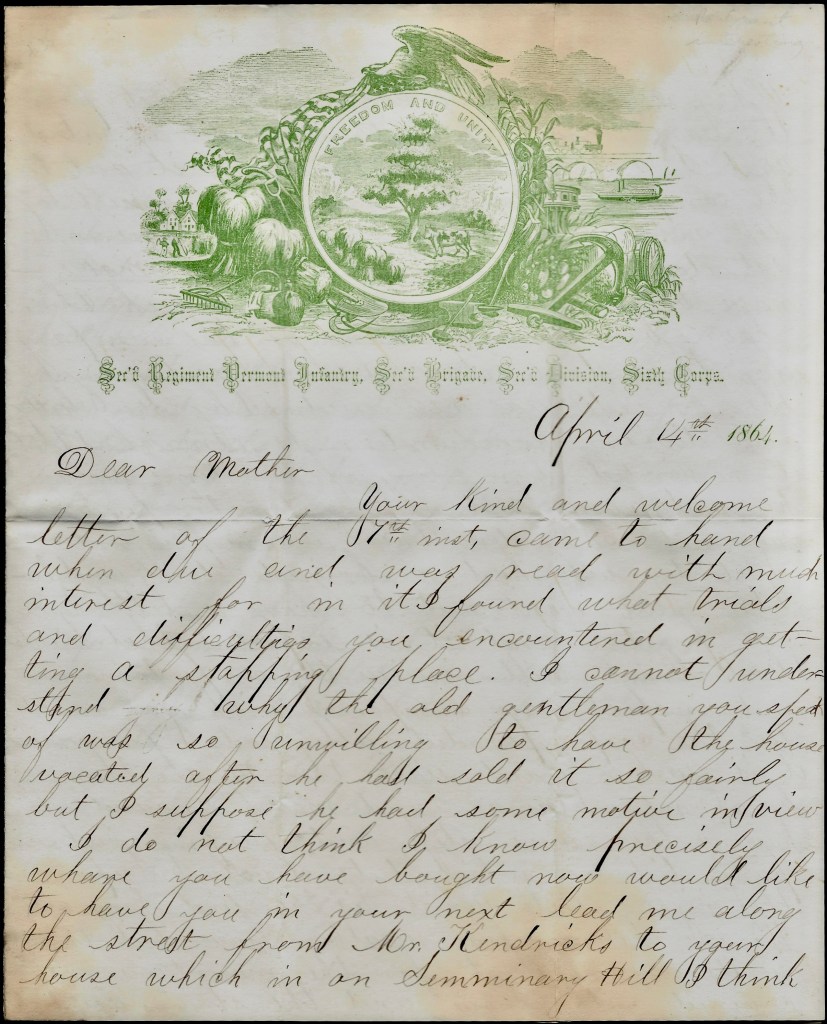
2nd Vermont Infantry Letterhead of Morey’s Letter dated 14 April 1864
April 14th 1864
Dear Mother,
Your kind and welcome letter of the 7th inst., came to hand when due and was read with much interest for in it I found what trials and difficulties you encountered in getting a stopping place. I cannot understand why the old gentleman you speak of was so unwilling to have the house vacated after he had sold it so fairly but I suppose he had some motive in view, I do not think I know precisely where you have bought now. Would like to have you in your next lead me along the street from Mr. Kendricks’ to your house which is on Seminary Hill, I think.
When I got to the bottom of the first page, the team drove up with a load of wood and I was called out to divide it out to the company. The I chopped up a small log for myself, after doing which I came in, sat down, and enjoyed a little smoke. Now I take my pen again to finish this.
Have been in command of the company for three days. Day before yesterday the brigade was reviewed by Gen’l Getty, our division commander. He remarked that it reminded him of the time when he had command of regular troops. Should you not consider this a compliment? Yesterday we had a brigade drill and today we went out to have a little target practice and it is expected that Lieut. Gen. Grant will review the corps tomorrow and inspect our camps. I wish you could see the corps paraded all ready for review. It is such a grand sight then to see them break into column and march around all having the same step and keeping just company distance which duty devolves upon the right guide which is the 1st Sergeant.
We are having fine weather now but the winds are cold. Yet far the mountains are covered with snow and the streams are high. For three days we had no mail in consequence of the bridges across the Bull Run and Rappahannock rivers but there are rebuilt now and the mail comes regularly which I hope it will continue to do so long as we stay in camp.
Did you receive my receipt for my town bounty? And also my order or receipt for the $125 State commutation money and if so, have you received the money? You say you will write soon and answer all my questions. Please do not fail to do so and let me [know] all the turns you are obliged to make, and please tell father he need not hesitate to use my money in his business for I intend to make that my business if I ever return to the quiet life I have left at my country’s call. Please do not keep me in suspense long in regard to my town bounty and state commutation money.
But I think I had better close this uninteresting letter and ask you to excuse me for troubling you this much. How do you like your new home and house? Please write me a long letter telling e all about it. Please remember me kindly to Uncle James. Tell him I should like to hear from him. Remember me kindly to all the family and all enquiring friends. Please write me soon and accept a great deal of love from your son in the army. — C. C. Morey
Letter 2
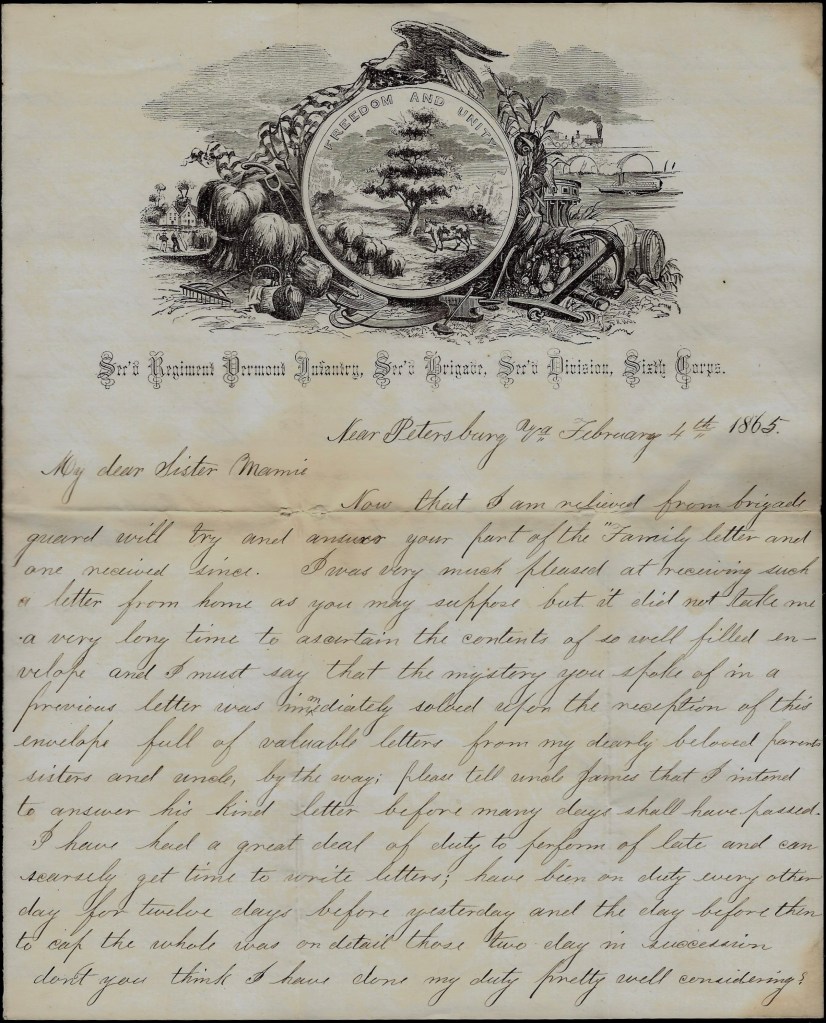
2nd Vermont Infantry Letterhead of Morey’s Letter dated 4 February 1865
Near Petersburg, Va. February 4th 1865
My dear Sister Mamie,
Now that I am relieved from Brigade guard, will try and answer your part of the family letter and one received since. I was very much pleased at receiving such a letter from home as you may suppose but it did not take me a very long time to ascertain the contents of so well filled envelope full of valuable letters from y dearly beloved parents, sisters, and uncle. By the way, please tell Uncle James that I intend to answer his kind letter before many days shall have passed.
I have had a great deal of duty to perform of late and can scarcely get time to write letters; have been on duty every other day for twelve days before yesterday and the day before then to cap the whole was on detail those two days in succession. Don’t you think I have done my duty pretty well considering?
The last letter I hacve received was yours of the 25th ult. Do not know why I have received no more. I suppose, however, that it is because they have not been sent. As you say, it takes our letters a very long time to go from here to Washington. This letterwill probably leave our camp tonight and City Point tomorrow morning will be on the boat from 30 to 35 hours. The will remain in the post office at Washington D. C. at least 24 hours more before it is mailed. This will account for the delay, I think.
Doubtless ere this you have (some of you) received letters from me saying something about orders to march. if so, rest easy for the prospect of a move has all passed and we are now as quiet as ever. What caused the order is that two rebel divisions were seen marching toward our left and we wished to be in readiness to meet them in case they should make a demonstration but they have been seen to return to their old encampments so there is no prospect of an attack at present on either side.
The weather is today very spring like and we are sitting in our tent with the door open. The photograph enclosed with my last letter was one that Lieut. Prouty gave me and i intend to ask you to put it with the others I have at home and I have some more to send which I wish you would place with the others until I come home or give you some further instructions in regard to them. I have received but one letter from Williamsburg friends since my last visit there. Cannot imagine the reason why they do not write. Have written to them two or three times. Hope they are all well and enjoying life as well as usual. I suppose they are anticipating much when the spring comes and they leave the city for our quiet little home in the little town of West Lebanon in the little state of New Hampshire.
Shurb Adams, a sergeant in Co. E, has just received a furlough for twenty days and will visit you before he returns. I have also sent by him a large book which perhaps you may [be] interested. Please keep it for me until I return home. I suppose you are still enjoying life as well as ever and attending those sociables and singing schools and all such pleasant gatherings. Would like to just step into our house just after dark and then go with you to some gathering in the village. Wouldn’t some folks stare and ask, “Who is that soldier that came with Misses Morey?”
We have no news in particular to write except that it has become a settled fact that commissioners from Richmond, Va., have gone to Washington to confer with the President on the subject of that great question Peace or No Peace. Hope they may conclude that we had better have peace instead of prolonged war.
I think of nothing more to write at present; therefore, will close. Please remember me kindly to all the family and our friends in West Lebanon and write as often as convenient. I have not solved the enigmas you sent me yet. Accept much love from your brother in the Army of the Potomac. Please direct all letters to Co. C, 2nd Regiment Vermont Vols.
— Charles C. Morey, 1st Lieutenant
To Muss Mary E. Morey, west Lebanon, New Hampshire
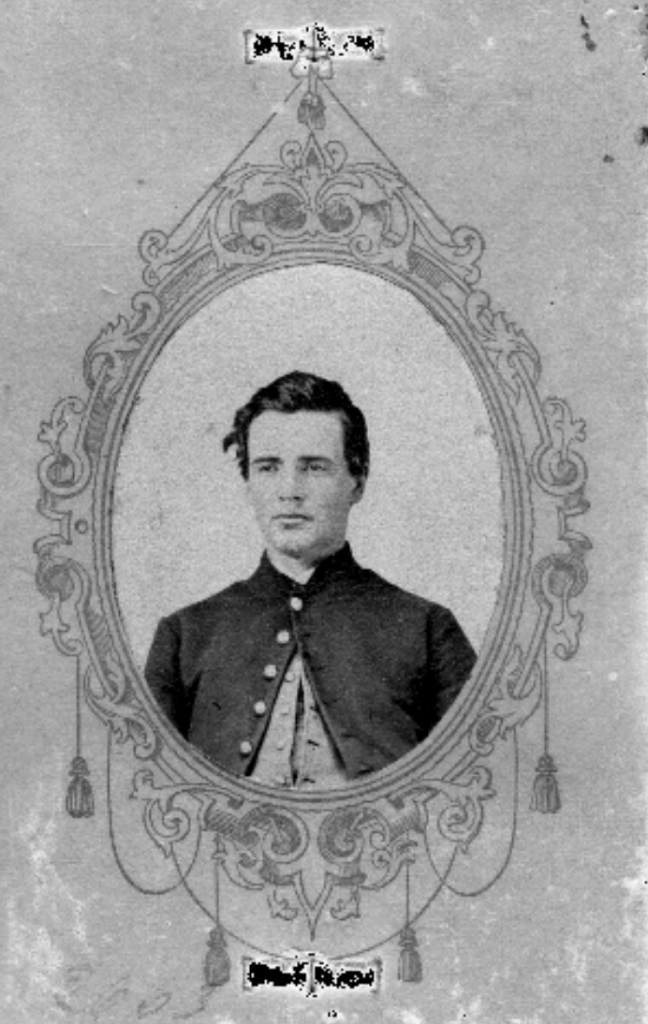
I could not find an image of Andrew but here is one of James A Redd of Co. F, 78th Ohio Voluntary Infantry (OVI)
The following letter was written by Andrew Hamilton Wallace (1839-1864), the son of Joseph and Mary (Logan) Wallace of Blue Rock, Muskingum county, Ohio. Andrew enlisted as a corporal in Co. D, 78th Ohio Infantry. This company was raised in Muskingum and Morgan Counties, and organized December 21st, 1861, in Camp Gilbert, Zanesville, Ohio. E. Hillis Talley was commissioned Captain; Benjamin A. Blandy, First Lieutenant; William S. Harlan, Second Lieutenant. Captain Talley was taken sick while the regiment was at Crump’s Landing. He was immediately removed to the hospital at Savannah, Tenn., where he died April 1st, 1862. He was the first officer of the regiment to fall a sacrifice to his country; being a young man of much promise, the only son of his parents, and loved and esteemed by all who knew him, caused his death to be deeply felt and regretted. About this time Lieutenant Blandy resigned and Lieutenant Harlan was promoted to Captain.
Andrew was killed in action before Atlanta in the Battle of Bald Hill on 22 July 1864.
Transcription
Crump’s Landing, Harden county, Tennessee Sunday eve, March 30th 1862
Dear Friend Sallie,
Your kind and welcome letter was received this morning. I was very glad to hear from you that you were well and enjoying yourselves at home and I hope these few lines may find you still the same. Your letter finds me well and enjoying myself very well at present.
Well, Sallie, it is with sorrow and regret that I inform you of the death of our friends Andrew Dixon and William Kenney. Andrew died on Tuesday the 25th at the hospital at Savannah which is about four miles below this place. And Kenney died on the 28th at the same place. There is a great deal of sickness here. It has been caused by the change of climate but there has not many died of this regiment yet. There has not more than ten or twelve died yet.
Well, Sallie, the rest of the boys are well at present and can just go for the crackers and beans and you ought to be here to help us to go for them some day. Well, Sallie, we are encamped on the Tennessee River four miles above Savannah. It is a very nice place here and the weather is very warm here now. It is as warm here now as it generally is in June up in Ohio. I am sitting before my tent on the wood pile in my shirt sleeves and one of our boys—maybe you know him—Wils Fox, is holding the candle while I write. But I expect it will be the last one that I will ever write here for we are a going to move tomorrow but I can’t tell where we will go to from here but I think it is to Corinth.
Well, Sallie, I wish you could of been here to of seen Wils and I baking bread to day. We got some of the nicest cakes baked that you ever saw. They are regular biscuits or big meeting cakes one but I can’t tell which.
Well, Sallie, I wish that I could been at home to of went to the distracted [protracted] meeting. I think that if I had been there, I could of raised an excitement for them and I would like to of been there to of seen the girls and to see if they look anything like they did when we left them. Sallie, I must tell you about the Southerner I saw the other day. It was a live woman. It was, I believe, the biggest one that I ever saw since I left home and it was a white one that was the beauty of the animal.
Well, Sallie, tell all the girls that I send my best respects to them and that I want them to write to me and that I will answer them and tell them that if they will come over some Saturday evening, that they can have my company if they desire it. No more at present but remain your friend, — A. H. Wallace.
N. B. A[lbert] Dempster says to tell you that he is all right and I guess he is. Write soon or a little sooner if you can. I send my love to all of you girls. Goodbye Sallie.
The following two letters were written by 2nd Lt. William M. Sentell (1834-1863) of Co. B, 28th Louisiana (Gray’s). This regiment was organized during the early spring of 1862 at Camp Monroe. The Marks Guards from Bossier Parish were mustered in as Co. B on the 14th May and other companies were added upon their arrival. When 10 companies were assembled, they were organized into the 28th Louisiana Infantry, with Henry Gray as colonel, William Walker as lieutenant colonel and Thomas Pool as major. The regiment numbered 902 men.
Pvt. Michael Thomas Bryan of Gray’s 28th Louisiana
Following the unit’s organization in Monroe, it was ordered to a training camp approximately five miles north of Vienna where it would spend the next two months. They subsequently assigned to General Shoup’s Brigade in the Department of Mississippi and East Louisiana. They were active at Chickasaw Bayou and also participated in the fighting that occurred around Camp Bisland on the Teche and the battle around Brasher City. William is believed to have been killed in the fighting in May 1863 and was probably buried on the field of battle in an unknown grave. [Lt. Wm. Sentell is mentioned frequently in No Pardons to Ask, nor Apologies to Make: The Journal of William Henry King, Gray’s 28th Louisiana Infantry Regiment, edited by Gary D. Joiner, Marilyn S. Joiner, and Clifton D. Cardin, in 2006.
William was the son of War of 1812 Veteran John Sentell (1793-1858) and Sarah Gardner (1800-1882) of Marshall county, Mississippi. He wrote the letter to an older brother named George Washington Sentell (1823-1895) who lived in Collinsburg, Bossier Parish, Louisiana, where he and another brother, Nathaniel Wesley Sentell, were partners in a mercantile store. In the 1860s, George resided in New Orleans though he owned cotton plantations in Arkansas and Louisiana. In 1861, William was serving as the postmaster in Collinsburg, Bossier Parish, Louisiana.
Another brother, James M. Sentell (1839-1862), also served in the Confederate army as a member of Co. D, 9th Louisiana Infantry. He was killed at Sharpsburg on 17 September 1862, having previously passed through the fighting on the Peninsula and the 2nd Battle of Manassas.
Letter 1
Camp Monroe May 22, 1862
Brother Washington,
I wrote to you some days since per Mr. Franks for some things I wished you to send. I hope you have received the letter ere this and send articles as per instruction. I wish now to make another request of you and wish this more particularly attended than anything else. That is to get my best cloth coat from my ward robe [and] have it thoroughly cleaned. I wish this coat for a uniform coat. I will have the stripes and buttons put on here. I expect I will have to cut the buttons from my grey coat I have here. I must have this soon. I am here without a sword and need one very badly. Most everyone else have them. I cannot get one here. I think and feel satisfied you can get one there. Write down to Shreveport immediately for one to some friend that will take an interest in getting one. Try and see if you cannot get Frank Haglus [?] if he brought it back with him so many officers are coming back it would appear to be an easy matter to get one. Please take this matter in hand and try to get one as soon as you can. I find it impossible to get one here.
I expect a good sword will cost me some 40 or 50 dollars. I have not received a line from you as yet. Am now expecting a letter every day. We are now in the regiment. Have everything very well arranged. I have been a little unwell a day or two from cold but have been on my feet all the while. I would like very much to receive the articles I ordered per Mr. Frank. My cloth coat and sword—do not forget them whatever you do.
I cannot tell you when we will leave this place. A number of reports are in circulation. I give them no credit. Some of our boys have been sick but all on the mend. Most diarrhea. J. H. Parker is quite sick but do not think him dangerous. I hope he will be up in a few days. The regiment have just commenced getting under [ ] properly. We are drilling every day by company. I have no news to write you. Any one inquiring after their friends you can say to them they are well. My love to sister Mildred and children. I saw the Lieut. Governor yesterday. He said he had the power from Governor Moore to establish a Camp of Instruction here and thought he would have all conscripts here in 30 days. Your brother, — W. M. Sentell
Think of my coat & sword.
Letter 2
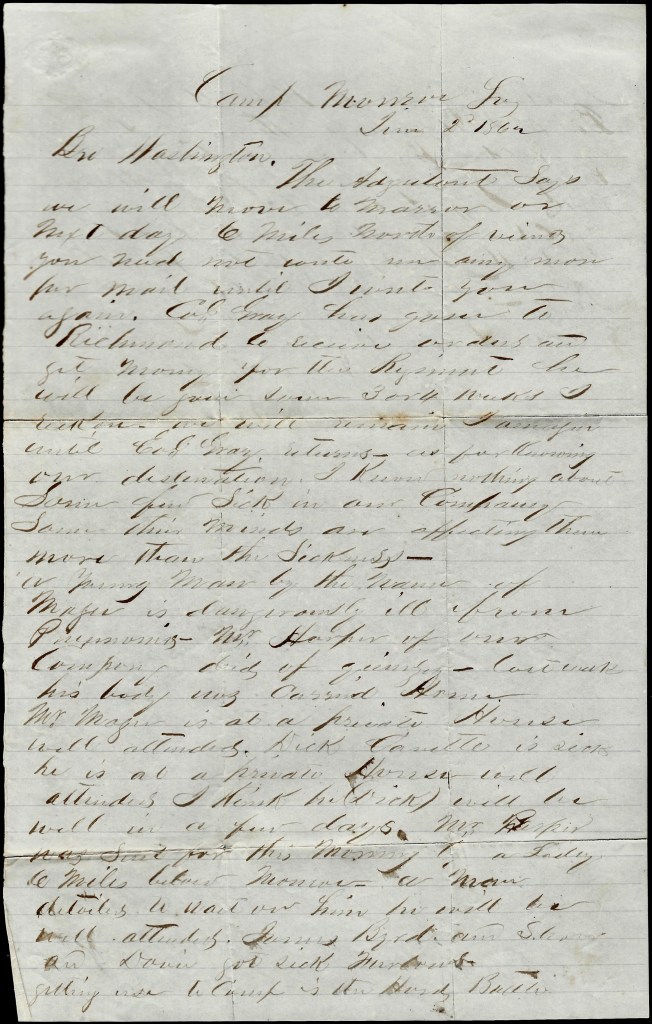
Camp Monroe, La. June 2, 1862
Br. Washington,
The Adjutant says we will move tomorrow or next day 6 miles north of Vienna. You need not write anymore now per mail until I write you again. Col. Gray has gone to Richmond to receive orders and get money for the regiment. He will be gone some 3 or 4 weeks I reckon. We will remain [ ] until Col. Gray returns. As for knowing our destination, I know nothing about. Some few sick in our company. Some their minds are affecting them more than the sickness. A young man by the name of Mager is dangerously ill from pneumonia. Mr. Harper of our company died of quinsy last week. His body was carried home. Mr. Mager is at a private house well attended. I think he (Dick) will be well in a few days. Mr. Harper was sent for this morning by a lady 6 miles below Monroe. A man detailed to wait on him. He will be well attended. James Byrd and Strong and Davis got sick furloughs. Getting use to camp is the hard [ ].
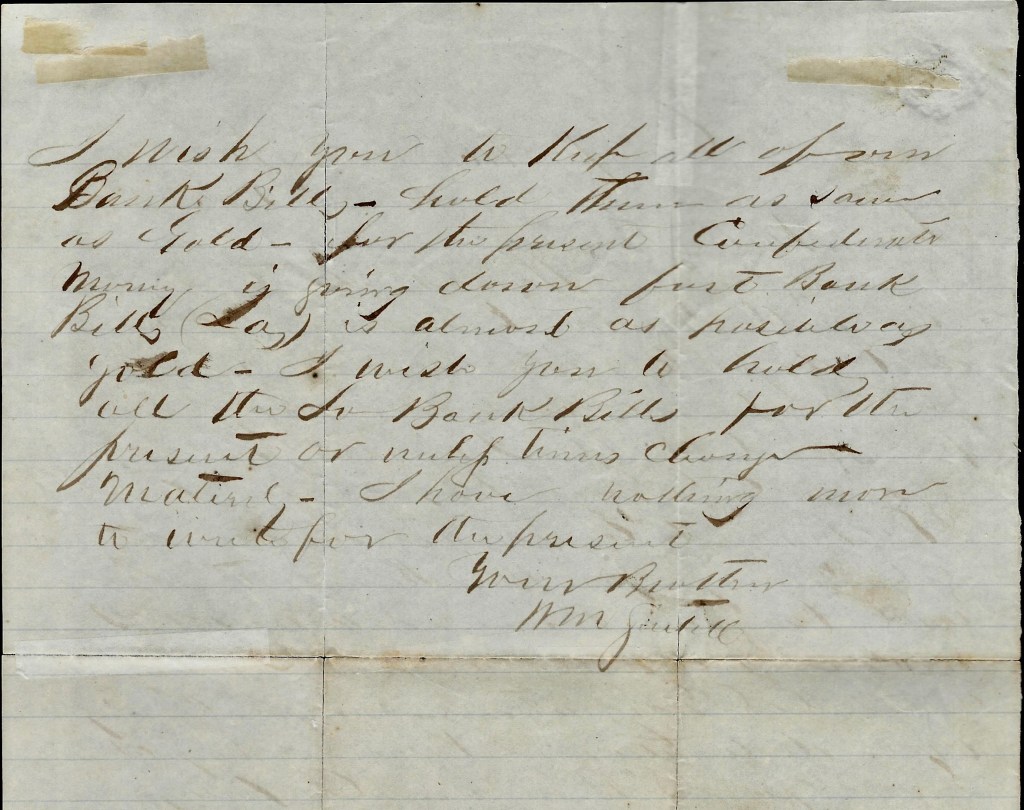
I wish you to keep all of our Bank bills. Hold them as same as Gold, for the present Confederate money is going down fast. Bank Bills (La.) is almost as [ ] as gold. I wish you to hold all the La. Bank Bills for the present or unless times change materially. I have nothing more to write for the present. Your brother, — W. M. Sentell
The following letter was written by 26 year-old George S. Campbell (1838-1931), the son of John Campbell (1811-18xx) of Boston. George was employed as a machinist when he enlisted as a private in Co. C., 1st Massachusetts Volunteers. His muster rolls informs us that he was wounded on 5 May 1862 in the Battle of Williamsburg and was absent from his regiment for a time but returned in time to participate in the Battle of Chancellorsville a year later. He mustered out of the regiment after three years and 9 days.
I could not find an image of George but here is one of George F. Whall who was a 42 year-old cabinet maker when he enlisted in the 1st Massachusetts Infantry in 1861 (Dan Binder Collection)
Transcription
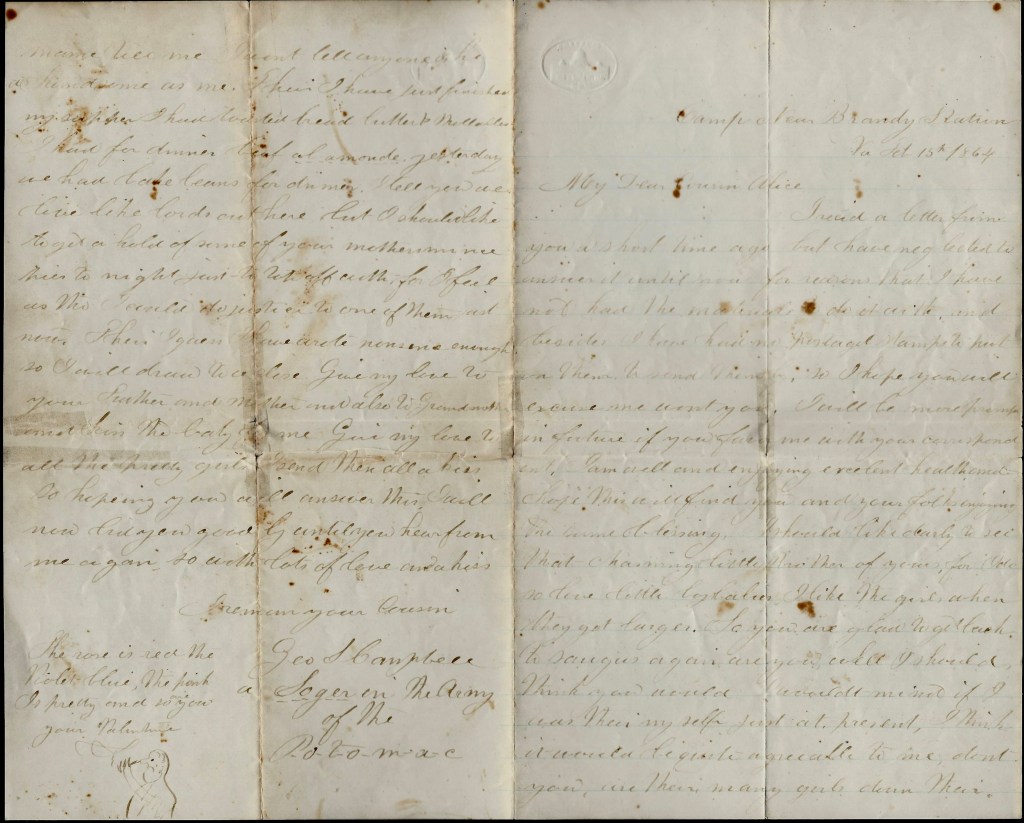
Camp near Brandy Station, Va. February 15th 1864
My dear cousin Alice,
I received a letter from you a short time ago but have neglected to answer until now for reasons that I have not had the materials to do it with, and besides, I have had no postage stamps to put on them to send them by. So I hope you will excuse me, won’t you. I will be more prompt in future if you favor me with your correspondence.
I am well and enjoying excellent health and hope this will find you and your folks enjoying the same blessing. I should like dearly to see that charming little brother of yours for I do so love little boy babies. I like the girls when they get larger.
So you are glad to bet back to Saugus again, are you? Well I should think you would. I wouldn’t mind if I was there myself just at present. I think it would be quite agreeable to me, don’t you? Are there many girls down there for I shall want you to introduce me to all of them when I visit you which will be in the course of three months or more. Won’t we have a grand time climbing up that hill you spoke about? You better believe I remember it—when you were so small that your Mother and I had to carry you up. But I suppose that the place has changed considerable since then, ain’t it?
How is that black-eyed Parker girl getting along—the one I sang for at your house one night at Chelsea? Have you been a skating much this winter? Has your Mother attempted to make a spread eagle of herself on skates? Tell her for me that our doctor has got a female horse out here and they call him Nancy, and he—excuse me, I mean she—can’t be beat. Will go her mile inside of 240.
We are having a snow storm today. It commenced about an hour ago. We had a Grand Review also today to please the women that are out here visiting their husbands at Corps Headquarters. So you see what we have to undergo to please the softer sex—march five miles with knapsack, haversack and canteen. I wish they would stay at home. This is no place for them. We have enough to do without their making more work for us, don’t you think so?
We came near having a fight the other day but missed it. Quite lucky for once. Since I left Boston last, I have been in three pitch battles and one skirmish—Chancellorsville, Gettysburg, One Mile Run [Mine Run], and the skirmish at Wapping Heights [Manassas Gap], Virginia, and so far have not received a scratch except a slight wound in my knapsack which tore a hole in my shirt and that was all. Lucky, ain’t I? But I don’t care about seeing anymore fighting. I have had my fill. Patriotism is below par with me. I want to go home and see Pa.
There is a rumor and I expect is true that the regiment is to come home on 16th of March. I am afraid if they keep us until the 27th of May, we will have some fighting but I hope they won’t.
I think it is real mean no one hasn’t sent me any Valentine this year. Have you had any yet? By the way, have you got a beau yet? What is his name? Tell me. I won’t tell anyone. Is he as handsome as me?
There, I have just finished my supper. I had toasted bread, butter & molasses. I had for dinner beaf a la mode yesterday. We had bake beans for dinner. I tell you we live like lords out here but I should like to get a hold of some of your mother’s mince pies tonight just to top off with for I feel as though I could do justice to one of them just now.
There, I guess I have wrote nonsense enough so I will draw to a close. Give my love to your Father and Mother and also to Grandmother and kiss the baby for me. Give my love to all the pretty girls. Send them all a kiss. So hoping you will answer this, I will now bid you goodbye until you hear from me again. So with lots of love and a kiss, I remain your cousin, — George S. Campbell
“A solger in the Army of the P-o-t-o-m-a-c”
The rose is red, the violet blue Is pretty and so are you. Your valentine.
The following letter was written by John Smith, the son of John Gardner Smith (1797-Aft1860) and Nancy B. Case (1801-1880) of Norwich, New London, Connecticut. John wrote the letter to his sister, Rebecca Ann (Smith) Morrarty (1838-1937) who married John Mikel Morrarty, Jr. (1831-1903) in 1854.
John Smith enlisted on 5 September 1861 and mustered as a Corporal in Company D, 8th Connecticut Infantry on 21 September. He was slightly wounded in the head in action at Antietam on 17 September 1862. He was reduced to Private, date not given, and mustered out at the end of his term of enlistment on 20 September 1864.
Serving with John in the same company was his brother-in-law, John M. Morrarty. He was away from the regiment for a time due to illness and was later transferred to the veteran reserve corps. He reenlisted on 6 Mar 1865 as a private, Co B, 2nd Regt, US Volunteers for another year.
Patriotic letterhead, “The House that Uncle Sam Built” (with slave labor)
Transcription
Moorehead City, N. C. April 20, 1862
My Dear Sister,
Last night I received your kind letter & I am very glad to hear that Mother arrived safe home. We are well—that is, John M[orrarty] & I—for a great many are sick & several are dead in our regiment. You know that I wrote in one of my letters that the 8th Regt. had been sent ahead of all the rest of the Division to take undisturbed possession of Moorehead City which we did—the regiment split to pieces. Co. E was sent to Beaufort, Co. I & F were sent to Carolina City. Co. D & K are now in Moorehead City, & Co. G. B, H. C. & A are over across the Sound on the same island that Fort Macon is on. The last five companies have a skirmish with the Rebels every day & drive them into the fort. Capt. Sheffield of Co. H is mortally wounded—the ball striking him in the pit of his stomach and coming out of his backbone. A private in the same company was wounded in the hip.
We have just completed a fine breastwork and mounted 6 mortars in position under the fire of the heavy guns of the fort. Col. Edward Harland is sick and the Major is in command of the five companies on the island.
Capt. J. Edward Ward is in command of this post in Moorehead City. The Lieut. Col. resigned & the Major, I suppose, will be promoted to Lt. Col. & Capt. War will be promoted to Major. He is as brave, noble, & efficient officer & is well worthy of his office.
If you will send me 1 dollar’s worth of postage stamps, I will be much obliged to you. I have told you a lie. I told you that I was well but I have got the neuralgia in face. Tell Mother to excuse me this time & I will write next mail. I have no postage stamps. Be sure and send them.
Your poetry was read and reread and placed on file until next week. Corporal H. N. Livermore, Co. D, died of typhoid fever & E. J. Comstock, C. D, of the same. They were both from Lebanon & Deacon McCull knew them both. I will now draw my letter to a close so goodbye from your affectionate brother, — John Smith
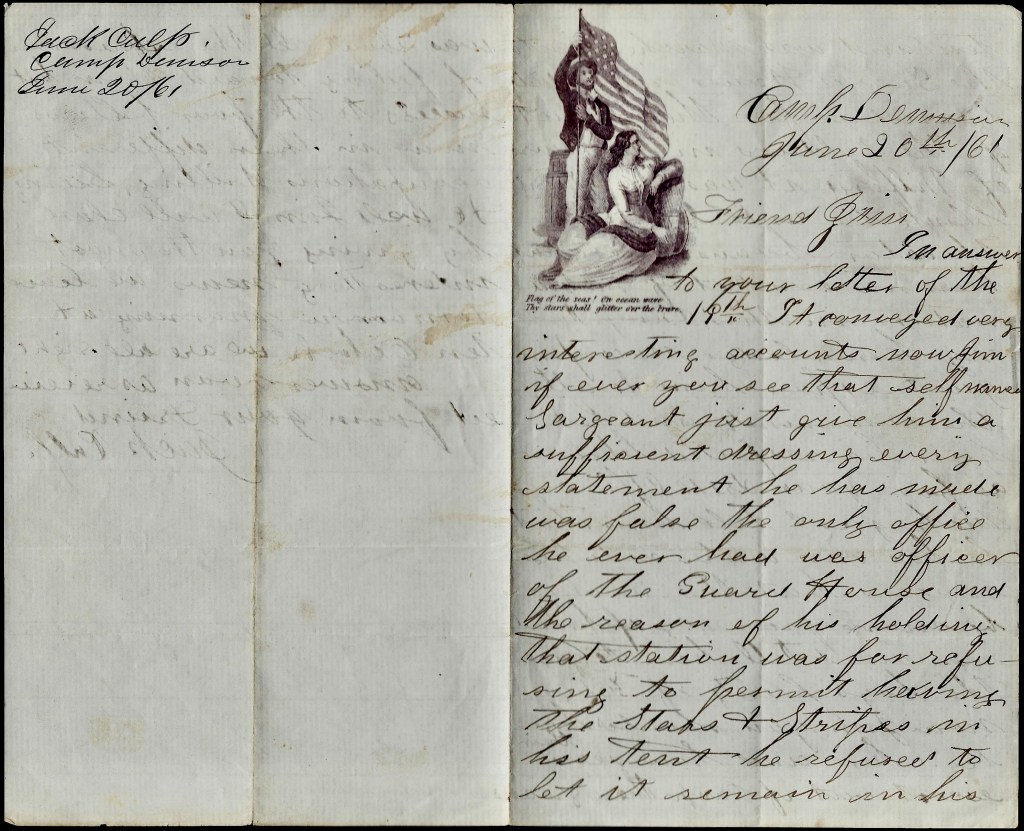
I believe this letter was written by Andrew Jackson (“Jack”) Culp of Co. F, 8th Ohio Infantry (3 months). Theregiment was organized 29 April through 2 May 1861 at Camp Taylor near Cleveland (and was mustered into service for 3 months on 2 May. Its nine companies were composed of men from northern Ohio, with Co. B representing the Hibernian Guards. The 8th Ohio was transferred on 3 May to Camp Dennison, near Cincinnati where they remained until June 22, 1861. Many of the soldiers in the regiment reenlisted for three years but it doesn’t look like Jack did.
Transcription
Camp Dennison June 20th 1861
In answer to your letter of the 19th, it conveyed very interesting accounts. Now Jim if ever you see that self named sergeant, just give him a sufficient dressing. Every statement he has made was false. The only office he ever had was Officer of the Guard House and the reason of his holding that station was refusing to permit having the Stars & Stripes in his tent. He refused to let it remain in his tent and was marched into the Guard House immediately. And as for the conduct of the soldiers in the town of Milford, it was all a point blank lie unless he was actor because there has been no conduct of such a nature in this camp to my knowledge. Now Jim, just expose him to all the community and let him be respected likewise.
As for your drill officer Mok, just tell him that he has our wishes as to his success but they would be more friendly if he had remained. Tell him to give the boys plenty of fatigue. Now Jim, you should have been here and have seen their escort out of camp. Three groans was about all the expression of feeling toward them. But success to the four fellows now in their different occupations—drilling, lying, &c.
Well Jim, I will close by giving you the most interesting news. We leave tomorrow morning at ten o’clock. We are all right. Answer soon as received. From your friend, — Jack Culp
The following letter was written by a soldier I believe was named “Theodore M. H.” and written to a woman in called “Bine” which may have been short for Sabina. It was datelined from Camp Dennison on 8 September 1861. Camp Dennison was a Federal Army training camp located in the town of Germany, Ohio, sixteen miles northeast of Cincinnati. George B. McClellan, a major general in the Ohio militia, chose Germany as the site for a camp. The camp was named for Ohio Governor William Dennison.
Camp Dennison was strategically located near Cincinnati, the Ohio and Little Miami Rivers, and the Little Miami Railroad. The rivers and railroad provided quick transportation from various parts of Ohio and surrounding states. The presence of troops at Camp Dennison also provided Cincinnati with soldiers to protect this important manufacturing city from Confederate attack. Camp Dennison encompassed more than seven hundred acres of land.
The camp hosted 75,000 to 100,000 soldiers traveling to and from the war. Since the soldiers only stayed for a short time, my only chance of identifying them was to look for regiments stationed at the camp in early September 1861, particularly those composed of German-Americans from Cincinnati. However, I couldn’t find anyone who fit that description by that name.
Transcription
Camp Dennison, September 8th 1861
Dearest Bine Mine,
I have been looking very strong for a letter from you last week but now it is Sunday and I feel very lonesome and disappointed because I did not get the letter you ought to [have] sent me. Now Bine, I want you to answer my letters the same day you receive them hereafter for they are the only thing that gives me any pleasure. And if you knew how anxious I am to get a letter from you, I know that you would not disappoint me. Now, if I do not get two letters at the very least from you this week, I shall in the future take the same time to answer yours that you do mine. Next to yourself, and your letters, that old pipe is my most loved friend and consequently I could not think of locking it up. But I think it would be policy to lock Bine up to keep her from running away. Why what would I do if you were to? If such a thing happens, I hope the first secessionist I meet will shoot me, for when I loose you, I will have lost all incentives to live. But this can never happen and I will not dwell on it for it gives me the blues to even think of it.
There was one of two things that I wanted to receive as a present from you but have got them from a different source. One was a needle case, the other a testament. The needle case was presented to me by a young lady from the country, the other case by some of the girls of our town. The testament was given to me here at the camp. I am afraid I do not study it enough to do much good—not one-eighth so much as I would read it if Bine had given it to me for then I would have studied it for the sake of the giver.
Will Hopkins was down yesterday to the mill with the wagon and came up to the camp and wanted Julius and I to go out home with him. As Julius wanted to go so bad to see Emaline Combs, I consented provided the Lieutenant would let us off and I went and asked him if he would let us off. He said that if we went, he could not let us go home for some time and as I wanted to see you worse than the folks in the country, I would not go (much against Julius’ will).
We had preaching today by Mr. [Samuel] Yourtree. 1 There was about three thousand there. It was the poorest sermon I ever heard but he made up for his lack of preaching by the prayer which was the most eloquent and patriotic I ever heard. There will be prayer meeting this afternoon at four o’clock and if I do not go down to Milford this afternoon, I think I will go.
Will Hopkins said the folks were coming down this week when I will get some more of the good things to eat. I will write the rest when I get yours.
Yours, Theo. M. H.
1 Samuel Livingston Yourtree (1817-1880) was a Cincinnati pastor of the Methodist Episcopal Church.
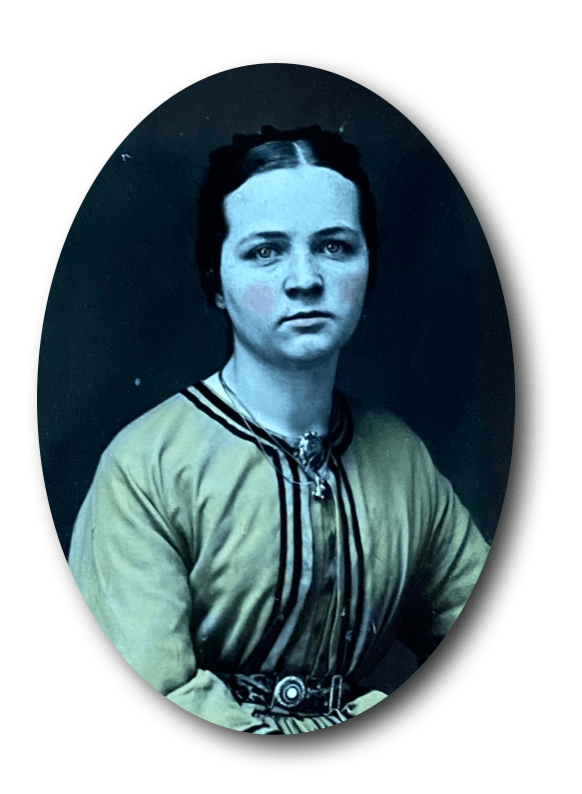
How Nannie might have looked (Bob Celli Collection)
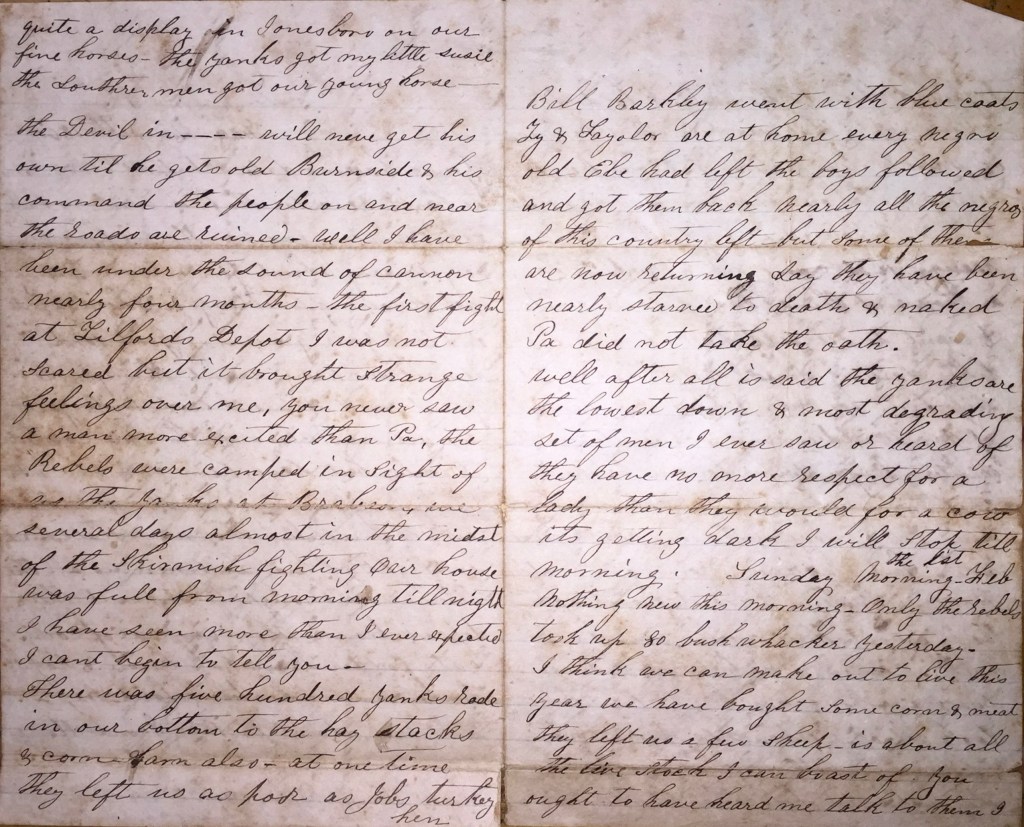
The following letter was written, I believe, by 16 year-old Nannie Margaret Bolton (b. 1847), the daughter of John Bolton (1817-1887) and Elizabeth Preston Smith (1821-1904). It was only signed “Nannie” but she is the only Nancy living in the vicinity of the neighbors mentioned in her letter; she was also referred to as “Nannie” or “Maggie.” In 1880, Nannie was still single and enumerated in her parents’ residence in Washington County, Tennessee. Sometime after 1880, the Bolton family moved to Randolph County, Missouri.
Nannie’s letter speaks of the 8 September 1863 fight at Telford’s Depot and Limestone Station near the family’s residence near Limestone, Washington county, Tennessee. [See Brisk Fight with the Johnnies: The 100th Ohio at Limestone Station by my friend Dan Masters, published on 16 August 2020.]
It should be noted the letter was certainly written in early 1864 but the dates are not correct.
[This letter is from the private collection of Steve Blume and was transcribed and published on Spared & Shared by express consent.]
Transcription
Limestone, [Washington county] Tennessee February 30th 1864
Yours bearing date October the 10th 1863 came to hand yesterday—the first mail we have had for near five months. We have been very uneasy about you and Uncle Jimmy, not knowing whether you skedaddled or stood your ground. Good Lord, Uncle, we have went through the flint mill since I last wrote you.
“The Devil in [Hell] will never get his own til he gets old Burnside & his command. The people on or near the roads are ruined.”
—Nannie M. Bolton, citizen, Limestone, Tenn., 30 February 1864
We are now clear of the blue coated Devils but have been over run with them for four long months. They treat us shamefully. They were stationed in sight of us and near us all the time—near enough to commit their depredations. They [took] every ear of corn, oats, fodder, bran, hay, bacon & hogs, turkey and chickens, lard soap, and even down to Pa’s grind stone. Our horses also. We have two old broke down rips. Aunt Alses, if you was here, I think we could make quite a display in Jonesboro on our fine horses. The Yanks got my little Susie. The Southern men got our young horse. The Devil in [Hell] will never get his own til he gets old Burnside & his command. The people on or near the roads are ruined.
Well, I have been under the sound of cannon nearly four months. The first fight at Telford’s Depot 1 I was not scared but it brought strange feelings over me. You never saw a man more excited than Pa. The Rebels were camped in sight of us; the Yanks at Brabson’s & we several days almost in the midst of the skirmish fighting. Our house was full from morning till night. I have seen more than I ever expected. I can’t begin to tell you. There was five hundred Yanks rode in our bottom to the hay stacks and corn [ ] also—at one time they left us as poor as Job’s turkey hen.
Bill Barkley went with blue coats. Ty & Taylor are at home. Every negro old Ebe had left the boys, followed and got them back. Nearly all the negroes of this country left but some of them are now returning. Say they have been nearly starved to death & naked. Pa did not take the oath.
Well, after all I said, the Yanks are the lowest down & most degrading set of men I ever saw or heard of. They have no more respect for a lady than they would for a cow. It’s getting dark. I will stop till morning.
Sunday morning, February 1st. Nothing new this morning—only the rebels took up 80 bushwhacker yesterday. I think we can make out to live this year. We have bought some corn & meat. They left us a few sheep is about all the livestock I can boast of. You ought to have heard me talk to them. I jawed them to the last. I told a Lieutenant that was here that he was of much less notice than our free negroes & that our free negroes was a credit to him. I poured it on to them pretty heavy. Just come up & I will tell you a thousand things that I can’t write.
I want to see Jeff so bad. Bless his little darling soul. I know he is sweet. Kiss him for me.
I have seen several of my Middle Tennessee acquaintances this winter. Major [John] Minor 2 for one. He spent a couple of weeks with us. I had like to have fell in love with him. He is a nice man.
Gen. [Alfred Eugene] Jackson’s 3 command is at Rogersville, Tenn. I heard from Capt. Berry about three weeks ago. He was well. Cousin Josiah Conley did not lose anything much but his horses. Took all of Ellison Thompson’s grain & horses and then ribbed his house. They just used Loflands up. They left & went to Virginia. Jennie [Lofland] is married to Jim [Horace] Baldwin. They used our good old Union friend Uncle Jerry Gibson about up. They was camped at the old place about ten days on the knob hill. The place is ruined, rail burned up, and timber cut down. Scarcely a tree left standing on the knobs.
Seven of Mr. Morrow’s negroes gone, his fencing nearly all burned up, and some of ours all next the road. Dr. [Alexander] Brabson 4 ruined. They day our folks retreated from Blue Springs, I never heard such shooting in my life. Our folks made a master retreat, crossed the long bridge just at dark. I never want to hear the like again. I got so used to cannons and guns that I did not mind it much. Five southern men run a thousand Yanks. They owned themselves that the rebs were the best fighters. I could write you a week of our troubles here but have not got space and paper is scarce in these diggings.
Mr. Miller says tell you he wants all the damned Yankees killed. We are all well and doing the best we can. William Henry Russell & his cousin has been spending the winter among the kin. Leesburg is dried up. Old Mrs. Sweet is still kicking. Old Jennie Cowan is dead. Bob Cowan out bushwhacking. Manuel Klepper gone with the Yanks.
I have not heard from my old spark since the middle of September. I hope he is still able for duty. You & Aunt Alses write to us soon and often. Pa says you must consider this letter [from] him and me both. It is such a task for him to write. As ever, your nice, — Nannie
Private Abraham Hoofnagle, Co. K, 100th Ohio Infantry. Captured at Limestone Station and survived imprisonment only to perish in the explosion of the Sultana April 27, 1865
1 Tilford [Telford] is a small station on the railroad between Limestone and Jonesboro. The community was first called Brabsontown, later Millwood, and continued so for many years. It was not until 1855, when Colonel George Whitfield Telford, a state senator who operated the Telford Manufacturing Company, donated about four acres of land to support local operations of the East Tennessee and Virginia Railroad, that the name Millwood was changed to Telford Depot. During the Civil War, citizens of this part of Washington County voted to secede from the Confederacy, but they were unsuccessful in persuading others to do so. The independent nation called “Bricker’s Republic” soon fell into relative obscurity. A Civil War battle took place in Telford on September 8, 1863, when the 100th Ohio Infantry clashed with the Confederate-aligned Thomas’ Legion just east of the depot. The Confederate force was supported by 4-Howitzer artillery unit commanded by General Alfred “Mudwall” Jackson. In the fight at Telford Station and Limestone, the 100th Ohio Infantry was overwhelmed by a much large force while guarding the railroad there and after a couple of hours of fighting, the Captain of Co. B, told his boys to make a break for it, but 240 men were captured.
2 Probably Major John Minor of Co. E, 10th Tennessee Cavalry (DeMoss’).
3 “Unlike most generals of the conflict, Brig. Gen. Alfred E. Jackson lacked any formal military training and had never donned a uniform, but was a farmer who owned 20 slaves prior to the Civil War. Jackson received his disparaging nom de guerre, the moniker “Old Mudwall,” by troops under his authority. Some men under the Tennessean’s leadership routinely complained to headquarters with statements accusing Jackson of being unfit for command to pointing out how the farmer turned brigadier had only commanded 20 slaves prior to the war. For much of the war, Alfred Jackson did little to gain the confidence of his men. He was known to discipline officers in the presence of enlisted men — chastening actions that a slaveholder would openly practice — but such harmful conduct toward military personnel was crippling to morale and esprit de corps of the entire unit, and it was shunned by veteran soldiers and grads of West Point and VMI.” [Civil War Talk]
4 Dr. Alexander Brabson (1805-1888) lived in the Limestone area of Washington County, Tennessee. After attending medical school in Kentucky, he returned to his home to open a general practice. In addition to his duties as a physician, Brabson owned and operated a flour mill. He was married to Emily Maria Stephens (1817-1885). The 1860 Slave Schedule shows he owned 6 slaves.


















 Spared & Shared 23