My passion is studying American history leading up to & including the Civil War. I particularly enjoy reading, transcribing & researching primary sources such as letters and diaries.
I could not find an image of Robert but here is one of John L. Robinson who also served in Co. B, 106th New York Infantry (Photo Sleuth)
This letter was written by Robert B. Hill (1840-Aft1920) who enlisted as the age of 22 on 29 July 1862 to serve three years in Co. B, 106th New York Infantry. He enlisted as a private but was a corporal when he was discharged from the service on 22 June 1865. According to his muster records, Robert was born in Wegatchie, New York, and he was described as a 5’4″ tall, light haired, grey-eyed farmer.
During the war, the 106th New York participated in the following battles: Fairmount and Martinsburg, W. Va.; Culpeper, Mine Run, Wilderness, Spottsylvania, North Anna river, Totopotomoy, Cold Harbor first assault on Petersburg, and the Weldon railroad, Va.; Monocacy, Md., Charlestown, W. Va., Opequan, Fisher’s hill, Cedar Creek, Va.; fall of Petersburg, Sailor’s creek, and was present at Wapping heights, siege of Petersburg, Hatcher’s run and Appomattox.
Just three months prior to this letter, the 106th New York was placed in the Army of the Potomac as part of Carr’s 3rd Division of French’s 3rd Corps. This letter was penned in the midst of the Bristoe Campaign—a series of minor engagements between Lee’s and Meade’s armies along the Orange and Alexandria Railroad in October and November 1863.
The Battle of Bristoe Station, 14 October 1863
Transcription
Near Catlett’s Station October 29th 1863
Dear Sister,
Yours of the seventeenth has been received some days since and I received one from Mother two or three days before yours and you must both excuse me for not answering them sooner. But the truth is that since I heard of Father’s death, I cannot think of anything to write but we must try and bear it as well as possible and hope when our time comes we may be found ready. And there is another reason that I have not written oftener of late. That is that we have not much time to do anything for we have been on the move nearly all the time for the last two or three weeks.
On the 25th of the month, our Brigade was sent to the front and we was relieved by the 2nd Brigade this morning. We was sent out to reconnoiter and try if possible to draw the rebels out and we went within a short distance of them and they sent their shells whistling over our heads but without doing any damage to our Brigasde. Our artillery would fire on them and then fall back but they took pretty good care not to come within musket shot of us. They have got a considerable force at Bealton Station and when General Meade finds out that he cannot draw them out this way, he will drive them the other. But I do not think there will be any very hard fighting for a few days.
We are just about ten miles from the front now but how long we will stay here, I cannot say. I do not think that our life is any safer here than at the front for we will not die before our time comes wherever we are. All the difference is that the more excitement there is, the time seems to pass away just so much faster and I think that it improves the health of all of us to have something to stir our nerves a little for the health of the regiment never was better than at the present time.
You say that you sent some things to me by Lieutenant [Robert] Riddle 1 but I never got them for he never came to the regiment and it is not very likely that he ever will for he has been discharged. I received the postage stamp that you sent in your last letter.
Now I will have to come to a close for this time for it is now nine o’clock p.m. This leaves me in good health and I hope these few lines will find all of you enjoying the same blessing. You must not expect too many letters from me while we are on the march for it is not much time we get to write letters. But you must write as often as you can. Give my love to all enquiring friends and keep a good share for yourself. Goodbye for the present. From your loving brother, — Robert Hill
1 2nd Lt. Robert Riddle was discharged from the 106th New York Infantry in early October 1863. He received a gunshot wound in his heel at Fairmont, Virginia, on 29 April 1863.
I could not find an image of John but here is a tintype of Pvt. Alonzo Bradley of Co. A, 6th Maine Infantry (MacDonald Collection)
The following letter was written by John Glover, a private in Co. D, 6th Maine Infantry. The 6th Maine Infantry was organized in Portland, Maine, mustered in on July 15, 1861 and mustered out of service August 15, 1864. Veterans and recruits were transferred to the 7th Maine Infantry and soon consolidated to become the 1st Maine Veteran Infantry. The regiment lost a total of 255 men during service; 12 officers and 141 enlisted men killed or mortally wounded, 2 officers and 100 enlisted men died of disease.
Glover’s letter summarizes the movements and engagements of the 6th Maine Infantry for the first six weeks of Grant’s Overland Campaign in 1864 fighting in the 3rd Brigade of Gen. Horatio Wright’s 1st Division of Gen. John Sedgwick’s VI Corps. They were brigaded with the 49th and 119th Pennsylvania, and the 5th Wisconsin. Glover informs us that the most of the casualties suffered by his regiment occurred on 10 May when their brigade was called upon to participate in Col. Emory Upton’s assault on the rebel works known as the Muleshoe—a salient in the rebel defenses near Spotsylvania Court House. They joined with 11 other regiments, “some 5,000 men whom Upton declared the best of the army” to charge upon the rebel works with fixed bayonets, not stopping to fire until they had breached the Muleshoe.
The Union Assault on the Muleshoe, 10 May 1864
Transcription
Camp of the 6th Maine Volunteers Near Petersburg, Virginia June 21st 1864
Friend George,
I once more resume the pen for the purpose of writing you a few lines to let you know that I am still alive and well. It has been some time since we had any correspondence and as times were rather dull and lonesome, I thought that I could not better improve my time than by writing to you. I have no news of importance to tell you—only that there is plenty of fighting here and not a great deal of rest.
Now I will try and give you a sketch of the present campaign. We broke camp on the 3rd of May about 4 o’clock in the morning and after a very hard day’s march lay down for the night. The next day about noon we marched down into a piece of woods and lay there all day and all that night and the next day threw up rifle pits and held them all that day and part of that night when we marched to the left and left our pits altogether.
After that, nothing took place of any importance until we discovered the enemy again at Spotsylvania Court House. There we had one of the hardest battles of the war. On the 10th of May our Division made a charge and was repulsed with very heavy loss. Our regiment lost 140 men killed, wounded and taken prisoners. Moses Babcock was wounded very bad. The ball passed through his breast and came out of his back so they say—I did not see him after he was wounded and have not heard from him since he went to the hospital, only by reports. The last report that I had, he was getting along very well and I understand that he is doing well.
Since the 10th, we have had some hard times but no such fighting as we had the 10th. We have lost a number of our regiment on the picket and skirmish line but it is useless for me to try to describe the whole scene of the campaign. I have given you an insight of the fighting and hardships of the last forty days and now, after a few lines more, I will close.
The Rebs are throwing a few shell over this way but none of them has come very near here yet but I expect they will soon throw some here and disturb my writing. There is already batteries of our own [responding] and every time they fire a shot, it disturbs my writing a little. And just now there was a rebel shot came very near me.
Now I have nothing more of importance to tell you. You will please tell Henry and family that I am well and [I] should write to them but it is very difficult to write here but I should like to hear from him if it is convenient. No more this time.
Please excuse poor writing and mistakes and write soon. Yours truly, — John Glover
P. S. Please tell me in your first letter if you received thirty dollars that was expressed on the 20th of September 1863.
Please direct to Co. D, 6th Maine Volunteers, Washington D. C.
This letter was written by Christiana Spangler (1828-1918) to her sister, Louisa (Spangler) Harr (1824-1882). In her letter, Christiana explains that she was deterred from coming to visit her sister by soldiers guarding the Wrightsville Bridge that spanned the Susquehanna river. The following vignette explains:
“When Confederate Brigadier General John Brown Gordon arrived on June 28 with approximately 1,800 troops, the Federals were waiting in their entrenchments. The Rebels opened up with artillery fire, and the Union position rapidly became untenable. The Federals decided to retreat to Columbia and blow up a section of the over mile-long bridge behind them, denying the Rebels access to Lancaster. The explosion failed to destroy the bridge, so the order to burn it was given. As the Confederates surged forward, the bridge erupted in flames. Gordon’s men worked for hours to extinguish the blaze. They kept Wrightsville from going up in smoke, but the bridge, financed by the First National Bank of Columbia, was destroyed. Gordon’s brigade was recalled to York the next day.“
Christiana’s letter was datelined 31st June 1863 which is clearly an error since there are only 30 days in the month. She makes no mention of the bridge having been destroyed yet but it may have been burned without her knowing of it when she wrote.
This letter is from the private collection of Jeff Hilsmeier who sent me photographs of it for transcription and publication on Spared & Shared.
Transcription
June 31st [30th] 1863
Dear Sister,
I take the pleasure this forenoon to write you a few lines to let you know that I am well at present and I hope that these few lines may find you and your family in the same state of good health and further, I will let you know that I was a going to come over home yesterday but I gave it up for this time for the people have a great excitement about the rebels that they are coming in so that they won’t let anybody over the bridge now in Columbia and they building forts above [the] city. But they can get over if they want to go to Lancaster for they are a great many hands are coming over to work in haymaking and harvesting and they never said a word to them that they can’t get over. But if one of our men wants to cross the bridge, they can’t.
And further I will let you know that me and Jacob got a letter from [your husband] Isaac and we were glad to hear of him but I expect till we hear of him again, he [will be] at home for he wrote that he expects to be in York till the 10th of July.
And further I will let you know that Jacob’s family is well and he has work enough. He is planting tobacco and seet potatoes still and I want you to let me know all the news that you know because I can’t get home. But if I live and can come about the rebels, I will come and stay a couple weeks with youans and I wish you all well till I see you again.
And so no more at present but still remain. My best respects to you and all inquiring friends and I want you to answer this letter as soon as it comes to hand. And so no more. Goodbye from me, — Christiana Spangler
The following letter was written by Louisa (Spangler) Haar (1824-1882), the wife of Isaac Haar (1818-1874) of Paradise township, York county, Pennsylvania. Louisa wrote the letter to her 46 year-old husband who was drafted in November 1862 and mustered into Co. C, 166th Pennsylvania Infantry (Drafted Militia). Isaac became ill in the winter and was hospitalized in January 1863—too ill to return to his regiment until 20 July 1863 and he was discharged a week later. Their children were named Emma (b. 1852), Annie (b. 1854), Amanda (b. 1856), and Allen (b. 1860) whose names appear at the end of the letter, though somewhat difficult to read due to the resolution of the image.
The letter was datelined 7 June 1863 but this was clearly a mistake; it should have been dated 7 July 1863—a few days after the Battle of Gettysburg which is described in the letter. In her letter, Louisa informs her husband of the passage of Gen. Early’s army through Gettysburg on the way to York, and then of the fights at Hanover and Gettysburg, followed by the heavy rains.
This letter is from the private collection of Jeff Hilsmeier who sent me photographs of it for transcription and publication on Spared & Shared.
Transcription
[Paradise Township, York county, Pennsylvania] June [July] 7th 1863
Dear husband,
Here I let you know that I and the children are all well at this present [time] and we hope that these few lines will and may find you in the same state of health. Further, I let you know that we had bad times here this week past. The rebels came through here on the [2]7th of June and went as far as York and then came back as far as Hanover on the 29th and there they had a fight and then from Hanover they went to Gettysburg and there they pound[ed] on us for about 3 days and it is said that our men killed about 35,000 rebels and took about 15,000 prisoners and it is aid that the rebels killed and wounded about 12 or 15,000 of our men.
And now the rebels are in Emmitsburg [Maryland] about 12 miles above Gettysburg and they say they are fixing for another battle and the rebels went up through Dover township and took most all the horses and through here they took a good many too but not so very much as some other places. And they keep the York fellows pretty hard. They say they made the York boys make up 25,000 dollars so as they didn’t burn down the town and they made it up more over here.
I let you know that I have a notion to cut some of our grain on the 8th, that is tomorrow, for the neighbors are still none at cutting grain and it is ripe too, but the weather ain’t good. It is raining here since last Saturday. Last Saturday evening we had an uncommon rain here. It wash the cornfields and the tobacco patches off pretty bad. It washed a couple loads of grain out of our corn field down in the lane and garden. It covered my [ ] patch most all over and if you write me a letter, direct your letter to the farmers post office that is at the [ ] for they do no business in Abbottstown—not since the rebels came in here, and I didn’t receive no letter from you since the 25th of June. That was the letter you wrote on the 21st. That was the longest day.
A little for Emma. She says that we have a good deal of blueberries but she is too lazy to pick them and Ogden says you shall come home and pick the blue berries. And now I want to know whether you are coming home pretty soon. I want you to write me and tell what time you can come about. No more at this time. Send me a letter as son as you can. No more. Yours, Louisa Haar and [names of her children].
The following letters were written by Pvt. Edward Jackson (1841-1863) of Co. A, 25th Illinois Infantry who enlisted at the age of 20 on 1 June 1861 to serve three years. When he was mustered into the regiment at St. Louis on 4 August 1864, he was described as a 5’6″ single farmer who had dark hair and hazel eyes. Though he enlisted for three years, Edgar did not live long enough to serve out his term. He died on 25 November 1863 from wounds received in the fighting at Missionary Ridge.
Edgar wrote all of the letters to his cousin, Josephine Cook (1847-1924), the daughter of Henderson and Lucinda (Trout) Cook of Georgetown, Vermilion county, Illinois.
[Note : These letters are from the Sic Parvis Magna, Gratias Jesu Collection and remain in private hands. They were made available expressly for transcription and publication on Spared & Shared.]
Letter 1
St. Louis, Missouri August 8, 1861
Dear Cousin,
I am sitting in my tent and I thought of the promise I made you to write to you and I thought that it was as good a time as I would find. I am well and so is Ben [Cook] and have been ever since we have been her. We landed here on Friday night at 12 o’clock and marched 4 miles to the Arsenal where we slept in dust six inches deep until morning, awoke, and walked down to the river and leaning on the fence, I gazed upon the longest river in the world. I thought of home and all who I left there. We are at present camped in the park.
We are unarmed and unguarded. All the troops that was fit to fight have been ordered away. There was two regiments came into the Arsenal today and some boatloads were going down the river. They are all undrilled like ourselves. 100 well-armed rebels can cut us all to pieces although I is little feared in our camp.
You must answer as soon as you finish this letter and tell me how Sis and Jim are. Tell Kate I would like to see her little red curly headed little John. He must write. Yours. Please answer soon. — Edgar Jackson
To Josephine
Write to me [at] St. Louis, Mo. , in care of Capt. Clark, [William N.] Coler’s Regiment.
Letter 2
Jefferson City, Mo. Tuesday, September 24th 1861
Dear Cousin,
I received your kind letter with much pleasure and tore it eagerly open to read the contents. I am well and have been since I came here. I have been homesick but that does not bother me more.
I have just come in from Dress Parade and it was the nicest sight that you or I ever saw. It is much prettier than a display of Wide Awake [marchers]. It was the last time that we ever expect to make in this place for we are under marching orders and will leave in the morning. We are going up to Lexington. They are fighting there like wildcats. The 23rd Illinois Regiment are taken prisoners and we are going to release them or die trying. General Frémont went through this city last night with 10,000 troops. The 25th Indiana Regiment were going up the river on a boat. They were fired into and the boat sunk.
You said for me to tell you what I had to eat and do. We have bread, meat, potatoes, beans, coffee, and rice, sugar. Soup the best of all. We have to drill from 7 till 11 before noon. Then from 2 until 6, making about 8 hours. They are fixing us for a fight and I say, let it come for I am getting tired of laying here and doing no good for myself nor my country. I want to fight some. There would be no honor in coming here and living at Uncle Sam’s expense for two or three years and not warring for him any.
I would like to come home this winter on furlough but there is no use of talking for we are not allowed to come home until discharged and nobody knows when that will be. I think that I can face it for three years if they are not too long and then I will got to Georgetown the nearest way.
You must excuse this bad writing for I can’t see where the rules are. If you want to see a full grown soldier, go down to Jim Hall’s. I sent Sis my picture today in some clothes that Frank Cook sent home. I would send you one if I could get money to get it taken. I had to borrow of [Lt.] Theodore West to get that one and it was a poor thing. They have been promising us three months wages for three weeks and it has not come yet and I do not look for it soon. You must write soon to Jefferson and if we are gone, all letters will follow us.
Yours as ever, — Edgar Jackson
Give my respects to all inquiring. Tell John to write me a letter. Kiss Kate for me two times. I don’t know whether you can read this or not. It is written by candle light. If you can’t, bring it to me and I will. I feel first rate tonight. I am not sick, homesick, nor lovesick.
Letter 3
Springfield, Missouri Wednesday, October 30th 1861
Dear Cousin.
I received your very kind letter today and was very glad to hear that you were all well. I am well and have been since I came here. All the boys are well, I believe, except Franklin. We had to leave him at Otterville. He was not able to travel and I have not heard from him since.
You heard that Old Baldwin was sick but that is false. He is well and has been all the time. Sylvester and Tom are both well and are enjoying themselves very well. I would like to be there to go to school with all the boys that I use to go with although I am doing very well where I am and don’t care if the war does last three years. I think that I can last as long as it does though I would like to be at home once in that time.
I should like to have been with you to the fair and to Terre Haute and saw the great city and the two regiments of soldiers that you said you saw although I have saw more than that. There are 25 regiments here in one body all in uniform and well drilled. We have run the secesh very near to the jumping off place and if they don’t jump, we will push them off. There is a dispatch today that Lane had them surrounded and could hold them three days and if we wanted to fight to come down and we could get the sight. We are going to start in the morning and we will whip them or fight a dry month for we are just the boys that can do that little trick.
There was a little fight here the other day. General Frémont’s body guard 150 men run 1800 of the secesh out of town and only lost 15 men and some few horses and have taken 28 prisoners. One of them is Colonel Price. The secesh lost about 100 men and nobody knows how man wounded. One colonel was killed by our boy in the fight. He was a very brave man. He was on horseback and he charged at our boys. They shot him five times before he fell from his horse. I saw all the dead men lying in the Court House. it was an awful sight. They were all in uniform—some of them all bloody just as they died.
Tell John that if I was there, I would keep him awake long enough to write me a letter. I have wrote my Father four times and sent him 20 dollars in one of them, I don’t know whether he got it or not for he has not wrote me one single line. I do not know how I can send this letter for there is not one postage stamp in the camp. Give my best respects to all and write soon to St. Louis. I remain your cousin, — Edgar Jackson
Please write soon.
Letter 4
Rolla, Missouri Saturday, December 13th 1861
Dear Cousin,
I received you very kind letter a few days ago and was glad to hear that you were all well for that is better than I can say for myself. I have not been able for duty for two weeks but there is so many of our company sick that I had to stand guard when my time came. I was on picket guard last night and today. I have the headache.
We are still laying in camp near Rolla and it is thought that we will stay here all winter but I hope not for this is a very lonesome place. There is nothing to see but soldiers, mule teams, and big rocky hills and I have seen them so much that it is no sight to me. There is about 20,000 troops here now. There is five Illinois regiments here—the 13th, 25th, 35th, 36th, and 44th. We are well provided with something to eat and wear. We have just drawn two good pairs of socks. We have good under clothes. They are woolen and very warm. We have good overcoats & blankets.
It is just 8 o’clock and there is brass bands, bugles, fifes, and drums beating the Tattoo—more music than I can listen to. There was one of [our] company taken off today with the smallpox. He was one of the Bloomfield boys.
I should like to hear Miss McCord’s class sing but we have one here that can beat it. We have a good time here singing. Ask Miss Katy if she won’t learn me to read when I get home. Tell her that when I get home we will play frog in the meadow like we use to do. I should like to come home on Christmas and see you all very well but I fear that circumstances will not admit. I have no hopes of coming home until discharged.
Tell John that his letter was the most interesting thing that I have read since I have been a soldier. Tell him to write again. Give my best respects to Uncle and Aunt and all inquiring and write soon to St. Louis.
I remain your affectionate cousin, — Edgar
There is neither postage stamps or stamped envelopes to be had here. We drew 17 dollars today.
Letter 5
Rolla, Missouri Wednesday night, January 21st 1862
Dear Cousin.
By reason of not having heard one word from you for a long time, I seat myself to write you the 2nd letter and hope you will soon write to me and let me know how you are all getting along.
My health is very good and the health of our company is better than when last I wrote to you. Alonzo [Jackson] is not well nor has not been for near a month and I fear that if he has to stay in camp here all winter, it will go very hard with him although I have no fears of myself for I am still hardy and rugged as ever and you well know that I use to be so at all times.
There has been three cases of smallpox in our company but they are not bad. One has entirely recovered and returned to camp. One has got so that he can wait on those that are bad and the other one is getting better. There is 15 cases of it in the hospital but not all from our regiment.
Today I broke guard and went to town and bought a picture of someones which I will send you although I don’t suppose you ever saw the fellow in your life but if you did, you will know him. I got another and will send it to New Holland, Indiana, to another cousin that you never saw.
It is getting very late and I am sitting alone in my humble place & position. All is still around me. The only sound that greets my ear is the snoring of my mess mates who lay in the arms of Morpheus enjoying the pleasures of sweet sleep and no doubt dreaming of home and the dear ones there for we often think of them.
We received (a few days ago) the 2nd box of nice presents from our friends in Georgetown for which we are under a thousand obligations for them for they prove to us that although we are away from them, we are not forgotten. We have been kept in camp so long that we hardly know how to act. A few nights ago I received an invitation to a dance out in the country about two miles from camp which I attended and had a good time in general. We had a good supper and good music, plenty of ladies, and I just went in lemons.
And now, Miss Pheney, you must write to me and tell me whether you received the picture or not and tell me whether you are going to school or not and how you like it. And who is dead and live, and who has moved to town or out of town, and tell me whether the Drakes are all dead or not for I expect Jim has quacked himself to death.
Give my respects to Uncle and Aunt and all other inquiring friends and believe me to remain your well wishing cousin, — Edgar Jackson
P. S. Kiss Kate for me.
Letter 6
Benton county, Arkansas February 20th 1862
Cousin Jo,
After a delay of some time I have found time to answer your letter that I received at Lebanon, Missouri, and I will have to ask you to excuse me for not writing sooner and I am sure you will when you hear my reasons.
We left our winter quarters at Rolla on the 2nd day of this month—the day that I was 21 years old. It snowed all day very hard so you can guess what sort of a place we had to sleep in. We marched five days without rest. We stopped at Lebanon three days and then resumed the march bound for Springfield where we expected to fight but failed to do so although it was not our fault. The enemy were there but they heard that we was coming and run like the Devil. They did not think we would follow them but General Sigel says they must fight or disband for he will follow them to the Gulf of Mexico. We have been following them about 100 miles and are determined to go on till they make a stand or disband.
We have been taking prisoners more or less every day. Some days we would find where they had broken their guns, burnt their wagons, & many dead horses were found along the road. All the citizens have deserted their homes and gone with the secesh army for protection (damned poor protection, I think). They are only one day’s march ahead of us.
Our cavalry engaged them yesterday at this camp. They had a bloody skirmish for a few moments but they would not stand fire. The cowardly Devils run into the woods. They lost about 30 men and of our cavalry, there were 9 killed and 11 wounded. It is reported that the enemy are waiting at Cross Hollows where they are fortified and reinforced. If that is the case, we will move to the attack tonight or soon in the morning.
Alonzo [Jackson] was sick and could not come with us. He was left at Rolla. I expect that he will be at home soon if he has not already gone there. But my health is good and I am satisfied to stay in Dixie Land.
You must excuse a short letter this time for I am so nervous that I can hardly write. Give my respects to all and answer soon. Ever yours, — Edgar Jackson
P. S. Those stamps you sent me were very acceptable for we could not get them at Rolla. Franklin and Sylvester [Cook] are both well.
Letter 7
Batesville, Arkansas May the 8th 1862
My dear cousin Jose,
Your letter came to hand yesterday evening and as I have some writing to do this morning, a portion of it shall be in answering your kind letter. My health is as goos as common and there is very little sickness in this part of the army.
We have been [on] a very long march as you can see by looking on the map, We have seen some awful country while crossing the Ozark Mountains. We often traveled all day without seeing a house. It is the most Godforsaken country in the whole [world]. It seemed to me worse than the Great Desert of Africa. The only thing about that looked like civilization was the lofty pine trees. They were green and looked natural—something like the Cedar Bluffs at my old home at Horseshoe Bend.
We was on the march 12 days without rest making about twenty miles a day. Some of the boys were entirely give out and got two days behind. We had to leave some at Salem, this state, for they could not keep up any longer. We have stayed here three days and I would like to stay here longer for it is the nicest town I ever saw but we are under marching orders to cross the river tonight or in the morning. A portion of the command has already crossed and we are camp on the other shore. When we all get over, we will resume our march bound for parts unknown. It is generally supposed that we will go to Little Rock.
Please answer soon. No more. Yours, — Edgar Jackson
Letter 8
Jacinto, Mississippi July 20th [1862]
My dear cousin Jose,
It is Sunday night and a very pleasant one. All have gone to bed but myself. I am along and this is the first opportunity of writing to you. The weather is so very hot that it is impossible to write or do anything else but lay around. You have very pleasant weather at Georgetown compared with this tropical, benighted land of swamps and secesh. We have been almost living on berries for some time past but they are about gone now and we will have to do without but not long for the peaches and apples are just beginning to ripen. Before long they will be at our disposal and no doubt we will dispose of a great many of them if they get in our way.
We are now in the 1st Brigade, 4th Division under command of Gen. Jeff Davis. The Brigade is formed of four regiments—three Illinois and one Indiana—25th, 35th, 59th Illinois and 22nd Indiana, and the 5th Wisconsin Battery. This brigade is commanded by Col. Coler. It’s rumored that we are going to be transferred into the other brigade and the 8th Kansas will take our place here. We do not like Gen. Davis as well as we did Gen. Sigel. We have wished ourselves in Sigel’s command a thousand times since we left it. We do not only like Gen. Sigel but we love him. Those who fought under him at Pea Ridge will never forget to praise and compliment him as often as his name is mentioned for we have seen him tried and know him to be a good and true loyal soldier.
My health is very good and there is very little sickness with us. Old Baldwin has been discharged and I do not know whether he has gone home or not. Lieut. [Theodore] West has not yet arrived although we look for him daily. Write soon to your cousin, — Edgar
Letter 9
Editor’s Note: This and the next letter were datelined from Benton Barracks and though Edgar does not state in his letter why he is away from his regiment and in St, Louis, we learn from a comrade’s letter that Edgar was taken prisoner in the Battle of Stones River and was paroled almost immediately to be held out of action by the Union army until he was officially exchanged. There was a Camp of Parole established at Benton Barracks for this purpose.
Benton Barracks St. Louis, Missouri August 5th 1863
Dear cousin Jose,
I wrote you a letter some time ago but never received any answer to it. I am now going to write you another and beg you to condescend to write me once more . Sorry to say I cannot write you anything of importance or interest. My health is good although I am not stout and rugged as I use to be with my regiment.
Benton Barracks is a dreary place to me, We are kept close in the confines of the barracks, not allowed to get out more than once a month. I have not had an opportunity of visiting the city since I have been here. I stole my way out one day and went into the country. Had a fine time. Found some berries. Also found a man’s orchard and partook of the forbidden fruit. Saw a woman coming toward me and expected to get a scolding [but I was] badly fooled. The lady talked kindly to me—almost sweetly. Said she liked soldiers—flattered me considerably. I asked her for a drink of water. She said come with her to the house and she would get me some. Went to the house but instead of water she brought me some nice sweet milk. This was very acceptable for I was always fond of milk. I thanked her for it and bid her good evening. She asked me to come again. The sight of her will, I fear, be the cause of my future wanderings (don’t laugh—you know I am sentimental in a horn).
We have religious service here three times each day, Sabbath School every Sabbath morning. I attend church regularly twice a day—sometimes more. In the cool of the evening we play at ball. In fact, we have every chance to enjoy ourselves in the barracks, yet I am not satisfied. I feel like I should either be at home or with my regiment. Either one is preferable to this place.
Are you having any school in Georgetown this summer? If so, who is teaching and who is attending? I understand there is a new church in progress. Any other improvements? I hear you can afford some saloons—in plain words, whiskey shops. Is there any more drunkenness in town than there use to be? I understand Old Baldwin has at last succeeded in gaining the fair Hoosier belle (Delanie Bell). Also James Snapp and Tiney Frazier tied. Bully for they! Poor little Jim Snapp. I do wonder if he has not some bright prospects if taking a wife before he dies. Success to him is my humble prayer. Has John still got his fine horse of which he bragged so much? Ask him if I may not ride him around the house a few times if I will come down.
Remember me kindly to all enquiring friends and don’t forget your affectionate cousin, — Edgar
My love to Katy. Write soon.
Edgar [Jackson] 20th Company Benton Barracks, St. Louis, Mo.
Letter 10
Benton Barracks St. Louis, Mo. August 20th 1863
Dear cousin Josephine,
Your letter bearing date August 10th came to hand in good time and plight. I was glad to get a letter from you for I had not heard from you for some time past and was anxious to know why you had stopped writing to me.
My heath is good but I cannot say I enjoy myself for this is the driest place I ever found. Tis enough to make anyone sick, particularly those who have been use to such a life as myself. I, you know, was always fond of solitary rambling that I am deprived of here. I have only been out of the barracks once and then I stold out. The officers have me a pass a few days ago and I thought to visit the city but I presented the pass to the sentinel at the gate [and] he said I had forged the pass and sent me to the guard house where I was closely guarded for twelve hours and then taken before the Provost Marshal for trial. I summoned the captain and first sergeant and proved myself clear of all charges. This is the kind of consolation I have always received for doing my duty. I have some books here and I pass the heat of the day reading. As soon as it is cool enough in the evening, we play at ball until sundown and then go to church.
I received a letter yesterday from the regiment. They are still at Winchester, Tennessee, enjoying life very well. A. W. Moore has been discharged from the company since I left. Sylvester is detached to work the siege guns at Murfreesboro. That is an easy berth but I feel safe in sating he would rather be with the regiment.
Jose, can you tell anything about my old friend Henry Brannock? I heard he was a soldier in the 11th Indiana Volunteers but was wounded at Shiloh. Since then I have not heard from him although I have written to Georgetown. I have forgotten it until this time.
You promise if I will come home you will not be so stringent on me as they are here but let me go where I wish to and to do as I please? That is a great temptation for it has been a long time since I have enjoyed such privileges and I expect I would go wild.
I heard that old Sam Frazier shot a soldier in Danville a few days ago. He must think he is a many of authority. Every dog has his day. Let him have his now but when the soldiers are liberated, they will revenge all such insults. — Edgar
My love to all. Tell Uncle I have not received that promised letter yet. Please write soon. — Edgar Jackson, 20th Company, Benton Barracks, St. Louis
Letter 11
Nashville, Tennessee November 10th 1863
My dear cousin Jose,
Yours of date August 17 did not come to me but I came to it at this place. I suppose when we were here before it was brought here and has been kept here until we returned a few days ago and being anxious to hear what is going on in Georgetown, I lose no time in answering.
My health is good and that is the most effective disease we have at this time. Alonzo was complaining yesterday but says he is better this morning. Sergt. [Samuel] Moore is not well nor has not been for some time. Sylvester and Frank are both well. I saw Theodore yesterday. He has been having the ague and he looks as slim as a bean pole.
I visited the companies of Captains McNutt and Holloway yesterday. They are all sick. Those who have no disease are either home[sick] or lovesick and the only topic of conversation is home or when the war will end. Their faces will average about two feet & 12 inches long.
Since we were here before, we have marched more than 500 miles. We have had no tents since we left Alabama and there is no prospect of getting any soon. I have not slept in a tent since I can recollect.
The day we got here we had quite a skirmish about daylight in the morning. We were started out on double quick. We descended a steep hill where a band of secesh (number unknown) fired upon us from a very high hill. Two companies—A & K—were deployed and run them from the position, killing and wounding as many. We followed them some distance and recaptured a sutler wagon which they had taken from the 51st Ohio Volunteers. I had the pleasure of firing five rounds at them. No one on our side was hurt.
Tell my Sis I wrote her a letter at Iuka, Mississippi, in which I sent her $5 by Charles Hamilton. But I suppose he never made his appearance at Georgetown. Give my best compliments to all who may enquire after your cousin, — Edgar
P. S. Tell Kate I am going to desert the army on purpose to come and see her and Ella. — Ed
The following letters were written by Pvt. Benjamin Franklin (“Frank”) Cook (1841-1924) of Co. A, 25th Illinois Volunteers. His muster records inform us that he was a single, 20 year-old farmer with dark hair and blue eyes from Georgetown, Vermilion county, Illinois and that he towered over his comrades at 6 foot 3 inches tall. He entered the service on 1 June 1861 and remained with them until 19 August 1863 when he transferred into the 1st USCT at Winchester, Tennessee.
Frank’s parents were Enos Cook and Malinda Harris of Vermilion county, Illinois. He wrote the letter to his cousin, Josephine Cook (1847-1924), the daughter of Henderson Cook and Lucinda Trout of Georgetown, Vermilion county, Illinois.
Frank’s second letter mentions briefly the Battle of Pea Ridge that was fought on 7-8 March 1862 near Elkhorn Tavern in Arkansas. “Many of our bravest men fell, ” he told his cousin, adding, “I saw the noble-hearted soldiers laying upon the battlefield with their heads and arms shot off, weltering in their blood. Upon the Rebel side the slaughter was tremendous.”
The first four letters in this collection were written while Frank served in the 25th Illinois Infantry; the last four letters were written after he had transferred out of the regiment to accept a commission as a lieutenant in Co. E, 12th United Stated Colored Troops (USCT).
[Note : These letters are from the Sic Parvis Magna, Gratias Jesu Collection and remain in private hands. They were made available expressly for transcription and publication on Spared & Shared.]
Letter 1
St. Louis [Missouri] August 16th 1861
Dear Cousin,
I had not forgotten your folks but I cannot write to all my friends at once, nor very often. I happened to have a little leisure [time] this evening and I thought you would like to hear from us so I take my seat on the ground under my tent and using a little box for a table, I proceed to write you a few lines in a great hurry to tell you how we are getting along here in this land of slaves.
We are now encamped at the Arsenal Park, St. Louis. We live in tents made out of muslin. They are about 8 feet long and 7 feet wide and run up to a sharp top. We have to stoop down to get into them. There is seven of us occupying one tent. Some of them have 10 men crowded into them so that you can guess that we haven’t much room for kitchen or parlor.
I saw a letter just now that you wrote to Edgar [Jackson] in which you stated that you heard that we had to eat sea crackers and water. That is not so. We did have to live on sea crackers one night but we have plenty to eat now. Some of the boys grumble at what they have to eat or rather the quantity which they have to do on. The reason of that is they have lost their appetites and found a dogs in place of their own. We have a negro hired to cook for us all. He charges 70 cents per month for each man. We have first rate beds to sleep on. They are made out of our blankets spread down on the soft side of a plank or the ground with a little straw sprinkled over it. We feel first rate of a morning when we get up off of our beds.
Uncle Sam gave us a nice blue blanket apiece and a pair of new shoes, a splendid gun, and numerous other little presents. We got the guns last night. We have to drill three hours each day and stand on guard once in a while. I was on guard last night. Sylvester [Cook] is on today. This is the hardest work that we have to do. Maybe you would like to know what we do when we are not on duty? Well we can’t do much of anything the most of the time for there is so much noise all around us. Some of the boys are playing cards. Others are singing, some doing one thing and one another. Sometimes they have prayer meeting. Sometimes a dance. There are plenty of fiddlers in the regiment. Of Sundays we have preaching. But I can’t tell you anymore at present.
Tell John to be a good boy. Tell Uncle Thomas’s folks that I wish them all well but can’t write to them at present. I remain your affectionate cousin, — B. F. Cook
Write
Dear Uncle, I thought perhaps that in addition to what ideas you might gather from Josephine’s letter I would give you a few from yesterday’s proceedings which might be interesting to you. Yesterday morning St, Louis was put under martial law. Last night we expected a muss. Consequently our regiment was armed and the guards were doubled. I was on guard at the arsenal on the south wall next to the river. During the day there was 7,000 troops passed up the rive to St. Louis where they took the cars as we supposed for Springfield in the state. There was three prisoners brought ito the Arsenal yesterday. You must excuse this horrible writing for therer are two boys waiting for the paper that I write with. Tell father that I received his letter and was very grateful for the change and will answer as soon as I can. Yours, — B. F. Cook
Letter 2
Camp Welfrey, Arkansas March 16th 1862
Dear Cousin Josephine,
As I have not written to you for a long time, I thought that I would write you a short letter and tell you how we are getting along. Well we have seen some pretty hard times since we left Rolla in Missouri. We have marched about three hundred miles over all kinds of road and all kinds of weather. We have marched from morning till night over frozen ground while the snow was falling thick and fast upon us, and at night have no bed except our blankets spread down upon the cold, damp ground. And again we have marched all day through mud and rain, and at night had to cut brush or gather up cornstalks to keep our blankets out of the mud.
We have always had plenty to eat so far when we have had time to cook. When Uncle Sam can’t get provisions to us, we have to take it from the inhabitants, but when they are at home we always leave them enough to do them a while. A great many of them have left their homes and gone south leaving almost everything they possessed. When this is the case, we don’t leave them much.
A few days ago we fought a great battle and won a great victory. Many of our bravest men fell. I saw the noble-hearted soldiers laying upon the battlefield with their heads and arms shot off, weltering in their blood. Upon the Rebel side the slaughter was tremendous. But I have not time to tell you much about the battle. If you will go to our house, you can read a letter which I wrote to father in which I described the battle more fully.
Well, Josephine, I suppose that you are going to school. If you are, my advice to you is to learn all you can for you can hardly appreciate the value of an education now but when you are your own woman, you will then see its value. How I wish that I could be at school now instead of being out here in Arkansas.
Tell John that I said for him to be a good boy and go to school and make a man of himself in spite of the world. And tell Katy that she must be a good girl and when I come home, I will bring her and Emma some nice presents. Give my love to your mother and father and tell them to write to me. And write to me yourself.
I remain your affectionate cousin, — B. F. Cook
P. S. You must forgive me for not paying postage for we can’t get stamps out here. Direct your letters to St. Louis in care of Captain Clark of the 25th Illinois Volunteers.
Letter 3
Nashville, Tennessee November 17th 1862
Dear Cousin Josephine,
As I have a little time this evening, I will try to write you a letter, but you must not think strange if it does not amount to much for I cannot find very much to write about at this time. Our present camp is situated on the northern bank of the Cumberland river, just opposite the City of Nashville. We received our tents a few days ago and are now pretty well fixed for living in regular soldier style and you may guess that the 25th Illinois boys know about as well how to make themselves comfortable when they have a half chance as the most of soldiers.
It is supposed by the General Commanding our Division (Gen. Jeff C. Davis) that we will hold this post all winter. If this be so, we will have a good time this fall putting up our winter quarters. I am in hopes, however, that the tarnel war will end before Christmas for I want to come home and take dinner at your house on that day. I often wish that I could be at your mother’s table and eat of her good cookeries when we are scarce of hard bread and pork. I will tell you what we had for dinner today which was a little extra. We had cornbread and meat and stewed pumpkins. Coffee bean. Was not that a splendid dinner?
Josephine, you must not think that I am grumbling at the fare for I am as hearty as a bear. I weighed the other day one hundred and eighty pounds. Don’t you think I am a “big boy” for certain? If we stay here till after we get our pay, I intend to get my picture taken and send it home so that you can all see me for I am afraid I will not get to come home very soon.
Elwood Hadden was here just now. He belongs to McNutt’s Company in the 73rd Illinois. He says that Marquis Hawes is very sick and is expecting his father to see him. I suppose that George Baker, James Hall, and Clark Brant are at home by this time as they started some time ago. Those fellows in the new regiments are not very well satisfied. They are nearly all homesick. They have not learned how to take a joke cooly like the old soldiers. If the 25th Illinois boys can get plenty to eat and wear, and plenty of fighting to do, they never grumble.
Sylvestor [Cook] is well and considers himself as good as the best of them. Alonzo and Edgar [Jackson] is learning to play on a bugle. I believe that all of our boys are well except John Ryan. He I believe is getting a discharge from the service.
Tell Katy that I often think of her and when I come home I intend to bring her and Emma a nice present. Tell John that he is big enough to write a letter and I would like to read one from him very much. Give my love to your mother and father and all the folks. Your cousin, — B. F. Cook
Letter 4
[Nashville, Tennessee] [December 1862]
Sunday night
Well JOsephine, while I am here “away down in Tennessee” in my old smoky tent trying to write you a letter, where are you? Are you at church where the pretty girls always go? Are you at home with Pa, Ma, Katy and Johnny and little “Sigel” talking over the events of the day, cravking hickory nuts or reading some nice book? I am all alone except our colored [ ] Cane, the cook, and he is so sound asleep that he don’t know his head from a washtub. The horns are blowing and the drums are beating Tattoo which means for everybody to go to bed. But they may blow their brains out and beat their drum heads in. I am not going to bed till I finish this letter.
As you told me how you was getting along at school, I must tell you how I am getting along with the war. There are two fellows in my mess besies me and “Cane”—the quartermaster’s clerk, and Joseph Carson, my assistant. Wright is a first rate little fellow. So is Carson. But Cane—he is blacker than—well, I can’t think of anything as black as “Cane” unless it would be a stack of “black cats.” But Cane is not so bad as he is black. He can make very good bread and not get one bit of black into it for you see the black won’t rub off. But I’ll tell you what is so. He burned some of the black off of one of his hands one day and he was very proud of it, So much so that he kept it—the white spot—tied up in a rag for a long time. Our mess, you see, is very small. Consequently we get along finely. I will try to content myself with this mess until the war ends. Then I intend to start a new mess entirely. I won’t have but one person in it. If you see any right pretty and smart young lady, just tell her about me. She must be a good cook for I intend to turn Cane off when I start the new mess for I can’t afford to have more than two cooks in my mess after I leave Uncle Sam. I will be one cook; she the other.
Tell Katy I would like very much to see her “Little Sigel” and that I intend to bring her a present when I come home from the war. Tell your mother that as I can’t be at her Christmas feast this year, to invite the biggest eater in yours to eat my share for no common little man could fill the bill. Tell John to have all the fun he can on Christmas day but not make himself sick.
Write soon. From your cousin, — B. F. Cook
Letter 5
Murfreesboro, Tennessee February 9th 1863
Dear cousin Josephine,
I have just finished reading your very interesting letter bearing date February 1st 1863 and have seated myself to answer it as well as I can. So,Josephine, while you are at home surrounded by your little brother, sister, Mother and Father, never think that I am traveling over any trouble whatever. I never voluntarily draw a damper over my feelings on any account. I have learned long since to make the best of everything. If the sun shines and everything seems bright and lovely, I try to make my feelings accord with nature. In other words, to appreciate God’s blessings. On the other hand, if clouds of darkness gather round me, and new troubles and difficulties place themselves in my path, I only summon all my courage and make one grand charge right over them but never despond. Gloominess only visits those who accept her company.
We had a grand ball here on New Years. It lasted several days and I assure you, we had a lively time of it—one that will not be soon forgotten as it carried sorrow to many a mother’s heart. Many, many have youths yielded up their lives to sutain our glorious cause and rescue from the grasp of traitors our Nation’s emblems.
Our company was very fortunate, it is true. Yet it was not unscathed. Poor George Brady received his death warrant here. Thomas Agnew is fearfully wounded. So is Mike Beckel. They—poor fellows—will never again respond to the bugle’s call. Other too were hurt but not so seriously as those I have mentioned.
I am pleased to hear that you have a good school and I exhort you, Josephine, to improve your opportunity to learn, for you can place no value upon an education. It is beyond price. It is no fault of your teacher that he requires you to write compositions for you can do nothing else so much calculated to improve your language and strengthen your mind. I also think that the teacher acts very judiciously in giving you the subject on which he wishes you to write as this enables you to set your mind immediately to work upon the subject instead of sending it out in search of some favorite theme. Besides, you by this means acquire a habit of writing upon the subject, or any subject, placed before your mind for consideration. Would to God that my opportunities for receiving an education had not been cut short so soon. I can conceive of nothing that would give me so much pleasure today as to be allowed the privilege of returning to school for the little learning which I had already acquired affords me more happiness than all other things. Besides, for htis reason, I lose as little time as I can even while I am in the army. I always find something to study in my leisure hours. At present, I am studying Abercrombie’s Mental Philosophy. I find it rather interesting but not as good a work as Upham’s which I studied before I left home.
Tell your mother that she was quite welcome to the picture or I would not have sent it, but if she exhibits it as you said and some of the fair ones should fall in love with it, I shall have to acknowledge myself under a thousand obligations for I have spent no little pains to induce someone to fall in love with the original, but all in vain. However, I shall feel more hopeful in the future as you think the girls are all determined to have soldiers for husbands. But I fear you underestimate the value of promising young lads at home. They may be worth more than you think for.
As to my mess, it has changed some since I wrote you before. Old Cane has left us. Our present cook is a young fellow with black hair, black eyes, and (I had like to have said rosy cheeks) fat cheeks—his face is as round as the full moon. We have plenty to eat and drink. Plenty of clothes and good beds to sleep on. In short, we have a huge old time. Excuse me, I forgot to mention our other boy. He is as black as any other nigger. We keep him to do chores and sing for us. He is a jolly Nig. I guess that considering all things, I can stand it the war out—especially as you promise to give me a pretty mess mate when I come home.
Tell Jane Smith that I will consider her case, but I had much rather here from her personally as I would be much better enabled to judge how smart she is by her correspondence. As to her qualities as a cook, I shall have to judge afterwards. Helen Yapp—bless her little picture. Tell her that she shall have a man and a soldier too if I have to search the whole army over to find one that will please her fairly. Tell her to write ,e another nice letter like the one that she and Sarah Thompson wrote me a long time ago and I will tell here about the bravest of the brave boys that fought at Murfreesboro.
Sylvester [Cook] is well as ever, and is out after the butternuts now. He was gone when your father’s letter came to camp so I opened and read it for him. Edgar [Jackson] is in camp. He was taken prisoner at the Battle of Stones River and was paroled. Consequently he cannot go out against the Rebs until he is exchanged. Alonzo is out with the company. Wm. Hesler was here but did not get to see George as he was with the company also. He started home day before yesterday.
The weather is very warm here today. Spring will be here in a few more weeks. I hear this minute a bird singing his songs of spring. Dinner is ready and I have run short for ideas so that I will have to cease writing for the present. This leaves me well and hearty. Give my love to all enquiring friends. I remain your affectionate cousin, — B. F. Cook
Letter 6
Section 38, N & NW [Nashville & Northwestern] Railroad 1 December 12th 1863
Dear Cousin Josephine,
I received your letter of the eighth of November some time ago but have been to busy to answer until the present hour. You must not think hard of me for not writing in answer to yours sooner for it is owing to no indisposition on my part, but owing to circumstances which I am not able to govern. And I assure you that I am always glad to get a letter from you or any of my connections or friends.
I am glad to hear you have a good school and a good teacher. Let me advise you as I always have done before, to take the advantage held out to you for gaining an education. Waste no time while you are young, for you cannot always enjoy the privileges of youth. Tell John that it is very right for him to love the little girls, and be polite to them. But he must not think so much about them or talk so much about them as to neglect his books if he wishes to become a good and noble man and a blessing to the society he lives in.
I am sorry to say that I have never been able to learn anything in relation to our cousin Alonzo. I fear he has found a grave in the land of traitors. But let us hope not. [– Frank]
1 Construction on the Nashville & Northwestern Railroad began in the fall of 1863, supervised by the 1st Michigan Engineers. Several thousand conscripted African Americans made up the bulk of the work force. Companies of the 12th and 13th United States Colored Infantries guarded the laborers from raids by Confederate troops and guerillas. Steamboats carried supplies up the Tennessee River to Johnsonville. The Nashville and Northwestern then carried the supplies to Nashville, where they were shipped to Gen. William T. Sherman’s army in Georgia.
Letter 7
Camp 12th US Colored Troops Section 53 N&NW Railroad February 4th 1864
Dear Cousin Josephine,
I have received your kind letter of the 26th of January. Am happy to know that you are all well and can say in return that I never enjoyed better health in my life than at the present time. And besides, am having a good share of fun. As I have not time to write much this time, I will just tell you about some new cousins I have found from the station with the train loaded with provisions a few days ago. I stopped at a house near the road in order to allow the wagons to get ahead as I could travel much faster on horseback than the train could move through the mud. I found the house to be occupied by some very fine people who by the way were not brought up in these parts. The family consists of three handsome young ladies, their father and step mother. Their name is Harris. I first tried to claim kin with the old man but he could not see that we were related as his parents had come from a different part of the world from that which my fore parents of that name emigrated. But the young ladies and myself agreed that we must at least be cousins or let it be as it would, we would play that we were cousins while I was in this place so that I would have a good excuse for visiting them often. My near cousins names are as follows—Sallie, Carrie, and Missouri. Sallie is the prettiest. Now our officers don’t know but what we really are cousins. The girls will ask them about “Cousin Frank” and look as honest as preachers. Carrie looks very much like you or at least like you use to.
You think me selfish for wishing to see but one? I didn’t mean to say that I did not care to see any of the others but that I had one favorite in the number. But I don’t like to tell who it is that I would rather see. Give my love to all, I remain your affectionate cousin, — Frank
Letter 8
Camp 12th U.S.C.T. March 9th 1864
Dear cousin Josephine,
I have just received your letter written on the last day of February. It found me well and enjoying myself as usual. I was as usual very glad to get your letter and to hear that all are well at home. I am very sorry indeed to hear of such a sad accident as that which happened in Caroll Moore’s family. It must have been a severe trial for Mrs. Moore. I am pleased to know that Capt. Clark has made his escape from the rebels. I wish all the prisoners in Libby could be as successful. 1 I am sorry that Sylvester [Cook] has to go back to the regiment for he will not see as easy a time there as in the fort. I have not been back to see my new cousins since I wrote you last, but Sallie has been married lately to an officer in the 13th U. S. C. T.
You need not be alarmed about my falling in love with any of the girls in Tennessee for I am going to marry and Illinois girl when this cruel war is over. But I must tell you what some Tennessee ladies said about me—but you must not accuse me of egotism. I was out foraging last Saturday and Sunday. I stayed all night in Vernon, Tennessee and one of my men overheard some ladies when he was on guard talking about the Lieutenant. He says that they all agreed that he (the Lieutenant) was the best looking Yankee they had ever seen. I thought that was quite a compliment. Since I wrote you last, we have quite an addition to our family. The 2nd Lieutenant’s wife and baby have come down from Illinois to pay him a visit. I don’t know how long they will stay. Since their arrival, the Capt. and I have built us a new house, as you know it was no more than polite in us to give up our old one to the Lieutenant and his family. But we have not lost anything by the change (for we went to Williamsville and knocked the side off of an old store house and tore up the floor and built us a cozy little cottage with a nice little window and a fireplace with a mantle board over it.
You must excuse me for this time for I am so sleepy that I can hardly see what I am writing. Give my love to all. I remain yours truly, — Frank
1 I believe Frank is referring to Capt. Terrence Clark of the 79th Illinois Infantry who was captured at the Battle of Chickamauga in September 1863 and taken to Libby Prison in Richmond, Virginia. He arrived at Libby Prison on 29 September. By 25 October he and others had hatched a plan to tunnel out of Libby Prison. See Tunnel Escape.
Letter 9
Camp Section 18, N. N. W. R. Tennessee September 4, 1864
My dear cousin.
I was very much pleased this evening to receive your good letter of the 29th of last month. You do me great injustice cousin by supposing that I don’t want to hear from you because you failed to get my last letter, or rather because you failed to get an answer to your last. There are none of my relatives whose letters are more welcome than are those of my cousin Josephine. You must remember that the mails are very uncertain at times, and also that a soldier cannot always do as he wishes. I have seen the time when I would have been glad of the privilege of writing letters to my friends when I could not. When I get a letter I always try to answer immediately but often I cannot, and having a great many things to think of, sometimes I forget to whom letters are due. So after this when you write to me and in due time do not get a reply, write again and again if necessary, but never get angry or suppose that I don’t care to hear from you for then you wrong yourself and your cousin. There is never any time lost in writing letters even if we never get answers to them.
We have had some excitement here within the last week. Forrest and Wheeler have been within twenty-five miles of us with between five and six thousand men. Our forces from Nashville had quite a fight with him at Lavergne and Franklin but they whipped him and started him on his way to “Dixie” with a heavy force at his heels. We were on the lookout for some of the raiders to give us a call and some of them did come within four miles of us. Our colored boys seem very much slighted. They are anxious to show their ability to fight rebels. You would have been pleased to have seen them and heard them talk during the excitement. As we had just received a fresh supply of ammunition and the detachment above us on the road was almost out, it became necessary for us to loan them a few boxes until their came up. When they were being carried from the fort and placed in the wagon, the boys gathered around and watched the transfer with as visible signs of sorrow depicteds on every feature of their rough and black, but honest faces as though they were witnessing the burial of their nearest and best friend. What a contrast between these sable defenders of the flag and the cursed Copperheads of the North and their brethren—the rebels of the South. These blacks are willing to throw their lives, if necessary, into the clutches of death to save a government from dissolution that has ever been anything but a blessing to them as a people, while the rebels, north and south, are anxious to see the destruction of the government that has always been a source of the greatest blessings ever enjoyed by any people.
You must excuse these blots for its in fault of my pen. Strange as it may seem, we haven’t a good pen in our shebang. We will have some soon, however. We have had very hot weather here for the last few days. Fruit is in great abundance here—peaches especially are splendid. I was astonished at the prices of articles with you. We buy all the articles you mentioned except dry goods fully as cheap as you do. We have bought potatoes at $1.50 per bushel. I can’t tell when I will come home. Don’t look for me till you see me coming. Tell Aunt Lucinda that I would like very much indeed to be at the barbecue of her pig but I don’t know whether I will have the privilege or not. Mrs. Lieut. D. G. Cooke has gone home. She concluded she could not make it convenient to go by Georgetown. The Lieutenant expects her back soon. I have nothing more of interest to write. I believe so I will close. Give my love to Pa, Ma, Johnny and Katy and the baby, and reserve a portion for yourself. Write often as convenient and I wil answer. Tell all the friends to write. I am your affectionate cousin, — B. F. Cook
Please don’t show this to anyone. It is so blotted I am ashamed of it. — Frank
No. 2
Well, Josephine, who told you that I had found a little Tennessee wife? If I have a wife in Tennessee, or any other state, I have never had the pleasure of making her acquaintance. If anyone will be so good as to tell me where I can find her, I will be under lasting obligations to them. I think it very doubtful whether I get home this winter or not. Don’t look for me until you see me coming. I would be very happy indeed could I be permitted to spend the Holidays at home this winter but I fear I shall not. I wish that I could have been at the party you spoke of in your letter. Not so much for the part as for the happiness it would give me to meet one of the persons spoke of in your letter. You may guess who that person was but I can’t tell you just now.
Give my love to your Ma and Pa, Katy, John and little Sigel. Remember me kindly to all my friends if I have any.
As I have lately been promoted to a 1st Lieutenancy, you will have to direct to Lt. B. F. Cook, Co. E, 12th USC Troops, N & N W Railroad, Tennessee
The following diary was kept by Gillis James McBane (1829-1914) who proudly boasted of his having been the first white child born in Logansport, Indiana. His parents apparently died early in his life for in the 1850 and 1860 census records he was enumerated with an old brother named Thomas P. McBane (1823-1878) who lived in Anoka, Cass county, Indiana, where he served as the postmaster. Gillis never married and after his brother’s death, went to live in Walla Walla, Washington, and later Moscow, Idaho. It should be noted that the family surname was more likely McBean which is the way it appears on Thomas’s headstone.
Gillis enlisted in 1862 as a sergeant in Co G, 73rd Indiana Volunteer Infantry, which was a part of the Army of the Cumberland. He participated in the battles of Stones River, Decatur, Perryville, Athens and many skirmishes with his regiment. On 30 December 1862 he was taken prisoner at the Battle of Stones River and placed in Libby Prison. He claimed to have been held a prisoner at Libby Prison for 3 months (even 6 months as stated in an obituary) though his diary informs us that he did not arrive in Richmond and placed in Castle Thunder Prison until January 16, 1863 and that he was exchanged on 3 February 1863—just over two weeks later. His diary informs us that he was transferred from Castle Thunder to Libby Prison on 27 January until the date of his exchange a week later. Incredibly, Gillis spent as much or more time in captivity being transported throughout the South in rude box cars than he did in the Richmond prisons—rarely given the opportunity to step outside the cars and given almost nothing to eat.
It was nearly a year before Gillis returned to his regiment but we learn from his diary this absence was not due to a lengthy stay in Richmond as a prisoner-of-war, but because he accepted temporary duty at the parole camp in Annapolis, Maryland, working as a cook and a carpenter.
Since Gillis never married, his diary was lost for a time but finally surfaced some years ago and was transcribed by a woman named Judy Lee who was able to attribute it to Gillis. I understand this diary was published in the Indiana Genealogist, March 2010 though it is not available to the public without a subscription.
[Note: This diary is now in the personal collection of Sally Ivey and she has made it able for me to publish on Spared & Shared.]
1862
July 21st —Journal of Camp Life. I enlisted in the service of the USA in Logansport and got a leave of absence to go out to my work near Monticello.
Saturday, 26th—Returned to Logansport and home.
Tuesday 29th—Went to Logan. Stayed all night at D. S. P.
Wednesday 30th—Took the train 8 A.M. for South Bend. Had a huge time on the cars, some being highly spirited from the excessive use of ardent spirits. Arrived in Camp Rose 10 P.M. We being first squad in camp, found supper ready, drew our blankets and looked for a soft place on the ground to rest our weary limbs.
Thursday August 2nd—Found the company in various circumstances. Those that were high spirited from the use of whiskey the day previous was low spirited now.
Sunday August 10th—I with Orderly Sergt. G. A. Vanness attended church up to…
Monday August 11th—We had but little military discipline in camp. We had the honor to escort the first company to camp and also the remainder of Co. G. In the eve we escorted Co. H to camp and had supper awaiting them.
Wednesday August 13th—At 6 p.m. we had our first dress parade and did well.
Thursday August 14th—Rained all day. Dress parade at 6 p.m. The fair sex said Co. G. was best on parade.
Friday August 15th—Moved quarters from tents to barracks.
Saturday August 16th—The ladies of the Bend gave the soldiers a dinner which we all did ample justice. 1
1 The regiment not only furnished a dinner to the Camp Rose soldiers, but they presented a “fine silk flag” to them and Indiana Congressman Schuyler Colfax gave them a speech.
Thursday August 21st—The 73rd Regiment left Camp Rose for the land of Dixie and was escorted to the depot by the citizens and left amidst cheers and flags. Arrived at Indianapolis 11 p.m. and ordered to Louisville, Kentucky. Arrived at Jeffersonville 10 a.m., laid over until 3 p.m. and crossed the river and marched through the principal streets of Louisville. The dust raised in such clouds that we could hardly distinguish each other. Through the dense fog of dust we could discern the form of many ladies greeting us with cheers. We went into camp one mile south of Louisville.
Friday August 23rd—Finds us in camp and other troops in view. We drew our muskets 2 and knapsacks.
2 Harper’s Ferry muskets were distributed to the men which caused many of them to grumble for they had expected Springfield or Enfield rifles rather than smoothbores. These muskets fired buck and ball and proved effective only at close range.
Sunday August 24th—We struck tents 6 p.m. and took the train for Lexington.
Monday, August 25th—Finds us in Lexington. We marched out one mile to where the 55th had been camped but was then at Richmond, Kentucky. We took some refreshments, then marched 1 ½ miles south of Lexington when we stopped until Saturday.
Saturday, August 30th at 7 p.m., we took up our line of march for Richmond, Kentucky. Marched all night.
Sunday, August 31st—At 10 a.m. we arrived at the Kentucky River and rested till 12 m. and found we was in the wrong pew as [Lt. Gen. Edmund] Kirby Smith had crossed the river with 30,000 and was advancing on us and commenced cannonading our retreat at 2 o’clock p.m. We then seen a heavy fog of dust raising to our left and heading us off and supposing them to be the enemy, we formed a line of battle to make a gallant charge. But when they arrived, it was the Pennsylvania cavalry come to our aid. At 4 p.m., commenced raining. Myself, Lindol Smith, William Jacks and Ephraim Powell being unwell, stopped for the night in a barn.
Monday September 1st—At day break, beat our march on to Lexington and arrived 11 a.m. Found all in excitement. At dusk, shouldered guns and knapsacks and marched through Lexington and marched all night.
Tuesday morn, September 2nd—Found us marching and marched all day and at 10 p.m., arrived at Frankfort and expected to rest until morn, but being pressed by the enemy, we had to resume our march at 1 a.m.
Wednesday September 3rd—The 3rd morn still found us drudging along with sore feet and suffering for food and water. We marched until 11 p.m. and called a halt.
Thursday September 4th—At 2 a.m. we again pursued our journey. At 10 a.m., we entered Shelbyville. I and Dick Moss and 1st Sergt. Co. F was detailed to press teams to haul the sick and entered town in advance of the train. We found plenty to eat and drink on the streets the first 3 or 4 days. I & J. & S. called at an Inn and fared sumptuously. [Just] as the regiment was entering the town, they were attacked in the rear and had to double quick through town and form line of battle. We suffered from the heat of the day and fatigue. When we would halt, many would fall to sleep, exhausted. We marched all day and night.
Friday September 5th—The dawn found us laying on the pike, very tired and sore. We marched till 3 p.m. and arrived in the vicinity of Louisville.
Saturday September 6th—Got up to roll call sore and tired. From this date for several days we moved camp 3 or 4 times.
September 22nd—The morn found us in camp in full view of Louisville. The day was pleasant.
Tuesday, September 23rd—I & John Walters and [David] E. Pryor prepared something for the detail to eat and go to bed.
Wednesday, September 24th—At roll call at 4 a.m., Co. G goes on picket. Relieved from duty 1 p.m., I and Edward Lucas and Finla Pawling went to the cemetery and to tavern and got some lemonade there. Back to quarters at 7 p.m.
Thursday, September 25th—Fell into line in entrenchment at 3 ½ a.m. Returned to quarters at 5 a.m. and breakfasted on yam yam [sweet potatoes] and coffee and performed our duties as usual for the day.
Friday September 26th—Called up at 4 a.m. Co. G went out on picket. Weather fair.
Saturday morn, September 27th—Finds me on picket post and it raining. Relieved at 10 a.m. Come to camp. Found some visitors from the Ninth Regt. (J. Banta, J.Chilcut, M. Pratt, J. Miller). Stayed all night.
Sunday, September 28th—The day was hot. Rained every hour or so.
Tuesday September 30th—We had monthly inspection. Afternoon struck tents and moved quarters south of town. Got supper and got to bed.
Wednesday, October 1st—We was called up at 3 a.m., struck tents for marching, but the division did not move till 2 p.m. Myself and [David E.] Pryor was detailed to guard the baggage. We had a huge supper. We had butter, sweet potatoes, Hoosier cake, and pies. Fifer [William H. H.] Smith and Isaac Sheeder went for chicken.
Thursday, October 2nd—Had a good breakfast—potatoes, tomatoes, cabbage, butter, &c. [David E.] Pryor and myself went to Express Office, got a box of provisions sent from home. In evening, put our baggage in the wagons and got in and traveled 15 miles that night. Arrived at R. 11 P.M.
Friday morn, October 3rd—Up at 4 a.m. After laying all night in the rain and no shelter, took up our line of march. At 7 a.m. went through Mt. Washington occupied the day previous by Rebs. Then crossed Salt River on rail[road] bridge as the Rebs burnt the [other] bridge. We went through cornfield and woods.
Saturday, October 4th—We again started for Bardstown 15 miles distant. We went 8 miles in a forward direction, then flanked off past Fairfield. We marched very fast and it [was] raining. At 4 p.m. the cavalry skirmished in our advance. We camped at 9 p.m. in sight of Bardstown.
Sunday, October 5th—Got breakfast which consisted of one cracker and raw bacon. Then went into town. Poor houses. Captured 100 sick Rebs in hospital and some other prisoners.
Monday, October 6th—We marched over mountainous country. Marched all day and night until 3 o’clock in the morn. Myself, Orderly [Garrett] Van Ness. Lieut. J[oseph] A. Westlake and [David] E. Pryor fell out at 11 p.m. in a meadow and slept till daybreak the 7th. We then marched to camp six miles cross Beech River. Got to camp at breakfast time.
Tuesday, October 7th—On the bank of Beech River, myself and Seth Pratt took a huge wash and filled our canteens with water. Orders to march at 10 a.m. [but were] in line until 12 M.—then we marched. We passed through Bloomfield—a small town, all secesh. I saw one Union flag. Travel slow. Water scarce. Camped for night. Cooked with poor water. Hog wallow.
Wednesday, October 8th—Orders to march at 9 a.m. and countermanded till 3 p.m. We marched 10 miles near Perryville. Brought on an engagement, heavy firing on both sides. We dismounted several guns. Camped in sight of the enemy. Not allowed to build fires.
The Battle of Perryville
Thursday, October 9th—We advanced at 4 a.m. fired a few shots, but no reply. The enemy retreated. We went through Perryville at 4 p.m. Camped in the rebel camp. Several houses in town badly shattered by shot and shell. Camped at Cave Spring. Plenty of water.
Friday October 10th—As I staid up until midnight night cooking, I had batter cakes for breakfast. We marched at 6 a.m. Went through the battlefield. The ground was covered with the dead. The hospitals was all full of dead and dying. We then marched in line of battle and heavy firing on our right and left. Went into camp at 2 p.m. Rain all afternoon. Co. G went out on picket. I took charge of the outside post of Co. G. We built rail pen and covered with fodder. I laid down and tried to sleep. Too cool and wet.
Saturday, October 11th—It rained all night. Made coffee. The boys had [all] drank their coffee but me. I had my coat off drying at the fire when [John Hunt] Morgan and his men came in yelling and firing upon us like drunken Indians. I had to lose my coffee. We retreated back to camp and formed a line of battle. We opened fire on them with artillery and sent them back with some riders less. We moved forward towards Harrodsburg, scouting the country as we went, taking many prisoners. Got to Harrodsburg at 4 p.m. Laid in town till dark. Moved 1 mile.
Diary entries following the Battle of Perryville
Sunday, October 12th—I got up early and had nothing to eat for breakfast. We marched at 9 a.m. Come upon the enemy. Formed line of battle and marched all day in that position. We skirmished all day with the musketry and artillery, our regiment being in advance. Returned back to the division to draw rations at night.
Monday, October 13th—We advanced six or eight miles. Camped on a high hill ½ mile from Danville. We stayed all day and part of the night (very hot).
Tuesday, October 14th—Called up at 2 a.m. Got breakfast at 3 a.m. Marched toward camp Dick Robinson, double quicked six miles. We have heard cannonading. We went into a grove until 4 p.m. We then marched through Stanford and camped 2 miles from town.
Wednesday, October 15th—Breakfasted on yam yam. Cannonading heard all night. At 7 a.m. we moved for Crab Orchard. Heavy cannonading all forenoon. Went through town 12 M. Marched 9 miles distance. Went into camp 8 p.m. Surrounded with a beautiful scenery of mountains. Cool.
Thursday, October 16th—Up early. Heavy dews. Drew rations and fell in line and marched at 9 a.m. 1 ½ miles and rested on the side of a mountain until 4 p.m. Then went back to old camp.
Friday, October 17th—The wagons came up with our knapsacks. I got a clean shirt and I and Edward Lucus went to the creek and washed. While there Ed brought me three letters from home. Myself, Moss Wilson, Garrett A. Van Ness, Isaac Sheeder and Seth Pratt bought some cakes, pies, biscuit at Kentucky sutler and had a huge supper.
Saturday, October 18th—Up and into line and marched through Mount Vernon for Wild Cat and captured co. rebels we laid. The road was filled full of timber by the enemy. We then turned back and went into camp 3 at 3 p.m. Water plenty and good.
3 The encampment was about seven miles from Mount Vernon, Rock Castle County. It came to be known by the men as “Camp Starvation” due to the short rations and scarcity of farms to pilfer food from.
Sunday, October 19th—We arose at leisure. We was surrounded on all sides with high mountains and laid still all day. Something unusual for us on Sunday. Wrote letters.
Monday October 20th—Got up, got breakfast for Ed Lucas and myself. Drew rations. Ed Lucas got potatoes and apples. I went to the highest mountain and wrote a letter to x.
Tuesday, October 21st—Myself and Ed went foraging. I caught a pig for breakfast.
Wednesday, October 22nd—We fell in line and marched at 5 a.m. No rest until 9. We went back the same road as far as Stanford, 30 miles, and camped at 4 p.m. Draw four days rations. Not quite half rations.
Thursday, October 23rd—Marched at 5 a.m. The air cool, heavy frost. Pass Stanford. Took a new road. Camp at 4 p.m. [four miles from Hustonville.]
Friday, October 24th—Resumed our march 3 ½ a.m. Marched from 8 a.m. to 4 p.m. without resting and passed through Liberty and cross a mountain 5 miles across. I with many others fell out. I & William Etmier come in camp at 11 p.m. Six of Co. G got in with the regiment. Cool.
Saturday, October 25th—At 7 a.m., started for Columbia 18 miles distant. It rained all forenoon. I & [William] Etmier fell out. I got something to eat. It snowed all afternoon. We pass Hustonville. Come in camp at dusk. Co. G got 2 tents—the first we seen for 2 months. I and Dick Moss went for a tent and covered up with it.
Sunday, October 26th—I got up. Found ourselves covered with 4 inches snow. We pitched 2 more tents.
Monday, October 27th—Finds us in camp. We go on inspection. I wrote 2 or 3 letters. In the evening Ed Lucas and David Pryor brought in chickens and onions.
Tuesday October 28th—Myself and Corp. Ben Banta and Corp. Isaac Sheeder went to Columbia. Got a bottle of stomach bitters, cheese, crackers, &c. andn feasted on the bank of Green river among the laurel.
Wednesday, October 29th—Clean up quarters. Go to creek, washed my shirt and pants. Went in and took a swim. Go to camp, made my supper on oysters.
Thursday, October 30th—We struck tents and marched at 5 a.m. Went through Columbia. Travel through poor country six miles without seeing a house. Traveled 25 miles. I seen one pretty girl. Co. G goes out on picket. We was relieved at 1 a.m. and went to the reserve. I pulled grass for my bed.
Friday, October 31st—Myself, Sgt. Alexander Wilson, Corp. Richard Moss, instead of going to camp with company, we call at tavern in the city of Edmonton. Got our breakfast and wait till the regiment pass along,[then] joined company and march until 2 p.m. Went in camp—the earliest for some time. We camped on a large farm. The owner has two sons in the Rebel army. This the third army camped on his place. We piled his rails. I and Sgt. Alexander Wilson and Corp. Richard Moss was put under arrest simply for eating hot biscuits and fried chicken, &c.
Saturday, November 1st—We struck tents and moved at 4 a.m. Passed though Glasgow at 9 a.m. Went 2 miles farther and camped.
Sunday, November 2nd—Up early. Lay in camp all day.
Monday, November 3rd—Up at 4 a.m. The night was cold. Drawed 5 days rations. John K. Anderson died and was buried at 7 p.m. The night was beautiful. We bought a nice coffin and give him a decent burial .
Tuesday, November 4th—The night cold. The leaves begin to decay.
Wednesday, November 5th—We started at 6 a.m. Crossed the Cumberland River at 10 a.m. on a pontoon bridge. Slow crossing—one at a time. Go through Scottsville—disagreeable.
Thursday November 6th—The night cold and wet. Co. G was on brigade guard.
Friday, November 7th—In line and marched at 5 a.m. Chilly weather. Crossed all day the first state line 12 M. Snowed all day. The first house that represented the state of Tennessee had no glass in the windows but a darkey’s head in the place of glass (black glass). Hilly country and poor soil. Cold.
Saturday, November 8th—The brigade moved out at 1 p.m. to surprise the enemy at Gallatin, Tennessee. Had a slight skirmish. The Rebs [Morgan’s Cavalry] fled. We camped three miles south of town on the bank of the Cumberland River.
Sunday, November 9th—I put the day in at the river and cracking nuts and writing letters.
Monday, November 10th—Struck tents and marched at 6 a.m. and crossed the Cumberland river on trestles and boards. The bank was solid rock—30 feet perpendicular. Pass a scope of timber—all cedar, and come into the Mumfordsville and Nashville Pike. Passed a beautiful residence. Camp at Silver Springs.
Tuesday, November 11th—Laid in camp all day except myself, Patrick C. Johnson, and Jehu P. Weaver was out gathering hickory nuts. Report our baggage captured.
Wednesday November 12th—The regiment was in line at 5 a.m. and raining. Then sent guns. Cold.
Thursday, November 13th—In camp all day.
Friday, November 14th—Nothing occurred unusual.
Saturday, November 15th—Our brigade went to Lebanon and back to engage Gen. Morgan but no Morgan. 22 miles.
Sunday, November 16th—At day break I went to Silver Springs for water for breakfast. J. Patrick was over to see me.
Monday, November 17th—A dreary, rainy day.
Tuesday, November 18th—No wood on the woodpile. I made some mush. Buried one of our company [Samuel C. Hess who died of] brain fever.
Wednesday, November 19th—We struck tents at 5 a.m. and got in line and it raining. We stood around in the rain until 12 M, then started. The mud on the pike was 3 inches deep. Rained till 4 p.m. We passed General Jackson’s residence [the Hermitage].
Thursday, November 20th—We started on our march at daylight. Crossed Stone River on rails. Went into camp at 2 p.m. I got Edward Scully’s cap and gathered us some walnuts.
Friday, November 21st—We pitched tents, policed guns. Stony ground.
Saturday, November 22nd—Co. G on brigade guard. We heard the whistle of the locomotive—the first for 2 months.
Sunday, November 23rd—Heavy frost. Got breakfast, made some cake out of soaked crackers. No services in camp. I put in time writing.
Monday November 24th—The company was out on drill. The boys from the 9th [Indiana] Regiment was over. Cousin F. J. Patrick and J. Peters was over to see me.
Tuesday, November 25th—Orders to march at 1 p.m. Orders countermanded for the morrow.
Wednesday November 26th—Co. G went out on picket at 12 M. Relieved and pitched tents and marched 4 miles south of Nashville on the N. & M. R. R. We went for rails.
Thursday, November 27th—Laid off camp ground and restruck tents and policed guns, &c.
Friday, November 28th—In camp.
Saturday, November 29th—Picket. Edward Lucas got my blanket. I and Richard Moss sleep together.
Sunday, November 30th—Orders for General inspection. [David] E. Pryor [was] cleaning his gun [when he] accidentally shot himself in right shoulder.
Monday, December 1st—The brigade went foraging. Co. G was skirmishers. Had some fun with the enemy.
Tuesday December 2nd—Orders for regiment review. Co. G on brigade guard. Cool.
Wednesday December 3rd—Orders for brigade review. All went off smooth.
Gen. William S. Rosecrans
Thursday, December 4th—With orders to shoulder guns and knapsacks to go on grand review. General Rosecrans 4 was present and told the boys they needed shoes. He wanted us to eat well, sleep well and fight well.
4 General William Rosecrans Starke Rosecrans replaced Gen. Don Carlos Buell who was sacked for his poor performance in Kentucky. McBane’s impressions of “Old Rosey” (as his men affectionately called him) seemed to mirror those of Corporal Charles W. Hills of Co. A of the 41st Ohio who also saw him for the first time at the divisional review on 4 December 1862: “I was prepared to see General Rosecrans as a stiff intensely military man, whose exterior should correspond with the rigid and uncompromising nature of his military policy, but was disappointed in his genial and familiar manner which was calculated to excite anything but awe or apprehension,” he wrote. “The Roman nose and massive brow betokened intellect, but I saw nothing of the calm dignity and thoughtful manner of Buell. As he passed us, we listened for some sage remark that should remind us of the historical sayings of Napoleon. ‘Fighting is a trade,’ he said. ‘Three things must be learned by all who would practice it with success. First, the soldier must learn to eat well; second to sleep well; and third, to fight well. Failure in the first two things, he gives out, and soon falls to pieces like an old shackly wagon.” [From the Forty-First Regiment,” Cleveland Morning Leader (Ohio), December 27, 1862, pg. 1]
Friday, December 5th—Commenced snowing in morn. Snow all day.
Saturday, December 6th–A brigade in Smith’s Division went out foraging and was drove back by the enemy. Mild.
Sunday, December 7th—Our regiment went foraging and skirmished all day. Got forage.
Monday, December 8th—Quite a stir making a list of those going to convalescent camp and hospital. Lindol Smith, William H. Jacks.
Tuesday, December 9th—Cool and frosty. Cannonading. After we went to bed we packed our knapsack and haversacks for a minute’s notice.
Wednesday, December 10th—Numerous reports of the approaching of the enemy. Consolidating our forces. Received notice of myself, [Alexander] Wilson and [Richard] Moss’s liberation charges and sentences. Found not guilty. William Searight and Seth Pratt received a box of luxuries from home. I had the pleasure of testing its qualities.
Thursday, December 11th—Cool in the morn. Seth Pratt opened a can of peaches and passed them [around] for inspection. They were good.
Friday, December 12th—The ground white with frost. Clean guns, preparation for a forage expedition on tomorrow. Received 2 letters from M. Y. A. F.
Saturday, December 13th—Quite blustery. Issued clothing. I drew an overcoat but the best fun I received was 3 letters—one each from T. F. M., D. H. M., and N. H. T.
Sunday and Monday, December 14th & 15th—In line. Daylight for a forage trip [on the Lebanon Pike]. 12 M. I now stand on the skirmish line in a cornfield several miles from camp. I hear the rattling of artillery in my rear and the commanding of officers. We are in view of Jackson’s Hermitage. We start for camp. Arrive 8 p.m.…..Routed up at 3 a.m. in line and lay so till daylight and dismissed. I got breakfast for myself and orderly [sergeant] Garrett Van Ness. Our meal consisted of beef, sow belly, coffee and crackers. Edward Lucas goes to hospital with measles. 12 M. out on brigade drill. Rained so hard was dismissed. Blowed some tents down. Got a letter from L. Smith. Orders to be ready for an attack in the morning. Still rains.
Tuesday December 16th—Rain all night. Ceased this morn. Cool and cloudy. Capt. William McConnell’s trial goes off. The regiment on battalion drill. Evening quite cool.
Wednesday, December 17th—Battalion drill in forenoon and afternoon and indication of fun before before many days with the enemy.
Thursday, December 18th—Cool and frosty. Brigade drill in forenoon. At 2 p.m. general inspection. Dress parade at 5.
Friday, December 19th—On drill as usual. I drew pantaloons. I washed shirts, socks, handkerchief.
Saturday, December 20th—On guard mount. I am sergeant of the 3rd relief. At night, fall into line. Heavy cannonading in the direction of Murfreesboro [which] commenced at 7 p.m. and lasted to 9 p.m. Returned to quarters.
Sunday, December 21st—All quiet this morn. The regiment laid in camp. Something very unusual for Sunday.
Monday, December 22nd—Up at usual time. Squad drill at 8 a.m. Battallion at 10 a.m. Drill at 12 and 2 p.m. Dress parade 6 p.m.
Tuesday, December 23rd—The boys in great glee. Dr. Hogle returned with boxes of cakes, jellies and letters from home. All merry.
Wednesday, December 24th—Up and tents struck and in line ready to move at 6 a.m. Misting rain. Lay in line all day. Evening boys play ball and plotting how to spend the Christmas. We restruck a few tents with orders to be ready to move at 6.
Thursday, December 25th—Christmas morn. In line at 7 a.m. to go foraging. March several miles before we met the enemy’s picket. We drove them several miles before us. Co. G spent the day skirmishing with the enemy. Some killed and wounded in the 51st [Indiana] Regiment. Got back to camp 9 p.m. Order to move at 6 a.m. in morn.
Friday, December 26th—In line and commenced moving toward Murfreesboro. I got two letters—one from S. E. S. and [one from] H. M. Commenced raining and I [had] no coat or blanket. The enemy made a stand at La Vergne. About 50 of our men left on the field dead. We skirmished all day through the rain and camped 1 ½ miles from La Vergne and no tents but take the rain. We camped 9 p.m. I and Orderly Sergeant Garrett Van Ness went for an oil cloth to sleep under.
Saturday, December 27th—Wet and cold. The Rebs opened out with artillery. We camped on yesterday’s battle ground. While I now write, 3 or 4 of the enemy shells pass over my head. We now, 11 a.m., open on them with artillery. Some wounded come to the rear. It rains. Co’s. G and B is skirmishers. We now advance. Skirmished all day in the rain and I [had] no coat. Took 40 or 50 prisoners. In evening we pushed the enemy so they lost hats and blankets. I picked up a hat and blanket (Rebs). Go in camp at dusk. Co’s. G, B, and E goes on picket. Ceased raining and turns cool. The boys go for cotton to sleep on. We are relieved from picket 1 a.m.
Sunday, December 28th—Co’s. G, B and E goes on picket again and while I note this, the roar of musketry is heard all around. I and Ephraim Powell is on one post on the bank of Stewart’s Creek. We are relieved at 1 p.m. Go back to camp. Co. G and the 51st [Indiana Regiment] volunteered to cross the river and go into the Rebel camp. The Rebs made their appearance but were out of reach. We captured a wagon load of sabers and guns and went back [across the river].
Monday, December 29th—The roar of musketry has commenced. We move our line forward at 5 a.m. The skirmishers are in motion. Co’s. G and B is ordered forward again on the skirmish line. Skirmished all day. The balls flew as thick as bees and at dusk we advanced cross the river. Drive the enemy from the timber through a cornfield into a wheat field. The flash of guns reminded me of lightening bugs and the Minié balls [of] mosquitoes. We held the line till 12 midnight, then fell back and recrossed the river. We got in quite a mess with the Rebs. The killed and wounded is not known. We camped on the bank of Stones River.
Diary entries detailing opening stages of Battle of Stones River
Tuesday, December 30th—Up this morn at 3 a.m.. Rained all night. As soon as day begins to dawn, the roar of cannon and musketry commences. Co’s. G and B again on the line. A brisk cannonading kept up all day to cover the pioneers. Great many killed. The rebel shells come over our heads.
Wednesday, December 31st—Breakfast over by 4 a.m. Some [were] up all night, too cold to sleep. Cannonading commenced at daylight. Spitting snow. The battle commenced at 6 a.m. and lasted all day. Our regiment got into a regular Shiloh fight about 12 M. Fought well and repulsed the enemy. Then was flanked and forced back at a heavy slaughter on both sides. Great many killed and wounded. Killed Capt. Peter Doyle [of] Co. H, John Fiddler, Ephraim Powell, Wm. McDonough, John Keis, Wm. Etmeir. A number out of Co. G wounded while falling back. I was surrounded and captured and taken to the rear through the battlefield which was three miles back. It was covered with the wounded and dead and dying. The enemy captured 1,000 of us and took us to Murfreesboro and paroled us. However, the battle raged furiously on the 2nd inst. General Rosecrans fought them back over the same ground. The 3rd instant we had 72 pieces artillery in position and killed 1,800 in one hour and 40 minutes. A decided victory.
Diary entries detailing Battle of Stones River
1863
McBane describes first day of captivity
Thursday, January 1st—Cold and frosty this morn. Up all night. No place to sleep. Secesh took my coat, rubber and blanket, canteen. Took all from me and give me no grub. We took corn for fuel. Poor fare. The battle rages. The wounded rebs come in by wagon loads. I with the rest of prisoners was put in the courthouse yard. At night formed line and drove to another lot. At 1 a.m. draw pint flour and nothing to cook with.
Friday, January 2nd—Up at 3 a.m. to get ready for a trip to Chattanooga. We stood in line at depot till 9 a.m. Then 1,200 of us took the train for Chattanooga. We traveled all day and until 2 a.m. Went through poor country. Went through a tunnel one mile through. Passed through Stevenson, Alabama. Arrived at Chattanooga 2 a.m. Tried to sleep [but] too cold and rainy. 5
5 “When we got to Tullahoma, a large crowd assembled to see us and many of them provided corncakes which they distributed among us. I got a piece from a soldier that had just got home from the North, having been a prisoner. He procured all he could for us, stating that he had been well-used when a prisoner with the Federals. In marching through the streets of Chattanooga, several of the citizens indulged their spite by calling us nicknames, laughing, and insulting us. Their officers and soldiers felt ashamed of them and said “twas like fighting a Negro who durst not fight you.” We stopped three hours at a place called Ringgold, Georgia and the people here were very social and some conscripts we talked to wished very much to be in our situation, prisoners of war. All along through Georgia, Alabama, and eastern Tennessee, they people are heartily tired of the war.” Wilson’s contingent of prisoners were sent south from Chattanooga to Atlanta and had made it into southern Alabama when the train received orders to bring the Federals back north and to send them through eastern Tennessee for exchange at Richmond, Virginia. [Quotes from Private John Wilson, Howard Tribune (Indiana) dated 12 February 1863, as published additionally in Honor Fearfully Won: A Stones River story of the 39th Indiana, by Dan Masters.]
Saturday, January 3rd—Up early. Could not sleep. Too cold. I found myself in an old Rebel camp ¼ mile from town with plenty of company— about 1800 prisoners of us—all hungry as I have not drawed but a pint of flour since I drew from Uncle Sam Dec. 30th, ’62. This afternoon we draw pint of meal and sow belly. It rained all afternoon and night. We could not cook our meal but I leave at 1 a.m. for Vicksburg. Raining.
Sunday, January 4th—At 1 a.m. we marched through the rain to the depot. We traveled all day through mountain country, Georgia. We went through a tunnel. The hills is almost bare except shrubbery pine. We passed some nice towns but very little stir as the Butternuts are wanted to the front. We arrived in Atlanta at sundown. Us prisoners occupied the public square—a cold place to sleep and nothing to eat.
Monday, January 5th—Up early. Too cool to sleep. Drew small loaf bread and took train for West Point. Arrived sun down. No guard over us with promise to sleep in cars.
Tuesday, January 6th—Rather cold to sleep without fire or blankets. At 11 a.m. took train for Montgomery, [Alabama]. Rough country. Arrived at Montgomery 11 p.m. At 2 a.m., drew rations and laid down to sleep 3 a.m.
Wednesday, January 7th—Finds us in the edge of town. We drew some mule beef at 2 a.m. Laid down to sleep at 3. We take the cars and go back over the same road we traveled yesterday. The wenches plowing for corn. I noticed the post oak growing with moss hanging 2 feet in length. Also the china tree full of white berries and no leaves. And one nice looking lady—Miss Mahone. Traveled all day. Night arrived at Atlanta at day light this morn.
Thursday, January 8th—This morn finds us in Atlanta. We march ¾ mile out from town and drew ½ loaf bread and put in the day hunting graybacks [lice] at 8 p.m.. Took the train toward Chattanooga. Lay at Dalton all day. I went to the spring for water. Found 3 pretty girls. Sung songs for me. Secesh songs.
Friday, January 9th—Lay all day here. Out of rations. I bought a pie [for] 50 cents. The boys go for the rebs sugar.
January 10th—This morn finds us in Dalton in an old hog car. Rained all night. This morn at 8 a.m., we leave for Knoxville, Tennessee. Travel all day and all night. The boys sing and try to be merry; sometimes fight and quarrel. Go at a snail’s gallop. Go all night. Crowded so we cannot lay down, no sleep, no grub. So it goes with us.
Sunday, January 11th—This morn finds in the vicinity of Knoxville. The train guarded with Butternuts and all hungry. Nothing to eat. Give us no chance to buy or the citizens to give to our wants. We are to lay here all day and not get out of the cars. 9 p.m., we draw some rations. The first I had to eat since yesterday morning for two days ration is one good meal.
Monday January 12th—This morn at 4 the train starts for the Rebel capital. We saw some beautiful country. We lay in Jonesborough. The guard won’t allow the women to bring us anything to eat. Good prospect for sleeping out in the cold without coats or blankets.
Tuesday, January 13th—This morn finds us laying on the road with the old complaint, cold and hungry. We leave Jonesborough at 8 a.m. We come to Watauga River. The bridge burned by Yankees. We ferried across. We walk ten miles to another bridge burned. Promised rations at next bridge but when we get there, they promised us at Bristol. We are there and none here and have to travel all night.
Wednesday, January 14th—I find myself on the cars and still traveling and no grub for 2 ½ days and travel all day and night again. One fight in my car. Crowded so we cannot sit down. No sleep for 3 or 4 nights. Snow on the Mountains. Creeks numerous. So it goes.
Thursday, January 15th—This morning finds us on our way to Lynchburg [Virginia]. We pass through a tunnel near town. Arrived in Lynchburg 8 a.m. I sold my pocketbook to get something to eat for the first for 3 ½ days. Exciting time. [Residents] come to see the Yanks. We draw rations at 2 p.m. and took train for Richmond to travel all night again. On our way at 9 p.m.
Friday, January 16th–Still finds us traveling slow. 30 miles from Richmond. Had one fight in my car last night. Rained all night. 11 a.m. we are now laying 13 miles from town waiting other troops to leave before we enter town. We arrive in Richmond 3 p.m. March up Main Street and stood at Rockett’s [Landing] and stood in the ranks till they find some place to put us. 6 p.m. Now we go into old tobacco factory (Castle Thunder). Plenty tobacco. Draw rations, ½ loaf bread, little beef, mess of. In squads of 20. Cold.
Diary Entry indicating imprisonment in Castle Thunder
Saturday January 17th—This morn finds me on the 2nd floor. Sleep pretty well. I feel unwell. The day is spent gaming. I have been playing checkers (through the window with my nose). At 5 p.m., draw our rations, ½ loaf bread [and] spoiled meat. Evening quite cool.
Sunday, January 18th—Still in prison playing checkers through the window. It’s Sunday and none of us going to church. We draw our rations as before. Men stealing each other’s haversacks. Our rations only ¼ ration.
Monday, January 19th—No sleep last night. Too cold. Draw our grub, ¼ loaf bread and soup and no meat. Different rumors going as to where we are going. Some [say] to South Carolina and some to Belle Isle. Evening draw our grub again, as usual. No fire and weather cold. Ice sickles hanging on the eve of the house.
Tuesday, January 20th—And still playing checker. The day gloomy and dark. Different report going as to our destination. I bought $2.50 worth of bread with Northern Indiana farewell. I was detailed to go for bread.
Wednesday, January 21st—I rested tolerably. All pass off as usual. I see two Rebel flags on state house across the street. The buildings filled with conscript. I see some girls in prison. Gloomy day to be in a darkroom.
Thursday, January 22nd—Up early. Cold. Could not sleep. Walk the floor till daylight. Bought tin cup, paid 4 loaves of bread. The day spent hunting body guards [lice]. 6 Rumors [that] Illinois and Indiana [were] going to secede from the Union, clipped from the Cincinnati Enquirer. Cheers the secesh. Gloomy day. I was detailed to bring grub at night. A general row took place with the prisoners. New General in command of prisoners. General starvation.
6 Civil War soldiers had various names for body lice. These nicknames included “vermin, graybacks, Bragg’s body guards, pants rabbits and seam squirrels.” They were notoriously prevalent in the crowded Richmond prisons.
Friday, January 23rd—The day again dawns on us prisoners but cloudy. No sun. We are busy skirmishing graybacks [lice]. Report says 1,200 leave here tomorrow. I sent $9.00 for bread, loose bread and money. The guards won’t let us buy.
Saturday, January 24th—Still here and no prospects of getting away soon. The day passes off as before. Men complaining of their money; they sent for bread but no return. Rumors we go to our lines on tomorrow. Tonight 34 more prisoners come in the building. They bring news from the front.
Sunday January 25th—No church with us today. Some of the men read the history of the four kings. Lonesome day.
Monday, January 26th—Up this morn at 3. A squad of prisoners, 1,200, left at 3. One died in the room overhead with brain fever. A good many sour looking faces. Our ration reduced to one-sixth loaf bread and soup. Complaint being hungry. 18 men taken out of this room to fill out the next squad that goes.
Tuesday, January 27th—Up early. 1,100 more prisoners left town at 3 a.m. 25 prisoners broke through the bridge across James River and was drowned. This afternoon we leave our prison and go to Libby Prison. Rain the forepart of the night.
Wednesday January 28th—Up at 3 A.M. Too cold to sleep. It is sleeting and snowing. They commenced paroling yesterday and still at it today. I was paroled yesterday. We have to keep on the move to keep from freezing. Snowing.
Thursday, January 29th—Quite a snow on the ground. Two fights on this floor last night. This third floor all pass as usual. Very cold.
Friday, January 30th—This morn the Rebs are drilling in the streets. We are in good cheer with the promise and hopes of getting out of prison. We draw rations for supper with the expectation of it being the last in this prison cells. The sun sets clear and everything seems cheerful. The weather quite cool.
Saturday, January 31st—Morn finds us where we did not expect to be last night—in prison. A disappointed set. We are promised to get off at 5 a.m. in morn. We are all prophesying when and where we go.
Sunday, February 1st—Again a disappointed set of men. Instead of being on our way to Fortress Monroe, we are in the prison. We have a general cleaning up the floor as though we was going to leave soon. I believe I shan’t go to church today.
Monday, February 2nd—It moderated. Looks like Indian summer. We are still in same place. Reports say we leave at 3 in the morn. Joyful times if so.
Tuesday, February 3rd—Up all night. At 2 a.m., fell in line, 750 march out in the street and stood in ranks till 6 a.m. and it snowing and cold. Took the train at 7 a.m. Cross James River bridge, ¾ mile across and 40 feet high. Arrived at Petersburg 2 p.m. (22 miles); took cars for City Point (10 miles). I seen Water Birch with red buds. Arrived City Point 4 p.m. The Flag-of-Truce steamer New York there with Stars and Stripes flying. We gave three cheers. Took the boat for Fortress Monroe. Anchored 40 miles from City Point.
Wednesday, February 4th—Finds us at anchor 40 or 50 miles from City Point. At 6 we set sail for Fortress Monroe. We arrive at Fortress Monroe 10 a.m. Laid at anchor till 5 p.m. We pass the blockade. The Monitor on picket. I see the two large guns in the USA—the Lincoln and Union. The bay full of ships. At 5 we raised anchor for Annapolis, Md. Rough sea. Some sick. Travel all night.
Thursday, February 5th—Finds us at anchor at Annapolis at 12 M. We go ashore to the barrack. Snowing and blowing. The men are drawing clothing and going to parole camp in the Navy Yard. I see some nice monuments of some patriots. Snow and sleeting.
Friday, February 6th—In the Navy Yard and no breakfast. We go up the barricks and draw rations. We have plenty to eat but no quarters to go into. We go to fixing guns. Cold.
Saturday, February 7th—Finds us in camp and heads up. I slept but little. My mess erected an old tent. I and D. McDonald took a walk through town and Navy Yard and all through the State House and on the cupola. Had full view of town. The streets all center to State House. A nice Marine Hospital.
Sunday, February 8th—After I issued rations to my mess, I went to the bay and gathered Minooza or clams for dinner. After dinner J. Charley Coons and D. McDonnal went to the wharf and got oysters to eat. While in the State House, I saw a cannon that was found in the St. Mary’s river in 1824 and presented to the citizens of Maryland by the Rev. Jos. Harbury. It was 12 feet in length. Very much defaced. Had quite an oyster supper.
Monday February 9th—This morn Maj. Everts starts all up to parole camp except the detail. I am detailed as carpenter. A. Delany [and] T. Quay took French furlough. I seen them to wharf.
Tuesday February 10th—C. Coons and myself worked as carpenters all day. Night went R. writing room.
Wednesday February 11th—200 more prisoners come up. Maj. Everts issues them clothing. Down to reading [room] and write some letters.
Thursday, February 12th—From this date on to the 21st inst., I worked as carpenter.
Saturday, February 21st—Today 600 more prisoners came up—mostly marines. Quiet a stir among the cooks. From this time, prisoners was coming and going in squads from 3 to 800 until March 9th.
[No entry until March 10, 1863]
Tuesday and Wednesday, March 10th & 11th—1,800 prisoners left Parole Camp for Camp Chase, Ohio by boat at 6 p.m. Night….All the prisoners leave for Benton Barracks, Mo. I got a permanent detail as chief cook in charge the barracks…..From March up to June there was a continual coming and going of prisoners. Variously from five to fifteen hundred.
[No entry until 13 June 1863]
Saturday, June 13th—Three thousand of the Gettysburg prisoners arrived which made us cooks busy times. I made 40 barrels of water into coffee and ten barrels of port per meal.
Sunday June 14th—Today seven thousand prisoners arrived and was marched to parole camp and among them was Col. Abel D. Straight, command of raiders captured near Rome, Georgia, via then 73rd Regt. Indiana, 57th Indiana, 80th Illinois and 3rd Ohio.
[No entry in July, Aug. Sept. Oct. and Nov. 1863]
Annapolis, Md., Sunday, November 29th—I attended the Methodist Episcopal Church as the dedication of the church occurred today. Bishop [Matthew] Simpson was in attendance and discoursed to a full house which was excellent indeed.
Monday, December 7th, I prepare for joining my regiment and received a letter from x and go to Parole Camp at 2 p.m. Took train and arrived at Annapolis Junction at 4 p.m. Then arrive at the Relay House at 5 p.m.. Got oyster supper and 10 p.m. took train and travel all night.
Tuesday, December 8th—Finds us on the cars traveling. We pass through several tunnels in Virginia. Arrived at the Ohio River at 10 p.m. Crossed over and staid all night at Bellair [Ohio].
Wednesday, December 9th—We take the train for Columbus at 6 a.m. and at 12 noon passed through Zanesville and at 3 p.m. arrived at Columbus and stay all night at the soldiers home.
Thursday, December 10th—Take the train at 6 a.m. and passed through Xenia and arrived at Cincinnati at 12 noon. Got a dinner at the Soldiers Home, then took the boat General Buell, for Louisville, Kentucky. Arrived 2 p.m. and laid over till 7 a.m. Then go up to Barracks. No. 7. Raining. We are to get transportation tomorrow. Our grub ready served.
Saturday, December 13th—We take the train at 7 a.m. and it raining. Pass Cave City and Bowling Green. Plenty cakes and pies to buy all the way. Arrive at Nashville, Tennessee, at 7 p.m. Conducted to Zolicoffer House. 6 Got supper and go up to the 4th story of the house for the night. Rain all day.
The “Zolicoffer House” in Nashville, Tennessee, during the Civil War
6 The “Zollicoffer House” in Nashville, only partially constructed when the Civil War began, was used extensively as a prison for Confederate POWs. Many of them were housed there on temporary floors that had been constructed as makeshift barracks inside the structure, and many of them were killed or mangled when the flooring collapsed on 29 September 1863. It was also used as temporary quarters for Federal troops passing through Nashville and by May 1864, there was still no roof and the upper floors were partially collapsed. After the war, a 1st Wisconsin Cavalry Quartermaster Sergeant named James Waterman remembered the Zollicoffer House as being “more like a prison than a barracks for civilized beings, and was a disgrace to the service.”
Monday, December 14th—Finds me in the Zolicoffer House—6 stories high with 365 rooms. I got a pass to go out of town. Went to the museum, returned. Quite a lot of Rebel prisoners come in today. Tuesday, December 15th—At 3 A.M. took train for Chattanooga. Had to ride on top the cars—a very cold trip. Passed through Murfreesboro 4 a.m. thence Tullahoma, and arrive at Stevenson, Alabama, at 8 p.m. Sleep on the depot porch.
The depot at Stevenson, Alabama, under Union Control in 1863
Wednesday, December 16th—Take the cars at 7 a.m. Ride on top the cars. Arrive at Bridgeport at 9 a.m. Draw rations. Cook bean soup. Take up quarters for the night on the bank of the Tennessee River. A boat arrived at the bank 8 p.m. Transport St. Clement. 15th Regt. Wisconsin. Myself and 4 others got good quarters. It rained all night.
Thursday, December 17th—Rained all night. The boat that arrived last eve. leaves this morning and no transportation for us. We go again. Take up guns for the night.
Frida, December 18th—Up and take the boat Dunbar at 6 a.m. for Chattanooga. Arrive at Kelly’s Ford 11 a.m. and march up Lookout Valley to General Hooker’s Head Quarters. Pass Raccoon and Lookout Mountain to Brown’s Ferry to Chattanooga. Laid at the ferry till the 15th Army Corps passed down the river in pontoons, then to Chattanooga and report to Chattanooga Provost Marshal and put in guard house for the night’s lodging.
Saturday, December 19th—Up early. Sent note to Provost Marshal. We got grub at 9 a.m. The Provost Marshal come and releases me and send me cross the street to the convalescent barracks.
Sunday, December 20th—Still finds me in Chattanooga with the promise of transportation tomorrow. Short allowances, ½ rations. In afternoon I take a walk over on the hill to view the captured artillery. I counted 51 pieces and two siege guns, weight 5,557 lbs. besides—Lady Buckner and Lady Breckinridge. 7 Then return to my room.
7 The large siege guns that were used by the Confederates when they laid siege to Union-occupied Chattanooga in late 1863 were captured in the Battle of Missionary Ridge and given the nicknames, “Lady Buckner” and “Lady Breckinridge.”
Monday, December 21st, Still in Chattanooga. I went over to see Lt. Murray, 51st Indiana Vol. Infantry. He promised to assist me in getting transportation to Nashville. I returned to my quarters just as they were starting with Rebel prisoners to Nashville and fell in and marched through Lookout Valley to Kelly’s Ford. Arrived 8 p.m. Camp on the bank of the Tennessee River for the night. Cold.
Tuesday, December 22nd—Finds us on the bank of Tennessee River suffering with cold. At 3 a.m.. we took the boat for Bridgeport. Arrive at Bridgeport 7 a.m.. Took the cars at 10 a.m. Arrived at Stevenson 12 M. Stay all night.
Wednesday, December 23rd—Finds us between Stevenson and Tullahoma. Arrived at Murfeesboro 3 p.m. thence to Nashville 9 ½ p.m.. Went to Zollicoffer House.
Thursday, December 24th—I was escorted to the regiment. Found all well. Richard Moss, Finla Pawling and myself took a walk to the State House and James K. Polk’s residence, then to quarters. Pass off afternoon talking over old time. I received 4 letters at night. I, Moss and Pawling went to the New Theater.
Friday, December 25th—Christmas. Quite pleasant morn. We had a huge turkey roast for dinner. The day was spent very pleasantly. At night, Dick Moss and myself went to the New Theater. Rain.
Saturday, December 26th—The morn passed off as usual. Myself, Wm. H. Jack and F. Pawling went over to Dr. Hogle. Had quite a pleasant visit. Those present, J. Williams, Mollie Tucker and Dr. and family. At night, I posted the guard on post.
Sunday December 27th to Thurs. 31st—No changes worthy of note.
1864
[Entries at the beginning of this year are sparse—only writing one or two days for January through to May]
In January 1864, the 73rd Indiana Volunteers were quartered in Nashville, with their headquarters on the corner of Broad and Vine Streets. Captain Williamson was still in command of the regiment which was scattered around in various places in the vicinity of Nashville—some of the men at Fort Negley, some on the Northwestern Railroad, some at Cheatham’s Mills, 22 miles from the city getting out timber for stockades, bridges, etc., and some engaged in charge of the siege guns about the city. They were officially attached to the 12th Army Corps, 3rd Division, 1st Brigade, Army of the Tennessee.
January 1st—Guard on the corner Vine and Broad St. Nashville. Very cold day. Myself, Wilson, D. Moss, J. McConnell and T. Surface dined together at evening. Went to the theater to see the star actress, M’lle Vestvali 8
8 The “accomplished actress and cantatrice” M’lle Vestvali appeared in the Nashville New Theatre in a benefit on 25 December 1863. Her engagement must have been extended. She was highly popular and a favor of President Lincoln’s. Her real name was Anna Marie Staegemann or Warsaw, Poland.See Vestvali the Magnificent.
January 1st to 11th—Finds us as before on Corner Vine & Broad.
January 12th—Sergt. Alexander Wilson goes home on recruiting furlough leaving me in command Co. G. Nothing occurs. Lt. A. Murray stops with me 3 or 4 days.
February 20th—I was taken sick and taken to Post Hospital and remained there until March 6th, 1864. William H. Jacks and J. Miller being nurses.
March 9th—Today I sent a detachment of 16 men out on Northwestern Railroad.
Saturday, April 2nd—We are moving camp to Fort Gillem and it raining.
Sunday, April 3rd—Today we all arrive at Fort Gillem, Nashville.
Saturday, April 16th—Up early and marched out on Murfeesboro Pike to Mill Creek Station on the N. & M. R. R. Arrived sunset. Find a company of the 85th & 33rd Ind. V. I.
Sunday, April 17th—This morn I relieve the 85 & 33 and take command of the post No. 3.
Monday, April 18th—We commenced work on the fortification and work on until June.
Saturday, May 19th—Sergt. A. Wilson returns to the company and assumes command.
Monday, June 6th—Relieved by the 115th Ohio and at 1 p.m. took up our line of march. Arrived at Lavergne 4 p.m. Rained all night. Co. G found quarters with Co. H for the night.
Tuesday, June 7th—Today we draw our dog tents, rations &c. Rained at night. Co. G goes to Co. H for quarters.
Wednesday, June 8th—Go to the station for transportation.
Thursday, June 9th—We lay all day at the station at Lavergne. Rain.
Friday, June 10th—At 2 a.m. take the train for Dixie. Pass through Murfeesboro, Tullahoma, Wartrace, Dechard. Arrive at Stevenson, Ala. 2 p.m. Rained, several showers. At 8 p.m. take train for Decatur.
Saturday, June 11th—This morn finds on the train. We pass Scottsboro, Bellfonte, Larkinsville and Huntsville. Arrive at Decatur Junction 7 a.m. and wait the arrival of the remainder of the regiment. At 1 p.m. we marched out to meet regiment and arrive at Mooresville 4 p.m. Stake tents.
Sunday, June 12th—In camp. On the bank of Limestone at Mooresville. Rain all day. Go to church at night. Our chaplain discoursed. Come back to quarters. Find 3 letters.
Monday June 13th—Dreary, wet day. Eve. I go out with a squad on picket.
Tuesday, June 14th—While on picket post the wagon train arrived. I am relieved and fall in line to march. Arrived on the bank of Tenn. River, then swam across Limestone and went into camp. Night.
Wednesday, June 15th—This evening, fall in line and move camp.
Thursday, June 16th—All right and work on fortifications. At the mouth of Limestone Creek on the bank of the Tennessee River. During the month of June we worked on fortification.
July. Eve. Co. G moved up to Triana [Alabama] at the Headquarters of the 73rd. During July and August we made several raids cross the Tennessee River resulting in the capture of prisoners, horses, cattle &c. Continually skirmishing with the rebs.
Wednesday, August 31st—Day of excitement. Muster for pay and fell in line to go to Elk River in Tennessee to intercept General Wheeler. Marched to Decatur Junction. Arrived 11 p.m.
Thursday and Friday, September 1st & 2nd—Finds us at the Junction. We lay here then 11 a.m. take the train for Elk River Bridge. Arrive 1 o’clock p.m. Regiment lay on the bank of the river all day. I took a bath. We changed positions 3 times during night….We, the regiment, took our position in the Fort on Mt. Prospect. The Rebs burn the railroad last night within 2 miles of the Fort. Stayed with calvary and teamsters. I was in charge of ammunition train.
September 3rd to 6th—Nothing occurs except exciting rumors throughout the camp.
Tuesday, September 6th—I go out 1 ½ miles on picket post. Nothing occurs but rumors about the capture of General Wheeler. Fort on Mt. Prospect built by General Fuller and General Dodge.
Tuesday, September 13th—I go on picket.
Thursday September 15th—At 12 M, we take the train and pass Sulphur Trestle and Athens. Arrive at Decatur Junction. 2 p.m. Fell in line [and] march to Mooresville. Arrive 4 p.m. and joined by remainder of the regiment from Triana 6 a.m.
Friday, September 16th—Stake our tents and arrange quarters.
Saturday, September 17th—Corp. H. Watts, Co. G was accidently shot through lower jaw.
Saturday, September 24th—Exciting rumors prevalent. I am on duty as officer of the guard.
Sunday, September 25th—I come in off picket. We struck tents and march to Decatur. Arrive 3 p.m. At 11 p.m. we are alarmed. Pitch tents and fall in the forts. Attacked by General Forrest and Rowdy.
Monday, September 26th—The regiment goes out to reinforce cavalry. Returned without an attack.
Tuesday and Wednesday, September 27th & 28th—Go out to recapture 500 prisoners. Rained hard all day. Could not overtake them. March all night in rain. In camp 11 p.m.. …..Go out on picket 9 p.m. Struck tents and take train for the recapture of Athens and arrived midnight in the vicinity of Athens [Alabama]. Picketed till day break, then advanced. The few Rebs skedaddled on our approach.
Thursday September 29th—Stake tents and work all night on the fort in the rain.
Friday, September 30th—Moved our quarters. Work day and night.
Saturday and Sunday, October 1st and 2nd—Co. G on picket at 2 p.m. [Brigadier] General [Abraham] Buford [of Forrest’s command] with 4,000 attacked our picket and drove them in. We fell back to the fort [Fort Henderson] and skirmished until midnight and it raining hard. At daybreak (the 2nd) the enemy opened out on us with four pieces of artillery. We responded with our two. We kept up a brisk cannonading until 11 a.m.. when General Buford sent in a flag of truce for our surrender but was answered no. and repulsed by our inferior number (500) and driven from the field. We put out our pickets to bed. [See Fort Henderson]
Monday, October 3rd—This morn we go back to our quarters. At night alarmed and in line of battle. Nix.
Tuesday, October 4th—Today a division under Commander General Morgan arrived and camped near. Rain.
Wednesday, October 5th—At 6 A.M. the division struck tents and fell in line and marched up to the 15th. We fortified and skirmished, &c.”
Sunday, October 16th—The 73rd Regt. attended the funeral services of Col. Elliot of the 102nd Ohio who was wounded in battle Athens.
Tuesday, October 25th—At dark fell in line and take the train for Decatur and it raining arrive at 10 P.M. Go on guard night.
Wednesday, October 26th—This morn we go on the skirmish line and charged the rebs and drove them back and held the line all day. Relieved 10 P.M.
Thursday, October 27th—On the skirmish line all day. At night dug pits.
Friday, October 28th—The rebs made an attack on our lines but could not drive today. We skirmished all day and at night camp at depo cross river.
Saturday, October 29th—At 4 A.M. take train for Athens.
Sunday, October 30th—Exciting times. Troops passing all day. Co. G goes out foraging. At night fell in line to evacuate Athens. The 73rd boy goes for the 181st Ohio commissaries. March to Decatur Junction.
Tuesday, November 1st—Marched back to Athens. Find plenty troops there, part of 4th Corp.
Wednesday, November 23rd—Up to this time we foraged. At 11 p.m. ordered to pack up for march.
Thursday, November 24th—Fell in line 5 A.M. and marched to Decatur Junction and go in camp.
Friday, November 25th—In line and on our march early. Passed through Mooresville 11 a.m. and Madison at 3 p.m. and arrived in Huntsville 11 p.m. Camped in town for the night.
Saturday, November 26th—We laid in Huntsville all day. Great excitement.
Sunday, November 27th—Fell in line 10 A.M. and marched all day. Camped in Cedar Gap.
Monday, November 28th—Up and on our march early. Pass through Brownsboro and Maysville. Cross Flint River through mountains all day. Cross Paint Rock River. The guerrillas attacked the rear of our train and captured 100 refuge wagons and refuges and camped on Paint Rock.
Tuesday, November 29th—Marched through valleys all day. At night camped at Larkinsville.
Wednesday, November 30th—Marched all day and camped at or near Belle Fount. The report says 2,000 rebs in our front and 5,00 in our rear.
Thursday, December 1st—Our train starts out early. We camp 3 miles from Stevenson. Pleasant.
Friday, December 2nd—March in Stevenson 10 a.m. and lay in camp all day. At night rain.
Saturday, December 3rd—Finds us in camp all drowned out. In afternoon moved camp. I took a squad of 40 men three miles out to load train. The train run off track and killed 3 colored soldiers and 2 white soldiers and wounded several more. We then marched out after night.
Sunday, December 4th—Finds us all well. Load train all day and no relief and out of rations.
Monday, December 5th—In evening I return to camp with my men. Co. G goes in the Redoubt.
Tuesday, December 6th—Gloomy morn. I go on staff.
Wednesday, December 7th—At work in Adjutant’s office.
Thursday, December 8th—Myself, W. H. Jack and William McCoy go out. Timber for our shanty.
Tuesday, December 13th—We build our quarters. Cold.
Wednesday, December 14th—In camp at Fort Harker.
Friday, December 16th—Heavy cannonading heard all day and expect an attack.
Saturday, December 17th—Order for inspection but rained all day. Postponed.
Sunday, December 18th—Inspection. Afternoon received orders to march. Rain all day.
Monday, December, 19th—Up early and struck tents for marching. Commenced our march 4 p.m. Arrived at Kipworth Landing on the Tennessee [river] at dark and it raining.
Tuesday, December 20th—Gloomy, cold and wet. Still lay on the bank.
Wednesday, December 21st—The fleet arrived at 3 p.m. The troops embarks at p.m. Rained and snowed all night. Wind bound.
Thursday, December 22nd—Finds the fleet at Whitesburg. Floated down to Limestone and back to Whitesburg. Very cold. Snow. Troops went ashore built fires.
Friday, December 23rd—At the landing by Huntsville. Pitched tents for night. At 7 A.M. struck tents and marched to Huntsville. Arrive 1 a.m. next day. Cold.
Saturday, December 24th—This morn finds us in Huntsville near the fort. Moved camp in afternoon.
Sunday, December 25th—The regt. stake of the ground to build Winter Quarter Headquarters in a private dwelling, Mr. White.
Monday, December 26th—Nothing occurs.
Tuesday, December 27th—Heavy cannonading heard all day in the direction of Decatur.
Wednesday, December 28th—Cannonading still heard this morn.
Thursday, 29, Friday 30th, Saturday 31st—Order to Decatur then to Stevenson then to Brownsboro. Took the train 2 p.m. Passed on to Hurricane Creek. Left Co. G and B. We then went back to Brownsboro. Arrived at 11 p.m. Cold.
1865
Sunday, January 1st—This morn 1 a.m. took train for Paint Rock to surprise and capture post. Arrived before day light, found no resistance. Many of the boys with frozen feet.
Thursday, January 5th—I received orders to bring with me to Hd Qrs. Musicians, color Sergt, guards and Corpl. Took train 6 p.m. Arrived at Huntsville 10 p.m. One breakman fell from cars. Cut one arm and leg off. Died morn.
Friday, January 6th—At Headquarters, Huntsville.
Saturday, January 7th—Nothing occurs.
Sunday, January 8th—Cannonading heard in afternoon.
Friday, January 13th—We took the train for Larkinsville. Arrived 6 p.m. leaving Co. G and A at Hurricane Creek and D at Paint Rock. H and E at Gurley’s Tank.
Saturday, January 14th—Stake our guns. Hd Qrs in private dwelling. Regt. built all day.
Monday, January 16th—All quiet in camp. I received my commission as S. M. [Sergeant Major] up to Feb. Nothing unusual occurs.
February 5th—Corpl. A. Finney accidently shot himself on picket post. Died in few minutes….At midnight guerillas attacked home guards and killed, wounded and captured them. Then attacked the train. We was in line and brought the wounded into camp.
Tuesday, February 6th—The ground covered with snow.
Monday, March 20th—I go home on furlough. Take train, arrive at Stevenson at 10 p.m. Lay all night.
Tuesday, March 21st—6 a.m. took train for Nashville. Got on top the cars and it raining. Arrived Nashville 10 p.m. Go to Soldier’s Home.
Wednesday, March 22nd—5 a.m. took train for Jeffersonville. Arrived at Louisville, Ky 8 p.m. Cross to Jeffersonville at 9 p.m. Took train to Indianapolis. Arrived 4 a.m. next morn.
Thursday, March 23rd—At Soldier’s Home with Corp. L. Smith.
Friday, March 24th—Took the train with H. and A. M. and wife for Kokomo. Arrived at Kokomo at 4 p.m. Then to Anoka.
Saturday, March 25th—At home.
Sunday, March 26th—At church to hear Pharns and at W. H. Lucke.
Saturday, April 1st—At Dr. Surface. I and Hanes, D. D. S. D. J. C. Cross River.
Sunday, April 2nd—At church and Tucker.
Wednesday and Thursday, April 5th and 6th—At Logansport. Great excitement. Downfall of Richmond.
Friday and Saturday, April 7th and 8th—-At Kokomo.
Sunday, April 9th—Go to Penn. Snow all day. At A. Murray’s.
Monday, April 10th—Take train to Curveton to D. L. Fishers. Great excitement over General Lee’s surrender.
Tuesday, April 11th—1 a.m. start home, then go to W. P. Thomas, then Dr. Surface, then F. Sharts. Rain.
Wednesday, April 12th—1 p.m. Took train for Dixie and stop at Kokomo. J. E. and E. went to the Panorama of the bible.
Thursday, April 13th—In Kokomo.
Friday, April 14th—6 A.M. took train for Indianapolis. Arrived 4 p.m. At night myself, Lindd, Smith, Wilda, J. Miller and E. Jack went to theater.
Saturday, April 15th—Indianapolis. Great solemnity prevails over the death of President Lincoln. Be it remembered the President of the U. S. A. was assassinated and died this 3 o’clock a.m. Indianapolis in drapery. Speeches at State House at 11 a.m. by Gov. Morton, Gov. Wright, McDonal at 10 p.m. Took train for Dixie. Arrived at Jeffersonville next morn 6 a.m.
Sunday, April 16th—Finds us in Jeffersonville. We cross the river to Louisville, Kentucky, and get transportation. At Soldier’s Home till 2 p.m. Then took train to Nashville. Arrived after midnight. Went to Soldier’s Home.
Monday, April 17th—Went to Post Hospital to stop.
Tuesday, April 18th—At Nashville.
Wednesday, April 19th—At the grand funeral procession in memory of the late President Lincoln.
Thursday, April 20th—At 2 p.m. took train for Stevenson, Alabama. Arrived after midnight.
Friday, April 21st—At 1 p.m. took train for Larkinsville and arrived at 3 p.m.
Sunday, June 11th— J. W. Kaizer, J. M. Gibson went out on the mountain and dined at Wininger’s.
Monday, June 19th—Myself, Com. Sergt. Qr. M. Sergt. and S. Lay went to Salt Peter Cave. Quite a pleasant trip.
Friday, June 23rd—Myself and Lt. Brown went over to Mrs. Judges.
Saturday, June 24th—At 5 p.m. took train for Nashville. Arrived at Huntsville 8 p.m. and laid over for the night.
Sunday, June 25th—At 6 a.m. took train for home. Arrived at Decatur Junction 8 a.m. At Athens 9 a.m. Mt. Prospect Tunnel Pulaski Columbia 12 M. then at Nashville 5 p.m. Regt went to exchange barracks. I, Adjt. Maj. Col., orderly slept in car.
Monday, June 26th—Commenced preparation for muster out.
Friday, June 30th—At Poland varieties.
Saturday, July 1st—At 3 p.m. Regt. Mustered out.
Sunday, July 2nd—Orders to be at depot at 3 p.m. and at 5 p.m. took train home.
Monday, July 3rd—Arrived at Louisville, Kentucky, 7 a.m. Crossed to Jeffersonville. Took train at 9 a.m. Arrived at Indianapolis 6 p.m. Struck tents for night.
Tuesday, July 4th—Turned over our ordance, callithumpian celebrating the 4th. Go to Camp Carington.
Wednesday, July 5th—Had our reception p.m. Dined at Soldier’s Home. Speech by Gov. Morton and Hoovey.
Thursday and Friday, July 6th and 7th—Go to theater, 7 Daughters Satan. I and Sergt D. Freeman went camp.
Saturday, July 8th—Draw our pay. Get our discharge and at 10 p.m. took train. Arrived 2 a.m. at Kokomo. Change cars and arrived at Anoka 3 a.m. Sunday.
Tuesday, July 11th—At Logansport at Dan Rice Show [Circus]. Stay all night up to 22nd, nothing occurs.
Pvt. Henry Rae Dunne, Co. I, 140th New York Infantry
The following letters were written by Henry Rae Dunne (1834-1864) while serving in Co. I, 140th New York Infantry. Henry was working as a compositor in the New York Evening Express Office where he had worked most of his life when he was drafted and mustered into the service on 17 September 1863 as a private. We learn from the letters that he tried to get himself assigned or transferred into the 6th New York Cavalry so that he could serve with his brother James Dunne but was unsuccessful.
During Grant’s Overland Campaign in 1864, Henry went missing in action in the Wilderness on 5 May 1864. In the opening engagement of that battle, shortly after the noon hour, the 140th New York was ordered to charge across Saunders Field where “the regiment melted away like snow. Men disappeared as if the earth had swallowed them,” according to Capt. Porter Paley. As many as 529 members of the regiment advanced that day, sprinting across the open field where they were cut down by rebels firing from the woods beyond and on the exposed right flank of the regiment. For 30 minutes the 140th New York clung to its foothold in the woods before retreating, leaving nearly half its men shot or captured.
These letters were shared with me by Paul Stokes, the great, great, grandson of Pvt. Dunne. According to Paul, his ancestor “was wounded, shot in the stomach, at the Battle of the Wilderness, taken prisoner and confined at Andersonville. He never returned home.”
According to the “Widow’s Pension” application that Mary Agnes (Higgins) Dunne filed, Henry’s Captain (Samuel McBlain) testified that Henry “was in the engagement on 5 May 1864 and to the best of his knowledge was wounded and died from the effects of said wounds….The widow swears that she has not seen or heard from him since that time.” On the muster out roll of the 140th New York, Henry is reported as “Prisoner of War since May 5, 1864. No evidence of death.” A comrade who claimed to know Henry well told Mary Agnes that “the last he seen of my husband he was laying wounded. He said he was either taken prisoner or died on the battle field.”
Henry and Mary Agness were married on 3 November 1857. Their two children were Catherine (“Katy”) Ann Dunne (b. 27 October 1860) and Joseph Henry Dunne (b. 16 October 1863).
Keith Rocco’s painting of the 140th and 146th New York Regiments charging through Saunders Field on 5 May 1864
Letter 1
Alexandria, [Virginia] September 24th 1863
Dear Wife,
I arrived here after a very unpleasant passage of 54 hours by steamer. We had to sleep on deck all the time. We got plenty to eat. It was salt pork, bread, crackers, and something they call “coffee” which was horrid. I wrote to Jim the moment the vessel got near here but could not get it posted yet. They kept us on board in the river all night. I expect him over here every moment. I have not yet been put in any regiment or company. Our officers do not yet know what to do with us so you need not write until you hear from me again.
I see by the Herald that I am entitled to $25 advance pay which I did not yet get. Also that I’m entitled to all other bounties the same as volunteers. I am trying to get in the 6th Cavalry. Jim will do his best to help me.
I hope this will find you, Ellen, Katy, and the baby—if there is one—all well. Give my respects to the friends that you see. As soon as I am in any regiment or company, I will attend to the relief ticket right away. If you wish to write on receiving this, direct your letter to James Dunne (care of Thomas Brooks), Headquarters 6th New York Cavalry, Washington D. C.
Letter 2
Camp near Culpepper, Va. October 6th 1863
Dear Wife,
Jim came to see me today, the first opportunity he has had since leaving home, having been detained in Washington two weeks longer than he thought he would be. He brought me all you gave him for me and some other things besides what were very acceptable and came in good. He gave me the letters. I am very glad to hear that you, Katy, Ellen, Mother and all are well. Jim came nearly sixteen miles this morning to see me. He said he would come again on Saturday or Sunday, whichever day he had a chance.
He has spoken to the Adjutant General of Buford’s Cavalry about my case and he thinks that I yet [will] be transferred. He had but very little time to spare today. I spoke to him about the Relief Money and I will have it settled soon. I do not want to speak to my Captain or Colonel about [it] now but will soon if I cannot be transferred to the cavalry.
Your affectionate husband, — H. R. Dunne
Co. I, 140th New York Volunteers, Washington D. C.
P. S. You will find a note for Mrs. James Dunne enclosed in this letter which I wish you to send to her immediately on receiving it as Jim has not written since leaving home and told me to write one for him. Send it promptly.
— H. R. Dunne
Letter 3
New Baltimore, Virginia October 23rd [1863]
Dear wife,
I received your letter last night. I wrote one to you and one to Jim the night before. Jim came to see me that night. He had but little time to spare. The cavalry were going to Warrenton. I gave him the letter to post for you, forgetting that I mentioned not seeing him in it.
I got the Relief Ticket. You could get Mr. Moran in 19th Street to help you to get it. I will send all my money when we are paid. We are to be paid every two months. I am glad you get along so well and that Mother is attending to you. I am glad also that Peter and B [paper torn]…godfather and godmother. Make sure and have a good time. If you move, it would be best to move into the 16th Ward but I do not know that it would make any difference. I would call the young one James Henry if I were home but you do as you please. I expect to see him again in a few days.
Enclosed you will find the ticket. You need not send any more stamps till I write for them. I bought 8 for twenty-five cents the other day and there was three in your letter.
Give my love to Mother, Peter, Briidget, Mr. and Mrs. Gills, Pay and [ ] if you see them and all [other friends]. Your affectionate husband, — H. R. Dunne
Write soon and let me know what kind of a nurse Katy makes. Let me know how the ticket does. If [you] want a different one, I can get it.
Letter 4
Warrenton Junction, [Virginia[ Tuesday, February 8th [1864]
Dear wife,
In my last I told you that I did not get your letter with the stamps in. It came the evening of the day I posted the letter. It was sent to the 146th Regiment instead of the 140th. You made the “0” so much like a “6” that the difference could not be told. The 146th is in the same Brigade with the 140th. Be more careful in future. What is probably the way the 50 cents worth of stamps were lost some time ago.
It looks now as though we will not be paid until March. One of the officers says it is on account of our pay going to be raised to $20 a month. I hope so but I have not yet seen the Bill for it has [not] become a law—only talk i nCongress so far.
There was a fight out at the Rapidan on Sunday but I do not know anything about it yet. You will know all about it in New York before we will out here. I have not seen Jim since. You need not send any stamps. Give my love to all. Let Laty write. Your affectionate husband, — H. R. Dunne
Be careful in making the 0 in 140th.
Letter 5
Warrenton Junction [Virginia] March 23rd 1864
Dear Wife,
I got paid today and send you $10 in this letter. The rest I will send $10 at a time. I think it will be the safest way [to send you the money.] I got the $25 US Bounty. It is to be taken out of the $100 Bounty at the end of the war.
I cannot get a pass to go see Jim now. I wrote to him today and as soon as I get an answer from him I will go down there. We have not had [illegible].
The rebs did not make the expected attack on the railroad and I do not think they will for a while yet. It commenced snowing here yesterday afternoon and snowed and drifted with great severity all night. It was bitter cold. I was lucky enough to be off duty. It is quite warm today and the snow of which there is about two feet is melting rapidly. In a few days we will have an excellent crop of mud. The Rebs, ladies, Union soldiers, intelligent contraband [illegible]…A number of soldiers of African descent, negro-ous types, &c. will not be inclined to march around much. Virginia mud is a great institution. It is dough, mortar, pitch and tar, all in one. You ought to come down here and take a walk of a few miles in it. You would enjoy it. [illegible] We have a good quality and quantity on hand—some to spare, and we would like to give five or six thousand acres to those at home who ask, “Why don’t the Army move?” About fifty barrels can be scraped up around my tent which I will give to anyone who wants it.
I sent the likeness and a letter to you yesterday. Send me your likenesses as soon as you can. Answer t his the moment you get it. You need not send any stamps. I can buy them for 3 cents apiece here.
Enclosed you will find $10. The rest I will send $10 at a time. Kiss for Katy and the baby. Your affectionate husband, — H. R. Dunne
Letter 6
Warrenton Junction March 30th 1864
Dear Wife,
I received your letter of Sunday together with the likenesses today (Wednesday). I sent you one yesterday without any money in it because I hadn’t received any from you to let me know whether you got the last four I sent you. There are two more on the way with ten dollars in each, making thirty dollars I sent you so far. I send five dollars in this. I will send more in another letter.
I am very glad to get your likenesses. Yours is taken badly. Katy’s is a good one. Of course I cannot judge of the baby’s but he’s a good-looking baby—just like his big sister Katy. Katy looks quite fat.
I do not know where the 164th [Regiment] is. In Tuesday’s Herald you can see all about our Corps, Division, and Brigade. We are in the 3rd Brigade, 1st Division, 5th ARmy Corps. The Division General’s name is Griffin. The Brigadier’s name is Ayers. The command of the Corps is Gen. Warren.
We had another heavy rainstorm last night and yesterday in the morning it changed to snow for a while. We have very curious weather out here but it’s not very cold. We have plenty of mud—some to spare if anyone wants it.
Katy must stop letting Josey. Write as soon as you get this. You need not send any stamps.
I have not seen Jim yet. I sent him word by the news agent last week that I would go up there Sunday or Money but passes to go from here to Culpeper must first be signed at headquarters and that is a good deal of trouble for both captain and colonel. There is as much red tape about getting a pass to go 15 miles out here as if it was worth a thousand dollars. But they cannot be blamed for it. If they were not strict, anyone could go to the rebel’s lines with all the news. I expect to go some day this week.
I hope you have got all the letters I sent you. Enclosed you will find five dollars. Will send more in a day or two. Write soon. Kiss for Katy and the baby. Give my respects to all. Your affectionate husband, — H. R. Dunne
Letter 7
Warrenton Junction, [Virginia] April 16th 1864
Dear Wife,
I received your letter this (Saturday) afternoon. I am glad to hear that you are all well. We expected to be away from here before this. We may go at any moment but other regiments will have to take our places. No one can get a pass to go any distance away from the regiment—not even the Major or a Captain. I could not [get] a pass to go about fifteen miles to see Jim. It is against orders from Headquarters for anyone to go away from the line of the railroad around their Brigade.
That Zouave was a he-tail, not a she-mail. I did not meet him since. All the sutlers have left. They went yesterday. The newsmen will be allowed to stay. I got a Sunday Mercury from Peter last Wednesday. I am much obliged to him for it. Let me know if he was a member of the Engine Co, No. 50 or not; also what they (50 and 54) were disbanded for.
I wrote a letter to Patsy yesterday. It will leave here in the mail tomorrow morning. I suppose it will be two weeks before I will get an answer to it if it reaches him at all.
We have plenty of rainy weather again but I am lucky this time. I will not have to go out much, if we stay here for two or three days.
That letter ought to be reported at the General Post Office. He has no business to run away with a letter on Saturday and keep it in his possession until Monday. If he does it again, say nothing much about it to him, but get someone in the house as a witness that you came quickly and send a note complaining of him to the Postmaster. I think the Postmaster’s name is Wakeman but you can easily find that out.
You talk about coming out here to see me. Of course I would be very glad to see you but I would not want you to come out here while we are in the field under any consideration. There are no hotels nor houses. What few houses there are left are taken by commissaries and used as storehouses. A few of our captains had their wives out here this past winter. I would not have you in their places under any circumstances. If we be stationed in Alexandria, Washington, or Baltimore, I would be very glad to have you come but not while we are out here. You can go to Albany or somewhere this summer and let Kate see the river. I think there will be a lively time in Virginia this summer. Every train that passes here is crowded with soldiers going to the front.
Write as soon as you get this. you need not send any stamps. Give my best respects to Ed and Mag. I sent a letter to Bendolina in Katy’s care but did not get time to finish it. Tell her to answer it. I want Katy to be a good girl and take good care of Josey. Katy’s letter is avery good one. Let her write to me again. Give my respects to all. Kiss for Katy and baby. Your affectionate husband, – H. R. Dunne
The man who advertised for a wife got a great many letters. He answered a few. One of them was from a young lady in New Jersey. He represented himself to her as being a sergeant—second enlistment—time near out—quite rich—owned some property in Grand Street—very moral—good looking, &c. Young lady showed his letter to her father—father quite patriotic—approves of her keeping up the correspondence and marrying him. Father and daughter will be disappointed. He has 2 years and 4 months to serve, cannot write but can read. Spends his money as fast as he gets it. Often gives $5 for a canteen of whiskey. Would have no objection to sleeping with young lady but can’t see the marrying part. Has sport out of the letters.
Letter 8
Warrenton Junction [Virginia] April 29, 1864
Dear Wife,
We are to leave here tomorrow (Saturday) or Sunday. We are to be relieved by negro troops. General Burnside with [his] Corps passed here this Friday afternoon. The troops along the railroad did not like the idea of having their places taken by negroes and most of them burned and otherwise destroyed their shanties. I do not think that our camp will be left in very good order for them. The regiment is anything but satisfied at having to make room for negroes. But most of them would rather go to the front with the main army than remain here now as all the cavalry have left this neighborhood. This is one of the worst places for guerrillas along the whole line of the Orange and Alexandria Railroad. The cavalry and some guerrillas had a brush night before last about three miles from here on the Warrenton branch.
The mail has been stopped for the last week in some Corps. The 11th say that they have had not had any mail for over 10 days. I heard some time ago that our mail was to be stopped for 60 days but it has come and gone regularly every day so far. I do not know how long it will continue. It may be stopped soon.
I would have had a pass to Culpeper on Sunday only for this move. The whole regiment is going together. The weather is quite good for marching now. The roads are in good condition and it is not too cold to sleep out doors nights without tents.
We expect to be mustered for pay tomorrow or Sunday but it would be hard to guess when we will be paid. That will depend altogether on the success of this campaign. I will write to you to let you know when I see any sign of it.
Grant is making the most extensive preparations to be successful. Regiments, wagons, artillery, ambulances, and everything to complete an army are passing here all the afternoon. A string of troops were five miles long here already passed and there is no sign of the end yet. For my own part, I would rather go to the front. I think it a great deal safer than to be a target on the railroad for some concealed sharpshooter on the roads at night.
I sent you a letter a few days ago with $1 in it for Katy or yourself as you see fit. Tell Katy I cannot send the leaf yet/ I will bring it when I come home myself. You need not send any stamps. Kiss for Katy and the baby. Give my love to Mother, Jim, Pete and Ellen. I will write again from wherever we stop if the mail goes. Write soon. Your affectionate husband, — H. R. Dunne
I have sent a letter to Jim at the same time that I send this. – H. R. D.
The following letter was written by Pvt. Jacob Hair who enlisted in Co. I, 209th Pennsylvania Infantry on 29 August 1864 and was discharged from the service on 11 July 1865. His name was sometimes recorded as Harr on the muster rolls. While at Bermuda Hundred, the regiment was attached to the Ninth Army Corps, 1st Brigade, Third Division.
[Note: Images of this letter were provided to me for transcription and publication on Spared & Shared by Jeff Hilsmeier who owns the original.]
Transcription
Bermuda Hundred, Va. October 4, 1864
Dear Brother,
I seat myself to inform you that I am well at present hoping that you enjoy the same blessing. I will now inform you that I am away down in Virginia in the army playing soldier. The place that I am is called Bermuda Hundred. It is only about three miles from Petersburg and about eight miles from Richmond and our army had a heavy fight towards Richmond. We could see them fighting from our camp but what the result is, we don’t know. 1 They also fought towards Petersburg but we have not heard from there yet [either].
Last Friday I was out on picket. I could see that the rebs retreated back toward Richmond. I was out on picket twice and took it well. We are well fortified here. We are only about 25 steps from our rifle pits and the rebs’ fortifications are only about half a mile from ours. Our pickets and the rebs’ pickets are only about 30 steps apart. We still invite the over. There are a great many that comes over every night—some nights as high as 6 to 8, and there would be a great deal more come if they darst but they are watched too close. I hope that the time will soon come that they would all come over into the Union.
On last Saturday night when I was out on picket, I heard a reb say that he believes that the damned Yankees would whip them out before a month was around.
I have not heard from home since I left home. I am looking for a letter every day. I want you to give my love to all my friends and tell them to write to me. I am your affectionate brother, — Jacob Hair
Write as soon as you get this letter. Direct to Mr. Jacob Hair, Co. I, 209th Regt. Penn. Vols. in care of Capt. [John] Klugh 2
1 The battle Jacob refers to was the Battle of Chaffin’s Farm fought on 29-30 September 1864 in which Butler’s Army of the James successfully assaulted and captured Fort Harrison which they later renamed Fort Burnham. The loss of this fort caused the Confederates to have to withdraw their lines of defense between Richmond and Petersburg.
2 Capt. John Klugh was wounded at Fort Steadman, Virginia, on 25 March 1865 and was discharged from the service on 10 May 1865.
The following letter was written by Roger Hannaford (1804-1882), a native of Devon, England, who emigrated to the United Stated on 1844, settling in Hamilton, Butler county, Ohio. Roger and his wife, Mary Northcott (1810-1852) were married in Devon, England, and had at least nine children before her death in 1852, her last born being Robert (“Bob”) Hamlyn Hannaford (1843-1870) who was a year old when the family sailed to the United States. In 1880 he moved to Marion, Kansas, which is where he died. In the 1860 US Census, Roger was enumerated as a widower farmer in St. Clair, Butler county, Ohio.
In Roger’s letter to his niece he refers to a letter received from his son Edwin (“Win”) Augustus Hannaford (1841-1915), a quartermaster sergeant in the 6th Ohio Infantry. It was written shortly after the Battle of Chickamauga that took place on 19-20 September 1863 and conveys the sad intelligence that the youngest of Roger’s sons, “Bob”—a private in Co. C, 93rd Ohio Infantry—was wounded in the battle and taken prisoner by the Confederates. The details of Bob’s captivity are not known but others in the 93rd who were captured at Chickamauga were taken to the Confederate prison at Danville, Virginia (see 1863: Isaac W. Newton to Sallie McQuiston). We know that he survived the war, however, and was discharged from his regiment on 3 November 1864. He married Mary Judith Coppage (1842-1915) and had one son before he died in 1870 of consumption (tuberculosis).
Ebenezer Hannaford (1840-1905)
Roger had another son who served with Win as a Corporal in the 6th Ohio Infantry. His name was Ebenezer Hannaford (1840-1905). After Ebenezer was mustered out of the regiment in 1864, he received a commission as Adjutant Lieutenant with the 197th Ohio Volunteer Infantry in April of 1865. He wrote several articles of his unit’s course during the war and had a couple of them published in Harper’s Magazine in 1863 and 1864. He published a few books after the war about his time in the service including: “The Story of a Regiment, Campaigns and Associations of the 6th Ohio Regiment (1868)” and the “Last Survivor (1904).” He died at his residence in Springfield, Ohio in 1905.
[Note: This letter was made available for transcription and publication on Spared & Shared by Kathy Nicholson by express consent. Kathy is the great- great granddaughter of Roger Hannaford.]
Transcription
Hamilton [Ohio] October 5th 1863
My dear Lu,
Yours to your aunt Sarah has been received (that is to say your note). Herewith I send Maggie’s and Willie and Tykes’ photographs. I think they are good—especially Willie’s and Mary Lizzie’s. Your Grandmother received a note from Julia a day or two since (Saturday).
Robert Hamlyn Hannaford, Find-A-Grave
We received a letter from Win dated Chattanooga, 21st September. He was safe but poor Bob was wounded in the leg, and what is worse, is a prisoner, if alive. He was wounded on the 19th (Saturday). Poor dear boy. I fear I shall never see him more. Edwin tells me that his comrades offered to help him off the field. His reply was, “Join your company and never mind me.” He little expected a repulse but such was the case so that that part of the battlefield where he was lying was soon in possession of the rebels. No one knows his fate.
I can write no more. All well and all unite in kind love. Your affectionate Uncle, — Roger Hannaford



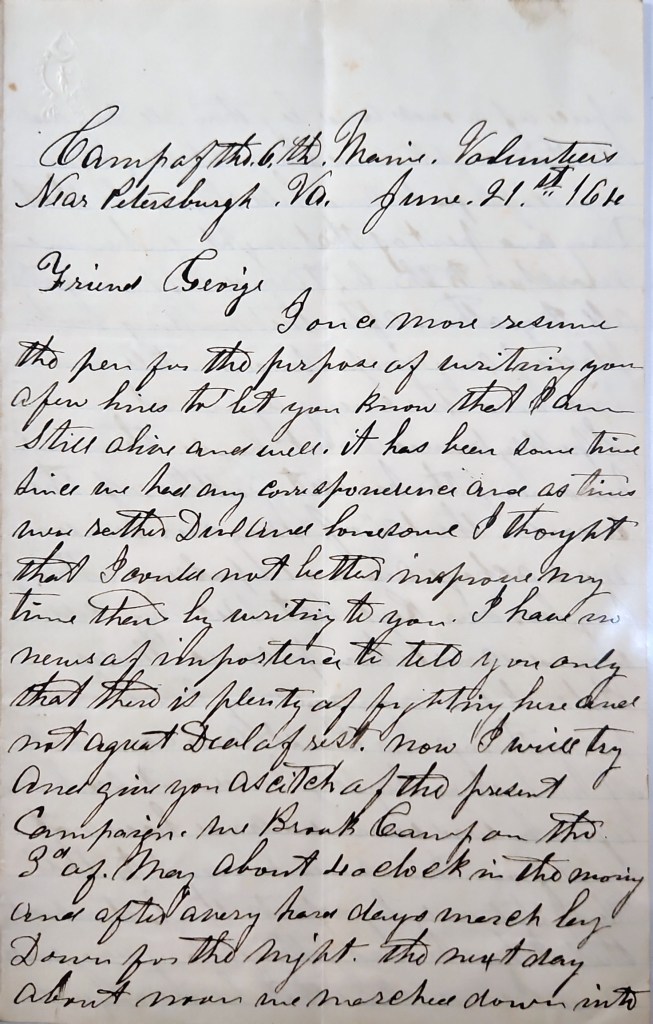

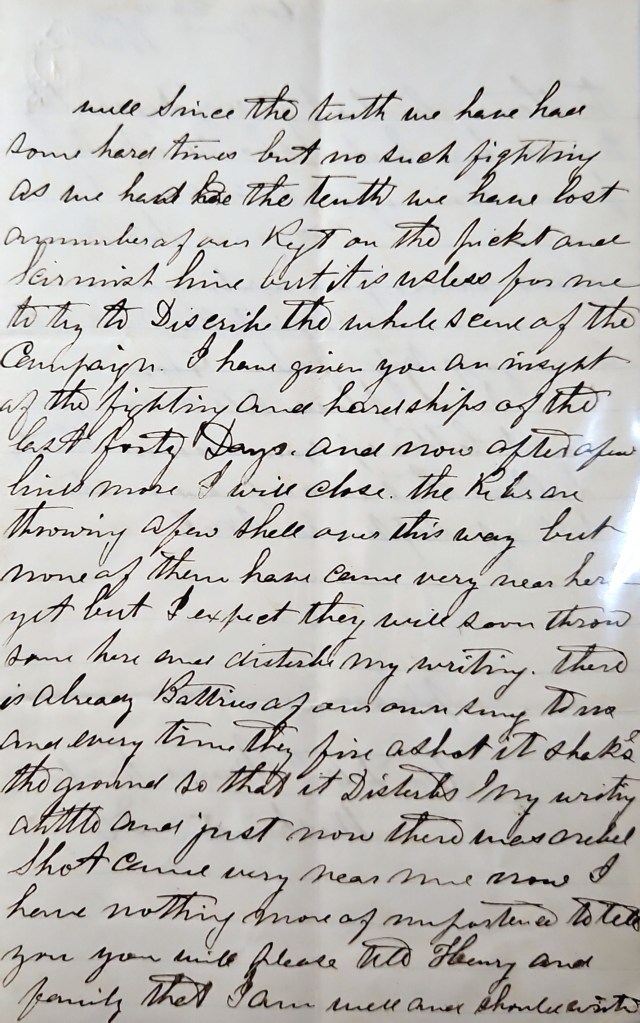

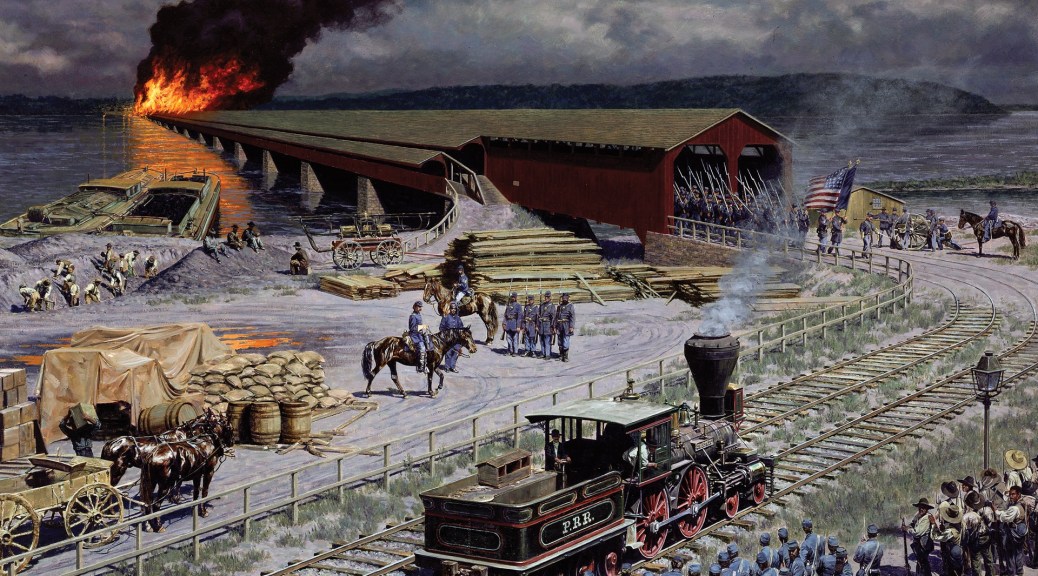
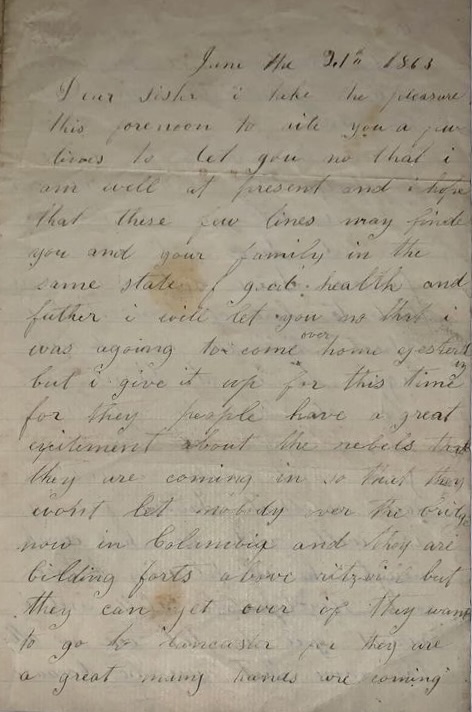


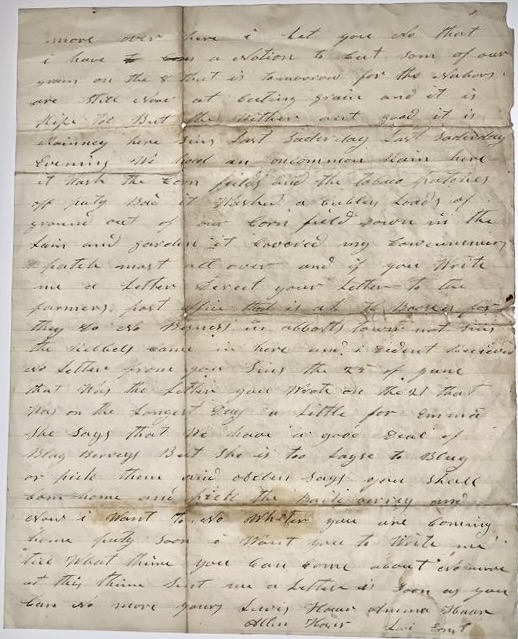
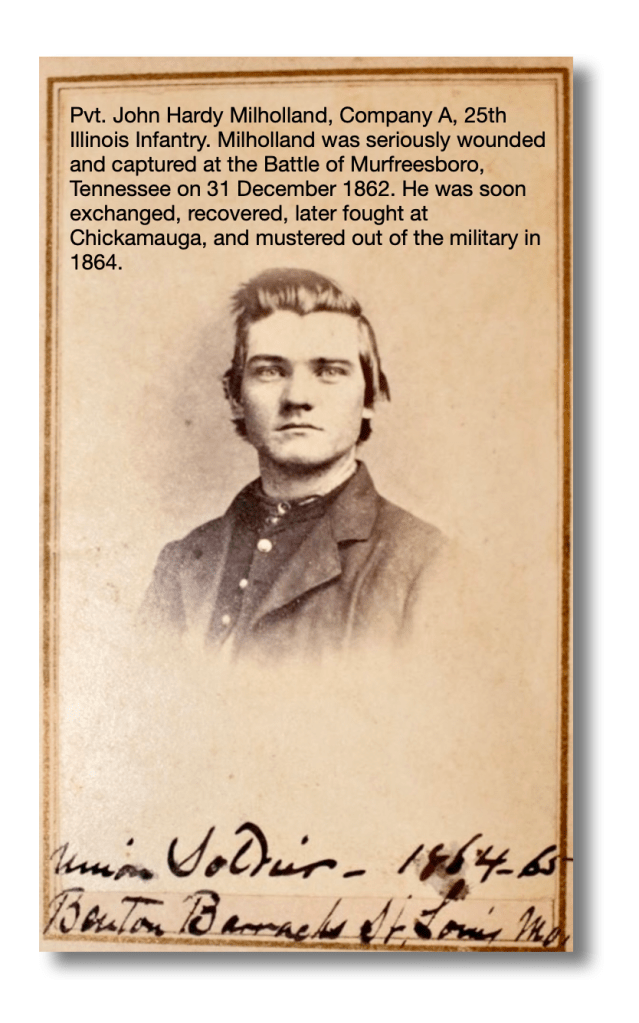
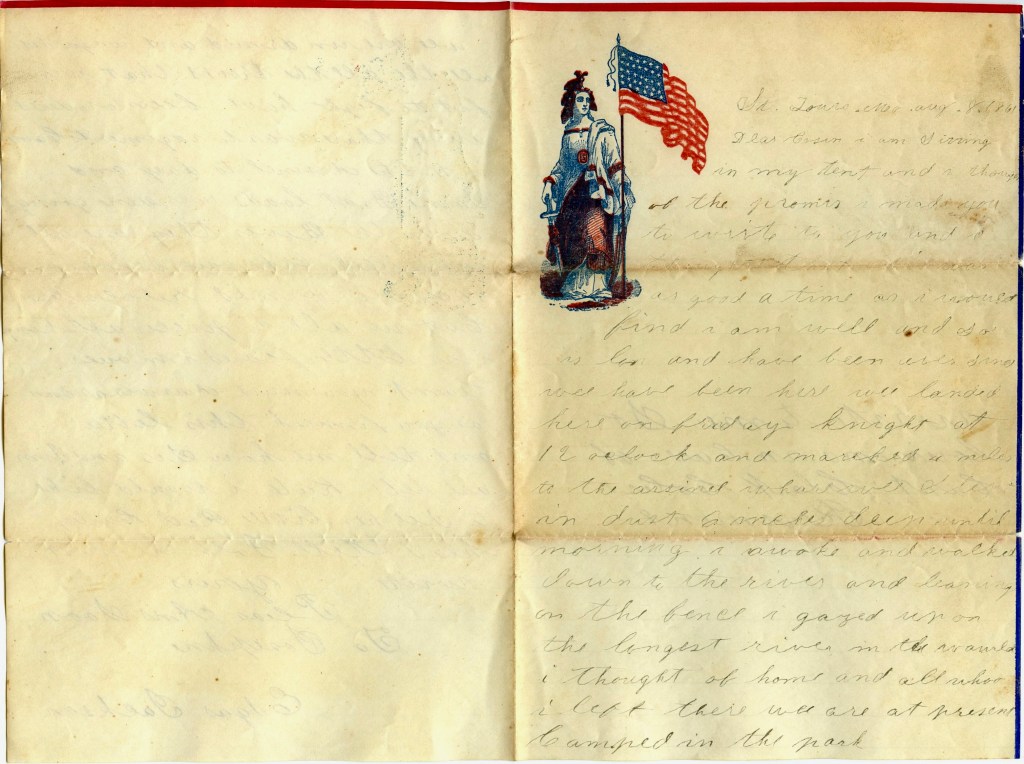
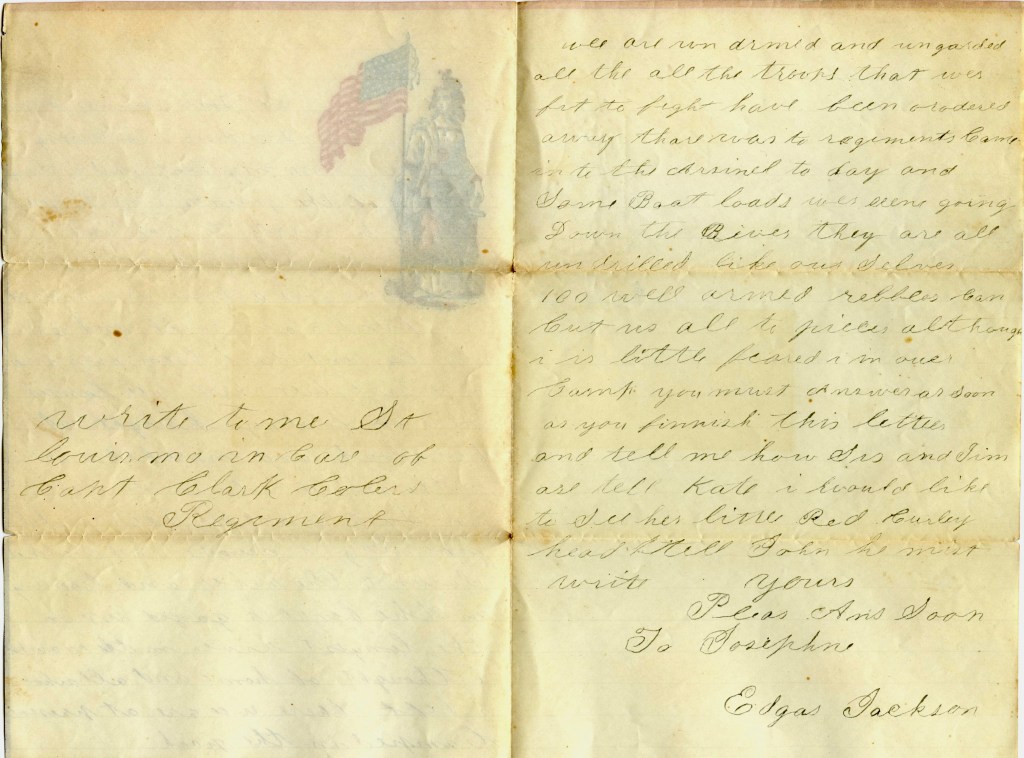
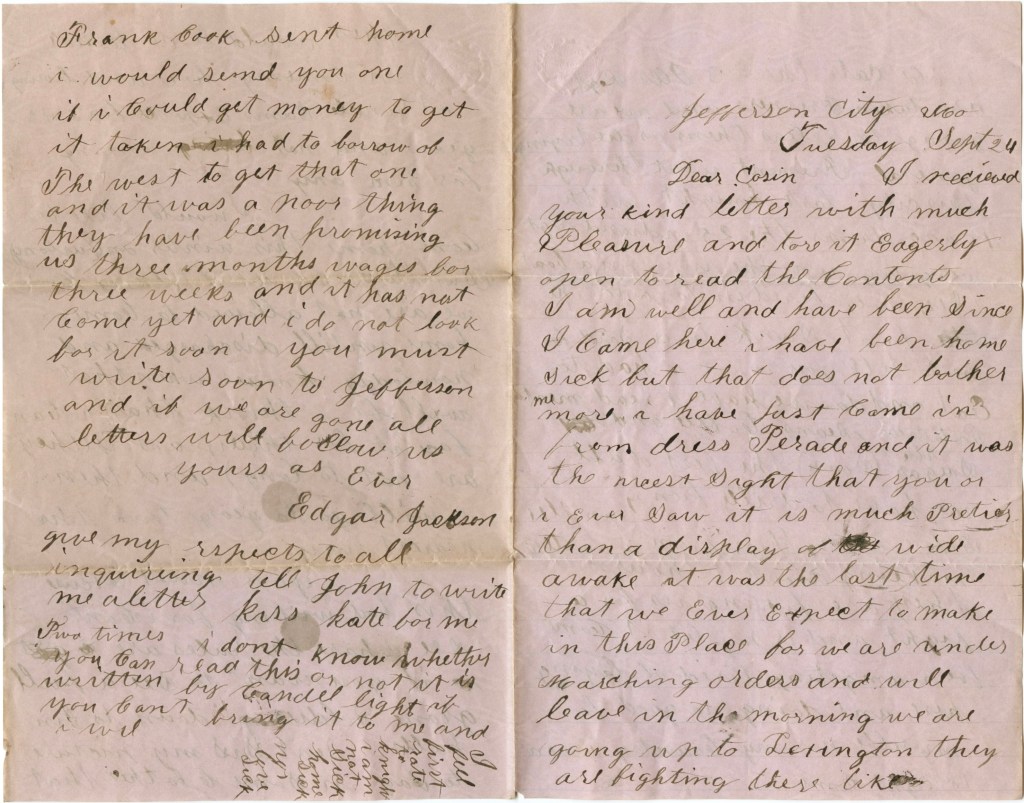

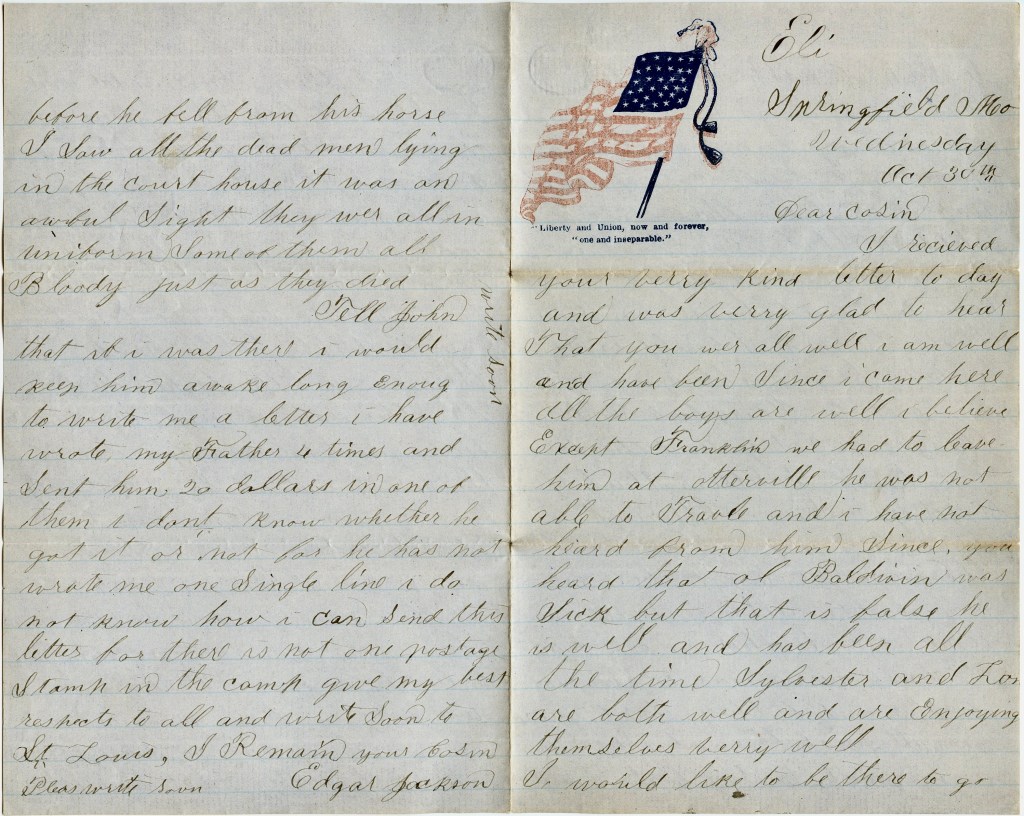
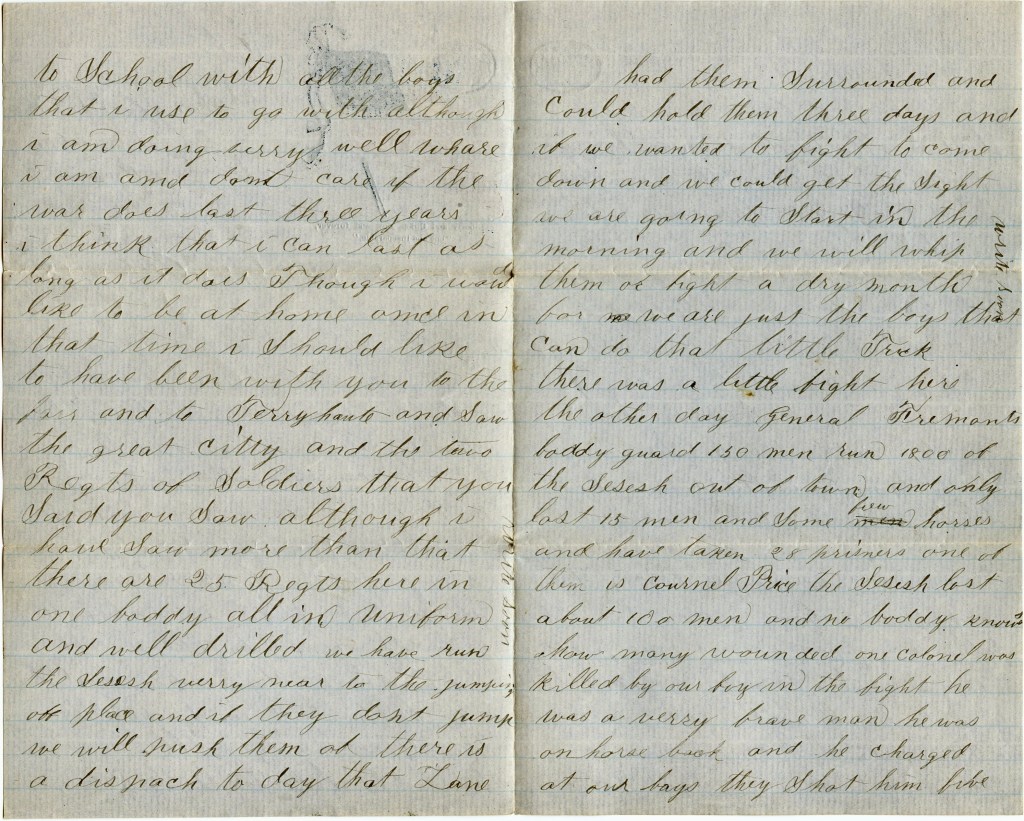
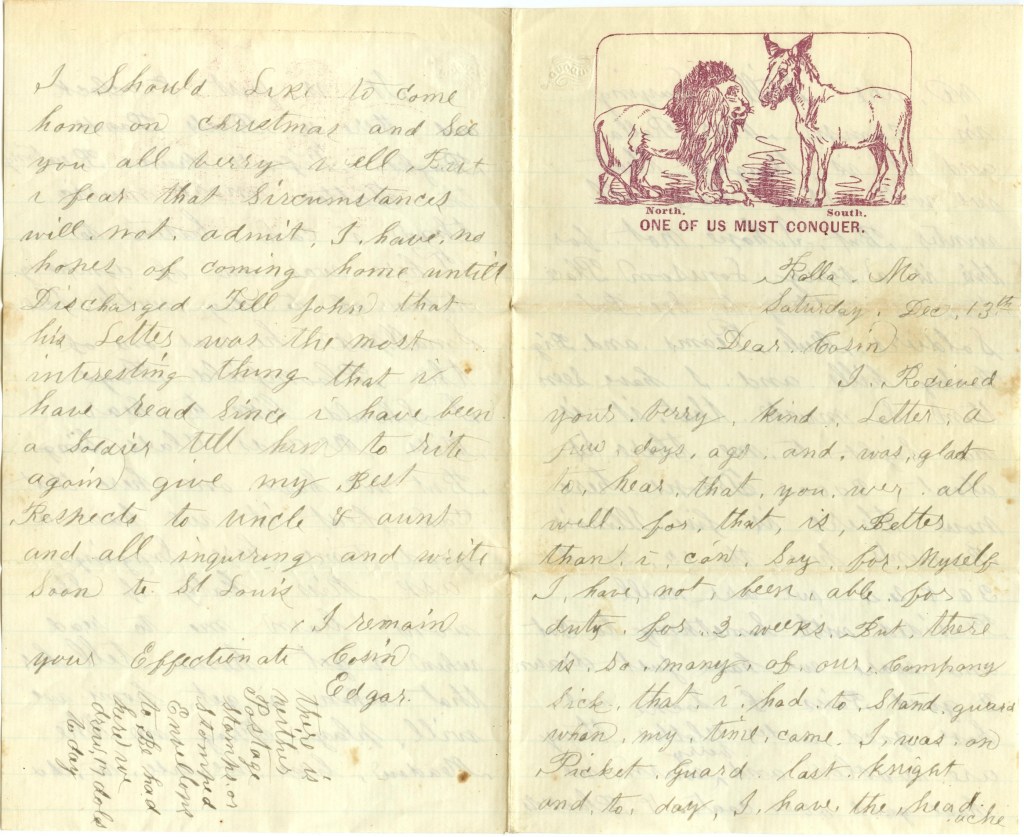


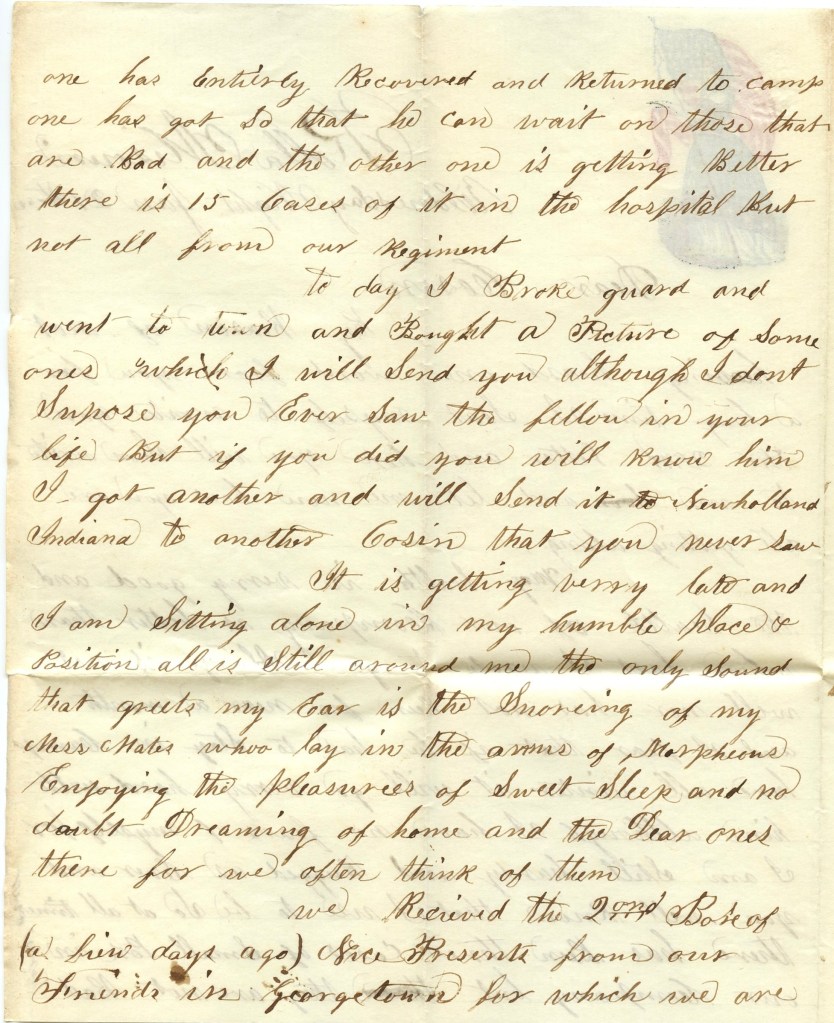
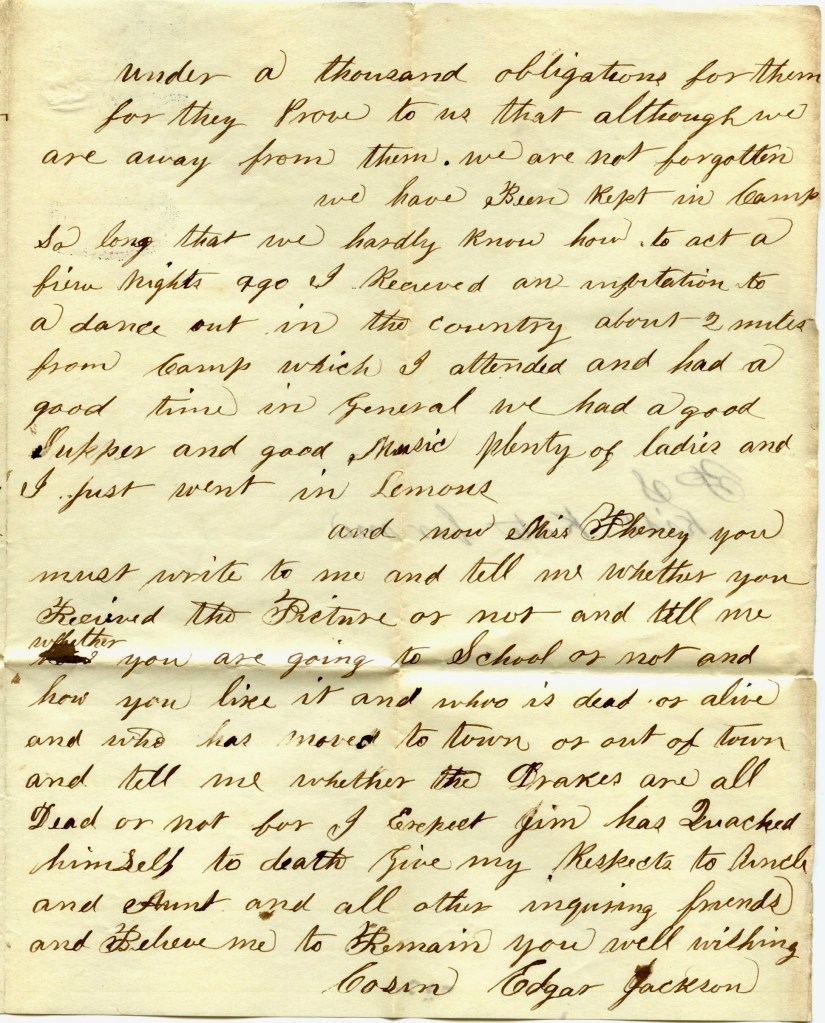

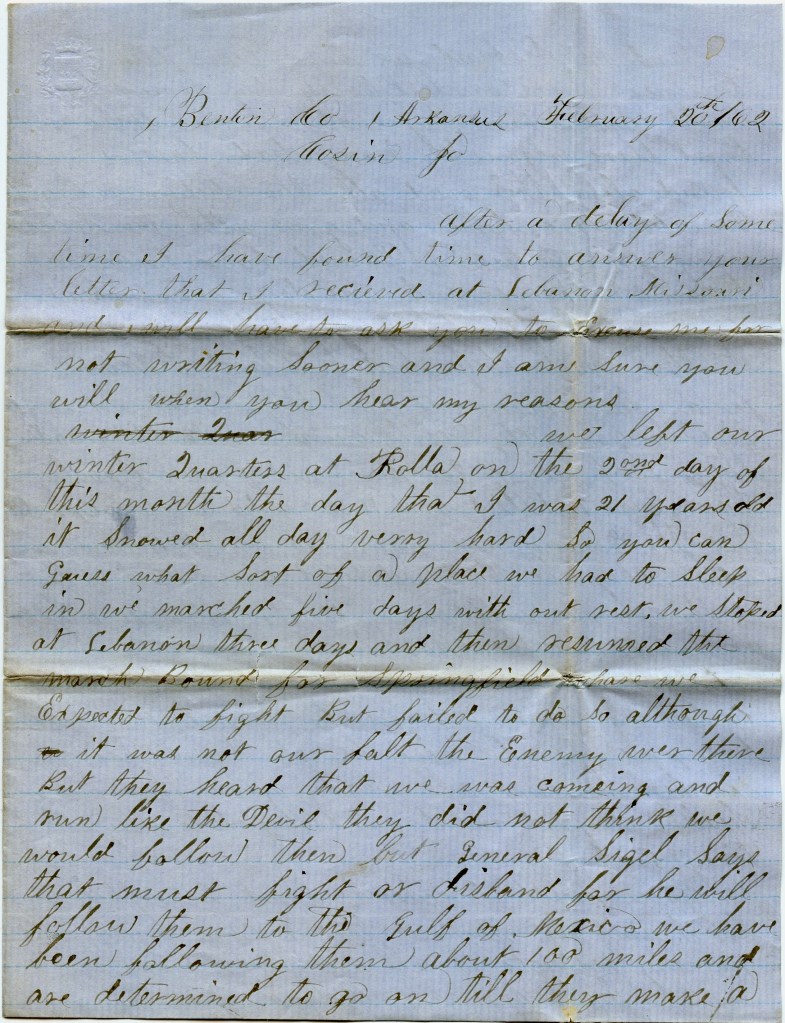


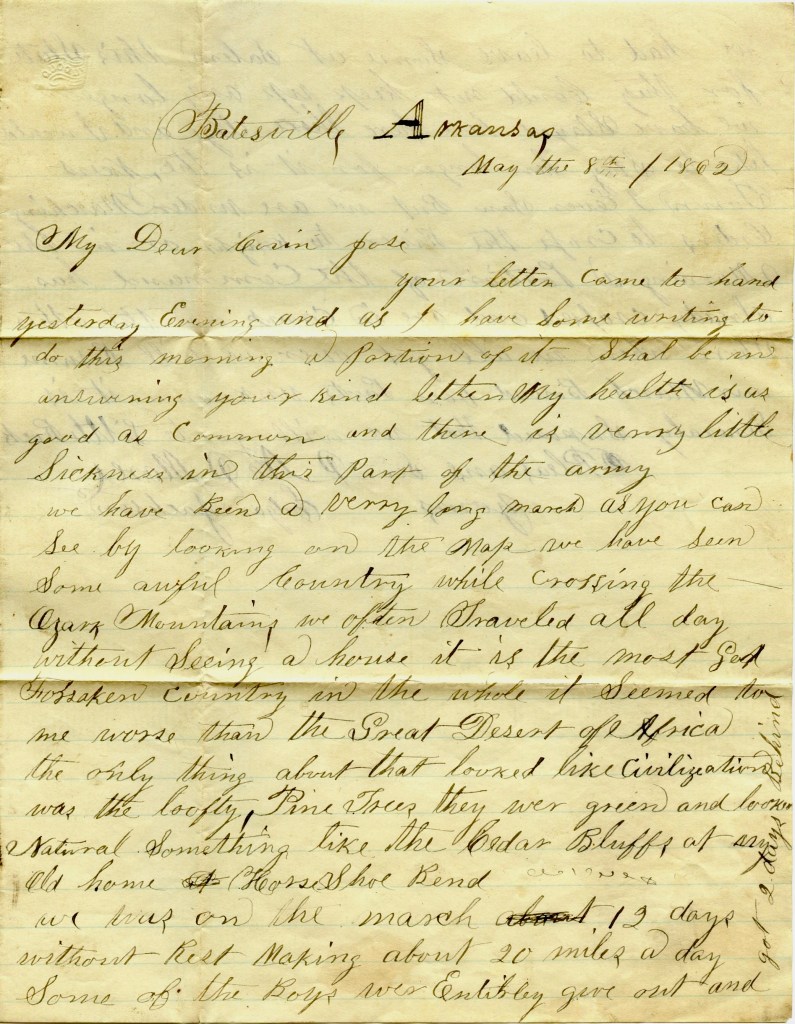

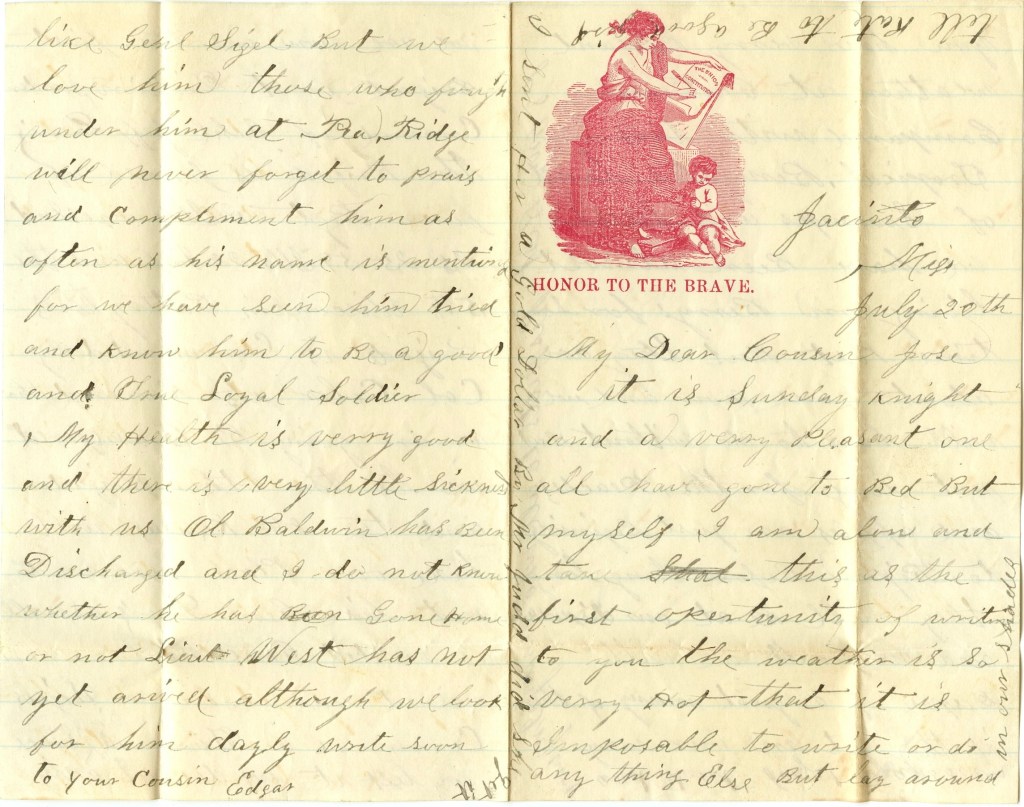
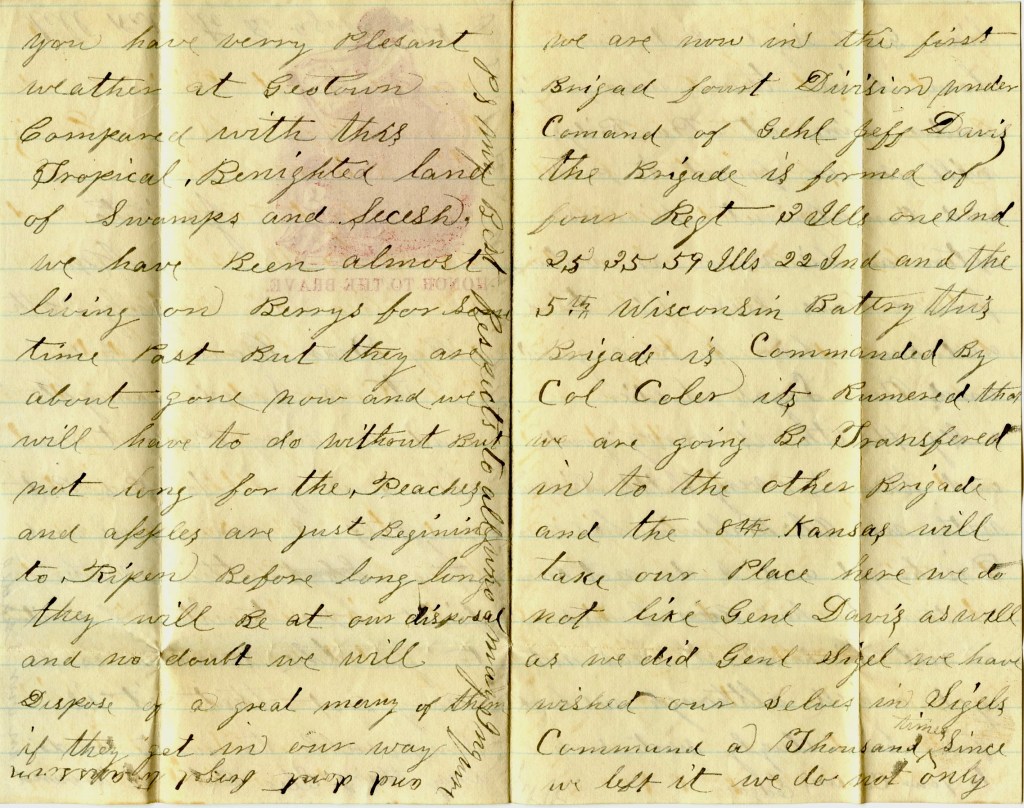

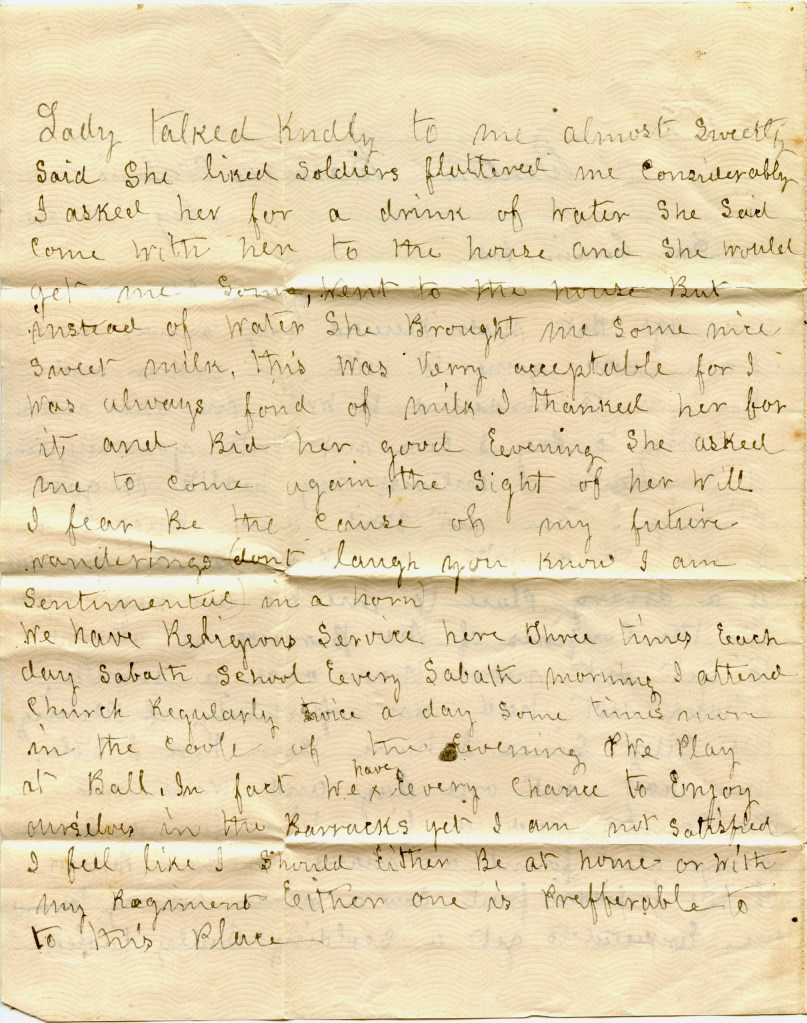
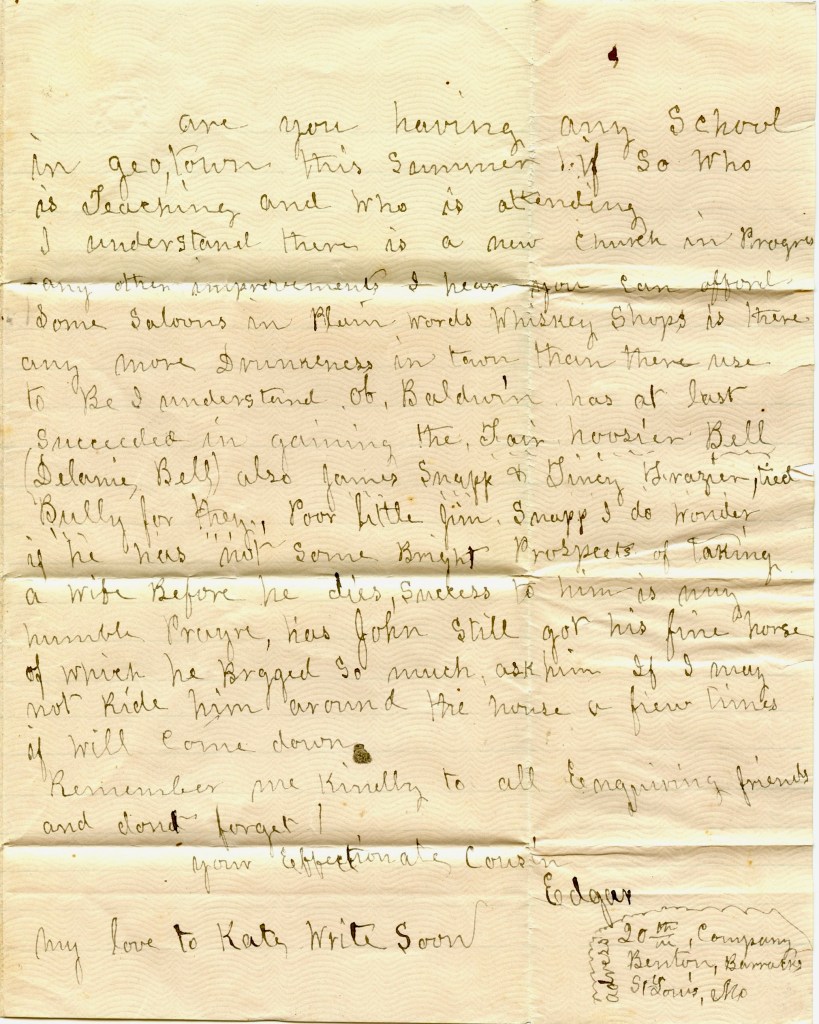

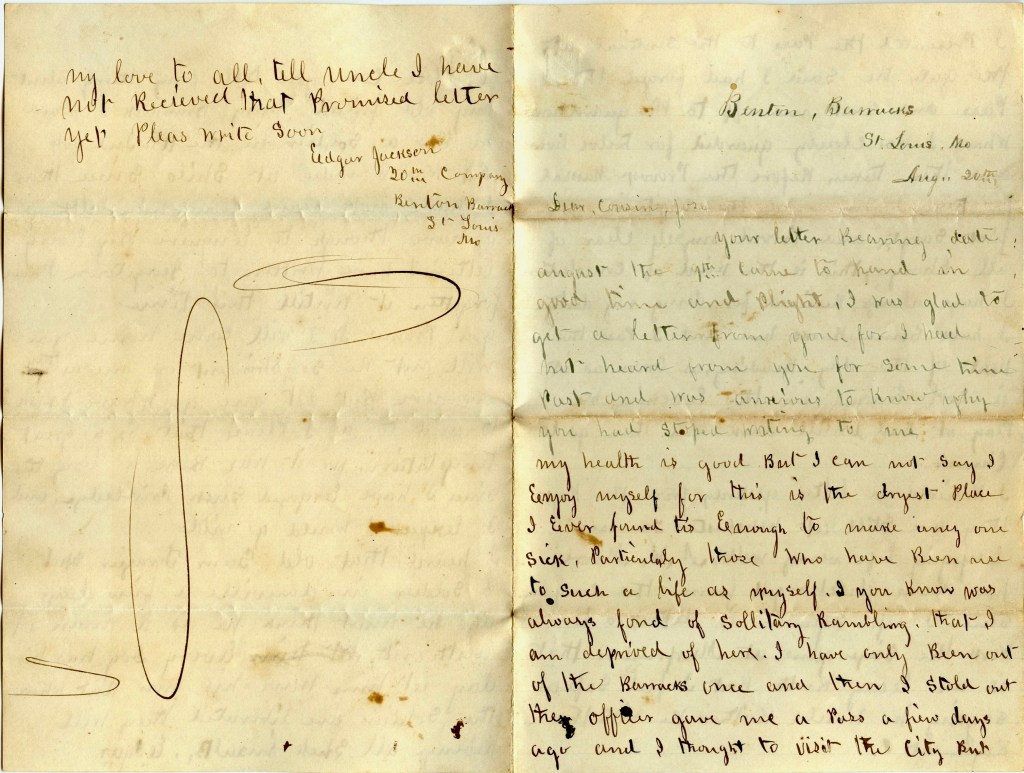
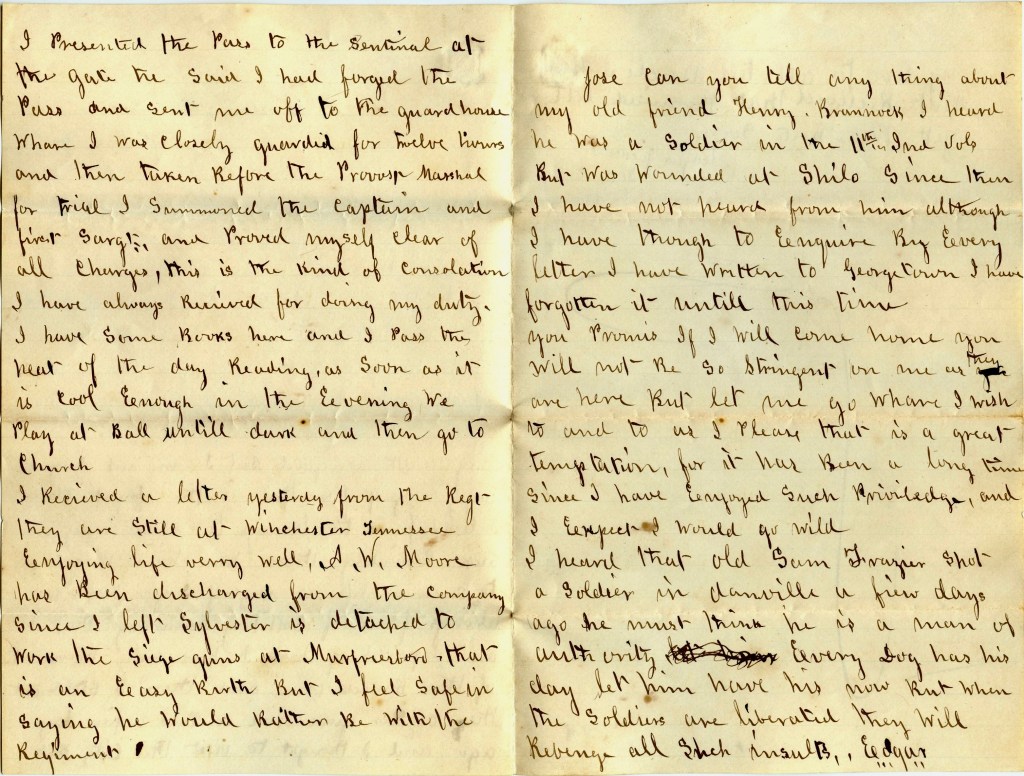
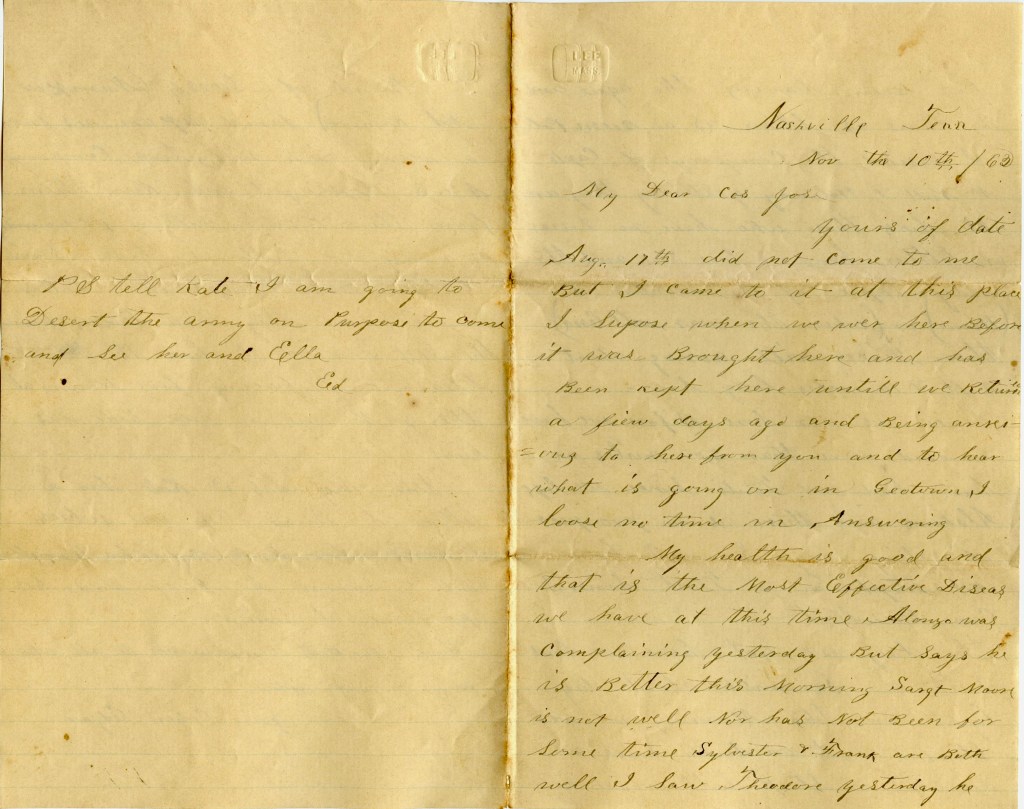
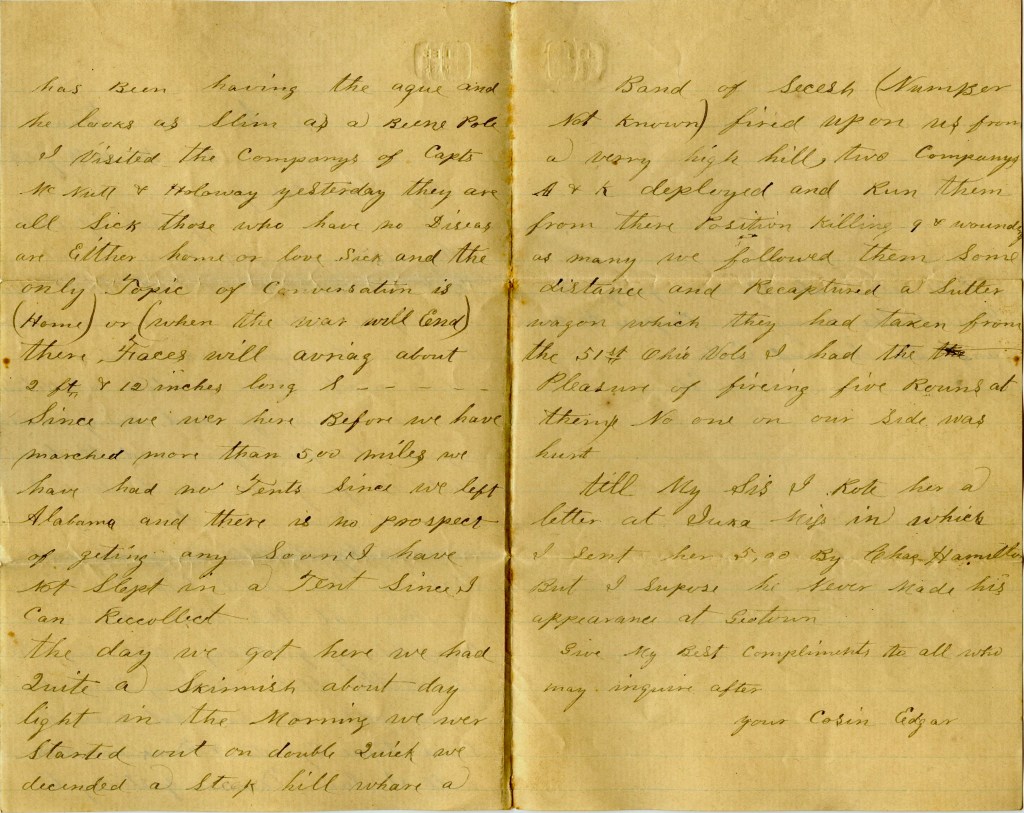
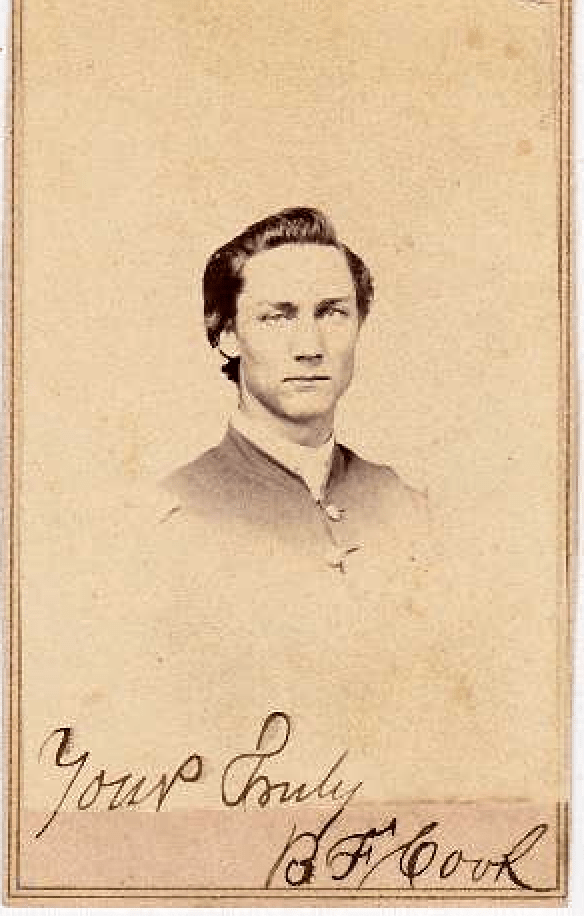
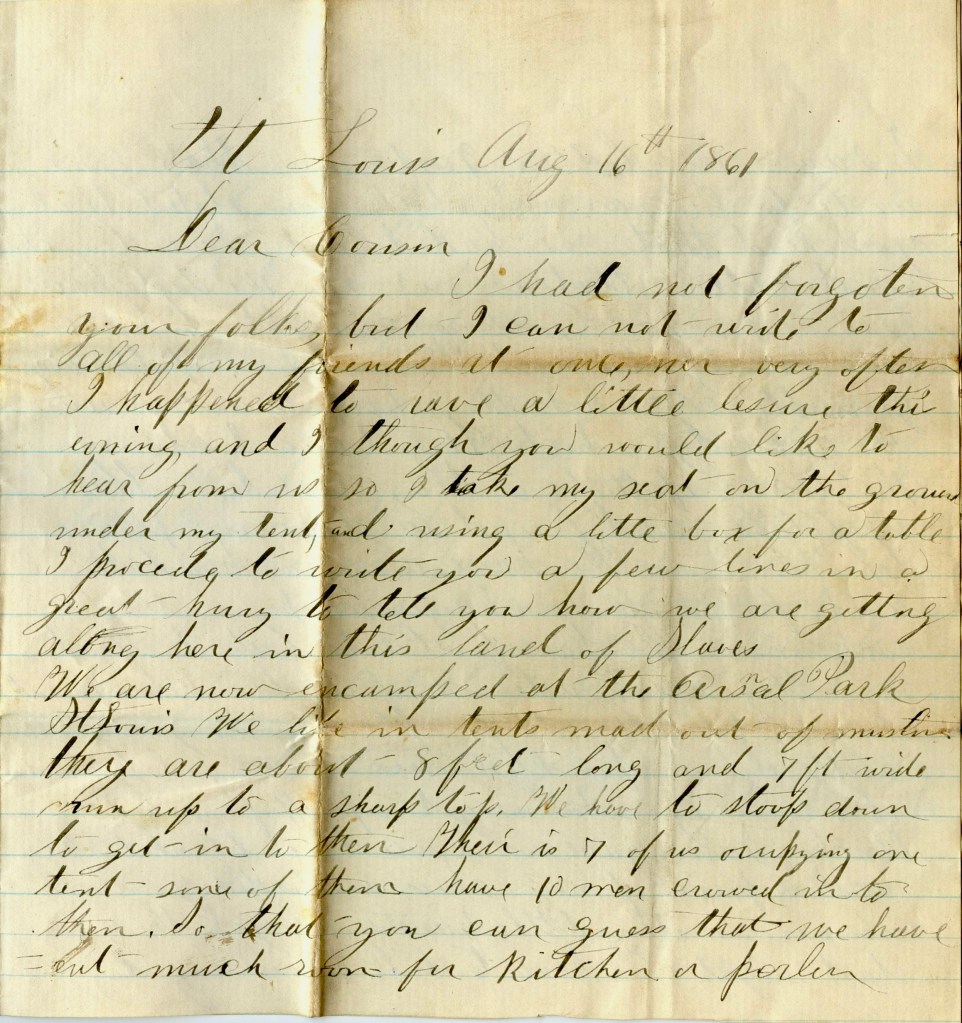
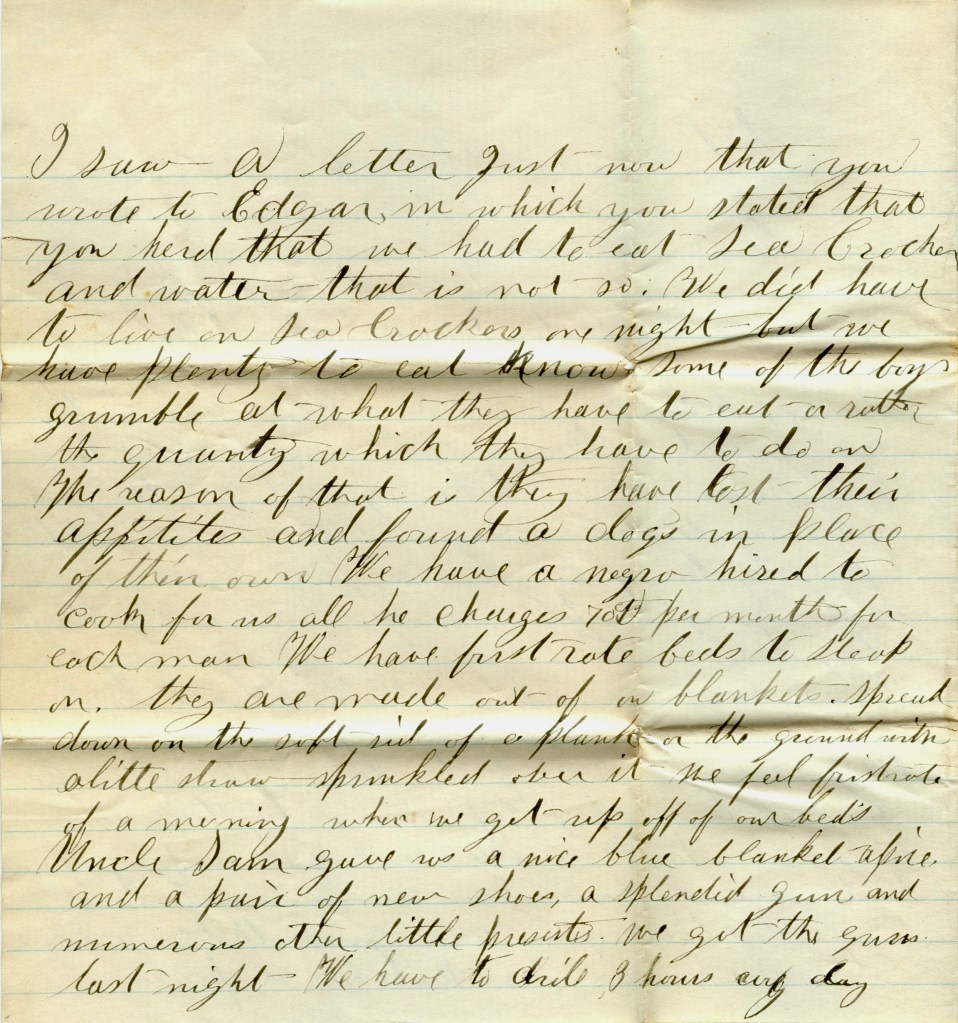


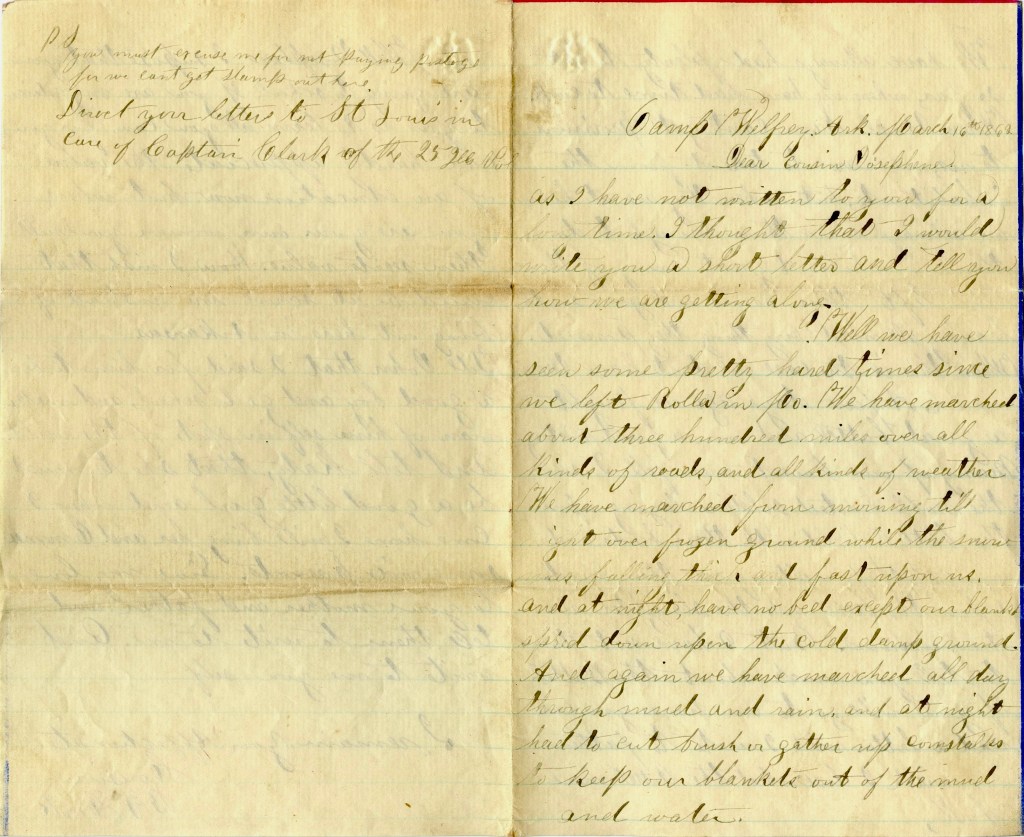

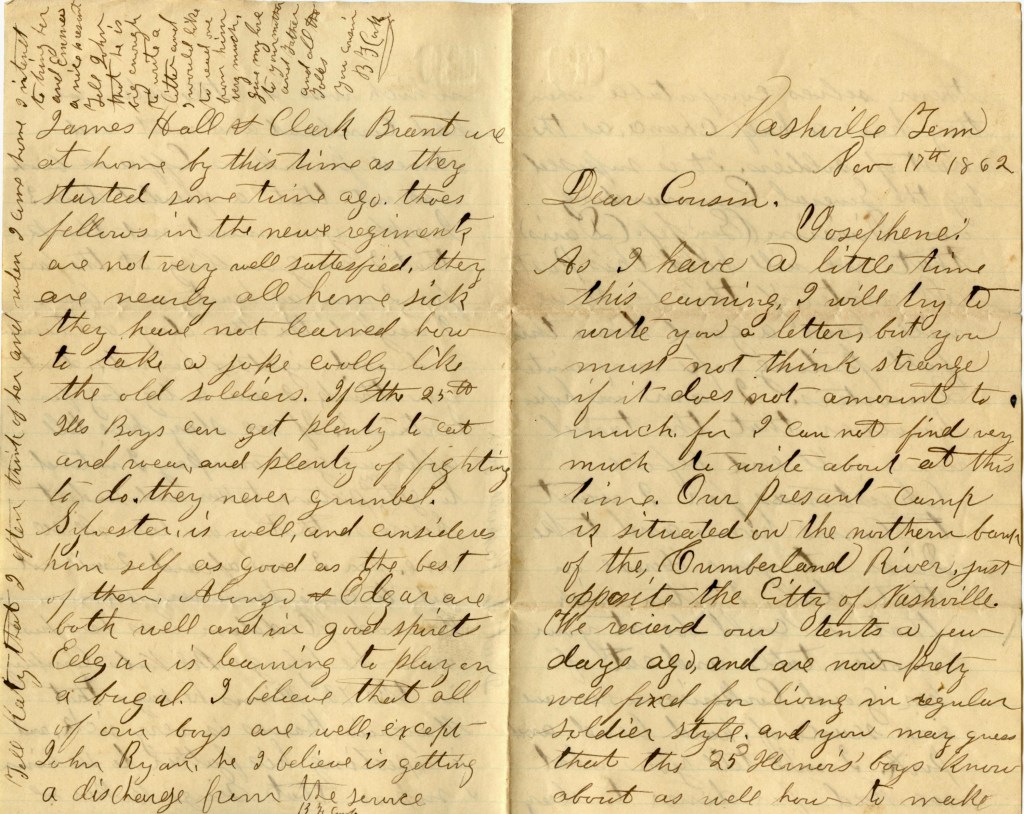

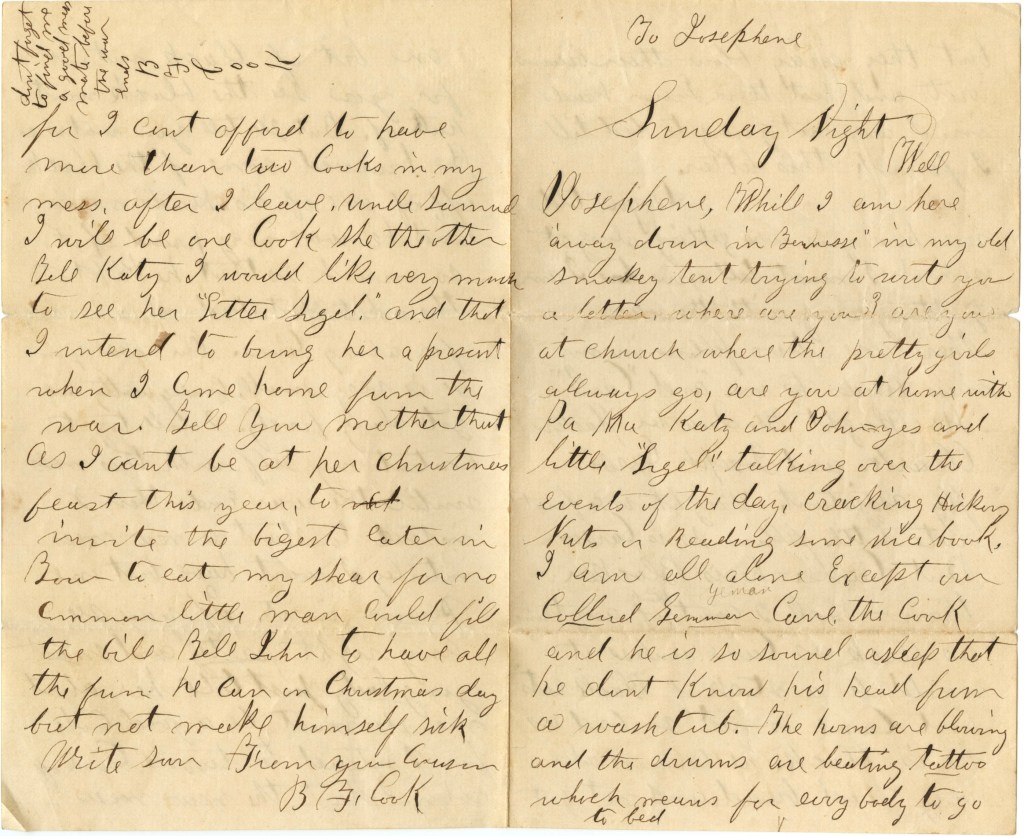

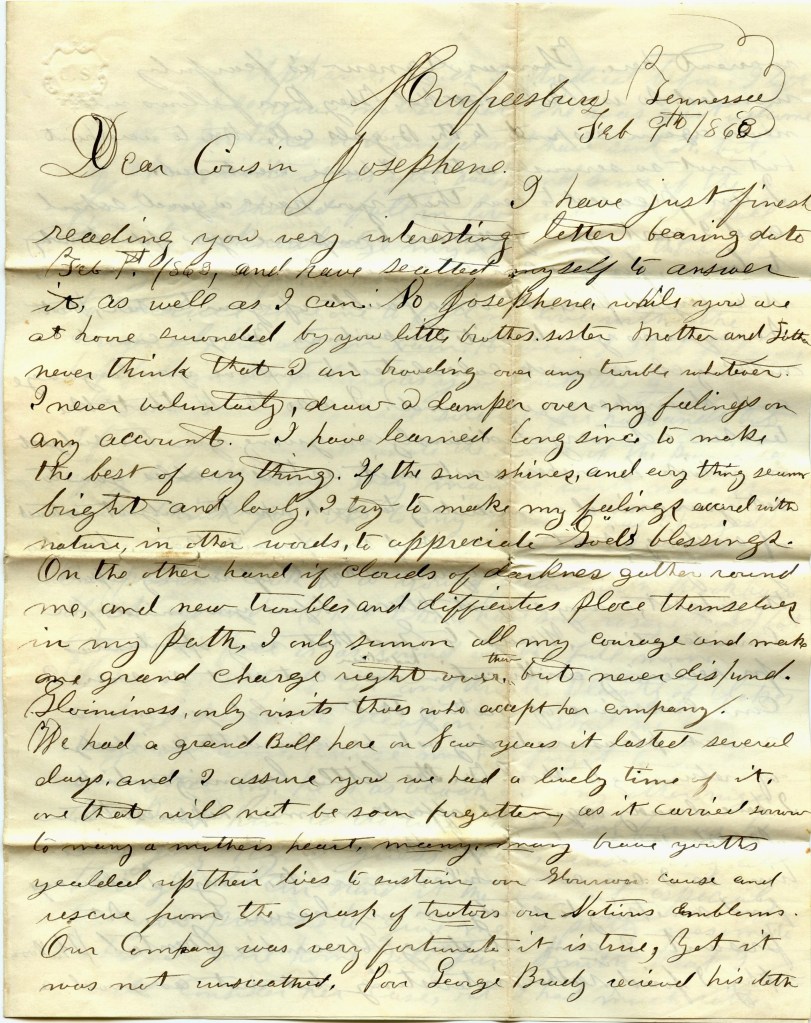
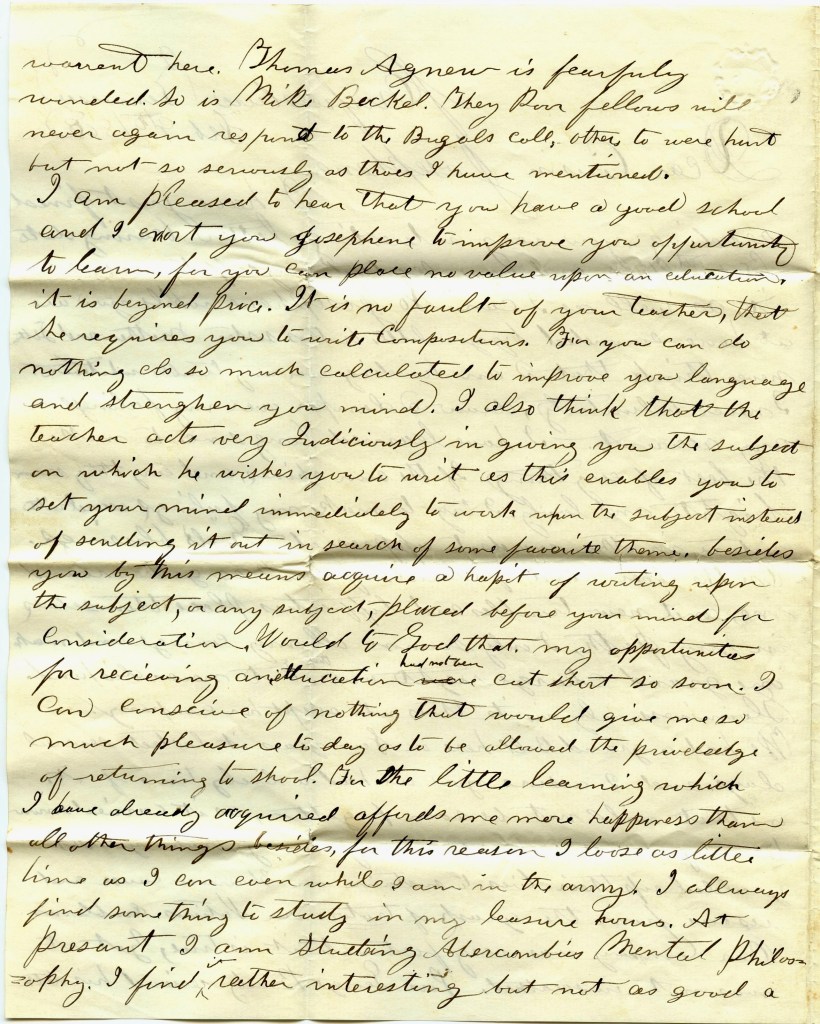


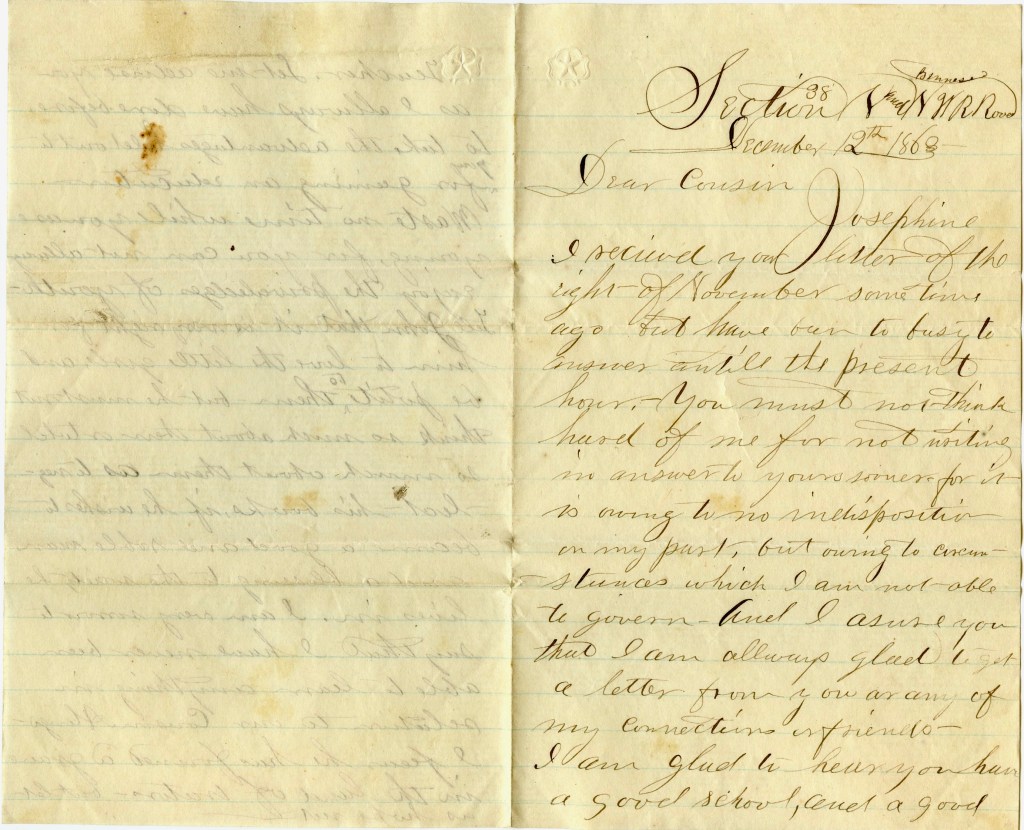
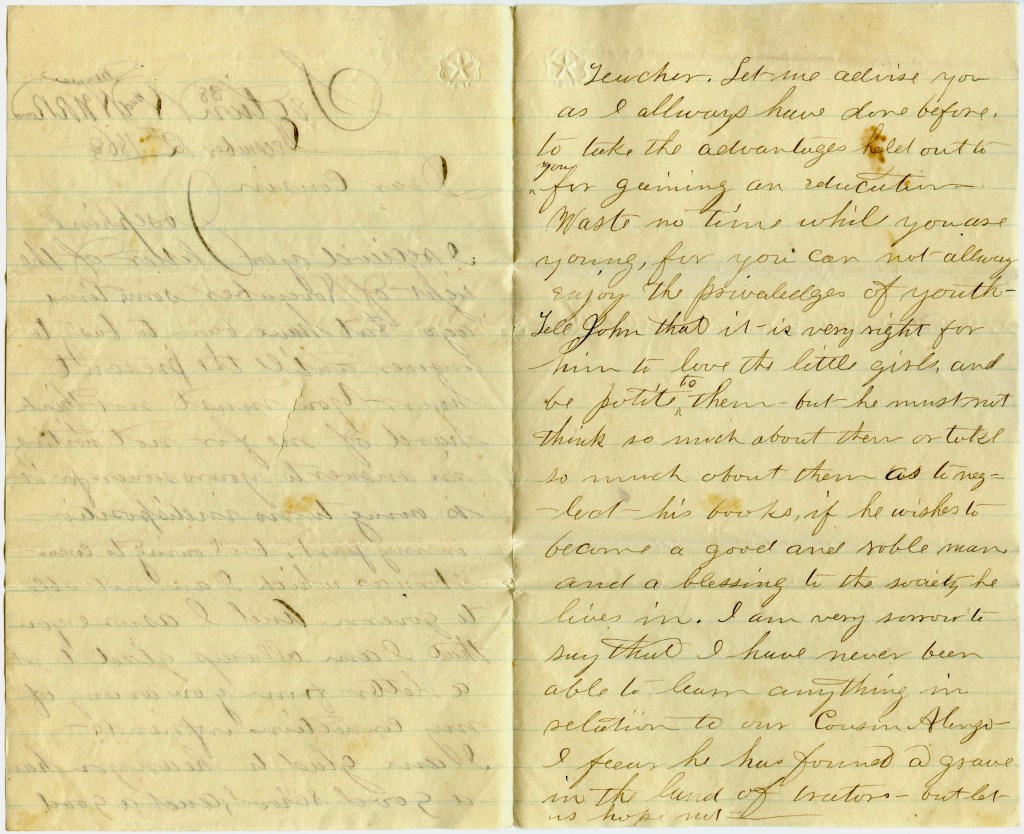

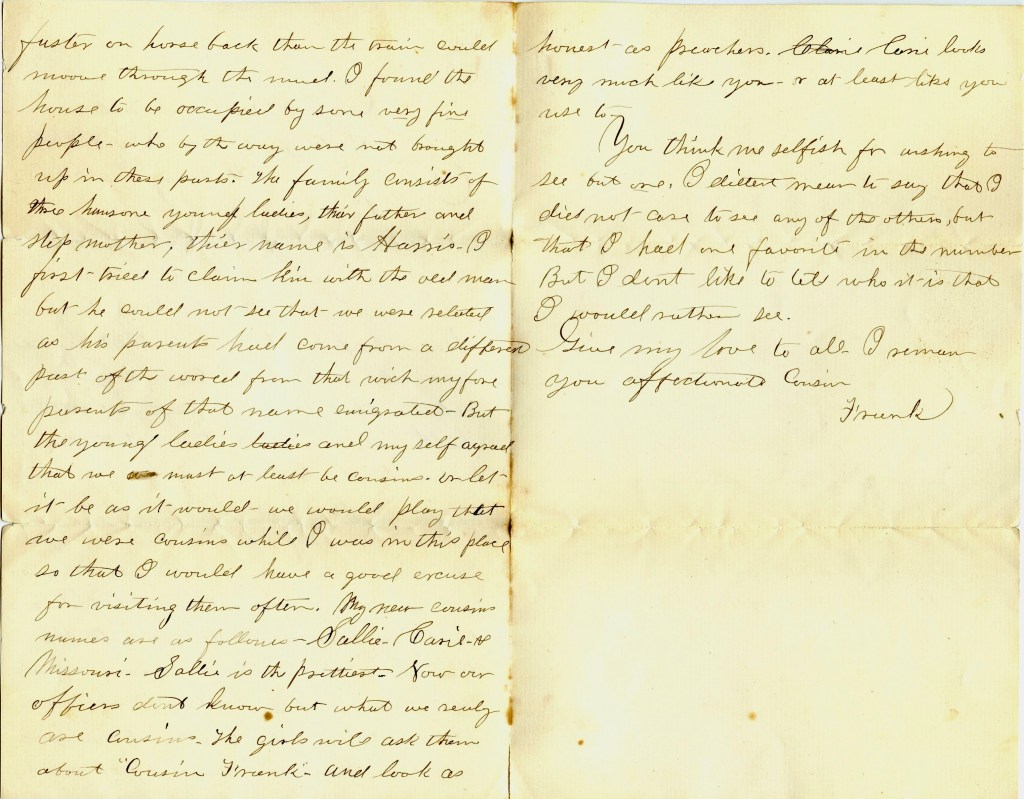
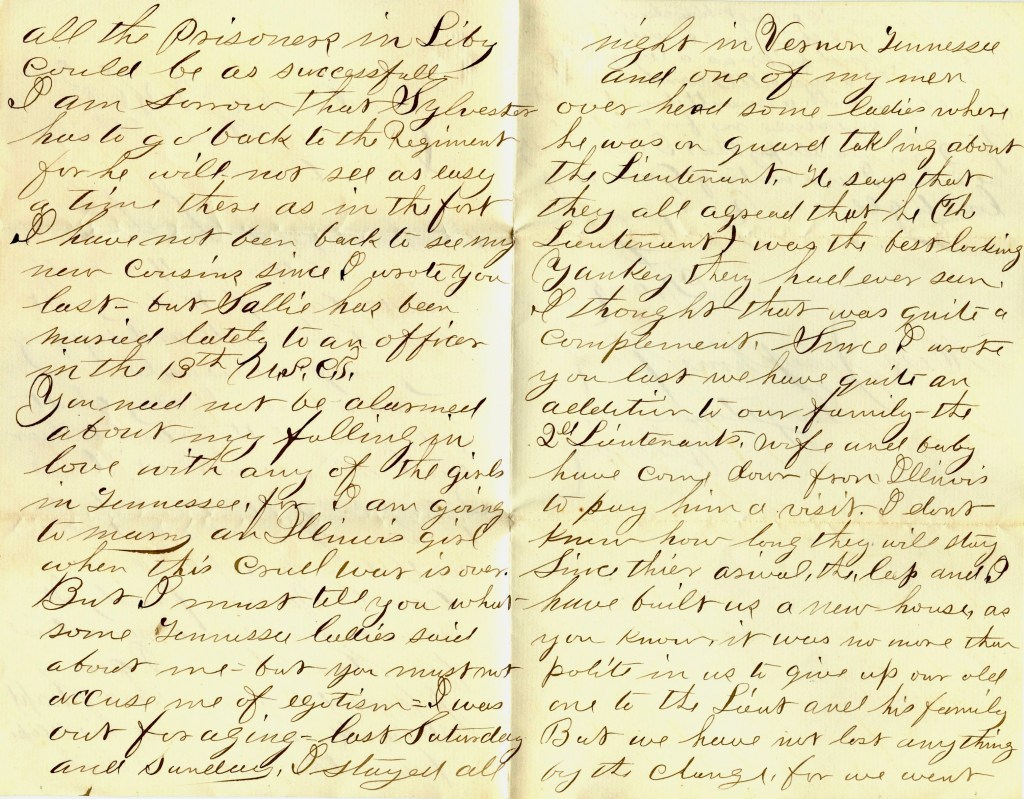
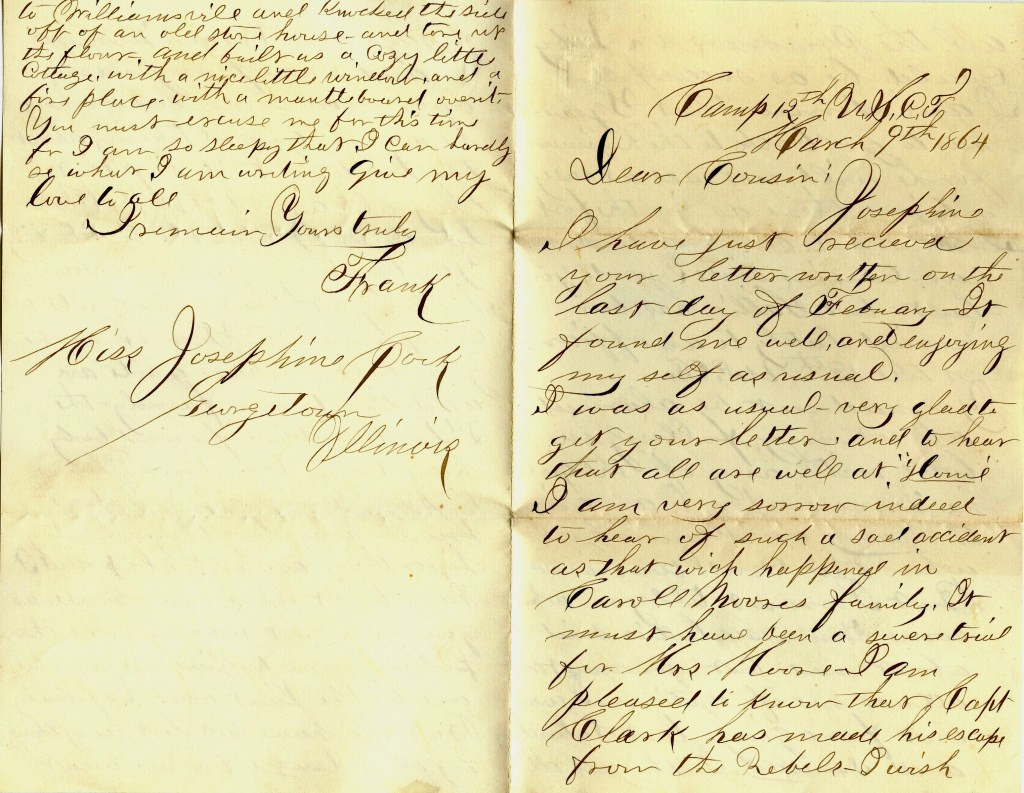
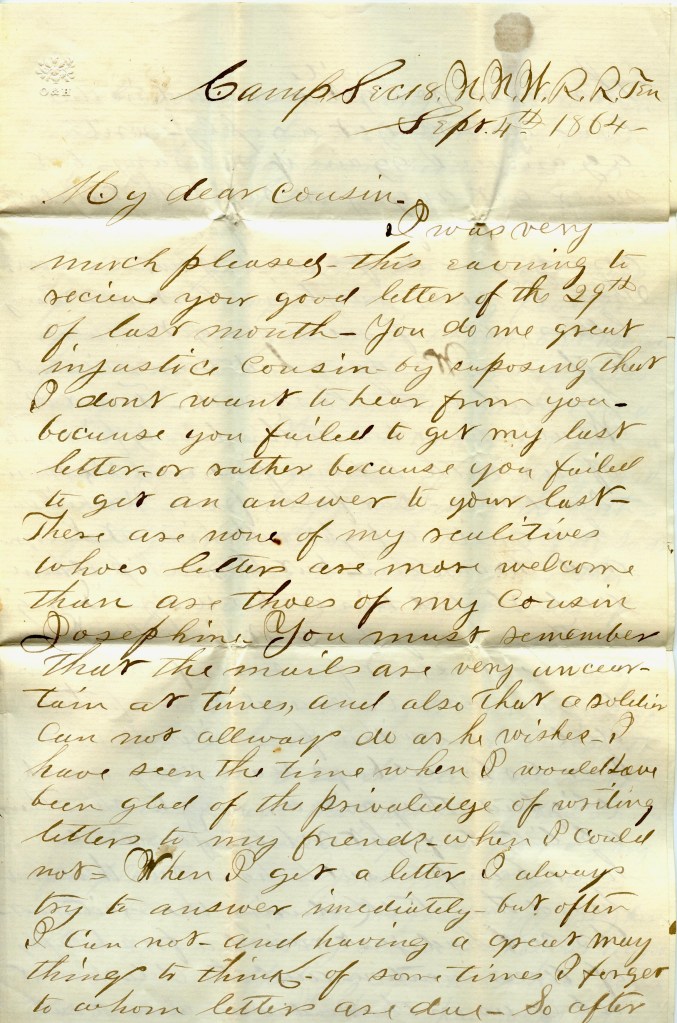


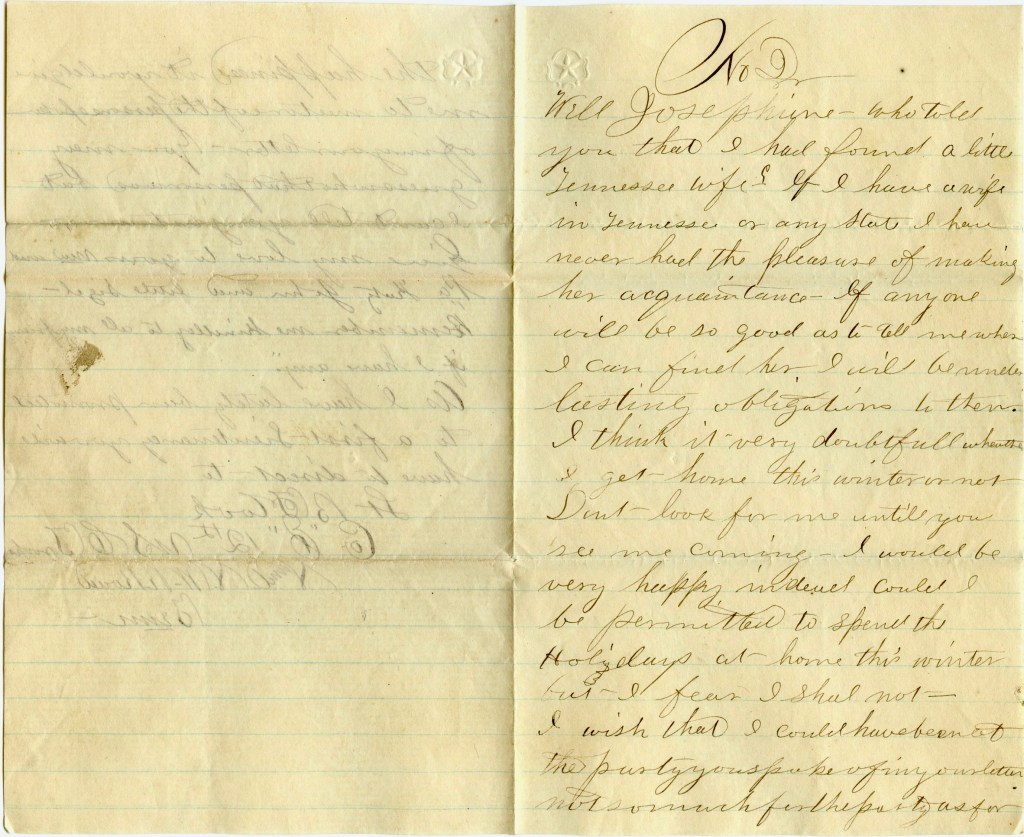
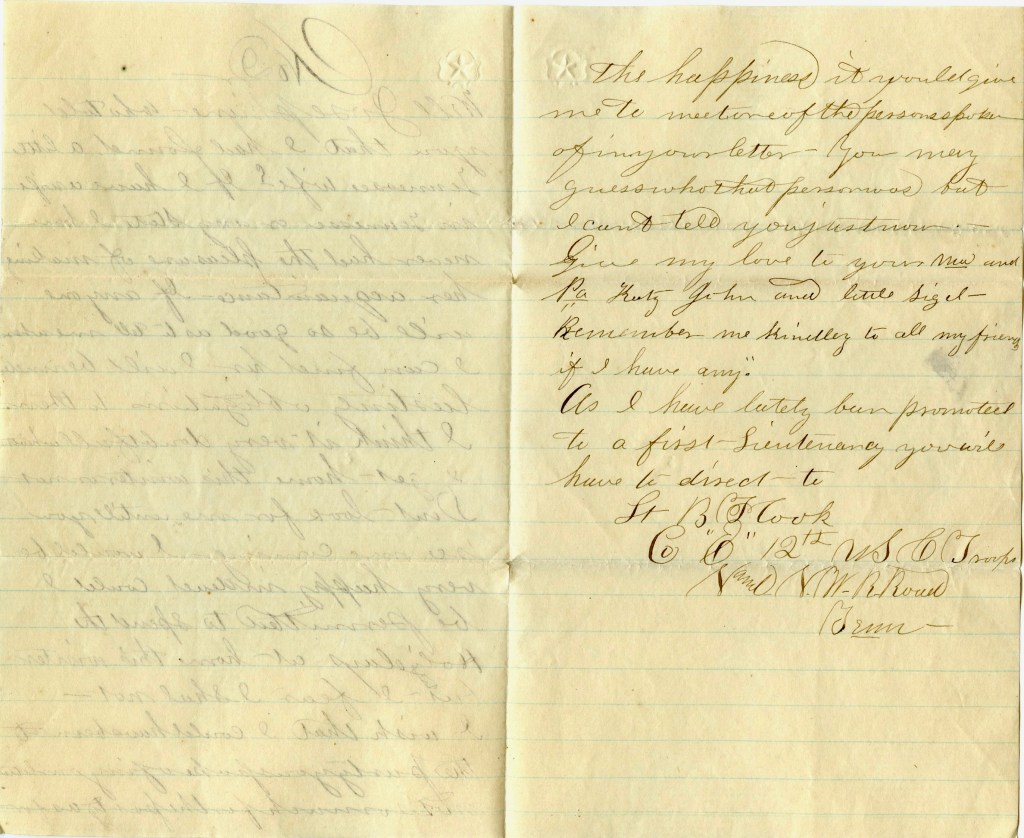
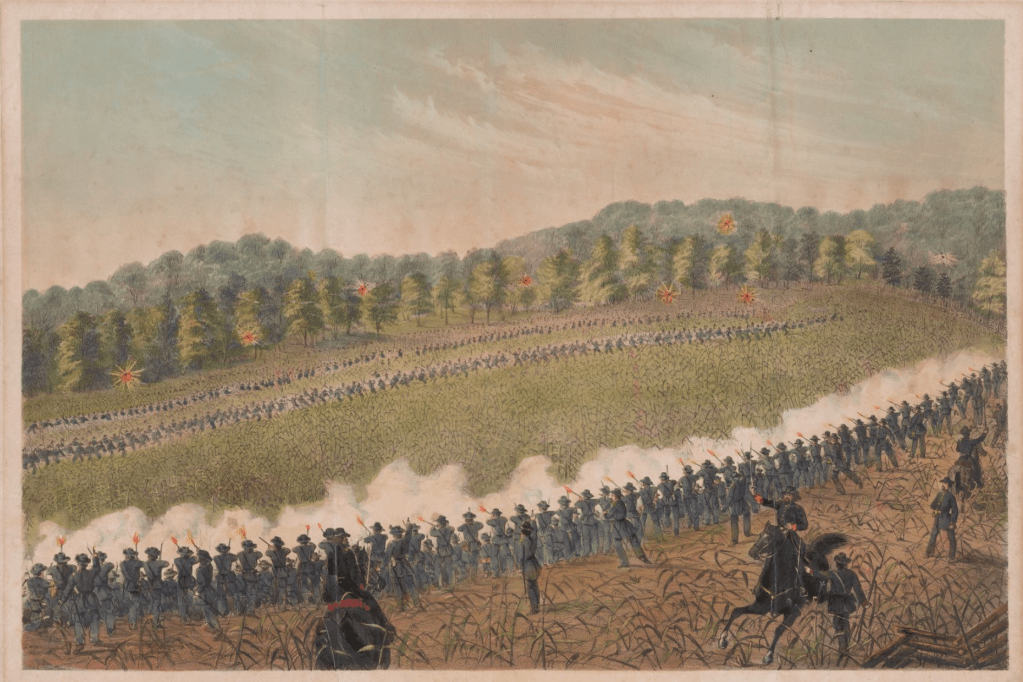
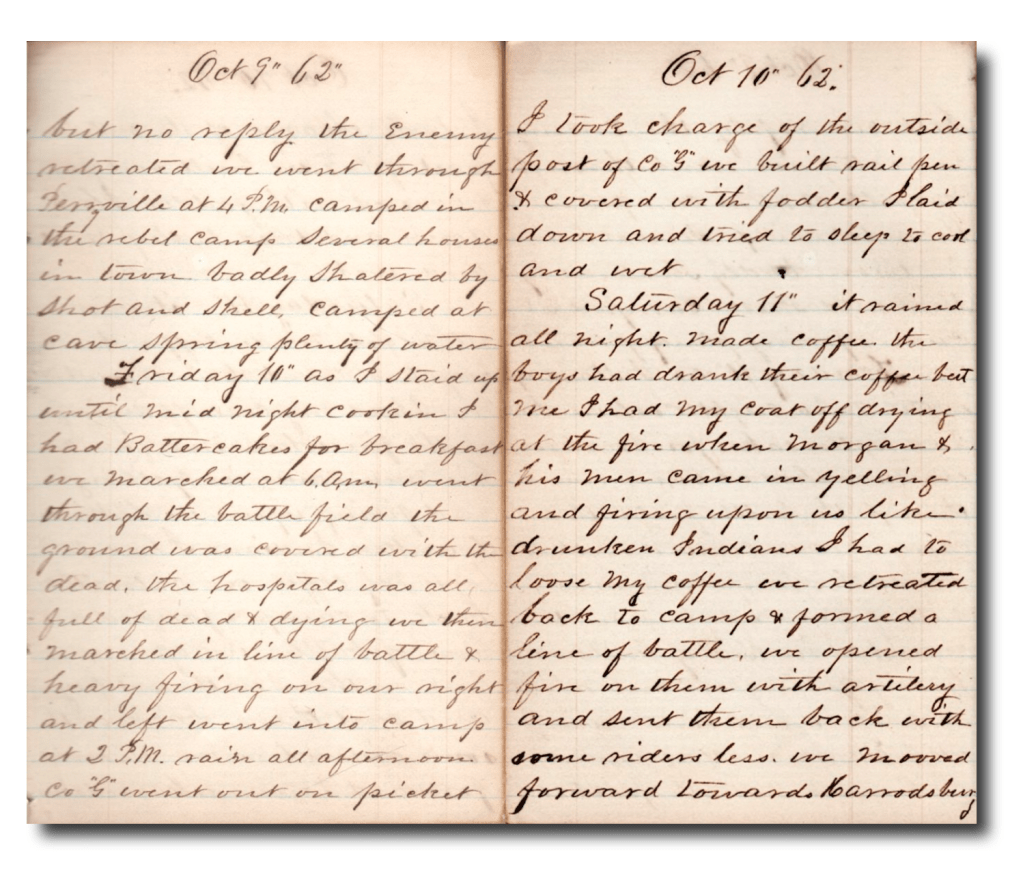
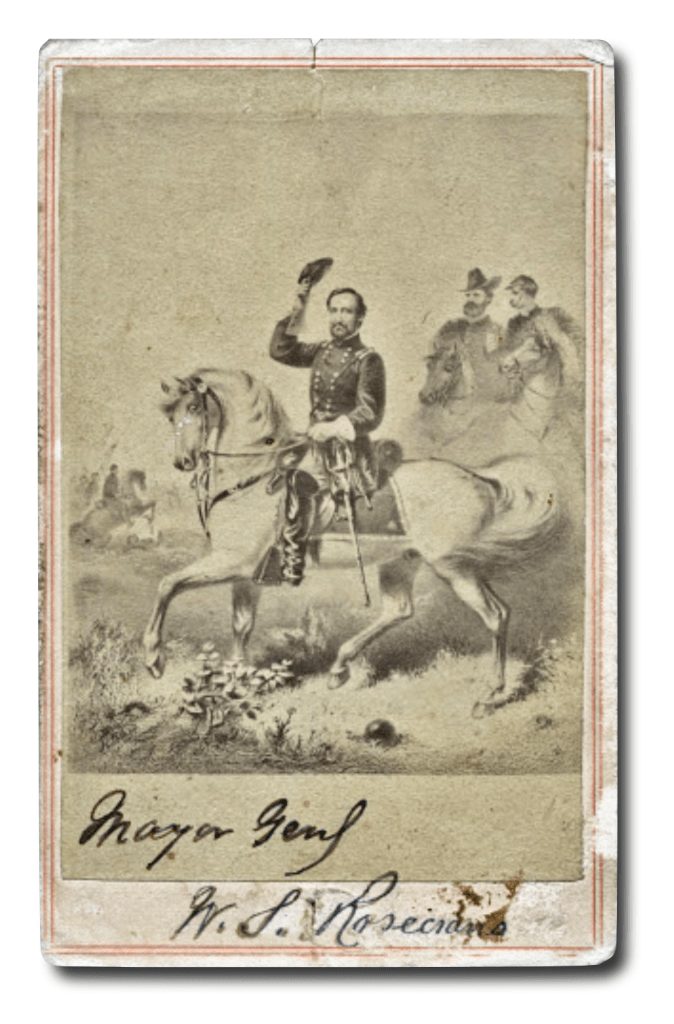

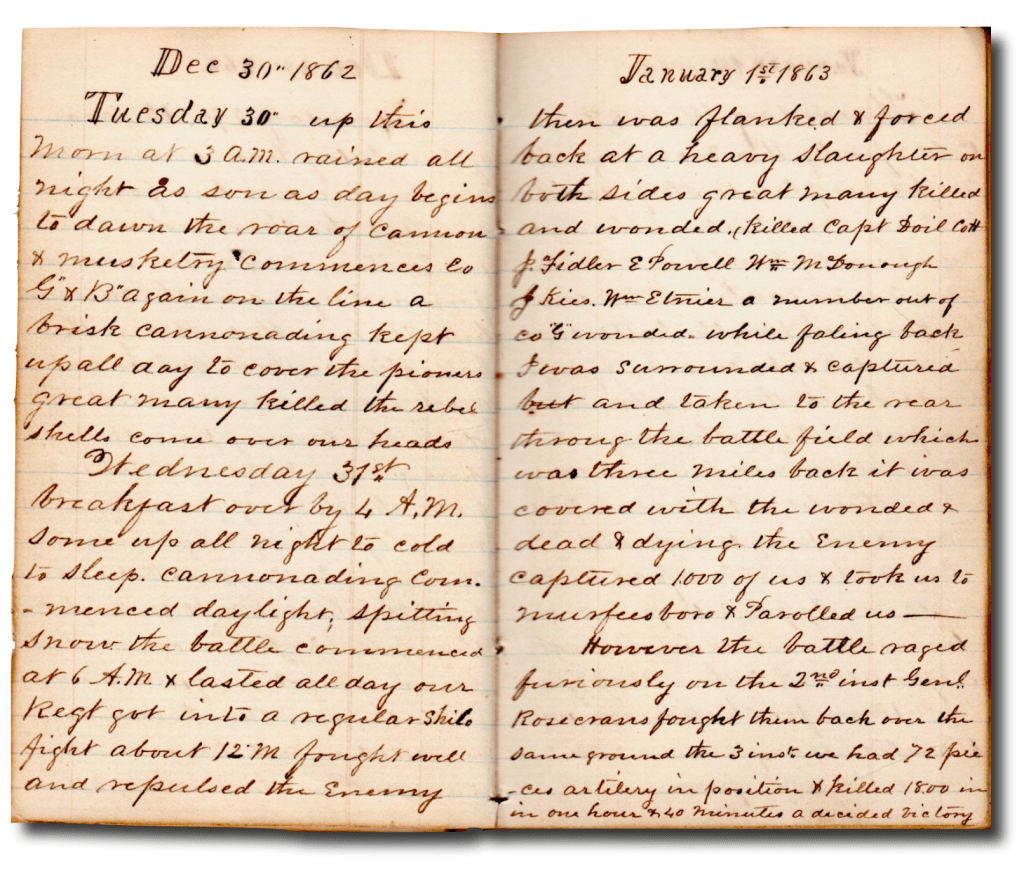
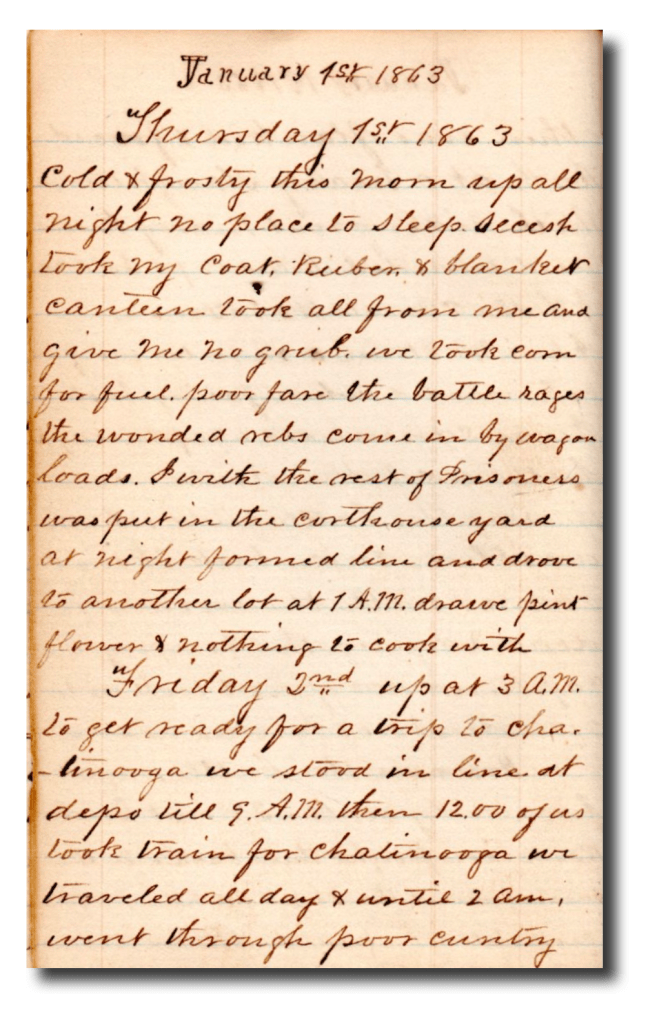
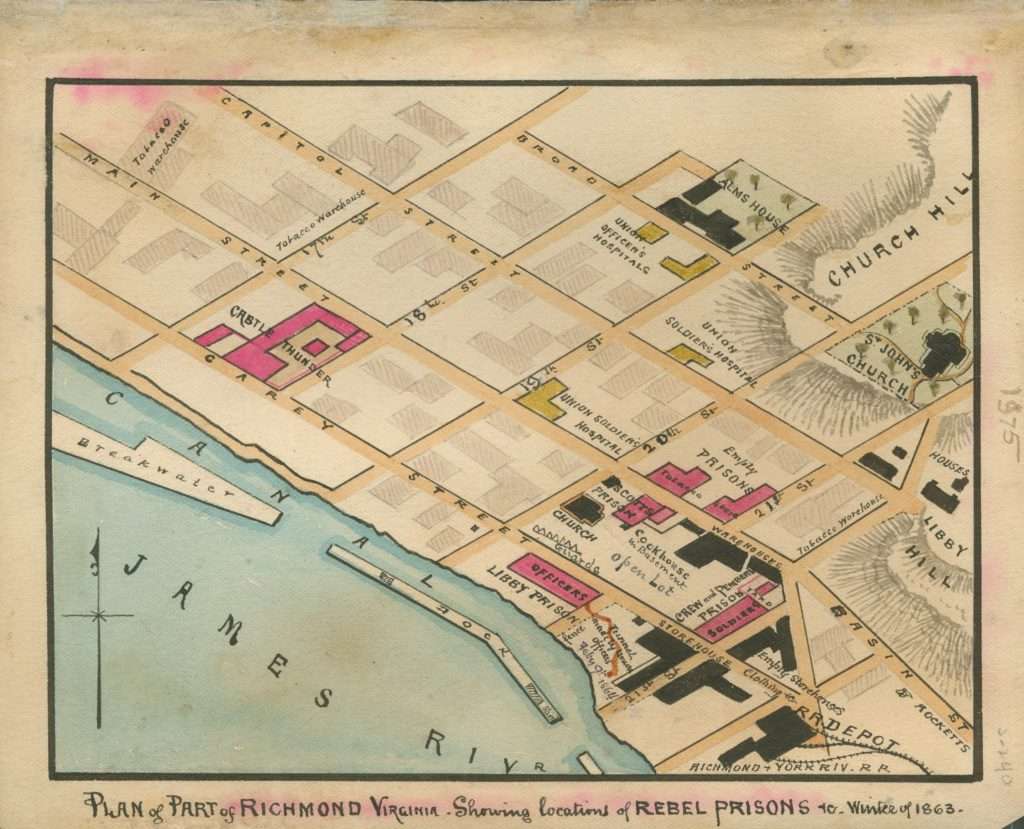
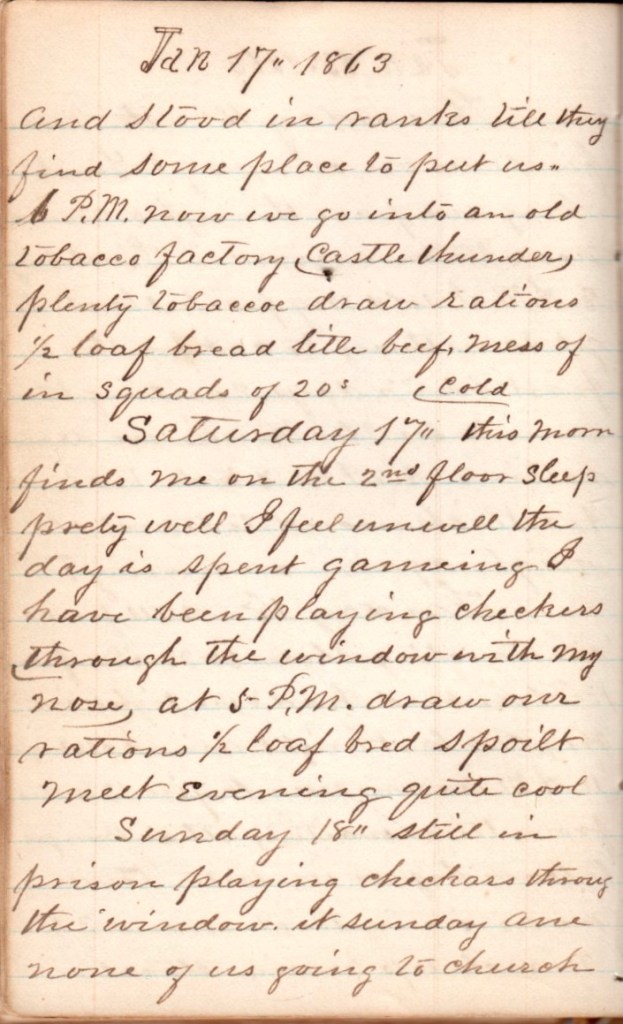
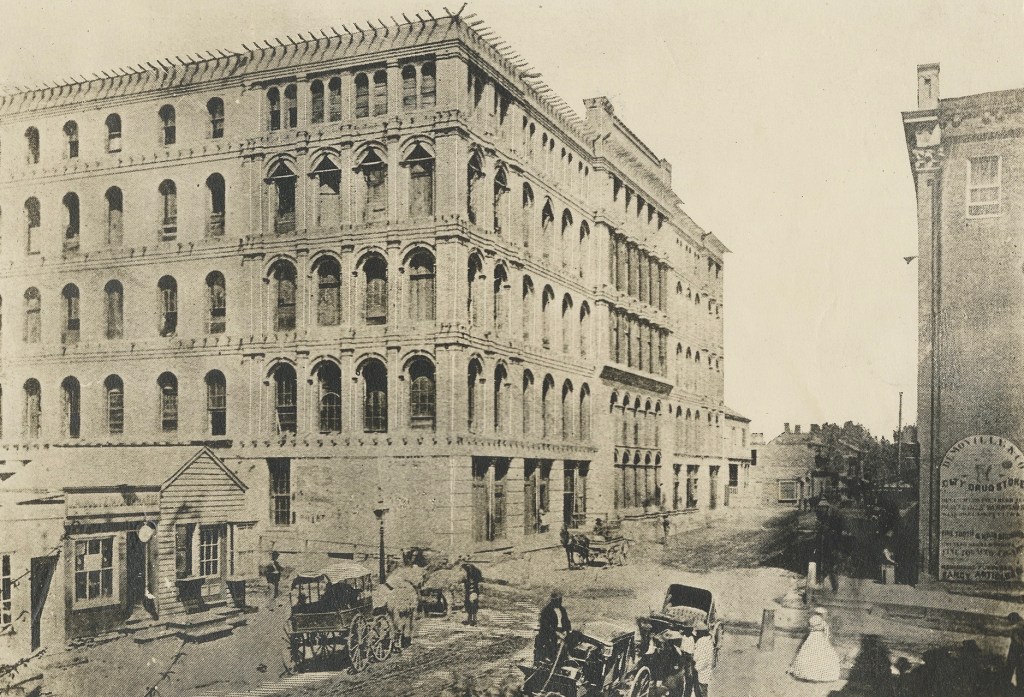
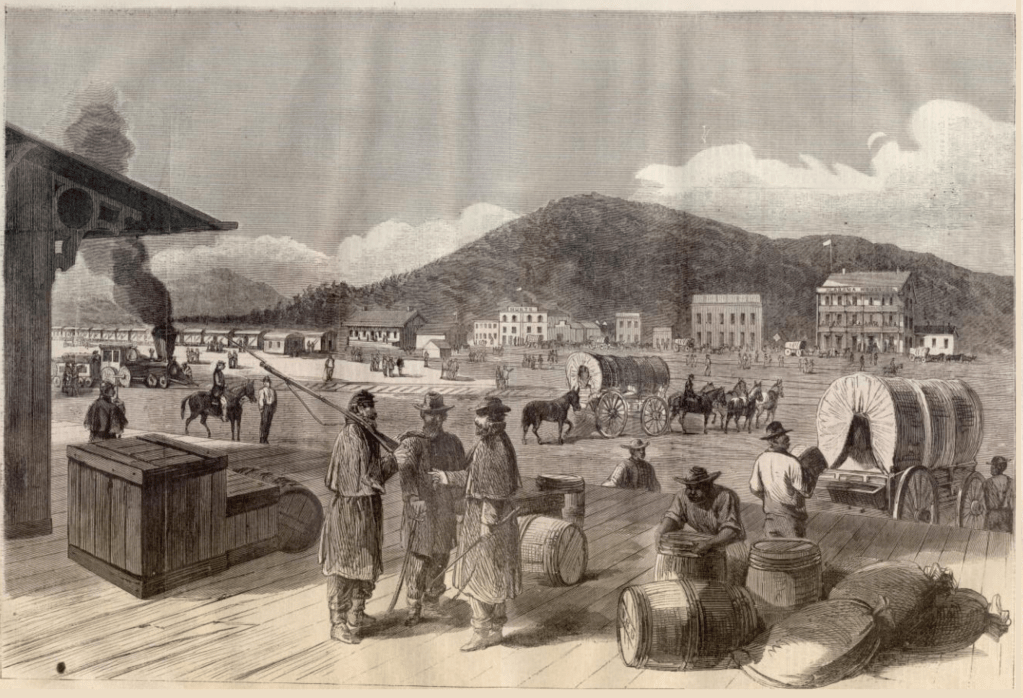

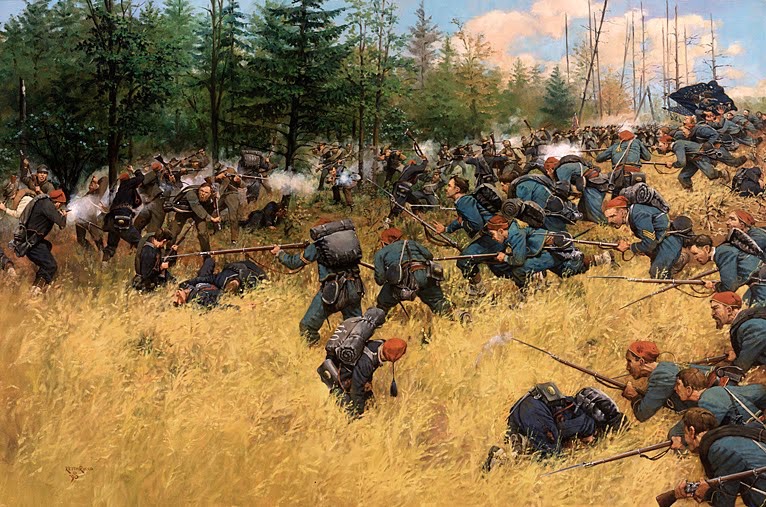


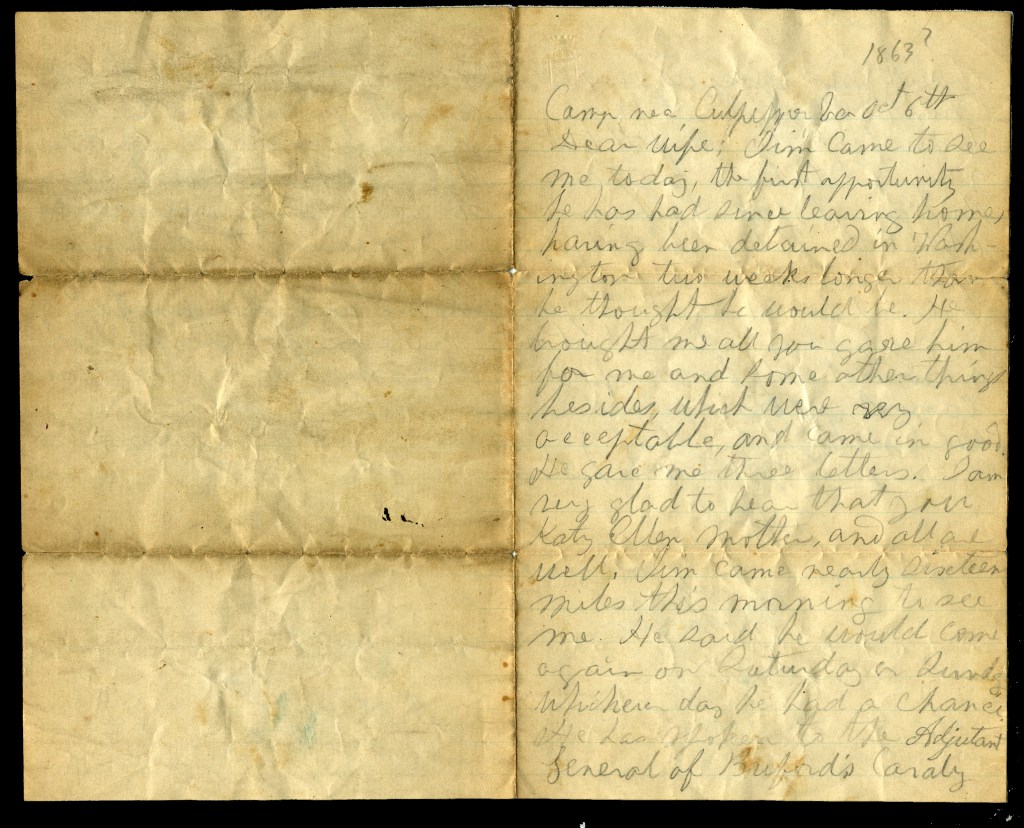

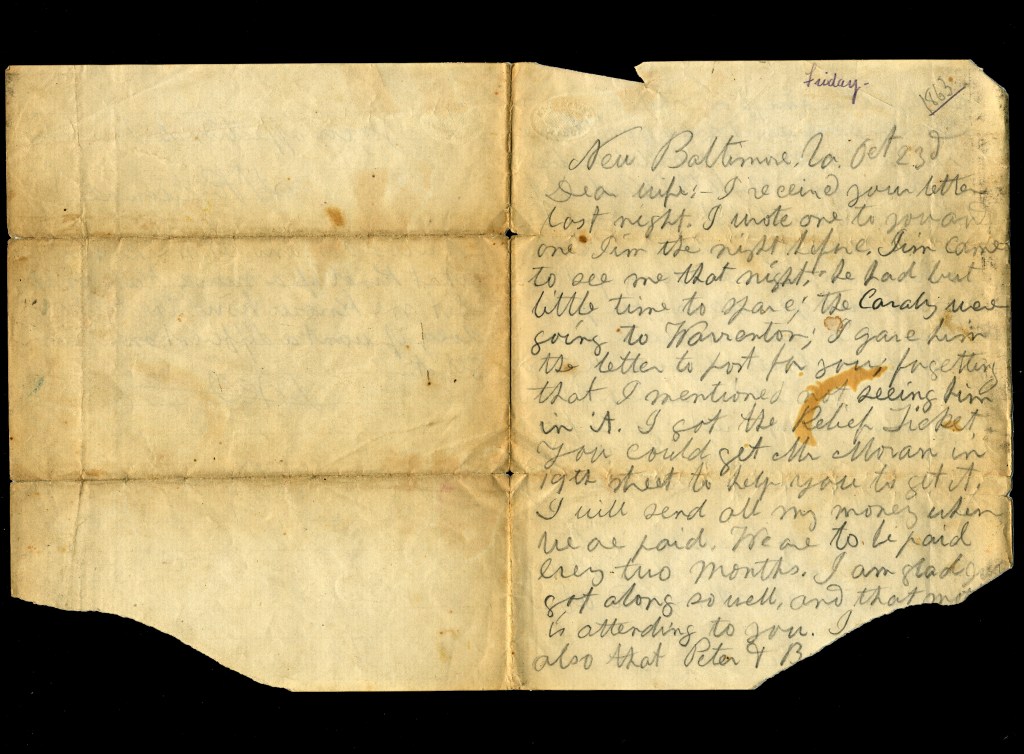


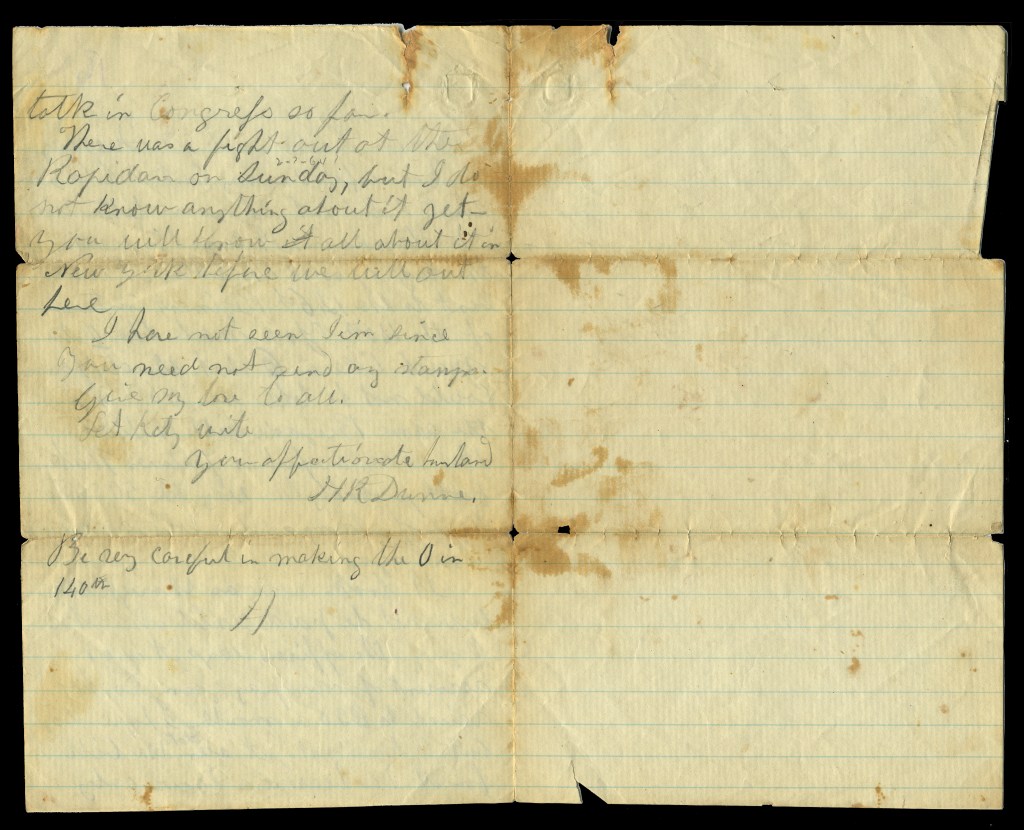
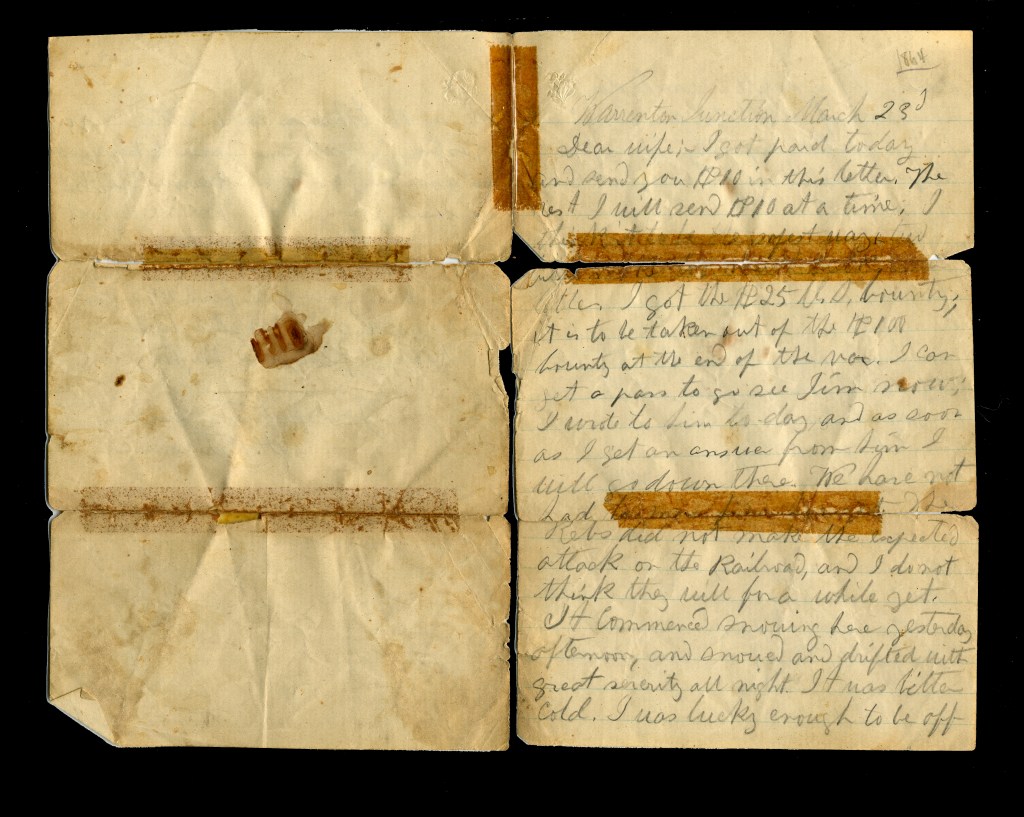
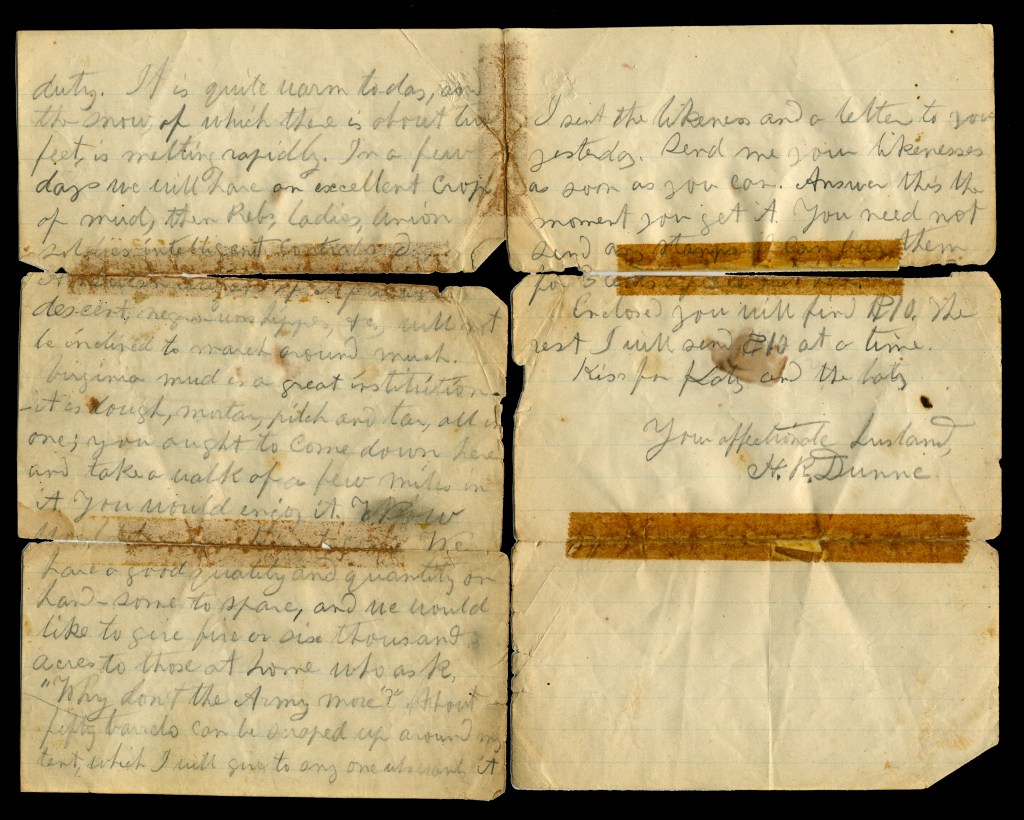


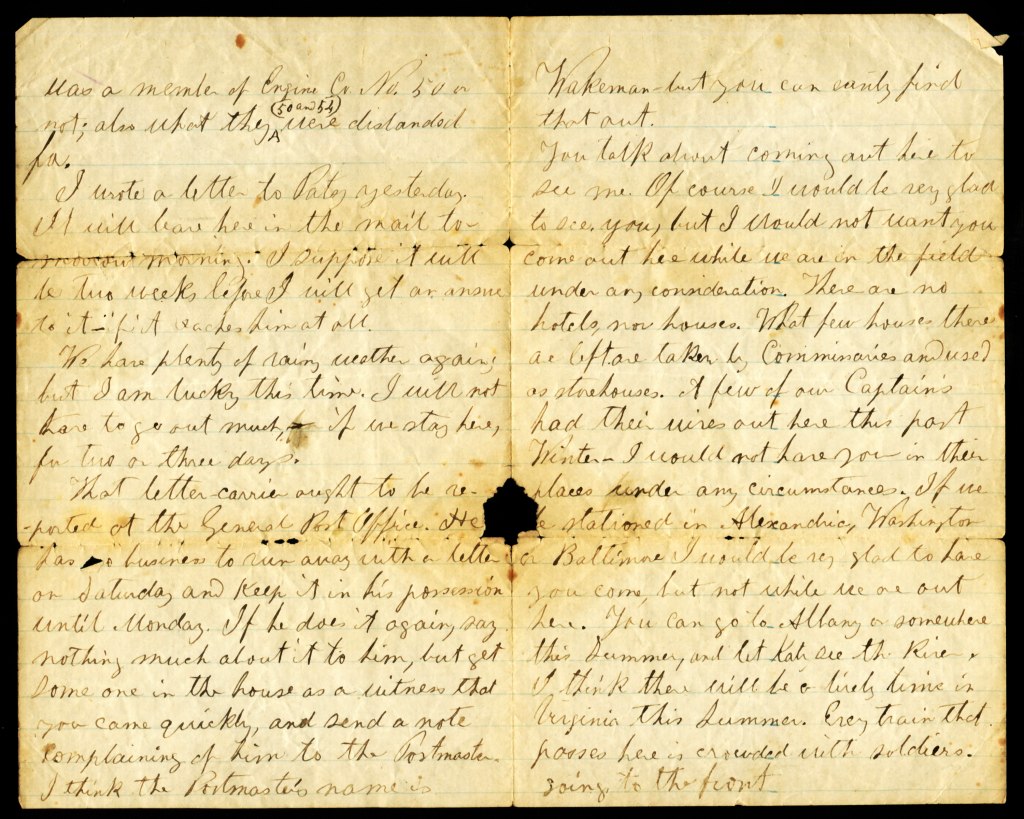
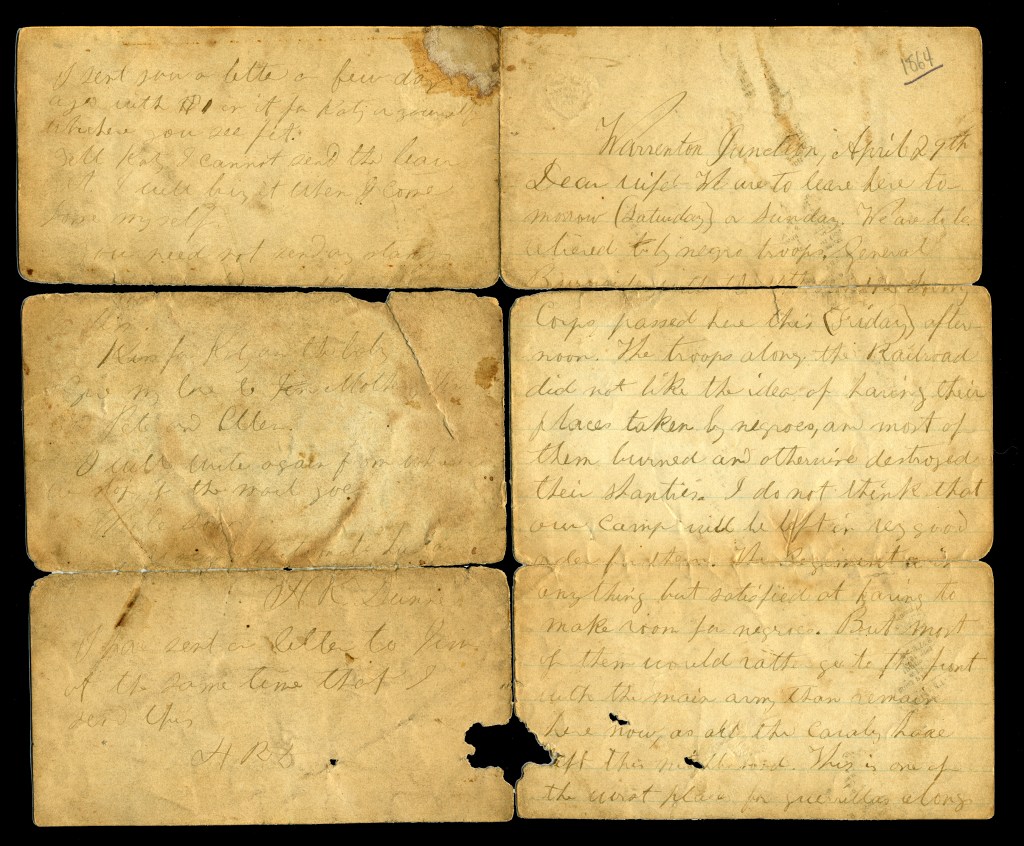
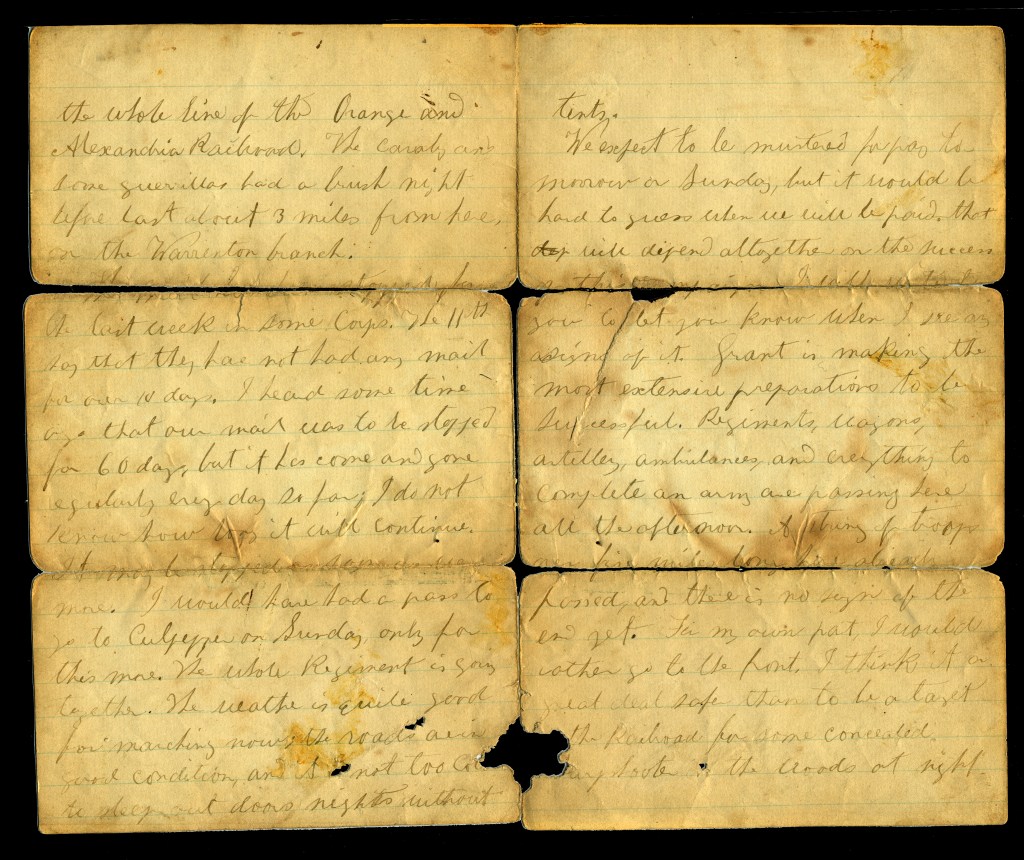
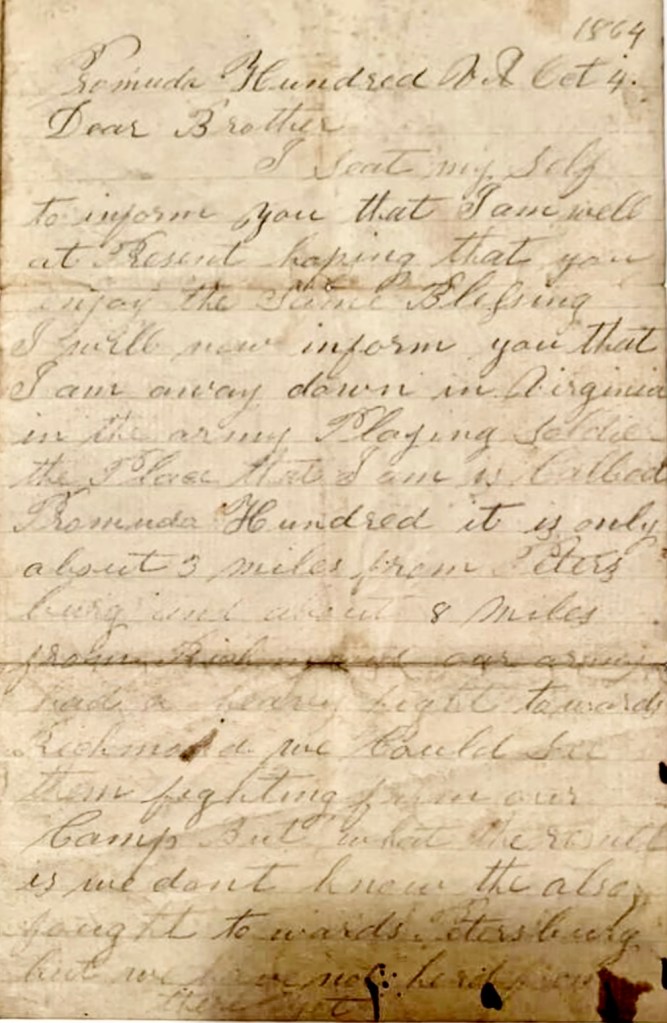

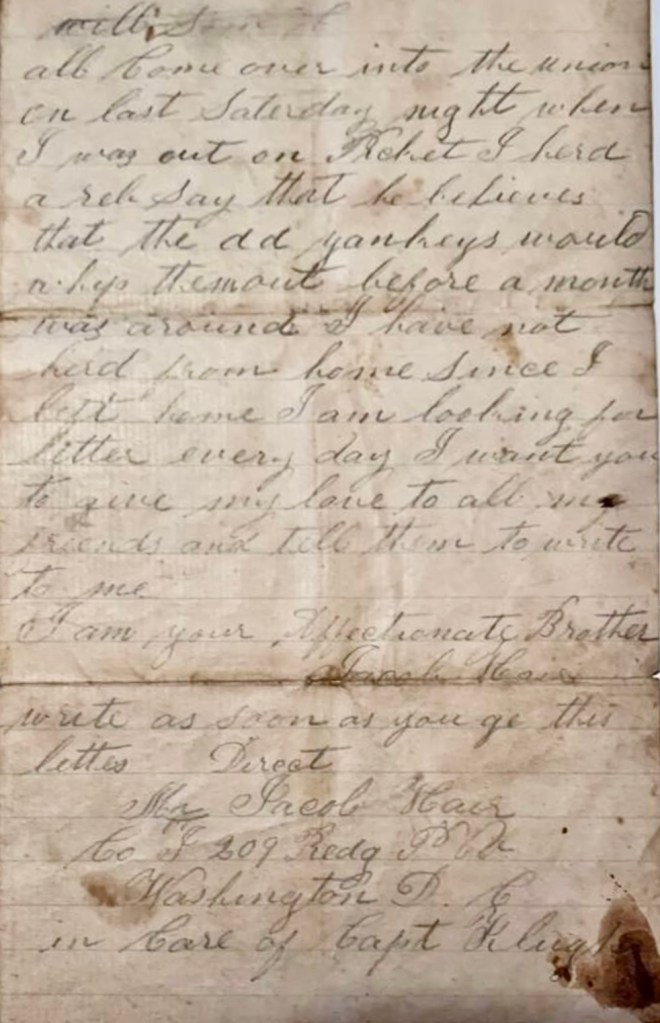


 Spared & Shared 23