My passion is studying American history leading up to & including the Civil War. I particularly enjoy reading, transcribing & researching primary sources such as letters and diaries.
The following letter was written by Canadian-born Benjamin Howe of Acworth, New Hampshire, who enlisted at the age of 24 in August 1862 to serve as a private in Co. E, 5th New Hampshire Infantry. He was transferred from Co. E to Co. H in December 1864 with his promotion to 1st Sergeant. The regiment served under the able leadership of Col. Edward E. Cross until he was cut down at Gettysburg. It sustained such considerable loses (over 1,000 men in killed and wounded) that it was only a shadow of its former self after the Battle of Gettysburg. Those that were left in the regiment were no longer a formidable fighting force and were assigned duty to guard prisoners at Point Lookout, Maryland until they could fill up their ranks once again.
This letter was written from Point Lookout and the rebels who were making the “curiosities” that Benjamin sent home to his friend were Confederate prisoners of war. The “niggers” as Benjamin called them whom he “knocked down” for sport were either contraband or, more likely, US Colored Troops (USCT) who were also on duty at Point Lookout serving as prison guards. Whether military or civilian, the blacks were sorely abused by the white soldiers of both the Union and Confederate armies.
Confederate POW’s laughing at a USCT soldier who accidentally killed his fellow sentry at Point Lookout, Maryland. This scene was one of many sketches made by Confederate POW Jack Omenhausser.
Transcription
Addressed to Mr. Edward Warner, Acworth, New Hampshire
Point Lookout, Maryland January 31, 1864
Friend Ed,
I received your letter and was glad to hear that you was well and I am glad to hear that you are having a good time this winter.
Dan is well and just as wild as ever. He is getting to be a first rate bugler and a good fellow as a general thing himself.
You wanted me to send you some curiosities. Well, I have got two rings made and I will send them to you. The rebels made them and they make lots of funny things. If the rings suits you and you want any more curiosities, I will furnish you with pleasure. I will keep an eye out for them and get a good many things. Tell Frank if she would like a fan that the rebs made, I will send her one. They make some of the prettiest that I ever saw and they cut little bibles out of stone and color them and they look real nice, and they make tooth picks and most everything that you could imagine.
Well, Ed, as I am in a hurry, I will come to a halt. As for myself, I am well at present and enjoying myself as well as possible under the circumstances. I get lonesome sometimes and go out of camp and knock down three or four niggers and come back satisfied. Give my best pair of specks [respects] to all enquiring friends and vote Democrat ticket.
If you want any more things, I will have them by the time you will let me know. I have got a rebel 50 cents scrip and it is a genuine one in their country. I will send it to you. Well, Ed, goodbye. Write often and I will answer them promptly and with pleasure.
From your friend, — Corp. Benjamin Howe
Direct to Co. E, 5th New Hampshire Volunteers, Washington D. C.
The following letter was written by William Bower Simmons (1838-1917) who was enrolled as a student at Roanoke College when the Civil War erupted. He left school immediately and enlisted as a private in William T. Patton’s Blue Ridge Rifles (Co. A) of the 28 Virginia Infantry. This regiment was mustered into service on 16 May 1861 at Lynchburg for a period of one year. Muster rolls show him present for duty until the 2nd of October when he was sent to a hospital (consistent with his letter), and then subsequently sent home on sick furlough.
William reenlisted with his company in the spring of 1862 but never returned from his sick furlough until 26 March 1863, though he was still unable to perform duty and was sent again to the hospital on 3 May 1863. He returned to duty on 7 March 1864 and was wounded on 18 June 1864. There are no subsequent entries in the muster rolls but a note in his on-line ancestry claims that he was “shot in the back at Howlett’s House. Recovered in Richmond hospital.”
William had a younger brother that also served with him in the same company named Edmond Orleans Simmons (1843-1862). Edmond was seriously wounded in the Battle of Gaines Mill on 27 June 1862 and died at Richmond on 6 August 1862.
After the war, William became a lawyer and subsequently served as a Botetourt county supervisor and judge for many years. William was the son of Anthony Kessler Simmons (1810-1886) and Sophia Bower (1811-1885) of Boutetourt county.
[Note: This letter is from the personal collection of Greg Herr and was transcribed and published on Spared & Shared by express consent.]
Transcription
Blue Ridge Botetourt, Virginia December 16, 1861
Dear friend Bent,
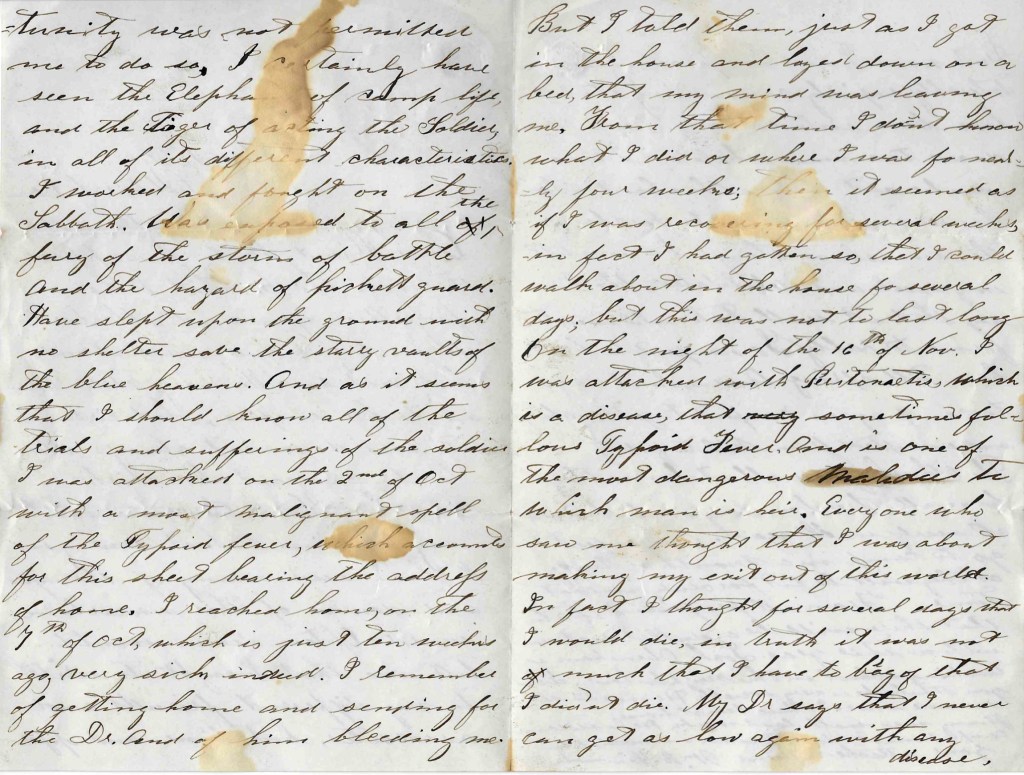
I suppose that you think that I have forgotten you and all about former times and associations, but not so. Memory still holds on to her empire, but circumstances does not always allow her to carry out her wishes. This has been the case with myself. Since I last saw you I have seen many of the ups and downs of this uncertain world. Often desire would tell me that I ought to write to my different friends and associates but time and opportunities has not permitted me to do so.
I certainly have seen the Elephant of camp life and the Tiger of acting the Soldier in all its different characteristics. I worked and fought on the Sabbath. Was exposed to all the fury of the storms of battle and the hazard of picket guard. Have slept upon the ground with no shelter save the starry vaults of the blue heavens. And as it seems that I should know all of the trials and sufferings of the soldier.
I was attacked on the 2nd of October with a most malignant spell of the Typhoid fever, which accounts for this sheet bearing the address of hime. I reached home on the 7th of October which is just ten weeks ago, very sick indeed. I remember of getting home and sending for the Dr. and of him bleeding me. But I told him then, just as I got in the house and laid down on a bed, that my mind was leaving me. From that time, I don’t know what I did or where I was for nearly four weeks. Then it seemed as if I was recovering for several weeks. In fact, I had gotten so that I could walk about in the house for several days but this was not to last long.
On the night of the 16th of November, I was attacked with Peritonitis which is a disease that sometimes follows Typhoid fever and is one of the most dangerous maladies to which man is heir. Everyone who saw me thought that I was about making my exit out of this world. In fact, I thought for several days that I would die; in truth, it was not much that I have to brag of that I didn’t die. My Dr. says that I never can get as low again with any disease.
But now I am improving again tolerably rapidly considering that I have been sick so long. I am reduced to a mere skeleton. I can make out to walk about the house and out on the porch if the sun shines though I am still very weak and debilitated. The Dr. says that it will take all winter for me to rally so I expect to be at home tlll spring. And when I do go to camp again, I expect to get discharged and exempted from military duty.
The other boys are all at home. They have all three been very sick but are all nearly well again and expect to go to camp in a month or two as they will be fit for duty in that time.
From all prospects I think that there will be a dull Christmas with us this year. Lock Obenshain is teaching school in the neighborhood. Don’t you think he is very sociable. He was to see me once since I have been at home. Jimmy was well last week. He is still in camp. I must close. Answer immediately. Your attached friend, — Wm. B. Simmons
This diary was kept by Averill Jacob Roundy (1835-1916), the son of Marvin Roundy (1808-1893) and Frienda Louisa Averill (1812-18xx) of Huron, Wayne county, New York. Averill enlisted on 22 April 1861 in Co. C, 70th New York Infantry. He was seriously wounded at the Battle of Williamsburg on 5 May 1862 (as stated in his diary) where 8 members of his company were killed and 22 others were wounded. On account of this wound, he was discharged from the hospital at Albany, New York, in October, where he was eventually sent. Later in the war, he sought permission to re-enter the service but was not permitted. Averill married Ellen Southwell (1841-1893) in 1865 and the couple had four children.
This uncased ambrotype of a Union soldier was included among the personal items in the collection of Averill Jacob Roundy and may actually be him although it is unmarked.
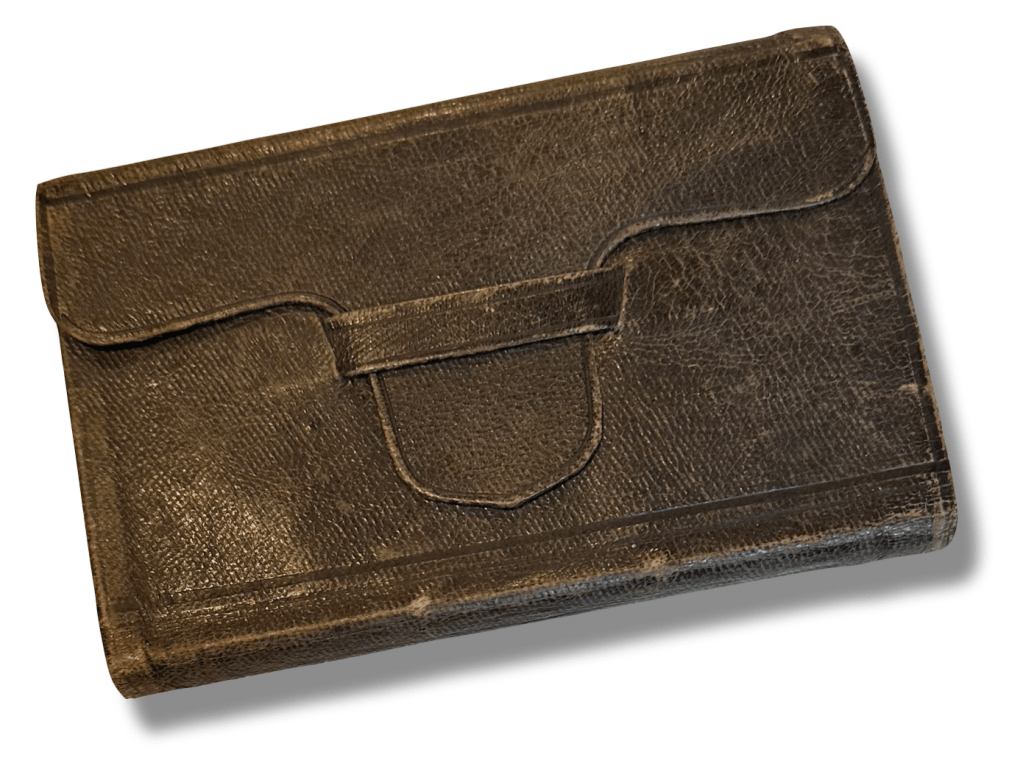
The leather pocket diary measures 3.25 x 5 inches and was most likely purchased at the sutler’s tent near Fortress Monroe on 12 May 1862—one week after Averill was wounded in the Battle of Williamsburg while serving in the ranks of the 70th New York Infantry. This regiment was recruited by Dan Sickles who served as its temporary colonel until promoted to Brigadier General of the “Sickles Brigade” of which the 70th New York was a part. At the Battle of Williamsburg—the first battle of consequence in which the 70th participated—the regiment lost 339 killed, wounded, or missing, of the 700 engaged. For Averill, it would be his first and last battle.
Averill’s handwriting is clear and easily read, even though the entries are in pencil. I have only transcribed that portion of the diary that pertains to his military service. The latter portion of the diary includes entries made in Effingham and Galesburg, Illinois, where Averill attempted to make a living as a teamster, I believe, though he did not appear to be much satisfied with the work or the location.
[Note: This diary is from the personal collection of Greg Herr and was made available for transcription and publication on Spared & Shared by express consent.]
Transcription
The pocket diary Averill purchased at the Sutler’s Tent near Fortress Monroe on 12 May 1862
May 12th—Averill J. Roundy’s book. In Chesapeake General Hospital, Fortress Monroe
Chesapeake General Hospital (large building) near Fortress Monroe
May 5th—Got wounded in a battle at Williamsburg
May 6th—Wound very sore. Had the ball cut out [of left shoulder].
May 8th—Got aboard the boat for Fort Monroe
May 11th—Landed at Ft. Monroe. Was taken to the Chesapeake General Hospital.
May 12th—Went to the sutlers and back. Got tired most out.
May 13th—Feel rather sore today but guess my wounds will come out all right. Hear all kinds of stories about the success of our troops. Hope they are true.
May 14th—Feel very well today. Guess I shall get so as to go home before long. Have not heard from the company since I left.
May 15th—Feel very well today. If I have no serious drawback, shall soon be well. Wrote a letter to E.
May 16th—It is pleasant today but cool. Wounds feel easy. Surgeon gives hopes of soon being able to go home. Hope to be able to go on the next boat.
May 17th—Is a lovely morning—cool and pleasant. Sun shines out clear. Am going to try and see Crow today. My wounds seem to be doing well. Went and saw Crow. Found him doing very well.
May 18th—[Sunday] It is a very pleasant day. Don’t feel quite as well today. Guess it was most too much for me going over to Crow’s yesterday. Have hopes of soon going home but don’t know how soon for we can’t go away from here just yet. Had a short but very pleasant sermon today. It was good to see.
May 19th—Is a very pleasant morning—cool and nice. Feel very well today.
May 20th—Nice morning—cool and pleasant. Feel very well but don’t hear any more about going home. Guess they mean to keep us here until we get well. Hope they won’t though.
May 21st—Passed the worst night I have seen since I came here. Could not sleep nor rest. Feel quite unwell today. Head aches some. Back aches some. Not a very pleasant morning. Cool but cloudy and misty.
May 22nd—Passed a very easy night. Rested well. Feel very well this morning. Nice and pleasant, dry, cool and comfortable. Report is that we are going to be sent to New York today. Hope it is so. Guess I can stand it. Have got on the boat at last to go home. Guess I shall make a go of it.
May 23rd—Have not started yet. Been kept on the boat all night. Got no supper last night. Don’t see as we are going to get any breakfast today. Have got started at last and are going at pretty good speed for New York.
May 24th—Are within about forty miles of Sandy Hook. Expect to see New York City this afternoon. Have heard that that the boat is to go to Albany to take some as far as there on the road to their homes. Hope it is so for there is where I want to go, you may be sure.
May 25th—This morning landed in New York City and was taken to the Park Barracks where we had our wounds dressed and taken care of for the first time since we left Fortress Monroe.
May 26th—Have concluded to go on home and have got on the boat for Albany and we have got started and are moving with good speed towards our destination.
May 27th—Landed in Albany this morning and took the cars for Clyde. Got there and from there home a little before sunset.
June 3rd—Went over to Uncle Daniel’s and had a good time. Got home about dark.
June 5th—Feel first rate today. Am getting along finely. Have been most all over the farm.
June 8th—Am at Uncle Botham’s today. Is a very pleasant day—cool and pleasant.
June 10th—Am at Uncle Daniel’s out in the logging field.
June 20th—Got a good long letter from [ ].
June 22nd—Got my coat on for the first time since I got hurt May 5th ’62.
July 11th—Got a certificate of disability for duty from Dr. Willson.
July 16th—Got a letter from Capt. Mooney.
July 17th—Went to Rochester and from there to Albany…
July 24th—Have been writing a little, reading a little, and doing a great deal of nothing. But it is dull work here. I must wait and watch for better times…
July 31st—Have been to the City [of Albany] to have my likeness taken.
August 1st—The most of the wounded have been sent from here [Albany] today.
August 2nd—Sent a letter home with a photograph in it. Also one to Henry Mayo and one to Ell. and have got four left. One to K___ and one to Justin leaving only two.
August 3rd—Gave a photograph to Miss Rawson and one to Miss Mary Carey.
August 8th—Am still in the hospital and likely to stay there for some time yet. Very lonesome and dull here. Almost dead with ennui.
August 11th—It is very warm this morning and I cannot find much to satisfy myself. Must go down to the City today and got my photographs.
August 13th—Got a letter from Almira this morning adn have written an answer to it. Gave a photograph to Dr. R. S. Havens.
August 17th—Gave a photograph to E. W. Merrill and down to the City this forenoon heard some splendid singing at the Cathedral.
August 18th—There went a regiment from here today, about twelve hundred strong.
August 23rd—Feel rather bad today. Curious I don’t receive any letters. Guess the folks have forgot me.
Capt. William H. Hugo of Co. C, 70th New York (Military Images)
August 29th—It begins to look and feel like fall and I begin to think I shall have to spend another winter in the army.
September 7th—Sunday and a cool and pleasant day. Have been over to an orchard and got all the apples I could eat.
September 27th—Received my Descriptive List today from Capt. [William H.] Hugo.
October 6th—Have got my discharge and am at home once more—a free man.
October 27th—The snow is about three inches deep and it is snowing like fun….
December 18th 1862—Effingham, Illinois. Commenced work for Samuel Fleming at $12/month.
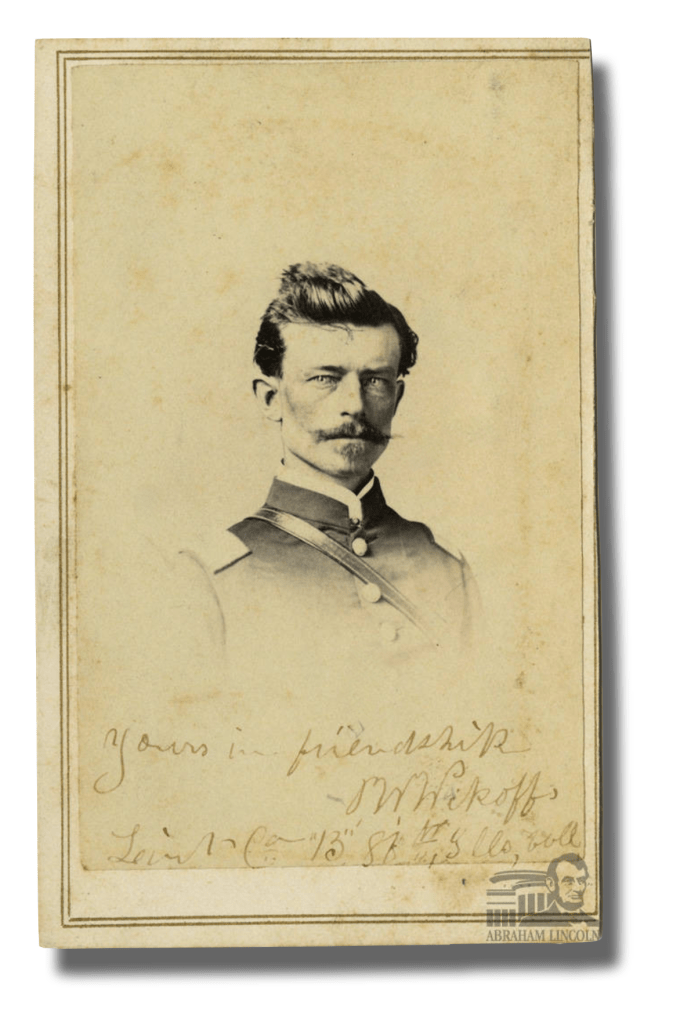
I could not find an image of Darwin but here is Peter W. Wycoff of Co. B who also served in the 86th Illinois Infantry, rising in rank from sergeant to 2d Lieutenant (Lincoln Library)
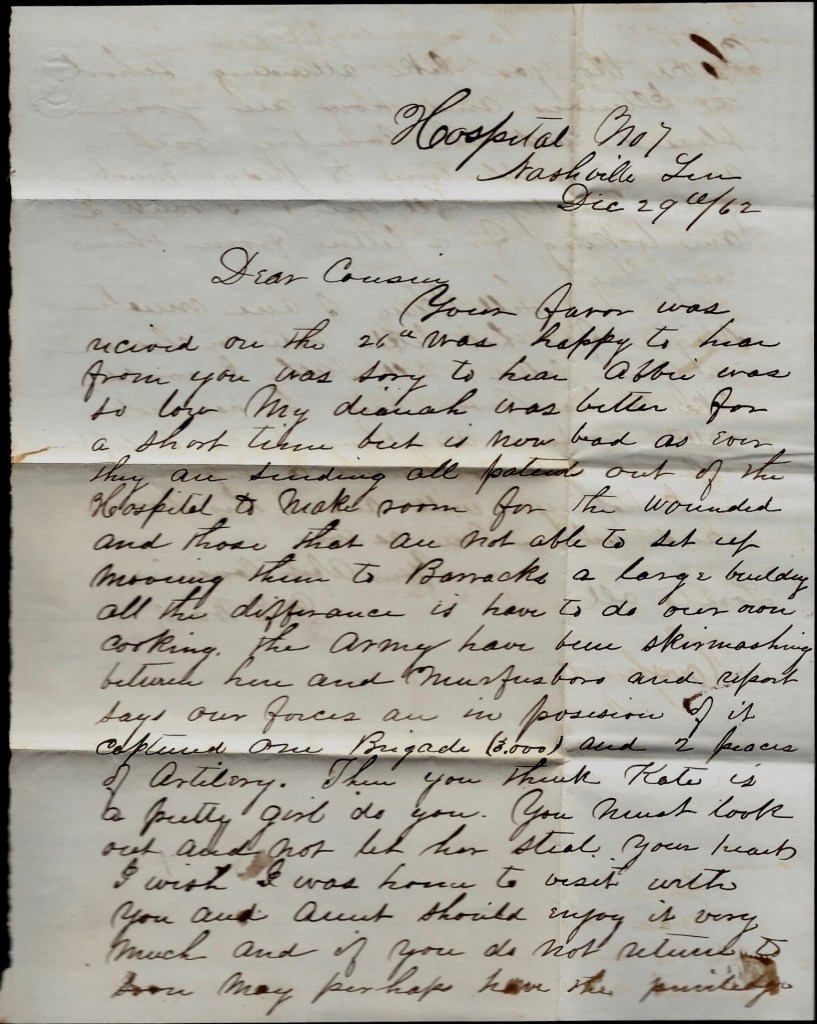
The following letter was written by Darwin E. Ward (1834-Bef1887), a native of Columbia, New York, who came to Henry, Marshall county, Illinois, prior to his enlistment in August 1862 as a sergeant in Co. H, 86th Illinois Infantry. When enlisted, he was described as a 5′ 7″, light hair, grey-eyed single farmer. Darwin was promoted to sergeant major and also was made adjutant of the regiment briefly before he was mustered out in June 1865.
Darwin wrote the letter to his younger cousin, Darwin Ward Esmond (1846-1923), the son of Darwin Edmond (18xx-1851) and Geraldine Laura Amelia Ward (1826-1913) of Newburgh, Orange county, New York. Darwin studied law and became a New York City lawyer. He married Hannah Catherine Williams (1851-1932).
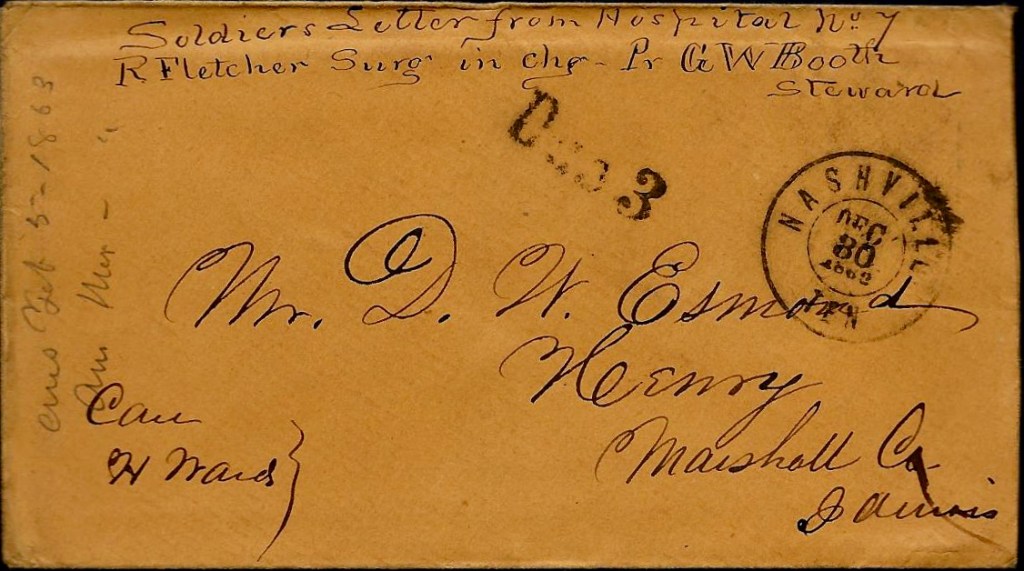
The 86th Illinois organized at Peoria and were sent quickly to Kentucky and attached to Colonel Daniel McCook’s Brigade to confront the Confederate troops who were threatening Cincinnati. They participated in the Battle of Perryville on 8 October 1862 where they suffered their first battle casualties. Afterwards, they marched to Nashville and went into winter camp there. It was here, at Nashville Hospital No. 7, that Darwin penned this letter.
Transcription
Addressed to Mr. D. W. Esmond, Henry, Marshall county, Illinois
Hospital No. 7 Nashville, Tennessee December 29, 1862
Dear Cousin,
Your favor was received on the 26th. Was happy to hear from you. Was sorry to hear Abbie was so low. My diarrhea was better for a short time but is now bad as ever. They are sending all patients out of the hospital to make room fr the wounded and those that are not able to sit up. Moving them to barracks—a large building. All the difference is [we] have to do our own cooking. The army have been skirmishing between here and Murfreesboro and report says our forces are in possession of it. Captured one brigade (3,000) and two pieces of artillery.
Then you think Kate is a pretty girl, do you? You must look out and not let her steal your heart. I wish I was home to visit with you and Aunt. Should enjoy it very much and if you do not return too soon, may perhaps have the privilege.
How do you like attending school in Illinois? And how are you pleased with the country. Rather an unfavorable time to judge much of the country. Tell Lee and Frank I am looking for a letter from them everyday.
Tell Mary I am much obliged for that little note enclosed in your letter. Tell Father I would like to hear from him. He has not written or said anything since I left. Hope he continues to improve. I hope you will answer this soon and believe me as ever your affectionate cousin, — D. E. Ward
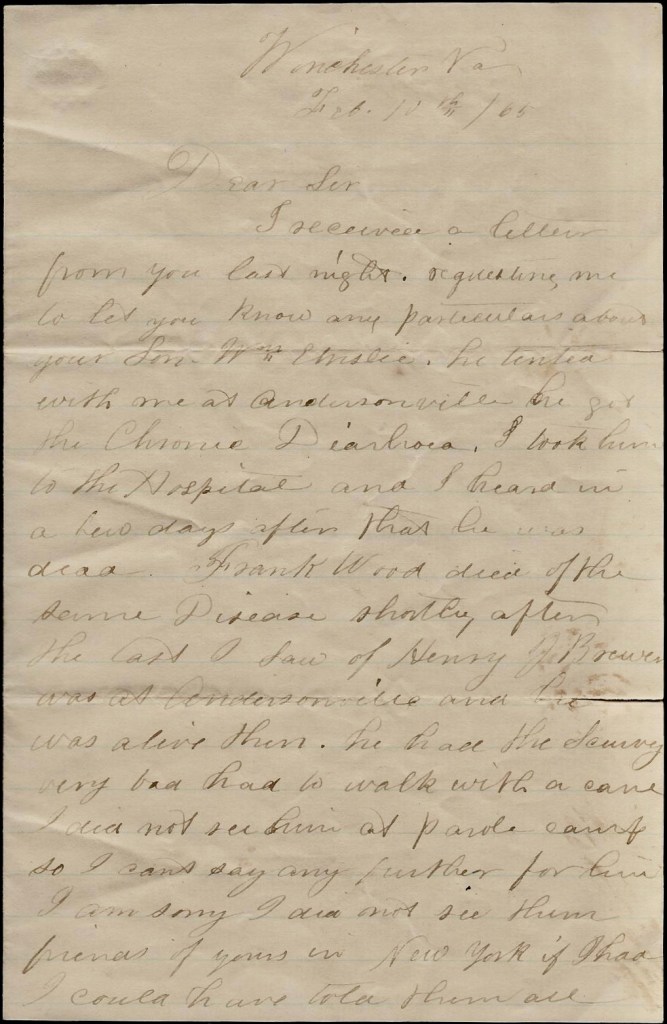
The following letter was written by David Gardner (b. 1842) who enlisted on 8 April 1863 at New York City to serve three years in Co. I, 5th New York Cavalry. He was taken prisoner on 17 June 1864 at Ely’s Ford on the Rapidan river in Virginia and taken to Andersonville. Unlike most of his fellow prisoners, David survived the confinement and was paroled in January 1865.
I could not find an image of David Gardner but here is an ambrotype of a cavalryman from the collection of my friend, Megan Kemble, who thinks he was in either the 5th or 6th New York Cavalry.
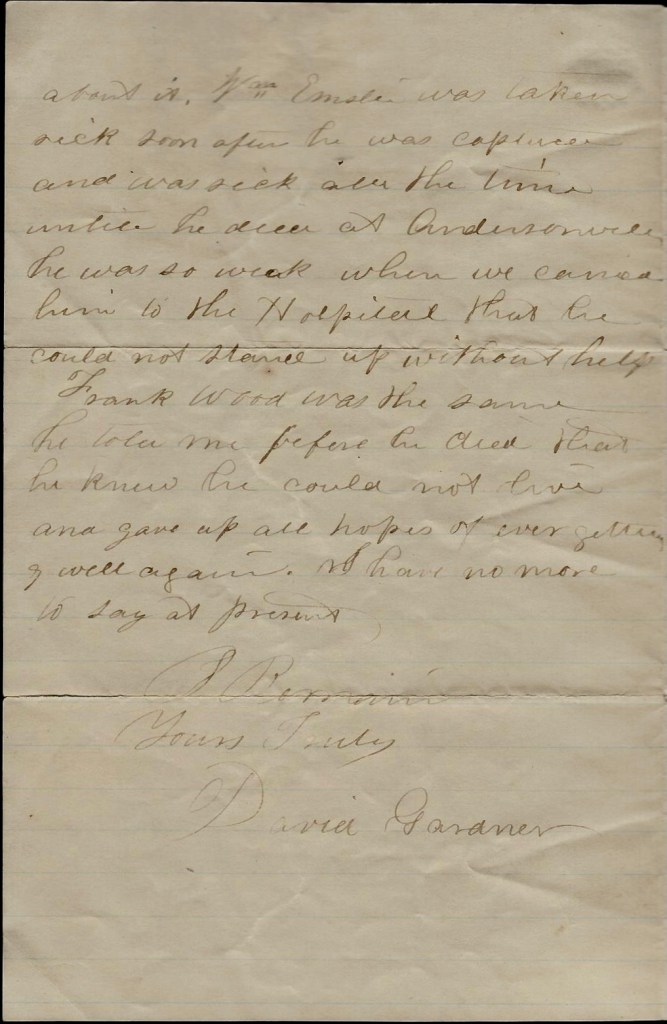
The letter is addressed to “Dear Sir” and my assumption is that it was sent to James Emslie, the father of William H. Emslie (1842-1864) who enlisted on 12 August 1861 at the age of 18 in Co. G, 2nd New York Cavalry. William was captured at Ellis Ford on 17 January 1864 and died of chronic diarrhea at Andersonville Prison on 25 June 1864. William’s parents were James and Jane (Weston) Emslie of Cornwall, Orange county, New York. We learn from the letter that David and William were tent mates at Andersonville. William was buried at Andersonville.
Also mentioned in the letter are two other names. The first is Henry J. Brewer (1841-1864) who served with William in Co. G, 2nd New York Cavalry. Henry was taken prisoner on 22 August 1863 at U. S. Ford on the Rappahannock River in Virginia and was also sent to Andersonville. He died there on 31 October 1864. This letter informs us that he was suffering from scurvy.
The other soldier mentioned was Frank Wood (1842-1864) who served in Co. I, 5th New York Cavalry with David Gardner. He was taken prisoner on 1 March 1864 near Richmond and died at Andersonville Prison on 19 July 1864.
A burial trench outside Andersonville Prison
Transcription
Winchester, Virginia February 10th 1865
Dear Sir,
I received a letter from you last night requesting me to let you know any particulars about your son, Wm. Emslie. He tented with me at Andersonville. He got the chronic diarrhea. I took him to the hospital and I heard in a few days after that he was dead. Frank Wood died of the same disease shortly after. The last I saw of Henry J. Brewer was at Andersonville and he was alive then. He had the scurvy very bad—had to walk with a cane. I did not see him at parole camp so I can’t say any further for him. I am sorry I did not see them friends of yours in New York. If I had, I could have told them all about it.
Wm. Emslie was taken sick soon after he was captured and was sick all the time until he died at Andersonville. He was so weak when we carried him to the hospital that he could not stand up without help. Frank Wood was the same. He told me before he died that he knew he could not live and gave up all hopes of ever getting well again. I have no more to say at present.
The following letter was written by a member of Co. B, 4th Georgia State Militia (GaSM) with the initials “J. W. G.” and addressed to his father, “W. W. G.” It was datelined from Savannah, Georgia, in mid-December 1864 where the regiment had fallen back, having spent the previous weeks attempting to hold back Sherman’s relentless march to the sea.
According to campaign records, the 4th GaSM was indeed in the 2nd Brigade, commanded by Brig. Gen. Pleasant J. Phillips. The 4th GaSM was commanded by Col. James Mann. The 4th GaSM served from 1 March 1864 through 26 April 1865.
There is a chance that each side of the sheet was written by a different member of the regiment who served from the same community. Unfortunately I could not find a roster for Co. B of this regiment to enable me to determine the author’s identity.
Our regiment has got to go on picket tonight. The pickets is almost 2 hundred yards apart. Pa, Joe is writing and he says tell all of his folks he is well and wants to hear from them. He is well and fat. Pa, Sherman’s army has cut the Charleston railroad and the Central Railroad and the Gulf Railroad. Pa, when you write, write to me how George Walker is getting along with his wound. Pa, when we left Macon, we come to Albany on the train and then we had to [march to] Thomasville 60 miles in 2 days and a half and get on the train and come to Savannah. Pa, I came [with]in 17 miles of Aunt Emily [ ] and heard they was all well. Sis, tell Aunt Jenny that I am [with]in 8 miles of Alf’s house but didn’t hear nothing from them. Pa, tell all enquiring friends I am well and to write to me. Nothing more, — J. W. G.
To W. W. G.
[On reverse side of sheet]
Savannah, Georgia December 14 [1864]
Dear Father and Mother,
I seat myself this evening to write you a few lines to let you know that I am well and [I want] to know how you all are a getting along. I haven’t heard anything since Pa came to see me at Lovejoy. I would like to hear how the Yankees treated you when they came through. Pa, we left Lovejoy one week after you left there and we have been traveling ever since. We come to [ ] in two days and nights and there we got on the train and [ ] and then to Griswoldville and [remainder illegible]
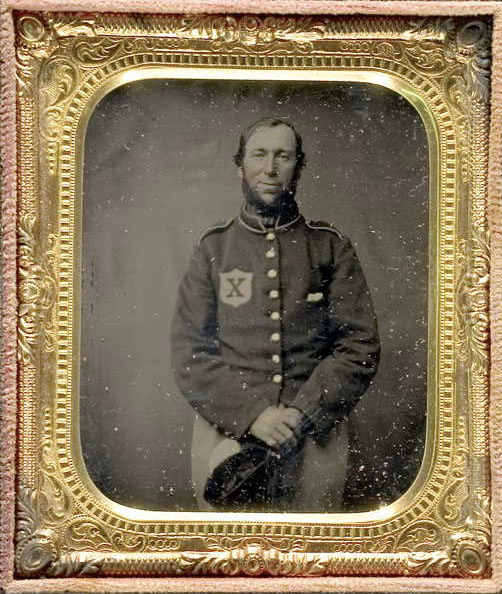
The following letter was written by Springstead B. Owen (1838-1912) of Newburgh, Orange county, New York, who enlisted on 14 July 1861 at the age of 22 to serve three years in Co. A, 56th New York Infantry. Springstead survived the war and mustered out on 16 August 1864. (On the company roster, his surname was recorded as “Owens.”) The 56th New York consisted of eleven companies of infantry, two light batteries, and two troops of cavalry, the whole being known as the “10th Legion.”
I could not find an image of Springstead but here is an unidentified member of the 56th New York readily identifiable by the “10th (roman numeral X) Legion” crest on his New York jacket.
Like so many other letters written home by soldiers in the Civil War, Springstead conveys the sad details of a comrade’s death to the deceased loved ones at home. In this case, Springstead describes the final days of Cornbury Merritt (1839-1862) who died of typhoid fever on 30 May 1862 near Bottom’s Bridge, Virginia. Cornbury’s younger brother, Seneca Merritt, was also in the same company but asked Springstead to write the “particulars” of Cornbury’s death since he was with him the entire time of his sickness. Most of these types of letters are eerily similar in content and expressions. It was customary to comfort the grieving family with news that their loved one died peacefully and with the hope of eternal salvation.
Cornbury Merritt was the son of Gilbert Merritt (1808-1873) and Fanny Eighmey (Amey) of Blooming Grove, Orange county, New York.
At the time that Springstead wrote this letter the regiment was assigned to the 1st Brigade, Casey’s Division, and deeply engaged in the Peninsula Campaign. Mention is made of an impending battle which would most likely have been the Battle of Fair Oaks (Seven Pines) which was fought on May 31-June 1, 1862.
Transcription
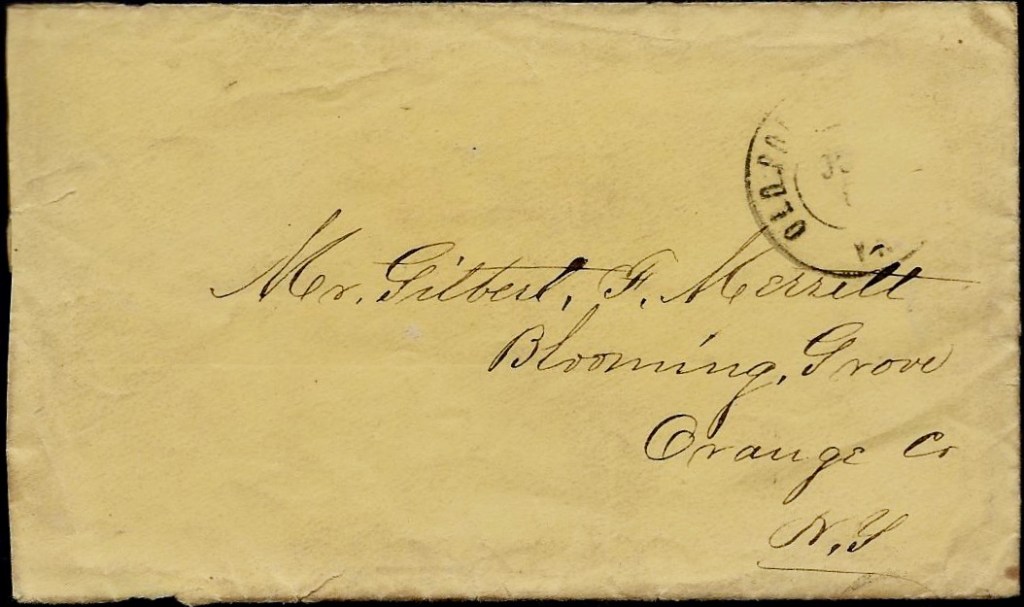
Addressed to Mr. Gilbert F. Merritt, Blooming Grove, Orange county, New York
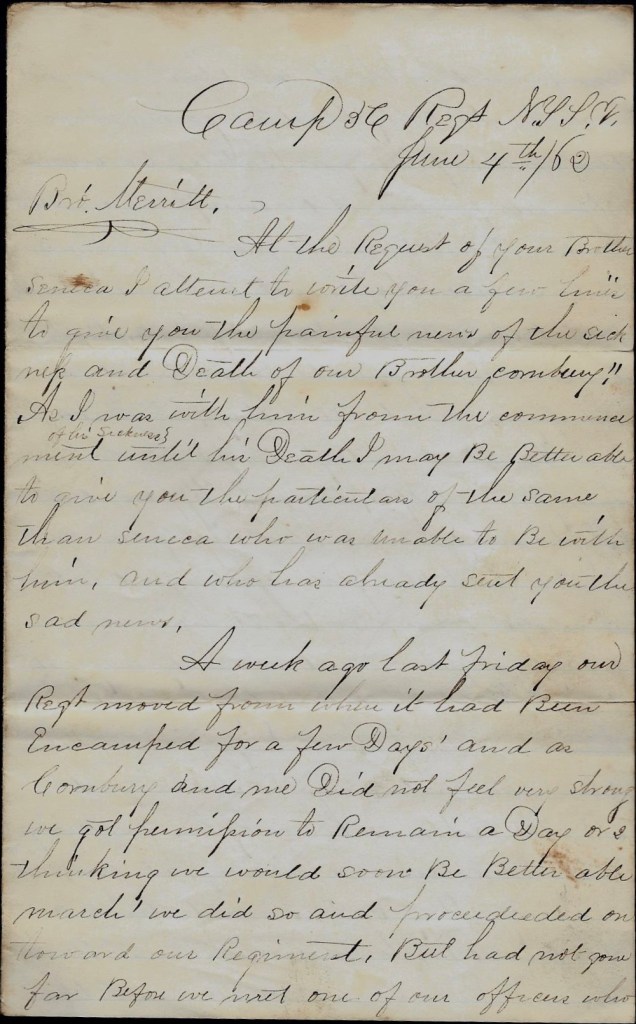
Camp 56th Regt. N. Y. S. V. June 4, 1862
Bro. Merritt,
At the request of your brother Seneca I attempt to write you a few lines to give you the painful news of the sickness and death of our Brother Cornbury. As I was with him from the commencement of the sickness until his death, I may be better able to give you the particulars of the same than Seneca who was unable to be with him, and who has already sent you the sad news.
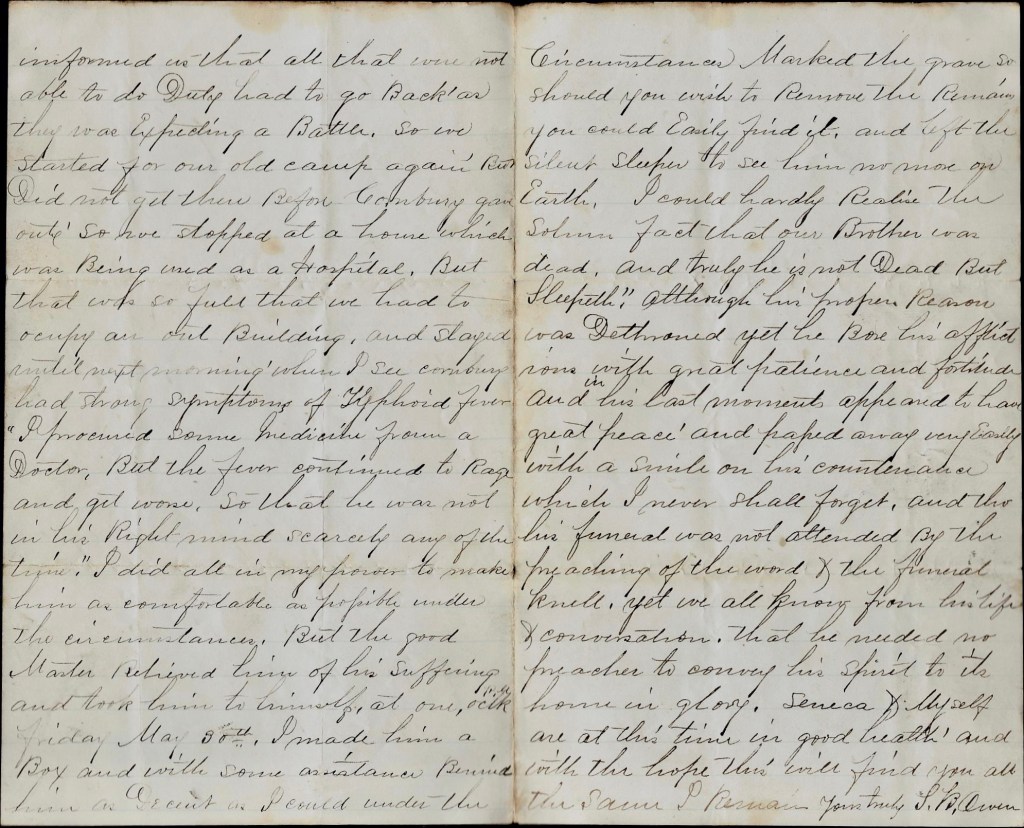
A week ago last Friday our regiment moved from where it had been encamped for a few days and as Cornbury and me did not feel very strong, we got permission to remain a day or two thinking we would soon be better able to march, We did so, proceeded on toward our regiment, but had not gone far before we met one of our officers who informed us that all that were not able to do duty had to go back as they were expecting a battle. So we started for our old camp again but did not get there before Cornbury gave out so we stopped at a home which was being used as a hospital. But that was so full that we had to occupy an out building and stayed until next morning when I see Cornbury had strong symptoms of Typhoid fever.
I procured some medicine from a doctor but the fever continued to rage and get worse so that he was not in his right mind scarcely any of the time. I did all in my power to make him as comfortable as possible under the circumstances but the good Master relieved him of his suffering and took him to Himself at one o’clock p.m. Friday, May 30th.
I made him a box and with some assistance buried him as decent as I could under the circumstances, marked the grave so should you wish to remove the remain you could easily find it, and left the silent sleeper to see him no more on earth. I could hardly realize the solemn fact that our brother was dead and truly he is not dead but sleepeth. Although his proper reason was dethroned, yet he bore his affliction with great patience and fortitude and in his last moments appeared to have great peace and passed away very easily with a smile on his countenance which I never shall forget. And though his funeral was not attended by the preaching of the word & the funeral knell, yet we all know from his life & conversation that he needed no preacher to convey his spirit to its home in glory.
Seneca and myself are at this time in good health and with the hope this will find you all the same, I remain yours truly, — S. B. Owen
This letter was written in the spring of 1863 by 30 year-old Sarah Plummer (Young) Merwin (1833-1920), the wife of Samuel Hubble Merwin (1826-1898) of Sacramento, California. Sarah was born and raised in Gray, Cumberland county, Maine. Her parents were Nathaniel Young (1788-1863) and Hannah Plummer (1802-1872). Sarah wrote the letter to her sister Francis (“Frank”) H. (Young) Merrill, the wife of John Tappan Merrill (1822-1910), a house carpenter in Gray, Maine.
We learn from the letter that Sarah and Samuel were residing with Samuel’s older sister, Orpha (Merwin) Massol (1815-1905), and her husband, Florian Augustus Massol (1810-1890) just outside of Sacramento where her husband and her brother-in-law were partners in the Massol, Merwin & Co. (pack train business). We know that Samuel had another sister living in California also named Sarah (Merwin) Barkley (1828-1885) who was the wife of John Henry Barkley (1825-1892). This couple apparently resided in Dutch Flat in 1863 for Sarah describes the journey to visit them just prior to this letter.
Though Sarah’s narration of the journey to Dutch Flat and return was itself captivating, the most interesting part of the letter comes when Sarah picks up her pen to resume her writing on May 11th and describes the celebration in Sacramento on 9 May 1863 upon receiving the news (though false) that Richmond had fallen to Union troops. Doubts of the validity of this news must have crept into everyone’s mind by the time the Sacramento Daily Union published their morning paper on 12 May 1863 which begged to know, “Has Richmond been taken by General Keyes? That’s the question of the hour.”
Transcription
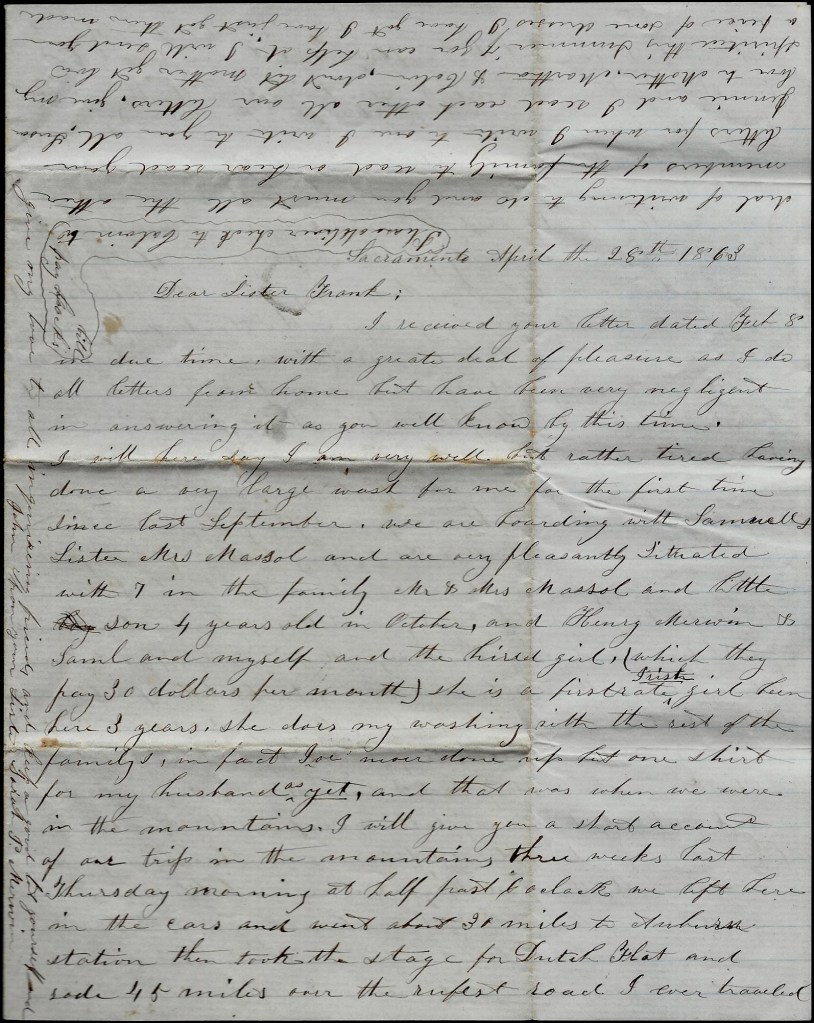
Sacramento, [California] April 28, 1863
Dear Sister Frank,
I received your letter dates February 8th in due time, with a great deal of pleasure as I do all letter from home but have been very negligent in answering it as will know by this time. I will here say I am very well but rather tired having done a very large wash for me for the first time since last September. We are boarding with Samuel’s sister, Mrs. Massol and are very pleasantly situated with 7 in the family—Mr. and Mrs. Massol and little son 4 years old in October, and Henry Merwin & Samuel and myself and the hired girl (which they pay 30 dollars per month). She is a first rate Irish girl. Been here three years. She does my washing with the rest of the family’s. In fact, I’ve never done up but one shirt for my husband as yet, and that was when we were in the mountains.
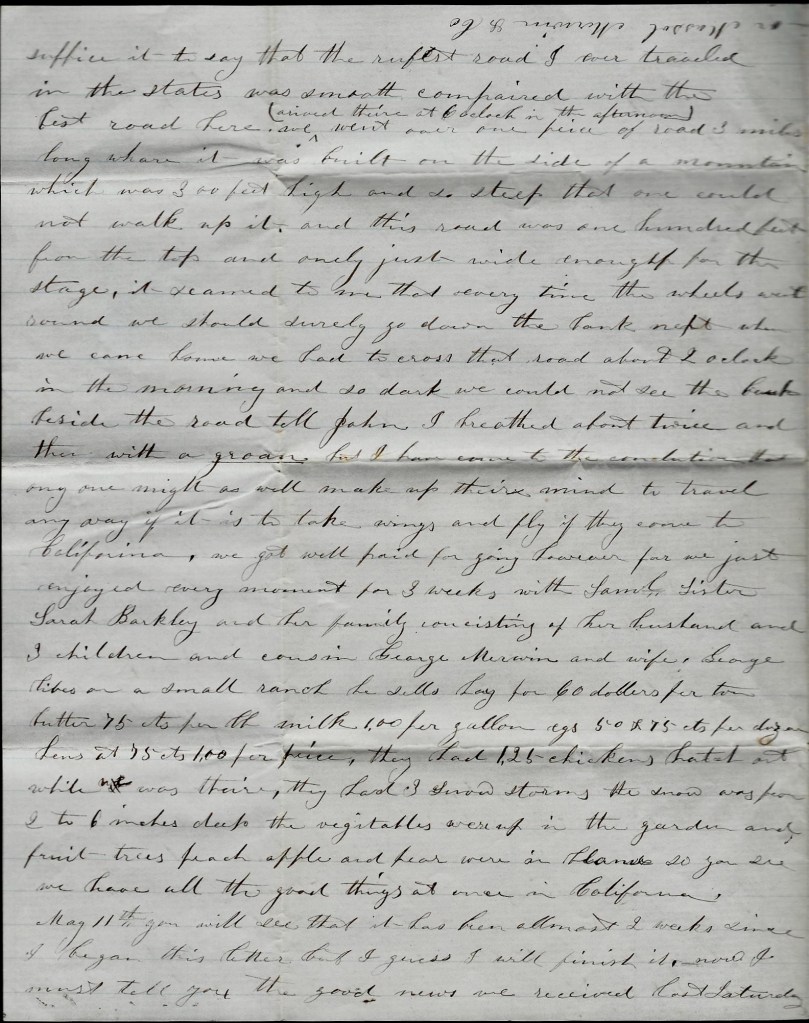
I will give you a short account of our trip in the mountains. Three weeks last Thursday at half past 6 o’clock, we left here in the cars and went about 30 miles to Auburn Station. Then took the stage for Dutch Flat and rode 45 miles over the roughest road I ever traveled. Suffice it to say that the roughest road I ever traveled in the States was smooth compared with the best road here. We arrived there at 6 o’clock in the afternoon, and went over one piece of road 3 miles long where it was built on the side of a mountain which was 300 feet high and so steep that one could not walk up it, and this road was one hundred feet from the top and only just wide enough for the stage. It seemed to me that every time the wheels went round we should surely go down the bank next. When we came home, we had to cross that road about 2 o’clock in the morning and so dark we could not see the bank beside the road. Tell John I breathed about twice and then with a groan, but I have come to the conclusion that anyone might as well make up their mind to travel anyway if it is to take wings and fly if they come to California. 1
We got well paid for going, however, for we just enjoyed every moment for three weeks with Samuel’s sister, Sarah Barkley, and her family consisting of her husband and 3 children and cousin George Merwin and wife. George lives on a small ranch. He sells hay for 60 dollars per ton, butter 75 cents per lb., milk $1 per gallon, eggs 50 and 75 cents per dozen, hens at 75 cents to $1 apiece. They had 1.25 chickens hatch out while we was there. They had 3 snow storms. The snow was from 2 to 6 inches deep. The vegetables were up in the garden and fruit trees—peach, apple, and pear—were in bloom so you see we have all the good things at once in California.
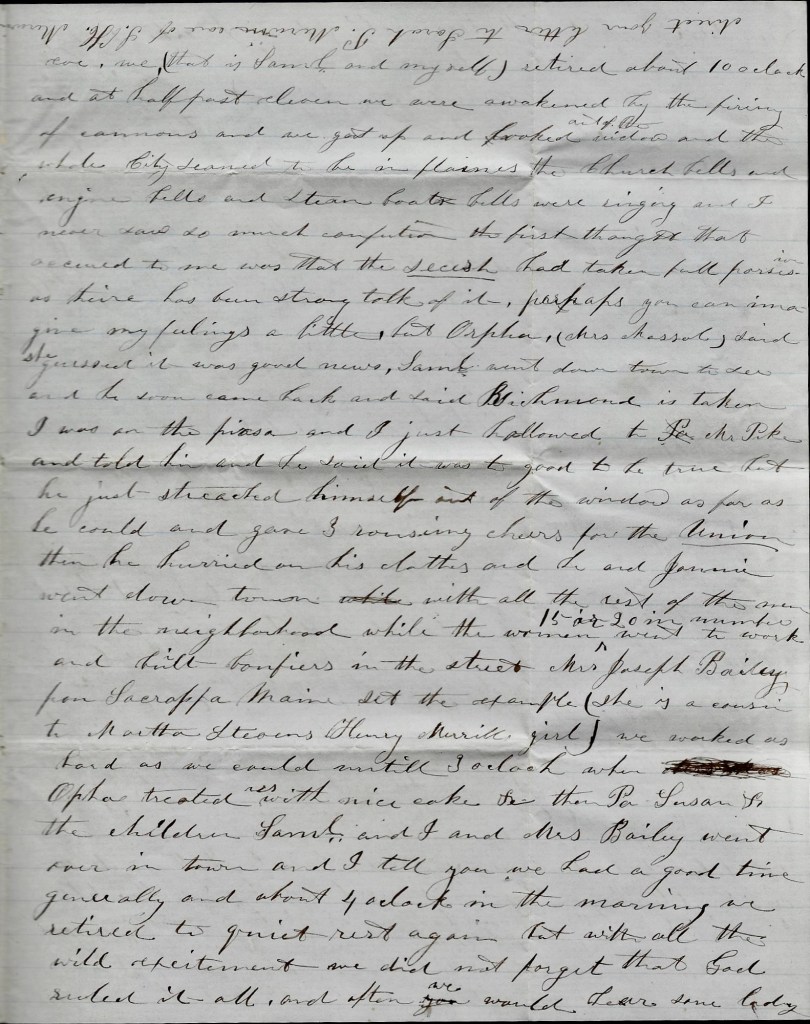
May 11th. You will see that it has been almost two weeks since I began this letter but I guess I will finish it. Now I must tell you the good news we received last Saturday eve. We (that is, Samuel and myself) retired about 10 o’clock and at half past eleven we were awakened by the firing of cannons and we got up and looked out of the window and the whole city seemed to be in flames. The church bells and engine bells and steam boat bells were ringing and I never saw so much confusion. The first thought that occurred to me was that the secesh had taken full possession as there has been strong talk of it. Perhaps you can imagine my feelings a little. But Orpha (Mrs. Massol) said she guessed it was good news. Samuel went down town to see and he soon came back and said Richmond is taken. I was on the piazza and I just hallowed to Mr. Pike and told him and he said it was too good to be true but he just stretched himself out of the window as far as he could and gave three rousing cheers for the Union. Then he hurried on his clothes and he and Johnnie went down town with all the rest of the men in the neighborhood while the women, 15 or 20 in number, went to work and built bonfires in the street. Mrs. Joseph Bailey from Saccarappa, Maine, set the example (she is a cousin to Martha Stevens, Henry Merrill’s girl). We worked as hard as we could until 3 o’clock when Orpha treated us with nice cake & then Pa, Susan, & the children, Samuel and I, and Mrs. Bailey went over in town and I tell you we had a good time generally and about 4 o’clock in the morning we retired to quiet rest again. But with all the wild excitement, we did not forget that God ruled it all and often we would hear some lady say, “Glory to God,” with tears rolling down her cheeks.
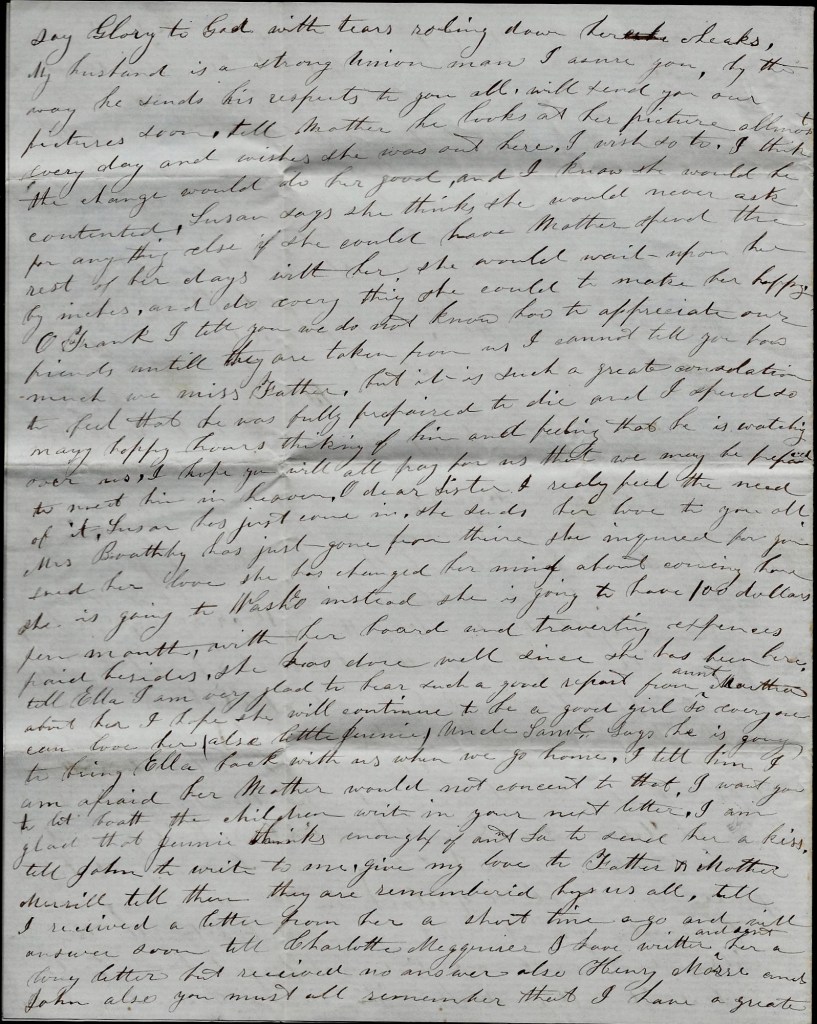
My husband is a strong Union man, I assure you. By the way, he sends his respects to you all. Will send you our pictures soon. Tell Mother he looks at her picture almost every day and wishes she was out here. I wish so too. I think the change would do her good and I know she would be contented. Susan says she thinks she would never ask for anything else if she could have Mother spend the rest of her days with her. She would wait upon her by inches, and do everything she could to make her happy.
Oh Frank, I tell you, we do not know how to appreciate our friends until they are taken from us. I cannot tell you how much we miss Father, but it is such a great consolation to feel that he was fully prepared to die and I spend so many happy hours thinking of him and feeling that he is watching over us. I hope you will all pray for us that we may be prepared to meet him in heaven. Oh dear sister, I really feel the need of it. Susan has just come in. She sends her love to you all. Mrs. Boothly has just gone from there. She enquired for you and sends her love. She has changed her mind about coming here. She is going to Washeo instead. She is going to have 100 dollars per month with her board and traveling expenses paid besides. She has done well since she has been here.
Tell Ella I am very glad to hear such a good report from Aunt Martha about her. I hope she will continue to be a good girl so everyone can love her (also little Jennie). Uncle Samuel says he is going to bring Ella back with us when we go home. I tell him I am afraid her mother would not consent to that. I want you to let both the children write in your next letter. I am glad that Jennie think enough of Aunt Sarah to send her a kiss. Tell John to write to me. Give my love to Father and Mother Merrill. Tell them they are remembered by us all. Tell her I received a letter from her a short time ago and will answer soon. Tell Charlotte Megguier I have written and sent her a long letter but received no answer. Also Henry Morse and John also. You must all remember that I have a great deal of writing to do and you must [tell] all the other members of the family to read or hear read your letters for when I write to one, I write to you all. Susan, Jennie, and I read each other all our letters. Give my love to Mother, Martha & Calvin. Don’t let Mother get low-spirited this summer if you can help it. I will send you a piece of some dresses I have got. I have just got them made.
Give my love to all enquiring friends and keeo a good lot yourself and John. From your sister, — Sarah P. Merwin
Direct your letter to Sarah P. Merwin, care of S. H. Merwin or Massol, Merwin & Co.
1 Unbeknownst to Sarah at the time, this route between Auburn and Dutch Flat, as rough as it was, turned out to be the best route over the Sierra Mountains that was selected for the Central Pacific Railroad. It became known as the “Auburn and Illinoistown, Dutch Flat and Donner Pass” route.
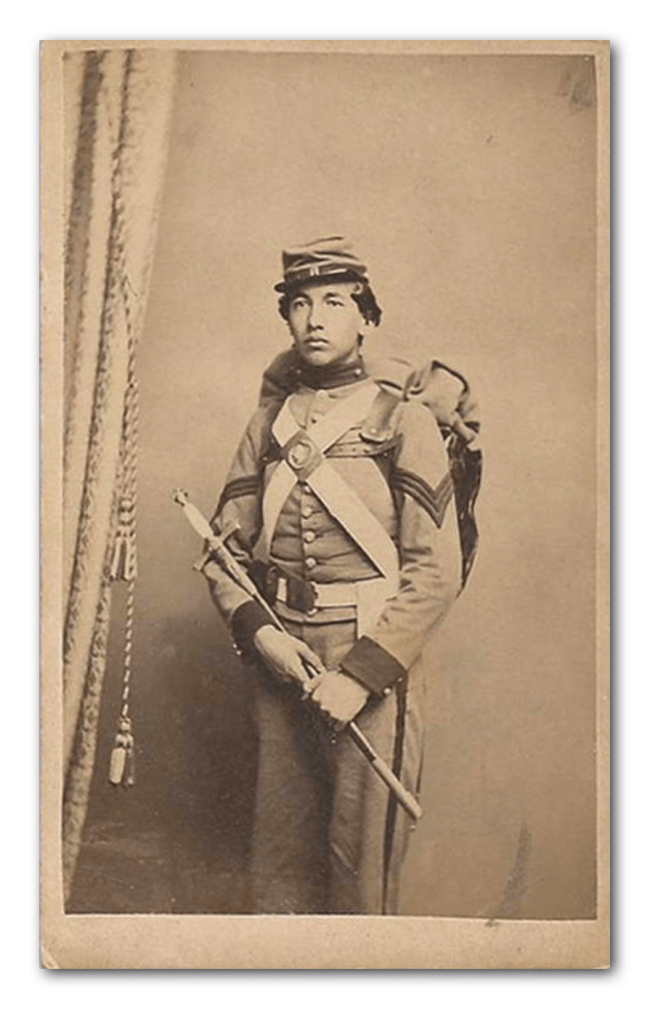
George Henry Hildt, 30th OVI (photo courtesy of Vicki Hildt Marjerrison)
The following letter was written by George Henry Hildt (1835-1914), the son of John Hildt (1807-1885) and Maria Elizabeth Gloninger (1812-1892) of Dover, Tuscarawas county, Ohio. George briefly homesteaded in Kansas in 1857 (see diary extract) and worked in St. Louis, but returned to Ohio in 1859.
He served in the 3-month 16th Ohio Infantry, enlisting as Private in Co. F and being promoted 2nd Lieutenant on 6 June. He mustered out with the company on 18 August. He then helped recruit another Company of volunteers which became Co. I of the new 30th Ohio Volunteer Infantry (OVI). He mustered in as Captain on 22 August 22, 1861. He was promoted to Major of the regiment on 28 January 1862.
George took command of his regiment during the Battle of Antietam as the senior officer after Lieut. Colonel Jones was captured. Colonel Ewing had previously been promoted to brigade command. After Antietam, the regiment headed south and west in the later part of 1862 and early ’63, seeing service in Kentucky, Arkansas, and three month stretch in Louisiana to March 1863. He was appointed Lieutenant Colonel on 18 April 1863 at Walnut Hills, Mississippi, then in operations around and in the siege of Vicksburg. He was wounded in the left hip there on 22 May 1863. The regiment was at Chattanooga and Knoxville in early 1864, and on the Atlanta Campaign May to September. He resigned on 22 September 1864.
After the war, George returned to Canal Dover (now Dover), OH and was a pension agent, once clerk in the office of Secretary of State of Ohio, and active in the Loyal Legion and Army of the Tennessee veteran’s groups. He also held the position of Commander of the Ricksecker Post (No. 469) of the Grand Army of the Republic. [Source: Antietam on the Web]
George wrote the letter to his cousin Alida Braucher (1843-1897), the daughter of Joseph Braucher (1810-1884) and Juliana Antoinette Hawley (1822-1895) of Canal Dover, Tuscarawas county, Ohio.
Transcription
Addressed to Miss Alida Braucher, Canal Dover, Tuscarawas County, Ohio
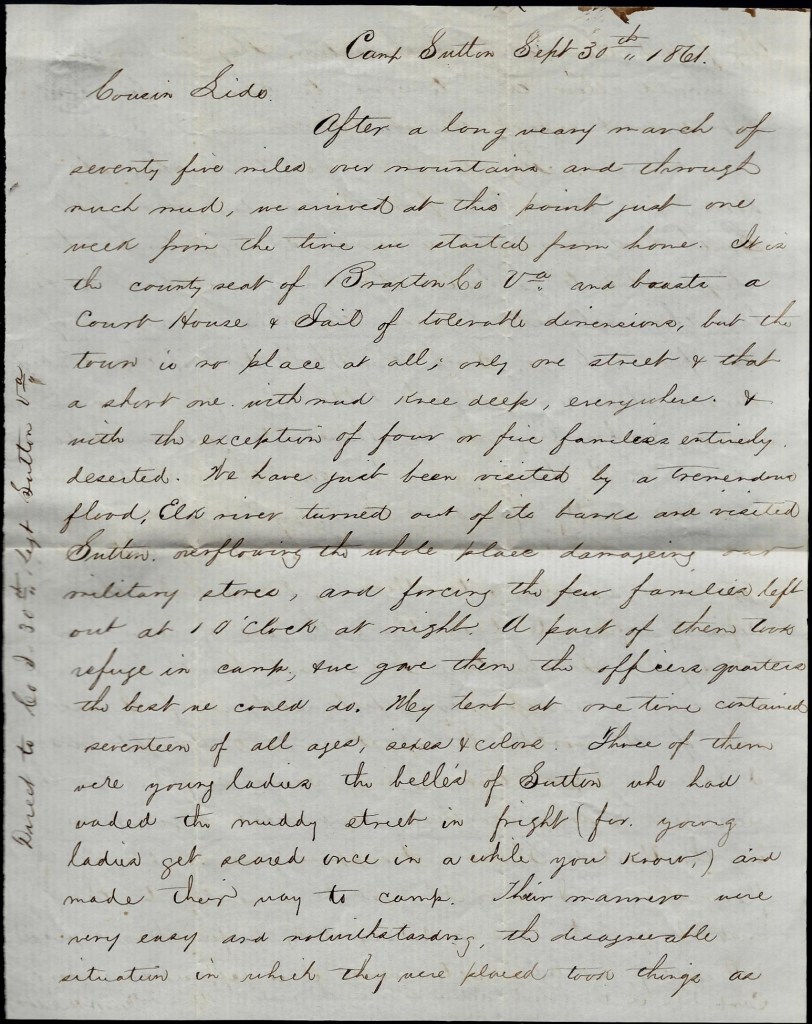
Camp Sutton September 30, 1861
Cousin Lide,
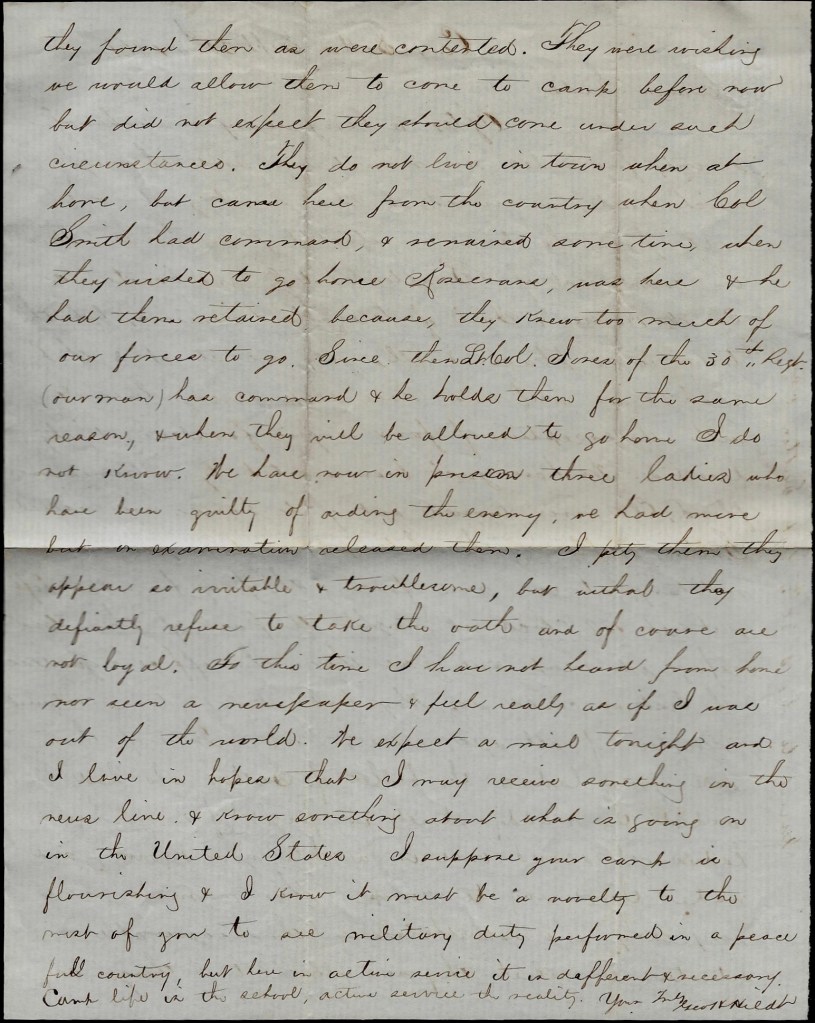
After a long weary march of seventy-five miles over mountains and through much mud, we arrived at this point just one week from the time we started from home. It is the county seat of Braxton County, Virginia and boasts a Court House and Jail of tolerable dimensions but the town is no place at all; only one street and that a short one, with mud knee deep everywhere. And with the exception of four or five families entirely deserted. 1
We have just been visited by a tremendous flood. Elk river turned out of its banks and visited Sutton, overflowing the whole place damaging our military stores, and forcing the few families left out at 10 o’clock at night. 2 A part of them took refuge in camp & we gave them the officer’s quarters—the best we could do. My tent at one time contained seventeen of all ages, sexes and colors. Three of them were young ladies—the belles of Sutton—who had waded the muddy street in fright (for young ladies get scared once in awhile you know) and made their way to camp. Their manners were very easy and notwithstanding the disagreeable situation in which they were placed, took things as they found them and were contented.
They were wishing we would allow them to come to camp before now but did not expect they should come under such circumstances. They do not live in town when at home, but came here from the country when Col. Smith had command, & remained some time. When they wishes to go home, Rosecrans was here and he had them retained because they knew too much of our forces to go. Since then, Lt. Col. Jones of the 30th Regt. (our man) has command and he holds them for the same reason, & when they will be allowed to go home, I do not know.
We have now in prison three ladies who have been guilty of aiding the enemy. We had more but on examination released them. I pity them. They appear so irritable and troublesome, but withal they defiantly refuse to take the oath and of course are not loyal.
To this time, I have not heard from home nor seen a newspaper & feel really as if I was out of this world. We expect a mail tonight and I live in hopes that I may receive something in the news line & know something about what is going on in the United States. I suppose your camp is flourishing & I know it must be a novelty to the rest of you to see military duty performed in a peaceful country, but here in active service it is different and necessary. Camp life in the school, active service the reality.
Yours truly, — George H. Hildt
Direct to Co. I, 30th Regt., Sutton, Virginia
1 This description of Sutton as it appeared in September 1861 certainly leaves us with the impression that aside from the court house and jail, there was very little “town” to speak of. Much is made of the burning of the town on 29 December 1861 by rebel guerrillas and the commissary stores that were there. See “Burning of Sutton.”
2 A History of Braxton County by John Davison Sutton reports that the flood of 1861 was one of the worst in county history. The water “ran down the main street of the town and was “belly-deep to a horse.”
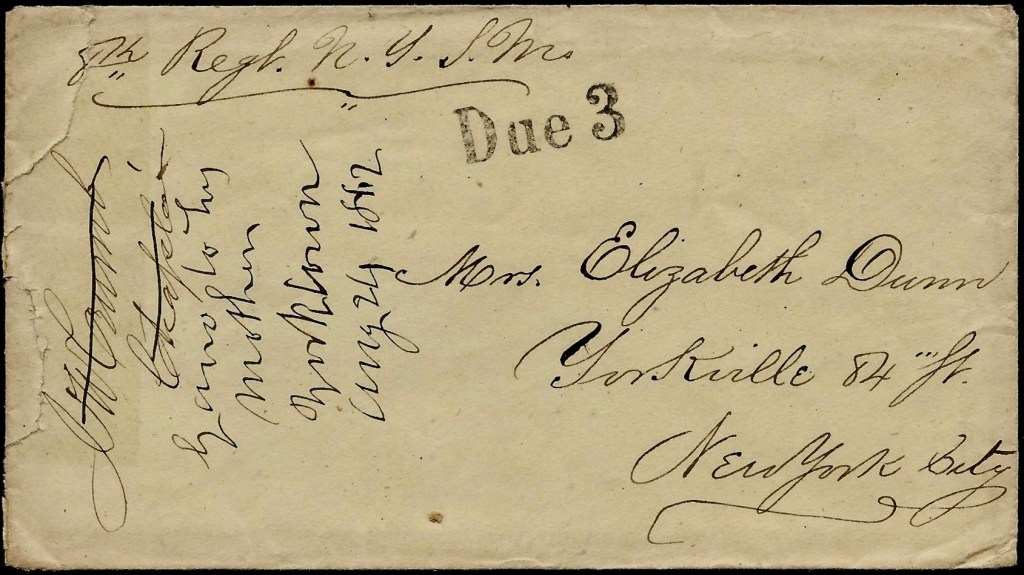
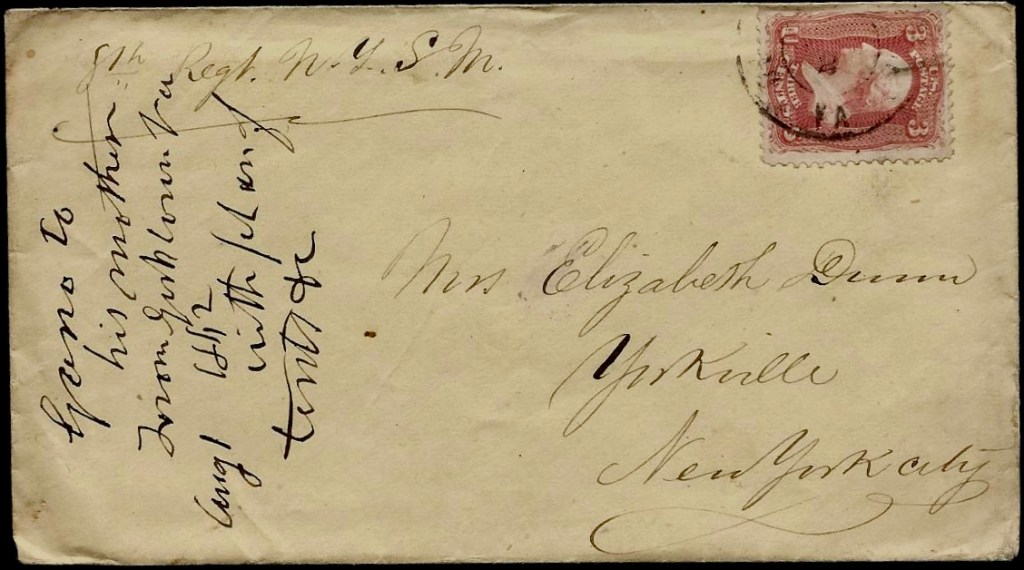
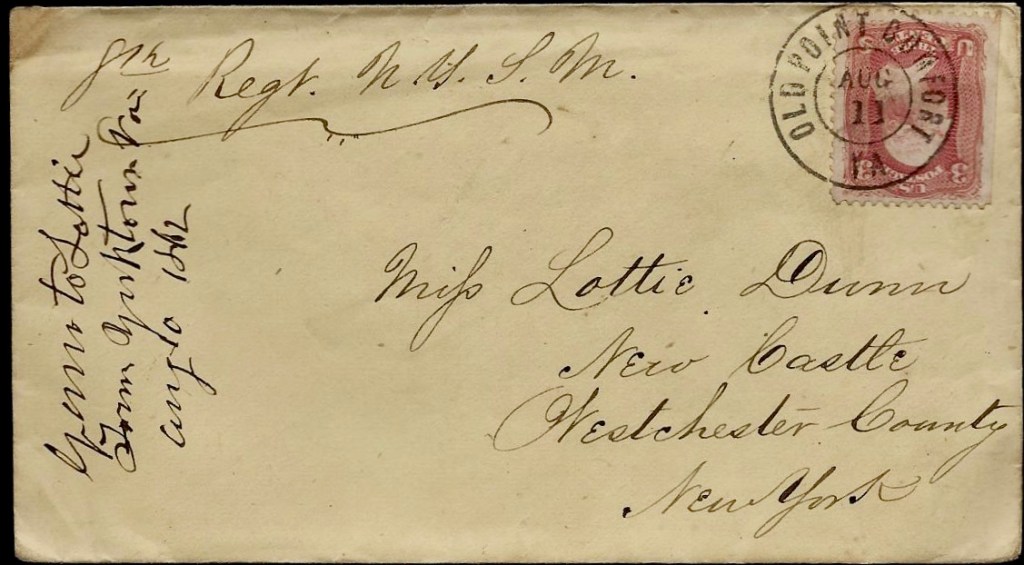
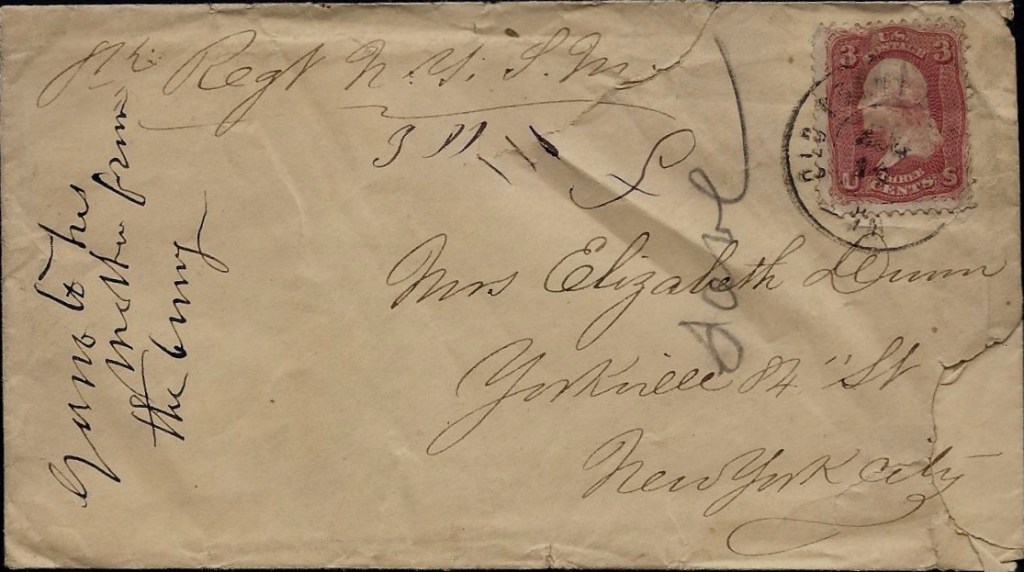
These letters were written by Nathaniel “Gano” Dunn (1844-1892), the son of Nathaniel Dunn (1800-1889) and Judith Elizabeth Rogers (1805-1869). He wrote the letters to his mother and his sister Charlotte (“Lottie”) who were residents in New York City during the Civil War. In 1850, when Gano was only six, his older brother Andrew was five, and his sister Lottie was 8, the family resided in New York City’s 18th Ward where his father was employed as a teacher. We learn from an obituary that Gano’s father was a friend and classmate of H. W. Longfellow (the poet) at Bowdoin College in 1825. His special area of interest was chemistry.
Gano first enlisted on 29 May 1862 as a corporal in Co. K, 8th New York National Guard (the “Washington Greys”) and mustered out on 10 September 1862. He reenlisted again later during the summer of 1863 for 30 days as a sergeant in the same company. All three of Gano’s letters featured here while serving in the Washington Greys were datelined from Yorktown, Virginia, in August 1862—just prior to his being mustered out of the regiment.
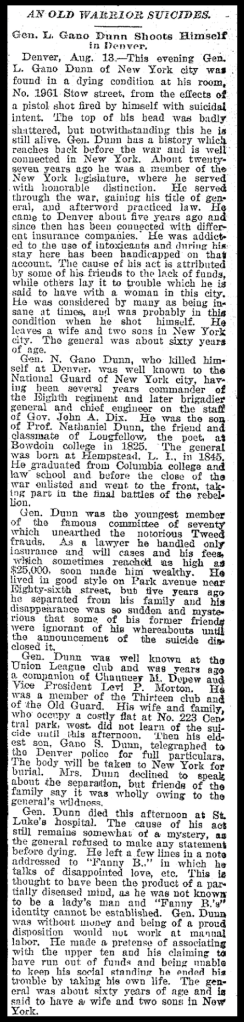
After the war Gano attended Columbia College and obtained a law license. He practiced law in New York City for many years. He married Amelia Sillick (b. 1841) in 1867 and the couple had at least three children born between 1870 and 1878. By 1880 the family had moved to Denver, Colorado, where Gano committed suicide in 1892 (see newspaper clipping in endnotes).
Letter 1
Camp Dix Yorktown, Va. July 18, 1862
Dear Lottie,
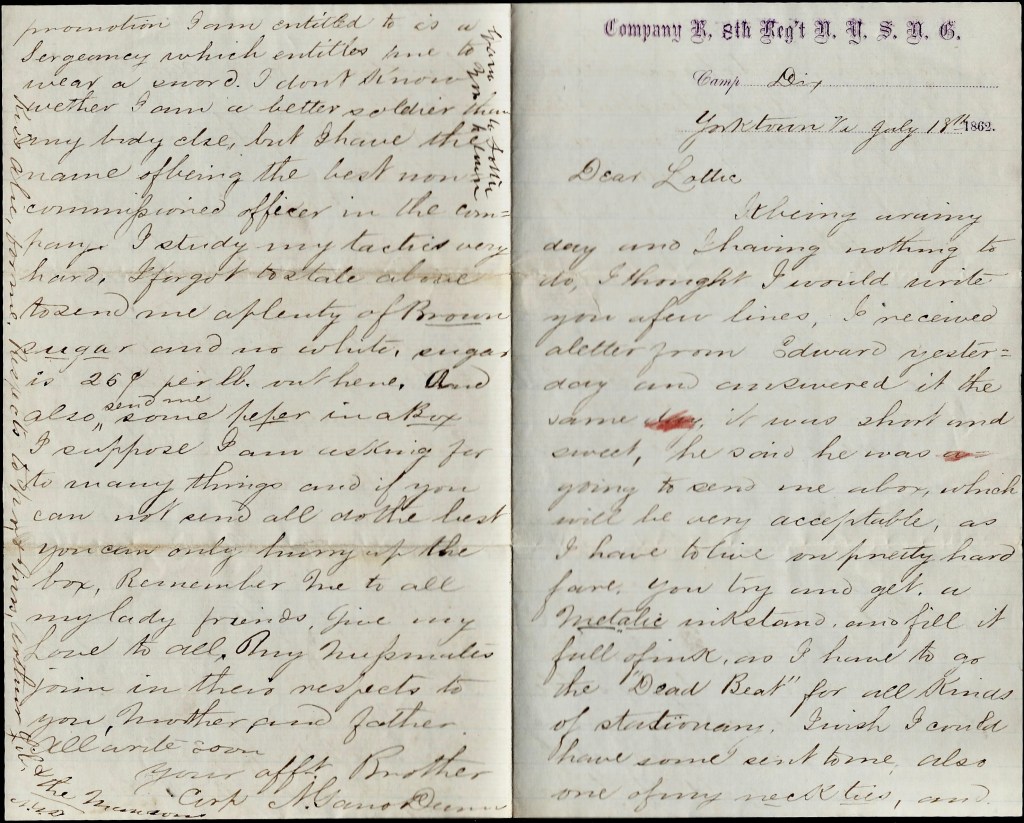
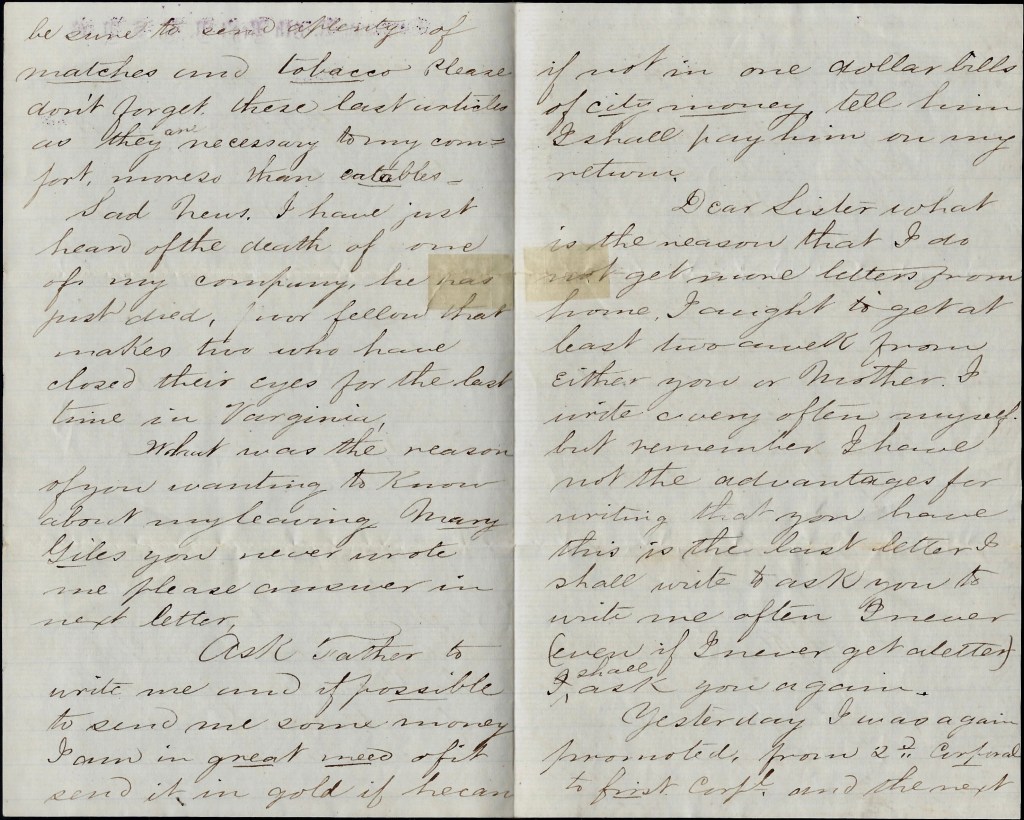
It being a rainy day and I having nothing to do, I thought I would write you a few lines. I received a letter from Edward yesterday and answered it the same day. It was short and sweet. He said he was a going to send me a box, which will be very acceptable as i have to live on pretty hard fare. You try and get a metallic inkstand and fill it full of ink as I have to go the “Dead Beat” for all kinds of stationery. I wish I could have some sent to me. Also one of my neckties, and be sure to send plenty of matches and tobacco. Please don’t forget these last articles as they are necessary to my comfort, more so than eatables.
Sad news. I have just heard of the death of one of my company. He has just died, poor fellow. That makes two who have closed their eyes for the last time in Virginia.
What was the reason of you wanting to know about my leaving Mary Giles? You never wrote me. Please answer in next letter.
Ask Father to write ,e and if possible to send me some money. I am in great need of it. Send it in gold if he can. If not, in one dollar bills of city moey. Tell him I shall pay him on my return.
Dear sister, what is the reason that I do not get more letters from home? I ought to get at least two a week from either you or Mother. I write very often myself but remember I have not the advantages for writing that you have. This is the last letter I shall write to ask you to write me often. I never (even if I never get a letter) shall ask you again.
Yesterday I was again promoted from 2nd Corporal to 1st Corporal, and the next promotion I am entitled to is a Sergeancy which entitles me to wear a sword. I don’t know whether I am a better soldier than anybody else but I have the name of being the best non-commissioned officer in the company. I study my tactics very hard.
I forgot to state above to send me a plenty of brown sugar and no white. Sugar is 25 cents per pound out here. And also send me some pepper in a box. I suppose I am asking for too many things and if you cannot send all, do the best you can—only hurry up the box. Remember me to all my lady friends. Give my love to all. My messmates join in their respects to you, Mother and Father. All write soon.
Your affectionate brother, — Corp. N. Gano Dunn
Letter 2
Camp Dix Yorktown, Virginia August 1, 1862
Dear Mother,
I received your letter last night and hasten to answer. I also received the Sunday Mercury from Isabella for which I wish to thank her kindly for me, and give my respects to all the Manson’s.
Thank goodness I have but one month more today and then, and then for home, a dear Mother, and a loving sister, and kind friends to greet me on every side.
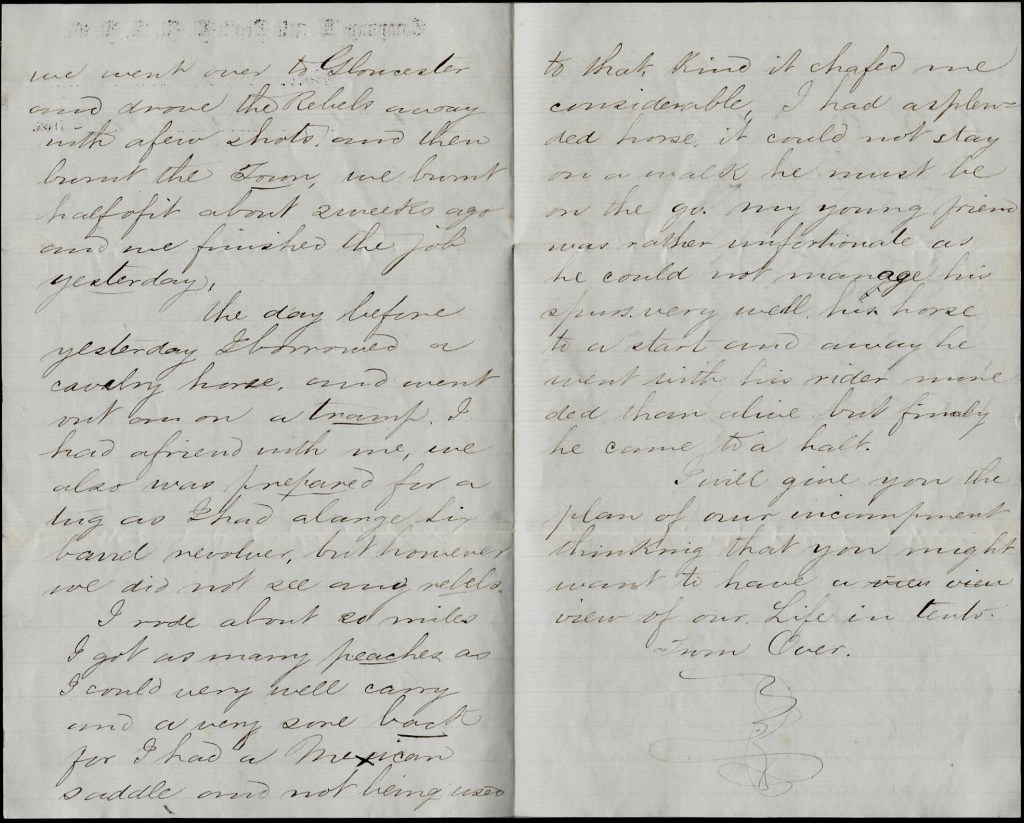
We had a kind of a skirmish here yesterday. We went over to Gloucester and drove the Rebels away with a few shots and then burnt the town. We burnt half of it about two weeks ago and we finished the job yesterday.
The day before yesterday I borrowed a cavalry horse and went out on a tramp. I had a friend with me. We also prepared for a tug as I had a large six band revolver, but however, we did not see any rebels. I rode about 20 miles. I got as many peaches as I could very well carry and a very sore back for I had a Mexican saddle and not being used to that, kind of chafed me considerable. I had a splendid horse. It could not stay on a walk. He must be on the go. My young friend was rather unfortunate as he could not manage his spurs very well. His horse took a start and away he went with his rider more dead than alive, but finally he came to a halt.
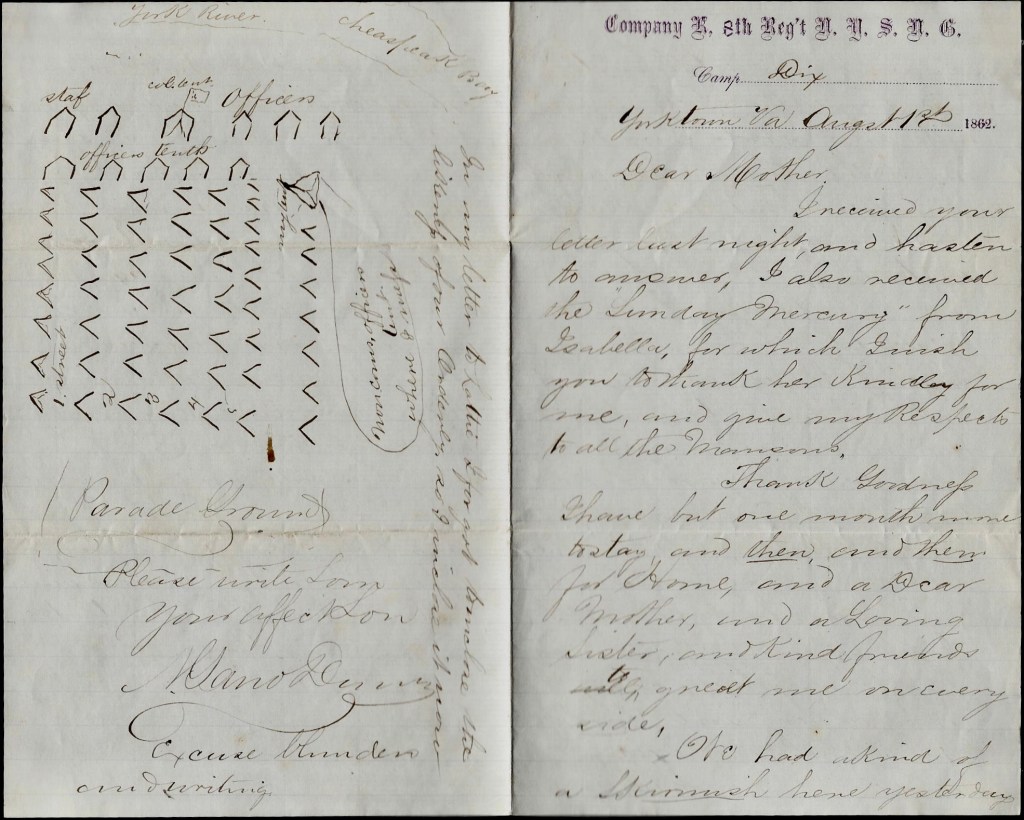
I will give you the plan of our encampment thinking that you might want to have a view of our life in tents.
Please write soon. Your affectionate son, N. Gano Dunn
In my letter to Lottie I forgot to make the likeness of our Orderly so I enclose it now. Excuse blunders and writing.
Letter 3
Camp Dix Yorktown, Virginia August 10, 1862
My dear Sister,
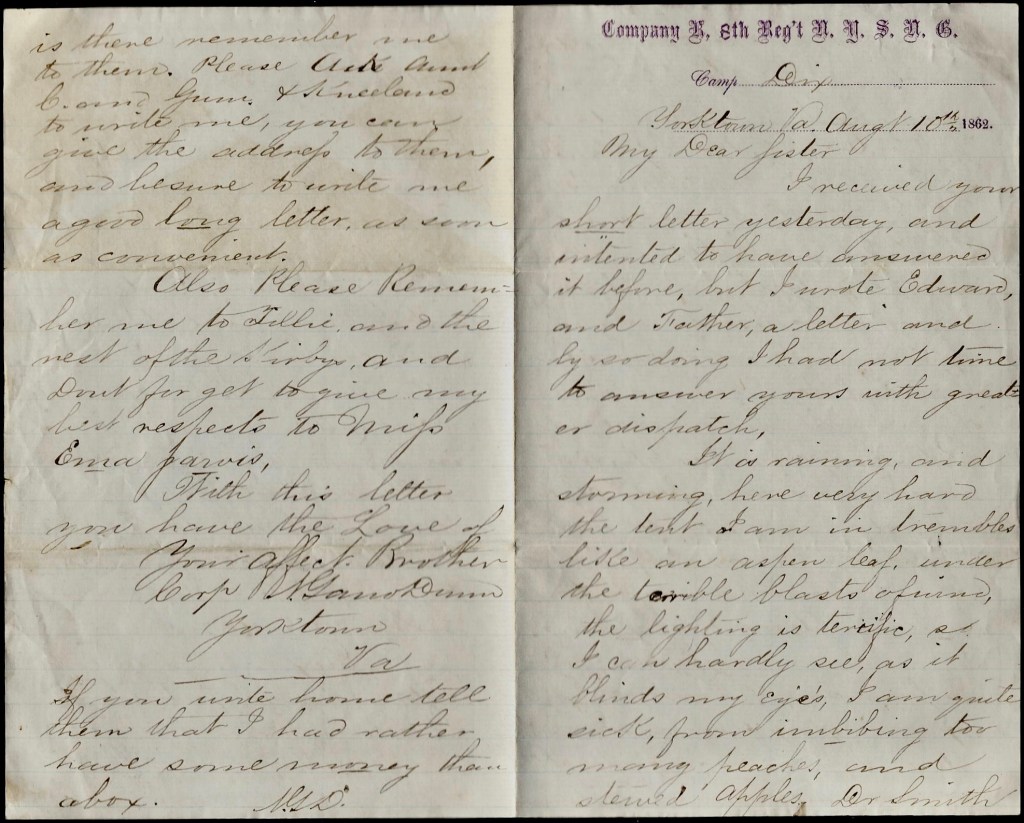
I received your short letter yesterday and intended to have answered it before but I wrote Edward and Father a letter and by so doing, I had not time to answer yours with greater dispatch.
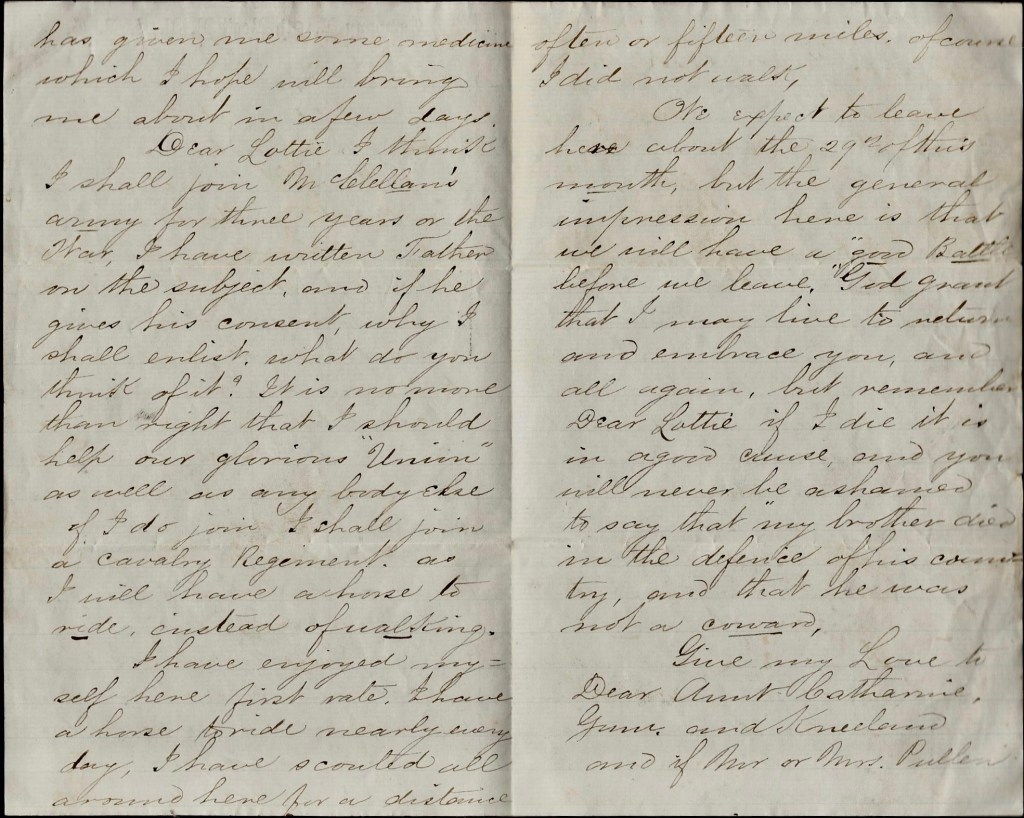
It is raining and storming here very hard. The tent I am in trembles like an Aspen leaf under the terrible blasts of wind. The lightning is terrific so I can hardly see as it blinds my eyes. I am quite sick from imbibing too man peaches and stewed apples. Dr. Smith has given me some medicine which I hope will bring me about in a few days.
Dear Lottie, I think I shall join McClellan’s army for three years or the war. I have written Father on the subject and if he gives his consent, why I shall enlist. What do you think of it? It is no more than right that I should help our glorious “Union” as well as anybody else. If I do join, I shall join a cavalry regiment as I will have a horse to ride instead of walking.
I have enjoyed myself here first rate. I have a horse to ride nearly every day. I have scouted all around here for a distance of ten or fifteen miles. Of course, I did not walk.
We expect to leave here about the 29th of this month but the general impression here is that we will have a “good battle before we leave.” God grant that I may live to return and embrace you and all again. But remember, dear Lottie, if I die, it is in a good cause and you will never be ashamed to say that “my brother died in the defense of his country, and that he was not a coward.”
Give my love to dear Aunt Catharine, Gum, and Kneeland and if Mr. and Mrs. Pullen is there, remember me to them. Please ask Aunt Catharine and Gus & Kneeland to write me. You can give the address to them and be sure to write me a good long letter as soon as convenient.
Also, please remember me to Tillie and the rest of the Kirby’s, and don’t forget to give my best respects to Miss Emma Jarvis.
With this letter you have the love of your affectionate brother, Corp. N. Gano Dunn, Yorktown, Va.
If you write home, tell them that I had rather have some money than a box. — N. G. D.
Letter 4
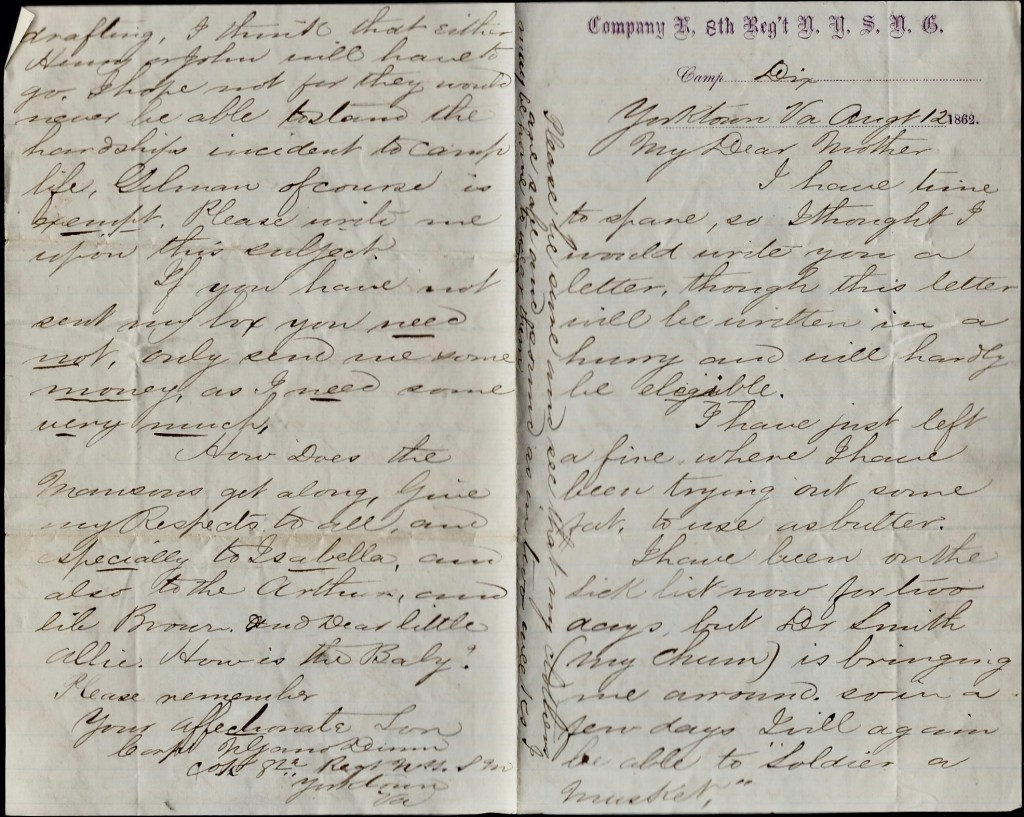
Camp Dix Yorktown, Virginia August 12th 1862
My dear Mother,
I have time to spare so I thought I would write you a letter, though this letter will be written in a hurry and will hardly be legible.
I have just left a fire where I have been trying out some fat to use as butter.
I have been on the sick list now for two days but Dr. Smith (my chum) is bringing me around so in a few days I will again be able to “Soldier a Musket.”
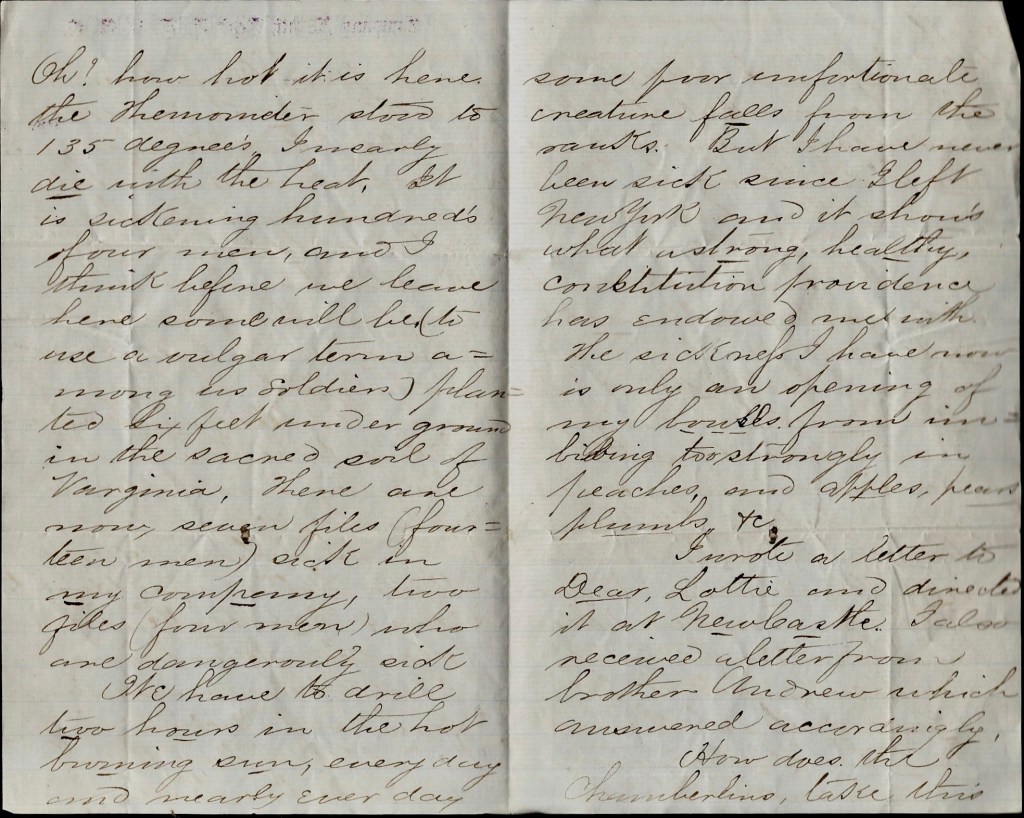
Oh! how hot is it here. The thermometer stood to 135 degrees. I nearly die with the heat. It is sickening hundreds of our men and I think before we leave here some will be (to use a vulgar term among us soldiers) planted six feet under ground in the Sacred Soil of Virginia. There are now seven files (fourteen men) sick in my company, two files (four men) who are dangerously sick.
We have to drill two hours in the hot burning sun every day and nearly every day some poor unfortunate creature falls from the ranks. But I have never been sick since I left New York and it shows what a strong constitution Providence has endowed me with. The sickness I have now is only an opening of my bowels from imbibing too strongly in peaches and apples, pears, plums, &c.
I wrote a letter to Dear Lottie and directed it at New Castle. I also received a letter from brother Andrew which I answered accordingly.
How does the Chamberlains take this drafting? I think that either Henry or John will have to go. I hope not for they would never be able to stand the hardships incident to camp life. Gilman of course is exempt. Please write me upon this subject.
If you have not sent my box you need not. Only send me some money as I need some very much.
How does the Manson’s get along? Give my respects to all and especially to Isabella and also to the Arthur and Lile Brown ad dear little Allie. How is the baby?
Please remember your affectionate son, — Corp. N. Gano Dunn
Co. K, 8th Regiment N. Y. S. M., Yorktown
Letter 5
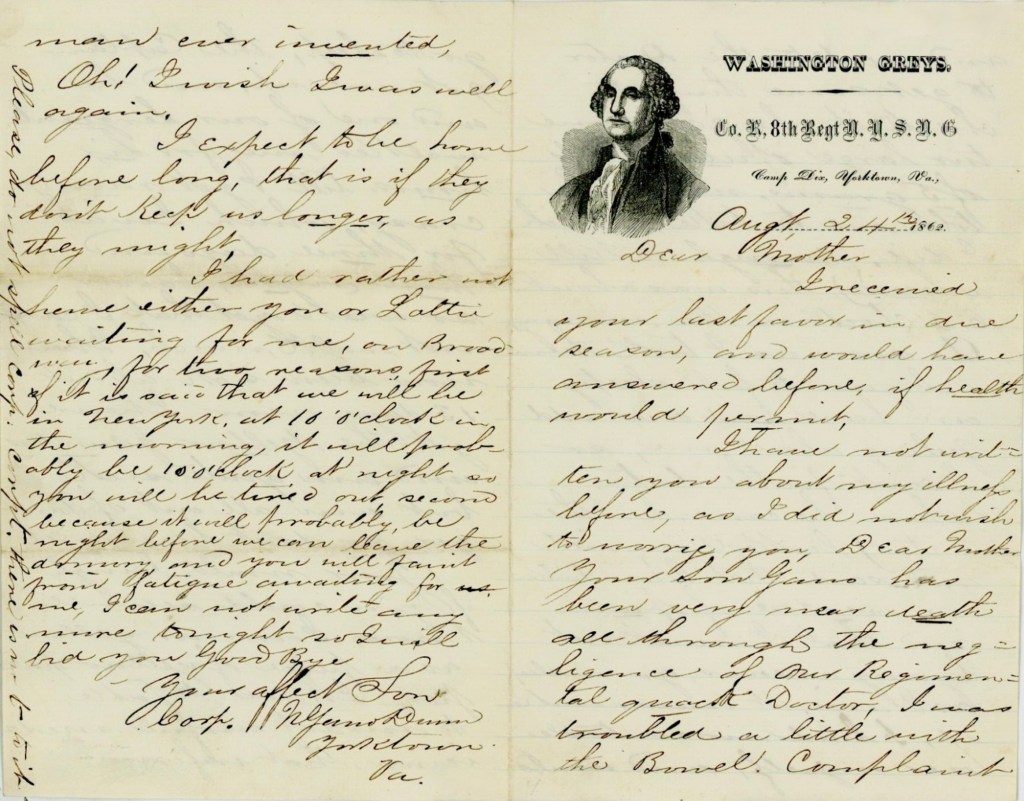
Camp Dix, Yorktown August 24, 1862
Dear Mother,
I received your last favor in due season and would have answered before if health would permit.
I have not written you about my illness before as I did not wish to worry you. Dear mother, your son Gano has been very near death, all through the negligence of our regimental quack doctor. I was troubled a little with the bowel complaint and went to the doctor to get something to check it. He gave me two large opium pills of 5 grains which he told me to take, which I did (enough to kill a horse). This was about 6 o’clock in the morning. As soon as I took them I began to feel sleepy and have an odd feeling about me, so I sent for the doctor. When he came, he (the doctor) looked worried and said that I had taken an overdose of opium and that I must not by any means go asleep as I might never wake up. I had no control over myself and would go to sleep, the Captain got me up, and he and one of our Sergeants walked me for six hours till I got raving crazy, which I was for three days and three nights. I am so weak yet that I cannot walk much. I have now been sick about 13 days. Now I have got the yellow jaunders [jaundice] and am quite sick, but am all out of danger so don’t be worried.
You would laugh if you could see me now. I am as yellow as a piece of yellow paper. I have to take the most awful medicine that infernal man ever invented. Oh! I wish I was well again.
I expect to be home before long—that is, if they don’t keep us longer as they might. I had rather not have either you or Lottie waiting for me on Broadway for two reasons. First, if it is said that we will be in New York at 10 o’clock in the morning, it will probably be 10 o’clock at night so you will be tired out. Second, because it will probably be night before we can leave the armory and you will faint from fatigue awaiting for me. I cannot write any more tonight so I will bid you goodbye. Your affectionate son, — Corp. N. Gano Dunn, Yorktown, Va.
Letter 6
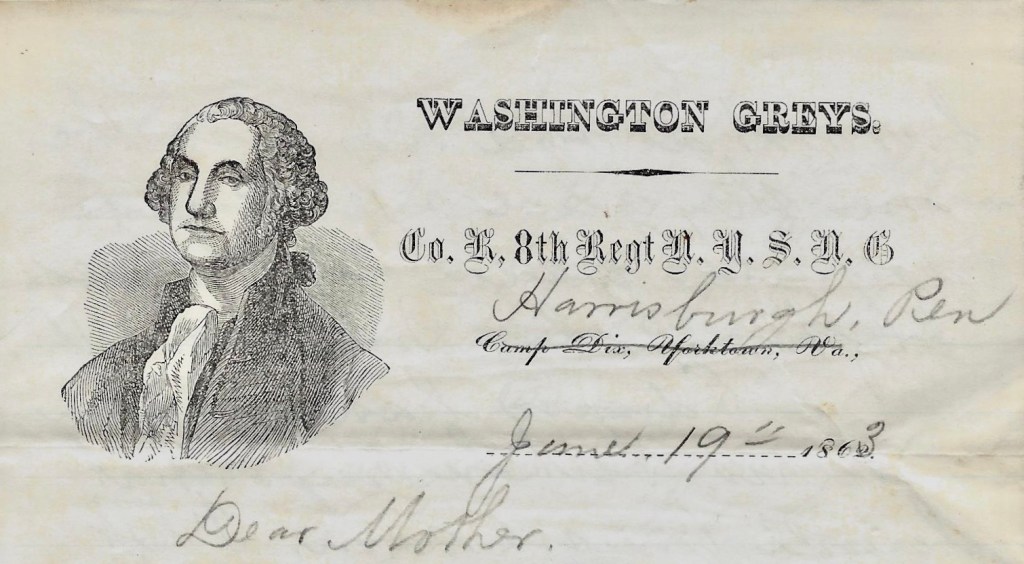
Stationery Heading
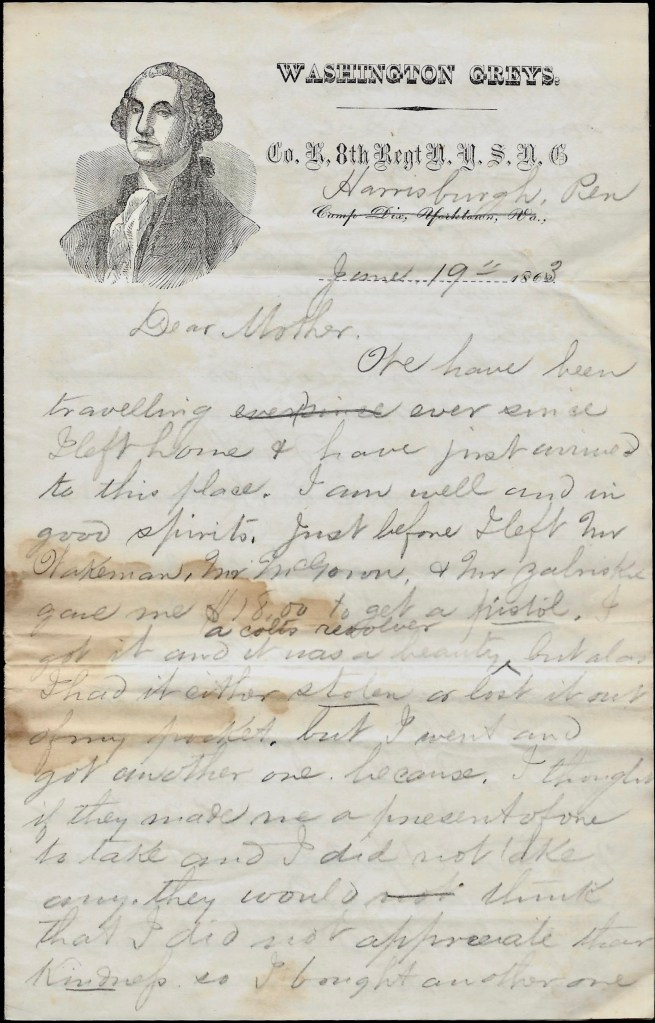
Harrisburg, Pennsylvania June 19, 1863
Dear Mother,
We have been traveling ever since I left home & have just arrived to this place. I am well and in good spirits. Just before I left Mr. Wakeman, Mr. McGown & r. Zalniskie gave me $18.00 to get a pistol. I got it and it was a beauty—a Colt’s revolver. But alas, I had it either stolen or lost it out of my pocket. But I went and got another one because I thought if they made me a present of one to take and I did not like any, they would think that I did not appreciate their kindness so I bought another one but not as nice a one as the one they gave me.
I was very glad to see Lottie before I left and also Mary Butts.
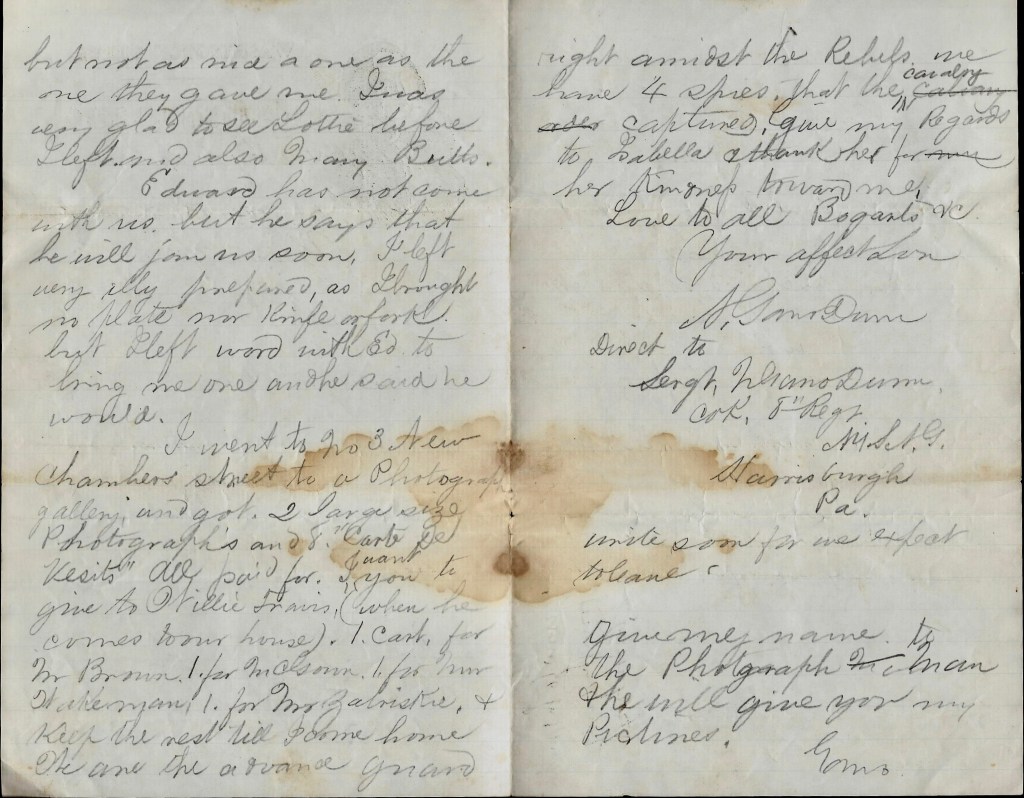
Edward has not come with us but he says that he will join us soon. I left very illy prepared as I brought no plate nor knife or fork but I left word with Ed to bring me one and he said he would.
I went to No. 3 New Chambers Street to a Photograph Gallery and got two large size photographs and eight carte-de-visites, all paid for, I want you to give to Willie and Travis (when he comes to our house). 1 carte for Mr. Brown, 1 for McGown, 1 for Mr. Wakeman, 1 for Mr. Zabriskie, and keep the rest till I come home.
We are the advance guard right amidst the Rebels. We have 4 spies that the cavalry captured. Give my regards to Isabella & thank her for her kindness towards me. Love to all Bogarts, &c. Your affectionate son, — N. Gano Dunn
Direct to Sergt. N. Gao Dunn, Co. K, 8th NYSNG. Harrisburg, Pa.















 Spared & Shared 23