My passion is studying American history leading up to & including the Civil War. I particularly enjoy reading, transcribing & researching primary sources such as letters and diaries.
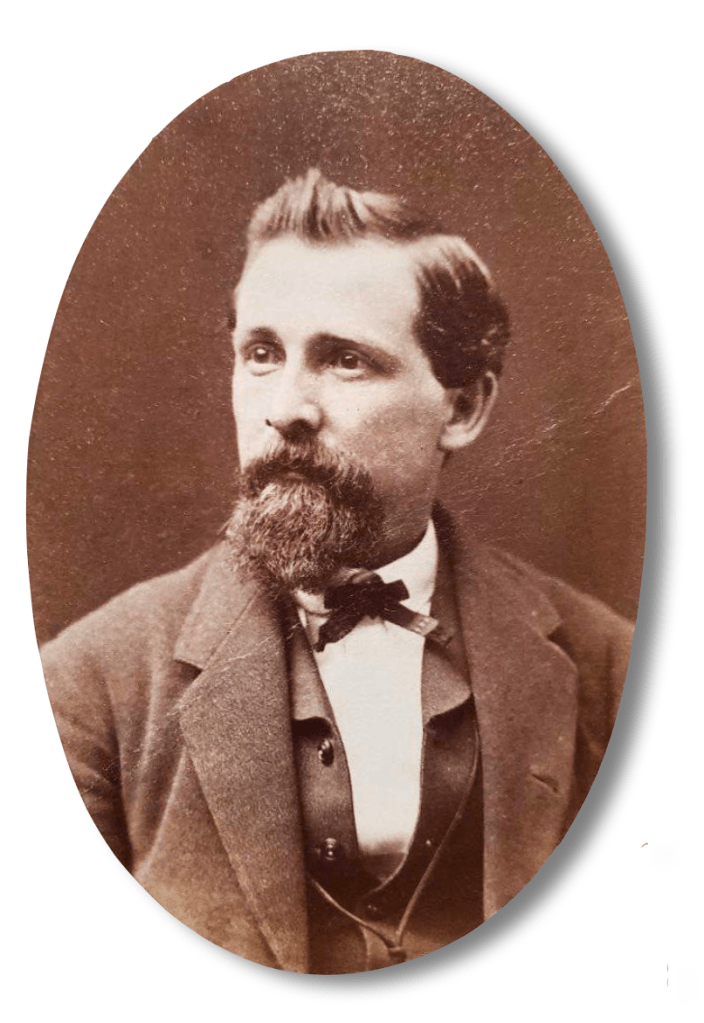
The following letter was written by Waldo Spear (1843-1907), the son of Hiram Spear (1810-1872) and Lucy Ripley (1806-1893) of Springfield township, Bradford county, Pennsylvania. Waldo enlisted in Co. C, 7th Pennsylvania Volunteer Cavalry in October 1861 and participated in battles at Lebanon, Murfreesboro, McMinnville, and Gallatin where he was taken prisoner on 25 August 1862. He was paroled because of his injuries and, when exchanged, was detailed as a courier of the 2nd Cavalry Division, Army of the Cumberland, in which capacity he served until 28 December 1864 when he was honorably discharged.
After his discharge, he returned to Pennsylvania for a short time and then moved to Mardin in Tioga county where he farmed for 17 years. In 1883 he purchased a store in East Charleston.
Four hard-riding troopers from Co. F, 7th Pennsylvania Cavalry; from left to right, Richard Fotheringile, John Coughlin, William Smith, and Llewellyn Llewellyn.
Transcription
Camp Parole September 14, 1862
Dear Parents & Brothers,
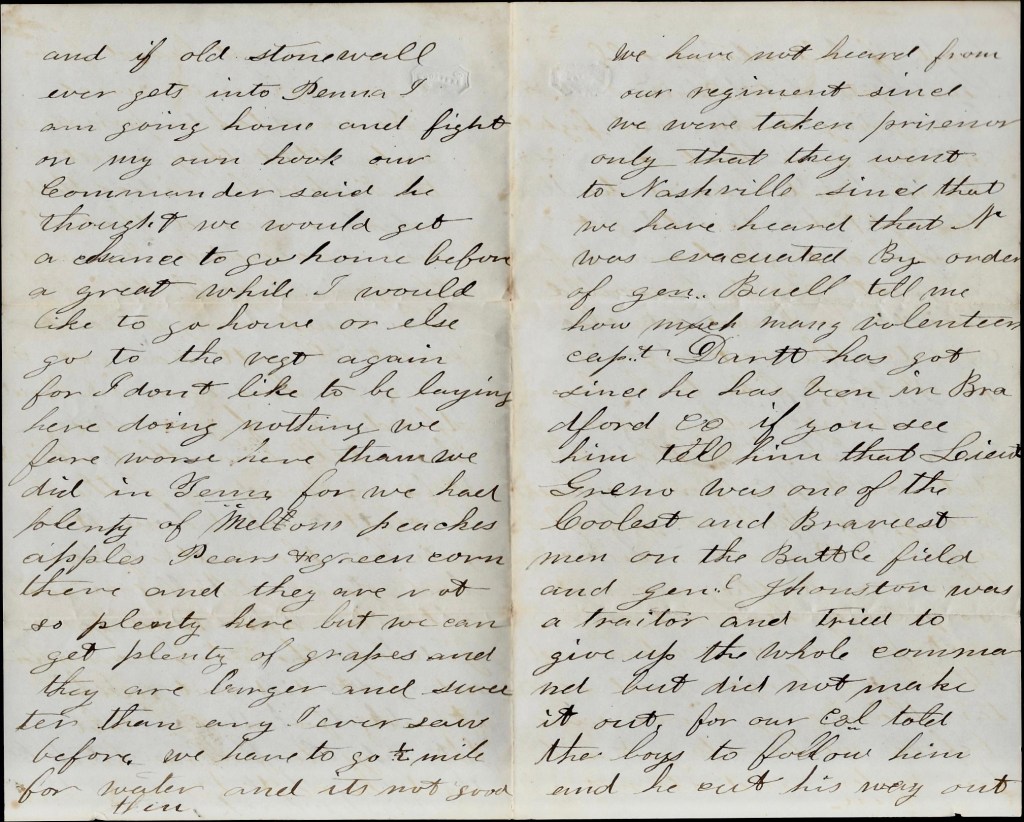
I am looking for an answer to my two letters which I wrote to you as soon as I arrived in Annapolis. I don’t think they have been miscarried for other letters have come from Troy and East Troy. I am very anxious to hear from you and William and all of you. I want to hear how William got home and if he got well. Tell me who is enlisting in Springfield. There must be a good many that I know. Tell Ned that if the rebels get up there, he must take the old shot gun and Bushwhack ’em, and if Old Stonewall ever gets into Pennsylvania, I am going home and fight on my own hook.
Our commander said he thought we would get a chance to go home before a great while. I would like to go home or else go to the regiment again for I don’t like to be laying here doing nothing. We fare worse here than we did in Tennessee for we had plenty of melons, peaches, apples, pears, and green corn there and they are not plenty here. But we can get plenty of grapes and they are longer and sweeter than any I ever saw before. We have to go a half mile for water and it is not good then.
We have not heard from our regiment since we were taken prisoners—only that they went to Nashville. Since that, we have heard that Nashville was evacuated by order of Gen. Buell. Tell me how many volunteers Capt. [Benjamin S.] Dartt has got since he has been in Bradford County. If you see him, tell him that Lieut. [Charles L.] Green was one of the coolest and bravest men on the battlefield and General [Richard Woodhouse] Johnson was a traitor and tried to give up the whole command but did not make it out for our Colonel [George C. Wynkoop] told the boys to follow him and he cut his way out, but not until Gen. Johnson had surrendered. 1
I want you to write soon and tell Marcus Gates that I have written to him twice but have not received an answer yet and I have written to Uncle Dwight once.
Direct your letters to Waldo Speer
Camp Parole, Annapolis, Maryland, Co. C, 7th P. V. Cavalry
1 Waldo’s description of the fight at Gallatin against Morgan’s cavalry in August 1862 rings true. Another member of the regiment wrote of it: “General Johnson, steadily repressing the desire of his subordinate officers to charge vigorously, for his men instead, in line, under fore, after the manner of infantry; in a few minutes ordered a retrograde movement over an open field; dismounted the men, and ordered an advance on foot, each man leading his horse; mounted them again to fall back; divided the command and sent each company to a detached and isolated position, all under fire of the entire rebel force, and held them thus until nearly surrounded, when he drew all together and ordered a retreat. At this stage of the battle I was shot and left on the field, but, from reliable sources, I learn that after retreating about two miles, the command was halted, dismounted, formed in line and held in check until the flanks were turned, when another retreat was ordered in which Lieut. Nicholas A. Wynkoop, son of the Colonel, Battalion Adjutant, and at the time, acting Aide-de-Camp to General Johnson, was killed. Arrived near the Cumberland river, another line was formed, dismounted, the flanks being entirely unguarded, Morgan was enabled to throw forces to the rear to cut off retreat, and pressed heavily on all sides, when General Johnson surrendered. When it became manifest that the General purposed to yield to the enemy, Colonel Wynkoop gathered together such of his command as he could mount, and with Colonel [Robert Kline] of the 3rd Indiana, assuming a bold front, succeeded in cutting his way out and reached Nashville. The loss in the brigade was about 40 killed, and 300 wounded and captured. The weather being warm, many of the wounded died in rebel hands…”
The following letter was written by William Wallace Hanscom (1839-1888) the son of Isaiah Hanscom (1815-1880) and Sarah Cutts Frost (1812-1865) of Kittery, York county, Maine. The letter was datelined from the Navy Yard at Mare Island, California, where “Wallace” had arrived some six weeks earlier in company with his mother and his younger brother, Weldon LeRoy Hanscom (1843-1919) after a journey of 25 days via two steamships and a train across the Isthmus of Panama.
Researching the Hanscom family, I discovered that the entire family had relocated from Maine to California in July 1854—three years earlier—where Wallace’s father found employment supervising the construction of dry docks and railway at Vallejo for the US Government. Wallace’s older brother, John O. Hanscom also worked on the same project for his father. In 1857, John left for San Francisco to take a job with Goddard and Company in the machinery and foundry business.
So it appears this letter described the return trip to San Francisco from a visit East to visit family and friends, most likely. In the 1880 US Census, Wallace was enumerated in San Francisco employed as an Engineer.
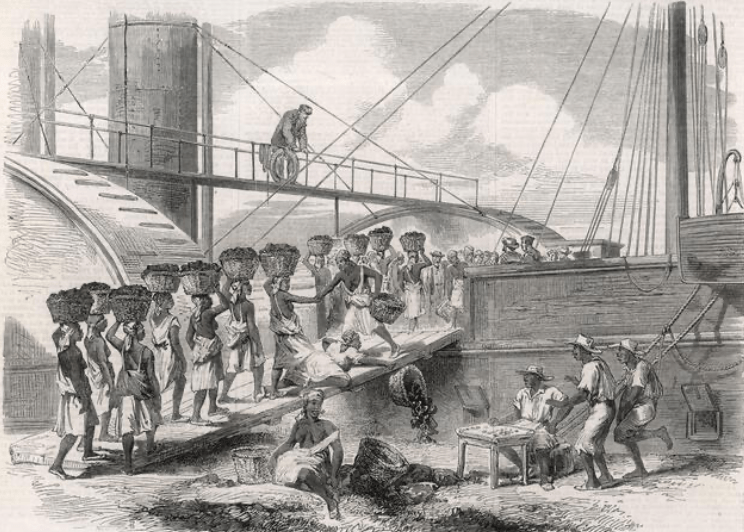
One of the more curious observations made by Wallace during this journey occurred when their steamer stopped in Kingston, Jamaica, to take on a load of coal. “There is one circumstance which to a New Englander seems rather strange [and] that is the manner in which labor is performed. That is [done] altogether by females—even carrying coal on board the vessel is performed by them by carrying it on their heads in half barrel tubs, while the males merely go around selling fruit or baskets or some such light work as that.”
Transcription
Navy Yard Mare Island, California September 10, 1857
Dear Madam,
Have you ever written the first letter to a stranger. If so, perhaps you can imagine my thoughts just at this moment when you try to think of the most suitable manner in which to commence, when one particular form continually arises before your imagination yet your mind convinces you that it is unfit. Such is my position. Therefore, let not this commencement surprise you as strange for I may write stranger things for I am considered by some as strange—and in fact I know I am in some things, yet there is a certain feeling which controls me and cannot be put aside.
Perhaps some of the incidents of our voyage from New York to San Francisco may be interesting to you, although if you examine the September number of “Putnam’s Monthly,” you may find it more interesting as I understand that is to be published in that magazine. We sailed from New York on the 6th of July with about 50 passengers in the first cabin, 150 in the second, and about 200 in the steerage which all together amounted to about 400 and which was very fortunate and pleasant—they the most quiet set of passengers which was ever on that steamer Illinois.
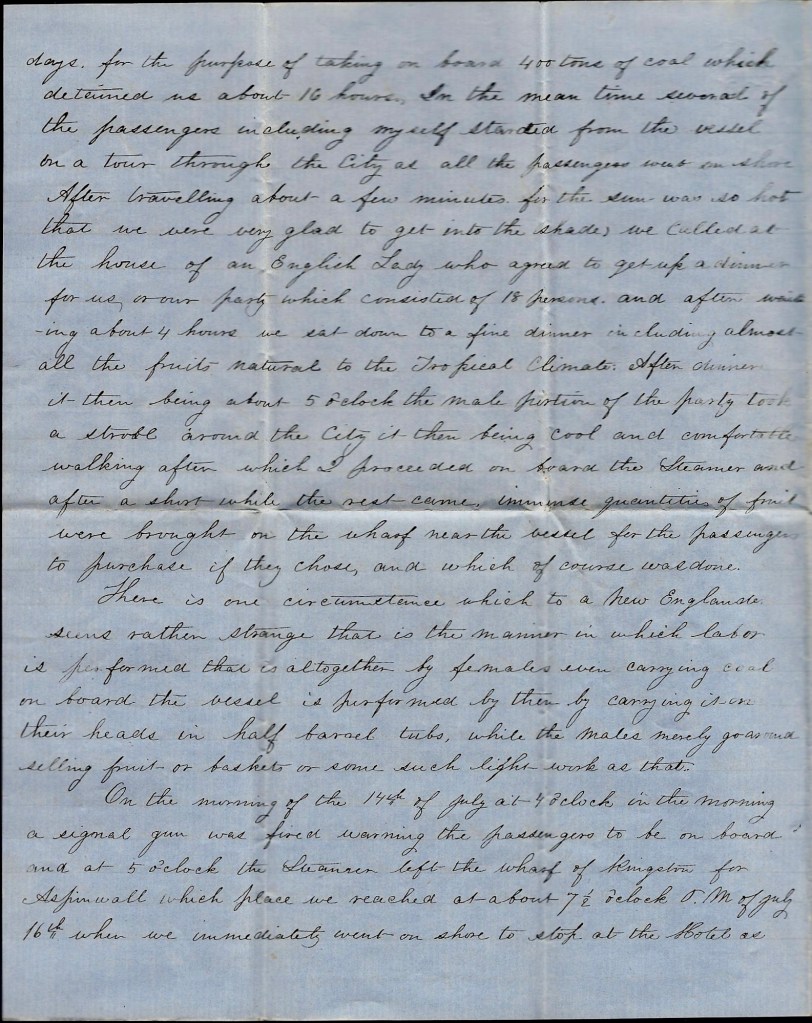
On the 13th of July we arrived at Kingston, Island of Jamaica, after a pleasant voyage of 7 days, for the purpose of taking on board 400 tons of coal which detained us about 16 hours. In the meantime several of the passengers including myself started from the vessel on a tour through the city as all the passengers went on shore. After traveling about a few minutes—for the sun was so hot that we were glad to get into the shade—we called at the house of an English lady who agreed to get up a dinner for us, or our party which consisted of 18 persons, and after waiting about four hours, we sat down to a fine dinner including almost all the fruits natural to the tropical climate.
After dinner, it then being about 5 o’clock, the male portion of the party took a troll around the city, it then being cool and comfortable walking after which I proceeded on board of the steamer and after a short while the rest came. Immense quantities of fruit were brought on the wharf near the vessel for the passengers to purchase of they chose, and which of course was done.
Kingston women coaling a steamer in Jamaica.
There is one circumstance which to a New Englander seems rather strange [and] that is the manner in which labor is performed. That is [done] altogether by females—even carrying coal on board the vessel is performed by them by carrying it on their heads in half barrel tubs, while the males merely go around selling fruit or baskets or some such light work as that.
On the morning of the 14th of July at 4 o’clock in the morning, a signal gun was fired warning the passengers to be on board and at 5 o’clock the steamer left the wharf of Kingston for Aspinwall which place we reached at about 7:30 o’clock p.m. of July 16th when we immediately went on shore to stop at the hotel. As the only chance which they have of doing business is on the arrival of a steamer, we of course had to go on shore and at our own expense obtain rooms for the night and breakfast in the morning. As the cars started to cross the Isthmus on the next morning at 8 o’clock, I accordingly engaged room for Mother, self, and Weldon at the most moderate price of $3.00 each. But of course we had to stop on shore and whatever was charged, we had to pay.
Next morning at 8 o’clock we left Aspinwall in the cars for Panama where we arrived at 11 o’clock and were immediately taken on board the steamer Golden Age by a small steamboat, as the water was not deep enough to allow the Age to come to the wharf. We sailed from Panama that afternoon at 6 o’clock and at 8 o’clock on the morning of the 24th, we arrived at Acapulco where we stopped about 5 hours for the purpose of taking on board provisions and coal. We sailed from there at 1 o’clock p.m. and the next afternoon at 4 o’clock we arrived at the Port of Manzanillo where we took on board $400,000 in silver bars and coin. 1
We left there in about two hours and arrived safely at the City of San Francisco at 1:30 o’clock Friday morning, July 31st after a most pleasant passage of 25 days.
At the present time we are settled down at the Navy Yard with a prospect of stopping here for some time. Brother John is at present in San Francisco where it was my intention to go had not I been taken sick with Panama fever from the effects of which it will probably take me some six months to recover. But my letter is getting to a most tedious length, therefore I will close.
Truly your humble servant, — W. Wallace Hanscom
P. S. Please accept the kind regard of my Father & Mother for yourself and all who may inquire. — W. W. H.
1 There were silver mines in this region of Mexico.
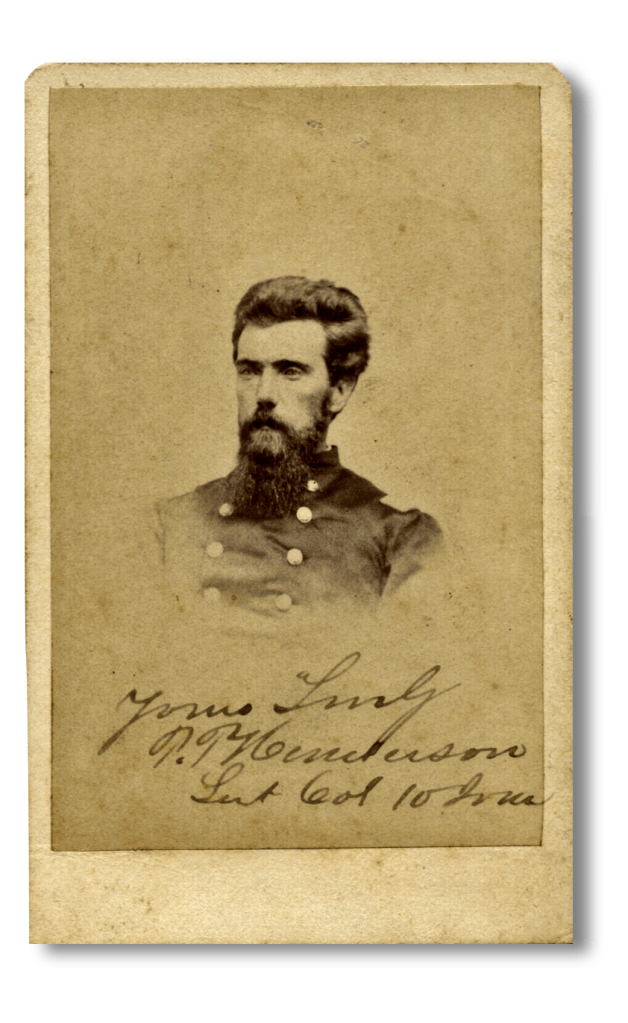
I could not find an image of John Clark or Lewis Wright but here is one of Lt. Col. Paris P. Henderson of the 10th Iowa who also signed the note. (Iowa Civil War Images)
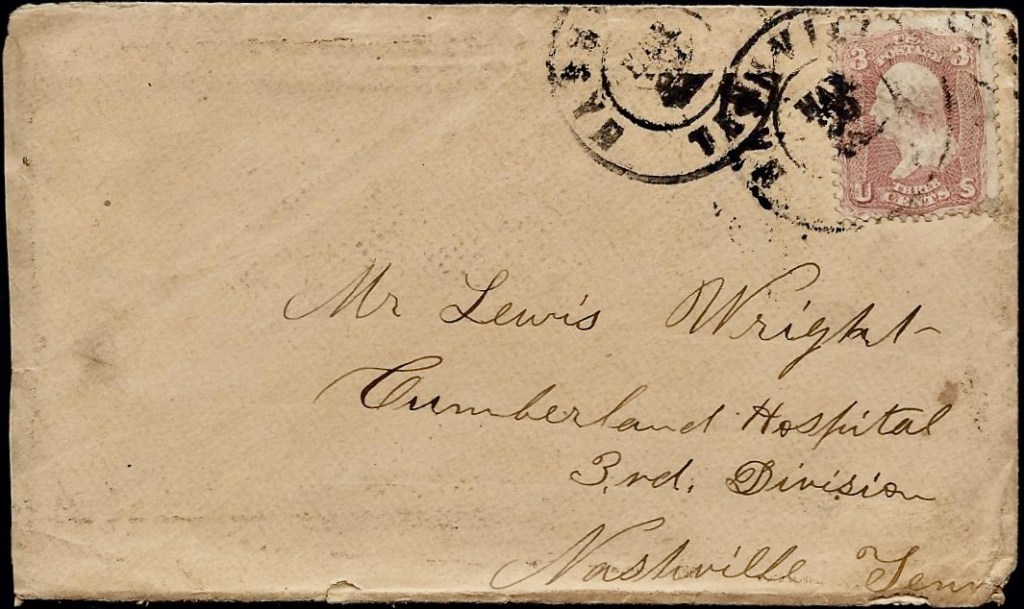
Twenty-two year-old Lewis Wright (1841-1864) was a battle-tested veteran of Co. H, 10th Iowa Infantry when he and others of his regiment stormed up Mission Ridge in November 1863. Earlier that year, on 16 May, he was wounded in the chest during a battle at Champion Hill, Mississippi. In the assault on Mission Ridge, however, his wound was much more severe. His left arm was dangled by his side as he was taken from the battlefield and transported to a field hospital where it was removed later that day.
The following note attesting to Wright’s battle wound while “in the line of duty” was written by 23 year-old John H. Clark of Rippey, Iowa, who served early in the war as 1st Sergeant of Co. H. Like Wright, he was wounded in the fighting at Champion Hill but recovered and was promoted to captain of the company on 11 August 1863, skipping right over the rank of lieutenant. Also signing the note, approving its accuracy, was Paris P. Henderson, formerly the captain of Co. G, and recently appointed to lieutenant-colonel of the regiment.
The reason for the note isn’t clear unless Lewis deemed it prudent to obtain as proof of service for a pension that would be due his family should he die from his wound. Though Lewis mustered out after three years service in September 1864, he died two months later at home and was buried in the Fair Oaks Cemetery next to his parents, Silas Wright (1816-1872) and Mariah Hurley (1816-1883) of Scranton, Greene county, Iowa.
Transcription
Addressed to Mr. Lewis Wright, Cumberland Hospital, 3rd Division, Nashville, Tennessee
I certify on honor that the bearer, Lewis Wright, a private of Co. H, 10th Regiment Iowa Infantry Vols., was on the 25th day of November 1863 at the Battle of Mission Ridge, Tennessee, wounded in the left arm and that his arm was amputated in Field Hospital at that place on 25th day of November 1863 and that said wound was received in line of his duty.
— John H. Clark, Capt, 10th Iowa Infantry, Commanding Co. H
Approved, P. P. Henderson, Lieut. Colonel, Commanding 10th Iowa
The following letter was written by H. Alvin Hitchcock (1841-1864, the youngest son of Otis Hitchcock (1795-1873) and Sarah Delano (1796-1877) of Randolph, Cattaraugus county, New York.
I could not find an image of Alvin but here is one of Eason W. Bull who served in Co. D, 154th New York Infantry
Alvin was 21 years old when he enlisted in August 1862 as a private in Co. A, 154th New York Infantry. When he enlisted, he was described as a brown-haired, blue-eyed, single farmer. The 154th New York was recruited in the counties of Chautauqua and Cattaraugus, organized at Jamestown, mustered into the U. S. service on Sept. 24-26, 1862 and left the state shortly afterward. They were assigned to the 1st brigade, 2nd (Steinwehr’s) division, Howard’s 11th corps, which was stationed during the fall of 1862 in Northern Virginia in the vicinity of Centerville. The regiment went into winter quarters with the corps at Stafford, Va., and suffered severely in the disaster which befell the corps at the Battle of Chancellorsville, losing 32 killed, 81 wounded and 115 captured and missing.
In his letter, Alvin gives a detailed eyewitness account of the Battle of Chancellorsville, from the time that his company helped the 15th New York Engineers lay the canvass pontoon bridge over the Rappahannock river at Kelly’s Ford, until his capture on the day after Stonewall Jackson’s flank attack that rolled up the 11th Corps. From his letter we learn that he was wounded while standing with others of the 154th New York on the “Buschbeck line” which held back Jackson’s men for over an hour while the high command attempted to stem the chaos of the fleeing soldiers.
For an excellent article describing the events Alvin witnessed and wrote about in his letter, readers are referred to Baptism of Fire: The 154th New York in the Chancellorsville Campaign by Mark H. Dunkelman published on American Battlefield Trust on 1 August 2022. I should also note that Dunkleman devoted an entire chapter to Alvin Hitchcock’s sad story in his book, War’s Relentless Hand: Twelve Tales of Civil War Soldiers (LSU Press, 2006)….After Alvin was exchanged and rejoined the 154th New York, he began to show signs of insanity. He was sent to the Government Hospital for the Insane at Washington, and from there–after a brief visit home–to the New York State Lunatic Asylum in Utica, where he died on July 13, 1864, of “Exhaustion–acute Mania.
Transcription
Addressed to Mr. Otis Hitchcock, Randolph, Cattaraugus county, New York (notice that envelope is mismatched with letter; envelope is postmarked Nashville, TN, and dates to April 1864.
Camp Convalescent Near Alexandria, Virginia [Approx. May 20, 1863]
Dear Parents and friends,
It is with pleasure that I take my pen in hand once more to inform you of my welfare & whereabouts. I am a paroled prisoner of war and I am as well as usual, hoping these few lines will find you all well and enjoying yourselves.
I will try and give you a kind of a description of our spring campaign. We left our winter camp about the middle of April and went to a place called Kelly’s Ford. We lay there in camp about two weeks when we got orders to make an advance on the enemy. Our regiment was ordered out just at night of the 28th of April to go and help lay the pontoon bridge. Our company and one other company were detailed to help the [15th New York] Engineers lay down the bridge & the rest of the regiment crossed over to guard us while we were at work. It was the Rappahannock river that I am speaking of now.
We got the bridge done about 11 o’clock at night and our regiment come back and we went back to camp and stayed till morning. Then we got orders to have three days rations in our haversacks and five more in our knapsacks, making in all eight days rations. And we had to have 60 rounds of cartridges, 40 in our boxes and 20 in our knapsacks. So you see that we were pretty well loaded down with hardtack and lead.
Well we marched down and crossed the river and lay there that day till the next morning. Then we got orders to strike tents and march. Our brigade was guard of the baggage train so you see we had to be in the rear. We marched till noon when we came to the Rapidan river. We crossed on a narrow footbridge but the train had to ford it and it being a very rapid stream, it took till about 4 o’clock p.m. before we got ready to start again. Then we started and marched clear through to where we had the battle before we camped. We marched about 25 miles that [day] by marching till 11 o’clock at night and you better believe that I was a tired boy that night if I ever was.
Well we stayed there till about 3 o’clock the next day. Then we got orders to form in line of battle. We could hear the enemy firing. They were fighting then only about two miles from us. We were marched 20 rods out across the road to another field, then our company and another company had to go and guard the pioneers while they were throwing up breastworks. We had to lay on our arms that night. The rebs were shelling the woods just about 150 rods to our right. We could see and hear the shells burst just as plain as day but the next day was when we had our fun.
[It was] just about 5 o’clock p.m. that Old Stonewall Jackson come in on our rear and you had better believe that we had a rather warm time of it for a little while. I think we were managed rather bad on the start. We were formed in by divisions, closed en masse, and marched in front of our breastworks & ordered to lay down. We lay there about five minutes when we were ordered to fall back to the breastworks. We fell back there & waited till they come up in sight & then we blazed away at them, but they [had] so many more in number than we did that they rushed right up and flanked us both right and left, and we got the order to retreat, and then was when I got hit but it did not lame me much till the next day. So I got off the field and went about a mile and lay down and slept good till the next morning when the rebs made another attack on our men & I happened to be lying right where they come in, so I was right between the two fires. But I was behind an old log from the rebs fire. The balls struck the log pretty freely but I was alright. But it was not long before they had me prisoner. I shall have to close. Write soon. — H. A. H
[to] Otis and Sarah [Hitchcock]
A map of the “Buschbeck line” established by the Federals near Dowdall’s Tavern on the Orange Turnpike where the 154th New York “blazed away” at the rebels.
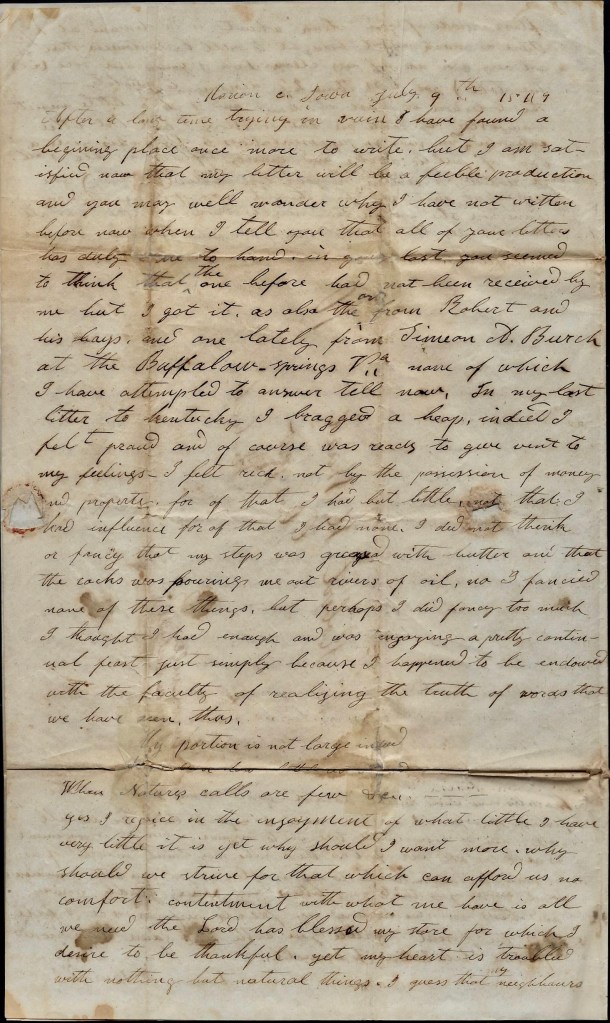
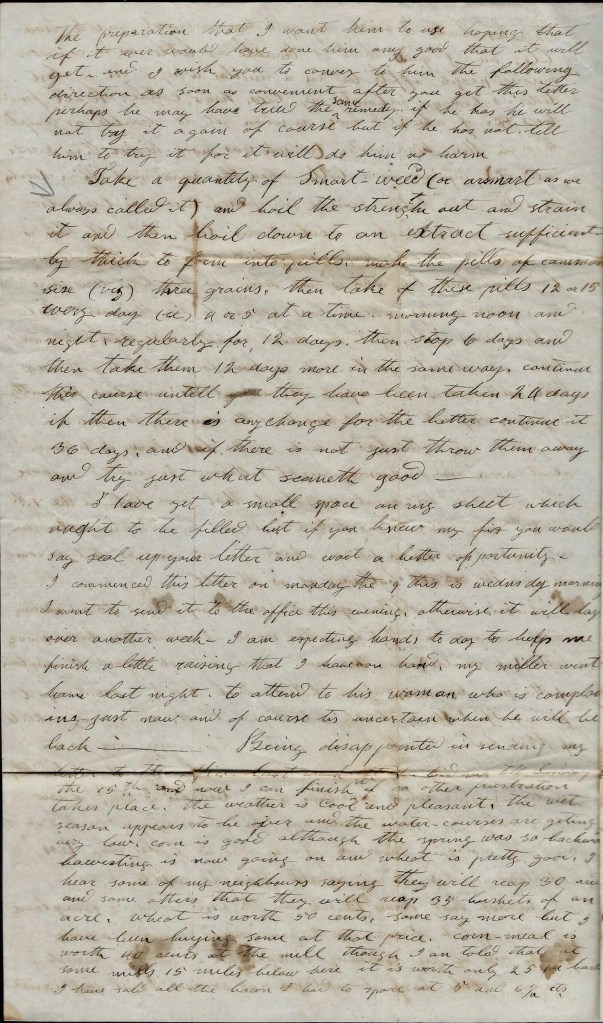
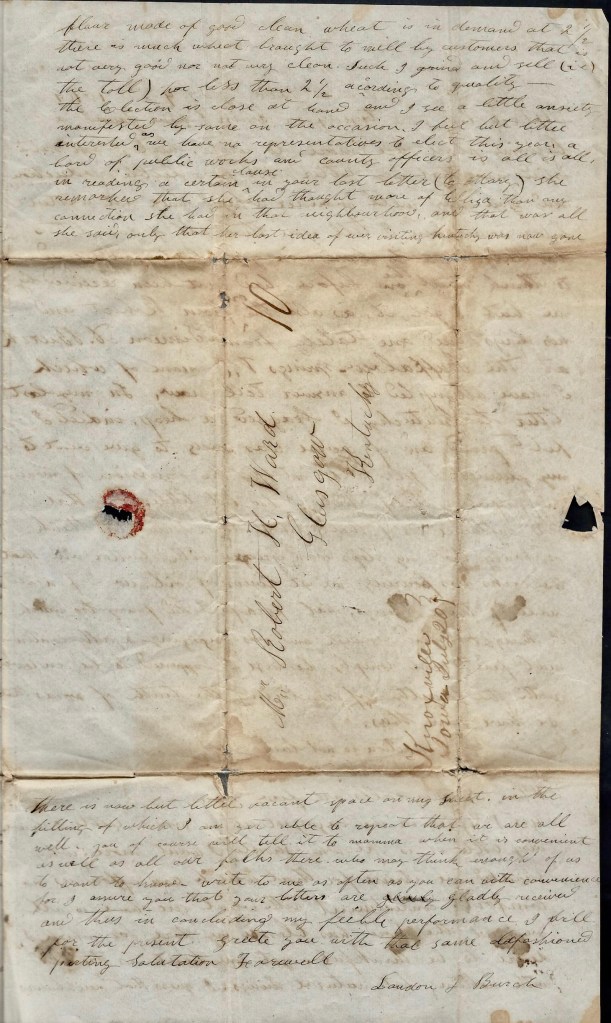
These two letter were written by William David Burch (1809-1874) and his brother, Landon J. Burch, (1801-1882), the sons of John Long Burch (1759-1834) and Elizabeth Benham (1777-1853) of Barren county, Kentucky. The brothers emigrated from Kentucky to Iowa Territory, Landon about 1838 and William about 1840,
William and Landon both wrote their letters to Robert Harrison Ward (1813-1860), the son of Seth Ward (1770-1815) and Rebecca Griffin (1770-18xx). Robert was first married in Barren county, Kentucky, in 1834 to Elizabeth Ann Nichols. He married 2nd Charlotte O’Neal and moved to Knoxville, Iowa, in the mid 1850s.
William’s letter, datelined from Knoxville, Iowa, contains a lengthy paragraph describing what he called “Iowa Mobocracy”—a kind of pact between the settlers to protect each others land from encroachment by squatters and others looking to take away the claims on which they had made improvements—whether legal or not. Might makes right, in other words. He even describes a posse of men in black face who intercept an interloper and sent him away tarred and feathered.
Letter 1
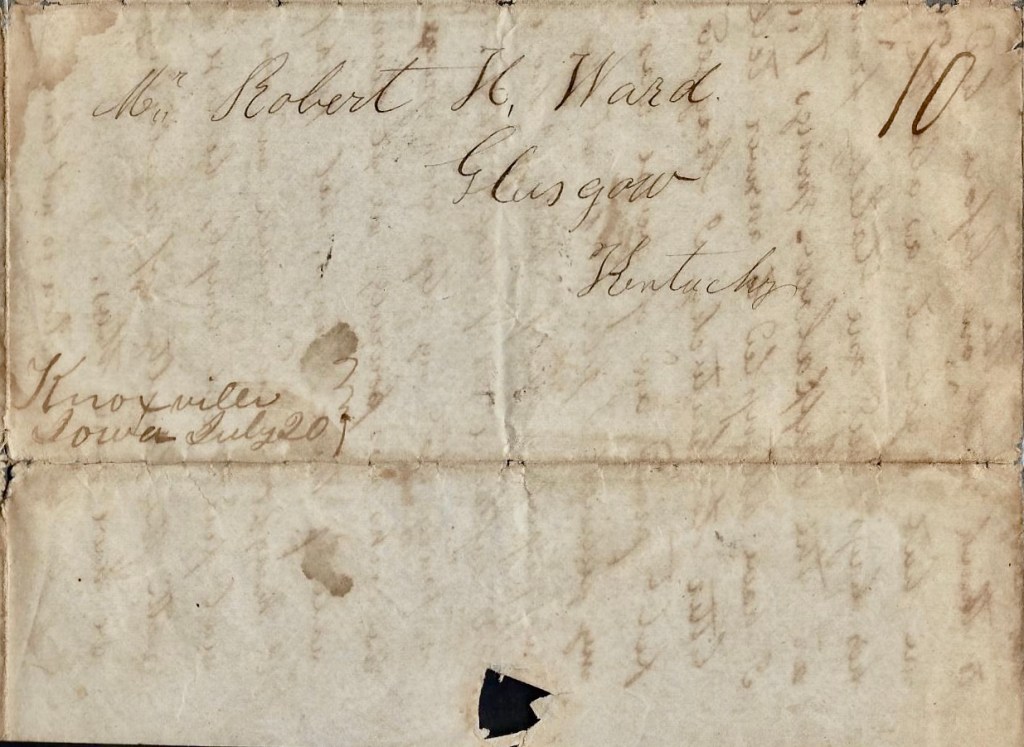
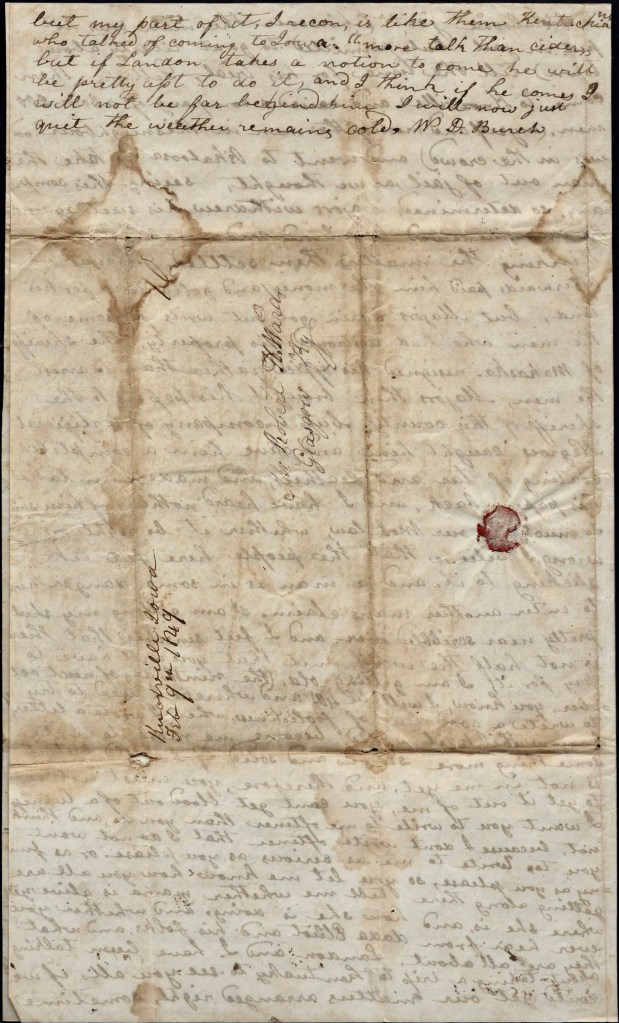
Addressed to Mr. Robert H. Ward, Glagow, Kentucky
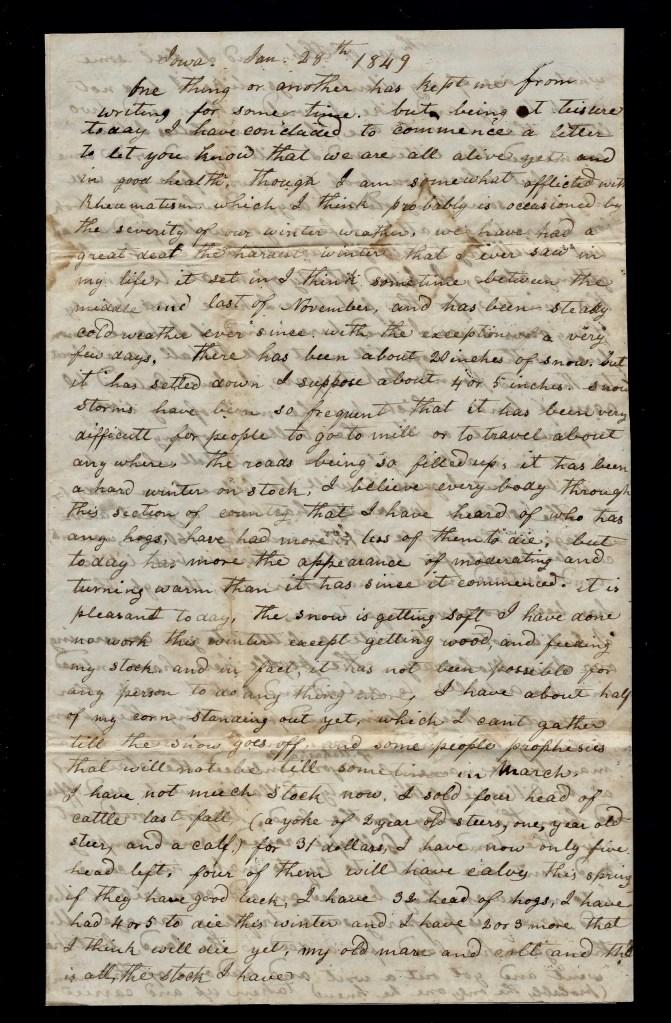
Knoxville, Iowa January 28, 1849
One thing or another has kept me from writing for some time. I have concluded to commence a letter to let you know that we are all alive yet and in good health. Thought I am somewhat afflicted with rheumatism which I think probably is occasioned by the severity of our winter weather. We have had a great deal—the hardest winter that I ever saw in my life. It set in, I think, sometime between the middle and last of November and has been steady cold weather ever since with the exception of a very few days. There has been about 20 inches of snow but it has settled down, I suppose, about four or five inches. Snowstorms have been so frequent that it has been very difficult for people to go to mill or to travel about anywhere, the roads being so filled up.
It has been a hard winter on stock. I believe everybody through this section of country that I have heard of who has any hogs have had more or less of them to die. But today has more the appearance of moderating and turning warm than it has since it commenced. It is pleasant today. The snow is getting soft. I have done no work this winter except getting wood and feeding my stock and in fact, it has not been possible for any person to do anything more. I have about half of my corn standing out yet, which I can’t gather till the snow foes off, and some people prophesies that will not be till sometime in March.
I have no much stock now. I sold four head of cattle last fall (a yoke of two year-old steers, one year-old steer, and a calf) for thirty-one dollars. I have now only five head left, four of them will have calves this spring if they have good luck. I have 32 head of hogs. I had four or five to die this winter and I have two or three more that I think will die yet. My old mare and colt and that is all the stock I have.
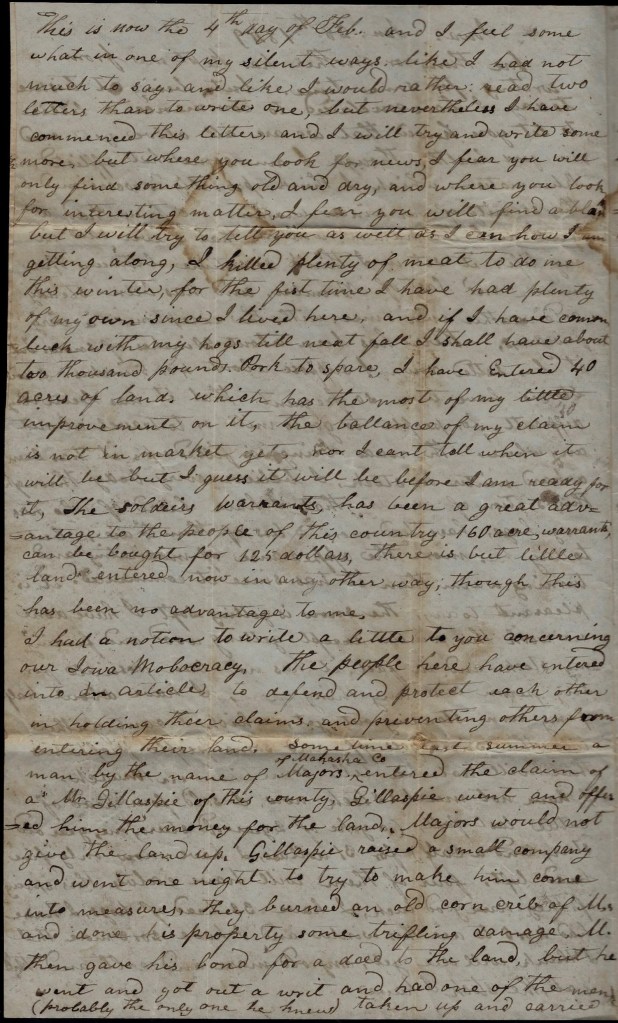
This is now the 4th day of February and I feel somewhat in one of my silent ways, like I had not much to say, and like I would rather read two letters than to write one. But nevertheless I have commenced this letter and I will try and write some more, but where you look for news, I fear you will only find something old and dry. And where you look for interesting matter, I fear you will find a blank. But I will try to tell you as well as I can how I am getting along.
I killed plenty of meat to do me this winter. For the first time I have had plenty of my own since I lived here, and if I have common luck with my hogs till next fall, I shall have about two thousand pounds pork to spare. I have entered 40 acres of land which has the most of my little improvements on it. The balance of my claim is not in market yet, nor I can’t tell when it will be but I guess it will be before I am ready for it. The Soldier’s Warrants has been a great advantage to the people of this country. 160 acre warrants can be bought for 125 dollars. There is but little land entered now in any other way though this has been no advantage to me.
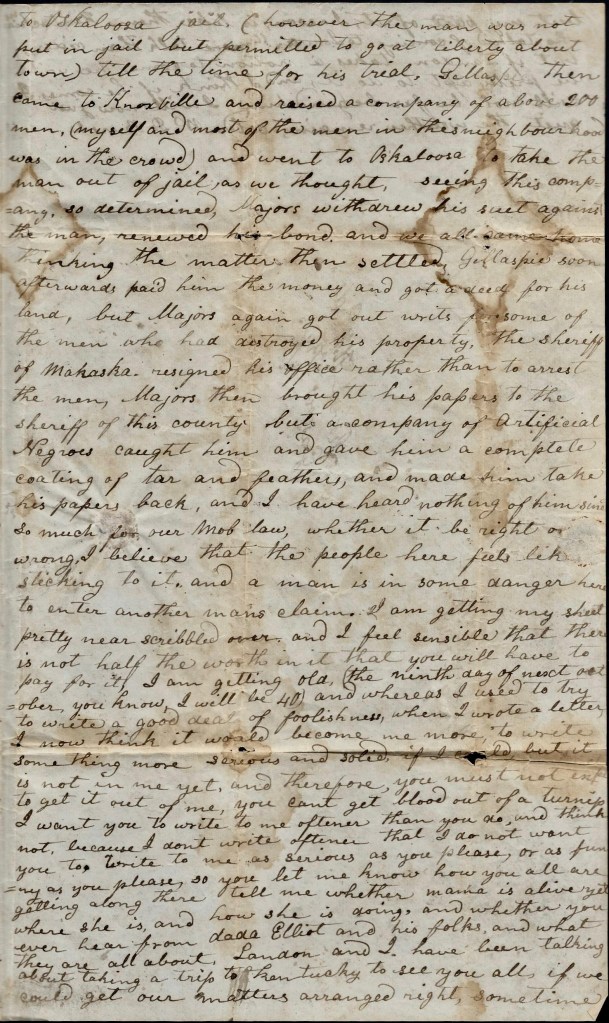
I had a notion to write a little to you concerning our Iowa Mobocracy. The people here entered into an article to defend and protect each other in holding their claims and preventing others from entering the land. Some time last summer a man by the name of Majors of Mahaska county entered the claim of a Mr. Gillespie of this county. Gillespie went and offered him the money for the land. Majors would not give the land up. Gillespie raised a small company and went one night to try to make him come into measures. They burned an old corn crib of Majors and done his property some trifling damage. Majors then have his bond for a deed to the land but he went and got out a writ and had one of the men (probably the only one he knew had taken up and carried to Oskaloosa jail (however the man was not put in jail but permitted to go at liberty about town) till the time for his trial. Gillespie then came to Knoxville and raised a company of above 200 men (myself and most of the men in this neighborhood was in the crowd) and went to Oskaloosa to take the man out of jail, as we thought. Seeing this company so determined, Majors withdrew his suit against the man, renewed his bond, and we all came home thinking the matter then settled. Gillespie soon afterwards paid him the money and got orders for his land, but Majors again got out writs for some of the men who had destroyed his property. The sheriff of Mahaska resigned his office rather than to arrest the men. Majors then brought his papers to the sheriff of this county but a company of artificial Negroes caught him and gave him a complete coating of tar and feathers, and made him take his papers back, and I have heard nothing of him since. So much for our mob law. Whether it be right or wrong, I believe that the people here feels like sticking to it and a man is in some danger here to enter another man’s claims.
I am getting my sheet pretty near scribbled over and I feel sensible that there is not half the worth in it that you will have to pay for it. I am getting old (the ninth day of next October, you know, I will be 40) and whereas I used to try to write a good deal of foolishness when I wrote a letter, I now think it would become me more to write something more serious and solid if I could, but it is not in me yet, and therefore, you must not expect to get it out of me. You can’t get blood out of a turnip. I want you to write to me oftener than you do, and think not because I don’t write oftener that I do not want you to write. Write to me as serious as you please, or as funny as you please, so you let me know how you all are getting along there. Tell me whether mama is alive yet, where she is, and how she is doing, and whether you ever hear from dada Elliot and his folks, and what they are all about. Landon and I have been talking about taking a trip to Kentucky to see you all, if we could get our matters arranged right, sometime but my part of it, I reckon is like them Kentuckians who talked of coming to Iowa—“More talk than cider.” But if Landon takes a notion to come, he will be pretty apt to do it and I think if he comes, I will not be far behind him. I will now just quit. The weather remains cold. — W. D. Burch
Letter 2
[Note: Only a partial transcription.]
Marion county, Iowa July 9, 1849
After a long time trying in vain I have found a beginning place once more to write, but I am satisfied now that my letter will be a feeble production and you may well wonder why I have not written before now when I tell you that all of your letters has duly come to hand…
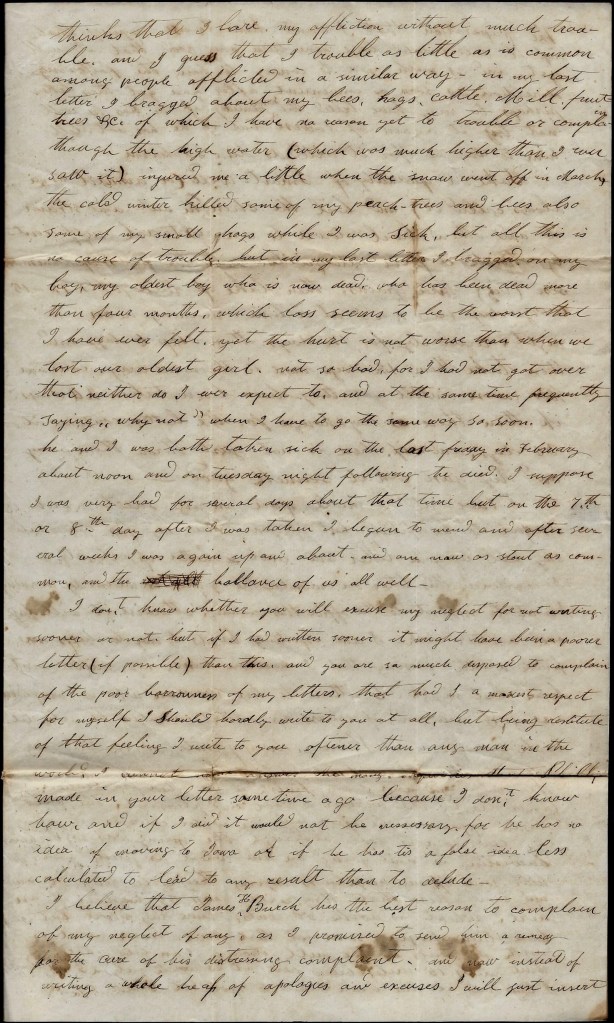
In my last letter I bragged about my bees, hogs, cattle, mill, fruit trees, &c. of which I have no reason yet to trouble or complain though the high water (which was much higher than I ever saw it) injured me a little when the snow went off in March. The cold winter killed some of my peach trees and bees. Also some of my small hogs while I was sick. But all this is no cause of trouble. But in my last letter I bragged on my boy—my oldest boy [Orestes Ducalion Burch] who is now dead—who has been dead more than four months, which loss seems to be the worst that I have ever felt. Yet the hurt is not worse than when we lost our oldest girl [Mantura Elizabeth Burch]— not so bad, for I had not got over that. Neither do I ever expect to. And at the same time, frequently saying, “Why not?” when I have to go the same way so soon.
He and I was both taken sick on the last Friday in February about noon and on Tuesday night following he died. I suppose I was very bad for several days about that time but on the 7th or 8th day after I was taken, I began to mend and after several weeks I was again up and about and am now as stout as common, and the balance of us all well.
I don’t know whether you will excuse my neglect for not writing sooner or not, but if I had written sooner, it might have been a poorer letter (if possible) than this and you are so much disposed to complain of the poor barrenness of my letters that had I a modest respect for myself I should hardly write to you at all… — Landon J. Burch
An unidentified North Carolina soldier (Steve Lott Collection)
The following letter was written by William H. Hall, a 21 year-old farmer from Orange county, N. C. when he enlisted 1 September 1861 at Fort Macon in Co. G, 27th North Carolina Infantry. William appears to have been with his regiment most of the war but did not survive it. He died of consumption (tuberculosis) at Petersburg on 28 July 1864.
The 27th North Carolina saw action in the war at New Bern, Sharpsburg, Fredericksburg, and then in the Wilderness, at Spotsylvania, Cold Harbor and Petersburg. At Sharpsburg, the regiment 63% of the 325 men engaged in killed, wounded and missing. Two of the Sharpsburg wounded are mentioned in this letter. William wrote the letter to a comrade names James who was at home in Orange county at the time. He too may have been recovering from a wound received at either Sharpsburg or Fredericksburg.
William was the son of Nelson Parish Hall (1817-1902) and Nancy Robinson Bowles (1820-1856) of Little River township, Orange county, North Carolina. After William’s mother died in 1856, his father remarried to Martha Caroline Taylor.
William’s composition and handwriting was above par and we learn from this letter that his comrades came to him to forge the General’s signature on their passes.
Transcription
Wilmington, North Carolina May 1st 1863
Dear friend,
I received your kind letter yesterday and was glad to hear from you once more. You will see by the heading of this that we are over more in the Old North State and you may guess we are glad little souls if we can get to stay. I suppose we have been ordered to Kinston but the order is countermanded. They had a skirmish near Kinston a few days ago and orders were sent to Gen. Whiting (the military commander in this vicinity) and he requested Gen. Hill to let him keep us here if possible, and, I suppose his request was granted conditionally.
They had commenced issuing furloughs when we were ordered to Kinston but they have suspended furloughs until the Kinston affair becomes more settled. I hope that won’t be long for I will get to go home in the second class, and you know I am anxious to see my sweetheart. Jim, I received a letter from her today (Mollie) but for the sake of everything sacred, I want you to keep everything I tell you about that a profound secret. She writes as sweet as a lark can sing.
We are looking for you to come down soon. Lieutenant [Stephen] Dickson wrote to you some time ago to come down and get your discharge but we have not heard whether you received his letter or not. You can get a discharge whenever you will come after it. Capt. [James Y.] Whitted’s resignation has been accepted and Dickson is now captain. We elected Robert D. Patterson 3rd Lieutenant yesterday. Tom Whitted ran against him and got 22 votes and Uncle Bob got 37. Tom Whitted is the most disappointed fellow you ever saw. Uncle Bob & John F. Thompson came to the company last night and Walt Thompson came with them and brought some brandy and we have a gay crowd today.
We are encamped about two miles below Wilmington on the [Cape Fear] river. We have a beautiful situation but we have little shade except the arbors we have built in front of our tents.
[Lafayette] Merritt is about to get a discharge on his wound he received at Sharpsburg and Bill Shields had the ball cut out of his hip day before yesterday in Wilmington. He bled very much but is doing finely now. He will start home on a furlough Monday.
The names of the recruits we got from Molette Bat. are viz. Blalock, Forrest, [William] Gattis, Mitchell, Pickett, Hughs, Thomas, Pearson, & Merritt. Walt brought Wils[on] Brown as a substitute for Tip Lipscomb but I think it doubtful about Dickson receiving him.
Our company numbers 75 now present. Our boys have their own fun running the blockade to townevery night. They write their own passes and I assign the General’s name to them and they go through every pop. Sam Dickson ran for 3rd Lieutenant yesterday and got three votes.
I understand Evans Turner and Miss Emma Nichols are to be married soon. I say goit Boots but don’t touch mine.
I shall close. Write soon & direct to Wilmington. I am as ever your true friend, — Wm. J. Hall
P. S. We just did miss going to Tennessee. Gen. Walker received orders to report to Gen. Johnson with his command about two hours after we left Coosawhatchie. That was as close as I want to come at that during the war. Yours, &c. — W. H. H.
I could not find an image of Howard but here is one of Dewitt L. Parrish of Co. B, 3rd Michigan Cavalry (Ancestry)
The following letters were written by Howard Marks Hopkins (1841-1929) who enlisted at the age of 19 in Co. E, 3rd Michigan Cavalry, on 5 September 1861. He remained a private throughout his service and mustered out on 30 May 1864. During his service, he participated in sixteen engagements and skirmishes, and was constantly on scouting duty.
Howard was the son of Aaron Hopkins (1794-1844) and Pheobe Marks (1806-1872) of Rome, Lenawee county, Michigan. Howard’s father brought his family to Michigan in a horse-drawn covered wagon from Nassau, New York, in 1844 but died three months after his arrival. Howard’s father’s death left his mother with four small children in almost a destitute condition so Howard and his older sister Mate were adopted by Jeremiah Ferguson, who brought them up and gave them a good home. Before the Civil War, Howard had the opportunity to to attend Adrian College in the winter of 1860.
After the war, Howard returned to Michigan where he married Adelia A. Teachout (1846-1925) in 1867. This letter was written to Howard’s cousin, Abbie Watson, whom I believe was the 20 year-old daughter of Joseph Croasdale Watson and Ruth Langdon of Wayne county, New York. Abbie married Archibald Barton (1833-1925), ten years her senior, in the late 1860s.
Letter 1
Addressed to Miss Abbie Watson, Clyde, Wayne county, New York
Corinth, Mississippi December 15, 1863
Dear Cousin Abbie,
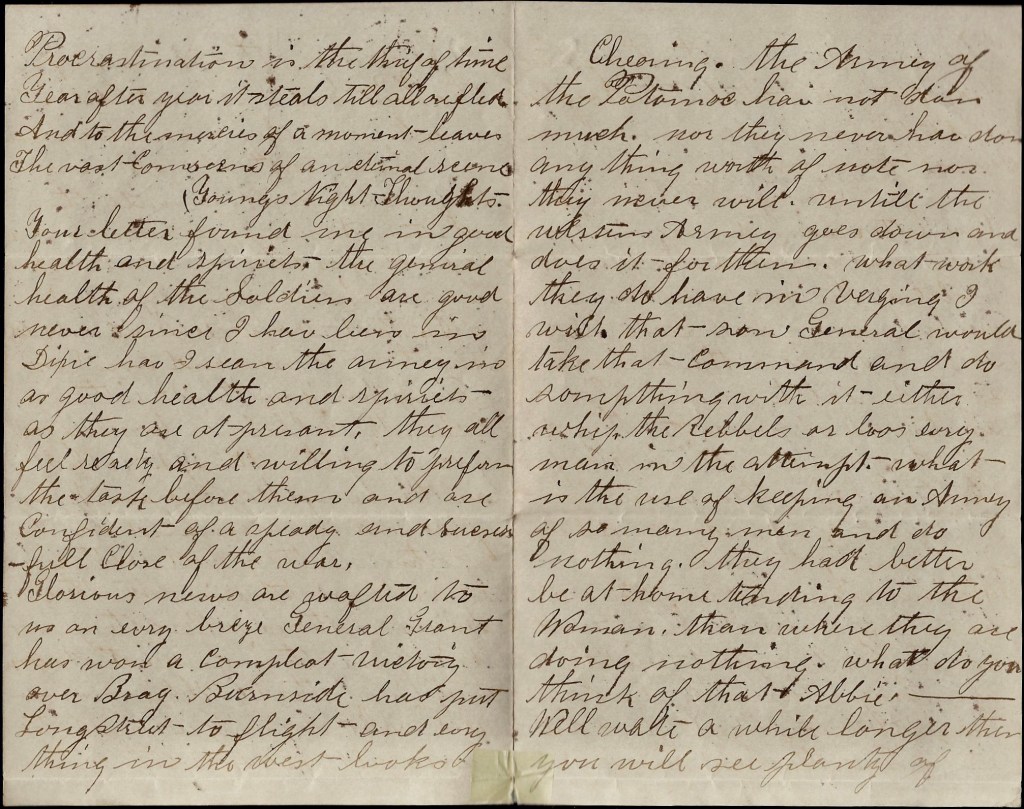
Your kind favor of November 15th came safe to hand last evening and I hasten to answer it fearing if I waited one or two days, that I might get negligent and wait as long as you did. Abbie, let us be more prompt in future and not delay writing so long. See what Young thinks about delaying things too long. “Procrastination is the thief of time. Year after year it steals till all are fled. And to the mercies of a moment leaves the vast concerns of an eternal scene.” (Young’s Night Thoughts).
Your letter found me in good health and spirits. The general health of the soldiers are good. Never since I have been in Dixie have I seen the army in as good spirits as they are at present. They all feel ready and willing to perform the task before them and are confident of a speedy and successful close of the war.
Glorious news are wafted to us on every breeze. General Grant has won a complete victory over Bragg. Burnside has put Longstreet to flight. And everything in the West looks cheering. The Army of the Potomac have not done much, nor they never have done anything worthy of note, nor they never will until the Western army goes down and does it for them. What work they do have in Virginia. I wish that some General would take that command and do something with it. Either whip the rebels or lose every man in the attempt. What is the use of keeping an army of so many men and do nothing? They had better be at home tending to the women than where they are doing nothing. What do you think of that, Abbie?
Well, wait awhile longer. Then you will see plenty of soldiers flocking home. Only about ten months longer and the three year men will be discharged. Then I will come down and see you. Mate and I have got it all planned. What a grand time we will have, won’t we? Oh, say Abbie, you must have your cousin Dill at your place. I want to see him. I suppose he is in the army yet.
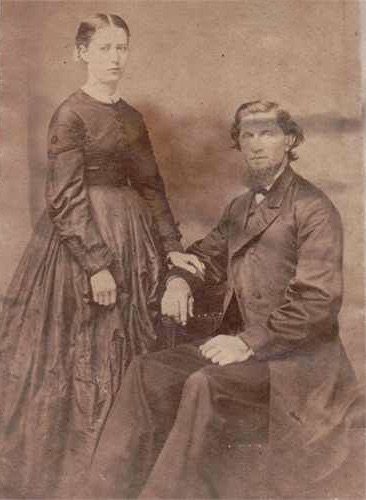
Abbie Watson and the man she would later marry, Archibald Barton. Both are buried in Clyde, New York in the Maple Grove Cemetery
About Blanchard and Mary Ann, I begin to think they have forgotten me. I have not received a letter from home over four months.
You say you think that Mr. Perles and Mate will never get married. I think they will. Mate told me they were engaged. Don’t you say a word to her that I told you.
Abbie, you speak of my being quite attentive to my early love, Miss Curtis. I will admit that I saw her some two or three times while at home and had a very pleasant visit. Do not fear. I am coming East before I get married. I have got to find someone to have me first. I am sorry you are getting too old to get married. I guess you can find someone to have you after the war closes. Now write me as soon as you get this. I am as ever your cousin, — Howard. Adieu!
Letter 2
LaGrange, Tennessee Sunday Morning Jan. 17, 1864
Dear Cousin,
Your kind favor of January 4th came safe to hand last evening and as is ever the case, I was very very glad to hear from you. Yes, Abbie, I am ever glad to hear from you and to know I am not forgotten by those at home who are near and dear. Abbie when you write me again, send me your photograph, won’t you? I shall look for it. I have not had a letter from Blanchard since I came back. I think it too bad. They seem to think so much of me and then not even write me a letter. They are good souls for I love them and may God bless them and their labors.
To me what a blessed gift letters are—especially when written to the lonely soldier who is far, far from kind friends and home. Home. What a sweet word. How I love it. One noble writer has said that the three sweetest words were, Mother, Home, and Heaven. How true. I wonder if I shall ever see my dear good Mother and home again. I trust and hope I may and that soon. You will say at once that I had better be asking myself the question, will I ever reach Heaven. I have asked myself that question many times and my daily prayer is that I may so live that I can reach Heaven and meet those gone before. Oh, is it not a pleasing thought to think if we are only faithful, that God will never leave nor forsake us?
Since I last wrote you we have moved camp. We are now camped at LaGrange, Tenn. where we were last summer. How long we shall stay here is more than I can say. Some say we are going to start for Texas in a few days. There is one division of this army going and we may be among the number. I hope so. I should realy like to visit Texas before I return home. A great many of the men are reenlisting as veterans and if they get 3/4 of the regiment, they will go home on furlough in a few weeks. There has quite a number enlisted already and I think they will get 3/4 of the men. I do not know as I shall reenlist. I think that I will not until some of those men in the North come out and then if they need more men, I am willing to go again and until those men in the North does do something, I shall not enlist again. I think if I stay three years that I have nobly preformed my duty.
You say you think your Cousin Dill is not in the army. You do not seem to know as much about him as you use to. What is the trouble? I fear you have had some difficulty. Write and tell me, won’t you? You wished to know where Jack Bond was. He is with us yet—is well and feeling well. Jack is a fine fellow.
Abbie, write to me soon. Give my love to all friends and accept this poor scribble from your very affectionate cousin, Howard. Goodbye, Abbie.
P. S. Direct to LaGrange Tennessee, Co E, 3rd Michigan Cavalry
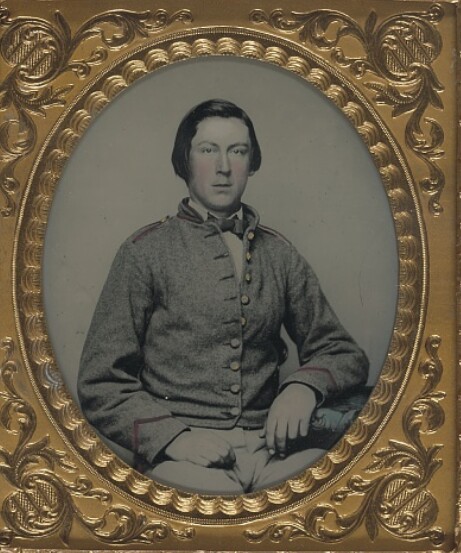
I could not find an image of Jacob, but here is an early-war image of William Savage Moore who rose from Private to Captain of Co. I, 15th Virginia Infantry (Photo Sleuth)
The following letter was penned by Jacob Shook (1843-18xx) of Camp Hill, Virginia, who enlisted as a private in Co. G, 15th Virginia Infantry in April 1861. Jacob was promoted up in the ranks to Orderly Sergeant of his company before being reduced in the ranks back to a private (“for 15 days”) in September 1864. He was then commissioned as a 2nd Lieutenant of his company before the first of November 1864 which is the rank he held at the time this letter was written. He assumed command of the company after the captain and 1st lieutenant of the company were badly wounded in the fight near Drury’s Bluff on 16 May 1864.
In the 1860 US Census, 17 year-old Jacob was enumerated in the household of Martin Baker of Henrico county, Virginia. It is believed that he was the orphaned son of Jacob Shook (1787-1858) and Maria Anna Chisholm. Shook (1802-1856) of Richmond, Virginia. Jacob’s father, before his death in 1858, had been a prominent butcher and grocer in Richmond. His wealth enabled him to have 11 slaves according to the 1850 slave schedules).
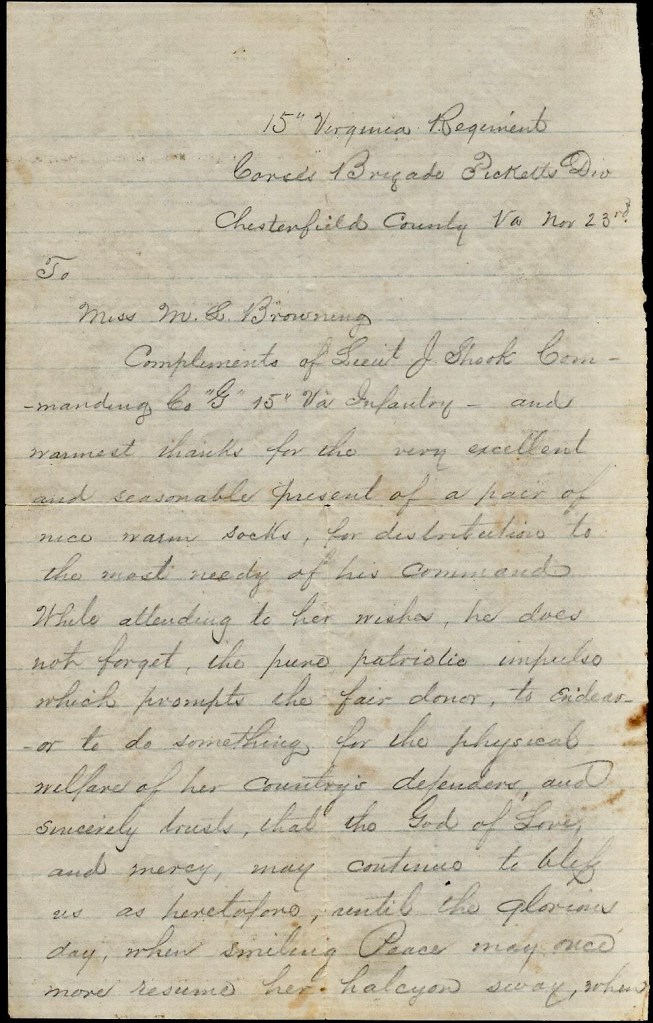
Lt. Shook’s letter was directed to a Miss M. S. Browning, otherwise unidentified. Indeed, Lt. Shook himself does not appear to know her except by name. He wrote to thank her for the socks that were contributed and distributed among members of his company. In a most chivalrous tone and referring to himself in the 3rd person, Lt. Shook praises her for the “pure patriotic impulse which prompts the fair donor to endeavor to do something for the physical welfare of her country’s defenders.”
Transcription
15th Virginia Regiment Corse’s Brigade, Pickett’s Division Chesterfield county, Va. November 23rd [1864]
To Miss M. S. Browning,
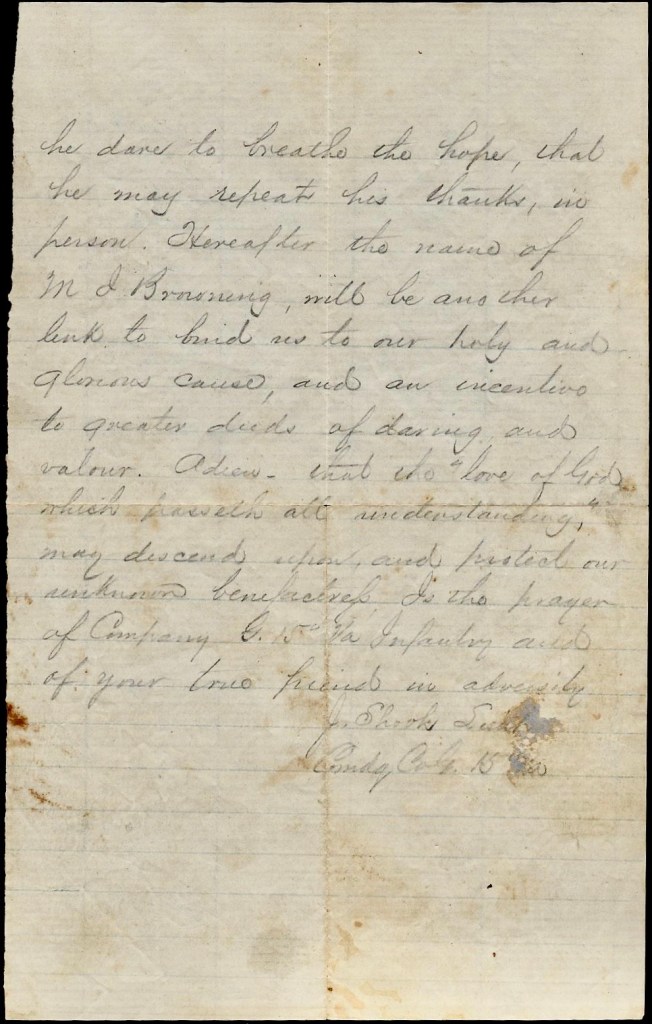
Compliments of Lieut. J. Shook. commanding Co. G. 15th Virginia Infantry, and warmest thanks for the very excellent and seasonable present of a pair of nice warm socks for distribution to the most needy of his command. While attending to her wishes, he does not forget the pure patriotic impulse which prompts the fair donor to endeavor to do something for the physical welfare of her country’s defenders and sincerely trusts that the God of love and mercy may continue to bless us as heretofore until the glorious day when smiling Peace may once more resume her halcyon sway, when he dare to breathe the hope that he may repeat his thanks in person.
Hereafter the name of M. C. Browning will be another link to bind us to our holy and glorious cause and an incentive to greater deeds of daring and valor. Adieu—that the “love of God which passeth all understanding” may descend upon and protect our unknown benefactress is the prayer of Company G, 15th Va. Infantry and of your true friend in adversity, — J. Shook, Lieut., commanding Co. G, 15th Va.
I could not find an image of Edward but here is a tintype of Jacob Kunckle who served in Co. M, 14th Pennsylvania Cavalry(Ancestry)
The following letters were written by Edward F. Tubbs (1841-1864) who enlisted September 11, 1862 and mustered into Co. I, 14th Pennsylvania Cavalry on 27 October 1862 at Erie, Pennsylvania. Edward mustered in as a corporal and was promoted to sergeant. Although one source erroneously states that Edward died of disease at Winchester, Virginia, in 17 December 1864, the truth is that he was among the 100 troopers led by Capt. William Miles of Co. I on a scouting expedition toward Ashby’s Gap on 17 December 1864. Mosby and his guerrillas ambushed this scouting party from a woods near Millwood, Virginia, killing Miles and about a dozen others, including Sergt. Tubbs. About 20 others were wounded, and nearly everybody else was captured. Mosby set one man free after slashing his face with a saber, allowing him to return to camp to tell the story of the ambush. The wounded and dead were recovered on the next day. Mosby sent his prisoners to Libby Prison.
Edward was the son of Irene Tubbs (1812-Aft1870) of Conneaut township, Erie county, Pennsylvania. Irene’s husband, Frederick Tubbs, died on 19 November 1842 after 9 years of marriage, leaving her to raise her children on the family 40-acre farm. Frederick, it seems, died a tragic death, have been shipwrecked and drowned in Lake Erie.
Letter 1
[Note: This letter was found in the Widow’s Pension File.]
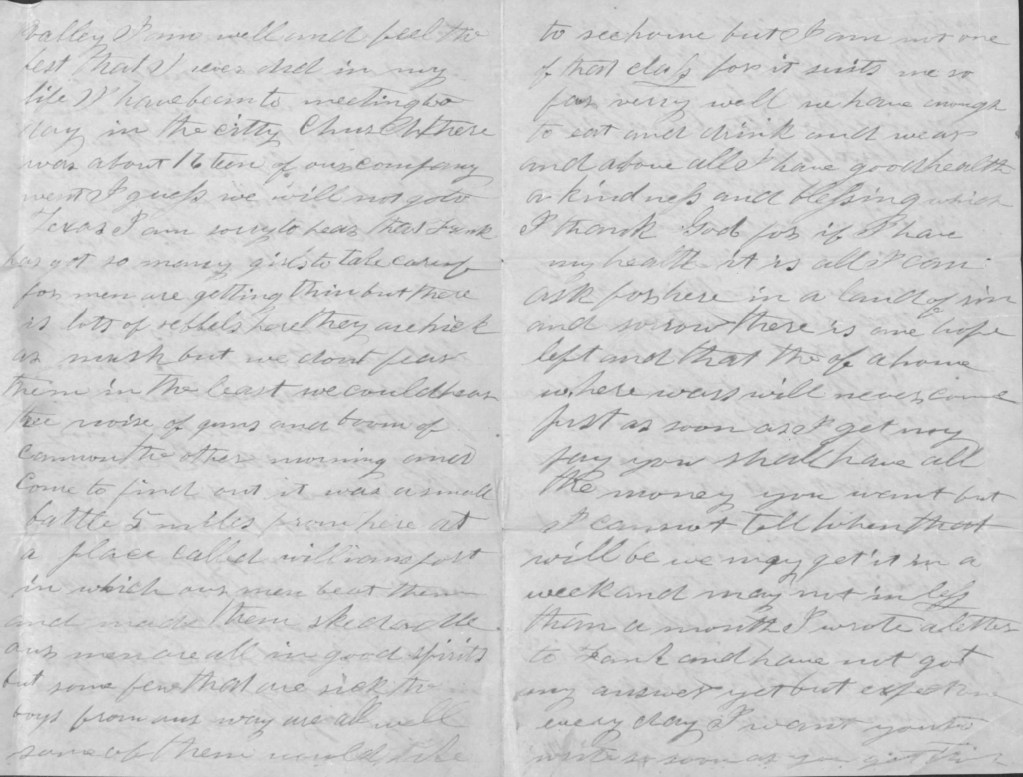
Hagerstown, Maryland November 30th 1862
Dear Mother,
I don’t suppose that you know that we are in Maryland. We have got among the rebels at last. We got into Hagerstown Tuesday night the 24th and are now in camp at this place. The letter that you sent to Pittsburg I got today and was glad to hear from you but you don’t tell me that you have got my clothes yet that I sent. I got the stamps and was glad of them for they are scarce here.
We left Pittsburg on Monday night and had a good ride of 349 miles. We passed through Harrisburg, Chambersburg and Carlisle—three handsome places. So I have crossed the Allegheny Mountains and am now in Cumberland Valley. I am well and feel the best that I ever did in my life.
I have been to meeting today in the city church. There was about 16 of our company went. I guess we will not go to Texas. I am sorry to hear that Frank has got so many girls to take care of for men are getting thin. But there is lots of rebels here. They are thick as mush but we don’t fear them in the least. We could hear the noise of guns and boom of cannon the other morning and come to find out it was a small battle 5 miles from here at a place called Williamsport in which our men beat them and made them skedaddle.
Our men are all in good spirits but some few that are sick. The boys from our way are all well. Some of them would like to see home but I am not one of that class for it suits me so far very well. We have enough to eat and drink and wear and above all, I have got good health—a kindness and blessing which I thank God for. If I have my health, it is all I can ask for here in a land of sin and sorrow. There is one hope left and that is a home where wars will never come.
Just as soon as I get my pay, you will have all the money you want but I cannot tell when that will be. We may get it in a week and may not in less than a month. I wrote a letter to Frank and have not got my answer yet but expect to everyday. I want you to write as soon as you get this. How long we will stay here, I know not but perhaps not long. There is a rumor in camp that we are a going to Western Virginia to stay this winter.
The weather is fine here and there is some talk of our being disbanded but I think it ain’t so. I could not bear to leave my company now. It would be like leaving home forever. There is no telling the love of a true Union man. His heart swells in his bosom for his fellow countrymen. But I must stop for the sheet is almost full. I want you to tell me if school has commenced. Give my respects to all. Direct your letters to Hagerstown, Camp Schoonmaker, Maryland, 4th Pa. Cavalry in care of Capt. W. Miles.
Letter 2
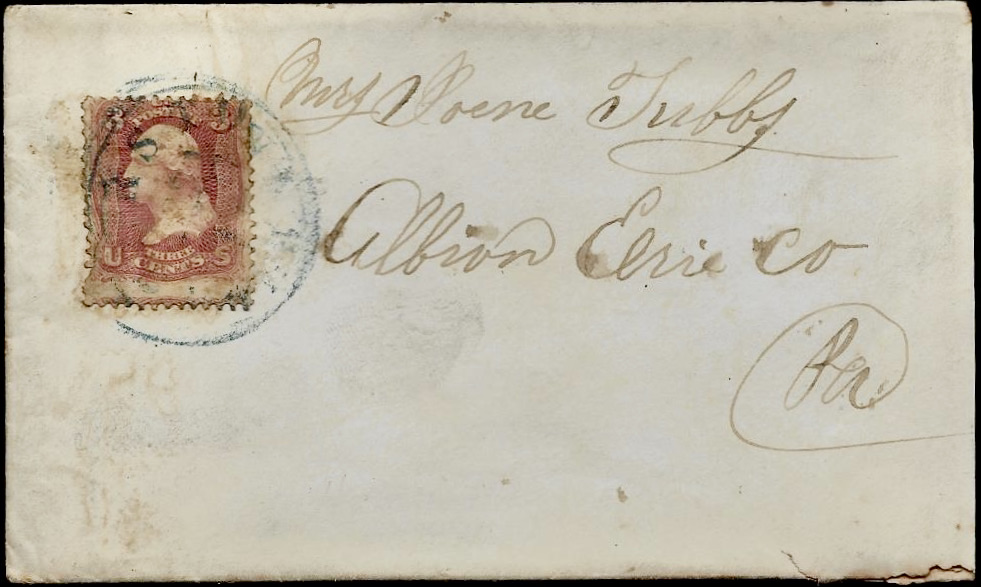
Addressed to Mrs. Joene Tubbs, Albion, Erie county, Pennsylvania
Hagerstown [Maryland] December 13th 1862
Dear Mother,
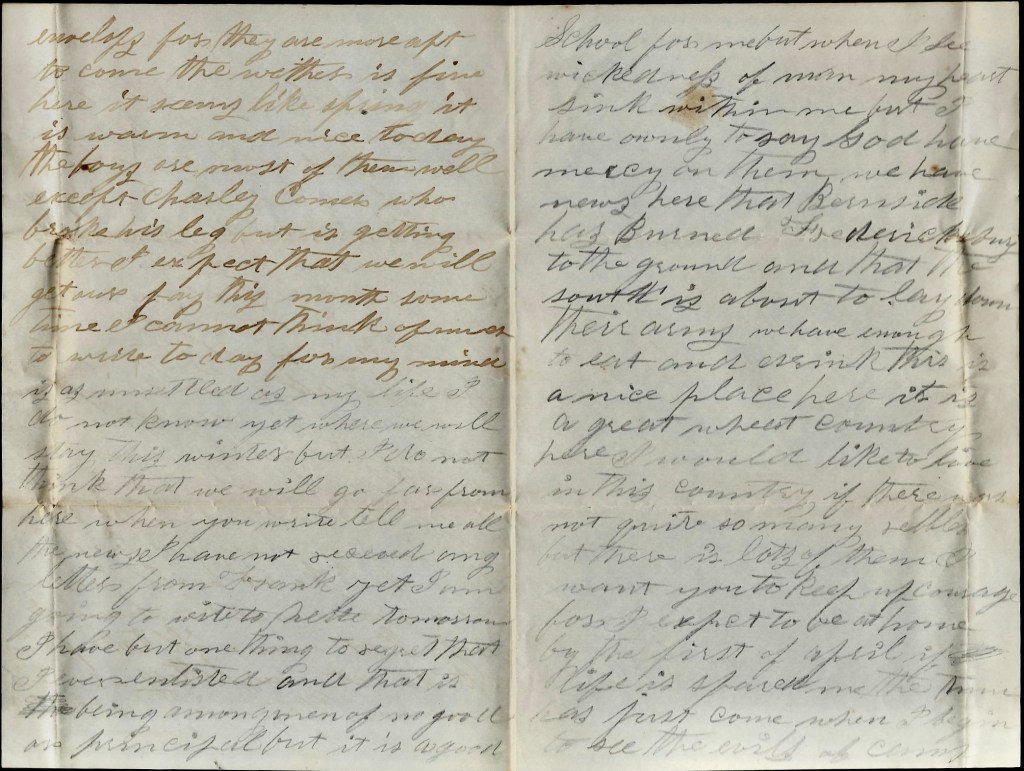
By the blessings of the God of Battles, I am yet permitted to live in peace and health and enjoy life as well as any soldier can. I have not received any answer to my last letter yet but may before this reaches you. We have got all our equipments, horses, and saddles. I have got a nice horse and a good one. The color of our horses is dark bays, We went out on drill on our horses today for the first time. I like it well. We have our savers and carbines. I hope that you will take pains to direct your letters as I tell you or they will not reach me and use plain paper envelopes for they are more apt to come.
The weather is fine here. It seems like spring. It is warm and nice today. The boys are most of them well except Charley [H.] Comer who broke his leg but is getting better. I expect that we will get our pay this month some time. I cannot think of more to write today for my mind is as unsettled as my life. I do not yet know where we will stay this winter but I do not think that we will go far from here.
When you write, tell me all the news. I have not received any letter from Frank yet. I am going to write to Nette tomorrow. I have but one thing to regret that I ever enlisted, and that is being among men of no good of principle. But it is a good school for me. But when I see wickedness of men, my heart sinks within me. But I have only to day, God have mercy on them.
We have news here that Burnside has burned Fredericksburg to the ground and that the South is about to lay down their arms.
We have enough to eat and drink. This is a nice place here. It is a great wheat country here. I would like to live in this country if there was not so many rebels but there is lots of them.
I want you to keep up courage for I expect to be at home by the first of April if life is spared me. The time has just come when I begin to see the evils of camp. After a certain period, the thought of love and peace seems to leave men and they are more like demons than anything else. But you must not think that this is a bad place for it is good too. [But] what will it will be unless there is a change in mankind.
I have to go on duty now so I must stop writing for the men are getting merry and want me to make them work and I can do it up right.
Direct to Hagerstown, Maryland, 14th Regt. Penn. Cavalry. in care of Capt. W[illiam] W. Miles’ Company, — E. F. Tubbs and no more.
Letter 3
[Note: This letter was found in the Widow’s Pension File]
Harper’s Ferry, Va. February 21 [1863]
Dearest Mother,
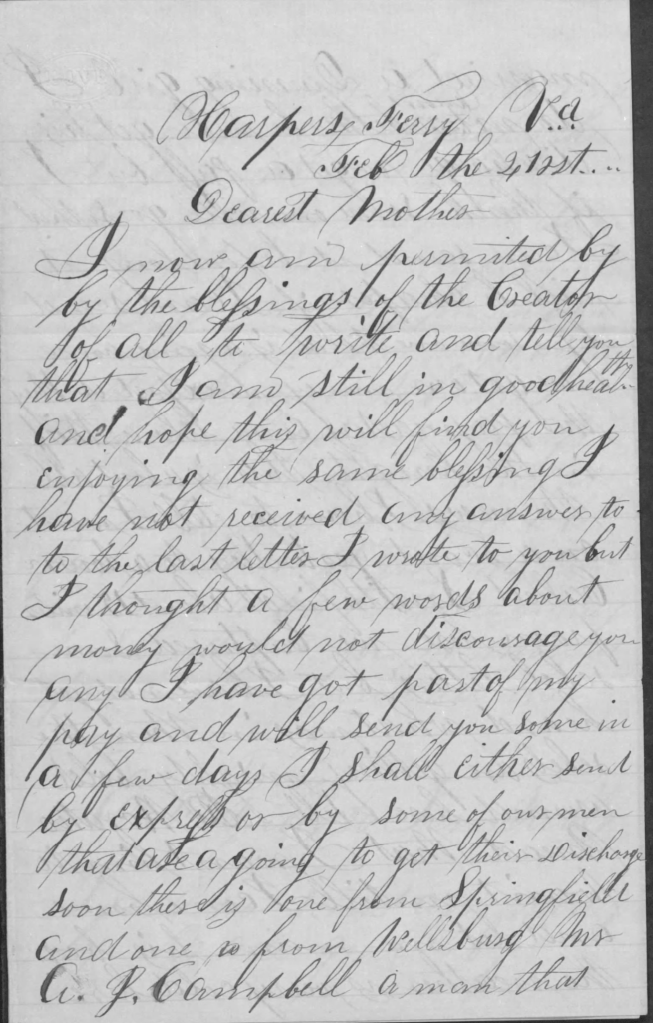
I now am permitted by the blessings of the Creator of all to write and tell you that I am still in good health and hope this will find you enjoying the same blessing. I have not received any answer to the last letter I wrote to you but I thought a few words about money would not discourage you any. I have got part of my pay and will send you some in a few days. I shall either send by Express or by some of our men that are a going to get their discharge soon. There is one from Springfield and one from Wellsburg—Mr. Campbell, a man that married a Dunning girl. I do not know whether he will get his discharge or get a pass but I think someone will go so that I can send it before long. It will be cheaper if I can send by someone that is a going home. We got our money unexpected. The paymasters come like a thief in the night. This is about all of the news I have to tell.
I went on a scout yesterday to a town called Smithfield about 15 miles from here. We captured some rebel lettrs but I have not yet heard what was in them. The rebels are getting mighty bold around here. Tell Horatio Mead that I want him to wait until I come home and let me name his boy.
The weather is very cold here. It is snowing here now and blowing some too. It makes the old tent real and twist. It rather disturbs me while I am writing but I shan’t complain as long as I can stay in my tent. We have a good fire. We get hickory and oak wood to burn.
I think I will get y likeness in uniform and send it home. So soon as it gets to be fair weather, it gives me new courage to get a little money to send to you. No more at present but write all the news.
From E. F. Tubbs to Irene Tubbs.
I shall not send any money by mail. Goodbye.
Letter 4
Harper’s Ferry, Va. May 9th 1863
Dearest Mother,
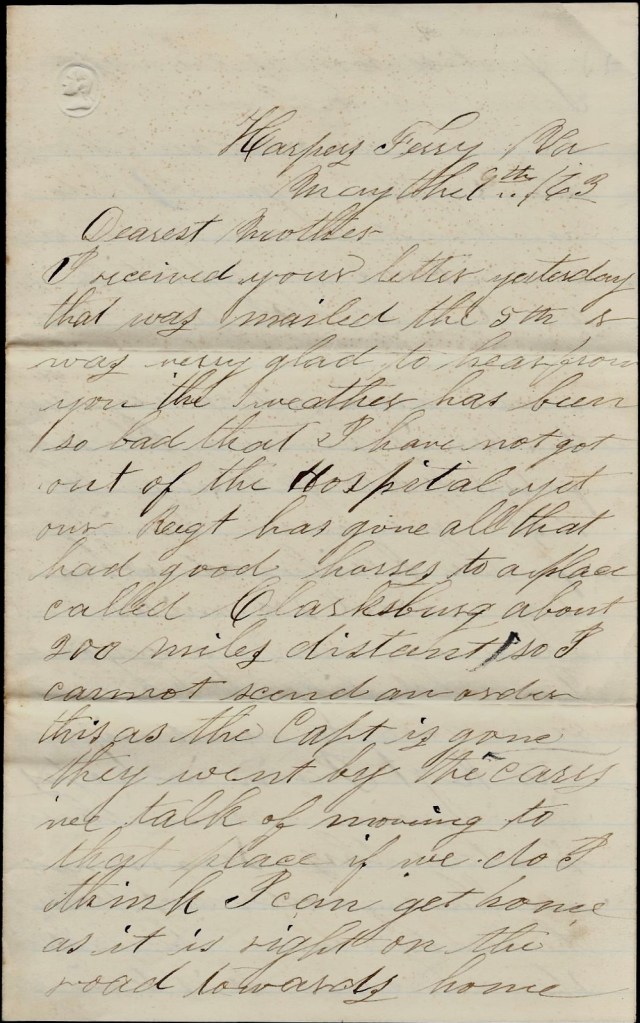
I received your letter yesterday that was mailed the 5th. I was very glad to hear from you. The weather has been so bad that I have not got out of the hospital yet. Our regiment has gone—all that had good horses—to a place called Clarksburg, about 200 miles distant, so I cannot send an order [with] this as the captain is gone. They went by the cars. We talk of moving to that place. If we do, I think I can get home as it is right on the road towards home. Just so soon as the captain comes back, I will send you an order and have the captain sign it. I do not know when they will come back.
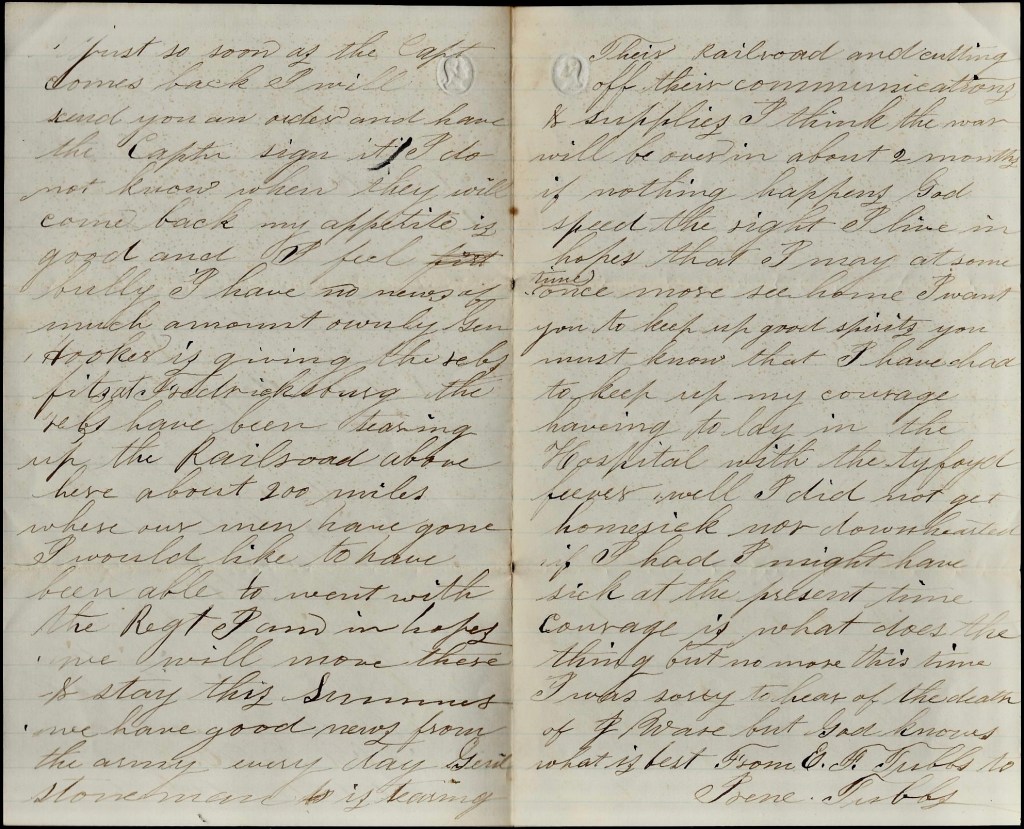
My appetite is good and I feel bully. I have no news of much amount—only General Hooker is giving the rebs fits at Fredericksburg. The rebs have been tearing up the railroad above here about 200 miles where our men have gone. I would like to have been able to went with the regiment. I am in hopes we will move there & stay this summer. We have good news from the army every day. General Stoneman is tearing their railroad and cutting off their communications & supplies. I think the war will be over in about two months if nothing happens. God speed the right. I live in hopes that I may at some time once more see home. I want you to keep up good spirits. you must know that I have had to keep up my courage having to lay in the hospital with the typhoid fever.
Well, I did not get homesick nor downhearted. If I had, I might have [been] sick at the present time. Courage is what does the thing. But no more this time. I was sorry to hear of the death of J. Boase [?] but God knows what is best.
From E. F. Tubbs
To Irene Tubbs
Letter 5
Harper’s Ferry, Va, May 19th 1863
Dearest Mother,
I now take my time to answer the letter that George Dunning brought to me. I was very glad to see someone from our past. I am glad that you sent the butter. It is so dear here in this place but is all I care about. I’m now in camp and am in good spirits and am gaining strength fast. You ask how sick I was. I was what would be called up in our place most awful sick with the fever but my pluck was good. I did not allow myself to think of home but I am now most well. My appetite is bully but I have to be careful what I eat. I ride a little most every day now. I will tell you why I thought that you thought that I did not care anything about home. It was by the letter that you wrote & if you think they don’t say as when I have the letters to show for all that I have said, but I will let that drop. I shall try to get a furlough about the [illegible]…if we stay here. And if we go to a place called Wheeling, Va., I will try to come sooner.
I have no news to write. I will send you a 25 cents piece that I found in the streets Old Virginia by George Dunning. I am, thank God, and have been most of the time able to write my own letters. I got J. Pratt to write one for me & that was all. Pratt has got his discharge and gone to York STate where his mother-in-law lives., his wife being there.
I am glad you sent the rest of the stripe for it makes just enough for they would cost me 75 cents here. I have bought me a hat for summer. It cost $2.25 in Harper’s Ferry. I rode down to the Ferry today. I want you to enjoy yourself the best way you can. Sell everything there is and use it to suit yourself. I drawed my first pay but I shall not send any home this time while I am sick. I used considerable to buy something to eat for I could not eat anything they had in the hospital. But if I do not come home next pay day I can send you some money. You can have your choice. I will come home or will send you the money. I think the money would do you more good than it would for me to come home.
But no more this time. If you ever have a chance to send anything, send butter. I’d rather have it than anything else. Keep up good courage. The war won’t last always. So goodbye, from your son, –E. F. Tubbs
Letter 6
[Note: This letter was found in the Widow’s Pension File.]
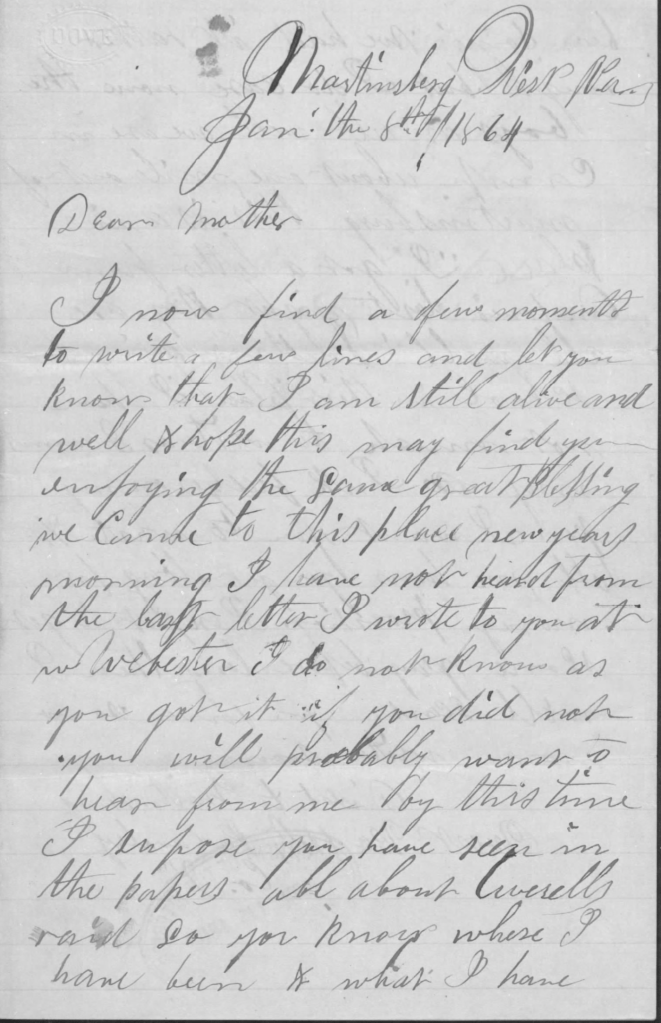
Martinsburg, West Virginia January 8th 1864
Dear Mother,
I now find a few moments to write a few lines and let you know that I am still alive and well & hope this may find you enjoying the same great blessing. We came to this place New Year’s morning. I have not heard from the last letter I wrote to you at Webster. I do not know as you got it. If you did not, you will probably want to hear from me by this time.
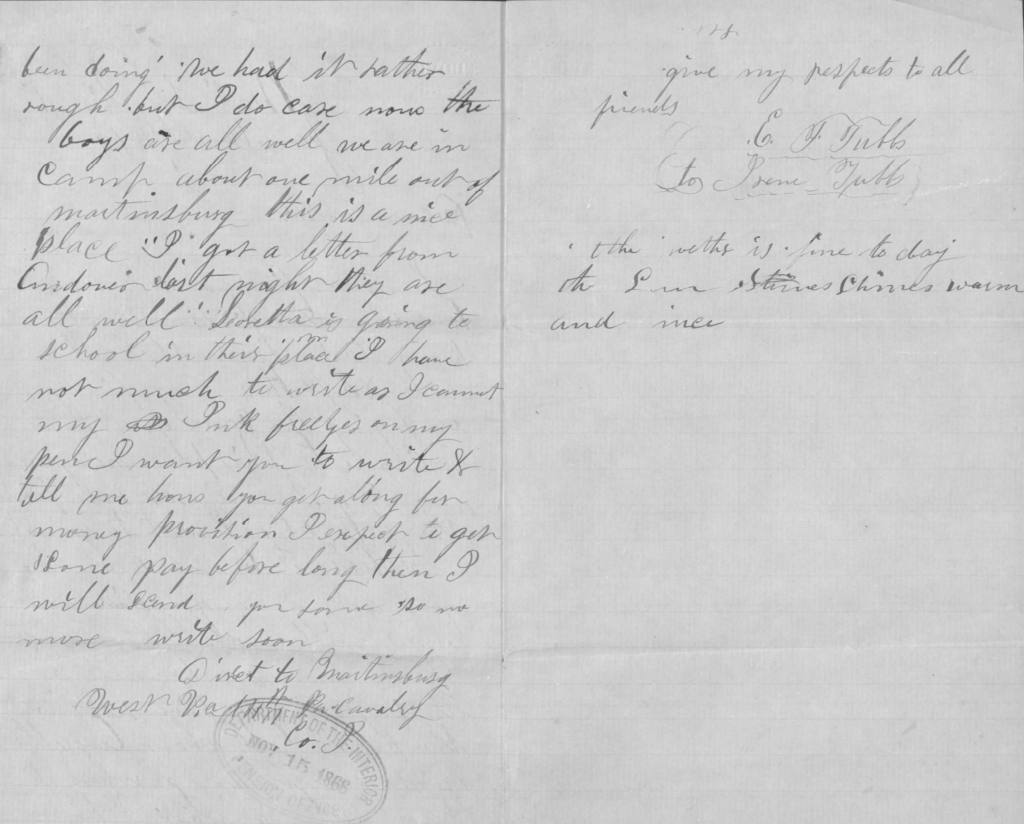
I suppose you have seen in the papers all about Averills’ raid so you know where I have been & what I have been doing. We had it rather rough but I don’t care now. The boys are all well. We are in camp about one mile out of Martinsburg. This is a nice place.
I got a letter from Andover last night. They are all well. Loretta is going to school in their place. I have not much to write as I cannot. My ink freezes on my pen. I want you to write and tell me how you get along for money and provisions. I expect to get some pay before long. Then I will send you some. So no more. Write soon.
Direct to Martinsburg, West Va., 14th Pa. Cav. Co. I.
Give my respects to all friends, — E. F. Tubbs
The weather is fine today. The sun shines warm and nice.
Letter 7
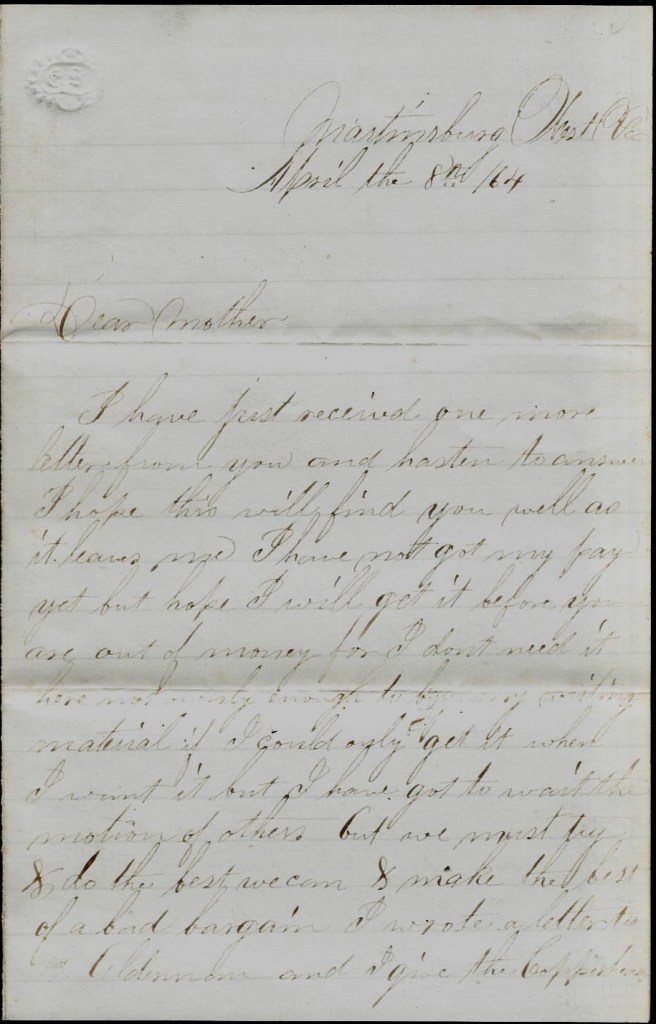
Martinsburg, West Virginia April 8, 1864
Dear Mother,
I have just received one more letter from you and hasten to answer. I hope this will find you well as it leaves me. I have not got my pay yet but hope I will get it before you are out of money for I don’t need it here, only enough to buy my writing material—if I could only get it when I want it—but I have got to wait the motion of others. But we must try and do the best we can & make the best of a bad bargain.
I wrote a letter to the Alderman and I give the Copperheads their just dues of course. What do I care if he is one of that class. So much the better for me. I intend to whip them by word and by sword. You say [he] showed you my letter. Well that is no [smudged] to him. I write to one person at a time when I write to the people of Pennsylvania generally. Then I’ll write and have it put in the Ledger or the Tribune. But when I write to one person, it is not shown by my request to anyone else. I am capable of writing to all and to write all the news if anything occurs worthy of mention.
I wrote to Thompson’s some time ago but have not had any answer yet. Tell them to call the boy Bill Averill for me. That’s all.
Well, I must now take a few lines to tell you how the boys are. Campbell has gone to the hospital again. He went today and our Orderly Holiday. There is more sickness in our regiment than I ever knew at one time before but I guess I have said enough for this time. Everything is quiet. Some talk of our moving to Old Beverly again but I hope it won’t be as I do not want to go to that place. But good night. Write soon.
— E. F. Tubbs
To Mrs. Irene Tubbs
Letter 8
[Note: This letter was found in the Widow’s Pension File.]
Camp in Cedar Grove Bunker Hill, Va. May 9th 1864
Dear Mother,
It is with shame for neglect of not trying to write before that I am now going to tell you where I am and as near as I can what I have been doing. We left Martinsburg on the 29th day of April, marched to this place, camped over night and mustered for pay the next day. And the next day we marched to Winchester and remained at that place until May 5th. Our regiment was then ordered back to Bunker Hill to keep the way open for communication from Martinsburg to Winchester as our army is there at present. Things change fast. Every day brings its change.
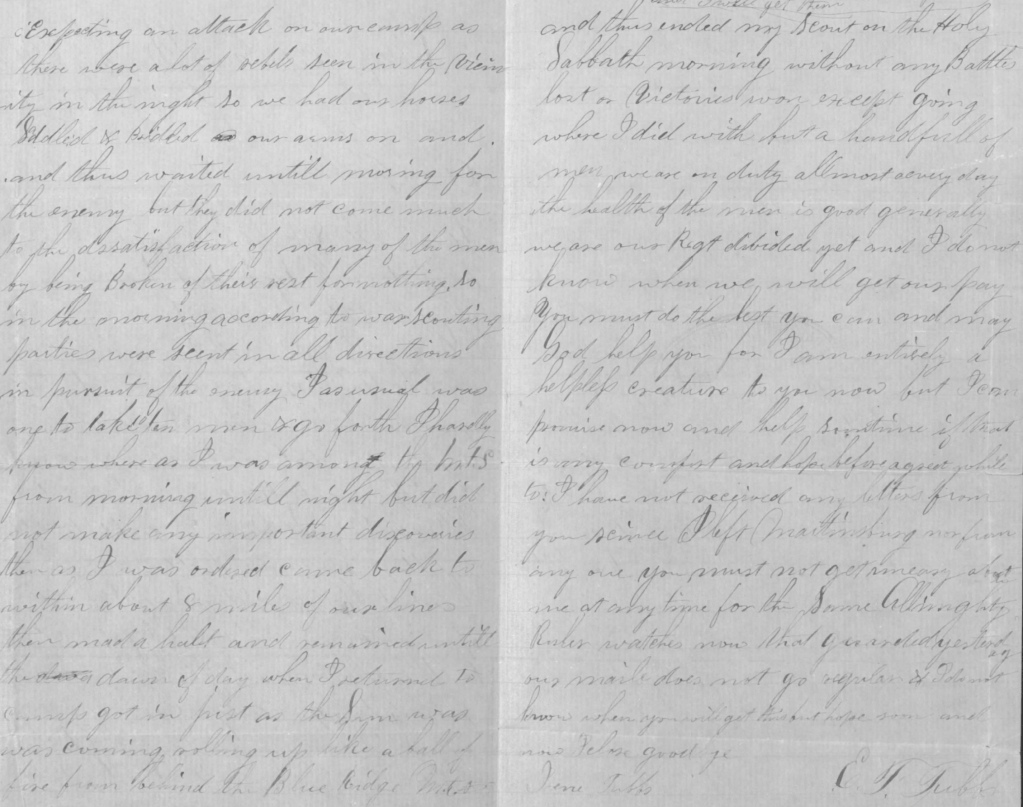
Night of Friday last, we were up all night in camp expecting an attack on our camp as there were lot of rebels seen in the vicinity in the night so we had our horses saddled and bridled, our arms on, and thus waited until morning for the enemy but they did not come much to the dissatisfaction of many of the men by being broken of their rest for nothing.
So in the morning, according to war, scouting parties were sent in all directions in pursuit of the enemy. I as usual was one to take ten men and go forth [but] I hardly know where as I was among the hats from morning until night but did not make any important discoveries then. As I was ordered to come back to within about 8 miles of our lines, then made a halt and remained until the dawn of day when I returned to camp. Got in just as the sun was coming rolling up like a ball of fire from behind the Blue Ridge Mountains, and thus ended my scout on the Holy Sabbath morning without any battles lost or victories won except going where I did with but a handful of men.
We are on duty almost every day. The health of the men is good generally. We are divided yet and I do not know when we will get our pay. You must do the best you can and may God bless you for I am entirely a helpless creature to you now. But I can promise now and help sometime if that is any comfort and hope before a great while to. I have not received any letters from you since I left Martinsburg nor from anyone. You must not get uneasy about me at anytime for the same Almighty Ruler watches now that guarded yesterday. Our mail does not go regular & I do not know when you will get this. Hope soon. And now I close. Goodbye. — E. F. Tubbs
Letter 9
Camp on the hill in Martinsburg Entirely out of danger May 16th 1864
Dear Mother,
I am at this present time sitting on a bag of oats which I have got for my horse, and as I am where there is a chance to send a letter which I think will reach you, I thought to write a few lines & let you know that I am well. I hope this may find you the same.
I came into this place yesterday from the front at Woodstock where Gen. [Franz] Sigle was when we left that place but we hear that he has advanced and had a small fight and drove the rebels 16 miles. I wrote a letter to you when I was at Bunker Hill but I do not know whether you ever got it or not, so I thought I would write another. I have not had a letter since the 28th of April. I do not know where our letters go. Our regiment is split up so. The 14th is in so many places—that I expect is the reason we do not get our letters.
We left Bunker Hill and went to Woodstock on the 11th of May and on the 12th we went to a place called Front Royal which you have heard of so much. On the 13th we went back to Woodstock via Strasburg and on the 14th at about 4 o’clock p.m. we started for this place. [There were] 100 of us, 25 of our regiment and 75 of the 21st [?]. We came here to guard a train back. We got in here on the 15th about noon so you see today is the first day’s rest we have had in some length of time. We rode all night Saturday night and it has rained almost all of the time. I expected to have went back today but I think we will remain here over night as it is sunset and our train is not ready.
We have good news from Grant. It is reported that Lee has surrendered his whole army but I do not know how true it is yet hope it may be true. The most trouble we have is with the guerrillas. They try to capture our wagon trains. We have over 50 miles to haul provisions to the army now under Sigel.
But it is getting late and I must close so good night. Direct your letters as before. Give my respects to all that are worthy of them.
— E. F. Tubbs
Letter 10
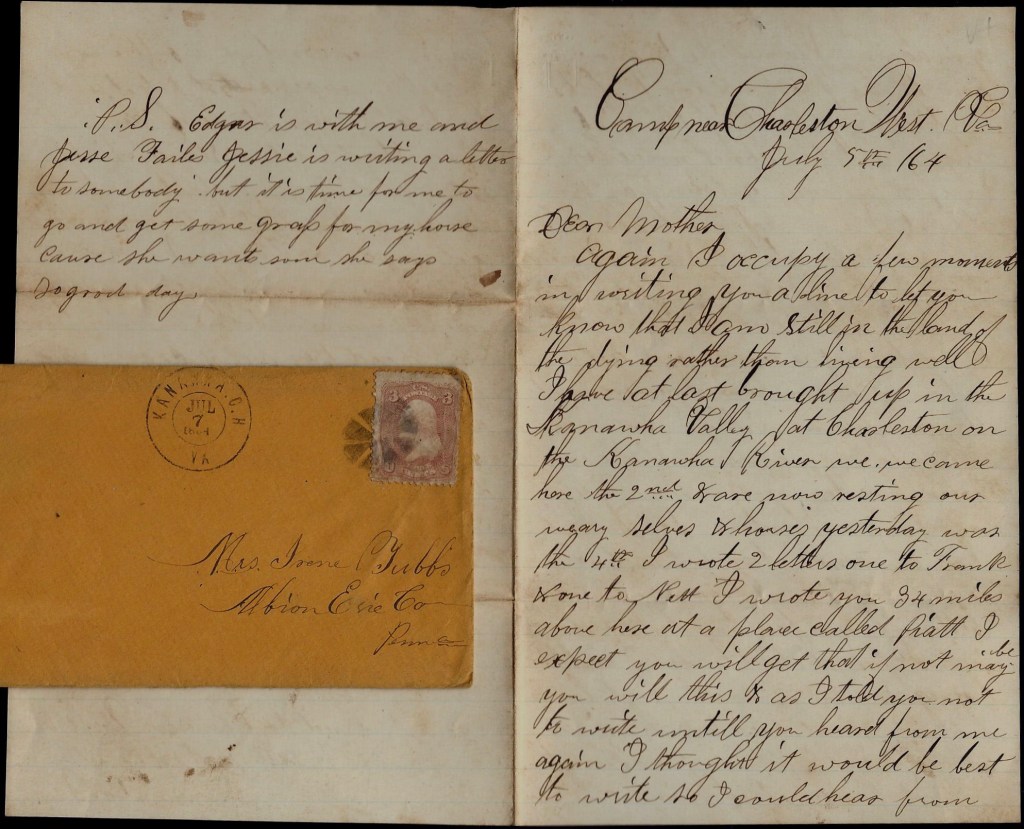
Camp near Charleston, West Virginia July 5, 1864
Dear Mother,
Again I occupy a few moments in writing you a line to let you know that I am still in the land of the dying rather than living well.
I have at last brought up in the Kanawah Valley at Charleston on the Kanawha river. We came here the 2nd and are now resting our weary selves and horses. Yesterday was the 4th. I write two letters—one to Drank and one to Nett. I wrote you 34 miles above here at a place called Piatt. I expect you will get that. If not, maybe you will this. And as I told you not to write until you heard from me again, I thought I could hear from you again. I would like to know how things prosper & how the folks sagtiate [?] up North—if they find anything to talk about now-a-days. I expect we will get our pay soon—at least I am really in hopes so. It has been a long time since I sent you any [money] but I could not help it as I could not get it.
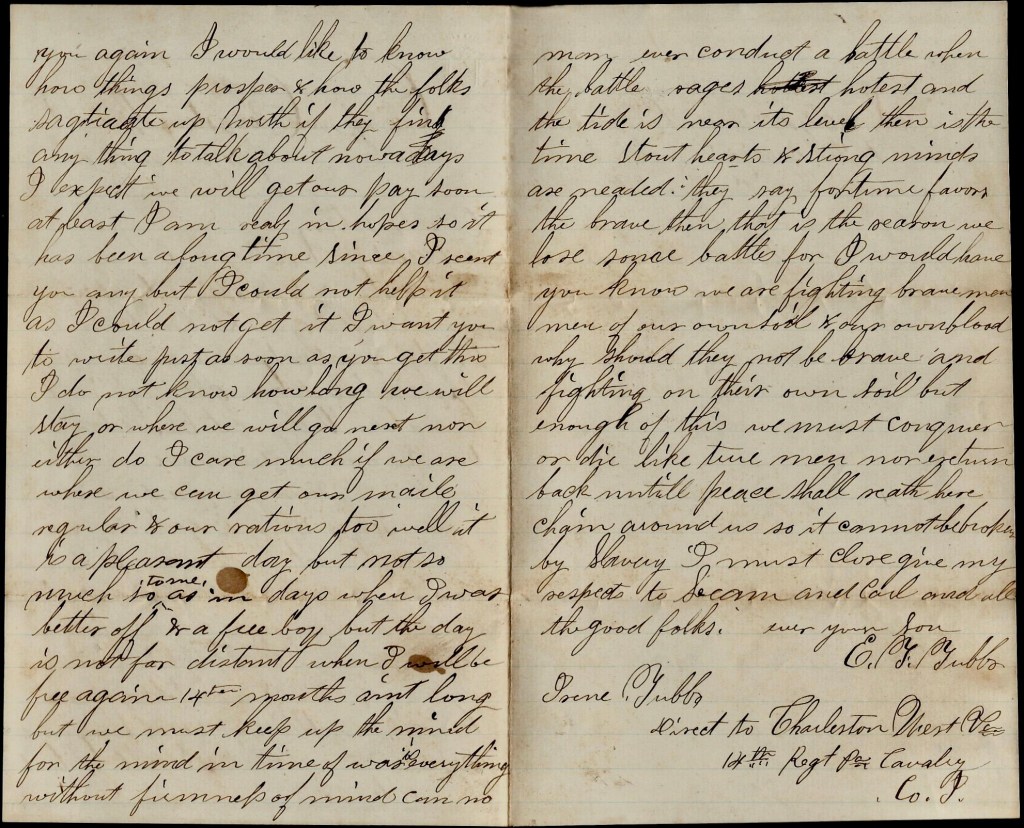
I want you to write just as soon as you get this. I do not know how long we will stay or where we will go next. Nor do I care much if we are where we can get our mails regular and our rations too.
Well, it is a pleasant day but not so much so to me as in days when I was better off & a free boy. But the day is not far distant when I will be free again. 14 months ain’t long. But we must keep up the mind for the mind in time is everything without firmness of mind can no more ever conduct a battle when the battle rages hottest and the tide is near its level, then is the time stout hearts and strong minds are needed, they say, for time favors the brave. Then that is the reason we lose some battles for I would have you know we are fighting brave men—men of our own soil and our own blood. Why should they not be brave and fighting on their own soil?
But enough of this. We must conquer or die like true men, nor return back until peace shall reach her chain around us so it cannot be broken by slavery. I must close.
Give my respects to Sam and Carl and all the good folks. Ever your son, — E. F. Tubbs
Direct to Charleston, West Virginia, 14th Regt. Pa. Cavalry, Co. I
P. S. Edgar is with me and Jessie Failes. Jessie is writing a letter to somebody but it is time for me to go and get some grass for my horse cause she wants some. She says so. Go day.
Letter 11
Gallipolis, [Ohio] August 22, 1864
Dear Mother,
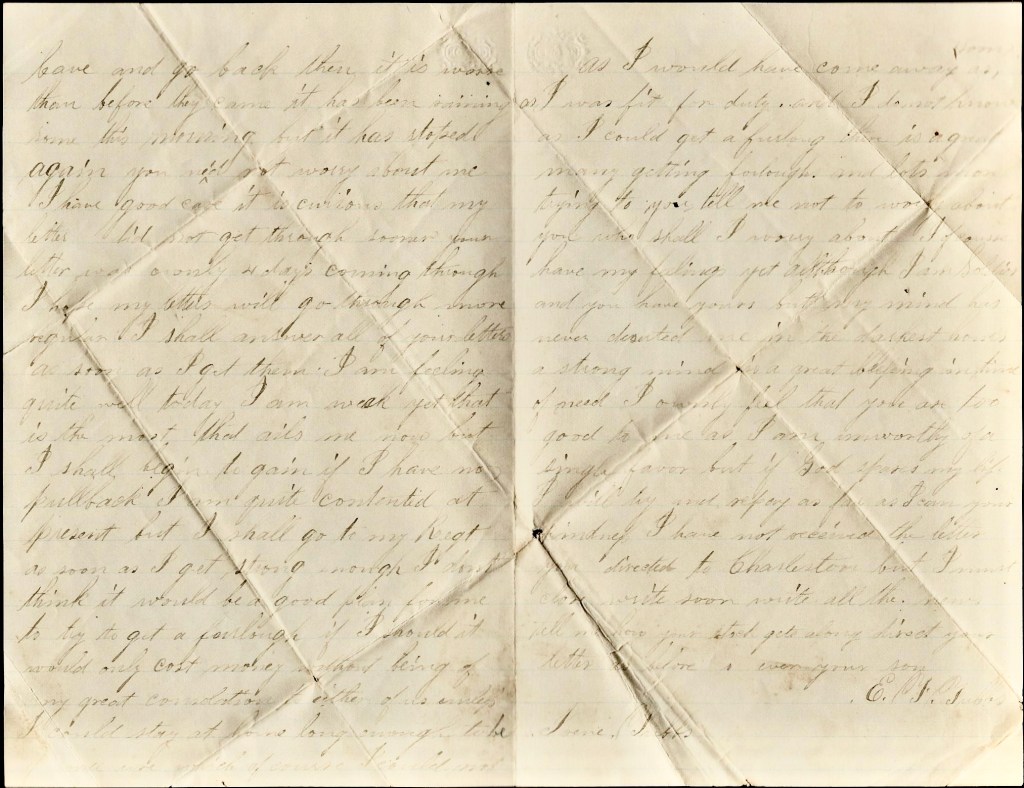
I have just received your letter of the 28th date but mailed at West Greenville. How does it happen to be mailed at that place? I got the 5 dollars safe but I did not expect you were going to send me money. I could get along some way until I got my regimental [pay] but I thank you with all my heart for your kindness. I hope I will be allowed the privilege of repaying you before long.
I am still improving slowly. It may seem strange but would not want you to come here if you could because it would make me worse. There is a great many mothers, fathers, brothers and sisters come here and cry around a day or two and then they have to leave and go back. Then it is worse than before they came.
It has been raining some this morning but it has stopped again. You need not worry about me. I have good care. It is curious that my letter did not get through sooner. Your letter was only 4 days coming through. I hope my letters will go through more regular. I shall answer all of your letters as soon as I get them. I’m feeling quite well today. I am weak yet. That is the most tha ails me now but I shall begin to gain if I have no fallback. I am quite contented at present but I shall go back to my regiment as soon as I get strong enough. I don’t think it would be a good play for me to try to get a furlough. If I should, it would only cost money without being of any great consolation to either of us unless I could stay at home long enough to be [illegible]…
There is a great many getting furloughs and lots now trying to. You tell me not to worry about you. What shall I worry about? I of course have my feelings yet although I am a soldier and you have yours. But my mind has never deserted me in the darkest hours. A strong mind is a great blessing in times of need. I only feel that you are too good to me as I am unworthy of a single favor. But if God spares my life, I will try and repay as far as I can your kindness. I have not received the letter you directed to Charleston but I must close. Write soon. Write all the news. Tell me how your stock gets along. Direct your letter as before. As ever, your son, — E. F. Tubbs
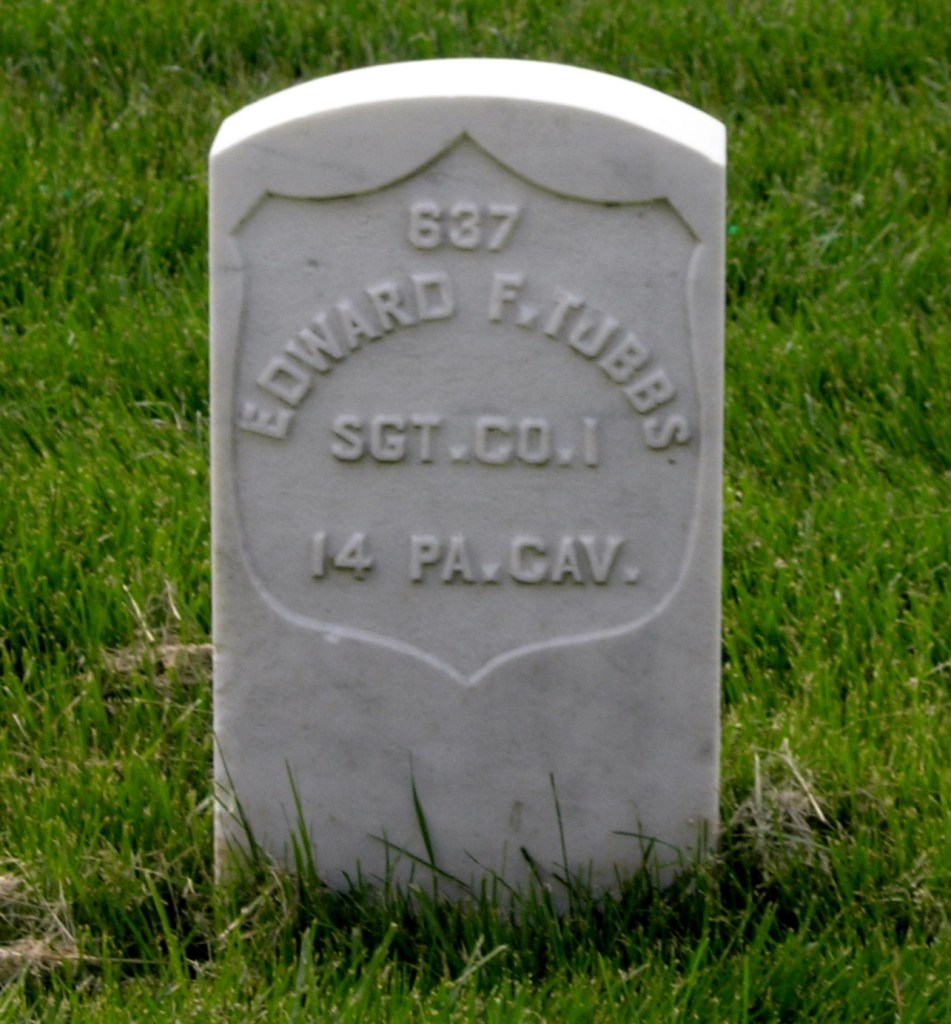
Sgt. Edward F. Tubbs’ Headstone in Winchester National Cemetery
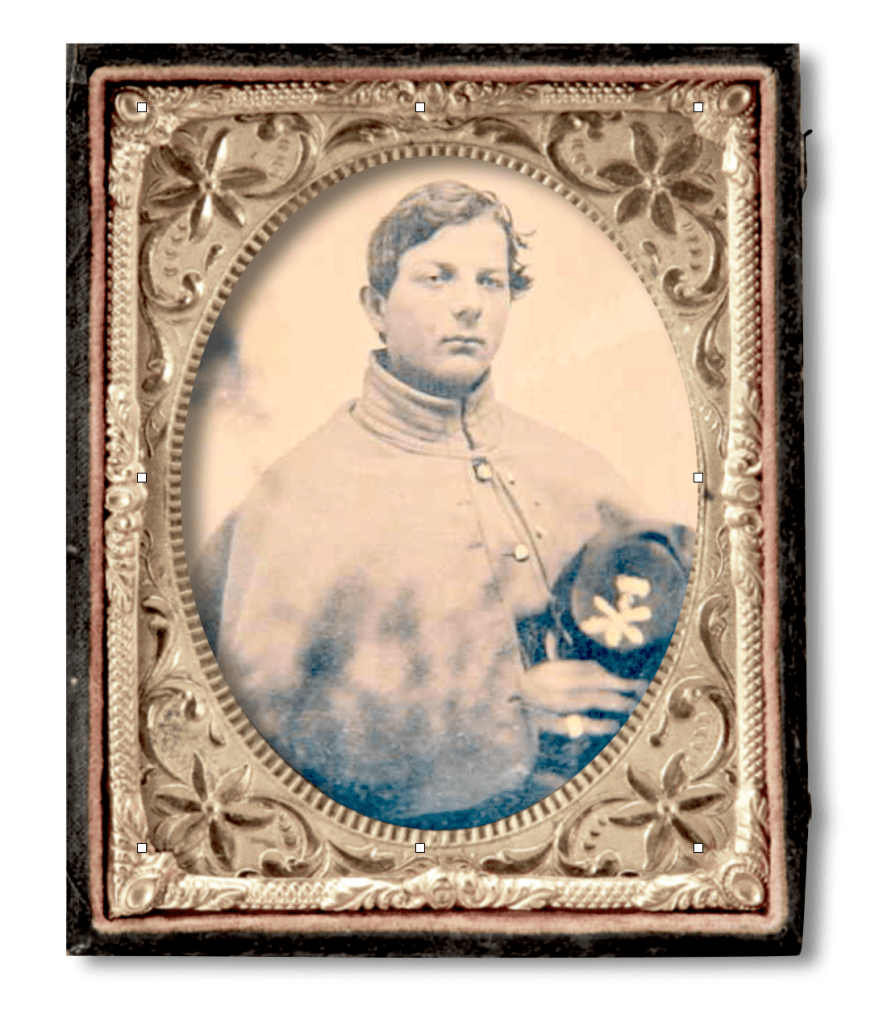
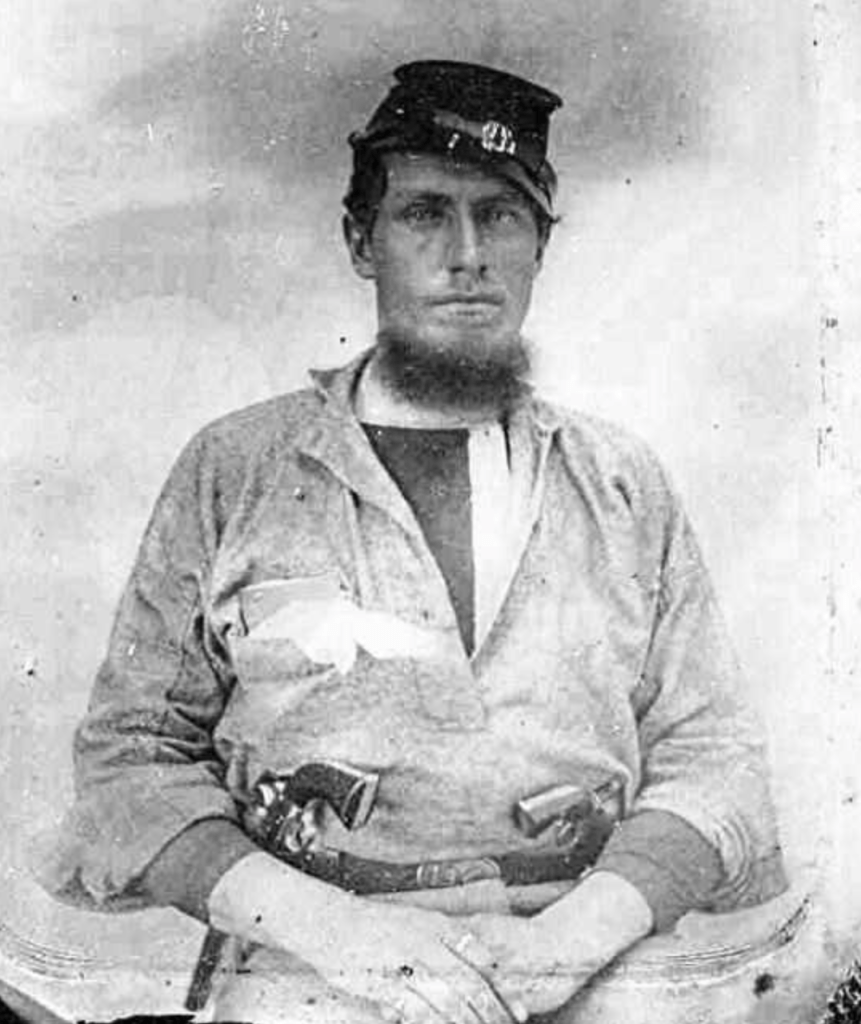
I could not find an image of Ben but here is Orlando Schooley who served in Co. G, 18th Illinois Infantry (Ancestry)
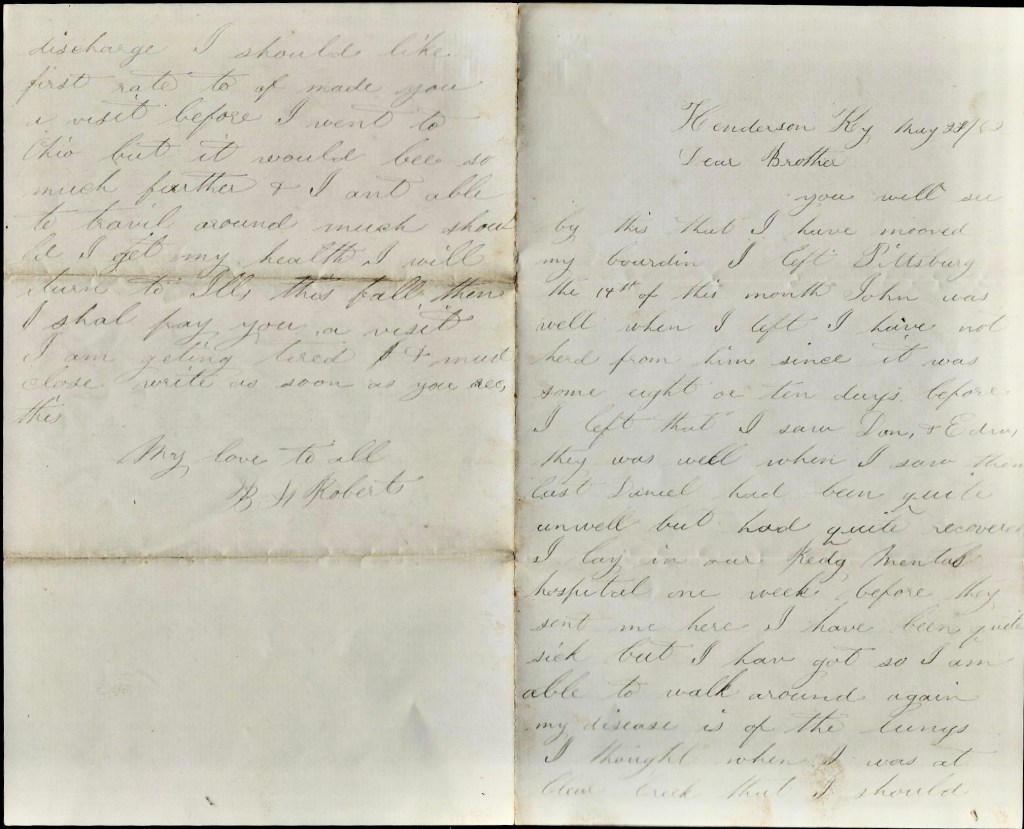
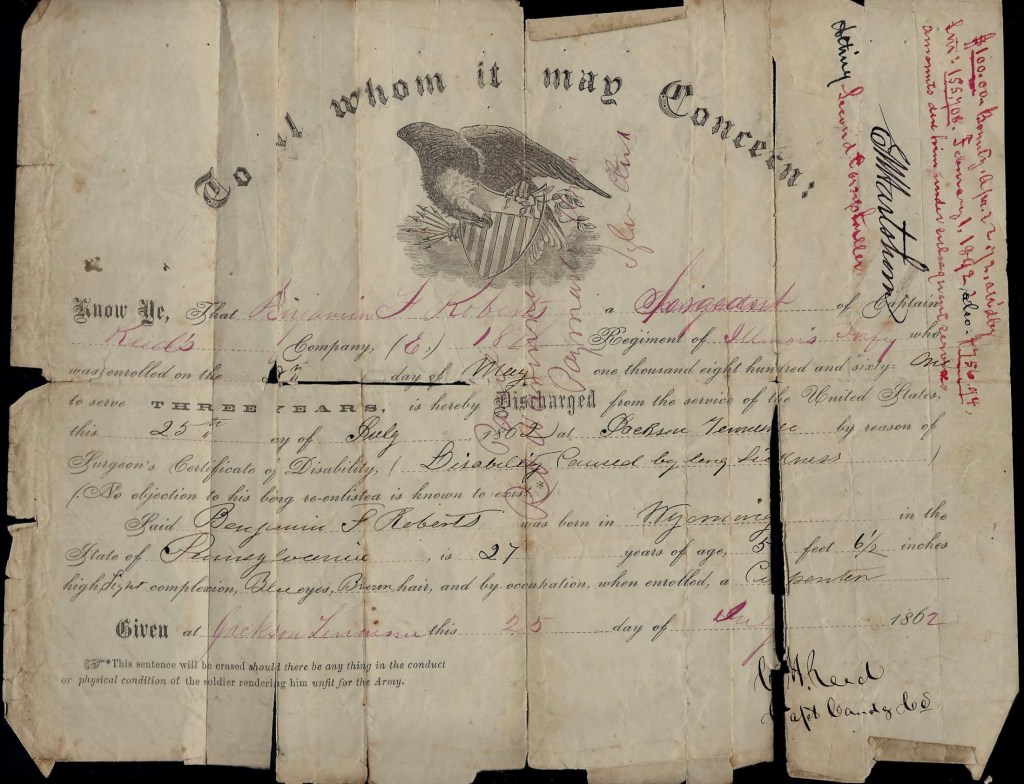
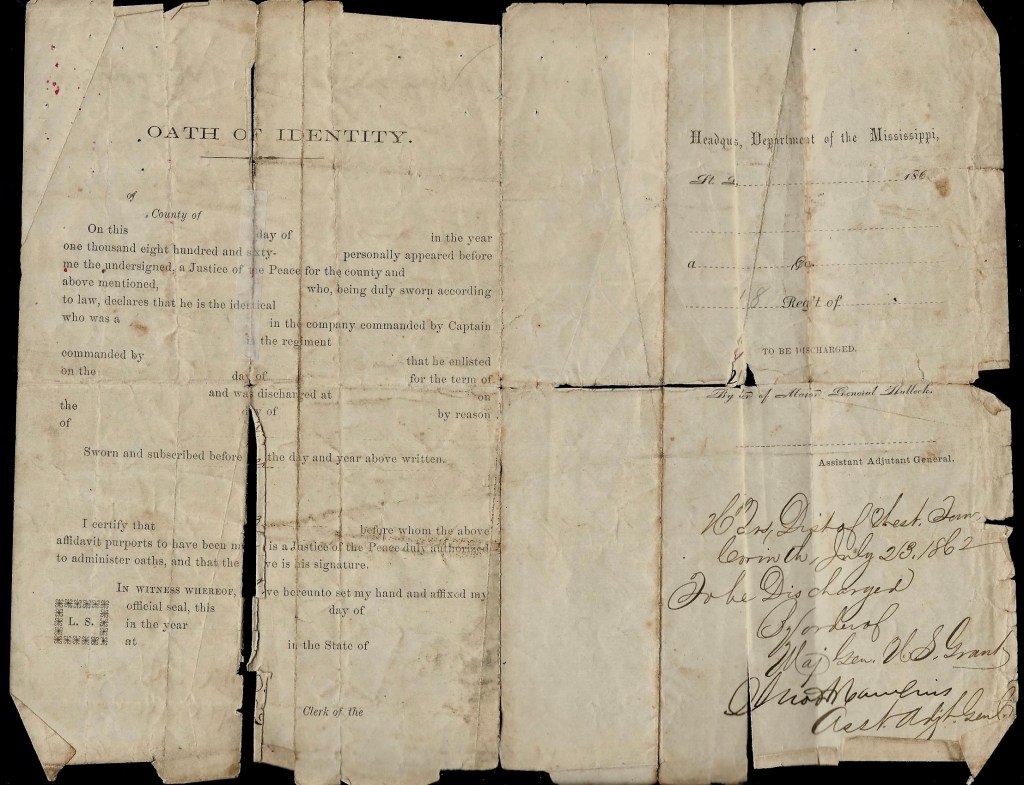
The following letter was written by Benjamin F. Roberts (1835-18xx), a native of Wyoming county, Pennsylvania, who was earning his living as a farmer in Clear Creek township, Alexander county, Illinois at the time the Civil War began. When he enlisted as a sergeant in Co. E, 18th Illinois Infantry on 28 May 1861, he was described as a 5 foot 7 inch tall, brown-haired, blue-eyed, single, 26 year-old carpenter. Ben became seriously ill in the spring of 1862 and had to be discharged for disability in July 1862.
The 18th Illinois Infantry saw its first major action at Fort Donelson in February 1862 where it occupied the right of Oglesby’s brigade, on the right of the line of battle, and during the second day’s fight lost 200 men in killed and wounded, 50 dying upon the field and 10 soon afterward. The regiment during the battle bravely and persistently maintained the position to which it was assigned in the early morning, and not until its ammunition was spent was the order to retire given.
You will see by this that I have moved my boarding. I left Pittsburg [Landing] the 14th of this month. John was well when I left. I have not heard from him since. It was some eight or ten days before I left that I saw Don & Edw. They was well when I saw them last. Daniel had been quite unwell but had quite recovered. I lay in our regimental hospital one week before they sent me here. I have been quite sick but I have got so I am able to walk around again. My disease is of the lungs. I thought when I was at Clear Creek that I should quit trying to soldier but went back to my regiment feeling pretty well [and] concluded I would stay to see the ball out at Corinth. But my health would not permit it. I would of got my discharge before I left Corinth but we only had about one hour’s notice of leaving & I had no time to attend to it. My physician told me I would get my discharge, go where I might, but they han’t the power to grant discharges here. Our surgeon has offered me my discharge several times but I did not want one as long as there was any hope of my recovering my health.
I have finally come to the conclusion that I will take a discharge as soon as I can get one for from experience I find I can’t stand the service. I expect I will remain here until I can obtain my discharge. This is a very pleasant place and considered very healthy. We occupy a large three-story brick building for our hospital here. Henderson is the county seat of Henderson county. It is one hundred and fifty miles above Paducah on the [Ohio] river. We have plenty to eat and kind attendance here although I want to get home for I think I would recover my health. I am tired taking medicine for I have taken so much the last year & done so little good that I have no confidence in it. I have written home since I came here but it is not time for an answer yet. I shall go home as soon as I get my discharge. I should like first rate to of made you a visit before I went to Ohio but I would be so much farther & I ain’t able to travel around much. Should I get my health, I will return to Illinois this fall. Then I shall pay you a visit. I am getting tired & must close. Write as soon as you see this.
























 Spared & Shared 23