My passion is studying American history leading up to & including the Civil War. I particularly enjoy reading, transcribing & researching primary sources such as letters and diaries.
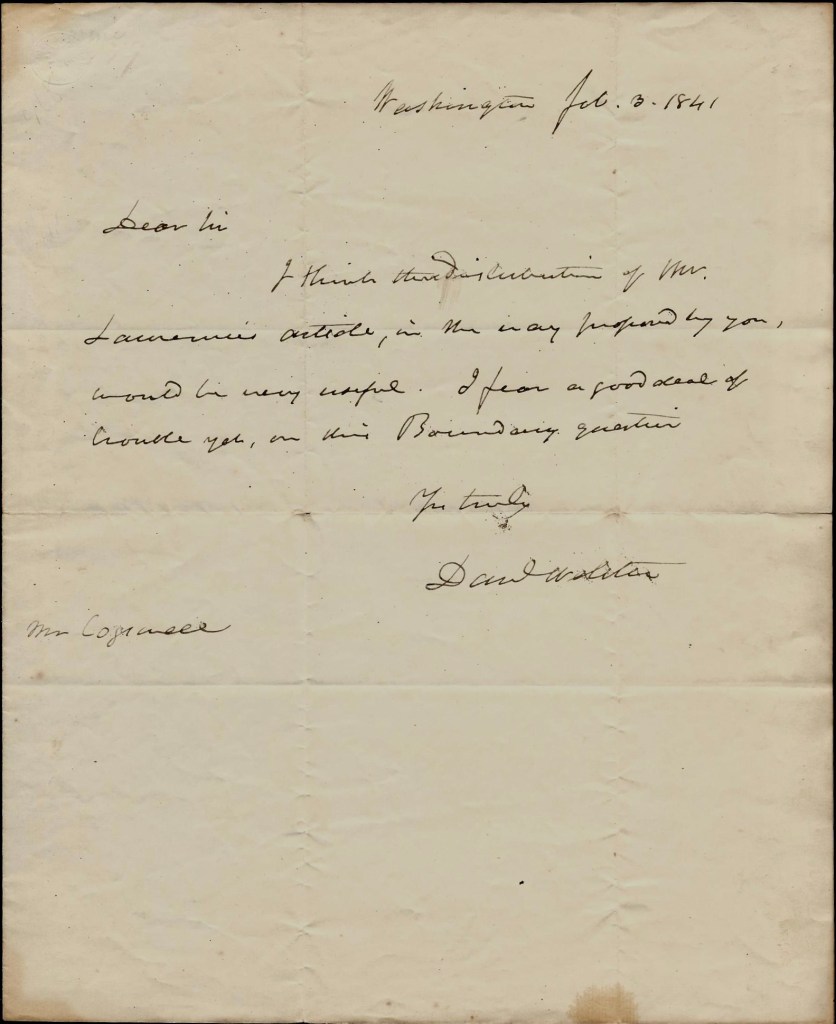
The following brief letter was penned by Daniel Webster (1782-1852)—the great American statesman and Senator from Massachusetts—in early February 1841. While officially still a senator at the time, Daniel had already been offered the first cabinet post as Secretary of State in the newly elected Whig administration of William Henry Harrison. He accepted the post at a critical time as the tensions between the United States and England had grown to a feverish pitch over the disputed boundary between the two countries in the rapidly developing Oregon Territory. Webster’s appointment had an immediate calming effect on the American population but he knew the matter could not be resolved without lengthy diplomatic negotiations. In fact it would take another five years before the Oregon Treaty set the border at the 49th parallel.
Abbot Lawrence was among the most important merchants, industrialists, and philanthropists of his day. He is credited as the founder of New England’s influential textile industry. In the later 1830s, Lawrence served as a Member of the US House of Representatives from Massachusetts where he had been a prominent leader of the Whigs and was particularly supportive of Henry Clay and his fight for internal improvements. He decided not to run for another term for Congress, citing poor health, but he remained active and influential in his party and weighed in on important issues such as the Oregon Boundary question.
In this letter, Lawrence appears to have written an article on the Boundary question that Webster must have endorsed as he supported Mr. Cogswell’s proposal to distribute the article more widely.
After President Harrison’s death and during the Tyler Administration while Webster continued as Secretary of State, a feud developed between Webster and Lawrence that would probably cost Webster the Presidential nomination of 1844.
I can’t be certain of the identity of Cogswell—the recipient of this letter, but I assume he was either an editor or possibly a state politician in Massachusetts.
Transcription
Washington February 3, 1841
Dear Sir,
I think the distribution of Mr. Lawrence’s article, in the way proposed by you, would be very useful. I fear a good deal of trouble yet on this Boundary question.
This letter was written by Montgomery Withers Boyd (1818-1886) who offered his services as an Acting Assistant Surgeon at Warrington, Escambia county, Florida (near Pensacola). For a time he was attached to Capt. Frank Kerr’s Battery at Fort McRae, Pensacola. And then early in 1862 he was appointed “Surgeon” of the 1st Mississippi Light Artillery. Boyd was an 1843 graduate of Transylvania University Medical Department at Lexington. He traveled to California in the Gold Rush of 1849 and was enumerated at Placercille, El Dorado county in December 1850. By 1853 he had moved to Jackson, Hinds county, Mississippi.
During the siege of Vicksburg, Dr. Boyd was taken prisoner near Snyder’s Bluff and held captive as a spy. After the city was surrendered, Grant dismissed the charge but held him in exchange for two of his assistant surgeons left with the sick in Jackson, Mississippi.
After the war, Dr. Boyd went to live in Brazil for a time but eventually returned to Jackson, Mississippi, where he died in 1886.
Dr. Boys wrote the letter to Dr. Cyrus S. Knapp (1822-1873), a New York native who relocated to Jackson, Mississippi, a decade before the war to set up his dental practice.
What’s most interesting in Boyd’s letter is his proposal to recruit a band of guerrillas with equipment and tactics quite similar to what General Mosby would later propose and carry out in Virginia.
[Note: This letter is from the personal collection of Greg Herr and was transcribed and published on Spared & Shared by express consent.]
Anxious to strike a blow at the Yanks (Wilson’s Zouaves) encamped on Santa Rosa Island, a surprise night attack was launched on 9 October 1861 by some 1500 rebels who were ferried over on three large steamers.
Transcription
Warrington, Florida July 9th 1861
Dr. C. S. Knapp Jackson, Mississippi
My dear sir, you know that I received a letter a long time ago from you and feeling that in writing to a friend, I had no right to bore him with a batch of nonsense such as I will be compelled to use on the present occasion, but that something must be written either to amuse or interest. I will very frankly say that I have no materials from which to construct a passably decent letter.
Each day adds something in the ennui of camp life where nothing much is expected to be done either by ourselves or by the enemy. They are afraid to attack and we cannot get at them. They have a large force and besides are strongly entrenched, and the whole of the lower end of Santa Rosa Island is but a continuous mine of powder and ball.
Now, you see partially our condition. I am at present acting in the line of my profession and am placed with an Independent Battalion of Georgia Volunteers commanded by Major Villepeigne—one of the very best officers of the old U. S. Army and for 6 years a preceptor at West Point and a native of South Carolina.
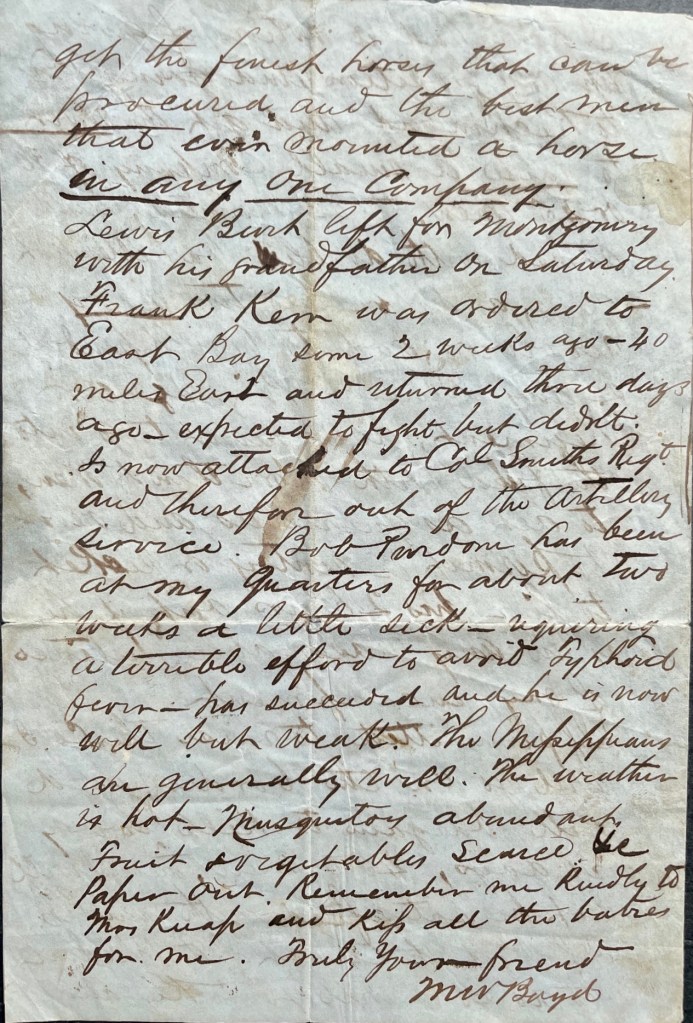
There are some rumors of an immediate fight but there have been so many that I am loathe to put any trust in them. I have had a notion of giving up my position and going on to Richmond and get the power to raise a small company of 30 or 45 men to be mounted and armed with double barreled shotguns, a sabre, and two Navy revolvers, and to be independent of any Division, Brigade, or Regiment, and never to go into the field with more than 15 men to act as guerrillas and never to permit a sentry or picket to live his two hours out if he is in any reasonable distance of my encampment. If permitted to raise this company, I will go on the border and will bargain to kill for every 30 days, 450 men, and I will not be satisfied with any less. If I get the consent of the President to do so, I will go to Kentucky and get the finest horses that can be procured and the best men that ever mounted a horse in any one company.
Lewis Burk left for Montgomery with his grandfather on Saturday. Frank Kerr was ordered to East Bay some two weeks ago—40 miles east—and returned three days ago. He expected to fight but didn’t [and] is now attached to Col. Smith’s regiment and therefore out of the artillery service. Bob Purdom has been at my quarters for about two weeks a little sick—requiring a terrible effort to avoid typhoid fever. Has succeeded and he is now well but weak.
The Mississippians are generally well. The weather is hot. Mosquitoes abundant. Fruit & vegetables scarce &c. Paper out. Remember me kindly to Mrs. Knapp and kiss all the babies for me. Truly your friend, — M. W. Boyd
Henry’s Headstone in Spinnertown, Pennsylvania, with a ghost image of David Polliard who served with him in Co. K, 148th Pennsylvania Infantry
The following letter was written by Henry B. Hillegass (1840-1914) who served as a private in Co. K, 148th Pennsylvania Infantry. Henry was the son of George Hillegass (1816-1889) and Lydia Frey (1813-1842) of Lehigh county, Pennsylvania. Just prior to his enlistment in August 1862, Henry was residing in Quakertown, Bucks county, Pennsylvania.
The 148th Pennsylvania was wrapped in glory at Gettysburg where they fought in the Wheatfield on 2 July 1863.
Henry was shot in the left leg on 10 May 1864 at Po River and at the time of this letter in November of that year, he was still recuperating in a Washington D. C. Hospital. He was not officially discharged from the service until 25 June 1865.
Henry wrote the letter to his lady friend but he never refers to her by name. She was, presumably, Susanna Catharine Blanck whom he married in 1865 and with whom he had at least five children. They lived out their days in Spinnertown, Bucks county, PA, where Henry retired from his job as a cigar maker.
Transcription
Lincoln Hospital B. B. Washington November 9, 1864
My dear and affectionate love,
I take the present opportunity today to drop a few lines to you informing you that I am well at the present time and I hope and pray that these few lines may find you in the same state of good health and that you may enjoy yourself with pleasure wherever you are.
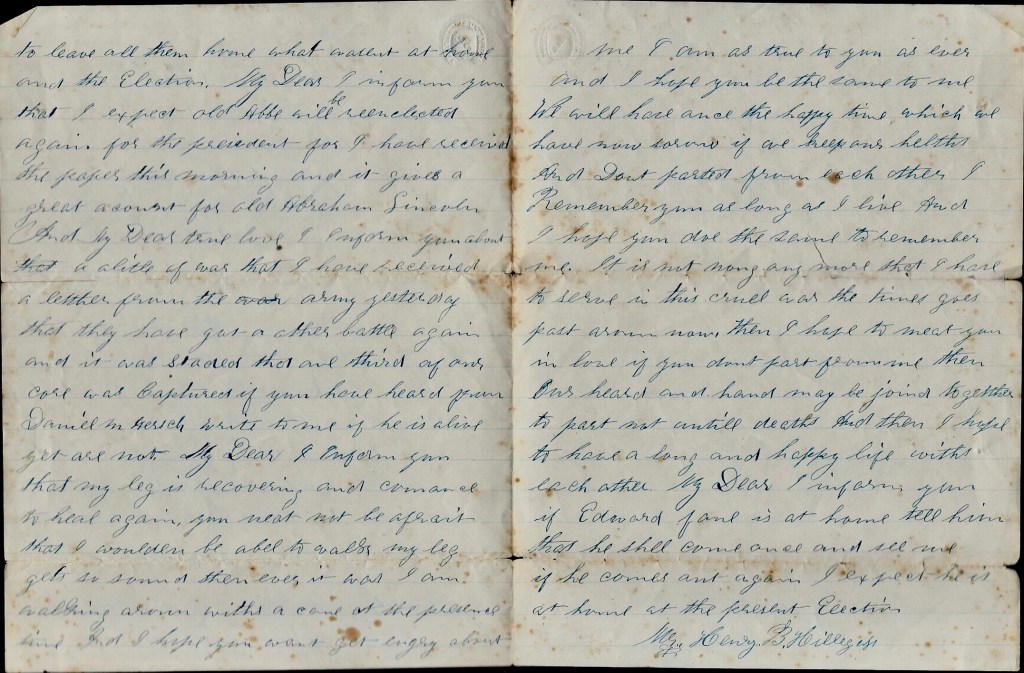
My dear, I inform you that I enjoy myself not very well at the present time for it is very lonesome here where I am. But I don’t expect to stay here long. I may stay a few weeks here. I expect they will transfer me to my own state and I expect to come home this winter sometimes—maybe before long. They are talking to leave them all home what wasn’t at home [for] the election.
My dear, I inform you that I expect Old Abe will be reelected again for the President for I have received the paper this morning and it gives a great account for Old Abraham Lincoln.
And my dear true love, I inform you about a little of war [news] that I have received by a letter from the army yesterday that they have had another battle again and it was stated that one third of our Corps was captured. If you have heard from Daniel M. Gersch, write to me if he is alive yet or not.
My dear, I inform you that my leg is recovering and commenced to heal again. You need not be afraid that I wouldn’t be able to walk. My legs gets so sound than ever it was. I am walking around with a cane at the present time. I hope you won’t get angry about me. I am as true to you as ever and I hope you be the same to me. We will have once the happy time which we have now sorrow if we keep our health and don’t be parted from each other. I remember you as long as I live and I hope you do the same to remember me.
It is not long anymore that I have to serve in this cruel war. The time goes fast around now. Then I hope to meet you in love if you don’t part from me. Then our heart and hand may be joined together to part not until death. And then I hope to have a long and happy life with each other.
My dear, I inform you if Edward Payne is at home, tell him that he shall come [at] once and see me if he comes out again. I expect he is at home at the present election.
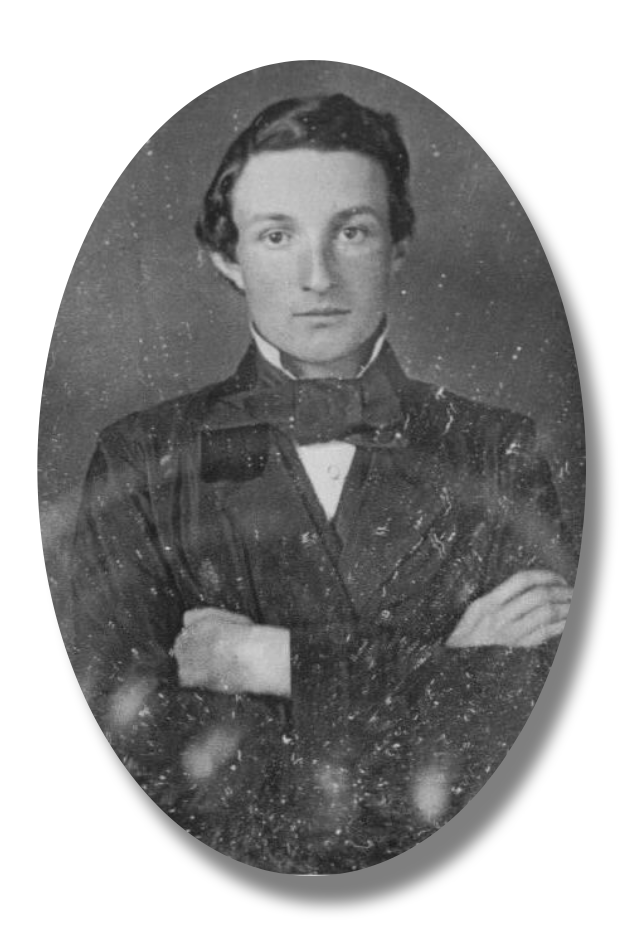
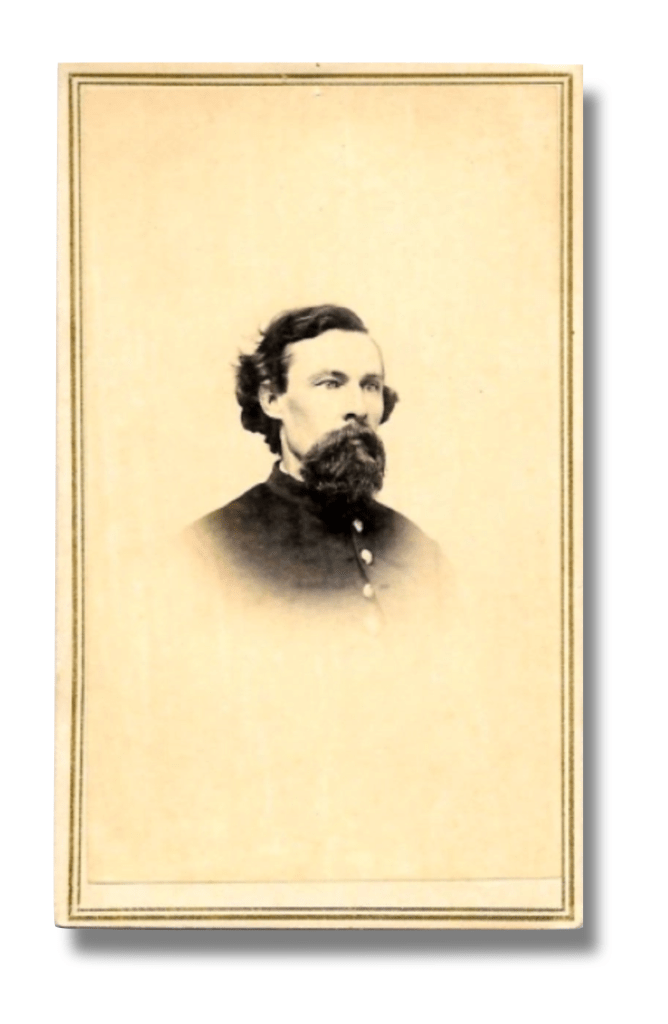
The following letter was written by Peachy Gilmer Breckinridge (1835-1864), the son of Cary Breckinridge (1795-1866) and Emma Walker Gilmer (1807-1893) of Botetourt county, Virginia. He attended VMI 1853-55, the College of William & Mary and the University of Virginia School of Law 1857-58. He journeyed to New Mexico with the Pacific Railroad Exploring Expedition in 1858-59. At his return, he practiced law in Fincastle. He was known by his mother’s maiden name, Gilmer.
Gilmer was a candidate on 14 Feb 1861 to represent Botetourt County in the Virginia State Convention that passed the Ordinance of Secession 17 April 1861. His platform being the most thorough for the preservation of the Union, he proposed if there must be war, to fight IN, and not OUT, of the Union. He was defeated, but “when he recognized the duty he owed to Virginia, he recruited and equipped a company for the service”. Major Breckinridge raised and equipped a company of Infantry, and was made Captain of Co. K, 28th Virginia Infantry. In re-election of the company, he was ousted April 28, 1862. He then joined the State Line, recruited a company for it and was promoted to the rank of Major, March 13, 1 863. When the State Line was disbanded, he joined his brother’s company, the Second Virginia Cavalry April 21, 1863 and served as Color Sergeant from May 1863. He was appointed Acting Captain of Company B in May 1864. He was killed in action at Kennon’s Landing on the James River May 24, 1864. His body was never recovered.
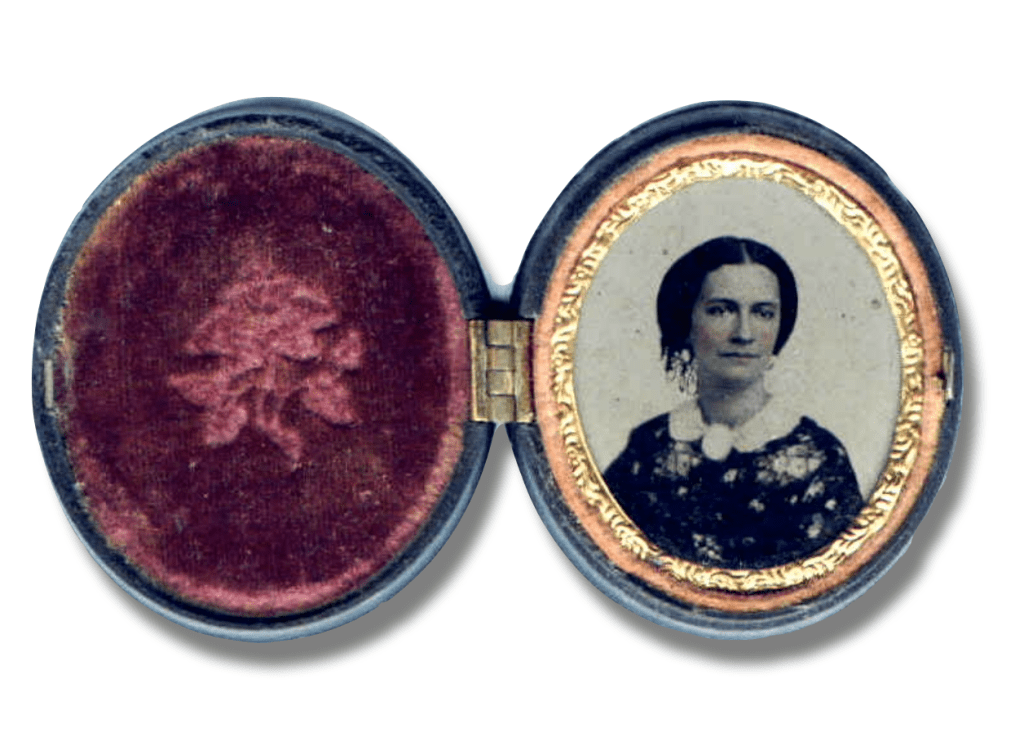
Gilmer was married in 1860 to Julia Anthony (1832-1917), pictured below.
Julia Matilda (Anthony) Breckinridge, wife of Peachy Gilmer Breckinridge
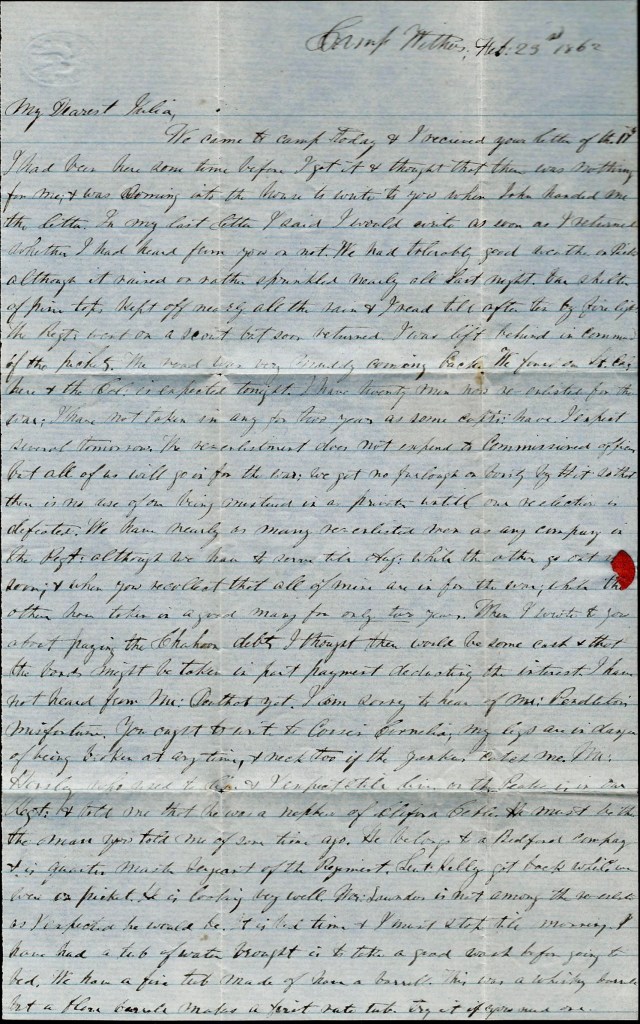
Transcription
Addressed to Mrs. Julia M. Breckinridge, Pattonsburg, Botecourt Co., Virginia
Camp Withers [near Centreville, Fairfax county, Va.] February 23rd 1862
My Dearest Julia,
We came to camp today and I received your letter of the 17th. I had been here some time before I got it and thought that there was nothing for me and was coming into the house to write to you when John handed me the letter. In my last letter I said I would write as soon as I returned whether I had heard from you or not.
We had tolerably good weather on picket although it rained or rather sprinkled nearly all last night. The shelter of pine tops kept off nearly all the rain and I read till after ten by firelight. The regiment went on a scout but soon returned. I was left behind in command of the pickets. The road was very muddy coming back. We found our Lt. Colonel here and the Colonel is expected tonight.
I have twenty men now re-enlisted for the war. I have not taken in any for two years as some captains have. I expect several tomorrow. The re-enlistment does not extend to commissioned officers but all of us will go in for the war. We got no furlough or bounty by it so that there is no use of our being mustered in as privates until our re-election [as officers] is defeated. We have nearly as many re-enlisted men as any company in the regiment although we have to serve til August while the others go out soon; and when you recollect that all of mine are in for the war, while the others have taken in a good many for only two years.
When I wrote to you about paying the Chahoon debts, I thought there would be some cash & that the bonds might be taken in part payment, deducting the interest. I have not heard from Mr. [ ] yet. I am sorry to hear of Mrs. Pendleton’s misfortune. You ought to write to cousin Cornelia. My legs are in danger of being broken at any time, and neck too if the Yankees catch me.
Mr. Horsley who used to live, and I expect still lives, on the Peak, is in our regiment and told me that he was a nephew of Clifford Cable. He must be the man who told me off some time ago. He belongs to a Bedford company and is a Quartermaster Sergeant of the regiment.
Lieut. Kelly got back while we were on picket. He is looking very well. Mr. Saunders is not among the re-enlisted as I expected he would be. It is bed time and I must stop till morning. I have had a tub of water brought in to take a good wash before going to bed. We have a fine tub made of half a barrel. This was a whisky barrel but a flour barrel makes a first rate tub. Try it if you need one.
Monday. I have been all the morning taking in re-enlisted men and making off accounts for bounty, &c. We now have 22 and expect a few more today. No company has a 28, I believe. It is too late to write more. Love to Uncle & the baby. Write soon. Your dearest one, — P. G. B.
The following letter was written by William H. Morrison (b. 1836), a native of Prince Edward Island, residing in Oconto, Wisconsin, in May 1861 when he enlisted as a private in Co. H, 4th Wisconsin Infantry.
I could not find an image of William but here is one of George Hill who served in Co. I, 4th Wisconsin Infantry. (Photo Sleuth)
Originally the Fourth Wisconsin was organized as an infantry unit at Camp Utley, Racine, WI. On July 2nd, 1861 it was mustered into service. Service areas for 1861 included Baltimore, MD, and Relay House, MD. In 1862 the regiment went to Newport News, VA where it left to join the “Army of the Gulf” in New Orleans LA. Disease took a terrible toll on the members during the trip, with several dying enroute. Traveling up the Mississippi River, the regiment saw action at Vicksburg and Baton Rouge, LA. The last service of the Fourth as an infantry unit was a “sanguinary” siege at Port Hudson, LA from May 21 to July 8, 1863. The regiment was then converted to the 4th Wisconsin Cavalry.
In early September 1863, William was discharged from the regiment as a corporal to accept a commission as Captain of Co. B, 99th U. S. Colored Troops. He was absent from his regiment late in 1864 and early 1865 suffering from chronic diarrhea and was able to obtain a certificate of disability and was discharged on 22 February 1865.
William wrote the letter to his friend, Thomas Millidge (1827-1895), a dry goods merchant in Oconto, Wisconsin.
William’s letter makes a reference to the recent Battle of Fort Henry on the Tennessee river wherein Gen. Ulysses S. Grant and Flag Officer Andrew H. Foote simultaneously attacked the Confederate fort and forced its surrender on 6 February 1862.
Transcription
Headquarters 4th Wisconsin Regt. Camp Baltimore, Maryland February 8, 1862
Dear friend Millidge,
Our day of judgement has come at last. Tonight about nine o’clock we received our marching orders to someplace to us unknown. There is no one knows as to where our place of destination is. All that I know about it is that we are going to leave here by water tomorrow morning precisely at nine o’clock so I am not able to write you but a few lines this time.
I suppose you have heard of the great victory gained lately and I learn that they are bound to keep the thing agoing and that is the way to do it. They have been fooling with those durn rebels long enough. But now they are doing the thing up brown. That is the way to put down this rebellion.
Thomas, I wish that I was able to write you a long letter but the want of time prevents me from doing it so I shall have to bring this to a close and allow me to sign myself your sincere friend and well wisher, — William H. Morrison
to Thomas Millidge
P. S. Remember me to all the inquiring friends and write as soon as you get this. I guess the letter will follow the regiment. Yours, — Bill
An unidentified private from Manchester who might very well have served in the 2nd New Hampshire Infantry (Dave Morin Collection)
The following letter was written by Lemuel Mason Cox (1837-1914) who volunteered in Co. C, 2nd New Hampshire Infantry in May 1861 and served three years and three months before mustering out on 21 June 1864, shortly after the Battle of Cold Harbor. At the time of his enlistment, Lemuel had been boarding in Manchester, Hillsboro, New Hampshire, earning his living as a carpenter. He was described as standing 5 feet five inches tall with gray eyes and brown hair.
The 2nd New Hampshire had a long and storied career, participating in the first battle at Bull Run where they had seven men killed, until they occupied Richmond four years later. At Gettysburg, the 2nd New Hampshire entered battle with 353 soldiers. In under three hours, 47 were killed, 136 wounded and 36 men went missing; of the 24 officers, only three were not killed or wounded. Due to their high losses, the 2nd New Hampshire was assigned to guard duty at Point Lookout, Maryland, with the 5th and 12th New Hampshire Volunteer Regiments. The 2nd New Hampshire returned to battle in time for the Battle of Cold Harbor where it suffered heavy casualties of nineteen killed and 54 wounded.
Transcription
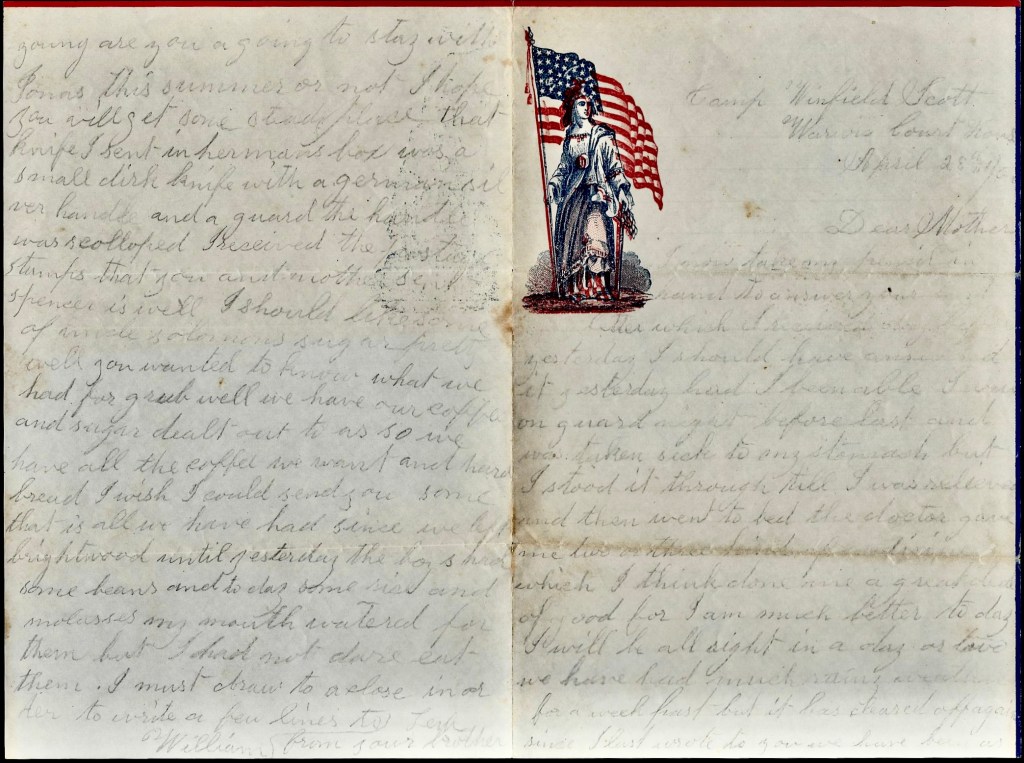
Camp Winfield Scott Warwick Court House April 28th 1862
Dear Mother,
I now take my pencil in hand to answer your last letter which I received day before yesterday. I should have answered it yesterday had I been able. I was on guard night before last and was taken sick to my stomach but I stood it through till I was relieved and then went to bed. The doctor gave me two or three kinds of medicine in which I think done me a great deal of good for I am much better today. I will be all right in a day or two.
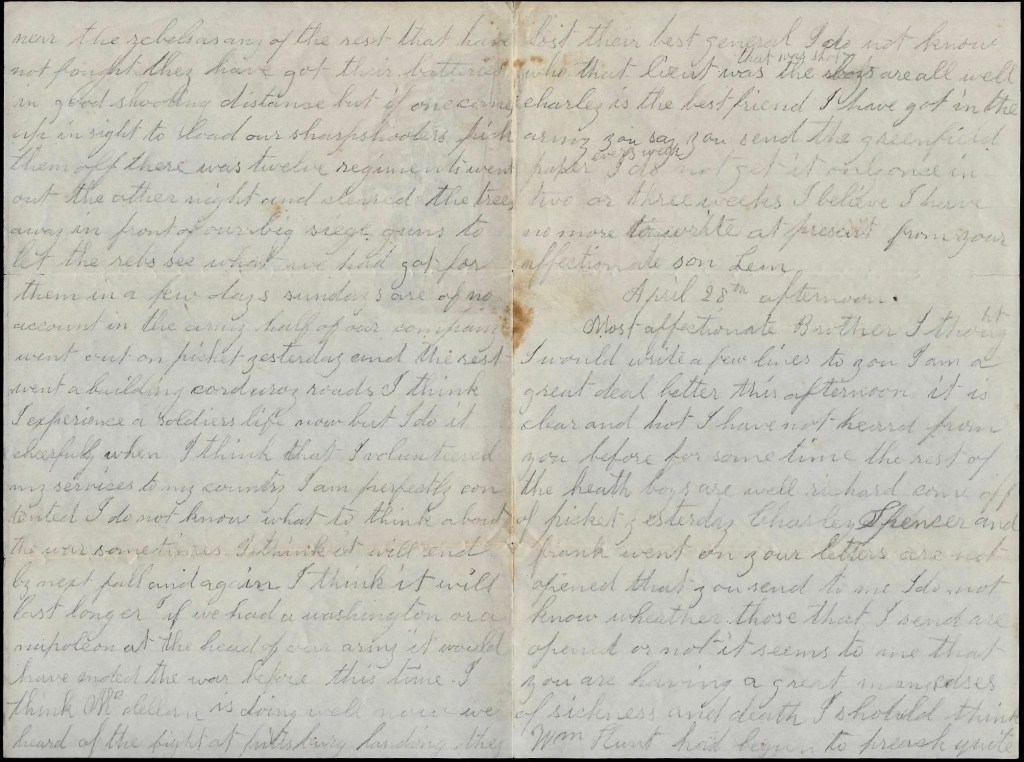
We have had much rainy weather for a week past but it has cleared off again since I last wrote to you. We have been as near the rebels as any of the rest that have not fought. They have got their batteries in good shooting distance but if one comes up in sight to load, our sharpshooters pick them off.
There was twelve regiments went out the other night and cleared the trees away in front of our big siege guns to let the rebs see what we had got for them in a few days. Sundays are no account in the army. Half of our company went out on picket yesterday and the rest went a building corduroy roads. I think I experience a soldier’s life now but I do it cheerfully. When I think that I volunteered my services to my country, I am perfectly contented. I do not know what to think about the war. Sometimes I think it will end by next fall, and again I think it will last longer. If we had a Washington or a Napoleon at the head of our army, it would have ended the war before this time. I think McClellan is doing well now.
We have heard of the fight at Pittsburg Landing [Shiloh]. They lost their best General [A. S. Johnston]. I do not know who that Lieut. was that was shot. The boys are all well. Charley is the best friend I have got in the army. You say you send the Greenfield paper every week. I do not get it only once in two or three weeks. I believe I have no more to write at present. From your affectionate son, — Lem
April 28th. Afternoon. Most affectionate brother, I thought I would write a few lines to you. I am a great deal better this afternoon. It is clear and hot. I have not heard from you before for some time. The rest of the Heath boys are well. Richard come off picket yesterday. Charley, Spencer, and Frank went on. Your letters are not opened that you send to me. I do not know whether those that I send are opened or not.
It seems to me that you are having a great many cases of sickness and death. I should think Wm. Hunt had begun to preach quite young. Are you a going to stay with Jonas this summer or not? I hope you will get some steady place. That knife I sent in Herman’s box was a small dirk knife with a German silver handle and a guard. The handle was scalloped.
I received the postage stamps that you and mother sent. Spencer is well. I should like some of Uncle Solomon’s sugar pretty well. You wanted to know what we had for grub. Well, we have our coffee and sugar dealt out to us so we have all the coffee we want and hard bread. I wish I could send you some. That is all we have had since we left Brightwood until yesterday. The boys had some beans and today some rice and molasses. My mouth watered for them but I had not dare eat them. I must draw to a close in order to write a few lines to William. From your brother, — Lem
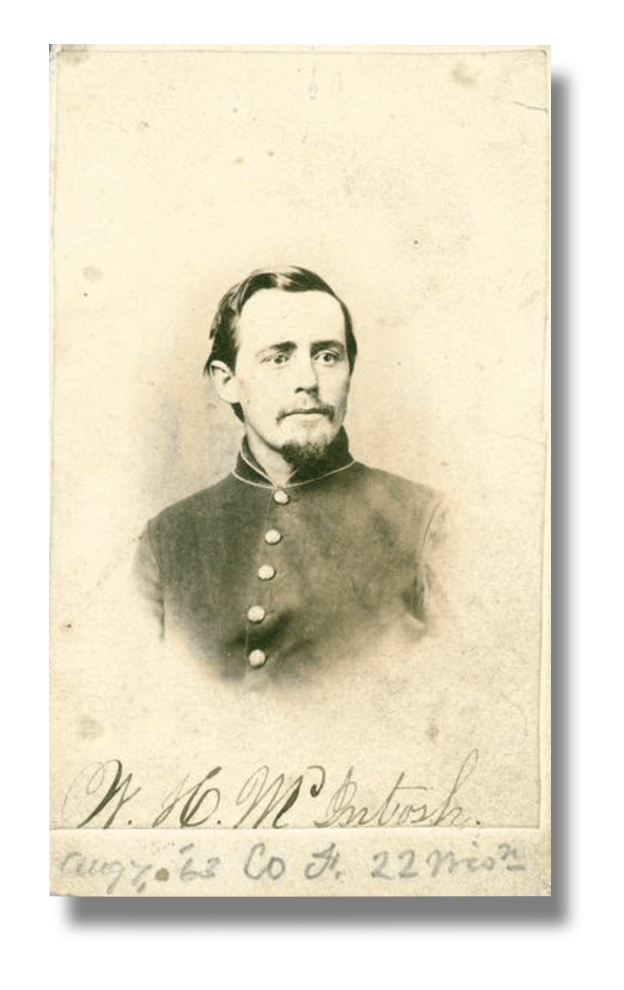
I could not find an image of John but here is a cdv of William H. McIntosh who served in Co. F, 22nd Wisconsin Infantry (WHS)
The following letter was written by John R. Siperly who was enumerated in his parents household in Delavan, Walworth county, Wisconsin at the time of the 1860 US Census, as a 23 year-old carpenter. John’s parent’s, Peter and Elizabeth (“Betsy”) Siperly, had relocated to Wisconsin prior to 1850 from the area around Rhineback, Dutchess county, New York.
John enlisted in August 1862 to serve as a private in Co. D, 22nd Wisconsin Infantry—sometimes referred to as “the Abolition Regiment.” He served a total of 2 years and 10 months, mustering out in June 1865. Though John wrote his father that he thought there were many signs for a “speedy close of this war” and even of peace negotiations, the heaviest days of fighting for the 22nd Wisconsin lay ahead of them, not behind them.
In 1867, John married Mary C. Church (1848-1906), and resumed in carpentry career in Walmouth county.
[Note: This letter is from the personal collection of Greg Herr and was transcribed and published on Spared & Shared by express consent.]
Transcription
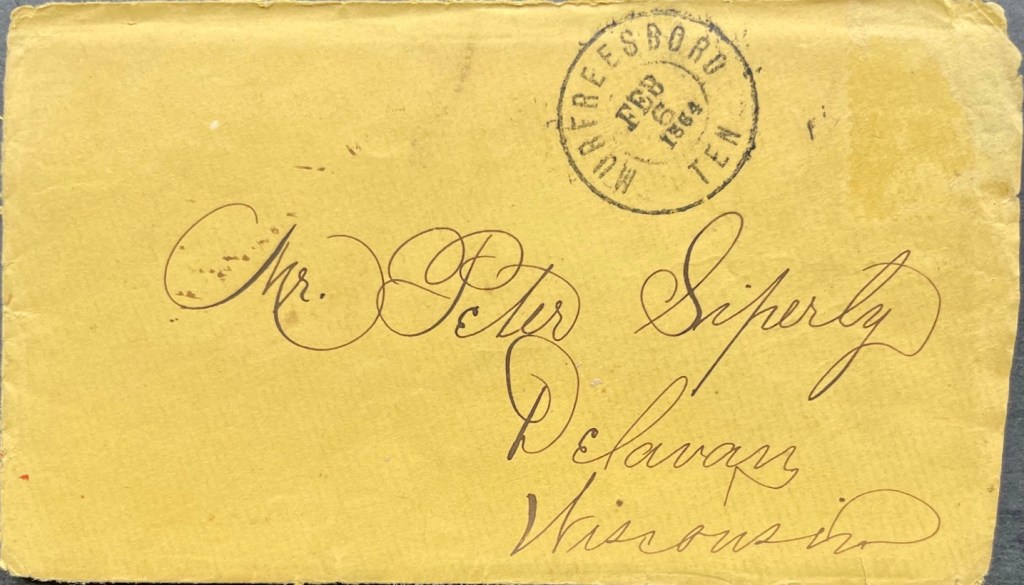
Addressed to Mr. Peter Siperly, Delavan, Wisconsin Postmarked Murfreesboro, Tennessee
Fort Overall February 4, 1864 10 o’clock at night
Mother & Father,
Well, I have been reading newspapers laying abed and killing mice tonight and the latter employment caused my mind to revert to the times I used to have at home sometimes at killing mice when the idea suggested itself to me that I had better scribble a few words for the remaining inmates of that home. Well, now it is darned late so you see I can’t say much—only to say that I am still well in the very best degree. We still have very pleasant weather though for the few last days it has been somewhat cooler and tonight looks like rain.
Important and encouraging [news] is being heard from different departments of the army—of desertions on a large scale in the rebel army; of mutinies, the most important one at Mobile; and grand victories of our forces, all of which betokens a speedy close of the war. It is a fact beyond a doubt that the majority of the men in the rebel army are fast seeing their mistake and would gladly give up if they could as many of them are doing.
A rumor is afloat now that the matter is being discussed at Richmond to the effect that if the president would extend his amnesty proclamation to the officers and leaders alike, they would lay down their arms and return to the Union. I can’t say how true this is but I don’t believe it. Neither do I care much, for rather than to see the hellish leaders of this rebellion receive one iota of pardon, or to have them escape a particle of the punishment they so justly merit, rather than that I would see this war continue five years yet. I feel perfectly willing to see all pardoned that comes within the scope of the President’s Proclamation and no further.
Tis thought some that a war with France is eminent—a thing that is not to be devoutly wished for. But if it must be, let it come. I don’t know that we will ever be better prepared than now.
Yesterday our regiment received orders to go to Nashville but has been countermanded again. Perhaps though we may go yet. I think, however, that we will soon be on the move. Tis hard telling where we will turn up next.
I hear that the weather is not as cold now in the North. I hope that is so. I sent a picture about two weeks ago. Did you get it? I hope there will be no further trouble about that money. Let me know when you get it. Good night. — John R. Siperly
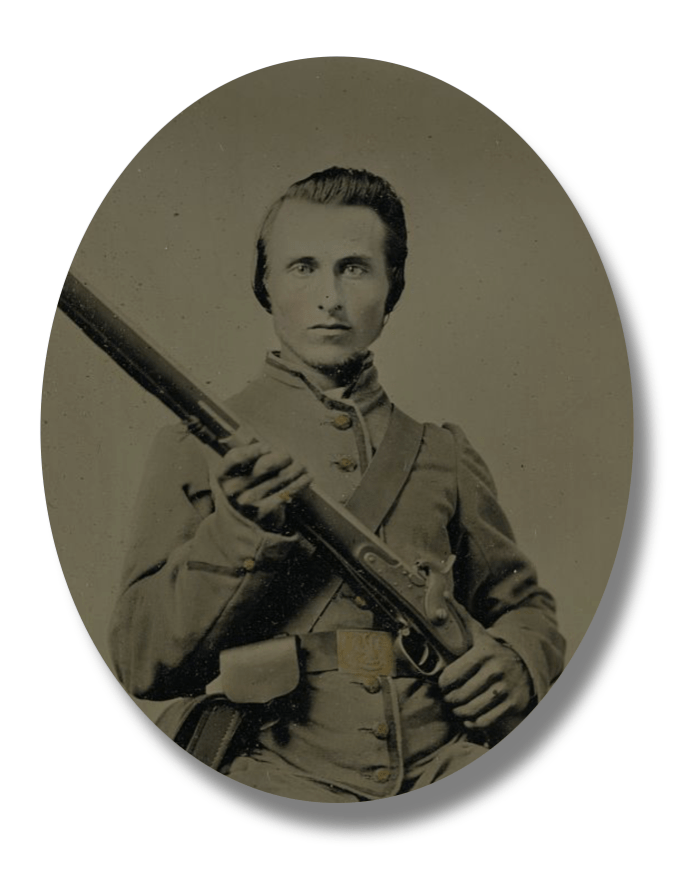
The following letter was written by John Owen Lemon (1837-1906) , a private in Co. D (“Pelican Rifles”), 2nd Louisiana Infantry—better known as “Wheat’s Tigers” or the “Louisiana Zouaves.” John enlisted on 11 May 1861 at New Orleans. He was promoted to a 2nd Corporal in June 1862 and sent to the hospital at Danville Virginia, just prior to the Battle of Malvern Hill, suffering from illness. His muster records show him as being absent much of the latter half of 1862 and 1863 yet he was promoted to 1st Corporal in November 1863. In February 1864 he reenlisted for the balance of the war. When he was paroled at war’s end, he was described as 28 years old, with grey eyes and dark hair, standing 5 feet, 4 inches tall. He gave his residence as Natchitoches, Louisiana.
In the 1860 US Census, John was enumerated in Natchitoches as the overseer on the John Pareryes plantation.
John died in Jefferson, Arkansas, in 1906. His widow, Harriett A. E. Lemon filed for a widow’s pension at that time. She may have been his third wife as it appears he married once before in 1889 to Annie Bogy and once before that in 1867 to Drucilla F. Goldman. I can’t be certain but think John was born in Fayette, Tennessee, the son of Robert Simon and Martha Simon. This seems to be confirmed by his saying, “since I left Old Tennessee” and I suspect that is also where his cousin Willy lived.
[Note: This letter is from the personal collection of Greg Herr and was transcribed and published on Spared & Shared by express consent.]
Transcription
Camp Magruder [Williamsburg, Va.] September 1861
My dear cousin.
It is with great pleasure that I seat myself to write you a few lines to let you know that I am still in the land of the living, hoping when these few lines reach you, they may find you enjoying the same blessing.
I have no news to write you that will interest you. The health of this regiment is as good as one could expect. As for myself, I have not been sick since I joined the army. Willy, you have no idea how hard a time we have. We have our cooking and washing to do but we get along better than you could expect. We have a fine time. If we could have a fight once and awhile, we would be better satisfied. But we have had nothing to do since we left home but ditch and march.
We have had orders to march the other day. We started and got one quarter of a mile of the camp and the order was countermanded and we returned to camp as mad as we could be. We are the [most] anxious soldiers you ever saw in your life to have a fight. When we thought we are about to have a fight, you never heard such a fuss in your life. The regiment is in [good] spirits from one end to the other—all they want is a fight.
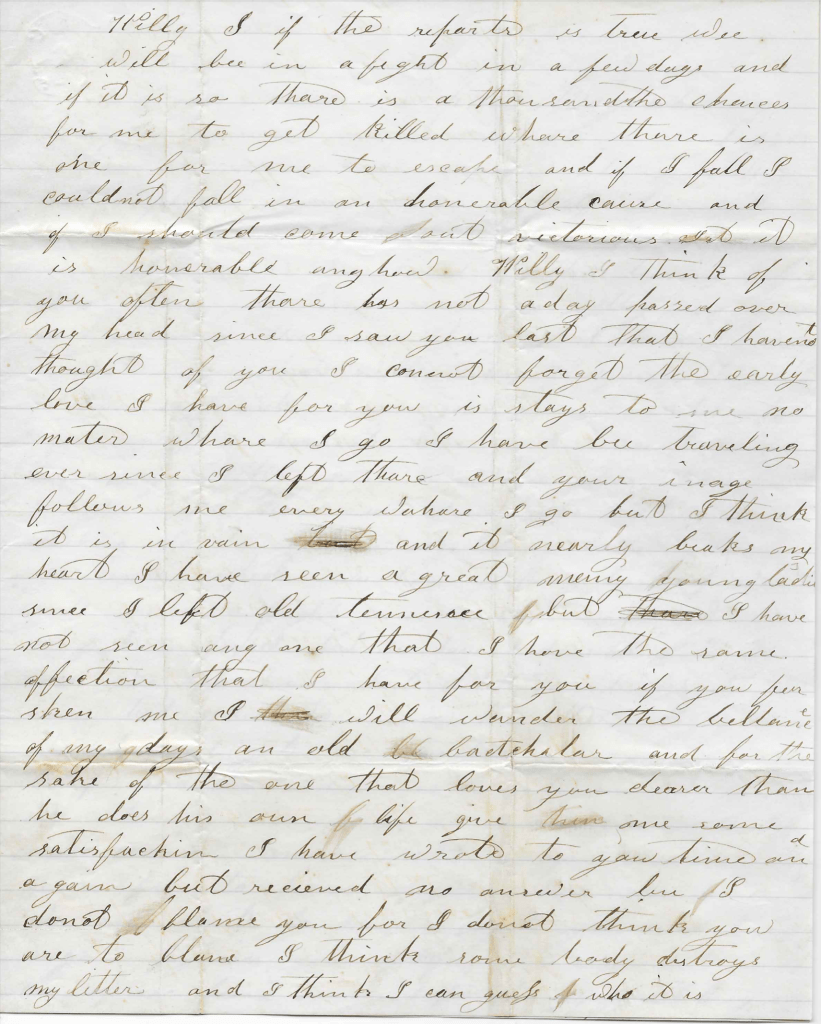
Willy, if the reports is true, we will be in a fight in a few days and if it is so, there is a thousandth chance for me to get killed where there is no room for me to escape. And if I fall, I could not fall in a [more] honorable cause. And if I should come out victorious, it is honorable anyhow.
Willy, I think of you often. There has not a day passed over my head since I saw you last that I haven’t thought of you. I cannot forget the early love I have for you. It stays to me no matter where I go. I have been traveling ever since I left there and your image follows me everywhere I go. But I think it is in vain and it nearly breaks my heart. I have seen a great many young ladies since I left Old Tennessee but I have not seen anyone that I have the same affection that I have for you. If you forsake me, I will wander the balance of my days an old bachelor and for the sake of the one that loves you dearer than he does his own life, give me some satisfaction. I have wrote to you time and again but received no answer but I do not blame you for I do not think you are to blame. I think somebody destroys my letters and I think I can guess who it is.
Willy, if I can’t write as a lover, write as a friend, for my heart is nearly broken. I am a poor soldier far from my parents and relations and war is but a game of chess played on a large scale. I may never see you again but one word from you would cheer me on my journey. So fare you well, my dear beloved one. I love you and it cheers me on my journey. If this cruel war will end, I will see you again.
Write as soon as you get this. No more at present but remain as ever your lover until death. Direct your letter to Williamsburg, Va., Second Regiment, Louisiana Volunteers, Company D
Do not let no one see this for my sake. To my beloved one, — John Owen Lemon
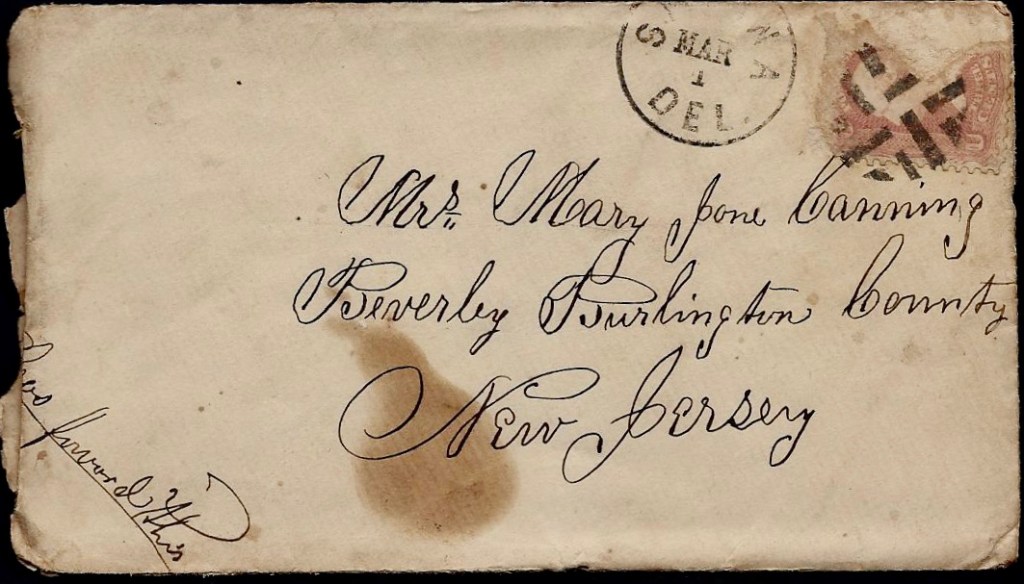
The following letters were written by George W. Hill (b. 1842) of Beverly, Burlington county, New Jersey, while serving in Co. F, 6th New Jersey Infantry. He wrote the letters to his sister, Mary J. Hill (b. 1840). In the 1850 US Census, George and Mary were living with their uncle Thomas Foster (b. 1816) in Duck Hundred, Kent, county, Delaware. Also living in the same household was their grandmother, Elizabeth Foster (b. 1797). By the time of the 1860 US Census, Thomas Foster had relocated to Beverly, Burlington county, New Jersey, and George’s sister Mary had married (1859) to Jacob (“Jake”) Adams Canning (1838-1905). During the war, Jake had served as a drummer in Co. H, 29th Pennsylvania Infantry.
According to the company records, George enlisted as a private on 7 August 1861 to serve three years in the 6th New Jersey Infantry. He was promoted to corporal in late August 1861 and then busted back to private in November 1861. In August 1862, just before the 2nd Battle of Bull Run, he was reported as a deserter, and was not returned to duty until 16 November 1863. Where and what he did during this period of time isn’t known but he subsequently was detailed as a clerk for Gen. Gershom Mott so he must have been forgiven for his absence. The last letter suggests George has been considerably weakened by illness so he may have missed several months of duty at war’s end.
Letter 1
Addressed to Mr. Thomas Foster, Beverly, Burlington county, New Jersey
Arlington Heights Wednesday, June 19, 1861
Dear Grandmother, sister, uncle, and brother-in-law,
I take my pen in hand to write you these few lines to let you know that I am enjoying good health at present and I hope these few lines find you the same. I received your kind and affectionate letter and money and was glad to hear from you all. I got the box of provision that Mrs. Craythorn sent to me and when I opened it I discovered a package that said on it to George W. Hill sent to him by his grandmother and I think more of that package than any other. You don’t say anything about how Jo Coney serve me. It will only make a fuss between him and me.
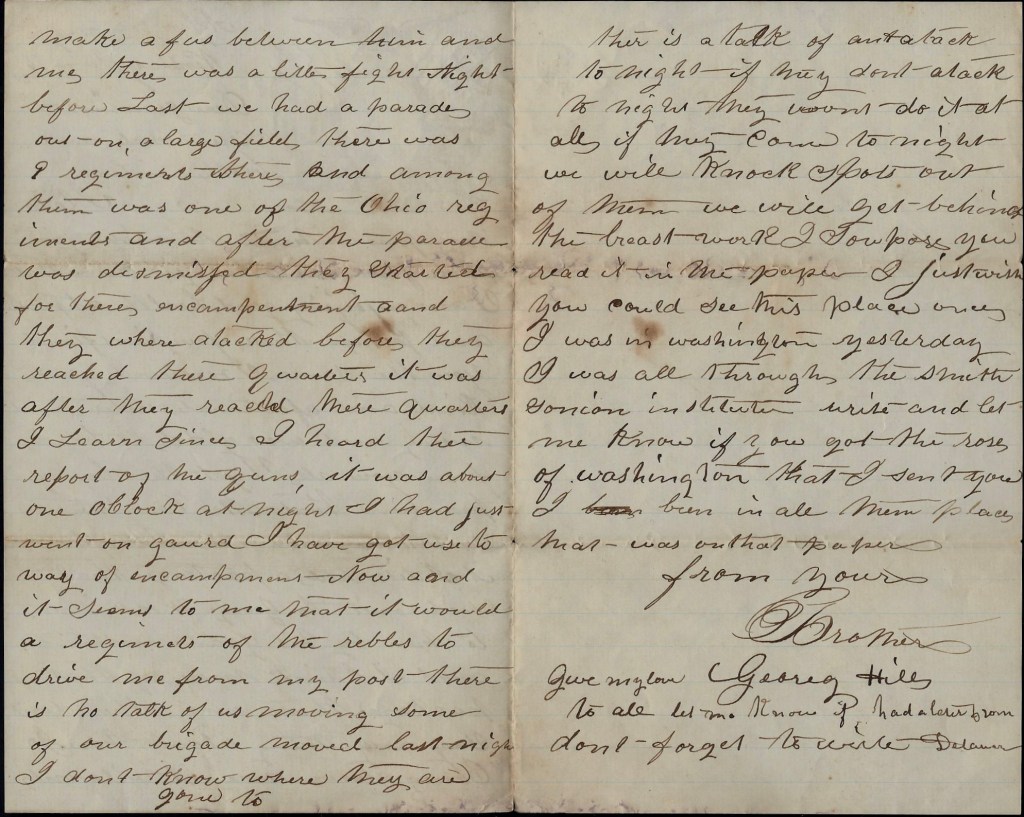
There was a little fight night before last. We had a parade out on a large field. There was nine regiments there and among them was one of the Ohio regiments and after the parade was dismissed, they started for their encampment and they were attacked before they reached their quarters. It was after they reached their quarters, I learn since. I heard the report of the guns. It was about one o’clock at night. I had just went on guard.
I have got use to way of encampment now and it seems to me from my post there is no talk of us moving. Some of our brigade moved last night. I don’t know where they are gone to. There is a talk of an attack tonight. If they don’t attack tonight, they won’t do it at all. If they come tonight, we will knock spots out of them. We will get behind the breastwork.
I suppose you read it in the paper. I just wish you could see this place once. I was in Washington yesterday. I was all through the Smithsonian Institute.
Write and let me know if you got the box of Washington that I sent you. I been in all them places that was on that paper. From your brother, — George Hill
Give my love to all. Don’t forget to write. Let me know if I had a letter from Delaware.
Letter 2
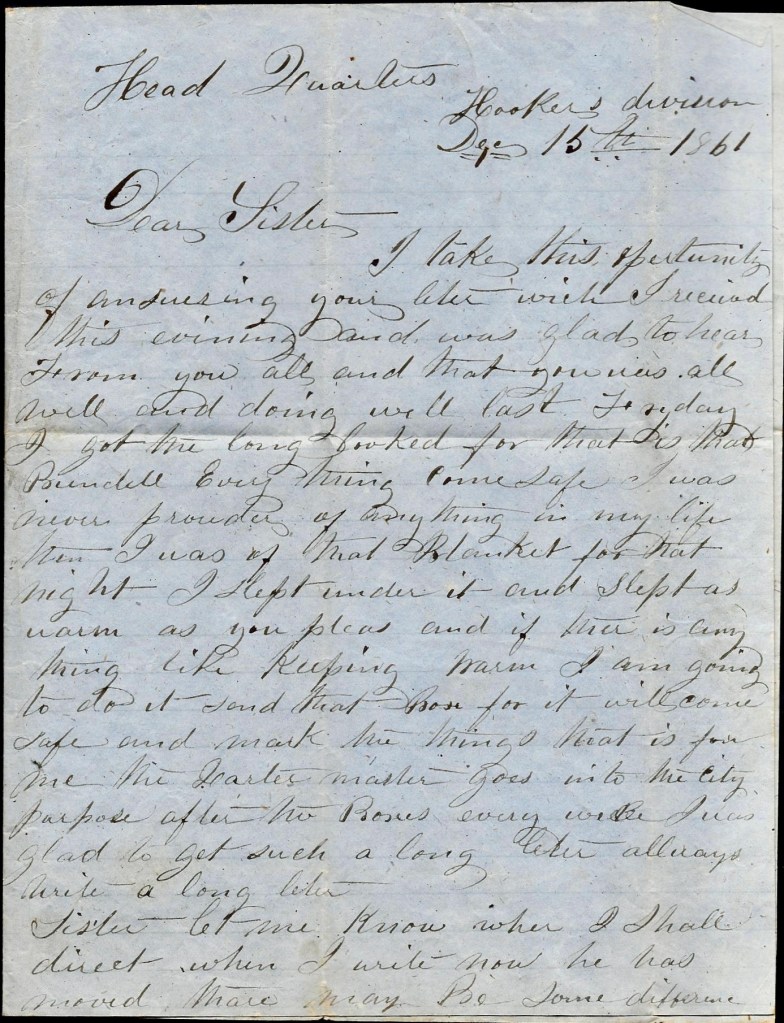
Headquarters Hooker’s Division December 15th 1861
Dear Sister,
I take this opportunity of answering your letter which I received this evening and was glad to hear from you all and that you was all well and doing well. Last Friday I got the long looked for—that is, that bundle. Everything come safe. I was never prouder of anything inn my life than I was of that blanket for that night I slept under it and slept as warm as you please. And if there is anything like keeping warm, I am going to do it, and that box for it will come safe and mark the things that is from me. The Quartermaster goes into the city on purpose after the boxes every week. I was glad to get such a long letter. Always write a long letter.
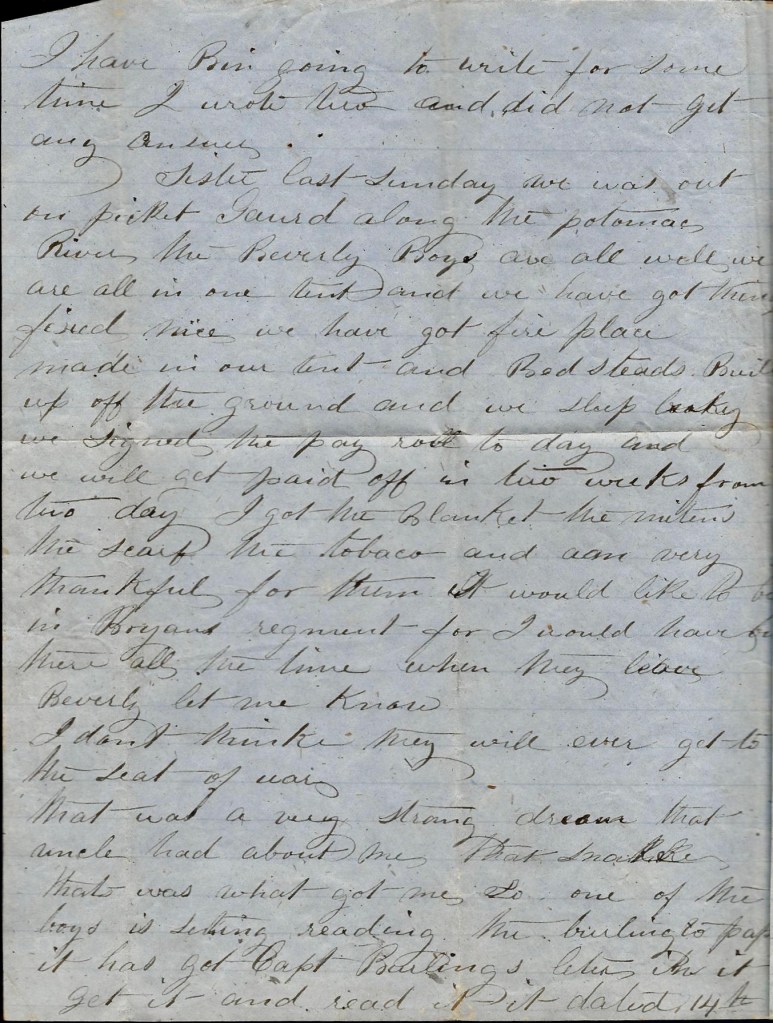
Sister, let me know where I shall direct when I write now he has moved; there may be some difference. I have been going to write for some time. I wrote two and did not get any answer.
Sister, last Sunday we was out on picket guard along the Potomac River, The Beverly Boys are all well. We are all in one tent and we have got them fixed nice. We have got a fire place made in our tent and bedsteads built up off the ground and we sleep bully.
We signed the pay roll today and we will get paid off in two weeks from today. I got the blanket, the mittens, the scarf, the tobacco, and am very thankful for them. I would like to be in Bryan’s regiment for I would have been there all the time. When they leave Beverly, let me know. I don’t think they will ever get to the seat of war.
That was a very strange dream that Uncle had about me. That snake—that was what got me. So one of the boys is sitting reading the Burlington paper. It has got Capt. [George C.] Burling‘s letter in it. Get it and read it. It’s dated 14th. In it you will see accounts of our march which is very interesting.
I am going to write to write to Homer and Jake too for I am anxious to hear from both. Write soon. I believe we are still in the same or in the neighborhood. I believe I have wrote all the particulars. Give my love to all my friends. Don’t forget the stuffed peppers for my mouth is all getting out of shape waiting for them.
I shall expect to see your likeness in the box. Don’t forget Sidy. Hang mine up in the privy. It will be good for the diarrhea. Mamma, keep in [good] spirits for your grandson will be a help to you in your old days. Nary one has told you so, have they not? I am glad to think that the Beverly folks are yet so kind to you as to send you some coal. I am glad to hear that uncle has got work. It won’t be very long before I can send you some more money.
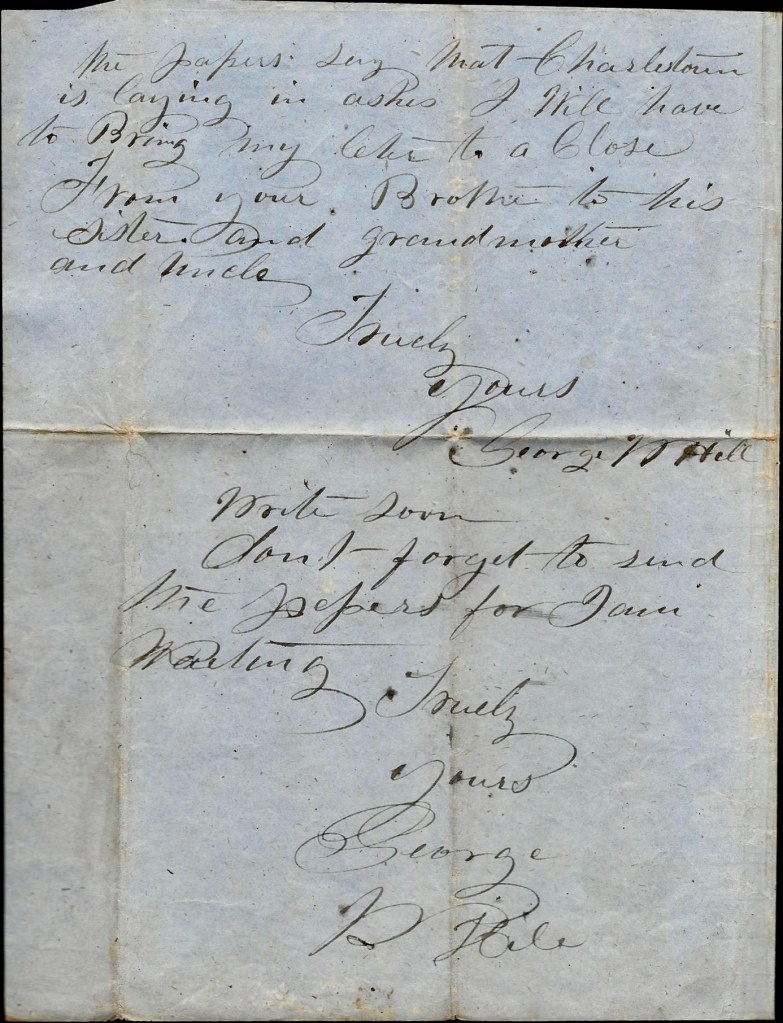
The papers say that Charleston is laying in ashes. I will have to bring my letter to a close. From your brother to his sister, and grandmother and uncle. Truly yours, — George W. Hill
Write soon. Don’t forget to send the peppers for I am waiting. Truly yours, — George W. Hill
Letter 3
Rum Point January 7, 1862
Dear Sister,
I received your kind letter just now and was glad to hear from you and that you was well but sorry to hear of uncle being sick. You said you had not received a letter from me. Sister, I have wrote two—one just after I got my box of things which came to me safe enough with the exceptions of a few of the pies [that] were mashed by the jar of pickles but I enjoyed my chicken and other things.
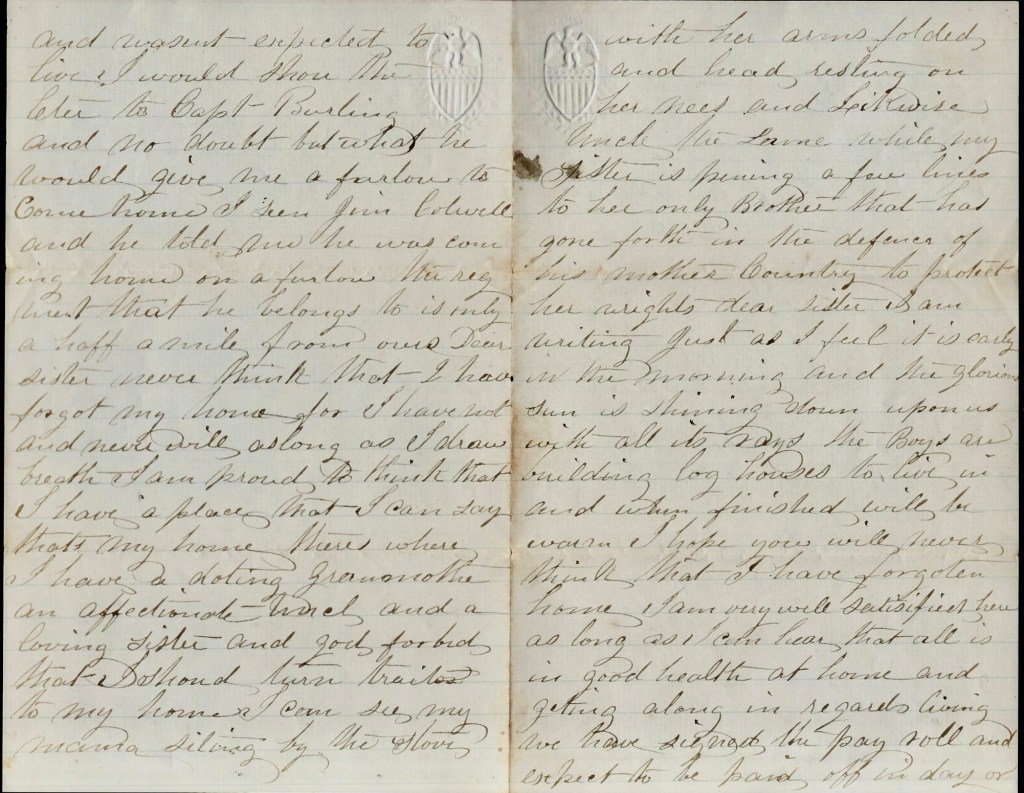
Now you all no doubt would like to see me come [home] just as bad as I would like to come. Now if you would just write in your next letter that some of the family was very sick and wasn’t expected to live, I would show the letter to Capt. [George C.] Burling and no doubt but what he would give me a furlough to come home. I seen Jim Colwell and he told me he was coming home on a furlough. The regiment he belongs to is only a half a mile from ours.
Dear sister, never think that I have forgot my home for I have not and never will as long as I draw breath. I am proud to think that I have a place that I can say, that’s my home. There’s where I have a doting grandmother, and affectionate uncle, and loving sister, and God forbid that I should turn traitor to my home. I can see my mama sitting by the stove with her arms folded and head resting on her knees, and likewise uncle the same while my sister is penning a few lines to her only brother that has gone forth in the defense of his mother country to protect her rights.
Dear sister, I am writing just as I feel. It is early in the morning and the glorious sun is shining down upon us with all its rays. The boys are building log houses to live in and when finished, will be warm. I hope you will never think that I have forgotten home. I am very well satisfied here as long as I can hear that all is in good health at home and getting along in regards living.
We have signed the pay roll and expect to be paid off in a day or two and I will send it to you as soon as I get it and use it as you like. Never let hard times worry you. If you want coal, send me word and I can have it hauled right to your door for you from Burlington. All I have to do is to go to Capt. Burling and tell him—he keeps a coal yard in Burlington—and he will send word to his brother.
I will have to bring my letter to a close sending you all my love. My regards to Aunt Lacy.
Truly yours, — George W. Hill
Write soon as possible and let me know how uncle is. I shall be uneasy till I hear from him. Goodbye. Goodbye.
Letter 4
Shipping Point, Virginia April 20th 1862
Dear Sister,
I now sit down to write you a few lines to let you know that I am well and in good spirits and hope that these few lines will find you all the same. I received your letter and was glad to hear from you and that you was all well. We are now about 5 miles from Yorktown and when you hear from me again, I shall be in Yorktown. There will be a very hard fight at this place. The rebels have a very strong force at this place. If you don’t hear from me for awhile, don’t be uneasy about me for I heard that all the letters was going to be stopped till after the fight. I don’t know how true it is but if it is, don’t be uneasy about me.
We expect to move every hour today, to proceed on closer to Yorktown to throw up breastworks. They have been firing at one another back and forward for two or three days. Wounded some on both sides. From what I can hear, the attack will be made next week sometime.
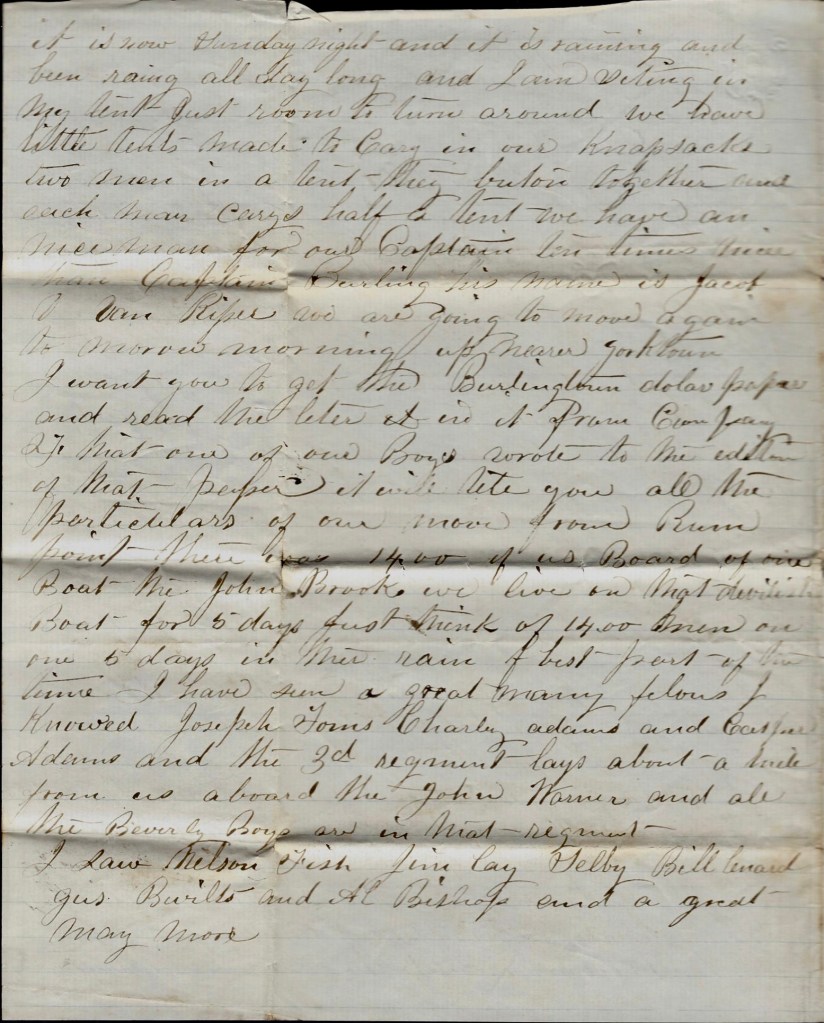
Dear sister, it has been a long time since I saw you. I never thought that I could stay away from home this long but a person don’t know what he can do till he tries. It is now Sunday night and it is raining and been raning all day long and I am sitting in my tent [with] just room to turn around. We have little tents made to carry in our knapsacks—two men to a tent. They button together and each man carries half a tent. We have a nice man for our captain—ten times nicer than Captain Burling. His name is Jacob VanRiper. 1
The Patterson Daily Register, 15 April 1862
We are going to move again tomorrow morning up nearer Yorktown. I want you to get the Burlington dollar paper and read the letter in it from Company F that one of our boys wrote to the editor of that paper. It will tell you all the particulars of our move from Rum Point. There was 1400 of us aboard of one boat—the John Brooks. We lived in devilish boat for five days. Just think of 1400 men on one [boat] five days in the rain the best part of the time. I have seen a great many fellows I knowed—Joseph Toms, Charley Adams, and Caspar Adams and the 3rd Regiment lays about a mile from us aboard the John Warner and all the Beverly Boys are in that regiment. I saw Nelson Fish, Jim lay Gelby, Bill Leonard, Gus Bevitts and Al Bishop and a great many more.
I am acquainted with both of them men that was there. One is [William A.] Bird and the other [Charles] Borden. Bird played off sick and got his discharge. The package that is coming for you is a pair of pants and a pair of drawers. It was the night before we started from Rum Point. I was going to throw mine away and Jim Smith come in the tent and says, “Hilly. have you anything to send home?” Says he, “I am going to send something home and now is your chance.” So I study awhile and could not think of anything to send but them pants.
I will have bring my letter to a close by sending you my love. Write soon. From your brother, — George W. Hill
Look for money in the next letter. They owe us 52 dollars at the end of this month. Don’t forget to send a paper to read. New York Weekly. Don’t forget to get that Dollar Newspaper and read it. 19th of April.
Sidy, tell Mary that I got her letter and paper and will answer after we move.
1 Capt. George Childs Burling (1834-1885) was promoted from Captain of Co. F to Major of the 6th New Jersey Regiment on 19 March 1862. He later became the Lt. Colonel and then Colonel of the regiment.
Letter 5
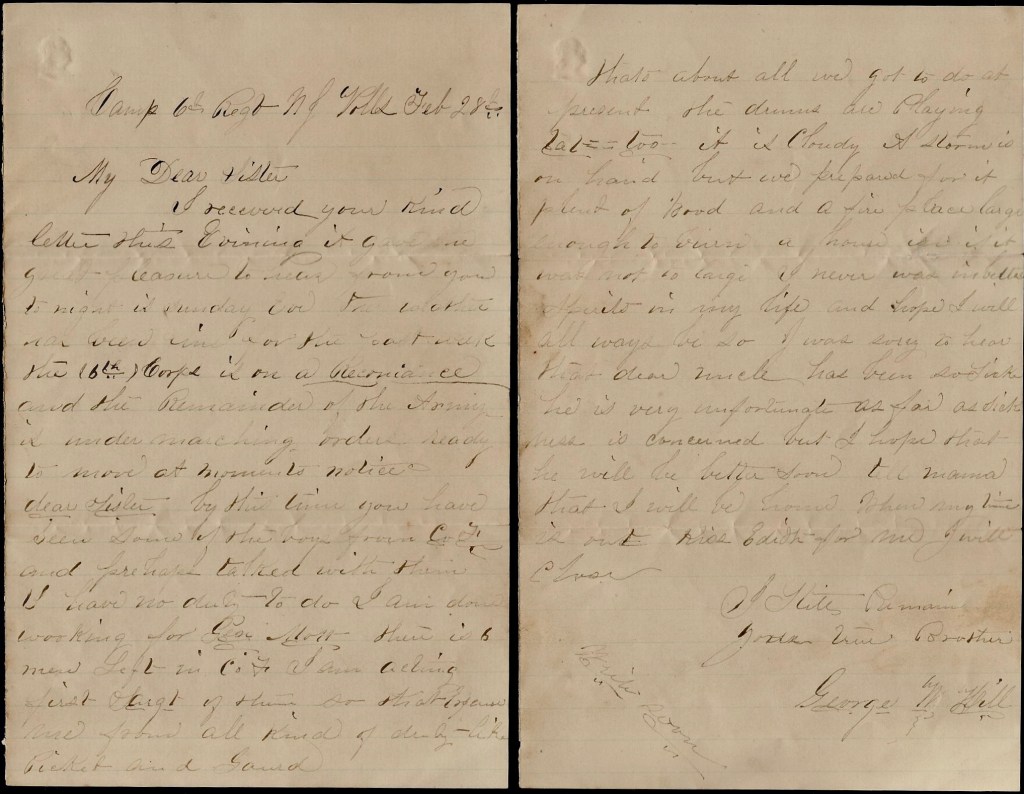
Camp 6th Regt. New Jersey Vols. February 28th [1864]
My Dear Sister,
I received your kind letter this evening. I gave me great pleasure to hear from you. Tonight is Sunday eve. The weather has been warm for the past week. The 6th Corps is on a reconnoissance and the remainder of the ARmy is under marching orders ready to move at a moment’s notice.
Dear sister, by this time you have seen some of the boys from Co. F and perhaps talked with them. I have no duty to do. I am done working for Gen. [Gershom] Mott. There is 6 men left in Co. F. I am acting 1st Sergeant of them so that excuses me from all kind of duty like picket and guard.
Jake must not think hard of me for not writing to him. I hope I will have a chance to see him before long. I hear that those that has reenlisted will be assigned to the Army of the Potomac. If so, I will see him. He could not do anything better than buy a house with his money but 400 dollars for that house is too much money. If I wanted a house, I would buy one in the country and get piece of land with it.
Yesterday I had a dinner that put me in mind of home. I will tell you what it was composed of. 1st was boiled pork, cabbage, turnips, potatoes, a cup of cold coffee, and to top out we had a half dozen mince pies but that was all. For supper tonight was as much fried tripe as we could eat.
That’s about all we get to do at present. The drums are playing tattoo. It is cloudy. A storm is on hand but we prepared for it. Plenty of wood and a fire place large enough to burn a house if it was not so large. I never was in better sprits in my life and hope I will always be so.
I was sorry to hear that dear uncle has been so sick. He is very unfortunate as far as sickness is concerned but I hope that he will be better soon. Tell Mama that I will be home when my time is out. Kiss Edith for me. I will close. I still remain your true brother, — George W. Hill
Letter 6
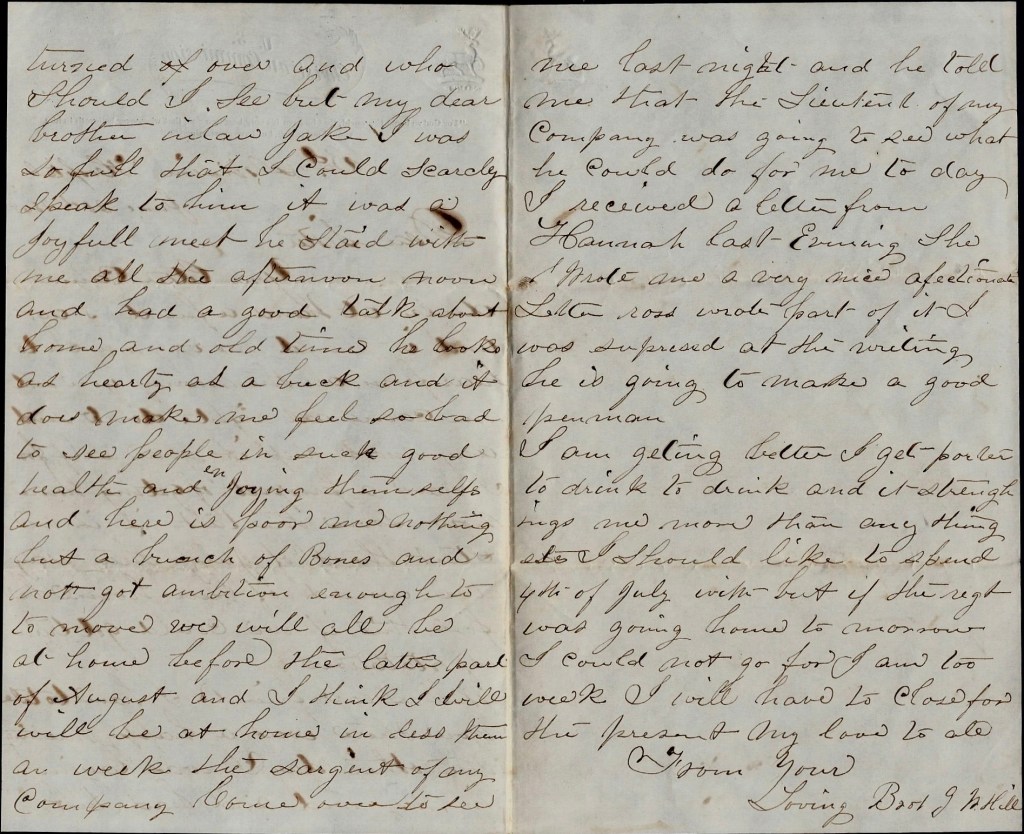
3rd Division Hospital June 28th 1865
Dear Sister,
Your letter came duly at hand a few days ago and it pleased me very much to hear from all. The money you sent me came all right. Don’t send any more. Keep it yourself for I have a prospect of getting home now soon. The talk is we start the 8th of July. They say we would of been home before this if we could get transportation.
Well, dear friends, I have to tell you there was a happy meeting the other day. I was laying in my bed and had just turned over and who should I see but my dear brother-in-law, Jake. I was so full that I could scarcely speak to him. It was a joyful meet. He stayed with me all the afternoon and had a good talk about home and old times. He looks as hearty as a buck and it does make me feel so bad to see people in such good health and enjoying themselves and here is poor me—nothing but a bunch of bones and not got ambition enough to move.
We will all be at home before the latter part of August and I think I will be at home in less than a week. The sergeant of my company came over to see me last night and he told me that the Lieutenant of my company was going to see what he could do for me.
Today I received a letter from Hannah last evening. She wrote me a very nice affectionate letter. Ross wrote part of it. I was surprised at the writing. He is going to make a good penman.
I am getting better. I get porter to drink and it strengthens me more than anything else. I should like to spend 4th of July with you but if the regiment was going home tomorrow, I could not go for I am too weak. I will have to close for the present. My love to all. From your loving brother, — G. W. Hill
The following letter was written by Flora Angeline Brooks (1851-1947), the 12 year-old daughter of Thomas Martin Brooks (1803-1881) and Sarah Brown Chenowith (1808-1865) of Paris, Edgar county, Illinois. Flora wrote the letter to her brother James Allen Brooks (b. 1844). She also mentions her brother Henry Erastus Brooks (b. 1847). Flora married Rev. John C. Ely (1849-1920), a Presbyterian Minister. They were married in 1887 and later moved to Kentucky.
At the time that Flora wrote this letter, her brother James was serving in a home guard militia under the command of Capt. Mitchell Campbell Lilley (1819-1897) based out of Columbus, Ohio. Early in the war, Lilley served as Captain of Co. H, 46th Ohio Volunteer Infantry (OVI), but ill health forced him to resign from active service in January 1863 and return to Columbus where he took command a home guard militia for the duration of the war.
Flora’s letter contains some interesting news. She informs her brother of the competing Fourth of July celebrations hosted in Paris by both the Republican Party and the Democratic Party—the latter being predominantly composed of citizens with southern-leaning sympathies who she refers to as “butternuts.” According to a thesis by Scott Parkinson published in 1988 who studied the effects of the Civil War in Edgar county, “anti-war feelings did not come to a boil until late in the war” as the war dragged on in what was traditionally a Democratic, mostly southern-bred population. “In early February 1864, the growing agitation erupted into violence for the first time as Copperheads and furloughed soldiers clashed in Mattoon, Illinois, in what is known as the ‘Mattoon Incident.’ The editor of the Paris Times blamed the incident on Copperheads belong to the subversive secret society (Knights of the Golden Circle).” A similar event occurred in Paris later in February 1864 when soldiers of the 12th and 66th Illinois skirmished with Copperheads trying to seize an arsenal of weapons in the town.
Flora also mentions the turn out by organized home militia units to confront John Hunt Morgan as he made his raid through southern Indiana, Illinois, and Ohio during July 1863. She also describes the celebrations in Paris, Illinois, upon hearing the news of the surrender of Vicksburg—a great letter written 160 years ago this month.
[Note: This letter is from the personal collection of Greg Herr and was transcribed and published on Spared & Shared by express consent.]
Transcription
Addressed to James A. Brooks, Columbus, Ohio, Care of Capt. M. C. Lilley
[Illinois] July 13th 1863
Dear Brother,
I am very sorry that I did not get to see you before you went away but we did not get the letter until late in the evening. Then it was too late to come home that day. Tilla Beaver and I were out to Mr. Elliott’s last Friday. We had a nice time. Charlie and Ellie were here the Fourth of July. It was said the Union Party had twice as many as the butternuts. They had their picnic in Conley’s Grove and the Union Party had their in Mr. Mayo’s Grove. 1
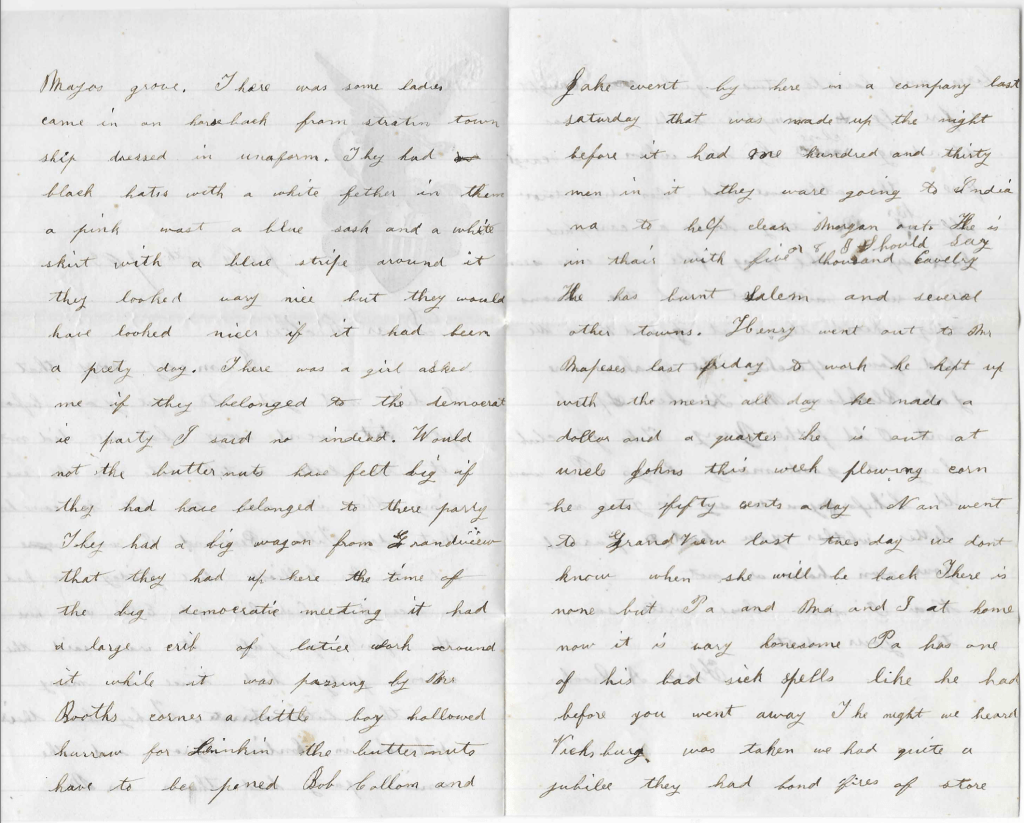
There was some ladies came in on horseback from Stratton township dressed in uniform. They had black hats with a white feather in them, a pink waist, a blue sash, and a white skirt with a blue stripe around it. They looked very nice but they would have looked nicer if it had been a pretty day. There was a girl asked me if they belonged to the Democratic Party. I said no indeed. Would not the butternuts have felt big if they had have belonged to their party. They had a big wagon from Grandview 2 that they had up here the time of the big Democratic meeting. It had a large crib of lattice work around it. While it was passing by the Booth’s corner, 3 a little boy hallowed, “Hurrah for Lincoln!” The butternuts have to be pissed.
Bob Collom and Jake went by here in a company last Saturday that was made up the night before. It had one hundred and thirty men in it. They were going to Indiana to help clean Morgan out. He is in there with five—or eight I should say—thousand cavalry. He has burnt Salem and several other towns.
Henry went out to Mr. Mapeses last Friday to work. He kept up with the men all day. He made a dollar and a quarter. He is out at Uncle John’s this week plowing corn. He gets fifty cents a day. Nan went to Grandview last Tuesday. We don’t know when she will be back. There is none but Pa and Ma and I at home now. It is very lonesome. Pa has one of his bad sick spells like he had before you went away.
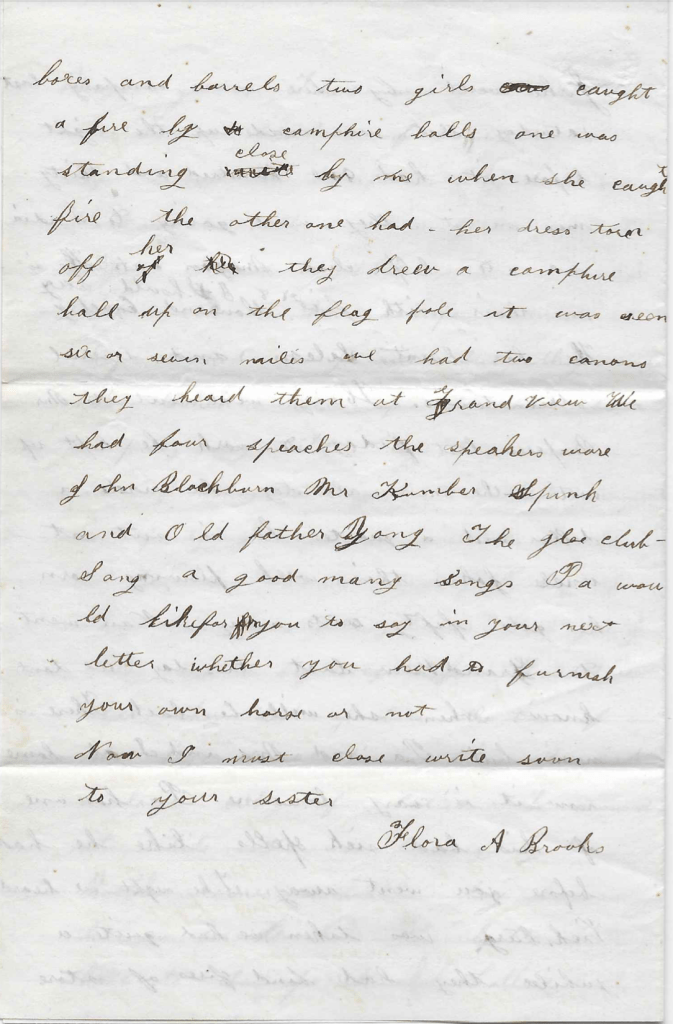
The night we heard Vicksburg was taken we had quite a jubilee. They had bonfires of store boxes and barrels. Two girls caught a fire by camp fire balls. One was standing close by me when she caught fire. The other one had her dress torn off her. They drew a camp fire ball up on the flag pole. It was seen six or seven miles. We had two cannons. They heard them at Grandview. We had four speeches. The speakers were John Blackburn, 4 Mr. Kimber, [Solomon] Spink, and Old Father Young. The glee club sang a good many songs.
Pa would like for you to say in your next letter whether you had to furnish your own horse or not. Now I must close. Write soon to your sister, — Flora A. Brooks
1 “Mayo’s Grove” was probably the wooded block of ground between East Court and East Wood streets that Colonel May donated to the city. A school house was later built there.
2 Grandview is a small community some eight miles southwest of Paris, Illinois.
3 Walter Booth (1823-1881) kept a dry goods store in downtown Paris. He was a prominent citizen of the town, reelected to the town council many times and twice elected mayor.
4 John Widener Blackburn (1825-1894) was a lawyer in Paris, Edgar county, Illinois. He is mentioned in this letter to Abraham Lincoln.
























 Spared & Shared 23