My passion is studying American history leading up to & including the Civil War. I particularly enjoy reading, transcribing & researching primary sources such as letters and diaries.
The following letter was written by Franklin (“Frank”) Garland who enlisted at the age of 19 on 20 November 1861 as a Landsman in the US Navy. He was later promoted to a Paymaster’s Steward and then mustered out of the Navy on 10 December 1864. He was initially on the receiving ship USS Ohio but then assigned to the USS Commodore, a side wheel steamer built in New Orleans and fitted for service with the West Gulf Blockading Squadron. She was renamed the Fort Gaines on 1 September 1864. He may have possibly served aboard the USS Portsmouth as well.
Frank was the son of Leonard Sawyer Garland (1815-1876) and Elmira H. Whitcomb (1817-1880). He was the eldest of several children the next oldest being Ann (“Annie”) Elizabeth Garland (1844-1936) whose name appears on this envelope. Frank was described in Navy records as standing 5′ 8″ tall, with hazel eyes and brown hair.
Transcription
Addressed to Annie Garland, Newington, New Hampshire, Ships Letter
US Steamer Fort Gaines New basin off New Orleans, La. September 28th [1864]
Dear Mother,
I now seat myself to write you a few lines to let you know that I am well as usual and I hope these few lines will find you enjoying the same happiness. I received a letter that you wrote to the Captain of the Portsmouth. He opened it and then sent it to me. You say that you haven’t heard from me since June but I can’t see into that for I wrote to you in July & August. They must have got miscarried somehow. I am very sorry because it only made you worry about me for nothing.
I wrote to Annie not long ago. I don’t see where all my letters go to. I wrote in my last letter for my clothes to wear home if they are fit to wear. My time is out now in a little while and then I will be a free man once more which I never was yet.
You said something about the colt in your last letter. Tell father to not keep him on my account for perhaps I would never want to use him. Please send my over coat if nothing more as I can’t get one here short of $25. I will draw to a close now as I have nothing more very interesting to write. So goodbye. From your son, — Frank
By the way, please direct to the U.S. Steamer Fort Gaines of N. Orleans, La. Our [vessel’s] name has been changed by order of Admiral Farragut.
I could not find an image of Thomas but here is a cdv of Edward F. Possen who was a corporal in Co. C of the 152nd New York Infantry (Photo Sleuth)
The following letters were written by Thomas Richard Petrie (1841-1923), the son of Robert Petrie (1808-1873) and Margaret Harter (1816-1906). He wrote all four of his letter to Gertrude Emily Sanders (1842-1924), his future wife.
Thomas was 21 years old when he enlisted on 5 September 1862 as a corporal in Co. F, 152nd New York Infantry. He was promoted to a sergeant on 11 February 1863 and mustered out of the service on 13 July 1865. For a couple of weeks during August 1864, Thomas served as the First Sergeant of his company.
The 152nd New York Infantry was recruited in the counties of Herkimer and Mohawk and mustered into the U. S. service on 15 October 1862. The regiment left on the 25th and was stationed in the defenses of Washington until the succeeding April, when it was ordered to Suffolk and assigned to Terry’s-brigade, Corcoran’s division, 7th corps. After sharing in the defense of Suffolk, it served under Gen. Keyes on the Peninsula and in July was ordered to New York city during the draft riots, remaining there until October, when it joined the Army of the Potomac and was assigned to the 1st brigade, 2nd (Webb’s) division, 2nd corps. In this command it shared in the Mine Run campaign, being engaged at Robertson’s tavern. In the Wilderness campaign it fought in Gibbon’s division, 2nd corps and was active in all the series of battles ending with the surrender of Lee at Appomattox. Its heaviest losses occurred at the Wilderness, Spottsylvania, North Anna river, Cold Harbor, first assault on Petersburg, Weldon railroad, Strawberry Plains, Reams’ station and Boydton plank road. Its losses during the whole campaign amounted to a total of 303 killed, wounded and missing. Its last battle was at Farmville two days before Lee’s surrender.
Letter 1
Addressed to Miss Gertrude E. Sanders, Eatonville, Herkimer Co., New York
152nd Regt. New York State Volunteers, Col. L[eonard] Boyer Company F, Capt. David Hill Camp Marcy, Va. January 11th 1863
My Darling Betrothed,
Again it is Sunday and I find myself as usual writing to my distant and much loved friend. I often think and ask myself the question why do I write so often and the only definite answer that I can give is that it is a pleasure to me. I said the only answer I could give was that it was a pleasure to me but it is not only that, but I think and trust it is also a pleasure to you to receive and peruse my letters, no matter how often. I have good reason for thinking so too, judging from what you have written from time to time. And besides, I know it is a pleasure for me to receive a line from you no matter how often, and I know of no reason why it should not be as great a pleasure to you. But if I should trouble you too often, please make it manifest, will you?
Hank has got supper ready and I must adjourn. We are going to have an oyster soup.
Sunday eve. Again I have taken up my pen to finish my letter. Gertie, you do not know how hard it is for me to write a letter. If it was anybody else but you, I could not write as often. But if my writing is poor and my composition is still poorer, I think and trust that my friend and companion of former times will not criticize my letters too closely. And if she does, I hope will excuse all imperfections.
Then Git [Gertie] and the General went to the ball? I could not think why you sent me the mittens until I received your last letter. I did not think when I sent to see my southern friends and neighbors that you would hear of it so soon, but so it is at last. Mr. H. J. H. has accomplished his end. And now you cling to the old stand by. Git, I did not think that was your only refuge. If I judge rightly, you did not have a very good time at the party. I am sorry to hear it. You did not run over anybody, did you? If you had, I think you would have told me. Your sleighing must have been delightful without any snow. I suppose Heman had those big bells and a two-horse tree and drove up in big style as is his wont.
Git, you may think I am rather dull of comprehension in speaking of that dear old watch after your spelling it such plain letters. It was very plain at first.
Your father wished to know how his friend Mr. [Ebenezer] Pearl gets along. Well, I will tell you. The old fellow is rather bad off. He is sick and has been five or six weeks. Besides, I think he is a little homesick. Today I heard that he was a going to be taken to the hospital. The health of the regiment is not very good in general. 1
It was news to me to hear that Shully Petrie and Lieut. Conern were engaged but there has been stranger things than that happened. Git, you said in your letter that you could hardly bear the idea of my being gone three years. I will say without boasting if you do not see me within three years, you need never expect to see me. This sheet is nearly full. I have a little more spare time and I will take another.
[rest of letter is missing]
1 Ebenezer A. Pearl was 44 years old at the time of his enlistment. He was discharged for disability on 28 February 1863.
Letter 2
Four miles from Petersburg, Va. Sunday, June 26, 1864
My darling Gittie,
I do not write to you today to only assure you how fondly and dearly I still love you (which you know is the case), but to ease your anxious mind and let you know I am still unhurt and well.
It has been some time since I last wrote. If I remember correctly, it was four weeks ago today. But as my thoughts wander back over those four weeks, it does not seem more than as many days. But what has been accomplished with this great Army of the Potomac in that time? Enough to fill pages in history, and until then it will never be known what was transpiring all along the long lines of our armies.
But Gittie, without giving a detailed account of all that came under my observation, I might relate some few things that I have seen that would make your blood run cold. But I will not do it. I will try and choose some more pleasant subject than relating the horrors of the battlefield.
I see by the Journal & Courier (of which I believe you are a reader) that there was a full description given of the 152nd [New York Infantry] in their first charge upon the Johnnies and what an imperishable name they have won. But Git, there is but few of them left at present to wear the laurels they so nobly won and richly deserve. All there is in the regiment at present is between 90 and 100. The rest are killed, wounded, and prisoners. There was about 50 taken prisoners this week.
As I think of the regiment and then think what if I had been with them, I cannot help but feel thankful that I was so fortunate as to be detached from them in this great and trying struggle—not so much for myself do I care, but [for] my darling Gittie. How much anxiety and trouble have you been saved from by my staying where I am and how could I help but feel thankful for saving my dearest friend from care and sorrow.
It is almost the 4th of July again. As I think of it, I can hardly believe it. Still it is so, and we have been celebrating that day for almost two months, both day and night with shot and shell. There is hardly a night passes over without there is an awful fight. To hear the roar of 40 or 50 guns and see the shells as they go shrieking through the air on their deadly missions, and the thousands of muskets as they break at irregular periods upon the midnight air, it altogether makes one of the grandest, still the wildest sight that I ever anticipated.
Gittie, how do the boys feel about the coming draft? I should think they would sell themselves at present pretty cheap. What think you? I hear that Minerva Searle is teaching school this summer. How does she and Mr. H. L. A. make out? As well as ever I hope.
The weather here has been very warm for the past week and we have not had a drop of rain in 5 or 6 weeks. Lieut. [John W.] Quinby is about returning to school to Fairfield again. He wrote that he thought he would pass near Eatonville and he would be happy to do me any favor in that vicinity I wished him to and he spoke particularly of speaking a good word for me to Miss G. E. S. so if you should happen to see him, you need not be alarmed if he would speak of me.
I am sitting today under the shady branches of a large oak and it is comparatively cool to what it is out in the sun. But how I wish I might change my seat here for one where if only for a few hours—I will leave you to answer where I would like to change this seat for.
Gittie, I have not had a letter from you in more than a month. Why is it? Please write as soon as convenient. Give my respects to all your people and remember me as your most sincere and loving friend, — Thomas
I send you a picture of E[dward] C. Townsend, formerly Orderly Sergeant in Co. F, 152nd. Now captain in Colored Troops [23rd USCT]. He wants I should accept a commission in that branch of the service. What do you think of it?
Letter 3
Burkeville Junction, Virginia April 29th 1865
My dearest friend,
How happy I am this afternoon to be able to sit down and acknowledge myself the recipient of another of your truly kind and loving letters. If your happiness is governed somewhat by my letters and I do not doubt it, whose letters do you suppose mine is governed by? I little expected a letter so soon but must say I was gladly surprised this morning upon the receiving of your letter of the 23rd inst. I must give my friend the praise of doing extremely well in writing so often to her very unworthy friend.
You will see by my last that I had received your letter of the 17th and I might here remark that I thought when you were writing that letter, you was very low spirited and perhaps not in the humor. But I may be doing my friend great injustice in entertaining any such thoughts. If I am, I most humbly beg your pardon. Do not think, Gertie, by my writing as I have, that I mean anything harsh or bad, but only wish to find out your true feelings when writing it. You say in your last in speaking that, “you were not very happy.”
Yes, Gittie, the assassination of our President proved but too true. You ask can the northern soldiers ever look upon the south with the least degree of respect? I think if they were again called upon to fight the southern traitor—Rebel or assassins—whatever they may be called (none of those names being appropriate for them), their watchword would be, “Remember our President!” While they know it was a northern man who held the weapon that killed our much lamented President, they also know and bear in mind that it was treason fired it, and that too approved by J. Davis and more of its leaders in the so-called “Confederate States”—but Confederate States no more. Yes, Gittie, and will but feebly express our grief for our President this particular time. Still, I think his sucessor a very able man and will not show much mercy to Rebels.
Then you are happy in thinking our soldiers will soon get their discharges and peace shall again reign? And if it should prove true, you know of one who would be happy to welcome back her soldier friend and ask me if I can guess who? Now Git, you know I am the poorest hand in the world to guess. So won’t you tell me who that person is? …
[the last two pages may or may not be from the same letter]
…How sad is the fate of our much beloved President. I wish the assassins could be caught and their fate left to be decided with the soldiers. They would meet their just doom in a short time, I will warrant you. His death has caused, I think I may safely say, the most general mourning throughout the land of any person ever known, and it seems so much worse at this particular time when the whole Nation were rejoicing over recent victories and as we thought were about to see the war satisfactorily settled. The Nation and the people, and soldiers, have lost one of their truest friends. And I think the most of them appreciate his worth…
[unsigned]
Letter 4
Headquarters Second Army Corps Richmond, Virginia Friday, May 5, 1865
My Dearest Friend,
At last I have seen the Rebel Capitol and am now within its precincts enroute for home. We broke camp at Burkesville Junction on the afternoon of the 2nd and got here this morning at 9—a distance of 55 miles, and tomorrow morning we start for Washington, another little journey of 140 miles to go on foot—that is, the troops (myself excepted of course). It will take us 12 days from here and I thought I would write my friend a line while here to inform her of our whereabouts. It is thought we shall be mustered out of service as soon as we arrive in Washington. What a pleasant thought—a day that we have long been looking for.
I am going over into the city as soon as I finish this letter to see some of the principal buildings such as Castle Thunder, Libby Prison, Spottswood Hotel, and the Rebel Capitol, and whatever else may come in my way. So if I am either brief in my remarks this afternoon, my friend I am sure will excuse me for our time is short here. You will not again hear from me until we arrive in Washington and then I will write soon after our arrival. With the thoughts of soon returning to home and friends, our journey will be very much lessened of its hardships. It hardly seems like reality on come home soon, but it is the prevailing opinion that we will all be home by the 4th of July and perhaps sooner.
Well, Gittie, please excuse lead pencil writing and all mistakes, and with kind regards to all inquiring friends and with a (goodbye kiss) and much love, I remain as ever yours and yours truly, — Thomas R. Petrie
A cdv of Lewis Josselyn, Co. K, 38th Massachusetts Infantry, taken in Baton Rouge in 1864 (Michael Cunningham Collection)
This letter was written by Lewis Josselyn of Co. K, 38th Massachusetts Infantry. Lewis was a shoemaker like his father when he enlisted at the age of 20 to serve three years. He was mustered out of the service on 30 June 1865 at Savannah, Georgia.
In the 1860 U.S. Census, 17 year-old Lewis was still residing at the home of his parents, Cyrus Barker Josselyn (1814-1898) and Elizabeth Barker Bates (1811-1885) in Hanover, Plymouth county, Massachusetts.
Lewis wrote this letter from Baton Rouge, Louisiana, while the 38th Massachusetts was attached to the 3rd Brigade, 2nd Division, 19th Army Corps, Department of the Gulf. A few weeks later, the 38th participated on the ill-fated Red River Campaign.
See also: Lewis Josselyn, Co. K, 38th Massachusetts (letter dated 11 December 1863) Lewis Josselyn, Co. K, 38th Massachusetts (letter dated 16 February 1864)
Transcription
Baton Rouge [Louisiana] March 9 [1864]
Dear Mother, &c.
We had a terrible thunder shower last night. Sometimes it would sound as if forty thousand cannon were fired off at once, it was so hard. It has not cleared off yet and is now very dark and rainy. I tell you what, it don’t know how to rain in Massachusetts as it does here. When it is a mind to, it comes down in perfect floods. One would think the bottom of the washbowl had come out and all was coming down on us at once.
I got another letter from you this morning and one last week. I did not write an answer to that one for I had just put a letter in the office for you this morning. I did not expect one again this morning, but I was going to write today or tomorrow whether I had one or not. I am glad that Edith and all of you are better again and I wish I could write the same. I for one am as well as can be, but Eli he gets along rather poorly. He has been quite unwell since I wrote last. The first of it, he thought it was the medicine he was taking for his diarrhea that made him feel so bad, and it might have been that. Anyway, he is far from well. Lime is some better of his sore throat than when I wrote before, but it is not well yet. Mark, I guess, feels quite smart now. I don’t ever think to ask him how he is for he is round carrying on as much as he ever is, if not more. You know he was always more quiet than Lime was.
Last night Butt and I went to a show that is now here for a few nights. It was a Polyorama (they call it) of the war from New York. It was paintings the same as a panorama or I could not see any difference in it. It was the best show of the kind that I ever saw. The paintings were as natural as life. One of the pieces was a fight between the Monitor and Merrimack. It first showed the Cumberland (the one that Hugh was in) and Congress in the Hampton Roads rocking in the water. The waves looked as if it was the sea itself. Then in steamed the Merrimack, going up to the Congress as if to run into and sink her, but the Congress then was aground and she dare not venture up to her, so she turns upon the Cumberland and runs into her, and then runs back and tries it again, this time making a hole in the Cumberland, and she sinks, with her colors still flying at the mast.
The Monitor now comes in, and engages the Merrimack. She finally finds the Yankee cheese box too much for her and she has to retreat. As she does so, she fires a shell at the Congress and sets it on fire and is destroyed. This was done the best of anything of the kind I ever saw. I go to the Theatre every few nights. They now have it closed to us and our boys go as guard. I could go every night if I wanted to, but I don’t want to go every night unless they are going to play something pretty good—better than it generally is, for it is a poor theatre.
Yesterday there was quite a fight outside between the rebs and our cavalry. For several days the rebs have been hanging round our cavalry pickets and our cavalry have been out a number of times but could not find them. Day before yesterday they were at the Plantation on which two of our company are stopping as guards and took a mule and a horse, They did not go to the house where they boys are or they would have been taken prisoners, They scared the niggers most to death. There was about twenty-five of them.
Yesterday a Lieutenant and a small squad of cavalry went out and they came on about fifty rebs. The rebs were hid in the bushes and fired on our cavalry, killing the Lieutenant and wounding one. They then sent a messenger right in and the rest of the cavalry went out and two regiments of infantry and some of a battery with muskets instead of cannon. The cavalry caught up with the rebs and took quite a lot of them prisoners and killed a lot, so some say, but there is so many stories aging, I can’t get the truth of it yet. I know they took two for they were brought to the judge’s office and I took them to jail. One of them was complaining all the way up there. He said one of the cavalry struck him on the back with his revolver. I thought it was mighty lucky for him that he did not get a bullet through him instead of a blow. They bother our pickets a good deal by coming up and shooting at them every little while. Our folks had ought to use them a little harder than they do when they catch them for it is not considered fair upon each other’s pickets.
Three days ago our regiment and another went out eight miles to see what they could find. They returned the same day without seeing a reb. It was quite a little tramp for the boys, they not being used ti it lately. I was glad we did not gave to go.
Waltham Sentinel, 29 April 1864
Day before yesterday there was an eating saloon keeper killed here by a soldier. They had a little fuss about something when the soldier drew his revolver and shot him dead. The soldier escaped and has not been found yet. I wsa past the saloon yesterday and the corpse lay in there with four candles lit around him—two at his head and two at his feet as the Catholics always do. It looked kind of queer to see a corpse that way.
George [B.] Oldham has been up to see us since I wrote last but he has now gone back again to New Orleans and from there he is going up round through the Tesche country (we call it where we marched last summer) recruiting for his [USCT] regiment for he has got to get a certain number of men before he can be mustered as an officer. He had on a new suite of clothes—an officer’s suit, and he makes a splendid looking officer.
I wrote you that Lime talked of applying for a commission. He says he does not want the folks to know anything about it so you need not say anything to anyone about it if you have not. He may have given up the notion now.
I wrote you to send some postage stamps some while ago but soon after that I had a chance to buy some do I got a lot—enough to last me a long time. You need not send me anymore unless I write for you to. I hope they will conclude to have a railroad run through Hanover and down round our way as you say there is some talk of, but I am afraid it will turn out more talk than cider for I don’t believe they could make it pay. It would be a mighty fine thing if I could when I come home ride as near home as the old forge in the cars.
We have just had another thunder shower but it was not so hard a one as we had last night. I guess it will now clear off. Everything here now begins to look like spring. All the trees are leafing out and the peach trees have all bloomed and blown off, and I noticed today on a fig tree that had leafed out some small figs.
That man I wrote to you about who is sentenced to be shot is still in the jail, but I don’t hear anything about him now. You ask me if I remember Mr. Morris. I do but he don’t probably me anymore than that I was one of those that were sick in the hospital while he was one of the nurses there. It would be curious if he did for he belonged to a different company and there was a good many in the hospital at the time I was. You say Barker talks of going to Abington again to work. I should think it would be rather lonesome for him to work alone in the shop after he has had company so long. I hope he will be lucky enough to get drafted on this call or any other for I think after this call is filled up, that there will be troops enough in the field to wipe this cursed rebellion out. I sincerely hope so. I believe the rebs will get fits before this summer is out. Someone of our company got up a petition to send to Gov. Andrews to have our 2nd Lieutenant made a 1st Lieutenant rather than have him resign as he talks of doing. Most of the boys signed it and so did I for we all like him as a lieutenant and we would like to have him stay but when he was made a lieutenant, all of the boys would have been pleased enough for him to resign and would have paid something if they could get clear of him that way.
I could not find an image of George but here is Pvt. Robert M. Burnard of Co. A, 47th Ohio Infantry (Tom Liljenquist Collection)
These letters were written by George Washington Sheldon (1845-1864), the son of Benjamin Sheldon (1811-1872) and Louisa Gustin (1824-1927). In the 1860 US Census, 15 year-old George was enumerated with the rest of the family on his parents farm in Perry township, Brown county, Ohio. However, letters mailed home to his parents during the Civil War were addressed to Blanchester in Clinton county. According to muster records, George enlisted at the age of 17 in Co. F, 47th Ohio Volunteer Infantry (OVI) on 7 August 1861. It’s possible he may have only been 16 and lied about his age. Sometime after his enlistment he seems to have been transferred to Co. E.
One of the letters published here was datelined from the camp of the 47th OVI in the rear of Vicksburg on 24 May 1863. After spending the early months of 1863 in a futile attempt to dig a canal that would allow Union gunboats to bypass the Confederate stronghold out of reach of the enemy’s cannons, the regiment participated in Grant’s advance upon Vicksburg’s rear. By May 18, the regiment had arrived at Walnut Hills, Mississippi, on Vicksburg’s outskirts. On May 19 and 22, 1863, the 47th attacked the Confederate position on Cemetery Hill. The regiment seized this position on May 22, 1863 and occupied the Cemetery Hill Fort for the duration of the Siege of Vicksburg.
Another letter published here was datelined from line of battle before Atlanta on 23 July 1864. The first part of the letter was written by George just prior to Lt. General John B. Hood’s attack on Maj. General William T. Sherman’s troops in what would be the Battle of Atlanta. The second part of the letter was penned by William (“Bill”) H. Orr, George’s bunk mate, who informed George’s parents that George had been taken prisoner in the battle. We learn from prison records that George was taken to Andersonville where he died of diarrhea on 10 September 1864 and was buried in Grave 8319.
Letter 1
Camp opposite Vicksburg State of Louisiana February 13, 1863
Dear Parents,
I take my pen in hand to let you know I am well and hope you are all the same. Well, I will tell you that I han’t got a letter from home since I left and I want you to write.
We are laying here within two miles of the Rebel Army but we don’t know when we will go into battle. We have about 90 thousand fighting men and it will be a hard and bloody battle if we ever get at it. But we have been here 3 weeks and no sign of a fight, though our pickets are in talking distance.
Where we are camped is very flat, swampy land and awful bad water. The old troops are very sickly. But the Virginia troops or the 47th, 30th, 37th, and 4th Vol. Regiments are all healthy. But how long we will be healthy is hard to say. For my part, I am as fat and hearty as I need to be. Well, it is very hot here and I don’t know what we will do when it comes summer for it is too hot now for me for I have got so lazy that I can’t cook my own grub though I han’t much to cook. Only once and a while I get into the woods and kill some fox squirrels or a coon for there is plenty of both and plenty of wild geese and ducks. But all in all we have a durned hard time.
The Rebels send a few shot and shell into our camp every day. Yesterday they sent a solid mortar ball that weighed two hundred pounds and you may believe it or not, but I saw it. It went into the ground eleven feet. It is the largest that has been shot at us yet. It was fired from a mortar.
Well, we expect our money every day. There is 6 months pay coming to us now. When I get mine, I will send it home. All the boys are well but [Jared] Nelson Overy. He is sick but is getting better. I think there has been over 2 thousand died since we came here but not a man from the 47th. [Letter is unsigned or the remainder of it is missing]
Letter 2
Camp in the rear of Vicksburg May 24th 1863
Dear Parents,
I take my pen in hand to let you know that I have received your letter and that it gave me great pleasure to hear you was all well.
I have been in an awful battle. It has now lasted six days and [involved] about 25 or twenty-six thousand of our men. I have made two desperate bayonet charges with my company. I will now tell you who fell in defending our liberty in the great siege of Vicksburg.
In Company E—that is my company and as brave a set of men as ever went out to battle for their country: Lieutenant [John W.] Duchemin, Orderly Sergeant Peter Hallsted, Sergeant Adrian A. Shields, Privates Francis [M.] Glancy, Mahlon T. Hall killed. Only one man killed. The rest are wounded. One man is killed, I suppose, who we cannot find. Many a poor soldier lies rotting on the battlefield. Jonathan Casto is killed. Jim Jester is killed and a great many more whose names I do not know, and God only knows how many more will fall.
The Old 47th Ohio done as good work as any soldier ever done in this or any other war. We have abandoned the idea of ever taking the city by storm so we are now fortifying and we have laid siege to the town and expect to starve them out. We have captured 13 or 14 thousand prisoners but they have a very large force yet.
That 50 dollars—you hire hands with it if you want to. Do just as you please with it. Isaac is all well. He is now elected to the office of Corporal. I can’t write much for I am in 150 yards of the Rebs’ breastworks and they are shooting all the time. But I am behind a hill and there is no danger. Bill Boggs is driving team. I got them postage stamps all right.
There is a good many more things that I would like to mention but I have no time. Goodbye. I hope I will get through this battle but if I should fall, remember I fall in a good cause. No more. Tell Benejah to write.
— George W. Sheldon
Letter 3
In line of Battle near Atlanta, Georgia July 23, 1864
Dear Parents,
I take my pen in hand to let you know I am well & hope you are all the same.
The Rebels abandoned their first line of works last night and we moved forward this morning. We are now within one mile and a quarter of the City. The artillery is keeping up a constant roar from both sides. Several shells have [ ] near where I am sitting. There is a 12 pound spherical case shell lying close to me. It came [with]in 3 or 4 feet of Bill Orr while he was picking blackberries. It was filled with musket balls.
July 24, 1864—Mr. Sheldon. Dear sir, I sit down to inform you of our sad disaster yesterday. Shortly after your son George stopped writing, the enemy moved on us in solid column and after twenty minutes heavy fighting, they took our works. We clubbed muskets with them but they over powered us and we were driven back in disorder. 1 Our company lost 20 men. Your son is a prisoner.
“General Logan road along the line and cheered up the boys. He said he would have a rally before the sun set.”
William H. Orr, Co. E, 47th Ohio Infantry, 23 July 1864
As I said, we were driven back nearly one and three-quarters of a mile and rallied. General Logan road along the line and cheered up the boys. He said he would have a rally before the sun set. We formed in line of battle and when the signal was given, we moved forward and retook the works and as many prisoners as they took from us. Their dead lay thick around our works. We expect them to try us again this evening. If they do, they will find it more of a task than they did yesterday.
After Maj. General James B. McPherson was killed during the pitched fighting of 22 July 1864, Maj. General John A. “Black Jack” Logan took command and rallied the troops by riding along the line, hat in hand, and organized a successful counterattack in the Battle of Atlanta.
Our regiment lost 107 men. Our company lost 20 men killed, wounded, and missing. I will give you a list of the company below.
Sergt. [Galen B.] Ballard killed Sergt. P[eter] L. Hallsted killed Sergt. [Jesse] Shumaker wounded severely Corp. [Thomas J.] Rogers wounded severely Private [John N.] Eckes wounded in 3 places Private [Jacob B.] Flory killed Private [William] Garrett wounded severely Private [George W.] Lazure wounded in 4 places severely Private [John K. R.] Torrie wounded in two places severely Missing Corporal Liddel, R[obert] M. Corporal Craig, A[braham] T. Corporal Justin, Isaac Private Dungan, A[ndrew] W. Private Garrison, Peter Private Means, Wm. Private Moon, Private Sheldon, George W. Private Rude, [Nicodemus] Private Girton [George W.] Private Fisher, J[oshua W.]
A few of the envelopes George used to send letters home to Ohio
That is a full list of to-date in our company. Our Lieut-Col. [John Wallace] was wounded and taken prisoner. One of our color bearers was killed and the other wounded. The Rebs got hold of our flag and one of the guards killed him and brought the flag off the field. The staff of the battle flag was shot in two 4 times and the stars and stripes was shot in two pieces. Neither one has got a staff now. 2
We have the 5th Sergeant to command the company. I believe I have said enough as your son was a bunk mate of mine, I thought it my duty to write and inform you of his capture.
I am your truly, — Wm. H. Orr
1 “At the works a fierce struggle and hand-to-hand conflict occurred over our colors, in which the enemy were punished most severely. In this struggle Corporal McCarthey, of the color guard, was captured; Corpl. Abraham T. Craig, of the color guard, wounded and captured, and Henry Beckman, color–sergeant, wounded. Lieut. Col. John Wallace, commanding the regiment, and Capt. H. D. Pugh were captured while bravely laboring to form a new line.” [After action report by Thomas T. Taylor, Maj., Commanding.]
2 “After proceeding a short distance, one small company and men from various regiments joined my line, swelling the number to about 250, with whom, wholly unsupported, I charged, and succeeded in approaching within a few feet of the works, when, such was the storm of fire which swept over this gallant band, that both flag-staffs were shot off and the regimental standard torn from the staff by the fragment of a shell. One of the color bearers, Corpl. Joseph Ludborough, was killed, Corporal Roemhild, of the color guard, wounded.” [After action report by Thomas T. Taylor, Maj., Commanding.]
I could not find an image of Thomas but here is Oren Fletcher of Co. F, 11th Pennsylvania Cavalry (Jim Mayo Collection)
The following letter was written by Thomas J. Williams of Co. A of “Harlan’s Independent Light Cavalry,” which retained that name until 13 November 1861 when it was attached to Pennsylvania and called the 11th Pennsylvania Cavalry. He was carried on the company roster as Thomas “P.” Williams but only because he had a way of writing his middle initial in a manner that looked more like a “P” than a “J.” According to regimental records, he was mustered in as a private on 27 September 1861 and discharged on a surgeon’s certificate on 29 January 1863.
During the summer of 1861, Secretary of War Simon Cameron authorized the creation of twelve cavalry companies, with each company coming from a different state. Colonel Josiah Harlan was to organize Ohio’s company, but United States law prohibited the establishment of single companies from individual states. As a result of this prohibition, after Harlan’s Light Cavalry mustered into service on August 31, 1861, officials assigned the company to the 11th Regiment Pennsylvania Cavalry, which was stationed at Hesterville, Pennsylvania. The members of Harlan’s company became Company M of the 11th and consisted of recruits primarily from Marion, Crawford, Meigs, and Wyandot Counties, Ohio.
Upon joining the 11th, Harlan’s Light Cavalry and the rest of the regiment left Hesterville for Ball’s Crossroads, Virginia, where the Northerners remained until November 1861.
Thomas wrote the letter to John Dawson Clise (1830-1912), a merchant in Dunleith, Jo Daviess county, Illinois. He was appointed postmaster of Dunleith in March 1861.
Transcription
Addressed to Mr. J. D. Clise. Dunleith, Illinois Franked as “Soldier’s Letter” by “Maj. Samuel Wetherell, Harlan’s Cavalry”
Camp Palmer [near Ball’s Cross Roads], Virginia October 25, 1861
Dear Sir,
I have taken my pen in hand to inform you that I am well at present and hope these few lines will find you enjoying the same good health.
We have had a hell of a time since I saw you the last time. We get about half enough to eat but I got a horse, saddle, and bridle and saber. We are five miles from Washington in Virginia. We are where the Rebels were about three weeks ago today. There was three skirmishes.
By God, the boys keep such a noise. There is a great many soldiers around [in the] woods. The Rebels [are] about two miles [from] them. We are starved to death this winter. If we have to stay outdoors, we will all freeze.
Dear brother, this is Sunday. There are a great many soldiers. There is about one hundred thousand soldiers. I am about half a mile from Upton Hill and two miles from Munson Hill. I expect will be marched at any moment. Yours truly, — Thomas J. Williams
P. S. I forgot to ask you to favor me a little by sending me a few letter stamps for we can’t get to the City to get any and the sutler has broke down and it is impossible for us to get them. Tell the boys over to the State House that Jo sends them his respects.
I was on guard last night and I could see the camp fires of our brave brother soldiers on all sides. I suppose there is in this vicinity about 250 thousand.
The ring is sound and has no end And so am I to you a friend
You can direct to T. J. Williams, Company A, Harlan’s Regiment, Washington City
Senator Robert Toombs—Gabriel’s more famous brother.
The following letter was written by Gabriel Toombs (1813-1901), the son of Maj. Robert Toombs (1760-1815) and Catherine Huling (1789-1848) of Wilkes county, Georgia. Gabriel was married in 1838 to Mary Susan Richardson (1819-1885) and had at least seven children by the time this letter was written in 1861. Gabriel was plagued with ill health and therefore unable to pursue a college education. Though he lived a long time, his health was always described as frail and delicate. He made his home on his father’s estate in Washington, Georgia, but—as mentioned in his letter—had a plantation near Columbus.
Gabriel’s accomplishments in life were wholly eclipsed by that of his older brother, Robert Toombs (1810-1885) who became a successful lawyer, fought in the militia against the Creek Indians in the 1830s, and then became active in politics, leading the “State-rights Whigs” in the 1840s, first in the US House of Representatives and later as a US Senator. When the crisis of 1861 arose, he advocated disunion and stumped across Georgia asserting that the North would no longer respect the constitutional rights of the South, necessitating secession as the only remedy. He initially accepted the position of Secretary of State in the new Confederacy but resigned in a few weeks to take the commission of brigadier-general in the army. He led his command at Bull Run in July 1861 which took place roughly five weeks before this letter was written. Gabriel mentions his brother in the letter, writing that his brother maintained that “this contest is not to be settled by diplomacy but by the sword.”
Gabriel wrote this letter to his friend, George Hargraves Thompson (1814-1896) of Glennville, Barbour county, Alabama. George was married to Sarah Willis Richardson (1821-1891). In the 1860 US Census, his real estate holdings were valued at $19,000 and his personal estate at $80,000.
Gabriel Toomb’s Home in Washington, Georgia, where he most likely penned this 1861 letter.
Transcription
Addressed to George H. Thompson, Glennville, Barbour county, Alabama
Washington, Georgia August 31, 1861
Dear Thompson,
Just as we begun to count certainly on the pleasure of seeing you & family at our house, I received your letter of 25th inst. dispelling our find hopes. “Man prospers but God disposes.” I trust you will keep this anticipated visit in your future plans.
The cause of the present disappointment is an additional source of regret to us. I trust, however, that yours is but a light affliction & that Sarah will be more favored than usual in her condition.
The gloomy accounts you give of the cotton is the same I am receiving from my brothers and my plantation. We are, however, making food enough for man and beasts, and if we can raise money enough to carry on the war successfully, we ought to be satisfied.
Mr. Cato & family left us on the 17th inst. We have not heard from them since.
I don’t know when I will go out to Columbus. Perhaps before long, as my overseer was sick the last I heard from him. I will go with Lois whenever she wishes to leave us as I have but little to keep me at home except poor health. It will not be prudent for her to come out before the weather is colder after being absent from there so long.
I disapprove of my brother’s going into the army but he seemed to think it his duty to do so. He says this contest is not to be settled by diplomacy but by the sword.
A friend has just called to see me so I must close by wishing you much prosperity & happiness. Your friend, — G. Toombs
The following letter was written by Noah Webster Yoder (1837-1877)—the son of Yost Yoder (1803-1850) and Nancy Hochstetler (1810-1882) of Berlin, Holmes county, Ohio. He was married to Catherine Zincon (1841-1882).
The following biographical sketch was found on Find-A-Grave:
Noah educated himself, taught school, studied medicine and practiced till the war of 1861, when he entered the army as 2nd Lieutenant in Co. G, 51st Ohio Vol. Infantry (OVI). He engaged in many battles and skirmishes in Kentucky and Tennessee. At the battle of Stone River, through some mistaken order of his superior officers, his regiment was ordered to advance over the brow of the hill and hold the position at all hazards. The rebels advanced in solid mass and cut the regiment all to pieces. He was in command and refused to retreat against orders and was hit first by a large musket ball, which entered in front of the breast, fractured the left collar bone and came out the back near the spine. A branch of the large artery which leads from the heart to the head was severed and the blood spurted at every pulsation. His knowledge of surgery taught him how to stop the blood, which saved his life. His comrades against his earnest protest refused to abandon him on the field. In the midst of the hail of bullets and cannon balls, they picked him up but were shot down one after another until at last Mr. John Hall, of Berlin, Ohio—a powerful man who had been drafted and joined the regiment only a few days before—picked him up bodily and set him against a stump with his face toward the rebels. While he was being carried in this manner, a ball fractured his left leg below the knee. The enemy charged past him and nothing but the stump against which he leaned kept him from being crushed to death. A rebel officer who was in the rear of the advancing charge was attracted by his groans and upon looking at him was struck with the fine intellectual face. Noah had a remarkable, kind and striking appearance. The officer stooped down and spoke some kind words to him calling him “Pawdner”. and inquired what he could do for him. The only reply that Noah could make was, “Water! For God’s sake give me some water!” His thirst was caused by the loss of blood. No one that has not experienced this feeling can realize it. The officer slipped the strap of his canteen over his head, went to the river which was some distance away, brought it back and Noah was no time in draining it dry. The officer said, “I must join my command and can nothing more for you.” Noah said, “Go! God Bless you.” The rebels were soon driven back past Noah and as fate would have it, formed their lines of battle just beyond him which left him about midway between the two firing lines and there for nine terrible hours he lay, the bullets and cannon balls from both sides passed over, round and by him. He was hit eight times. The end of his finger was cut off, the breast bone was hit, a ball passed through his bowels and in fact he was shot all to pieces. This battle was fought Jan. 2, 1863, and yet Noah lived to raise a family of children and do much good in the practice of medicine in the Shanesville community. He lived through all this to be upset from his carriage, in what might be called a mud run, and drowned while on his way to relieve a suffering patient. When his untimely and tragic death occurred there was mourning in every household. Mothers went about their work sobbing and children wept at the mention of his name. Winter snows may fall and cover his grave, but his memory will ever remain green in the hearts of those who knew him best. His heroism, patriotic devotion to his country, and the great good he did to his people will be told from generation to generation.”
Noah wrote the letter to his younger brother, Samuel S. Yoder (1841-1921). Samuel’s biographical sketch is also on Find-A-Grave:
“Samuel was educated at and attended the local common public schools and the prestigious Mount Vernon Seminary in Mount Vernon, Ohio. He then entered Wooster University in Wooster, Ohio, and later graduated from the University of Michigan in Ann Arbor, Michigan. Following the outbreak of the American Civil War, he enlisted in the Union Army with the 128th Ohio Volunteer Infantry, on April 19, 1862, and rose to the rank of Lieutenant and continued serving until the Civil War ended in 1865. Following the Civil War, he studied medicine and opened up a practice in Bluffton, Ohio. He then was elected the Mayor of Bluffton, Ohio, and served in that position from 1868 to 1878. He then moved to Lima, Ohio, and began studying law in 1878. He was admitted to the bar in 1880, and then commenced to practicing law in Lima, Ohio. He served as a Member of the Ohio Democratic State Executive Committee from 1883 to 1885, and as a Judge of the Probate Court of Allen County, Ohio, from February 1882 to October 1886, when he resigned. He then decided to run for a seat in the United States Congress and was elected to succeed United States Representative Charles Marley Anderson (1845-1908), on March 4, 1887. A Member of the Democratic Party, he then served Ohio’s 4th District (Fiftieth Congress and Fifty-First Congresses) in the United States House of Representatives from March 4, 1887, to March 3, 1891. He was not a Candidate for renomination in 1890. After his term in the United States Congress expired on March 3, 1891, he was succeeded in office by United States Representative Martin Kissinger Gantz (1862-1916), on March 4, 1891. He lastly served in the position of Sergeant at Arms of the United States House of Representatives from December 8, 1891, to August 7, 1893. He retired from public service shortly thereafter. He then continued with his practice of law while also engaging in the real estate business in Prince Georges County, Maryland, and in the Washington, D.C. area until his death.”
A CDV of Moses F. Yoder, 51st OVI. Mortally wounded at the Battle of Kennesaw Mountain.
Noah and Samuel had two other brothers that served in the Civil War though neither survived. One was Moses F. Yoder (1843-1864) who served in Co. G, 51st OVI with his brother Noah. He was promoted to corporal on 20 June 1864 and then mortally wounded in the Battle of Kennesaw Mountain. He died on 2 July 1864.
The other brother was Jacob Yoder who served in the 2nd Ohio Light Artillery. As related by the following letter, when on a campaign up the Red River in Louisiana, “Jake” fell out of a boat while assisting wounded soldiers and was drowned on 24 May 1864. The family supposition has always been that he was “dragged under” by an alligator. The official records for the State of Ohio state that Jacob enlisted on 11 January 1864 at the age of 19 and that he “drowned 22 May 1864 at Morganzia, La.”
Two images of Jacob Yoder taken before he enlisted in the 2nd Ohio Light Artillery
[Note: The copy of this letter was provided to me for transcription and publication on Spared & Shared by Jeff Schrock.]
Transcription
Berlin, Holmes county, Ohio June 16, 1864
Dear Brother,
We received your letter containing the awful news last evening and Oh! such sorrow as it brought to our little family. Here we had just finished and mailed our letters to him—Catherine one, and I one—and talked to him of coming home and of the time we would have when he did so. And then in an hour after received your letter. Oh! we just sat down and cried, and then read again, and yet there was not ray of hope that it might be a mistake.
Oh! how I am grieved for his fate! If he would have died on the field of battle, I could have born it, but such an unfortunate accident to take the life of one so young and beloved, so careful and yet so brave, will mar my happiness while I live. It has cast a gloom over our family that will darken every ray of sunshine and happiness the remainder of our lives. When this war is over and we meet again, how can we be happy and see the vacant seat of Jake.
Oh! God! I cannot bear to think of it. Like the dying man, I still hope he lives and that once more I may take him by the hand. Say Jacob! It is hard for a man of my nature to submit to fate. Were it only circumstances, I would brush them though fire and water intervened. But who will battle against fate? Let us submit. But cursed be the water that’s proved his misfortune. Jacob would have made a good man. He was so careful and saving. Nothing would turn him off the right road to honor and distinction. And with all the self reliance of a man of higher birth, he walked on the stage of life. Be careful and tell no one that you suppose he was dragged down by an alligator. You know the world has no sympathy and even might ridicule. Tell them he drowned while bathing with his comrades in the Mississippi. I will have a nice monument put up for him with proper inscriptions &c.
I will now close, Samuel. Yours in great sorrow, — N. W. Yoder
Aaron Masterson Colliver and his family several years after the Civil War.
The following description of the Battle of Fort Donelson was written in a letter to his father by Aaron Colliver (1838-1907), a 22 year-old Hoosier native who was living in Davis county, Iowa, at the time he enlisted on 6 May 1861 in Co. G, 2nd Iowa Infantry with his 24 year-old brother Thomas Colliver. As stated in the letter, Thomas Colliver was slightly wounded in the battle; Aaron came through it unscathed. Aaron served in the regiment until mustering out in late May 1864. He later was commissioned a Lieutenant in Co. D, 48th Iowa Infantry. Thomas was discharged for disability in September 1863 and then later served as a 1st Sergeant in the “Liberia Guards.”
Aaron was the son of Andrew Colliver (1805-1889) and Perlina Masterson (1811-1898) of Drakesville, Davis county, Iowa.
The 2nd Iowa’s reputation became legendary at Fort Donelson. Here is a synopsis of the regiment’s role in the fight:
“After their arrival on February 14, 1862, the 2nd Iowa was placed at the extreme left of Grant’s force as a part of General Charles Smith’s division, and Colonel Tuttle sent companies A and B ahead as skirmishers. The rest of the regiment spent a night on the line without tents or blankets to protect them from the brutal winter weather. On February 15, the Confederate forces counterattacked the right wing of Grant’s forces and the Federal troops were pushed back. When told of this, General Grant said, “Gentlemen, the position on the right must be re-taken” and rode off to give instructions to General Smith. Those instructions were to attack with the brigade on the left, which were the 25th Indiana along with the 2nd, 7th, and 14th Iowa. Colonel Tuttle and the 2nd Iowa led the gallant charge.[See Smith’s Attack] John A. Duckworth recorded the words of Colonel Tuttle just before the charge. Tuttle told his men, “Now, my bully boys, give them cold steel. Do not fire a gun until you have got on the inside, then give them hell! Forward my boys! March!” At 2:00 p.m. Colonel Tuttle led the advance toward the enemy stronghold. As ordered, the 2nd Iowa marched in silence, without firing a shot. The regiment marched in line over the open meadow, through a gully, over a rail fence, and up a hill cluttered with broken trees when suddenly the enemy came into sight and a steady rain of lead poured into the ranks of the brave men. The 2nd Iowa answered with a deafening roar and continued to advance toward the Confederates despite their losses. The march was challenging and costly as volley after volley leveled the men of the 2nd Iowa Infantry. Continuing to absorb the damage from the enemy, the 2nd Iowa marched across the difficult terrain.
Colonel Tuttle and Lieutenant Colonel Baker were both injured in the charge, yet they remained on the field throughout the charge. Company captains Jonathon Slaymaker and Charles Cloutman were killed in the charge. When Captain Slaymaker fell and his men tried to help him, he yelled, “Go on! Go on! Don’t stop for me!” At least five members of the color guard were wounded or killed before Corporal Voltaire Twombly would take the flag and be hit in the chest by a spent ball. However, he would rise again and charge with the colors until the day was done. Twombly would be awarded the Medal of Honor for his actions. Acts of bravery like those mentioned were normal for the men of the 2nd Iowa during the charge. Despite running for 200 yards under enemy fire, the 2nd Iowa would successfully charge and cross into the enemy’s works without firing a single round from their muskets.
Once inside the enemy breastworks, the men of the 2nd Iowa opened fire on the Confederate soldiers, most of whom fell back to the next trench. Those who refused to retreat were put down by the men’s bayonets. The men of the 2nd Iowa continued their attack on the Confederate forces and followed them into the next line of trenches before the Confederates could regroup and counterattack. At this point in the battle, the rest of the brigade, which formed the right wing of attack, began occupying the first trench and firing upon the second entrenchment. Friendly fire from the 52nd Indiana Infantry caused more casualties for the 2nd Iowa. In the confusion, the 2nd Iowa fell back into the first entrenchment and regrouped with their comrades behind them. General Smith then ordered the regiment to take cover behind the walls of the first trench while the 25th Indiana unsuccessfully tried to take the second trench by bayonet. After the failed charge, the Federal forces regrouped. The men endured another cold night without any protection from the elements, and prepared for battle in the morning.
To the surprise of the Federal Forces, the Confederates did not continue the fight in the morning but instead agreed to Grant’s terms for unconditional surrender. On account of their bravery, the 2nd Iowa received the honor of leading the march into the fort. The regiment was the first to place their glorious flag, ridden with bullet holes and stained with blood, inside the fort.”
A sketch of the “infernal hill” strewn with felled trees that was climbed by the 2nd Iowa at Fort Donelson under a hail of bullets. (Alexander Simplot, Wisconsin Historical Society)
Transcription
[Fort Donelson, Tennessee] February 18th 1862
Dear Father,
I take this my first opportunity of informing you that I am in Fort Donelson. You will hear from us before you receive this but you will want to hear from me. On the tenth we left St. Louis for this place and landed four miles down the river. On the morning of the fourteenth, we marched up within about a quarter of a mile of their breastworks where we lay in the snow all night. We were shelled some but no one [was] hurt. On the fifteenth, after the forces on the right—that is, up the river, had tried to force their works and failed, in the evening they called on the left. We—the 2nd Iowa—being on the extreme left, were formed in line of battle to charge their works at the point of the bayonet. The left wing of the regiment was to lead the way; the right to follow (Co. G is in the left).
We charged up such a hill as can’t be found in Iowa. Father, you have seen many such [scenes] but I have never [seen] such a sight. May God grant that mortal man may never see such again. This hill is about four hundred yards long and has had a heavy growth of timber on it which has been felled. Through this mass of brush and logs we forced our way at a front movement while the balls came like hail. This movement was kept up until we climbed over their earthworks without a gun being fired, when we opened fire on the retreating rebels [in the 30th Tennessee] with considerable effect. We were reinforced after engaging the enemy for some time. We fought for about three hours when night came on when we fell back to the breastworks and lay on our arms for the night. The next morning, after considerable sparring about, they surrendered the fort with all their implements of war and some twenty thousand prisoners.
James Shadle also served in Co. G, 2nd Iowa Infantry (Mark Warren Collection)
As we ascended that infernal hill, three of Co. G fell dead and several wounded. Thomas’s gun was shot from his hands about the time he was attempting to climb the breastworks. He fell and about that time he received a slight wound in the shoulder. I escaped entirely. There was six killed dead on the field and twenty-four wounded in Co G. [1st Sergeant] P[hilip] Q. Stoner lost his right arm, S[amuel] Fouts his leg, J[ohn] Pirtle and several others are dangerously wounded. Sergt. [John] Dunn, Wm. Drake, James [M.] Duckworth, [Andrew J.] Patterson, J[oseph Z.] Neidy, [Joseph N.] Rhodes fell on the field and are buried in one grave.
Father I was happy to receive yours of the 5th last night. Write again for I seldom have an opportunity. Tell John that I received his on the policy of the war but it is impossible for me to answer it, but I am pleased with the policy. — Aaron Collins
The following diary was kept by David Alexander Chandler (1842-1917), the son of Isaac Hollingsworth Chandler (1794-1856) and Alice Armstrong (1799-1855) of Flushing, Belmont county, Ohio. Both of David’s parents died prior to the 1860 US Census and I can’t confirm where David was enumerated at that time.
Muster rolls indicate that David enlisted in August 1862 as a private in Co. B, 126th Ohio Volunteer Infantry (OVI) and on 3 February 1863 he was promoted to a corporal. The diary only includes 1863 but David would continue to serve in the regiment in the Overland Campaign where he was wounded at Spotsylvania Court House on 12 May 1864. He was not mustered out of the regiment until 15 March 1865.
I could not find an image of David but here is one of William Wirt Groves (1843-1941) of Belmont county, Ohio, who also served in Co. B, 126th OVI (Ancestry.com)
The 126th was organized September 4, 1862, under Colonel Benjamin F. Smith. It moved via the Baltimore & Ohio Railroad the same month to Parkersburg, West Virginia, and then to Cumberland, Maryland. It guarded the railroad during the winter, and in spring of 1863 operated against guerrillas in West Virginia as a member of the Third Brigade, Second Division, 8th Army Corps. In June the Regiment returned to the vicinity of Martinsburg and was severely pressed by the advance of Lee’s army in the Battle of Martinsburg, a component of the Second Battle of Winchester. The 126th escaped to Harper’s Ferry and afterwards moved to Washington (City). On 9 July 1863, the Regiment was assigned to the Third Brigade, Third Division, Third Army Corps, commanded by General French. From this point to the end of the war, the history of the 126th is identified with that of the Army of the Potomac. On 16 August 1863, the 126th was sent to New York City to aid in squelching the draft riots that had broken out on 13 July 1863. On 16 September, the Regiment returned to Virginia.
It joined the legendary 6th Corps on 25 March 1864 and took part in the Battles of the Wilderness, Spotsylvania, Cold Harbor, and Petersburg under General Grant; The Battle of Monocacy under General Lew Wallace; Snicker’s Gap, Opequon (Third Winchester), Fisher’s Hill, and Cedar Creek under General Sheridan, and ended the war fighting in the Battle of Petersburg. The Regiment was mustered out 25 June 1865, and lost during its term of service over 500 men.
[Note: This diary is from the personal collection of Greg Herr and was transcribed and published on Spared & Shared by express consent.]
A sample of David Chandler’s Handwriting
In the back of the diary are some entries in red ink that appear to have been recorded from 1862. I have not transcribed them all but here are a few remarks.
September 7, 1862—Stood guard for the first time around the camp. On beat No. 2.
September 9, 1862—There was some folks come to see us. Miss McMillan and the Miss Jarvises. Nothing of import transpired with the exception of our friends coming to see us about every day until the 18th when we was ordered to go to Parkersburg, Va. We started in the morning September 19th and landed at Parkersburg at 12 o’clock a.m.
October 6, 1862—I went as one of the escorts to bury a soldier that was killed in the Antietam fight. Was shot in the mouth. He was killed on the 17th of September.
Martinsburg, Virginia
JANUARY
Thursday, January 1, 1863—I am well. Was on guard at the hedge fence. There was some ladies brought a basket of provision to us. I came to camp & afterwards went down to Martinsburg. Nothing of import transpired.
Friday 2—Able for duty. We had drill. It was very nice weather.
Saturday 3—Able for duty. Had no drill. The weather was still very nice.
Sunday, January 4, 1863—I am well. Was at church. Heard a very good sermon by our chaplain in the morning & in the evening at the same place by the chaplain of the 106th New York Regiment.
Monday 5—Able for duty. Had drill. The weather is still good & dry for the time a year.
Tuesday 6—Able for duty. I was on guard. Had a very good time. It is still nice weather.
Wednesday, January 7, 1863—Able for duty. I did not have to drill as I came off duty. wrote some.
Thursday 8—Able for duty. There was drill. It rained & is getting muddy.
Friday 9—Able for duty. No drill. Very muddy. Nothing of importance transpired.
Saturday, January 10, 1863—I am able for duty. We received a large box of provision. I received a very nice New Years present from a true friend & some things from Bro. George. Eatables from home are very desirable to the soldier.
Sunday 11—I am well. I was at church in town at the Lutheran Church. Our chaplain preached after which I was in my tent writing the most of the rest of the day.
Monday 12—Able for duty. Still muddy. Nothing of importance transpired.
Tuesday, January 13, 1863—Able for duty, It is still muddy. Nothing of import transpired.
Wednesday 14—Able for duty. It is colder & frozen some.
Thursday 15—Able for duty. I was at a burying—one of Co. G’s men. He died with fever.
Friday, January 16, 1863—Able for duty. Capt. W[illiam] B. Kirk came to his company which was camped near Martinsburgh, Va. Was welcomed by three hearty cheers. He had not been in command of the company since the 20th of October. He brought me some presents from home.
Saturday 17—I am well. Clarkson Chandler died of typhoid fever. He was the first of our happy number. But although young in years, we feel we cannot wish him back for he died with a good hope of a better world.
Sunday 18—I am well. We buried our soldier friend in a splendid Cemetery east of Martinsburgh. There we laid his body to rest. He was buried in the honors of war. There was a very large procession followed him to his last home.
Monday, January 19, 1863—Able for duty. It was not fit for drill.
Tuesday 20—Able for duty. We had to drill some little.
Wednesday 21—Able for duty. We had to drill some little but soon got tired & came in.
Thursday, January 22, 1863—Able for duty. We had to drill. The ground was frozen & very rough to go about.
Friday 23—Able for duty. Had drill. Still very cold and the ground froze.
Saturday 24—Able for duty. We had no drill today. Still cold.
Sunday, January 25, 1863—I am able for duty. I did not go to church as it was a very bad day & I had a very bad day & I had a good bit of writing to do. Nothing of importance transpired during the day.
Monday 26—Able for duty. Sergeant Isaac M. Clevenger took the measles & William Moore and Daniel Thatcher were all taken with the measles.
Tuesday 27—Able for duty. Thatcher & Moore went to the hospital in town. It is a large church. There is a good bit of snow laying on the ground. I. M. Clevenger went to the hospital in the evening.
Wednesday, January 28, 1863—Able for duty. It is a very bad day to be out. It is snowing very fast. Still snowing in the evening. I laid in my tent & wrote & slept all day. There was no drill or duty to perform this day for me so I took it easy.
Thursday 29—I am able for duty. Mr. & Mrs. Chandler 1 came to camp after the body of Clark but did not take him up. Enos Brown took sick with some kind of fever. Isaac Eddy was sick. But 6 in our tent fit for duty. The rest was down with the measles.
1 Clarkson’s parents were Israel Chandler (1814-1872) and Mary Medley of Flushing, Belmont county, Ohio. The couple were married in February 1840. Besides Clarkson, Israel and Mary lost another son in the war named Smith Chandler who served in Co. M, 3rd Ohio Cavalry. He died of small pox in Nashville on 3 March 1864.
Friday 30—I am able for duty. Was out on picket guard with Beal H. Bryan. Was at the water station. Had a gay old time. Got our rations cooked at Mrs. Cook’s. They were very kind to us. Chandler & wife went home.
Saturday, January 31, 1863—Able for duty. I had nothing to do all day. The snow is melting very fast. I went after some straw for beds with Simeon Russell. In the evening went to town & tore around awhile.
FEBRUARY
Sunday, February 1—I am able for duty. I was at Episcopalian Church with John Morris, H. Bryan, Washington Waddle. There was a large amount of the fair sex there—some splendid looking ones too. I came to camp & spent the rest of the day. One out of our regiment and one out of the 106th New York was buried.
Monday 2—Able for duty. I have come off guard in town. There was 12 secesh in the guard house. It rained. Some of the boys all better but Clevenger and [Abner] Bethel.
Tuesday, February 3, 1863—Able for duty. A. Brown and N. Bethel came to see their sons. Clevenger gets worse & worse. It is a dull, cloudy day. Evening becomes cold.
Wednesday 4—Able for duty. I chopped wood all afternoon. There was 20 of us out chopping. It was not so cold. Still the snow is on the ground. Had dress parade & the corporals was appointed to fill up vacancies.
Thursday 5—Able for duty. I am on guard. I acted as Corporal for the first time. It snowed all day & rained all night. Was very bad for guards to be out. The rain froze & made it worse. Sergeant Clevenger died in the evening.
Friday, February 6, 1863—Able for duty. The day was warm. Thawed but got cold in the evening. John Morris and I went down town & sat up with Enos Brown and Abner Bethel at a private house. The folks were very kind. They did not take Clevenger today.
Saturday 7—Able for duty. It has been a very pleasant day. It thawed a good bit. Galen Huston was put under arrest for leaving his post while on guard. The mail did not come. Brown and Bethel both better.
Baltimore & Ohio Railroad shops during the Civil War (1861 – 1865), Martinsburg, West Virginia, 1860s. Workmen and bystanders are seen among a group of Camelback locomotives and a train of iron-pot coal cars (foreground). (Photo by PhotoQuest/Getty Images)
Sunday 8—Able for duty. We took the corpse to the railroad. It was a nice day. There was church but I did not go. Come back to my tent and lay in my bunk the most of the time & read. It rained a little in the evening.
Monday, February 9, 1863—Able for duty. There was two corpses set home & two buried here. They were all out of Co. H & C. Daniel & Samuel Starkey took a box down to E. Brown and A. Bethel at the house of Mr. & Mrs. Miller. Evening dull & lowering. Begins to rain & snow.
Tuesday 10—Able for duty. A very nice day. Thawed & was very muddy. Another man buried [from] Co. A. Evening turned colder. The boys are still getting better. Was down town & ground an ax.
Wednesday 11—Able for duty. This day is cloudy & looks like rain. Drizzled in the forenoon. Afternoon snowed & rained all the afternoon. Very bad day. I stayed in my tent the most of the time. Moore & Groves came to see their boys.
Thursday, February 12, 1863—Able for duty. Two more deaths—R. Leisure and someone in Co. H. it is still cloudy & looks like rain. Afternoon, Leisure was buried. I did not go. I was down to see Enos and Abner. Both better. Morris started home. Received two letters, Ath. & C.
Friday 13—Able for duty. Had drill in the forenoon. It is very muddy. Evening Lee Reynolds and I went down town to stay with the sick. There was a lot of young ladies came into see the boys. Had a good time.
Saturday 14—Able for duty. It is frozen some little this morning.but is thawing. Nothing of import transpired. The sick are all better.
Sunday, February 15, 1863—Able for duty. Went on picket guard on the Tuscarawas Road. Had a very good time. Countersign “Yorktown.” Nothing of importance. The sick is all better in B Company.
Monday 16—Able for duty. Came in from picket & found B. Deselm & Father & B. Pumphrey. Evening had dress parade. John A. Shaffer reduced to ranks. Reuben McGregor, Sergeant; Hiram Ball, Corporal; all of B Co. Received letters from F. and A. Went to town and heard the Bishop from Baltimore, Isaiah 55 Chapter.
Tuesday 17—Able for duty. Deselms and Brown went home. It snowed about 4 inches deep. Snowed nearly all day. I laid in my tent and read nearly all day. The Mrs. James & Copeland & Neers all came. There was one more death in Co. D.
Wednesday, February 18, 1863—Able for duty. I was on picket guard on the Williamsport Road. Had a good time. It snowed part of the day & turned to rain & rained the rest of the day & all night. The countersign was “West Point.”
Thursday 19—Able for duty. I came in from guard. Caught a rabbit. I did not go out much as it was so sloppy. went to see Enos and Abner. There was another death in the 106th New York. Still cloudy and dull.
Friday 20—Able for duty. I went on guard on the Charlestown Road. Had a good time. Saw a young Dutch Lady. The countersign “Fort Donelson.” Ely Davis in camp. Nothing of interest transpired.
Saturday, February 21, 1863—Able for duty. Returned from picket and wrote some few letters. Lieut. [Joseph M.] Shaffer [of Co. K] died and was sent home. The boys are all getting better. Had dress parade in the evening.
Sunday 22—Able for duty. Snow snow. There is about 12 inches of snow. I did not go to church. It was too bad to get out. I wrote the most of the time. Henry Cecil’s discharge came back all signed. The New York Regiment got paid.
Monday 23—Able for duty. This morning is very nice. The sun shines warm and the snow is settling down. Continued clear all day. We had no guard duty to do as we dome all the day before. Went to town in the evening.
Tuesday, February 24, 1863—Able for duty. Very cold in the morning but got warm towards noon. Henry Cecil & Mrs. Neer started home. I stayed in town the most of the day. Saw the Rebs [prisoners] start for Camp Chase. Received letter from Father & Mother.
Wednesday, February 25—Able for duty. Its cold this morning but clear and will be warmer by noon. Noon is here and it is still thawing. The New Yorkers put their camp guard on again. Mrs. Copeland & James started home. Nothing of import.
Thursday 26—Able for duty. Capt. Gordon was in camp on his way home. John Speck came to see his son. Brought a lot of provision to the boys. Brought me some things from Seph. & a letter. Pumphrey started home.
Friday, February 27, 1863—Able for duty. I went out on picket on the Tuscarora Road. The countersign was Butler. Nothing of importance transpired. The snow all went off. The night was a very nice one.
Saturday 28—Able for duty. Was not relieved until 12 o’clock on account of it being the day for mustering for pay. We mustered for the third time today. Hiram Cecil came. received a letter from John.
MARCH
Sunday, March 1—Able for duty. I sent to see A. Bethel & E. Brown & stayed all day. Had a good time. Saw Cecil. All the boys are better. The mud is very deep. Nothing of import. It was a stormy day.
Monday, March 2, 1863—Able for duty. It is a very nice day. We aired the tent. I had an attack of spring fever. Several of the boys was up from town. There was not much went off. The New Yorkers had dress parade.
Tuesday 3—Able for duty. This morning is very much like March—snow and rain. The roads is very muddy. Nothing of importance transpired. Received two letters.
Wednesday 4—Able for duty. We had drill. It was cold in the morning but cleared off about noon & was warm. I stayed in the tent & wrote the most of the day.
Thursday, March 5, 1863—Able for duty. Had drill in the forenoon. Had a game of ball on the parade ground. Had a good thing. The sick all getting better. I received a letter from cousin Maggie.
Friday 6—Able for duty. Went out on picket. Was over on the railroad. Saw a man and wife quarrel. Had a very good time. The countersign was Saratoga. The New York Regiment went to North Mountain. 2 Porter quit cooking.
2 David makes frequent reference to the “New York Regiment.” This was the 106th New York Infantry (the “St. Lawrence County Regiment”) led by Col. Edward C. James. In January and February 1863, they were assigned to Martinsburg under Milroy’s Command, 8th Corps, Middle Department. In March they were reassigned to the 3rd Brigade, 1st Division of the 8th Army Corps.
Saturday 7—Able for duty. Came in from picket. It is a raining this morning. Laid around the tent. Nothing of interest transpired. There was three deaths in the regiment died in the night.
Sunday, March 8, 1863—Able for duty. There was inspection. It rained in the night. I did not get to go to church. I spent the day reading & writing & sleeping. It rained in the evening.
Monday 9—Able for duty. I laid in the tent. Wrote some. There was not much of import transpired. Received a letter from Annis & Richy & one from L. E. H. Answered them that night.
Tuesday 10—Able for duty. I was on camp guard. We moved the tents over on the New York camp ground. I stood until 12 o’clock and then went to my tent & slept the rest of the night.
Wednesday, March 11, 1863—Able for duty, It snowed last night—enough to cover the ground—but it soon left after the sun arose. This day was very warm. The tents was ditched & the ground policed.
Thursday 12—Able for duty. Had nothing to do. Had a game of ball. Went to town. The sick are all better. Came back to camp. Received a paper and letter from C.
Friday 13—Able for duty. Went on picket on the Williamsport Road. 1st post with some boys of Co. K. Had a very good time. Got my eyes hurt. The countersign was Stony Point.
Saturday, March 14, 1863—Able for duty. Went to a burying—one of Co. H. Had a game of ball. Saw Mr. Ramsey of Harrison County. Had a long talk with him. It was a very cold day. Wm. Moore came back to the company.
Sunday 15—Able for duty. Went to church. Heard a sermon from Joshua 24th & 15th verse. There was a large congregation. There was another death in Co. C. James Parks was up to see us. It snowed in the evening.
Monday 16—Able for duty. James Parks & John Near, & Will Surffman all came to camp and returned to duty. It snowed. Cap. Gordon was here on his way back to Winchester. He had been to Ohio on business.
Tuesday, March 17, 1863—Able for duty. I went on picket on the Williamsport Road on the outpost. Had a very good time. Saw a bull harnessed up, worked in sheaves. He was gay. The countersign was Bunker Hill.
Wednesday 18—Able for duty. Came in off picket. Got a letter from Thomas with his photograph in it. Stayed in the tent & read & wrote some letters. Received a letter from L. E. H.
Martinsburg was one of the more Union-friendly towns in Virginia. Young ladies often nursed the sick soldiers, gave them food to eat, and socialized with the young men far from home.
Thursday 19—Able for duty. Went to town & took the boys rations. Had a good time. There were some young ladies. Received a letter from M. M. & one unknown.
Friday, March 20, 1863—Able for duty. Had a sore throat. Did nothing all day but play ball & lay around the tents. Had dress parade in the evening. Lieut. Smith has resigned.
Saturday 21—Able for duty. Stayed in my tent the most of the day with sore throat. Read & wrote some. The days was rather disagreeable to be out. The mud was deep. Received a letter from John.
Sunday 22—Able for duty. Had inspection after which I went to church. Went to prayer meeting at Mr. Snyder’s. There was a large turnout considering the mud. Nothing of import transpired.
Monday, March 23, 1863—Able for duty. There was some of the 8th Army Corps went through here—the 79th New York & 16th Massachusetts & 20th Massachusetts. They were going to reinforce Rosecrans in Tennessee. Received a letter from Annie and Dr. Piggett.
Tuesday 24—Able for duty. There was a lot more of the soldiers went through. Nothing of import transpired. Went to town & wrote some little.
Wednesday 25—Able for duty. Was on guard in town on the 3rd relief. Had a good time in the day time but in the evening it commenced to rain & rained all [night]. I received a letter from Cad.
Thursday, March 26, 1863—Able for duty. Came off guard & laid in my tent and read & slept & wrote all during the day. It cleared off & was a pretty nice day. Went to town in the evening.
Friday 27—Able for duty. This morning is very nice & clear. The sun is warm like spring. Policed [camp] and aired our tents, Nothing of import transpired except the excitement of the pay master coming.
Saturday 28—Able for duty. It is raining this morning. Then turned to snow. Snowed all day. We were paid off this evening. I got $72.80 cents. It has been very bad day to be out.
Sunday, March 29, 1863—Able for duty. Had intended to have inspection but put it off. I went to town to church. Heard the chaplain preach. Came back to camp & spent the rest of the day in reading & writing.
Monday 30—Able for duty. Went out on picket on the Williamsport road on the outpost. The night was very bad. It snowed all the after part of the night. The countersign was Monmouth. I received a letter from S. Picket and T. G. Clevenger.
Tuesday 31—Able for duty. I came off picket and fixed up for monthly inspection. Went to town in the evening and took the boys their bread. The snow all left us today. I spent the most of the day in writing.
APRIL
Wednesday, April 1, 1863. Able for duty. We cleaned up our camp ground. Fooled some of the boys as it was the first of April. I laid in the tent as I did not feel very well.
Thursday 2—Able for duty. This is a good day. The sun was warm. It clouded up & rained in the evening. I received a letter from Cader. Had drill in the afternoon & dress parade in the evening.
Friday 3—Able for duty. Went on guard on camp. Sergt. Westfall was on. We had a good time. I laid in the guard house the after part of the night. I stood until 2 o’clock. I received letters from Isaac & C. Dobbins. Had drill and dress parade.
Saturday, April 4, 1863—Able for duty. Went to town this forenoon & got some likenesses taken. [Washington] Waddell and I got one taken together. The wind had dried up the mud so it was nice and dry. Wash Van Fossen went to the hospital. I got my likeness taken.
Sunday 5—Able for duty. It is snowing. I went down to the Young’s and ate my Easter dinner. It was very disagreeable day to be out. I had a good bit of sport. I laid around the tent after I came from town.
Monday 6 7—Able for duty. The snow has about all gine. It is not very warm. I did not do much of anything all day. Wrote some little. Wm.Patrick is sick, also W. Bailey. Received a letter from Maggie Armstrong.
Tuesday, April 7 8, 1863—Able for duty. I went on picket. Got on the Shepherdstown Road. I had a good time. It was a nice day. Saw Miss Annie Sheetz. I received a letter from Will with his pictures in it. The countersign was Battenroush.
Wednesday 8 9—Able for duty. Came in from picket and wrote a letter or two. Drilled in the afternoon. Had dress parade in the evening. Nothing of import transpired. Co. G came back to the regiment from Carneyville.
Thursday 9—I made a mistake in the above days. I left out last Monday. I was able for duty & it was a rather bad day to be out.
Friday, April 10, 1863—Able for duty. We mustered to see how many of us lack to fill up our regiment. This is the nicest day we have had this spring. Received a letter from John & one from Thomas. Had dress parade in the evening. A good many were out from town.
Saturday 11—Able for duty. Policed around our tents. Wrote some. We cleaned up our tent. Wm. Patrick went to the hospital. Received a letter from Cadiz. Had dress parade in the evening. Old [Aaron W.] Ebright got so excited he could not command the battalion.
Sunday 12—Able for duty. Went to town to church. The house was full. Went to town in the evening & stayed with Simeon Russell. There was a lot of young ladies came up to see us on dress parade but it rained so we did not have any.
Monday, April 13, 1863—Able for duty. It is very warm. Had battalion drill in the afternoon. Capt. Lyons drilled us. Had dress parade in the evening. I went to Chambers to a party. Had a ay old time. There was 8 couples there.
Tuesday 14—Able for duty. Was on guard in town. It was a nice day. I had a very pleasant time. There was 4 graybacks brought & put in the guard house. I was at a post at Snooks’s. D. Wertz went back to Pa.
Wednesday 15—Able for duty. Came off guard. It is raining very hard. Rained all day. I stayed in the tent all day. Had no drill at all.
Thursday, April 16, 1863—Able for duty. It was muddy. Did not drill. I wrote some. Received a letter from John & Lizzie. The sick are all better. It rained some in the evening but not much.
Friday 17—Able for duty. Went on picket. Got on the Williamsport Road on the 1st relief. Had a very nice time. It was warm & nice. They had dress parade in camp. There was a good many out. Countersign was Fairfax.
Saturday 18—Able for duty. Came inn off picket. Ann Kirk came to see Captain. Jo James came back from home. Received a letter from Seph. Also my watch & one from Mollie Jaris. Had dress parade.
Sunday, April 19, 1863—Able for duty. Went to town. Had a pass for all day. Went to the cemetery with some ladies. Had a pleasant time. It was warm & nice. Everything looks like spring. The grass is green. The ladies came out to dress parade.
Monday 20—Able for duty. It is raining this morning. I am writing this morning in the tent. There was nothing of importance transpired.
Tuesday 21—Able for duty. Had no drill. The ground was wet & muddy. I wrote some. Had dress parade in the evening.
Wednesday, April 22, 1863—Had drill in the forenoon. Went out in the woods in the afternoon & cleared off a place to move our camp upon. Received some things from home. Also a letter.
Thursday 23—Raining this morning. Started on picket. Rained all day. I got wet and cold. Continued to rain all night. Received a letter from John. The grand round did not come. Countersign Foster. Was on the Hagerstown Road.
Friday 24—Came in from picket. Still raining. Went to town in the afternoon to see Beal Bryan & Mrs. Huffman. Received some letters and a letter from Georgio. The mud is very deep again.
Saturday, April 25, 1863—It was warm & we had no drill. I was in town. Had dress parade in the evening. There was a great many out to see us. Nothing of import transpired during the day.
Sunday 26—Was waked up at 2 o’clock & ordered to get ready to leave. Got in the cars & started at 10 o’clock. Landed at New Creek about 4 o’clock evening. Went up in the fort & looked at it. We laid in barracks there that night.
Monday 27—Started for Greenland Gap. Marched 15 miles & camped between two mountains. Our company guarded the train (12 wagons). Saw some of the largest mountains I ever seen before. We had Gen. Kelley with us & the 6th Virginia Battery. Laid down on the ground and slept nice.
Tuesday, April 28, 1863—Got up at 3 o’clock and got breakfast & started for the gap. Got there about 9 o’clock. Saw the place where the fight had been. The dead horses was thick. Saw where the dead was buried. Ate our dinners there and marched to Storm Mountain 8 miles.
Wednesday 29—The boys went out to forage. Killed a lot of sheep & 9 cattle. Had a big time in general. We did not march any. I laid around & rested. Some of the boys had very sore feet marching.
Thursday 30—Mustered for pay on Mount Storm. Went out on picket about one mile from camp. Had to keep a sharp look out. Co. G went on a scout. There was 100 men detailed to go & blockade the road. Corp. Ball got his leg cut. Major [Aaron] Ebright commanded them.
MAY
Friday, May 1, 1863—Came in from picket & laid down and went to sleep. There was nothing of import transpired during the day. The boys loafed about to suit themselves.
Saturday 2—This morning is nice & warm. There was a train came from New Creek with provision. the boys got all the maple sugar they wanted. Got tired of laying in one place so long.
Sunday 3—Marching orders. Started for New Creek by 4 o’clock. I was sick when we started. I marched 14 miles & gave out. The regiment was ordered back to the Gap & I was left. I made out to get to New Creek after night a little.
Monday, May 4, 1863—Started for Martinsburg half past 5 and landed there before 12. Went to a boarding house & laid on a bed & rested. Then came to camp & in the evening went to Millers & stayed all night.
Tuesday 5—Ate my breakfast & came to camp & wrote some letters. Rested the rest of the day. Went to town & got the mail. Received a letter from Annie & Clevenger & L. Mumma. Stayed in the tent with Morris all day.
Wednesday 6—I did not do anything but write & run around. I went to town & got the letters. Heard from the regiment. All well. Still at the Gap. I feel a good bit better again & will soon be able for duty.
Thursday, May 7, 1863—Wrote some little & went to town a little while. Then came to the tent and read awhile. Nothing of import. Went over to see the New Jersey boys on dress parade. The weather is cool.
Friday 8—Still laying around. I went to town & sauntered about , it being so lonely in camp. Received a letter from Maggie.
Saturday 9—It is very warm today. Lieut. [George W.] Hoge came to get all that were able to go. There were some of them had a party at Miller’s. I was there. Had a nice time. They started on the 2 o’clock train. I came to camp.
Sunday, May 10, 1863—Went to Methodist Church & after which I went to Young’s and got my dinner. The some ladies & I took a walk to Falkner’s. Had a nice time. I then stayed at Young’s and helped to get Mrs. Bryan & Huffman on the cars.
Monday 11—Received a letter from Will & answered it & also wrote one to Maggie & in the evening took them down to town to the post office. It is very lonely in camp. All the boys gone.
Tuesday 12—Went to town & run about. Received a letter with a picture in it from S. Pricker. Got orders to join the regiment. Went & bid the friends adieu. Ate my supper at Miller’s.
Wednesday, May 13, 1863—Started at 2:30 o’clock in the morning. Got to New Creek by 8 in the morning. Did not drill any that day. The company drilled before & after dinner. Nothing of import transpired.
Thursday 14—I feel a good bit better. Went out and drilled some. It was warm during the day but got cold in the evening. Received a letter from Annie.
Friday 15—Drilled.It is warm & nice today. Our knapsacks came to us. I received a paper from Will. Nothing worth mention. Some of the boys went to Romney to guard some cattle.
Saturday, May 16, 1863—Received a letter from Thomas & one from C. Dobbins. Went out on picket about two miles up in the mountains on the Romney Road. Wrote two letters. There was nothing but mountains to be seen. Some boys went to Paterson’s Creek to guard a wagon train.
Sunday 17—Came in from picket. Received a paper from Thomas. Did not do much. I laid in the tent & read the most of the day. Had dress parade in the evening. The boys returned.
Monday 18—Had drill. I did nothing after drill but read some. There is no news of import. It was very warm. Had dress parade in the evening. Received a letter from Maggie.
Tuesday, May 19, 1863—Had drill. It was very warm. Did not drill long. I went to the river & bathed. Wrote some and read some and slept some. It was too warm to do anything. Received a letter from Mollie Miller.
Wednesday 20—Had drill. I read some & wrote a letter or so. There was some girls came in with cakes & such things to sell. Received a letter from Cousin Hattie George. They were all well. Had dress parade. Received a letter from Jennie.
Thursday 21—Had no drill. I wrote a good bit. We had orders to pack up and be ready to leave. The 3rd Ohio Regiment went through going to Columbus. We did not leave until 9:30 o’clock at night. I received a letter from Betty Bryan. I laid down in the car and went to sleep.
Friday, May 22, 1863—Landed at Martinsburg at 10 o’clock. Was welcomed back by the citizens. I went to Millers & got my dinner. We moved our tents about half a mile farther from town in the woods. Received a letter from Annie.
Saturday 23—Had no drill. We had to police the ground about our tents. Had dress parade in the evening. Nothing of importance transpired.
Sunday 24—Went to town to Methodist Church. Heard a very good discourse. Did not go in the afternoon. Read some & wrote a little & slept some. Had dress parade in the evening.
Monday, May 25, 1863—Went on picket. Went out on the Williamsport Road. Had a good time. Had a chicken to eat. The countersign was Moorefield. There was nothing of importance transpired. There was a lot of boys went to town & policed the streets in town.
Tuesday 26—Came off guard. Laid around the tent the most of the forenoon. Had no drill in the forenoon. We went out to drill afternoon but we got in a shade and laid down and did not drill.
Wednesday 27—Had company drill in the forenoon & battalion drill afternoon. Had a nice drill. There was four barns burned. One had 125 bushels of wheat in it. Another was Stewart’s. There was nothing in it. I went to town & heard P. Clyan speak.
Thursday, May 28, 1863—Had company drill before noon & battalion drill after. Received a letter from Thomas. He is well. I got a mess of lettuce & had a good mess. I went & helped dig awhile in the well that they are digging in camp.
Friday 29—Was on city guard 3rd relief. Nothing of importance transpired. I was scouting about over town the most of the day. Was up to see the regiment on dress parade.
Saturday 30—It rained some this morn. Came off duty about 9 o’clock & came to camp. Had no drill. I went to the creek & took a wash. Nothing strange occurred during the day.
Sunday, May 31, 1863—There was quarterly meeting in town but they would not sign any passes to leave camp. Had monthly inspection in the afternoon. There was preaching in camp. It rained in the evening.
JUNE
Monday, June 1—Had company drill before dinner & battalion drill after noon. Received a letter from Richie Douglas. He had got his foot hurt. I did nothing but lay around the tent. Had dress parade in the evening.
Tuesday 2—Went on city guard again, 3rd relief. The day is fine. I enjoyed myself fine. Received a letter from M. Jarvis. There was a regiment came in (5th Maryland). They were nearly all drunk. Laid on our old camp ground.
Wednesday, June 3, 1863—Came off guard about 9 o’clock. There was a stable burned in the outskirts of town. No damage except burned the stable. I wrote 3 letters today. Had battalion drill and dress parade.
Thursday 4—Had to drill before noon & battalion drill after noon. Received a letter from John & one from Mollie M. & Jim. A lot of ladies out. Nothing of import transpired. I wrote some.
Friday 5—Col. [William K.] Harlan started home on furlough. The pay master came and payed us two months pay, 26 dollars. The boys are on a high horse this evening. Received a letter from Maggie & Emma.
Saturday, June 6, 1863—Was on camp guard. Had a very nice time. read a letter from Will. He was well. Had a big time with some boys that got drunk. We had 12 in the guard house. I tell you, they had big times.
Sunday 7—Came off guard & went to town to Methodist Church. Heard a very good sermon. There was a great crowd came out in the evening to see us on dress parade. Col. Gerritt was out.
Monday 8—Had drill in the morning. Battalion drill in the afternoon. Old [Aaron W.] Ebright drilled us. Had a very nice drill. Dress Parade in the evening. Received a letter from Annie and Uncle D. Ripley.
Tuesday, June 9, 1863—Had company drill in the morning & battalion drill in the afternoon. There was no news of any import. Had dress parade in the evening.
Wednesday 10—Had no drill. There was a picnic at Falkner’s Woods. All the straps was invited. The band went out. I was in town in the evening & seen the crowd march through town.
Thursday 11—There was some Rebels taken to Baltimore. Simeon Russell went from our company. I received a letter from Becca Brown & Clayton. Had no battalion drill on account of rain.
Friday, June 12, 1863—Andrew Richards started home last night on furlough (10 days). I went out on picket on the dry run road. Had a good time. There was great excitement in camp. Our Co. & E Company went to Winchester to guard a wagon train. The countersign was Martinsburg.
Saturday 13—Came in from picket. There was great excitement in camp. We tore up the tents & took them all & piled them up. We then put the tents up and laid down but was called out in the night & went about one mile and came back and stayed all night.
Sunday 14—Started in the morning to meet the rebs. Went about one mile from town and our company was sent out to skirmish. We skirmished until sundown and then fell back to the regiment. The rebs opened their battery on us and over powered us and we started for Harpers Ferry.
Monday, June 15, 1863—Marched all night. Got to the Ferry about 10 in the morning. I laid around all the afternoon and slept. I was very tired [and] foot sore. The boys, some of them, did not get here until night. We laid in a little piece of woods.
Tuesday 16—All is quiet here. The boys from Winchester have been coming in all day. Saw Capt. Gordon with his company. He brought 36 men out. Says there was some regiments had not 50 men in them all counted.
Wednesday 17—Got up at 4 in the morning and went up on the hill ad formed line of battle and stacked our guns. The line was about one mile long. Everything was quiet all day. It was very hot. I made a shade and laid down and slept.
Thursday, June 18, 1863—We are still kept in line of battle. The 151st New York Regt. are at work on the entrenchments & rifle pits. Capt. C. M. Gordon was taken sick. I laid about on the ground & slept a good part of the day.
Friday 19—Our regiment & the 106th new York had to dig rifle pits. Capt. [William B.] Kirk went to a house as he was sick. The day was hot. It commenced to rain in the evening. We got very wet & cold. Was called out in line about 10 o’clock at night & kept standing with rain for some time.
Saturday 20—Was called out in line at 3 in the morning & stood until after sun up. Then our company was detailed on fatigue. Part of us worked on the fortifications and part went to cut down a piece of woods.
Saturday, June 27, 1863—Everything quiet here. Gen. Hooker & Howard & Butterfield were all here & their staff. I did not get to see them, Capt. Gordon was down to see us. He is not very well. There was 25 rebels brought in by the cavalry. Received a letter from Thomas.
Sunday 28—Had company inspection. I wrote some & run around. Nothing of importance transpired during the day. I run about camp & laid & slept the most of the day.
Monday 29—The troops began to evacuate the heights. There was a great excitement. We did not drill. Laying around to suit ourselves. Elliott’s Brigade was to stay and guard the trains through to Washington.
Tuesday, June 30, 1863—Commenced to rain. We got up at 3 o’clock & cooked 3 days rations & prepared to march. Mustered for pay. It rained all day. We tore our tents up in the morning and we was out. Had a wet time.
JULY
Wednesday, July 1—Got up this morning & got breakfast over expecting to leave but did not. The commissary was destroyed. Barrels of sugar and coffee. We got Enfield Rifles, We started at last about dark & marched to Sandy Hook & got on a boat called Little Bob.
Thursday 2—We glided along smoothly. I slept but little, Seen fine fields of wheat ripe. We went very slow. Was detained at the locks a great deal. Stopped & got our meals.
Friday, July 3, 1863—Still we move along. It is very warm. I went in the canal swimming. It was nice. We was detained by some locks being broken. still we moved slow. Col. was in our boat with us.
Saturday 4—It rained all the after part of the night. I was on guard. The boat landed at Georgetown about 10 in the morning. Laid on the canal until 3 in the evening. Then we started & marched 4 miles north and encamped. the 4th was celebrated in the city.
Sunday 5—We encamped & laid around. I visited some of the large forts. Nothing of import transpired. I spent the day laying around. There was a camp guard put on. It began to rain in the evening.
Monday, July 6, 1863—Got up early and prepared to march (Oh, how it rains). We started about 10 o’clock, marched through Washington City in mud nearly to our knees. I never saw the like. Got to the depot. There we had a gay time. Started about 3 o’clock for Frederick [Maryland].
Tuesday 7—Landed at Frederick Junction about 10 last night. Laid on the cars. We laid around on the cars. Got orders about noon to go up to Frederick. Laid there an hour or so. Saw 11 hundred Reb prisoners. Gen. Jones was among them. Marched through Middletown and encamped.
Wednesday 8—Rained all night. I laid on a pile of rails and slept dry considering how it rained. We started and marched about 6 miles on South mountain where Gen. Keno fell. Saw the graves of the Rebs. We laid there all night. Heard our forces fighting. 3
3 The fighting heard was probably from the Battle of Boonsboro which was one of several rearguard cavalry engagements in Washington County, Maryland following the Battle of Gettysburg. Sloppy conditions forced the troopers on both sides to dismount and fight like infantrymen. The battle, which was the largest cavalry conflict in Maryland during the Gettysburg Campaign, raged throughout the afternoon.
Thursday, July 9, 1863—We still lay on the mountain. I went about half mile and got all the cherries I wanted to eat. Marched about 2 miles in the evening & encamped in a piece of woods. Could hear fighting going on in the direction of Boonsboro.
Friday 10—Was called up & ordered to be ready at a moment to move. Was detained by troops passing until noon. Then we started. Went about 3 [miles] and laid over until after supper. Then we started & marched until about 2 o’clock and encamped in a wheat field.
Saturday 11—There is strings of wagons & cavalry & infantry on all the roads as far as we can see. I received a letter from Annie & Richie. We started in the evening & marched I know not how far and encamped in the rear of our Corps.
Sunday, July 12, 1863—We started through the fields towards the National Road, Our company was sent out to skirmish. Went about one mile. It rained very hard. There was skirmishing on all sides. We was called in at dark & joined our regiment.
Monday 13—Laid around all day. It rained in the evening. There was skirmishing along the line. There was some prisoners taken.
Tuesday 14—Started forward through the fields. Lieut. [Edwin C.] Lewis [of Co. K] shot himself through the hand. Stopped about 2 miles from the river. There was about 400 Rebs came past that the cavalry captured.
Wednesday, July 15, 1863—Received orders to go to Harper’s Ferry. The Rebs crossed the river again. We marched until about 2 o’clock. It was so hot there was six men sun struck & died. We put up for the night.
Thursday 16—Started again this morn early. It was a good bit cooler. We marched within about two miles of Sandy Hook & encamped, there being so many troops before us we could not go further.
Friday 17—Went to the 12th Corps & seen Jess Brock & John Hollingsworth. They looked fine. We started for the Ferry about dark & marched until 2 o’clock. We crossed the pontoon at the Ferry. It rained.
Saturday, July 18, 1863—Started and marched until about noon & encamped on a hill—a nice place. There we drew oil blankets & shirts. Isaac Eddy came back.
Sunday 19—Marched until noon & encamped on Harman Lodge’s farm. I got something to eat. Had church in the evening. Our chaplain preached. There was a good crowd out.
Monday 20—Started early and marched very hard until 2 o’clock. It was very warm. We encamped on the hill near Upperville. I got my boots fixed. Saw some Rebs that was taken prisoner.
Tuesday, July 21, 1863—Regiment went on picket. Had a big time. We killed hogs, ducks, and chickens. Had everything we wanted. We were encamped in a nice piece of woods. Nothing of import transpired.
Wednesday 22—We laid around until about noon when the regiment came along. We marched until dark & encamped at Piedmont [Station (now Delaplane, Va,)] on the Manassas Railroad for the night in a clover field. It was a cold night.
Thursday 23—Started early for Manassas Gap. Landed there about 4 o’clock. There was heavy skirmishing when we got there. We formed & began to advance. There was a pretty smart fight by evening. We was on picket.
Friday, July 24, 1863—Brisk skirmishing this morn. Came off picket. Had to start to head the Rebs at another gap. They run like wild. We had a very hard march. Marched to Piedmont. Encamped on the opposite side of the creek.
Saturday 25—Laid in camp until 4:30 o’clock in the evening. Was placed behind the wagon train as guards. Marched until 7 o’clock at night. It rained most awful hard. We had to lay down on the wet ground to sleep. Passed through Salem.
Sunday 26—Started again behind the train. Went about 1 mile and laid in the road until noon. Started again. It was very warm. Landed at Warrington about 6 o’clock. went into the wood 2 miles from town.
Monday, July 27, 1863—We are still resting. The Adjutant came back. I washed my dirty clothes. Laid around and took my rest for I was about wore out. I wrote some little part of the day in sleeping. Had brigade inspection (it rained).
Tuesday 28—All those that was going home after the conscripts started. [Abraham] Kelley went. I did not run around much but stayed close to my bed & rested. Feel a good bit better.
Wednesday 29—Was on fatigue [duty]. The day is cool & cloudy. We still lay around. I slept the most of the afternoon. All the boys seem to enjoy themselves the best kind.
Thursday, July 30, 1863—We laid around as usual. Nothing of importance transpired. Our mail was expected but did not come. I did not go around much. It rained pretty hard in the afternoon.
Friday 31—Received our mail. I received 12 letters, two from home, two from C. We had to move our camp about 100 yards in a field. Received orders to leave. ot ready & started & the order was countermanded & we went back until morning.
AUGUST
Saturday, August 1—Was awakened up at 3 o’clock & got ready to leave but did not go until about 5. Marched until 10 and encamped in a field. It was extremely hot. Stopped on a field. It was very hot. I took sick.
Sunday, August 2, 1863—We still lay in the field. It was extremely hot. I was so sick I did not move around much. There was preaching in camp. I spent most of the day in reading my testament.
Monday 3—Our regiment was sent out on picket. We was scattered along the North Branch of te Rappahannock. It was my birthday (21). I wrote a letter but was too sick to do any duty. The day was extremely hot . In the evening it looked like rain.
Tuesday 4—Came in from picket about noon. It was still very hot. I was still sick so I came across to camp. There was a letter from Thomas. He was well. It rained in the evening.
Wednesday, August 5, 1863—I am a good bit better. I received a letter from George telling about Morgan’s Raid. We had company drill & dress parade in the afternoon. It sprinkled rain in the evening.
Thursday 6—(Thanksgiving Day) Had drill one hour on the morn, Then church at 10. The President’s Proclamation was read. Then took his text from Judges 5th [chapter] 2-3 verse. It was a good sermon. The day was spent without further duty.
Friday 7—Had drill. Then we was paid off 26 dollars. There was nothing of import transpired. I wrote some The day was intensely hot. It rained in the evening awful hard.
Saturday, August 8, 1863—Had no drill. There was dress parade in the evening. It continues awfully hot—too hot to enjoy laying around. There was some of the boys very sick. We heard from Reynolds.
Sunday 9—There was church. I had a letter to write & I did not go. It still keeps hot. Lieut. [Robert] Hille’s is sick. Lieut. [Joseph C.] Watson took command of our company. Daniel Thatcher & Nimrod Pumphrey came back to the company.
Monday 10—Had drill. B. & W. Van Fossen came back. There was dress parade. The sick is not much better. The weather is very hot.
Tuesday, August 11, 1863—Started at 5 o’clock on picket. we went down on the Rappahannock again but not exactly at the same place as before. We had a pleasant time. I took a bath. The weather is still hot. One of Co. A got drowned.
Wednesday 12—Came back to camp. We moved the camp to drier ground & fixed up a nice shade. It rained most awful hard in the evening & night. I received a letter from Thomas. He is well.
Thursday 13—We were fixing around camp all day. Had drill and dress parade. I received a letter & paper from Jen. There is nothing of import transpired. The chaplain went to Washington.
Friday, August 14, 1863—Was detailed to put up a tent for the Quartermaster. Had a nice time. He treated the boys to all they wanted to drink. I wrote a letter in the afternoon. They day was very pleasant.
Saturday 15—Received orders to get ready for to march. We tore up & then we was ordered to wait for further orders & laid around until the next morning. I laid around the camp all day. It was warm. I wrote some.
Sunday 16—We started for Bealton Station. Took the cars about 3 o’clock, landed at Alexandria about 8 o’clock evening. We encamped near town in a lot. The boys are having a grand time.
Monday, August 17, 1863—I scouted over town. Had all the melons & apples & all kinds of fruit I wanted. I enjoyed myself the best kind. Saw Jess Brock & J. Hollingsworth. Spent the day scouting around. I went to the theatre at night.
Tuesday 18—Still we laid around. Had all the privileges we wished. Thomas came down to see me. I had a splendid time. We scouted about. Ate ice cream & had a good time in general.
Wednesday 19—We still were together & talked over past times. We were ordered to get ready to move. Thomas went to the boat with me & then he went back & we went on board the Merrimack about 5 o’clock in the evening.
Thursday, August 20, 1863—Started about 6 o’clock this morn. The day is very pleasant. We enjoyed it fine. Saw Fort Washington & Mt. Vernon & many other things to attract attention. I rode on deck all the time.
Friday 21—We are on the ocean. The waves are tossing us like fun. Nearly all the boys are sick—I among the others. I had to lay on my back the most of the day. Could not see land all day.
Saturday 22—This morning the sea is calm & I feel better. I run around on deck. We got in the New York Harbor about 8 o’clock a.m. and cast anchor and laid until 3 o’clock p.m. We then landed and came up Washington Street & encamped in Castle Garden. Have a nice place.
Sunday, August 23, 1863—This is a glorious Sabbath. We are laying around in the garden. Everything quiet. Had preaching in the afternoon. There was a large congregation out. The weather is fine.
Monday 24—We had nothing to do but police a little. I wrote some & laid around & read. Spent the time very pleasant. There was nothing new transpired.
Tuesday 25—We fixed up our shelters. Col. D. McCook came to see us, We fixed up & policed &then laid around the rest of the day. All quiet. Everything going smooth. Rained in the evening.
Wednesday, August 26, 1863—Was on guard at the cook house. Our doctors [William] Estep & [J. Sykes] Ely & Joseph Palmer. We received our mail. I received letters from John Tho. $3 worth stamps. Also one from Will & J. & M. M. Wrote some. Afternoon dress parade.
Thursday 27—Still on guard. Had big times with the cooks. There was nothing but drill going on. The weather is good. Cool nights. Had dress parade evening.
Friday 28—Came off guard. Lieut. Hoge was mustered in as our captain. [Abraham] Kelley is Lieutenant now. There was nothing new going on. Dress parade evening.
Saturday, August 29, 1863—Received a letter from B. Brown. All well. The weather is cloudy. R. Williams heard of the death of his mother. Barret came to the regiment. Also Col. B. F. Smith returned. We done nothing all day. rained very hard evening.
Sunday 30—I nearly froze last night. We had church in camp. There was a minister came from the city & preached. It was a good sermon. Our chaplain preached in the evening. I received a letter from Isaac.
Monday 31—We mustered for pay in the forenoon & drilled in the afternoon. I wrote a letter or so & then laid around. The nights are very cold.
SEPTEMBER
Tuesday, September 1, 1863—Received letters from Thes. & C. Dobbins. Answered one & then loafed around and eat melons & peaches & apples. This day is cloudy & rather cool. We wear our coats all the time here.
This automatron was a popular attraction at Barnum’s Museum for soldiers and young patrons. Unfortunately it was destroyed in the fire on July 1865. (Al & Claudia Niemiec Collection)
Wednesday 2—Was on guard but was not needed so I got a pass & went to Barnum’s Museum. I saw many curious things there. In the evening there was two old men (ministers) came to camp & spoke to us. Barret and Castle came.
Thursday 3—Came off duty. Our clothes came. I drew a wool blouse [ ] pair shoes & cap. There was a mad cow run through the camp and run. Several of the men had a big time with her. Had to catch her and lead her out of the [ ].
Friday, September 4, 1863—I run around camp. There was nothing new transpired. I wrote some. The oys are getting tired of laying around without tents. The weather is pleasant. Cool nights. There was a man from Barnesville at New York.
Saturday 5—Still nothing new is going on. Nothing but the common noise & bustle of the place. I sat on the beach and watched the boats pass & repass for a good while. Received letters from Annie & Jen. We received orders to leave at 3 o’clock. We got ready and went to the dock and laid there all night.
Sunday 6—We still lay here in the harbor. The regiment got on board the Empire City about 12 o’clock. We laid there until 3 o’clock. The 1st Minnesota Regiment was on with us. We had a nice evening to start.
Monday, September 7, 1863—Had service on the boat by the Minnesota chaplain. Last night was pretty rough. Some of the boys was a little sick. I stood it fine. I rode on the top deck most of the day watching the waves & birds &c. Everything is going on nice.
Tuesday 8—We are in the Bay this morning. The wind is very calm The morning is fine. We are in sight of land. I enjoyed the ride fine up the Potomac. Saw Mt. Vernon & Fort Washington. Reached Alexandria 3 o’clock evening.
Wednesday 9—We landed and encamped near town. We have fixed up our shade awaiting further orders. I went through the soldier’s cemetery—also the one belonging to the City. It is extremely large. Many nice monuments.
Thursday, September 10, 1863—We fixed up our tents. Lieut. [Robert] Hilles went to the hospital. [William P.] Huffman and [William W.] Cooper was at camp. There was a burying (a soldier). I received a letter from John with $5 in it. Also received a letter from Thomas.
Friday 11—We received orders to be ready to march by 10 o’clock. We did not start until 12. Abner Bethel, another of our noble boys, died with fever. We marched 14.5 miles to Fairfax. Encamped near town.
Saturday 12—Started early. Passed over the Bull Run Battlefield. Saw a great deal to interest one. The boys made the peaches pay for it. There was a good many along the road. I about fagged out. Encamped near Centreville.
Sunday, September 13, 1863—It is raining this morn. We pulled out and passed through Centreville and Gainesville. It was a hard day to march. the roads was quite muddy. I kept along by the hardest. Some could not keep along. Passed Buckland and Warrenton and encamped near town.
Monday 14—We drew one days rations and started again and landed on our old camping ground. We found our boys that came through on the cars here. We got here about noon. I received a letter from B. Brown.
Tuesday 15—This morning is cloudy. There was a little rain last night. Nothing of import going on. Received marching orders. We marched around until 12 o’clock at night & encamped near a ford & encamped.
Wednesday, September 16, 1863—We started & crossed the Hedge Man River, then the Hazel River. Had to wade. We ate our dinner & came to or near Culpeper Court House. There we laid tired enough. It was after night before we got to camp.
Thursday 17—Our regiment went back to guard the ammunition train. We laid all day & started in the evening for Culpeper. Marched very fast and encamped a little after night near town. It rained all night.
Friday 18—Waked up wet as a rat. It rained very hard until noon. We changed our camp and fixed up our tents but as usual, as soon as we got fixed up, orders came to join the brigade which was about two miles off. We went.
Saturday, September 19, 1863—We fixed up our tents & cleaned the ground off & then we had nothing else to do all day. I laid around, read the most of the day. There was but little of import transpired. All quiet. We drew our shelter tents.
Sunday 20—We had brigade inspection. There was a captain of the 89th P. V. Regt. inspected us. He belonged to Col. Smith’s staff. We had dress parade in the evening. The Old Major [Ebright] made an awful mistake.
Monday 21—We fixed up our tents and fixed it up good with a floor. I was not well. Pains in my back. I went to the doctor and got some medicine. I wrote a letter to B. Brown.
Tuesday, September 22, 1863—We was waked up last night at 12 o’clock to draw 8 days rations. I am still sick—worse than yesterday. The doctor pronounces it the Dumb Ague. I am suffering with pains all through my body.
Wednesday 23—I feel some little better. Still I am weak & sore. We moved our camp about a quarter of a mile. I was very weak & sick. Was in bed all day. was excused from all duty.
Thursday 24—I am no better. Still laying in my tent. Gill Reynolds and A. Romans came back to the regiment. They look fine. Also Bob Finney.
Friday, September 25, 1863—I am still sick. Am not able for duty at all. Wash. Waddle came back to the company. There was a great many came back to their companies. Received a letter from Thomas, Hattie, George, & Jen.
Saturday 26—Still I am no better. There is nothing going on. The days are hot and nights extremely cold. I was not out of the tent but a little while during the day.
Sunday 27—Still no better. I laid in my tent & read. There was inspection in the morning & preaching in camp but I was not able to go so I laid in my bunk and read.
Monday, September 28, 1863—I think I feel better this morning. Still am extremely weak as I have ate nothing since I first took. There was a general inspection of the brigade by Col. Smith.
Tuesday 29—I am not much better. Still no appetite to eat. The weather is still about the same—warm days and cold nights. There is nothing new going on in camp. All quiet.
Wednesday 30—I am still about the same. There was monthly inspection. I received a letter from Thomas & will. Will was on his road home on a visit. I feel spited I did not get to see him.
OCTOBER
Thursday, October 1, 1863—I still feel about the same. The pay master is here. I received $24.10. He was awful slow. Was all day paying the regiment. Parks & Bryan fixed up our tent off the ground. It is much better.
Friday 2—I suffered most intent this forenoon with the cramp in my stomach. Got easy afternoon. It rained all day. I was not out of my tent. I felt so bad. Got better evening. Received letters Call. & N. M.
Saturday 3—It feel considerably better this morning. This is a fine morning. There was nothing new transpired. Drill & dress parade as usual.
Sunday, October 4, 1863—I am still getting better. There was inspection. There was church but I was not able to go. I laid in the tent the most of the day & read in my testament.
Monday 5—Still mending. Got some sweet potatoes. They went good. I am getting so I can eat a little. A portion of the 6th Corps passed here going towards Culpeper.
Tuesday 6—Still better. Mr. Wilkey came to see his son. We drew our new knapsacks. There is nothing new going on. Still have drill twice a day & dress parade evening.
Wednesday, October 7, 1863—I am still improving. The boys that was taken prisoner at Martinsburg came back. [John] Scoles took a french [leave] and went home so he has not returned yet, Received letters from Richie & Thomas. It rained at night.
Thursday 8—Our regiment was ordered to prepare for three days picket. It is a little rainy. They left 7 of us to take care of things. Lieut. Hilles came back afternoon. He looks fine. Received a letter from B. Brown & Jennie.
Friday 9—I am about able for duty again. Laid around camp all day. William Cooper came back in the evening. He looks hearty again. He says the boys are all getting better at the hospital.
Saturday, October 10, 1863—We drew 8 days rations & ordered to be ready to move at a moment’s notice. We started (that is, the sick) for Culpeper & the rest stayed there. We got to Culpeper & put up with the ambulances. It rained in the evening.
Sunday 11—We was kept up all night last night and ready to move at a moment’s notice. I slept a little while. We started early. I got a ride. We came back the same way we went & crossed Hazel River at Milligan’s Ford & then crossed the South Branch of the Rappahannock at Hansel’s Ford & parked at dark. I slept in the ambulance.
Monday 12—We was waked up at daylight & got breakfast & then started. I walked. Got my knapsack hauled. We parked before noon. Kilpatrick’s Cavalry had a fight at Kelly’s Ford. The brigade was in line of battle all day. We lay around all the afternoon.
Tuesday, October 13, 1863—I received a letter before the train started from S. Picket. We started after the 3rd Division. Gen. French was riding around. We came fast. Stopped near the Warrington Railroad at noon & voted. Then started and marched to where the 1st Division had a fight & ate our suppers & then started & marched until 2 o’clock the next morning & then I slept about two hours and got up. The name of the town was Greenwich.
Wednesday 14—We got our breakfast & started. Passed the regiment. There was fighting all day in our rear. We crossed Goose Creek & Bull Run & parked at Centreville. There was a good many troops. There was firing until dark. 4 There was trains coming in until morning. I got a good night’s sleep.
4 The fighting heard was from the Battle of Bristoe Station which took place on 14 October 1863. The battle occurred quite by accident when A. P. Hill’s Corps stumbled into two Union Corps of the retreating Union army at Bristoe Station. Union soldiers of the 2nd Corps, posted behind the Orange & Alexandria Railroad embankment, mauled two brigades of Henry Heth’s Division and captured a battery of artillery.
Thursday 15—The wounded came in from the 2nd Corps. There was 4 or 5 men died that was wounded. We started and passed the Division about noon. It rained about two hours, We came past Union Mills & parked about 3 p.m. in a field about 4 miles from Fairfax Station.
Friday, October 16, 1863—We had a bad night last night. It rained very hard, thundered very hard, & Bailey & I got all we could to eat. We got a mess of tomatoes & beans. There was some cannonading in the afternoon. William Loy and Oliver Knapp went to hospital.
Saturday 17—We got up early and got our breakfast. Bailey went to hunt the regiment. It was on picket so we had to get our grub where weever we could get it. I went to a house & engaged some bread.
Sunday 18—Went early after the bread. We had a good breakfast. The teams was ordered to hitch up and then the orders were countermanded. I went to see if I could find the regiment but could not. I seen Gen. Sickles.
Monday, October 19, 1863—We was ordered to get ready to move by daylight. We pulled out about sun up & went back the same way we came a piece & then turned south. Parked about noon. I went to the regiment.
Tuesday 20—We started again. Went nearly west. Went about 4 miles out of the road adn had to turn and come back and struck toward the railroad. I saw where there was a good bit of fighting done. We went into camp near a run.
Wednesday 21—We started early & marched very hard. Got out of the road. We got to Catlett’s Station & went into camp near the railroad. We fooled around. Slept without a tent. Slept fine. I feel pretty good.
Thursday, October 22, 1863—William Huffman and Philander Chandler & Isaac Haines & John Scoles came back to the regiment. Our regiment went to Bristoe Station to guard a provision train. I was left in camp. Richard was sick and came to stay with us. I received a letter from Annie with her picture. The folks at home are well.
Friday 23—The regiment returned about noon. We fixed up our tent and made ourselves as comfortable as possible. the General sent and took Haines to the guard house. There was a detail of ten men to work on the railroad. Hilles went with them. It set in and rained after night.
Saturday 24—We got up early. It was a cold morning. The day passed off without much stir but about 4 in the evening our brigade got orders to pack up and go to Bealton. We started at dark. It was awful muddy. We went as far as the railroad & there we stood until we got orders to go back and stay all night.
Sunday, October 25, 1863—We were up early and packed for the trip. It was a nice day. Started and marched moderate. I stood it pretty well. We came near running into the Rebel pickets. We turned & went back about one mile & took a position in the woods. The cavalry then came up and took the front. We laid there the rest of the day.
Monday 26—We arose early. I took with a severe cramp colic. Had a hard time. I went to the doctor & got some medicine. I did not get much better. About 8 o’clock there was heavy skirmishing by the cavalry. Then artillery until it became quite brisk. There was no infantry engaged on our side. Our brigade still lay in line all day. There was cannonading all day. I was with the ambulances. I suffered a great deal.
Tuesday 27—All is quiet this morning. There was a good bit of cavalry came in during the night. I laid around & done the best I could. There was no move during the day. We laid in the woods. The supplies came and they drew rations.
Wednesday, October 28, 1863—We still laid in the woods. No fighting yet. They have fell back. I am still in a bad fix. Can eat nothing. The cavalry were scouting all around. The day was nice. We laid by a big fire.
Thursday 29—The 2nd Brigade came down & relieved us. We started back to Catlett’s Station. I rode in the ambulance. I stood the ride tolerable. My bowels are so sore I could not walk. We did not stop at the station but went on up the railroad one mile. We fixed up our tents expecting to stay awhile. I was still not better. Still could not eat anything.
Friday 30—We was waked up at 4 o’clock & ordered to be ready to march at 7 o’clock. The whole Corps went just right back down the railroad. I had to go in the ambulance. They went into camp about 3 miles below Warrenton Junction. I went ip to the regiment. We had no tent fixed up.
Saturday, October 31, 1863—It began raining before day and rained until about 10 o’clock. I was taken to the hospital. It was cold & damp but I got along the best I could. [William] Copeland came up in the evening to sleep with me. There was nothing new. The regiment mustered for pay.
NOVEMBER
Sunday, November 1—The left wing of our regiment went on picket. I laid around. Felt a little better. It was a nice day. There was preaching but I was not able to go so the day wore away. I felt lonely but read some and slept some.
Monday 2—The boys came back from picket. There is nothing new going on. they drew rations. I still feel a little better but it is very little. The nights are extremely cold. There has been ice frozen on the water. Daniel Starkey came back.
Tuesday, November 3, 1863—There was some talk of a move but it has died away. All is quiet. They are still giving out rations. The day has been pretty warm for the time of year. I still remain in the hospital. I was down to the company a little while.
Wednesday 4—The sick was sent away. We started & got to the cars about 10 o’clock at Warrenton Junction. Started for Washington. We got to Alexandria about dark. Laid there an hour or so & went up to Washington. There we took the ambulance for the hospital. Landed at the Carver Hospital about 10 o’clock.
Hospital Tents at Camp Carver with Columbian College Building in the background (LOC)
Thursday 5—Feel a little rested after our ride. I got in a nice ward. A good nurse named Wm. Hayes. There is none of our regiment in with me. I saw some of the boys from another hospital. [Oliver] Knapp has gone home. I wrote a letter to Thomas.
Friday, November 6, 1863—Thomas came to see me before noon & we had a nice talk. He then went back & brought me a book to read. In the afternoon, I went to prayer meeting. In the evening I saw [William H.] Loy. He looks pretty well.
Saturday 7—I did not feel very well so I laid around the ward most of the day & read. The day is cloudy and cool. The nurse was busy fixing up the war for inspection.
Sunday 8—There was inspection by the doctors about 9 o’clock. I feel a little better this morning. I laid around & read. Went to church at night. Had a very good prayer meeting.
Monday, November 9, 1863—I feel about the same, Thomas came up to see me. Brought me some nice apples & three books from the soldier’s Free Library in the city. I was out to see the Invalid Corps in dress parade.
Tuesday 10—I did not feel very well so I spent the day in the war reading from the books. Very interesting. The weather is fine for the season.
Wednesday 11—I am about the same. Do not gain strength at all. There is nothing to interest one around so I stay in the tent & read the most of the time. Take a walk once in awhile.
Thursday, November 12, 1863—I am about the same. The sick of [New] Jersey that was here all got to go to their own state to the hospital. I still get no word from the regiment or from home.
Friday 13—This is a fine day—warm and nice. I do not feel quite so well. The soldiers that was mustered here signs the pay rolls today. Nothing of import is going on here.
Saturday 14—Thomas comes up to see me in the afternoon. There is a Negro Regiment to drill so we went. They drilled near the Mt. Pleasant Hospital. They done it up in style. Had the band there from Carver Hospital.
Sunday, November 15, 1863—It is a stormy day. I spent the day in the tent. Wrote some & read the rest of the day. I have all the good books I can read & I find the time goes off faster at reading.
Monday 16—There was a performance at night in the mess room. It was good. This is a fine day. I take a short walk once in awhile but am in the tent the most of the time. I do not get much better. Still weak & troubled with pain in my back.
Tuesday 17—Nothing of import is going on. The weather still keeps fine & warm. I find the History of Helena Rivers very interesting.
Wednesday, November 18, 1863—The day passes off with about the same old routine. There was a singing in the mess hall by the chaplain’s brother. It was a very interesting singing sung. Union songs.
Thursday 10—There was four of us went from the hospital down to the City to see about our pay. I came near running myself down. Went up New York Avenue but failed to get any money. Thomas & I went to Georgetown to see Capt. Gordon. Saw him. Had a fine chat. He is sick.
Friday 20—I feel very sore from my trip and so I spent the most of the day in bed reading. I do not feel so well today. Nothing of import transpired.
Saturday, November 21, 1863—It has been raining all day. Oliver Knapp came over with William Loy. He just got back from home. He gave me a short history of how things was going on at home. The friends are all well.
Sunday 22—This is a fine day. The doctor took Hays & White’s names for their regiments. I laid around the tent. Read the most of the day. It was a nice day.
Monday 23—Hays and White left. I got a pass & went to town. Was in the Patent Office & the Soldier’s Free Library & the Ohio Relief Society. I bought a pair of boots. Paid $5 for them. I received a letter from John.
Tuesday, November 24, 1863—This is a rather blustery morning. Gates went to the city. Our new nurse came in. I went to the library & got a book to read—title, Strangers Strategem.
Wednesday 25—This is a nice morning. All is going on fine. I received a letter from Dr. Ely. They are at Brandy Station. Also a letter from C. Dobbins & one from Jennie.
Thursday 26—Thanksgiving. It is cool but clear. We had a good dinner. Turkey, oysters, &c. There was a brother of the nurses here. There was some citizens around giving the soldiers apples.
Friday, November 27, 1863—I laid around the ward. Te news from the army is good. The weather still is very good. All is about as usual in the hospital.
Saturday 28—This is a rainy day. Thomas came up to see me. I received a letter from S. E. Picket. Thomas brought me a shirt, pair of drawers, and pair of socks from the Ohio Sanitary Commission.
Sunday 29—I spent the day in the ward. Read the most of the day. The doctor took the name of Ellis to go to his regiment which is at Charleston. I did not go to church.
Monday, November 30, 1863—This is a cold, windy morning. There was a lot of us going to town to get our pay but it was too cold. I received a letter from Jen & answered it.
DECEMBER
Tuesday, December 1—There was five of us went to town but did not get our pay. The days was cool. We came back. Did not stay in the city any time.
Wednesday 2—Received letters from George & Annie. Our pay master came up and paid the brigade off—all but me, and his money fell short so I had to do without. Thomas Bradley, one of those in this tent, started home on furlough 60 days.
Thursday, December 3, 1863—Mr. Ellis was sent to convalescent camp. I went to the City. Got my money. Thomas & I went to the Smithsonian Institute & from there to the Capitol. Went through it & then went to the Navy Yard. We had a nice time. It was a nice day. I received a long letter from Richie Douglass. They were all well. Oliver Knapp was over to see me but I did not get from town until late.
Friday 4—I laid around my tent. Felt pretty sore after my trip down town. I read the most of the day. Took a nap in the afternoon. The weather is good, warm, and pleasant. There was nothing strange transpiring.
Saturday 5—I went to Columbia Hospital to see Knapp & Loy. Dr. Ely was here to see me. He told me of [Beal] H. Bryan being wounded [on 9 October while on a scout]. He came up with a lot of wounded from the division.
Sunday, December 6, 1863—I was in my ward the most of the day reading & writing. I received a letter from Jen. The day was nice & warm. Knapp was over to see me in evening.
Monday 7—I was laying around reading in forenoon. Went to the city in the afternoon. It was a cool day. I was with Thomas. We had a nice time. Came back before night.
Tuesday 8—There is nothing strange going on. I got a book to read, title: Ruth Hall. It was very interesting. Everything goes on smooth.
Wednesday, December 9, 1863—We have nice warm weather for the time of year. There is nothing going on here to interest one. All quiet. I can spend the time best reading.
Thursday 10—There was a lot sent off. Ritz out of our tent went. He belongs to the 151st New York Volunteers. He was a Dutch man. A good-hearted boy. Nothing strange going on.
Friday 11—I have not been outside the hospital for several days. I came near being put into another tent to help nurse.
Saturday, December 12, 1863—I received 4 letters. One from James Parks & S. Russell & cousin H. George & Jen with her picture in it. I heard from my boots. They went on to the regiment all safe. I heard the 3rd Corps had gone to Tennessee.
Sunday 13—This is a most splendid day—so warm & nice. I was not out much. I spent hte day reading. I wrote some during the day.
Monday 14—It rained very hard last night & is still disagreeable. I laid around as usual reading. Read the Prairie Flower Boy—a fine book.
Tuesday, December 15, 1863—It has cleared up & is more pleasant but still muddy. There is nothing new going on. The boys in the tent keep up the spirits.
Wednesday 16—There is nothing going on all the same. I laid around & read. Found some fine books in the library. There is still some leaving on furloughs.
Thursday 17—It rained all day. Jesse Snyder’s father came and got him transferred to York Hospital. He started about 4 o’clock in the evening. He was a good fellow. Good company. 87th Pennsylvania.
Friday, December 18, 1863—I spent the day as usual reading. I wrote some. The weather is bad. Rainy and cold. It cleared up & froze. Very disagreeable to be out. I was down to the State Agents.
Saturday 19—I laid around as usual. The doctor gave me an order to go before the board. They did not meet. Knapp was over to see me. Loy and Hannah have gone to convalesce.
Sunday 20—This is a glorious day. I laid around & read. I received a letter from Jennie—a long letter. Everything is going on smoothly.
Monday, December 21, 1863—I went before the board for examination. There was but few to be examined. The day was warm & nice. I wrote a letter or so. All quiet & lonesome.
Tuesday 22—The doctor told me the board had agreed to give me a furlough. I received a letter from Simeon Russell. He wrote me a long letter. There was a lot of them going home on furlough.
Wednesday 23—The day is cold & disagreeable. It sleeted & snowed a little in the evening. It was very cold. I laid around as usual & read.
Thursday, December 24, 1863—I went to the City. Got a cap & vest. I went to the Sanitary Commission and got a pair of drawers. I drew a pair of pants. I got a letter from Will. He was well.
Friday 25—A glorious day. I received a letter from Annie—a long one. We had a big dinner—turkey, oysters, vegetables, &c. There was music in the mess hall in the evening.
Saturday 26—There was nothing of importance. Gilbert was over & spent the evening. Palmer promised to come over but did not. He is in the Invalid Corps.
Friday, December 27, 1863—Received letter Maggie Armstrong. I spent the day in the tent reading the new books they got. Are very interesting. I have read a good many of them. The time goes slow to me here.
Monday 28—This is a wet day. All looks dull. A cold rain makes it very bad getting around. I received a letter from Simeon Russell. They are having a muddy time out there.
Tuesday 29—Still it rains. The ground is very soft. I wrote a letter to Will. It was not fit to be out. I read nearly all day. Nothing of importance, Thomas was up to see me.
Wednesday, December 30, 1863—There was two ladies to see me. One—Mrs. Moore—she knew Will & came to see me. The other was Miss Dell L. Brownell of Williston, Vermont. 5 They seemed to be very kind to the soldiers.
5 Lucy Adelia (“Dell”) Brownell was born in 1839 in Williston, Chittenden county, Vermont. She died in 1926. She was the daughter of George Washington Browell (1814-1905) and Almira Benham Barry (1817-1909).
Thursday 31—This has been a gloomy day—rainy and cold. We was mustered in the forenoon by Judson & a Stewart. Robert Finney was over to see me. He is in Columbia Hospital. There is nothing going on today. A gloomy day for the last day in the year. I received a letter from Callie M. Dobbins. A good long letter.
1864
JANUARY
January 1, 1864—I went to the City. Was at the President’s [New Year’s Day] reception [at the White House]. Had the pleasure of taking Old Abe by the hand. Saw his wife also. Thomas & I then went to the Lincoln Hospital to see James Brookhart. Saw him. Had a long talk. He belongs to the 69th Co. 2nd Battalion Invalid Corps. I came back. Like to froze. It got very cold. The wind blew very hard & the ground froze very hard. Rather a bad day to be out. I enjoyed the day fine. Saw a great many of the Army officers. there was also a good many passing through for home that had reenlisted.
January 2, 1864—It was a rather disagreeable day. Frozen very hard. I received a note from Thomas & a letter from Jennie Bryans. Address is King Street, King Hospital, Ward One, Alexandria, Va.
January 3rd—The weather is still cold. There was two of my regiment, Co. I, came over from Columbia to see me. The 6th New York Cavalry passed through going home having reenlisted for three years. One of the third US Infantry was here has served 5 years & now has reenlisted again. All quiet here. Gates was put down for Convalescent.
The following letters were written by Otis Whitney (1821-1901) who served in Co. H, 27th Iowa Infantry. The following biographical sketch summarizes his life very well.
Otis Whitney, Jr., was born 13 Jun 1831, in the town of Seneca, Ontario County, state of New York, where he lived till nearly thirty years of age, working on the farm, attending school and studying law; was admitted to the practice in the supreme court of the state of New York at a general term of the court held in the city of Auburn, county of Cayuga, on the first day of November, 1847, but never engaged actively in practice, having no relish or respect for it. He traveled and taught school for three years, and then went into partnership with his brother-in-law, Tyler H. Abbey, who was a successful merchant at Watkins, Schuyler County, state of New York, and continued in business up to the fall of 1854, when he caught the western fever and decided to take the advice of Horace Greeley to “go west and grow up with the country.”
Before leaving he was united in marriage with the daughter of Dr. Enos Barnes, in western New York, a well known and popular physician and surgeon, and one of the earliest settlers on the west side of Seneca Lake. The newly married couple started immediately on the journey west, and finally located in Quasqueton, Buchanan County, state of Iowa, where he purchased two hundred acres of land, intending to make a farm of it, but finding more satisfactory employment in town never settled on the land. Most of the time up to 1862 was spent in clerking, overseeing flour and saw mills, and acting justice of the peace, for which office his previous study of law was especially helpful. In the fall of 1862 he went into the army as first lieutenant of Company H, Twenty-seventh Regiment Iowa Volunteer Infantry. In camp of instruction he was familiar with the drill, etc., as he had been studying the tactics from the commencement of the war and in command of and drilling a company of home guards for more than a year. In a few weeks the regiment was ordered to the field, or as the popular phrase is, to the front, and not more than half drilled or disciplined. On 10 Apr 1863, he became captain of the company by reason of resignation of Captain Jacob M. Miller, the previous captain, who became disabled and unable to endure active field service. Whitney was captain of the company up to the close of the war, and was discharged with the company and regiment at Clinton, IA, 8 Aug 1865.
He returned to his home in Quasqueton, which he had not seen in three years, worn out, run down, and weak from constant for three years, and which continued for more than fifteen years after the war. Finding no place of business obtainable he with his family, wife and two children, went on a visit to the old folks at home in the state of New York. While on this visit he was induced to engage in an enterprise to be consummated at Richmond, VA, in the establishment of a dairy farm. The project was a complete failure, and mindful still of the advice of Greeley he again went west with his family to grow up again, locating on government land in Oswego Township, Labette County, Kansas, in the spring of 1867. Upon this place he lived seventeen years, when he sold out and moved into the city of Oswego, two and a half miles distant.
[Note: These letters are from the private collection of Greg Herr and have been transcribed and published on Spared & Shared by express consent.]
Letter 1
Camp Gilbert 6 miles above St. Paul October 15, 1862
My dear wife,
It is now one hour past midnight of the 14th. I am in a room with eight others (one sick with a fever) trying to pass away the night. No beds in the room. The reason why I am here is because I happened to be chosen to act as one of the clerks of election which we held on the boat and came here to canvass the votes. Our camp is about half a mile above Fort Snelling. Our tent is up but no arrangements made for sleeping & the weather is so cold we did not like to occupy it tonight. Ice froze half an inch thick last night in pails that were sitting on the hurricane deck of the steamboat we four companies came up on.
We embarked Sunday morning & had a pleasant trip with some little adventure. Sunday night, just at dark, a snag (a large tree trunk) smashed through the guard deck near the bow of the boat & came very near throwing some of the boys overboard. A few minutes before there were several standing on the very spot where the crash was made. Last night a steamer coming down undertook for some unexplained reason to run our boat down but by the skill of our pilot, we avoided being struck but in doing so, the stern of the boat was thrown so near the shore that a tree on the shore crashed through the side of the boat & tore out the entire side of the barber shop to the great fright of several men who were sleeping on the floor & in chairs. The fright was not without cause as it came near sweeping off several men.
The affair I spoke about when I wrote Saturday night was more serious than I then supposed as you have probably learned by the papers before this time. We brought the corpse of the young man with us to McGregor’s Landing. It is hard to see stout young men killed in that way. It is feared the affair will not end so but that more blood will be spilt. Tomorrow 6 companies of our regiment are ordered north to guard the U S Paymaster in paying off the Chippewas their annuity. My company H remains here. 1 Some think we shall be called out to fight the Sioux. It is thought we shall be sent to Kentucky within three weeks.
You need not be alarmed at any stories you hear. I am now enjoying good health and shall probably live out my allotted time.
I got the comforter you sent & it was very acceptable. I ought not to write any more as I would like to sleep a little if I can on the floor. Kiss Emma & little Eddie for me. Much love to yourself. — O. Whitney
P. S. SEnd me the description of lots where the house stands. The deed is in the top part of the box you keep in the drawers. — O. W.
1 Companies “A,” “B,” “C,” “E,” “F” and “G.” Moved to Mille Lac’s, Minn. October 17, thence moved to Cairo, Ill., November 4. Companies “D,” “I,” “H” and “K” at Fort Snelling, Minn., till November 1. Moved to Cairo, Ill., November 1.
Letter 2
Camp Defiance Cairo, Illinois November 19th 1862
My Dear Wife,
I have just received your letters & all the articles. The socks are particularly acceptable as those I have on hand are getting the worse for wear.
I have not opened the can to see what is in it. The corn will be very good if I can get it cooked. That is the great difficulty in the way of enjoying any such thing that may be sent us. It is impossible to get any cooked unless it goes into the general mess. The bandages will be carefully preserved against time of need. I hope I shall have no occasion to use them.
You say you hope we will go into winter quarters here. If you could look around & see the position we occupy, you would soon change your mind. It would be difficult selecting as bad a place for quartering soldiers in the state of Iowa as this. It is mud everywhere and such mud as you do not see in Quasqueton. It sticks fast to ones boots until they are completely loaded down. But this is not the worst of our position. It is very unhealthy. Dr. Hastings is afraid there will not be well ones enough by Saturday night to take care of the sick.
Several of us officers occupy an old shanty on the top of the embankment that keeps the Mississippi and Ohio from overflowing the town in high water. The boys and many of the officers sleep on a level with the Mississippi in ordinary stage of water. The place, Cairo, is one of the most God-forsaken places it has ever been my misfortune to visit. Almost every place is a drinking saloon. The place boasts a theatre all on the ground floor. Steamboats and gunboats swarm.
Yesterday 750 secession prisoners embarked for Vicksburg to be exchanged—forlorn God-forsaken wretches—they breathe out blasphemy & threats against the Union.
My quarters are within six feet of one of the sentinels around the battery that defends Cairo. At daylight our quarters are shaken by the thunder of a great cannon.
The sick, wounded and crippled are all around us. War is a horrible thing. I had intended to close my letter with this page but as I have just heard a rumor that we are to go to Memphis soon, I will fill up the fourth page.Our regiment is in most miserable condition to meet the enemy. Poorly supplied with poor guns and many of them unfit for us. God have mercy on us if we have to go into battle in our present condition.
I thank Alice for her kindness with kind regards. Hand over to crooks all of Mt. Buell’s notes with orders to put them into Judgments after requesting payment. Also all other notes except mine. Take his receipt for them. Those charges of Elie’s are correct. Keep the piano. Take William’s word. I shall write to Father & Columbus today. Give my love and respects to Mr. Henry’s family. I will try and write often. Don’t send stamps.
With a kiss for Emma and Eddie, I bid you goodbye for the present. With much love, — Otis
P. S. It is not certain we go to Memphis. Direct to this place care of Col. Gilbert, 27th Regt. Iowa Vol.
Letter 3
Mrs. H. N. Whitney, Quasqueton, Buchan county, Iowa
State of Mississippi November 29, 1862
My dear wife,
I write you a few lines upon a camp chest, my candlestick a bayonet stuck in the ground.
I am now about thirty-three miles from Memphis. The camp is on a great broad flat, mostly covered with timber. The locality of the 27th Iowa is in a cornfield together with several other regiments. Our whole force I do not know but probably not far from 40,000. It may be more & may be less. On three sides are hills, mostly covered with timber. The fourth side is a continuation of the flat, heavily timbered & inaccessible by a large force. Batteries are posted on the hills around.
Our march from Memphis was very tedious yet I endured it very well—much better that I expected. The first two days I was able to relieve the men by carrying their guns for them. The third day I had all I could do to get along myself well as I could. You may think it a small matter to march only 33 miles in three days but it was not so.
The first day we did not start until in the afternoon but was on foot all day. We reached camp about nine o’clock p.m. Pitched tents, got supper, and got to bed about midnight. The next morning was on the march before sunrise [and] encamped about sun down. Troops were arriving till 2 o’clock in the morning. The third day were up before daylight but did not march till nearly noon. Waiting, waiting, waiting—more tedious than marching. We reached this camp sometime after dark. We marched by a round about course so that we have actually come more than 33 miles.
The tedium of the march is partly owing to repeated halts—some not lasting a minute. I presume we were over an hour passing over the last mile. The men were mostly exhausted, some miserably footsore. Others were weak with sickness. I was troubled with both. Today we have lain in camp. Tomorrow morning we have to march at 7 o’clock without bag or baggage except what we can carry on our backs.
We have an object in view. That is to cut off Van Dorn and Price from forming a junction with Bragg. We look for a battle tomorrow or next day—a severe one. We have had pale cheeks in camp already. I do not intend to say anything to excite your fears. This may be the last letter I can write you & yet I may be spared to write many more & come home to stay for many happy years. God only knows.
It is very possible that Price may run too fast to be caught. If we do intercept him, we shall have a battle. If I survive or am able, I will write as soon as possible. If I go down, I commit you and the children to God & such friends as you can find. I intend writing a short letter home asking their sympathy in your behalf. I send you an order on P C. Wilcox from his nephew for ten dollars. My wages due from the government some $200, you may get after awhile. I cannot tell how now.
It grieved me to leave you in such straightened circumstances but it cannot be helped. I must not write more now. I need strength for te march. Forget and forgive my many failings since we have journeyed together. God bless you and Emma & Eddie. A kiss for them & much love for you. — Otis
Letter 4
State of Mississippi December 6th 1862
My Dear Wife,
I have not heard from home since leaving Cairo & it is hard telling when letters will arrive. As usual we are in suspense & uncertain of our future movements. One thing, however, seems probably certain and that is that we are not very likely to have an action with Price’s forces for the present. I dare say you are glad of it & so am I, although I would try not to flinch from any duty. Price seems to be the prince of Generals at retreat & a middling good fighter when he can engage an enemy far inferior to him in numbers.
The cannonading I wrote you about was Gen. Grant shelling Price out of some fortifications on the Tallahatchie river about four miles from our present camp. Price evacuated in the night precipitously leaving sixteen of his heaviest guns spiked. His night retreat saved his army from being cut off ot our division from a defeat. We make no calculations for defeat & with an equal force numerically I think we need not. We expected to move some nine miles this morning but owing to a scarcity of provisions the march was postponed one day. So we march tomorrow or expect to on Sunday, of course. Almost all of our movements are begun on Sunday.
We are encamped in the woods on good dry ground & are very comfortable although deprived of many conveniences of home. You would be surprised to see the water we drink for common. It is about a good straw color, mostly caught in mud puddles. Sometimes the boys go to the river after water which is much better though highly colored with the yellow clay of the banks. It is no small job to go one and a half miles through clay mud after water. All our cooking is done with water except occasionally a fry. It is very difficult to cook rice, beans, mush, or anything of that kind without burning. Yesterday they commenced cooking a kettle of beans and had made great calculations on a cup of bean soup for breakfast but when I tasted, it was burnt & bitter with smoke & fire. I got hold of a piece of beef & roasted it on a stick.
The next move we make we may be situated where we can get sweet potatoes, sugar, and some chickens but a stay of two or three days exhausts the supply and then we come down to bare army rations which are how reduced to through greater rations & counting a 42 lb. box of crackers at 52 lb. I am feeling middling well though not strong. Night before last we had a visit from several of the boys in the Iowa 5th—Wm. Brown, Henry McWilliams among them. They are well & in good spirits.
I wish you would write me about the cistern, the house painting, and the floor in the shanty. The bills, &c.
The sergeant major was just here to notify us that we move in the morning at 7:30 for a place called Oxford 10 or 15 miles down the river. Our last camp was about a mile from a little place called Chulahoma. With a kiss for Emma and Eddie, as usual, yours with love, — Otis
P. S. Direct to Cairo, Illinois Co. H, 27th Regt. Iowa Vols.
Letter 5
Holly Springs, Mississippi December 23rd 1862
You see I am in the famous place called Holly Springs—a place I little expected to see when we passed it some 12 miles west in chase of Price. I have sent you two letters within ten days. As one or both have probably been taken & destroyed by the secessionists, I shall have to go back a little further than I would otherwise.
Our third camp before this was at Waterford from which place we moved down the railroad 5 or 6 miles on the Tallahatchie where we (the regiment) was divided up and posted along the railroad to guard it. My company and another was posted something like a mile above and towards Waterford & ordered to throw up breastworks which we endeavored to do with all alacrity & perseverance but before they were half completed, we obliged to leave under the following circumstances.
On Saturday morning (the 20th, I believe) report came into camp that Holly Springs was attacked and taken by the secesh and that a body of their cavalry were on the way to either attack us or pass nearby to destroy a bridge below us. We were accordingly hurried out of quarters with no baggage or provision to march some mile or two, resist the passage, and then return to stay over night. It was afternoon when we started. Reached the post, formed line of battle, stacked arms—built a great high rail fence 30 or 40 rods long (of old rails handy by) then took positions by companies & waited for the enemy. No enemy came, and after waiting two or three hours, word was received to march for Holly Springs by way of Waterfordm whole distance about 15 miles.
We trudged on for Waterford which we reached just at dark where we found troops pouring in by the wholesale. We camped—or rather lay out at Waterford over night, for our blankets & overcoats did not reach us until about 12 p.m.
Before going any further, I will go back & relate a little incident exhibiting the varied fortunes of war.
On Satirday morning at daylight, 14 secession cavalrymen rushed upon a hospital a mile from our camp, made prisoners of the guards—some 12 in number, took what horses they could find (among them Doctor Hasting’s horse) and left in a hurry. No one in our company had the misfortune to be taken. Doctor Hastings can owe his freedom to the comfortable habit of waiting for the sun to rise first. However, the boys are all paroled as we hear today—out of the service until exchanged.
On Sunday morning early we commenced the march for Holly Springs, nine miles distant, which we reached about 2 p.m. The rebels fled Saturday night after destroying immense army supplies, railroad cars, and burning some of the best blocks in the town. They also destroyed a heavy mail and ransacked the Post Office. They also took some 1000 [prisoners], most of who, they immediately paroled, not having time to parole all. Several were killed and wounded. We cannot learn how many. You can learn by the papers long before we shall know. That is the only way we have of learning what we have done,
Yesterday morning my company was called out for picket guard. Slept in the woods over night. Had my blankets so that I got along very comfortably. As Lieutenant, I stay at the reserve & can usually rest most of the night. Sleeping on the ground in fair weather is not so very bad after one gets used to it but in wet weather it is decidedly uncomfortable. Our future destination is not yet disclosed. Some say our tents and camp equippage will be brought to us tonight.
Holly Springs is a beautiful place of some 2,000 inhabitants. The beauty of the place consists mostly in the ornamental trees, evergreens, surpass anything I have ever seen in the North. They elicit the unbounded admiration of the boys. There are some very fine dwelling houses equal to anything we see at the North. The planters’ houses are generally off some distance from the road. Generally very comfortable and capacious, flanked on either hand by negro huts, also in the rear. The impression the boys get is that the planters live very well—in fact, much easier than northern farmers.
I can’t tell you anything more now. I am getting tired sitting on the ground leaning against the sharp end of a board. The boys have plundered all they could since coming to this place—against orders. Preserves, jelly, marmalade, and many fancy articles. I am writing with a splendid five dollar pen [made by] A. L. Shurtleff, found on paper jayhawked, all supported upon a splendid quorto quill & Morocco-bound volume entitled, National Portraits, 1836, also with ink that was not bought.
The boys seize many fancy articles of no earthly use to them and which they destroy or throw away when they march. Yesterday I went over the battlefield. The most noticeable feature was broken guns—broken purposely by the victorious party. The dead and wounded are out of sight. The newspaper paragraph recording the fight should be headed, Disgraceful Surrender at Holly Springs, or as Artemus Ward has it, “words to that effect.” There was criminal carelessness on the part of the commander of the post—or treachery.
I do not know when I can send this as our communication is cut off. If you have received the trunk I sent home, open it immediately and air the things. One of the boys gives me a paper of uncle’s to send home. Direct to Holly Springs.
Love to all, remembering the kiss for Emma and Eddie. Yours with love, — Otis
Letter 6
Jackson, Tennessee January 10, 1863
My Dear Wife,
I have lately received 12 or 15 letters of yours so I concluded I have received all you have written. I have not written you for nearly or quite two weeks. You must not expect letters every two or three days as it is impossible for me to write so often. Today we may have nothing to do & so it may be for several days & then we may be put on a march for several days when it is utterly impossible to find time to write [even] if I had the material for writing.
The last few days of 1862 we were moving from one point to another until on the last day of the year at 2 o’clock a.m. we were landed at this place. Got two hours sleep before morning. After breakfast I lay down and slept two hours more when orders were received to change camp to another part of town. Camp was changed & we had fixed up a very comfortable bed with leaves. The boys being very tired and sleepy, went to bed early but not to sleep for at 7 p.m. orders were such that none took more than a canteen, haversack without plate, knife, or fork, and one blanket. Orders were left with the cooks to have breakfast ready for our return in the morning.
Daylight in the morning found us 14 miles distant on the road to Lexington and night (9 p.m.) found us 33 miles from our tails, bedding and provisions. Thus we spent the last night of the old year & new years day marching most of the time for 24 consecutive hours with 1 and a half hours stop for sleep & that in the open air without fires as they were forbidden to be built. You must not suppose it took 22 hours to march 33 miles. Marching is done by hitches and starts. The stopping is more tedious than marching unless the stop is long enough to allow of siting down. The marching is very different too from taking a walk down street. Everyone must carry a blanket & heavy overcoat besides his arms. A soldier’s weighs not far from 25 lbs. (a little more than a pail of water; the whole load more than two pails of water.) These overcoats and blankets when wet are very heavy.
The 2nd day of January at 4 a.m., up and at 5 on the march making 30 miles this day by 8 p.m. Fixed a comfortable bed of corn stalks & got nearly asleep at 12 p.m. when orders came for Company H to fall in & report at the General’s Headquarters. Did so, the captain too sick to go with the company. Gen. sent is with another company to check an expected attack. Just as we were falling into line to go to the General Headquarters, two volleys of musketry were heard out on the picket line we were going to guard. The firing was two companies of the 18th Illinois firing into each other—one company mistaking the other for rebels. The result was two killed on the spot, one mortally wounded, and nine others wounded. Before we reached our post, it commenced raining & continued most of the night. Our post was close by the road in a grove of cedar. The ambulances passing by us for the dead and dying & wounded. I got a little sleep on the rocks & did not get very wet. Were relieved a little after daylight. Returned to camp & got a little sleep.
About 10 a.m., cannonading was heard over on the Tennessee river and word was given to fall in. Now commenced one of the most serious marches we have yet had. The distance is 12 miles to a point on the river we wished to reach.
The soil is a miserable kind of clay—sometimes red, sometimes yellow, and sometimes a mixture of red and yellow, ochre, but in places ledges of rocks. The mud was indescribable, soft, slippery, sticky and deep, and yet under the excitement of the cannonade the soldiers, 3 regiments of infantry, our battery, and a part of a regiment of cavalry, made the march to within 2 and a half miles of the river in two hours, as near as it was safe for us to approach, the enemy having the advantage of us in cannon and position. Besides, they had effected a crossing & we could not get at them if we would. The cannonading was all on the rebel’s side. We now commenced a retreat for our position was one of great danger, exposing us to a surround in a position impossible to defend.
It was dark long before we reached our old encampment. Some of the men came in with one shote on, some bare foot, and some did not come in at all that night. Capt. Miller must have been 3/4 of an hour passing the last quarter quarter of a mile. So passed the 3rd day of the New Year.
The 4th, Sunday, we were permitted to lie in camp except to go through with battalion inspection. The 5th at daylight were on the way for as we supposed Jackson by way of Lexington. Made 18 miles. Rained in the night. Most got very wet. 6th at daylight on the march. Made 18 miles. Camped 3 or 4 miles from a place called Henderson on the Memphis and Corinth Railroad, 17 miles from Jackson. The march today very hard owing to blankets being wet & more gave out than usual.
7th, on the march before daylight and made Bethel on the Memphis & Corinth Railroad (32 miles from Jackson) at about 2 p.m. Were then marched to the railroad to take the cars for Jackson. Waited by the railroad track 3 or 4 hours before the cars came along. Reached Jackson about 11 p.m. safe and sound. Cars stopped by two girls who had extinguished a fire built by the rebels to throw the train off. Conductor gave the girls $5.
Boys are very glad to get back to their tents and cooking utensils. Some nights parts of companies would have to be up all night to cook mush enough to eat. Many had to leave in the morning without a breakfast.
9th, lay in camp undisturbed except to clean off camp ground. 10th, writing letters and battalion drill. So you see we have been pretty generally employed for the last 8 or ten days. Soldiers in the service 18 months say it was the hardest trip they have had.
You wish me to answer your questions, &c. Let Dr. Hastings’ account stand. There must be some mistake about it. Let Mr. Hyde, Mr. Alford, and all others wait till I get money & then if they have not done the fair thing, let them wait. I am sorry you wrote to Frank Smith. My charges were only made as a means of defense in case she should sue me on the note I signed which she holds against Ed….Do not trouble yourself to write more than once a week. With a kiss for Emma and Eddie, I remain yours with love, — O. Whitney
Letter 7
Camp Reed near Jackson, Tenn. February 1st 1863
My Dear Wife,
I have just returned from picket duty & find a letter from you of the 25th together with the directions for making an allotment. I have seen the system before & had Mr. Lakin to explain the business. I did not think it worth while to make an arrangement to have any part of my wages sent home for the reason that no money will be sent only while or at the time we are paid & probably not until after the paymaster should make his returns to the War Department. We can probably find opportunities to send money home when we get it to send.
I find you are sometimes mislead by the papers as to our position, &c. I have already written you that we are under Col. Dunham acting as Brig. General, The brigade is made up on the 103rd Illinois, 50th Indiana, 1st Tennessee, and 27th Iowa. We are at present in Gen. Sullivan’s Division. Now that I think of it, I will say that you can shorten your direction of letters to me. Direct them to Cairo, Illinois, 27th Regt. Iowa Vols. Writing to the care of Col. Gilbert does not amount to anything. we are supposed to be still in Grant’s Army.
I wish you would send me F. N. Shurtleff’s letter as soon as possible. If it is what I have looked for, I am more than usually interested. I should like to hear from Ed again but I am afraid it will be some time first. I don’t know but he may be disappointed about the Thompson notes. I sent him two two notes I had taken up from which he could see the amounts, yet I am afraid he had the impression that I had taken up the large note that Thompson still holds against him and being so disappointed does not feel inclined to write me anymore. You know he owes me $100. It is very possible he would not have sent that if he had not supposed I was paying off the large note. I never gave him to understand or never intended to do so that I was paying or should undertake to pay it.
One thing is certain, if I ever return from this war, I must have better paying business than I have had in Quasqueton or my friends or the town will have to support us. I dare say there will be time to talk of these things hereafter if at all necessary to talk of them.
Our cook is hurrying up the supper and I must hurry out of the way. Our chaplain is now holding a meeting within ten rods but I shall not go to hear him. This is the second time I have known of his preaching.
You speak about my coming home as if you did not want me to come home until my time is out or the war closed. If that is the case, I am afraid I shall hardly come home again. You look upon this war differently from what the soldier does. He—or most—can see no end & but few feel able to endure the three years. As to seeing the hand of God on our side, I can’t. He may favor a great principle we may have in view but He must certainly abhor the principles of the men endeavoring to sustain that principle. I see no end unless a new policy is adopted. How will the North like another call next fall for 600,000 more?
I must go out to dress parade. Kiss the children for me. Affectionately yours, — O. Whitney
Letter 8
Camp Reed near Jackson, Tennessee February 5th 1863
My dear wife,
As it is a stormy, snowy day 7 not much to do, I will improve the opportunity to write you a few lines, in other words & perhaps a less hackneyed expression—write you a short letter.
as you see, we are still in the old camp at Jackson and are making a long stay for the 27th [Iowa]. We have just experienced another Tennessee snow storm & it is now raining which may terminate in another snow. Residents and those familiar with the country say February and March are the winter months, If so, we shall probably yet be subject to considerable exposure and inconvenience from inclement weather.
Our military operations are now confined to camp guard and picket duty of which we have enough & to spare. Once in about four or five days the 27th furnishes from 300 to 350 men for picket duty. Picket duty runs like this. Our camp is some mile and a half north of town from which the guard formed in line march to Gen. Lawler’s Headquarters in town where the guard is detailed in squads of from ten to twenty, each squad with a commissioned officer and are stationed on the several roads leading into town. These squads are posted out on these several roads from a mile and a half to two and a half miles out of town. The quad is posted at some convenient place to observe the road outwards & have to keep posted on the lookout from one to five, who are relieved every two hours, ready to give the alarm if the enemy should appear. They have to examine papers and take them up of persons leaving town and make those coming in show their oath of allegiance. In the night, none but soldiers are allowed to pass out or in on giving the countersign. Citizens with the countersign are to be arrested and handed over to headquarters in the morning. The regular time for picket is 24 hours but they cannot leave the station until relieved if it is nor in a week or more.
On most of the picket stations there is a rude shelter, or some the “heavens with a blanket for a cover.” The most disagreeable part of standing picket is in the probability that in case of an attack, the picket will be either shot or taken prisoners. There is one consolation—that the enemy will not come in on more than two or three of the ten or a dozen roads leading into town.
Co. H is not called upon to furnish very heavy guards for the very good reason that we have only 18 men reported fit for duty. Yesterday we had 35 men reported sick. today we have 38. The addition consisted of the orderly Wilcox, Charles Coulson, & Jim Haskin. The orderly cut his foot (not very bad) with an ax. Jim said he had the cramp colic through the night. Charles Coulson had the ball of his thumb cut with a butcher knife. Day before yesterday the Captain [Jacob M. Miller] went to the hospital in town. He has done nothing but give orders in the tent since returning from the Tennessee Expedition. [William G.] Donnan has been with Col. Dunham of late—will probably stay there.
Day before yesterday morning, five companies were sent by rail to Henderson 18 miles toward Corinth to forage, &c. At present we are without the prospect of an immediate change & yet the change may come all the sooner. If there is any move, I must lead the company. I don’t like the way things go. Capt. M[iller] is considered by the men a wonderful good man while for myself, I don’t think I am very well liked. Difference. Capt. M[iller] has never been on battalion drill but two or three times, has not drilled the company an hour, & has been away from it nearly half the time. [Lt. William G.] Donnan has represented the company on company & battalion drill not over five days—the time I was at home & with you in Dubuque. I have never been reported sick, have never been absent from company or battalion drill or dress parade except when at home or with you except once—[that was] dress parade on Sunday when the hour was changed without my knowledge.
Out of 13 non-commissioned officers, we have but two to act. I might say some things more pointed but will not for fear it may come back. Our sutler, Mr. Candy of Independence, has just come and I shall probably have to pay him $15 for a pair of boots. Alf[red] and A[lbert] Cordell, Henry Turner, Jacob Glass, E. F. Porter, A[lonzo] L. Shurtleff, A[dam] Hoover, Henry French, B[enton] F. Colburn, & one of the Chase boys are on the sick list of those from Quasqueton.
My health is good except a bad cold. I am satisfied I cannot endure much exposure. Tell me the news when you write. Give my respects to Alice and the girls. Kiss the children as usual. Yours as ever, — O. Whitney
Letter 9
Camp Reed, Jackson, Tennessee March 6th 1863
My dear wife,
Our regiment is now obliged to do picket duty every other day & expecting to be gone on such duty tomorrow, I conclude to write you a few lines now for fear I may not do it under several days if I neglect doing it now.
The 50th Indiana left this morning, their destination said to be Lexington, some 35 to 40 miles east and north of Jackson. Their tents were left behind & I should think they had not more than one blanket apiece & many no overcoats. It was raining when they marched out of their camp. I expect we shall be called upon to leave in the same way one of these days. In such exposure there is necessarily much suffering & those who are delicate run the risk of losing life. One great difficulty the soldiers experience on such expeditions it that of getting wholesome food. For want of that, many become sick. A regiment, as today, may be accompanied with but four teams which with almost impassable roads allows of but scanty supplies for only a few days. Each company may have not to exceed two camp kettles & two spiders. With these must get all they have to eat & you may be assured it frequently makes lively work & many got to bed hungry after a long march. In the morning, if the march is renewed at an early hour, many commence the day’s march hungry. There are always some of the men ready to find fault with any kind of usage they may receive. Such curse and swear at their officers & blame them as the sole cause of all their trouble, while there are others who do not grumble at any kind of usage in the unavoidable line of duty.
You have written several times about sending some things to me. From what I have seen, I am content to let you & my kind friends keep their good things to eat or wear them at their leisure. The two boxes Mr. Candy (our sutler) brought with him from Buchanan county cost $24 just to get across the Mississippi & then after the things (food mostly) reached here they were eaten in such quantities as to make many of the boys sick. Some parents were so foolish as to send liquor to their sons. It is needless to say the liquor was drunk with the usual effects & results. The inducements to drink in the army are so great that friends and relatives need not be to the trouble of sending intoxicating liquors. After the Mississippi is fairly open to navigation, the expense of transportation will not be probably one half what it is now.
For myself, I want no boxes sent or consigned to me until I get a supply of money. You will find one one of my letters directions about strawberries and raspberries.
Our, or this brigade, is broken up for the present, but the direction of letters will be the same as heretofore. Give my respects to all friends. Remembering the children as usual. Affectionately, — O Whitney
Letter 10
Camp Reed Jackson, Tennessee March 19th 1863
My Dear Wife,
Yesterday morning I went out on picket guard & did not return till noon today & found a letter from you. Some things in yours are more interesting than agreeable. For instance, the report nuisance circulates of you & Mrs. H. It is needless to take any notice of his slanders. No one that knows him believes anything he says unless they first know it to be true. I could name certainly one more of the same stripe.
I cannot learn anything definite about pay. It will probably come some time unless the government breaks down in which case greenbacks will be of no account. Although we are doing nothing in a military view, I am for one kept busy almost all the time. So many sick to visit & then the dead or their effects to attend to. Two more of my company have died within a week—Joseph Moore and B[artimeus] McGonigil. The latter died yesterday. A[lonzo] L. Shurtleff is thought to be getting better. Warren Chase is at the post hospital. The left top of his lungs is said by the doctors to be entirely consolidated. [The] Cordell boys [Albert & Alfred] about as usual. Witten doing duty. Henry French has a large swelling on his neck. I can only send you a short letter now but will try and write often. We know nothing of going to Vicksburg.
I have just received the papers & bundle of linens. Respects to friends, &c. Kisses for the children. Love for you. — O. Whitney
Letter 11
Medon, Tennessee
May 6th 1863
My dear wife,
You see I am in a new place (Medon). It is 13 miles from Jackson, southeast on the Ohio & Mobile Railroad. It is the rout taken by the cars to and from Memphis. The cars at Corinth are 93 miles from Memphis by the Charleston & Memphis Railroad but there is a link out from Corinth to what is called Grand Junction which is not in repair so the cars have to run to Jackson some 64 miles and then they are still 92 miles from Memphis. The roads run somewhat like the following diagram. Corinth is lower down than I have represented.
Yesterday we moved everything from Camp Reed to a new campground much nearer Jackson & a very pleasant place. We had pitched our tents and were beginning to provide for something besides the bare ground to sleep on & were getting along finely when word came that we were to move in the morning. The morning came, this morning, & by 8:30 a.m.we—the whole regiment—were at the depot of the Ohio & Mobile Railroad. Co. H & B were under the charge of Major [George W.] Howard [and] ordered to Medon. Other companies went farther down towards the Junction. We moved off about 10 a.m. & reached Medon about 11:30 a.m. where I am at present with most of, or, a part of the men. After landing here, a very heavy detail was made for the purpose of relieving the pickets that were then out. I will give as near as I can a diagram of roads and picket stations. The men stay at the stockades three days before they are relieved. The pickets regular are relieved each day in the morning.
8 o’clock p.m., May 7, 1863
Last night I was too tired to finish this letter & contrary to my usual practice, I did not burn it up but left it to finish tonight. And if I do not finish it this evening, I may leave it for some other time. Notwithstanding we are moving here & there & do not know from day to day when we shall be the next, the soldier’s life has a sort of varied monotony about it that makes a diary less interesting than you at home would suppose.
Yesterday we landed in the little dilapidated town of Medon, sent out pickets, & relived 11 stations. Then I mounted a horse and rode 8 hours to visit the picket stations after which, attempting to write you a letter, failed from fatigue, made up my bed on the floor and went to sleep dreaming of home & everything else that one ever thought of—and more too. And that makes up about the sum total of the day’s labors & though other days may be different, the difference is in quantity & not in kind.
This place seems to be built for the sake of having a place to look at or name, I could not say which. It must have contained not to exceed one hundred and fifty people in prosperous times, and there must have been 8 or 10 stores. Most every house holds a widow and a few darkies attached in the little darkey houses. I have called on two of these widows in this place, one just before dark of whom I purchased two pair of cotton socks for $1. She is a great raw-boned double-jawed woman, has two married & three unmarried daughters living with her, & the usual complement of negroes. I did not fall in love with her or her daughters nor the wenches. The other widow is something more of a personage. She is accounted to be rich but she says she is nearly ruined by the soldiers. I was Officer of the Day yesterday & as such she sent to have me come & see her. A new set of soldiers coming in, she felt a great anxiety to see what kind of Yanks were to guard the town & if possible conciliate them so that safe might be safe from pecuniary loss. I did the best I could to assure the lady that she need not fear harm from our detachment of the 27th Iowa if she would preserve a strict neutrality which of course she promised to do. Today I called on her & found her in good spirits, safe & sound to all appearances. She keeps a piano but does not play it. Has a little daughter called Peter something (I don’t recollect what now). The last name is Swink. The daughter is some 11 years old, goes to school, does not play the piano. The widow has a few wenches. The balance are in Texas. The widow is smart but too old to captivate. Southern women vary very much in what constitutes female charms, &c. Some are somewhat attractive, and some are somewhat otherwise. Most of the ladies in this part of Dixie either chew tobacco or dip snuff. You probably know what chewing means, Dipping snuff is in this fashion. They take a stick of Dogwood & split one end up fine, then dip into snuff, then chew & suck it. Sweet pretty-looking young ladies will spout tobacco spit like a barroom loafer.
I have not smoked since the 22nd of February. I will not try to write more now. It ia very hard work for me to think of anything. Kisses for the children. Yours with love as ever. — O. Whitney
Letter 12
Camp Opposite Little Rock, Arkansas October 4th 1863
My Dear Wife,
Yesterday I was gratified at the reception of three of your letters dated August 30th, September 6th, and September 13th. It had been nearly or quite a month since receiving any intelligence from you. I was anxious to learn whether you have received the money I sent by the chaplain although I had previously been informed that the money was left at Independence [Iowa].
I hope you will keep the money as safely as possible for I send you all but what I spend for my own personal expenses. I wish you would let me know when you answer this how much you have on hand. I would like to know that I may make some calculation as to the amount I can save. When I leave the service, I shall be out of any income and also out of business & as there will be thousands in the same situation, it may be difficult getting into business. Those who have no money on hand will be driven to work at perhaps uncongenial employment. I expect you will live well & dress well & your judgment satisfies me. Some wives of soldiers act like fools. I have heard of some that received the $50 county bounty & 30 or $40 in cash & at the first opportunity, went to town & laid out the last dime for clothes, buying everything that pleased the fancy as long as money lasted.
It is very difficult finding any clothing here and when it is found, very costly. Boots from $10 to 15 per pair. Pants the same. Dress coat from $30 to $40. And overcoat from $40 to $60, and other things in proportion. Soldiers clothes can be had of Post Quartermaster at very low figures but the service will not allow officers to dress entirely like the men in the ranks & the officers cannot complain as the government pays them liberally & has a right to expect they will wear the uniform of officers. You must not expect me to give an very minute answer to your letter. I am very glad to find that Eddie recognized me & now that I think of it, I will enclose the other likeness in this letter. It is so small I think Eddie will be puzzled to make out the original.
I hope you will not allow yourself to become nervous on account of my absence. The soldiers wives are much worse situated than you are for when furloughs are being granted, only five in a hundred can go home at once and generally by the time one set gets back, the order granting furloughs is revoked or the regiment is under marching orders & then it costs a soldier several months pay to go home & return. It costs an officer more than a private as it is customary to charge them higher fare on the river and full fare on the railroad. If the order should be renewed allowing leaves of absence, I shall make an immediate application but I do not expect any opportunity for some time. It will depend entirely upon what is intended to be done with us. If we should be posted here, we shall be allowed furloughs & leaves of absence. You must make no calculation on seeing me until I let you know. Now that you have a house full of friends, I dare say you wil not be lonesome.
I have no news of interest. We go to bed at night without any fear of enemies or of being disturbed. There are more Union people here than we have found at any other place. The Arkansas River is very low—so low that the boys wade it in places. The evenings are very cold, not freezing, but if anything worse. One feels the cold here more than in the North. The atmosphere is different here from Iowa, rendering a slight degree of cold very penetrating & uncomfortable. I wish you could make me a couple of good shirts—fine woolen of some delicate tasty color. If you should make them, have them made very large, a fold & buttons in front with a band round the neck. You could send them by mail. Others have them sent by mail. You need not send me paper as I can get it readily. Postage stamps cannot be had for money. I will close this prosy letter but not with the promise of doing any better next time. With love as ever, — Otis Whitney
Letter 13
Camp near Little Rock, Arkansas October 20, 1863
My Dear Wife,
As it has been a number of days since I have written to you, I conclude to write you a few lines now although I have nothing to communicate but the old story—as well as usual & doing nothing of any account. A soldier’s life is one the most calculated to make anyone reckless & lazy. I have stopped writing long enough to eat breakfast & now that we are about prepared to to put up a log cabin. I must be very brief for we must move the tent to another place to make way for the cabin. I shall not have an opportunity to work today as I have quarterly report of ordnance and ordnance stores to make out.
In some respects we are living very well & comfortably. For breakfast we had nice white fish, corn meal, quick cakes with melted sugar and coffee. I get our supplies from the Division Commissary & do not have to pay as high as you do at home. Sometimes we get potatoes but generally go without for the best of reasons. We have been well supplied with sweet potatoes lately at $1.50 per bushel. Chickens are to be had occasionally at 50 cents apiece. We now have very nice persimmons. I wish the children could have some. They cannot be transported because when fit to eat, they are as soft as a thoroughly rotten apple. They are very harmless & the saying is that no one can eat too many.
The 50th Indiana have been removed fifty miles up the river. We have received no mail a long time. The occasion of the long delay is that the White River is getting unprecedentedly low and the fleet sticks on the sand bars for days at a time.
I have just stopped long enough to move the tent & everything is covered with dust half an inch deep or less. The wind has been blowing for two or three days is the reason of so much dust. There are yet no signs of leaves of absence & I begin to thing the expense from this point too much. I should not think so if it were not that I may be holden by the government for $200 or $300 worth of company property that has been lost, destroyed, & thrown away. I could not afford both now. The government hold captains [responsible] for every article put into mens hands.
I cannot write more now. I hope to hear from you soon. Love to all & yourself, — O. Whitney
Letter 14
[Note: The following letter is from the collection of Greg Herr and was transcribed and published on Spared & Shared by express consent.]
Camp near Little Rock, Arkansas November 1st 1863
My Dear Wife,
I have before me your letters of the 5th, 8th & 12th of October & I suppose it will not be out of order to answer them all at once—especially as i have sent you one letter since receiving these. It was sealed up and stamp on envelope or I should have opened & at least acknowledged the receipt of these last letters. Your stamps & photographs came safe & are very welcome—the first because it saves me considerable inconvenience & the latter because it places your image before me in the best possible form. I think it is a fine likeness and those of your acquaintances to whom I have shown it pronounce it perfect. It seems to me you are thin—more so than usual. You do not take after your Father i that respect, but rather imitate your worthy stepmother, who I believe was not remarkably adipose. I believe, however, she was a slippery creature if not very greasy. But I will turn the leaf & change the subject.
It is now nearly 3 p.m. & I have just completed a muster & payroll having worked continually on it today. I have not a complete set of muster & pay rolls made out for the months of September & October & am ready for the pay master to come along as soon as he pleases which he may do in two weeks, a month, 2 months, or longer. Every two months we are and all the forces are mustered & the periods are stated to wit: the 31st of October, 31st December, 28th or 29th of February, 30th of April, & so on through the year. Those that are not mustered lose their pay for that term unless they get an order which restores them to pay.
Mustering is this—after we are in the U. S. Service, the muster roll is made out with all the names of those belonging to the company, their date of enlistment, where enlisted, by who enlisted, when mustered into the U. S. Service, for what period, where mustered, by whom mustered, by whom last paid, to what time paid. Then the company is paraded & the names of all answering present are put down in a column as present & all those absent. Their absence must be explained in a column of remarks. That is what is called mustering for pay. Muster and pay rolls are just alike with the exception that the payroll extends to the right 6 or 8 inches further with columns for amount of pay, time to be paid for stoppages, &c. &c. &c. a column for each man to sign his name as a receipt to his pay, and then a column for a commissioned officer to witness the receipt of each man. I will not take up more room with this.
Last night I had the pleasure of spending the evening in the company of Mr. & Mrs. Hastings at the St. Anthony Hotel in Little Rock. They reached the place Thursday night & got tipped over before crossing the river. Tipped over in the sand in an ambulance from the depot to the hotel. They came as all have to come, by the river to DuVall’s Bluff, thence to this place on platform railroad cars. They had proceeded down the river as far as the famous place Vicksburg—the doctor being on his way to join the Engineer Corps—when McPherson’s adjutant ordered him to report at Helena, Arkansas, and from there proceed to his regiment, the 27th Iowa, at Little Rock. Yesterday the doctor was very busy trying to find a place to live. I think Mrs. Hastings will not find it very agreeable here.
I have been writing so much that I will stop with this page. My health is very good as usual. One of our captains started home this morning for Iowa to get recruits. He will probably have an opportunity to stay some months and get better acquainted with a wife he married a month or two since when home for a few days on leave of absence.
If you send me shirts, you can send by express as there is an agency here. With respects to all and love to yourself & the children, goodbye for the present. — O. Whitney
Letter 15
Memphis, Tennessee January 1, 1864
My dear wife,
I wish you a Happy New Year—also Emma and Eddy. I am trying to have a comfortable New Year’s day if not a happy one. I am writing with my paper on a book called Order Book & am sitting close up & almost over the little sheet iron stove. Yesterday towards night the weather became very cold (for this latitude), blowing the snow like a regular Iowa storm. It is to me the severest storm I have experienced in the South. This morning it is very cold—the ground frozen hard. My ink froze up in the night. We should perish if out in the open field as we were last year unless in the woods where the trees break the wind and where we could build up large fires. Day before yesterday I was field officer of the day. The morning was fine and I thought I should have a pleasant day but I was disappointed.
Just after dark it commenced raining and rained more or less all night. A little after 12 p.m., I started out & went twice along the picket line & returned a little before 5 p.m. The distance around the picket line is about 5 miles. It is not a very agreeable job in the night. I have blankets that I can keep warm nights & when the wind does not blow & it is not so excessively cold, I can keep warm enough.
We are having disagreeable times with the field officers of the regiment. Charges & specifications have been drawn up & served upon Col. [James I.] Gilbert, also upon Lieut. [William G.] Donnan. I think Dr. H. is at the bottom. The worst of it is they have my name down as a witness against the Colonel & the first witness against Lieut. Donnan. I do not know what they expect to prove by me. Lieut. Donnan thinks I am interested in the prosecution against him when I cannot think what they want me to testify to & knew nothing of the charges until they were drawn up & did not know I was a witness until after the charges were handed in. The result of the thing is I shall have no friends on either side. I wish we had at the head of the regiment some men who understood military a little better. I have not yet called to see Mrs. D. and now I shall not. We have hitherto had very good feeling among the line officers of the regiment, but I am afraid it will not continue long.
I expect you will exercise your own judgement in the conduct of your affairs. If you choose to give Henry’s family the cold shoulder, I have no objections, or if you wish to become somewhat isolated from society. When I wrote about your coming down here I had intended or expected if you come you would stay 3 or 4 months or perhaps so long as the regiment remained here, or at any rate until spring. You probably noticed on the envelope of the letter of the 28th that my application for a leave of absence was not granted. I did not much expect it would be, My chances for getting one are less now than at any previous time because Lieut. Wilcox is Acting Regimental Quartermaster & Lieut. Donnan is Acting Adjutant of the Regiment so that if I should go away, there would be no commissioned officer with the company. Lieut. Donnan has never been with the company but a few days at a time since we left Dubuque & I do not expect that Lieut. Wilcox will ever be with the company again to do duty.
Mr. John Smyser, Orderly’s father, made us a first rate visit. He brought a lot of sausages, butter, honey, & so on. We have plenty of butter and honey yet. With love to you and kisses for the children. As ever, — O. Whitney
Letter 16
Union capture of Fort De Russy, Louisiana, March 15, 1864
[Note: Whitney refers to Fort De Russy throughout this letter as Ft. La Rogue for some reason.]
At Alexandria, Louisiana On board Steamer Diadem [a sternwheel packet] March 19th 1864
My dear wife,
We have been at this place three days and how much longer we shall stay, I doubt if anyone knows. The next day after the taking of Ft. La Rogue [Fort De Russy] , we went aboard the fleet & moved up to this place meeting no opposition. Gen. [A. J.] Smith with some gunboats & 5 transports remained at Ft. La Rogue to finish up the job by removing the cannon and blowing up the works. They came up last night having accomplished the object. In the bursting of one of the cannon which they purposely burst, several men were killed & wounded. One Lieutenant had his head completely blown away. One man had both legs cut off. Another both arms. All the result of carelessness.
The same day after reaching this place, the men were disembarked & all but the sick have been shore since. Many are getting the ague & fever & it seems to be very unhealthy. When we marched upon Ft. La Rogue we left behind some said to be sick with the small pox. Most if not all of the soldiers have been vaccinated so that I think they will not be likely to have more than the varioloid. I have been vaccinated twice since being in the army. Almost all of the river towns have more or less cases of small pox in them.
It is the expectation that we shall be joined here by Gen. Banks who has a large force of mounted infantry & that after a little, we shall advance up to Shreveport, distant by land 184 miles & nearly 300 by water. I hope we shall not attempt to go if we have to walk for I do not feel like walking 368 miles now & in this climate.
We have some 22 gunboats along and I suppose the good people at home think the infantry will not have much to do with such help—especially where some of those gunboats carry as high as 30 cannon, but a little observation would correct some mistaken notions with regard to the supposed invincibility of gunboat fleets. The little Fort La Rogue defied our whole fleet of gunboats & persons said they would have driven back our fleet or sunk it. Certain it is that the gunboats fired but our shell to my knowledge, & that bursty directly over the heads of Co. H, 27th Iowa Infantry.
Living is rather expensive on the boat for the line officers $1.50 per day. I am in hopes the expedition will do up its business as soon as possible & return. I believe we were ordered to report at Memphis or Columbus. This country is full of sugar. 100’s of hogsheads of sugar have been found. The gunboats are very busy taking on cotton, When sold, they get a part of the proceeds as prize money. With love as usual. Yours affectionately, — O. Whitney
Letter 17
Camp back of Memphis, Tennessee June 17th 1864
My dear wife,
I received yours of the 5th and 8th on the 13th and 14th—one on my birthday and the other the day after. You must know pretty near how old I am for when we were married, I was several years the older or elder. At any rate, I am so old it hurts my feelings to talk about it. Where the years have gone to & how they went is a mystery to me.
My sister Martha 2 years younger than I am is now a little old maid & I can think of her as only a girl just home from school. Well, it can’t be helped. Neither can I help thinking of myself as an old fool. But I hope if I am permitted to live for years to come, I can do something more for my family that I have yet done or shown any ability to do. Those children are not at all provided for and in less time than we have been in Iowa, Emma become a married woman when I presume she will expect a setting out, & in a few years Eddie will want a farm or some other substantial evidence of his Father & Mother’s economy and thrift. My wish is to be able to do something for them. But to do it, things must prosper more in future than in the past. One of the great desires in my life is to live to see the children grow up.
You write to me about resigning. Now that is a thing that cannot be done very easily. If I should undertake it & be successful, I could not probably get around under 3 or 4 months & perhaps much longer. I have been tempted often to undertake it. One consideration that has kept me back is that I might be drafted. When I hear from Mr. Shurtleff’s folks in Oregon & how successful they are, I wish myself there away from the commotion & uncertainty of war. They, from accounts, appear to be doing well and like the country much.
The condition of things & the prospect in this country is very dark to me & I begin to feel as if I would prefer to have rest. Notwithstanding the noble & continual efforts of many at home & in the army, I begin to feel as if we do not deserve success in this struggle. The northern towns & cities swarm with those who do not wish our cause success and the army is almost controlled by those who wish the war prolonged indefinitely. Favoritism & partiality are carried to that extent as to become disgusting & disheartening. True patriotism is scarce & many of our most prominent men are ready to barter the best interests of the country for some prominent office or for money. I am not sure but the taunts of the South that the mercenary spirit of the North would prove its ruin. While the South is sacrificing everything for its cause, the North is reveling in wealth the profits of the war. Those who contribute most are least able to contribute. I wish you would keep an eye on this & not be too liberal for when the war closes, or even before, I expect there will be a reaction that will grind the face of the poor into the very dust.
The swimming times that now prevail in the North will not last always and not even as long as the war has already continued. It looks to me as if the wheels are getting clogged. These 100 days men called out is the beginning of temporary expedients—the drowning man catching at straws. If Grant is successful in taking Richmond, all will go well. If he is not, then the botch work will appear.
My health is improving. We are under orders to be ready to march at an hour’s notice—after [Gen.] Forrest I suppose. I received Martha’s letter and will write to her soon. The annual interest of $10 has not yet been paid Father. We expect pay soon. There is no use in applying for leave of absence. Remember me to the children. Yours affectionately, — O. Whitney
Letter 18
Holly Springs, Mississippi August 11, 1864
Dear Father,
As I have an opportunity, I am trying to improve it by writing some short letters to my friends. I with my company, regiment, & brigade (2nd Brigade, 3rd Division) have been camped at this place since the 4th waiting for the railroad bridge to be built across the Tallahatchie River, To build that bridge the rebels had to be driven back from the opposite bank where they were entrenched—that was done yesterday by Gen. [Joseph A.] Mower who commands the 1st Division, 16th Army Corps. He is a fighting general & is undoubtedly working for the 2nd Star as he only wears one now. Waterford is 10 miles farther south on the railroad & the bridge crossing the Tallahatchie River is some 7 or 8 miles further on.
“Col. David Moore…is a perfect savage. He will order his men to charge without any preliminaries upon a battery regardless of men or guns.”
This expedition consisting of 15 or 20, or 25,000 men is under command of Major General [Andrew J.] Smith. I think on the whole everything considered, he is a safe commander of such number of forces as we have here. He is a fighting man & seems to delight in the thunder of artillery. I have seen him sit on his horse where the shot and shell and Enfield rifle bullets were howling and whistling all about, as cool & unconcerned as most persons could be sitting down to eat in his own house. Gen. Mower the same. And Col. [David] Moore who commanded our [3rd] division in the late expedition & Battle at Tupelo is a perfect savage. He will order his men to charge without any preliminaries upon a battery regardless of men or guns. For example, he ordered us to charge upon the battery at Lake Village on our return up the Mississippi River from the Red River expedition & after we had got up to within close canister range, we came to a bayou that we could not cross. Their lines of infantry was also in ambush on the opposite bank from 10 to 15 rods off. As might be expected, our men were slaughtered. But we outnumbered them so that we should soon have cut off their retreat & they fled after they found our men would not fall back.
As yet my clothes even have not been touched but I have had many very close calls—too many to specify in a letter. At the Battle of Tupelo, however, I had one so strange that I must tell it that you may see by what singular circumstances one’s life is saved. Our brigade was supporting the front line within about 15 rods & was by order lying down. The bullets, shot and shell struck the ground just behind us mostly so that if we had not lain down, hardly a man could have escaped untouched. Most of the time while laying there, I had rested upon my elbow so as to look around & see what was going on, but getting tired, I dropped my head down flat on the ground which I had hardly done before a 6 lb. solid shot passed over me lengthwise within three inches of my back and heels, bounded out & stopped within two rods. The only man who was fidgety & got up in the heaviest of the fight had his right forefinger shot off. In some places our brigade suffered more severely than the front line.
The next day we charged on a battery and might have been easily used up if the enemy had not run when they heard the order for us to fix bayonets. We had to charge so far that not more than one quarter of the line of the 27th Iowa Regiment was able to come up to where the enemy had their line. The rest were exhausted or struggling along as their strength would permit. It was very hot & many fell down blind & sun struck. But I will not continue this letter further in this strain.
The country is full of Rebs & they seem to love to fight. The country is full of corn with some cotton. When we subjugate this country by force of arms, I shall expect to be an old man. If the backbone of slavery is broken, there is no excuse for continuing the war to free the slave. If the freeing of the slave is not the object, but independence on the part of the South, who has counted the cost of subjugation? And can it be done? But I will stop.
My health is good. I hope to hear from you & that you & mother & all are well. I have heard nothing of Olive in a long time. With love to Ma and all the rest, I remain with the greatest respect your affectionate son, — Otis Whitney
Letter 19
Camp at Nashville, Tennessee December 6th 1864
My dear wife,
I have seated myself on my roll of blankets & commenced a letter to you not knowing whether I shall have an opportunity to finish before having to fall into line to repel Gen. Hood’s army. We are entrenched behind strong temporary works which we have thrown up since the 3rd inst. We are on a high and commanding hill with a section of a battery planted on it. Cannonading has been going on almost all the time since we took our position with the exception of part of the night & it has just now commenced again 8:30 a.m.
We have no fears of an attack in the daytime, nor much in the night. But a night attack would to a great extent deprive us of the use of our artillery. It is no doubt the intention & policy of the rebels to attack us in the night & then by force of numbers to overwhelm us—precipitating themselves upon us in massed columns with insane and reckless fury, hoping to break our lines. We have a force large enough to whip the rebels in the field, I think, but it is not the intention of our commander to move outside our works to fight. Gen. Hood cannot afford to remain long before the city & if he attempts to retreat, that retreat must soon be converted into a flight. The rebels do not reply to our artillery & have not except once the first afternoon when they planted a section of a battery (2 guns) and attempted to shell us but soon gave up the attempt as useless as they could not reach us with their shell. Judging from appearances, they are short of artillery ammunition. We have a line of entrenchments 7 miles long that is the outside line. Inside are rifle pits and two formidable & very commanding forts full of heavy siege guns.
Yesterday Gen. Hood under a flag-of-truce sent in a demand for an unconditional surrender of the place with all the men, arms, munitions, &c. as a means of saving the needless effusion of blood. I do not know what reply was returned to the demand, but we are still here & still unattacked except that lively skirmishing is going on all the time night and day. Tonight my company go on picket—or rather into the skirmish line. We were on the first night after taking this position but there was no skirmishing that night. The skirmishing has been almost entirely on our left. On our left to the river above Nashville where our lines touch the river, it is upwards of three miles.
Nashville is a rough, to me, not very pleasant place. There are quite a number of fine houses in town & some very fine residences just outside of town. The Capitol is built on a hill overlooking the city and is a fine structure, said to have been at one time the finest Capitol in the U. S.
Lt. Smyser has been sick since reaching this place—that is, he has not attended to any company duty in the field. I do not think he will be sick long. At any rate, I hope not, as I expect we shall soon have a long march to make either after Hood, or away from him. Our men are all in good spirits & I believe would rather have an attack from Hood than not. The weather has been quite comfortable since our arrival here with a slight rain at two different times. Today I expect to get a dog tent & then I shall be as comfortable as a dog can well be in a strange place away from home. The other day I saw Lt. Johnson who brought the doll for Eva Scott. He said it cost only $5. I would have bought one for Emma if I had had a chance. I am Officer-of-the-Day & must be looking around. Accept love and kisses for the children and yourself, — O. Whitney
Letter 20
Camp 12 miles from Columbia, Tennessee December 20th 1864
My dear wife,
I avail myself of a few minutes leisure, or rather respite from marching, to send you a few lines. You have probably heard long before this all the particulars of the two days fight before Nashville & how the Federal forces defeated Hood’s forces. The battles were on the 15th and 16th. On the 17th our forces commenced the pursuit—that is, the infantry. The cavalry were in pursuit the night after the fight. The roads were very bad & it rained most of the day. The 18th continued the chase & camped long after dark on the battlefield of Franklin with the evidences of the sanguinary contest all around us—cast away knapsacks, haversacks, blankets, cartridge boxes, and various kinds of small arms. Dead horses lay scattered around and new made graves were in the midst of our camp & long rows in sight near our fortifications.
The 19th yesterday we were up prepared for the march at 8 a.m. Left encampment at 8:30 a.m. but did not make a half mile before noon—raining all the time and weather cold. We had a very disagreeable march of 12 miles to this encampment. We are now resting in camp for one or two reasons. Our division supply team is not yet up although wagons were coming up all night. Besides, we are within 10 or 12 miles of Duck River over which it is reported our forces cannot cross—the late heavy rains having swelled the river too much to be forded. Hood’s forces are across & he is probably making every effort to reach and cross the Tennessee River. Our march thus far has been on what is called the Franklin Pike. The Pike or road is nothing more or less than a graded macadamized road. It would be entirely out of the question to march on a common earth road. On such, I do not think our army could make two miles a day. The Pike is getting out of repair which delays our march very much, at times obliging us to stand hours waiting for teams to get past a broken place in the road. I rained part of night before last and all day yesterday.
We may be ordered to move any minute so that I must hurry up. I passed through the battles unharmed but was dreadfully fatigued. In the charge on the 16th, I had a full haversack & canteen, a rubber blanket, and my overcoat which was wet and very heavy. Although not carrying near so much load as many others, I gave out with fatigue for a time and fell behind apiece but regained the front before the line permanently halted. I am feeling very well—better than one could expect after being exposed to so much inclement weather & especially sleeping under & on wet blankets.
I received yours of December 12th with a few lines from Uncle Nathan. I had written him a letter. Randolph I have observed does not feel very much inclined to carry on correspondence except on business.
There is a sound of heavy skirmishing on the left & it may be possible the cavalry are trying to pen up some of the rebs. I do not know when I can send this. Love and kisses for you and the children, — O. Whitney
December 23, 1864 I have not had an opportunity to send this till today and now I only put it into the hands of our postmaster. We are camped on the banks of Duck River near Columbia. The weather has been very stormy but now it is fair but very cold. I am well. Yours with love, — O. Whitney
Letter 21
[Note: The following letter is from the collection of Greg Herr and was transcribed and published on Spared & Shared by express consent.]
Camp 27th Iowa Infantry 6 miles below New Orleans, La. February 22d 1865
My Dear Wife,
Here we are at last in the mud & rain waiting for further orders & on the identical ground where the British army was defeated by Andrew Jackson some 49 years ago. We reached New Orleans yesterday afternoon, lay on the opposite side of the river an hour os so, and then moved down to this encampment. Yesterday we were amused & interested in watching the scenery on either bank of the river as moved along down. After passing Baton Rouge, the banks present the appearance of fine residences in the suburbs of a great city. All the time there were from one to a dozen sugarhouses in sight. There were many beautiful mansions and nearby the negro quarters gave the appearance of fine little villages. On some of the plantations there must have been fifty or sixty negro houses generally painted white—sometimes yellow. One house the main part had 15 windows in a tier & was three stories high making forty-five windows in front and then one each side were wings, themselves fine houses. All around were heavy pillars. The grounds around were planted with large evergreens, live oak most conspicuous. Orange trees in profusion shining with golden colored oranges, but they are not fit to eat being as sour as lemons. Among the large shrubbery, the dark green foliage of the fig was prominent. Notwithstanding these beautiful sights, there is an unsatisfactory feeling pervading that I can account for in no other way than that one does not like the location of a residence nearby a vast river several feet higher than all the surrounding country.
The river is dammed up on both sides or the whole country where those large mansions are would be overflowed so that river steamers might float at pleasure. We have seen no sunshine for two or three days and last night the regiment debarked in the rain. I was brigade officer of the day & remained on the boat over night.
It is expected that we shall be on board Gulf Steamers within a few days. We shall no doubt have a touch of that nautical complaint sea sickness. Out destination is said to be Mobile. There we shall have a new experience in warfare. Dr. Hastings has gone into a hospital in the city or expected to last night when I last saw him. He may get an order to proceed North as Lt. Snyder did at Vicksburg. I suppose he—the Dr.—has written to Mrs. Hastings. If not, and this should be the first she hears of his being sick, say to her that the Dr.’s trouble is neuralgia in the head. I think he will be about in a few days and perhaps accompany us to Mobile.
I have frequently heard the Dr. speak of New Orleans as a very healthy place at this season of the year & for that reason am induced to think he will stay in the city unless on account of being with his brother he should prefer to to to Memphis if he could get an order to that effect. Give my respect to Mrs. Hastings. It has been some time since I have received any word from you. I suppose of course that you and the children are well & enjoying the winter, cold as it may be. It is not very warm here yet. Since being here we have had a stiff sea breeze, generally cool with occasionally warm streaks intermixed. The boys say they have seen peas in blossom in the gardens. My health is good but every day makes me more and more tired of soldiering. With love and kisses for yourself and the children, I remain as ever yours, — O. Whitney


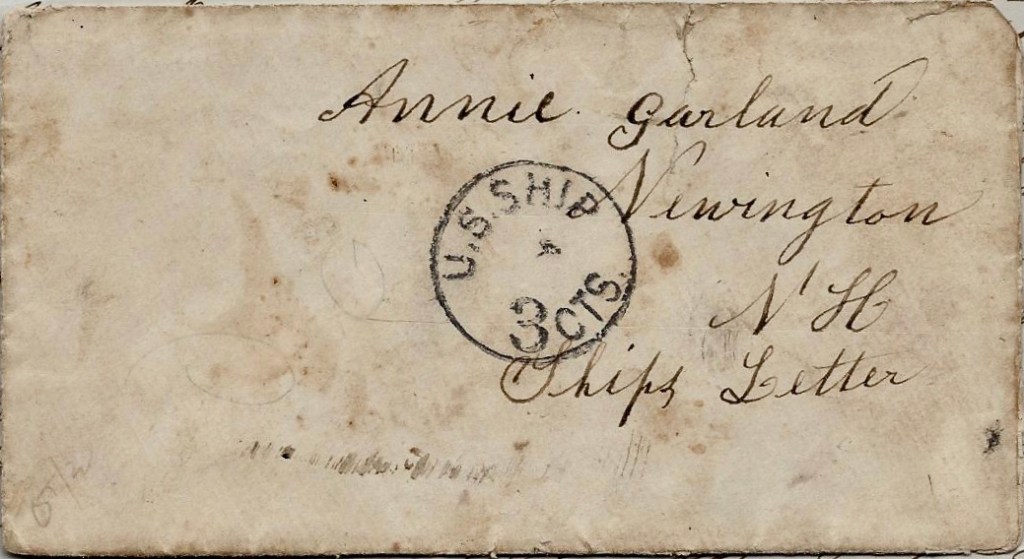
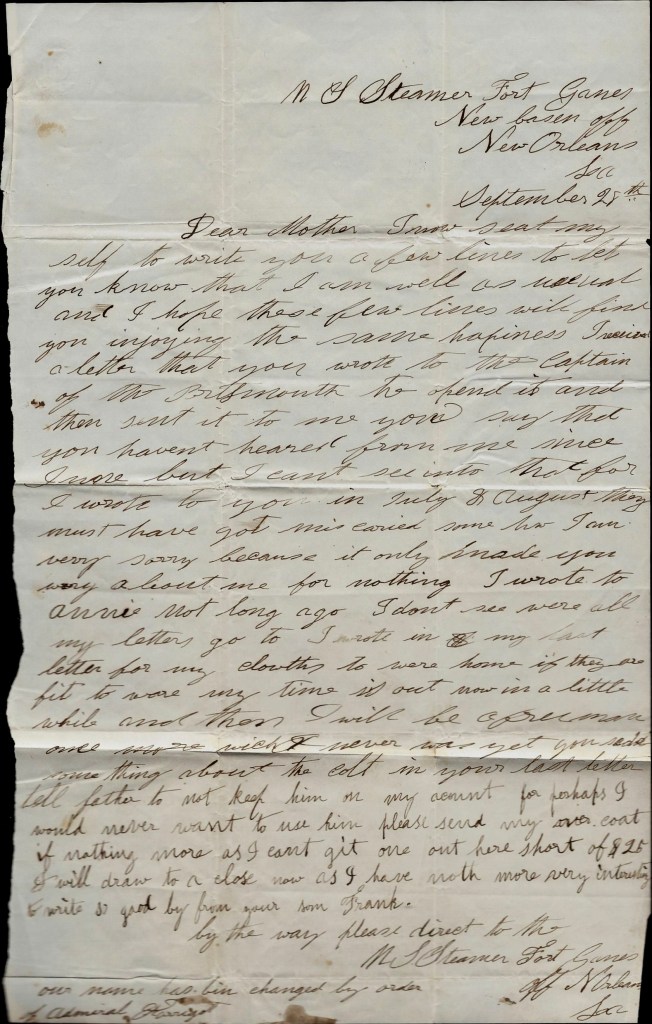


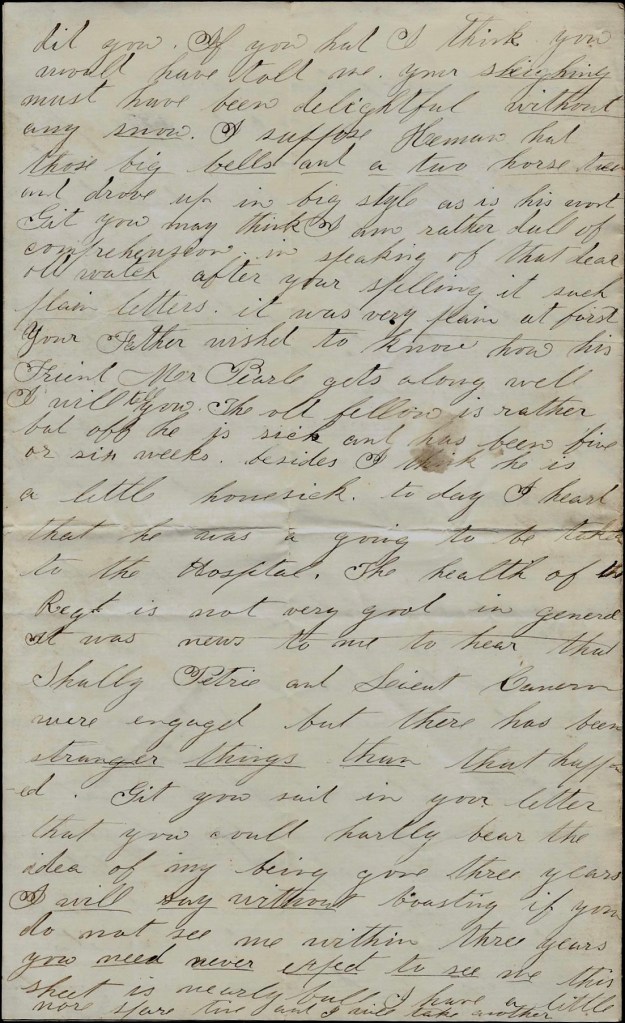

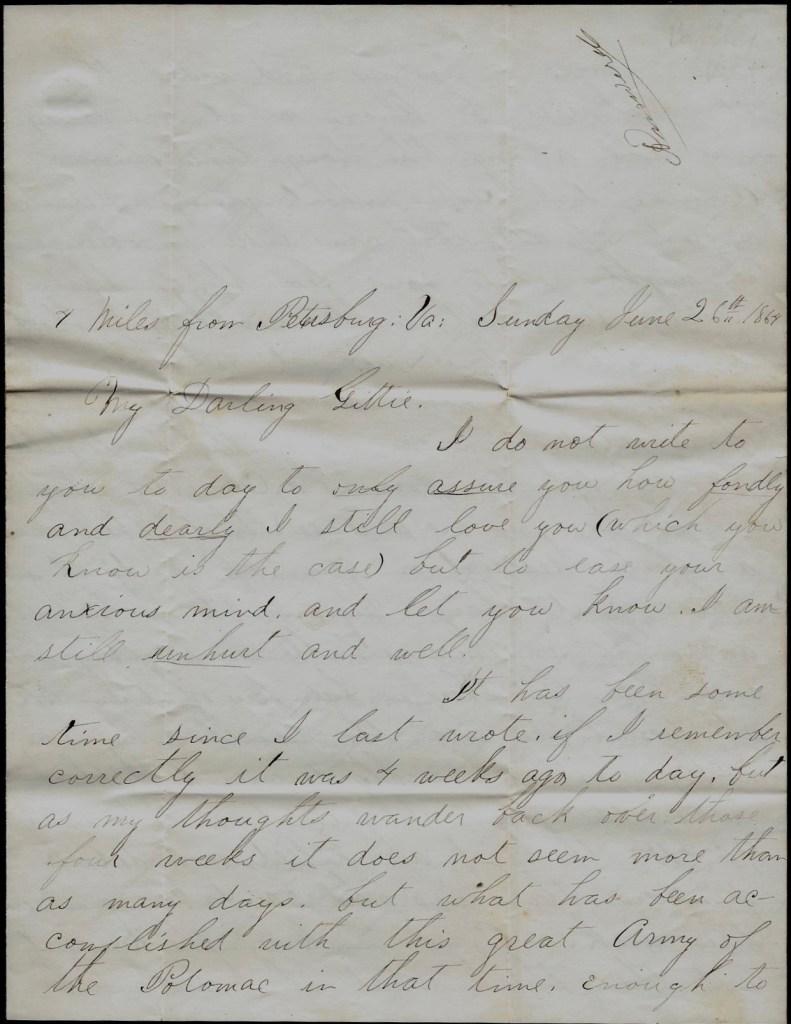
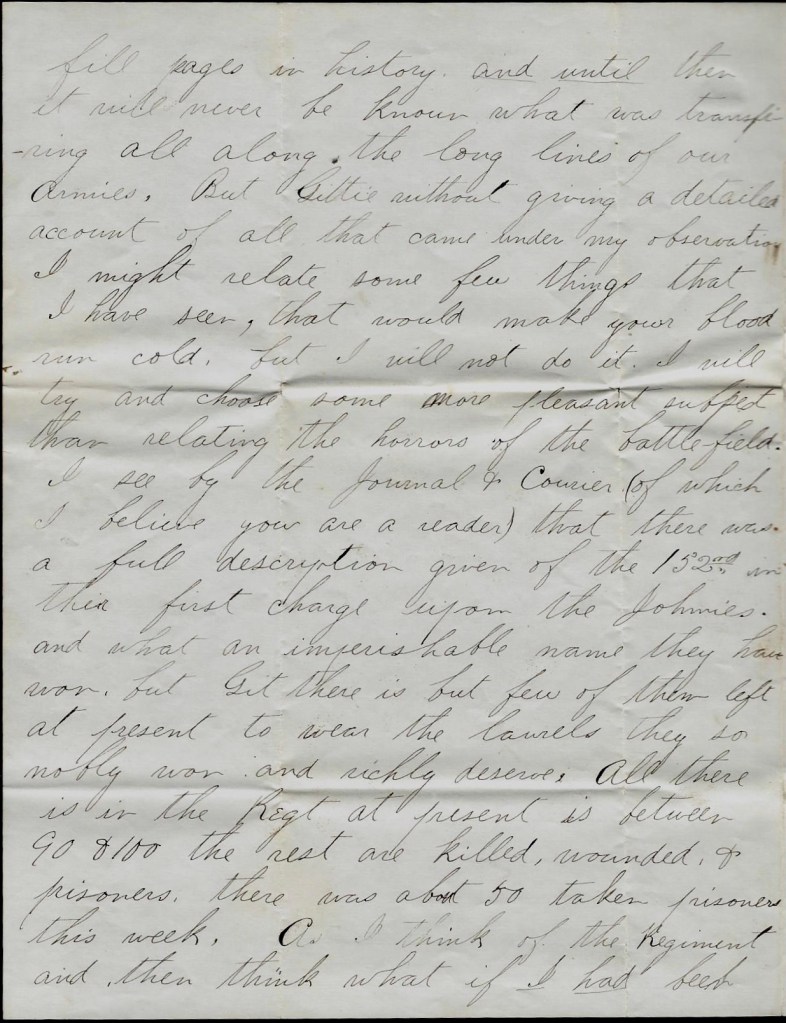
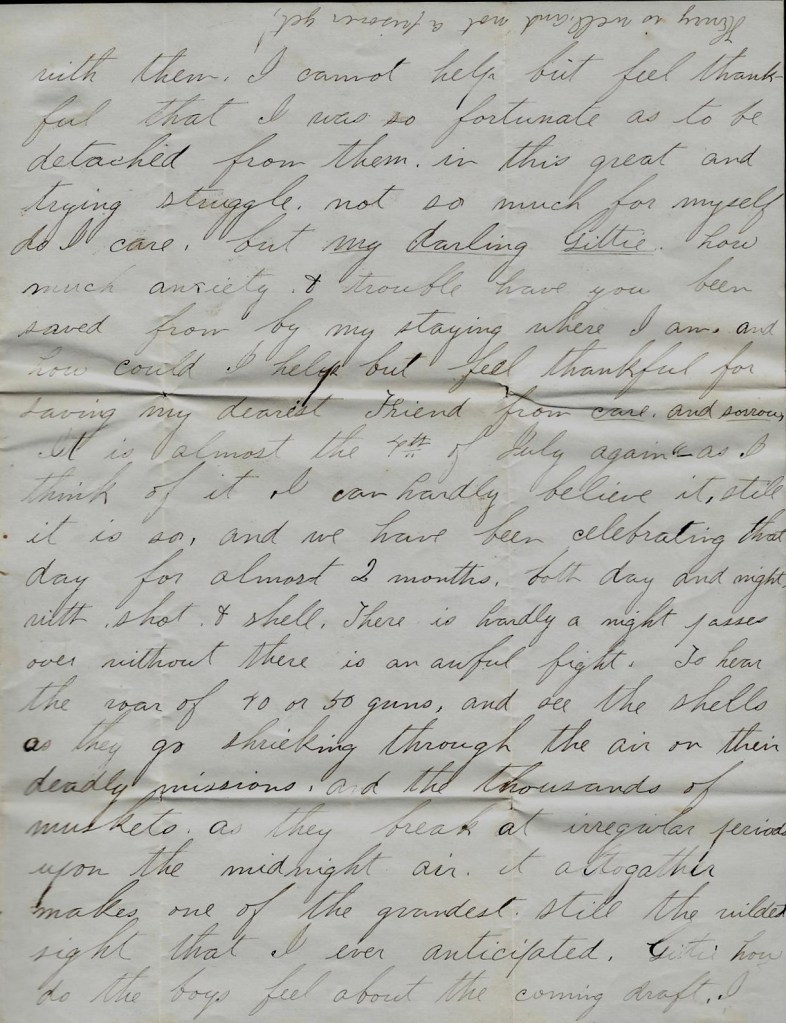

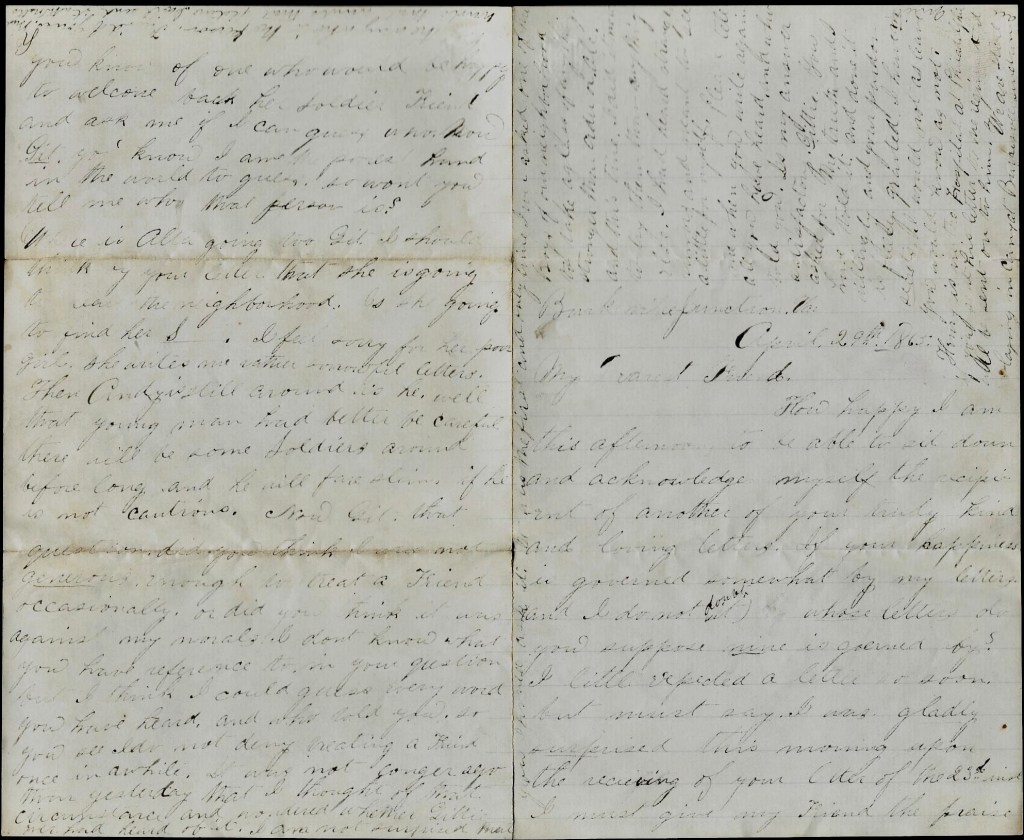
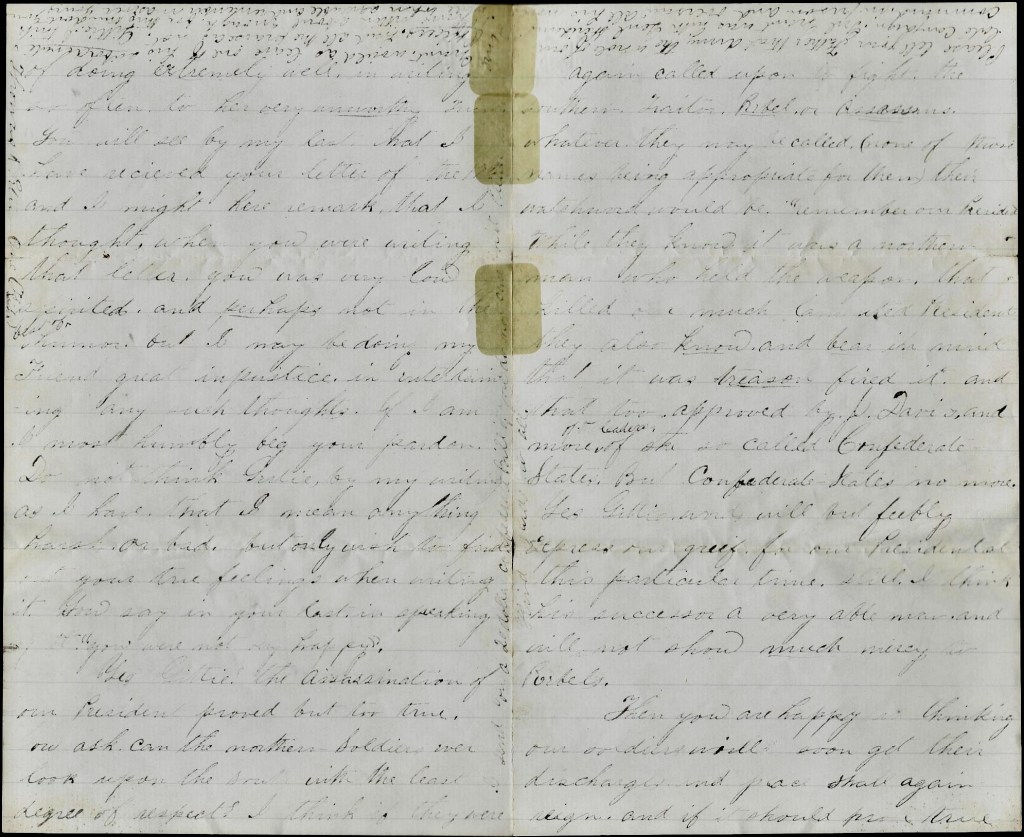
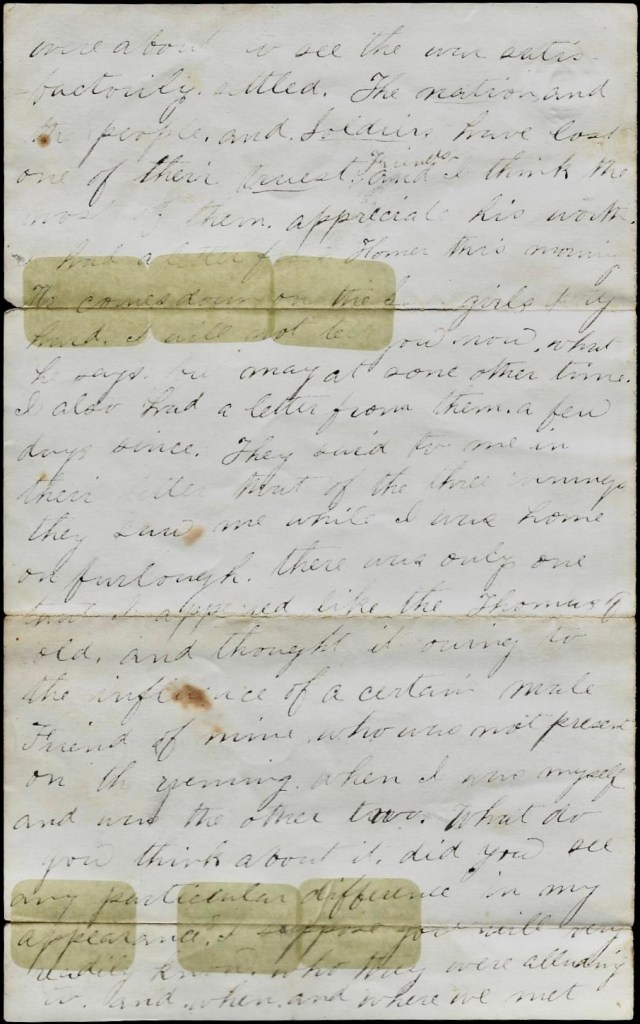


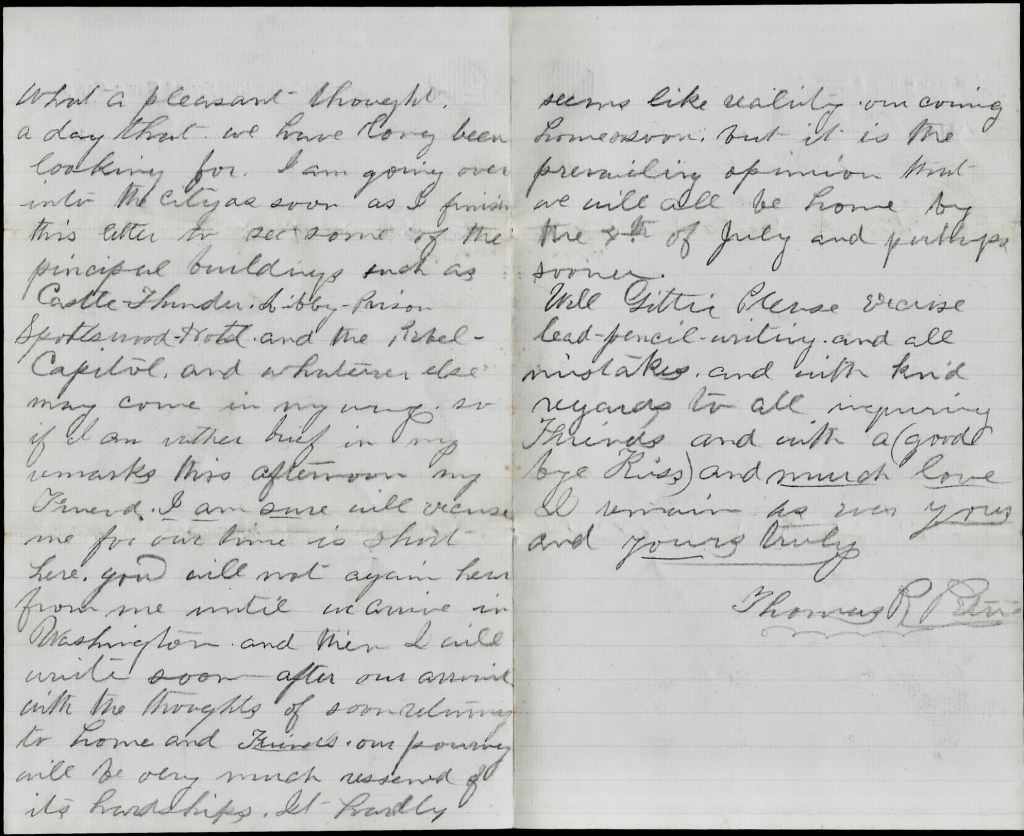
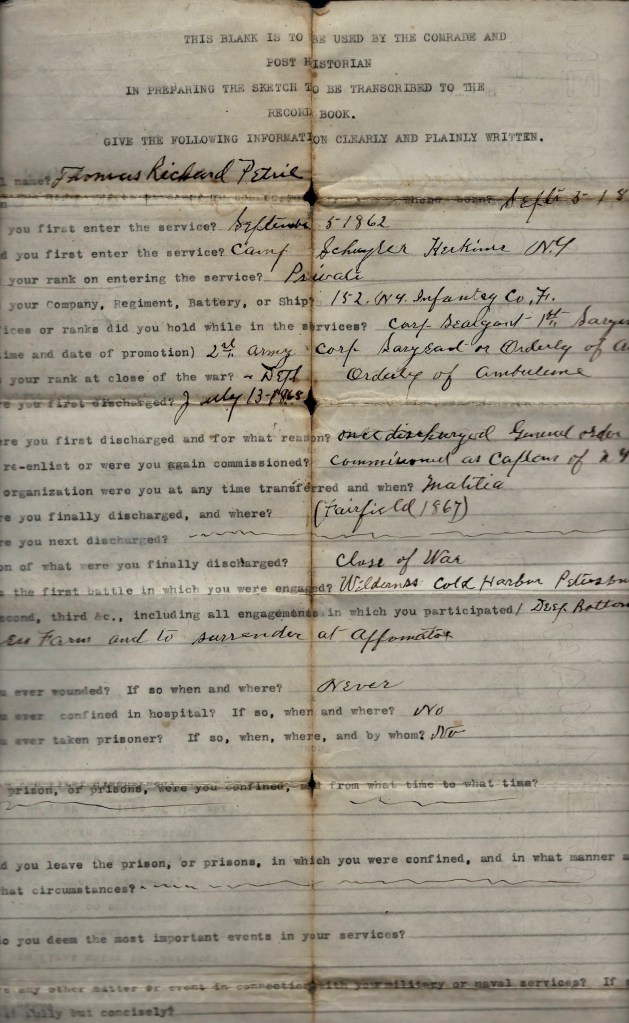

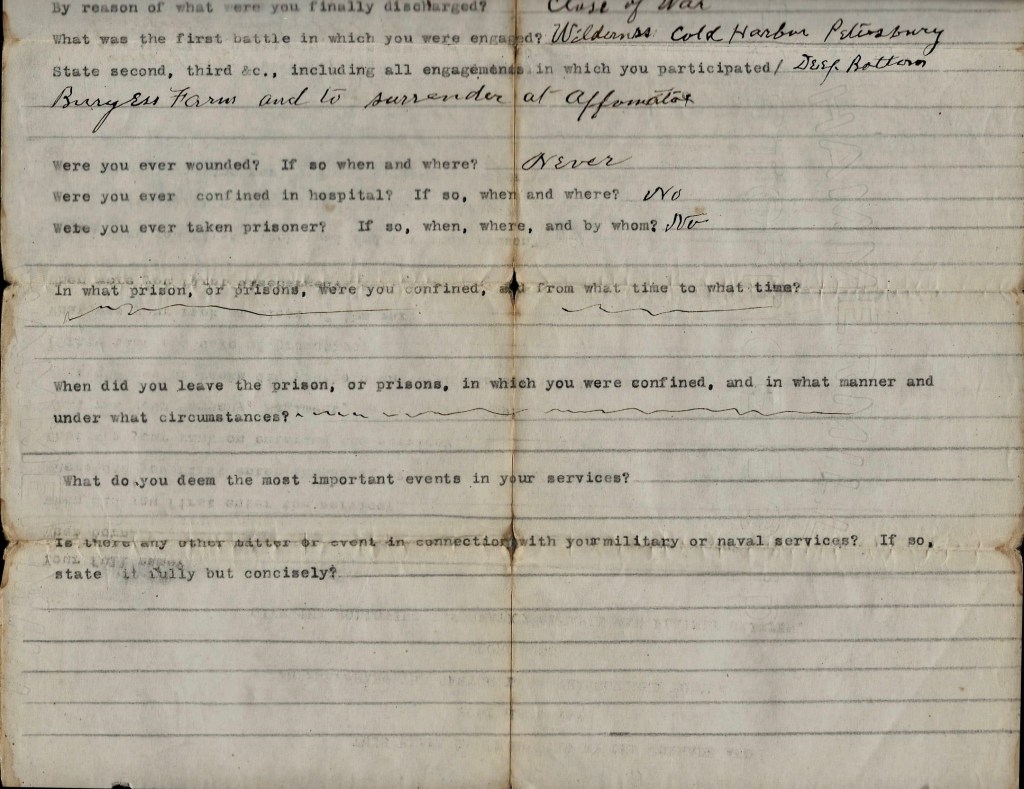
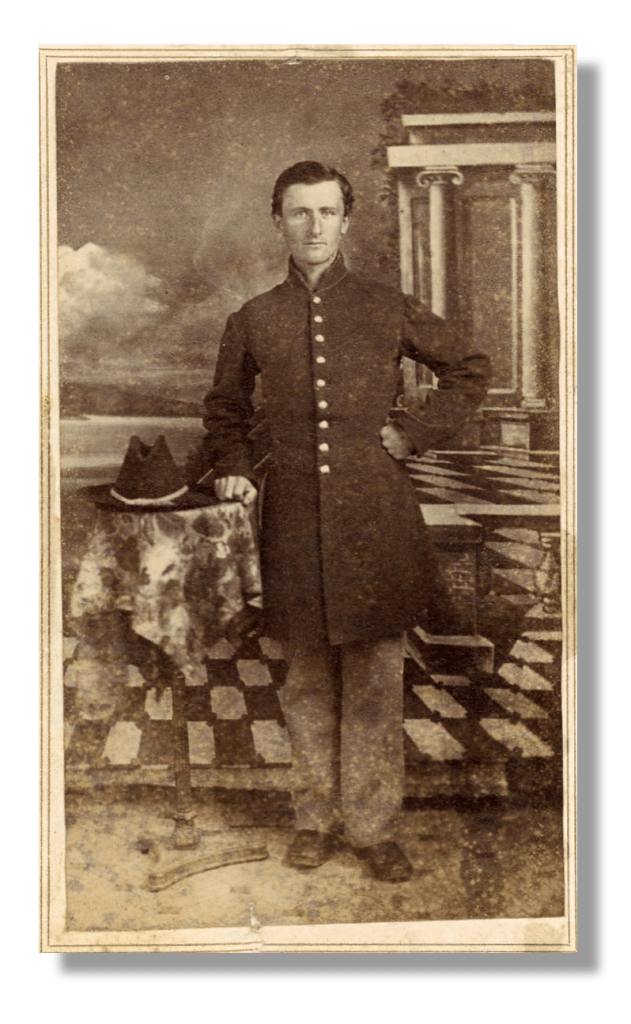
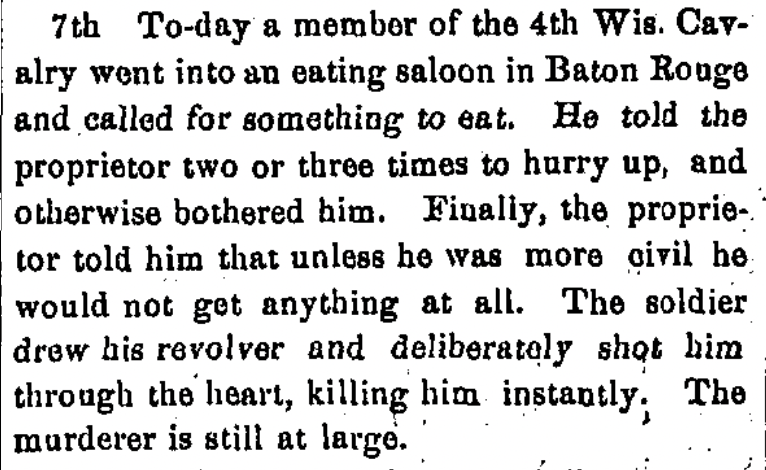


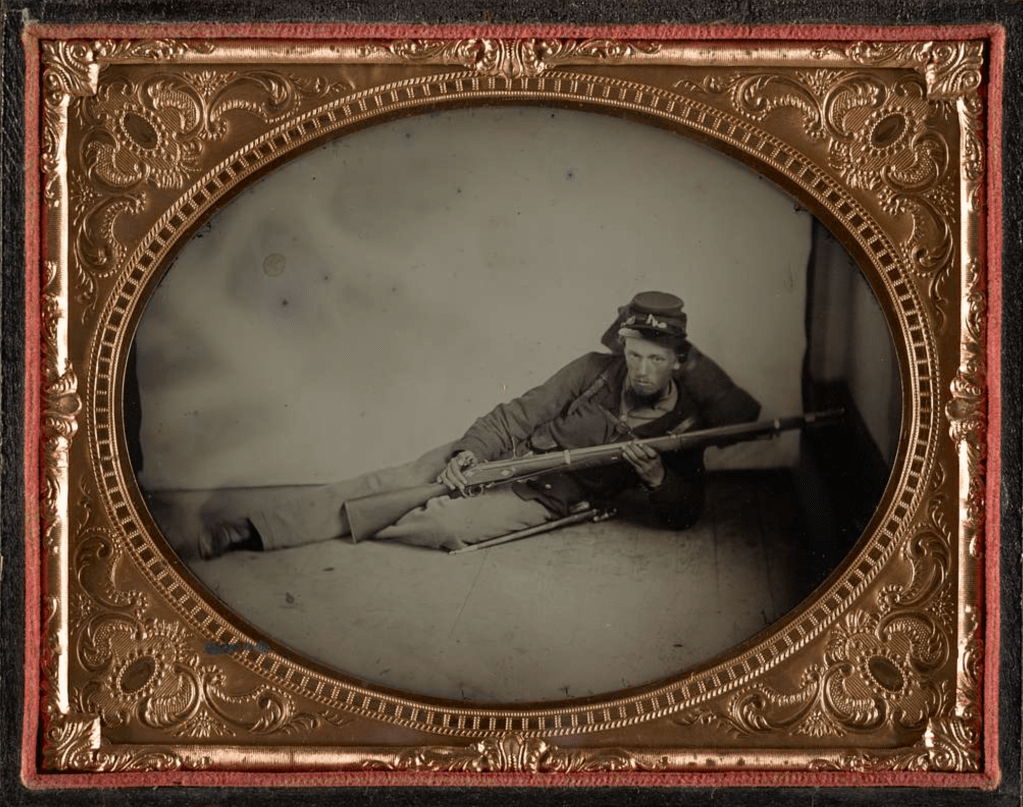


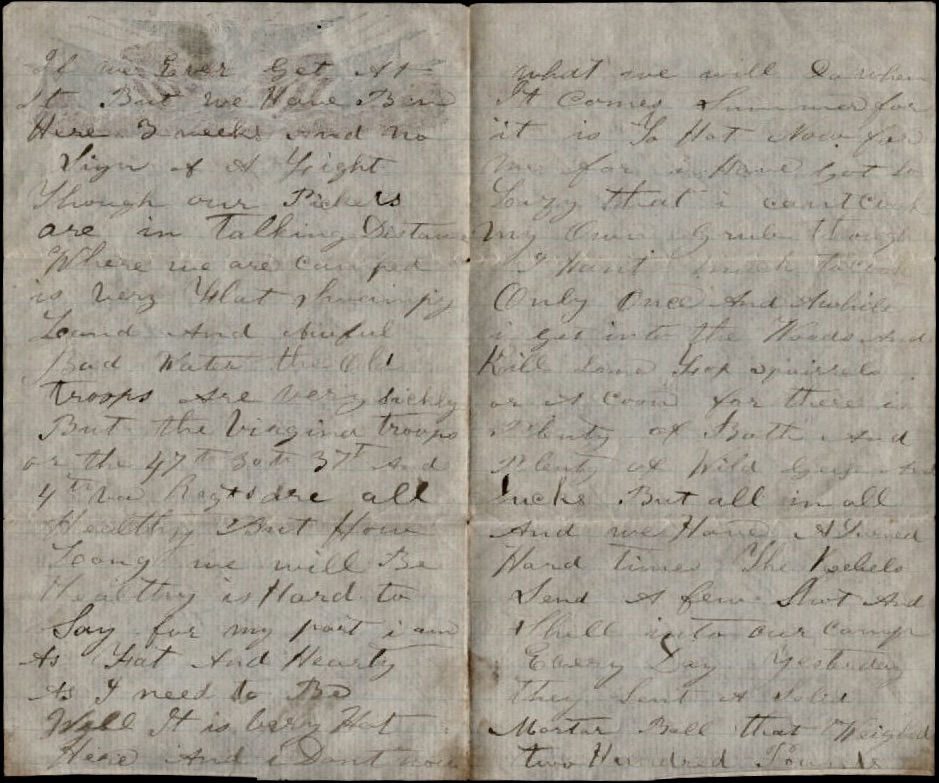

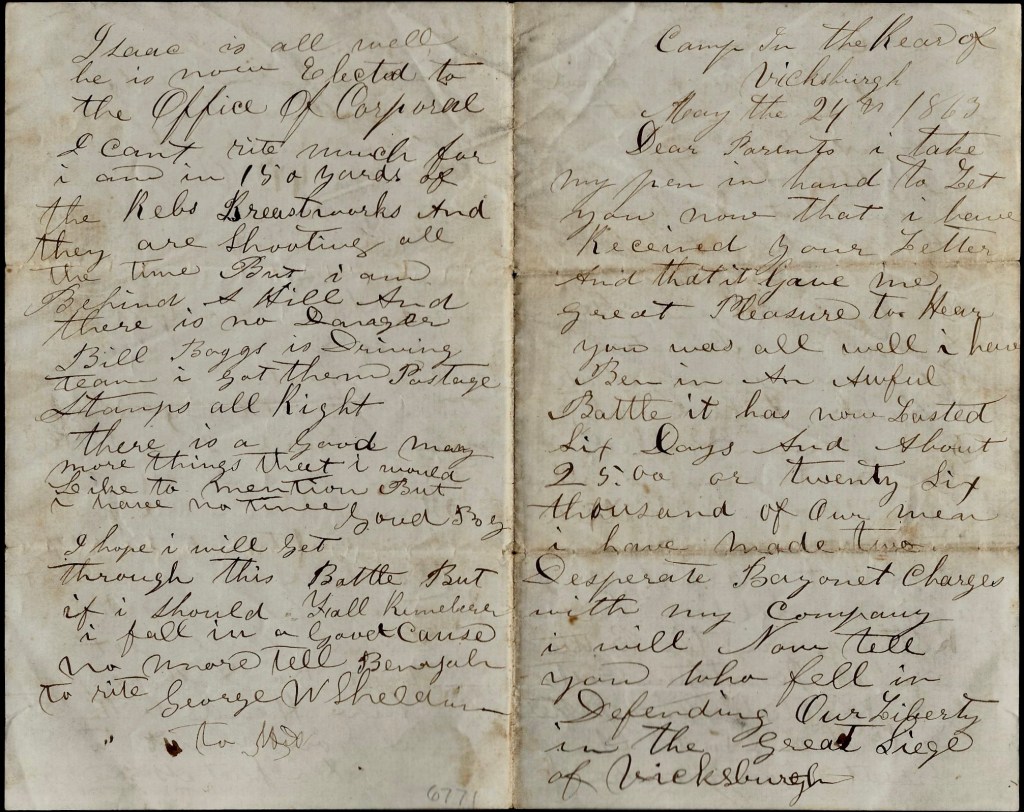

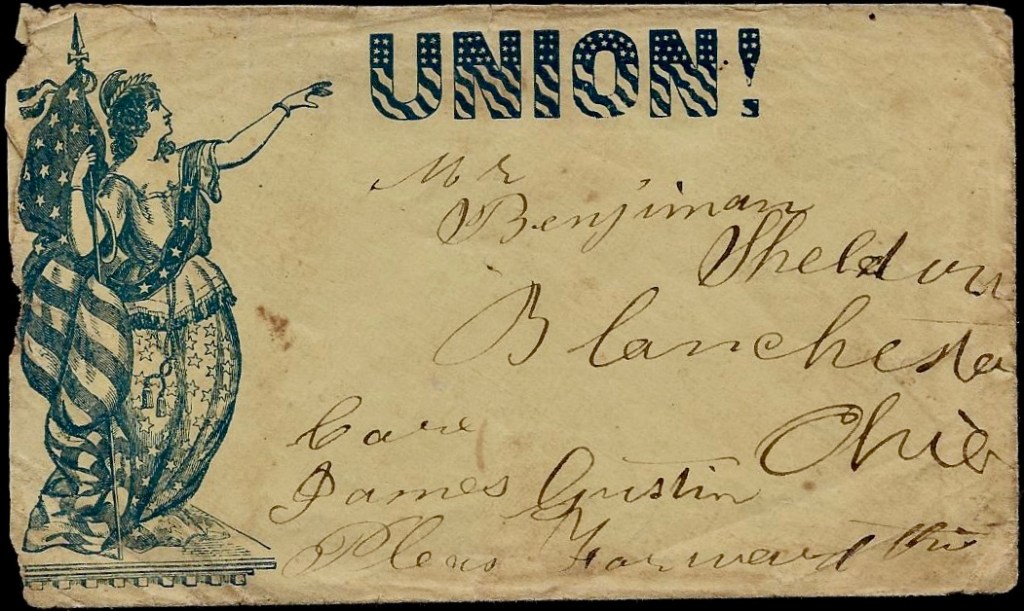


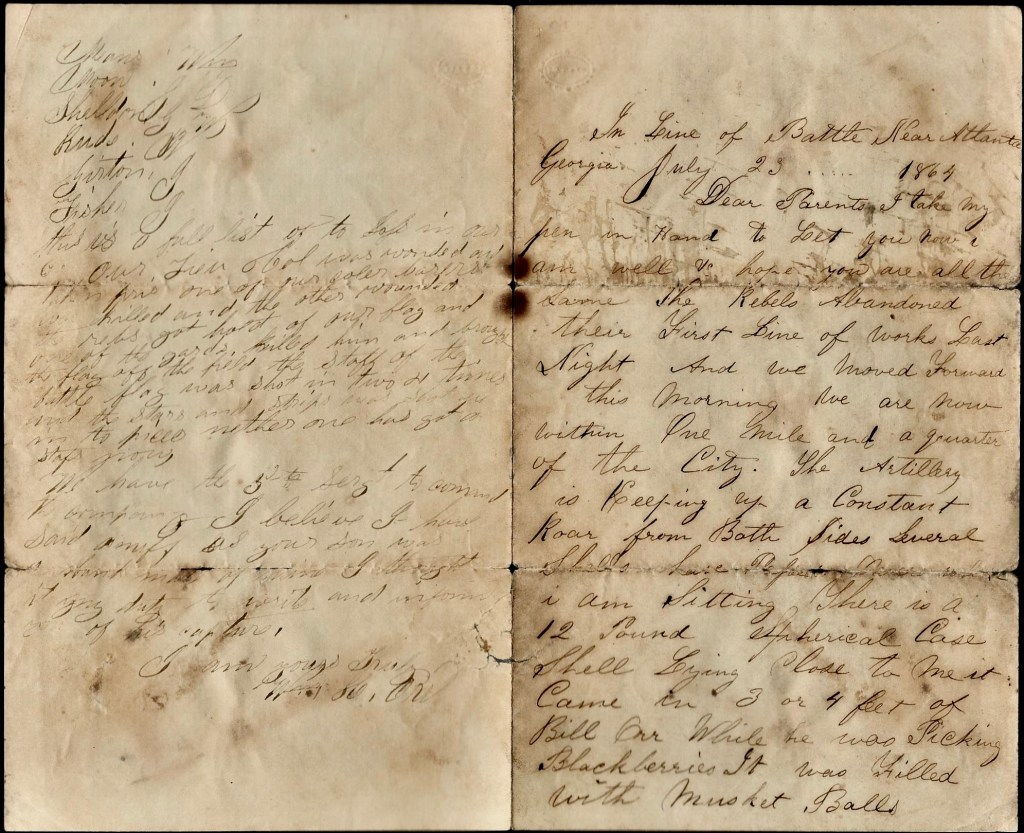
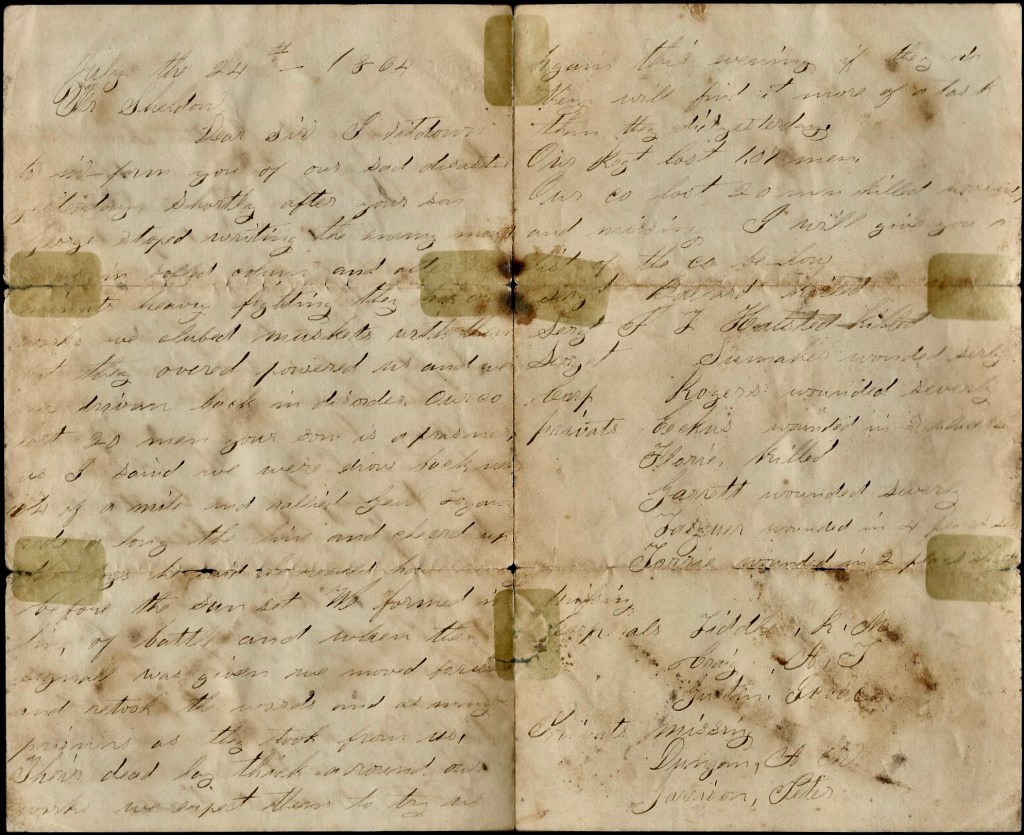


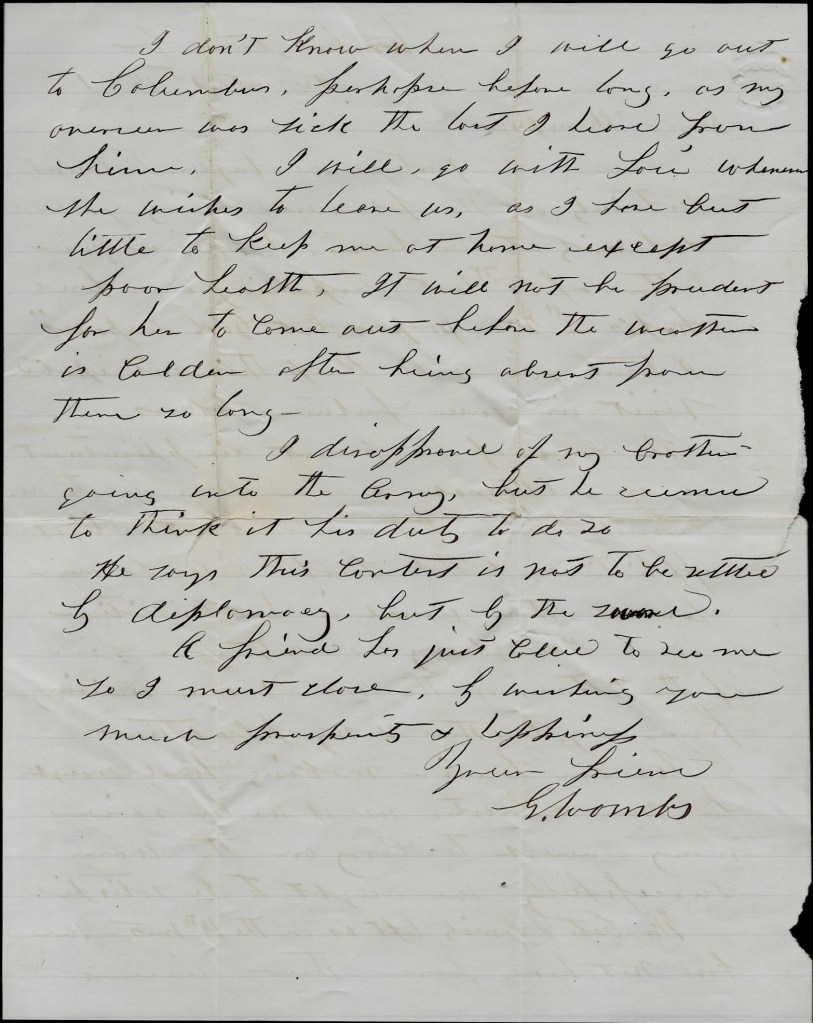
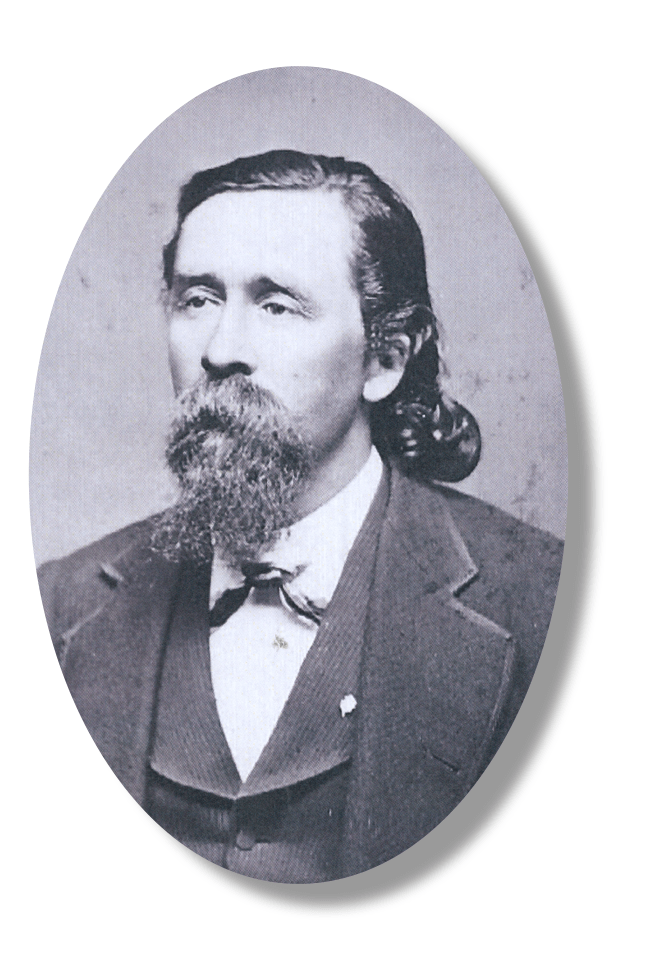


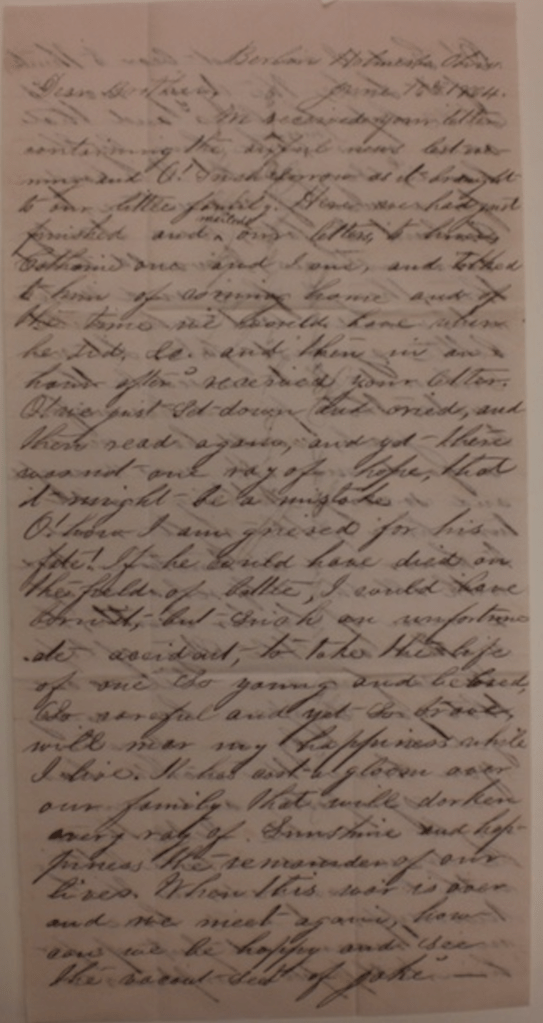

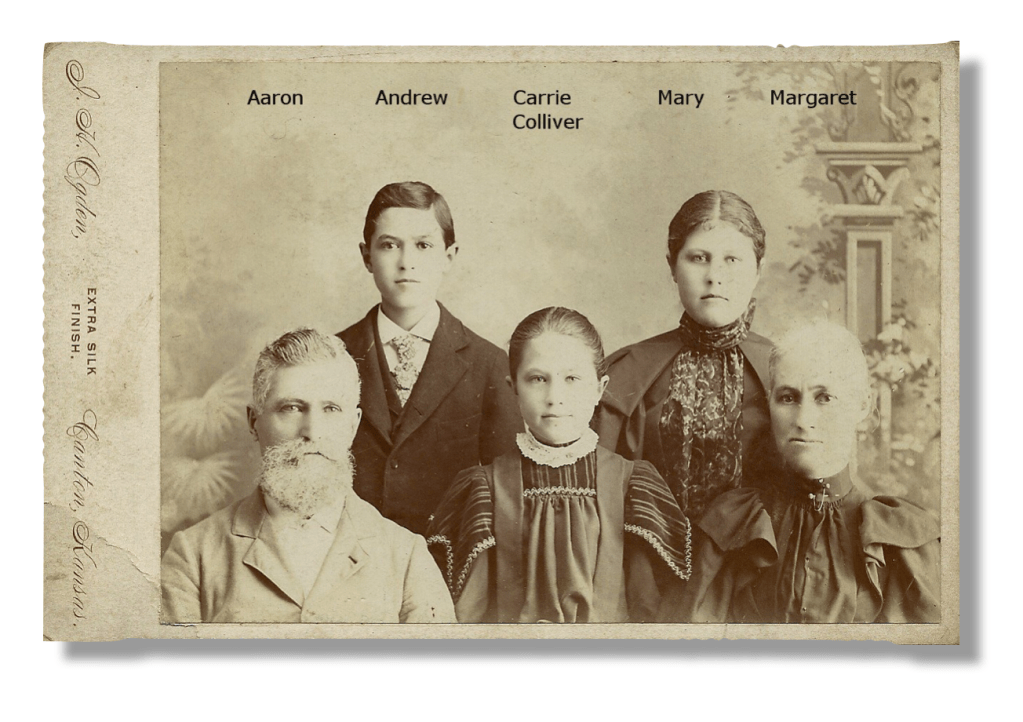


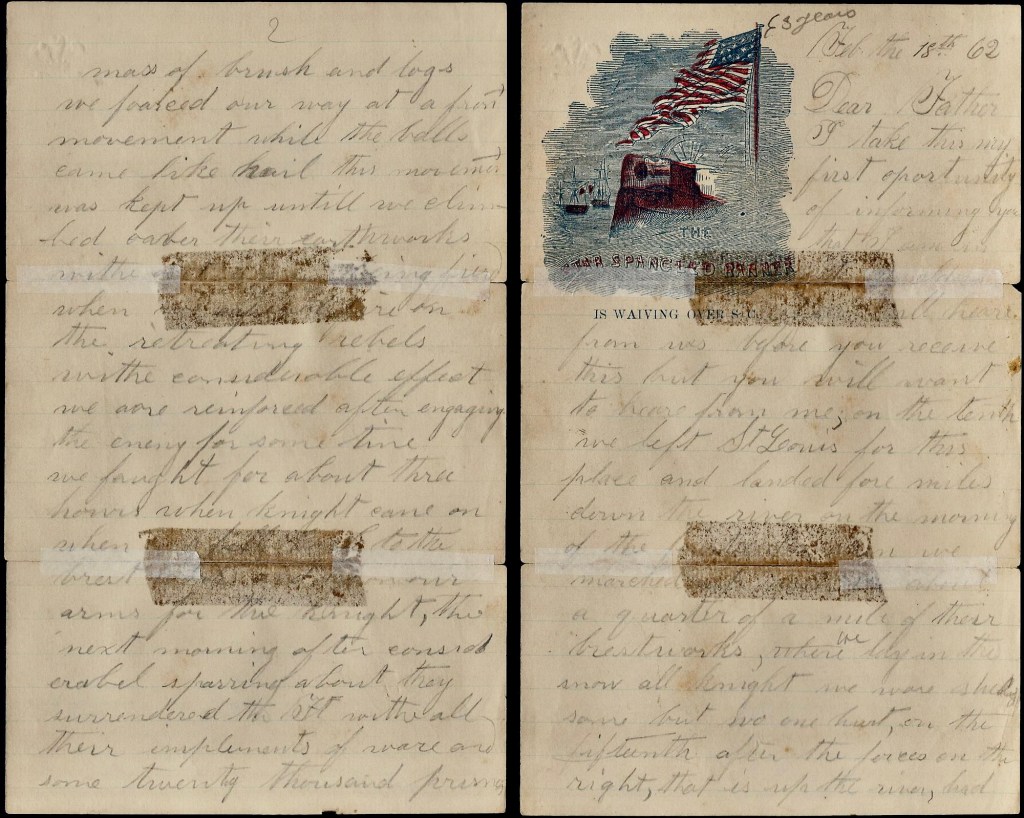


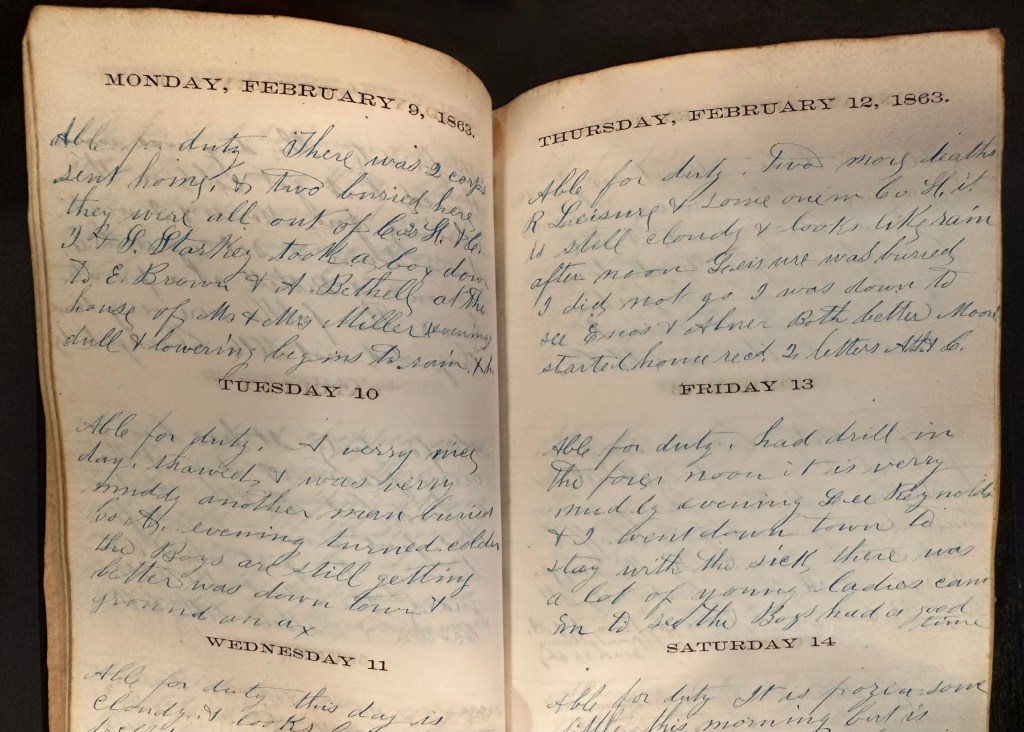


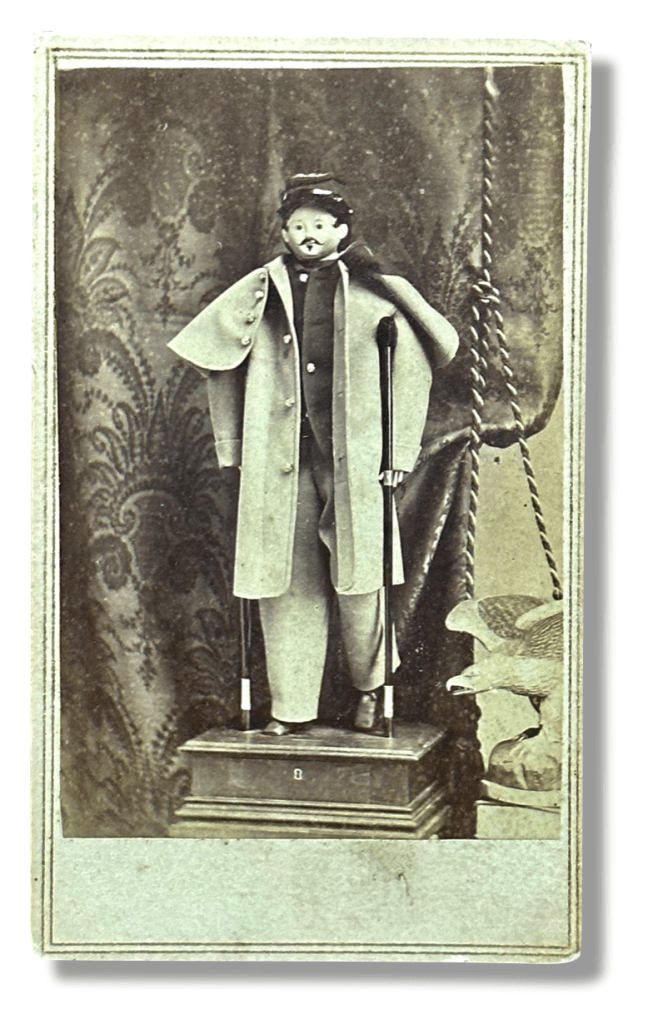



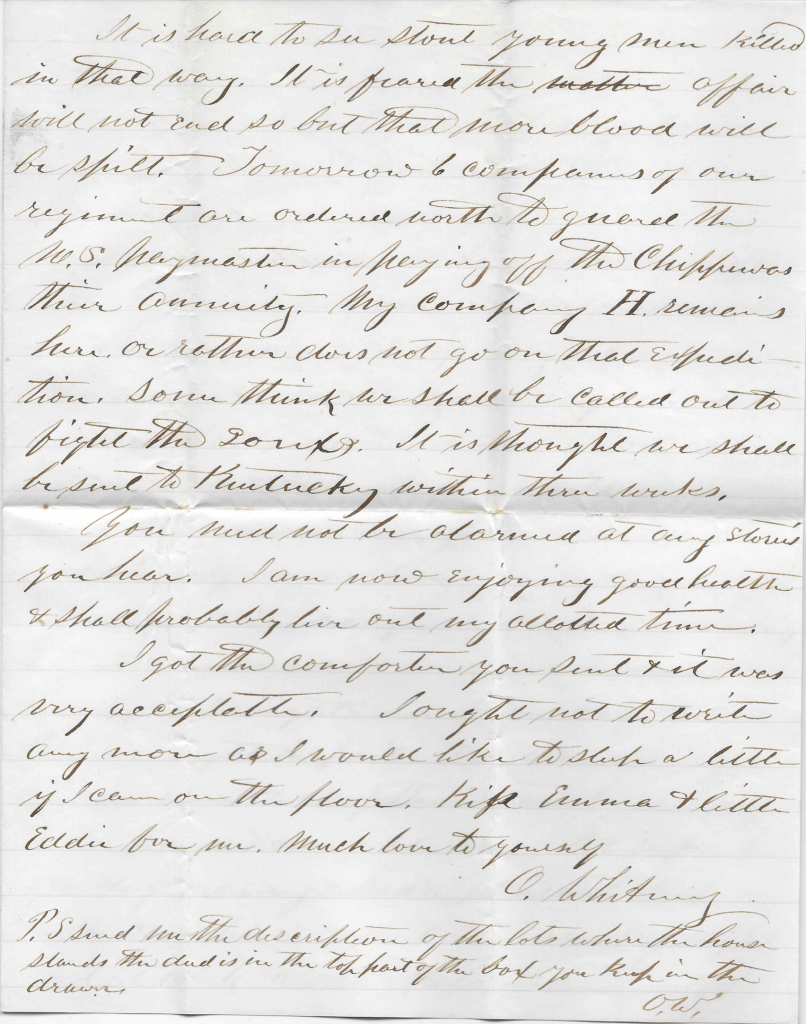
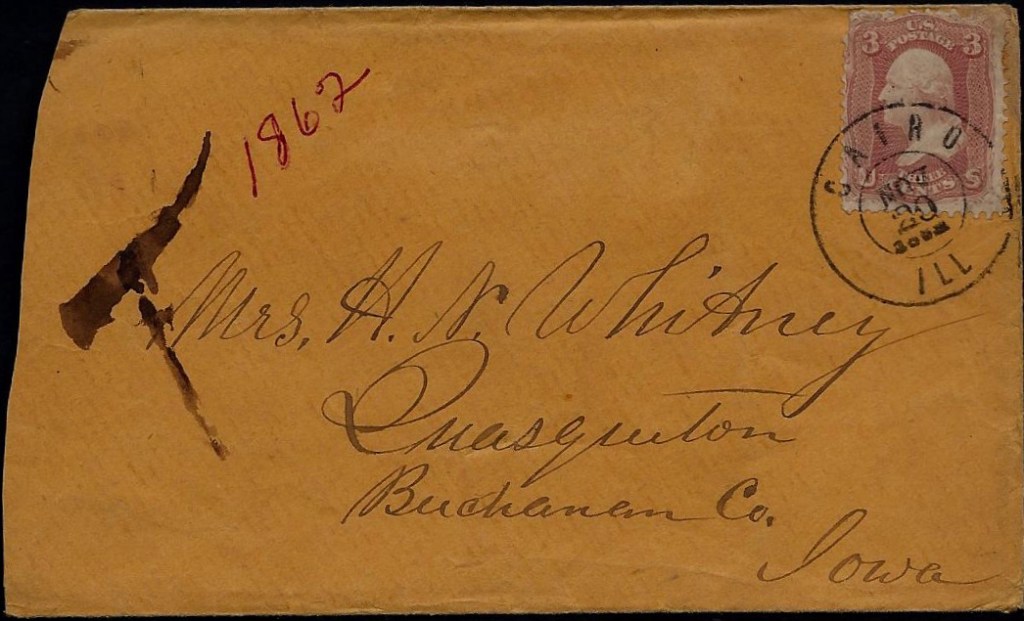

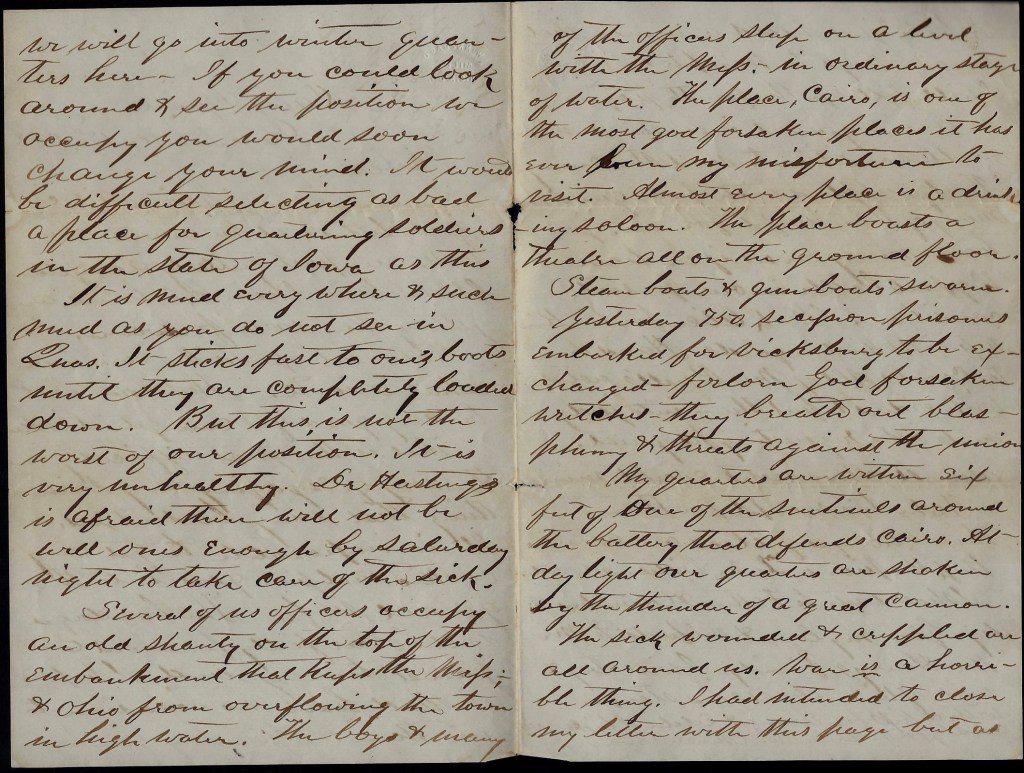
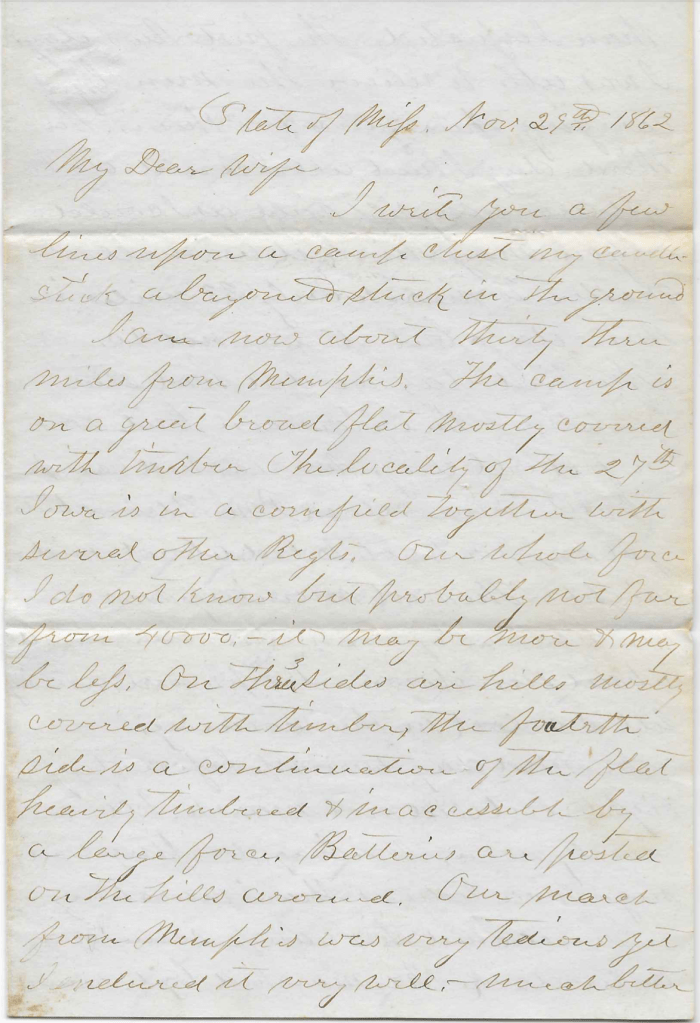
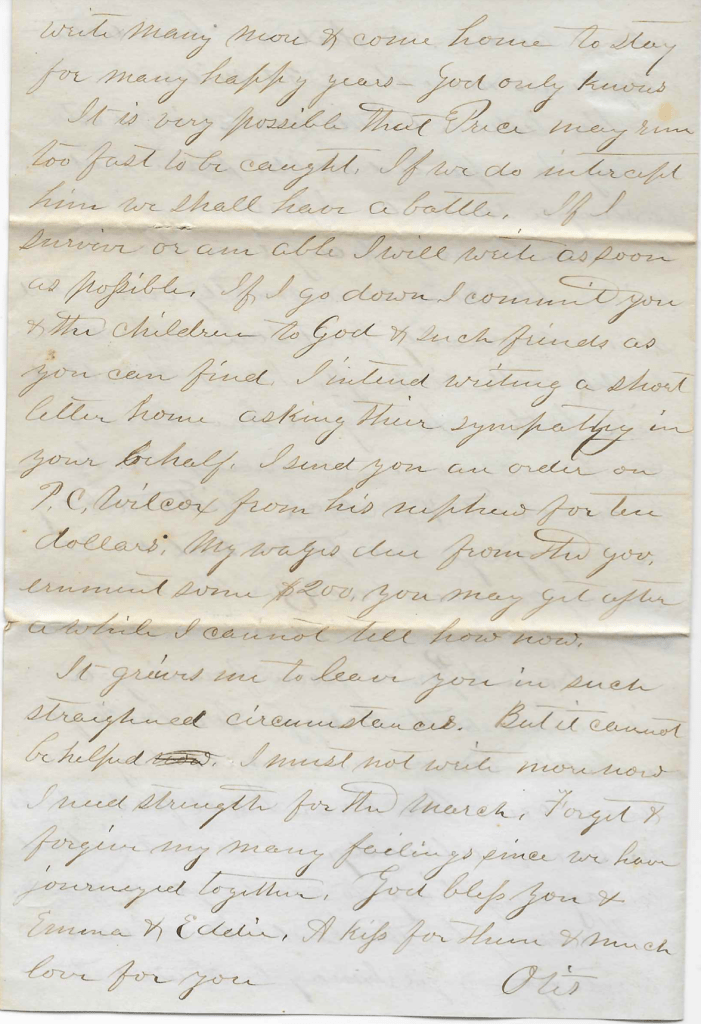
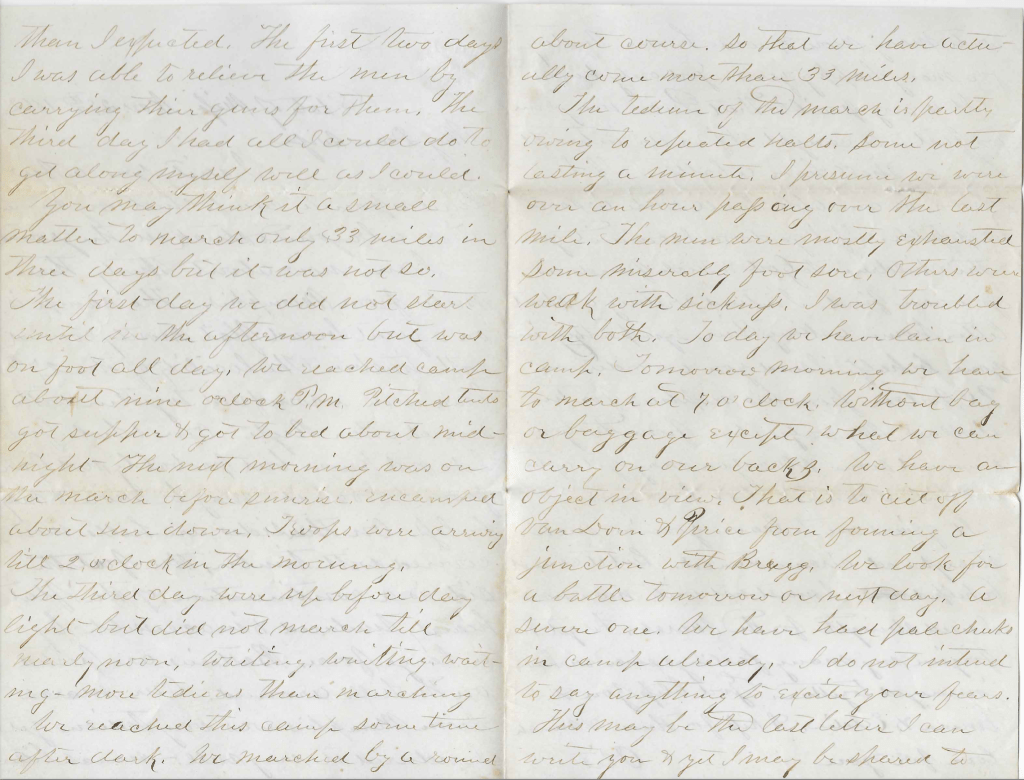

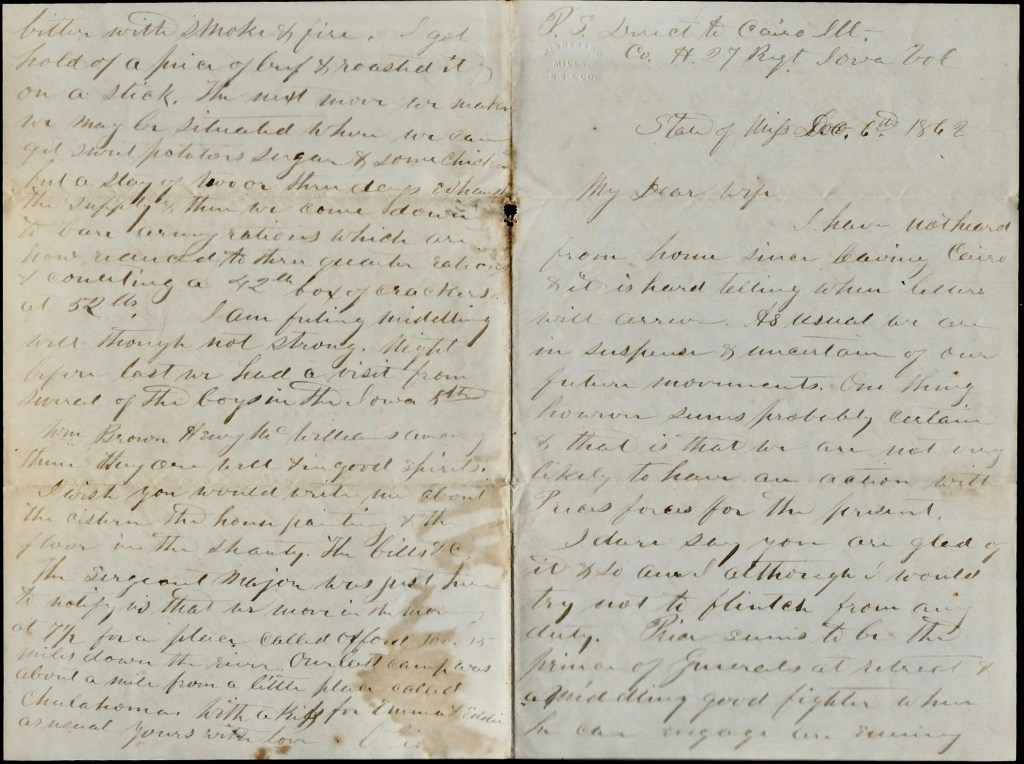





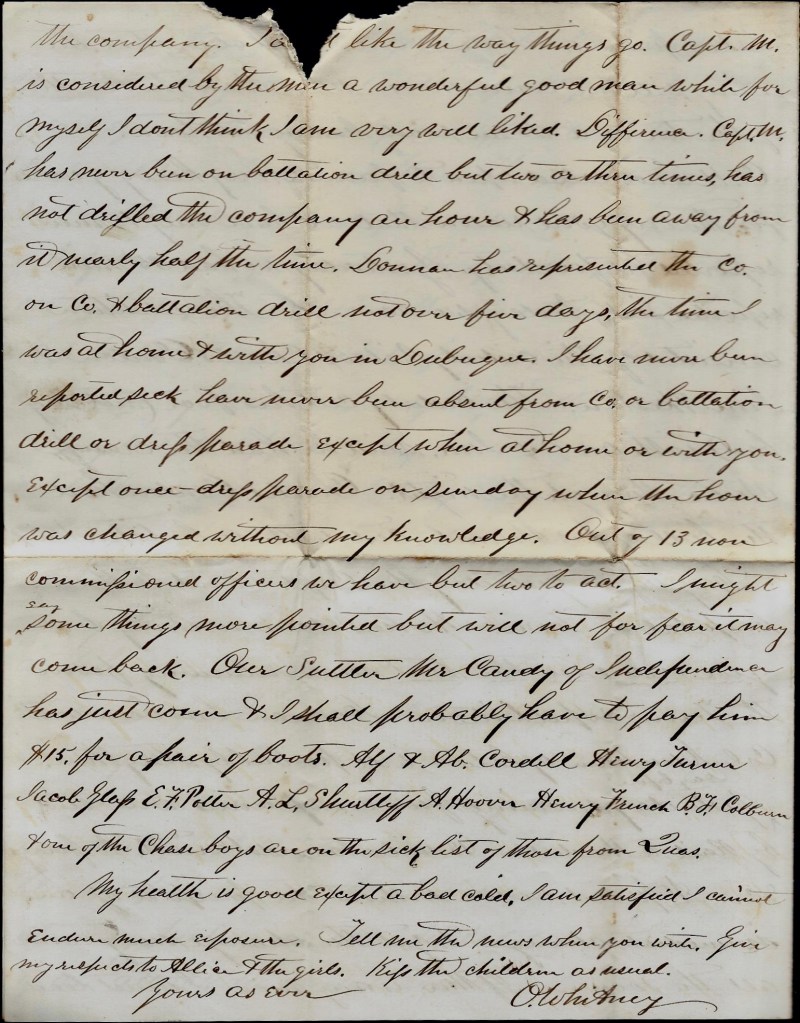
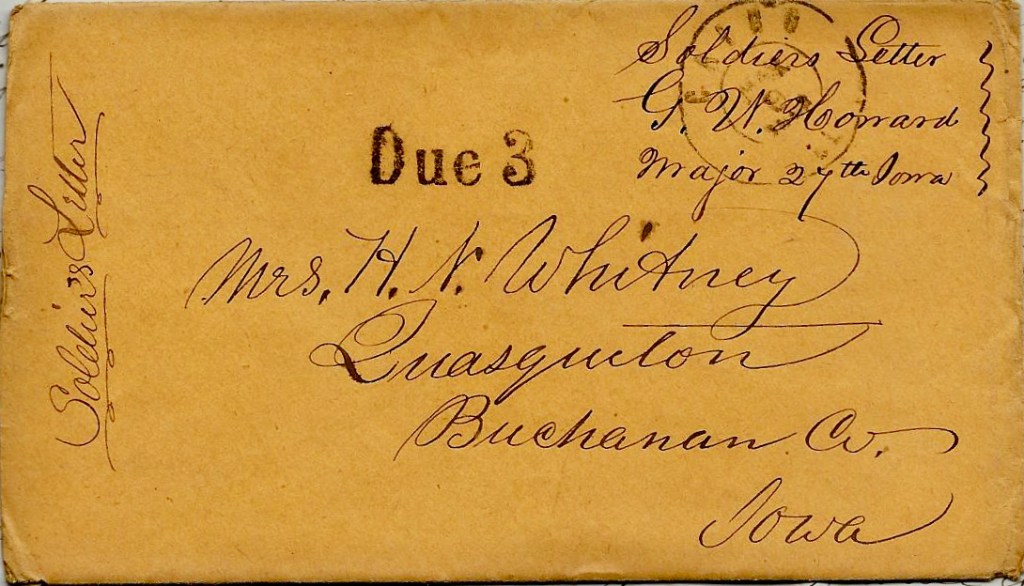


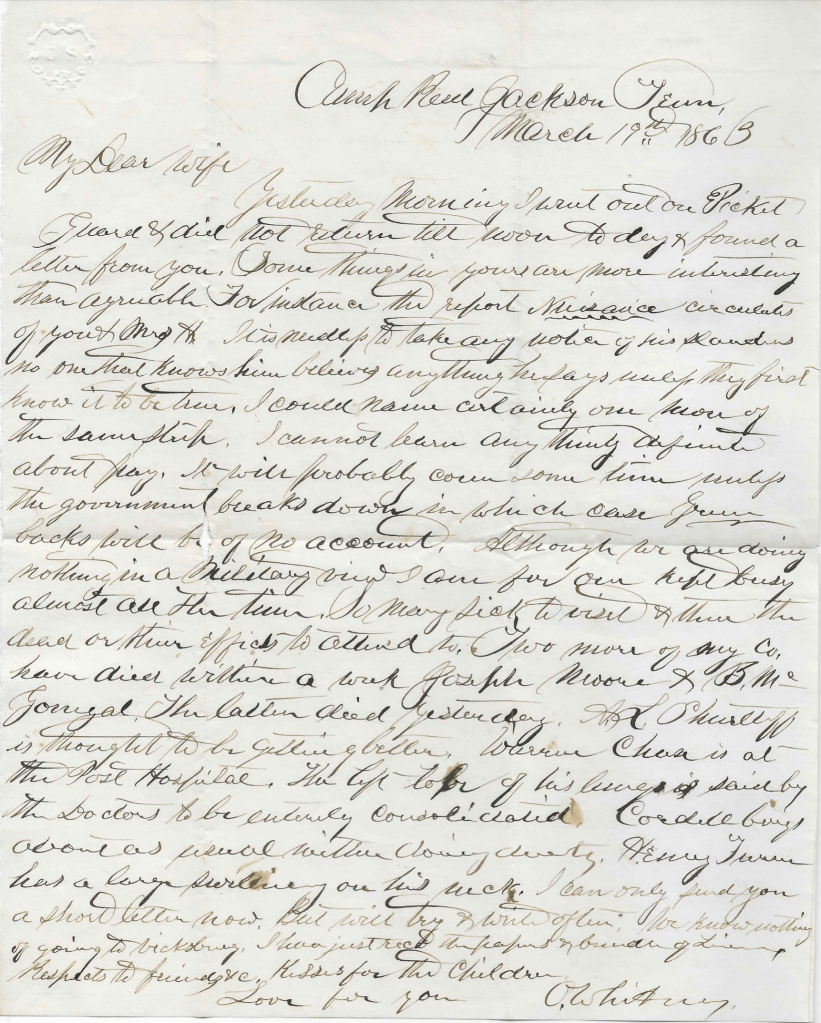


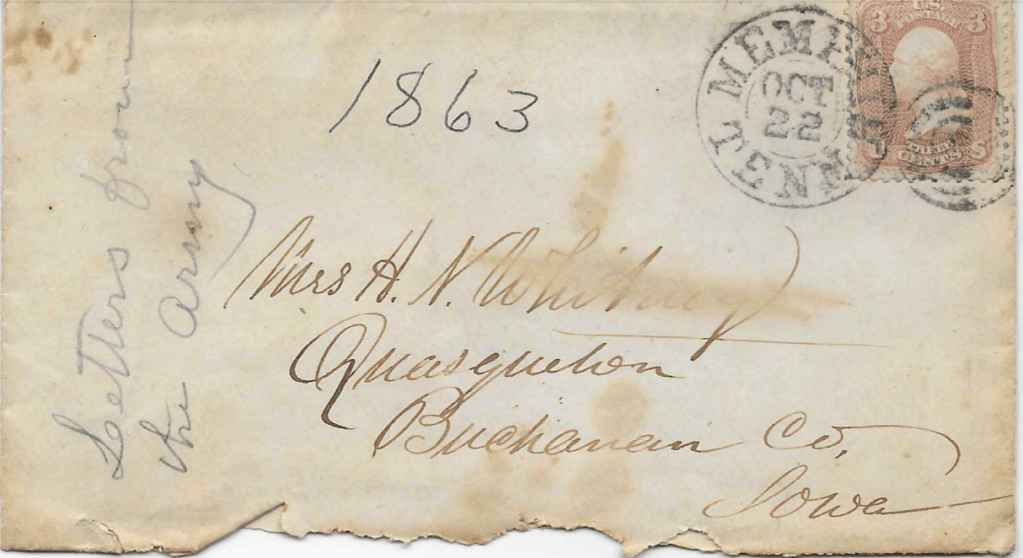
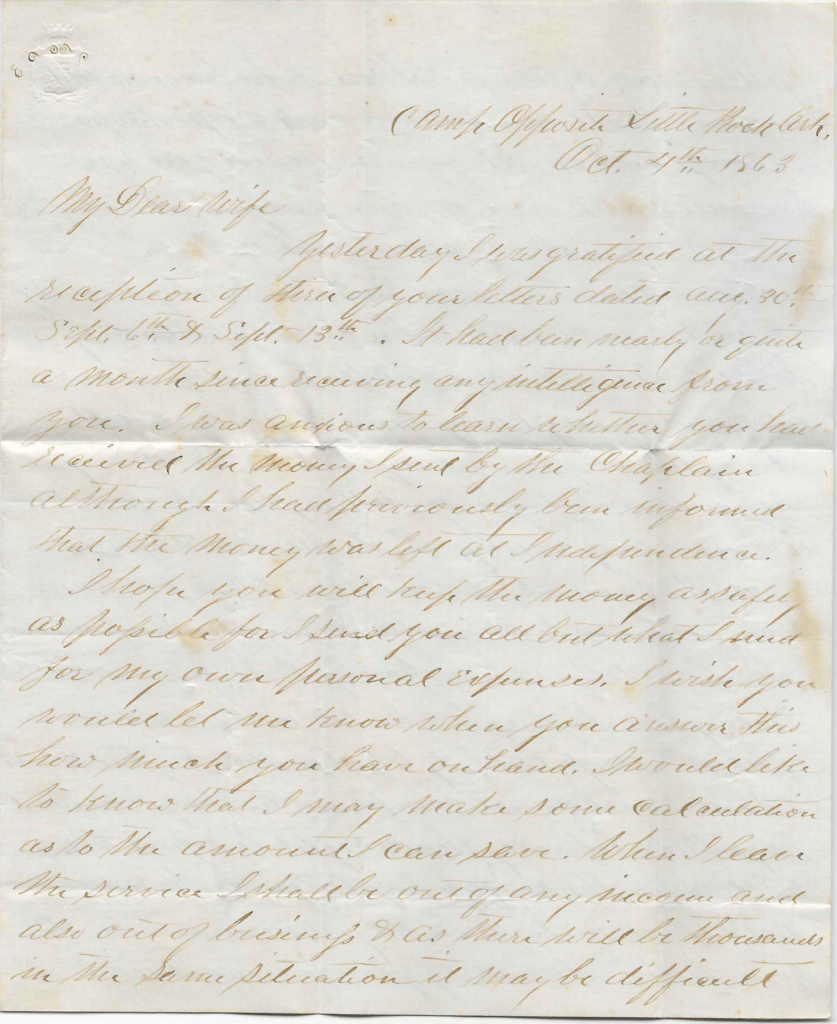

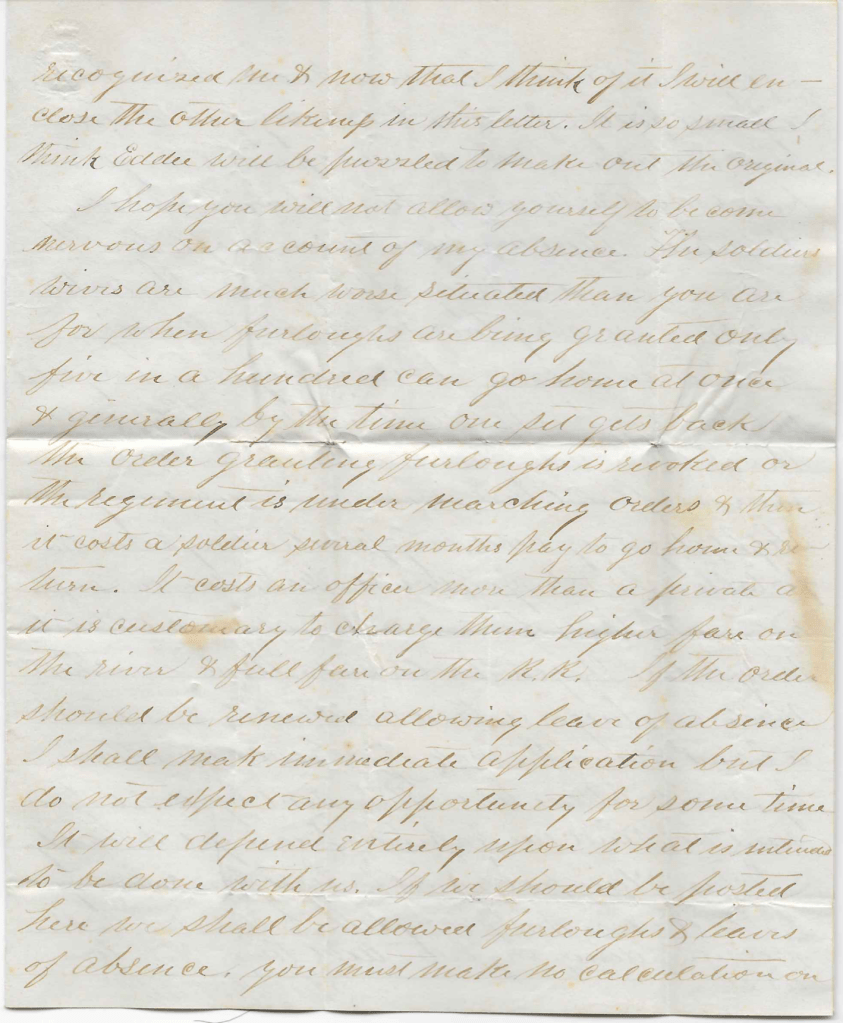


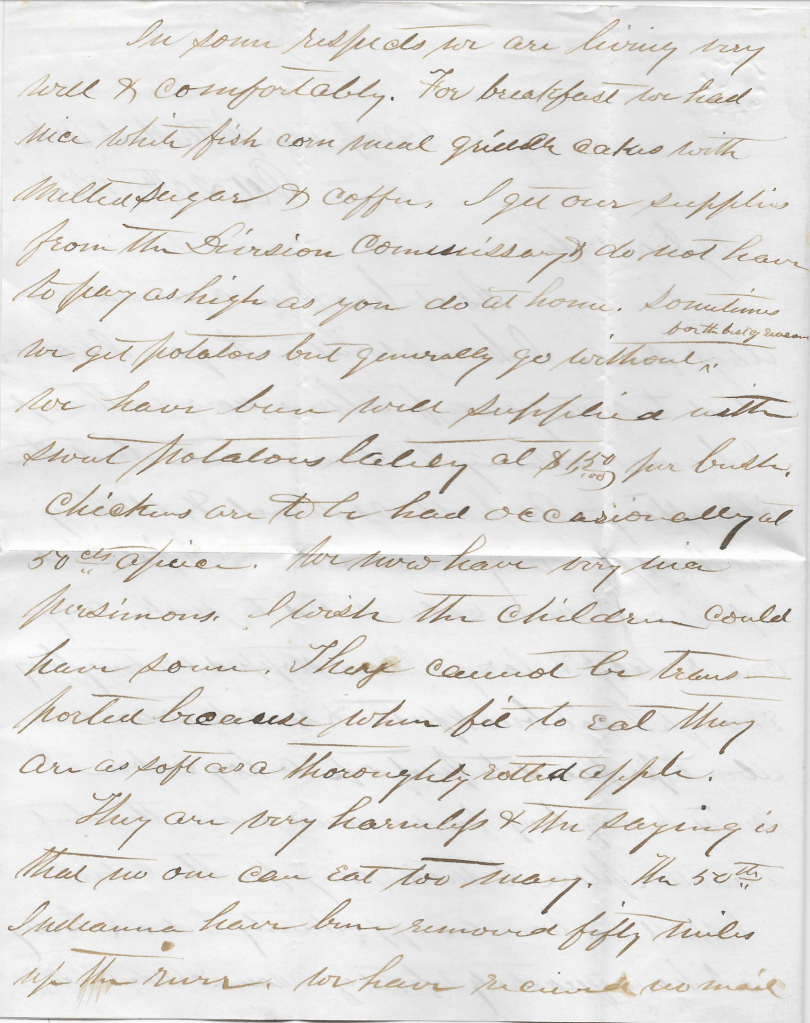


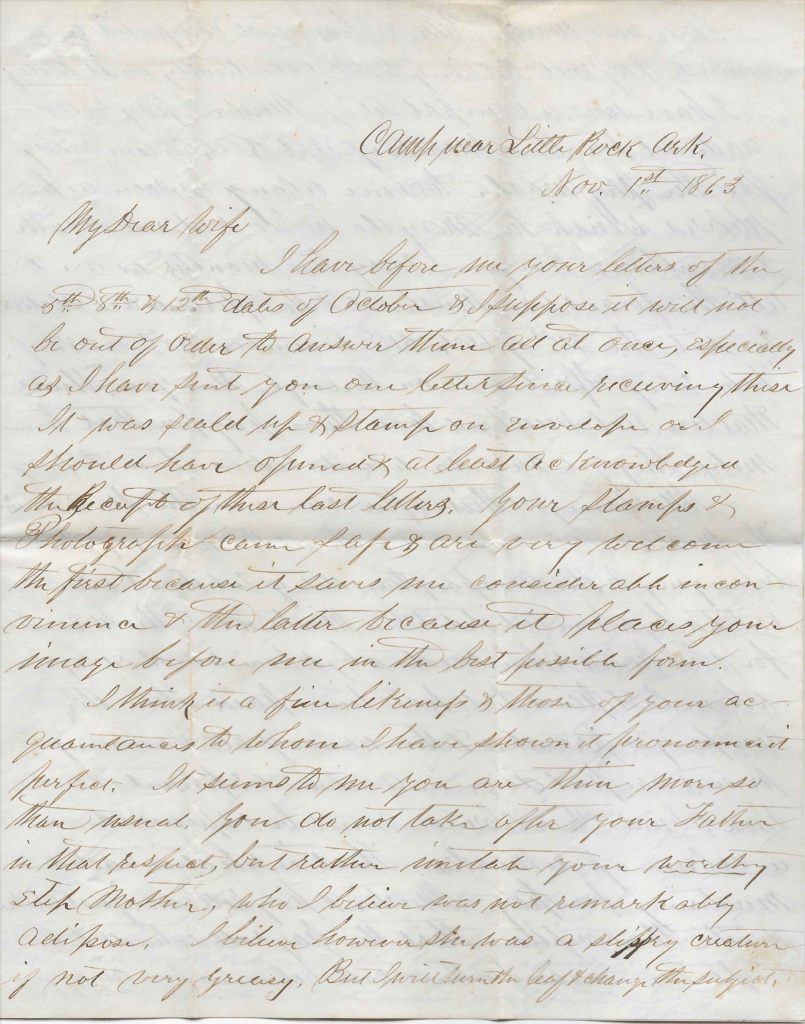








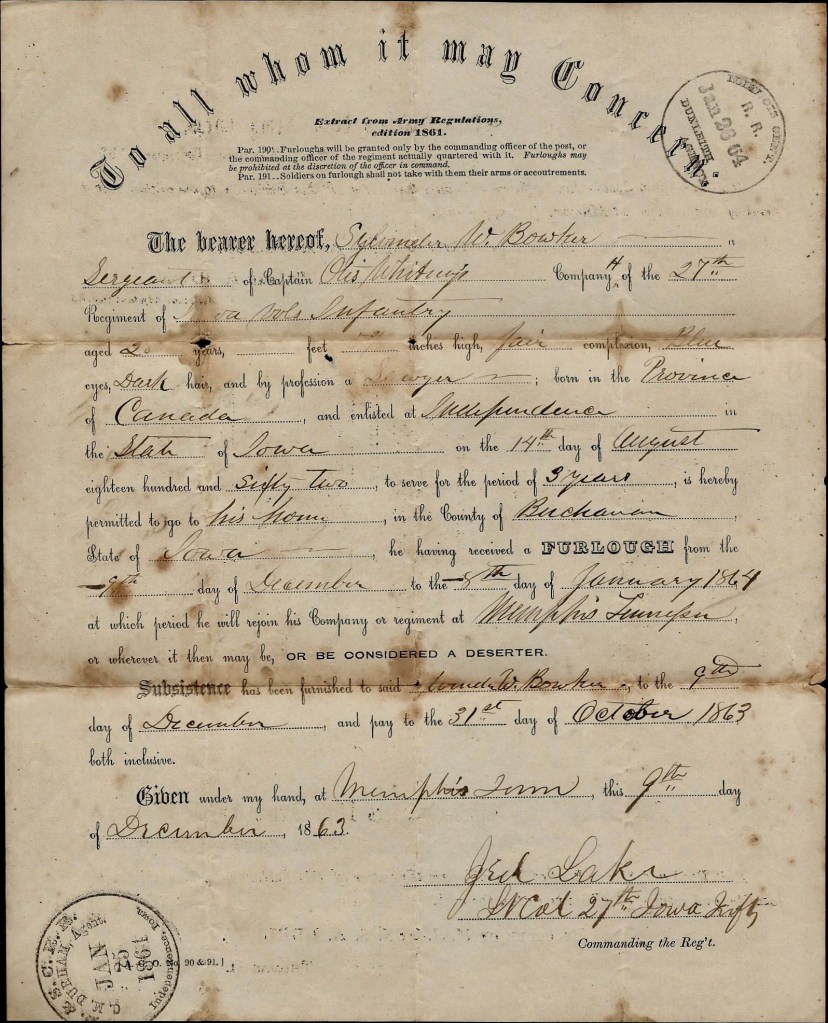

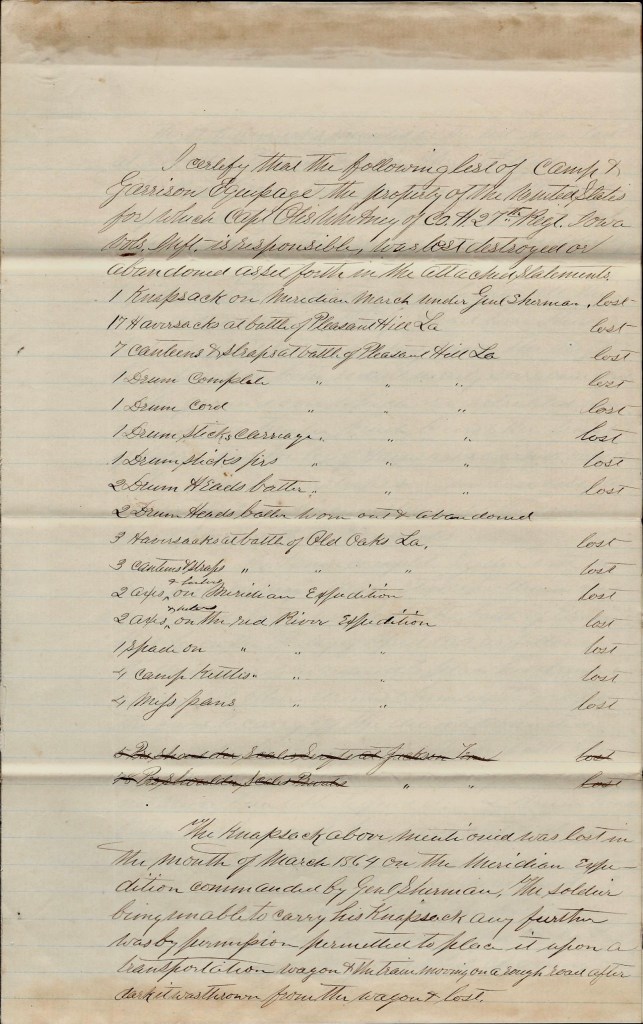
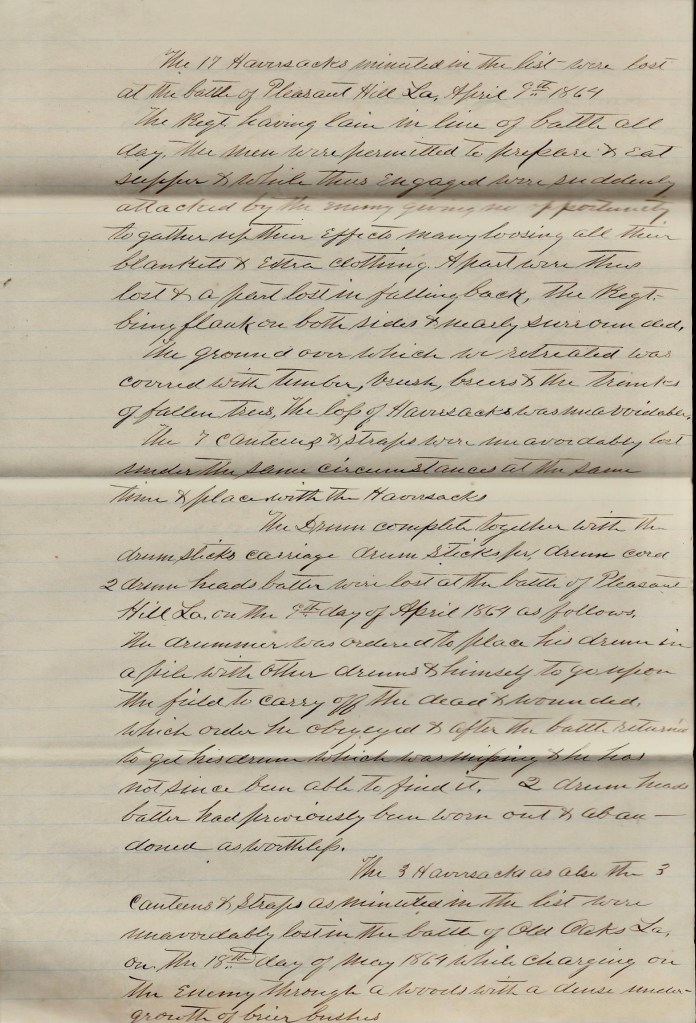


 Spared & Shared 23