My passion is studying American history leading up to & including the Civil War. I particularly enjoy reading, transcribing & researching primary sources such as letters and diaries.
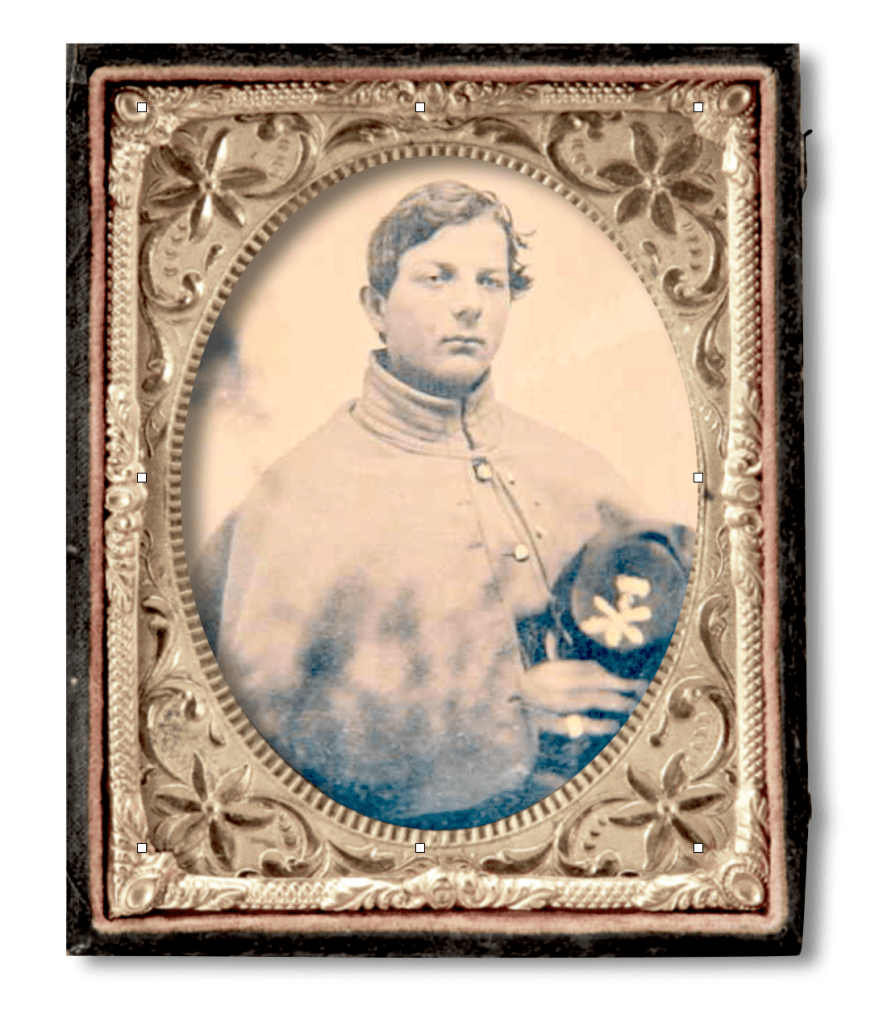
I could not find an image of Howard but here is one of Dewitt L. Parrish of Co. B, 3rd Michigan Cavalry (Ancestry)
The following letters were written by Howard Marks Hopkins (1841-1929) who enlisted at the age of 19 in Co. E, 3rd Michigan Cavalry, on 5 September 1861. He remained a private throughout his service and mustered out on 30 May 1864. During his service, he participated in sixteen engagements and skirmishes, and was constantly on scouting duty.
Howard was the son of Aaron Hopkins (1794-1844) and Pheobe Marks (1806-1872) of Rome, Lenawee county, Michigan. Howard’s father brought his family to Michigan in a horse-drawn covered wagon from Nassau, New York, in 1844 but died three months after his arrival. Howard’s father’s death left his mother with four small children in almost a destitute condition so Howard and his older sister Mate were adopted by Jeremiah Ferguson, who brought them up and gave them a good home. Before the Civil War, Howard had the opportunity to to attend Adrian College in the winter of 1860.
After the war, Howard returned to Michigan where he married Adelia A. Teachout (1846-1925) in 1867. This letter was written to Howard’s cousin, Abbie Watson, whom I believe was the 20 year-old daughter of Joseph Croasdale Watson and Ruth Langdon of Wayne county, New York. Abbie married Archibald Barton (1833-1925), ten years her senior, in the late 1860s.
Letter 1
Addressed to Miss Abbie Watson, Clyde, Wayne county, New York
Corinth, Mississippi December 15, 1863
Dear Cousin Abbie,
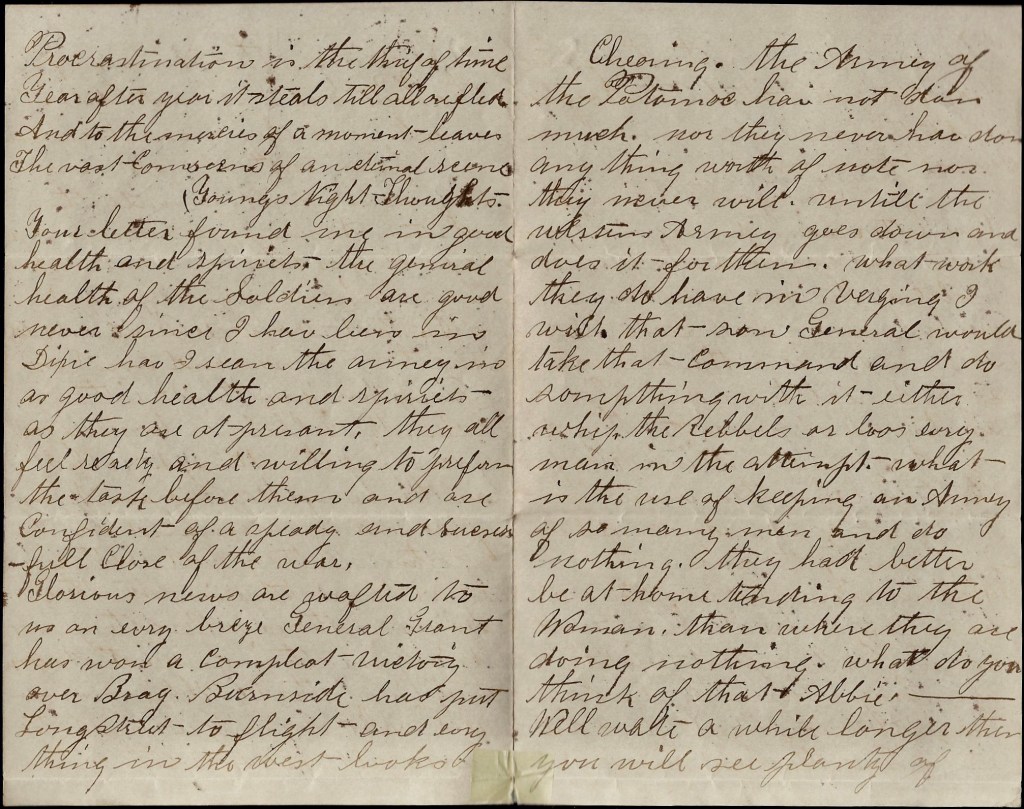
Your kind favor of November 15th came safe to hand last evening and I hasten to answer it fearing if I waited one or two days, that I might get negligent and wait as long as you did. Abbie, let us be more prompt in future and not delay writing so long. See what Young thinks about delaying things too long. “Procrastination is the thief of time. Year after year it steals till all are fled. And to the mercies of a moment leaves the vast concerns of an eternal scene.” (Young’s Night Thoughts).
Your letter found me in good health and spirits. The general health of the soldiers are good. Never since I have been in Dixie have I seen the army in as good spirits as they are at present. They all feel ready and willing to perform the task before them and are confident of a speedy and successful close of the war.
Glorious news are wafted to us on every breeze. General Grant has won a complete victory over Bragg. Burnside has put Longstreet to flight. And everything in the West looks cheering. The Army of the Potomac have not done much, nor they never have done anything worthy of note, nor they never will until the Western army goes down and does it for them. What work they do have in Virginia. I wish that some General would take that command and do something with it. Either whip the rebels or lose every man in the attempt. What is the use of keeping an army of so many men and do nothing? They had better be at home tending to the women than where they are doing nothing. What do you think of that, Abbie?
Well, wait awhile longer. Then you will see plenty of soldiers flocking home. Only about ten months longer and the three year men will be discharged. Then I will come down and see you. Mate and I have got it all planned. What a grand time we will have, won’t we? Oh, say Abbie, you must have your cousin Dill at your place. I want to see him. I suppose he is in the army yet.
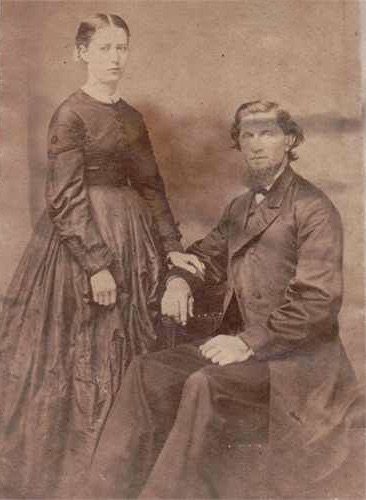
Abbie Watson and the man she would later marry, Archibald Barton. Both are buried in Clyde, New York in the Maple Grove Cemetery
About Blanchard and Mary Ann, I begin to think they have forgotten me. I have not received a letter from home over four months.
You say you think that Mr. Perles and Mate will never get married. I think they will. Mate told me they were engaged. Don’t you say a word to her that I told you.
Abbie, you speak of my being quite attentive to my early love, Miss Curtis. I will admit that I saw her some two or three times while at home and had a very pleasant visit. Do not fear. I am coming East before I get married. I have got to find someone to have me first. I am sorry you are getting too old to get married. I guess you can find someone to have you after the war closes. Now write me as soon as you get this. I am as ever your cousin, — Howard. Adieu!
Letter 2
LaGrange, Tennessee Sunday Morning Jan. 17, 1864
Dear Cousin,
Your kind favor of January 4th came safe to hand last evening and as is ever the case, I was very very glad to hear from you. Yes, Abbie, I am ever glad to hear from you and to know I am not forgotten by those at home who are near and dear. Abbie when you write me again, send me your photograph, won’t you? I shall look for it. I have not had a letter from Blanchard since I came back. I think it too bad. They seem to think so much of me and then not even write me a letter. They are good souls for I love them and may God bless them and their labors.
To me what a blessed gift letters are—especially when written to the lonely soldier who is far, far from kind friends and home. Home. What a sweet word. How I love it. One noble writer has said that the three sweetest words were, Mother, Home, and Heaven. How true. I wonder if I shall ever see my dear good Mother and home again. I trust and hope I may and that soon. You will say at once that I had better be asking myself the question, will I ever reach Heaven. I have asked myself that question many times and my daily prayer is that I may so live that I can reach Heaven and meet those gone before. Oh, is it not a pleasing thought to think if we are only faithful, that God will never leave nor forsake us?
Since I last wrote you we have moved camp. We are now camped at LaGrange, Tenn. where we were last summer. How long we shall stay here is more than I can say. Some say we are going to start for Texas in a few days. There is one division of this army going and we may be among the number. I hope so. I should realy like to visit Texas before I return home. A great many of the men are reenlisting as veterans and if they get 3/4 of the regiment, they will go home on furlough in a few weeks. There has quite a number enlisted already and I think they will get 3/4 of the men. I do not know as I shall reenlist. I think that I will not until some of those men in the North come out and then if they need more men, I am willing to go again and until those men in the North does do something, I shall not enlist again. I think if I stay three years that I have nobly preformed my duty.
You say you think your Cousin Dill is not in the army. You do not seem to know as much about him as you use to. What is the trouble? I fear you have had some difficulty. Write and tell me, won’t you? You wished to know where Jack Bond was. He is with us yet—is well and feeling well. Jack is a fine fellow.
Abbie, write to me soon. Give my love to all friends and accept this poor scribble from your very affectionate cousin, Howard. Goodbye, Abbie.
P. S. Direct to LaGrange Tennessee, Co E, 3rd Michigan Cavalry
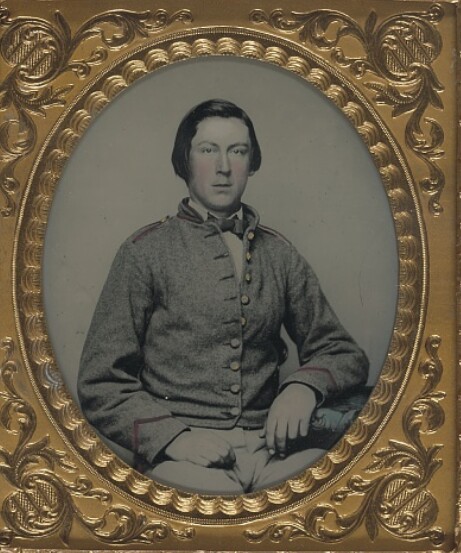
I could not find an image of Jacob, but here is an early-war image of William Savage Moore who rose from Private to Captain of Co. I, 15th Virginia Infantry (Photo Sleuth)
The following letter was penned by Jacob Shook (1843-18xx) of Camp Hill, Virginia, who enlisted as a private in Co. G, 15th Virginia Infantry in April 1861. Jacob was promoted up in the ranks to Orderly Sergeant of his company before being reduced in the ranks back to a private (“for 15 days”) in September 1864. He was then commissioned as a 2nd Lieutenant of his company before the first of November 1864 which is the rank he held at the time this letter was written. He assumed command of the company after the captain and 1st lieutenant of the company were badly wounded in the fight near Drury’s Bluff on 16 May 1864.
In the 1860 US Census, 17 year-old Jacob was enumerated in the household of Martin Baker of Henrico county, Virginia. It is believed that he was the orphaned son of Jacob Shook (1787-1858) and Maria Anna Chisholm. Shook (1802-1856) of Richmond, Virginia. Jacob’s father, before his death in 1858, had been a prominent butcher and grocer in Richmond. His wealth enabled him to have 11 slaves according to the 1850 slave schedules).
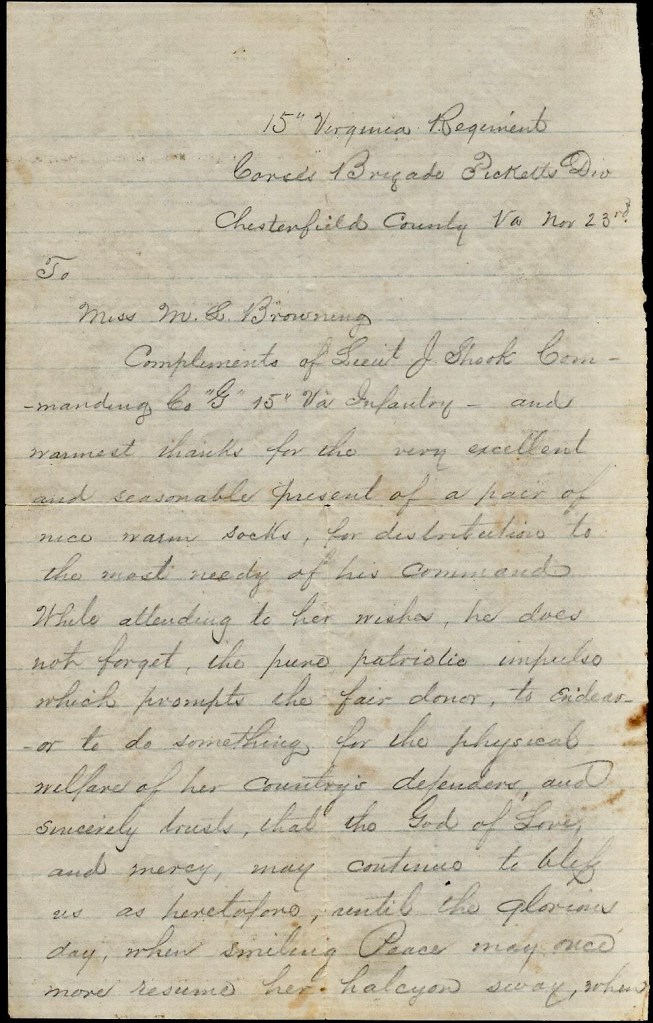
Lt. Shook’s letter was directed to a Miss M. S. Browning, otherwise unidentified. Indeed, Lt. Shook himself does not appear to know her except by name. He wrote to thank her for the socks that were contributed and distributed among members of his company. In a most chivalrous tone and referring to himself in the 3rd person, Lt. Shook praises her for the “pure patriotic impulse which prompts the fair donor to endeavor to do something for the physical welfare of her country’s defenders.”
Transcription
15th Virginia Regiment Corse’s Brigade, Pickett’s Division Chesterfield county, Va. November 23rd [1864]
To Miss M. S. Browning,
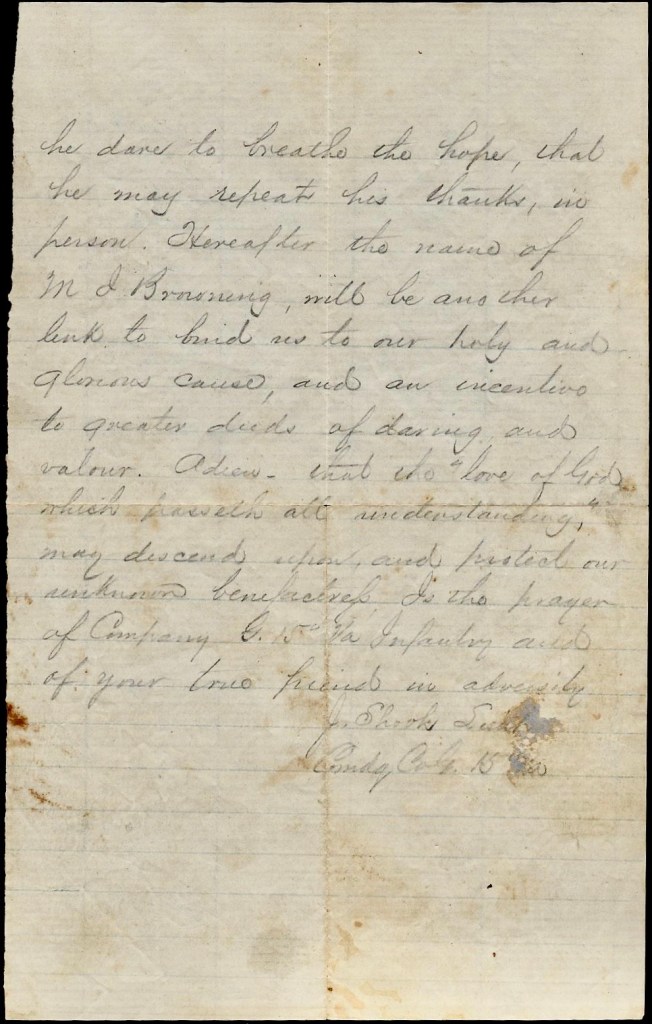
Compliments of Lieut. J. Shook. commanding Co. G. 15th Virginia Infantry, and warmest thanks for the very excellent and seasonable present of a pair of nice warm socks for distribution to the most needy of his command. While attending to her wishes, he does not forget the pure patriotic impulse which prompts the fair donor to endeavor to do something for the physical welfare of her country’s defenders and sincerely trusts that the God of love and mercy may continue to bless us as heretofore until the glorious day when smiling Peace may once more resume her halcyon sway, when he dare to breathe the hope that he may repeat his thanks in person.
Hereafter the name of M. C. Browning will be another link to bind us to our holy and glorious cause and an incentive to greater deeds of daring and valor. Adieu—that the “love of God which passeth all understanding” may descend upon and protect our unknown benefactress is the prayer of Company G, 15th Va. Infantry and of your true friend in adversity, — J. Shook, Lieut., commanding Co. G, 15th Va.
I could not find an image of Edward but here is a tintype of Jacob Kunckle who served in Co. M, 14th Pennsylvania Cavalry(Ancestry)
The following letters were written by Edward F. Tubbs (1841-1864) who enlisted September 11, 1862 and mustered into Co. I, 14th Pennsylvania Cavalry on 27 October 1862 at Erie, Pennsylvania. Edward mustered in as a corporal and was promoted to sergeant. Although one source erroneously states that Edward died of disease at Winchester, Virginia, in 17 December 1864, the truth is that he was among the 100 troopers led by Capt. William Miles of Co. I on a scouting expedition toward Ashby’s Gap on 17 December 1864. Mosby and his guerrillas ambushed this scouting party from a woods near Millwood, Virginia, killing Miles and about a dozen others, including Sergt. Tubbs. About 20 others were wounded, and nearly everybody else was captured. Mosby set one man free after slashing his face with a saber, allowing him to return to camp to tell the story of the ambush. The wounded and dead were recovered on the next day. Mosby sent his prisoners to Libby Prison.
Edward was the son of Irene Tubbs (1812-Aft1870) of Conneaut township, Erie county, Pennsylvania. Irene’s husband, Frederick Tubbs, died on 19 November 1842 after 9 years of marriage, leaving her to raise her children on the family 40-acre farm. Frederick, it seems, died a tragic death, have been shipwrecked and drowned in Lake Erie.
Letter 1
[Note: This letter was found in the Widow’s Pension File.]
Hagerstown, Maryland November 30th 1862
Dear Mother,
I don’t suppose that you know that we are in Maryland. We have got among the rebels at last. We got into Hagerstown Tuesday night the 24th and are now in camp at this place. The letter that you sent to Pittsburg I got today and was glad to hear from you but you don’t tell me that you have got my clothes yet that I sent. I got the stamps and was glad of them for they are scarce here.
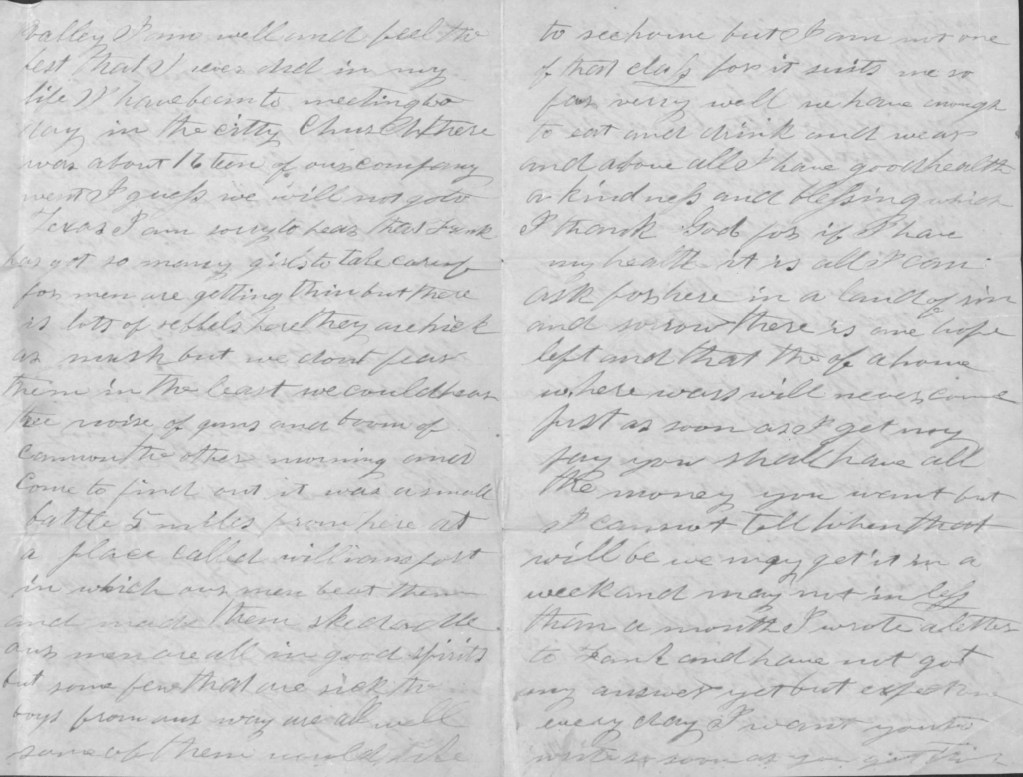
We left Pittsburg on Monday night and had a good ride of 349 miles. We passed through Harrisburg, Chambersburg and Carlisle—three handsome places. So I have crossed the Allegheny Mountains and am now in Cumberland Valley. I am well and feel the best that I ever did in my life.
I have been to meeting today in the city church. There was about 16 of our company went. I guess we will not go to Texas. I am sorry to hear that Frank has got so many girls to take care of for men are getting thin. But there is lots of rebels here. They are thick as mush but we don’t fear them in the least. We could hear the noise of guns and boom of cannon the other morning and come to find out it was a small battle 5 miles from here at a place called Williamsport in which our men beat them and made them skedaddle.
Our men are all in good spirits but some few that are sick. The boys from our way are all well. Some of them would like to see home but I am not one of that class for it suits me so far very well. We have enough to eat and drink and wear and above all, I have got good health—a kindness and blessing which I thank God for. If I have my health, it is all I can ask for here in a land of sin and sorrow. There is one hope left and that is a home where wars will never come.
Just as soon as I get my pay, you will have all the money you want but I cannot tell when that will be. We may get it in a week and may not in less than a month. I wrote a letter to Frank and have not got my answer yet but expect to everyday. I want you to write as soon as you get this. How long we will stay here, I know not but perhaps not long. There is a rumor in camp that we are a going to Western Virginia to stay this winter.
The weather is fine here and there is some talk of our being disbanded but I think it ain’t so. I could not bear to leave my company now. It would be like leaving home forever. There is no telling the love of a true Union man. His heart swells in his bosom for his fellow countrymen. But I must stop for the sheet is almost full. I want you to tell me if school has commenced. Give my respects to all. Direct your letters to Hagerstown, Camp Schoonmaker, Maryland, 4th Pa. Cavalry in care of Capt. W. Miles.
Letter 2
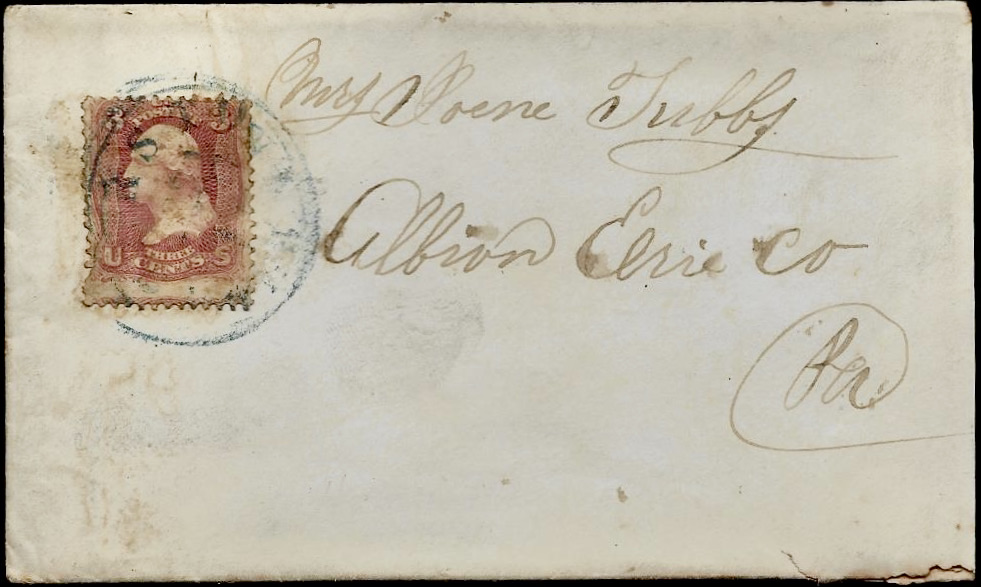
Addressed to Mrs. Joene Tubbs, Albion, Erie county, Pennsylvania
Hagerstown [Maryland] December 13th 1862
Dear Mother,
By the blessings of the God of Battles, I am yet permitted to live in peace and health and enjoy life as well as any soldier can. I have not received any answer to my last letter yet but may before this reaches you. We have got all our equipments, horses, and saddles. I have got a nice horse and a good one. The color of our horses is dark bays, We went out on drill on our horses today for the first time. I like it well. We have our savers and carbines. I hope that you will take pains to direct your letters as I tell you or they will not reach me and use plain paper envelopes for they are more apt to come.
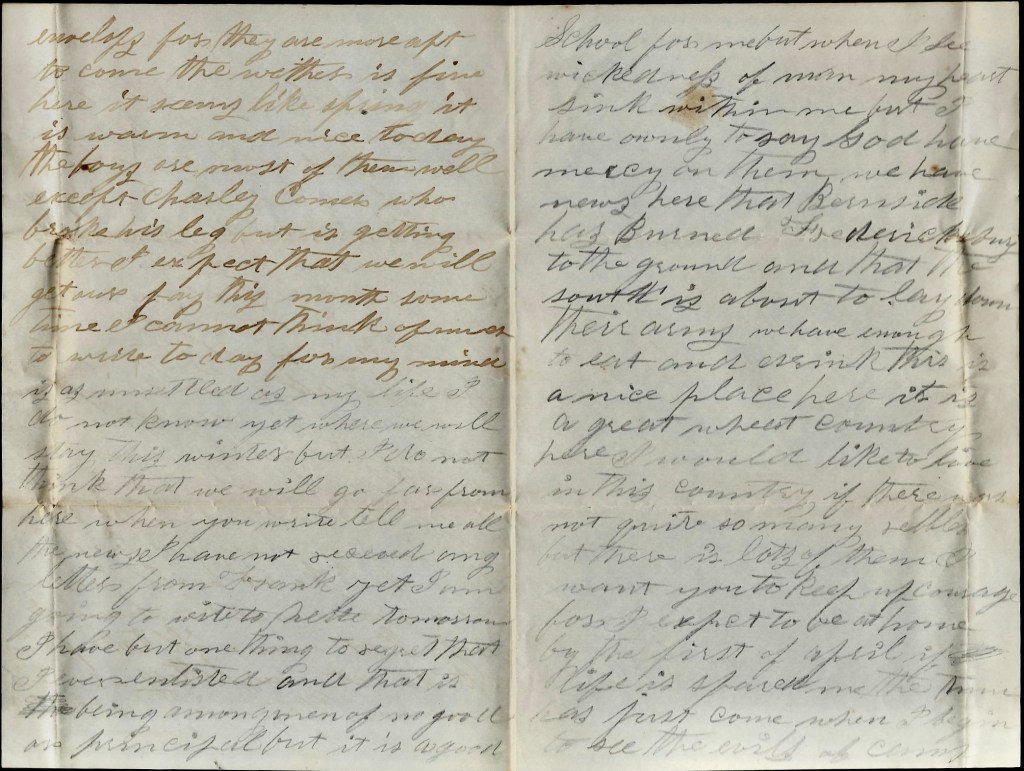
The weather is fine here. It seems like spring. It is warm and nice today. The boys are most of them well except Charley [H.] Comer who broke his leg but is getting better. I expect that we will get our pay this month some time. I cannot think of more to write today for my mind is as unsettled as my life. I do not yet know where we will stay this winter but I do not think that we will go far from here.
When you write, tell me all the news. I have not received any letter from Frank yet. I am going to write to Nette tomorrow. I have but one thing to regret that I ever enlisted, and that is being among men of no good of principle. But it is a good school for me. But when I see wickedness of men, my heart sinks within me. But I have only to day, God have mercy on them.
We have news here that Burnside has burned Fredericksburg to the ground and that the South is about to lay down their arms.
We have enough to eat and drink. This is a nice place here. It is a great wheat country here. I would like to live in this country if there was not so many rebels but there is lots of them.
I want you to keep up courage for I expect to be at home by the first of April if life is spared me. The time has just come when I begin to see the evils of camp. After a certain period, the thought of love and peace seems to leave men and they are more like demons than anything else. But you must not think that this is a bad place for it is good too. [But] what will it will be unless there is a change in mankind.
I have to go on duty now so I must stop writing for the men are getting merry and want me to make them work and I can do it up right.
Direct to Hagerstown, Maryland, 14th Regt. Penn. Cavalry. in care of Capt. W[illiam] W. Miles’ Company, — E. F. Tubbs and no more.
Letter 3
[Note: This letter was found in the Widow’s Pension File]
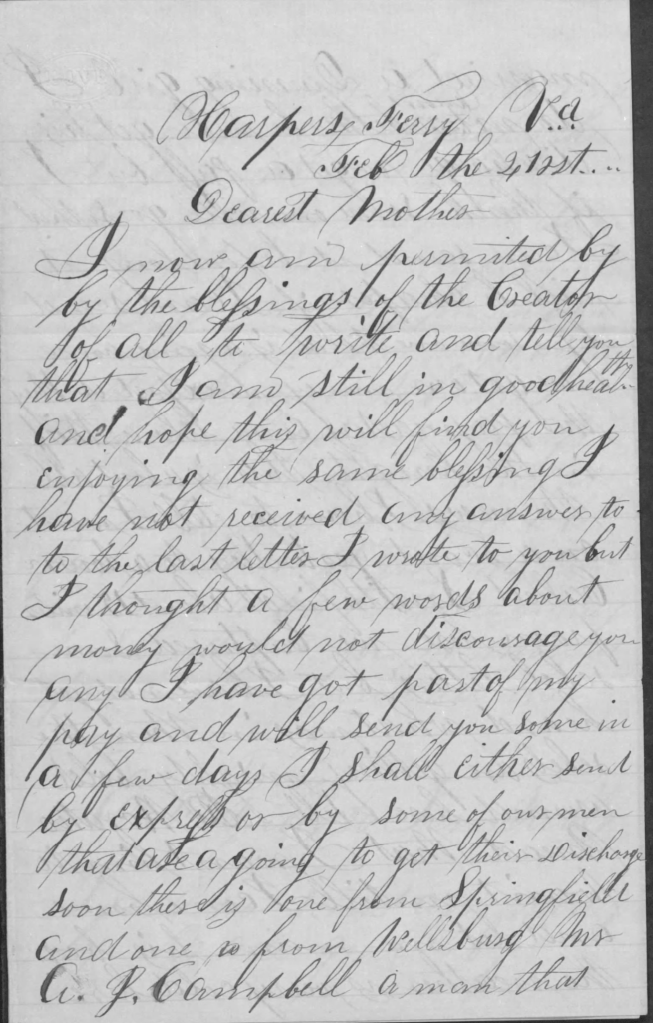
Harper’s Ferry, Va. February 21 [1863]
Dearest Mother,
I now am permitted by the blessings of the Creator of all to write and tell you that I am still in good health and hope this will find you enjoying the same blessing. I have not received any answer to the last letter I wrote to you but I thought a few words about money would not discourage you any. I have got part of my pay and will send you some in a few days. I shall either send by Express or by some of our men that are a going to get their discharge soon. There is one from Springfield and one from Wellsburg—Mr. Campbell, a man that married a Dunning girl. I do not know whether he will get his discharge or get a pass but I think someone will go so that I can send it before long. It will be cheaper if I can send by someone that is a going home. We got our money unexpected. The paymasters come like a thief in the night. This is about all of the news I have to tell.
I went on a scout yesterday to a town called Smithfield about 15 miles from here. We captured some rebel lettrs but I have not yet heard what was in them. The rebels are getting mighty bold around here. Tell Horatio Mead that I want him to wait until I come home and let me name his boy.
The weather is very cold here. It is snowing here now and blowing some too. It makes the old tent real and twist. It rather disturbs me while I am writing but I shan’t complain as long as I can stay in my tent. We have a good fire. We get hickory and oak wood to burn.
I think I will get y likeness in uniform and send it home. So soon as it gets to be fair weather, it gives me new courage to get a little money to send to you. No more at present but write all the news.
From E. F. Tubbs to Irene Tubbs.
I shall not send any money by mail. Goodbye.
Letter 4
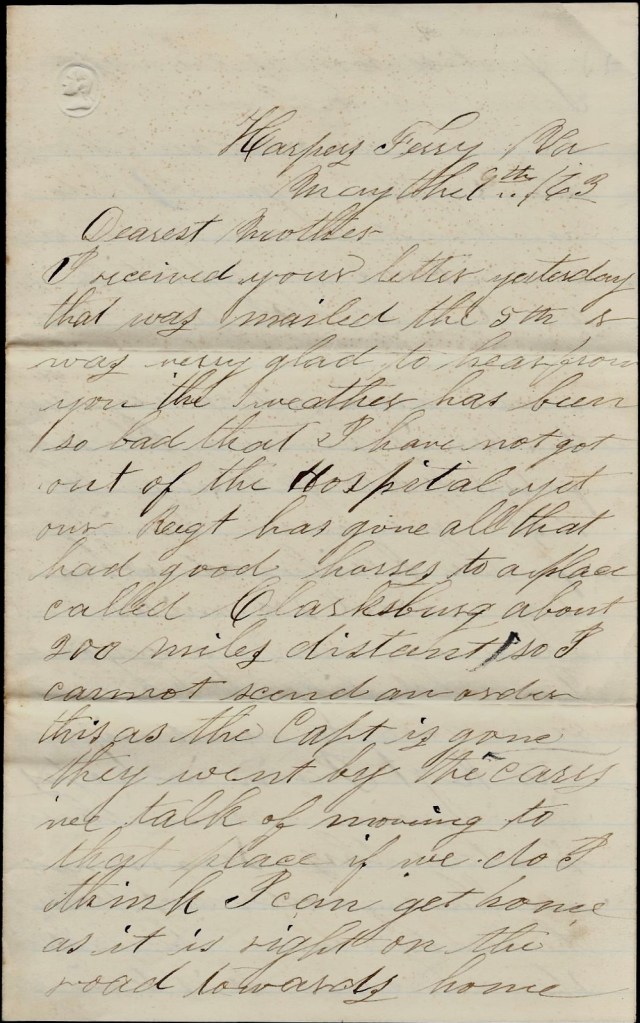
Harper’s Ferry, Va. May 9th 1863
Dearest Mother,
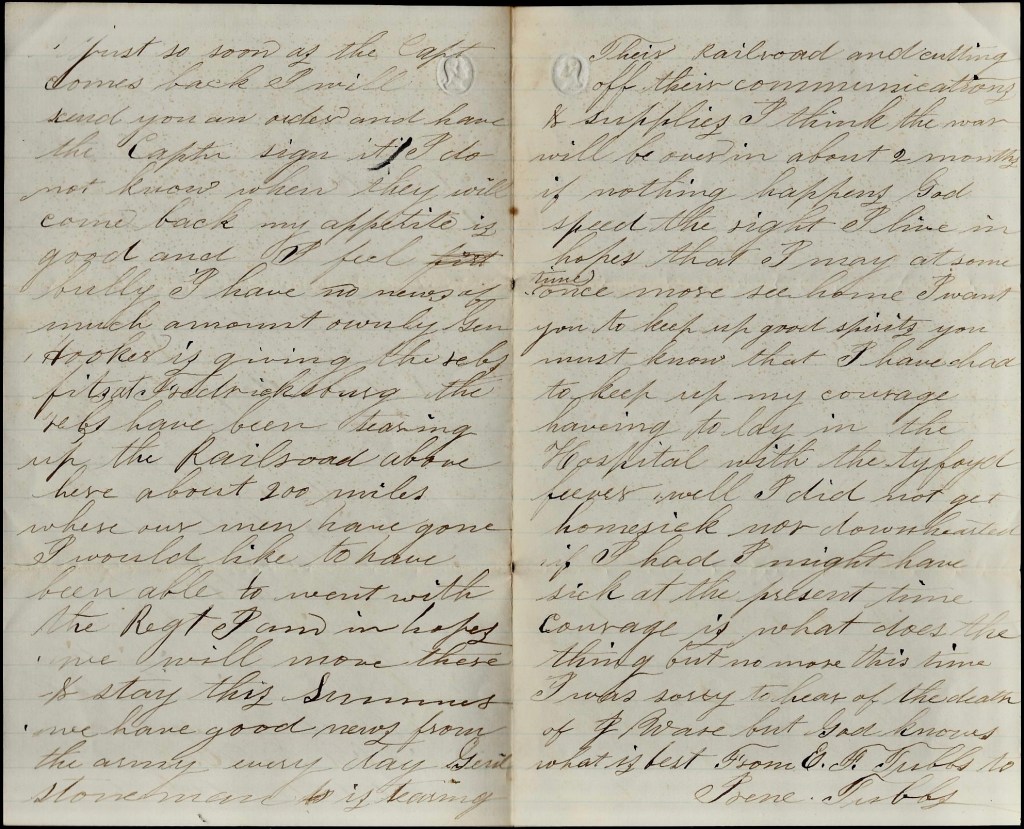
I received your letter yesterday that was mailed the 5th. I was very glad to hear from you. The weather has been so bad that I have not got out of the hospital yet. Our regiment has gone—all that had good horses—to a place called Clarksburg, about 200 miles distant, so I cannot send an order [with] this as the captain is gone. They went by the cars. We talk of moving to that place. If we do, I think I can get home as it is right on the road towards home. Just so soon as the captain comes back, I will send you an order and have the captain sign it. I do not know when they will come back.
My appetite is good and I feel bully. I have no news of much amount—only General Hooker is giving the rebs fits at Fredericksburg. The rebs have been tearing up the railroad above here about 200 miles where our men have gone. I would like to have been able to went with the regiment. I am in hopes we will move there & stay this summer. We have good news from the army every day. General Stoneman is tearing their railroad and cutting off their communications & supplies. I think the war will be over in about two months if nothing happens. God speed the right. I live in hopes that I may at some time once more see home. I want you to keep up good spirits. you must know that I have had to keep up my courage having to lay in the hospital with the typhoid fever.
Well, I did not get homesick nor downhearted. If I had, I might have [been] sick at the present time. Courage is what does the thing. But no more this time. I was sorry to hear of the death of J. Boase [?] but God knows what is best.
From E. F. Tubbs
To Irene Tubbs
Letter 5
Harper’s Ferry, Va, May 19th 1863
Dearest Mother,
I now take my time to answer the letter that George Dunning brought to me. I was very glad to see someone from our past. I am glad that you sent the butter. It is so dear here in this place but is all I care about. I’m now in camp and am in good spirits and am gaining strength fast. You ask how sick I was. I was what would be called up in our place most awful sick with the fever but my pluck was good. I did not allow myself to think of home but I am now most well. My appetite is bully but I have to be careful what I eat. I ride a little most every day now. I will tell you why I thought that you thought that I did not care anything about home. It was by the letter that you wrote & if you think they don’t say as when I have the letters to show for all that I have said, but I will let that drop. I shall try to get a furlough about the [illegible]…if we stay here. And if we go to a place called Wheeling, Va., I will try to come sooner.
I have no news to write. I will send you a 25 cents piece that I found in the streets Old Virginia by George Dunning. I am, thank God, and have been most of the time able to write my own letters. I got J. Pratt to write one for me & that was all. Pratt has got his discharge and gone to York STate where his mother-in-law lives., his wife being there.
I am glad you sent the rest of the stripe for it makes just enough for they would cost me 75 cents here. I have bought me a hat for summer. It cost $2.25 in Harper’s Ferry. I rode down to the Ferry today. I want you to enjoy yourself the best way you can. Sell everything there is and use it to suit yourself. I drawed my first pay but I shall not send any home this time while I am sick. I used considerable to buy something to eat for I could not eat anything they had in the hospital. But if I do not come home next pay day I can send you some money. You can have your choice. I will come home or will send you the money. I think the money would do you more good than it would for me to come home.
But no more this time. If you ever have a chance to send anything, send butter. I’d rather have it than anything else. Keep up good courage. The war won’t last always. So goodbye, from your son, –E. F. Tubbs
Letter 6
[Note: This letter was found in the Widow’s Pension File.]
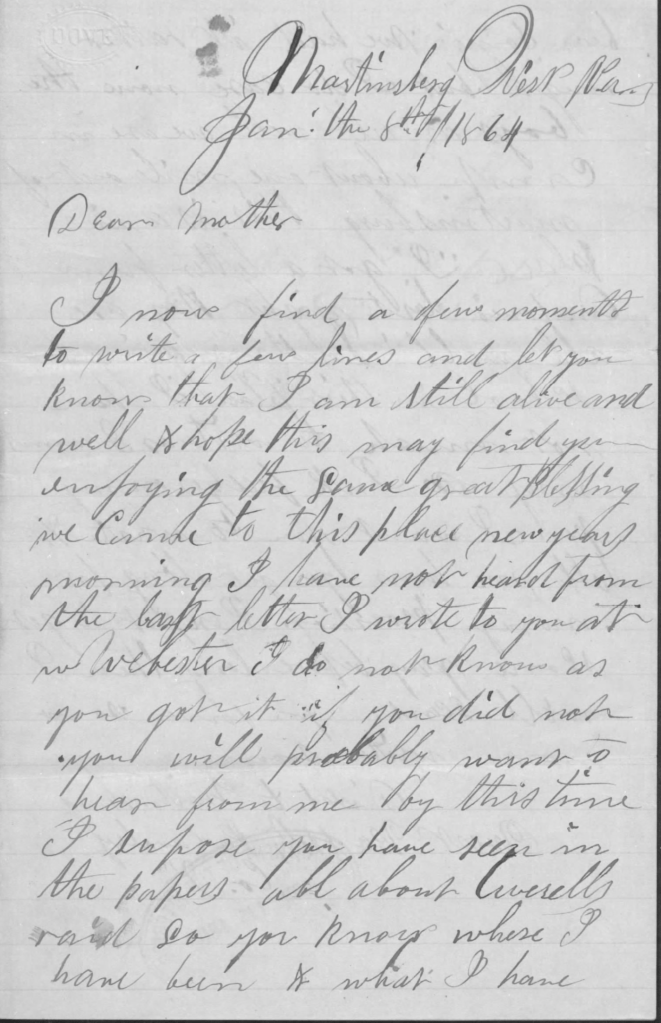
Martinsburg, West Virginia January 8th 1864
Dear Mother,
I now find a few moments to write a few lines and let you know that I am still alive and well & hope this may find you enjoying the same great blessing. We came to this place New Year’s morning. I have not heard from the last letter I wrote to you at Webster. I do not know as you got it. If you did not, you will probably want to hear from me by this time.
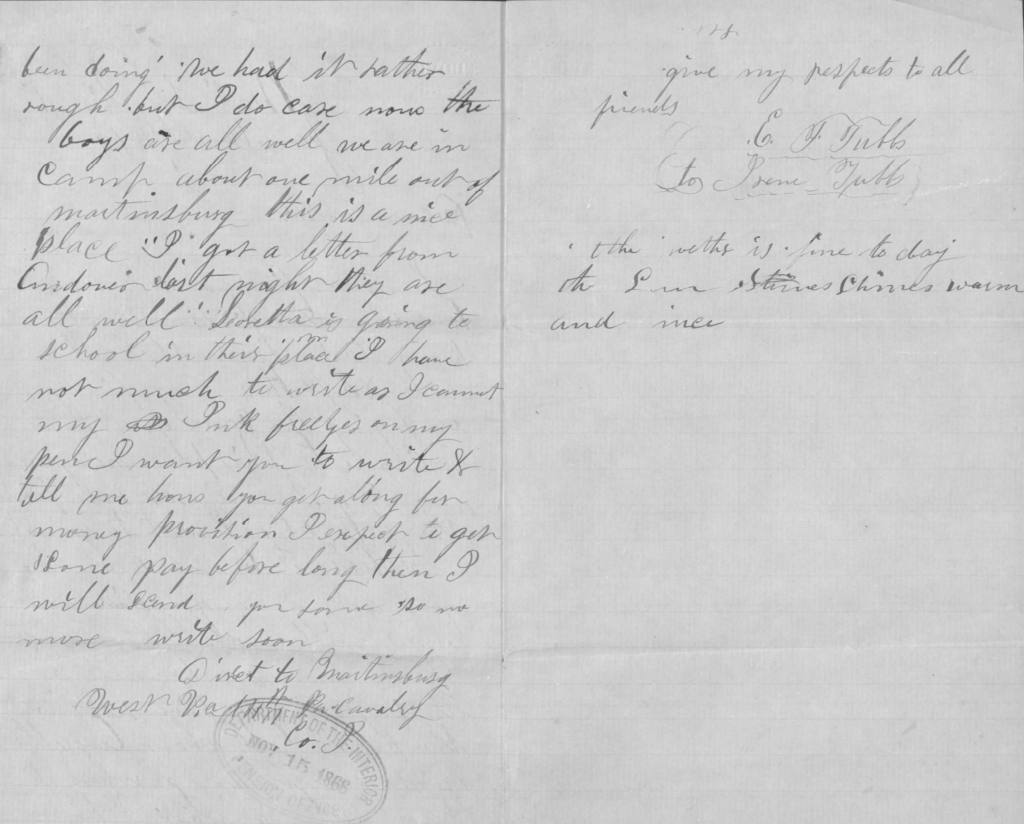
I suppose you have seen in the papers all about Averills’ raid so you know where I have been & what I have been doing. We had it rather rough but I don’t care now. The boys are all well. We are in camp about one mile out of Martinsburg. This is a nice place.
I got a letter from Andover last night. They are all well. Loretta is going to school in their place. I have not much to write as I cannot. My ink freezes on my pen. I want you to write and tell me how you get along for money and provisions. I expect to get some pay before long. Then I will send you some. So no more. Write soon.
Direct to Martinsburg, West Va., 14th Pa. Cav. Co. I.
Give my respects to all friends, — E. F. Tubbs
The weather is fine today. The sun shines warm and nice.
Letter 7
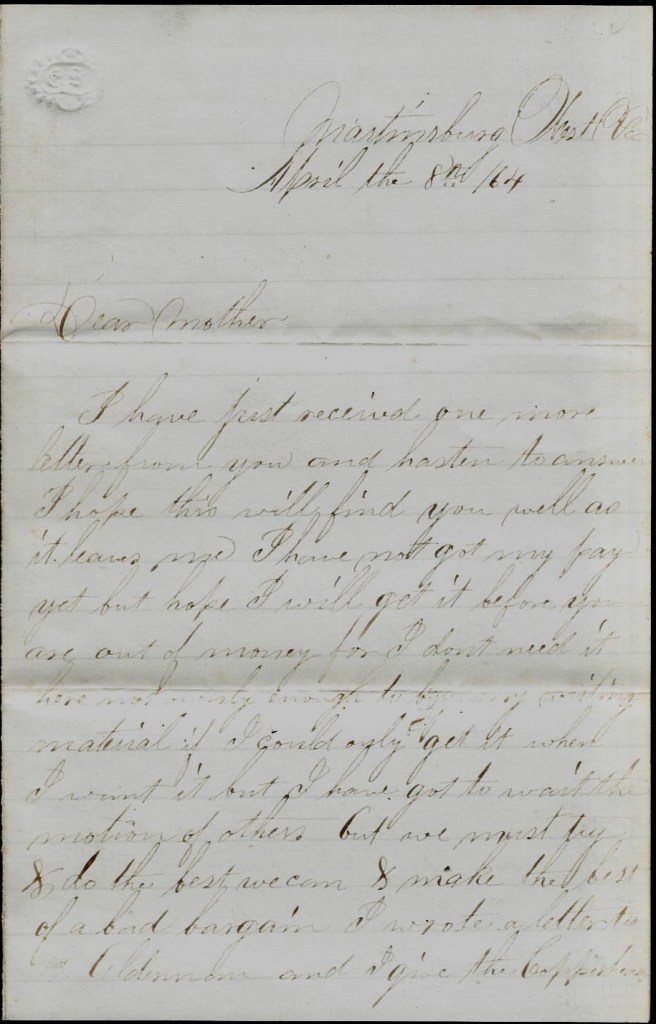
Martinsburg, West Virginia April 8, 1864
Dear Mother,
I have just received one more letter from you and hasten to answer. I hope this will find you well as it leaves me. I have not got my pay yet but hope I will get it before you are out of money for I don’t need it here, only enough to buy my writing material—if I could only get it when I want it—but I have got to wait the motion of others. But we must try and do the best we can & make the best of a bad bargain.
I wrote a letter to the Alderman and I give the Copperheads their just dues of course. What do I care if he is one of that class. So much the better for me. I intend to whip them by word and by sword. You say [he] showed you my letter. Well that is no [smudged] to him. I write to one person at a time when I write to the people of Pennsylvania generally. Then I’ll write and have it put in the Ledger or the Tribune. But when I write to one person, it is not shown by my request to anyone else. I am capable of writing to all and to write all the news if anything occurs worthy of mention.
I wrote to Thompson’s some time ago but have not had any answer yet. Tell them to call the boy Bill Averill for me. That’s all.
Well, I must now take a few lines to tell you how the boys are. Campbell has gone to the hospital again. He went today and our Orderly Holiday. There is more sickness in our regiment than I ever knew at one time before but I guess I have said enough for this time. Everything is quiet. Some talk of our moving to Old Beverly again but I hope it won’t be as I do not want to go to that place. But good night. Write soon.
— E. F. Tubbs
To Mrs. Irene Tubbs
Letter 8
[Note: This letter was found in the Widow’s Pension File.]
Camp in Cedar Grove Bunker Hill, Va. May 9th 1864
Dear Mother,
It is with shame for neglect of not trying to write before that I am now going to tell you where I am and as near as I can what I have been doing. We left Martinsburg on the 29th day of April, marched to this place, camped over night and mustered for pay the next day. And the next day we marched to Winchester and remained at that place until May 5th. Our regiment was then ordered back to Bunker Hill to keep the way open for communication from Martinsburg to Winchester as our army is there at present. Things change fast. Every day brings its change.
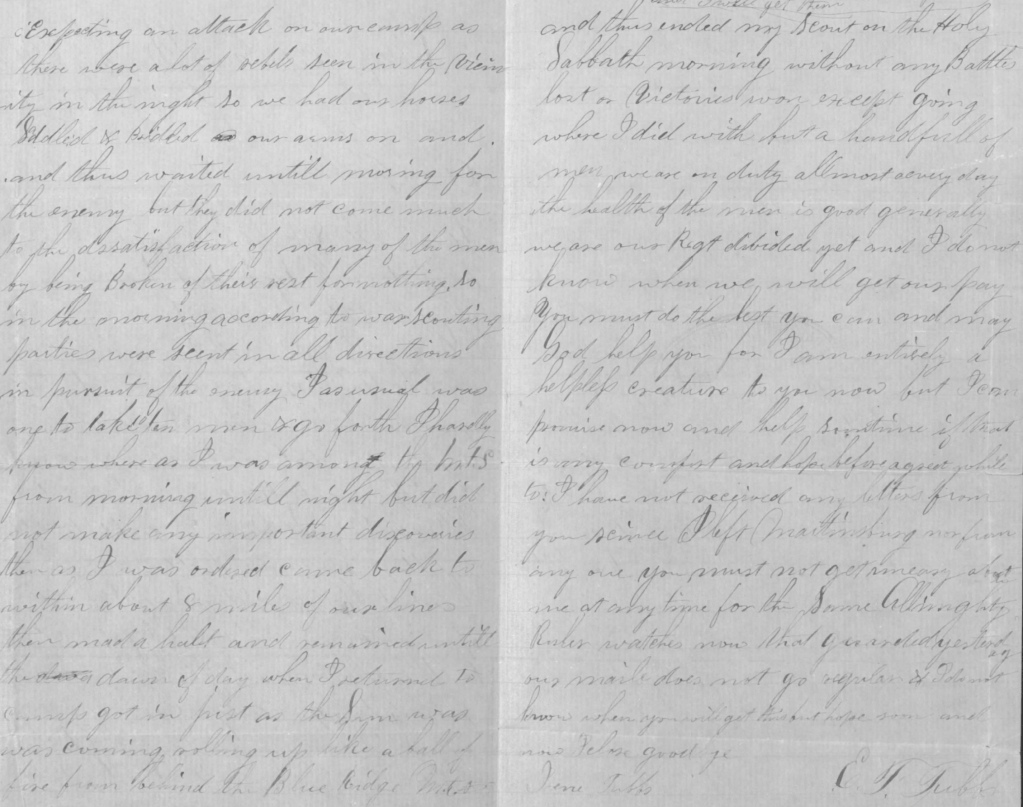
Night of Friday last, we were up all night in camp expecting an attack on our camp as there were lot of rebels seen in the vicinity in the night so we had our horses saddled and bridled, our arms on, and thus waited until morning for the enemy but they did not come much to the dissatisfaction of many of the men by being broken of their rest for nothing.
So in the morning, according to war, scouting parties were sent in all directions in pursuit of the enemy. I as usual was one to take ten men and go forth [but] I hardly know where as I was among the hats from morning until night but did not make any important discoveries then. As I was ordered to come back to within about 8 miles of our lines, then made a halt and remained until the dawn of day when I returned to camp. Got in just as the sun was coming rolling up like a ball of fire from behind the Blue Ridge Mountains, and thus ended my scout on the Holy Sabbath morning without any battles lost or victories won except going where I did with but a handful of men.
We are on duty almost every day. The health of the men is good generally. We are divided yet and I do not know when we will get our pay. You must do the best you can and may God bless you for I am entirely a helpless creature to you now. But I can promise now and help sometime if that is any comfort and hope before a great while to. I have not received any letters from you since I left Martinsburg nor from anyone. You must not get uneasy about me at anytime for the same Almighty Ruler watches now that guarded yesterday. Our mail does not go regular & I do not know when you will get this. Hope soon. And now I close. Goodbye. — E. F. Tubbs
Letter 9
Camp on the hill in Martinsburg Entirely out of danger May 16th 1864
Dear Mother,
I am at this present time sitting on a bag of oats which I have got for my horse, and as I am where there is a chance to send a letter which I think will reach you, I thought to write a few lines & let you know that I am well. I hope this may find you the same.
I came into this place yesterday from the front at Woodstock where Gen. [Franz] Sigle was when we left that place but we hear that he has advanced and had a small fight and drove the rebels 16 miles. I wrote a letter to you when I was at Bunker Hill but I do not know whether you ever got it or not, so I thought I would write another. I have not had a letter since the 28th of April. I do not know where our letters go. Our regiment is split up so. The 14th is in so many places—that I expect is the reason we do not get our letters.
We left Bunker Hill and went to Woodstock on the 11th of May and on the 12th we went to a place called Front Royal which you have heard of so much. On the 13th we went back to Woodstock via Strasburg and on the 14th at about 4 o’clock p.m. we started for this place. [There were] 100 of us, 25 of our regiment and 75 of the 21st [?]. We came here to guard a train back. We got in here on the 15th about noon so you see today is the first day’s rest we have had in some length of time. We rode all night Saturday night and it has rained almost all of the time. I expected to have went back today but I think we will remain here over night as it is sunset and our train is not ready.
We have good news from Grant. It is reported that Lee has surrendered his whole army but I do not know how true it is yet hope it may be true. The most trouble we have is with the guerrillas. They try to capture our wagon trains. We have over 50 miles to haul provisions to the army now under Sigel.
But it is getting late and I must close so good night. Direct your letters as before. Give my respects to all that are worthy of them.
— E. F. Tubbs
Letter 10
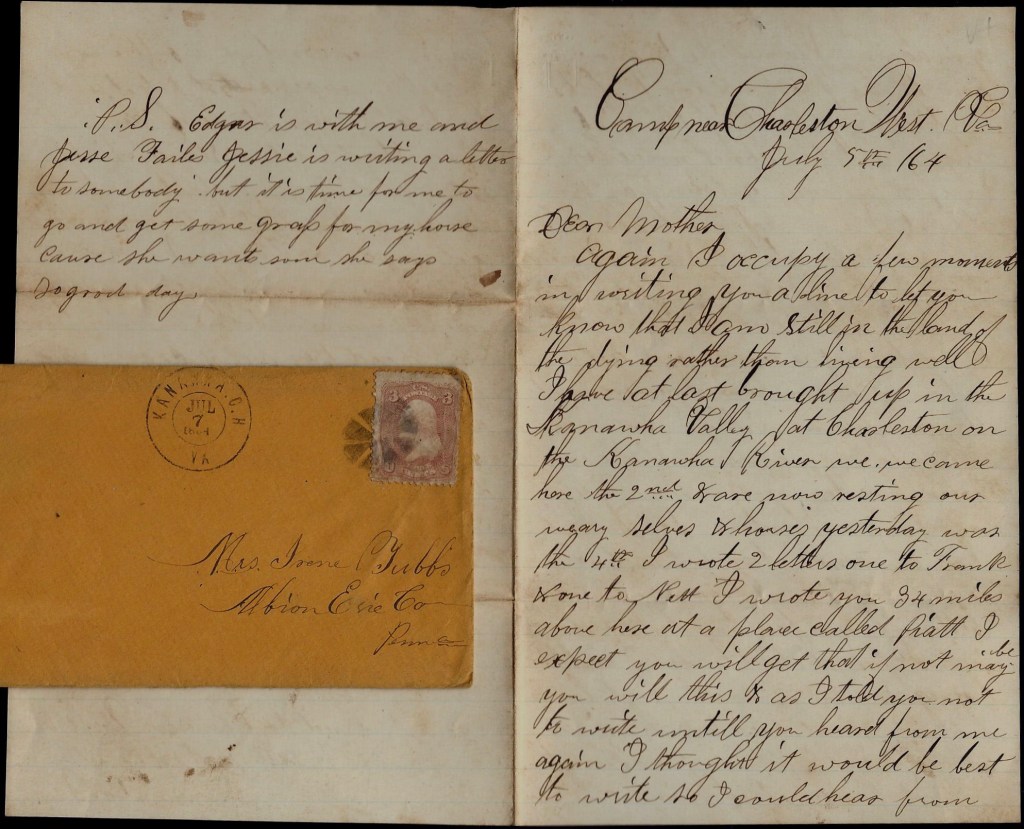
Camp near Charleston, West Virginia July 5, 1864
Dear Mother,
Again I occupy a few moments in writing you a line to let you know that I am still in the land of the dying rather than living well.
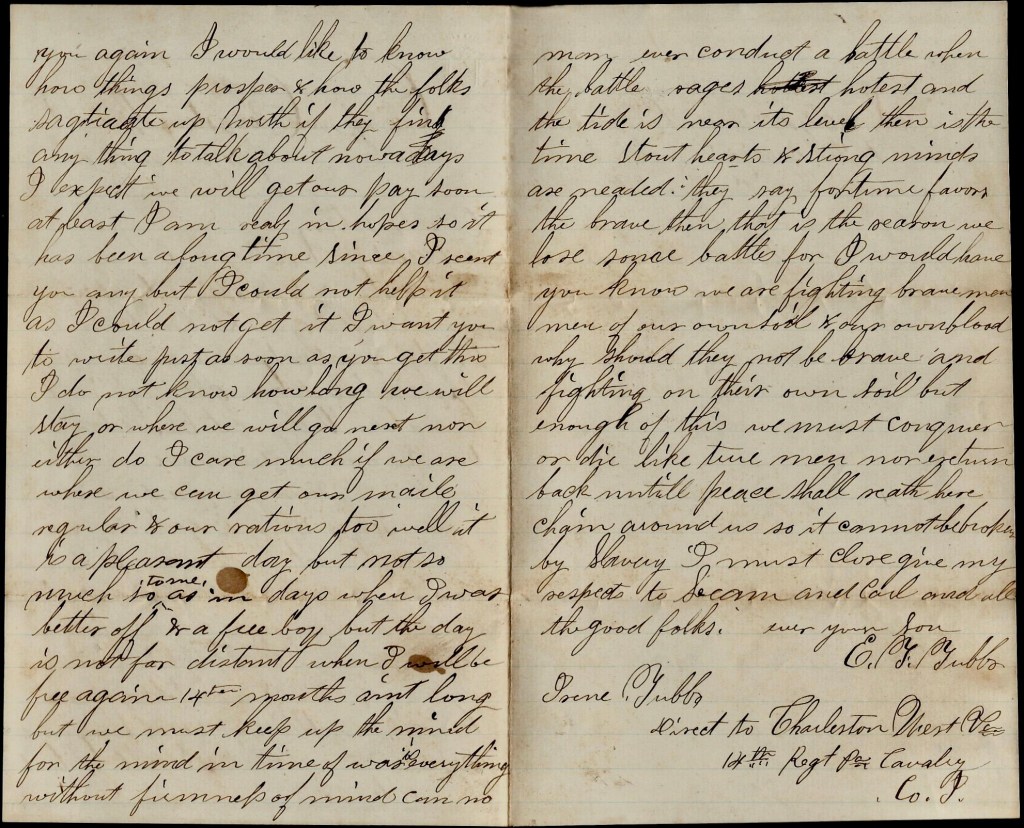
I have at last brought up in the Kanawah Valley at Charleston on the Kanawha river. We came here the 2nd and are now resting our weary selves and horses. Yesterday was the 4th. I write two letters—one to Drank and one to Nett. I wrote you 34 miles above here at a place called Piatt. I expect you will get that. If not, maybe you will this. And as I told you not to write until you heard from me again, I thought I could hear from you again. I would like to know how things prosper & how the folks sagtiate [?] up North—if they find anything to talk about now-a-days. I expect we will get our pay soon—at least I am really in hopes so. It has been a long time since I sent you any [money] but I could not help it as I could not get it.
I want you to write just as soon as you get this. I do not know how long we will stay or where we will go next. Nor do I care much if we are where we can get our mails regular and our rations too.
Well, it is a pleasant day but not so much so to me as in days when I was better off & a free boy. But the day is not far distant when I will be free again. 14 months ain’t long. But we must keep up the mind for the mind in time is everything without firmness of mind can no more ever conduct a battle when the battle rages hottest and the tide is near its level, then is the time stout hearts and strong minds are needed, they say, for time favors the brave. Then that is the reason we lose some battles for I would have you know we are fighting brave men—men of our own soil and our own blood. Why should they not be brave and fighting on their own soil?
But enough of this. We must conquer or die like true men, nor return back until peace shall reach her chain around us so it cannot be broken by slavery. I must close.
Give my respects to Sam and Carl and all the good folks. Ever your son, — E. F. Tubbs
Direct to Charleston, West Virginia, 14th Regt. Pa. Cavalry, Co. I
P. S. Edgar is with me and Jessie Failes. Jessie is writing a letter to somebody but it is time for me to go and get some grass for my horse cause she wants some. She says so. Go day.
Letter 11
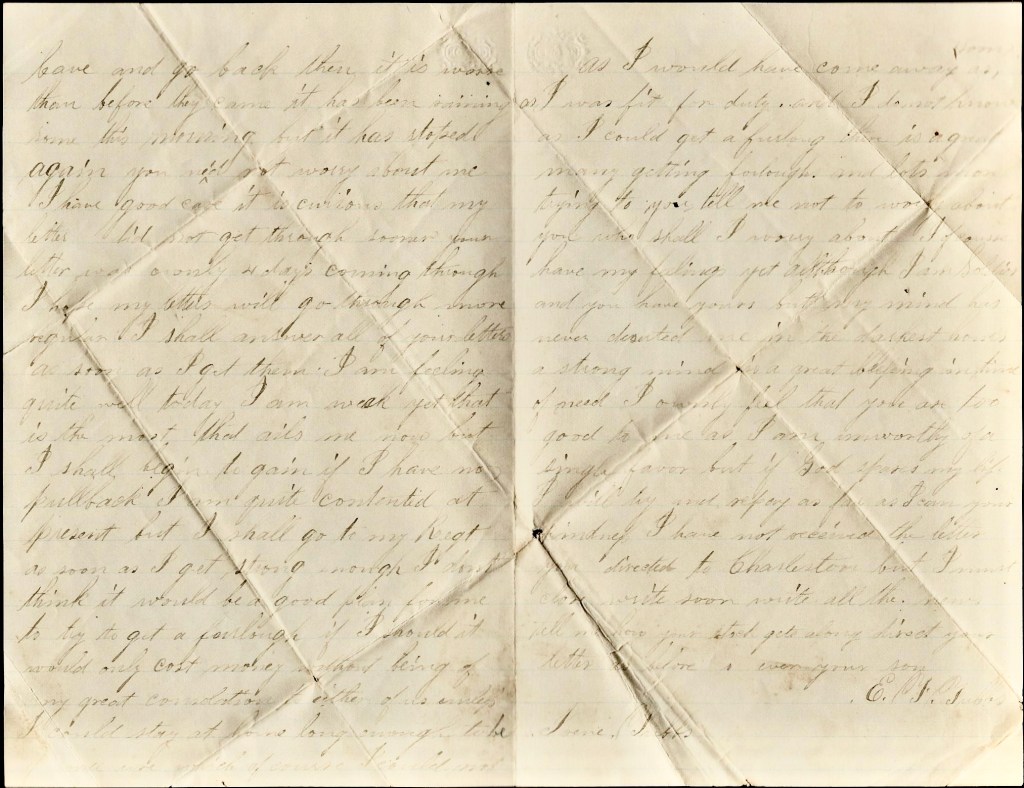
Gallipolis, [Ohio] August 22, 1864
Dear Mother,
I have just received your letter of the 28th date but mailed at West Greenville. How does it happen to be mailed at that place? I got the 5 dollars safe but I did not expect you were going to send me money. I could get along some way until I got my regimental [pay] but I thank you with all my heart for your kindness. I hope I will be allowed the privilege of repaying you before long.
I am still improving slowly. It may seem strange but would not want you to come here if you could because it would make me worse. There is a great many mothers, fathers, brothers and sisters come here and cry around a day or two and then they have to leave and go back. Then it is worse than before they came.
It has been raining some this morning but it has stopped again. You need not worry about me. I have good care. It is curious that my letter did not get through sooner. Your letter was only 4 days coming through. I hope my letters will go through more regular. I shall answer all of your letters as soon as I get them. I’m feeling quite well today. I am weak yet. That is the most tha ails me now but I shall begin to gain if I have no fallback. I am quite contented at present but I shall go back to my regiment as soon as I get strong enough. I don’t think it would be a good play for me to try to get a furlough. If I should, it would only cost money without being of any great consolation to either of us unless I could stay at home long enough to be [illegible]…
There is a great many getting furloughs and lots now trying to. You tell me not to worry about you. What shall I worry about? I of course have my feelings yet although I am a soldier and you have yours. But my mind has never deserted me in the darkest hours. A strong mind is a great blessing in times of need. I only feel that you are too good to me as I am unworthy of a single favor. But if God spares my life, I will try and repay as far as I can your kindness. I have not received the letter you directed to Charleston but I must close. Write soon. Write all the news. Tell me how your stock gets along. Direct your letter as before. As ever, your son, — E. F. Tubbs
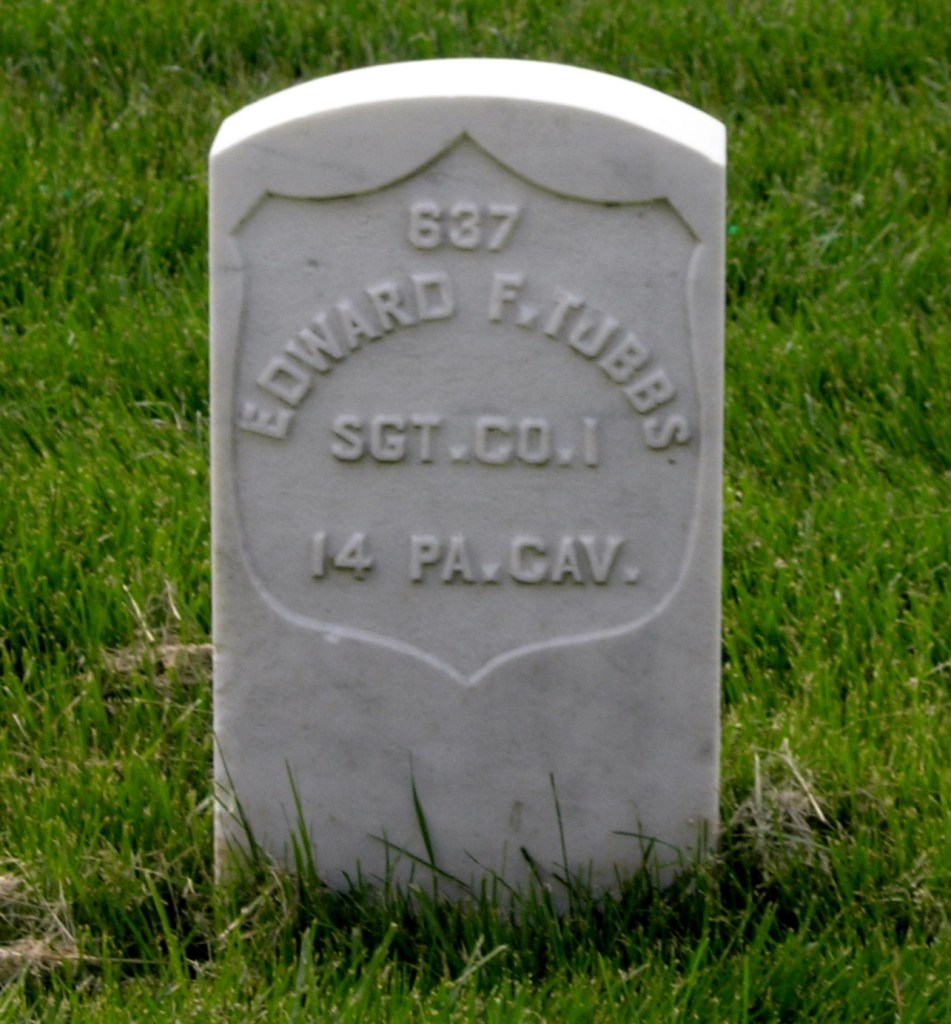
Sgt. Edward F. Tubbs’ Headstone in Winchester National Cemetery
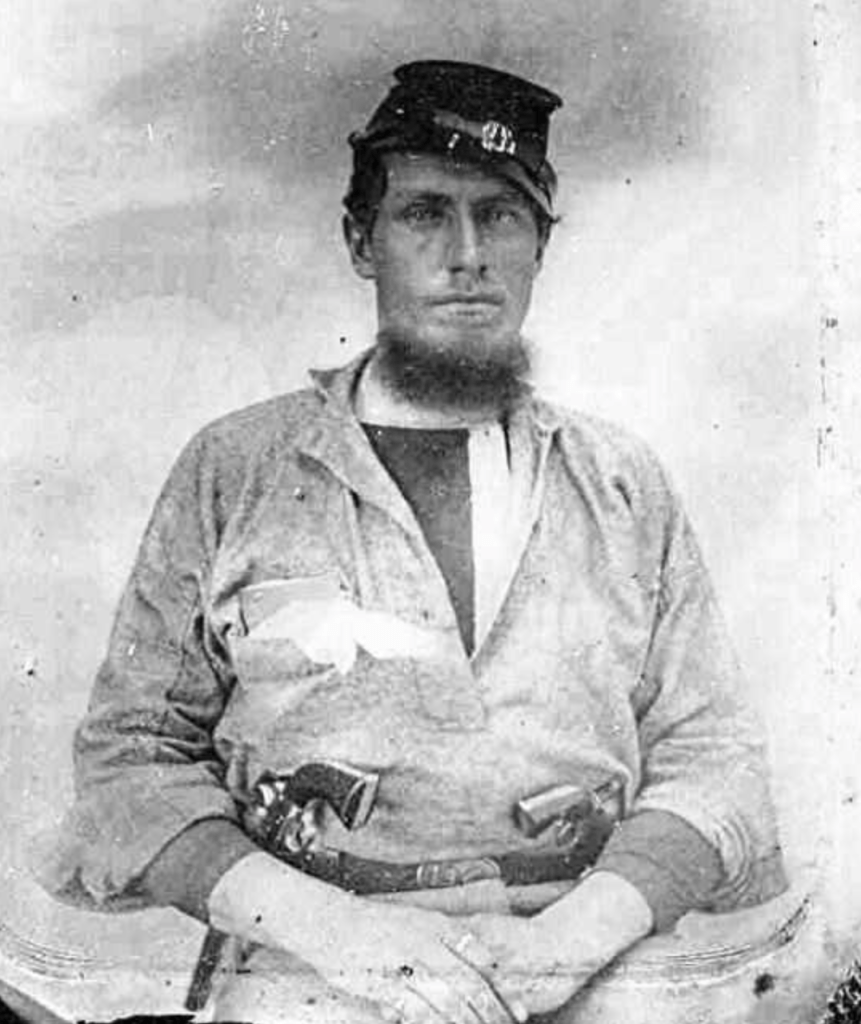
I could not find an image of Ben but here is Orlando Schooley who served in Co. G, 18th Illinois Infantry (Ancestry)
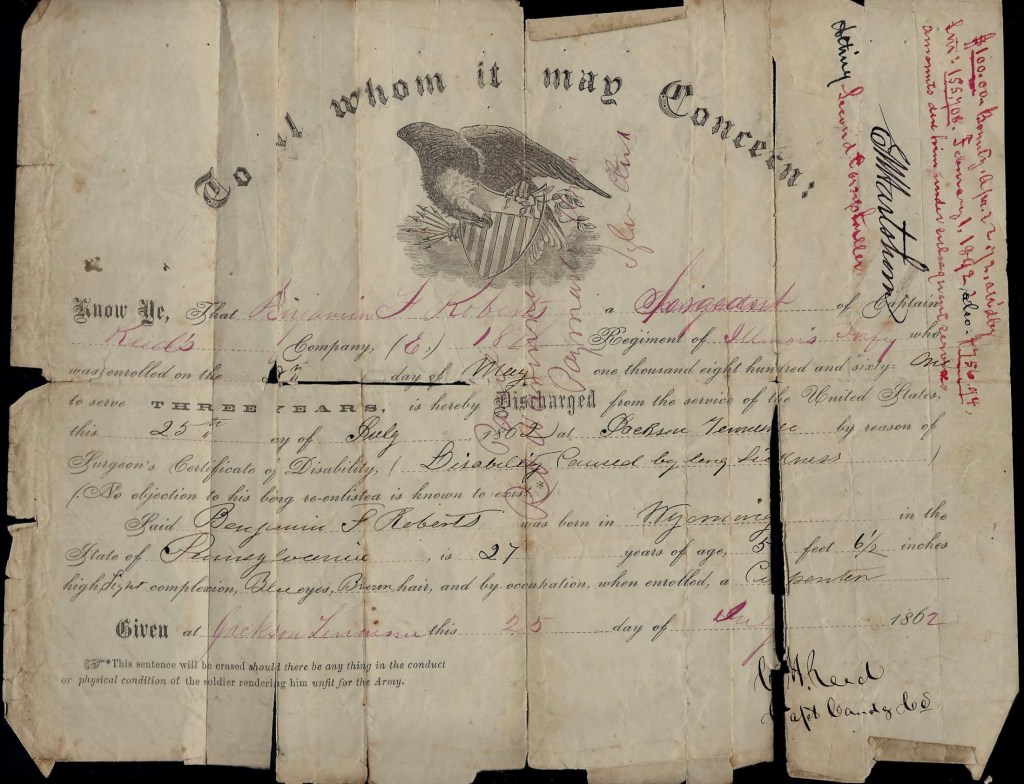
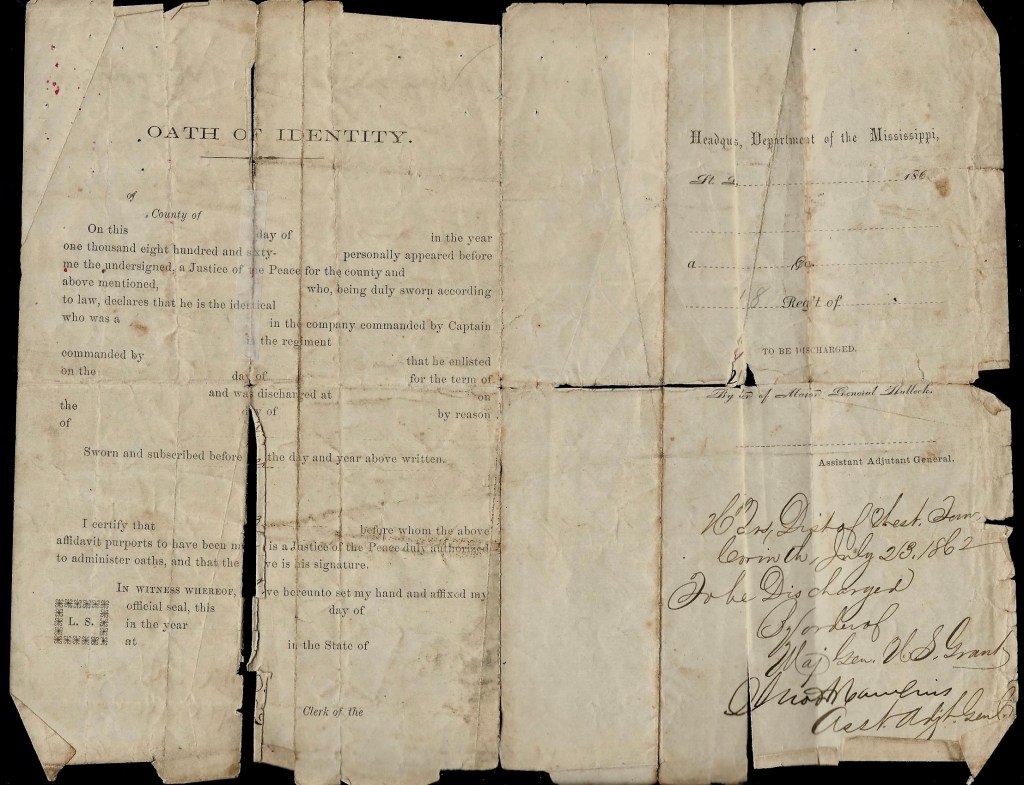
The following letter was written by Benjamin F. Roberts (1835-18xx), a native of Wyoming county, Pennsylvania, who was earning his living as a farmer in Clear Creek township, Alexander county, Illinois at the time the Civil War began. When he enlisted as a sergeant in Co. E, 18th Illinois Infantry on 28 May 1861, he was described as a 5 foot 7 inch tall, brown-haired, blue-eyed, single, 26 year-old carpenter. Ben became seriously ill in the spring of 1862 and had to be discharged for disability in July 1862.
The 18th Illinois Infantry saw its first major action at Fort Donelson in February 1862 where it occupied the right of Oglesby’s brigade, on the right of the line of battle, and during the second day’s fight lost 200 men in killed and wounded, 50 dying upon the field and 10 soon afterward. The regiment during the battle bravely and persistently maintained the position to which it was assigned in the early morning, and not until its ammunition was spent was the order to retire given.
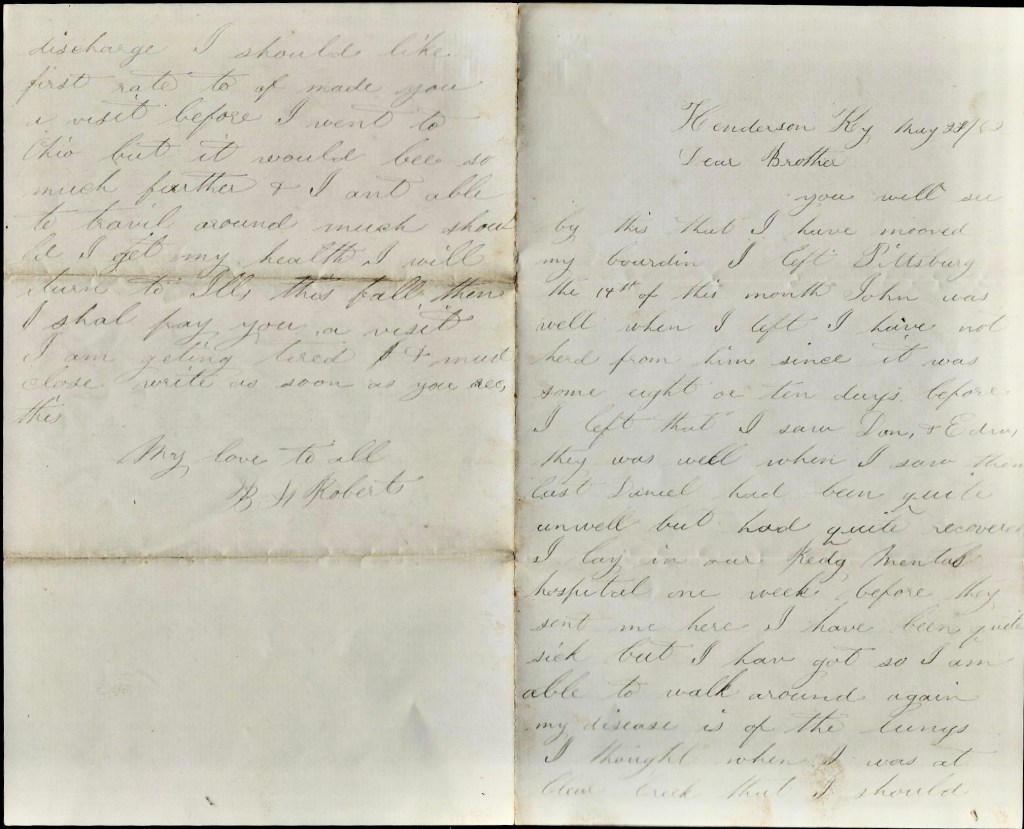
You will see by this that I have moved my boarding. I left Pittsburg [Landing] the 14th of this month. John was well when I left. I have not heard from him since. It was some eight or ten days before I left that I saw Don & Edw. They was well when I saw them last. Daniel had been quite unwell but had quite recovered. I lay in our regimental hospital one week before they sent me here. I have been quite sick but I have got so I am able to walk around again. My disease is of the lungs. I thought when I was at Clear Creek that I should quit trying to soldier but went back to my regiment feeling pretty well [and] concluded I would stay to see the ball out at Corinth. But my health would not permit it. I would of got my discharge before I left Corinth but we only had about one hour’s notice of leaving & I had no time to attend to it. My physician told me I would get my discharge, go where I might, but they han’t the power to grant discharges here. Our surgeon has offered me my discharge several times but I did not want one as long as there was any hope of my recovering my health.
I have finally come to the conclusion that I will take a discharge as soon as I can get one for from experience I find I can’t stand the service. I expect I will remain here until I can obtain my discharge. This is a very pleasant place and considered very healthy. We occupy a large three-story brick building for our hospital here. Henderson is the county seat of Henderson county. It is one hundred and fifty miles above Paducah on the [Ohio] river. We have plenty to eat and kind attendance here although I want to get home for I think I would recover my health. I am tired taking medicine for I have taken so much the last year & done so little good that I have no confidence in it. I have written home since I came here but it is not time for an answer yet. I shall go home as soon as I get my discharge. I should like first rate to of made you a visit before I went to Ohio but I would be so much farther & I ain’t able to travel around much. Should I get my health, I will return to Illinois this fall. Then I shall pay you a visit. I am getting tired & must close. Write as soon as you see this.
The following letters were written by 34 year-old James Milton Miller (1828-1892) to his wife, Mary Frances Milam (1838-1909). James was the son of Samuel Miller (1792-1873) and Jane Hamilton (1794-1865) of Itawamba, Mississippi. James and Mary were married in January 1857 and living in Pontotoc, Mississippi, when the Civil War began.
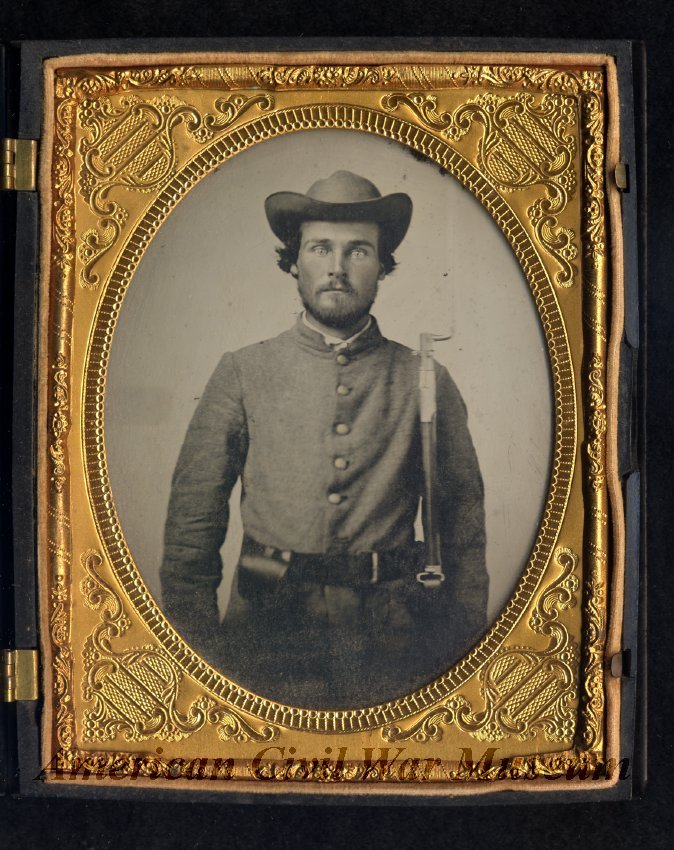
An unidentified Mississippian (Civil War Museum)
Both letters were written while James served as a private in Co. G (the “Orr Guards”), 31st Mississippi Infantry. He enlisted in March 1862 and seems to have been with his regiment or on detail through at least the spring of 1863 except for a time in the Durant Hospital in December 1862.
After the war, in 1869, James loaded all of his family and their possessions in wagons and relocated to Freestone county, Texas, in an area four miles south of Brewer Prairie, where he lived out his days. After his death, his widow filed for a Confederate Widow’s Pension which is where the following two letters were found and brought to my attention by Billy Mercer, his ggggreat-grandson.
The events taking place at the time of these two letters, copied from the regimental history, included: “When General Grant advanced from Memphis down the Central Railroad, Rust’s brigade (which included the 31st Mississippi) fell back from Holly Springs to the Tallahatchie River and thence in December to Coffeville, where they participated in the battle of December 5. Colonel Orr commanding the brigade and Stephens the regiment. The brigade pursued the Federal advance back to the main army at Water Valley, and then retired to Grenada. VanDorn’s raid to Holly Springs followed and Grant retreated to Memphis. The regiment was then sent to the support of S. D. Lee at Chickasaw Bayou. The brigade was met at Edwards as it moved to Vicksburg by General Featherston, who took command, the brigade then including the Fifteenth, Twenty-second, Thirty-first and Thirty-third Regiment and Rayburn’s Battalion. Featherston’s Brigade was ordered to Snyder’s Bluff March 19 on account of the Federal reconnaissance by General Sherman and Admiral Porter on Rolling Fork and Deer Creek, and toward the close of the ten days’ operation the Thirty-first joined the Twenty-second and Thirty-third at the scene of action. Colonel Orr then taking command of the Confederate forces with Featherston. After an unique campaign in the flooded swamps with the Federal gunboats that were crowding their way through the bayou, the gunboats escaped into Black Bayou, and the regiment took steamer for Fort Pemberton, confronted by a Federal fleet. Late in April they moved to Grenada, whence the regiment was ordered again to Edwards. May 3 Colonel Orr at Edwards was ordered, “on the arrival of Featherston, with his brigade, your regiment and Snodgrass’ Alabama Regiment will go to the Big Black bridge.”
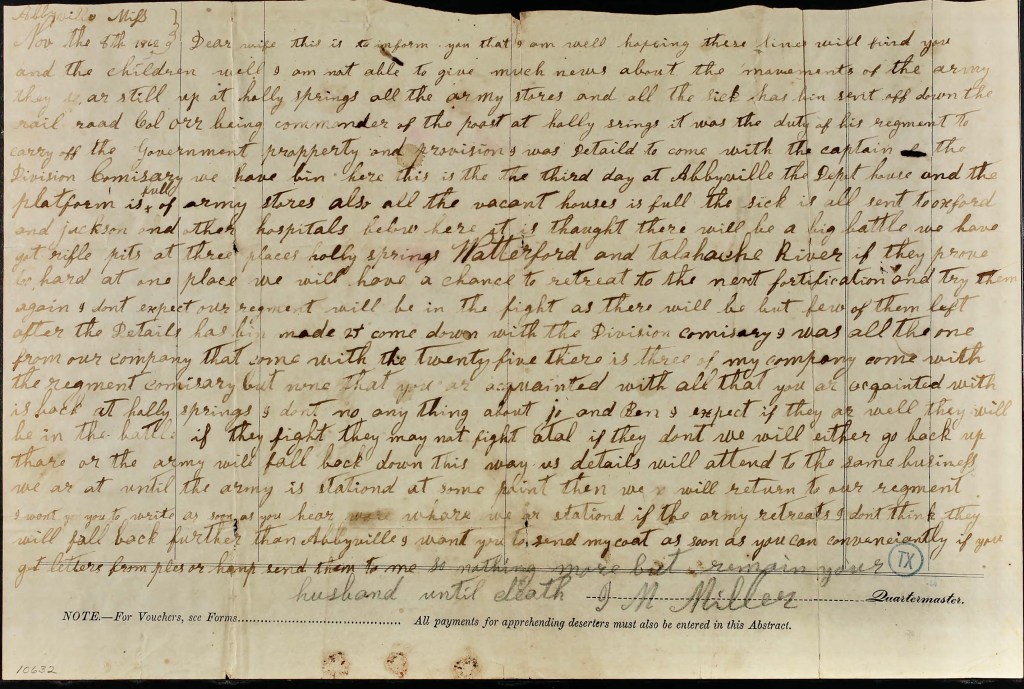
This is to inform you that I am well, hoping these lines will find you and the children well. I am not able to give much news about the movements of the army. They are still up at Holly Springs. All the army stores and all the sick has been sent off down the railroad. Col. [Jehu A.] Orr being commander of the post at Holly Springs, it was the duty of his regiment to carry off the government property and provisions. I was detailed to come with the captain of the Division Commissary. We have been here this is the third day at Abbeville. The depot house and the platform is full of army stores. Also all the vacant houses is full. The sick is all sent to Oxford and Jackson and other hospitals below here.
It is thought there will be a big battle. We have got rifle pits at three places—Holly Springs, Waterford, and Tallahatchie River. If they prove too hard at one place, we will have a chance to retreat to the next fortification and try them again. I don’t expect our regiment will be in the fight as there will be but few of them left after the details has been made. It come down with the Division Commissary. I was the [only] one from our company that come with the twenty-five. There is three of my company come with the regiment commissary but none that you are acquainted with. All that you are acquainted with is back at Holly Springs. I don’t know anything about Joe and Ben. I expect if they are well, they will be in the battle if they fight, [but] they may not fight at all. If they don’t, we will either go back up there or the army will fall back down this way. Us details will attend to the same business we are at until the army is stationed at some point. Then we will return to our regiment.
I want you to write as soon as you hear where we are stationed. If the army retreats, I don’t think they will fall back further than Abbeville. I want you to send my coat as soon as you can conveniently. If you get letters from Ples [Pleasant] or Hanp, send them to me. So nothing more but remain your husband until death, — J. M. Miller
Letter 2
Milldale, Mississippi February 25th 1863
Dear Wife,
This leaves me well except a bad cold. Hoping these lines will find you and the children well. I have got three letters from you since I came from the hospital. I have wrote you two but it appears that you have not got them. Lish Bowen 1 come in yesterday. He said you was at his house the day before he started and you had never had a letter from me since I went to the hospital. I believe all the chance to get getters through is to send then by hand.
I did not see Bill Ausbon [Osborn?]but I have got my socks and gloves. I have not saw Ben and Jo since we was at Jackson. I understand they have went up to Grenada.
We are camped in two miles of the Yazoo River among the biggest hills I ever saw. There is large cane growing on the top of the highest hills. We can see the smoke of the Yank’s gunboats on the Mississippi river 12 or 15 miles off. The cannons is firing every day and every night down in the direction of Vicksburg but I don’t think they do much damage. It is thought the Yanks is going up the river. If they are, we will not have them to fight here. If they go up the river, we will go to Granada or Holly Springs or to the mouth of Cold Water.
Our provisions is short. We get meal that is nearly all bran. Our beef cattle is so poor they can hardly stand up. They have got the hollow horn and hollow tail and hollow belly. They frequently get down on the lift. As bad as the beef and meal is, we don’t get enough of that. We sometimes have to live a day or two on parched corn.
I have not got time to write any more. So nothing more but remain your husband until death, — J. A. Miller
[In another hand; possibly a nephew of J. A. Miller who enlisted underage?]
Dear Father,
I embrace the present opportunity of writing you a few lines. I haven’t nothing new to write. I received a letter from Mother by [Elisha] Bowen yesterday. I was glad to hear from you all. My leg is about as it was when I left home. We are here at a place called Milldale [Snyder’s Bluff] 12 miles east of Vicksburg, a little north of east. I can’t say how long we will stay here. I think not long. There is some talk of us going north, maybe to Jackson, then to Grenada. We was ordered to the mouth of Cold Water [but] that order was countermanded. We have stopped here waiting for orders now.
Father, I went to the colonel yesterday and talked to him about being discharged. The colonel says that you must go before the justice of the peace and make out an affidavit of my age to the day and date of my birth and send it to the colonel, J. A. Orr. You can send it by D. Rodgers and maybe by Z. H. Fulton. Sam says that his pa is a coming to this regiment to see him before long. Sam Fulton wants you to tell his wife she can send a letter by D. Rodgers. I say no more at this time. I remain your son until death, — W. A. Miller
1 William Elisha Bowen (1834-1879) was from Itawamba county, Mississippi.Elisha served in Co. C, 1st Mississippi Infantry.
An image of an unidentified Yank (Griffing Collection)
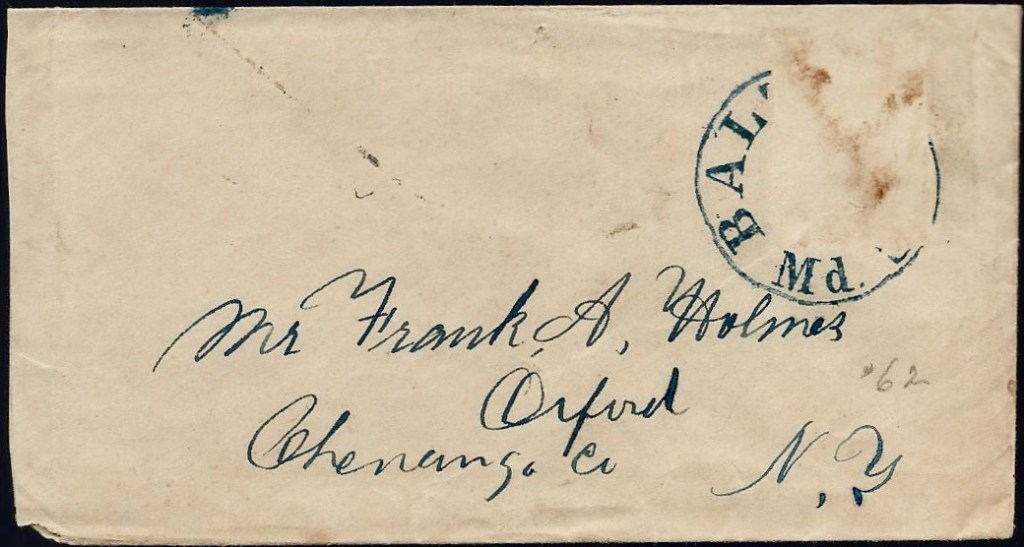
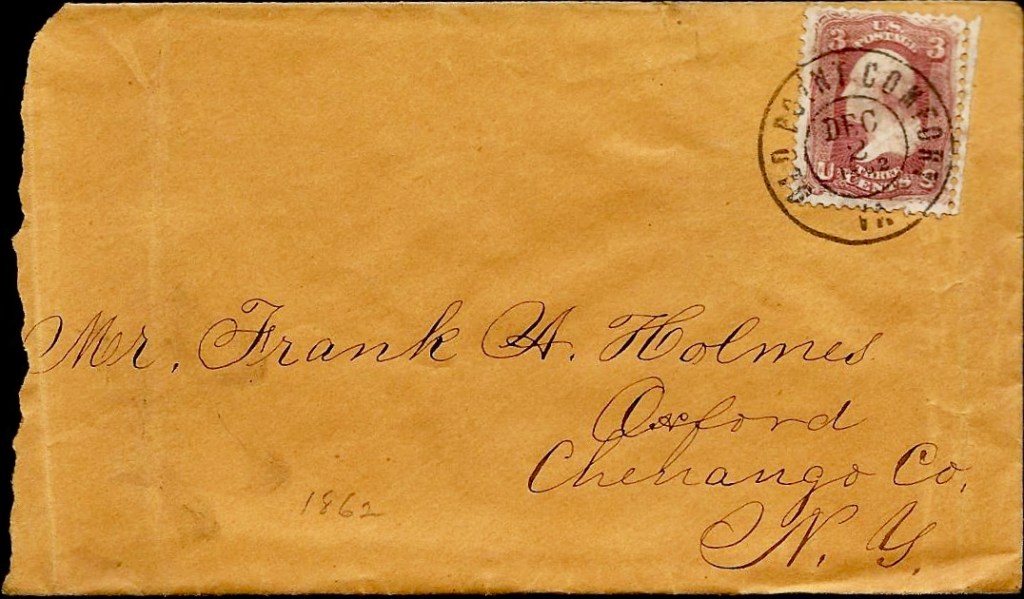
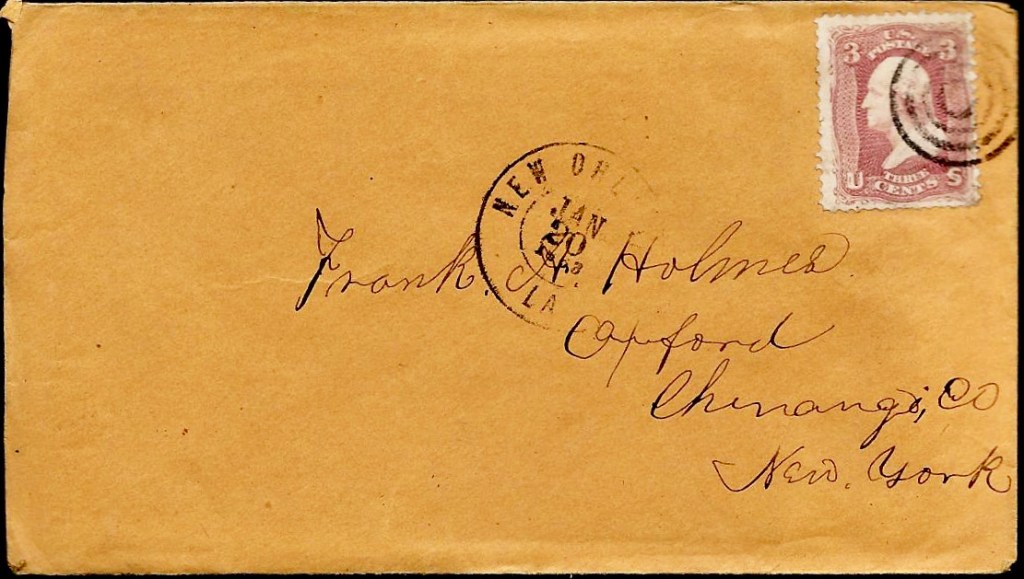
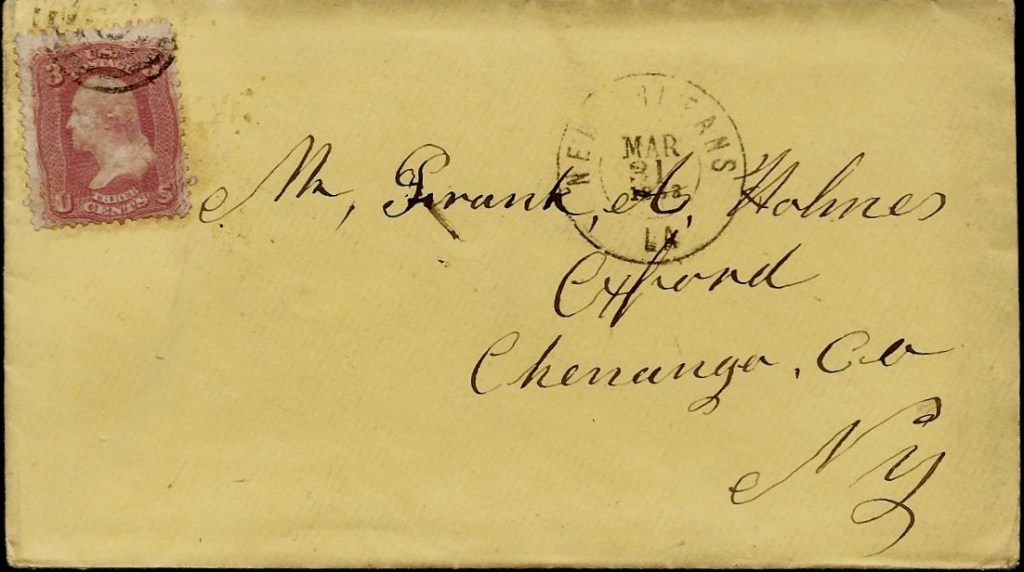
These letters were written by Pvt. Asa Holmes (1816-1863) who was was 46 years-old when he enlisted in Co. A, 114th New York Infantry on 1 August 1862 at Oxford, Chenango County, New York, to serve three years. He died of chronic diarrhea on 1 (or 2) November 1863 at Barracks Hospital at New Orleans.
Asa was the son of John Holmes (1760-1849) and Esther Wilcox Ensworth (1776-1863) of Oxford, Chenango County, New York. Asa wrote the letter home to Oxford where his wife, Eliza Ann (Odell) Holmes (1817-18xx) and their two children—Mary A. (b. 1842) and Frank (b. 1850)—were residing. By 1863, his son Frank was 13 years old and his daughter Mary was 18, married, and the mother of a child.
Seven companies of this regiment were recruited in Chenango County, and three in Madison. They rendezvoused at Norwich, where the regiment was organized and mustered into the U.S. service for three years on September 3, 1862. Three days later, it started for the front, moving to Binghamton by canal boats and proceeding from there to Baltimore. In November, it sailed for New Orleans as part of Banks’ expedition, and upon its arrival there, it was assigned to Weitzel’s (2nd) brigade, Augur’s (1st) division, 19th corps. It was stationed for a time at Brashear City and neighboring points, and it was first engaged at Fort Bisland, where it had 11 men wounded, 3 mortally. It did not participate in the Bayou Teche campaign, but joined its corps before Port Hudson on May 30, 1863, where it was actively engaged for 40 days in the siege and suffered severely in the grand assault of June 14. The loss of the regiment during the siege was 73 killed, wounded, and missing.
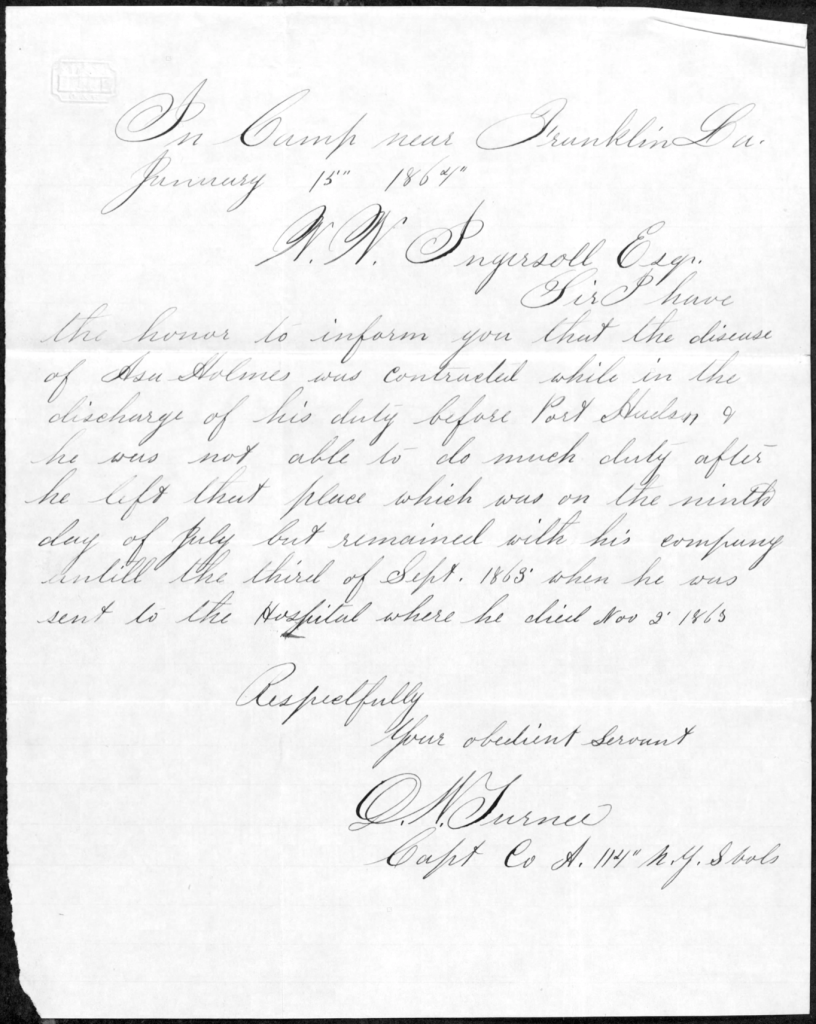
A letter from Asa’s captain states that Asa contracted the illness that killed him about the 9th of July but he remained with his regiment until 3 September 1863 when he was sent to the hospital. Asa was among the 192 men in the regiment who died of disease and other causes during the war.
[Note: see also Holmes, Asa. Civil War letters, 1863 June 16-17. 2 items. Located at Pearce Civil War Collection, Navarro College, Corsicana, Texas.]
Letter 1
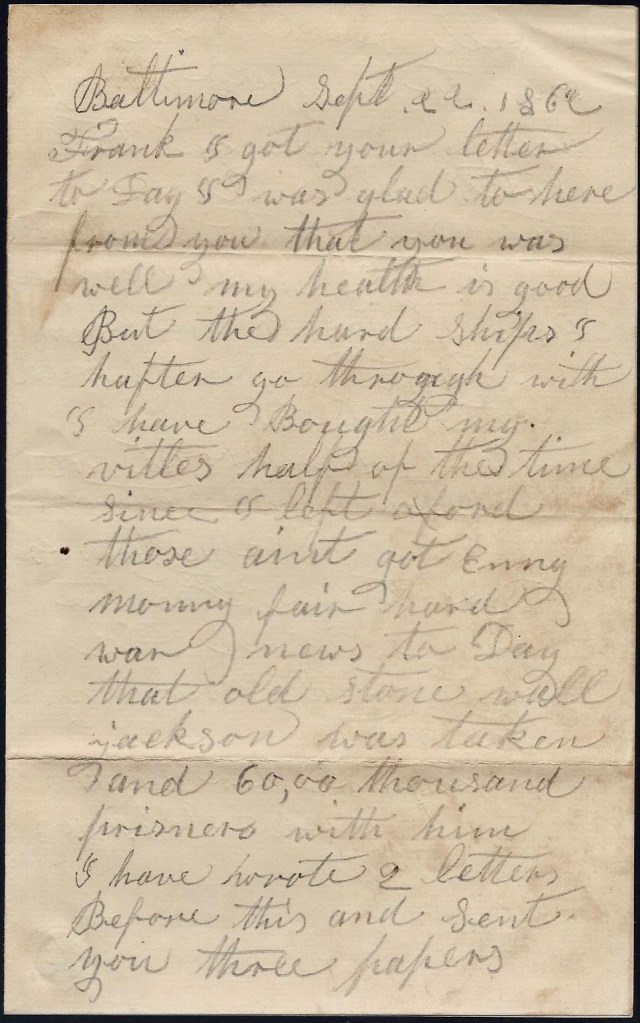
Baltimore[Maryland] September 22, 1862
Frank, I got your letter today. I was glad to hear from you that you was well. My health is good but the hardships I have to go through with. I have bought my vittles half of the time since I left Oxford. Those [that] ain’t got any money fair hard.
The war news today [is] that Old Stonewall Jackson was taken and 6 thousand prisoners with him. I have wrote two letters before this and sent you three papers. I will send you one tomorrow morning and you will get the latest news of war.
Thy bring into Baltimore from 100 to 150 every day or to prison. I want you should write when you leave all about it.
From your father, — Asa Holmes
Direct your letter as the same you did, Get what money you want. Enquire for paper. — Asa Holmes
Letter 2
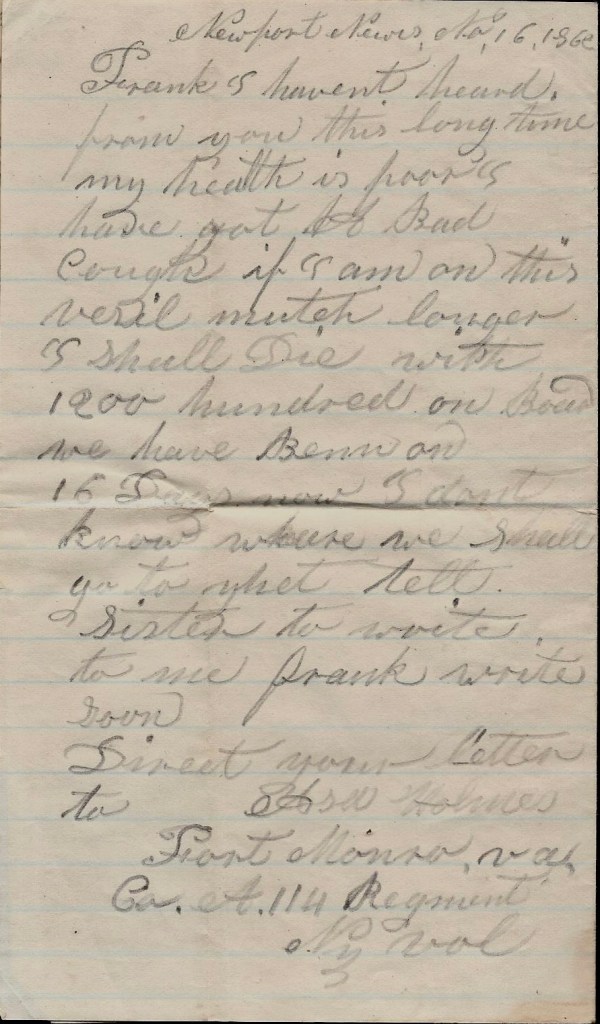
Newport News, Va. November 16, 1862
Frank, I haven’t heard from you this long time. My health is poor. Have got a bad cough. If I am on this vessel much longer, I shall die with 1200 on board. We have been on 16 days now. I don’t know where we shall go to yet. Tell sister to write to me Frank. Write soon.
Direct your letter to Asa Holmes, Fort Monroe, Va., Co. A, 114th Regiment New York Volunteers.
December 2nd, 1862
Frank, I wrote to you last night. Now I write to inform you that we was called up at midnight to go on board the vessel. The whole brigade numbers about 7,000 men, to be ready any minute to go. Don’t know where. Don’t make much difference now. I lay in my bunk to write this.
I sent fifty cents in the other letter to you. Also fifty in this. Ask Mr. Lewis if he has received my check and the money I sent.
My health is better but not good yet. I shall come around yet safe, I suppose. There is some hope I shan’t. Do the best you can till I come. Then I can tell you more than I can write about the war. — Asa Holmes
Elisa, take good care of Frank and not have him a nigger to no one. There is money enough to do it. — Asa Holmes
Letter 3
Quarantine Station Sixty Miles Below New Orleans On Mississippi [River] December 18, 1862
We have to lay here ten days. No vessel can pass here that have any sick on board. Every vessel has to be examined by the government doctor which comes on board, We had 200 sick—some with the ship fever, measles and typhoid fever and small pox and body lice by the bushel, and the itch and ship rash too.
Frank, I don’t know whether I put that money in the other letter or not, I was in such a hurry. I put some in this.
There is not but four houses here and them belong to the government for sick hospital. Frank, [I wish] you was here to see the orchards of oranges and lemons. Some as as big as pumpkins. We are on shore today. Snakes and alligators too numerous to mention. We can’t hear a word about the war here.
Keep up good courage. I shall be home by and bye. I am exposed to all kind of sickness. Hope you are well and all the rest. When I come to a stopping place, then I’ll tell you where to direct your letters. Then you must write a long letter to me.
I have seen the elephant all lover. I have took the first lesson with the rest of them.
To Frank A. Holmes, [from] Asa Holmes
Letter 4
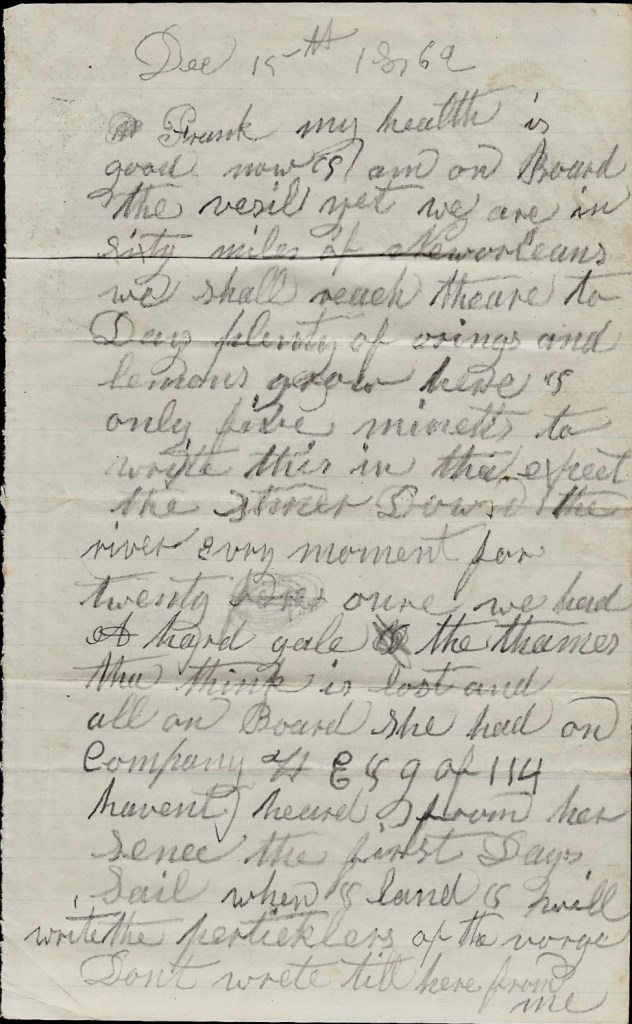
December 15th 1862
Frank, my health is good now. I am on board the vessel yet. We are [with]in sixty miles of New Orleans. We shall reach there today. Plenty of oranges and lemons grow here. I only have five minutes to write this as we expect the steamer down the river every moment for twenty one.
We had a hard gale. The steamer they think is lost and all on board. She had on Company H, E, F, and G of 114th. Haven’t hear from her since the first days sail. When I land, I will write the particulars of the voyage. Don’t write till you hear from me.
Keep up good courage. Our fare is hard but I think I shall live through it. Don’t you suffer any for money. I send fifty cents in this to you. — Asa Holmes
Letter 5
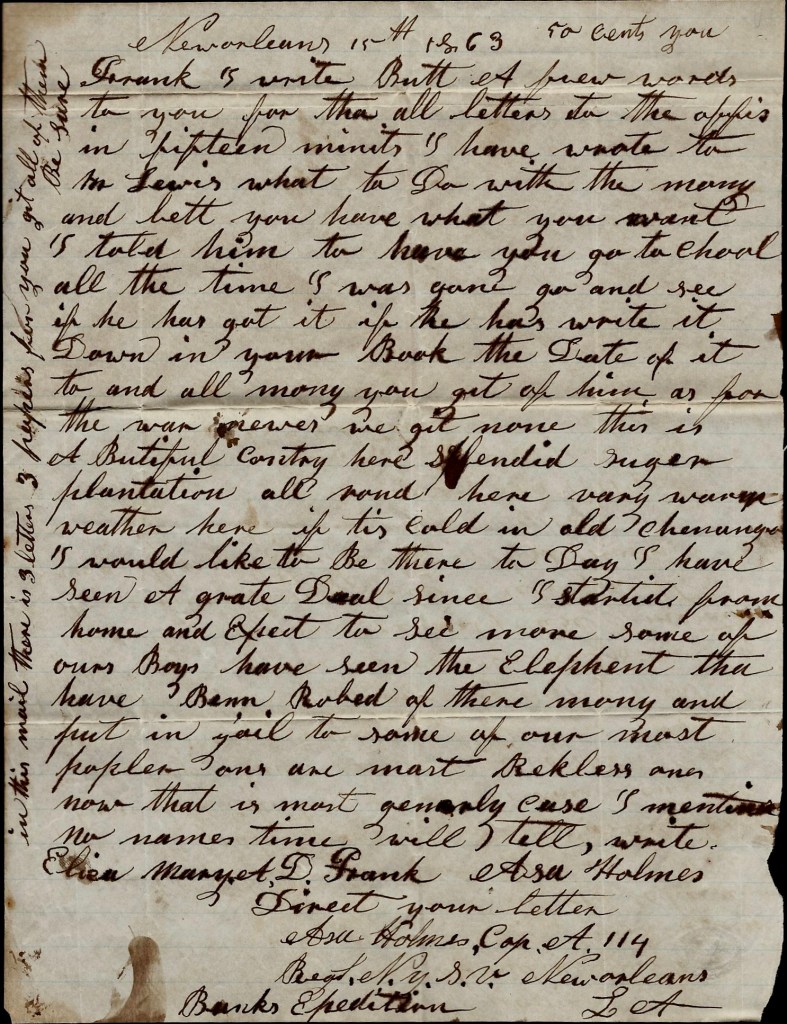
New Orleans [Louisiana] [January] 15th, 1863
Frank, I write but a few words to you for all letters [must be] to the office in fifteen minutes. i have wrote to Mr. Lewis what to do wit hthe money and let you have what you want. I told him to have you go to school all the time was gone. Go and see if he has got it. If he has, write it down in your book, the date of it too, and all money you get of him.
As for the war news, we get none. This is a beautiful country here. Splendid sugar plantations all around here. Very warm weather here. If tis cold in Old Chenango, I would like to be there today. I have seen a great deal since I started from home and expect to see more. Some of our boys have seen the elephant. They have been robbed of their money and put in jail too. Some of our most popular ones are most reckless ones. Now that is most generally the case. I mention no names. Time will tell.
Write Eliza, Mary A., D. Frank. Direct your letter to Asa Holmes, Co. A, 114 the Regt. N. Y. S. V., New Orleans, La. Banks Expedition
Letter 6
Brashear City [present day Morgan City, Louisiana] February 10, 1863
Frank, I feel very uneasy to think I don’t get a letter from you. This is the last one I shall write to you or sister till I get one. This is the sixteenth I have wrote to you and got no answer and I think it’s time to stop now till one is [received]. Sister I think don’t think enough of me to write. I don’t feel good tonight. Amen
— Asa Holmes
Letter 7
Bayou Boeuf Camp Mansfield March 9, 1863
Rather bad news, Frank, I write. Yesterday one of the gunboats left Brashier City to go up the river with one company [Co. F] of the 160th Regiment on board and one of the General’s staff on board to see what they could discover. They got about two miles from the city where the rebels had fixed a battery with sixteen guns around a bend in the river. They got close on to it before they see it and they destroyed our boat and killed all on board but two. 1 The pilot jumped overboard and ran ashore. The General’s staff got shot through the face. The gunboat Calhoun started as soon as she heard the firing with Co. C of the 114th Regiment but she run on[to] a sand bar before she got there to help them. If they could of got there, both boats would [have] drove them back.
I don’t know what will be the next move. There is a great stir with the big officers today. It may be that we shall have to follow them up and whip them out. There has one gunboat gone down to the gulf to pilot two large gunboats up here. They say, “I hope so.” I think we shall have a big battle before long the way things shape—it is brewing pretty fast.
My health is good now. My cough has most left me—only when I have been out all night on guard or picket in the rain. It is very sickly in the regiment now. It is reported that there ain’t about two hundred and fifty for hard duty now. That is pretty small number from a large regiment.
Write how Hiram Lewis gets along. I wonder if Stephen Lewis feels as savage as ever about the war. I can tell him something about it he never thought of yet, nor I before I left home. Write how Elizabeth gets along since W. was married. I should think Mary A. Deila would write to me and let me know how she gets along this spring. I write two letters every week to you. You must go to school every day this summer without fail. Don’t think of working for no one this summer. Learning is better than money to you and get it while you can and improve it expressly in writing. You can write better, I think, than the last you wrote to me. I could not hardly read it. But I am glad to have a letter from you if it is only a straight mark on paper. It looks though you had some respects for me. I hope Mary A. Delia will send Elroy’s likeness to me. I know it is hard for her to write. It used to be for me but I can write a sheet of paper over in ten minutes now. Don’t think nothing of it. I know I don’t spell every word right, but I think you can make it out.
No more at present. — Asa Holmes
I have no letter tonight from you nor nobody else but most of the boys have got one and reading it. Never mind. I can be contented till I get one from Oxford. Frank, don’t you be kicked around by no one. — Asa Holmes
1 Asa is referring to the engagement at Pattersonville on 8 March 1863, where Co. F, Capt. Josiah P. Jewett, was on board the gunboat Diana during the action with the Confederate batteries. Co. F lost 6 killed and 16 wounded, Capt. Jewett being mortally wounded.
Letter 8
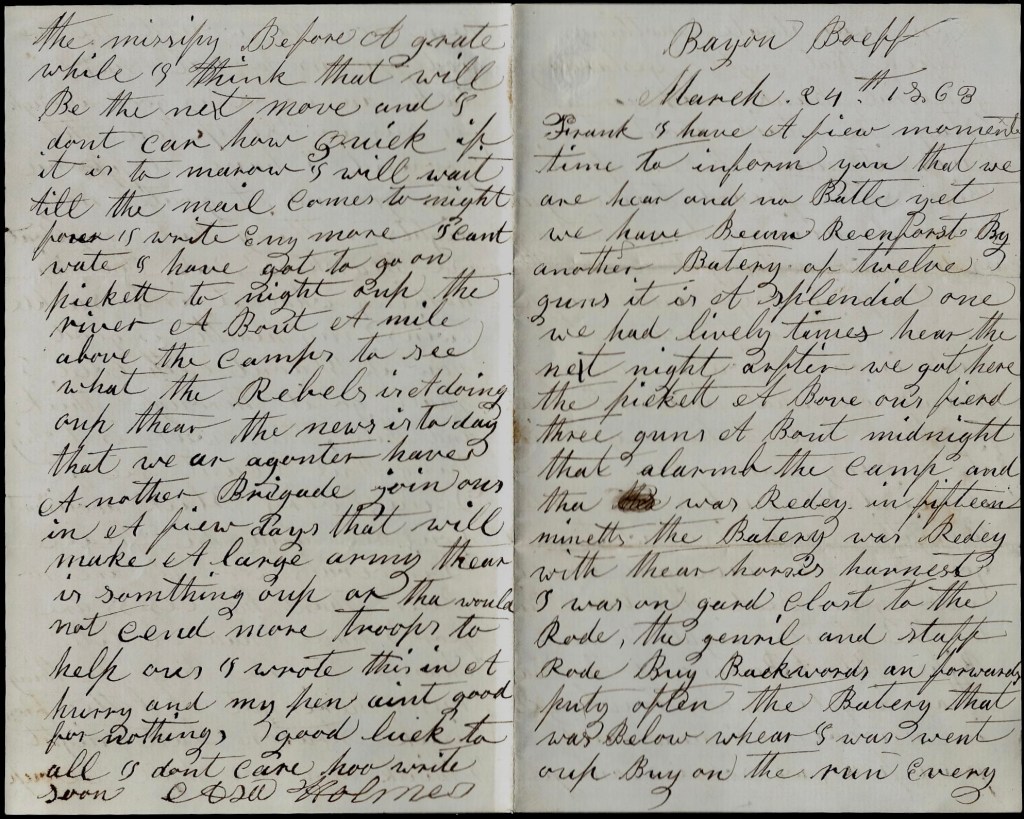
Bayou Boeuf March 24th 1863
Frank, I have a few moments time to inform you that we are here and no battle yet. We have been reinforced by another battery of twelve guns. It is a splendid one. We had lively times here the next night after we got here. The picket above ours fired three guns about midnight that alarmed the camp and they was ready in fifteen minutes. The battery was ready with their horses harnessed. I was on guard closest to the road. The general and his staff rode by backwards and forwards pretty often. The battery that was below where I was went up by [me] on the run. Every horse was straight. Nothing happened that night.
Yesterday General Banks was here and staff. He stayed about three hours. It must be on special business. They fired twelve guns when he arrived here. The soldiers don’t know nothing till they tell us to pick up and march. We are in camp where the mud is over shoe. We are on a sugar plantation. What makes the mud? We have had a heavy rain. It is very warm here now. [There are] all kinds of snakes here and descriptions and sizes. What would you think to have one crawl into your bed? They crawl into the tents nights.
I saw ripe blackberries and they say there is plenty of strawberries in New Orleans now and green peas. We soldiers can’t get them for they would be too good for us to eat. Hard tack and coffee is good enough for us, and to sleep on the ground. I have slept on the ground a great many nights [with] nothing but my coat and blankets. But that is nothing [compared to] what it is to suckle twins.
My health is good now. If I don’t catch cold, I shall go it through thick and thin. This war is a big thing but I can’t see it. Damn every Black abolitionist you see and the Peace Democrats [too] for they are no better than the secesh are for I have had a little chance to see how the thing runs here.
Got a letter from Isaac Stratton last night. I think now we shall be up the Mississippi before a great while. I think that will be the next move and I don’t care how quick if it is tomorrow. I will wait till the mail comes tonight before I write anymore. I can’t wait. I have got to go on picket tonight up the river about a mile above the camp to see what the rebels are doing up there.
The news today is that we are a going to have another Brigade join ours in a few days. That will make a large army. There is something up or they would not send more troops to help us. I wrote this in a hurry and my pen ain’t good for nothing. Good luck to all. I don’t care how. Write soon. — Asa Holmes
Letter 9
Port Hudson July 1, 1863
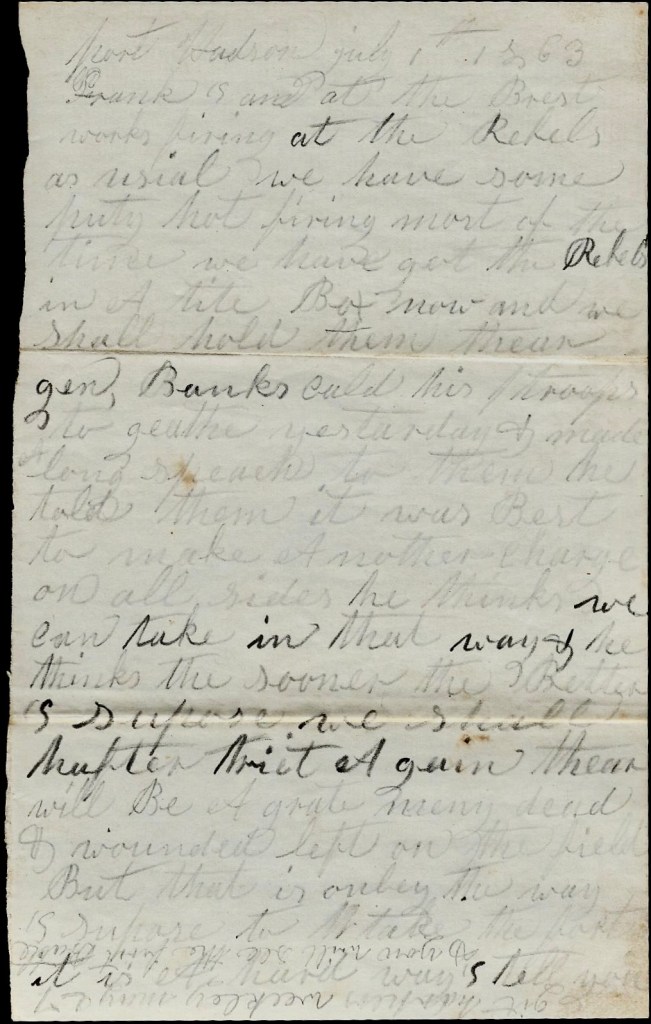
Frank, I am at the breastworks firing at the rebels as usual. We have some pretty hot firing most of the time. We have got the rebels in a tight box now and we shall hold them there.
Gen. Banks called his troops together yesterday and made a long speech to them. He told them it was best to make another charge on all sides. He thinks we can take [Port Hudson] in that way & he thinks the sooner the better. I suppose we shall have to try it again [but] there will be a great many dead and wounded left on the field. But that the only way, I suppose, to take the fortress. It is a hard way, I tell you.
I told you in my other letters I should not write who was killed and wounded till we got through fighting. Then I will write the particulars—if I am alive. I have got to stand my chance with the rest of the soldiers.
July 2nd. Good morning to all of you. I have been to the breastworks facing the rebel balls for twenty-four hours and I am alive yet. I thank God. I have just got your letter dated June the 12th. I was sorry to hear you was so unwell but you and Frank must not feel bad about me. I shall come out alright. If I don’t, I am nothing but a poor cuss. We are a going to hold the 4th of July in the fort if we get into it. It will take a great many lives to get there. I shan’t worry about it. Farewell to all. — Asa Holmes
Get Harper’s Weekly May 27th and you will see the first battle.
Letter 10
Donaldsonville, La. July 21st 1863
Well Frank, I am here yet. I have just come in off from picket. I have been out for twenty-four hours. We suffer from the heat amazingly. You think it is hot in old Chenango of the Fourth day of July? What do you think of it here now?
It is very peaceable here now for a few days. The soldiers are a resting & appear to enjoy themselves very much. I think this state will come back into the Union before a great while. I think there won’t be much more hard fighting in this state. The Rebels is getting pretty tired of it. There will be some guerrilla fights, of course, but no more big battles, I think. We may have a pretty hard battle with the Rebel army that we have got surrounded here but I think they will surrender before fighting very hard. Our army has taken a great many prisoners already from it & they say the Rebel soldiers are deserting very fast. There is from ten to twenty comes into our lines every day. They say they have got tired of this war & won’t fight anymore.
I was pleased to hear from Mr. Williams that he was so strong a Union man. You take such a man & if he is drafted, he won’t whine, but he will go like a brave soldier and fight to protect the Union forever.
Well I feel very well now except my eyes. They are very weak since I got over the fever & jaundice. It colored my shirts very yellow. There is such a blur over my eyes that I can’t hardly see to write or read. I hope they will get over it as I grow stronger. They are very much as they was when I had the measles. That bothered me very much. I sweat so much it runs into my eyes and makes them smart so.
Well, Mary A. Dealia, how do you get along — and Marting too? & the boy — is he well? If he is, I would like to see him. I will pay for his likeness if you will take the pains to send it to me. This is the last time I shall write about it. You can send it or not. I will pay all expenses. I shall have money by and by & if I die, you will have part of it — or your boy — so it makes no difference. Eliza, write to me whether you got my two letters I wrote before this. I don’t want none of you worrying about me. I am here & you are there — all of you — & I am but one alone by myself. Is Ma fetch round alright yet? I don’t let nothing trouble me.
I sit here a writing while there is a regiment getting onto a transport for some place, I don’t know where. They are the Twelfth [12th] Connecticut that belong to our brigade. They have been with us ever since we have been in Louisiana. The 8th Vermont has got marching orders today for someplace too. They belong to Weitzel’s [2nd] Brigade too. It may be our [turn] next. We can’t tell.
Well, Frank, I have got a good silver-plated knife I am going to fetch you when I come home. It is a dirk knife with a spring in the back of it.
Farewell to all, — Asa Holmes
Write soon. Direct your letters as you always have. They will follow the regiment.
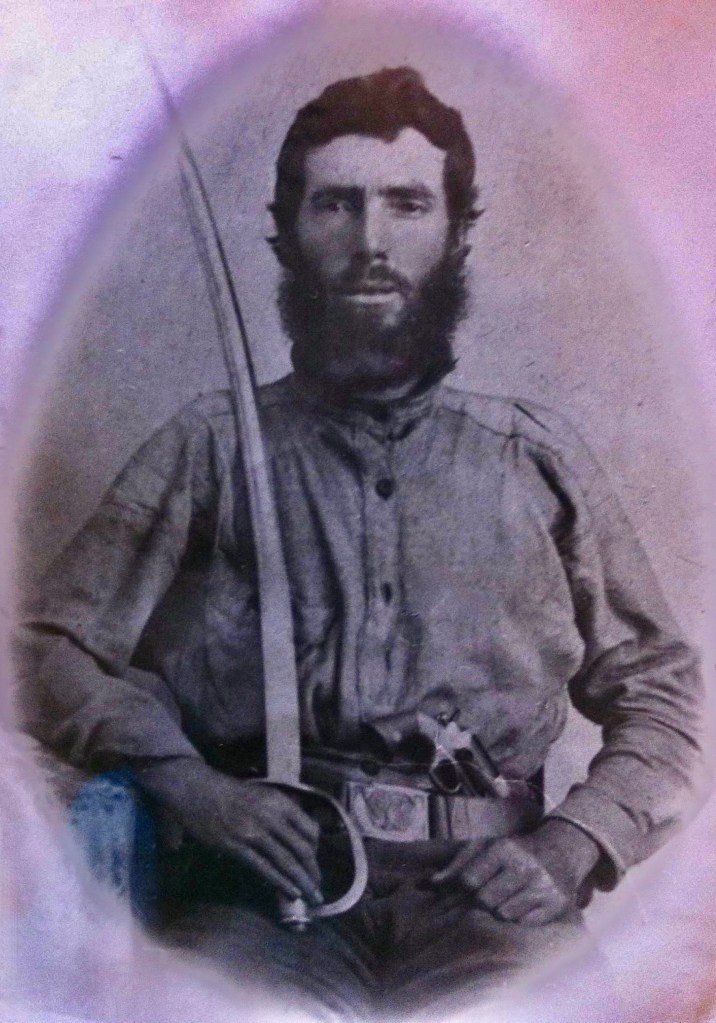
I could not find an image of Lemuel but here is one of Capt. James Q. Baird who served in Co. G, 66th OVI (Ancestry)
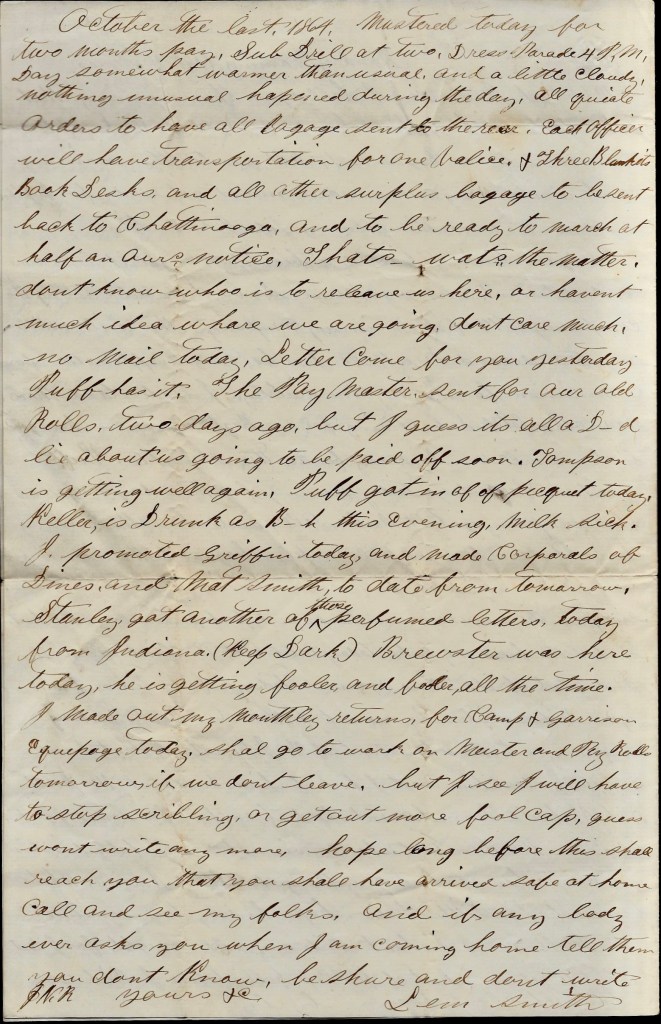
The following letter was written by Lemuel Wilmer Smith (1829-1922) who enlisted at the age of 32 as a private in the 66th Ohio Infantry on 17 October 1861. He mustered into Co. F on 26 December 1861 and worked his way up to Captain of the company a year later. He was mustered out of the regiment at Savannah, Georgia, on 29 December 1864.
An obituary for Lemuel informs us that he was born in May 1829 at Leesburg, Ohio and died in March 1922 at the age of 92 and 10 months. He moved with his parents to Union county, Ohio, in 1834 where he made his home until 1881 when he moved to Holliday, Illinois. When he was 20 years old he joined in the gold rush to California. When he returned, he walked across the Isthmus of Panama and barely escaped capture by Indians. He married Minerva Twiford in 1852. After her death in 1867, he remarried to Sarah Crawford. In the 1870 US Census, Lemuel was enumerated in York, Ohio, where he made a living as a dry goods merchant and served as the local postmaster. I should note that Lemuel’s spelling was very poor suggesting a limited education.
Lemuel wrote the letter to John N. Rathburn who served in Co. F of the regiment until promoted to Captain of Co. C on 3 March 1864. He was wounded on 9 June 1864 at Port Republic. [Many of the letters exchanged between John and his wife are housed in the US Army Heritage and Education Center at Carlisle Barracks]
Lemuel’s letter was written from Atlanta which the regiment occupied just prior to Sherman’s March to the Sea.
Transcription
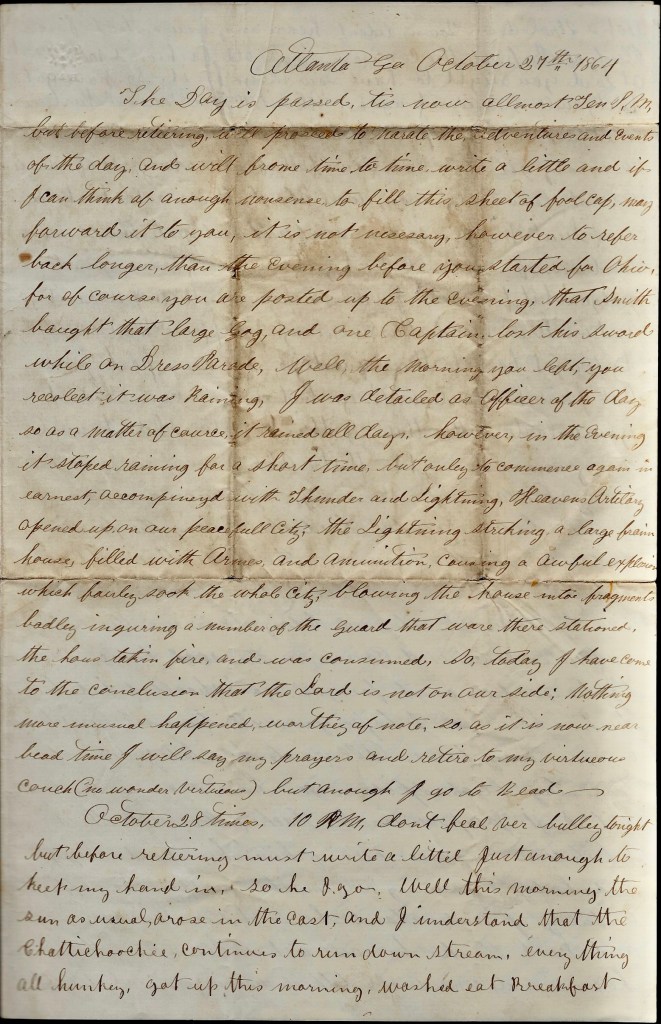
Atlanta, Georgia October 27th 1864
The day is passed, tis now almost ten p.m. but before retiring will proceed to narrate the adventures and events of the day and will from time to time write a little and if I can think of enough nonsense to fill this sheet of fools cap, may forward it to you. It is not necessary, however, to refer back longer than the evening before you started for Ohio, for of course you are posted up to the evening that Smith bought that large hog and one Captain lost his sword while on Dress Parade.
Well, the morning you left, you recollect it was raining. I was detailed as officer of the day so as a matter of course, it rained all day. However, in the evening it stopped raining for a short time but only to commence again in earnest, accompanied with thunder and lightning. Heaven’s artillery opened up on our peaceful city, the lightning striking a large frame house filled with arms and ammunition, causing an awful explosion which fairly shook the whole city, blowing the house into fragments, badly injuring a number of the guard that were there stationed. The house was taken fire and was consumed so today I have come to the conclusion that the Lord is not on our side. Nothing more unusual happened worthy of note so as it is now near bed time, I will say my prayers and retire to my virtuous couch (no wonder virtuous) but enough. I go to bed.
October 28 10 p.m. Don’t feel very bully tonight but before retiring must write a little just enough to keep my hand in. So here I go. Well, this morning the sun as usual arose in the east and I understand that the Chattahoochie continues to run down stream. Everything all hunkey. Got up this morning, washed, eat breakfast. took a stroll down town, didn’t hear any news, but found plenty of pork at the commissary—real old fashioned mess pork. Oh Lord, you ought to have saw me go for it. So have got pretty well greased up again. About 10 a.m., Lawrence Porter called in, do I jumps on to Doc’s pony, goes out to the commissary, gets two canteens full of whiskey, so of course didn’t leave very soon. Well, about three o’clock, here come Lieut. Wells, so we sent out and got three more canteens of infernal rotgut and so I leave you to judge what followed. I will say, however, that I didn’t go out on Dress Parade this evening. I suppose Wells and Porter got back to their quarters. For my part, I know that I am here and writing, but if you can read it, you will do better than I think. So shan’t write anymore tonight. That’s all.
October 29. Evening. From some cause or other, had an awful headache during the forenoon but alright this evening. The first thru train come down this evening. Plenty to eat now. Some of our train guard returned today. Tells me the Rebs got after you and [W. A.] Cavis on the road home. Well that’s good enough for you. You should of had better luck, however. I hope you will have no more trouble on your way home. All quiet here today. One of those big black spiders you have seen in this country but Sergt. Thompson on the back of the neck this morning which come very near killing him. His head, legs and body becoming very much swollen. He suffers awfully. I understand he is better this evening and Doc thinks he will get well. Everything here as usual. Considerable talk of moving. Good night.
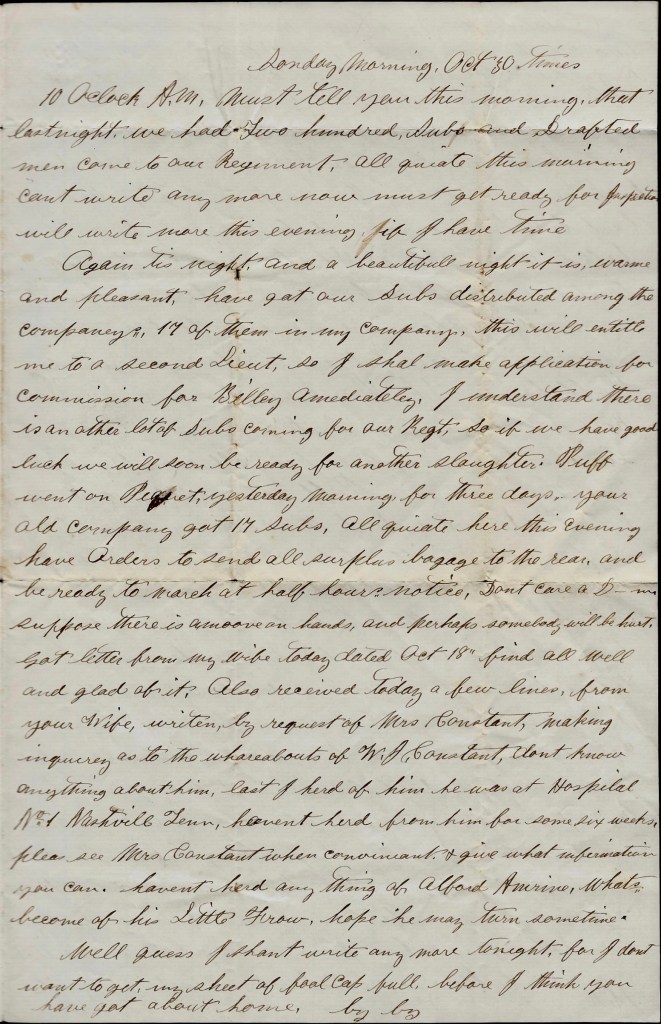
Sunday morning, October 30th, 10 o’clock. Must tell you this morning that last night we had two hundred subs [substitutes] and drafted men come to our regiment. All quiet this morning. Can’t write any more now. Must get ready for inspection. Will write more this evening if I have time.
Again tis night and a beautiful night it is—warm and pleasant. Have got our subs distributed among the companies. 17 of them in my company. This will entitle me to a Second Lieutenant so I shall make application for commission for Billy immediately. I understand there is another lot of subs coming for our regiment so if we have good luck, we will soon be ready for another slaughter.
Puff went picket yesterday morning for three days. Your old company got 17 subs. All quiet here this evening. Have orders to send all surplus baggage to the rear and be ready to march at half hour’s notice. Don’t care a damn. Suppose there is a move on hand and perhaps somebody will get hurt. Got letter from my wife today dated October 18th. Find all well and glad of it. Also received today a few lines from your wife written by request of Mts. Constant, making enquiry as to the whereabouts of W[illiam] J. Constant. Don’t know anything about him. Last I heard of him, he was at hospital No. 1, Nashville, Tenn. Haven’t heard from him for some six weeks. Please see Mrs. Constant when convenient & give what information you can. Haen’t heard anything of Alfred Amrine. What’s become of his Little Frow? Hope he may turn sometime.
Well, guess I shan’t write anymore tonight for I don’t want to get my sheet of fools cap full before I think you have got about home. Bye bye.
October the last 1864. Mustered today for two months pay. Sub drill at two. Dress parade 4 p.m. Day somewhat warmer than usual and a little cloudy. Nothing unusual happened during the day. All quiet. Orders to have all baggage sent to the rear. Each officer will have transportation for one valise & three blankets. Book desks, and all other surplus baggage to be sent back to Chattanooga and to be ready to march at am hour’s notice. That’s what the matter. Don’t know who is to relieve us here or haven’t much idea where we are going. Don’t care much. No mail today.
Letter came for you yesterday. Puff has it. The paymaster sent for our old rolls two days ago but I guess it’s all a damned lie about us going to be paid off soon. Thompson is getting well again. Puff got in off of picket today. Keller is drunk as B___h this evening. Milk sick. I promoted Griffin today and made corporals of Dines and Mat[thias] Smith, to date from tomorrow. Stanley got another of those perfumed letters today from Indiana (Keep dark). Brewster was here today. He is getting fuller and broader all the time. I made out my monthly returns for camp and garrison equippage today. Shall go to work on muster and regimental rolls tomorrow is we don’t leave.
But I see I will have to stop scribbling or get more fools cap. Guess won’t write anymore. Hope long before this shall reach you that you shall have arrived safely at home. Call and see my folks and if anybody asks you when I am coming home, tell them you don’t know. Be sure and don’t write.
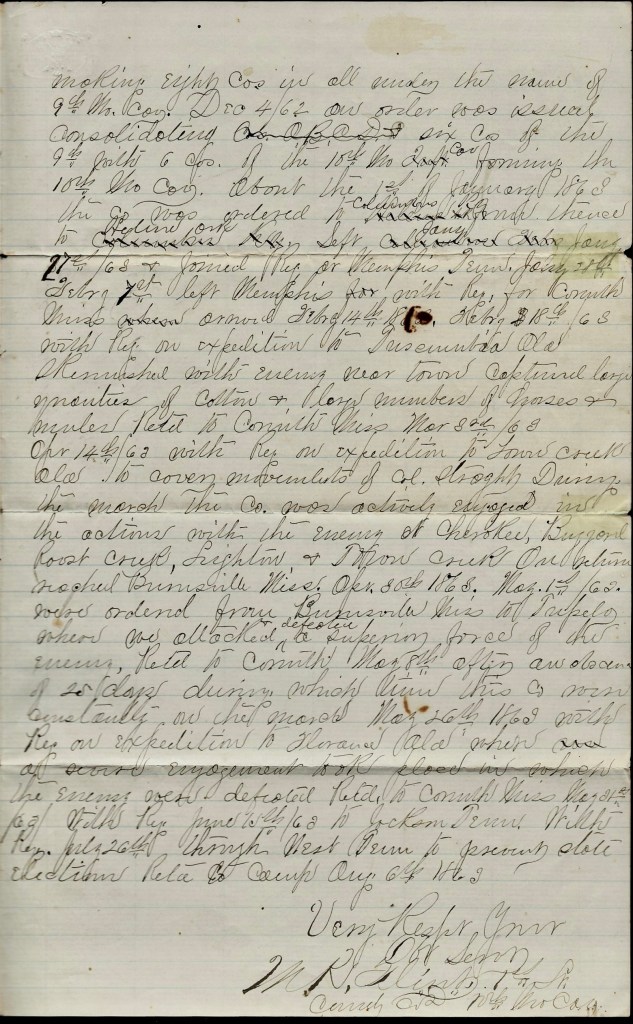
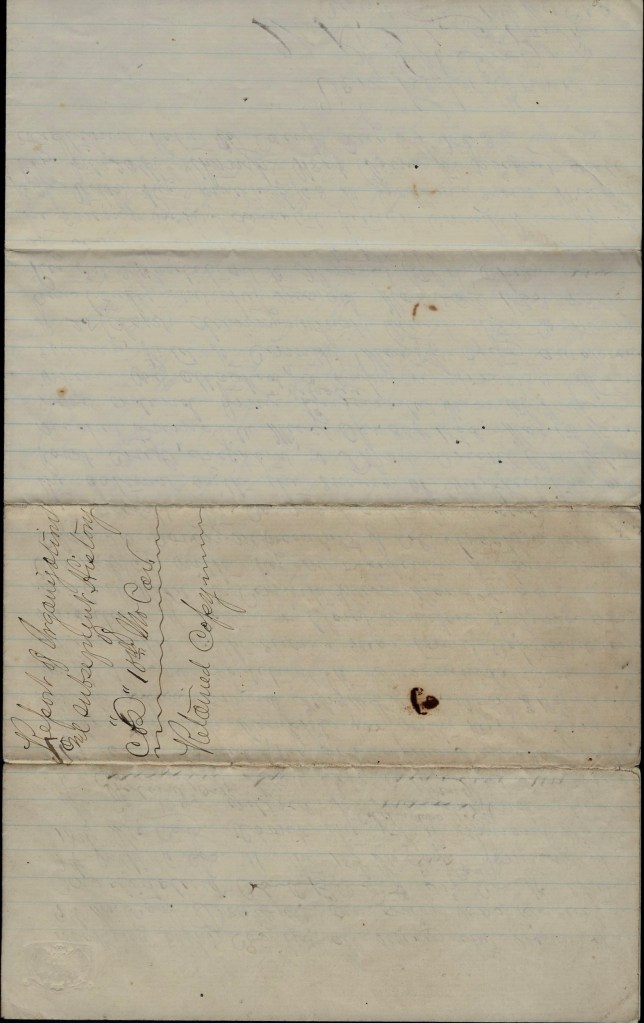
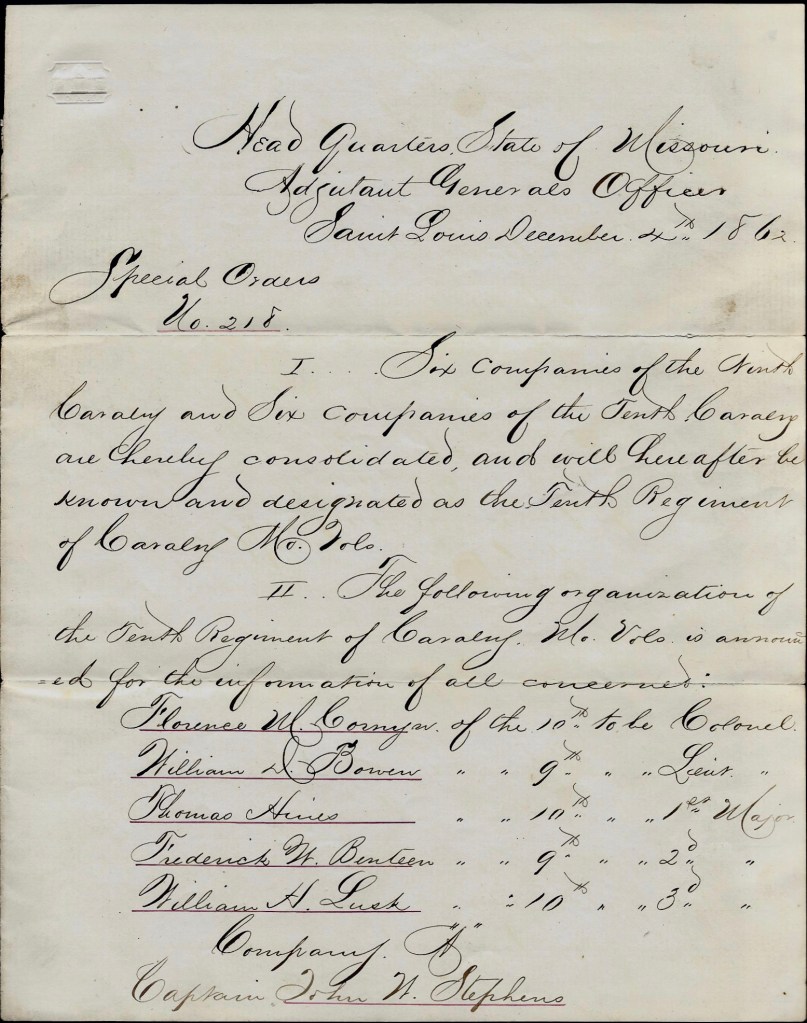
The following was penned by Mortimer Riley Flint (1836-1931) while serving as the 1st Lieutenant of Co. D, 10th Missouri (Union) Cavalry. The document is a copy of the report Flint submitted in late August 1863 in response to questions pertaining to the formation and history of the company.
Flint sent his report to Jeremiah F. Young, the adjutant of the 10th Missouri Cavalry.
Transcription
Headquarters 10th Missouri Cavalry Camp Sweeny August 31st 1863
J. F. Young 1st Lt. & Adjt. 10th Missouri Cavalry
Sir, to reply to questions contained in “circular,” I would respectfully submit the following.
First. Name or number? Co. D, 10th Mo. Cav. Second. How & where organized, recruited under what auspices or authority, &c.? Organized as Co. D, Bowen’s Batt. Cav. Mo. Vols. and attached to 13th Regt. Infantry Vols. Illinois Volunteers under authority from the Governor of the State of Missouri in Rolla, Mo. Third. Mustered into service when & for what term? October 6th 1861 for three years. Fourth. Original strength in officers and men? 59 men , 3 officers. No. of recruits added in the field? 57 men Added by transfer and from what? 2 men 1 man from Co. C, 10th Mo. Cav., 1 from Co. A, 10th Mo. Cav. No. of officers & men killed in battle? 1 man. No. died of disease and wounds? 24 men. No. discharged? 13 men No. deserted? 18 men No. transfered & to what? 2 men & 2 officers. 1 man to Co. C, 10th Mo. Cav., 1 man to non com. staff 18th Mo. Cav, 1 officer to Co. H, 3rd Mo. Cav., 1 officer to staff 11th Mo. Cav. Fifth. When reported for service? Rolla, Mo. September 25, 1861 Sixth. History?
This company was on duty at Rolla, Mo., from the date of organization until the last of October ’61 when it was ordered to form part of the escort to a train of supplies for Gen. Fremont’s Army. Joined the Battalion at Bolivar, Mo., and marched to Springfield, Mo. Returned to Rolla, Mo. the last of November, ’61 and was then ordered to Salem, Mo., with the Battalion to establish a post.
On the morning of December 3rd about daylight, was attacked by a superior force of the enemy under command of Col. Freeman. The enemy was repulsed with severe loss. This company taking a prominent part in the action. Lost nine horses killed and three men wounded.
Joseph Asher of Co. B, 10th Missouri Cavalry
January 3rd ’62, left Rolla, Mo., with Battalion as escort to Gen. Curtis. On the 12th of February skirmished with rebel picket near Springfield, Mo. On the 16th of February, took active part in the battle of Sugar Creek & on the 7th, 8th, and 9th of March in the Battle of Pea Ridge. Marched to Batesville with Battalion. Arrived May 3rd ’62. On 28th of May ’62, the company moved to Sylomore on White River & attacked the enemy in their camp capturing 44 horses, 22 prisoners, and a quantity of 2.M. property & C.C. & G. E. Left Batesville June 23rd ’62 & marched to Helena, Ark. where it arrived July 13th ’62. August 15th went with Battalion down Mississippi river. While gone had several skirmishes with the enemy at Miliken’s Bend July 22nd ’62, Greenville July 23rd ’62, Bolivar July 25th ’62. October 3rd ’62 left Helena and arrived at St. Louis, Mo. October 7th ’62.
The Battalion was ordered to be filled to a full regiment. Raised four new companies making eight companies in all under the name of 9th Missouri Cavalry. December 4, ’62 an order was issued consolidating six companies of the 9th with six companies of the 10th Missouri Cavalry forming the 10th Missouri Cavalry. About the 1st of January 1863, the company was ordered to Columbus, Kentucky. thence to Helena, Arkansas. Left January 27th ’63 & joined regiment at Memphis, Tennessee January 28th. February 1st, left Memphis with regiment for Corinth, Miss. Arrived February 14th, 1863. February 18th, ’63, with regiment on expedition to Tuscumbia, Alabama. Skirmished with enemy near town. Captured large quantities of cotton & large numbers of horses & mules. Returned to Corinth, Miss. on March 3rd, ’63.
April 14, 1863 with regiment in expedition to Town Creek, Alabama to cover movement of Col. Streight. During the march the company was actively engaged in the actions with the enemy at Cherokee, Burgoyne, Roost Creek, Leighton, and Town Creek. On return reached Burnsville, Mississippi April 30th 1863. May 1st 1863 were ordered from Burnsville, Miss. to Tupelo where we attacked & defeated a superior force of the enemy. Returned to Corinth May 8th after an absence of 25 days during which time this company were constantly on the march/ May 26th 1863 with regiment on expedition to Florence, Alabama, where a severe engagement took place in which the enemy were defeated. Returned to Corinth, Miss., May 31st ’63.
With regiment June 15th ’63 to Jackson, Tennessee. With regiment July 26th through West Tenn. to prevent state election. Returned to camp August 6th 1863
Very respectfully your obedient servant, — M. R. Flint, 1st Lt., Company D, 10th Mo. Cavalry
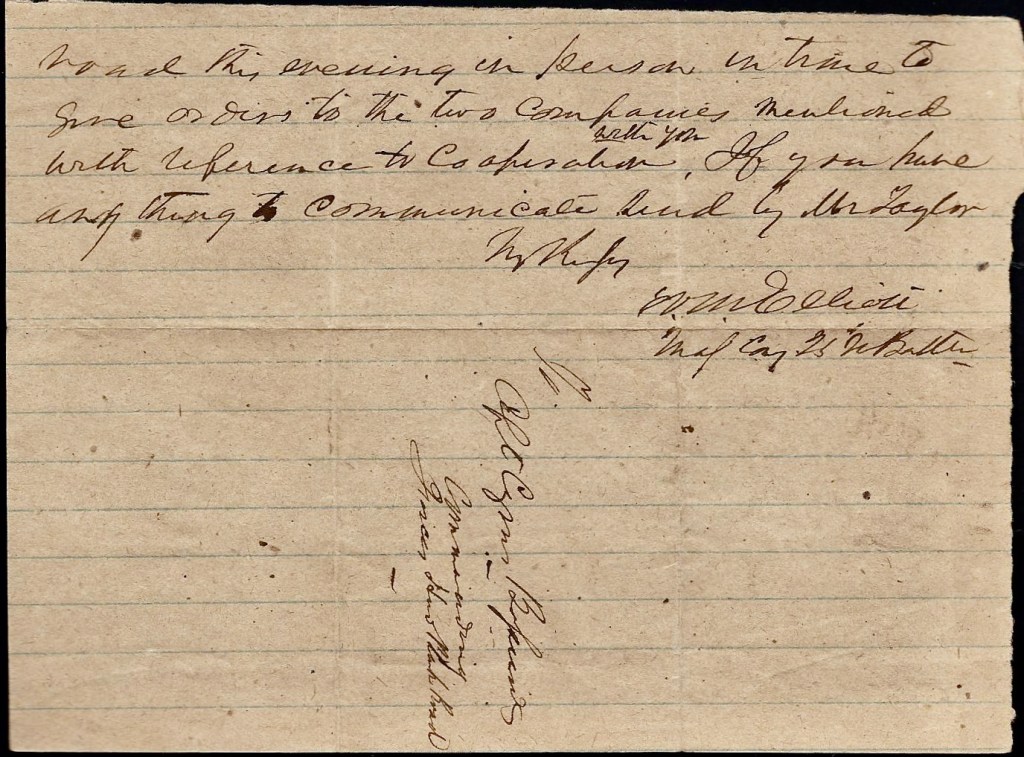
The following note was written by Maj. Wyatt Moseley Elliott (1823-1897), an 1842 graduate of the Virginia Military Institute, who commanded the 25th Virginia Battalion, otherwise known as the “Richmond City Battalion.” This battalion was organized on 15 August 1862 for service in and around Richmond by the authority of the Confederate Secretary of War, George W. Randolph. Their anticipated term of service was six months but as the war dragged on, their term was extended and they were still on duty in May 1864 when the Richmond Daily Dispatch wrote of them: “The 25th Virginia battalion, better known as the City Battalion, Col. Wyatt M. Elliott, who, since their organization, have been on duty in this city, yesterday morning moved to Chaffin’s Bluff, their place in this city being supplied by the 28th Va. battalion, Hunton’s brigade. As the City battalion passed down Main street the troops presented a really splendid appearance, and were loudly cheered by the citizens. The men are delighted with the change. The constant guard duty they had to perform here was excessively wearisome.”
Wyatt wrote the letter to Capt. Cyrus Bossieux (1835-1906) of Richmond who commanded Co. F of the battalion. He first entered the war as an enlisted man in Co. A, 1st Virginia Infantry. He also served as Capt. of Co. H in the 3rd Virginia Artillery. Reference is also made to Co.’s A & C which were commanded by Capt. John H. Greaner and Capt. W. W. Harrison, respectively.
The significance of this note is that it was written during the Battle of Chancellorsville just as the tide was turning against Hooker’s Army of the Potomac who were being pressed by McLaws and Early to push Sedgwick’s men back across the Rappahannock. Major Elliott’s placement of troops north of Richmond on the Hanover Plank Road was precautionary, not knowing the direction Sedgwick’s army intended to take after crossing the Rappahannock and overrunning the Confederate defenses at Fredericksburg the previous day.
Transcription
Richmond [Virginia] May 4th 1863 1 1/4 o’clock p.m.
Capt. C. Bossieux,
Sir, I send this note by the hand of Mr. W. O. Taylor. I have received no message from you. You will retain the position you now hold. I have ordered two companies placed at my disposal in aid of your force on the plank road to take position at the point at which you yesterday left companies A & C whose duty will be to dispute the passage of the plank road and also to be summoned to your aid in case of necessity. I will be out on the road this evening in person in time to give orders to the two companies mentioned with reference to cooperation with you. If you have anything to communicate, send by Mr. Taylor in reply.
— W. M. Elliott, Maj. Commanding 25th Va. Battalion
To Capt. Cyrus Bossieux, Commanding forces [on the] Hanover Plank Road
I could not find an image of either Ed or Dan Roberts in uniform but here is William H. Oury who served in Co. E, 20th OVI(Ancestry)
The following letter was written by 20 year-old Edward H. Roberts and his brother, 25 year-old Daniel Roberts, both privates in Co. D, 20th Ohio Volunteer Infantry (OVI). The brothers enlisted together on 3 October 1861 to serve three years. Daniel mustered out at the end of his term of service; Edward mustered out as a corporal in July 1865. They wrote the letter to their older brother, George W. Roberts (1829-1900).
The Roberts boys were the children of Morehouse Roberts (1790-1847) and Susannah Newman (1806-1898) of Delaware county, Ohio. I previously transcribed an 1863 letter by Daniel Roberts which can be found at—1863: Dan Roberts to George W. Roberts.
The 20th OVI was organized at Columbus, from Aug. 19 to Sept. 21, 1861, to serve for three years. During the winter it was employed in guarding several batteries in the rear of Covington and Newport, Ky. In February 1862, a month after this letter was written, it participated in the battle of Fort Donelson, Tenn., “with no little credit to every man. It also participated in the battle of Shiloh, with considerable loss, and it is fully entitled to a share in the glory of that victory.”
Transcription
City Barracks Cincinnati, Ohio January 21, 1862
Dear Brother,
I now will take up my pen and try to write you a few lines to let you know we are all well. I hope these lines will find you and family the same. Well George, I am almost ashamed to try to write to you. it has ben so long since I have written to you. I wrote you a letter before I went to Illinois. I did not get no answer from it. It was not the reason which I did not write. It was that I was such a poor writer and I would hear from you every little while from home so I thought if you wanted to hear from me, you would write to me. You must excuse me this time and I will do better next time.
Our regiment has come back to the City Barracks. I expect we will stay here awhile. It may be that we will stay here till spring. We came here last week. We did not do any fighting when we was in Kentucky.
I would druther be in our tents than here. We are kept in like prisoners here. Ed and Tip is well and hearty. Ed is as fat as he can hardly be. Well, George, he eats a nuff, if that will make anybody fat. We have plenty to eat such as it is.
We hear from home every week. They was well last week. George, you orty [ought to] see Giles. You would not know him. He is about as tall as Old Calwell . I don’t think I ever saw a boy grow as fast in my life as he did while I was gone to Illinois. Well, George, if he is tall, he is awful good boy. He is very hard working boy.
I was home two weeks last fall. He worked hard all the time while I was home. He is very good to Mother. I am going home as soon as I can get a furlough. Ed was home while we was in Kentucky.
I got a letter from our neighborhood last week. They say that Melissa Clark is getting very fat. I can’t hardly believe it. We have not heard from Benjamin and John for about a month. They was at Cairo then. They was both doing duty then. We wrote to them about three weeks ago and have not heard from them yet.
Well, George, I guess Jim Herron 1 has got dinner ready and I must go and help him get rid of some of it. No more at present. Please write soon.
Dan wanted me to write a few lines but he has written all the news so I will not write anymore. Please write soon and direct to City Barracks, Cincinnati, Ohio, Co. D, 20th Regt. Ohio Vol. [Infantry], USA
Your brothers, — Ed and Dan
1 James J. Herron was killed in the Battle of Bolivar, Tennessee, in August 1862.