My passion is studying American history leading up to & including the Civil War. I particularly enjoy reading, transcribing & researching primary sources such as letters and diaries.
This letter was written by Asa Howard (“A. H.”) Battin (1829-1896), the son of John Battin (1800-1875) and Sarah Dew Howard (1804-1875). From an obituary we learn that:
Asa was born on a farm one mile west of Hanover, Columbiana County, Ohio, March 16, 1829. His boyhood and youth were spent upon a farm in the vicinity of his birthplace, and his early education was obtained in the district school. Later he attended a private school under the auspices of the Quaker church, of which both his parents and grandparents were members. He was studious and ambitious, and, at the age of eighteen years, he became employed as a teacher. The next five years he taught in the district schools of Columbiana County, and during that time he took up and pursued the study of law. He was admitted to the bar at New Lisbon in May, 1853, and in April, 1854, he began the practice of his chosen profession at Salem, Columbiana County. In December, 1858, he removed to Wellsville, where he opened an office and practiced law for ten years, with the exception of the time he spent in the army during the Civil War. He enlisted April 19, 1861, shortly after the rebellion began, as captain of Company K, Third Regiment, Ohio Volunteers. He returned home from the field about May 1, 1862, broken in health. His one year’s service was chiefly performed in West Virginia and Kentucky.”
Asa was married to Eliza Atkinson (1834-1871) in 1855 and their oldest daughter was Anna Gertrude (“Gertie”) Battin (1856-1920), both of whom are mentioned in the final paragraph.
Transcription
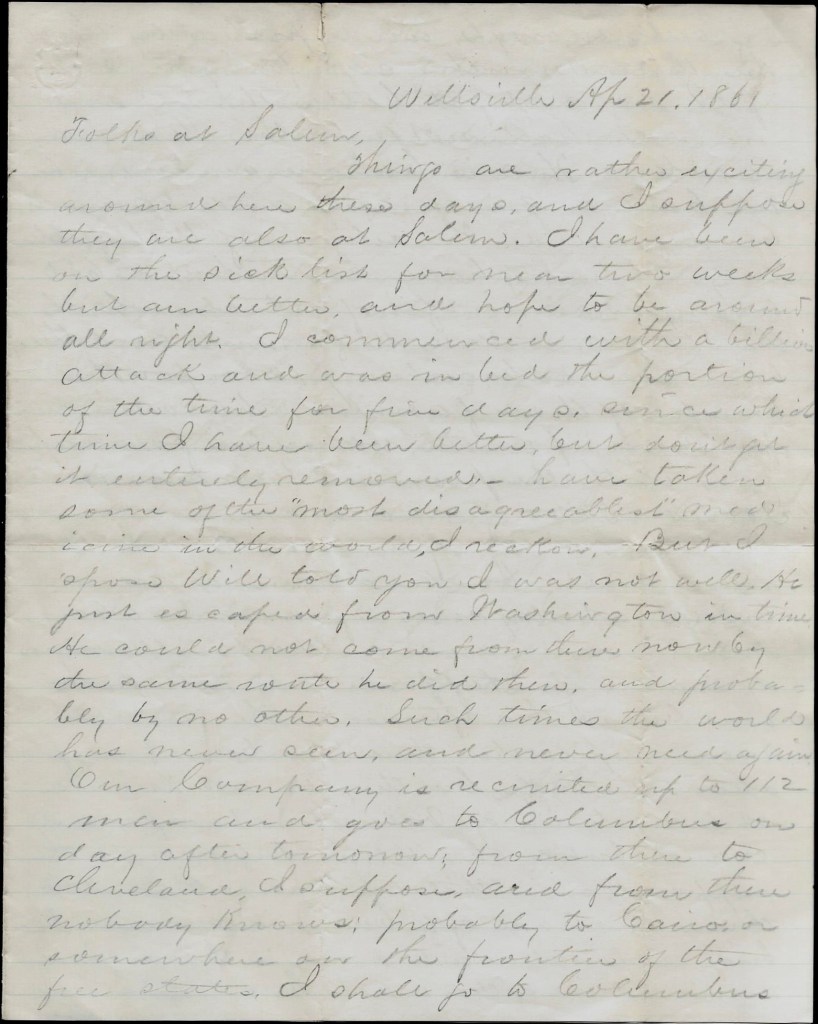
Wellsville [Ohio] April 21, 1861
Folks at Salem,
Things are rather exciting around here these days and I suppose they are also at Salem. I have been on the sick list for near two weeks but am better and hope to be around all right. I commended with a bilious attack and was in bed the portion of the time for five days since which time I have been better but don’t get it entirely removed. Have taken some of the “most disagreeable” medicine in the world, I reckon. But I suppose Will told you I was not well. He just escaped from Washington in time. He could not come from there now by the same route he did then and probably by no other. Such times the world has never seen and never need again.
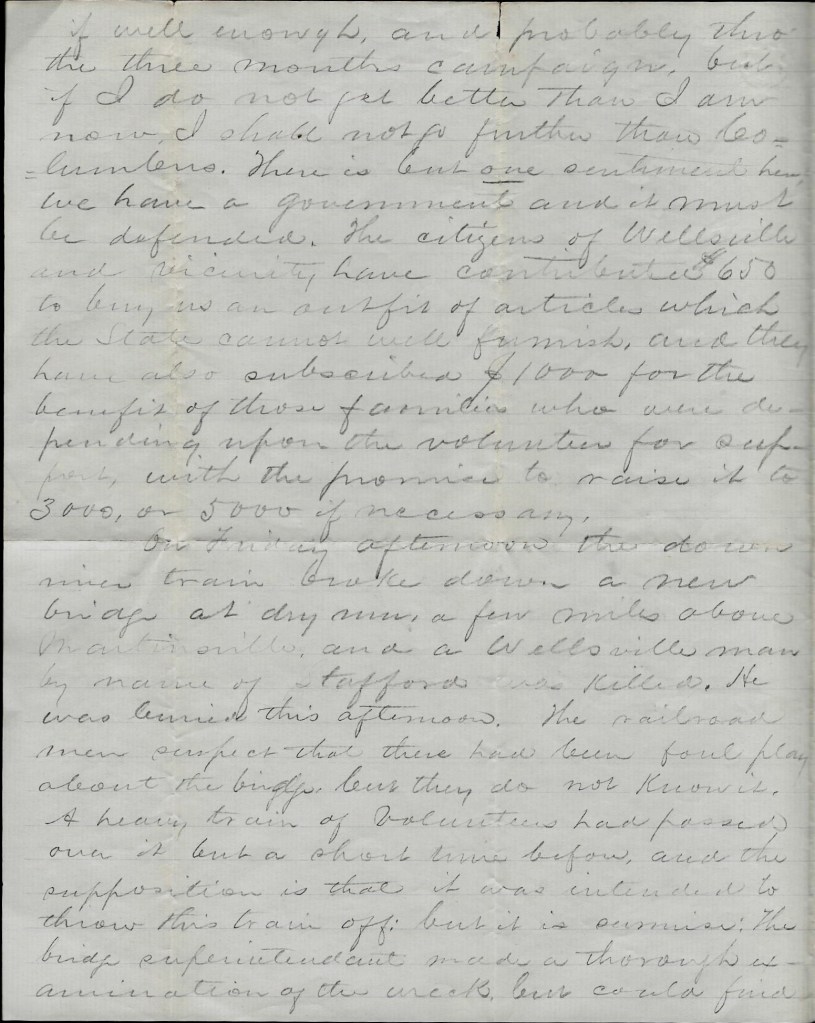
Our company is recruited up to 112 men and goes to Columbus on day after tomorrow; from there to Cleveland, I suppose, and from there nobody knows; probably to Cairo or somewhere on the frontier of the free states. I shall go to Columbus if well enough and probably through the three months’ campaign, but if I do not get better than I am now, I shall not go further than Columbus. There is but one sentiment here. We have a government and it must be defended. The citizens of Wellsville and vicinity have contributed $650 to buy us an outfit of articles which the State cannot well furnish, and they have also subscribed $1,000 for the benefit of those families who were depending upon the volunteers for support with the promise to raise it to 3,000 or 5,000 if necessary.
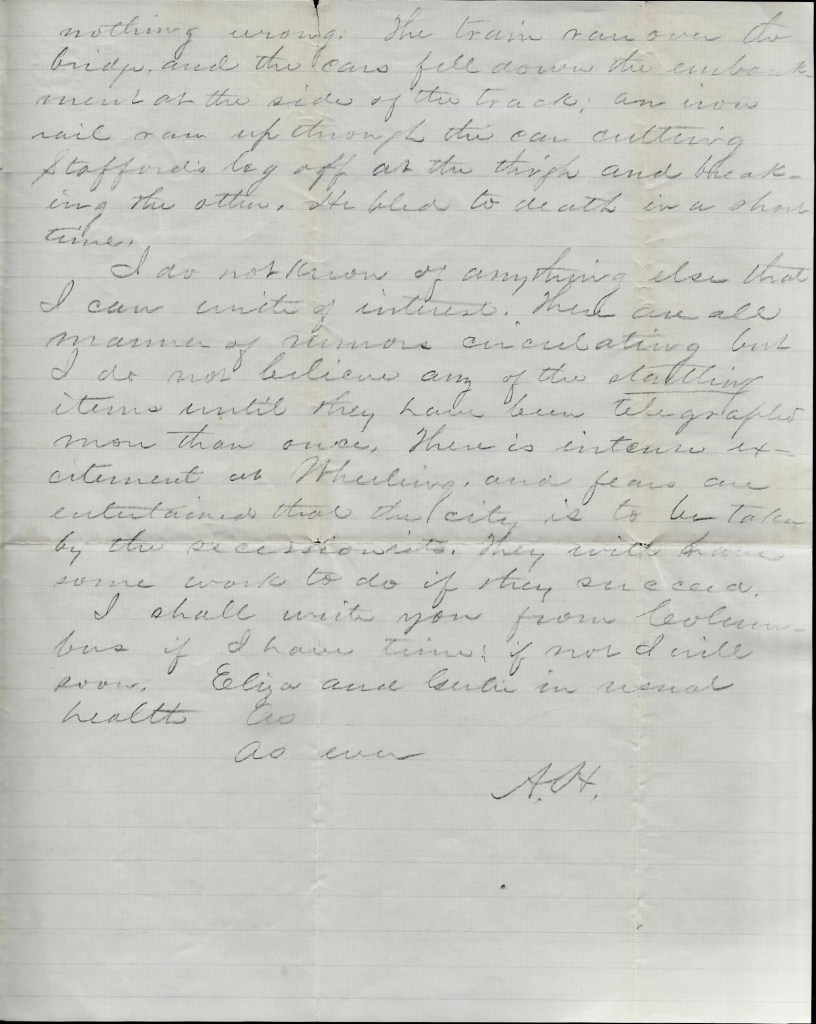
On Friday afternoon, the down river train broke down a new bridge at dry run a few miles above Martinsville and a Wellsville man by name of Stafford was killed. He was buried this afternoon. The railroad men suspect that there had been foul play about the bridge, but they do not know it. A heavy train of volunteers had passed over it but a short time before and the supposition is that it was intended to throw this train off, but it is surmise. The bridge superintendent made a thorough examination of the wreck but could find nothing wrong. The train ran over the bridge and the cars fell down the embankment at the side of the track. An iron rail ran up through the car, cutting Stafford’s leg off at the thigh and breaking the other. He bled to death in a short time.
I do not know of anything else that I can write of interest. There are all manner of rumors circulating but I do not believe any of the startling items until they have been telegraphed more than once. There is intense excitement at Wheeling and fears are entertained that the city is to be taken by the secessionists. They will have some work to do if they succeed.
I shall write you from Columbus if I have time. If not, I will soon. Eliza and Gertie in usual health. As ever, — A. H.
The following letter was written by 18 year-old William (“Will”) Dare Garrison (1826-1847), the eldest child of at least six born to Edmund Fithian Garrison (1802-1858) and Rebecca Dare (1808-1845) of Swedesboro, Gloucester county, New Jersey.
When war was declared on Mexico in May 1846, Will enlisted in Co. D (“Cambria Guards”), 2nd Pennsylvania Volunteers. Although he traveled with the volunteers in 1846 he did not officially enlist until 21 Jan. 1847. William would pass away on 11 July 1847 from illness at the Castle of Perote in Mexico City, aged twenty-one.
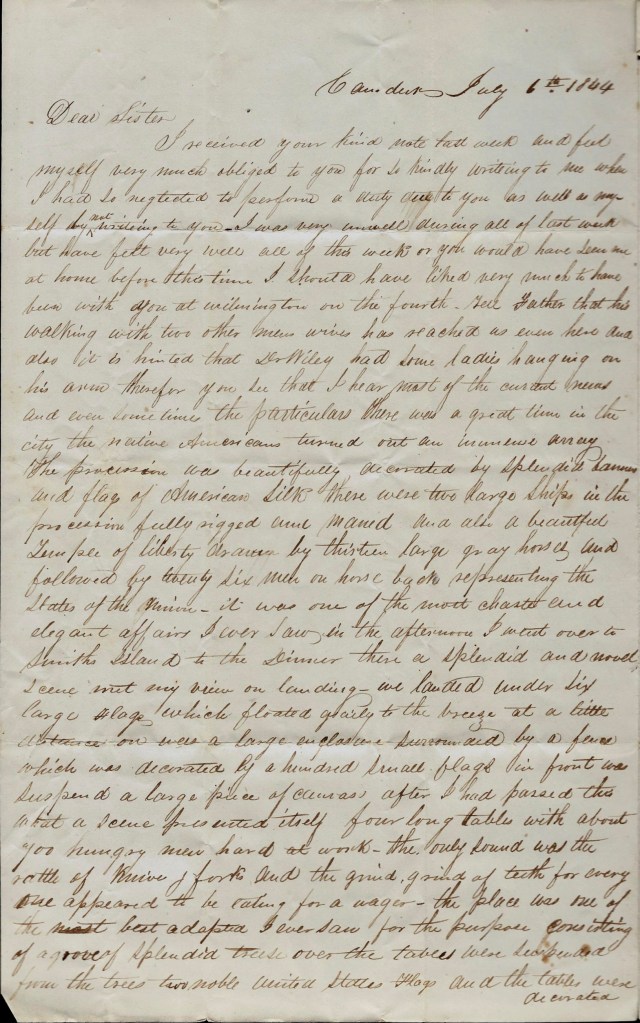
In this incredible letter, Will provides us with rich detail of the 4th of July events in Camden, New Jersey, in 1844 which happened to coincide with the Presidential campaign of Whig candidate Henry Clay and his running mate, Theodore Frelinghuysen. We learn that a political barbecue with food and speeches was held in the afternoon of the day’s events on Smith Island, in the middle of the Delaware river between Camden and Philadelphia. The letter was written on 6 July 1844, just one day before a major riot erupted across the river in Philadelphia between the Nativists and Roman Catholics.
A view of Camden from Philadelphia in 1844. Smith’s Island is in the middle of the Delaware river at left where all the trees are shown.
Will wrote the letter to his sister, Harriet Fithian Garrison (1831-1919) who married John W. Kirby (1826-1897) in 1854. That the family admired the statesman Henry Clay seems to be of little doubt as Will had a younger brother named Henry Clay Garrison (1835-1913) who humorously wrote his own epitaph: “Poor old Garry, Here he lies. Nobody laughs, And nobody cries; Where he has gone, Or how he fares, Nobody knows, Nobody cares.”
[Note: to see a map of Lobos Island drawn by Will in April 1847 during the Mexican-American War, see Manuscript Map.]
Transcription
Camden [New Jersey] July 6th 1844
Dear Sister,
I received your kind note last week and feel myself very much obliged to you for so kindly writing to me when I had neglected to perform a duty due to you as well as myself by not writing to you. I was very unwell during all of last week but have felt very well all of this week or you would have seen me at home before this time. I should have liked very much to have been with you at Wilmington on the fourth. Tell Father that his walking with two other men’s wives has reached us even here and also it is hinted that Dr. Wiley had some ladies hanging on his arm. Therefore, you see that I hear most of the current news and even sometimes the particulars.
There was a great time in the city. The native Americans turned out an immense array. The procession was beautifully decorated by splendid banners and flags of American silk. There were two large ships in the procession fully rigged and manned and also a beautiful Temple of Liberty drawn by thirteen large gray horses and followed by twenty-six men on horseback representing the States of the Union. It was one of the most chaste and elegant affairs I ever saw.
“…what a scene presented itself. Four long tables with about 700 hungry men hard at work—the only sound was the rattle of knife and fork and the grind, grind of teeth for everyone appeared to be eating for a wager.”
— William Dare Garrison, 6 July 1844
In the afternoon, I went over to Smith’s Island to the dinner. There, a splendid and novel scene met my view on landing. We landed under six large flags which floated gaily to the breeze. At a little distance on were a large enclosure surrounded by a fence which was decorated by a hundred small flags. In front was suspended a large piece of canvas. After I had passed this, what a scene presented itself. Four long tables with about 700 hungry men hard at work—the only sound was the rattle of knife and fork and the grind, grind of teeth for everyone appeared to be eating for a wager. The place was one of the best adapted I ever saw for the purpose consisting of a grove of splendid trees. Over the tables were suspended from the trees two noble United States flags and the tables were decorated with numerous small flags bearing the names of Clay and Frelinghuysen. At one end and against the screen was an elevated platform and a table for the officers and speakers. Over them hung a portrait of Henry Clay with U. S. flags festooned over it and two splendid banners hung on either side of it. Opposite to it at the other end of the table, hung a splendid banner surmounted by a gilt eagle festooned with flowers. Upon the side nearest the water was erected a stand for the speakrs, gaily decorated with flags. After dinner we had some toasts and very good speaking interrupted only be cheers and the roar of cannon.
The afternoon concluded with cheers, the firing of cannon, and the bursting of rockets and other fireworks. In the evening there was a splendid display of fireworks.
Give my best respects to all my friends and kiss the family all around for me. There has been a great number of persons over here since the fourth and yesterday there were several fights in the [beer] gardens and a good deal of hard fun. The Dutch [Germans] brought over a band and they danced all the afternoon. Altogether the fourth has gone off with less trouble than was anticipated. I hope that the fourth at Swedesboro went off without any new sprees. Tell Mother that I aim to get up at 5 o’clock after this in order to take exercise and hope by that means to keep from getting sick any more. Give her my love. Tell Father I am looking for him every day in order to make some arrangements. I must now conclude for business calls me to attend to something else. Therefore, I subscribe myself your affectionate brother, — Will D. Garrison
Write back soon.
Burn all my letters for I do not want them kept as monuments of my foolishness and tell John to do the same. — WDG
Programme of Events, Pennsylvania Inquirer, 4 July 1844
The following letter was written by Jonathan F. Harrington (1835-1916), the son of Ralph Harrington (1802-1863) and Anna Paxton (1809-1884) of Groton township, Erie county, Ohio.
Capt. Jonathan F. Harrington, Co. A, 72nd OVI
His on-line obituary claims that “he grew up in a time when Erie county, Ohio, was still in a pioneer condition. He was reared on the home farm and secured his educational training in some of the early schoolhouses familiarly known only to the oldest residents now living. After getting the advantages offered by the schools of Groton township he also spent one year attending school at Detroit, Michigan.
His vocation since early manhood has been that of farming and soon after getting started in that vocation, he went away to help fight in the battles of the Union. Capt. Harrington enlisted in May 1861 in Co. A, 72nd regiment OVI ad his first duty was in recruiting the company for that regiment, and after getting its quota mustered in he took his place in the ranks as a private soldier. A year later he was made 2nd Lieutenant, and later promoted to 1st Lieutenant and during the last two years of is service to his country was captain of the company. He continued in the war four years until his honorable discharge in September 1865. Capt. Harrington fought in the great battle of Shiloh, participated in the siege of Corinth and also in the campaign ending in the fall of Vicksburg.
On January 1st 1868, he was married to Miss Sarah E. McKesson (1845-1935) who also represents some of the pioneers of Erie county.”
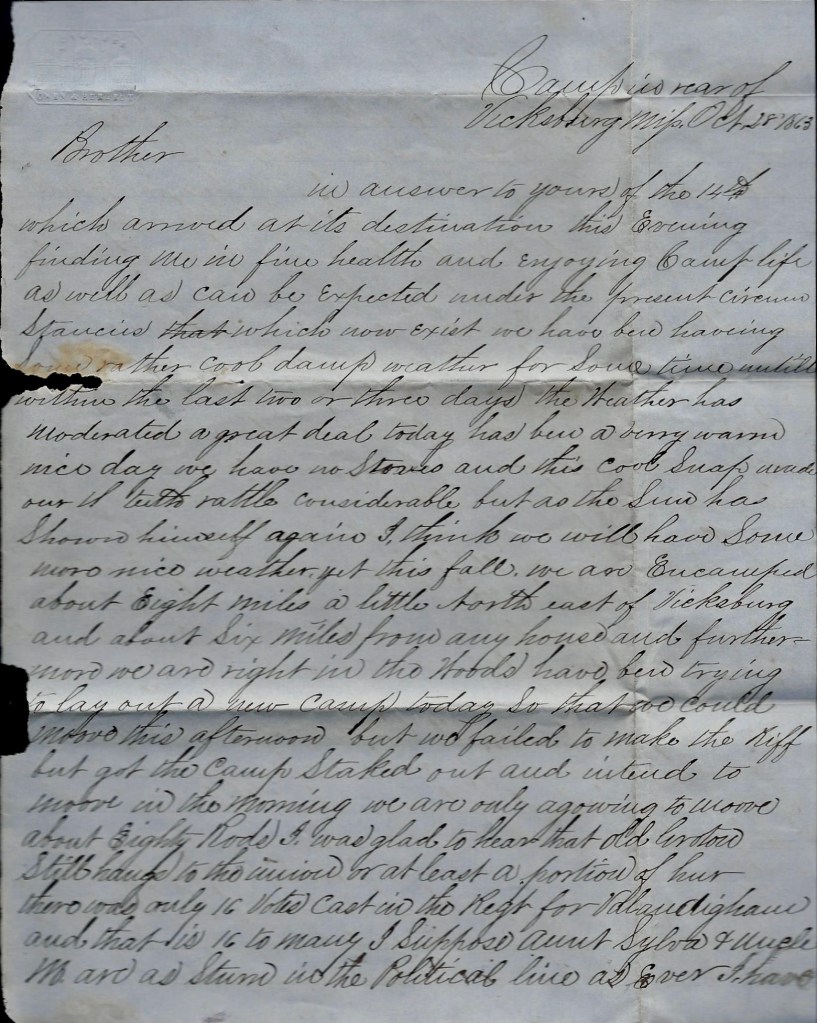
In this letter datelined from the regiment’s encampment 8 miles in the rear of Vicksburg, Mississippi, Capt. Harrington informs his younger brother Lionel E. Harrington (1841-1895) of their location, the health of the regiment, and reacts to the recent gubernatorial election results in the regiment and at home in Ohio in which the “Peace Democrat” Clement Vallandigham lost in a landslide to the pro-Union War Democrat John Brough.
Field Desk used by Capt. Jonathan F. Harrington during the Civil War
[Note: To read Harrington’s account of the Battle of Shiloh, go to: Civil War Talk.]
Transcription
Addressed to L. E. Harrington, Esq., Groton, Erie county, Ohio
Camp in rear of Vicksburg October 28, 1863
Brother,
In answer to yours of the 14th which arrived at its destination this evening finding me in fine health and enjoying camp life as well as can be expected under the present circumstances which now exist, we have been having some rather cool damp weather for some time until within the last two or three days. The weather has moderated a great deal. Today has been a very warm day, nice day. We have no stoves and the cool snap made our teeth rattle considerably but as the sun has shown himself again, I think we will have some more nice weather yet this fall.
We are encamped about eight miles a little northeast of Vicksburg and about six miles from any house. And furthermore, we are right in the woods. Have been trying to lay out a new camp today so that we could move this afternoon but we failed to make the riff [?] but got the camp staked out and intend to move in the morning. We are only a going to move about eighty rods [quarter mile].
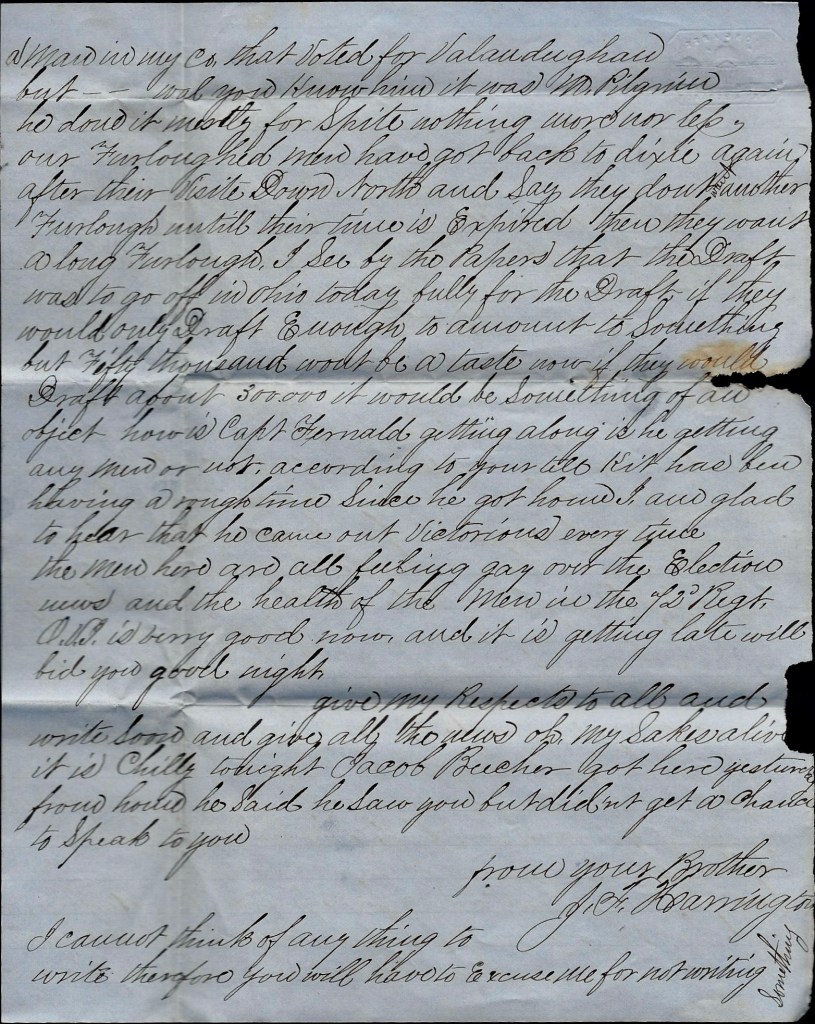
I was glad to hear that Old Groton still hangs to the Union, or at least a portion of her. There was only 16 votes cast in the regiment for [Clement] Vallandigham and that is 16 too many. I suppose Aunt Sylvia & Uncle M. are as stern in the political line as ever. I have a man in my company that voted for Vallandigham but—well, you know him. It was M. Pilgrim. He done it mostly for spite—nothing more nor less.
Our furloughed men have got back to Dixie again after their visit down North and say they don’t want another furlough until their time is expired. Then they want a long furlough.
I see by the papers that the draft was to go off in Ohio today. Bully for the draft if they would only draft enough to amount to something, but fifty thousand won’t be a taste. Now if they would draft about 300,000, it would be something of an object. How is Capt. Fernald getting along? Is he getting any men or not? According to your tell, Kit has been having a rough time since he got home. I am glad to hear that he came out victorious every time.
The men here are all feeling gay over the election news and the health of the men in the 72nd Regiment OVI is very good now and it is getting late. Will bid you good night.
Give my respects to all and write soon and give all the news. Oh my sakes alive, it is chilly tonight. Jacob Beecher got here yesterday from home. He said he saw you but didn’t get a chance to speak to you.
From your brother, — J. F. Harrington
I cannot think of anything to write. Therefore, you will have to excuse me for not writing something.
I could not find an image of Ira but here is a tintype of John L. Cleveland of Co. B, 3rd Vermont Infantry
The following letters were written by Ira E. Morse (1837-1862) of Co. D, 3rd Vermont Infantry. Ira enlisted on 1 May 1861 and was mustered into the regiment on 16 July 1861. He received a gunshot wound on 16 April 1862 at Lee’s Mills, Virginia, but recovered only to die of disease on 29 November 1862. It appears that Ira, weakened from chronic diarrhea, had fallen out of the ranks while on a march and that a Boonsboro, Maryland, resident named Cornelius Wertz found Ira by a tree in the woods near his home and took him in and cared for him until he died. He was buried “in front of the church in Boonsboro where several Union soldiers had been buried.” David Trull claimed to have received Ira’s diary and bible from Mr. Wertz and delivered them to Ira’s parents.
Ira was the son of David Morse (b. 1807) of Charleston, Vermont, who was said to be physically unable to support his family financially. David and his wife Fanny’s net worth in 1860 was only $400 and they had come to rely on the money that Ira sent home to his family. By the time of his death, Ira had sent home $200 between his wages and the bounty he received for enlisting.
While researching Ira, I discovered in the “Widow’s Pension” claim filed by Ira’s mother following his death, that two of Ira’s letters written during the Peninsula Campaign in the summer of 1862 had been sent to the Pension Office as proof of Ira’s having sent money home to his parents for their use. I have transcribed these and added them with the 3rd Letter describing the Battle of Antietam.
Letter 1
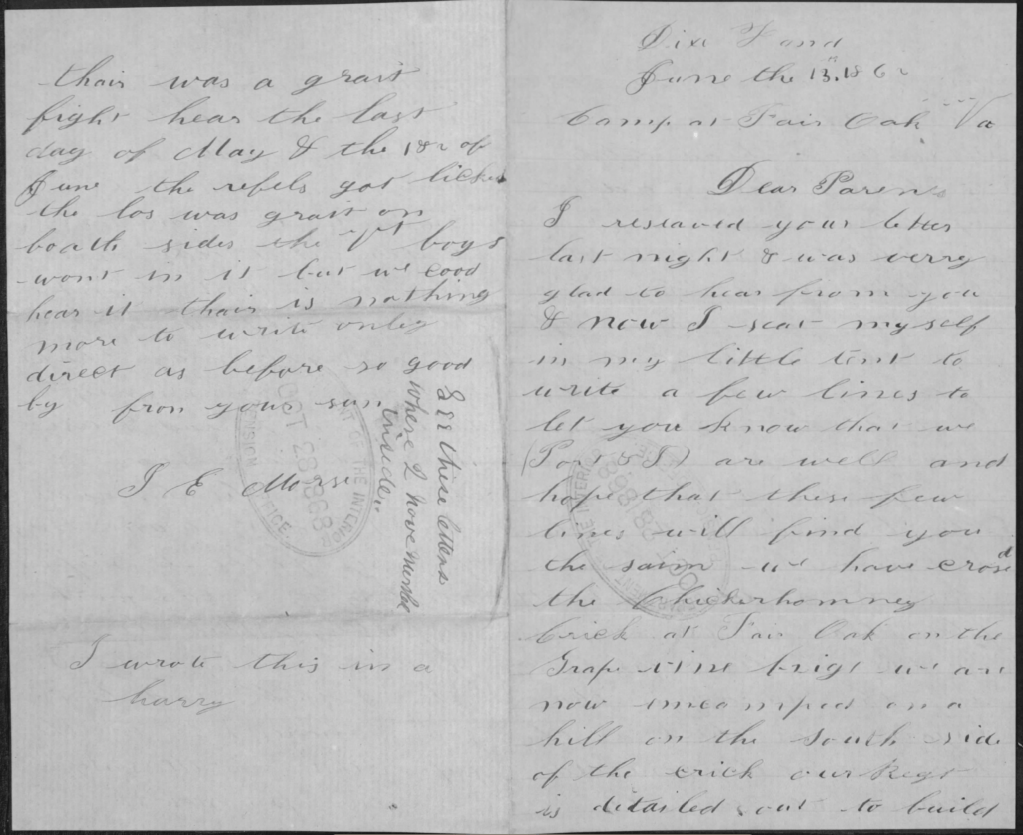
Dixie Land June 13, 1862 Camp at Fair Oak, Va.
Dear Parents,
I received your letter last night & was very glad to hear from you & now I seat myself in my little tent to write a few lines to let you know that we (Port & I) are well and hope that these few lines will find you the same.
We have crossed the Chickamoniny Creek at Fair Oaks on the grapevine bridge. We are now encamped on a hill on the south side of the creek. Our regiment is detailed out to build a bridge across the crick. The rest of the [Vermont] Brigade is 1.5 miles ahead. There is heavy cannonading up there this morning. Our picket is so close to the Rebs that they have to post themselves in the night & lay flat on their bellies until the next night. Our men are a building forts all along the lines. We shall have Richmond before long.
This is a very pretty place here. It is all oak on the hills and pine in the swamps. The niggers is as thick as the hair on a dog. One old nigger is 106 years old. Little niggers from 10 to twelve will carry a pail of water on their heads and not touch a hand to it.
I am sorry to hear that Dan ain’t so well. I don’t think he had ought to work at all. You may take any of my money that you need and use it and get Dan some clothes too if he needs them. I don’t want any of my folks to suffer as long as I can work. We probably shall be paid off again before long & then I shall send home some more.
I see in the papers that the Mississippi River is open now.There was a great fight here the last day of May & the 1st of June. The Rebels got licked. The loss was great on both sides. The Vermont boys weren’t in it but we could hear it. There is nothing more to write—only direct as before. So goodbye from your son, — I. E. Morse
I wrote this in a hurry.
Letter 2
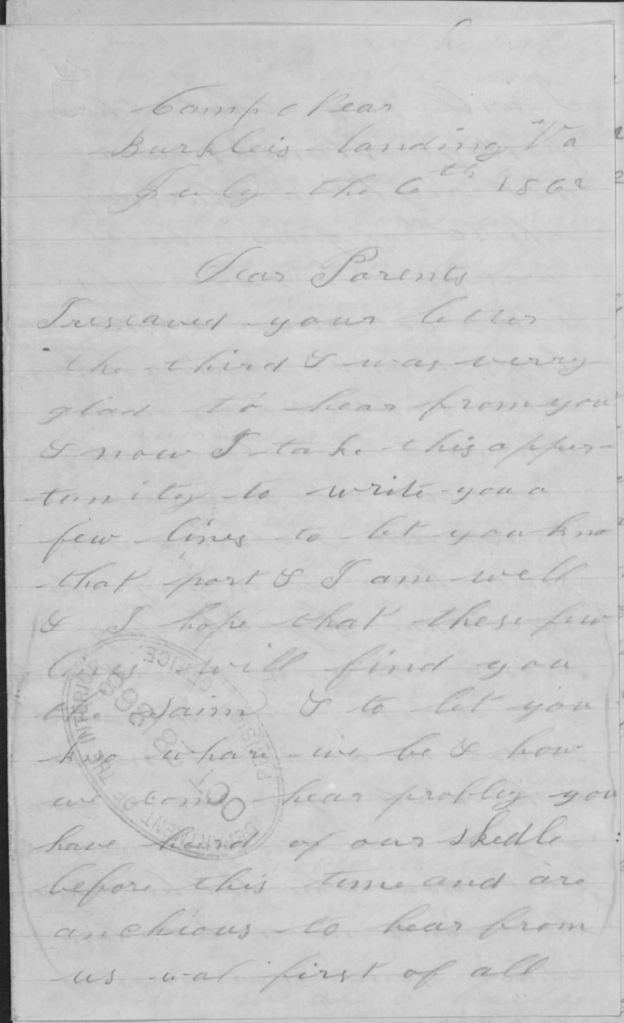
Camp near Berkeley’s Landing, Va. July 6th 1862
Dear Parents,
I received your letter the third. I was very glad to hear from you. i now take this opportunity to write you a few lines to let you know that Port and I are well and I hope that these few lines will find you the same & to let you know where we be & how we come here. Probably you have heard of our skedaddle before this time and are anxious to hear from us.
Well, first of all I will say that them postage stamps was all right.
Thursday the 26th of June, a battle was fought on our right & we got news that our boys was a licking them. Cheers after cheers was given all along the lines. We was paid off the same day & Port & I sent home our money the next day by the pay master…
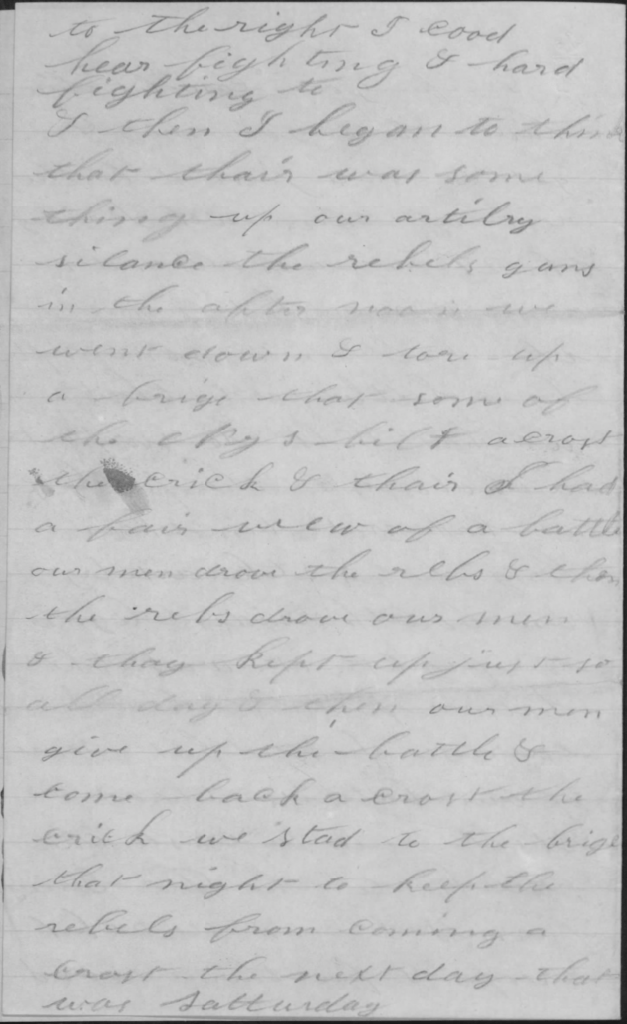
Well. Friday the 27th we was all under arms & marched up onto the hill into some rifle [pits] by a little fort that we had built to support a battery & the pickets. We had not been there long before the artillery on both sides began to fight. It was the hottest place that I ever see. I see that some of our batteries throwed shell over across the crick to the Dr. Gaines’ farm & I could see rebel troops & further around to the right I could hear fighting & hard fighting too.
And then I began to think that there was something up. Our artillery silenced the rebel guns. In the afternoon we went down & tore up a bridge that some of the nigs built across the creek & there I had a fair view of a battle. Our men drove the rebs & then the rebs drove our men & they kept up just so all day and then our men give up the battle & come back across the creek. We stood to the bridge that night to keep they rebels from coming across. The next day—that was Saturday—our troops wrecked the rebels all out and took a lot of prisoners. We was completely cut off twice but forces come up in the rear from the James river and drove the rebels back. The 2nd day we arrived at this landing. It rained all day hard & the mud was half a knee deep & we all got wet as rats & our legs was all mud up to our bodies.
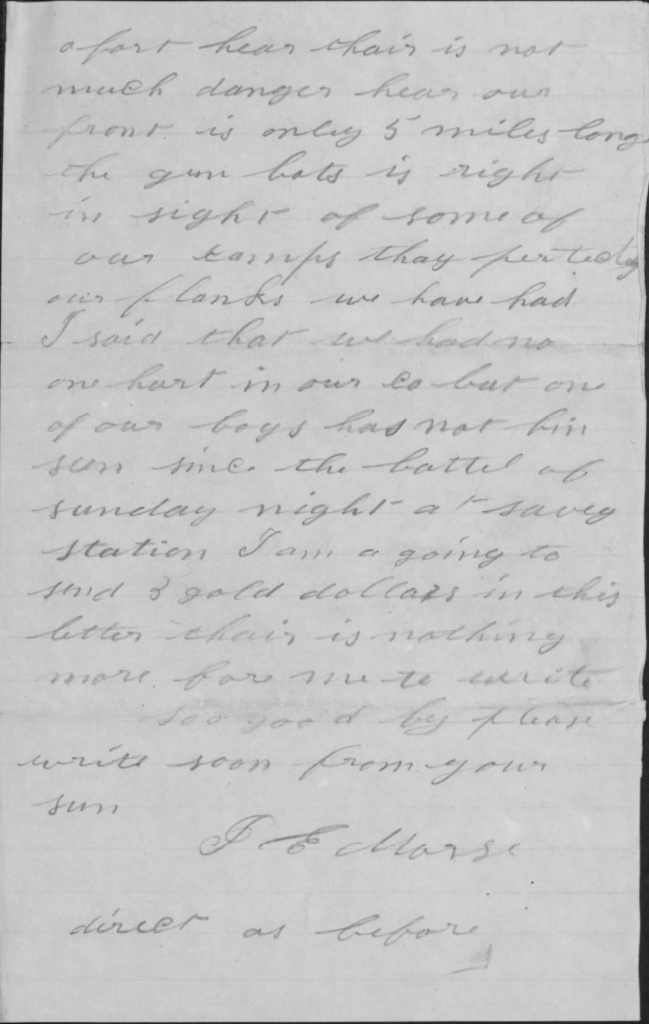
The next day the rebels got into a hill and began to shell some of our camps. The cavalry went up and drove them off & took their guns & then we loved to the place that we are now. We lost everything on this retreat almost. We are a building a fort here. There is not much danger here. Our front is only 5 miles long. The gunboats is right in sight of some of our camps. They protect our flanks. I said that we had no one hurt in our company but one of our boys has not been seen since the Battle of Sunday night at Savage Station. I am a going to send 3 gold dollars in this letter. There is nothing more for me to write. So goodbye. Please write soon. From your son, — I. E. Morse
Direct as before.
Letter 3
Camp near Hagerstown, Maryland October 13, 1862
Dear Brother & Sister,
It is with pleasure that I can have time to write you a few lines to let you know that I am some better than I have been. I had had the diarrhea for two months but I am on the gain now. I shall be all right before long now.
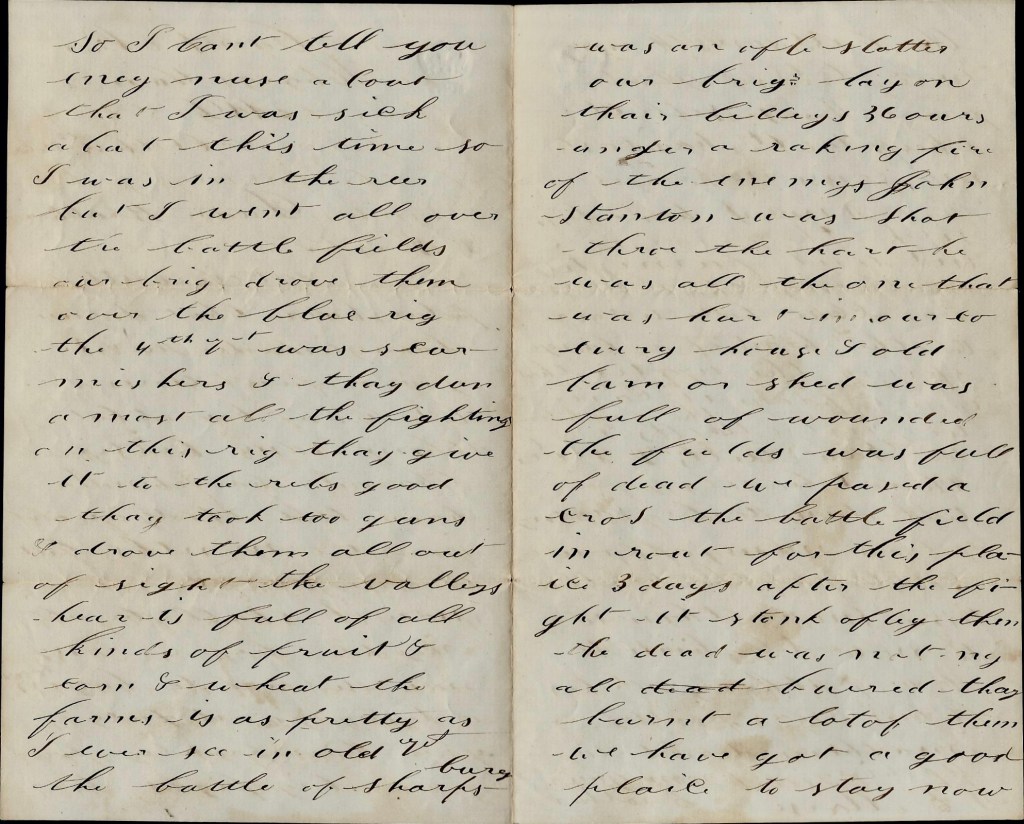
We are to Hagerstown a doing guard duty. You have probably heard of our big fight here so I can’t tell you any news about that. I was sick about this time so I was in the rear but I went all over the battlefields. Our brigade drove them over the Blue Ridge. The 4th regt. was skirmishers & they done a most all the fighting on this ridge. They give it to them Rebs good. They took two guns and drove them all out of sight.
The valleys here is full of all kinds of fruit & corn & wheat. The farms is as pretty as I ever see in old Vermont.
Ira’s account of the battlefield—the stench, the unburied soldiers and animals, & the houses filled with wounded are described in detail in Steven Cowie’s new book, “When Hell Came to Sharpsburg”
The Battle of Sharpsburg was an awful slaughter. Our Brigade lay on their bellies 36 hours under a raking fire of the enemy [guns]. 1 John Stanton was shot through the heart. He was all the one that was hurt in our company. Every house & old barn and shed was full of wounded. The fields was full of dead. We passed across the battlefield en route for this place three days after the fight. It stank awfully then. The dead was not nye all buried. They burnt a lot of them.
We have got a good place to stay now. The citizens bring in a lots of good provisions & sell it cheap too. It has cost me some money to live since I have been sick. The government don’t furnish one thing that a sick man can eat. We are to the head of a large spring. The water that comes from it carries two grist mills & two saw mills & several small shops.
Tell Dan to be saving of his money for we shall need it sometime more than we do now. Tell him to let father get his clothes and have mother mail them. Direct to Washington. From your brother, — I. E. Morse
1 The 3rd Vermont, being in Brooks’ Brigade, left its camp in Pleasant Valley at 6 A.M. of the 17th, crossed the Antietam at Pry’s Ford and reached the field about noon. It was ordered to the support of Sedgwick’s Division, Second Corps, on the Union right but, before getting into position, was ordered to the support of French’s Division and formed in Mumma’s Cornfield, on ground vacated by the 14th Connecticut, its left connecting with French, its right resting on Mumma’s Lane, facing south parallel to and about 170 yards from the Bloody Lane. It was subjected to a galling fire of both Artillery and Sharpshooters, causing some loss. It remained in this position until the morning of the 19th.
Private Louis Hottowitz and another member of the 17th Missouri or “The Western Turner Rifles” holding their Colt revolving rifles. (Bruce Hermann Collection)
The following letter was written by James Ferdinand Mallinckrodt (1842-1925), the son of William Hermann Mallinckrodt (1810-1895) and his wife Louise (1817-1897) of St. Louis, Missouri. Ferdinand enlisted in the 17th Missouri Infantry as a corporal in 1861. The 17th Missouri Volunteer Infantry Regiment was formed at St. Louis in August 1861 by the St. Louis Turner Society, a German-American athletic and social organization. Under the leadership of Charles Stiefel and Frederick Leser, the St. Louis Turnverien placed its meeting hall in the hands of General Lyon, the Union military commander in St. Louis, and Col. Sigel, a former German officer. A new regiment known as the Western Turner Rifles was quickly recruited to serve for three years composed primarily of German-American officers and enlisted men from St. Louis who had previously served 90-day enlistments from May to August 1861 with the First, Second, Third and Fourth Missouri Regiments. These units fought under Brigadier General Lyon and Sigel at the capture of Ft. Jackson in St. Louis, the relief of St. Genevieve, Missouri and later in the summer at the battle of Wilson’s Creek.
Ferdinand would be promoted to Sgt. in Co. H, and then following the Battle of Ringgold, Georgia, and in winter camp, promoted to Lt. in Co. C by the commander Col. Cramer (pretty tragic end to that guy). He also eventually did a tour on recruiting duty in St. Louis.
After the war, Ferdinand embarked on an eclectic career as a machinist, draughtsman, and scientific model-maker. He also styled himself a literary figure, publishing several pamphlets and frequent letters to the editor, and corresponding with famous authors. In 1915 he removed to Salt Lake City to live with his brother and nephew; he is not thought to have been a Mormon.
Ferdinand sent this letter to his sister, Cecilia D. Mallinckrodt (1845-1873).
Transcription
Addressed to Mr. H. Mallinckrodt, St. Louis, Missouri
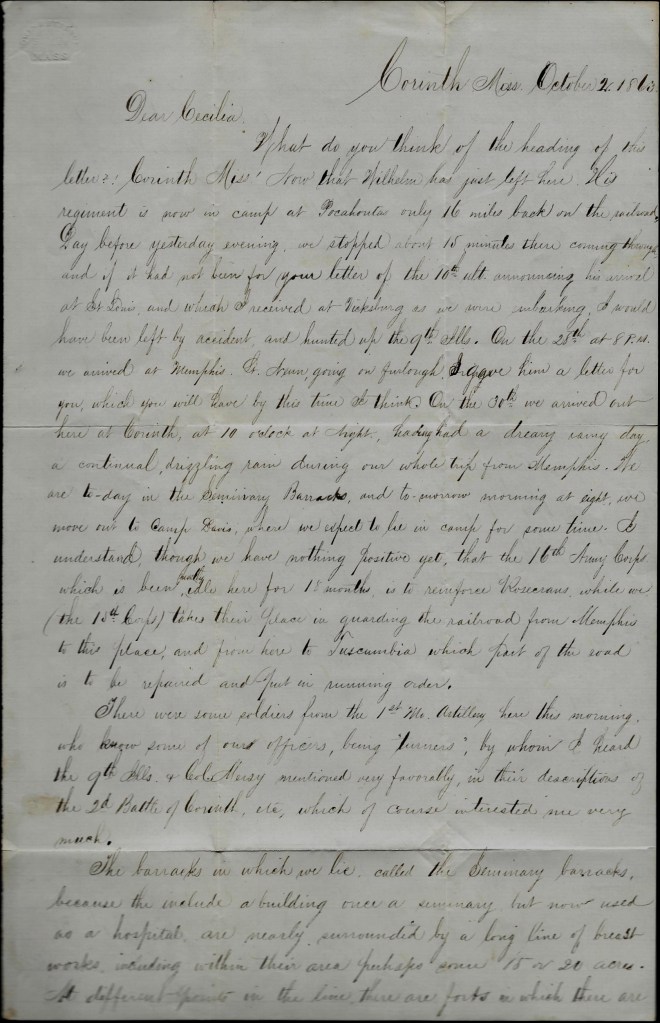
Corinth, Mississippi October 2, 1863
Dear Cecilia,
What do you think of the heading of this letter?! Corinth, Miss! Now that Wilhelm has just left here, his regiment is ow in camp at Pocahontas only 16 miles back on the railroad. Day before yesterday evening, we stopped about 15 minutes there coming through and if it had not been for your letter of the 10th ult. announcing his arrival at St. Louis, and which I received at Vicksburg as we were embarking, I would have been left by accident and hunted up the 9th Illinois. On the 28th at 8 p.m. we arrived at Memphis. Lt. Neun, going on furlough, I gave him a letter for you which you will have by this time I think. On the 30th, we arrived out here at Corinth at 10 o’clock at night, having had a dreary, rainy day—a continual. drizzling rain during our whole trip from Memphis. We are today in the Seminary Barracks and tomorrow at light we move out to Camp Davis where we expect to lie in camp for some time. I understand, though, we have nothing positive yet that the 16th Army Corps, which has been mostly idle here for 18 months, is to reinforce Rosecrans while we (the 1st Corps) takes their place in guarding the railroad from Memphis to this place, and from here to Tuscumbia which part of the road is to be repaired and put in running order.
There were some soldiers from the 1st Missouri Artillery here this morning who knew some of our officers, being “Turners” by whom I heard the 9th Illinois & Col. [Augustus] Mersy mentioned very favorably in their descriptions of the 2nd Battle of Corinth, &c., which of course interested me very much.
The barracks in which we lie, called the Seminary Barracks, because they include a building once a seminary but now used as a hospital, are nearly surrounded by a long line of breastworks, including within their area perhaps some 15 or 20 acres. The different points in the line are forts in which there are mounted about 10 or 12 heavy guns in all. From my little experience during the Siege of Vicksburg, it seems to me that these works could not withstand very much battering and especially are they rendered defective on the west side by a height 300 yards rising, however, no higher than the fort’s own location, but in such a manner that an enemy might approach under cover of it to its top and there establish himself with a few heavy guns and batter down our works. Forts are visible in all directions.
Corinth is a little town about like Pilot Knob. Now that you have Wilhelm at home, you certainly have a good source of information about Corinth—better than I could possibly be. Capt. Wilhelm came back from furlough yesterday and reports that nothing is done yet about drafting and we will most probably be consolidated. In that case, I would most probably come home, which I would be glad to do. Well, more about that when the time comes. I am quite well as ever. Give my love to all and William. To King’s and Ewald’s. Your brother– Ferdinand
In the 1860s, Samuel Badger Neal of Kittery, York county, Maine began to conduct interviews with some of the older members of his community, thinking to record some oral history of the area before it was lost. He recorded their stories on stationery, some bound, some not, and kept them bundled together with a string thinking, perhaps, he might someday publish them. He did not. He passed away and they were handed down to a niece or nephew who slapped a note on the pile which read, “Most of these are Uncle Sam’s gossipy notes on early Kittery.” They were indeed, and while some of the recorded stories are of limited historical significance, there are nuggets of information buried within them that would likely be of keen interest to historians of the area and particularly Kittery—the oldest settlement in Maine.
Samuel (“Sam”) Badger Neal (1842-1901) was the son of John Robert and Anna Maria (Badger ) Neal. He was born in Portsmouth, New Hampshire, on 29 April 1842 and fitted for college at Phillips Exeter Academy. He graduated from Harvard College in 1864 and the following year entered the NH National Bank of Portsmouth as a cashier. He then went to New York as a salesman in the coal business, to Boston as a bookkeeper, and then as a coal salesman. He suffered from ill health and lived with his parents in Kittery for a while, managing his father’s coal business. He lived until 1901. He was found dead in his stable, having been knocked down and trampled by his horse.
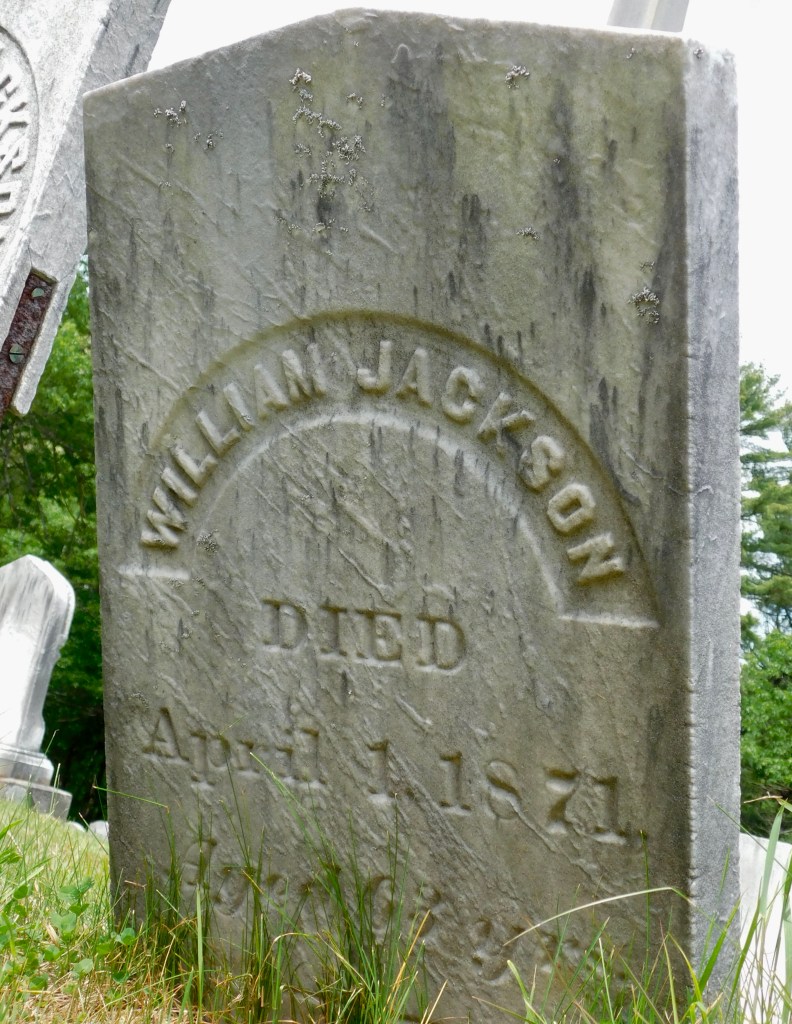
William Jackson (1808-1871) was a ship builder in Kittery. He was married to Mary C. Young (1820-1886). He died on 1 April 1871 and was buried in the Orchard Grove Cemetery in Kittery.
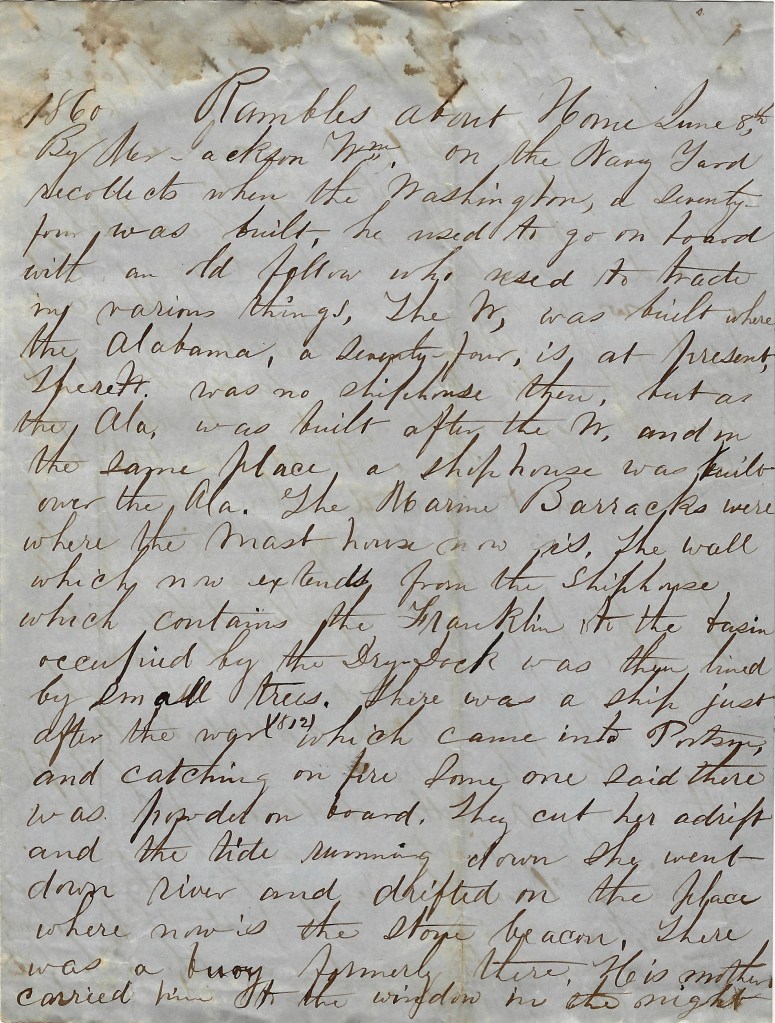
On the Navy Yard
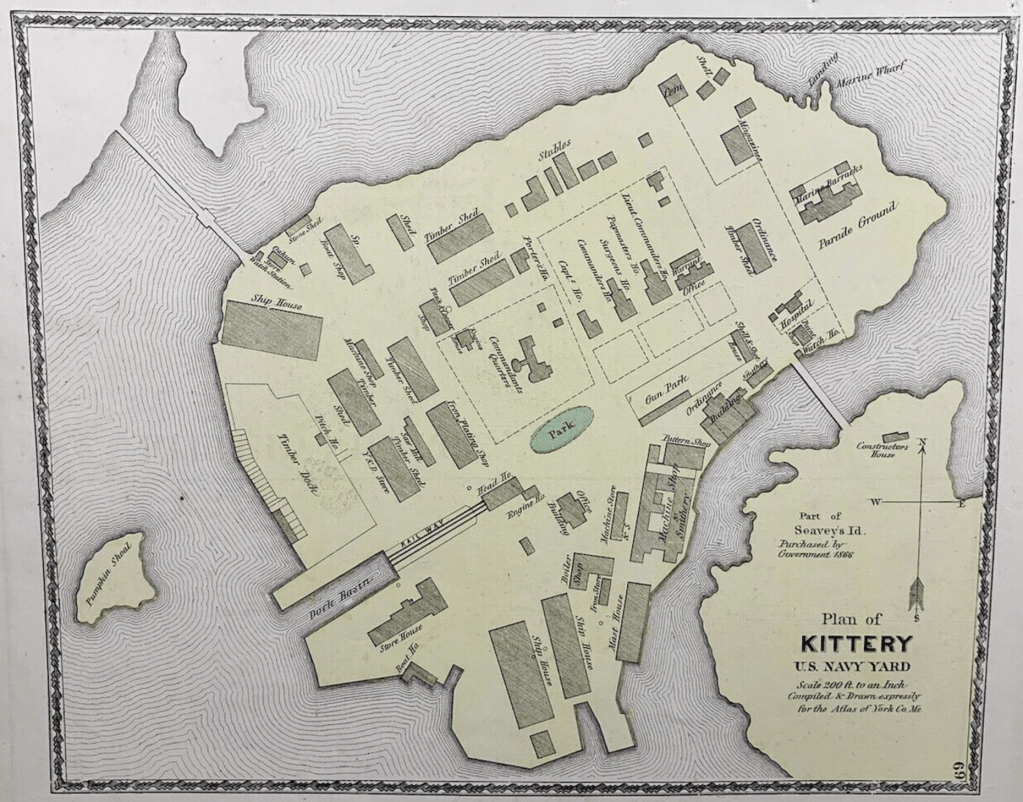
The Naval Yard at Portsmouth, N. H. as seen in 1853
Mr. William Jackson recollects when the Washington, a seventy-four [gun], was built [during the War of 1812]. He used to go aboard with an old fellow who used to trade in various things. The Washington was built where the Alabama, a seventy-four, is at present. There was no ship house then, but as the Alabama1 was built after the Washington, and in the same place, a ship house was built over the Alabama. The Marine Barracks were where the mast house now is. The wall which now extends from the ship house which contains the Franklin to the basin occupied by the dry dock was then lined with small trees.
William Jackson Headstone in Kittery
There was a ship just after the War of 1812 which came into Portsmouth and catching on fire, someone said there was powder on board. They cut her adrift and the tide running down, she went down river and drifted on the place where now is the stone beacon. There was a buoy formerly there. His mother carried him to the window in the night. The ship was burned in the night. She was loaded with hemp. The place now having the red beacon over it was called Pumpkin Island because it was wholly planted with pumpkins by old Mother Shaw. The Huckleberry Island was also much larger but is now washed away on the eastern part of this shipyard and Samuel Badger’s great grandmother Fernald said she picked huckleberries on the part extending from Mr. Jackson’s house to the water.
A wall used to extend along the front of the yard by the water side and where the present wharf is, used to be the wharf of the old Master Whitten. On the southeastern part of the yard was a nice orchard and along the shore a row of pear trees called Button Pear trees.
He has seen the whole of it—the yard—planted with corn. A little distance from the house, southeastern direction, was what was called a “loom house” where they used to work weaving, &c.
The first ship [that] Samuel Badger launched from the yard was the Charlotte. She was pointed south and the ship ran against Huckleberry Island. The rudder got loose, cause of it, when then tide come down, she sustained serious damage. She was beached where the wood dock now is and he estimates the damage at $500.00.
It is said that the Indians used to go to the shoals. The Indians used to come up by the Portsmouth bridge, a hundred at a time, and steal everything. The America was built at Badger’s Island in 1690. The Falkland, 54 guns, was built here by order of the British government, and this place was selected as a naval depot prior to the Revolution. At this yard was the Ranger was built, commanded by John Paul Jones. The frigates Congress, Crescent, and Portsmouth of 24 guns were built here prior to 1799. The Washington, 74 guns, in 1814. Schooner Porpoise in 1820. Sloop Concord, 24 guns, in 1828. Sloop Preble, 16 guns, in 1839.
1 The 74-gun Alabama mentioned by Sam was one of “nine ships to rate not less than 74 guns each” authorized by Congress in 1816. She was laid down in the Naval Yard in June 1819 and ready for launch in 1825 but remained on the stocks until the Civil War when she was launched under the name USS New Hampshire instead and used as a store ship in the South Atlantic Blockading Squadron.
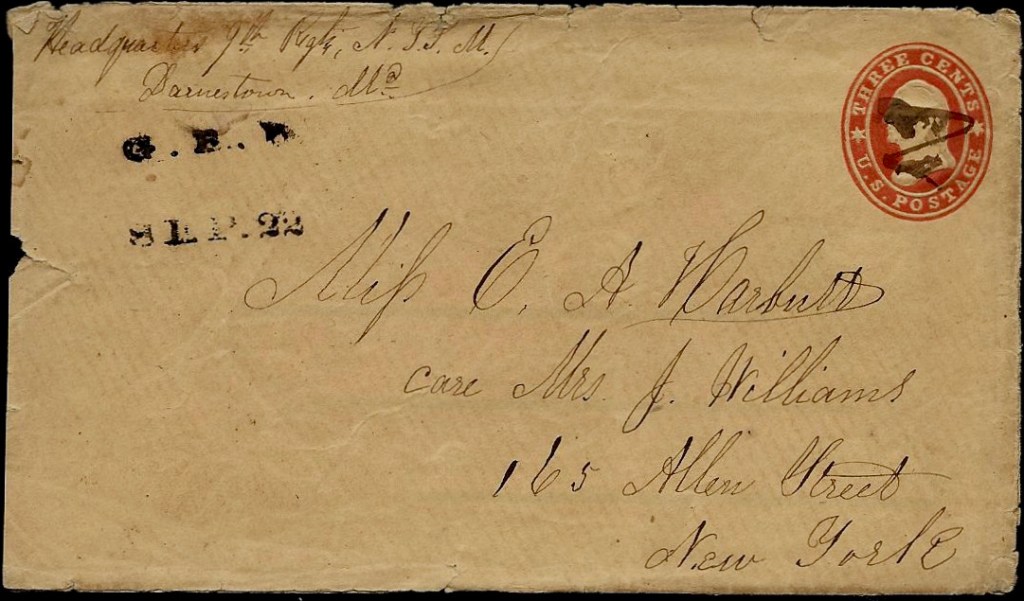
This partial letter (and unsigned) letter seems to have been written by a member of the 9th New York State Militia which became the 83rd New York Volunteers. This regiment spent much of the summer following the Battle of Bull Run at Camp Stone near Darnestown, Maryland, where Union General Nathaniel Banks kept “a firm and certain hand” on the citizenry of Marylanders with a large military presence.
The letter was addressed to Eliza Ann Harbutt (b. 1843), the daughter of John Harbutt (b. 1822)—a clothier in New York City, and his wife Sarah Niffen (b. 1822). Both of her parents were English emigrants as was her grandfather, Francis Niffin—a taylor, who resided with the Harbutt’s in the same household in New York’s 14th Ward in 1860. Nothing further could be found on Eliza.
Transcription
Addressed to Miss E. A. Harbutt, care of Mrs. J. Williams, 165 Allen Street, New York
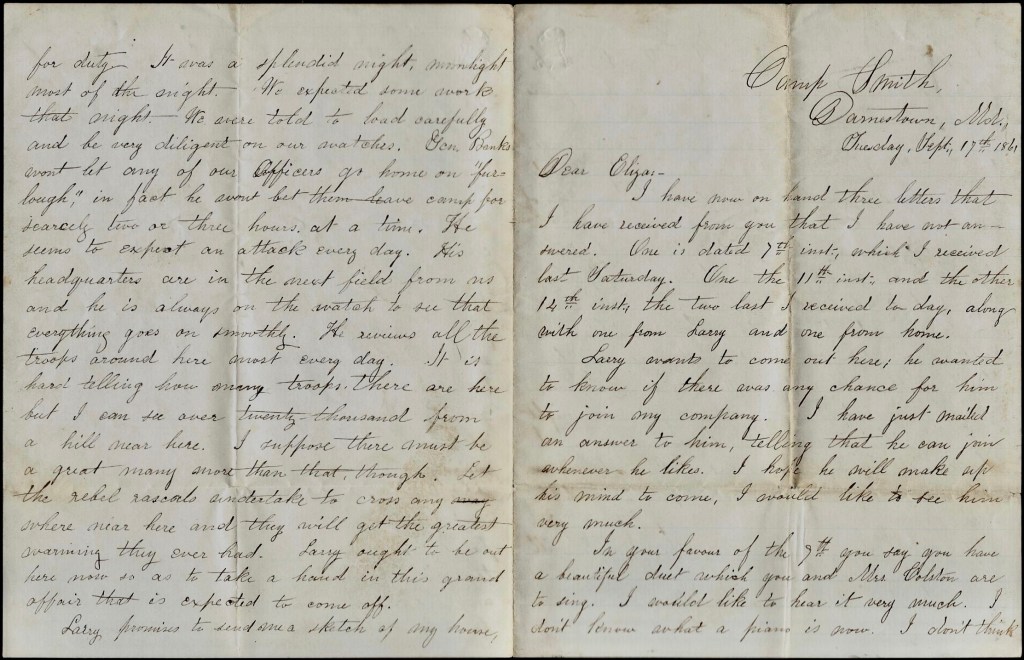
Camp Smith Darnestown, Maryland Tuesday, September 17, 1861
Dear Eliza,
I have now on hand three letters that I have received from you that I have not answered. One is dated 7th inst. and the other 14th inst.; the two last I received today along with one from Larry and one from home.
Larry wants to come out here; he wanted to know if there was any chance for him to join my company. I have just mailed an answer to him telling that he can join whenever he likes. I hope he will make up him mind to come. I would like to see him very much.
In your favor of the 9th, you say you have a beautiful duet which you and Mrs. Colston are to sing. I would like to hear it very much. I don’t know what a piano is now. I don’t think I have heard one since I left New York. When I come home, I will hammer your piano to pieces.
I would like to hear of a marriage between Mr. Higgins and a certain lady friend of yours. It would greatly relieve the monotony of his life.
You seem to think it ridiculous for me to think of coming home before next April; the fact is it is useless for anyone to make up their mind to see the close of his war within any definite period. It is all in the hands of the Almighty. We may see the close of it before New Years; then again we might not see the close of it for years. I have great hopes in the next battle. If we should prove to be the victorious party and the rebel army should be broken up, there is little doubt but the worst of the struggle will then be over. I hope so anyway.
Sunday, Hiram and myself had quite a picnic. We got a bottle of claret wine, two very nice pound cakes that we bought from a countryman that sells bread, biscuit, cakes, and pies, and such things around the camp. We also had some biscuit and a half pound of butter. We started about 10 o’clock in the morning. It was a beautiful day—cool and clear—and went a short distance from camp to a beautiful grove. We took our blankets along. There is a beautiful spring close by. We spread our blankets and spent the day there (Sundays we don’t have any drills) smoking, reading, writing, and eating and drinking all day. I tell you, we had a gay time. I am sure you would have enjoyed yourself had you been along, dear, for the surrounding scenery was most magnificent. Everything, in fact, was sublime.
We started for camp about five o’clock, arriving just in time for evening dress parade. We had supper. After supper there was ten men detailed for picket duty so Hiram and myself were among the number. We slung our blankets and reported to the guard house ready for duty. It was a splendid night. We expected some work that night. We were told to load carefully and be very diligent on our watches. Gen. Banks won’t let any of our officers go home on “furlough.” In fact, he won’t let them leave camp for scarcely two or three hours at a time. He seems to expect an attack every day. His headquarters are in the next field from us and he is always on the watch to see that everything goes on smoothly. He reviews all the troops around here most every day. It is hard telling how many troops there are here but I can see over twenty thousand from a hill near here. I suppose there must be a great many more than that though.
Let the rebel rascals undertake to cross anywhere near here and they will get the greatest warming they ever had. Larry ought to be out here now so as to take a hand in this grand affair that is expected to come off.
Larry promises to send me a sketch of my home…[remainder of letter missing]
Return address on envelope reads: Headquarters 9th Regt. N. Y. S. M, Darnestown, Md.
In the 1860s, Samuel Badger Neal of Kittery, York county, Maine began to conduct interviews with some of the older members of his community, thinking to record some oral history of the area before it was lost. He recorded their stories on stationery, some bound, some not, and kept them bundled together with a string thinking, perhaps, he might someday publish them. He did not. He passed away and they were handed down to a niece or nephew who slapped a note on the pile which read, “Most of these are Uncle Sam’s gossipy notes on early Kittery.” They were indeed, and while some of the recorded stories are of limited historical significance, there are nuggets of information buried within them that would likely be of keen interest to historians of the area and particularly Kittery—the oldest settlement in Maine.
Samuel (“Sam”) Badger Neal (1842-1901) was the son of John Robert and Anna Maria (Badger ) Neal. He was born in Portsmouth, New Hampshire, on 29 April 1842 and fitted for college at Phillips Exeter Academy. He graduated from Harvard College in 1864 and the following year entered the NH National Bank of Portsmouth as a cashier. He then went to New York as a salesman in the coal business, to Boston as a bookkeeper, and then as a coal salesman. He suffered from ill health and lived with his parents in Kittery for a while, managing his father’s coal business. He lived until 1901. He was found dead in his stable, having been knocked down and trampled by his horse.
1860 Interview of Hannah Jackson (1774-1866)
Houses
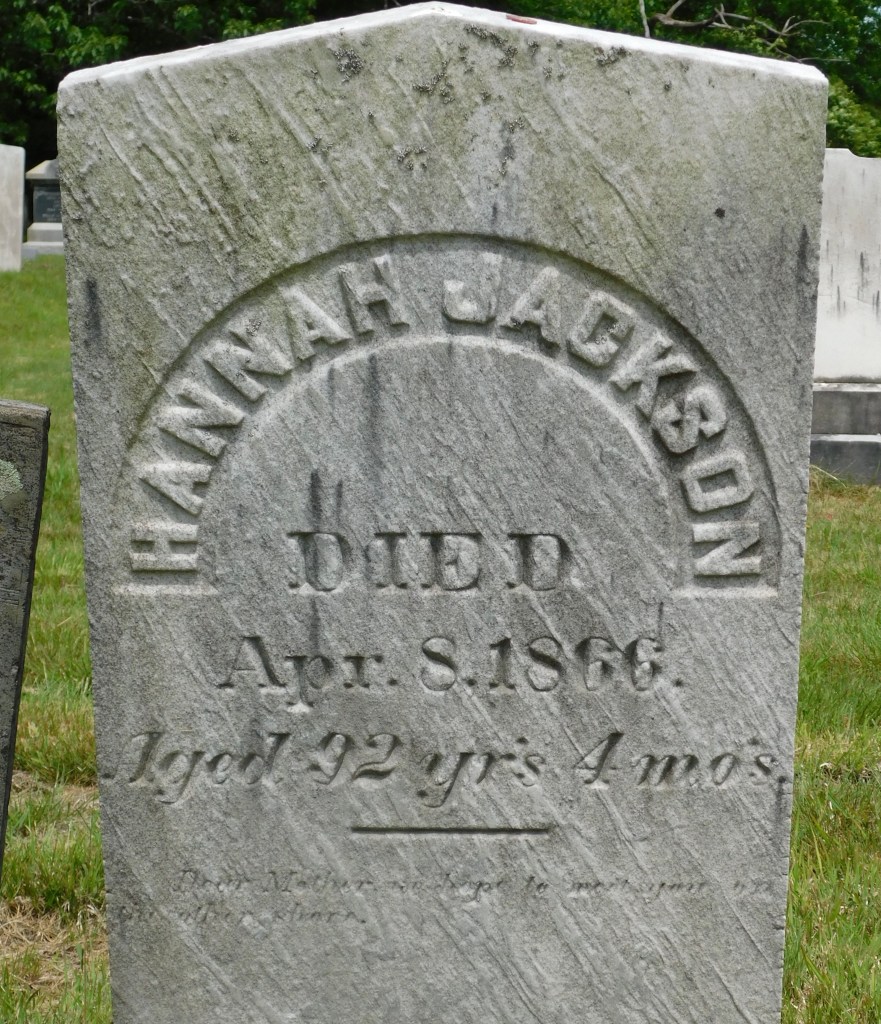
There were eight houses in the place she recollects at first belonging to Nathan Dame, Jonathan Dame, Grand or great-grandfather Fernald, Chandler, Jackson, Traip, Whitten, and one other. The house enlarged by S. Badger formerly consisted merely of the portion now used as dining room, comprising two rooms, two closets, and cellar. In the cellar of what is now Jackson’s house used to be a house or room the old lady called it and her mother used to show her where the steps were. When her mother first came here there were no houses (on the foreside) but many clamshells all around the field where the Indians had been. Her mother was 92 years old and 5 months and died between 20 and 25 years ago. Mrs. Jackson (the above) is 86 or 7 and says the house she lives in (Jackson’s House) was built by her father 10 years before the Revolution. Her father died in Rhode Island of the yellow fever.
The house now belonging to the Hanscom (Isaiah) about 3 or 4 feet east of her own (Jackson’s) before consisted of a small house occupied by a Mr. Chandler. One day after going all round his field rather curiously, he came to the doorstep, stumbled in the house and dropped down in fit which he never came out of. In the War of 1812, folks carried their things back some distance of by Mendon’s somewhere and some of them 3 miles when the British were expected to attack them. The soldiers with drums and fifes passed by her house making a great noise on their way to the Point Fort McClary.
Fort MClary
She could hear the bell ring down at Rye, and a fire alarm was touched off at the hay yard and there was great consternation. The could see the English with the naked eye. The old lady said she could recollect the first building on the Navy Yard and before it was done she went over there one night with a party of girls and found a bottle of rum and had a grand time over it. (Probably they drank it.) This building was part on the south part of the yard somewhere, probably one of the old ship houses. (The old lady whose apartment was in the cellar of Jackson’s house was old Mrs. Pope.) The old lady (Jackson) says that she dreamed twice that there was something buried down by the shore on the hill just southeast of where the present blacksmith shop of Badger’s yard stands, and says if she had the use of her legs, she would go there and dig it up.
Capt. Traip used to go to sea. He picked up a brass cannon there once. An old scow full of iron once laid in the river and the old man (Traip) used to dive after it in a diving bell. She said she often stood on a scow and watched when he came up. He would look as pale as a ghost. He used to get two or three barrels of iron every time.
Witches
Emerson Baker’s book on witchcraft in Kittery and Southern Maine
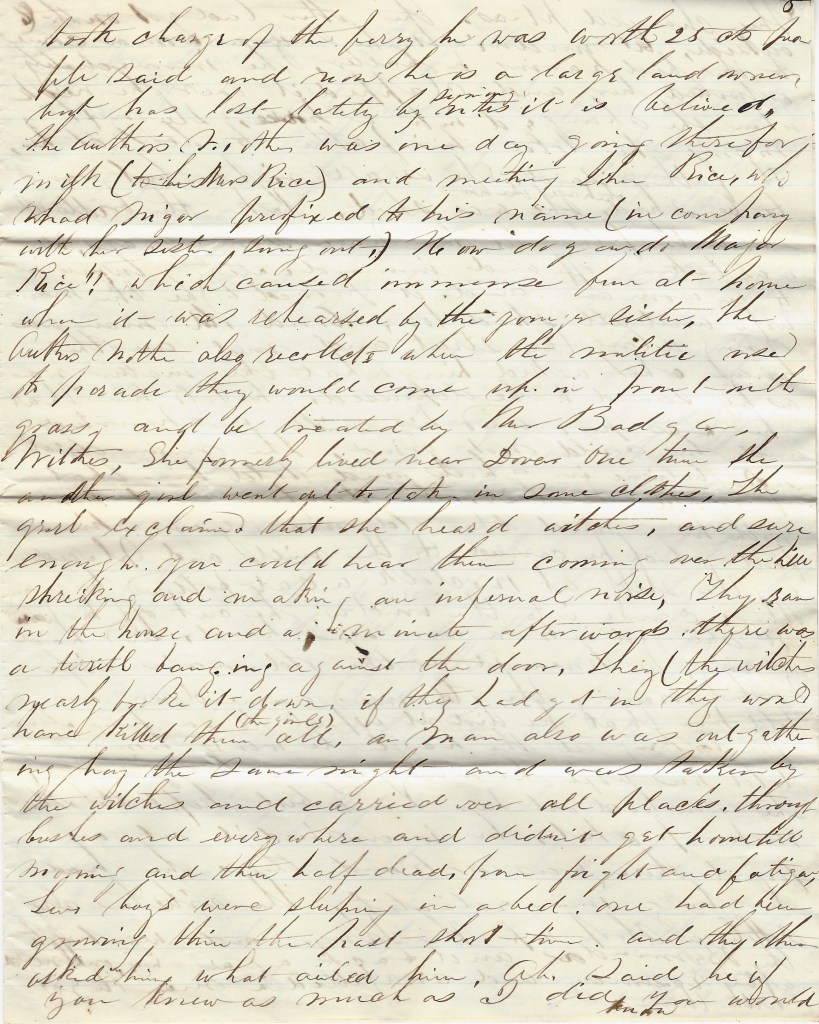
At the old ferry (by Mrs. Rice’s at present), Mrs. Rice used to have an parrot who would call people all kind of names. When Mr. John Rice [1788-1871] took charge of the ferry, he was worth 25 cents, people said, and now he is a large land owner, but has lost lately by signing notes it is believed. The author’s mother was one day going there for milk (to Mrs. Rice) and meeting John Rice who had major prefixed to his name (in company with her sister) sung out. “How do you do Major Rice!” which caused immense fun at home when it was rehearsed by the younger sister. The author’s mother also recollects when the militia used to parade, they would come up in front on the grass and be treated by the Badger witches. She formerly lived near Dover. One time she and another girl went to take in some clothes, the girl exclaimed that she heard witches, and sure enough, you could hear them coming over the hill shrieking and making an infernal noise. They ran in the house and a minute afterwards there was a terrible banging against the door. They (the witches) nearly broke it down. If they had got in, they would have killed them all (the girls). A man also was out gathering hay the same night and was taken by the witches and carried over all places, through bushes and everywhere and didn’t get home till morning and then half dead from fright and fatigue.
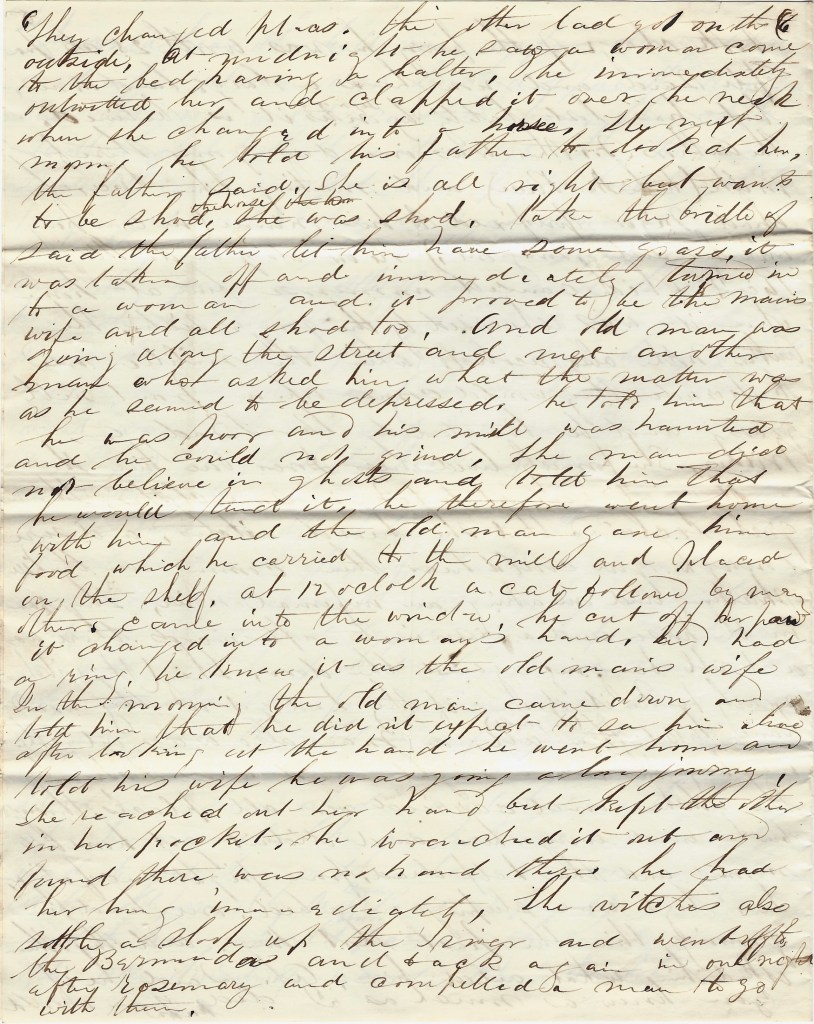
Two boys were sleeping in a bed. one had been growing thin the past short time and the other asked him what ailed him. “Oh,” said he, “if you knew as much as I did, you would know.” They changed places. The other lad got on the outside. At midnight he saw a woman come to the bed having a halter. He immediately outwitted her and clapped it over her neck when she changed into a horse. The next morning he told his father to look at her. The father said, she is all right but wants to be shod. The horse was shod. “Take the bridle off,” said the father. “Let him have some grass.” It was taken off and immediately turned into a woman and it proved to be the man’s wife and all shod too.
An old man was going along the street and met another man ad asked him what the matter was as he seemed to be depressed. He told him that he was poor and his mill was haunted and he could not grind. The man did not believe in ghosts and told him that he would tend it. He therefore went home with him and the old man gave him food which he carried to the mill and placed it on the shelf. At 12 o’clock, a cat followed by many others came into the window. He cut off her paw. It changed into a woman’s hand and had a ring. He knew it was the old man’s wife. In the morning the old man came down and told him that he did not expect to see him alive. After looking at the hand, he went home and told his wife he was going on a long journey. She reached out her hand but kept the other in her pocket. He wrenched it out and found there was no hand and there. He had her hung immediately. The witches also sailed a sloop up the river and went off to the Bermudas and back again in one night after rosemary and compelled a man to go with them.
Hannah Jackson’s Grave Marker in Orchard Grove Cemetery, Kittery, York county, Maine
In the 1860s, Samuel Badger Neal of Kittery, York county, Maine began to conduct interviews with some of the older members of his community, thinking to record some oral history of the area before it was lost. He recorded their stories on stationery, some bound, some not, and kept them bundled together with a string thinking, perhaps, he might someday publish them. He did not. He passed away and they were handed down to a niece or nephew who slapped a note on the pile which read, “Most of these are Uncle Sam’s gossipy notes on early Kittery.” They were indeed, and while some of the recorded stories are of limited historical significance, there are nuggets of information buried within them that would likely be of keen interest to historians of the area and particularly Kittery—the oldest settlement in Maine.
Samuel (“Sam”) Badger Neal (1842-1901) was the son of John Robert and Anna Maria (Badger ) Neal. He was born in Portsmouth, New Hampshire, on 29 April 1842 and fitted for college at Phillips Exeter Academy. He graduated from Harvard College in 1864 and the following year entered the NH National Bank of Portsmouth as a cashier. He then went to New York as a salesman in the coal business, to Boston as a bookkeeper, and then as a coal salesman. He suffered from ill health and lived with his parents in Kittery for a while, managing his father’s coal business. He lived until 1901. He was found dead in his stable, having been knocked down and trampled by his horse.
1863 Interview of Lydia Fernald Remick (1776-1866)
Lydia was the daughter of William and Mary (Staples) Fernald. She was married to Josiah Remick (177-1825) in 1801 and died in November 1866 at the age of 90. Lydia’s father was a Lieutenant in Capt. Samuel Leighton’s Co. from Kittery in the American Revolution.
“Here lyes Buried the Body of the Revd Mr. John Eveleth who Departed this Life August 1st, Anno Dom: 1734: Aged 65 Years” copied September 10, 1863
I found 10 graves round his which I at first supposed were those of his family, but an old lady, Mrs. [Lydia Fernald] Remick, who is now 87 years old, told me that the graves had all been made since she remembered. She said that old Mr. John Fernald, who 20 years ago had died at the age of 80 or more, had told her that when he was a child, he had played with some of the “rounds” which they had on their seats. 1
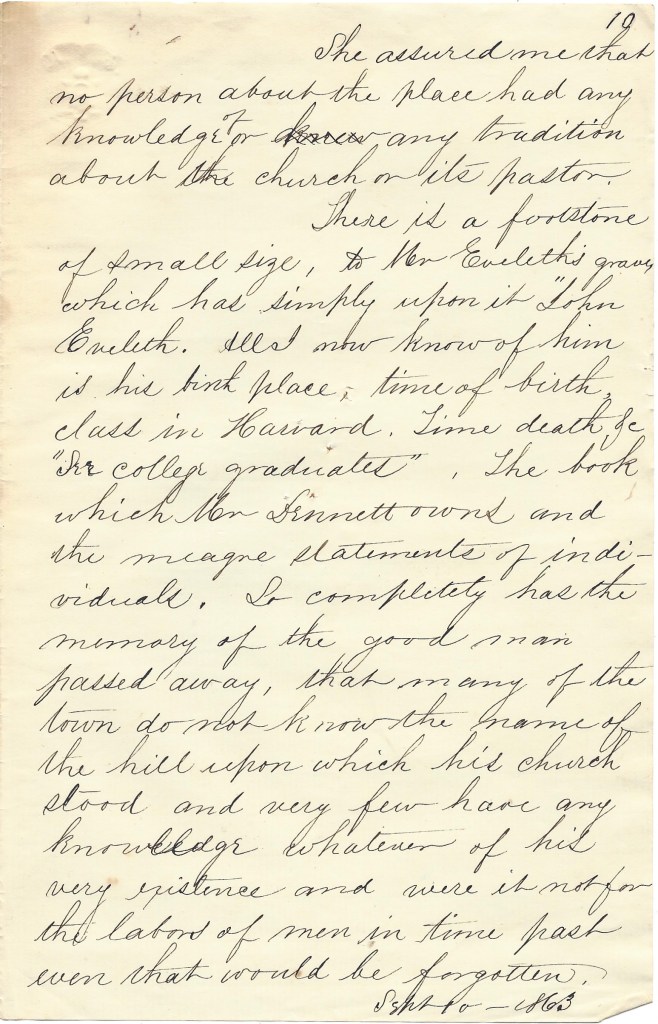
She assured me that no person about the place had any knowledge of or any tradition about the church or its pastor. 2
There is a footstone of small size to Mr. Eveleth’s grave which has simply upon it “John Evelith.” All I now know of him is his birth place, time of birth, class in Harvard, time of death, &c. “See college graduates” [in] the book which Mr. Dennett owns and the meagre statements of individuals. So completely has the memory of the good man passed away that many of the town do not know the name of the hill upon which his church stood and very few have any knowledge whatever of his very existence and were it not for the labors of men in time past even that would be forgotten. September 10, 1863.
1 I don’t have a clue what Sam is referring to when he speaks of the “rounds” on the seats.
2 One source on Kittery history says of John Eveleth: “There is said to have been a meeting house in which he preached, and which, not being used after his decease, fell rapidly into decay. It does not seen likely that he had any established parish. It has been said that he was an Episcopalian.” [Early History of the Wilson Family of Kittery, Maine, page 60] Another source claims that the meeting house was built on Gowel’s Hill, so called (now Cole’s) near the residence of the late Captain Mark Fernald, some time previous to the year 1729 and was occupied by the Rev. John Eveleth, Episcopal clergyman, about five years. He died August 1, 1734, and was buried in the neighborhood of his ministerial labors, aged sixty-five years. The grave is on the estate of the late Samuel Fernald, half way from the highway to Spinney’s Creek and is marked by a slab of slate with a sculptured cherub. The meeting house was near the line of the present town of Eliot and must have been the most convenient place of worship for the people at South Eliot.” [Old Eliot: A monthly Magazine of the History and Biography…] Another source claims that this church served from 1729 to 1834 by the Rev. John Eveleth, the son of Joseph Eveleth of Gloucester, Mass., and was born there 18 Feb 1769-70. He graduated from Harvard College in 1689 and was ordained at Manchester, Mass., 1 October 1693. “His tombstone may still be seen in a pasture, about half way from where the church stood to Great Cove.” {See Old Kittery]
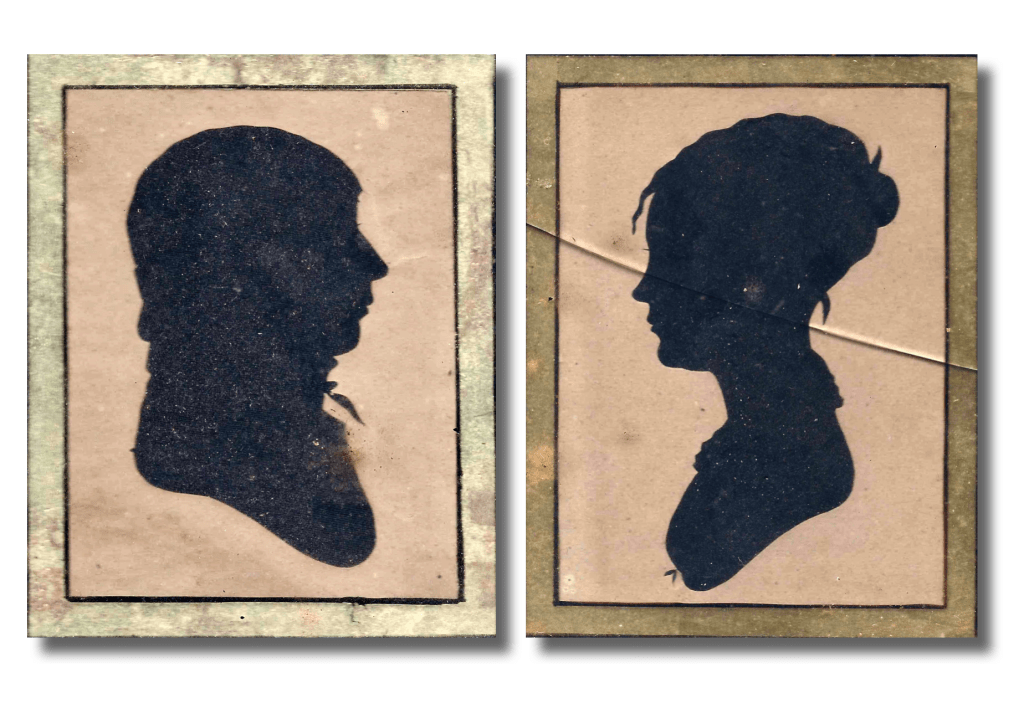
Silhouette Images of Mark Dennett (1786-1883) and his wife Alice Wilson (1785-1819). The couple were married in 1808 so these silhouettes may have been made about that time. Both were born and died in Kittery, York county, Maine.
In the 1860s, Samuel Badger Neal of Kittery, York county, Maine began to conduct interviews with some of the older members of his community, thinking to record some oral history of the area before it was lost. He recorded their stories on stationery, some bound, some not, and kept them bundled together with a string thinking, perhaps, he might someday publish them. He did not. He passed away and they were handed down to a niece or nephew who slapped a note on the pile which read, “Most of these are Uncle Sam’s gossipy notes on early Kittery.” They were indeed, and while some of the recorded stories are of limited historical significance, there are nuggets of information buried within them that would likely be of keen interest to historians of the area and particularly Kittery—the oldest settlement in Maine.
Samuel (“Sam”) Badger Neal (1842-1901) was the son of John Robert and Anna Maria (Badger ) Neal. He was born in Portsmouth, New Hampshire, on 29 April 1842 and fitted for college at Phillips Exeter Academy. He graduated from Harvard College in 1864 and the following year entered the NH National Bank of Portsmouth as a cashier. He then went to New York as a salesman in the coal business, to Boston as a bookkeeper, and then as a coal salesman. He suffered from ill health and lived with his parents in Kittery for a while, managing his father’s coal business. He lived until 1901. He was found dead in his stable, having been knocked down and trampled by his horse.
1863 Interview of William Dennett (1786-1883)
One of Sam’s first interviews was with Mark Dennett (1786-1883), the son of William Dennett (1739-1803) and Mary Adams. Mark was born in Kittery, Maine, Aug. 28, 1786, died April 30, 1883. Among Mark’s personal papers is found a record of some events in his early life, written by himself in which he says:
“In early boyhood I hated school, until about nine years old, when my fancy changed and I like the school and began to stand at the head of my class. Our school privileges were very limited. I attended to nothing at school but reading, spelling and writing until I was thirteen years old; but I progressed in the old arithmetic at home under the instruction of my father and brother, to the rule of three. At thirteen years I commenced the arithmetic at school, and during the winter term I mastered about one-half Merrill’s Arithmetic. In the spring of 1800, at a short term of six weeks of Grammar School, I progressed in English Grammar so that I could parse simple sentences. In September a term of Grammar School commenced, and I attended to the study of Latin, and during the winter I advanced into Virgil and Cicero. In the spring my father said that I must help him on the farm. In the winter of 1801-2, there was no Grammar School, and I mastered the last half of the arithmetic. In the winter of 1802-3 I studied Latin at home and recited my lessons once a week with Rev. William Briggs. Oct. 25, 1803, my father died, and the care of the farm devolved on me, and I was thus deprived of school privileges. During the winter of 1803-4 I devoted every spare hour by day and very long evenings to the study of Greek, and in December, 1804, I received a certificate of qualification for teaching in the Grammar School from three ministers who were college graduates. Jan. 1, 1805, at the age of eighteen, I commenced teaching the Grammar School in Kittery, and excepting two or three years (when otherwise employed) I continued to do so several months each year until I was sixty years old, when my hearing failed and I declined the service. In 1807, my mind being religiously impressed, I was baptized and joined the Christian church, of which act I never repented.”
Mr. Dennett was much interested in local history, and was an honored leader in the town of Kittery. He was selectman seventeen years; deputy to the general court of Massachusetts from 1814 to 1819 inclusive, and a member of the first legislature of Maine. He was state senator several times, justice of the peace, and captain and major of the militia. He married (first) Dec. 22, 1808, Alice, daughter of Edward Wilson. She was born Sept. 22, 1785, died Feb. 4, 1819. He married (second) May 4, 1820, Miriam Pettigrew, born Dec. 12, 1802, died Aug. 10, 1881.
Children of 1st wife: 1. Augustus, born Oct. 17, 1809, died Dec. 30, 1811. 2. Alexander, born Nov. 10, 1811, mentioned below. 3. Betsey, born Sept. 19, 1817, died Nov. 18, 1841. 4. Son, born & died Feb. 3, 1819. Children of 2d wife: 5. Alice, born May 24, 1821. 6. Sylvester, born Nov. 26, 1822, died Aug. 30, 1847. 7. Sarah, born April 29, 1824, died Feb. 21, 1844. 8. Charles W., born Feb. 15, 1826, died April 6, 1847. 9. Julia Ann, born Jan. 21, 1828, died Nov. 29, 1903; married (first) a Mr. Clough; married (second) Nov. 10, 1858, Joseph Langton. 10. Mary, born Jan. 2, 1830, married Burlinton Paul; died March 22, 1863. 11. Mark Jackson, born April 22, 1834, died July 15, 1856. 12. John, born July 31, 1836, died May 12, 1838. 13. Oren, born Jan. 9, 1839, died Aug. 14, 1859. 14. Emily, born June 22, 1841, died Feb. 13, 1857. 15. Louisa, born Jan. 15, 1844, died June 17, 1847.
Interview 1
May 26, 1863
Major Mark Dennett recollects the time when there was only one tree on Navy Yard Island and that one in front of the Commodore’s house, a very large fine tree—something like the oak on Boston Common.
His brother owned the yard. He purchased it about 1790 or 4. The island was then destitute of trees but Dennett planted some apple trees.
Dennett sold the island for about $5000 to the government. His wife was not satisfied with the sum he obtained and demanded $500 more and got it. Dennett might have received twice as much for it but he was afraid to ask too much for Gov. [John] Langdon [of New Hampshire] was then trying hard to sell Badger Island to the commissioners who were to decide upon the location of the yard. 1
Navy Yard Island drawn in 1800 (formerly Dennett’s Island)—the tree is depicted in the center of the island.(History of the US Navy Yard, Portsmouth, N. H.)
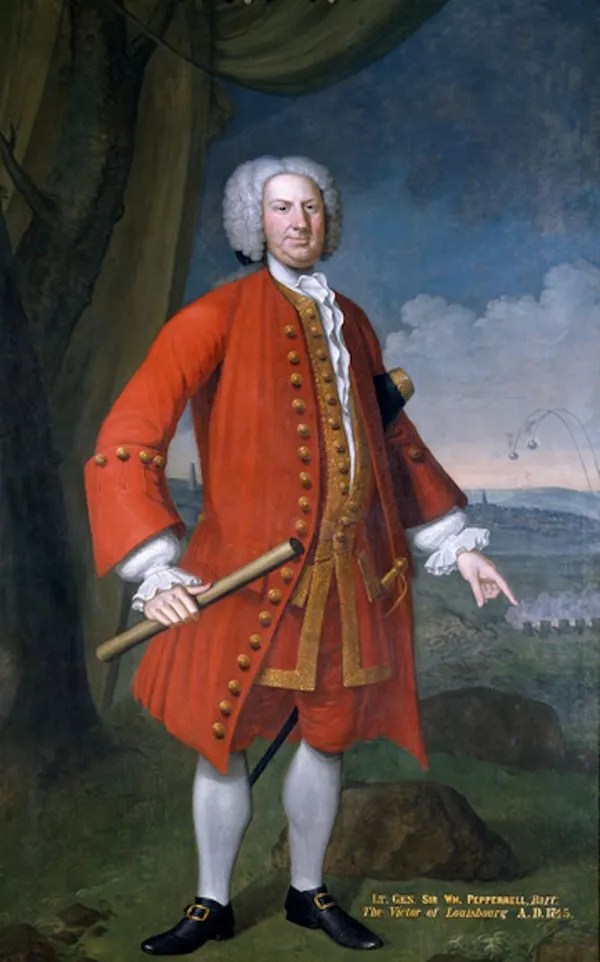
Sir William Pepperell
Sir Wm. Pepperell [who died in 1759].
Dennett’s grandfather was acquainted with [William] Pepperell and once went down to see him. His grandfather was a very tall man and as he went out of the door, which as can still be seen was very low, he struck his head against the top and loudly upbraided Pepperell for his low door. But Pepperell, drawing himself up to his full height (he was a short man) stood in the doorway and said, “There, is not this door high enough for a man to stand in?” Dennett had said to him, “Why don’t you have your door high enough for a man to stand up in?” Dennett was then a little overcome with the effects of of the liquor.
Two gentlemen were once going on the way to Saco with Pepperell. One of them was named Goodwin, the other —-? All went armed for the country was sparsely settled and Saco woods were a fit haunt for evil characters. Goodwin told Pepperell that he could disarm him. Pepperell wished him to try it. Goodwin dropped the subject and a little while after when it had escaped the mind of Pepperell, he suddenly went behind him (they were on horseback) and slyly drew his pistol from his belt. Pepperell was highly offended as he thought it disgraceful for an old soldier to be disarmed in that way. They made all up over a glass of punch probably.
Sir William Pepperell at the Siege of Louisbourg, Cape Briton Island, 1745, during King George’s War
1 The Portsmouth Naval Shipyard (PNSY) was established in 1800 when the U.S. government purchased Fernald’s Island (a.k.a. Dennett’s Island) in the Piscataqua River between Kittery and Portsmouth. In 1825, a bridge was built from Kittery to PNSY. In 1826, PNSY expanded to Seavey’s Island. In 1847, the side-wheel steam frigate USS Saranac, was built there.
Interview 2
September 1, 1863
This afternoon I had an interview of an hour or two with Mr. Dennett. I wished to obtain some information of the situation of Trafton’s Ferry near is the house of Thomas G___, the son of Ferdinand. Trafton’s Ferry is near the bridge which leads to York. 1
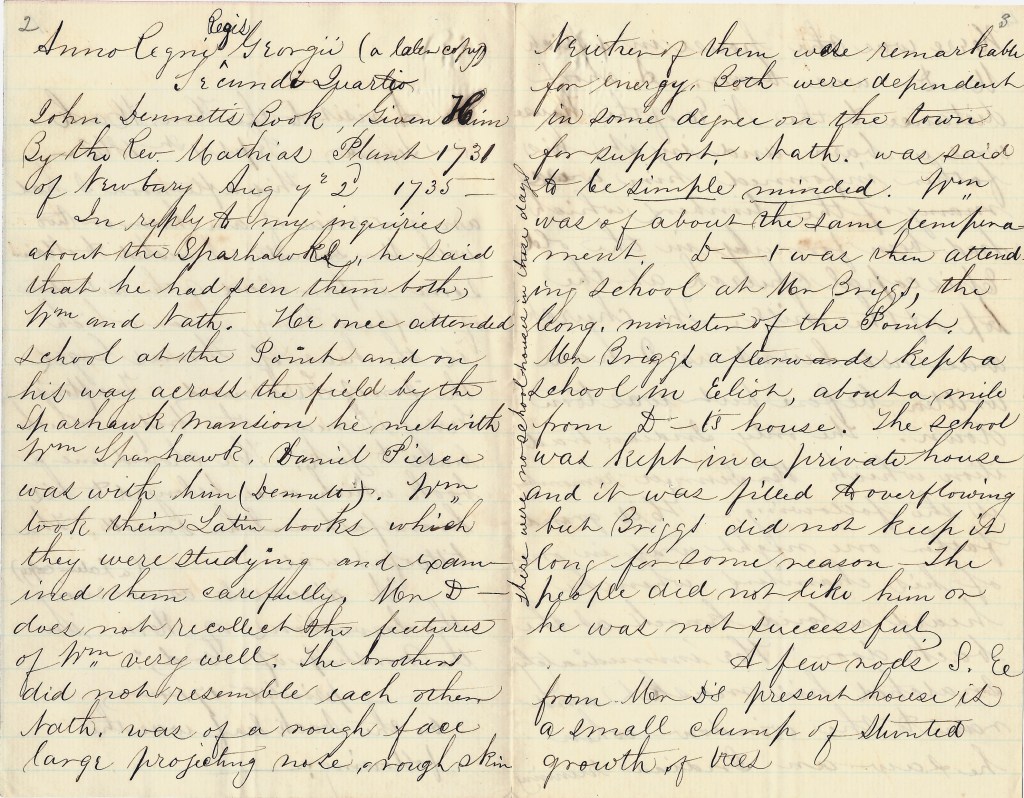
He showed me a book which once belonged to his Grandfather John Dennett [1708-1797]. The little of it was, “A discourse concerning the Inventions of Men in the Worship of God.” Printed 1714. On the back leaf was the following: “Anno Cegni Regus Georgii (a later copy) Secundi Quarto. John Dennett’s book, given him by the Rev. Mathias Plant 1731 of Newbury August 2d 1735.
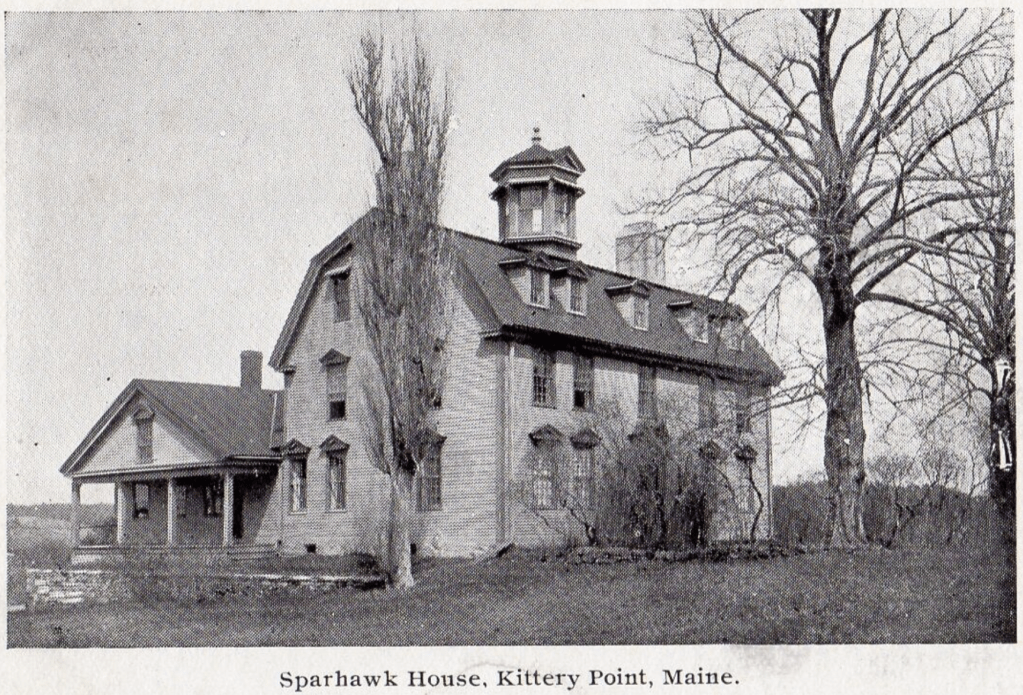
In reply to my inquiries about the Sparhawks, he said that he had seen them both, William and Nathaniel. He once attented school at the Point and on his way across the field by the Sparhawk mansion he met with William Sparhawk. Daniel Pierce was with him (Dennett). William took their Latin books which they were studying and examined them caregully. Mr. Dennett does not recollect the features of William very well. the brothers did not resemble each other. Nath. was of a rough face, large projecting nose, and rough skin. Neither of them was remarkable for energy. Both were dependent in some degree on the town for support. Nath. was said to be simple minded. William was of about the same temperament.
Dennett was then attending school at Mr. Briggs, the Congregational minister of the Point. Mr. Briggs afterwards kept a school in Eliot about a mile from the Demmett’s house. The school was kept in a private house and it was filled to overflowing but Briggs did not keep it long for some reason. The people did not like him or he was not successful.
A few rods southeast from Mr. Dennett’s present house is a small clump of stunted growth of trees. Here was the house in which Mr. Dennett was born. A short distance to the northeast of the house was a barn and in it, his father informed him were many of the timbers which had been formerly in the old Episcopal Church at the top of the hill. The church was not burnt as I have written before, but was torn down.
The only Indian tradition which Mr. Dennett remembers is the following. His grandfather one night was in one of his chambers when he heard a loud knock at the back door. He immediately snatched his musket and ran to the window when he saw an Indian running over the field at the back of the house at the top of his speed.
The house was used as a garrison house and families frequently flocked to it in time of danger. 2 There is an old house by the brick kiln which formerly stood by Mr. Dennett’s house. It was inhabited by a family of the name of —–. It is about as old as the Dennett House. At one time there was an attack threatened by the Indians. All of the family came over to the Dennett House with the exception of the old lady—the grandmother. “She was not afraid of the Indians and would not leave the house for them.” She was a little frightened, however, and towards the latter part of the night, she grew very fearful and anxious. She heard footsteps approaching and she cautiously looked out of the window fearing the worst but she found that the noise was made by a squad of men who were going by in pursuit of the Indians. The old lady was not so courageous but that she sat up all night carding flax. Mr. Dennett says that the hill in front of his house was 70 years ago as thickly settled as it is now.
He showed me a letter written by the wife of Mr. Eveleth about 7 years after his death [dated 5 September 1743] …The letter was written on a piece of paper of this size or a little less in a very compact form. The old lady was in difficult circumstances at this time. This letter and the book are the only remains of the family Mr. Dennett knows of.
1 Trafton’s Ferry on the York River operated at the site of Rice’s Bridge on Route 1 and replaced the Stiver ferry because a new road to Kittery and Portsmouth had been created at this location. I began operation in 1688 by the Freethy family and was tubsequently operated by the Trafton family.
2 In 1698, John Dennett (Mark’s grandfather) bought land in Kittery for a garrison homestead to protect his family from attacks (house no longer stands). A garrison house was built of heavy timbers and often had an overhanging second floor.