All posts by Griff

My passion is studying American history leading up to & including the Civil War. I particularly enjoy reading, transcribing & researching primary sources such as letters and diaries.

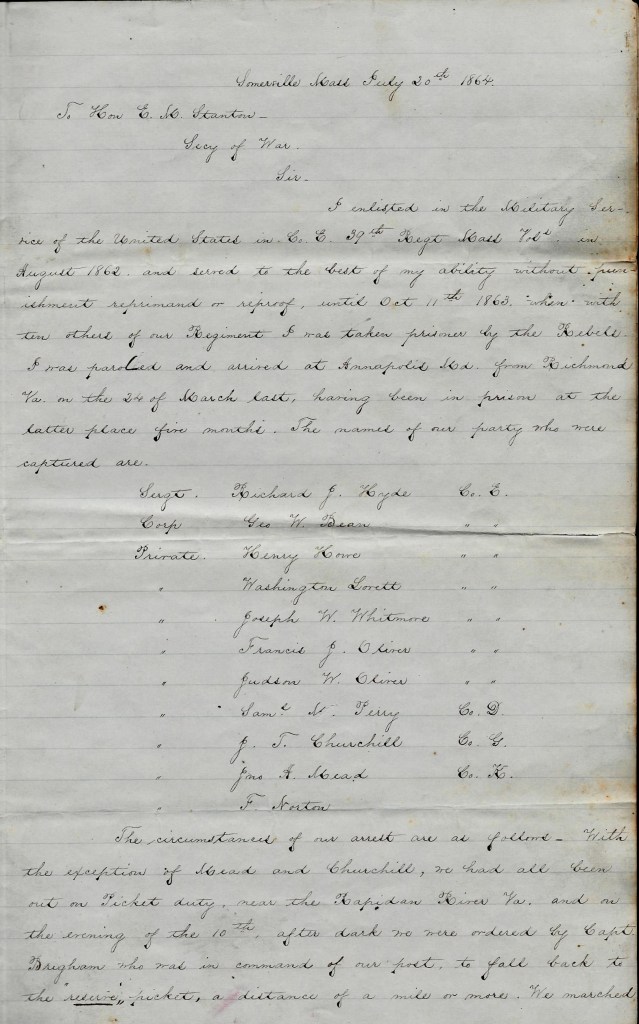
1864: Judson Wayland Oliver to Edwin M. Stanton

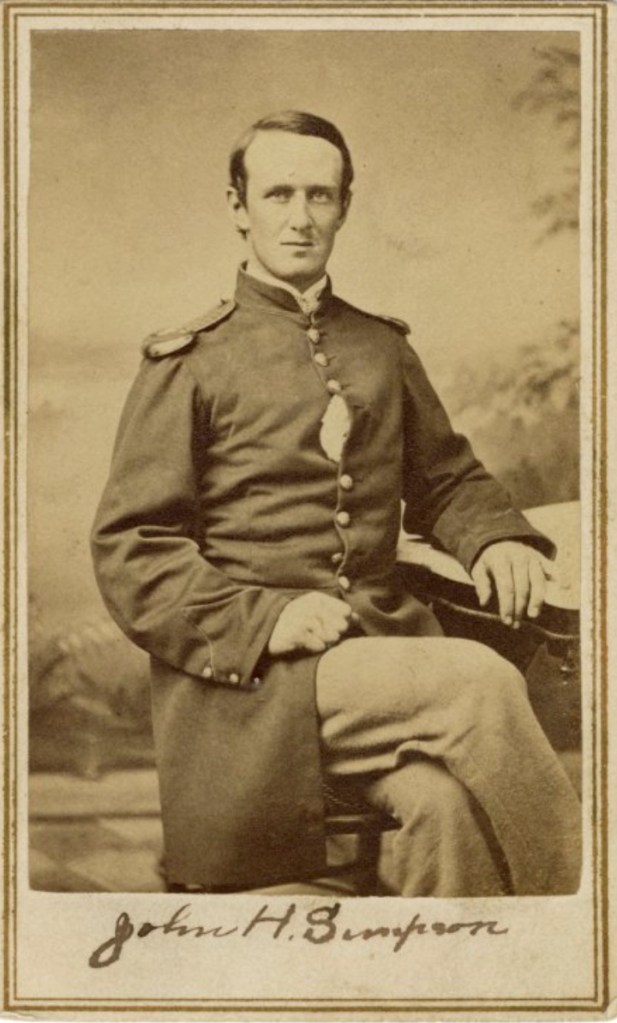
I could not find an image of Jud dating to the time he was in the Civil War but here is one of John H. Simpson of Co. C, 39th Massachusetts Infantry (Photo Sleuth)

The following letter, addressed to Secretary of War, Edwin M. Stanton, was penned by Judson (“Jud”) Wayland Oliver (1832-1908) of Co. E, 39th Massachusetts Infantry. As he states in his letter, he was taken a prisoner of war near the Rapidan River on 10 October 1863 and held in prison on Belle Island in Richmond through the winter of 1863/64 until exchanged after five months. After more time regaining his health in Union hospitals, he was returned to his regiment where he remained until taken prisoner again in February 1865 at Hatcher’s Run. He was exchanged not long after and mustered out in June 1865.

Judson was the son of William Oliver, Jr. (1795-1880) and Lydia Neagles (1810-1890) of Somerville, Middlesex county, Massachusetts. He was married in 1853 to Sarah Fessenden Hobart (1836-1878) and was the father of two children born before the Civil War began; three more after the close of the war.

Prior to Jud’s capture in October 1863, the 39th Massachusetts had spent the entire previous year performing guard duty in the defenses of Washington D. C., on the upper Potomac River, and near Harper’s Ferry. They were advanced to the Rapidan river and posted there in August and September 1863, but were pulled back to join other commands for the Bristoe Campaign. It was during this retreat from the Rapidan that Jud and the others in his squad were captured by rebel cavalry.
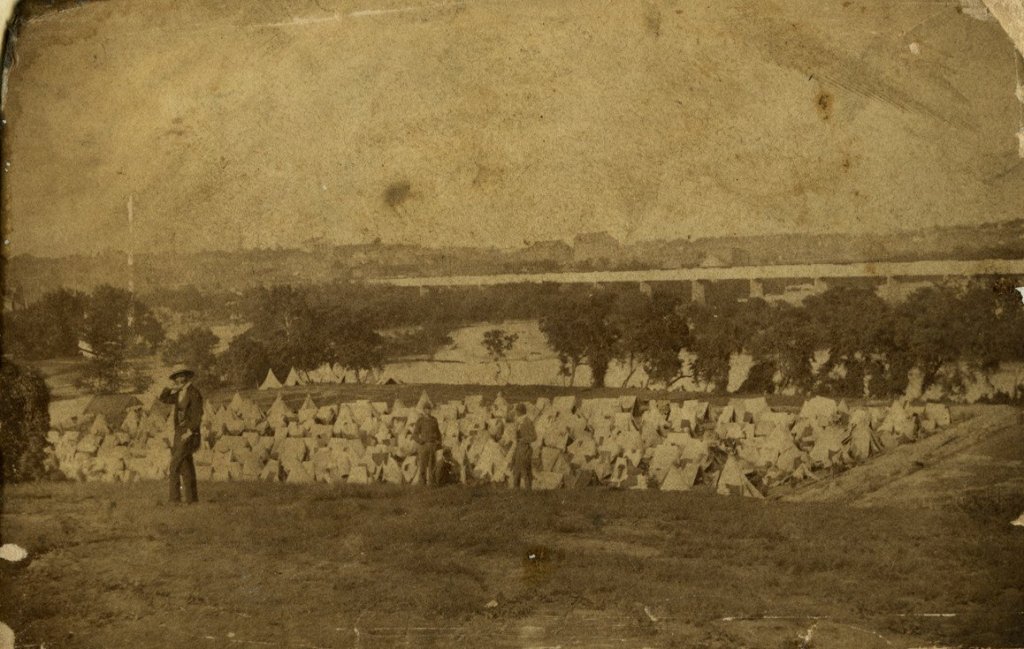
A rare Confederate photograph taken in the field shows tents where Union prisoners of war were housed on Belle Isle, an open-air prison located on an island in the James River across from Richmond. The photographer, Charles R. Rees, took the image from a high point on the island; in the distance, at center left, is the Capitol.

Transcription

Somerville, Massachusetts
July 20th 1864

To Hon. E. M. Stanton, Secretary of War
Sir,

I enlisted in the military service of the United States in Co. E, 39th Regt. Massachusetts Volunteers in August 1862 and served to the best of my ability without punishment, reprimand, or reproof until October 11th 1863 when with ten others of our regiment I was taken prisoner by the rebels. I was paroled and arrived at Annapolis, Maryland, from Richmond, Va., on the 24th of March last, having been in prison at the latter place five months. The names of our party who were captured are:

Sergt. Richard J. Hyde, Co. E
Corp. George W. Bean, Co. E
Private Henry Howe, Co. E
Private Washington Lorett, Co. E
Private Joseph W. Whitmore, Co. E
Private Francis J. Oliver, Co. E
Private Judson W. Oliver, Co. E
Private Samuel M. Perry, Co. D
Private J. T. Churchill, Co. G
Private Jno. A. Mead, Co. K
Private F. Norton

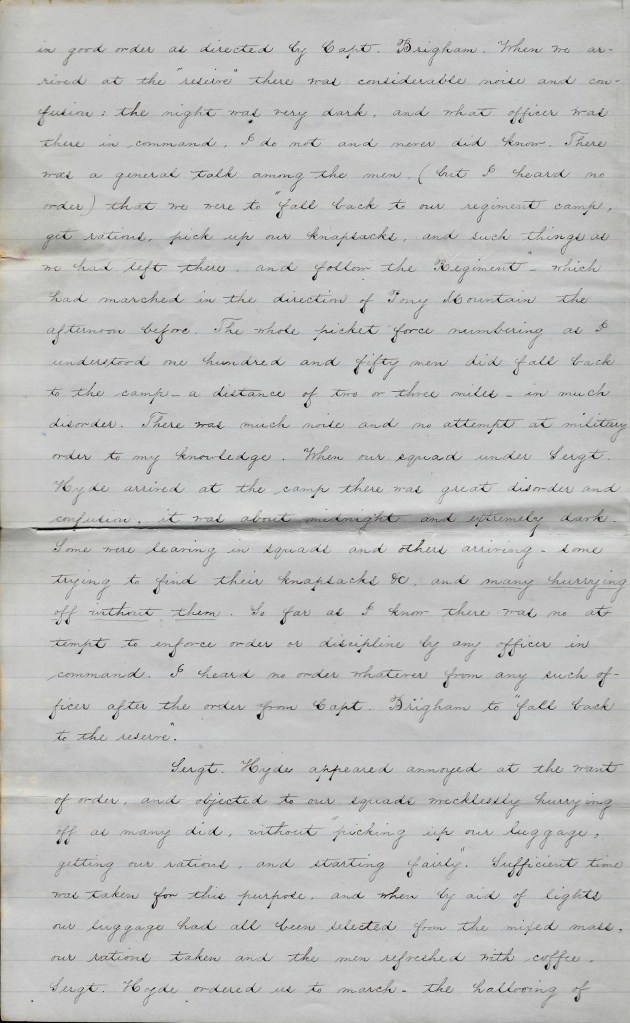
The circumstances of our arrest are as follows. With the exception of Mead and Churchill, we had all been out on picket duty near the Rapidan River, Va., and on the evening of the 10th, after dark, we were ordered by Capt. Brigham who was in command of our post, to fall back to the reserve picket, a distance of a mile or more. We marched in good order as directed by Capt. Brigham. When we arrived at the “reserve,” there was considerable noise and confusion. The night was very dark and what officer was there in command, I do not and never did know. There was a general talk among the men (but I heard no order) that we were to “fall back to our regiment camp, get rations, pick up our knapsacks, and such things as we had left there, and follow the regiment which had marched in the direction of Pony Mountain the afternoon before. The whole picket force numbering as I understood one hundred and fifty men did fall back to the camp—a distance of two or three miles—in much disorder. There was much noise and no attempt at military order to my knowledge.

When our squad under Sergt. Hyde arrived at the camp, there was great disorder and confusion. It was about midnight and extremely dark. Some were leaving in squads and others arriving, some trying to find their knapsacks, &c., and many hurrying off without them. So far as I know, there was no attempt to enforce order or discipline by any officer in command. I heard no order whatever from any such officer after the order from Capt. Brigham to “fall back to the reserve.”

Sergt. Hyde appeared annoyed at the want of order and objected to our squad’s recklessly hurrying off as many did, without “picking up our luggage, getting our rations, and starting fairly.” Sufficient time was taken for this purpose and when by aid of lights our luggage had all been selected from the mixed mass, our rations taken, and the men refreshed with coffee, Sergt. Hyde ordered us to march, the hallooing of those who had already gone, being still within our hearing through the woods. Privates J. T. Churchill and John A. Mead were still at the camp with us, but had not been on picket duty. Mead had been left by the regiment in charge of the rations as he said, and Church had been left behind with a written permit to “follow the regiment as best he could, as he was sick.”

I had been sick all the day before and had on that account been excused from duty on that night by Capt. Brigham who had given me medicine when I turned in early in the evening. This medicine affected me disagreeably and I was quite sick and exhausted when we arrived at the camp. I had wrapped myself in my blanket and laid down on arriving there and one of my comrades searched out my luggage for me.

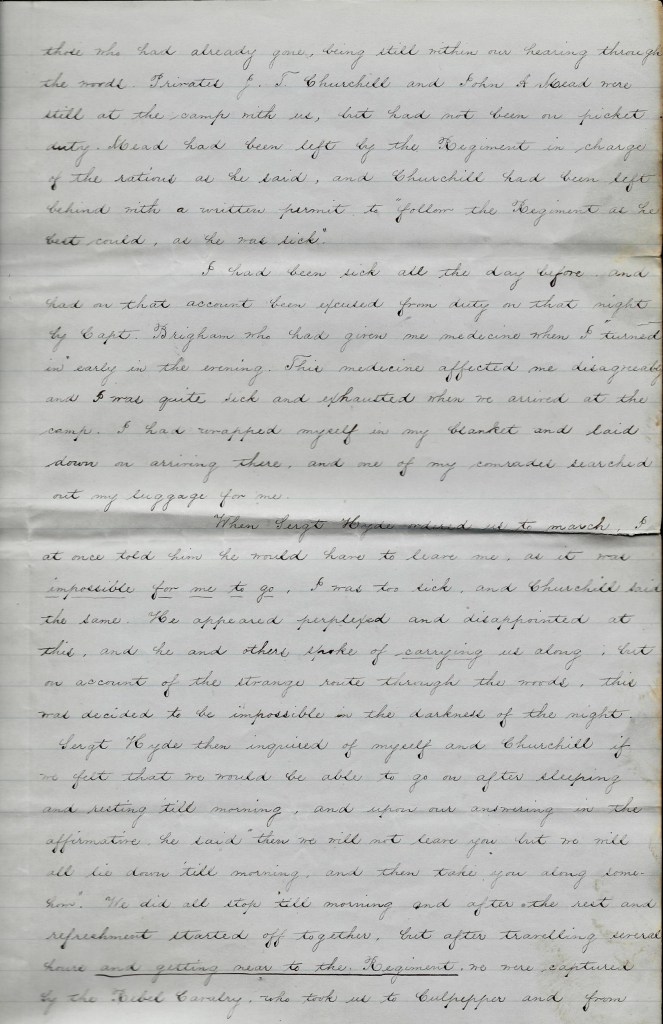
When Sergt. Hyde ordered us to march, I at once told him he would have to leave me as it was impossible for me to go. I was too sick and Church said the same. He appeared perplexed and disappointed at this, and he and others spoke of carrying us along, but on account of the strange route through the woods, this was decided to be impossible in the darkness of the night. Sergt. Hyde then inquired of myself and Churchill if we felt that we would be able to go on after sleeping and resting till morning, and upon our answering in the affirmative, he said, “then we will not leave you but we will all lie down till morning, and then take you along somehow.” We did all stop till morning ad after the rest and refreshment, started off together. But after traveling several hours and getting near to the regiment, we were captured by the rebel cavalry who took us to Culpeper and from there to Richmond.

While we were at Culpeper, Private Charles A. Spaulding of Co. G of our regiment was brought there a prisoner and was taken to Richmond with us, but where or under what circumstances he was taken, I do not know. He was not on picket duty to my knowledge and he was not of our party till he was brought into Culpeper the day after we were captured.

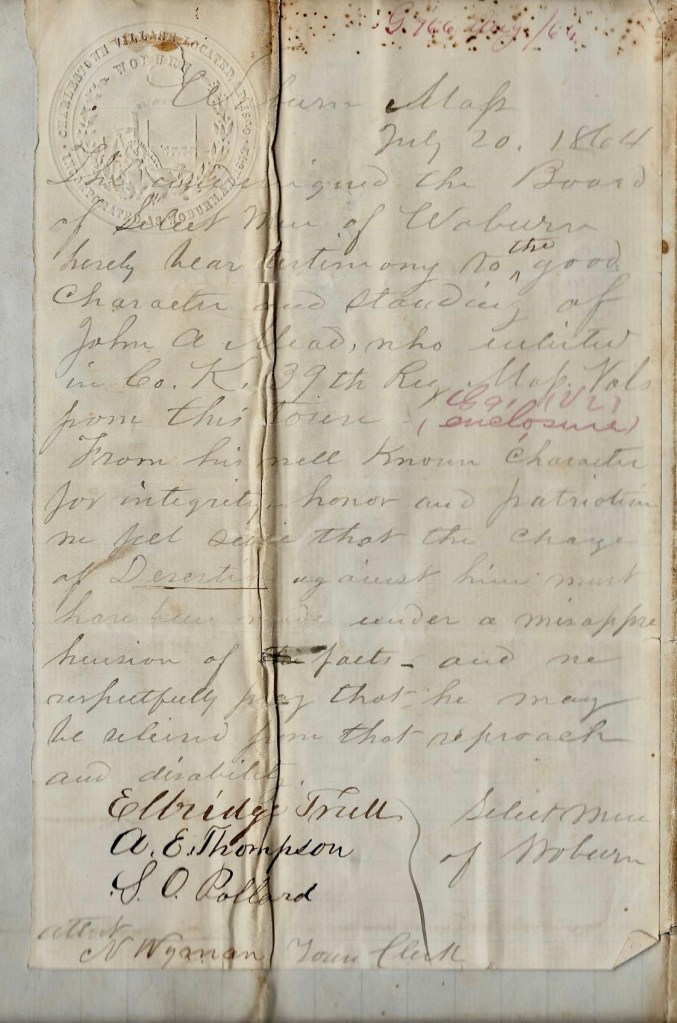
Our privations and sufferings in Richmond (from which Private Henry Howe died in December) were probably as extreme as those of an of our Union prisoners. I was sick and considered beyond the hope of recovery for some weeks in February and early in March and on getting out of the hospital but a short time before being paroled, I learned that the rest of my comrades of the 39th Regiment except Mead—who was also paroled—had been sent to Columbus, Georgia. Since I was paroled, I have been in the hospital at Annapolis and Annapolis Junction, Maryland, and Mason Hospital [in] Boston, and a furlough and “Pass” till the present time. Myself and unfortunate comrades are branded on the return rolls or “reports” of the regiment as “Deserters” and this as I am informed for the reason that we did not leave the regimental camp and follow the regiment more promptly.

I have nothing to add to what I have already said in regard to those circumstances and the want of military order and command except to declare that insubordination or wrong doing was wholly and entirely foreign from the intent and purpose of anyone of us. From what we heard of the requirement of the picket force (in absence of any actual order), we were fully impressed with the belief that to collect and carry along our knapsacks and spare luggage was but to do our duty and that to recklessly hurry off without taking this property was to violate our duty. This was Sergt. Hyde’s honest feeling in the matter and he so avowed in presence of some who left their knapsacks behind, and I most solemnly declare that I believe he would have started with his squad and followed the regiment that night, after having collected the luggage as before described, but for the impossibility of taking Churchill and myself along with them. I feel that my sickness and that of Churchill was really the cause and the only cause of the others remaining till morning, and that while it was the feeling of humanity which induced Sergt. Hyde to remain, neither that nor any other impulse or motive would have induced him to violate any known military order.

Our hardships, privations, and sickness in Belle Isle prison, grievous as they were, were mild compared with the sufferings of myself and comrades in the feeling that we are branded as the worst of criminals and our dependent families thereby deprived of all legal aid and support. I refer with confidence to my company officers, and to the entire regiment for the previous good conduct of our squad and our standing as dutiful, trustworthy soldiers, and I respectfully pray that we may be relieved from this reproach and disability, and restored to our former standing and position in the regiment, so far as this charge is concerned.

—Judon W. Oliver

In the presence of Charles S. Lincoln [Justice of the Peace, Somerville, Mass.]
1861-63: Aaron Jehiel Rayner to William Henry Rayner

I could not find an image of either Jeheiel or Frederick but here is a tintype of Russell Towsley who served in Co. C, 7th Michigan Infantry wearing his early war uniform (Ancestry.com)

The following letters were written by Aaron “Jehiel” Rayner (1841-1919) of Co. B, 7th Michigan Infantry. The first letter includes a part written by Frederick R. Searl (1843-1874) of the same company.

Jehiel was the son of John Raynor (1804-1879) and Emily Meech (1817-1873) of Mason, Ingham county, Michigan. He enlisted in the 7th Michigan on 22 August 1861 and was discharged at Petersburg, Virginia, on 22 August 1864 after three years service. His 1919 obituary states that Jehiel saw “much active service, being engaged in a number of important battles such as Fair Oaks, Antietam, Gettysburg, and numerous smaller engagements. While in the service he had many close calls, but was never seriously wounded, although his horse was killed under him at Spotsylvania.” [Not sure why an infantryman would have been riding a horse unless he was on a special detail.]

Frederick R. Searl was the son of Elisha Randal Searl (1809-1879) and Martha Hurd (1815-1862) of Mason, Ingham county, Michigan. He enlisted with Jehiel in August 1862 in Co. B, 7th Michigan and was wounded on 31 May 1862 in the Battle of Fair Oaks, Virginia. The would was so severe that his right arm had to be amputated, necessitating his discharge for disability on 18 July 1862. He died twelve years later.

The letters were addressed to Jehiel’s older brother, William Henry Rayner (1836-1905) of Mason, Ingham county, Michigan.

To read another letter written from Camp Benton by Roger Noble of the 7th Michigan Infantry written on 28 October 1861, see Roger Noble Letter-October 28, 1861. MSU Libraries.

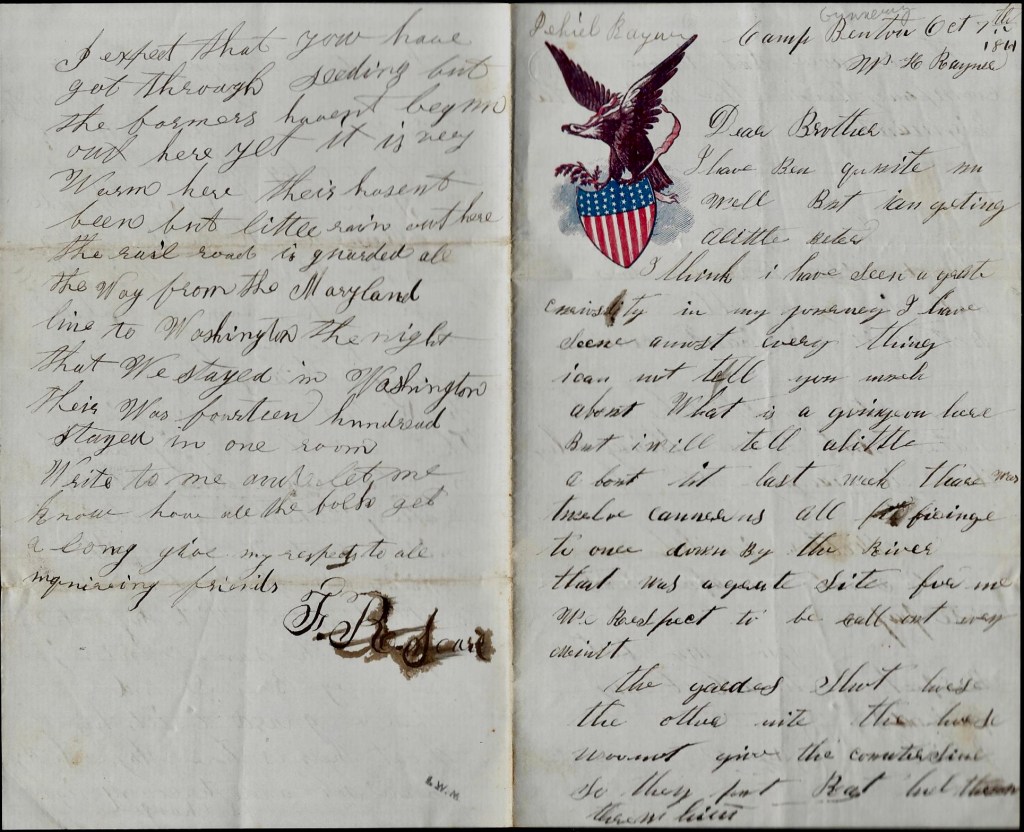
Letter 1

This letter was written from Camp Benton on the Maryland side of the Upper Potomac. The 7th Michigan was brigaded with several Massachusetts regiments known as Lander’s Brigade. It was penned just two weeks prior to the Battle of Ball’s Bluff. Fortuitously, the 7th Michigan did not participate in this federal disaster because it was deemed “unfair to put them into battle with the poor arms they had.” These “poor arms” were converted Belgian flintlocks that were very unreliable and inaccurate. Before the end of the year they were provided with Springfield rifled muskets.

Camp Benton
October 7, 1861

Dear Brother,

I have been quite unwell but I am getting a little better. I think I have seen a great curiosity in my journey. I have seen almost everything. I cannot tell you much about what is a going on here but I will tell a little about it. Last week there was twelve cannons all firing at once down by the river. That was a great sight for me. We expect to be called out every minute.

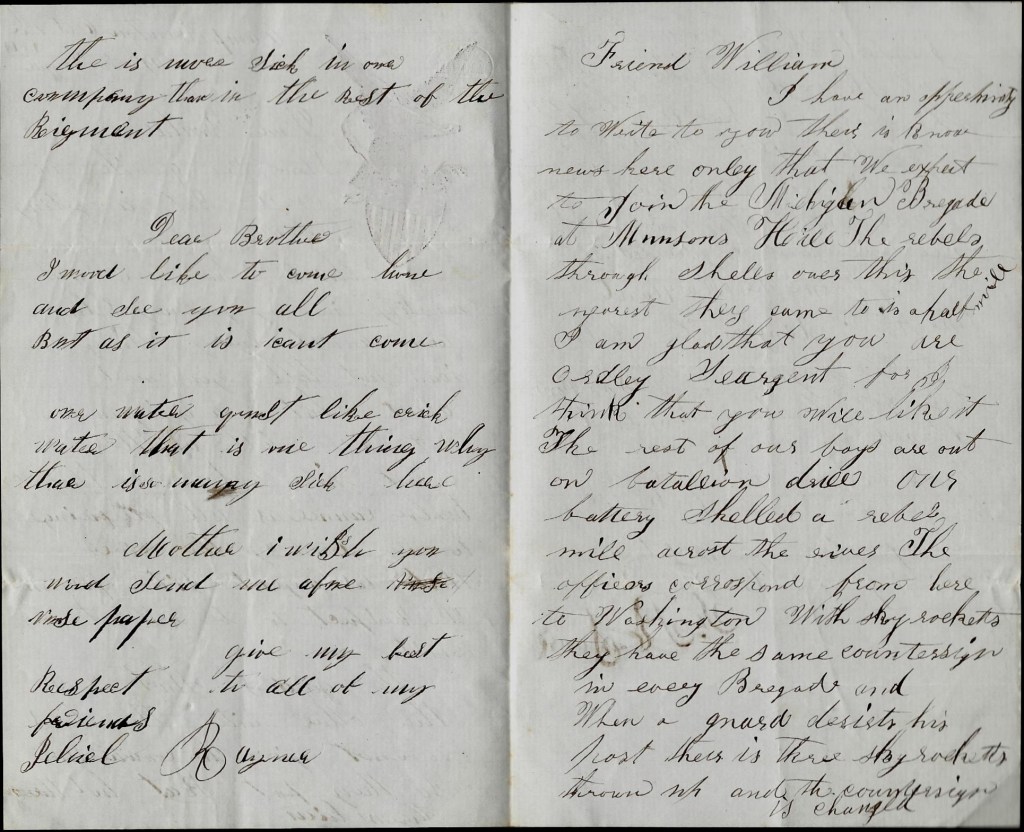
The guards shot twice the other night. The [ ] wouldn’t give the countersign so they shot but [did not get] him. There is more sick in our company than in the rest of the regiment.
Dear brother, I would like to come home and see you all but as it is, I can’t come.

Our water [is] just like crick water. That is one thing why there is so many sick here.

Mother, I wish you would send me a few newspapers. Give my best respects to all of my friends, — Jehiel Rayner

Friend William

I have an opportunity to write to you. There is no news here only that we expect to join the Michigan Brigade at Munson’s Hill. The rebels throw shells over this. The nearest they came to [us] is a half mile. I am glad that you are Orderly Sergeant for I think that you will like it. The rest of our boys are out on Battalion Drill. Our battery shelled a rebel mill across the river. The officers correspond from here to Washington with sky rockets. They have the same countersign in every brigade and when a guard deserts his post, there is three sky rockets thrown up and the countersign is changed.

I expect that you have got through seeding but the farmers haven’t begun out here yet. It is very warm here. There hasn’t been but little rain out here. The railroad is guarded all the way from the Maryland line to Washington. The night that we stayed in Washington there was fourteen hundred stayed in one room.

Write to me and let me know how all the folks get along. Give my respects to all enquiring friends. — F. R. Searl

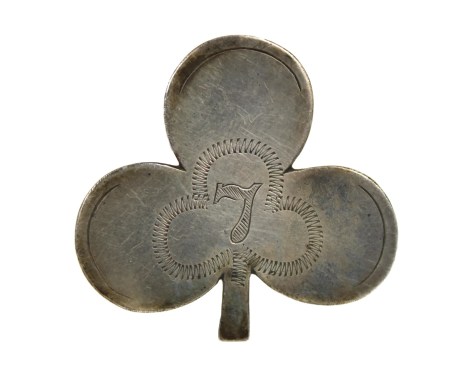
The Corps Badge of the 7th Michigan Infantry from later in the war.

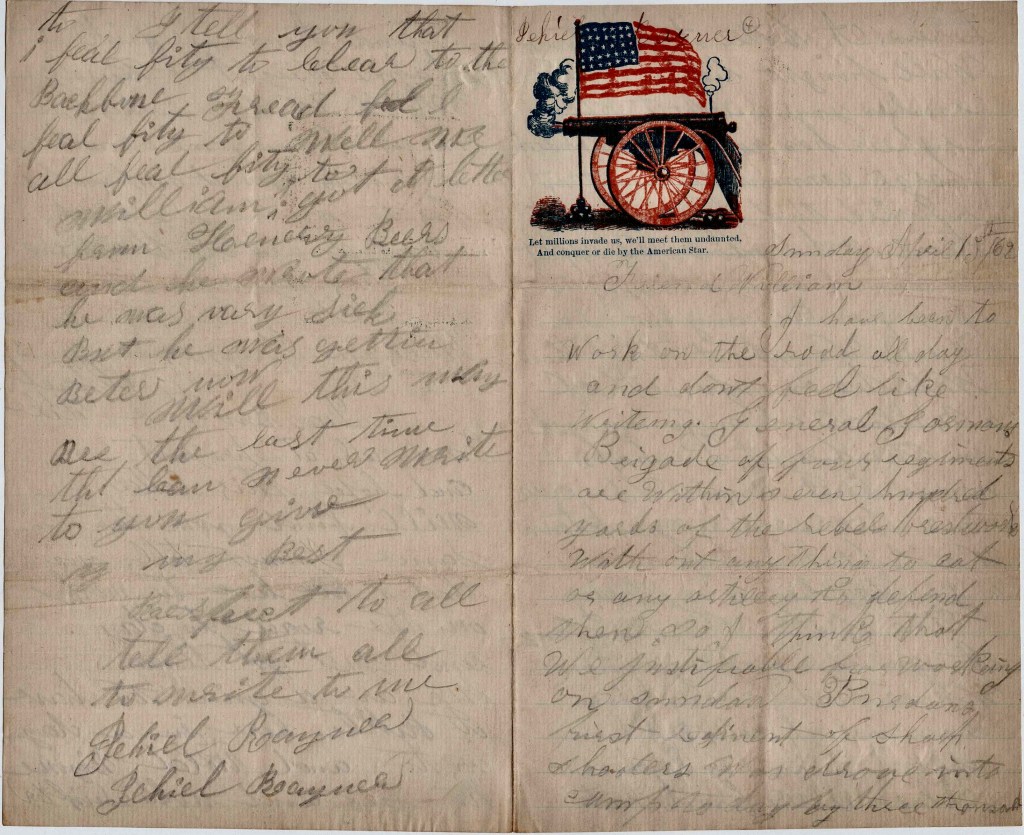
Letter 2

Sunday, April 13th 1862

Friend William.

I have been to work on the road all day and don’t feel like writing. General Gorman’s Brigade of four regiments are within seven hundred yards of the rebels’ breastworks without anything to eat or any artillery to defend them so I think that we [are] justifiable for working on Sunday. Berdan’s First Regiment of Sharpshooters was drove into camp by three thousand rebels. A battle at Yorktown will [be] fought before this reaches you, I expect. The rebels has got five hundred large cannons there. It is reported that Jeff Davis is there & Johns[t]on. We expect to march on Yorktown tomorrow [but] we may not in a week. We expect that there will be one-fourth of a million of men engaged in the fight.

Perhaps you don’t know where we are but we [are] near Yorktown. We left Fortress [Monroe] a week ago day before yesterday. The battle will be fought on the same ground where Lord Cornwallis surrendered in 1776. [should be 1781]

I have seen Charley Rhodes & Alva Welles & Frank Feits & Ambrose Irish & John Wright & Burdy Hill. Write whether you hear from me or not for it is almost impossible for to write. We sleep outdoors all the time. From your friend, — Fred [R. Searl]

To William Rayner

[In a different hand]

April 13th

Dear Brother,

I am well at present and hope this letter will find you the same. I must tell you that I have to work on the road today and just got through. We are a goin’ to have a battle here in a day or two and a big one too….

Well, this may be the last time that I can write to you. Give my best respects to all. Tell them all to write to me. — Jehiel Rayner


Letter 3

Camp near Culpeper [Va.]
September 30, 1863

Dear Brother,

I now take the opportunity to write you a few lines to let you know that I am well at present and hope these few lines will find you the same. I must say that I hain’t had a letter from you in some time. I would like to know why you don’t write to me oftener. Now, Will, I wish you would try to write to me once a month if you please.

I can’t think of much to write to you this time but can say that the Rebels are a coming into our lines every day. they come one and two at a time. They was two come over last night and they give is some very important news. I must say that I like to see them come over. Why? Because when one comes over, that is one less to fight.

The report is this morning that they was seven hundred came over last night upon the right. I hope it is so. I guess Old Lee will lose the whole of his army if he don’t look out. Them that come over last night said that they had to keep double pickets on every night so as to keep them from running away. I guess that is so.

Mr. Wm. H. Rayner, I will send you in this letter twenty dollars. I wish you would write as soon as you get it so as to let me know if you get it or not. If you get it, I will send you twenty more right off. We got pay the other day and I have got forty dollars that I want to send home to you. This is all at present. Give my best respects to all. This is from A. J. Rayner

Will, I want you to give H. H. Beers three dollars for me that I owe him. I think that is all that I owe him. You ask him how much I owe him and then pay him and then let me know how much it is and then I will pay. Will, I want you to let me know how much I owe you and then I will send it home to you. You must know what I mean—the money that I borrowed from you. — Jehiel Rayner

1862: Sanford Troop to Kinyon Terry

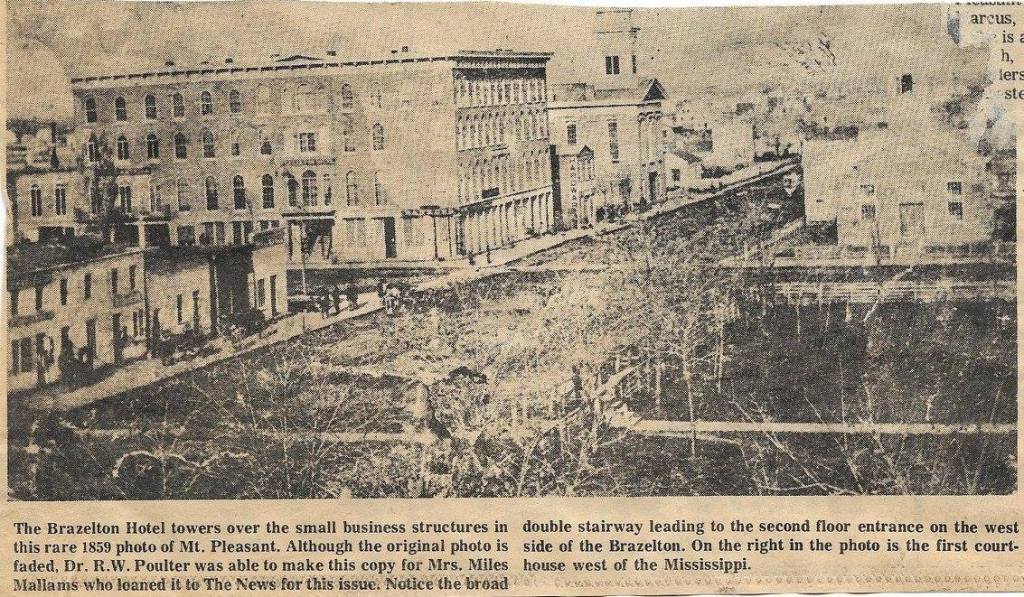
I can’t be certain of his identity but I believe this letter may have been written by Sanford Troop (b. 1832), a native of New York State, who’s brother was a merchant in Mt. Pleasant, Henry county, Iowa. They were enumerated together in the same household in the 1860 US Census at Mt. Pleasant. Perhaps he was a buyer for his brother’s store which would explain his knowledge of commodity prices and the necessity of his traveling around Iowa.

He wrote the letter to his cousin who I believe was Thomas “Kinyon” Terry (1834-1900 of Norwich, Chenango county, New York. Kinyon was married to Lucy “Elvira” Gleason (1842-1866) in 29 August 1861 in Broome county, New York.

Transcription

Iowa City, [Iowa]
January 5th 1862

Dear Friend Kin,

Many weeks have passed since I wrote to you, yet you have never been forgotten. And now, without making any apologies, I will endeavor to reply to you last favor.

My letter to Elvira was perhaps as acceptable to you as her, & as you are both one, you may not think that I deserve a real chastising after all. I have been to Mt. Pleasant since writing to Elvira but they would not let me stay long so I’m again on my errand of mercy, destined to Monticello, Davenport, Dubuque, & McGregor. The weather has been beautiful and the traveling good & I feel thankful that I have been so wonderfully favored. Today it is snowing and we have the promise of sleighing. I suppose you have already been favored with sleigh rides as good perhaps as when I lived near you. I have had but one sleigh ride and that was on a sleigh drawn by oxen on bare ground & uphill at that. I made it pleasant, however, from the fact that a jolly number was in company with me.

I should like to know what you are doing. I have not heard from the East in a long time. Perhaps it is owing to my own negligence in writing. If you do not think me wholly unworthy of a letter, I should like well to hear from you & the friends. I know not whether Libbie is at home or away. If Olivia has a melodeon or piano, I have a beautiful piece of music that I would like to send her. You will please tell me. It has been published only about three weeks. Composed & arranged by an intimate acquaintance here in Mt. Pleasant, it was played at the Good Templars Supper a few evenings since, held at the City Hall in Mt. Pleasant with great applause. Mt. Pleasant is quite a place for amusement & something is most constantly going on to make it lively. The 4th Regiment of Cavalry are yet in camp and adds, I suppose, to its liveliness. 1

I find the farmers rather disheartened & well they might while stock and produce remain at the present prices. Beef is now selling at three dollars, pork at two dollars, corn at ten cents per bushel, and other grain in like proportion. At Washington ( a business railroad town), these that I mentioned are the current prices at present. Yet we are hoping for something better than this. How soon they may be realized, I know not.

Kin, I have not much news to write you today, but if I find something between here and Dubuque that I think will interest you, I will write you from that place. I would like to meet you now & have one of those good old chats. When will that time come? I am alone today, yet I am not lonely for I have become hardened and accustomed to this kind of life. When I leave Mt. Pleasant, it is very unpleasant, but in two or three weeks I forget it during my business hours. But when the day is past & I am quietly retired for the night, my thoughts go back to the land of my younger days. I think how pleasant they were. But now it makes me sad and lonely so I try to forget them.

Kin, you well know that if our leisure hours are all taken up, it serves to hide & dispel the little sad thoughts & troubles that arise. I must write you a few words more & then bid you goodbye for the present. you must write me ad tell me about all your folks at home. My best regards to them all. Give the sincere sentiments of your cousin, Sanford

[to] Kinyon


1 Co. D of the 4th Iowa Cavalry was raised in Mount Pleasant and the regiment was still encamped outside of town in January 1862. Sgt. (later Captain) Lot Abraham served in that regiment. I transcribed all of his war diaries on a website entitled, “My Own Dear Lot.” Here is the link to his diary from January-March 1862.

1861: Luther H. Winship to Elizabeth (Hinman) Winship

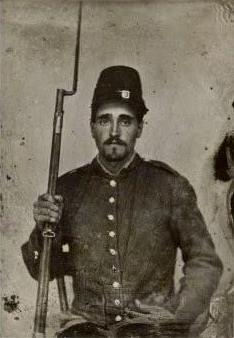
I could not find an image of Luther but here is one of Reuben Hendrickson of Co. F, 27th Indiana Infantry. He was wounded on July 3rd at Gettysburg and killed at Resaca, Georgia in 1864.

The following letter was written by Luther H. Winship (1841-1861), a wagoner in Co. C, 27th Indiana Infantry. (His name appears as Windship in company rolls.) The 27th Indiana was organized at Indianapolis and mustered in on 12 September 1861. They were transported to the Upper Potomac where they were attached to Stiles’ Brigade, Banks’ Division, of the Army of the Potomac.

Luther was the son of Martin L. Winship (1800-Bef1860) and Elizabeth Hinman (1805-Aft1861). In the 1860 US Census, Luther was enumerated with his 53 year-old mother and his 28 year-old sister, Catherine M. Winship in Ninevah, Bartholomew county, Indiana.

Unfortunately Luther did not survive the war; he didn’t even survive the year. He died on 29 December 1861 at Frederick, Maryland. He has a grave marker in Haw Creek Cemetery at Hope, Indiana, but whether his body was actually buried there is unknown.

Luther’s letter includes a great description of the Battle of Ball’s Bluff which took place on 21 October 1861. Contrary to a long-held traditional interpretation, the Union launched attack did not come from a plan by McClellan or Brig. Gen. Charles P. Stone to take Leesburg. The initial crossing of troops was a small reconnaissance. That was followed by what was intended to be a raiding party. To make matters worse, Stone was not advised that McCall and his division had been ordered back to Washington. Though the 27th Indiana did not participate in the battle, Luther—with the regimental wagon train—was on the Maryland side of the Potomac not long after the battle and was an eye-witness to the treatment of wounded survivors who were being attended to in a Maryland church turned hospital.

Transcription

Mud Creek, Maryland
October 27th [1861]

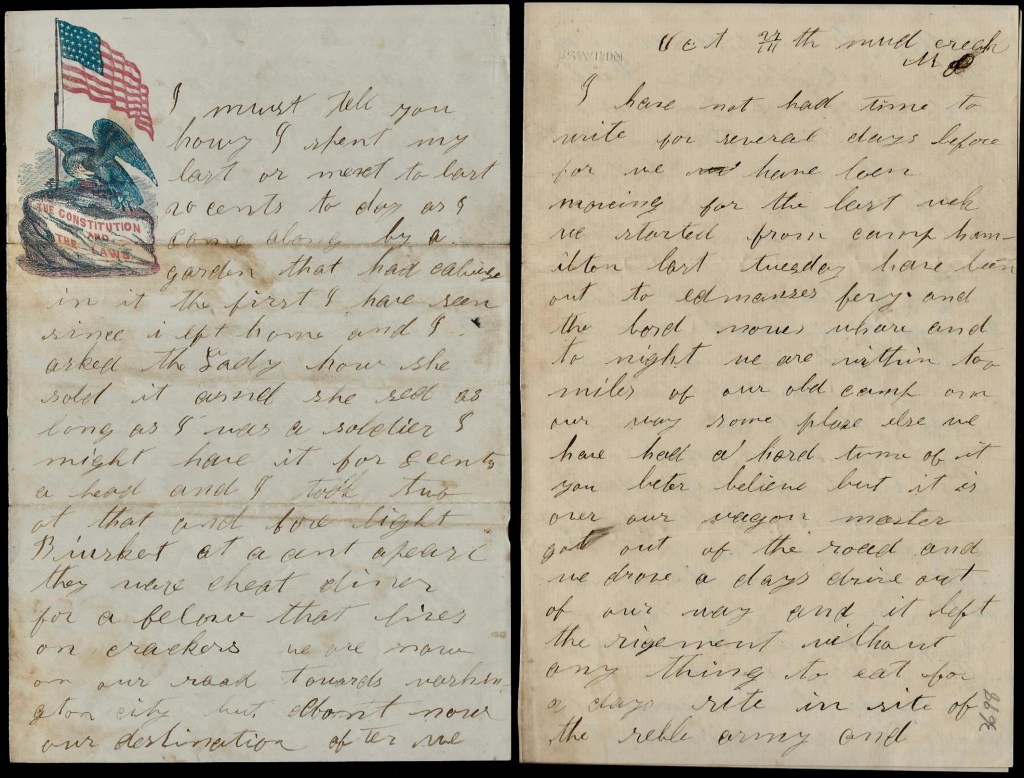
I have not had time to write for several days before for we have been moving for the last week. We started from Camp Hamilton [at Darnestown, Maryland] last Tuesday [the 22nd]. Have been out to Edwards’ Ferry and the Lord knows where and tonight we are within two miles of our old camp on our way [to] someplace else. We have had a hard time of it, you better believe, but it is over. Our wagon master got out of the road and we drove a day’s drive out of our way and it left the regiment without anything to eat for two days right in sight of the Rebel army and within bomb distance of them but the boys killed hogs, cows, and took roasting ears and lived fat—only they had no tents. We had plenty to eat with us but didn’t take time to cook it. [We] drove for 48 hours and only rested four. I ate raw bacon and bread and drank water with one exception—when we stopped to feed.

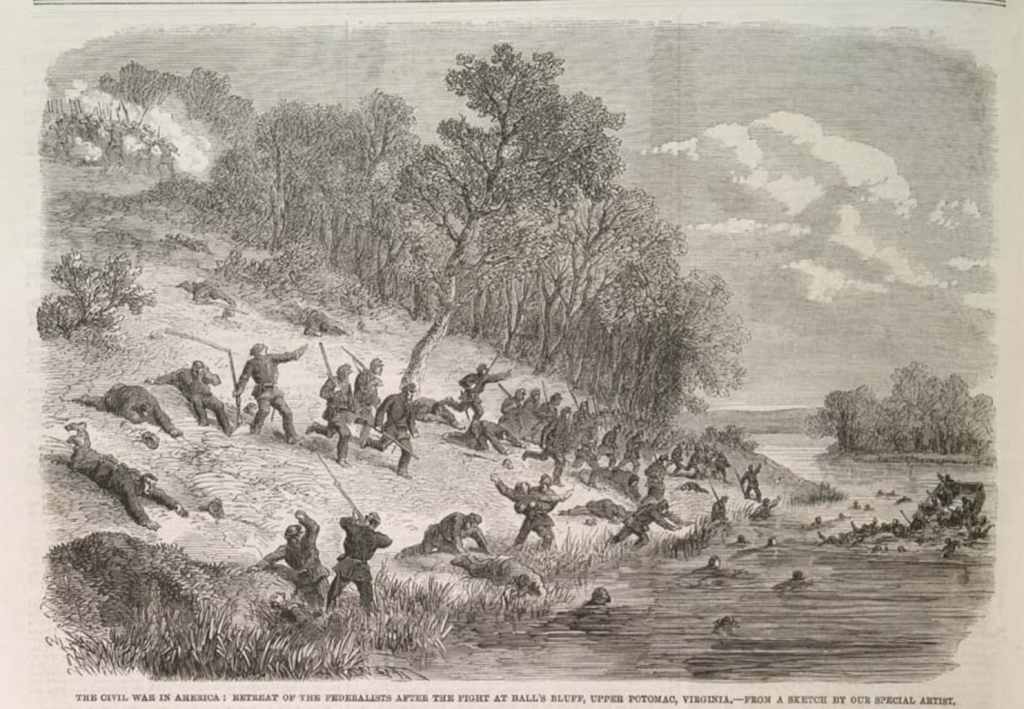
But enough about our own suffering. You will see before this about the regiment that was murdered here a few days ago and I will send you the straight of it if I don’t. It crossed the river by itself and was to be reinforced but it rained so it could not be done. It went into the slaughter pen unconscious of this fact against 8,000 men and fought till one third of them bit the dust when they retreated for an island [Harrison’s Island] in the river but there was not boats enough for them and some attempted to swim and they fired on them in the water and there was 150 of them that sunk to rise no more, either from lead or drowned. Those that did get through said the most was drowned so at least one half of the regiment is gone.

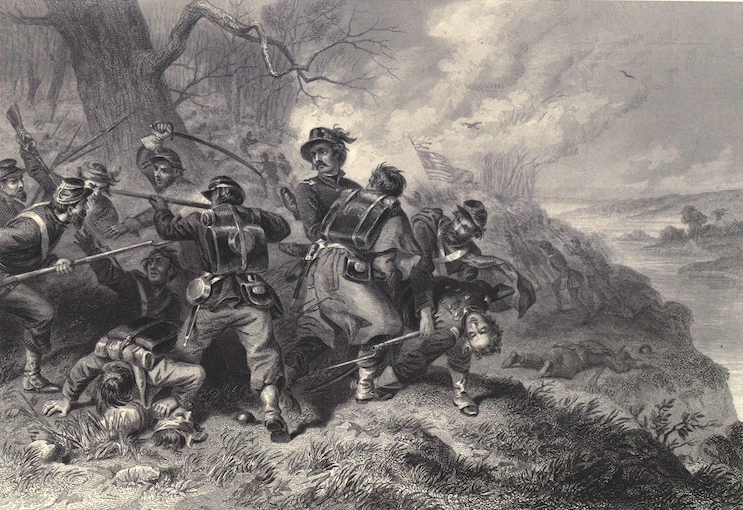
Union soldiers carry the body of Colonel Edward Baker as they retreat during the fighting at Ball’s Bluff.

Colonel [Edward D. Baker] is dead. Lieutenant-Colonel had his leg shot off. I seen him myself and a hundred more that was wounded. The floor of the church they were in was slippery with blood. My heart was sick as I passed amongst them giving them water and then that could eat some of my own scanty store of provisions. I seen any amount of men pass our camp that night naked that had swam the river and what few of us that was there made coffee the whole four hours we laid there for them. Although I had not slept for the longest time I ever went, [I] was not sleepy then at all. I must close for we have to march in the morning early and I must sleep. — yours son.

Mother, I am well. One of our men shot one of his mess mates yesterday accidentally.

I must tell you how I spent my last or next to last 20 cents today. As I came along by a garden that had cabbage in it—the first I have seen since I left home—and I asked the lady how she sold it and she said as long as I was a soldier, I might have it for 8 cents a head and I took two at that and four light biscuits at a cent apiece. There were a cheap dinner for a fellow that lives on crackers.

We are now on our road towards Washington City but don’t know our destination. After we get settled, I will write you the particulars of this march and this fight of which I spoke.

I haven’t had any news from [home?] since the 12th. Think [it] rather strange for we get the mail two times a week at present. Excuse bad writing for I have to write on my knee tonight. Give my love to all my friends and be careful not to anyone else. I remain your unworthy son, — L. H. Winship

To my mother.

The man that got shot was on picket on the river and the one halted the other but he did not hear and he thought he was a rebel so fired a shot through his head.

1861: John Gaylord Wells to Catherine (Griswold) Wells

The following letter was written by John Gaylord Wells (1821-1880), the son of William Wells (1786-1825) and Catharine Griswold (1792-1880) of Hartford county, Connecticut. He was married in 1847 to Emily A. Cornwall (1823-1900) and their daughter Gertrude Leland (“Lela”) Wells was born in 1851.

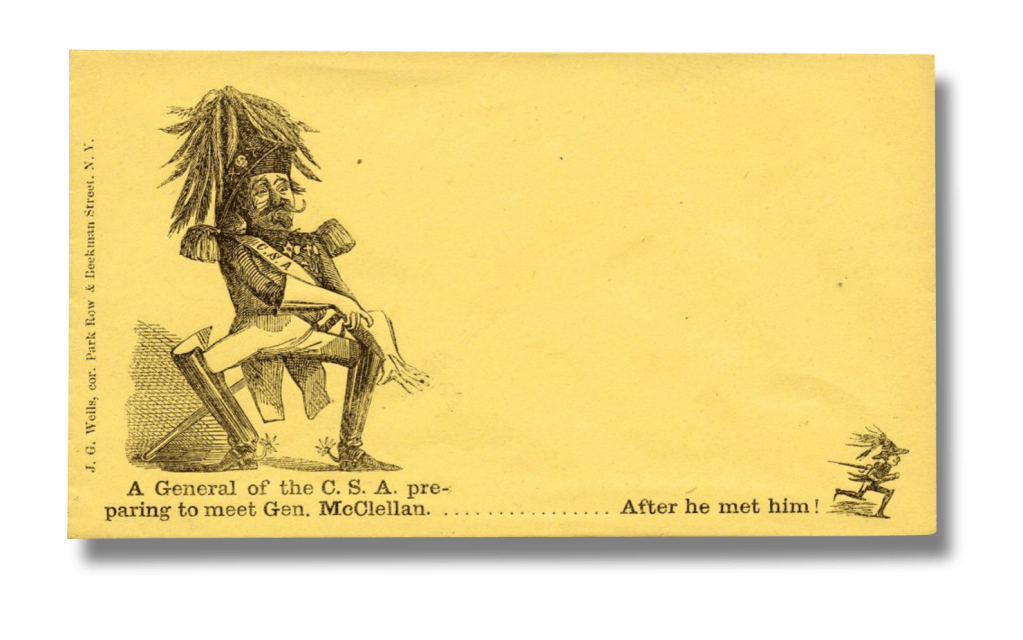
In his letter, written on Christmas day 1861, John confesses to his mother that he was a “slave” to his work. “I enjoy business, consequently enjoy life for business is my life,” he wrote. This single statement reveals much of John’s character. Not only did he not celebrate the holidays himself, we learn that he had not seen his wife and daughter in six months. The Civil War had begun which created opportunities for entrepreneurs like Wells. His obituary, published in New York and Connecticut papers, indicates that he was the originator of patriotic envelopes (and stationery such as the one he wrote this letter on) which became a robust business in the first year or two of the war.

An example of one of John G. Well’s patriotic envelopes from early in the Civil War.

Wells began his career learning the printer’s trade in Hartford, Connecticut. He is credited with inventing “elastic type for printing on hard substances” and several other “ingenious contrivances.” However, much of his time and earnings were spent in patenting and defending his patents. Following the Civil War, Wells published his own book entitled, “Every Man His Own Lawyer” and advertised it as a complete guide in all matters of law and business negotiations. It sold over 800,000 copies in the U. S.

In January 1878, he sprained his ankle in stepping from a curbstone causing an injury that eventually led to its amputation. He never fully recovered from that injury and he died in January 1880.

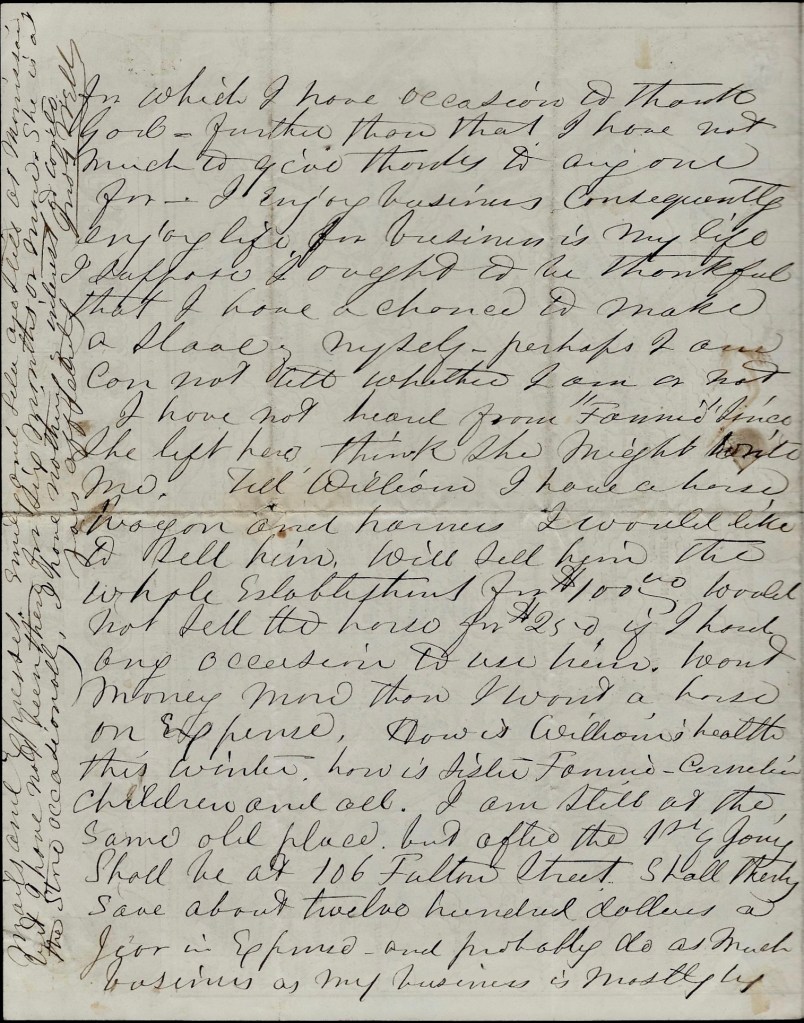
Transcription

New York [City, New York]
December 25, 1861

My Dear Mother,

Your kind letter was duly received. I have been extremely busy or I should have written you before. Today is Christmas and of course a holiday for the people—all business is suspended for today except slaves like myself. I know no holidays. You ask where I dined Thanksgiving. I will tell you—in my office on pen and ink. I wrote all day until about 9 o’clock in the evening and then went and bought an oyster item for my Thanksgiving dinner. This is as good as you can expect a slave to receive. I have spent today in the same way and expect to dine in the same way.

I enjoy good health for which I have occasion to thank God. Further than that, I have not much to give thanks to anyone for. I enjoy business, consequently enjoy life for business is my life. I suppose I ought to be thankful that I have a chance to make a slave of myself—perhaps I cannot tell whether I am or not.

I have not heard from “Fannie” since she left here. Think she might write me. Tell William I have a horse, wagon & harness I would like to sell him. Will sell him the whole establishment for $100. Would not sell the horse for $250 if I had any occasion to use him. Want money more than I want a horse on expenses.

How is William’s health this winter? How is sister Fannie, Cornelia, children and all? I am still at the same old place but after the 1st of January, shall be at 106 Fulton Street. Shall thereby save about twelve hundred dollars a year in expenses and probably do as much business as my business is mostly by mails and expresses. Emily and Lela are still at Morrison but I have not been there for six months or more. She is at the store occasionally. I have nothing of interest to write. Yours affectionately, — Jno. G. Wells

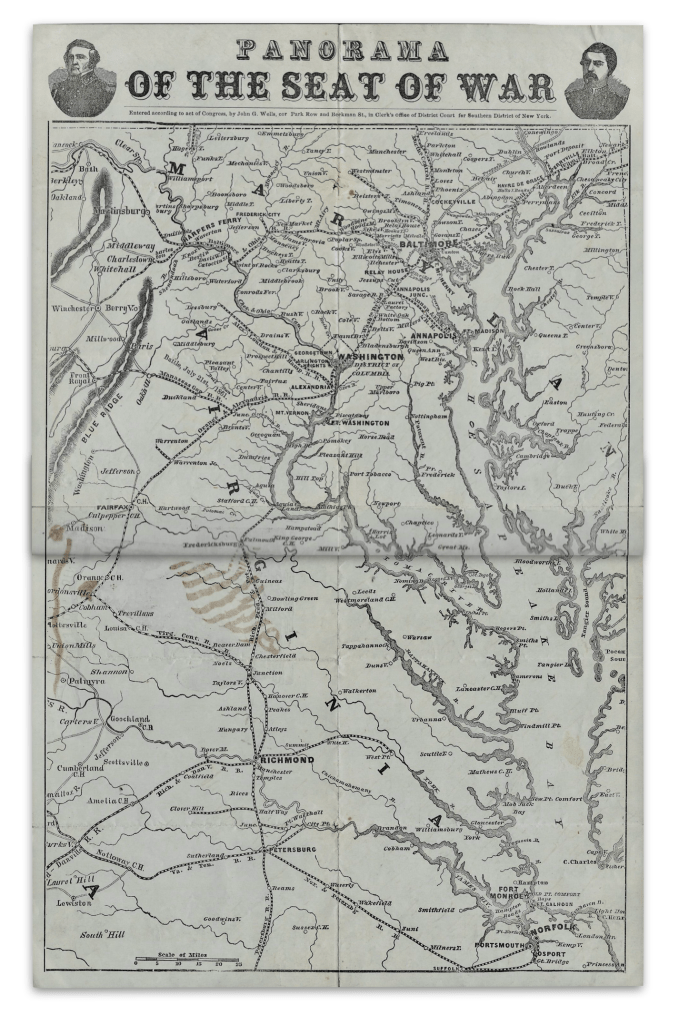
Wells’ letter was written on patriotic stationery that included this large “Panorama of the Seat of War” map printed on the inside of the folded sheet. Note that under the title it reads, “Entered according to act of Congress by John G. Wells, corner of Park Row and Beekman Street, in Clerk’s Office of District Court for Southern District of New York.” This same map was marketed by Wells in 1861 as a stand-alone folding map measuring 15″ x 9 ” although instead of portraits of Winfield Scott and George McClellan in the upper corners, it was sold with images of Commodores Silas H. Stringham and Andrew Hull Foote. See “Early Pocket Map.” This same stationery (without a letter written on it by the designer & marketer himself) is available for purchase at Gosen Rare Books for $750.

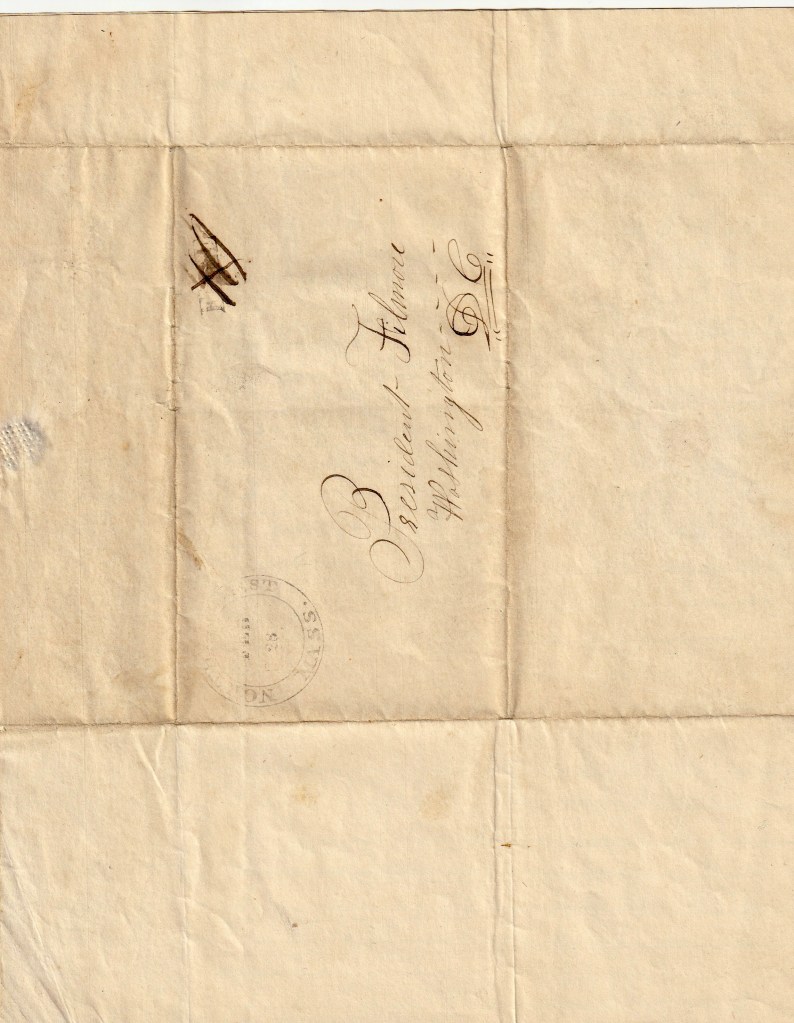
1851: Charles Mulligan, Jr. to Millard Fillmore

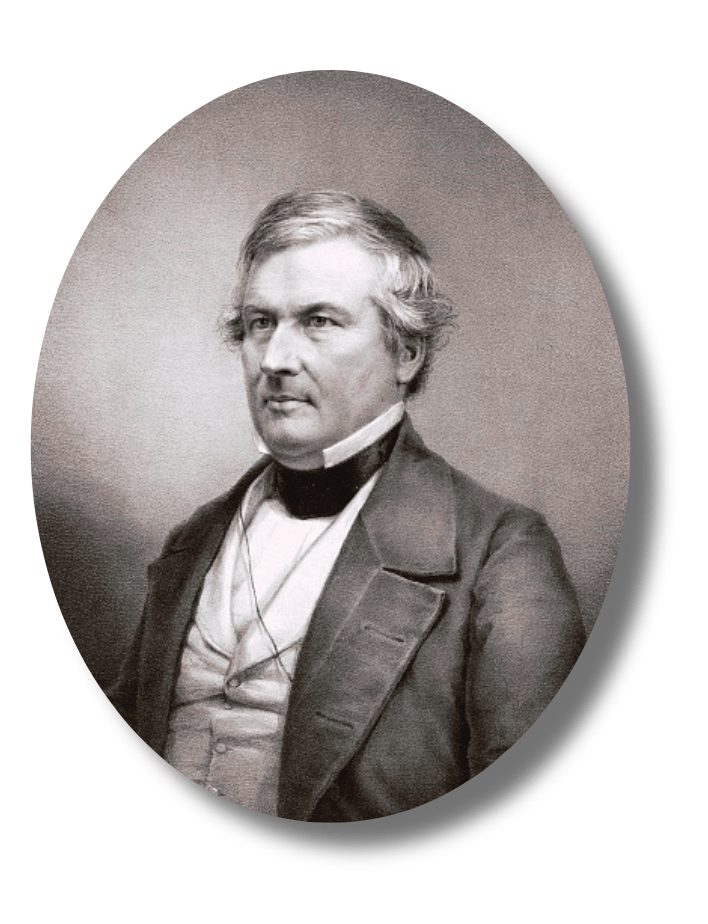
President Millard Fillmore

The following letter was penned by a self-professed “well wisher” of President Millard Fillmore who advised him that his life was in danger. There were men of “true steel,” he warned the President, who opposed the Chief Magistrate’s stated political position in support of the recently passed Compromise of 1850—with its odious Fugitive Slave Law—and his avowed determination to enforce it with the full force and might of the federal government. Though he personally opposed slavery, Fillmore “had no sympathy for the slave, for free blacks, or for the northern whites who did have sympathy for the slave.” 1 Fillmore’s defense of the omnibus bill was rooted in his belief that it was the only possible way for the Union to be preserved. He rightfully predicted that it would appease the Southerners but he miscalculated the firestorm it would cause in the North. Where once the average Northerner heard little and cared less about slavery, suddenly it became everyones business and an incendiary topic.

In Amherst, Massachusetts, where this letter was mailed (if not written), the majority of the Whigs shifted their allegiance to the Free Soil Party platform and joined in passing a series of resolutions that included an outright rejection of the notion that citizens should be compelled, by the Constitution, to engage in slave catching or suffer a penalty in failing to do so. A plethora of court cases challenging the law throughout the major Eastern seaboard cities dominated the papers and the daily citizen chatter on courthouse steps.

I have searched without success to find any citizen by the name of Charles Mulligan, Jr.—not only in North Amherst but in Massachusetts—who may have actually been the author of this letter. It is my conclusion that the name was fabricated and that the letter, offered to the President under the pretense of coming from a friend, was actually written by someone who opposed the President. The alleged threat of spies, looking for an opportunity to kill the President if he did not back down from his position in support of the Fugitive Slave Law, was not real, in my opinion. I believe it was only a rather crude and ineffectual attempt to intimidate Fillmore. 

Whether Fillmore took the threat seriously or not is difficult to say. No American President had been assassinated up to that date though there was a half-hearted attempt on Jackson’s life in 1835. It seems he took it seriously enough to send the letter back to the deputy post master of N. Amherst asking him if he knew who mailed it. Curiously, he wrote this enquiry in his own hand.

[Note: This letter is from the personal collection of Richard Weiner and was transcribed and published on Spared & Shared by express consent.]

Transcription

Amherst [Massachusetts]
February 26th 1851

President Fillmore
Dear Sir,

Excuse the liberty I take in addressing to you these few lines & take me if you please to be your well wisher while I say to you that I accidentally became aware that it is a notorious fact that by a private meeting in this vicinity, thy life is deliberately premeditated in case you say one word more in favor of that (as they call it) black slave till 2 & accidentally, as I before said, I find it to be a notorious fact that eight able-bodied men of true steel (as men) have been chosen to leave for Washington City tomorrow morning as spies to lay in wait for your life in case another move is [made] to favor slavery & only write you this short epistle that you may look out for them.

Yours very respectfully, — Charles Mulligan, Jr.

[docketed at bottom of letter in Fillmore’s own hand]

To the Deputy P[ost] M[aster] at North Amherst

Sir, Can you inform me who wrote the above. Respectfully yours, — Millard Fillmore

Washington City, March 2, 1851


1 Millard Fillmore: The American Presidents Series: The 13th, by Paul Finkelman, page 102.

2 I don’t understand the use of the word “till” here unless there was actually a slave named “Till” who was subject to the Fugitive Slave Law. I could not find any reference in the newspapers that would clear up this confusion. I’m inclined to believe that the author left out a word or two inadvertently.

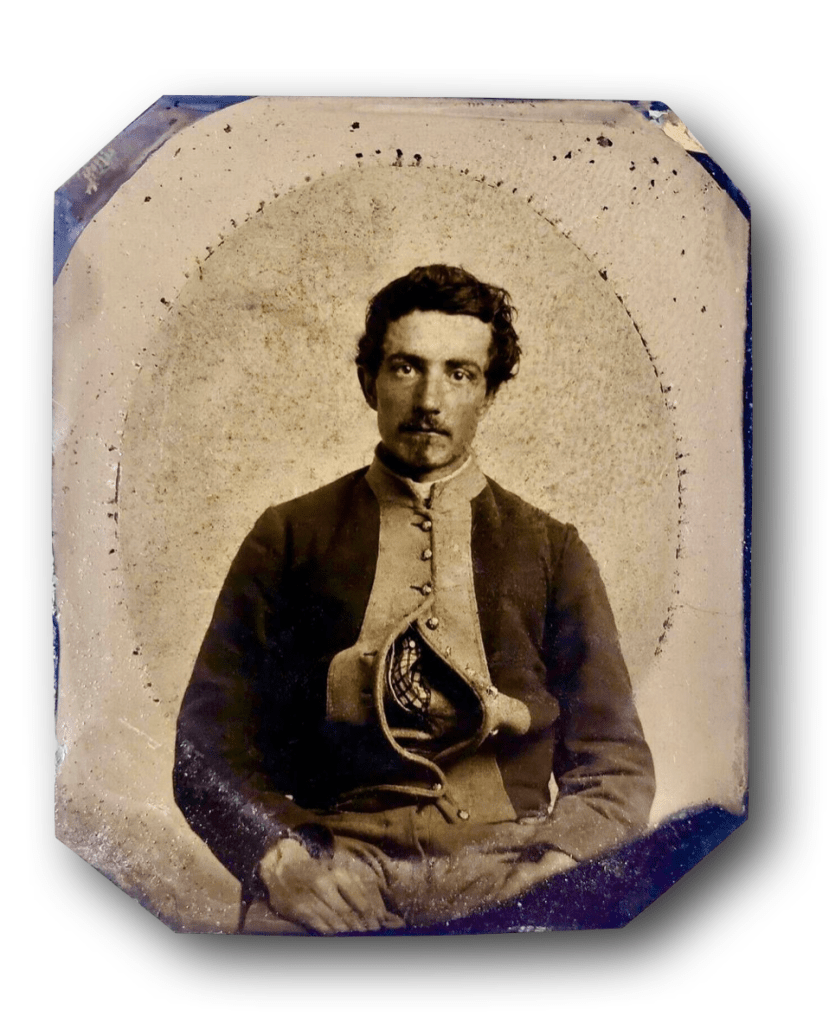
1863: Richard S. Thomas to Hannah Jeffrey

An unidentified Union soldier, possibly from an Indiana Regiment, wearing a faux zouave jacket
(Will Griffing Collection)

The following letter was written by Richard S. Thomas (1839-1864) of Huntington, Indiana, who enlisted as a recruit in Co. F, 13th Indiana Infantry on 13 September 1862. He was killed on 10 May 1864 in the fierce hand-to-hand combat that ensued when the regiment was attacked unexpectedly by two Confederate brigades led by Major General Robert Ransom while on an expedition to cut the line of communication on the Richmond & Petersburg Railroad (see Battle of Chester Station).

Richard addressed the letter to his cousin, Hannah Jeffrey (1838-1886), the daughter of Willis Jeffrey (1807-1886) and Zilpha Achsah Thomas (1811-1865) of Mount Etna, Lancaster township, Huntington county, Indiana. She died unmarried at the age of 48.

Transcription

Addressed to Hannah Jeffrey, Mount Etna, Huntington county, Indiana

Camp Suffolk, Virginia
April 30th 1863

Dear Cousin,

I have nothing of importance to write but I concluded I would write a few lines to let you know that I am still alive and well. I have no doubt but you have heard before this time that we had a few rebs in our immediate neighborhood and that we have been giving them a Lincoln pill occasionally and that they have been returning the compliment with Jeff Davis drugs.

On the 11th inst. there was one hundred men went out in front from the Old 13th to feel of their pulse but we had not advanced but a short distance outside of our pickets till we found our patients was prepared to give us a warm reception. We exchanged shots with them for about an hour but finding them too strong for our small force, we returned to camp with a loss of three men wounded. Barney [Bernard] Conron, our 2nd Lieutenant, was amongst the wounded and has since died. We sent his body to Huntington.

“Our regiment…made a charge into a piece of woods where the skirmishers said the rebs was drawn up in line of battle but they was either mistaken or else when we raised the hoosier yell and went in on double quick with bayonets fixed, they thought it was more than they could stand and skallyhooted out of that in a hurry for when we got there, there was not a greyback to be seen.”

Robert S. Thomas, Co. F, 13th Indiana Infantry, 30 April 1863

On the 24th we went out in force on another road and had a little fight. Our regiment was on the right and made a charge into a piece of woods where the skirmishers said the rebs was drawn up in line of battle but they was either mistaken or else when we raised the hoosier yell and went in on double quick with bayonets fixed, they thought it was more than they could stand and skallyhooted out of that in a hurry for when we got there, there was not a grey back to be seen. I shall not attempt to give any particulars as you will get it sooner and more correct in the paper than I could give if I should try.

Our company was out on a reconnoissance yesterday up the Jericho Canal, or rather the Dismal Swamp Ditch. We was about three miles above our outpost pickets and did not see anything nearer like a rebel than mud and water and canebrakes. we went till we had to wade mud and water knee deep and the further we went, the worse it got. We talk of going again tomorrow in skiffs and if we do, we will go through to Dremen [Drummond] Lake unless the rebs stop us before we get there.

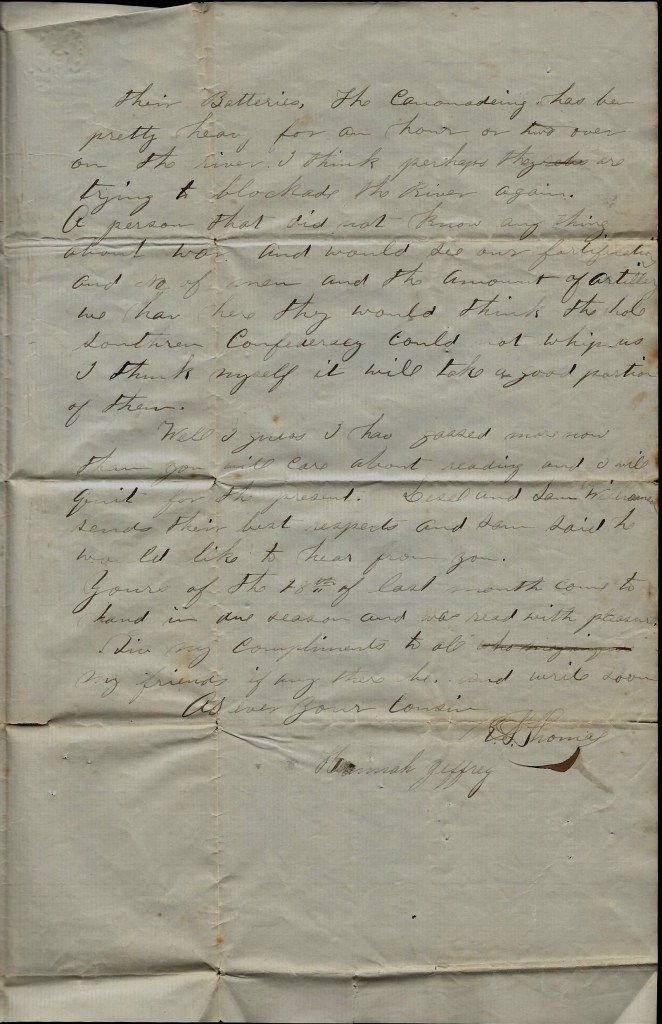
There has not been any fighting for several days except by the sharpshooters. They are popping away every day but I don’t think they are accomplishing much. There is more or less artillery firing every day by our men. They are shelling the woods to keep the rebs from planting their batteries. The cannonading has ben pretty heavy for an hour or two over on the river. I think perhaps they are trying to blockade the river again.

A person that did not know anything about war and would see our fortifications and number of men and the amount of artillery we have here, they would think the whole Southern Confederacy could not whip us. I think myself it will take a good portion of them.

Well, I guess I have gassed more now than you will care about reading and I will quit for the present. Lesel [?] and Sam Williamson sends their best respects and Sam said he would like to hear from you.

Yours of the 28th of last month come to hand in due season and was read with pleasure. Give my compliments to all my friends if any there be and write soon. As ever, your cousin, — R. S. Thomas

[to] Hannah Jeffrey

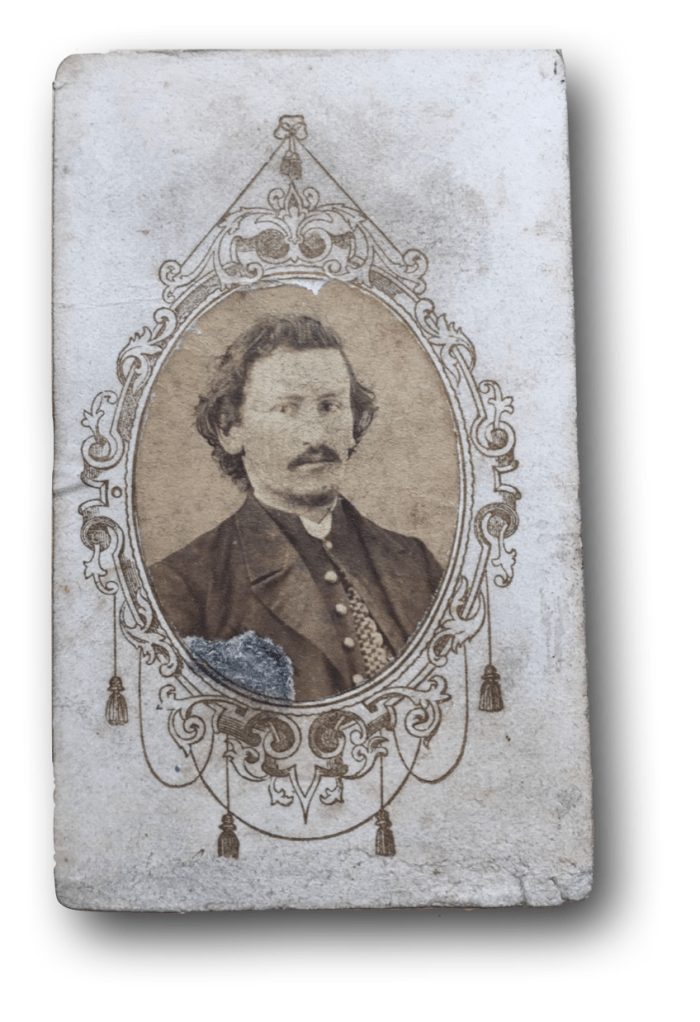
1863: George Espy Morrow to Pliny Dudley Cottle

The following letter was written y George Espy Morrow (1840-1900), the son of John Morrow (1800-1887) and Nancy Espy (18xx-1881) of Warren county, Ohio. George was the grandson of Jeremiah Morrow, the 9th Governor of Ohio and a U.S. Senator. George Morrow’s parents were farmers, and he remained home until enlisting in August 1861 as a corporal in Co. C, 2nd Ohio Infantry in 1861. He was wounded at the Battle of Perryville and was briefly a prisoner of war. He was discharged on 15 July 1863 due to disability.

George wrote the letter to Pliny Dudley Cottle (show here) after Pliny was discharged for disability from the 2nd OVI

Following his discharge, he moved to Minnesota. After a few months, he decided to enroll in the University of Michigan Law School. He graduated in 1866 and took a position as editor of the Western Rural, later editing the Western Farmer. In 1876, Morrow accepted a position as professor at the Iowa Agricultural College, and eventually rose to chair the department. In 1877, Morrow accepted an appointment as chair of the University of Illinois College of Agriculture. Morrow implemented the Rothamsted Plan at the university to determine what could improve the quality of Illinois soil. The field became known as the Morrow Plots, today recognized as a National Historic Landmark for its contributions to the history of American agriculture. He later became president of the Oklahoma Agricultural and Mechanical College.

Morrow married Sarah M. Gifford in Detroit, Michigan, in 1867.  Morrow died on 26 Mar 1900 at his home in Paxton, Illinois and was buried in Mount Hope Cemetery in Urbana, Illinois. [Wikipedia]

George wrote the letter to one of his “best friends,” Pliny Dudley Cottle (1840-1916), the son of Lucius Cottle (1815-1890) and Adeline Dudley (1817-1843) of Maineville, Warren county, Ohio. Pliney enlisted as a sergeant in September 1861 in Co. I, 2nd OVI. He was discharged for disability on 28 February 1862. Later in the war he served as a lieutenant in the 146th Ohio National Guard.

Transcription

Addressed to P. D. Cottle, Maineville, Warren county, Ohio

Headquarters 1st Division, 14th Army Corps
Murfreesboro, Tennessee
4th April 1863

P. D. Cottle
My dear friend,

Today when I had opened the mail and found in our headquarters package a letter from one of my best friends, I thought that as much as could reasonably be expected. When, a short time after, I was told there was another for me at the company, I had not the least idea whom it was from—was rather agreeably surprised to find it was in your handwriting. It will be better to direct as this is headquarters in future—at least until further orders—as I will receive it sooner.

I regret that you have not fully recovered your health but am glad to see that you have your usual good spirits. I frequently hear from you as regards your health, &c. from my other correspondents, and have often thought of writing. In future, I hope to hear from you more frequently. Tell me of all the little occurrences in the neighborhood. You, as a one time soldier, know that we feel an interest in the most unimportant and trivial affairs connected with homeland.

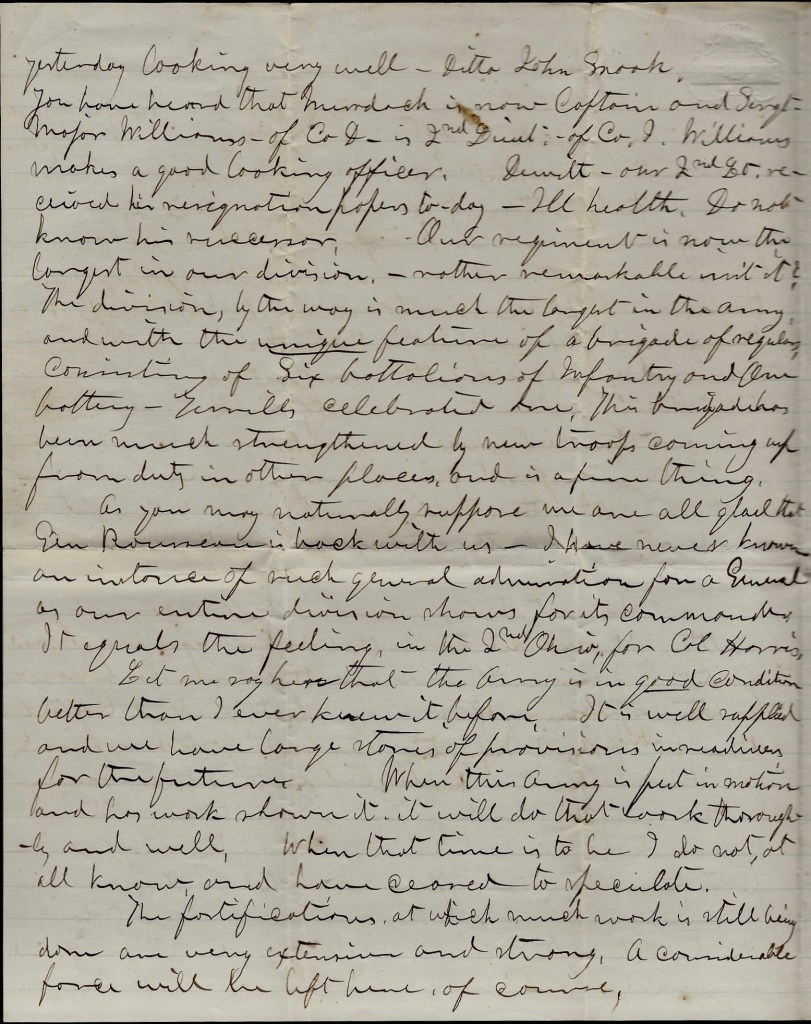
I see the regiment almost daily. The health of the men is generally good. All your friends are well, I believe. I saw Jessie Hineson yesterday looking very well—ditto John Snook. You have heard that [James E.] Murdoch is now Captain and Sergeant Major Williams of Co. D is 2nd Lieutenant of Co. I. Williams makes a good-looking officer. [Daniel W.] Dewitt, our 2nd Lt., received his resignation papers today—ill health. Do not know his successor.

Our regiment is now the largest in our division—rather remarkable, isn’t it? The division, by the way, is much the largest in the army and with the unique feature of a brigade of regulars, consisting of six battalions of infantry and one battery–[William Rufus] Terrill’s celebrated one. This brigade has been much strengthened by new troops coming up from duty in other places and is a fine thing.

As you may naturally suppose, we are all glad that Gen. Rosecrans is back with us. I have never known an instance of such general admiration for a general as our entire division shows for its commander. It equals the feeling in the 2nd Ohio for Col. [Leonard A.] Harris. Let me say here that the army is in good condition—better than I ever knew it before. It is well supplied and we have large stores of provisions in readiness for the future. When this army is put in motion and has work shown it, it will do that work thoroughly and well. When that time is to be, I do not at all know ad have ceased to speculate.

The fortifications, at which much work is still being done, are very extensive and strong. A considerable force will be left here, of course.

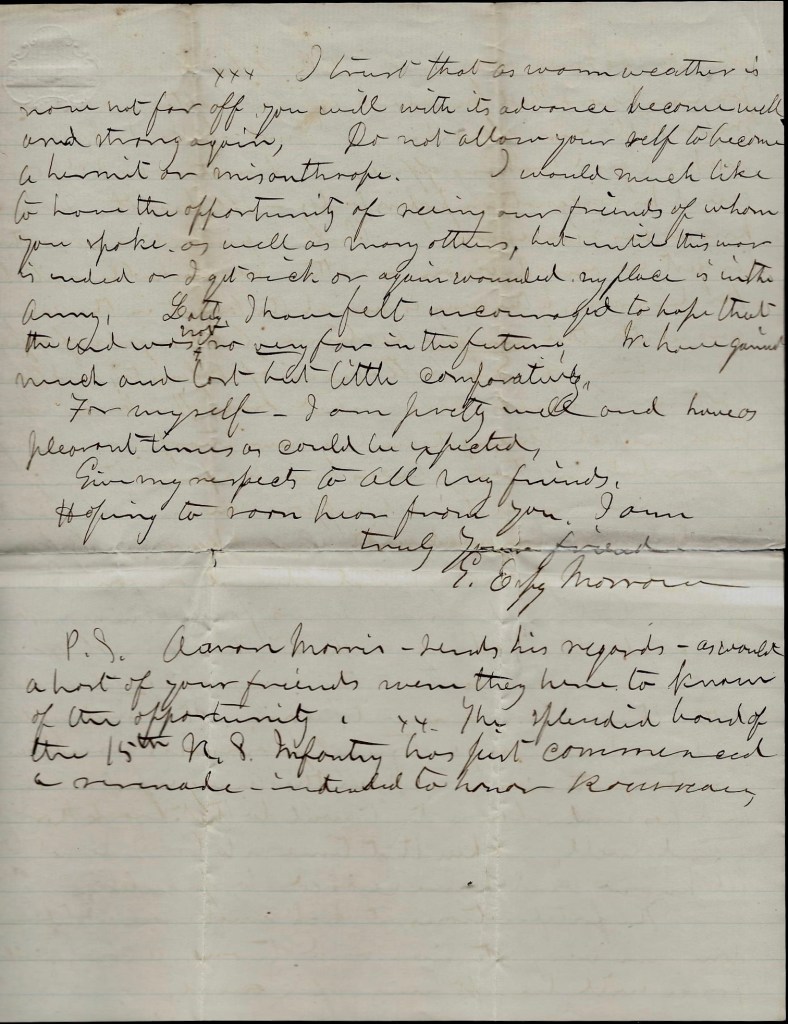
I trust that as warm weather is now not far off, you will with its advance become well and strong again. Do not allow yourself to become a hermit or misanthrope. I would much like to have the opportunity of seeing our friends of whom you spoke as well as many others but until this war is ended or I get sick, or again wounded, my place is in the army.

Lately, I have felt encouraged to hope that the end was now not very far in the future. We have gained much and lost but little comparatively.

For myself, I am pretty well and have as pleasant times as could be expected. Give my respects to all my friends. Hoping to soon hear from you, I am truly your friend, — G. Espy Morrow

P. S. Aaron Morris sends his regards as would a host of your friends were they here to know of the opportunity. The splendid band of the 15th U. S. Infantry has just commenced a serenade intended to honor Rosecrans.

1863: Thomas M. Nickel to Henry C. Scofield

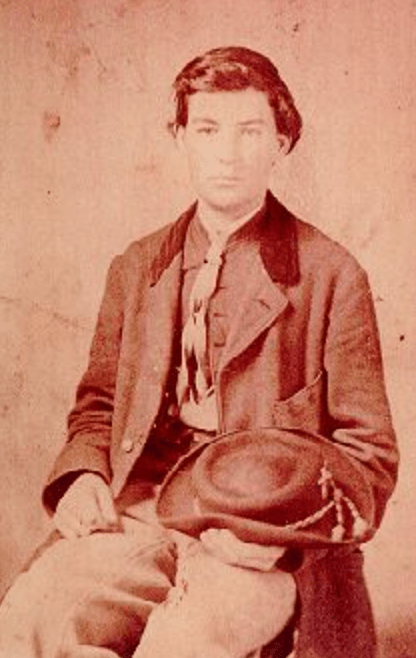
I could not find an image of Thomas but here is one of George J. Yeagley of Co. C, 5th Independent Battalion OVC
(Brad Pruden Collection)

This letter was written by Pvt. Thomas M. Nickel of Co. B, 5th Independent Battalion Ohio Volunteer Cavalry. This regiment was organized for only 6 months for duty beginning at the time of Morgan’s Raid on the southern border of Ohio until August 1863; they completed their organization at Camp Chase and moved to Cincinnati on 8 September 1863. They were assigned duty in the District of Eastern Kentucky engaged in scouting and raiding guerrillas until February 1864. They skirmished in Morgan county, Kentucky on 6 Otober 1863 adn at Liberty, Kentucky, on 12 October, 1863. They mustered out on 15 February 1864, losing one man killed and two men dying of disease.

Thomas wrote the letter to his friend, Henry C. Scofield (1836-1883), the son of Barzilla Schofield (1804-Bef1850) and Lydia Parish (1807-1870) of Cattaraugus county, New York. In the 1855 New York Census, Henry was enumerated in the household of his uncle, Amos Schofield (1809-1869) of Allegany, Cattaraugus county, New York.

[Note: This letter is from the personal collection of Greg Herr and was transcribed and published on Spared & Shared by express consent.]

Transcription

Addressed to H. C. Scofield, Esq., Portfield [Cattaraugus County] New York

Camp Garrett
Fleming county, Kentucky
October 3rd 1863

Sir,

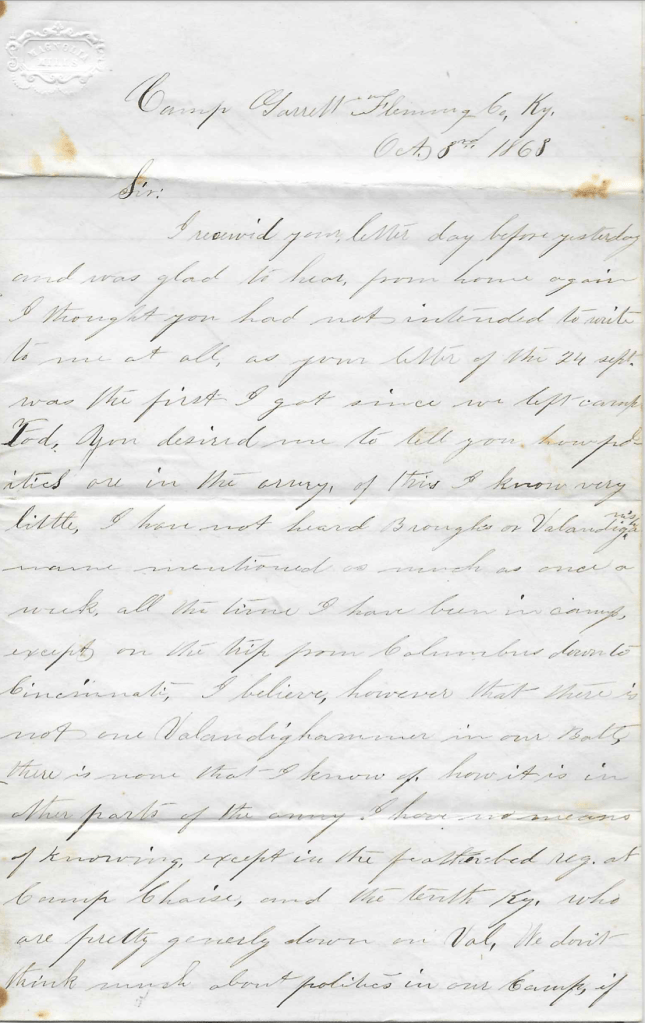
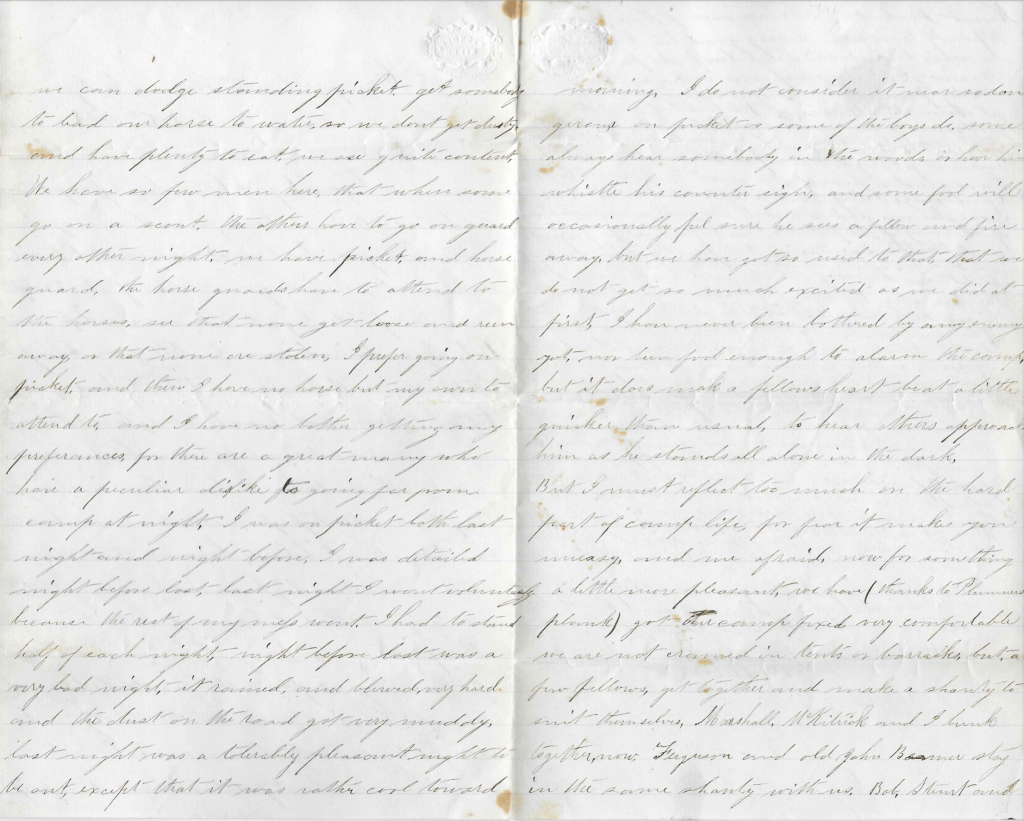
I received your letter day before yesterday and was glad to hear from home again. I thought you had not intended to write to me at all, as your letter of the 24th September was the first I got since we left camp Tod [in Cleveland]. You desired me to tell you how politics are in the army. Of this, I know very little. I have not heard [John] Brough’s or [Clement] Vallandigham’s name mentioned as much as once a week all the time I have been in camp except on the trip from Columbus down to Cincinnati. I believe, however, that there is not one Vallandighammer in our Batt[alion]. There is none that I know of. How it is in other parts of the army, I have no means of knowing except in the featherbed regiment at Camp Chase and the 10th Kentucky who are pretty generally down on Vallandigham.

We don’t think much about politics in our camp. If we can dodge standing picket, get somebody to lead our horse to water so we don’t get dusty, and have plenty to eat, we are quite content. We have so few men here that when some go on a scout, the others have to go on guard every other night. We have picket and horse guard. The horse guards have to attend to the horses, see that none get loose and run away, or that none are stolen. I prefer going on picket and then I have no horse but my own to attend to and I have no bother getting my preferences for there are a great many who have a peculiar dislike to going far from camp at night.

I was on picket both last night and night before. I was detailed night before last. Last night I went voluntarily because the rest of my mess went. I had to stand half of each night. Night before last was a very bad night. It rained and blowed very hard and the dust on the road got very muddy. Last night was a tolerably pleasant night to be out except that it was rather cool toward morning. I do not consider it near so dangerous on picket as some of the boys do. Some always hear somebody in the woods, or hear him whistle his countersign, and some fool will occasionally feel sure he sees a fellow and fire away. But we have got so used to that that we do not get much excited as we did at first.

I have never been bothered by any enemy yet, nor been fool enough to alarm the camp, but it does make a fellow’s heart beat a little quicker than usual to hear others approach him as he stands all alone in the dark. But I must reflect too much on the hard part of camp life for fear it makes you uneasy and me afraid. Now for something a little more pleasant.

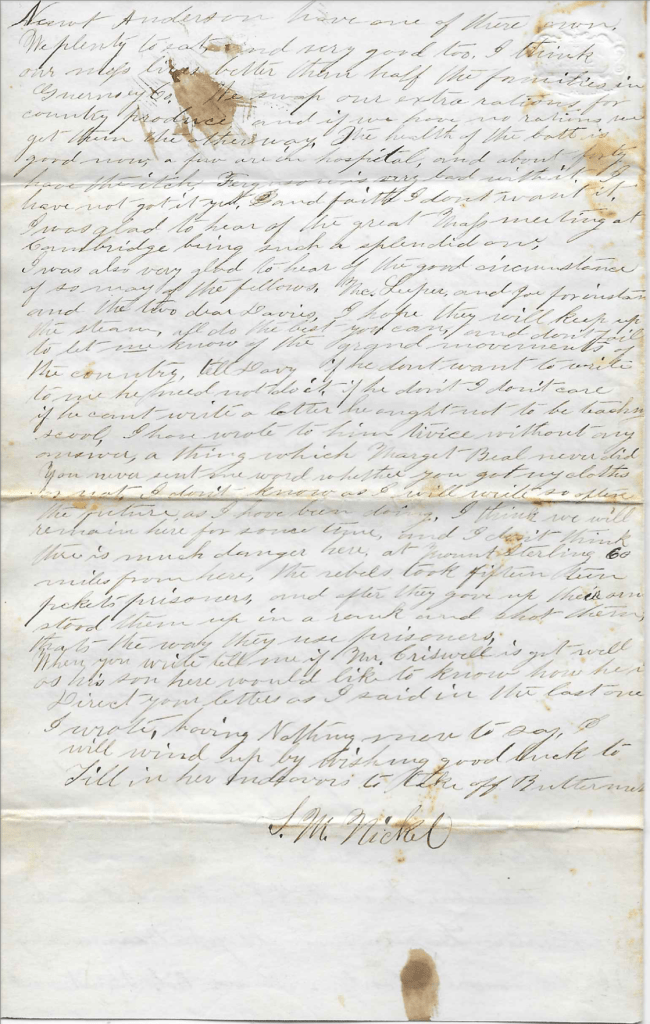
We have (thanks to Plumner’s plank) got our camp fixed very comfortable. We are not crammed in tents or barracks, but a few fellows get together and make a shanty to suit themselves. Marshall [Harvey], [James M.] McKitrick, and I bunk together now. [William P.] Furgeson and old John [C.] Beymer stay in the same shanty with us. Bob Stewart and Newt Anderson have one of their own. We [get] plenty to eat and very good too. I think our mess lives better than half of the families in Guernsey county. We swap our extra rations for country produce and if we have no rations, we get them the other way.

The health of the Batt[alion] is good now. A few are in the hospital and about forty have the itch. 1 Ferguson is very bad with it. I have not got it yet and faith, I don’t want it.

I was glad to hear of the great Mass Meeting at Cambridge [Ohio] being such a splendid one. I was very glad to hear of the good circumstance of so many of the fellows—McLeeper and Joe, for instance, and the two dear Davis. I hope they will keep up the steam, all do the best they can, and don’t fail to let me know of the grand movements of the country. Tell Davy if he don’t want to write to me, he need not do it. If he don’t, I don’t care. If he can’t write a letter, he ought not to be teaching school. I have wrote to him twice without any answer—a thing which Marget Beal never did.

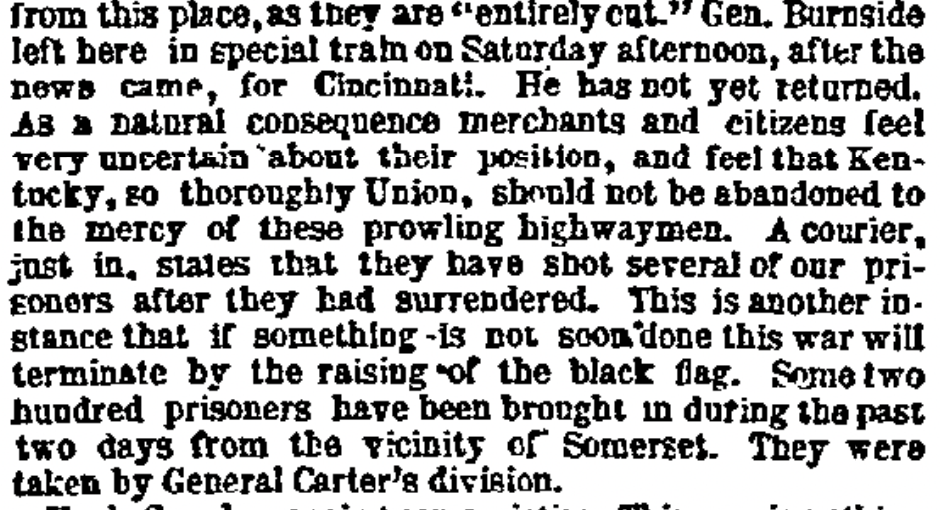
You never sent word whether you got my clothes or not. I don’t know as I will write so often in the future as I have been doing. I think we will remain here for some time and I don’t think there is much danger here. At Mount Sterling, sixty miles from here, the rebels took fifteen of our pickets prisoners and after they gave up their arms, stood them in a rank and shot them. That’s the way they use prisoners. 2

When you write, tell me if Mr. Criswell is got well as his son [William H. Criswell] here would like to know how he is. Direct your letters as I said in the last one I wrote. Having nothing more to say, I will wind up by wishing good luck to Till in her endeavors to take off Butternuts.

— T. M. Nickel


1 The “itch” might have been scabies. See “army itch.”

2 I could not find an incident taking place just prior to Thomas’s arrival in Kentucky at or near Mount Sterling. It might date date to events at Mount Sterling in mid-June 1863 during which time it was alleged that prisoners were shot. See excerpt from article appearing in the New York Herald on 19 June 1863.

1861: Samuel P. McKenney to Eliza Beazley

The following letter was written by Corp. Samuel P. McKenney (1820-1871) of Co. D, 30th Virginia Infantry who enlisted on 26 April 1861 at Spotsylvania Court House for one year’s service. He was “discharged for majority” (meaning over age) from the regiment on 23 July 1862.

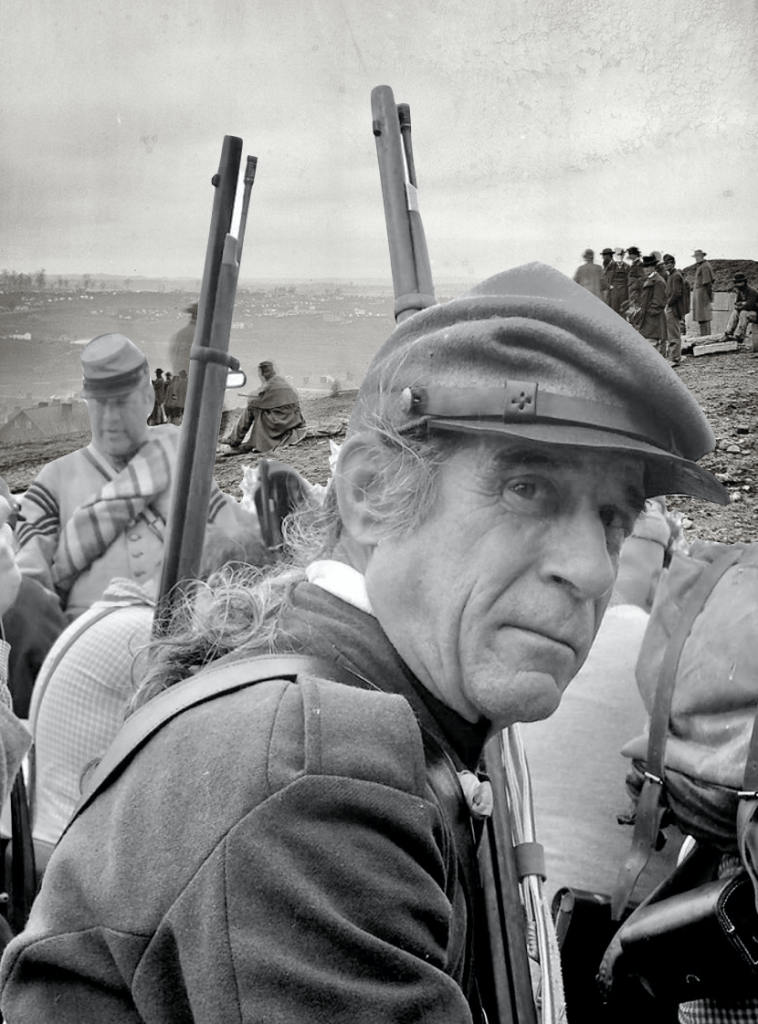
A member of the 30th Virginia Infantry reenacting unit

I believe Samuel died of consumption in Spotsylvania County in 1871. Further, I believe his parents were John Milton McKenney (1798-1834)—a native of Ireland, and Elizabeth Carpenter. He wrote the letter to Eliza Beasly (Beazley)—possibly his cousin—who was his “consort” though they never married.

The 30th Infantry Regiment completed its organization at Fredericksburg, Virginia, in June, 1861. Men of this unit were from Fredericksburg and the counties of Spotsylvania, Caroline, Stafford, and King George. It was assigned to General J. G. Walker’s and Corse’s Brigade, and fought with the Army of Northern Virginia from the Seven Days’ Battles to Fredericksburg. After serving with Longstreet at Suffolk, it was on detached duty in Tennessee and North Carolina. During the spring of 1864 the 30th returned to Virginia and saw action at Drewry’s Bluff and Cold Harbor. Later it endured the hardships of the Petersburg trenches north and south of the James River and ended the war at Appomattox. 

[Note: This letter is from the private collection of Greg Herr and was transcribed and published on Spared & Shared by express consent.]

Transcription

Camp Cary 1
Potomac Creek
8 o’clock at night

Miss Eliza Beasly,

Having been unexpectedly called to this place, I could not comply with my promise sooner. I do assure you that my thoughts have been hovering about that lovely spot. You know where and for what; ever since my departure. Eliza, but for thee, I would not care to live. Little did I think the ties of a lover was so binding until separated. I now assure you that fear I know not. But alas, the probability of our never meeting on this earth again is indescribable. Oh my heart is filled to overflowing. But should I be killed, I shall die a soldier’s death. I have no uneasiness in regard to the great battle to be fought as we are in the right. He that controls all things will be with us. Liberty, Liberty is what every American if true will have or die.

Eliza, I stood the trip perhaps better than anyone in the company. Robert Duerson 2 has been sick but not serious—caused from excitement. The rest of the boys are well. I should not be surprised if I am made Captain before long though I care nothing for office. [ ] is mighty and will prevail. I will try and see you soon. My love to Mary. Say to Charles I am in hopes he may get off. I do not want him in this company for I know he can’t stand the trip. Of all the sorry, low life people, I have never seen their equals. I am truly sorry that I joined the company. Say to Aly I forgive him for his treatment to me as I believe it is possible we may never meet again.

Eliza, it is you and only you that I care to live for. I will see you soon. Yours most affectionately, — Sam’l P. McKenney


1 The encampment was probably named after Col. Richard Milton Cary (1834-1886), a Richmond attorney who organized a volunteer militia company of light infantry which became Co. F of the 12th Virginia soon after the bombardment of Fort Sumter. One June 15th he was promoted to the rank of Colonel and given command of the 30th Virginia, a regiment posted near Fredericksburg.

2 Robert Duerson (1833-1906) was a resident of Thornburg, Spotsylvania county, Virginia, when he enlisted in Co. D, 30th Virginia Infantry. He served from 26 April 1861 to 16 May 1864 when he was wounded in the thigh at Drury’s Bluff, Virginia.