My passion is studying American history leading up to & including the Civil War. I particularly enjoy reading, transcribing & researching primary sources such as letters and diaries.
The following letter appears to have been written by Henry, or Harry, Anders but I have not been able to identify him in census records. It seems that he was probably a college student and writing to a former classmate. His letter refers to the preliminary measures being taken by Frederick county, Maryland, to prepare draft lists of suitable young men fit for service in advance of the draft that was anticipated in 1863. He pokes fun of those currently being examined by surgeons with the hope that they would be declared exempt them from the draft.
T R A N S C R I P T I O N
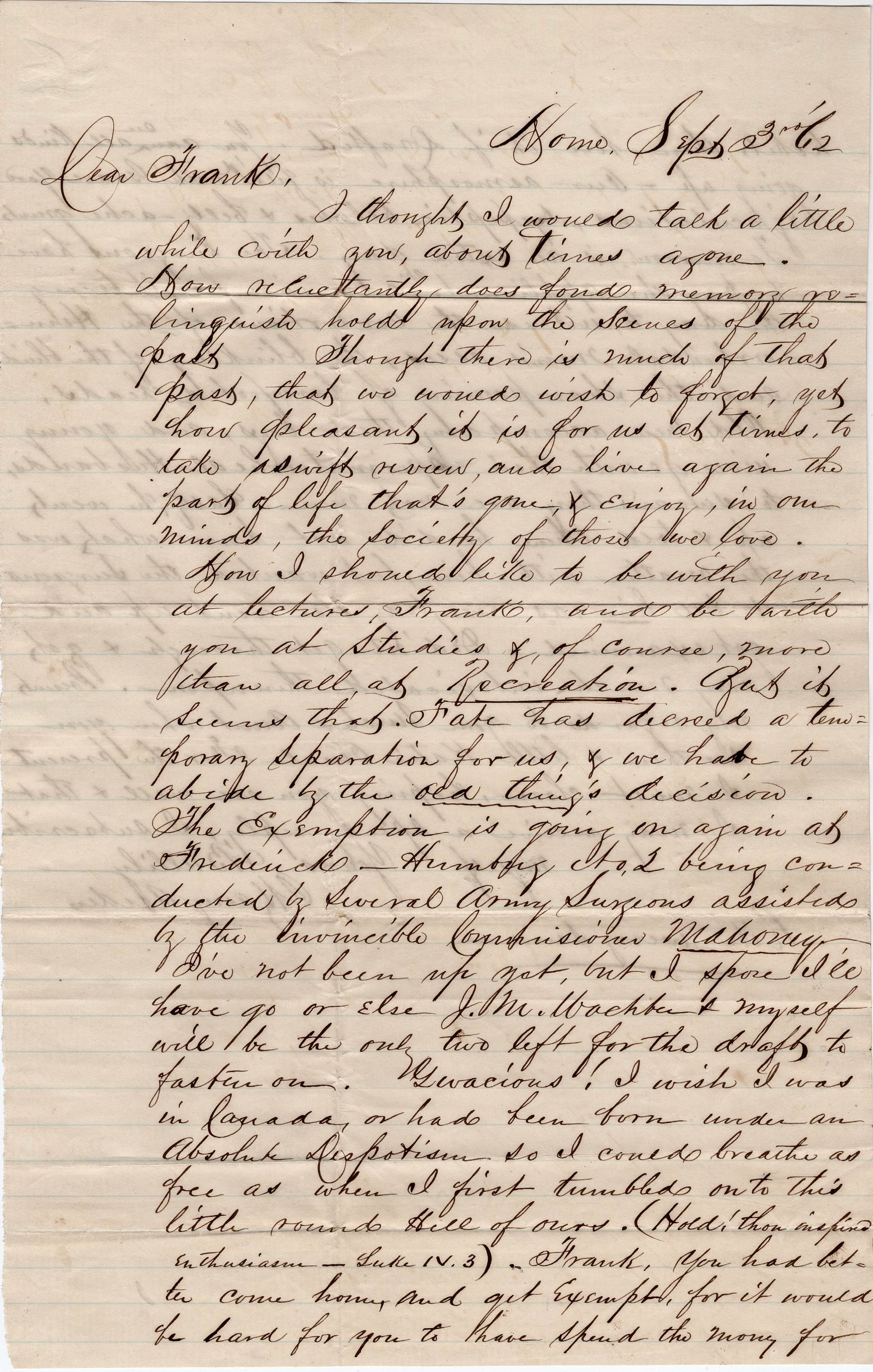
Home September 3, 1862
Dear Frank,
I thought I would talk a little while with you about times agone. How reluctantly does fond memory relinquish hold upon the scenes of the past. Though there is much of that past, that we would wish to forget, yet how pleasantly it is for us at times to take a swift review and live again the part of life that’s gone & enjoy, in our minds, the society of those we love.
How I should like to be with you at lectures, Frank, and of course more than all, at recreation. But it seems that fate has decreed a temporary separation for us & we have to abide by the old thing’s decision.
The exemption is going on again at Frederick. Humbug No. 2 being conducted by several Army Surgeons assisted by the invincible Commissioner [William] Mahoney. 1 I’ve not been up yet, but I suppose I’ll have to go or else J. M. Wachber & myself will be the only two left for the draft to fasten on. Gracious! I wish I was in Canada or had been born under an Absolute Despotism so I could breathe as free as when I first tumbled on to this little round hill of ours. (Hold! thou inspired enthusiasm—Like IV.3)
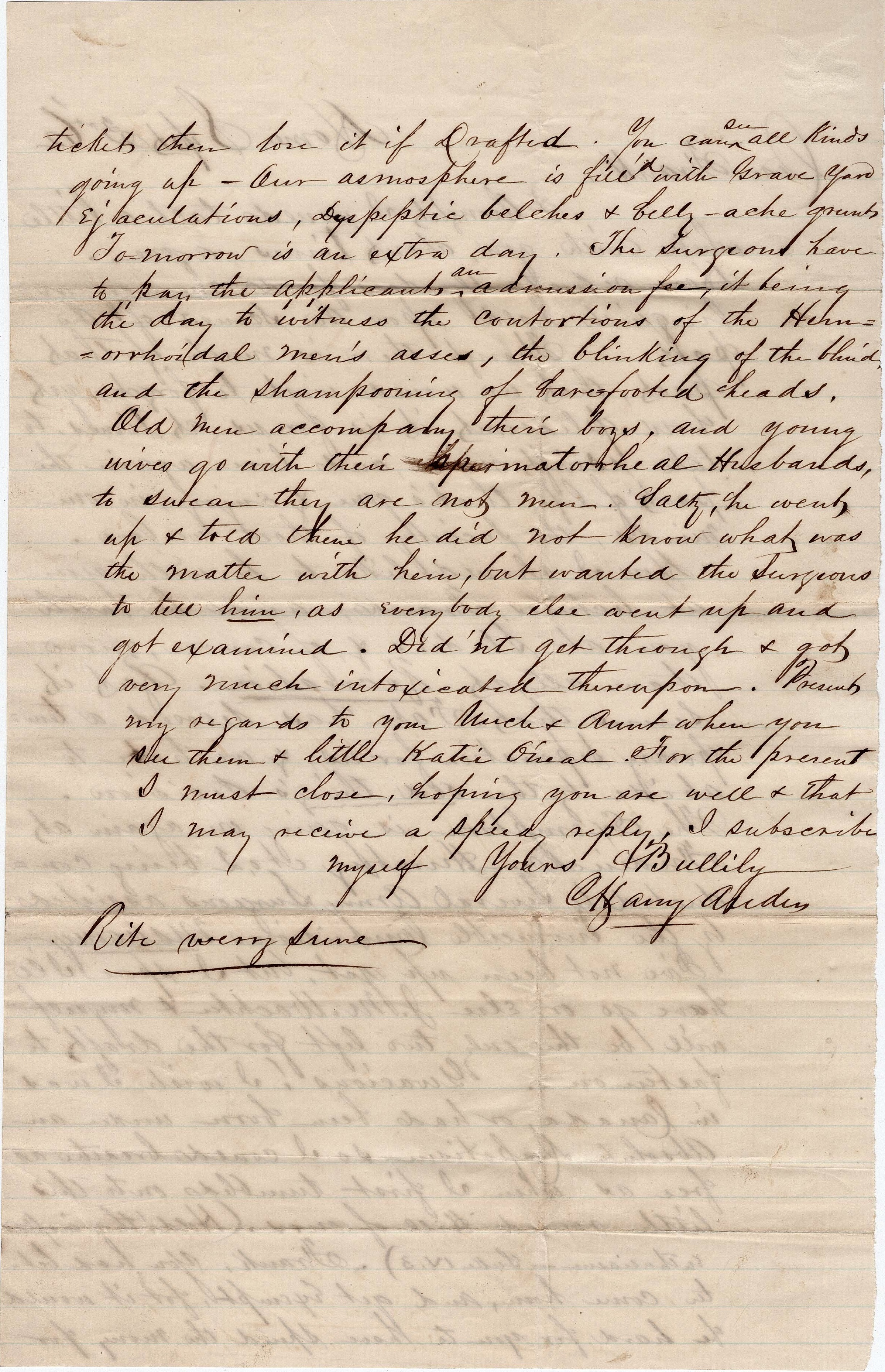
Frank, you had better come home and get exempt for it would be hard for you to have to spend the money for ticket, then lose it if drafted. You can see all kinds going up. Our atmosphere is filled with grave yard ejaculations, dyspeptic belches, and belly-ache grunts. Tomorrow is an extra day. The surgeons have to pay the applicants an admission fee, it being the day to witness the contortions of the hemorrhoidal men’s asses, the blinking of the blind, and the shampooning of barefooted heads. Old men accompany their boys and young wives go with their matorrheal husbands to swear they are not men.
Salry, he went up and told them he did not know what was the matter with him, but wanted the surgeons to tell him, as everybody else went up and got examined. Didn’t get through & got very much intoxicated thereupon.
Present my regards to your Uncle & Aunt when you see them & little Katie O’Neal. For the present, I must close, hoping you are well and that I may receive a speedy reply. I subscribe myself, — Harry Anders
Write very soon.
1 “Records of the Union draft as it affected Frederick County might have given helpful information but they are not available. “David Agnew was the local draft officer for Emmitsburg under the President’s call for troops in 1862” and probably had records of Emmitsburg men in service. However, William Mahoney, Commissioner of Enrollment and Draft for this county, was arrested by the Confederates [during the Antietam campaign in Sept. 18621 and the enrollment books destroyed.” Under that 1862 call the county was asked for 259 more men to add to the total of 1019 it had already provided. Presumably, therefore, the records of at least 1,278 (and possibly their places of residence) became Confederate possessions and were later lost if not immediately destroyed. This was not actually a draft but a call for more volunteers. The first actual mandatory draft was riot instituted until July of 1863.” [Source: Emmitsburg Area in the Civil War]
The following letter was written by Ephram Marsh (1842-1917) who served in Co. H, 104th Ohio Infantry. Ephram enlisted on 2 August 1862 and mustered out 17 June 1865. He was married in 1870 to Mary L. Wuchter (1850-1939) after the war.
Ephram may have been an orphan. He was enumerated in the 1850 US Census in the household of Daniel Waggoner of Franklin township, Summit county, Ohio. In the 1860 US Census, he was enumerated as a 16 year-old farm laborer/boarder with the Samuel Warner family in Green township, Summit county, Ohio. Neither the Waggoner’s nor the Warner’s appear to be relatives of Ephram’s.
T R A N S C R I P T I O N
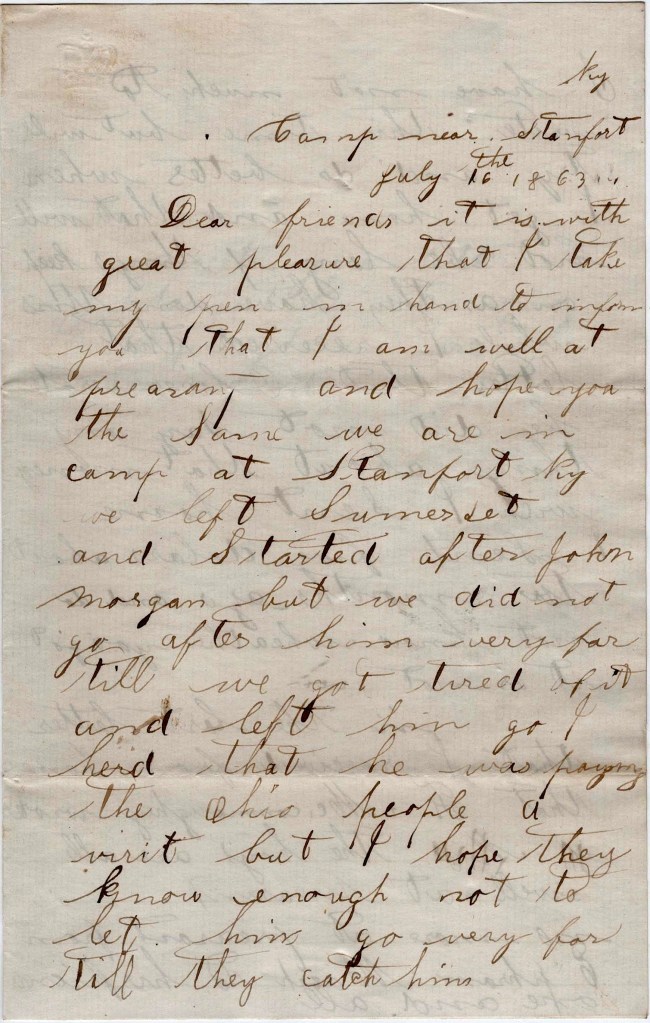
Camp near Stanford, Kentucky July 16, 1863
Dear Friend,
It is with great pleasure that I take my pen in hand to inform you that I am well at present and hope you [are] the same. We are in camp at Stanford, Kentucky. We left Somerset and started after John Morgan but we did not go after him very far till we got tired of it and left him go. I heard that he was paying the Ohio people a visit. I hope they know enough not to let him go very far till they catch him.
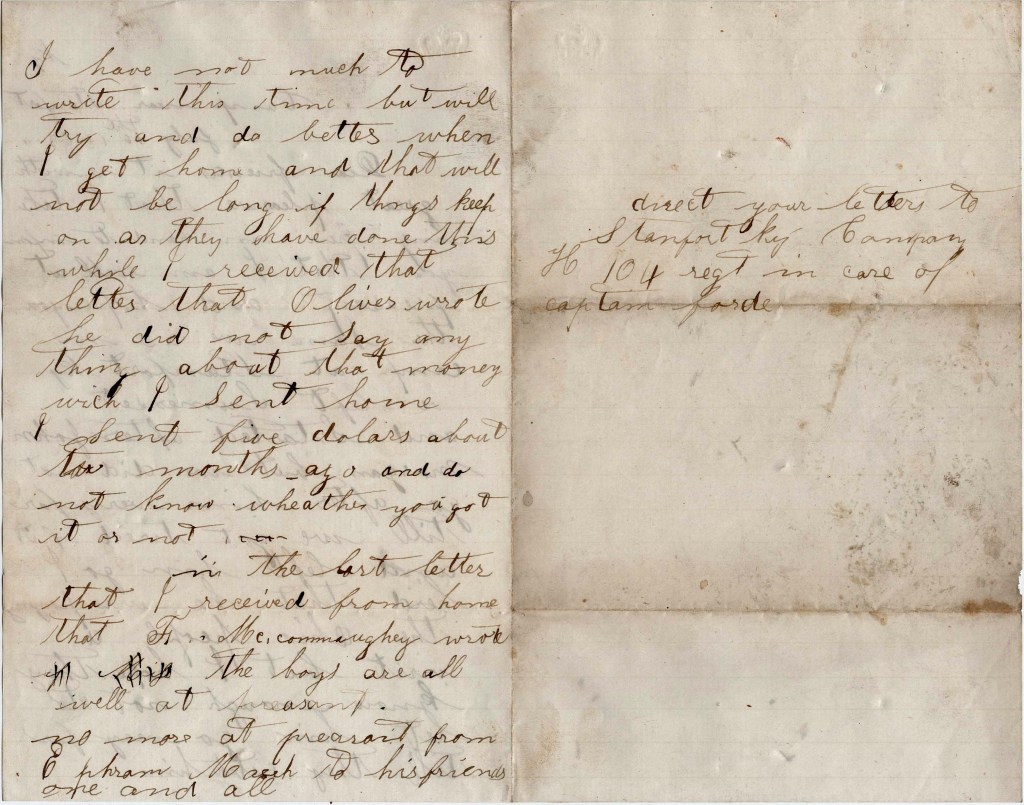
I have not much to write this time but will try and do better when I get home and that will not be long if things keep on as they have done this while.
I received that [letter] Oliver wrote. He did not say anything about that money which I sent home. I sent five dollars about two months ago and do not know whether you got it or not in the last letter that I received from home that F. McConnaughey wrote.
The boys are all well at present. No more at present. From Ephram Marsh to his friends, one and all. Direct your letters to Stanford, Kentucky, Company H, 104th [Ohio] Regiment in care of Captain Ford.
The following letter was written by James Lambert (b. 1822), the son of Virginia native, Ambrose Waveland Lambert (1796-1882) and Mary “Polly” Walker Adams (18xx-1867) of Parkeville, Parke county, Indiana. No regimental affiliation is identified in his letter and the content suggests that he was serving as a teamster or driver—possibly in a civilian capacity—in Gen. Crooks’ Headquarters in 1862 and 1863. He mentions being a part of “six regiments of the Kanawha Division” who were sent east to the aid of Gen. Pope just prior to the 2nd Battle of Bull Run. I believe these six included the 11th, 12th, 23rd, 28th, 30th and 36th Ohio Infantry regiments. I could not find a “James Lambert” in their rosters, however. The on-line ancestral tree for Ambrose Lambert, his father, to whom he addressed the letter, is also incomplete and seems to contain many errors so is of little help.
Be that as it may, the content of the letter is excellent, giving a description of the movements of these regiments sent East from West Virginia in August 1862 and of their participation in the battles at South Mountain and Antietam where Lambert served as an “eye witness” to both battles. He then describes their transfer to the Army of the Cumberland in January 1863 and of the journey up the Cumberland river to Carthage, Tennessee, where he wrote the letter. When Crook arrived in Carthage in 1863, he set up his headquarters in the Smith County courthouse and put his troops to work on the Battery Hill Earthworks.
T R A N S C R I P T I O N
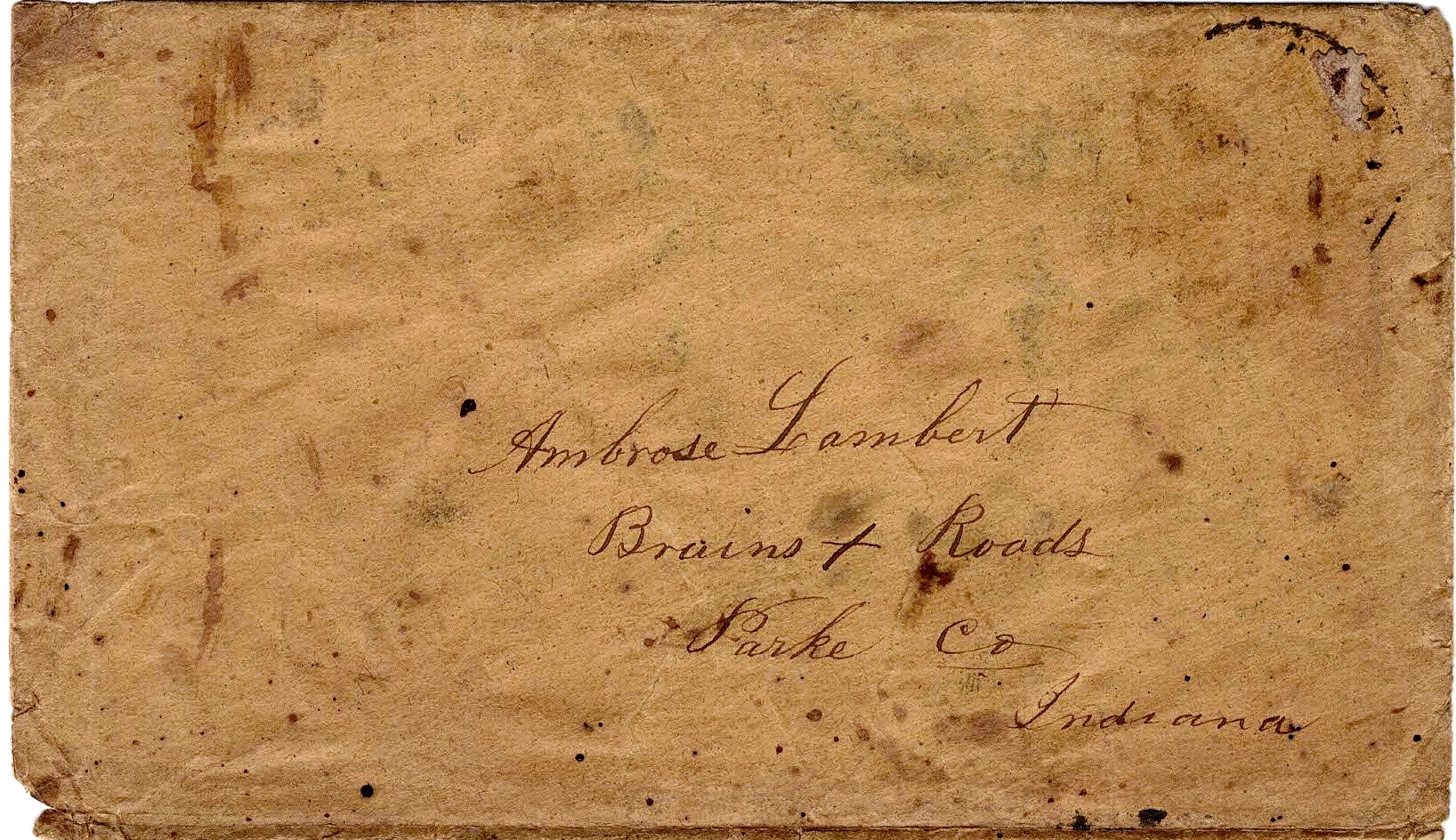
Addressed to Ambrose Lambert, Bruins & Roads, Parke County, Indiana
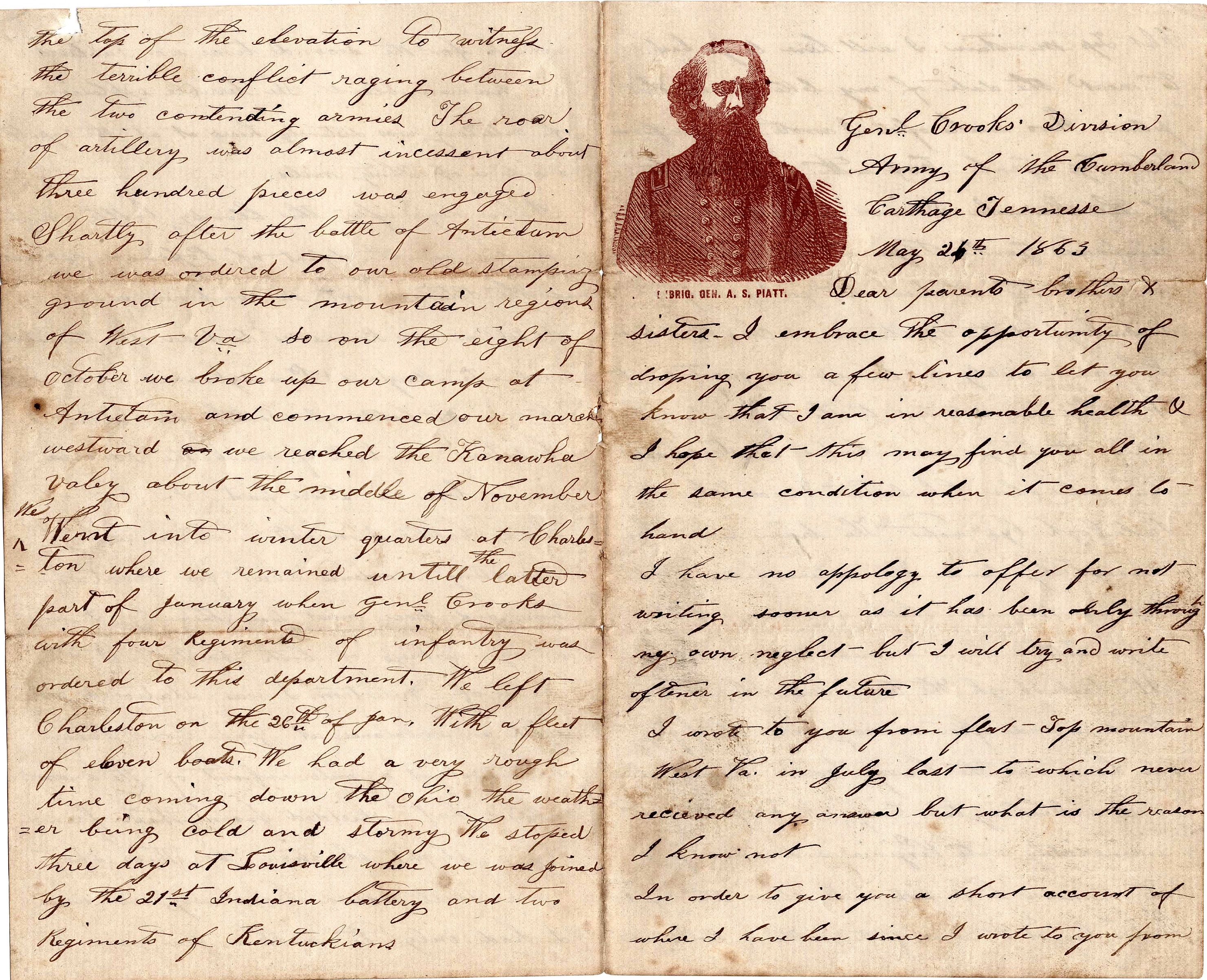
General Crook’s Division Army of the Cumberland Carthage, Tennessee May 25th 1863
Dear parents, brothers & sisters,
I embrace the opportunity of dropping you a few lines to let you know that I am in reasonable health and I hope that this may find you all in the same condition when it comes to hand.
I have no apology to offer for not writing sooner as it has been only through my own neglect but I will try and write oftener in the future. I wrote to you from Flat Top Mountain, West Virginia, in July last to which I never received any answer but what is the reason, I know not.
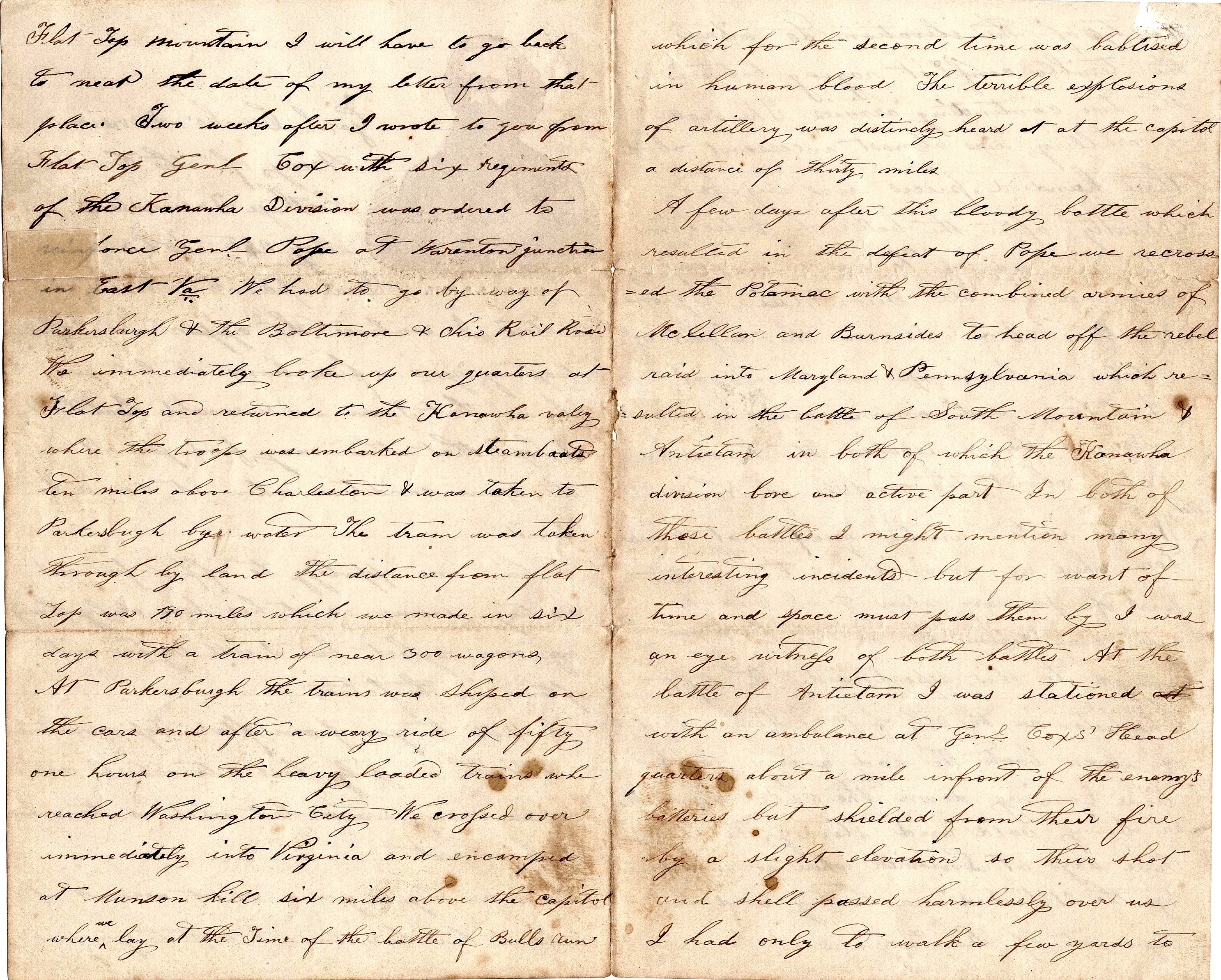
In order to give you a short account of where I have been since I wrote to you from Flat Top Mountain, I will have to go back to near the date of my letter from that place. Two weeks after I wrote to you from Flat Top, General [Jacob D.] Cox with six regiments of the Kanawha Division was ordered to reinforce General Pope at Warrenton Junction in East Virginia. We had to go by way of Parkersburg and the Baltimore & Ohio Railroad. We immediately broke up our quarters at Flat Top and returned to the Kanawha Valley where the troops was embarked on steamboats ten miles above Charles Town & was taken to Parkersburg by water. The train was taken through by land. The distance from Flat Top was 190 miles which we made in six days with a train of near 300 wagons. At Parkersburg, the trains was shipped on the cars and after a weary ride of fifty-one hours on the heavy-loaded train, we reached Washington City. We crossed over immediately into Virginia and encamped at Munson Hill, six miles above the Capitol, where we lay at the time of the Battle of Bull Run, which for the second time was baptised in human blood. The terrible explosions of artillery was distinctly heard at the Capitol—a distance of thirty miles.
A few days after the bloody battle—which resulted in the defeat of Pope—we recrossed the Potomac with the combined armies of McClellan and Burnsides to head off the rebel raid into Maryland & Pennsylvania which resulted in the Battle of South Mountain & Antietam, in both of which the Kanawha Division bore an active part. In both of those battles, I might mention many interesting incidents but for want of time and space, must pass them by. I was an eye witness of both battles. At the Battle of Antietam, I was stationed with an ambulance at Gen. Cox’s Headquarters, about a mile in front of the enemy’s batteries but shielded from their fire by a slight elevation so their shot and shell passed harmlessly over us. I had only to walk a few yards to the top of the elevation to witness the terrible conflict raging between the two contending armies. The roar of artillery was almost incessant. About three hundred pieces was engaged.
Shortly after the Battle of Antietam, we was ordered to our old stomping ground in the mountain regions of West Virginia. So on the 8th of October, we broke up our camp at Antietam and commenced our march westward. We reached the Kanawha Valley about the middle of November. We went into winter quarters at Charles Town where we remained until the latter part of January when Gen. Crook with four regiments of infantry was ordered to this department.
We left Charles Town on the 26th of January with a fleet of eleven boats. We had a very rough time coming down the Ohio, the weather being cold and stormy. We stopped three days at Louisville where we was joined by the 21st Indiana Battery and two regiments of Kentuckians. At Smithland at the mouth of the Cumberland river, we was joined by a large fleet from Cairo. We commenced our ascent of the Cumberland on the same day that the rebels made their desperate attempt to recapture Fort Donelson and arrived at that place about 8 o’clock that night, just after the rebs had withdrawn from the fight where they had been terribly handled by the little garrison in command of the fort.
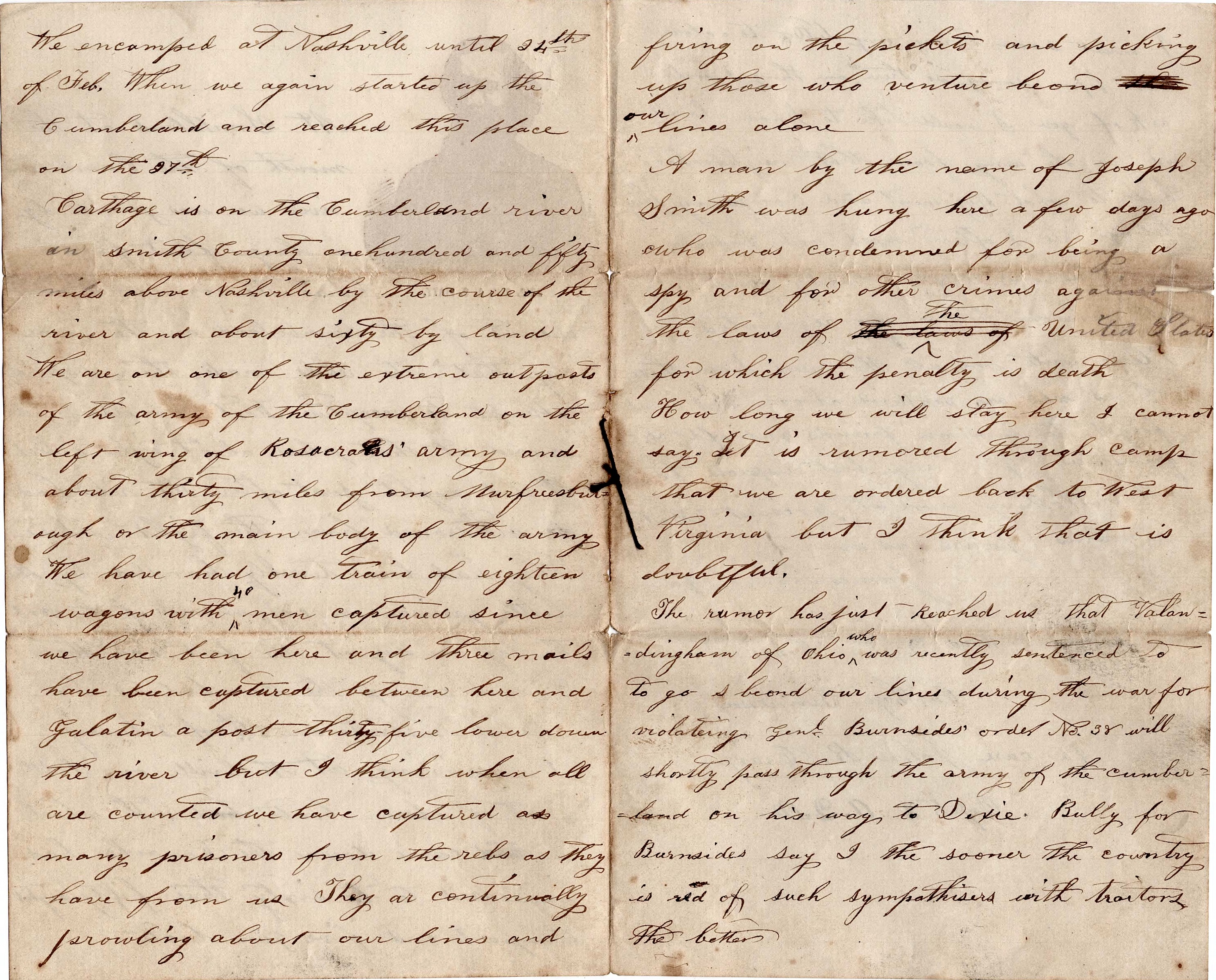
We lay one day at the fort and then steamed on up the Cumberland and reached Nashville on the 8th of February. On arriving at Nashville, our little fleet of eleven boats with which we came down the Kanawha had increased to 63—58 transports and 5 gunboats. We encamped at Nashville until 24th of February when we again started up the Cumberland and reached this place on the 27th.
Carthage is on the Cumberland river in Smith County, 150 miles from Nashville by the course of the river and about 60 by land. We are on one of the extreme outposts of the Army of the Cumberland on the left wing of Rosecrans’ Army and about 30 miles from Murfreesboro or the main bosy of the army. We have had one train of 18 wagons with 40 men captured since we have been here and three mails have been captured between here and Gallatin—a post 35 [miles] lower down the river. But I think when all are counted, we have captured as many prisoners from the rebs as they have from us. They are continually prowling about our lines and firing on the pickets and picking up those who venture beyond our lines alone.
A man by the name of Joseph Smith was hung here a few days ago who was condemned for being a spy and for other crimes against the laws of the United States for which the penalty is death.
How long we will stay here I cannot say. It is rumored through camp that we are ordered back to West Virginia but i think that is doubtful.
The rumor has just reached us that [Clement] Vallandigham of Ohio who was recently sentenced is sentenced to go beyond our lines during the war for violating General Burnsides’ Order No. 38 [and] will shortly pass through the Army of the Cumberland on his way to Dixie. Bully for Burnsides! say I. The sooner the country is rid of such sympathizers with traitors, the better.
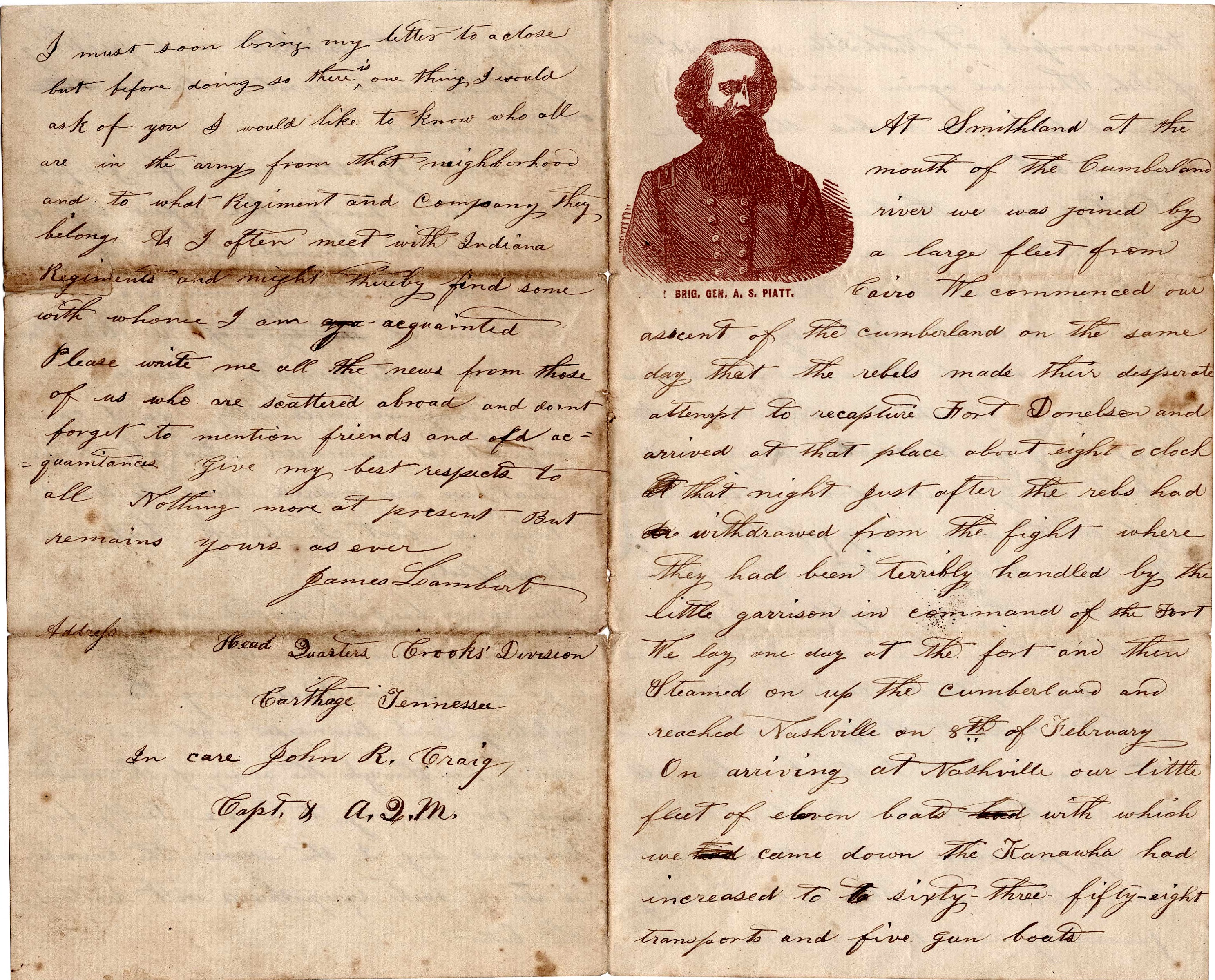
I must soon bring my letter to a close but before doing so, there is one thing I would ask of you. I would like to know who all are in the army from that neighborhood and to what regiment and company they belong. As I often meet with Indiana regiments and might thereby find some with whom I am acquainted. Please write me all the news from those of us who are scattered abroad and don’t forget to mention friends and old acquaintances. Give my best respects to all. Nothing more at present but remain yours as ever, — James Lambert
Address: Headquarters Crooks’ Division, Carthage, Tennessee, in care of John R. Craig, Captain & Asst. Q. M.
The following letter was written by Thomas Elvanslow Kearns (1831-1903), the son of Isaac Kearns (1800-1886) and Polly Steed (1803-1883) of Randolph county, North Carolina. At the age of 33, Thomas enlisted in the Confederate army as a private on 19 August 1864 at Camp Holmes, North Carolina. He was assigned to serve in Co. H, 38th North Carolina Infantry. During the Union break-out of the Richmond-Petersburg siege, he was captured near Sutherland, Virginia, on 3 April, 1865. He was then transferred to City Point, Virginia on 6 April, 1865, where he was held until he was released in June 1865.
Thomas was married to Rebecca Kindley (1840-1911) in September 1860. His sister, the recipient of this letter, was Adline Norwood (Kearns) Adderton (1829-1918), the wife of George R. Adderton (1830-1893). George served the Confederacy as a member of Co. K, 5th North Carolina Cavalry from March 1823 until at least late October 1864.
T R A N S C R I P T I O N
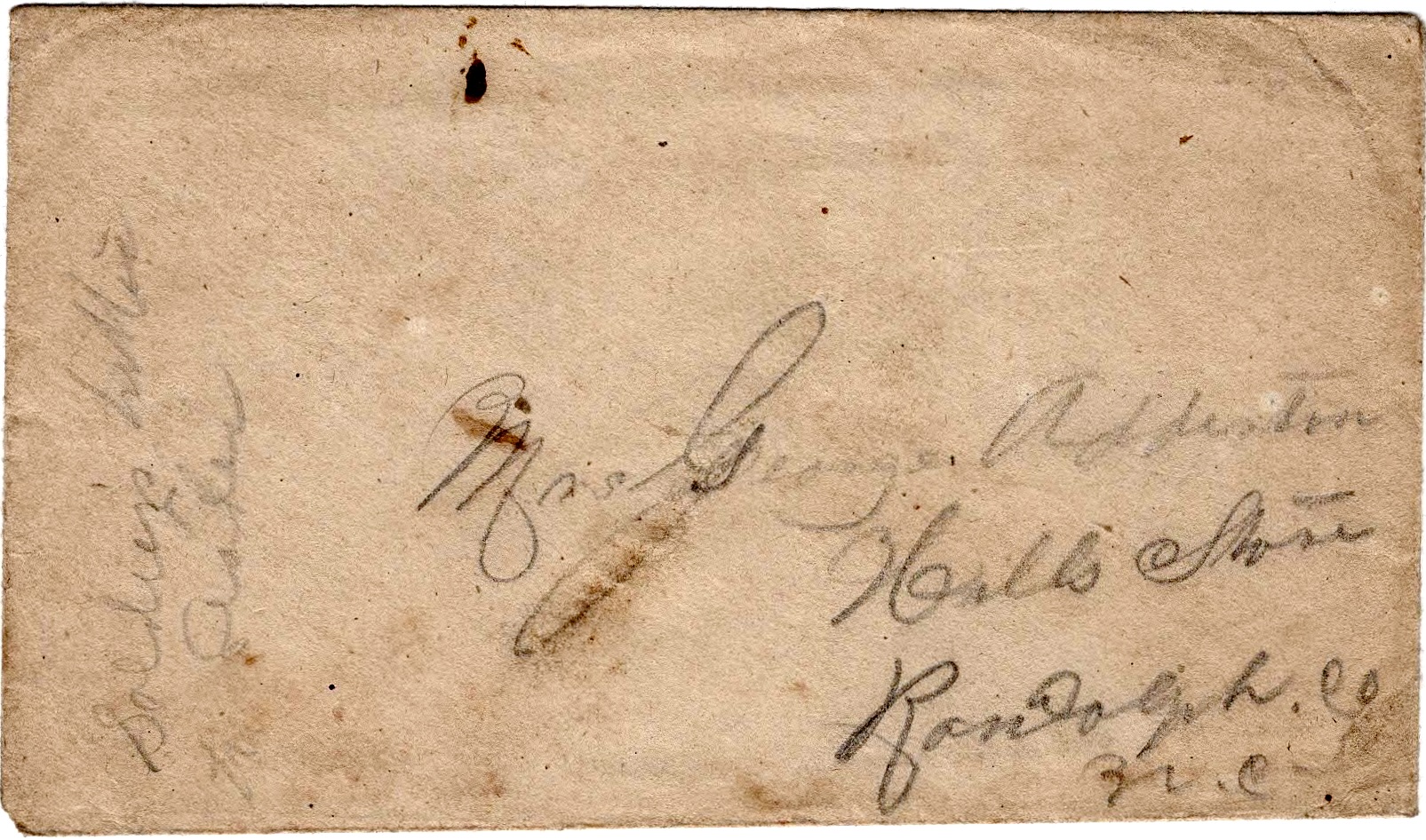
Mrs. George Adderton, Hall’s Store, Randolph county, North Carolina
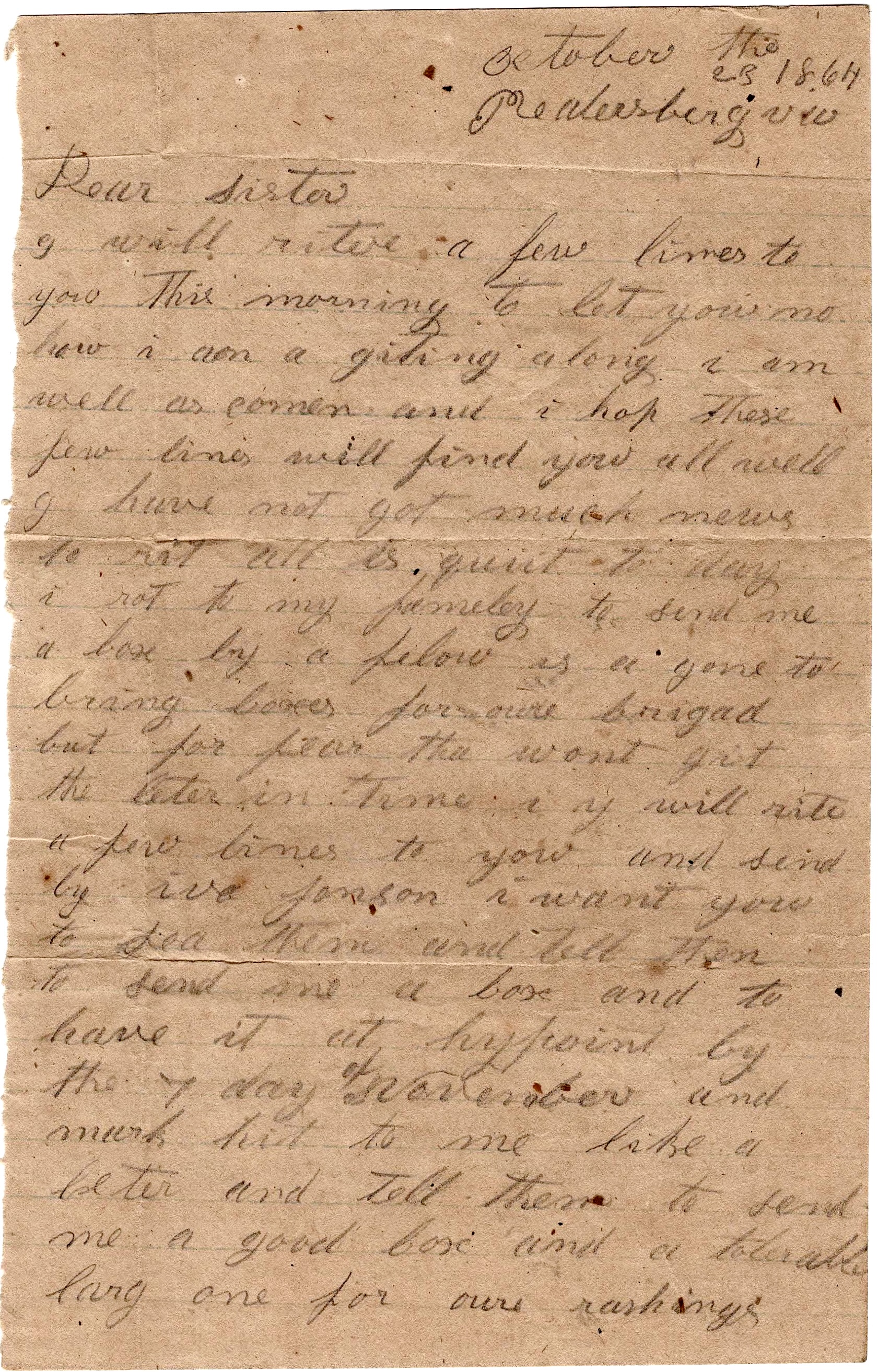
Petersburg, Va. October 23, 1864
Dear sister,
I will write a few lines to you this morning to let you know how I am a getting along. I am well as common and I hope these few lines will find you all well.
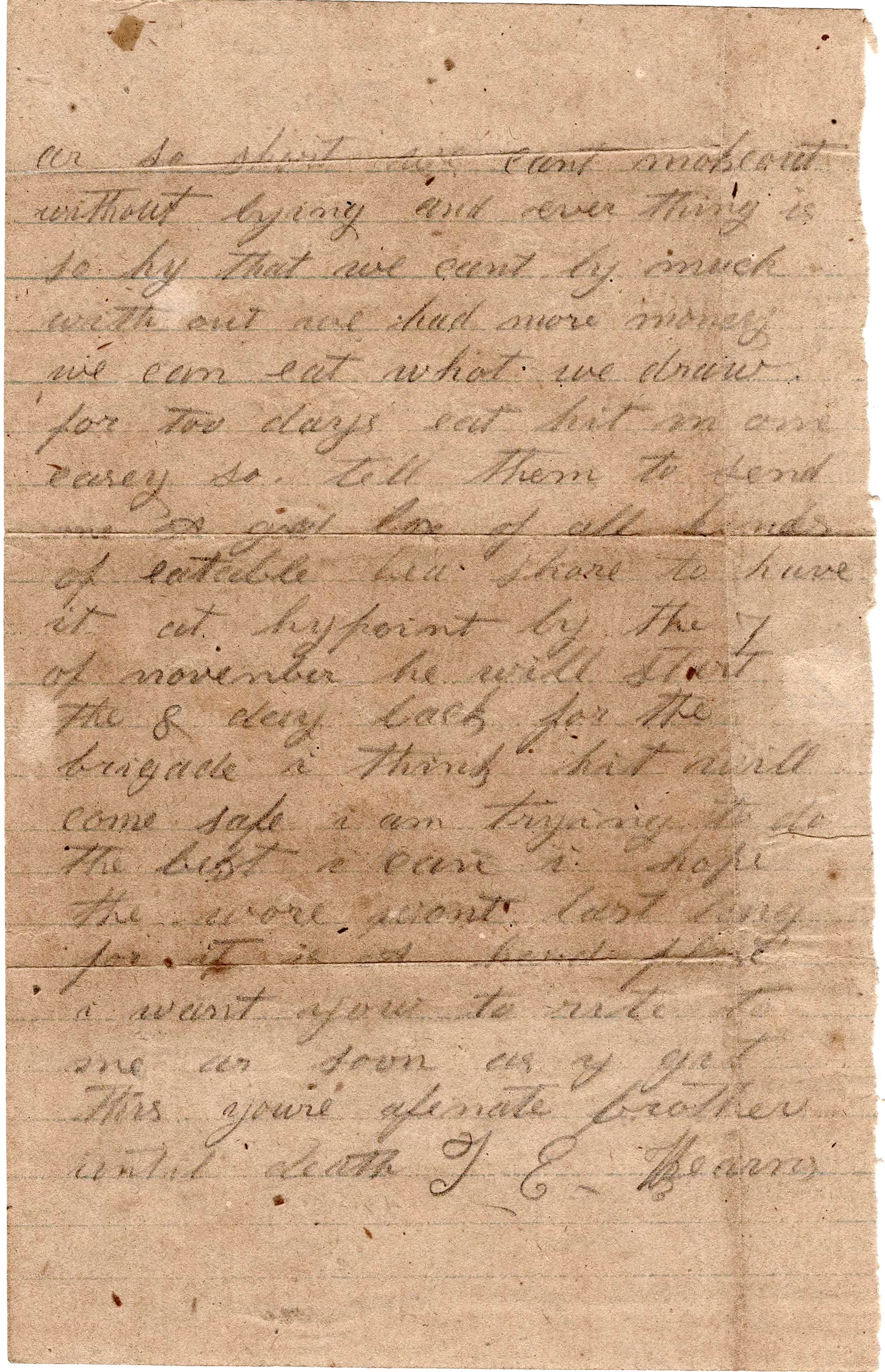
I have not got much news to write. All is quiet today. I wrote to my family to send me a box by a fellow [that] is going to bring boxes for our brigade but for fear they won’t get the letter in tie, I will write a few lines to you and send by Ive Johnson. I want you to see them and tell them to send me a box and to have it at High Point by the 7th day of November and mark it to me like a letter. And tell them to send me a good box and a tolerable large one for our rations are so short, we can’t make out without buying and everything is so high that we can’t buy much without we had more money. We can eat what we draw for two days in one easy, so tell them to send me a good box of all kinds of eatables. Be sure to have it at High Point by the 7th of November. He will start the 8th day back for the brigade. I think it will come safe.
I am trying to do the best I can. I hope the war won’t last long for it is a hard place. I want you to write me as soon as you get this. Your affectionate brother until death, — T. E. Kearns
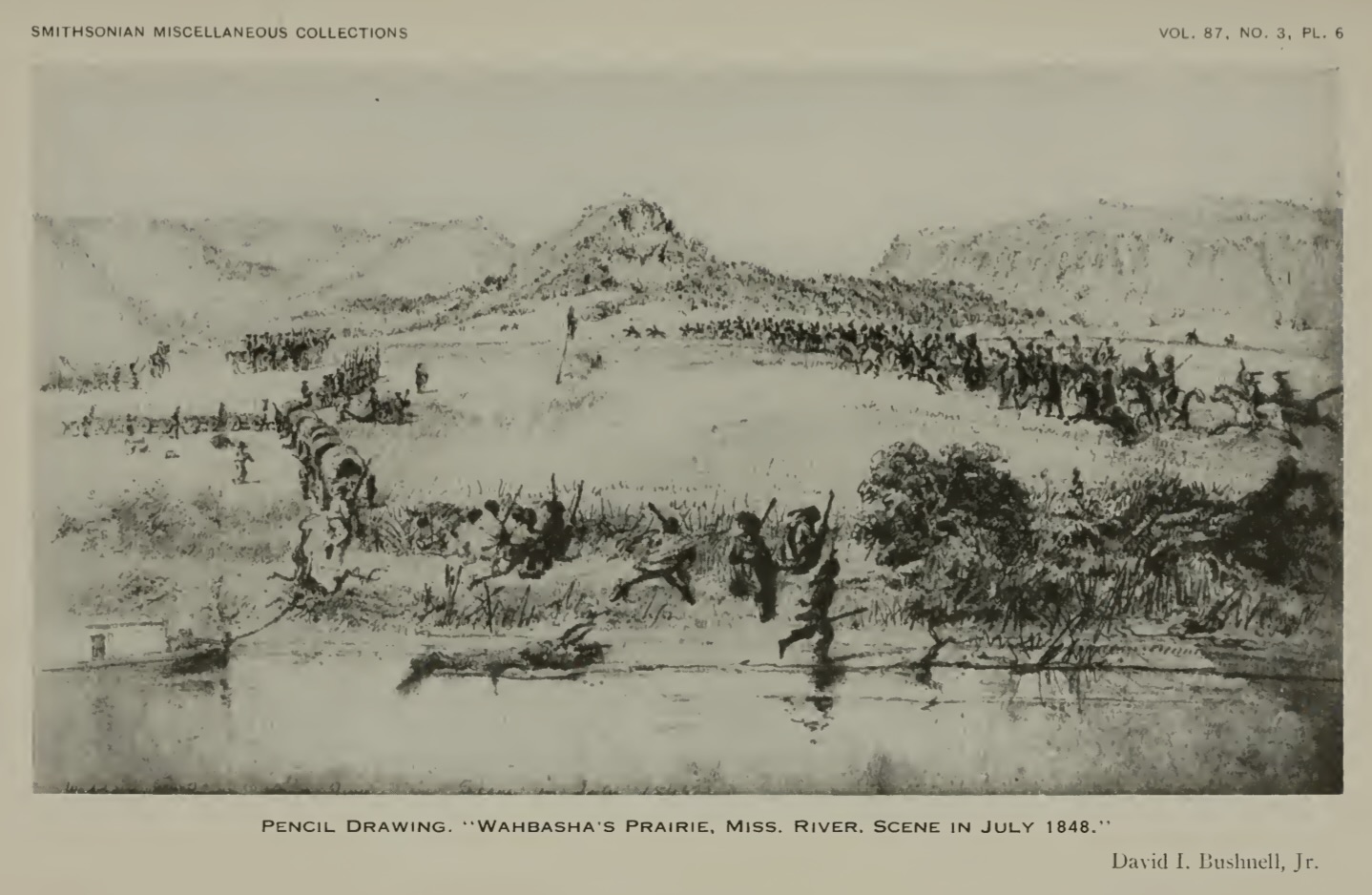
The following letter was written by William Harris of Camden, New Jersey, who was among the first wave of settlers belonging to the “Western Farm & Village Association,” organized in NYC in 1852 for the settlement of farm land in the West. The leaders of this association settled on Minnesota Territory and let a party of farmers and mechanics with their families by rail and steamboat via Lake Erie, across Ohio from Cleveland to Cincinnati, then down the Ohio and up the Mississippi rivers to a place called Wahbasha’s Prairie, a landing on the upper Mississippi, 150 miles below St. Paul.
William’s letter informs us that the organizers of the caravan of settlers led them to a site six miles overland to “a most beautiful opening of comparatively high table-land covered with oak” near a stream named Rolling Stone Creek, an Indian trail, and a couple of abandoned squatters cabins where they decided to establish their village plot. The association promised the settlers mutual assistance and protection in their efforts to find homes in the West where land could be purchased at government prices.
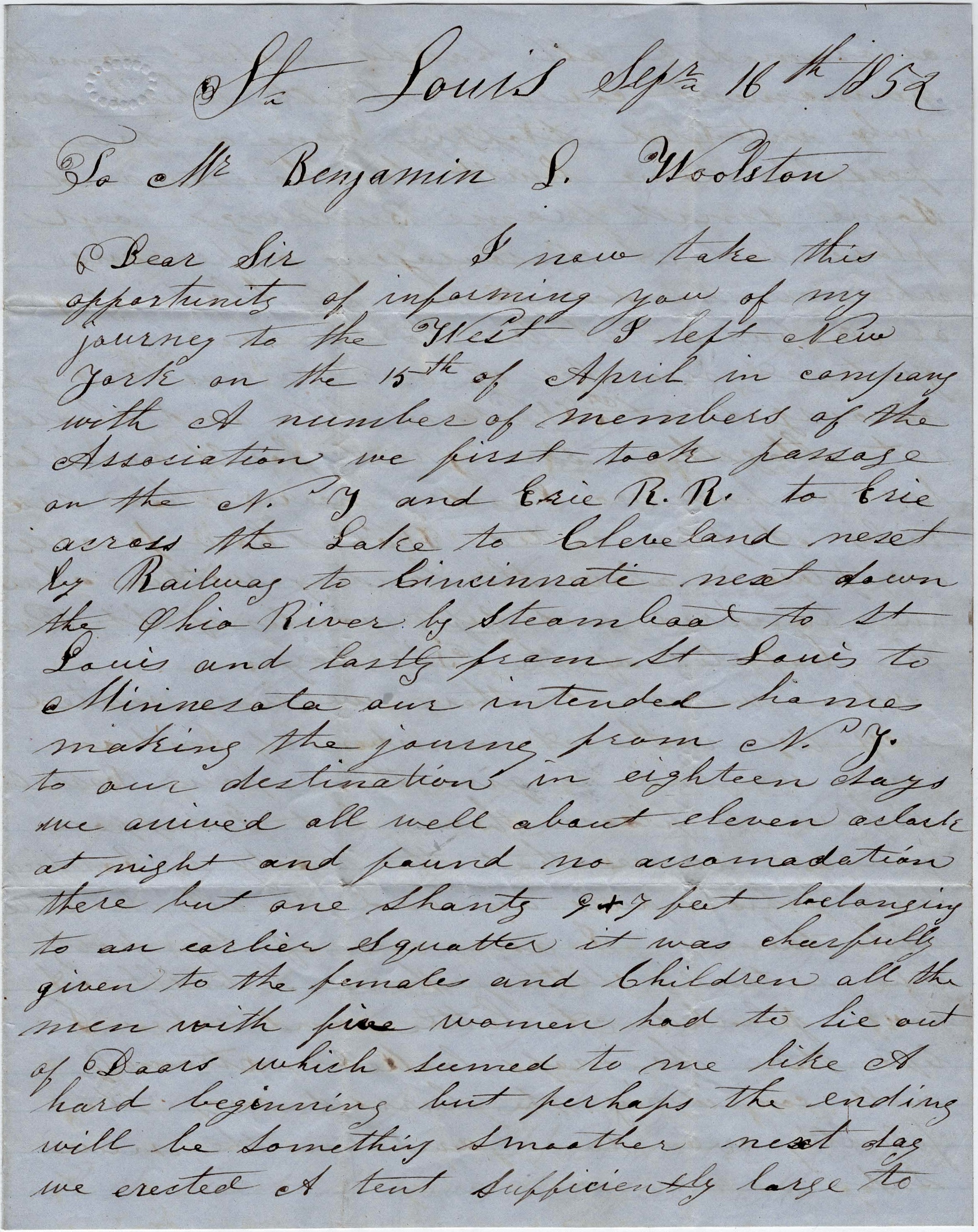
T R A N S C R I P T I O N
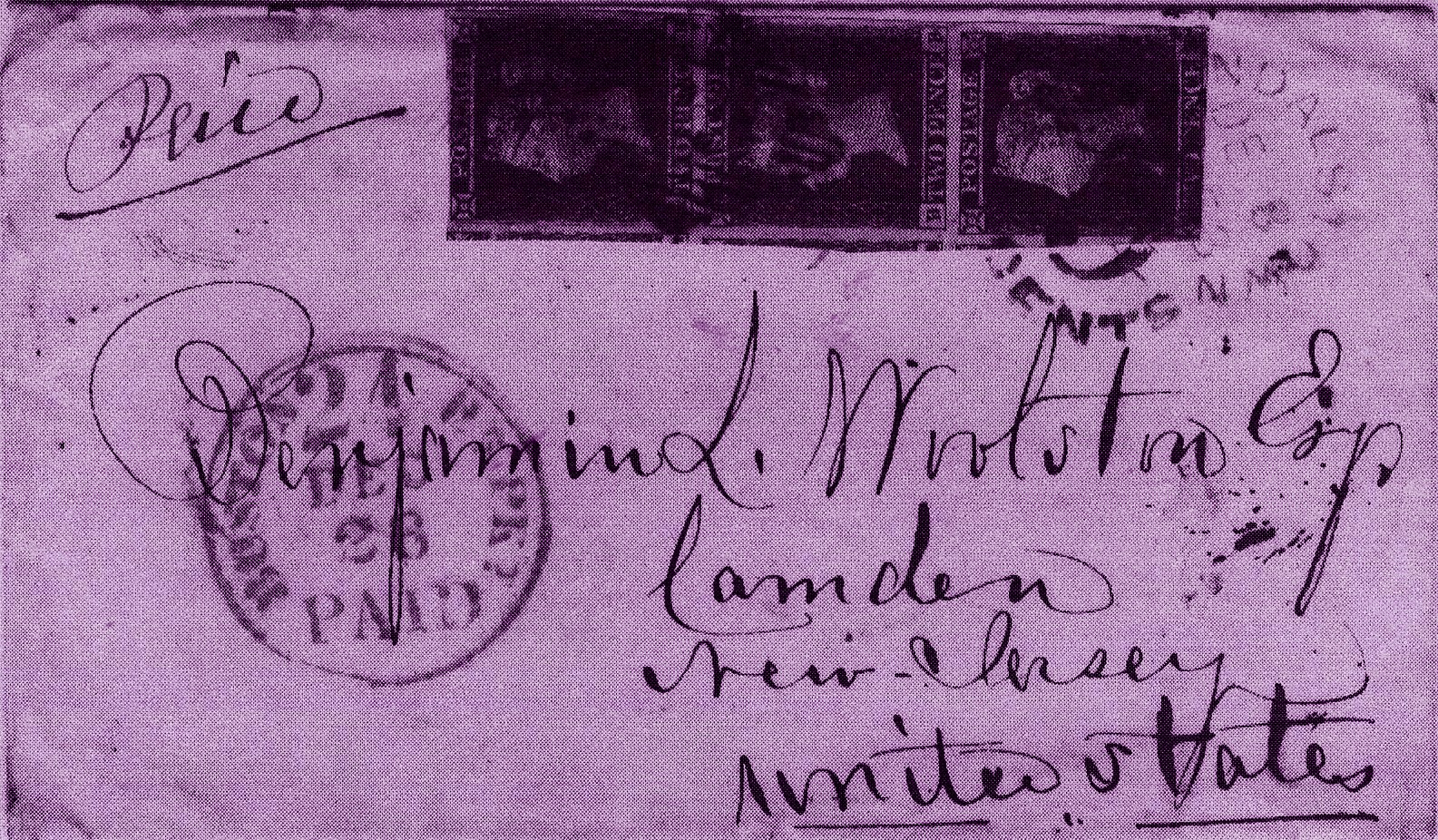
Addressed to Benjamin L. Woolston, Esq., Camden, New Jersey, United States
St. Louis [Missouri] September 16, 1852
To Mr. Benjamin L. Woolston
Dear Sir—I now take this opportunity of informing you of my journey to the West. I left New York on the 15th of April in company with a number of members of the Association. we first took passage on the New York and Erie Railroad to Erie, across the Lake to Cleveland. Next by railway to Cincinnati, next down the Ohio river by steamboat to St. Louis, and lastly from St. Louis to Minnesota—our intended homes—making the journey from New York to our destination in eighteen days. We arrived all well about 11 o’clock at night and found no accommodation there but one shanty 9 x 7 feet belonging to an earlier squatter. It was cheerfully given to the females and children. All the men with five women had to lie out of doors which seemed to me like a hard beginning but perhaps the ending will be something smoother.
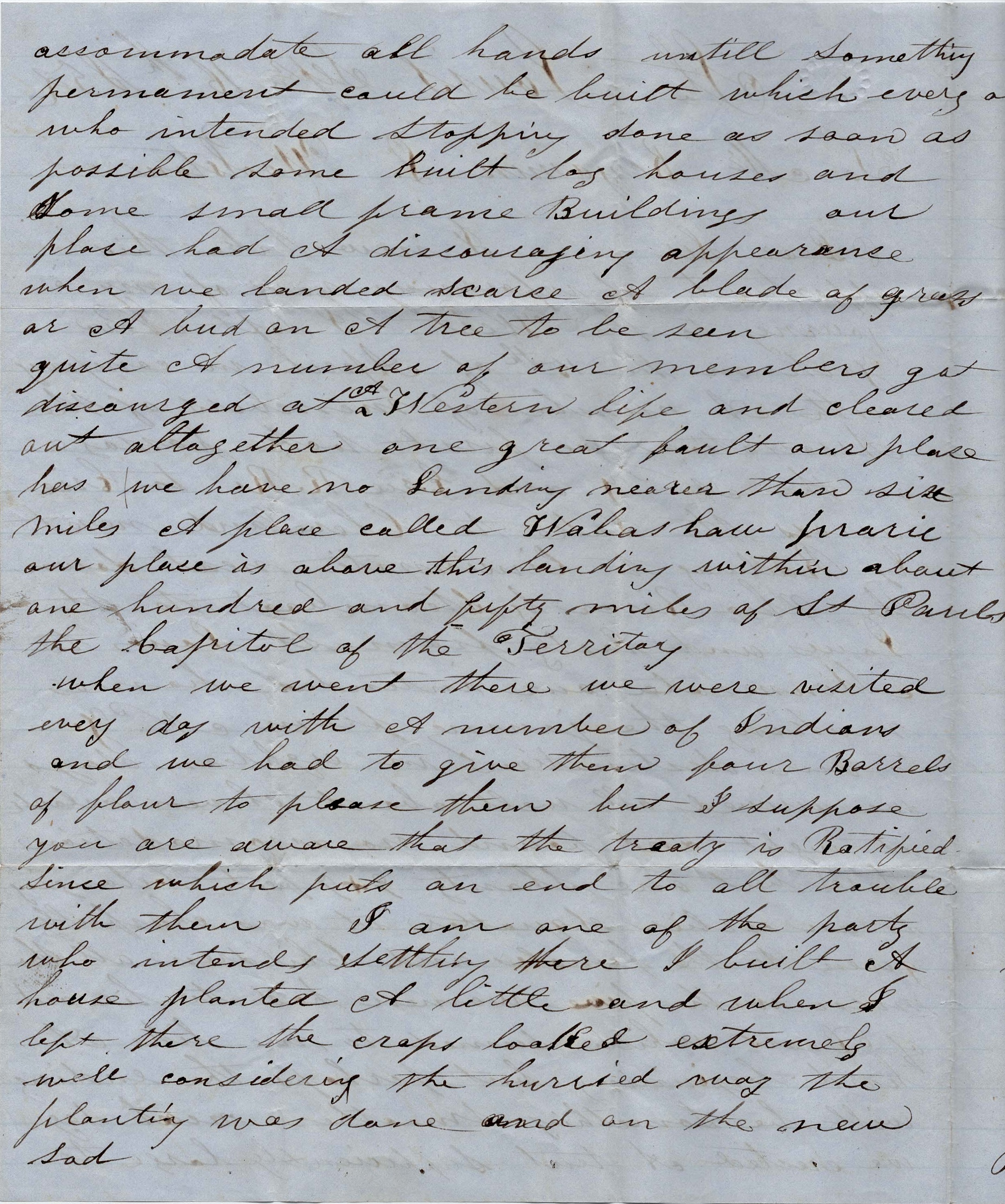
Next day we erected a tent sufficiently large to accommodate all hands until something permanent could be built which everyone who intended stopping done as soon as possible. Some built log houses and some small frame buildings. Our place had a discouraging appearance when we landed—scarce of blade of grass or a bud on a tree to be seen. Quite a number of our members got discouraged at a western life and cleared out altogether. One great fault—our place has no landing nearer than six miles—a place called Wahbasha’s Prairie [now Winona county, Minn.]. Our place is above this landing within about one hundred and fifty miles of St. Paul—the Capitol of the Territory.
A sketch of the landing at Wahbasha’s Prairie by Seth Eastman in 1848.
When we went there, we were visited every day with a number of Indians and we had to give them four barrels of flour to please them but I suppose you are aware that the treaty is ratified since which puts an end to all trouble with them. I am one of the party who intends settling there. I built a house, planted a little, and when I left there, the crops looked extremely well considering the hurried way the planting was done and on the new sod.
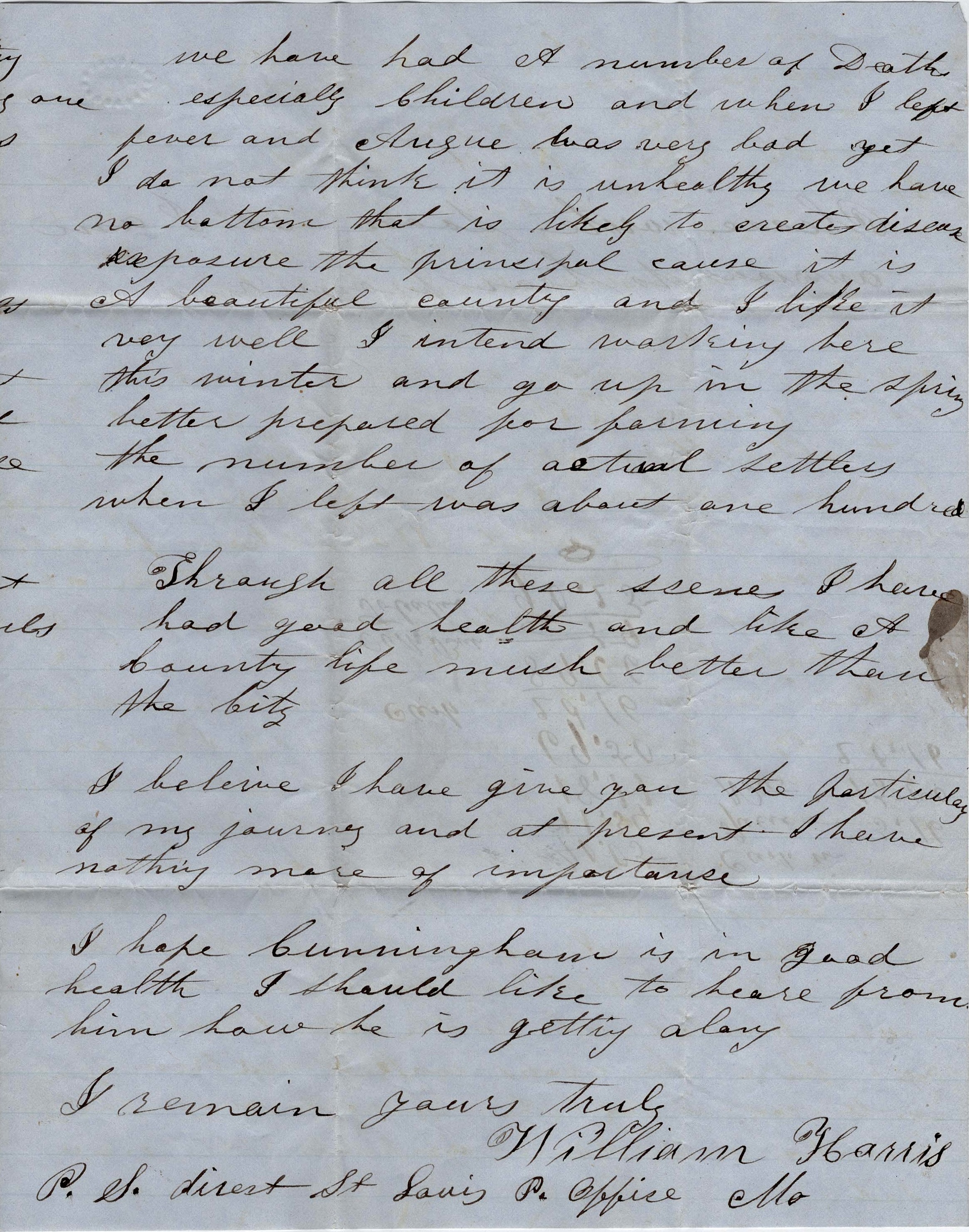
We have had a number of deaths—especially children, and when I left fever and ague was very bad yet. I do not think it is unhealthy. We have no bottom that is likely to create disease. Exposure [is] the principal cause. It is a beautiful country and I like it very well. I intend working here this winter and go up in the spring better prepared for farming. The number of actual settlers when I left was about one hundred.
Through all these scenes, I have had good health and like a country life much better than the city. I believe I have given you the particulars of my journey and at present I have nothing more of importance. I hope Cunningham is in good health. I should like to hear from him. How is he getting along? I remain yours truly, — William Harris
The following letter was written by Ralph Ashley (1797-1852) to his eldest son, Rollin Mallory Asley (1827-1911). Father and son were partners in a general store in Port Republic, New Jersey under the name “R. and R. T. Ashley” until 1833, when the partnership was discontinued and Ralph carried on the business alone until about 1848. Ralph also ventured into ship building, the marketing of wood and charcoal to New York City. Ralph Ashley was married to Sarah Blackman (1803-1879) in 1826.
The nature of Ralph’s trip to the coastal port of Edenton, North Carolina, is not stated explicitly but seems to have been connected with the salvage or selling of a vessel and/or cargo, and perhaps a reconnoissance trip to look for timber to purchase and sell to the New York City market. Ralph’s impression of slavery is consistent with the views of most Northern businessmen who visited the Antebellum South.
T R A N S C R I P T I O N
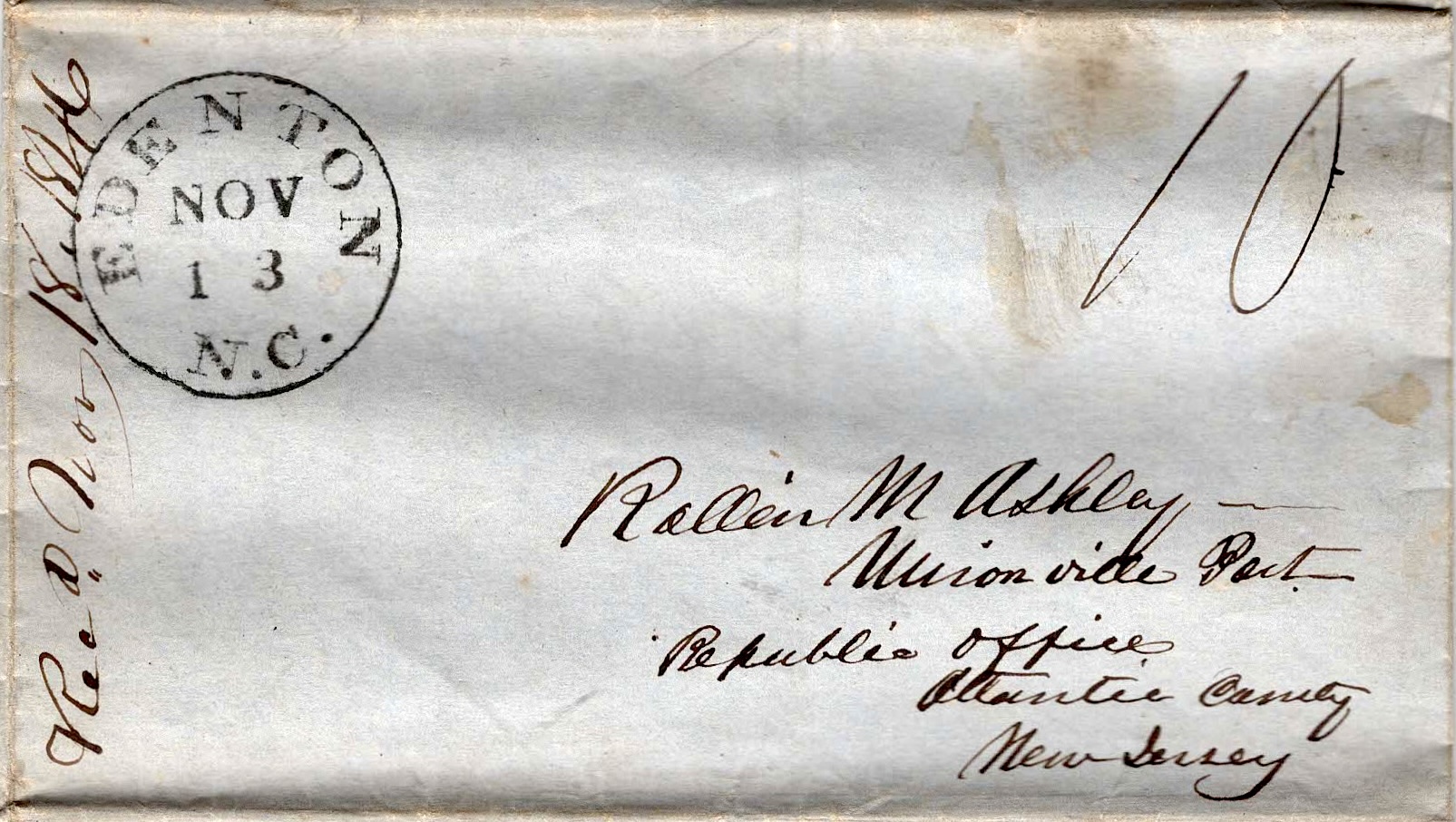
Addressed to Rollin M. Ashley, Unionville, Post Republic Office, Atlantic county, New Jersey
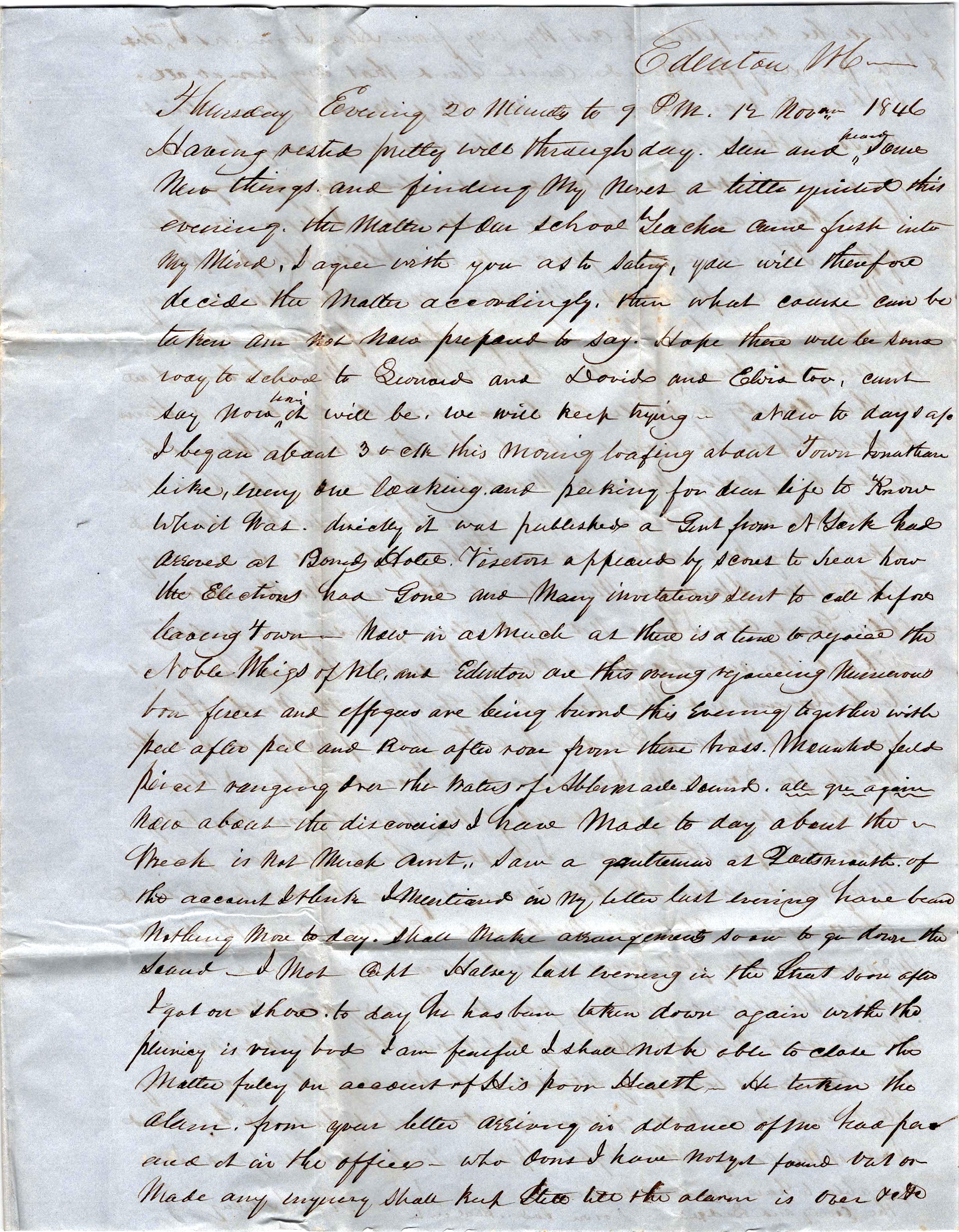
Edenton, North Carolina Thursday evening, 20 minutes to 9 p.m., 12 November 1846
Having rested pretty well through day, saw and heard some new things and finding my nerves a little quieted this evening, the matter of our school teacher came fresh into my mind. I agree with you as to salary. You will therefore decide the matter accordingly. Then what course can be taken, am not prepared to say. Hope there will be some way to school to Leonard and David and Eliza too. 1 Can’t say now how it will be. We will keep trying.
Now today as I began about 3 o’clock this morning loafing about town, Jonathan-like, everyone looking and peeking for dear life to know who I was, directly it was published a Gent from York had arrived at Bond’s Hotel. Visitors appeared by scores to hear how the elections had gone and many invitations sent to call before leaving town. Now inasmuch as there is a time to rejoice the Noble Whigs of North Carolina and Edenton, on this evening together with peel after peel, and roar after roar from the brass-mounted field pieces ranging over the waters of Albemarle Sound, all qu again.
Now, about the discoveries I have made today about — the wreck is not much [ ]. Saw a gentleman at Portsmouth of the account I think I mentioned in my letter last evening. Have been nothing more today. Shall make arrangements soon to go down the Sound. I met Capt. Halsey last evening in the street soon after I got on shore today. He was taken down again with the pleurisy [and] is very bad. I am fearful I shall not be able to close the matter fully on account of his poor health. He taken the Alum. From your letter arriving in advance of me had [ ] and it in the office. Who [ ] I have noted found out on. Many any enquiry. Shall keep still till the alarm is over, &c.
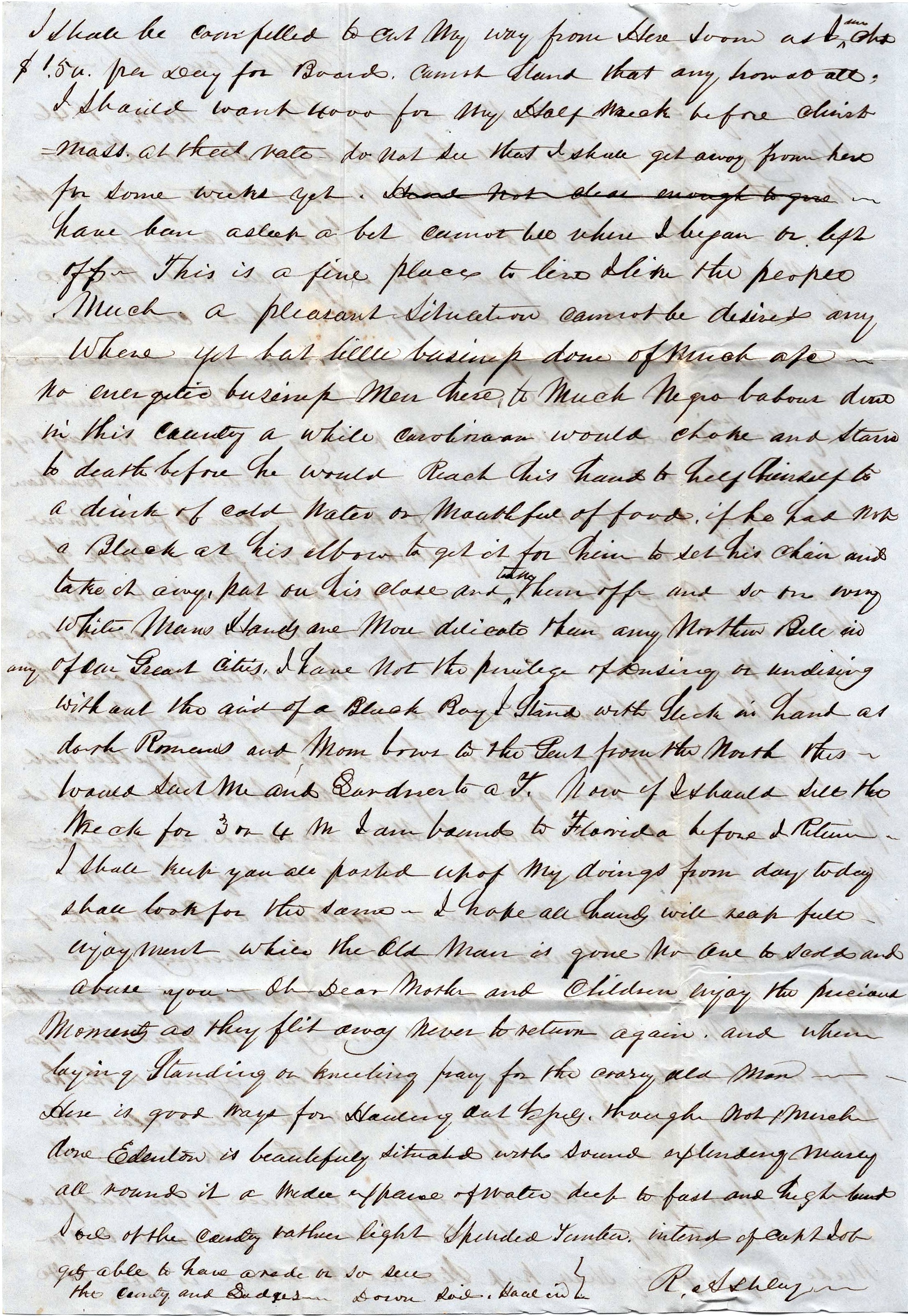
I shall be compelled to cut my way from here soon as I am charged $1.50 per day for board. [ ] stand that any [ ]. I should want 4000 for my half week before Christmas at that rate. Do not see that I shall get away from here for some weeks yet. Have been asleep a bit. Cannot tell where I began or left off.
This is a fine place to live. I like the people much. A [more] pleasant situation cannot be desired anywhere yet but little business done of much account. [There are] no energetic business men here. Too much Negro labor done in this country. A white Carolinian would choke and starve to death before he would reach his hand to help himself to a drink of cold water or a mouthful of food if he had not a Black at his elbow to get it for him, to set the chair and take it away, put on his clothes and take them off, and so on. Every white man’s hands are more delicate than any Northern belle in any of the great cities. I have not the privilege of dressing or undressing without the aid of a Black boy. I stand with stick in hand as dark Romans and Mom bows to the Gent from the North. This would suit me and Gardner to a T.
Now if I should sell the wreck for 3 or 4 M, I am bound to Florida before I return. I shall keep you all posted up of my doings from day to day. Shall look for the same. I hope all hands will reap full enjoyment while the Old Man is gone. No one to scold and abuse you. Oh dear Mother and children, enjoy the precious moments as they flit away, never to return again. And when laying, standing, or kneeling, pray for the crazy old man. Here is good ways for hauling out vessels, though not much done. Edenton is beautifully situated with Sound extending marly all round it. A wide expanse of water, deep too, and high coast. Soil of the country rather light. Splendid timber. Intend if Capt. Job gets able to have a ride to see he country and ledges. — R. Ashley
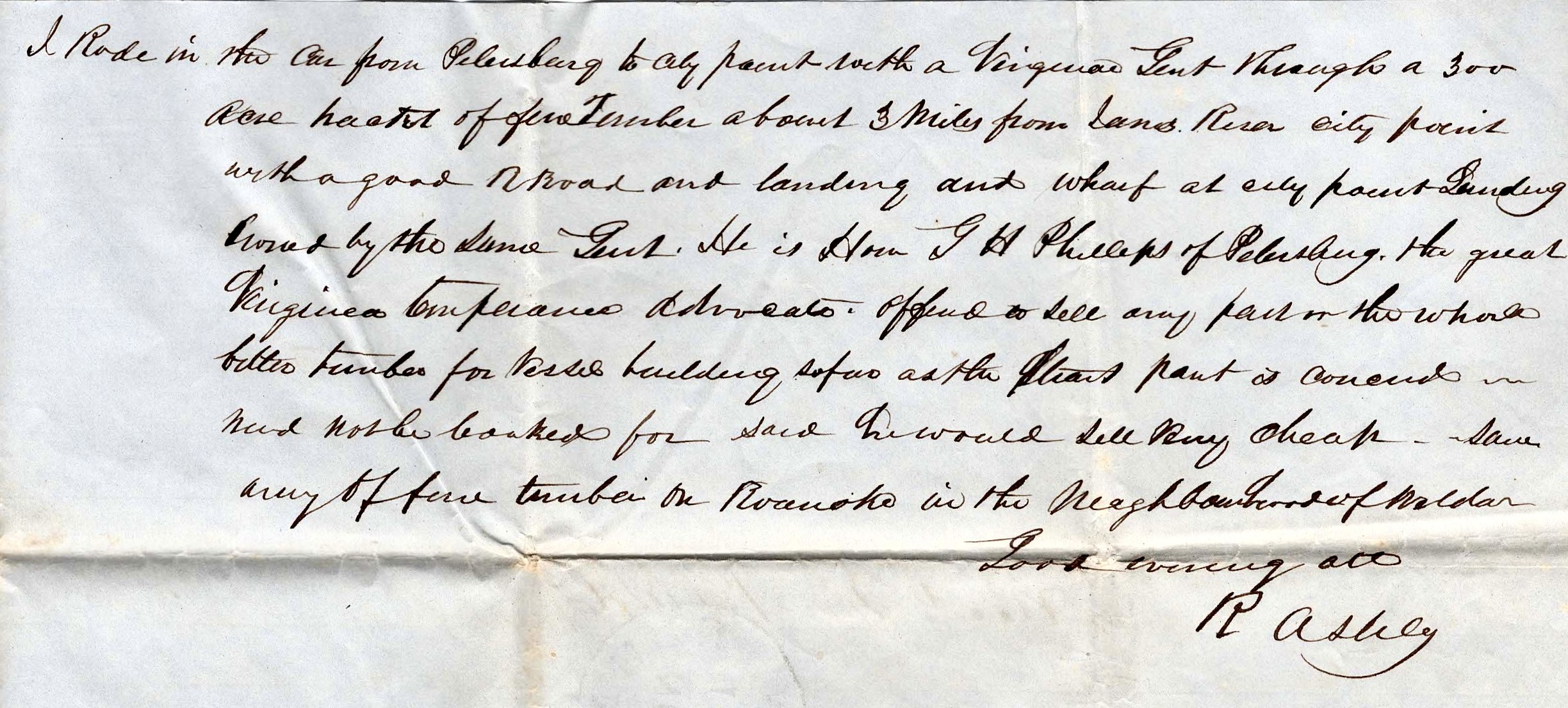
I rode in the car from Petersburg to City Point with a Virginia Gent through a 300-acre [ ] of fine timber about 3 miles from James River. City Point with a good railroad and landing and wharf at City Point Landing owned by the same Gent. He is Hon. G. H. Phillips of Petersburg—the great Virginia temperance advocate. Offered to sell any part or the whole. Better timber for vessel building so far as the strait part is concerned. Need [ ] [ ] for said he would sell buy cheap. Saw [ ] of fine timber on Roanoke in the neighborhood of [ ].
Good evening all, — R. Ashley
1 Ralph’s youngest children were Ann Eliza Ashley (b. 1835), Leonard (b. 1837), and David (b. 1840).
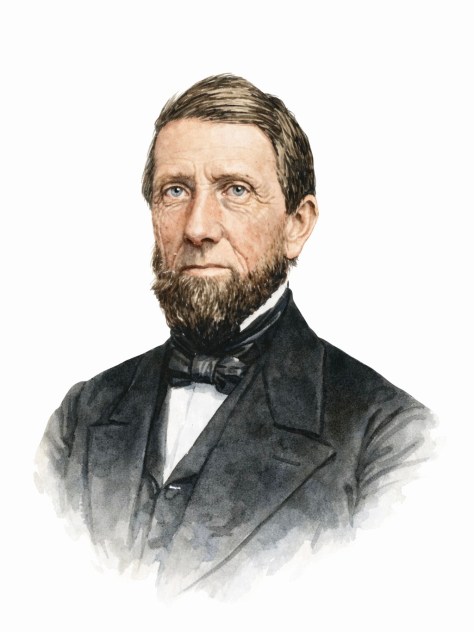
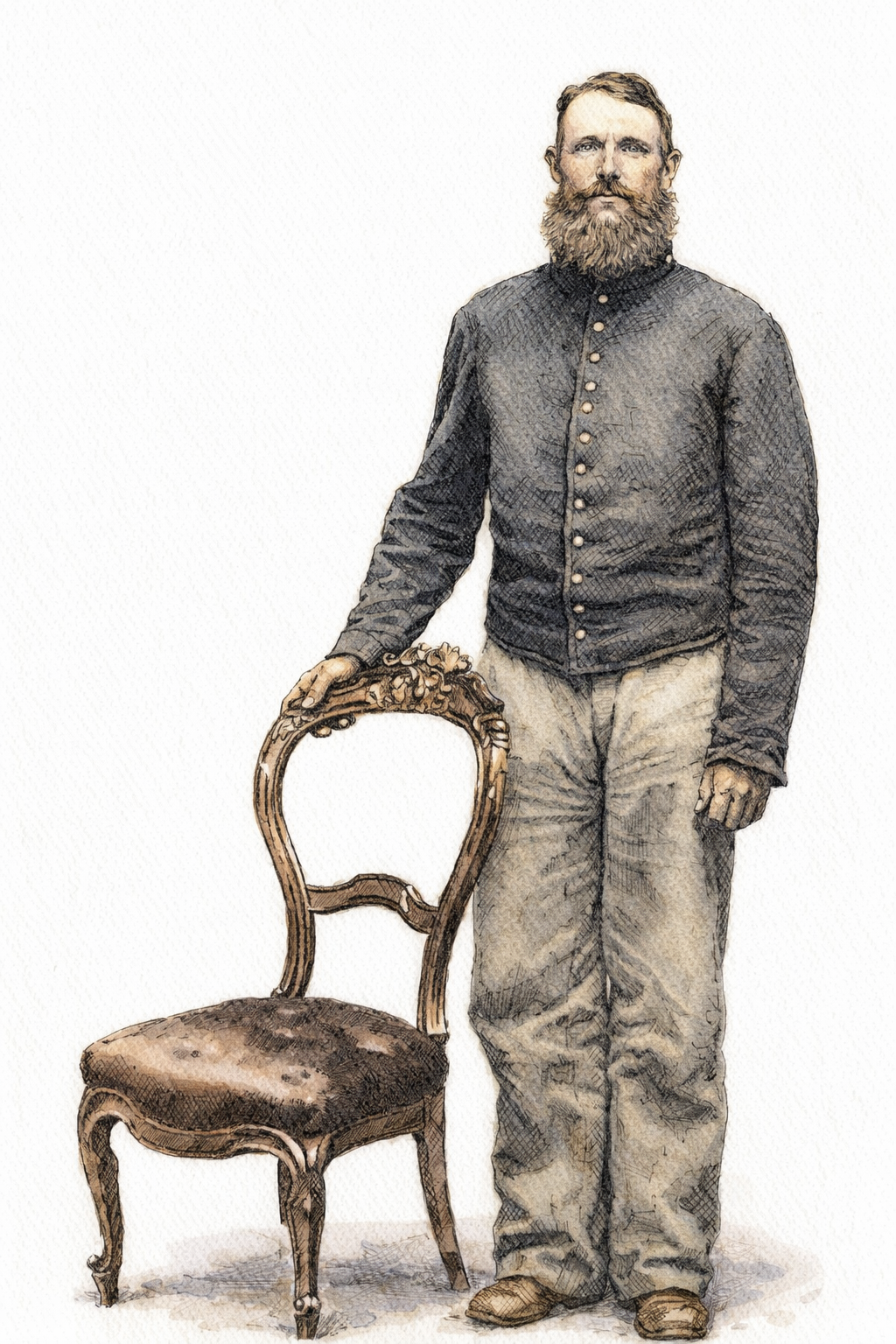
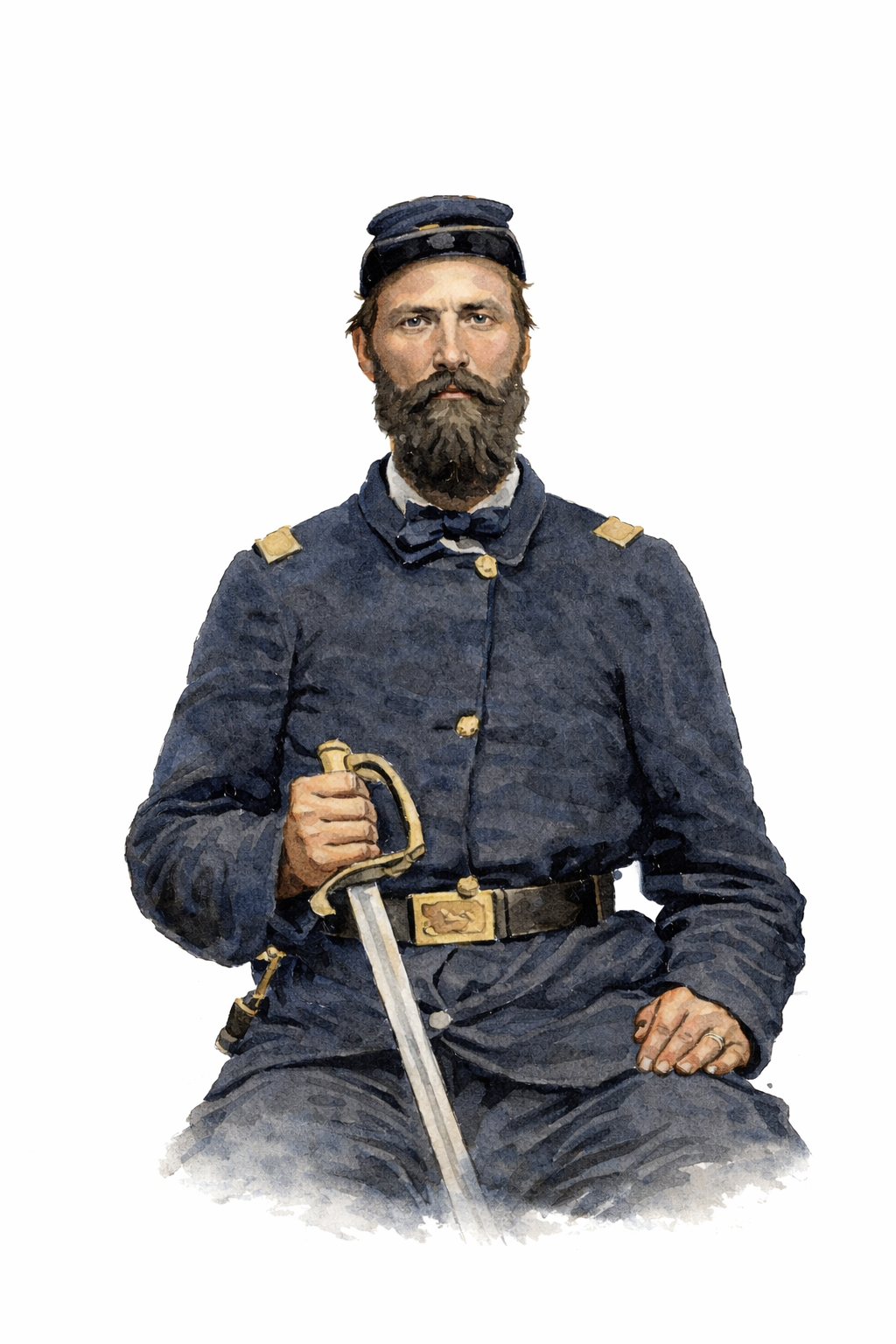
I could not find an image of Samuel but here is a sketch of Luther L. Haas who served in the 46th Pennsylvania (Josh Branham’s Collection)
The following letter was written by Samuel Thoman (1813-1862), the son of Johann Heinrich Thoman (1757-1835) and Magdalena Fredrika Hoffman (1769-1856) of Perry county, Pennsylvania. Samuel married Sarah Novinger (1820-1893) in 1839 and moved to Dauphin County, Pennsylvania, where he was employed as a miller. In September 1861, at the age of 48, Samuel enlisted in Co. D, 46th Pennsylvania Infantry. He was killed in the First Battle of Winchester in May 1862 in which Gen. Banks’ troops were heavily outnumbered and forced to retreat 35 miles to Williamsport, Maryland.
In his letter, Samuel speaks of the construction of a log shanty for winter quarters at Camp Mathews and of his hope that his wife might come and visit him. Samuel and his wife had only one son—Emanuel Thoman (1844-1915).
T R A N S C R I P T I O N
Camp Mathews [on the Upper Potomac in Maryland] January 4th 1862
Dear wife & son,
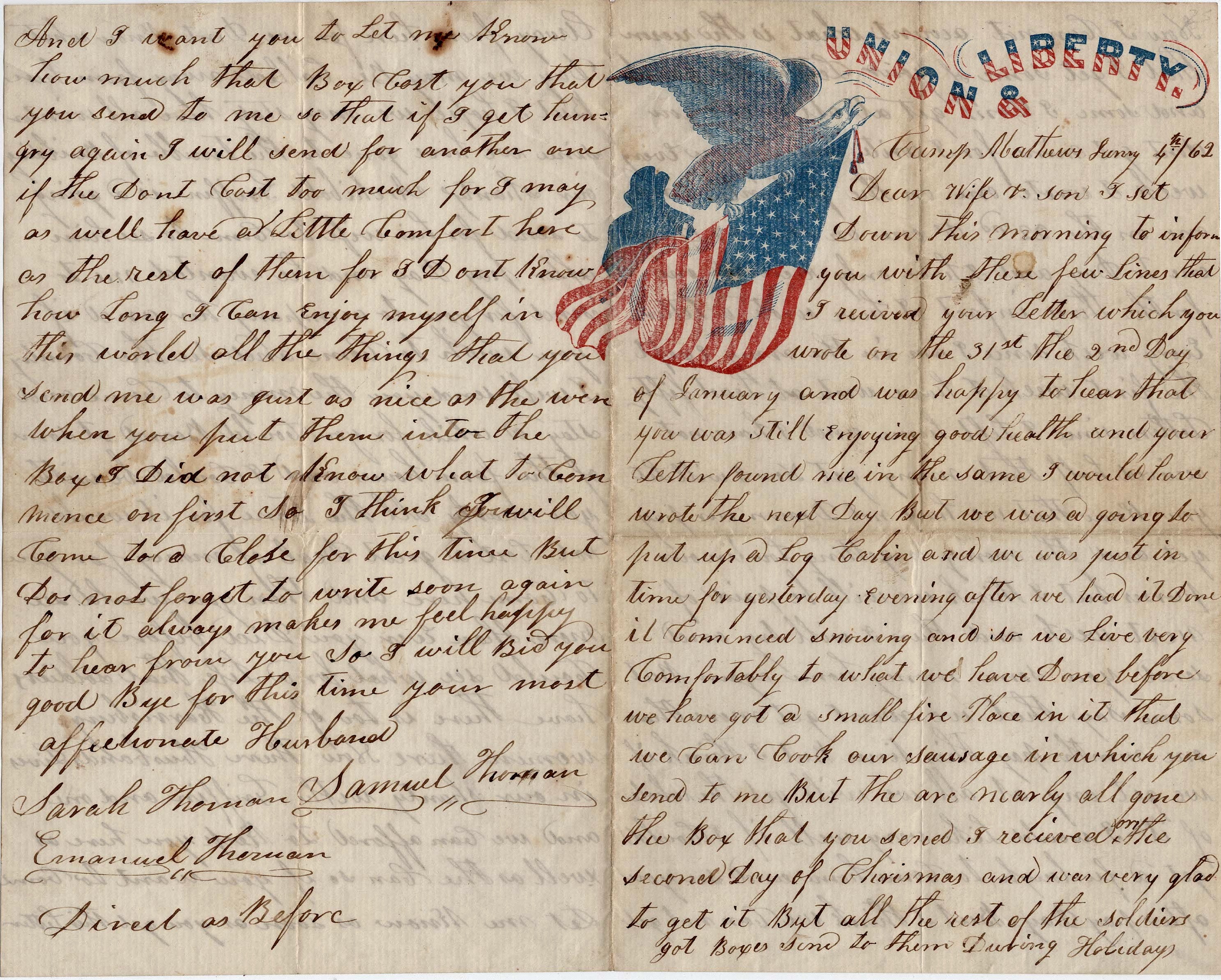
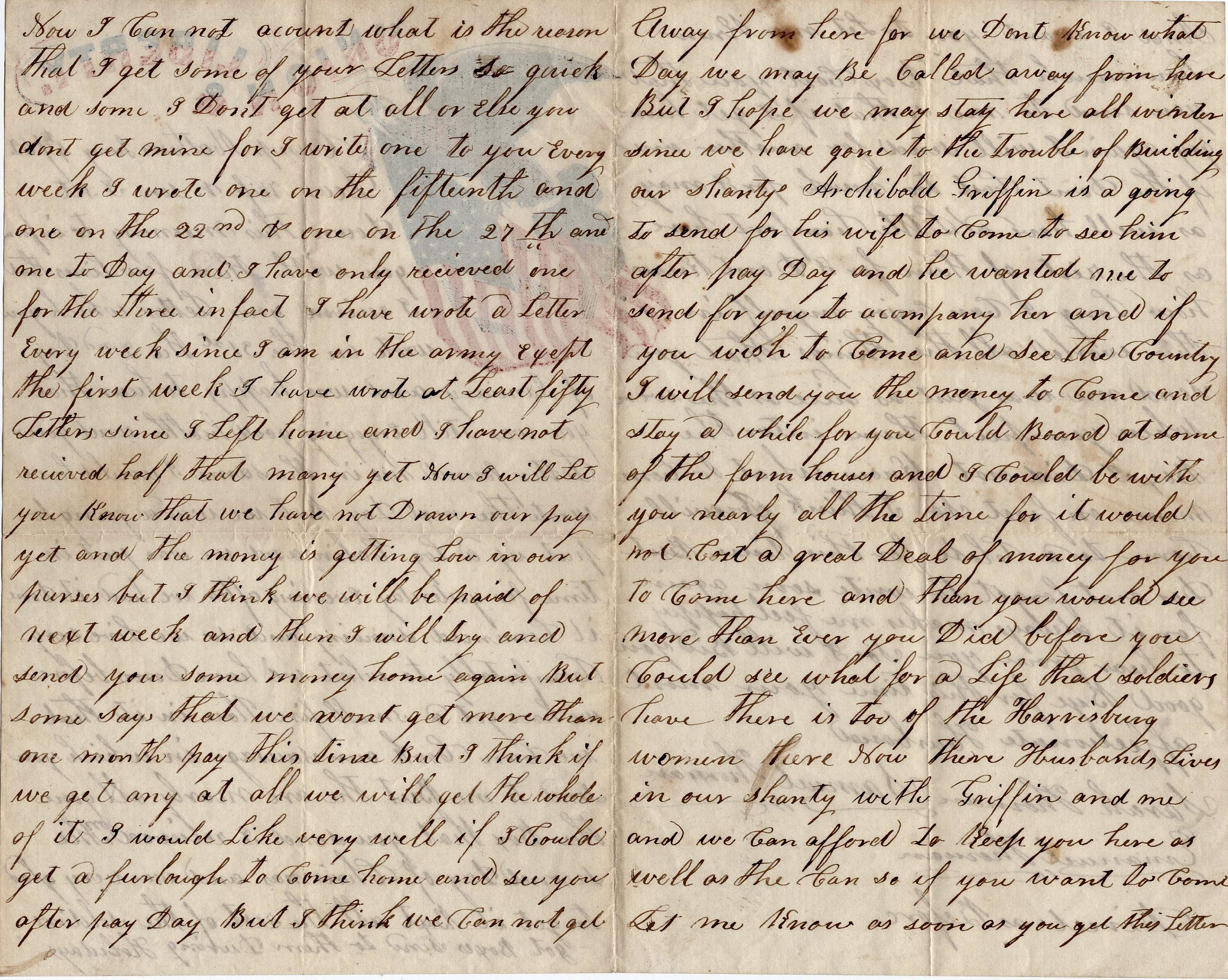
I sit down this morning to inform you with these few lines that I received your letter which you wrote on the 31st the 2nd day of January and was happy to hear that you was still enjoying good health and your letter found me in the same. I would have wrote the next day but we was going to put up a log cabin and we were just in time for yesterday evening after we had it done, it commenced snowing and so we live very comfortably to what we have done before. We have got a small fire place in it that we can cook our sausage in which you send to me, but they are nearly all gone. The box that you send I received the second day of Christmas and was very glad to get it. But all the rest of the soldiers got boxes sent to them during the Holidays. Now I cannot account what is the reason that I get some of your letters so quick and some I don’t get at all, or else you don’t get mine for I write to you every week. I wrote one on the 15th and one on the 22nd & one on the 27th and one today, and I have only received one for the three. In fact, I have wrote a letter every week since I am in the army except the first week. I have wrote at least 50 letters since I left home and I have not received half that many yet
Now I will let you know that we have not drawn our pay yet and the money is getting low in our purses but I think we will be paid off next week and then I will try and send you some money home again. But some says that we won’t get more than one month’s pay this time. But I think if we get any at all, we will get the whole of it. I would like very well if I could get a furlough to come home and see you after pay day but I think we can not get away from here for we don’t know what day we may be called away from here. But I hope we may stay here all winter since we have gone to the trouble of building our shanties.
Archibald Griffin is a going to send for his wife to come to see him after pay day and he wanted me to send for you to accompany her and if you wish to come and see the country, I will send you the money to come and stay a while for you could board at some of the farm houses and I could be with you nearly all the time for it would not cost a great deal of money for you to come here and then you would see more than ever you did before. You could see what for a life that soldiers have. There is two of the Harrisburg women here now. Their husbands live in our shanty with Griffin and me and we can afford to keep you here as well as they can so if you want to come, let me know as soon as you get this letter.
And I want you to let me know how much that box cost you that you sent to me so that if I get hungry again, I will send for another one if they don’t cost too much for I may as well have a little comfort here as the rest of them for I don’t know how long I can enjoy myself in this world. All the things that you sent me was just as nice as they were when you put them into the box. I did not know what to commence on first.
So I think I will come to a close for this time but do not forget to write soon again for it always makes me feel happy to hear from you so I will bid you goodbye for this time. Your most affectionate husband. — Samuel Thoman
The following letter was written by Abijah S. Jackson (1825-1868), a native of Wilmington, Delaware, and a 38 year-old when he first volunteered to serve as the Orderly Sergeant in Co. E, 1st Nebraska Cavalry. He was promoted to 2nd Lieutenant in August 1862 and resigned his commission at Pilot Knob in July 1863, giving the reason that he was suffering from bronchitis and “unfit for duty.”
After returning East to Philadelphia, and only a month later in August 1863, Abijah enrolled in the service again, returning to the ranks as a private in Co. E, 3rd Pennsylvania Heavy Artillery. He served with them until 6 April 1864 when he accepted a commission as 2nd lieutenant of Co. E, 188th Pennsylvania Infantry. He was subsequently promoted to 1st Lieutenant in September 1864 and to Captain in January 1865. Service records indicate he stood just shy of 5′ 9″ and had black hair and hazel eyes.
Abijah’s letter provides us with the details of the wounding and death of Hiram Root Shinkel (1840-1864), captain of Co. E, 188th Pennsylvania Infantry. He was wounded in the Battle of Drewry’s Bluff on 16 May 1864 and died at Richmond. The letter was addressed to Jacob Shinkel (1814-1889) of Leverington P. O., Philadelphia county, Pennsylvania.
[Note: This letter is from the private collection of Keith Fleckner and was made available for transcription and publication on Spared & Shared by express consent.]
T R A N S C R I P T I O N
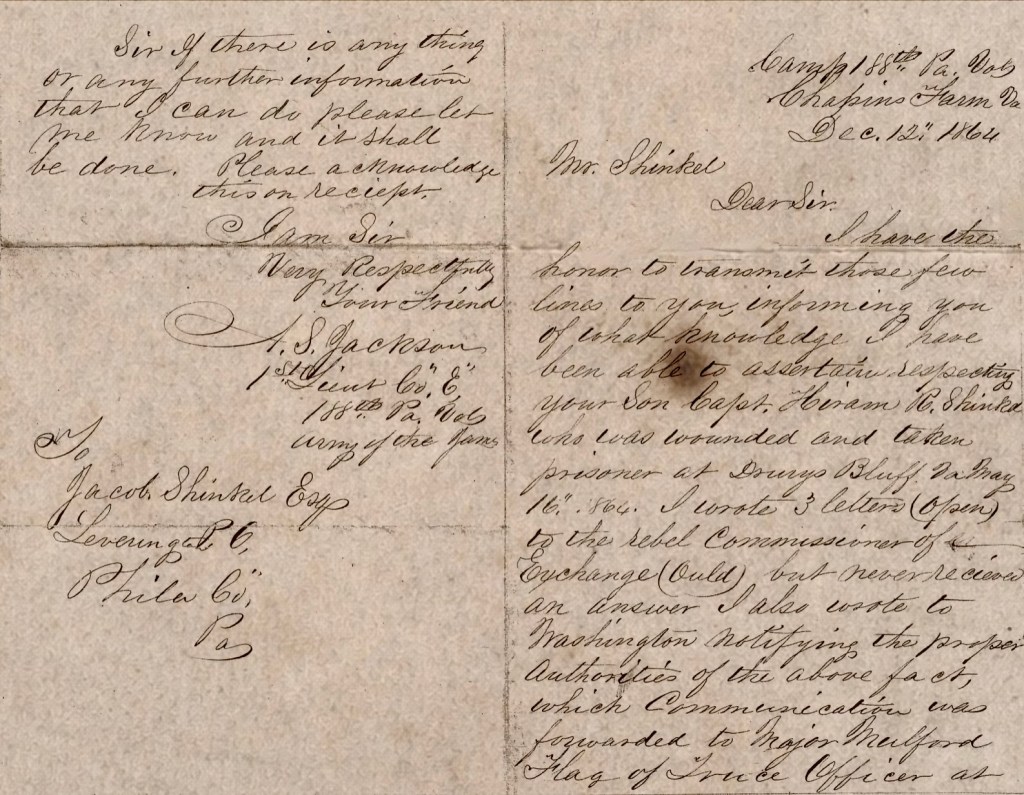
Camp 188th Pennsylvania Vols. Chapins Farm, Virginia Dec. 12, 1864
Mr Shinkel
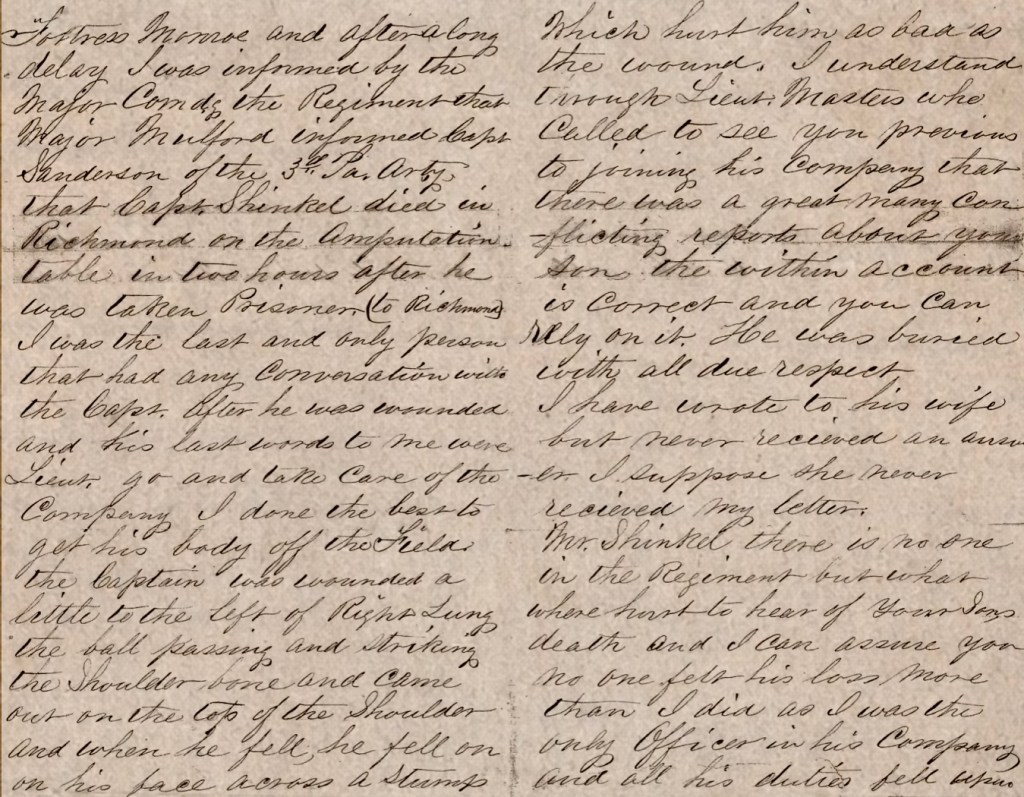
Dear Sir—I have the honor to transmit these few lines to you informing you of what knowledge I have been able to ascertain respecting your son, Capt. Hiram R. Shinkel, who was wounded and taken prisoner at Drewry’s Bluff, Virginia, May 16, 1864. I wrote 3 letters (open) to the rebel Commissioner of Exchange ([Robert] Ould) but never received an answer. I also wrote to Washington notifying the proper authorities of the above fact, which communication was forwarded to Major [John E.] Mulford, Flag of Truce Officer at Fortress Monroe, and after a long delay I was informed by the Major commanding the Regiment, that Major Mulford informed Capt. [Joseph Warner] Sanderson of the 3rd Pennsylvania Artillery that Capt. Shinkel died in Richmond on the amputation table [with]in two hours after he was taken prisoner (to Richmond).
I was the last and only person that had any conversation with the captain after he was wounded and his last words to me were, “Lieutenant, go and take care of the company.” I done the best to get his body off the field. The captain was wounded a little to the left of [his] right lung—the ball passing and sticking the shoulder bone and came out on the top of the shoulder. And when he fell, he fell on his face across a stump which hurt him as bad as the wound. I understand through Lieutenant [Andrew] Masters, who called to see you previous to joining his company, that there was a great many conflicting reports about your son. The within account is correct and you can rely on it. He was buried with all due respect.
I have wrote to his wife but never received an answer. I suppose she never received my letter.
Mr. Shinkel, there is no one in the regiment but what were hurt to hear of your son’s death and I can assure you no one felt his loss more than I did as I was the only officer in his company and all his duties fell upon me.
Sir, if there is anything or any further information that I can do, please let me know and it shall be done. Please acknowledge this on receipt. I am, Sir, very respectfully, your friend — A. S. Jackson, 1stLieut. Co. E, 188thPa Vols., Army of the James
To: Jacob Shinkel Esq. Leverintgon P. O., Philadelphia Co. PA
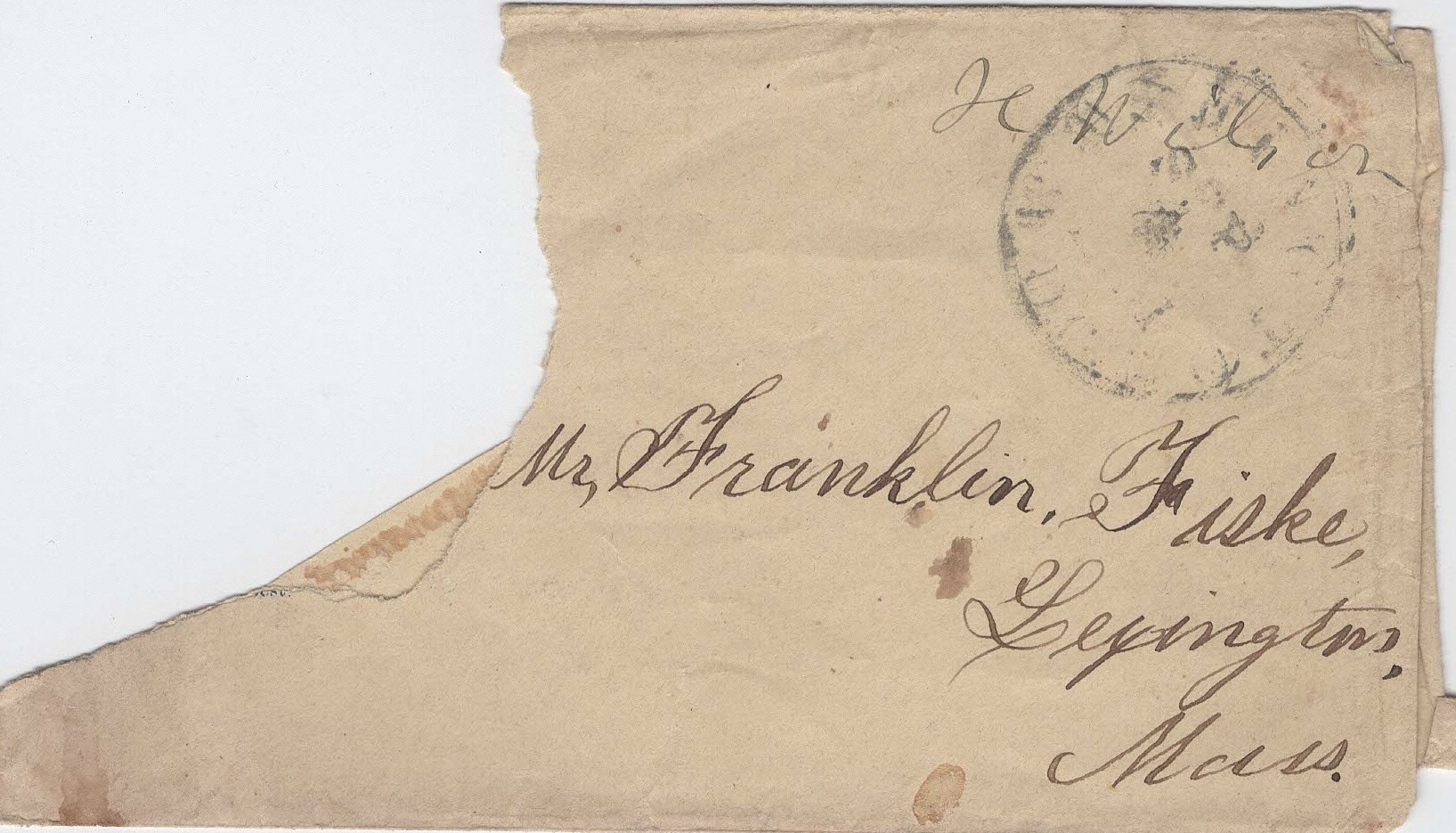
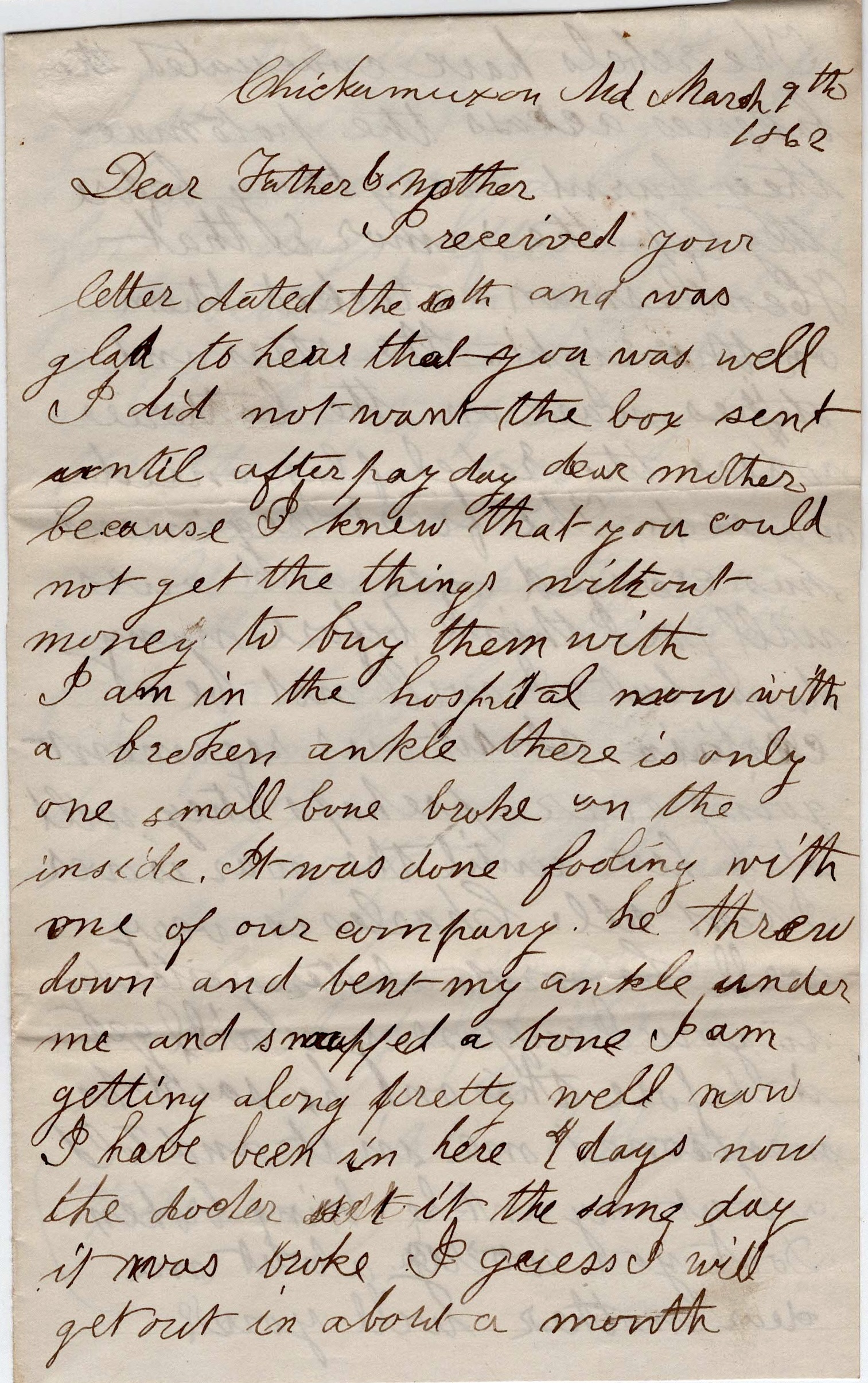
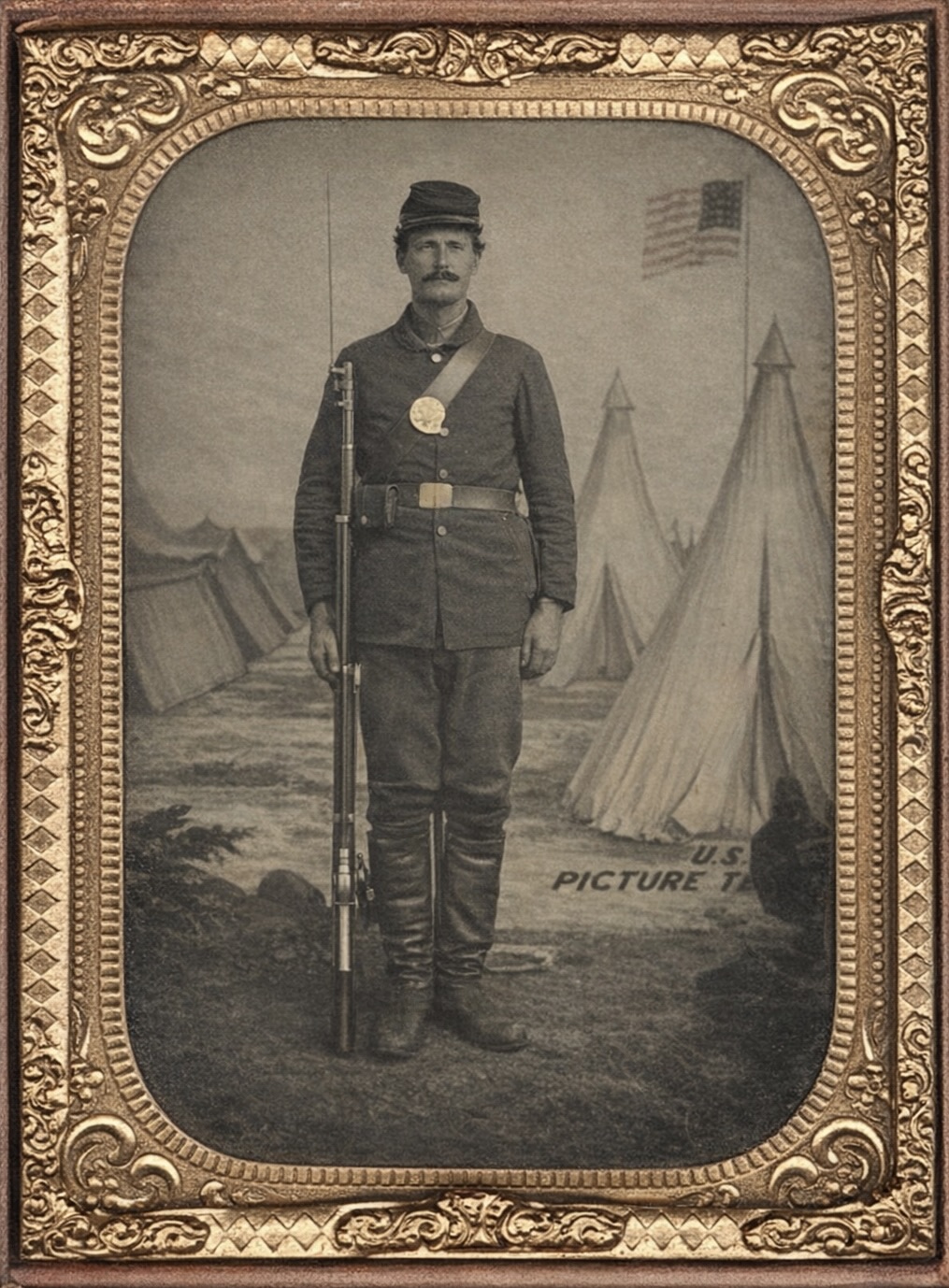
The following letter was written by Joseph Henry Peters Fiske (1843-1870), the son of Franklin Fiske (1804-1868) and Hannah Peters (1801-Aft1868) of Lexington, Middlesex, Massachusetts. He enlisted on 13 June 1861 at Lexington, Massachusetts in Co. G, 11th Massachusetts, at the same time as his older brother Charles Albert Bowers Fiske (1842-1910) who served in Co. K. Joseph was discharged for disability on 20 May 1863. The Register of Enlistments informs us that Joseph died in February 1870 and that he suffered from rheumatism.
T R A N S C R I P T I O N
Chicamuxen, Maryland March 9, 1862
Dear Father & Mother,
I received your letter dated the 6th and was glad to hear that you was well. I did not want the box sent until after pay day, dear Mother, because I knew that you could not get the things without money to buy them with.
I am in the hospital now with a broken ankle. There is only one small bone broke on the inside. It was done fooling with one of our company. He threw [me] down and bent my ankle under me and snapped a bone. I am getting along pretty well now. I have been in here four days now. The doctor set it the same day it was broke. I guess I will get out in about a month.
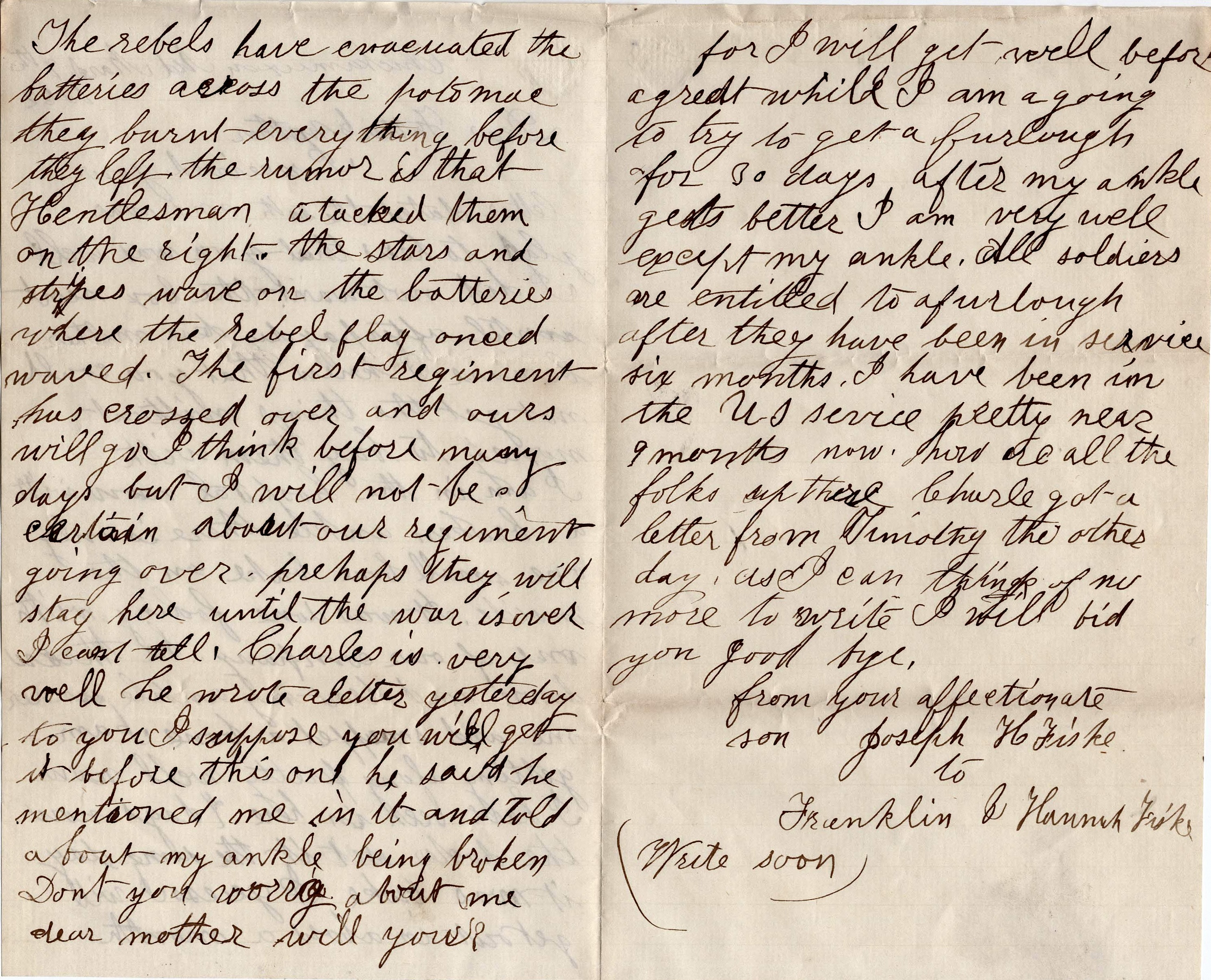
The rebels have evacuated the batteries across the Potomac. They burnt everything before they left. The rumor is that Heintzelman attacked them on the right. The stars and stripes wave on the batteries where the rebel flag once waved. The first regiment has crossed over and ours will go, I think, before many days. But I will not be certain about our regiment going over. Perhaps they will stay here until the war is over. I can’t tell.
Charles is very well. He wrote a letter yesterday to you. I suppose you will get it before this one. He said he mentioned me in it and told about my ankle being broken. Don’t you worry about me, dear Mother, will you? for I will get well before a great while. I am a going to try to get a furlough for thirty days after my ankle gets better. I am very well except my ankle. All soldiers are entitled to a furlough after they have been in the service six months. I have been in the service pretty near nine months now.
How are all the folks up there? Charlie got a letter from Timothy the other day. As I can think of no more to write, I will bid you goodbye. From your affectionate son, Joseph H. Fiske
The following letters were written by Henry Randall Dunham (1838-1877), the son of John Levi Dunham (1811-1861) and Laura Melvina Cheney (1812-1894) of LaPorte, Sullivan county, Pennsylvania. Henry was “a rising young lawyer” when he enlisted in Co. K, 141st Pennsylvania Infantry and was promoted soon after to 1st Lieutenant for his efforts in raising the company. However, ill health resulted in his resigning his commission after 4 months service in late December 1862 and returning home to LaPorte. In January 1865, Henry returned to the service in late December 1864, receiving a commission by order of the President, as 2nd Lieutenant of Co. F of the Thirteenth Regiment, United States Colored Troops. Though he was only a 2nd Lieutenant, his muster rolls indicate that he drew pay for commanding Co. H from 15 February to 15 June 1865. After hostilities ended, he was assigned duty as the Acting Commissary of Subsistence at Fort Macon, North Carolina, and was mustered in as 1st Lieutenant of Co. E in late July 1865. He mustered out of the service on 10 December 1865 at Roanoke Island, returned home, and was for a time in the employ of Welles, Ackley & Company, a mercantile establishment in Dushore, Sullivan county, Pennsylvania. He afterward went to Kansas, returned to his home in Laporte where he died September 5, 1877, at the age of thirty-nine years.
Henry’s brother, Benjamin M. Dunham (1840-1863), served with him in the 141st Pennsylvania but was killed at the battle of Chancellorsville on May 3, 1863.
[Note: These letters are from the personal collection of Keith Fleckner and were offered for transcription and publication on Spared & Shared by express consent.]
Letter 1
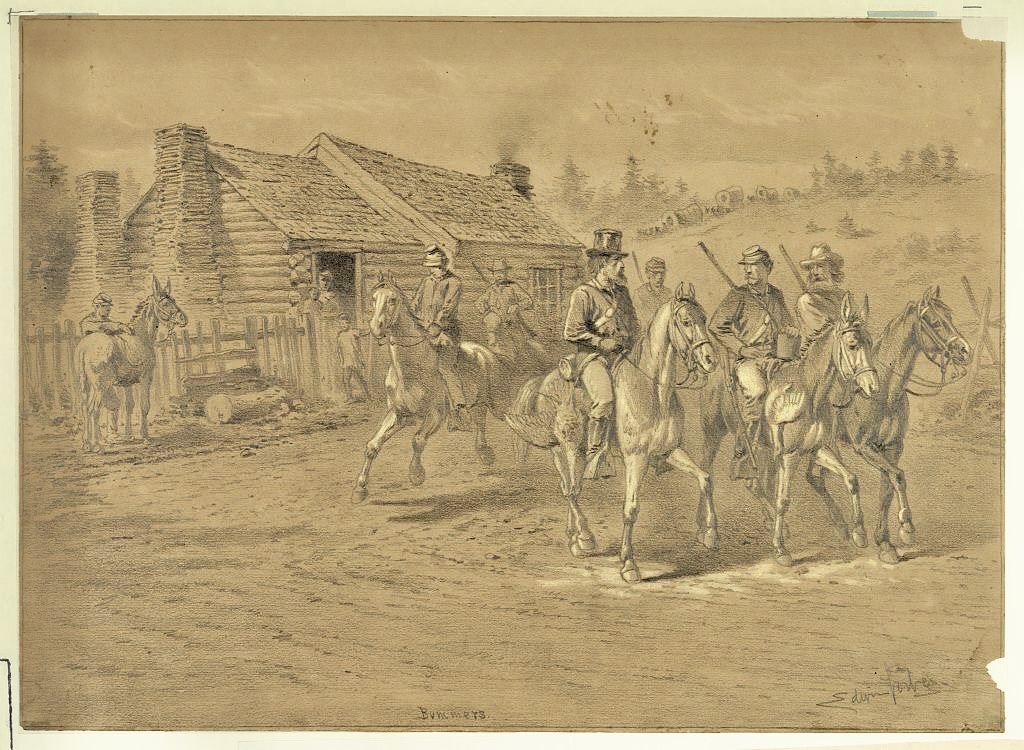
Sherman’s Bummers foraging in advance of his army.
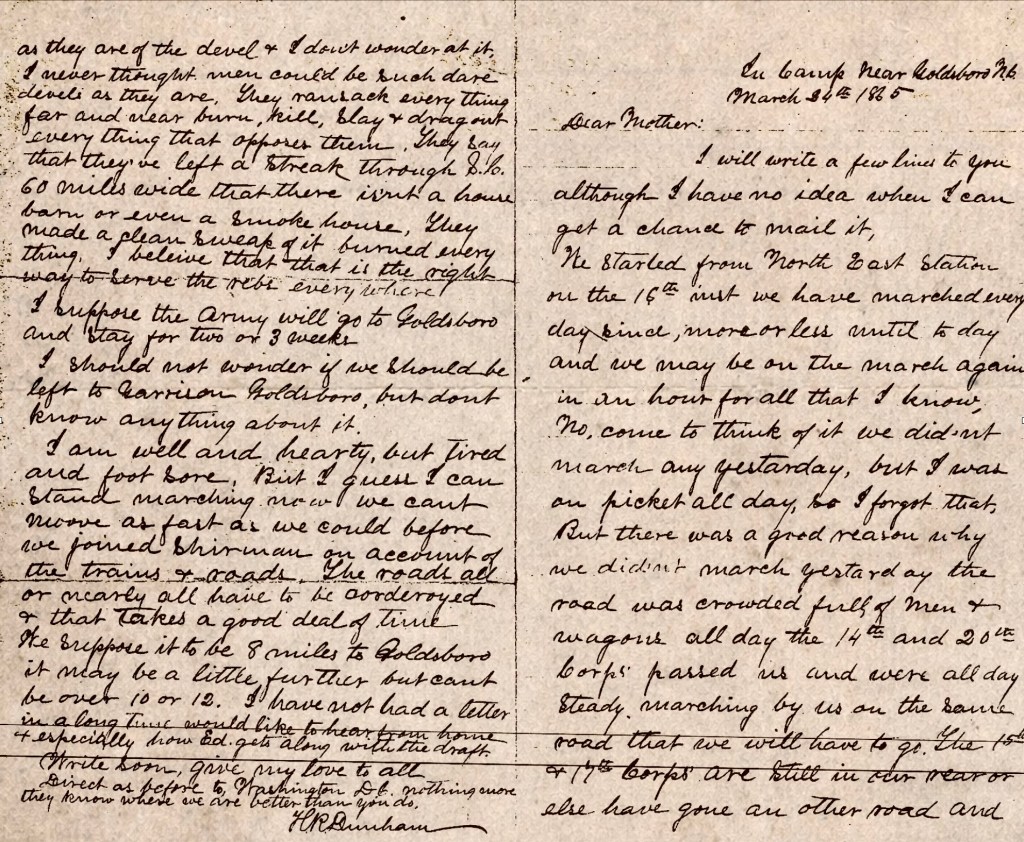
In Camp Near Goldsboro, N. C. March 24th 1865
Dear Mother,
I will write a few lines to you although I have no idea when I can get a chance to mail it.
We started from North East Station on the 16th inst. We have marched every day since—more or less—until today, and we may be on the march again in an hour for all that I know. No, come to think of it, we didn’t march any yesterday, but I was on picket all day so I forgot that. But there was a good reason why we didn’t march yesterday—the road was crowded full of men and wagons all day. The 14th and 20th Corps passed us and were all day steady marching by us on the same road that we will have to go. The 15th and 17 Corps are still in our rear, or else have gone on another road and not far off.
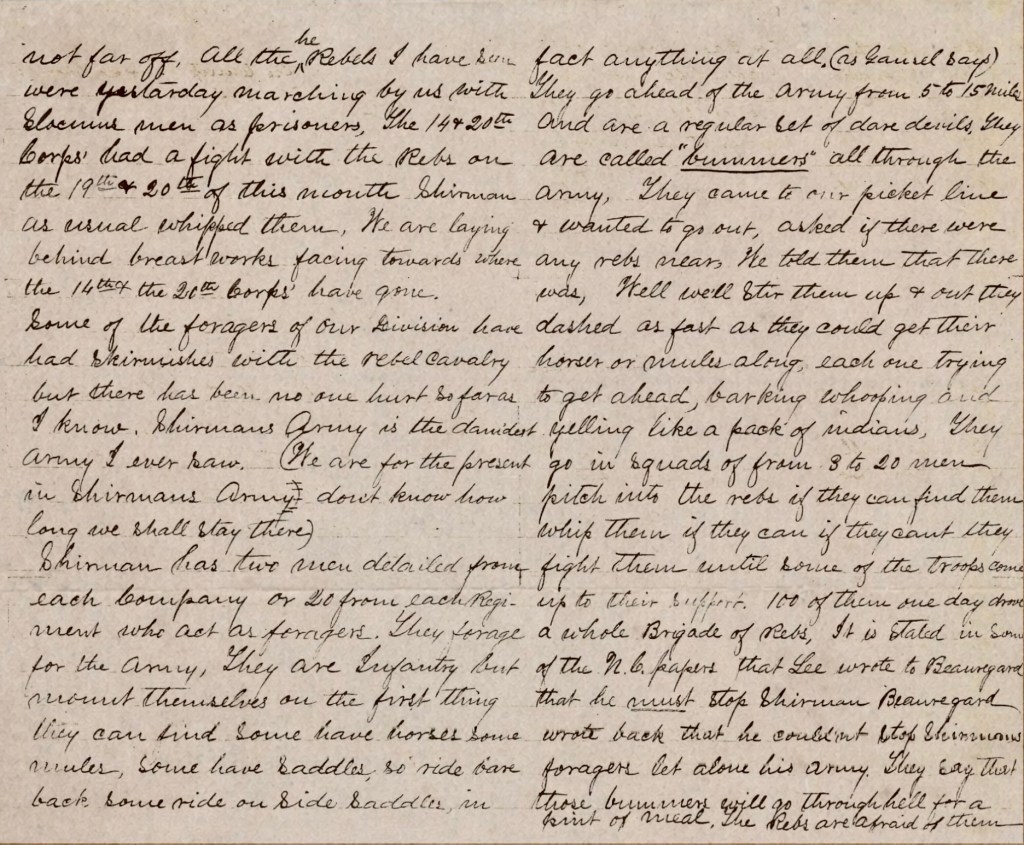
All the Rebels I have seen were yesterday marching by us with Slocum’s men as prisoners. The 14th and 20th Corps had a fight with the Rebs on the 19th and 20th of this month. Sherman as usual whipped them. We are [now] laying behind breast works facing towards where the 14th and the 20th Corps have gone. Some of the foragers of our division have had skirmishes with the rebel cavalry but there has been no one hurt so far as I know.
Sherman’s Army is the damnedest army I ever saw. (We are for the present in Sherman’s Army—don’t know how long we shall stay there). Sherman has two men detailed from each company or 20 from each regiment who act as foragers. They forage for the army. They are infantry but mount themselves on the first thing they can find. Some have horses, some mules, some have saddles, so[me] ride bare back, some ride on side saddles—in fact, anything at all (as Gaurel [?] says). They go ahead of the army from 5 to 15 miles and are a regular set of dare devils. They are called “bummers” all through the army. They came to our picket line and wanted to go out. [When they] asked if there were any rebs near, we told them that there was. “Well, we’ll stir them up and out!” [Then] they dashed as fast as they could get their horses or mules along, each one trying to get ahead, barking, whooping, and yelling like a pack of Indians. They go in squads of from 3 to 20 men, pitch into the rebs if they can find them, [and] whip them if they can. If they can’t, they fight them until some of the troops come up to their support. One hundred of them one day drove a whole brigade of rebs.
It is stated in some of the N.C. papers that Lee wrote to Beauregard that he must stop Sherman. Beauregard wrote back that he couldn’t stop Sherman’s foragers, let alone his army. They say that those bummers will go through hell for a pint of meal. The rebs are afraid of them as they are of the devil and I don’t wonder at it. I never thought men could be such dare devils as they are. They ransack everything far and near, burn, kill, slay, and drag out everything that opposes them. They say that they’ve left a streak through S. C. 60 miles wide—that there isn’t a house, barn, or even a smoke house [left standing]. They made a clean sweep of it—burned everything. I believe that that is the right way to serve the rebs everywhere.
I suppose the army will go to Goldsboro and stay for two or 3 weeks. I should not wonder if we should be left to garrison Goldsboro, but don’t know anything about it.
I am well and hearty, but tired and foot sore. But I guess I can stand marching now. We can’t move as fast as we could before we joined Sherman on account of the trains and roads. The roads all or nearly all have to be corduroyed and that takes a good deal of time. We suppose it to be 8 miles to Goldsboro. It may be a little further but can’t be over 10 or 12. I have not had a letter in a long time. Would like to hear from home and especially how Ed gets along with the draft. Write soon, give my love to all.
Direct as before to Washington D. C. Nothing more. They know where we are better than you do. — H. R. Dunham
Letter 2
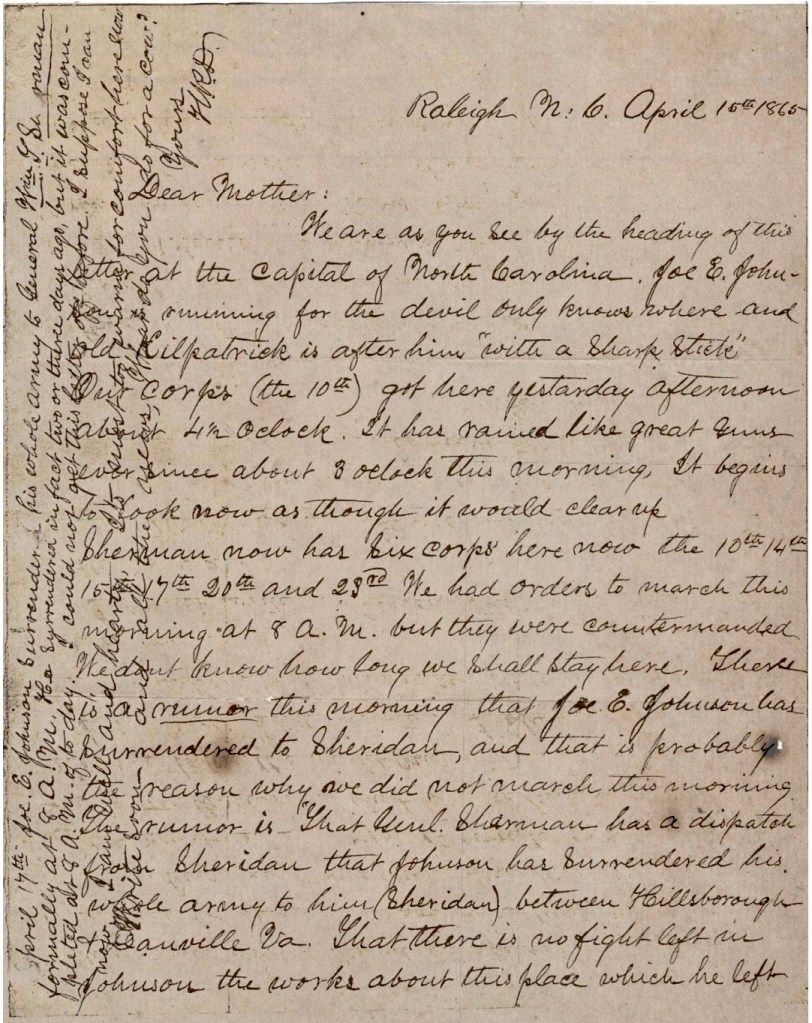
Raleigh, N.C. April 15th 1865
Dear Mother:
We are as you see by the heading of this letter at the Capital of North Carolina. Joe E. Johnston is running for the devil only knows where and old Kilpatrick is after him “with a sharp stick.” Our Corps (the 10th) 1 got here yesterday afternoon about 4.30 o’clock. It has rained like great guns ever since about 3 o’clock this morning. It begins to look now as though it would clear up.
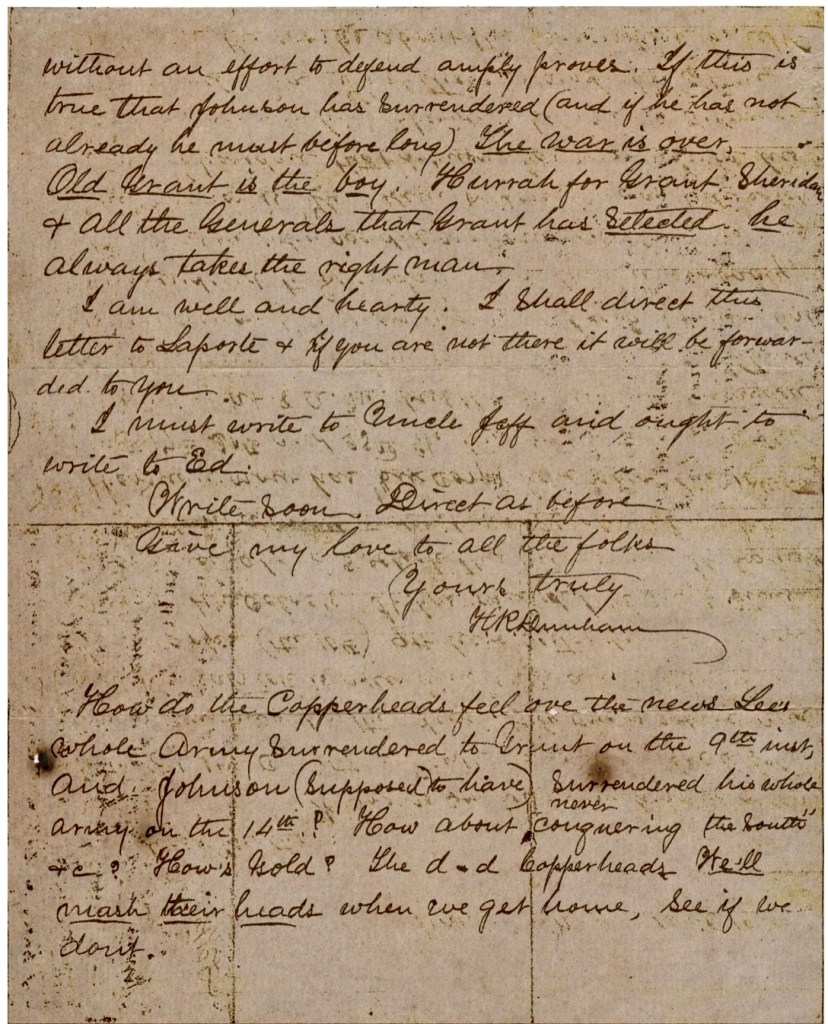
Sherman has six corps here now—the 10th, 14th, 15th, 17th, 20th, and 23rd. We had orders to march this morning at 8 a.m. but they were countermanded. We don’t know how long we shall stay here. There is a rumor this morning that Joe E. Johnston has surrendered to Sheridan, and that is probable the reason why we did not march this morning. The rumor is, “That General Sherman has a dispatch from Sheridan that Johnston has surrendered his whole army to him (Sheridan) between Hillsborough and Danville, Va. That there is no fight left in Johnston.” The works about this place which he left without an effort to defend amply proves. If this is true—that Johnston has surrendered (and if he has not already, he must before long)—the war is over. Old Grant is the boy. Hurrah for Grant, Sheridan, and all the generals that Grant has selected. He always takes the right man.
I am well and hearty. I shall direct this letter to Laporte and if you are not there, it will be forwarded to you. I must write to Uncle Jeff and ought to write to Ed. Write soon. Direct as before. Give my love to all the folks. Yours truly — H. R. Dunham
How do the Copperheads feel over the news [that] Lee’s whole army surrendered to Grant on the 9th inst., and Johnston (supposed to have) surrendered his whole army on the 14th? How about “never conquering the South” &c.? How’s Gold? The damned Copperheads—we’ll mash their heads when we get home. See if we don’t.
April 17th. Joe E. Johnston surrendered his whole army to General Wm. T. Sherman formally at 8 a.m. He surrendered in fact two or three days ago, but it was completed at 8 a.m. of today. I could not get this letter off before. I suppose I can now. I am well and hearty. It’s most too warm for comfort here now. Write soon and all the news. What do you do for a cow? Yours, — H. R. D.
1 The 30th USCT was part of the 25th Corps until March 1865 when it was reassigned to the 1st Brigade, 3rd Division, 10th Corps, Department of North Carolina. It remained a part of the Department of North Carolina until December 1865 when it was mustered out of service.

 Spared & Shared 23