This letter was written by Lydia (Thompson) Olney (1818-1867), the first wife of Ephraim Zelotus Olney (1816-1892). The letter was penned in late June 1861 from Superior, Boulder county, Colorado Territory. The couple were still enumerated there in 1865 though Lydia died two years later. That census informs us that Lydia was born in New York State, probably in the vicinity of her husband who came from Tioga county. The couple were farming in Potter county, Pennsylvania, before coming to Kansas. Lydia’s parents were Isaac C. Thompson(1794-1874) and Keziah Wicks (1797-1876). They had numerous children; the letter was directed to one of the youngest, Israel Thompson (1841-1909) who lived in Harrison, Potter county, Pennsylvania in 1860.
Lydia does not give us much information about her husband’s occupation but the mention of wagons to and from Pikes Peak suggests to me that he was likely transporting supplies to the mining regions. It’s curious that Lydia datelined her letter from Superior. Though the first settlers arrived in this area of the foothills between present day Boulder and Denver, a coal seam was not discovered here until 1864 and local lore claims the town derived its name from the “superior” quality of the coal mined in the area. The town itself was not platted and officially named until 1896. Native Americans of the Arapahoe and Ute nations still frequented the area in the 1860s.
T R A N S C R I P T I O N
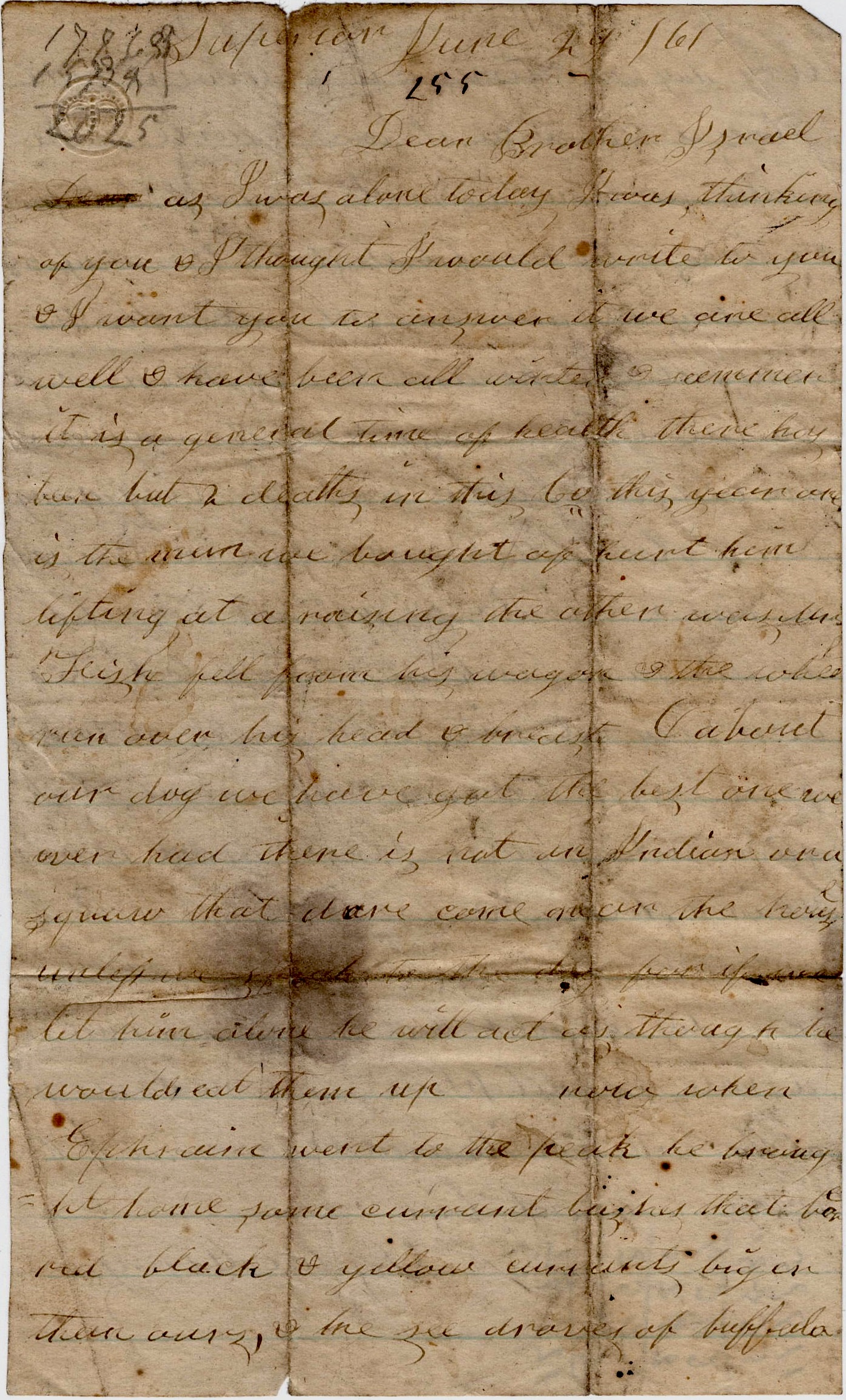
Superior [Boulder county, Colorado]
June 29, 1861
As I was alone today, I was thinking of you & I thought I would write to you & I want you to answer it. We are all well. I have been [well] all winter and summer. It is a general time of health. There has been but two deaths in this county this year. One is the man we bought of hurt him lifting at a raising. The other was Mr. Fish [who] fell from his wagon & the wheel run over his head & breast.
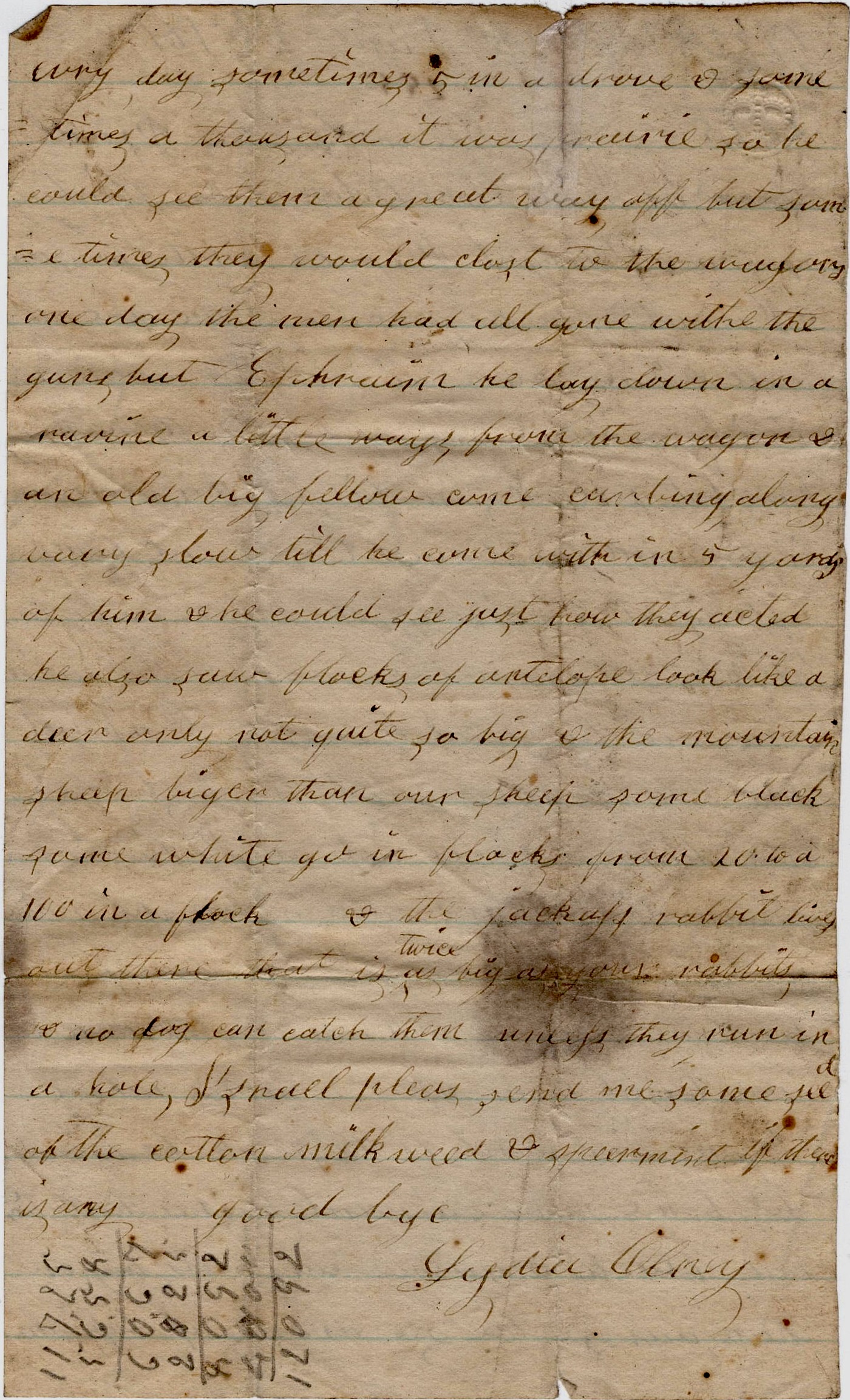
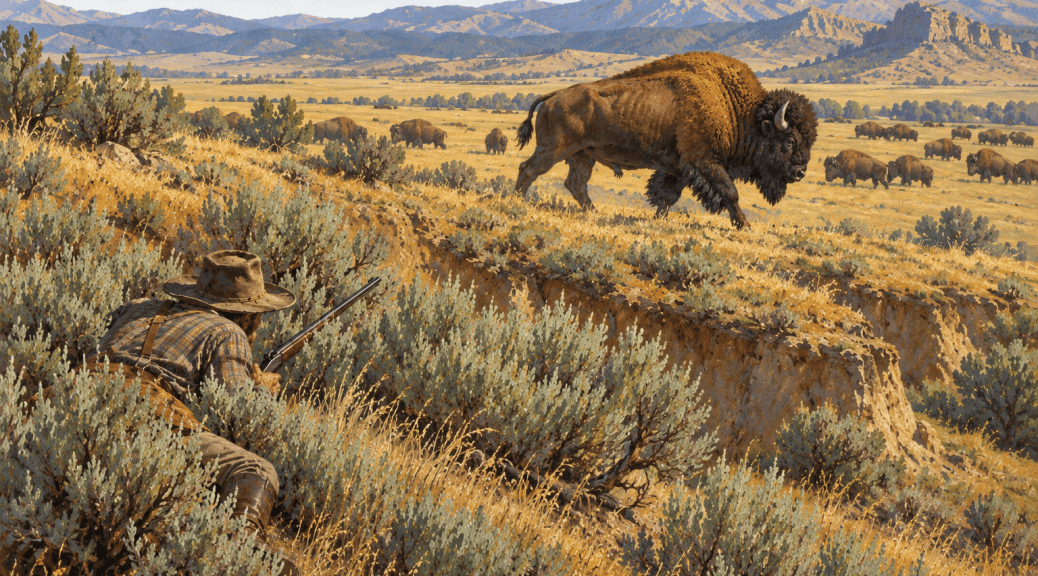
Oh, about our dog. We have got the best one we ever had. There is not an Indian or squaw that dare come near the house unless we speak to the dog for if we let him alone, he will act as though he would eat them up. Now when Ephraim went to the Peak, he brought home some current bushes that bore red, black and yellow currants bigger than ours & he see droves of buffalo every day—sometimes 5 in a drove & sometimes a thousand. It was prairie so he could see them a great way off. But sometimes they would [be] close to the wagons. One day the men had all gone with the guns but Ephraim, he lay down in a ravine a little ways off from the wagon & an old big fellow come cantering along very slow till he came within 5 yards of him & he could see just how they acted. He also saw flocks of antelope. [They] look like a deer only not quite so big & the mountain sheep bigger than our sheep—some black some white—[and] go in flocks from 20 to a 100 in a flock. And the Jackass rabbit lives out there that is twice as big as your rabbits & no dog can catch them unless they run in a hole.
Israel, please send me some seed of the cotton milkweed & spearmint if there is any. 1 Goodbye, — Lydia Olney
1 It’s hard to imagine today why anyone would want these plants but they were most likely desired for their medicinal properties. Cotton milkweed roots were used to treat respiratory illnesses and Spearmint was used to treat colic, indigestion and stomach aches, among other uses.