My passion is studying American history leading up to & including the Civil War. I particularly enjoy reading, transcribing & researching primary sources such as letters and diaries.
The following letter was written by Humphrey J. Comer (1819-1889) of Richmond, Missouri. He was born in Chillicothe, Rosee county, Ohio, to John Comer (1785-1865) and Polly Baker (1790-1852), and came to Missouri Territory with his parents when he was young.
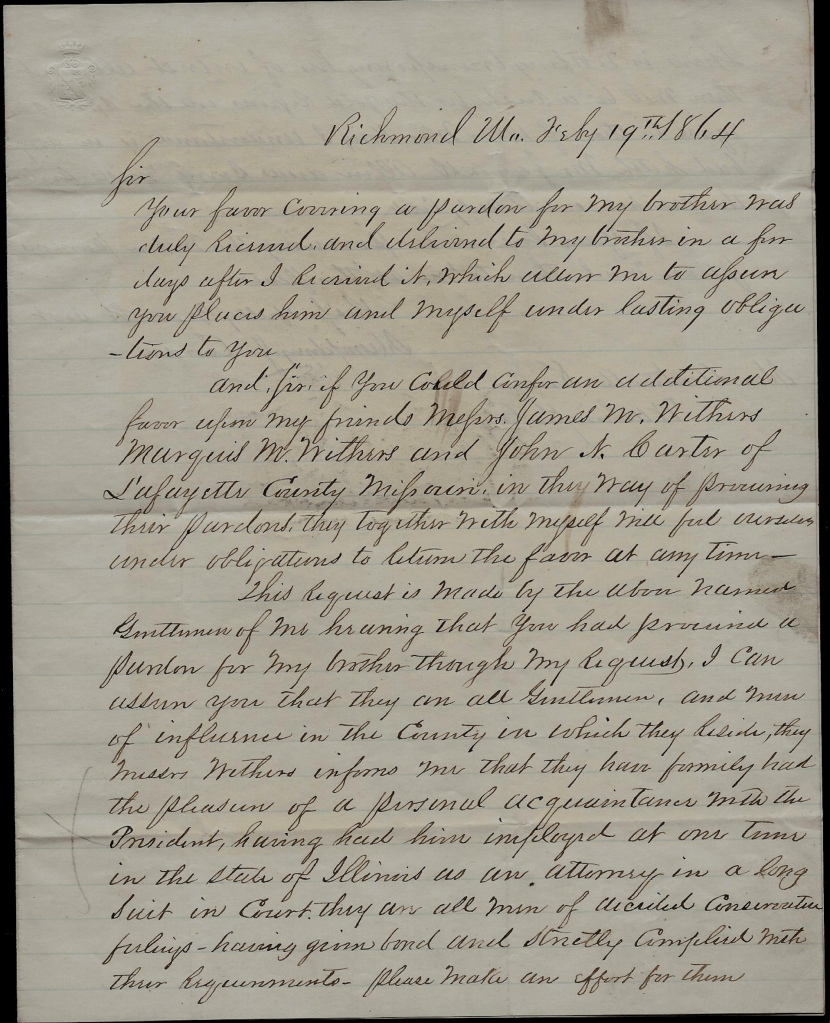
Comer wrote the letter to U.S. Congressman Austin A. King—also from Richmond, Missouri—at Washington, D.C. in which he thanks King for his help in obtaining a pardon for his brother, and now asks the same favor for friends of his—two of whom he points out had formerly “had the pleasure of a personal acquaintance with the President [Lincoln], having had him employed at one time in the State of Illinois as an Attorney in a long suit in Court.”
He notes that all is “quiet” at present, but in just 8 months, the Guerilla leader, “Bloody Bill” Anderson was killed in Richmond, Mo. and buried there.
Congressman Austin King
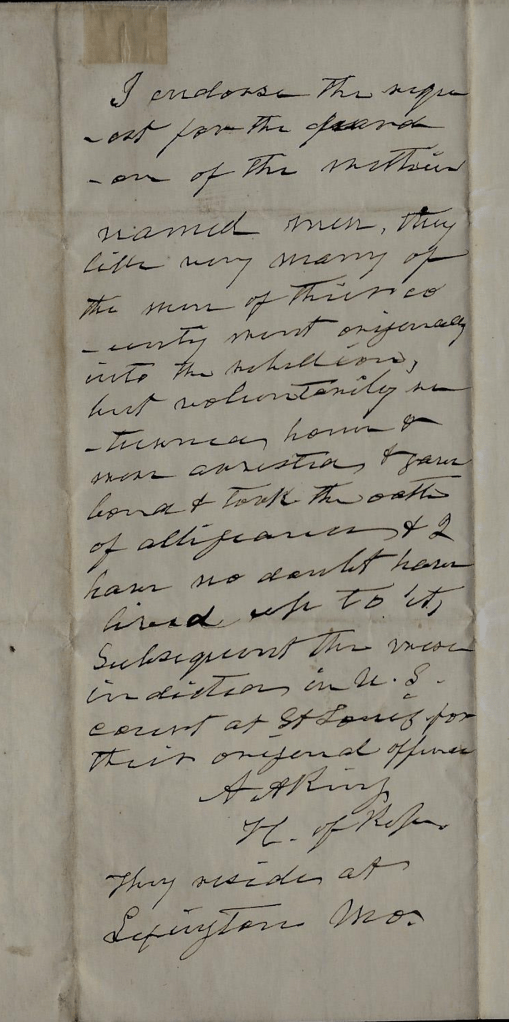
On the back is a lengthy autograph endorsement signed by Austin A. King, (1802-1870), born in Tennessee, he came to Missouri in 1830; Colonel of Militia in the Black Hawk War, 1832; Move to Richmond, MO in 1837, when he was appointed Judge of the Missouri Fifth Circuit Court, serving on the bench until 1848, and during which time he presided over the trial of Mormon Founder Joseph Smith during the 1838 Mormon War; Governor of Missouri, 1848-1853; In U.S. Congress, 1863-1865.
Congressman King endorses the request for the pardons requested by Mr. Comer in this letter (which would have to be granted by President Lincoln), and notes that “they, like very many of the men of their county, went originally into the rebellion, but voluntarily returned home & were arrested & gave bond & took the oath of allegiance & I have no doubt have lived up to it…”
Transcription
Richmond, Mo. February 19, 1864
Sir,
Your favor covering a pardon for my brother was duly received, and delivered to my brother in a few days after I received it, which allow me to assure you places him and myself under lasting obligations to you.
And, Sir, if you could confer an additional favor upon my friends Messrs. James M. Withers, Marquis M. Withers, and John N. Carter of Lafayette County, Missouri, in the way of procuring their pardons, they together with myself will feel ourselves under obligations to return the favor at any time.
This request is made by the above named Gentlemen of my hearing that you had procured a pardon for my brother through my request. I can assure you that they are all Gentlemen, and men of influence in the County in which they reside. They, Messrs. Withers, inform me that they have formerly had the pleasure of a personal acquaintance with the President, having had him employed at one time in the state of Illinois as an Attorney in a long suit in Court. They are all men of decided conservative feelings—having given bond and strictly complied with their requirements. Please make an effort for them.
There is nothing transpiring here of interest. All quiet. There will be a rush for the gold regions in the spring equal to that of 1850. Mrs. King, I understand, is in very bad health. Mr. James R. Allen died some weeks since. The weather is intensely cold.
If you succeed in procuring the within pardons, please mail them to me at this place.
Respectfully your obt. servt. Humphrey J. Comer
[to] Hon. Austin A. King, Washington City, D.C.
docketed on the reverse:
I endorse the request for the pardon of the within named men. They, like very many of the men of their county went originally into the rebellion, but voluntarily returned home & were arrested, & gave bond & took the oath of allegiance & I have no doubt have lived up to it. Subsequent they were indicted in U.S. Court at St. Louis for their original offense.
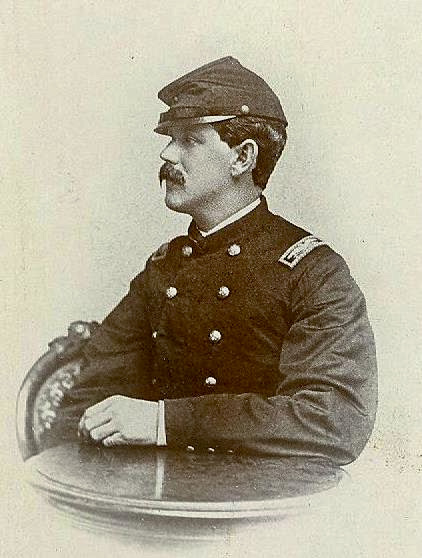
Col. Charles Ray Brayton, 3rd Rhode Island Heavy Artillery
Charles R. Brayton (1840-1910) was born in Warwick, Rhode Island to William Daniel Brayton and Anna Maud (Clarke) Brayton. In 1857, his father was elected as a Republican representing Rhode Island in the U.S. Congress. In 1859, he began attending Brown University in Providence, but left in the middle of his second year to join the 3rd Rhode Island Heavy Artillery. He was commissioned as first lieutenant in 1861, promoted to lieutenant colonel in 1863, and to colonel in April 1864. He was honorably mustered out of service in October 1864. In March 1865, along with many others, he received a brevet (honorary promotion) to the rank of brigadier general. That same year, just a month before the end of the war, he married Antoinette Percival Belden.
Charles wrote the letter to Col. Edwin Metcalf of the 3rd Rhode Island Heavy Artillery. At the time of this letter, the 3rd Rhode Island Heavies were still stationed on Morris and Folly Islands near Charleston, South Carolina.
[Note: These letters are from the personal collection of Greg Herr and were transcribed and published on Spared & Shared by express consent.]
Letter 1
Headquarters Battery C, 3rd Rhode Island Vol. Artillery Morris Island, South Carolina September 14, 1863
Dear Colonel,
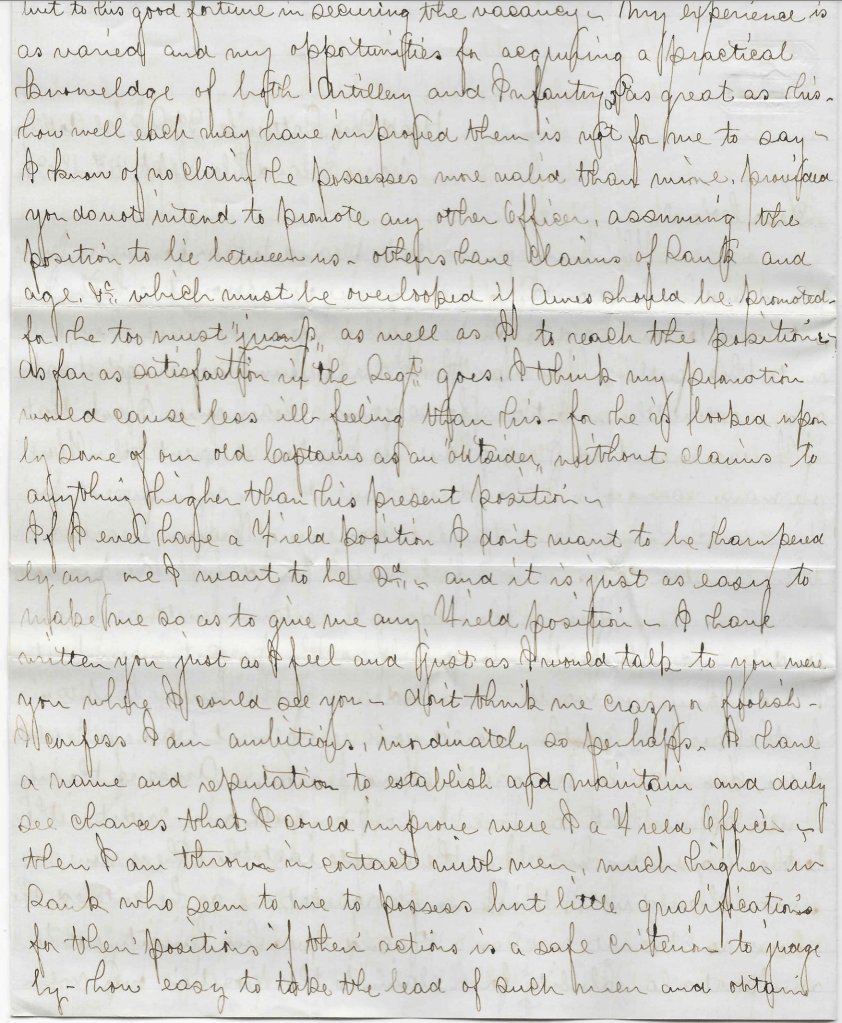
Thinking you would be pleased to hear from us on Morris Island and having something to say on my own account which I intended to have said to you personally before you went home, I write this epistle. You may think me presumptuous, egotistical, and inordinately ambitious for so young a man when I ask that if Frieze is removed, I may have his position as Lieut. Colonel. There are many reasons why I should not have it—my age, present position in the line, and three Majors besides. There are also others why I feel that I could fill the position as well as an officer in the regiment, certainly with as much credit and satisfaction to yourself as the present incumbent. I hardly think you would recommend any of the “Senior” Captains for the position. Neither would your judgement lead you to select either Day or Bailey for equally strong reasons.
Ames is the only Field Officer that can fill the position with any credit, either to the regiment or himself. The simple fact that he is now my Senior should not, I think, weigh against me as he entered the service as 2nd Lieutenant and I as a 1st, and owes his seniority not to any particular ability for, or claim to, the position over me, but to his good fortune in securing the vacancy. My experience is varied and my opportunities for acquiring a practical knowledge of both artillery and infantry are as great as his. How well each may have improved them is not for me to say. I know of no claim he possesses more valid than mine, provided you do not intend to promote any other officer, assuming the position to lie between us. Other have claims of rank and age, &c., which must be overlooked if Ames should be promoted for he too must “jump” as well as I to reach the position.
As far as satisfaction in the regiment goes, I think my promotion would cause less ill feeling than his for he is looked upon by some of our old Captains as an “outsider” without claims to anything higher than his present position. If I ever have a Field Position, I don’t want to be hampered by anyone. I want to be 2nd and it is just as easy to make me so as to give me any Field Position. I have written you just as I feel and just as I would talk to you were you where I could see you. Don’t think me crazy or foolish. I confess I am ambitious, inordinately so perhaps. I have a name and reputation to establish and maintain and daily see chances that I could improve were I a Field Officer. I am thrown in contact with me, much higher in rank who seem to possess but little qualifications for their positions. If their actions is a safe criterion to judge by, how easy to take the lead of such men and obtain for my regiment and myself the preferment they are too lazy to strive for.
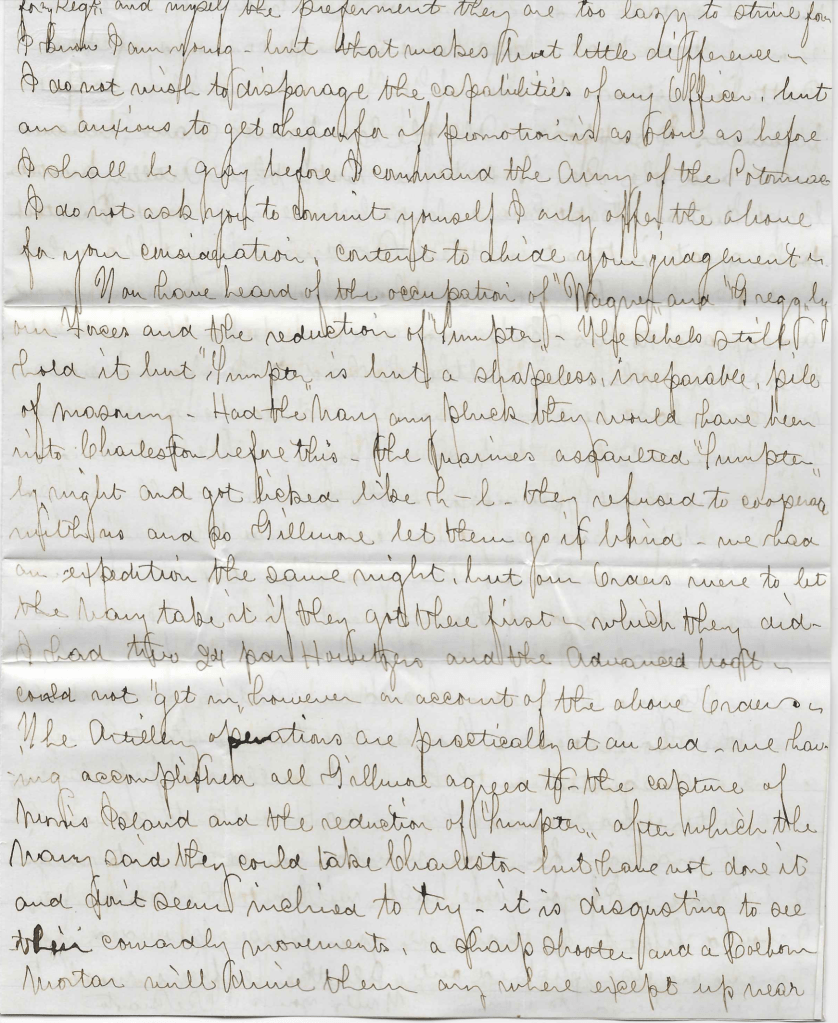
I know I am young but that makes but little difference. I do not wish to disparage the capabilities of any officer, but am anxious to get ahead for if promotion is as slow as before, I shall be gray before I command the Army of the Potomac. I do not ask you to commit yourself, I only offer the above for your consideration—content to abide your judgement.
You have heard of the occupation of [Forts] Wagner and Gregg by our forces and the reduction of “Sumpter.” The rebels still hold it but “Sumpter” is but a shapeless, irreparable pile of masonry. Had the Navy any pluck, they would have been into Charleston before this. The Marines assaulted “Sumpter” by night and got licked like hell. They refused to cooperate with us and so Gillmore let them go it blind. We had an expedition the same night but our orders were to let the Navy take it if they got there first, which they did. I had the 24 pounder Howitzers and the Advanced boat. Could not “get in” however on account of the above order. The artillery operations are practically at an end—we having accomplished all Gillmore agreed to—the capture of Morris Island and the reduction of “Sumpter” after which the Navy said that they could take Charleston but have not done it and don’t seem inclined to try. It is disgusting to see their cowardly movements. A sharpshooter and a Coehorn Mortar will drive them anywhere except up near the Rebel Batteries and we have not any ordnance here heavy enough to do that.
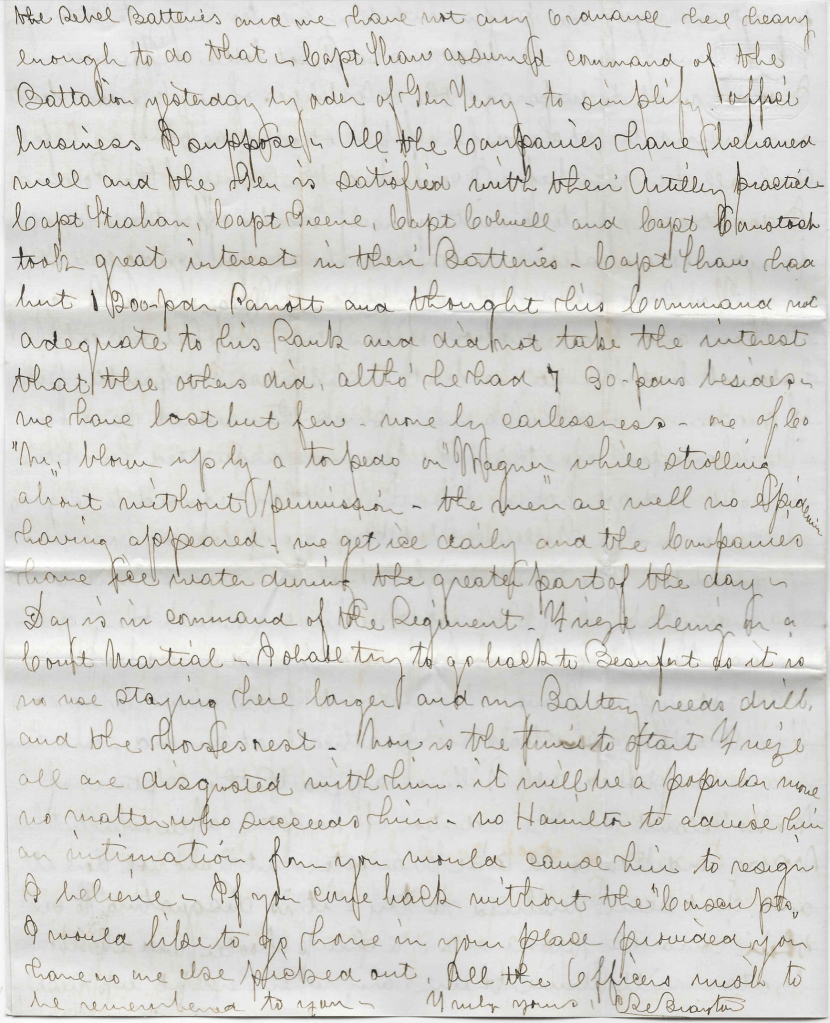
Capt. Shaw assumed command of the Battalion yesterday by order of Gen. Terry to simplify office business, I suppose. All the companies have behaved well and the General is satisfied with their artillery practice. Capt. Strahan, Capt. Greene, Capt. Colwell, and Capt. Comstock took great interest in their batteries. Capt. Shaw had but one 200-pounder Parrott and thought his command not adequate to his rank and did not take the interest that the others did, although he had seven 30-pounders besides.
We have lost but few—none by carelessness. One of Co. “M” blown up by a torpedo on “Wagner” while strolling about without permission. The men are well. No epidemic having appeared. We get ice daily and the companies have ice water during the greater part of the day. Day is in command of the regiment, Frieze being on a court martial. I shall try to go back to Beaufort as it is no use staying here longer and my Battery needs drill, and the horses rest. Now is the time to start Frieze. All are disgusted with him. It will be a popular move no matter who succeeds him. No Hamilton to advise him. An intimation from you would cause him to resign, I believe. If you come back without the “conscripts,” I would like to go home in your place provided you have no one else picked out. All the officers wish to be remembered to you.
Truly yours, — C. R. Brayton
Letter 2
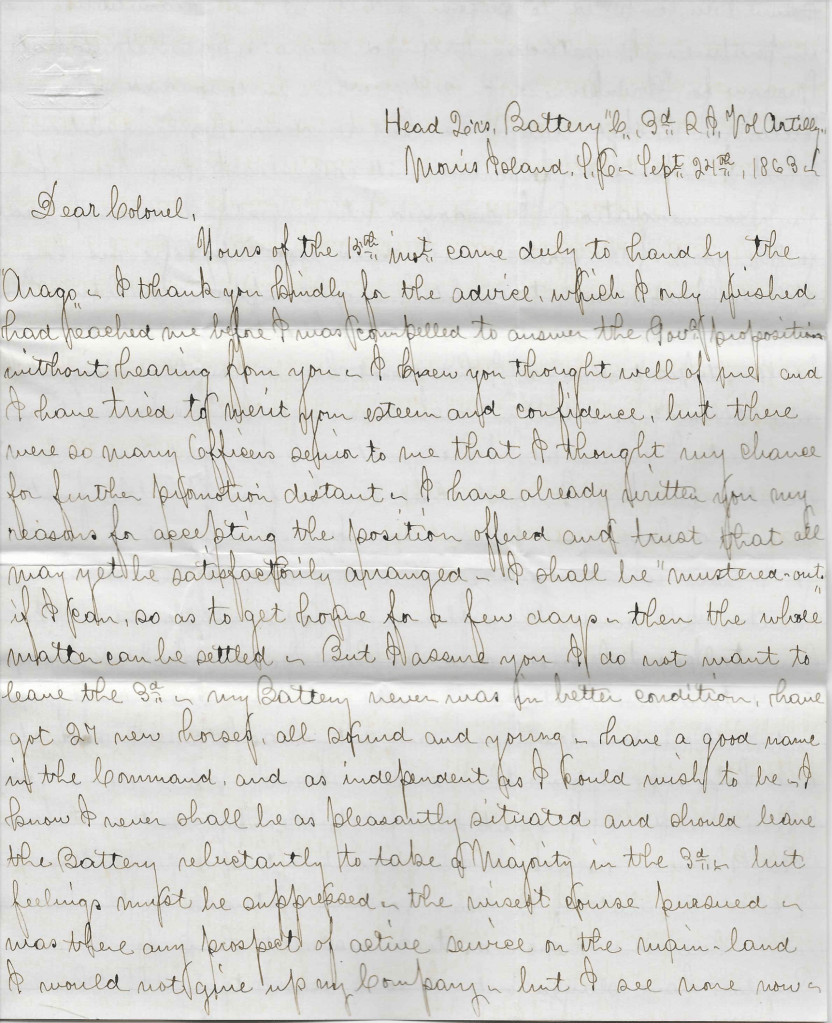
Headquarters Battery C, 3rd Rhode Island Vol. Artillery Morris Island, South Carolina September 24, 1863
Dear Colonel,
Yours of the 13th inst. came duly to hand by the Arago. I thank you kindly for the advice which I only wished had reached me before I was compelled to answer the Governor’s proposition without hearing from you. I knew you thought well of me and I have tried to merit your esteem and confidence, but there were so many officers senior to me that I thought my chance for further promotion distant. I have already written you my reasons for accepting the position offered and trust that all may yet be satisfactorily arranged. I shall be “mustered out” if I can so as to get home for a few days. Then the whole matter can be settled. But I assure you I do not want to leave the 3rd. My Battery never was in better condition. Have got 27 new horses, all sound and young, have a good name in the command, and as independent as I could wish to be. I know I never shall be as pleasantly situated and should leave the Battery reluctantly to take a Majority in the 3rd but feelings must be suppressed—the wisest course pursued. Was there any prospect of active service on the main land, I would not give up my company, but I see none now.
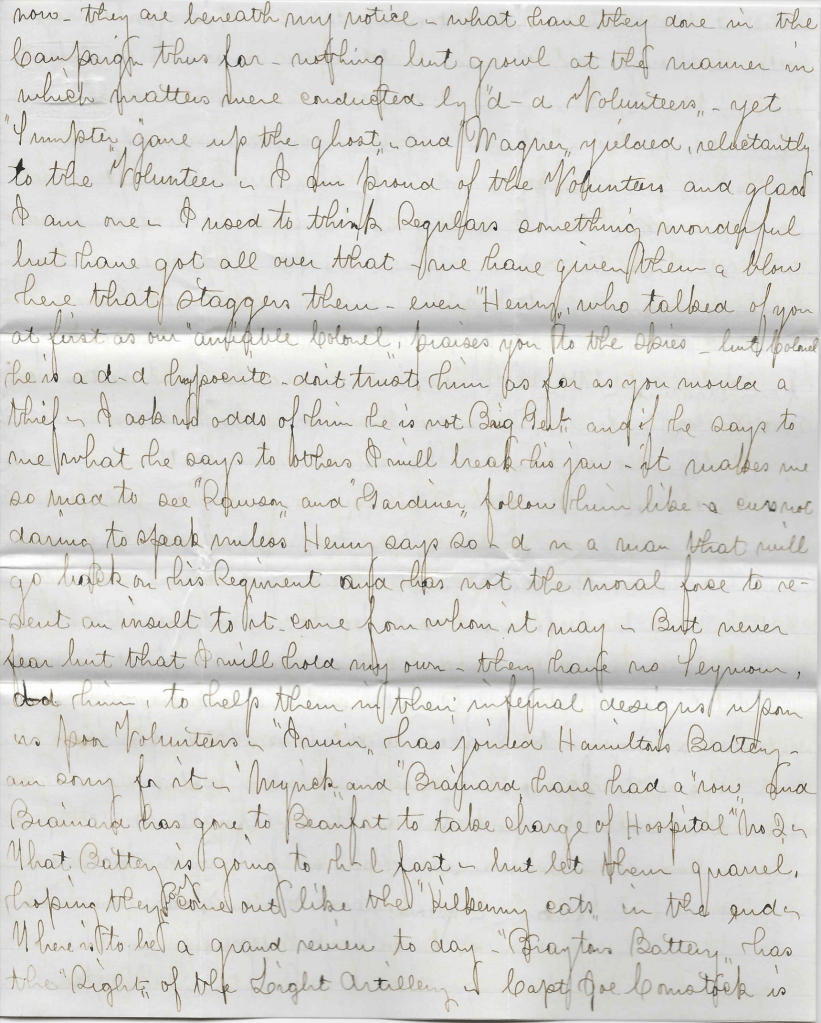
I have been compelled to perform a duty at once humiliating and imperative. I yesterday preferred charges against Lieut. Morrow for “Drunkenness on duty” while in command of a section on picket duty. He has tendered his resignation which I respectfully forwarded. It came back from Henry Metcalf for my recommendation. I endorsed it “respectfully recommended for the good of the service.” I could not approve his honorable discharge and thought I might appear to crowd him too hard did I insist on a court martial. As it is, he may be court martialed as I have not heard from the resignation and Gillmore is severe in such cases. Did I do more than my duty? No doubt of his guilt, as I brought him to camp beastly drunk. I regret that my company furnishes the first case and hope you will not consider it a fault of mine for I have ever discouraged drinking and no one ever saw me drunk or under the influence of liquor while here.
I have talked to Morrow and let him pass when my judgment told me better. I could not have been more lenient with my own brother. My duty was plain. I did it and hope you approve the course. It may save some good officers and be of great benefit to the regiment in the end. Gen. Gillmore has received his appointment as a Major General. I fired a salute of 13 guns for his yesterday on the beach where there were thousands to congratulate him by cheers.
Regulars have “played out.” I don’t associate with them now. They are beneath my notice. What have they done in the campaign thus far—nothing but growl at the manner in which matters were conducted by “damned Volunteers,” yet “Sumter” gave up the ghost, and “Wagner” yielded reluctantly to the Volunteer. I am proud of the Volunteers and glad I am one. I sed to think Regulars something wonderful but have got all over that. We have given them a blow here that staggers them. Even Henry, who talked of you at first as our “amiable Colonel, praises you to the skies.” But Colonel, he is a damned hypocrite. Don’t trust him as far as you would a thief. I ask no odds of him. He is not Brig. Gen. and if he says to me what he says to others, I will break his jaw. It makes me so mad to see “Rawson” and “Gardiner” follow him like curs—not daring to speak unless Henry says so. Damn a man that will go back on his regiment and has not the moral force to resent an insult to it—come from whom it may. But never fear but that I will hold my own. They have no Seymour, damn him, to help them in their infernal designs upon us poor Volunteers.
“Irwin” has joined Hamilton’s Battery. Am sorry for it. “Myrick” and “Brainard” have had a “row” and Brainard has gone to Beaufort to take charge of hospital. No. 2 in that Battery is going to hell fast. But let them quarrel, hoping they may come out like the “Kilkenny cats” in the end.
There is to be a Grand Review today. “Brayton’s Battery” has the “Right” of the Light Artillery. Capt. Joe Comstock is still at the [Hilton] Head awaiting transportation. You speak in your letter as though the 3rd was intolerable now. I can’t believe you really mean any such thing. Cursed we are by as miserable a lot of Field Officers (excepting yourself and Ames) as ever sapped the life of any regiment, but still we have talent among us sufficient to fill creditably any position. Our officers are far in advance of any I have seen here, take them as a class. You have no idea of the class of officers that came with those troops from Virginia. The 3rd stands well and are treated as Artillery Companies should be. They have done well. I am proud of them. If you can make a better regiment than stands out of the 4rd Rhode Island, mark out your cause and there are enough of us to support you. Only a few croakers to deal with.
Never fear about our getting into Charleston before you come back. Don’t you think me rather precocious in asking what I did. But I can’t help it for if I am left out now, I shall never command a regiment, I fear, and it is hard jumping from Major to Colonel over a Lieut. Colonel. But we will talk this over I hope before anything definite is done. I can keep my counsel—have so far—and promise you I will in future. Please excuse the emphatic remarks. Yours truly, — C. R. Brayton
Letter 3
Office of the Chief of Artillery Morris Island, South Carolina December 14, 1863
Dear Colonel,
Yours ofthe 4th and 5th (postscript) was duly received a few hours after I had mailed one for you. I think Eddy’s case settled for I well knew the Gov. had “no personal interest in the matter.” Bailey, I think, was at the bottom of the affair, put up to it by Eddy’s friends at home. If you think the matter need more attention, I will write the Governor about it, but I think it unnecessary.
Maj. Ames is in command of the Battalion. I showed him your letter about Report and Returns. Peirce of Co. D had a Descriptive List which Burton says he gave to Lamson, one having been given, the Company Commander has no right, I think, to give another.
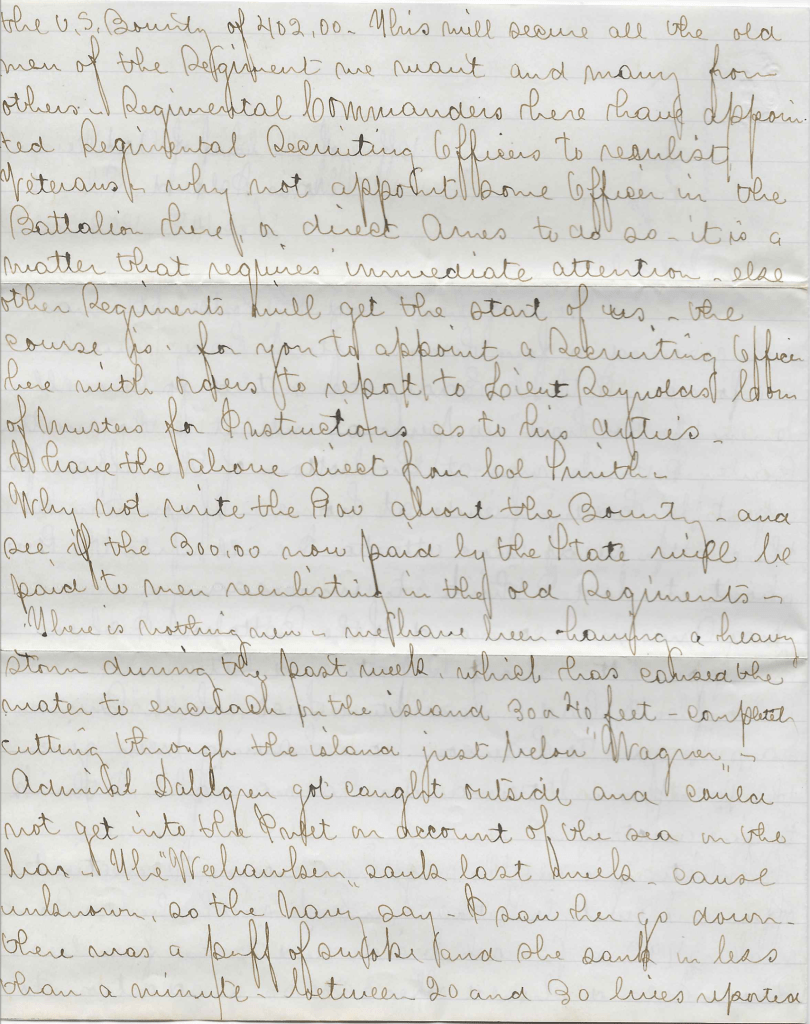
Reenlisting is all the rage here now. Connecticut offers a bounty to Veterans which with the US Bounty, makes $792 for cash, beside aid to the families. Rhode Island should offer $500 in addition to the US Bounty of $402. This will secure all the old men of the regiment we want and many from others. Regimental commanders here have appointed Regimental Recruiting Officers to reenlist Veterans. Why not appoint some officer in the Battalion here or direct Ames to do so? It is a matter that requires immediate attention—else other regiments will get the start of us. The course is for you to appoint a Recruiting Officer here with orders to report to Lieut. Reynolds, Com. of Musters for instructions as to his duties. I have the above direct from Col. Smith.
Why not write the Governor about the Bounty and see if the $300 now paid by the State will be paid to men reenlisting in the old regiments.
There is nothing new. We have been having a heavy storm during the past week which has caused the water to encroach on the island 30 or 40 feet, completely cutting through the island just below “Wagner.” Admiral Dahlgren got caught outside and could not get into the Inlet on account of the sea on the bar. The “Weehawken” sank last week—cause unknown, so the Navy says. I saw her go down. There was a puff of smoke and she sank in less than a minute. Between 20 and 30 lives reported to have been lost.
The storm has evidently broken up the “obstructions” 1 between Sumter and Moultrie as large masses of timber, evidently links of some chain have been driven on shore. They consist of 9 sticks of 15 in. hard pine timber firmly bound together with iron hoops. Through the centre is a bar of railroad iron, on either end of which iron links have been attached so that an indefinite number of these wooden masses can be joined together and thus make a chain of great strength. The timber having buoyancy enough to support the railroad iron at all times and the iron being strong enough to prevent vessels from forcing their way past it.
Sumter was on fire in the Southwest corner during the past week—cause unknown to us. We shell the city every twenty-four hours. I will see about King’s Case Co. M today. Regards to all your officers. I pity Lanahan’s wife—she being alone at Pulaski, but Capt. Jerry is satisfied, I suppose. Write soon. Have not yet received our mail by the Arago. Can’t it be sorted at the Head some way?
Ever your sincere friend, — C. R. Brayton
1 The New York Herald of 7 April 1863 carried an article on “the obstructions” in Charleston Harbor. They were said to consist of “floating rafts, made of heavy timber, securely lashed together by cable chains, and then bolted to an upper layer of timber, which not only covers the chains, but adds a bracing strength to the structure. At a given point this bar or boom is provided with a moveable gate, which is opened to allow their own vessels to pass in and out. This place of ingress is directly under the guns of Fort Sumter and so close that it seems impossible that any vessel could pass them, A chain and a connecting seres of obstructions exist between Forts Sumter and Moultrie.”
William’s broken headstone in Cottonwood Cemetery, Dallas, Texas
The following letter was written by William McCarty (1821-1883) to his wife, Myrilla Jane Wilson (1827-1882). The couple were married in 1846 and had at least two children by the time this letter was written. William was born in Tennessee and was residing in Bradley county, Tennessee, when the 1850 US Census was collected. Ten years later he and Marilla were enumerated in Plano, Collin county, Texas.
TexasMuster Roll Index cards indicate that William was drafted into Co. D, 15th Battalion Texas State Troops on 15 July 1863.
Transcription
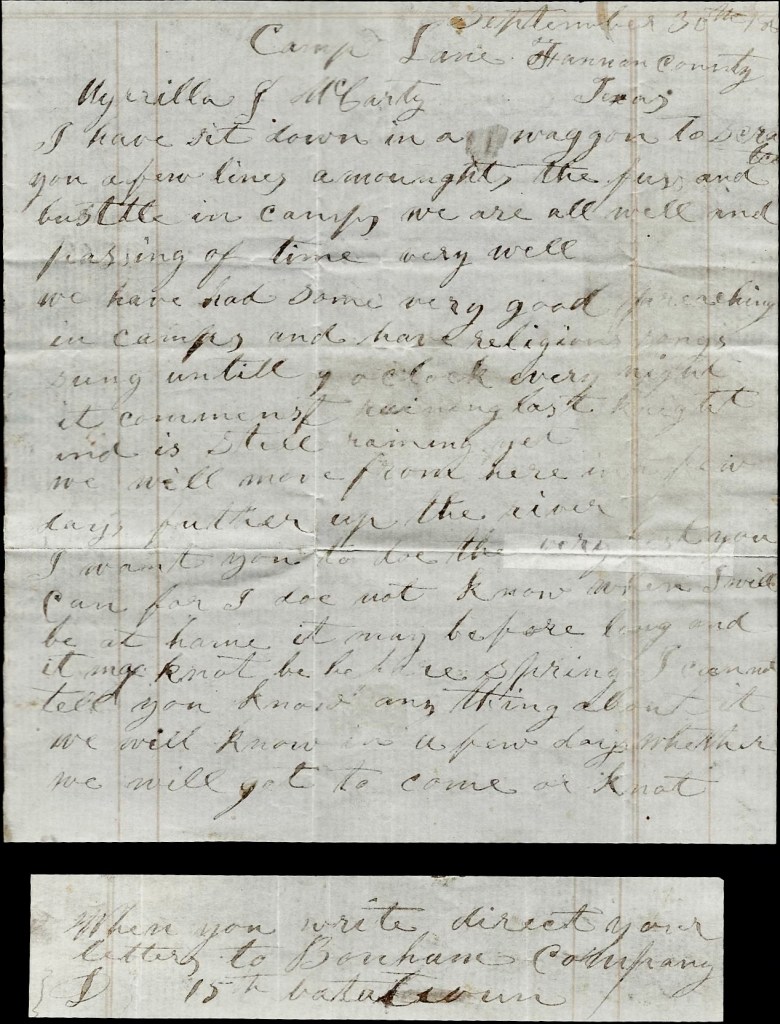
Camp Lane, Fannon County, Texas September 30th 1863
I have sat down in a wagon to scratch you a few lines amongst the fuss and bustle in camp. We are all well and passing of time very well.
We have had some very good preaching in camp and have religious songs sung until 9 o’clock every night. It commenced raining last night and is still raining yet. We will move from here in a few days further up the river. I want you to do the very best you can for I do not know when I will be at home. It may be before long and it may be not be before spring. I cannot tell. You know anything about it. We will know in a few days whether we will get to come or not.
We are all sworn into the Confederate service for the length of three years after our six months is out. Now my Marilla, I do not want you to give way in despair to everything. I want you to brave the storm and do all the good you can for yourself and your country. Do not fret nor grieve for me for I will try to take care of myself and I want you to do the same.
I will say something about our tent. I do not know whether it will take 36 yards or not. When you go to make it, make your breadth about 7 yards long the ends. Set your breadths up on the end and then take a pleat in it up high enough for the wall and that will make the eve. Then a small rope every yard. Then it will do without corner posts. — William McCarty
When you write, direct your letter to Bonham, [Texas], Company, Co. D, 15th Battalion
An unidentified seaman from the collection of Ron Field
The following letter was written by Joseph B. Frost (1839-1872) of Marblehead, Massachusetts who entered the US Navy in December 1861 at the age of 22 and held the rank of Ordinary Seaman (OS). He was described as standing 5’9″ tall with brown hair and blueish gray eyes. We know from this letter as well as official records that Joseph served aboard the USS gunboat Penobscot. The next notice of him in Naval Records indicates that he was admitted into the Naval Hospital at Portsmouth, Virginia, in July 1863 suffering from periostitis (shin splints). He was discharged from the hospital on 21 August 1863 and I believe discharged from the Navy at or about the same time. An assistant surgeon named William Longshaw, Jr.1 who served aboard the USS Penobscot form May-July 1863, treated Frost with the following comments: “Has been under treatment for ulcer affecting right leg. This patient manifests a scrofulous diathesis and has before been treated for indolent ulcer. Treatment has been…local stimulants with iodine externally and idiod. internally. Was sent to army hospital in Beaufort, N. C. on 19 July 1863 and discharged 27 July 1863 for passage to Hampton Roads.” From this description, my interpretation is that Joseph may have been suffering from syphilis which was commonly treated with potassium iodine.
Curiously, Joseph’s hospital admission record at Portsmouth suggests that Joseph was incapable of signing his own name with anything other than an “X” (his mark). If so, he must have had someone else on board the gunboat to write the following letter on his behalf.
Frost wrote the letter to his friend, Henry “Martin” Lowe (1840-1907), who served with him aboard the US Gunboat Penobscot. Martin was the son of Henry Thurston Lowe (1806-1888) and Rachel Pool (1816-1897), and the husband of Louisa Foster Blatchford (1841-1910) of Rockport, Essex county, Massachusetts. Martin and Louisa were married on 21 April 1860 at Newburyport and in the 1860 US Census, they were enumerated as newlyweds in her parents home—William and Mary (Gott) Blatchford of Rockport. At that time, Martin was employed as a clerk. One of some forty-one men from the fishing port of Rockport, Massachusetts who served in the Navy during the Civil War, Martin Lowe was a Paymaster’s Steward aboard the U.S.S. Penobscot. He entered the service in early February 1862 and was discharged in March 1864. [See 1862-64: Henry Martin Lowe to his Family]
1 Dr. William Longshaw Jr., Acting Assistant Surgeon, U.S. Navy, was killed on 15 January 1865 at the Battle of Fort Fisher. “A sailor, too severely wounded to help himself, had fallen close to the water’s edge and with the rising tide would have drowned. Dr. Longshaw, at the peril of his life, went to his assistance and dragged him beyond the incoming tide. At this moment he heard a cry from a wounded marine, one of a small group who, behind a little hillock of sand close to the parapet, kept up a fire upon the enemy. Longshaw ran to his assistance and while attending to his wounds was shot dead.”
Transcription
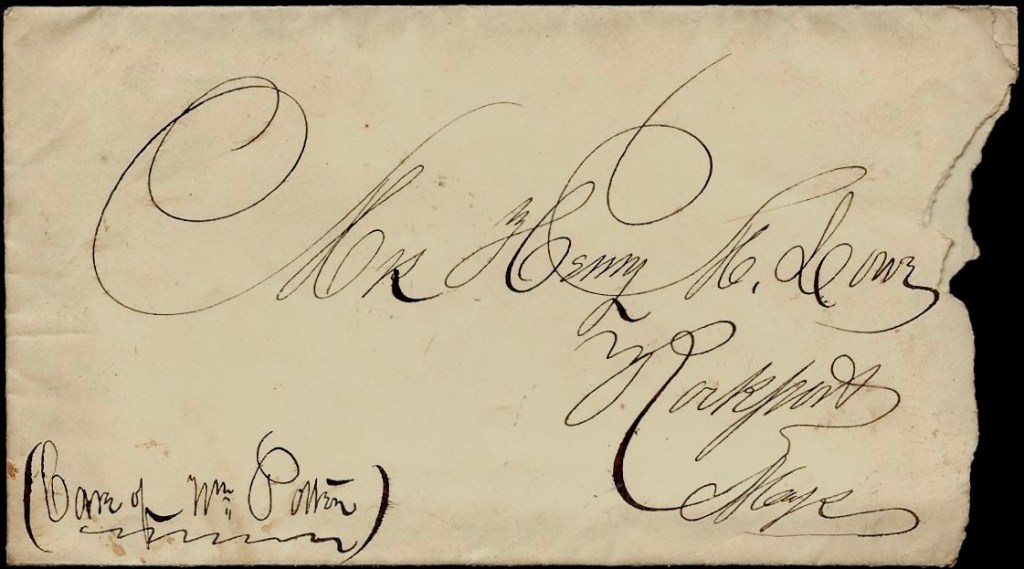
Addressed to Mr. Henry Lowe, Rockport, Massachusetts
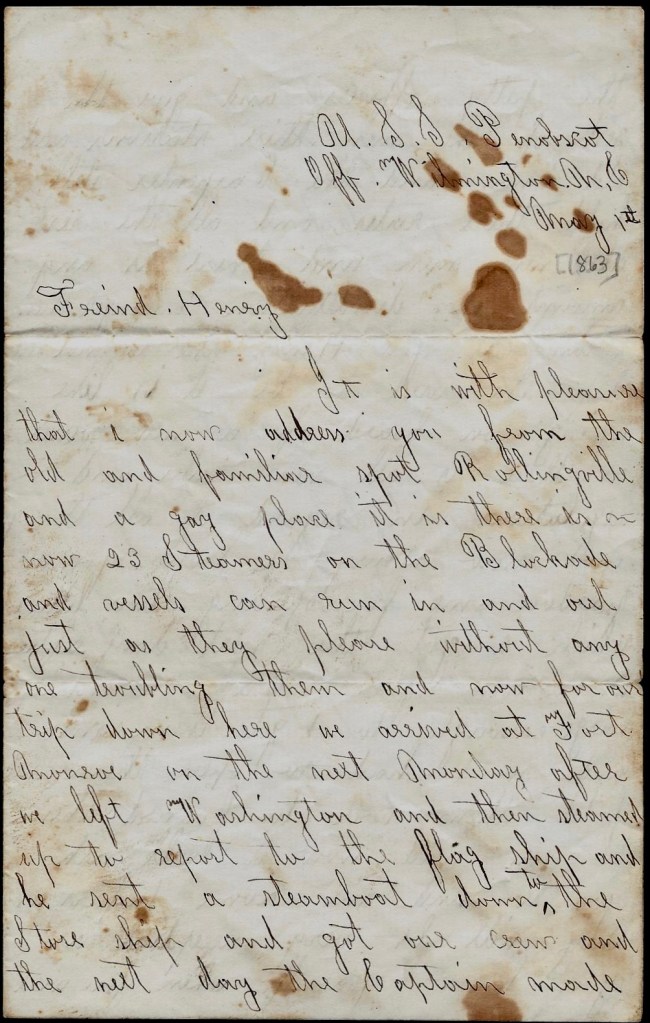
U. S. S. Penobscot Off Wilmington, N. C. May 1, [1863]
Friend Henry,
It is with pleasure that I now address you from the old and familiar spot Rollingville and a gay place it is. There is now 23 steamers on the blockade and vessels can run in and out just as they please without anyone troubling them.
And now for our trip down here. We arrived at Fort Monroe on the next Monday after we left Washington and then steamed up to report to the flag ship and he sent a steamboat down to the store ship and got our crew and the next day the Captain made the petty officers and give the rest of the men their station and old Snow and the carpenter still hold their rates and all the rest are new men and there is any amount of dissatisfaction amongst them. I can tell you, Henry, she is not the ship she used to be. It is like a going on board of a new vessel as there is all new rules and regulations in regard of all things.
And now Henry, I hope you will pardon me for opening two letters which I got the next day after we arrived for I had no envelopes large enough to get them into and so I had to open them and fold them over to forward them to you. And now I will ask you to send me some papers as they will be very receptive as you know yourself when you were with us.
And now Henry, I will bring this to a close as the mail is all ready to go on board the Florida. This is from your friend and well wisher. — Joseph B. Frost
Direct as before.
P. S. Henry I want you to send me your wife’s and baby’s picture for I have already got yours and when I get them, I shall keep them in remembrance of you and your family. And by sending them, you will greatly oblige old — Hob
I could not find an image of Brooks but here is a CDV of Benjamin Marot who also served in the 66th Illinois Infantry (Photo Sleuth)
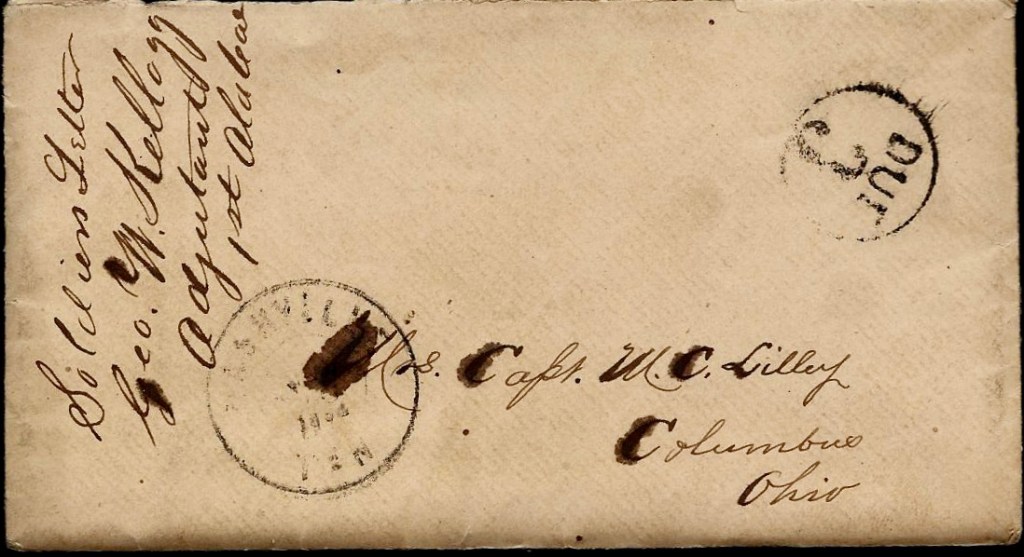
The following letters were written by John Chenowith Brooks (1838-1915) to his sister, Amanda Catherine (Brooks) Lilley (1830-1887)—the wife of Mitchell Campbell Lilley of Columbus, Ohio. John and Amanda were the children of Thomas Martin Brooks (1803-1881) and Sarah B. Chenowith (1808-1865) of Paris, Edgar county, Illinois.
John enlisted in Co. E, 66th Illinois Regiment (Western Sharp Shooters) in October 1861. The 66th Illinois was a multi-state regiment—two companies were raised in Ohio, three in Illinois, one in Michigan, and four were organized at St Louis’ Benton Barracks of Missourians and detachments of volunteer candidates sent by recruiting officers from Iowa, Minnesota and other western states, thus forming a regiment that represented every state in the West, a pet scheme of General John C. Fremont. John rose in rank to sergeant and later as a 2nd Lieutenant. Late in the war he was attached to Co. G, 1st Alabama Cavalry (a predominantly white regiment composed of Southern Unionists). He mustered out of the service on 25 January 1865 and soon after attended the Indianapolis Dental College where he graduated and became a practicing dentist in Sullivan and Charleston, Illinois. He married Charlotte Blake (1844-1928) in 1864 and had at least two children.
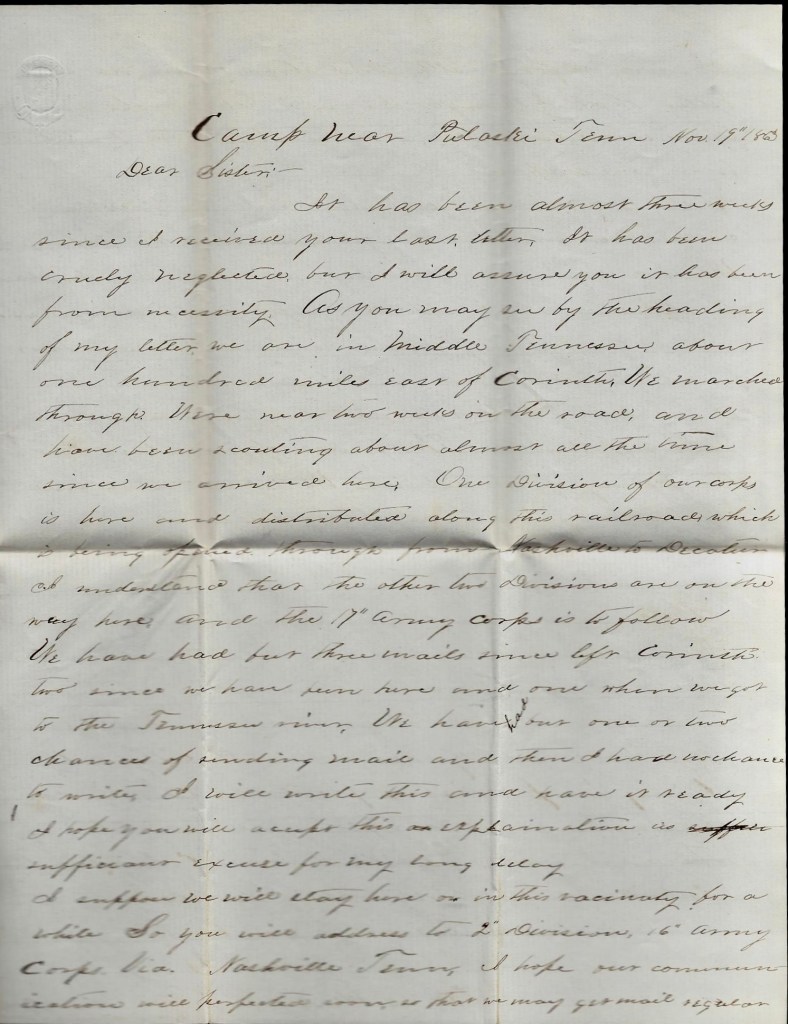
Letter 1
Camp near Pulaski, Tennessee November 19, 1863
Dear Sister,
It has been almost three weeks since I received your last letter. It has been cruelly neglected but I will assure you it has been from necessity. As you may see by the heading of my letter, we are in Middle Tennessee, about one hundred miles east of Corinth. We marched through [and] were near two weeks on the road, and have been scouting about almost all the time since we arrived here. Our Division of our Corps is here and distributed along this railroad which is being opened through from Nashville to Decatur. I understand that the other two Divisions are on the way here and the 17th Army Corps is to follow.
We have had but three mails since we left Corinth—two since we have been here and one when we got to the Tennessee river. We have but one or two chances of sending mail and then I had no chance to write. I will write this and have it ready. I hope you will accept this explanation as sufficient excuse for my long delay.
I suppose we will stay here or in this vicinity for awhile. So you will address to 2nd Division, 16th Army Corps, via Nashville, Tenn. I hope our communication will be perfected soon so that we may get mail regular.
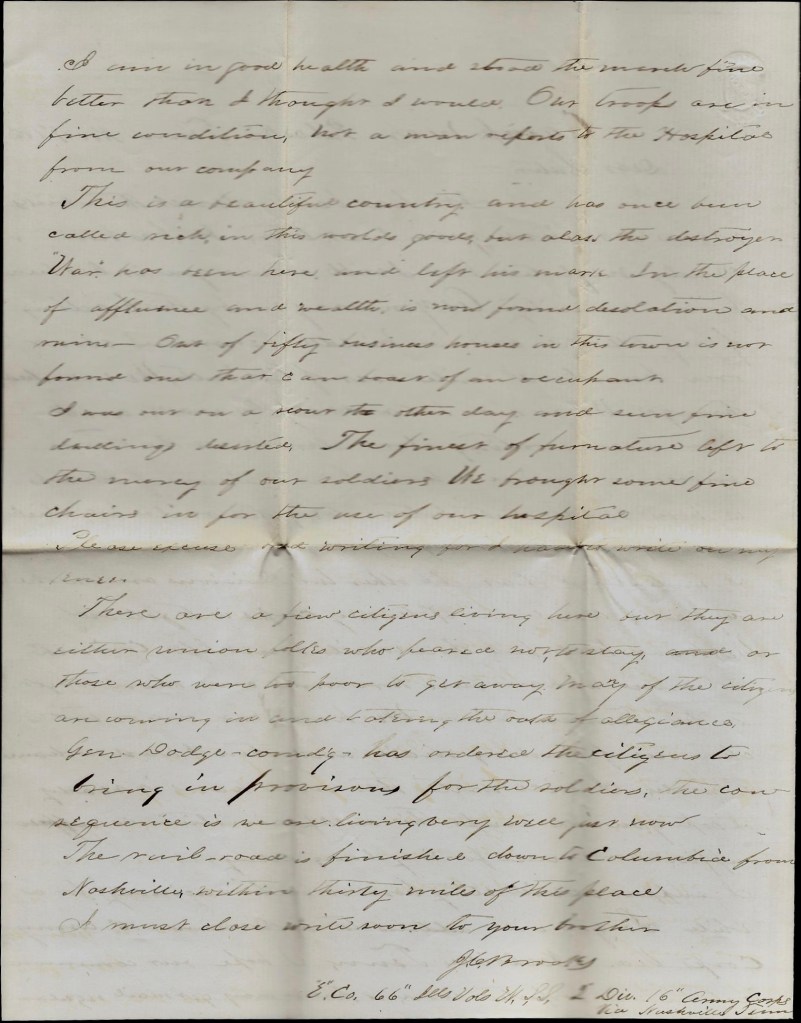
I am in good health and stood the march fine—better than I thought I would. Our troops are in fine condition. Not a man reports to the hospital from our company.
This is a beautiful country and has once been called rich in the world’s goods, but alas, the destroyer “War” has been here and left his mark. In the place of affluence and wealth is now found desolation and ruin. Out of fifty business houses in this town is not found one that can boast of an occupant.
I was on a scout the other day and seen find dwellings deserted—the finest of furniture left to the mercy of our soldiers. We brought some fine chairs in for the use of our hospital. Please excuse bad writing for I have to write on my knee.
There are a few citizens living here but they are either Union folks who feared not to stay, or those who were too poor to get away. Many of the citizens are coming in and taking the oath of allegiance. Gen. Dodge, commanding, has ordered the citizens to bring in provisions for the soldiers. The consequence is we are living very well just now. The railroad is finished down to Columbia from Nashville, within thirty miles of this place. I must close. Write soon to your brother, — J. C. Brooks
E Company, 66th Illinois Vols., W. S. S., 2nd Division, 16th Army Corps, via Nashville, Tenn.
Letter 2
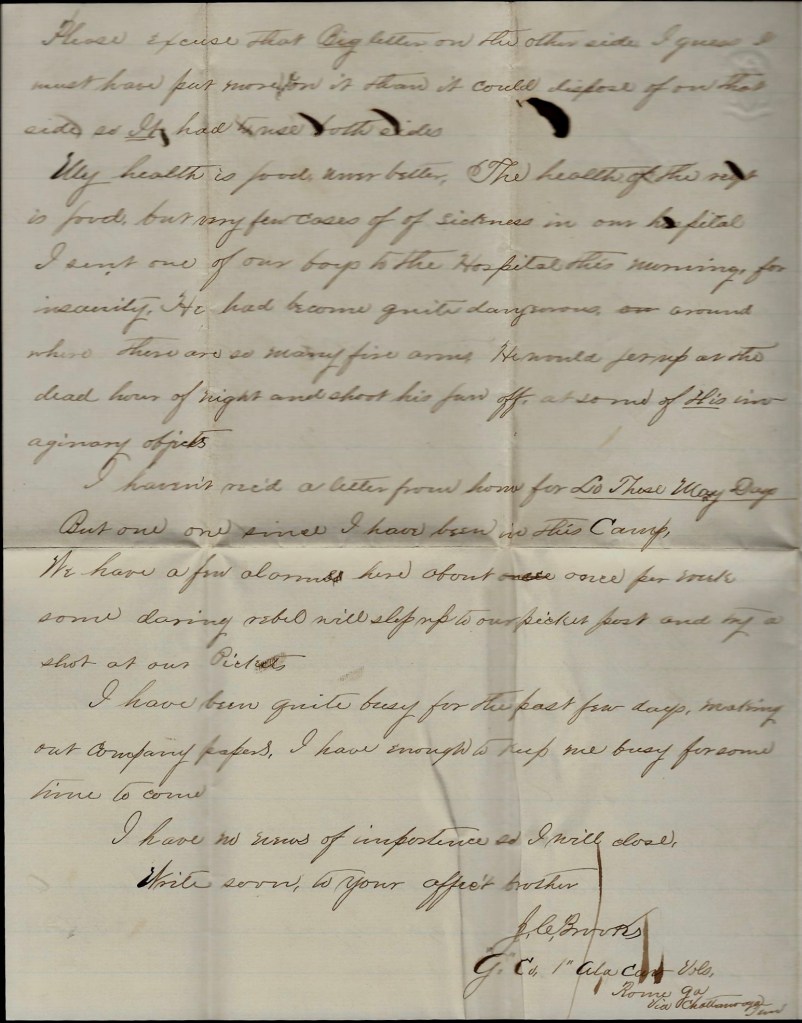
Camp 1st Alabama Cavalry near Rome, Georgia July 10th 1864
Dear Sister,
I received a letter from you some time ago while in the field, but have forgotten whether I answered it or not. If I have you may thank me for an extra.
Our regiment is now stationed at Rome, Georgia. We left the army in the front about three weeks ago while they were hammering away at Kennesaw Mountains. I have heard but little news from there since. We have heard that Sherman had got into Atlanta and that is all. Our communication might just as well be cut off for all the good it does us in the way of news and mail. I have received but one mail since I have been here. There is a train runs down here every day or two but it hardly ever brings mail. I suppose our mail goes down the army and they neglect sending it back. I hope we may get a regular communication opened soon. If we don’t, I fear there will one boy have the blues some o’ these days. I have enough to do just now to keep me from getting the blues.
Please excuse that big letter on the other side. I guess I must have put more on it than it could dispose og on that side so I had to use both sides.
My health is good—never better. The health of the regiment is good—but very few cases of sickness in our hospital. I sent one of our boys to the hospital this morning for insanity. He had become quite dangerous around where there are so many firearms. He would get up at the dead hour of night and shoot his gun off at some of his imaginary objects.
I haven’t received a letter from home for Lo these many days, but one since I have been in this camp. We have a few alarms here about once per week. Some daring rebel will slip up to our picket post and try a shot at our pickets.
I have been quite busy for the past few days making out company papers, I have enough to keep me busy for some time to come. I have no news of importance so I will close. Write soon to your affectionate brother, — J. C. Brooks, “G” Company, 1st Alabama Cavalry Vols., Rome, Georgia, via Chattanooga, Tenn.
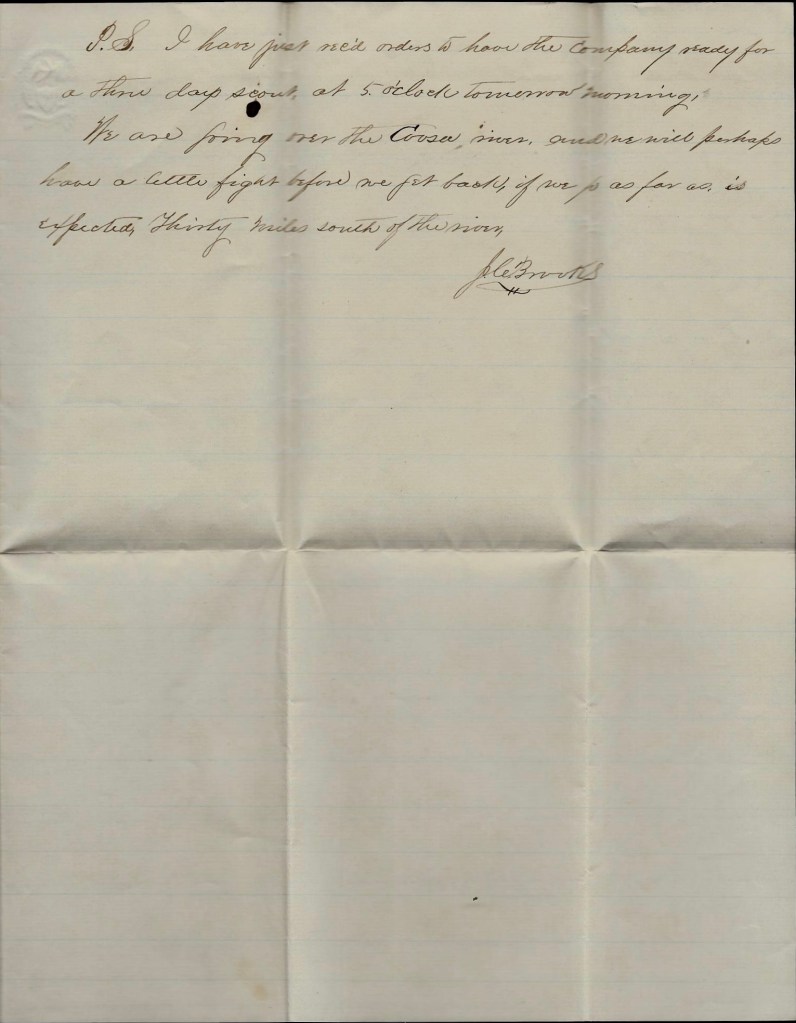
P. S. I have just received orders to have the company ready for a three days scout at 5 o’clock tomorrow morning. We are going over the Coosa river and we will perhaps have a little fight before we get back. if we go as far as is expected, thirty miles south of the river. — J. C. Brooks
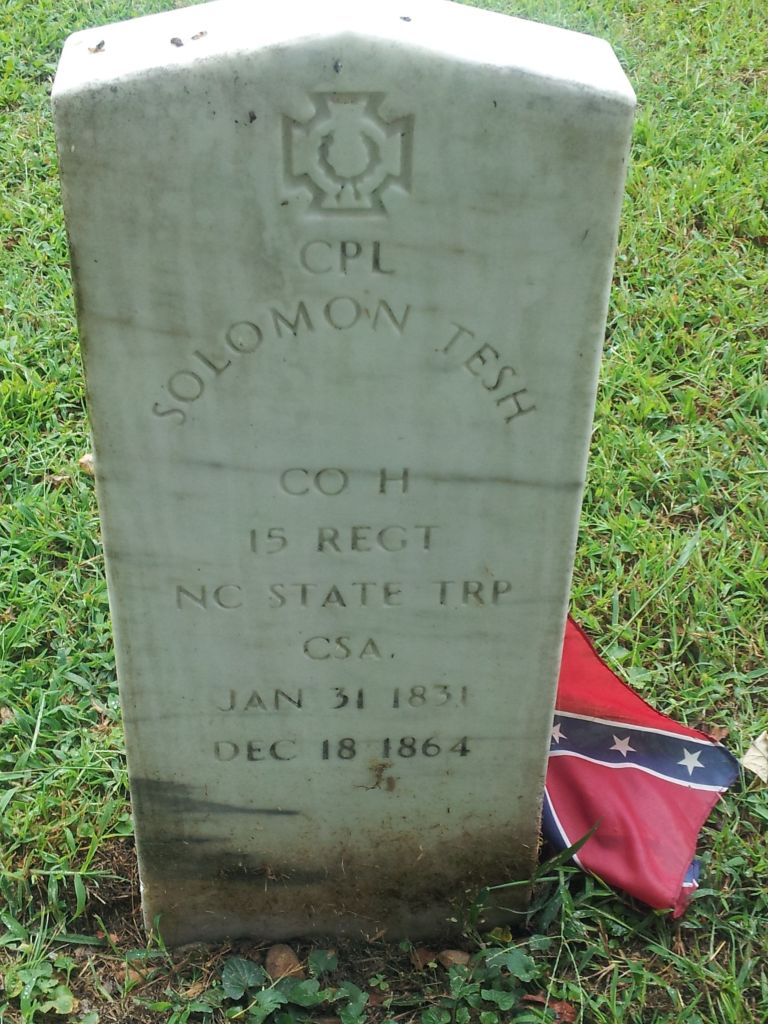
Solomon Tesh’s Headstone in Hollywood Cemetery in Richmond, Va.
The following letter was written by Solomon Tesh, a corporal in Co. H, 15th North Carolina Infantry. Solomon enlisted on 15 July 1862 at Raleigh, North Carolina. His muster records indicate that he was wounded in the fighting at South Mountain on 14 September 1862 and shortly thereafter furloughed for 60 days to recuperate. He was with his regiment again in December 1862 and promoted to corporal on 8 April 1863. Unfortunately, Solomon did not survive the war, though he expressed eternal hope that he might, asking his Lord to “give us peace in thine own way & grace to wait thine own time. Thy will be done, not mine.”
Solomon was the son of George Tesh (1796-1872) and Maria Sarah Boeckel (1796-1870) of Friedberg, Davidson county, North Carolina. He was married in 1851 to Phebe Malvina Perryman (1835-1923) who bore him five children—Letitia, Laura, Robert, Benjamin, and Lucy.
Transcription
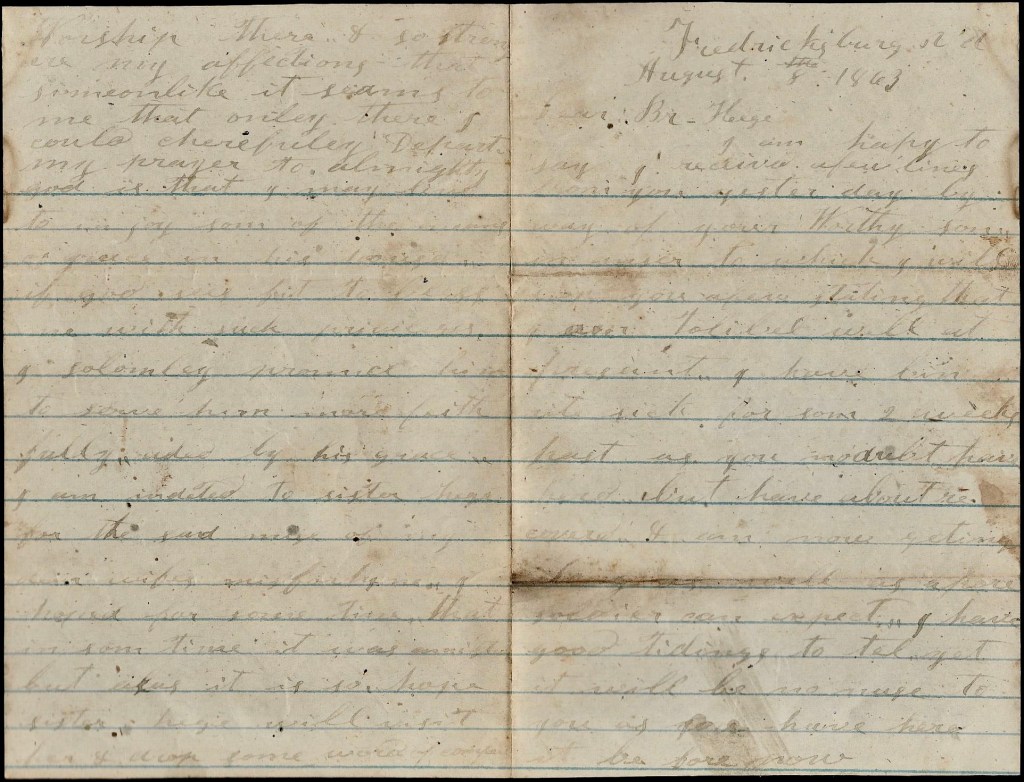
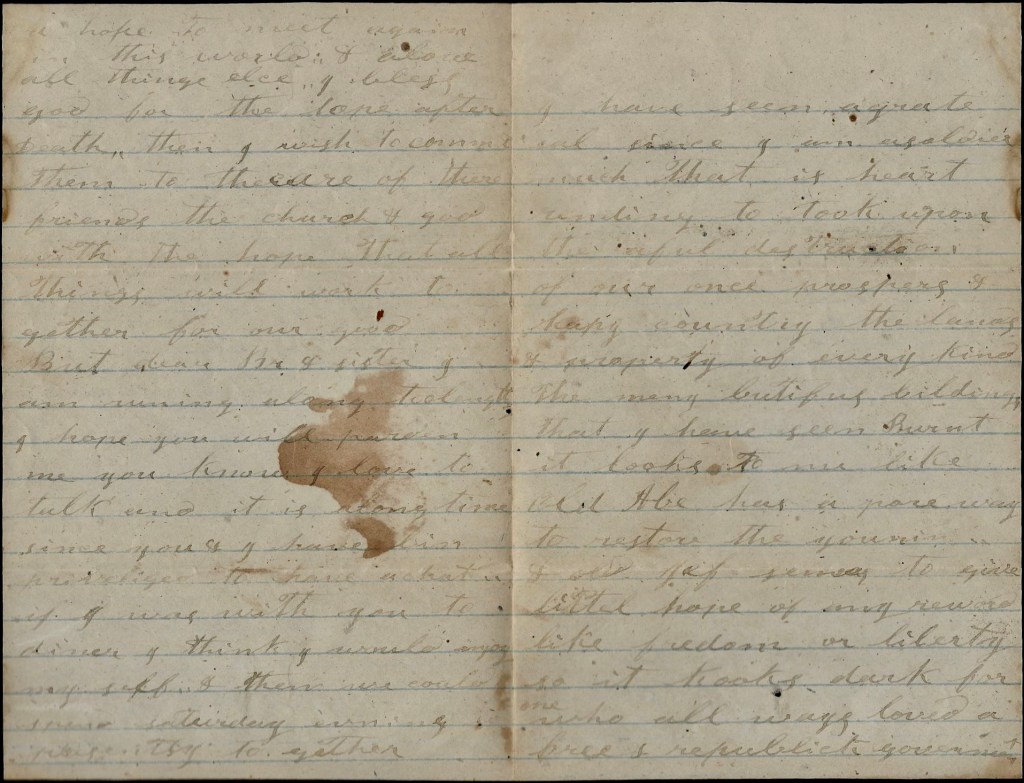
Fredericksburg, Virginia August 8th 1863
Dear Br. Hege,
I am happy to say I received a few lines from you yesterday by way of your worthy son, in answer to which I will drop you a few stating that I am tolerable well at present. I have been right sick for some two weeks past, as you no doubt have heard, but have about recovered. I am now getting along as well as a poor soldier can expect.
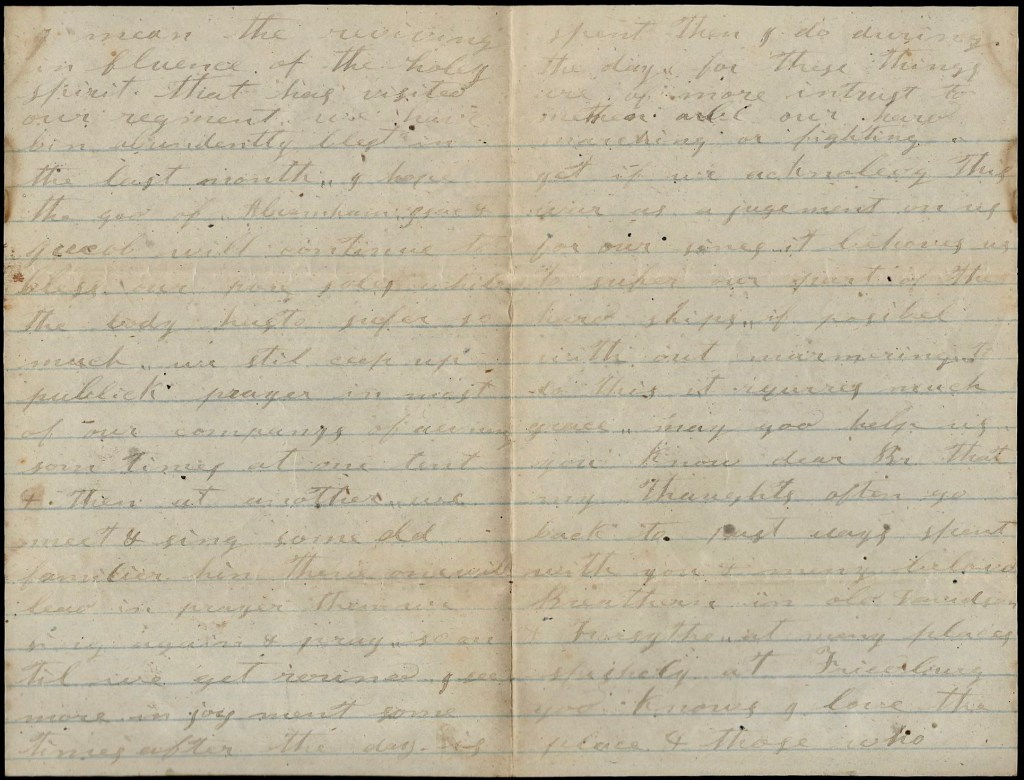
I have good tidings to tell, yet it will be no news to you as you have heard it before now—I mean the reviving influence of the Holy Spirit that has visited our regiment. We have been abundantly blessed in the last month. I hope the God of Abraham, Isaac, & Jacob will continue to bless our poor souls while the body has to suffer so much. We still keep up public prayer in most of our companies, sometimes at one tent and then at another. We meet & sing some old familiar hymns. Then one will lead in prayer. Then we sing again & pray and so on till we get revived. I see more enjoyment sometimes after the day is spent then I do during the day for these things are of more interest to me than all our hard marching or fighting. Yet, if we acknowledge this war as a judgment on us for our sins, it behooves us to suffer our part of the hardships, if possible without murmuring. To do this, it requires much grace. May God help us.
You know, dear Br., that my thoughts often go back to past days spent with you & many beloved Brethren in old Davidson & Forsythe at many places—especially at Friedburg. You know I love the place & those who worship there. And so strong are my affections that Simeonlike, it seems to me that only there I could cheerfully “Depart.” My prayer to almighty God is that I may live to enjoy some of the means of grace in this. If God will fit to bless me with such privileges, I solemnly promise Him to serve Him more fully idea by his grace.
I am indebted to sister Hege for the [ ] of my dear wife’s misfortune. I hoped for some time that in some time it was [ ], but alas, it is so. Hope sister Hege will assist her & drop some word of comfort as any such misfortune must add to sorrow already in divide. It is no small mater to have five little children depending on a poor woman & her husband in the army, now exposed to everything that is hard & dangerous—spiritual & temporal, & at the same time in a condition like here. These things are enough to weigh down my spirit, but turn the thoughts & cry out, “Bless God,” that it is no worse with us. My wife & dear children are still in the interior of the state where they know comparatively nothing of the horrors of war & at last account, we were all alive & had a hope to meet again in this world. And above all things else, I bless God for the hope after death. Then I wish to commend them to the care of their friends, the church & God, with the hope that all things will work together for our good.
But dear Br. & sister, I am running along too lengthy. I hope you will pardon me. You know I love to talk and it is a long time since you & I have been privileged to have a chat. If I was with you to dinner, I think I would enjoy myself & then we could spend Saturday evening pleasantly together.
I have seen a great deal since I am a soldier—much that is heart-rending to look upon. The awful destruction of our once prosperous & happy country, the lands & property of every kind, the many beautiful buildings that I have seen burnt—it looks to me like Old Abe has a poor way to restore the Union & Old Jeff seems to give little hope of any reward like freedom or liberty, so it looks dark for one who always loved a free & republic government. I hope that in some way the curse may be removed ere long. Lord, give us peace in thine own way & grace to wait thine own time. Thy will be done, not mine.
But I must close, dear Br., I hope you will remember when you read this the source from where it comes & will therefore receive it as well meant & overlook all mistakes C. A. is well. The boys are all about except Br. He is not about much. Cont is with us. He is some better. No more now. Your friend, wishing to be claimed as a brother—Solomon Tesh
to his esteemed Br Solomon Hege Fredricksburg Va. August 8th 1863
This letter is written by Andrew Durfee (1840-1865), the son of Stephen Durfee (1812-1886) and Sarah Marshall (1816-18xx) of Fall River, Newport county, Rhode Island.
Andrew mustered into Co. D, 1st Rhode Island Cavalry as a private in mid-December 1861. He was captured at Middleburg, Virginia. where the regiment was badly routed on 18 June 1863, and paroled on 23 July 1863 at City Point, Virginia. He was captured again at Sulfur Springs, Virginia, on 14 October 1863. He spent the next 18 months at Libby and Andersonville, being paroled 27 February 1865 at N. E. Ferry, North Carolina, only to die of pneumonia in the General Hospital in Wilmington, North Carolina within a month.
I could not find an image of Andrew but here is Lyman Aylesworth of the 1st Rhode Island Cavalry. Lyman barely escaped capture at the Battle of Middleburg (VA) on June 17/18, 1863 when most of his comrades were taken prisoner. His family donated his uniform, sword, enlistment papers and other various accoutrements to the Varnum museum in the 1920s. His shell jacket has been recently conserved. — at Varnum Memorial Armory Museum.
Transcription
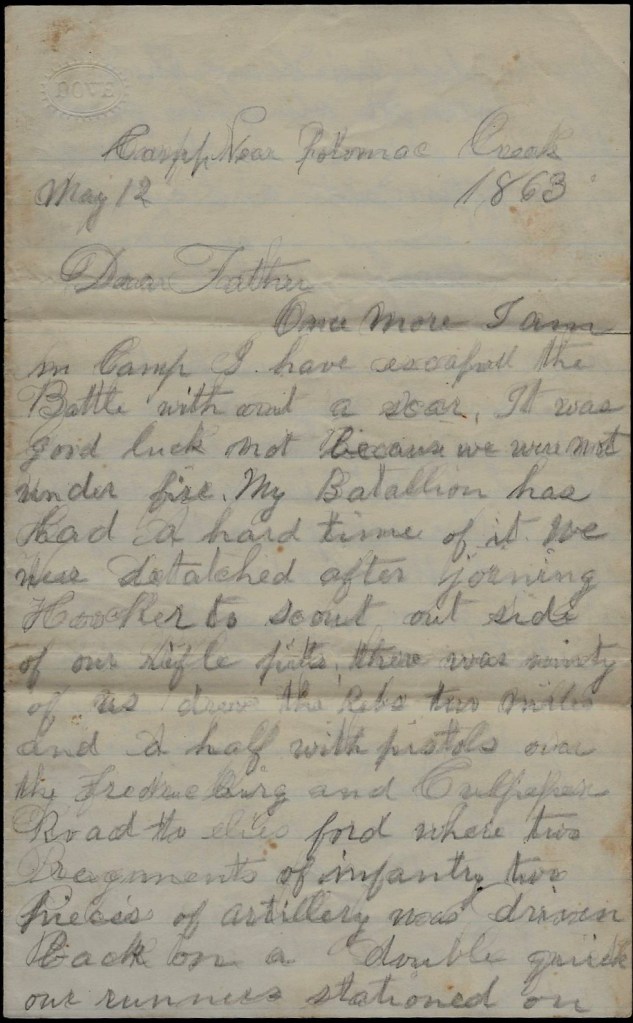
Camp near Potomac Creek May 12, 1863
Dear Father,
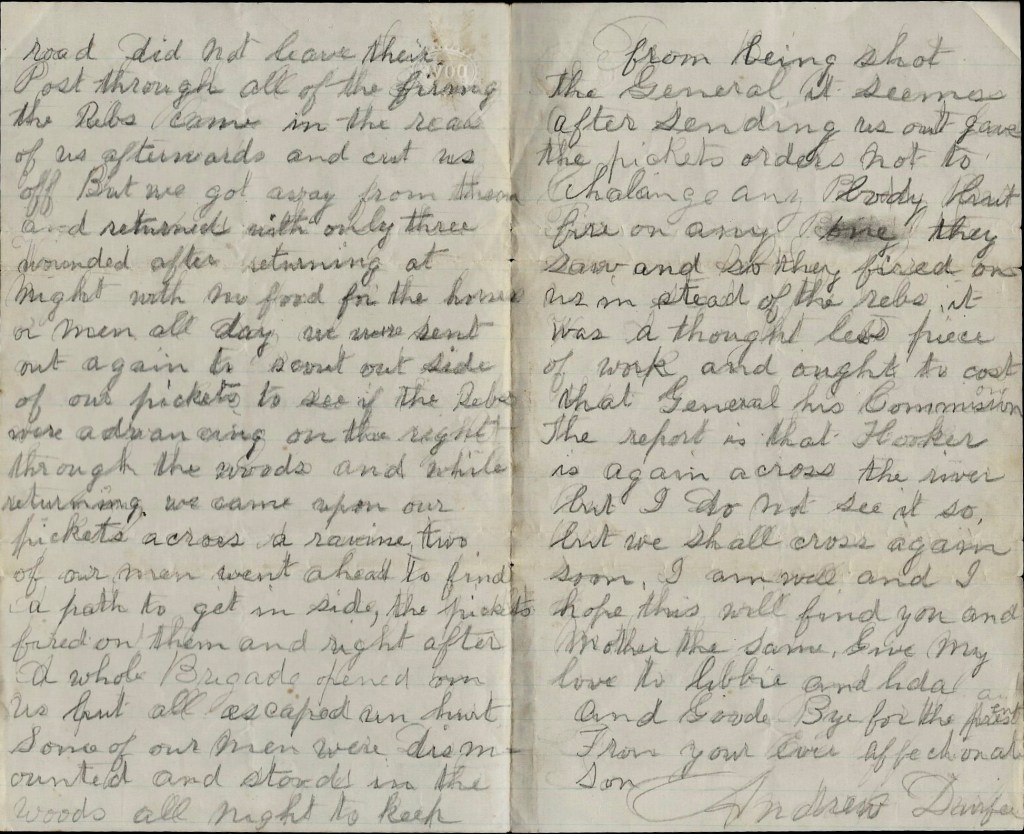
Once more I am in camp. I have escaped the battle without a scar. It was good luck [and] not because we were not under fire. My battalion has had a hard time of it. We were detached after joining Hooker to scout outside of our rifle pits. There was ninety of us drove the Rebs two miles and a half with pistols over the Fredericksburg and Culpeper Road to Ely’s Ford where two regiments of infantry [and] two pieces of artillery was driven back on a double quick. Our runners stationed on the road did not leave their post through all of the firing. The Rebs came in the rear of us afterwards and cut us off but we got away from them and returned with only three wounded.
After returning at night with no food for the horses or men all day, we were sent out again to scout outside of our pickets to see if the Rebs were advancing on the right through the woods and while returning, we came upon our pickets across a ravine. Two of our men went ahead to find a path to get inside the [picket line when] the pickets fired on them and right after, a whole brigade opened on us but [we] all escaped unhurt. Some of our men were dismounted and stood in the woods all night to keep from being shot. The General, it seems, after sending us out, gave the pickets orders not to challenge anybody but fire on anyone they saw—and so they fired on us instead of the Rebs. It was a thoughtless piece of work and ought to cost that general his commission.
The report is that Hooker is again across the river but I do not see it so. But we shall cross again soon. I am well and I hope this will find you and Mother the same. Give my love to Libbie and Lida and goodbye for the present. From your ever affectionate son, — Andrew Durfee
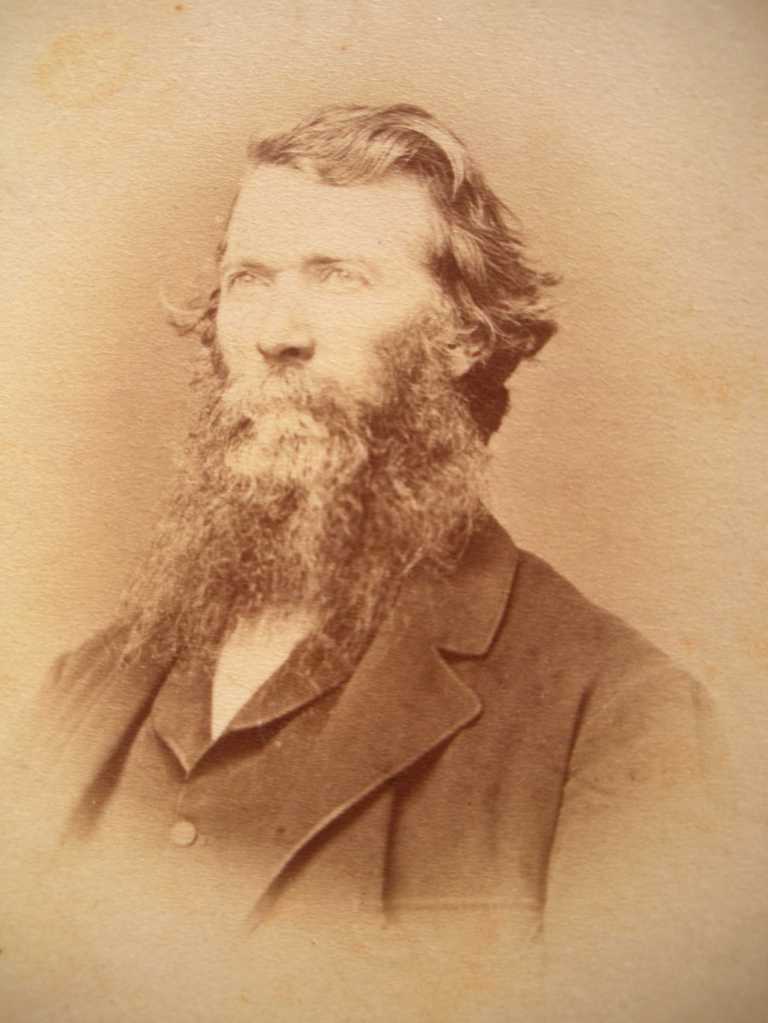
The following letter was written by 43 year-old Mitchell Campbell Lilley (1819-1897), the proprietor of a moderately successful bindery and printing firm in Columbus, Ohio, at the time that civil war erupted in 1861. Having served previously in the Mexican War, and being a member of the local militia, Lilley was quick to offer his service as Captain of Co. H, 46th Ohio Volunteer Infantry (OVI). Ill health, however, forced Lilley to resign from active service in January 1863 but he returned to Columbus to command a home guard militia for the duration of the war.
Mitchell Campbell Lilley
Following the war, Lilley convinced the Ohio General Assembly that deaf students at the state institution for the deaf could be trained in bookbinding skills which enabled him to expand his business and branch out into other endeavors, such as manufacturing and distributing fraternal regalia.
Lilley was married in 1849 at Paris, Illinois, to Amanda C. Brooks. They had 13 children, five of who died in infancy.
The 46th OVI took part in Grant’s first attempt to seize Vicksburg which was to march his army overland from La Grange, Tennessee, following the Mississippi Central Railroad south toward Vicksburg. He imagined that a supply line could be maintained from Columbus, Kentucky, but this proved impossible. Once Grant’s forces had made it as far as 35 miles south of Grand Junction, the large supply depot he had established at Holly Springs in his rear was swiftly and unexpectedly attacked by Earl Van Dorn’s Cavalry, destroying $1.5 million of supplies, capturing the Federal garrison quartered there, and destroying track and bridges. The damage inflicted by Van Dorn’s troopers caused sufficient harm for Grant to withdraw his forces to Memphis and rethink his strategy.
In this letter, Capt. Lilley describes their return to Holy Springs and what they found when they got there.
[Note: This letter is from the personal collection of Greg Herr and was transcribed & published on Spared & Shared by express consent.]
Transcription
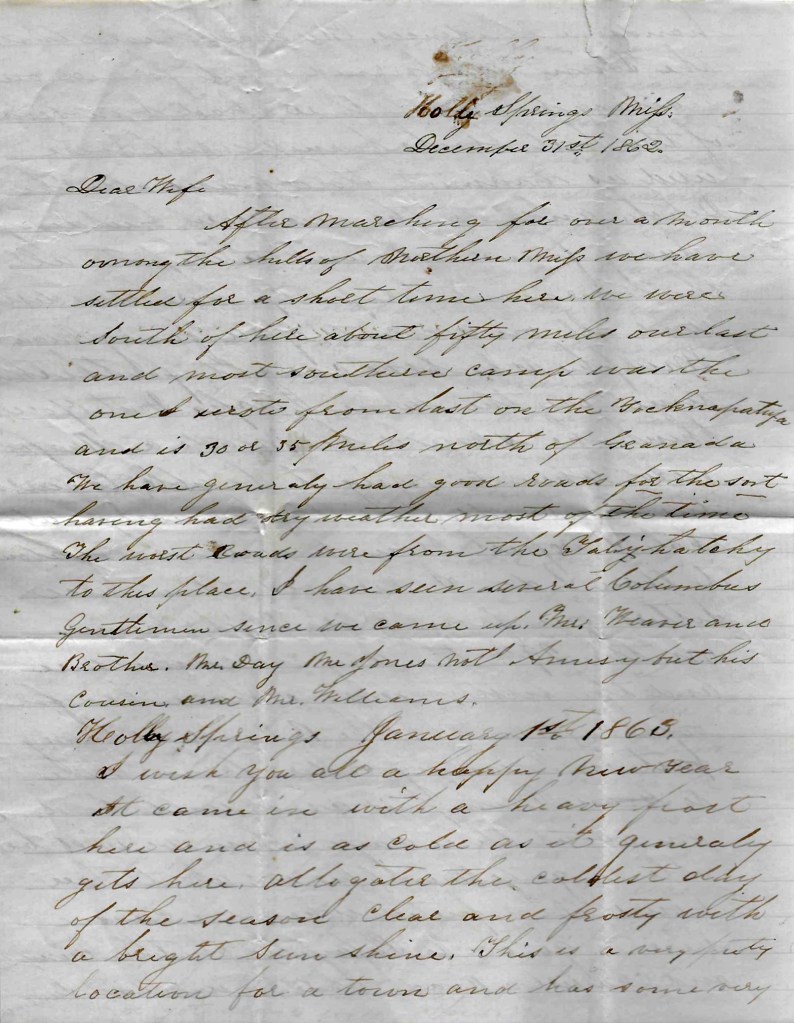
Holly Springs, Mississippi December 31, 1862
Dear Wife,
After marching for over a month among the hills of Northern Mississippi, we have settled for a short time here. We were south of here about fifty miles. Our last and most southern camp was the one I wrote from last on the Yachnapatufa and is 30 to 35 miles north of Grenada. We have generally had good roads for the sort, having had dry weather most of the time. The worst roads were from the Tallahatchie to this place. I have seen several Columbus gentlemen since we came up. Mr. Weaver and brother, Mr. Day, Mr. Jones—not Amisy but his cousin, and Mr. Williams.
Holly Springs, January 1st 1863. I wish you all a happy New Year. It came in with a heavy frost here and is as cold as it generally gets here, altogether the coldest day of the season, clear and frosty with a bright sunshine. This is a very pretty location for a town and has some very handsome residences. We had heard that the town was burned but found on reaching here that there had been several of the best blocks burned which were used as Government storehouses—also the depot, and all the necessary buildings usually found around a depot. All the government property here was destroyed and all on account of a fancy man, Col. [Robert C.] Murphy, who was caught for the third time in the same trap. Don’t you think he should be made a Major now when he might be able to surrender his thousands.
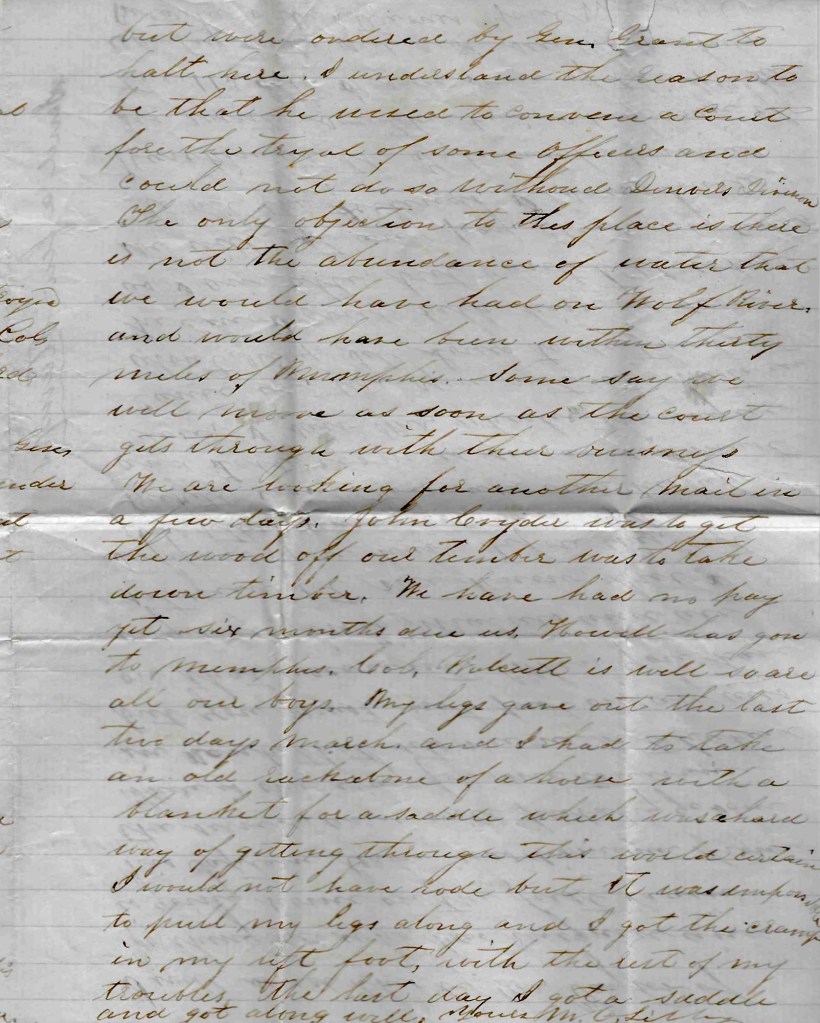
Well, talk enough about that. I expect you know more about it than I do. I received your three letters—one from Cairo, Paris, and home—on the 29th, the day we came here, and the first news we have had for over a month. The railroad is being put in running order from here to Memphis and will be done in about three days when we will be able to go to Memphis in about three hours. We expected when we came here to go on to Lafayette on the Memphis & Charleston Road where we were last summer, but we were ordered by Gen. Grant to halt here. I understood the reason to be that he wished to convene a court for the trial of some officers and could not do so without Denver’s Division. 1 The only objection to this place is there is not the abundance of water that we would have had on Wolf River, and would have been within thirty miles of Memphis. Some say we will move as soon as the court gets through with their business.
We are looking for another mail in a few days. John Cryder was to get the wood off our timber was to take down timber. We have had no pay yet—six months due us. Howell has gone to Memphis. Col. Wolcutt is well. So are all our boys. My legs gave out the last two days march and I had to take an old rackabone of a horse with a blanket for a saddle which was a hard way of getting through this world certain. I would not have rode but it was impossible to pull my legs along and I got the cramps in my left foot, with the rest of my troubles. The last day I got a saddle and got along well. Yours, — M. C. Lilley
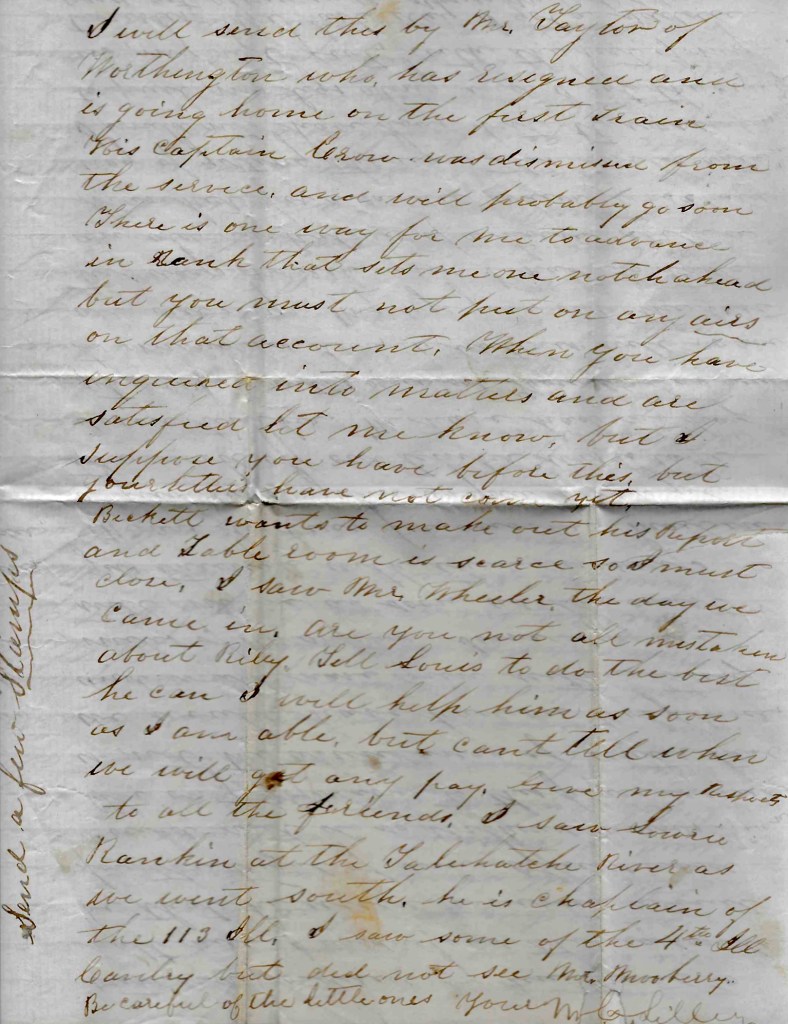
I will send this by Mr. Taylor of Worthington who has resigned and is going home on the first train. His Captain Crow was dismissed from the service and will probably go soon. There is one way for me to advance in rank. That sets me one notch ahead but you must not put on any airs on that account. When you have enquired into matters and are satisfied, let me know, but I suppose you have before this. But your letters have not come yet.
Beckett wants to make out his report and table room is scarce so I must close. I saw Mr. Wheeler the day we came in. Are you not all mistaken about Riley? Tell Louis to do the best he can. I will helm him as soon as I am able, but can’t tell when we will get any pay. Give my respects to all the friends. I saw Lowrie Rankin at the Tallahatchie River as we went south. He is chaplain of the 113th Illinois. I saw some of the 4th Illinois Cavalry but did not see Mr. Mooberry. Be careful of the little ones. Yours, — M. C. Lilley
1Gen. James W. Denver remained in command of this brigade until about November 23, 1862 when he was given the command of one of the three divisions Sherman’s division was split into. During this period Gen. Denver and his brigade participated in the Siege of Corinth, a march to Memphis, and a brief move south with Sherman toward Holley Springs, December 5, 1862. After returning to Memphis his division transferred to Gen. Hurlbut’s XVI Corps where it was designated as the First Division. Its assignment was to guard 65 miles of the Memphis & Charelston Rail Road. He was preforming this duty when he resigned his commission March 18, 1863. He remained in his command until his replacement, Gen. William Sooy Smith, took command of the division.
I could not find an image of Jared but here is a tintype of William W. Harding wearing the uniform of the 11th Pennsylvania Cavalry. William served in Co. G. He holds a model 1840 heavy cavalry saber and has a colt Model 1860 Army tucked in his belt.(Union Drummer Boy)
This partial year 1863 diary was kept by Jared Fuller (1821-1900) who was 40 years old when he enlisted on 22 August 1861 as a corporal in Co. A, 11th Pennsylvania Cavalry. He was discharged for disability on 25 October 1863 presumably related to the failing eyesight he complained of in his diary.
The 11th Pennsylvania Regiment (108th Volunteers) was organized at Philadelphia by Colonel Joseph Harlan of Philadelphia as an independent regiment under authority of the Secretary of War, known as “Harlan’s Light Cavalry.”Most companies were from Pennsylvania, but Company A was from Iowa, parts of E and F from New York, part of I from New Jersey, and Company M was from Ohio.
In the 1850 US Census, Jared was enumerated in Colchester, Delaware county, New York. At that time, prior to his marriage, he was living in the home of his parents, John Fuller (1780-1856) and Perninah Langdon (1784-1873).
Just before and after his enlistment, Jared resided in Fort Dodge, Webster county, Iowa. He was married in 1854 to Sarah J. Beates (1828-1869) and was the father of four children. When he returned to Fort Dodge after the war, he held several local elected positions including county treasurer and county recorder.
[Note: This diary is from the private collection of Greg Herr and was transcribed & published on Spared & Shared by express consent.]
Transcription
JANUARY
Thursday, January 1, 1863—It is New Years. How oft I have looked forward to this time of the year with bright & joyous hopes but today I look at it with indifference. It is a dark hour for my country.
Friday 2—Still on picket. The weather is beautiful—almost like Spring. Days are sunshine & the nights clear & frosty. I wonder what is stored up in future for me. Time will show.
Saturday 3—We were relieved from picket today. Some excitement in camp that the rebels are approaching in strong force. General Corcoran commanding here. I saw him today.
Sunday, January 4, 1863—Company inspection. This morning the day was uncommonly fine. The 58th Pennsylvania embarked for Newbern, North Carolina. Success attend them.
Monday 5—A body of infantry left Suffolk for North Carolina today. The 13th Indiana Regiment bid farewell to Brigadier Gen. [Otis S.] Ferry. He paid his farewell address & departed for the North.
Tuesday 6—Everything quiet here today. News arrived here by the papers that the gunboat Monitor foundered at sea off Cape Hatteras on her way south.
Wednesday, January 7, 1863—Everything passed off quietly today. Two companies of our regiment wet on a scout toward Blackwater. The companies returned from North Carolina all safe and sound.
Thursday 8—Camp Suffolk. Our regiment is out on a scout, Started this morning. Weather cool with a little rain. No stirring news.
Friday 9—Camp Suffolk, Va. Last night at 12 o’clock news came that our pickets were driven in. Snow fell in the night. Cannon heard toward Windsor. Regiment out yet. All quiet in Suffolk.
Saturday, January 10, 1863—Camp Suffolk, Va. A rainy day. Boys still out. Rumor says the rebels are this side Blackwater from 8 to 15 thousand strong. Two rebel prisoners were brought in at 11 o’clock p.m.
Sunday 11—Camp Suffolk, Va. All quiet all day. Rather cool and cloudy.
Monday 12—Camp Suffolk, Va. Rumors of rebels in force hanging around us. G & K companies go on scout. Weather cold.
Tuesday, January 13, 1863—Camp Suffolk, Va. This morning A & H companies go out on scout. Heavy cannonading heard on James river. Company came in at 9 p.m. Brought in 6 or prisoners—guerrillas.
Wednesday 14—Companies D & E go out today on scout. South rains. Weather warm. All quiet at Suffolk.
Thursday 15—Camp Suffolk. Company B went out on scout. Dull times. All quiet and so much so as to be oppressive.
Friday, January 16, 1863—Camp Suffolk. Rainy day in a Va. camp & its accompaniments of mud.
Saturday 17—Camp Suffolk. Cold & windy but clear. Nothing going on to break the monotony of life.
Sunday 18—Camp Suffolk. Last night was the coldest we have had. Dress parade at 9 o’clock a.m. Company started on a scout 5 p.m. Returned 9.
Monday, January 19, 1863—Camp Suffolk, Va. A fine morning bright but cool. Dress parade at 9 a.m. The day passed quietly away. The papers tonight brings of a victory in Arkansas. 7,000 prisoners.
Tuesday 20—Camp Suffolk. Cloudy wind south east & rather cold. Went on a scout to Holland Corners. The rebels had barricaded the road. Returned at 3 p.m. Another scout got 2 prisoners.
Wednesday 21—Camp Suffolk, Va. Rained all last night. 2 companies went on a scout 2 hours before day light pay master in camp.
Thursday, January 22, 1863—Camp Suffolk. Wet & moist on account of irregulation of pay rolls. No pay yet. Two companies on a scout returned at dark. No rebels found.
Friday 23—Camp Suffolk—Wet & stormy. No scout today. The Army of the Potomac is on the move once more. May the God of Battles be with them.
Saturday 24—Camp Suffolk. Weather still moist but clearing off. A scout of two companies have gone out to North Carolina & the Dismal Swamp. Another of two companies gone on the same.
Sunday, January 25, 1863—Camp Suffolk. Clear & pleasant. All quiet in camp today. Seems quiet like Sunday. All are anxious to [hear] from the advance of Burnside.
Monday 26—Clear & pleasant. Companies A & H returned from North Carolina. Burnsides advance was impeded by the bad roads and storms of last week.
Tuesday 27—Camp Suffolk, Va, Cloudy. A storm is pending. Detailed on camp guard today. Afternoon a furious storm is now raging. No news of importance from the army.
Wednesday, January 28, 1863—Camp Suffolk, Va. Stormed all night. The paymaster in camp. The pay rolls have been signed for 7 months pay. Hooker supersedes Burnside in command.
Thursday 29—Camp Suffolk. Cold & stormy last night. Co. G went on a scout this side of Carrsville. They was fired on by rebels in ambush. Another scout went today. Found rebels at Deserted House.
Friday 30—A force of 7 regiments of infantry, 11th Pennsylvania Cavalry, 2 batteries artillery & howitzers left Suffolk at 10 last night. At 8 this a.m., drove in the rebel pickets after [we] opened on them with all our artillery.
Saturday, January 31, 1863—Deserted House 10 miles from Suffolk. The Battle [of Kelly’s Store] yesterday, was an important affair. The rebels 4,000 strong under Gen. [Roger A.] Pryor was driven across the Blackwater by our force under Gen. [Michael] Corcoran. Our loss was severe.
FEBRUARY
Sunday, February 1—Camp Suffolk. James [A.] Beach was buried today with military honors. He was a brave and gallant soldier & met his death in the discharge of his duty.
Monday 2—Camp Suffolk. Co. A went on scout, Our party went to Carrsville. No rebels here since the battle. Went over the battlefield. The picture was horrible.
Tuesday, February 3, 1863—Camp Suffolk. A terrible snow storm is raging today. It seems quite like an Iowa snow storm. The surgeons report of killed & wounded in late battle is over 100.
Wednesday 4—Camp Suffolk, Weather cold . Snow about 8 inches deep. Rather hard keeping warm. Tonight the moonlight shining on the snow & post would remind one of a colder clime.
Thursday 5—Cold & rainy. Nothing doing today but camp duties & as few of them as can be got along with. Bids fair to be stormy night. No movements now.
Friday, February 6, 1863—Camp Suffolk. Rained all last night. Snow has disappeared & its place supplied with mud. Went to the hospital. Our wounded doing well.
Saturday 7—Camp Suffolk. Cleared off last night. Very disagreeable weather. Nothing going on but Saturday’s police.
Sunday 8—Camp Suffolk. Weather clear and beautiful. Been to church today. Our chaplain preached in town. Subject of discourse—the cross scene.
Monday, February 9, 1863—Camp Suffolk, Va. Weather continues beautiful. Went to Norfolk on pass. Enjoyed the journey much. Williams of Co. A got his discharge. Went on train with me to Norfolk.
Tuesday 10—Norfolk, Va. Weather warm and springlike. Vigorous steps are being taken to organize African regiments in Norfolk & other places.
Wednesday 11—Camp Suffolk. Cold & Cloudy. 2 companies on scout. Drill of the recruits. Eyes still weak. Co. E went to South Quay. Drove in the rebel pickets.
Thursday, February 12, 1863—Camp Suffolk. Weather stormy with cold wind. Two weeks since the battle. The [battlefield] scenes have not faded or lost any of its impression.
Friday 13—Camp Suffolk, Va. Another sudden change this morning. Clear & cold. Wind northwest. Co. A on a scout. Went to Carrsville. Suffered much with my eyes. The rebels not been here for 5 days.
Saturday 14—Camp Suffolk. Clear and cold. Some ice to be seen this morning. Saw the regimental surgeon. Got excused from full duty. Visited 130 New York. Saw my friend John Barager. *
* BARAGER, JOHN K.—Age, 44 years. Enlisted, August 6,1862, at Ossian, N . Y . ; mustered in as private, Co. I, August 16, 1862, to serve three years; appointed corporal, September 3, 1862; wounded, date not stated, at Old Church, Va.; died of such wounds, May 31, 1864; also borne as John K. Barragher.
Sunday, February 15, 1863—Camp Suffolk. Weather begins to assume the appearance of Spring. Dress Parade 9 a.m. Went to meeting in town 11 a.m. No preaching. Went to the negro meeting at noon.
Monday 16—Camp Suffolk, Va. Weather pleasant. 3 companies of cavalry went beyond Carrsville. Drove in the rebel pickets. Two of our men dismounted by wires they stretched across the road.
Tuesday 17—Camp Suffolk, Va. Steady rain & cold withall. A detail from our company went to Windsor. Saw the rebel pickets there. All quiet along the lines.
Wednesday, February 18, 1863—Camp Suffolk, Va. Rained all night & still raining & cold withall. Almost enough to snow. No scout yesterday or today on account of the bad weather.
Thursday 19—Camp Suffolk, Va. Weather still unsettled. Mud knee deep. Our company & two more on a scout. Have not returned yet 9 a.m.
Friday 20—Camp Suffolk, Va. Cleared off this morning. The scout that went out last night returned at midnight. Found no rebs. The 9th Army Corps has arrived at Fort Monroe.
Saturday, February 21, 1863—Clear & pleasant. A battalion under Major [Frank A.] Stratton gone to Elizabeth City & 2 companies on scout. Looks like a storm.
Sunday 22—Camp Suffolk, Va. Snowed all night & this morning it has turned to rain. The anniversary of the day fills the heart of the patriot with hope. The spirit of Washington still lives.
Monday 23—Camp Suffolk. Cold & windy. No mail since Saturday. Two companies on scout. The command under Major [Frank A.] Stratton returned today with some prisoners.
Tuesday, February 24, 1863—Camp Suffolk, Va. Cold & clear. Got a letter from home. Glad to hear all well there. Some of the money sent had been received.
Wednesday 25—Camp Suffolk, Va. Clear & Springlike. Co. A wet on a scout as far as Beaver Dam Church. Saw no rebels. News of the investment of Vicksburg received tonight.
Thursday 26—Camp Suffolk, Va. Dark and cloudy. Threatening a storm. Company Drill on foot in a.m. No news of importance. Rather dull in camp.
Friday, February 27, 1863—Warm & showery like Spring. Scout went out early this morning. An alarm in camp. The cavalry ordered out 10 p.m. Went to the old battlefield.
Saturday 28—Camp Suffolk. The alarm last night was occasioned by a force of rebels showing themselves to our pickets but fled before our troops arrived on the ground. Mustered for pay by Col. [Charles C.] Dodge of the 1st New York [Mounted] Rifles.
MARCH
Sunday, March 1—Camp Suffolk. Rainy during the forepart of the day. Suffering with my eyes. Fear I shall lose their use forever. Cleared off towards evening.
Monday, March 2, 1863—Camp Suffolk. Clear and Springlike. An order issued this morning for grinding sabers. Looks like bloody work. Mounted drill 10 a.m. The Conscription Bill gives hope to the loyal.
Tuesday 3—Camp Suffolk, Va. Weather pleasant. Rather dull in camp. Two companies on scout. Rumors of a raid to be made by our regiment & some mounted infantry on some rebel post.
Wednesday 4—Camp Suffolk. Snowed this morning & rather cold. Our regiment went on scout with two howitzers & mounted infantry. The force returned having made a successful raid.
Thursday, March 5, 1863—Camp Suffolk. Cold last night. Ice froze thicker than I have seen in Pa. The sad news came last night of the loss of another of our ironclads.
Friday 6—Camp Suffolk. Rather cold but pleasant. News from Vicksburg rather conflicting.
Saturday 7—Camp Suffolk,Va. Weather pleasant. The Saturday’s policing on the grounds & preparing for tomorrow’s inspection.
Sunday, March 8, 1863—Camp Suffolk. Warm & showery like Spring. Regimental Inspection 4 p.m. by Major Gen. Peck. Went meeting. Heard the chaplain of 112th New York Vols.
Monday 9—Camp Suffolk. Clear & pleasant. Dress Parade 9 a.m. 4 companies on 5 days scout to North Carolina.
Tuesday 10—Camp Suffolk. Dark and cloudy. Co. A on picket duty for 1 week.
Wednesday, March 11, 1863—Camp Suffolk, Va. Stormed hard all last night with high winds. Went this morning with forage to the South Quay picket station with forage. Cleared off this afternoon.
Thursday 12—Camp Suffolk. Clear and rather cold. All quiet in camp. Evening Co. K returned from a scout. Had one of their men shot by a bushwhacker who made his escape.
Friday 13—Camp Suffolk. Batteries practicing at target. Co. K went out in force to revenge the death of Corporal [Levi] Lewis * by laying waste [to] the country.
* Levi Lewis, born October 16, 1841, was reared on the family farm in Luzerne County, Pennsylvania. The oldest son of Robert S. and Mary Lewis, he had an older sister, Lydia Rugar, and two younger brothers, Robert T. and Car. Levi voluntarily joined Company K of the 11th Pennsylvania Cavalry. Sworn in on September 1, 1861, he was appointed corporal on September 9th and served primarily at Fort Monroe and at other camps in Virginia. He held the rank of corporal until he was killed by a sniper on March 12, 1863, at Suffolk, Virginia. His body and efforts were shipped home to Luzerne County, Pennsylvania, on March 17, 1863.
Saturday, March 14, 1863—Camp Suffolk. Clear & cold for the season and climate. 5 regiments of the army corps arrived here last night. The staff of the 28 N [ ] fetched up in our stable.
Sunday 15—Camp Suffolk. Still cold & dry. More soldiers are arriving.
Sunday 22—Camp Suffolk, Va. The snow is fast melting but oh! the mud. The band is now playing the dead march as the body of Lieut. Moody is being conveyed to the cars.
APRIL
Saturday 11—Camp Suffolk. The enemy have advanced upon us in force, driven in our pickets, and taken some of them. Our regiment went out toward night & engaged them and took two prisoners.
Sunday 12—Enemy seem to be preparing for an attack. No engagement as yet.
Monday, April 13, 1863—Enemy are all around us. A skirmish at noon on the Somerton Road. Enemy fell back.
Tuesday 14—Firing through the night by the gunboats. One gunboat reported disabled.
Monday 20—Camp Suffolk, Va. A gallant dash was made last night by the 89th New York & 8th Connecticut Volunteers across the Nansemond river, capturing 200 prisoners and a battery of guns. Loss small on our side. *
* “You have probably read about our taking the rebel battery the other side of the river, so I shall not need to say much about that. I was there of course. I fired my rifle 3 times. None of the boys fired more times than that, with one of our rifles, but those who had Sharps Rifles fired 5 times. Some of the boys fired none. One man of this company was wounded in his arm and leg but not seriously.” — Henry C. Smith, Co. E, 8th Connecticut Volunteers, 10 May 1863. [See: Henry Cole Smith Letters]
MAY
Sunday 3—Camp Suffolk, Va. Morning bright and beautiful. A large force went out on several roads to reconnoiter. Slight skirmishing on South Quay. Enemy in heavy force on Petersburg Road. Hard fighting. This force commanded by Major General Getty. Enemy driven back. Union loss 200.
Monday, May 4, 1863—Camp Suffolk, Va. As was thought by us yesterday, the enemy evacuated their position here last night and we are now pursuing them and taking many prisoners. [Leander] Chase of A Company, 11th Pa. Cav. took and brought in five prisoners and a sutler’s wagon.
JUNE
Monday 22—Regiment marched from Suffolk to Portsmouth.
Tuesday 23—Went on board transport. Arrived opposite Yorktown about sundown. Anchored in the middle of the river.
Wednesday, June 24, 1863—In York River opposite Yorktown on board transport. 2 o’clock afternoon received orders to move up the river within 10 miles of West Point.
Thursday 25—Arrived at the White House about 10 o’clock. Expecting to disembark. Saddles all stripped for a raid. Rebel pickets driven in. Two taken prisoners. Pickets and scout gone out.
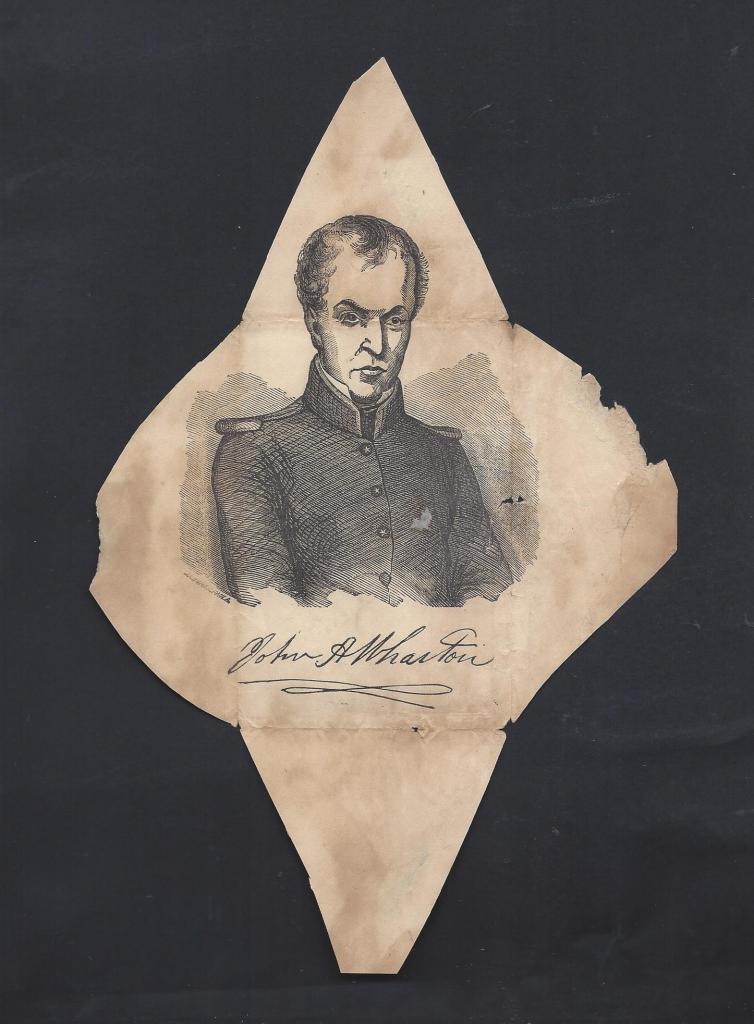
The following letters were written by 37 year-old Sergt. James Edmund Wallis of Co. B, 20th Texas Infantry—often referred to as “Elmore’s Regiment.” The regiment wsa composed of mainly middle-aged men commanded by Col. Henry M. Elmore. It was part of the District of Texas, New Mexico, and Arizona, also known as the Third Corps under Gen. John B. Magruder. The main purpose was to guard the Sabine River and to protect the city of Galveston, Texas. They saw little action until the Battle of Galveston in January 1863 in which they served with distinction.
In the 1850 US Census, 13 year-old J. E. Wallis was enumerated in his father’s residence in Washington county, Texas. His parents were J. Wallis (1801-1865) and Elizabeth Crockett (1790-1866). He was born in Alabama in 1835. In the 1860 Slave Schedules, J. E. Wallis is listed among the slave holders in Chappell Hill, Washington county, Texas, with 13 slaves. He was married in 1860 to Sarah Catherine “Kate”) Landis.
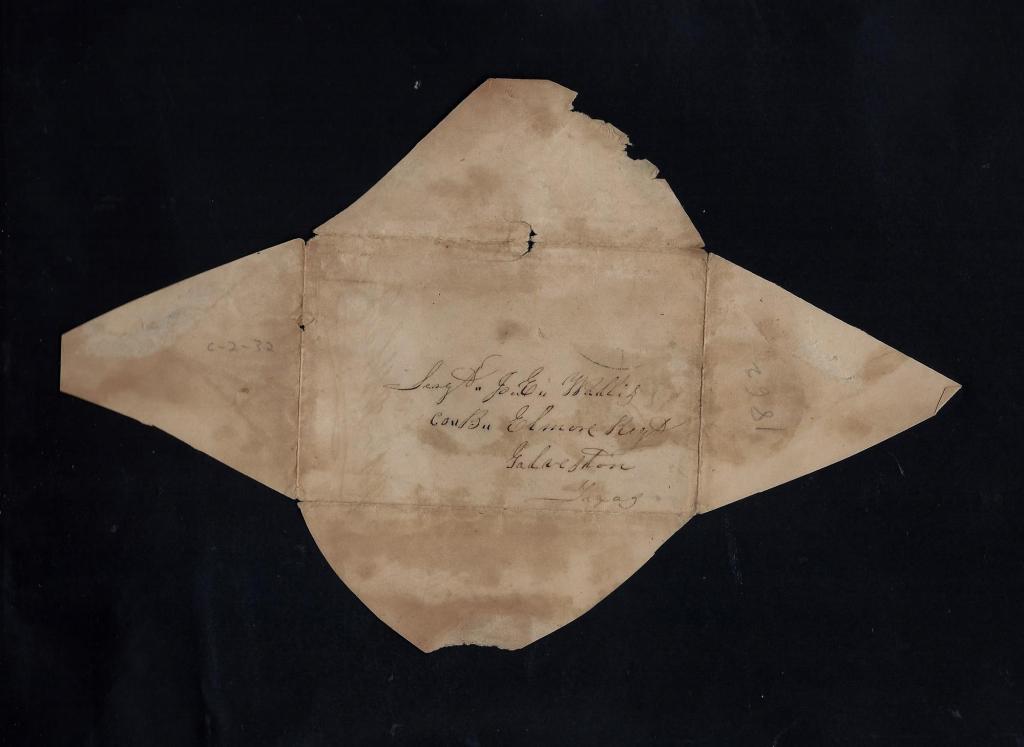
Addressed to Mrs. Kate Wallis, Chappel Hill, Texas
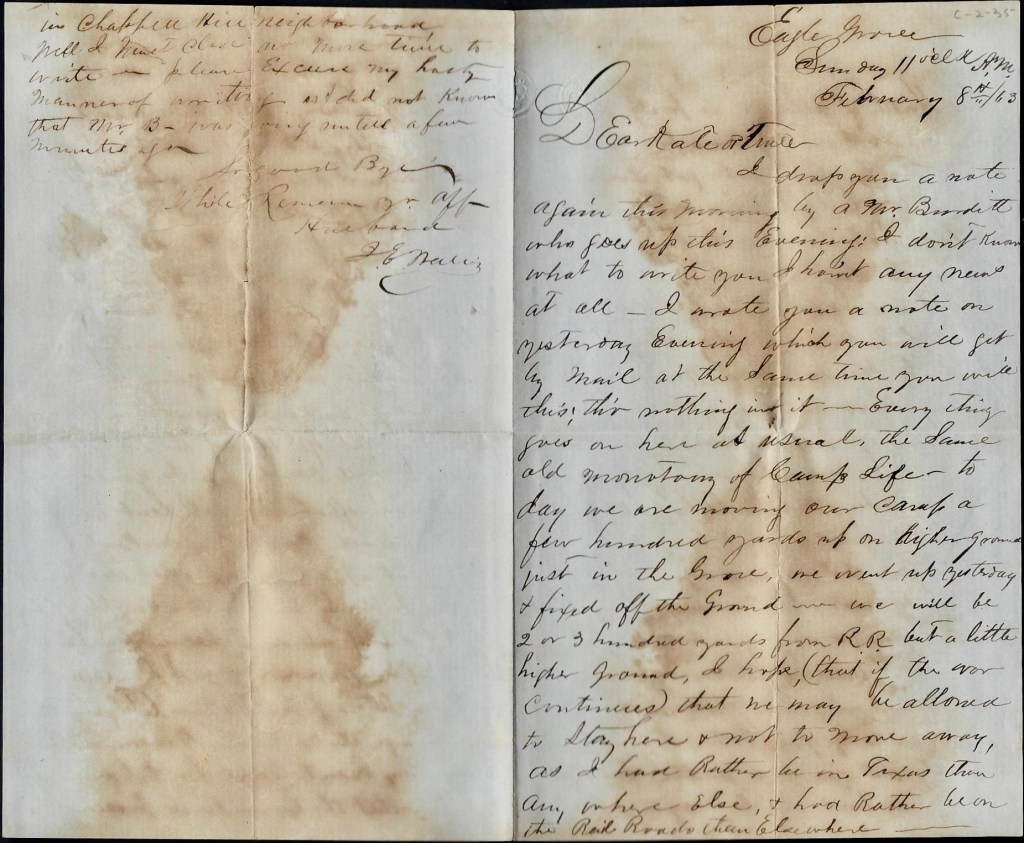
Eagle Grove, [Fort Moore] February 8, 1863 Sunday, 11 o’clock a.m.
Dear Kate,
I drop you a note again this morning by a Mr. Burditt who goes up this evening. I don’t know what to write you. I hain’t any news at all. I wrote you a note on yesterday evening which you will get by mail at the same time you will this, though nothing in it. Everything goes on here as usual—the same old monotony of camp life.
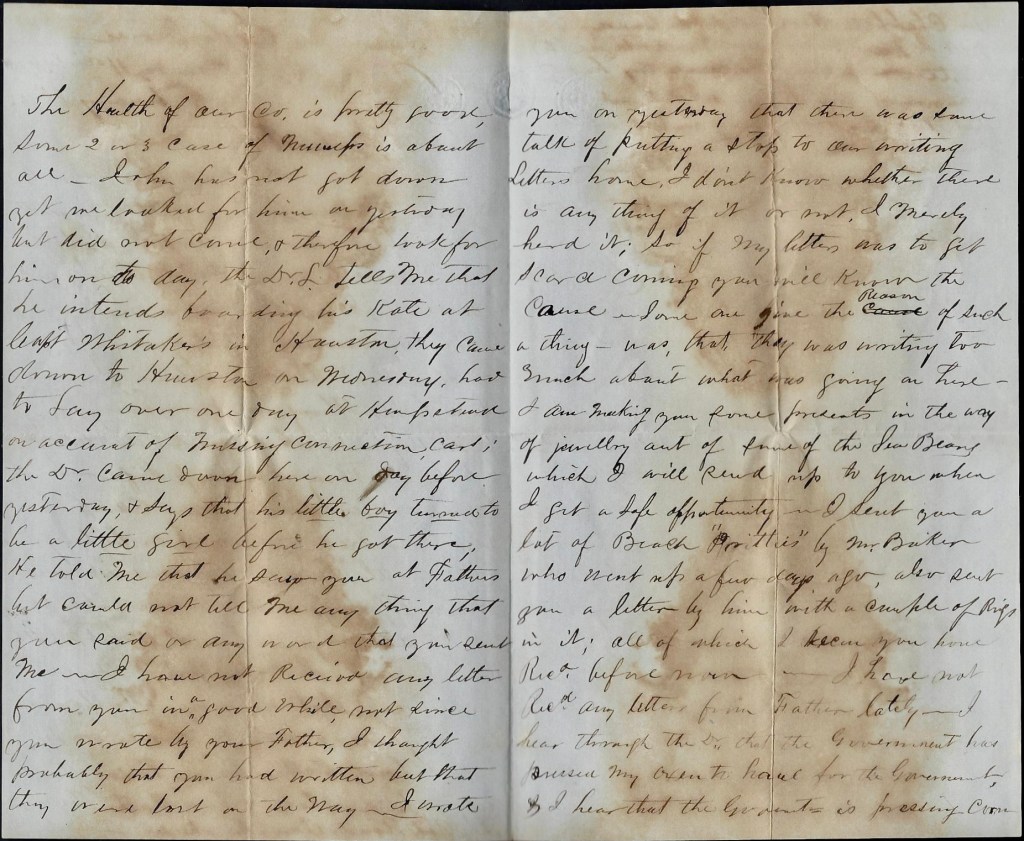
Today we are moving our camp a few hundred yards up on higher ground just in the grove. We went up yesterday & fixed off the ground. We will be about 2 or 3 hundred yards from the railroad but a little higher ground. I hope (that if the war continues) that we may be allowed to stay here & not to move away, as I had rather be in Texas than anywhere else & had rather be on the railroads than elsewhere.The health of the company is pretty good. Some two or three cases of mumps is about all. John has not got down yet. We looked for him on yesterday but did not come, & therefore look for him on today. The Dr. L[ockheart] tells me that he intends boarding his Kate at Capt. Whitaker’s in Houston. They came down to Houston on Wednesday, had to stay over one day at Hempstead on account of missing connection cars. The Dr. came down here on day before yesterday & says that his little boy turned out to be a little girl before he got there. He told me that he saw you at Father’s but could not tell me anything that you said or any word that you sent me.
I have not received any letter from you in a good while—not since you wrote by your Father. I thought probably that you had written but that they were lost on the way. I wrote you on yesterday that there was some talk of putting a stop to our writing letters home. I don’t know whether there is anything of it or not. I merely heard it; so if my letters was to get scarce coming, you will know the cause. Some one give the reason of such a thing was that they was writing too much about what was going on here.
I am making you some presents in the way of jewelry out of some of the sea beans which I will send up to you when I get a safe opportunity. I sent you a lot of beach “pretties” by Mr. Baker who went up a few days ago. Also sent you a letter by him with a couple of rings in it, all of which I reckon you have received before now.
I have not received any letters from Father lately. I hear through the Doctor that the government has pressed my oxen to haul for the government & I hear that the government is pressing corn in Chappell Hill neighborhood.
Well, I must close. No more time to write. Please excuse my hasty manner of writing as i did not know that Mr. B was going until a few minutes ago.
So goodbye. While remain your affectionate husband, — J. E. Wallis
Letter 2
Galveston [Texas] May 6, 1863 Wednesday morning, 8 o’clock a.m.
Dear Kate,
Although not having one of your interesting favors before me to reply, I thought I would write you a line or two this morning though nothing of interest to mention. I look for a letter from you this evening. I received a letter from Father yesterday written on Sunday evening in which he stated that everything was getting along very well in the way of getting me a substitute—that either your Father, him, or Glenn would come down on Wednesday with him. That is, start on that day, and arrive here on Thursday (tomorrow). So I shall be on the lookout for them. But here lately I have been disappointed so often that I will not build my calculations too high for fear of too great a fall.
It is with a great deal of anxiety of mind that I have spent the last few weeks, all the time thinking of home and how soon I would get there & all these sort of things, &c. such as calculated to make a man restless and uneasy and now to be disappointed would be too bad. Don’t you think it would? But such is the fortune of man sometimes.
I don’t know how I will come out getting “Arnold” in, in my place, but as I said before, I have got one or two places in view, & if I fail these two places, I don’t know what I shall do. I have some doubts whether he will ever get here for the reason that someone may offer him $3,000 or $4,000 and then he will of course back out of the present trade. But time will tell the secret yet unfolded to me.
We hain’t any news of importance here. The Great Ball that was set for tomorrow night here comes off tonight. I reckon it will be a grand affair. I learn from John and “Cane” that the supper alone costs $2,000. It is a military affair for the benefit of the General Hospital at the place. Mamie spoke yesterday evening as though she was not going to attend. John and “Cane” were yesterday eve assisting to decorate the ballrooms. I shall not go unless someone would be liberal enough to make me a present of a ticket ($10 or $15, I believe). Then it would be to see—not to be seen—with the clothing that I would have on, as it is a fancy dress ball.
No late war news any further than what you have heard. John Samon’s—Porter King’s substitute in our company, died yesterday morning after a few days sickness. Some say congestion of the brain, some say pneumonia, some say inflammation of the bowels. I have a little of all! I wrote to Porter to tell (on yesterday) Mrs. Samons.
A schooner arrived here a few days ago run in at mouth of Brazos loaded with assorted cargo of hides, 5 days from Yucatan, 6 or 7 weeks since she left the Brazos loaded with cattle. No more this time. Goodbye. While I remain your affectionate husband, – J. E. Wallis