My passion is studying American history leading up to & including the Civil War. I particularly enjoy reading, transcribing & researching primary sources such as letters and diaries.
This letter was written by John Calhoun Clemson (1841-1871), the son of Thomas Green Clemson (1807-1888) and Anna Maria Calhoun (1817-1875. John’s father was born in Philadelphia and educated at the Alden Partridge’s Military Academy in Vermont. He afterward studied agriculture in France and upon his return, he promoted agricultural education and engaged in farming in South Carolina. During the Civil War, he supported the Confederacy and even served in the Nitre & Mining Bureau of the CSA in the last couple years of the war. After the war, he donated land and money to the establishment of an agricultural college which evolved into Clemson University. John’s mother, Anna Maria, was the only daughter of South Carolina US Senator, John C. Calhoun.
John Calhoun Clemson
20 year-old John C. Clemson entered the state service in 1861 as a private in Capt. James M. Perrin’s Company, 1st Orr Rifles. In October he was detached to the staff of Roswell S. Ripley of the South Carolina militia who had previously commanded the garrison at Fort Moultrie during the Fort Sumter bombardment. In August 1861 Ripley was appointed a brigadier general and assigned command of the Dept. of South Carolina and its coastal defenses. From this December 1861 letter we learn that John Clemson had already been commissioned a Lieutenant in the state service and contemplated taking a commission in the Confederate army. Sometime in 1862 he appears to have taken a post with the Nitre & Mining Bureau of the War Department. He was taken prisoner in September 1863 at Bolivar, Mississippi, and was not released from the prison at Johnson’s Island until June 1865. When he was released from prison he was described as having dark hair, grey eyes, and standing 6 foot 4 inches tall—he could have looked Abraham Lincoln straight in the eye.
John C. Clemson survived the Civil War (including over two years in a Union prison) but he did not survive a train accident that took place when a passenger train collided with a lumber train on 10 August 1871 at Hunnicott Crossing where the Blue Ridge Railroad crossed the G&C Railroad in Oconee County.
John wrote the letter to an unnamed uncle but my hunch is that it was Col. Andrew Pickens Calhoun (1811-1865). All of John’s paternal uncles were living in Philadelphia at the time, and Andrew was the only maternal uncle still living in 1861. Besides, Andrew held a plantation in South Carolina (“Fort Hill”) and was attempting to operate a cotton plantation in Marengo county, Alabama, where he may have been attempting to introduce “sea island” cotton.
Transcription
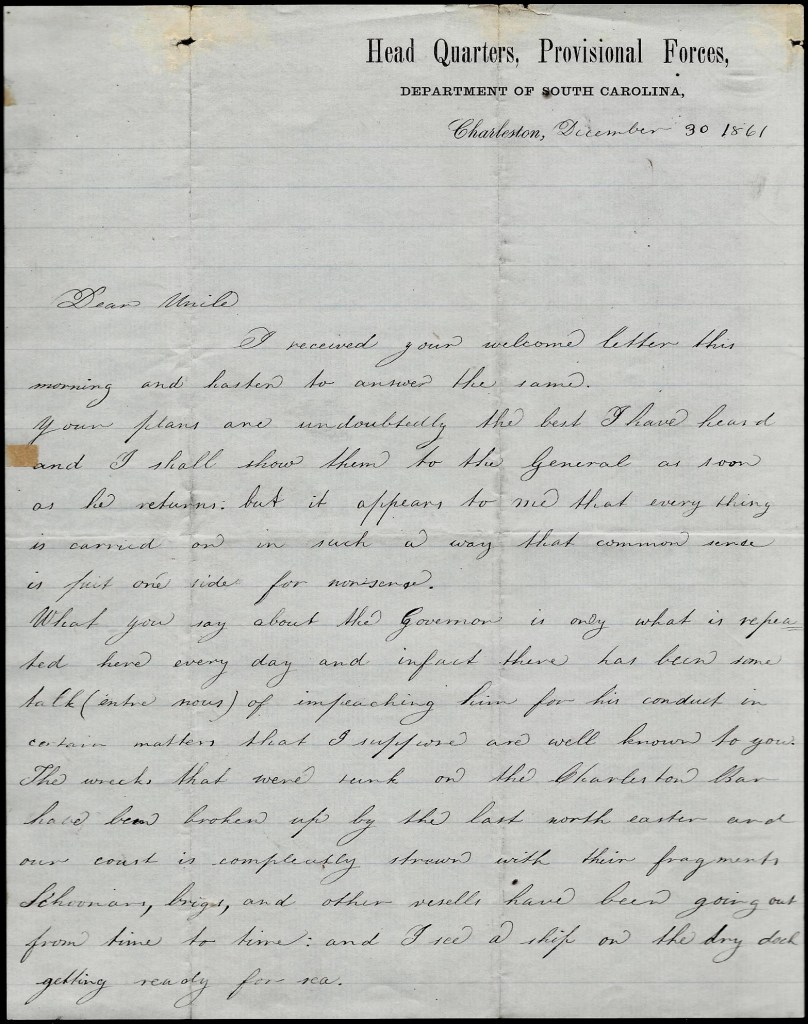
Headquarters Provisional Forces Department of South Carolina Charleston December 30, 1861
Dear Uncle,
I received your welcome letter this morning and hasten to answer the same. Your plans are undoubtedly the best I have heard and I shall show them to the General as soon as he returns. But it appears to me that everything is carried on in such a way that common sense is just one side of nonsense.
What you say about the Governor is only what is repeated here every day and in fact, there has been some talk (entre nous) 1 of impeaching him for his conduct in certain matters that I suppose are well known to you. 2 The wrecks that were sunk on the Charleston Bar have been broken up by the last north easter and our coast is completely strewn with their fragments. Schooners, brigs, and other vessels have been going out from time to time and I see a ship in the dry dock getting ready for sea. Some vessels have carried out cotton, and rice is the usual freight. I do not approve of our produce going out at all for the sooner we starve them out, the better.
Since I wrote you, I have received an appointment in the state service as Second Lieutenant and I have been nominated for a Second Lieutenant’s commission by the Secretary of War in the Confederate army. I wish I had time to run up and pay you a visit for a few days but I am so busy that I have not the face to ask the General for a leave of absence.
You do not tell me how you are, or how you are getting on. In your next, you must let me know if the sea plants are growing and the other plants. How are the negroes with you? They are very troublesome in these parts and the trouble is not confining itself to the coast but is spreading very rapidly. Many have run away as far as thirty miles from the enemy.
Give my love to all enquiring friends. Your affectionate nephew, — J. C. Clemson
1 “Entre nous” is French for “In Confidence” as you might have suspected.
2 The Governor of South Carolina was Francis Wilkinson Pickens (1807-1869. He held the office from 14 December 1860 until 17 December 1862.I am unaware of any attempt by the State of South Carolina to introduce impeachment proceedings against Gov. Pickens.
This unsigned, mid-July 1861 letter was written by a youthful businessman from La Grange, Tennessee. It came to me for transcription with the hope that I might be able to identify the author. The letter was written to a northern acquaintance about the present political and social situation in Tennessee, including a discussion of his own sense of allegiance to the South and his predictions about how the fateful course of events will unfold for both sides. Between the lines there is a sense of the deep struggle taking place within his own mind and heart on these issues, just as he describes it for others. Indeed, Tennessee was very much a split state as far as sentiments were concerned. Confederate allegiances were much higher in the western areas where La Grange is located than they were in the northeastern portion of the state, which Confederate troops actually had to forcibly occupy.
La Grange was incorporated as a town in 1829 and enjoyed the reputation of being the wealthiest and most cultured town in the South at the time. The oldest town in Fayette county, it is located 50 miles east of Memphis and only three miles north of the Mississippi state line. At one time, its population topped 2,000; today it claims only 160 residents. During the Civil War, the town suffered severely at the hands of the thousands of Federals who established a garrison there. Less than a week after the fall of Memphis, Union troops took occupancy of the town and after that, due to its strategic importance along the Memphis and Charleston Railroad, it was continually occupied by either Union or Confederate troops. At one time, as many as thirty thousand Union soldiers were encamped in and around the town, and over three thousand wounded or sick were hospitalized there.
This letter was written just 10 days after Tennessee was admitted to the Confederacy—the 11th and last state to do so. It is very much a manifesto of the inevitability of impending war, as well as its high eventual cost. The first major conflict—the Battle of Bull Run—was fought 9 days later in Virginia, with the Union’s prevailing belief in an early triumph dashed. The letter ends suddenly, and though it may well be only a partial letter, the absence of a signature may be intentional. In this regard, the author notes that he now is using private rather than public conveyance for his mail.
From the letter, I surmised that the author was a comparatively young businessman who worked in a La Grange store doing business with customers that would often purchase goods on credit—a common practice at the time, particularly in agrarian societies. He mentions learning the business from the “old man” which may very well have been, in the customary reference, his own father. A website on the history of La Grange informs us that between 1860 and 1862, the merchants were J. T. Foote, George P. Shelton, O. S. Jordan, C. F. Chessman, Cossett, Davis & Bryan, Fowler & Louston, T. S. Parham, R. J. Bass & Co., and John Goodwin.
After searching through the 1860 US Census records for these businessmen, I discovered that John W. Goodwin—the last named merchant—was enumerated in the 1860 US Census taken at La Grange as the 28 year-old son of 61 year-old merchant, James Doswell Goodwin (1798-1869). In researching this family, I discovered that John Watts Goodwin (1831-1922) was the oldest son of his merchant father; his mother, Catharine (Watts) Goodwin (1806-1851), had died in Rolls county, Missouri, when John was 20 years old. Digging deeper into John’s biography, I discovered that he was born in Virginia (as were his parents) and that he attended the Fleetwood (military) Academy in Virginia before attending Jubilee College in Charleston (now Brimfield), in Peoria county, Illinois. In the 1850 US Census, 19 year-old John W. Goodwin was enumerated in his father’s household in District 73, Ralls county, Missouri, where his father farmed. Ralls county borders the Mississippi river in northeast Missouri.
Given these facts, I’m inclined to attribute this letter to John Watts Goodwin, writing to a former acquaintance in Illinois or Missouri. An obituary notice for him claims that he worked for a time in various capacities for the Memphis & Charleston Railroad during and after the Civil War. In 1869 he was appointed secretary and treasurer of the Little Rock & Memphis Railroad. In 1900 he became a director of the First National Bank of Little Rock.
[Note: This letter is from the private collection of Richard Weiner and is published on Spared & Shared by express consent.]
Transcription
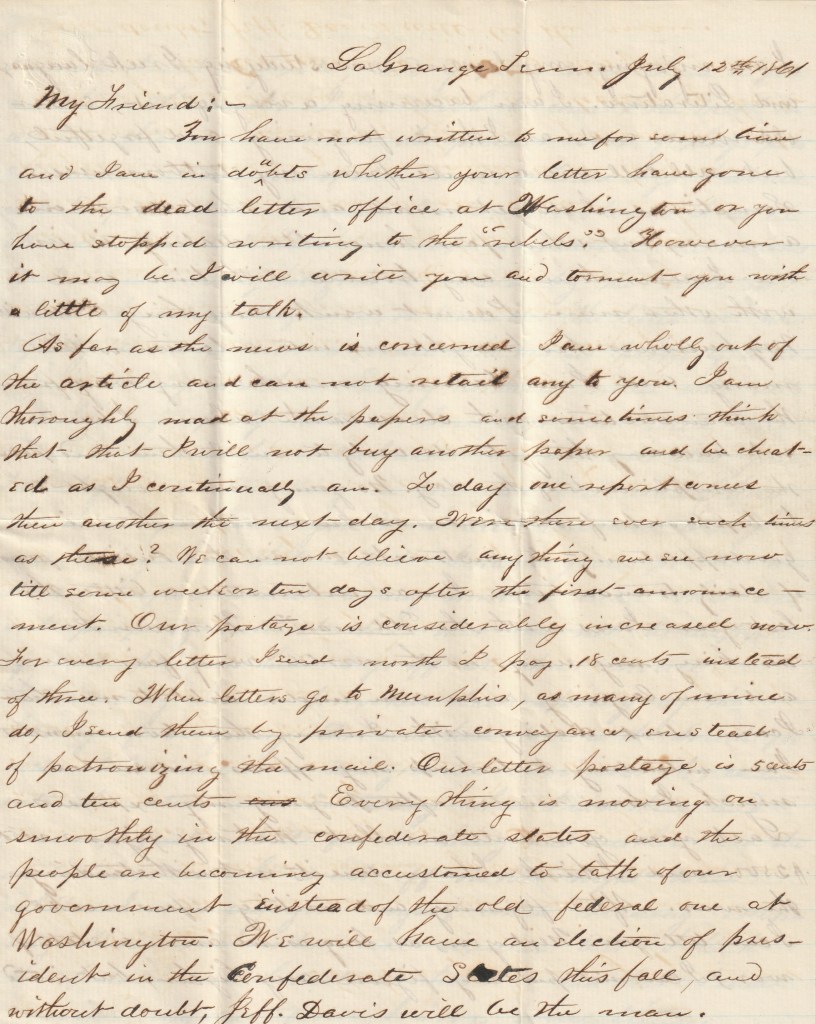
La Grange, Tennessee July 12th 1861
My Friend:
You have not written to me for some time and I am in doubts whether your letter have gone to the dead letter office 1 at Washington or you have stopped writing to the “rebels.” However it may be, I will write you and torment you with a little of my talk.
As far as the news is concerned, I am wholly out of the article and cannot retail any to you. I am thoroughly mad at the papers and sometimes think that I will not buy another paper and be cheated as I continually am. Today one report comes—then another the next day. Were there ever such times as these? We cannot believe anything we see now till some week or ten days after the first announcement.
Our postage is considerably increased now. For every letter I send North, I pay 18 cents instead of three. When letters go to Memphis—as many of mine do—I send them by private conveyance instead of patronizing the mail. Our letter postage is five cents and ten cents. Everything is moving on smoothly in the confederate states and the people are becoming accustomed to talk of our government instead of the old federal one at Washington. We will have an election of president in the Confederate States this fall, and without doubt, Jeff Davis will be the man.
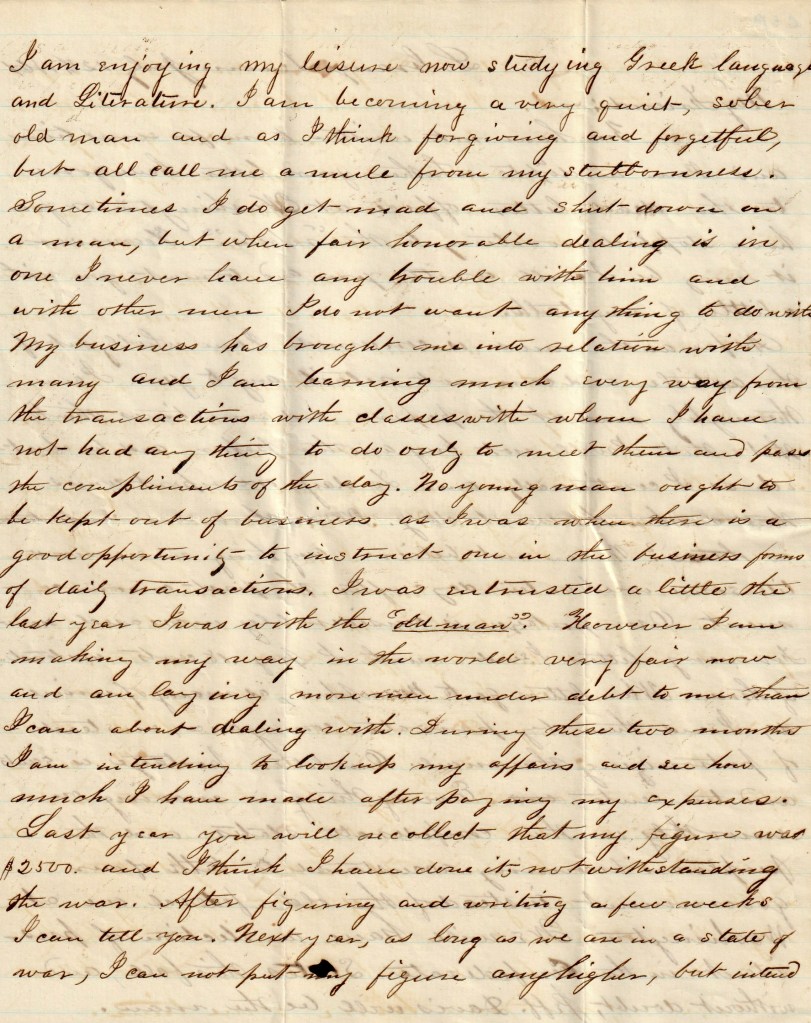
I am enjoying my leisure now, studying Greek language and literature. I am becoming a very quiet, sober old man and as I think—forgiving and forgetful. But all call me a mule from my stubbornness. Sometimes I do get mad and shut down on a man, but when fair honorable dealing is in one, I never have any trouble with him and with other men I do not want anything to do with. My business has brought me into relation with many, and I am learning much every way from the transactions with classes with whom I have not had any thing to do—only to meet them and pass the compliments of the day. No young man ought to be kept out of business as I was when there is a good opportunity to instruct one in the business forms of daily transactions. I was entrusted a little the last year I was with the “old man.” However, I am making my way in the world very fair now and am laying more men under debt to me than I care about dealing with.
During these two months, I am intending to look up my affairs and see how much I have made after paying my expenses. Last year, you will recollect, that my figure [goal] was $2,500 and I think I have done it, notwithstanding the war. After figuring and writing a few weeks, I can tell you. Next year, as long as we are in a state of war, I cannot put my figure any higher, but intend to make it at any rate. And if peace comes I am in for another thousand.
I did wish to come to the North on a visit this summer but the present state of things puts all such notions out of one’s head. Should I go, I would not be permitted to come back. Nor should I so be allowed. Now that there is a conflict between the sections, it becomes every citizen to stand by the state to which he owes allegiance—or leave it. The lines are now tightly drawn and a man who has no property interest is closely watched. Every Northern man who did not have property interest here left, and some—one at least—and he a dishonest one—have also gone. Two left without calling on me and even asking, “how much do I owe you?” I am ashamed to say one thing, and that is that I have given positive orders to refuse credit to any northern man that has not property interest here that can be disposed of and permit him to go off at short notice.
I was very much provoked last spring by the leaving of a young Dr. who had been in the South for some time and was doing some business. He came into the store one Saturday when I was there and run up quite a bill for one thing and another and the very next week went off on the night train while I was enjoying myself either reading or sleeping. There was another case similar but I think the fellow was honest at heart and that I shall receive my due from him some time. As a matter of course, interest will keep a man when, were he free from anything that bound him to a place, he would return to his old allegiance. Such seems to be the case here now and men and women that can get away seem to do so. On the other hand there are many men here of northern birth who are true to the South. Many have every reason to be so. Wife, children, slaves, and all their friends and interest, bind them to this and no other portion of the earth, and now that the conflict has come, there is but one step for them to take—viz: to espouse the cause which lies nearest to their hearts.
These are hard times and many are the troubles that are to follow if this war is to be prosecuted as the message of Lincoln seems to indicate it will be. Let them push on but my opinion is that—let it turn out as it may—there will be a debt heavier than any ever dreamed of before. I very much doubt whether the new loan and levy will accomplish his object. After his money is spent and his army unpaid, Mr. Lincoln will find the same race of rebels in the South and an army for him to meet. The commercial interest of the South will be prostrated if England respects the federal blockade. The northern shipping must feel it also as they must lie idle and do nothing. Manufactories at the North are now closed and will stay so till the war is over and amicable relations again restored—not as the same nation, but as two separate and independent republics.
1 The Dead Letter Office opened in 1825. By the 1860s, with the nation’s men busy fighting in the Civil War, women employees outnumbered the men 38 to 7. These mostly female clerks acted as “skilled dead letter detectives,” inspecting the mail for potential clues about who sent it or where it was going.
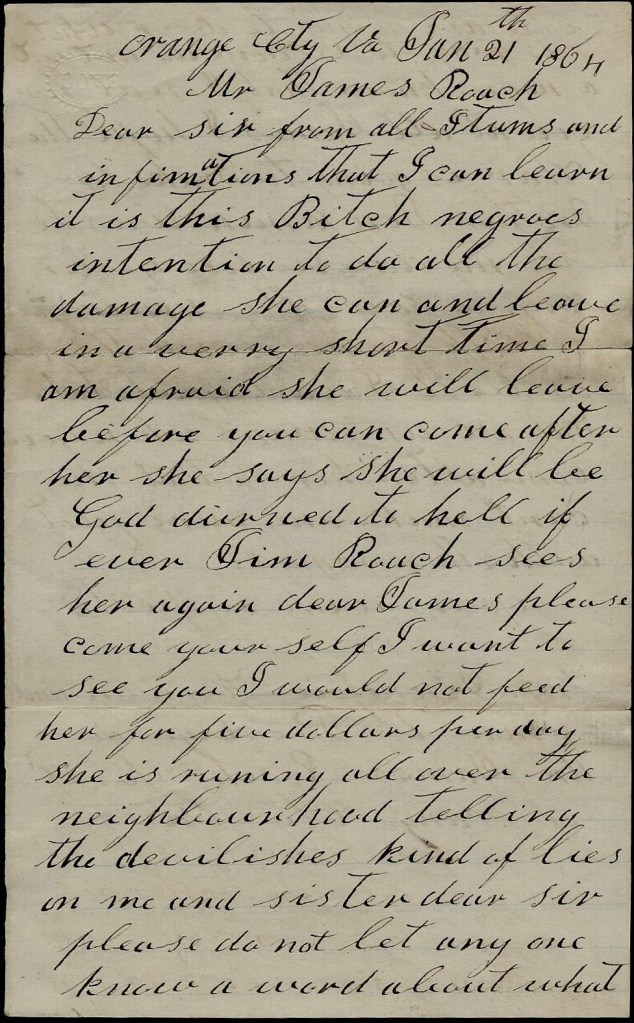
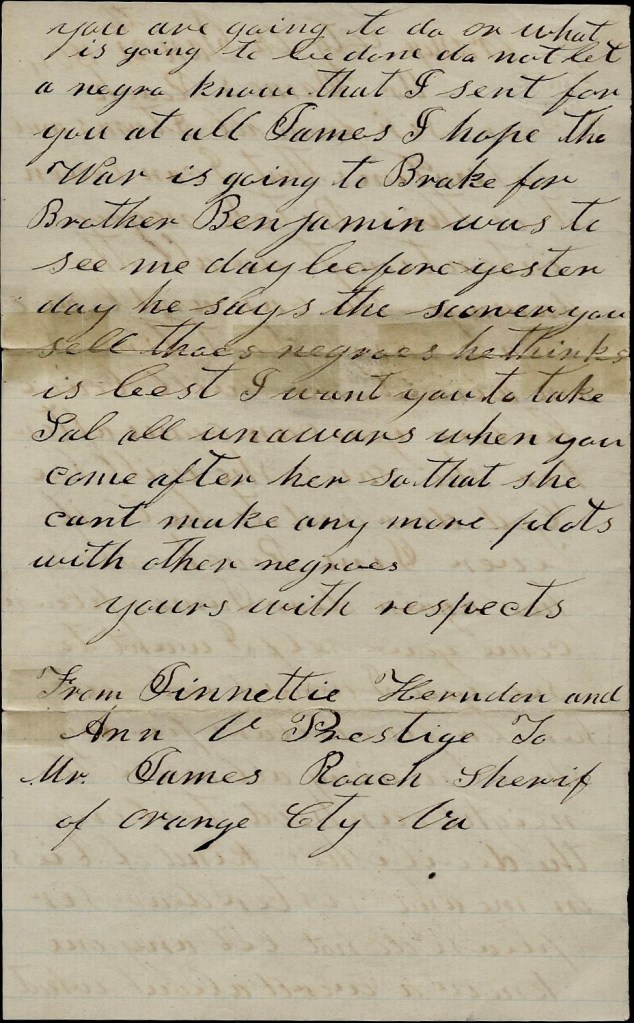
This letter was written by Jennett Herndon (1825-Aft1910), the daughter of Benjamin Herndon (1790-1880) and Hannah Bledsoe (1795-1870). In her letter, Jennett mentions her brother, Benjamin Herndon (1831-1917) of Orange county, Virginia. Also, co-signing the letter was Anne V. (Herndon) Prestage (1835-Aft1880)—Jennett’s younger sister. Anne was married to Wilson M. Prestage who enlisted as a private in Co. K, 17th Mississippi Infantry early in the war but left his regiment under false pretenses in December 1863 and was considered a “Rebel Deserter” when he was finally apprehended by the Provost Marshal at New Market, Tennessee on 11 March 1864.
Jennett wrote the letter to James Roach (b. 1834) who became the sheriff of Orange county, Virginia, in 1863.
Transcription
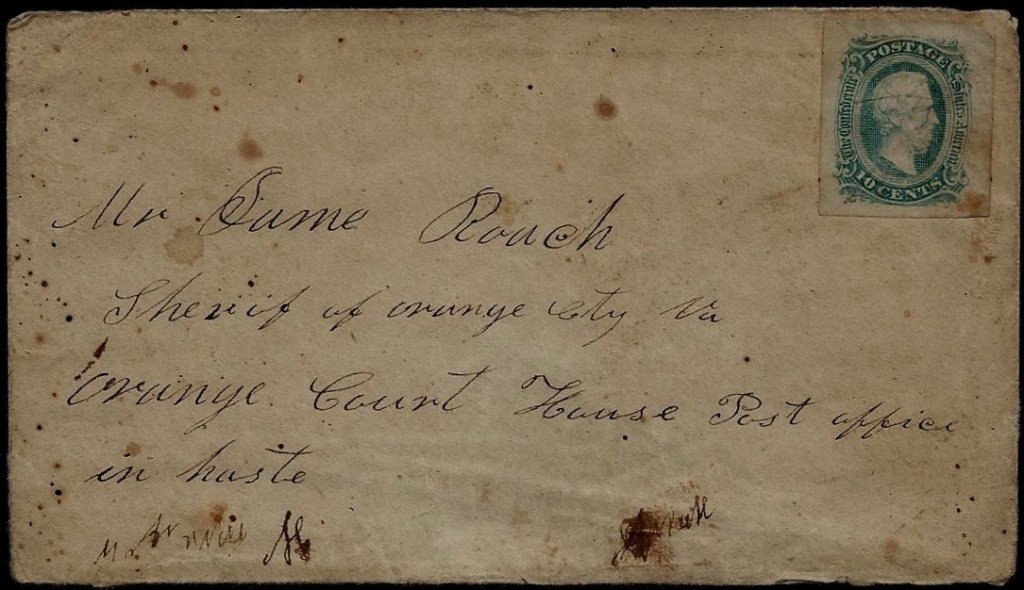
Addressed to Mr. James Roach, Sheriff of Orange county, Va., Orange Court House Post Office. in haste.Envelope includes an 1863-64 10 cent CSA Green Jefferson Davis Stamp
Orange City, Virginia January 21st 1864
Mr. James Roach Dear Sir,
From all items and informations that I can learn, it is this bitch negro’s intention to do all the damage she can and leave in a very short time. I am afraid she will leave before you can come after her. She says she will be God durned to hell if ever Jim Roach sees her again. Dear James, please come yourself. I want to see you. I would not feed her for five dollars per day. She is running all over the neighborhood telling the devilishes kind of lies on me and sister.
Dear sir, please do not let anyone know a word about what you are going to do or what is going to be done. Do not let a negro know that I sent for you at all. James, I hope the war is going to break for brother Benjamin was to see me day before yesterday. He says the sooner you sell those negroes, he thinks is best. I want you to take Sal all unawares when you come after her so that she can’t make anymore plots with other negroes.
Yours with respects. From Jennettie Herndon and Ann V. Prestage
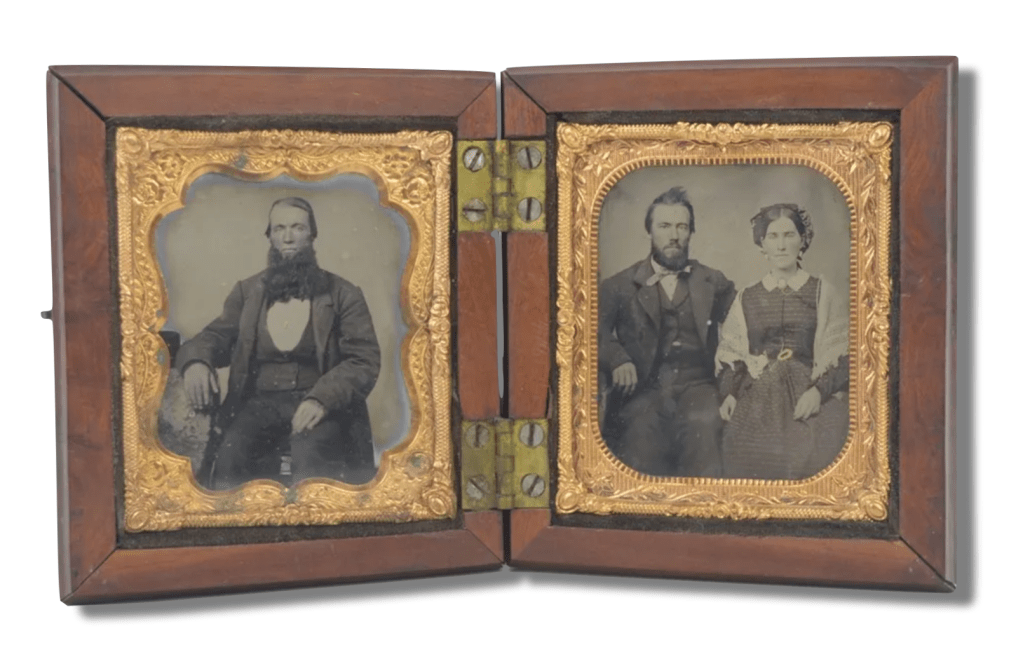
How Kate & Alvin might have looked (Will Griffing Collection)
These letters were written by Catharine (“Kate”) Pinckard (1834-1905), the daughter of Dr. Thomas Butler Pinckard (1793-1860) and Catharine Lawrence Vance (1804-1839). Kate was the wife of Alvin Choate Greenleaf (1829-1866) of Tennessee. She and Alvin were married in Indianapolis in January 1855 and they had three children, Catherine (“Katie”) St. Clair Greenleaf (1856-Aft. 1861), Annie Helm Greenleaf (1858-1860), and Margaret Pinckard Greenleaf (1864-Ukn). Kate’s father—a native of Virginia—was a physician who practiced medicine in Lawrenceburg, Indiana, in New Orleans, Louisiana, and finally in Lexington, Kentucky, where he died in 1860.
From the 1858 Indianapolis City Directory we learn that Alvin worked for the Greenleaf & Brown City Foundry & Machine Shop located at 93 South Pennsylvania. The firm was established by Alvin’s father, Edward Greenleaf (1802-1873) who came to Indianapolis in the late 1840s from Cincinnati, having previously lived for several years in Bolivar, Tennessee. The family became famous for inventing and manufacturing the “turntables” upon which railroad cars were turned. However, the Civil War caused a schism in the Greenleaf family though Kate does not speak of it in her letters. In fact, Alvin’s brother, Clement Allen Greenleaf enlisted in Co. A, 11th Indiana Infantry, serving under Gen. Lew Wallace.
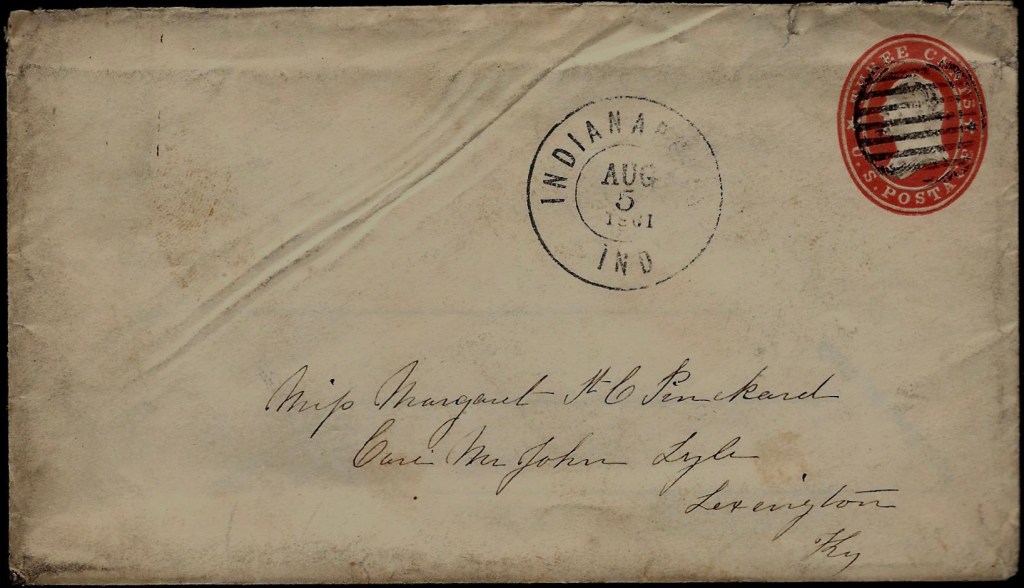
At the time Kate wrote the first letter datelined from Indianapolis on 4 August 1861, she and Alvin resided at 114 E. Vermont Street—a boarding house near the center of the city.
Sometime during the Civil War, the Kate and Alvin Greenleaf left Indiana and lived in Memphis, Tennessee, where we learn from the second letter that he ran a livery business for a time and then went into the cotton commission business. He must have been living in Cincinnati by late 1864, however, as I found a letter in the national archives written by Hon. Green Clay Smith, datelined from Washington D. C. on 23 January 1865 to Secretary of War Edwin Stanton which read: “I have been informed that one Mr. Alvin C. Greenleaf of Kentucky is now confined in the old Capitol Prison and was arrested and brought here from Cincinnati without having committed any offense. I have also been informed that the papers in his case are now on file in some branch of your department. Will you do me the kindness to have the case examined and let me know the facts. His family are one of the most estimate and his wife writes me imploringly & I have promised to do for her what I can. I apprehend it is a case of personal pique.” The letter is docketed on the reverse with a statement that reads: “Respectfully returned and report that this prisoner is charged with dealing in & passing counterfeit government securities & notes, & is under the control of the Solicitor of the Treasury Department.”
Kate wrote the letters to her yet unmarried sister, Margaret St. Clair Pinckard (1832-1919) of Lexington, Kentucky. Margaret (“Mag”) married James Granville Cecil (1808-1881) of Danville, Kentucky, in February 1868.
Letter 1
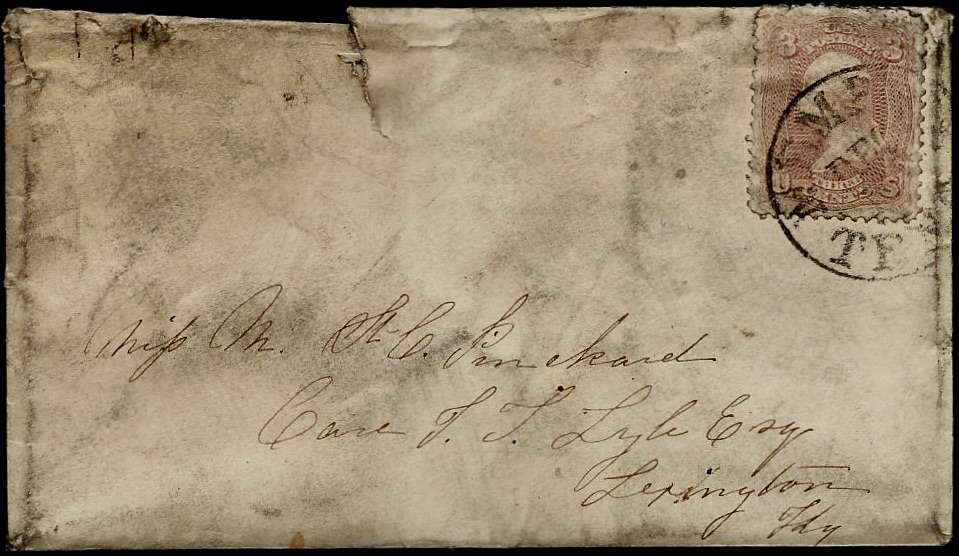
Addressed to Mis Margaret st. C. Pinckard, Care of Mr. John Lyle, Lexington, Kentucky
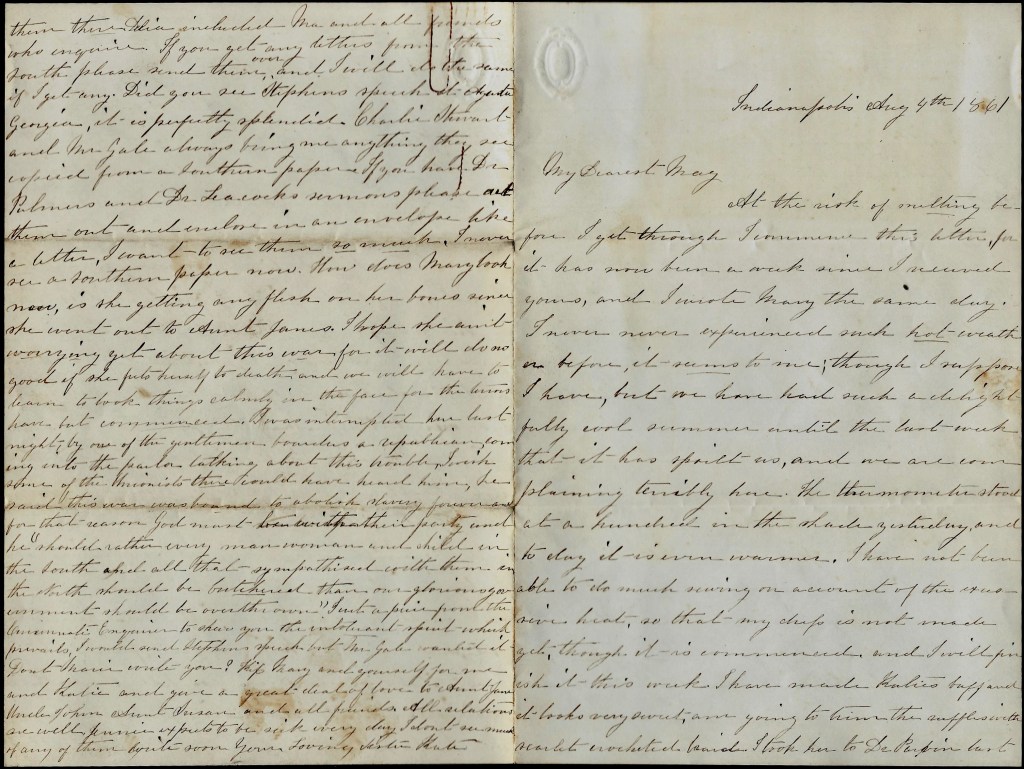
Indianapolis, [Indiana] August 4th 1861
My Dearest Mag,
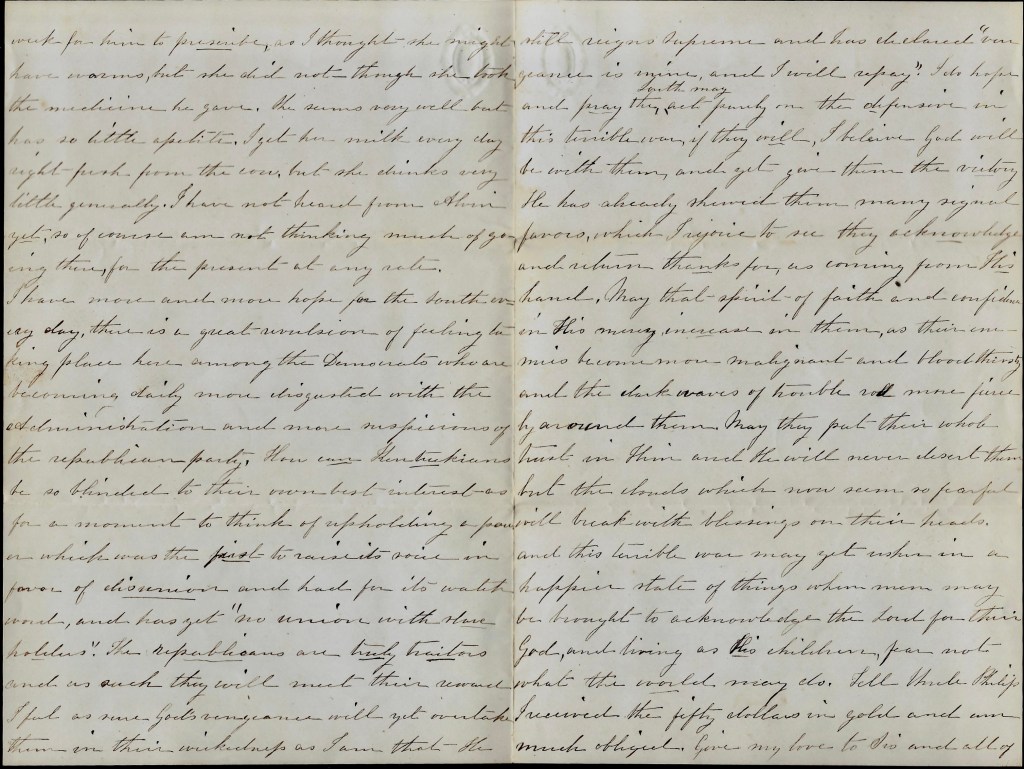
At the risk of melting before I get through, I commence this letter for it has now been a week since I received yours, and I wrote Mary the same day. I never, never experienced such hot weather before, it seems to me; though I suppose I have, but we have had such a delightfully cool summer until the last week that it has spoilt us, and we are complaining terribly here. The thermometer stood at a hundred in the shade yesterday and today it is even warmer. I have not been able to do much sewing on account of the excessive heat, so that my dress is not made yet, though it is commenced, and I will finish it this week. I have made Katie’s buff and it looks very sweet. Am going to trim the ruffles with scarlet crocheted braid. I took her to Dr. [Theophilus] Parvin last week for him to prescribe as I thought she might have worms, but she did not, though she took the medicine he gave. She seems very well but has so little appetite. I get her milk every day right fresh from the cow but she drinks very little generally.
I have not heard from Alvin yet so of course am not thinking much of going there for the present at any rate.
I have more and more hope for the South every day. There is a great revulsion of feeling taking place here among the Democrats who are becoming daily more disgusted with the [Lincoln] Administration and more suspicious of the republican Party. How can Kentuckians be so blinded to their own best interest as for a moment to think of upholding a power which was the first to raise its voice in favor of disunion and had for its watchword, and has yet, “No union with slave holders.” The republicans are truly traitors and as such they will meet their reward. I feel as sure God’s vengeance will yet overtake them in their wickedness as I am that He still reigns supreme and has declared “vengeance is mine, and I will repay.” I do hope and pray the South may act purely on the defensive in this terrible war. If they will, I believe God will be with them, and yet give them the victory. He has already showed them many signal favors, which I rejoice to see they acknowledge and return thanks for as coming from His hand. May that spirit of faith and confidence in His mercy increase in them, as their enemies become more malignant and bloodthirsty and the dark waves of trouble roll more fiercely around them. May they put their whole trust in Him and He will never desert them but the clouds which now seem so fearful will break with blessings on their heads and this terrible war may yet usher in a happier state of things when men may be brought to acknowledge the Lord God their God, and living as His children, fear not what the world may do.
Tell Uncle Philip I received the fifty dollars in gold and am much obliged. Give my love to sis and all of the there, Delia included, Ma and all friends who enquire. If you get any letters from the South, please send them over and I will do the same if I get any. Did you see [Alexander] Stephen’s speech at Augusta, Georgia? It is perfectly splendid. Charlie Stewart and Mr. Gale always bring me anything they see copied from a Southern paper. If you have Dr. Palmer’s and Dr. Leacock’s sermons, please cut them out and enclose in an envelope like a letter. I want to see them so much. I never see a Southern paper now.
How does Mary look now? Is she getting any flesh on her bones since she went out to Aunt Janes? I hope she ain’t worrying yet about this war for it will do no good if she puts herself to death and we will have to learn to look things calmly in the face for the terrors have but commenced.
I was interrupted here last night by one of the gentlemen boarders—a Republican—coming into the parlor talking about this trouble. I wish some of the Unionists there could have heard him. He said this war was bound to abolish slavery forever and for that reason, God must be with their party and he “should rather every man, woman, and child in the South and all that sympathized with them in the North, should be butchered than our glorious government should be overthrown.” Just a piece from Cincinnati Enquirer to show you the intolerant spirit which prevails. I would send Stephens’ speech but Mr. Gale wanted it.
Don’t Marie write you? Kiss Mary and yourself for me and Katie and give a great deal of love to Aunt Jane, Uncle John, Aunt Susan, and all friends. All relations are well. Jennie expects to be sick every day. I don’t see much of any of the, Write soon. Your loving sister, — Kate
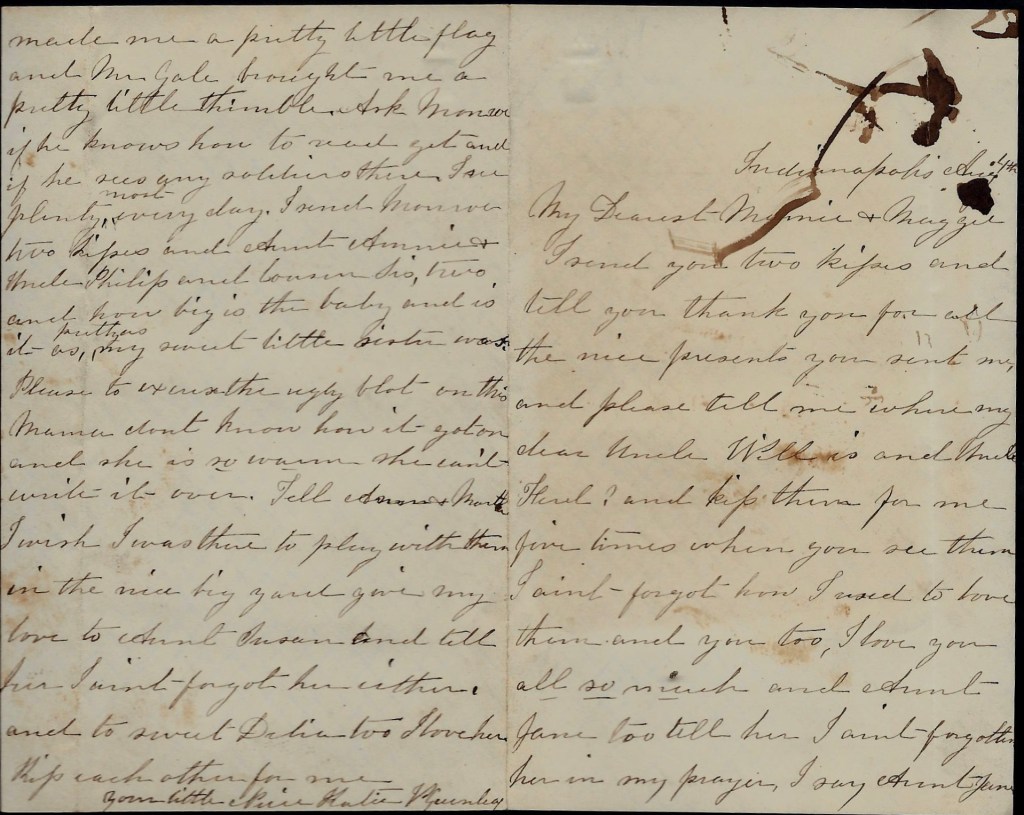
Indianapolis August 4th
My dearest Minnie and Maggie,
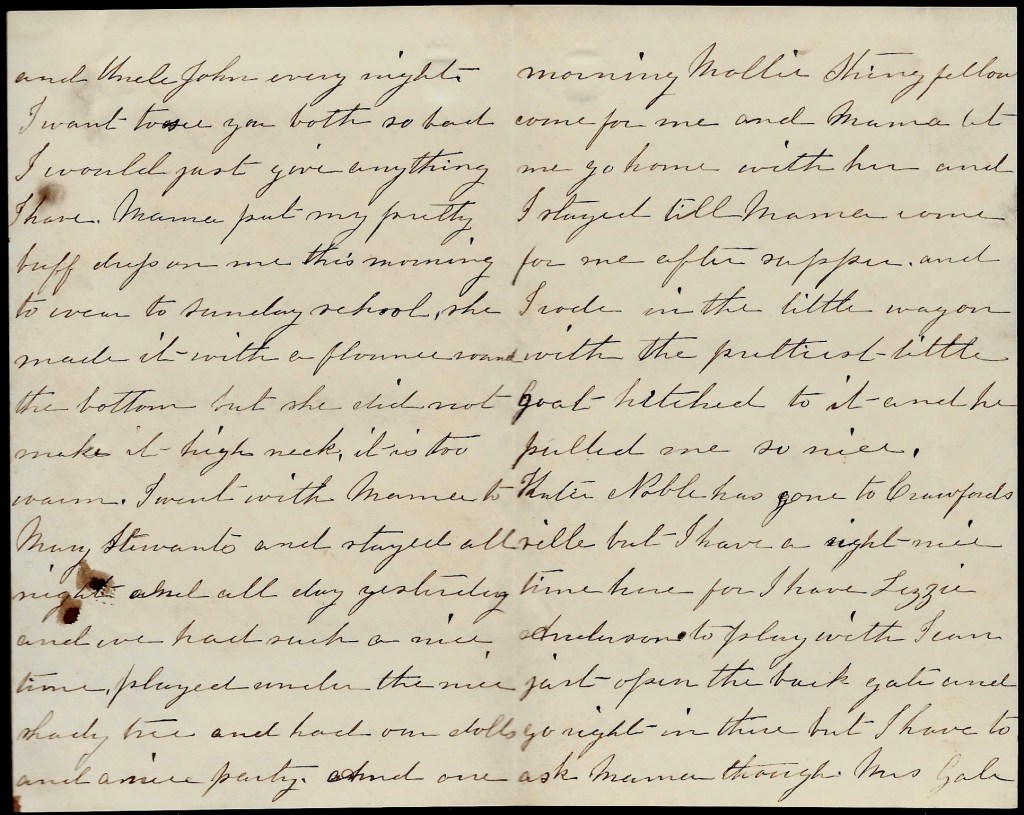
I send you two kisses and tell you thank you for all the nice present you sent me and please tell me where my dear Uncle Will is and Uncle Hal> and kiss them for me five times when you see them. I ain’t forgot how I used to love them and you too. I love you all so much and Aunt Jane too. Tell her I ain’t forgotten her in my prayer. I say Aunt Jane and Uncle John every night. I want to see you both so bad, I would just give anything I have. Mama put my pretty buff dress on me this morning to wear to Sunday school. She made it with a flounce round the bottom but she did not make it high neck. It is too warm.
I went with Mama to Mary Stewarts and stayed all night and all day yesterday and we had such a nice time. Played under the nice shady tree and had our dolls and a nice party. And one morning Mollie Stringfellow come for me and Mama let me go home with her and I stayed till Momma come for me after supper and I rode in the little wagon with the prettiest little goat hitched to it and he pulled me so nice.
Katie Noble has gone to Crawfordsville but I have a right nice time here for I have Lizzie Anderson to play with. I can just open the back gate and go right in there but I have to ask Mama though. Mrs. Gale made me a pretty little flag and Mr. Gale brought me a pretty little thimble. Ask Monroe if he knows how to read yet and if he sees any soldiers there. I see plenty most every day. I send Monroe two kisses and Aunt Annie & Uncle Philip and cousin Sis two. And how big is the baby? And is it pretty as my sweet little sister was?
Please to excuse the ugly blot on this. Mama don’t know how it got on and she is so warm she can’t write it over. Tell Aunt Martha I wish I was there to play with the in the nice big yard. Give my love to Aunt Susan and tell her I ain’t forgot her either. And to sweet Delia too. I love her. Kiss each other for me. Your little niece, — Katie Greenleaf
Letter 2
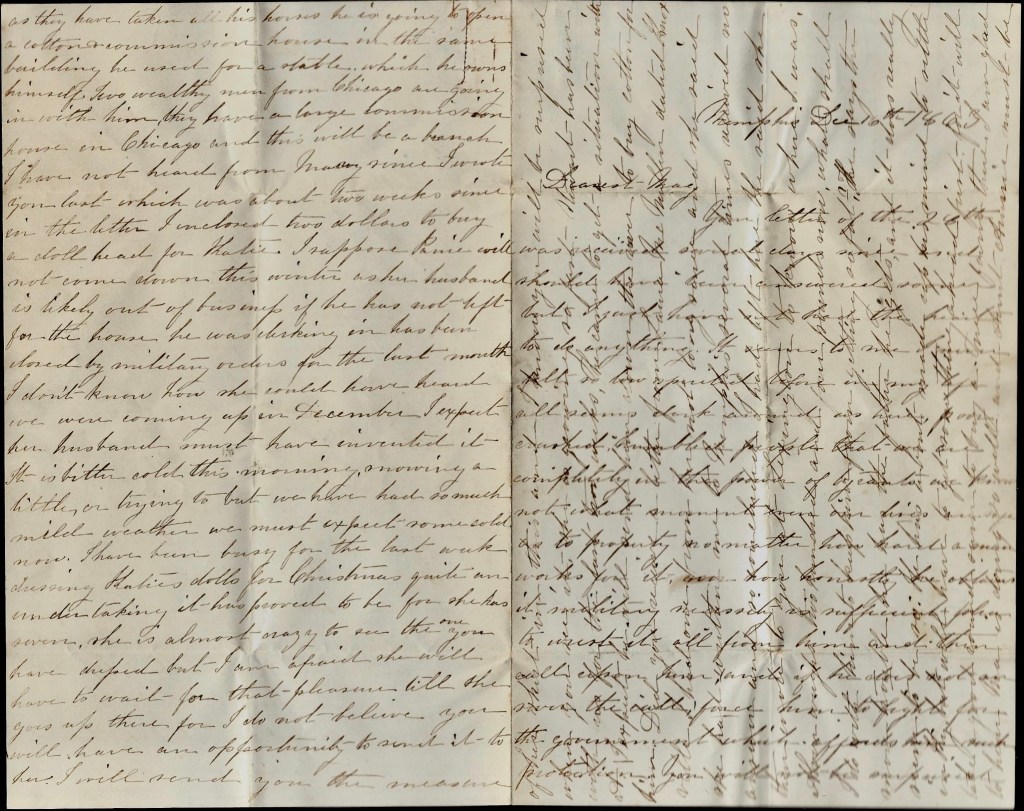
Memphis, [Tennessee] December 16th 1863
Dearest Mag,
Your letter of the 28th was received several days since and should have been answered sooner but I just have not had the heart to do anything. It seems to me I never felt so low-spirited before in my life. All seems dark around us here—poor, crushed, humbled people that we are completely in the power of tyrants. We know not what moment even our lives safe. As to property, no matter how hard a man works for it or how honestly he obtains it, military necessity is sufficient reason to wrest it all from him and then call upon him and if he does not answer the call, force him to fight for the government which affords him such protection.
You will not be surprised after this prelude when I tell you Alvin has had almost everything he possessed taken from him in the last week, not for any fault he had committed but simply because the government had need of them and would pay of course for all it took in what was much better than gold—government vouchers, a little piece of paper saying six months after the restoration of peace when you can prove your loyalty. you shall receive so much. I am thankful I am not a man. I could never have borne what Alvin has had to, but I am truly thankful he can. Patience has almost had its perfect work in him. If they would only leave me, my husband and child, gladly—willingly—would I give up all else that I have for as long as he is spared to us and has his health, we will never want. I know he has strong hopes of getting exempted on account of his arm.
Thursday morning, December 17th
I have just written thus far yesterday evening when Stewart McMullen, who is with us now, came home with the joyful news that he & Alvin were both exempted—he on account of bad health, and Alvin on account of his arm. I could have cried for joy. To think that arm which I have grieved over so much should have proved such a blessing disguise. My spirits from being below zero have gone almost up to boiling point and I don’t believe I even hate the Yankees.
Well, I will try and write you about something else now. Katie is well and improving very fast in her reading and spelling. Alvin found a little orphan boy someplace the other day who had no home and brought him out here with him and Katie is taking great interest in teaching him. He is sitting by me now having his lesson which has made me make several mistakes.
Alvin told me last night he was going up in February and take Katie and me with him. As they have taken all his horses, he is going to open a cotton commission house in the same building he used for a stable, which he owns himself. Two wealthy men from Chicago are going in with him. They have a large Commission House in Chicago and this will be a branch.
I have not heard from Mary since I wrote you last which was about two weeks since. In the letter, I enclosed two dollars to buy a doll head for Katie. i suppose Janie will not come down this winter as her husband is likely out of business if he has not left for the house he was clerking in has been closed by military orders for the last month. I don’t know how she could have heard we were coming up in December. I expect her husband must have invented it.
It is bitter cold this morning. Snowing a little, or trying to, but we have had so much mild weather we must expect some cold now/ I have been busy for the last week dressing Katie’s dolls for Christmas—quite an undertaking it has proved to be for she has seven. She is almost crazy to see the one you have dressed but I am afraid she will have to wait for that pleasure till she goes up there for I do not believe you will have an opportunity to send it to her. I will send you the measure of her skirt in this and I know you will be surprised when you see it—she is growing so fast. Stewart has been with us for the last two weeks. He came to get a situation with Alvin. I expect he will send him down the river to buy cotton for him.
Did you receive a letter from Laura McMillen dated Knoxville? I had one from her not long since and she said she had written me to Memphis several times [but] received no answer and so concluded that I had left here. She said she then wrote to you at Lexington to know where I was.
Alvin weighs two hundred and four pounds now. What shall I do with him to keep him from getting so fat? He says the more trouble he has the fatter he gets. And it does really seem to be so. He has about made up his mind to settle in Kentucky but will have to get something ahead first, for it will take a good round sum to buy a nice farm there. I am glad to hear Ma is doing so well and Aunt Annie must be making money too with her house full of boarders.
I have had several applications but Alvin has a perfect horror of boarding or taking boarders so I have rejected them all. Well, I must close now hoping to hear from you very soon. With warmest love to Aunt Jane & Susan, Uncle John, Aunt Annie, Sis and Ma, and baskets to you in which Alvin and Katie join me.
An unidentified Northern Mother (Rob Morgan Collection)
Though I cannot confirm it, I believe this letter to have been written by Polly (Sackett) Giddings (1822-1864), the daughter of Thomas and Lucy Sackett and the widow of Emery Sidney Giddings (1815-1851). The “Grandmother” mentioned in the letter would have been Polly’s mother-in-law, Philothea (Fish) Giddings (1782-1868)—the widow of Elisha Giddings (1780-1855). “Maple Grove Farm” was the name of the Giddings estate in Cherry Valley that eventually was taken over by Sidney’s brother, Josiah Marvin Giddings (1812-1892). The “Grandpa” mentioned in the last line of the letter would have been Polly’s father, Thomas T. Sackett (1794-1864) who resided in Geauga County, Ohio. Polly Giddings was known to be a member of the First Congregational Church of Wayne in Ashtabula County. According to the History of the church, she became a member in January 1847. Her husband’s parents were charter members in 1832.
If the letter was written by Polly, then it was addressed to her son, Claudius Joseph Giddings (1843-1928) who was apparently in relatively poor health and living with an Uncle’s family, possibly working as a printer while attending school. Polly’s son, who later went by the name “Claude J. Giddings” moved to Vasalia, California, in the 1870s and became a banker. According to his obituary, he attracted attention when at age 64 he married 21 year-old Anna Olsen.
The letter contains a well-crafted statement that captures the sentiment, undoubtedly, of many mothers who resided in both the North and the South who saw the approach of war unfold before them and despaired that they might lose a son in an irrational conflict brought on by extremists with opposing views, drawing the “conservatives into the perils and horrors of civil war.”
[This letter is from the private collection of Richard Weiner and is published by express consent on Spared & Shared.]
Transcription
Maple Grove Farm April 22, 1861
My dear Joseph,
Your Grandma is anxious about you and insists I should write although my last is unanswered. There is so much excitement all over the country and especially about you in Pitts. Yesterday while at church, Esq. Abel Krum, 1 our Representative to Columbus, entered the church direct from that City with exciting war news. He went into Mr. [Heman] Geer’s 2 pulpit to announce that when he left [Columbus], Jeff Davis was marching to take Washington and probably now they were engaged with the Federal troops fighting. He then came on to our [Congregational] church requesting that our citizens would call a meeting and see who would volunteer for defense of the Southern part of our state [Ohio] where they had already been skirmishing. He had not yet been to call on his family. Returns to Columbus this Monday morning again.
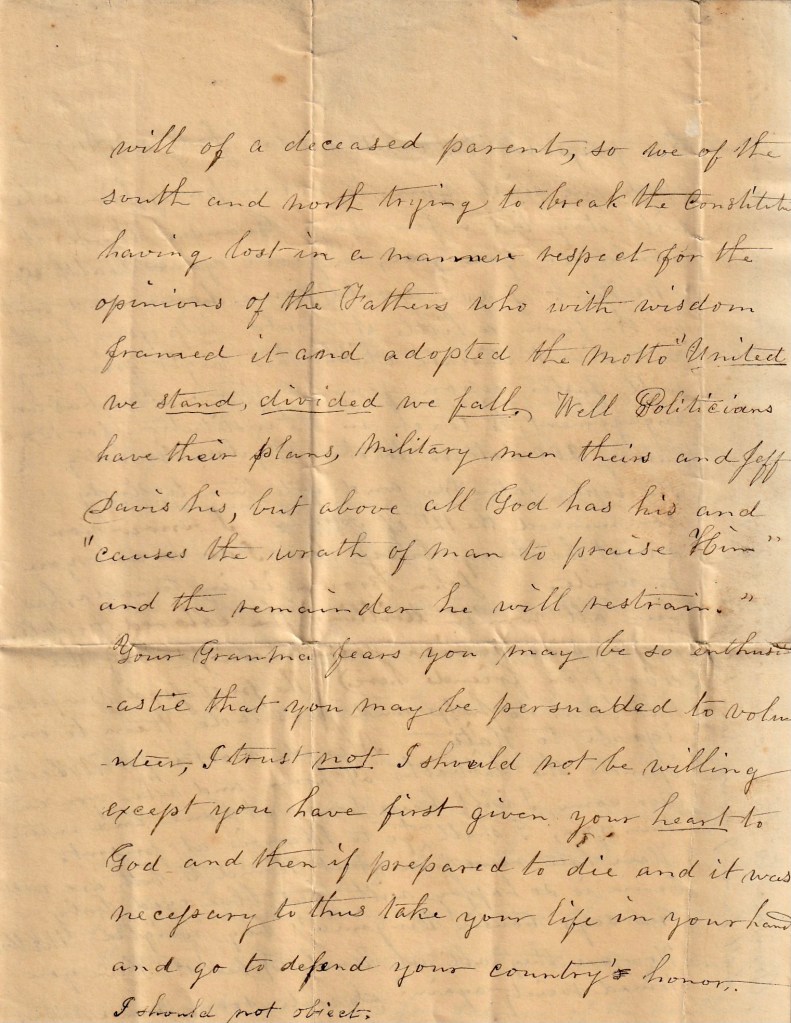
Tomorrow evening the citizens meet. The cannons have been heard here this morning and again since three o’clock, the wind very strong in the east and the air filled with smoke ever since sunrise. Shouldn’t be surprised if its from the fire of our public buildings. And so the antagonist factions have succeeded in drawing us conservatives into the perils and horrors of civil war. If the fire eaters of the South and ultraist of the North alone could meet and both get whipped, it might cool off their excited blood. But here we are in a family quarrel like naughty children trying to break the Will of a deceased parent. So we of the South and North, trying to break the Constitution, having lost in a manner respect for the opinions of the Fathers who with wisdom framed it and adopted the motto, “United we stand, divided we fall.”
“And so the antagonist factions have succeeded in drawing us conservatives into the perils and horrors of civil war. If the fire eaters of the South and ultraist of the North alone could meet and both get whipped, it might cool off their excited blood. But here we are in a family quarrel like naughty children trying to break the Will of a deceased parent.”
—Polly (Sackett) Giddings, 22 April 1861
Well politicians have their plans, military men theirs, and Jeff Davis his. But above all, God has His and “causes the wrath of man to praise Him” and the remainder “He will restrain.”
Your Grandma fears you may be so enthusiastic that you may be persuaded to volunteer. I trust not. I should not be willing except you have first given your heart to God and then, if prepared to die and it was necessary to thus take your life in your hands and go to defend your country’s honor, I should not object.
George proposes to visit us in July or August and we wish you to accompany him as he will stat but a few days. Grandma thinks it would do you good, improve your health, &c. We think if you would come home and work on the farm a little, it would help your health and divert disease while this night printing will fasten upon your system. George has an engagement to teach in the institution for 10 months—salary 200 dollars. teaches algebra, geometry, philosophy, Latin, &c., and gets time to study. Commenced the 12th of April. I know you must be very busy but I do want you to write.
John Brown is in Canada. 3 Has been all winter drilling the colored people (for active service somewhere—so say the abolition friends here). The professed purpose has been to help and persuade them to emigrate to Haiti. Alfred works for Wolcott. Spends the Sabbaths at home and when you and George come, I will keep house at home and entertain you. I shall not got to Illinois at present.
Have late news from Aunt H. and C. Both are well. Carrie is so happy with that blue-eyed baby. George says Cousin Virginia’s boy weighed 11.5 pounds. How are they all at Uncle Robert’s? Have you joined society again. So write soon. From, — Mother
Grandma is bad. Can scarcely get up or down. Grandpa is doing alone. Shall have 9 cows. Have 5 calves.
1Abel Krum (1805-1881) was born in Kinderhook, Columbia county, New York. He died in Cherry Valley, Ashtabula county, Ohio.
2 Heman Geer (1819-1892) was a Congregational Clergyman in Ashtabula county, Ohio. He was in the pulpit of the Wayne Congregational Church from October 1857 to January 1867. He died at Tabor, Iowa.
3 A reference to John Brown, Jr. (son of the martyr). The Detroit Free Press on 19 May 1861 had less than kind things to say about Brown’s attempts to relocate escaped slaves from Canada to Haiti: “That notorious character, John Brown, Jr., is now at Windsor, accompanied by an ebony-colored individual who styles himself Captain Tate and hails from Hayti. Does John Brow for one moment entertain the idea that, by bringing his Haytien friend with him to exhibit as a specimen of what Hayti produces, he will prevail upon the Canada niggers to leave a country where they can subsist by stealing, and go where they will be obliged to labor for a livelihood? It cannot be accomplished; it is beyong the power of man.”
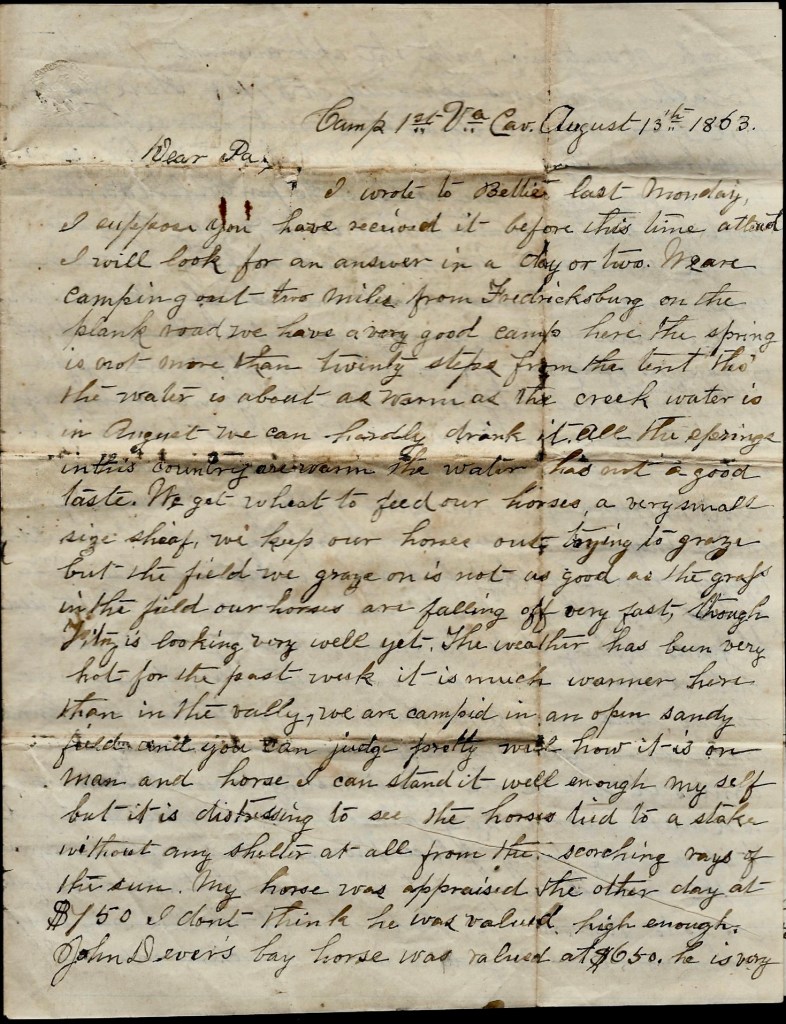
This letter was written by Pvt. John “Rison” Gibbons (1843-1919) who enlisted at Harrisonburg in Co. I, 1st Virginia Cavalry in December 1861. He remained with his company throughout the war until he surrendered at Appomattox Court House on 9 April 1865 at which time he was described as being 20 years old, standing 5′ 8″ tall, with light hair and blue eyes. He filed a claim for a bay horse killed in action near Berryville, Virginia, in August 1862 which was valued at $2900 when he entered the service.
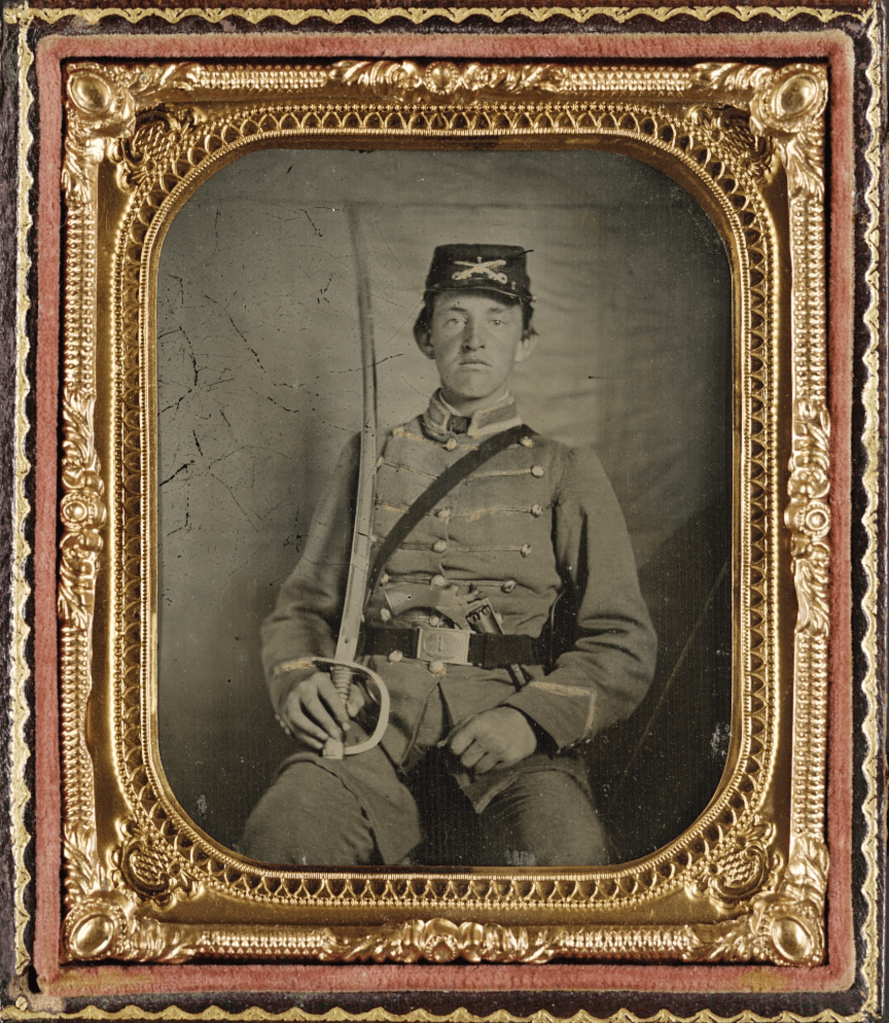
I could not find a Civil War era photograph of Gibbons but here is one of Pvt. David M. Thatcher who also served in the 1st Virginia Cavalry(LOC)
Rison Gibbons was the son of George Rockingham Gibbons (1814-1907) and Harriet Caroline Rison (1818-1876) of Rockingham county, Virginia. He married, in 1874, Ann America Felton (1848-1938). After the war he farmed in Georgia, went into the wool manufacturing business in Brentwood, Tennessee, and finally became a Mining Engineer in Georgia.
Gibbons’ letter includes a description of the battlefield at Fredericksburg and mentions the collection of two Yankee teeth he pulled from the jawbone of a half-buried Union soldier. Most soldiers found this behavior reprehensible but a great many others engaged in the occasional collection of such morbid souvenirs when time and opportunity allowed. Both sides were guilty of collecting these human trophies. After the Battle of Seven Pines, it was reported in the Pontiac Weekly Gazette (11 July 1862) that “a [Union] soldier pulled off the lower jaw [bone of a dead rebel] and asked” his comrades if they didn’t want a rebel relic.” [See Dark Trophies, by Simon Harrison]
Transcription
Camp 1st Virginia Cavalry August 13th 1863
Dear Pa,
I wrote to Bettie last Monday. I suppose you have received it before this time. At least I will look for an answer in a day or two. We are amping out two miles from Fredericksburg on the plank road. We have a very good camp here. The spring is not more than twenty steps from the tent though the water is about as warm as the creek water is in August. We can hardly drink it. All the springs in this country are warm. The water has not a good taste. We get wheat to feed our horses—a very small sheaf. We keep our horses out trying to graze but the field we graze on is not as good as the grass in the field. Our horses are falling off very fast though Fitz is looking very well yet.
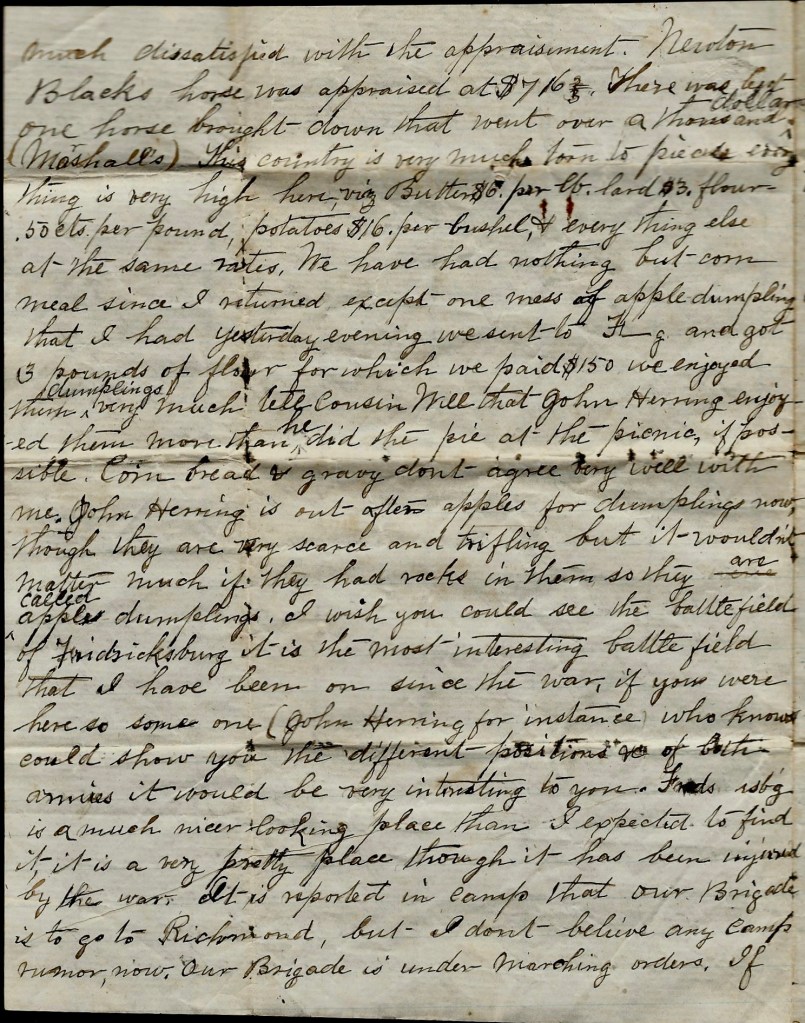
The weather has been very hot for the past week. It is much warmer here than in the valley. We are camped in an open, sandy field and you can judge pretty well how it is on man and horse. I can stand it well enough myself but it is distressing to the horses tied to a stake without any shelter at all from the scorching rays of the sun. My horse was appraised the other day at $750. I don’t think he was valued high enough. John Dever’s bay horse was valued at $650. He is very much dissatisfied with the appraisement. Newton Black’s horse was appraised at $716. There was but one horse brought down that went over a thousand dollars (Marshall’s).
This country is very much torn to pieces. Everything is very high here—viz: butter $6 per lb., lard $3, flour 50 cents per pound, potatoes $16 per bushel, & everything else at the same rates. We have had nothing but corn meal since I returned except one mess of apple dumpling that I had yesterday evening. We sent to Fredericksburg and got 3 pounds of flour which we paid $150. We enjoyed them dumplings very much. Tell Cousin Will that John Herring enjoyed them more than he did the pie at the picnic, if possible. Corn bread & gravy don’t agree very well with me. John Herring is out after apples now though they are very scarce and trifling but it wouldn’t matter much of they had rocks in them so they are called apple dumplings.
I wish you could see the battlefield of Fredericksburg. It is the most interesting battlefield that I have been on since the war. If you were here so someone (John Herring, for instance) who knows [it] could show you the different positions of the armies, it would be very interesting to you. Fredericksburg is a much nicer looking place than I expected to find it. It is a very pretty place though it has been injured by the war.
It is reported in camp that our Brigade is to go to Richmond but I don’t believe any camp rumor now. Our Brigade is under marching orders. If you get this before Lute Dever starts, send by him my dictionary & spirits turpentine. I neglected them when I left.
Enclosed you will find a Yankee tooth which you will please give to Mr. Irvine. He told me when I first started into service to send his a Yankee’s tooth which request I will comply with. Uncle Shanks Miller made the same request. I have one for him also. I will write to Uncle Robert as soon as I get through this and will enclose it to him. Both of these teeth came out of the mouth of a Yankee that was killed at the first Battle of Fredericksburg. He is buried about three hundred yards from camp. The reason why I know he is a Yankee is that a part of his blue coat is sticking out of the ground (not grave). I got his jaw bone and extricated six teeth and picked out two of the nicest to send away. The others I gave to some of the boys who wanted them for some other purpose. There are a good many Yankee bones bleaching upon the field that I am now writing on.
I must close this uninteresting letter so as to have time to write to Uncle Robert. You must come down before you go south if practicable. Some of the boys are anxious to see you before you leave. Give my love to all the family, Aunt Mary, cousins Laura & Will. write soon to your affectionate son, — J. Rison Gibbons
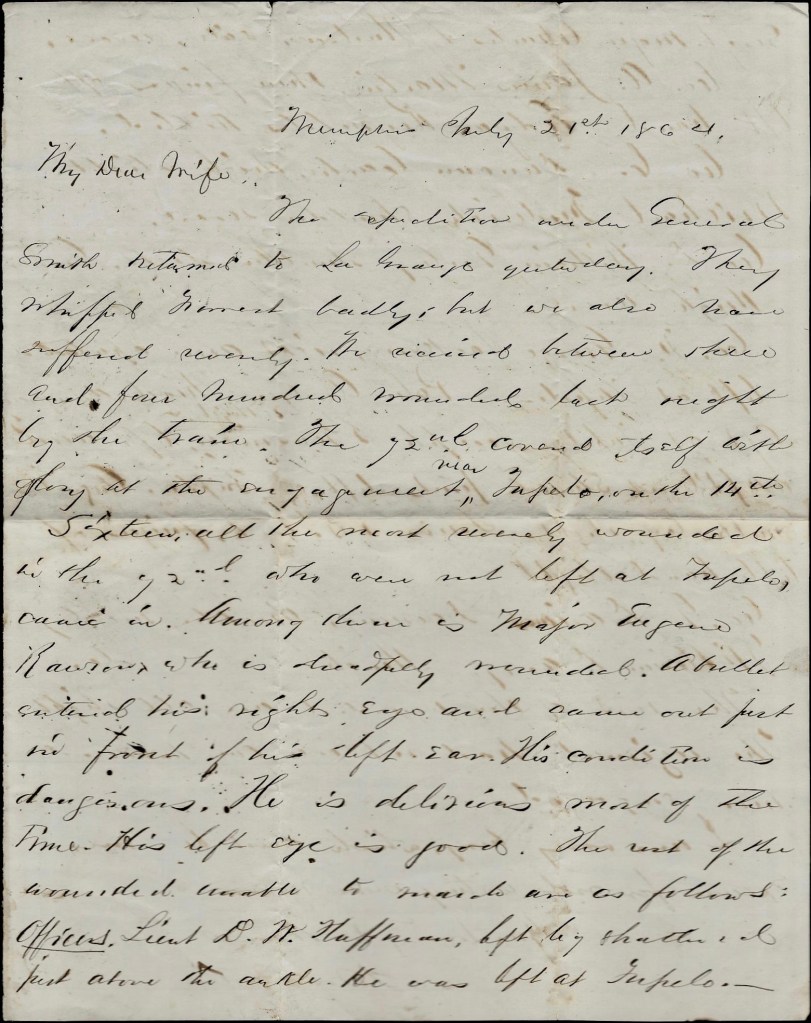
This letter was written by Surgeon John Birchard Rice (1832-1893), a physician from Fremont, Ohio, who served in the 72nd Ohio Infantry. He was promoted to Brigade Surgeon after the Battle of Shiloh and eventually made Chief Surgeon of a Division in the 15th Army Corps, and Medical Office of the District of Memphis, overseeing 150 surgeons and 15,000 soldiers. He later served in the US Congress (1881-1883).
In this letter, Rice informs his wife of the casualties sustained by members of the 72nd Ohio during the expedition to Tupelo, Mississippi, in July 1864 under the command of Gen. Andrew Jackson Smith. In the Battle of Tupelo (July 14-15), Union forces turned back Confederate forces under Gen. Nathan B. Forrest that were threatening the disruption of Sherman’s supply lines during the Atlanta Campaign.
John B. Rice was the son of Robert Stuart Rice (1805-1875) and Eliza Ann Caldwell (1807-1873) of Fremont, Sandusky county, Ohio. He was married to Sarah Eliza Wilson (1842-1928) in 1861.
Transcription
Memphis, [Tennessee] July 21, 1864
My Dear Wife,
The expedition under General Smith returned to La Grange yesterday. They whipped Forrest badly but we also have suffered severely. We received between three and four hundred wounded last night by the train. The 72nd covered itself with glory at the engagement near Tupelo, on the 14th. Sixteen, all the most severely wounded in the 72nd who were not left at Tupelo, came in. Among them is Major Eugene Rawson who is dreadfully wounded. A bullet entered his right eye and came out just in front of his left ear. His condition is dangerous. He is delirious most of the time. His left eye is good. 1
The rest of the wounded unable to march are as follows:
Officers: Lieut. D. W. Huffman [Co. B], left leg shattered just above the ankle. He was left at Tupelo. Sergt. Major [& Adjutant] Charles L. Hudson, side, severe. Co. A, [Pvt.] James Martin, three fingers off left hand. [Pvt.] Edgar Reynolds killed. Co. C, [Sgt.] Duncan Carter, thigh, slight. [Pvt.] Michael Frederick, shoulder, severe. Co. D, [Pvt.] William Gooley, shoulder, slight. Grones, thigh, severe. Co. F, [Pvt.] George Jackson, right arm amputated, left at Tupelo. [Pvt.] Peter Andrews, head, dangerous, left at Tupelo. [Pvt.] Joseph Bensinger, in thigh & left arm amputated at shoulder joint—left at Tupelo. [Pvt.] Augustus Smith, leg, slight. [Pvt.] Louis Bowlach, fingers of left hand, slight. Co. G, [Pvt.] Darius Downing, shoulder, severely. William Davis, thigh, severely.
The rest of the wounded are all slight. The Regiment had not over one hundred men engaged. I am very busy, which must be my excuse for not writing more now.
Your loving husband, — John B. Rice
1 Major Eugene A. Rawson died on 22 July 1864 at Memphis from wounds received on 15 July 1864 at Old Town Creek, Mississippi.
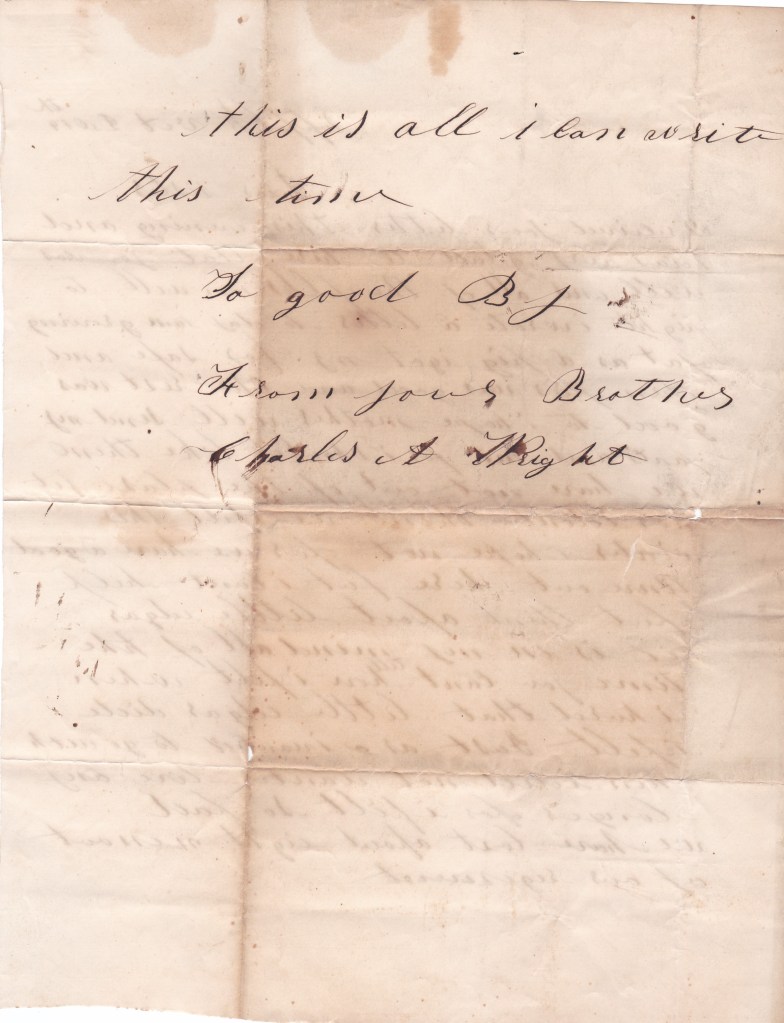
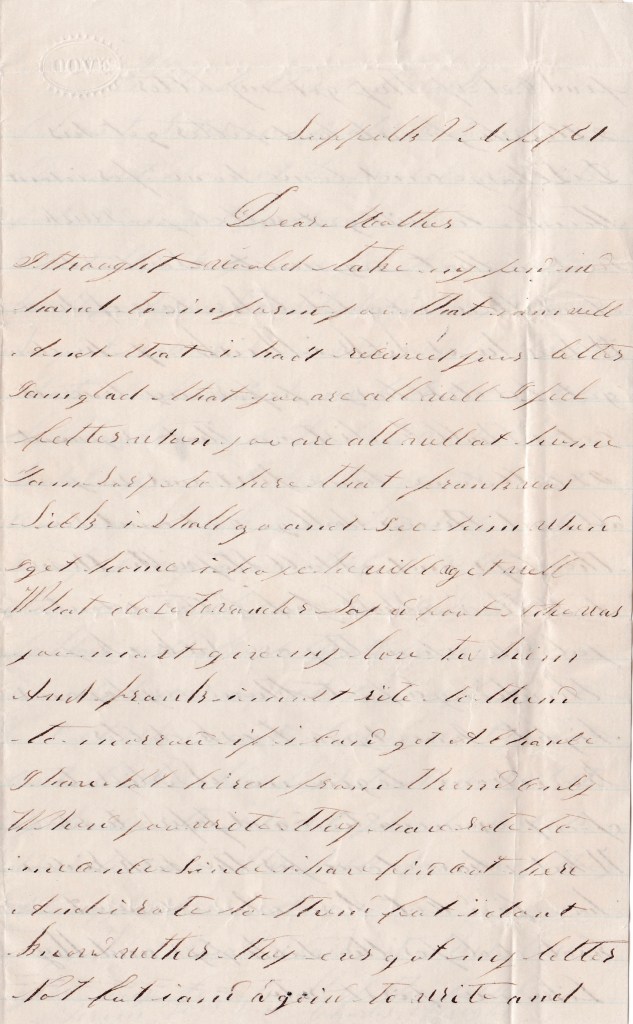
These letters were written by Charles A. Wright (1843-1899), a 19 year-old cooper from Townsend, Massachusetts, who enlisted on August 25, 1862 in Co. B of the 6th Massachusetts Infantry during their second term of service—a nine-month’s stretch when they were attached to the VII Corps and saw duty in and around Suffolk, Virginia. After he was discharged from the 6th Mass, he enlisted into Co. D, 2nd Massachusetts Heavy Artillery. He was discharged for disability at New Berne in July 1865.
Charles was the son of William Henry Wright (1804-1887) and Mary Baldwin (1807-1873) of Townsend, Middlesex county, Massachusetts.
Five soldiers, four unidentified, in Union uniforms of the 6th Regiment Massachusetts Volunteer Militia outfitted with Enfield muskets in front of encampment. Photo shows soldiers wearing frock coats and standing at ease with their Enfield Rifles. An encampment is visible in the background. Photo shows one identified soldier, Albert L. Burgess, on far right. Taken during their second term of service probably in Suffolk, Virginia. Published by North South Trader, May-June 1983, p. 23.
[Note: These letters are from the personal collection of Jim Doncaster and are published on Spared & Shared by express consent.]
Letter 1
Suffolk, VA Sunday morning, October 5, 1862
I am pretty well today. We have had a fight it out here yesterday. We whipped them up pretty well. We killed about thirty of them. We lost only four men in all. The Rebels had to skedaddle and burn the bridge so we could not get across.
I wish you would send Jennie out here in a letter. I would kiss her and send her back home safe. Henry, I suppose you feel pretty big of your horse. I hope you do. If I live to get home I shall buy me a wife and live happy. I tell you, I shall. I am a different man now to what I was at home.
I want you to tell Augusta to send her picture to me. I should like to have her send it as soon as she can. I did not think of it when I wrote to her. I want you [to] tell John Going to write to me, and I will write to him. I go to church every Sunday. I hope you all go to church every Sunday. You tell William to write to me….also Martha and do tell her to write to me and send Hattie out here in a letter and I will kiss her and send her back safe at home. I should like to see the little ones. I hope I shall live to see them once more and see you all.
I hope you will write as often as you can. So goodbye. From your brother, — Charles A Wright
Letter 2
Suffolk, Virginia December 19th [1862]
Dear Sister,
I received your letter this evening and I was very glad to hear that you was well and all the folks. I am well tonight. I wrote a letter today. I am growing fat as a pig. I got my box safe and them pies was good and the rest was good too. I hope mother will send my pants and hat for I should like them. We have not [moved] out of this place yet nor I don’t think we shall this winter. I hope not for we have a good time out here. But I can’t help but think about Little Edgar. 1 It is in my mind all the time. You can’t tell how [bad] I felt when I heard Little Edgar died. I felt just as I wanted to go with him. I did not want to live any longer for I felt so bad. We have lost about eight men out of our regiment.
This is all I can write this time. So goodbye. From your brother, — Charles A. Wright
1 Little Edgar was Charles’ nephew, Edgar Heselton (1859-1862). Edgar’s parents were Franklin Loring Heselton (1836-1917) and Mary Roanna Wright (1834-1864).
Letter 3
Suffolk, Virginia 1863
Dear Mother,
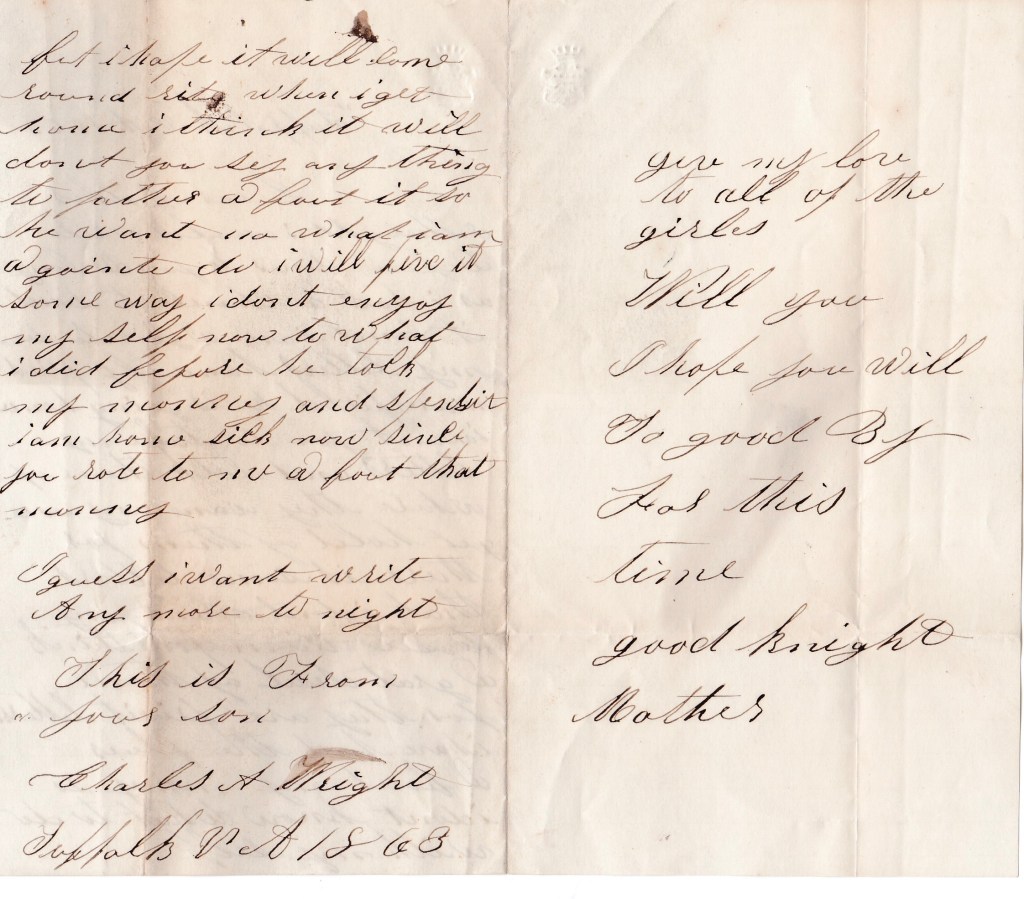
I thought I would write a few lines to you as long as I had a chance to send it and I am a going to send my letter home by Fred Mansfield. He is going home. I want you to take my letters and lock them up where they won’t anyone get hold of them for there is some letters that I don’t want any[one] to see them for I think a great deal of them for they are private letters. I have had the blues about my money so I don’t know what to do with myself but I hope it will come round right when I get home. I think it will. Don’t you say anything to Father about it so he won’t know what I am a going to do. I will fix it some way. I don’t enjoy myself now to what I did before. He took my money and spent it. I am homesick now since you wrote to me about my money.
I guess I won’t write anymore tonight. This is from your son, — Charles A. Wright.
Give my love to all the girls, will you? I hope you will. So goodbye for this time. Goodnight, Mother.
Letter 4
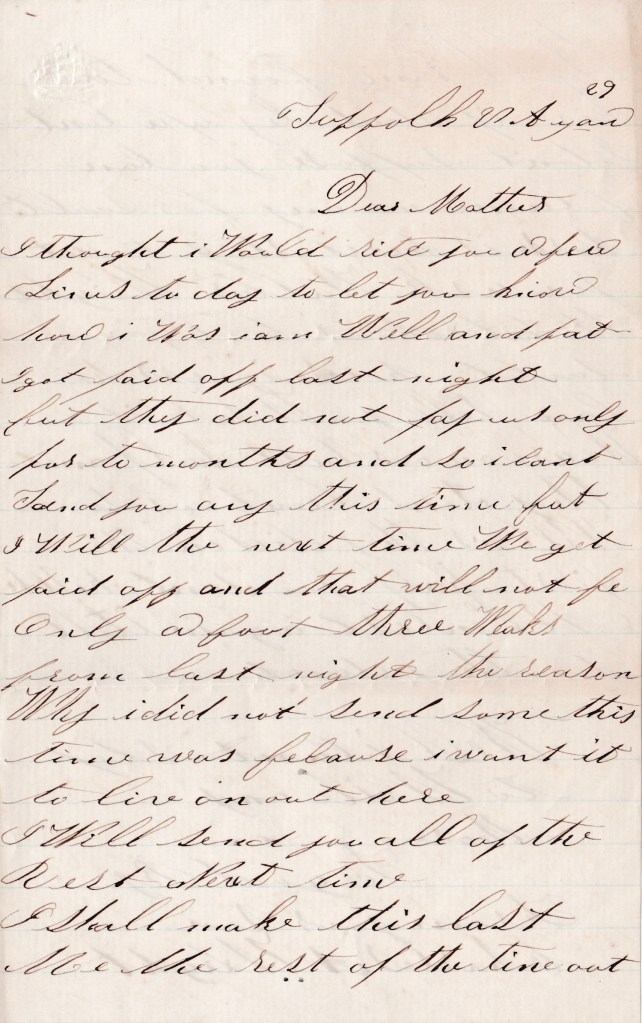
Suffolk, Virginia January 29, [1863]
Dear Mother,
I thought I would write you a few lines today to let you know how I was. I am well and fat. I got paid off last night but they did not pay us only for two months and so I can’t send any this time but I will next time we get off and that will not be only about three weeks from last night. The reason why I did not send some this time was because I want it to live on out here. I will send you all of the rest next time. I shall make this last me the rest of the time out.
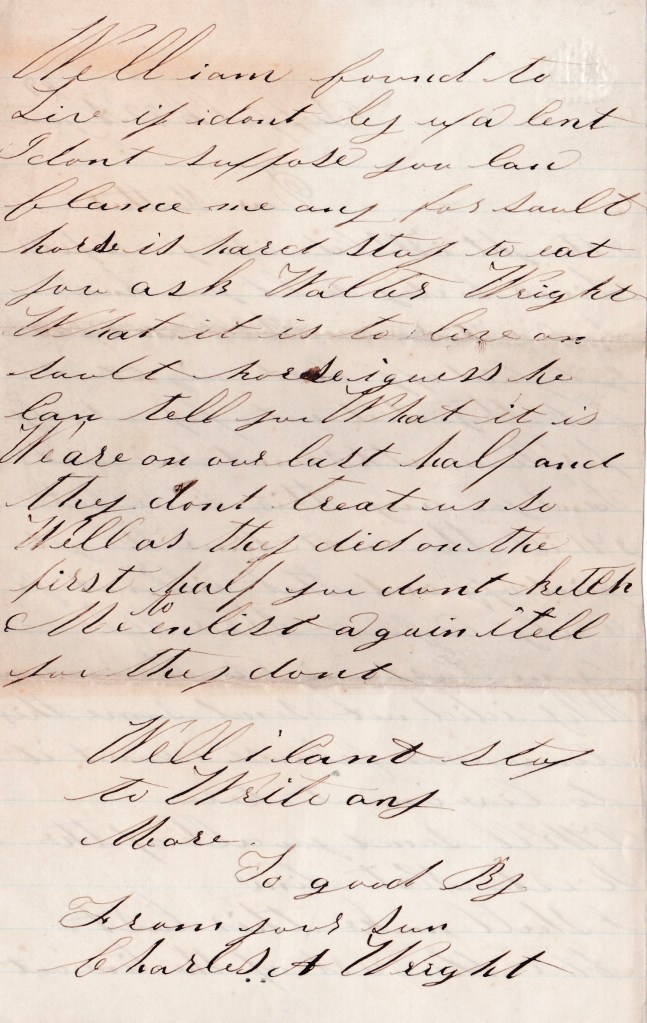
Well, I am bound to live if I don’t lay up a cent. I don’t suppose you can blame me any for salt horse is hard stuff to eat. You ask Walter Wright what it is to live on salt horse. I guess he can tell you what it is.
We are on our last half and they don’t treat us so well as they did on the first half. You don’t catch me to enlist again, I tell you they don’t.
Well I can’t stop to write anymore. So goodbye. From your son, — Charles A. Wright
Letter 5
Suffolk, Virginia April 21, [1863]
Dear Mother,
I thought I would take my pen in hand to inform you that I am well and that I had received your letter. I am glad that you are all well. I feel better when you are all well at home. I was sorry to hear that Frank was sick. 1 I shall go and see him when I get home. I hope he will get well. What does Frank say about the war? You must give my love to him. And Frank must write to them tomorrow if I can get a chance. I have not heard from them, only when you write. They have wrote to me once since I have been out here. And I wrote to them but didn’t know whether they ever got my letters. But I am a going to write and find out if they got my letters. I think Frank had better get his discharge and come home for I don’t think he will get well, do you? I wish I was in that regiment as a nurse and that I could take care of him when he is sick. I think if he don’t get his discharge before my time is out, I shall enlist in that regiment. I shall come home first and see you all and then I shall go out and see the boys and I shall stay with them. And then I shall feel better. I don’t feel right when they are sick. I keep thinking about them every day and night. I am a going to ask Doctor [Walter] Burnham to give me a certificate of my examination and papers to show what I have done for the sick soldiers here. I have done a great deal for the sick boys and they like me first rate.
Well, Mother, I think the climate suits me better out here than it does at home. I’ve never been so fat in my life as I am now. I don’t think you would know me now hardly if you should see me for I am so fat. I don’t suppose you would think that I could get so much fat onto my little frame but I have and I can hold up a great deal more if I had it on me. I weight one hundred and twenty-five pounds. That is pretty good for me, I think. Don’t you? I suppose Father will buy that horse for me. I hope he will for I want it when I get home. And if I go out to see the boys, he can sell it if he wants. I don’t find nothing else to write. The sick boys are getting along first rate now.
This is all I can write this time. Give my love to all the folks. From your son, — Charles A. Wright
1 I presume Charles is referring to his older brother Franklin S. Wright (1841-1863). Frank was serving in the 33rd Massachusetts Infantry. He was killed at the Battle of Brown’s Ferry Farm on 29 October 1863.
Pvt. William D. Semans, wounded at Ft. Stedman Find-A-Grave
These two letters were written by William D. Semans (1844-1924), the son of Nelson Semans (1819-1891) and Hannah Briggs (1826-1905) of Starkey, Yates county, New York. William enlisted as a private in Co. L, 14th New York Heavy Artillery, in December 1863. He was wounded in the jaw by a shell fragment at Fort Stedman on 25 March 1865, five weeks after writing his friend, “I have not got a scratch yet nor do not want any.” He was treated for his wound at Armory Square Hospital in Washington D. C., from which place he was discharged from the service.
The 14th New York Heavy Artillery saw hard service. After manning the batteries in New York Harbor, they were ordered to the front as infantrymen in the 9th Corps. They passed through the Wilderness, then suffered heavily at Spottsylvania, Cold Harbor, and the first assault on Petersburg. In the Battle of the Crater they were one of the first to plant the colors on the enemies works. They occupied Fort Stedman at the time of the enemy attack in March 1865 and fought their way to Fort Haskell.
The letter was addressed to Adam S. Miller of Starkey, Yates county, New York, who enlisted in August 1862 but mustered out of the regiment on 8 January 1864 for disability.
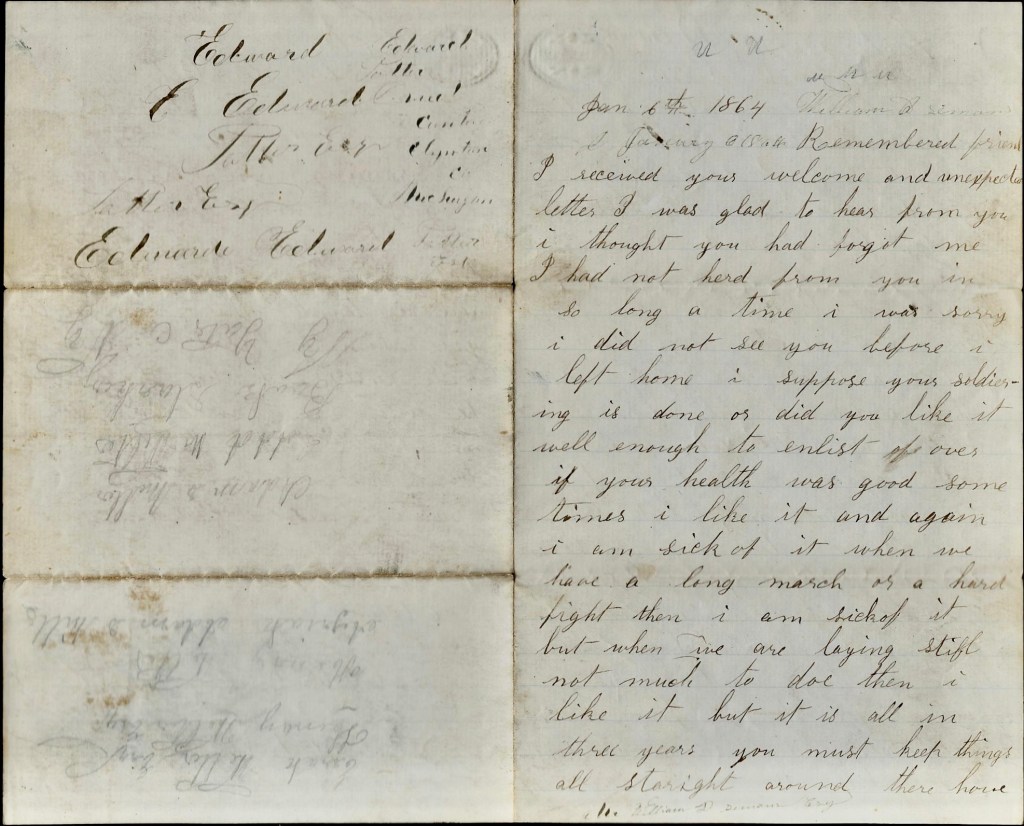
Letter 1
[Fort Richmond, New York (?)] January 6th 1864
Remembered friend,
I received your welcome and unexpected letter. I was glad to hear from you. I thought you had forgot me, I had not heard from you in so long a time. I was sorry I did not see you before I left home. I suppose your soldiering is is done, or did you like it well enough to enlist over if your health was good? Sometimes I like it and again I am sick of it. When we have a long march or a hard fight, then I am sick of it. But when we are laying still [with] not much to do, then I like it. But it is all in three years.
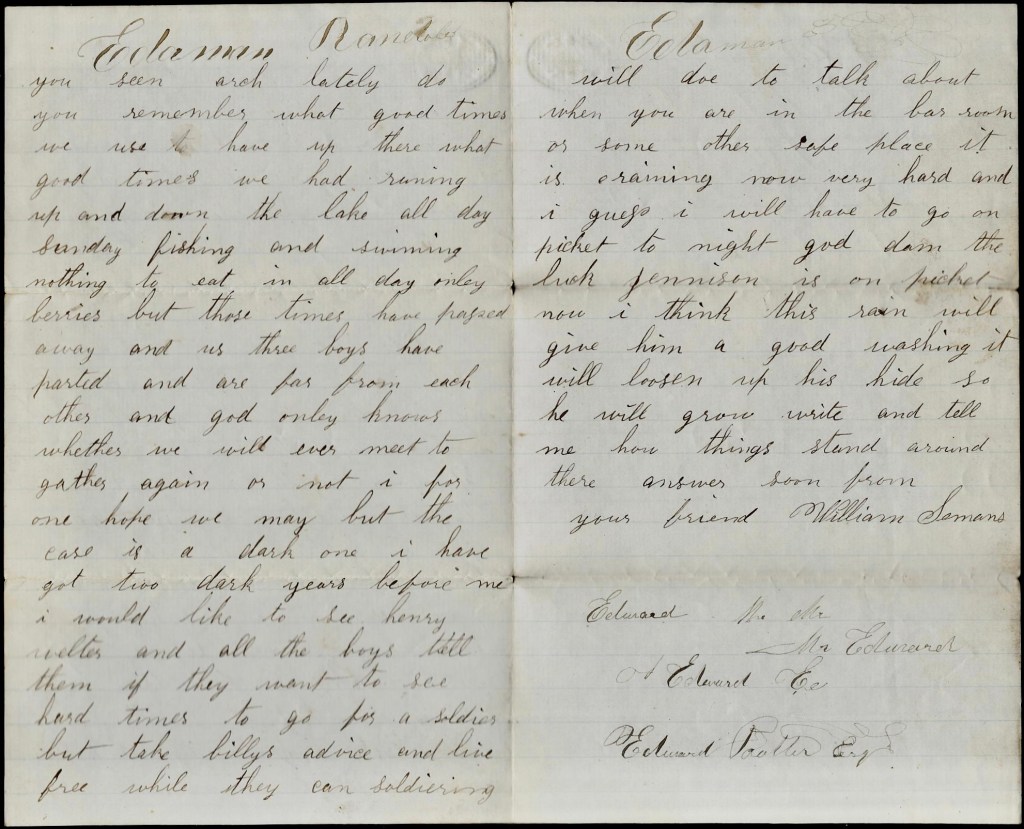
“Tell them if they want to see hard times, to go for a soldier. But take Billy’s advice and live free while they can. Soldiering will do to talk about when you are in the bar room or some other safe place.”
— Pvt. William D. Seman, Co. L, 14th N. Y. Heavy Artillery
You must keep things all straight around there. Have you seen Arch lately? Do you remember what good times we used to have up there? What good times we had running up and down the lake all day Sunday, fishing and swimming, nothing to eat in all day—only berries. But those times have passed away and us three boys have parted and are far from each other and God only knows whether we will ever meet together again or not. I for one hope we may, but the case is a dark one. I have got two dark years before me. I would like to see Henry Welter and all the boys. Tell them if they want to see hard times, to go for a soldier. But take Billy’s advice and live free while they can. Soldiering will do to talk about when you are in the bar room or some other safe place.
It is raining now very hard and I guess I will have to go on picket tonight. God damn the luck. Jennison 1 is on picket now, I think. This rain will give him a good washing. It will loosen up his hide so he will grow. Write and tell me how things stand around there. Answer soon. From your friend, — William Semans.
1 George A. Jennison (or Jamison) enlisted at age 18 with William Semans in December 1863 in Co. L, 14th New York Heavy Artillery. He was wounded on 12 May 1864 and again on 25 March 1865. He mustered out of the regiment from Lincoln US General Hospital.
Letter 2
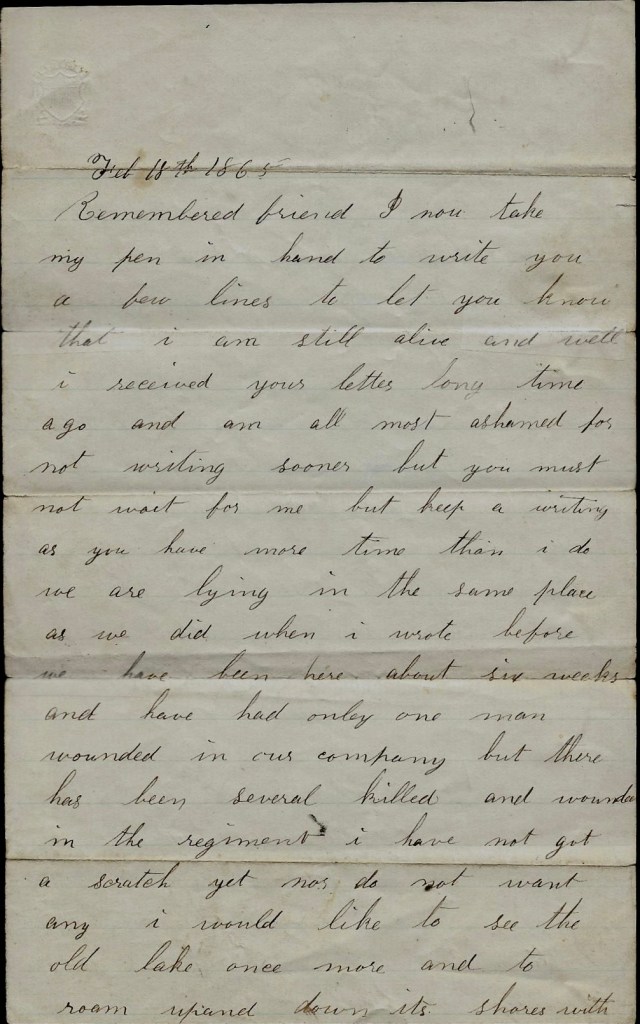
[Fort Stedman near Petersburg, Va.] February 18th 1865
Remembered friend,
I now take my pen in hand to write you a few lines to let you know that I am still alive and well. I received your letter a long time ago and am almost ashamed for not writing sooner, but you must not wait for me but keep a writing as you have more time than I do.
We are lying in the same place as we did when I wrote before. We have been here about six weeks and have had only one man wounded in our company but there has been several killed and wounded in the regiment. I have not got a scratch yet nor do not want any. I would like to see the old lake once more and to roam up and down its shores with you and Old Carmer. Then was when I enjoyed myself eating berries and stealing Mr. Conkling’s apples. But apples are scarce here. They cost five cents apiece and not very large at that.
You spoke about your sweetheart Nelly. Tell me her other name so if I ever get a furlough, I can find her. There is not much firing going on here. They get to shelling every two or three days. There has three shells bursted in our company. Only wounded one and scared the rest pretty badly. Please answer soon from your friend.
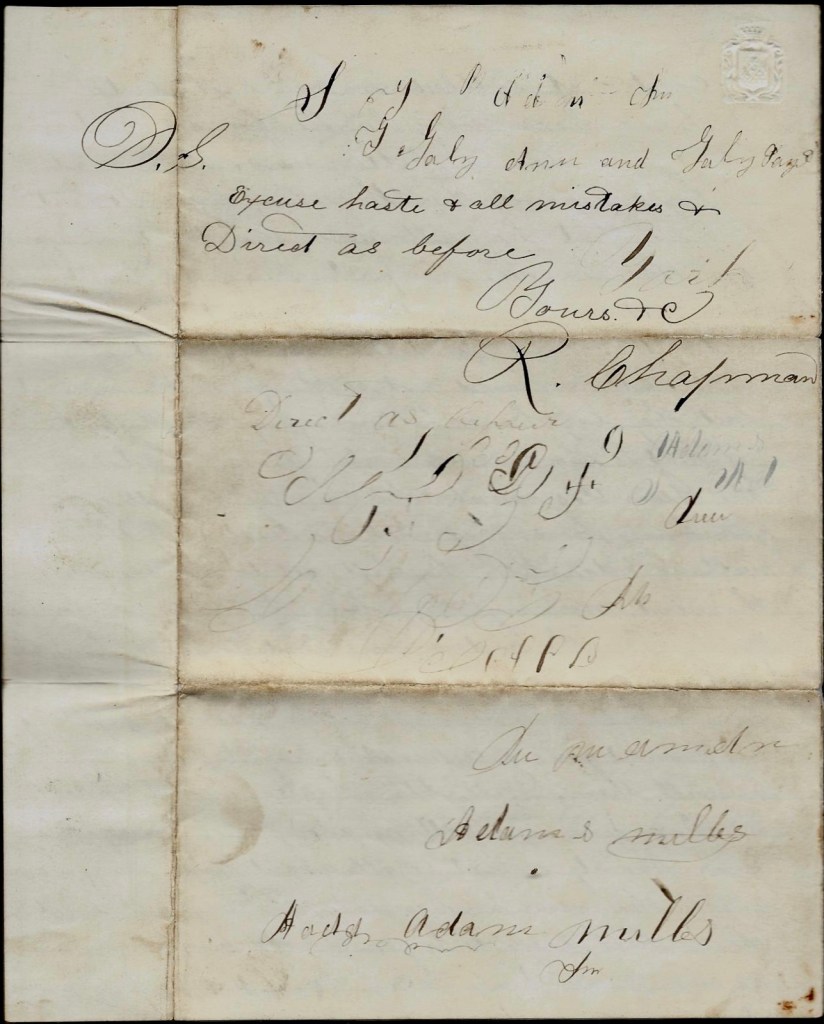
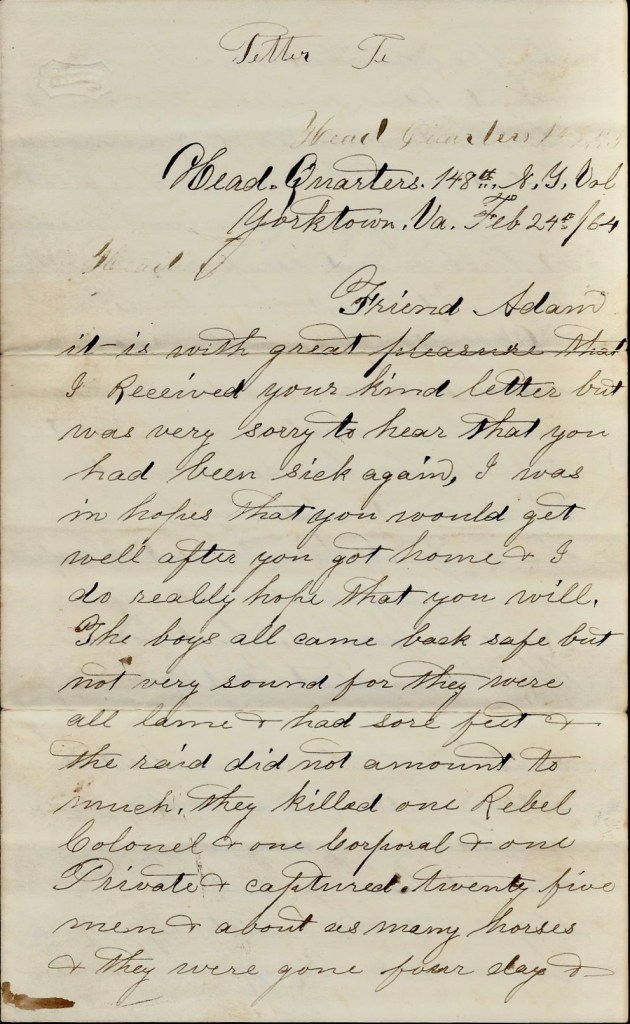
These letters were written by 19 year-old Richard Chapman who enlisted on 15 August 1862 to serve in Co. B. 148th New York Infantry for three years. His health failed him, however, and he died at the Fortress Monroe Hospital on 2 September 1864. The letters were addressed to Adam S. Miller of Starkey, Yates county, New York, who enlisted in the company at the same time as Chapman but mustered out of the regiment on 8 January 1864 for disability.
Richard’s two letters were written at the time of Gen. Isaac J. Wistar’s raid on Richmond in February 1864. The following partial newspaper extract published in the Daily Press on 14 February 2014 describes the raid:
Sometime about 10 a.m. on Feb. 6, 1864, the road leading west from Williamsburg began to rumble under the weight of one of the largest Union raids ever aimed at the Confederate capital in Richmond. Nearly 7,000 bluecoats moved out in an ambitious expedition led by Yorktown commander Brig. Gen. Isaac J. Wistar—more soldiers than the area had seen since the Army of the Potomac attacked retreating Confederates in the May 1862 Battle of Williamsburg. Sparked by the plight of hundreds of captured Federal officers held in Richmond’s notorious Libby Prison, the mission became more urgent after Union spies got word of a planned transfer to the newly built yet soon-to-be-infamous Confederate POW camp in Andersonville, Ga. Two Southern deserters had described the defenses at Bottoms Bridge as lightly manned, too—and they’d confirmed their reliability through a late 1863 raid that brought nearly 100 prisoners back from Charles City County, writes Carol Kettenburg Dubbs in “Defend this Old Town: Williamsburg During the Civil War.”
Despite the efforts of Wistar and Williamsburg Col. Robert M. West to keep their preparations secret, however, the advance units of 2,200 Union cavalry “found the enemy (at Bottoms Bridge) posted in strong force, and continually receiving accessions by railroad” when they arrived early the following morning, Wistar reported. Nine troopers were killed or wounded attempting to force a crossing, after which Wistar—recognizing that he’d lost the advantage of surprise—reluctantly ordered his men to withdraw. “It was a very good plan — and they had a sizable force to carry it out. But the Confederates knew they were coming,” says Carson Hudson, author of “Civil War Williamsburg.”
“Even before their return, Maj. Gen. Benjamin F. Butler at Fort Monroe discovered from a Richmond newspaper that a Union deserter had given them up—and he was just livid. “Butler offered to exchange any number of prisoners to get him back. But the Confederates wouldn’t.”
Letter 1
Headquarters [Isaac J.] Wistar’s Brigade Butler’s Division, 18th Army Corps Department of Virginia & North Carolina 148th Regt. N. Y. S. Vol. Infantry Yorktown, Virginia February 8, 1864
Friend Adam,
Thinking perhaps that a few lines from an old friend & used to be brother soldier would not come amiss, I thought I would write to you and let you know how we are getting along. The regiment has gone out on another raid—or expedition rather. They started last Friday at half past 2 o’clock with six days rations in their knapsacks & some took their rubber blankets & shelter tents & overcoats & a pair of socks, & there was the regiments of Colored Troops & Battery L & the 1st Rhode Island Battery & two other batteries and five regiments of cavalry & the 16th New York Heavy Artillery, & the 118th N. Y. S. Vol. Infantry & the 139th N. Y. S. Vol. Infantry, & the 25th Massachusetts Vol. & several other regiments. They were commanded by Brig. Gen. Wistar & they left here at 3 o’clock p.m. Friday 7 arrived at Williamsburg that night at 9 o’clock. At 12 M. that night they left Williamsburg for the mouth of the James river where they expected to meet Maj. Gen. Butler with about thirty-three thousand men and with the force that they had, they will number at least fifty thousand men. They had a nice little squad of them, don’t you think so? The report is that they are going to try & take a very large fort at what is called Bottom’s Bridge about fourteen miles this side of Richmond. if they succeed in taking it, they are going on further.
There is but nine of us left here. All the invalids were left here to take care of the camp & I will tell you their names commencing with Andrew Morrison [age 29], George Winans [age 46], David Griswold [age 46], David Hughes [age 46], Andrew Bradley [age 45], John H. Tymeson [age 22], Thomas H. Little [age 19], Lyman A. Stoll [age 24], and myself. My health is not very good at present. I caught a heavy cold and it settled in my right side & I have been very lame for some time but am some better now.
Ben [Grace] was enjoying good health when he left but I fear that he will never see Yorktown again for this season. Joseph Decker [age 46] & A[lexander] P. Houghtailing [age 22] has just come back. They gave out & were ordered back by the doctor & they say that Ben fell out. He could not keep up with the regiment but they say he is following up the regiment and if that is the case, he will probably be taken by the guerrillas which the country is full of & you know how they will be treated by them as well as I do.
After the regiment got to Williamsburg, the next morning the whole brigade were ordered in line & the orders were read to them by Gen. Wistar & they were as follows—that they would see long and forced marched & calm and severe fighting & I would give one month’s pay to be well & be with them.
Well, Adam, please write & tell me how you are getting along & if you got your bounty or not & all about your going home & all the news in general. The boys all send their best respects to you & I the same.
I remain as ever yours truly &c., — Richard Chapman
P. S. Excuse haste and all mistakes & direct as before, Yours &c. — R. Chapman
Letter 2
Headquarters 148th N. Y. Vol. Yorktown, Va. February 24, 1864
Friend Adam,
It is with great pleasure that I received your kind letter but was very sorry to hear that you had been sick again. I was in hopes that you would get well after you got home & I do really hope that you will.
The boys all came back safe but not very sound for they were all lame & had sore feet & the raid did not amount to much. They killed one Rebel Colonel & one corporal and one private and captured twenty-five men and about as many horses & they were gone four days and a half and marched one hundred and thirty-four miles. They went within ten miles of Richmond but it was the means of a great number of our Union prisoners at Richmond escaping & getting safe into the Union lines.
Well, Adam, you wanted to know where Randall G. Bacon is. Well he is at or near Fort Norfolk. He has command of the recruits that they have enlisted. He is 1st Lieutenant & expects something higher after the regiment [38th USCT] is formed. And John Morrison [age 45] is at Fort Monroe in the hospital & he has been very sick with the fever but is getting better. Ben [Grace] & Roy [Tubbs] are to bed a laughing and raising the old harry as bad as ever & they send their best respects to you & John Knapp the same.
The boys are all enjoying good health except John Clark. 1 He is pretty sick. Well, Adam, we have got two new recruits in our company & one of them is Charley Gabriel’s [18 year-old] brother [George] & the other one’s name is [William W.] “Roberts.”
I am on guard today and No. 1 on the relief & I have stood three tricks. Captain is feeling well now and he uses us very well. His wife is here & they went down to Norfolk this morning.
Well, Adam, you must excuse this poor writing for I am in a hurry and a short letter this time & please write as soon as convenient & oblige. Well good evening & pleasant dreams. I remain as ever your true & faithful friend, — Richard Chapman
1 John Clark was 22 years old when he enlisted in August 1862 in Co. B, 148th New York Infantry. He was killed in action on 18 June 1864 in the first assault on Petersburg.



















 Spared & Shared 23