My passion is studying American history leading up to & including the Civil War. I particularly enjoy reading, transcribing & researching primary sources such as letters and diaries.
During the Civil War, soldiers sometimes placed advertisements in news papers seeking “pen pals” or urged a comrade’s relatives to strike up a correspondence with them. Some, perhaps, hoped the correspondence might actually lead to a relationship; others simply found it as a convenient way to fill the otherwise dull hours of camp life. Female correspondents often took on the task as a patriotic duty—as a means of encouraging the soldiers who were willing to “sacrifice home and pleasure” to put down the rebellion.
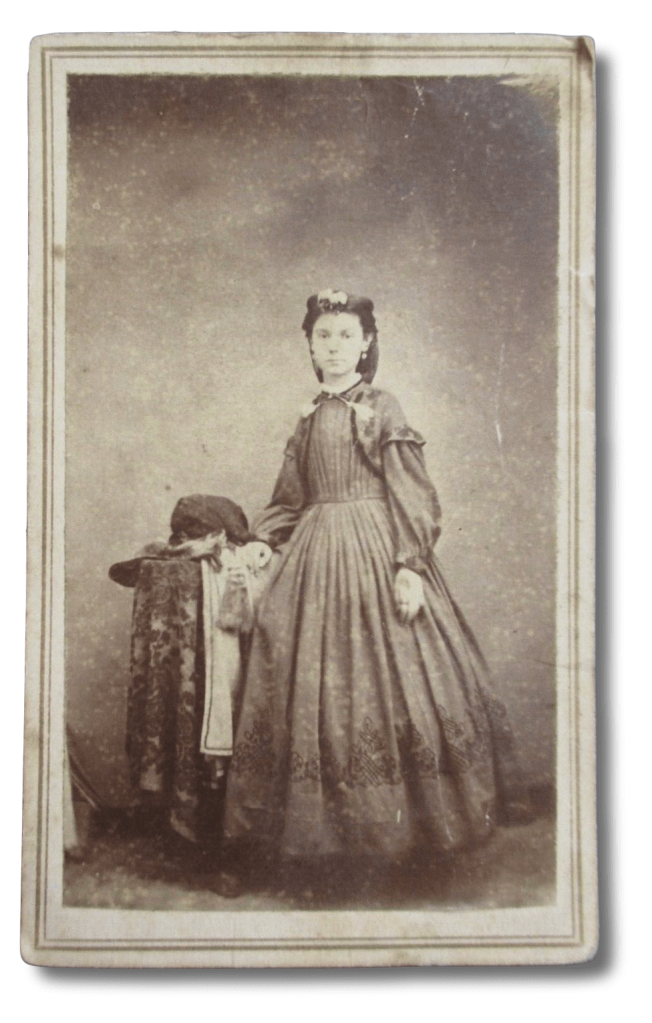
How Julia might have looked
In this charming letter, Julia A. Donaldson of Lafayette, Indiana, wrote to a soldier identified only as “Mr. May” who may have been local boy or not. I have not been able to find Julia in census or directory records but she may have only living in Lafayette temporarily—perhaps as a housemaid or staying with a relative. It seems clear she and Mr. May did not know each other. She states she has a brother in the Union Army. The only Donaldson I can find in military records connected with Lafayette, Indiana is a Madison Donaldson of the 20th Indiana Infantry, which was formed in Lafayette but he does not appear in the census records there. As for Mr. May, there were four different soldiers with the surname May in the 20th Indiana Infantry. Perhaps he was one of these soldiers.
I have transcribed Julia’s letter as she wrote it so you can see that her formal schooling—if she had any at all—was severely limited.
[Note: This letter is from the private collection of Richard Weiner and is published on Spared & Shared by express consent.]
Transcription
Lafayette, April 18, 1862
Mr. May,
Dear sur,
as i have hurd a friend if yourn spoke of you, i thot that i would writ to you. i hope that you will pardin me for the privlig that i have takin as this is Leep year and all foks is free in war times, i thot it would bee nise to have a unoin corasponent. i hope that that you will pardin me for making such a bold atenit as to write to you. i would not atemp to writ to eney won except won that had gon to help to put down this wiked war. i alway feel free to write or talk to eney won that is wiling to help put down this weked war. i think that eney won that is wiling to sacrifise home and plasur to help to restor aruend cuntry is the salt of our repulicen goverment.
when i pic up a paper and see that you ned help, i feel like picking up a gun and go to war mi self. But i cant. all i can do is to tri and write and pra for those Brave Boys that is wiling to tri and restor our republici goverment. i have won Brother in the army and a grat meny of mi friends ar in the army. a grat eny has gon to war. But tims ar quit flurshing in the norh yet and i hop it will always Bee so, By the help of god and our Brave Boys.
Well i supose that you would like to know what fur looking girl you corspondent is. Well i wil tell you. I am tall and slender, dark complected, dar hear and dark eyes and full of fun 21 years old. i enjoy mi self vary much ended But still i often think of a nother world apart Cold hener wher there is no mor war or parting of friends. We all hop haf to part with our friends ito am among strangers.
Will i gess that i will close this leter for i supose that i have writin mo than will enter rest you, i will close hoping that you will pardin me for the privilige that i have takin and if you think this leter worth ancering, I will Bee plsed to her from you.
From you well wisher, — Miss Julia A. Donaldson, Lafayette, Indiana
This letter was written by Lt. Nathaniel G. Wilkinson, who served in the War of 1812 with 2nd Battalion, 6th U. S. Artillery. After the war he was posted at Norfolk, then at Fort Johnston (N. Carolina), and later in the 1820s as Captain and commander of Cantonment Jessup in Louisiana.
Nathaniel wrote the letter from Fort Johnston which was originally a British fort located on the west bank of the Cape Fear River, four miles above its mouth. Following the American Revolutionary War, peace prevailed, and Fort Johnston underwent a period of physical decay. The community of Smithville (renamed Southport) gradually developed around the fort. In March 1794 with war raging in Europe, the Congress appropriated funds for the first system of seacoast defense in the United States to fortify sixteen critical ports on the seaboard, provided that states provide the land. North Carolina quickly ceded the land to the federal government. Although reconstruction began in July 1794, work on Fort Johnston progressed slowly over decades. Politician Benjamin Smith ultimately agreed to sponsor the reconstruction of the fort. Major Joseph Gardner Swift characterized Fort Johnston as “dilapidated” upon inspecting the post in January 1810.
In spring 1812, the Army formed a new unit, the “Sea Fencibles,” composed of river pilots who resolved to serve on land and sea. Governor William Hawkins assigned four militia companies from coastal southern North Carolina to Fort Johnston to strengthen the defenses of Cape Fear during the War of 1812. Many locals feared that Fort Johnston provided inadequate defense for the region. The British, however, did not attack the region during the war.
After the War of 1812, an individual sergeant sometimes commanded Fort Johnston, and the Army abandoned it altogether at least once while engaging its troops elsewhere. Nevertheless, the surgeon began to record meteorological observations from the early 1820s. Its garrison departed to fight in Second Seminole War in 1836. The Army completed Fort Caswell two miles away in 1838, reducing the importance of Fort Johnston. The Fort Johnston garrison again departed to fight in Mexican–American War in 1846. The fort was seized by Confederates during the Civil War and was used as a training center and storage center. [Wikipedia]
The letter suggests that the US Government soon intended to build a fortification on Battery and Oak Islands. The construction of Fort Caswell on Oak Island, however, was not begun until 1825 and it took 11 years to complete it.
Nathaniel wrote the letter to Dr. Levi Sawyer (1785-1844) of Bolton, Worcester county, Massachusetts.
[Note: This letter is from the private collection of Richard Weiner and is published on Spared & Shared by express consent.]
Transcription
Fort Johnston, N. C. 30th July 1819
Dear Sir,
With pleasure I sit down to address you a few lines and have to inform you that Capt. [William] Wilson 1 and his company have returned to this place. The company will be stationed here, I think, for many years as it is though that a fortification will be erected on Battery and Oak Islands.
Mr. Potter wishes to sell his dwelling and storehouses; you could, I think, get them upon very good terms. He wishes to move to Louisiana. He has lately returned from there. 2
Russell has not paid me as yet and I have to request you will let me know what will be done in that case; I am afraid he does not wish to pay me.
Please to write me as early as possible on the occasion, You could, I am certain, get the sutting [sutlary] were you at this place, and if you wish it. I will speak to the Capt. for it, for you, before you come.
Times are hard in your part of the country and if you are not in pretty good business, I would advise you, if you could get the sutting [sutlary] to this company, to come to Smithville again. Be certain to write me as early as possible and I will let you hear from me again.
Should the forts be built on these islands I have mentioned and men stationed therein, you could soon make something very handsome.
Respectfully, I am your friend, — N. G. Wilkinson
[to] Dr. L. Sawyer, Bolton, Mass.
1 Capt. William Wilson was stationed at Fort Johnston. He commanded the 6th Military District.
2 In August 1818 the store of Robert Potter and a Mr. Gause at Smithville advertised the receipt of a variety of dry goods aboard the sloop “Fame”. They offered a variety of cordials,preserves, perfumes, hardware, candy, crockery, cutlery, etc. “All offered cheap!”
Dan Troiani’s painting “Remembering the Battle of the Crater”
This letter was written by Homer Shunk Thompson (1842-1909) who enlisted as a private on 2 September 1861 in Co. E, 45th Pennsylvania Infantry and rose in rank to Sergeant Major in the regiment before he was mustered out of the service on 17 July 1865 as a veteran.
Homer was the son of sheriff John Thompson (1798-1876) and Lydia Blake (1799-1871) of Centre county, Pennsylvania. After the war, Homer entered the mercantile business at Stormstown. He married Francina Walton (1845-1901) and later a woman named Harriet. He relocated to Kansas a few years to try farming but returned to Pennsylvania and resumed the mercantile business at Reed’s Gap, then Shade Valley, and finally Pine Grove Mills. He eventually returned to Stormstown.
Homer’s letter contains an incredible account of the Battle of the Crater fought on July 30, 1864. In his letter, Homer informs his sister of his injuries, his treatment, and recalls some of the details of the fighting that he witnessed before being taken from the field with a head wound. See also: “Refusing Capture: Capt. Theodore Gregg, Co. F, 45th Pennsylvania” by Tim Talbott.
[Note: This letter is from the personal collection of Richard Weiner and is published on Spared & Shared by express consent.]
Transcription
Addressed to Miss Lydia Thompson, Half Moon, Centre county, Pennsylvania
2nd Division, 9th Army Corps Hospital City Point, Virginia August 4th 1864
Sister Lydia,
I am feeling in pretty good order today and so I will write to you. My head is pretty sore and troubles me a good deal. Was it any other place, I would not mind it but the head is rather a tender place and does not take much to put it out of trim. My shoulder is doing very well and in a few days will be all right again. It was nothing more than a bad bruise and they soon get well. I came here on the 2nd from the field hospital. I am getting along finely. Could not be doing better. We have god tents and good comfortable beds to sleep. Everything is kept clean and in the best of order. I had no idea that the hospital of this place was kept in as good order as it is. The only thing that can be complained of is they do not feed us any better than they might do. In fact, not as well as I would like to be fed. They seem to think that a man with a sore head ought not to eat anything and I think just the opposite. It seems to me that I can eat as much and as strong diet as ever I could.
This is a general hospital for the entire army and from here some are shipped north and others are kept here and returned to their regiments when fit for duty. They took off a boat load yesterday evening and among others were 4 of the 45th. Among them was John Holahan—“(My John).” He was wounded just below the left thigh with a piece of shell. A pretty sore wound but not a dangerous one by any means. He had only 20 days to serve when he was wounded. I would not care if I could count my time as easily as he can. There are some four of the regiment in the same tent that I am in but they are persons that you do not know. I wish I had been among the number that left here yesterday. I would have thought there might have been a chance to get to Pennsylvania a while. I may possibly get off in the next boat but it is not very likely for they mostly send the worst ones away. It is not very likely that I will be sent away from here at all—till I am sent to the regiment.
The fight on Saturday proved to be a grand failure—nothing short of a perfect butchery. T’was not much better than Fort Pillow. My opinion is that Gen. Grant is to be blamed entirely for the failure, and had he done his part, the city would have been ours. As it is now, we mourn the loss of about 4,000 men and nothing gained by it.
There was a strong rebel fort in front of Burnsides lines and he had been engaged for some time in digging a mine to blow it up. On the night of the 29th he had finished it and everything was ready for the match which was applied the morning of the 30th and at daylight the fort was blown up. The Old 9th charged across the intervening space and succeeded in capturing the fort and one line beyond before the Rebels recovered from their surprise. By this time they commenced to pour a deadly fire into us on both flanks as well as in our front. We looked in vain for Butler on our right or Meade on our left to advance and cover our flanks but we looked in vain. Not a man moved and we were left to suffer alone.
The Rebels—finding that we were not going to advance any other part of the line—massed almost their entire force on us and advanced to drive us back. The outer line was held as long as it was possible to hold it and then fell back to the second line. There the fighting went on hand-to-hand. After our men were driven from the front line, I was wounded and so I did not see any more of the fight. The fort was still held by our men till sometime in the afternoon when Gen. Bartlett hoisted the flag and surrendered himself and what few men were with him.
“I never saw such fighting in my life as there was done that forenoon. It was the first time that I ever saw bayonets used, but there both parties used them. Bayonets, guns, swords, pistols, and everything could be thought of was used.”
Homer S. Thompson, Co. E, 45th Pennsylvania Vols., 4 August 1864
I never saw such fighting in my life as there was done that forenoon. It was the first time that I ever saw bayonets used, but there both parties used them. Bayonets, guns, swords, pistols, and everything could be thought of was used. Prisoners were taken and retaken by both parties without ever getting out of the same breastworks. Some of our prisoners were shot down on the spot after they had surrendered. Surely the 9th Corps can hereafter take for their battle cry, “Remember Petersburg!”
Lt. Waldo C. Van Valin taken prisoner at the Battle of the Crateron July 30, 1864
Our darkey troops were engaged for the first time and fought well—full as well as the whites did. They lost very heavily as the Rebs did not have much mercy on them. There was only a portion of our regiment in the fight. Almost one half the men were on picket at the time and so escaped. We went into action with 90 men and out of that number, 68 were killed, wounded, or taken prisoners—by far the heaviest loss according to the number of men that we ever had. Our company only lost 4—one killed, one wounded, and two missing. We were more fortunate this time than usual. We had several officers taken prisoner who I fear will meet with hard usage. Among them was Lt. Van Valin of Unionville or vicinity. He was a very fine man and one of my particular friends. I would give anything to know how he is at the present time—whether living or not. I should not wonder if they killed the officers taken there. They are devils enough to do such things. 1
Some 5 days ago I received a letter from you but do not know the date on it. Sam Brook(?) was sent to Philadelphia sick, so that it was our Sam that you saw in the papers. As for hair I cannot send you any because I have none to send. When I was wounded, they cut my hair off so that it would not be in the way of hunting the ball. You may direct your letters to the regiment and if I stay here they can be sent down and if not they can be forwarded from there just as well.
My compliments to all the friends. Good Bye. Your brother, – Homer S. Thompson
1 Lt. Waldo Carrollon Van Valin (1840-1907) of Unionville served in Co. A, 45th Pennsylvania Infantry. He was taken prisoner in the Battle of the Crater on 30 July 1864 and was confined at Macon, Georgia, until he was paroled.
I could not find an image of John but here is one of Joseph Seavey who also served in the 27th New York Infantry. Seavey was killed on 27 June 1862 in the Battle of Gaines Mills.
These 44 Civil War letters were written by John Boultwood Edson (1839-1863), the son of Elijah Edson (1812-1878) and Achsah Edna Wright (1818-1905) of Rochester, New York.
John enlisted as a private on 7 May1861 to serve two years in Co. E, 27th New York Infantry. He mustered out with the company on 31 May 1863 at Elmira, N. Y. Although some sources say that John “died in the service in December 1863,” I can’t find any evidence that he reenlisted unless he happened to go to California to bring mules back East as mentioned in the final letter.
Other family members mentioned in John’s letters include his sister Miriam Crane (Edson) Clements (1841-1891), who became the wife of Thomas Clements (1839-1902) in 1862. Albert H. Edson (1842-1863) who served in Co. Am 8th New York Cavalry until he was mortally wounded in the Battle of Gettysburg on 1 July 1863. Harriet (“Hatt.”) E. Edson (1832-Unk)
Letter 1
[Elmira, New York] Sunday, May 19, [1861]
Dear Mother,
A I have finished a few lines to Ben, I thought I would say something in regard to my things that I left behind. My ink has run out so will be compelled to use the pencil. I have been to church this forenoon & remained to class meeting which was as interesting a one as I ever attended, there bring several volunteers present. I wish I could have some collars—straight ones—sent me as in probability we shall remain some time. Tell Father to try some of the boys & see if he could not get me a Wide-Awake cape. Some of the boys in Woodbury’s have them. He could for a very little sum. Should like to have another fine shirt.
Please send me a stick of that sticking plaster & a paper of peruvian bark. Capt. Wanzer [told] me again that I would pass. It was announced this morning that all the companies would leave this week for some distant post & I will not be back in the state until the end of 3 months which time they are sworn into the service of the United Sates. [ ] quite sick. The other day had a very bad diarrhea caused by the change of water. Everyone more or less has been affected with it.
Our fare is some better than at first. I feel very sleepy on account of having been on guard last evening. Whenever you wish to send anything to me you can do so by express free of charge no matter how small or large. Address John B. Edson, Elmira, N. Y., Care of Capt. Geo. Wanzer, Independent Zouaves
Letter 2
Headquarters Elmira [N. Y.] May 24th [1861]
Dear Father,
As I will have an opportunity of sending a few lines free of expense, I will give you a little more in respect to my life here. I have had pretty easy times as yet but tomorrow we are to drill from 10 a.m. until half past 1 p.m. and from 3 until 6 p.m., then from 8 until 9 in the evening so that will tell on a man if anything will. I’m ready for it, however, and will not [ ] as long as I’m able to stand upon my feet. I’ve had the misfortune to have the knife you gave me stolen and consequently am without a necessary article for a soldier’s equipment. I do not tell you this because I want you to send one—not by any means.
The Rochester Regiment re expecting every moment to receive marching orders. They have received their uniforms and equipments. They expect to be sent to Fort Monroe, Va.
I learned with great regret of Col. Ellsworth’s death while leading on his brave and undaunted men to the capture of one of the principal cities near our Capitol. But his death will only make another & still finer fire burn in the breast of every true patriot. May God protect that heroic band which when the incendiary flames were seething & hissing around one of the finest of buildings in the Empire City, counted death nothing compared with frustrating the designs of traitors. And now we behold those led by their noble leader who falls while the shout of victory rings in his ears.
There is one regiment yet to receive their uniforms, then comes our turn. We have had one case of the diphtheria in our midst but the prospects will now [page missing?].
I hope you try and send me those things that I mentioned in my last—the Wide-Awake cape especially for I will need one when on guard duty out of doors. I went down to see our barracks this afternoon and found it a pretty hard looking place. The drill ground—or what will be the same—is very stoney & consequently will be very hard on our feet. We are still in Schull’s Hall, Water Street. Will leave on Monday for our barracks. I shall try and come home and see you all before I go if possible—not without my uniform however. I would like a little money as I will have to get a shirt done up once a week at the least and my being sick took some of what I had when leaving which was not much, as you know. However, I can hardly bear to speak of it & will try and get along without any if possible.
It is getting very near time for our prayer meeting and I must close. I can’t tell the reason why I do not hear from you. I have written several times but do receive no answers. How is it? You spoke of your work being very hard. I knew from the first that you would not like it. But that’s not the question. Uncle James said he was going to Rochester in a few days. I hope you will tell him just your condition. Do not work hard. Take it easy. Men do not expect a man to kill himself or to overdo while in their employ, but what am I saying (trying to advise one what has had the experience you have).
I hope you will take care of yourself. Remember me to all my friends. I ever will remain your affectionate son, — J. B. Edson
Letter 3
Headquarters, Elmira, [N. Y.] [June 1861]
Dear Mother,
Mrs. Blackford is waiting at the door, or rather passing through. She desired me to send a few lines to you. I hardly know what to say.
We came into barracks yesterday morning. Our sleeping apartments are first rate considering a soldier’s life is so rough. We are to be mustered in tomorrow.
Tell Albert I shall remember him when far away.
As soon as I get my uniform, I shall try and obtain a furlough for a day or two. The package you sent by our Sergeant came safe. I received it last [night]. Tell Albert I will write to him soon. Also Emeline. So goodbye for awhile.
Your affectionate son, — J. B. Edson
Letter 4
Headquarters Elmira Barracks No St Com E. of Union Dpt. June 22, [1861]
Dear Father,
I received a letter from you yesterday. In it you stated not having received a letter from me for over a week. I have written two or three to persons around there—one to Fanny, one to Em. Semms so you could heard through them of me. My health is none of the best but considering the general health of our company, I do pretty well. We have some 7 or 8 under the physician’s care. The measles are going through the regiment, taking old and young. There have two men died in our regiment since we’ve been in barracks. The Oswego Regiment [ ] was sworn into the service of the U. S. today. They received their uniforms yesterday and a first one it is in comparison to the one of the Rochester Regiment.
I received the parcel you sent me ad it was very acceptable I can assure you. I’m going to try and go home the latter part of next week if possible—that is, if I get my uniform & pay.
Our new quarters are very pleasant. The race course where the celebrated horse Florence Temple won her laurels is close by. The [Chemung] river runs in the rear of our quarters—a fine bathing place. If you go down East, stop here on your way there. I guess you could or would it be out of your road?
We have started the prayer meetings again and I’m in hopes they will continue. If you have any things to send me, I will try and pat the Express charges, if they are not over 50 cents. I may have some money by the time you wish to send it. Our officers have deceived us in respect to our uniform & pay. The Rochester Regiment fares badly [missing page?]
…had to put up with. We are to have the same but they have not made their appearance yet. They are in the town. Our Colonel told us we might expect them [uniforms] so as to appear at dress parade Sunday evening. I very much doubt it, however. Our pay has not come yet. No knowing when it will come, the Major pledged his word we should have it today sure, but nary bit have we seen.
Our company was told to proceed to the Doctor’s room & be vaccinated. I did not go but suppose I will have to go as it is an imperative order and must be obeyed. The boys were going to see if our Captain will try and have us in Rochester on the 4th of July and show our proficiency in drill. I hardly think we will be here on the fourth, Gen. Van Valkenburgh having received a telegram to hurry off all the regiments now here as fast as possible within 20 days so it may be we will be in the Capitol of our nation before the fourth.
Give my respects to Homer Aylesworth and the boys there. Tell Emeline to write and Albert especially. I shall not write any more if I don’t get an answer more punctually. How does Em get along with her school? I received a letter from Will M_____ the other day. Tell Em that I wrote to P____the other week. If she sees him, tell him to answer it right away or prepare for a storm when I see him. I must close as I want to get this in the office this evening.
P. S. Go and see Ben Swift and tell him to answer my letter. I have never received a word from mine. He does not stick to his agreement. My love to all enquiring friends. I remain as ever, your son. — [J. B. Edson]
Letter 5
[On the eve of the Battle of First Bull Run]
In camp 5 Miles beyond Fairfax Court House and within 2 Miles of the Rebel Batteries July 20th [1861]
My Dear parents,
I’m writing this under peculiar trials and circumstances as I’m seated in one of the camp wagons trying to write to you, my ever loved and to be loved parents.
We left Washington last Tuesday afternoon at 4 o’clock. The order for marching came very suddenly. We marched until 11 o’clock that night to a place 11 miles from Fairfax, there encamped until the next morning at 7 when we started on and such a march it beggars description—one of the hottest days I ever saw, if not the hottest. Men [were] falling out of the ranks at every step exhausted. I stood it until the last when men who had worked in the harvest fields at home in the morning said said if they had had another mile to march, should have dropped in the road. The rebels having poisoned several wells and destroyed others made it very bad for us.
We arrived at Fairfax at two o’clock. We expected to find a large secession force there but they had eloped. Consequently we were disappointed. We stayed in Fairfax from 12 o’clock of that day until 4 o’clock of the next day. We lived on the spoils taken from the secessionists. While there the boys took their guns and shot chickens, geese, pigs and even bullocks. One party went to a farmer’s house some two miles off and found 7 bottles of wine, pies, cakes, &c. No one at home. Fairfax was a deserted hole.
Started at 4 o’clock for this camp where we arrived at 7 o’clock [and] set our picket guard that night. That was a night indeed to me. I can assure you, I laid down upon the ground with a blanket over me [and] it commenced raining soon after and I was wet through. About 12 o’clock we were awakened by the firing upon our pickets. We all jumped up and seized our arms. During that hour volley after volley came pouring in. Such a sight! Men standing whispering to one another. Our Colonel came around and told us to lie down by our guns which we did only to be awakened by another alarm.
While I’m writing I hear the artillery booming in the distance towards the rebels’ batteries. I suppose you have heard of the battle on the 18th [see Battle of Blackburn’s Ford]. It was a small affair [paper creased] troops they having to retreat. The Colonel who led them on did so contrary to the orders of Scott. We lost some two hundred men. Gen. Scott is expected to be here this evening to plan the attack. It is this—to shell the batteries, then pour in shot until they are burned out, then bring on the infantry and give them the bayonet. We are waiting now for the shells to come on so we can proceed wit hthe battle. There will be severe fighting. We will in all probability be in Richmond some time next week. Our Colonel told our Orderly when he asked him for a sword that he would scarcely need one for we would all be home in three weeks. I tell you, it is tough. We will have all of Virginia in our possession before another month. I hope I shall live to see you all again. I often think of home and all its comforts. Tell all my friends if they write to direct to Washington.
John B. Edson, Company E, 27th Regt. N. Y. S. V., Washington D. C.
I wrote to you when in Washington but have received no answer. I will get it if you write. I have received no money yet. Probably will not until we are again in Washington. Let me know how you are getting along and what the people think of the movement of the army in Virginia. I hope to see you before many months are passed. It is very warm today. My love to all. Ever your affectionate son, — J. B. E.
Letter 6
Camp Anderson Washington D. C. July 25th [1861]
My dear sister Hattie,
After the eventful scenes of Sunday last, my mind is much disturbed. I have no appetite for the trash that is presented to us. If you had been anywhere near to have perceived our army as it wended its way through the streets of Washington—it was raining very hard & had been for some time. My jacket I threw away as an encumbrance just before entering the battlefield. O! such a scene. It baffles description. But I’m not sorry. The 27th [New York] Regiment has established a name that will live in history. They, next to the Fire Zouaves of New York, are warm in the hearts of the citizens of Rochester.
The evening of our arrival, Ladies flocked around and with their kindness and attention, ministered to our wants. The Ladies of this place give me a supper this evening.
I can hardly realize that I’m in the land of the living when thinking of that hour. There is a feeling of thankfulness comes over me.
Johnny Clague told me why lying on the field that he was glad the victory was ours. Poor boy. He little thought before the time the afternoon was over we would be on the retreat. He died nobly, cool and collected as if on parade. I was with him all the time until the rebels fired into the house where he was but he died before they had time to torture his body further.
I’m trying to obtain a furlough of a week’s respite to recruit my strength. I hope I may succeed. Give my love to Anna M. I often think of her, and all my friends. Has Father found work yet and where? Get Ann’s and your likeness and send them to me and oblige.
Your brother, — J B. Edson
Tell Ben Swift I will write him in a few days.
Letter 7
Camp Anderson, Washington D. C. August 2nd 1861
My dear Sister,
I received a letter from you, Mother & Annie last evening as I was preparing to send some money $10 in gold by our Lieut. [Charles S.] Baker. He is to leave it at Mr. Blackford’s with Albert. He will deliver it to Father. You can tell him that I received $15 only. I send him 10 as I would probably lose it if I had it with me.
My mind is so confused this morning that I can hardly write at all. There is one thing I wish you and the rest of our folks to understand—also my friends—that I wish no more of my letters to be published or any extracts of them. If I see any more of them in any of the papers, I shall immediately cease writing. I’m not joking now. It is not very pleasant for me. You do as I tell you and all will be well.
Your letter came just in time as I had began to have the blues. The letter I received last night from you was the only one I received from home since I returned from Bulls Run. I expect every day to hear of the order for the Grand Army to proceed across the river again under the command of a man though younger in years than our former one, understands his business a great deal better, and one who will lead us to victory. We never will return but with victory perched upon upon our banner. You never heard of victory being achieved when contending against such odds. 18,000 men engaging 80,000 and they behind batteries concealed and manned with rifled cannons. But I have said enough on this subject.
You wished to know whether John Clague (all honor be to his memory) died contented with his fate, or rather, did he die a christian. I was with him the most of the time which he lived after he fell. I thought of speaking to him on the subject, but he was in too much agony—his pain being intense. You could touch him no place just what it seemed to torture him. God, I trust, has taken care of him. 1
Tell Annie I will surely write her within two days. I have been very unwell for the last 3 or 4 days having had the neuralgia in my face. Have you seen Bill Lockhart since the fight at Bulls Run? I don’t believe I will be able to go home. If my health does not improve enough by the time we have to march again, I will apply for an honorable discharge. Our [Colonel] will in all probability be elected to a Brigadier Generalship. His name has appeared first on the list for that post. You no doubt saw a piece in the paper (the [Rochester Evening]Express) about him. Oh! he is a noble man.
I should like to see home before I go into another engagement as I have a strong presentiment if in another engagement, I shall not escape. I often think of Annie McMillan. I thought of her once on the field of battle. Would I be saying too much, Em, if I should say it was love. But it is really so—she is a lovely girl both in looks and disposition. But as you say, there is no chance for me there. Dare you question her on such a subject? Give her my love.
Tell Albert to write to me immediately. Goodbye. God bless you.
1 Apparently God did take care of him. He was taken prisoner after the Battle of Bull Run and was among those 240 prisoners released from Richmond, Virginia, on January 3, 1862 and conveyed to Fortress Monroe for exchange. Other members of the 27th New York who were among these prisoners released included Solomon Wood, A. H. Cornell, P. Flarity, Charles Hunt, G. L. Mudge, V. Mudge, W. P. Smith, J. McAulay, G. F. Jewett, J. C. Fowler, C. A. Durnell, J. Chamberlain, H. P. Boyd, T. J. Briggs, J. Borden, W. P. Smith, C. Tucker, W. Trall, Ed Watrous, E. H. Warner, T. H. Yates, John Hogan, W. H. Merrill, H. Gerrick, and possible others.
Letter 8
Camp Vernon Alexandria, Virginia August 23, 1861
My dear sister Hat.,
I received your kind letter of the 18th a few moments ago & proceed as to answer it. Always be as punctual as I am & you will hear often from me—that is, as far as I am able to write a person. In regard to my health, it never was better. While away from the confinement of city life as we had while in Washington. I enjoy the highest of heaven’s blessings—good health.
With the blue waters of the Potomac in front of us & the healthful breezes of the ocean to fan our over-heated brows, we cannot complain much except when it rains hard. Our company was out on picket guard Monday and all Monday night. This is dangerous business & to put the climax on the thing, at, or rather in the eve about 8 o’clock after our guard had been set for the first part of the night (which was from 8 o’clock until one, I was on the same), it commenced to rain—and such a rain I never wish to see again much less to be out in. There was a brook close by which swelled to such an extent as to overflow the banks on either side. I was on the opposite side guarding the junction of two roads—one leading to Fairfax Court House and the other to Richmond. I saw if I did not cross then, I should not be able to that night so we plunged in, not thinking how deep it was. The consequence was a fine ducking. Then had to spend the rest of the night shivering like so many dogs. No one knows except those who are out here what we had to undergo that night.
I have just finished my dinner which consisted of boiled fat bacon & bread & water & some [ ] meal with a little something. Oh dear, I’m getting so fleshy—oh yes.
We are expecting an attack every day now. Our pickets have been driven in several times & we have destroyed the bridge crossing Hunter’s Creek in order to detain their coming across. They will meet with a warm reception. Our brigade had a sham battle in the presence of Gen. McClellan & staff. He is a young man & has an eagle’s eye. He is rising with fame/ Remember he is the hero of Western Virginia having never lost a battle while there. You will hear of him soon. Also of the Bloody 27th Regiment.
I have some news for you. There are five New York regiments to return home to recruit. We have every reason to expect our regiment is included in those five. It may be 3 or four weeks before we start as the government will wait until she has more troops to take our place. They are coming on by the thousands every day. We may me in Elmira very soon. If so, I will surely go home (what a delightful [ ]).
How often do I think of home, the dearest spot of earth. I want you to write and let me know how or what kind of a term you had at Mrs. Lockhart’s & if it was the German Society or the Asbury. How I wish you and Bell could be with each other oftener than you do. She has the best disposition of any one I know of. Give her my respects when you see her. Also to her mother.
Has Mr. Clague heard from [his son] John since Mr. Merrill’s letter?
The next time you write, send a postage stamp as I have no money. Yours as ever. Your brother, — J. B. Edson
Letter 9
[near Washington D. C.] [September 1861]
Dear sister Hat.,
Can you excuse a dirty piece of paper. I have no other. You say write a long letter but what shall I write? I know of nothing new. It is you who ought to write a long letter instead of me. There is very little of importance doing near us now with the exception of the erection of the new fort [Fort Lyon] which will be on a larger scale of any in this direction if the Rebels do not take it into their head to rout us out before we finish it, but we would like nothing better than to have them come. What a licking they would get. Excuse the phrase of course.
I was talking with a very wealthy man the other day when on picket duty who has been within a few days within the Rebel lines. He says they are in a desperate condition. A common sack of salt that will sell in Washington for $1.50, cost $7 dollars there. They cannot go so long if they happen to take any of our men prisoners, they strip them of their clothing & put their rags upon them. This man says he is perfectly satisfied that the government will succeed in crushing this rebellion.
So you see the stars and stripes must & shall wave over the land of the slave. Tell Annie McMillan I never expect to hear from her & have given up entirely. She surely could find 10 minutes to write. I don’t care how badly written and all this so I get one. It must be a long one, however, to pay up for waiting so long. Tell Fanny to write me a letter. I wrote Salone a letter and enclosed it in one to Father and you must have received it ere this.
I must close. Write soon. My love to all enquiring friends—Mr. & Mrs. Jackson in particular. I will try and write him a letter soon.
As ever, your brother, — J. B. Edson
Letter 10
Headquarters Army of the Potomac September 20th [1861]
Dear Father,
I received yours of the 15th yesterday & will today try and answer it. In the first place, you must not look too close at the piece of paper I’m scribbling on as it is all I have in the world. Not having received our pay yet, it is rather hard for me so if you should not hear from me as often as you desire, do not censure me for if I had the means you should hear from me at the least twice a week. Every other regiment in our brigade have been paid and we know not the reason why they should delay ours so long. I shall enclose this in a franked envelope, not knowing whether it will reach its destination, or as I believe I told you in my last letter that we were hourly expecting an attack, but as yet have had no engagement with the enemy.
The new fort [Fort Lyon] I spoke of in my last is in progress of erection. It is to cover 17 acres of ground & mount 100 guns. It will command 3 roads leading in the following directions—Fairfax Court House, Richmond, and Mount Vernon. Today was the day Gen. Beauregard told his men they should have a fight and march on Washington, but no demonstration of the kind has yet been made.
Our new rifles are a great acquisition to the boys. I’ve made some excellent shots with mine. I’m longing to have another turn at the Rebels now we have such a death dealing weapon. I shot at an object a foot and a quarter square 150 yards distant and put the ball through it. I shall try and take it home with me. I’m living in hopes that this struggle will terminate this winter so that next spring I may be home for good. There is a good prospect of it. While I’m writing I hear they are fighting in Missouri. The report came today that our forces last lost 800 men & the Rebels 4,000.
I was sorry to learn that you were out of work. If you were in Washington Navy Yard, I rather think you could get all the work you would wish for. They are very busy. When I was in Washington, I went all through the machine shops. It was very interesting. Can you not afford to send me a paper at least 3 in a week—that is, if you take any now. If you haven’t the materials for sending–that is, the wrapping paper—just take the papers down town to Ben Swift with the postage stamps and he will mail them. Tell Ben for me that I think he is not doing the fair thing by me—if he would only write me, I would do my best and try and give him an interesting one in answer to it.
There are times, dear Father, when my spirits are very low and much depressed & must have more letters from home. It has been more than a week since I heard from you or the family until I received the one yesterday. I’m now going to ask a favor of you. It is I’m told today that we will not receive any money until the first of next month. If you could get $3 dollars for me, I will send you six for the same when I get my money. I would not ask it but I sent my shoes—those I got of White before I left Rochester over in Alexandria to get fixed more than two weeks ago. I’m afraid the man will sell them. Also a pair of pants & a shirt to get washed. If you could send it, I will more than double pay you for your trouble. Write soon. As ever your affectionate son, — J. B. E.
Letter 11
Army of the Potomac October 8th 1861
Dear Father,
Yours of the 5th came safe. Received it this afternoon. I have just returned from picket duty some 8 miles from camp. I was on the outer post. Allowing me to exaggerate, I will say I nearly froze. It was extremely cold. We could not make a fire until daylight as it might be the means of showing the enemy where we were stationed.
This morning a farmer living nearby where we were stationed—a Union man—came and asked two of us to accompany him to Mount Vernon, a mile and a half distant, he having some wheat he wished to bring away & take it to Alexandria to grind. I volunteered at one & in company with a comrade jumped into the wagon with our rifles and ammunition with us. Having arrived near the grounds, we left the man to go for his wheat while we visited the hallowed spot where the mortal remains of the immortal Washington [laid]. The grounds have been left to themselves, having been much neglected. I can tell you I felt proud as I gazed upon the scene and stood upon the same grounds as did the Father of his country. I enclose a leaf that I plucked from a vine that grew over the top of the tomb. It will be a little souvenir of the immortal Washington.
It is reported here in camp that there are 11 regiments to be taken from the Army of the Potomac & sent to Kentucky & that General Slocum’s Brigade is going. It is true that we are soon to leave our present position but where I do not know. You shall hear from me as often as convenient.
I should like to hear from George Carpenter very much. I wrote Miriam the other day but have not yet received an answer. Let me know if Albert has received his horse yet or no & whether the government will furnish it, which of course they ought to.
Remember me to all my friends, I shall send this by a young man who has obtained his discharge on account of ill health, he being consumptive. He will give you a good description of camp life. I remain your affectionate son, — John B. Edson
Letter 12
Camp Franklin November 8, 1861
Dear Parents,
Your letter of the 3rd inst. arrived this morning & right glad was I to hear from you. I believe I wrote to Emiline on Monday last. Mrs. Barnes arrived some day since. I was disappointed in not getting anything from home. To talk of Scott’s band coming here to the men of this regiment would not be believed by them. We have been disappointed so many times we are almost tired of hearing anything concerning the band.
I was hoping I could get home in time to see Albert before he left for Washington as I have many things to tell him of besides some advice. However, I will see him in Washington. Our regiment expects to get paid tomorrow. If I cannot get a furlough, I will try and send the girls some money. Will do better by them on the next payday. Look at things on their bright side and all will be well. I have many dark days but in God is my trust.
The weather is very changeable & the nights very cold. The days middling comfortable. If the army was on the move, I should like it better as I then should think there would soon be an end to this struggle. I have all confidence in our youthful commander.
In regards to Father getting employment, I should say let him be on the lookout for a chance in some ity like Springfield, Massachusetts. Get acquainted with some of the business men in the city, viz: Rochester. Let him write to Mr. Clark, make enquiries.
In regard to being reconciled to camp life, it is nothing more than I expected to encounter when I enlisted. I wish father would see Ben Swift and ask him as a favor if he will write me. I do not think he is doing right in not letting me know how he is prospering. I have not heard a a word from him since I saw him last in Rochester.
I shall write again in a few days but do not let this deter you from writing immediately on the receipt of this. My love to all. (I am waiting very patiently for those likenesses. When will they come? Echo answers when.)
Yours truly, — J. B. E.
P. S. Please excuse this sheet of paper as I am running short of the same. As ever, your son, — J. B. E.
Letter 13
Camp Franklin, Va. November 26 [1861]
My dear Mother,
I received a letter from Father and yourself this morning and was truly glad to get it. We have been having some pretty cold weather here for the last few days. Last Sunday eve, or rather night, we had quite a snow storm here, It looked really queer to see snow here so far south.
We have been kept in rather a fretful condition expecting to go to Beaufort, S. C., hearing every little while of orders to that effect. General Slocum is figuring to get his brigade down south.
Father mentioned in his letter of the probable movement of the Army of the Potomac. There is not much said here about it but ever since the review last week we have been expecting something of the kind.
The government does not provide gloves, mittens, or boots for [ ] the soldiers. I have had to get both of this for myself. I’m in hopes I shall be able from next payday to lay up some money. I am sure I can lend my money here in the regiment to good advantage. I do not know how this will meet with your’s & Father’s approbation. If you or Father think I had better send it home and have Father place in someone’s hands who will pay a good interest on it, let me know what you think about it. I should like to have a little money when I get home.
You had better continue to answer my letters & address them Washington as I should [paper torn]. I suppose Albert has by this time left Rochester for Washington. (God speed him!) May he never experience the hardships that I have is my prayer because I know his constitution cannot stand it.
How is it with Lockhart’s folks? I have not heard from them some time. Has Emeline been there lately?
I have been in hopes that we would [go] down to Beaufort as then we should have warmer weather. If we should make any move in [paper torn]..and let you know.
Move love to all. Ever remain your sincere and affectionate son, — J. B. Edson
Letter 14
Camp Clara, Va. [December] 15 [1861]
Dear Sister Hat,
I will again send you a few lines although you do not deserve one for not answering my last. I’m still enjoying good health, thank God.
The weather for the last 3 or 4 days has been splendid. It commenced to rain last evening and the weather since has been very bad. I suppose the folks up North are rejoicing over the late victories at Port Royal and also in Kentucky.
General McClellan reviewed our division yesterday. It was a grand sight, indeed. He appeared in sight with his aides and body guard. The artillery fired a grand salute, then the bands struck up. Just imagine an army of twenty thousand men marching in review. I don’t suppose you can, however.
He—the General—afterwards passed through our camp. Our regiment had all rushed on to the parade ground where they awaited his appearance. When he passed, such shouting and cheering you never heard, I know. I don’t believe there was a man but threw his hat up in the air. As he passed, he gracefully lifted his cap from his hair and bowed (en-militaire) He is the idol of the army. He predicts a speedy termination to this struggle in less than three months.
In regard to getting a furlough, it is utterly out of the question. No man—well man I mean—is or shall be allowed a furlough, so says our General for he says he does not know at what moment he may receive orders to take up the line of march. Our success down soouth will probably call some of Beauregard’s forces away from the Potomac. If so, them McClellan will move on. I rejoice that I am in the service of my country and the prospects so good for having another pass at them & I embrace it willingly.
But what of Albert? I hear nothing of him. I begin to think that the folks are getting tired of writing to me—especially Father and Mother. But I can stand it. If they fo not choose to write, it is all the same to me. I shall not write home again until I get one at least. The money I send enclosed is for yourself. I had hope that I could have sent more but next time will do better. Tell Miriam not to feel hard with me for not sending her some. I sed the photographs to her. Please give my love to all enquiring friends. write immediately on the receipt of this.
As ever your brother, — John B. Edson
Letter 15
Camp Franklin, Virginia December 18, 1861
Dear Father,
It is now more than a week since—yes, ten days since—I have heard from home. How is this? If you do not wish to [write], I will relieve you from the task. A soldier of all other men ought to receive all the encouragement friends at home can give them, by writing frequently and when written to, ought to have all the news that can be gathered. Do not think me harsh for thus speaking. It is my nature to be plain. I mean no hard feelings.
In my last letter I mentioned have been over to Washington and seen [brother] Albert. He seemed in good spirits then. Since the there have been several men over here in our camp who belonged to Crook’s Cavalry. They said that their regiment was to be disbanded & if the men would join some of the infantry regiments now in want of men to fill up their ranks, that the government would then pay them for what time they have been in the service. Otherwise, they will be disbanded and sent home without any pay. This is because the government does not want any more cavalry. I wrote Albert a few lines and sent them by one of the men who were over here yesterday. I told him that if I was in his place, I would—if the regiment was disbanded—go immediately home for as I had enlisted as cavalry, I would not enter any other branch of the service—especially the infantry. I also told him before he took any step to come over and see me & then I could better advise with him.
Last week our regiment were out on picket for four days with us about three-quarter of a mile of Annandale & very near to our encampment the first night on our march towards Manassas.
How do you prosper? Does your work pay you well? Have you heard from Uncle Jana lately? I have not since we left Washington, I believe.
The weather in Virginia especially around here is splendid, not having had any wet weather his month. I have recovered my usual good health and am again hale and hearty. I have never had as much flesh upon my bones as at the present. I’m astonished at myself. If I don’t look sharp, I shall come home resembling jolly neighbor Jackson in rotundity. If Albert will conclude to go home, I will let him have money to take with him. The government will of course pay their fare.
Them men are all anxious to be on the march but as yet we do not see any indications that way. Hoping soon to see this struggle ended and of seeing you again soon, I will close also requesting you to be a little more punctual in writing.
Ever remaining your affectionate son, — John B. Edson
to Mr. Elijah Edson
Letter 16
Camp Clara, Virginia January 1st 1862
Dear Father,
I received the box you and Mother sent with the contents last evening, it having been brought from the Express Office by our commissary. It having been 7 days on the road, it came just in time on New Year’s eve. If you could have been in camp last night you would have been pleased. Just as the New Year came in—boom! boom! from the different camps and then the different instrumental bands stood up making the night vocal with sweet music. The moon and stars shine forth in their brilliancy causing a delightful halo around the encampments. The weather is as beautiful as May. Still have brigade and battalion drill. Yesterday we were—that is, the whole division—reviewed by our Division commander General Franklin after which we were mustered for pay and will get it probably the last of this or the first of next. We as a squad—four of us—have had to get us a stove for our tent. I will try and send you some [money]. I cannot tell yet how I shall come out. I think I can let you have $10 or 12 dollars. That will help you some.
Albert will get his pay about the time we do. I heard they were making out hteir pay rolls. I have not seen him since I was over there. He is promising to come over here but as yet has not made his appearance. I know of nothing more of importance. Still waiting the word forward. I will now close & believe me ever your affectionate son, — John B. Eden
Dear Mother, I received your kind gift which was thankfully received. I will say nothing to the girls as I do not know whether they had any hand in it or not. I expect I should get a letter from each of the girls. By the bye, I must tell you how we passed Christmas. It was a pleasant day although somewhat cloudy. At dress parade in the morning we were told that there would be no drill so we busied ourselves as best we could. Our dinner consisted of some fresh beef fried & this with the [ ] constituted my Christmas dinner. It tasted too much as good as the best Christmas dinner could possible.
I sincerely hope Father will get into steady and profitable work this winter. Cheer up. I think you will come out all right. The family is a great deal smaller than formerly & Robert is paying his way. Consequently you and Father and the girls might live quite comfortably but if course you know best. I will send some money to you on pay day and that will help you some.
Did you send Emily’s letter I wrote her to her yet? I wrote to Salem some two weeks ago and sent it right through to Magara. Do you know where [ ] Edson is? I wrote Emily a good long letter and shall expect an answer. Have the girls write and let me know how their festivities went off. Is Miriam to be married this spring or next spring? If so, I will be to the wedding. Has her loving Tom [Clements] proved negligent? If so, tell her to send him down here and I will chasten him by putting him in the guard house.
Goodbye from your son, — J. B. E.
Letter 17
Camp Franklin, Va. January 12, 1862, Sunday evening
My Dear Parents,
I write you this under peculiar feelings knowing as I do by whose hands it will be delivered to you—one who but a few months ago I left for one of the slain as I suppose. But thanks be to God he yet lives and by what he says intends to rejoin his company. Yesterday was big day here. About 3 o’clock the regiment got underway and marched towards Alexandria to meet the [exchanged] prisoners. We met them about halfway to camp [and] drew up in line. The Colonel then ordered Open rank and they—the prisoners—marched through, the band taking the lead [and] playing a spirited air. We then marched [behind them] and whenever we would pass any of the many encampments, we would find invariably drawn up in line to receive us, giving the prisoners three cheers. [William H.] Merrell will not be able to join the regiment on account of his arm—it being weak caused by the wound in his shoulder.
I suppose you have or will have before this reaches received my other letter—the one I wrote the other day in answer to Miriam’s. Not wishing to lose the opportunity of sending this by [John T.] Clague, I thus embrace this chance. He can and will no doubt give you a greal deal of information respecting the rebels. I am perfectly satisfied with my condition. I could almost wish I had been a prisoner to receive all the encomiums and praises of a thankful people. It will be difficult for me or any other private to obtain a furlough.
There is no more news of importance just now so I desist for the present. Remember me to all my friends. As ever your son, truly, — J. B. Edson
Letter 18
Camp Franklin, Va. February 13th [1862]
Sister Hatt.,
The parcel brought by J. T. Clague has come and am thankful for its contents—especially the ran and needles.
You spoke of a young man by the name of [George W.] Kent having called. I do not wish him mentioned again in any of my letters to me. He is a deserter, he having obtained a furlough for ten days, his mother being sick and not expected to live, as he said. He has been gone 23 days an has no intention of returning to the company. He is a thief in the bargain. He also obtained a coat on a loan of a corporal out of Co. K in this regiment. You would know it. It had two stripes upon each sleeve…the boys all despise him. He dare not come back now. Please send nothing by him for he is not to be depended upon. Have nothing to say to him. I was astonished when I read your letter.
We awoke this morning with the news from Burnsides Expedition ringing in our ears & gladdening our hearts.
I expected to receive more letters by John Clague than I did. Have you got the letter which I sent? It is time you received it and also one I wrote and sent before that one in which I sent home the photograph of General Slocum and Col. Bartlett.
You should have meantime received these letters as I thought a good deal of those photographs. Your truly, — John B. Edson
Letter 19
Camp Franklin, Virginia [Late February 1862]
Brother Bob,
You no doubt think me a queer kind of brother that I don’t once even in a great while write you. It is not because I do not think of you. On the contrary, every day I think of you and wonder what might you be [like] when I get home—if I ever do.
Bob, I’m soon to hear again the booming of the great guns at Manassas and again hear the minié balls whistling about my ears as I did something like 7 month ago.
You wish yourself old enough to be here no doubt. You may yet have a chance. I hear you have charge of an engine. Go on, study much & gain all the information you can. Spend your evenings at home studying and prying into things. Father will gladly help you in such things as pertain to engineering. Do not pattern by me. Many, many is the evening have I spent in [ ] when it might have been spent so as to prove advantageous in after years.
It may be I shall not be permitted to ever see you again but remember my last thought will be of loved ones at home. It will be a hard conflict but I have no fears for the result. Be a good boy—especially to Father and Mother & Ide—and you will not be sorry. Please write your brother, — J. B. Edson
Letter 20
Camp Franklin, Va. February 27, 1862
Dear Parents,
I send this box with the letters I have received since the Battle of Bull Run. Also some books that I have gathered together since I’ve been in the army. As we are only allowed so much clothing, I thought it would be advisable to send all these unnecessary articles. The cap I want preserved until I return—if I do. If I don’t, you may give it to Bob. We may start at any moment.
I do not wish to have any anxiety on my account felt by you as it was my own free will that I’m where I am. “Listen.” “Listen” for good news soon. News that will make the heart of the nation glad. Remember me to all inquiring friends. As ever, your son, — J. B. Edson
Letter 21
[Camp Franklin, Va.] Monday morning, March 31st 1862
Sister Hatt.,
Here I’m still writing and it’s now 9 o’clock and I have had no breakfast, there being no sugar at the commissary and you know I could not drink coffee with[out] my supply of that necessary article. I always used so little when at home. Well Hat, is Mat Willis married yet? I heard here that she was. John Hall was my informant. He wishes me to ask you to ask May is she remembers the oysters. Please do it. How is Annie McMillan? Give her my respects if you please.
I want you to call on the Lockhart’s and see if they are well. Ask Edna Carpenter if she ever received a letter from me since I’ve been in the army. Remember me to George Carpenter.
I heard George Vaughan was married to Bell Montgomery. Is this true? Please give me all the news afloat & write me a good long letter and send me William Menullery’s letter to you—the last one. I have never heard from him since I have been in the army, or at least since being in Virginia. Now I insist on this. You know I will say nothing to anyone of its content.
So goodbye for the present. Send me something by Scott if he returns. From your brother, — J. B. Edson
Letter 22
Manassas Junction Sunday, April 6th 1862
Dear Father,
You no doubt will be surprised when you see this. We left Camp Franklin Thursday morning about 11 o’clock, marched to Alexandria & there took the cars for Manassas. Arrived all safe. As we came through the deserted camps of the Rebs, it was shameful to see the destruction of property. Locomotives & cars burnt right on the track.
Yesterday morning, Friday, I started for the old battle ground of the 21st of July last, arrived there about noon—it being about seven miles from where we are encamped. You cannot imagine my feelings when there & seeing the bones of our boys bleaching in the sun. It made my blood boil. There were a number of bones found of men belonging to our regiment which we buried over and there being a minister present, held a short service of the bones. His name was Parker. I went to the spot where Co. Ellsworth’s Fire Zouaves fought & there were the bones of nearly a dozen of them exposed to the gaze of the passers by. I helped cover them over again. I have now with [me] one of the ribs which was detached from the back bone & intend sending it home when convenient. I also have a piece of one of the Zouaves red shirts which I enclose in this and the girls can work it into a piece or needlework to keep in remembrance of those brave men.
I visited the old stone house where I carried John Clague. 1 It looked natural—only has been torn to pieces pretty well. It still bears the mark of the cannon shot.
This is a rough sketch of the stone house. It was a tough sight to see these bones of our comrades thus exposed.
I suppose by the time you get this you will have received letters I sent by David Scott with the draft in. We expect to go on tomorrow towards the Rappahannock. The whole of McDowell’s Corps are now coming on. I will write again soon but you must answer this as soon as you get it. Give me all the news. So goodbye for the present. Your affectionate son, — John B. Edson
The Old Stone House on the Manassas Battlefield showing the “mark of the cannon shot” (blue dot) where John Edson marked it on his sketch.
1Bull Runnings, a website managed by my friend Harry Smeltzer, posted a letter in August 20201 that was written by Pvt. John B. Edson on the “Death of Pvt. John Clague.” The letter was apparently printed in the Rochester Evening Express on 26 July 1861 and read as follows:
Camp Anderson, Washington, July 23d.
Dear Sir: – You no doubt have heard of the great battle fought on Sunday last. Our regiment was brought in to the hottest of the affray. I have a painful duty to perform. It is with a trembling hand I inform you of the death of your son John. He fell by my side mortally wounded in the right shoulder. He lived about two hours and a half. Myself and two others carried him to a stone building nearby, used as a Hospital by our troops while in action. I made him as comfortable as possible. He seemed to take everything very easy and died nobly. Our troops had to retreat, and consequently could not bring him off the field. We’ll try however, and obtain it by a flag of truce if the rebels will respect it. John was thought a great deal of in camp. He was quiet and took everything very cool. I am in hopes of getting a furlough for a week or two, until our regiment is made up again, it having been terribly cut to pieces, and then will give you a full account of his death. — J. B. Edson
Excerpt of article written by correspondent of the Cincinnati Commercial Tribune published in that paper on 12 April 1862.
Letter 23
Camp at Ship Point On Cheeseman’s Creek, Va. April 30th 1862, Wednesday morning
Dear Parents,
I commence this letter this morning not intending to finish it at this time but add a little to it every day until after the Battle of Yorktown. The weather is now pleasant and the boys are enjoying the oysters and clams with which the creek abounds hugely. They are of a large kind & very fat. All we have to do is to wade out up to our knees & pick them out of the soft mud. The first time I went in after them I cut my feet badly. I have since learned a better way to get them.
Our camp is the best one we have had since we’ve been in Virginia, located in a beautiful pine grove. There is an old Rebel living just across the creek and who owns all the land around here—something like 200 acres. He told me the other day that he paid 25 cents per bushel for these oysters and had them brought from the James river and planted them on his plantation which is nearly surrounded by water & that he had 3,000 bushels before the Union soldiers came here & would not have 100 bushels left when they went away. Whenever he hears a tree fall, he sighs and says, “there goes $5.” Poor old fool. He has 3 sons in and one son-in-law in the rebel army. He says the Rebs used him far better than we do. We have no pity for the old fellow.
You may think it strange that McClellan does not make the attack. I hear he is growing very unpopular at the North. Perish the man who says ought of this man. The rebels are very strongly fortified clear across the peninsula. Two privates were taken prisoner the other day and brought to the prison boat. They say that Yorktown will be ours shortly. They do not believe that Fort Henry or Donelson is taken. They say it’s a lie and that they never can be taken. News came in camp to the capture of the Crescent City (New Orleans). I learn that Magruder has offered to surrender on conditions but it’s of no use, they have got to surrender unconditionally or fight. They are constantly firing to find out the position of our forces. These prisoners say they—the Rebs—are pretty troubled ot know how we are situated. There is no firing allowed on [ ] or loud talking or singing. All fires for cooking purposes have to be under ground.
We are still expecting to go on board at any moment. Some of the field officers were saying that our destination was Gloucester, just opposite Yorktown, and that we would have to land under cover of the gunboats. An order was read on dress parade last eve from General Slocum that when we disembarked, we would have to be upon [ ] before daylight with our accoutrements on & arms in hand & thus rest upon them until reveille. This is to be done every morning to guard against a surprise. We will be then in close proximity to the enemy.
Yorktown, May 5th 1862, 3:30 p.m. We have just weighed anchor having ben at anchor of this place ever since early this morning. Yesterday morning we were astonished with the news of the evacuation of Yorktown & its fortifications. Such fortifications we have never seen before as belonging to the rebs. They are immense. Officers & men wonder why they did not stand. They could have made a grand stand here but the fact of the matter is there is no stand in them. They are fallen back a few miles & have been followed by some 20,000 cavalry. We are now going up the river some 30 miles further & no doubt will see some warm work. A report has lately come in that they—the enemy—have wounded some 500 of our men. No telling how true this is.
I suppose there were great times in Rochester when the news came of the evacuation of Yorktown. You will receive more of the particulars of this affair than I can give you. Gen. Banks is reported as in the rear of them. They will be cut off sure. The rebellion is about a played out concern. You will soon no doubt hear the notes of peace played ringing through the vales of this glorious republic.
They have—the crew—let the anchor go again so we do not know when we will go on. I hope they will land us soon as our company is in the lower deck down to the water line & it is awful warm & no air, and we are packed in as close as the niggers in the hold of a slaver.
I received your letter with the gold seal in last evening & was glad to hear that you were all well. I’m sorry I cannot be home on the 20th. Should like it very much but it is otherwise ordered. I do not understand your saying Albert was at Winchester. How came he there? Has his regiment got their horses or not? Let me know in your next. Send me his last letter.
I shall not be able to send Emily a letter until we are again on terra firma. Is Salomi to be in Rochester the 20th? I must now close so goodbye for the present. Your affectionate son, — J. B. Edson
Letter 24
Mechanicsville, Virginia In Camp 5 miles from Richmond May [21th] 1862, Wednesday afternoon
Dear Father,
Your kind letter of the 16th inst. I received day before yesterday & have not until today found rally time to answer it. Since last writing you we have seen some pretty severe marching. We have driven the Rebels step by step until now, as a last resource, they have concluded to make a stand here or on the other side of the Chickahominy in the swamp. All we have to do to get a sight of them is to step just beyond the guard lines of our camp & we can see their pickets and their fires very plainly by night.
Last Monday night I was detailed along with some 150 others from the regiments comprising our brigades to build a pontoon bridge over the Chickahominy. 1 The pontoons were brought over by land. Well, it came on to rain just after we started & rained all night and we poor devils had to stand and take it. We did not lay the bridge as the teamsters were late in getting the boats at the proper place. This work had to be done in the dark and right under the nose of the enemy pickets. Daylight over taking us, we had to hide the boats until the next night. We then started back for camp which we reached at 4 o’clock & found the regiment had marching orders right away & it rained still as hard as it could pound. I was wet to the skin already. I threw myself down in my tent for a few minutes but was soon ordered along with the rest to pack up. With our wet tents strapped upon our knapsacks, we trudged along in mud and water over our shoe tops & in about an hour arrived at our present camp.
The house belonging & situated in the grove in which we are encamped was shelled last Saturday by our batteries, it having been the rendezvous of a number of Rebels. The house is riddled through & through with rifled shells. There are many beautiful plantations around here. The boys have been feasting on green peas & green gooseberries [ ] also sweet potatoes.
We hear Jeff Davis has said the streets of Richmond shall run red with blood before he will surrender Richmond. McClellan is getting some of those guns of Yorktown notoriety which will play mischief with them. Last week our regiment along with the 11th New York [Fire Zouaves] Regiment were out on a reconnoissance and drove the enemy over the Chickahominy & feel their strength on this side. We were accompanied by Capt. Arnold & his battery. We drove them over 3 miles—that is, their pickets, & a regiment of cavalry and a battery.
It is generally believed around here that they will make a desperate fight where they now are in order if possible to save Richmond. But it’s of no use. The [ ] and McClellan will compel them to surrender and that unconditionally. Please send me some papers. Closing, I remain as ever your son, — J. B. Edson
1 At the time of the Peninsular Campaign the area had been subjected to steady rains that turned the entire river valley into a huge swamp. On May 27th a pontoon bridge was thrown at New Bridge but was removed when advancing Confederate troops threatened the site. Another attempt to build the bridge on the night of the 31st also proved unsuccessful. The rising water and powerful currents created by the steady rains made the job impossible in the darkness.
Letter 25
[Mechanicsville, Virginia] Wednesday, May 28, [1862]
Dear Father,
I suppose you think you ought to have a few lines. Well so do I. How do you prosper? I suppose you have all you can do & have your time occupied in introducing your Canadian cousin Tom to your many acquaintances. I hope he will try and get a situation in Rochester & remain there until I return which I hope will be ere long.
You will perceive that I made rather an abrupt panic. I wrote this first part of this yesterday afternoon when an order came that the enemy was getting ready to attack us and I with all the others had to fall into line with rifles in hand, but it proved to be only a false alarm. Last eve we heard for the first time of Gen. Banks’ retreat back across the Potomac. It had a tendency to depress to some degree the minds of the boys but I have full confidence in the strong arm of the North. We have a very powerful army directly in front of us and we have to be on the watch constantly. We have to arise an hour before sunrise & remain under arms until daylight to prevent a surprise. This affair of Banks will no doubt prolong the war for a few weeks longer than it would have lasted had this misfortune not have happened. Some here think it a plan to draw [Stonewall] Jackson away from these parts & keep him from reinforcing the Rebels in our front. It will not be many days before we’ll be in Richmond, being only five miles from there. The steeples of the different churches can be seen by getting on a high piece of ground or on the top of a house.
Our regiment expects to go out on picket tonight where we will be within 60 rods of them. Our regiment is in the advance now. General Porter has turned the 13th Regiment of Rochester fame out of his division & says they can not be depended upon & have been detailed for extra duty in the rear of the army. This is a big thing for the pet regiment of Rochester, don’t you think so? There was an account of their running from the enemy at Yorktown. Have you heard of the 27th [New York] running yet? Hey? Well no more boasting. I want you to write me an answer to this & in which you must give me a precise account of the affair of the 20th in which you find such a conspicuous part. I hope you will delay in your matrimonial jump until your bro. Jack can be there to witness it. Have you seen Bell lately? If so, let me know.
Tell Father to send me Albert’s last letter to him to me when he answers this one. I suppose his regiment had to leave Winchester when the Rebels made their appearance & will now probably as a regiment be fully equipped. Let me know all particulars. I shall not probably write again until we are in Richmond. You will soon hear of a big battle near Richmond.
Letter 26
On picket before the Enemy Lines and 5 Miles from Richmond June 2nd [1862], Monday afternoon
My dear Mother,
You must think this a rather queer place to answer your letter. Well, to tell you the truth, I’m somewhat in a writing humor. Your letter of the 25th inst. [ult.] has just been handed to me & I will try and answer it in my poor way. I wrote a long letter last week to Father, Miriam, & Em before I received the box with the cards which latter arrived all safe with the exception of a piece being torn out of the center of the envelopes leaving the letter partly exposed. The cards do very well but I like not the [illegible] the type was not the kind I should have chosen for such an occasion. The letter being [ ] large and not neatness enough about them. Some folks have queer tastes about them, however the present as far as it goes was “well enough” and reflects cordially upon the donor. There is one question I wish—you may laugh at my asking such a silly question—but I must do it. Did Father have the stirring ceremony of giving the bride away? and how was he dressed for the occasion? I’m very particular, you’ll say, no doubt. You were too much so in your letter of the 25th. I like to have the full particulars at all times.
This is the second time within a week that we’ve had to be on picket duty. The first time when we came on at 7 o’clock in the eve all right that night, well about 3 o’clock the next afternoon there came up the greatest thunderstorm I ever have witnessed—perfectly terrific. The rain came down in torrents & we stood & took it lasting until the relief pickets came along. We went back to camp, it being very dark, but the lightning playing fearfully the while, the rain commenced again & also the thunder. I cannot describe it. I could not do it justice but suffice it to say that I never in all my life heard nor saw anthing so grand.
You no doubt have heard of the Chickahominy Swamp in the papers. It is just in front of where I’m writing & the Rebs just on the other side. Our watching is mostly at night, we having to be careful then. How often when sitting or leaning against a tree with no other companion around me but the whippoorwill, the quail, & frogs in the distant swamp singing and grunting their songs, a person has only to be alone in the woods of an evening to realize the beauty of the same. I have read often of the woods being musical. I believe it now. As I said before, when thus on duty watching the enemy, my mind often wanders back to the fireside warm and comfortable, to the white table cloth, & the tea simmering on the stove. How often I’ve wished I could have dropped in upon that circle, if only for an hour. Then stern duty recalls me from my reverie. The busy workings of the enemy in the swamp beyond as they prepare works for a stout resistance to the vigorous efforts of our young Chieftain—the noble McClellan—bids me to be watchful.
Last Saturday the ball was opened on our left wing by General Keys or rather Casey but who had to fall back overcome by superior numbers. Soon General Kearny appeared upon the scene of conflict & turned the tide of battle. I cannot give a description as our Division was not engaged, it occupying the right of the army here, [and] our brigade occupying a bridge and holding it & keeping the enemy from turning our right flank. We have not heard the particulars further than that the victory is ours. You will hear it all before I do. We shall probably cross tomorrow & no doubt will have a pretty hard battle. The Rebs I learn this afternoon [shot] at Capt. Wanzer, missing him, the bullet burying itself in the ground beyond.
I suppose you have heard ere this of the retreat of Gen. Banks back to Harpers Ferry & Williamsport. No doubt Albert’s regiment has had to retreat also and they probably will be furnished with horses. I hope you will send me all of Albert’s letters hereafter as I take a great deal of interest in the perusal of his letters. I admire his spunk, &c. He knows not the severity of a hard and toilsome march. May he never experience what I have in this respect is my prayer.
Our troops are now very near Richmond. It may be before I get a chance to send this we will be in that city. We expect to get our pay now in two or three days, the paymaster being around the camp.
Please send me some post stamps in your next letter as I cannot get them around here. You did right in sending what you intend to Bill. L. although I cannot say that I have much of any interest in the matter. I must now close with love to all, with a large share for yourself. Remember me to all enquiring friends & I remain your affectionate son, — J. B. Edson
Letter 27
In camp 7 miles from Richmond [Mid] June 1862
Dear Father,
Your letter of June 1st along with Mother’s I received this morning when on guard. I was pleased to hear of Albert’s safety. He never knows something of what a retreat is and the disastrous consequence. There is one thing I wish to know & that is if they had carbines or the regular infantry rifles or muskets & if they also had their sabers.
We are now back in our old camp having been for 11 days on picket duty at Mechanicsville—a placeI mentioned in my previous letters. I wrote you in the 3rd of this month and send enclosed a draft for $16 with which you know what to do. Please send me Albert’s letter giving an account of the battle. Where does [ ] Clements work now?
Give me all the news you have or may hear & I ever remain your affectionate son, — J. B. Edson
Letter 28
Camp Lincoln, Fair Oaks June 28, 1862
Dear Father,
I will endeavor to write you a few lines. We have just had quite a [illegible], the air quality. The weather for the past 10 days has been very warm and uncomfortable. We are still encamped at or near the late battlefield. The division is engaged in building new roads for the movement of heavy siege guns. This is to be another regular investment & siege if the Rebels don’t interfere by bringing on a general engagement which, if they do, McClellan will push right through to Richmond at all hazards. His heavy siege guns have all arrived & are at the station. There is quite an eminence just by and the Rebel picket line which I understand McClellan intends to take possession of & on which he will plant his siege train & which will command the city of Richmond.
They—the Rebs—have tried several times to bring on an engagement. The night before last, or rather in the evening, they undertook a bold maneuver in attempting to get possession of a large quantity of commissary stores which they are in great need of. Our pickets fell back until our batteries could get a chance at them and which soon made sad havoc in their ranks, literally disemboweling a great many.
It is an opinion & sentiment of the North that McClellan intends to be in Richmond by the 4th of July. Allow me to say they know very little about it and it would be a great benefit to the cause of the Union if this set of demagogues would hold their prating. If it had not been for their ignorance with that of a few fanatics in the Cabinet of Congress, McClellan would have been in Richmond long ere this. I just wish I could have the healing of these men. I would give them a dose harder to take than Surgeon [Norman S.] Barnes (camphorated pills).
You do not tell me how you are getting along at Woodbury’s & what kind of work is M. Aylesworth doing at present. I wish you would sed me some papers at all events. Three a week would only be 3 cents, not much. My health is good. Send if you please Albert’s letters after you read them & I will send them back.
Remember me to all enquiring friends. And I ever remain your affectionate son, — J. B. Edson
[partial letter?]
…steady front 4 ranks deep right up, up to the batteries, on, on, they come. But hard whang goes the grape and canister into them, mowing them down like grass. They reform and still they come only to be received in the same disastrous manner. No less than 4 times have they been known to thus form & press on and in some instances the infantry, who are supporting the batteries getting out of ammunition, have to fall back leaving the gunners to work their guns, there being no way to get the battery off—the horses having been shot down. Thus you have a very faint idea of part of a battlefield. It is beginning to grow dark and I must close. Ever remaining your affectionate son, — J. B. E.
Letter 29
In Camp on James [River] July 4th, 1862
Dear Father,
Yours of the 29th I received today. I had begun to think you had forgotten me entirely. [illegible due to crease in paper] since informing you of my safety after the battle of the 27th of June. In it I gave you a faint description of the conflict. The eve I wrote that we expected to be attacked but we retreated from there that night for 5, yes 7 days & nights without rest. But it is alright now. McClellan, I believe, has them where he wants [them]. As our regiment was on its way to its present camp, wading in mud nearly knee deep, Gen. McClellan rode along & says, “Never mind, boys, you will soon be through it.”
We expect to have some rest now & recruit our strength. Thousands have fallen on our side during the past 10 days. I don’t suppose 40,000 would cover the list of the killed on our side. The enemy lost many more. The Rebels have been strongly reinforced lately. Thus their success lately, but now that reinforcements are arriving for us, it will put a different face on the matter.
Let me see, one year ago today I was in Rochester. Little did I then think that I should pass through such scenes as I have. Heaven has been propitious indeed with me—comrades falling around me and I spared. One or two holes through my clothes showing how very near I was being hit. The young man who tented with me all of last winter in Camp Franklin was shot through the heart almost at the first fire we received from the Rebels. They tried again their bullets on John Clague, wounding him in the back of the lower part of his head. It was done by a buckshot. It bled profusely at first. I tied my handkerchief wet in water around his head & he walked back to camp. It was a close call for him. He is now as we as ever.
I suppose you will [have] a good time today in Rochester. I suppose the “home guards” will make quite a sensation. I wonder how they would like to have a few 150 pound percussion shells burst and fall around them? Methinks their pantaloons would be wet. With what? you ask. Not where we did sweat. If they have any manhood about them, they will at once & without delay volunteer to take the places of those whose time of enlistment will be out in a few months.
I expected to see the whole of our brigade taken prisoners on Monday night, we being completely cut off. But by the skillful management of Gen. Slocum & Bartlett, we succeeded in stealing through in safety and by a certain spot where but 4 hours before the bullets that the enemy fired into General Kearny’s men flew through our ranks & the shell & solid shot over our heads. I don’t believe there was a man in the ranks certain that ew would get through in safety.
General McClellan reviewed his troops this afternoon. Sadly & decimated look the ranks to what they did one month ago. There is one thing I wish you to understand—the Rebels fight with undaunted courage. To give you an instance, just imagine an army of 4 divisions in all—something like 50,000 men—advancing & thus to sudden destruction. To be sure, they fought with a courage & bravery worthy of a better cause. They thought to drive us into the James [river] by an overwhelming force but as soon as our tired legions came in sight of this placid stream, “Boom!” “Boom,” came a sound which shook the very earth and great missiles went hissing through the air, then to burst causing panic & dismay in the Rebel ranks, hundreds falling to rise no more.
The little Yankee cheese box—the Monitor—rides just below the camp in the river in her majesty and bids defiance to all the world if necessary.
I received Emilie’s letter the other day & was sorry she was soon to return. If I live, I will endeavor to go over & see her & her folks. I suppose there was a big time in Rochester on the 4th. Let me know all about it. We spent it here amid the booming of heavy guns from the gunboats & light field pieces with the instrumental bands playing the national airs.
My health is still pretty good & feel in good spirits. Would feel much better of it were not so hot but must put up with it nevertheless. I f you wish to send anything to me, send someone over to Mrs. Rogers when you get the box [ ] and see when her brother Ed R. is going to return. He has been home on a sick furlough. I heard he was about returning. Do this if it will not put you to too much trouble. How is Miriam getting along? I think she might condescend to write a little more frequently.
Tell Hatt. to tell me how she & Em spent the 4th. Tell her I saw Tony Walk the other day. He is well & in good spirits. I must now close. I received the letter with the $5 in all safe. Let me have all the news you have. Send me the Express with all the letters from this company in. Do you know what [ ] Tim Edson is in at present. Also [ ] Aylesworth. Closing, I hope to hear from you soon. Your affectionate son, — J. B. Edson
Letter 30
[Camp near Harrison’s Landing] Tuesday afternoon, August 5th [1862]
I will again [write you] today not knowing what may transpire in a few hours to prevent my doing so.
There is a report in camp that General Pope has been driven back to Manassas. This is only a report; hope it may not prove true. If it is so, this army stands a pretty poor sight.
McClellan might have long ere this been in the Rebel Capitol if there had not been such [___]lling in Congress. I will say no more at present on that subject. Our regiment was paid or at least [our[ company this morning. I will give the draft to Capt. Wanzer & he will sent it along with others to his Father, Doct. Wanzer near the [ ] in Buffalo Street. I don’t know a safe way to send it there the old way. So all Father will have to do is to go to the Doctor’s office and get the draft.
Mother, will you purchase me some [baking] soda and do it [up ] in a kind of flat bundle & send it in a paper the same as you sent the Handy & Co,. There is no danger about sending things that way provided the postage is paid on the weight. Do this and oblige your affectionate son, — J. B. Edson
Letter 31
Camp near Harrison’s Landing James River August 8th 1862 Friday morning
Dear Father,
Your letter of the 3rd I received this morning and was glad to hear that all were well at home. The weather is very warm at present—Yea, awful hot! You don’t see no such weather north as this.
Our fortifications are about completed and strong ones they are. If the enemy should make up his mind to attack us, I’m inclined to think they would go back with a fl___ in their _____. Just imagine an army of something like 80,000 men entirely surrounded by earthworks & at a distance of about every 20 feet a piece of artillery planted. Just imagine the amount of fire that would belch forth on the approach of an enemy.
Yesterday or rather the day before two of the members of our company who were taken prisoners during the late retreat [returned]. They have fared pretty hard. The Rebs seem confident of whipping us but just hurry up those million men, get them to the field, & we’ll sweep rebellion into oblivion. These men say that the Rebels admit their cause is lost of Richmond falls.
Capt. [George G.] Wanzer goes home to recruit one regiment. When he returns you will have an opportunity to send anything you think would produce benefit to me. I wish I could be one that was to go with the captain but it is otherwise ordered.
I’m glad to hear you have steady work. Should think they would appreciate your services enough so as to remunerate you accordingly. I think if they have not done so, they are mean, unprincipled men.
The box has not come yet. I don’t much expect it now & it don’t much matter if does not. I must close now as I feel ill having been up all night on the [ ]. It is very unhealthy here. I don’t expect to be entirely well until cool weather sets in which is not far off. Closing, I remain your affectionate son, — J. B. Edson
Letter 32
Fort Lyon Alexandria, Virginia August 29, [1862]
My Dear Parents,
I received a letter from Mother dated the 24th. Was glad to hear from you as I always am. Once more in Alexandria, who would have thought it 4 months ago when we sailed down the Potomac for the Peninsula that we would so soon be in our old posts again. “Well, such is the fate of war.” We were told when we got into this camp that we were to stay here but we had but just got our tents pitched after experiencing a heavy rain storm which soon laid them level with the ground, then comes the ominous words, “Strike tents and prepare to march at a moment’s notice.” That order came last night and we are yet here, but as soon as our rations are cooked, we start for someplace—God only knows where.
You say you think I’m having hard times down here. You may well say that but it is no worse with me than with thousands of my brave comrades having made such hard and tiresome marches. We all thought htat we would have a chance to recuperate our failing strength. We have not seen our knapsacks for nearly two weeks and they contain our little all, causing us to wash our shirts & my other things. Well, all this is well enough.
You spoke of Brady proposing to you to send me an under shirt. It would be very acceptable. Only let it be a colored one. You will find some nicer ones of fine soft wool in most any of the stores over the river. Do not get anything that is harsh. You know how tender my skin is. I have never drew but one of those white shorts from the government & that one was the other…Government shirts are too harsh for me altogether. Well, do as you think best & I guess all will be well. This person you call Sergt. Brady is nothing more than a private [William H. Brady] in our company. He was not in any of the battles with his company but came in after they were over so you can judge how much the boys think of him. Our time is nearly out.
If I had more time, I would write more. Give my love to all enquiring friends & I ever remain your affectionate son, — J. B. Edson
Letter 33
Camp Franklin, Va. [August 30, 1862]
Dear Father,
Yours of the 23rd I received this forenoon & hasten to answer it.
I have some good news for you. The long wished for time has come. Yesterday afternoon about 4 o’clock the Colonel [Joseph J. Bartlett] gave orders to fall in to line without arms out on the parade ground. He them formed us into a square and read an order somewhat as follows. An order from the Headquarters of the Army for the men to stand in readiness to march at a moment’s notice with two days rations in our haversacks and our knapsacks to contain but one shirt besides the one we have on, it—the orders stating how heavily the teams are to be loaded.
We know not at what moment we will have to start. McClellan’s anaconda is about to make the final strike of the war. He will probably lead on with 250,000 men. General Banks has crossed the Upper Potomac and occupies the same position that General Patterson held when the Battle of Bull Run was fought. He will prove no such traitor as did Patterson and will come down on the Rebs at Manassas like a whirlwind.
Joseph J. Bartlett of 27th New York; shown here in Brig. General’s uniform (LOC)
Oh! it will be a glorious time when we plant the glorious emblem of our Nation high on the ramparts of Manassas. But I’m digressing. After Col. Bartlett had read this order, you ought to have heard the cheering. He then made us a speech in part of which he said that he was willing to share the fate of the rank and file. He said he knew the metal that the regiment was made up of. (Col. Bartlett will not ask him men to go where he dare not, but on the contrary will lead us into the very thickest of the fight himself fighting like a caged lion.) Just look at his eyes in his photograph and see if you can’t discern a spirit that says, “Never say die.” He is an awful man in battle. If you could have seen him at Bulls Run, just at this point, then at that, always where the worst danger was to be incurred.
When you get this letter, I shall be on the way to Manassas, but you must write all the same and direct to Washington as usual. It may be the last time that I shall have the pleasure of writing you again. No human being can tell. The God of battles only knows. I have longed for the hour to come when we could wipe out the Bull Run defeat.
You no doubt will look at all the news with a great deal of interest but always bear in mind that the 27th will always be in the front ranks of the many eager combatants. Remember too the 27th has the best names of any regiment that was in the field at Bull Run—no exceptions—even the boasted 69th and fire zouaves. I will tell you if I ever see you again.
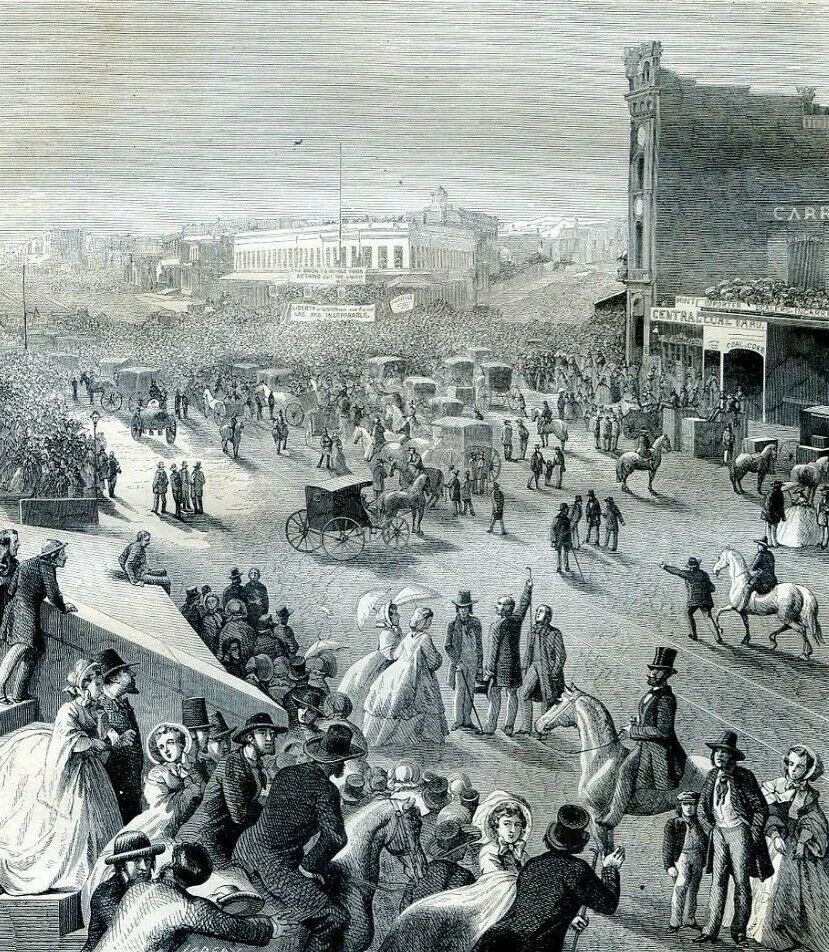
So goodbye for the present, — J. B. Edson
Look out soon for great news in Eastern Virginia.
Letter 34
Camp near Alexandria, Va. September 5th 1862
Dear Father,
I received two letters from home yesterday—one mailed on the 18th of August, the other on the 1st of this month. I was glad to hear of your all being well and am thankful that I still live. Since I last wrote you, we’ve been to Manassas or within a mile and a half of the battleground but not in time to take a part. If we could only have got there—that is, our Division & Corps—no doubt there would have been a different termination. I will tell you if I ever get home about the part our Division & Regiment took in that fight. I am sick of putting things on paper.
Well, I’ve just finished my dinner of pork and beans. I have not yet heard from the box. I think the man who said he would bring it to me ought to [have] made it good in some way or other.
I feel no interest in writing now days. I’m not disposed at all. The news of General McClellan having taken full command of the whole army fills me with delight. If they had not deprived him of his command before, he would have long ere this brought with the help of his brave legions this war to a successful close. “All honor to the Brave Gay Commander & woe be to the man that anyone of us hears abusing or disparaging him, our General.” I’ve been told by persons lately from the North that Gen. McClellan was very little thought of & in some places denounced as a traitor. If McClellan had been on the field last Saturday, things would have been different.
I suppose Capt. [George G.] Wanzer is on his way home by this time. I hear he has been called.
I will close hoping to hear from you often. As ever your affectionate son, — J. B. Edson
Send me some postage stamps and Albert’s last letter.
Letter 35
Wayside Marker at Crampton’s Gap
Crampton’s Gap September 15, 1862
Dear Father,
Your letter of the 8th I have just received & am glad that you are all well. Well, I have passed through another terrific battle with the enemy which we—that is, our Division—completely routed. The enemy were strongly posted in the above named gap. It was assigned to General Bartlett to open the engagement with his brigade which he did in gallant [style]. Our regiment was thrown forward as skirmishers to find the enemy and bring on the engagement. On we went right into the teeth of the rebel batteries. They opened on us with grape and canister & case shot but still on we went until the left of our regiment commenced firing. We fought them thus, picking off the rebel gunners and horses until the rest of our brigade came up to our relief which was just in time as our ammunition was just exhausted. Then General Bartlett ordered a general charge of the whole line. We carried everything before us, the rebs running like scattered sheep although having been just reinforced by Gen. [Howell] Cobb with his brigade. The dead and dying are laying all about.
It was a complete victory for us, Slocum having cut their line in two. It was a bold stroke but a successful one. I hear that yesterday they were repulsed everywhere. We are only about 5 or six miles from Harper’s Ferry near the town of Jefferson. You will see it on any of them maps that are in the New York Herald. Probably I shall see Albert in a few days if he is not shot or wounded. There has been heavy firing in that direction yesterday.
McClellan is in the field & I think all will yet be well. Our regiment does its duty everywhere. Remember. I expect we will move every moment.
Ever your affectionate son, — J. B. Edson
Letter 36
On the Battlefield near Sharpsburg, Maryland September 19, 1862
Dear Father,
Having a few spare moments, I will use them in letting you know that I am yet in the land of the living. Our Corps arrived on the field just in time to take the front & relieve the men who had been engaged all day. Our Division were not engaged. We did nothing of the offensive yesterday. Last night the enemy moved off. This morning our light artillery went after them. I hear them now thundering in the enemy’s rear. I read in the Clipper an account of Albert’s regiment cutting their way out of Harper’s Ferry. It was a gallant deed. I know not how Albert is. I hear the regiment is about a mile and a quarter from here near Williamsport. I’m expecting to see him every day. I want to see him very much.
We have bivouacked on the battlefield for two nights. The stench is terrible. There was one spot near our company where a Mississippi & Georgia Regiment made a charge, but just as they were crossing the fence, a storm of bullets met them & some sixty were stretched dead upon the field in every for which death by the bullet can cause.
The Monroe County Regiment—108th—were in this battle & young Robert Holmes is reported to have been killed. He was leading on his company while on the charge when a ball went through his breast & he fell. The bullet spares none. Capt. [George G.] Wanzer has not returned yet.
When you write, let me know all the news. How is Miriam getting along? I hear nothing from her. I suppose she has no thought for her long absent brother having [ties?] of another nation to call her attention elsewhere.
There will probably be another great battle soon which will terminate the contest of this fall. I leave you to guess as to what you think will be the result of that contest.
All hail to our young commander, McClellan.
From your affectionate son, — J. B. Edson
Saturday, September 20th—Before ending this, I can tell you that I’ve seen Albert. His regiment was on the move. I had to run from the rear of his regiment to the front in order to see him. He looked well. I’m expecting to see him now every moment having sent word to him to come & see me. Write soon & oblige your son, — J. B. Edson
P. S. Tell Hatt. to write me. Also cousin M. as I did not receive her letter she sent in the box. — J. B. E.
Letter 37
In Camp at White Plains, Virginia and 17 miles from the old battleground of Bull Run November 1861 [should be 1862]
Dear Father,
Your kind letter of the 26th inst. [ult.] I received only a few days ago. I not being with the regiment, could not get it when it arrived. I am in good health, thank God. Old winter has set in—snow an inch deep on the ground.
Well, one more in Old Virginia and nearly upon the same ground we have been on before so many times. We have made some tall marching, just back from Harrison’s Landing to Newport News, from there we sailed to Alexandria, marched through there to Bull Run and back to Alexandria, from there to Washington, through Maryland to Williamsport, and then back to Berlin, just this side of Harper’s Ferry where we again crossed into Virginia and are now very near Manassas again. Strange movements.
No winter quarters for the army this winter but strong active war. It is as cold here today & as strong as I’ve seen it in the North in this month. So you can judge how warm & comfortable we soldiers are. I’m in hopes they—that is, our army—will end this affair this month.
You spoke of Albert’s regiment as being attached to our Corps. It is not so. I’ve not seen him since the time near Williamsport, Maryland. I’ve heard while on this march that the regiment is out in front and in the advance & they have lost some in skirmishing with the enemy but where they are, I do not know.
Those gloves you sent by Lieut. Leggett I’m afraid I shall never get. I need the gloves very much as I cannot get any around here. You could send me a pair by mail or you could tell Albert’s mail [ ]. Give him the directions the same as a letter. Hoping to hear from you soon, I close ever remaining your sincere & affectionate son, — John B. Edson
to Elijah Edson, Esq.
Letter 38
In Camp 11 miles from Fredericksburg Stafford Court House, Va. November 26, 1862
Dear Mother,
Hearing that Father was not in Rochester, I will write to you instead. It has been some time since I heard from home. You know not how I feel when some time elapses before I hear from home. The soldier prizes a letter from home far better than any favors that can be conferred upon him. He needs all the encouragement in the way of hearing from home is concerned that can possible be given to him.
I’m again with the regiment having been at the commissary for the month. It was much easier there than in the regiment for I had my knapsack carried in the wagons. They are the greatest curse that the soldier has.
I received a letter from Annie McMillan a day or two ago which & answered in which she mentions Father’s being in Baltimore. She did not mention what he was there for. I wish you would tell me all about it & if he gets any better wages than he did when he used to go out 2 yeas ago.
Saturday, 29th. I received a letter from Father last evening in answer to the one I wrote when at White Plains. About two weeks ago I heard that Albert was back at or near the junction with some sick horses and that the principal part of the regiment was in the advance along with the 8th Illinois Cavalry. I haven’t heard a word from him since.
I received a letter from Annie McMillan about a week ago. She said in that Father had gone to Baltimore. If he is there, it is but a short distance to where we now are. He could go from Baltimore to Washington, then take the boat from there to Aquia Creek & it is only 7 or 8 miles from there to Stafford Court House and by enquiring for General Brooks’ Division. He—Brooks—has command of our division & has ever since sometime before we left Maryland.
I don’t believe I will ever get the gloves you sent by Lieut. Leggett unless Albert sends them by mail. It would not be policy to send anything by express to anyplace. You could send me a pair of gloves by mail quite easily & not have it cost but very little. I should prefer the pure buckskin glove to any cheap affair for they would not be worth the cost of the mail. We do not expect to be paid now until after the first of January & I should like to have you send me 2 or 3 dollars in money if you can as I need it very much. Also please send me one coarse and one fine tooth comb. Send them in a paper by mail.
The government thinks we can carry on a winter campaign here successfully but we soldiers have our doubts about it. It took 16 hours to pull our rifled gun from the mud into which it had sunk the other day. If we—that is, the army—should go into winter quarters, there is a good reason to believe the two years men will be discharged. If so, Bully for us!
I must now close, remaining as ever your affectionate son, — J. B. E.
Letter 39
On the Battlefield of Fredericksburg December 13th [1862]
Dear Father,
This is the second night that we have bivouacked upon the battlefield. The enemy is in strong position before us. We crossed in force yesterday morning the night before after our forces had finished shelling the city. Our regiment was ordered over & deployed as skirmishers and scour the country a short distance in front after which we returned across the river. The next morning—yesterday I mean—the whole left Grand Division crossed. Our position is near the center. Our lines is about 10 miles long so you may judge of the quantity of ground we cover and have to fight over. Our brigade lay under the fire of the rebel batteries all day. Tomorrow we take the front as skirmishers. I may fall. It is a hard contested field. It is (nip & tuck) with both sides so far although I believe the advantage if any is with Stonewall Jackson. I hear [he] commands the rebels.
We attacked them on the left this forenoon with a view of flanking them bit did not make much headway. They have a very strong position. The troops have to spend the night in the open air & tonight are not allowed to unpack their knapsacks. This order is that we may be ready to support the skirmishers in case they are being driven in.
I have not seen [brother] Albert yet. I was near their camp at Bell Plain. I suppose they are doing picket duty still in our rear. If we should beat the rebs here, I think it would be a final one for them.
I will now close this as I write under some difficulties sitting upon my knapsack & it upon the ground. The Rebel campfires are only a little over half a mile distance.
So goodbye. If we meet no more here below, may we meet in a far better world where war & conflict is not thought of. May God defend the right is the sincere prayer of your son, — J. B. Edson
Letter 40
Still on the Battlefield [at Fredericksburg] Monday morning, December 15th [1862]
Dear Father,
I will send you a few more lines this morning. Yesterday all day we were on picket and had to lay under their fire all day. Whenever we would put up our heads, they would pop at us. The Rebs are very strongly fortified. It will be a great sacrifice of lives to take their position.
Yesterday being Sunday, they did not commence on either side. I received the letter with the dollar which you sent yesterday.
So goodbye for the present. Your son, — J. B. Edson
Letter 41
White Oak Church, Va. February 25, 1863
Dear Parents,
Having an opportunity to send a few lines by Chas. W., recon I will improve them. I received the papers sent by Lieut. Roach & was glad to get them…
Albert is no where near me now or was he when I got [ ] He [ ] 20 miles away at Aquia Creek where, consequently, cannot get to him. I heard they had orders to go to Newbern, North Carolina. I let him have my watch some two months since. He then told me I could have the one he sent him so I shall reclaim mine…[ink is too faded to read]
Letter 42
White Oak Church, Va.
[Ink is too faded to transcribe]
Letter 43
Near White Oak Church, Virginia
[Ink is too faded to transcribe]
Letter 44
27th Regt. N. Y. State Vols. Near White Oak Church, Va. April 10th [1863]
Dear Father,
Received your letter of the 29th some days ago and have now concluded to answer it. We have just had another muster which will probably be our last.
The President & wife reviewed the army the other day. I was not present on account of a lame ankle. A couple of our boys have just started for the 8th Cavalry. I sent word to Albert by one of them telling him if he wanted to see me again before I went home, this might be his only chance.
The weather for the past 3 days has been exceedingly beautiful….You did not tell me how UncleJohn & Henry are prospering & where they are working & who for.
Father, I wish you to take the money now in the bank in my name & get you a Sunday go to meeting suit of clothes. You can have it in welcome & I want to see them on you when I get home—that is, on the first Sunday afterwards. Noe bear this in mind. If there should be more than you can use, let Mother have the rest to get her a tip top dress—that is, if there is enough now you understand. I will see to Hatt. when I return.
I will now close hoping to soon see you in person. As ever, your affectionate son, — J. B. Edson
We have now (one of Joe Hooker’s days)—the stormy ones.
We expect to start for York State in about ten days. I understand the 13th have given up their arms. I think I saw Albert last. I advised him to get a furlough. I wish he would. I would like to see him in Rochester. You may well feel proud of him for he’s a brave soldier. No fear in his constitution. 27 days at the most have we got to serve but that is short. If I should get my discharge in Washington, I should not go to Rochester with the company and there are a great many others that would not. Our officers have proved themselves to be mere nothings. They have never stuck to their promises. I have an abject…
The government was some 4,000 men to go to California after mules. The men are to be equipped as cavalry, two revolvers, saber and carbine. To proceed to New York City, from thence by steamer to California, to come back the overland route, the regular mail route & bring those mules back with each of us riding one & lead two. Pay $45 per month. …starting first of June. This is what I’m thinking of. I have not yet made up my mind. I have a often wanted to see California. I think it would be a good chance.
I have been feeling somewhat unwell, having a heavy cough, but I guess it will soon pass away. Do you think work will be plenty this summer.
I do not know whether I shall go to work at my business or no. I shall not be in a condition to do any heavy work at the first.
Capt. Henry P. W. Cramer, Co. A, 50th Illinois Infantry
These letters were written by Henry P. W. Cramer (1824-1899) of Mendon, Adams county, Illinois, who entered Co. A, 50th Illinois Infantry as the 1st Lieutenant on 12 September 1861 and was promoted to Captain on 5 February 1862 when Capt. Edgar Pickett resigned. Cramer remained as captain of the company until he resigned his commission on 15 September 1864 after three years service.
Henry was the son of Christian Cramer (1779-1852) and Mary E. Pitts (1791-1857). He was married to Jane Anne Dean (1825-1900) and the couple had three children born prior to Henry’s enlistment: William (b. 1849), Jessie (b. 1858), and Elmer (b. 1861).
All nine of these letters were addressed to and saved by Henry’s older sister, Catharine (Cramer) Burkholder (1822-1906), the widow of Daniel Burkholder (1815-1858). Catharine’s children included Christian Burkholder (1845-1864), Mary Elizabeth Burkholder (1846-1921), William Burkholder (1848-1922), James Wesley Burkholder (1850-1915), and Phoebe Ann Burkholder (1858-1937). Mentioned in the final letter of this collection is the death of Catharine’s oldest son, Christian, who enlisted on 31 March 1864 in Co. K, 116th Pennsylvania Infantry. He was wounded on 3 June 1864 at the Battle of Cold Harbor and died at the 1st Division, 2nd A. C. Field Hospital.
Henry’s older brother Adam K. Cramer (1809-1868) is also mentioned throughout these letters. Adam lived in Fayette county, Pennsylvania, with his wife Catherine Zufall (1810-1889). They had at least seven children, three of whom gave their lives for their country. Adam G. Cramer (1837-1863), Enos R. Cramer (1839-1863) and Samuel Cramer (1843-1863) all served in Co. B of the 142nd Penn. Vols. and all three were killed or mortally wounded on 1 July 1863 at Gettysburg while fighting in the area south of Herbst’s Woods. Enos and Adam died on the field but Samuel had an arm and leg amputation before he died on 9 July. [See: Video]
Letter 1
Camp near Corinth, Mississippi May 26th 1862
Dear Sister Catharine,
I received your letter of the 11th of May yesterday & was glad to hear from you & that you were all well & getting along well, but I was sorry to hear of our nephew White being killed at the Battle of Winchester. You say Samuel & Uriah Massena are in the army in Virginia and that Uriah was shot in the hand. You did not say what army they are in—whether it is the Rebel or Union army. Please let me know, but I suppose it is the Union army they are in. But then you know how easily Sam is persuaded to anything that I did not know but that he living in Virginia, the rebels might have persuaded him into their army. If they have, I almost wish he may be killed, but I hope he is all right on the Union question. How does sister Barbara get along while he is in the army? Does she have anything to live on or not For I do not suppose that he saves anything of his wages in the army to send home for her to live on, he being in the habit of drinking & there being so many ways to spend money in the army that I fear he will not save any of his money & that she will suffer.
I am also sorry to hear that the Imel boys fared so badly in the army but I am glad to know that they were willing to die for the old flag & the old Constitution. I am sorry to hear of the death of cousin Bacon. I think he was a good man. Where did he live? You spoke of sister Elizabeth. Where does she live? Does she live with Martha or where does she live & does she still own that land she bought? What is her post office address? Please let me know. I cannot tell whether Jane have answered the letters you spoke of or not but I think she has. You must keep on writing to her for it does her good to get a letter from a friend in her lonely condition for she is very lonely in my absence.
I understand from Russell and from Christian also that they have quite a correspondence with each other. I am glad to hear it for it will tend to improve their minds as well as keep up a friendly feeling between them. Christian said I should write to him as soon as I got your letter. Tell him I would be glad to do it but I have so much writing to do & so little convenience for writing that I will have to make this one do for you & him both this time & I do not have very much spare time to write letters either for I am kept busy nearly all the time with one thing or another connected with the company. You say you hope the time will soon come when war and bloodshed will come to an end & that I may be spared to return to my family. Catharine, you cannot wish so anymore than I do. It is my daily—yes, constant wish & prayer for I am heartily tired of war & its horrors & of being absent so long from my family. But I think the time is not far distant where those of us that are not killed will be permitted to return home if we are successful at this place & I cannot but help thinking we will be although I expect it will be a desperate struggle if they fight at all & I suppose they will. But I cannot tell when it will come off any more than you can.
There is skirmishing all along the lines all the time between the two lines of pickets for our lines are now within two miles of each other and occasionally a man taken prisoner, wounded or killed on both sides. We have now two hundred thousand troops here. Gen. Halleck is here in person. They have also got a large force but from what we can learn of deserters from their army & of returned prisoners to our army, they have not got so large a force as we have into many thousands. Neither have they near so much artillery as we have. We may have to lay here a month or move yet before the fight comes off for I do not think that General Halleck intends to fight until he has everything just to suit him & he may not intend fighting them at all but trying to surround them and starving them out for they are said to be quite short of rations.
I have passed through several conflicts unhurt & pray God that He may spare my life so that I may return to my home in safety. I want you to remember me in your morning and evening prayers that I may come out of this contest unharmed. It is as you say, this may be the last time I may write to you in this world. God only knows what the result will be. I wish you would see brother Adam and tell him to write to me & give me his correct post office address so that I can write to him if my life is spared to do so. I have written to him a number of times & have got no answer from him. I have concluded that I must not direct my letters to the right post office for him to get them or he would answer them…
How is the Harbough’s getting along? Is Uncle Leonard dead or not? If I did know, I have forgotten. I will have to bring my letter to a close. Write as soon as you get this. Direct as you did before & tell Adam to direct in the same. When you write to Elizabeth again, tell her to write to Jane and Jane will write to her. Tell her and Martha and Rebecca to write to me. Also tell Barbara to write to Jane & I both & we will write to all of the, if they will give us their post office addresses. Give my love to Lena and my respects to all enquiring. No more. God bless & protect you all. Goodbye dear sister.
Your brother, — H. P. W. Cramer
To Catharine Burkholder
P. S. Just now there is heavy cannonading off on our left a good ways. The engagement may be coming on now. but I do not think it will be general yet for a few days.
Letter 2
Addressed to Mrs. Catharine Burkholder, Drake Town, Somerset county, Pa.
Camp near Corinth, Mississippi June 28, 1862
Dear Sister Catharine,
It is with pleasure that I sit down to write you a few lines away down here in Dixie & to let you know that I received your letter of the 16th June last night. I was glad to hear from you and that you and your family are all well. I also had a letter from Jane last night stating that they were all well for which I am truly thankful. My family has been blessed with exceedingly good health ever since I have been away from home. I am in my usual health. Hope these lines may find you and yours still enjoying good health.
We are now encamped about two and a half miles south of Corinth on the Mobile & Ohio Railroad. I and my company have passed through the Corinth affair unharmed although we were under fire of the enemy several times before the evacuation. Our regiment was kept in the advance all the time we were moving on Corinth from Pittsburg Landing. The last engagement our regiment had with the Rebels before they evacuated was the last day but one before they left. In it we had one man killed & four or five wounded in the regiment, but my company came out without a scar, although the leaden hail flew thick around us. In this encounter our regiment as usual was thrown out in advance (it being the centre regiment of the Brigade) some two hundred and fifty yards. We came out of the brush into a road by an open field. The Rebels were on the opposite side of the field & opened fire on us as we emerged from the brush. We could not see them. We then fell back into the brush again about 20 paces and halted to see whether they would come out or not. They then charged on us across this open field with about three times our number & with a yell. When they got fairly out into the field, we opened fire on them with our artillery which very soon stopped their noise & drove them back with great loss. They never came out after this.
I cannot tell how long we will remain here but the prospects are that we will stop here nearly all summer. We have been some thirty miles farther south than this since the evacuation but were ordered back to this place where we have been ever since. This is a hard climate on us northern men. It is very warm & debilitating—so much so indeed that we cannot drill any, only in the cool of the morning & evening. The water we get here is so poor & unhealthy, it being mostly surface water.
I hope Mc[Clellan] will succeed in flaxing them out at Richmond & that soon so that they will move us farther north, if not home. In my opinion, the result of the Richmond battle will be the decisive one in a great measure. This is a poor country down here. I would not give 20 acres of our Illinois land for a whole plantation of it & be obliged to live on it. In fact, it is hardly worth fighting about, niggers and all. But then that is not what we are fighting about. We are fighting for the Constitution as our father’s made it & for the Union & republican principles. I do not mean the principles of the Republican party, but principles of a republican form. The Rebels are contending for the principles of anarchy & despotism. God forbid that they should ever succeed in establishing them in this fair land of freedom. My prayer to God is that the Old Stars & Stripes under which we as a nation have been so prosperous may forever continue to wave all over the land of the free and the home of the brave.
Our regiment has become considerably reduced in numbers through disease and battle. When I went into the service, my company was full, 101 men all told. Now it is but seventy and will not be that long for I have quite a number of men that will have to be discharged in a short time on account of disability. The other companies have lost at about the same ratio & if we remain down here all summer, I fear we will lose still a great many more. I do not want you to understand that these men are all dead that have left the regiment. About half of them are.
I am sorry for Sam Massena 1 that he has had such bad luck, but he will not remain a prisoner long. He will either be exchanged or released on parole. Poor wretch. I pity him. Tell Uriah for me that he must not become discouraged fighting in so good a cause as ours is, but that he must keep up his spirits & fight the harder. A soldier’s life is a hard one, I very well know, but if the troops will only keep up their spirits & fight bravely, it will be over much sooner than if they allow themselves to become disheartened, for then they will not fight half so well. When you write to Uriah again, give him all the encouragement you can. Tell him to fight bravely if called upon to fight and avenge his father’s capture.
I will quit for the present. Write soon. Direct as usual. Remember me at a throne of grace. My regards to all enquiring, &c.
Your brother, — H. P. W. Cramer
To his sister Catharine Burkholder
P. S. What has become of the Aughinbough’s?
1 Samuel Massena (1820-1874) married Henry’s sister, Barbara Cramer, and lived in Aleppo, Greene county, Pennsylvania. He served in Co, A, 12th West Virginia Infantry (Union). Their son, Uriah Massena (1842-1908) served in Co. K, 26th Pennsylvania Infantry. Uriah’s biography claims he “loyally and bravely served his country for three years and three months.”See 1861-62: Uriah C. Messina to Catherine Burkholder published on Spared & Shared 16.
Letter 3
Camp near Corinth, Mississippi August 19, 1862
Dear Sister Catharine,
I sit myself down to write you a few lines in order to let you know of my well being & that I received your letter the other day with great pleasure. I am glad to hear that you and family are all well, or were at least all well at the writing of your letter. I am sorry to hear that you have so much sickness in your neighborhood. You say you should have answered my letter sooner that you did but for the reason of your having so many sick patients to visit. Well it seems that both of my sisters have turned Doctoresses for you said in one of your other letters that sister Barbara had taken up the practice of medicine. Well I guess if I get sick, I will send for someone of you to come and doctor me—that is, if I can raise money enough to pay the bill for the bill must be pretty high at the rate that other doctors charge for visits when you take into account the distance that you would have to travel to attend me. But I hope I shall have no occasion to call on you. At present I am very well & tolerably comfortable in my situation for the situation of a soldier is changeable like that of other people—sometimes more comfortable than at other times.
We have had no trouble with the secesh since the evacuation of Corinth. Yesterday morning we were called into line before daylight to be ready to march at a moment’s notice, but the alarm that had been given proved to be a false one so we did not have to go this time.
I had a letter from Jane yesterday. They were all well when it was written the 11th. In it they stated that they had got the report somehow at Mendon that our regiment had been engaged in a skirmish with the enemy & that we had been badly cut up. Now that was all false. I cannot see how such reports get started. They certainly do no good. But on the other hand a good deal of harm—that is, if you take into account the grief and anxiety of mind occasioned by such reports to the friends at home who have connections in the army on account of their safety. I think there is a better prospect now of bringing this war to a close than there has been at any time since it began—that is, soon as all those new troops are got into the field & that will not be long. It looks now as if the government was determined to sustain itself & this is the way to do it for the more men we have in the field, the sooner the rebellion will be crushed & it will cost the government less also. The Confiscation Act is also another grand move toward ending it; so also the emancipation of the slaves of Rebels & employing them in our army. Every slave we take from them weakens then one man and strengthens us one man for they employ them constantly against us.
I am sorry to hear of the deaths of T. Aughinbaugh & T. Lightlider. Where is Thad’s family? Had he squandered all the property Mr. Boose had given him or not? You say Sam Massena has got home. How did he get away from the secesh? Was he released on parole or how? I am glad that Uriah is in better spirits than he was. What kind of a young man is he? Is he wild like his father or is he steady in his habits? Why does Adam not write to me? What is Frank Long doing in Springfield? I will have to close with this.
Your brother, — H. P. W. Cramer
Write soon. Give my respects to all friends.
Letter 4
Addressed to Mrs. Catharine Burkholder, Drake Town, Somerset county, Pa.
Camp near Corinth, Mississippi September 26th 1862
Dear Sister Catharine,
It is with pleasure I take my pen up to write you a few lines, but I am so nervous it is with difficulty I can write at all. I cannot account for it. I have been so for some time by spells. I received yours of the 14th on yesterday. I was truly glad to hear from you, to know that you were all well and getting along well. I trust these lines may also find you all in good health. It does me good to hear such a favorable report from Uriah. I was fearful he would be led off by the example & bad influence of his Father, but I am glad it is not the case. I hope he will be spared to get out of the army & become an honorable man. I am glad to hear that Sam has grit enough to go into the army again. Was he exchanged or was he only paroled. If he was only paroled & the rebels capture him again, it will go hard with him. How comes it that Uriah is staying in the hospital? Is his health poor, or has he been detailed as a nurse? What regiment and what company does Frank Long belong to and where are they posted now? Let me know. I want to write to him.
We had another engagement with the Rebels a few days ago at Iuka—a small town about 22 miles from here. Our men whipped them soundly. Our loss in killed and wounded from 150 to two hundred, killed about 70. Rebel loss 800 to 1,000 killed & wounded, killed about 300—at least our forces buried two hundred and seventy of the Rebel dead & of course they had not found them all at that time yet. Our regiment was not in the fight. Neither was our Brigade but the balance of our Division was there but was not engaged. It is a wonder that we were not in it for they have kept our regiment in the advance whenever there was any trouble on hand ever since we left Pittsburg Landing. But I am not sorry at all that we were not in it. I have been in all the fights that I care about being in.
“I am not an abolitionist by a long shot, but if freeing the slaves will tend to end this war, for God sake, free them, & in addition to that, we can never have lasting peace in the United States while slavery exists in it.”
—Capt. Henry Cramer, Co. A, 50th Illinois, 26 Sept. 1862
Our army has been doing some good execution in the East of late. If they will only keep on doing so, the Rebellion will be crushed in a short time. I thank God that the President has finally proclaimed the slaves of Rebels free. I think it will go farther towards putting down the rebellion than any other one act that could be done. I am not an abolitionist by a long shot, but if freeing the slaves will tend to end this war, for God sake, free them, & in addition to that, we can never have lasting peace in the United States while slavery exists in it.
It is strange that I do not get brother Adam’s letters. He must certainly not direct them right or I would get them. Instruct him how to direct. Do you know anything about Josiah Philippi—how he is getting along? Has he ever rebuilt the house and shop, has or is likely to get out of debt? There is still a matter of 50 or 60 dollars coming to me from him on that property. Is there any prospects of him marrying again & if there is, who to? I have written to him several times since I am in the army but never got an answer. What ever became of Jeremiah Philippi? Is old Christian Philippi still alive and does he still preach? How does cousin John Cramer, Betty Shoff, Aunt Lizzy, & all her boys & the children of all these get along?
Catherine, there is one thing I want to speak of to you and probably you may think it is none of my business. You are now a widow with your children all around you & they appear to be good children. Your boys seem to work well & you appear to be getting along very well. I do not know what your intentions are with regard to marrying again, but my advice to you would be to remain a widow unless you can better your condition very much by marrying again. You might get a husband that would ill treat your children which certainly would be a source of great annoyance to you and your children also, & in addition to all that, he might squander what you & your children have gathered. I do not want you to think hard of me for these suggestions, I merely make them as such.
I would like to hope you get your own & your three oldest children’s likenesses taken & send them to me. Have yours and Mary Elizabeth’s on one plate and the two boys on one. You can have them put in a double case; then it will take but one. I would like o have the pictures of all the children but perhaps it would cost more than you would like paying out. Get good ones taken. If they are not perfect the first sitting, make them try until they do get good pictures. If you send them, have the case well done up in paper and sealed or pasted & directed the same as you would a letter. I will send you mine some of these days.
How is Lena and her family? Give them my love. I also had a letter from Jane yesterday. They were all well with the exception of sore eyes & Russell had cut his foot pretty bad.
We are a good ways south but the nights are getting so cool that it is quite uncomfortable in our tents. Is there many chestnuts and cranberries this season? If there is, I wish I had a bushel or two of each, but that cannot be. They might be sent to my folks but they cannot be to me. I had better quit for I have already asked you more questions that you will be able to answer in one letter. Write soon as you get this & answer my questions if you can. Goodbye &c.
Your brother, — H. P. W. Cramer
Letter 5
Camp near Corinth, Mississippi November 3rd 1862
Dear Sister Catharine,
I received yours of the 20th of October. I was happy to hear that my letters reach you as promptly as they do. You are now the only blood relative with whom I am in communication. I can get no answer to my letters from brother Adam, & I have written to cousin S. K. Cramer in Iowa & get no answer from him either so that it leaves you my only correspondent of the Cramer stock. If you will give me Adam’s proper post office address again, I will write him again. I keep forgetting his address all the time. I send your letters that I get from you home to Jane so I have nothing to refer to to find it out again, only by asking you. Give me the proper name of his post office & county is all I want and tell him again to write to me at this place. Let me know how he is getting along, whether he is making anything or not, how his sons & daughters are doing, & all about them, & whether Adam’s wife is as she use to be.
Well, Catherine, we have passed through another bloody battle at this place since I last wrote you. It commenced on the 3rd of October, just one month ago today, & ended on the 4th of October. I have again been spared without a scar for which I am truly thankful but I came very near being wounded. Our regiment made a charge on the enemy on the 3rd. While we were in the charge, the enemy turned our right flank and we were obliged to fall back. In this retreat I was struck by a ball in my left coat sleeve. It entered a little above the wrist and passed out over my hand. It caused my wrist to smart so much that I at first thought I was wounded, but on examination I found it was not. Pretty close cutting, was it not? I feel convinced that it is nothing but God’s protecting care that preserves me in these hairbreadth escapes, while at the same time I do not deserve the least of His notice, but instead, thereof His just displeasure.
I lost out of my company on the 3rd, one killed, two wounded & one missing. On the 4th, three wounded. The Rebels came very near defeating us several times. In fact, they did drive us at nearly every point on the 3rd (we fought in the woods on the third) & it was the charge that I have spoken of that saved the day to us on the 3rd. On the 4th, we fought in the edge of town. They had to come out into open ground to attack us. We killed large numbers of them in their attempt to cross this open ground but still they drove us back a short distance. But we soon rallied our men again & drove them from the word go, slaughtering them at a fearful rate & taking great numbers of them prisoners. After the battle, we buried between 13 and 14 hundred of the Rebels. Our loss was 350 killed. The loss in wounded on both sides was about 5 to one killed. Our loss in prisoners was about 400. Theres was upwards of two thousand. We followed them 35 miles. Our advance followed 45 miles. In their hasty retreat, they threw away immense quantities of arms, ammunition, tents, wagons, cooking utensils, cannon, & in fact, the greater portion of all they had.
“If the Rebel Price & his army ever had a trouncing, they got it here on the 3rd & 4th of October 1862. It is said they are advancing on us again. All I have to say about that is that if they do come, they will get whipped worse than ever..”
—Capt. Henry Cramer, Co. A, 50th Illinois, 3 November 1862
If the Rebel Price & his army ever had a trouncing, they got it here on the 3rd & 4th of October 1862. It is said they are advancing on us again. All I have to say about that is that if they do come, they will get whipped worse than ever for we are now fortified at his place [such] that fifteen thousand can resist 60 thousand successfully. But I shall not be sorry at all if they do not come for I certainly have fought them as often as I care about. But if they do, I will try it again. I am better of my nervousness.
Sometimes we fare first rate on account of provisions, at other times we are rather hard up. Officers are not furnished grub by the government but have to buy it so when we are in a place where we can get anything to buy, we live pretty well, but I have saw that when we could get but little of anything, the men fare rather slim sometimes. Also on account of being so situated that the Quartermaster cannot get rations for them. My bed is a couple of blankets & the mother earth. My two Lieutenants [Sergeant Moody and Henry C. Bissell]and I sleep together, each of us have two blankets. We spread two on the ground to lay on & use the others for covering. A soldier’s life is a hard one at best.
I am sorry to hear of the deaths you speak of. What was the matter with cousin Joseph Pritz & what condition is his family left in? At one time you know he had become very intemperate & squandered nearly all his effects. Had he been doing any better lately? What Jacob Miller do you mean? Is it Levi & Jonathan’s brother or some other Jacob Miller? If Capt. F. Long has been captured by the Rebels, I am sorry for it. I used to think a good deal of Frank although he was a wild fellow. Yet he had some very good traits about him. If he is at home & you can get to see him or get word to him, tell him to write to me. I am pained to hear of the affliction of cousin Henry Cramer. What occasioned the tumor on his back that you speak of & how long has it been there? Has he ever tried to have it cut out? I am glad that my suggestion to you in regard to a certain matter were not taken as an offense by you & that our thoughts corroborate so very nearly with each other on that subject. It is encouraging to me to know that Adam’s sons are willing to stand by the old flag of our country. God grant them success & a safe deliverance.
I received a letter from Jane yesterday. They were all well. It was accompanied by her own & the children’s likenesses. I was happy to receive them yet I could barely restrain myself from shedding tears at the sight of them, not knowing whether I shall ever be permitted to see the originals of those pictures in life again or not. These thoughts make me feel sad. I have not got mine taken yet to send to you but will do it soon. Send yours and the childrens along as soon as you can for it may be all that I shall ever see of you & perhaps not even that for life is very uncertain & especially in the army. Tell cousin John Cramer & cousin Betsy Shoff or John to write to me occasionally. Write soon, &c. Your brother as ever, — H. P. W. Cramer
To my sister Catharine Burkholder
This American Battlefield Trust Map shows the location of the 50th Illinois positioned in the center of the Union line just to the right of the 10th Ohio Battery.
Letter 6
Camp near Corinth, Mississippi February 11th 1863
Dear Sister Catharine,
I sit down this afternoon to address a few lines to you. I received yours of December 14th some time ago but have been so busy ever since that I did not get it answered. You will please excuse me. I have still not had an opportunity of getting my picture taken to send to you but I will send it just as soon as I can get it taken. I want you to send yours along & not wait for me. You are differently situated from what I am. You can go and come when you please. I cannot. Military rule is very strict. It necessarily must be. I cannot get away at all nor anyone else without getting permission & that we cannot always get.
I have had some pretty hard times since I last wrote you. About the time I got your letter, the Rebel Forrest made a raid across the Tennessee River for the purpose of cutting our communication off & did succeed in doing it. We were ordered out in pursuit of him & his gang. We started out at 10 o’clock at night on the 18th of December & marched all of that night & the four succeeding days & till 11 o’clock each night. We marched 130 miles in that time. I had a pair of new boots on. Oh but they did hurt my feet. I believe I never traveled in so much misery in my life. That is about the biggest marching on record for an army. The usual distance for troops to arch in a day is from 10 to 12 miles, but this was a forced march—at least my feet felt like it. Well when we got back to Corinth again, we were put on half rations on account of the Devils cutting our communications off. We were on half rations about three weeks. I tell you, we almost suffered for the want of something to eat. I tell you, it seems hard when men have to be denied enough to eat. The Rebs did not take much out of this raid after all, although we did not find them. But Gen. Sullivan with his forces did and gave them a sound drubbing, taking quite a number of them prisoners and all of their artillery but two or three pieces, & drove them back across the Tennessee River again. Within a few days, this same gang under Forrest was whipped again at Ft. Donelson. They lost 150 killed & 300 wounded. I think Forrest had better give it up for a bad job.
We now have plenty to eat again, communication having been opened again. I went to Memphis, Tennessee, on last Friday in charge of some prisoners of war from this place—Rebs of course. I had 38 of them. Memphis has been a beautiful place & still is, but the ravages of war are visible all over it. A great many very fine buildings are entirely demolished. The court house square is the most beautiful place I believe that ever I saw. It is still unmolested. It is set full of evergreens. A cedar and a magnolia tree are alternately [planted] with quite a number of forest trees interspersed. In the centre stands he monument of that Old Hero & lover of the country, Andrew Jackson. One one side of hte monument is inscribed these memorable words of his—“The Federal Union must be preserved.” These Devils, although professing to be Jackson’s disciples, have really undertaken to deface this inscription. The word “Federal” is very much defaced but is still legible. The engraving is so deep they could not deface it entirely without spoiling the entire monument. But the greatest curiosity about this square—to me at least—was the squirrels that are in it. There must be at least one hundred grey squirrels in it. They are as tame as cats. One can walk up to them & nearly lay their hand on them & they do scarcely notice you. It is a beautiful sight to see them gamboling about through this square. There are boxes placed on those forest trees in which they have their nests. The whole is enclosed with a very neat, ornamental iron fence.
You said Jerry Philippi had been in the Pittsburg Landing fight. How I should have liked to have seen him. You say we are near together if we only knew it. We may have been then, but may not be now. The troops that were in that battle have since been wonderfully scattered & it is almost impossible to find a person in the army unless you know what company & regiment he belongs to & what state he enlisted from. I would stand the treat as the saying is if I could get to see him. I wish you would find out the letter of his company, the number of his regiment, & what state the regiment belongs to & let me know it forthwith.
I had a letter from Jane the other evening. They were all well. I have some notion of resigning and going home. My health is not so good as it has been but still I suppose I could stand it. It is on Russell’s account that I think of doing it. He always was a hard boy to manage. It was all I could do to keep him under subjection. Jane writes me now that he has got entirely beyond her control—that she cannot do anything with him. I am well convinced that I owe a great deal of duty to my country, but if I am not mistaken, my first duty is to my family. He is now about the right age to be ruined forever if he is spoiled now. The old adage says that charity begins at home and I think if everyone will take hold & do as much as I have done toward putting down this hellish rebellion, it will be dried up in a short time, so I think no one can blame me for resigning if I do.
I am tolerable well with the exception of a very bad cold. Hope you and yours are all well. Give my respects to all the friends. Write soon as you get this &c.
Your brother, — H. P. W. Cramer
Letter 7
Camp near Corinth, Mississippi February 22nd 1863
Dear sister Catharine,
I sit down on this the birthday of the Father of his country (viz) Washington, to address a few lines to you. Although there is no letter due you from me at this time, I sent you one some 8 or 10 days ago to which I have got no answer yet, but as I have now my picture taken, I thought I would send it along without waiting for an answer to my last. I wonder what George Washington would have to say about this hell-begotten rebellion if he were now living. I think he would make some of those God forsaken traitors, both North and South, quail before him. I think they will begin to shake in their books ere long as it is. In their boots, did I say? Well, if I did, that is a mistake of mine. So far as the South is concerned for the southron army has neither boots nor shoes to shake in, or else they are lied on most scandalously.
I had a letter from Adam the other day in which he said that Uriah Massena had been to see them & that he (Uriah) said he had been taken a prisoner at Vicksburg & paroled. How is this?—he being in the eastern army and taken a prisoner at Vicksburg? There was none of the eastern troops sent to Vicksburg that I know anything of. It looks mysterious to me. He must have been in th Rebel service if he was taken at that place as he said he was, or he has deserted from the eastern army & has hatched up this prisoner & parole story to screen himself. If he has done that, if if he has been in the rebel service, I hope he will be arrested and punished severely for it. It makes no difference with me if he is my nephew. A deserter should be punished for forsaking his country and flag. Of course I had much rather it were not so—if indeed it is so. At any rate, it looks smutty to me. You may be able to explain it all satisfactorily to me. I wish you would if you can.
The picture I send you is a photograph likeness. I like them much better than I do the other kind. They are much more correct and cost but little more by getting half a dozen, they will not cost so much as the others, but one alone will cost more, and sitting will do for a hundred or more after they have the negative as it is called (for that alone the sitting is required). They can print a hundred or more from it, consequently the first two or three they are cheap. I wish you would have yours. A photograph instead of the other kind if you have not already got it. I suppose you would have to go to Connellsville or Somerset to have it done but that would only be a pleasure trip for you seeing you have your own horse and conveyance & in addition to all that, you might come across some good-looking widower (grins).
I will send out in this letter for Lena also, give it to her if you please & tell her that I want her to send me hers and her husband’s in photograph, hers alone if she does not feel able to get both. I want you to send them right along now. If I am spared to have the opportunity of getting the picture of my whole family taken, I will send it to you also, but at present it is out of my power to do so. I have sent one likeness to Adam & if you will again give me the correct Post Office address of my other sisters in Green county, I will send one to each of them. I mean Rebecca, Marth, Elizabeth, & Barhary. I believe they are all living yet—at least I have not heard of the death of any of them…
There is some talk of us having to leave here but I cannot tell yet whether it is true or not. I hope it is not for I do not want to go into the field until the weather gets better for we have horrible weather here. It averages about three days rain to one of sun & cold too. It is like the correspondent said of Virginia, water 6 inches and mud the balance of the way. But it is not as I like in this matter of moving. When we get an order to move, we have to go, rain or shine.
I am well with the exception of the cold that I spoke of in my other letter sitting on my breast or lungs but is getting better. I had a letter the other evening from Jane & the children. They were all well except Jane. She had had a bad spell again and that miserable sick headache. It appears that is going to follow her through life. I guess I had better quit for I have about run out of material. Now don’t forget those photographs & tell Lena not to forget here either for I will look for them certain now. You wil l have to be careful about handing them. A little scratch or anything of that kind will spoil them. Give my respects to all enquiring. Who lives now where Thad Aughinbaugh did live? Write soon & answer all my questions both in this and the other letter. May the good Lord protect and preserve you all. Goodbye. Your brother, — H. P. W. Cramer
To his sister Kate.
P. S. That is the fashionable name for Catharine.
Letter 8
Rome, Georgia June 5th 1864
Dear Sister,
I received your kind letter some days ago but was on the march at the time, consequently I could not answer it. I will now try to do so. I was glad to hear from you as I had not heard from you directly in a long time. I was glad to hear that you and your family were well and that Christian has gone into the service of his country. You say it was a hard trial for you to part with him. I have not the least doubt of that. I have had some experience in that line myself. It has always been a trying time with me when the time came for me to leave my dear family and return to the army, but after all we have a duty to perform which we owe to our government which we, if we are loyal citizens of America, will perform regardless of our inclination for ease and comfort which we would enjoy at home. I say it is our duty to go forth to protect and sustain the flag of our country—the glorious old Stars & Stripes, long may they wave over a land of freemen. Our families and family connections are pretty well represented in this war, I think it can hardly be said of the Cramer family that they have failed to show a spirit of patriotism in the time of their country’s need.
In a letter that I had from Jane a few days ago, she tells me that [our son] Russell has also enlisted in the hundred days service. I was sorry to hear it on account of his youthfulness (he is only 15 years old), but I hope he will stand it that length of time. Poor fellow. It may do him good if he lives. One thing it will do, it will cut his eye teeth for him, as the saying is. There are hard things to contend with but we must endeavor to overcome them manfully.
I saw Uriah Massena since we are on this campaign about two weeks ago. He is in the 4th [West] Virginia Regiment, 15th Army Corps. We have been near each other before but did not know it. I should not have known it then, not knowing what regiment he was in. He knew from some source that I was in the 50th Ills. Regt. & enquired for the regiment, It happened that we were moving in the same column and were close together at the time. We had halted for rest & dinner one day on the bank of a creek. I was very dirty & had gone to the creek with my Lieut. to wash. When I got back, I noticed a young man talking with one of my men that looked strange to me. He approached me & addressed me in the familiar term of Uncle. I looked at him for some time & asked in my mind, who in thunder are you. He extended his hand to me. I took it and told him that he decidedly had the advantage of me. He then informed me who he was. I was perfectly taken aback, I had not had the least idea of meeting with him in the Western Army. He was well & looked well. I may be mistaken but I think he is a better boy than I expected he was. All that I judge from is his appearance. I had formed and idea that he was a chip off the old block, but his appearance does not bespeak that for him. Am I right or am I wrong? He told me that [his father] Sam had quit drinking. Is that so, or is it not? Well, I also saw Jerry Philippi & Absalom Pile this day two weeks ago. They are both in the same company and regiment, Co. B, 76th Ohio Regt. They were well. They both knew me. I knew Pile at first light, but I should not have known Jerry if he had been pointed out to me. He looks so very old. I was astonished to see him look so old. I was never more pleased to see an old friend than I was to see Jerry. He was equally pleased to see me. He is still the same warm-hearted Jerry as of yore.
Well, I have again through the protection of God passed through another desperate battle, or series of battles, without being harmed. I thank God for it. One man of my company only was wounded. Our Division, the 2nd of the 16 Army Corps under General Dodge lost about 200 men. We are now doing garrison duty at this place. The balance of the Division is in the front 35 to 40 miles south of this. They have been charged upon 7 times since we left them but have never faltered but repulsed the charge every time. It is a fighting division of the true metal. Cannot tell how long we will stay here.
You say Elizabeth has a bastard but do not say what Elizabeth. I am ashamed of her whoever she is. Do not say anything to Jane about it in writing to her. I am well. Must quit. Have no paper but what I get out of old rebel books. Goodbye, — H. P. W. Cramer
God bless you all.
What Co. & Regt. is [your son] Christian in? Who is his captain and who his Colonel? Tell him to be a good soldier & to write to me. God bless him and protect him.
Letter 9
Rome, Georgia July 10, 1864
Yours of the 26th June was received yesterday evening. I am truly sorry for to hear of the death of your dear [son] Christian. I have not the least doubts about his being a good boy. I sympathize with you in your bereavement but you need not, or at least you have no cause for doing so, mourn as those that have no hope. In the first place you say he had been regenerated in heart & that you think he was steadfast. I think so too from the tone of his letter to you. In the second place, he fell at his post in the discharge of his duty, nobly defending Liberty, and the cause of oppressed and downtrodden humanity & the best government the light of the sun ever shone on. God surely will not cut off those who die in the cause of right. He is a just God & loves those who do right & labor for the cause of right.
It is a severe blow, it is true, to be bereft of one so near and dear as a son in the bloom of youth—one just stepping into manhood. But when we think of the cause in which he died and the probable trouble, annoyance, vexations of spirit with which he would in all probability have been beset in this sin stricken world had he lived, that he has escaped all these things, they are calculated o ward off in a great measure the blow which under other circumstances would have fallen much heavier, you must strive to bear your affliction with Christian fortitude. God will not forsake the widow, neither do I believe He will forsake those whose main stay & support is slain in defending the cause of Liberty.
I had hoped that he & I would live to see each other. I had been as it were instinctively drawn towards him from the letters that he used to write me occasionally, but my hopes are all blasted. I wish I was near you so that I could render you some comfort and assistance. I am sorry to learn that my opinion of Uriah was incorrect. What trifling habits does he have? You say there has five of our nephews [been] killed besides Christian who is the 6th one. I recollect of none but Adam’s three sons, Christian, & P. Whipkey—5 in all.
Where is Elizabeth living at? What on earth does she mean to act the way she does? I should have thought her first lesson ought to have taught her enough of this kind of conduct. It is an old saying that children that have had their fingers burned are afraid of fire. It is a pretty true saying too, but it does not hold good in her case. She must not have as much sense as a child. Enough of this. The subject is mortifying to me.
How does your other boys do? Are they industrious and obedient? I forget which is the next oldest. I think it is William. He must be nearly grown by this time. Tell them that I want them to be good boys, to obey their mother in ll things & to take for their example their brother who has fallen in defense of his country. Tell them to write to me,
The regiment that Russell belongs is the 137th Illinois. It is stationed at Memphis, Tennessee. I have not heard from him directly since he is in the service. Old ex-Governor John Wood of Quincy, Illinois, is his Colonel. he is the Father of Quincy. He is quite an old man, near 70 I should judge.
It is very warm here at this time—the thermometer averaging about 95 degrees. No news worth speaking of. Sherman has got Joe Johnston on the run again. Will take Atlanta in a short time if he has not already got it. There is now a General Hospital established at this place. There is about 2,000 sick and wounded soldiers here set from the front. Three of my boys died of disease during the month of June. Russell has grown very large. When I was at home last winter, he was nearly as tall as I am. I am well. Hope you are the same. God bless you. Goodbye. Your brother, — H. P. W. Cramer
I could not find an image of George but here is one of Ira H. Felch who also served in the 39th Massachusetts Infantry (Excelsior Brigade Store)
This letter was written by George R. Harlow (1838-1908) who enlisted as a private in Co. E, 39th Massachusetts on 12 August 1862. In this letter, datelined from the regiment’s encampment near Cedar Mountain in January 1864, George imagined that the fighting might soon be over. Little could he have realized the fight left in the Confederate army. Just after his promotion to corporal, he was wounded slightly in the fighting at Laurel Hill, Virginia, at the beginning of Grant’s Overland Campaign and then again quite severely on 18 August 1864 in the fight for control of the Weldon Railroad near Petersburg. Following the amputation of his right arm, George was sent to a hospital in Washington D. C. where he was mustered out of the regiment for disability on 17 March 1865.
George was the son of Eldad Hitchcock Harlow (1803-1883) and Almira Clark (1807-1890) of Westminster, Vermont. He wrote the letter to his sister, Julia Elizabeth Harlow (1840-1869), who married Edward R. Taplin (1843-1872) in 1867. George died in Chattanooga, Tennessee.
To read other letters by member of the 39th Massachusetts I have transcribed and posted on Spared & Shared, see: Julius Marshall Swain, Co. B, 39th Massachusetts (3 Letters) Joseph John Cooper, Co. F, 39th Massachusetts (1 Letter) Benjamin Curtis Lincoln, Co. G, 39th Massachusetts (20 Letters)
Transcription
Addressed to Miss Julia E. Harlow. East _____, Mass. Postmarked January 19, 1864
Camp near Cedar Mountain, Va. January 16, 1864
Sister Julia,
We have just finished building our winter quarters and have been so busy that I have hardly had time to write a letter besides being on picket or guard nearly every other day. Our duty here is quite hard to what it has been and it is rumored that our Division is to go back to Culpeper and that a larger one is to take our place. How true, I cannot say. I would as leave do the duty [here] if when we get settled and made comfortable, they would let us remain until spring.
We occasionally see some rebels and not a few come into our lines and give themselves up saying they are tired of fighting. Almost every night some come in and tell pitiful stories of their army. They all seem to tell one story and they are not half fed or clothed. Some of those that come in are barefooted without overcoats or blankets to make themselves comfortable. The other night a captain come in and said his whole company wanted to come in and would as fast as they could get away. Surely if such is the state of their army as represented by them, may we not look for brighter days to come? They all seem to think the fighting is over or will be before spring.
We have a most beautiful camp situated in fine view of Cedar Mountain battlefield and the distant Blue Ridge, have very comfortable houses large enough for eight persons only. We have had a little snow but is nearly all disappeared and now are having fine weather for a few days.
Dr. Tyler did not write anything particular about Kirk stopping there this winter. He thought as a general rule outdoor life was the best for persons afflicted as he was. Henry wrote me that Charles had hired the house where Frank Clark lived and was to take Mr. Ranney’s farm to carry on this summer.
Will you please copy those lines in that book of poetry I let you have. The title, I believe, is “Thoughts at the Lord’s Table” and send me when you have an opportunity. If not all of them, a part.
Have you had your winter’s sleigh ride yet? We have had a little snow but has all disappeared and is quite muddy in the middle of the day. Last night I was on duty and do not feel much like writing but must write Henry a few lines.
I could not find an image of George but here’s an unidentified Rebel believed to have been a cavalryman (Larry Lingle Collection)
This letter was written by Pvt. George R. Adderton (1830-1893) of Hills Store, Randolph county, North Carolina. He enlisted on 23 March 1863 and mustered into Co. K, 5th North Carolina Cavalry. George experienced periods of time when he was not able to do duty due to sickness and others when he was without a horse. As far as we can learn, George was otherwise with his regiment during their very active campaigns in 18663-65.
Though he could not know it at the time, war’s end was just around the corner even though he yet held out hope for a Southern Independence. For George, any prospect for peace was “knocked in the head” when the Yanks made it clear that slavery would be abolished. Presumably George was with his regiment in their last few battles at Five Forks, Scott’s Crossroads and Battle of Namozine Church. Only 5 of the enlisted men actually surrendered at Appomattox; most of the cavalry cut their way out and escaped surrender.
[Note: This letter is from the personal collection of Richard Weiner and is published by express consent on Spared & Shared.]
Transcription
Camp near Stoney Creek, Virginia March 2nd 1865
Dear wife, It is through the kind Providence of God that I am permitted this evening to drop you a few lines to let you all know that I am well at present. I hope when these few lines come to hand, they may find you all well at home.
I hant got any news to write. P. T. Kearns is well and hearty. I hant had a letter from home this week. I want to hear from you all. I hear that all you in North Carolina are all scared to death about the Yankees. I don’t think there is much danger. I recon the home guard is scared to death but I think they will hear the elephant bellow before before this war comes to a close.
I hear there is a good many desertions in Randolph county but I think they will be caught and punished. The times look gloomy but I think we will gain our independence yet. You wrote something about the slaves. They have knocked that in the head. They aren’t going to take out.
I have drawn a very good overcoat. In closing, write soon.
Frederick K. Ployer, Co. D, 187th Pennsylvania (History of First Battalion Pennsylvania six months volunteers and the 187th regiment Pennsylvania Volunteers, page 190)
This letter was written by 19 year-old Frederick Kissel Ployer (1844-1920), the son of Jacob Ployer (1820-1897) and Sophia Kissel (1822-1896). Prior to his enlistment, Frederick was teaching school in Frankford township, Cumberland county, Pennsylvania. When he enlisted at Chambersburg on 4 February 1864 in Co. D, 187th Pennsylvania Infantry, he was described as standing 5 foot 9 inches tall. served in the field from May, 1864, to October of the same year, in this period participating in the Battle of Cold Harbor, and all of the engagements of the 5th Army Corps during the siege of Petersburg. His regiment was very active in the operations carried on at the Petersburg & Norfolk railroad, June 18 and 19; Jerusalem Plank Road, June 20; Weldon railroad, Aug. 18, 19 and 20. When his regiment was ordered to Philadelphia, he was detailed for special duty at headquarters. Department of the Susquehanna, and was ordered to report to Capt. Francis H. Wessels, Judge Advocate of this department, at Harrisburg. There Mr. Ployer was engaged in clerical work with the military commission in the trial of the Columbia County Conspirators. From the conclusion of this work until the muster out of his regiment, at the close of the war, he continued as record clerk in the Judge Advocate’s Office. He was honorably discharged August 3, 1865.
He married Sarah A. Lloyd January 18, 1870, and fathered Eleanor I. (b. 12/12/72). He also worked for the Internal Revenue Service and for a time was a clerk in an Altoona machine shop before becoming a bank cashier and financier. He served as one time commander of Mechanicsburg’s Zinn Post No. 415, G.A.R., and died in Carlisle Hospital from “hypostatic pneumonia with myocarditis” with “fractures of leg, clavicle & ribs” from an “accident” when he was “struck by an automobile.”
Transcription
Addressed to Israel D. Buchwalter, Esq., Bloserville, Cumberland county, Penn. “Lincoln & Johnson & the Union” [Not sure if envelope goes with letter.]
Line of battle near Petersburg, Va. July 5th 1864
Friend Daelhouser,
It is with the greatest of pleasure that I embrace the present opportunity of addressing you a few lines, notwithstanding the difficulties under which I write, tho facilities for writing are very poor and the writing no doubt will be accordingly. I am well and enjoying good health and I sincerely hope these lines may find you and family enjoying the same kind blessing.
The weather here still continues hot and dry. Look where you will and you see nothing but dust, dust, dust. But still it is not near so warm as it was last week as there is a good cool breeze blowing.
For the last week things have been very quiet in our front. The pickets of both sides seem to be taking a good rest. The pickets are very sociable with one another. The Rebs come half the distance between the picket lines and our pickets go the other half and then they trade and barter—the Johnnies generally trading tobacco for hard tack or other eatables. They say that they are short of rations and that they can not stand it much longer. And I judge it is about correct for Grant is in such a position that it is very difficult for them to get supplies forward. Grant has cut four of the five railroads running from the south to Petersburg and Richmond leaving them but one railroad and the James River canal open for to bring up their supplies. I see in the papers daily of complaints against Grant for being too slow about taking Richmond but rest assured that things will come out all right side up in the end. In the course of time, Lee will have to surrender or evacuate the region round and about Richmond and go farther south, and if he gets started once, we will take him much faster than he will like to go.
All is wanted is for the people to stand steadfast and uphold the government and be of good cheer and in my estimation matters will soon come to a successful issue. I suppose the “Copperheads” about your neighborhood are quite indignant at the nomination of Lincoln and Johnson. I saw a copy of the American Volunteer printed by the arch-traitor Bratton. He kind of goes it pretty strong. I suppose he would like to have his office destroyed again by some of Uncle Sam’s bluecoats. Just let him go on. He will rage and fume worse next November when he hears that Lincoln and Johnson has been elected by an overwhelming majority.
I will now tell you about the the 4th of July in the army. Things came off quite different from what we expected. We were expecting a festival of grape and canister as on last 4th of July, but everything passed off quietly. The day was quite cool and pleasant and bands were playing national airs all day such as Yankee Doodle, Hail Columbia, Star Spangled Banner, &c. Last evening our band played the Star Spangled Banner and the Rebs, hearing it, gave three groans while our men all along the line gave three rousing and hearty cheers.
Yesterday we had a Fourth of July present. What do you think it was. It was onions, pickles, and cabbage furnished by the U. S. Sanitary Commission. So much for the sanitary fairs held in the North. We have plenty to eat an once in awhile we get rations of whiskey, but it is in such small rations that you do not get enough to wet your eye. We get about half a gill at a time.
Our loss in the regiment so far will not exceed 200 men killed, wounded, and missing. A great many are sick and the regiment has been greatly decimated by disease. Out of 1100 men, we have about 550 men for duty. The old troops do not suffer so much from sickness as they have become used to it.
Alex Kennedy, Abraham Waggoner, and Joseph Heffelfinger are well. This morning I saw Edw. Wilders.
I will now bring my letter to a close hoping to hear from you soon. Give my love and respects to all friends but reserve a due portion for yourselves.
A paper once in awhile would be gratefully received if you can send me one—that is, one of our home papers, as we can buy the dailies here every day. Write soon.
Yours truly, &c. — F. K. Ployer
Direct to F. K. Ployer, Co. D, 187th Regt. P. V., 1st Brigade, 1st Division, 5th Army Corps, Washington D. C.
Tell Father to send me some letter paper as I am entirely out.
This incredible letter was written by 2nd Lt. John Hawthorn (1817-1882) of Fayette county, Iowa, who enlisted on 5 September 1861 as a sergeant in Co. F, 9th Iowa Infantry. He was promoted to 1st Sergeant on 11 March 1862, and finally to 2nd Lieutenant on 6 February 1863. He survived the war and mustered out on 31 December 1864 after making the march to Savannah, Georgia—a proud veteran of the Bloody 9th whose record of service was arguably unmatched by that of any other regiment in the state.
I could not find an image of John Hawthorn but here is one of John W. Niles who served with him in the 9th Iowa, first as a sergeant and then as captain of Co. B. (Photo Sleuth)
John was married to Hannah White (1825-1880) in Wiscassett, Maine, on 9 May 1848. In the 1850 US Census, he was enumerated as a farmer in Bloomingdale, Dupage county, Illinois. In 1860, John & Hannah had relocated to Westfield township, Fayette county, Iowa. In 1870, John and Hannah were living in Lodi (Maple Park), Kane county, Illinois, where he was employed as agent for the gas works. They were enumerated in the household of his father-in-law, Solomon White (1801-1879), a local merchant.
Hannah died in 1880 and John died in 1882; both are buried in Springfield Cemetery, Garnet, Kansas. Her grave marker bears the name, “Hawthorne” though the name has been found in records as Hawthorn, Hathorn, and Hawthorne.
Transcription
Camp 9th Iowa East Point, Georgia September 26th 1864
Dear Niece Susie,
I have waited & waited for a letter from you ever since I was at Woodville [Alabama] last spring but no letter comes. I have written you three since receiving your last. What is the matter? Have I offended or are you like the girl that got married & didn’t live anywhere now? But soberly, every mail for five months & now I have thought now I’ll hear from Susie—but no letter yet.
I am well except rheumatism which for a month or over past has [been] troubling me considerable so that I have had hard work to perform the duties devolving upon me during the last of this campaign which has been a long and fatiguing one. Our regiment & Army Corps has been on the move 133 days out of which we have been in the front line & under fire of the Rebs 81 days and have helped fight 13 different and distinct battles from one to 25 days long.
We started the first of May from Woodville 589 strong and when we came into camp here on 10th of September, we numbered but 331. We have as a regiment lost 1 officer killed, 3 wounded—our Colonel [being] one, badly [wounded] in head [by a] bullet; over 100 men killed and wounded, 13 taken prisoners on 27th May at Dallas, Georgia. Over 30 have died of disease—2 of sun stroke, and lots of others sick in hospitals. Most of those that have died of disease were new recruits who came back with us when home on Veteran’s furlough & most of those sick since starting out & now in hospitals are all new recruits. Some of them are coming up to us now & will be ready for the fall campaign. Yesterday, 112 non-veterans mustered out—expiration of three years on 23rd—so now we are very much reduced indeed. But what we have left are good grit.
An unidentified member of Co. E, 9th Iowa Infantry—a regiment much reduced after the Atlanta Campaign but those left were of “good grit.” (Dale Niesen Collection)
In every fight, siege, &c. have we—the [9th]—come off best, fought the Rebs day by day, driving them inch by inch as it were from Tunnel Hill near Ringgold, through all their various deviations & wanderings to Dalton, Resaca, Calhoun Ferry, Allatoona Pass, Adairsville, Kingston, Dallas, New Hope Church, Lost Mountain, Pine Mountain, Big Shanty, Kennesaw Mountain, Marietta, Nick-A-Jack Creek, Chattahoochie River at RR Bridge, and at Roswell. Then at Stone Mountain, Decatur & towards Atlanta on east 20, 21, 22 Peach Orchard & Creek, on west and north by Hooker on 20 & 21st too, then at Eutaw Church on 28th July from which time to 26th August we fought, dug, and sharpshot with [the Rebels] every day, every day almost getting someone in [our] regiment killed or wounded.
Then we made the flank move to the right, cut the Montgomery Railroad near Fairburn, then on 30th drove the Rebs 6 miles with three sharp little fights & at night had them in their works near Jonesboro 22 miles south of Atlanta 31st & September 1st were two days of hard fighting but we broke their army in two, 8 miles above Jonesboro near Rough & Ready Station, taking over 2,000 prisoners, 14 guns, and on the eve of September 1st, drove them through Jonesboro. [On the] 2nd, [we] followed them to near Lovejoy Station & held them there till all our teams could collect & get within the fortifications of Atlanta when on the 7th we began to fall back slowly & on the 10th, we brought up here and have been resting & fortifying &c. as best we could & enjoying ourselves hugely on hard tack and bacon. No fresh beef.
We have given the Rebs several good killings & they say that one more good large killing, or two small ones, would be all they could stand. Sheridan in the Shenandoah Valley is doing glorious work too. Old Farragut has acted well his part. Grant has fought some heavy and bloody battles though not with that success we had hoped for but we do not despair for him. He will hoe his row out yet, we believe, and compel Lee to cut bait or fish.
Gen. John “Black Jack” Logan, “Hold your fire till they come up snug & then kill them all, damn them!”
We got a report last night that Grant had had a blood fight & taken Petersburg but we hardly credit it as Grant was, the last we heard of him, looking after matters about Harpers Ferry. But we hope he may have [taken] Petersburg though we hope the loss as reported on our side may not be true of 30,000 killed, wounded, & missing & that Grant himself was mortally wounded. That would be an awful blow to the army. We would in that case fear you would be for taking our general away from us. We could illy afford to lose Grant, but to lose Sherman would cut us up bad, though we have a Thomas, a Howard, & then our Gen. John A. Logan who is a trump & loves to tread on secesh snakes of all varieties & says the best way to end the rebellion is to kill every Reb—North or South— we can get at as on the 28th July when the Rebs were charging our lines, charge after charge, & riding along our lines he [Logan] said, “They come, hold your fire till they get up snug & then kill them all, damn them! Kill every mother’s son of them! That’s the way to end the rebellion & take you home.
Now Sis, you have our moves &c. in a nut shell & soon we hope to crack the secesh shell & if extermination or the acknowledgement of their independence alone will secure peace, we hope to enrich their soil with their carcasses as at Decatur & Eutaw Church where we buried ourselves in front of our own Army Corps over 2400. In front of the 55th Illinois they buried 209 in two trenches—98 and 111. In our front we buried 97—one colonel, one major, 6 captains, and 11 lieutenants. They seemed determined on death or whipping us as Hood told them the 15th Army Corps was never whipped & it remained for them to do it or all was lost. But the 15th Army Corps still remains unwhipped & long may it remain.
We are having fine weather. All is cheerful and bright. Everything is being done that can be to put the army in fighting trim for a speedy campaign & vigorous one. The Rebs are playing hob with our hard tack line. Night before last they entered Marietta, tore up track, burned lots of supplies &c. carrying off report says quite a lot of our sick boys in hospital there & some few guards. They have been doing that kind of business for some time & this morning one division of our Corps & one battery have gone out there to attend to their cases.
I expect by & by to go home. Business calls for me loudly & I feel that I must go and I shall resign if I cannot get a furlough or leave of absence. So when you write me again, direct to Fayette, Fayette county, Iowa. I would I could go East this fall & see you all & father and mother J. but I will have to content myself with matters at home for awhile. Write me a long letter & tell me if you have been down to see the Dresden folks & how you are all going for President. I see you did nobly for Governor. May the whole Union follow your lead & put Lincoln & Johnson in the Chairs of State, that Rebels may howl & gnash their teeth for the tightening of Union measures & the downfall of their arrogant pride that “Lincoln should never rule over them, &c.”
Where is John &c. now all your good friends in your neighborhood. My love & regards to all who inquire after me so deal it as will suit best saving a good share of the first for yourself & tell Uncle G & Aunt I never got any letter from them yet & I would be right glad of a letter from your Aunt Elizabeth & will answer. Love to Aunt Baily & girls. Where is Uncle B. now? Are the Richmond folks & Aunt Polly? Do you go and see her often? I got a letter from Han & Sallie on inst. date, were well and very urgent for me to come now and stay there this winter and then I might come back but I feel that I am getting [too] old to sleep in mud and wet and cold, though I have stood it for over three years now & have not seen a day for the whole time but what I could do my duty though I have several times been somewhat under the weather.
Now dear Susie, if you wish to keep up correspondence all right & I’ll try to act my part & when I get home, I’ll get help now and then, but if other engagements take up your time & cannot afford your Old Uncle a little time to keep youth bright & life cheerful, all right. So do your best for self & I’ll try & live as long as I can see anybody & when we go under, may Jordan be crossed safely & by and by all meet where there is fullness of joy & pleasures forever more. And now goodbye. Ever be true to yourself, your country, and your God. Your uncle, — John
This letter was written by English emigrant Josiah Coombs (1832-1896), of Cass county, who enlisted as a private in Co. B, 4th Iowa Infantry on 10 July 1861. He survived the war and mustered out with his regiment at Louisville as a private on 24 July 1865 [see Josiah Combs]. After the war, Josiah returned to Cass county where he married and worked as a plasterer. Josiah addressed his letter to Nathaniel Bradley Baker who Governor Kirkwood appointed as adjutant-general of Iowa to coordinate Iowa’s response to the Civil War.
I could not find an image of Josiah but here are seven members of Co. F, 4th Iowa Infantry (Roger Davis Collection)
In his letter, Josiah emphatically denies that he was a deserter when he disappeared from the regiment during the Battle of Chickasaw Bluffs in December 1862. Rather, he informs us of his captivity and passage from one “loathsome” Confederate prison to the next until he was finally paroled and returned from New Orleans back to St. Louis by way of the New York. As witness to his remarkable ordeal, Josiah was fortunate to be able to use a high-ranking colonel and a chaplain. I could not find any evidence that either Josiah Coombs or Rev. Arnold Needham wrote any memoirs of their captivity, but Col. Thomas C. Fletcher did.
Fletcher was in command of the Missouri Wide Awake Zouaves (31st Missouri Infantry) when he was wounded and captured at Chickasaw Bluffs near Vicksburg. His tale of captivity was published in Harper’s Weekly and states that they “were kept in the loathsome cells [at the Vicksburg jail] and fed upon the worst fare ever meted out to the vilest criminals for one month. They were then removed to Jackson, Mississippi, and thrust into the old rickety ruin of the bridge that was yet standing above water, the remaining part having fallen down. Here they were kept for another month in the coldest season of the year, without beds or bedding; no fires or lights were allowed them. Three hundred and eighty privates, also prisoners, were put into the bridge with them. Almost every day, two or three were carried out dead, and sometimes the dead lay at the entrance of the bridge unburied for four days.” [See “The Prison over the Pearl River at Jackson, Mississippi, where Union prisoners have been confined,” by Chris Mackowski]
The Prison over the Pearl River—a partial former covered bridge—used by Confederates to hold Yankee Prisoners. Drawn by Col. Thomas C. Fletcher who was confined there in February 1863. It was reproduced in Harper’s weekly on 6 June 1863. (Museum of Fine Arts)
Transcription
Benton Barracks St. Louis, [Missouri] August 29th 1863
Adjutant-General Baker, Dear Sir,
I take the liberty of addressing these few lines to you hoping you may be able to point out some way for me to proceed.
I was captured on the Yazoo River north bank last winter, taken to Vicksburg, kept there 5 weeks, sent there to Jackson, Mississippi, for six weeks—altogether 75 days in the most loathsome prisons, sent to New Orleans in March where we were reported to the Federal Authorities remaining there six weeks. We were then sent to New York by water, from there here, where I arrived on [ ]. I have not [been] absent one day without leave since reporting in the Federal lines.
Col. Thomas C. Fletcher, (Wilson Creek National Battlefield)
I wrote for my descriptive roll but have received no answers. I have been informed that I am marked as a deserter. I have been one year without pay of any kind and I do think that [I’m owed] something for my God knows I have been punished enough over one hundred dollars—my watch, clothes, and everything I had I lost while a prisoner in proof of which I refer you to Col. [Thomas Clement] Fletcher, commanding Brigade where my regiment is at Big Black, [and] Chap[lain Arnold T.] Needham of 13th Illinois Infantry, both fellow prisoners with me.
I am willing to serve my enlistment out faithfully. I am no deserter so help me God and I do not wish the stigma on me, my regiment, or the state. Hoping, sir, you will do me the favor of replying to this note, I remain your obedient servant, — Josiah Coombs
Enclosed is an old descriptive roll of mine. Please send it back and oblige. Yours, — J. C.