My passion is studying American history leading up to & including the Civil War. I particularly enjoy reading, transcribing & researching primary sources such as letters and diaries.
This letter was written by Caroline (“Carrie”) Crane Faxon (1848-19xx), the daughter of Charles Faxon (1799-1867) and Lucy Ann Steele (1804-1874). Charles Faxon was a printer, bookseller, and editor who hailed from Connecticut. In the 1820s he relocated to Catskill, New York, where he edited the Catskill Recorder. He then moved to Buffalo, New York, where he started the Daily Star. In 1843, he moved to Clarksville, Tennesee, where he commenced the publication of the Primitive Standard, an Episcopal Journal, with Rev. James Hervey Otey, afterwards Bishop of Tennessee. He also started the Clarksville Jeffersonian. Carrie married Robert Warner Thomas in December 1868.
Carrie wrote her letter to her older brother, John Wellington Faxon (1840-1917). John married Florence Herring in February 1866. John joined the 14th Tennessee Infantry and served until 1863 when, on account of disability, he was transferred to the CSA Treasury where he clerked until war’s end.
Carrie’s older brother, Henry W. Faxon (1826-1864), enlisted on 15 January 1864 at Buffalo, New York, as a private in the 24th New York Cavalry. He died of disease at Harewood Hospital in Washington D. C. on 11 September 1864.
Carrie’s letter mentions several Clarksville hometown boys who fought in Co. A, 49th Tennessee Infantry. This hat was work by Sergt. William McKeage of Co. A who finally deserted after the Battle of Nashvillein mid-December 1864.
Transcription
Clarksville, Tennessee February 3rd 1865
My Darling Brother,
I suppose you will be quite surprised to find that I am in Clarksville, Tennessee, instead of Buffalo, New York. I received your letter a week ago last night and can assure you was highly delighted that you had at last condescended to write to you little sister, I have been thinking of you ever since I came home—especially all this week before Christmas when all the girls nearly in town, and all the young men that are left, assembled at our church for the purpose of decorating it. Lou Ellen Anderson was there, also Julliet, Nannie H., Jane Ward, Hattie Elliott, & all the other pretty girls in town. All sent their love and spoke of the Christmas that Lewis clark, Willie Kerr & yourself were with us and what a nice time we all had down to the church.
I have a great deal of news to tell you but some is what you will not like to hear. In the first place, Sallie McKoin was married today to Quint Atkinson 1, & Mr. [Hugh] Dunlop 2 is to be next week to Miss Mattie Williams. The next thing, the small pox is in town. Dr. McMullen & his wife both died of it. Also old Ely Lockhart. Old R. Beaumont has died since I came home but not of small pox. Old grandmother Shackelford, brother John’s little Marietta, & others.
Mont. Ghoram [Gorham] was shot across the river and his remains brought home. Also Lem House 3 whose remains will be brought home tomorrow. Bob Bringhurst 4 & young Willie Munford 5 were both killed at Nashville & brought home. Polk W[ilcox] 6 has had his left arm cut off and is a prisoner. The whole family are in town. Miss Sallie has the typhoid fever and is quite sick. Little Georgie sends his love to you. He has been very sick but is well now. Dixie, or little Emmy, & Sallie say, “Tell Uncle John I kiss him.” Goodbye. Write soon. With much love, — Carrie
Emma Derring, Dr. McMullen’s niece, has the small pox. I tell you this so if you see any of her relations in Mississippi, you can tell them of it. — Carrie
1Quintus C. Atkinson (1840-1894) served as a private in Co. A, 49th (Confederate) Tennessee Infantry. He was discharged for disability following a year’s service. He was married to Sarah (“Sally”) Elizabeth McKoin on 3 February 1865 at Clarksville, Tennessee.
2 Mr. Hugh Dunlop (1811-1879) was an elderly farmer who loved near Clarksville, an emigrant from Scotland. He married Miss Mattie Williams on the 17 May 1865.
3 Lemuel F. House served as a private in Co. A, 14th Tennessee Infantry.After he was wounded at the Battle of Sharpsburg in September 1862, he left the regiment to join Forrest’s Cavalry.
4 Robert Bringhurst was a sergeant in Co. A, 49th Tennessee Infantry.He was among the garrison at Fort Donelson that were captured in February 1862 and sent to Camp Douglas in Chicago. He was exchanged in September 1862. Nothing more appears in his muster rolls but we learn from this letter that he was killed at the Battle of Franklin. It is believed that the remnants of the 49th and 55th Tennessee were consolidated with the 7th Texas to form “Bailey’s Consolidated Regiment of Infantry.”
5 William B. Munford also served in Co. A, 49th Tennessee Infantry. He was taken prisoner at Fort Donelson and later exchanged. Elevated in rank to a Lieutenant, Munford was later placed on detached service as a clerk on Gen. Quarles staff as A.A.A.G. He was killed at the Battle of Franklin according to the Military Annals of Tennessee.
6 James Polk Wilcox also served in Co. A, 49th Tennessee Infantry.He was wounded and taken prisoner at Franklin, Tennessee. He was sent to Louisville, Kentucky, and then to Camp Chase in Ohio. He died of pneumonia on 5 March 1865 according to muster rolls. His left arm was amputated on 1 December 1864 in an attempt to save his life.
This letter was written by Robert Hancock Wood (1826-1901), the son of James Wood (1797-1867) and Frances Allen (1804-1888) of Albemarle county, Virginia. Robert was married to Mary Caroline Bills (1829-1869) in January 1847. She was the daughter of Major John Houston Bills (1800-1871) and Prudence Tate McNeal (1809-1840) of Bolivar, Hardeman county, Tennessee.
Robert was the captain of Co. B, 22nd Tennessee Infantry. He volunteered his services on 15 July 1861 at Trenton, Tennessee, and was discharged from the service on 8 May 1862 when he was not re-elected as captain after the regiment’s reorganization. According to the book, The Battle of Belmont: Grant Strikes South, the Hardeman county boys in Co. B of the 22nd Tennessee called themselves the “Hatchie Hunters.” They were among the troops that faced Grant’s troops at the Battle of Belmont on 7 November 1861 and later at Shiloh.
In this September 1861 letter to his father-in-law, we learn that Capt. Wood felt it was a mistake for the Confederacy to move troops into neutral Kentucky. “I have felt ever since we came into the state that we were abandoning our principle of self defense & placing ourselves upon indefensible grounds. The evidence of Kentucky’s Union proclivities are too strong & decided to admit of [her ever coming] to our side except by subjugation. She is not yet ready to take the leap and we cannot help her decide. I think the whole move on our part will prove to be a military failure, not less marked & pitiable than a similar one made into Missouri.”
Robert Hancock Wood and his wife, Mary C. (Bills) Wood. Robert was captain of Co. B, 22nd (Confederate) Tennessee Infantry in the first year of the Civil War.
Transcription
Mayfield, Kentucky September 16, 1861
Major J. H. Bills, dear sir,
Enclosed herewith I send you the account of my company which I wish paid by Thomas Peters, Quartermaster of Tennessee forces. The amounts are embraced in a requisition which is here enclosed, signed by myself and Col. Freeman. It will be necessary for the accounts to be receipted before the Quartermaster will allow the requisition. But this you can do for the several persons holding them.
It is possible Col. Peters may object to paying the requisition at this time but be pleased to remind him that he promised me when I was in Memphis laying in the uniforms about the 12th of July that if I would have the clothes made up, he would pay for it. He has paid for the lots & clothes, long since I think & he must also pay for this. Be pleased to press the matter as it is very important for the interests of the company that it should be allowed. It is possible the requisition is not correctly made out. If not, let him write out one and forward me at once and it shall be returned forthwith with the necessary signatures.
Be pleased also to get from him a requisition I gave Col. McMahon for hats, shorts, drawers, socks, shoes, &c. for my company dated about the 20th of July. Col. McMahon sent the requisition forward to Col. Peters to be filled at the same time taking my receipt for the articles., but the articles were not furnished in whole, or in part. Still, so long as my receipt is out, I am liable to have an ugly account presented me.
Col. McMahon induced me to believe that I could never have the requisition honored unless I signed the receipt of the 1st instance. Be pleased to follow this last matter up until the requisition is destroyed.
Your kind favor was received at Columbus just before we took the cars for the Tennessee line & I had no opportunity of answering until now. I am sorry I did not meet with you at Columbus (I suppose you made your intended visit).
We had a somewhat fatiguing trip for a sick regiment from Columbus to this point. We are now 27 miles north of the Tennessee line in Graves county in a black jack and hickory [ ] county. It reminds me a good deal of western portions of Hardeman county—considerable wealth, large farms hereabouts. Water is very scarce. Wells are deep. Cistern water mostly used. An excellent evidence that good [ ] hard to get. There is a creek in half mile from our camp which we are compelled to use. It is however stagnant water and muddy.
Much to my surprise and gratification, I found the Polk Battery here. From what I can hear, I think they slipped off from Columbus without orders. I saw Lieut. Smith today. He is a little unwell. I gave him two [ ] of quinine & set him up again. I have not seen March but learn he is well.
We find the people of this portion of Kentucky very hospitable & well disposed & anxious for us to overrun the state. But I have felt ever since we came into the state that we were abandoning our principle of self defense & placing ourselves upon indefensible grounds. The evidence of Kentucky’s Union proclivities are too strong & decided to admit of a hope of [ ] over to our side except by subjugation. She is not yet ready to take the leap and we cannot help her decide. I think the whole move on our part will prove to be a military failure, not less marked & pitiable than a similar one made into Missouri. So far as soldiers are concerned, it is a pleasant recreation to move them about from place to place with the hope of giving them work to do. Still we will not win any laurels in Kentucky this time because the move is premature.
It is understood that President Davis disapproves of the move and did instruct General Polk to send the army back to Tennessee. I do not know how true this is but I believe [ ] the matter is understood by the President, he will order us at once. I think we will return to the Tennessee line in less than three days from this time.
My health was a little feeble for two or three days at Columbus but I am now as well as ever & ready to go wherever duty calls. The health of my company is improving (those who are here). About thirty are at home on furloughs. We are [with]in 25 or 26 miles of Paducah where it is said the enemy is posted 10 to 12,000 strong. The larger portion are foreigners badly officered & drilled with the exception of one regiment of Zouaves. If we attack the place, we will have to approach from this place on foot as the rolling stock on the road is not sufficient to carry more than 700 men at a time.
I would write more but night is approaching. Be pleased to let <ary read this. Give my love to all your family and write as often as you can.
This letter was written by Paul Tudor Jones (1828-1904), the youngest son of Gen. Calvin Jones and Temperance Body Williams. He came with his parents to Bolivar, Hardeman county, Tennessee in 1835, settling on a farm where the West Tennessee Insane Asylum was eventually built. He received his education at La Grange College in Alabama and in 1849 married Jane Margaret Wood. When she died in 1863, he married Mary Kirkman. Paul was an extensive planter as was the man he addressed his letter to, Major John Houston Bills (1800-1871) of Bolivar, Hardeman county, Tennessee. Major Bill’s biography in Tennessee Encyclopedia reads:
Born in Iredell County, North Carolina, John H. Bills was one of the founders of Bolivar, in Hardeman County, and a leader of the Tennessee Democratic Party in the nineteenth century. He came to the West Tennessee area in 1818 with members of the family of James K. Polk. In 1823 Bills married Prudence Polk McNeal, a cousin of the future president. Bills also began a cotton factoring company with her brother, Ezekial McNeal, which they called Bills and McNeal, and acquired two plantations, one near Bolivar and the other in Mississippi.
Bills was one of the first commissioners for the new town of Bolivar in 1824, and with his brother-in-law, one of the leading industrialists and planters in West Tennessee. He purchased his home, known as “The Pillars,” in 1837, from a Philadelphia newspaperman, John Lea, and traveled throughout the eastern United States to furnish it in appropriate style. The mansion is now a historic house museum administered by the local chapter of the Association for the Preservation of Tennessee Antiquities. Bills entertained several notable Tennesseans and southerners at his home, including Andrew Jackson, James K. Polk, Sam Houston, Leonidas Polk, and Jefferson Davis. After his wife died in 1840, Bills continued making trips throughout the eastern U.S. and Europe. In 1849 Bills married a widow from Virginia, Lucy Anne Duke.
Union troops burned the town of Bolivar in 1864, destroying the business district, including Bills’s cotton plant. Bills, however, proclaimed himself neither Unionist nor secessionist, and thus protected his home and much of his wealth from military reprisals. He continued traveling, entertaining, and aiding in the rebuilding of his business and of Bolivar until his death at home in November 1871.
From the letter we learn that Major Bill’s “great house” was being remodeled and in his absence, Mr. Jones was overseeing the construction work which was being performed by the Major’s slaves. The Major’s home—called “The Pillars” was built in the 1820s but a wing was added onto the building beginning in 1858 according to “The Pillars” website.
Transcription
October 15, 1860
Major J. H. Bills, dear sir,
As you requested to be advised of the progress of the work here, I know of no better way than to begin a sort of diary & send it to you by first conveyance.
In attempting to get our negroes straightened, I find 2 or 3 taking wives away from home & I regret that it was not known before you left. I have put all off until I could hear from you. Alfred has taken one of Jane Willians’ women & Stephen Miller’s man Bob has asked for Emma.
Monday, 15th October
Gray burning brick. The fir made its appearance on top this morning. Anthony & Wash digging out cisterns. Got down 14 feet. Pretty wet [and] will go no further. Carrol hauling dirt from cistern to house & getting up brickwood. The women burning brush. Jake & Arch sick. Lucy & Ned hewed over the plates and morticed the sills & side plates to Great house. Wilson to the River. Brought home the meat and balance of lime & cement. Isham hauling cistern timbers until 12 & brickwood after dinner. The rest of hands at the pond getting sills from negro houses & loading the wagon. got 4 sills today and 3 saw logs.
Tuesday 16. Changed the fire in brick kiln this evening. Covered cistern. got out posts for workshop. Got out 14 sills today and 5 or 6 saw longs. Chopping out places in sills to receive the sleepers & adjusting the plates of Great house. Ned hauling saw logs. Wilson to River after Mill. Isam & Arch sick. Women burning brush. Wash making & repairing mule collars.
Wednesday 17th Arch & Isam sick or lazy. Finished mortising for sleepers & all ready at Great house for scantling. Close up the Brick kiln tonight. Plastered the upper half of cistern. Finished hauling brush & 24 sills in all from negro houses. Ned hauled 2 saw logs today and six sills. Wilson got back at 12 with the Mill and hauled a load of corn in afternoon from below the old cow pen.
Mr. Duke went to Austin today and brought out your letters & I feel anxious to settle about the Mill & will send Gray to Senatobia in the morning & write to [George] Widrig to stop it. You say truly that the time is about out when it ought to be sawing to profit this winter & I am sorry you could not have seen Widrig when you passed Murphey & stopped it. The work that I shall do for the balance of the week will not interfere with the mill if it comes or not. I shall get rafters and build a corn crib & gather some corn, &c. And but little is lost if any log work that has been done except the saw logs of which we have in the yard 20 & the rough lot of timber got out for the mill. I had rather lose that than more fooling about for a week or two in the mud trying to get the mill started.
All are out except Arch and Isam & I cannot see anything the matter with them unless maybe a slight cold. Carrol was ready for work the day after you left but i told him to keep quiet a day or two and he is regularly at it now & doing very well
Respectfully — P. T. Jones
If the mill does not come by Friday night, I shall know it is stopped and shall them go to building log houses. Shall put up the sills & mortise down for sleepers so no time will be lost. I wrote Widrig if he wanted to communicate further to address us at Bolivar. I wrote we would not take it.
I could not find an image of Thomas but here is a full-plate tinted ferrotype of a Louisiana soldier—the artist detailed a pelican on his belt plate. Dennis Headlee Collection
These two letters were written by Thomas E. Morrow (b. 1835) of Co. G, 8th Louisiana Infantry. Thomas enlisted as a private on 23 June 1861 at Camp Moore, Louisiana for 12 months service. Muster records show he was with his regiment until mid November 1861 when he was detached to accompany Major Prados (perhaps to take his brother’s body home). He accepted a bounty and reenlisted in April 1862 and was with his regiment until 7 November 1863 when he was taken prisoner at the Battle of Rappahannock Bridge. He was in captivity at Point Lookout, Maryland, until 10 March 1864 when he returned to his regiment, only to be taken prisoner again on 19 October 1864 at the Battle of Belle Grove and returned to Point Lookout a second time. He was finally exchanged on 10 February 1865.
Thomas was the oldest son of James “Madison” Morrow (1811-1865) and Elizabeth B. Kinnon (b. 1816) of Walton county, Georgia. Thomas was born in Georgia in 1835 but came to Minden, Claiborne Parish, Louisiana, as a child when his father purchased several tracts in Township 19, Range 8 in 1839-40.
Enlisting with him in the same company were two brothers—20 year-old Edward G. Morrow (1841-1861) and 13 year-old William M. Morrow (1848-1936) whom I believe he referred to as “Bud.” Edward died of disease at Culpeper, Virginia, on 23 November 1861. William, like Thomas, survived the war though he was wounded twice—at Chancellorsville and again on the 2nd day at Gettysburg. William was taken prisoner on 7 November 1863 at Rappahannock Bridge with his brother but he may have deserted after he was exchanged in April 1864. William settled in Caddo, Louisiana.
The brothers were accompanied by one of the family slaves named Dolphus Morrow or “Dolph” for short. In the 1860 Slave Schedule, the Morrow family owned 56 slaves ranging in age from infant to age 58.
Letter 1
Camp Pickens Manassas Junction, Virginia July 9th 1861
Dear Sister,
You must excuse my writing as I am sitting on the ground and writing on my knapsack. Camp life goes hard with most of the boys as they never knew before what it was to cook and wash for themselves but me and Bud do very well as far as that is concerned for we make Dolphus do that. This place is about 27 miles from Washington City, 23 from Alexandria, 12 from Fairfax Court House. There is about six thousand troops at this camp. It is said that in ten days we can land one hundred and fifty thousand troops in Washington City.
We do not know at what hour we will be call[ed] on to fight and we will not know until we are ordered to march for a private knows but very little what is going on, but I am pretty certain that we will get into a fight before ten days.
This camp is General Beauregard’s headquarters. I have seen him several times. We drill five hours every day. We have one hundred & twelve privates in our company (Minden Blues). Four have been sent home on account of sickness before we got here. If any get sick now, they will not have the pleasure of going home but will have to go to the hospital. I feel as well as I ever did in my life. Bud is also in good health.
It has been four weeks last Saturday since we left home and have not received a letter but they did not know what point to direct their letters. If you haver received a letter from home lately, write me all the news. Perry [J.] Murrell got a letter from Minden. Mrs. Thompson & Rial Lancaster are married. John Lancaster joined our company at Camp Moore.
You must answer this as soon as you receive it. If you have nothing else to write, let me know whether you are well or not. I would like to know how you are getting on but should like to see you much better for it has been a long time since I have seen you. It seems as if I had been from home three years. Give my love to all of the pretty girls. Tell them I am not a marrying man just now but as soon as the war is over, I will be on hand.
Give my love to Truby C. and accept the love of your brother for yourself. Your affectionate brother, — T. E. Morrow
P. S. Direct your letter thus:
F. E. Morrow Manassas Junction, Virginia Care of Capt. J. L. Lewis, 8th Louisiana Regiment
Letter 2
Camp Carondelet, [@ 6 mile from Centreville,] Virginia January 23rd 1862
Dear Sister,
I got your letter that you wrote to me in Lieut. [Benjamin F.] Simms’s letter. I was glad to hear that you had recovered your health & was taking an interest in your studies & the examination. I would like to be there to see you & as a matter of course all the pretty girls. You seem to regret my not coming by to see you but you must recollect that my furlough was out on the 18th of December and I did not leave home until the 28th December & if I had have went by to see you, I would have lost five or six days & you know Military Laws has to be carried out to the letter so I had to hurry on to camps.
I found Mother very sick when I got home but she was a good deal better before I left. I found everything very dull in Minden & I could not enjoy myself there in the least. I was almost crazy to get back to the Army. You can’t imagine how dull & different everything is in Minden. There are but three young men in Minden—Han. McKinnie, Lynn Watkins, & Ben. Neal. They look like lost sheep. I would not be in their fix for a thousand dollars. I would not go home to stay unless the whole of our company were to go. Talk about staying at home now—it would be impossible for me to do it.
I saw but very few young ladies while at home. In fact, I did not go about but very little. I, sister, and Aunt Frances took dinner & an egg-nog out at Uncle Edwards’ on Christmas. Sister went home two or three days before I left. Jesse stayed but a short time after I got there. I think that sister & Jesse are both dissatisfied with the River.
Our time will be out just five months from today. Everyone is looking forward to a happy time when he gets back home but I don’t expect we will stay there but a short time after we get home. We don’t look for a fight here until spring. It is very cold but we are now in winter quarters—log cabins daubed with mud and dirt floors constitute our winter quarters which are very comfortable compared with our tents.
There was a man killed tonight by another who was drunk. He stabbed him three times. He only lived three minutes. While I was at home, there were two men shot for trying to release a prisoner & trying to kill the Officer of the Guard. 1
Capt. [John Langdon] Lewis resigned while I was at home & the boys elected J[ohn] H. Webb for captain. I should have voted for him if I had have been here. He got fifty-nine votes to Simms’s sixteen. [Benjamin F.] Simms & [William] Rockwell do not like it at all but nobody cares. I wish both of them would resign—Simms in particular. Webb is a good captain & a perfect gentleman. He was our orderly sergeant.
I have changed my mess. There are ten in the cabin I am in, viz: Nunn, L. Wren, W. Morrow, King, Jack Hamilton, Russell Montgomery, McCoy, John S. Williams, G. Collins, myself & Dolphus. We sleep in bunks one bed above the other like steamboat berths. We have a good deal of fun since we got into winter quarters. We have two god violins in the company & the boys have a dance almost every night.
I expect it would amuse you girls a good deal to see us going it on a reel or just to see how we manage everything in general. I am well at present but have been a little unwell since I returned. You must write often & I will try to be more punctual in writing. Since we got houses, it is a great deal more convenient to write. You must write oftener.
Your affectionate brother, — T. E. Morrow
1 The two Louisiana Tigers executed were Dennis Corcoran and Michael O’Brien. Lt. Kennon was the Officer of the Day. The circumstances surrounding the event are described in more detail under the heading, “Tiger execution,” found on the Louisiana Tigers web page.
Thomas E. Morrow’s List of Engagements during the Civil War.
Richard C. Hulse, Co. F, 5th New York Heavy Artillery
These letters were written by Richard (“Dick”) C. Hulse (b. 1843), the son of Joseph C. Hulse (1818-1893) and Elizabeth Todd (1819-Aft1880) of New York City. Prior to the Civil War, Richard’s father was a furniture merchant in the city. After the war, he kept a billiard saloon in Morrisania, New York. Richard was a member of the Yorkville (upper east side of Manhattan) Fire Department, Truck No. 10, before joining the service.
When Richard was 19 years old, he enlisted on 4 August 1862, at New York city as a private in Co. F, 5th New York Heavy Artillery to serve three years. At the time of his enlistment, Dick was described as a “machinist” who stood just shy of 5 and a half feet tall, with brown hair and brown eyes. Before his service had barely begun, he was captured and paroled by Stonewall Jackson’s men at Harper’s Ferry on 15 September 1862. The first four letters were written from Harpers Ferry and give ample evidence that an attack by Stonewall Jackson’s men was expected several weeks before it occurred lending credence to the argument that Col. Dixon S. Mills was either an incompetent commander or a southern sympathizer who intentionally handed over the critical strategic landmark to the Confederate army.
Until Richard and the other members of his regiment who were taken prisoner at Harper’s Ferry could be exchanged, they were detained first at Camp Douglas near Chicago and later and Fort Marshall in Baltimore. Sometime on or about New Years’ Day 1863, feeling himself misused by the regiment, Richard went on French leave and the next time we hear from him we find that he has enlisted in Co. L, 18th Pennsylvania Cavalry. Richard’s letters inform us that he rode with the 18th Pa. Cavalry during almost all of 1863, including their engagements during the Gettysburg campaign, but he was finally arrested and returned to the 5th New York Heavy Artillery in November 1863.
He was taken prisoner again at Cedar Creek, Virginia, on 19 October 1864 along with most of the other members of his battalion who were on picket duty near Bowman’s Ford in the early morning surprise attack by troops under Confederate General William H. Payne. Following a stint in prison, Dick was reported as having taken the Oath of Allegiance to the Confederacy and joined the rebel army as a “Galvanized Confederate” at Salisbury, North Carolina, in December 1864. I have attempted to corroborate this claim but cannot find any evidence to dispute it. I could not find his name anywhere in military or civil records after the date of his last letter to his family in September 1864. My hunch is that if he survived the war, he assumed an alias name.
Letter 1
Harpers Ferry August 17, 1862
Dear Parents,
This being Sunday, I thought it would be my only chance to write as we are busy in working around the camp. I see the difference between a feather bed and a soft plank two inches thick. We have plenty to eat fresh meat two or three times a week, good coffee, and beef soup and above all them crackers that you had. Tomorrow we go to work and put up tents as we have some new recruits. We just have been to church and are now eating our salt junk and beef soup. There is eight of us and we are a going to cook for ourselves as some of the meat is not done.
We expect to have a fight soon with Stonewall Jackson but if he comes he will get his fill as we have a gun that will give the secesh a pill that they don’t like. A few nights ago we seen a rebel light and we fired a shell and it went into a house 6 miles off and killed 10 men, wounded 27 of them.
We have pretty easy times here. Nothing to complain of. I have now my pipe in my mouth smoking as I write this letter. I send my best respects to Uncle John and all the folks. I am very well and hope all the folks are the same. We have the best water of any regiment in the army. We have our home-made pie every morning when we have got out ten cents pieces ready for them. We are on a very high mountain. It takes about 3 or 4 hours to walk up and then you can see for 80 miles off.
Don’t forget to tell Aunt Mary where I am so she can send on what she promised me. I send my respects to Mrs. Davis and all the boys.
Sundays we have to polish our shoes, clean our guns and clothes, and get ready for inspection. It takes about two hours for to inspect. we will have to wash our own clothes. I cannot tell how clean mine may be but as long as it looks clean, then it will do. I have not much to say about the country but I think it is a very healthy place.
There was four of us went to a secesh and we made him give us fresh milk and chickens. We have a brave set of boys out here. I am acquainted with them all now. They seem very pleasant to each other. There is no gambling done in camp as the captain [Eugene McGrath] would not let them play. Well, if you was to see us boys lay down nights on the soft side of a plank two inches thick with no pillow but a bag of oats.
Our captain think he will be sent soon to New York with his company as they expect Johnny Bull [England] over with his army. Let them come. We will settle them as we have three big guns here that will blow all rebels out of Virginia. We have two niggers in camp here and have plenty of fun with them. All us soldiers set out nights by our tents and sing all the Union songs.
Tell Uncle John to write to me as soon as you get this. I have been on guard all night and pretty sleepy in the morning. You have my directions and so you will know where to direct to. I guess this [is] all I have to say now. Write soon. And tell Uncle John I would write to [him too] but as he will see this letter, it will be of no use. From your son, — Dick
Tell Albert and Sarah to write to a fellow.
Letter 2
Maryland Heights August 28, [1862]
Dear Father & Mother,
As I now have a few moments to spare, I thought I would write a few lines to you all. I am not very well at present but am recovering very fast from the Camp Fever. I would [like] a couple of shirts if you could send them. I wrote to Uncle John to send them by Adam’s Express with some other articles. I have to take a little brandy every morning so the doctor says I wrote you a letter before but got no answer from you. I received the one from Ma. I send my love to you and the folks. Tell Sarah and Albert to write a few lines. When you write, tell all the news. Tell Joe to write. Aunt Mary said she would send me some things so you can tell her my directions.
We are expecting a fight now as there is rebels all around us. We are ready. We had our full ammunition given to us yesterday so as to be on hand.
I have fell away about 20 pounds since I have been here but I am gaining a little now. I heard that you were sick but I hope it is of no consequence. I suppose you are very busy in your office. I can get along very well with them crackers. Some days I eat five or six with the salt horse and bean soup as they call it. But it is like dish water. But I must not grumble as it was my own choosing.
The captain [Eugene McGrath] 1 is a first rate fellow but there is some that dislike him. But as long as he stands true to the flag that we were born under, what more do we want. I have just come off guard duty and like it first rate. We have to look out every night for signals as there is plenty of rebels around us. When we see one, we always fire a shell over so as to let them know that we are around.
I think Amos is doing a big thing in getting married in war times. I think he ought to serve his country as all other young men is for now is the time to crush this rebellion, for if it is not done in six months from now, it will never end in six years from now. But I am satisfied and willing to serve until we plant the Staes and Stripes all over Dixie. I am to be made a corporal in a few days. Then look out for me for I will work myself up as well as I can to suit the captain and the men. I would like to see a paper once in awhile as they are scarce out here. Things are very high out here.
The troops begin to come in here very fast now as Harper’s Ferry is getting dangerous, but our battery stands ready for any number of rebels that dare to come within our reach. If we cannot use our big guns, we will use our muskets and show what the Heavy Fifth is made of. I think I will have to come to a close now as I have but little to say this time.
Dear father, do not forget to write as I would like to hear from you all. The children must write a few lines too. So I remain yours. Your so, — Dick
1 Eugene McGrath (1817-Aft1900), a native of County Tyrone, Ireland, came to America at the age of three, trained as a shoemaker, and was a builder in New York. He was a member of militia Companies in New York City before the war. Age 44, he enrolled 7 May 1861 in New York City and mustered as Captain, Co. B, 38th New York Infantry on 3 June. He was wounded in action at Bull Run, VA on 21 July 1861 and was recruiting in New York City for the 38th Infantry by the end of August, but was discharged for disability on 14 September 1861. He returned to active service on 12 March 1862 when he was commissioned Captain, Co. F, 5th New York Heavy Artillery. He commanded the battery and was captured with them in action at Harpers Ferry on 15 September 1862. At the surrender on the morning of the 15th, a teary-eyed McGrath was quoted as saying, “Boys, we’ve got no country now.” (Boston Pilot, 11 October 1863) He was wounded in action in September or October 1864, place not given. He was promoted to Major of the regiment on 3 February 1864 to rank from 29 December 1863. He resigned his commission on 21 February 1865.
Letter 3
Maryland Heights September 2, 1862
Dear Father & Mother,
I received your letter about noon. We had a very hard shower here yesterday and we had to sleep in our wet clothes all night. One reason was that we did not have any extra clothes and the other was we got a dispatch saying the rebels were building a battery on Loudoun Heights. The place is no more than two blocks from us. I suppose I will have a very bad cold as I shivered all night with the cold but I guess our salt horse and crackers will be my medicine. I am off the doctor’s list now and I am glad that I am able to do duty.
We have now five hundred niggers on our ground to build log huts for our winter quarters. We are surrounded on four sides by rebels and are expecting them every minute. If we were forced to skedaddle, we would have to surrender or jump off high rocks and run our risk of losing our life. As we slept last night on our soft planks and the rain dripping on us, there was a sound very queer and that was the beat of the long roll. We jumped up, seized our guns, and stood ready for action but our big cannons brought the enemy in the woods to a halt and then you ought to see the skedaddling amongst them. Ha, ha, ha.
Well, I have just eat my dinner now today. We have fresh meat and beef soup. Tell Joe and the children not to be afraid to write to me as I have plenty of time to read them. We only have drill twice a day and then we can go where we please.
Dear father, you need not fear about me now as I see that the world is before me and that there is a road to travel which leads above for those who do good. I have made up my mind now to follow a good path and cast off evil ways. — R. C. H.
I have not much to say but I will try and see if I can fill 4 sheets. Will you please sed a newspaper once in awhile as we have nothing to read out here. Send some postage stamps.
Why don’t Uncle John write? Has he not received my letters? The mail is very backward here in sending letters. It may have been miscarried but show him this and tell [him] to write. I send my love to you all and all the folks in Yorkville. Tell Uncle John that I have not forgot him but I will write as soon as I receive an answer from this. So I remain ever your obedient son, — Dick
Write soon and as often as you can.
Letter 4
Addressed to Joseph C. Hulse, Quartermaster Department, No. 6 State Street, New York City
Maryland Heights September 9, 1862
Dear Father & Mother,
I sent an answer to your letter of the 30th ult. but I guess you did not receive it as the mail and road was taken possession of by the rebels. We are having very tough times out here. We expect every minute an attack from the enemy. We have been sleeping on our arms these two nights. Our captain called us together and told us our time had come—that he wanted his men, although [but] a handful, to stand by him. He said he would not leave us until the last drop of blood runs out of his frame and such hurrah! good gracious. Some of the men cheered so that anyone two miles off would hear them While he spoke, some could not help crying. I believe I have not told you how we are situated but I will commence now.
We are on a mountain about one mile high. We have our pickets posted all around. We have three large guns—regular Navy pieces. I tell you, they can bark like the mischief when they go off. If we were forced to retreat, we would have to cross the Potomac or be taken prisoners but there is no retreat in our captain for he will keep the hill till the last. We thought one night we would have to retreat but it seems they did not come. You can see that I am in a hurry as we have found out how to send the letters but it is dangerous for you will have to run the risk of them going into the hands of the secesh.
I guess you have heard of our men retreating from Winchester. They have all retreated on this side. There was one cavalry company—as they were retreating, they were hissed at and their captain told them to dismount and clear out the place. Well, it happened to be a watchmaker’s store. They rushed in, broke the windows, and some took feed bags full and others took haversacks full of gold and silver watches, jewelry rings and other articles. Why you can [buy] from the for four or five dollars, gold or silver ones, as they do not know what to do with them.
I have not received that box yet but it may be on the way coming. I do not know whether you will get this letter or not but I hope you will receive this for I am very well now and feel as hearty as the next one. The captain says I fell away a good deal since I came here, but never mind, he says, for eat all you can get, sleep all you can, and then you are all right. I will write you a very long letter this time for it may be my last time to write to you all for thinks look very suspicious out here now. We have very strict orders out here. No one must leave the camp ground. We have extra guard on night time.
I send my love to you all and all the folks. Do not forget to tell Uncle John. It is now very near dinner time. Our work out here is not hard. We have easy times to what some so. I suppose things are very dull in New York now but there may a good time come yet when we all may return to our homes and those black-hearted villains as we called them—I mean secesh—may once more be brought to rally under the Stars and Stripes.
We caught sixteen rebels last night and if you was to see them come in, one would lay off on the chairs and the others would call for a glass of milk or whiskey but they did not get treated as they thought they would. They got the guard house with nothing but dry bread and water. Nights we have our camp fires and have plenty of singing and talking. Why then a fellow feels as if he was at home but as soon as they leave to go to bed, then I lay down.
Our men are very sociable together. There is not a cross word said to nobody. That is what we call something like it, for in the campground below us they are always fighting. I think I will have to close now as the [drum] roll strikes for dinner. If there is any way of sending stamps, please send some. So I remain your Old Dick—from your son, Richard H. Hulse
Dear brothers and sisters, I thought I would say a few words in this letter to you. I hope you are getting along well. You must not think that I forgot you all for I did not. If you see Joe Davis, tell him I send my best respect to all the folks. I think that this is my last chance of writing to you all. We are surrounded on four sides by rebels and maybe we may all cut up to pieces for the rebels say they allow us on the hill no quarter but they mean to shell us out. But we fear them not. You may all write but I don’t know whether it may go. So I remain your dear brother, — Dick
Letter 5
Headquarters 5th Regt. Artillery, N. Y. V. Fort Marshall, Baltimore, Maryland September 23, 1862
Sir:
I am instructed by Col. [Samuel] Graham to say that your son, Richard Hulse, is a paroled prisoner at Annapolis, Maryland.
I am, sir, your obedient servant, — Jas. F. Farrell, 1st Lt., & Adjutant, 5th Reg. Artillery
to Mr. J. C. Hulse, Quartermaster Office, No. 6, State Street, NYC
Letter 6
Chicago [Illinois] Sunday, [September] 28, 1862
Dear Father & Mother,
Having arrived at a stopping place now and this being my only chance as I am cooking for the company. I guess you have heard of the news at Harper’s Ferry. I am glad to state I was in the thickest of the fight and got through safe and sound. If I had time, I would write a little about it but we are busy. We do not know the next minute [when] we have to move or where we have to go. I think we will fight with the Indians or come home to New York. We are in Camp Douglas and a very nasty place at that. Our company is all the growling about the sleeping and eating. We went five days without anything to eat but a cracker a day.
I write this to let you know where I am. I am getting along very well. I may write another letter soon so you need not answer this till you hear from me again. So I remain yours. Your son, — Dick
I send my love to you all and all the folks at Yorkville. Tell Uncle John as soon as I get settled, if I ever do, I will write to him. I had to leave Harper’s Ferry without any clothes except what’s on my back. When I wash, I pull off my shirt and put on my coat and that’s the way I get along. I send my love to Joe, Albert, and Sarah. Well, it is almost time to get supper ready so I will have to close.
So goodbye all till you hear from me again. — Dick
Letter 7
Camp Douglas [Chicago, Illinois] October 3, 1862
Dear Father and Mother,
Having found out that we are to stay here, I thought I would write and let you know we are situated in a unhealthy place and have barracks to sleep in instead of tents. We have nothing to do but get up and get our meals and go to bed again but it may not be long as there is some talk about sending us on the frontier to fight with the Indians. I wrote in my last letter for you not to write for there is so many rumors but you can write for we are a going to stay here.
The prisoners here are tearing down fences and doing all the damage they can. I had a bad time of it last night. It rained so hard and our barracks are so poor that my blanket was soaked with the wet and all my clothes I had on. We are going to have a bad time of it if we stay here this winter for this morning it is very cold. The citizens say they will try and get us away from Chicago because some go and eat and drink as much as they want and will pay for it. You can see by my writing that it is cold out here.
I have just got my breakfast and sat down to finish this letter. Our captain is in New York now but our other officers are here. I have not got that box yet. Maybe you can find out where it is for I have but one short and that’s on my back. I wish you will write as soon as you get this for we do not know what will turn up the next minute. I am learning very fast how to cook victuals for the men. The only thing [hard] is about getting up and get them their coffee as it is so very cold these morning. I wish you will send a few stamps. I have not much to say so I will close by wishing you all good morning. From your son, — Dick
N. B. Give my love to all and all the folks and my friends. Go by these directions:
Richard Hulse Company F, Fifth Artillery, Camp Douglas Chicago, Illinois
Write soon.
Letter 8
Camp Douglas [Chicago] Illinois October 10, 1862
Dear Father & Mother,
I have just received your letter of the 8th and was glad to hear from you all. I am sorry to hear that Joe is sick. Most of our men are getting sick on account of [the] poor water we have here and the ground is so low and when it rains, it rains so hard and so long, that it keeps the ground soaked wet.
Our captain is not here with us now. I do not know where he is. Our men are raising an awful time here about their breakfast, dinner, and supper on account of not getting their rations. All the paroled prisoners here say they will burn down the barracks and march out if they do not get paid soon. I have been without a shirt to change since I left Harper’s Ferry but now I have raised a couple of them. I do not know what they are a going to do with us but I guess we will make our home here this winter. It is beginning to get very cold here now. I never want to go on a long march again as we were treated just like pigs. We were sent in baggage cars and stayed for five days in them and when we wanted to sleep, we had to tear up the benches and lay down on the soft planks. I am about use to them now.
They are giving $150 to new recruits here. It is as much as they can do to keep us in. We go in and out when we please. We go in and take a look around the city and then we come back and get the meals ready for the men/ I am one of the cooks but I do not stay in the cook house long as it is so hot in there. Our meals are very good when we do get a good meal. We have bread every day and no crackers. I wish you will hurry that box up as I am in a hurry for to take a good smoke after my Fifth Avenue meals.
I wrote Uncle John a long letter and I will see if I can write another one. I suppose they will have a great time in New York when they do draft. Tell Albert and Sarah to write a few lines. Give my love to Miss Hill and her mother when you write. Let me know all the news. I received your two papers this morning and was glad to get them as I had no means of getting once since I left our late battlefield.
I would like to have the paper with the account of our battle in. You can see that our captain is a regular war horse. While we was on our big guns firing away at the rebels, the order came up to spike our guns. He sings out to us, “Go in, boys! We are giving them fits and we will never spike them,” In about a half an hour, another order came up and he would not take any notice of it and when it came up for the third time, he would not spike them till he fired fifty or sixty shots out of each one and then we spiked them and threw them off the hill. And when we left the hill, he (the captain) cried like a child. We were ordered to pack our knapsacks and leave the hill which we did in good order and not till the last man was down. If our captain had had charge over Col. [Dixon S.] Miles, there would be no such order as surrender in him. The captain was so mad, if you was to say anything to him, he would draw his sword and say he would chop the first man in two that did not behave themselves.
We have Lieutenant [Joseph H.] Barker 1 in charge of us now and can get along with him first rate. We was aroused out last night by the cry that our barracks were afire but it was not much. Tell Sarah I got one from her. I will have to close soon as I am going to get ready to cook supper for the men. We are a going to have potatoes, cabbage, and coffee for them tonight. You can tell that we live high once in awhile.
Give my love to all the folks home and at Yorkville. Give my love to Aunt Mary and all the folks in Williamsburg and tell some of them to write a few lines.
My hands now are as cold as ice. I think we soon will have snow if it keeps on this way. Well, I have not much to say now so I will close by wishing you all good health. From your son, — Dick
N. B. Some directions. Look sharp for the box and have it sent on soon, — Dick
Tell Aunt Mary’s folks to write a few lines and tell them I would like to be on Eight Street once more. So goodbye till next time. Write soon, — Dick
1 Joseph H. Barker—Age, 21 years. Enlisted, November 29, 1861, at New York city; mustered in as private, Co. F, November 30, 1861, to serve three years; mustered in as first lieutenant, August 1, 1862; captured and paroled, September 15, 1862, at Harper’s Ferry, Va.; discharged on tender or resignation, November 27, 1863; commissioned first lieutenant, August 18,1862, with rank from August 1,1862, original.
Letter 9
Camp Douglas [Chicago, Illinois] October 16, 1862
Dear Father & Mother,
received your letter of the 8th and answered it but I guess you did no get it. I wrote to Uncle John too but they must have been delayed. I have not got the box yet and wish you will look after it. I wrote before that we may stop here for this winter but I do not know what they will so. They talk about discharging us. We are expecting our pay this week coming. We have had a great time in camp this week. Our barracks were burnt and the fences tore down. Our own men got fighting together and it ended by one man getting shot by Lieut. Barker. Our captain is at Washington attending the court martial but do not know if he will ever come back. I have just received one of the Harper’s Ferry letters dated September 6th and got the two stamps.
It is beginning to get very cold out here now and have to rollup tight in my blanket so as to keep warm. My ten days is up cooking for the company and have nothing to do but walk the city of Chicago on a french pass. Since our captain has been away, the men will not obey orders. The sergeant came the other morning and told us to fall in for drill and not one would move and me either. When Lieut. Barker shot the man, they all rushed out for to kill him. They went into his quarters, smashed everything they could get, and was stopped by the guard who have come just in time to save his life.
My paper and envelopes are getting played out so I will soon have to stop writing. Give my best respects to Mrs. Davis and all the folks and tell her I sent a letter to Joe. Please send out a couple of papers once in awhile. When we get a paper here, by the time they all get done reading it, it is just like old magazines torn up into bits. About three hundred has seen them two Frank Leslie‘s you sent me at Harper’s Ferry which I got while I was here. Write as soon as you get this and let me know if the box will come here or not. Give my love to all the folks and do not forget them at Yorkville.
Tell Albert and Sarah to write when you do. I have not much to say at present so I remain yours, your son, — Dick
Same directions. Write soon. Hurry up the box.
Letter 10
Camp Douglas [Chicago, Illinois] October 20, 1862
Dear Father and Mother,
I received your letter Saturday evening and the box with my delight in. I have not received the first box yet and wish you would write as soon as you get this and let me know what express to go to as there is three expresses here. You could not have sent me anything better for it was just what I wanted. When I laid aside my sourdough bread and coffee (we call it dishwater) and sit down to my supper of cakes and sweet meats, then I begin to think it was something like home. Tell Ma that I still keep that piece of fruit cake till the last minute but it makes my mouth water to see it. I have to keep my eyes skined [peeled?] about my bunk for there is plenty around that feels like helping themselves—but I will look out for them. Your letter was delayed because I sent you two before I got it.
Most all the prisoners here have gone to work in the city and are getting to one dollar and two and a half a day. They work about a week, then come in drunk and make such a fuss. We are expecting our captain here now in a few days and will hear them what he has to say about us. They have not paid us off yet. They say there is no money in Washington for to pay us.
We are to have a baseball match between our company and Company A that was taken prisoners with us. They are making great preparations about it. Anything now-a-days to pass away time. I am going down in the city to see about the box if it should be there. I have just got a new rig of clothes so I am well prepared for the coming winter. Our dinner is most ready. Today we have fresh meat and beef soup and bread. Write as soon as you get this and let me know what to do about the box. Give my love to all the folks and those at Yorkville. ask Uncle John if he got my letter or not.
I have not much to say now so I will close. I remain your son, — Dick
N. B. I am very much obliged to you for that box and I will live like a king for a few days. Tell mammy she is the best mammy I have seen or heard of. — Dick
Dear Sister, I read your few lines and was glad to hear from you. You know I used to tease you a little but you know all about it. I will keep that piece of cake for my special tooth. Tell Mary Miller I received hers and wrote to her but did not get an answer. Tell Albert to write a few lines in the next letter. I must hurry up and I have to go down in the city. How are you all getting along in your new place? We do not know whether we will come home or not but if I was to come home, I would enlist again in the Navy for we have a good thing here. They’re paying a great deal of money. I guess I will close now. so goodbye, — Dick
Same directions. Tell Brother Lunyan and Joe to write.
Letter 11
Addressed to Mrs. Joseph C. Hulse, 356 Eight Street, New York City
Camp Douglas [Chicago, Illinois] October 25, 1862
Dear Mother,
I received your letter yesterday and was glad to hear you all was well. The letters do not go as regular as they ought. I have sent three to Pop and did not get an answer. I received the ox you sent and I will live high for a few days. The Harper’s Ferry box I did not get. The agent says Pop must look after it. All I care for it is the tobacco as it is very scarce out here.
We are expecting to come home in a few days. Our captain says he thinks we are going to Troy, New York, and then send home on a furlough of thirty days. I tell you what, we have nice times here. There is a place in Chicago where they give free lunches. well we go there every day when we can make five cents for our lager. We call for a glass of lager and then he gives us plenty to eat.
It began to snow last night but it did not amount to much. I wrote to cousin Joe Davis and got an answer. Give my love to Miss Hill and her mother and to all the folks at home. Tell brother Billy I received her letter and was much surprised at her writing. I think she will beat me soon. How are you all getting along? I think there will be a great time when they draft in New York.
A few nights ago we set one of the barrels on fire here and you ought to see the rats burn and run about. We have about 45,000,000,000,000 rats here. The Chinese could get fat living here. I have not much to say but I will write all I can. It is very cold this morning.
Give my love to all the folks at Yorkville and tell them I did not receive any answer to my letters. I believe we will come home the end of next week. Tell Albert to write a few lines. I have just had my toast and coffee and a good smoke. Then I sat down to write.
We had a game of baseball between our two companies and our company came off boss. I believe I will have to close now till I write my next letter. So I remain your son, — Dick
Write soon. Give my love to all the folks. write all the news. So goodbye. — Dick
Letter 12
Camp Douglas [Chicago, Illinois] October 30, 1862
Dear Father and Mother,
I received your letter this afternoon and was very sorry to hear of the death of Grandpa Todd. I received a letter from Mammy and Sarah a few days ago. I went down to Adams Express and they say you will have to look for it but I do not know whether we will stay here or not as our captain is waiting for orders every minute to return to New York. There is a great talk about us going Saturday for to be there at election time as there is some general going to run for governor. One of our men has died since he has been here and do not know the minute that the 7 others in the hospital will go. Most every man is sick in our company but I am glad to say that I am amongst the well.
You will see our company beat the other at baseball and we have played them another match and beat them too. We have been drilling these few days and our captain is praised a good deal amongst the troops out here. He is the man to see that we get our rights. He hates Gen. Tyler and says Gen. Tyler will not make his men (Capt. McGrath) pay for what damage the other paroled prisoners done. You ought to see what rats we have here, They have dug out so far under the barracks that they almost fall in. There was a party had a pile of 200 rats. It is a great place for parade ground and that’s all. I went out a few days ago and worked two two days and I got $1 a day.
The reason we had to stop working is our captain had to report to Washington how many men he had. The rest would be counted deserters that did not answer to his name. Our captain has detailed me for his clerk. The other one deserted. You must write as soon as you get this.
Give my love to Uncle John and all the folks and ask why he does not write. I sent him three letters since I have been here. Tell Joe and all the children to write. Give my love to Miss Hill and her mother and all the folks. I wish we will come to New York once more. I have not much to say now. So I remain your son, — Dick
Write soon and let me know all the news.
Letter 13
Camp Douglas [Chicago, Illinois] November 8, 1862
Dear Mammy,
I have not received an answer yet and I thought I would sit down a write a few lines. Please write as soon as you get this and let me know how Pa is getting along with his back. I sent on a letter for a box and wish you will please send it on as soon as you can for our captain thinks now that we will go away from here in six days. You know how it is about rumors. We cannot tell what they will do with us. Some say we will be exchanged soon and others say we will be sent to Troy.
I am the captain’s clerk now. He is very good to me and he is like a father. The other day I had a bad cough and the chills. He made me take medicine that I did not like but he was out one day and I got thinking what you used to give me and I went to work and boiled some onions and molasses together which cured me of my cold.
When you write, send me the directions of Aunt Mary and give my love to all the folks when you go over there. How is Joe and all the children getting on? Give my love to Uncle John and all the folks and tell him I wrote to him two or three days ago. Some of the others are very jealous on account of me getting company clerk. Tell Uncle that I am keeping my stiff upper lip on yet as he told me to do. I think I can get a posish in a few days. I would have been a corporal but the office is all filled but will soon be empty.
Mammy, don’t forget the box and pack it up something like the other and send it by the American Express. That Harper’s Ferry box I guess I never wil get it as they don’t care much about looking for it. When you write, let me know all the news and how the election went on.
I have no duty to do. I am in the office reading or writing or playing with the nigger we have here. I guess I will close now. So don’t forget the box and write soon. Give my love to all. So I remain your son, — Dick C. C.
Letter 14
Camp Douglas [Chicago, Illinois] November 11 [1862]
Dear Father,
Having plenty of spare time I thought I would write a few lines to let you know that I am well and hope you and all the folks are the same. I have sent two letters but got no answers. I wrote one saying you could send the box as we will stay here for a few weeks yet but we may get orders to start before long so you can send the box on by the American Express. Please send some postage stamps in the next letter as I want to use them very much in writing.
The weather is very mild now but we have so many changes. One day it is cold enough to freeze anyone. Then another day it is very warm. If you have not sent the box yet, please put in a couple of towels and the other things just as you like. Please send it on soon so I can get it before we do go away.
Lieut. Barker has just come from a visit of 10 days in the city and says he heard we were to start Thursday but write soon and send the stamps and the box as soon as you receive this. Let me know all the news and how the election went on. Give my love to all the folks at Yorkville and all the folks at home. I am getting along with my new posish and the captain says I suit him first rate. I have just got over a bad cold and the chills. I think I will have to close now. Please don’t forget the stamps. Send the box on as soon as possible. Write soon. Give my love to mother and all the folks in Williamsburg.
So I remain yours truly, — Dick C. C. [Captain’s Clerk]
N. B. Tell Mammy not to forget to pack that box as I was very much pleased with the other one. So goodbye, — Dick C. C.
N. B. I guess I will take a walk now before dinner so I can eat plenty of bean soup and pork. – Dick
Give my love to Joe, Albert, and Sarah and tell them to write for it may be their last one. Please don’t forget my request and write as soon as you get this. Send the box on and believe me yours truly, your son, — Dick Hulse, C. C.
Letter 15
Camp Douglas [Chicago, Illinois] November 12, 1862
Dear Father,
I thought I would write a few lines to you if you have not sent the box, don’t you do it as we expect to leave tomorrow or a few days [after]. I write yesterday saying for to send some stamps. Those you can send as soon as you receive the letter as I am in want of them very much when I write. I don’t know how true it is about our leaving but our captan is pretty sure we will leave in a week’s time. Give my love to all the folks and I hope these few lines will find you all in good health and getting along first rate. Please send some stamps and write as soon as you get the letter,
Write as soon as you get this. So I will close now by remaining your son, – Dick, C. C.
Dear Mammy, I am getting along first rate. If you sent the box, let me know in the next letter and if not, don’t send it for I may soon be home. Give my love to Miss Hill and her mother. I have some writing to do for the company so I have not much spare time. So good afternoon, Mammy, and believe me yours truly. Your son, — Dick, C. C.
Write soon.
Letter 16
Addressed to Mrs. Joseph C. Hulse, 356 Eight Street, New York City
Camp Douglas [Chicago, Illinois] November 14 [1862]
Dear Mammy,
I received your letter of the 9th yesterday and was very happy at the time to receive the box too. Tell Pop I think that he is a good guesser as I got the box when he said I would get it by Thursday. There is the greatest time in camp you ever saw. It is about us going home but I do not know what to say almost about it as we hear so many rumors about going home. The papers say we will go home before long.
You ask what I was working at. Well, I was doing Irishmen’s work—that is, digging a sewer for a new house now building about a mile from camp. Once in awhile I have fried liver. We go over to the slaughter house and help them kill and that’s the way we get our liver. Most every man has got a frying pan so we can fry anything.
I have not received the tobacco and pipes yet. I will write to Joe today and see when he sent them and by what express. We had a nice time here last night. All the men got together and began to sing some of them old sngs you sent me. They boys are hard up for tobacco. They take the coffee grounds from the morning’s coffee and dry it and smoke it in their pipes. Such is camp life. Joe could get work out here if he was strong enough as they are doing nothing else than building houses. I have been to camp meeting most every second night since I have been here and have got about a half barrel of tracts and papers. You ought to see me last night. I felt so good about the box that I did not care much about going to sleep.
Give my love to all the folks at Yorkville. I think it is very strange that Uncle John don’t write as I sent him two or three letters since I have been here. Tell Aunt Mary I am very much obliged to her for the sweet meats as that is my taste, Oh how good it does go on my sour and stale bread. If I was to return home, I could eat all the stale pieces without grumbling as I have got used to it now. I think I will burst up now as I am played out. So write soon and give my love to Miss Hill and her mother and to Katy Grant and all the folks. Your son, — Dick, C. C.
Write soon giving my love to Pop.
Dear Emma, as I have wrote all the news to Mammy, I thought I would write a little letter to you. You say your mother was eating something nice, not good for little boys. If you was to see me eat beans here you would be surprised as we have them every second day. I would like to be home now. I would give you fits for calling me saucy Dick, but you have the best of me now. We was expecting to get home by Thursday but it proved a dead beat. Give my love to all the folks. The next time I write I will write more. You can send on your likeness as I am fond of having them to look at. I have carried my gal’s likeness through the war at Harper’s Ferry and have it yet. So write soon and send it on. Yours, — Dick
Letter 17
Camp Douglas [Chicago, Illinois] November 17, 1862
Dear Brother,
I received your letter this afternoon with great pleasure. I have received the box ma sent and have been living fine. I am well here and I do not know what they are going to do with us. The talk now [is] we are to be exchanged soon and then I have the sport of fighting once more for my country. If you was only at the Battle of Harper’s Ferry and seen the sport. You know Henry Asche that use to go to school with us? Well he was with me at the time. He was with the 12th Regiment. If I ever should return, I could relate more than I could write. When the firing commences, you feel rather afraid but you get used to it after a little while.
The boys here are playing the mischief while they do not get paid. They take the old stamps from the old letters, then rub the ink off with a piece of bread, then they pass them in the night time and we have to smoke dried coffee grounds for tobacco. I have got to be a great smokey. If you should come across a good briarwood pipe, send it on and I will make it all right.
This morning I got a hour from my captain to go out so I went with five others on a rat scout and how we did pepper them when we dug them up. I am telling you all I know at present as I wrote all the news to Mammy and Emma. I wrote to Uncle John yesterday. I received a letter from him.
I am a great old washer woman now and can wash first rate. I always have my shirts and drawers clean for inspection every Sunday. I am very tired of writing now as I have much of it to do for the company. Write as soon as you get this and don’t forget the pipe if you can get one. Give my love to Mammy and all the folks at Yorkville, &c. &c. &c. &c. &c. &c. Tell Mammy the next thing I would like is some tobacco. So take care of yourself. From your brother, — Dick, C. C.
Give my love to Miss Hill and her mother and do not forget Katy Grant and Miss Dolben. Tell Aunt Mary I get along first rate with the sweet meats and tell Pop the segars went well too, and the candy. I guess it is all now. — Dick, C C.
N. B. Tell Albert it is his turn to write. No matter if it is a few lines. I have just got done my dinner of bean soup and pork. We have 4 days pork and bean soup and 3 days fresh meat soup and potatoes so you can see how we live. Anybody that comes out to fight for Uncle Sam has to be a fool before he knows his business. So jog along, — Dick
Don’t forget the pipe.
Letter 18
Fort Marshall [Baltimore, Maryland] November 24, 1862
Dear Mother,
I have left Chicago at last. On Thursday we received orders to go to Washington and report to General Burnside as we were exchanged and ready to go into the field once more. As we arrived in Baltimore for to go toWashington, our Colonel got orders from General Wool for to keep us with our regiment for further orders. Our Colonel thinks a good deal of us and says he will keep us here and clothe us and make us like his men (gentlemanly soldiers).
If you sent anything to Chicago, let me know in the next letter. I did ot get get that tobacco of Joe Davis. Give my love to Mrs. Davis and all the folks and let her know where I am. We can get anything we like here as the sutler trusts the regiment but charges very high. Tell Joe I got his letter and answer it.
We was four days on our march and had nothing to eat but crackers and what we got as the cars stopped to take in water. We have seen hard times and will see harder times before we get home, if we ever should. We have no quarters here yet but we can make out to sleep on the floor for a few nights.
Give my love to all the folks at Yorkville and hope they are getting along first rate. When you write, let me know all the news. Give my love to Pop and all the rest of the folks and direct your letters to Richard H. Hulse, Company F, 5th Artillery, Fort Marshall, Baltimore, Maryland
Write as soon as you get this. We may not stay here this winter but I will let you know when we leave so write soon and give my love to all. If you had seen me eating bread and sugar for four days—ha, ha, ha. I began to think how Mammy used to say to me you have been in my sugar box and then the answer would always be no. So goodbye all. Your son, — Dick, C C.
Write soon and send a few stamps as we can’t get them franked. — Dick
How glad I am to think that we can fire one shot more at the rebels and to think we can rally around the old flag once more. — Dick
Letter 19
Fort Marshall November 29, 1862
Dear Father,
Having left Chicago at last for Washington but when we arrived at Baltimore we received orders to stay with our regiment for further orders from Washington. I guess you know that we are exchanged and ready to go into the field again. We have no quarters yet but have to eat and sleep on the floor like pigs. All the men are dissatisfied and willing to fo and ramble about rather than to stay here. write as soon as you get this and let me know all the news. I have been here a week now. I wrote to Mammy when we came here but got no answers. I wish you will send a few stamps.
Give my love to all the folks at Yorkville and to all home. While we was at Chicago we had one man killed by the railroad cars running over him. He was drunk at the time. The men buy whiskey at ten cents a quart. They use to get all the old stamps off the letters and buy their rot gut with them but while they are here, if they get drunk, they are fined 10 dollars.
Let me know how all the folks are getting along. I have not heard from you in 3 weeks now. I have had a great toothache. I eat nothing but bread and sugar for four days as we had nothing else to eat but crackers. Write soon and send me a few stamps as I want them when I write my gals. I do not know when we will get paid.
Go by these directions. Richard Hulse, Company F, 5th Artillery, Fort Marshall, Baltimore, Maryland
Write soon Pop and believe me yours truly. Your son, — Dick
Give my love to all and when you write, let me know all the news. – Dick
N. B. Send some stamps.
Letter 20
Fort Marshall [Baltimore, Maryland] November 30, 1862
Dear Uncle,
This being Sunday and nothing to do, I thought I would sit down and write a few lines. We have left Chicago at last and received orders to start for Washington but we got no further than Baltimore when we received orders to stay with our regiment at Fort Marshall. I guess you know that we are exchanged and ready for the field once more. While we stay here, we will have a little more to do than when we are in the field. We have 8 hours drill and have to dress so as to suit the Colonel for he is a gay fellow. We have no quarters yet but have to eat and sleep the best way we can but never mind, are are use to anything. We have not been paid yet and I do not know how soon we will be paid.
There is one thing our men misses since they left Chicago—that is running the guard and buying a quart of whiskey. All it cost was ten cents a quart and then it was old stamps pulled off old letters. When you write, let me know how the opening of the new truck went off and do not forget to give my best respects to them all. Write how the draft is getting along. They drafted here week before last. They got about fifty Jews. We had one man run over and killed in Chicago. He was drunk at the time and went to step off the cars when he was thrown under the wheels. All this for drinking the 10 cent stuff. We was very nearly starved out as we had nothing but crackers but I manage to get about 5 lb. of sugar so I had bread and sugar for 4 days and had to wind up with a toothache.
Let me know how all the folks are getting along and if Mary and Minnie has anybody to tease them yet. Ha. ha. How does the horse and wagon go? I suppose soon you will be riding in a sleigh instead of a wagon. I have not much to say in this letter but may have in my next. Give my love to all the folks. I wrote to Pop yesterday and received 4 papers from him. I wrote to Mammy last Monday but got no answer yet. The men are making quite a fuss because they do not get paid. They have not been paid in 8 months and some have large families in New York. I guess I will have to close now by wishing you goodbye. Yours truly. Your nephew, — Dick, C.C.
Write soon and let me know all the news. Yours, — Dick
Letter 21
Fort Marshall December 2, 1862
Dear Father & Mother,
I received both of your letters this afternoon. I got the paper day before yesterday. I am well and getting along first rate. We have no quarters yet but there is a rumor of us going back to Washington where we was ordered. They have quite a time here with contraband goods. We had a scouting party sent out last week and captured a magazine loaded with powder and stuff intended for the rebels, It is underground and we have the twenty men in our guard house who was arrested on suspicion of being concerned in the affair.
You wrote what a good dinner you had on Thanksgiving but I had nothing different from salt horse and bread and soup, but I was satisfied and so was the rest. I will go down to Adam’s Express and see about the box. Whiskey is not so cheap here for the men as it is in Chicago. There they were buying it for 10 cents a canteen. Our captain is a little better than he was. Our shanty looks like a horse stable where we sleep. We have stalls and fill them with straw and since we have been here we are treated like dogs. I am afraid they will march out of the fort on their own accord for they say they would sooner lay on the ground than to stay where they are. We have the roughest set of men I think in the whole army. I have left my posish on account of the men getting jealous but the captain says he will not let me go and says he will fix the jealousy ones. We have not done any guard duty yet nor drilled.
While we was at Harper’s Ferry our company with the officers were buying pies from a rebel and when we left, they dished him out of a hundred dollars and this last week, he sent a letter saying he would like to have the money but the answers was among the men (let him go to the devil). I have not much to say now but may have soon so give my love to all and all. So take care of yourself like I am doing. Yours truly. Your son, — Dick, remaining a C.C. [Company Clerk] yet.
Write as soon as you get this, — Dick
Letter 22
Fort Marshall December 14, 1862
Dear Father & Mammy,
I received your letter yesterday and was glad to find you all all well. I have not forgot the box yet but I suppose I will get it tomorrow. I have got no answer from Joe Davis yet. I do not believe we are exchanged yet as we have no answer yet and a good many says we are not. Maybe you can tell but our officers say we are. Our Colonel is under arrest and so is the Major. They are at Washington. I wish you will please tell Uncle John to send on a check so as I can draw a few dollars as it is very cold out here to wash our clothes so we will have to have a company wash woman. Our officers think we will not stay here long as we are inspected most every other day by General Morris, commander of Baltimore.
I believe we will never be paid as the paymaster is a Jew and likes to keep the money on interest as long as he can. Write as soon as you get this and let me know all the news. We are all homesick of staying inside of this fort and most all of the company has deserted. We had at Harper’s Ferry 132 men and four lieutenants but now we have 74 men. I would like to be home [on] New Years but I guess I will stay where I am.
Our grub is getting very poor and do not know how long the men will stand it. They are all the time growling and our officers say themselves we are not treated right. If ever I get home, I am done soldiering. We do nothing but lay in our bunks all day. Once in awhile we drill.
Give my love to all the folks and Sarah and Grandma and all the folks at Yorkville. I will have to close now. Yours truly. Your son, — Dick, H. P. (High Private)
Write soon and tell Uncle John about the checks for I cannot play washwoman till next summer.
You will have to send on the receipt of that Harper’s Ferry box before I can get it so they will write on for it. — Dick
Give my love to all and write soon. No more till next time from a half-starved Harper’s Ferry prisoner.
Hurrah, hurrah, the Stars and Stripes Hurrah Hurrah for the Heavy Fifth that vindicates the law.
Letter 23
Fort Marshall December 17, 1862
Dear Father & Mammy,
Having just received the box, I thought I would sit down to write to let you know you could not have sent anything to suit me better than the box. Tell Aunt Sarah the cakes went very nice. I am afraid to open the box of honey because I do not like it much. I suppose you know better than that. You can tell what sweet meats I use to eat when I was at home.
Well I do not know what they are going to [do] with us. Some say disband us. Others say we will be sent in the field again to fight for our broken down country.
I am very much obliged to you for the segars as I have been smoking coffee grounds for a long time. There is a good many of our men deserted. I would like to be home New Years but I suppose I will have to stay here. Well, Pop, I have seen as much as I want of the army. I would not mind it half as much if we was traveling around but staying inside of a fort sickens a fellow.
I think that cup of butter is something extra as it does not taste like common butter. I have not much to say now but I see if I can make up something. Write as soon as you can. Give my love to all and when you write, give all the news. Please see Uncle John about sending me a check so as I can draw a few dollars from the bank.
We have no arms yet but do nothing but drill. Let me know what you think about us being exchanged or not. It looks as if we were not exchanged. So write soon. Give my love to Joe, Sarah, and Albert, and tell Albert to write. So yours truly. Your son, — Dick
I send my love to all the folks at Yorkville.
Letter 24
Fort Marshall December 20, 1862
Dear Father,
As our quartermaster sergeant is going to New York, I thought I would sit down and write a few lines. I will send by him a record of our company for you. We have got our pay at last but only three months. I have bought a large pair of boots, 3 shirts, necktie and a great many other things I needed. You need not send that check. we will get the rest of our money next pay day. Most of our men is going home to see their family. I am coming home next pay day. There is no furlough issued so we go on our own hook and nothing is said to them when they return to camp.
“I have got my likeness taken,” —Dick Hulse, 5th N. Y. Heavy Artillery, December 1862
I received the box and opened it with great joy. I could not have anything to suit me better than that box. I have got my likeness taken and will bring it with me when I come home. Our Lieutenants is going home the same way and they say it is no more than right as long as the men return safe with two weeks. We have got our arms now and all our harness. I am well and as fat as ever but I am bound to see New York once more before I get killed in this war. Our sergeant is going to start this afternoon for New York and he will bring this letter and that record to you as that is the only Christmas present I can send to you.
I wrote two letters to you but got no answer yet. I tell you, it is getting very cold here. My cup of butter was like ice and my ink froze too. This was where I sleep. I cannot come home by New Year’s as the captain is lying very sick at the hospital and I am there to take care of him. I am the captain’s boy now. Our other company clerk is coming back. I wish you will write as soon as you get this and let me know all the news. I hope Aunt Sarah will stay till I come home. Give my love to all the folks. So no more at present.
Do not send the check as I can make out with what money I have. So long till I hear from you again. Yours, your son, — Dick
N. B. If my life is spared, I will return home for a few days about the middle of January.
Letter 25
Fort Marshall December 30, 1862
Dear Father,
Having received no answer from the two letters I sent you, I thought I would write a few lines hoping to find you all in good health as it does not leave me at present. I have been in the hospital for three days. I was struck in the eye with a stone and could not see for a day. The men have such a fashion of throwing things when a fellow gets in bed and the lights is put out. My eye is better now but it is as big as a bull’s eye.
Our colonel has been dismissed from the service. I think our regiment will not stay here long when we get another colonel. Our captain hopes he will get away soon for we are all sick of staying here. I would rather be in Chicago than here. We have got our clothes and harness now and look very nice when we go out with the regiments on dress parade.
I had a very poor Christmas time. It was very lonesome and instead of having our chickens &c., we had a splendid dinner of salt horse, bread, and bean soup.
Write as soon as you get this and let me know all the news. I have bought everything I needed for a soldier to have. Give my love to all the folks and tell Mammy to write A fellow feels very disappointed if he does not get a letter from home. Give my love to all the folks at Yorkville and tell Uncle John to write. I wish you all a happy New Year and I am sorry I cannot be there to spend New Year’s with you but if I live by next pay day, I will be home to see you once more. Do not forget to write soon.
We have just got our cartridge boxes filled with ammunition. They say the rebels is not far off. I believe we will see another battle before long but let it come. I am willing to share the fate of the rest. That battle at Harper’s Ferry has learnt me a lesson about fighting and may see worse fighting than that.
So no more at present. From your son, — Dick
Write soon. Same directions now.
Letter 26
Fort Marshall January 1st 1863
My dear Father & Mother,
A Happy New Year to you and all the folks. Tis with great pleasure that I now take my pe in hand to inform you that I am well and hope these few lines will find you all the same. I received the box you sent to me today and I am taking a good smoke for the New Year. I am very much pleasd with it and accept it as my New Year’s present. My chum has returned from New York and says he would rather stay here than New York but it is not the way with me for I will not be contented till I see you all. It has been very lonesome here today but I have managed to please myself a little. Oh if I could only be home today to help you to eat your turkeys instead of eating our poor house grub. I’ll tell you what I had for dinner. We had a piece of fresh meat, pot liquor, and a piece of bread. Ha. ha. ha. That’s a Fifth Avenue meal, as we call it. If a fellow wants to see times, let him go and join Uncle Sam’s army.
I am glad Jim has got work and hopes he will stay at it. Tell him for me never to enlist as it will play the mischief with him. Has Aunt Sarah gone home? I wish she will be home by the time I will get home. I suppose you are very busy and I hope it will always be so. So I want you to write as soon as you get [this] and let me know all the news.
I suppose you have heard about our colonel’s trouble? I believe he has been dismissed from service. I hope we will get another colonel that will bring us onto the battlefield. I am getting along first rate here but we must complain of having poor grub. It is only our dinner that keeps us alive as we only get coffee and bread twice a day.
I have not much to say now but may have in my next. So I wish you all a Happy New Year. From yours, — Dick
N. B. Write soon
I will send one of the secesh paper brought on by one of our sergeants who deserted at Chicago and was at the Battle of Fredericksburg.
Letter 27
Fort Marshall January 12, 1863
Dear Father,
Having just come off guard I thought I would write a few lines to you. I am well and getting along first rate and I hope you are the same. I heard you was unwell. There is five of our companies left here for Fort McHenry. I think we will go away from here soon. We are in charge of a Colonel of the 18th Regt. Connecticut Volunteers. There is three companies left of us. The General commanding is to be here today to inspect us and I have not much time to write. We do not have a half a hour’s rest a day as we have to drill and work all day. We are expecting our pay this week but I do not know if it is true of us getting it then.
How is Joe getting along with his work? We have got some very cold weather here. There is a great time with our officers of the regiment. Our colonel, I believe, has been dismissed from service and now there is a captain and lieutenant going to be court martialed. I do not think our regiment will stay together long as there is too many jealous lieutenants and captains looking for Eagle instead of the bars. This is all I have to say at present. So write soon. From your affectionate son, — Dick
Dear Mammy,
Having a spare sheet left I thought I would scribble it up. I did not receive the letter you sent me. I will answer Sarah’s letter but I have not much to say. Give my love to Aunt Sarah, Grandma, and all the folks at Yorkville and to Miss Hall and her mother, and accept the same from your son, — Dick
Write soon.
Letter 28
Fort Marshall January 19, 1863
Dear Father,
I now take up my pen to write a few lines to you hoping to find you and all the family in good health as it leaves me at present. I have not received any letters from you in some rime. I write two letters to you. I have that tobacco used up and now I must wait till pay day which I do not know how soon it will come. We are expecting our pay every day. There is a report now that our regiment is going to New York Harbor. We may or may not. I cannot tell how true it is. Since our five companies have left here, there is three companies of the 18th Connecticut Volunteers have taken their place. They are our worst enemies. They shoot all our men who run the guard. The other day they shot two but if ever we catch any of them running the guard, we will give them Tit for Tat. Connecticut boys can not boss the New Yorkers.
I have to do guard duty very often. I only have 3 nights a week in bed. All the rest I am on guard and when we are off guard, we hav so much drill that it makes a fellow played out. So much for being one of Uncle Sam’s children. We are engaged every day shooting our muskets off. I can shoot to the mark but I can not hot a mosquito yet.
Write as soon as you receive this. I wrote to Mammy and Sarah last week and let me know all the news about New York. There is nothing that will make a fellow feel good but a letter from home. How is Miss Dolbeer getting along. Give my love to Miss Hill and her mother too, Aunt Sarah, Grandma, and all the folks and accept the same from your affectionate son, — Dick
Direct your letters to:
Richard H. Hulse Co. F, 5th N. Y. V. Artillery Fort Marshall Baltimore, Maryland
N. B. I received the Mercury you sent me. Give my love to all the folks at Yorkville and tell Uncle John to scribble a few lines to a fellow. I have not much tosay now but may have in my next. Write soon. — Dick
My love to all the family.
Letter 29
Fort Marshall January 24, 1863
Dear Father,
I thought I would sit down and write a few lines to you hoping to find you and all the family well as it leaves me at preset. I wrote two letters to you but I did not receive any answers from them. I wish you will send on the receipt of that Harper’s Ferry box as the Express man says I can get it if I can get the receipt.
We are all living in hopes of moving. The report is now that the 8th Army Corps which we are in is going to Fredericksburg. Every week there is a new rumor about us leaving here. We have not been paid yet but expect it every day. We don’t have much time to rest here as we have so much duty and drill to do and guard—especially tonight. I have got to pack my knapsack and clean up for inspection which is every Sunday morning. We have appointed this week corporals and sergeants. I was appointed a corporal but told the captain I would rather stay as I was as it would be better for anyone. As a private you will have friends but the other way you will have plenty of enemies.
We are getting very poor grub here. Our officers has as much as they can do to keep the men still meal times. We have cooks that is not fit to cook for pigs. There is not a good cook in the camp. You know what a good cook I am. I have not much to say now but please send on that receipt and write as soon as you get this.
Give my love to all the folks and those at Yorkville. That tobacco you sent smoke very well but I will have to wait till pay day as I am all out. If I get that Harper’s Ferry box, I believe you sent out some in that so send on the receipt if you have got it. Write soon.
From your affectionate son, — Dick
Write soon. How is Joe getting along?
Letter 30
Dick sketches a picture of himself receiving the box of goodies from home.
Fort Marshall February 1, 1863
Dear Mother,
I received your letter two days ago and would have written before but I was waiting for the box which I got yesterday by Harden’s Express. I found everything all very nice. It was just supper time when I received the box so I just laid aside my coffee and bread and laid into the good things.
We have had a snowstorm of two days. I was on guard and got soaking wet. My gun was so rusty that it will take some time to clean it. Our recruiting office in New York is closed as recruits is very scarce in New York. I wrote to Pop last Sunday and told him to send the receipt of that Harper’s Ferry box which I can get from the Express if I had the receipt. Tell Sarah that Company I is in Washington or somewhere there abouts.
Today (Sunday) we all have to tend to meeting. We have got preaching in a tent. The minister is from Connecticut. He supplies us with reading every Sunday. We are living in hopes of our pay yet (one thing I have to say is God bless all my aunts, you and Pop when I look at my box, ha-ha-ha).
It is a beautiful day here but I would rather be in New York now that here. I have to keep a lock and key on my box as you use to say to me about your sugar. Tell Brother luny to see if he cannot write some. Tell Aunt Loretta that the pickalilly went bully. Give my love to all the folks of Yorkville and tell Uncle John that I am waiting everyday for a letter from him. Give my love to Pop and all the folks at home, Give my love to Miss Hill and her mother. I am writing before church time as I will not have ant time to write after dinner. I have not much to say this time but may have in my next. So take care of yourself from your, — Dick
Tell Pop to write soon.
Letter 31
Fort Marshall Baltimore, [Maryland] February 7, 1863
Dear Father,
I received your kind letter this morning. I will see the Express agent Monday as I will be on guard tomorrow and will not have the chance of going tomorrow. I guess you have seen in the Mercury about us going to New York Harbor. I don’t know how soon it may be—if it is only true.
Our captain is major now. He got his posish last week. He is liked by everyone in the regiment. He came from the 8th Ward and so most of our men knew him. He was lieutenant in a regiment that at Bull Run and was wounded in three places. We have quite muddy weather here as you have in New York. We have not been paid yet. It is very near mustering to get four month’s pay. The pay master is a Jew and has the money on interest.
Give my love to all the folks at home and abroad. So no more at present from your affectionate son, — Dick
Write soon and if you have spare time to come on, I would like to see you. — Dick
Letter 32
Camp Germantown March 6 [1863]
Dear Father and Mother,
Having a chance to write I thought I would let you know that I am safe and sound but not in my old regiment. I was taken at Havre de Grace and brought on to Washington as a deserter by a detective but when I got to Washington, I made my way to Fairfax Court House where I joined the 18th Pennsylvania Cavalry. I am getting along first rate so far but I have to fare worse than I did at Baltimore.
We are laying in two feet of mud and the secesh is not two miles from us. We go out scouting with our horses. We have attacked the enemy about a dozen times since I have been here. Our grub is a little better than when I was at Baltimore.
There was a rebel came in our camp two days ago and bought all the tobacco the sutler had and when he got outside of our lines, he says to all of our officers that he was a rebel, and we would be taken prisoner. We expect every night to be taken prisoners as we are in a dangerous place. Today it is raining and that’s the reason I could not write as we do not go o na scout rainy days.
When you get this letter, write as quick as you get it for we may not be here long. I can say since I have been down here that I have killed 5 rebels for the sake of our glorious Union. My turn may come as soon as theirs do but it will not be for cowardice. I can handle the sword very good and the pistol too.
Give my love to all the folks and tell Aunt Sarah that I will settle with her as soon as I get paid and if I get shot down, for Uncle John to pay her out of my money.
We have plenty to do all day long to take care of our horses. We are armed with a sword, pistol, and carbine, and can give the rebels a warm reception when we meet them. When you write, direct your letters to:
Richard H. Hulse Care of Capt. Page Company L, 18th Pennsylvania Cavalry Camp Germantown Fairfax Court House, Va.
Write soon.
Letter 33
Camp Germantown March 12th 1863
Dear Father,
I now take my pen in hand to let you know that I am safe and sound in Virginia but do not have things very comfortable here. We have mud here up to the top of our boots. Then you can judge what we sleep on. Everything us muddy. Our grub is pretty good.
Last night we was aroused from our sleep as we thought the rebels were coming as we are not far from them. I guess you read where the rebels made a raid into Fairfax. We have a great deal of skirmishing here. Our regiment is pretty well cut up and has lost many of its officers but thank God that the rebels has not sent a bullet through my body yet but I will try to do my share in killing them before I get shot.
We have plenty to do to take care of our horses. I wrote you a letter a few days ago and I hope as soon as you receive this letter or the other that you will write soon. I stated in the other letter how I came here but I will see hard times now as I have not seen yet. We have as good officers in our company as anyone would want. They furnish us with tobacco an papers and such things as we want. I have my sabre and pistol and horse. We have not colonel or lieutenant-colonel.
Give my love to all the folks and Mammy and if I get a chance to get to my regiment, I will try—that is, if the rebs do not pop me off the next time. I am out on a scout but do not forget to write soon. We are to move [from] where we are now to a place unknown yet but direct your letters to:
Richard H. Hulse Company L, 18th Pennsylvania Cavalry Camp Germantown Near Fairfax Court House or elsewhere, in care of Capt. Page
Write soon and let me know all the news from home. Tell Mammy not to worry about me. Tell her to tell Aunt Sarah if I live, I will send in the money as soon as I will get paid and if I should get shot, tell Uncle John to draw my money and pay her what I owe her with interest and the rest for Mammy to have for herself. But thank God that I may have the chance to escape with my life as I have so far. So I remain yours, your son, — Dick
Write soon and tell Mammy not to worry. — Dick
Send me a stamp please and put one envelope and paper in the letter.
Letter 34
Sketch of cavalryman in Dick Hulse’s letter
Fairfax [Virginia] March 17, 1863
Dear Mother & Father,
I received your letter of the 15th inst. and was very glad to hear from you all. I was very sorry to hear Mrs. Hill was dead and I did not have much time to see her while I was there.
We have moved our camp to a place nearer to the Rebels. We are expecting [Stonewall] Jackson every day here but we are all ready to receive him. There was a man trying to pass through our lines with goods for the rebels but our men captured him and distributed the things to the regiment. We got needles, buttons, combs, and &c. &c. We are expecting pay here but mine will not amount to much.
Give my directions to Uncle John and tell him to write a few lines. Give my best respects to all the family and tell him not to forget to give my best respects to all the boss Cutler boys of Yorkville. Our grub is a great deal better than when I was at Baltimore. We cook in messes 10 men in a mess. My captain gives me tobacco whenever I want any till I get paid. I tell you I have plenty to do to take care of my horse. Give my love to the Williamsburg folks and tell Pop to write a few lines in the next letter. Where we are now, it is not so muddy and have very poor water.
Tell Joe to work at anything rather than to join the army for I am very sorry that I could not stay in New York when I was there. Give my love to Mrs. Davis and all the boys and let Joe know where I am so he can write to me. Tell Joe I was offered 50 cents for that knife he gave me but I would not sell it as I want to keep it till I come back—if I should ever live to get back.
We tear down houses that belong to secesh and clear the families down south. We have destroyed many a thousand dollars worth of property. Give my love to all the folks and don’t forget to write soon. My directions are:
Richard H. Hulse, Co. L, 18th Pennsylvania Cavalry, camp near Fairfax Court House, Va. Write soon.
So no more at present from yours truly, — Dick
Letter 35
Fairfax Court House March 30, 1863
Dear Mother,
I received your letter tonight and was very glad to hear from you all. I am as well as ever and I thank God alive too. We are going to move away from here in a few days. As you know, cavalry don’t stay long in one place for we have to be out scouting to see where the enemy is. I like it first rate out here. It is just like being at home.
I think Sarah is having nice times in New York now before she goes out west. We do not get any fresh meat here. It is all salt junk and bean soup. We was all turned out of bed last night as we thought the rebels was coming. We have had some snow this morning.
I have got use to ride a horse now. As you know, I never rode a horse in my life. We have a sabre, pistol, and small rifle. I am sorry to hear pop was sick. Tell him I received his letter but was so busy as the taking care of our horses takes up all of my time and then we have to drill on foot and horseback. Give my love to Aunt Sarah and all the folks at Yorkville and I am sorry that I did not stay and draw my money from the bank so I could pay Aunt Sarah as we do not expect our pay soon. Give my love to Mrs. Davis and all the boys.
I have got in a fix now that I will see some fighting and run a great risk of getting shot but I am able to meet my foe wherever I come across them when I am out scouting. I do hope the war will soon come to an end so we may return to our homes to see peace and happiness once more between the North and South. I am going to prayer meeting tonight for I do not know what minute I may be taken off.
Write as soon as you receive this letter and tell me all the news. Tell Uncle John to write. So don’t worry Mammy as we may meet together again when the war is over and our glorious banner flying all over the South. I almost think that I was never born to be shot but when I get in contact with my foe, I can take my part. So goodnight Mammy. From your, — Dick
Same directions.
Letter 36
Fairfax Court House, Va. April 6, 1863
Dear Father,
I now take my pen in hand to write a few lines hoping to find you all the folks well as it now leaves me at present. Our company was on a scout for days. We took about fifty Seceshers and captured some horses. We broke into grocery stores and barns and ransacked houses. We expect to go out on a scout again. Some of the prisoners will not take the Path of Allegiance. Some we took right out of their beds while their wives would be shedding alligator tears (of no account to us as we did not care).
Our regiment is under marching orders but do not know where we are going to but may be somewhere nearer to the rebels. I am well satisfied here and have everything as comfortable as anyone wants to be but I see harder times than when I was in the fort.
We had a little skirmish when we was out but slip out with a small loss. I wish when you write tell me all the news. Give my love to all the folks home and write as soon as you receive this. Yours, — Dick
Direct your letters
Richard H. Hulse Co. L, 18th Penn. Cavalry Care of Capt. Page Fairfax Court House, Va.
Letter 37
Fairfax Court House, Va. April 8, 1863
Dear Mammy,
I received your letter last night and was glad to hear from you all. I have not much news to tell you but I will see what I can rake up. I am just as well as ever and getting as much as I want to eat. The fun we have is when we go out on a scout and come in [with] some seceshers pigs and chickens and anything we lay our hands on. Today I had for dinner some fresh meat and beef soup, mustard, horseradish, peppers, applesauce, and a few triflings. We have to be careful how we eat things that we capture as they may be poisonous.
I wrote to pop and Uncle John but got no answer yet. We are still in the old mud hill which is up to our knees in mud. Tell Joe I think he is well off that he is not here when we go out on picket and standing on our post about 3 block from the others. We have to keep our eyes skinned so that no bushwhackers comes up on the sly and shoot us but I have got off my scareness now and I am not afraid as I have got my pistol and carbine loaded. Then when them goes off, then I take my sabre and defend myself the best way I can. Such is a soldier’s life in the cavalry service.
Well, I guess I will have to close, So write soon. Your son, — Dick
Love to all the folks. Same directions.
Dear Cousin, I thought I would answer your large letter as I have a sheet to spare. Well, if you think about coming out, I think you would be tired of riding a horse for three days hard running. That’s so. We have some comfort but it lies on the officers—I mean the head ones—to close the war. We men fight and do all we can to keep the Old Stars and Stripes flying. I tell you what, there is some fine secesh girls down here in Virginia, but they stick their noses [up] at us bloody Yankees. But we plague them by taking their fathers and brothers and put them in prisons for not taking up arms to fight for the flag which gave many of them a living.
Give my love to Emma and all the folks and tell Emma it is not so cold down here and I have plenty of handkerchiefs. Give my love to Miss Hill. So farewell till I hear from you again. Yours, (not very well known)– Dick
Letter 38
Fairfax Courthouse, Virginia April 21, 1863
Dear Mammy,
I received your letter tonight and I began to think that you did not get my letter. We have moved about a mile from where we was but go by the same directions. Our new camp is just as muddy as ever. We are under a new General and in a new Brigade. We have some very rainy weather down here and the mud and water is up to our boot tops, but we are living just as high as ever.
I can hardly have time to write to Sarah as we have so much work to do but I will write to her tonight. Then I must stay up and get a candle.
I have been out on a scout. We captured three men and wounded and killed about five. (I tell you what, it makes a fellow feel very skittish). I think I will see more fighting than I wish for but the rebels’ bullets were never made for Dick’s body. We had a great time down here last Friday. Two of our men got drunk and were going to shoot everyone but we took away their arms and then we had a great time as they fought like tigers. They was sent to the work house to hard labor for two years.
Give my love to pop and tell him to write me a few lines. I will have to go out on a scout tomorrow as we received news that the rebels were scouting around us. We was turned out of bed last week. They say they rebels was advancing but they were not strong enough for us. We are down here to defend Washington and vicinity.
Give my love to Uncle John and all the folks and tell him I wrote to him and would like to hear from him as he is one of the best uncles I have and ever will have. Tell Albert paper is very scarce down here and I am as poor as a church mouse. One of our men died last night about 12 o’clock but I shall never go to the hospital as we have got nothing but a horse doctor. Give my love to Miss Hill, Aunt Mary, and all the folks and accept the same from yours forever. Your son, — Dick
That note was thankfully received.
Direct your letters
Richard H. Hulse Company L, 18th Penn. Cavalry Care of Capt. Page Near Fairfax Court House, Va.
My captain thinks a good deal of me and I expect to [make] corporal soon. Write soon. Give my love to Mrs. Davis and all the boys.
Letter 39
Camp Stahl May 4, 1863
Dear Mammy,
I received your letter last night and was glad to hear from you all. I wrote to Pop about our five days’ scout. I suppose you have seen it in the papers. We are expecting to go out every minute as the rebels are very thick around us. There is a rumor about us leaving here to go to Wheeling, Virginia, or to Winchester. We had a fight here day before yesterday in which Major was killed and some men were wounded.
We are to be paid on the 9th. I am to get $25 bounty but cannot tell till I get it but I have not forgot Aunt Sarah. I do not feel very good now as my horse was taken from me. He was not a fast runner so we want nothing but race horses. Oh Mammy, if you only could see me frying secesh chickens and other things that’s good you would say that you would never take me for a boarder as you would lose by it. I took a hen from a secesh woman that weighed about 10 pounds. Then she began to cry. Then I took my sword and chopped its head off which made her curse me and call me a damn Yankee.
We have to keep powder and balls with ys all the time and our pieces loaded. The balls flew around our heads and body like a hailstorm. One man got shot four times and did not stop fighting till he dropped from loss of blood. And what sights I have seen on the battlefield.
Give my love to Sarah when you write. I have just time to scribble these few lines so that I can not write. The captain says I will make a good soldier as I am always ready to go out scouting or to do any duty give me.
My love to all the folks at home and abroad. I have not much to say this time but write soon So I remain yours for ever. Your son, — Dick
Go by these directions. — Richard H. Hulse, Co. L, 18th Pa. Cavalry, Care of Capt. Page, Camp Stahl, near Fairfax Court House, Va.
Letter 40
Camp Stahl June 2, 1863
Dear Father,
I received your ever welcome letter and was glad to hear from you for it is some time since I have heard from home. I was out on a ten days scout and wrote to you before I went but I guess the letter was misplaced. We are scouting around the country after Old Mosby but he is too smart for us as he knows Virginia too well to be caught.
I am now in the quartermaster Department. I am asst. clerk for the regimental quartermaster. He says I suit him first rate and will make it a permanent place for me. I have as much writing to do as I am able to do and I am leaning now how to go through military matters. I have a better job in view.
My horse wsa pretty well played out on this last scout like his master so he was condemned and taken off my hands. There is a great talk about our regiment being disbanded as it is a nine months regiment and being drafted and substitute men but I intend to stick to my country’s cause and serve my time out faithfully. I think the pay master will pay us a visit tomorrow as he is paying our brigade. I hope the time may not be long when you will have the pleasure to see us together and I hope we will see the time what that dear old flag will once more float over the southern lands and that every traitor is slain, but I think we will have to battle a little longer.
Our regiment has been out on a scout for a day and a half and took some prisoners and captured a large amount of goods. I have not much new to tell you now but may have in my next. I will write as often as I can and let you know the news. I wish you would send me the Mercury as I have not heard from New York since I left.
I like my captain first rate and all the officers and men. I have one New York friend and he is just like a brother to me. I am never in want of anything but a newspaper. I wish you to write to dear Mammy and give my love to her and all the folks out West and I will write as soon as I get a chance.
I suppose you will feel very lonesome now that you are alone but we will have to live in hopes of seeing better times but I long to see the time wen we shall all be together. So write soon, pop, as your letters is always welcome to your affectionate son and no matter how small the news is. I am anxious to hear from home. Give my love to all the folks at Yorkville and tell Uncle John to write. Almost begin to think that he has forgotten the boy that they called Dick Hulse. So accept my love from your affectionate son, — Dick
Same direction. Tell Joe to write if it is only a few lines.
Letter 41
Camp Stahl June 5, 1863
Dear Father,
I received your letter tonight and showed it to Capt. Page. He said he would see the colonel and have things made all right. I prefer staying here as I am a great deal better off. The adjutant says he will see the colonel and have it fixed so I can stay here. I have not received any bounty, He says he thinks a great deal of me and will do his best to get me transferred. He told me to write to you that I will be alright so you need not worry about me.
I got a letter from my regiment about a week ago and the captain said if I would return, he would see that I was alright and he would try his best to get me out of the scrape.
Dear Pap, I am a great deal better off here (not only on account of my posish) but if I was to go back, I never will be satisfied as I think I am able and know enough to fill a posish and not be a private and run down by raw recruits. I am getting along first rate here. I have no enemies but gaining friends. My captain sees that I am a soldier in all respects and willing to do my duty so you can state the case to Sergeant Lord if you think proper but as long as I can stay in this regiment I will be satisfied, but not in my old regiment.
So as soon as I hear the news from the colonel. I will write again. The officers says it lies greatly in my favor and think there will be no trouble about getting transferred. So do not worry, pop. So I will close so as to get it in the post office for to start tomorrow morning.
From yours. Your affectionate son, — Dick
Write soon if there is no news and I will let you know how I will stand as soon as the Colonel will see the letter. Yours, — Dick
Give my love to Uncle John and all the folks. — Dick
I wrote to Manny this afternoon. Give my respects to Sergt. Lord if you see him. I was not treated right in that regiment by the non-coms so I am now where I am satisfied. — Dick
Letter 42
Camp Stahl June 5, 1863
Dear Mother,
I now take the pleasure of writing these few lines hoping that they may find you well and in good health as it leaves me at present. It is some time since I have heard from you for the letters I sent must have been miscarried. I wrote to pop day before yesterday and I am expecting an answer today. There is not much news down here but we are doing a little scouting, capturing a few prisoners, and other things. There is talk of the enemy not being far from here but they do not come in large numbers as they are mostly guerrillas seeking after horses, grain, and other articles.
i see in pop’s letter you have left him alone for awhile but I guess he will not get homesick. I am now in the Quartermaster Department. I am Asst. Clerk but I do not know how long I may stay here as business is very dull.
I see Joe has joined the fire department but I think he is too quiet to be a bully. Thank God his brother Dick may soon be with him in his glory, Give my love to Aunt Sarah and all the folks and tell her I am waiting anxiously for the paymaster to come.
I was out scouting for ten days but my horse gave out so I had to return to camp and turn my horse in so I will get another one as soon as they come. I have not much news to tell you this time so I will close by wishing your good health. So give my love to Sarah and all the folks. Accept my love from yours. Your son, — Dick
Direct your letters to:
Richard H. Hulse Co. L, 18th Penn. Cavalry Care of Capt. Page Camp near Fairfax Court House, Va.
Write soon.
Letter 43
Warrenton, Virginia July 29, 1863
Joseph C. Hulse, Esq. 6 State Street New York
Dear Father, I again write you, having been on the march for over a month. I have been unable to do so before. Our regiment has been in all the late fights and was the first to draw blood from Johnny Reb at Hanover, Pennsylvania. Our company being on the left suffered severely for the hounds attacked us in the rear. We lost our 1st Lieutenant a prisoner [and] had 13 wounded in this bout. On we went to Gettysburg where our loss was trifling [and] from there to Hunterville where the Johnnies again caught H__l Columbia. There we destroyed their supply trains, capturing about 300 graybacks and 500 horses, the best of which we soon swapped for our own wore-out creatures. Many of our boys have Major’s caps, &c., captured here.
On we went to Boonsboro, Maryland, where we licked ’em again. At Hagerstown we was at first repulsed with a heavy loss but subsequently drove ’em again and occupied Hagerstown. Finally we, after a day’s rest, came up with their reat ay Falling Waters where our brigade captured 807 privates and 14 officers of Lee’s army.
Our battle flag has now upon it.
Hanover, Pa Gettysburg, Pa Huntersville, Pa Hagerstown, Md Boonsboro, Md Falling Water, Md
and two more fights are to go on it yet. I am well and have thus far escaped injury. Give my love to all. Tell mother [that] Dick is all right, safe and sound. No more at present but I am as ever your son, — Richard H. Hulse
Direct to me, care of Lieut. J. C. Golden, R. Quartermaster, 18th Penna. Cavalry, 1st Brig., 3rd Div., Cavalry Corps, army of the Potomac, Washington D. C.
P. S. Father, please send me a few stamps. I cannot get them here.
Letter 44
Warrenton, Virginia August 11, 1863
Dear Mother,
I received your letter last night and was very glad to hear from you as it is very near two months since I heard from you. We have had a long march of it since we left Fairfax, having traveled through Virginia & Maryland & Pennsylvania. We are now doing patrol duty near Falmouth and we are to take up our line of march today. I do not know where. We are to see some fighting for awhile.
The fourth of July was a gloomy day with me. I was helping burying the dead and such an awful sight—men with heads off and arms and bodies all torn to rags.
Most of our boys are so ragged that their hind quarters is scorched by the hot sun beating upon the saddles and the shirts got so lousy that they had to throw them away and very near starved except what we steal from families on our march. I have sold most of my shirts &c. to buy bread which we had to pay 75 cents and upwards for a loaf of bread and everything else is high. The water is very poor down in Virginia, sometimes swallowing lumps of mud.
I have wrote to Pop but received no answer so I did not know but you were dead or gone to the country so one letter from home is worth a good deal in the army as it eases a soldier’s mind a little. We have awful hot weather down here. We happened to get some corn so we had a good supper of hot corn. Ground berries is very plenty down here. You can pick a bushel in a half hour.
The talk is now that our regiment will be discharged and sent home as most of them are nine months men and the time most up so give me home once more (so Dicky will never go for a soldier). Oh Mammy, if you only seen Dick when the bullets were flying around like hail enough to make a man’s hair stick up on his head. But I have got use to it now.
I am corporal now. I received my stripes at Gettysburg. If I was only home, I could relate more to you than I could write. Tell Aunt Sarah I have not been paid since I have been out and will pay her if I have to come to Killawag to do it and I am sorry that I could not settle it before I was taken prisoner once, but I managed to escape and it was no more than a half hour before I had another sword and pistol in my hand fighting Johnny Reb.
Give my love to Sarah and Albert and tell them to be good children so I will not have to flog them if I should ever come home. Tell Albert never learn how to handle a musket for Uncle Sam does not care much for his boys when he sends them to the war to get killed.
I hope Joe will not be drafted. Tell him he better keep himself quiet for it’s enough for a mother to have one son in the army for to worry about. So mammy, write soon for I do not know where I will be when you write again. Give my love to all the folks and do not forget Uncle John and all the folks and tell pop to write if it is only a few lines. I do not believe there is a stamp in Virginia as we cannot get one. We do not get any newspaper but once in awhile we mage to get hold of a Sunday school paper. So no more at present. For yours forever. Your son, — Dick
Direct your letter to Horace C. Hulse, Co. L, 18th Penn. Vol. Cavalry, Care of Capt. Page, Washington D. C.
To be forwarded.
Letter 45
Peach’s Farm, Virginia August 14, 1863
Dear Father,
Tis with great pleasure that I again have the opportunity of writing these few lines to you. I am as well as ever. I received your letter last night. It was delayed. I do not see many papers out here but I manage to get a hold of a newspaper which had the account of the riot [in New York City].
The colonel is now sick in Washington. The last I heard of my transfer ws that the colonel had written to the Secretary of War about it so I suppose I will be all right. I am still with the Quartermaster’s and I am on the lookout for a Quartermaster Sergeant’s [position] and if I fail in it, I will take corporal in my company which has been promised me.
We are laying here for awhile now as our number is reduced greatly. I believe it will be filled up with conscripts and drafted men. We just left Stafford Court House last night. We went to Falmouth and took a rebel picket post with 4 men. We have been very short of rations and clothing. Most of the boys’ pants was so ragged that the hot sun beat upon the saddles and scorched their hind parts. Mine is not so bad. We had to sell our clothes and everything we could spare to buy bread which we had to pay 75 cents and upwards for a loaf of bread.
I would like to see home for a few weeks but I believe there is no furloughs given. I do not know whether you may have the chance of getting me one or not but I am about tired of soldiering as I have seen enough for to last me awhile. But I will stick to it till I get discharged. So pop, try and get me a furlough if you can—if only for two or three weeks. I did not get the Mercury yet. I wrote to Mammy a few days ago. Give my love to all the folks at Yorkville and tell Uncle John to write a few lines.
If I was only home, I could relate to you more than I can write and I wish you will write all the news for you do not know how glad I was to get a letter from you. I see Joe is getting up in the world and hope he will get along first rate.
I have a first rate horse to ride but he is awful wild. We are capturing bushwhackers every day on the railroad. We caught five about half mile where our train was laying. My captain is sick in the hospital. Our regiment numbers about 250 men now.
Direct your letters the same as you have been. We had to leave Stafford Court House on a double quick as we heard the rebs were after us so we burnt all the grain &c. and left there. Was about 1500 cavalry came in after we left. Where we will strike for now, I do not know.
Pop, send me a newspaper which has all the news in it about the riot and let me know if you know where my old regiment is now. I heard they were at Fredericksburg. I hardly know what to write now but I will write as soon as I have any news. So write soon. From yours forever. Your son, — Dick
See about the furlough. Give my love to Joe and tell him keep out of Uncle Sam’s claws. Write soon.
Letter 46
Stafford County, Virginia August 23, 1863
Dear Father,
Tis with pleasure that I again have the opportunity of writing these few lines to you hoping you are well as it leaves me at present.
We are now doing picket duty on the Rappahannock. We can see the Rebs and not only that, we travel from one side [of the river] to another. They brought over whiskey ad tobacco yesterday and our boys gives them coffee and sugar. The whiskey does not bother me but I want tobacco so I give my coffee and sugar for tobacco.
I believe we will not stay here long as they say this place is not worth keeping so I believe we will fall back to a place worth keeping. I heard the Army of the Potomac was falling back but I hope it is not true for while we are in a humor of fighting, I say go ahead.
The Rebs lays over the other side of the river. They have a strong force of infantry and artillery. It is Longstreet’s Corps and Stuart’s Cavalry. They talk as if fighting was suspended for awhile so believe we will have a little rest. Tonight being Saturday night and business in the Quartermaster’s settled up, I felt like writing a few lines home to you all. Let me know if Mammy has come home yet as I got no answer from her.
Our regiment is very short of officers. Our Major [H. B. Van Voorhis] is commanding it and we have nothing but 2nd Lieutenants. Things is working very smoothly along with me in the Quartermaster’s Department. The sergeant we have has not done his duty so there seems to be a chance for me as the quartermaster says to me, “Dick, you do your duty and I will try my best and see what I can do for you.” Our colonel [Thomothy M. Bryan] is in Washington getting conscripts for to fill up the regiment. My duty in the quartermaster department is very light now while we are marching, but I hope I may see home soon.
I am tired of this war but I am in a tight place (as the cat said when the monkey had her in his claws). We managed to get new clothes and rations plenty so all what troubles us now is we want to go home. Write soon, Pop, and give my love to all the folks and Uncle John. Tell Brother Joe I would like him to write a few lines for it is that what makes a soldier feel good (that is, getting a letter from home).
So accept the love from your son, — Dick
Same directions.
Tell Uncle John to remember me to the ten truck boys and tell them I send my best respects to them all and hope I may see the time again when I can lay ahold of the rope and yell, “Come you old boss of Yorkville!” So goodnight as it is ten o’clock and I am running the risk of getting put on extra duty for keeping lights after taps. Yours, — Dick
Letter 47
Stafford County, Virginia August 24, 1863
Dear Father,
I received your letter tonight and I now take the chance of answering it. Our regiment is still doing picket duty on the Rappahannock but may make a move soon.
In relation to my transfer, my Colonel [Timothy M. Bryan] is away and so is Lieut. Colonel [William P. Brinton] so I have no chance of seeing about it. I think our regiment will soon go up as the Colonel is about to resign and the Lieut. Colonel is going to take charge of a new regiment of cavalry and our officers is either dead, taken prisoner, resigning and other troubles. We have one Major and he is hated by all in the regiment. He has put the Quartermaster in arrest and other officers for small things. I think there will be a change soon. The Quartermaster [James C. Golden] says if our Colonel does take charge of a new regiment, he will see that i get transferred into it and see that I get a good position. Him and I is on very good terms. I sometimes think that war is a great thing for I learn and see things every day. There is nothing like living to learn.
I received them two papers and I will sit up and read them tonight. I have not much news to tell you as I sent you a letter before this so give my love to all the folks at home and abroad and accept the same from your son, — Dick
I will see to my transfer as soon as I can. Please give this note to Emma.
Letter 48
Quarter Master’s Dept. 18th Penna. Vol. Cavalry 1st Brig., 3rd Div., Cavalry Corps September 5, 1863
Dear Father,
Fearing my last letter had not reached you, I now sit down as well as ever to let you know how I am getting along.
I have heard about my case and the Colonel says that I am alright—that they could not take me away as long as I was in the service. Our regiment is still doing picket duty along the river and everything is quiet. The paymaster is to pay us on the 10th instant. we will get four months pay. Our Lieut. Colonel Brinton is in Pittsburg waiting for a supply of conscripts to fill up the regiment.
I received a letter from Mammy but I thought as she was going to New York that I would not write out there.
We still hold communication with the rebs and exchange papers once in awhile. That Harper’s you sent me is a great curiosity amongst them. For that I received a lot of smoking tobacco. The boys wood sooner do picket duty where there were a body of rebel soldiers than where there was bushwhackers but we have to do a great many things that we do not like. So when you write, do not forget to let me know all the news. I have not received a letter from Uncle John in some time but give my love to Uncle John and all the folks and do not forget those at home.
The families out here are very poor and have to live off Uncle Sam. The quartermaster has just bought a dozen of doughnuts and he paid 75 cents a dozen for them. They do not want to sell things but they are on a trade for coffee and sugar. There is a gold mine out here about four miles away from us but they have not worked at it for some time. The persons that occupy the farm have moved to New Jersey.
Our Colonel is on detached service somewhere around New York. He is taking charge of conscripts. There is a rumor that Lee and Stuart will go into Pennsylvania again but if they do, they will come out a little quicker than when they went in for the 18th Pennsylvania Cavalry has not done fighting yet for we have Lieut. Colonel that is a man and has proved himself a man. There is not a man in the regiment that is not willing to lay down his life for him for when he goes into a fight, he does not say you must go in but he says, “Follow me boys! But if you do not want to follow, stay back.” But they all go in as they know he understands the work.
So write and believe me your son, — Dick
N. B. So Pop, I am all right as I am transferred into the 18th Penna. Cavalry from the 5th New York [Heavy] Artillery and will stick to the service until I am discharged or else my bones is laid low. — Dick
Same directions. Love to all and abroad.
Letter 49
Quartermaster’s Department Camp Ballard’s Farm, Va. September 11, 1863
Dear Father,
I received your letter this afternoon and was glad to hear from you all. I think my letters are miscarried or else they are delayed. There is nothing new down here. Our regiment is still doing picket duty on the Rappahannock and all the boys are as well as ever and get as much beans and corn as they want to eat. We are expecting the paymaster soon and I guess will not turn him away without paying us. The Johnnies are still doing picket duty on the other side of the river but there is a rumor that Lee has gone north instead of going towards Richmond.
I have not received that newspaper yet. We have quite exciting times down here in the line of racing. General Kilpatrick and General Custis [Custer] has racing matches two or three times a week. We have some very fast running horses down here no wonder the war does not end).
I hope Albert will succeed in his work. Although young, I think he will get along. I hope Joe will have good luck this winter with his Express.
I think we will lay here for awhile unless something new turns up soon. Give my love to all the folks at home and abroad. I have not much news this time but I will write a few lines to let you know that I am as well as ever.
We are expecting our Colonel on every day. The boys miss him very much as he is thought a great deal of by the boys. So no more at present and write soon and let me know all the news and how you all are getting along. So accept the love from your son, — Dick
Tell Joe to give my best respect to the 10 Truck Boys and let them know that I am safe and sound.
N. B. Tell Uncle John to write a few lines and let me know the news and how he is getting along and all the folks. So write soon.
I will show you how I have my bed fixed. [sketch]
Letter 50
Gainesville, Virginia October 22, 1863
Dear Father,
I now take my pen in hand to write a few lines hoping to find you all well as it leaves me at present/ We have had quite a long tramp of it. We fell back from Culpeper to Fairfax and now are advancing again. Our division was relieved yesterday and I think we will go into winter quarters soon. Our regiment is very small now and about time it was recruited up. I think we will fall back from here and go into winter quarters around Washington.
My captain [William H. Page] is with us again as he has been absent from us some time. Our sergeant led the 3rd squadron in the charge at Culpeper and got his horse shot twice. We had some fun in skedaddling around here for we had to fall back on the infantry.
I think our General Kilpatrick will rest for awhile now as all the men says he is a man killer and he will fight for that’s his delight.
I wrote two letters to you and I was waiting for an answer but I am getting along first rate and as fat as ever. I think the Army of the Potomac will not do much more fighting this year. Give my love to all the folks at home and tell Mammy I received a letter from y dear and heard you was all well. Tell Mammy I want her likeness too so I can have you both by my side if I should happen to fall.
I begin to think now that I want to go home and see you all but my three years is not up yet. I think I will have to eat a little more pork and wormy crackers for awhile. The crackers we get now is so wormy that we have to break them up before we eat them and get out the worms [that are] about as long as your little finger. We cannot rase much forage out here now as the fruit is about played out.
We now have the chance of picking chestnuts which are very large down here. Our regiment is so small and the officers all gone—nobody but a captain to take charge of us. So no more at present. From your son, — Dick
I suppose Uncle John has forgotten Dick but I have not him so give my love to all the folks. Tell Joe it is about time he wrote a few lines and let me know how he is getting along. — Dick
Letter 51
Gainesville, Va. October 23, 1863
Dear Sister,
I received yours of the 19th and was glad to hear from you all. I thought you all had forgotten Dick but there must have been some trouble in the letters going and coming.
Well, all the news is that we are resting now and I think we will go into winter quarters soon. I wrote to Pop this morning and gave him all the news. I am glad to hear Albert is learning the butcher’s trade. Tell him that I think he is a butcher without smelling of his boots. I think Joe ought to write a few lines to me and let me know how he is coming on.
I received a letter a few days ago from my dear. I wish I was home so I can eat some fresh bread as I am tired of picking the worms out if the crackers we get. The pork is alright. But never mind. It is only for three years or a little more. So no more news at present.
Dear mother, yours was received today and answered right away. There has been some trouble in the letters going as I have wrote to you twice but I hope this will arrive safe.
I am getting along first rate and begin to wish this war was over soon. But I am afraid not for there is fight in the Johnny Rebs as they will fight till the last.
So worry yourself not about Dick. From your son, — Dick
Letter 52
Catlett’s Station, Virginia November 3, 1863
Dear Father,
Yours of the 29th was received today and I was glad to hear you were all well. I am as well as ever. We are now on the advance again instead of going into winter quarters. The railroad is repairing rapidly and [will] soon be ready for the army to advance. If you will please address Col. Bryan, Ryker’s Island, New York. he may let you know all about my case. He has been absent some time. So has our Lieut. Colonel. The regiment is now commanded by my Capt. [William H. Page] so you can see how we are short of officers.
I am very much obliged to you for the box you was going to send me but I am afraid we will not lay up for some time as Meade is [determined] to follow Lee up and give him battle wherever he can find him (so look out for Richmond).
I have not much news to tell you. Our regiment is getting their horses recruited up for a long tramp. Today we was out to drill and out of the company there was four men and a corporal to drill.
I have not seen the Mercury for some time. I think they cabbage it at Headquarters as I think General Kill [Kilpatrick] likes to read New York papers. So no more at present till you hear from me again. Give my love to all the folks at home and abroad and accept the same from your son, — Dick
Excuse the writing. I am in a hurry. Write soon.
Letter 53
Headquarters 5th Army Corps [November 1863; duty as body guard to Gen. Sykes began on 6 November 1863]
Dear Father,
Now being away from the regiment, I thought I would write and let you know the half of our regiment is now bodyguard for Gen. Sykes where we may see better times than we had. I think you will hear a great more soon as we are bound for Richmond. General Meade says he is going to eat his dinner in Richmond in fifteen days. The Johnnies have been building some nice winter quarters but General Meade drove them out.
Our troops is now across the Rapidan. Our corps is waiting for the railroad to get repaired so we can forward (on to Richmond). I have not much news as everything is quiet now and it is a big thing to ride along with the General at the head of his corps in battle (so we can see some fun).
I answered your other letter but received no answer. I received the Herald you sent but I have not seen the Mercury for 3 or 4 weeks. There was one of our Major dismissed from the service on account of cowardice and &c. &c. so there is a chance of my Captain being Major as he is the senior officer now. So no more at present.
From your son, — Dick
Give my love to all the folks at home and abroad—especially those at Yorkville
Direct your letter to Richard H. Hulse, Care of Capt. W. H. Page, Cavalry Escort, Headquarters 5th Army Corps, Army of the Potomac,Washington D. C.
Tell Joe to give my best respects to the members of 10 Truck and tell them I am as well as ever and hope they are the same. I have not received any letter from Uncle John yet.
Tell Joe to keep up his wind and pull steady so as to keep the machine a running. Instead of my pulling the machine, I have to pull the trigger and let the Johnnies have the contents.
A sketch of the No 10 Truck in the New York Fire Service in which Richard used to be a member. A fireman’s hook is part of the emblem.
Letter 54
Camp near the Rapidan [November 1863]
Dear Father,
We crossed the Rappahannock a week ago and succeeded in driving the Johnnies to the Rapidan and finally drove them beyond Gordonsville. We are now making for Richmond (if we can). I begin to think that the Johnnies are pretty well gone up. they are burning everything and retreating for Richmond and our boys are following them up. It is beginning to get very cold down here—especially lying on the damp ground. Our regiment is still doing picket duty along the Rappahannock for want of a commander but I am with the supply train on the advance to supply the troops of General Kilpatrick.
I have not heard from you in some time but give my love to all at home and abroad and write soon for we expect to go forward soon (Kilpatrick is the man now. He will go where another General will not). So not much news to tell you now but everything is going well with me so far. I am as well as ever and hope you all are the same. How is the Express getting along and Uncle John too?
I will write to you as soon as I hear any news. Accept the love from yours, — Dick
Tell Uncle John to write and tell him to give my best respects to all the Ten Truck boys. — Dick
Letter 55
Fort McHenry [Baltimore, Maryland] December 22, 1863
Dear Father,
This is the first chance I have had to write to you as I have been a prisoner since the 14th of last month. I wrote to me Capt. McGrath to have me brought back to my regiment so there would not be any trouble. I am now waiting to see what will be done with me. I have no charges against me yet and I do not think Capt. McGrath will go hard on me as he wrote that if I would come back that he would do all he could to get me all right. I have been here now about four weeks. My company is doing duty at Fort Dix near the Relay House.
My captain is not Major but has returned to his company again. I am as well as ever but I have seen rough times in passing from one guard house to another. There was no one that knew anything about m transfer as the Adjutant that knew all about it had left the regiment and the Colonel also so I made up my mind that I would return to my old regiment. I am expecting to get out every day. We fare here middling but then the life in a guard [house] I do not like.
So write as soon as you get this. I wish you would write a few lines to Capt. McGrath at Fort Dix, Relay House. Hoping these few lines may find you all well, I remain your son, — Dick
Write soon. No more cavalry man but a Heavy 5th New Yorker
Tell Mammy I received her letter as I was going away so I had no chance of writing but I expect to be back to my company soon and then I will answer it. Direct your letter Richard H. Hulse, Co. F, 5th New York Heavy Artillery. Care of the Provost Marshal, Fort McHenry, Md.
I have a recommendation from my captain showing when I joined the regiment and how I have conducted myself which I am not afraid to show it to President Lincoln. He says in it that I have always done my duty as a soldier and never flinching or faltering and have proven myself to be equal to the best, and if ever the 5th New York goes into the field, there is something left of Dick yet to show that he is not a coward.
So no more at present till I hear from you again as it is some time since I have heard from you, If I get to the camp before I get a letter from you, I will let you know. I have had no pay now for a long time and hardly know when I will get any but I will stand the storm. It won’t be long. So give my love to all at home and abroad and accept the same from your son, — Dick
Tell Mammy I got her likeness and I want to know what she is laughing at.
Letter 56
Fort McHenry, Maryland January 22, 1863 [should be 1864]
Dear Father,
Having now the opportunity of writing a few lines as I have not had the means of getting paper till now, I write to let you know I am still here but I have had no trial yet as my charges have not been brought against me yet. There was a talk about Col. [Edward] Murray was to have us all released but but it is a failure. There is about sixty men of the regiment here for different offenses. Col. [Edward] Murray is in command at Fort Marshall and Lieut. Murray is here taking charge of the fort. We have to work every day here. I have the job of sawing wood for the women in the fort, so I manage to make a dime once in awhile. We have about two hundred prisoners to work every day.
Capt. [Eugene] McGrath was down to see me before New Year’s and he said he was trying to get his men out. He said he got your letter. If I ever get back safe, I will never be so anxious to serve my country in the field again for I won’t run the risk of getting killed or maybe crippled for life and then had to settle for it in the guard house. But it is my own fault. But when I am two years n the service, I am going to reenlist in some other regiment as I am not tired of the service yet.
I am sorry that I left the regiment as I was well off and needed nothing but I am completely played out here of everything. I wish you will enclose a sheet of paper and envelope. Give my love to all the folks at home and accept the same from your son, — Dick
Give my love to Uncle John and all the folks. My regiment has been paid off so I stand a poor chance of getting any pay for some time but as the old saying is—live in hopes and die in despair.
Letters 57 & 58
Two letters by Lt. Joseph Murray written to Richard’s father giving him the status of Richard’s court martial hearing.
Letter 59
Fort McHenry January 30th 1863 [should be 1864]
Dear Mother,
I received your ever welcome letter and was glad to hear you was well but worrying. But Mammy, you need not worry yourself as I will come out safe. You can tell Pop I went today to have my court martial so everything went off nice but they have postponed my case till Monday on account of my captain not being here. Lieut. Murray is doing all he can for me and I have found him to be a friend to me. I am gettin along here first rate—only I am in close quarters. I have written to Pop and expect a letter tomorrow.
I wish you to give my love to all of Uncle John’s folks and let him know all the news. Tell Sarah to write and let me know how my bog brother is getting on or else I will forget that I have any brothers. Tell Albert to write a few lines to me.
Now Mammy, I have not much to say now but I will write as often as I get the chance. So give my love to all the folks and accept the same from your son, — Dick
Write soon. You will hear from me again as soon as I get my trial.
Letter 60
Fort McHenry February 1, 1864
Dear Father,
Yours was received today and found me well which I hope left you all the same. I had my court martial [hearing] today and everything went off favorable. My captain and Lieut. Murray was my witness in my behalf. My captain gave me a good character. My statement and my recommendation from my cavalry captain was greatly in my fabor. My captain says he was trying to get me out without a court martial but he says I will not stay here long as the court will not go hard with me so I will have to serve a few months here.
I have not much to say as there is no news for we do not hear anything of any importance. I wish you to show the letters to Uncle John. I have answered Mammy’s letter. So give my love to all the folks at home and abroad and accept the same from your son, — Dick
Write soon. I would like to see the Mercury as it is some time since I have see it. Yours, — Dick
Letter 61
Fort McHenry February 7, 1864
My dear sister,
Yours of the 3rd was received last night and now today being Sunday I will have the chance of answering it. I have not much news to tell you but I am as well as ever, but could feel better if I was at my regiment. I have 18 months more to serve. Then I will get my discharge and come home as I do not think I will enlist again for I have seen about enough (it is the same as anyone would sit down to a chicken pot pie and get his belly full, then quit). We have some men here which has gone crazy since they have been here (on account of trouble and lice by which they are very near been eat to death for some of the lice here is as big as horse flies. We have a song made up about this place and I will give you one verse:
Oh Fort McHenry is the place Where picking lice is no disgrace Then we will all drink Stone blind Johnny fill up the bowl
We have a prayer which they say on going to sleep:
Now I lay me down to sleep And the lice around me creep If I should die before they wake I pray my comrades their souls to take—Fort McHenry
I have no more news at present. I wrote to Mammy and it is about time I got a letter. Tell Joe not to let this 800 bounty entice him off to the war for $2000 will never get me as I ought to know what war is and what a soldier has to go through. So give my love to all the folks at home and abroad and all my friends. So take care of yourself and never marry James Cooney. And ask Joe if he is going to marry that red-haired gal with one eye. So goodbye from your brother, — Dick
Write soon and let me know all the news. And tell Mammy to send me the Mercury.
Dick going to work.
“Dick going to work” at Fort McHenry
Letter 62
Fort McHenry February 16, 1863 [should be 1864]
Dear Mother,
Yours was received this morning and after I came from work, I sat down to answer it. I have not received any news in regard to my sentence. You ask about the fare. Well we get half rations and then it is not very good.
About liberty, I get passed out every Sunday and then I can go no further than around the fort and as about the company I keep for it about time I ought to know. Of course there is good and bad people in here as I have got acquainted with a good many who has been taken from their homes and put in the guard house on suspicion.
You wonder why I do not worry myself. Well, the reason is it was my own fault in getting here although I am sorry about but it will learn me a great lesson. The work that I do is not hard or else I would find some easy job. I think my captain will try and get me out for he said he was trying to get me out without a court martial and he said that I would not stay here long. Sometimes I think that I will reenlist again and other times not for I would just as leave take the chance in the field as to stay home.
It commenced to snow last night and it is very cold here. I have not much news to tell you. I would write often only I do not have the paper so give my love to all the folks at home and abroad and do not forget to tell Uncle John to write a few lines and tell him to give my best respects to my friends of Boss 10 of Yorkville. So Mammy, goodbye till I hear from you again and accept the love from your son, — Dick
The letter was very acceptable.
Letter 63
Fort McHenry March 1, 1864
Dear Father,
Receiving no answer from you and thinking you was too busy to write, I now pen these few lines to let you know how I am. I am very sick with the mumps and have so far kept from going to the hospital although I would get some treatment there but I expect soon to be able enough.
I saw Lieut. Murray and he has not heard yet what my sentence is but he says it will be no more than 3 months so I have been here three months and expect to get out soon. My captain is doing all he can for me. He says the reason why he did not write to you was because he thought that he would get me out without a court martial. I would have written before to you but then I am a broke down sport. I do not eat much as my throat is too sore for such course food. It is the first and last time that ever I will be in such a place as this is. This is just learned me a good lesson.
I have not much to say but may have in my next. So give my love to all the folks at home and abroad. Hoping to hear from you soon. I remain your son, — Dick
Give my love to Uncle John and all the folks and tell him to write. Write soon and let me know all the news.
Letter 64
Fort McHenry March 6, 1864
Dear Father,
I received your letter last night and today being Sunday, I will sit down and answer it. I am well as ever now. I suppose you know my sentence as Lieut. Murray said he wrote to you and told you all about it. Well about my pay, I have not received any money now this six months. My pay and allowances is stopped as long as I am sentenced here. Lieut. Murray said he would try & get my parole of the fort so as I can go in and out when I please but I think as soon as my captain finds out my sentence, I will be released and Lieutenant Murray says as soon as the general comes here (that is, General Morris), he will see him and try to have my sentence remitted.
Well, Pop, you talk about sending me some things for they will be very acceptable now. You can send them by Adams Express to me in care of Lieut. Murray as I do not think it is safe to send them in care of the Provost Marshal as the letter you sent me before this one was opened as I think they thought there was money in it for they are in the habit of opening other prisoners’ letters.
I wish you would see Uncle John and see if I can not draw a few dollars out of the bank for I cannot get along here without any money as I do not know when I will ever get a cent from Uncle Sam. I have received the Mercury till this week of which I have not got it yet.
I have no news of any account to tell you so I will have to close by sending my love to all the folks at home and abroad and do not forget to accept the same from your son, — Dick
I wish you will please send me some hand tobacco when you send the things and some of them thick clay pipes.
Letter 65
Fort McHenry March 16, 1864
Dear Father,
I now pen you these few lines to let you know how things are. I am as well as ever. Lieut. Murray has been trying to get a copy of my sentence as he thinks they are printed by this time. I have been looking for that package as I am in want of some tobacco and have not had a cent of pay this last six months. I wrote to Uncle John and told him to send on that package in care of Lieutenant Murray as Lieut. Murray says he would see that I got it all right. There is a talk of Col. Graham taking command again. Then I think he will do something in the way of getting his men out. This place is very full as they are bringing in bounty jumpers every day—some with 300 and 400 dollars with them. Then we have a set of men here that will rob them of every cent unless they leave it at the provost marshal’s office. They will tear his clothes ad hat up in pieces looking for money as they generally sew up their money. Every morning there will be some get up minus their fine hats and boots. There could be a large book printed of all that happens here every day. I have not much news to tell you but I will write as often as I have the chance.
Hoping to hear from you soon, I will now close by sending my love to all the folks at home and abroad and accept the same from your son, — Dick
N. B. I wish you would see Uncle John and see if I cannot draw a few dollars as it is hard for one to stay here six months without a cent. Yours, — Dick
Write as soon as you get this.
Letter 66
Fort McHenry, Maryland March 22, 1864
My dear sister,
The “Soldier’s friend” arrived at last. I got it yesterday. Was very pleased with it. I found everything all right and just suited my belly. The first thing I done was to get a good meal ready to throw away (that is, down my throat).
I have not much news. You can tell Pop I know my sentence. I got six months from the first of February [and] all pay and allowances stopped. It says hard labor but all I do is work in the Ordnance Department which duty is very light so I have about a little over 4 months more (so it is, let the wide world wag as it will, I will be gay and happy still).
I have enough things now to set up a peanut stand but I guess I know I would be the best customer.
Well, one thing [I can tell you] is that it is very cold here this morning so we would not go out to work. The boys used to say, “soldiers will you work. No, I will sell my shirt first,” but that will not do here as they have to work unless they are sick. We have men here with only one arm and wooden legs so you see this is a great place of wonderful things.
I have not much to tell you but I can write very often now so take care of yourself Sally and give my love to all that sent the box with all the good things and all the folks at home and abroad. So goodbye Sally. Your brig brother—but not the biggest, — Dick
Coming home from the Express office.
Dick’s sketch of “Coming home from the Express Office.”
Letter 67
Fort McHenry April 4 [1864]
Dear Father,
Not hearing from you in some time, I write you these few lines to let you know I am well as ever and hope you all are the same. All that ails me is that I would like some money. I wish you to see Uncle John and see if I can not draw some of that money as I have been some time without money and will be for some time to come yet. I feel sometimes that I hae been punished enough for what I’ve done for I feel as if I ought to see New York once more.
I received a letter from Sarah but I have no news to write to her but let things be as they are. I will try and keep my courage up a little while longer. Give my love to Uncle John and all those at home. So no more at present. From yours son, — Dick
Write as soon as you get this and let me know all the news. Your Dick
Letter 68
Fort McHenry April 9, 1864
Dear Mother,
Your letter came to date last night and received the amount enclosed. I have no news of any account but to begin, our regiment is going to Harper’s Ferry and so I expect to be released with the rest. It may be so in a few days. The regiment I believe has started. I think that our regiment will see some fun very soon. You ask me what I wanted to do with so much money. The reason is if you or anyone else was in my position you would soon know as my pay is stopped, the grub getting poorer every day, and then have to work on that, but I will want nothing more as I will go without anything for the present. As for whiskey, my mind is never troubled for it.
Now Mammy, there is no use worrying about me as I am old enough and learnt enough so far to keep on the right side of this wide world. I would have written before this to you but I was expecting to go away today but if I have the good luck to go with the regiment, I will write to you. I have not much news to tell you now but if I get down to the Rebs again, then look out for some fun as I am going in for a Generalship. I am going to stay in the army till the war is over or else sooner shot.
I write this letter tonight as the bed bugs will not let me and others sleep but I manage to get book or papers to read. About the Mercury, I get it every other week. I think the clerks in the office keeps them but never mind. They will suffer some time for it. So give my love to all the folks at Yorkkville and abroad and do not forget those at home although they do not write to me—although my brother need not ask me any favors.
So accept the love from your son, — Dick
When you see Uncle John, tell him to write me a few lines.
Letter 69
Fort McHenry, Maryland April 17, 1864
Dear Father
Your ever welcome letter and package was received from Lieut. Murray yesterday—contents very acceptable. My regiment is beyond Harper’s Ferry. They have only released those prisoners that were not sentenced so I still remain but I will try my best to get there because I would sooner be where the bullets are than to be in here. I seen Lieutenant yesterday but did not have a long talk with him as he was busy but I will see him today. They are sending prisoners away as fast as they come here so I think we may hear something from U. S. Grant in a few days.
Tell Sally she is the best gal I saw for writing letters to her big brother and tell her if she wants to live with me when I get married, I will make her do all the housework as I am going to take good care of my wife—that is, if I get one.
Well, today is Sunday and a fine day it is so I can look at those pictures all day. Bed bugs begin to bite now so it is a good sign we are going to have warm weather.
Our regiment is now doing infantry duty and will be for thirty days. I think that this summer will tell if the rebs gets the best of us. I think we might as well give up but as Grant is going to do things on his own hook, I think he will make a blow as he sees fit. But after all, let the Democrats elect their president. I am one of them and if I was home, I would put my vote in for Little Mac—the pride of the U. S. Army. So Pop, do not forget to vote for Little Mac if he runs.
Give my love to all the folks at home and abroad and keep a good part of it for yourself. From your son, — Dick
Give my love to Dick Seage and I wish him good luck in those lovely hours he will soon see. No more news at present. Write soon. For President General McClellan
Letter 69
Fort McHenry April 24, 1864
Dear Pop,
Another Sunday and everything as same as usual. I am as well as ever and hope that these few lines may find you all the same. Nothing is heard about releasing the sentenced prisoners but those that left here are getting their trial at the Ferry, But my time is not long and will soon pass away. I am out to work morning at 7 o’clock in the Ordnance Department which work three of us does in a hour or so. Then we go out at 1 o’clock and come in when we choose. We have no guard with us now but we have a boss with us who is not afraid of trusting us all over the fort.
The only time that is lonesome to a fellow is the night time for I scrape up all the books I can to read because half the night is spent with others in playing cards which never interests me none.
I have not received the Mercury in some time but my chum Joe Davis has sent me some papers.
I will now tell you a cute trick played. A fellow was sentenced here for six months and having received a letter from his wife that his child was very sick, he said nothing to no body but he borrowed a new hat, pants, boots and vest from one of his bunky’s and then 5 dollars from a friend of his and left in the night time for Philadelphia where we all hope that he is safe and sound as his child was on the point of death but he will be back before his sentence is up so all they can do is to close confine him. There are some leaving every day.
The weather here is very fine and middling warm. I have no news of any account but I thought I would write a few lines. I wrote to you last Sunday. I got that package all safe. I have not seen Lieut. Murray in some time as he is very busy around. Write as soon as you get this. Write and let me know all the news. Give my love to all my folks and friends at home and abroad.
Tell Sally I do not forget her as I do not write but all you must do is to let her read the letter and that will be all the same. Most of the boys is washing today. It looks just like a laundry. We have a wash box now and the place is being cleaned and fixed up. It is very near diner time. Well, here it goes. Dinner, dinner, dinner. Then there is a rush for we are fed out of a hole.
Dick’s sketch of the food line at Fort McHenry
Write soon.
Accepting the love from your son. I will close now, — Dick
Letter 70
Post Hospital [Fort McHenry] May 7, 1864
Dear sister,
Your letter of the 6th was received and long looked for as I have written four letters home and no answer came. But I will let you all off without a whipping.
I am getting along first rate here—fat as ever, plenty of good victuals, clean sheets, clean clothes, and plenty of good friends, especially the young man in the office with me who keeps me in segars, tobacco, and &c. as he has just received a large bounty. I have the evenings occupied in reading different books which will be to my advantage some time as we are living to learn.
So Sally, tell Pop I would like a paper once in a while as I am out of that dirty hole. You ought to see me when I get dressed up in clean clothes, just like a rag picker putting on a $40 suit of clothes. What do you think of Dick the doctor now—or will be. I help mornings in giving out medicines to the sick and then I got to writing which is not very pressing now. I want Pop to write a few lines.
Lieut. Murray is to be relieved here to go to his regiment as he had made application to but never mind, Dick will go on the first of August. But anyhow, I have seen enough of fighting. Maybe I may get a ball put through me because I do not want to die in this nigger war. I am a sound Democrat and say kill every nigger and those tat uphold them. What do you think of that stump speech for your big brother? As you know, I am bigger than you and used to whip you and Albert when you was bad, but I think my whipping has done me good or else I would come on a furlough and give you more.
So Sally, I might as well close. I have nothing further new of any account to [write] you. Give my love to those at Yorkville and tell Uncle John to write to doctor Dick Hulse of New York who went for fun and got enough of it—more than I bargained for. Give my love to all the folks at home and abroad. Do not forget all and you may keep some for yourself So farewell Sally. Your brother, — Dick
The sick Rebels are treated well here by their friends in Baltimore but our poor soldiers cannot find any friends in Richmond as they do here. So write soon.
Letter 71
Post Hospital Fort McHenry May 11, 1864
Dear Father,
I now write you these few lines of good news. After the long exertions of Lieut. [Joseph] Murray to have me released, he has just succeeded. We are going to start for Harper’s Ferry tomorrow morning. He sends his best regards to you all and says he would have written only he is busy and I will write for him.
When you write, as I want you to write to us both as soon as you get this, direct your letters to Camp Hill, Harper’s Ferry. So Pop, I am out of trouble now and guess I will stay out of it for some time. My captain told Lieut. Murray when he was at the Ferry on a visit that he wanted me very bad in the company as he would make me company clerk.
I hae not much to say now but you will hear the news when I get at the Ferry. Hurrah! Now is my time to have a hand in this taking Richmond. So give my love to Mammy and all the folks at home, abroad, and all over.
Accept the same from your son, — Dick
I am in a hurry now. The doctor is very sorry for me to leave him on one account and glad the other.
Richard H. Hulse Co. F, 5th NYV Artillery Camp Hill Harpers Ferry, Va.
Send a postage stamp.
Letter 72
A post-war view of Harper’s Ferry from Camp Hill
Camp Hill, Virginia May 19, 1864
Dear sister,
Your letter was received but we was at Martinsburg doing duty so I could not answer it before now. The afternoon I came here we was ordered off there. We stayed for five days. There is not much new of any account now.
We had quite a flood here. The Potomac had risen and swept the pontoons and the railroad bridge away.
When I came here, I found the boys all in good health and was very glad to have Old Dick with them once more as the old members says it is nothing like having all the old members together to make it like home.
It is very warm down here but it is very cool at nights as we are encamped on a high hill and rivers on each side. What do you think of your big brother Dick washing his clothes in the Potomac. But then I do not have any ironing nor any starch to put in my shirts. You must know that we have to keep ourselves clean as we have to show our clothes on inspection. I have got a musket and accoutrements which I received about a half an hour after I arrived. My captain says he wanted me along. He thinks a good deal of me as I know he does. When I came back, he shook hands with me and I thought he would pull them out by the roots.
So hurrah for the Heavy 5th!
I want you to tell Pop to write as he has not written me in some time. I do not think I will get my pay this pay day but you can tell Pop I think I will get my back pay. So no more at present. Yours, — Dick
Give my love to all at home and abroad and tell Uncle John I wish to be remembered to all the 10 Truck [Fire House] Boys.
Letter 73
Camp Hill [Harper’s Ferry] Virginia June 4, 1864
Dear Mother,
Yours and Sally’s letter was received a few days ago but I could not answer it as we are on duty every other day and then we just have time to clean our muskets and belts and take a sleep. But after all that I am as well as ever.
About a week ago we lost two of our comrades. One [Peter Boland] was drowned and the other [Philip H. Ferris of Co. F] was shot while on duty.
Well, we have not much news here but there is no sign of ant Rebs about. You can tell Pop that the young fellow’s name, Jim Crocheron [Cockrane], is here and sends his respects to him. Well, Mammy, I think I will be discharged as soon as my 3 years is up on account of me being reprieved so look out for the 1st of August 1865 if Johnny Reb does not settle me before that. Part of our regiment went away from here to join General Hunter.
I have no news of any account. I hear from my chum Joe Davis once in awhile (and also Carrie; they have moved over in Williamsburg [on Long Island]). When you write, let me know all the news. There is a fellow here by the name of [Theodore] Meserole whose uncle sold out his shop to George Veritran.
We have not been paid yet and will not till July but the boys do not let me want for anything as I am quite a lad with them. Give my love to all the folks at home and abroad and tell Pop and Uncle John to write. Don’t forget now. There is a rumor about us leaving here soon but I do not know where.
So Mammy, take good care of yourself and accept the love from your son, — Dick
Tell Sally this letter will do for both and if she does not like it, spank her for me.
Tell Pop to write. I almost forgot when he did write. Lieut. Murray sends his respects to Pop. Well, I must make my bed now as I am very sleepy, having been on duty last night. I received the Mercury and my chum Joe Davis sends me the Clipper. Love to all.
Letter 74
Camp Hill [Harper’s Ferry] Virginia June 14, 1864
Dear Mother,
Your letter of the 10th was received a few days ago but the time being taken up these few days I could not get the chance of writing. We was called out of bed night before last on account of the Rebs who were going to make a dash on our outer camps. We laid on our arms that night behind the breastworks about four miles from here but they did not trouble us. The country is so full of bushwhackers our duty is so very hard that all the spare time we have we put it in sleeping.
The 1st Battalion of our regiment has suffered severely from that fight they had up the Valley. I am very sleepy now as I have been up all night but I will finish this letter as I do not know when I will get the chance again.
It is Mrs. Baulch that moved over in Brooklyn. I hear from Joe Davis very often as he sends me papers every week. I have also written a letter to my dear in Brooklyn but you can guess who she is.
I have been washing this morning. If you could only have seen the boys in the river a washing this morning, you would laugh. We have rocks in the river which answers as washboards. I will not tell you that I can wash good for you may want me to be washwoman when I come home. Tell Pop Mr. Crockeron [Cockrane] has been here and I understand that Jimmy is to be discharged from the service. And also tell Pop to write as Lieut. [Joseph] Murray asks very often about him, and also Uncle John for it is some time since I have heard from them. I have not much news to tell you now. So give my love to all the folks at home and abroad and accept the same from your son, — Dick
Letter 75
Camp Hill [Harper’s Ferry, Virginia] June 28, 1864
Dear Sister,
Your letter of the 23rd was received and as same as usual very glad to hear from you. I have not heard from Pop in some time. I have wrote very often but have received no answer.
Our battalion is expecting to go to Baltimore and I hope Lizzie will not be far away so I can go and see her. You talk about beaus. I will see to that when I come home. I want your name to be Davis so you can guess who I have in view for you. You must not talk of ice cream for you will make my mouth water.
I had a letter from Carrie and she sends her love to you all. You must go and see her. Her number is 60 Eleventh Street, Williamsburg, and go down and see Mrs. Davis.
I have just come off picket and then I went down to the river and washed some clothes as I wash twice a week this warm weather as my mess mates are very clean boys.
I have bad news. My captain is wounded. He was sent out on a scout and had a skirmish with the enemy, The boys feel very bad about it but thank God he will recover. We are going to muster in for pay on Thursday. Ask Uncle John and Pop why they do not write. Lieut. Murray is well and is anxious to go to the front as our first battalion has done well. Their names as fighters is known all over. Col. Murray says the New York boys is a hard set but they will fight as they took 950 prisoners and arms. But we may be in Baltimore in a week.
It is so warm here that we just as not be on picket as to lay in our tents for the flies bite so. I am now a going to clean my musket and belts for dress parade tonight. The boys here are all well and enjoying ourselves first rate by going out and picking cherries and blackberries. We save up all our soap and candles and buy pies with them as the folks are very poor around here.
Tell Mammy I think it is hard for me to wash my clothes, let along wash hers but for the washboard it is in the river as the water has made some wrinkles in a rock about a block long which does for a washboard. Our rations here are very good. Plenty of fresh bread for I hardly know how a hard tack tastes. I suppose the times has come for picnic for my dear went to one [the] Mariner’s Church had so I was not there to see her alright. I have no news of any account but write soon. Give my love to all at home and abroad and do not forget to keep enough for yourself.
So I will have to dry up and not burst as it will not do for Uncle Sam to lose me. I only wish I was agoing to bring this letter home. Then I would tell you enough to keep you up every night. I mean my hairbreadth escapes when I was a cavalry man as the boys tease me very often about it for they say I am very wild since I have come back. But it is me that keeps them in good spirits for I am very funny and joky.
So take care of yourself, — Dick
Letter 76
Harper’s Ferry, Virginia July 29, 1864
Dear Father & Mother,
Your letter was received last night & I now write these few lines to let you know that we are ordered off to the front. We are getting three days rations cooked. We are going to relieve the 1st Battalion of our regiment. Our destination is Winchester where General Crooks is going to make a dash on. I just have hardly these few moments to write as we are very busy in getting off, hoping through God’s mercy to live through this all.
I now close by sending my love to you all and everyone. From your affectionate son, — Dick
I will write to you as the time will permit me. So farewell till you hear from me again. — Dick
Letter 77
Charlestown, Virginia August 28, 1864
Dear Father & Mother,
I now sit down to write these lines to you to let you know that I am well with the exception of a slight wound which I received in the gallant charge on the enemy’s breastworks on Thursday. 1 We were ordered out to try their strength and fell back with a heavy loss. Our company loss was six men killed and ten wounded. So when you see my name in the papers, do nor feel ashamed for I am still in the ranks ready to give them the contents of my gun.
I am writing these few lines as we lay here in line of battle for they have just fell back from here. I wrote to you a few days ago and I would like to hear from you all very much. So Pop, write as soon as you get this and let me know how you all are. Give my love to all the folks at home and abroad and accept the same from your son, — Dick
P. S. This bring the first charge for our battalion, they rushed on till we got within the rebel guns, then we got fits. Our officers had to call the men back as we broke through the advance regiment.
So New York boys are still in the field. We had to leave our dead on the field so the rebs stripped them of everything except their shirts. Fall in just sounded. So goodbye for the present. Write soon. Love to all.
1 Dick is referring to the fight at Halltown, Virginia on 26 August 1864. Among those killed were John Curtis of Co. G, David Hoffman of Co. F, Franklin McDonald of Co. F, Smith Pittenger of Co. F, John Shanihan of Co. F, and Timothy Shea of Co. E.The following newspaper clipping appeared in the Baltimore American of 1 September 1864, page 4.
Letter 78
Charlestown September 1, 1864
Dear Mother & Sister,
Your letter received last night and I now sit down to answer it. Well, I am as well as ever I could be. I wrote you a letter stating I got wounded. Well that is very near well. It was on my left thick. The ball they say that struck me wounded three others behind me. We had six men killed and one expected to die from his leg being taken off so you see I came off very lucky. I guess the fighting is over for us now as the Rebs have left the Valley. We are now on picket but we must keep our eyes skinned for Mosby who plays hide and go seek with our boys.
When I was wounded, my captain went around hunting for me so he found me and shook hands and then began playing with me. He upset me, kicked me around and played foot ball for he thinks a great deal of me. He was very glad that I was not wounded bad. The boys all thought he was in fair.
Well, mother, I expect to come home in March a the Major told some of the boys that we would be mustered out when the officers did for when we enlisted, we was to fill up old regiments so if I should be so lucky and I am spared, then it will be the time for me to give you all a sketch of camp life.
I have got some string beans which I must cook for dinner. I had a great mess of tomatoes and hard tack cooked together for breakfast. Last night I had beef steak and apples cooked with hard tack. You must not laugh at my french cooking.
I received a letter from Carrie a few days ago and she send her best respects to you. Write as soon as you get this for if you was to see the boys running to the mail with smiling faces and then get disappointed, you would not fail to write. So I will close by sending my love to all the folks at home and abroad. So accept the same from your son & brother, — Dick
This letter was written by Duncan O. Stowell (1844-1929) of Ellisburg, Jefferson county, New York, who enlisted at age 20 in September 1863 to serve one year in Co. L, 6th New York Heavy Artillery. He mustered out of the service on 28 June 1865 at Petersburg, Virginia.
Duncan was the son of George H. Stowell (1811-1883) and Francis Derry (1812-1873) of St. Lawrence county, New York. After the war, Duncan married Martha A. Kelsey (1841-1934) and moved to Woodbury County, Iowa where he was a farmer.
Transcription
Sunday, March 12, 1865
Dear Cousin,
I received a short letter from you when we were at Winchester and have frequently thought to answer it but for some reason or other I have postponed doing so until the present. I have to ask your pardon for being tardy this time and if you will grant it, I will be prompt in the future.
We here in the army labor under one great disadvantage in writing to friends—that is this: We can tell them no news. However, I am glad to tell you one thing—viz: that Charley and I are both well. I have served a little more than a half of the time for which I enlisted and have been favored with the best of health and good luck. For this and many other things I thank the Great Ruler ad if it be His will, I hope to meet you all once more in a peaceful country.
It may be of interest to you to know where we are and what we are doing. We are on the line between the James and Appomattox rivers and are doing picket and fatigue duty. We are on duty the most of the time. When on picket we are quite close to the Johnnies and can talk to them with ease. There are deserters coming into our lines every night. They tell us that they are kept on half rations—that the Confederacy will “go up” soon, &c. How true this last statement is remains to be seen. God grant that it may be be so and that we may again have a prosperous and united country. I think that never since this rebellion broke out have our prospects been so good as at the present.
There are many things that I might tell you about connected with the army but it would require too much space and perhaps would not interest you. I will tell you as near as I can though the way we live when in camp like this. We have shanties about 15 feet long, 10 wide and 6 high covered with our tent cloths. There are four of us in a shanty. We cook our own food which consists of pork, beans, fish, coffee and sugar, and hard tack. Sometimes we get bread in the place of hard tack. We have had better rations and more of them since we came here than before.
The weather is getting quite warm and pleasant except a cold rain once in awhile. I have not seen any snow to speak of since we left the Shenandoah Valley last December but presume you have had snow enough and sleigh riding to your heart’s content. Wouldn’t I like to jump into a cutter and have a good sleigh ride—all alone of course. I think of nothing more this time. Now Sarah, I don’t want you to do as I did but return good for evil and write me a good long letter as soon as convenient. Give my love to your people and oblige. Yours, — D. O. Stowell
Direct to me, Co. L, 6th New York Heavy Artillery, Washington D. C.
Private Heyward Glover Emmell of Co. K, 7th Regiment New Jersey Volunteers (Madison Historical Society, Morristown, N. J.)
These Civil War letters were written by Heyward Glover Emmell (1841-1917) who served in Co. K., 7th New Jersey Infantry. Heyward’s given name is spelled variously in military and civil records but I have used the name that appears on the family headstone in Morristown, New Jersey, and the way it is spelled in the 1909 Morristown City Directory where Heyward was enumerated among the city’s booksellers & stationers. Heyward was the son of Silas Brookfield Emmell (1800-1883)—a Morristown merchant—and Elmina Campbell (1808-1869).
In 2011, Jim Malcolm discovered Emmell’s Journal in the archives of the Madison (Morris County, New Jersey) Historical Society and published it under the title, “The Civil War Journal of Private Heyward Emmell, Ambulance & Infantry Corps, A Very Disagreeable War.” In the preface of the book, Malcolm remarks that the journal contained daily entries of surprisingly good penmanship with few words that were not readable. Not so with Heyward’s letters and as a consequence, though I have not personally examined the original journal, my hunch is that it was a post-war production written partially from memory and based principally on either letters sent home or pocket notes kept by Emmell in the field. I don’t say this to diminish the value of Malcolm’s book—only to reconcile the differences between the neatness of the journal and the sloppiness of Emmell’s handwritten and penciled letters. Besides, Emmell states in the letter sent home to his parents following the Battle of Williamsburg that he lost his knapsack containing everything he carried with him except for what was in his pockets. Surely if he had been keeping a journal from the date of his enlistment up to that point of time, he would have mentioned such a loss.
There are fifteen letters in this collection, most of them brief and what I would call, “Thank God I’m still alive!” letters that were written after each of the major engagements of the 7th New Jersey.
A book review published on-line by William R. Feeney makes the following observations about Emmell:
Jim Malcolm’s Book, published in 2011 & avaiiable on Amazon
Emmell’s service is distinctive not only because he fought in almost every major battle of the war but also because of his transfer to the Union army’s Ambulance Corps in September 1863. Having served as a stretcher-bearer for fourteen months, Private Emmell provides historians with a unique view of the difficulties in dealing with wounded soldiers. The information in Emmell’s journal is most helpful to the academic when viewed in its entirety rather than in smaller segments. The pages are littered with interesting anecdotes that raise numerous questions from the reader but are rarely insightful in themselves. However, when these stories are woven together, they compose a rich tapestry of material for the historian to analyze. At first glance, for instance, Emmell’s writing appears to comment on race as if he were a third-party reporter. Interactions with “contraband” or “darkys” occur around him, but he never directly takes part. However, Emmell’s feelings on race are evident when snippets of information are strung together. His terse observations on the rebel “darky sharpshooter,” the use of a large black bear to “chase down and squeeze” contraband because the bear was “down on darkys,” and the nightly minstrel shows in camp reveal Emmell’s prevailing views of African Americans, despite his reticence in giving a personal opinion (19, 27, 106).
Emmell’s insight into camp life is equally rich when contextualized broadly. His remarks on arsenic cake, soldier suicide, wedding ceremonies, barrel punishments, burning “sculls” to brew coffee, masquerade balls where men dressed as women, and even one instance of two Union soldiers dressed as rebels who snuck into Petersburg during the siege to attend a dance tell us much about how soldiers coped with the stress and boredom of camp (3, 42, 55, 88, 109, 106, 119). When viewed as a whole, Emmell’s diary is useful for a wide range of Civil War topics, such as race, fraternization, camp life, battles, military organization, medical services, and injury.
The Civil War Journal of Private Heyward Emmell, Ambulance and Infantry Corps: A Very Disagreeable War. Ed. Jim Malcolm. Madison: Fairleigh Dickenson University Press, 2011. ISBN 978-1-61147-040-6, 150 pp., cloth, $75.00.
The national flag of the 7th New Jersey bears the battle honors the regiment won during three years of hard campaigning with the Army of the Potomac. (New Jersey State Museum)
Letter 1
Camp near Williamsburg, Virginia Wednesday, May 7th 1862
My dear Mother,
I expect Mother has read in the Times by this time that the Jersey Brigade were badly cut up, as is the whole of Hooker’s Division. The Jersey Brigade was on the advance after a long march [when] near this place we found ourself near the enemy. We unslung knapsacks and went in action right away and fight five hours. We drove them back twice and then stood our ground when our ammunition give out & they came up and with the Stars & Stripes & said, “Don’t fire on your friends!” and at the same time asking what regiment we were. When told the 7th New Jersey, they said they were [a] Pennsylvania regiment & then fired volley after volley in our ranks so that we had to fall back.
Captain [James M.] Brown 1 & his company was the last to leave. I don’t believe the captain would [have] left until taken prisoner but got shot through the jaw and was carried a ways as we left. It seemed [as] if I was running through a shower of bullets but I was never touched by one. How thankful I do feel.
When we retreated, Sickles Brigade arrived and they and the New Hampshire & Massachusetts & the rest of our division fought until cut to pieces when just then arrived another division which fought & then arrived another division. At 7 o’clock it ceased.
The rebels left. Our troops went in pursuit of them. They were strongly fortified and they had the woods all fixed to suit so as to annoy us. Big trees laid crossways.
The Jersey Boys fought ten times their number after [a] long & tiresome march. The dead in our regiment is about 40, 100 wounded, and about that number missing. Our company [had] 8 or 9 wounded in the fighting & Joe Watkins 2 & Calvin Nix’s 3 [wounds] are the only dangerous ones. Our boys brought Joe off the field yesterday. The rebels took his revolver, watch, and money and called him a damn Yankee. Two other rebels came up to him and fixed a blanket under his head & gave him a drink. After that two others took hold of him & were carrying him across to their lines & were frightened & dropped him & run. None of our company were shot dead and these are the only dangerous ones. The rest are mostly flesh wounds. Three or 4 got balls through coats, hat or haversack without hurting them.
Lieut. Colonel [Ezra A. Carman] shot through the wrist, sword in hand. Major [Francis] Price is in command now. Most all the line officers wounded. Lieut. [Joseph H.] Johnson killed of Company H—he was pierced after dead. Lieut. [Thomas C.] Thompson of Co. A was taken prisoner. All of the division the same way.
I lost my knapsack of course. The rebels got them all & all my things but one handkerchief. Testament and my dear Mother’s picture & a comb & pocket knife. Merritt [Bruen], 4 I just telling that I was writing home, he is well. Of course he did not have to be in the battle. Bob Lambert is not hurt. I believe he was in it but not hurt. I have a blanket I picked up. I do not feel bad losing my knapsack but am thankful not my life. I am well [and] in good spirits. I have to write on anything I can get. I picked this paper dropped by some Con[federate] soldier likely.
I forgot to say that it rained all Monday while we were fighting & we laid flat and fired a good deal of the time. It is horrible to tell of the sights of things around here. 1,000 of dead bodies of ours and the enemy dead around. A good many have been buried. It was horrible to go past a surgeon’s place & see the piles of arms &c. and to see men with legs taken off by shells &c.
I must close. Love to all. Your affectionate son, — Heyward
1 Capt. James M. Brown survived and was later promoted to Major of the 15th New Jersey.
2 Corp. Joseph S. Watkins died at Chesapeake US Army General Hospital at Fortress Monroe, on 31 May 1862 of wounds received in the Battle of Williamsburg.
3 Calvin Nix survived his wounds and lived until 1928.
4 Sgt. Merritt Bruen later served as regimental quartermaster.
Letter 2
Near Williamsburg [Virginia] May 8, 1862
Dear Father,
I wrote a few lines to Mother yesterday. I thought that as I could get chance to write a few lines today and make sure of one of them reaching Morristown. It was last Sunday morning that we were ordered to go & work in number 1 mortar battery but we had just got there & what was to be seen but the Stars & Stripes floating over Yorktown. The rebels had evacuated from out of their stronghold. If they had only stayed until 2 o’clock Monday morning, McClellan would have commenced the battle. Our course we got orders to go back to our camp but soon got orders to march towards Williamsburg. We marched through Yorktown but had to move very slow for they had torpedoes fixed all over the road with wires. When anyone would step on a wire, it would explode [and] kill everyone near it. As there had been 100 hundred killed by them before, our division was very careful not to step on them. I saw a number of them.
About dark we reached the halfway house & so tired & thirsty we could hardly move. We unslung knapsack, got our canteens filled & slung knapsacks and marched until 11 o’clock at night when we rested until daylight and woke up and found it raining very hard. We started again mud knee deep passing muskets, wagons, &c. left by the enemy. About 8 o’clock, we arrived to where our artillery and the 2nd N. H. & 1st Mass. were engaged. We unslung our knapsacks and marched in line of battle, throwing 4 companies out as skirmishers.
Pretty soon, bang, bang, went the rebel’s sharpshooter rifles when Lieut. Colonel [Ezra A.] Carman give the order to drop & lay down. Then was when I first begin to see the horrors of war. Down fell one after another of the skirmishers of Company A who were a few yards before us. It was too hot. Our skirmishers had to come in. The whole regiment laid flat, firing when they could see anything, but the enemy were all hid behind the brush. Pretty soon the firing became general—we driving them back twice.
Well, it went on so until near 1 o’clock when they came out in sight with Stars & Stripes & saying they were our boys. [But] when they got near us, fell on their knees & fired, cutting our brigade badly, when we were driven back. Capt. [James M.] Brown was the last to leave & I do not believe he would have left until taken prisoner if not had got shot through the jaw. Joe Watkins is pretty bad. [Calvin] Nix & [John] Slingerland is pretty bad. I hope all will get well. We had 7 or 8 wounded was all in our company. In the regiment about 30 killed, and 80 wounded. I do not know how many missing. There must be about 2,000 killed & wounded in the whole fight, I should think.
The boys go to see Joe [Watkins] often & say he is better. He is in a house near here. It was the awfullest sight could be thought of to see the dying and wounded. Some in their struggles had handfuls of dirt in their hands, some were found ramming the balls in their guns. I could get lots of things but I could not take care of them such as secesh rifles & canteens. Some of our boys got the rebels’ pocketbooks but I could not do that. It was bad enough for me to see the dead let alone take the things out of their pants. I see a lot of rebel postage stamps. They were just like ours except Jeff Davis’s picture instead of Washington’s. They were not like those I saw at home.
Fort Magruder is about 200 yards from me, It was a strong, fortified place here & so was Yorktown forts upon forts. Some of our boys have been up to Williamsburg. It is a town like Morristown. The boys have boughten [ ] & went in a eating house & got dinner. Williamsburg is a mile and a half from here. I wrote again this morning so as to make sure of getting one letter home & let the home folks all know that I was well. I lost my knapsack and all my things. My paper envelopes & everything. I found what I am now writing on. I had my letters, testament, Mother’s picture, my knife, pocket book, and in my pocket is all I have left.
Lieut. [Thomas C.] Thompson was left at Williamsburg by the rebels wounded. They could not carry him in their hurry. We are still encamped on the battlefield. I do not think we will be put in action right away for most all the officers are wounded in the division. Heaps of love to Mother, sister & heaps to Father. Your affectionate son, — Heyward
Letter 3
The 7th New Jersey Monument near the Trostle Farm Barnsouth of Gettysburg
[Note: The writing on this letter is so faint that it is barely legible.]
Battlefield near Gettysburg, Penn. July 4th 1863
My Dear Father,
Having passed through another battle of which I have a great deal to be thankful I was not killed. The loss is awful in our [ ] company [ ] Capt. [William R.] Hillyer [ ] Lieut. John’s wounded but Lieut. Millen dangerous and of the boys killed and wounded I cannot say—only that we had about 16 in our company. Tom Campbell is at our Corps Hospital wounded. He sent for some of to come and see him. Merritt is going. I could not go or I would. Merritt had seen [ ] First Lieutenant of the Macon Co. & he says Blankie is out west—a signal officer—so Cl___ is not hurt….
Merritt will see Louis. Capt. Logan is killed. The rebels have fallen back a little. Gen. Meade is ….
I must close….I will write first opportunity again…I close, your affectionate son, — Heyward
An 1863 cdv of Heyward Emmell from the family photo album (Charles Joyce Collection)
Letter 4
On the Field May 7th 1864
Dear Father,
I write you a few lines to let you all at home know that I have come out safe so far, hoping everything will turn up right. We have had hard fighting now for 3 days. No more boys injured in our company. I have been helping get off our wounded.
Please give bushels of love to Mother & Sisters & I close & remain your ever affectionate son, — Heyward
Merritt wishes to be remembered to all at home
Letter 5
In the field May 15th 1864
Dear Mother,
I have written once & Merritt [Bruen] wrote once for me to let all at home know that I am not hurt & well, but I do not know as they have reached home. Neither do I know that this will, but there are doctors going to Fredericksburg with wounded every few days and I shall try to send this by of them.
We have been fighting since May 5th. The loss of life has been dreadful. It is estimated killed & wounded at 50,000 in the Army of the Potomac. Our Corps (the 2nd) made a charge a few days ago [and] took 8,000 prisoners and a great many cannon. The battlefield where the charge was made is just heaped with the dead of both parties. The dead bodies are just riddled like a paper box with shots. We stretcher carriers are busy all the time & I cannot write as I would if I were in the regiment.
Yesterday where our Corps were was quite still and we had to get those wounded rebs out that there was some possibility of living. We put them under shelter from the heavy showers [that] have fallen every hour or two for the past 5 days. This morning we left them & changed our front. The rebs followed us up pretty sharp & for a little while we thought we would likely go to Richmond as the roads were blockaded but after a little we got the wagons a moving & am now safe again behind our troops.
I have never witnessed such a scene in my life as in this battle [see The Battle of Spotsylvania Court House]. Gen. Sedgwick, 6th Corps, was killed. 1 There are some killed in Co. K but none from Morristown. Tell Carrie the Major [Frederick Cooper] of the 7th got wounded in two places. I helped carry him off.
I must now close for we are going to leave. Another shower will get this wet. Please do not worry. I am not exposed—nothing to what I would be in the regiment. I feel thankful that I got out safe so far & hope for the best & send bushels of love to Mother, Father, and Sisters. I close & remain your ever affectionate son, — Heyward
I head this “in the field” for I know not nor can I find out any name for this place. We moved from the extreme right of our line last night where our division was forming a strong picket line, to here which is on our left—that is the Johnnie’s right. I see some of the boys writing home so I thought I would do so to let all at home know that I am well.
Everything is very quiet today along the line. Merritt is well. Em’s just returned from Fredericksburg where he took a train loaded with wounded.
This battle is being very skillfully carried on. Gen. Lee & Gen. Grant are just like two persons playing chess & are a good match for each other. I hope & think we will be victorious in the end. I hope Gen. Butler will be able to take Richmond while Grant holds all Lee’s forces here and fights him. I hope for the best & will [ ] to close this short letter hoping it will get home and also the two I sent before & also one Merritt sent. The last letter I had from home was dated the 3rd of May.
Please accept overflowing measure of love from Heyward and give the same to Father, Sister Kate, & Carrie, and I close & remain your ever affectionate son, — Heyward G. Emmell
Letter 7
Camp 5 miles South of Pamunky [River] May 29th 1864
Dear Mother,
It has been most two weeks since I have had a chance to write home & now I have not much prospects of this getting off as there is no communication. This will let Mother know I am well. Needn’t be worried if I do not write in some time for I hardly have time to eat & lose my sleep most every night.
I now close. Accept bushels of love from your ever affectionate son, Heyward, and give the same to Father, Kate & Carrie.
I close.
P. S. I have had the ginger some time which Dempsey brought. It is very nice. Merritt is well.
Letter 8
Cold Harbor June 2, 1864
Dear Sister,
I seat myself on my rubber blanket, my only protection from the storm cold, &c. as it is all I carry except my haversack of hardtack which is not always got rations in it, I am sorry to say.
We are now again on the Peninsula about 11 or 12 miles of the long-looked for Rebel capitol. Part of Gen. Butler’s force are here. As I write this, I can hear the skirmishing & cannonading which has not been still for a month nearly now. We have just been in 3 hours from a tiresome march of 14 or 15 [miles] from the extreme right to the very left. I have had my coffee and feel a little refreshed & as it was most two weeks until I wrote on the 29th & I am afraid that letter did not reach home, do Iborrowed paper and made up my mind to write again & send it by the next chance to let all at home know that I am well.
We stretcher carriers are to the front and my knapsack is with the wagon so I had to borrow paper of course. I have a quantity in the knapsack in the ambulance.
No Morristown boys in Co. K killed. In the 15th Regt., Sergeant Vanhouten was killed and in the 8th Regt. Sergeant Evans—a son of a man that used to plow Auntie’s garden when I was very small.
Gen. Grant works on Gen. McClellan’s plan—fortifies every inch as he takes it. The base of supplies I believe is now the White House [Landing]. I received a letter of May 20th. Please give our dear mother bushels of love from Heyward and give the same to Father and Carrie & accept the same for yourself. Please excuse my dirty paper. It dropped in the creek & my hands being dirty helped to soil it.
I now close and remain your affectionate brother, — Heyward G. Emmell
Letter 9
Near Cold Harbor, Virginia June 10th 1864
Dear Mother,
I have received a letter from home every few days & hope mine go too through. We lay where we did when I wrote on the 7th. Our brigade is just in front of a mill pond with a fine breastwork in front. The John[nie]s shell us a little every day but do not do much injury. Our pickets are out front. The breastworks a couple hundred yards & in front of them lay the South Carolina sharpshooters who go to the same stream for water to fill their canteens & talk together, trade, &c.
One of our boys in the brigade got a Richmond paper of the same day as it was printed. They do not fore a shot at each other in our front until one or the other side advances, but one didn’t keep his word and killed an orderly to the Colonel of the 11th [New] Jersey tonight.
They is talk of us changing base to the James River & that we will move tonight so if we do, I will not have chance to write in a week or more likely. I received a letter from Father tonight. I would have written Father this but I had bit one envelope with me that is on my person & that was directed to Mother. It is my turn to write Father but I thought it made no difference as long as I write where it was directed.
Please excuse all mistakes & heaps of love to all at home including a large share to my dear Mother & I close & remain your affectionate son, — Heyward
Letter 10
Near Petersburg, Virginia June 20th 1864
Dear Father,
Michael Mullery (1842-1864) was originally in Co. K until promoted to Captain of Co. I. He was killed at Petersburg on 16 June 1864.
I will take a few moments to write Father and let all at home know that I am alive. It has been a very hot place since we come here across the James River. The men have been killed by hundreds. In our Co. K, there is 3 killed and about 10 wounded. [Jabez] Beers is killed. Allen [H.] Pierson mortally wounded. Capt. [Michael] Mullery [of Co. I] killed. [Francis E.] Kane is wounded, [Corp. Andrew C.] Halsey has his arm broke with a ball & will have to be amputated. I have no chance to hear about the boys after they go to the hospital so there is no use of wring me to find out for there is no time to do so now.
The first letter for Beers we received & he told me they thought him dead. The next one come I sent to Jim [ ] Beers being dead. I hear. I did not see him. There is no use in having letters directed in my care for they come no better.
[Hugh] Roden is well & says it is very queer that his Father gets no letter from him.
I must now close. Please give bushels of love to my dear Mother & Sisters. I fel very thankful that I have got through safely so far. Merritt is well. I must close & remain your affectionate son, — Heyward
Letter 11
Before Petersburg, Va. July 29, 1864
My Dear Mother,
I received sister Carrie’s letter of the 22nd a few days ago with much pleasure & was very glad to hear that all at home were well.
On the 26th, about 5 o’clock, our Corps started on a tramp, We marched all night and went over 20 miles. I was the nearest played out that I ever have been I think. The route we took was to Point of Rocks where we crossed the Appomattox and then after marching about ten miles further we reached the James River & crossed it the same way on pontoons. Here we found our monitors and gunboats and with the aid of them, we drove the John[nie]’s back who had been firing in transports that bring our provisions to us and captured 4 guns of them.
We crossed the James at Turkey Bend which is a few miles I believe from Malvern Hill. Last night after dark ew started for Petersburg & we are now [ ] along with the 18th Corps after a hard march all night.
I received the handkerchief the afternoon we left for the march & also the stamps, They must have been delayed somewhere.
Mother, I must now [ ] sleepy. Please excuse the shortness. I feel thankful that I have been preserved so far & hope for the best. Please give bushels of love to Father, Sisters Kate & Carrie, & accept overflowing [ ] for my dear Mother & I close & remain your affectionate son, — Heyward
Letter 12
Before Petersburg August 1st 1864
Dear Kate,
Your kind epistle arrived safely this morning & a package of papers. The letter was dated the 25th & I was very glad to hear that all at home were well. I saw Mr. Mills—the one we boys use to call Monkey Mills that use to be in Mr. Johnson’s store and was in our church choir. He is well. He wished to be remembered to Father…I received the handkerchiefs & stamps a few days ago.
About 5 p.m. July 26th we started on a march & marched to the Appomattox River and crossed it on pontoons at Point of Rocks & then marched to Turkey Bend—or some call it Deep Bottom—on the James River & crossed it also. Here we found the gunboats & all the monitors and a small force of the 19th Corps. on bank and it was now morning and we had marched about 22 miles, having marched all night long. Our force consisted of the 2nd Corps under Gen. Hancock and Sheridan’s Cavalry. Our line was formed & a charge was made into the Rebel works (he meantime our monitors hurled in shells from the river) and we captured four Parrott cannon. There was then a new line formed & there was nothing but sharpshooters firing. We lay all the next day also until night when we started back & marched until morning, reaching the right of Petersburg where our division halted until dark when it relieved the 18th Army Corps which were in rifle pits for 24 hours. It was a warm place. If you stuck your cap—whiz–whiz—would come over a ball at what they would think was your head.
The day we was there, all the batteries opened & it was a splendid sight to see from a good place and shells of ours explode in & around Petersburg. Most of our shells were thrown at Fort [ ]. A few struck in the city & it soon became full of smoke so that you could hardly see the spires of the churches. A few of the houses burnt up.
At the same time, in front of Burnside’s Corps, the niggers made a charge & were successful first but afterward were driven back & a great many of them were captured which the rebels are making build up the forts which we blew up or if they refuse, kill them. That is the report here. They use mortar for dropping shell in the trenches here now which are not very pleasant. They sound just like a locomotive coming & in the night you can see them come.
I wrote Mother on the 29th. Please give bushels of love to Mother & Father & Sisters Carrie & accept the same yourself from Heyward.
I must now go for my 4 months pay as the regiment is getting paid which I will enclose in this.
P. S. The chaplain has no checks but will have them in 3 days. I give him 50 dollars and will send the check next letter for 50. I received 58 today.
Letter 13
Near Deep Bottom on James August 17th 1864
My Dear Mother,
I will try and find a way to send this if possible. On the 12th we left Petersburg & marched to City Point & imboarded the sick of the 24th Corps. The troops marched there too but the ambulances went back after unloading to Point of Ricks & crossed the Appomattox River & parked 2 miles from here on the other side of the James. We stretcher carriers were ordered to leave the ambulances & go back to City Point which made it a tiresome march for us. We got on transports & sailed to Deep Bottom, just across the river from where we left the ambulance train.
There has been some hard fighting. Our regiment has not been engaged. I helped get some of the 8th New Jersey Volunteers out yesterday who were wounded. Gen. Birney with the 10th Corps & [ ] of our corps are on the [ ] & it is reported are near Malvern Hill. They brought a rebel General dead in yesterday. His name was Chamberlin [John Randolph Chambliss, Jr.], I believe, a cavalry general. 1
Our gunboats help very much where we are.
It has been some time since I have got a letter from home. The last was dated July 29th. I send bushels of love to Father & Sisters Kate & Carrie & overflowing measures to my dear Mother & hope for the best. And I will now close & remain your ever affectionate, — Heyward
P. S. I put in this one of my friend’s photographs for sister to keep for me. I sent a check on July [ ] for $50.
1 “Promoted to brigadier general, [John R.] Chambliss continued in command of the brigade, through the cavalry fighting from the Rapidan River to the James, gaining fresh laurels in the defeat of the Federals at Stony Creek. Finally, in a cavalry battle on the Charles City Road, on the north side of the James River, Chambliss was killed while leading his men. His body was buried with honor by the Federals, and soon afterward, On Wednesday the 17th of August 1864, a detachment of confederate soldiers came across the union lines under a flag of truce to retrieve Chambliss’s body. Thereafter, he was exhumed and delivered to his friends. It was buried in the family graveyard in Emporia, Virginia. Robert E. Lee wrote that “the loss sustained by the cavalry in the fall of General Chambliss will be felt throughout the army, in which, by his courage, energy and skill, he had won for himself an honorable name.” [Wikipedia]
Letter 14
In the entrenchments before Petersburg, Va. August 21, 1864
Dear Carrie,
Sister Kate’s letter of August 15th arrived on the 18th & I was very glad to hear from home once more & that the directions was right, for I will now receive them regularly. We left Deep Bottom—that is, the 3rd Division—on the night of the 18th and marched all night through the rain and got to Petersburg by noon the next day where our division relieved a division of niggers belonging to the 9th Corps in the entrenchments. Every morning about 3 o’clock the rebel batteries opened on us and we lay low in deep holes which we dig with piles of large logs front of us to screen ourselves from the flying missiles. We will be relieved from this position tomorrow. It is very filthy here. The ground is all littered with old meat &c.
I wrote at Deep Bottom to Mother. We went in a flag-of-truce when we were there with the rebel general Chamberlin’s [Chambliss’s] body & at the same time some of the stretcher carriers went in between the lines after some of the 8th New Jersey dead. They were mortified & it was very disagreeable even to have them carried near you. It was very disagreeable on board the transports. We expected to go to Washington but I was glad to get off so soon for we had hardly room to stand.
At dusk the whole 2nd Corps moved down the James river, bands a playing, to White House Point & laid at anchor & at 10 o’clock a tug boat come up with orders for the fleet to move to Deep Bottom. The going on transports & going down the river was of course just a blind for we could have marched it in half of the time it took to embark. I will not undertake to tell what we accomplished while there for you can read it in the papers before this, & all that I know would just be what took place just around our brigade.
The 5th Corps took 1100 prisoners yesterday and a train belonging to the Johnnies. I can now hear very heavy fighting on the left of us. We have had rain every day for the past 5 or 6 days.
I must now close. Please give bushels of love to my dear Mother & Father, Sister Kate, & accept heaps for yourself & I close & remain your ever affectionate brother, — Heyward G. Emmell
Letter 15
Before Petersburg, Virginia September 11th 1864
Dear Father,
I received sister Kate’s note of the 5th this morning with great pleasure but am sorry to hear that Carrie has so bad a cold. The 5th, 6th, and 8th Regiments have gone home. Next goes the 7th [New Jersey] who are to go between this and October 1st. The clerks are busy making out muster rolls.
We stretcher bearers have something to do again as we advanced a part of the line of pickets who were too close to our fort & it has occasioned picket firing again. Just think a few days ago their pickets & ours would play cards together & some of theirs & our officers were drinking & playing together & now shooting [at] each other—but so it is. We use to get Richmond papers every morning.
Stephen Bruen is now Quartermaster and Tim Burroughs is Quartermaster Sergeant. Merritt’s [Merritt Bruen] death was very sudden. He had a great many friends in the army.
I must now bringhis to a close but not before giving heaps of love to my dear Father, Mother, and Sisters & please remember me to the Aunties & I close & remain your ever affectionate son, — Heyward G. Emmell
The following photographs are in an album recently purchased by a friend of mine at the Gettysburg Show (June 2022). It is clear the album once belonged to Heyward G. Emmell.
Silas Brookfield EmmellSilas Brookfield EmmellSilsa Brookfield EmmellCatharine (“Kate”) C. EmmellCatharine (“Kate”) C. EmmellGeorge A. EmmellCaroline (“Carrie”) EmmellElmina (Campbell) EmmellElmina (Campbell) Emmell
This letter was written by Sarah Eliza (Wilson) Rice (1842-1928), the daughter of James William Wilson (1816-1904) and Nancy E. Justice (1821-1904) of Fremont, Sandusky county, Ohio. Sarah—who went by “Lizzie”—was only 19 years old when she married John Birchard Rice (1832-1893), an 1857 graduate of the medical department at the University of Michigan, in December 1861.
During the Civil War, Lizzie’s husband served on the medical staff as assistant surgeon of the Tenth and then as surgeon of the Seventy-second regiments of the Ohio Volunteer Infantry. He was also surgeon in chief of a division in the Fifteenth Army Corps and of the District of Memphis. Following the Battle of Shiloh, Gen. W. T. Sherman went out of of his way to praise Rice in his after action brigade report: “I take the liberty to refer to the important services of Surgeon John B. Rice and the assistant surgeons of the 48th, 70th, and 72nd [Ohio] Regiments. They have labored at the landing among the wounded almost incessantly night and day, taking no sleep for two days and nights.”
In this letter, Lizzie shares home-front information with her husband including the excitement raised between Union loyalists and secession sympathizers who were derisively called “Butternuts” or “Copperheads.” Her youthful exuberance relating social activity and local courtships is on full display as her husband is about to embark on an expedition down the Mississippi from Memphis to Young’s Point, opposite Vicksburg.
More on Surgeon John B. Rice: Five of John’s Civil War letters are on-line, graciously made available to researchers at the Ohio History Connection where they are housed under the title, John Birchard Rice Civil War Letters. The Auburn University Digital Library also has a letter from Surgeon Rice to his wife dated 24 October 1864 on-line.
I wrote you a long letter day before yesterday, but having nothing in particular to do this evening will write you again. There is nothing going on worth writing about. It is as dull as can be here. Was out to an exhibition last evening which was as good as such exhibitions generally are. Saw Mr. Willard there and he inquired about you as he always does when he sees me.
Surgeon John B. Rice, 72nd OVI
There was a “Union Supper” over at Hocke’s Hotel 1 last evening. The way they come to have it there was this. One evening last week a number of these butternuts about town (Frinefrock 2, [Bruce] Lindsay, and others) went over there to hold one of their meetings. They abused Lincoln and the soldiers and talked “secesh” so strong that Hocke ordered them out of his house. They remonstrated, but he told them to go. They then told him that they would get their horses and go and that it would ruin him. He told the hostler to get their horses ready as soon as he could and let them go. Said there was something in his heart that told him he ought not to let them do so and he would not have it. The Union men were so pleased when they heard it that about one hundred of them went over there last night and got their supper. Do not know whether [Benjamin] Brundage & Owen were there the night they were ordered away or not.
Owen is very much taken with Live [Olivia] Bartlett. 3 Thinks she is perfection. He pays here a great deal of attention and would not be surprised if he cut out Oakley. 4 She would do a great deal better to take him, if he was not a butternut. That is the only thing I know against him. He is smarter than Oak and has a profession while Oak has no trade, profession, or anything else. The most he has ever done towards making a living is teaching school and clerking.
I received yours of the 14th day before yesterday. I cannot tell you how glad I was to hear that you had been promised a “leave of absence” when this expedition was ended. Hope it will not be very long. You had better take good care of your new clothes for I want you to present as fine an appearance as possible when you come home. I want folks to see that I have reason to be proud of you. I will not tell you how many compliments Mr. Glenn paid you, nor what they were for fear it would make you vain if I did. Amos Word has returned to his regiment. Charlie Norton has been promoted. Have almost forgotten what he is now but think it is Captain. You wrote that the weather was very pleasant. Do you have much rain? It rained here all this week until yesterday when it was very warm and pleasant. Tonight the ground is covered with snow.
Your brother Rob is expected home in a few days. He has got his “sheepskin.” Did I ever tell you that Lou Gessner 5 had gone back into the army? They are going to have a “Continental Tea Party” 6 out to Clyde next Thursday evening. Have heard a number of ladies say that they thought of going out. Ella Watson called here yesterday but I was not at home. She told me when I called on her that she was very anxious to see your picture. Said she had not seen you since you was a little fellow. That was the time I suppose when you was so much in love with her. I heard the other day that one of my schoolmates (a girl about my age) was married to a widower who had ten children. I think she is a goose to marry a man with children. She is now living in Springfield, Mass.
It is very late and will have to stop writing and go to bed. Suppose I have made about fifty mistakes in this letter. Have been talking and writing at the same time. Is Gen. [James William] Denver going down the river with you? Remember me to all friends. Suppose Owen has told you all the news that I have written, hasn’t he? He must have a special correspondent here at home who keeps him posted in regard to what is going on. But no more tonight. Did Gen. [Ralph Pomeroy] Buckland give you that kiss I sent by him?
Write often to your darling wife, — Lizzie S. Rice
All send love
Monday, March 30
Did not get this letter in the [Post] Office yesterday and it will not go out until tomorrow morning. I suppose you will get it as soon as if it had gone out this morning. Have no doubt but it will lay in the office at Cairo or perhaps travel around two or three weeks before you get it. Do not forget to write often. Affectionately your wife, — Lizzie
1 Christian F. Hocke, (1820-1863) a native of Germany, operated the hotel in Fremont, Ohio. I note that Christian died on 10 June 1863, just two and a half months after this letter was written. His 17 year-old son who was also named Christian, took over the operation of his father’s hotel and was identified as the proprietor in 1870.
2 Judge Thomas Peter Finefrock (1826-1909) practiced law in Sandusky county. He ws married to Emma Ellen Carter (1835-1910) at Fremont, Ohio.Finefrock was a life-long Democrat who took a very active role in leading the ultra-Democratic Party in an anti-Administration campaign.
3 Olivia Jane Bartlett (1842-1879) was the 21 year-old daughter of Brice J. Bartlett—a lawyer and former mayor in Fremont, Ohio.Olivia married Israel Oakley Totten on 29 March 1864. When he died two years later, she married Capt. John George Nuhfer.
4 Israel “Oakley” Totten (1841-1866) enlisted in August 1861 in Co. F, 49th OVI. He was wounded in the Battle of Stones River and discharged in August 1863. His father, William Oakley Totten, was a shipbuilder in Fremont.
5 Dr. Louis S. J. Gessner was an Asst. Surgeon on the 37th OVI. He later served briefly as the surgeon at Camp Chase, Confederate POW Camp in Columbus, and then was sent to Nashville where he was Chief Surgeon at Hospital No. 11, Army of the Cumberland, 1863-65.
6 A “Continental Tea Party” seems to have been an event designed to inspire patriotism during the war, conjuring up images of the Spirit of ’76. Some newspaper accounts of such events indicate attendees may have worn continental clothing.
These letters were written by James Liggett, Jr. (1838-1916) and Cyrus Spink Liggett (1834-1908), both sons of James Liggett (1797-1891) and Maria Quick (1803-1883) of Washington township, Holmes county, Ohio. During the summer of 1864, James & Cyrus signed up together to serve 100 days in the 166th Ohio Volunteer Infantry (OVI)—recruited to garrison the forts of Washington D. C. while the old garrisons were sent an infantrymen to the battlefront with Grant’s army.
Mentioned in one of the letters is their younger brother “Tip”—William Henry Harrison Liggett (1840-1863)—who enlisted in the spring of 1861 to serve in Co. H, 23rd Ohio Volunteer Infantry (OVI). Tip’s letters may be found published on Spared & Shared at 1861-62: William Henry Harrison Liggett to his Family.
The 166th OVI left for Washington on 15 May 1864 and were assigned to garrison duty at Fort Richardson, Fort Barnard, Fort Reynolds, Fort Ward, and Fort Worth (with regimental headquarters at Fort Richardson), defenses of Washington south of the Potomac River, until September. They participated in the repulse of Early’s attack on Washington July 11–12. Both brothers mustered out on 9 September 1864.
Letter 1
Fort Worth May 21, 1864
Respected Parents & Sister,
This morning finds me seated in a very comfortable place to write you a history of our journey to the land of Dixie. We left camp Camp Cleveland last Sunday evening, marched to the depot, got in the cars and stayed in them till about four o’clock in the morning. Then started for Pittsburg. Arrived there about nine o’clock in the evening. Was marched to the City Hall & had a very nice supper prepared by the people of Pittsburg, then went back to the cars. Left for Harrisburg about 11 o’clock, arrived opposite the city the next day about 3 o’clock but did not change cars or go into the city. Left it to the left and went to Baltimore. Arrived there about 11 o’clock the next day. Marched to the Soldier’s Rest, got dinner, and supper, then left for the city of Washington. Arrived here about two o’clock in the morning after being on the road four days and three night.
Marched to the Soldier’s Home Boarding House and got something to eat and then to quarters & slept till morning very well. Then went to breakfast. After that the Colonel ordered the captains to march the men up to the Capitol by companies so you may bet that this order was obeyed promptly by the boys. By the bye generally, this child in particular. There we saw the images of several of the things of note such as the image of George Washington and the Indian Chief Tecumseh & Col. Johnson in the death struggle, & the dying Blackhawk—the very bullet hole in his head. Then there is a great many other things that I cannot describe.
The Senate chamber is a very nice place though I cannot give you a description of it. The Capitol is a very magnificent building though the city is a very inferior place to be—the metropolis of this great Nation. Tip used to give us descriptions of this place so that I wasn’t disappointed in not finding any greater show of things than I did.
The White House and the Smithsonian Institute that he used to talk so much about I did not get to visit though intend to visit them when we are returning home, let be the consequence what it may. The City of Baltimore is far the nicest city of the two with the exceptions of the public buildings.
From Washington we marched to Fort Richardson.
Letter 2
Fort Richardson May 29, 1864
Girt, respected sister,
I seat myself this morning to let you know how we are getting along in this God forsaken land. This is Sunday and it appears more like hell on earth than anything I can think of. Now do you think that I have got the blues when I talk this way for I might as well tell the truth as a lie. I do not believe the government can or will ever prosper while there is so much unnecessary wickedness going on. I will tell you this—it’s no place for a young boy to be nor an old one neither if he respects his family.
I don’t want to make a public talk of it, but when I get out this time I will stay out if it takes my last dollar. The army is getting along. I suppose you get more correct news than we do. They say that Grant is within 8 miles of Richmond but you can’t believe one word you hear here.
I wish you could be here and see this country. We are on Old General Lee’s property now and I have not [seen] one rail fence since we have been here. There is hundreds of acres laying here to the commons and no kind of grain being raised scarcely, but all kinds of fruits. We can see Washington every day from here. Oh! how I [wish] you could see the Capitol House and the nice yard and the pool of water with those yellow fish in it. I’ll bet Father would like to see them. Tell him and mother to take the world easy for what they work for, some person will spend in the future.
Well Girt, have written three letters home since I have been here and have not received one. I want you to sit right down as soon as you get this and write me an answer and tell me how they get along, how the children is, and so on. It is probably they did not direct them right.
The boys are all well but myself and I feel some better than I did yesterday. I have got my old disease or rather the camp diarrhea. I will tell you the truth about it. We are starved sick here, out in day after day on two hard tack and a little colored water, cold coffee without sugar or cream. Still the government is not to blame for it but the Quartermaster and the Orderly is to blame for it. I have seen my dogs and your dogs eat more and better than we get sometimes–that is the truth of it. I care not what the rest of the boys says.
Well, I must close for the want of time. You may show this to Martha and [ ]. If I had time I could write you another sheet. When you write, direct to Fort Richardson, Virginia, 166th Regiment OVI, Co. K in care of Capt., Kirnerer
Your brother, C. S. Liggett
Letter 3
Fort Ward June 12, 1864
Sister Gert,
Your letter of the sixth came to hand in due time and found us in the best of health. I was glad to hear that you were all getting along so well. This is Sunday but it don’t seem very much like Sunday, notwithstanding we was to hear a sermon. It seemed more like going to a political meeting than to church. The preacher’s name is Whiteman—I believe a Congregationalist—and not very much of a preacher.
You said you was sorry to hear of our suffering for the want of something to eat. We have plenty of soft bread, pork, beans, potatoes, rice, sugar, coffee, tea and sometimes dried apples and twice a week, fresh beef. I think this is a plenty for any person. To be sure, it is not got up in as good style as it would be at home, but we can stand it for one hundred days. There was a few days that we did not have very much to eat but that was because we was moving and carelessness of the officers but we have plenty & more than we want to eat.
You wanted me to give you a description of the place & fort that we are at now. This fort is not finised yet. It stands on a very high place commanding the country for miles around. The timber is all destroyed & grown up with young sprouts so that the face of the country is perfectly green. When this fort is finished, it will take a very superior force to take it. The number of guns that will be mounted I can’t tell. There is about twenty now and several mortars. I cannot give you a satisfactory description today for I don’t feel in a writing humor.
You wanted to know what I sent home. I sent one pair of boots [and] one pair of shoes. Cy had some things in the carpet sack. They were all packed in that caret sack that had Tom’s name on & packed in a box and sent to Cleveland & was to be sent home from there. I want you to get Father to enquire of some of the enrolling officers whether we will be subject to the draft and write immediately and let us know how it is for we get different reports respecting the draft.
The five dollars that you sent come safe. Mother can keep that money for I don’t want it at present. If her & Father would come down here they would be repaid for the money that it would take to bring them. I suppose that Lawrences are at home by this time so you can all read this and answer it together.
Gert, your Rilla is here. He is, I think, one of the easiest frustrated fellows that ever I saw though I guess pretty fine fellow other ways. Well, I can’t write today worth a cent. When you write, tell me whether Jake Quick has paid Father and how does my [ ] nag look by this time, &c. Tell Father he had better not pitch in too hard. He had better buy some kind of stalk that will make beef in the fall or let them eat the grass. Cows sell here from [ ] & ffty dollars a head.
Panter was here. He has one hundred & fifty cattle on the way for Washington City. You must excuse this letter for I was on picket last night and don’t feel very much like writing. Write soon. Direct to Fort Richardson as before. All well. — James Liggett
The flag under which the 6th & 7th Arkansas fought during the Atlanta Campaign. It was captured on 1 September 1864 at the Battle of Jonesboro.
These letters were written by Asahel W. Thompson (1838-1864), the son of Asahel Washington Thompson (1800-1872) and Nancy Horton (1809-1899) of Chesterfield county, South Carolina.
According to military records, Asahel enlisted on 19 September 1861 at Pitman’s Ferry, Arkansas. He was wounded at the Battle of Chickamauga in September 1863 and convalesced in a hospital at Columbia, South Carolina, until 9 February 1864 when he returned to his regiment.
Due to dwindling numbers, the Sixth and Seventh Arkansas were consolidated for the Atlanta Campaign which started in May. On September 1, the entire unit was captured at the Battle of Jonesboro but were later exchanged in time to fight at the Battle of Franklin, Tennessee, and the Battle of Nashville, Tennessee. Private Thompson was not among those taken prisoner, however. He was wounded in the left arm, just above the elbow, on 22 July and he died on 25 August, 1864, at a hospital in Griffin, Georgia. He was buried in the Stonewall Confederate Cemetery at Griffin. Thompson was actually a member of Co. G, 6th Arkansas, though when the 6th was consolidated with the 7th companies C and G of the 6th were consolidated and became Co. E of the 6th-7th Arkansas. So Thompson was a member of Co. E, 6th-7th Arkansas in the Atlanta Campaign.
The first six letters posted here are from my client’s collection and were written while serving in Daniel C. Govan’s Brigade, Patrick Cleburne’s Division, which has often been called “the best fighting division in the Army of the Tennessee” and the “hardest hitting division in the Confederate army.” [see No Better Officer…, by Daniel E. Sutherland] The other letters were found transcribed and posted on the Heritage Auctions website where they were recently sold.
Letter 1
Addressed to A. R. Thompson, Jefferson P. O. Chesterfield District, South Carolina
Dalton, Georgia April 22, 1864
Father & Mother,
This short epistle leaves me well hoping it may reach you the same. This [is the] second letter I have written you since I left home. I have nothing of interest to correspond to you. Sherman are concentrating his forces in front of our army and a battle is expected soon. It is thought if Sherman does not advance on Johnston, that Johnston will advance soon.
Father, I must say something in regard to my transfer and there is not an officer from my Colonel up to General Johnston that will approve of it. Father, I think I can get a transfer from Congress or the Secretary of War as Congress meets the first of next month. I would be glad [if] you could go to see Witherspoon 1—that is, if he is not gone to Richmond. If you can get to see him and state the case to him, I think he would give me a transfer or tell you how I could get it. You would have to give him the company number of Regiment, Brigade and Division as my officer will not transfer me. I am going to try as long as I think there is any chance as I am not satisfied in my present company.
Answer in haste. Fail not. Give me the initials of Witherspoon’s name.
Address [to] Dalton, Georgia, Company C, 6th Arkansas Regt., [Daniel] Govan’s Brigade, [Patrick] Cleburne’s Division, The Army of Tennessee
— A. W. Thompson
1 Probably James Hervey Witherspoon (1810-1865) who served as a member of the CSA Congress representing South Carolina.
Letter 2
Camp 6th Arkansas Regiment May 27th 1864
Dear Mother,
I assume my seat this afternoon to correspond to you the following. This leaves me well.
We are in line of battle in sight of the Yankees. Some heavy fighting going on on some part of the line. Some few killed and wounded in my Brigade today. One man mortally wounded in my company today. I have heard the roaring cannon & the clash of musketry for twenty days.
I am very tired. I must close as time will not admit of writing anymore. We are in thirty miles of Atlanta. Write soon. Fail not.
Address: Dalton, Georgia, Company C, 6th Arkansas Regt., [Daniel] Govan’s Brigade, [Patrick] Cleburne’s Division, Army of Tennessee
Wrote in haste. Listen at the cannon and the musketry.
Letter 3
Line of Battle, 6th Arkansas June 2, 1864
Dear Sister,
Yours of the 20th of May is at hand & its contents. I received it in due time & read it with great pleasure. This leaves me well but very tired. We have had some hard fighting to do for the last week. Two men killed dead in my regiment yesterday. Our cases have been very small to that of the enemy’s as we fought them mostly behind breastworks. Seven is the most we have had killed & wounded a day in my regiment.
We have been fighting twenty-four days. It is supposed we have killed and wounded forty thousand Yankees since the fight commenced. Our case has been very small. The hardest struggle we have had since the fight commenced was on the 27th of May [when] the enemy charged my Brigade [Gowan’s] & Gen. [Hiram B.] Granbury’s Brigade with six lines of battle which was successfully repulsed with a loss of one thousand killed on the field & five thousand wounded & several prisoners. 1 Such a slaughter of Yankees I have never witnessed before. You could stand in one place & count fifty dead Yankees. We had them to bury putting over one hundred in a hole together. Such a sight I have never witnessed before.
The front line hoisted a white flag three different times but they had so many lines we did not let them surrender. Oh! that this cruel war would stop. Our line of battle is forty miles from Atlanta. Gen. Johnston fell back from Dalton to draw them from their base. Fighting is got to be very common of night. I was in a hot fire night before last. The enemy fired volley after volley of cannon in our ranks but did not do much execution.
I must close as time will not admit of writing anymore. You must not expose my bad written letter. The cannon are roaring up and down our lines & my mind are wandering. Answer in hate. Fail not. Give me all of the news. — A. W. Thompson
to L. E. Hancock
1 The Battle of Pickett’s Mill was fought on 27 May 1864. In the battle, Sherman sent Brigadier General Thomas J. Wood’s division, supported by other formations, to turn Johnston’s right flank, but the Federals were repulsed with heavy casualties when they ran into tenacious Confederate opposition. Author Ambrose Bierce, an eyewitness, later wrote an account of the battle titled The Crime at Pickett’s Mill.Cleburne’s division reported sustaining 448 casualties, mostly in Granbury’s brigade. The Union soldiers suffered a loss of 1,600 killed, wounded, and missing. The American Battlefield Trust estimated losses at 500 Confederate and 1,600 Union. Normally, the killed-to-wounded ratio in Civil War battles was one-to-five. In this battle, the number of killed in Wood’s division was extraordinarily high, probably because many of the dead were shot repeatedly. The Confederates found one corpse with 47 bullet holes. Hazen’s brigade lost 467 casualties, Gibson’s brigade lost 681, and Knefler’s brigade lost 250, mainly prisoners. Scribner’s brigade lost 125 of which 102 were from the 37th Indiana and 78th Pennsylvania. About 70 wounded and 140 unwounded Union soldiers were captured by the Confederates. Georgia State Parks credited Union forces with 14,000 troops and Confederate forces with 10,000 soldiers.[See Battle of Pickett’s Mill]
This print of the Battle of Pickett’s Mill depicts the first volley from Granbury’s Texas Brigade into the advancing troops of Gen. William B. Hazen. Hundreds of union soldiers were cut down from less than 20 paces away. One half of Hazen’s brigade became casualties in less than 30 minutes of fighting. (Rick Reeves Studio) See HistoryNet’s article, Simply Criminal.
Letter 4
Camp line of Battle, 6th Arkansas Reg. June 8th 1864
Dear Sister,
I assume my seat this afternoon to correspond to you the following. Yours of the 28th is at hand & its contents which I received on the 4th inst. Before I could get through reading your letter, I was called upon to go to the front as skirmishers to meet the advancing invader. Though I read your letter with great pleasure, it was filled with news to me. This short epistle leaves me well. I have nothing of definite importance to communicate to you. We are still in line of battle, some skirmishing going on every day and night on some part of our line. The enemy is still maneuvering for advantage of position but so far he has been promptly met. They are still throwing troops on our right but they do not find Gen. Johnston napping. They are trying to flank Johnston but met at ever point and successfully defeated.
Dear sister, we have been one month fighting and marching, changing our position to right, to left & right, to center, & left to center. The most of the time, day and night, we was marching or fighting. Some nights do not sleep any atall though the troops are in good spirits and confident of victory wherever they meet the invader.
I have just written a letter to Gilly Ann. Also one to Mr. Files of Hamburg. The letters will leave this evening by hand. Mr. Files is acquainted with Bro. J. Q. Files is Clerk of the Court of Ashley. I wrote to him for an answer. I am in hopes that Father’s finger will soon get well. Willy, I am glad to hear that you can feed Matchless. You must ride her to church when she gets large enough. Give Charley my address. Tell him to write to me. Also J. P. D. McLaurin is in this army. I saw him the other day. He thought that Bro. William carried his family to Texas and he did not know it to be so. Yours as ever, — A. W. Thompson
to H. F. Thompson
Letter 5
Line of Battle. 6th Arkansas Regt., Govan Brig. June 16th 1864
Dear Sister,
Yours of the 3rd inst. is at hand which was read with pleasure. This short epistle leaves me well is the best news that I can communicate to you. I was sorry to hear that Father was sick. I am hopes that this will reach him enjoying health & pleasure. Dear sister, we are in line of battle and the enemy are in a half miles of our line of battle. Skirmishing are going on all the time, day and night. While I am writing the cannon are belching forth its war whoop from the invader in front of our lines.
We are waiting for the Yankees to advance on us which we expect them to do soon. It is thought they will advance today. They are maneuvering from the way they throw their shells.
I am sorry to inform you that Lt. General [Leonidas] Polk that commanded a Corps in this army was killed dead on the field yesterday. His left shoulder was torn off with a shell. He was killed on the right of my Division [at Pine Mountain].
I was sorry to hear the death of little Mary Watts but God giveth & God taketh away. He blessed us & five us a brave & noble general but he taketh him away and we are willing to give him up. They are so many old fields and roads I could not understand by your letter where Mary Watts was buried & I am not acquainted with Miley Sowell.
Our rations are not very plenty but we can make out on them. We get nothing but bread & meat. You must answer in haste. Give me all the news. Give Charley & J. P. my address & tell them to write to me. Give me the latest news from the 8th & 6th & 26th Regiments. If you do not get a letter every week from me, it is on account of the mail as it is not regular from here to the railroad. We are on the extreme left of our line of battle & that throws us fives miles from the railroad. Answered in haste. Fail not. — A. W. Thompson
The postage for the buttons was very high but buttons are very high & money is not worth much. Mother, you can give Aunt Wineford some of the buttons if she has any use for them as she is always making new pants. Farewell for awhile.
Address A. W. Thompson, Co. C, 6th Arkansas Reg., Govan’s Brigade, Cleburne’s Division, Army of the Tennessee, Marietta P. O., Georgia
Letter 6
Line of Battle, 6th Arkansas Reg. June 23rd 1864
Dear Father & Mother,
Your kind letter of the 10th is at hand. I received it in due time. This leaves me well but wearied nearly out. We have been fighting very hard for the last two days. We are in full view of the enemy. They are in four hundred yards of our lines. Father, while I am writing, the balls are whistling all around me. The skirmishers are a few yards of our line of battle fighting. We are in our ditches & we have to stay in them day and night. My company have been skirmishing very hard for the last two days. The loss in my company for the last two days are one killed, four wounded, and one lost his right arm & several others struck with balls. I run some very narrow escapes but I thank God that I am one amongst the living yet.
You will see enclosed the Yankees account of their repulse on the 27th May [at Pickett’s Mill] but they was mistaken about the number of men we had engaged. Govan & Granbury Brig. was all that repulsed them. We had several wounded in the regiment & some few killed.
We are waiting for the Yankees to advance on our lines & when they do, we are confident of victory. It has been nearly two months since we left Dalton & we have been fighting & moving around from right to left, & falling back most the time, day and night. He have heavy rains every day and we have to take it as it comes.
Father, I cannot interest you as times is very hot around me with balls. You should be satisfied to hear that I am living. You must not expose my letters as I had to write in great haste & my mind are wandering. I get very little sleep at night. You must write in haste. Fail not. Give me all the news. Address as before. Yours as ever, — A. W. Thompson
Letter 7
Line of Battle Ten Miles from Atlanta July 7th 1864
Father & Mother
This short epistle will inform you that I received yours of the 25th in due time & was read with great pleasure. My health is very good except a bad cold & cough. My leg has been a great deal of pain to me for the last week.
Father, we are [with]in ten miles of Atlanta. The two armies are close fronting each other. I have had some fighting to do since the date of my last letter. I spent the fourth of July on the skirmishing line and the Yankees advanced ]with]in seventy-five feet of our line when they received a brisk fire from our lines which made them skedaddle back. I ran a very narrow escape. We was behind very inferior works of old rails & some dirt thrown on them when a ball passed through them with full force, passing so near my head that I did not know which side it went.
Father, I was struck the other day side of my head right in my left ear but being a spent ball, it did not hurt me very bad. Had one ball shot threw my oil-cloth, wounding me, [and then] wounding a member of my company in the leg. Father I feel that GOD is with me. If not, I could not be able to pen out this letter to you knowing what I went through since I left Dalton.
The casualties of my company since we left Dalton is three killed, six wounded, one lost his right arm. Mother, I often think of your table. Our rations are bacon & cornbread. We have to fry it in our plates. I have got so I cannot eat it fried any longer. I boil some in my cup and eat but I am getting very puny as I cannot change my diet, the soldiers are using pea vines, parsley, kernels of wheat, briar leaves & many other weeds for salad. My company uses the above named for salad. The boys are nearly starved out for vegetables but they are like me, cannot help themselves. Answer in haste. Give me all the news from JP & CS. Let them hear from me. I have not time to write to them as there is fighting all the time on our front. — A. W. Thompson
Addressed to Miss Nancy F. Thompson, Jefferson P. O., Chesterfield District, South Carolina
Letter 8
Line of Battle in Front of Atlanta July 15th, 1864
Dear Sister,
I received your benevolent and favorable letter of the 1st & the 2nd in due time. It was received with great pleasure. I have no news to communicate to you that will interest you—only that I am well. Hoping you may receive this short epistle enjoying health and pleasure.
We are [with]in four miles of Atlanta. The Yankees are fronting our line of battle but have not advanced any for several days. They know that General Johnston will not retreat any further & they are come to a halt. When they try to advance on Atlanta the bloodiest battle of the war will take place. Most of the citizens have left the city. The soldiers are in good spirits & we all think that Johnston will hold Atlanta. Gen. Bragg arrived here yesterday from Richmond.
You spoke something about the apples getting ripe. It would be a great pleasure to me if I could spend one week at home to get some fruit and vegetables though I would be satisfied if I could get a few onions to eat with my bacon, but alas I will have to do the best I can during the war. I should be satisfied that I am living. I am in hopes that Charles Norton’s wound is slight when you get the correct news, for I would be very sorry to hear of his death. Let me hear from John and Henry Knight also from the 6th, 8th, & the 26 Regiments.
I got a mess of Irish potatoes the other day which pleased me, the best of anything I have met up with in several days. Onions are selling at one dollar a pound and they are very scarce. It is the most impossible to get any vegetables about the army. I must close, answer in haste, fail not, give me all the news as all you write to me interests me. — A. W. Thompson
Letter 9
On August 11, 1864, Thompson’s father was sent a two page letter from Griffin, Georgia, from a volunteer Army missionary imparting grave news regarding the condition of his son.
Griffin, Georgia Aug 11 1864
Dear Sir:
I drop you these lines to inform you of the condition of your son, A. W. Thompson, Co. C, 6th Ark. Regiment. He was wounded on the 22nd July in the left arm. It was broken just above the elbow and is now at the S. P. Moore Hospital in this place. He is very anxious to see you. He begged me to write to you which I do with pleasure. To be candid I cannot think from what the Dr. told me that your son will survive unless a change in his present condition. He was thought to be doing well till yesterday but since then he is growing weaker. I will write you in a day or so again & will telegraph you tomorrow or next day how your son is doing.
In the meantime I hope you will be submissive to the will of Providence—whatever that may be. We are doing all for him that can be done & the ladies are untiring in their attentions to the soldier’s wants. I remain respectfully yours, — Wm. H. Pearson, Missionary to the Army




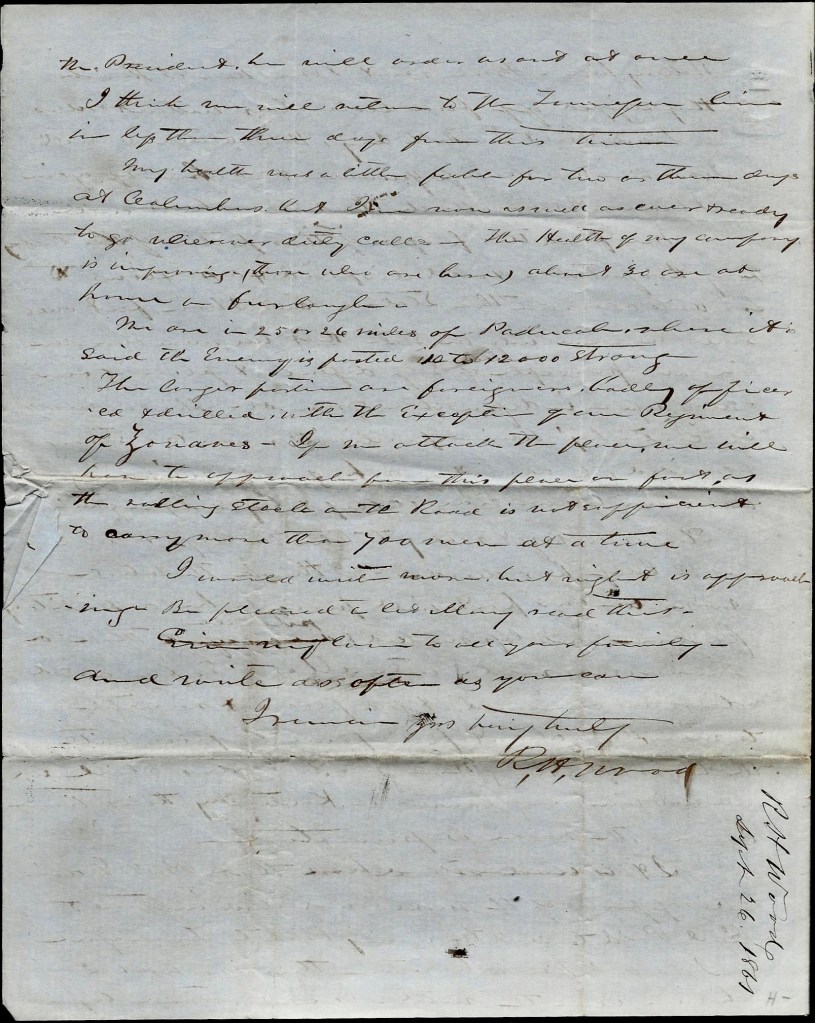
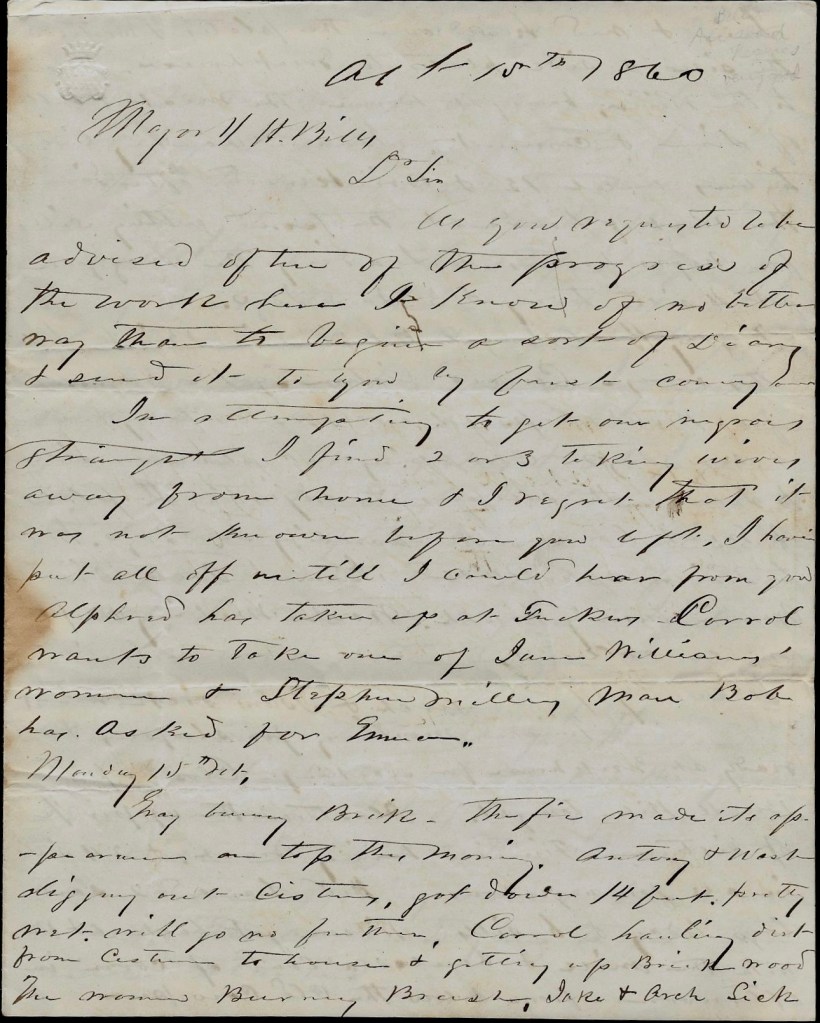
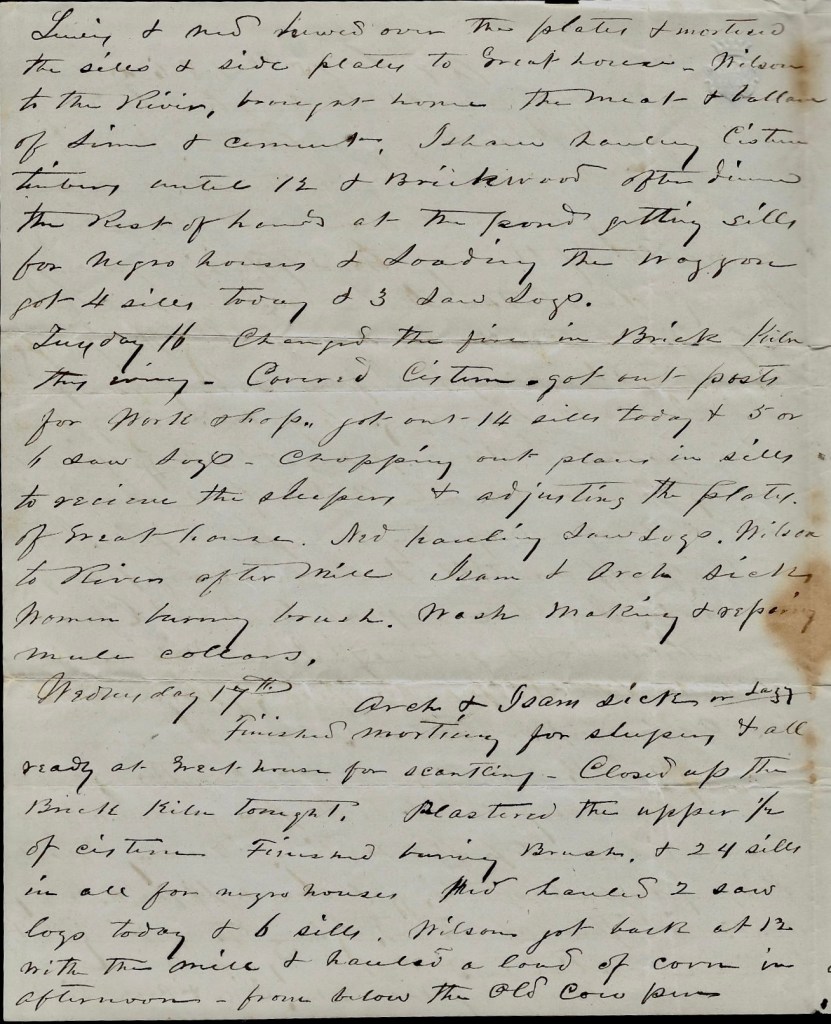

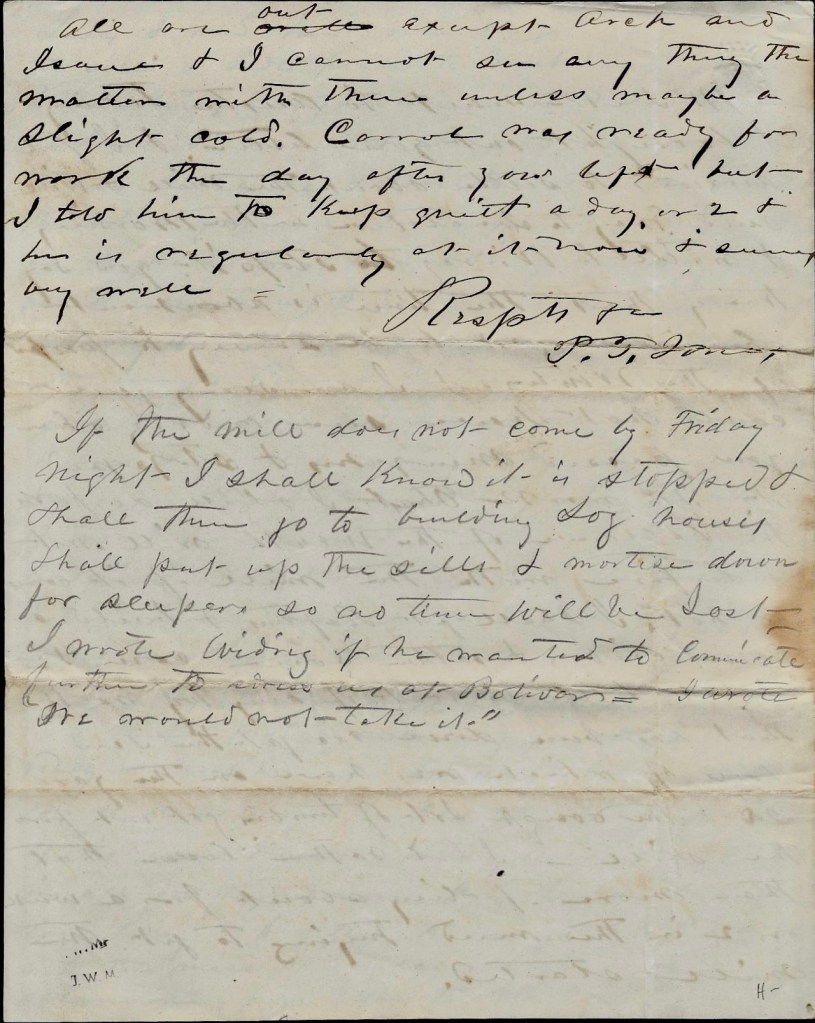
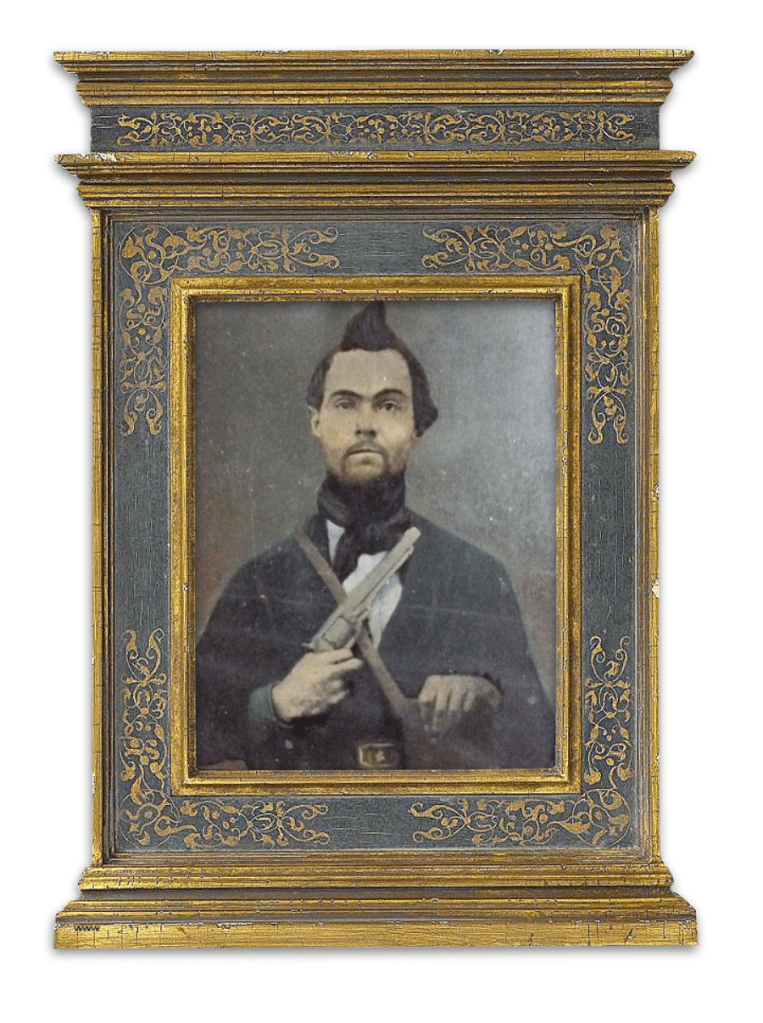
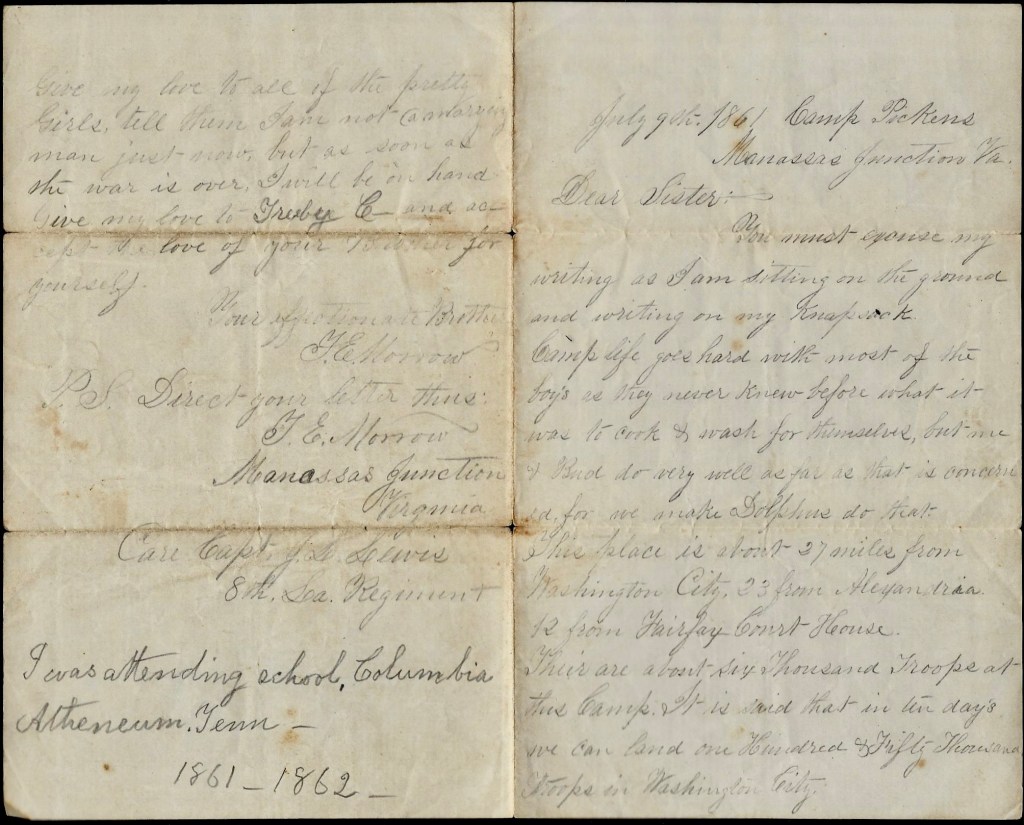
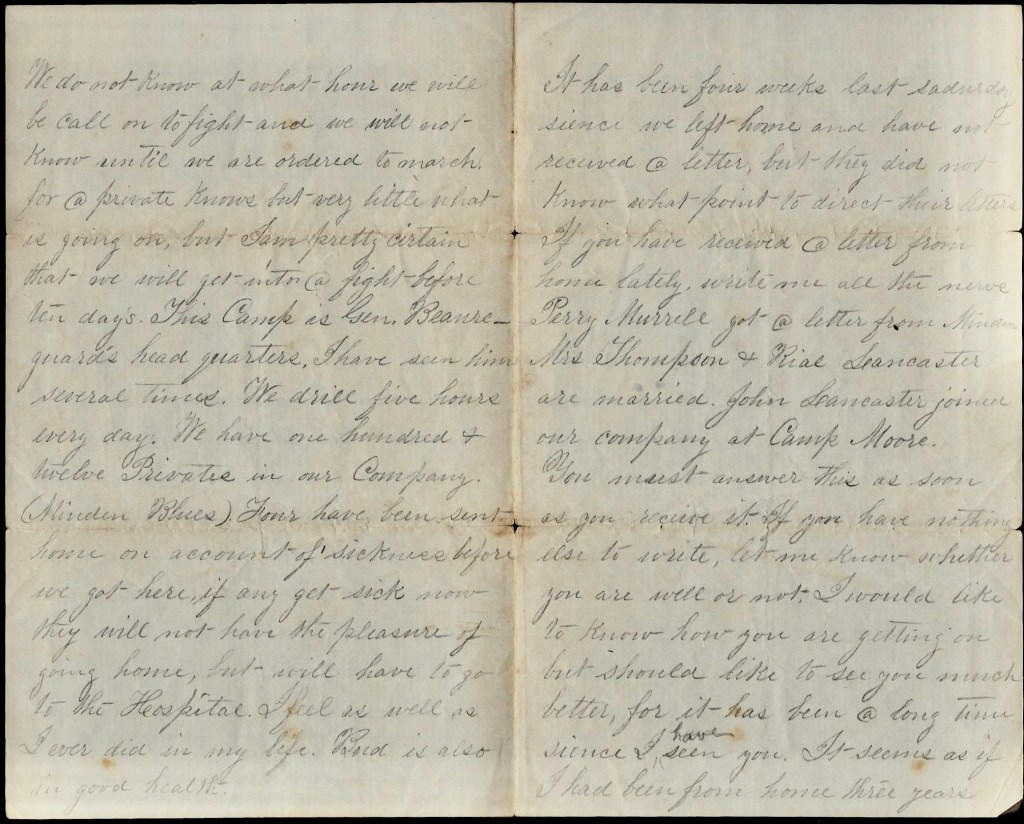
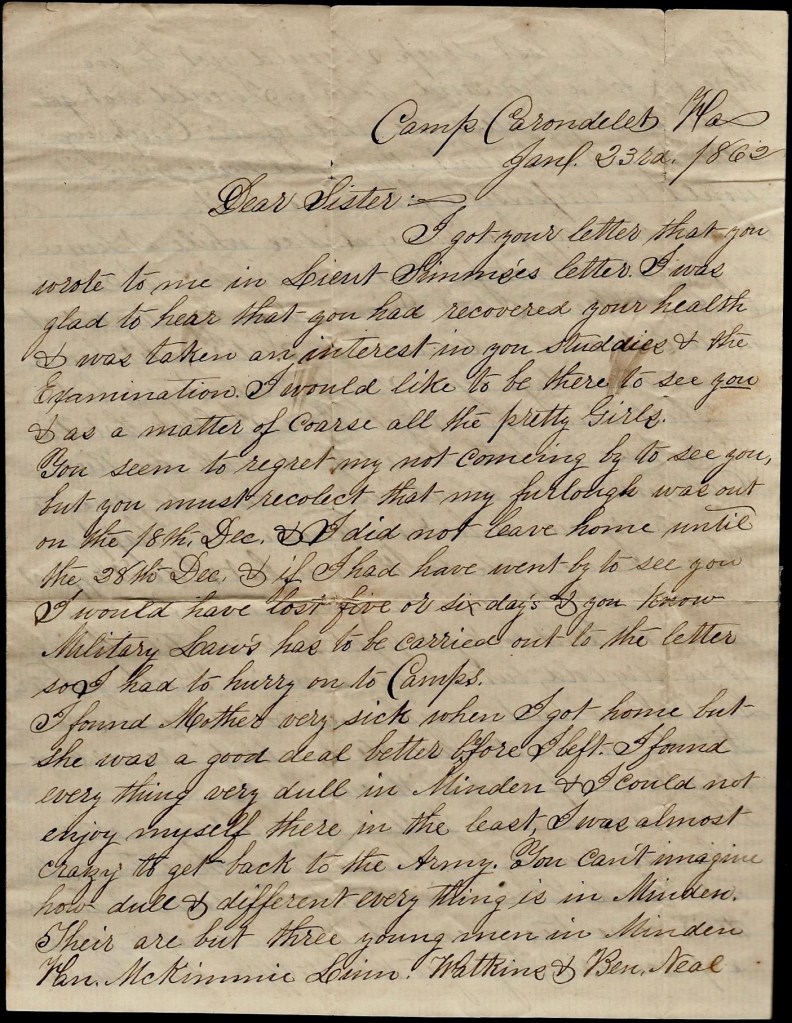
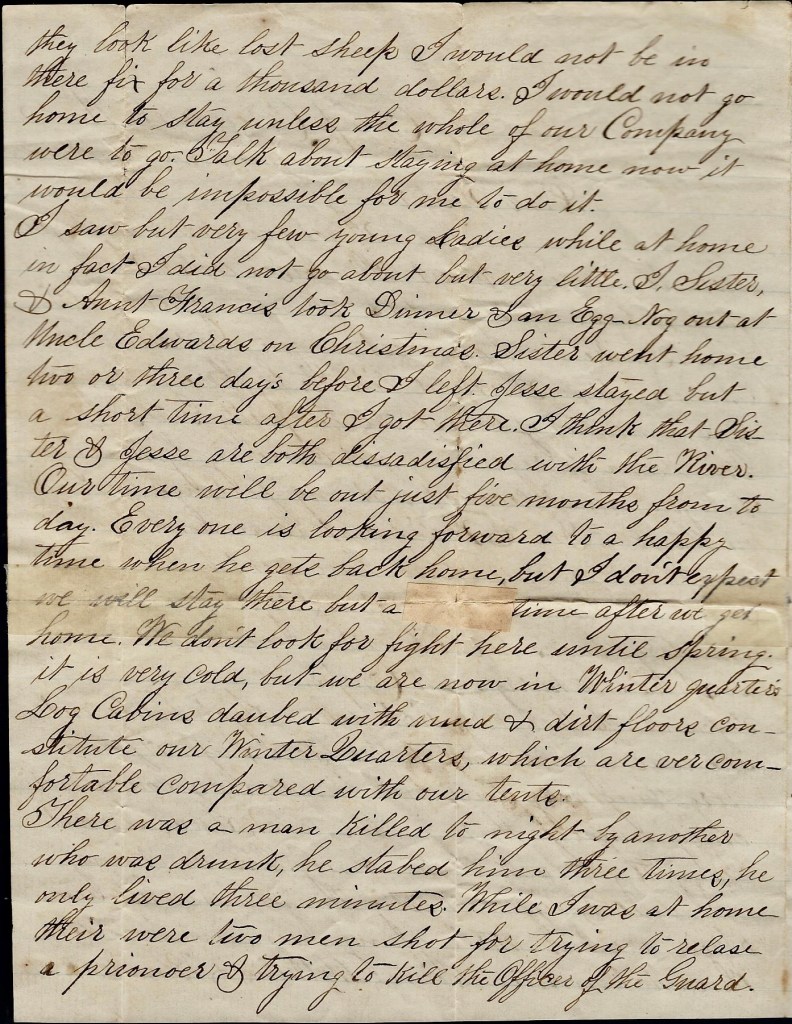
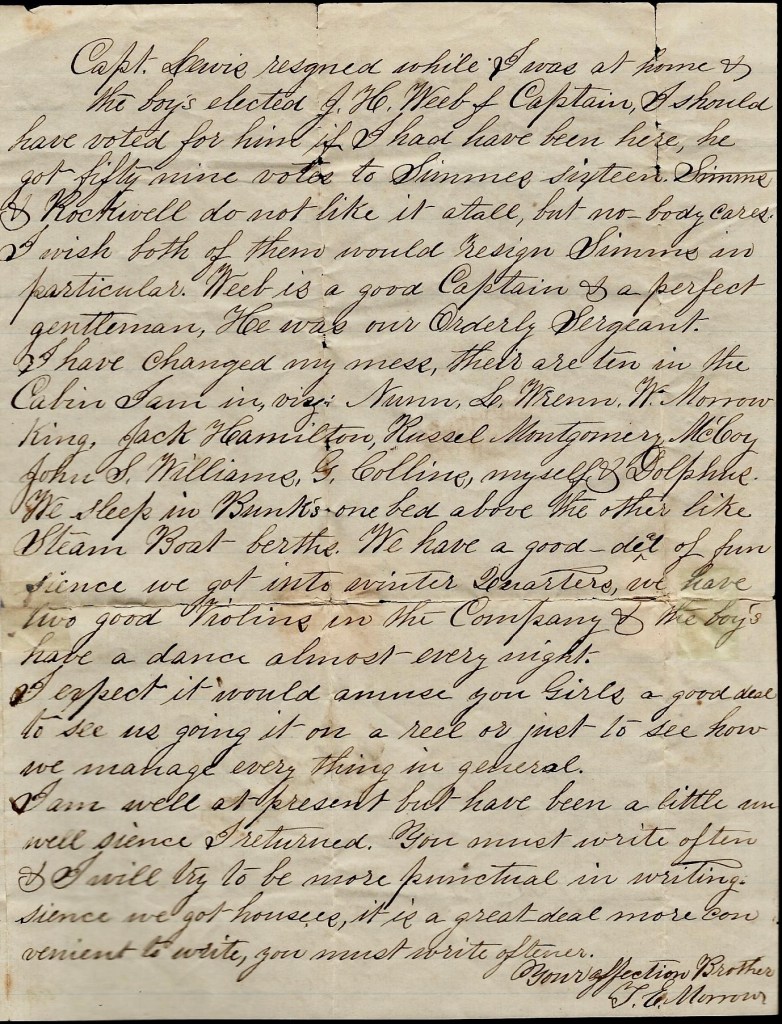
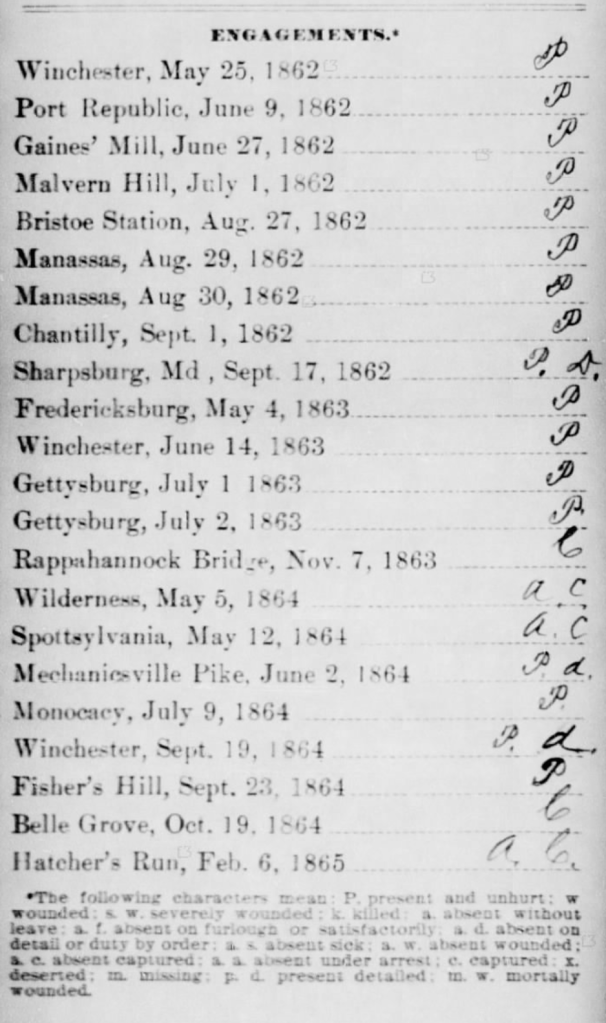
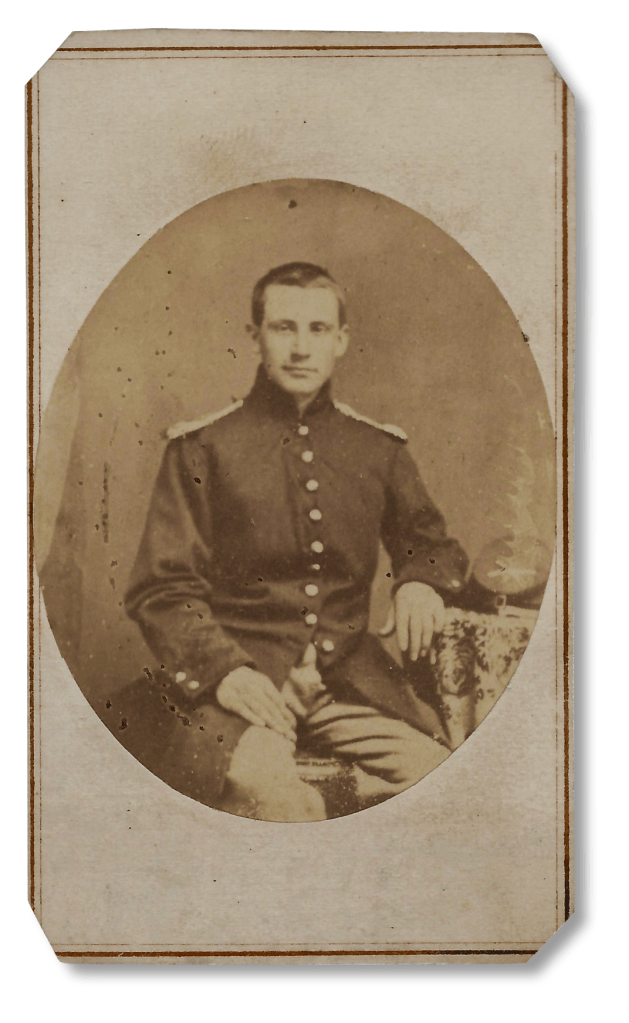


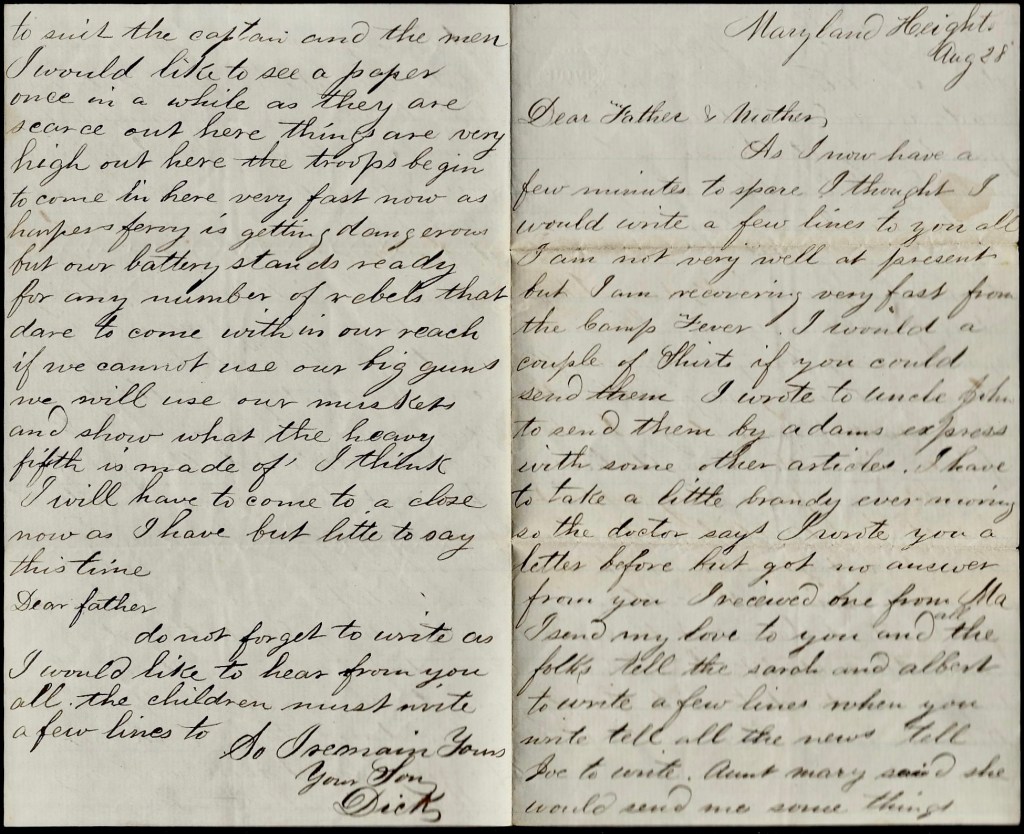
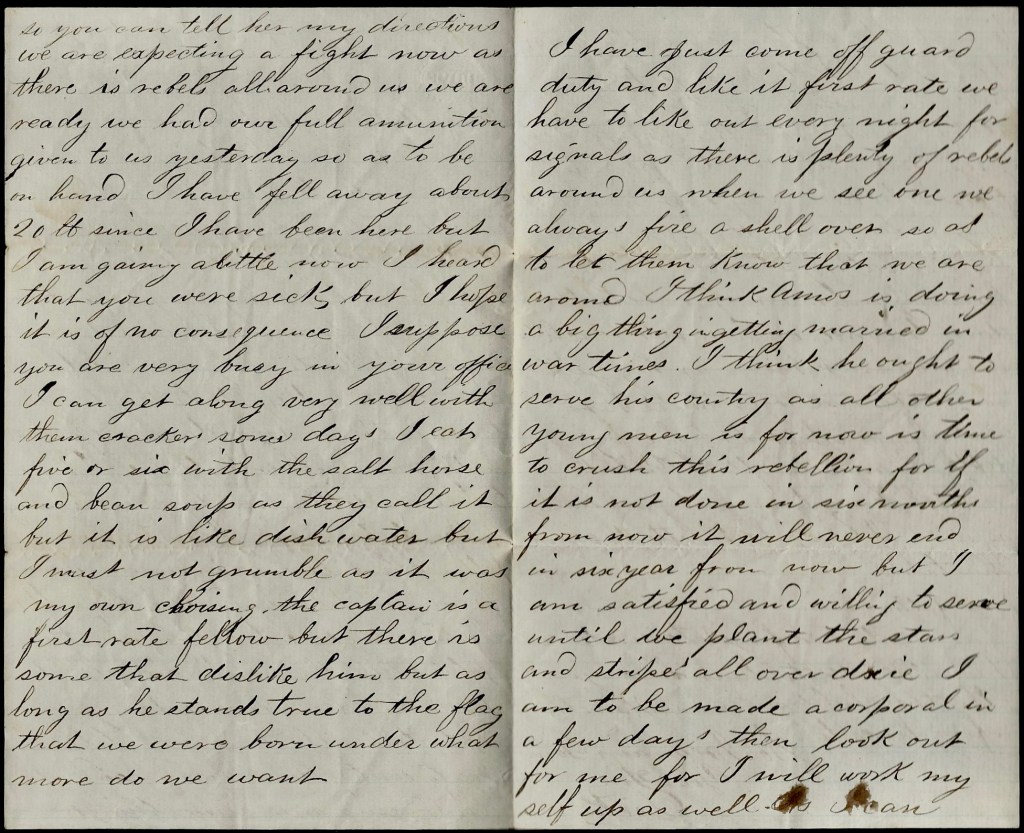
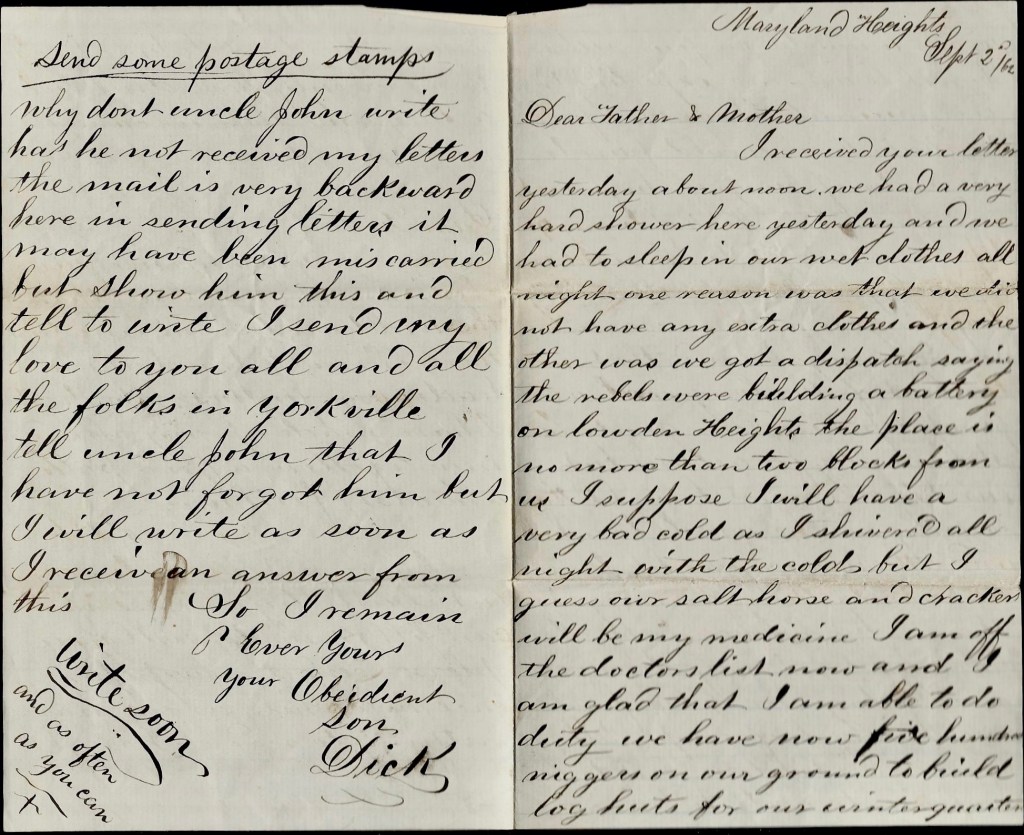


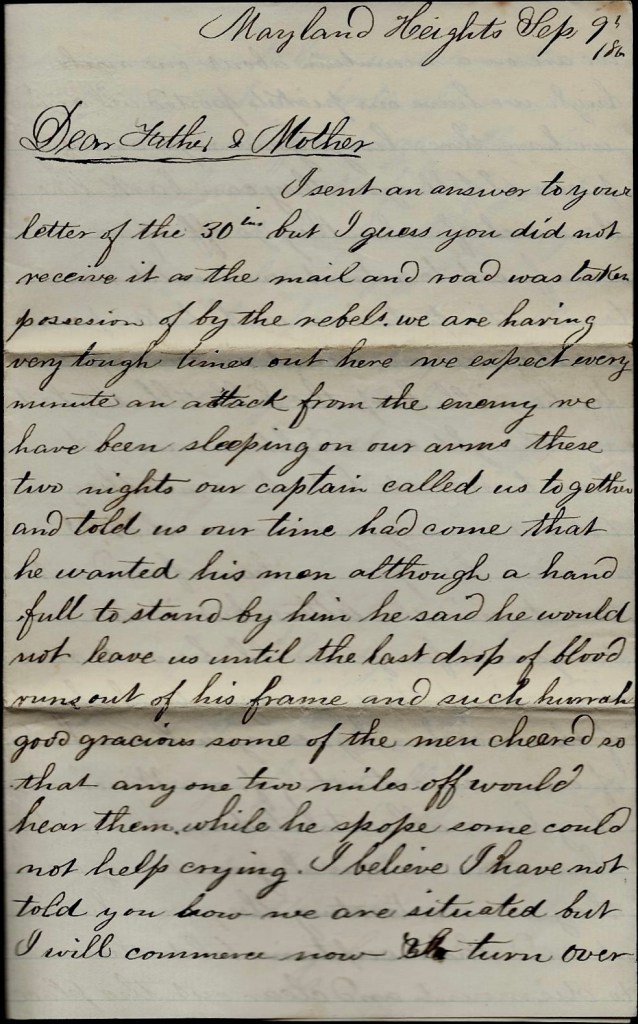


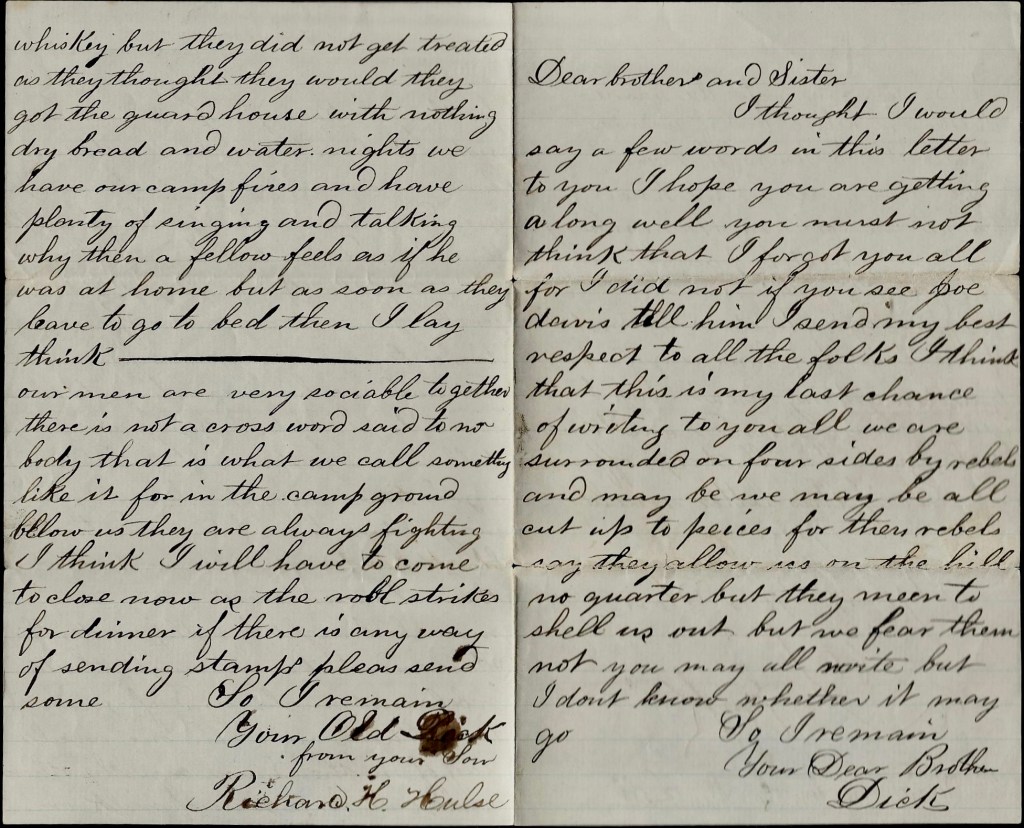

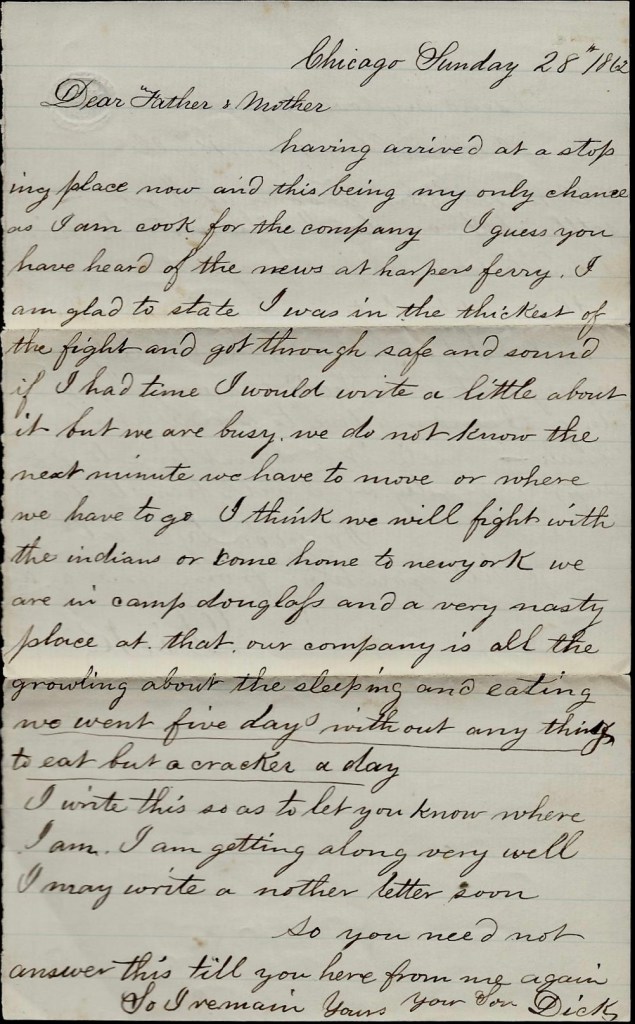

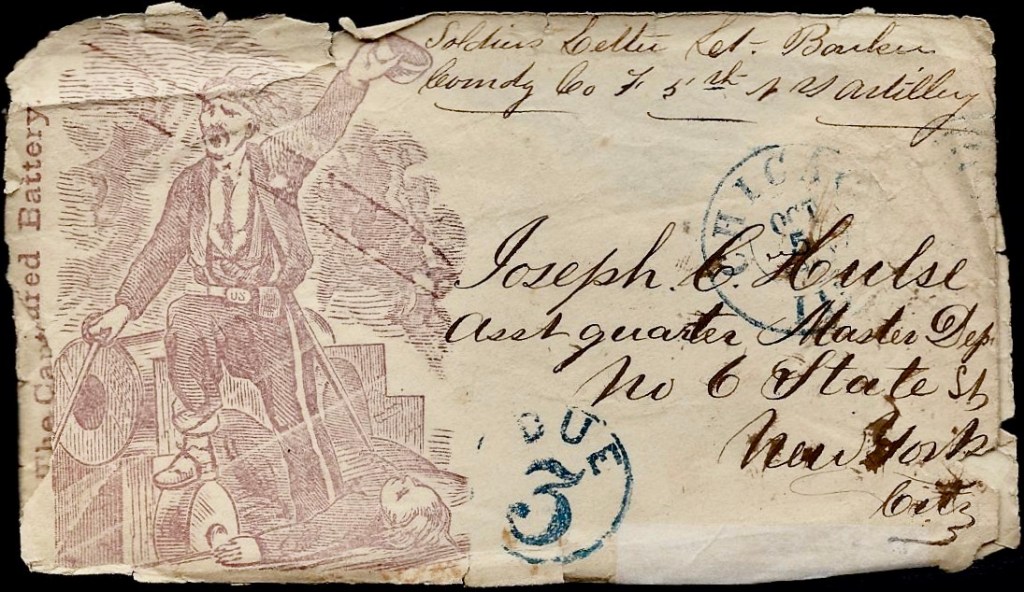


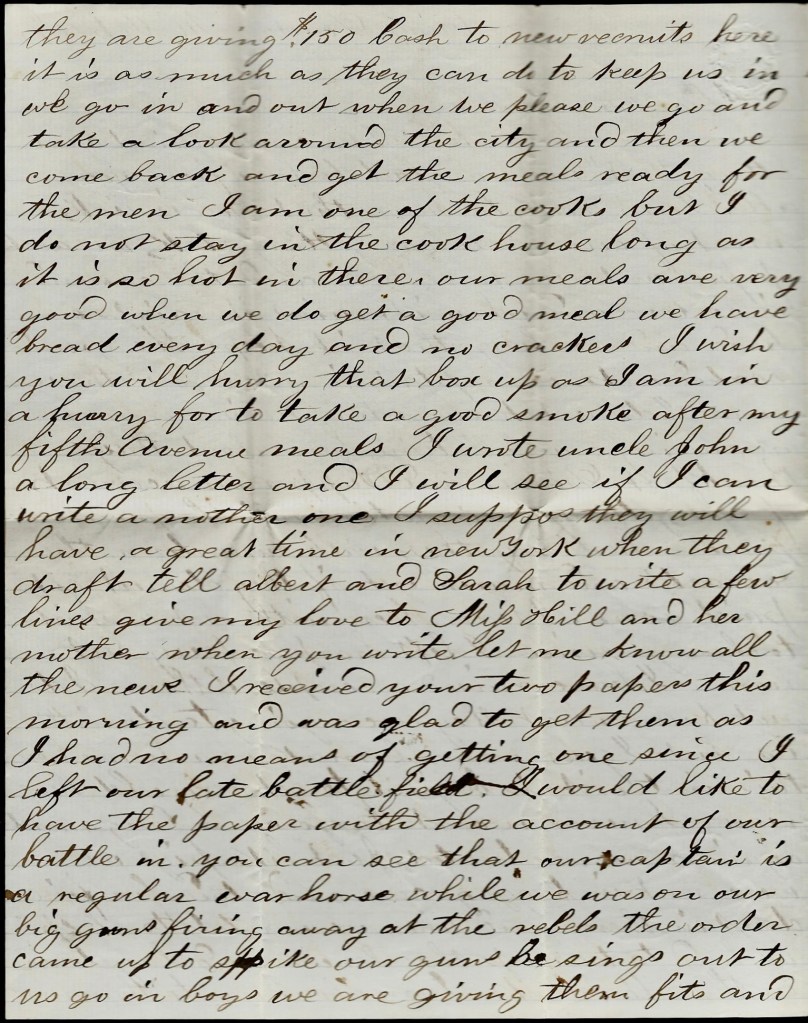
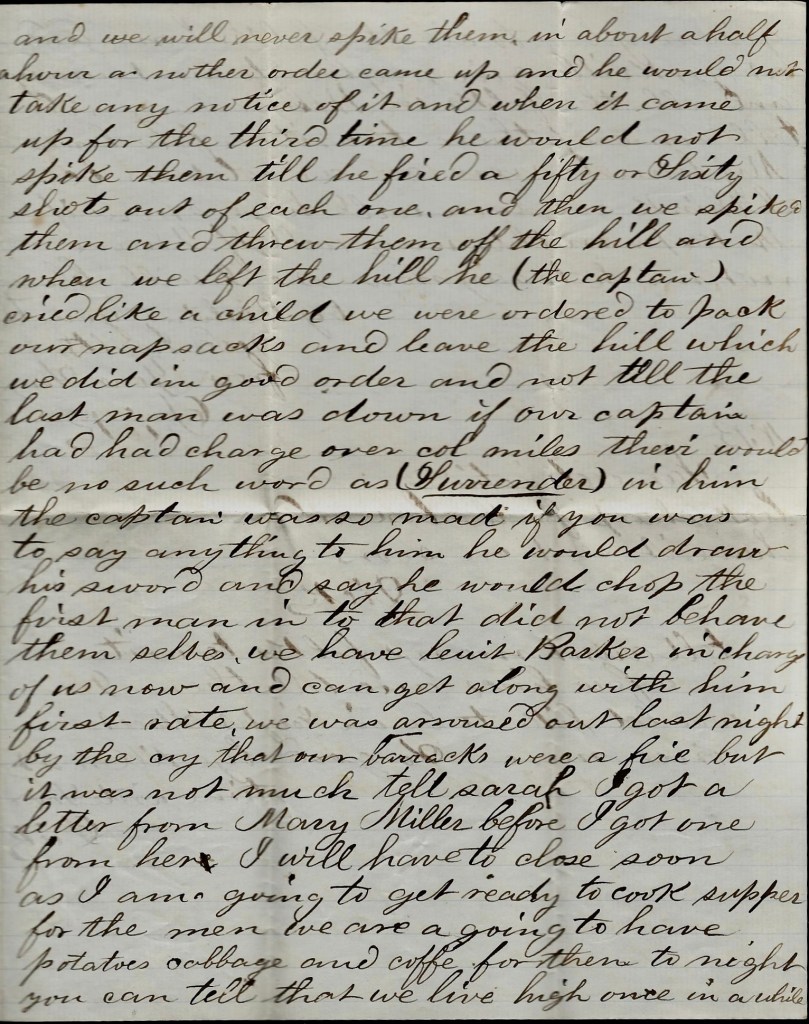

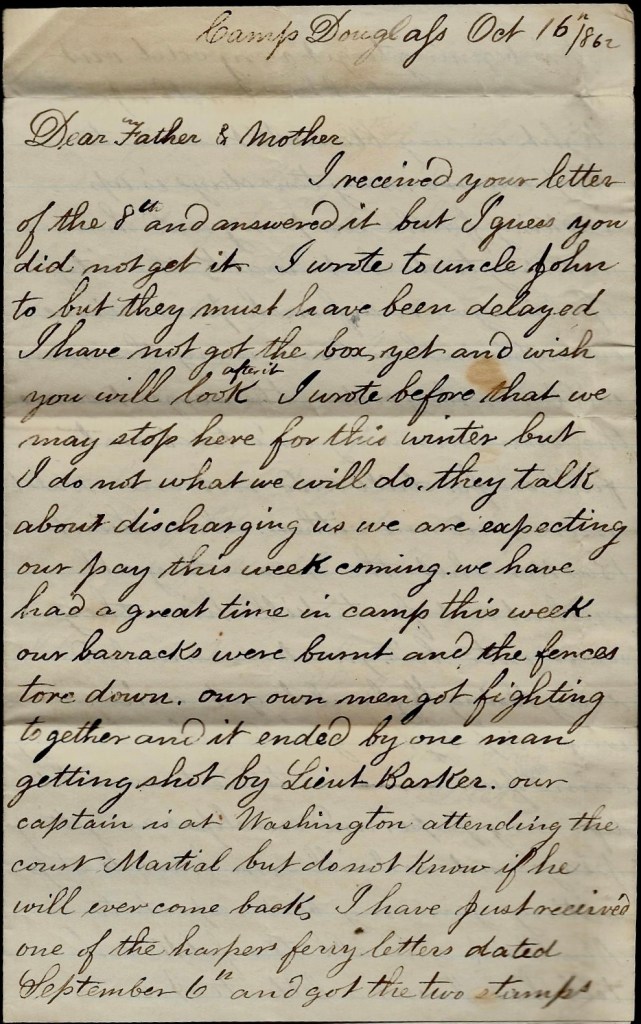
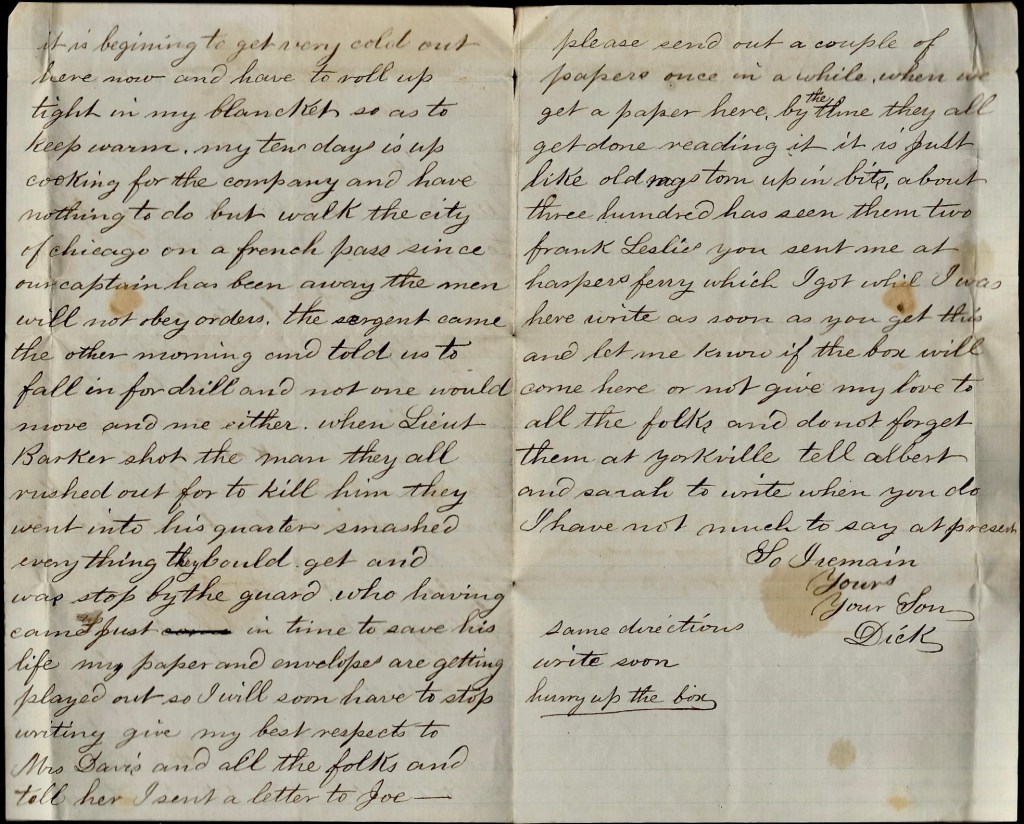


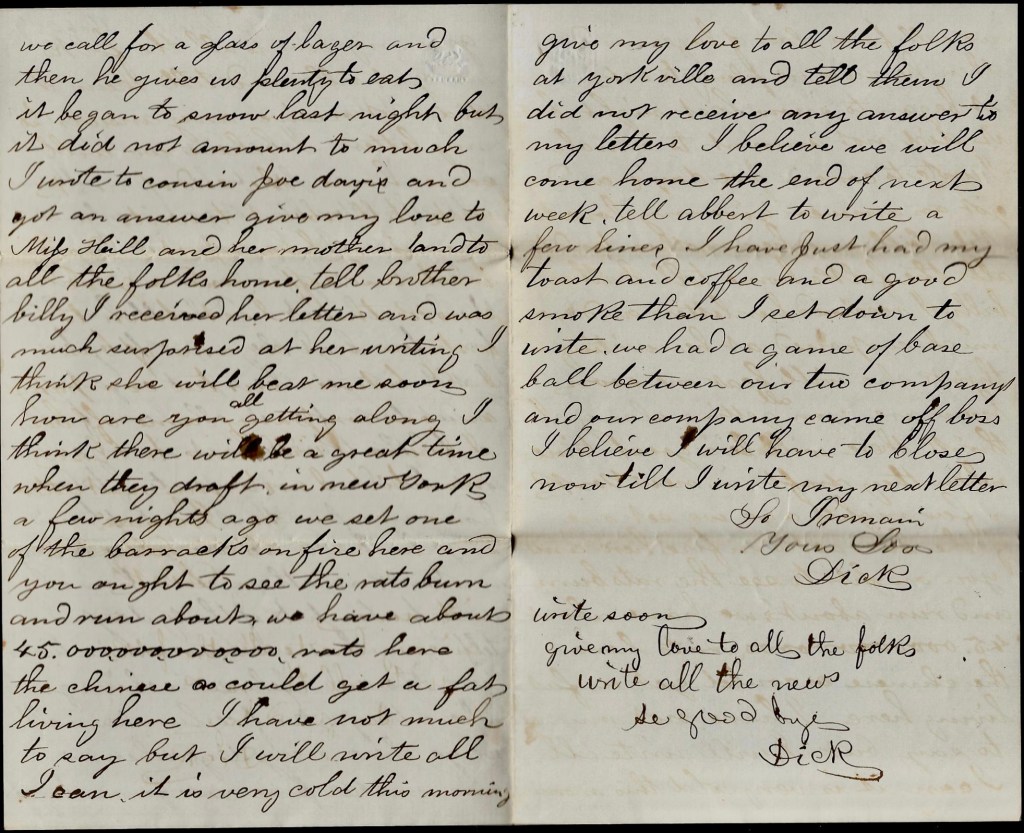
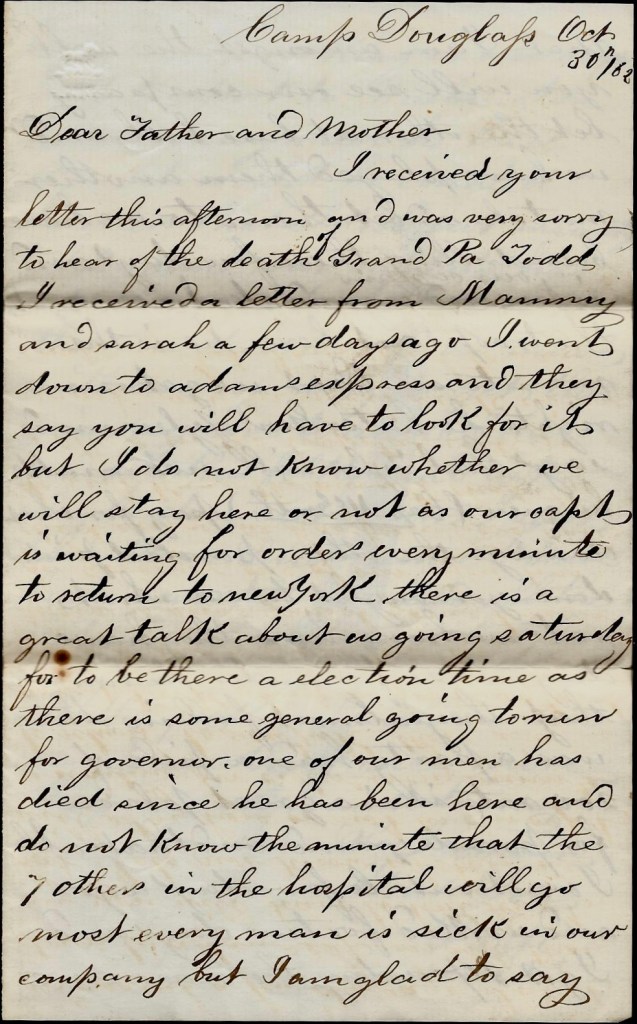


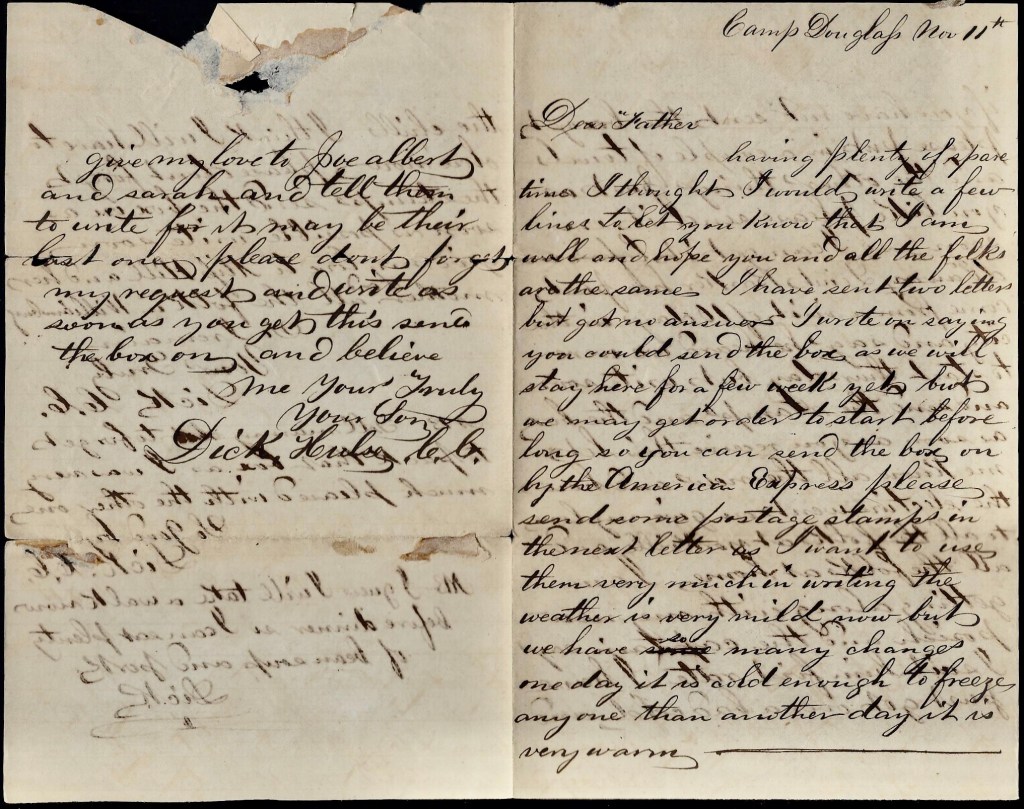

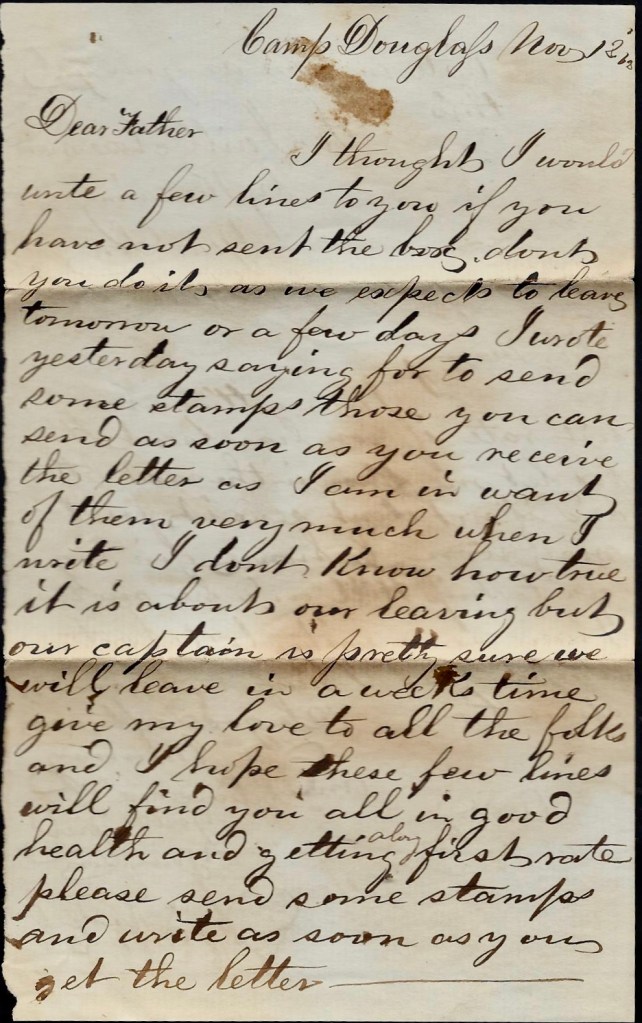
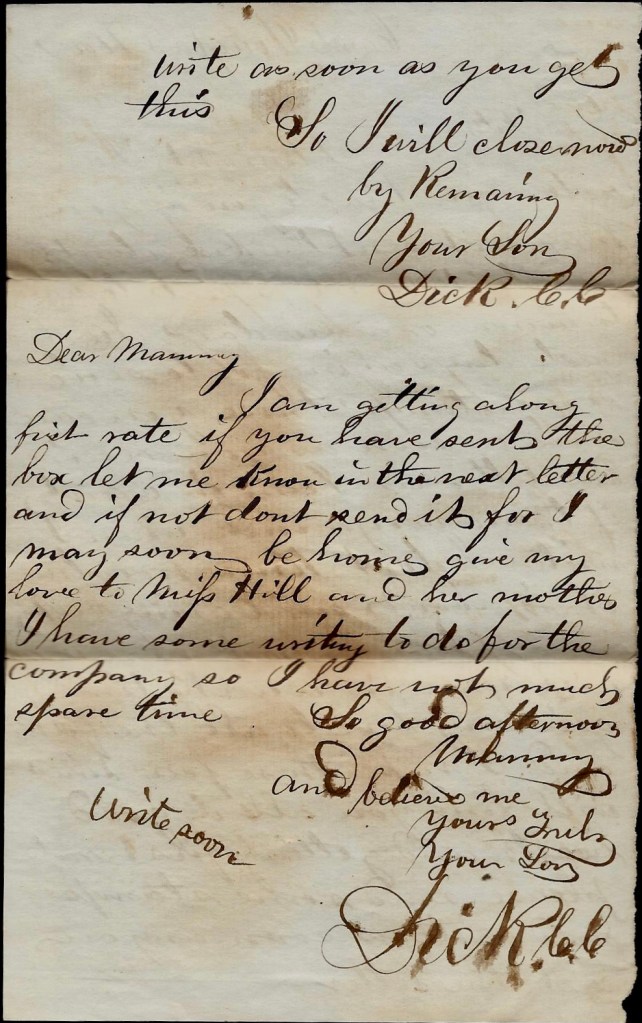


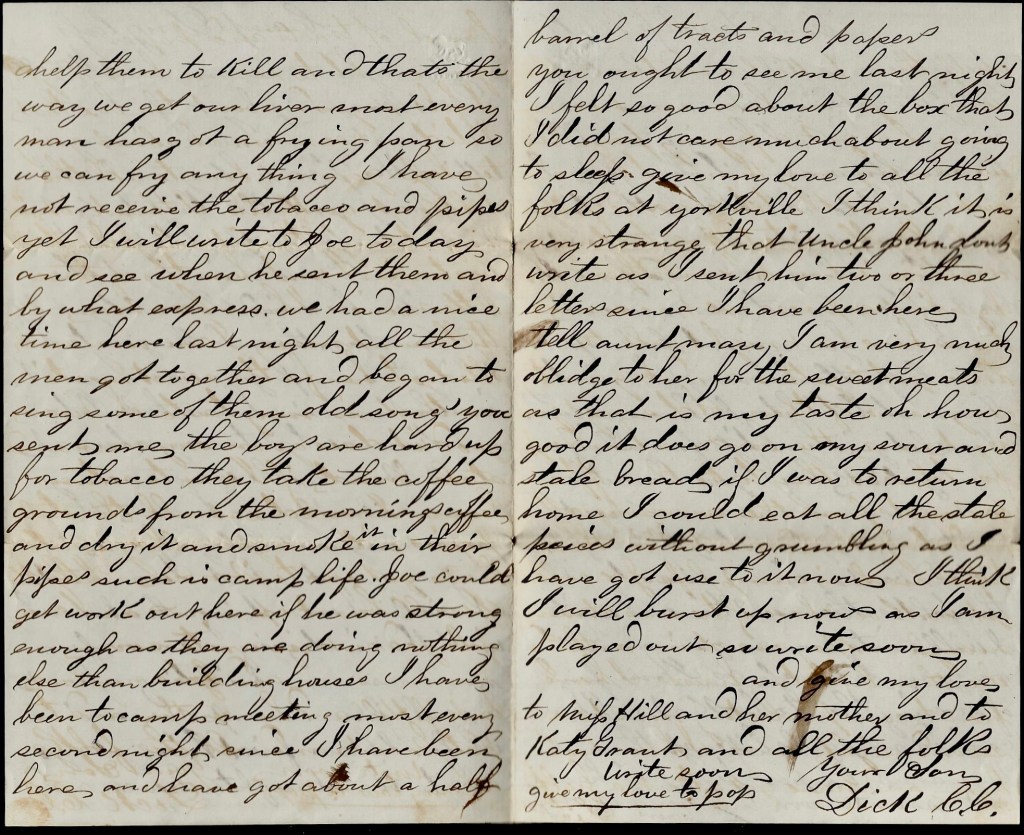

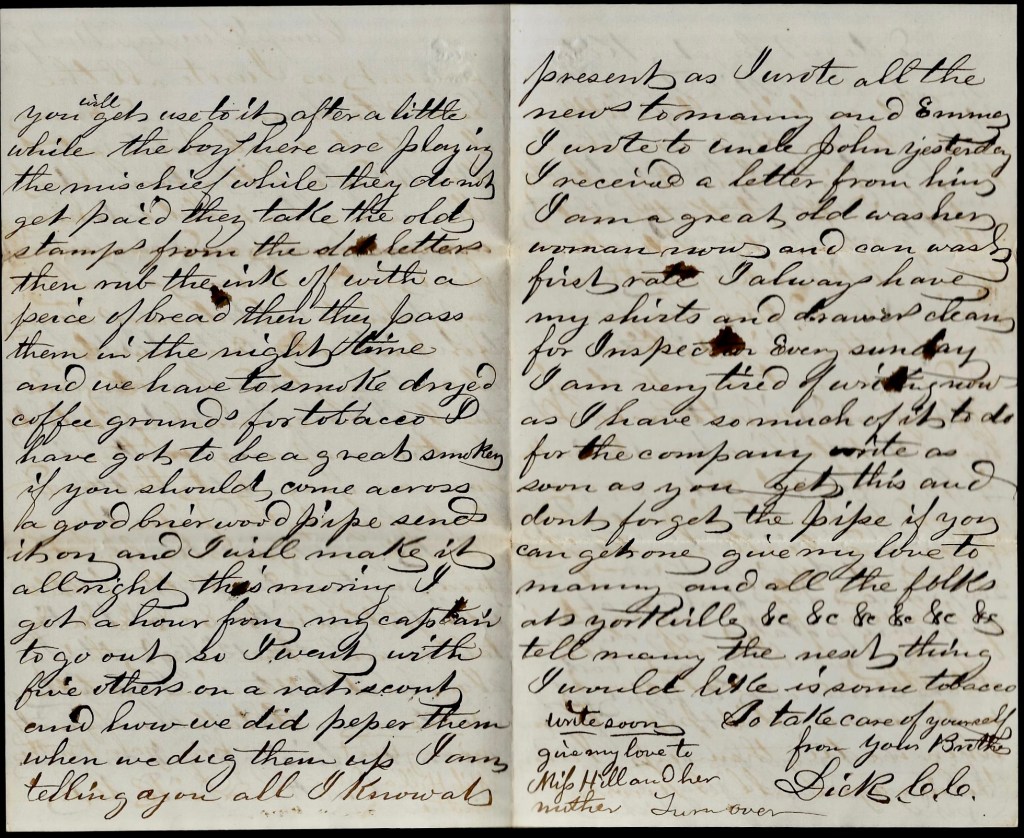

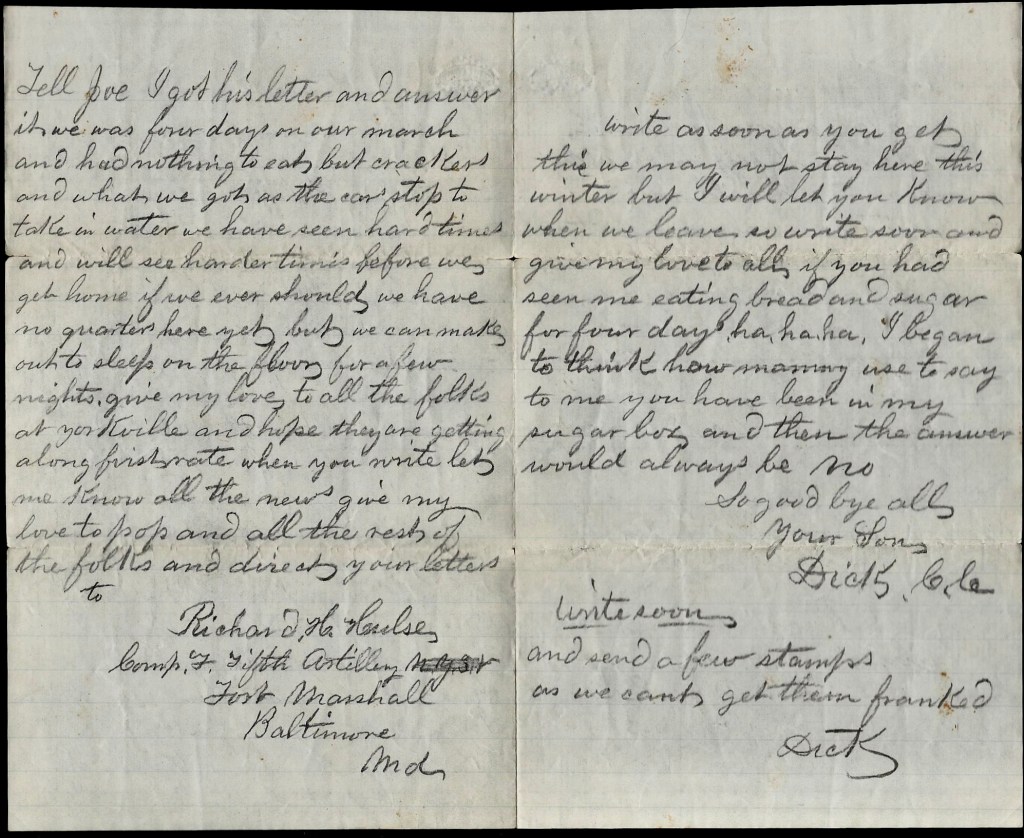


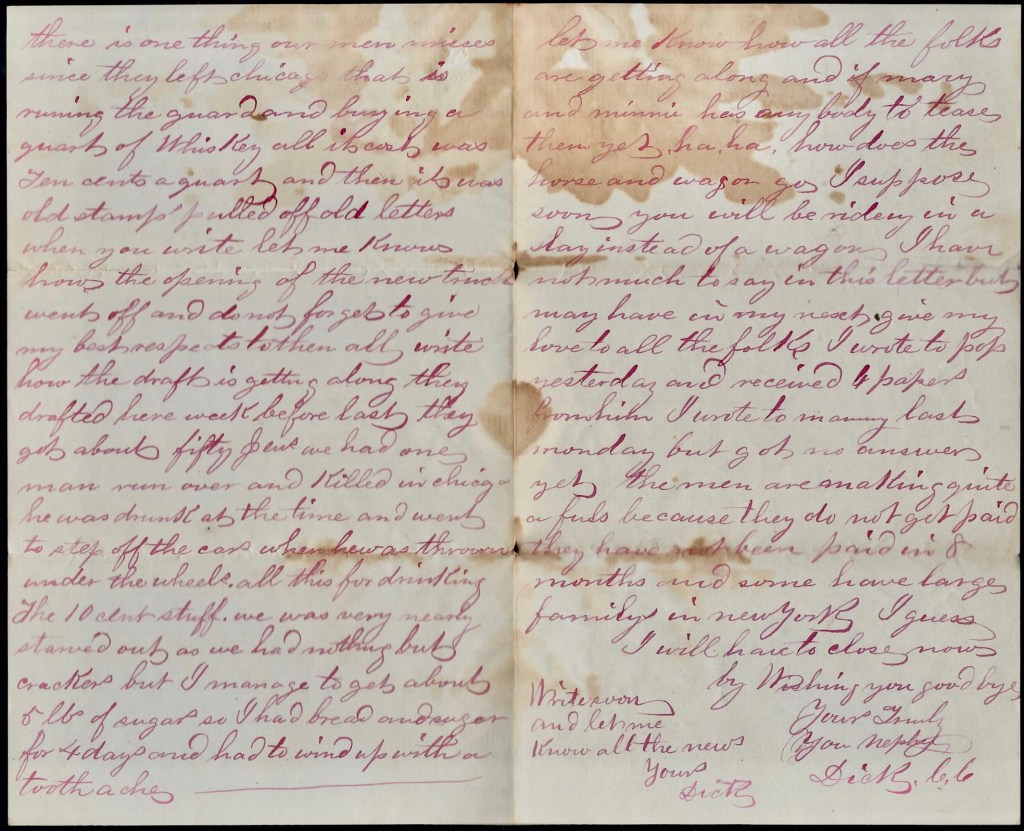
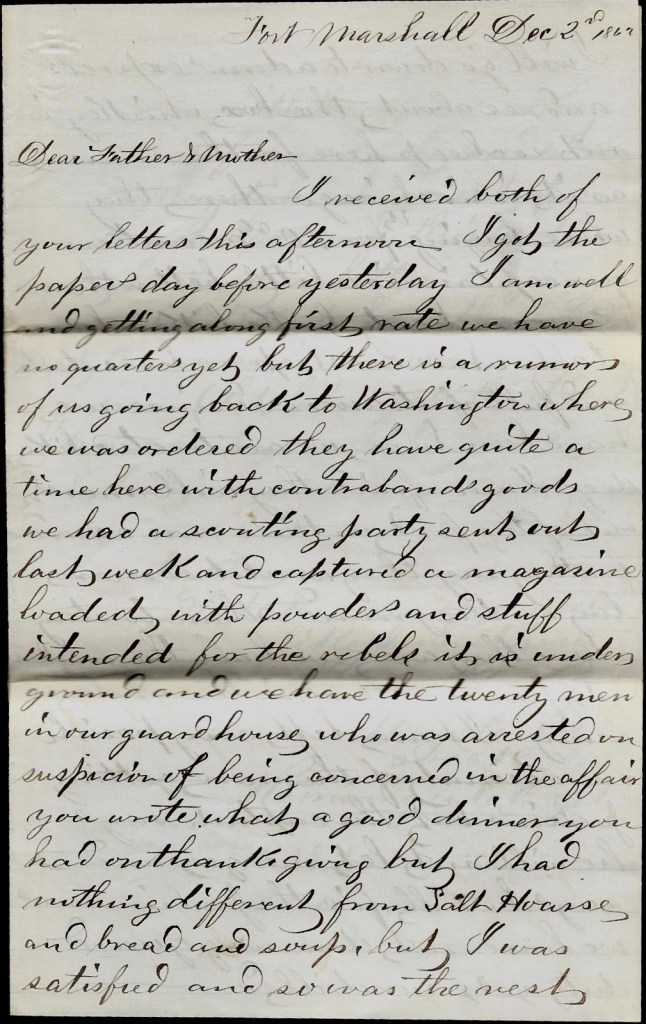


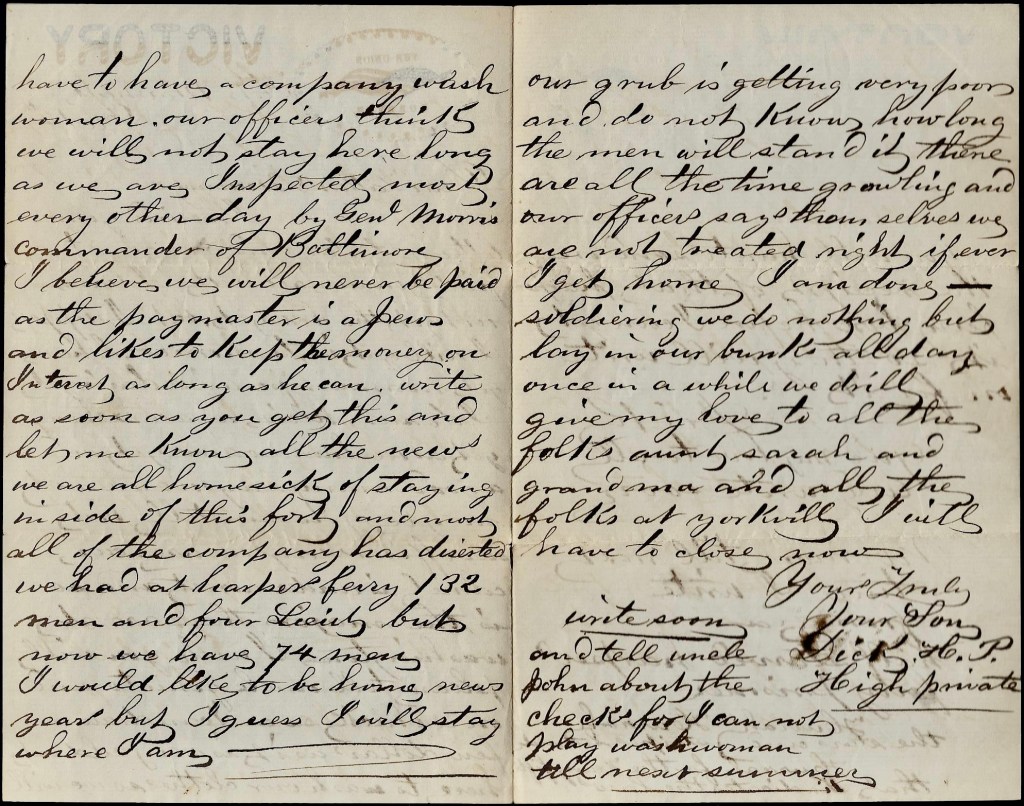


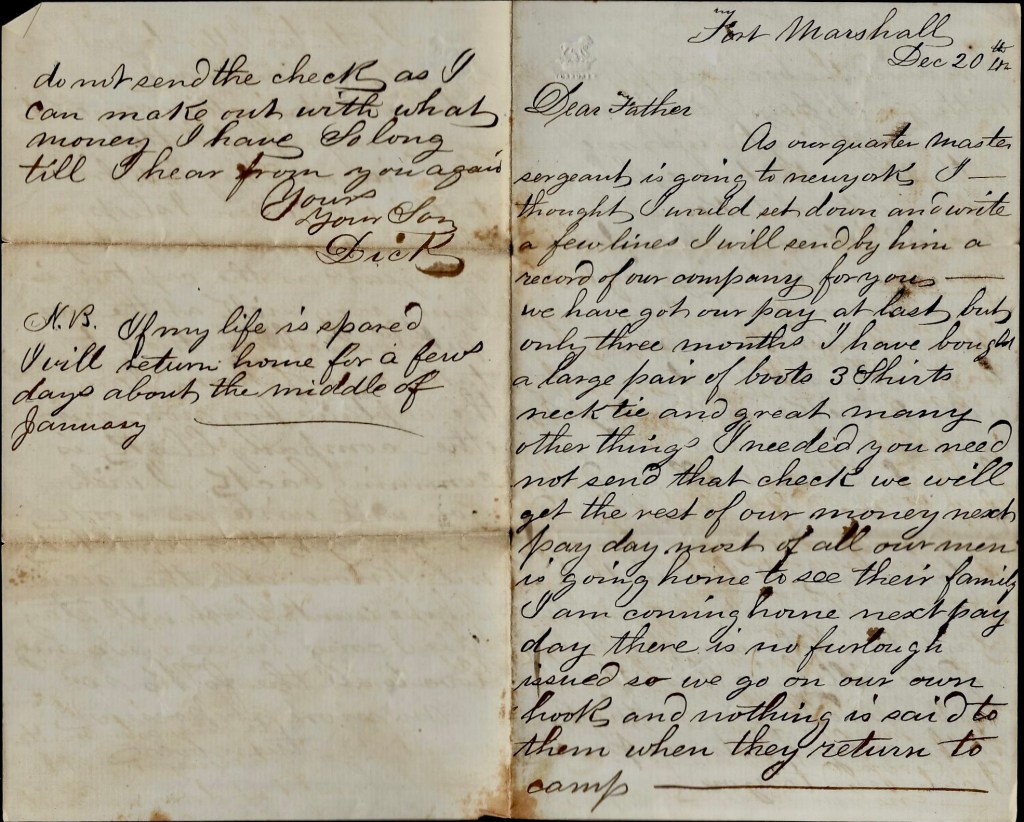
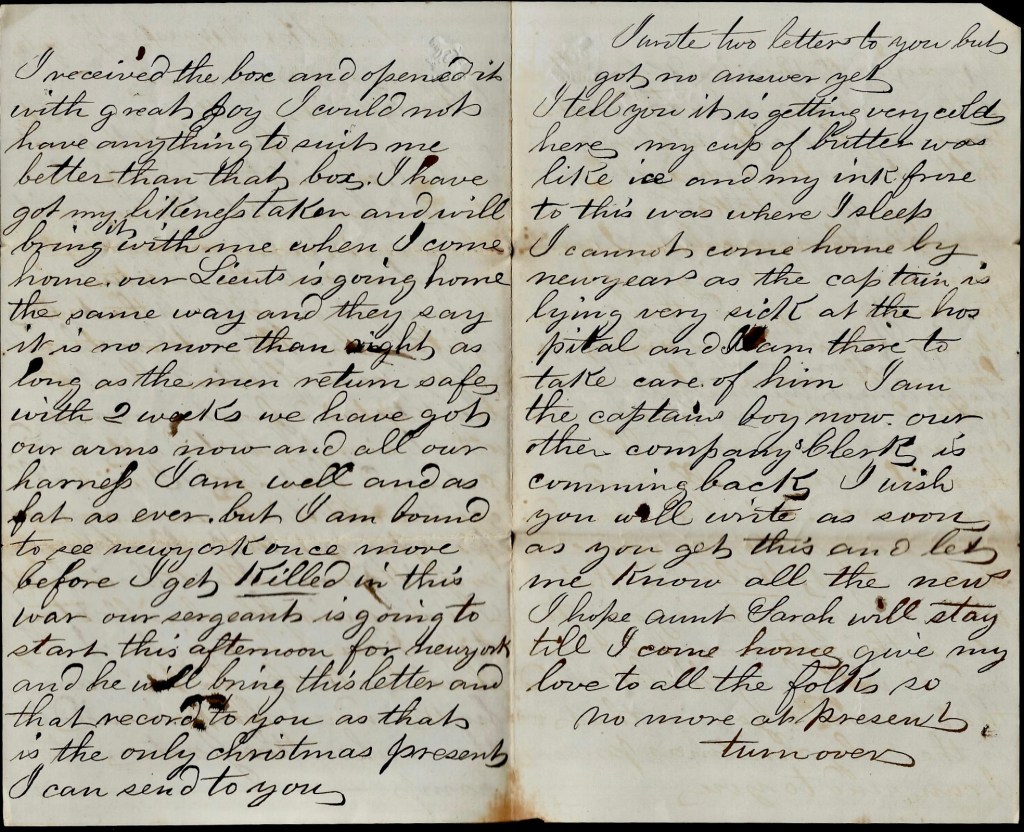
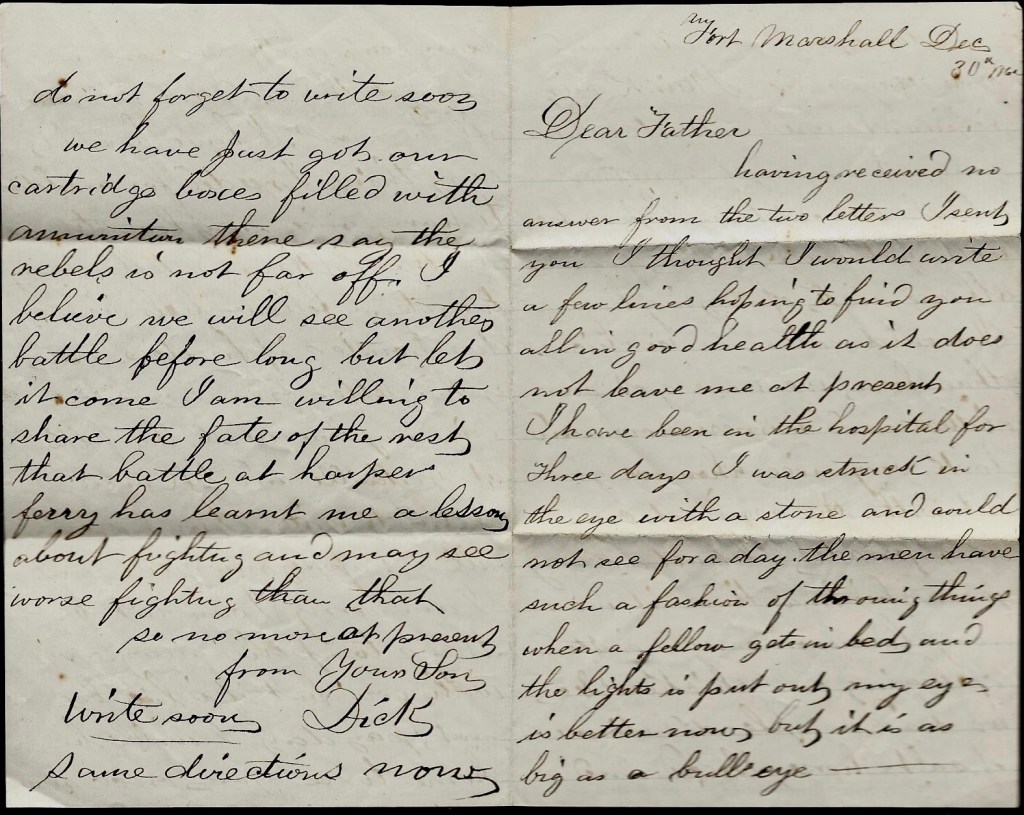
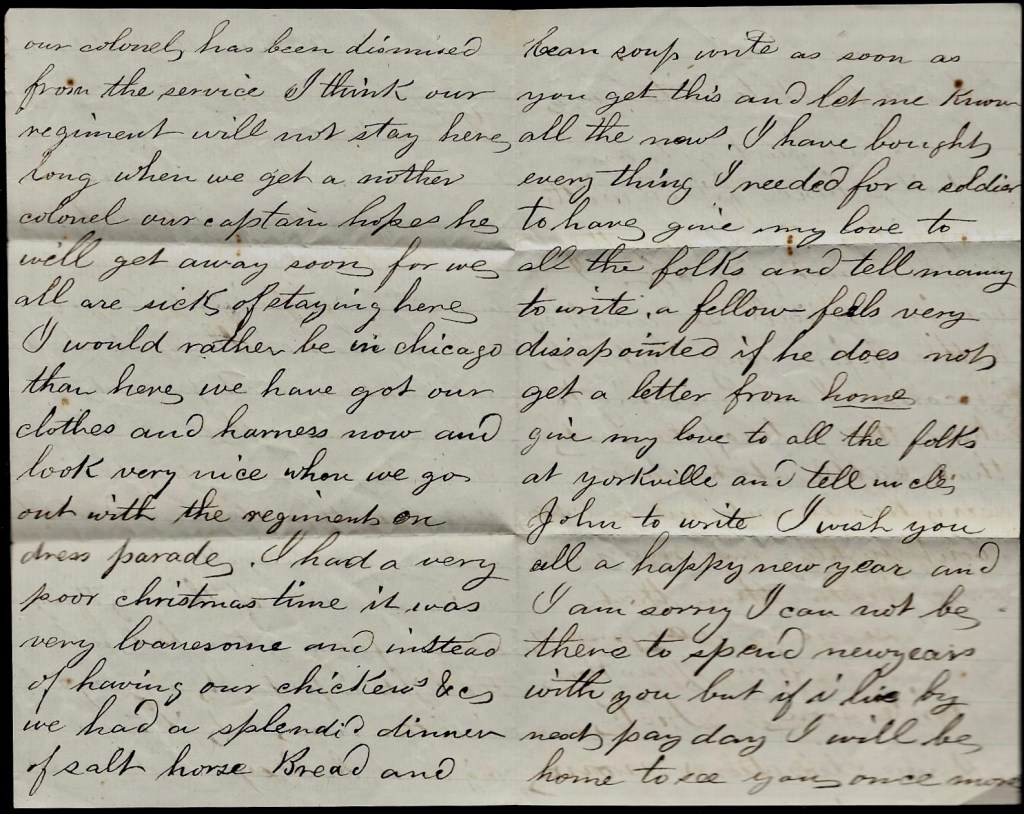
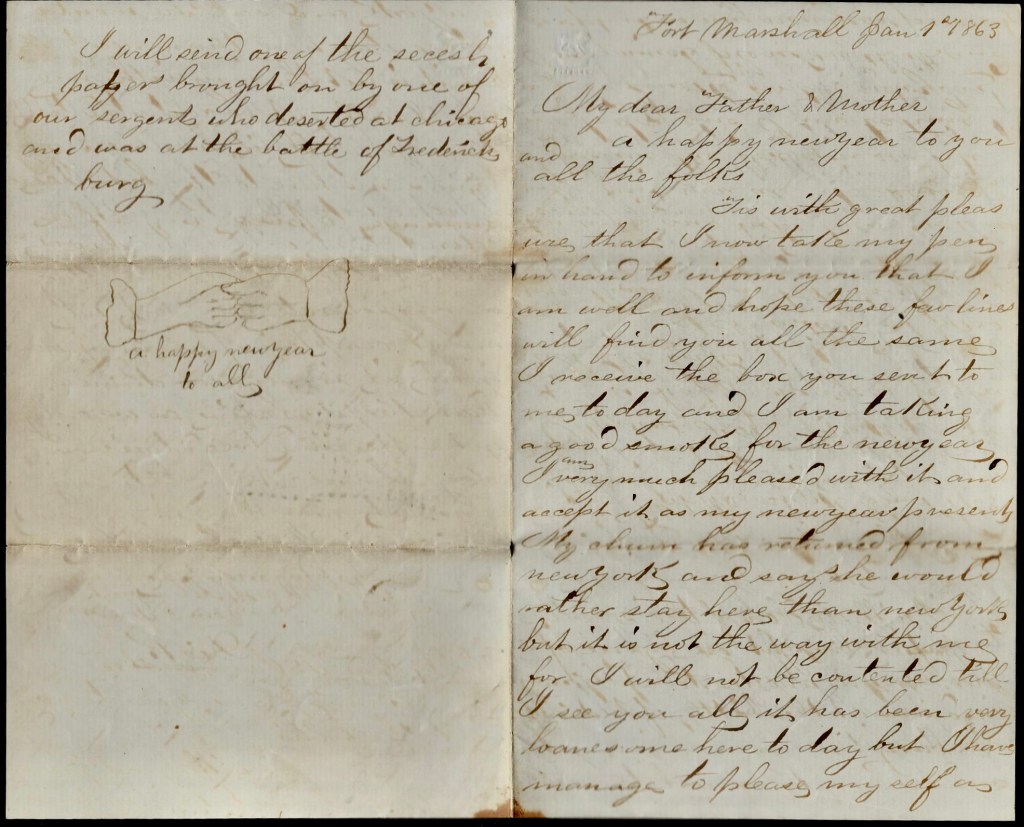
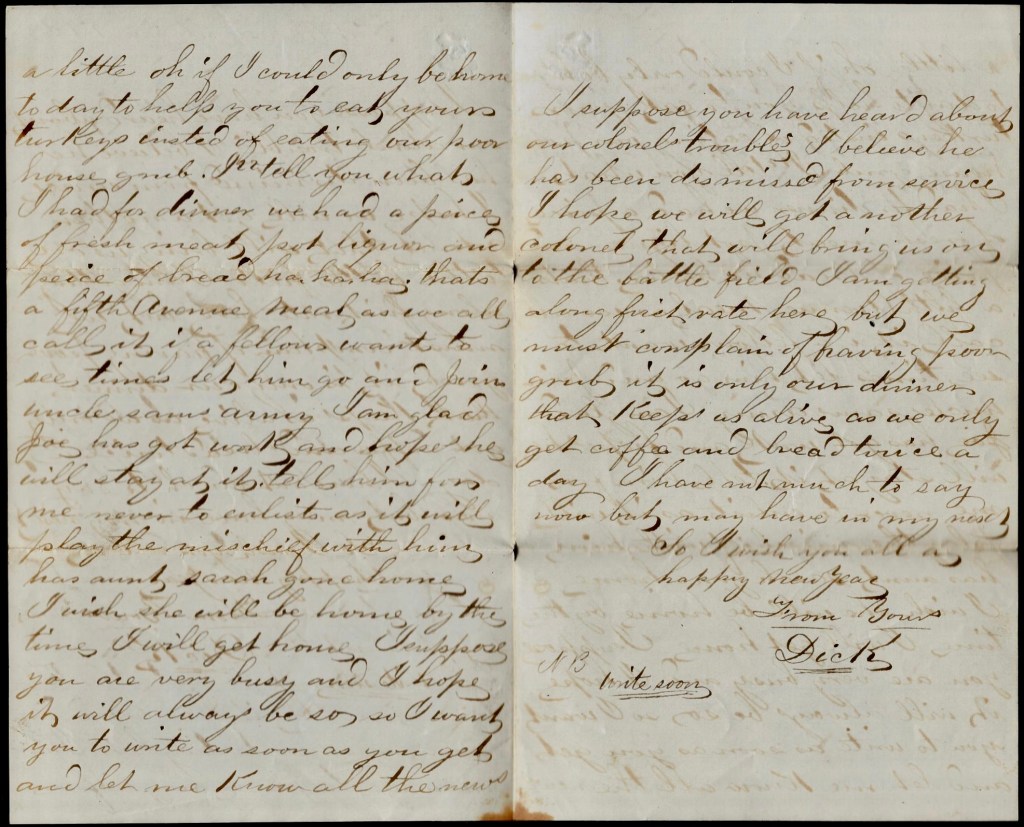

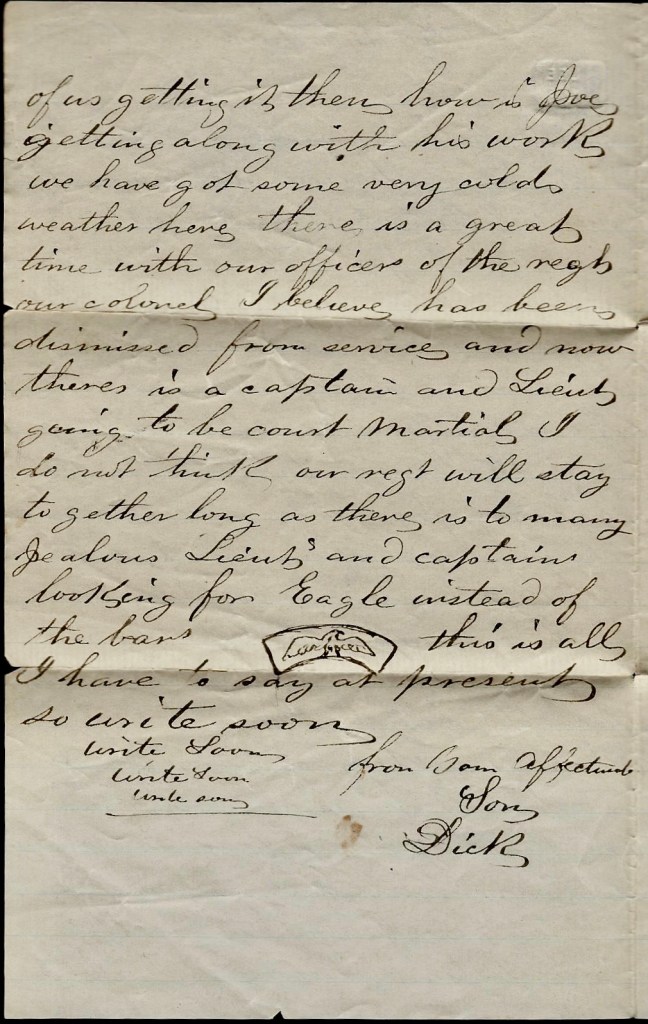


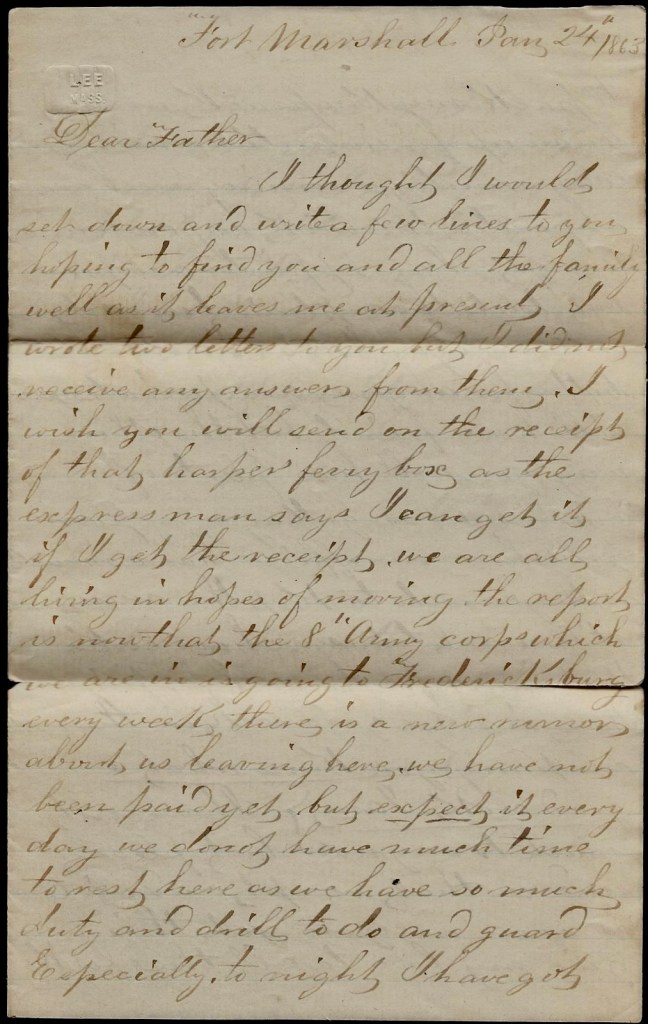
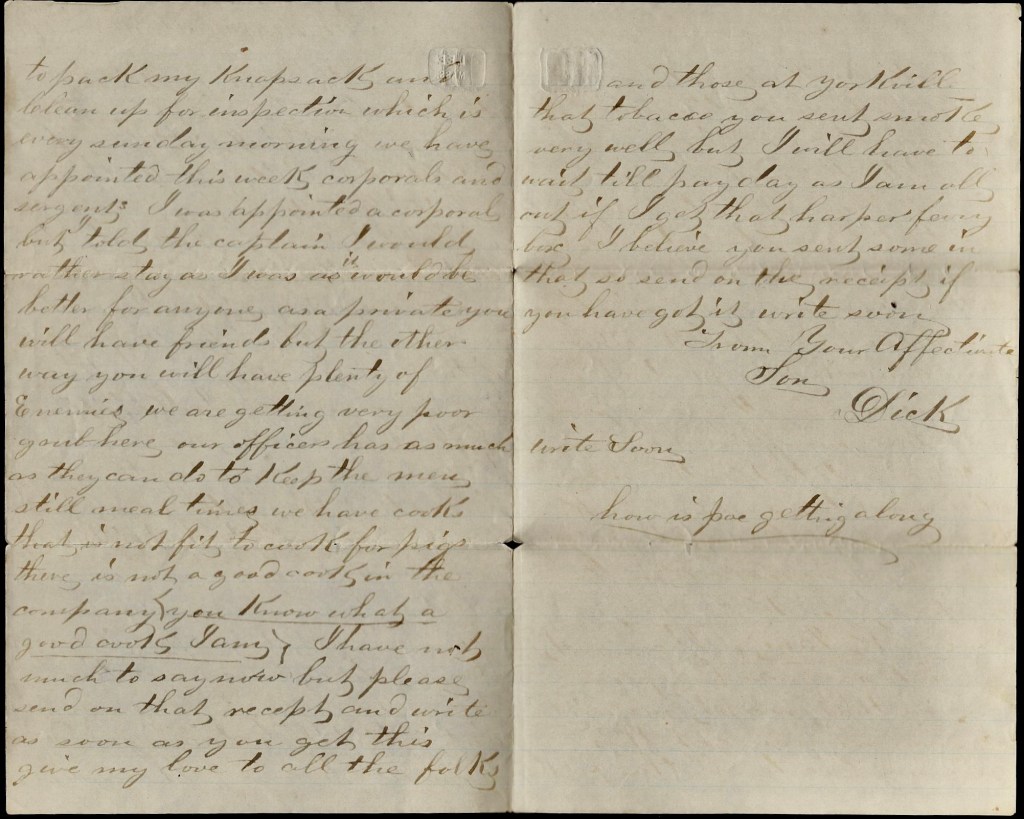


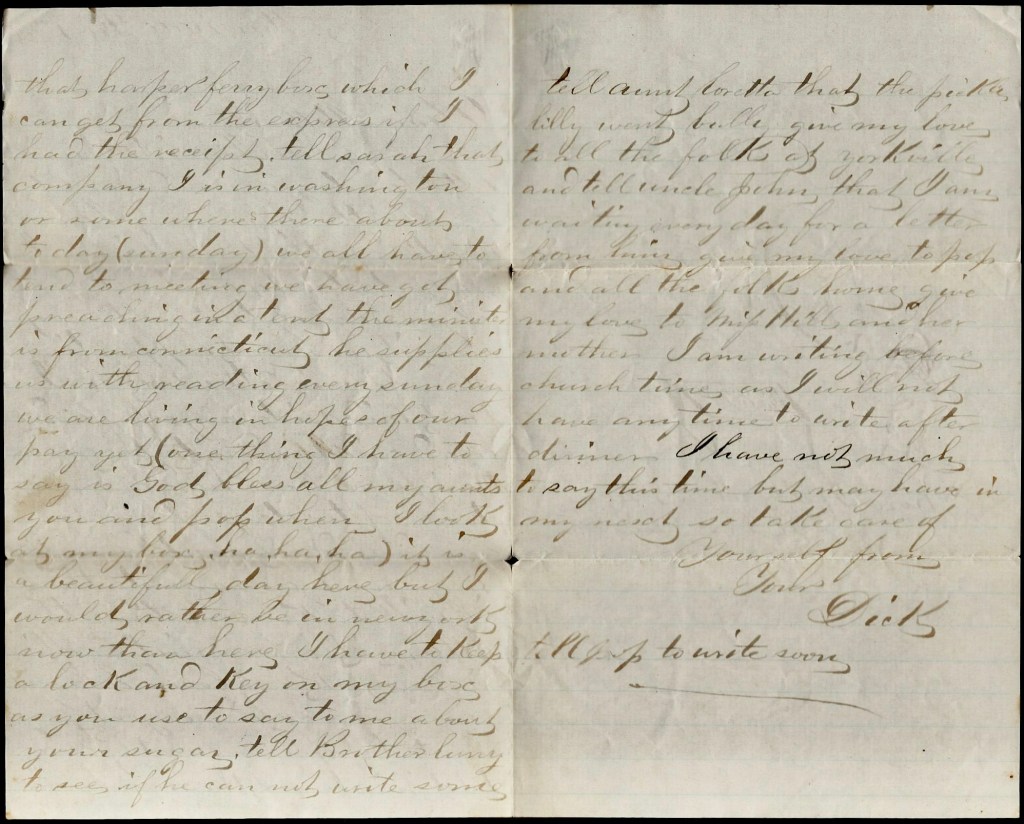
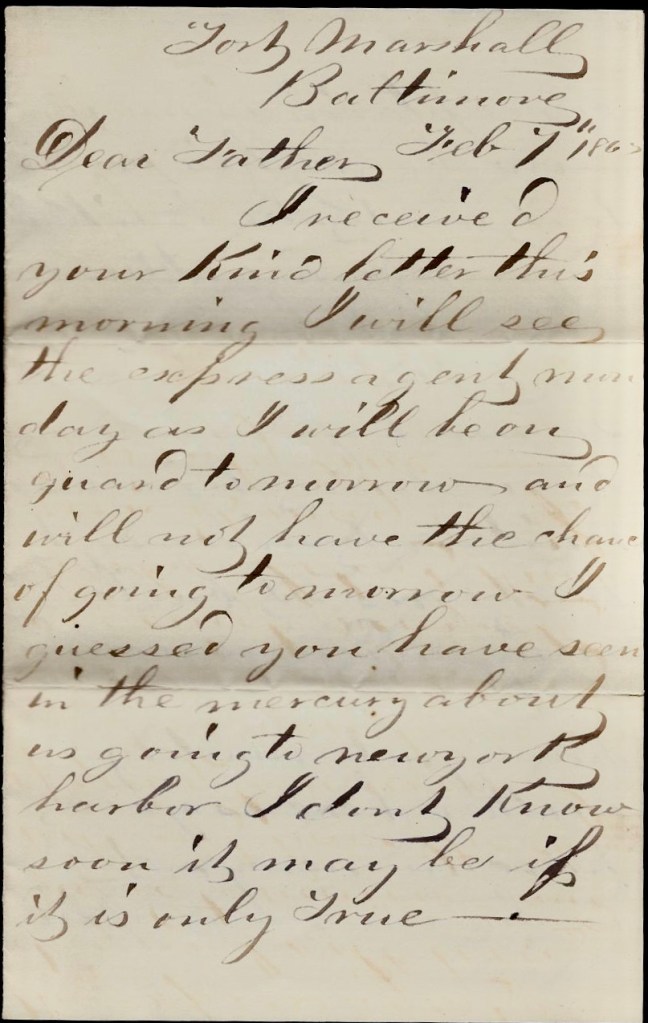
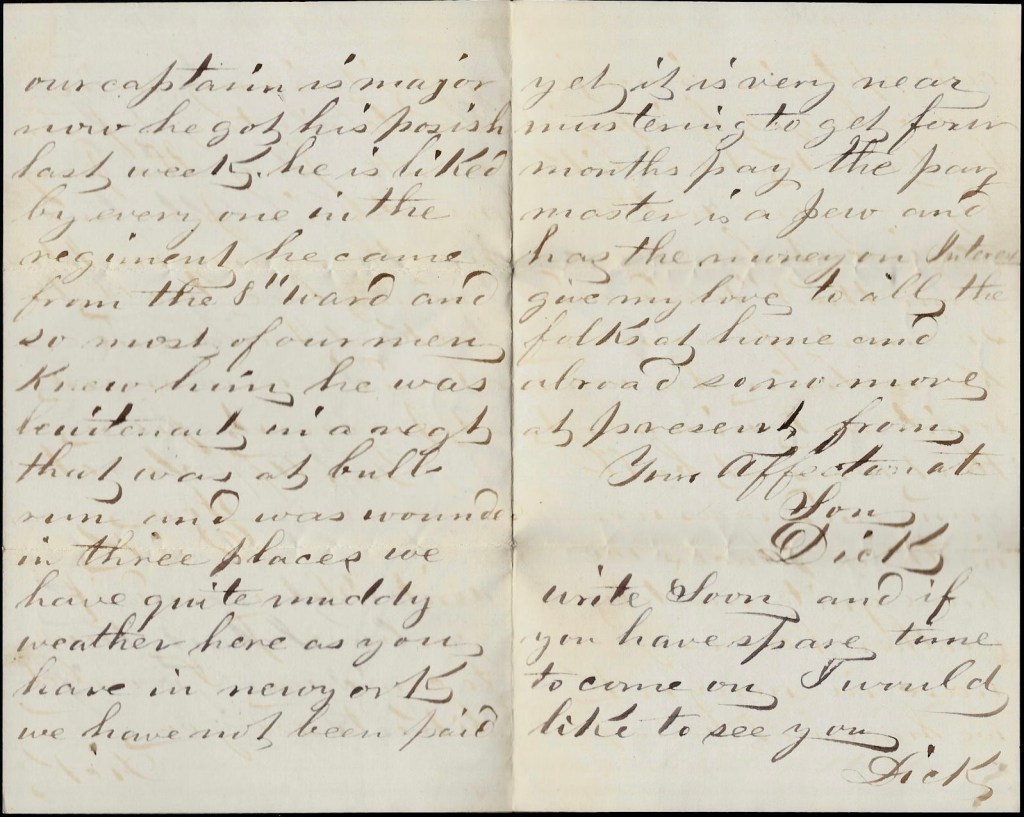

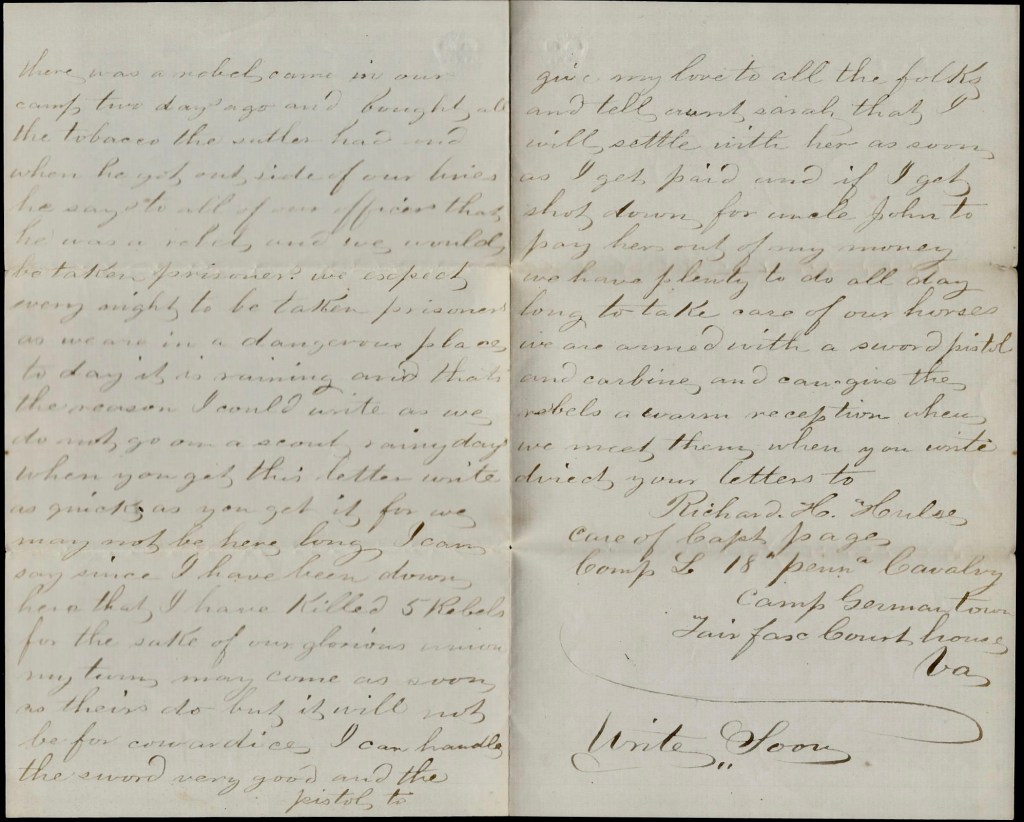
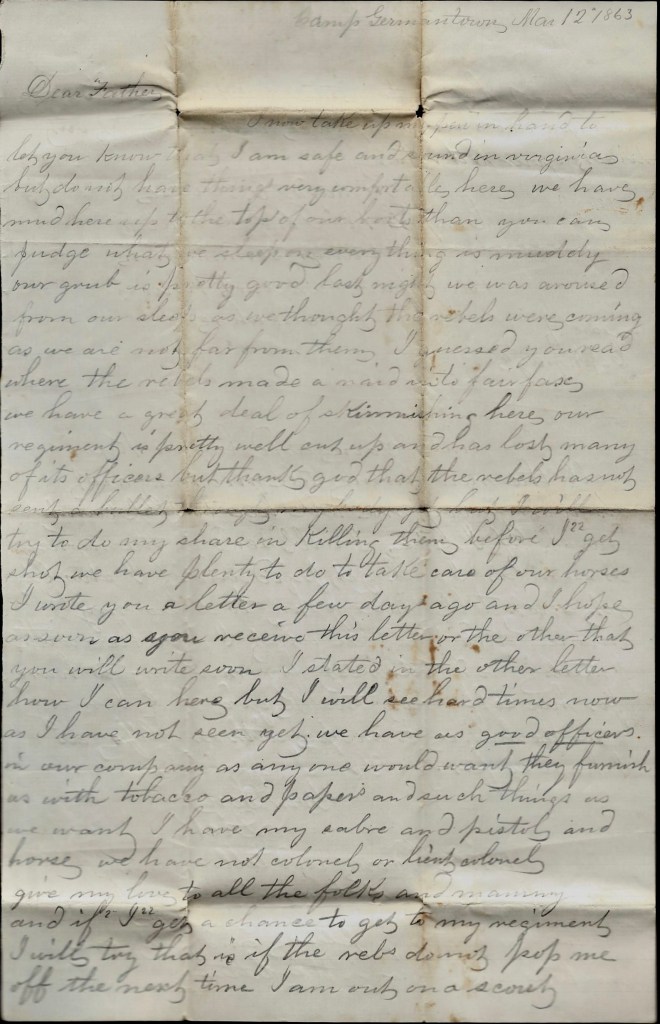
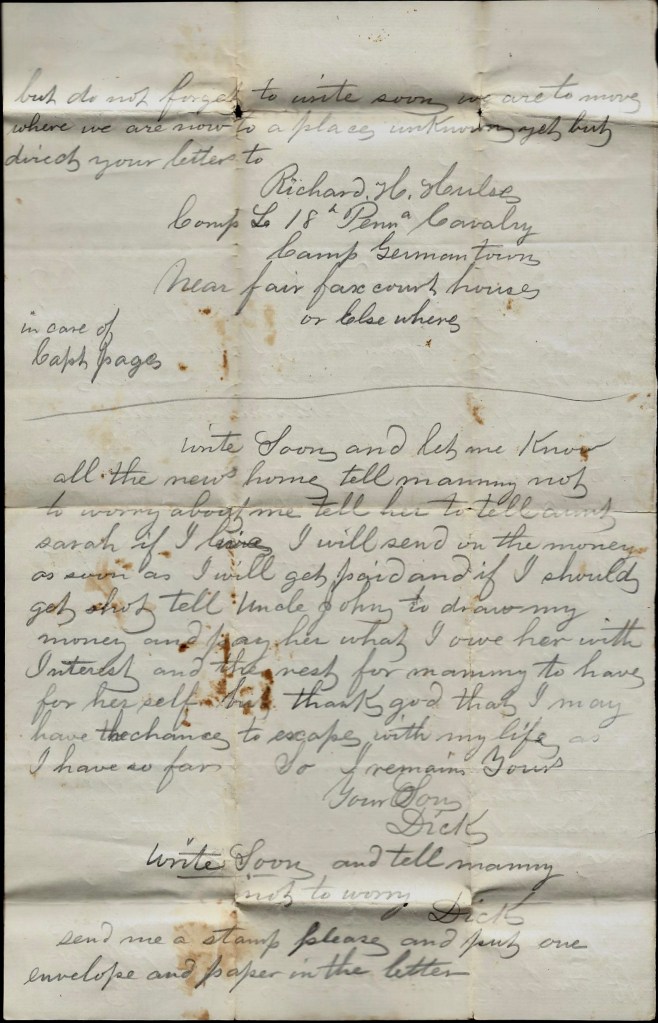
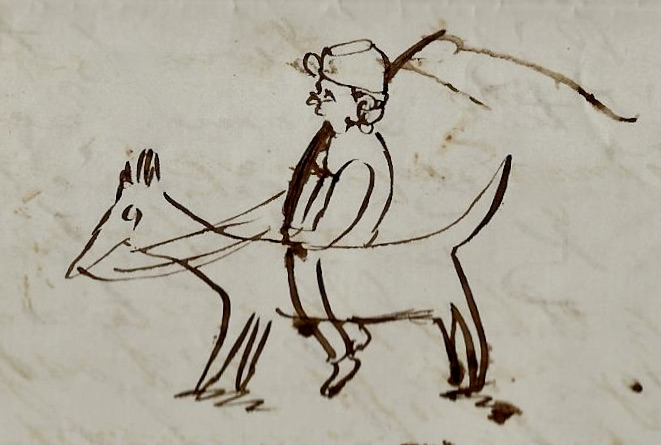
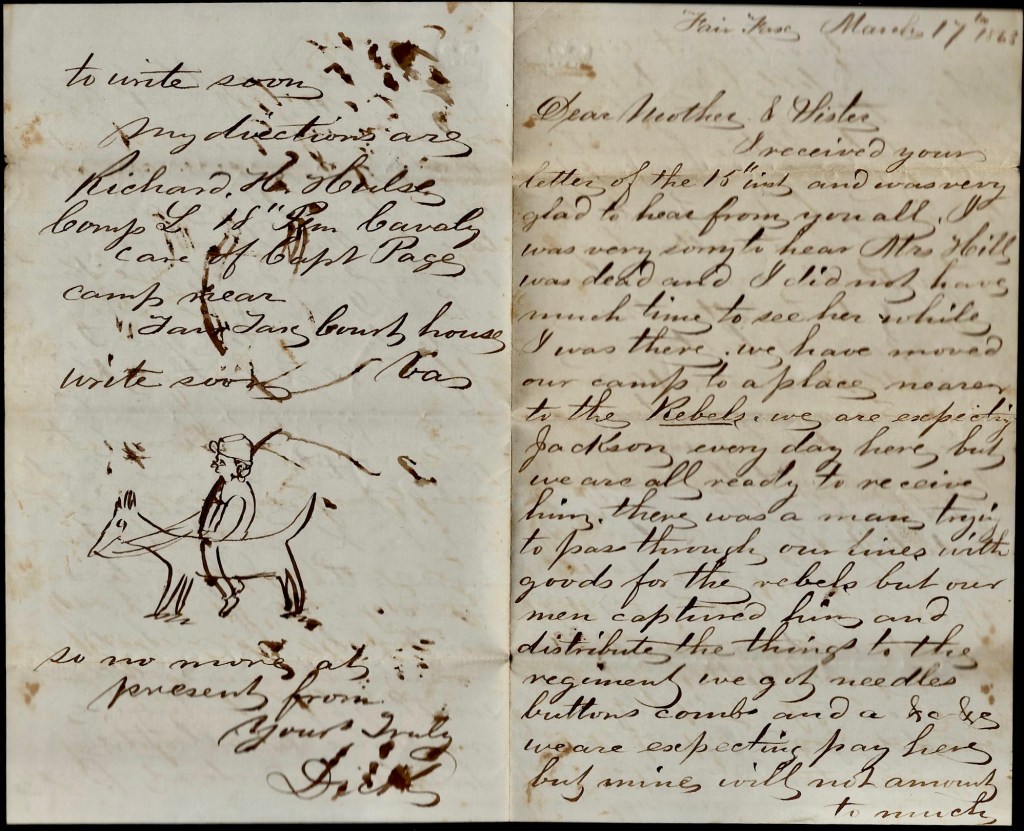
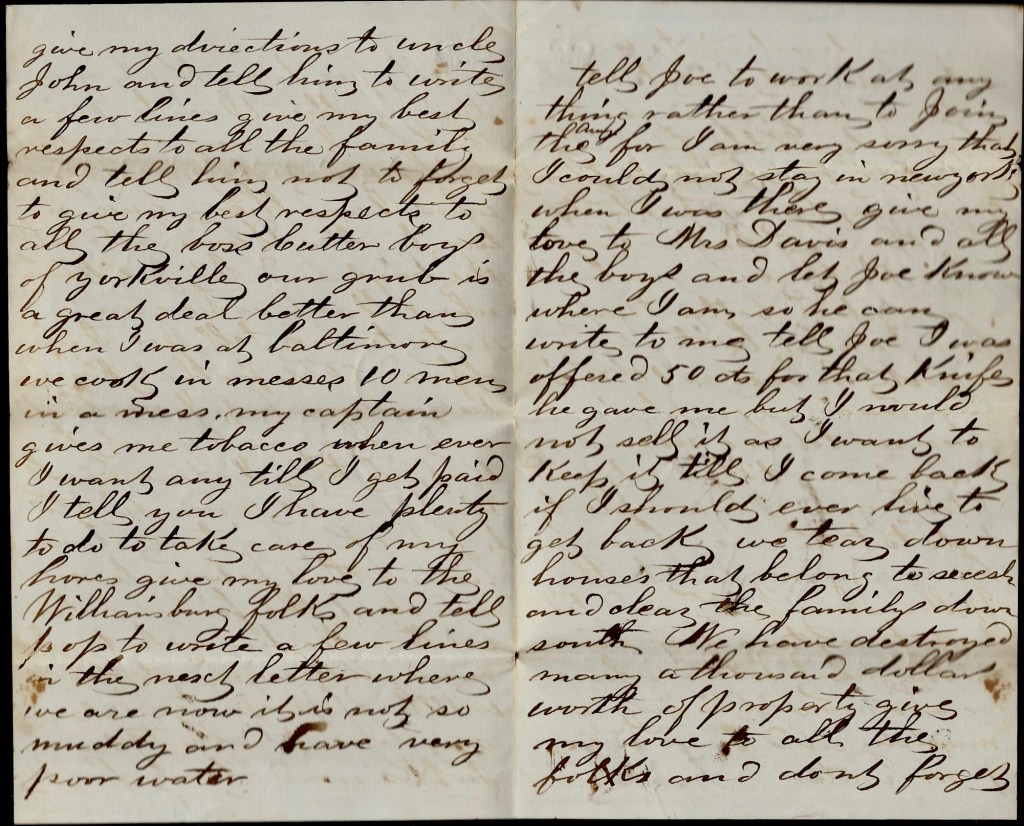


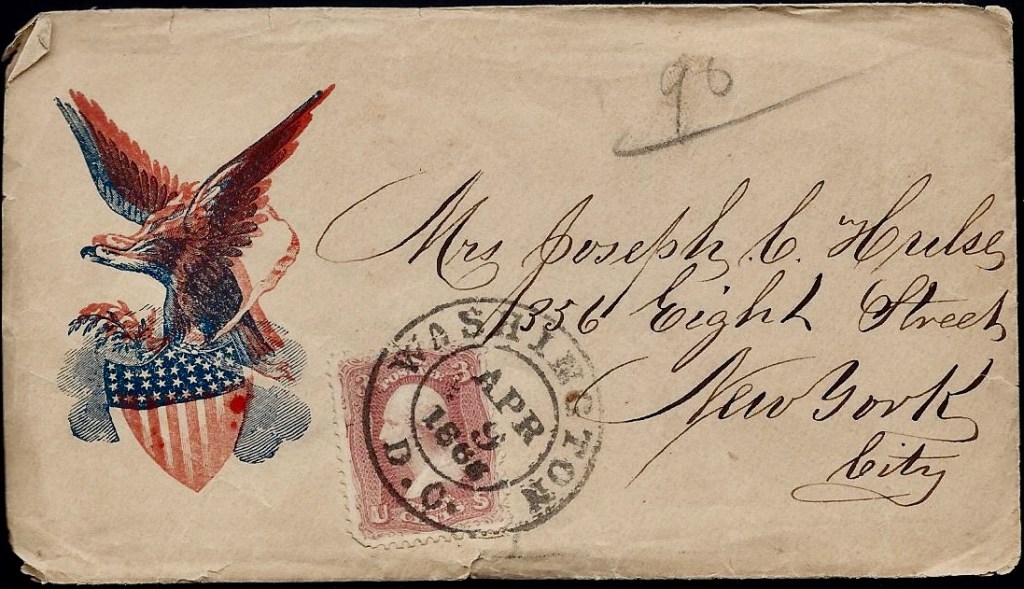
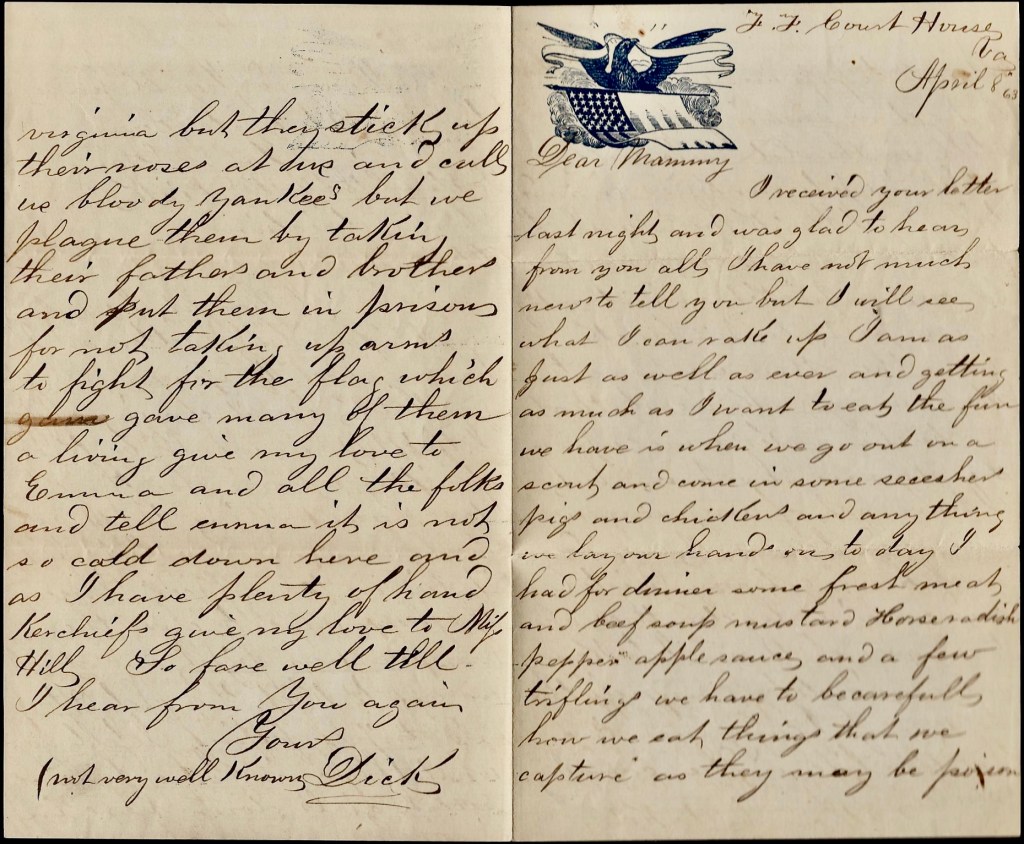


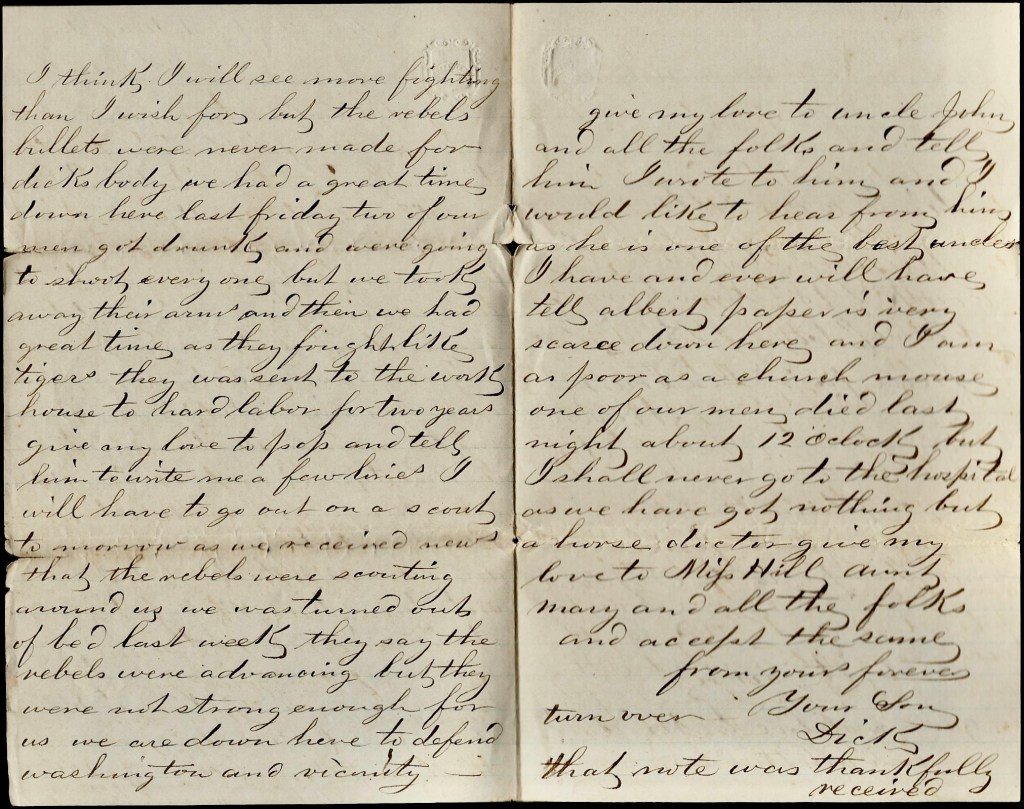

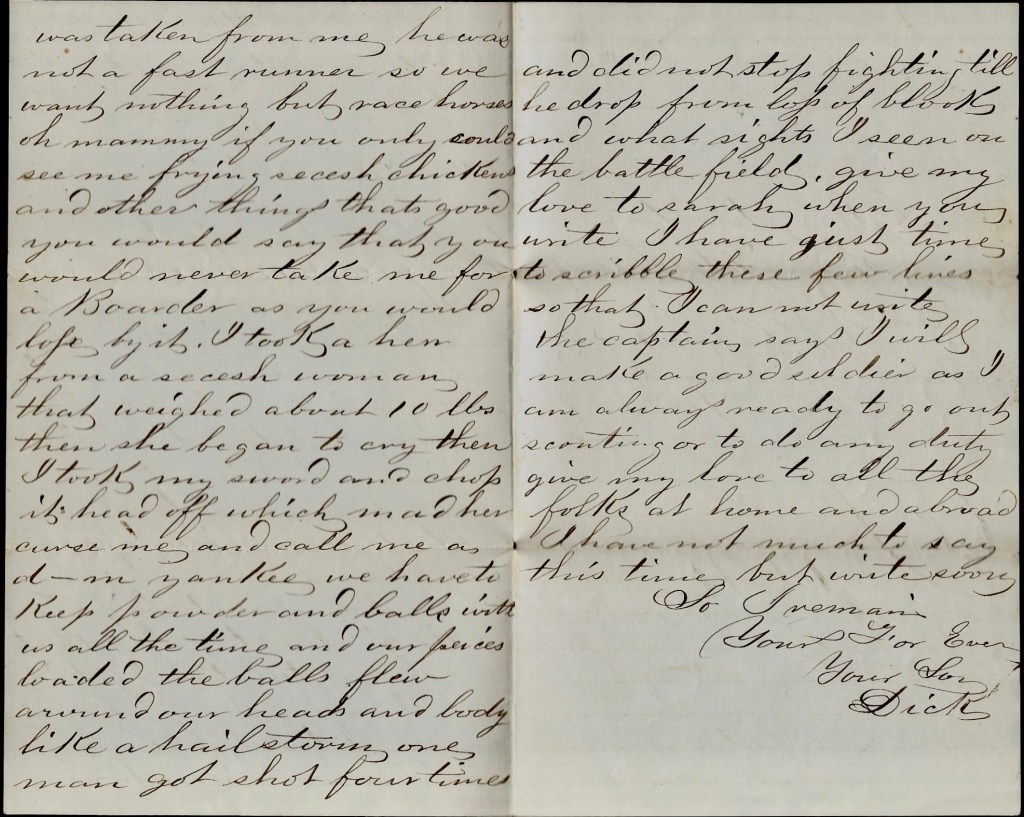
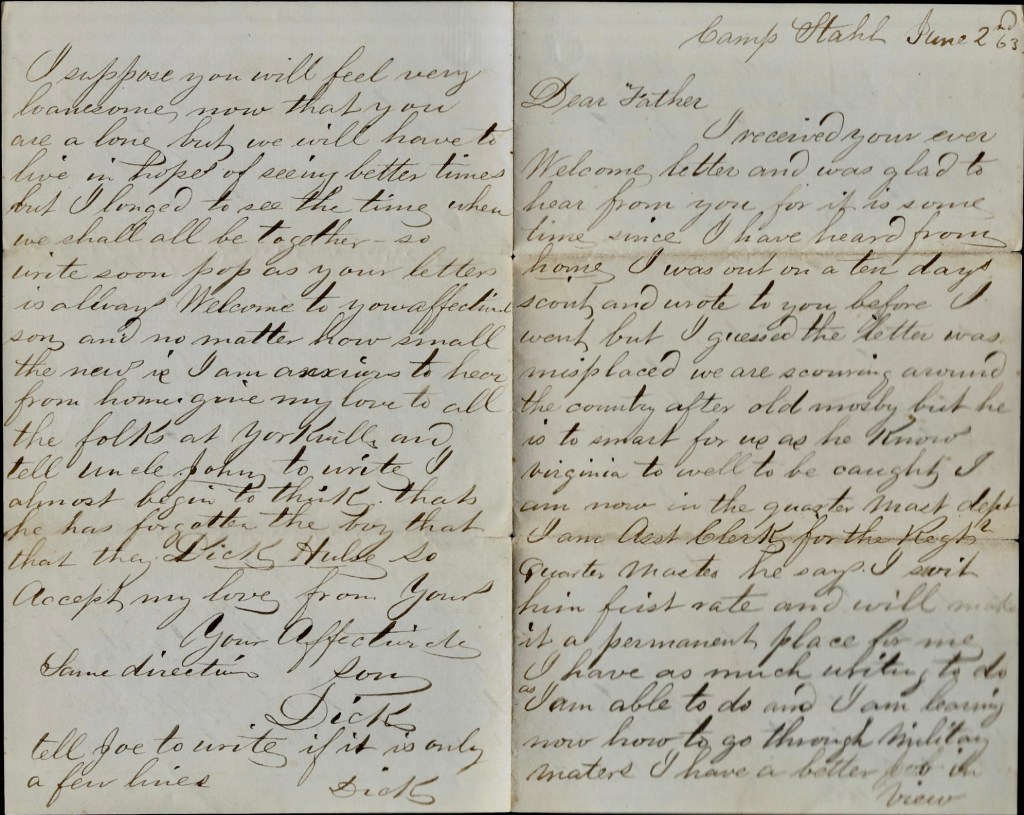

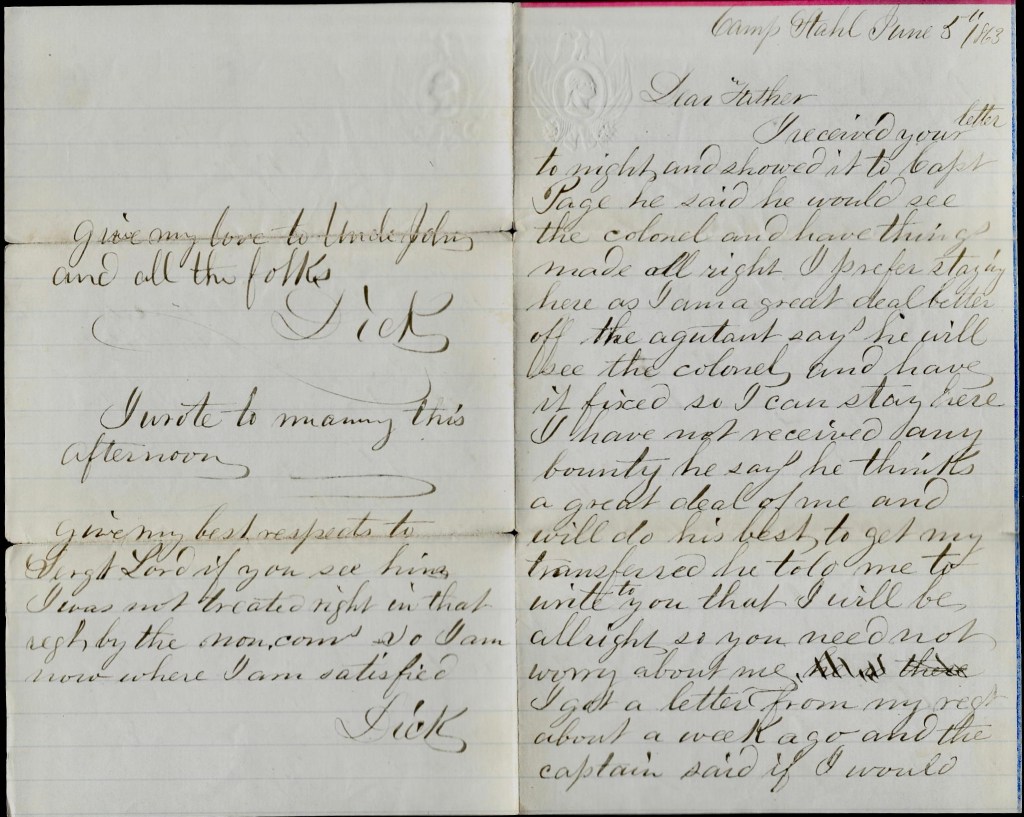

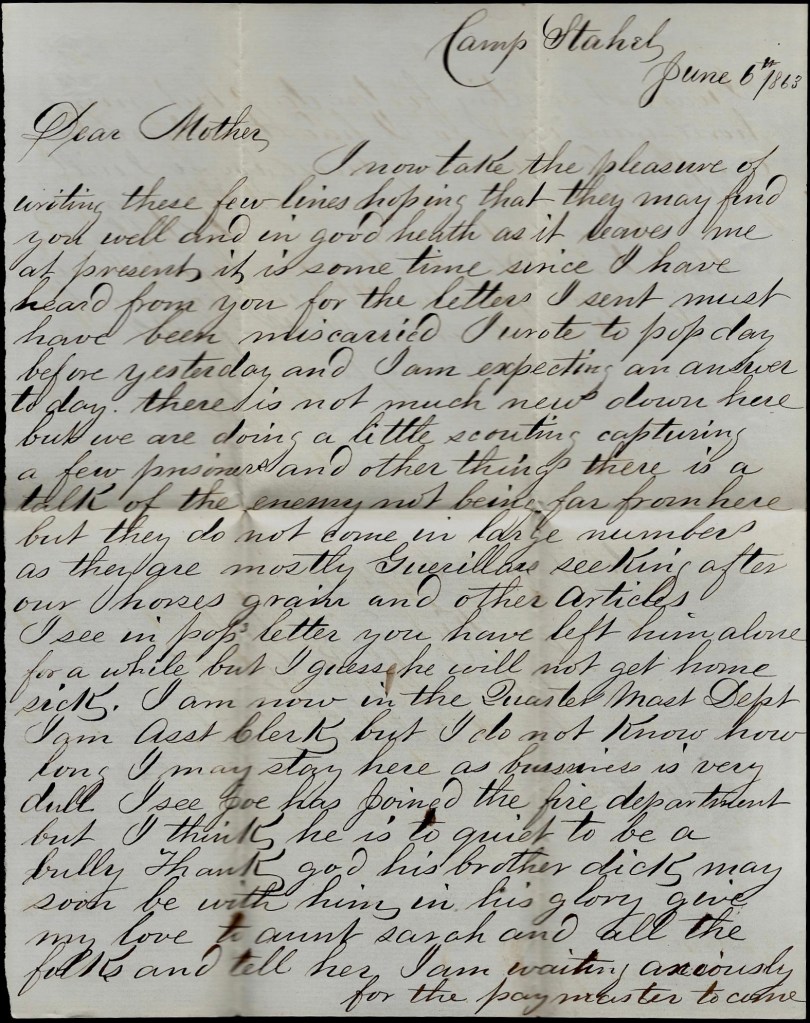
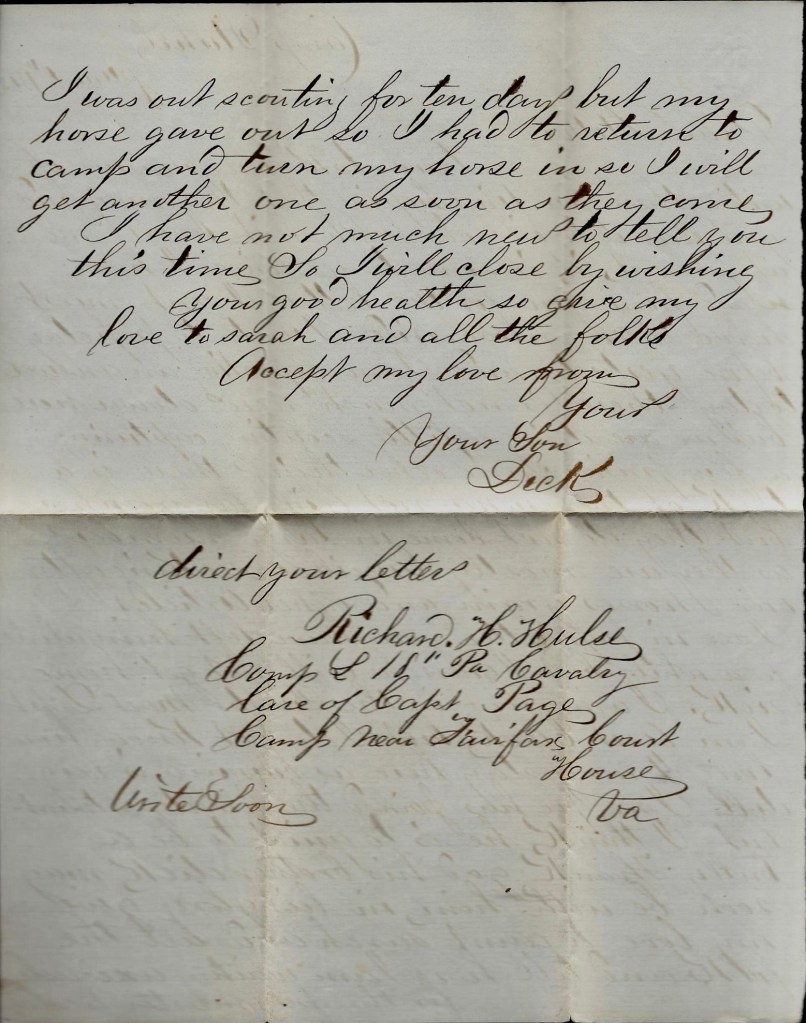


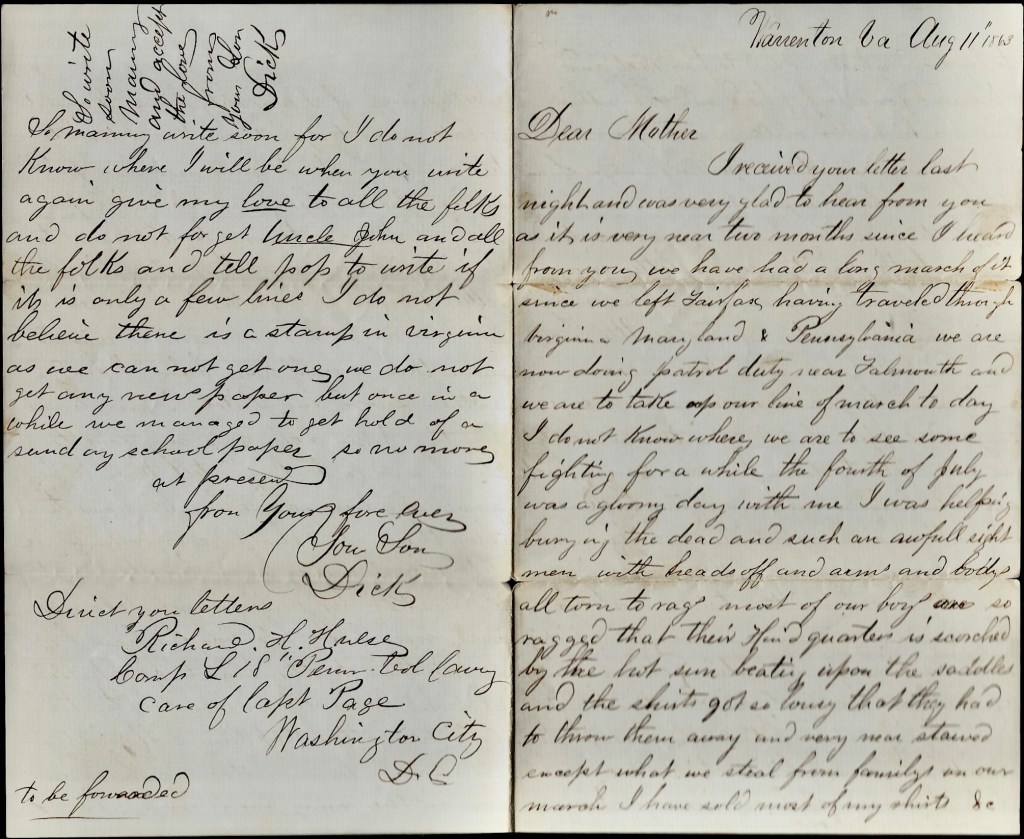


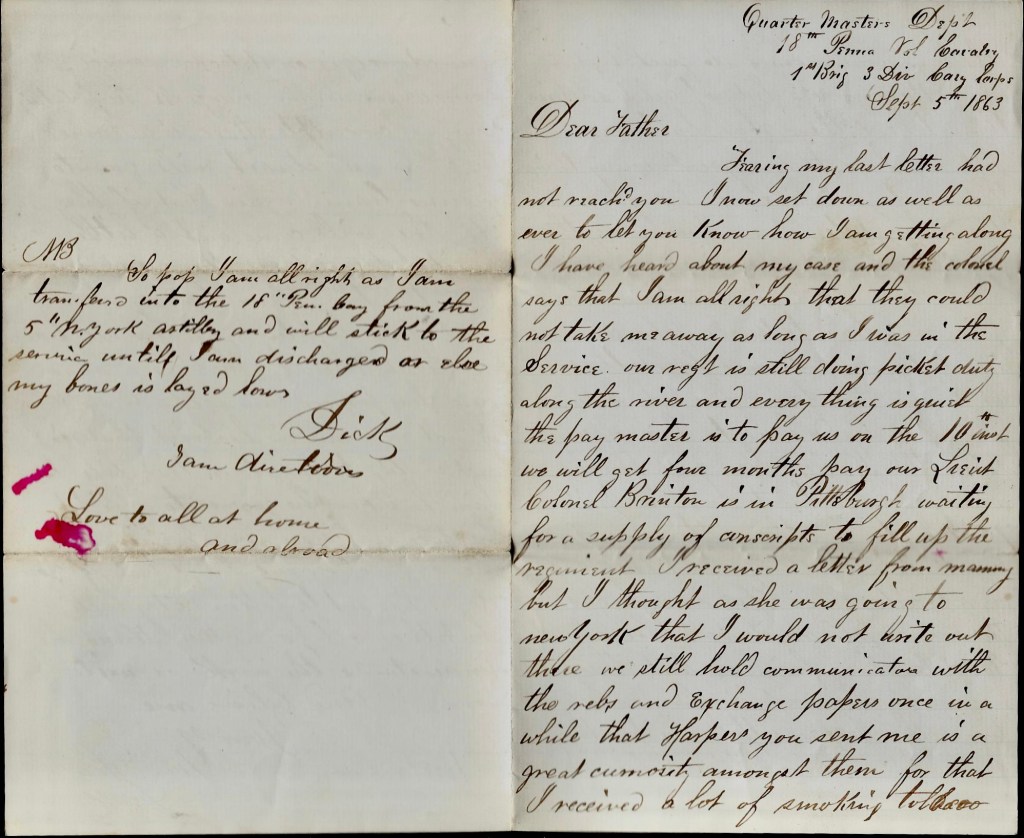

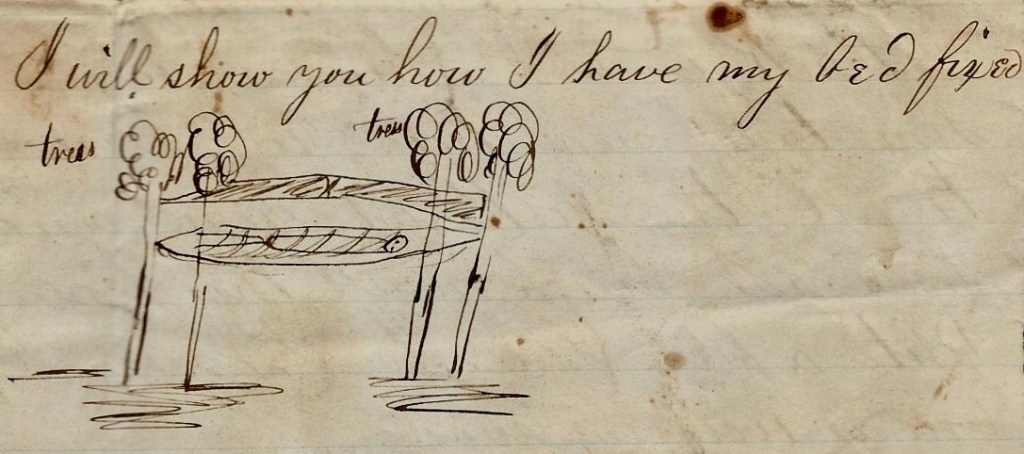
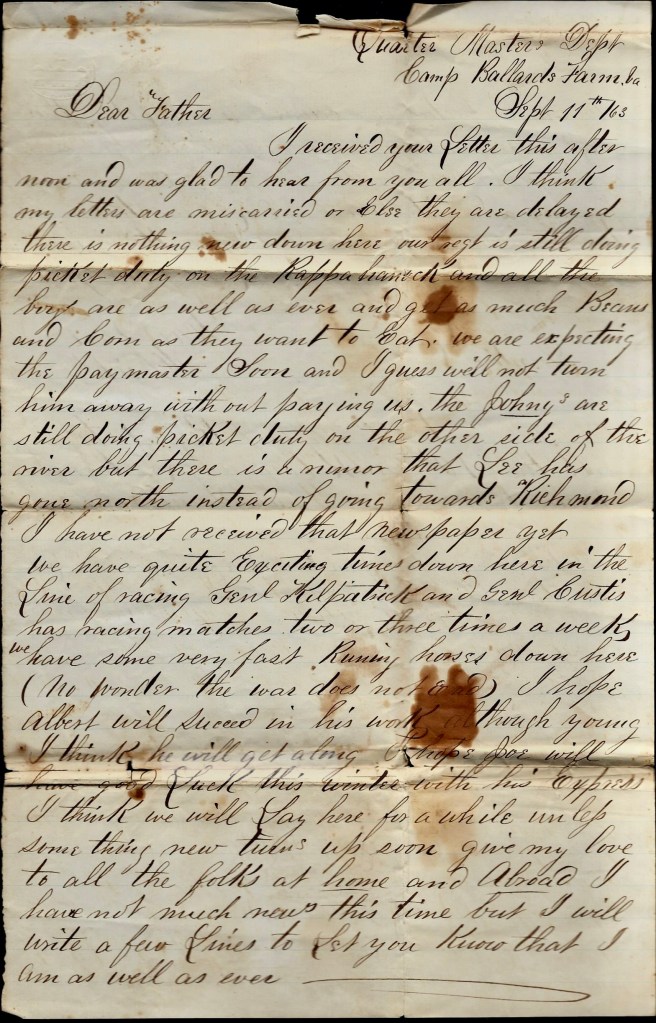


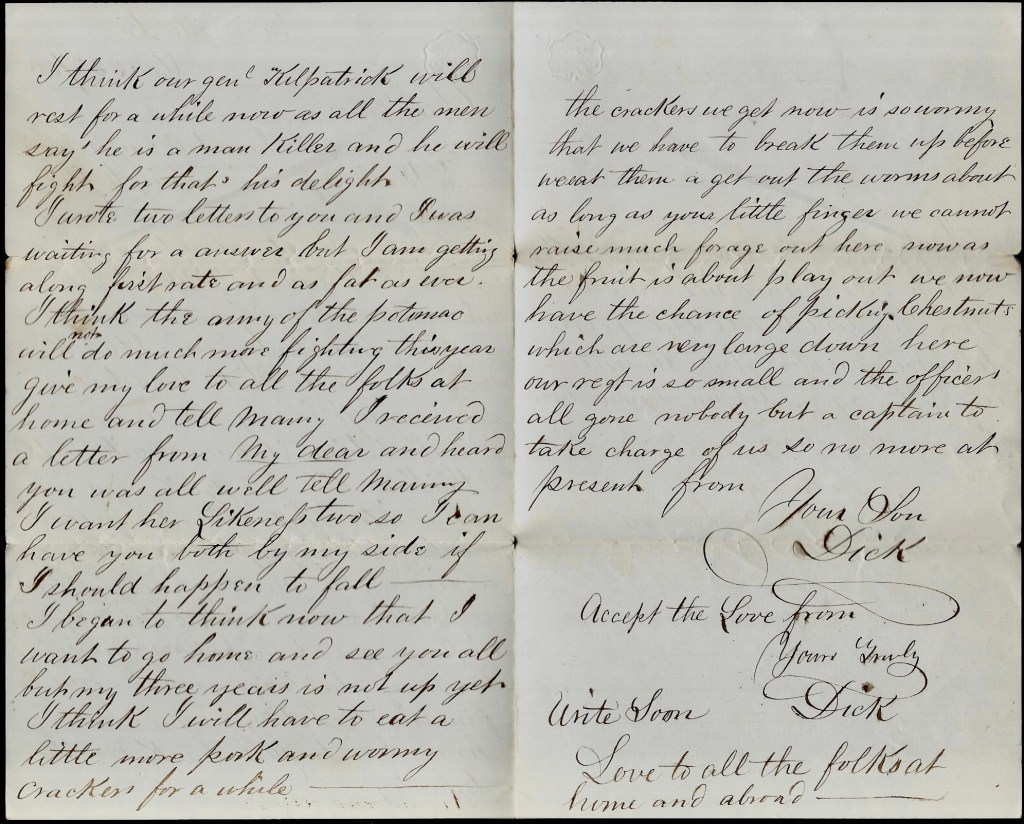


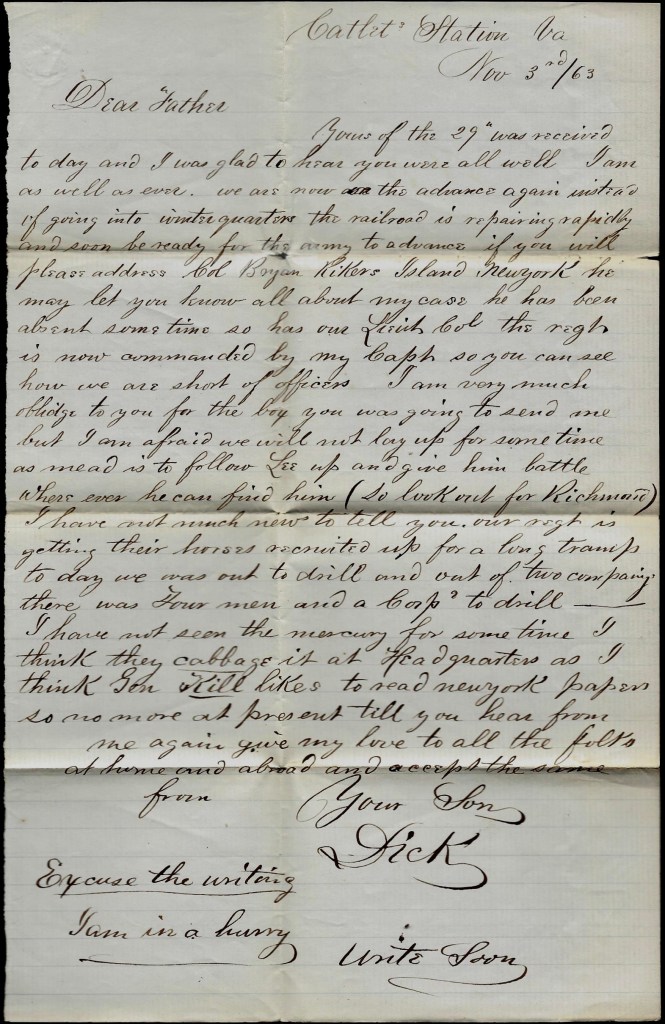


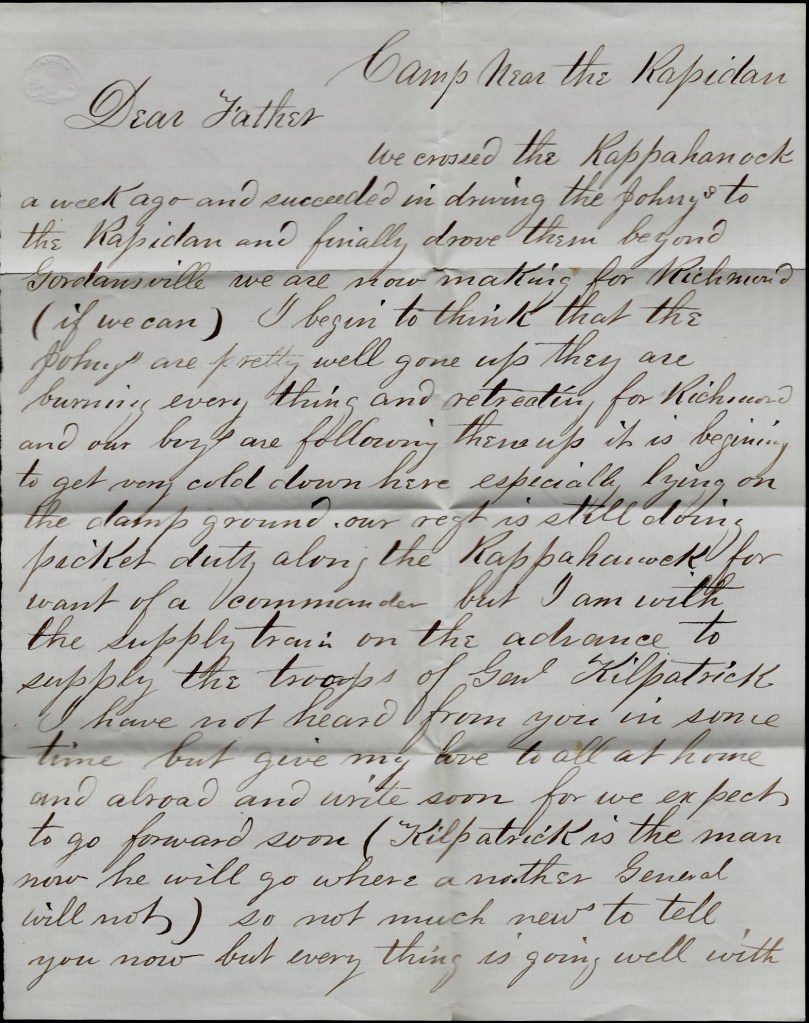
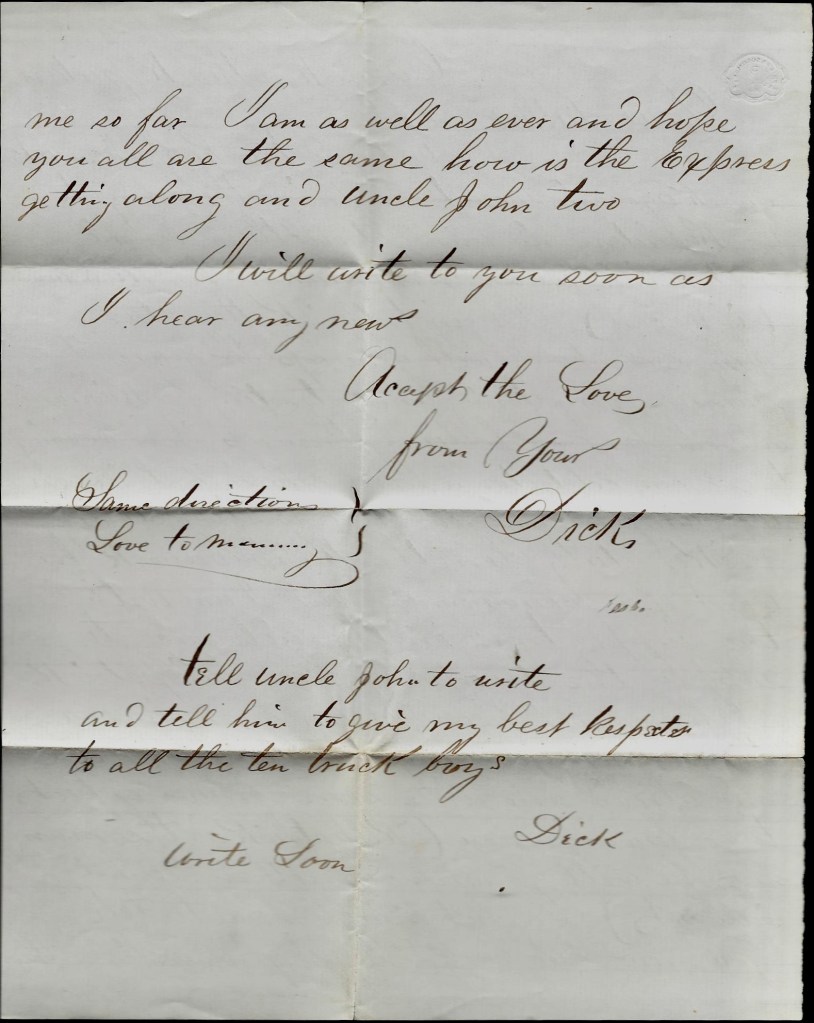
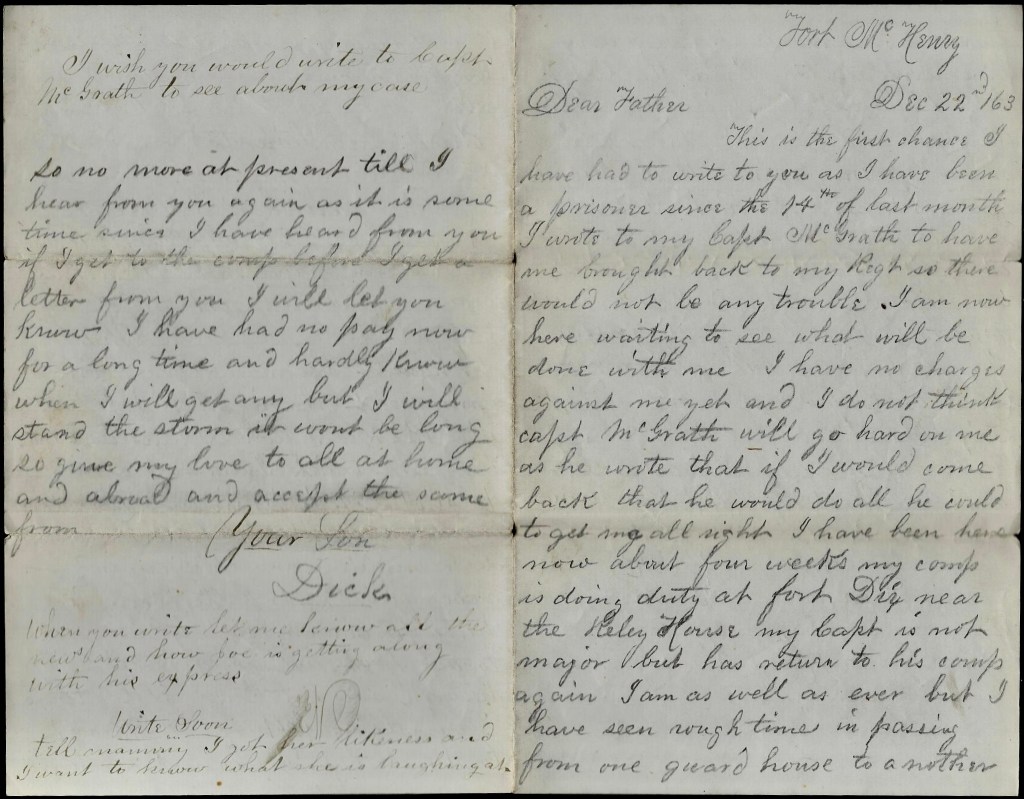


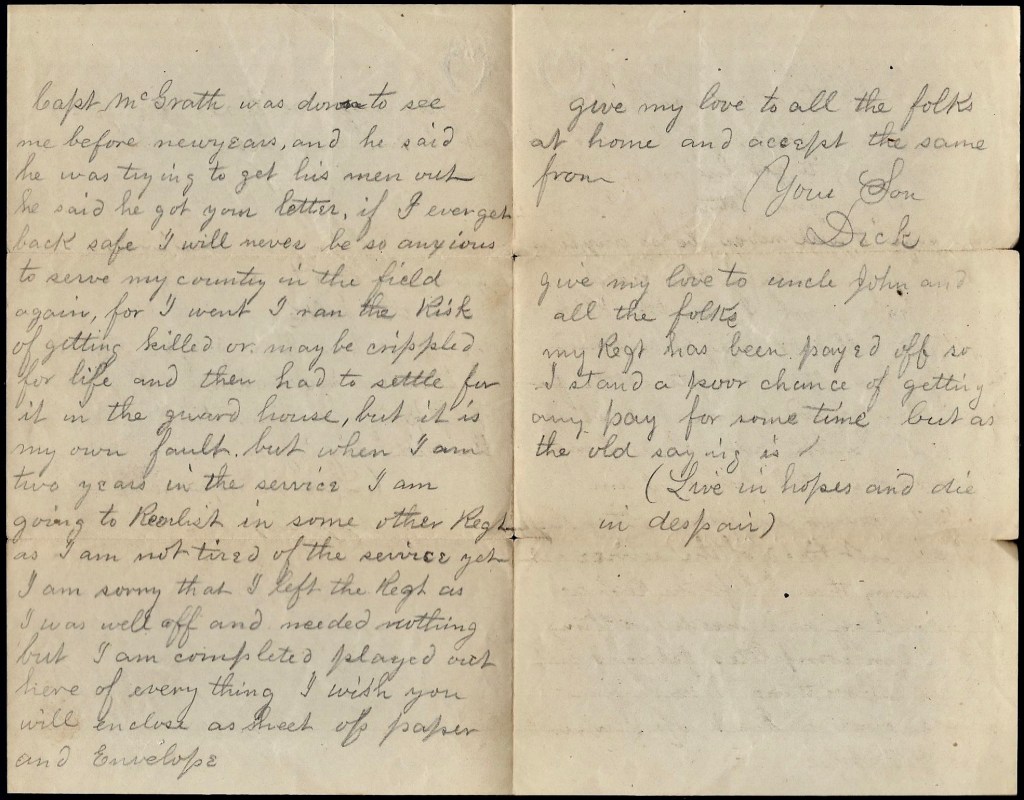

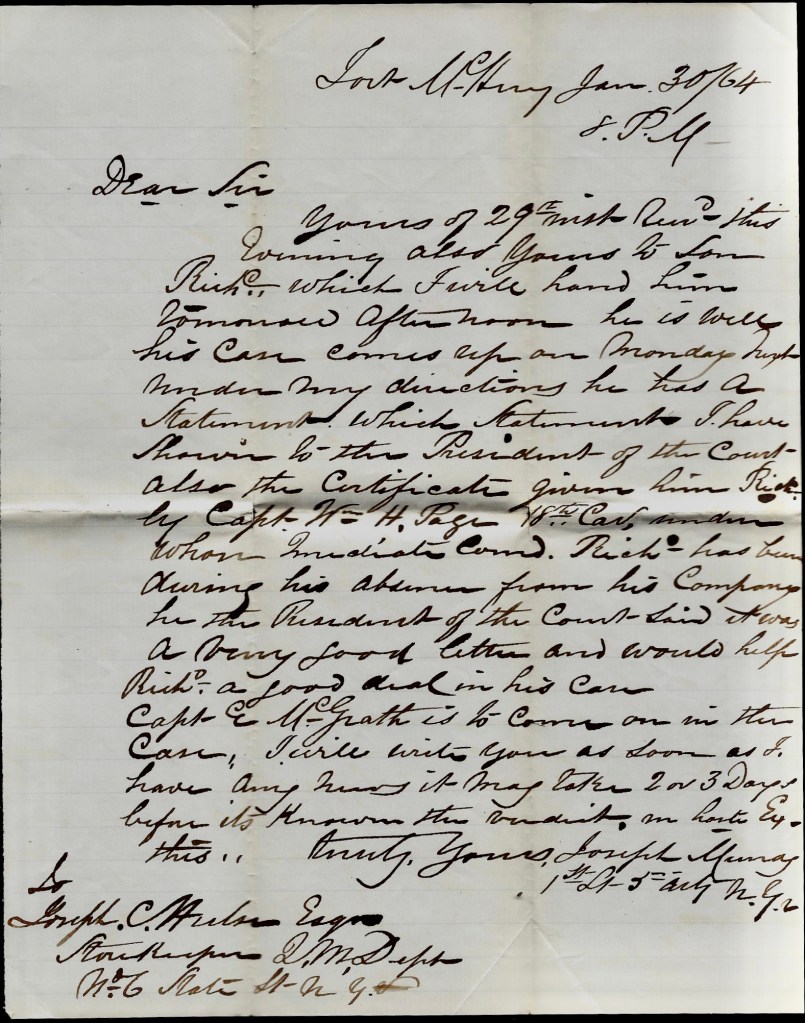

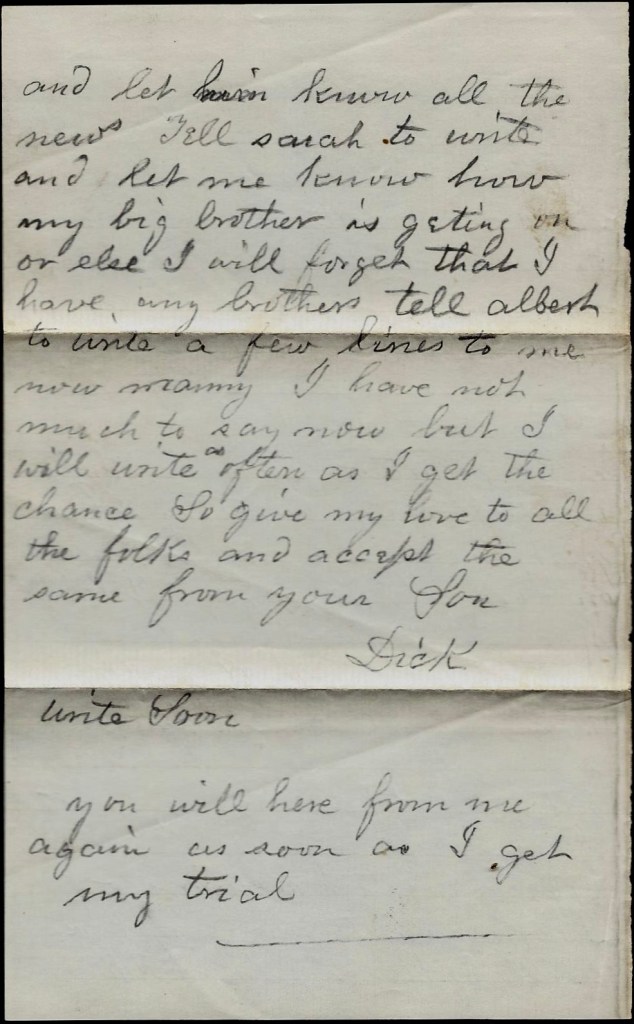

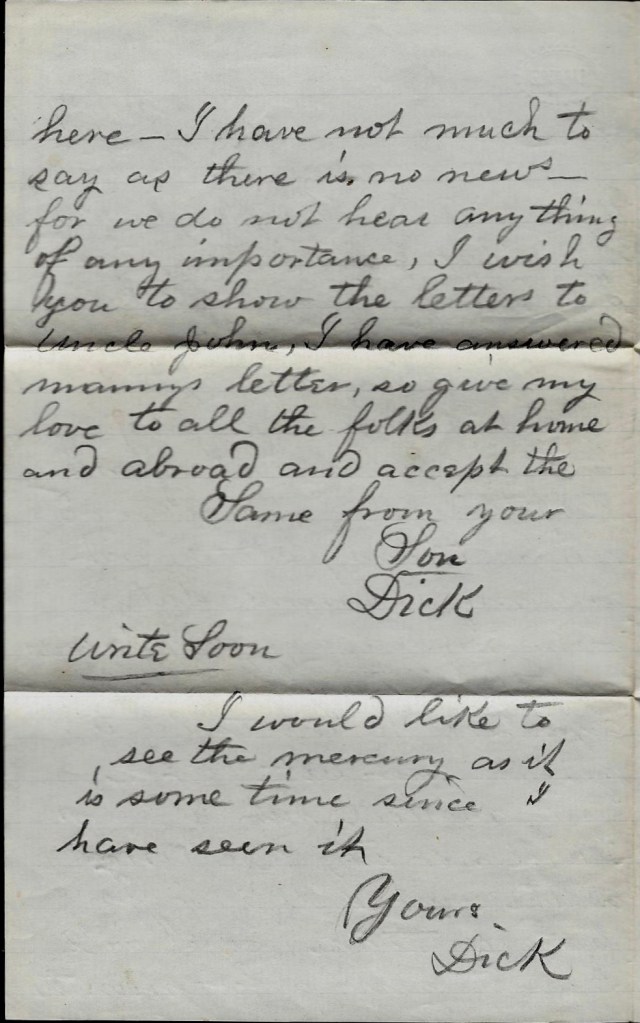


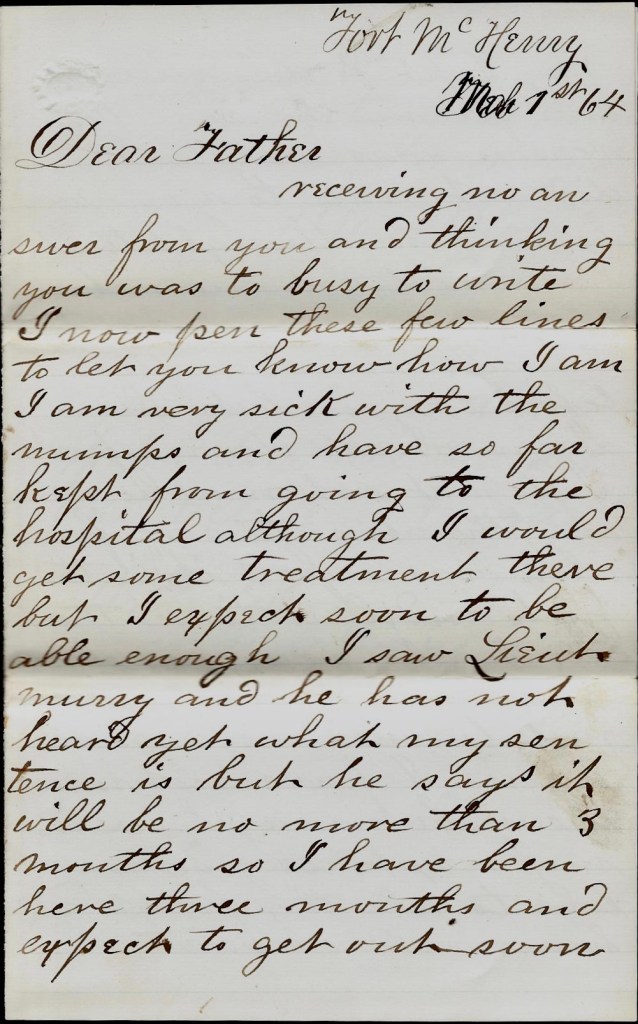

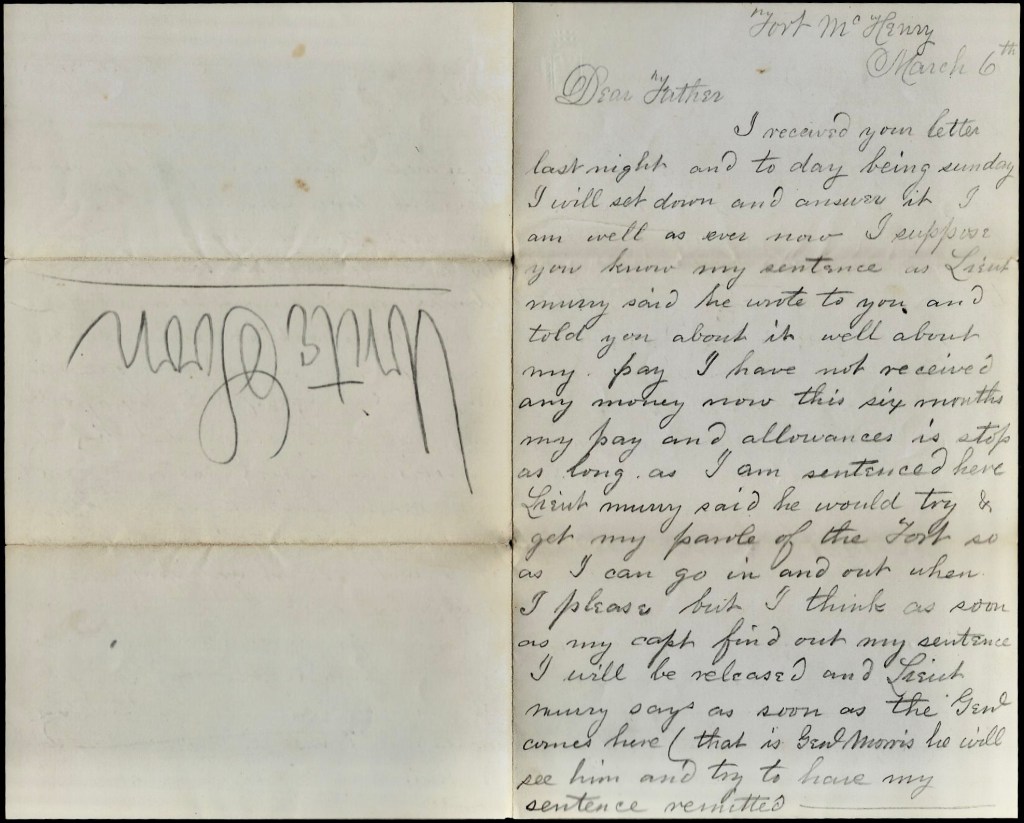


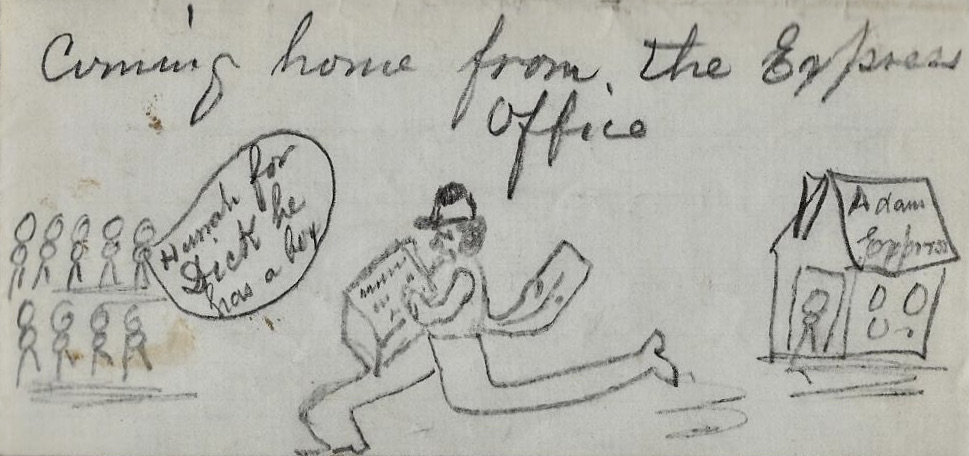


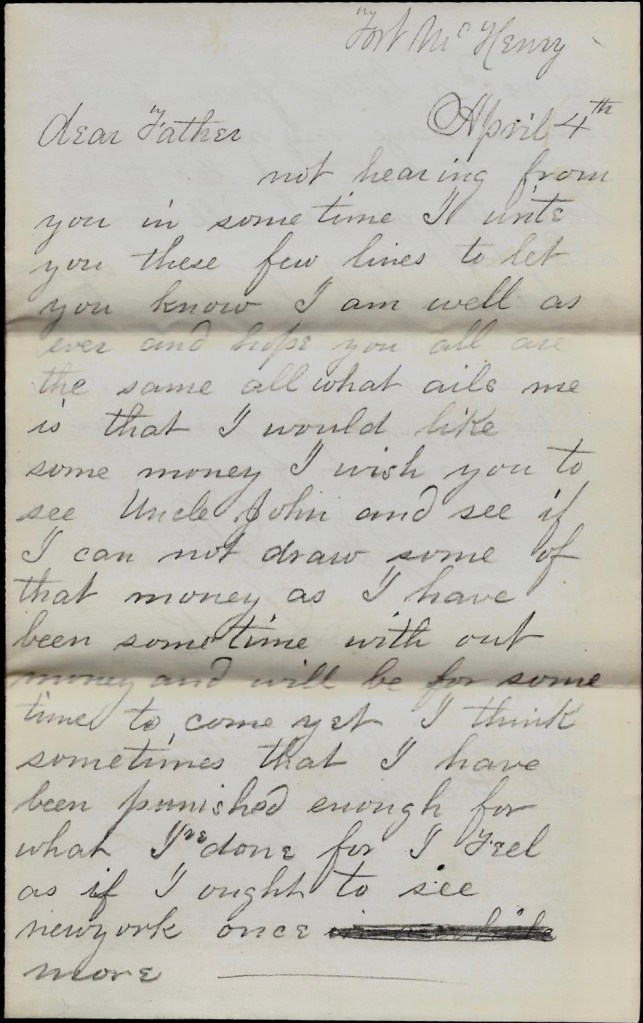
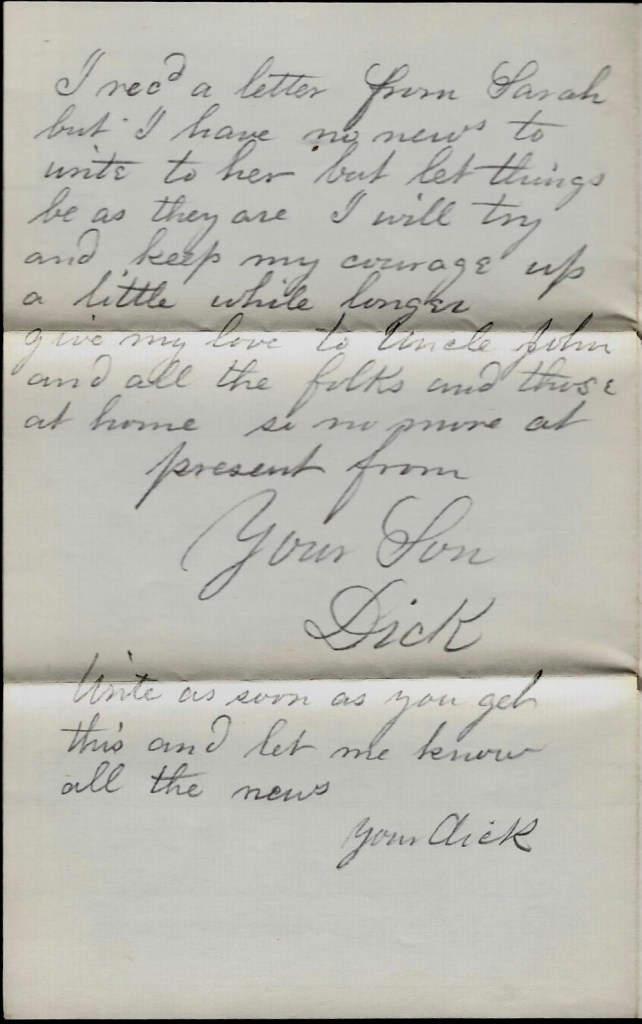

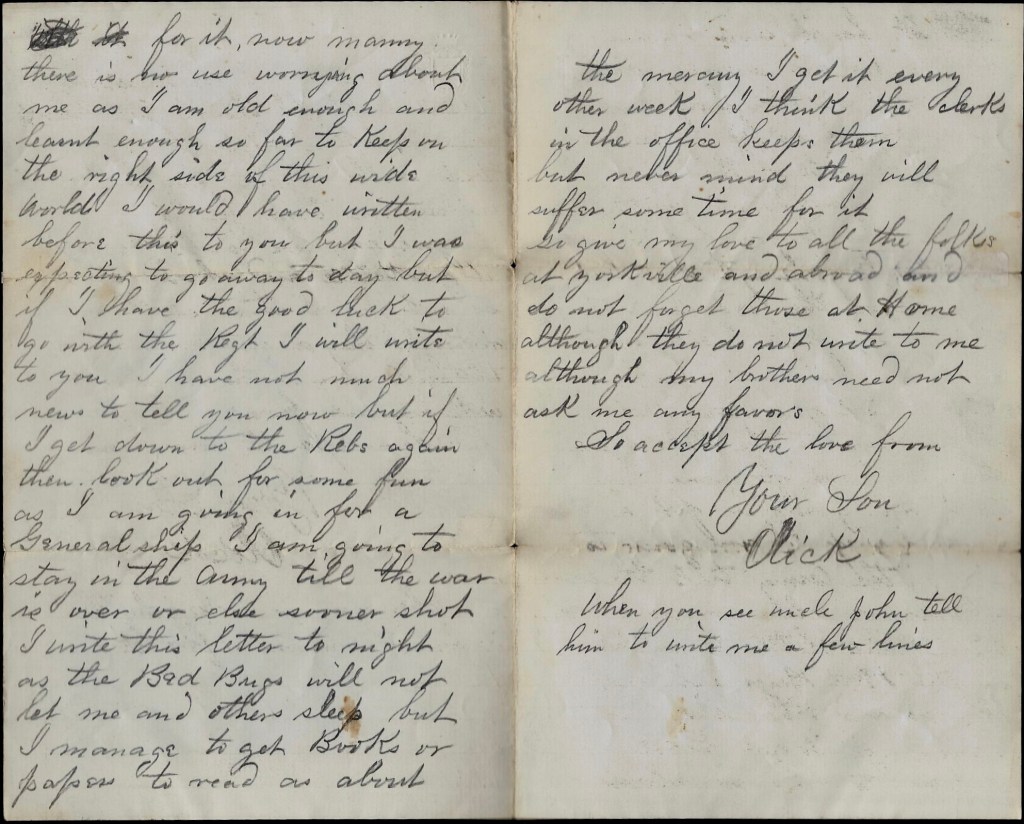
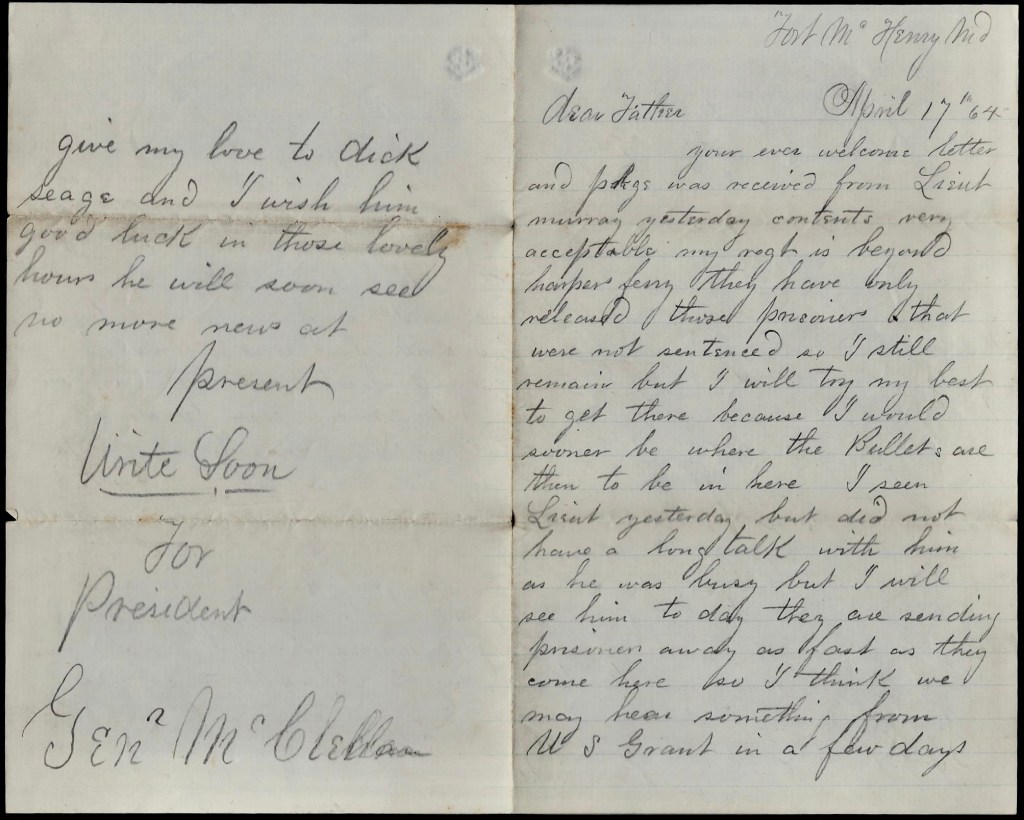

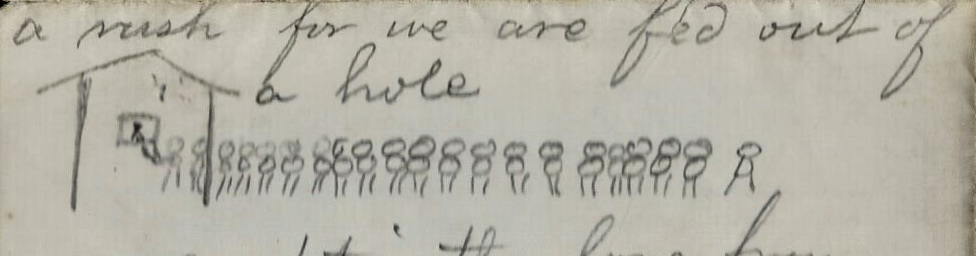
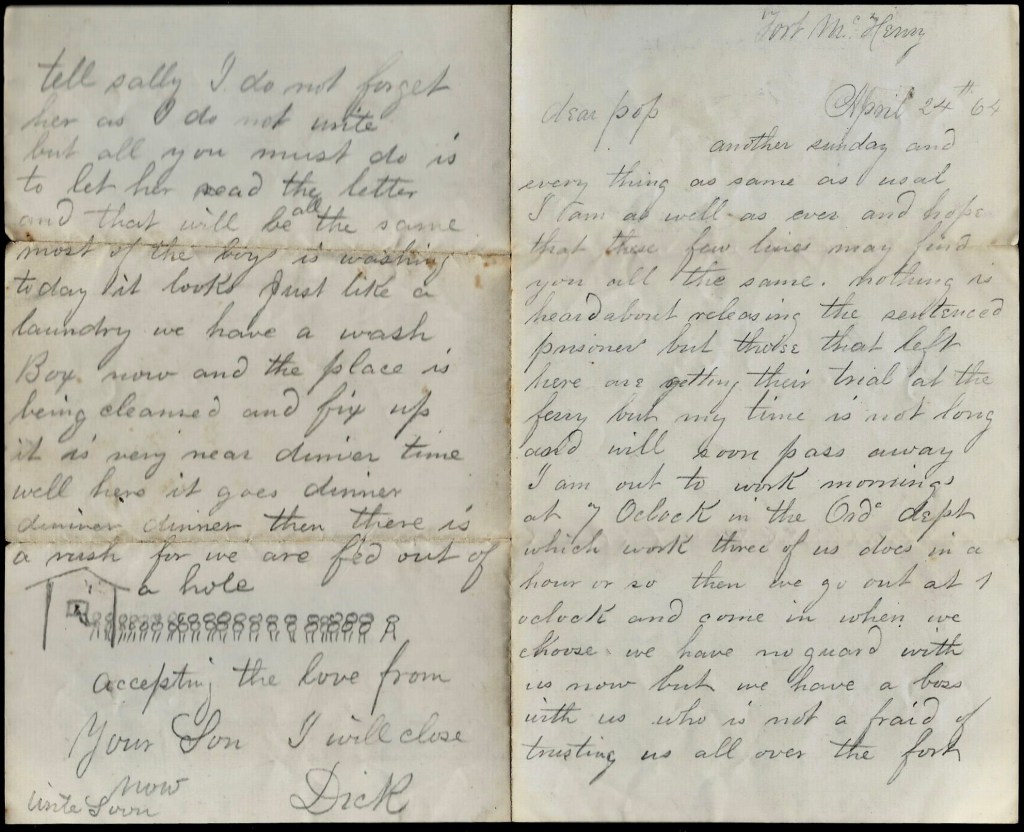


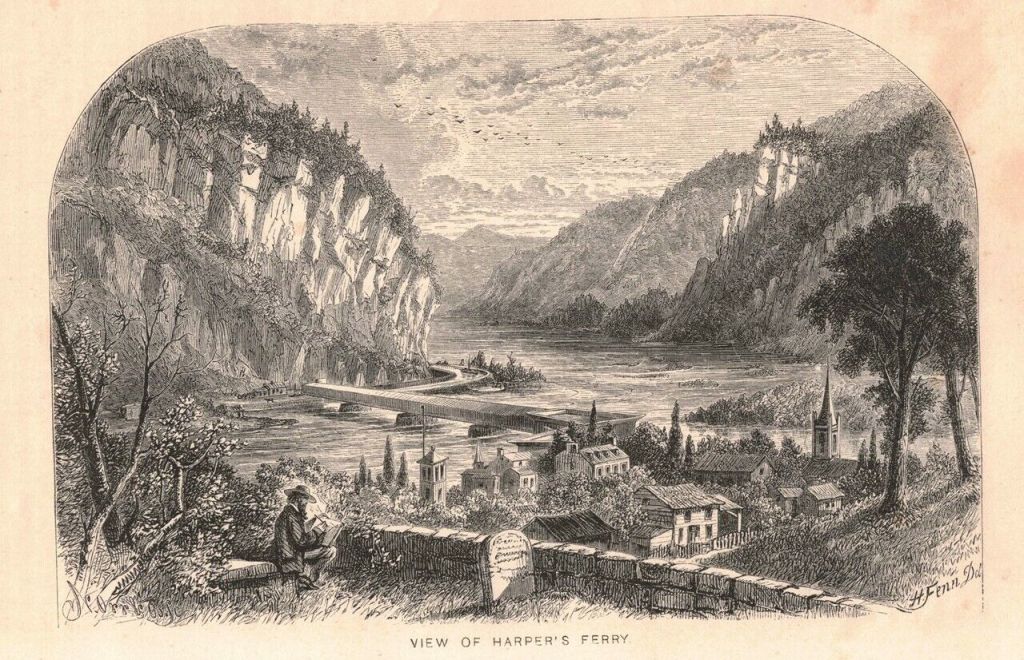
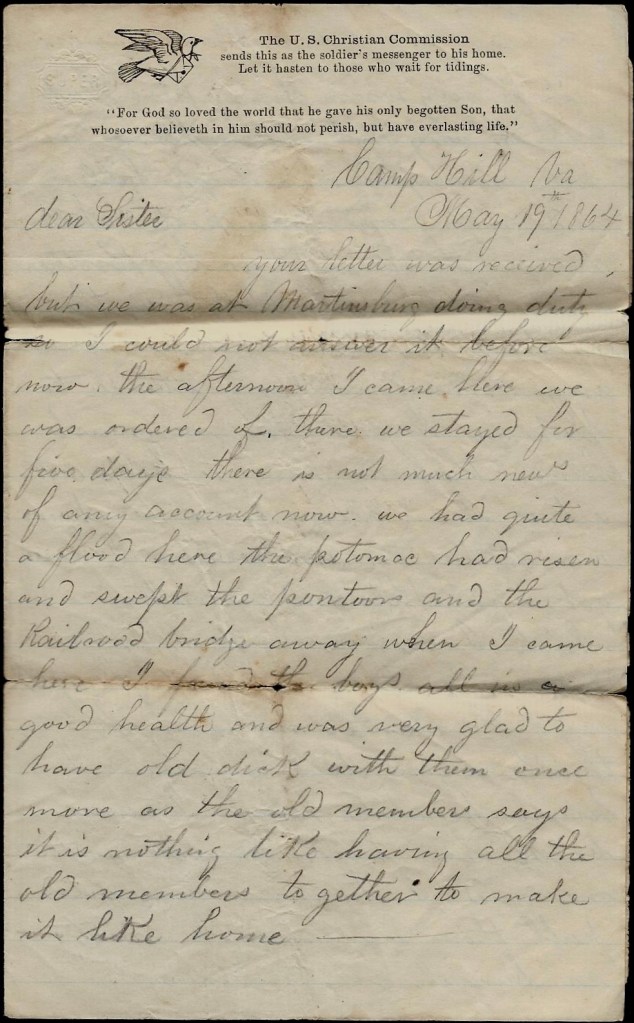

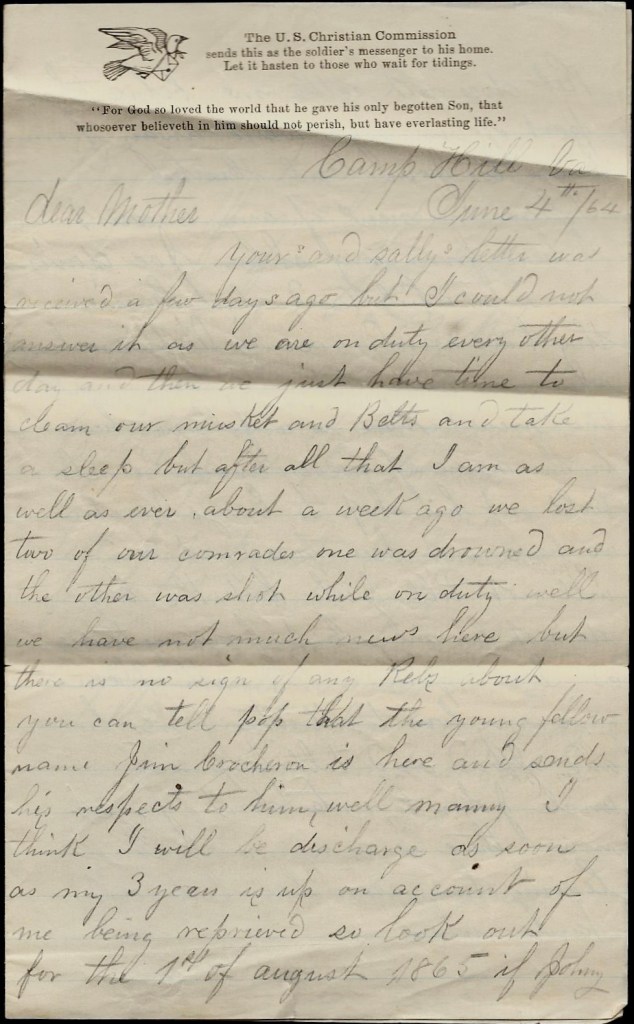


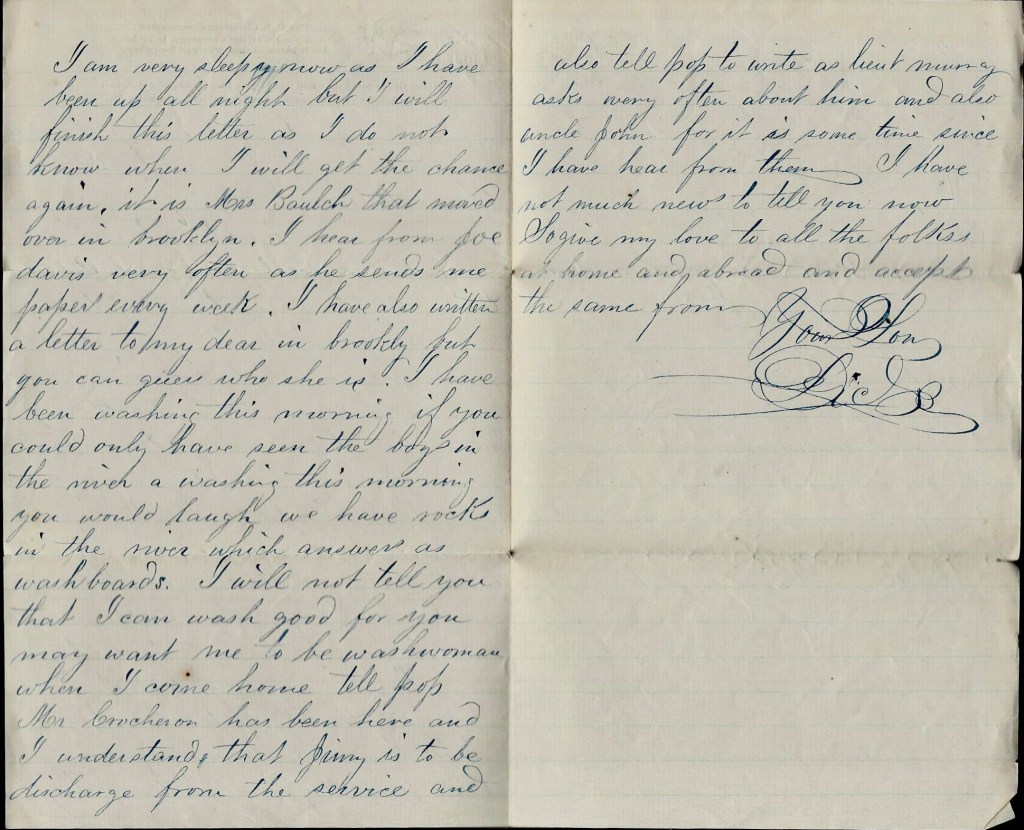
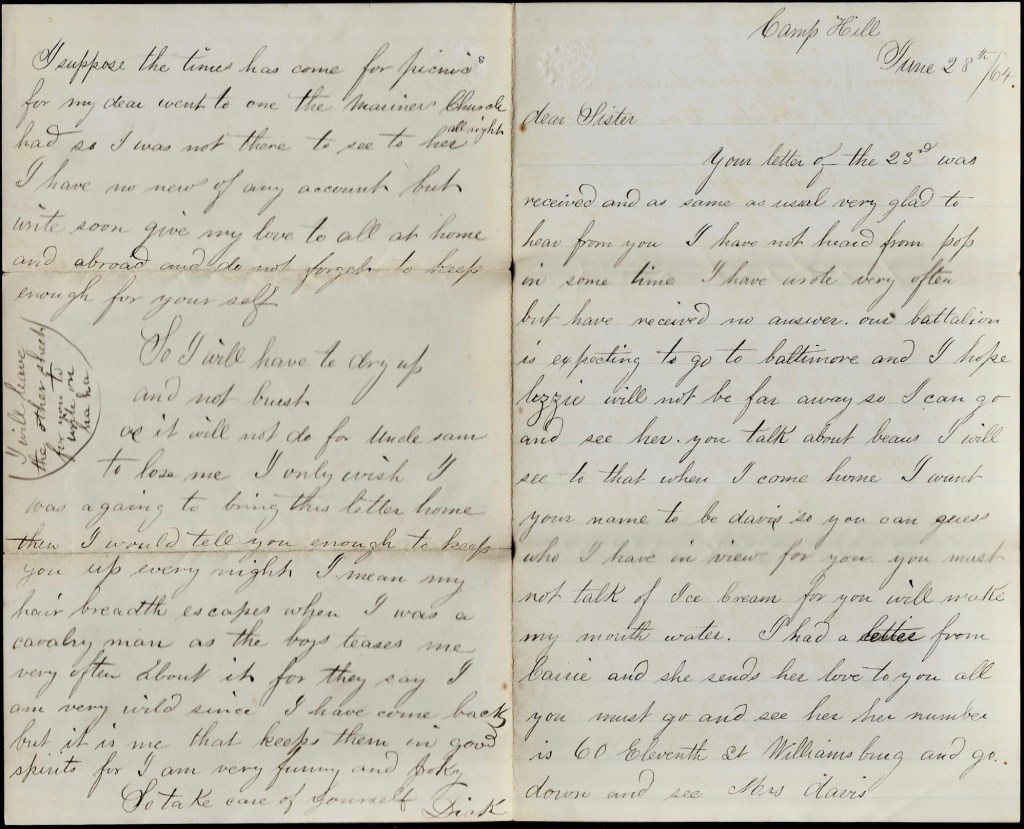
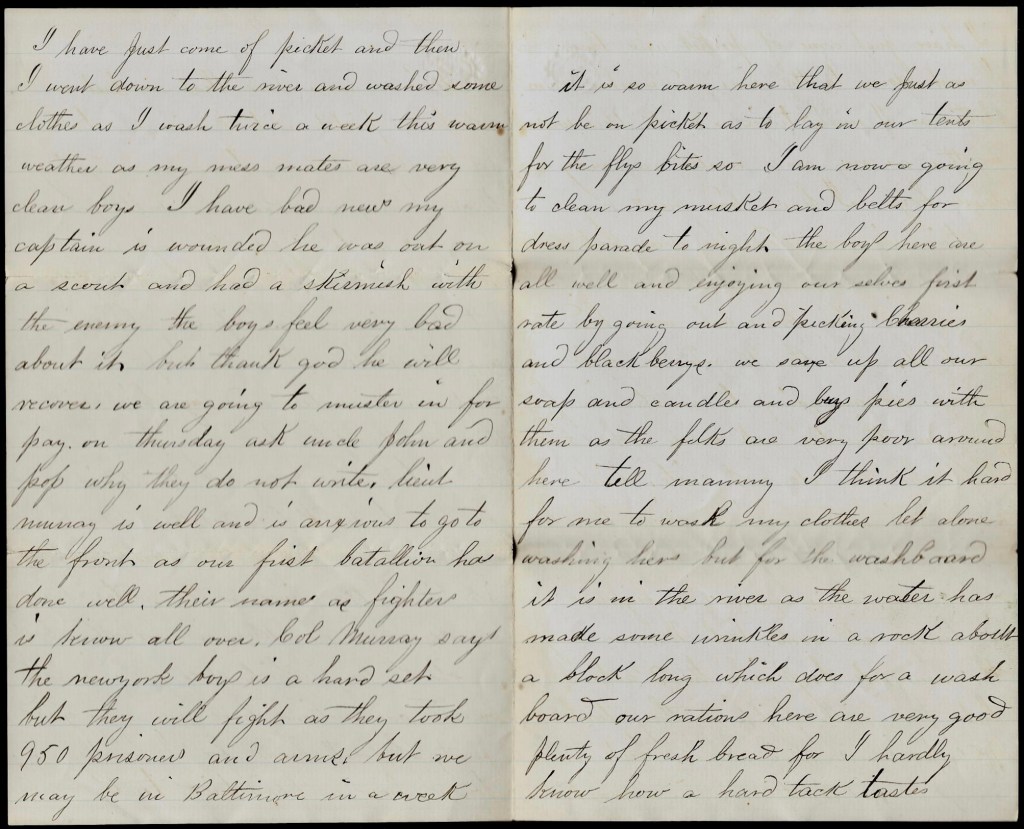


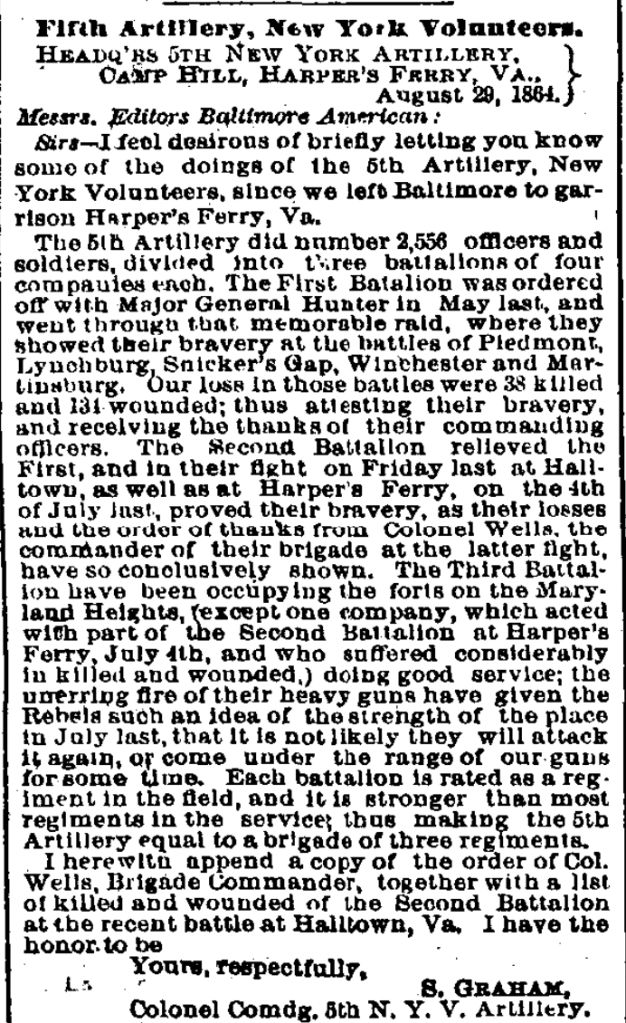


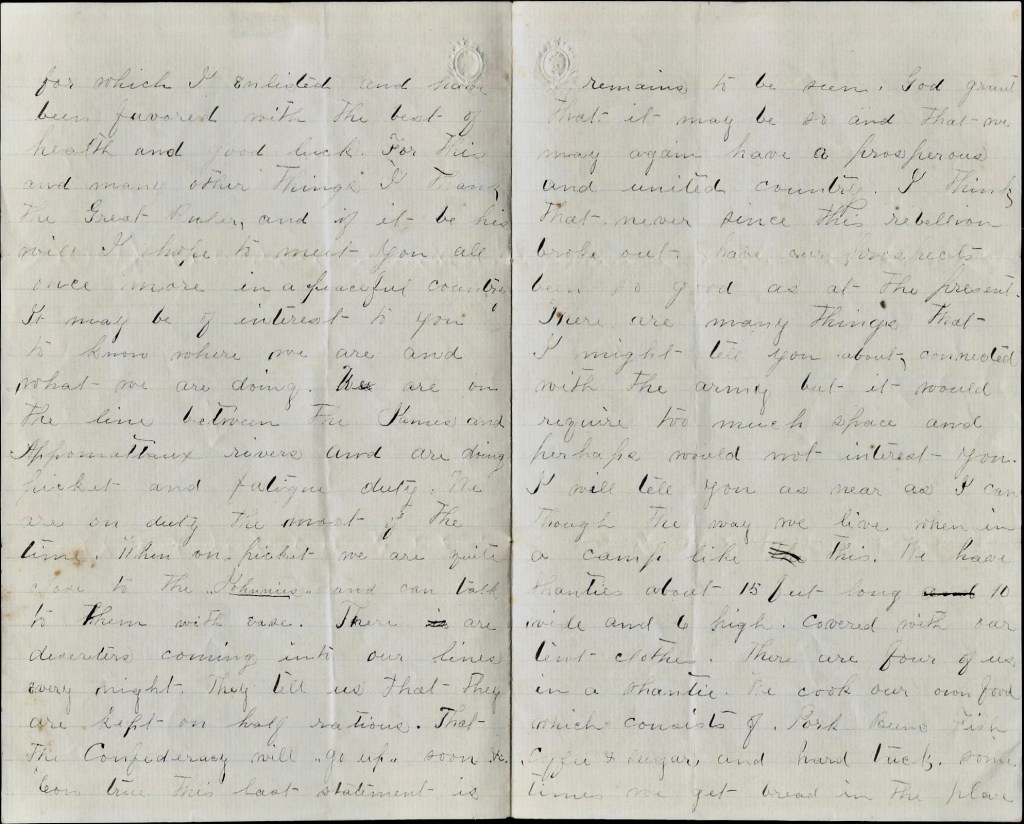



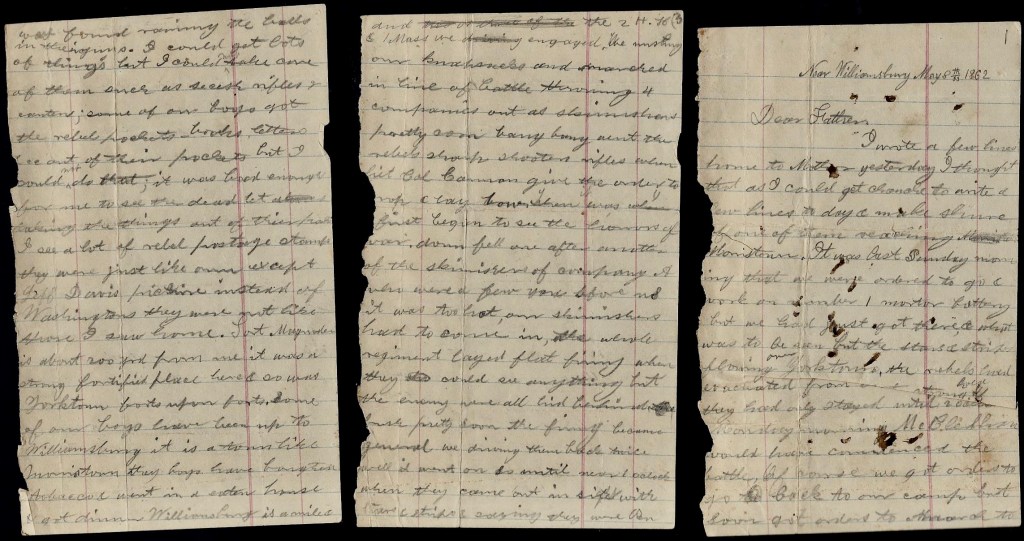
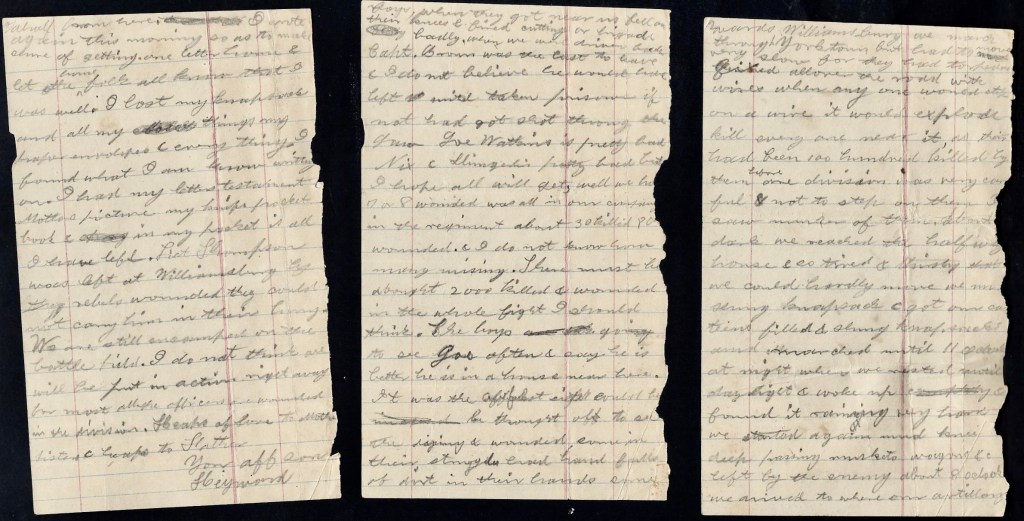
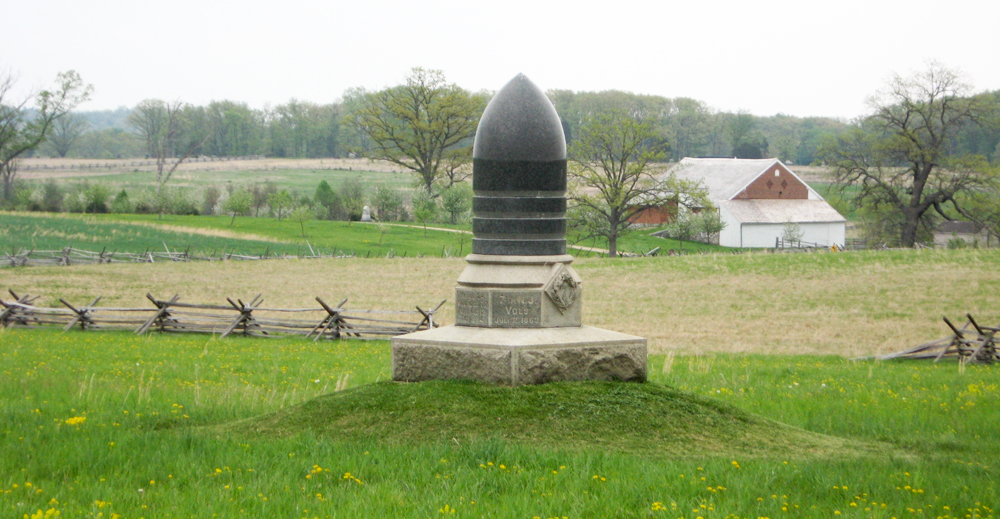


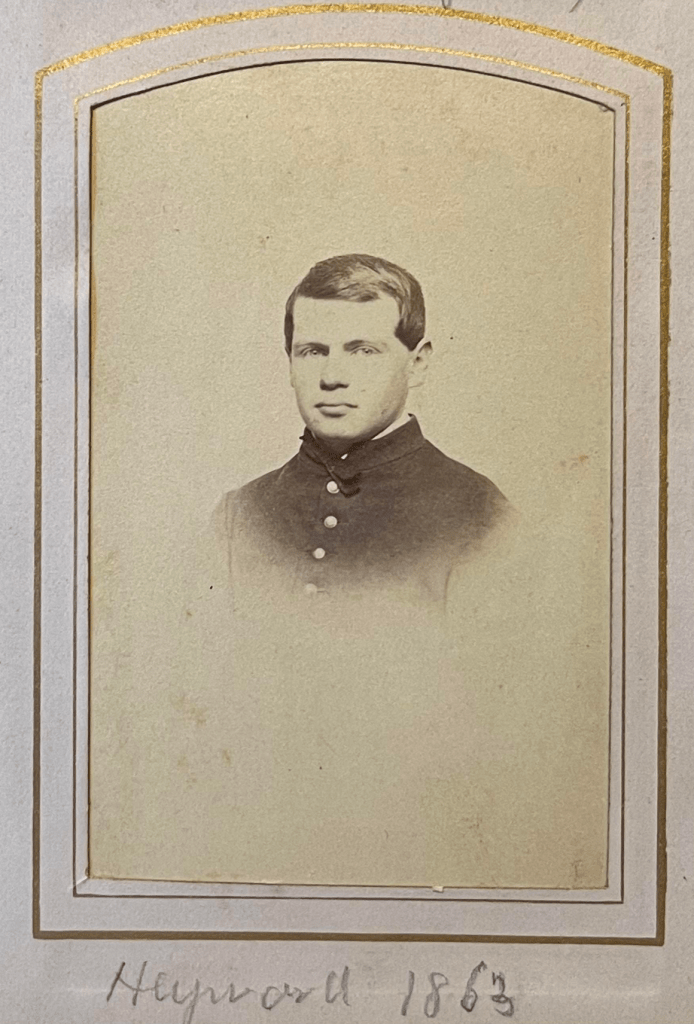










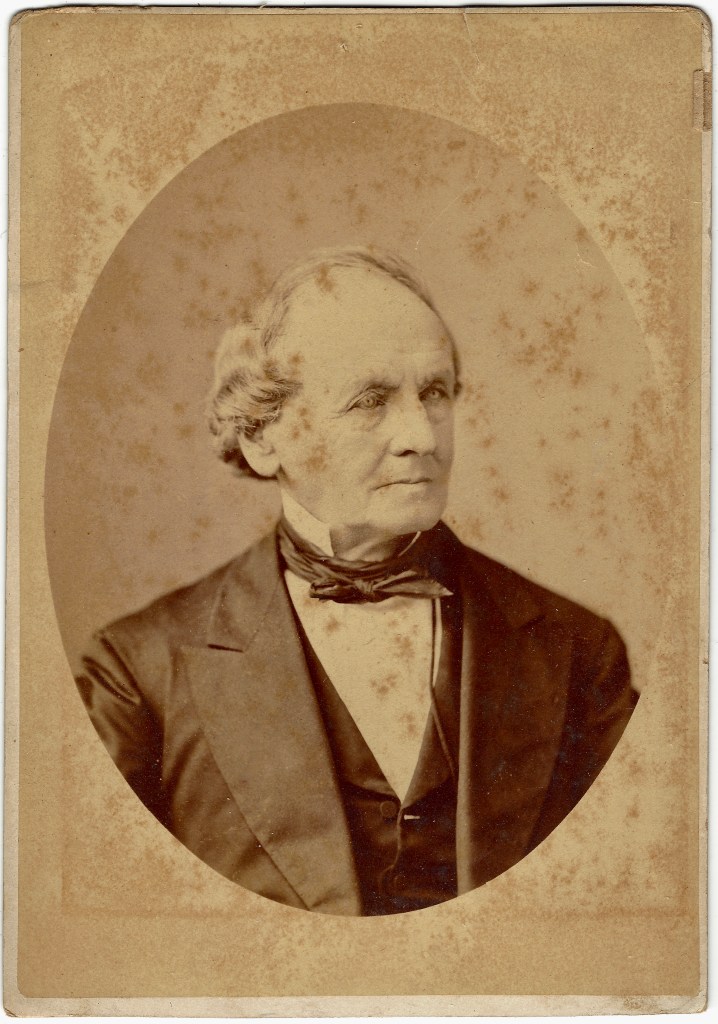


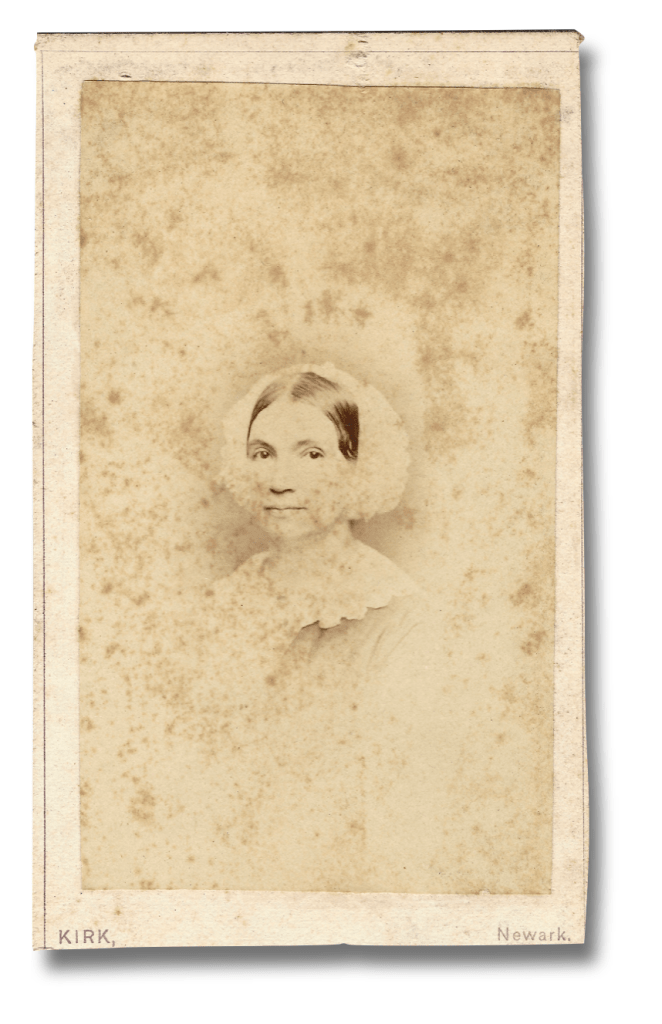
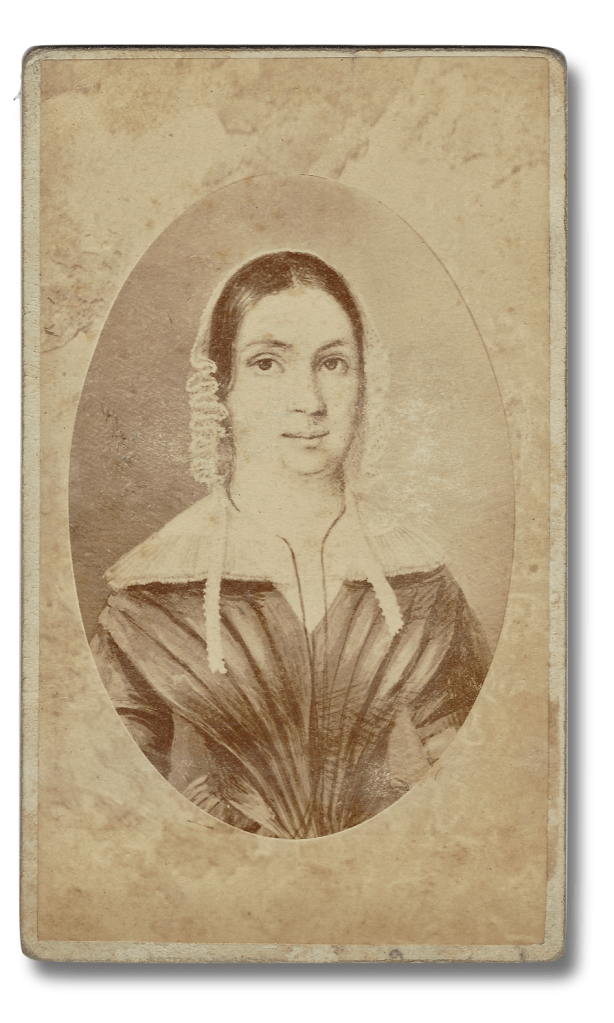
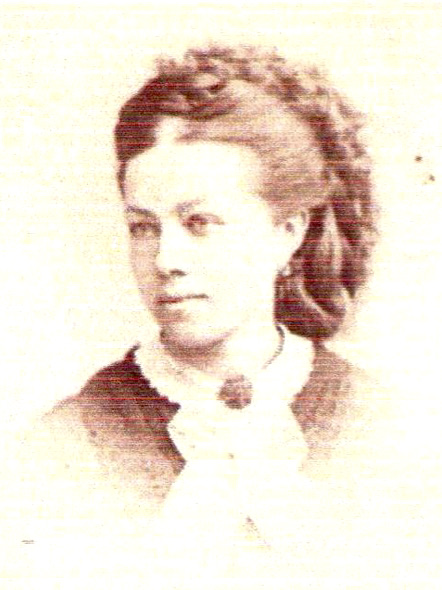


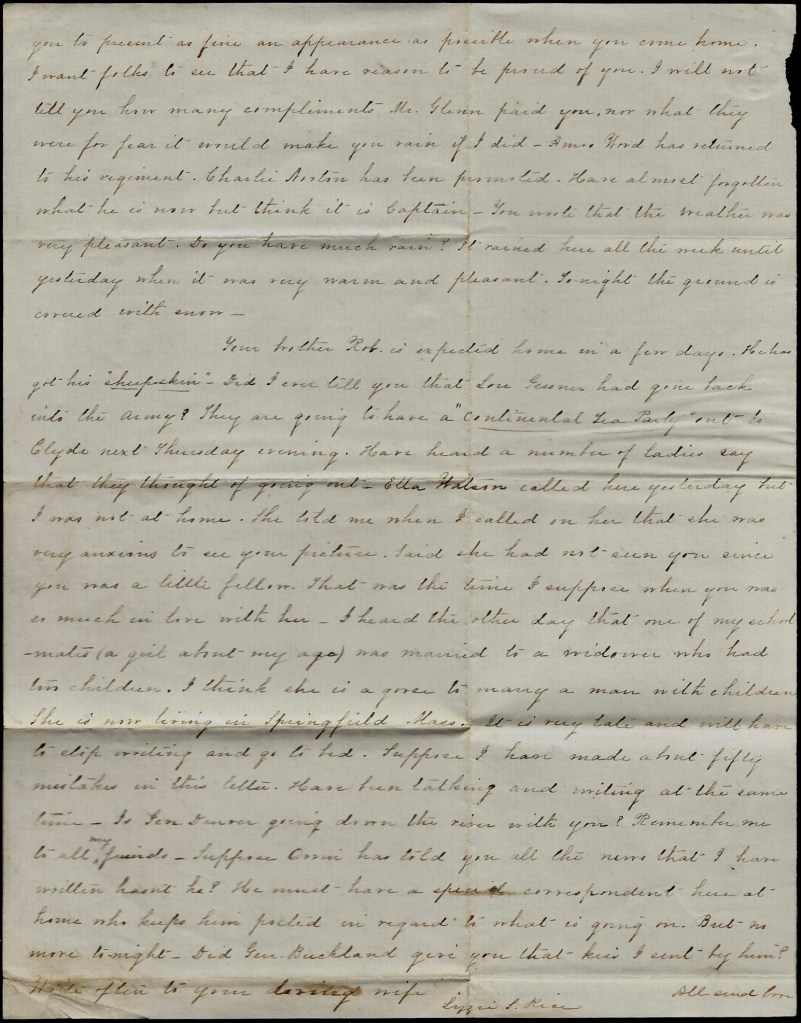
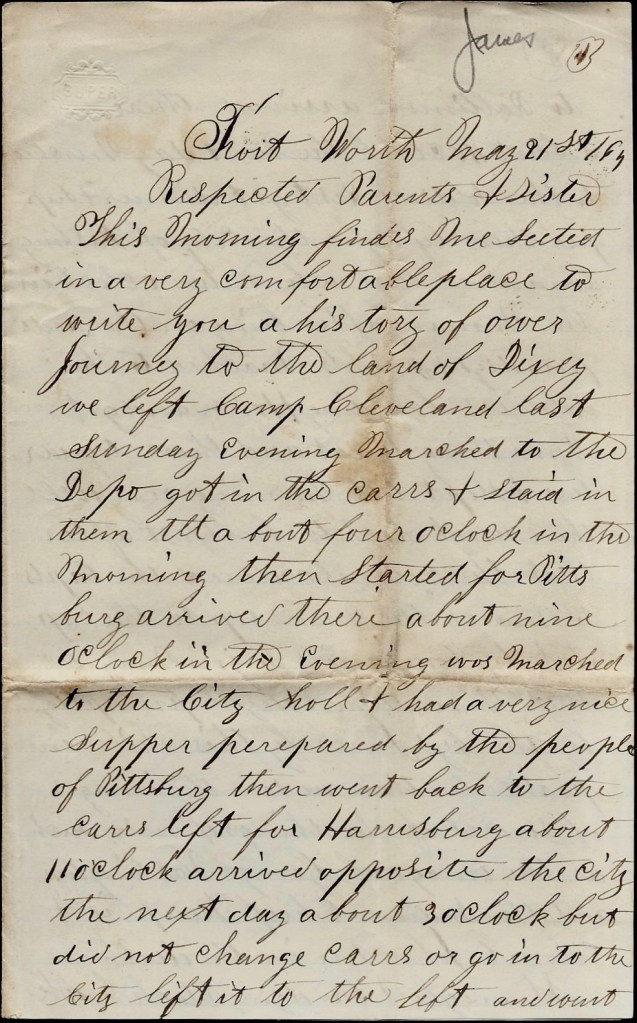

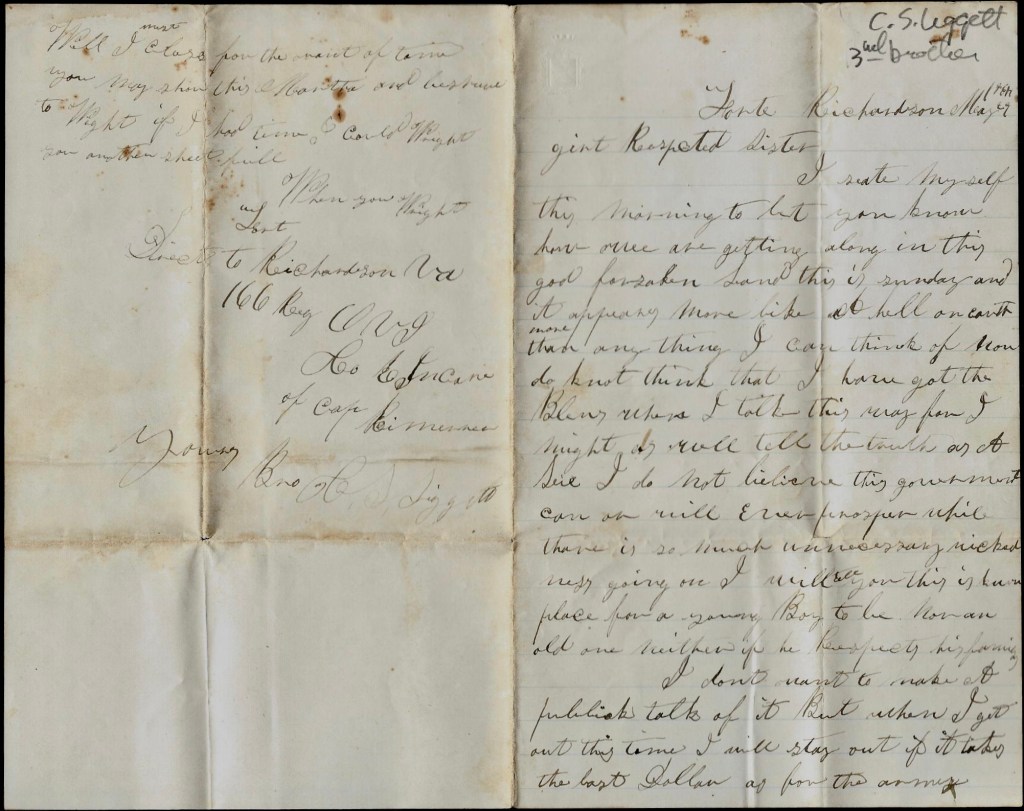


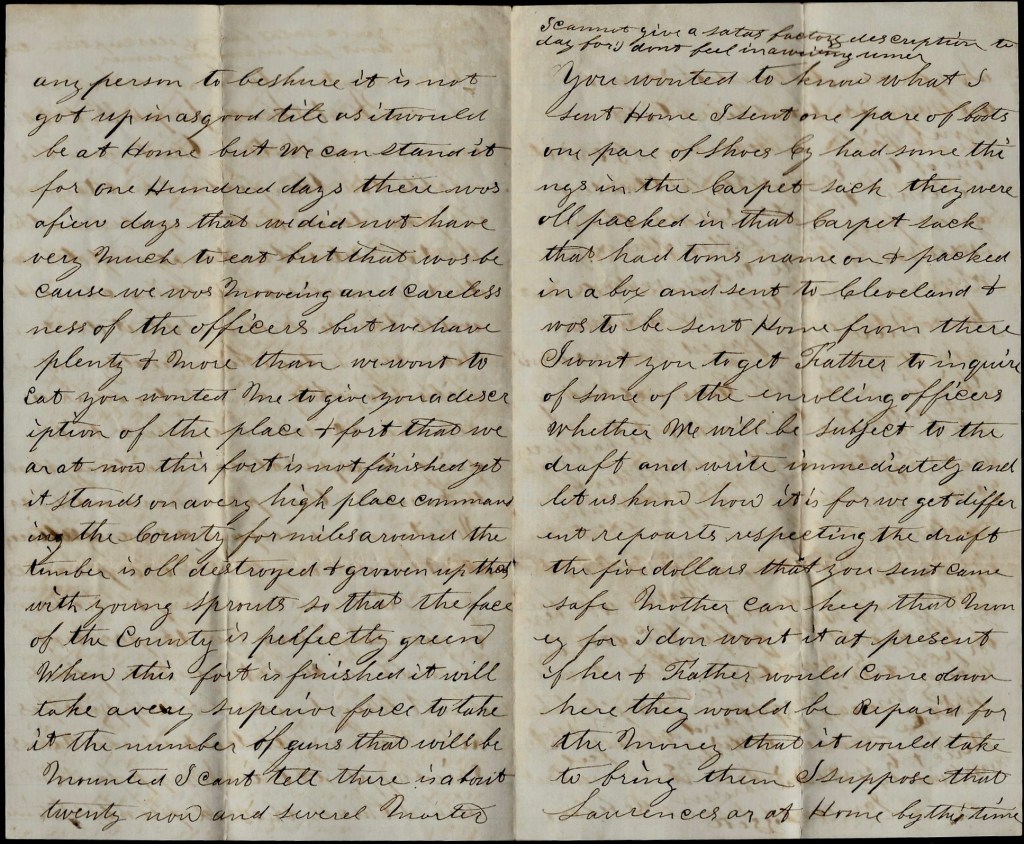
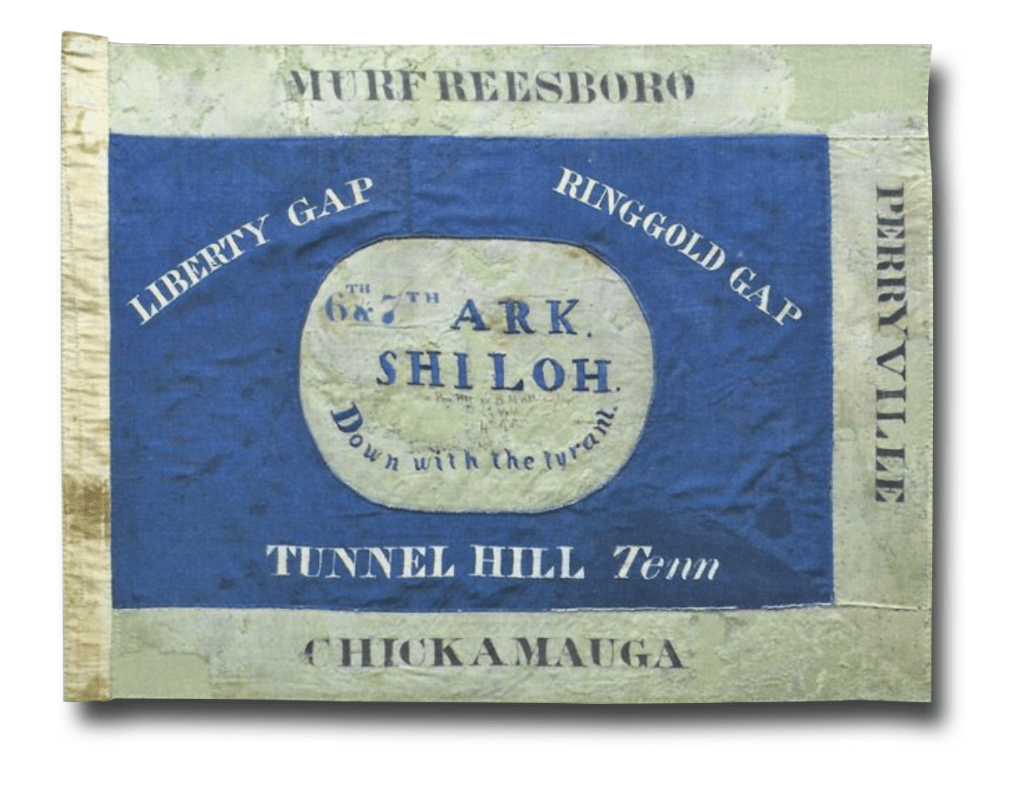


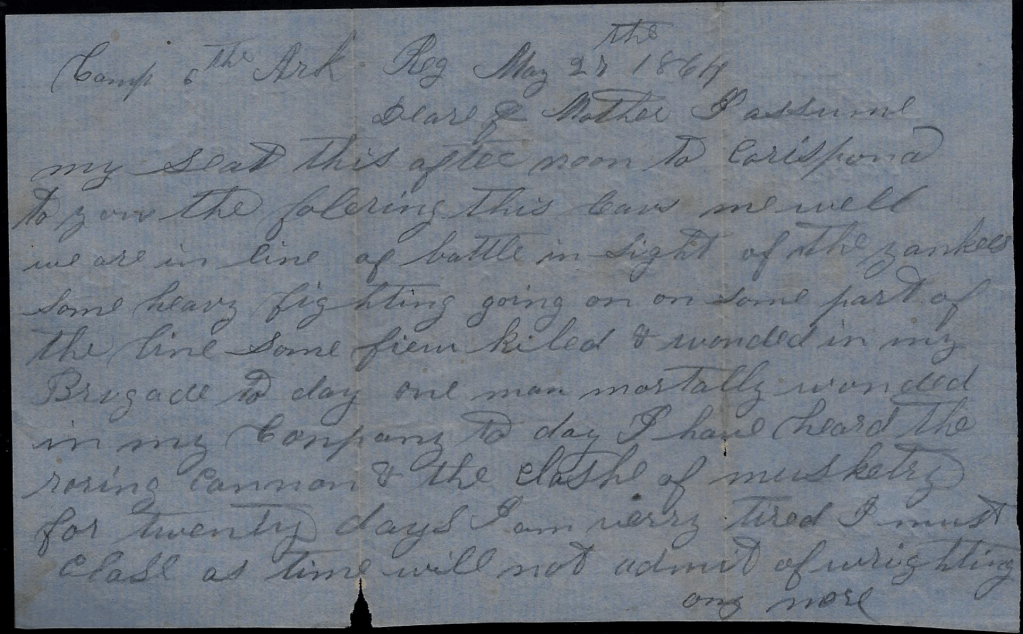


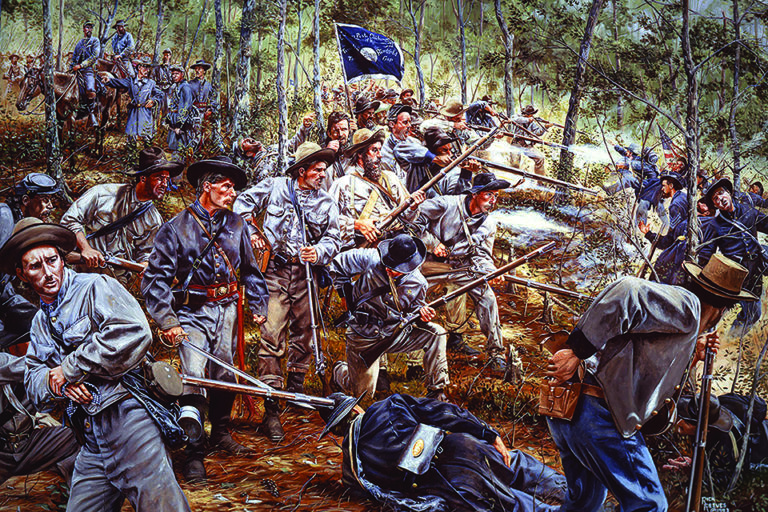
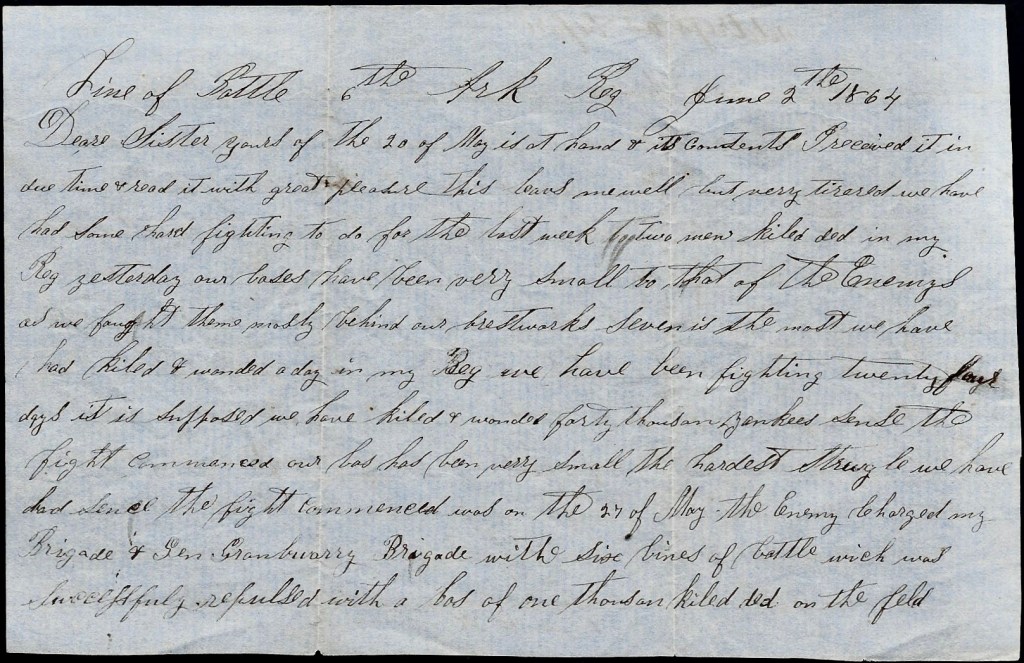


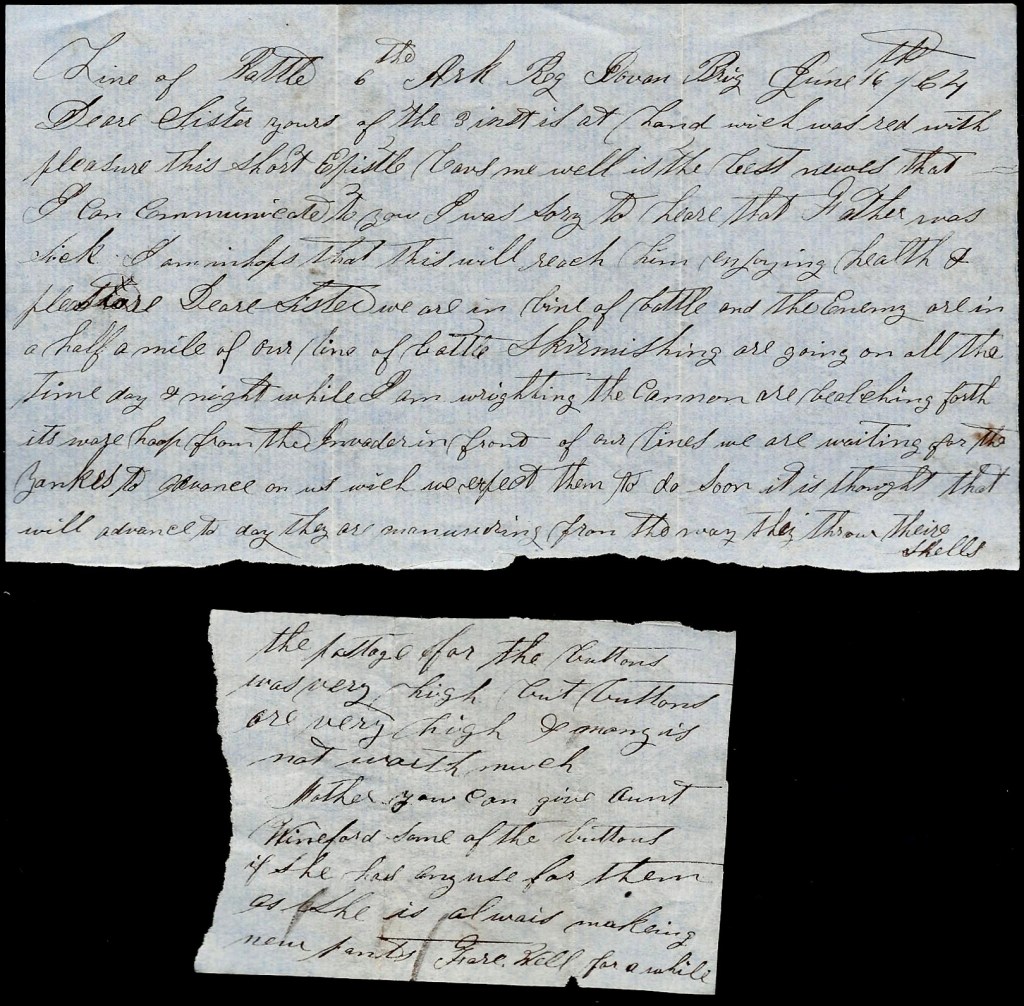
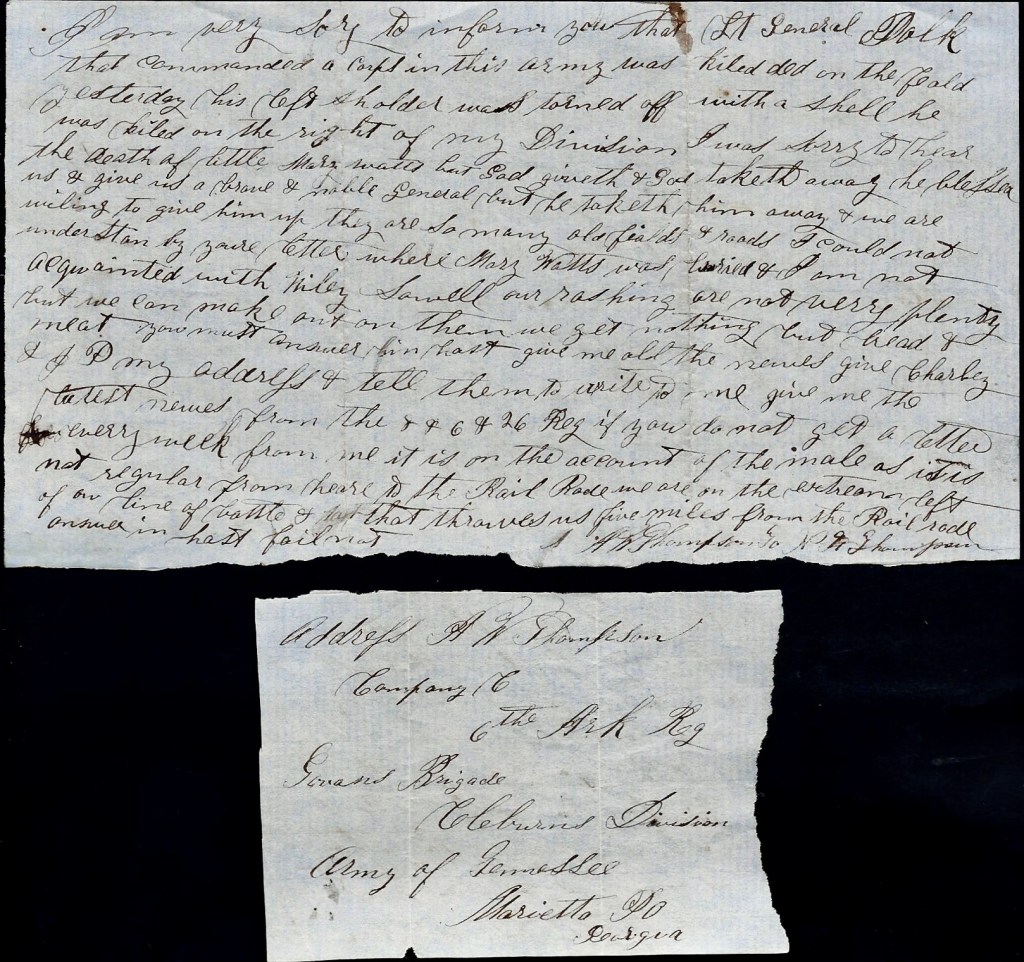

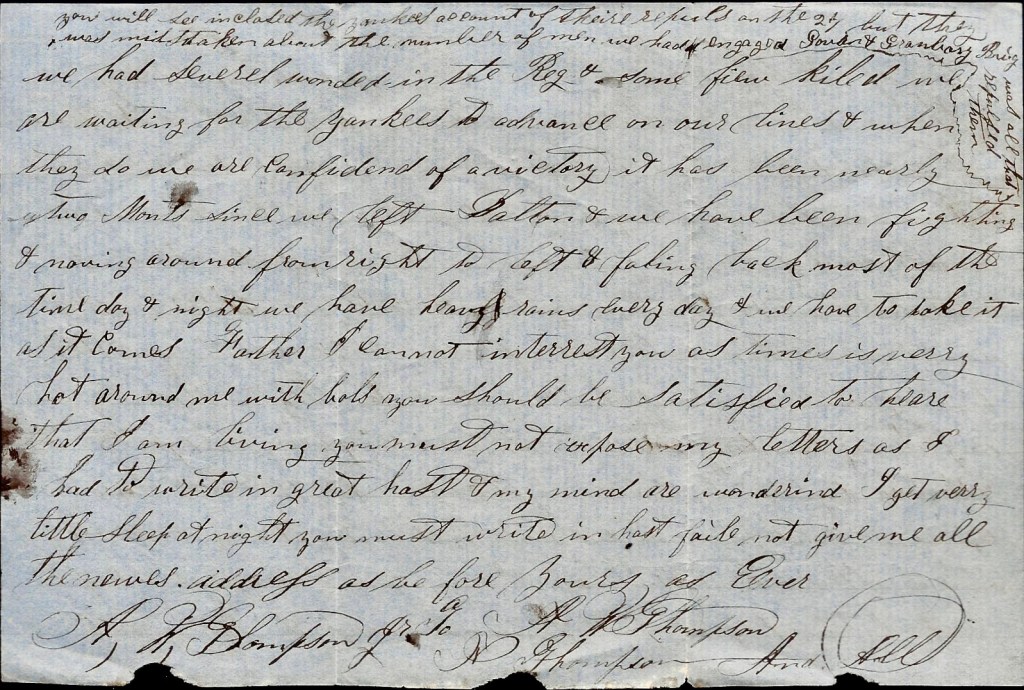

 Spared & Shared 23