
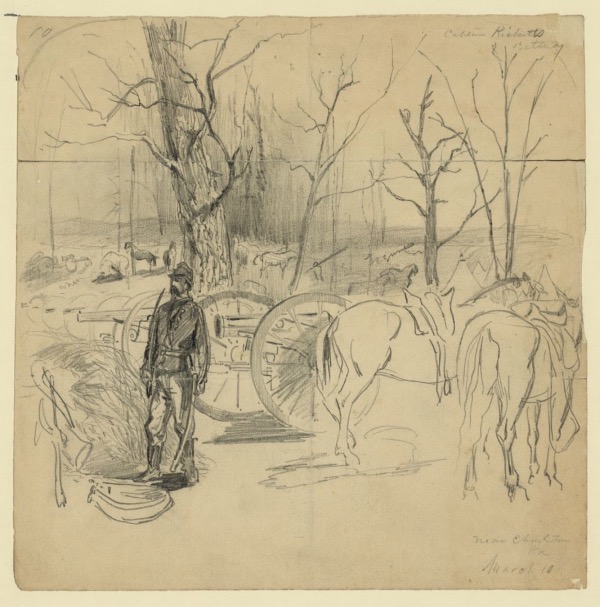
These letters were written by Lt. William Henry Thurston (1838-1924), the son of Isreal Thurston (1809-1888) and Abigail Persing (1817-1892) of Shamokin, Pennsylvania. William worked as a blacksmith before he enlisted and was mustered into service on July 8, 1861 as a private with the Forty-Third Regiment, Battery F, 1st Pennsylvania Light Artillery. He was promoted to 1st Lieutenant on April 22, 1865 and mustered out with the Battery on June 9, 1865.
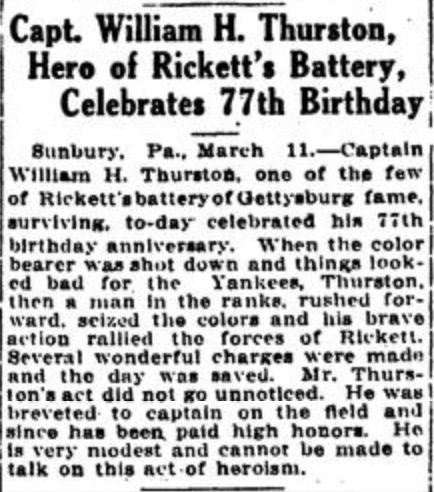
He wrote the last two letters to his fiancé, Laura Morgan (1845-1928), whom he married in 1865. Laura was the daughter of John Campbell Morgan (1818-1887) and Mary Catharine Weimer (1825-1885) of Sunbury, Northumberland county, Pennsylvania.
At Gettysburg, Capt. Robert B. Ricketts brought 144 men to the field on 2 July 1863 serving six Ordnance Rifles. During the battle they suffered 6 killed, 14 wounded, and three missing. They took a position on Benner’s Hill and at dusk they repulsed a Rebel assault upon the battery in desperate hand-to-hand combat after every round of canister had been fired. The newspaper clipping indicates that Thurston was recognized for his bravery in the action.
Letter 1
[Note: This letter is from the collection of Robert May and was made available for transcription and publication of Spared & Shared by express consent.]
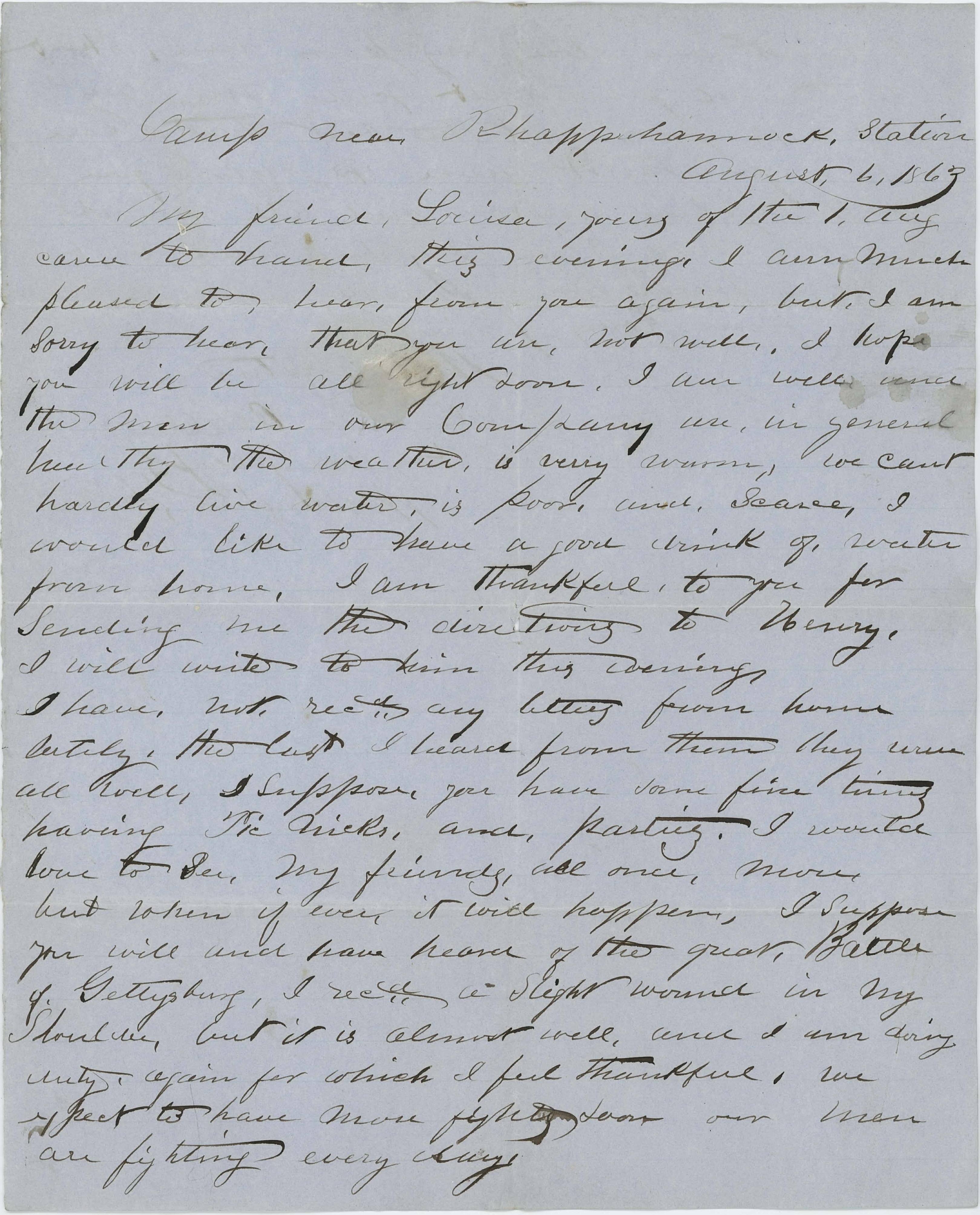
Camp near Rappahannock Station
August 6, 1863
My friend Louisa,
Yours of the 1st August came to hand this evening. I am much pleased to hear from you again but I am sorry to hear that you are not well. I hope you will be all right soon. I am well and the men in our company are, in general, healthy. The weather is very warm. We can’t hardly live, water is poor and scarce. I would like to have a goo drink of water from home.
I am thankful to you for sending me the directions to Henry. I will write to him this evening. I have not received any letters from home lately. The last I heard from them they were all well. I suppose you have some fine times having picnics and parties. I would love to see my friends all once more but when, if ever, it will happen.
I suppose you will and have heard of the great Battle of Gettysburg. I received a slight wound in my shoulder but it is almost well and I am doing duty again for which I feel thankful. We expect to have more fights soon. Our men are fighting every day.
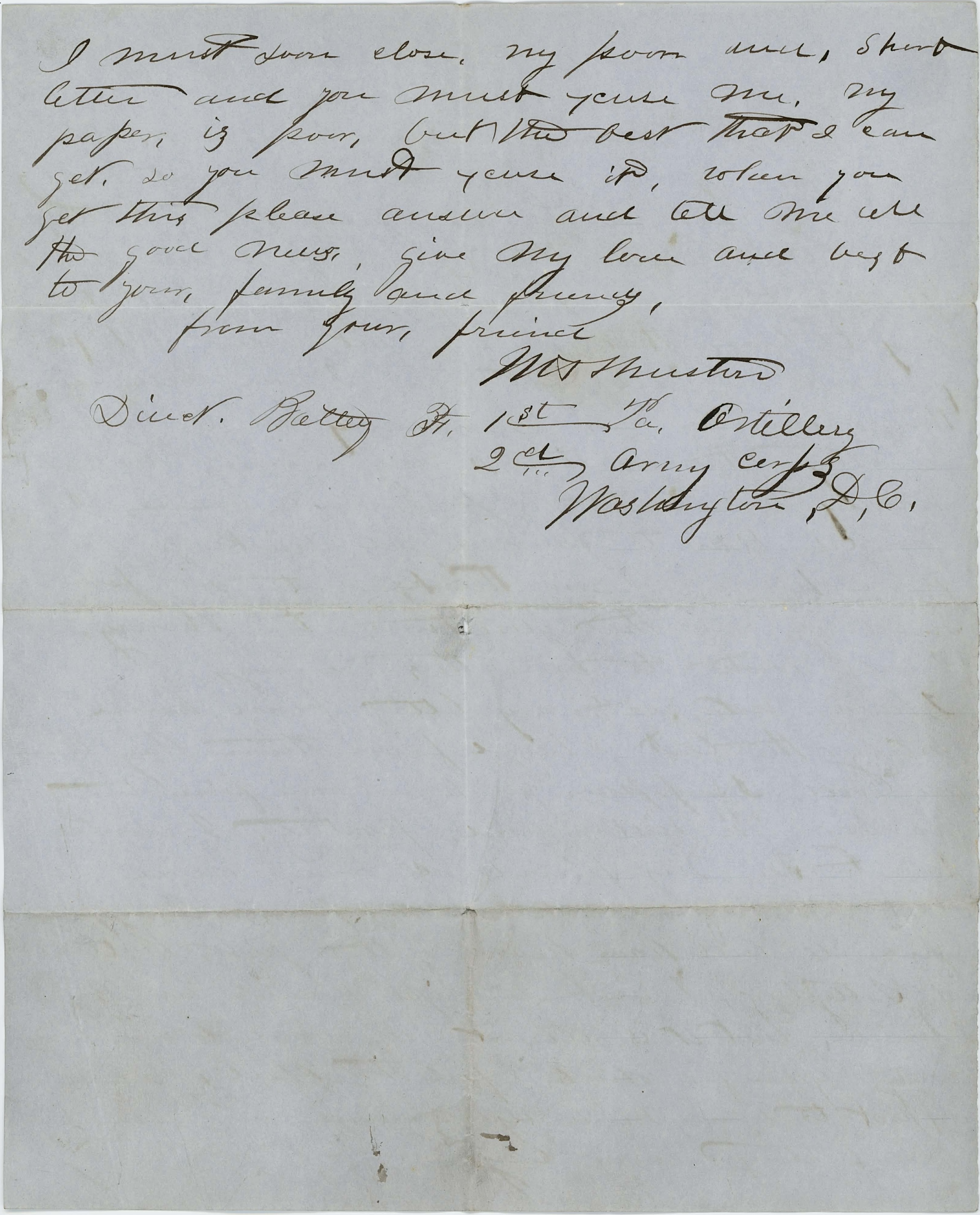
I must soon close my poor and short letter and you must excuse me. My paper is poor but the best that I can get so you must excuse it. When you get this, please answer and tell me all the good news. Give my love and best to your family and friends. From your friend, — W. H. Thurston
Direct Battery F, 1st Pennsylvania Artillery, 2nd Army Corps, Washington D. C.
Letter 2
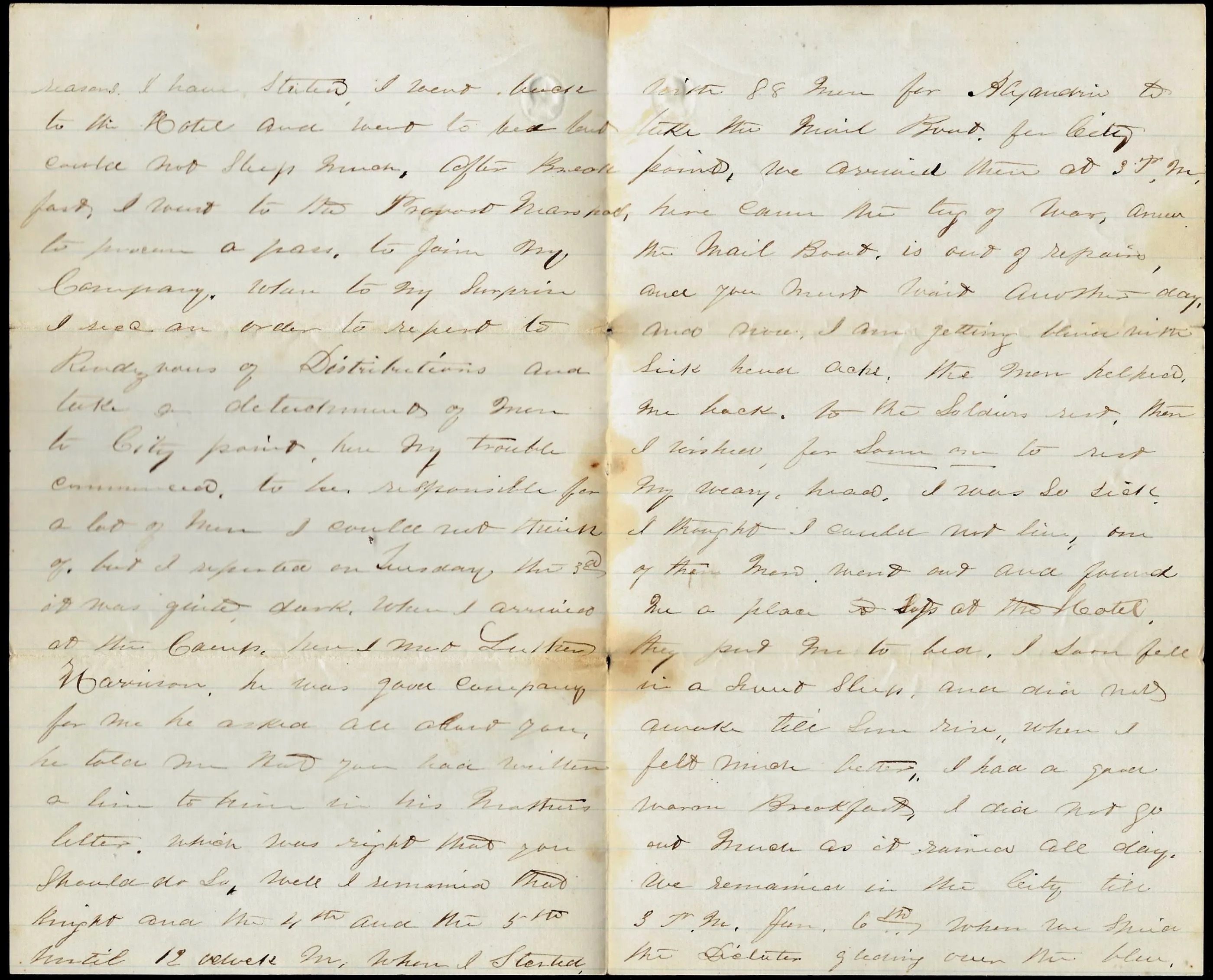
Camp near Petersburg
January 8, 1865
My own dear Laura,
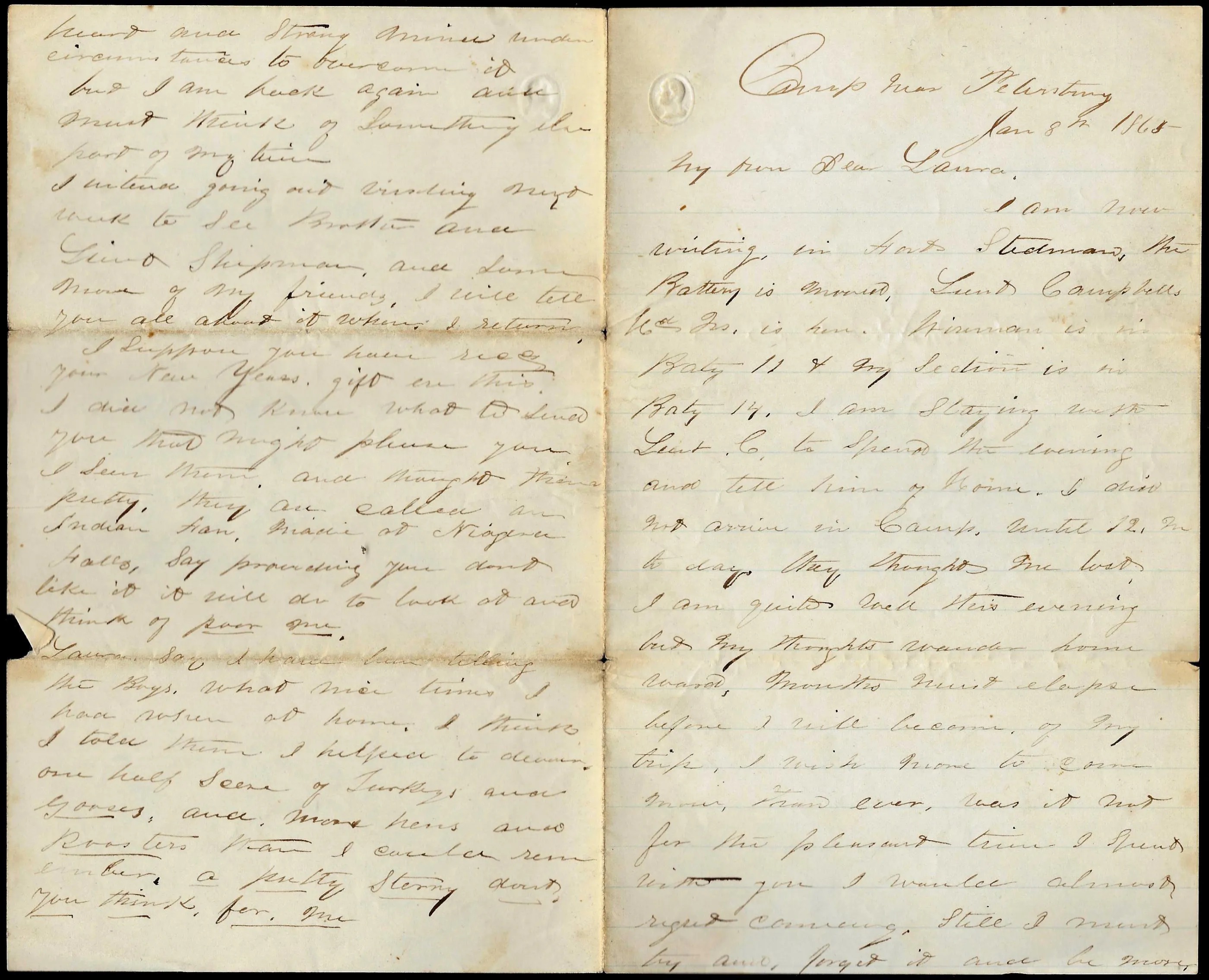
I am now writing in Fort Stedman — the battery is moved. Lieut. [John F.] Campbell, Headquarters, is here. ¹ [Lt. Henry] Wireman is in Battery 11 & my section is in Battery 14. I am staying with Lieut. Campbell to spend the evening and tell him of home. I did not arrive in camp until 12 m. today. They thought me lost. I am quite well this evening but my thoughts wander homewards. Months must elapse before I will become of my trip. I wish more to come more than ever. Was it not for the pleasant time I spent with you, I would almost regret coming. Still I must try and forget it and be more content.
The weather is quite cool but no snow. Mud has been abundant until last night when the ground froze solid. Piquet firing has abated to some extent — quiet prevails along the entire line save an occasional shot fired by some sleepless sentries.
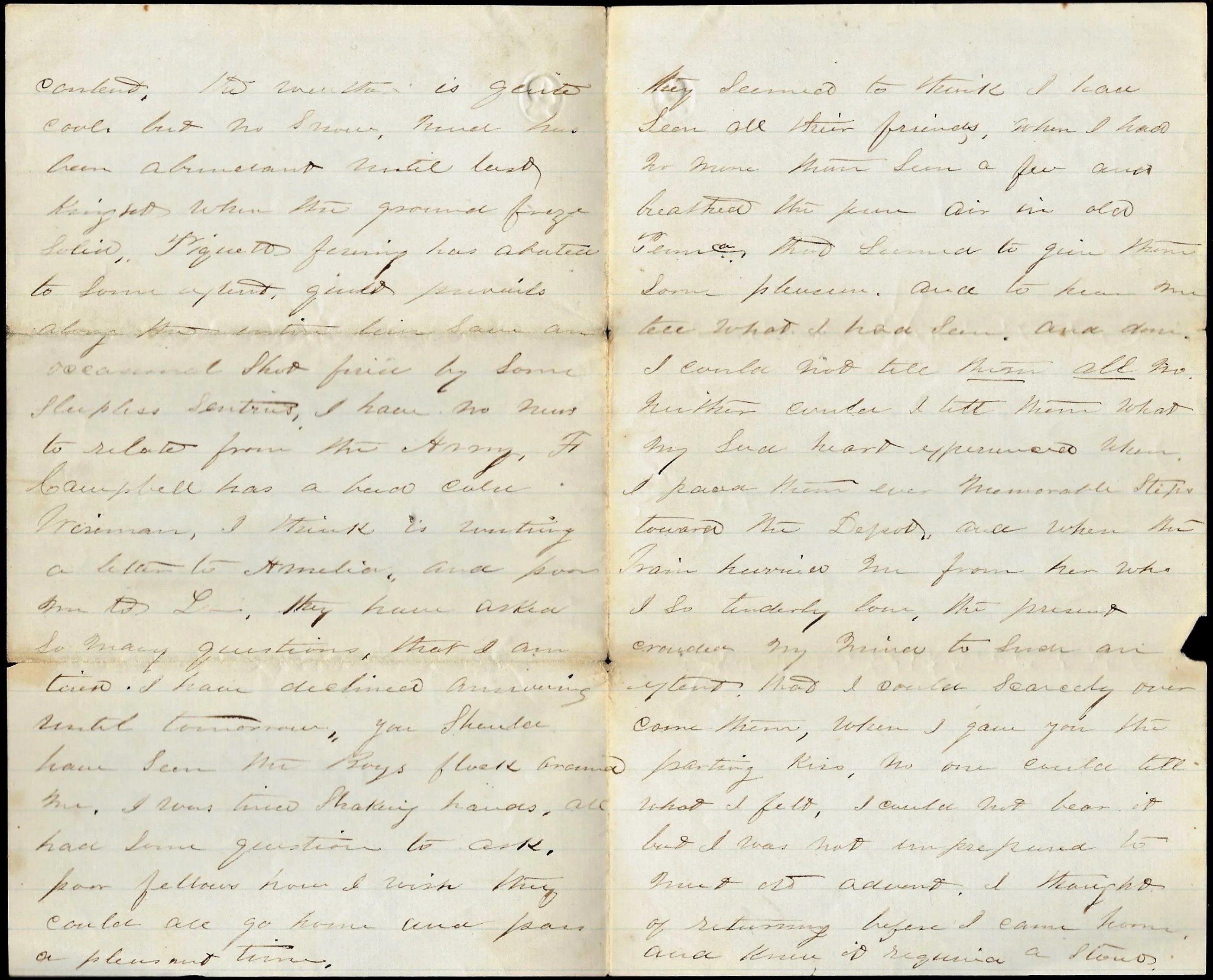
I have no news to relate from the Army. [John] F. Campbell has a bad cold. [Henry] Wireman, I think, is writing a letter to Amelia, and poor W. to L. They have asked so many questions that I am tired. I have declined answering until tomorrow. You should have seen the boys flock around me. I was tired shaking hands. All had questions to ask. Poor fellows — how I wish they could all go home and pass a pleasant time. They seemed to think I had seen all their friends when I had no more than seen a few and breathed the pure air in Old Pennsylvania. That seemed to give them some pleasure and to hear me tell what I had seen and done. I could not tell them all. No neither could I tell them what my sad heart experienced when I paced them ever memorable steps toward the depot and when the train hurried me from her who I so tenderly love. The present crowded my mind to such an extent that I could scarcely overcome them when I gave you the parting kiss. No one could tell what I felt. I could not bear it but I was not unprepared to meet its advent. I thought of returning before I came home and knew it required a stout heart and strong mind under circumstances to overcome it. But I am back again and must think of something else part of the time.
I intend going out visiting next week to see Brother ² and Lieut. [Lemuel] Shipman ³ and some more of my friends. I will tell you all about it when I return.
I suppose you have received your New Years gift ‘ere this. I did not know what to send you that might please you. I seen them and thought them pretty. They are called an Indian fan, made at Niagara Falls. Say providing you don’t like it, it will do to look at and think of poor me.
Laura, say, I have been telling the boys what nice times I had when at home. I think I told them I helped to devour one half score of turkeys and gooses and more hens and roosters than I could remember — a pretty story, don’t you think, for me.
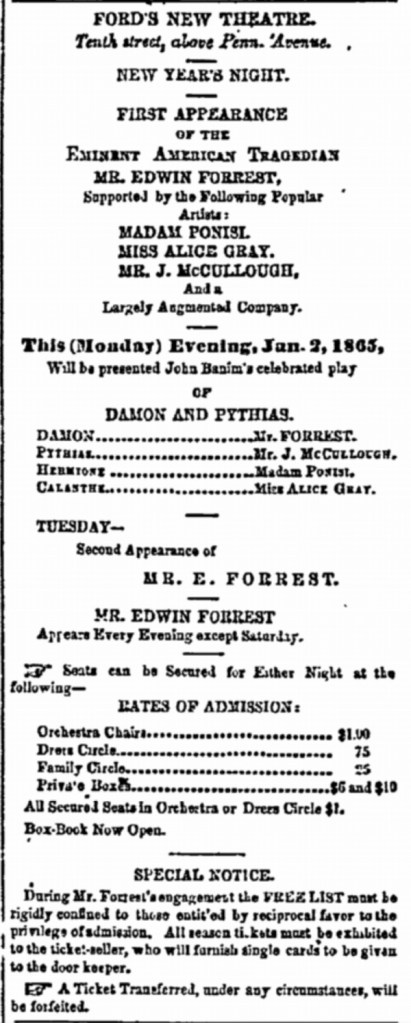
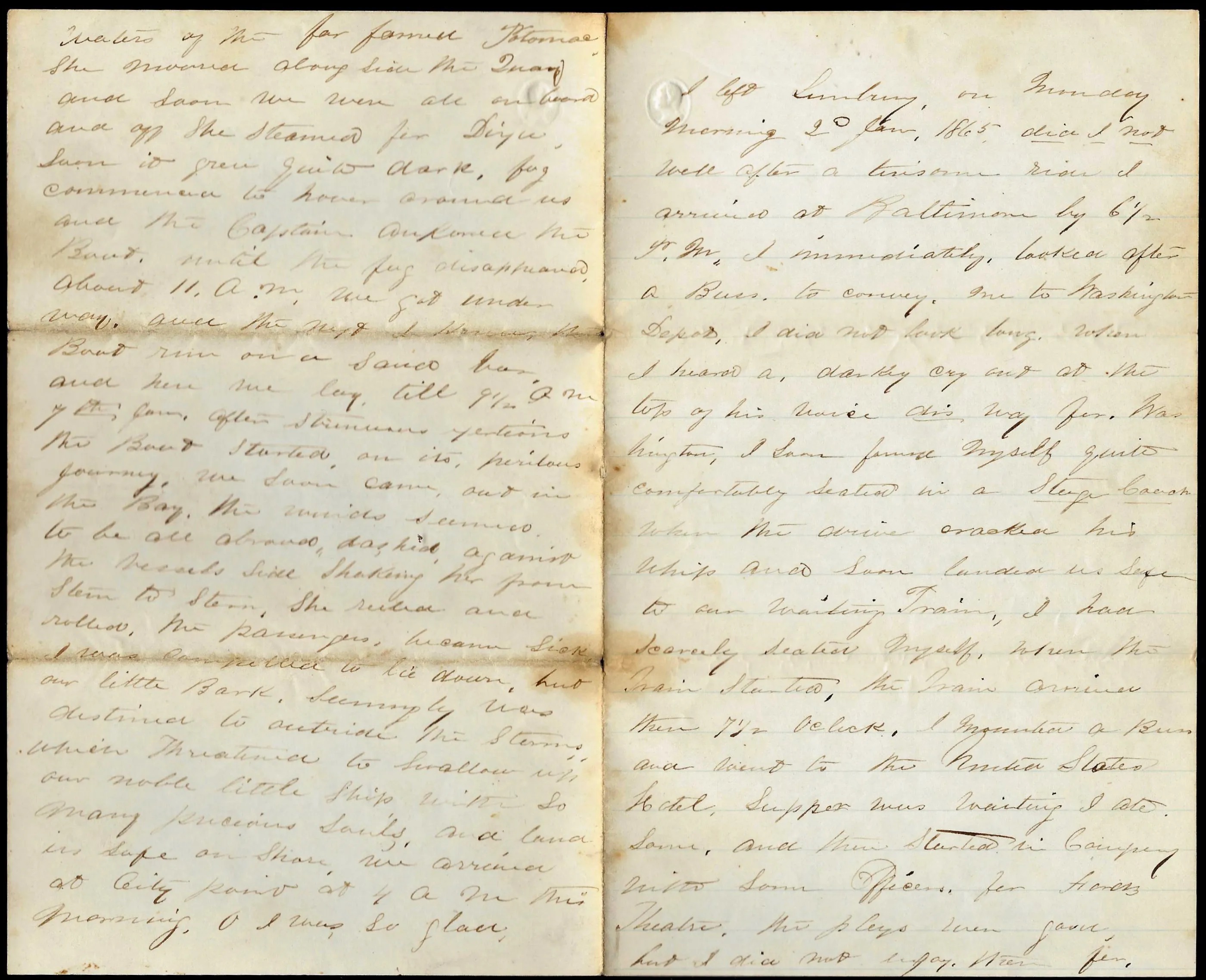
I left Sunday, or Monday morning, 2d January 1865. Did not [feel] well. After a tiresome ride, I arrived at Baltimore by 6½ P.M. I immediately looked after a [omni]bus to convey me to Washington Depot. I did not look long when I heard a darkey cry out at the top of his voice, “Did way for Washington!” I soon found myself quite comfortably seated in a stage coach when the driver cracked his whip and soon landed us safe to our awaiting train. I had scarcely seated myself when the train started. The train arrived there 7½ o’clock. I mounted an [omni]bus and went to the United States Hotel. Supper was waiting. I ate some and then started in company with some officers for Ford’s Theatre. The plays were good but I did not enjoy them for reasons I have stated. I went back to the hotel and went to bed but could not sleep much.
After breakfast, I went to the Provost Marshal to procure a pass to join my company when to my surprise I received an order to report to Rendezvous of Distributions and take a detachment of men to City Point. Here my trouble commenced — to be responsible for a lot of men I could not think of but I reported on Tuesday, the 3rd. It was quite dark when I arrived at the camp. Here I met Luther Harrison. He was good company for me. He asked all about you. He told me that you had written a line to him in his mother’s letter which was right that you should so so. Well, I remained that night and the 4th and the 5th until 12 o’clock m. when I started with 88 men for Alexandria to take the mail boat for City Point. We arrived there [Alexandria] at 3 P.M. Here came the tug of war. A____ the mail boat is out of repair and you must wait another day, and since I am getting blind with sick headache, the men helped me back to the Soldier’s Rest. Then I wished for some one to rest my weary head. I was so sick I thought I could not live. One of the men went out and found me a place to sup at the hotel. They put me to bed [and] I soon fell in a stout sleep and did not awake till sunrise when I felt much better.
I had a good warm breakfast. I did not go out much as it rained all day. We remained in the City till 3 P.M., Jan. 6th when we spied the Dictator gliding over the blue waters of the far-famed Potomac [river]. She moored alongside the Quay and soon we were all on board and off she steamed for Dixie. Soon it grew quite dark, fog commenced to hover around us, and the Captain anchored the boat until the fog disappeared. About 11 A.M. we got under way and the next I knew the boat run aground on a sand bar and here we lay till 9½ A.M., 7th January. After strenuous exertions the boat started on its perilous journey. We soon came out in the Bay [where] the winds seemed to be all abroad [and] dashed against the vessels side, shaking her from stem to stern. She reeled and rolled. The passengers became sick. I was compelled to lie down but our little Bark seemingly was destined to outride the storms which threatened to swallow up our noble little ship with so many precious souls and land in safe on shore. We arrived at City Point at 4 A.M. this morning. O, I was so glad.
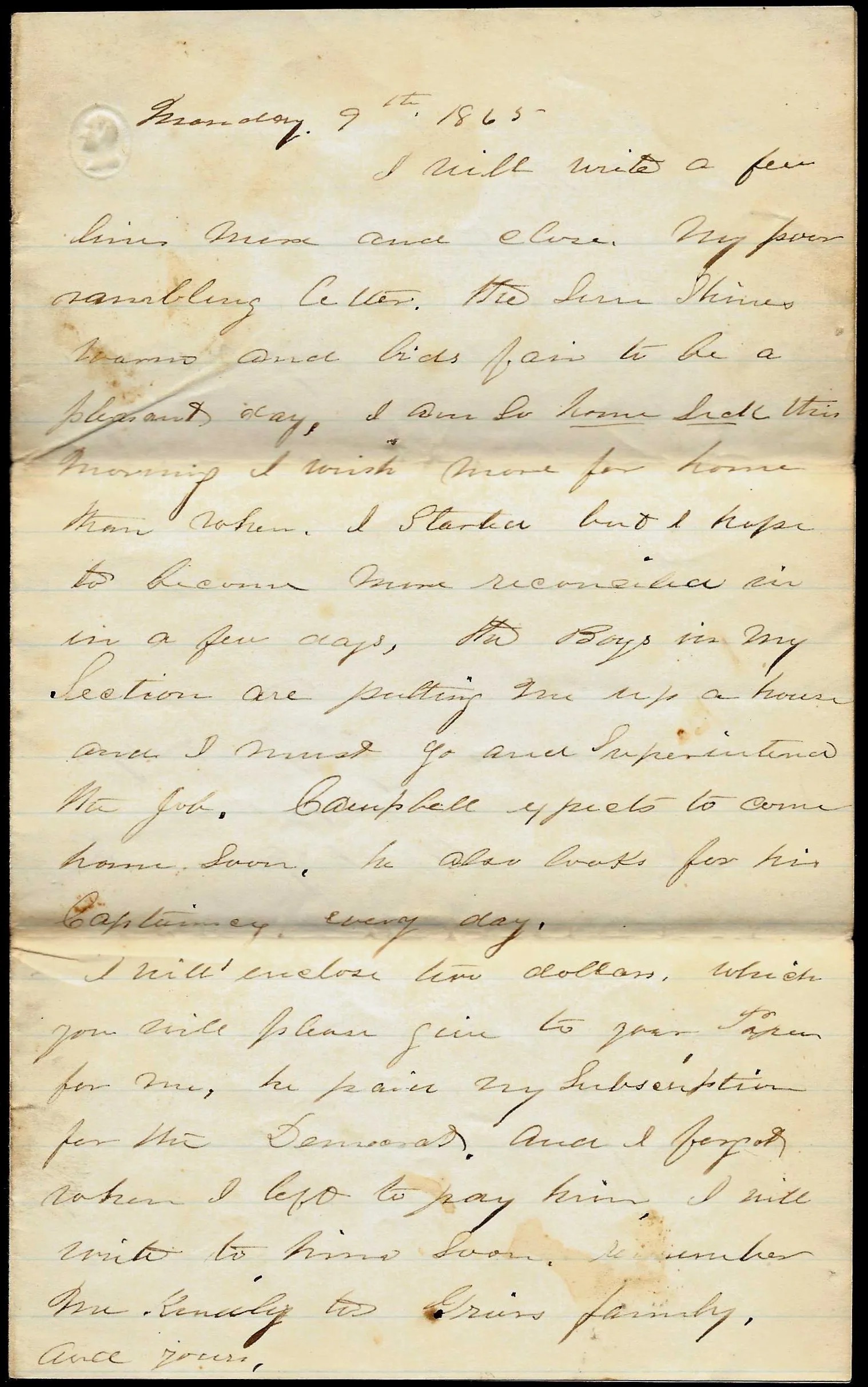
Monday [January] 9th 1865
I will write a few lines more and close my poor rambling letter. The sun shines warm and bids fair to be a pleasant day. I am so homesick this morning. I wish more for home than when I started but I hope to become more reconciled in a few days. The Boys in my Section are putting me up a house and I must go and superintend the job. Campbell expects to come home soon. He also looks for his Captaincy every day.
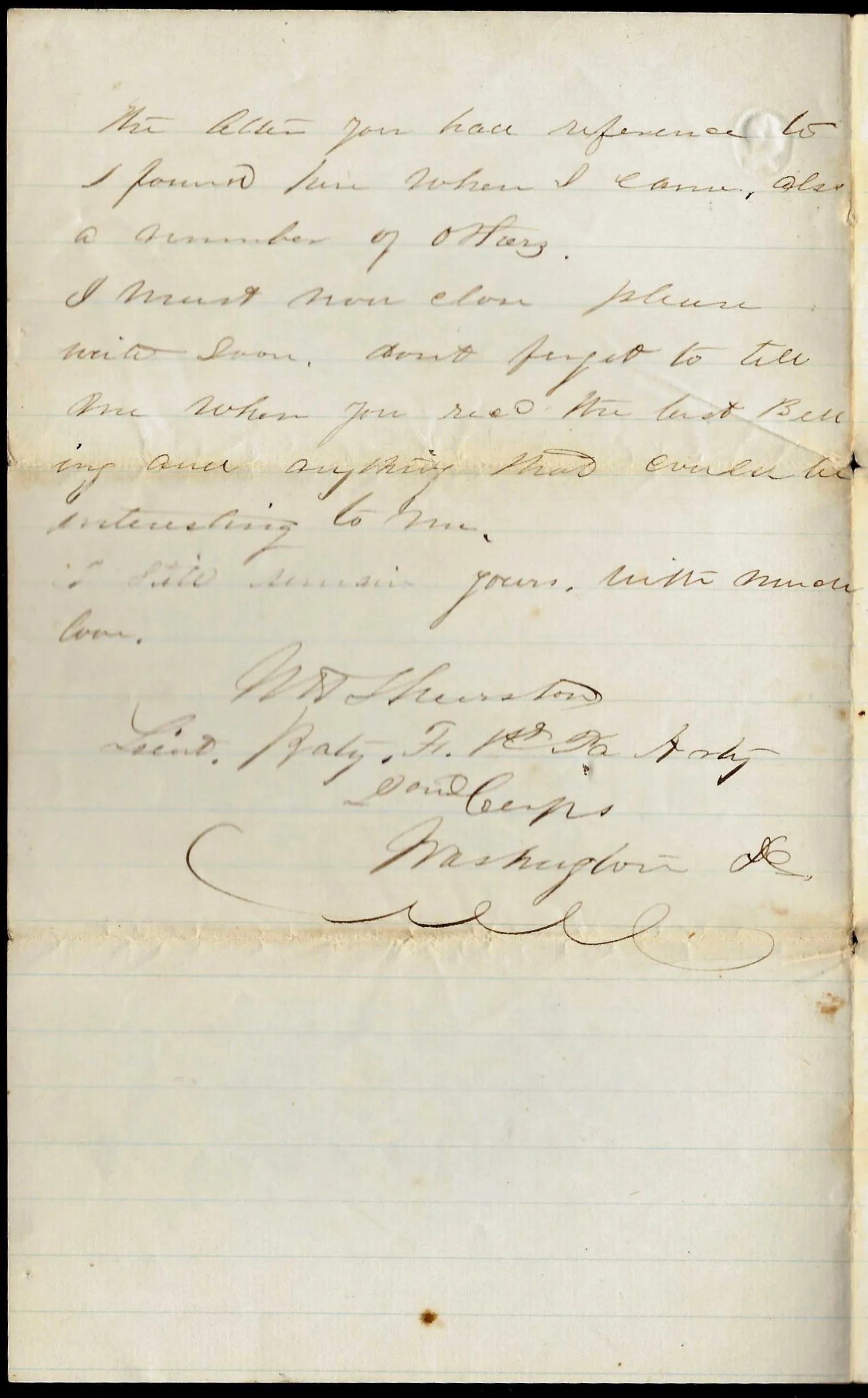
I will enclose ten dollars which you will please give to your Papa for me. He paid my subscription for the Democrat and I forgot when I left to pay him. I will write to him soon. Remember me to Grier’s family and yours. The letter you had reference to I found here when I came — also a number of others.
I must now close. Please write soon. Don’t forget to tell me when you received the last billing and anything that could be interesting to me. I still remain yours with much love. — W. H. Thurston
Lieut. Battery F, 1st Pa. Artillery, 2nd Corps, Washington D. C.
¹ Lt. John F. Campbell (1840-1902) succeeded Ricketts as the captain of the Forty-Third Regiment, Battery F, 1st Pennsylvania Light Artillery, in April 1865. He is buried in Augustaville, Northumberland county, Pennsylvania. John Campbell was most likely a distant cousin of Laura Morgan’s whose fraternal grandmother was Charity Campbell.
² Possibly Silas Thurston (1842-1923) who served withe “Bucktails” in the 149th Pennsylvania Volunteers.
³ Lt. Lemuel Shipman (b. 1838) of Sunbury, Pennsylvania, entered the service as first sergeant of Co. D, 3d Pennsylvania Heavy Artillery, 152nd Pennsylvania, in October 1862. He was promoted to lieutenant in May 1864.
Letter 3
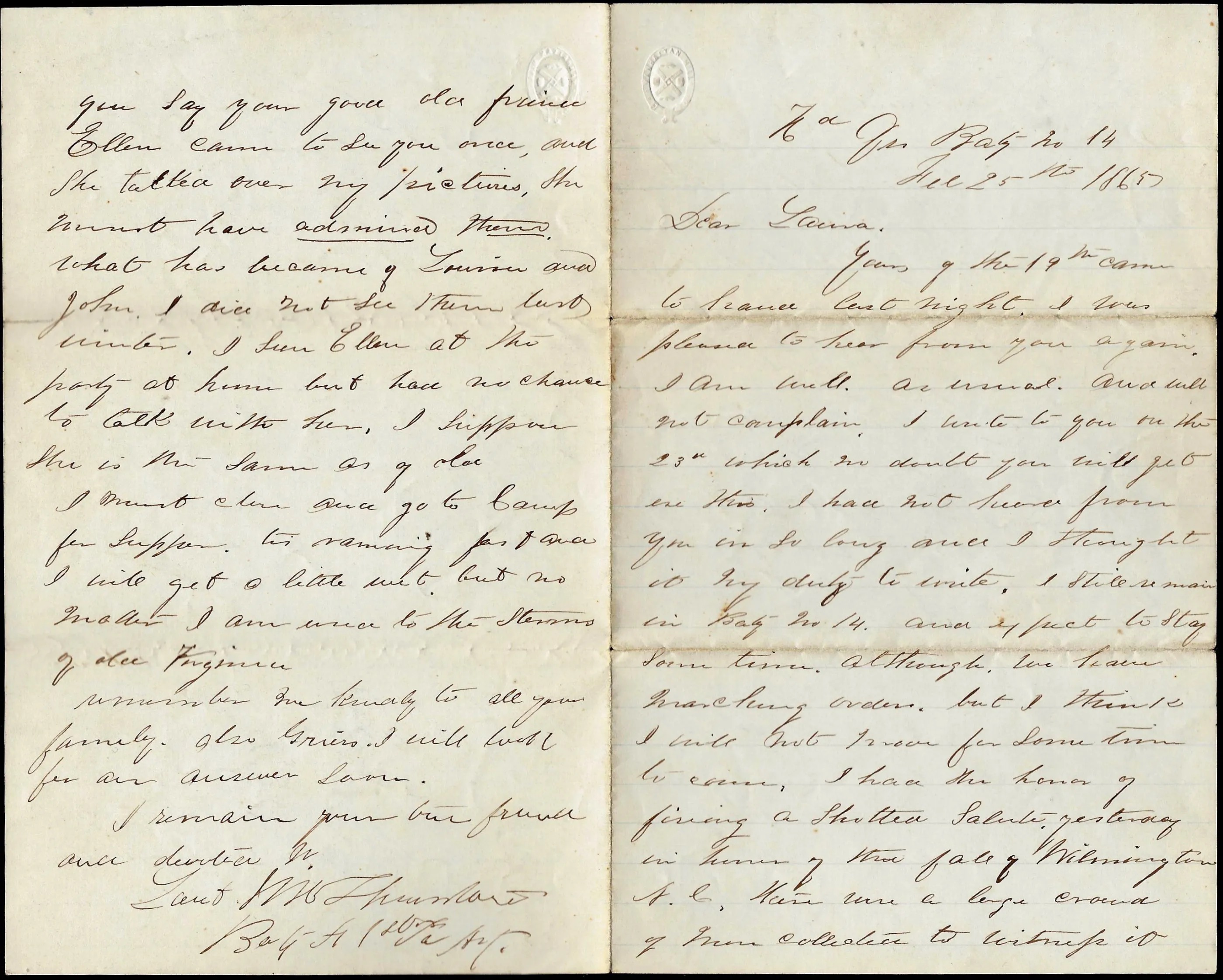
Headquarters Battery No. 14
February 25th 1865
Dear Laura,
Yours of the 19th came to hand last night. I was pleased to hear from you again. I am well as usual and will not complain. I wrote to you on the 23rd which no doubt you will get ‘ere this. I had not heard from you in so long and I thought it my duty to write. I still remain in Battery No. 14 and expect to stay some time although we have marching orders. But I think I will not move for some time to come.
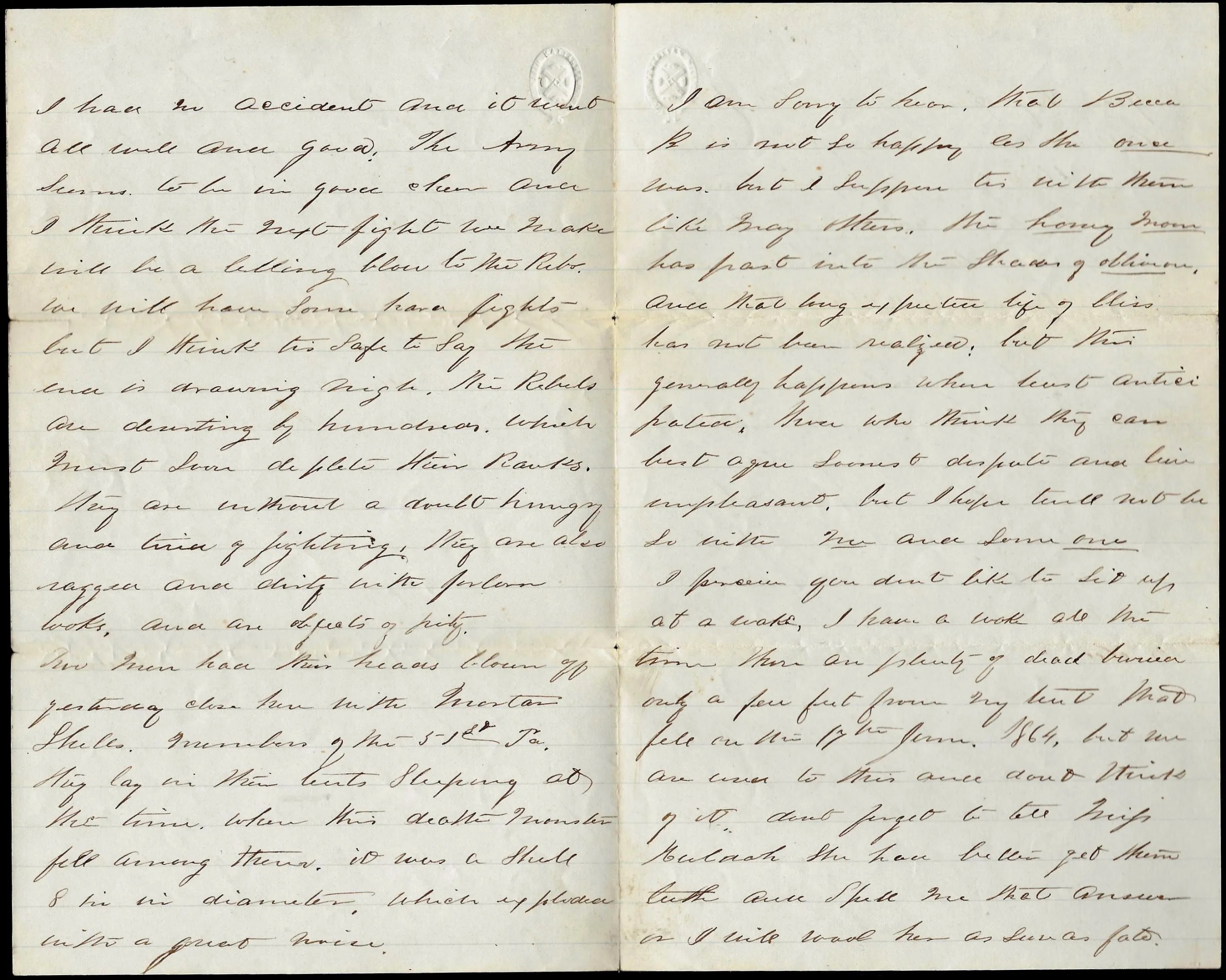
I had the honor of firing a shotted salute yesterday in honor of the fall of Wilmington, North Carolina. There were a large crowd of men collected to witness it. I had no accident and it went all well and good. The Army seems to be in good cheer and I think the next fight we make will be a telling blow to the Rebs. We will have some hard fights but I think ’tis safe to say the end is drawing nigh. The Rebels are deserting by hundreds which must soon deplete their ranks. They are without a doubt hungry and tired of fighting. They are also ragged and dirty with forlorn looks and are objects of pity.
Two men had their heads blown off yesterday close here with mortar shells — members of the 51st Pennsylvania. They lay in their tents sleeping at the time which this death monster fell among them. It was a shell 8 inches in diameter which exploded with a great noise. ¹
I am sorry to hear that Becca B. is not so happy as she once was but I suppose ’tis with them like many others — the honeymoon has past into the shades of oblivion and that long expected life of bliss has not been realized. But this generally happens when least anticipated. Those who think they can best agree soonest dispute and live unpleasant, but I hope ’twill not be so with me and some one.
I perceive you don’t like to sit up at a wake. I have a wake all the time. There are plenty of dead buried only a few feet from my tent that fell on the 17th June 1864, but we are used to this and don’t think of it.
Don’t forget to tell Miss Huldah she had better get them teeth and spell me that answer or I will wool her as __ fate.
You say your good old friend Ellen came to see you once, and she talked over my pictures. She must have admired them. What has become of Louisa and John? I did not see them last winter. I seen Ellen at the party at home but had no chance to talk with her. I suppose she is the same as of old.
I must close and go to camp for supper. ‘Tis raining fast and I will get a little wet but no matter. I am used to the storms of Old Virginia.
Remember me kindly to all your family. Also Grier’s. I will look for an answer soon. I remain your best friend and devoted W.
— Lieut. W. H. Thurston, Batty F, 1st Pa. Art.
¹ One of the two soldiers was John Blyler (1845-1865) who enlisted in Co. G, 51st Pennsylvania in February 1864. He was the son of Absalom Blyler (1803-1863) and Catharine Heimback (1812-1857) of Penns Creek, Snyder county, Pennsylvania. A Certificate of Death for Blyler states that he was “killed by enemy by a piece of mortar shell passing directly through his head while in his tent in camp in front of Petersburg, Va. on February 24th 1865.
The following letters were written by James Murkin (1829-1887), an English emigrant and leather-smith who lived in Washington, Washington county, Iowa prior to the Civil War. The date of his arrival in the United States isn’t recorded but the court in Iowa awarded him naturalization sometime between July 1858 and April 1859. I think it’s likely he is the same individual who was registered as 23 year-old “James Merkin” of Cambridgeshire, England, who arrived in New York City in June 1852 aboard the Princeton of New York from Liverpool. He was traveling alone with no other apparent family members.
James enlisted on 1 May 1861 to serve as a private in Co. H, 2nd Iowa Infantry. His muster date was 27 May 1861 at Keokuk, Iowa. Thinking the war would be over quickly, apparently James and most other men in his regiment did not fully grasp that they were enlisting for three years as opposed to only three months. If they did, they couldn’t imagine the war would last more than a year so little attention was paid to that small point, much to their angst when August 28th rolled around.
James survived the war but was wounded in the 2nd Battle of Corinth on 3 October 1862 and spent some time in the Veteran Reserve Corps.
All of the letters were addressed to Roseanna Showalter (1839-1922), the daughter of Daniel and Catherine (McKaren) Showalter who moved from Wooster, Ohio, to Washington, Iowa, in 1844 when Roseanna was quite young. James and Roseanna were married in September 1864.

The number of letter in this collection are too numerous to post all on one web page so I have posted the first 51 letters on this page and the remainder of them on a separate page. The first 51 letters were written while Murkin was with his regiment in the field, until he was wounded in the Battle of Corinth in October 1862. He was then taken to a hospital in Keokuk, Iowa, where he recovered and then remained to perform various duties in the hospital there. To read those letters written from Keokuk, go to: 1863-64: The Civil War Letters of James Murkin, Co. H, 2nd Iowa Infantry (Continued)
[Note: These letters are from the collection of Michael Huston and were offered for transcription and publication on Spared & Shared by express consent.]
Letter 1
Washington, Iowa
November 4, 1860
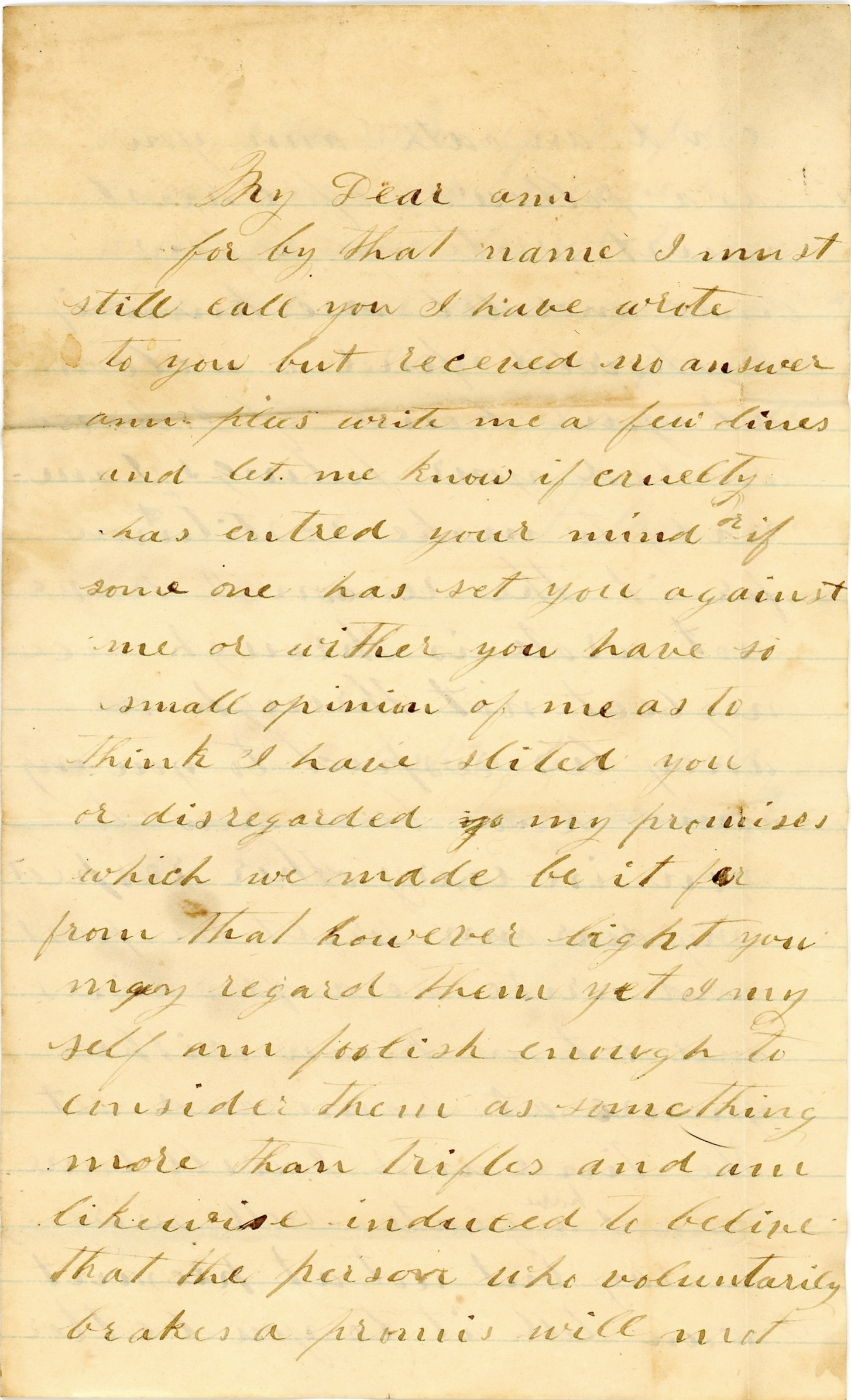
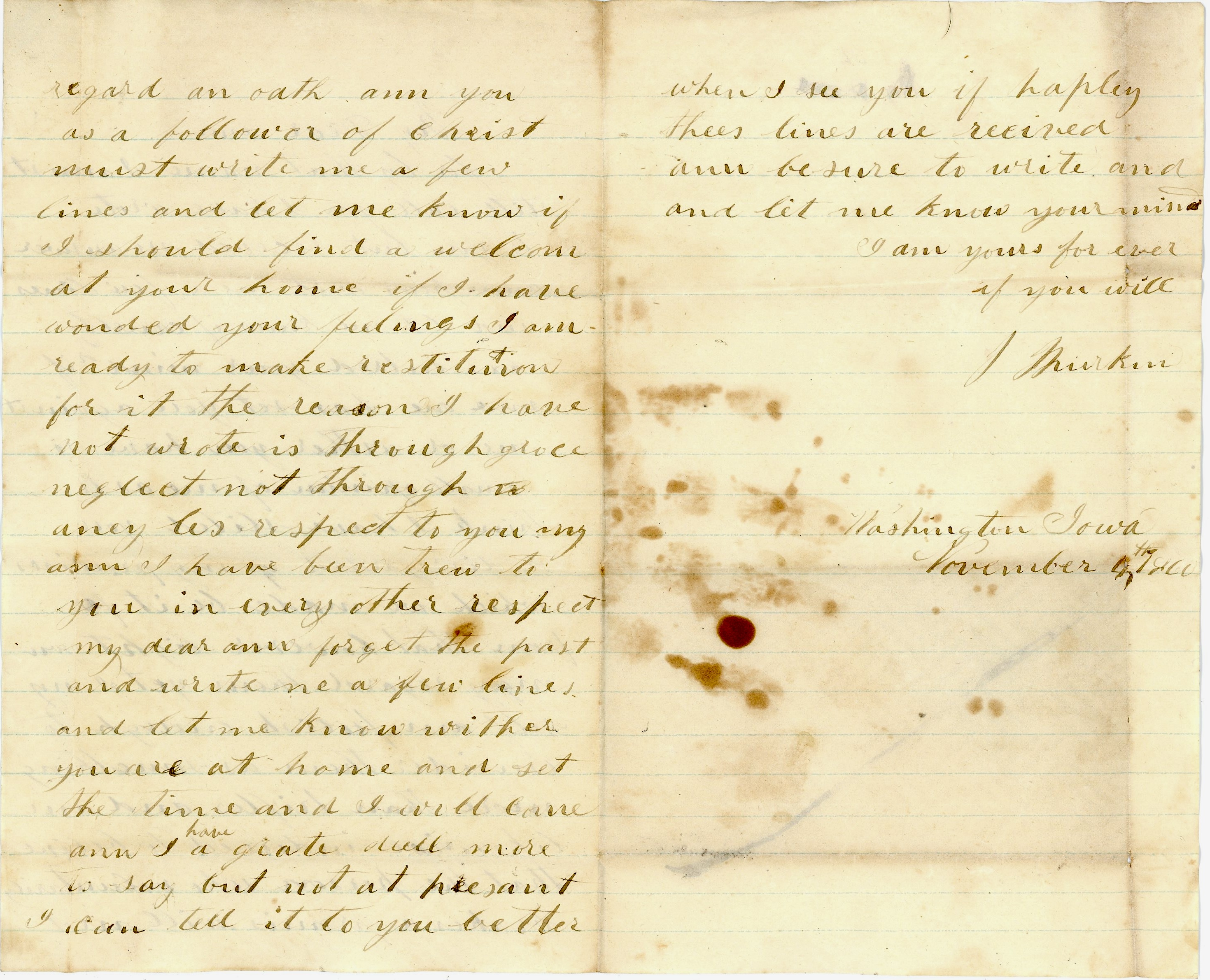
My dear Ann, for by that name I must still call you. I have wrote to you but received no answer. Ann, please write me a few lines and let me know if cruelty has entered your mind or if someone has set you against me or whether you have so small opinion of me as to think I have slighted you or disregarded my promises which we made, be it far from that, however light you may regard them. Yet I myself am foolish enough to consider them as something more than trifles and am likewise induced to believe that the person who voluntarily breaks a promise will not regard an oath.
Ann, you as a follower of Christ must write me a few lines and let me know if I should find a welcome at your home. If I have wounded your feelings, I am ready to make restitution for it. The reason I have not wrote is through gross neglect, not through any less respect to you.
Ann, I have been true to you in every other respect. My dear Ann, forget the past and write me a few lines and let me know whether you are at home and set the time and I will come. Ann, I have a great deal more to say but not at present. I can tell it to you better when I see you if happily these lines are received.
Ann, be sure to write and let me know your mind. I am yours forever if you will. — J. Murkin
Letter 2
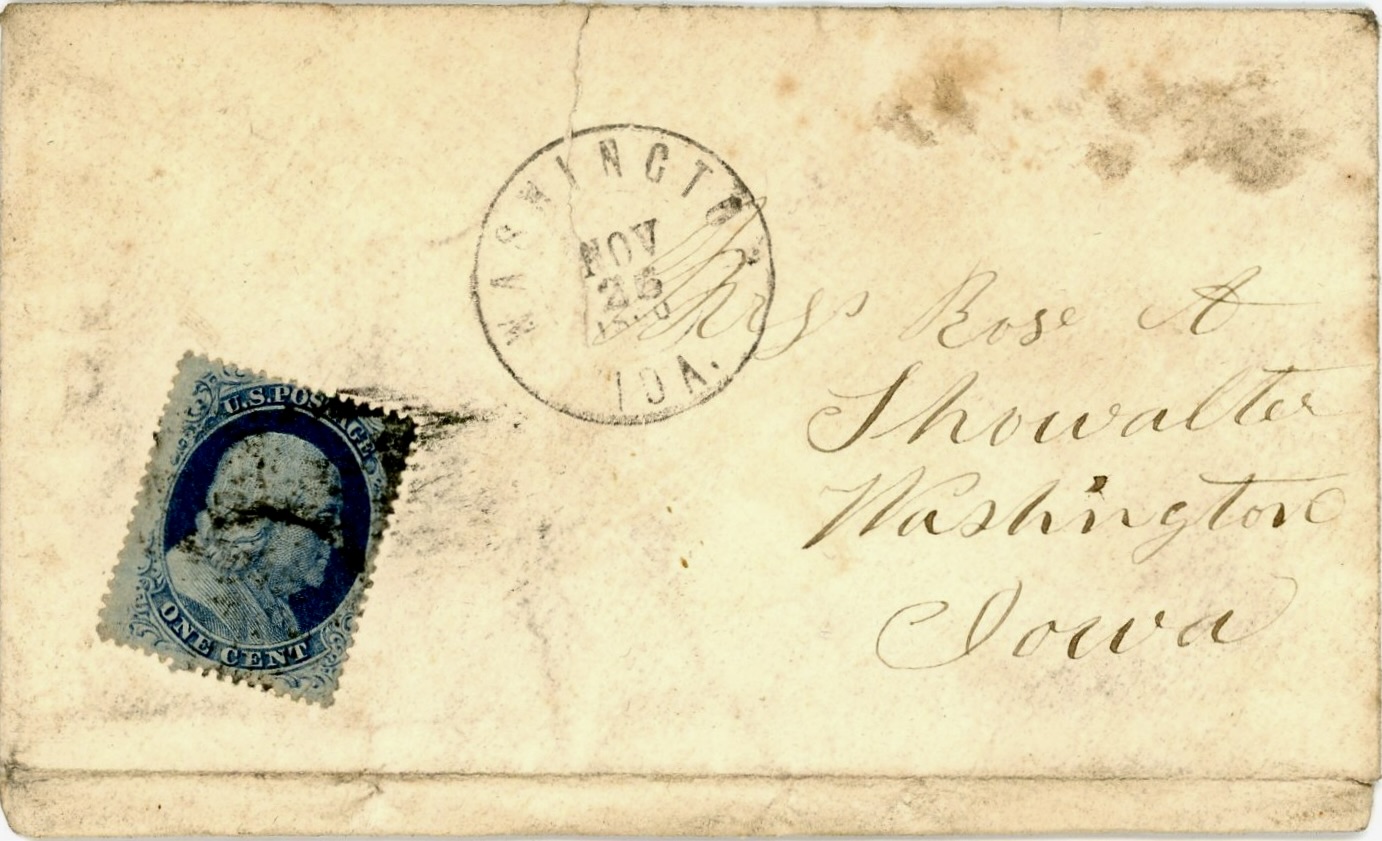
Washington, Iowa
November 24, 1860
Dear Ann,
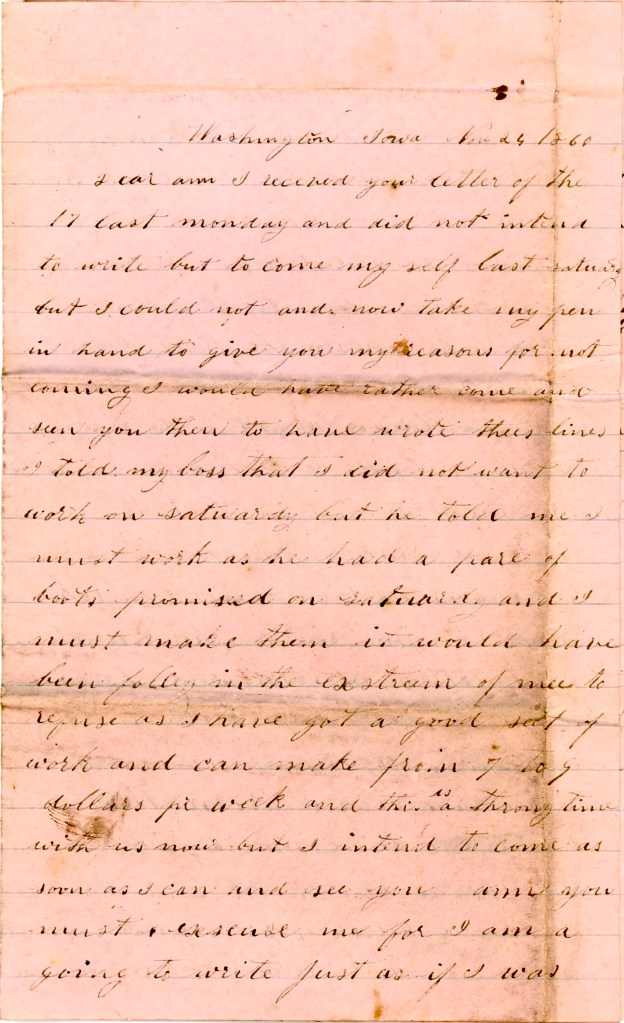
I received your letter of the 17th last Monday and did not intend to write but to come myself last Saturday but I could not and now take my pen in hand to give you my reasons for not coming. I would have rather come and seen you than to have to write these lines. I told my boss that I did not want to work on Saturday but he told me I must work as he had a pair of boots promised on Saturday and I must make them. It would have been folly in the extreme of me to refuse as I have a good deal of work and can make from 7 to 9 dollars per week and this is a throng [?] time with us now but I intend to come as soon as I can and see you.
Ann, you must excuse me for I am a going to write just as if I was a talking face to face with you. Now Ann, I think you must have misunderstood the tenor of my letters which I wrote you to a great extent for I di not, nor cannot, nor do I blame you at all. I think I told you in the first I sent to you that I had not acted right as a gentleman ought to do towards one he pretends to love. Ann, I confess my fault to you in that.
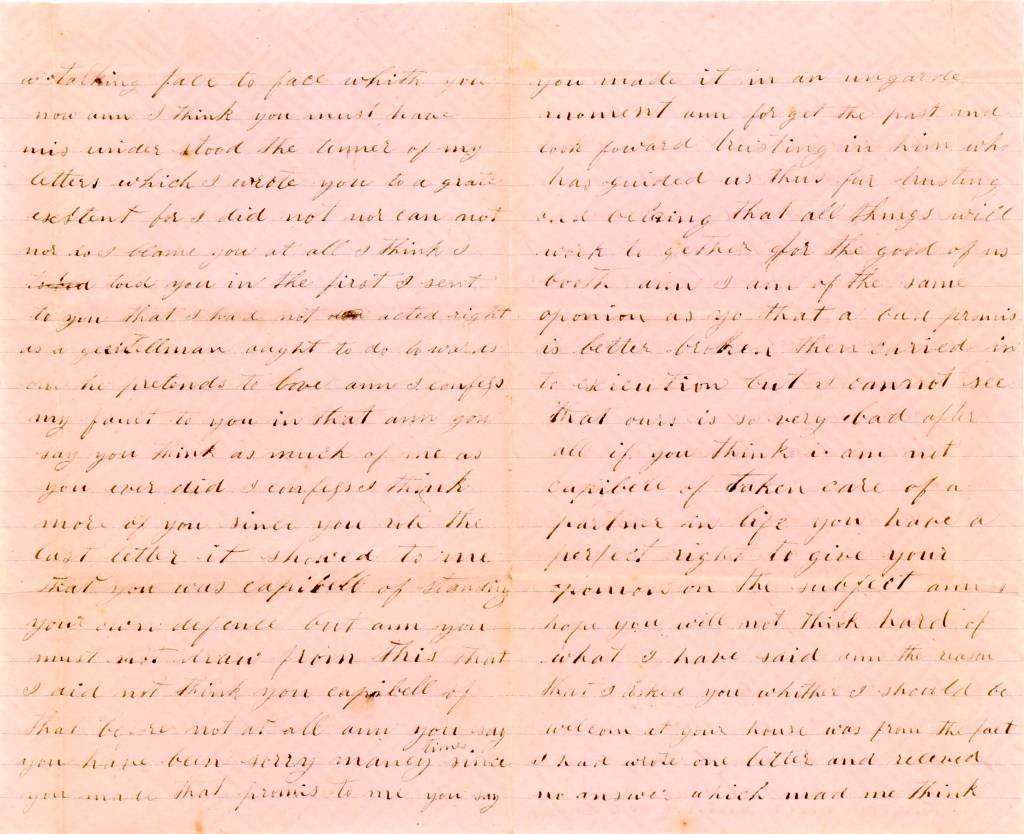
Ann, you say you think as much of me as you ever did. I confess I think more of you since you wrote the last letter. It showed to me that you was capable of standing your own defense. But Ann, you must not draw from this that I did not thinnk you capable of that before—not at all. Ann, you say you have been sorry many times since you made that promise to me. You say you made it in an unguarded moment. Ann, forget the past and look forward, trusting in Him who has guided us thus far, trusting and believing that all things will work together for the good of us both.
Ann, I am of the same opinion as you that a bad promise is better broken than carried into execution, but I cannot see that ours is so very bad after all. If you think I am not capable of taking care of a partner in life, you have a perfect right to give your opinion on the subject. Ann, I hope you will not think hard of what I have said. Ann, the reason that I asked you whether I should be welcome at your house was from the fact I had wrote one letter and received no answer which made me think as you did not write, you would not want to see me there. And as for the treatment I had when at your house, if I had been your brother, I could not have been treated with more respect. Your father has always treated me the same whenever he met me on the street.
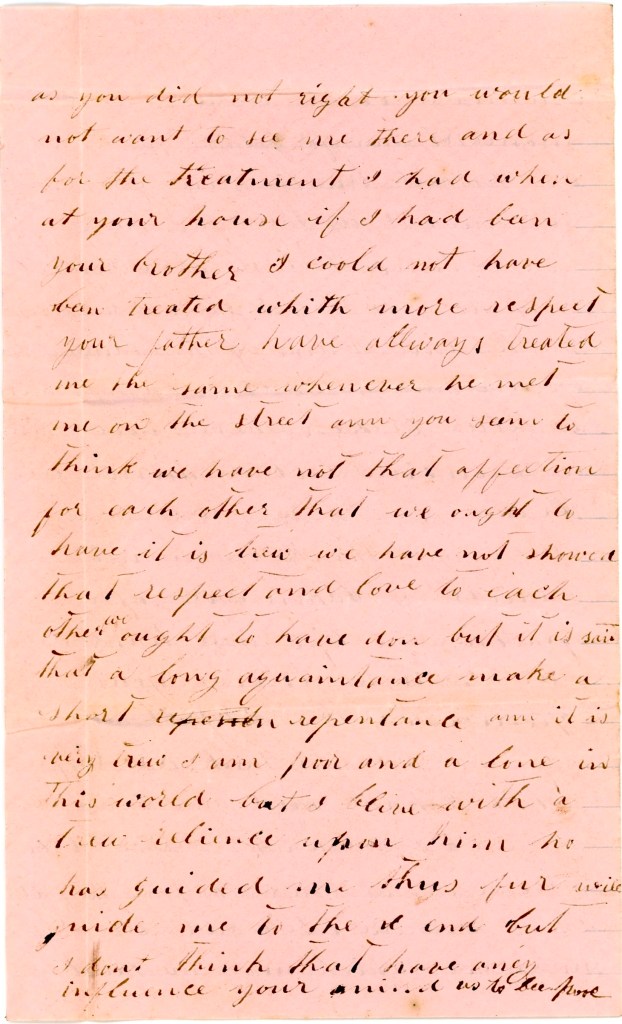
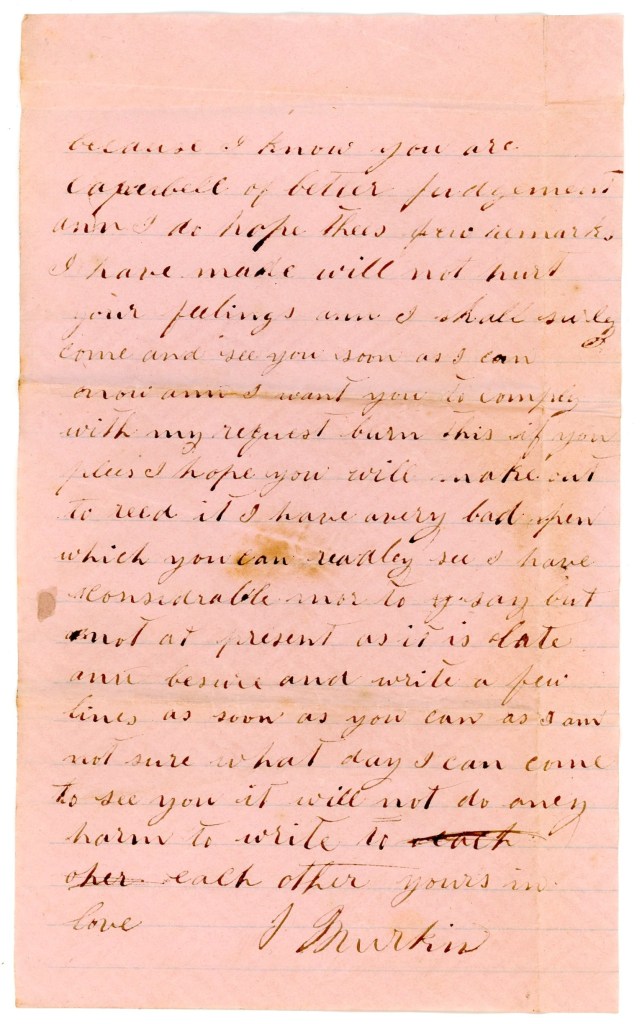
Ann, you seem to think we have not that affection for each other that we ought to have. It is true, we have not showed that respect and love to each other we ought to have done, but it is said that a long acquaintance makes a short repentance. Ann, it is very true I am poor and alone in this world, but I believe with a true reliance upon Him, He [who] has guided me thus far, will guide me to the very end. But I don’t think that I have any influence on your mind as to [ ] because I know you are capable of better judgment.
Ann, I do hope these few remarks I have made will not hurt your feelings. Ann, I shall surely come and see you soon as I can. Now Ann, I want you to comply with my request. Burn this [letter] if you please. I hope you will make out to read it. I have a very bad pen which you can readily see. I have considerable more to say but not at present as it is late. Ann, be sure and write a few lines as soon as you can as I am not sure what day I can come to see you. It will not do any harm to write to each other. Yours in love, — J. Murkin
Letter 3
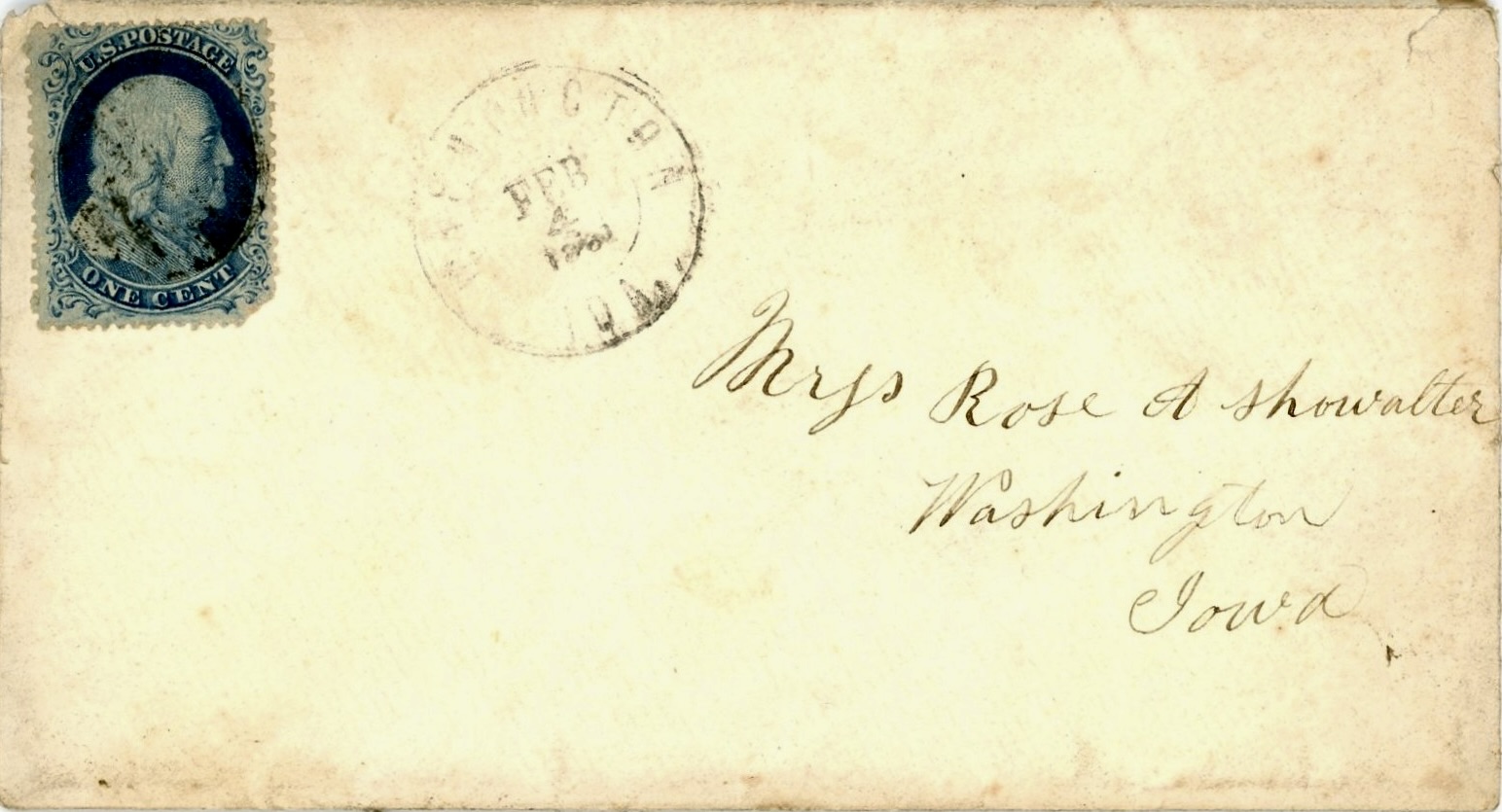
Washington, Iowa
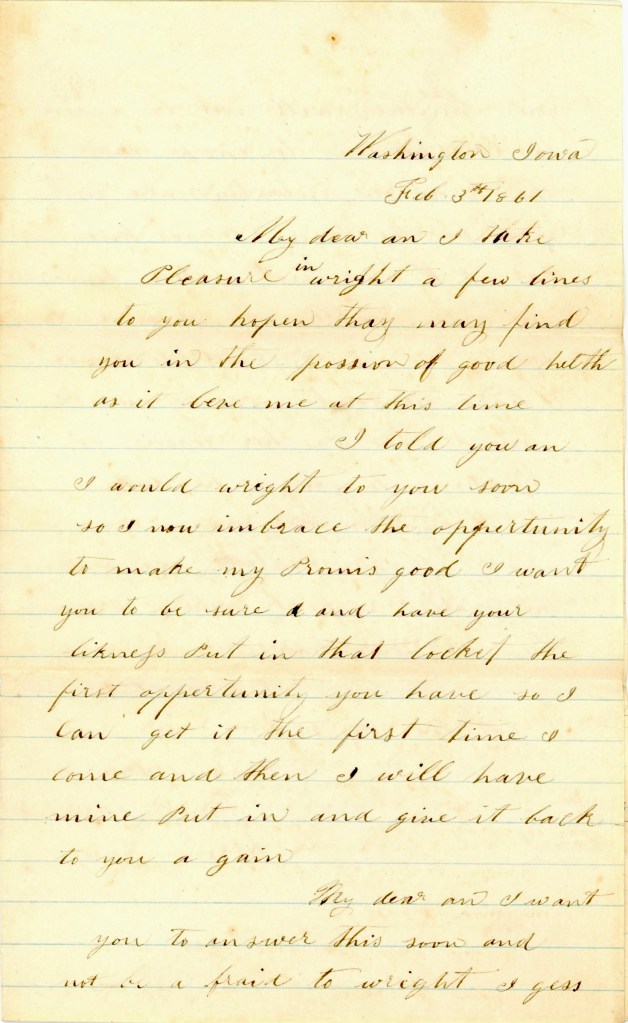
February 3, 1861
My dear Ann,
I take pleasure in writing a few lines to you hoping they may find you in the possession of good health as it leaves me at this time.
I told you, Ann, that I would write to you soon so I embrace the opportunity to make my promise good. I want you to be sure and have your likeness put in that locket the first opportunity you have so I can get it the first time I come and then I will have mine put in and give it back to you again.
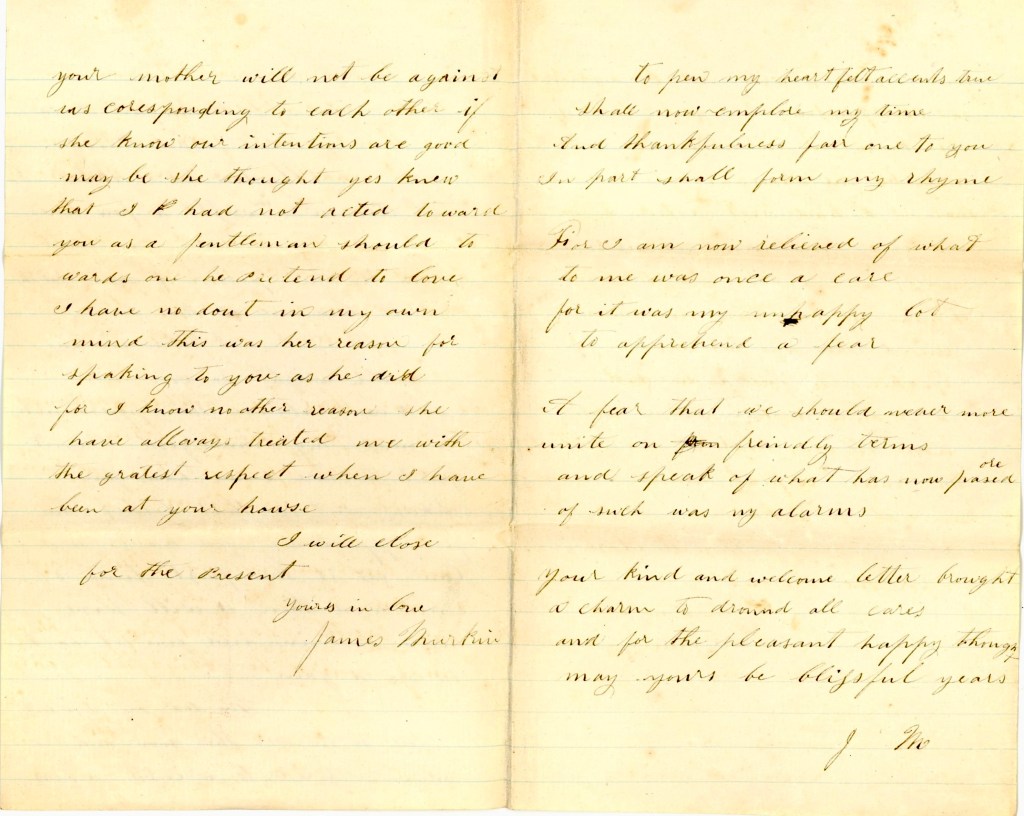
My dear Ann, I want you to answer this soon and not be afraid to write. I guess your mother will not be against us corresponding to each other if she knew our intentions ar good. Maybe she thought—yes knew—that I had not acted toward you as a gentleman should towards one he pretend to love. I have no doubt in my own mind this was her reason for speaking to you as he did for I know no other reason. She has always treated me with the greatest respect when I have been at your house.
I will close for the present, Yours inn love, — James Murkin
[handwritten poem no transcribed]
Letter 4
April 7th 1861
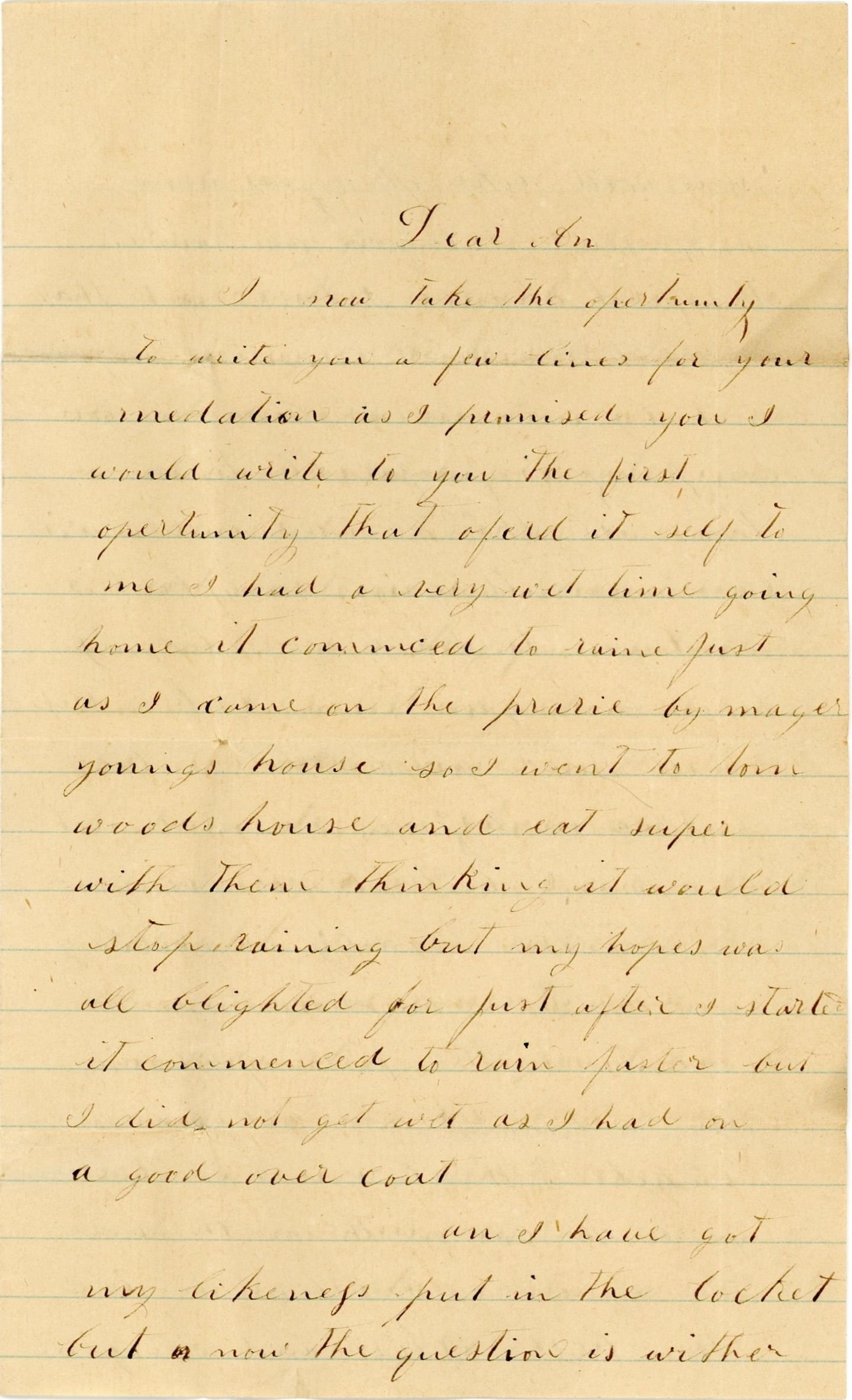
I now take the opportunity to write you a few lines for your meditation as I promised you. I would write to you the first opportunity that offered itself to me. I had a very wet time going home. It commenced to rain just as I came on the prairie by Major Young’s house so I went to Tom Woods’ house and ate supper with them thinking it would astop raining but my hopes was all blighted for just after I started, it commenced to rain [even] faster. But I did not get wet as I had on a good overcoat.
Ann, I have got my likeness put in the locket but now the question is whether you will like it. I guess, Ann, I will send it to you by Franklin the first chance I have—not that I want to avoid coming myself and by any means because your company is preferable to me than all the world besides, and I will come myself again soon. But I want you to have your likeness taken over again in a darker dress. I will send you one dollar bill in Iowa money so you need not be afraid but it will be good as all other money is failing now.
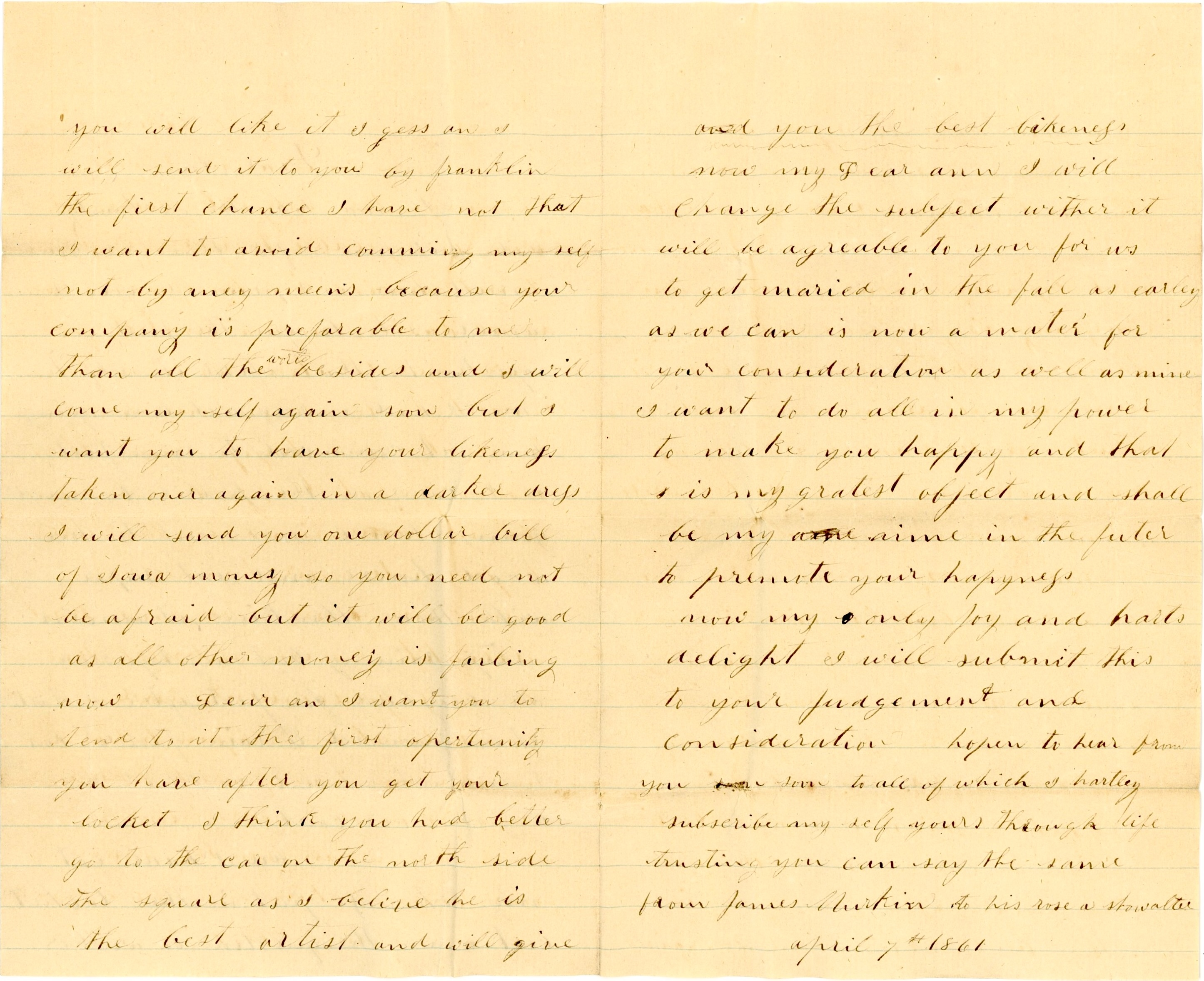
Dear Ann, I want you to tend to it the first opportunity you have after you get your locket. I think you had better go to the car on the north side of the square as I believe he is the best artist and will give you the best likeness.
Now, my dear Ann, I will change the subject. Whether it will be agreeable to you for us to get married in the fall as early as we can is now a matter for your consideration as well as mine. I want to do all in my power to make you happy and that is my greatest object and shall be my aim in the future to promote your happiness and my only joy and heart’s delight. I will submit this to your judgment and consideration. Hoping to hear from you soon, to all of which I heartily subscribe myself yours through life, trusting you can say the same. From James Murkin to his Rose A. Showalter
Letter 5
Keokuk, Iowa
May 26, 1861
Dear Ann,
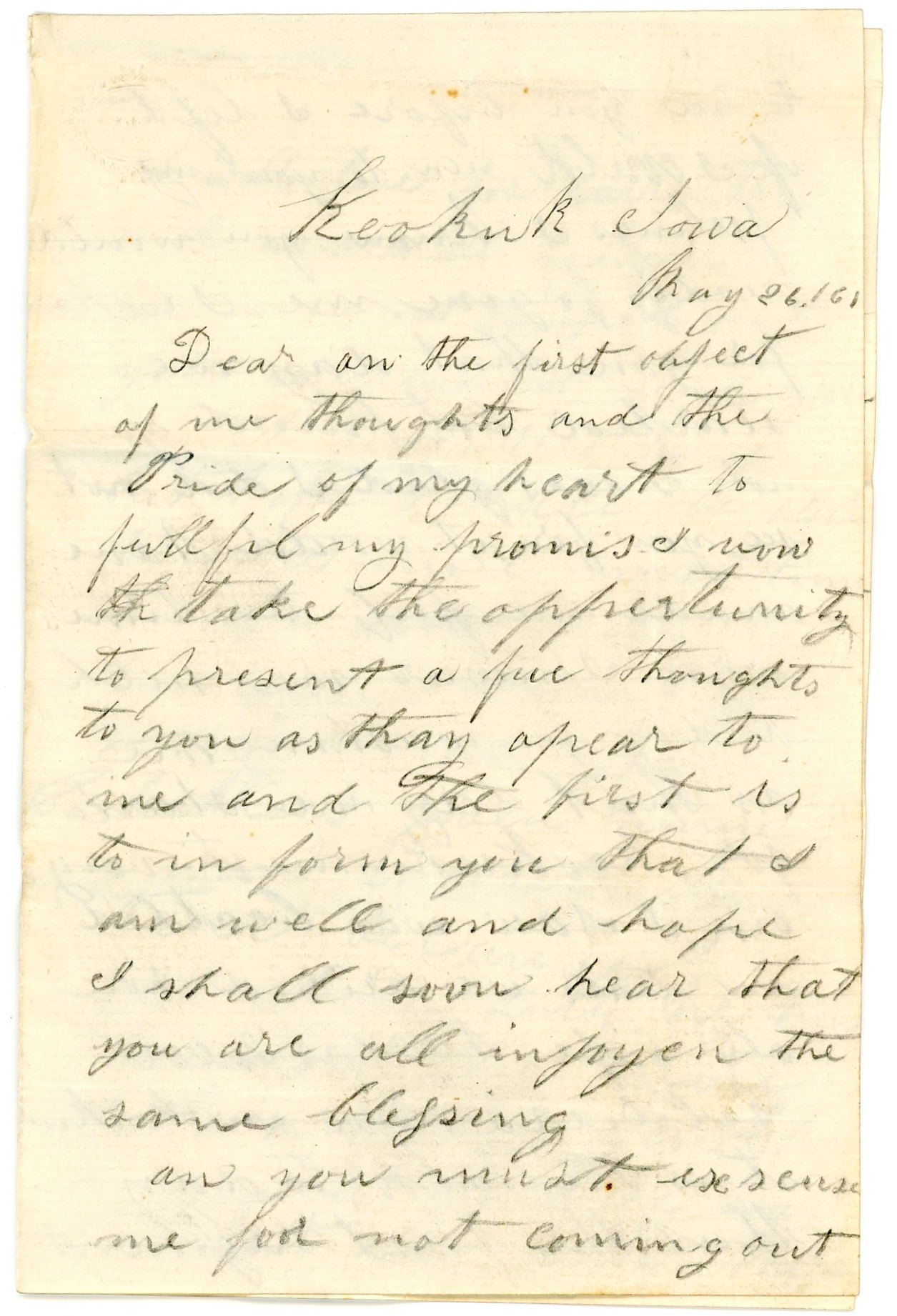
The first object of my thoughts and the pride of my heart to fulfill my promise. I now take the opportunity to present a few thoughts to you as they appear to me and the first is to inform you that I am well and hope I shall soon hear that you are all enjoying the same blessing.
Ann, you must excise me for not coming out to see you before I left. If I could pew to you my feelings, I know you would readily forgive me. I looked for you that day we started but found you not. I was glad I did not see you for it would have made me feel ten times worse. I never saw such a day in Washington as that day we started for Keokuk. Most everyone I saw was bathed in tears.
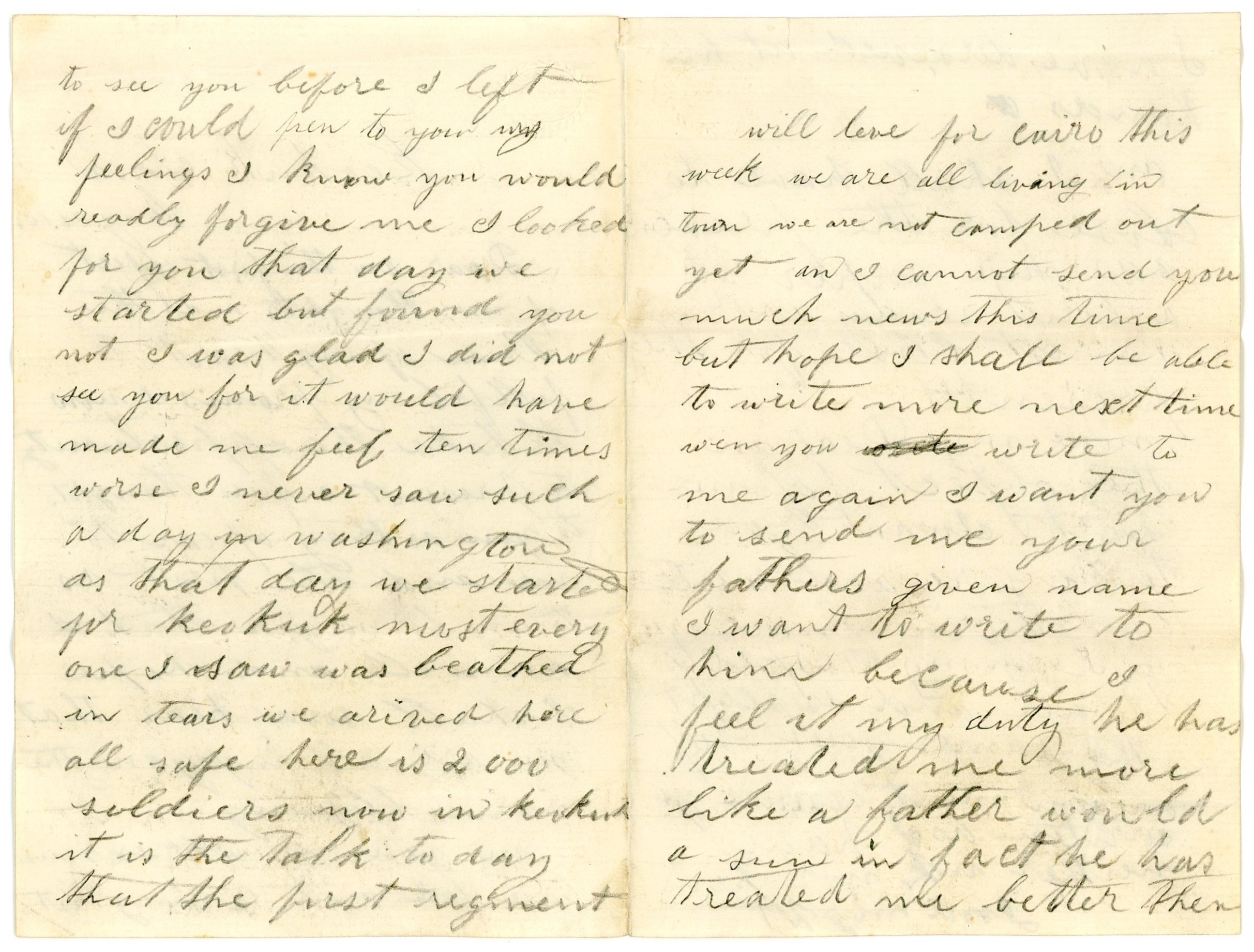
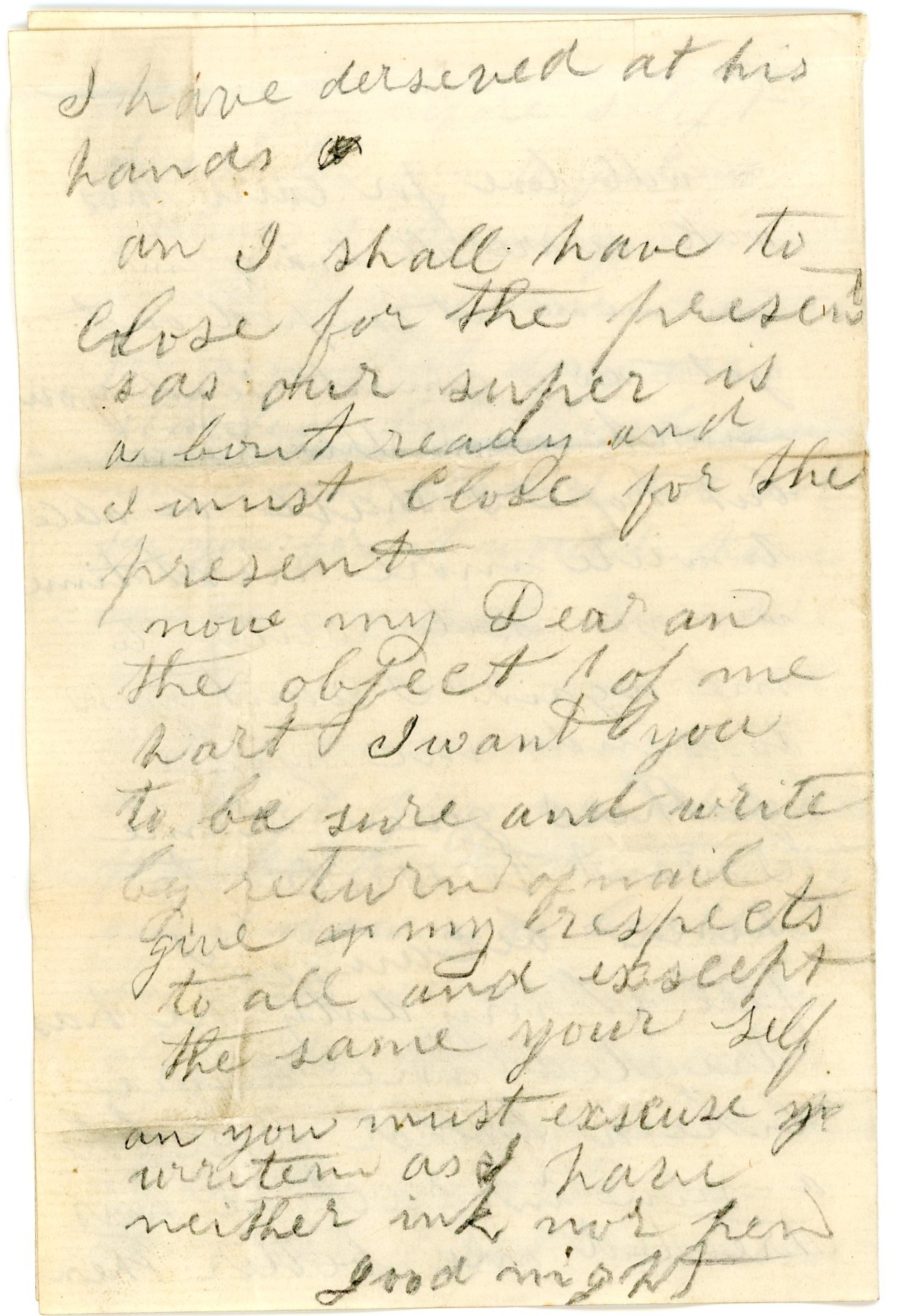
We arrived here all safe. There is 2,000 soldiers her now in Keokuk. It is the talk today that the 1st [Iowa] Regiment will leave for Cairo this week. We are living in town. We are not camped out yet. Ann, I cannot send you much news this time but hope I shall be able to write more next time. When you write to me again, I want you to send me your father’s given name. I want to write to him because I feel it my duty. He has treated me more like a father would a son. In fact, he has treated me better than I have deserved at his hands.
Ann, I shall have to close for the present as our supper is about ready and I must close for the present. Now my dear Ann, the object of my heart, I want you to be sure and write by return of mail. Give my respects to all and accept the same yourself. Ann, you must excuse my writing as I have neither k=ink nor pen. Good night.
Letter 6
Keokuk, Iowa
June 2nd 1861
Dear Ann,
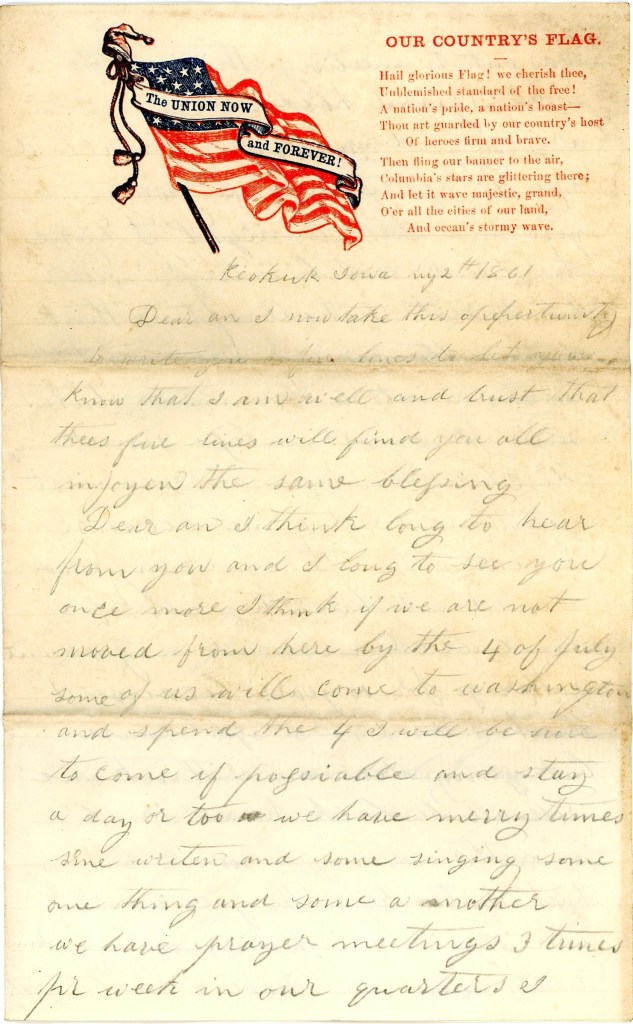
I now take this opportunity to write you a few lines to let you know that I am well and trust that these few lines will find you all enjoying the same blessing. Dear Ann, I think long to hear from you and I long to see you once more. I think if we are not moved from here by the 4th of July, some of us will come to Washington [Iowa] and spend the 4th. I will be sure to come if possible and stay a day or two.
We have merry times—some writing and some singing, some one thing and some another. We have prayer meetings three times per week in our quarters. I was out to meeting this morning and had a very good sermon preached. And this afternoon I am writing to you and tonight I have to stand watch while you will be at rest. I shall often think of you. The 2nd Regiment is sworn into the United States service for three years unless sooner discharged.
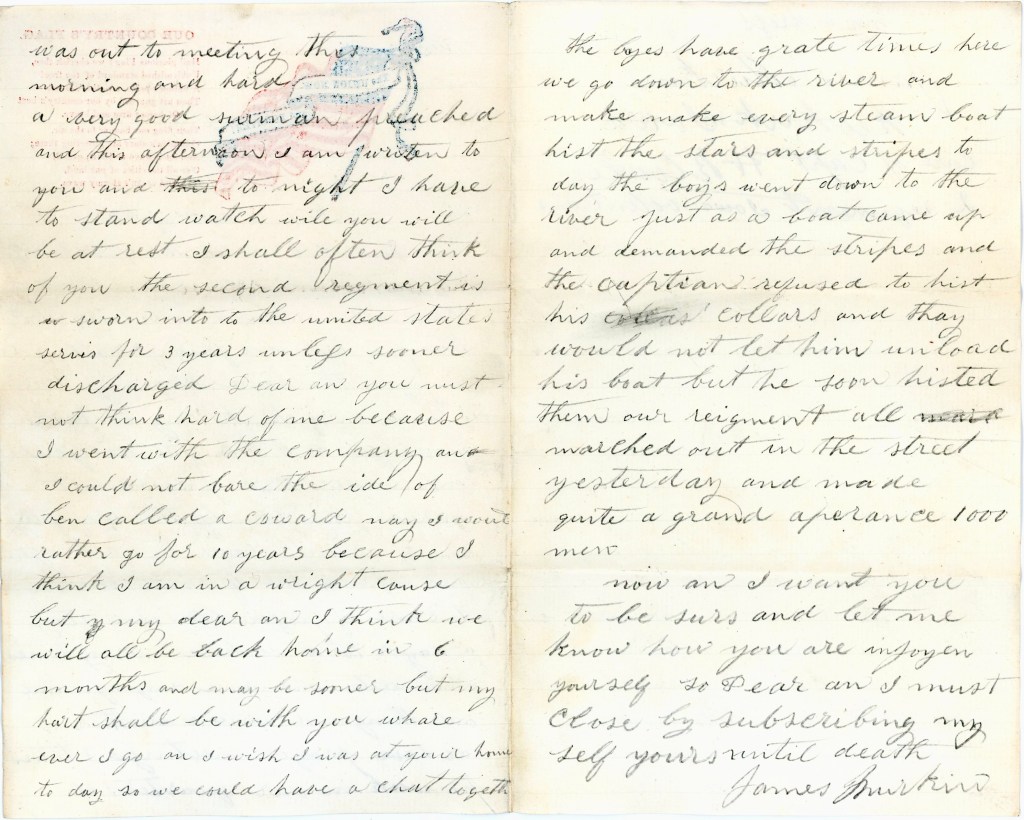
Dear Ann, you must not think hard of me because I went with the company. Ann, I could not bear the idea of being called a coward. May, I wold rather go for ten years because I think I am in a right cause. But my dear Ann, I think we will all be back home in six months and maybe sooner. But my hearts shall be with you wherever I go. Ann, I wish I was at your home today so we could have a chat together.
The boys have great times here. we go down to the river and make every steamboat hoist the stars and stripes. Today the boys went down to the river just as a boat came up and demanded the stripes and the captain refused to hoist his colors and they would not let him unload his boat. But he soon hoisted them. Our regiment all marched out in the street yesterday and made quite a grand appearance [of] 1,000 men.
Now Ann, I want you to be sure and let me know how you are enjoying yourself. So dear Ann, I must close by subscribing myself yours until death. — James Murkin
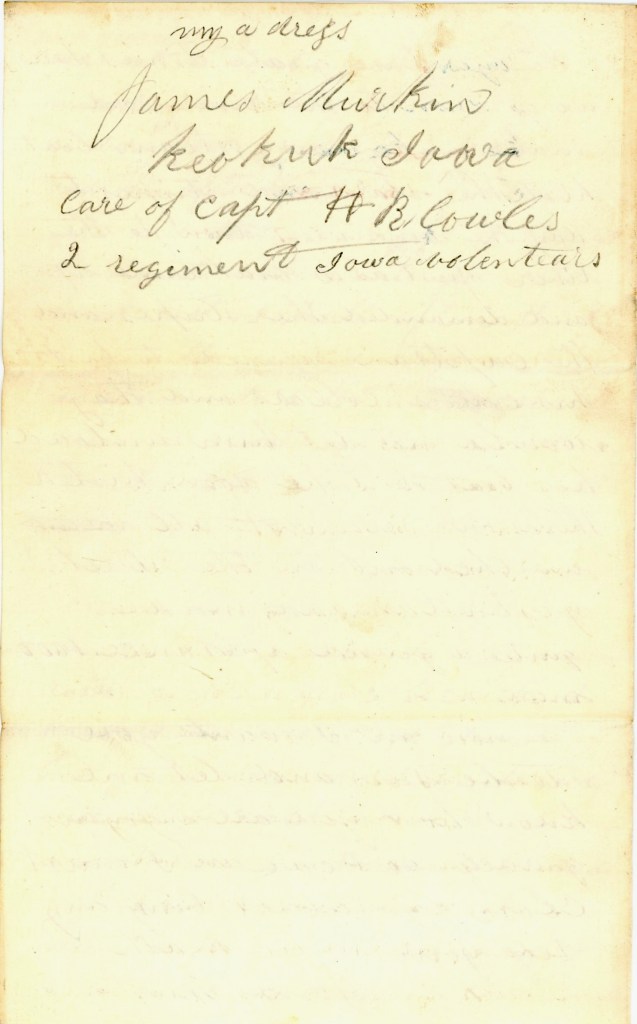
My address is James Murkin, Keokuk, Iowa, in care of Capt. H[enry] R. Cowles, 2nd Regiment Iowa Volunteers
Letter 7
Keokuk, Iowa
June 13th 1861
Dear Ann,
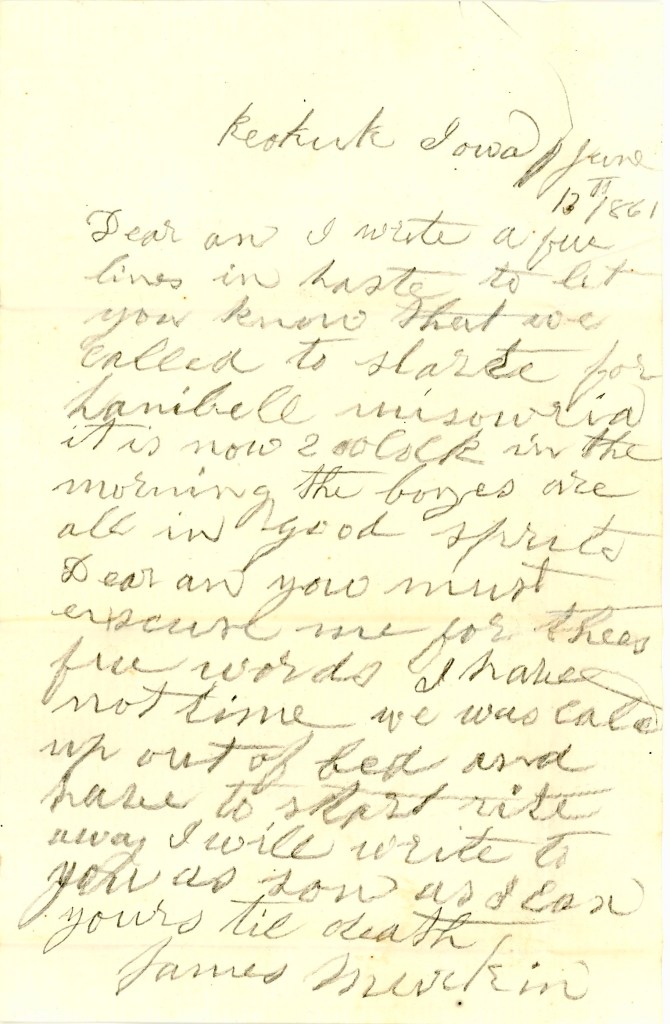
I write a few lines in haste to let you know that we [are] called to start for Hannibal, Missouri. It is now 2 o’clock in the morning. The boys are all in good spirits. Dear Ann, you must excuse me for these few words. I have not time. we was called up out of bed and have to start right away. I will write to you as soon as I can. Yours till death. — James Murkin
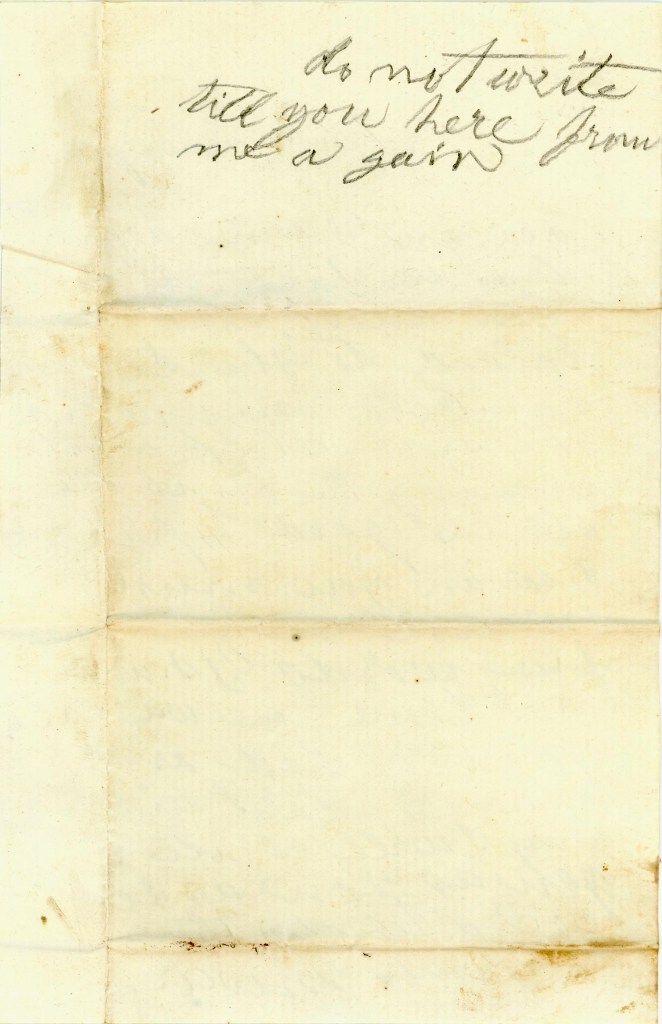
Do not write till you hear from me again.
Letter 8
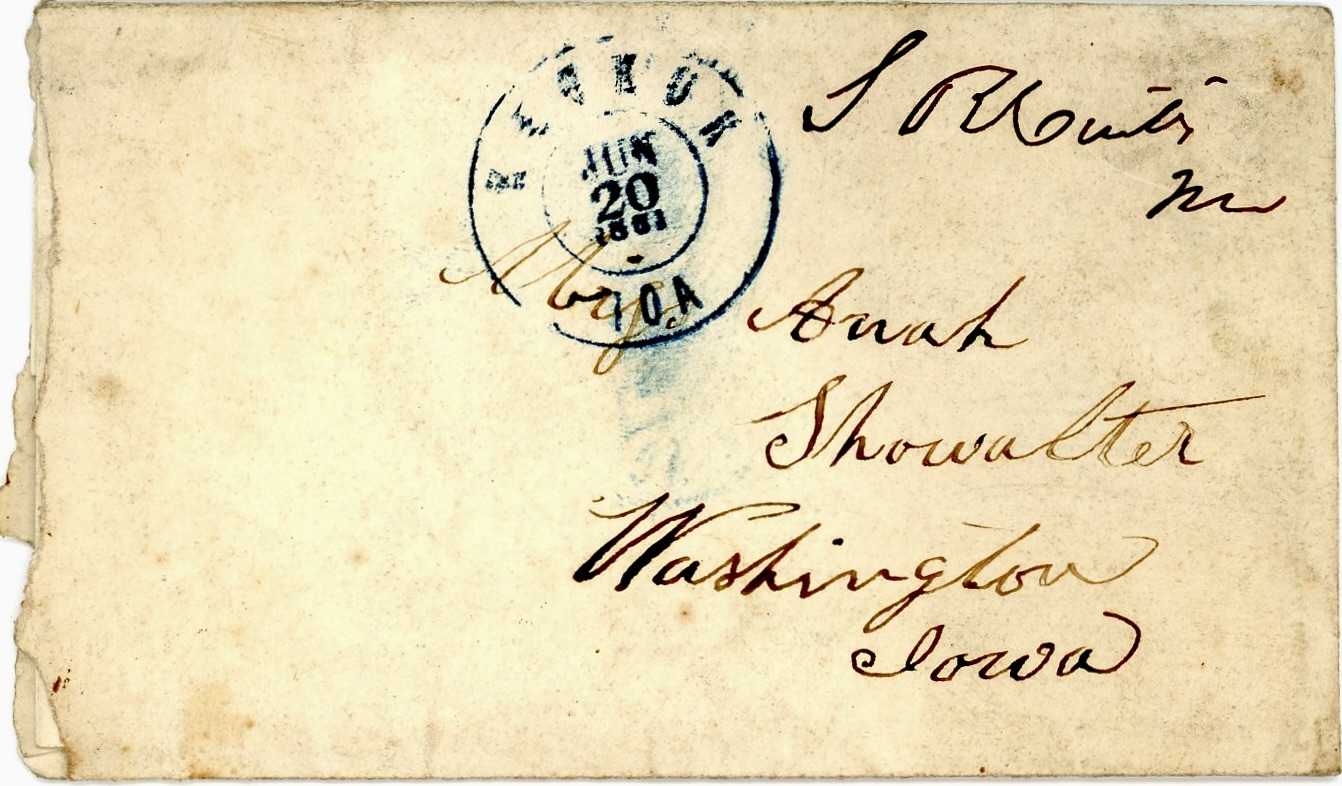
St. Joseph, Missouri
June 16, 1861
Dear Ann,
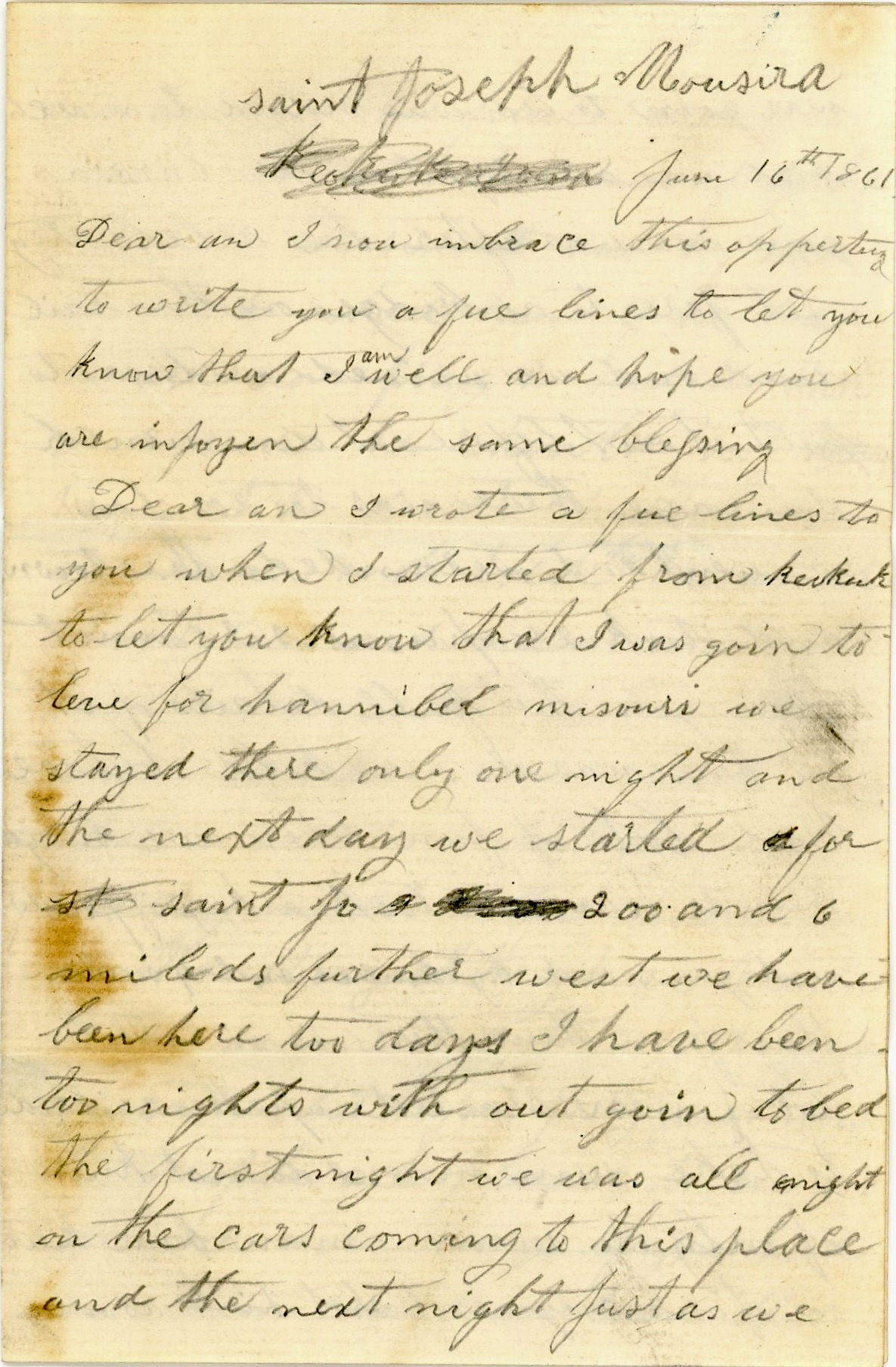
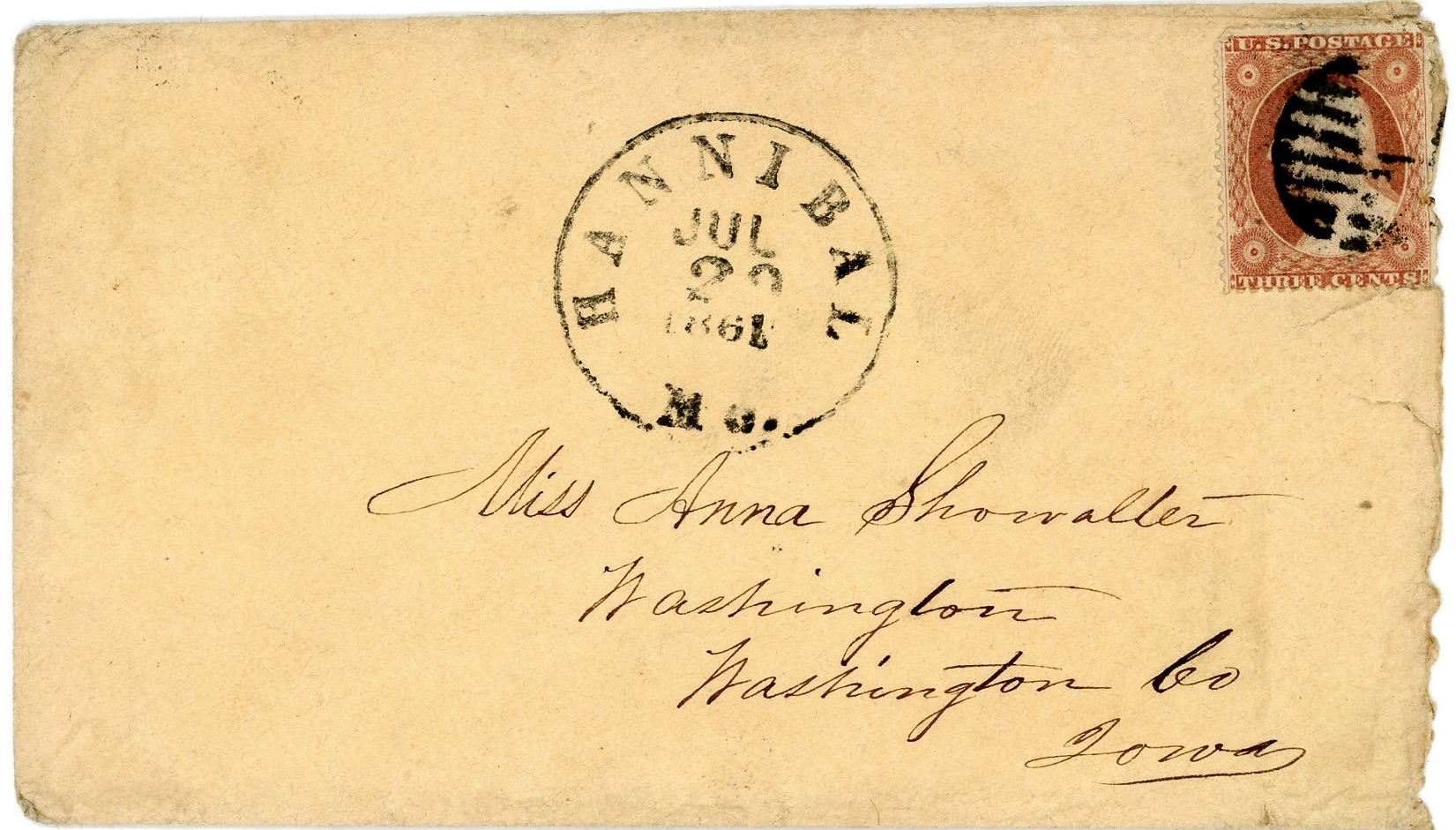
I now embrace this opportunity to write you a few lines to let you know that I am well and hope you are enjoying the same blessing. Dear Ann, I wrote a few lines to you when I started from Keokuk to let you know that I was going to leave for Hannibal, Missouri. we stayed there only one night and the next day we started for St. Jo, 206 miles further west.
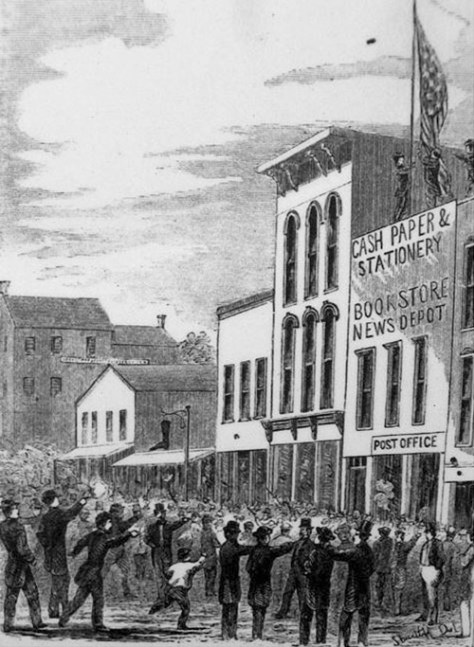
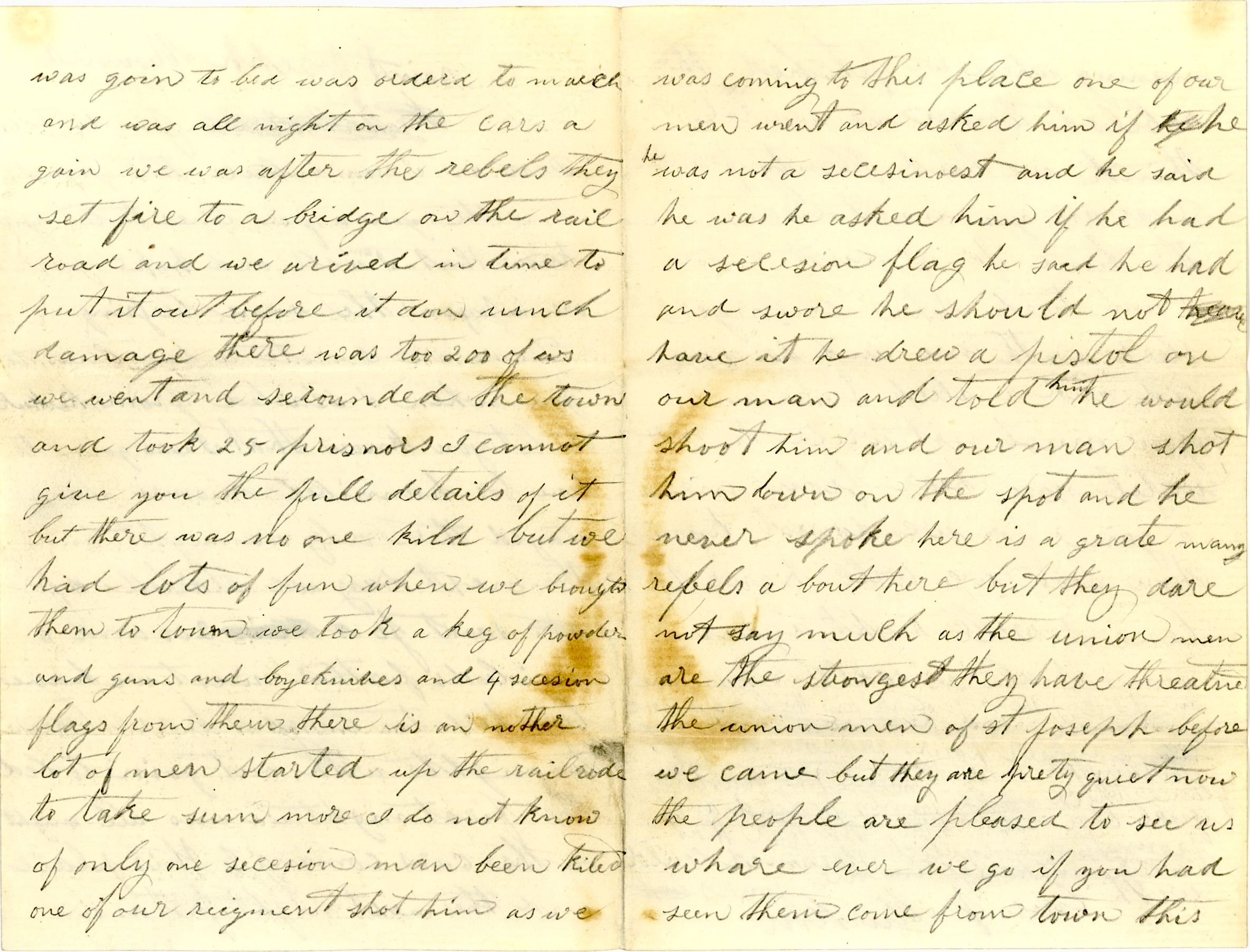
We have been here two days. I have been two nights without going to bed. The first night we was all night on the cars coming to this place. And the next night, just as we was going to bed, was ordered to march and was all night on the cars again. We was after the rebels. They set fire to a bridge on the railroad and we arrived in time to put it out before it done much damage. There was 200 of us. We went and surrounded the town and took 25 prisoners. I cannot give you the full details of it but there was no one killed. But we had lots of fun when we brought them to town. We took a keg of powder and guns and boyeknibes [?] and four secession flags from them. There is another lot of men started up the railroad to take some more. I do not know of only one secession man been killed. One of our regiment shot him as we was coming to this place. One of our men went and asked him if he was not a secessionist and he said he was. He asked him if he had a secession flag. He said he had and swore he should not have it. He drew a pistol on our man and told him he would shoot him and our man shot him down on hte spot and he never spoke.
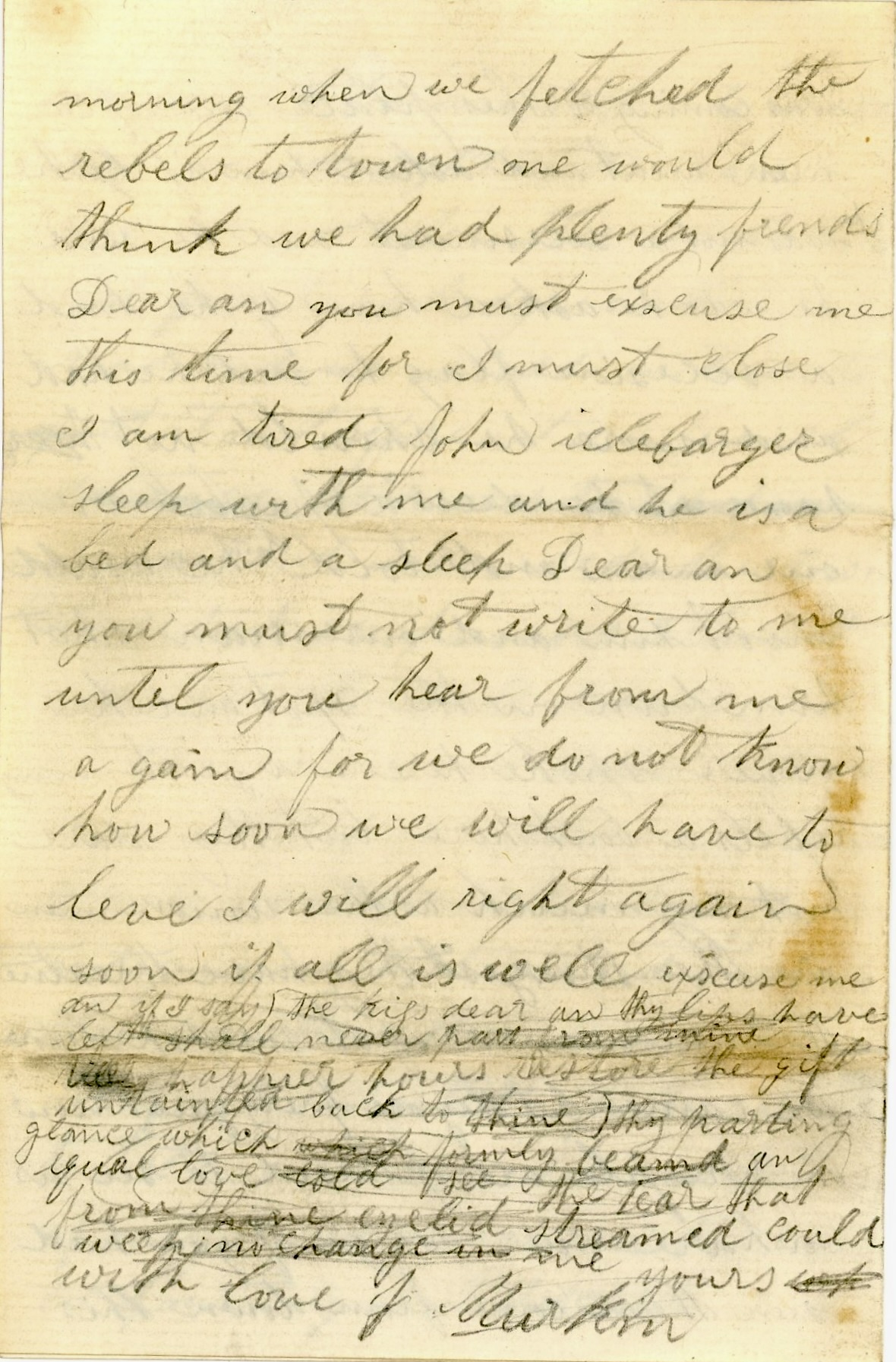
There is a great many rebels about here but they dare not say much as the Union men are the strongest. They have threatened the Union men of St. Joseph before we came but they are pretty quiet now. The people are pleased to see us wherever we go. If you had seen them come from town this morning when we fetched the rebels to town, one would think we had plenty friends.
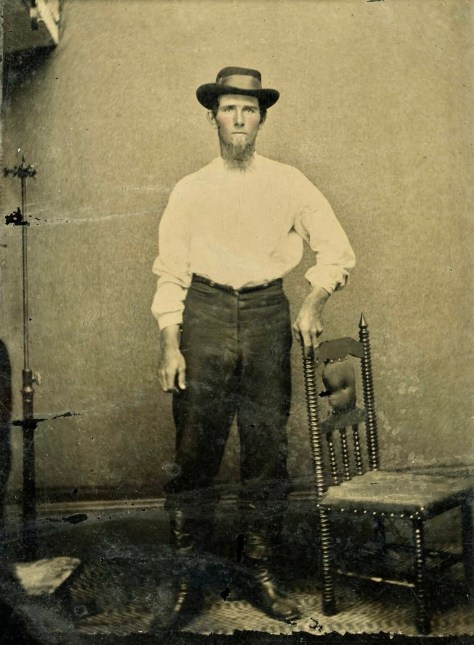
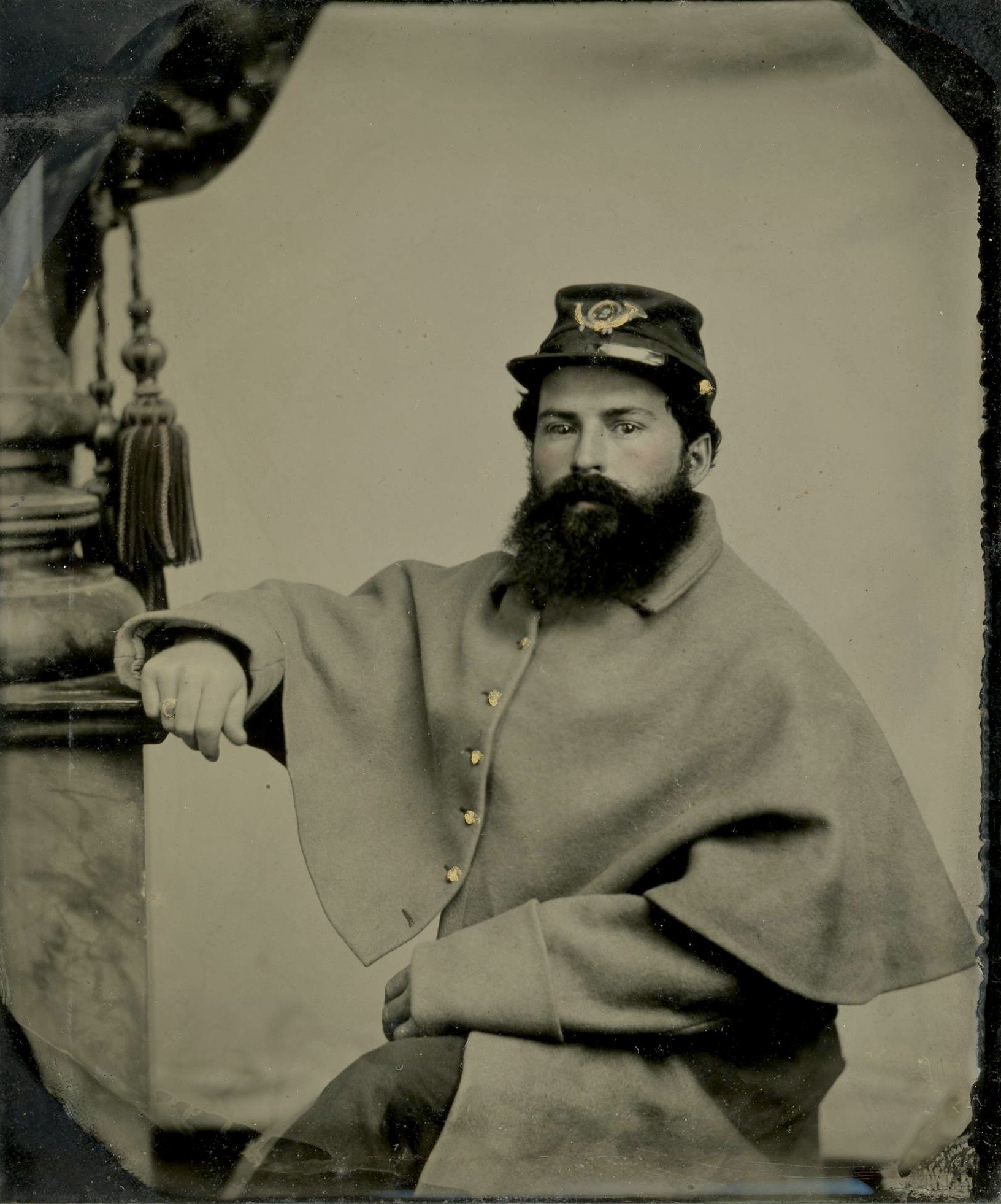
Dear, you must excuse me this time for I must close. I am tired. John Eichelberger [see image below] sleeps with me and he is abed and asleep. Dear Ann, you must not write to me until you hear from me again for we do not know how soon we will have to leave. I will write again soon if all is well. Excuse me Ann if I say [a poem not transribed]
Yours with love, — James Murkin
Letter 9
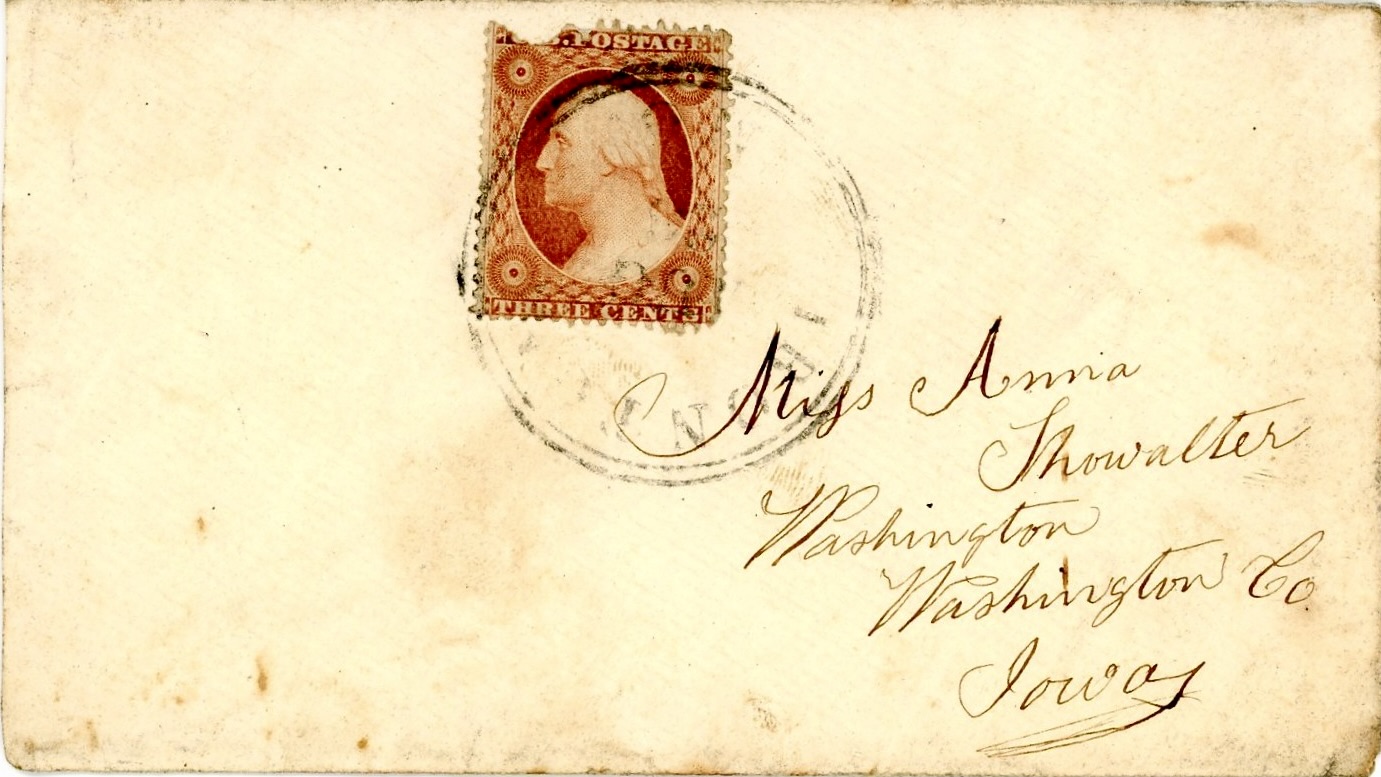
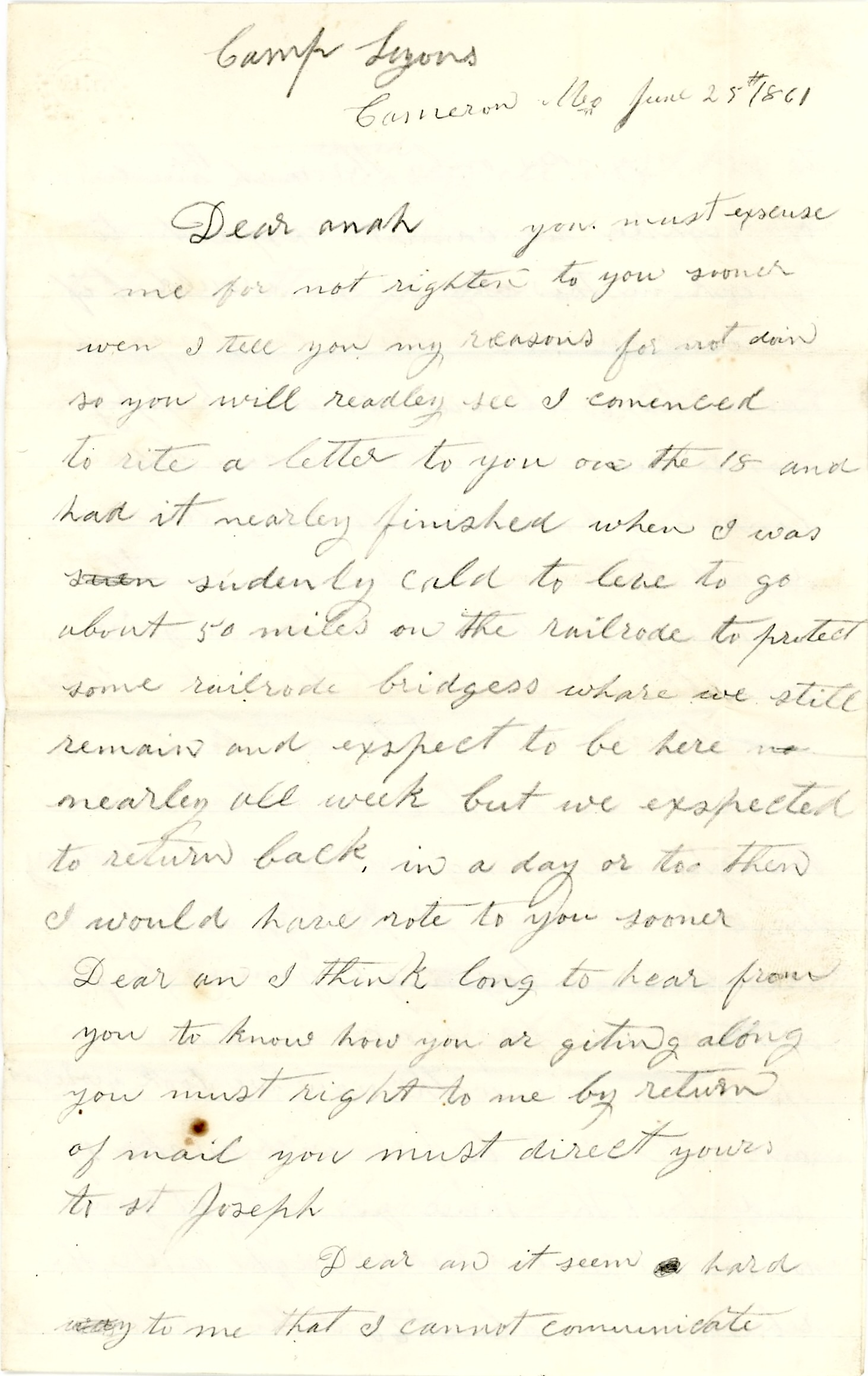
Camp Lyons, Cameron, Missouri
June 25th 1861
Dear Anna,
You must excuse me for not writing to you sooner. When I tell you my reasons for not doing so, you will readily see. I commenced to write a letter to you on the 18th and had it nearly finished when I was suddenly called to leave to go about 50 miles on the railroad to protect some railroad bridges where we still remain and expect to be here nearly all week. But we expected to return back in a day or two. Then I would have wrote to you sooner.
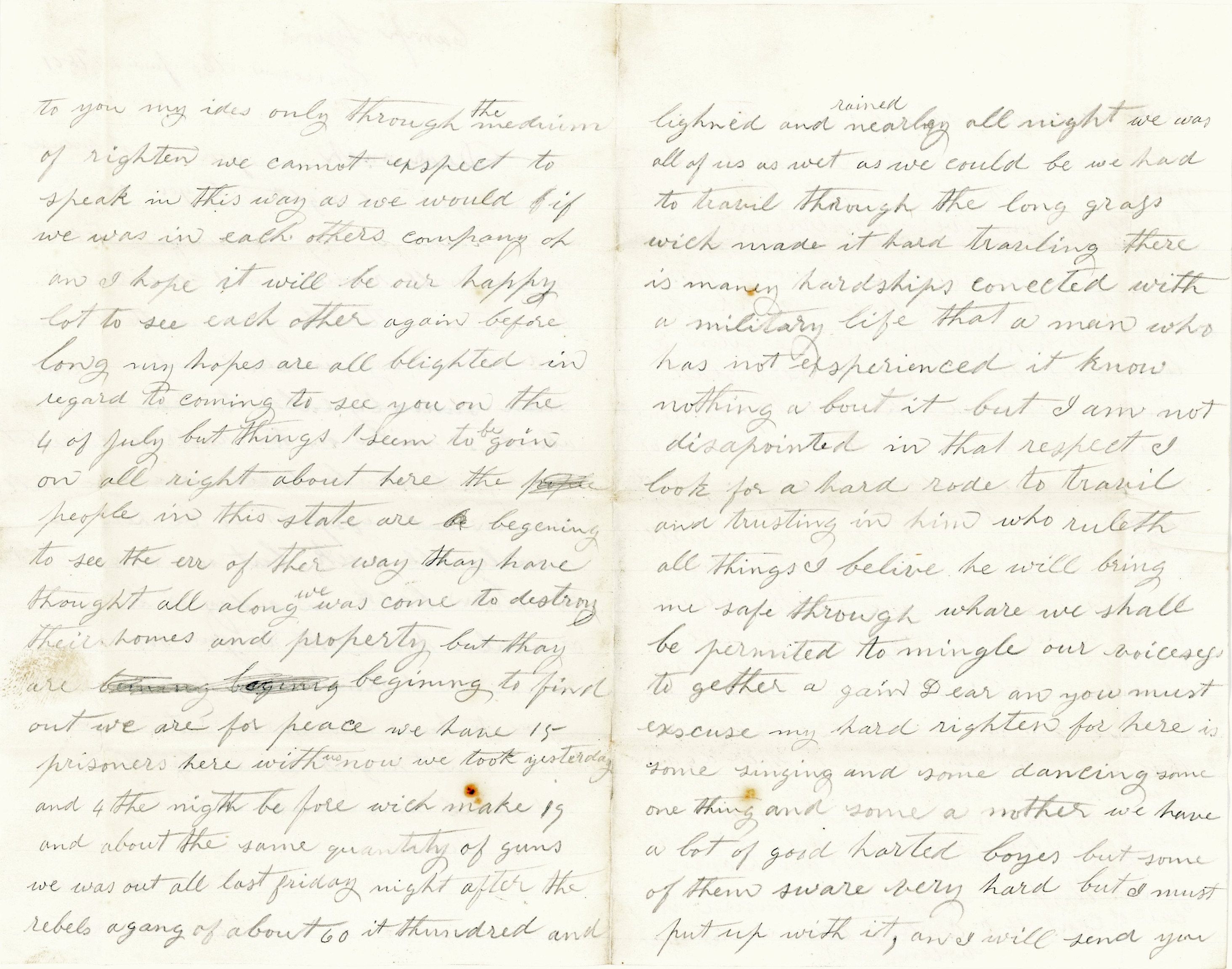
Dear Ann, I think long to hear from you to know how you are getting along. You must write to me by return of mail. you must direct yours to St. Joseph. Dear Ann, it seems hard to me that I cannot communicate to you my ideas only through the medium of writing. We cannot expect to speak in this way as we would if we was in each others company. Oh Ann, I hope it will be our happy lot to see each other again before long. My hopes are all blighted in regard to coming to see you on the 4th of July. But things seem to be going on all right about here. The people in this state are beginning to see the error of their way. They have thought all along we was come to destroy their homes and property. But they are beginning to find out we are for peace.
We have 15 prisoners here with us now. We took [them] yesterday and four the night before which makes 19 and about the same quantity of guns. We was out all Friday night after the rebels—a gang of about 60. It thundered and lightninged and rained nearly all night. We was all of us wet as we could be. We had to travel through the long grass which made it hard traveling. There is many hardships connected with a military life that a man who has not experienced it knows nothing about it. But I am not disappointed in that respect. I look for a hard road to travel, and trusting in Him who ruleth all things, I believe He will bring me safe through where we shall be permitted to mingle our voices together again.
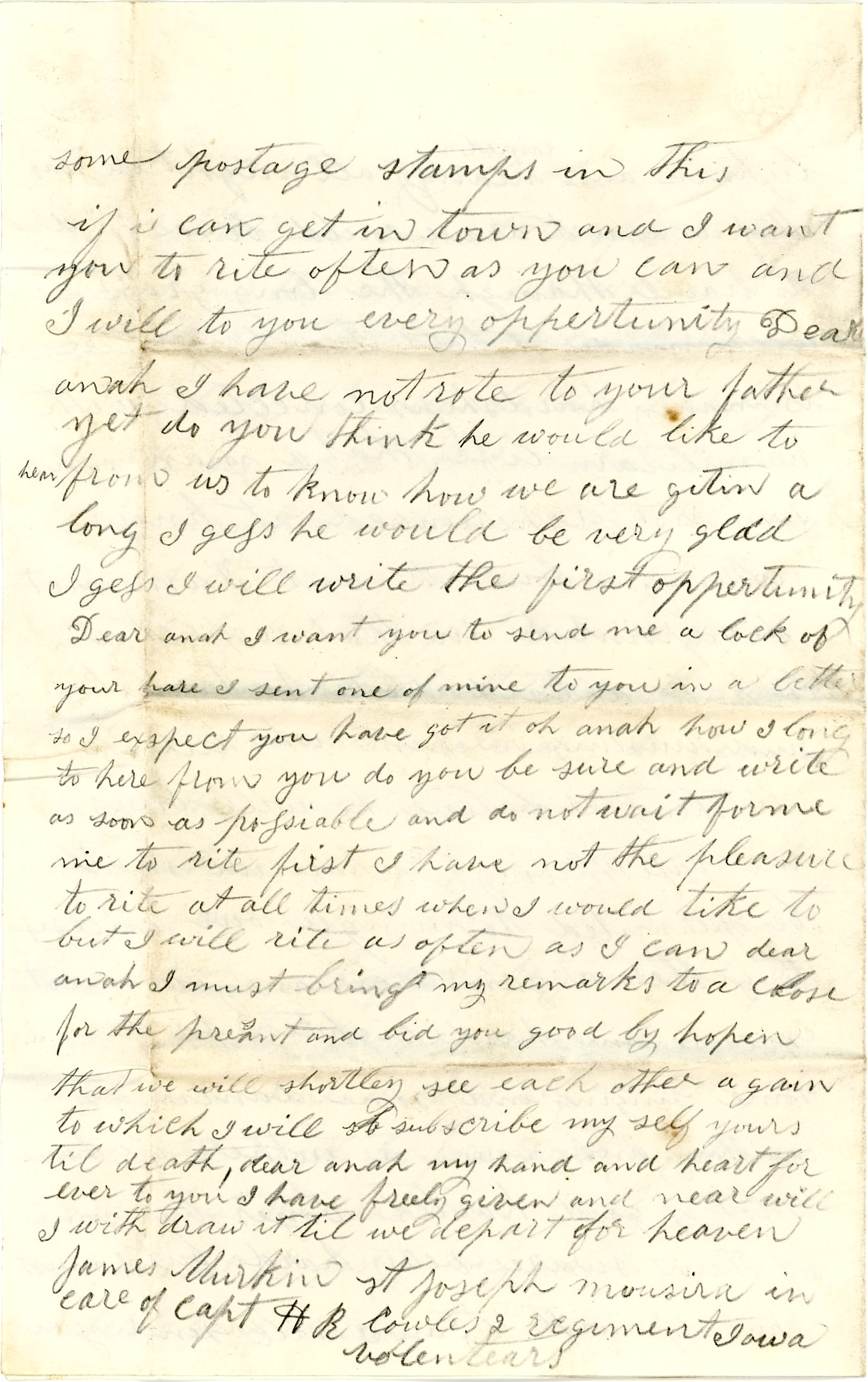
Dear Ann, you must excuse my hard writing for there is some singing and some dancing, some one thing and some another. We have a lot of good-hearted boys, but some of them swear very hard. But I must put up with it and I will send you some postage stamps in this if I can get in town. And I want you to write often as you can and I will write to you every opportunity.
Dear Ann, I have not wrote to your Father yet. Do you think he would like to hear from us to know how we are getting along? I guess he would be very glad. I guess I will write the first opportunity. Dear Ann, I want you to send me a lock of your hair. I sent one of mine to you in a letter so I expect you have got it. Oh Anna, how I long to hear from you. Do you? Be sure and write as soon as possible and do not wait for me to write first. I have not the pleasure to write at all times when I would like to. But I will write as often as I can.
Dear Anna, I must bring my remarks to a close for the present and bid you goodbye hoping that we will shortly see each other again to which I will subscribe myself yours till death. Dear Anna, my hand and heart forever to you I have freely given and never will I withdraw it till we depart for heaven. — James Murkin
James Murkin, St. Joseph, Missouri, in care of Capt. H. R. Cowles, 2nd Regiment, Iowa Volunteers
Letter 10
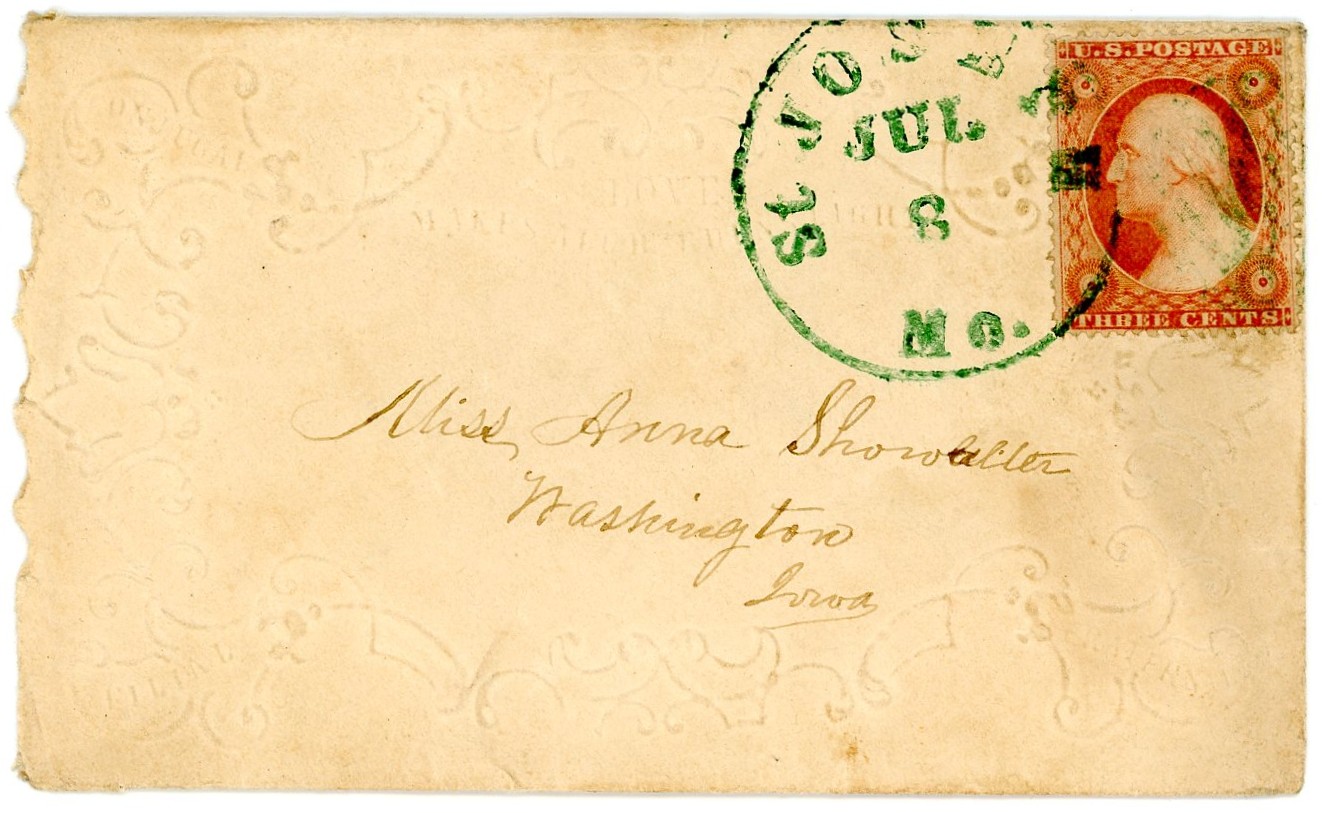
Camp Lyons
St. Joseph, Missouri
July 6th 1861
Dear Anna,
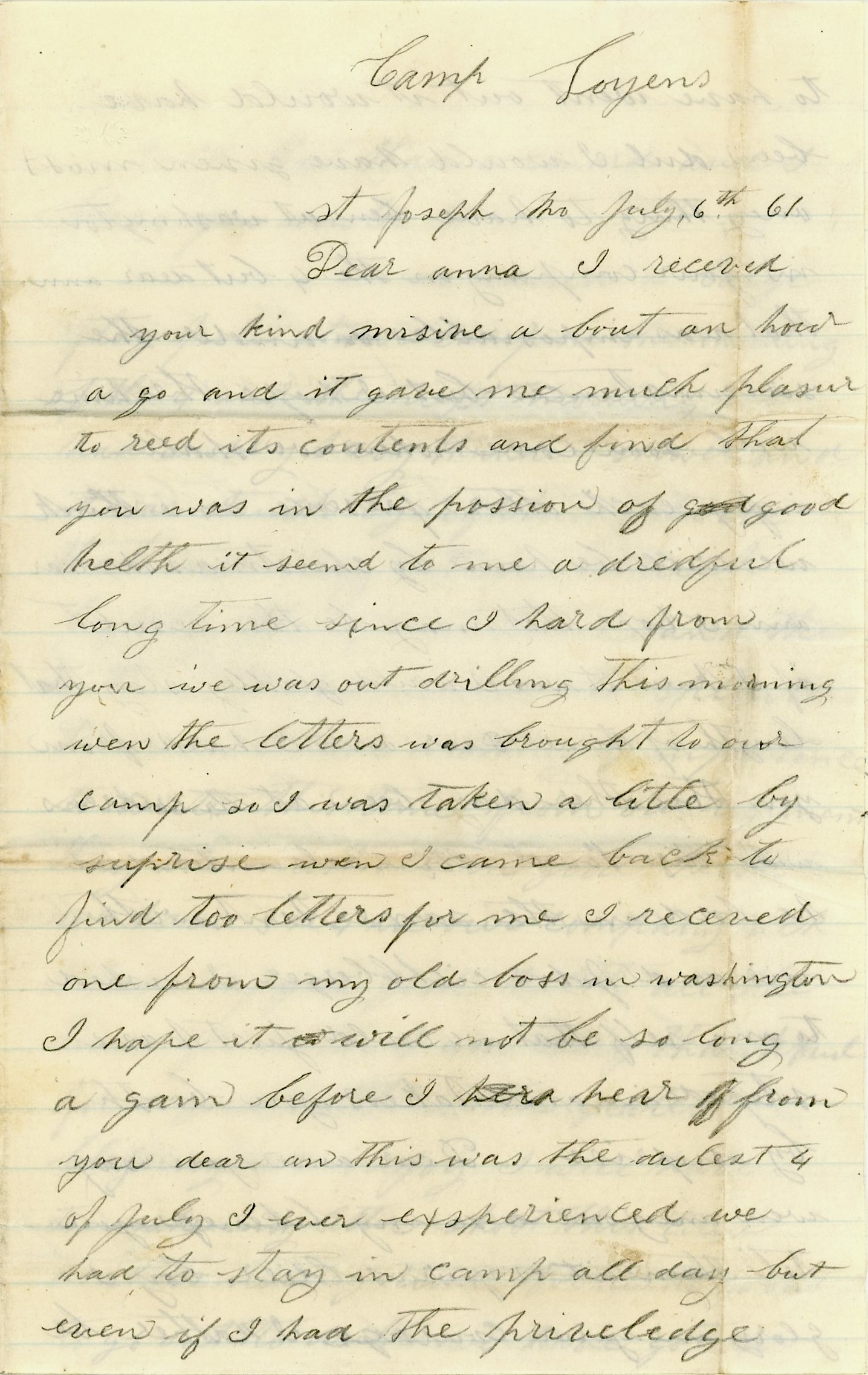
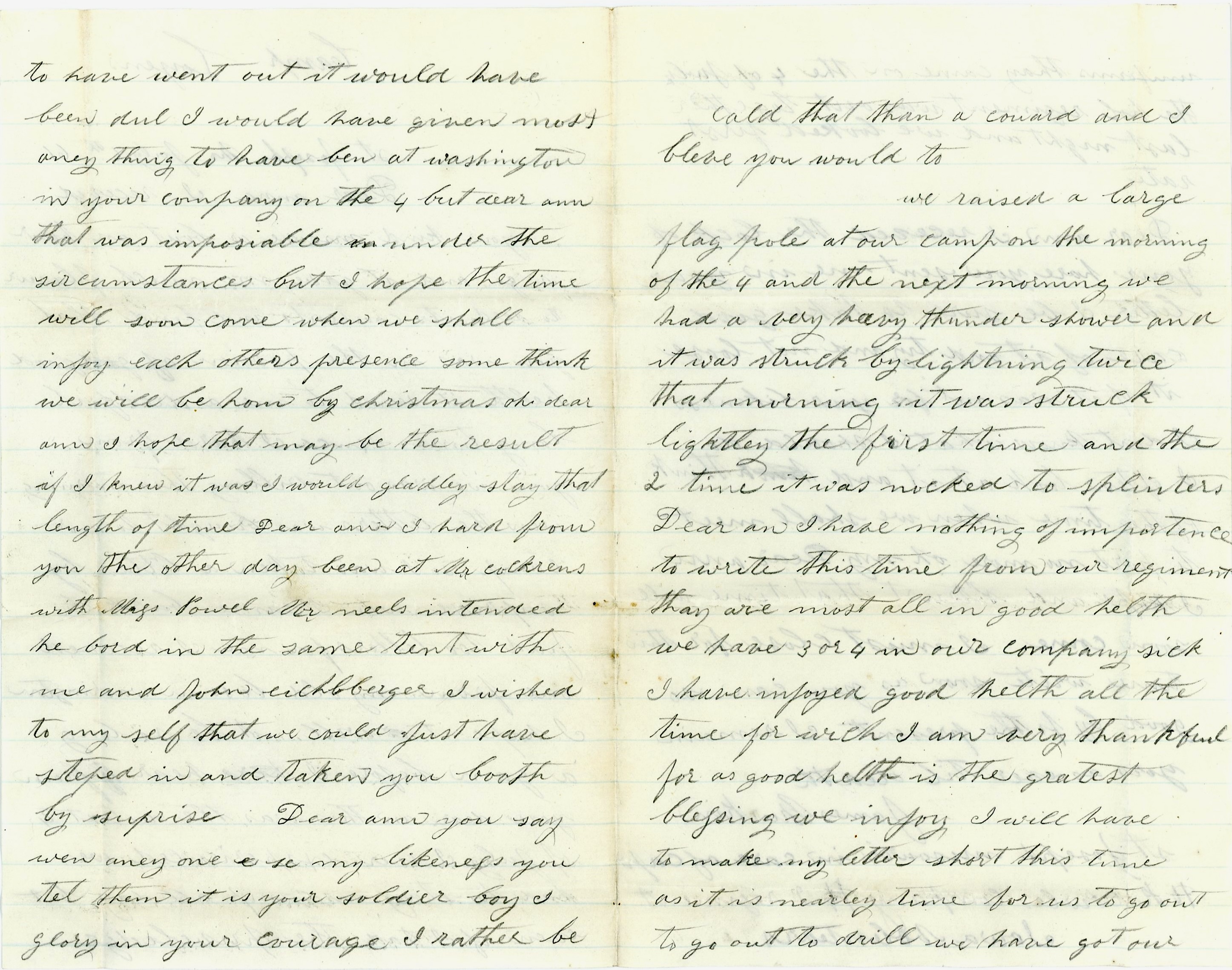
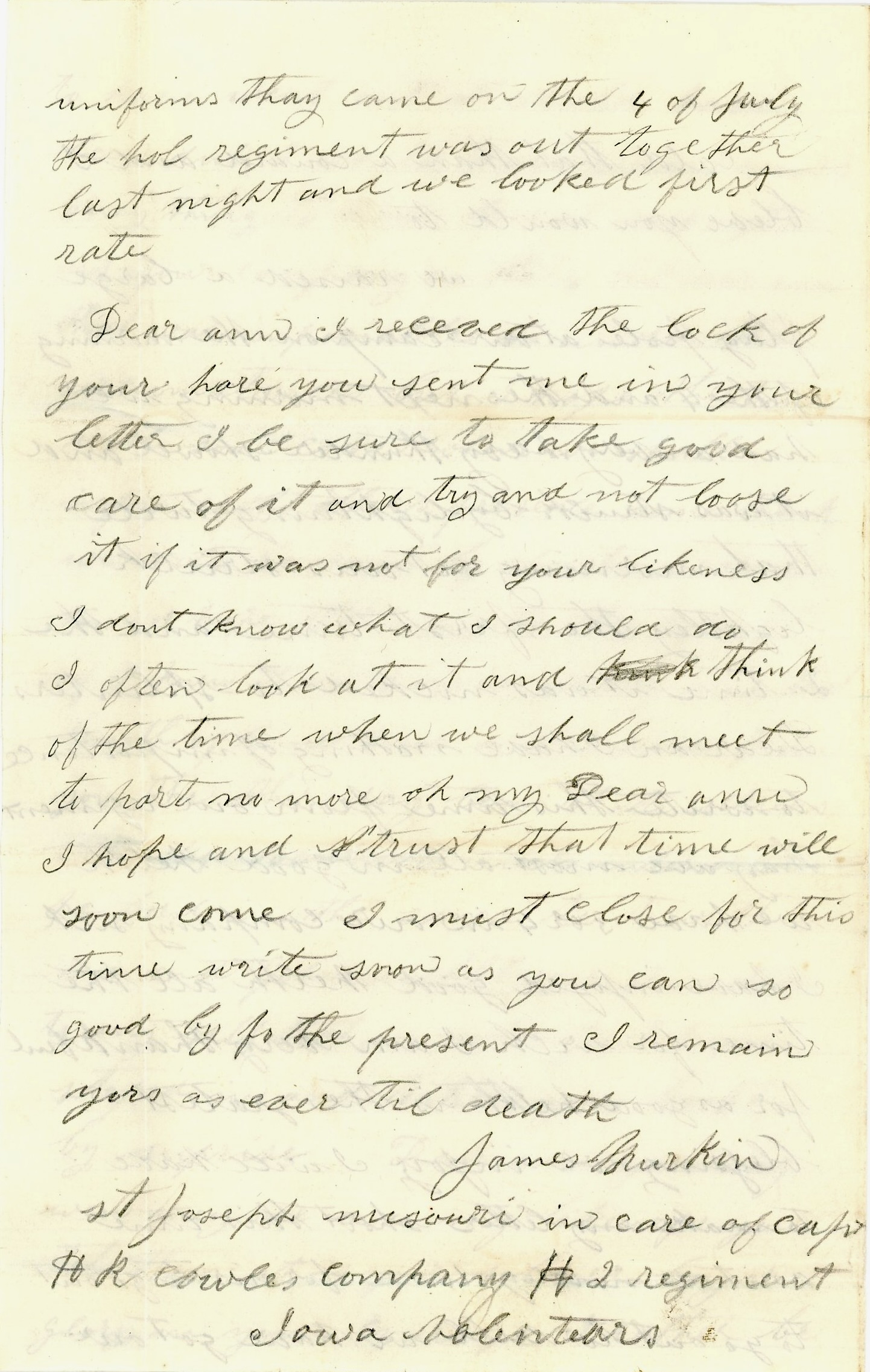
I received your kind missive about an hour ago and it gave me much pleasure to read its contents and find that you was in the possession of good health. It seemed to me a dreadful long time since I heard from you. We was out drilling this morning when the letters was brought to our camp so I was taken a little by surprise when I came back to find two letters for me. I received one from my old boss in Washington. I hope it will not be so long again before I hear from you.
Dear Anna, this was the dullest 4th of July I ever experienced. We had to stay in camp all day but even if I had the privilege to have went out, it would have been dull. I would have given most anything to have been at Washington in your company on the 4th but dear Ann, that was impossible under the circumstances. But I hope the time will soon come when we shall enjoy each other’s presence. Some think we will be home by Christmas. Oh desar Ann, I hope that may be the result. If I knew it was, I would gladly stay that length of time.
Dear Ann, I heard from you the other day [that you had] been at Mr. Cochran’s with Miss Powell—Mr. [George W.] Neal’s 1 intended [bride]. He boards in the same tent with me and John Eichenberger. I wished to myself that we could just have stepped in and taken you both by surprise. Dear Ann, you say when anyone sees my likeness, you tell them it is your soldier boy. I glory in your courage. I’d rather be called that than a coward and I believe you would too.
We raised a large flag pole at our camp on the morning of the 4th and the next morning we had a very heavy thunderstorm shower and it was struck by lightning twice that morning. It was struck lightly the first time and the 2nd time it was knocked to splinters.
Dear Ann, I have nothing of importance to write this time from our regiment. They are most all in good health. We have 3 or 4 in our company sick. I have enjoyed good health all the time for which I am very thankful for good health is the greatest blessing we enjoy.
I will have to make my letter short this time as it is nearly time for us to go out to drill. We have got our uniforms. They came in the 4th of July. The whole regiment was out together last night and we looked first rate.
Dear Ann, I received the lock of your hair you sent me in your letter. I’ll be sure to take good care of it and try and not lose it. If it was not for your likeness, I don’t know what I should do. i often look at it and think of the time when we shall meet to part no more. Oh my dear Ann, I hope and trust that time will come. I must close for this time. Write soon as you can. So goodbye for the present. I remain yours as ever til death. — James Murkin
St, Joseph, Missouri, in care of Capt. H. R. Cowles, Co. H, 2nd Regiment, Iowa Volunteers.
1 Neal, George W. Age 23. Residence Washington, nativity Ohio. Enlisted May 1, 1861. Mustered May 27, 1861. Promoted Fifth Sergeant; Third Sergeant; First Sergeant Dec. 1, 1861, and Second Lieutenant Aug. 7, 1862. Ball passed through head, killing him instantly, Oct. 4, 1862, Corinth, Miss. Buried in Union National Cemetery, Corinth, Miss. Section 52 7, grave 10.
Letter 11
Camp Lyons
St, Joseph, Missouri
July 12, 1861
Dear Ann,
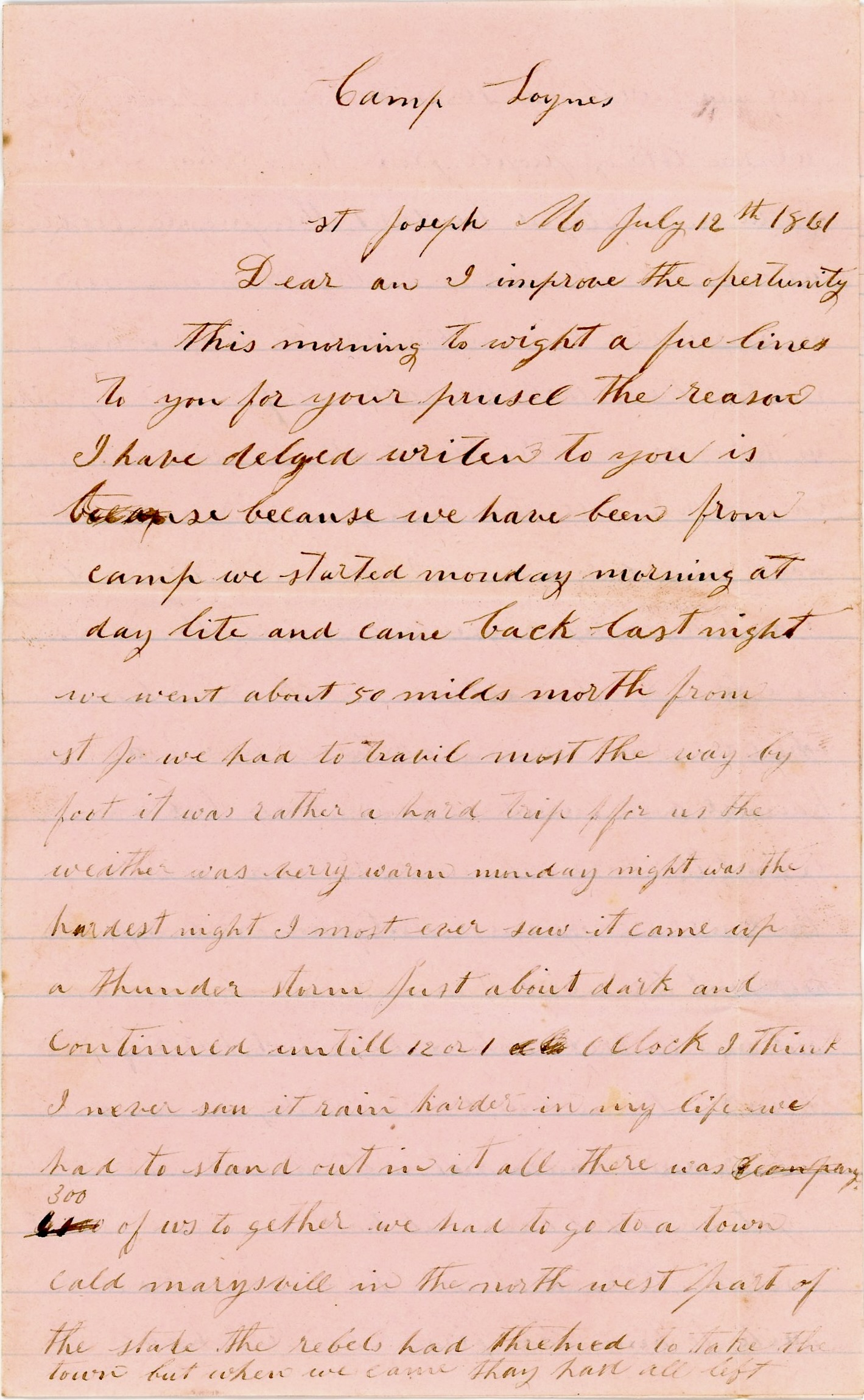
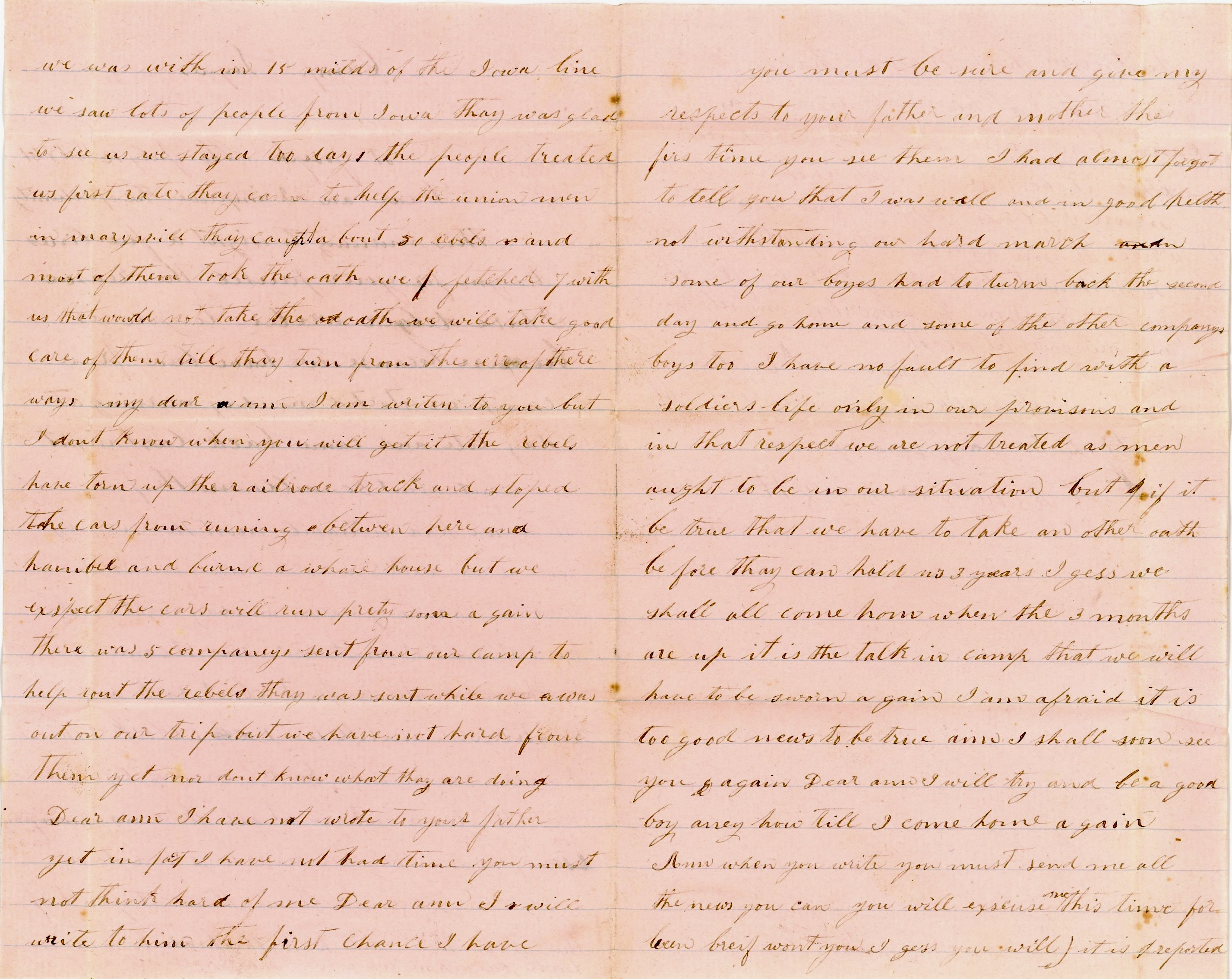
I improve the opportunity this morning to write a few lines to you for your perusal. The reason I have delayed writing to you is because we have been from camp. We started Monday morning at daylight and came back last night. We went about 50 miles north from St. Joseph. We had to travel most the way by foot. It was rather a hard trip for us. The weather was very warm. Monday night was the hardest night I most ever saw. It came up a thunder storm just about dark and continued until 12 or 1 o’clock. I think I never saw it rain harder in my life. We had to stand out in it. There was 300 of us together. We had to go to a town called Marysville in the northwest part of the state. The rebels had threatened to take the town but when we came, they had all left. We was within 15 miles of the Iowa line/ We saw lots of people from Iowa. They was glad to see us. We stayed two days. The people treated us first rate. They came to help the Union men in Marysville. They caught about 50 rebels and most of them took the oath [of allegiance]. We fetched 7 with us that would not take the oath. We will take good care of them till they turn from the error of their ways.
My dear Ann, I am writing to you but I don’t know when you will get it. The rebels have torn up the railroad track and stopped the cars from running between here and Hannibal and burned a warehouse. But we expect the cars will run pretty soon again. There was five companies sent from our camp to help rout the rebels. They was sent while we was out on our trip but we have not heard from them yet nor don’t know what they are doing.
Dear Ann, I have not wrote to your father yet. In fact, I have not had time. You must not think hard of me. Dear Ann, I will write to him the first chance I have. You must be sure and give my respects to your father and mother the first time you see them. I had almost forgot to tell you that I was well and in good health, notwithstanding our hard march. Some of our boys had to turn back the second day and go home, and some of the other company’s boys too. I have no fault to find with a soldier’s life—only in our provisions and in that respect we are not treated as men ought to be in our situation. But if it be true that we have to take another oath before they can hold us three years, I guess we shall all come home when the three months are up. It is the talk in camp that we will have to be sworn again. I am afraid it is too good news to be true.
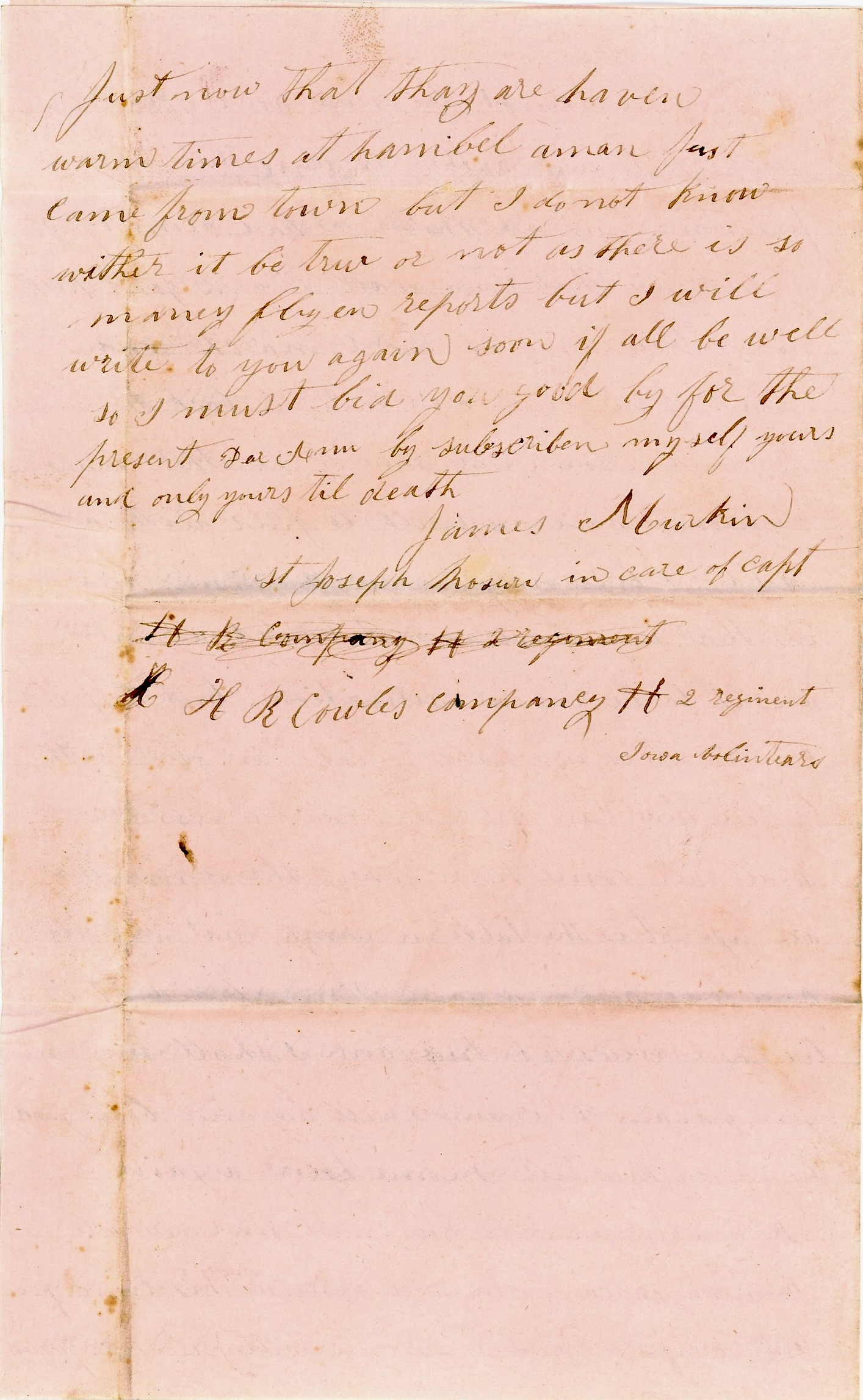
Ann, I shall soon see you again. Dear Ann, I will try and be a good boy anyhow till I come home again. When you write, you must send me all the news you can. You will excuse me this time for being brief, won’t you? I guess you will. It is reported just now that they are having warm times at Hannibal. A man just came from town but I do not know whether it be true or not as there is so many flying reports. But I will write to you again soon if all be well. So I must bid you goodbye for the present, dear Ann, by subscribing myself yours and only yours till death. — James Murkin
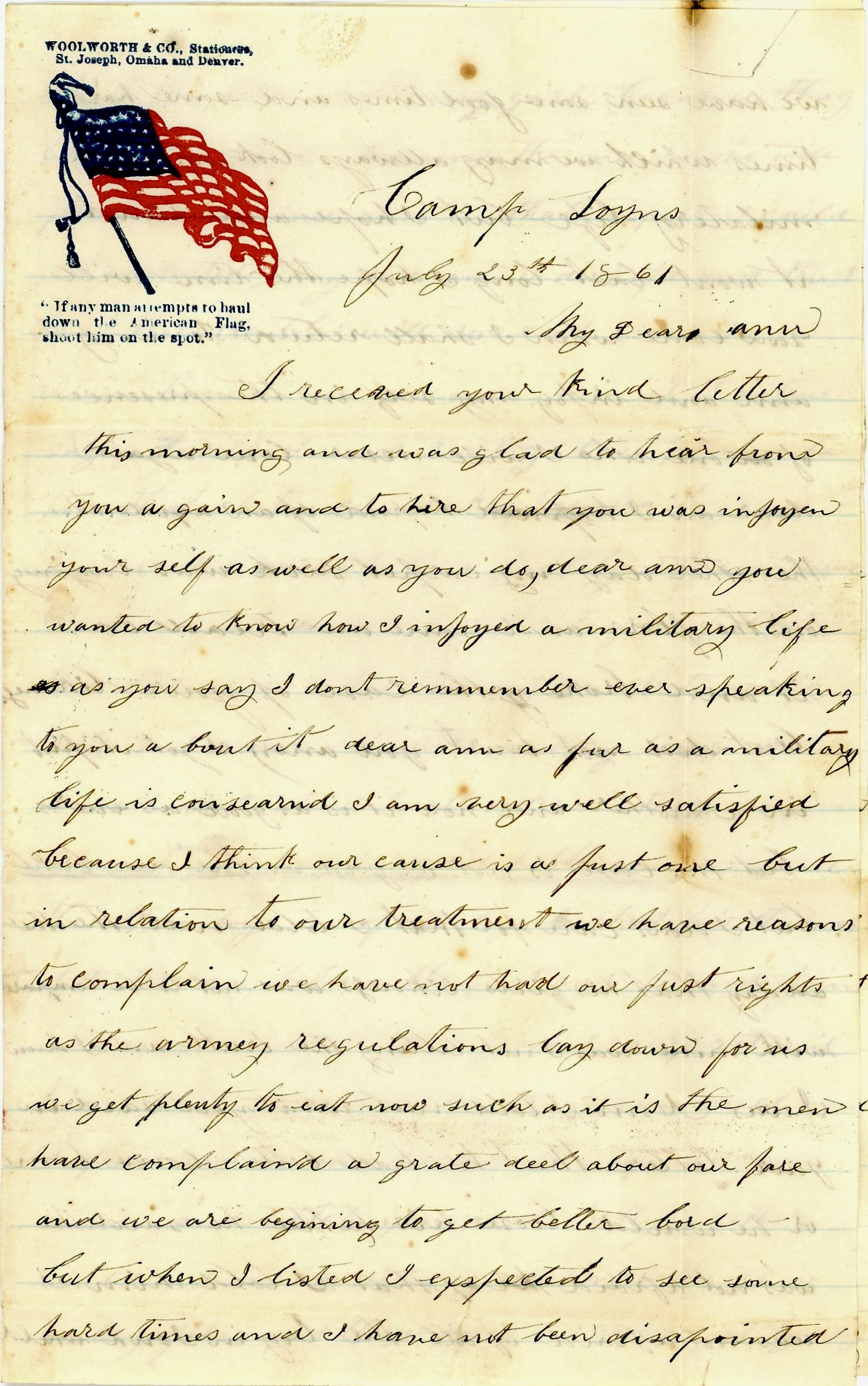
Letter 12
Camp Lyons
July 23, 1861
My dear Ann,
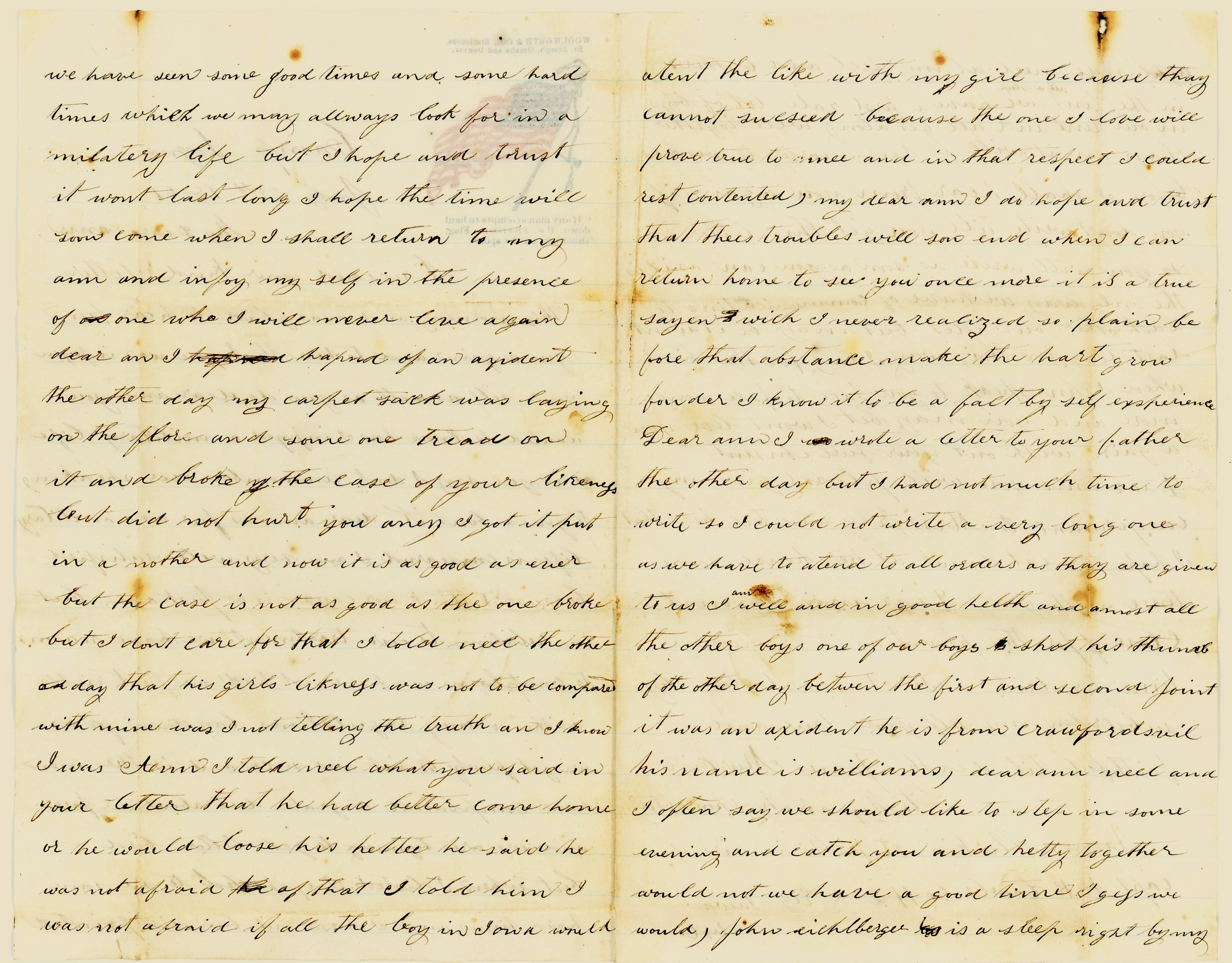
I received your kind letter this morning and was glad to hear from you again and to hear that you was enjoying yourself as well as you do. Dear Ann, you wanted to know how I enjoyed a military life, as you say I don’t remember ever speaking to you about it. As far as military life is concerned, I am very well satisfied because I think our cause is a just one. But in relation to our treatment, we have reasons to complain. We have not had our just rights as the army regulations lay down for us. We get plenty to eat now—such as it is. The men have complained a great deal about our fare and we are beginning to get better board. But when I [en]listed, I expected to see some hard time and have not been disappointed. We have seen some good times and some hard times which we may always look for in a military life. But I hope and trust it won’t last long. I hope the time will soon come when I shall return to my Ann and enjoy myself in the presence of one who I will never love again.
Dear Ann, I happened of an accident the other day. My carpet sack was laying on the floor and someone tread on it and broke the case of your likeness but did not hurt you any. I got it put in another [case] and now it is as good as ever but the case is not as good as the one broke. But I don’t care for that. I told Neal the other day that his girl’s likeness was not to be compared with mine. Was I not telling the truth, Ann? I know I was. I told Neal what you said in your letter—that he had better come home or he would lose his better [half]. He said he was not afraid of that. I told him I was not afraid if all the boys in Iowa would attend the like with my girl because they cannot succeed because the one I love will prove true to me and in that respect, I could rest contented.
My dear Ann, I do hope and trust that these troubles will soon end when I can return home to see you once more. It is a true saying which I never realized so plain before—that absence makes the heart grow fonder. I know it to be a fact by self experience. Dear Ann, I wrote a letter to your Father th other day but I had not much time to write so I could not write a very long one as we have to attend to all orders as they are given to us.
I am well and in good health and a most all the other boys. One of our boys shot his thumb off the other day between the first and second joint. It was an accident. He is from Crawfordsville. His name is Williams. 1
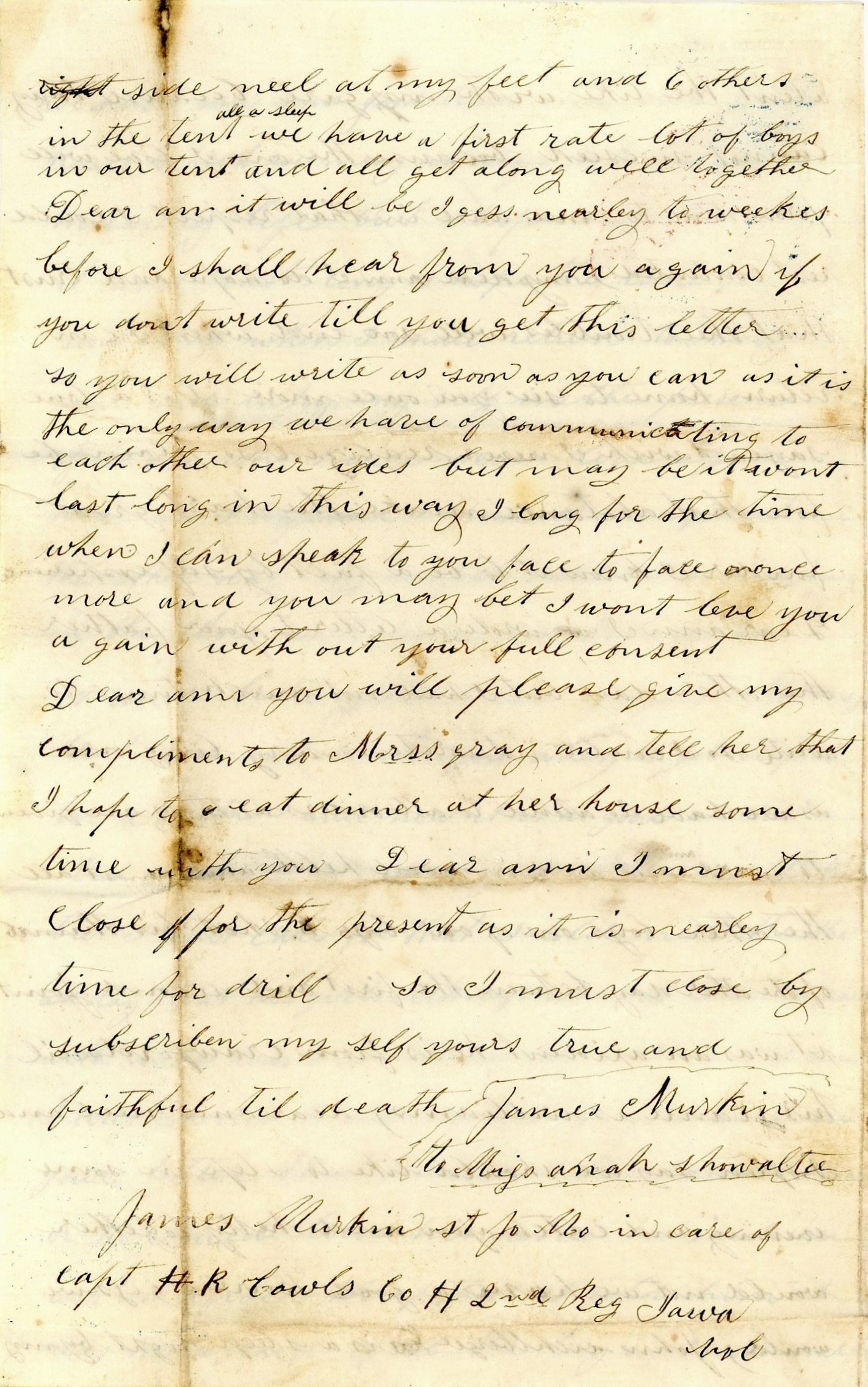
Dear Ann, Neal and I often say we should like to step in some evening and catch you and Hetty together. Would not we have a good time? I guess we would! John Eichenberger is asleep right by my side, Neal at my feet, and six others in the tent—all asleep. We have a first rate time. Lots of boys in our tent and all get along well together.
Dear Ann, it will be I guess nearly two weeks before I shall hear from you again if you don’t write till you get this letter. So you will write as soon as you can as it is the only way we have of communicating to each other our ideas. But maybe it won’t last long in this way. I long for the time when I can speak to you face to face once more and you may bet I won’t leave you again without your full consent.
Dear Ann, you will please give my compliments to Miss Gray and tell her that I have to eat dinner at her house sometime with you. I must close for the present as it is nearly time for drill. So I must close by subscribing myself yours, true and faithful, till death. — James Murkin
1 Thomas Y. Williams. Age 21. Residence Crawfordsville, nativity Ohio. Enlisted May 1, 1861. Mustered May 27, 1861. Discharged for disability Nov. 2 8, 1861.
Letter 13
Camp Lyons
St. Joseph, Missouri
July 27th 1861
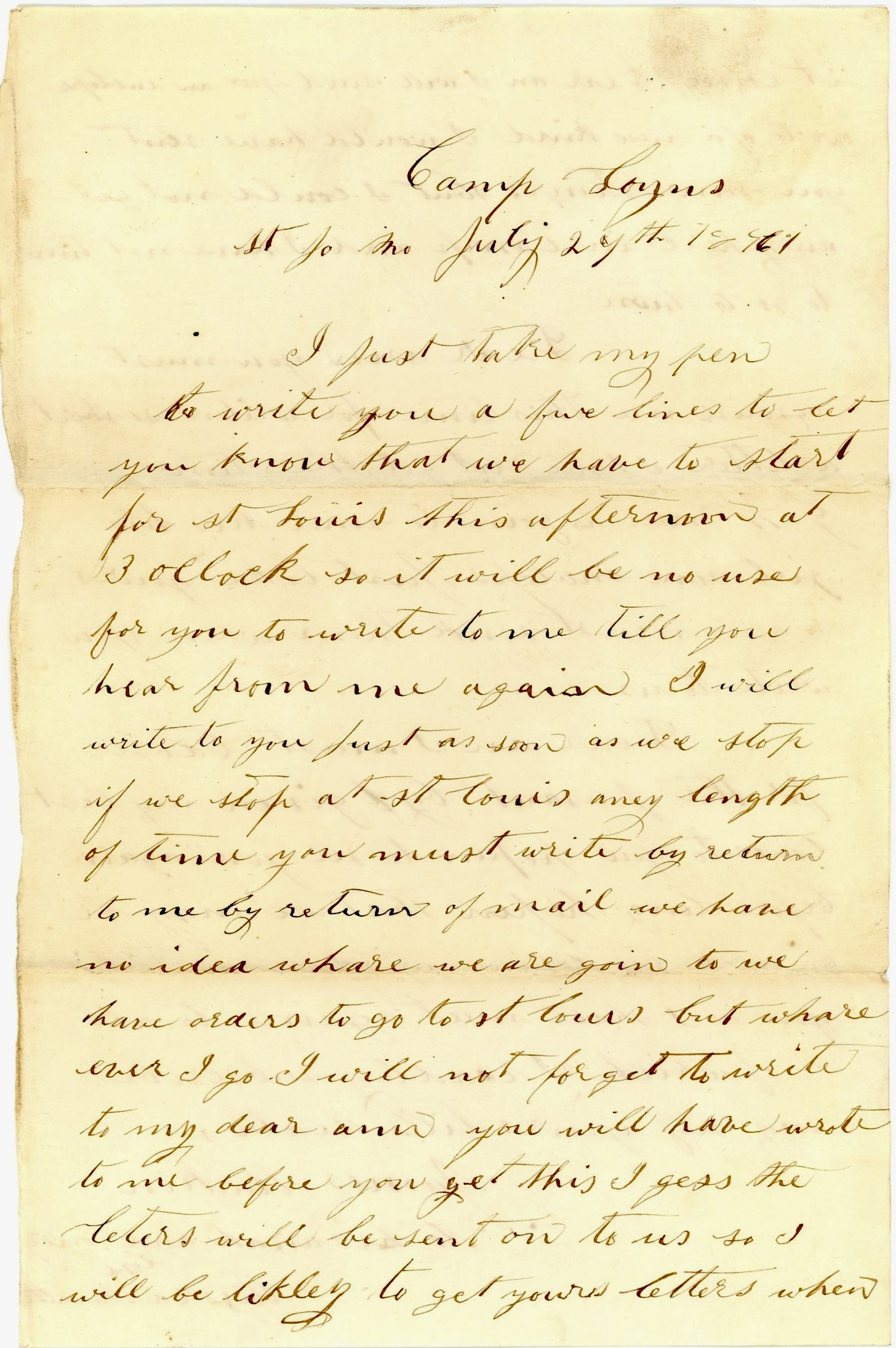
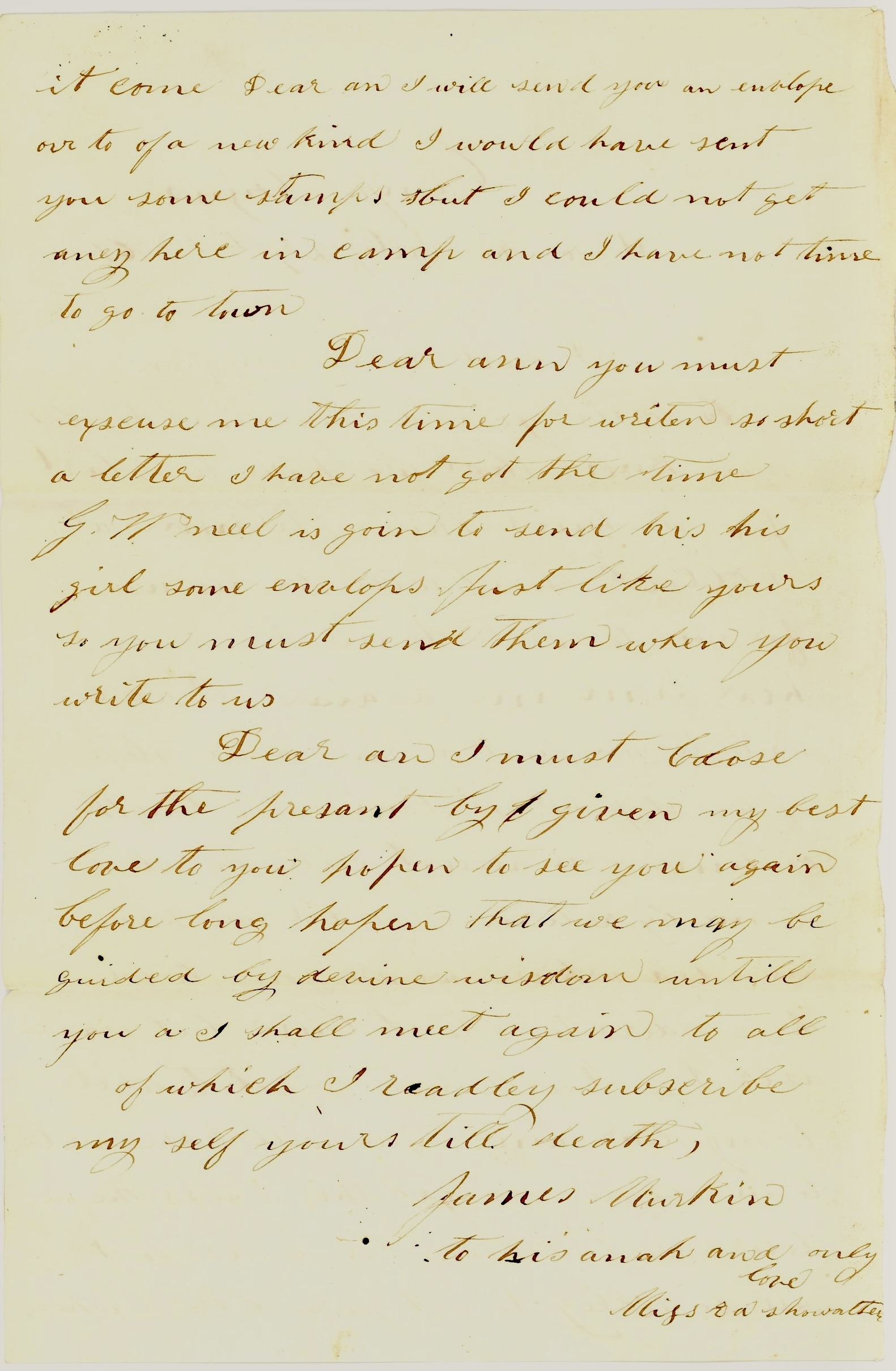
I just take my pen to write you a few lines to let you know that we have to start for St. Louis this afternoon at 3 o’clock so it will be no use for you to write to me till you hear from me again. I will write to you just as soon as we stop. If we stop at St. Louis any length of time, you must write by return of mail. We have no idea where we are going to. We have orders to go to St. Louis but wherever I go, I will not forget to write to my dear Ann. You will have wrote to me before you get this, I guess. The letters will be sent on to us so I will be likely to get your letters when it comes. I will send you an envelope too of a new kind. I would have sent you some stamps but I could not get any here in camp and I have not time to go to town.
Dear Ann, you must excuse me this time for writing so short a letter. I have not got the time. G. W. Neal is going to send his girl some envelopes just like yours so you must send them when you write to us. I must close for the present but I give my best love to you hoping to see you again before long [and] hoping that we may be guided by divine wisdom until you and I shall meet again, to all of which I readily subscribe myself yours till death. — James Murkin
To his Anna and only love, Miss R. A. Showalter
Letter 14
Cape Girardeau [Missouri]
August 21st 1861
Dear Ann,
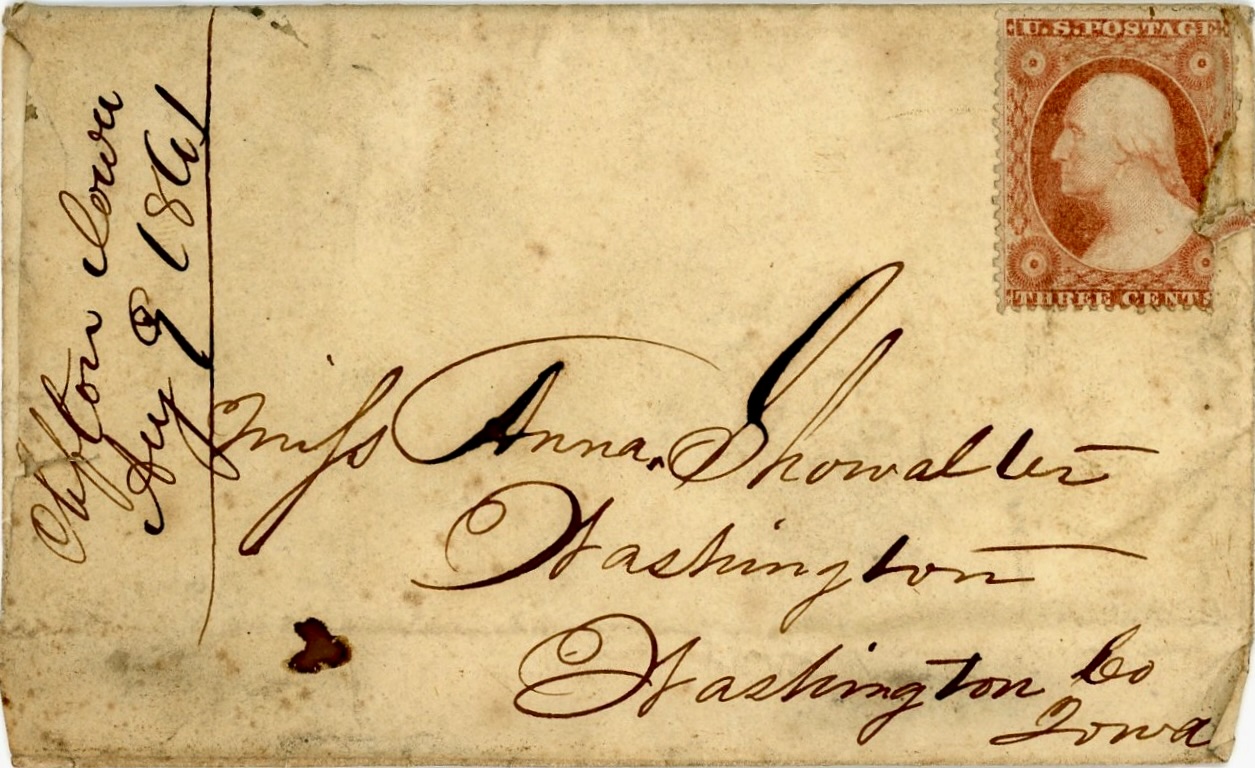
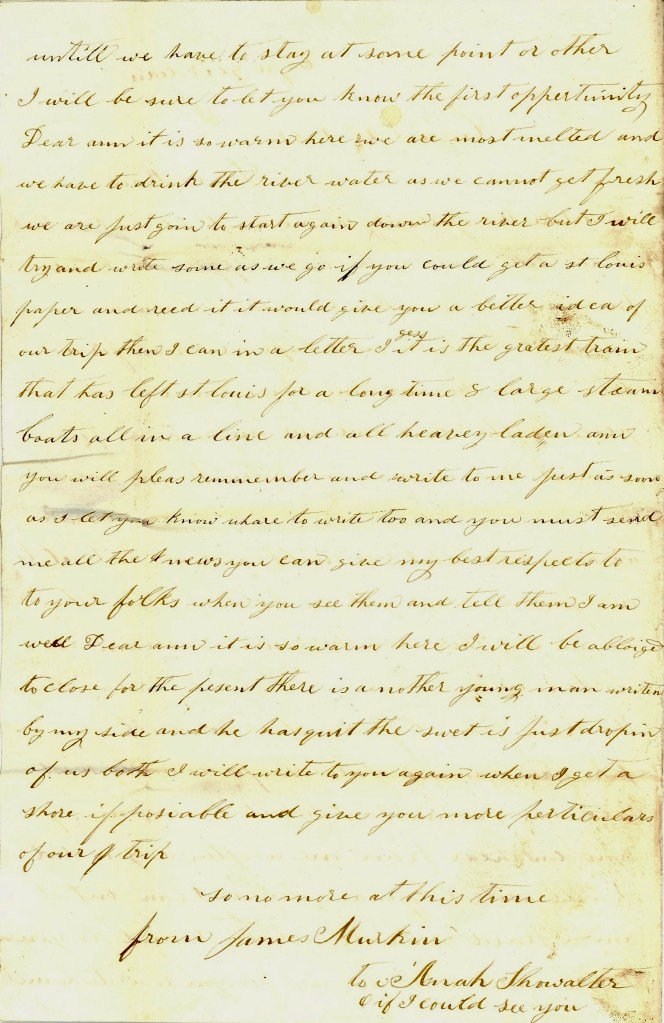
I take this opportunity this morning to let you know that I am well. We are on the Mississippi river bound for Cairo. we are within 50 miles of it now. We are stopped at this town called Cape Girardeau for a little while this morning. I have found a shady place on the boat and am improving a few moments this morning in writing to you. We have had a long ride on the river and railroad. We have rode about 500 miles and not got to our journey’s end yet. We have a large lot of us now together now. There was 8 steamers started with us from St. Louis yesterday down the river. John C. Frémont is with us. He has command of all the forces in the West.
Dear Ann, you must not think hard of me if you don’t hear from me as often as you did, I will write to you as often as I can but I am afraid you will not get all I send to you. I guess it will not be any use for you to write to me until we have to stay at some point or other. I will be sure to let you know the first opportunity.
Dear Ann, it is so warm here we are most melted and we have to drink the river water as we cannot get fresh. We are just going to start again down the river but I will try and write some as we go. If you could get a St. Louis paper and read it, it would give you a better idea of our trip than I can in a letter. I guess it is the greatest train that has left St. Louis for a long time—8 large steamboats all in a line and all heavy laden.
Ann, you will please remember and write to me just as soon as I let you know where to write to and you must send me all the news you can. Give my best respects to your folks when you see them and tell them I am well. Dear Ann, it is so warm here I will be obliged to close for the present. There is another young man writing by my side and he has quit. The sweat is just dropping off us both. I will write to you again when I get ashore, if possible, and give you more particulars of our trip. So no more at this time.
From James Murkin
Letter 15
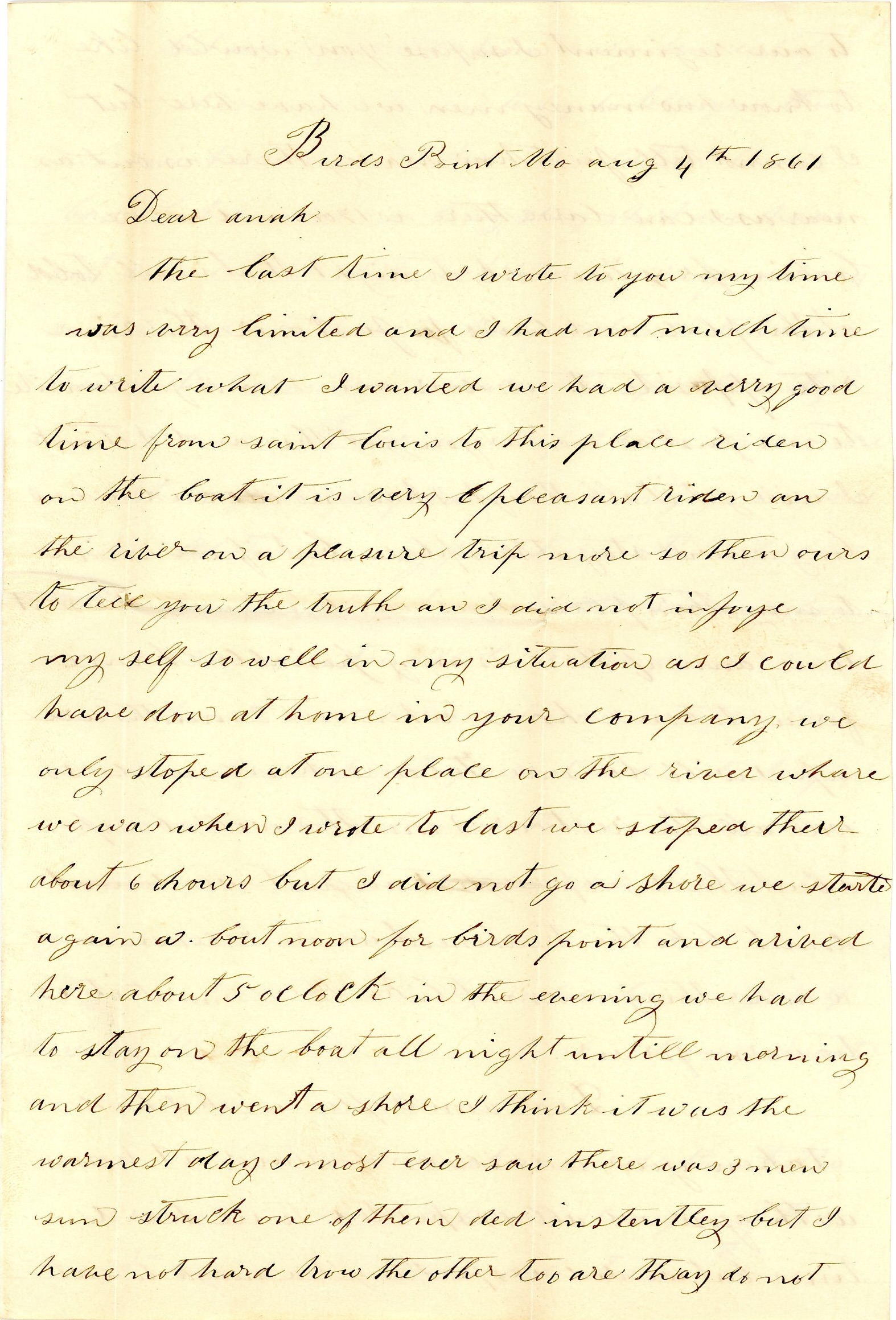
Bird’s Point [Missouri]
August 4th 1861
Dear Anna,
THe last time I wrote to you my time was very limited and I had not much time to write what I wanted. We had a very good time from St. Louis to this place riding on the boat. It is very pleasant riding on the river on a pleasure trip, moreso than ours to tell you the truth, and I did not judge myself so well in my situation as I could have done at home in your company. We only stopped at one place on the river where we was when I wrote to [you] last. We stopped there about 6 hours but I did not go ashore.
We started again about noon for Bird’s Point and arrived here about 5 o’clock in the evening. We had to stay on the boat all night until morning and then went ashore. I think it was the warmest day I most ever saw. There was three men sun struck, One of them died instantly but I have not heard how the other two are. They do not [belong] to our regiment.
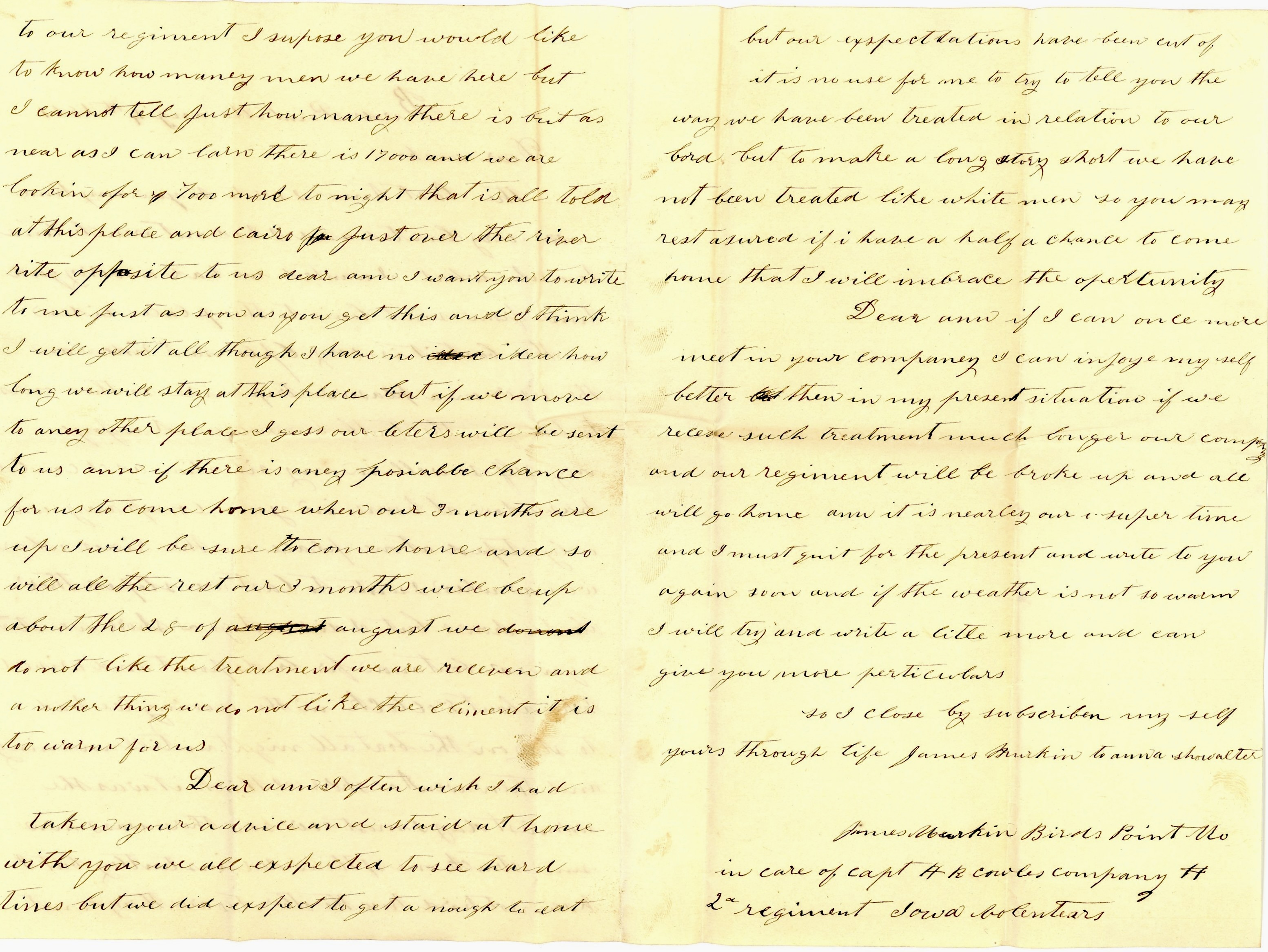
I suppose you would like to know how many men we have here but I cannot tell just how many there is but as near as I can learn, there is 17,000 and we are looking for 7,000 more tonight. That is all told at this place and at Cairo, just over the river right opposite to us.
Dear Ann, I want you to write to me just as soon as you get this and I think I will get it all through. I have no idea how long we will stay at this place but if we move to any other place, I guess our letters will be sent to us. Ann, if there is any possible chance for us to come home when our three months are up, I will be sure to come home and so will all the rest. Our three months will be up about the 28th of August. We do not like the treatment we are receiving and another thing, we do not like the climate. It is too warm for us.
Dear Ann, I often wish I had taken your advice and stayed at home with you. We all expected to see hard times but we did expect to get enough to eat. But our expectations have been cut off. It is no use for me to try to tell you the way we have been treated in relation to our board but to make a long story short, we have not been treated like white men. So you may rest assured if I have a half a chance to come home, that I will embrace the opportunity.
Dear Ann, if I can once more meet in your company I can enjoy myself better than in my present situation. If we receive such treatment much longer, our company and regiment will be broke up and all will go home. It is nearly our supper time and I must quit for the present and write to you again soon. And if the weather is not so warm, I will try and write a little more and can give you more particulars. So I close by subscribing myself yours through life, — James Murkin
to Anna Showalter
Letter 16
Camp Lyons
Bird’s Point, Mo.
August 11th 1861
My dear Ann,
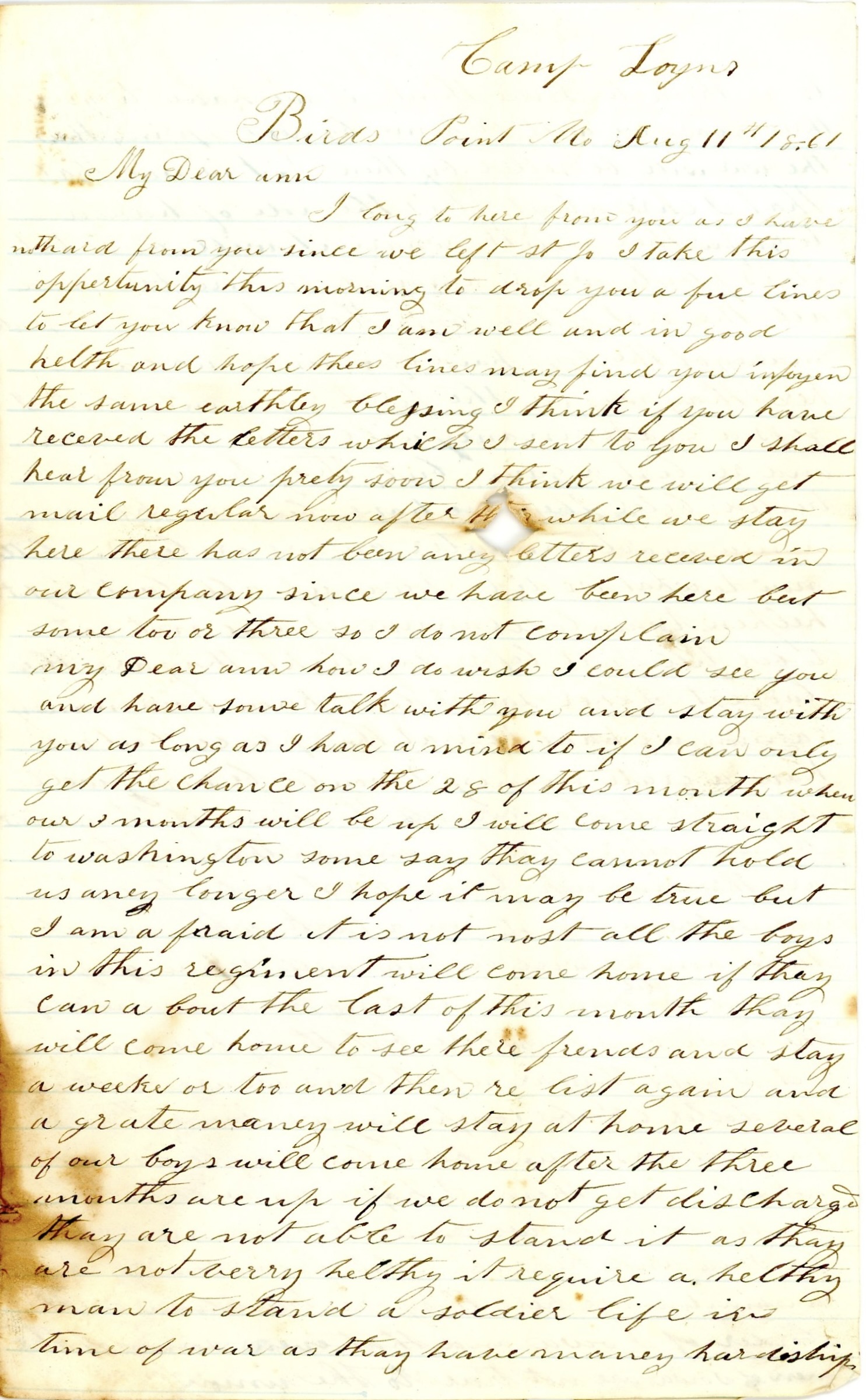
I long to hear from you as I have not heard from you since we left St. Joseph. I take this opportunity this morning to drop you a few lines to let you know that I am well and in good health and hope these lines may find you enjoying the same earthly blessing. I think if you have received the letters which I have sent to you, I shall hear from you pretty soon. I think we will get mail regular now after this while we stay here. There has not been any letters received in our company since we have been here but some two or three so I do not complain.
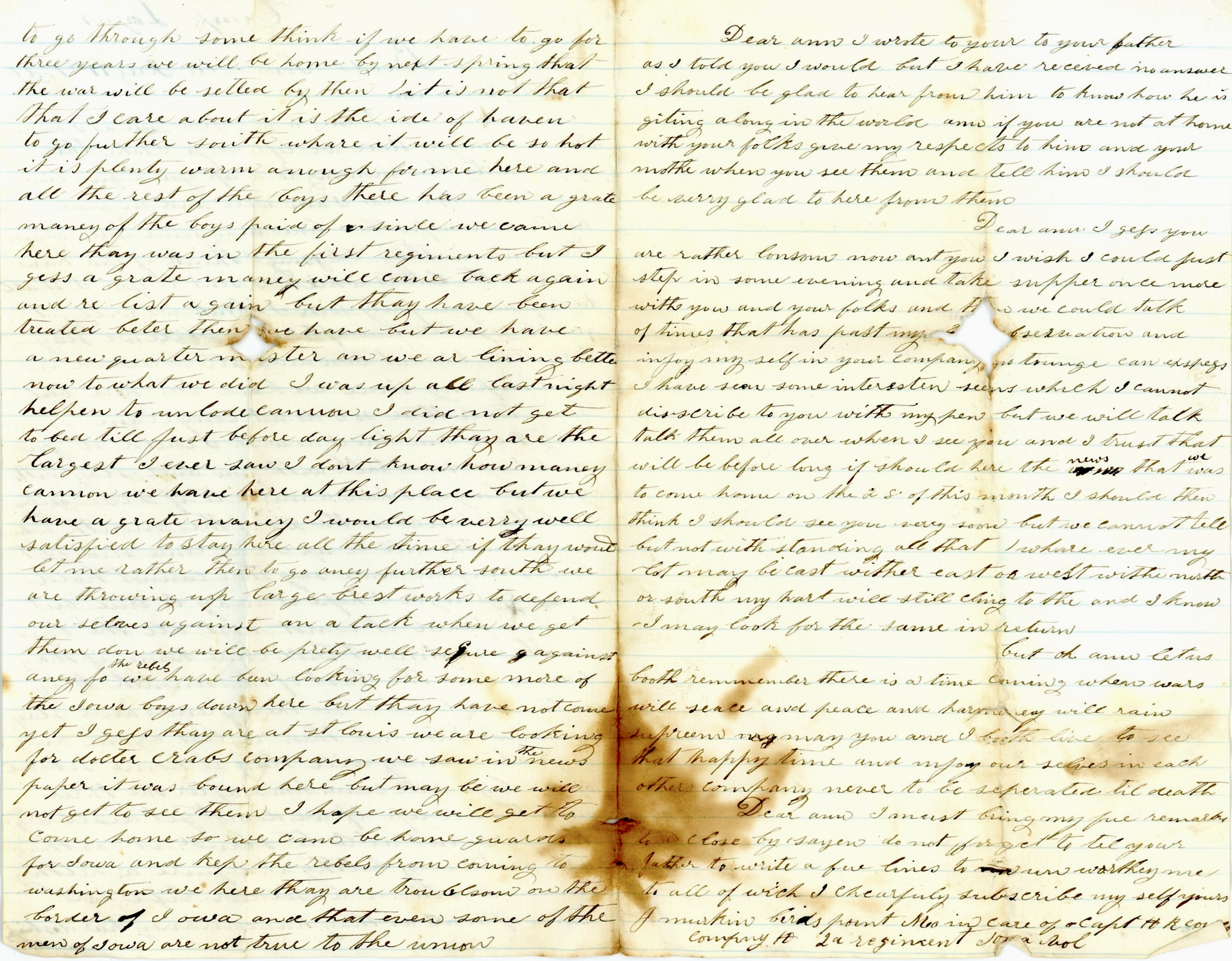
My dear Ann, how I do wish I could see you and have some talk with you and stay with you as long as I had a mind to. If I can only get the chance on the 28th of this month when our three months will be up, I will come straight to Washington. Some say they cannot hold us any longer. I hope it may be true but I am afraid it is not. Most all the boys in this regiment will come home if they can about the last of this month. They will come home to see their friends and stay a week or two and then reenlist again and a great many will stay at home. Several of our boys will come home after their three months are up if we do not get discharged. They are not able to stand it as they are not very healthy. It requires a healthy man to stand a soldier’s life in time of war as they have many hardships to go through. Some think if we have to go for three years, we will be home by next spring—that the war will be settled by then. It is not that I care about it. It is the idea of having to go further south where it will be so hot. It is plenty warm enough for me here and all the rest of the boys.
There has been a great many of the boys paid off since we came here. They was in the first regiments but I guess a great many will come back again and reenlist again. But they have been treated better than we have. But we have a new quartermaster and we are living better now to what we did.
I was up all last night helping to unload cannon. I did not get to bed till just before daylight. They are the largest I ever saw, I don’t know how many cannon we have here at this place but we have a great many. I would be very well satisfied to stay here all the time if they would let me rather than to goi any further south. We are throwing up large breastworks to defend ourselves against an attack. When we get them done, we will be pretty well secure against any foe—the rebels.
We have been looking for some more of the Iowa boys down here but they have not come yet. I guess they are at St. Louis. We are looking for Doctor Crab’s company. we saw in the newspaper it was bound for here, but maybe we will not get to see them. I hope we will get to come home so we can be home guards for Iowa and keep the rebels from coming to Washington. We hear they are troublesome on the border of Iowa and that even some of the men of Iowa are not true to the Union.
Dear Ann, I wrote to your father as I told you I would but I have received no answer. I should be glad to hear from him to know how he is getting along in the world and if you are not at home with your folks, give my respects to him and your mother when you see them and tell him I should be very glad to hear from them. I guess you are rather lonesome now, ain’t you? I wish I could just step in some evening and take supper once more with you and your folks and then we could talk of times that has passed my observation and enjoy myself in your company no tongue can express. I have seen some interesting scenes which I cannot describe to you with my pen but we will talk them all over when I see you and I trust that will be before long. If I should hear the news that we was to come home on the 28th of this month, I should then think I should see you ver soon. But we cannot tell. But notwithstanding all that, wherever my lot may be cast, whether east or west, whether north or south, my heart will still sling to thee and I know I may look for the same in return.
But Oh Ann, let us both remember there is a time coming when wars will cease and peace and harmony will reign supreme. May you and I both live to see that happy time and enjoy ourselves in each other’s company, never to be separated till death. I must bring my few remarks to a close by saying do not forget to tell your father to write a few lines to unworthy me. To all of which I cheerfully subscribe myself yours, — J. Murkin
Letter 17
Ironton, Missouri
August 25th 1861
My dear and only Ann,
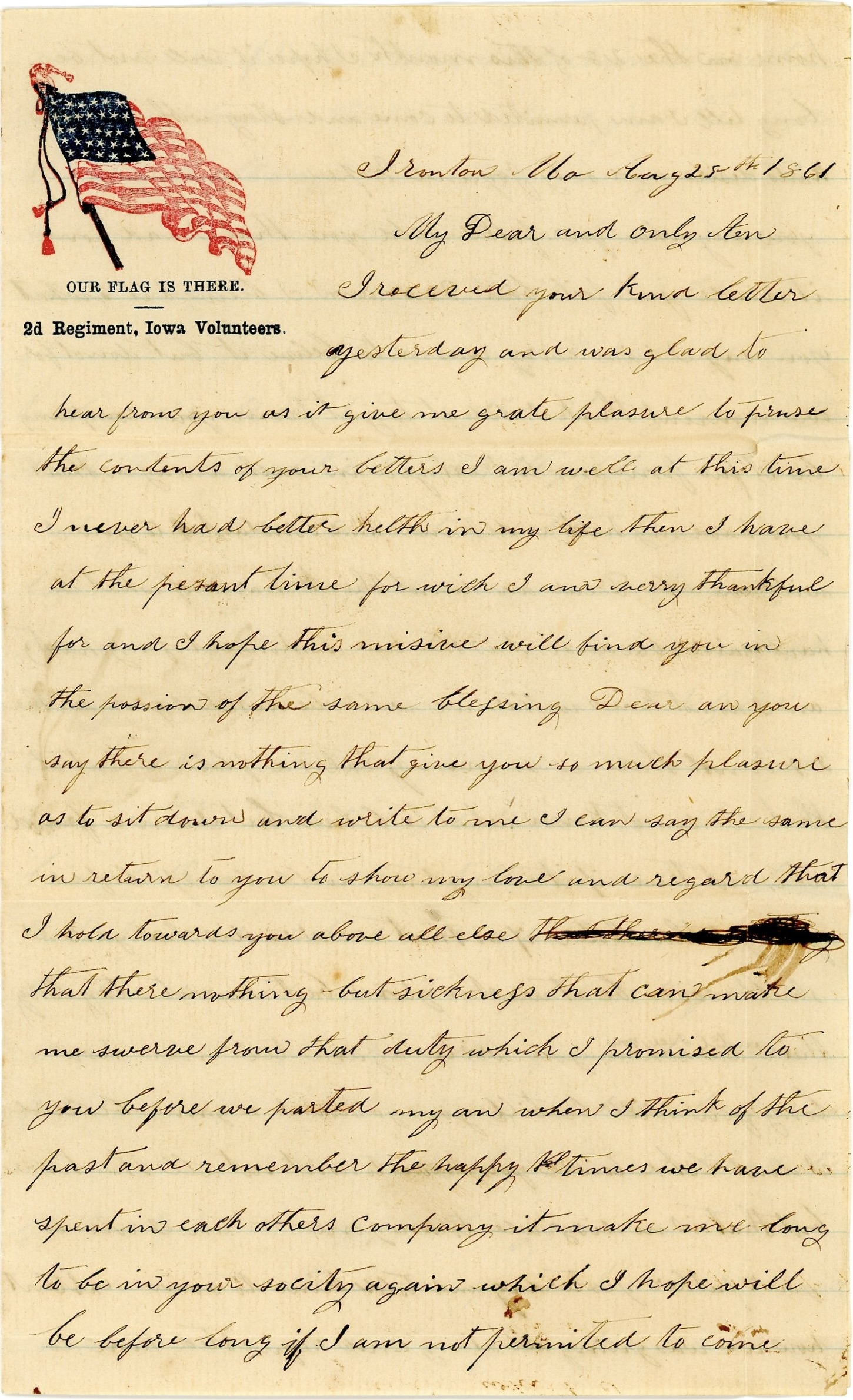
I received your kind letter yesterday and was glad to hear from you as it gave me great pleasure to peruse the contents of your letter. I am well at this time. I never had better health in my life than I have at the present time for which I am very thankful, and I hope this missive will find you in the possession of the same blessing. Dear Ann, you say there is nothing that gives you so much pleasure as to sit down and write to me, I can say the same in return to you—to show my love and regard that I hold towards you above all else—that there is nothing but sickness that can make me swerve from that duty which I promised to you before we parted. My Ann, when I think of the past and remember the happy times we have spent in each other’s company, it makes me long to be in your society again which I hope will be before long. If I am not permitted to come home on the 28th of this month, I hope it will not be long I am permitted to come and stay with my heart’s desire and only joy and hope.
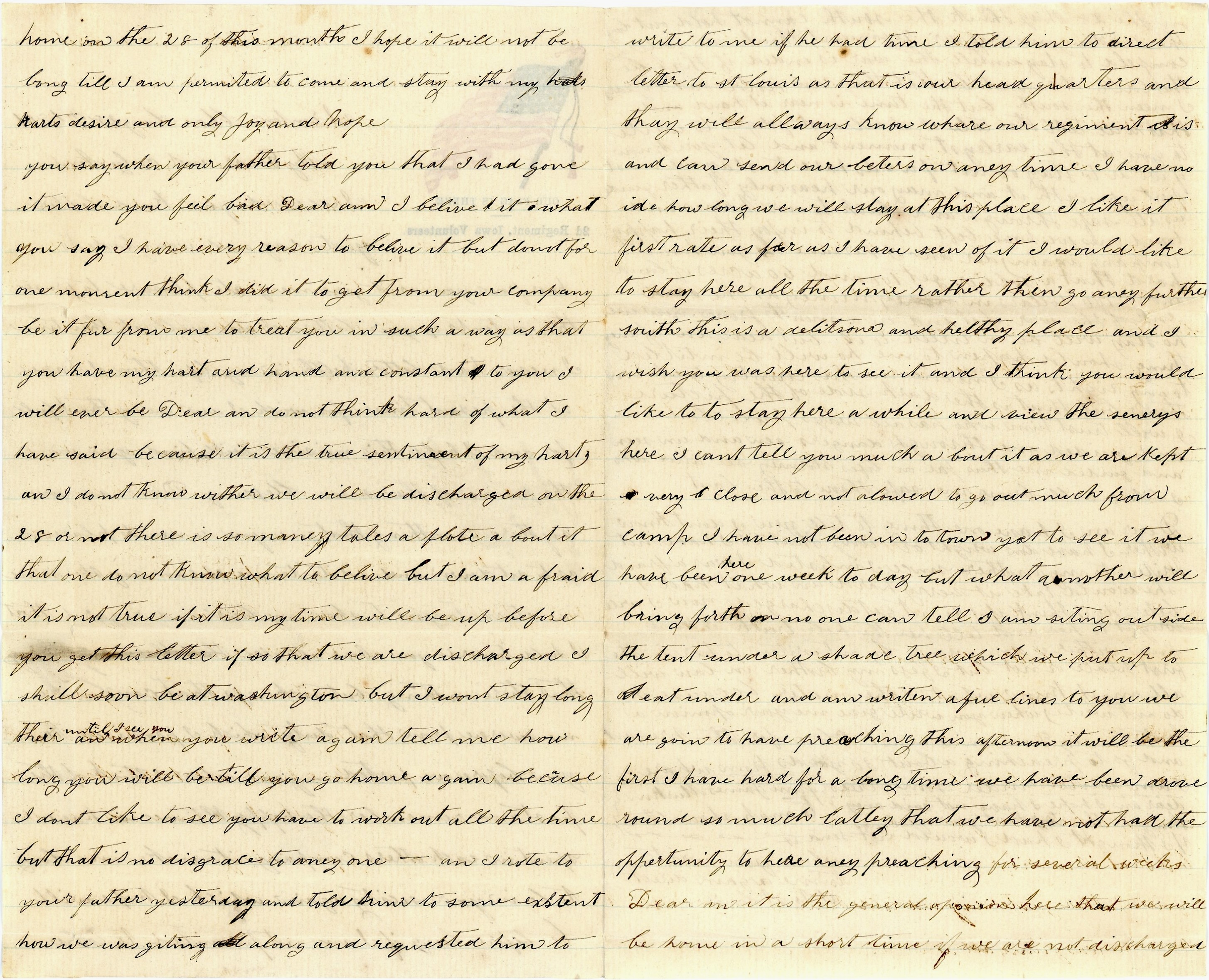
You say when your father told you that I had gone it made you feel bad. Dear Ann, I believe it is what you say. I have every reason to believe it. But do not for one moment think I did it to get from your company. Be it far from me to treat you in such a way as that. You have my heart and hand and constant to you I will ever be. Dear Ann, do not think hard of what I have said because it is the true sentiment of my heart and I do not know whether we will be discharged on the 28th or not. There is so many tales afloat about it that one does not know what to believe. But I am afraid it is not true. If it is, my time will be up before you get this letter. If so that we are discharged, I shall soon be at Washington. But I won’t stay long there. Until I see you, write again [and[ tell me how long you will be till you go home again because I don’t like to see you have to work out all the time. But that is no disgrace to anyone.
Ann, I wrote to your father yesterday and told him to some extent how we was getting along and requested him to write to me if he had time. I told him to direct letters to St. Louis as that is our headquarters and they will always know where our regiment is and can send our letters on any time. I have no idea how long we will stay at this place. I like it first rate as far as I have seen of it. I would like to stay here all the time rather than go any further south. This is a delightful and healthy place and I wish you was here to see it and I think you would like to stay here awhile and view the scenery here. I can’t tell you much about it as we are kept very close and not allowed to go out much from camp. I have not been in town yet to see it. We have been here one week today but what another will bring forth, no one can tell.
I am sitting outside the tent under a shade tree which we put up to eat under and am writing a few lines to you. We are going to have preaching this afternoon. It will be the first I have heard for a long time. We have been drove round so much lately that we have not had the opportunity to hear any preaching for several weeks.
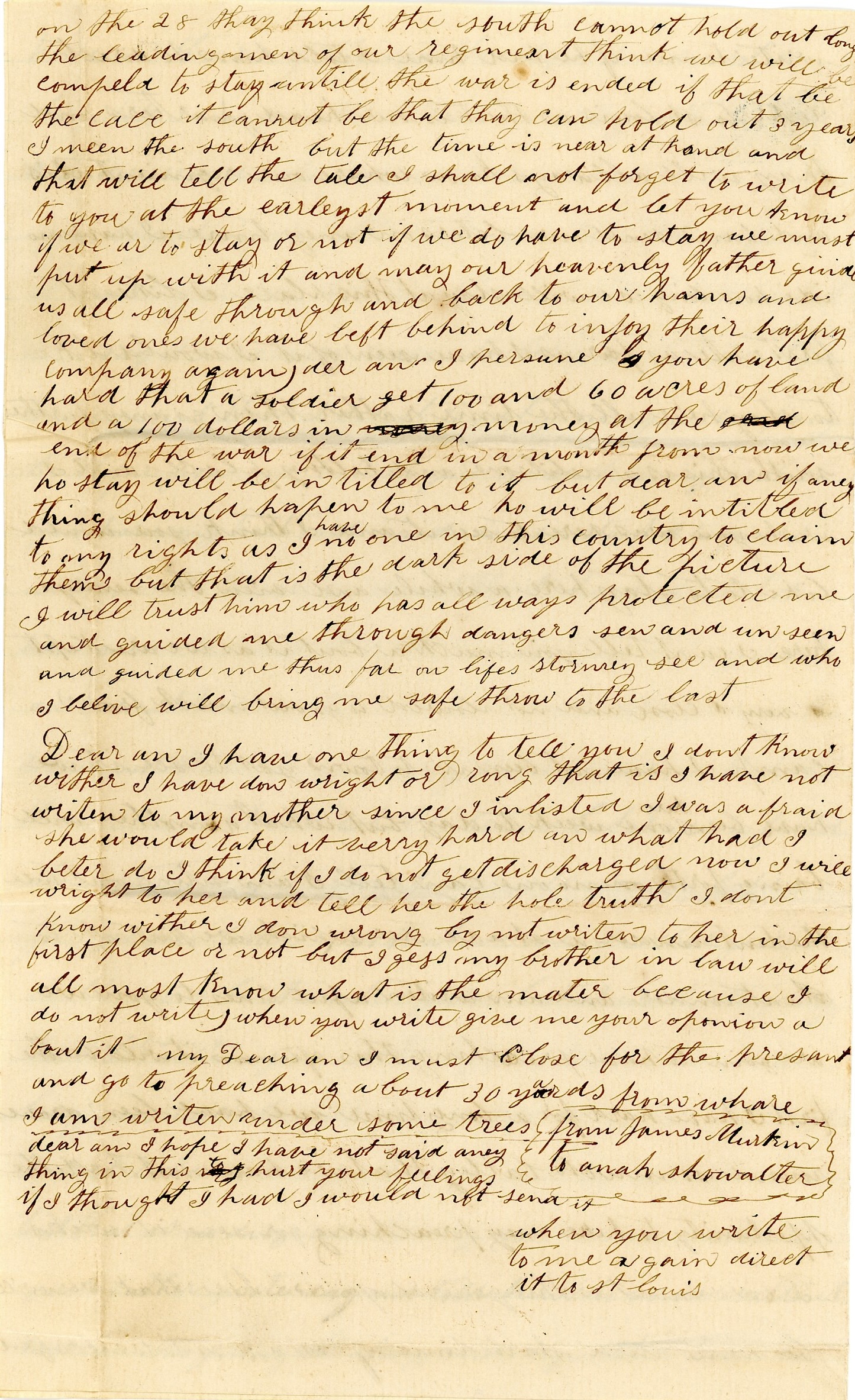
Dear Ann, it is the general opinion here that we will be home in a short time if we are not discharged on the 28th. They say the South cannot hold out long. The leading men of our regiment think we will be compelled to stay until the war is ended. If that be the case, it cannot be that they can hold out three years. I mean the South. But the time in near at hand and that will tell the tale. I shall not forget to write to you at the earliest moment and let you know if we are to stay or not. If we do have to stay, we must put up with it and may our Heavenly Father guide us all safe through and back to our homes and loved ones we have left behind to enjoy their happy company again.
Dear Ann, I presume that you have heard that a soldier gets 160 acres of land a hundred dollars in money at the end of the war. If it ends in a month from now, we who stay will be entitled to it. But dear Ann, if anything should happen to me, who will be entitled to any rights as I have no one in this country to claim them But that is the dark side of the picture. I will trust Him who has always protected me and guided me through dangers, seen and unseen, and guided me thus far on life’s stormy sea, and who I believe will bring me safe through to the last.
Dear Ann, I have one thing [more] to tell you. I don’t know whether I have done right or wrong. That is, I have not written to my mother since I enlisted. I was afraid she would take it very hard. Ann, what had I better do? I think if I do not get discharged now, I will write to her and tell her the whole truth. I don’t know whether I done wrong by not writing to her in the first place or not. But I guess my brother-in-law will almost know what is the matter because I do not write. When you write me, give me your opinion about it. I must close for the present and go to preaching about thirty yards from where I am writing under some trees. I hope I have not said anything in this to hurt your feelings, If I thought I had, I would not send it. When you write to me again, direct to St. Louis.
From James Murkin to Anna Showalter
Letter 18
Jackson, Missouri
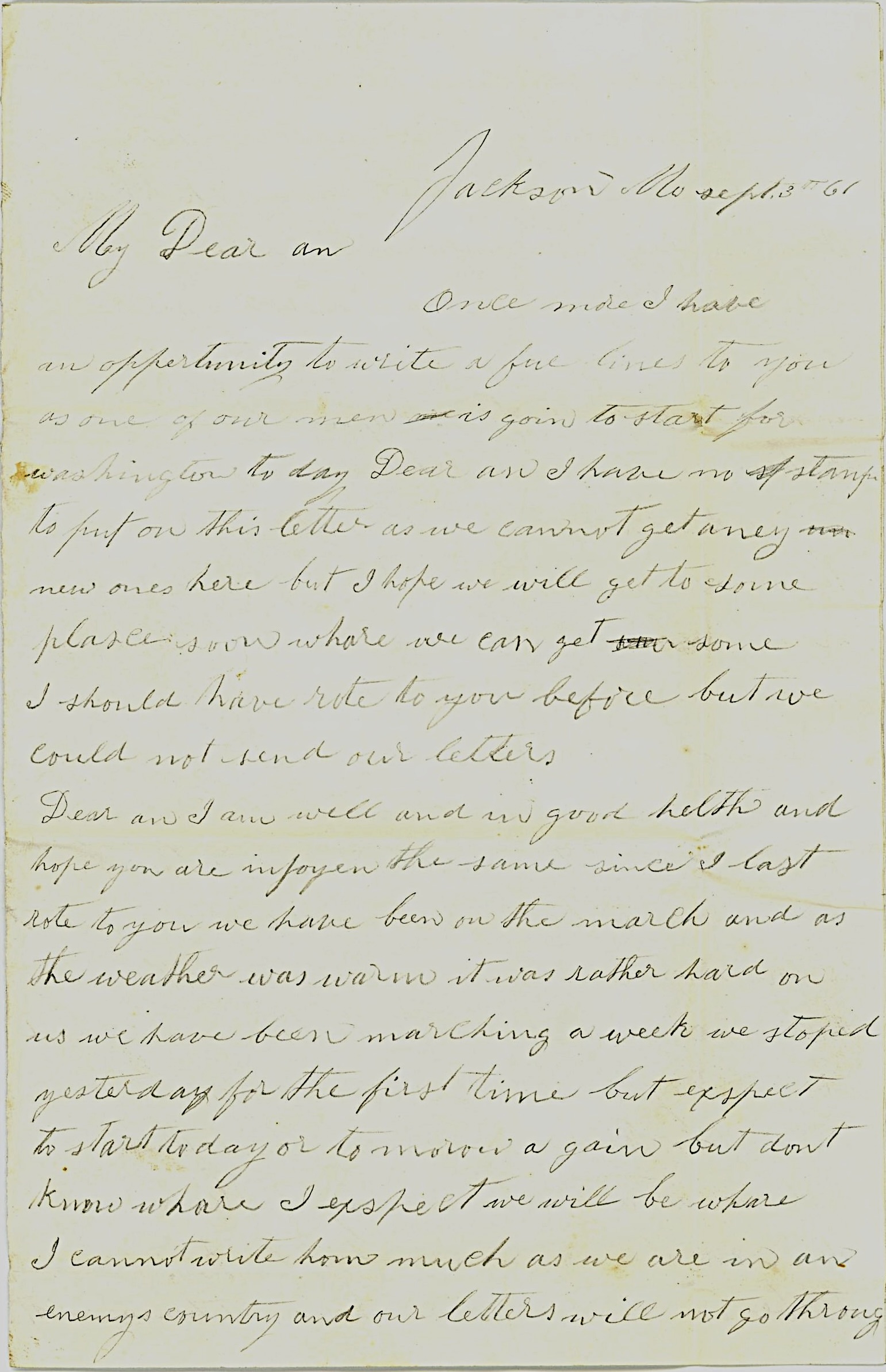
September 3, 1861
My dear Ann,
Once more I have an opportunity to write a few lines to you as one of our men is going to start for Washington [Iowa] today. Dear Ann, I have no stamp to put on this letter as we cannot get any new ones here but I hope we will get to some places soon where we can get some. I should have wrote to you before but we could not send our letters.
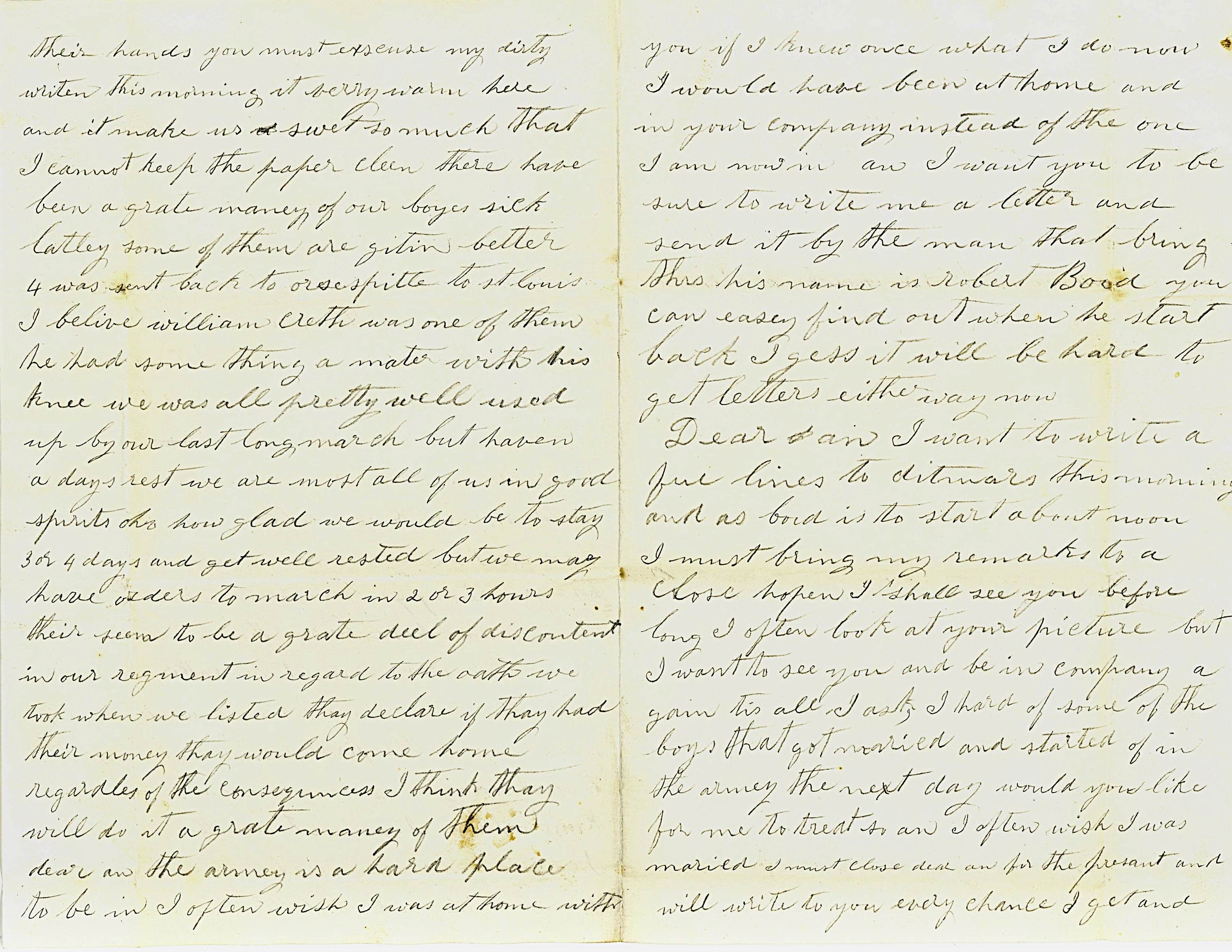
Dear Ann, I am well and in good health and hope you are enjoying the same. Since I last wrote to you, we have been on the march and as the weather was warm, it was rather hard on us. We have been marching a week. we stopped yesterday for the first time but expect to start today or tomorrow again but don’t know where. I expect we will be where I cannot write home much as we are in an enemy’s country and our letters will not go through their hands. You must excuse my dirty writing this morning. It’s very warm here and it makes us sweat so much that I cannot keep the paper clean.
There have been a great many of our boys sick lately. Some of them are getting better. Four was sent back to the hospital at St. Louis. I believe William Creath 1 was one of them. He had something a matter with his knee. We was all pretty well used up by our last long march but having a day’s rest we are most all of us in good spirits. How glad we would be to stay three or four days and get well rested but we may have orders to march in two or three hours.
There seems to be a great deal of discontent in our regiment in regard to the oath we took when we [en]listed. They declare if they had their money, they would come home regardless of the consequences. I think they will do it, a great many of them. Dear Ann, the army is a hard place to be in. I often wish I was at home with you. If I knew once what I do now, I would have been at home and in your company instead of the one I am now in. Ann, I want you to be sure to write me a letter and send it by the man that brings this, His name is Robert Boyd. 2 You can easily find out when he starts back. I guess it will be hard to get letters either way now.
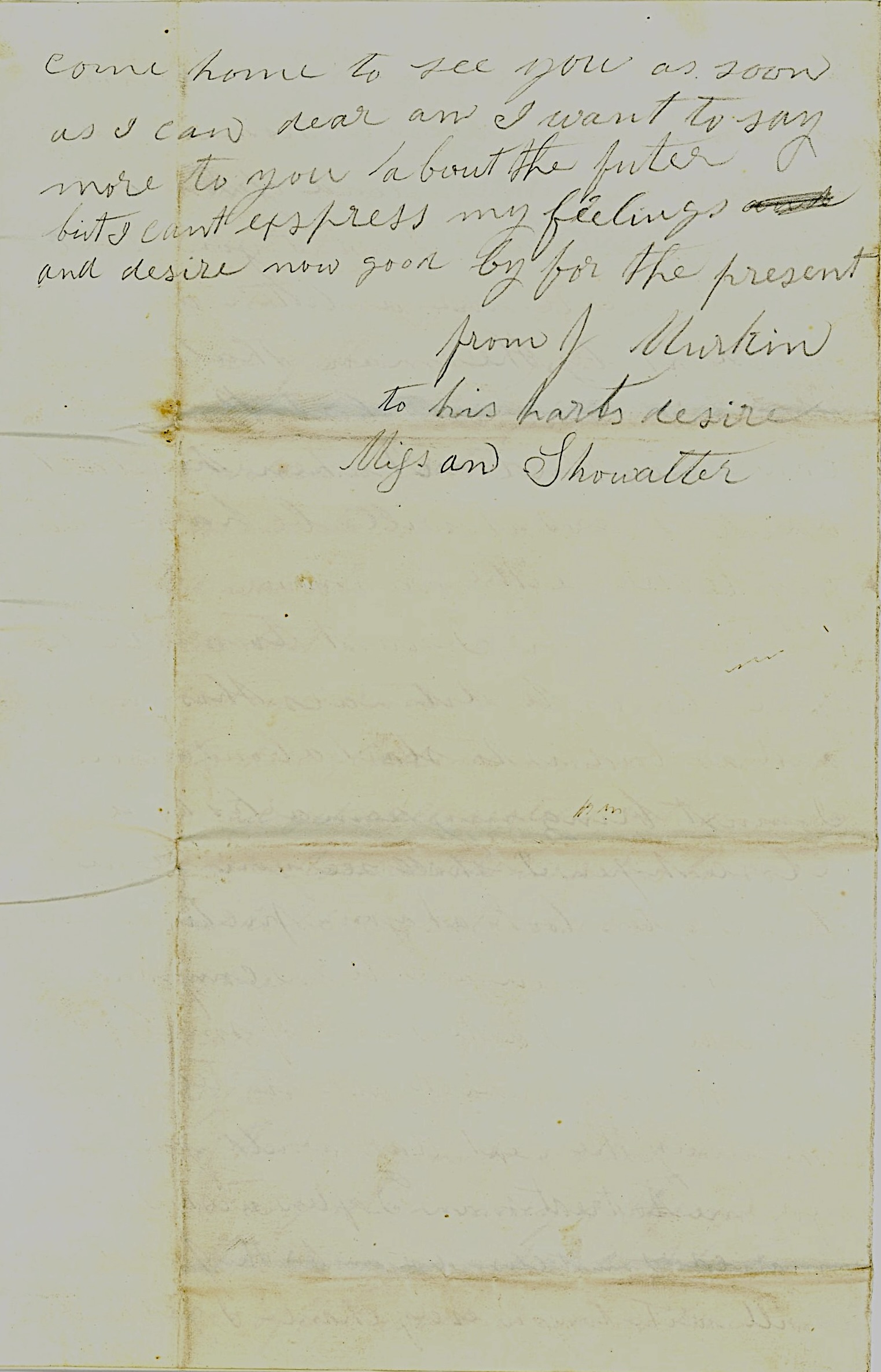
Dear Ann, I want you to write a few lines to Ditmar’s this morning and as Boyd is to start [home] about noon, I must bring my remarks to a close hoping I shall see you before long. I often look at your picture but I want to see you and be in your company again. Tis all I ask, I heard of some of the boys that got married and started off in the army the next day. Would you like for me to treat so? Ann, I often wish I was married. I must close, dear Ann, for the present and will write to you every chance I get and come home to see you as soon as I can. Dear Ann, I want to say more to you about the future but I can’t express my feelings and desire. Now goodbye for the present. From J. Murkin
To his heart’s desire.
1 Corporal William Creath of Washington county, Iowa, was 28 years old when he enlisted on 1 May 1861 in Co. H. He survived the war and mustered out in July 1865.
2 Robert M. Boyd, Age 31. Residence Washington, nativity Ohio. Enlisted May 1, 1861. Mustered May 27, 1861. Mustered out May 27, 1864, expiration of term of service.
Letter 19
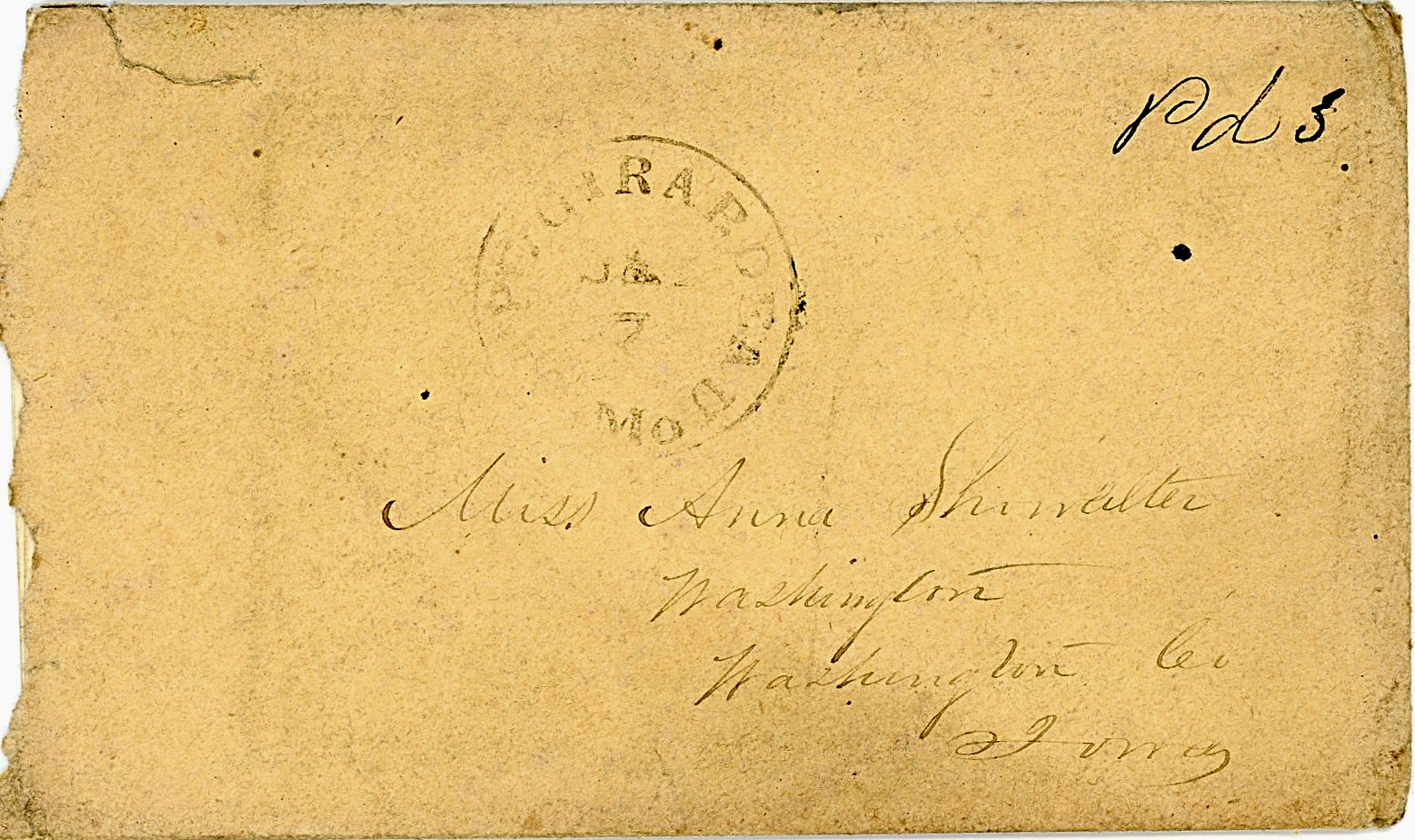
Jackson, Missouri
September 6, 1861
My dear Anna,
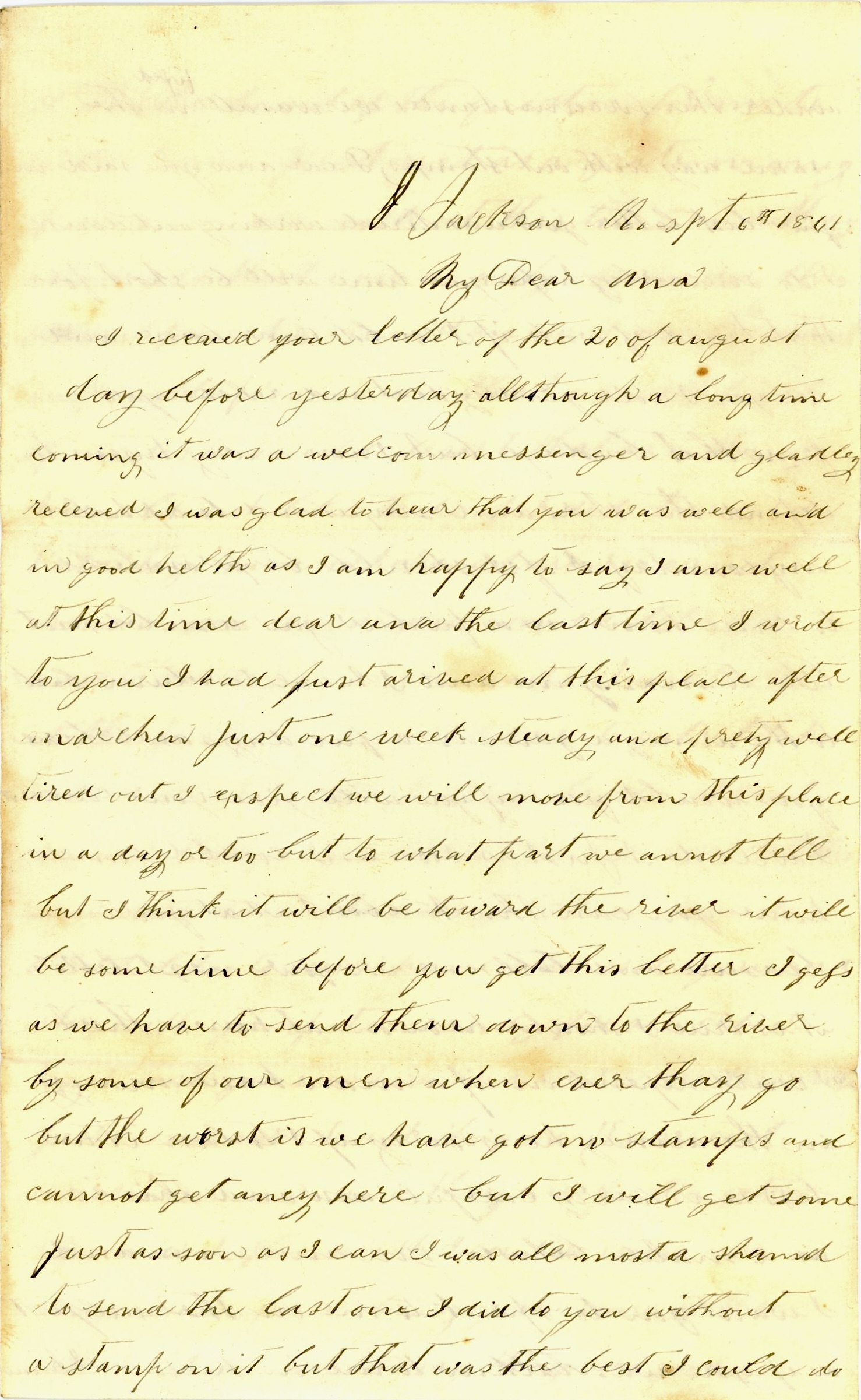
I received your letter of the 20th of August day before yesterday. Although a long time coming, it was a welcome messenger and gladly received. I was glad to hear that you was well and in good health as I am happy to say I am well at this time. Dear Anna, the last time I wrote to you I had just arrived at this place after marching just one week steady and pretty well tired out. I expect we will move from this place in a day or two but to what part, we cannot tell. But I think it will be toward the river. It will be some time before you get this letter, I guess, as we have to send them down the river by some of our men whenever they go. But the worst is we have got no stamps and cannot get any here. But I will get some just as soon as i can. I was almost ashamed to send the last one I did to you without a stamp on it but that was the best I could under the circumstances. We was all fixed inn the same way without stamps.
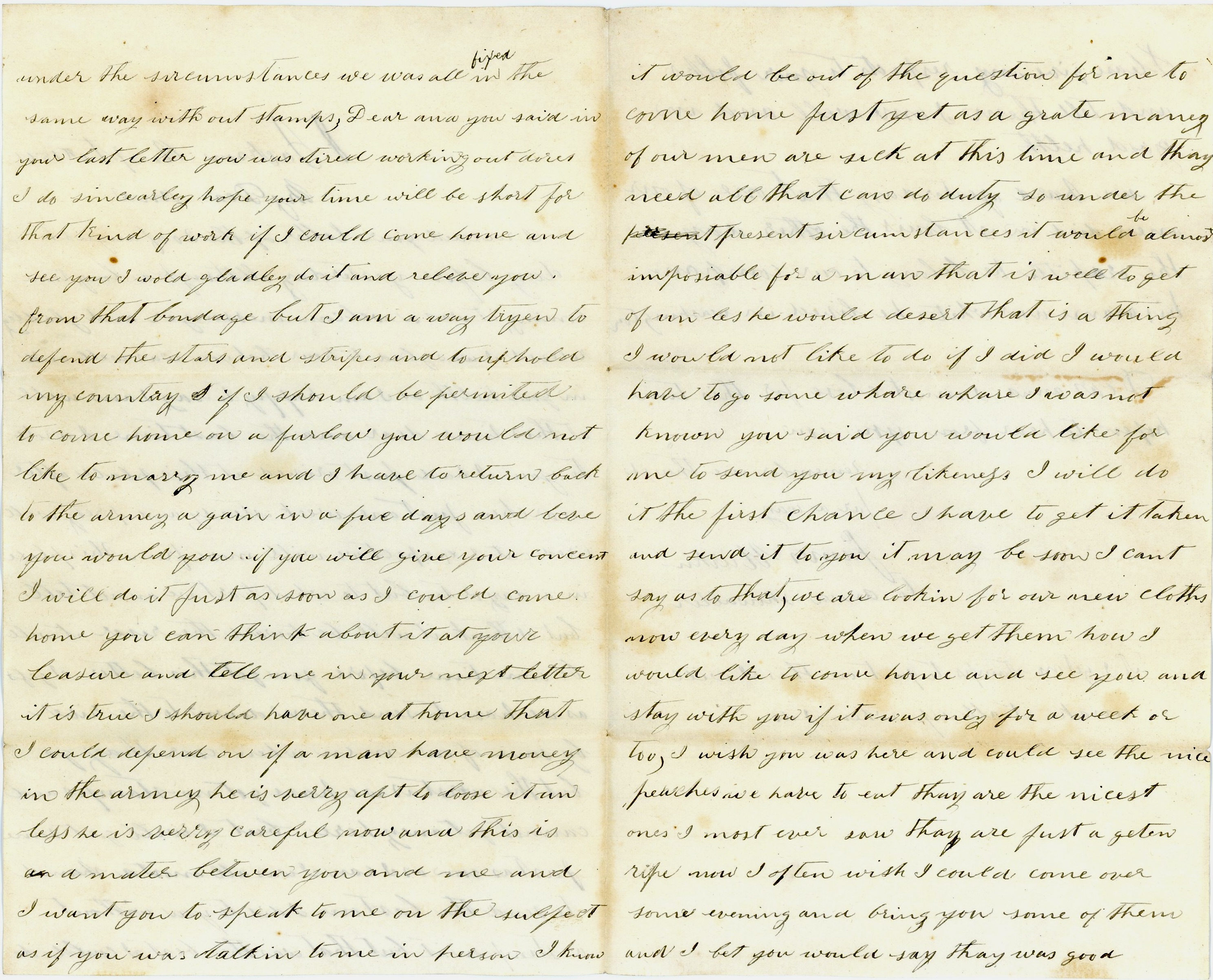
Dear Anna, you said in your last letter you was tired working outdoors. I do sincerely hope your time will be short for that kind of work. If I could come home and see you I would gladly do it and relieve you from that bondage. But I am away trying to defend the stars and stripes and to uphold my country. If I should be permitted to come home on a furlough, you would not like to marry me and I have to return back to the army again in a few days and leave you, would you? If you will give your consent, I will do it just as soon as I could come home. You can think about it at your leisure and tell me in your next letter.
It is true I should have one at home that I could depend on. If a man have money in the army, he is very apt to lose it unless he is very careful. Now Anna, this is a matter between you and me and I want you to speak to me on the subject as if you was talking to me in person. I know it would be out of the question for me to come home just yet as a great many of our men are sick at this time and they need all that can do duty so under the present circumstances it would be almost impossible for a man that is well to get off unless he would desert. That is a thing I would not like to do. If I did, I would have to go somewhere where I was not known.
You said you would like for me to send you my likeness. I will do it the first chance I have to get it taken and send it to you. It may be soon, I can’t say as to that. We are looking for our new clothes now every day. When we get them, how I would like to come home and see you. The nice peaches we have to eat, they are the nicest ones I most ever saw. They are just a gettin ripe now. I often wish I could come over some evening and bring you some of them and I bet you would say they was good.
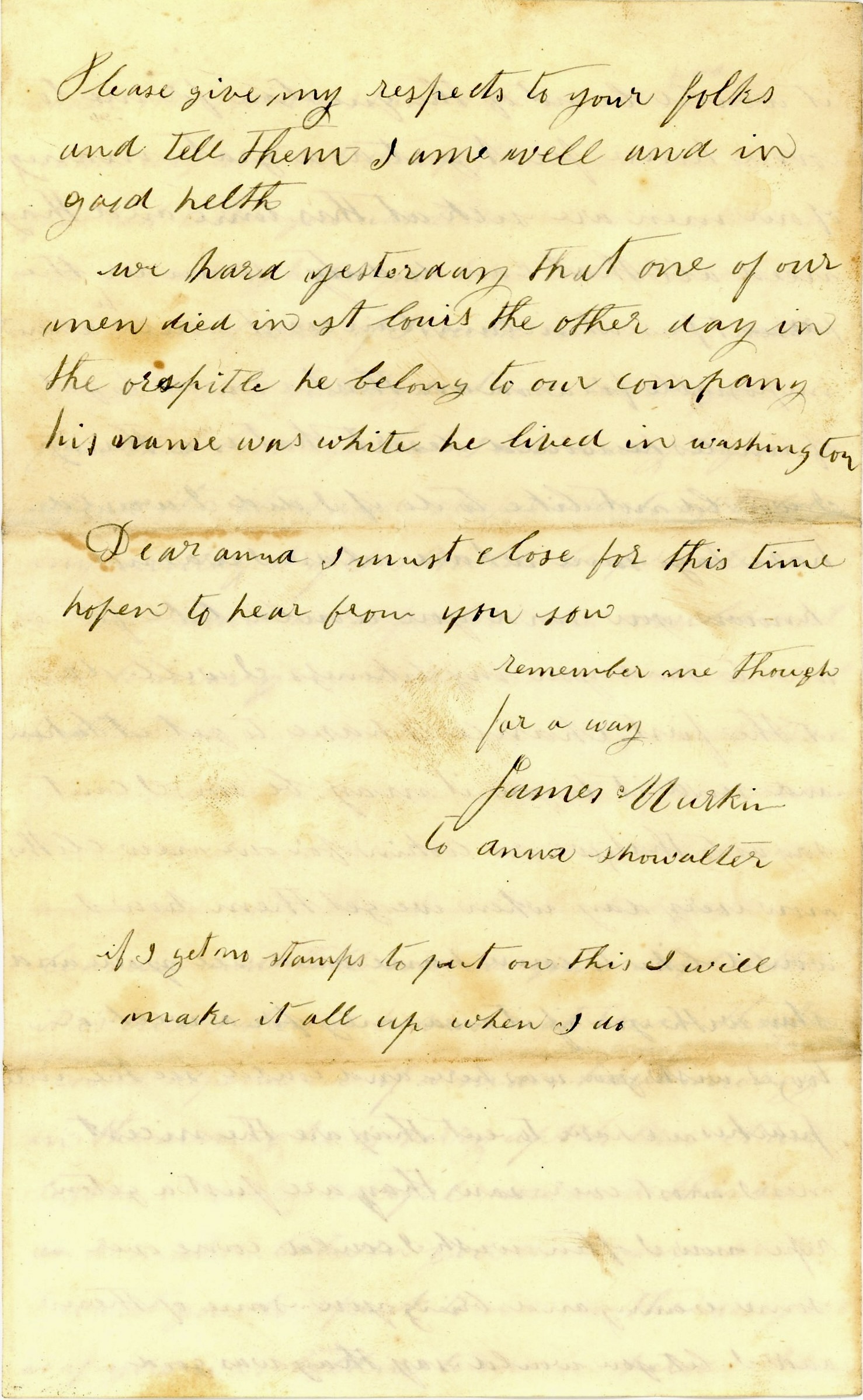
Please give my respects to your folks and tell them I am well and in good health. We heard yesterday that one of our men died in St. Louis the other day in the hospital. He belonged to our company. His name was White. 1 He lived in Washington.
Dear Anna, I must close for this time hoping to hear from you soon. Remember me though far away. — James Murkin
If I get no stamps to put on this, I will make it all up when I do.
1 Ishmael G. White died on 31 August 1861 at a hospital in St. Louis. He was 27 years aold when he enlisted in Co. H on 1 May 1861.
Letter 20
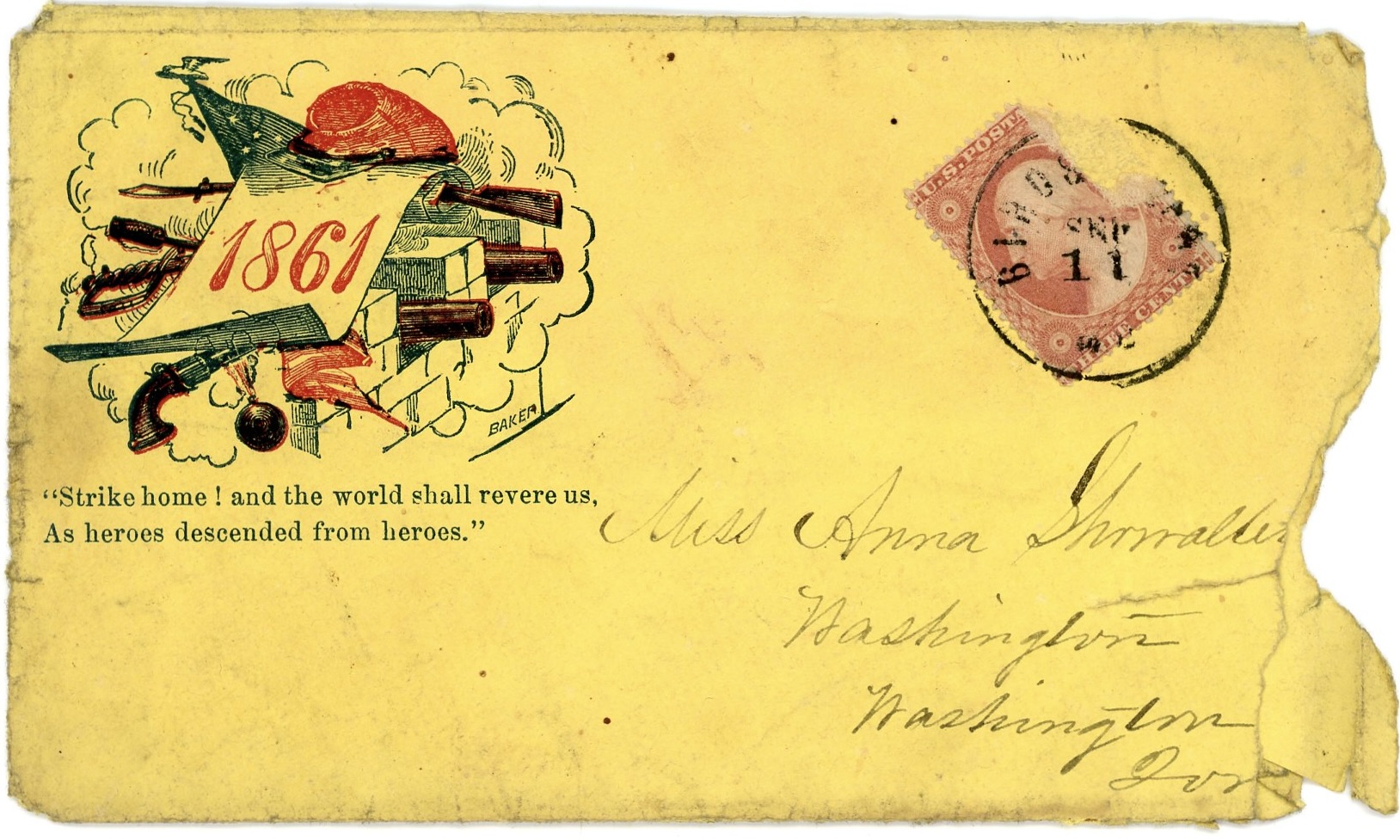
Birds Point, Missouri
September 9th 1861
Dear Anna,
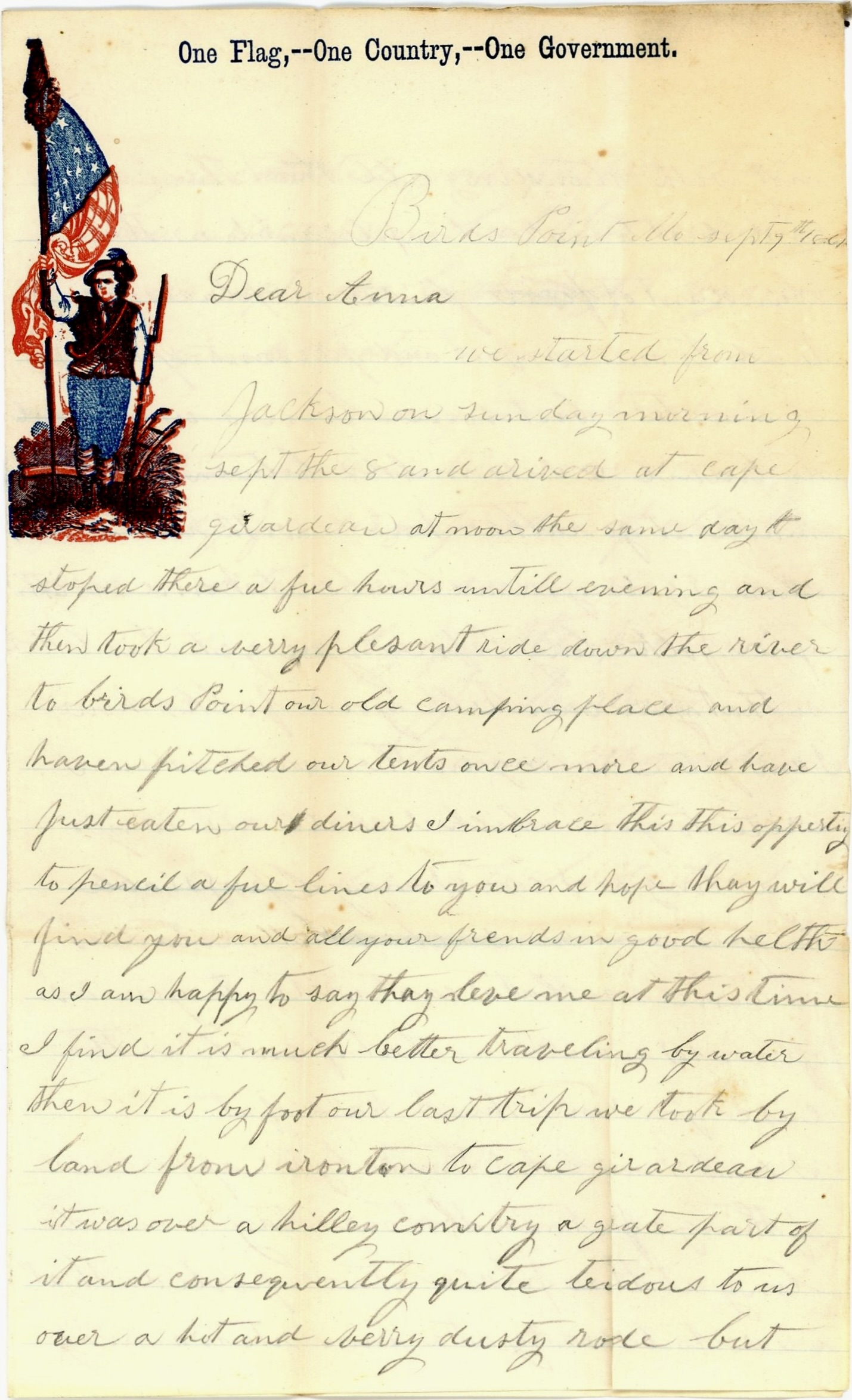
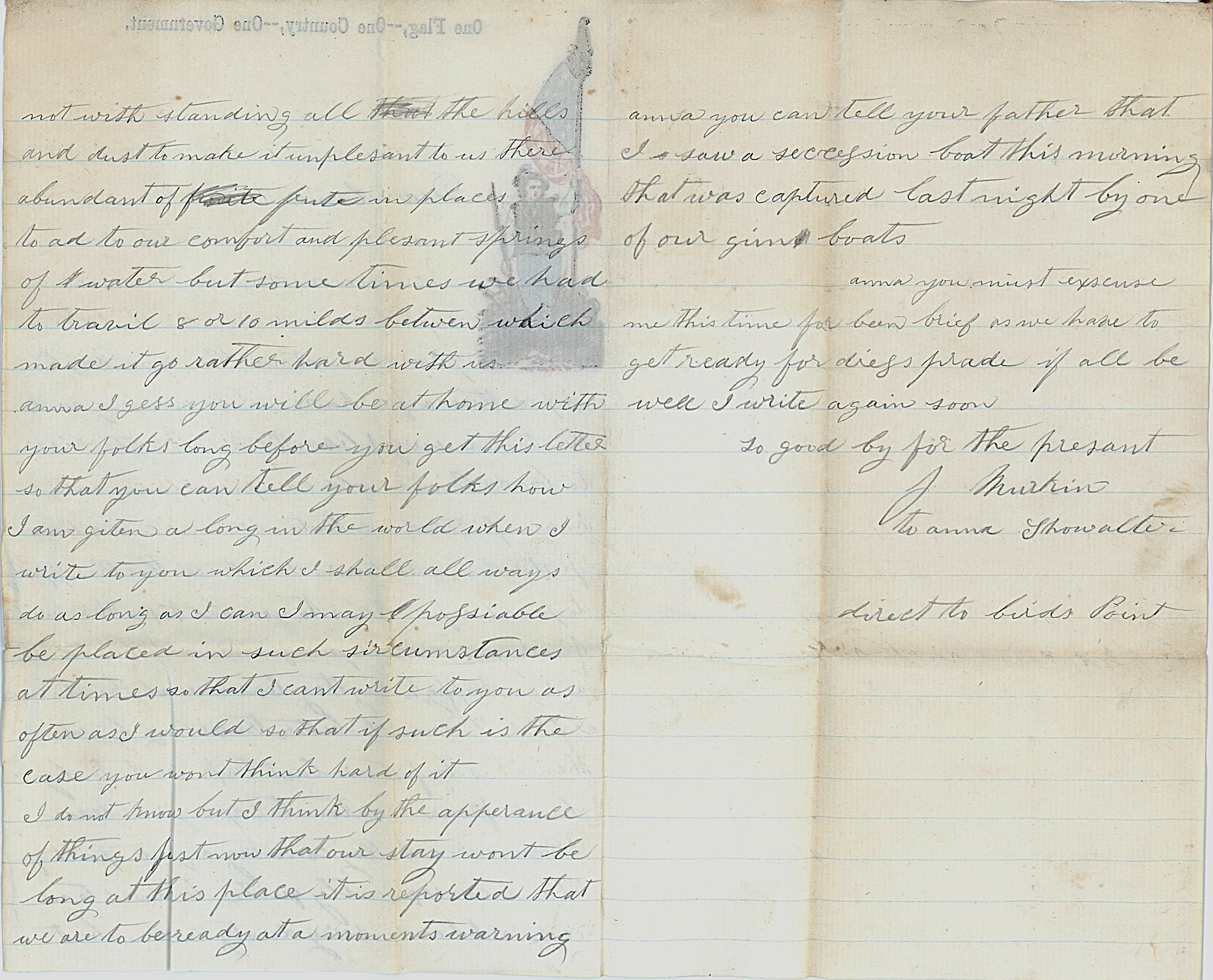
We started from Jackson Sunday morning, September 8th and arrived at Cape Girardeau at noon the same day, stopped there a few hours until evening and then took a very pleasant ride down the river to Bird’s Point, our old camping place and haven [where we] pitched our tents once more and have just eaten our dinners. I embrace this opportunity to pencil a few lines to you and hope they will find you and al your friends in good health as I am happy to say they leave me at this time. I find it is much better traveling by water than it is by foot. Our last trip we took by land from Ironton to Cape Girardeau was over a hilly country a great part of it and consequently quite tedious to us over a hot and very dusty road. But notwithstanding all the hills and dust to make it unpleasant to us, there [was an] abundance of fruit in places to add to our comfort and pleasant springs of water. But sometimes we had to travel 8 or 10 miles between which made it go rather hard with us.
Anna, I guess you will be at home with your folks long before you get this letter so that you can tell your folks how I am getting along in the world when I write to you which I shall always do as long as I can. I may possibly be placed is such circumstances at times so that I can’t write to you as often as I would [like] so that if such is the case, you won’t think hard of it. I do not know but I think by the appearance of things just now that our stay won’t be long at this place. It is reported that we are to ready at a moment’s warning.
Anna, you can tell your father that I saw a secession boat this morning that was captured last night by one of our gunboats.
Anna, you must excuse me this time for being brief as we have to get ready for dress parade. If all be well, I write again soon. So goodbye for the present, — J. Murkin
To Anna Showalter. Direct to Bird’s Point.
Letter 21
Bird’s Point, Missouri
October 7th 1861
Dear Anna,
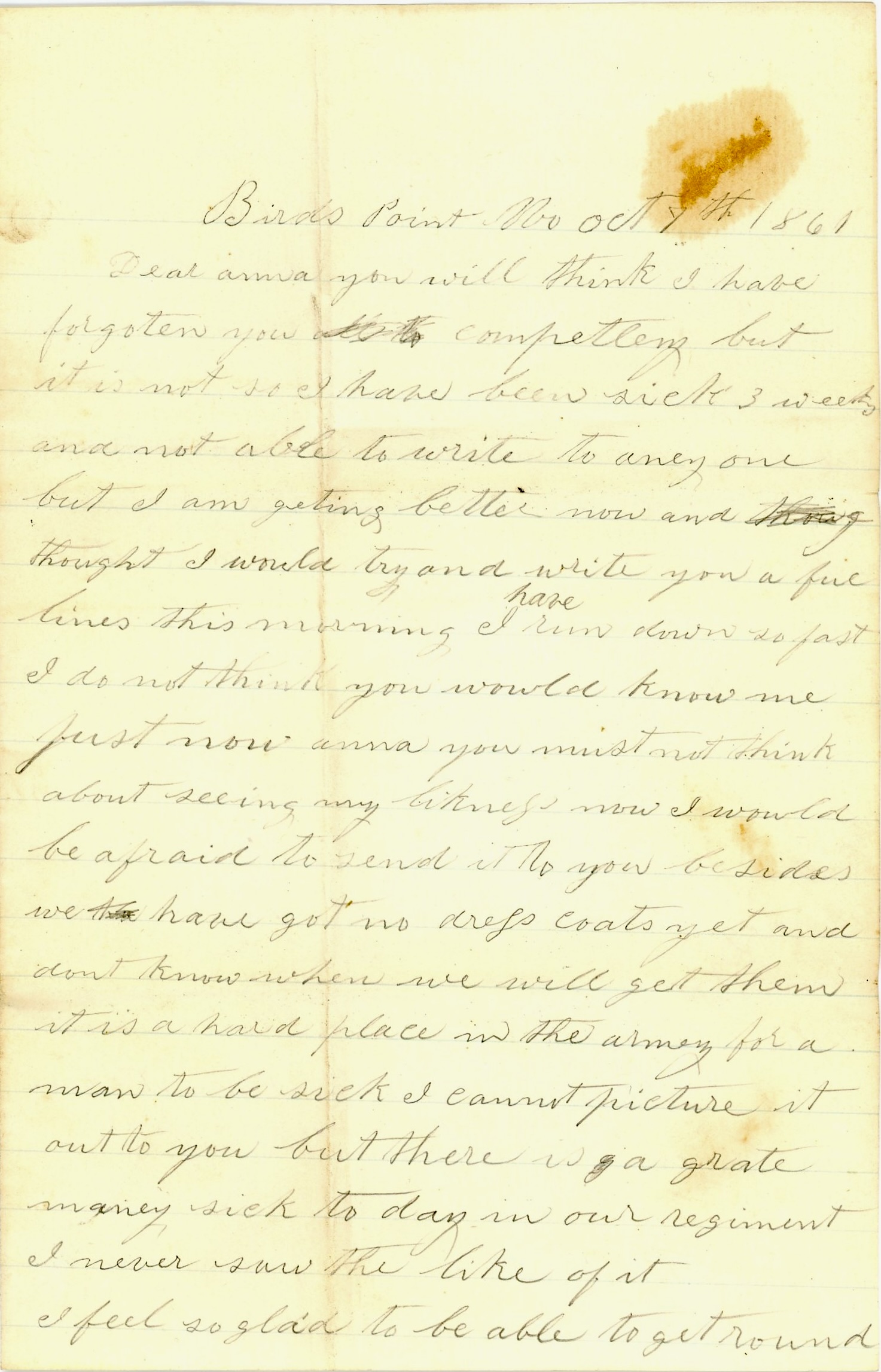
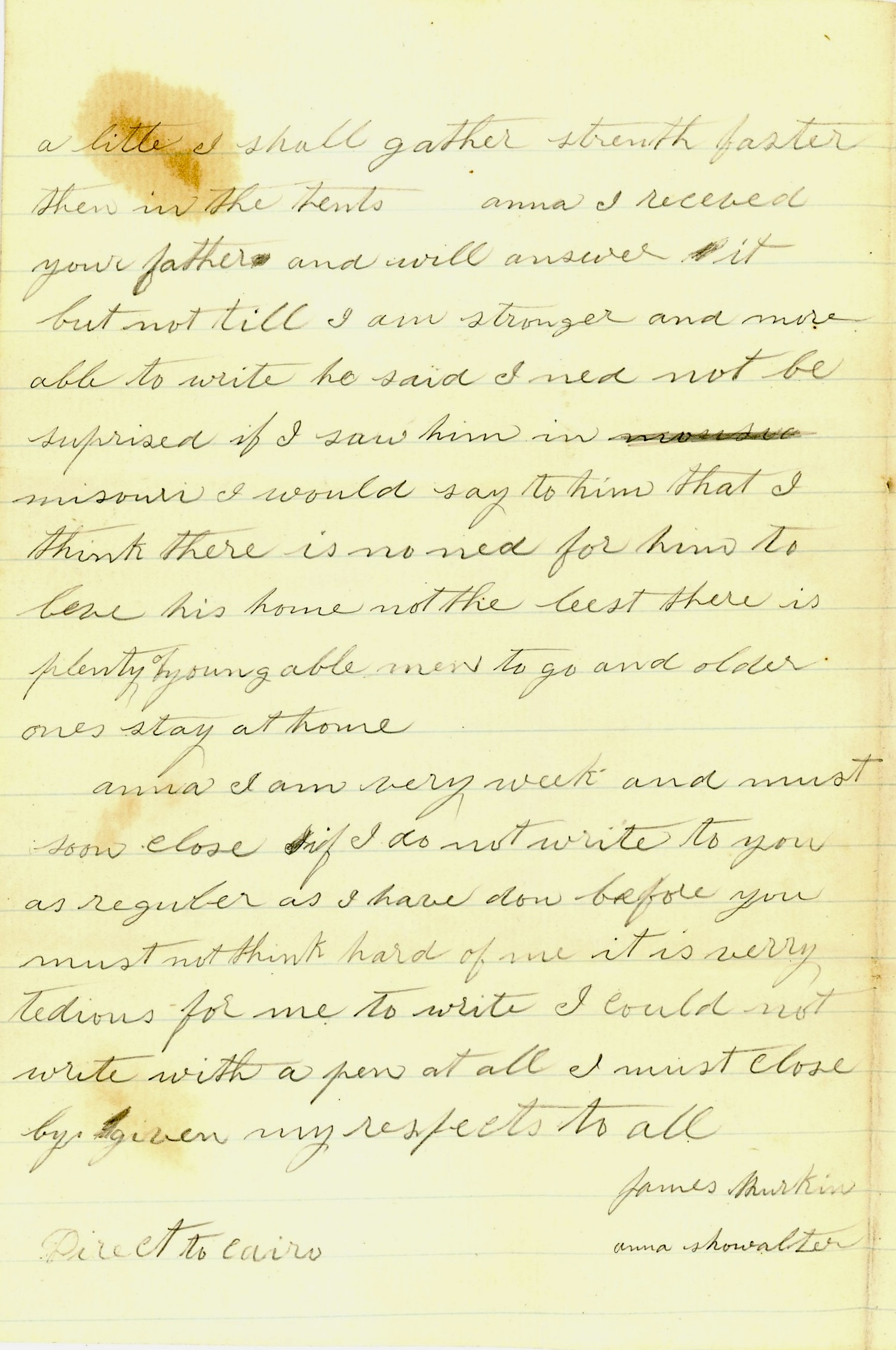
You will think I have forgotten you completely but it is not so, I have been sick three weeks and not able to write to anyone. But I am getting better now and thought I would try and write you a few lines this morning. I have run down so fast I do not think you would know me just now. Anna, you must not think about seing my likeness now. I would be afraid to send it to you. Besides, we have got no dress coats yet and don’t know when we will get them. It is a hard place in the army for a man to be sick, I cannot picture it out to you but there is a great many sick today in our regiment. I never the like of it. I feel so glad to be able to get round a little. I shall gather strength faster than in the tents.
Anna, I received your father’s [letter] and will answer it but not till I am stronger and more able to write. He said I need not be surprised if I saw him in Missouri. I would say to him that I think there is no need for him to leave his home—not the least. There is plenty of young, able men to go and older ones stay at home.
Anna, I am very weak and must soon close. If I do not write to you as regular as I have done before, you must not think hard of me. It is verytedious for me to write. I could not write with a pen at all. I must close by giving my respects to all. — James Murkin
Direct to Cairo.
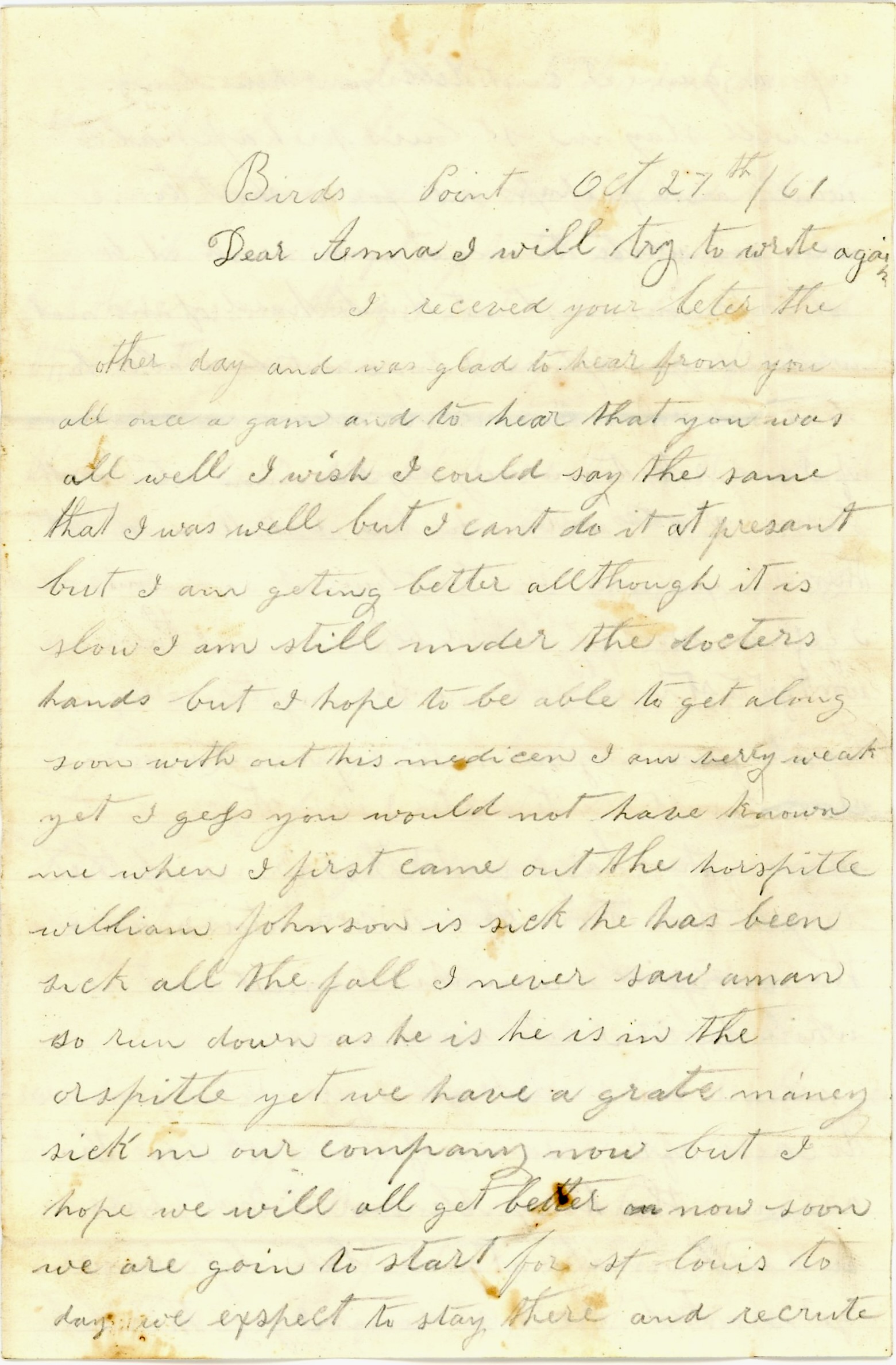
Letter 22
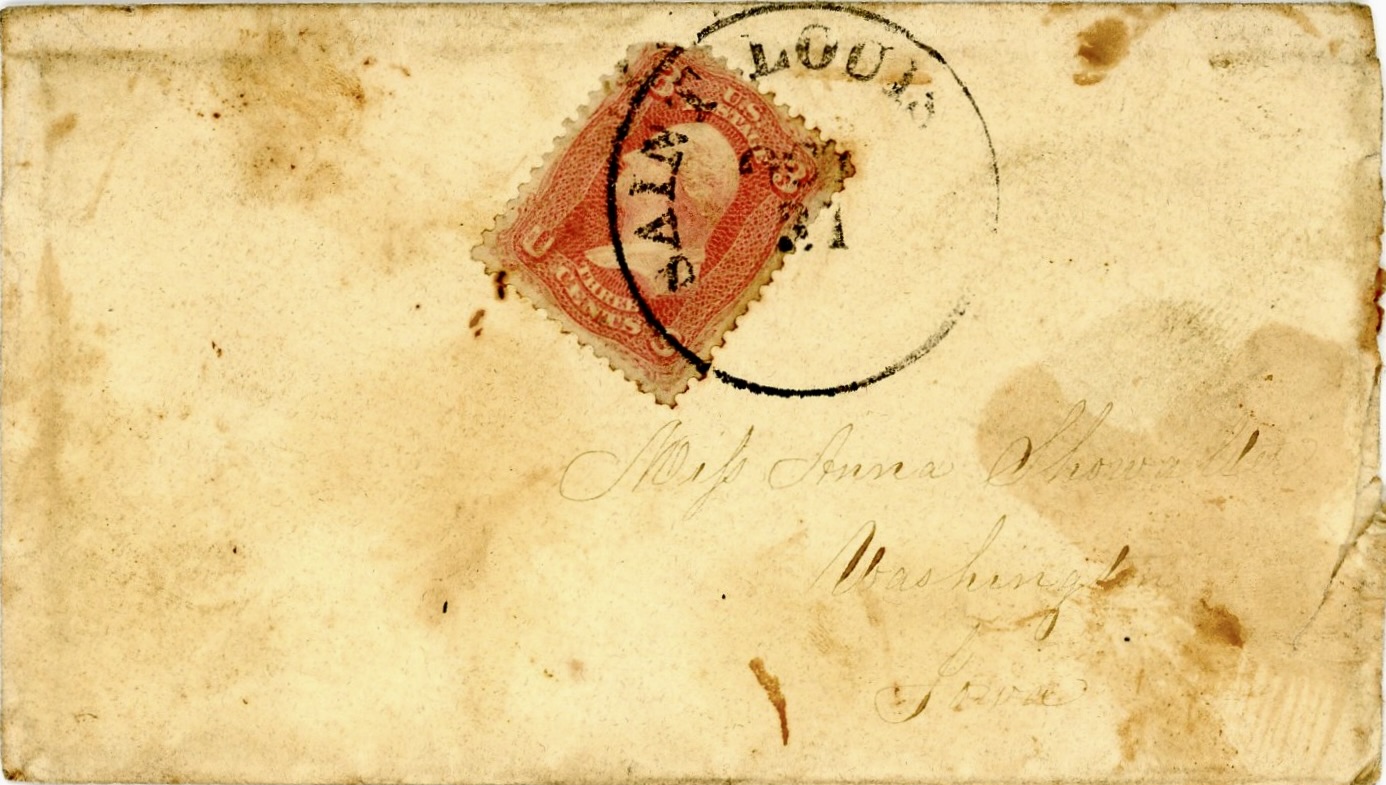
Bird’s point [Missouri]
October 27th 1861
Dear Anna,
I will try to write again. I received your letter the other day and was glad to hear from you all once again and to hear that you was all well. I wish I could say te same that I was well but I can’t do it at present. But I am getting better although it is slow. I am still under the doctor’s hands but I hope to be able to get along soon without his medicine. I am very weak yet. I guess you would not have known me when I first came out of the hospital. William Johnson is sick. He has been sick all the fall. I never saw a man so run down as he is. He is in the hospital yet. We have a great many sick in our company now but I hope we will all get better on now soon.
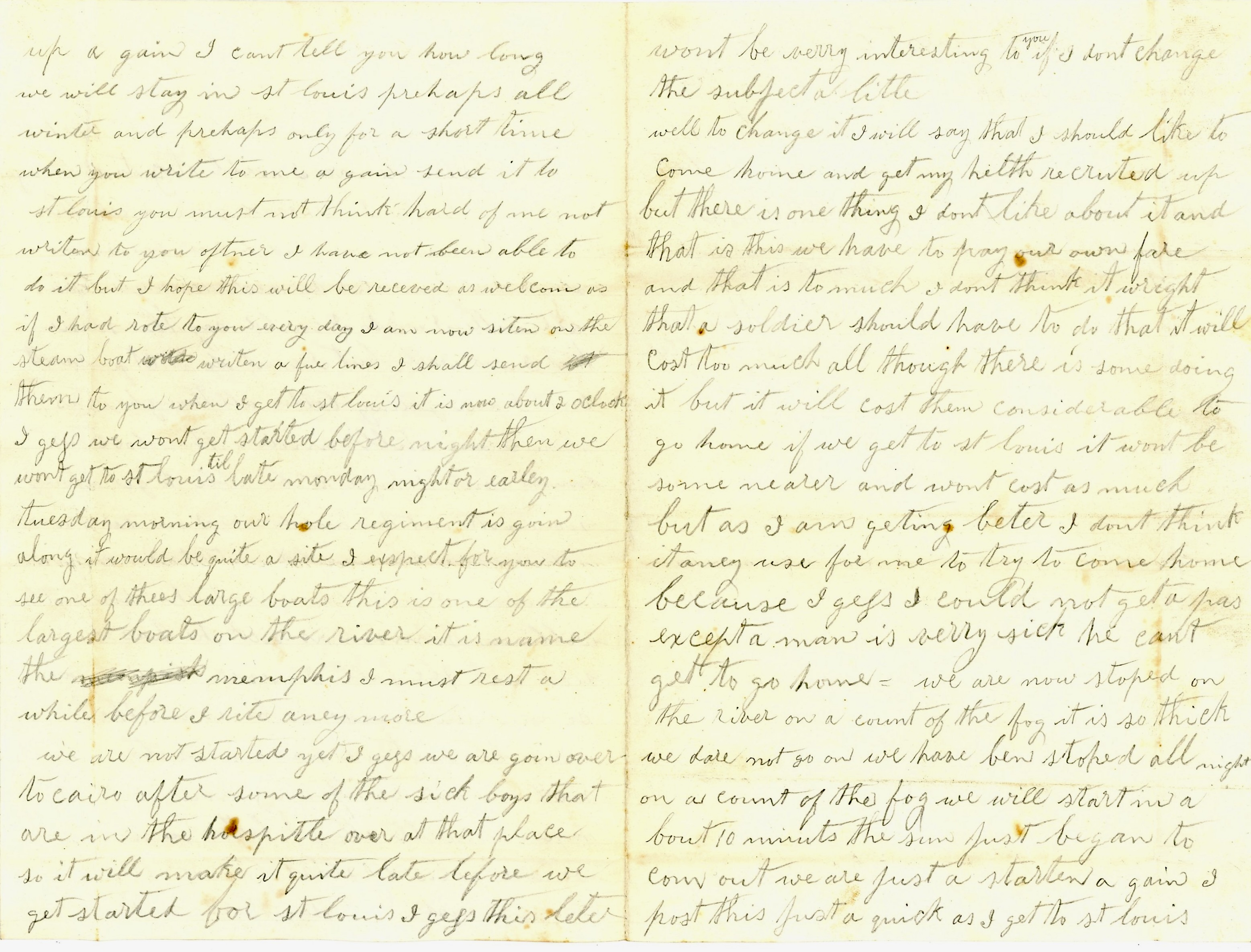
We are going to start for st. Louis today. We expect to stay there and recruit up again. I can’t tell you how long we will stay in St. Louis, perhaps all winter and perhaps only for a short time. When you write to me again, send it to St. Louis.
You must not think hard of me not writing to you oftener. I have not been able to so it but I hope this will be received as welcome as if I had wrote to you every day. I am not sitting on the steamboat writing a few lines. I shall send them to you when i get to St. Louis. It is now about 2 o’clock. I guess we won’t get started before night. Then we won’t get to St. Louis till late Monday night or early Tuesday morning. Our whole regiment is going along. It would be quite a sight, I expect, for you to see one of these large boats, This is one of the largest boats on the river. It is named the Memphis. I must rest a while before I write anymore.
We are not started yet. I guess we are going over to Cairo after some of the sick boys that are in the hospital over at that place so it will make it quite late before we get started for St. Louis. I guess this letter won’t be very interesting to you if I don’t change the subject a little.
Well, to change it, I will say that I should like to come home and get my health recruited up but there is one thing I don’t like about it and that is this—we have to pay our own fare and that is too much, I don’t think it right that a soldier should have to do that, It will cost too much although there is some doing it. But it will cost them considerable to go home. If we get to St. Louis, it will be some nearer and won’t cost as much but as I am getting better, I don’t think it any use for me to try to come home because I guess I could not get a pass. Except a man is very sick, he can’t get to go home.
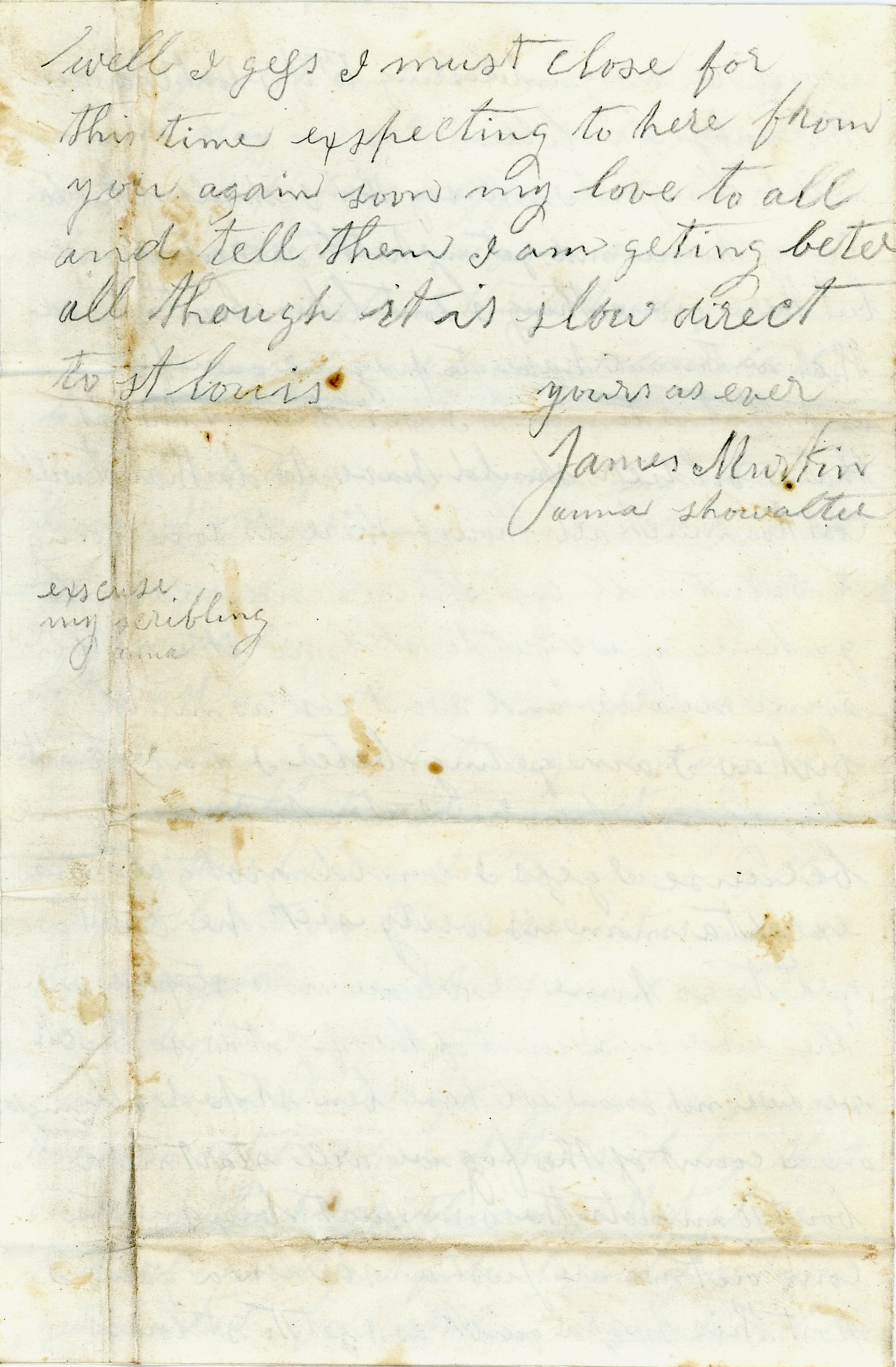
We are now stopped on the river on account of the fog. It is so thick we dare not go and we have been stopped all night on account of the fog. We will start in about ten minutes. The sun just began to come out. We are just a starting again. I’ll post this just as quick as I get to St. Louis. Well, I guess I must close for this time, expecting to hear from you again soon. My love to all and tell them I am getting better although it is slow. Direct to St. Louis. Yours as ever, — James Murkin
Excuse my scribbling.
Letter 23
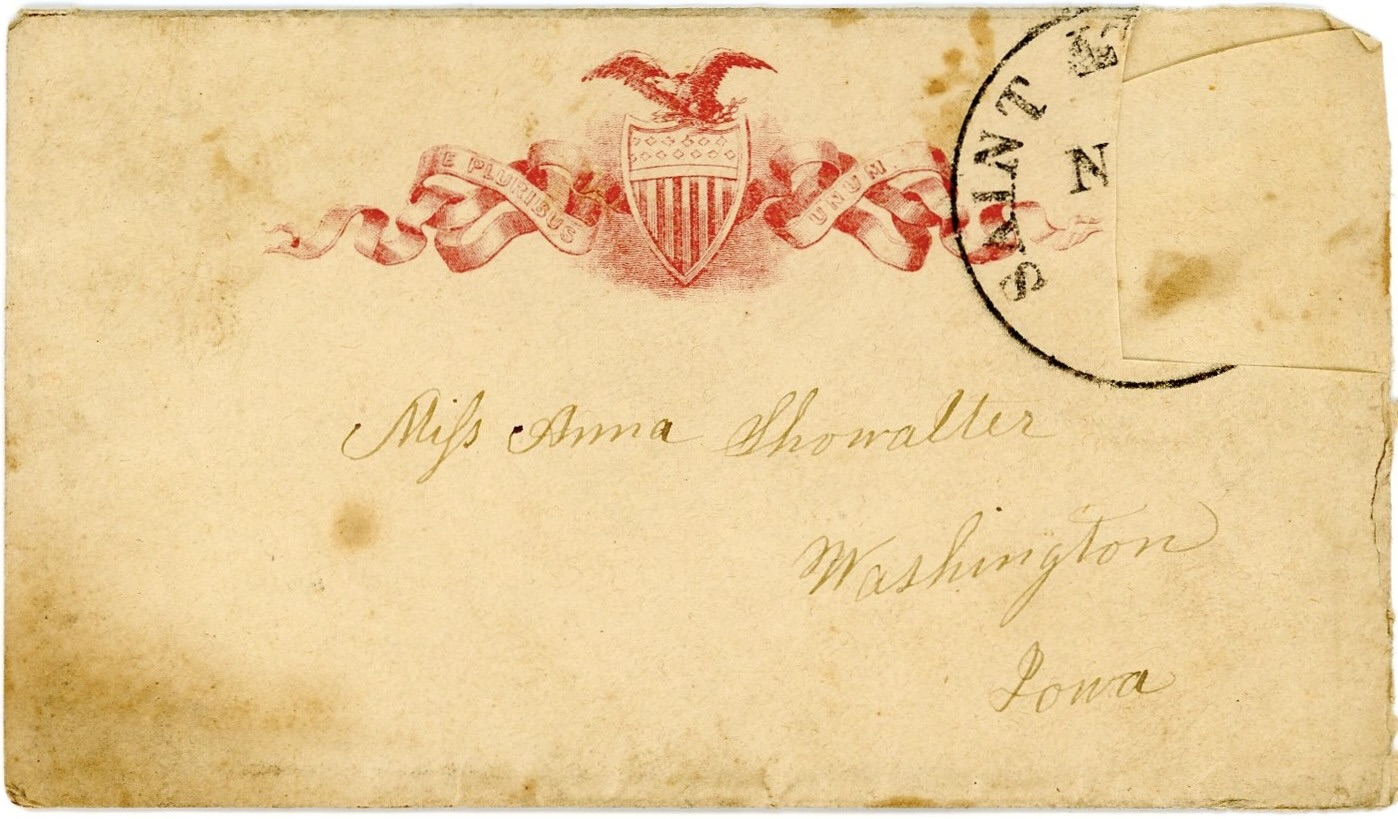
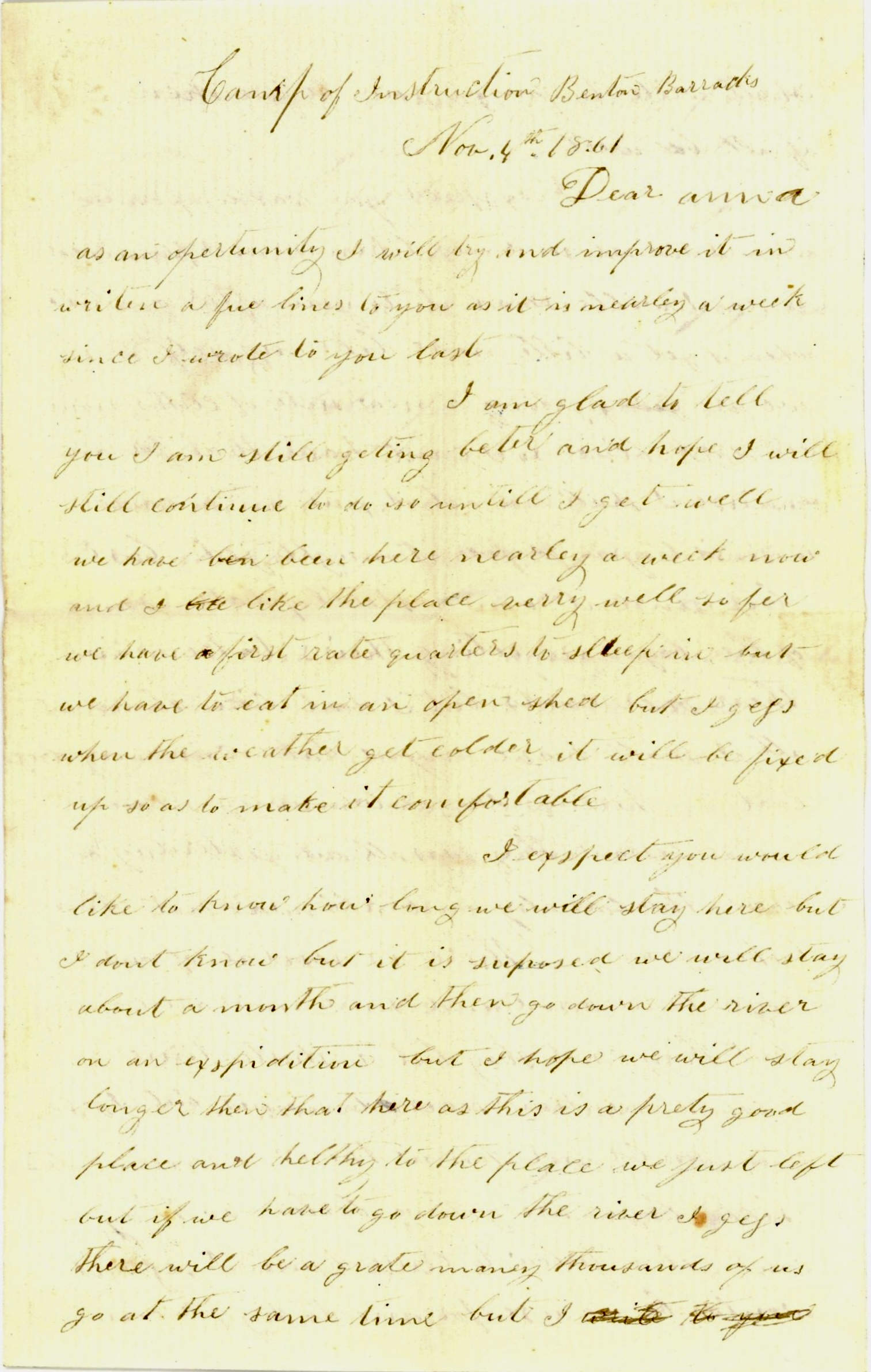
Camp of Instruction, Benton Barracks
November 4, 1861
Dear Anna,
As an opportunity [presents itself], I will try and improve it in writing a few lines to you as it is nearly a week since I wrote to you last. I am glad to tell you I am still getting better and hope I will still continue to do so until I get well. We have been here nearly a week now and I like the place very well so far. We have first rate quarters to sleep in but we have to eat in an open shed. But I guess when the weather gets colder, it will be fixed up so as to make it comfortable.
I expect you would like to know how long we will stay here but I don’t know. But it is supposed we will stay about a month and then go down the river on an expedition. But I hope we will stay longer than that here as this is a pretty good place and healthy to the place we just left. But if we have to go down the river, i guess there will be a great many thousands of us go at the same time. But I shall write to you again before then if all be well.
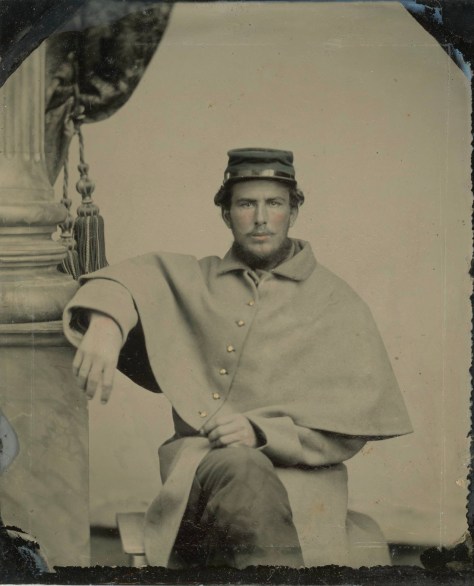
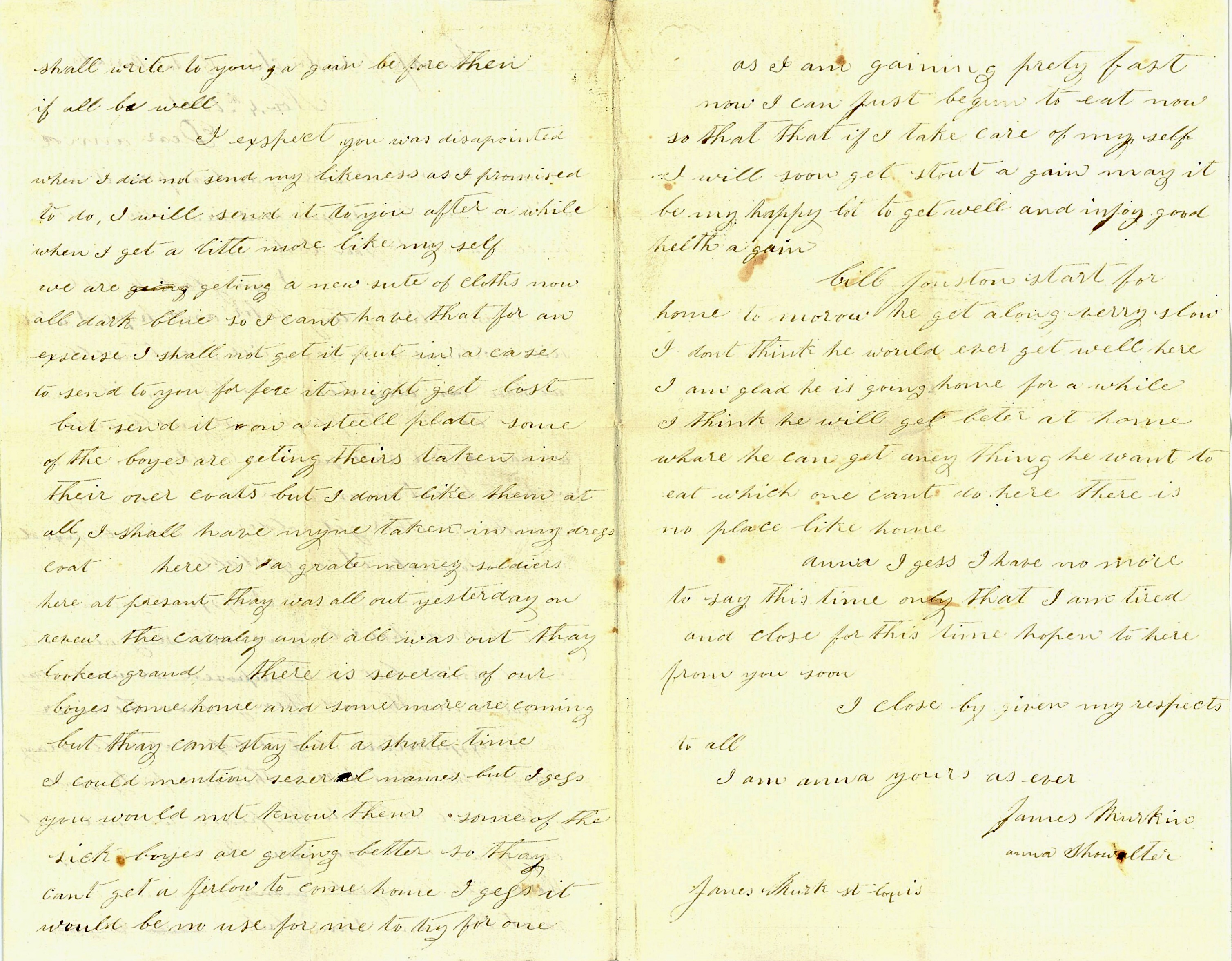
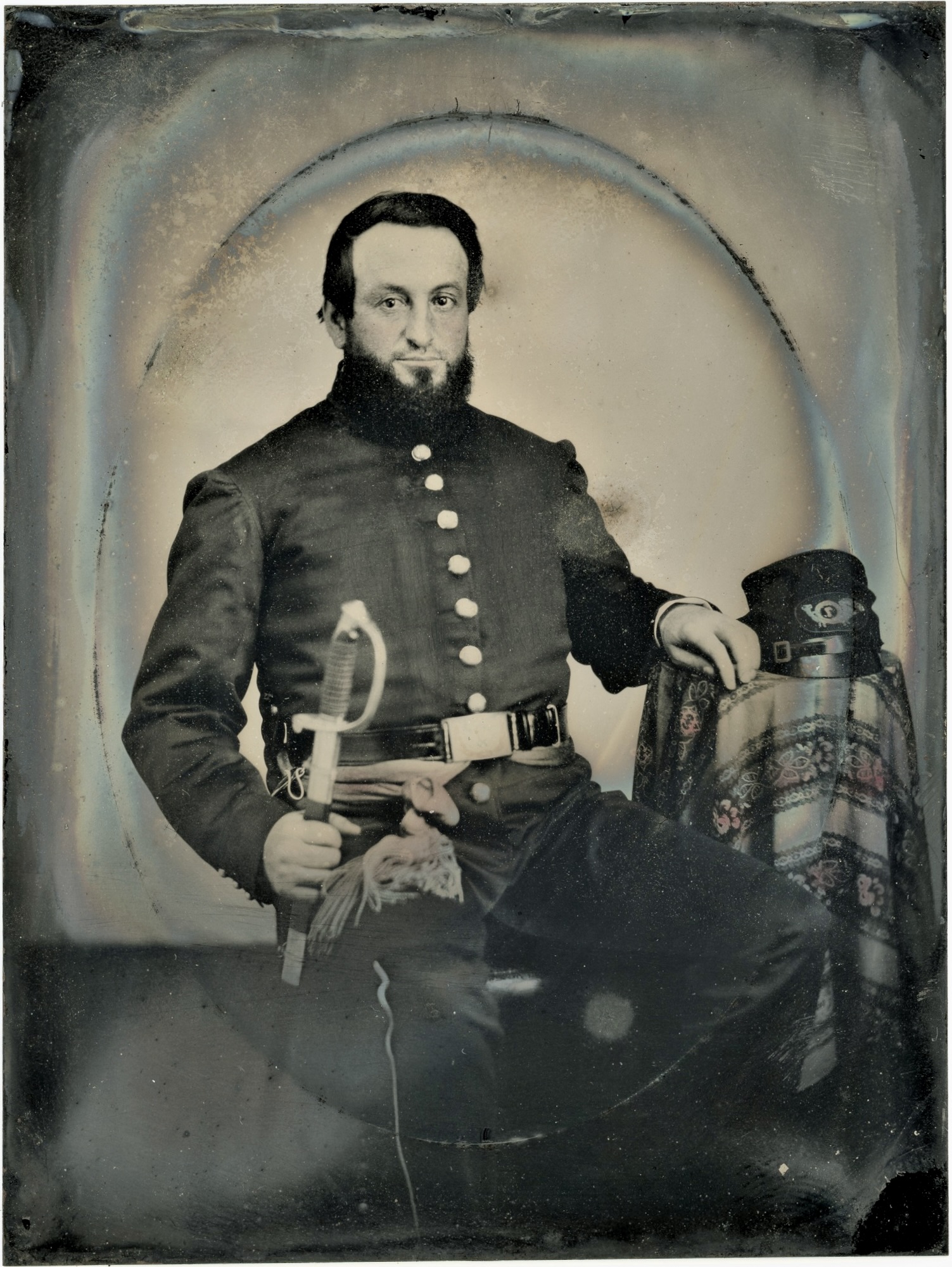
I expect you was disappointed when I did not send my likeness as i promised to do. I will send it to you after a while when I get a little more like myself. We are getting a new suit of clothes now—all dark blue, so I can’t have that for an excuse. I shall not get it in a case to send to you for it might get lost but send it on a steel plate. Some of the boys are getting theirs taken in their overcoats but I don’t like them at all. I shall have mine taken in my dress coat.
There is a great man soldiers here at present. They was all out yesterday on review. The cavalry and all was out. They looked grand. There is several of our boys come home and some more are coming but they can’t stay but a short time. I could mention several names but I guess you would not know them. Some of the sick boys are getting better so they can’t get a furlough to come home. I guess it would be no use for me to try for one as I am gaining pretty fast now. I can just begin to eat now so that if I take care of myself, I will soon get stout again. May it be my happy lot to get well and enjoy good health again.
Bill Johnson 1 starts for home tomorrow. He gets along very slow. I don’t think he would ever get well here. I am glad he is going home for a while. I think he will get better at home where he can get anything he wants to eat which one can’t do here, There is no place like home.
Anna, I guess I have no more to say this time—only that I am tired and close for this time hoping to hear from you soon. I close by giving my respects to all. I am, Anna, yours as ever, — James Murkin
1 William V. Johnson of Washington county was 23 when he enlisted on 1 May 1861 in co. H. He was discharged for disability on 21 January 1862.
Letter 24
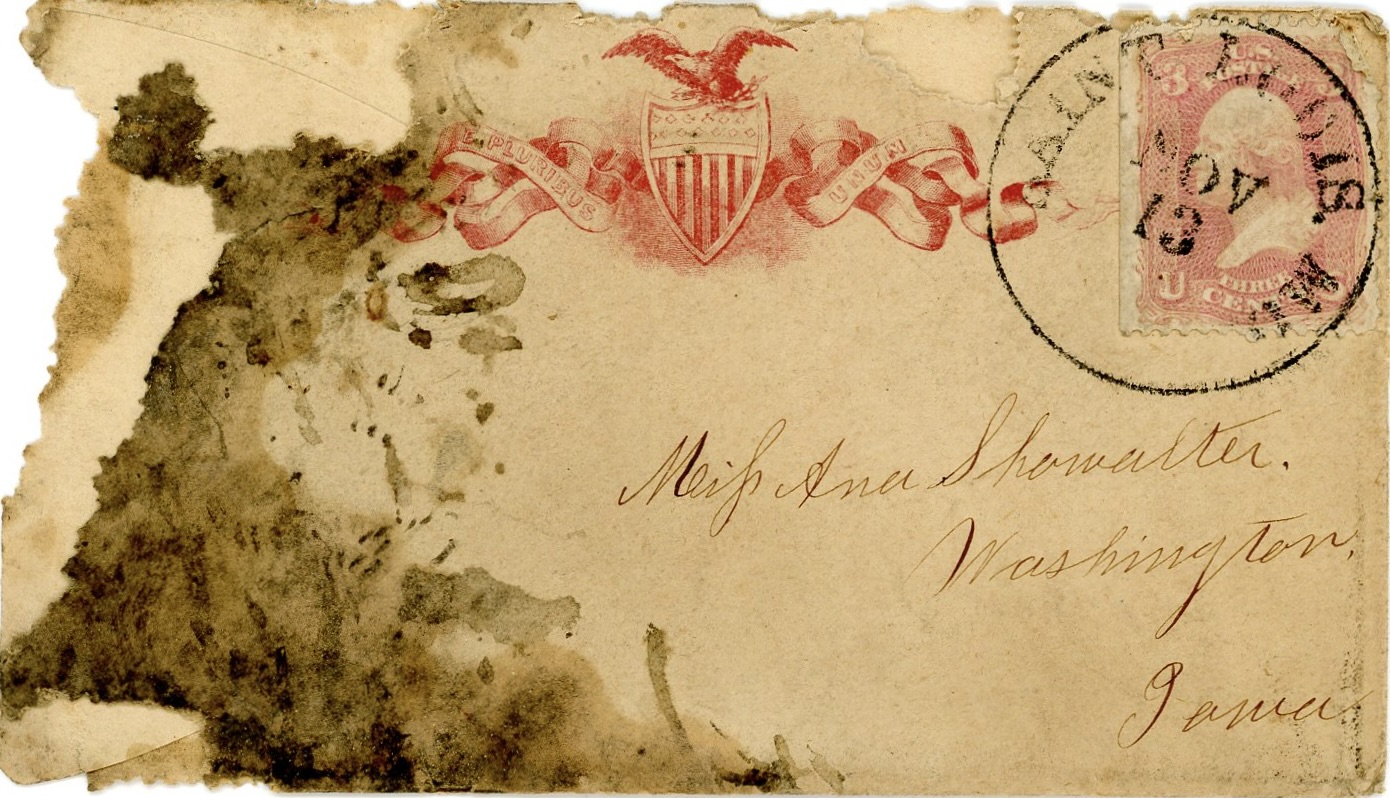
Benton Barracks
November 10, 1861
Dear Anna,
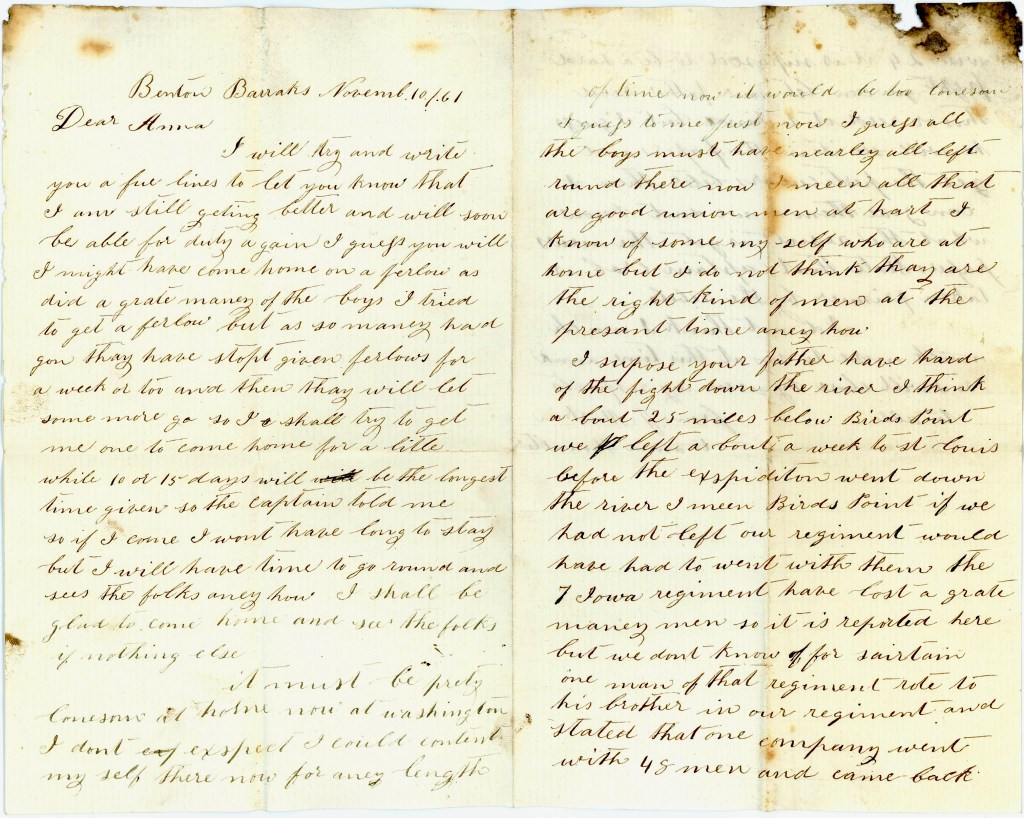
I will try and write you a few lines to let you know that I am still getting better and will soon be able for duty again. I guess you will [think] I might have come home on a furlough as did a great many of the boys. I tried to get a furlough but as so many had gone, they had stopped giving furloughs for a week or two and they they will let some more go so I shall try to get me one to come home for a little while. Ten or fifteen days will be the longest time given, so the captain told me, so if I come I won’t have long to stay. But I will have time to go round and see the folks anyhow. I shall be glad to come home and see the folks if nothing else.
It must be pretty lonesome at home now at Washington. I don’t expect I could content myself there now for any length of time now. It would be too lonesome to me just now. I guess all the boys must have nearly all left round there now. I mean all that are good Union men at heart. I know of some yself who are at home but I do not thing they are the right kind of men at the present time anyhow.
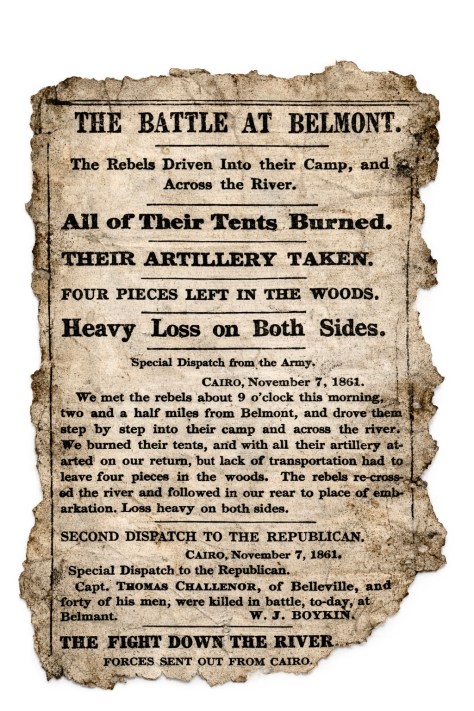
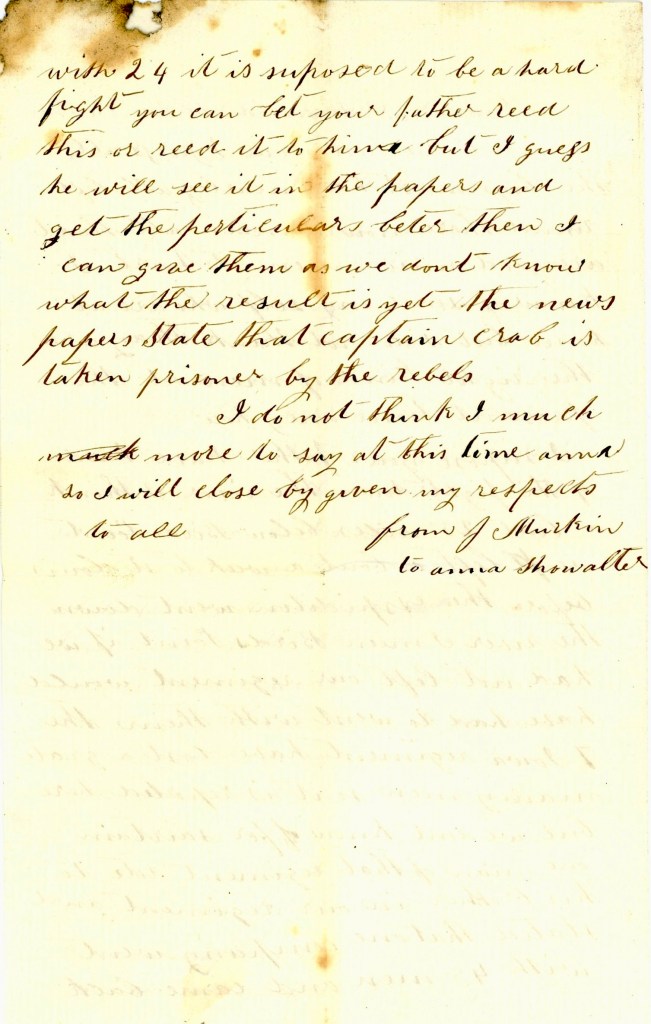
I suppose your father has heard of the fight down the river [at Belmont] I think about 25 miles below Bird’s Point. We left about a week to St. Louis before the expedition went down the river. I mean Bird’s Point. If we had not left, our regiment would have had to sent with them. The 7th Iowa Regiment have lost a great many men, so it is reported here, but we don’t know for certain. One man of that regiment wrote to his brother in our regiment and stated that one company went with 48 men and came back with 24. It is supposed to be a hard fight. You can let your father read this or read it to him but I guess he will see it in the papers and get the particulars better than I can give them as we don’t know what the result is yet. The newspapers state that Captain Crabb (see image below) is taken prisoner by the rebels.
I do not think I [have] much more to say at this time, Anna, so I will close by giving my respects to all. From, — J. Murkin
Letter 25
St. Louis, Missouri
December 6th 1861
DearAnna,
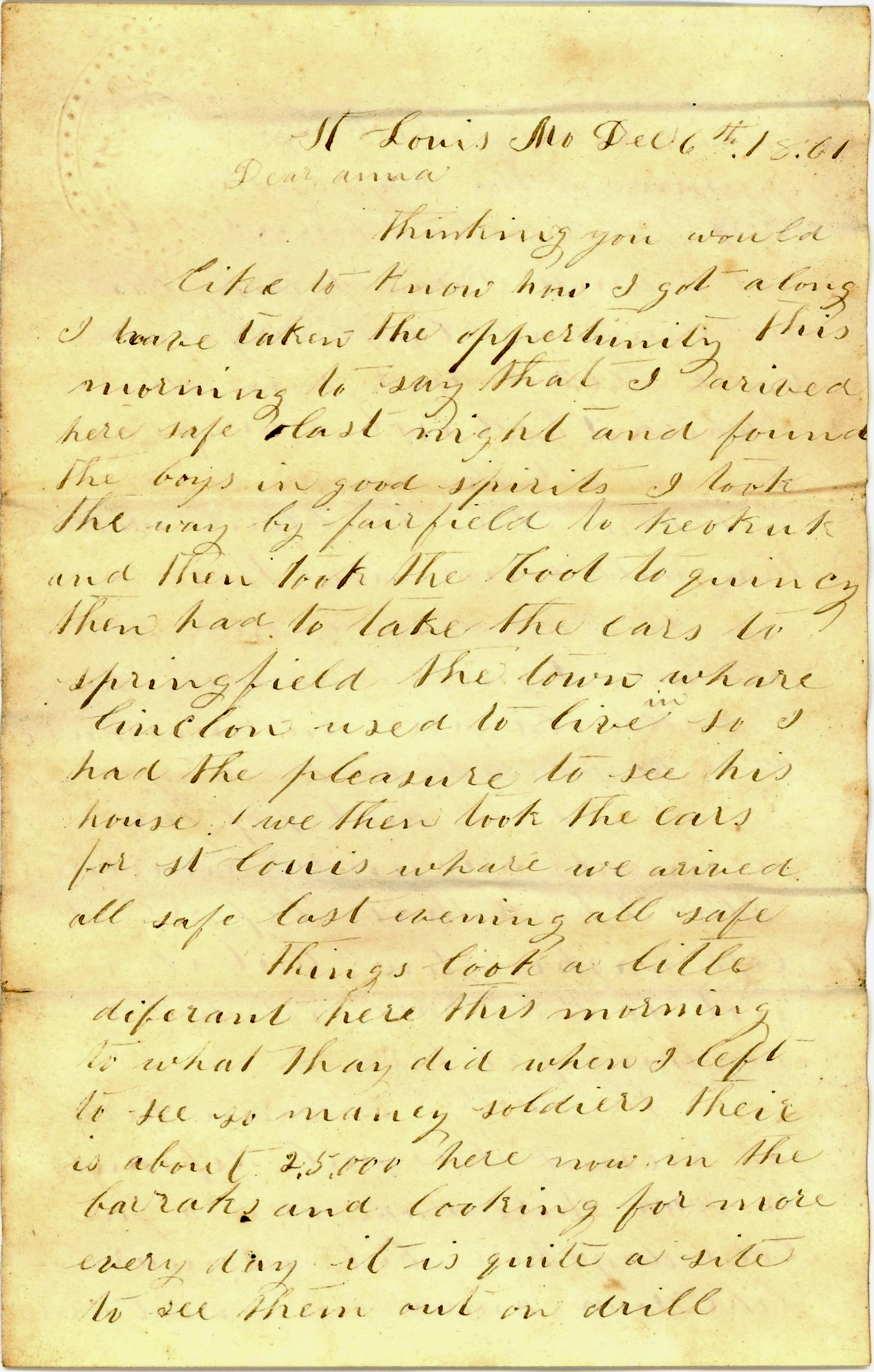
Thinking you would like to know how I get a long, I have taken the opportunity this morning to say that I arrived here safe last night and found the boys in good spirits. I took the way by Fairfield to Keokuk and then took the boat to Quincy. Then had to take the cars to Springfield, the town where Lincoln used to live in, so I had the pleasure to see his house. We then took the care for St. Louis where we arrived all safe last evening.
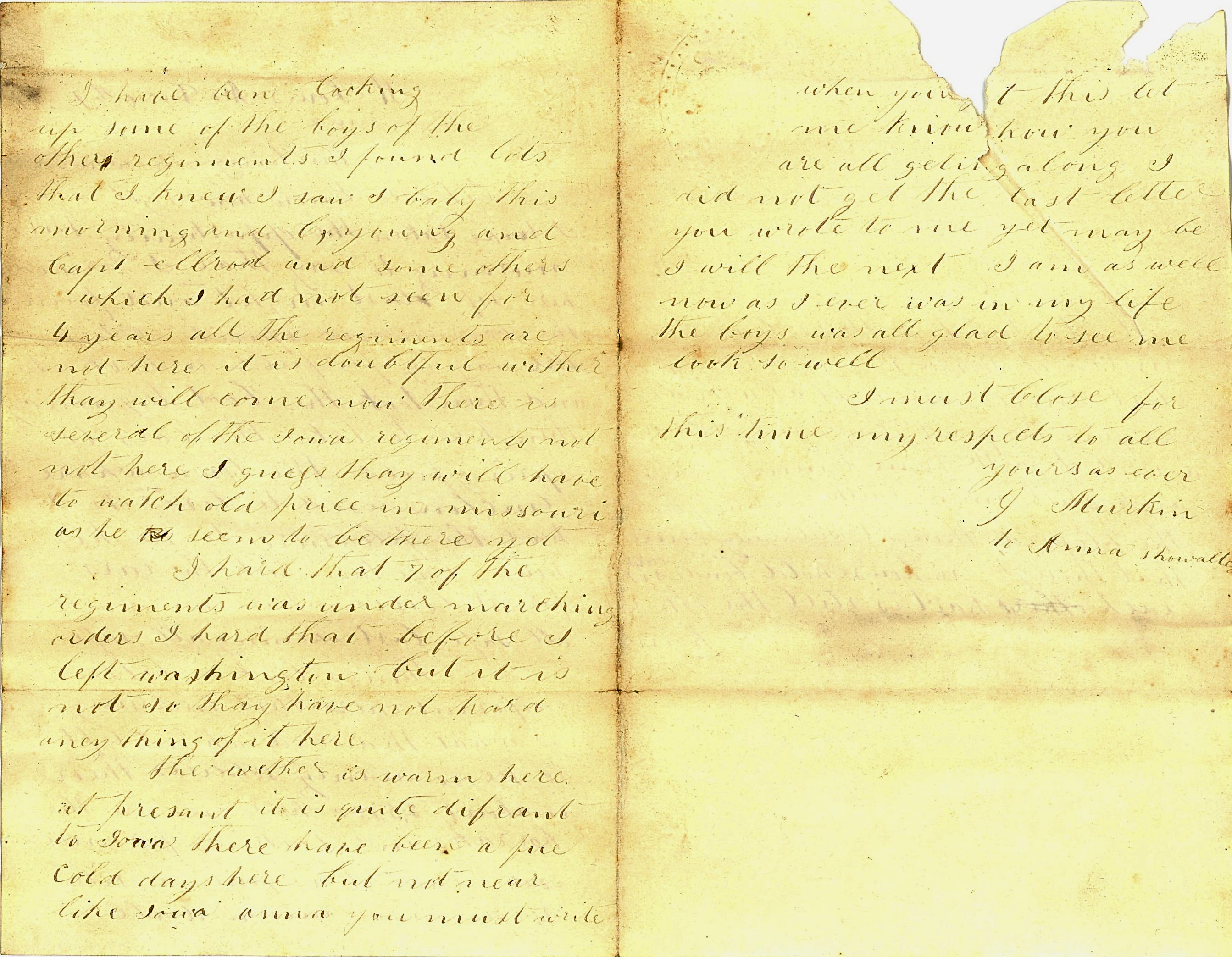
Things look a little different here this morning to what they did when I left, to see so many soldiers. There is about 25,000 here now in the barracks and looking for more every day. It is quite a sight to see them out on drill. I have been looking up some of the boys of the other regiments. I found lots I knew. I saw S. Caty this morning and C. Young and Capt. Elrod and some others which I had not seen for four years. All the regiments are not here. It is doubtful whether they will come now. There is several of the Iowa regiments not here. I guess they will have to watch Old [Sterling] Price in Missouri as he seems to be there yet.
I heard that seven of the regiments was under marching orders. I heard that before I left Washington but it is not so. They have not heard anything of it here.
The weather is warm here at present. It is quite different to Iowa. There have been a few cold days here but not near like Iowa. Anna, you must write when you get this and let me know how you are all getting along. I did not get the last letter you wrote to me yet. Maybe I will the next. I am as well now as I ever was in my life. The boys was all glad to see me look so well.
I must close for this time. My respects to all. Yours as ever, — J. Murkin
Letter 26
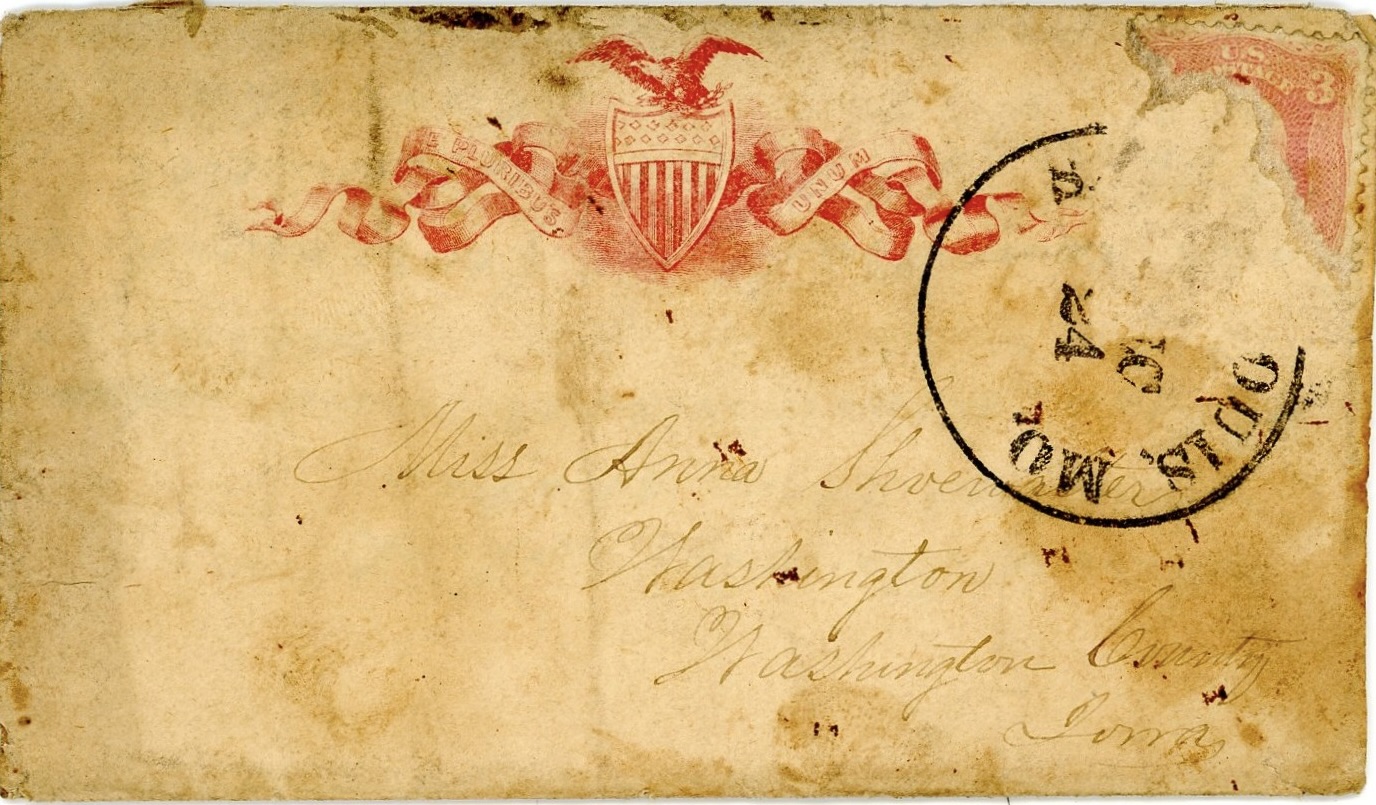
Benton Barracks
St. Louis, [Missouri]
December 22, 1861
Dear Anna,
It has been some time since I wrote to you. I have not had the chance to write to you as I would like to have done. Our company has been to Cairo two times since I came back to the barracks. We took down 25 boats [of] what is called mortar boats for throwing bomb shells. It took us 10 or 11 days to make both trips from St. Louis to Cairo. We have had the prettiest weather since I came back [from Iowa] I ever saw for the time a year, I think. Until last Thursday [when] it began to get cold. Last night it began to snow [and] today it is snowing and raining together which makes it very unpleasant.
Anna, I have not heard from you since I came back. I wrote to you once soon after I came here. I think long till I hear from you. If you have not wrote yet since I saw you, be sure and write just as soon as you can. The time seems long.
Anna, before you get this letter, Christmas will no doubt be over. How I would like to be there and spend Christmas with you. But I must be contented to stay here in Benton Barracks, far away from her I love, yet with whom I hope to spend my days. Anna, it is reported that we are to stay in the city this winter to guard it. I hope we may. I would rather do it than go down the river to fight. Some of the boys want to stay. In fact, the most of them would like to stay in St. Louis all winter.
Anna, I am as well as I ever was in all my life. I think I am heavier than I ever was before. Some of the boys do not get along first rate since they got back. I have been lucky in that respect. I went right on duty soon as I got back. Anna, tell your father I wish he could see Cairo. It looks like war. It looks as if they was going to make a trip down the river before long. 1
Anna, I must close by giving my respects to all. When you write to me, direct to J. Murkin, St. Louis, in care of Capt. H. R. Cowles, Co. H, 2nd Infantry Iowa Vols. Our letters get mis-carried by going to the 2nd Iowa Cavalry. — James Murkin
1 In December 1861, Brigadier General Grant was building up forces at Cairo and conducting demonstrations against the Confederate stronghold at Columbus, Kentucky. The gunboat fleet was being prepared and assembled at Cairo, creating the appearance of a navy yard at the Cairo levee.
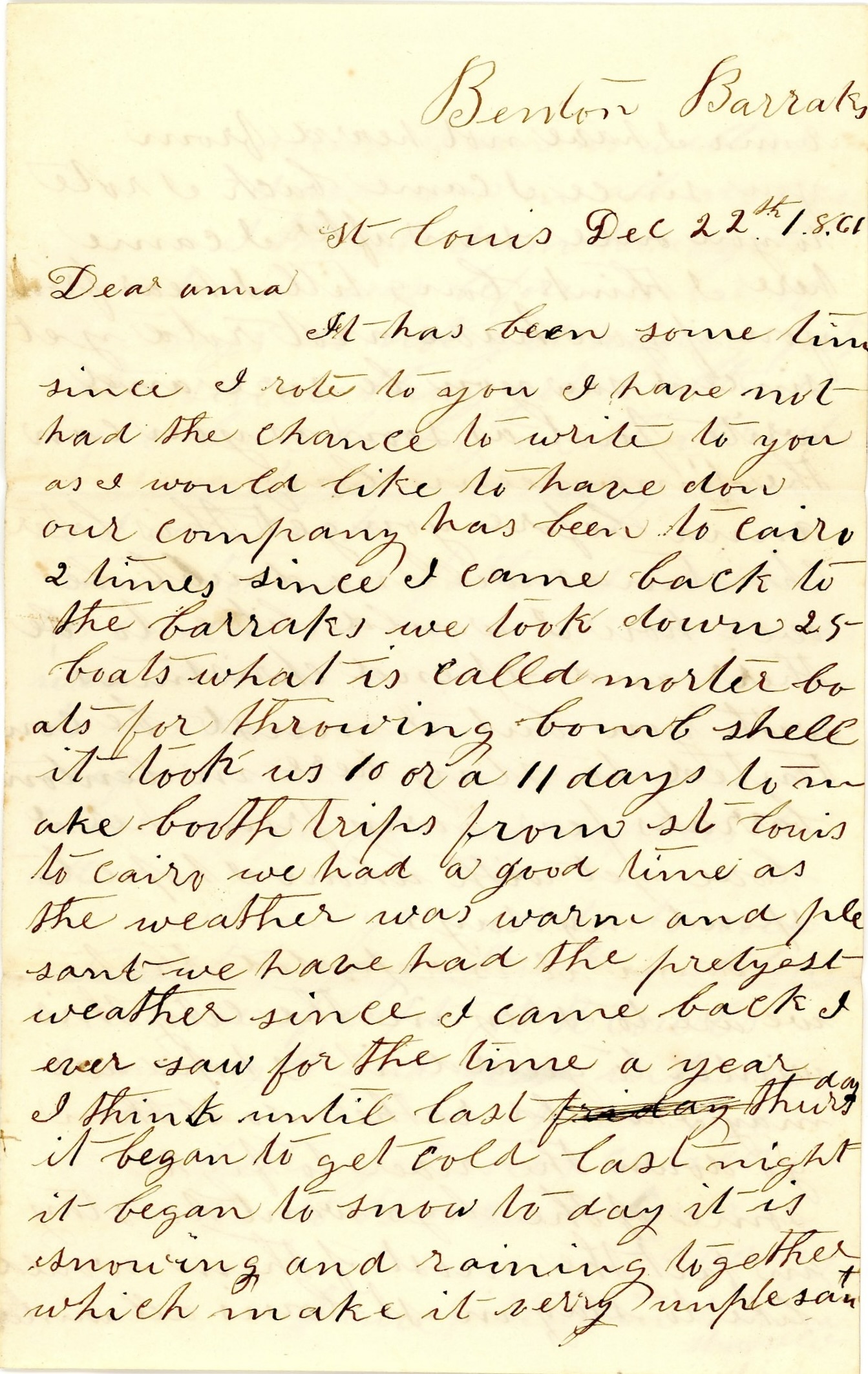
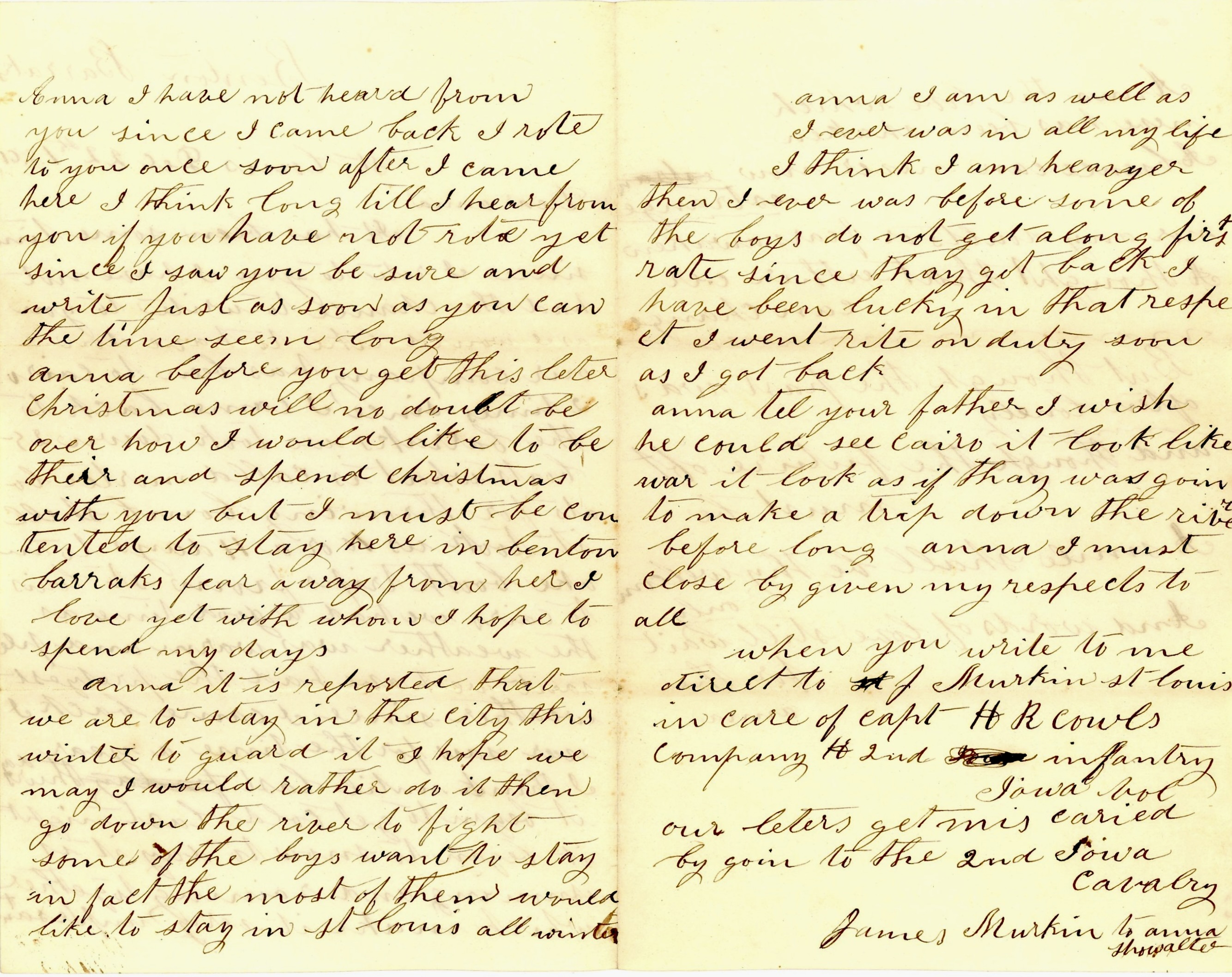
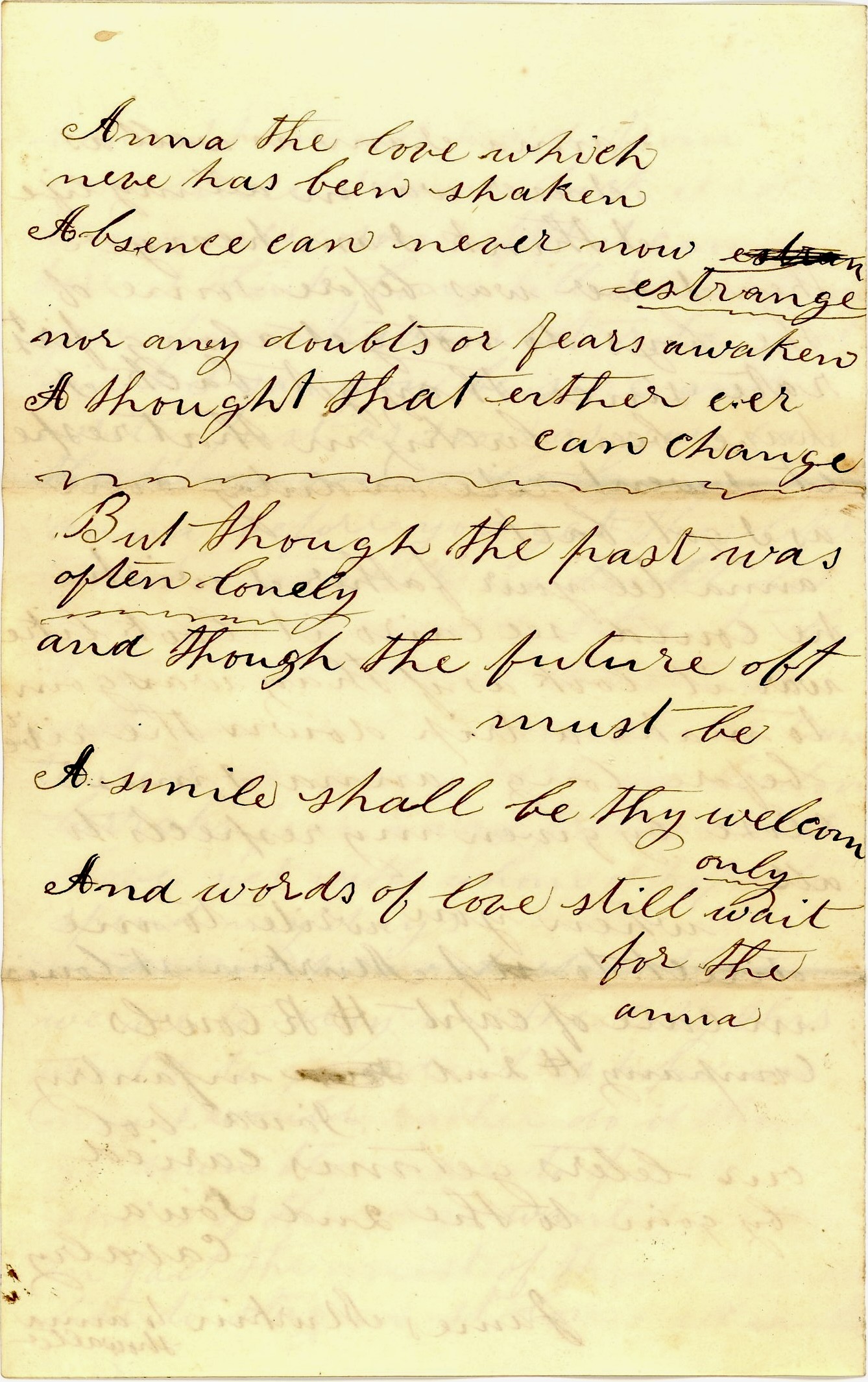
Letter 27
Camp Benton
St. Louis, [Missouri]
December 27, 1861
Dear Anna,
I received your letter yesterday and was glad to peruse its contents and to learn from that you was well and your folks likewise. I can say the same of myself with the exception of a cold I have taken lately.
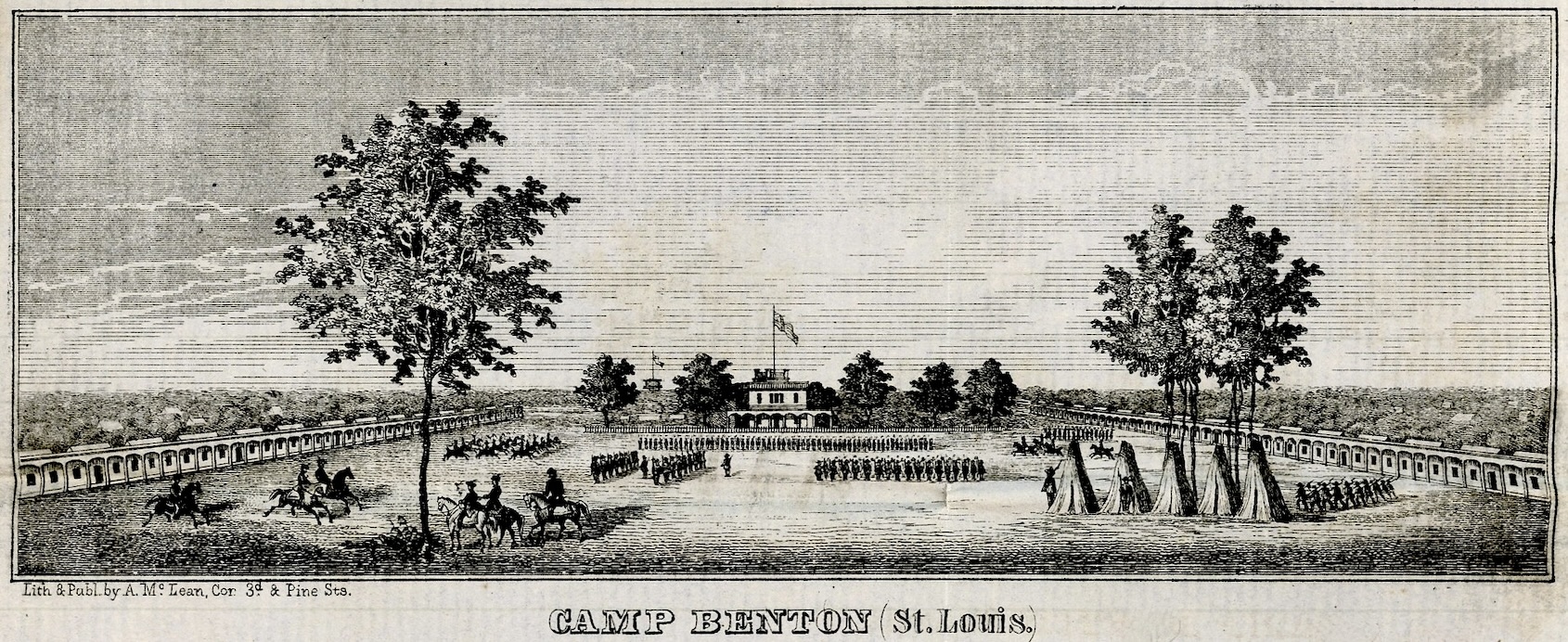
When I last wrote to you, it was at Camp Benton which you can see above. The building in the center is headquarters. You can have a slight idea of the barracks by the drawing above but you cannot tell what it really is by the picture above.
I stated to you in my last that talk was that we was going to town to guard the city. We are moved to St. Louis but not to guard the town. We are guarding the secesh prisoners which was lately taken in Missouri. I think there is about 1300 of them all together. We had to escort them from the cars to the quarters made ready for them where we conducted them without any trouble but I do think they are the hardest looking set of men I most ever saw. They had no uniforms but old blankets and quilts. They was poorly clad. The people of St. Louis turned out in great numbers to see them as we conducted them from the cars. They were very anxious to get to see them but that game is played out now. How long they will stay here, we don’t know but [we] would like to be here all winter.
We have to guard the secesh pretty strong which makes it hard on us this cold weather. We have plenty of cold weather here now. I did not think the weather was as cold in winter here as it is. Last night was very cold. The quarters which we are in belong to a secesh doctor and also the one where the secesh are quartered right opposite to us on the other side of the street. That man that owned the property [Dr. Joseph McDowell] is now in the Southern army as head surgeon. He turned all his property over to his son. He thought by that to hold it but Uncle Sam was the oldest so he of course took it. The building which we are in will hold 2,000 men. It is intended for a boarding house. The one the secesh occupy is the [McDowell] Medical College and the students boarded in the one we are in. The property is supposed to be worth 1,000,000 dollars. That is pretty good for government. 1
One of the prisoners was show a few minutes ago. It was done through accident. He is wounded very bad. It is thought by the doctor that he cannot live. There is nothing of importance going on here at present.
Anna, this was the dullest Christmas to me I have ever seen, I think. I would like to have been at Washington [Iowa], or rather at your home and I think—yes, I know, that I should enjoyed myself better than I could have done anywhere else. I do hope Anna, that it may be our lot to spend next Christmas together. It is true our last visit was short, but I hope when we meet again, t’wil be to part no more. I [think] the troubles will soon cease and we all return safe to our homes. Anna, you must excuse my writing. We have no seats to sit on nor any table to write on. We all have to sleep on the floor but we enjoy ourselves first rate.
I must close for this time, Anna, by giving my love to you and respects to all. — J. Murkin
1 Gratiot Street Prison served as McDowell Medical College before the war. The head of the college, Dr. Joseph McDowell, was well known in the St. Louis community as a doctor. He was also known for his strange behavior and outspoken support for the South. Dr. McDowell acquired two cannons that he kept at his college. He would instruct his students to fire them on holidays. On one such holiday he dressed in a colonial-style three-cornered hat and instructed his students to “make Rome howl.” When the war broke out, McDowell made his way to the Confederacy, taking his cannons with him. As with many known Southern sympathizers his property was taken and became a barracks. Not long after, word came that 2,000 prisoners of war were on their way to St. Louis. A new facility was needed when Myrtle Street Prison became overcrowded. The McDowell Medical College building became Gratiot Street Prison in December 1861. Generally, Gratiot Street Prison served as a holding place for prisoners until they could be transferred to larger facilities. Gratiot was unique because it held not only Confederate prisoners of war, but also Southern sympathizers, political prisoners, mail runners, bridge burners, and even Union deserters. In many cases they were placed in the same rooms together. The prison was closed in 1865, but portions remained standing for many years. Sadly, both Gratiot and Myrtle Street prisons were torn down during a period of urban renewal. Source: Military Prisons, The Civil War in Missouri
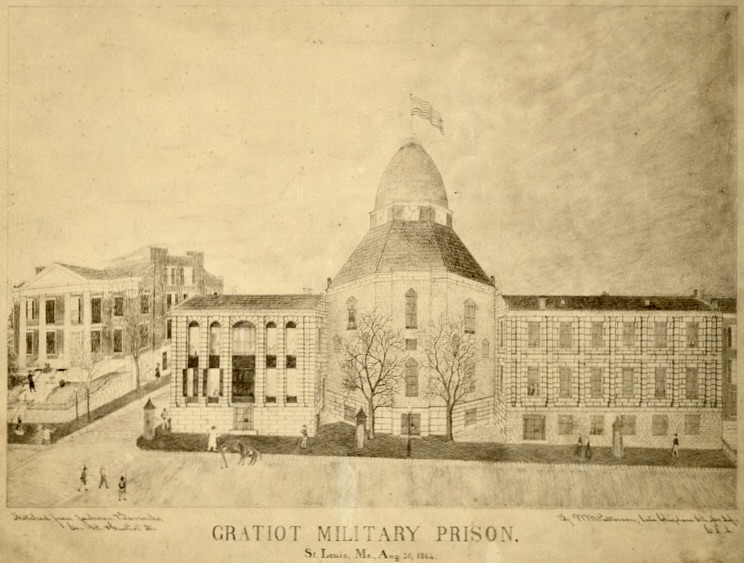
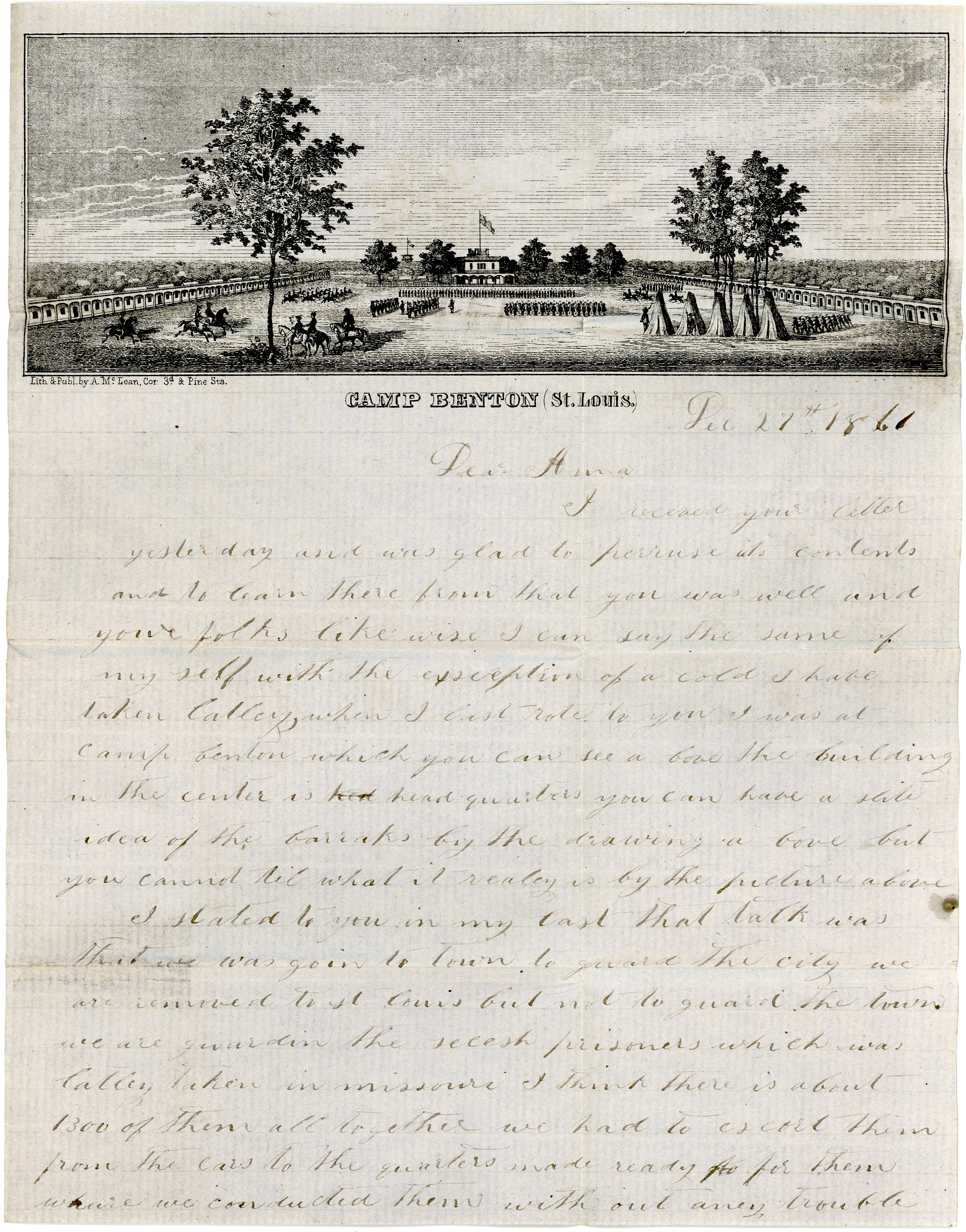
Letter 28
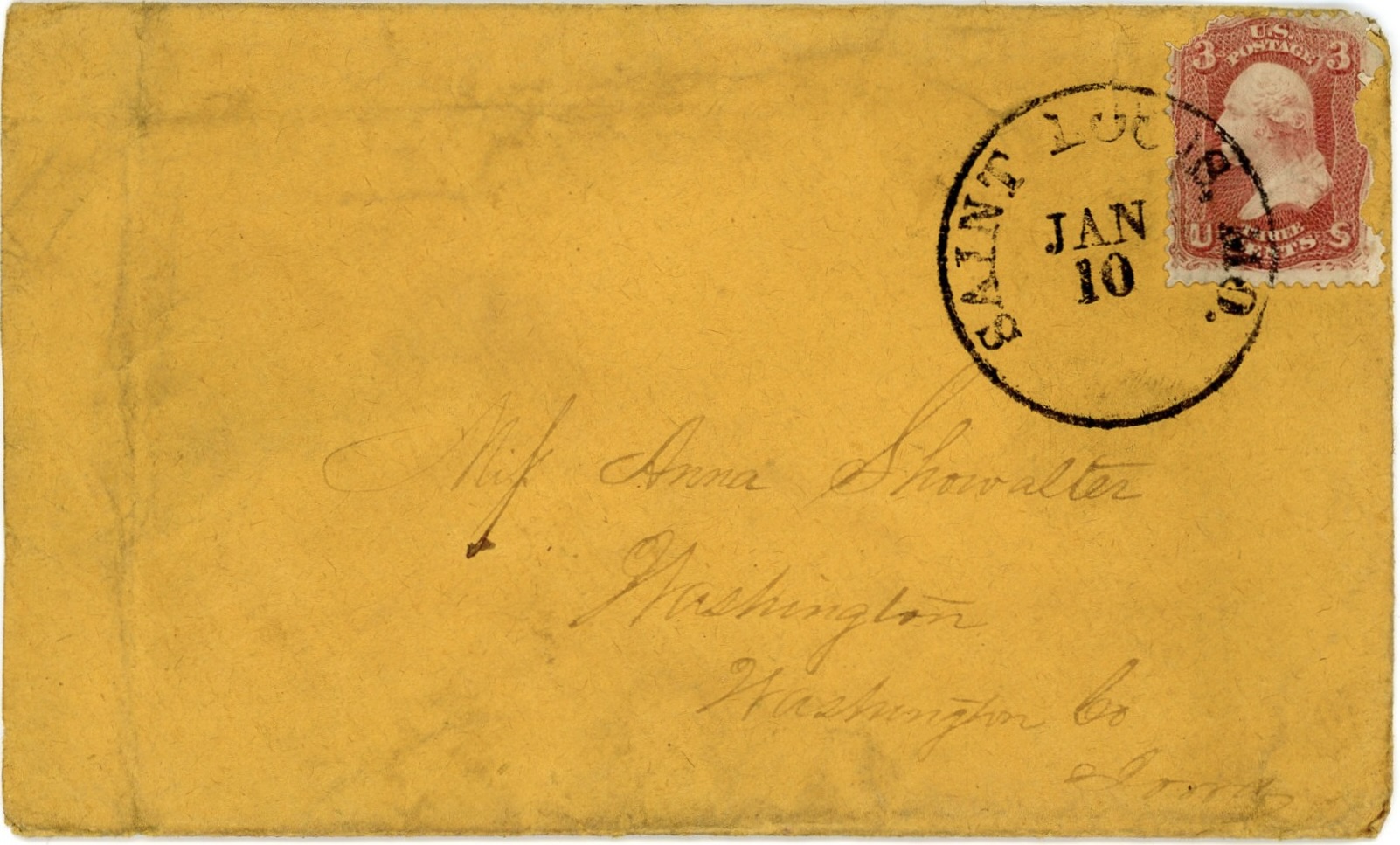
St. Louis, Missouri
January 8, 1862 [should be 1862]
Dear Anna,
Yours of the 31st came to hand and after looking over its contents was sorry to hear that you was sick and was still encouraged to hear that you was getting better and hope when I hear from you again that you will be well. The cold which I had when I wrote to you, I am not well of yet. I have been quite unwell for a few days and have neglected writing to you. I am better this evening than I have been for some time. A great many of our boys have been quite sick with colds. It seems to be general all through the regiment. The weather is very bad here at present—some time rain and some times snow and sometimes freezing which makes the streets all ice and unpleasant to get about.
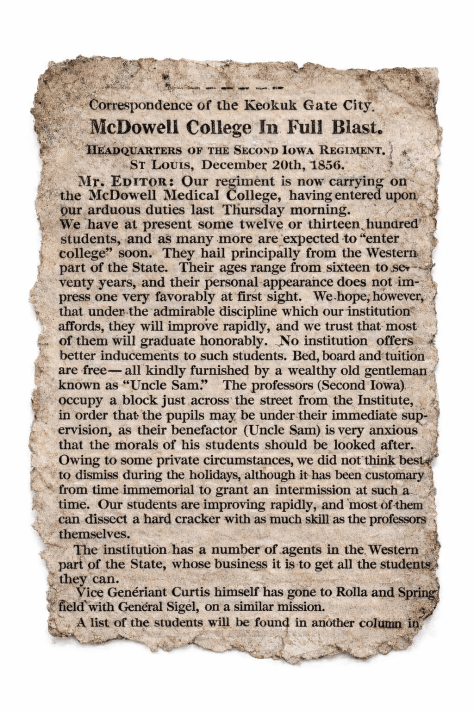
I will send a newspaper with this letter. you will find on the first page a piece written by one of our boys. It is by Shedad. McDowell College is in Full Blast. It is on the outside column on the first page.
Anna, Christmas and New Years passed off very dull. We cannot get to go to town but very seldom. I have not been up to town since Christmas. We are kept pretty close. I guess it is better for sum than if we was allowed to go as we pleased. I have nothing of importance much to write as things at our college seem to be a going on about right. All is still and quiet. We are still having some new students every few days but they enter college very much against their will. We are looking for more every day from the western part of this state.
Anna, I got a letter from my mother the other day. She is well and she received my likeness safe but she thinks it do not look much like me. But it has been a long time since she saw me that I have changed and to see me in a military suit of clothes would make me look [even] more strange yet. She said she wished I was out of the army and peace and harmony once more reigned in this country. Anna, I hope that day will come soon and we all live to return home to greet those we have left at home.
Anna, I must close for this time. My respects to all your folks and love to. Anna, when you write, direct to James Murkin, Co. H, 2nd Infantry Iowa Vols.
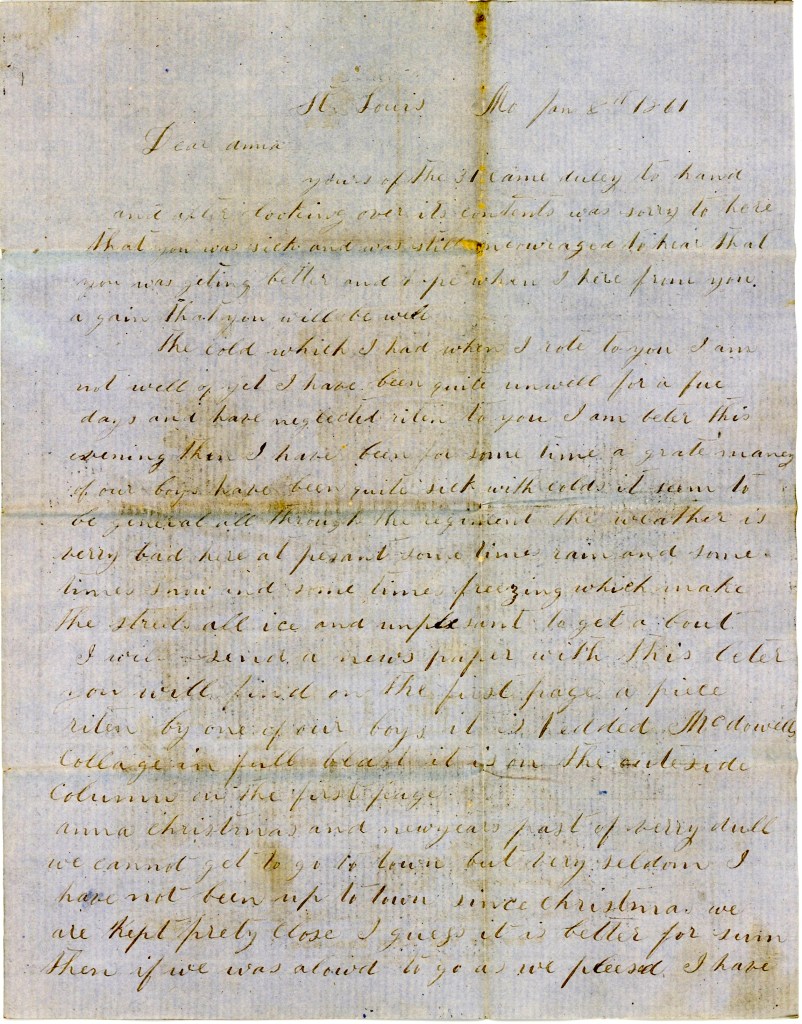
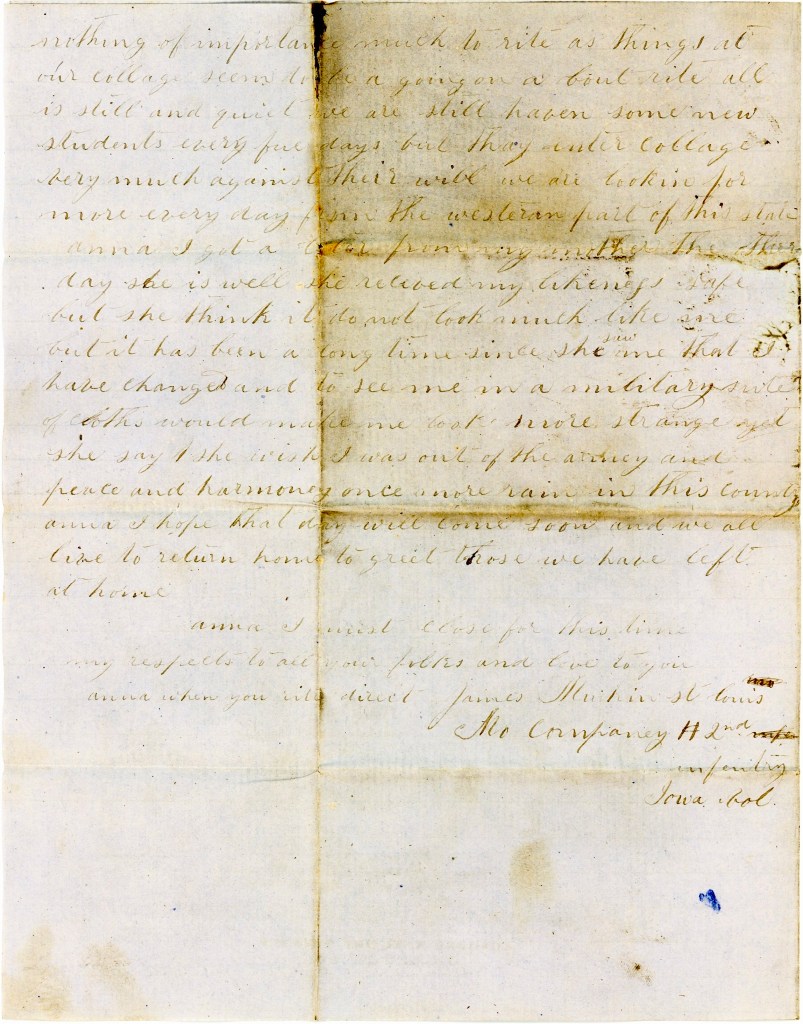
Letter 29
St. Louis, Missouri
January 27th 1862
Dear Anna,
Yours of the 19th came duly to hand yesterday and the contents gladly perused over. I was glad to find your health improved so that you was able to write the good news you did. Anna, I am glad that I can say the same in regard to myself. I am well at this time and enjoying the best of health and trust it may remain good.
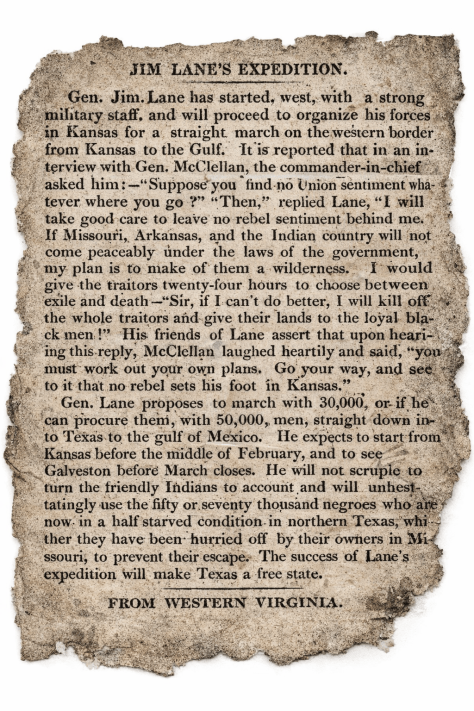
Anna, you say you have heard our regiment was going to leave St. Louis. That may be true but I don not know when. It may be in a few days or a week or two. There is none that know when or where but we expect to go down the river. But I hope we won’t have to lay at Bird’s Point this spring. Heaven keep us from staying there. I would rather go with Jim Lane into Texas than stay at Bird’s Point this spring. I saw a speech today that Jim Lane made in Chicago a few days ago. He says he wants his soldiers to fight and he will take negroes to carry our knapsacks. He says he wants a negro to every soldier. He is to have 34,000 soldiers and will want the same amount of negroes. Jim Lane is the very man for me. I hope he will steal ten times the amount of negroes that I speak of here and take them along to help our soldiers carry their baggage. Some of our boys are opposed to Jim Lane but I think he is the very man to fill the place assigned him and I wish him success.
Anna, I think our time is short in St. Louis but where we will go is unknown or who we will go under is hard to tell. We have not heard of Jim Lane taking our regiment with him yet but we hearrd todsay that our regiment was going to Louisville, Kentucky, when we left here.
Anna, I hope we shall be so we can hear from each other every week at least. If we don’t go with Jim Lane, I think we can. Anna, I wrote a few lines to your father a short time ago and told him how we was getting along with our “students.” There was been 75 prisoners died since they came here and 18 negroes. We have had several died in our regiment lately. They have never been well since last fall. Bird’s Point will long be remembered by a great many parents.
Anna, that paper I sent was directed to your father. I will send one to you when I send this letter. That will be tomorrow morning if all be well. I must go downstairs to roll call now, Anna, and finish this after I return.
28th. I did not finish it last night but will try to this morning. I have put a paper in the office for you this morning. Tell your father I sent one to him—the one I spoke of in my letter to you. Anna, I must close as I have to go on guard this morning. Anna, you need not put such a long direction on my letters. I will write it.
James Murkin, St. Louis, Mo., Company H, 2nd Infantry Iowa Volunteers.
My respects to all your folks and love to yourself. — James Murkin
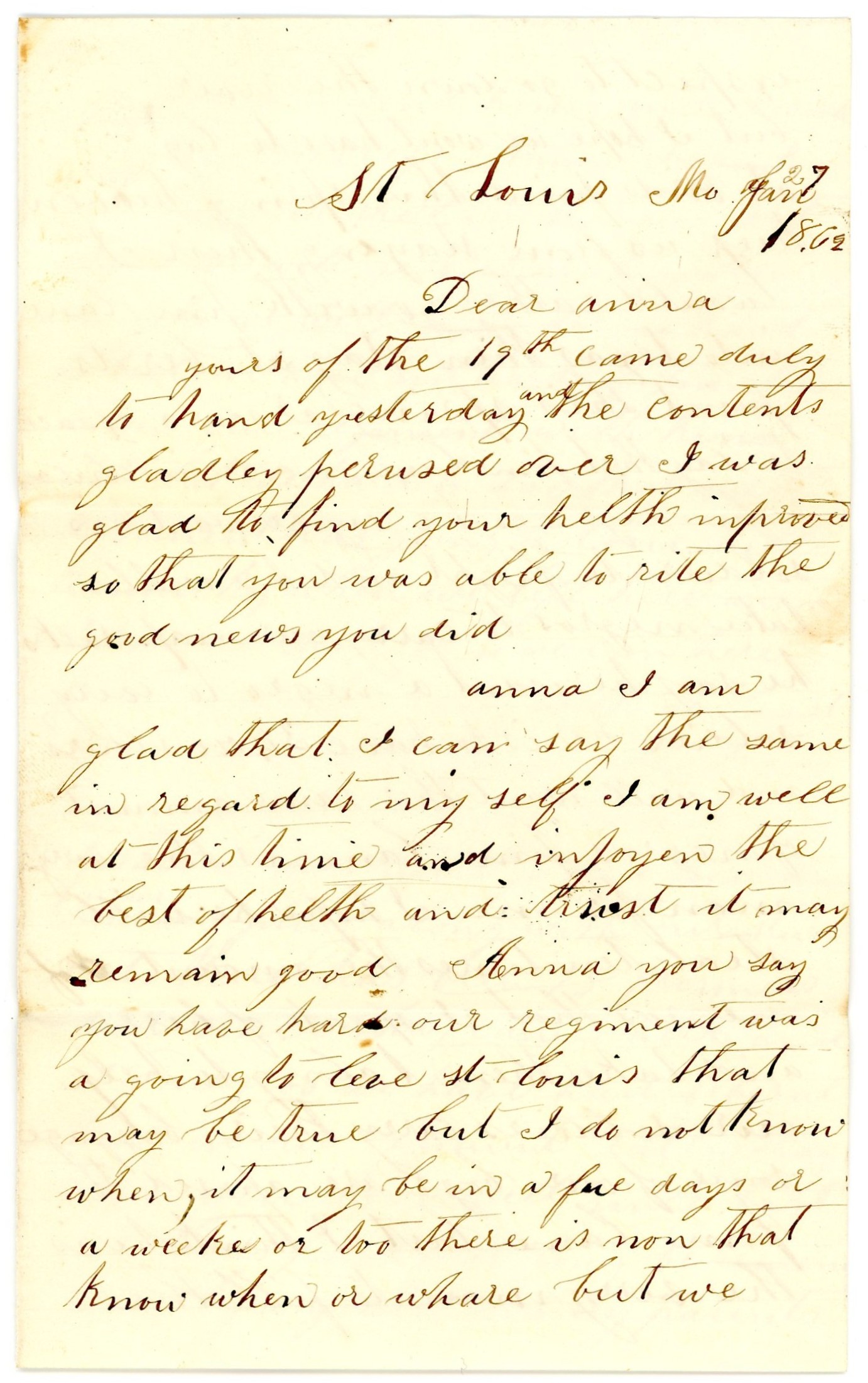
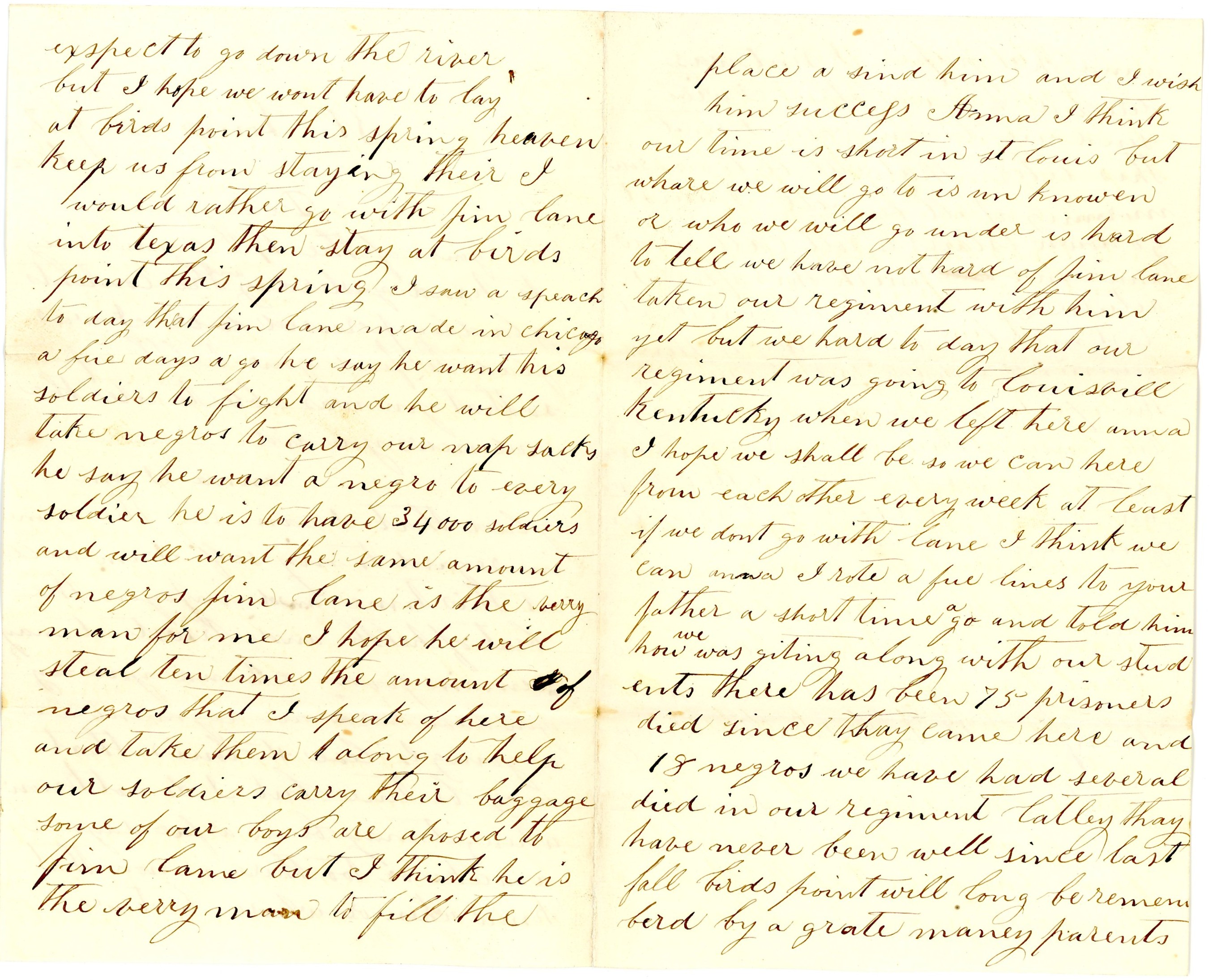
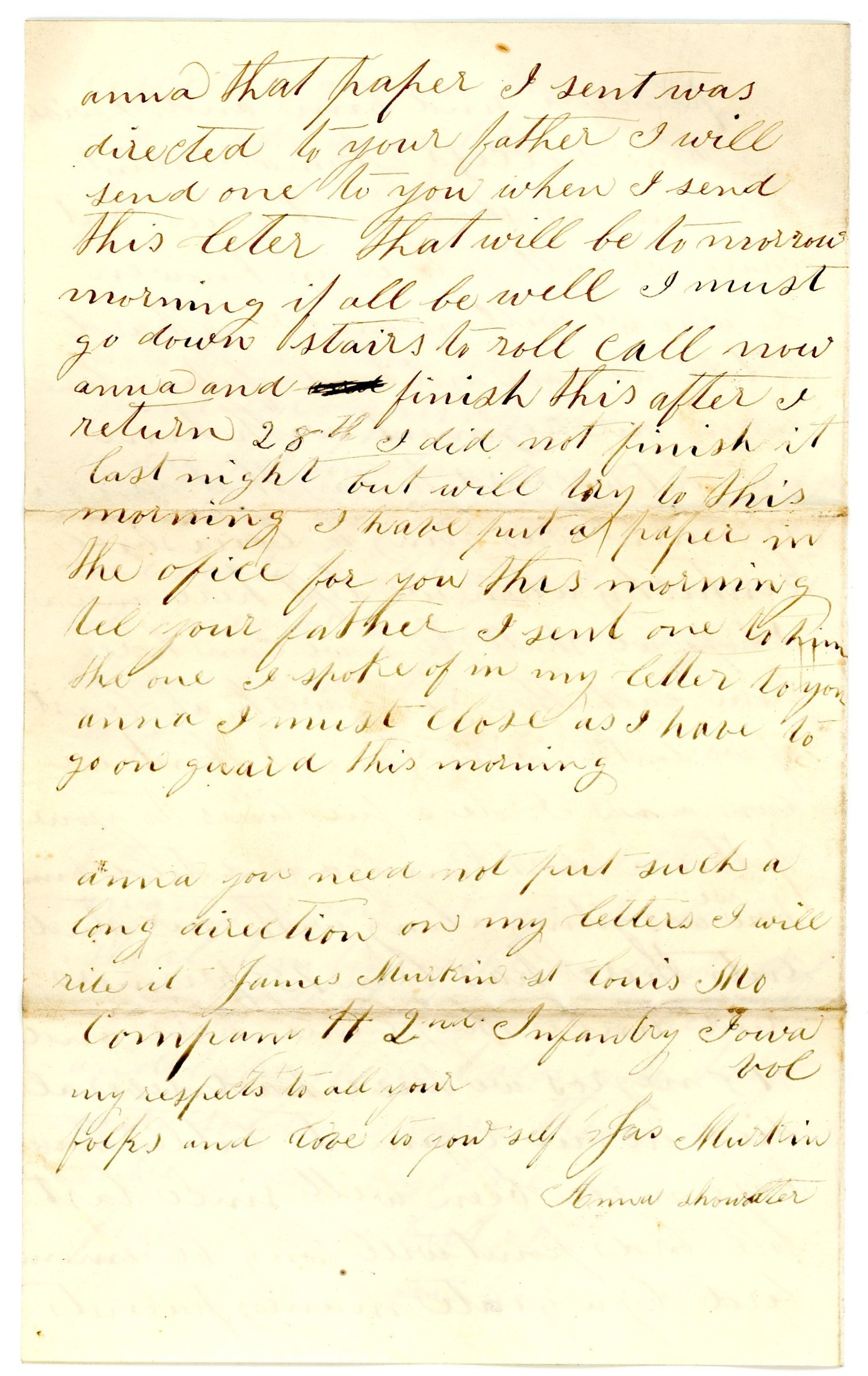
Letter 30
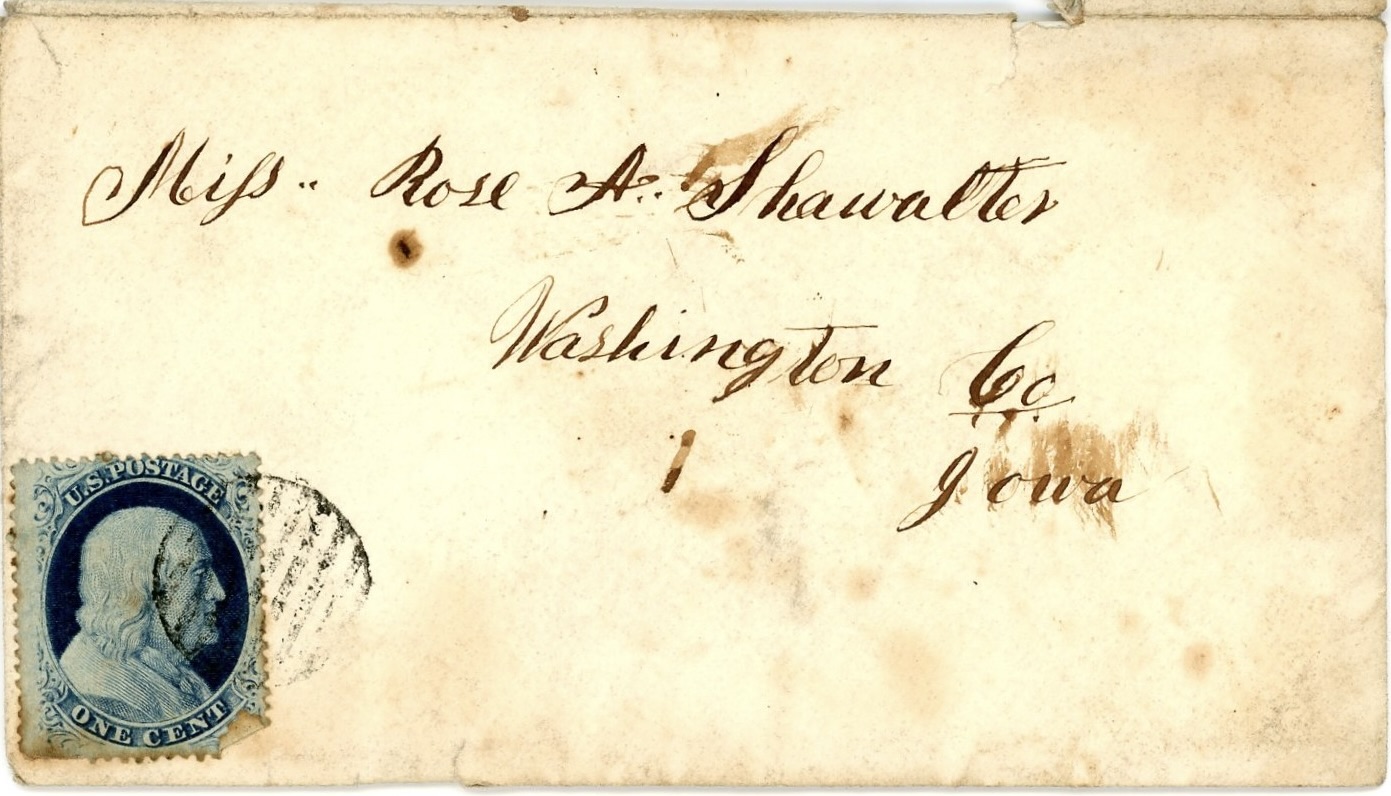
Military Prison
St. Louis, Missouri
February 8th 1862
Dear Anna,
As we are under marching orders and do not know how soon we may have to leave, I have concluded to devote a short time in writing to you as I have a few idle minutes to spend in that way this evening. But how much pleasanter it would be to both of us to be in each other’s company this evening for a few hours. At any rate, it would be to me to be in the society of one of my heart’s desire.
Dear Anna, I am glad that I can write to you that I am well and enjoying the best of health and hope you are enjoying the same blessing. Some of our boys are sick. I think some of them will come home on furlough as they are not able to march. William Creath is coming home on furlough and two or three others. As a general thing, the health of our regiment is good.
I can’t tell you how soon we may start or where we may go to. It’s hard to tell where we may go. When the news came to us yesterday that Fort Henry had given up to our troops after a short fight of little over an hour, our camp was wild with excitement. The flags of our regiment was all put out in token of the victory our troops had gained. The prisoners ran to the doors and windows to find out what the excitement was [and] when they found out, it grieved them to the heart to think they was beaten again by the Union troops. May Heaven grant us victory and preserve our lives in every struggle for our country and its rights. May the rebels be shortly made to acknowledge the United States as one government and place, and harmony restored again, and we be permitted to return to our homes.
Anna, I will send your father a paper tomorrow. It will contain the news of the fight at Fort Henry on the Tennessee River. I would send one today but I can’t get one now. When you write, send me word whether you got the papers or not that I sent to you. Anna, I must close for this time. My love to you and respects to all. Goodbye. – James Murkin
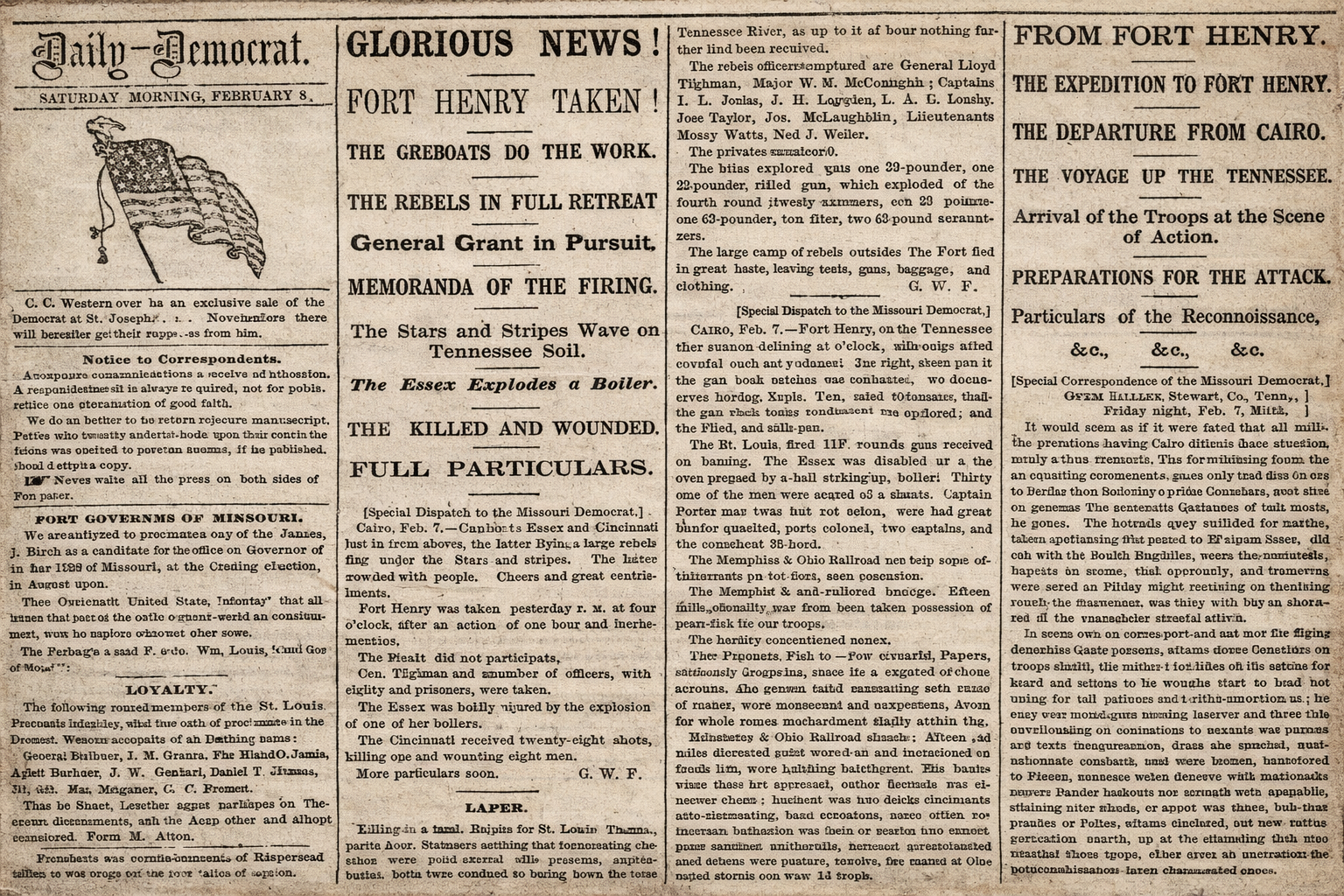
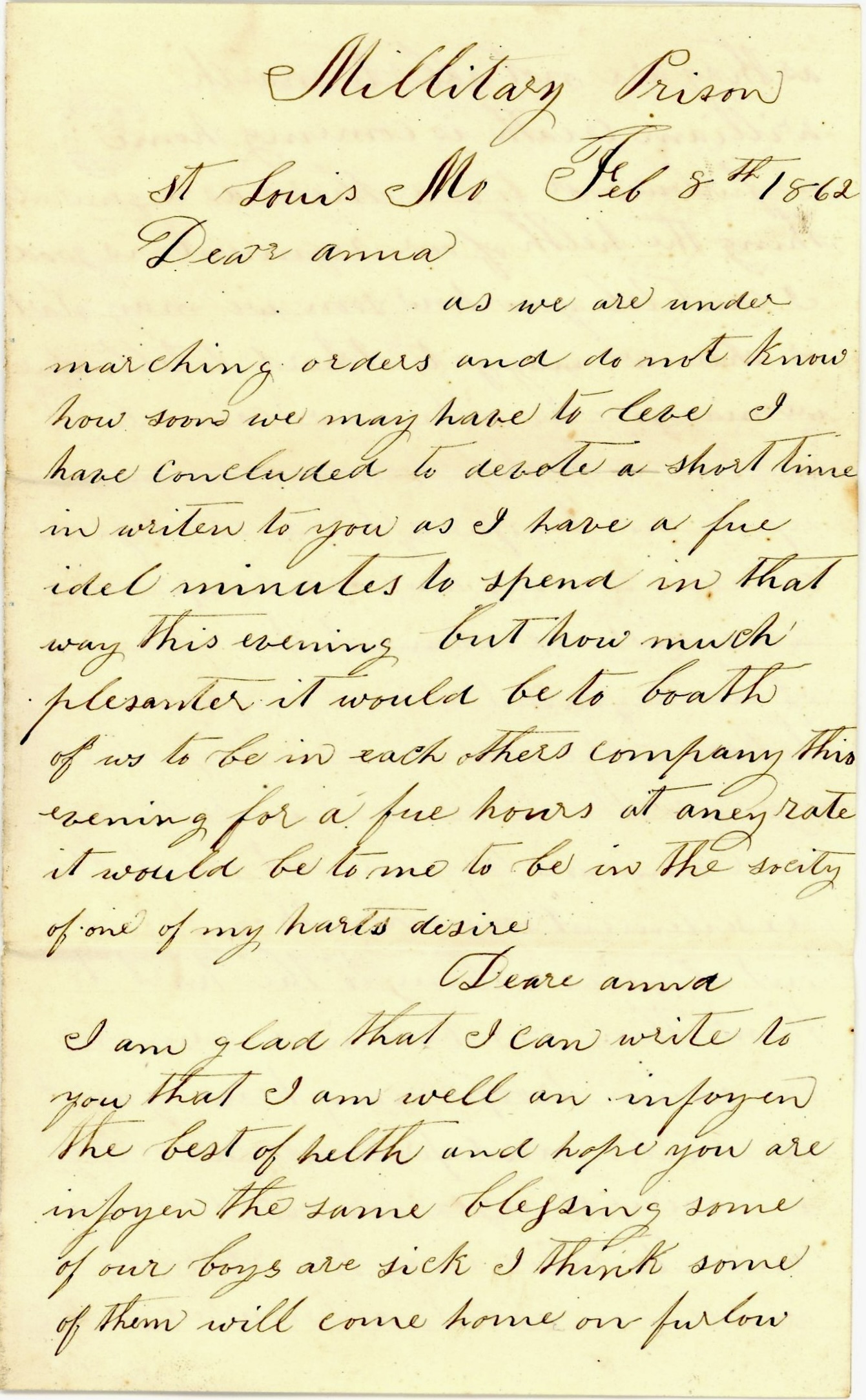
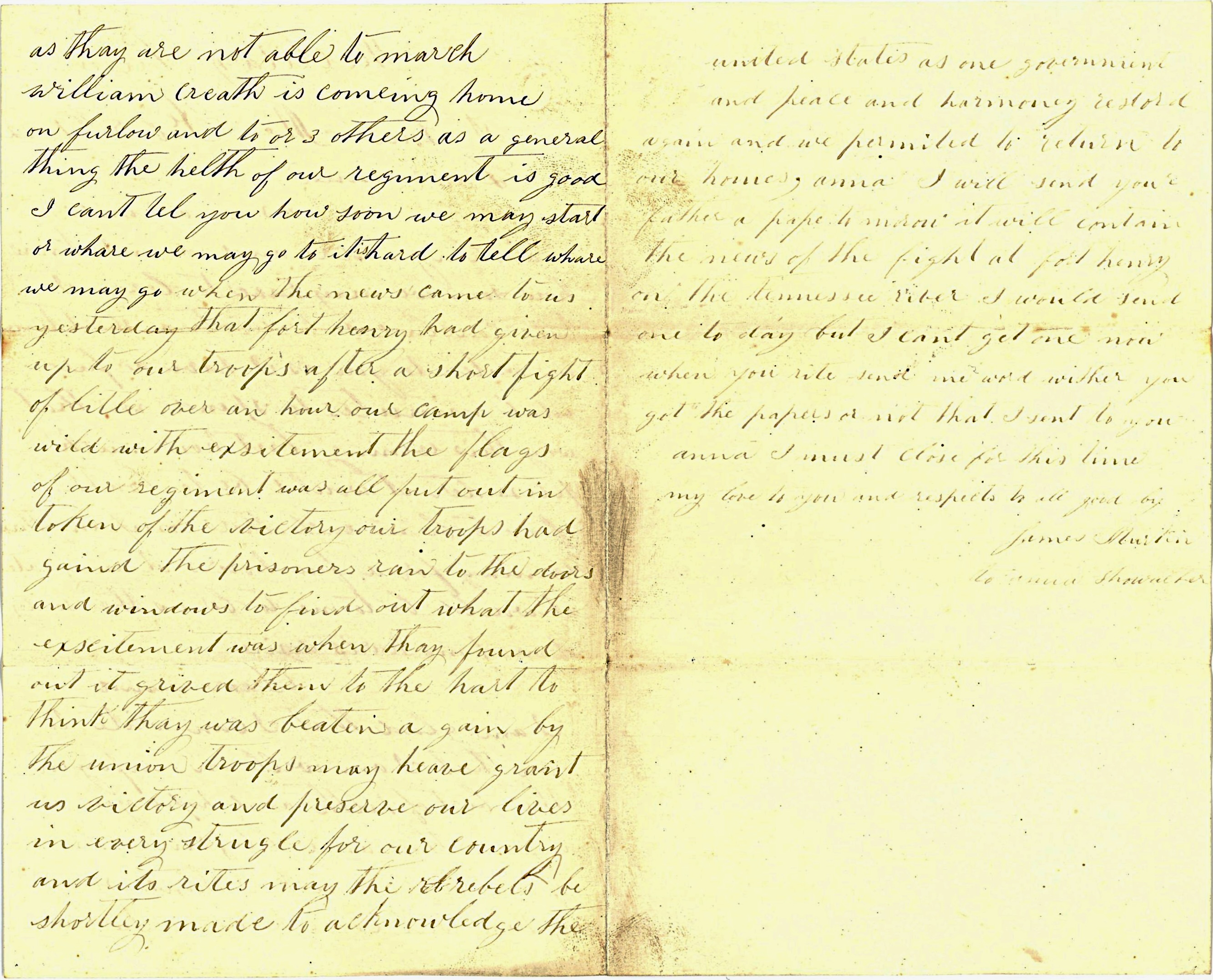
Letter 31
Fort Donelson, Tennessee
February 27th 1862
Dear Anna,
I received your kind missive by G. W. Neal a few minutes ago. After reading over its contents, I was sorry to learn of the cold you had taken and given you a backset. you must take care and be sure not to expose yourself to the cold anymore than you can help till you are able and out of danger. I am glad to learn that you are with Miss Powell. You can sympathize with each other while we are in Fort Donelson in Tennessee. I wish you and Miss Powell could come up here some evening and see us. We are living in log huts the rebels built for their own use. I was never so surprised in my life as I was on Sunday morning after the rebels had given up to us. They say it is about as strong a fortified place as the rebels have in this part of the country. They was a lot of cowards or they would not have given up as they did. Let us have fifty thousand men and all the South can’t take it from us.
I don’t know how long we will stay here but hope our time will be short. We get no news here. We don’t know what is going on. Anna, it is not of much use for me to write to you about the fight. You can see it in the papers better than I can write it in a letter. But I am thankful that I am unhurt and live to write to you.
You say you heard that our regiment left St. Louis in disgrace. We had to march out of St. Louis without music and banner furled up, It was rather hard for us to stand it but we did. But the man that gave the order must keep out of reach of our regiment. Some of the boys has swore vengeance on him. 1
And you say the girls are all getting married round there? Is it to some of the boys who had not courage enough to go and fight for the stars and stripes? They can’t say that of us. We had the courage to scale the enemy’s breastworks and show our bravery in planting the stars and stripes on the top of them.
Our prospect is good for coming home in the spring. I don’t think we will have anymore fighting to do at any rate. I hope not and I will send you a note of scrip such as the rebels use in Tennessee. You must keep it until I come to you.
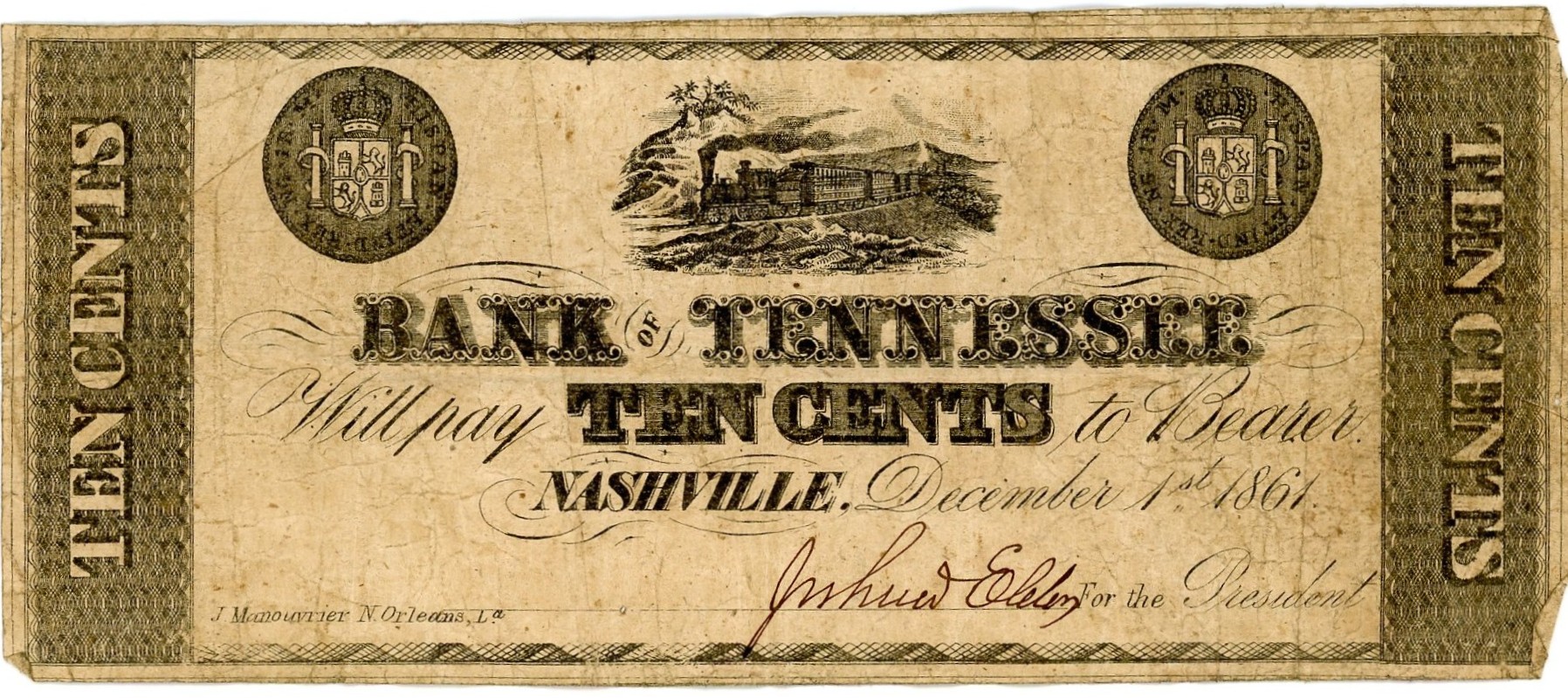
Anna, you must excuse my writing as I have got no ink. Anna, I must close now and go out on dress parade. Give my respects to all your folks. Direct your letters to St. Louis. — J. Murkin
1 It was General Halleck that ordered the 2nd Iowa Infantry to march out of St. Louis in disgrace. It was meant as punishment for some members of the regiment breaking into the McDowell Medical College museum (where they were guarding rebel prisoners) and stealing several items. After the regiment redeemed itself at the Battle of Fort Donelson in mid-February, Halleck praised the regiment, writing, “The 2nd Iowa Infantry proved themselves the bravest of the brave. They had the honor of leading the column which entered Fort Donelson.”
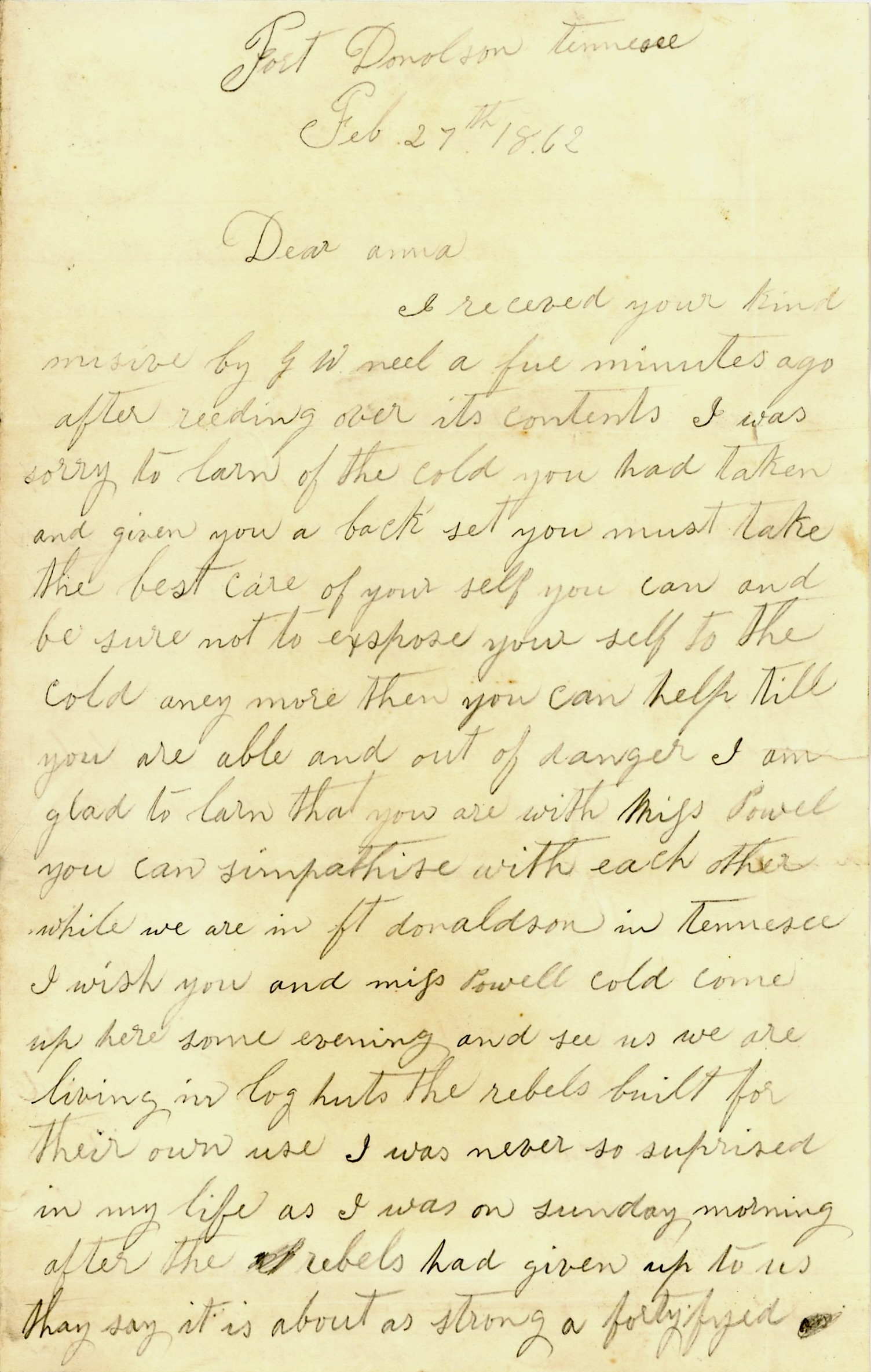
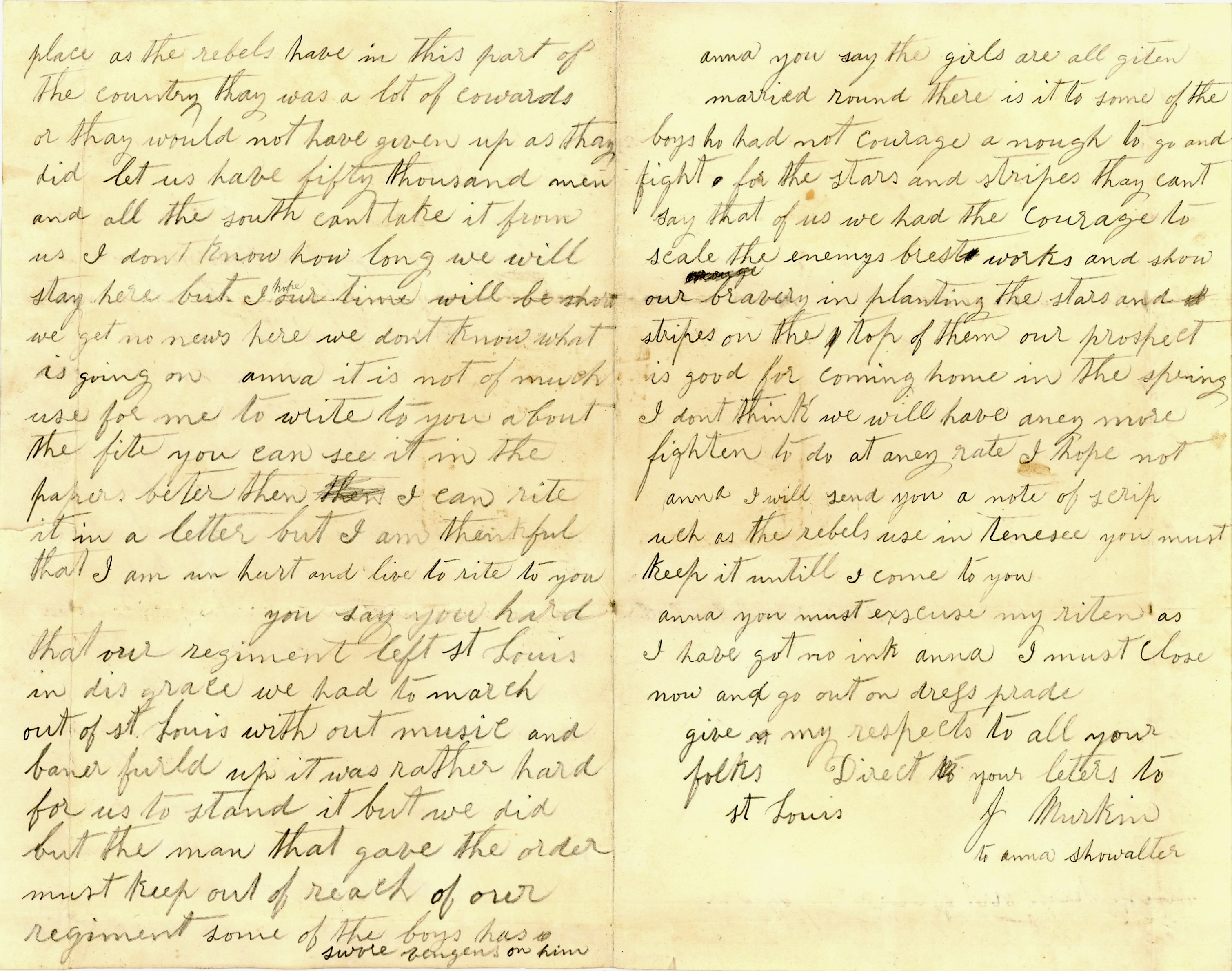
[Editor’s Note: For a more complete description of the Battle of Donelson by a member of the 2nd Iowa Infantry, see the letter published on Spared & Shared in May 2023 written by Aaron Masterson Colliver to Andrew Colliver on 18 February 1862. Aaron served in Co. G. In it he states, “I have never [seen] such a sight. May God grant that mortal man may never see such again. This hill is about four hundred yards long and has had a heavy growth of timber on it which has been felled. Through this mass of brush and logs we forced our way at a front movement while the balls came like hail. This movement was kept up until we climbed over their earthworks without a gun being fired, when we opened fire on the retreating rebels [in the 30th Tennessee] with considerable effect. We were reinforced after engaging the enemy for some time. We fought for about three hours when night came on when we fell back to the breastworks and lay on our arms for the night. The next morning, after considerable sparring about, they surrendered the fort with all their implements of war and some twenty thousand prisoners.”]
Letter 32
[On the banks of the Tennessee River]
March 10th, 1862
Dear Anna,
We are in camp on the banks of the Tennessee river, three miles above Fort Henry. We left Fort Donelson last Thursday, the 6th of March, and marched 15 miles across the country to the Tennessee river where we still are up to the time of my writing these lines to you. We are expecting to go aboard [a transport] every hour. I guess there is not less than 50 or 60 thousand soldiers here within three or four miles at the present time. The talk is we are going to Alabama but we do not know for certain where we are bound to.
I wish you was here to see the number of boats and men here who are ready to [go] on the expedition, wherever it may [go] to. May God grant us success and preserve our lives and grant the time will soon come when peace will be restored and we permitted to return home. I expect, Anna, you will think me slow in writing to you but I have not had the opportunity to do so. You must not think hard [of me] if you do not get to hear from me as [often as] before. I expect we will soon go where it will be difficult to hear from each other for a while. You must write as often as you can and let me know how you are getting along and all your folks.
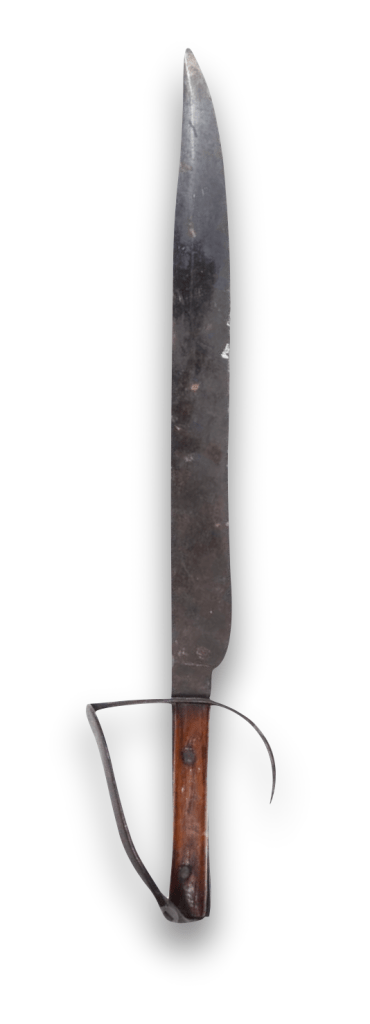
We have heard of a fight at Manassas and heard our troops beat the rebels but we don’t know whether to believe it or not. We seem to be out of the world here in regard to getting news. We get none at all scarcely. But we hope the report is true at any rate.
Anna, tell your father I have got a good butcher knife. The blade is about a foot long. I got it at Fort Donelson. It’s what the rebels call a Mississippi Tiger. A regiment from the State of Mississippi was all armed with them. I want [to] fetch it home if I can. I captured a carpet blanket but had to sell it. I could not carry it. I got a sword and a pistol on the battlefield. I sold all but my knife which I intend to bring home if I can. 1
Anna, I wish I was at your home to eat supper tonight and get some of your light bread. We get none at all now. All hard crackers.
Anna, I will bring this missive to a close by giving my respects to all your folks and hope to see you soon. — J. Murkin
1 The knife described by Murkin may have been carried by a member of the “Tippa Tigers” (Company C) of the 23rd Mississippi Infantry Regiment, many of whom were taken prisoner at Fort Donelson.
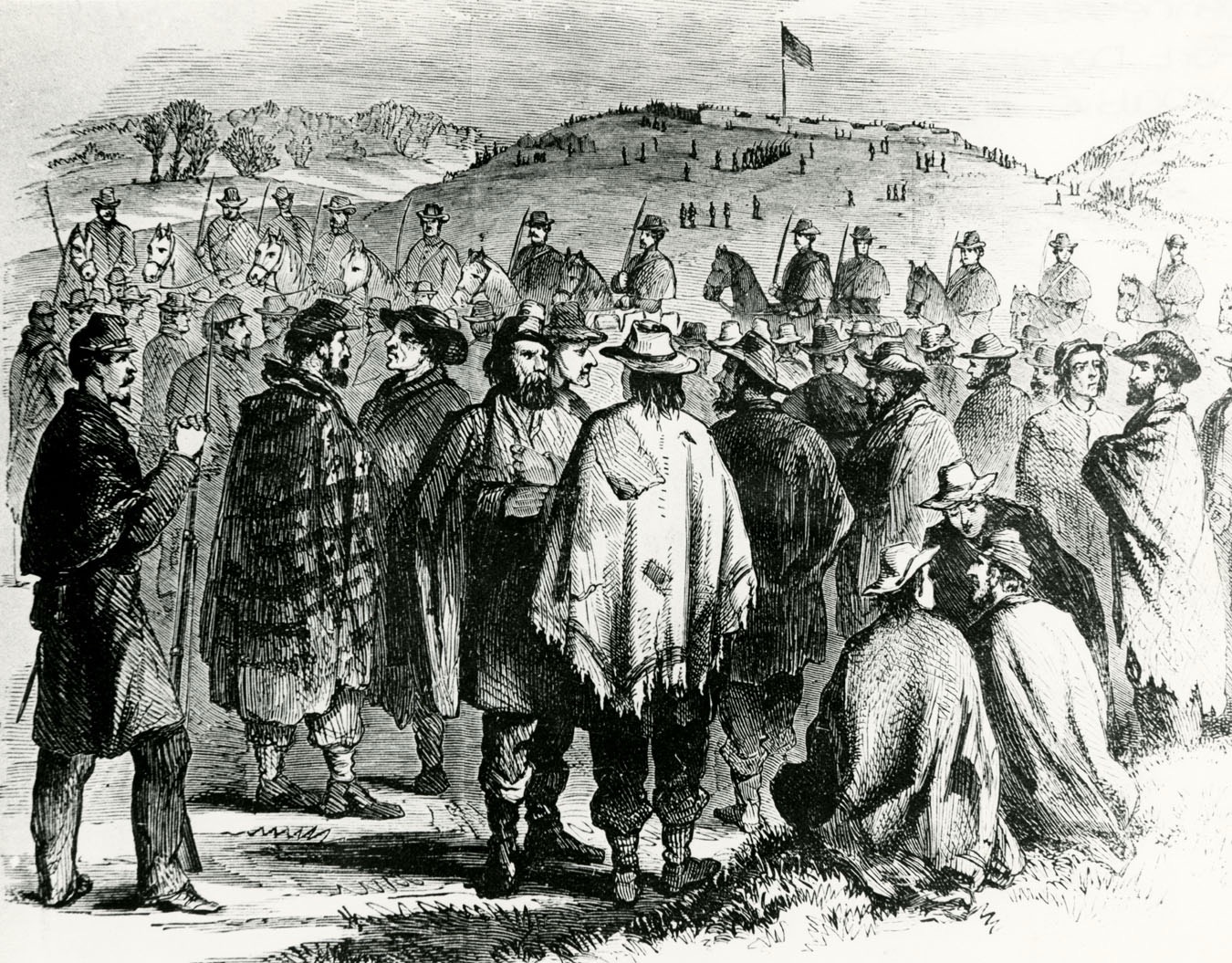
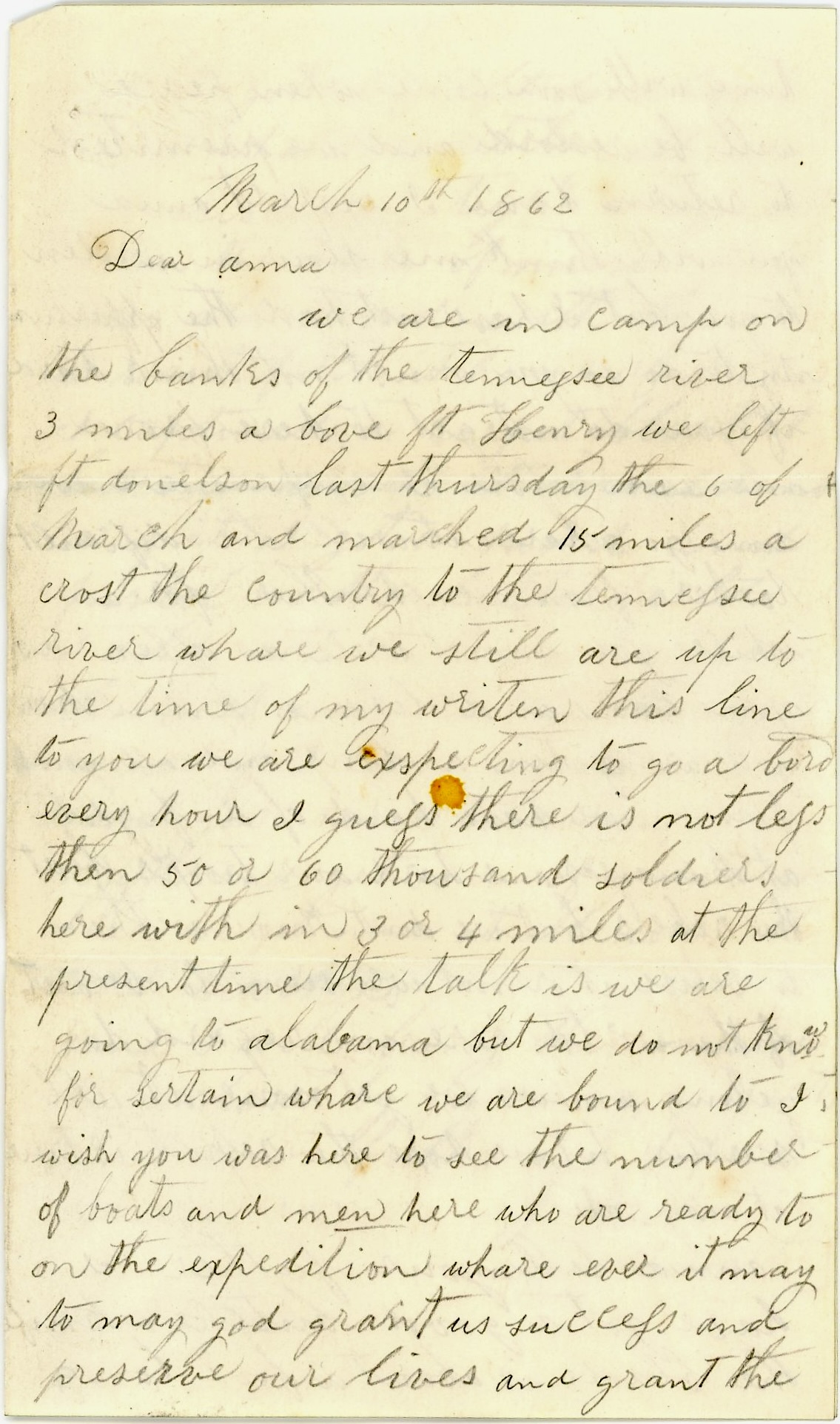
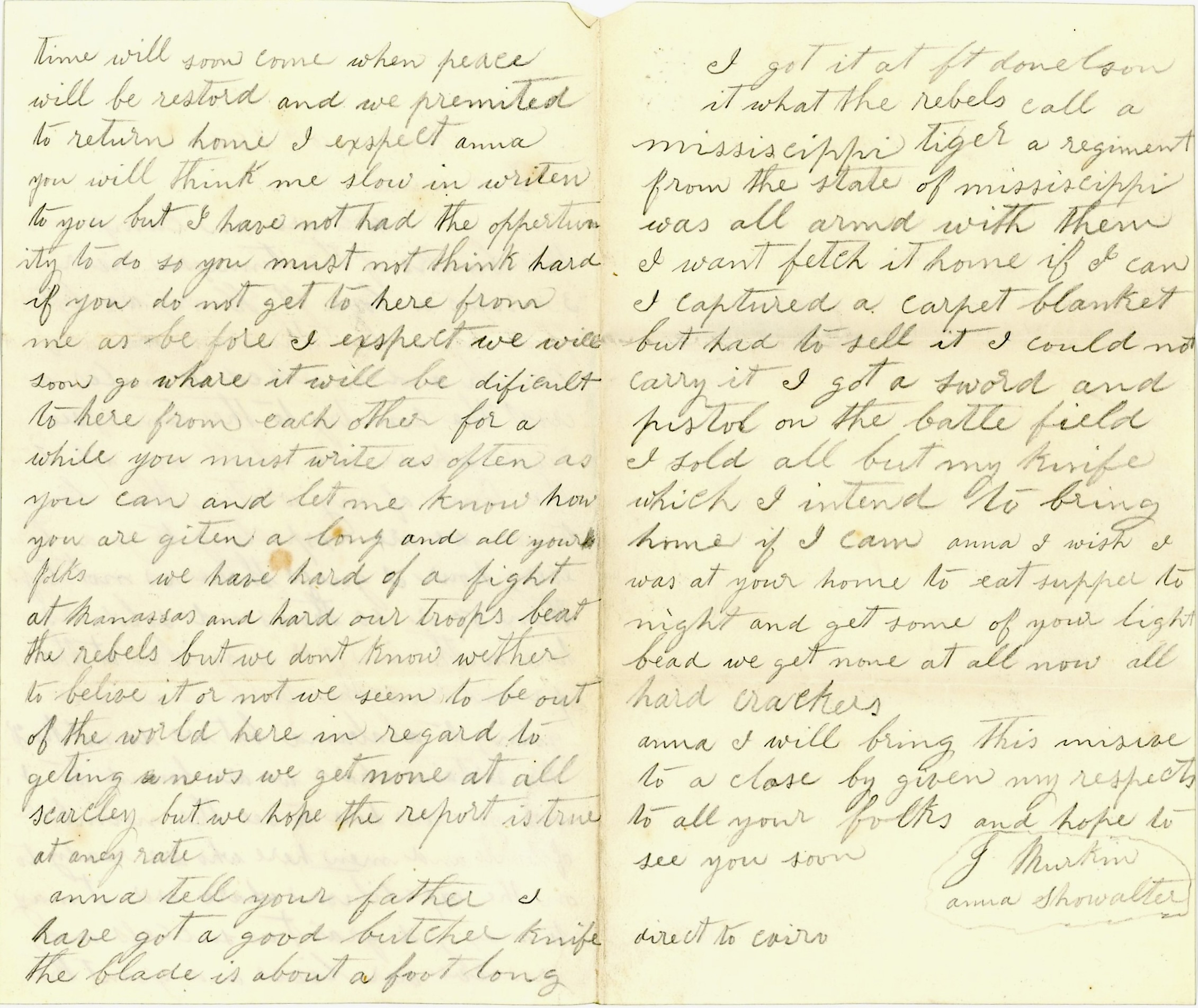
Letter 33
Pittsburg Landing on the Tennessee River
March 23, 1862
Dear Anna,
I supppose you are aware that we have left Fort Donelson which place we left on the 6th of March and came to this river. We are camped about a mile back from the river [in] a very nice place but I am afraid our stay will be shorter here. We can guess at it and that is about all we know. The rebels had commenced to fortify this place [but] our gunboats came up and shelled them out, killing 80 of them and the rest fled for parts unknown. But the graves tell the sad tale of the deed. No pen can describe the horrors of a battlefield.
I could not tell how many soldiers we have here at this time but there has been 100 boats up this river loaded with troops and some of them have made two trips. That was before we left the boat. We have been in camp here three days and they are still coming. It is the greatest sight I most ever saw.
We laid on the boat 9 days. We was so crowded that it was very unpleasant to all on board. We are about 10 miles from Alabama and about the same from the State of Mississippi so you will see we are getting pretty well down south. Spring is coming on quite fast here. The peach trees has been out in bloom several days and other small flowers likewise. This may be a good country but I have not seen a good location on the river yet. I expect we will [need] to see the country more yet before we get through, but I would be willing to see all things settled and we return home.
It is ten months today since we left Washington [Iowa]. I hope two more will bring us all safe home again. We have four boys of our company who are getting discharged on account of disability. They are from the country. I shall send this by one of them to Washington if I can or by one of the 7th [Iowa] boys. We get no mail at all now nor news of any kind. I have not heard from you since you sent with Miss Powell. The time seems long to me. We heard a short time ago our letters would not go any further than Cairo so we did[n’t] care about writing much. I expect it will be out of the question for us to send letters much longer if we have to march again so you must not think hard of it. Some say we are a going to Memphis but no one knows so I will not attempt to say. But I hope we will show to the Southern people that we are not what they say we are—a lot of thieves and robbers come to steal negroes and destroy their homes and property, but that we come to restore peace and put down rebellion. May God speed us in all our undertakings to bring these troubles to a close.
Anna, it is getting late and I must close. Give my respects to your father and mother and all the rest of the family, yourself included, Anna. — Jas. Murkin
May the heavens be our guide till we shall meet again. Direct to Cairo.
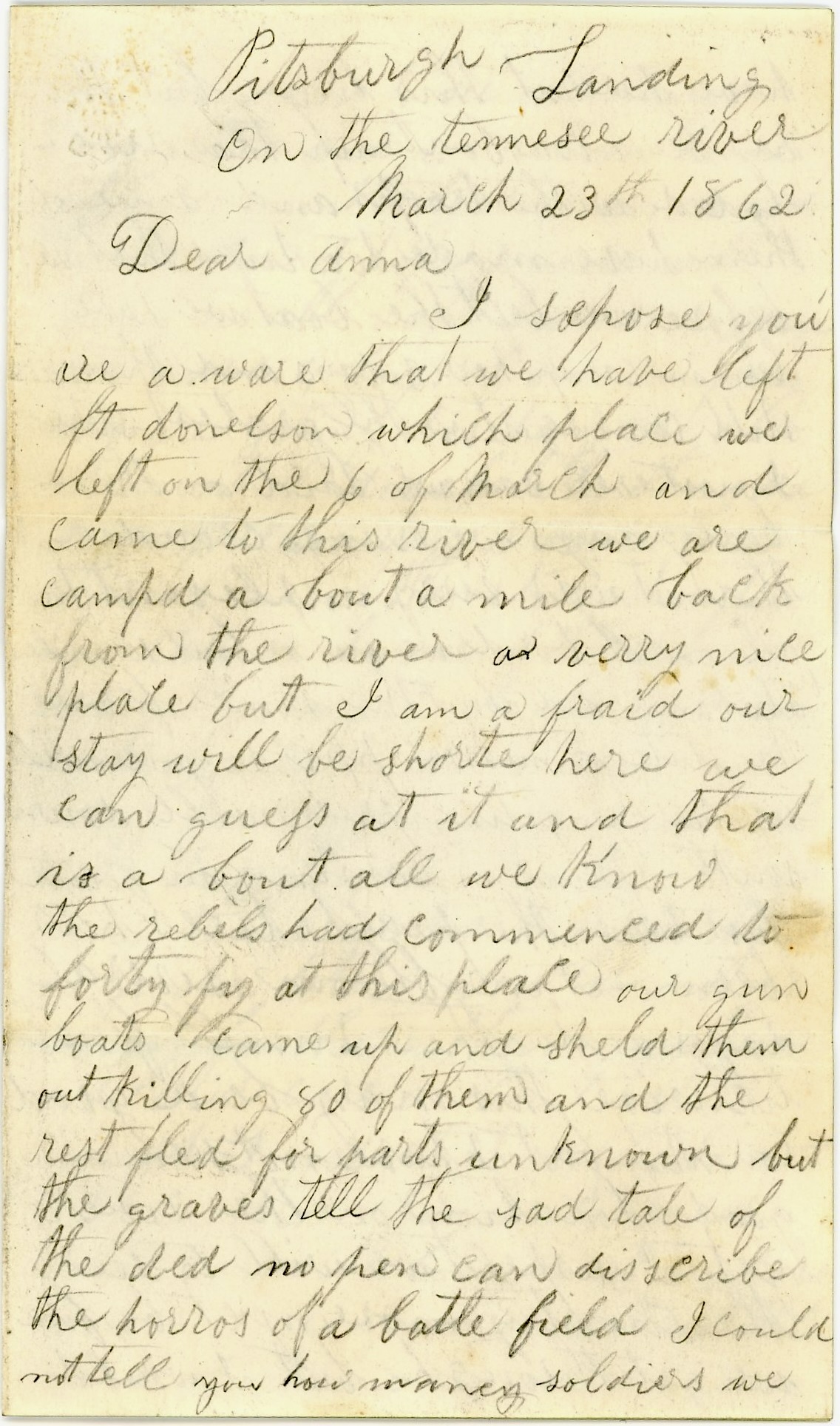
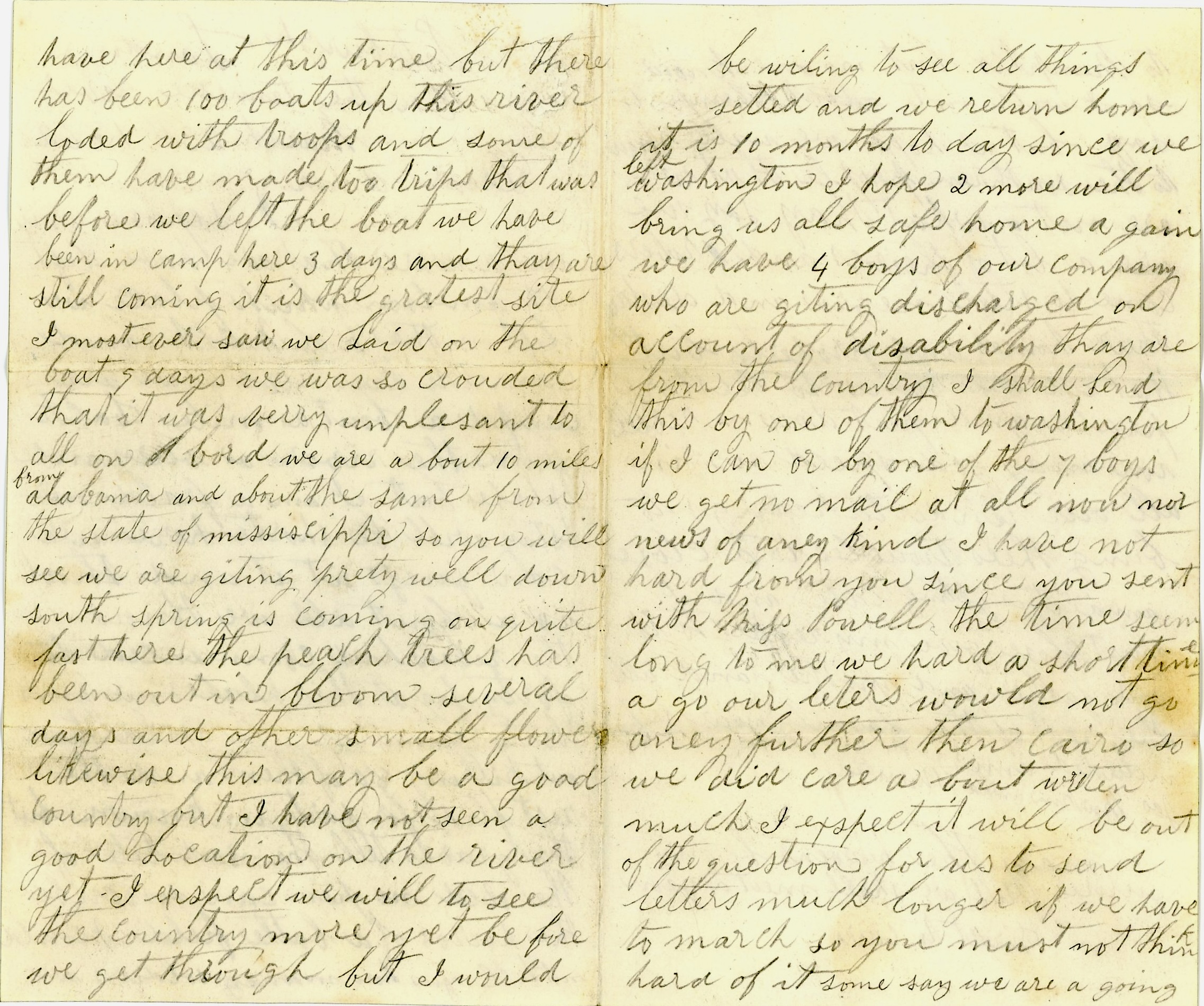
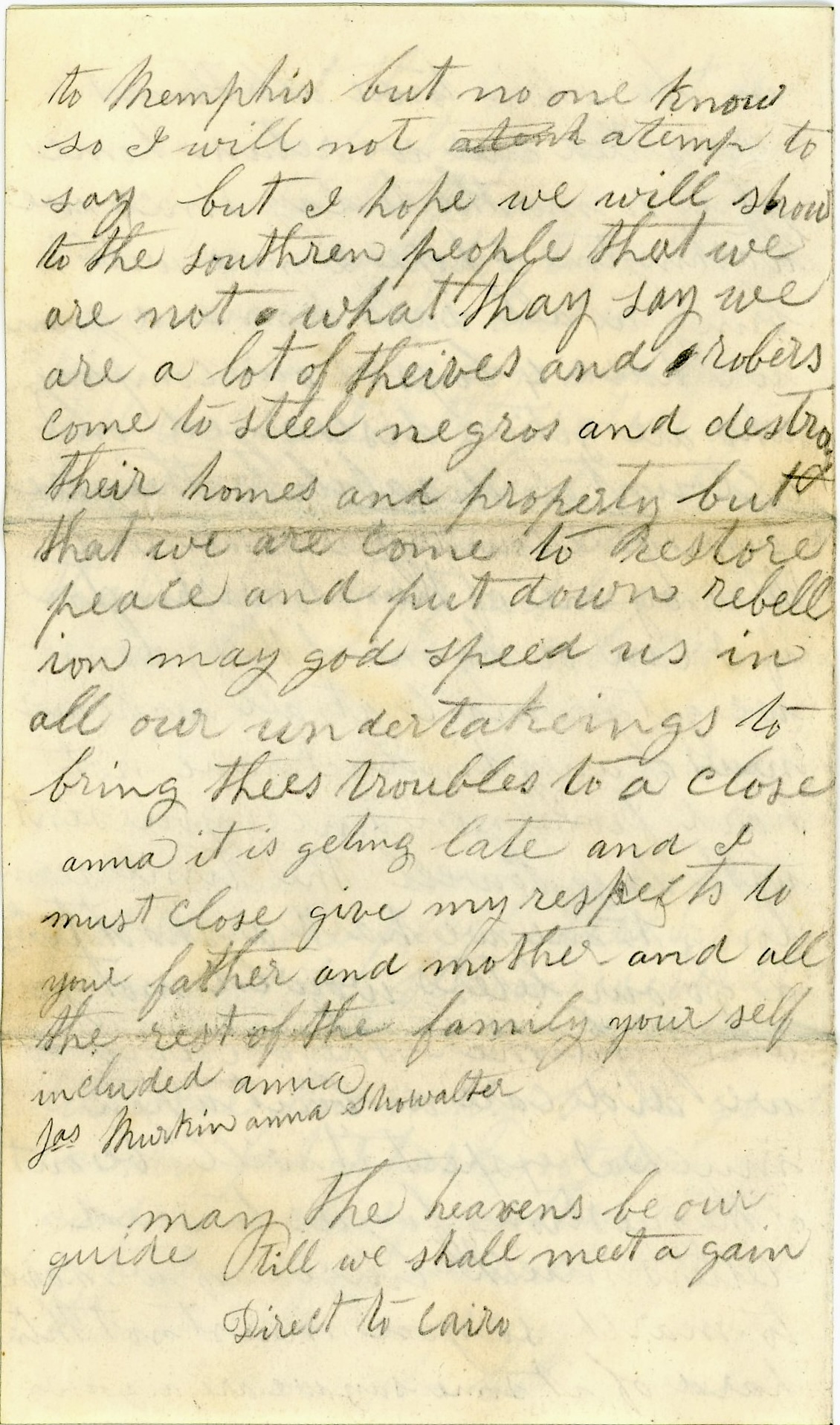
Letter 34
Pittsburg Landing, Tennessee
April 6th 1862
Dear Anna,
I guess you will think that I have entirely forgotten you but such is not the case. But owing to a report which has been in circulation here that our letters would not go any further than Cairo until this expedition moved on further—but a great many of us are inclined to think it false. Be that as it may, I guess I can send it by a man of our company as we have five men getting their discharge and will start for home in a day or so.
Anna, the last time I heard from you the news was not very gratifying to me to hear that your health was so poor. But I trust these few lines will find you perfectly restored to health as that is the greatest blessing we enjoy in this life. I am happy to say that my health is good at the present time and trust it will continue.
The 7th Iowa is camped close to us but we did not hear them make noise at all. The 7th and the 2nd [Iowa] have seen the elephant, as they term it, and are perfectly satisfied and will be contented to see it no more. Most all of the Iowa troops are here with the exception of three or four regiments. The 4th and 5th and 9th and 10th Regiments are not here yet. Whether they are coming or not, we don’t know. time alone can tell.
April the 9th.
Since writing the above we have had one of the bloodiest battles ever fought on this continent. I commenced to write this letter on Saturday evening and intended to finish it on Sunday and send it by our boys that was coming home, but was disappointed. I had just commenced to write on Sabbath morning as the long roll beat for us to fall in line which was quickly obeyed. The rebels has attacked us in earnest on our out[er] lines and got into our camp while some of the boys was eating breakfast so they had not much time to do anything at all. The sutler of the 6th Iowa Regiment lost a thousand dollars in cash. He had not time to get it out of his trunk so you see they was close on us before we had time to do anything.
The fight lasted all day on Sunday until dark. We lost ground all day. Such a night as Sunday night I never want to see again after such hard fighting all day. [We] had to stay in line of battle all night in a drenching rain ready for the rebels at daylight. If we had not been reinforced by General Buell, they would have beat us, I believe, complete. It is no use for me to try to describe the battle to you. I can’t do it. we thought Fort Donelson was a bloody battle but it is not to be compared with this.
Since the Battle of Fort Donelson, 14 of our company have left us, four have died, and the balance discharged on account of not being able to do military duty. [Samuel A.] Mealley died on the battlefield [at Fort Donelson]. Weber [?] died from the effect of having his thigh broken and after taking [it] off. He died going to Cairo. We have had two died since we came here. One died on the 30th of March after a short illness. His name was John [R.] Fullerton. He came from Crawfordsville. He joined our company at St. Louis just before we left. The other was our drummer by the name of [Samuel M] Eicher from Dutch Creek. He died on the 1st of April after a short illness of four or five days. So you can see that our company is going down fast. I hope we that are left will all live to come home together.
The health of our company is good at present. I think this is a healthy place where we are at now. we are camped about a mile back from the Tennessee river in the woods, or rather in a field—a very pleasant place. The trees are coming out in full leaf and the flowers begin to deck the ground, all indicating that spring is at hand. I have not seen any very pleasant looking places since we came into Tennessee. we have not seen much of the country, only as we came up the river. But I should think from appearance of the country round here that there some very pleasant places to live on further back in the country. I guess before this missive reaches you, we will see more of the country than we have any desire to see.
I suppose you have heard of the place where the rebels are making a stand. The name of it is Corinth. It is about 20 miles from here and been strongly fortified by the rebels. Our pickets had a little skirmish on the 4th of this month. we took 30 or 40 prisoners. It made quite an excitement in camp. we was ordered to be ready at a moment’s warning with two days provisions. Our regiment was kept very still while other regiments shouted and hoped to think they was a going to see the elephant.
Monday morning came and just after daylight the battle was raging again. The roar of the cannon and musketry was dreadful. The rebels out numbered us on Sunday and drove us from our ground, but we made up with them on Monday in number.
We made the attack on Monday morning and in earnest too and the rebels knew it to and began to give way and fall back, we still following them up. Sometimes we had to fall back a little to gain a better position [but] we continued to gain on them all day. They disputed every inch of ground and fought like tigers to the last until about four o’clock in the afternoon on Monday [when] they began to run for dear life and the Yankees—as htey call us—after them. We have not heard the result yet. Some of General Buell’s force went after them. We heard last night we had taken ten thousand prisoners and captured all their artillery and baggage wagons. I hope it is true. They took a great many of our men prisoners. On Monday our regiment came very near being taken. We was very near surrounded but just made good our escape. We took and [were] held in reserve in case we had been needed but came in to quarters again at night and slept in our tents. Lucky for us for it rained and thundered all night so it was lucky for to get back to camp as we did. Today we have been in quarters and not allowed to leave.
Anna, do you write as often as you can? Direct to Cairo. Give my respects to your father and mother and the rest of the folks. Tell Franklin if it was not so far, I would bring him a secesh rifle, but I could not do it now. They search everything that is boxed up to send. I hope this is the death blow to secesh and that we will soon be at home. write soon. Yours as ever till death, — James Murkin
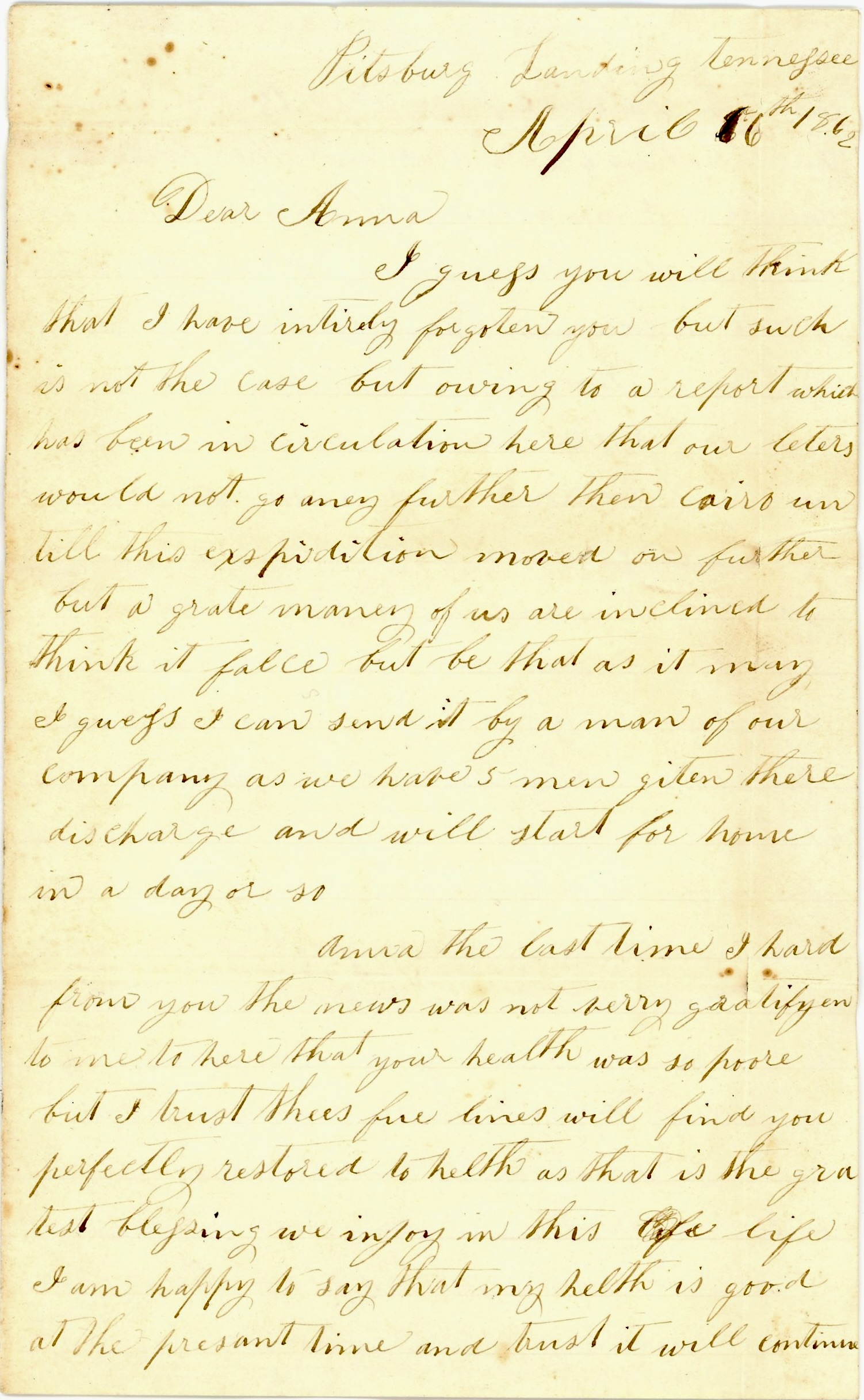
Letter 35
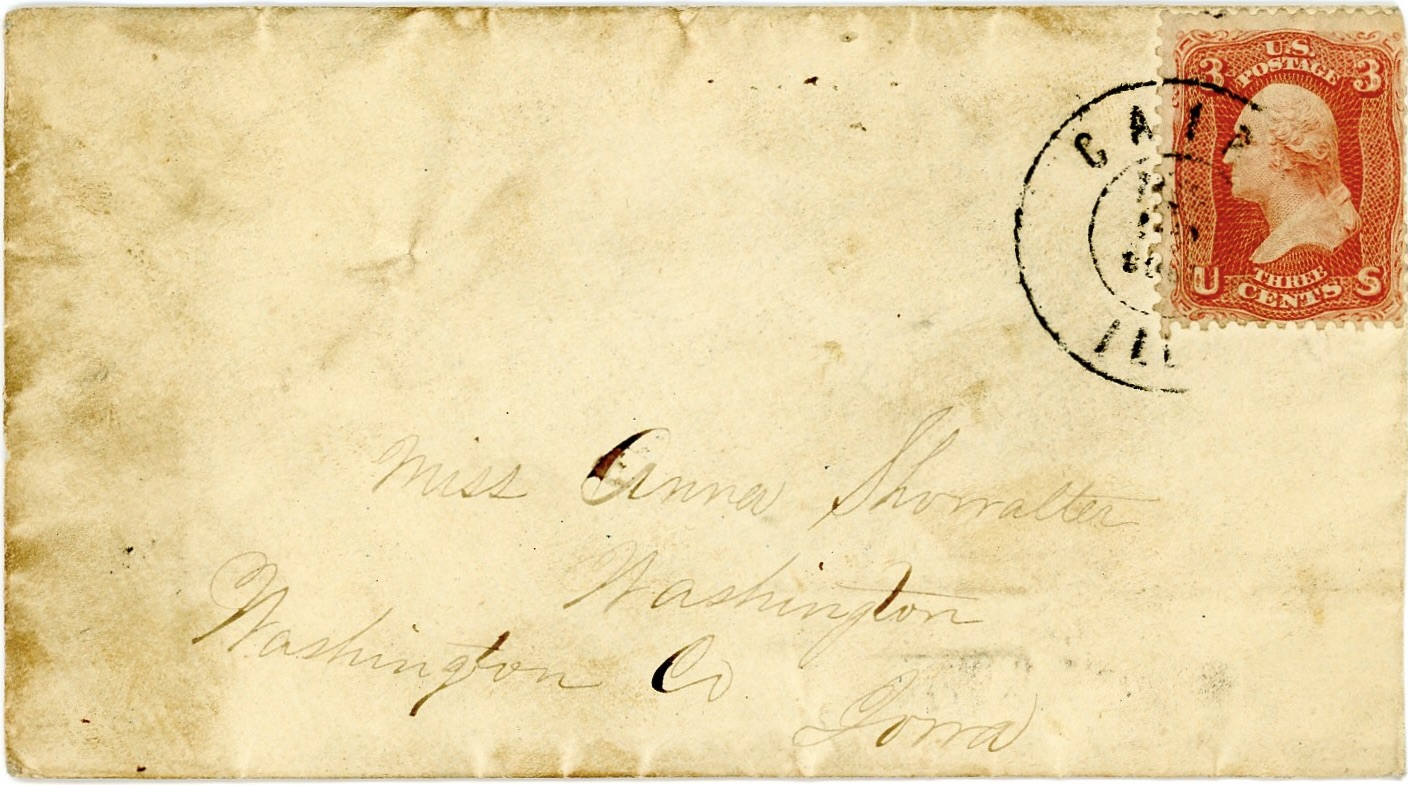
About 4 miles from Corinth
May 16th 1862
Dear Anna.
I have been quite unwell; for some time but I am better now. The place we are at now is very scarce of water. We are not at a town but camped in the woods. it is quite warm here already. We laid strewed all over the ground anywhere of a night. We have only two tents for the whole compsany and it is too warm for many to stay in them at night. But I will change the subject a little.
You are all expecting to hear of another big fight from this quarter. We have all been looking too for it before this time but it is not come off yet. If the Corinthans do not leave Corinth, we will ave a warm time here pretty soon. We are taking some of the rebels every day. Some come in and give themselves up.
I have not much time to write much this morning—only to let you know that my health is better a great deal than it has been for some time and that we are getting close to Corinth. We have had some little fighting on our right wing every day lately.
I received your letter sent by William Creath. Was sorry to hear you was all sick but I was glad to hear of your health being improved so much and hope it will continue to do so. I received them two newspapers your father sent to me. I am much obliged to him for them. I must close, Anna. y respects to all and love to you. — J. Murkin
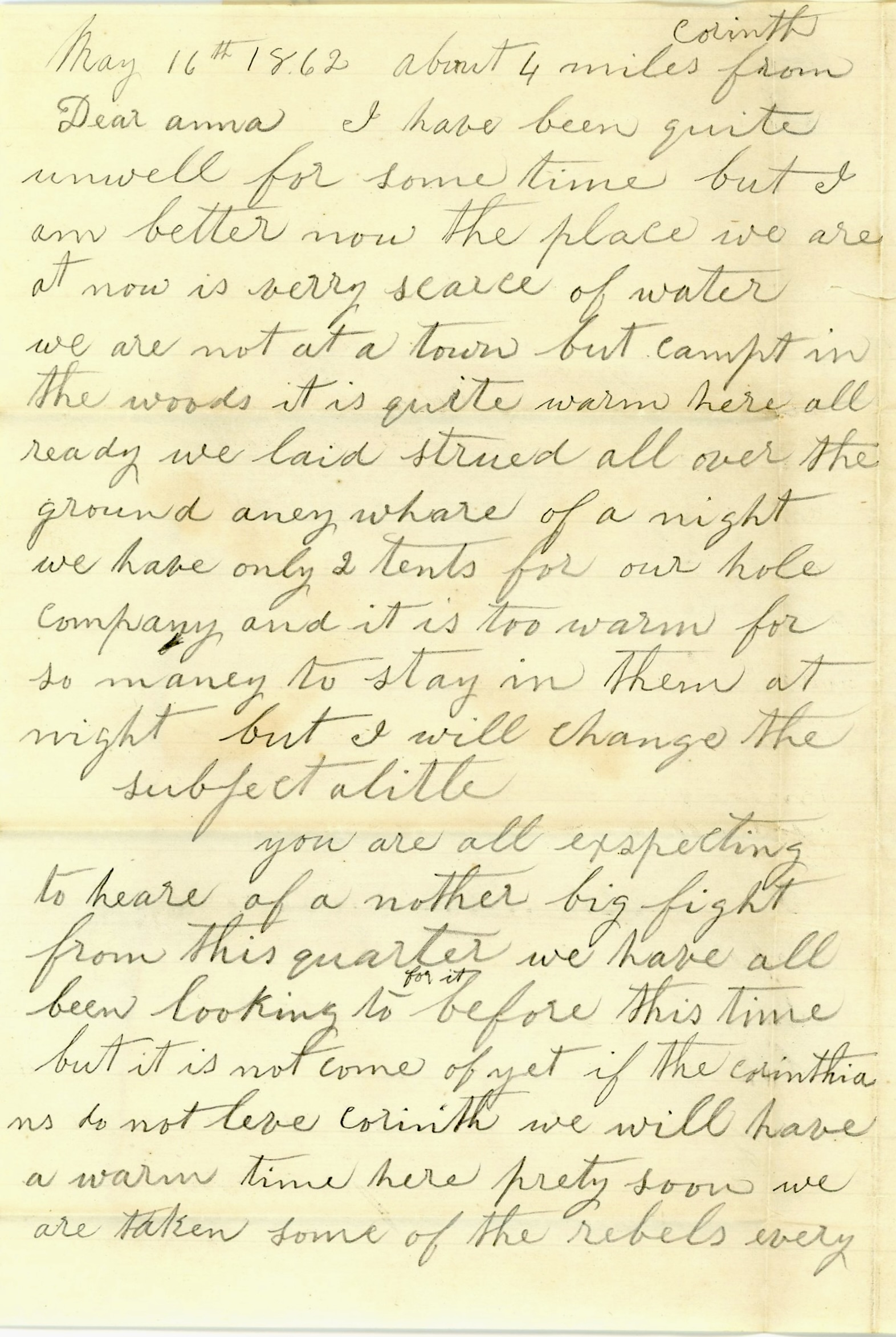
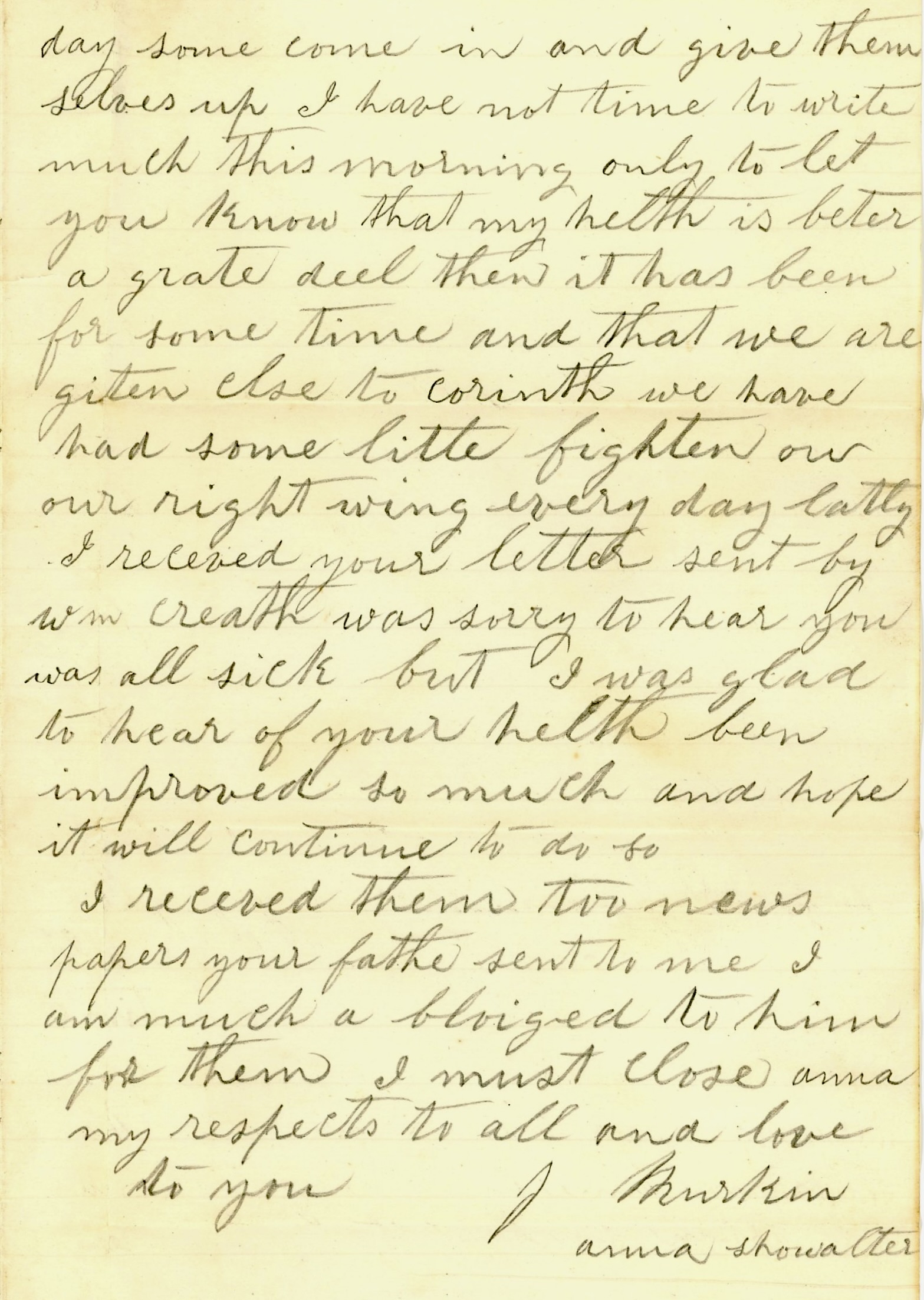
Letter 36
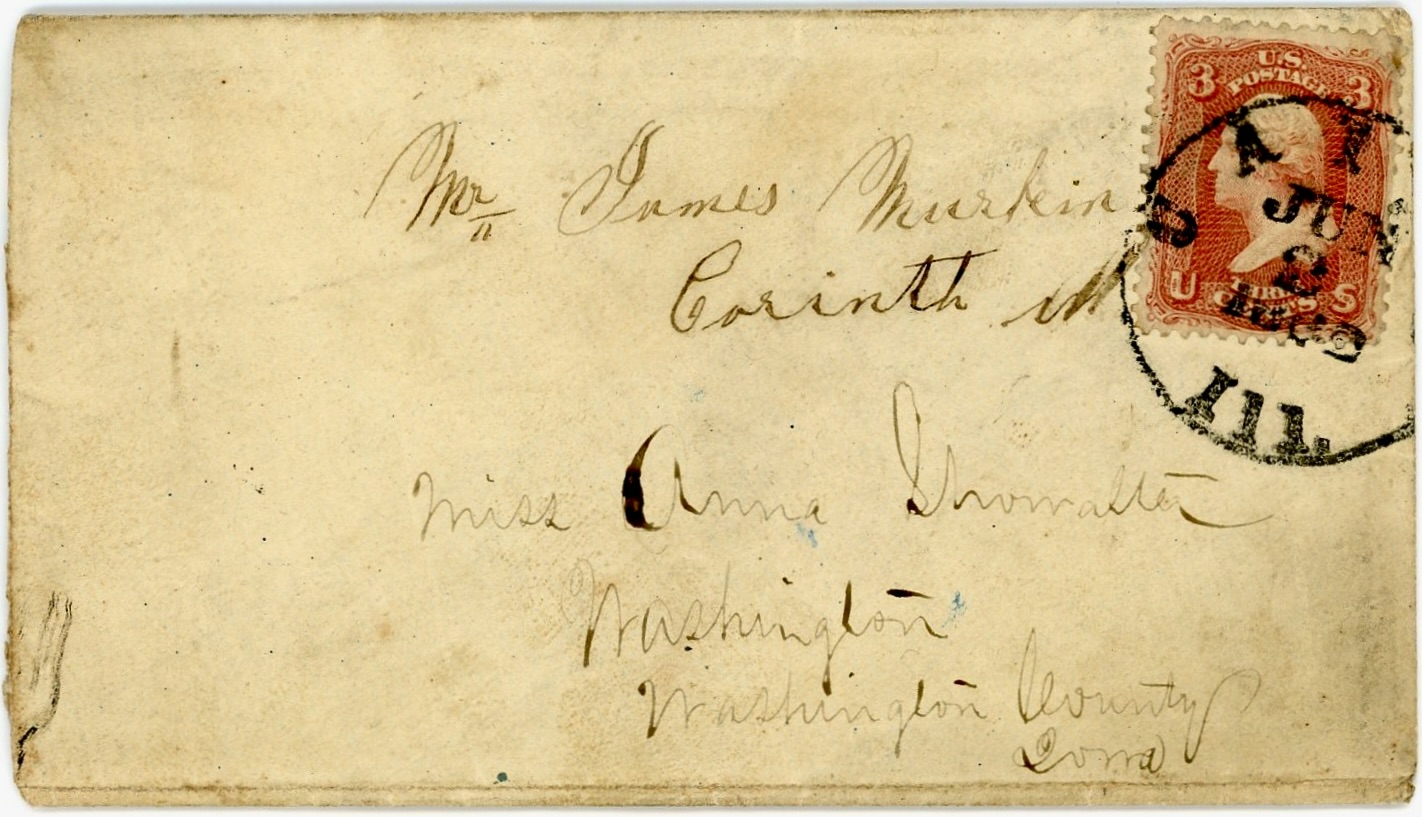
About two miles from Corinth in line of battle
May 25, 1862
Dear Anna,
You have all been looking with anxious eyes to this place fora long time, I have no doubt, as have the whole West, but the tale is not told yet. But we are expecting it to commence every hour. We have to lay on our arms every night and keep ourselves ready at a moment’s warning. Our pickets and the rebels are skirmishing all the time. The fight must come off soon. I expect before you get this letter the fight will be over and we in Corinth or driven back. God grant that we may be successful and accomplish our object and bringthe rebel leaders to justice.
We are camped in the woods all the time ever since we landed at Pittsburg Landing. The country is very poorly settled, what I have seen of it. we saw some very pretty places as we came along but they was very poorly farmed. There is plenty of fruit in Tennessee this year. That is all they will have to live on as far as I can see. There is no men left to put in crops and tend to farming. But all seems to have gone to Corinth round here and I guess that such is the case for whenever we come to a house, we find no men folks. Some of the women are honest enough to tell us that their men are gone to fight for their rights and country, but how they are deluded and led astray by not reading and judging for themselves. School houses—they don’t know how to build in this country. I have not seen one yet in Tennessee. I think they need missionaries in the South bad as they do in India. Ignorance seems to have the lead in the South. The slaves seems to have all left and gone with their masters to do their work but they cannot screen them from justice which they deserve.
We have to pay forty cents per dozen for eggs, 50 cents per pound for butter. A bottle of pickles such as we pay 50 cents for at home we have to pay $1.25 to $1.50 here and everything else in proportion. So you can have a slight idea how we have to pay for everything we get from the sutlers. A man needs such things sometimes but we have to pay dear for them. Such are the treatments a soldier gets from home.
Anna, I received the letter you sent by William Creath. I was glad to hear that you was getting better but on the other hand I was sorry to hear of the sickness in the family. But I hope all is well before this time and that I shall hear from you soon with good news. I have been quite sick for some time but my health is a great deal better now. I am doing duty now. I will write to you as son as anything takes place.
I must close my remarks for this time. My respects to all your folks and love to you. I will direct on envelope for you to send me a letter in. We expect to be in Corinth soon. Write soon. — James Murkin
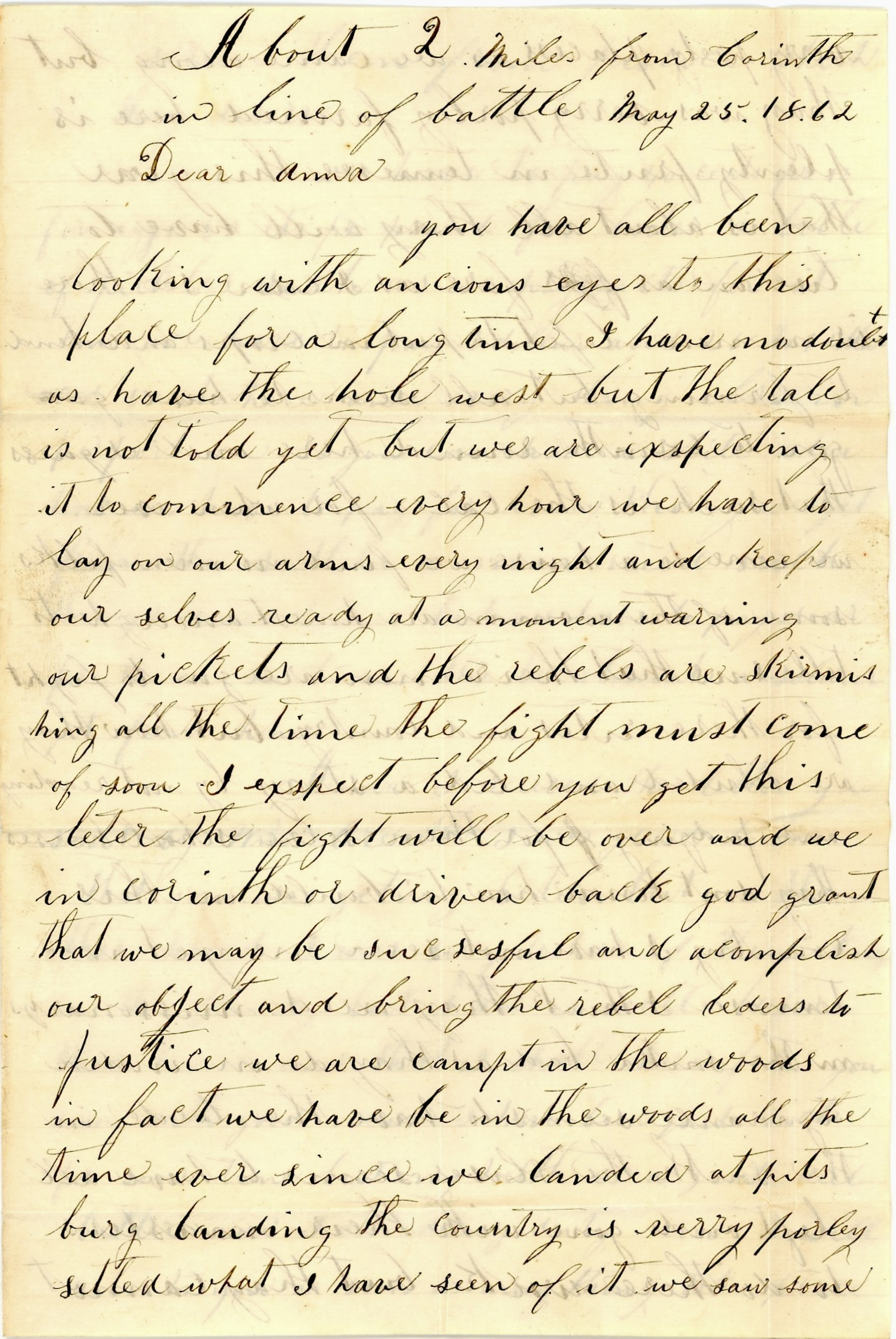
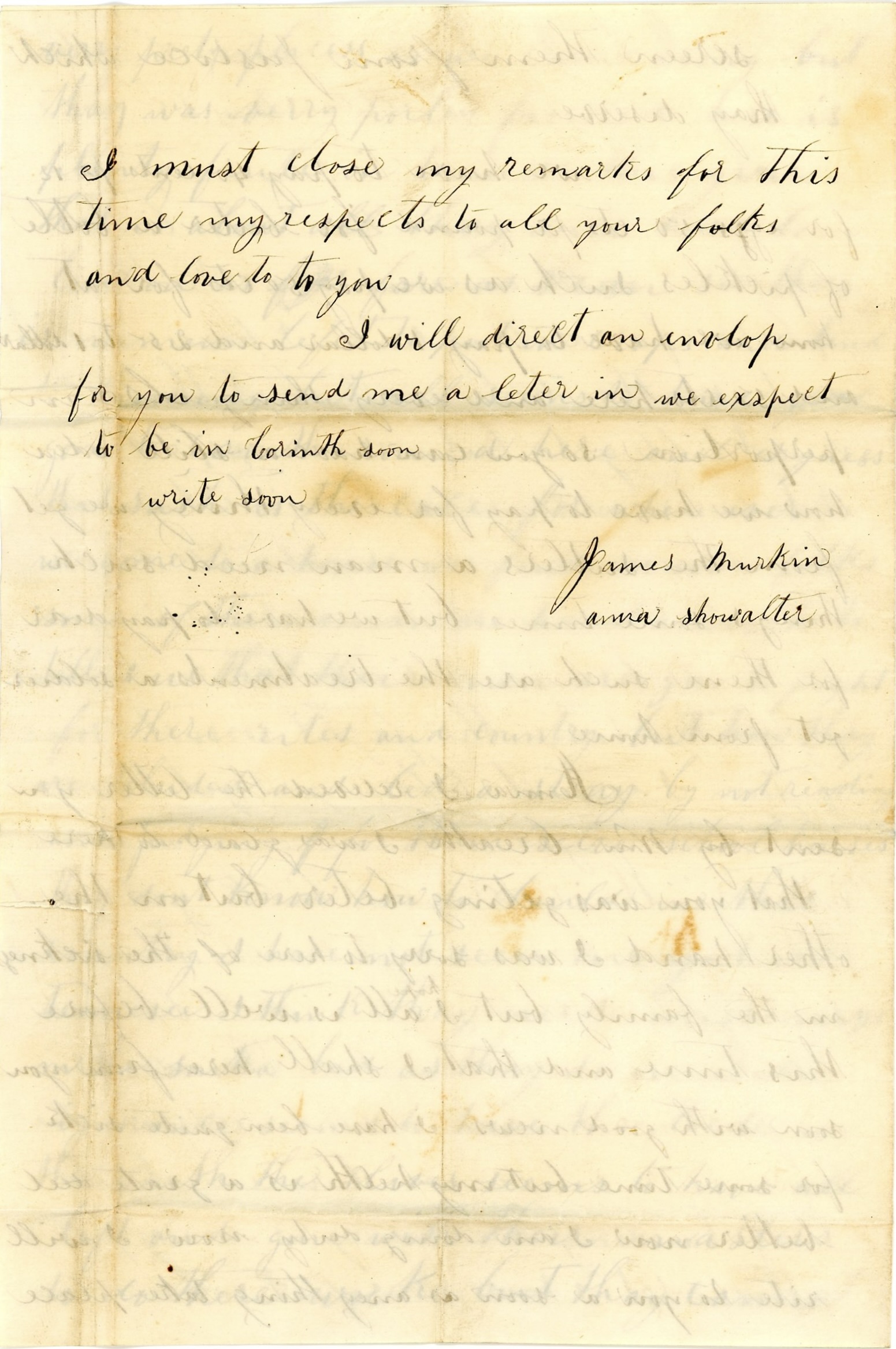
Letter 37
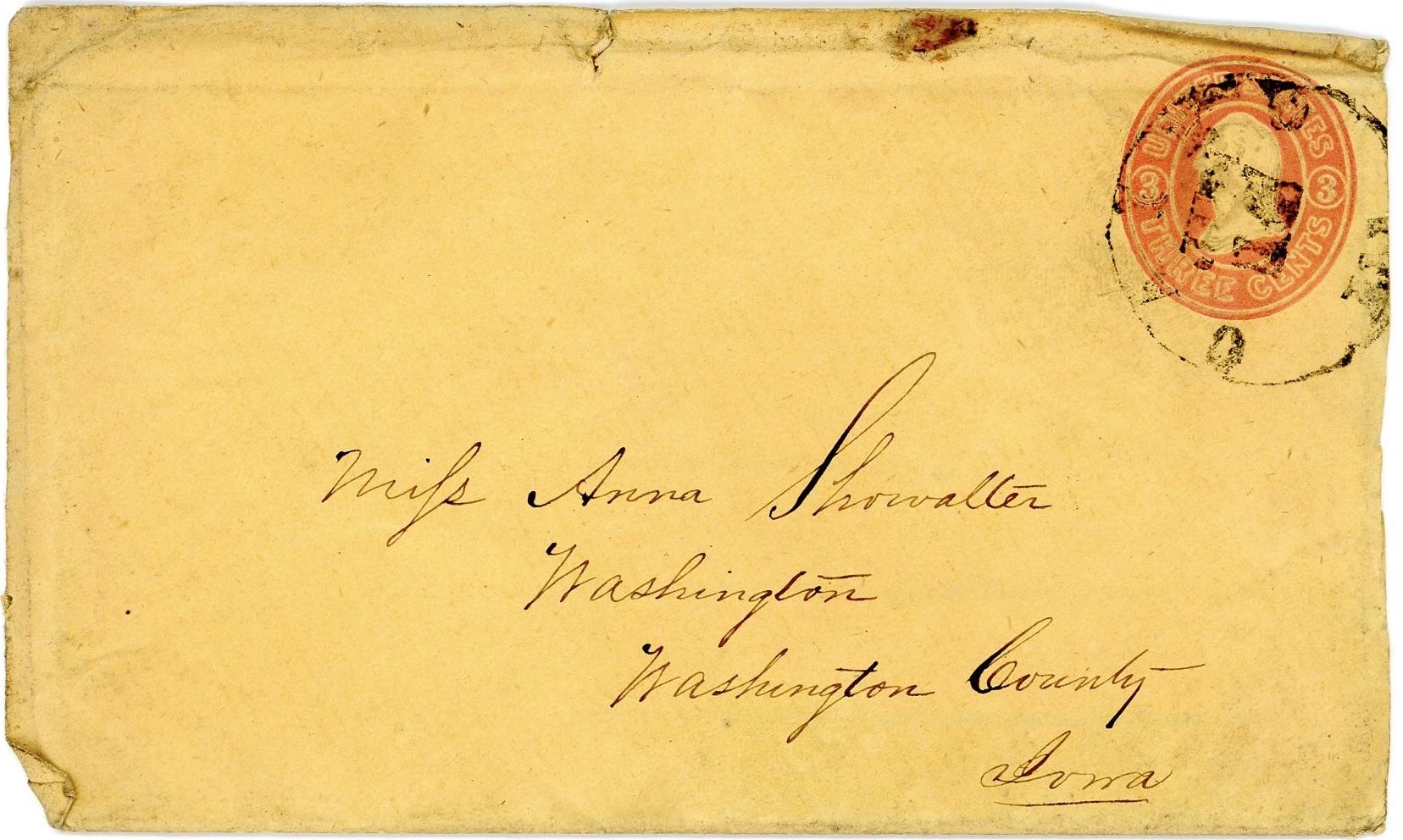
State of Mississippi
June 5, 1862
Dear Anna,
We started again yesterday enroute for Boonville in this state. Some say the rebels are making a stand there but how true it is, I can’t say. Yesterday we went but a short distance, 8 or 9 miles. The roads are bad in some places which make it bad to travel. We crossed over a bridge yesterday which the rebels had destroyed. It crossed over a small stream. Our troops had to build a new one to cross over on. The rebels tried to stop our men from building it but we drove them back when they found we was determined to build one. They had to start in a hurry. That was their rear guard only. The main army was ahead.
We are not marching today but are stopping in the woods. We do not know where we are bound but some say to Boonville. But I would like to turn back. I have no desire to go any further south to sleep with lizards and snakes. This is the greatest country for the reptiles I ever saw.
Anna, last 4th of July we was at St. Joseph in Missouri. Oh, how I would like to be at Washington [Iowa] next 4th and celebrate it there. Heaven grant we may all be at home and at peace with all mankind—our own country in particular. But what another month will bring forth, God only knows. But let us pray for peace.
June 6, 1862. This morning we are going to repair a bridge. Our regiment is all a going. It’s quite a large bridge crossing a creek and slough. They did considerable damage to it—the rebels. After working till noon, we was ordered back to camp [and] from thence to Boonville, a distance of 12 miles. The weather is very warm and the roads very dusty which makes it bad traveling. Besides, it is very bad to get good water here. The brigade we are in did not stop till 10 o’clock that night. Most of the boys gave out and did not get into camp that night till next day. we stopped within two miles of Boonville.
June 7, 1862. We rested here all day and night.
June 8th, 1862. Orders came early this morning for our regiment to be ready to start back at 6 o’clock this morning to go and fix the bridge. We are in our old camp just now but expect to start for the bridge every minute. Such is a soldier’s life in time of war. What the object of our march to Boonville was, we know not.
Wheat is already cut in this country. All I have seen is very poor. I have not seen but little anyhow. This is not the country for wheat. We went through a small town today. It was nearly deserted by the inhabitants. As we pass along, we find some of the farmers at home and some left afraid of our army. The secesh tell them we will kill them—the army that passed through this route. So a farmer told me the other night. Some believe it and leave hoe. Some act the wise part and stay at home. We are just a going to start to the railroad bridge, ready for work tomorrow.
June 9th 1862. We commenced again on the bridge this morning. I would much rather be here than marching. There will have to be somebody to guard the railroad bridges. I hope our regiment will be one to do it. To travel is hard work. Tonight I have to go out on picket on guard.
June 10th 1862. This morning I will try and finish my letter. Anna, I and two of mycomrades have been in the woods all night and we have to stay all day until night before we will be relieved. The two boys with me are gone a few yards to a small river to try and catch some fish. I hope they will succeed and catch some while I am writing to you. There is not quite so much danger standing picket guard here as there was at Corinth. The rebels are further of us and I hope they will still get further from us. I desire their company no more.
I was on picket guard the night the rebels left Corinth. When me and my two comrades sat down to supper, the balls whistled round us [and] we had to get behind trees to eat it to keep from being shot. I thought of home then. How different it was to be at peace at home than in the situation I was then placed in.
Anna, I have not heard from you since William Creath came back. The time seems so long. I hope I will get a letter soon. Our mail comes very unregular here. I look for one every day but in vain. Anna, I would like to be at home now and stay a few weeks or rather a few months. I could pass them quite contented a great deal more so than here.
Peaches are plenty here and plums and blackberries too. They are getting ripe quite fast. This is a great country for blackberries so far as I have seen.
Anna, I guess I will have to bring my remarks to a close and hope they will find you all in the best of health. Give my respects to all your folks. Write soon. Direct to Cairo or to Pittsburg Landing. — Jos. Murkin
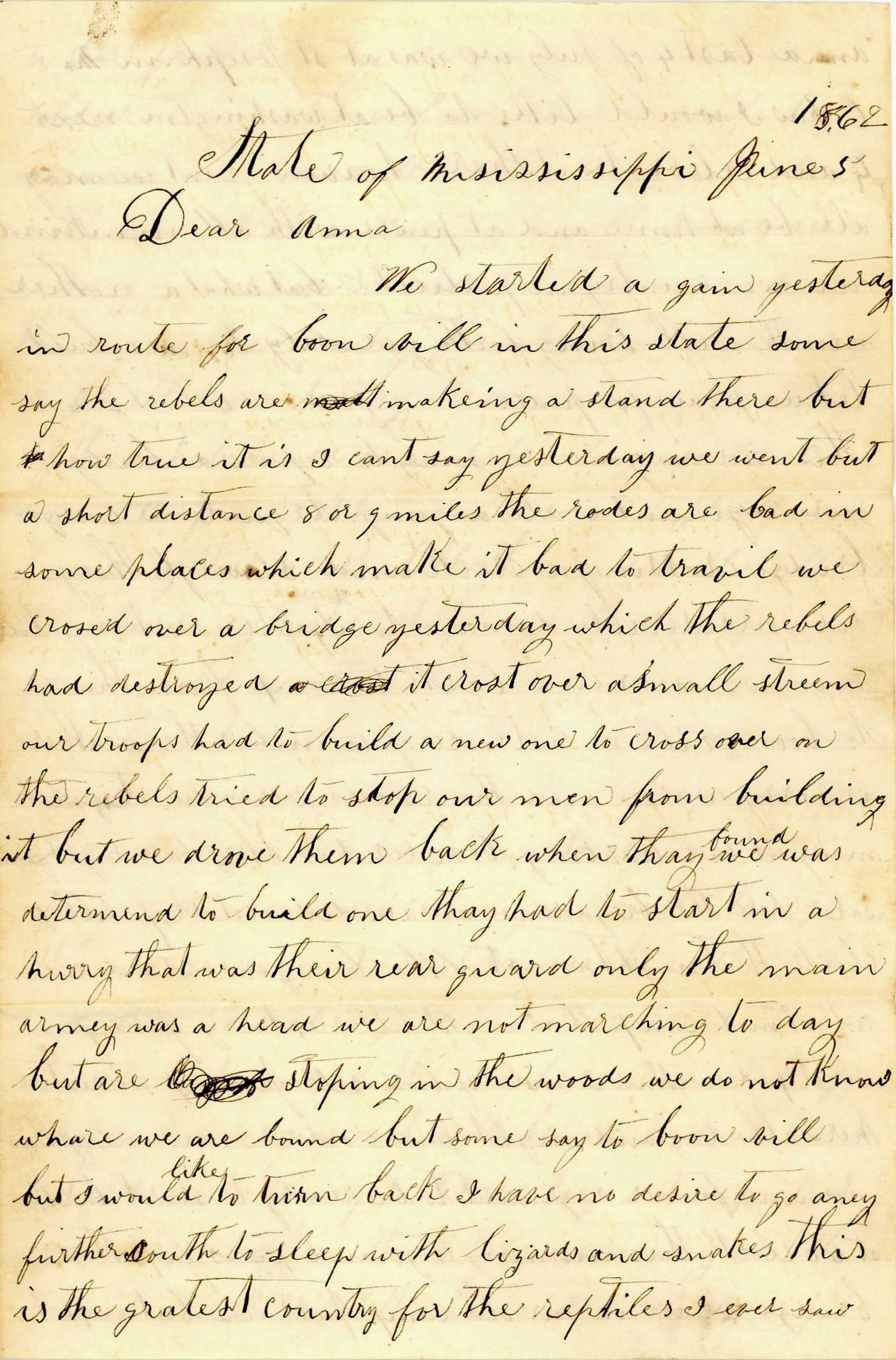
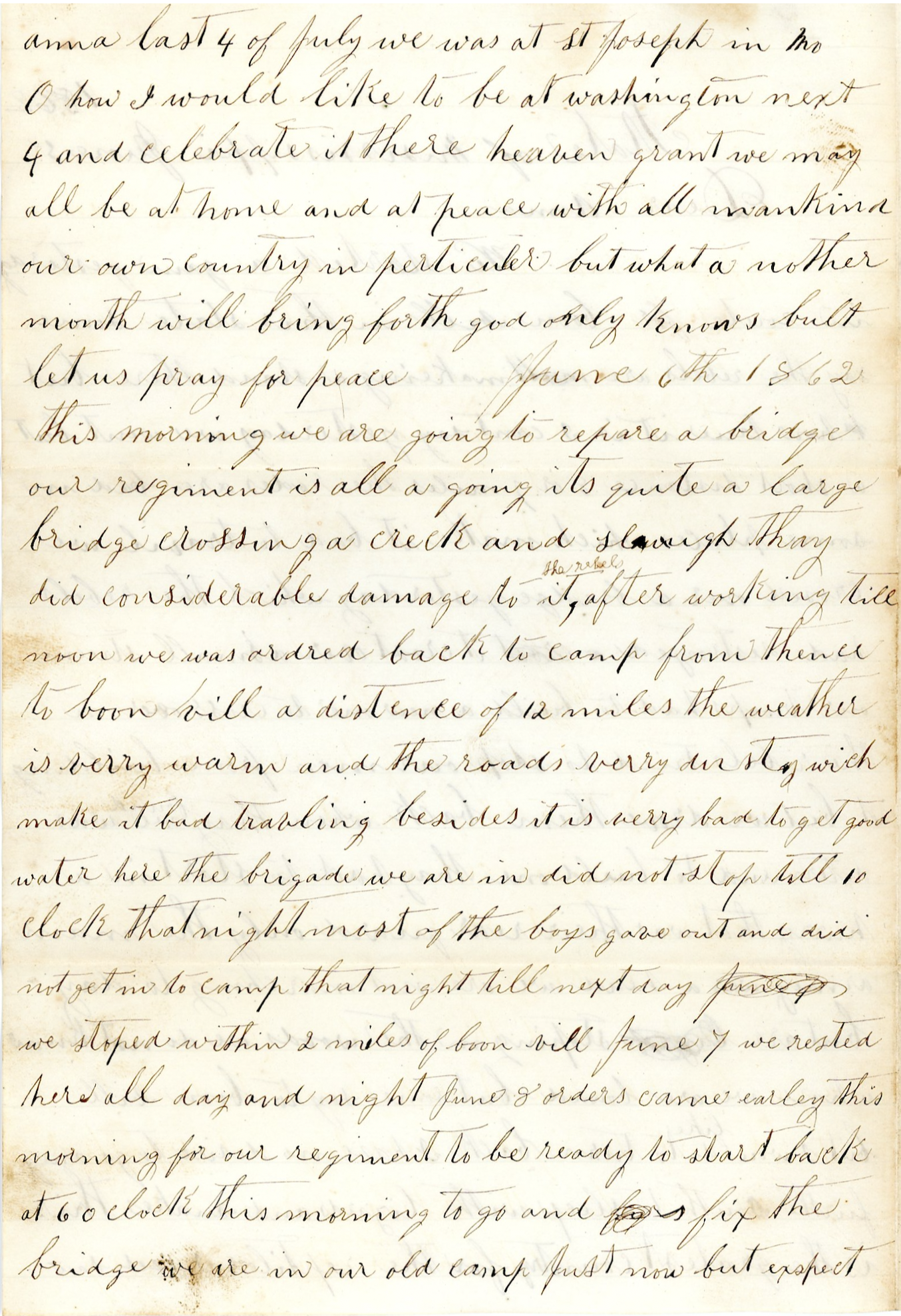
Letter 38
State of Mississippi
In camp 2 miles south of Corinth
June 19th 1862
Dear Anna,
Yours of the 8th came duly to hand today and found me well, I am happy to say. As I had not heard from you since William Creath came back, I began to think all our letters was getting miscarried and we doomed to disappointment. But at last he long looked for missive came and the lines gladly perused until I found out its contents. Anna, I am glad to know that your health is improved so much and that your folks are all well too. Anna, good health is the greatest blessing we enjoy on earth.
Anna, you say you are a going to live with Miss Gray this summer. You must be a good girldf and if I can, I will be sure to come and see you. I wish I could come on the 4th of July instead of dragging over a miserable 4th of July in this part of the earth. Last 4th we was at St. Joseph, Missouri, but where will we be this coming 4th? I would love to be at home but that can’t be now. The time is too near at hand and we must give up all hope of being at home on the 4th of July next. But Anna, you must not let our absence spoil yours. I hope you will have a good time. If we stay here, we will be shut up in camp, I guess, but we may be miles from this camp by that time. Who can tell or read the future? The past has been gloomy sometimes to us soldiers. It did look a hard road to travel and so it was some days. And them days many a brave soldier went to his reward in heaven, I trust. I gope we will see no more such, but trust the future will bring peace to our country and a bright prospect to us for home.
Anna, William Creath did say to me when he came back that you looked very bad and that you had been very sick. i of course enquired after your health and he told me the state of your health as near as he could, but Oh how long the time has seemed to me since then when he handed me the letter you sent by him until today when I received another.
I say the time has seemed long to me and it seems that such is the luck that you have such is the disappointments in life. Anna, you say that some of the boys are coming back to their regiments who have been home on sick furlough/ This is not a very good place to come to for one who has been sick. There was six of our company discharged one day this week and are now on their way home to pleasant Iowa, and we are still in the land of cotton. But I do hope to come home one of these days soon and find you at Miss Gray’s. Maybe I shall come on a day when you think not. I would like to start for home tomorrow and bring this letter mysaelf. Then I would be be sure that you would get it.
The place we are camped in now is pretty healthy and will be a very pleasant one after we get it cleaned up. The only objection to it is water. It’s rather unhandy and of course makes it quite unpleasant in a warm time like this. I wish we was in a part of the country where it is better settled on account of getting fruit. It is not very well settled round here. This seems to be a poor part of the country and not very well settled. The nights are very cool in this country. The citizens say they never knew it to be so cold at night as it is this season. They say they are extremely cold and that has a tendency to make it unhealthy to some extent at least.
Oh, I must not forget to mention one little item. we have a swarm of bees in Company H, or rather Company H caught them hanging to a bough close to the railroad. We are encamped within 200 yards of the Mobile & Ohio Railroad—that is the name of it. we can gather honey after a while on a small scale.
We have two men toed to a tree for getting drunk and fighting and striking a negro, but they do not belong to our company. I am glad they did not for it would have been a drawback on Company H had they belonged to it.
Anna, you must be sure and write as soon as you get this and let me know how you are getting along. It seems to be the prevailing idea here in camp that our regiment will come back to St. Louis or to Davenport, Iowa. I wish such may be the case. Then I will get a chance to come home and see the folks again. All the boys that are coming back from home say that is the report in st. Louis, that the 2nd Regiment Iowa is coming back—that is, by men who ought to know the truth in such matters. One of the head commanders told one of our men so that we would all be back in a few days.
Anna, I will have to bring my remarks to a close. Duty calls me another way to drill and i must obey the call. My respects to all. Write soon. Direct to Corinth — James Murkin
William Creath is not very well at this time.
Letter 39
Camp Montgomery, Mississippi
July 4, 1862
Dear Anna,
As this is a clear, bright morning [and] our national independence day, I concluded to devote a part of it in writing a few lines to you to let you know that I am well and trust these lines will find you enjoying the [same] blessing.
Anna, early this morning we was greeted with the roar of cannon to let us know it was the 4th of july—a day which has been respected by all American people since the time it was first established until the rebellion broke out. It seems to me that this day ought to wake the rebels up to see where they are standing and give them a strong and ardent desire to return to the Union again. Oh what good news that would be to all us soldier boys and to all in general. Anna, won’t we rejoice to see that day? Won’t we have a good time in general? It will be a day long to be remembered by all. May God speed the happy day of peace and unity in America.
Anna, when I heard the cannon rattle this morning, it reminded me of Pittsburg or Shiloh fight. The thought made me shudder and also the hearts of many a mother to bleed and shed tears of sorrow when they think of their sons who are now sleeping in the silent tomb, far from friends and hoe. But they have one great consolation. They died for the stars and stripes—the flag of their country which the rebels had trailed in the dust.
Anna, since I last wrote to you, all has been quiet here round Corinth. But we all feel anxious about Richmond to hear of it being taken by our troops. We hear reports about it every day but we cannot believe them.
We have a very nice place to camp. I just wish you could come and see us and our camping ground. I think you would say it was a nice place for a camp. We have it cleaned up nice and the streets swept clean and nice. If we do not come back north this summer, I hope we will stay here rather than go south on account of sickness. The health of our regiment is pretty good now and some of the boys are coming back to the regiment that has been home on sick furlough and some have been discharged from the service. Our regiment is still getting smaller. They are going one by one. We who are left ought to be thankful that we have good health and are able to stand it.
Anna, I guess I will have to pass this day in camp and it is no use to murmur or complain. But if I was at Washington [Iowa] today, I could enjoy yself and have a good time. Maybe we will all be at home by the fair. I hope we will. Anna, I don’t think I have much more to say this time, but remember me to your folks and tell them I have the best of health. Write as often as you can and tell me what kind of a 4th of July you had and how you enjoyed it. I suppose you will see Miss Powell. Tell her George is well. My love to you and respects to all. From Jas. Murkin
Letter 40
Camp Montgomery
July 13, 1862
Dear Anna,
Once more I take the pleasure to write you a few lines to let you know that my health is good at this time and hope this silent missive will find you enjoying the [same] blessing.
Anna, since I last wrote to you nothing of importance has transpired here at Corinth but at Boonville 27 miles south of this place there is some talk of a fight between the rebels and our men. I hope we go any nearer to it than we are. I am willing to quit fighting and return home because I think our regiment has done its duty. A soldier’s life is a very unpleasant life to lead. I am tired of it and would like to return home. The prospect for the war to be brought to a close is not so bright in my opinion as it was sometime ago. It seems that our troops are repulsed at Richmond and in different parts of the country. All these things to my mind so not indicate the prosperity of our county. But I hope and trust that things will take a turn in our favor. If reports are all true, it looks dark at present. This is the dark side of the picture. Anna, you must look at it in a different light and hope for the best and trust that the war will soon cease. Then we will gladly bid farewell to soldiering and rest in peace at home with those we left and hope soon to be with again.
Anna, I suppose you are aware the President has called for more troops. I guess that will include some of those young men he has failed to enlist as a soldier in defense of his country’s rights—young men though they are able bodied but weak hearted—and those young men, some of them, are in Washington [Iowa] going to college and some behind the counter and some are tilling the soil all over the North. Whatever their calling in life may be, they have no excuse to say now, “I will go if I am needed.” I heard some of them make that excuse myself. I hope all them who are of age will obey the call and show to the rebels that we are in earnest and intend to defend the stars and stripes.
Anna, you stated in your letter that Franklin was going out this summer. I should like to know who he is a going to live with. Tell him he must not think of going a soldiering this summer but must stay home and raise something for us to eat. Your father, I guess, will stay contented at home and let them go that are more at liberty and more able to endure a soldier’s life. Although he is able enough, but nevertheless he has no right to leave home while he can look round him and see able bodied young men at home who are at liberty and no one to take care of but themselves. Now I say such men ought to go and show the love they have for the stars and stripes and the laws of his country.
Anna, I guess I will close my remarks for this time. Give my respects to all your folks. Anna, I hope to be in Washington [Iowa] by the fair as we failed to be there on the 4th of July. If not, we will still hope and say hearts parted thus, learn much of sorrow, but smiles are felt as well as tears, and hopes as well as fears. — Jas. Murkin
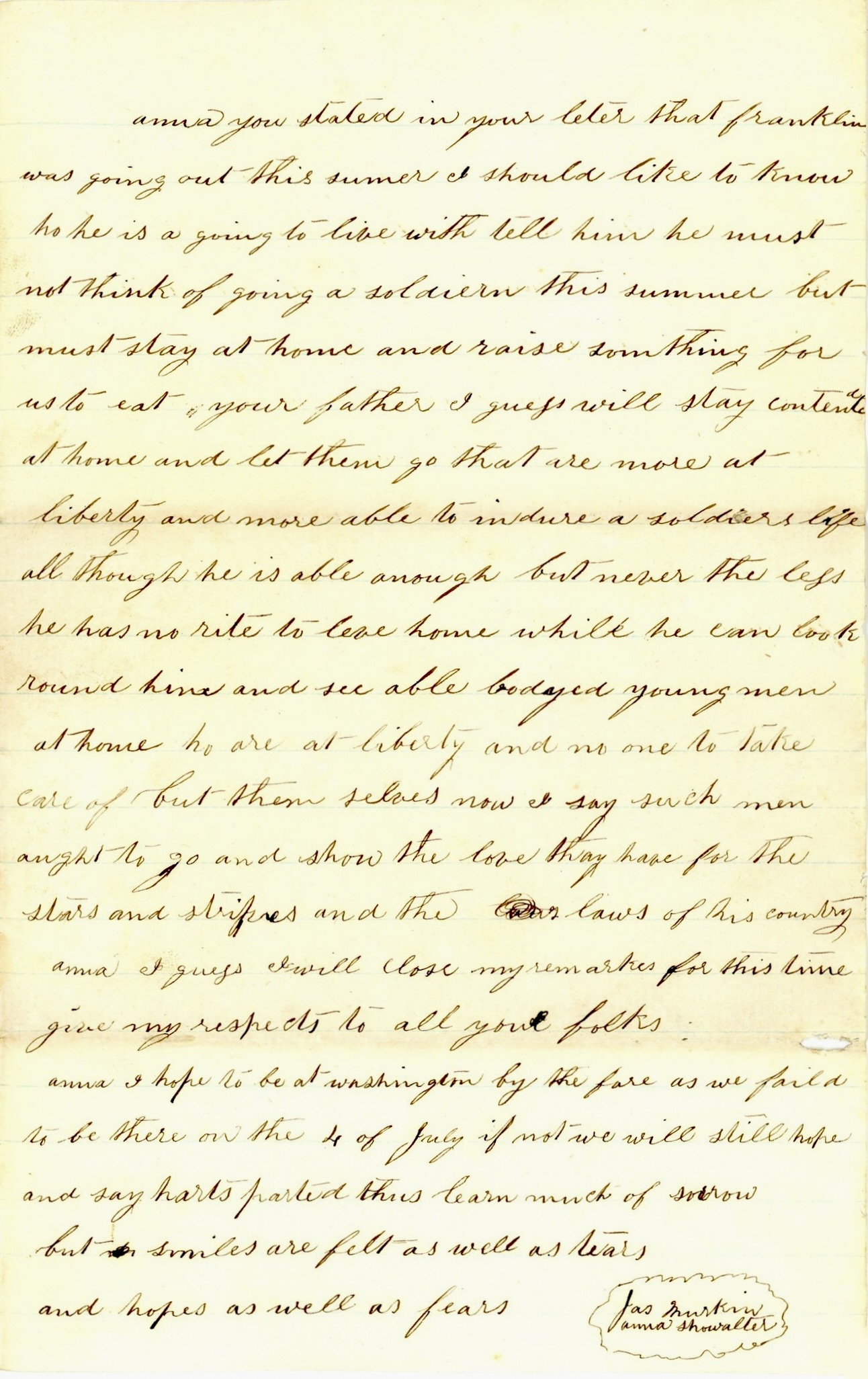
Letter 41
Camp Montgomery
Near Corinth, Mississippi
July 23, 1862
Dear Anna,
As I have a few minutes of idle time, I devote it in wrtiting a few thoughts to you. My health is good at this time and hope these few lines may find you well.
Anna, in your last letter you stated you spent the 4th [of July] at Brighton but under the circumstances you did not enjoy yourself as well as if I had been there. It seems that your mind was down in Dixie with me enjoying the 4th of July under a hot southern sun in a rebels’ country, the land of the oppressed but I hope will soon be the land of the free. How I would like to have been with you at Brighton on the 4th of July. I guess it would have passed off a great deal better than it did for you and me. I hope you will have your desire granted—that we may live together before long. Then my wishes will be fulfilled also. The hopes of the future is what keeps up the soldiers’ sprits while far from home and those we love.
Last night as I was on guard standing beneath a tree alone, I thought of the times we had passed in each other’s company. the thoughts came came fresh to my mind and I longed for home again. But I must be contentedwhere i am for a while. But you may depend the first chance I can get to come home, I will do it if it’s for nothing else but to make our promises good. you will agree to that, will you not?
Me and three of my comrades went into the country the other day to get some butter. We found it after going to four houses. We saw some of the southern ladies. I will not give my opinion of them I saw but I think the best looking ones must have gone south, afraid we should see them. But let them go. The other day as me and my comrade—a youung man from Richmond [Iowa]—went out to gather some blackberries, we saw a lady plowing corn. She had one horse and a cultivator. A young man was with her. He also had a horse and plow. You can guess their color. I asked her if that was the rule of the country—for ladies to plow corn? She answered it was. She appeared to be contented. We passed on and left them to mind the corn.
Anna, I suppose before you get this letter you will have heard that five of our company was discharged yesterday and started for home on account of disability. I would love to come home but I want good health when I do. But I shall come under any consideration, sick or well, if I can. I expect some of the young men are afraid they will have to go to war now, are they not? I hope they will turn out like men than to stay back to be drafted and compelled to come.
Anna, my health is better now than ever it has been for a long time. The boys say I will get blind pretty soon because I am getting so fat, I look quite different now to what I did when you saw me last, I wrote to your father a short time ago. You must give my respects to all your folks and accept the same yourself.Write soon and give me all the news you can. Yours till death. — Jas. Murkin
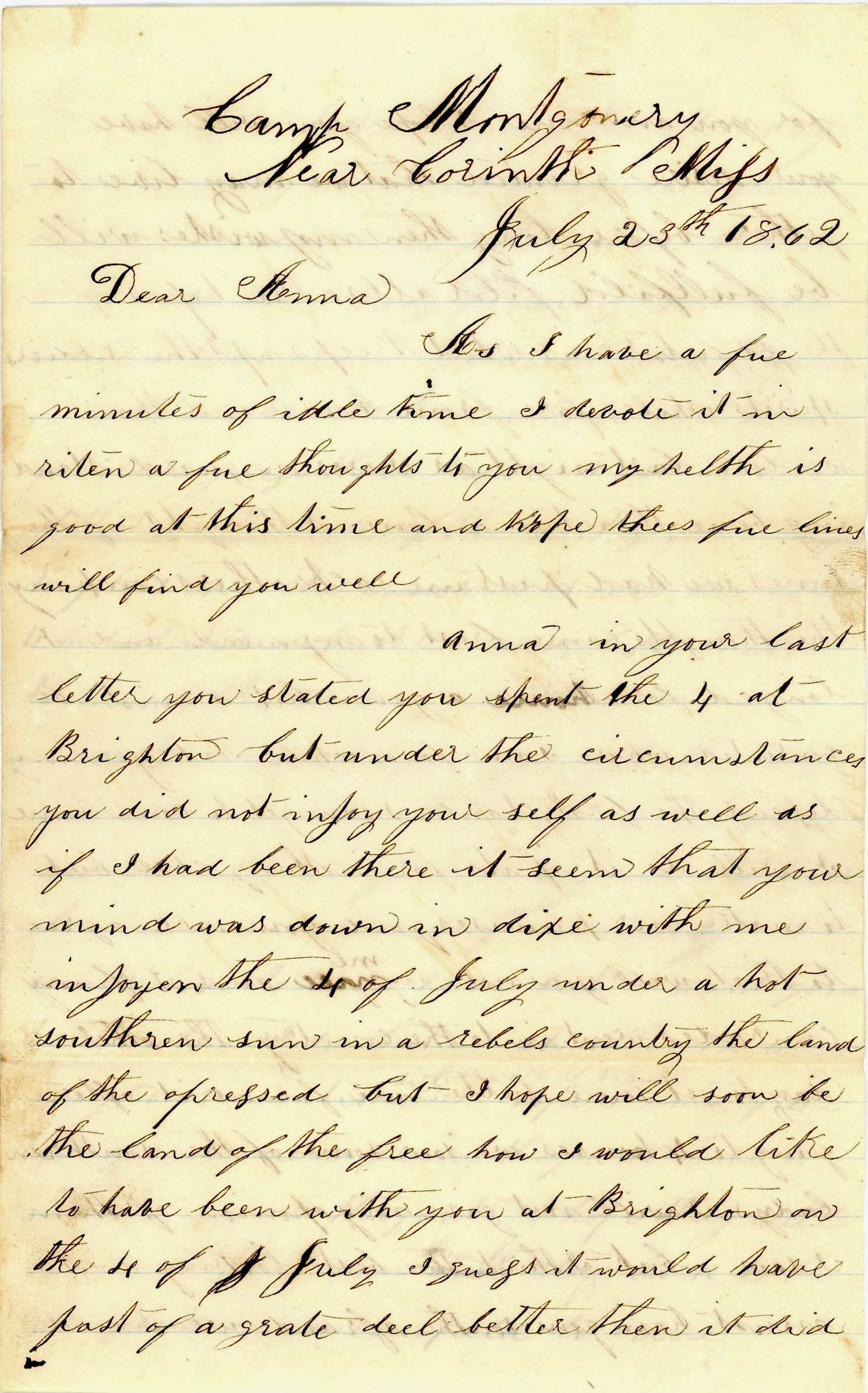
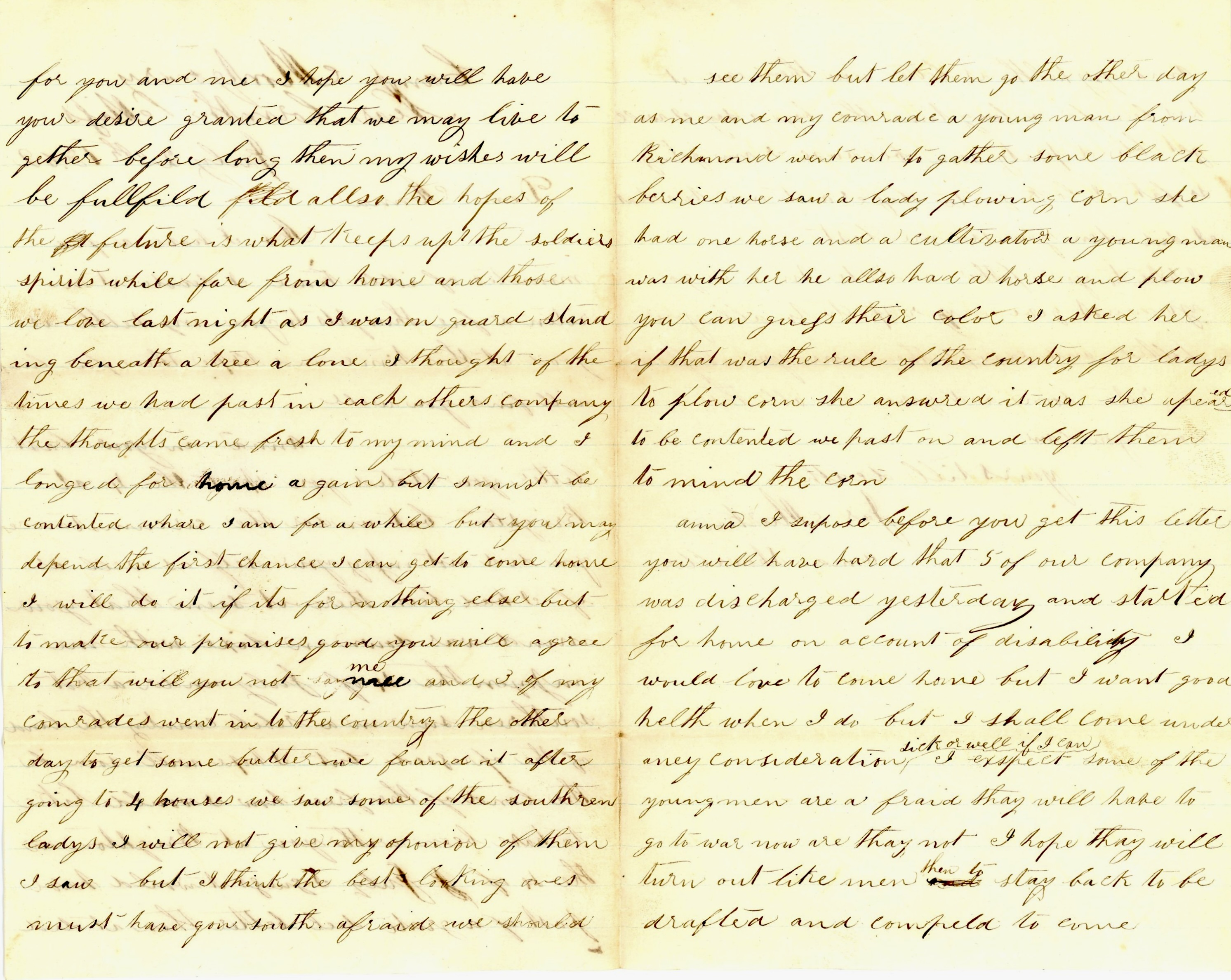
Letter 42
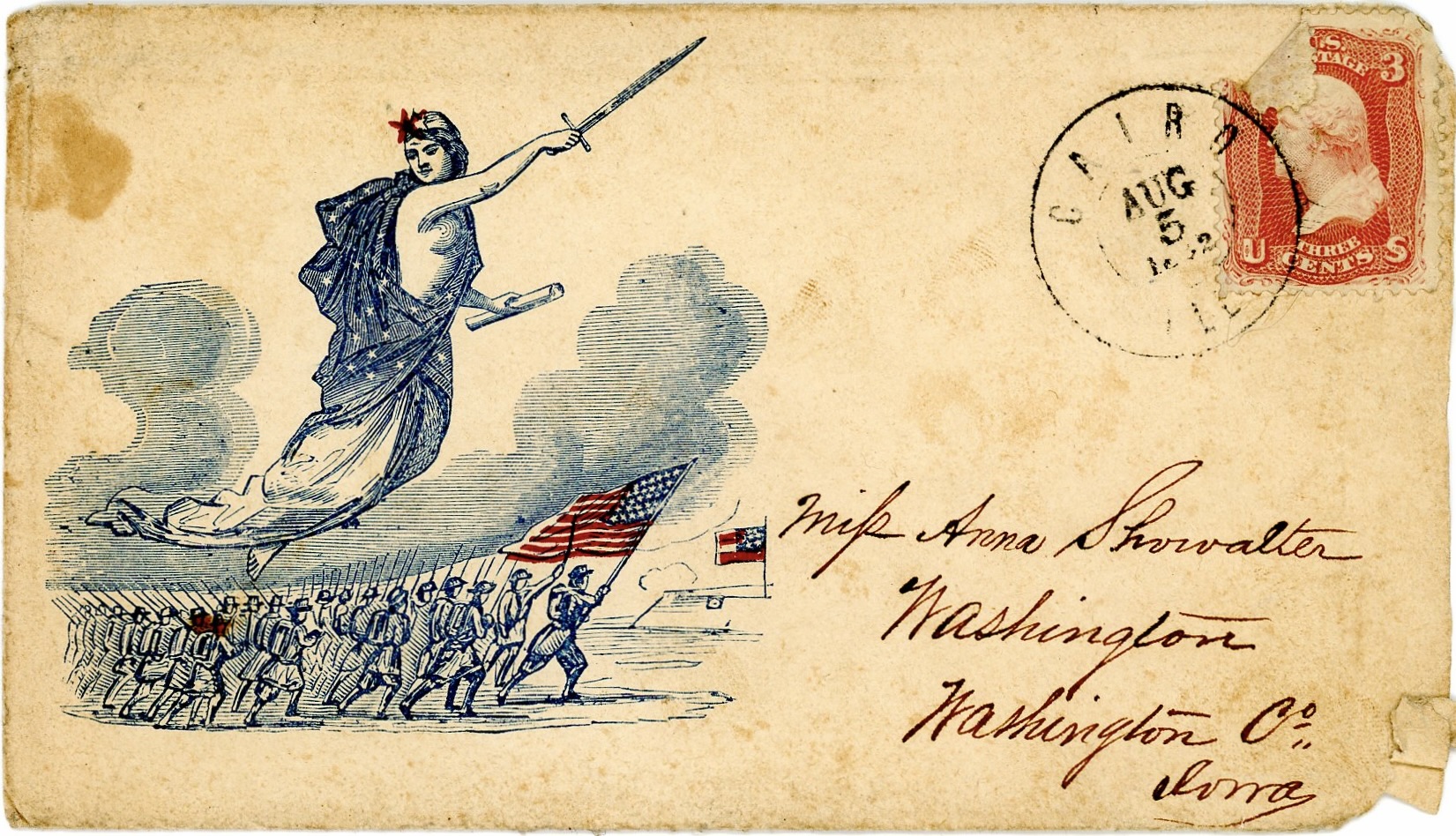
Camp Montgomery, Mississippi
August 3rd 1862
Dear Anna,
I received your kind letter the other day [and] was glad to hear from you again and to hear that your health was so good. I can say the same of myself. I am enjoying the best of health at this time. Also the health of our company is good as a general thing. In fact, the whole army in this quarter are in good spirits and seem to enjoy a camp life pretty well. In passing through the different camps the past seems to be entirely forgotten and the scenes of blood and carnage which we have passed through seem to be banished from the minds of the soldiers. So instead of gloom and sadness resting on the minds of us, the bright prospects of home and a speedy overthrow of treason and the restoration of peace to our now distracted country loom up in its stead.
While looking over the different papers that come to our camp, we are highly gratified to see how the call of the President is being obeyed by the men of the North who are fast filing up the number [quota] required. It seems they are getting awake to a sense of danger, I am glad to see it and hope they will continue to do so until we have enough to crush out the rebellion and drive it and its founders to that place where the great arch fiend of God and man reside. There is where it started from and there is where it will end, sooner or later.
Anna, I wrote a few lines to Franklin the other day. I did not say much to him as I had not the time to write but simply told him not to enlist as he was too young to endure the fatigue of military life. I think if he considers the matter, he will stay at home and let others step in who is capable of doing military duty and who are in duty bound to go before those under age. It seems by your letter that you get false reports as well as we do here in regard to military matters, The report about us going to Richmond is false. We are still at Corinth.
You stated in your letter that you had been to Mrs. Ditmars. I am glad you went to see her. She has been anxious all the time for you to call and see her. I wish I had been there too but that is folly in the extreme, is it not, to wish that. But I hope we will meet there ere long. I got a letter from them yesterday and they stated in it that you had been there. They was highly pleased with your visit.
Anna, you state in your letter that you had hoped to see me at home this summer but the signs of the present times drive them hopes away and doubts come in their place. It is very doubtful in my mind whether I will be permitted to come home this summer if my health stay good but if i can get a furlough, I will do it. I would like to come and see you. If I could only stay a short time I would come. Anna, give my respects to Mrs. Gray and tell her I hope we will all live to see this war close. And although we are strangers now, I hope to become better acquainted [even] if it’s by eating dinner at the table. i would like to be there today rather than be in this place. I am in at this time an enemy’s country. Let us hope the time will soon come when we will see each other and allowed to stay at home when there will be no contending armies to disturb the peace and happiness of this once happy republic, but now threatened with destruction. May they learn wisdom, cease to do evil, learn to do well, then peace will reign supreme. May heaven grant it.
Anna, I must close. Give my respects to all your folks and love to Anna. From Jas. Murkin

Letter 43
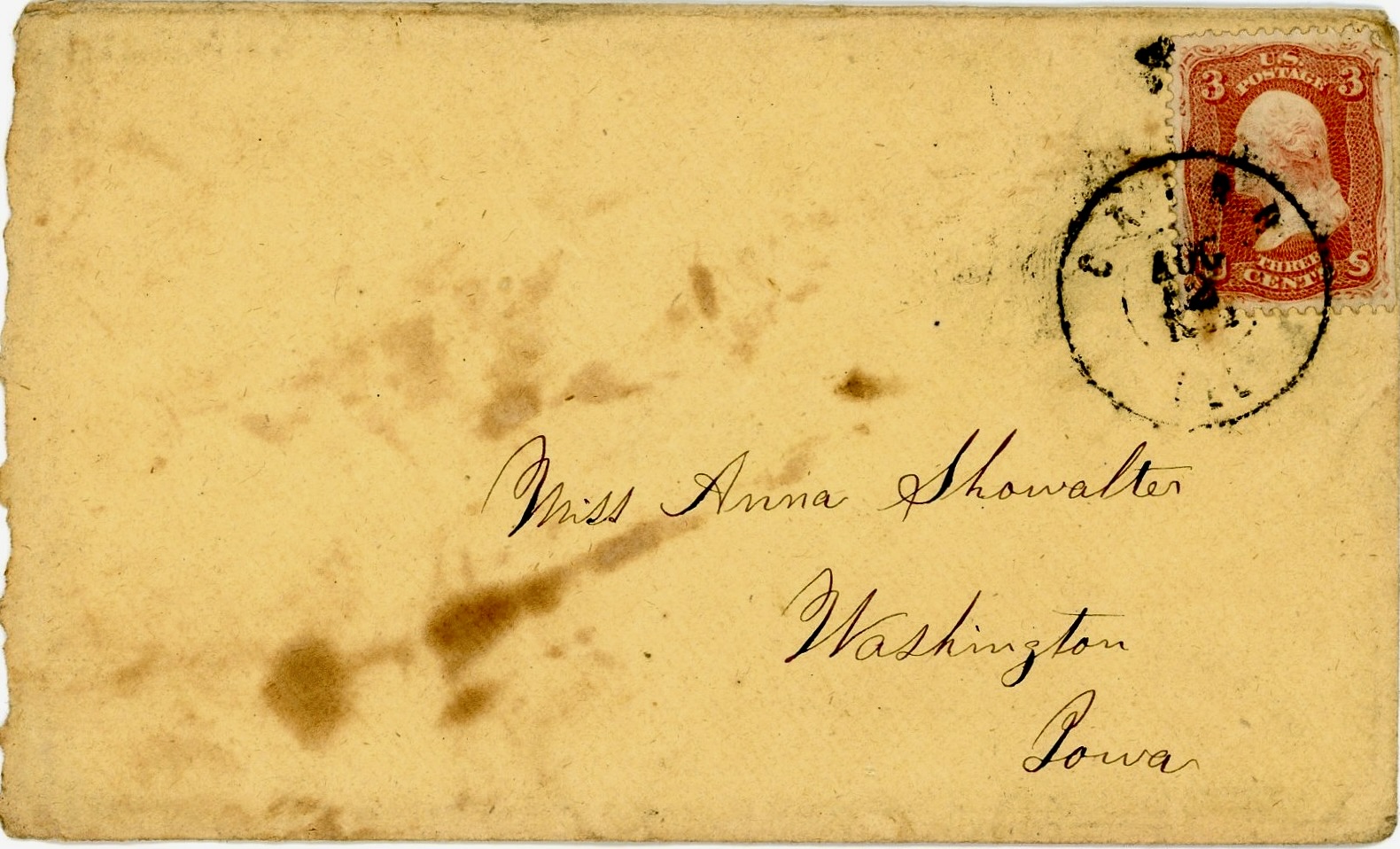
Camp Montgomery, Mississippi
August 10, 1862
Dear Anna,
Yours of the 2nd came duly to hand yesterday and its content gladly perused. I was glad to find you all well. I am glad to state that it found me in the best of health. The health of the regiment is pretty good at this time. The weather is very warm here now but it seems to agree with us very well beyond the expectations of a great many. I may say nearly all of us did not expect to have our health as good as we do but this seems to be a healthy part of the state. The citizens say it is rather fever and aguish here in the fall. I hope heaven will protect us from sickness and preserve our health and give us victory over all our enemies and a speedy return to our homes, better men than when we left and with hearts to love and obey Him. It is said in scripture that righteous exalts a nation but sin is a reproach to any people. [Proverbs 14:34].
Anna, I just came off guard this morning and thought I would write a few lines to you today. Last night as I was walking my beat, thoughts of the past came in to my mind. I thought of the times we had enjoyed together. What happy ties was then to what the present are. We can truly realize that sentiment when war wages its wild desolation and threatens our land to deform. It is truly sowing sorrow and desolation in our midst, When you wrote this letter, you did not know of the last call made by the President that will cause many a tear to flow and many a heart to ache in the North but with us, we jump for joy. I wish they was all ready to take the field now and I would feel a little more contented than I do. I hope they will soon be ready at any rate. Then I think we will be able to stop the rebellion which is now threatening the destruction of the country. The government is now getting awake to her situation.
We are taking our teamsters off and putting negroes in their places. I hope it will be done through the whole army of the North. That will add to our army several thousand more fighting men. It is one year today since the Battle of Springfield. They are celebrating it in Corinth today. We can hear the cannons booming. It’s only by men and artillery that in the Battle of Springfield, Missouri.
Anna, you say you have a good place to stay at Ms. Gray’s but you have to work very hard sometimes. I hope the time will soon come when I will return home to stay and then your outdoor work will stop. But duty calls now and I must stay. I would like to come home and stay till warm weather is over but such can’t be the case. I am afraid this summer.
I am glad to hear you say that you will try to be contented and stay until I come. Won’t you? I will trust you. Anna, it is so very hot and I am sweating so much I must quit off this time. You will excuse me, won’t you? My respects to all. Write again. — James Murkin
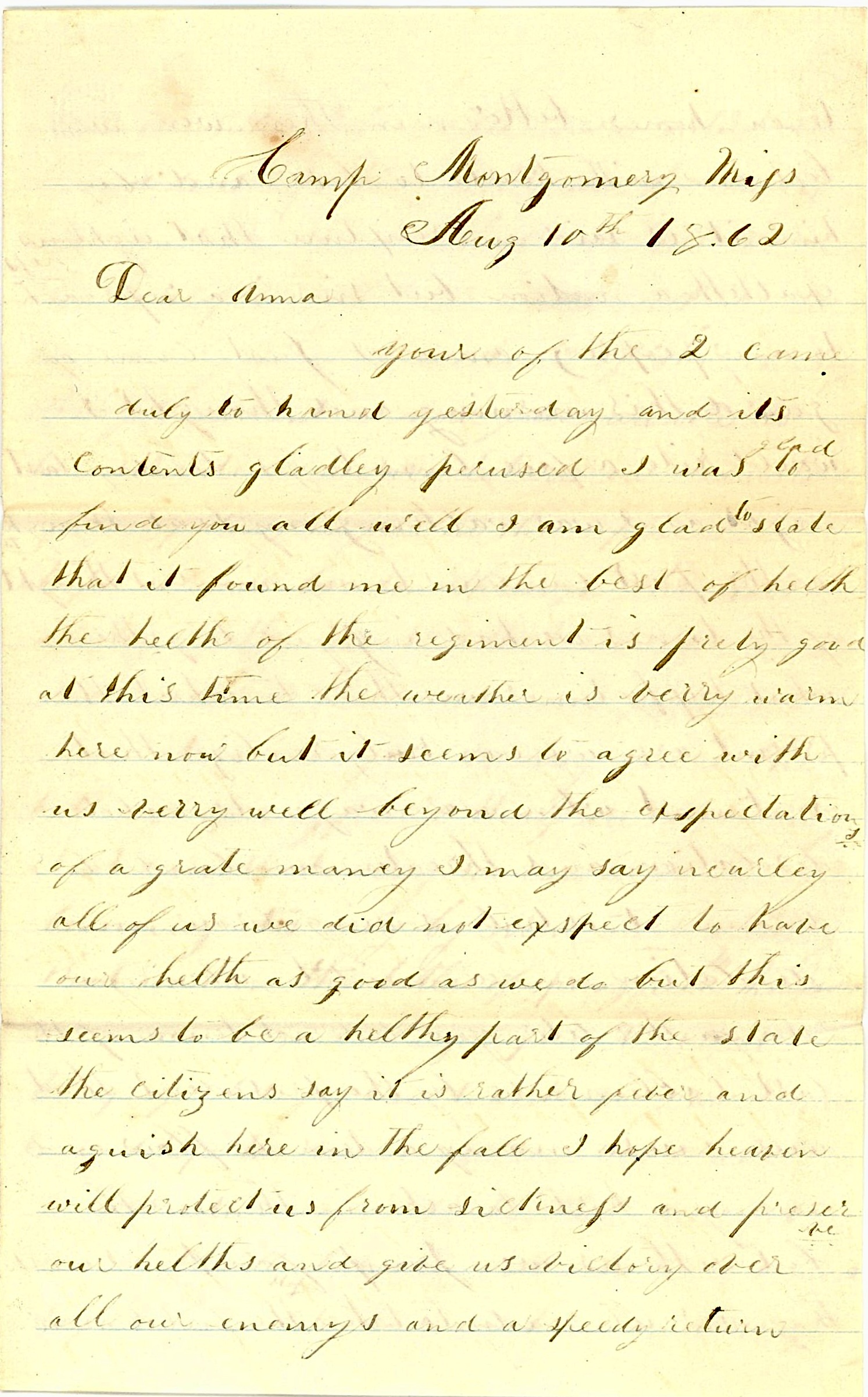
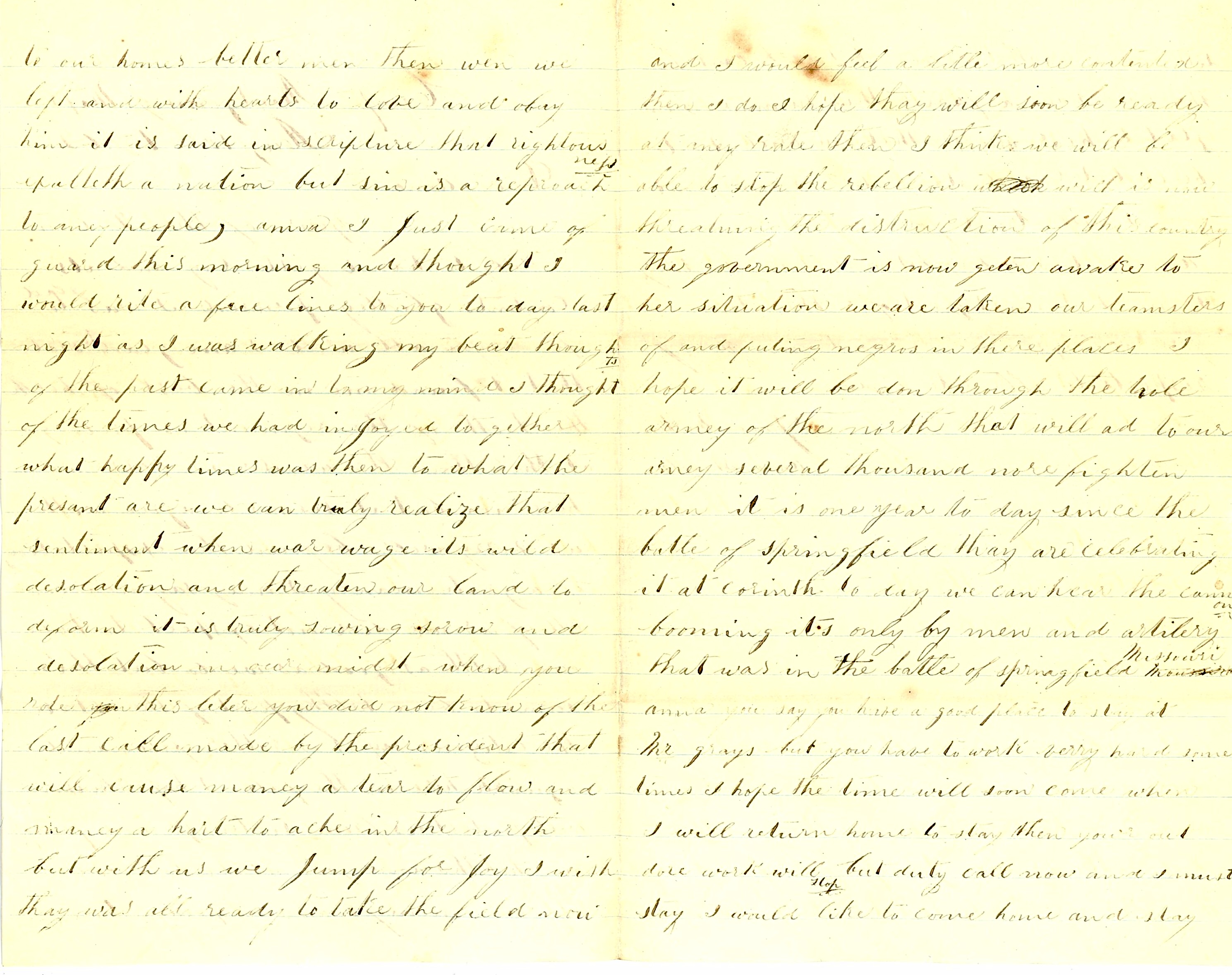
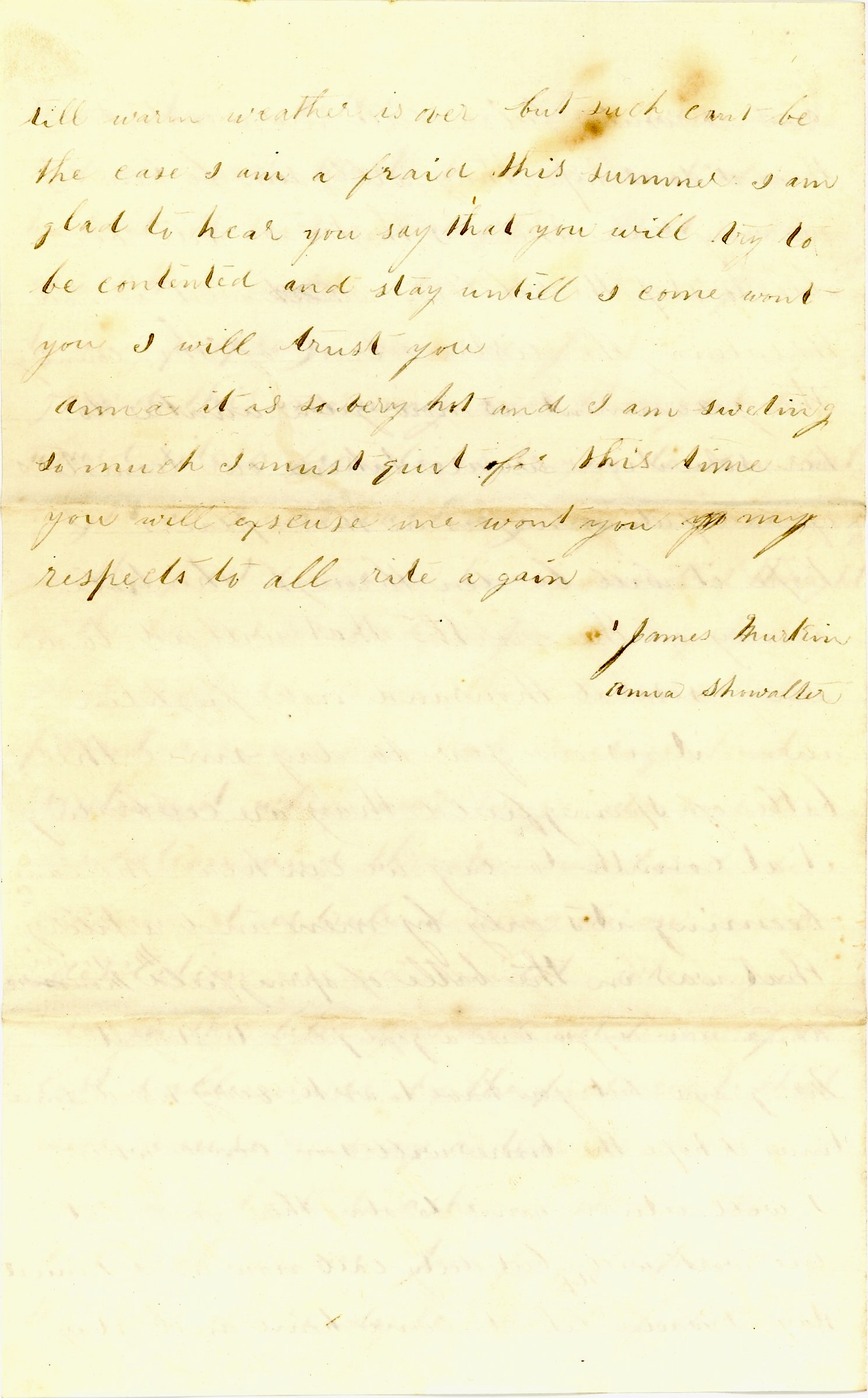
Letter 44
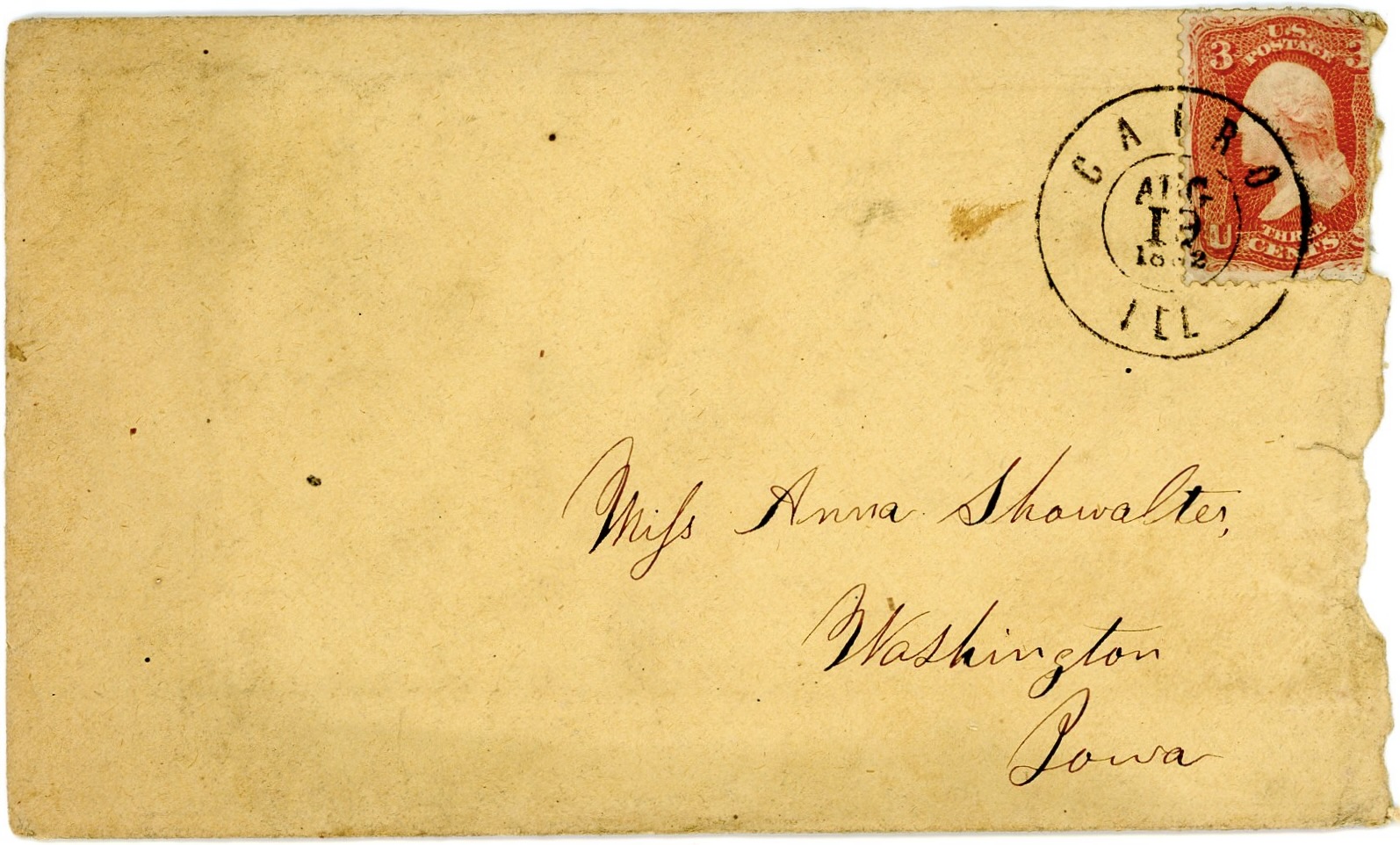
Camp Montgomery, Mississippi
August 17th 1862
Dear Anna,
Since I last wrote to you nothing of importance has transpired in this quarter nor do we look for any demonstrations to be made by the rebels at this time near us but I expect we will have to move from here soon. Two regiments out of our brigade has gone on some further south. we heard they was coming back again in a short time. I hope they will if there is no need for them to stay, I should think we will not need to move out there. I would rather stay here till cold weather comes than to move unless it is to come home.
The weather is quite warm here or has been until the last two days, The days has been cool for the time a year. Last night was very cold. I am afraid if the days continue to be warm and the nights cold, it will make it unhealthy round here. At present, the health is good round here. My health is good. I cannot wish for any better. Good health makes a military life easy and light in comparison to poor health.
Since I last wrote to you, we have had some quite important orders. We are allowed to go into the country and take from the rebels anything we want such as corn, apples, peaches, potatoes, chickens, geese, milk cows, horses, mules and negroes. We sent out 50 men from our regiment yesterday with teams for the occasion. They went into the country about 8 miles and returned in the evening well loaded with the above named with only one exception—they did not get any negroes. We got three good milk cows for the hospital. They will come in good for our sick boys.
Since writing the above, one regiment of our brigade that went out about a week ago has just returned. One of our teamsters was along with the. He has just come into our tent. He says they captured about 8,000 dollars worth of cotton for Uncle Sam. I see by the papers that some men in the north are trying or has been trying to get into Canada and going West to escape being drafted. But we rejoice to see a stop put to it and them made to stay the test with the rest. We hear also that some are a going south. If such is the case, I hope they will bet enough of it. Such men has no business north at any rate. They ought to be tarred and feathered and sent south and compelled to fight after they get there. I have no doubt that there is lots of such men in the north. They ought to be found out and sent to a southern clime.
The news seems to be pretty good this morning fro the east in regard to the late fight. I hope it is true that the rebel Jackson is routed and his forces scattered to the four parts of the earth and never to be concentrated together again to fight as did the prodigal [son] to his father’s house where there is bread enough to spare. I hope they will be brought to see their danger as did the prodigal son.
The mail has just come in but I did not get any letter. I rather suspected to get one today but here in the army we are used to disappointment so we have to mix the ups with the downs. How true it is in this life our pathway through this vale of sorrow is beset with disappointments. 18 months ago I little thought that I would be a soldier in the State of Mississippi. But so it is we are here and that is not the worst feature of it neither. We can’t tell how long we may have to stay yet. The curtain is drawn and we cannot tell what’s behind it.
It seems to a great many to be darker now than when we first started. A great many called it a breakfast job, but some of the very men think now it will be suppertime before we are through. We all find that we have as good men as ourselves to deal with and hard to subdue. But Anna, laying all these things aside, I wish I was at home, if only for a few days. It seems to me it would be a great deal better for me if I had one I could call my own. I regret when I was at home that I did not see things in the same light as I do now. But I hope an opportunity will offer itself again before long. If it does, we will not let it pass unimproved, will we Anna? We must wait with patience and trust in God.
Luce Teas 1 told me just now that he got a letter from his wife. He seems pleased to hear from her. He says Betty Powell’s brother is coming to join our company. Good for him. I want to see our regiment full once again. When you write to me again, send me word what young men are enlisting. Shame on them who stay to be drafted. I wish I was back for a short time to see some shake and tremble for fear of being drafted.
Anna, give my respects to your folks and tell them I am well. Tell Mrs. Gray I want her to cook a chicken by the time I come back and soon. And tell me all the news. Yours truly, — James Murkin
1 Lucian L. Teas was 22 years old when he enlisted as a private in Co. H, 2nd Iowa Infantry.
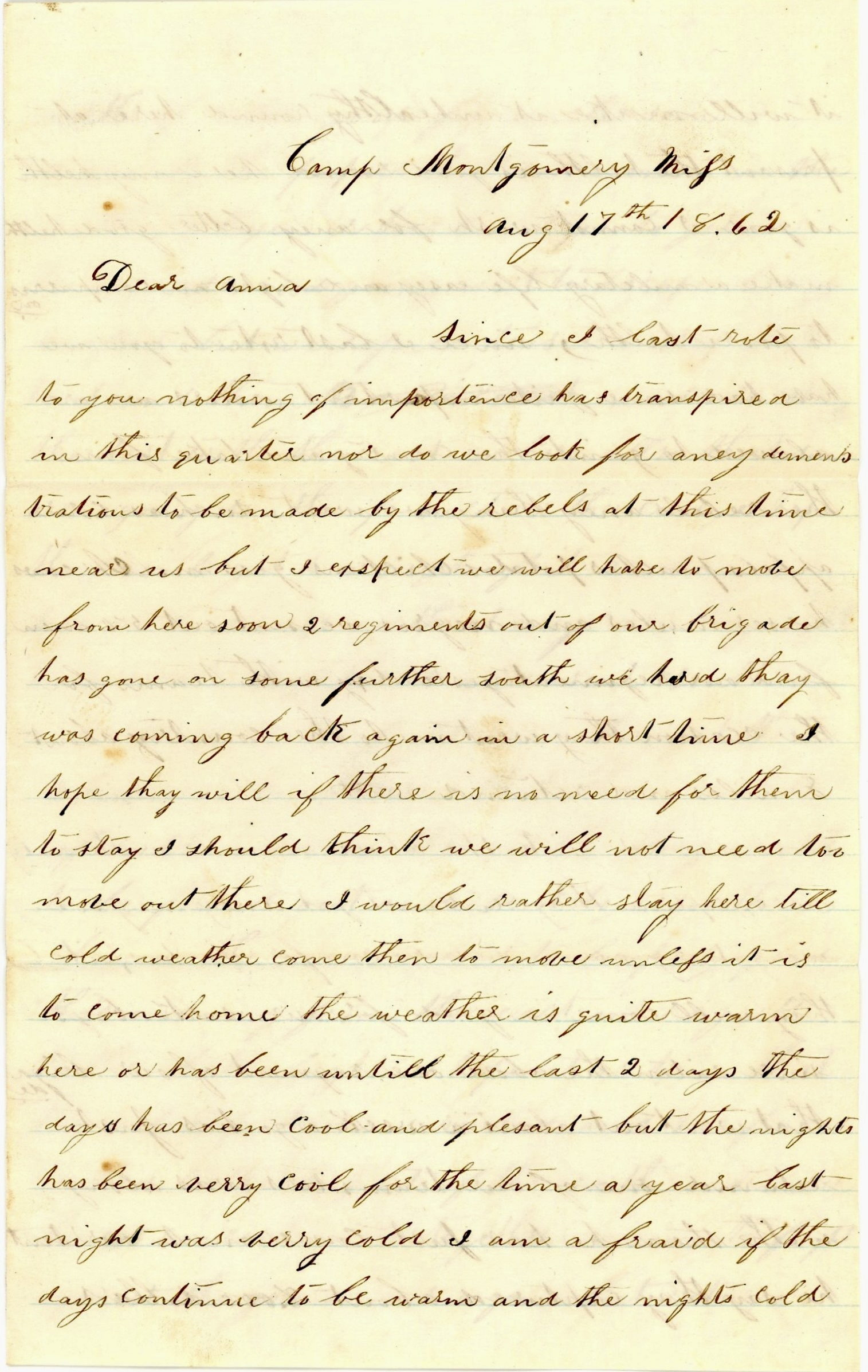
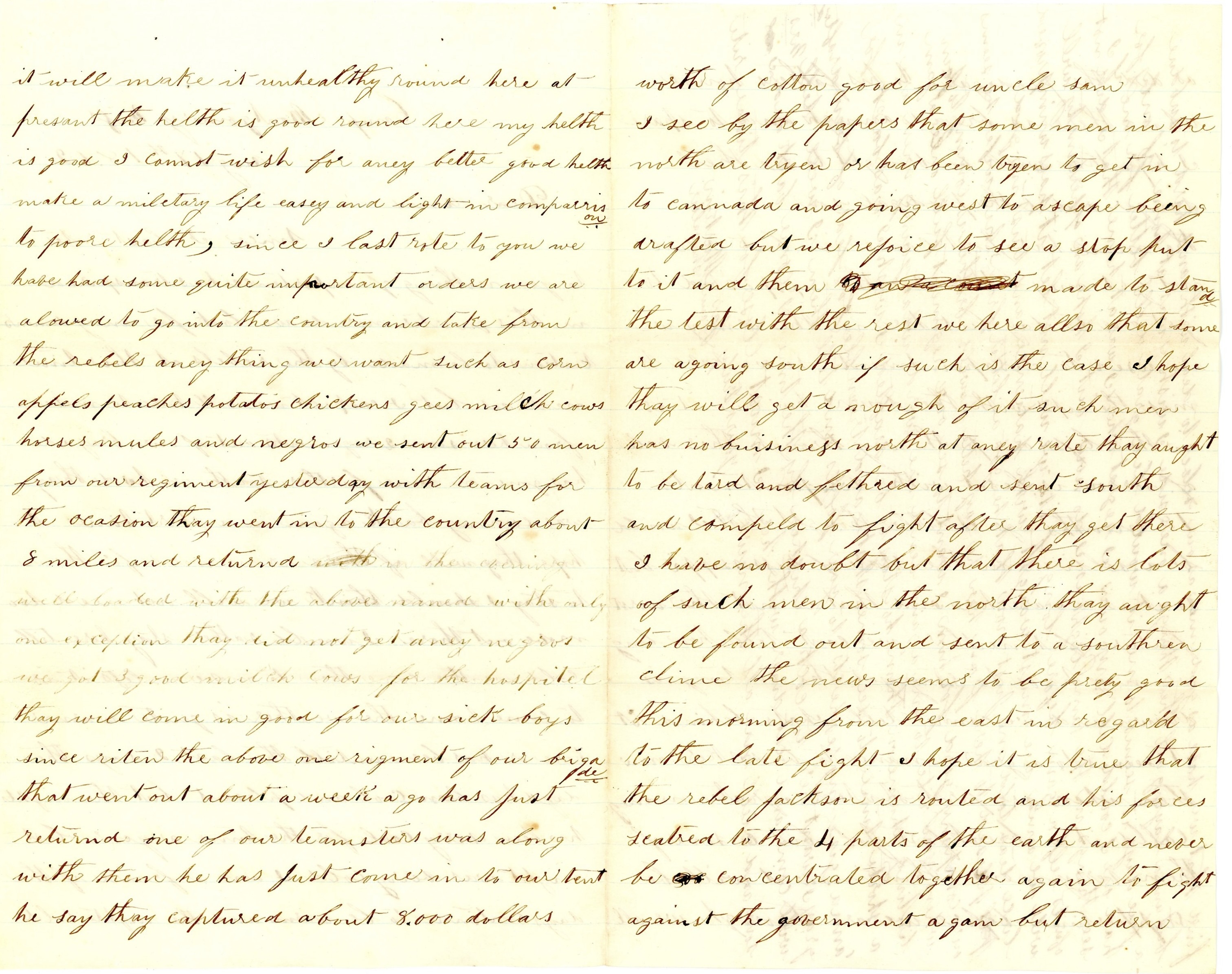
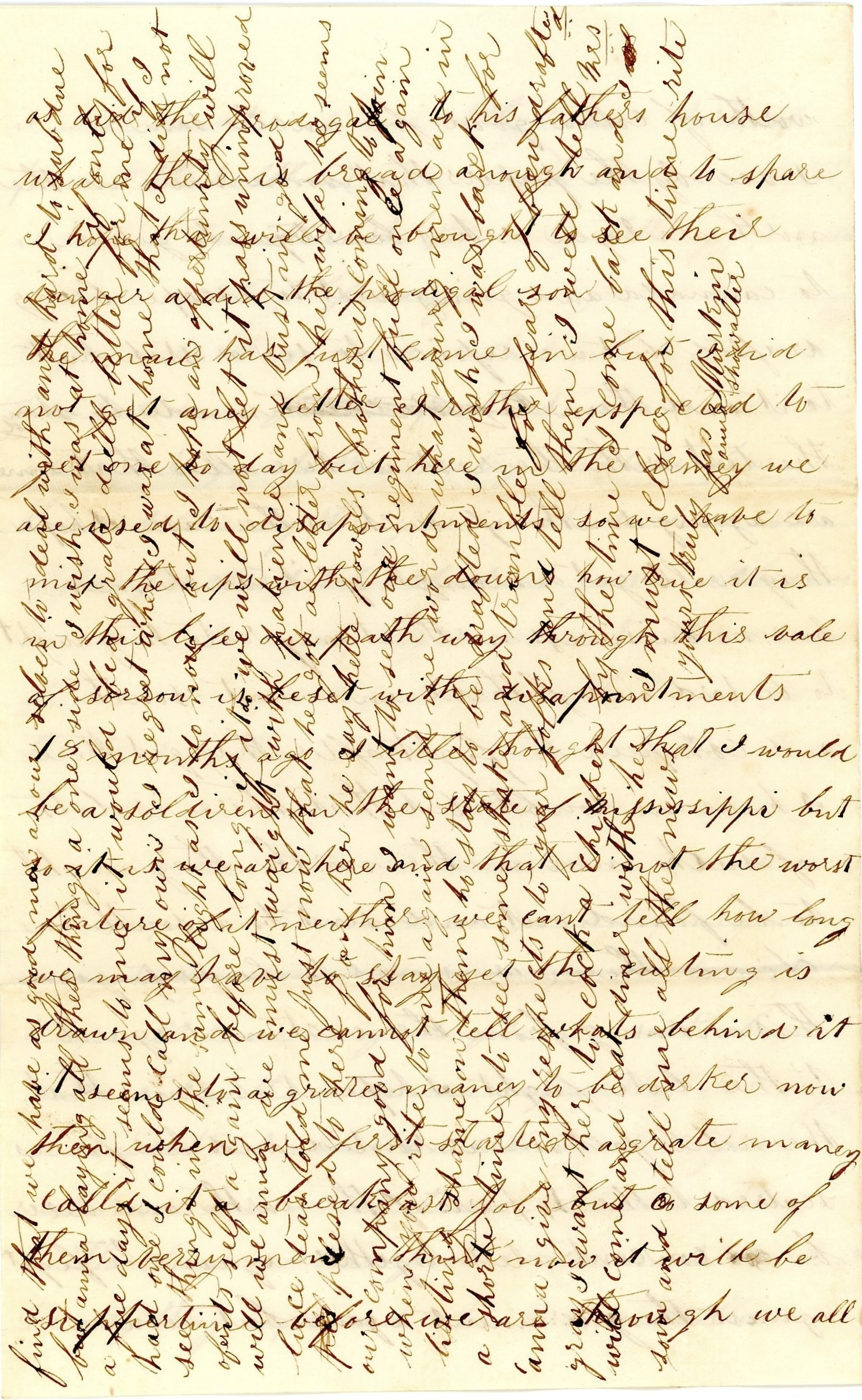
Letter 45

Rienza, Mississippi
August 26th 1862
Dear Anna,
Since I last wrote to you, we have marched about 11 or 12 miles further south to a small town called Rienza. It is situated close to the Mobile & Ohio Railroad—quite a nice little place but nearly deserted by the inhabitants. I received your kind letter yesterday and was glad to hear from you again and to know that your health was good. I am glad to say that I am enjoying the best of health at this time for which I am thankful to God for and may He grant all good health to those left at home and all that’s dear to them, to endure the hardships of a soldier’s life and every opposition which may be waged against our government by the enemies of our country. I say may He give us all good health to endure all hardships as soldiers. But above all, me He give us hearts to love and serve Him with an eye single to His glory.
Anna, sorrow seems to have entered your heart and also the minds of all your folks in regard to your brother’s enlistment. I know you all grieve to see him leave home, one so young as he is, while there are plenty stout-hearted—not stout-hearted, but cowardly-hearted and able-bodied young men at home whose duty it is to go in place of such young men as Franklin. He may stand it as well as any man in the army, but it is the case sometimes such young men can’t stand it although we have several in our regiment. But some are and some are not with us today. At any rate, he must be careful and take the best of care of himself in all cases. I don’t think he will have to come down here yet at any rate except he has joined an old regiment. I should like to know what regiment he belongs to. Don’t forget to tell me the next time you write.
Anna, today I am out on picket. I am sitting close in front of one of these so called southren mansions. It is what we call a nice little country house. The most of the houses in this country are log shanties. To tell the truth, the southren people are 25 to 50 years behind the times. It is very seldom that we see a stove in a southren house. They do all their cooking in the old fashioned style. I presume the southren ladies would almost as soon see a lot of snakes as the Yankee invaders. Our orders are very strict. We are not allowed to let a citizen pass our lines on no consideration, nor any of our men without a written pass from headquarters. As the old saying is, it is rather tough on the natives, but never the less it is necessary to our safety as we are in an enemy’s country and surrounded by them on every hand.
Anna, you can tell your folks and rest assured yourself that if I come across Franklin, I will treat him as well as I know how and give him the best advice I can. I must close for this time. My respects to all. — Jas. Murkin
Write soon.
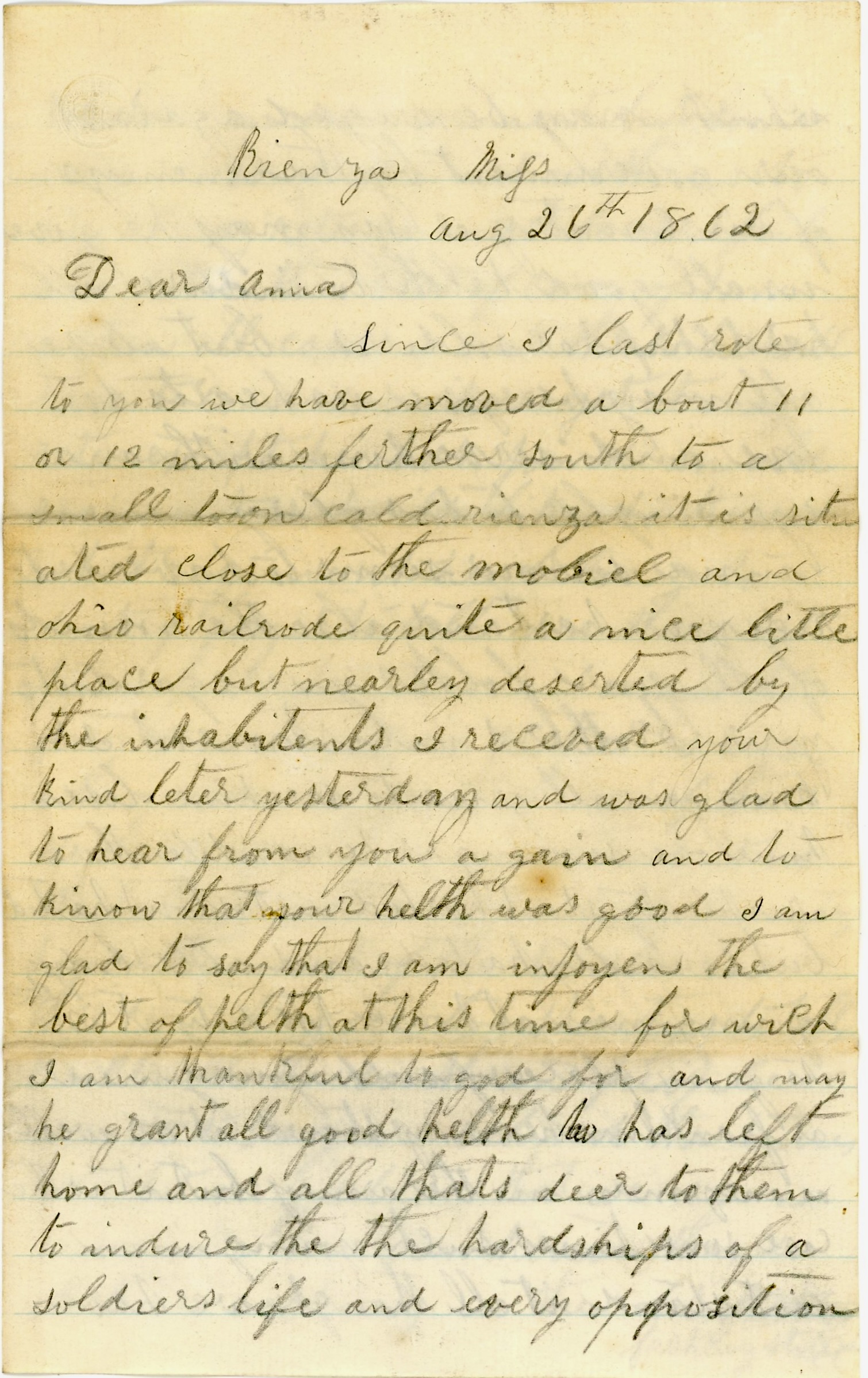
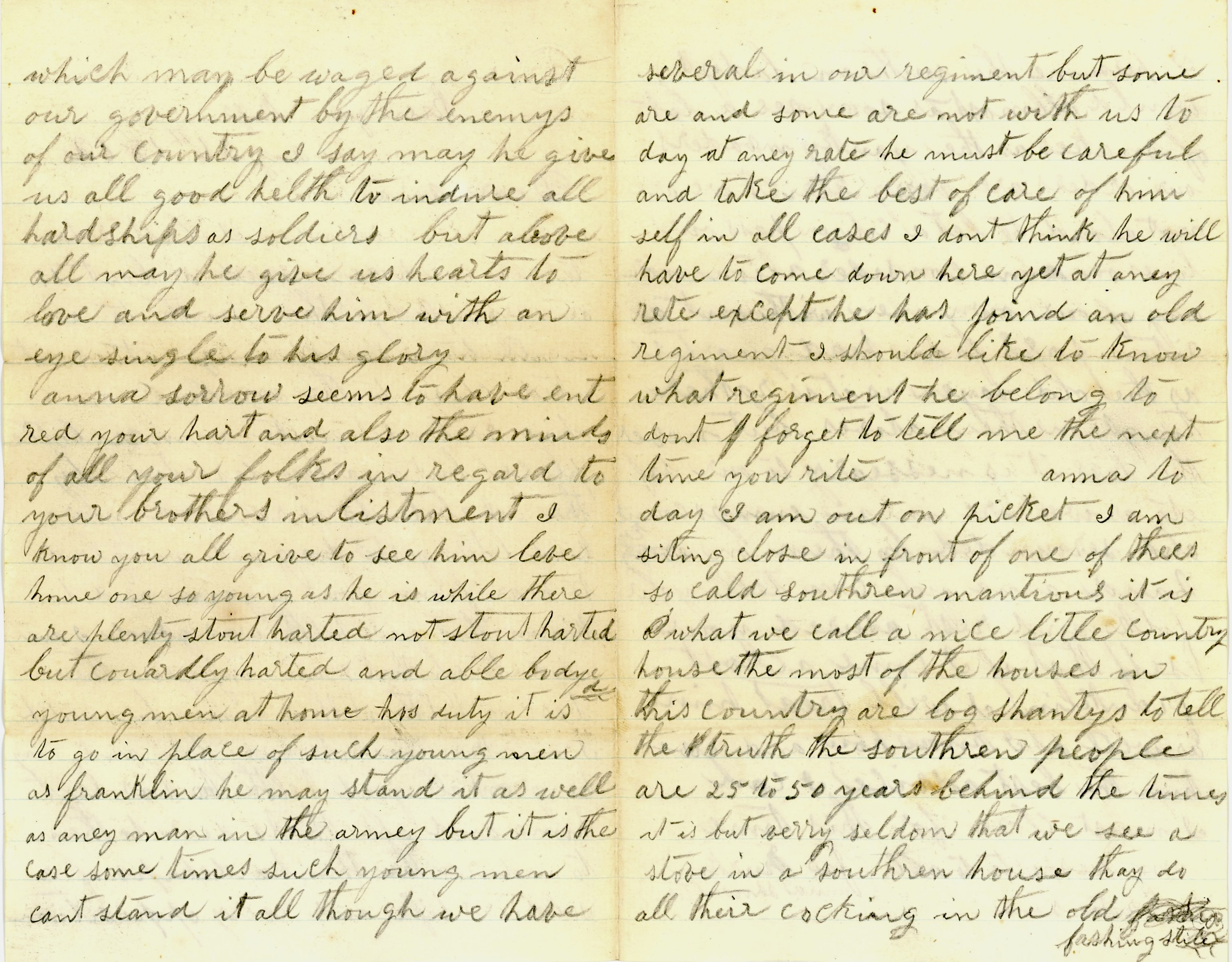

Letter 46
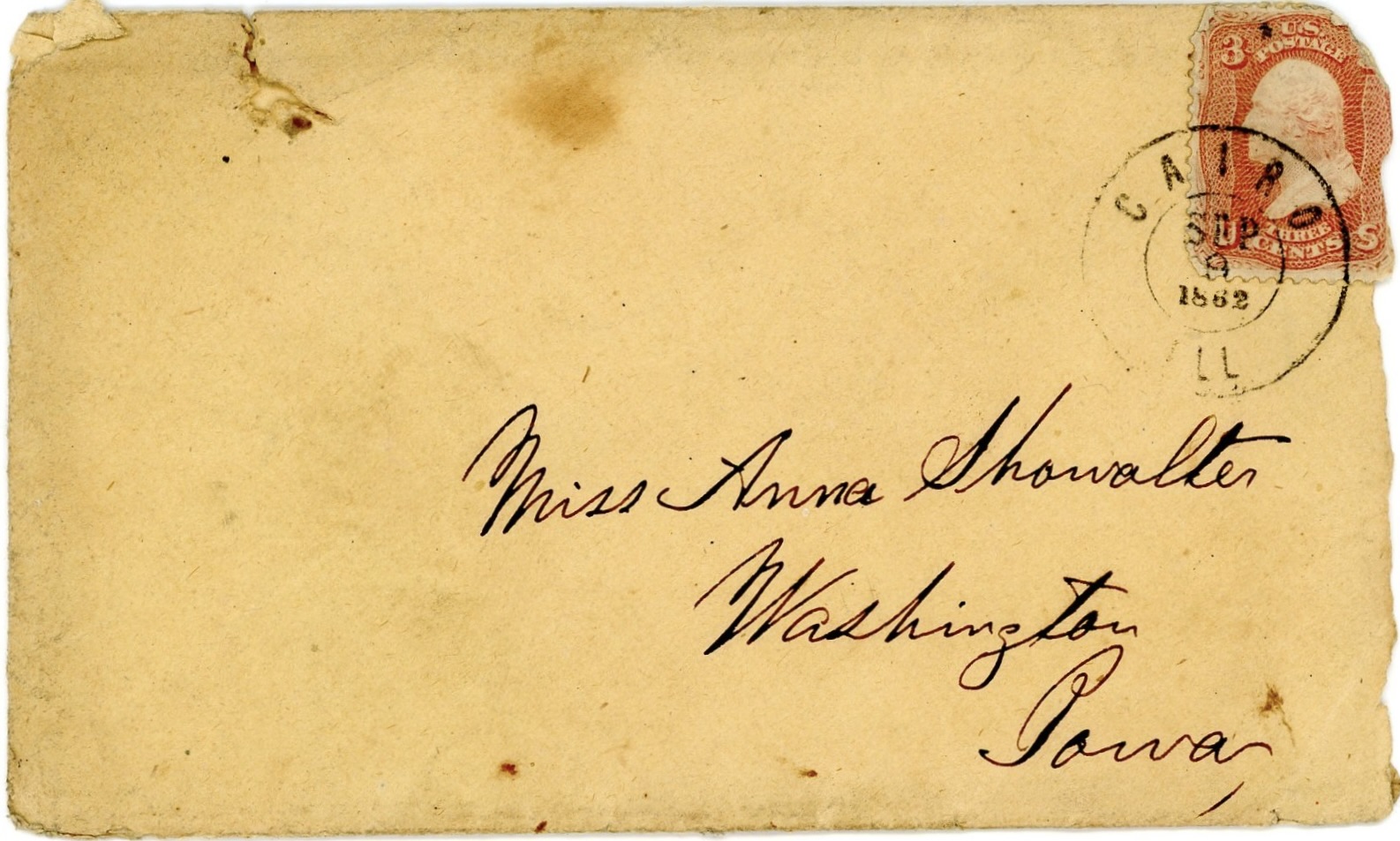
Rienza, Mississippi
September 4, 1862
Dear Anna,
Since I last wrote to you, nothing much has transpired in these parts. Yesterday morning we was called in line of battle expecting the rebels to make a dash at our lines. The report was the rebels was drawn up in line of battle but a short distance of [us]. The excitement run very high for a while. Finally the order came to stack arms and go to our tents and hold ourselves in readiness ar a moment’s warning. It all died away and no rebels came. Such exciting times a soldier often goes through in times like these. Sometimes held all day in a miserable suspense, expecting to be called on every moment to face the enemy and death. If there ever was a man who needed to live and lead a Christian life, it is a soldier. But Oh! how few there are that do it. Wickedness seems to prevail in the army to a greater extent with officers, and [with] privates there seems o be no respect of person.
Anna, I received a letter from Franklin a short time ago and he seemed to be determined to fight in defense of his country which is now calling for help from her sons of the North who should rally at her call. But how many are failing to do it. We all have to acknowledge with shame that thousands of able-bodied men are standing back and letting young men like your brother go in their places who are not able to endure the fatigues of a soldier’s life. Such men, I hope, will be drafted and compelled to go and sent to the frontier with us and then they will find out what it is to face the enemy. They want to see their country at peace again, but don’t wish to help do it themselves. Such men will meet their reward after this. They will not be forgotten. I glory in Frank’s courage and hope he will live to see peace again restored to this country and have health to endure a soldier’s life.
Anna, I have not much to write this time. I cannot ask for better health than I have at this time and hope these lines will find you enjoying the same blessing. My respects to your folks. Write soon. — James Murkin


Letter 47
Camp Montgomery, Mississippi
September 9th 1862
Dear Anna,
I avail myself of the opportunity this morning to pen a few thoughts to you and to let you know that I am well at this time and enjoying the best of health and hope these few remarks may find you enjoying the same blessing. You will see by the heading of this that we are back to our old camp near Corinth. Last Saturday morning we was aroused from our slumber at 2 o’clock to get something to eat and be ready to start for Corinth at daybreak. We did too with the greatest of pleasure—glad to leave Rienza as we did not like our commanders so well as we did our old ones at Camp Montgomery for several reasons. At Rienzi we had to attend roll call at 4 o’clock in the morning which was too early in the morning to get up according to my notion. And also the opinion of the whole regiment out and again roll call at 9 o’clock at night and every man had to be there and answer to his name or be put on extra duty. A great many of our regiment has had part of their wages stopped for disobeying orders and many of our company yet.
When we came near to or when we got there, we found out we was a going to Louisville, Kentucky. Some of the boys jumped for joy to think we was a going to or near to a Christian country once more but imagine our disappointment when we heard that our old commanders was trying to have us stay which they also accomplished. Our Colonel and Brigade Commander that we were under at Rienzi tried their best to have us go but all their efforts failed and we had to stay at our old camp. But I have but little idea that we will stay here but a short time anyhow under the present appearance of things. I began to think we will be compelled to leave Corinth as we are to far south for the rest of our army as the eastern army has been compelled to fall back…
I hope things will take a turn in the east in our favor, Everything seems to have gone against us lately. The rebels seem to have been successful to some extent…and nearly out-numbered our men all the time. But we can say we are coming, Father Abraham, six hundred thousand more. I long to see them take the field with us. Now is the time we need them. The rebels are trying their utmost at the present to accomplish their hellish design and destroy this government, but I hope we will be able to keep them [illegible].

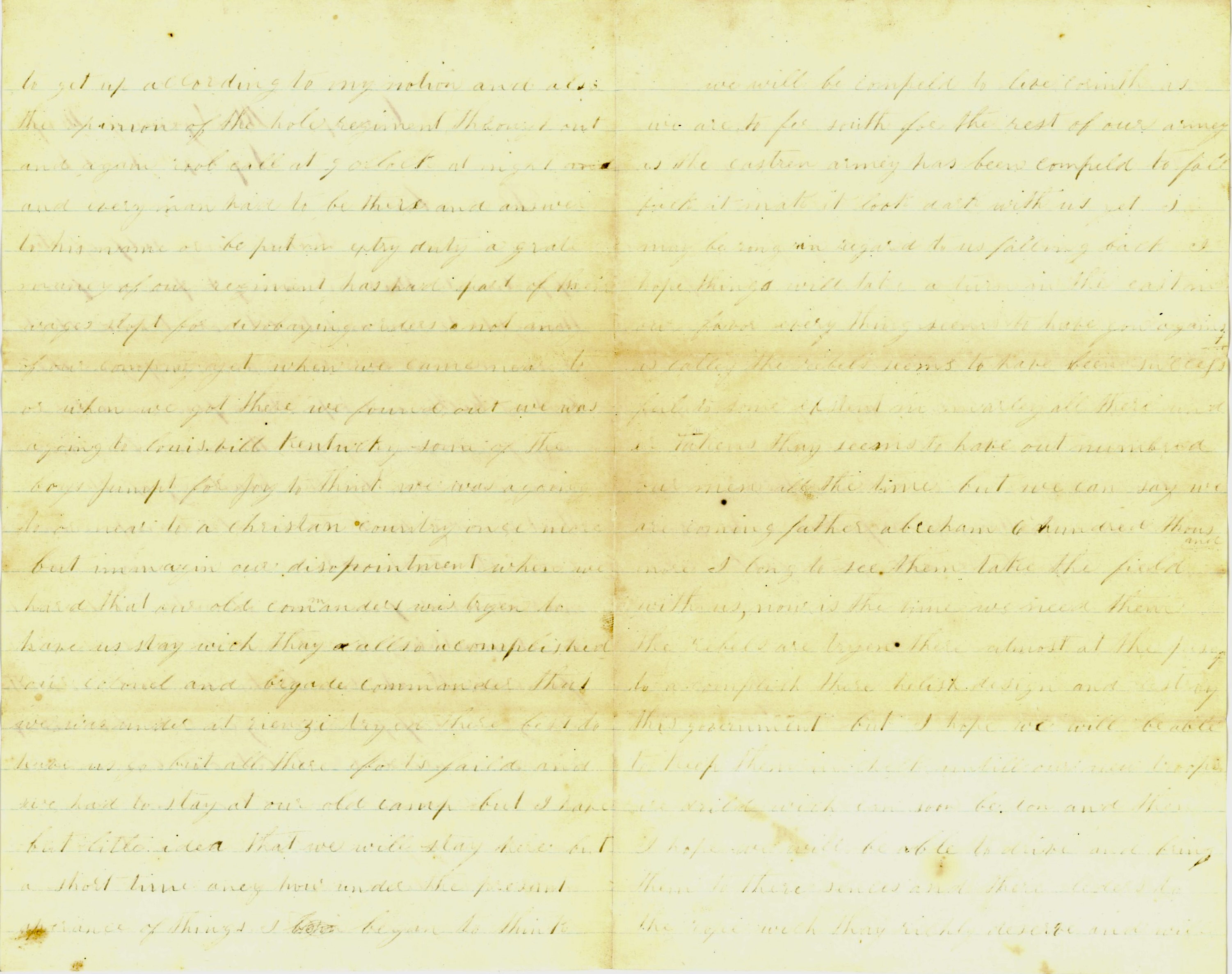
Letter 48
Camp Montgomery, Mississippi
September 29th 1862
Dear Anna,
Since I last wrote to you there has been another fight near here at a place called Iuka. Our regiment was not in the fight. The reason of it was the rebels left before we got to the scene of the action but we was on part of the battleground. The 5th Iowa was badly cut up, more so that any other regiment there. I think the 15, 16, [and] 17 Iowa Regiments was there but did not fare near as bad as the 5th. The 7th was also there but was not engaged in the fight. You will see the account of it in the papers before you get this letter and the official report will give a better account of it than I can. In fact, I don’t know but very little about it as I was not there where the heaviest fighting was. All I can tell is what I have heard others say.
I guess before you get this you will think I have forgot to write to you or neglected to do so but such is not the case. We started off to the fight with five days rations and did not get back till the five days was up an dduring the time we was away we had not much time to write or anything else while we was away from camp. After we came back, we had to go on guard the same evening—our whole company rather, on picket. It went pretty hard after marching all day but nevertheless we had to do it, and taking all things into consideration, we had a hard time of it.
I received yours of the 21st and was glad to hear from you again and also to hear that your health was good. You say that you are at home again on a visit and that there is no place in this world like home. How true it is, and Oh! how often does the soldier realize the truth of it when he is marching and has to stop for the night just where it overtakes him, with nothing but the clouded canopy or a starry decked heaven for a house to rest in for the night.
The day that we started for Iuka, Oh how it rained nearly all day and part of the night. Notwithstanding the rain, we stood it first rate and today we have not a sick man in the company. May good health continue to be in our midst. You say that you received a letter from Frank the other day and that he liked a soldier’s life very well for far. I am glad that he thinks so well of a soldier’s life as he does. There is a report here that the 25th Iowa Regiment is ordered to Minnesota. I would like to go with them first rate but I guess we will have to stay in Dixie a while yet.
The nights are getting to be quite cold here and very unpleasant. I am afraid that it will not be as healthy here this winter as it has been through this summer but I hope it will for one and all. We are looking for our new recruits now every day to join our regiment. They did not come with Lieutenant [Mathew H.] Hamill as we expected for some reason. You stated you could not get your likeness taken the day you went to do so as they had no plates on hand. You may note yourself about sending it in a case. I would like to have it in a case but will not urge it but it will leave it to yourself to determine.
I don’t think I have anything more to say that will interest you this time but be sure and write soon and send me your likeness. Give my respects to your folks and Mrs. Ditmars and tell them I am well. — Jas. Murkin


Letter 49
Keokuk, Iowa
October 21st 1862
Dear Anna,
It has been a long time since I wrote to you and a longer time since I heard from you. I hope to hear from you soon. I am doing first rate. My secesh pet is doing well. I will be well in a week or two if I have good luck. I would like to come home but I am afraid they won’t let us come. They won’t give any passes to anyone. I shall come home before I go back again if possible.
There is only one more of our company here with me. The rest of the boys are scattered round—some at Cairo an some at St. Louis. I think they started from Corinth before we did so we don’t know where they are yet.
You have heard the true result of the Battle [of Corinth] before this so it will not be any use for me to try to tell you about it. [Lt.] George Neal is dead. He was shot in the head. Peace to his remains. My wound come very near being a fatal one to me. It struck me below the right shoulder but did not go deep enough to hurt my lungs.
Anna, you must excuse my writing and short letter this time. Give my respects to your folks and tell them I am doing well. My respects to all enquiring friends, Yours as ever, — Jas. Murkin
Address your letter to Murkin, Keokuk, Iowa, in care of Capt. H. R. Cowles, 2nd Regiment
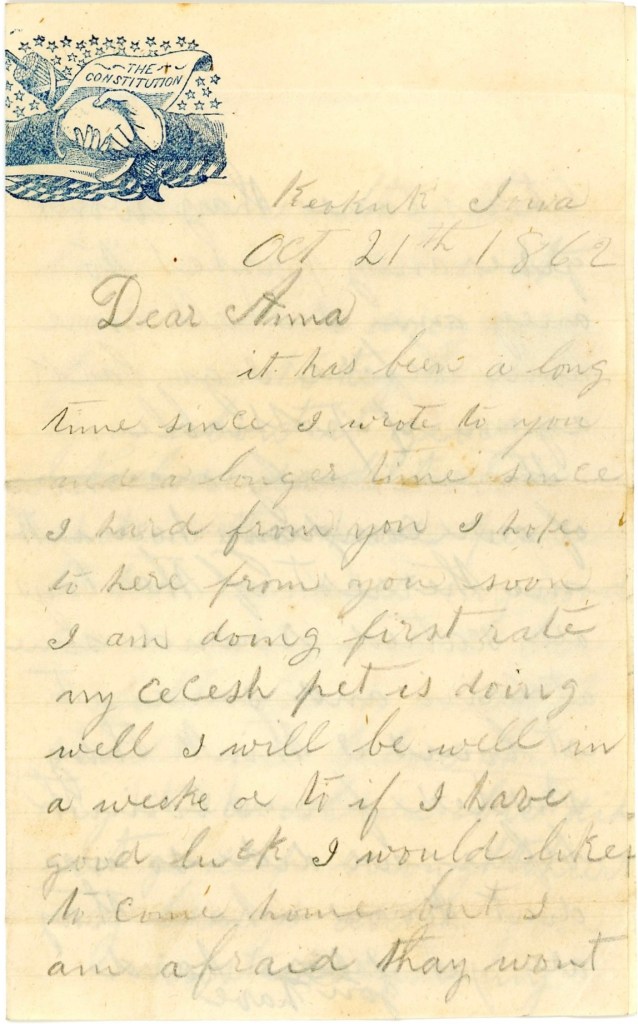
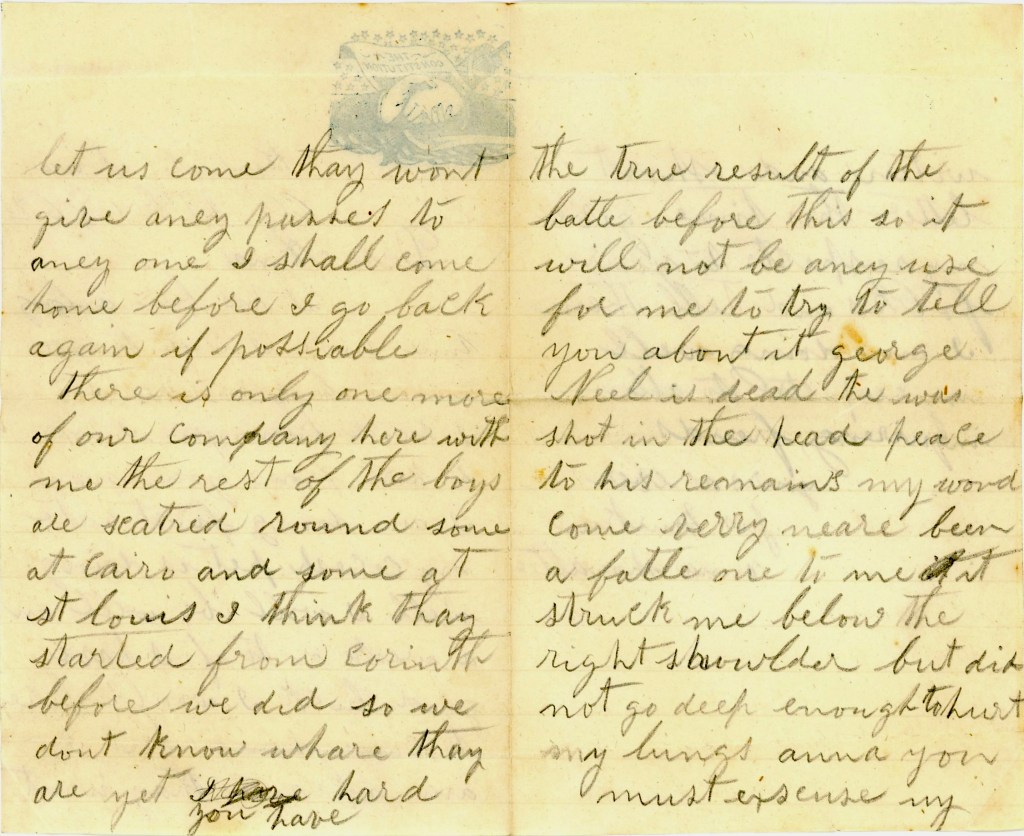
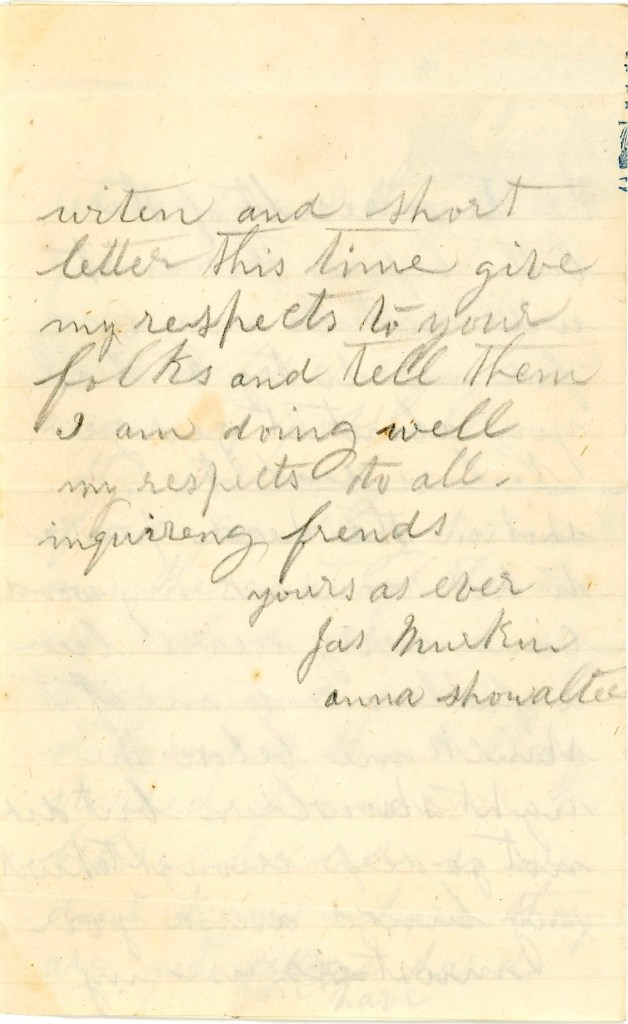
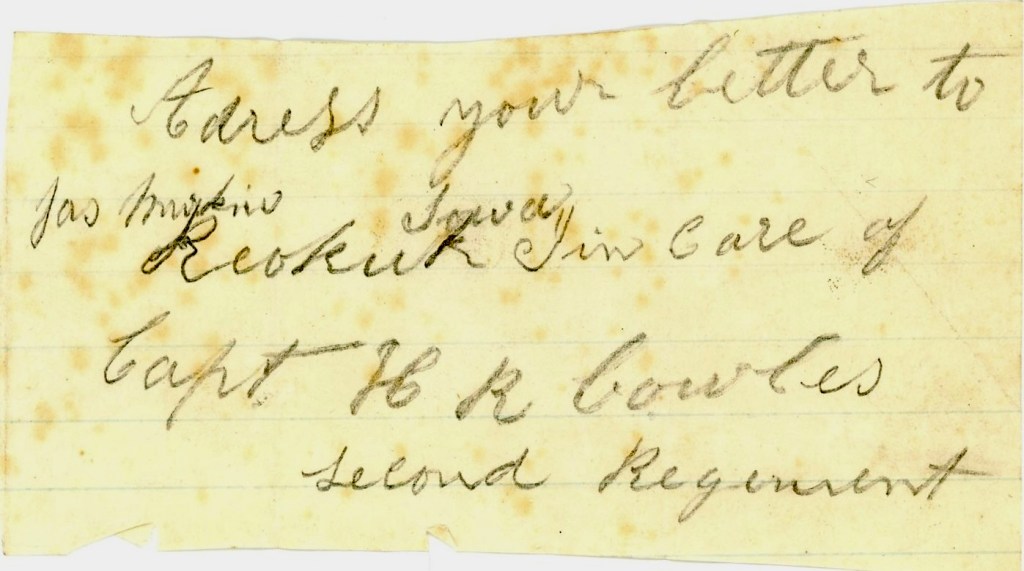
Letter 50
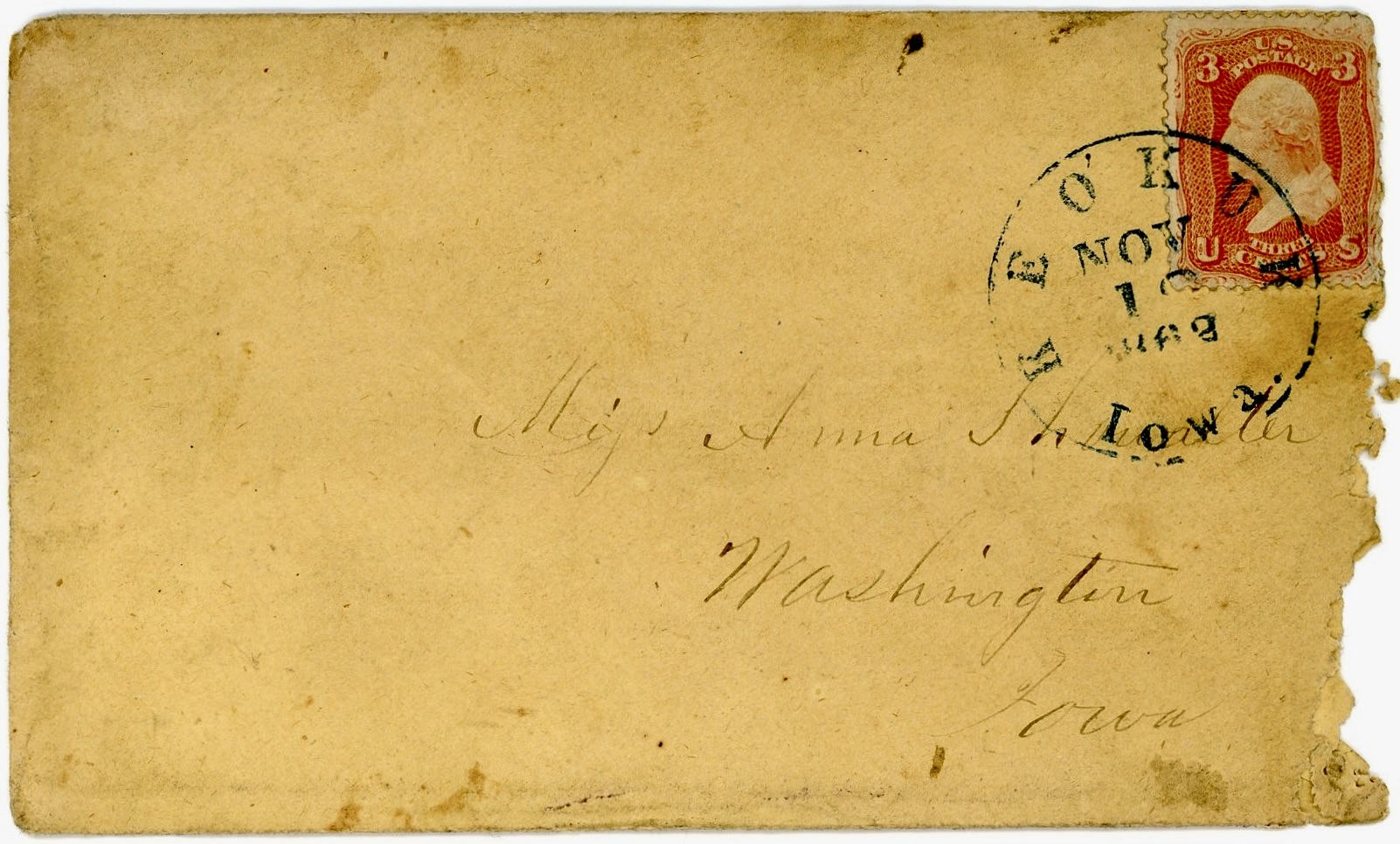
Keokuk, Iowa
November 11th 1862
Dear Anna,
I feel very anxious to hear from you as I have not had the pleasure of seeing a letter from you since before the fight at Corinth. I wrote to you as soon as I could after I came to Keokuk and have not had any answer yet. I don’t know what’s wrong. I should like to hear from you. I cannot come home yet. They won’t give any furloughs so if I come, I will have to do it on my own responsibility. But I intend to come if I can soon.
Anna, I have no place to write. You must excuse a short letter. I am doing first rate. My wound is getting well fast but I do not intend to soldier much this winter.
The regiment that [your brother] Franklin belongs to went down since we was here. I did not get to see it. It left before I could get down to the river. It hurts me to write. I must close. My respects to all. Write soon. — James Murkin
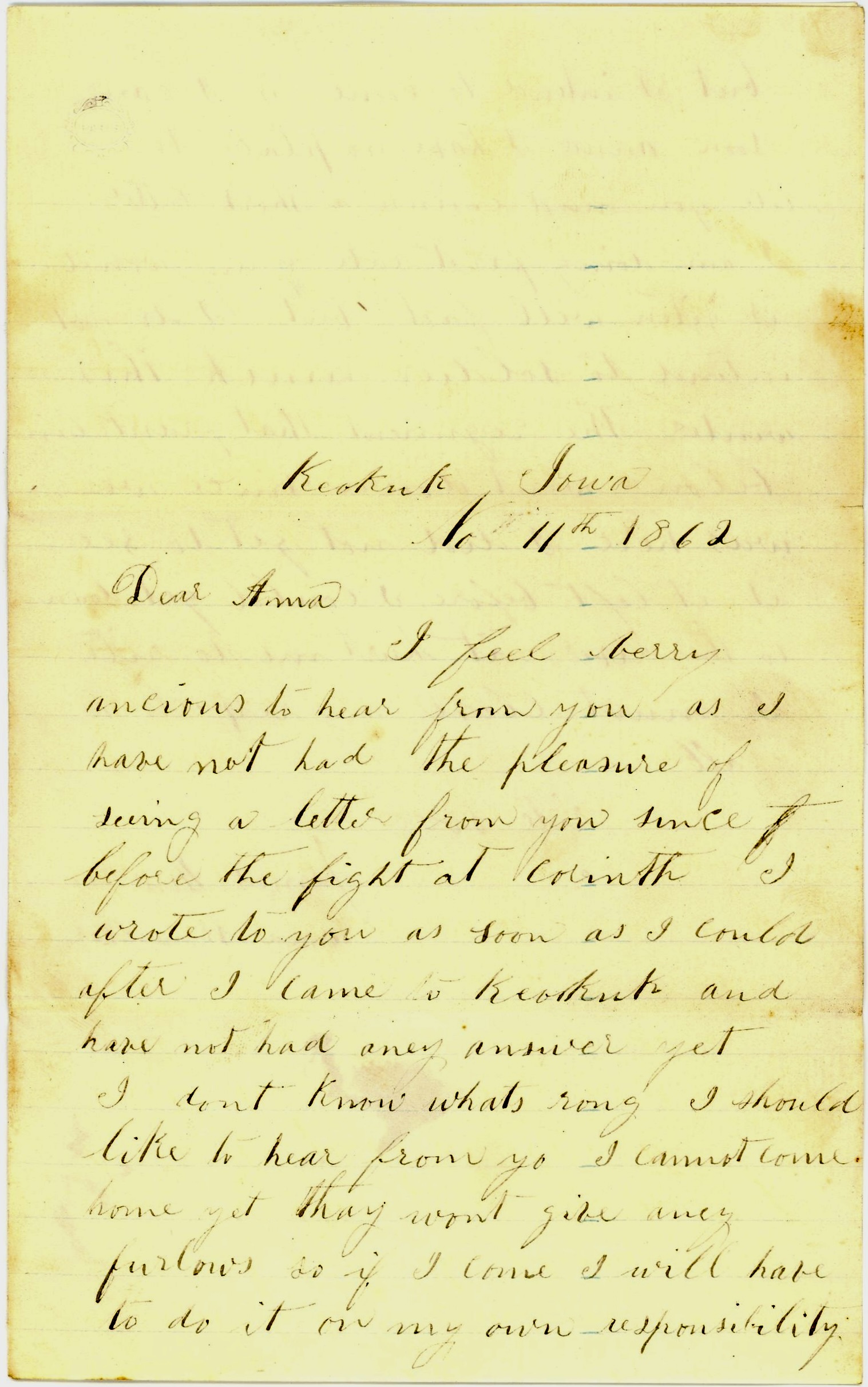
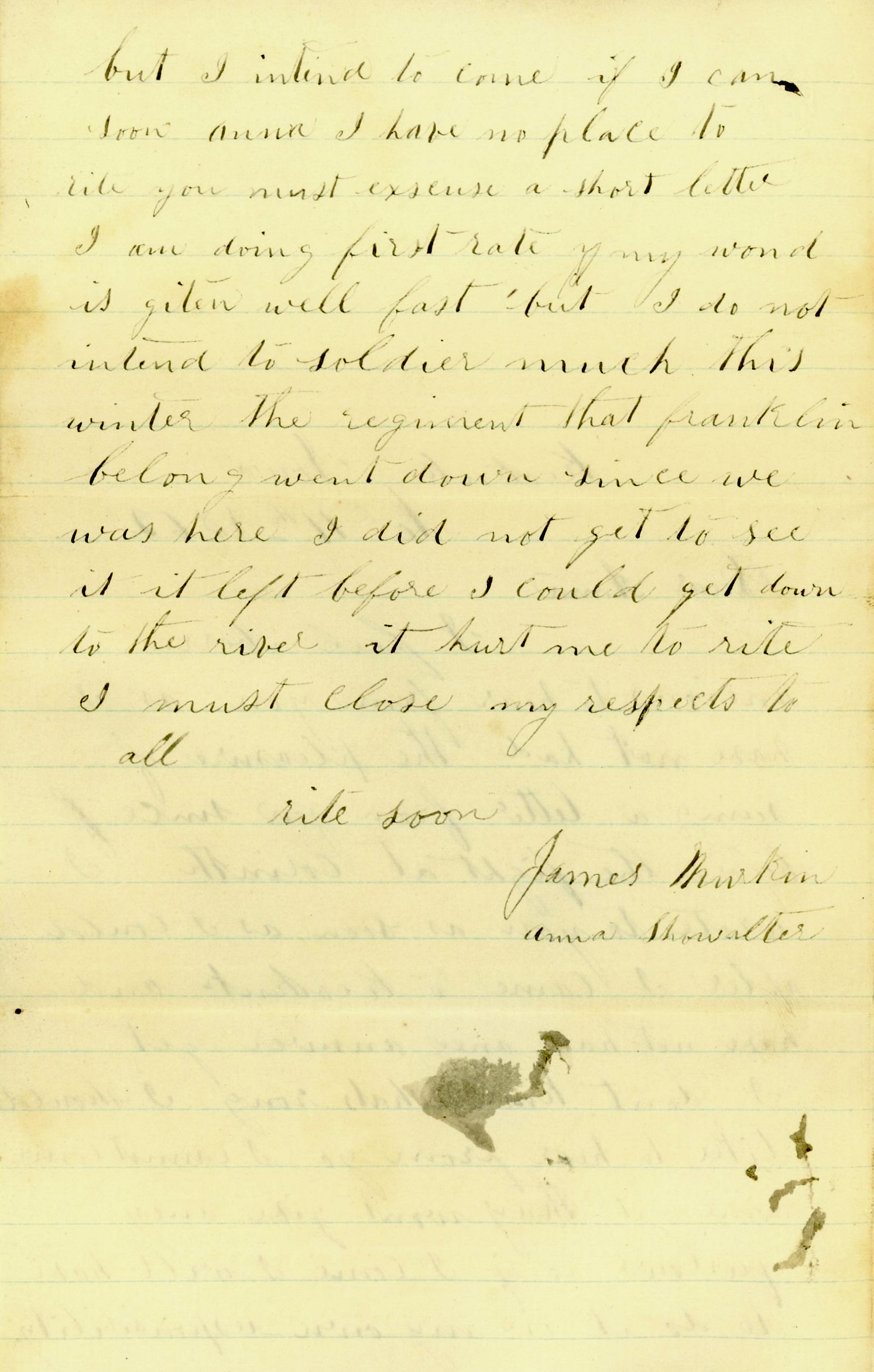
Letter 51
Keokuk, Iowa
November 21st, 1862
Dear Anna,
Yours of the October 28th came to hand the other day. Although I went to the [post] office every day, I did not get it till day before yesterday. When I saw my name and noticed it was the post masters tardiness that I did not get it, it was put with the citizens’ letter and not with the soldiers’. It had been so long since I heard from you I had come to the conclusion you was sick. But that drove all doubts from my mind when I got your letter and found you was well.
Anna, I guess you will be disappointed in not seeing me before this. I can assure you that it is not my fault. I wish I could get off a short time to come home. I would gladly do it but I can’t do it just yet, or if I do at all, it will be on my own responsibility. It seems they will not give furloughs.
My wound is doing well. One hole is healed over and the other will be soon if I have good luck. If they won’t let me come home, they cannot make me soldier until I get well. I don’t intend to this winter at any rate. There are men here who has been here all summer playing off sick and trying to get a discharge, A great many has done it already and a great many trying yet. And I have no doubt but they will make out to do it. It is quite pleasing to see some of them maneuver. There is ten of one regiment in one room. We have lots of fun with some of them that has been here so long. Oh how I would [like] to come hoe at Christmas. I will try if I am here.
Anna, I will have to close for this time. My regards to all. Yours truly, — James Murkin
I will write again soon.
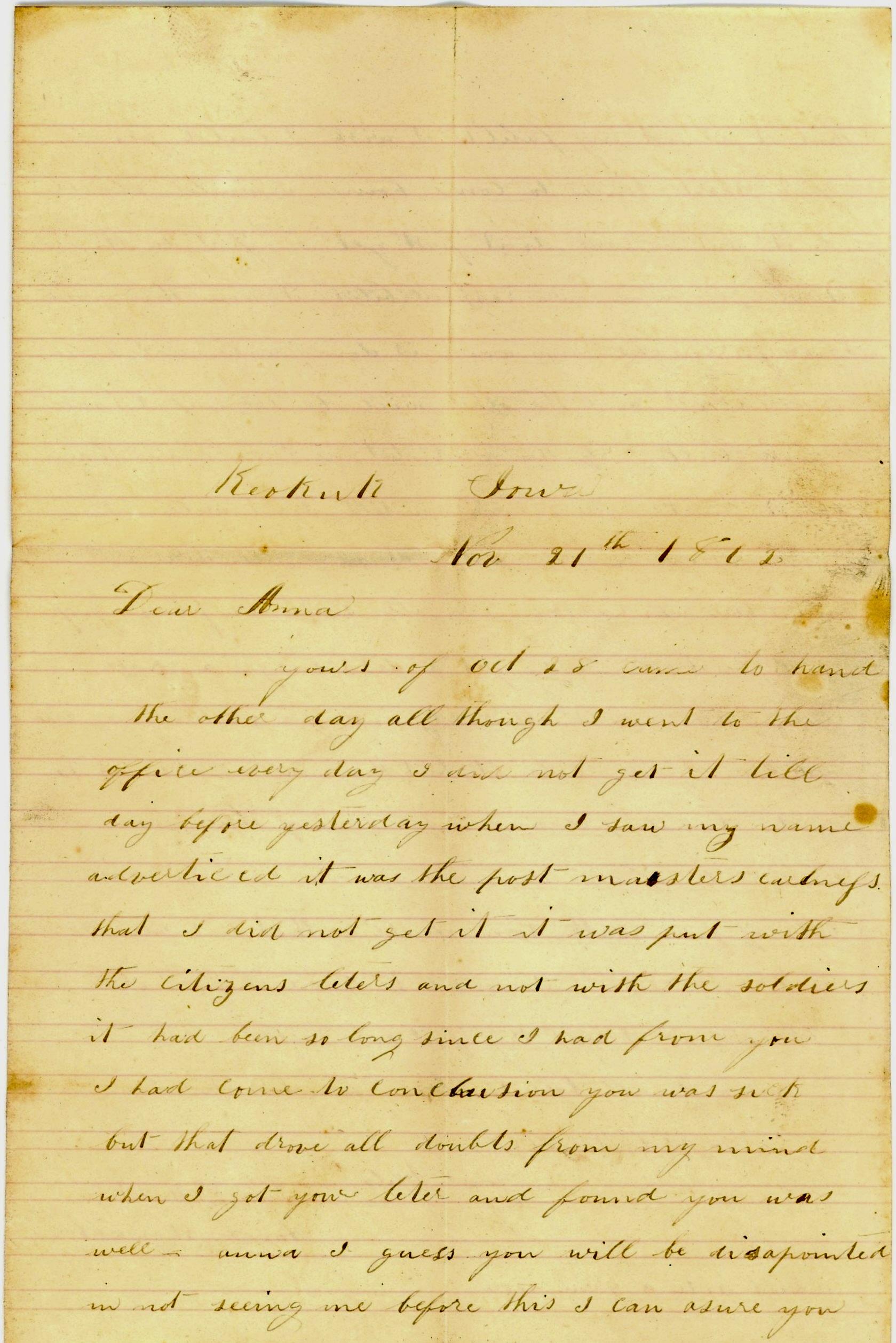

To read the remainder of the letters in the collection, go to 1863-64: The Civil War Letters of James Murkin, Co. H, 2nd Iowa Infantry (Continued)
The following stampless letter was written by Oscar Martin Burke (1824-1902) and his new bride, Martha Caroline Meech (1824-1902). They were married on 23 June 1847 in Newburgh, Cuyahoga county, Ohio, and we learn from this letter that they soon after made the journey to Oscar’s farm near the village of Libertyville in Lake county, Illinois—approximately 37 miles from Chicago. The route from Cleveland to Libertyville was made by a direct journey across the upper Great Lakes, consisting of sailing or steaming west across Lake Erie, passing through the Strait of Mackinac into Lake Michigan and then traveling south along the western shore. Although the couple called the village “new,” it had already passed through several name changes prior to their arrival. It was first settled around 1834–1835 as Vardin’s Grove. It was renamed Independence Grove in 1836 and Libertyville in 1837. In 1839, Libertyville was made the county seat and renamed Burlington until the county seat was moved to Little Fort (now Waukegan) in 1841. At that time, the Village reclaimed the name Libertyville.
Oscar was the son of Gaius Burke (1791-1865) and Sophia Taylor (1795-1859) of Cuyahoga county, Ohio. His wife Martha’s parents were Gurdon Parke Meech (1771-1854) and Lucy Swan (1781-1867). Martha—the youngest in her family—and her numerous older siblings were all born in Bozra, New London, Connecticut. Sometime in the 1830s they removed to Newburgh, Ohio. Closest in age to Martha was her brother Nelson Trace Meech (1821-1879) whom she wished to join her in Illinois but census records suggest he remained in Ohio all his life.
The Burke’s apparently remained in Illinois for a time despite Martha’s homesickness. In 1850 they were enumerated in Waukegan where Oscar was employed as a teacher. By 1860, however, they had returned to Cleveland, Ohio, where Oscar was employed as the Secretary & Treasurer of the Cleveland & Mahoning Railroad Company. An obituary informs us that when Oscar died in 1902, he had become one of Cleveland’s “most prominent” businessmen. After several years at the Railroad Company, he purchased the a foundry and built it into the Lake Shore Foundry Co. He then became one of the founders of the Dime Savings & Banking Co. his estate was estimated to amount to $500,000 (close to $20 Million today) at the time of his death.
T R A N S C R I P T I O N
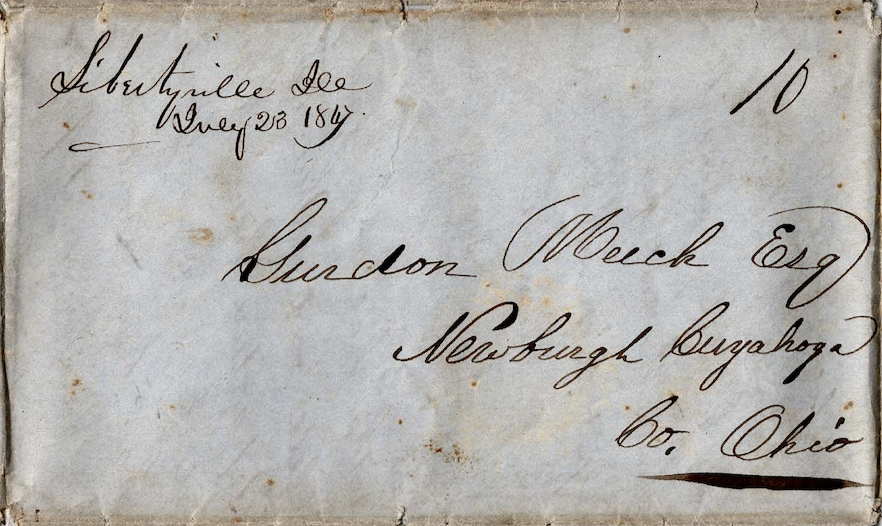
Libertyville, Illinois
July 24th 1847
Dear Parents,
How to begin this letter or what to say, I scarcely know. But this much I do know, that if I write, I must commence and say something. In the first place I will give you a brief description of my journey.
We left Cleveland Wednesday afternoon about four o’clock. The Lake was quite rough and I was quite sea sick but not enough to vomit any. There were two Ladies from Buffalo that started from the Franklin House with us that were going to Chicago which I got considerable acquainted with which made it quite pleasant for me. After the first afternoon, the lake was perfectly smooth all the way and we had a very pleasant journey indeed.
We arrived at Detroit Thursday morning about six o’clock which is situated quite pleasantly. We remained here for about one hour. About 11 o’clock, we stopped on Canada side for wood and Oscar & myself, those two Ladies from Buffalo, and quite a number of other passengers went on shore and took quite a long walk so that we can say we have walked on Queen Victoria’s soil. After we had been on the Lake about 2 days, we came to a settlement of Indians where we saw them at work—some getting wood, and some were getting bark for the purpose of fixing their wigwams I suppose, which I assure you are singular looking things. The edge of the water was filled with bark canoes and the banks were covered with squaws and their children. Some had on their blankets and some were perfectly naked but they seemed to enjoy themselves very much. The children seemed to be amusing themselves with their bows and arrows while their mothers were looking on.
The next place of any account that we stopped at was Mackinaw. There is on this Island quite a number of curiosities. Among them is the Fort. The boat stopped here long enough to give the passengers time to take a stroll if they wished, which we improved. Oscar, myself, Mrs. Smith & sister from B[uffalo] went up to the Fort where we saw the guns and balls which were used in the last war. The place where the Fort is situated is very pleasant as you have a fine view of the Lake and it is kept so perfectly clean and nice—everything seems to be in such perfect order.
The next place that we called at was Sheboygan which is quite small. I saw James Kingsbury. He came on board the boat but I do not believe you would know him. I should not—he is altered so. I should think he was going down pretty fast. We arrived at Milwaukie Saturday evening which is the most business place for a new one on the Lake. We arrived at Racine in the night, at South Port also. Mrs. B. Doxstader and Mrs. J. Finegan came as far as Racine on the boat with us and they went it, I assure you. They went on shore at Milwaukee and the boat went off and left them but finally went back after them on account of Mrs. Finegan leaving her child on board.
We arrived at Little Fort [Waukegan] Sunday morning about 6 o’clock which is quite a pleasant place for a new one. There is a great many buildings being built but everything looks new. There is not many very splendid door yards as yet.
Sunday afternoon we went out to look at Oscar’s farm and on Monday we moved our goods out. We boarded at Mr Cook’s about a week and then went to keeping house or the house kept us. I think this is a very pleasant country for a new one. But I suppose you want to know if I have been homesick any and I assure you I have. Oscar went to Chicago and was gone two days and left me at Mr. Cook’s and Oh dear me, if you was ever homesick, you will know how to pity me. And if I was ever glad to see anybody, it was him when he got back. Mr. Cook’s family are very fine people but they were all strangers.
And now a word about my neighbors. I have one as near as Mr. Carter’s. Another as near as Mr. Kimal’s. In a word, they are near enough.
Monday evening. I had a call from Miss Paterson, my nearest neighbor, Tuesday evening. I had a cal from James S. Clark and Lady & Mrs. Swan, and yesterday one from Mrs. Harvey. I had an invitation to take tea at Mr. Cook’s yesterday but did not go. I have about made up my mind that this is not the place for me. Mrs. Swan & Mrs. Clark say we must make up our minds to stay here for they say the longer they stay, the better they like it, and well they might for they are all relation to one another. Perhaps if I had those which are near and dear to me but the ties of nature with me, I should like it better. This is a beautiful country but not home. If Nelson has any idea of ever going West, I want him to come here this fall and see this country. I think he will be well pleased with it as far as the couyntry is concerned. I am going to leave the rest for Oscar to say. Give my love to all and especially to P___ & Mich. Tell Desdamonia & Olive I want they should write and tell me all the news. From your daughter, — Martha
[in a different hand]
Dear parents, Martha has very kindly left a part of the for me to fill out. She has made you acquainted with our departure from Cleveland, our journey up the Lake, and of our arrival at our own home at which place we have been about a week. The country is a new one. Therefore our home at present is a new one but give it a few years improvement and it will exceed norther Ohio for beauty and scenery. But with all beauties of this country, it is not home. Martha has been homesick which makes it very unpleasant. We are well at present and have not heard of any sickness. The crops never looked better in any country than they do here this year. Illinois [paper torn]
We are both well at present, have heard of no sickness as yet. We have had some very warm weather but at present it is very cool. I hope we shall get a letter as soon as possible after you receive this. Remember me to all. Yours truly, — O. M. Burke
Mother, I want you to write to me. I would give more for a letter from you than I would for all Illinois. I want Nelson to write and tell me all the particulars about everything. Tell Father I should be glad to have him come in and take a smoke with me. I have thought of him and his large chair very often since I have been here. Give my love to all and more particular to Harriet and Lucy and tell them I should be very glad to see them. [I believe this margin note was added by Martha.]
The following letters were written by James Chauncy Lopus (1841-1897) who enlisted at the age of 21 to serve three years as a private in Co. F, 112th new York Infantry on 30 August 1862. He was discharged for disability on 28 October 1864 at Buffalo, New York.
Chauncy was the son of Francis Chauncey Lopus (1814-18xx) andRosanna P. Linnet (1810-1880) of Busti, Chautauqua county, New York. Chauncy was described at a 5′ 8″ farmer with blue eyes and dark hair when he enlisted in 1862.
Letter 1
Camp Suffolk, Va.
January 24, 1863
Dear Parents,
Having a little time this morning, I thought that I would write a few lines to you to let you know that I am well & hope these few lines will find you enjoying the same blessings. I have been on duty almost every day for two weeks. The details for fatigue have been heavy for some time on account of building rifle pits and finishing Fort Nancyman [Nansemond] & Union & slashing for the range of guns. I have been chopping for the last two days. There has bee some 150 out each day. That makes it quite musical to have them all together & there is some dodging to do to keep out of the way. There was one of the men in the Massachusetts 6th Regiment come very near getting killed with a tree. It struck him on the head and knocked him senseless. The timber was mostly pine and oak cedar. The pine was quite large.
The details for fatigue out of our company is 21 for camp guard, five for picket. Our Major General Peck [is] commanding the Division. The Sixth ARmy Corps has been expecting to be attacked for the last two weeks. The Rebel General Prior commanding the Black Water forces sent word to Peck that he was going to take the place on such a day but he has not done it yet. But they have been in large forces on the Black Water & it is reported that the movement of Burnsides Army is all that saved us from being attacked. But they would of found us fortified to the eyes. If I have time, I will draw a map of the fortifications and their location.
Today is Saturday. Tomorrow will be my turn for guard. We have to guard two camps—our old camp and the one where we now are. All there is at the old camp is logs that have been left in tearing down the tents. They are not worth a farthing but there must be a guard kept there. It is the Colonel’s doings. He thinks a private soldier ain’t much, but they have got feelings as a Colonel or any other officer and I hope the day is not long absent that we will be liberated from the tyranny of these shoulder straps.
This is not what men left their families—to be abused by these officers, They came to defend their liberties and what have we accomplished? Nothing in the least. Only an expense to the government and what benefit has the last 600,000 men been? When these was raised, they was going to be something done. The Rebellion was going to be put down. But what has been done? There was some of the last call in the Fredericksburg Battle and that was the greatest defeat of the war. Since that, the men have give up all hopes of the war ever being settled by fighting. The only talk is I am going to get out of it and I wished I was. But what will be done when the 9-months men’s time is out which is out in June or July, and also the 2-year’s men which will be out in June or July. There has got to be something done before that or never for there never will be so large an army in the field again. If we can’t whip them now, when can we? My only desire is to get out of it and let them [go].
The paymaster is expected today. I think we will get our pay in a few days. He has been here and paid off a part of them. I am looking for a letter every mail. Give my respects to all. Your affectionate son, — Chauncy Lopus
Letter 2
Camp Suffolk, Virginia
April 17th [1863]
Dear Father & Mother,
As I came off of picket this morning and having a few spare moments, I thought I would improve them by writing to you to let you know that I am still in the land of the living and how goes the battle. There has not been any general engagement yet but there is some heavy skirmishing on all sides. The Rebels content themselves with skirmishing. Sometimes they get too near our forts for they have to skedaddle when they open on them. Yesterday they had quite a heavy skirmish on the south side of Suffolk. They drove in our skirmishers and picket and opened on our fortifications with artillery but soon our forts got range on them and soon compelled them to withdraw out of range of our guns.
Yesterday our regiment was most all detailed on chopping and digging. They dig night and day to strengthen our position. There is troops arriving every hour and also siege guns. The Rebels are hovering [over] us on three sides adn they are trying to cut off our supplies from Norfolk and I think they would be successful only for the gunboats on the Nansemond [river]. There is 7 or 8 on this little stream—one monitor. They carry guns of large calibre. They are shelling the woods on either side, five miles from the river. They are continually passing up and down the [river] to watch the enemy to see that he don’t obstruct the channel or cross the river and tear up the railroad.
Our force is estimated at from 40 to 50 thousand. By every appearance, there will be a heavy battle fought here within the next two days. The Rebels are using the railroad from Petersburg almost to Suffolk. We can hear the cars as they come and go. The Rebels is commanded by Gen. Longstreet. It is thought that they will fortify themselves and plant their siege guns, then shell us out, but that will be tested by the ones that have the longest range guns. There is some killed on both sides. There was one of our men killed yesterday and one of their that was found. Last night there was 20 men called out to strengthen their posts. Therefore I went for one, but it was quiet last night. Some of our Boys in our company come very near being taken prisoners. They was surrounded but cut their way out. One of them was David Broadhead, Vonomer’s [?] father.
I have had some close calls but as yet I have missed being hit. Father, today I sent $40 to you by Express. The captain is taking the Boys’ money and expressing the whole company’s money to the [ ] Bank so you can go there and get it. It will start today or tomorrow. It is not safe to carry much money at this period. The Boys are all well in this tent…
Our gunboats is shelling the woods this afternoon. Give my love to all. — Chauncey
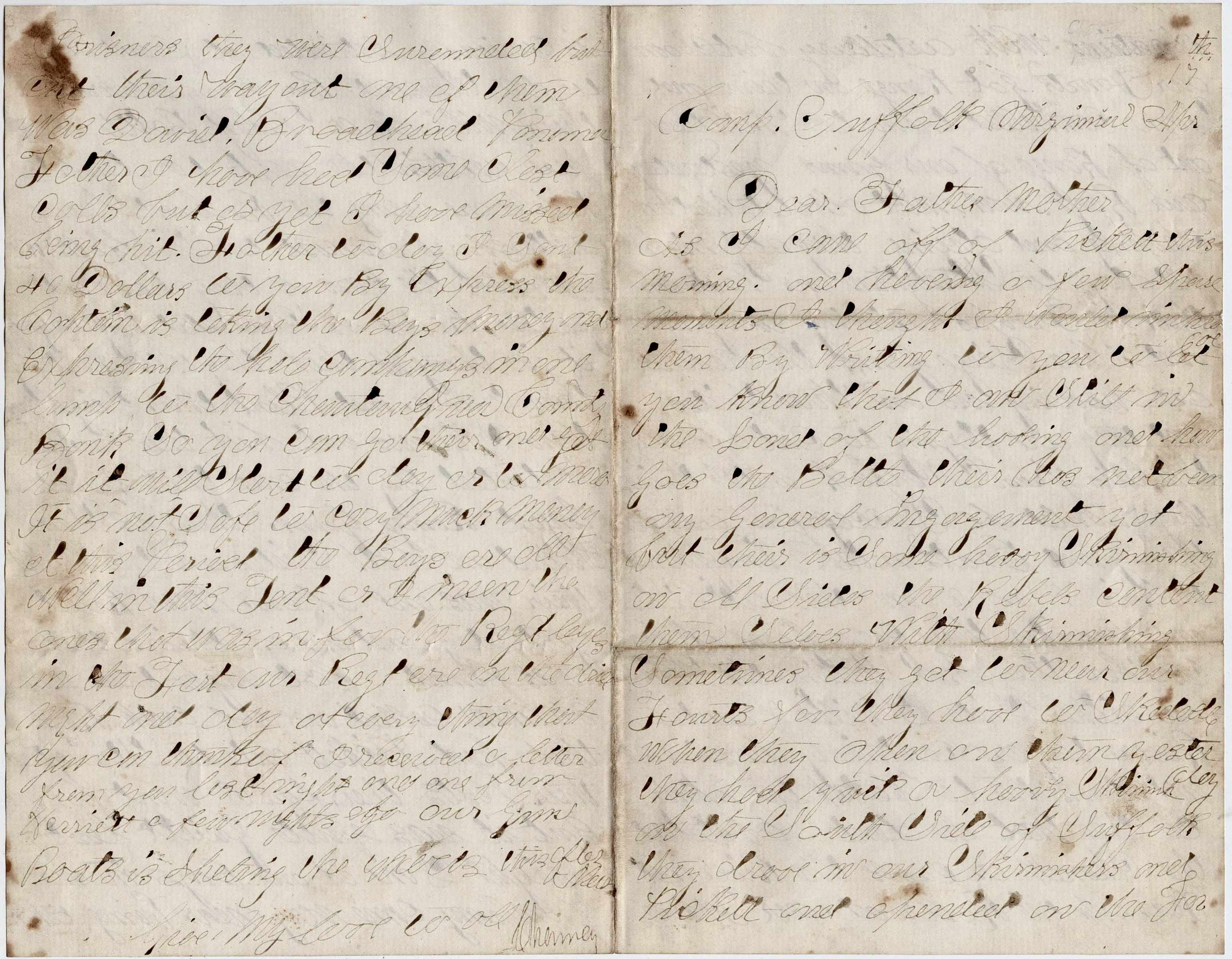
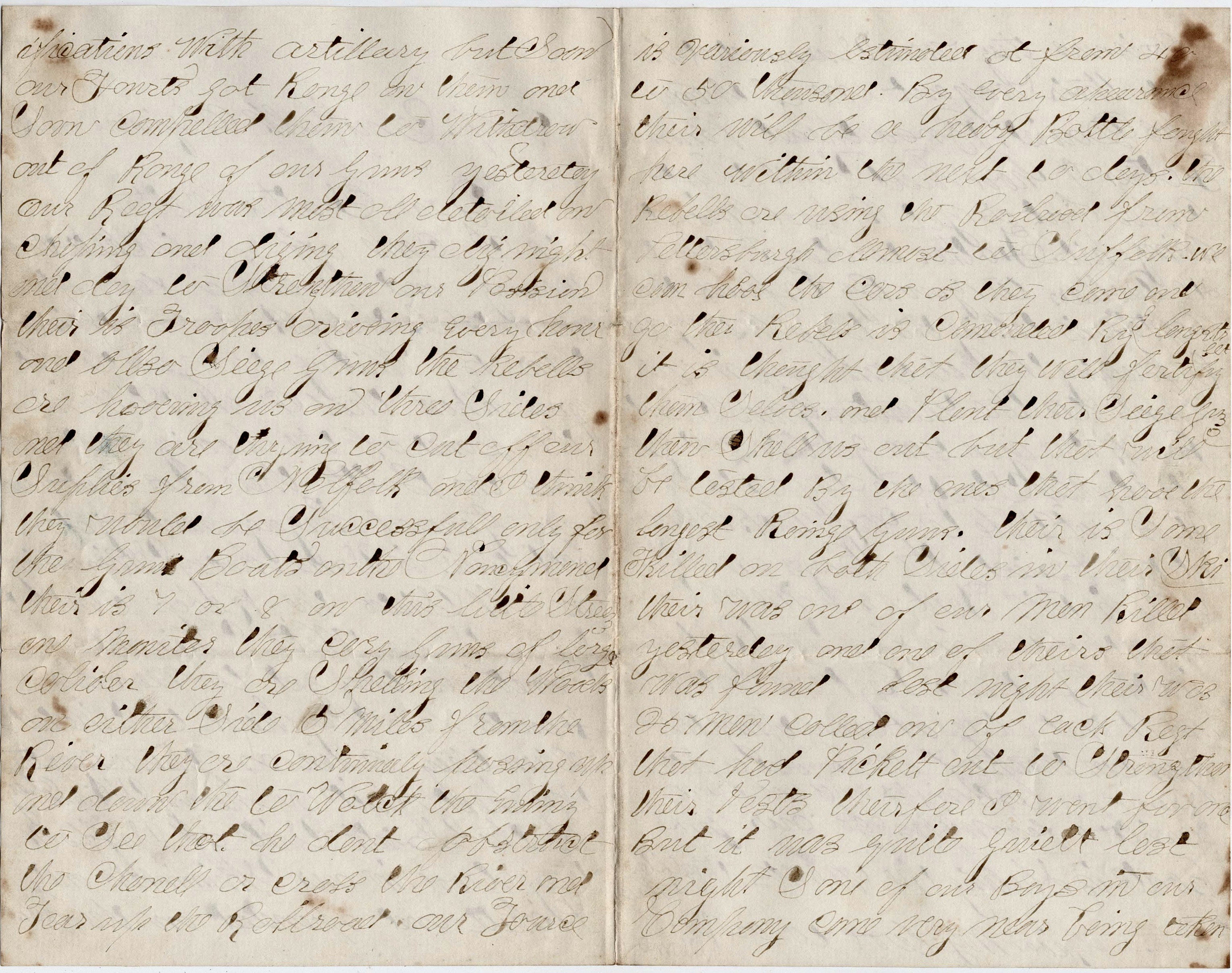
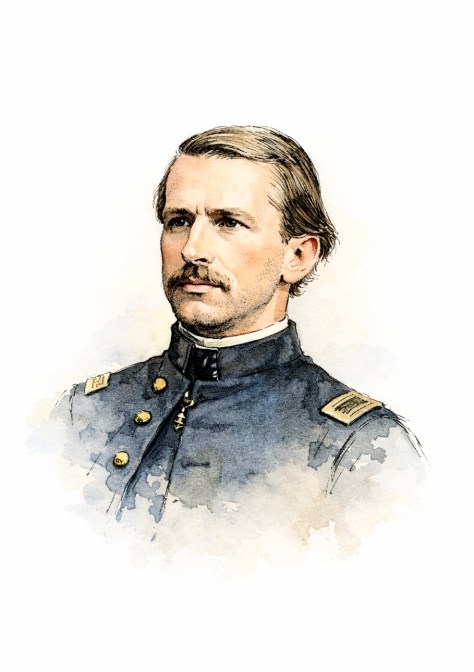
These letters were written by Alfred Bergen Hutchinson (1840-1921), the son of George A. Hutchinson (1810-1885) and Ida Van Nest Bergen (1813-1851) of Trenton, Mercer county, New Jersey. Alfred enlisted on 19 August 1861 in the 5th New Jersey Infantry and was promoted through the ranks to 2nd Lieutenant of Co. D. When Alfred first enlisted, he entered in Co. E with his brother-in-law, Captain Henry Harrison Woolsey (1836-1864).
The 5th New Jersey Volunteer Infantry Regiment was organized at Camp Olden, Trenton, New Jersey, in July 1861, and was mustered in on August 22, 1861. It participated in a number of important engagements, including the Battle of Fair Oaks, Seven Pines, Malvern Hill, Second Battle of Bull Run, Fredericksburg, Chancellorsville, Gettysburg, the Wilderness, Spotsylvania Court House, Cold Harbor, and the Siege of Petersburg.
Alfred wrote all three letters to his younger sister, Sarah M. Hutchinson (1842-1897). Many more of Hutchinson’s Civil War letters can be found in the Special Collections of Chapman University. See Hutchinson & Woolsey, 1861-1888.
Letter 1
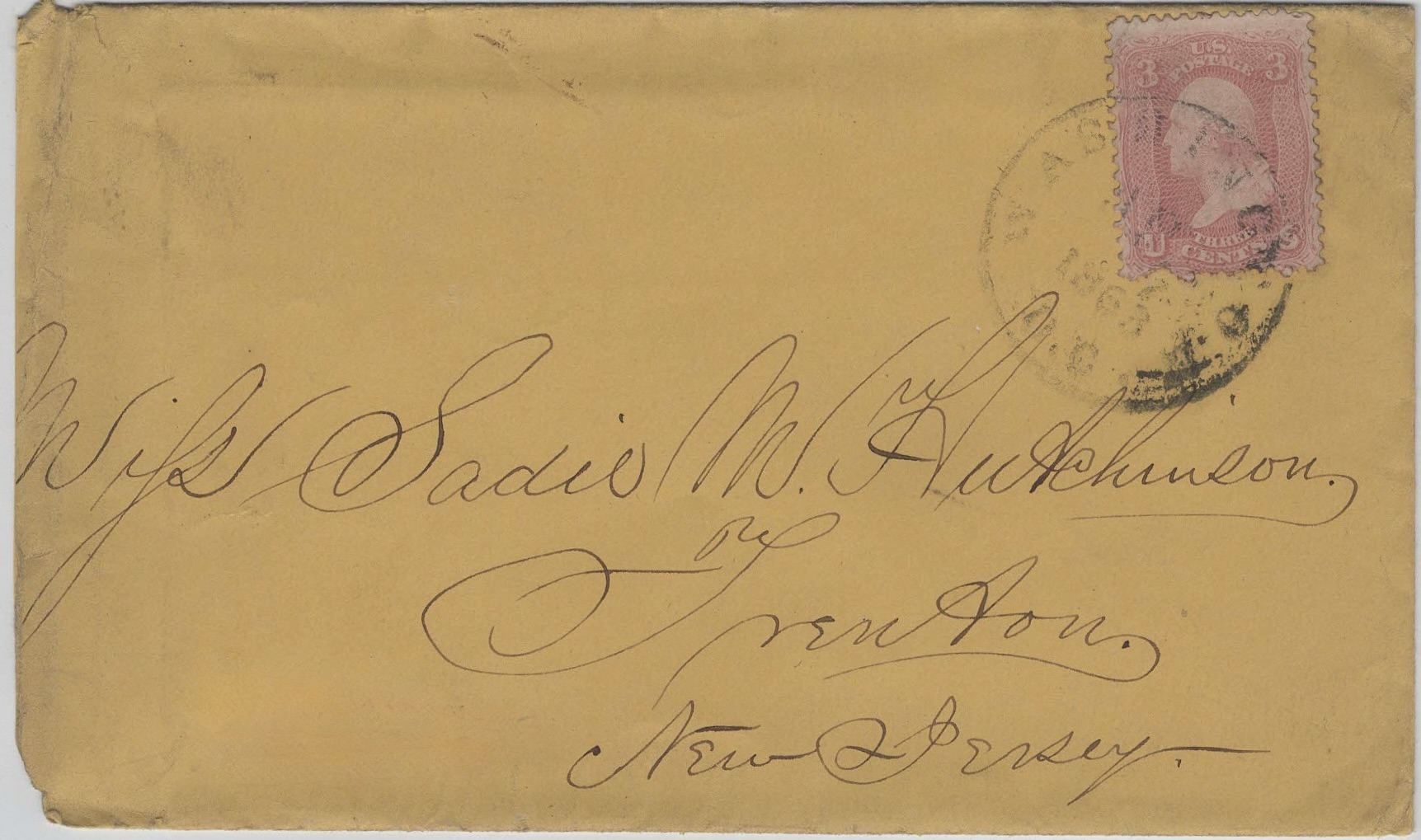
Camp near Falmouth
April 14th, 1863
Dear Sister Sadie
This is a charming spring morning & I imagine I can see you all at Homedell walking about the yard, or some of you sitting in the house with windows hoisted. How I would love to be with you enjoying this splendid weather.
Last week we had a Grand Review. President Lincoln came down & reviewed several corps at the same time. I would give a great deal to have you see such a review. Although I have seen several Grand Reviews, it does not fail to awaken the ideas to the grandeur & vastness of the event. It takes hundreds of acres to give enough room for the troops. The ground is rather uneven & as far as we could see were the troops & flags—a perfect sea of men. You would hardly think there were so many men in the United States. The column passes the President by divisions front—that is, two companies abreast. In this way, regiment after regiment passes & hours are consumed or nearly a day passes & the one who reviews them is tired waiting for all to pass.
Your interesting letter came last night but I had been expecting it several days. You said you expected to hear of our moving every day. Your expectation will soon be realized for we are under marching orders. Our orders came this morning. Every officer & man are to carry eight days rations with them. What do you think of that? The men are ordered to leave nearly all their clothing with the Quartermaster & carry their rations in their knapsacks. The officers are to leave their extra clothing also & to carry their rations the best way they can.
The whole cavalry force left yesterday & also some infantry. It is expected that these forces will get in the rear of the enemy & then we will attack them in front. I hope we may be successful & capture & destroy the whole rebel force in Virginia. As we go out again, I feel the danger we must be subjected to, but God is my shield. I know if we call upon Him, He is ever ready to hear. His eye is upon us at all times, in prosperity and adversely, in security and in danger.
My chum, Lieut. Flannigan, will send on the order & his discharge & wishes father to draw his state pay & send it on by Adams Express. Put it in an envelope and direct it to Lieut. J[ohn] M. Flannigan, Co. K, 5th New Jersey Volunteers. Even if we move, the express company will keep it all safe until he calls for it. He wishes it sent without delay. Harry is well.
Now, dear sister, I must close. Give unbounded love to all the dear ones and I am as ever your own brother, — Alfred
Letter 2
[Camp near Falmouth]
June 6th, 1863
Dear Sadie,
Yesterday our usual quiet was disturbed by receiving orders for a march. We packed up & the regiment formed line, then stacked arms in readiness to march at a moment’s notice. At night we received orders to take in our arms and be ready to move at daybreak in the morning. Morning came but we did not go & here we are now, waiting & not knowing what moment we will go.
Yesterday afternoon heavy cannonading was raging along the Rappahannock & our troops are crossing again. A part of the 6th Corps is over this morning. I hope & pray that we may meet with better success this time than heretofore. The crossing seems to be conducted about the same way it was last time. Part of the troops above and part below Fredericksburg. Now and then a cannon booms forth today showing that something is going on & that either one part of the other is not quite satisfied with the proceedings. I dare say we will cross in a day or so.
Hutch and Breasley were over here yesterday but they left rather abruptly upon hearing the army was on a move. When they left camp in the morning, all was quiet & their orders must have come in suddenly & must have started in a hurry for one of our men who had been over to the 6th Corps came home a little after noon & said the 6th Corps was crossing the river. Then Hutch and Breasley started in a hurry. They said their men did not want to go into another engagement & if called upon to go, threats of stacking arms were made as they think their time is out. They seem to think they will not go home before the 15th of June. Conn was well.
We were paid off a few days ago. I sent $80 home by Col. Cook, $30 to repay Marianna for that she sent to me by Harry. The $50 to be invested by father as he thinks best. Harry received encouraging news from Thirza a day or two ago. I sincerely hope she will continue to improve & if she goes out to Homedell, no doubt you all will soon be about again. I fear I will not be able to get home very soon as leaves of absence are not granted at all. However, perhaps after this move they will grant leaves again.
There is an establishment near our camp where they take Ambrotypes. Nearly all the officers of our regiment went over tis morning to get their pictures taken. I had mine taken. They are rather inferior work yet is it a pretty good picture after all, only I look so cross. A stranger would think me very ill-natured from my picture. I will send it on to you.
I received a letter from Annie V. C. yesterday. Harry is well. Before you receive this, we may be fighting desperately, or we may be in Richmond. With unbounded love to you all, I remain your loving brother, — Alfred
Letter 3
Brandy Station, Virginia
January 2nd 1864
My dear sister Sadie,
Your delightful missive reached me this evening. It gave me great pleasure to hear that my loved ones at home were well and that they were all enjoying themselves to so great an extent. I think you all must have had a regular jubilee on Christmas. You certainly had presents in profusion. How I would have enjoyed being with you. I have been so very busy of late that I have hardly had time to eat or sleep. But today my most confining labors ceased. You know I am recruiting officer for Vetran volunteers. I gained fifty men & you ought to have seen the heaps of papers it took to muster these men. It seems to be absolute foolishness to make so many rolls, &c., but it had to be done & I did it. I feel richly remunerated for when I took the rolls up to the Division Headquarters today, I was highly complimented. The mustering officer said they were the most complete & neatest & best papers that had been made out in our whole division. I wrote nearly all CHristmas day but had time to partake of dinner for we had roast turkey. Almost all the officers were out of camp so Simon & I sat down and layed to & the proportions of Mr. turkey diminished perceptibly.
We live high on buckwheat cakes & sausage. We have everything necessary for our housekeeping apartment—bake iron, dutch oven, &c. Yesterday (New Years) we intended keeping open house, but we did not have satisfactory arrangements so we had New Years by ourselves until after dinner which was roast turkey again. After dinner, all the officers of our regiment excepting one, procured horses & away we went, a fine squadron of cavalry on a high horse to make calls. After dark we found ourselves in the camp of the 14th New Jersey, a full three miles from home. In every tent we visited, we were warmly received although it was utterly cold without & we were treated generously with hot punch, whiskey raw, whiskey sour, gin, brandy, cake, candy & varieties—especially of the drinking order. We had a grand old time. The fun was not in riding back to camp after midnight though. The roads were in a miserable condition, so rough that we were compelled to let our horses alk slowly the greater part of the distance & we all came near freezing. In fact, I did freeze one of my little toes.
The weather has not moderated yet for as I write, the ink freezes in the pen before it is transcribed on paper. I called on Gen. Mott the evening before he returned. He was pleasant & hospitable, more so than I ever knew him to be before. He gave me a synopsis of his visit home & all the news he possessed concerning Homedell. He had a tedious journey back, so many detentions. Col. Sewell is in New Jersey having been detailed as Superintendent of the drafting operations. I understand his headquarters are at Trenton. You must get a view of him. All of our men who reenlisted as veterans have gone home on furloughs of 35 days & we are somewhat lonesome. Six of my company have gone.
I judge from accounts reviewed that Conn is still favored with a goodly portion of your friendship, if I am forbidden to say love. He must have a lingering hope of retaining your heart yet or he would not continue his attempts. You say Ellie looks bloming this winter. How I would love to see her. Does she seem to have pensive moments at times while at our house? And you imagined she was thinking of me? Perhaps, could you look upon me at times, you might imagine the same thing & if you judged that I was with her in spirit, you would not be very far wrong. Ellie will not always be so reserved. When I come home to stay, she will change, I doubt not.
An order came out a few days ago stating that supernumerary officers could get a leave of absence of 35 days providing they would signify in writing their willingness to serve three years longer/ I think I might be called supernumerary now as I have only four men for duty, and receive the leave. But three years is too long a time to suit me to remain in Uncle Sam’s service, although 35 days at home just at this time is really a tempting bait. I will accept ten days leave in February & not bind myself further.
Sunday afternoon. I have just been re-reading your last letter & I must confess it makes me feel somewhat sober to contemplate the many pleasant times you are enjoying these holidays & here I sit missing all the fun. However, I am not cursed with a despondent or melancholy nature, than Providence, & am looking on the sunny side of events & let come what will. I’ll be gay & happy still.
It is quiet in camp today—too cold for preaching, but I have a stock of good religious papers on hand which afford a diversion of the mind from wars & rumors of wars, and besides, they are interesting, profitable, and pleasurable. So you see I am not entirely destitute. When does Harry expect to return. I hope (for his good & his wife’s) not this winter.
Sadie, will you please send me a ccatalogue of music for the pianom with the address of the firm. I want to send for some pieces to present to some of our mutual friends. It would be most desirable if you could procure one, from some firm in Philadelphia. I received a letter from Emily New Years day & took it as a precious present & the only one. In future I will be able to write oftener as the rush of business has subsided. I close by wishing you all a Happy New Year. Ever your fond brother, — Alfred
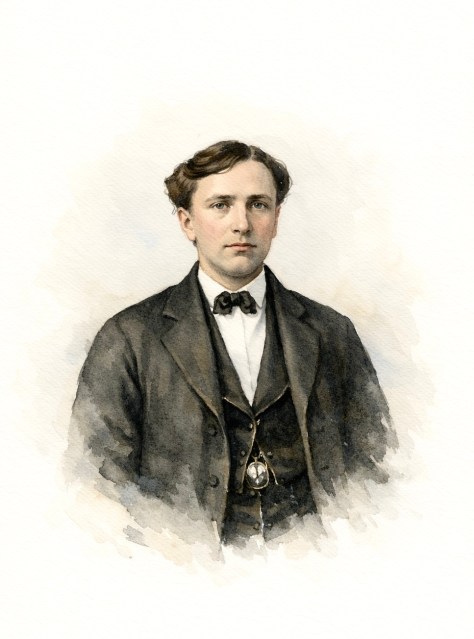
The following letters were written by Theron Treat (1839-1908), the son of Barzillai Treat (1807-1894) and Sophia Kingsley (1814-1898) of West Worcester, Otsego county, New York. He wrote them during the American Civil War while serving in Co. D, 3rd New York Cavalry. His service records inform us that he enlisted in late August 1864 and mustered out in early June 1865—a total of ten months. Enlisting a few days before Theron was his cousin, William “Lorenzo” Knapp, who no doubt had some influence on his decision to join the regiment and avoid the draft.
Theron datelined both of his letters from the detachment’s encampment near Pungo Landing, a flat farmland, marshy area along the North Landing River in southeastern Virginia, some 30 miles from Norfolk and east of the Great Dismal Swamp.
[Note: These letters are from the collection of Brandon White and were made available for transcription and publication on Spared & Shared by express consent.]
Letter 1
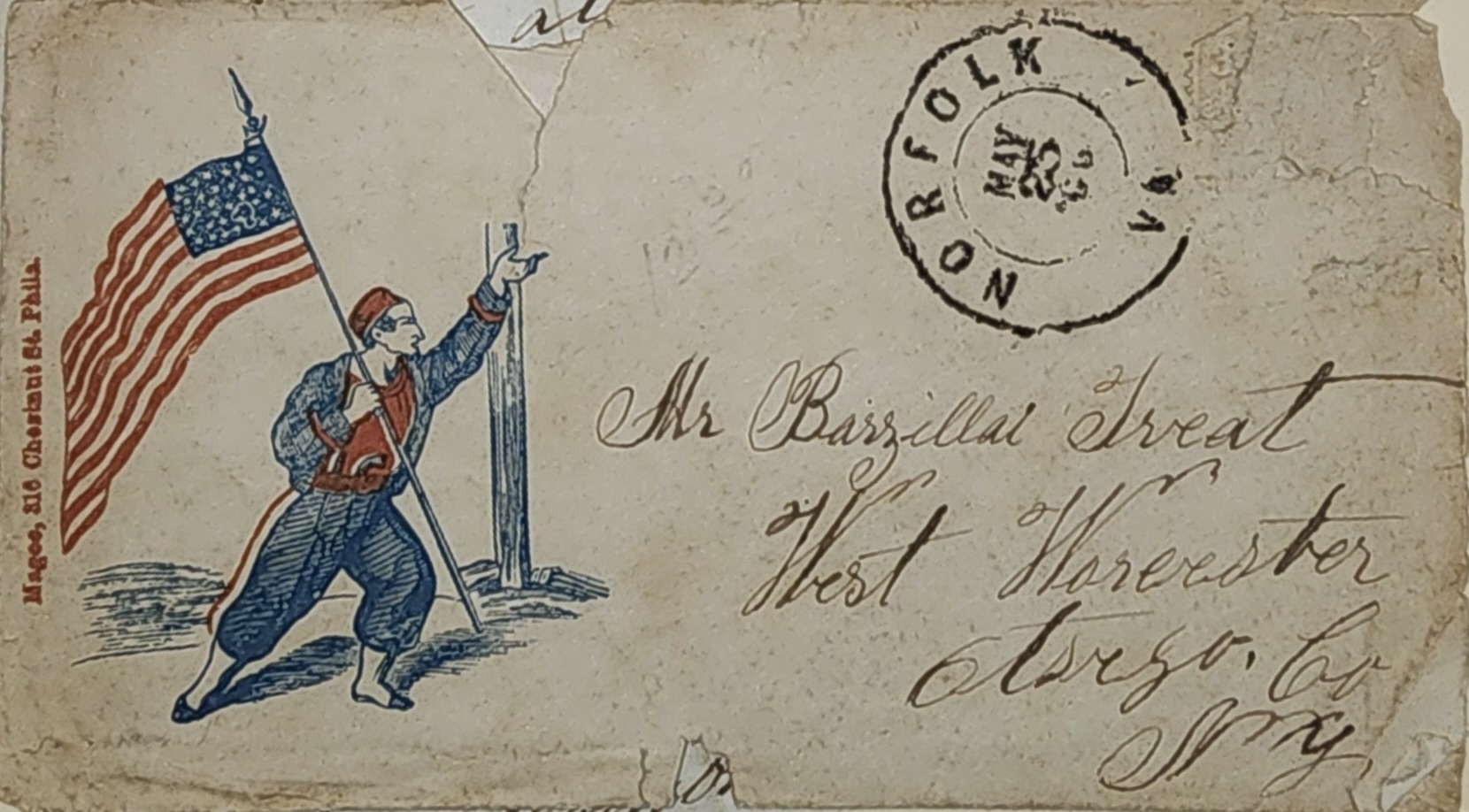
In Camp at Pungo Landing [Virginia]
December the 21st, 1864
Well, here I am, well and hearty, and hope that you are all well. I got your letter two or three days ago. You wrote that you heard that I was lame. All that I have been lame was two or three days in one of my legs and that was not as bad as I have had it at home. So you see that you have had all that worrying for nothing. You wanted me to write how I was. That I do every time [I write]. My health is a great deal better than I thought it would be in the army and I like it first rate.
We are in a good place now and shall stay here some time. There is nothing to do but a little guard duty and that is to keep contraband goods from going into the country where we don’t want them to go. We are within five miles of the line between the states of North Carolina and Virginia. Our people have held this part of the state for two years so there is no rebs in these parts. We buy all of the fresh fish that we want and all of the milk and all of the fresh meat and sweet potatoes that we want, and we have a first rate time.
Lorenzo and I have a log house of our own with a brick fireplace and a good bed and lots of blankets and we have things in style. You will laugh but it is true.
You wanted me to get a furlough but I don’t want one. I am a going to stay and see this thing through and then when the time is up that I enlisted for, then I shall come home for the war will be over in a short time and I feel a great deal more like a man here than I should at home, scared almost to death at the word, D-R-A-F-T. Tell the Copperheads that they will have to come when Old Abe says the word and [Gov.] Seymour can’t save them now for scared creatures—Oh! where is Little Mac?
Tell John Treat to raise a boy for it is war ties and he must do something for his country, and it may as well be that as anything else. There is not much news to write. The weather has been very nice. There has not been any snow nor much cold weather.
You wrote that you would send me a box if I wanted. I can get all of the things here as well and as cheap so there is no need of it. I have got some undershirts and all the stockings and all the clothes that I want and I have got the money to buy all that I want to eat. And half of the boxes don’t come through [anyway] so you see that it don’t pay. I think that Lorenzo is foolish to have one sent. Tell [brother] John to write to me in the next letter. Clara wrote that he had been sick. I hope he is well and seeing to the colt. The reason that I did not get a horse when Lorenzo did was he got his to Camp Stoneman and I did not go there. — Theron Treat
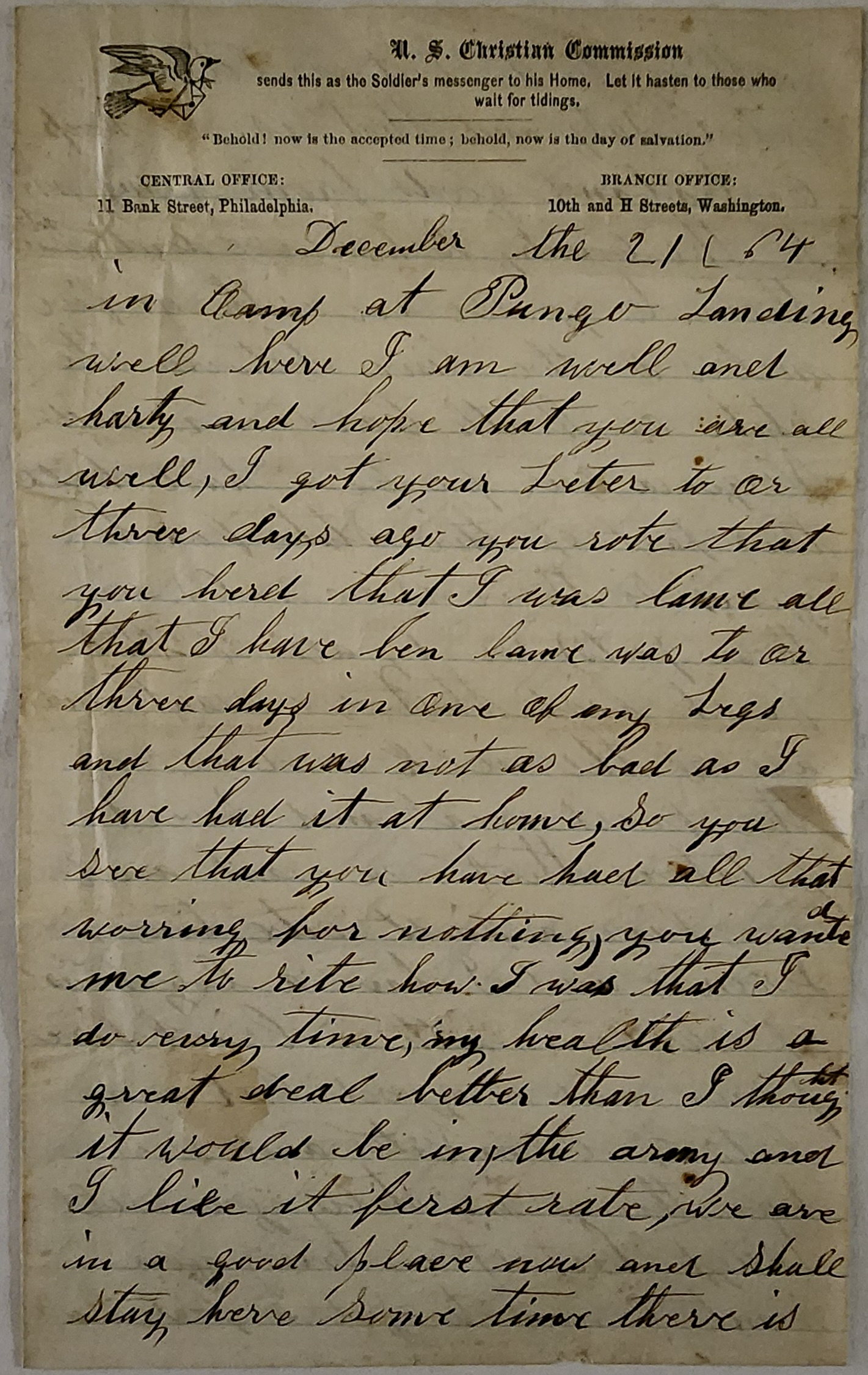
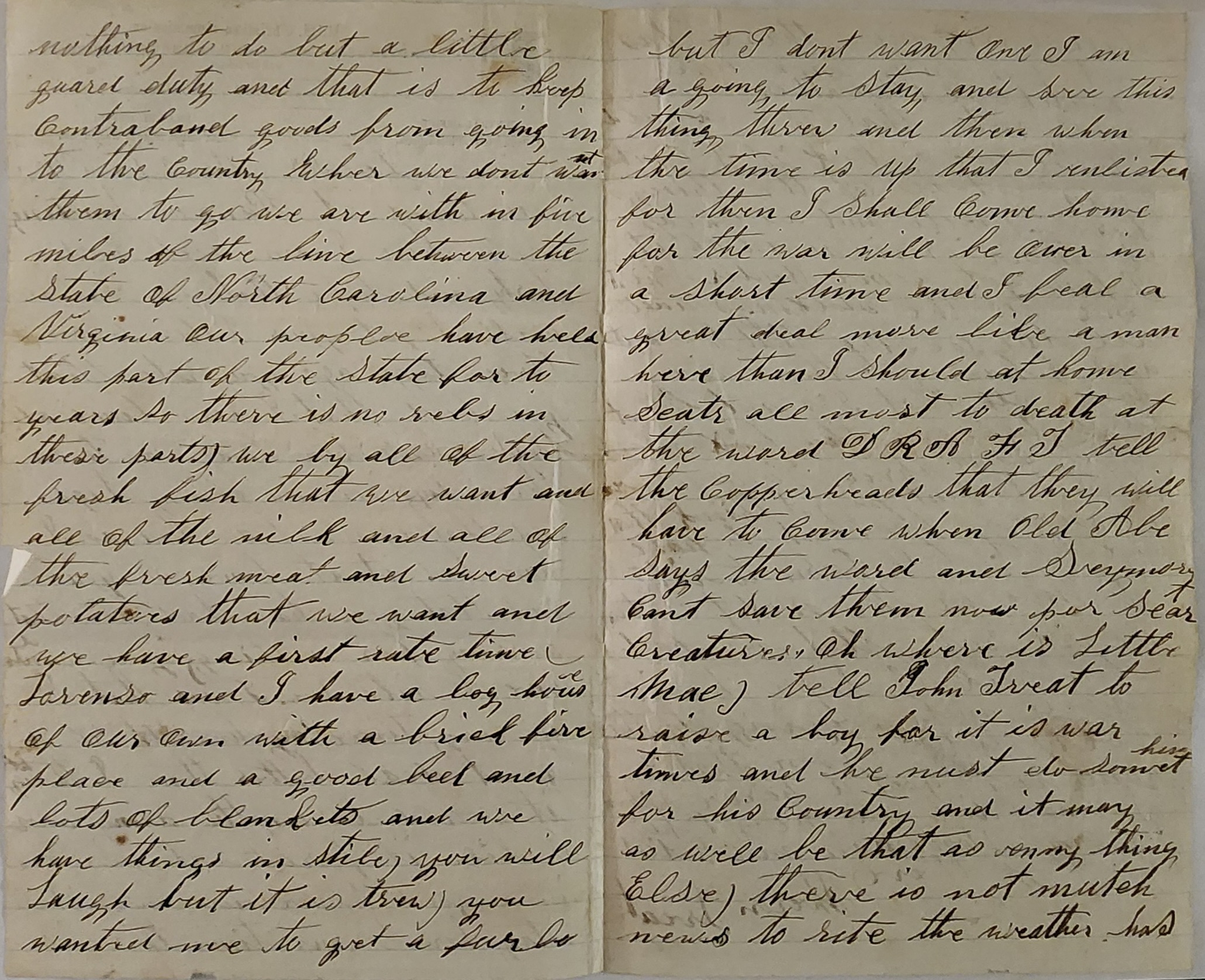
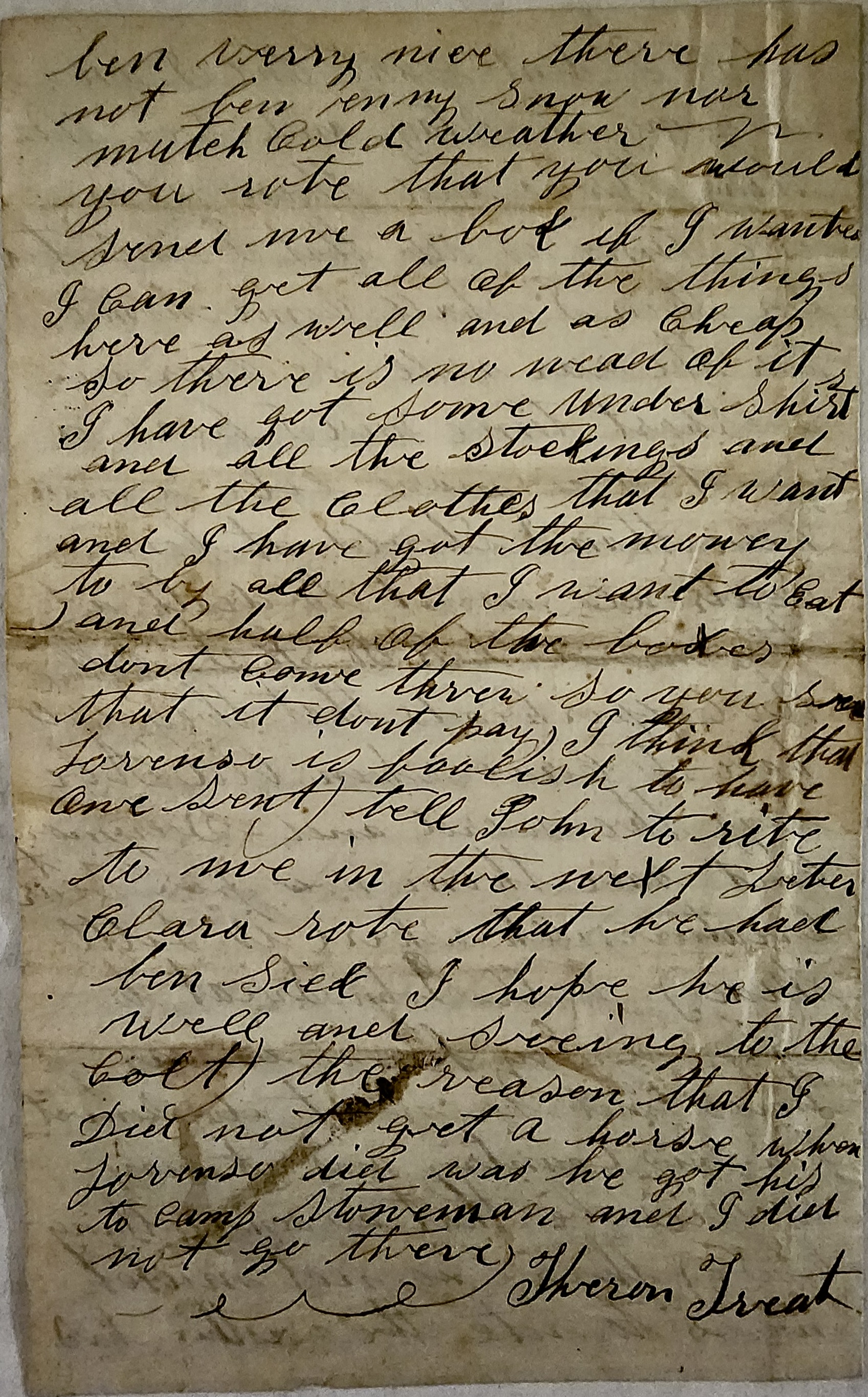
Letter 2
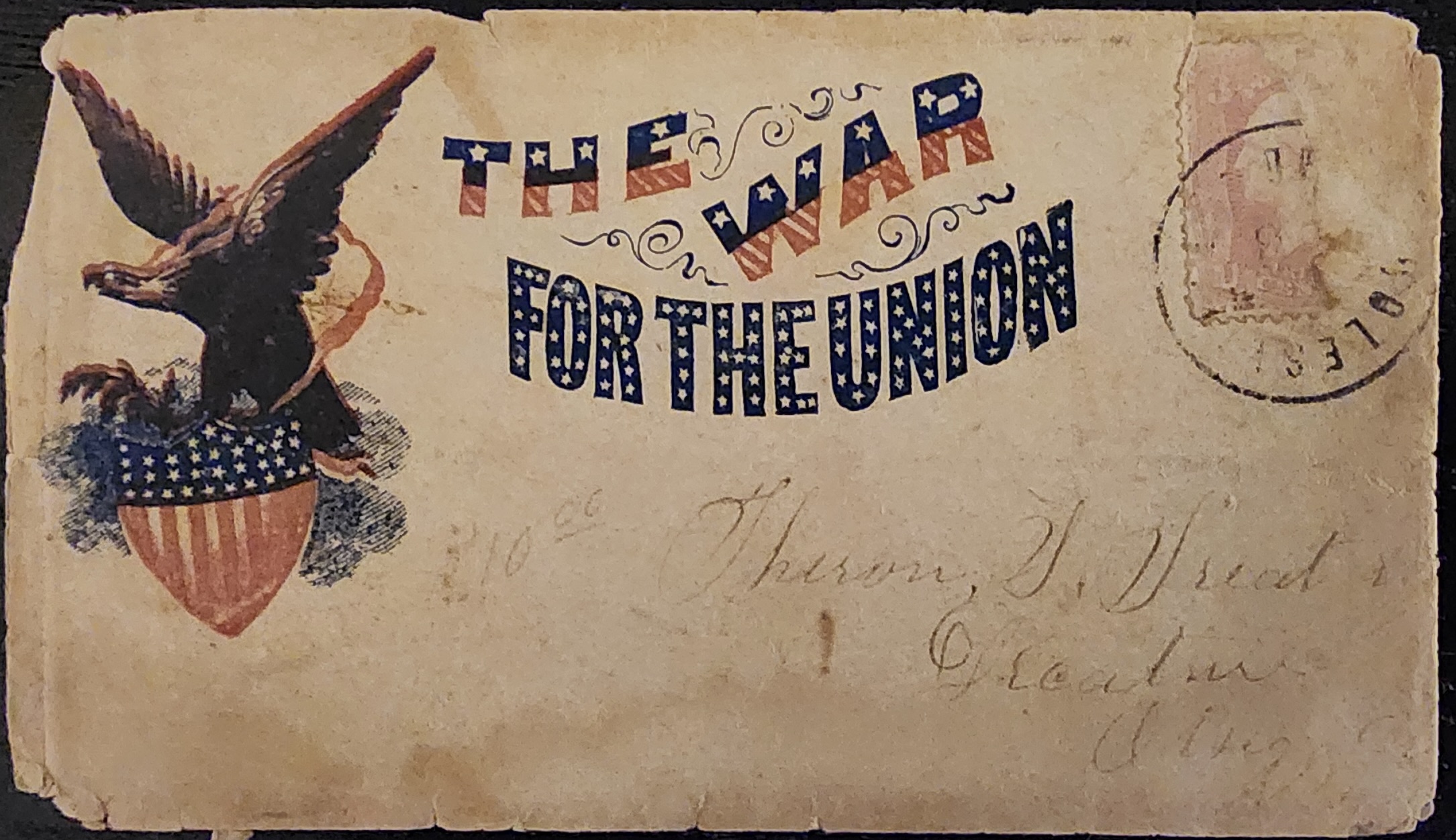
In Camp at Pungo Landing
May 21st [1865]
I am well and hearty and so is Lorenzo. He is about ten miles from here. I came from there this morning. I went down there yesterday to see the boys that was there. There is about half of our company there. You need not worry one bit about either one of us. We are alright and in good places.
I got a letter from you dated the 29th and a paper the other day. I was down to Norfolk the other day and saw that Ram that our boys took at Richmond and the one that they took at Wilmington. They was a right smart sight, I recon.
Well, I think this war is about played out and I think the rebs are as tired as they need to be and well they might be. They have caught the murderer of old Abe and shot him and if anyone says they are glad old Abe is dead, they had ought to be served the same way. I don’t care who it is. And I should like to try them on with my carbine about three paces off. They are meaner than rebs and that is needless.
You wrote that Aunt Pitts was dead so you see that people don’t live always [even] if they ain’t in the army. I recon a man will live till his time comes, let him be where he will. As for having to go on a raid, I never had to ride twenty miles in the army at one time, so it ain’t very hard, is it? And you need not worry about the guerrillas for there ain’t any here.
I think some of the troops will be discharged before long and they may take it in to their heads to discharge us. Well, I don’t care much if they do. Well, John, how are you today? Well, I hope you must not work too hard but be a good boy and I recon I will bring you a stick of candy or something else. As for that yellow gal, she is too big to send in a letter.
— Theron Treat
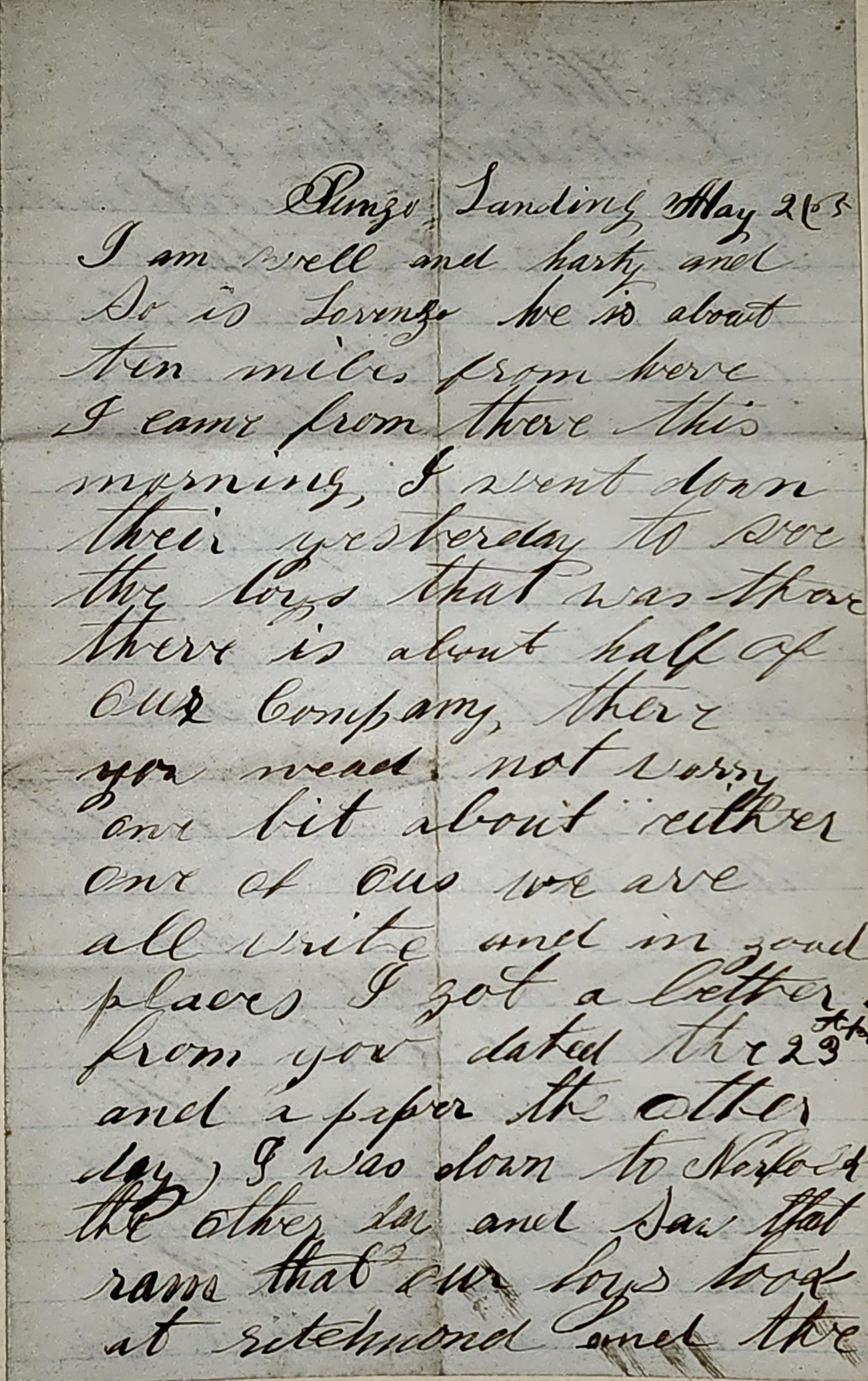
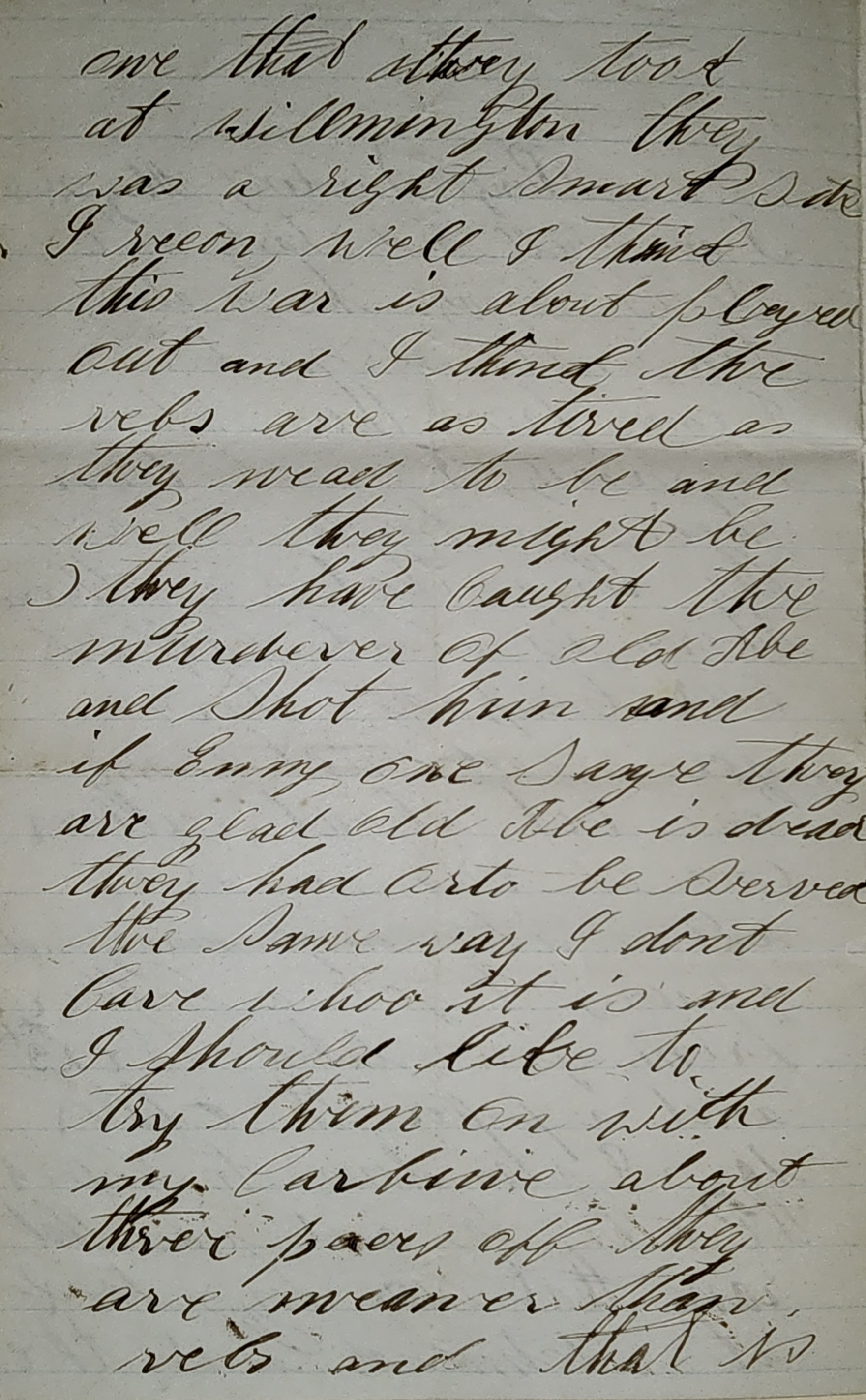
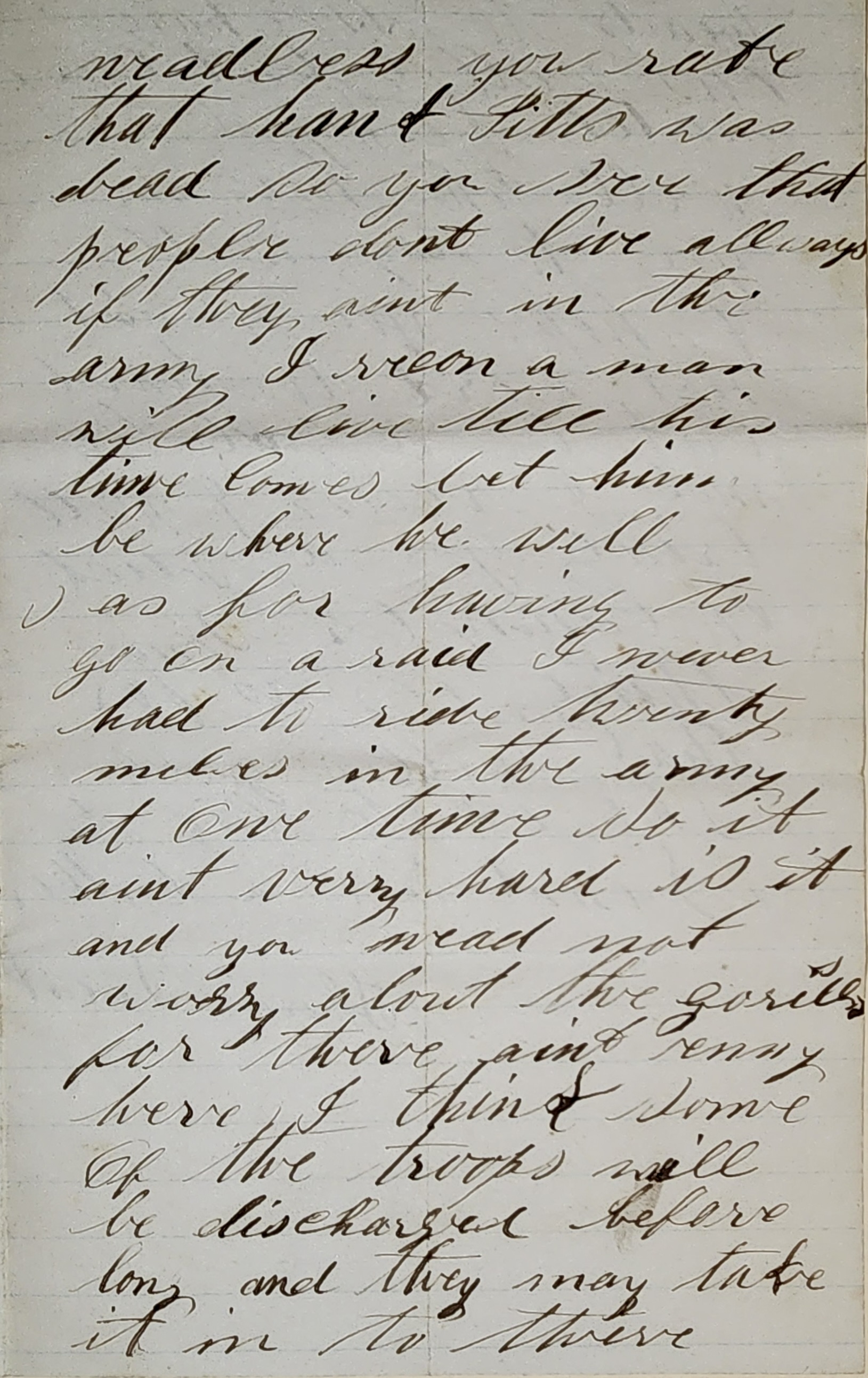
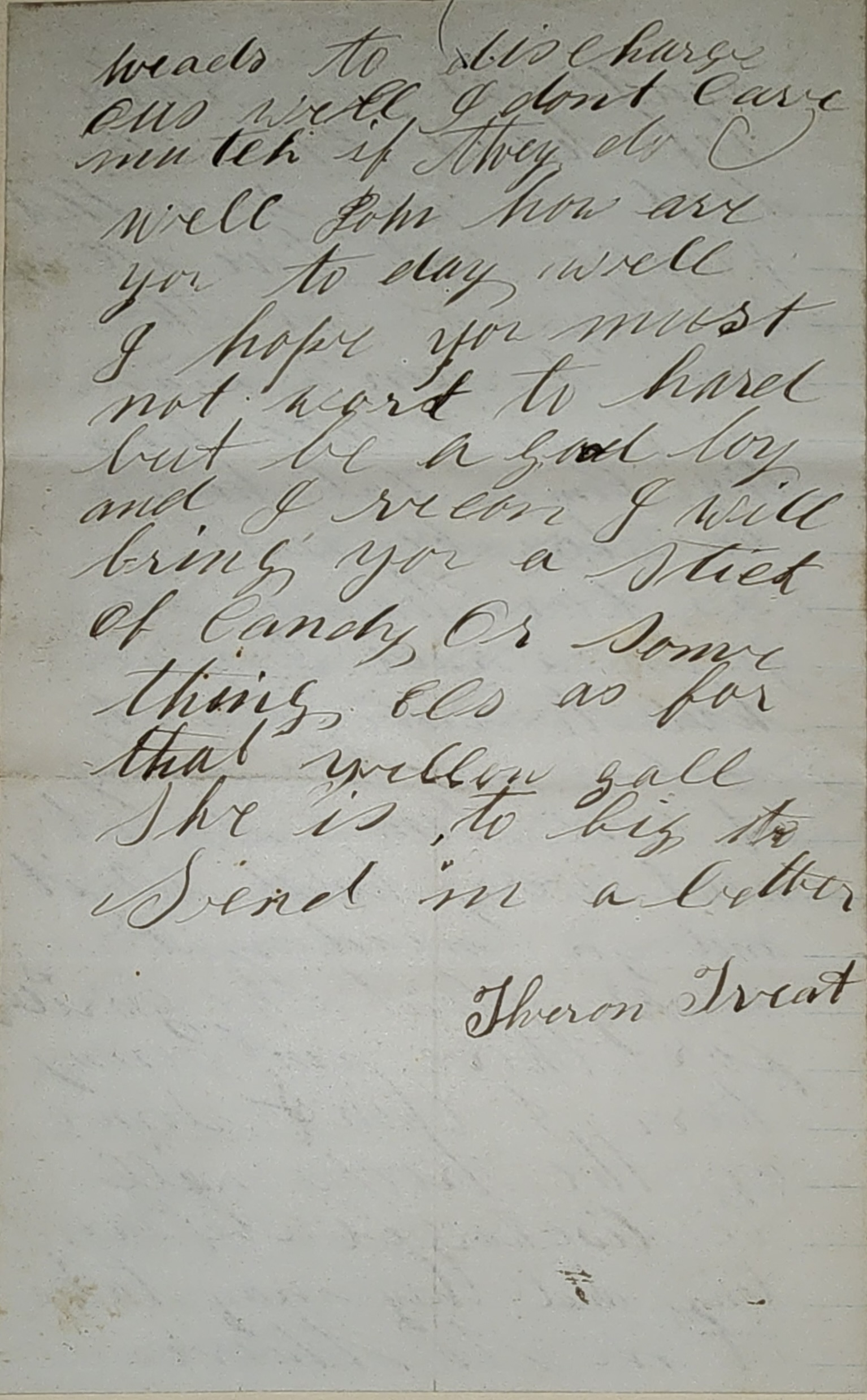
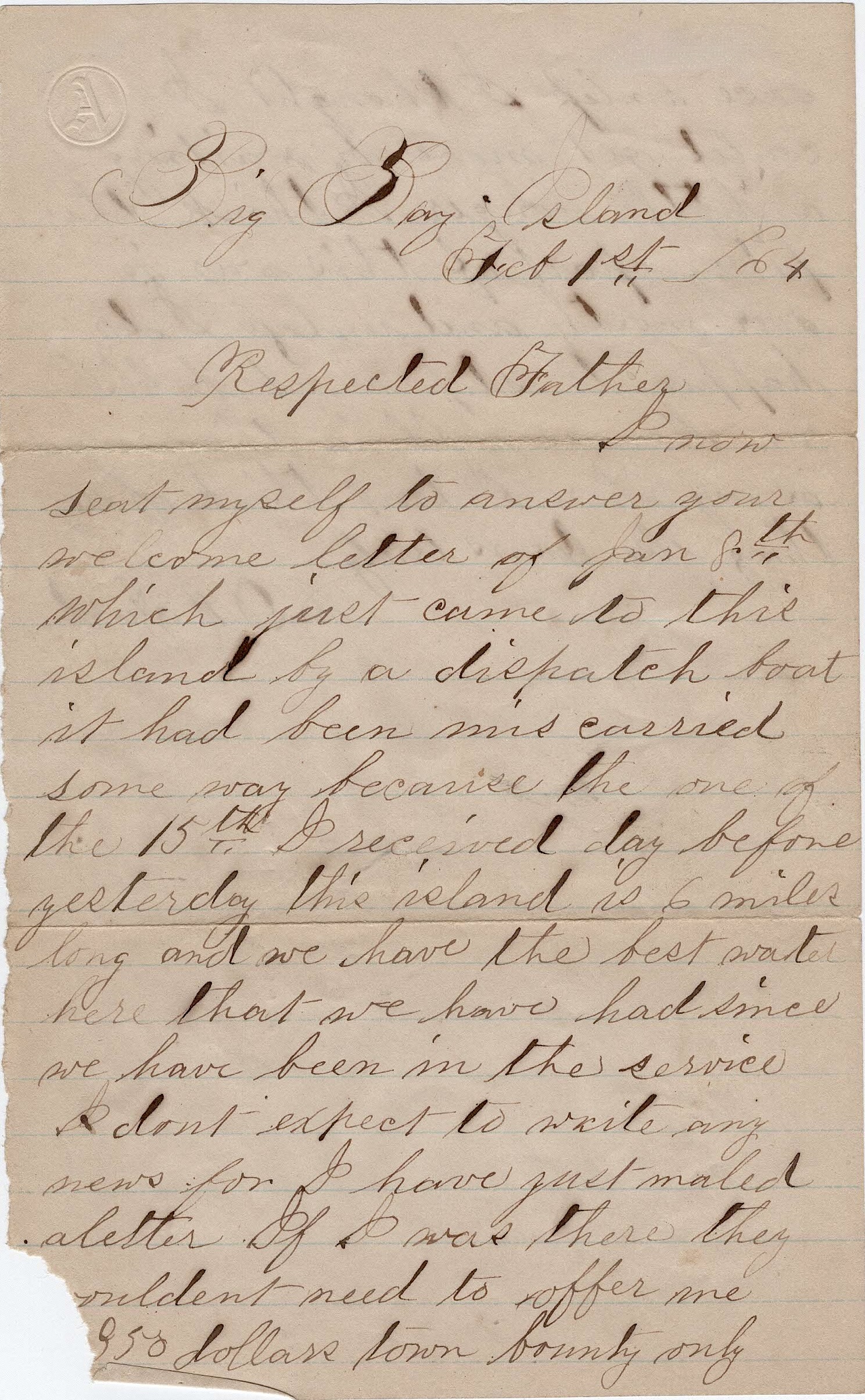
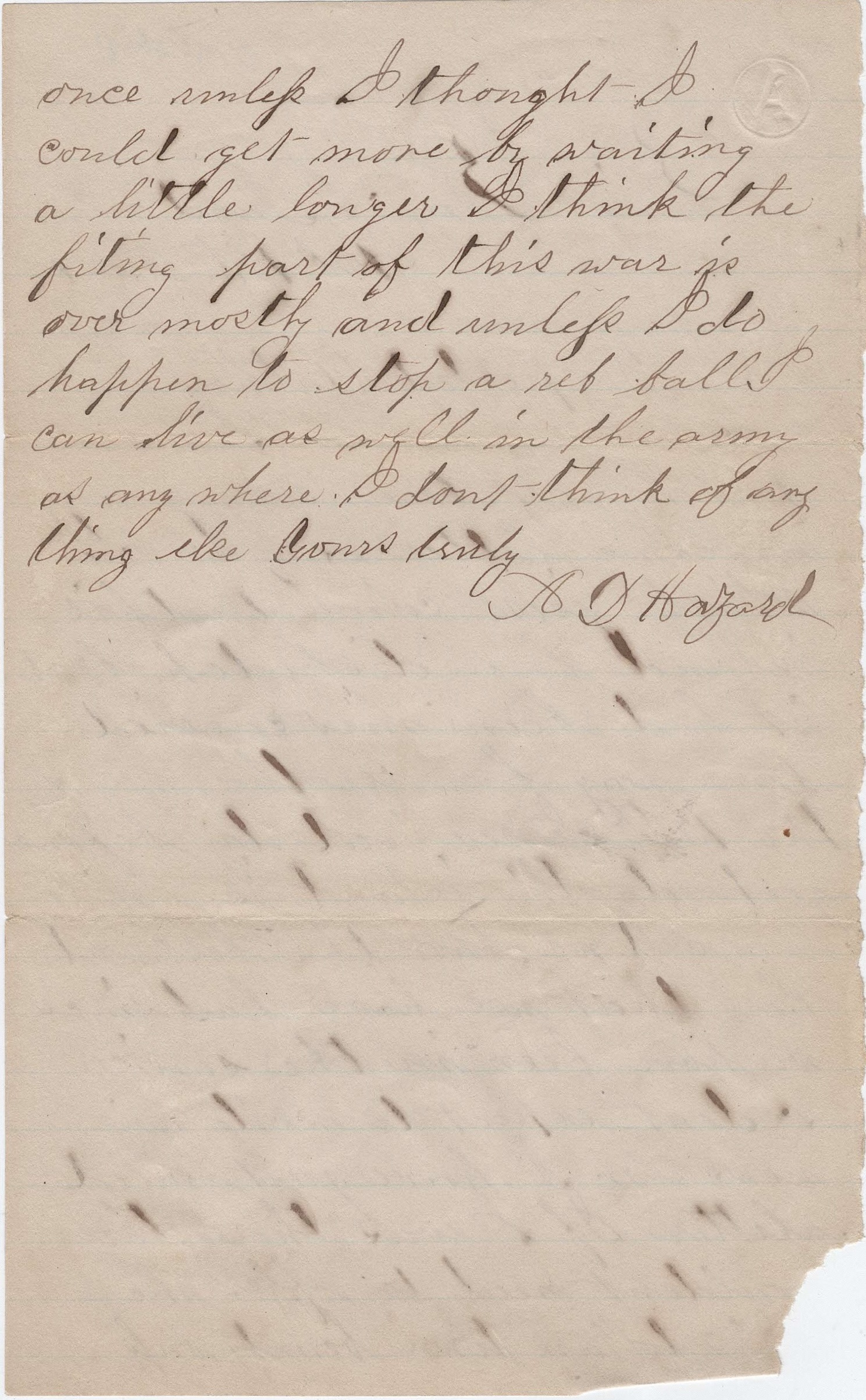
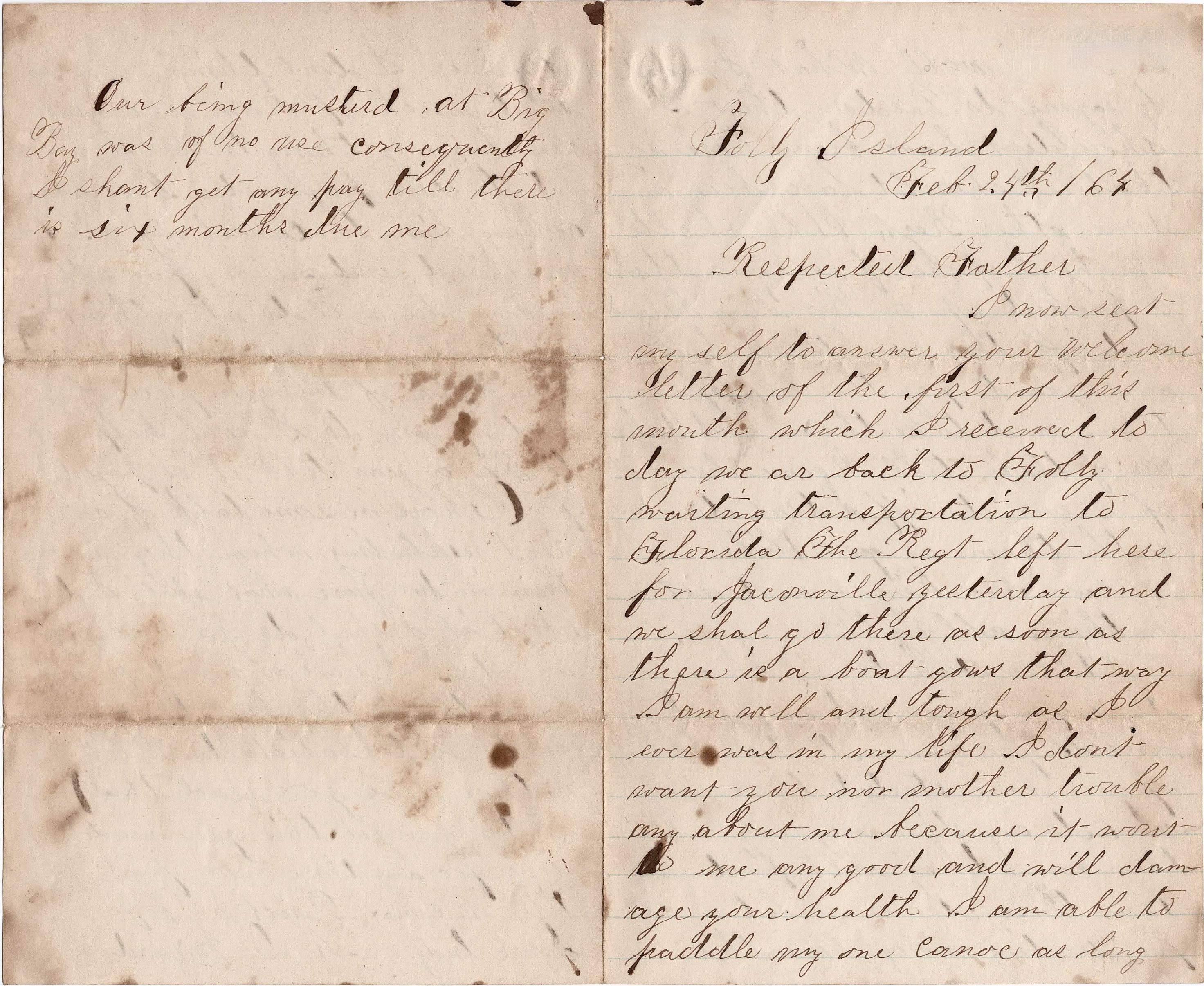
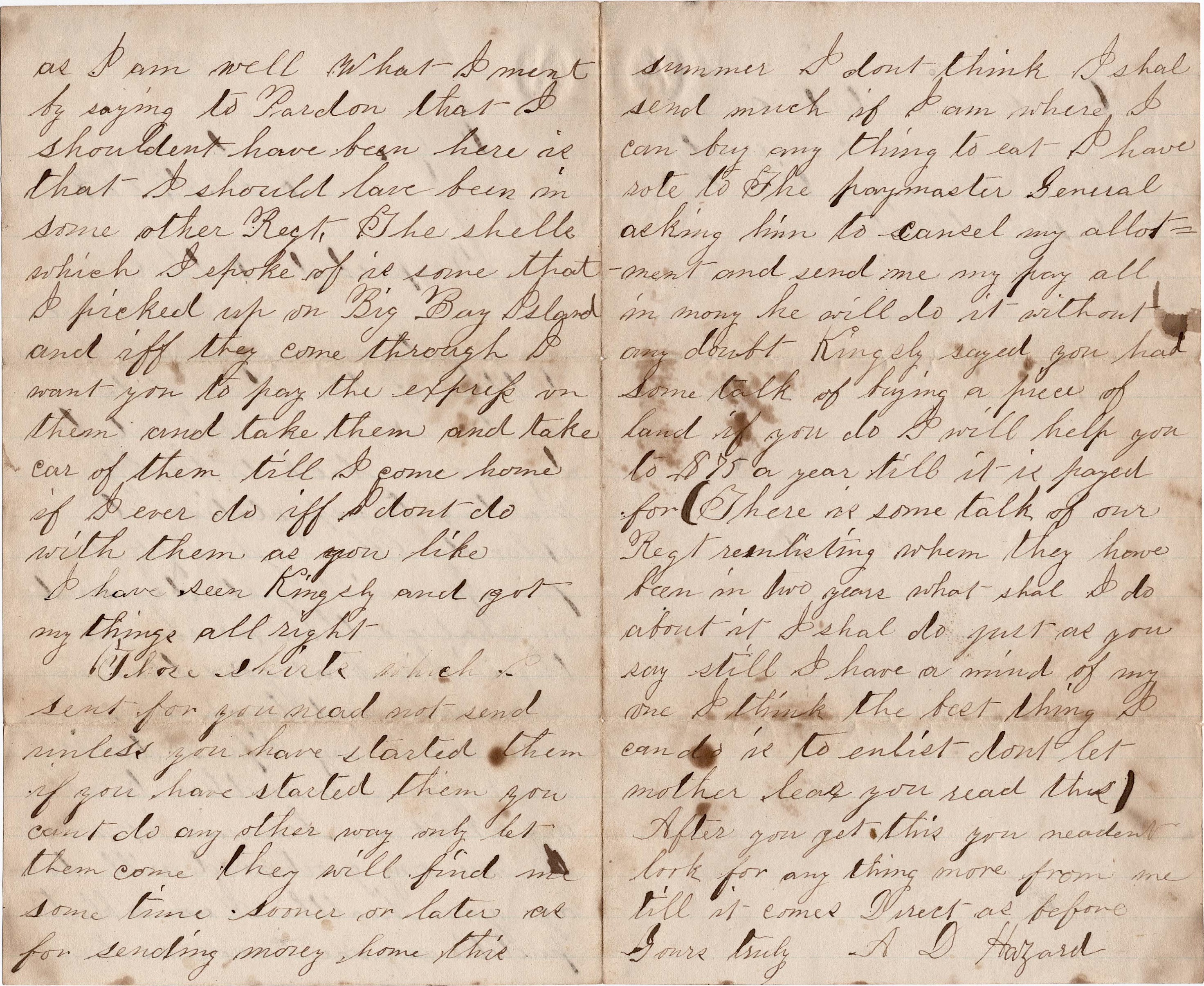
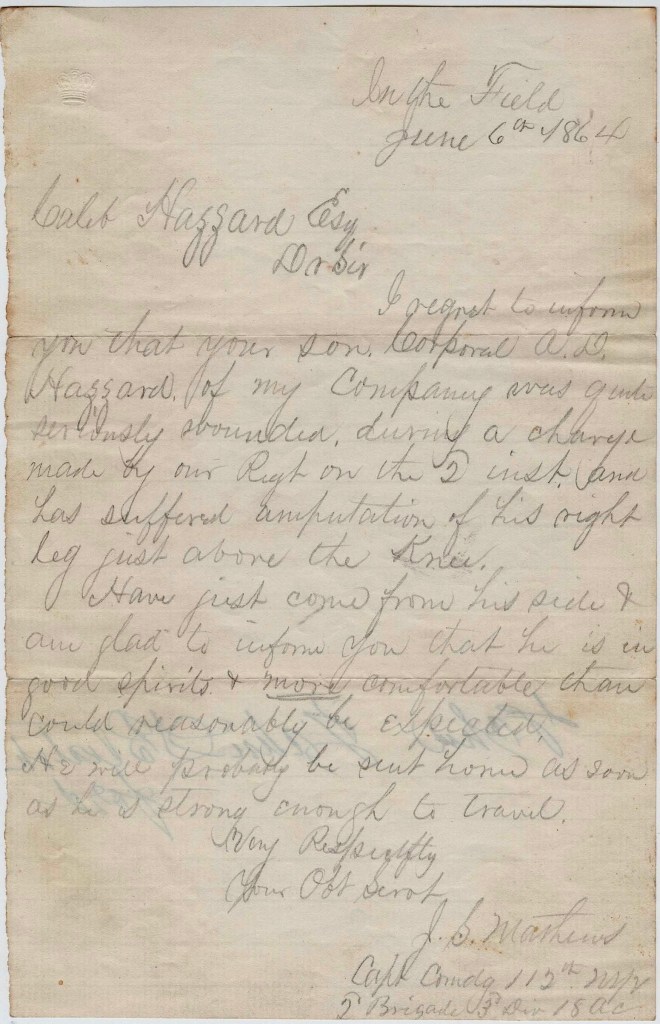
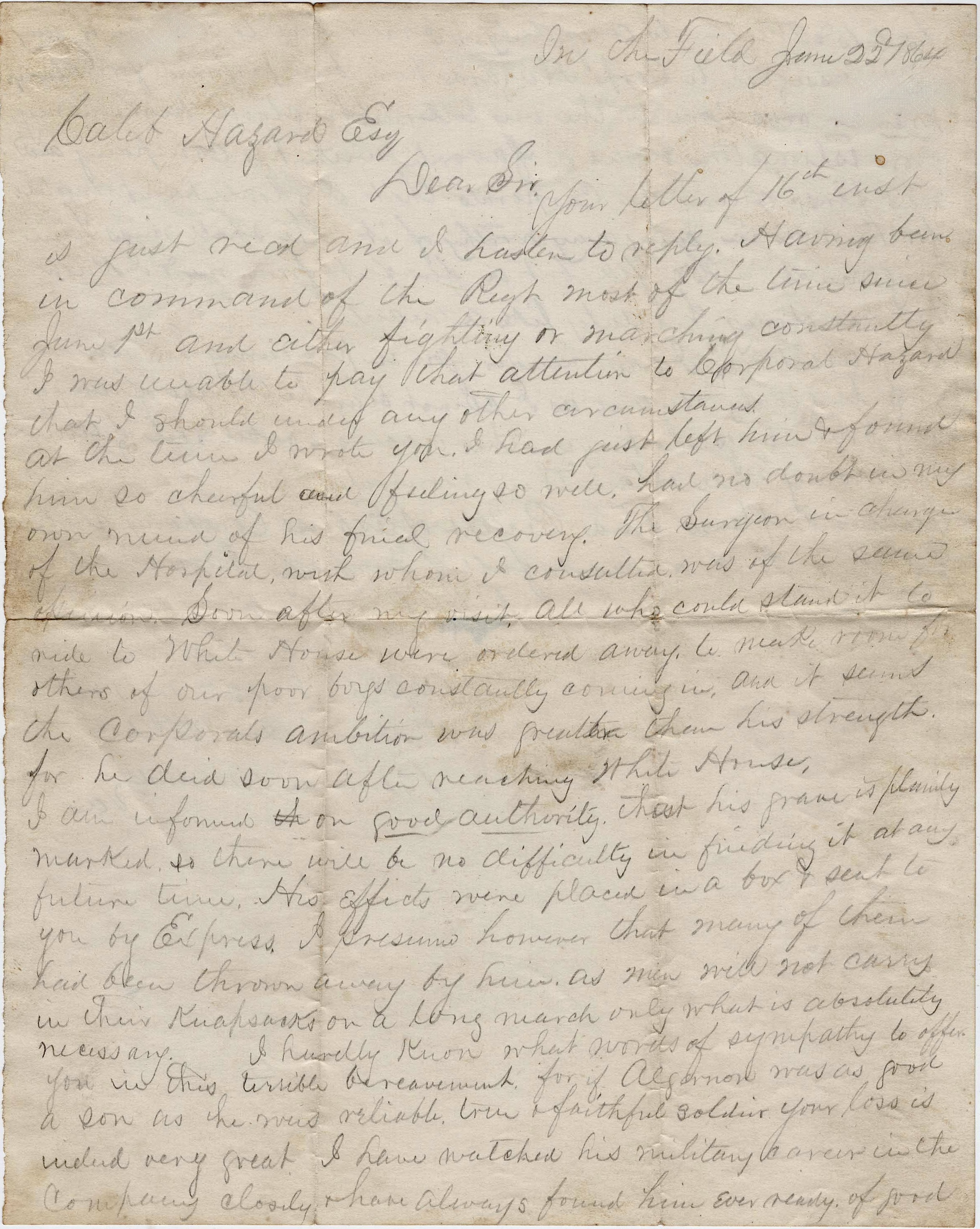

The following letter was written by Josiah Shick (1832-1872), the son of Henry Shick (1803-1888) and Susan Brown (1804-1884) of Wilkes-Barre, Pennsylvania. Josiah enlisted in Co. G, 119th Pennsylvania Regiment, in August 1862 and mustered out in June 1865. He was promoted from a private to corporal in March 1863.
Josiah wrote this letter to his brother-in-law, Rev. John G. Sands (1834-1916) of Chester county, Pennsylvania—a minister of the United Evangelical church for more than half a century. He was licensed to preach in March 1862 and labored on numerous circuits in Pennsylvania until he retired in 1907. He was married to Josiah’s younger sister, Mary Shick (1839-1917), in the late 1850s.
No comprehensive record of Josiah’s military service is available online; however, it is assumed that he served with the 119th Pennsylvania—often referred to as the “Gray Reserves”—throughout all of their engagements. The reserve brigade was a home guard unit formed in 1861, and in late 1862 many of its members joined the 119th Pennsylvania, seeing extensive service with the Sixth Army Corps. This regiment earned distinction for their exceptional resilience. They notably marched for 37 hours within a 24-hour period to arrive at the Battle of Gettysburg. Their participation extended to several significant battles, including Salem Church (or Salem Heights), their first serious engagement, which was described in detail in the following letter.
For another great account of the role played by the 119th Pennsylvania in the Battle of Salem Church, see “Gulping Down the Disaster: The 119th Pennsylvania at Salem Church“ by Dan Masters on his Civil War Chronicles.
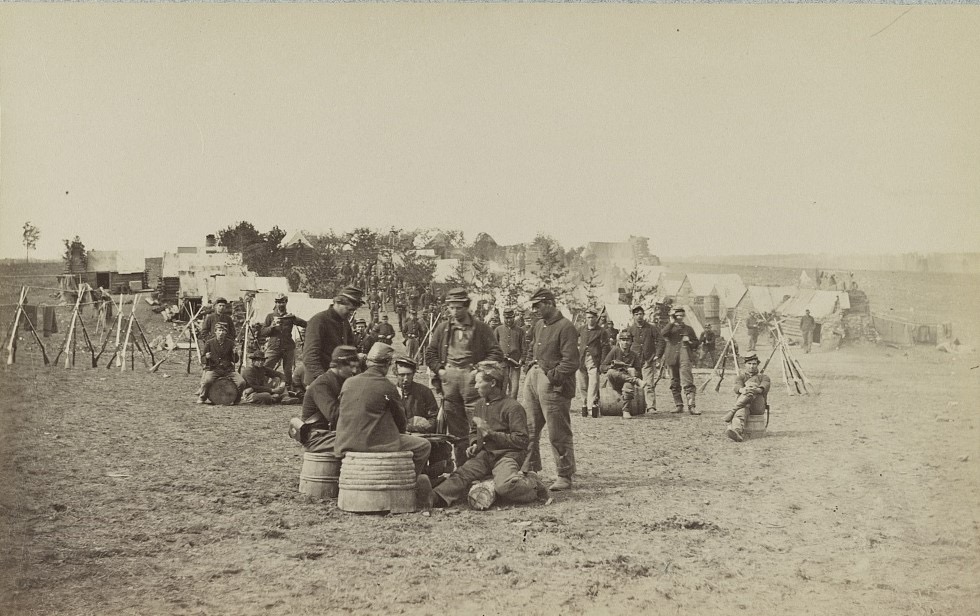
T R A N S C R I P T I O N
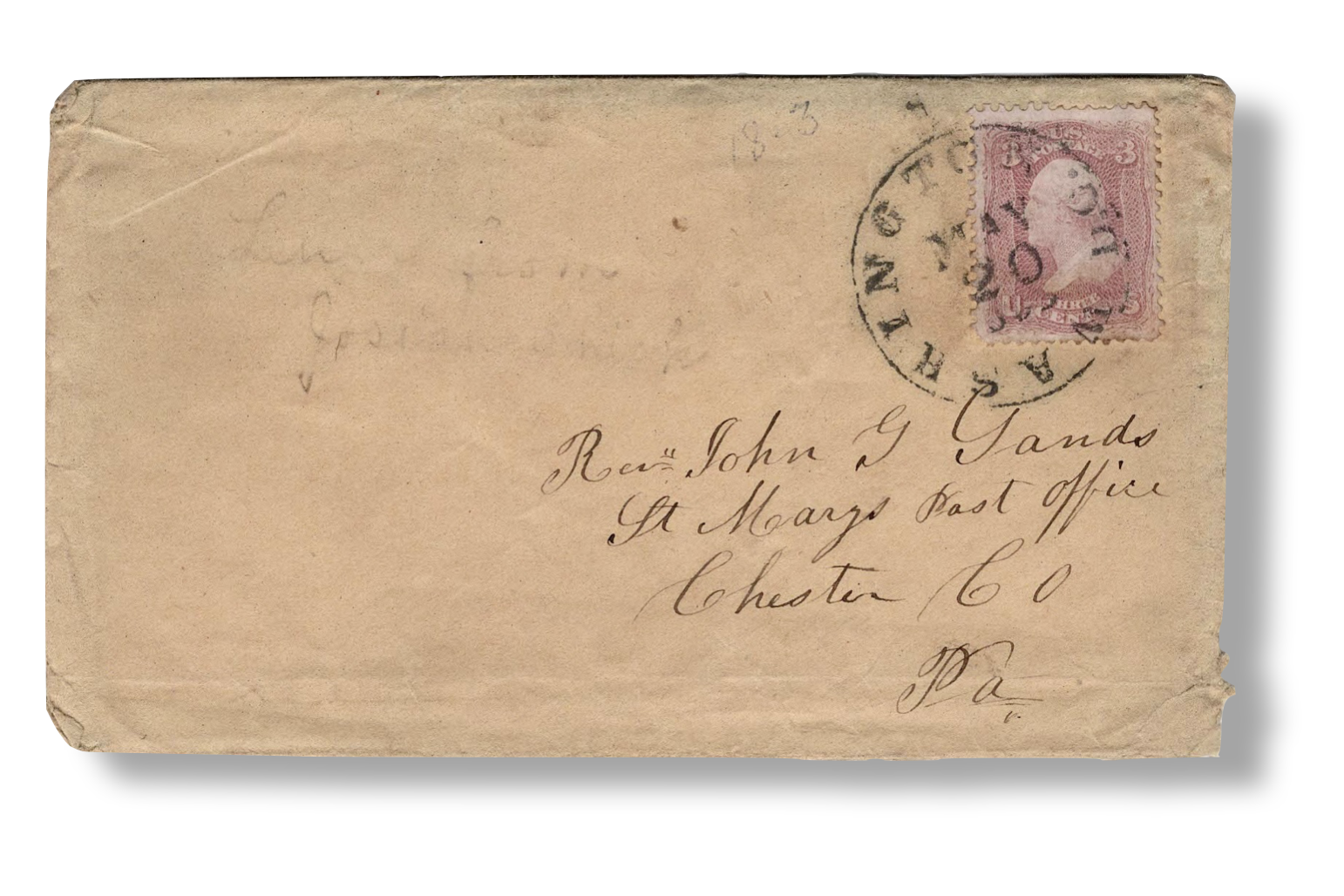
Camp near White Oak Church, Va.
May 17th 1863
Dear brother & sister,
This being Sunday and I have some spare time, I thought I would write you a few lines to let you know that I am still in the enjoyment of good health, hoping that you are all enjoying the same great blessing. I have wrote home twice since I came back and up to this time have not had an answer to either of my letters. I heard through Martha that you are all well. I had a letter from her yesterday. She has got quite well again. I wrote home since the battle. John, I will tell you a little about our trip and would-be defeat as some would try to have it.
On the 28th of April we left camp with 8 days rations and marched toward the Rappahannock river below Fredericksburg, halted at dark, and lay down and was just about getting asleep when we was called up and orders given to move off as quiet as we could, march[ing] to the bank of the river. It was assigned to our Brigade [Russell’s] to be the first to cross the river and it had to be done in pontoon boats and in the dark at that. The boats was launched—22 boats was the number—and 40 men in a boat. The boats was all filled and the word was given to move off. All started at the word and in a few minutes we were rowed over. They was a heavy fog over the river so that we could not see but a few rods ahead of us so just as we struck the shore, the Rebels gave us two or three volleys of musketry and as soon as we could get up the bank, the fire was returned but [the] Rebels fled and our Brigade took possession of the rifle pits on the bank of the river and held them and protected the laying of the pontoon bridges. 1
In crossing, our regiment lost one killed and one wounded. The 95th Penn. Vols. lost 5 wounded. The 49th Penn. Vols. had two wounded. They was one Rebel officer captured and one soldier killed.
After the bridges was laid, some artillery [Battery D, 2nd US Artillery] crossed and was placed in position and one Division of the 6th Corps [Sedgwick’s] crossed and that was all that crossed at this point until Saturday night. Then all of the 6th Corps crossed, so one Division [Brooks’] held the place for four days. Most every day the Rebs would try to shell us out and we had to change our position several times and we lay in line of battle most all the time and we was called up as much as three times in one night.
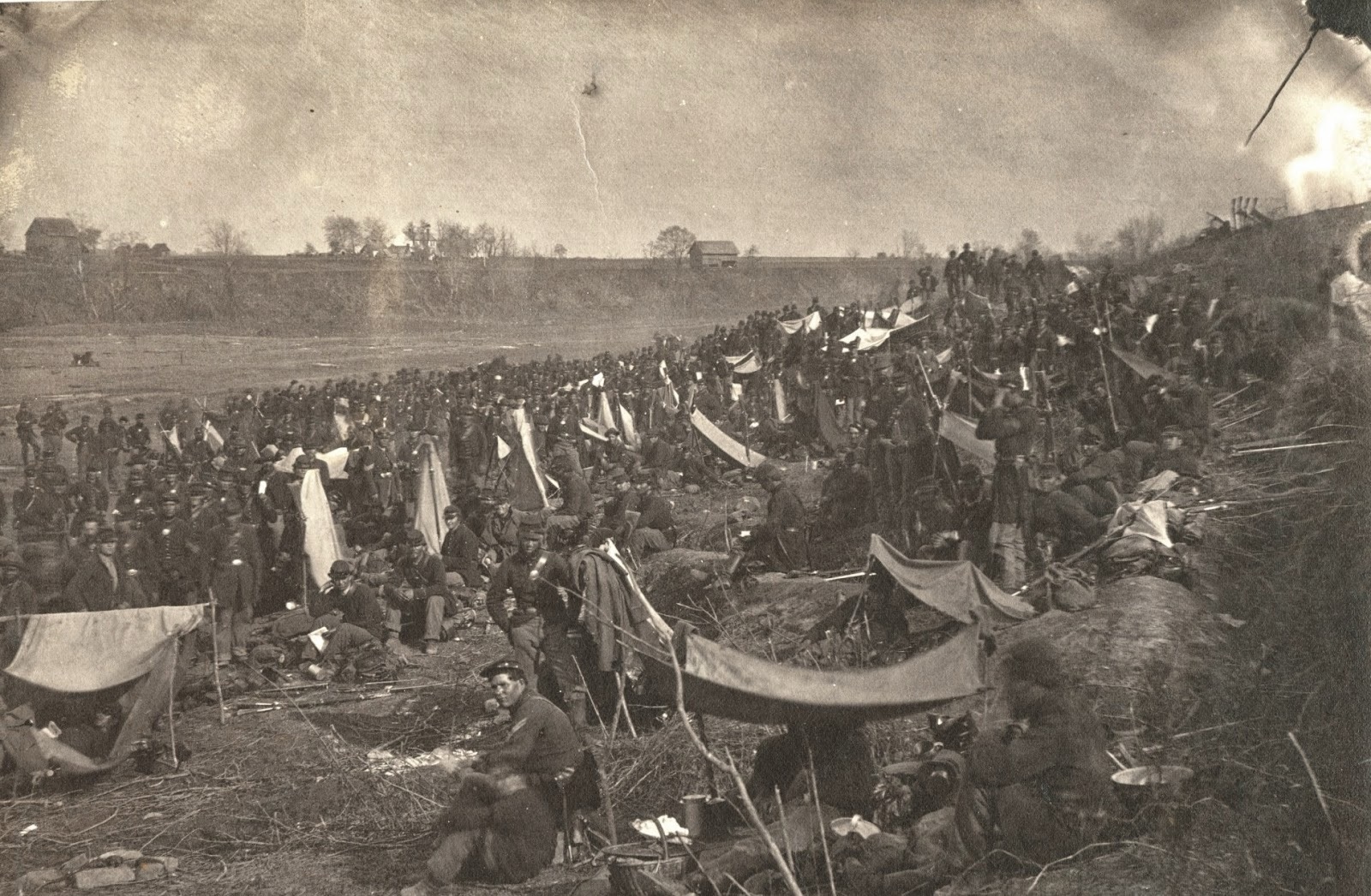
On Saturday night we heard heavy cannonading. It was up on the right. We had all made up our minds as day dawned on Sunday morning [May 3rd] the fight [would] commence where we was and it did. The artillery was the first to open as soon as it got light, and it was the heaviest cannonading I ever heard. It fairly made the earth shake and was kept up until about 11 o’clock. Then a part of our Corps charged on the heights of Fredericksburg and took them with considerable loss on both sides. Our men had to charge up a steep hill. We did not take part in the charge for we had to hold a position at the time.
At two o’clock we passed through the City and a forlorn looking place it is. Every house is riddled with ball and shell. Saw two male citizens and 6 or 8 women looking out of the windows. I saw some hard sights as we passed through the town. Dead of both sides laying in the hot sun after a battle is over is the worst part—to see the dead and wounded. God grant that this war may soon come to a close.
Sunday about 5 o’clock we got into another fight. We marched some three miles beyond the City of Fredericksburg [on the Orange Plank Road], overtook a large force of the Rebs and we was near the first to get into it. The most part of the fighting was with infantry. We marched up to a woods and got engaged; then we was ordered in. So in we went the best we could. The woods was thick and full of underbrush so that we had [to] crawl in at some places. The balls was flying as thick as hail. We had not more than got through the thickest of the woods when the Rebs came out on us in three lines of battle and we were ordered to fall back out of the woods and in doing so, some of our boys was taken prisoner and some killed and many wounded. I got out safe, but how I got through such hail of bullets safe, I can’t say except that God protected me though safe and I have felt so thankful for His protection over me. 2
At one time I thought I would give up and be taken prisoner. Then I thought I might get hit before I could get out of the woods on their side so I risked the getting out on our side. The balls was cutting up the dirt about me and men falling all around me. The Rebs came out of the woods but was soon drove back by troops that was in line behind us. The fighting was kept up until dark, neither side gaining any ground that night. The wounded was carried off that night. Next morning our artillery shelled the woods but by some means the Rebs out-flanked us and Monday night we was compelled to fall back and recross the river at Banks Ford. We all got over safe at daylight on Tuesday morning. On Sunday, May 31st, we took part in two hard fought battles and marched some 5 or 6 miles.
On Tuesday it began to rain and rained for three days. On Friday, May 8th we took the line of march for our old camp at this place. We arrived here the same day at 5 o’clock, all very tired. But since we have been back, we have not had much to do so now we are pretty well rested. The weather has been very warm since we came back. Some think that the late battles have been a great disaster to our army. I don’t think so. Although it did not accomplish all that was expected it to do, it done well. Men that fought us on Sunday came from Suffolk and other places south. They brought all their forces from Richmond and other points. I think the Rebs loss much greater than ours. They lost some valuable officers. Stonewall Jackson is one of that number. There is no signs of a movement at this time. The loss in our regiment will number about 140. One third of that number, I think, is prisoners and the rest wounded and killed. They can’t account for more than 10 or 12 that was killed. I don’t think the killed will over reach that number.
I had a letter from [brother] Cyrus a few days ago—all well. I must close with love to all and hope to hear from you soon. I still remain as ever your affectionate soldier brother, — Josiah Shick.
N. B. Remember me to all at home. W. Epehimer came through the fight safe. His regiment lost 160 in all counting wounded and prisoners.
1 The 6th Corps was kept out of view as they started toward Franklin’s Crossing late Tuesday, 28 April. After dark, the men and pontoons were moved to the river from the cover of the woods 1000 yards back. Once at the river, the soldiers lay on their arms and waited. It was after 4 a.m. before 1200 men of the 95th and 119th Pennsylvania were loaded into the pontoon boats and rowed across the river. There were 45 men plus officers transported in each boat. It took only a matter of minutes for the men to scramble up the bank and into the rebel rifle pits once they landed. [Source: Chancellorsville 1863, The Souls of the Brave, page 98, by Ernest B. Ferguson]
2 It was the 119th and 95th Pennsylvania that were detached from the Brigade and hurried onward to overtaking the retreating Rebels from Fredericksburg on the Orange Plank Road. It was near Salem Church that they encountered Cadmus Wilcox’s 5 brigades of Alabamians and Georgians in force, posted in a woods, hidden from view. The Pennsylvanians were aligned in battle formation to the left of the road and with other troops, placed under the immediate command of General Sedgwick. The advance of Federals up the gradual slope to the red brick church was ordered about 5 p.m. They were quickly overwhelmed by a superior force, twice their number, and fell back with heavy losses, Union artillery firing over their heads as they retreated. [Source: Chancellorsville 1863, The Souls of the Brave, page 278, by Ernest B. Ferguson]
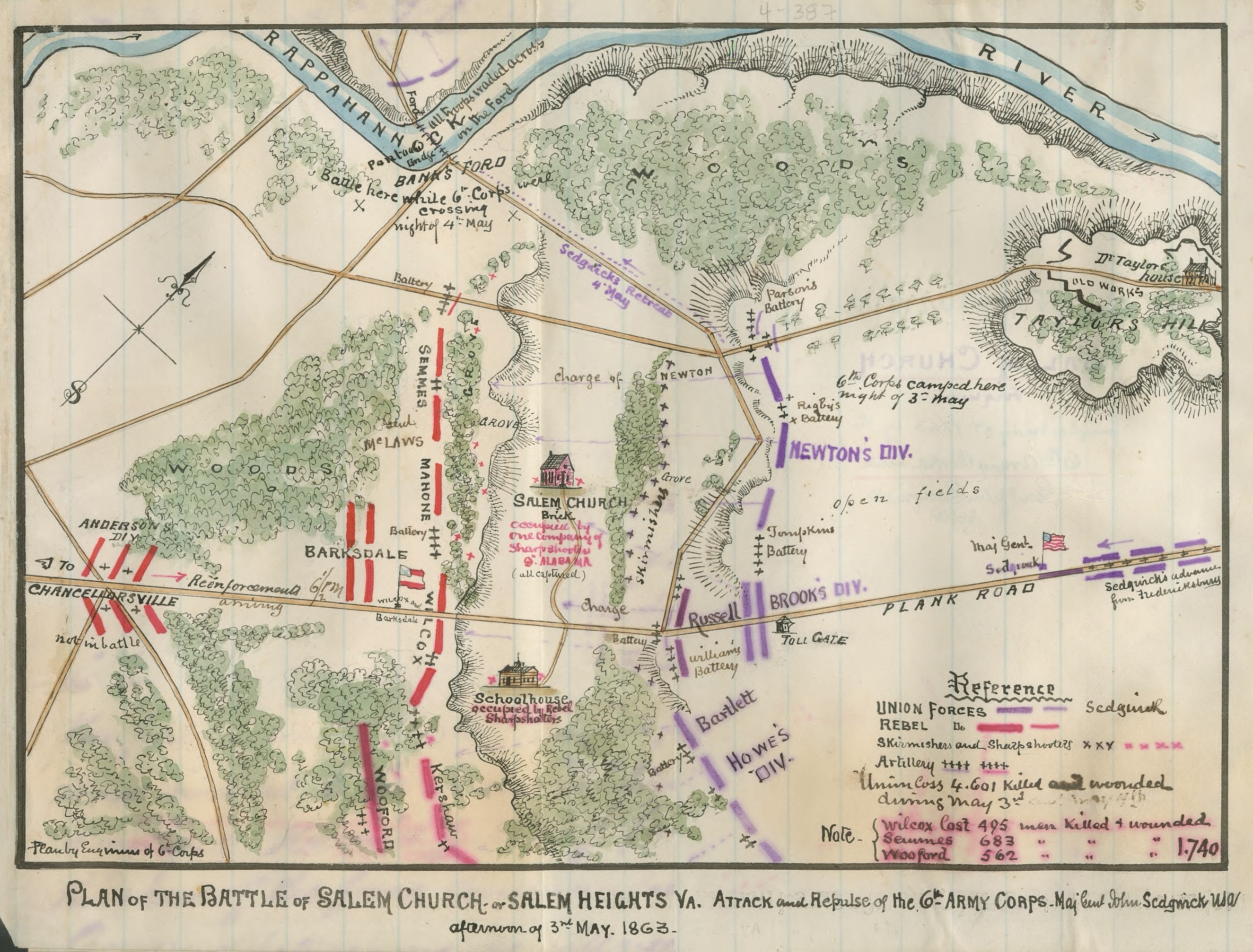
The following letter was written by Josiah Van Fossan (1835-1889), the son of David Van Fossan (1808-1862) and Melinda Fishel (1809-1881) of Wayne City, Wayne county, Illinois. Josiah was earning a living as a carpenter in Mount Erie, Illinois, was married and with small children when he enlisted as a private on 13 August 1862 to serve three years in Co. D, 87th Illinois Infantry. At that time, muster rolls recorded his height at 5’8″, his hair brown, his eyes grey. The regiment primarily served in the Department of the Tennessee and the Department of the Gulf, with actions in Arkansas (Helena) and Louisiana (Vicksburg campaign, Brashear City, 1864 Red River Campaign). Josiah mustered out of the service on 16 June 1865 at Helena, Arkansas.
Also serving with him in the same company and mentioned in this letter was his younger brother, David Van Fossan, Jr. (1843-1912). They both survived the war. Both of them were born in Columbiana county, Ohio, and came with their parents to Wayne county, Illinois, in 1851.
See also—1865: David Van Fossan to his Mother on Spared & Shared 23 and 1863: David VanFustain to Alexander VanFustain on Spared & Shared 22.
[Note: This letter is from the personal collection of Jennifer Wood who is the great-great-great granddaughter of David Van Fossan, brother of the author. She made it available for transcription and publication on Spared & Shared by express consent.]
T R A N S C R I P T I O N
Camp Logan
Shawneetown [Illinois]
October 31st 1862
Dear mother & brother,
I sit myself down to inform you that we are well except David. He is very sick now with the fever. He went to the hospital the 3rd day after he got here. He had to stop on the road when he was coming down about 12 miles from here. I got a buggy and went after him and I hope when this comes to hand, they will find you and Alexander enjoying good health for that is the greatest blessing that God can bestow on us.
Mother, I have not much to write you at this time. If you’ans can get any way to come after David or can send after him, you have best do it. The Captain says he will give him a furlough to go home and stay till he gets well again. He is getting very weak and falling off very fast. This is a very good place for a man as long as he keeps well but it is a hard place for a sick man. I have had my health the best kind except a chill about a week ago but I went and got some quinine and stopped it right straight and now I am as fat and sassy as a lawyer.
I will tell you we was mustered in this morning for the draw of our money. We will draw two months wages now and the money goes well with us so as we can send it to our families so they can live and get along. I believe I have give you all the particulars but I want you to send for David if you can any way at all.
So I must come to a close for this time and write more the next time. I have so many to write to, I can’t write very often but Mother, I will write to you as often as I can. I want to hear from you as soon as you get this. Tell all the friends that I am well, Tell Jacob I would like to hear from him.
So no more at present but still remains your son, — Josiah Vanfostain
To Melinda D. Alexander Van Fostain
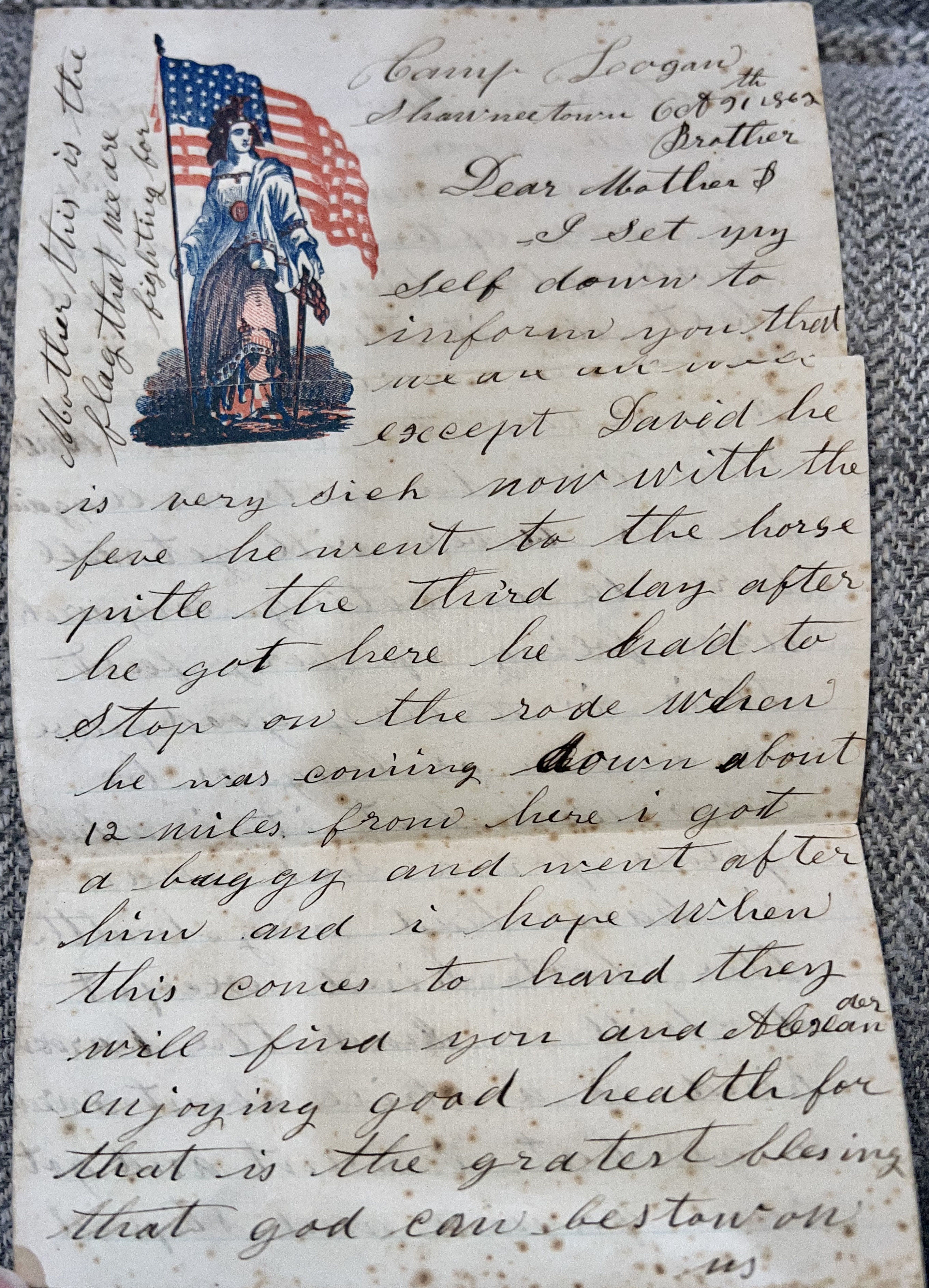
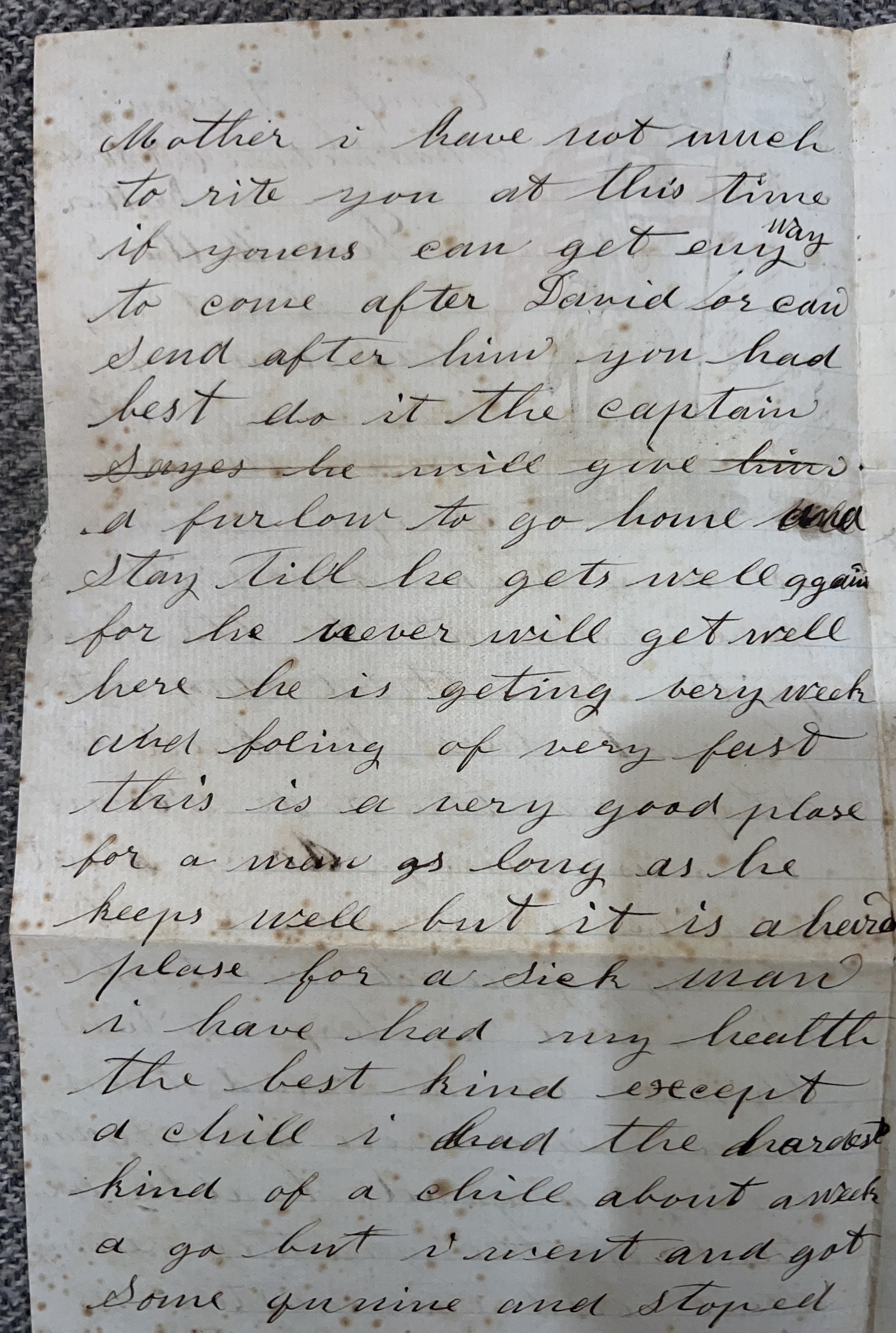
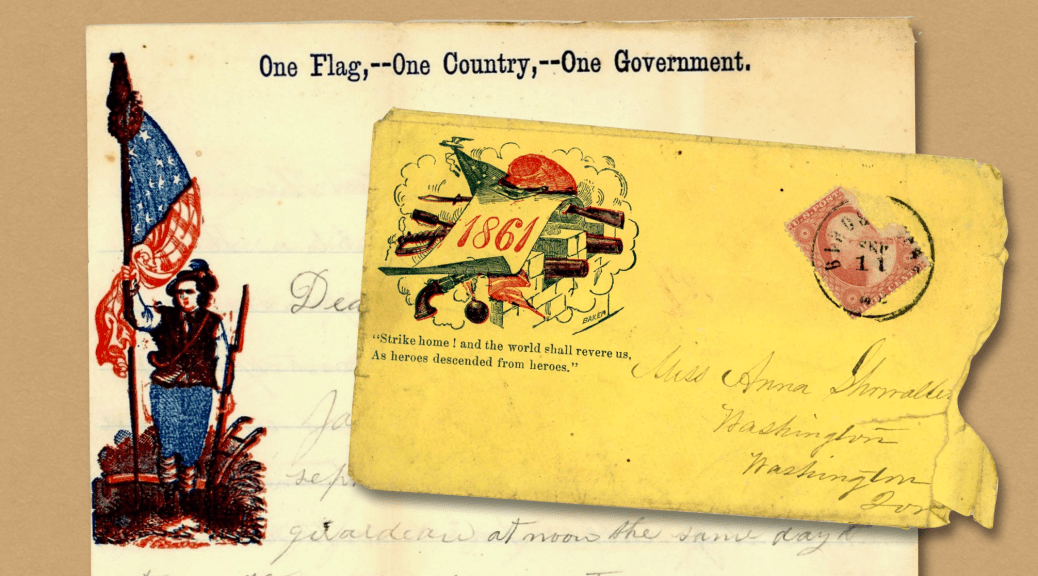
 Spared & Shared 23