My passion is studying American history leading up to & including the Civil War. I particularly enjoy reading, transcribing & researching primary sources such as letters and diaries.
The following letter was written by Samuel Benjamin Barber (1838-1873). Samuel was born in Lewis, Essex county, New York but was living in Grand Rapids, Michigan in 1861 when he enlisted in Co. D, 3rd Michigan Infantry (1st Organization). He was wounded on 15 July 1864 and mustered out that same year. He died in 1873 and was buried in New Boston, Michigan.
Transcription
Culpeper Court House, Va. Saturday, September 26, 1863
My dear friend,
Yours of the 11th came duly to hand and found me in the best of health and hope that these few lines will find you as they leave me.
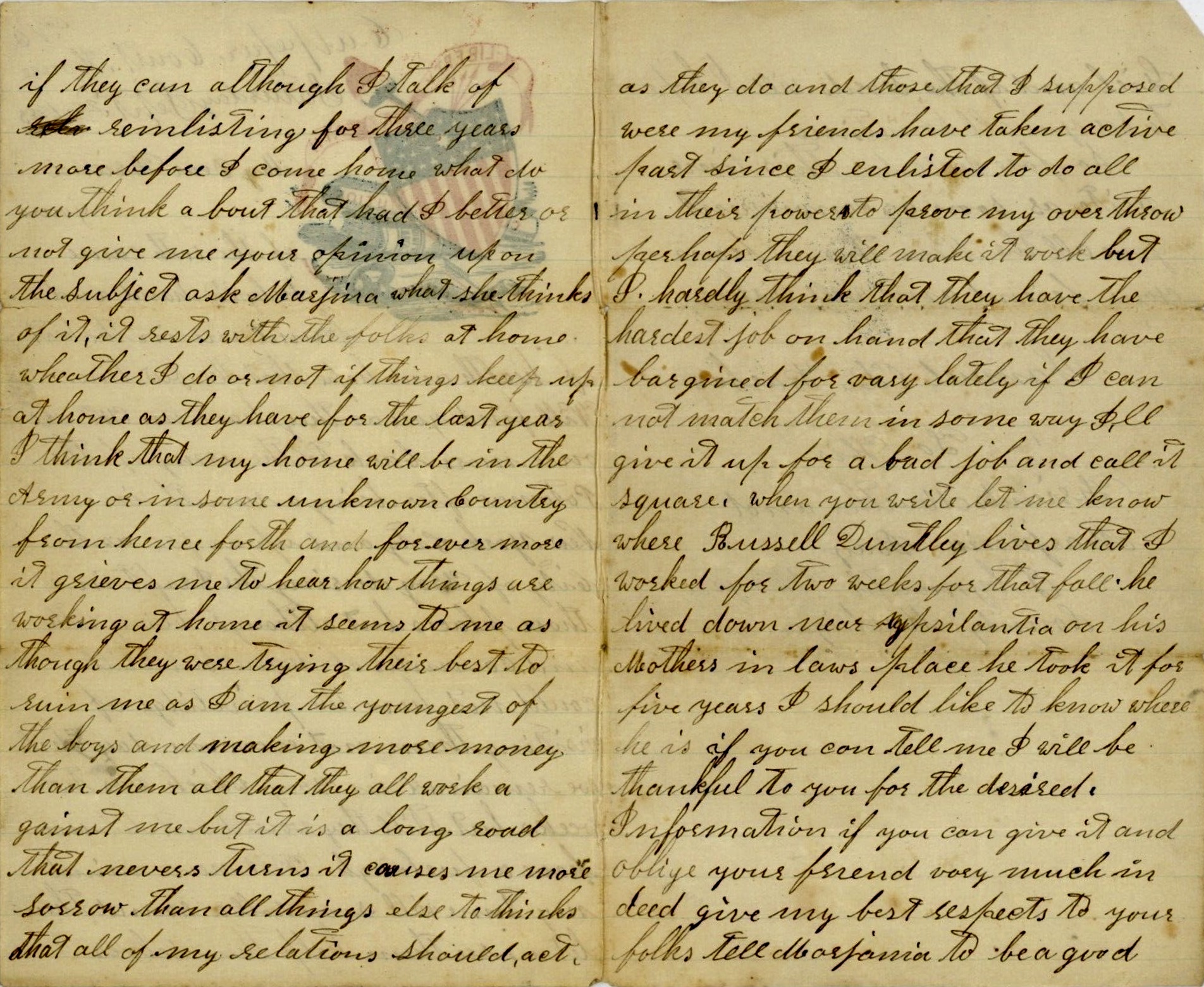
We are once more back to the Army of the Potomac after being a month inn New York City and up as far as the City of Troy during the draft in those places, but although being within 160 miles of home but still could not have the privilege of visiting them—not even one day while we remained in Troy which was two weeks, but still they would not let me have a furlough. Well never mind. My time will soon roll around. Then let us see them help themselves if they can although I talk of re-enlisting for three years more before I come home. What do you think about that? Had I better or not? Give me your opinion upon the subject. Ask Marjania what she thinks of it.
It rests with the folks at home whether I do or not. If things keep up at home as they have for the last year, I think that my home will be in the Army or in some unknown country from henceforth and forever more. It grieves me to hear how things are working at home. It seems to me as though they were trying their best to ruin me as I am the youngest of the boys and making more money that them all that they all work against me. But it is a long road that never turns. It causes me more sorrow than all things else to think that all of my relations should act as they do and those that I supposed were my friends have taken active part since I enlisted to do all in their power to prove my overthrow. Perhaps they will make it work, but I hardly think that they have the hardest job on hand that they have bargained, for very lately, if I cannot match them in some way, I’ll give it up for a bad job and call it square.
When you. write, let me know where Russell Duntley lives that I worked for two two weeks for that fall. He lived down near Ypsilanti on on his mother-in-law’s place. He took it for five years. I should like to know where he is. If you can tell me, I will be thankful to you for the desired information if you can give it and oblige your friend very much indeed.
Give my best respects to your folks. Tell Marjania to be a good girl and if the Lord’s will, I hope to see you all sometime. So farewell for this time. Write as soon as convenient. Give all the news. This is from your friend and well wisher, — Samuel B. Barber
To his friends Martha and Marjania Ray, Plymouth, Wayne county, Michigan
This letter was written by Timothy Sprague (1811-1862), the son of John Sprague (1775-1862) and Rhoda Crittenden (1776-1835) of Wyoming county, New York. Timothy’s first wife was Polly Bliss who died sometime after the birth of her second child, Walter Scott Sprague (1844-1916). Her first child was Isabella Sprague (1839-1904), the recipient of this letter. Timothy married a second time to a woman named Sarah but she seems to have died in the early 1850s, perhaps not long before he made the journey to Minnesota Territory described in this letter.
Isabella was born in China, New York and died in 1904 in Conneautville, Crawford county, Pennsylvania. Timothy’s letter mentions “Ethan.” I believe this was Ethan Lord Sprague (1835-1917), the son of Timothy’s brother, John Sprague, Jr. (1807-1888) and Harriet Lord (1810-1875) of Conneautville, PA.
Transcription
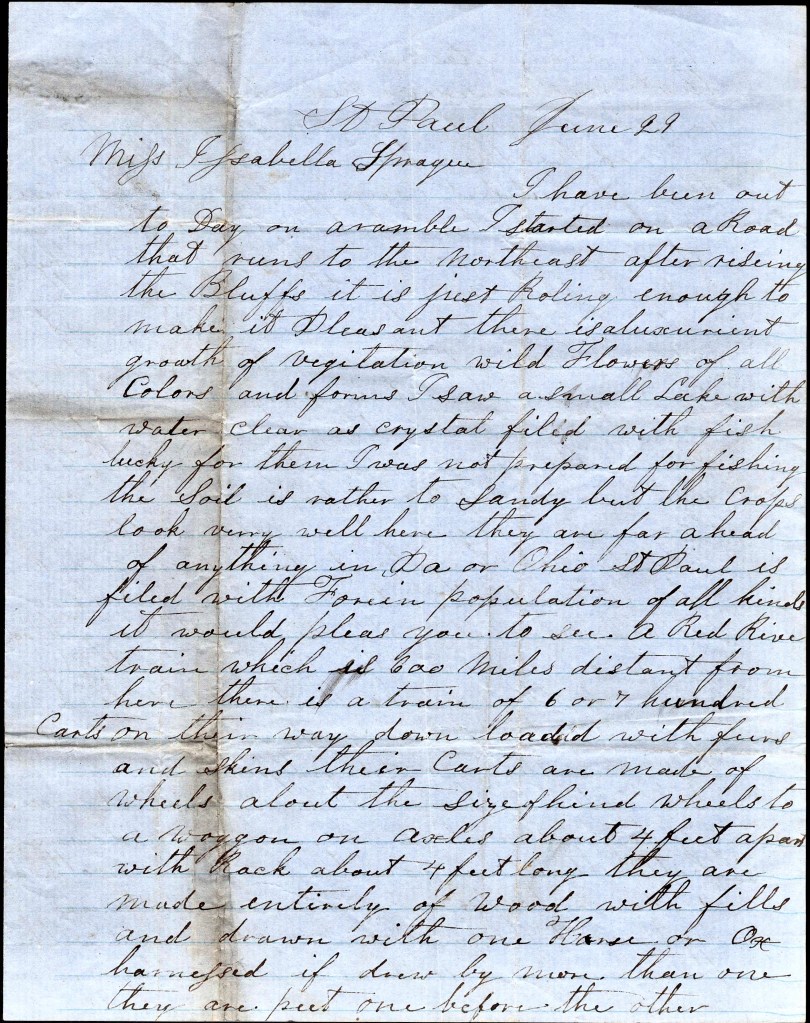
St. Paul [Minnesota Territory] June 29, [1850s]
Miss Isabella Sprague,
I have been out today on a ramble. I started on a road that runs to the northeast. After rising the bluffs, it is just rolling enough to make it pleasant. There is a luxuriant growth of vegetation, wild flowers of all colors and forms. I saw a small lake with water clear as crystal filled with fish. Lucky for them I was not prepared for fishing. The soil is rather too sandy but the crops look very well here. they are ahead of anything in Pennsylvania or Ohio.
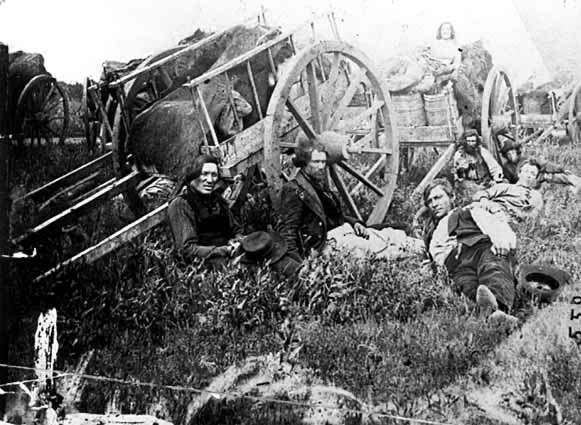
St. Paul is filled with foreign population of all kinds. 1 It would please you to see a Red River 2 train which is 600 miles distant from here. There is a train of 6 or 7 hundred carts on their way down loaded with furs and skins. Their carts are made of wheels about the size of hind wheels to a wagon on axles about 4 feet apart with rack about 4 feet long. they are made entirely of wood with fills and drawn with one horse or ox harnessed. If drawn by more than one, they are put one before the other. 3
The wagons described by Sprague and some of the Métis people of Minnesota Territory.
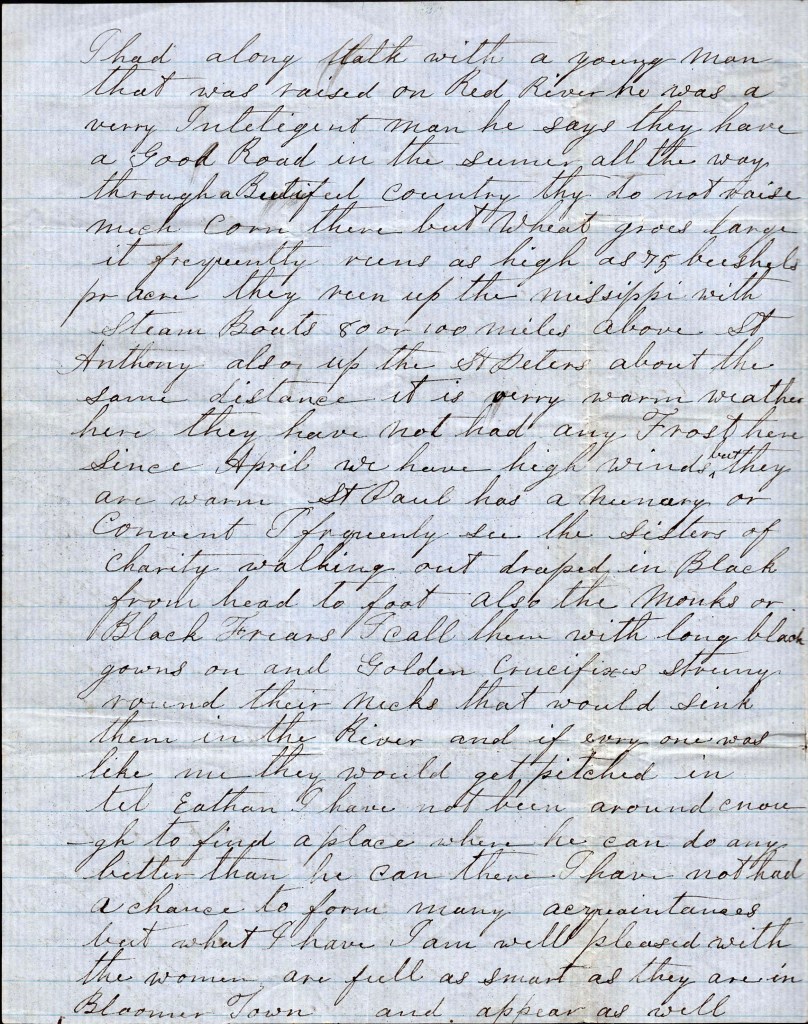
I had a long talk with a young man that was raised in Red River. He was a very intelligent man. He says they have a good road in the summer all the way through a beautiful country. They do not raise much corn there but wheat grows large. It frequently runs as high as 75 bushels per acre. They run up the Mississippi with steamboats 80 or 100 miles above St. Anthony. Also up the St. Peters about the same distance. It is very warm weather here. They have not had any frost here since April. We have high winds but they are warm.
St. Paul has a nunnary or convent. I frequently see the Sisters of Charity walking out draped in black from head to foot. Also the monks or Black Friars, I call them, with long black gowns on and golden crucifixes strung around heir necks that would sink them in the river and if every one was like me, they would get pitched in.
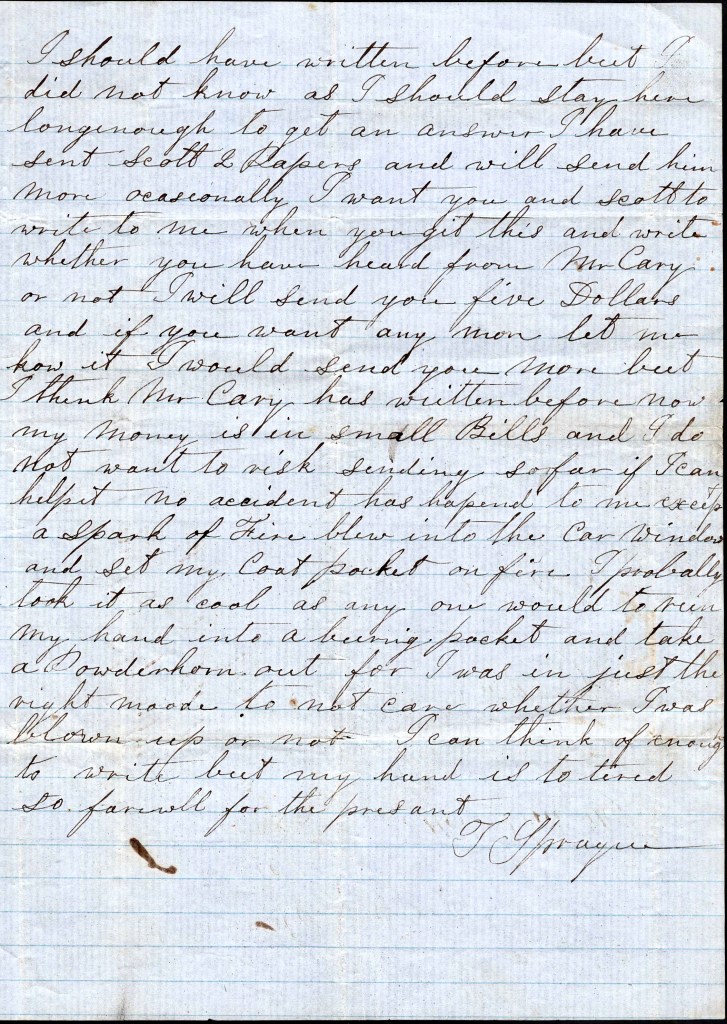
Tell [your cousin] Ethan I have not been around enough to find a place where he can do any better than he can there. I have not had a chance to form many acquaintances but what I have, I am well pleased with. The women are full as smart as they are in Bloomer Town and appear as well. I should have written before but I did not know as I should stay here long enough to get an answer.
I have sent Scott two papers and will send him more occasionally. I want you and scott to write to me when you get this and write whether you have heard from Mr. Cary or not. I will send you five dollars and if you want any more, let me know it. I would send you more but I think Mr. Cary has written before now. My money is in small bills and I do not want to rish sending so far if I can help it.
No accident has happened to me except a spark of fire blew in the car window and set my coat pocket on fire. I probably took it as cool as anyone would to run my hand into a burning pocket and take a powder horn out for I was in just the right mood to not care whether I was blown up or not. I can think of enough to write but my hand is too tired so farewell for the present. — T. Sprague
1 A correspondent for the Hartford Republican recorded his first impressions of St. Paul in a most unfavorable light when he visited the town city in 1855. “It was raining and the streets were covered with mud, black as tar, ” he wrote. “It is situated upon a bluff 60 feet above the river and is surrounded by a bluff still higher, from which you have magnificent views of the amphitheater below. St. Paul has about 6,000 inhabitants, sixty lawyers, six or eight churches, five daily papers (two Republican and three Democratic), and every man takes all papers and advertises in all, though the price is more than double that of our Eastern papers. Speculation is most rampant, and those who are the most reckless, make the most money, a fact which is owing to the rapid rise in land. The country is constantly being filled up with immigrants, hundreds and hundreds daily arriving in the boats, mostly from New England and New York, though every state in the Union is represented. All the best lands within 50 miles of here are taken up.” [Cayuga Chief, 20 November 1855, Auburn, NY]
2 The Red River originates at the confluence of the Bois de Sioux and Otter Trail rivers and flows northward through the Red River Valley, forming most of the border of Minnesota and North Dakota. It continues into Canada and empties into Lake Winnipeg. The watershed was a key trade route of the Hudson Bay Company, transporting furs and other commodities.
3 “In the 17th century a lucrative trade developed between Native Americans who trapped animals near the Great Lakes and traders who shipped the animal furs to Europe. For two centuries this trade network was the Métis people—a mixed race community descended from Native Americans and French traders, as well as other mixed race peoples. In particular, during the latter 18th century, numerous French and English traders in the Minnesota region purchased Sioux wives in order to establish kinship relationships with the Sioux so as to secure their supply of furs from the tribes.” (Wikipedia)
The following two letters were sent to me from a private collection with the hope that I might be able to identify the author but I have failed to do so. I publish it here, however, on the outside chance that I might be able to link it to some other correspondence in the future.
[Note these letters are the property of Greg Herr and were sent to me for publication on Spared & Shared by express consent.]
Letter 1
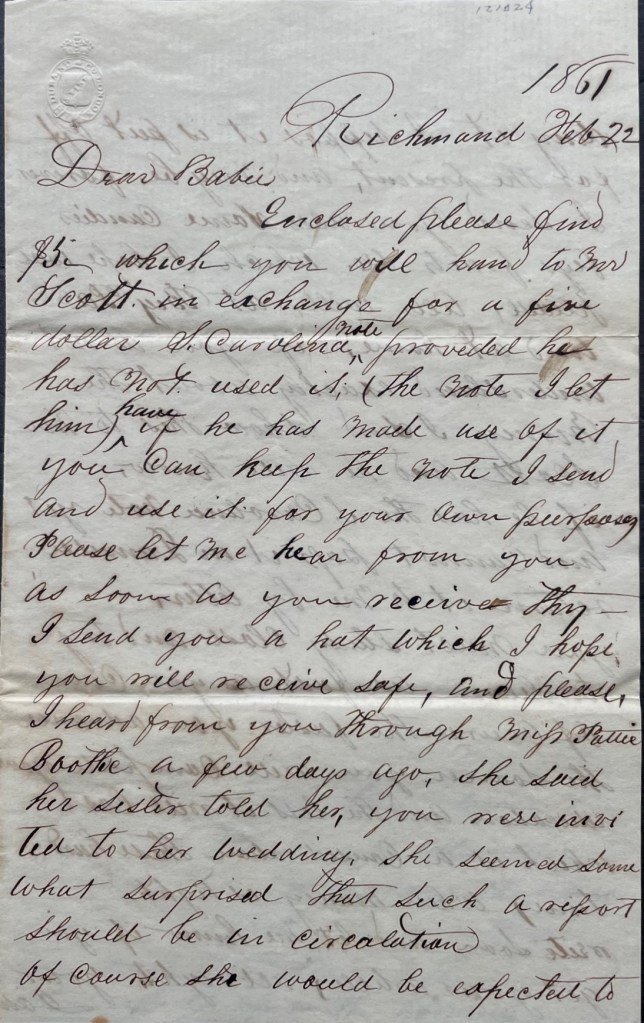
Richmond [Virginia] February 22, 1861
Dear Babie,
Enclosed please fid $5 which you will hand to Mr. Scott in exchange for a five dollar S. Carolina Note provided he has not used it (the note I let him have). If he has made use of it, you can keep the note I send and use it for your own purposes. Please let me hear from you as soon as you receive this.
I send you a hat which I hope you will receive safe, and please, I heard from you through Miss Pattie Boothe a few days ago. She said her sister told her you were invited to her wedding. She seemed somewhat surprised that such a report should be in circulation. Of course she would be expected to deny it. I suppose it is put off for the present, and may be forever. I send you also some candies, figs, fruits, &c. which I hope will please.
All’s well at Big Pa’s and at home. If you do not understand exactly about the money I send, show this to Mr. Scott and he will know if he has the S. Carolina Note yet and cannot pass it in Danville return it to me by letter.
You must study close and try to learn as fast as you can. Of course the faster you advance, the sooner you will complete your education and the less it will cost which is a consideration these hard times when money is tight.
Write soon and let me know if you get your articles all right. Your little Pa. — John J. Barnes
I have been down to Richmond attending the Convention. 1 The Convention is likely to do nothing satisfactory to the people. I go up in the morning.
1 The Virginia Convention of 1861, also called the Secession Convention, met on February 13, 1861, before the American Civil War to decide if Virginia should secede from the United States. It had 152 delegates, mostly Unionists, who were elected by the Virginia General Assembly, and their decision needed to be confirmed by a statewide vote. Several Southern states had already seceded after Abraham Lincoln was elected president in November 1860. Virginia was hesitant, and debates lasted for months. On April 4, secessionists lost a vote but still prepared for war. Former governor Henry A. Wise tried to secure the federal arsenal at Harpers Ferry by military means, which upset Unionist delegate John Baldwin. After Fort Sumter fell on April 13 and Lincoln called for volunteers on April 15, support for secession grew, leading the convention to vote on April 17 to leave the Union. Virginians showed their support in a vote on May 23, and the state joined the Confederacy.
Letter 2
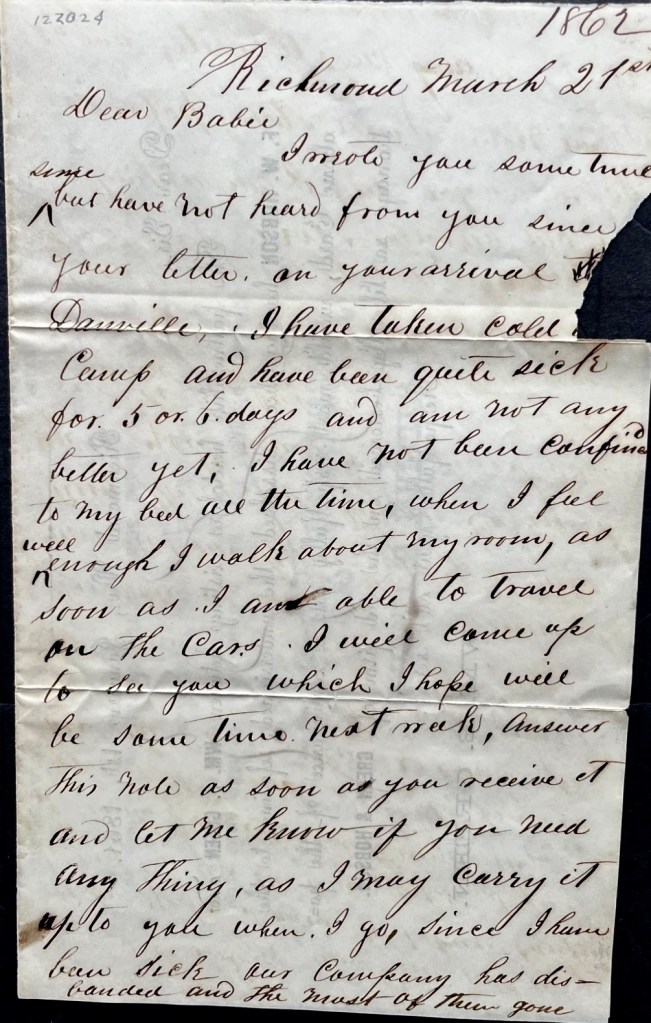
Richmond [Virginia] March 21st 1862
Dear Babie,
I wrote you some time since but have not heard from you since your letter on your arrival at Danville. I have taken cold in camp and have been quite sick for 5 or 6 days and am not any better yet. I have not been confined to my bed all the time. When I feel well enough, I walk about my room. assoon as I am able to travel on the cars, I will come up to see you which I hope will be sometime next week. Answer this note as soon as you receive it and let me know if you need anything as I may carry it up to you when I go. Since I have been sick, our company has disbanded and the most of them gone home. I was sorry but could not help it so many of them getting exempt on account of being a widow’s overseer and about 20 sick ones in camp.
I left camp and came to town as soon as I was taken sick. Ned is very sick also, but hope he is some better today. The doctor thinks Ned better. I have had Morris here but got Tom to take him home this morning. I do not feel much like writing this evening [even] if I had anything to write, and as I have none, I will stop. Paper is scarce. As you see I am writing on an old circular. Write soon as you get this. Direct to Richmond. — J. J. Barnes
The following letter was written by Sergt. Major John Arthur Johnston (1828-1899) who was a wholesale grocer in Petersburg, Virginia, before the American Civil War. The partnership was called, “Donnan and Johnston.” At the breaking out of the war, Johnston volunteered to become the post quartermaster of the CSA at Norfolk. When Norfolk was evacuated, he was placed in charge of the quartermaster’s department of Mahone’s Brigade. He was subsequently made quartermaster of Anderson’s Division which place he held until the end of the war.
Returning to Petersburg after the war, he was elected sheriff and served 14 years in that capacity, He was also at one time a director in the Atlantic, Mississippi & Ohio Railroad Company.
This letter was written to Alexander Donnan, his former partner in the grocery business.
[Note: This letter is from the personal collection of Greg Herr and was made available for transcription and publication on Spared & Shared by express consent.]
Transcription
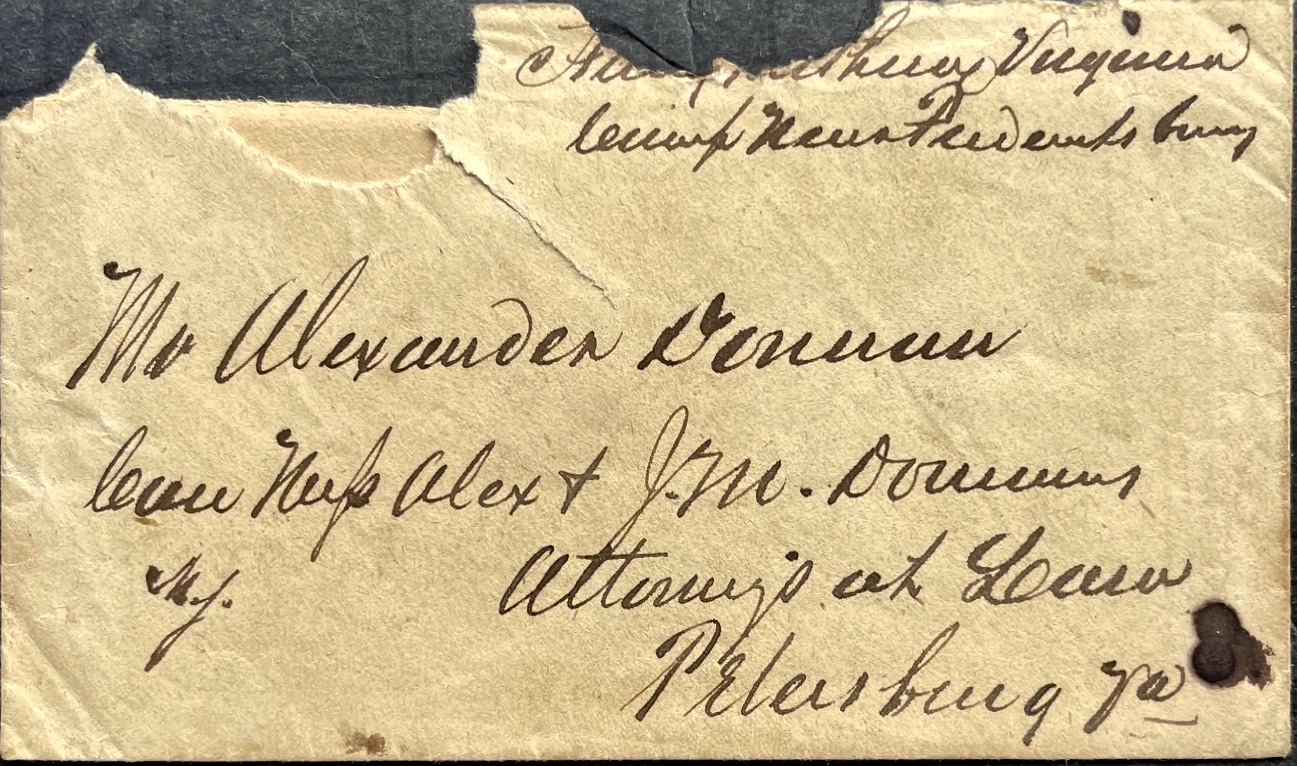
Addressed to Mr. Alexander Donnan, Care of Messrs. Alex & J. M. Donnans. Attorneys at Law, Petersburg, Virginia
Army of Northern Virginia Camp near Fredericksburg, Va. March 28, 1863
Mr. Alexander Donnan, dear friend,
Your valued letter of the 18th inst. reached me a few days ago. Pease accept my thanks for the prompt attention given and your prompt reply.
You can arrange the necessary papers to revise the decree at your convenience and send then to me by mail and I will have them executed and returned when the decree is secured. We can [ ] the date of sale terms, &c.
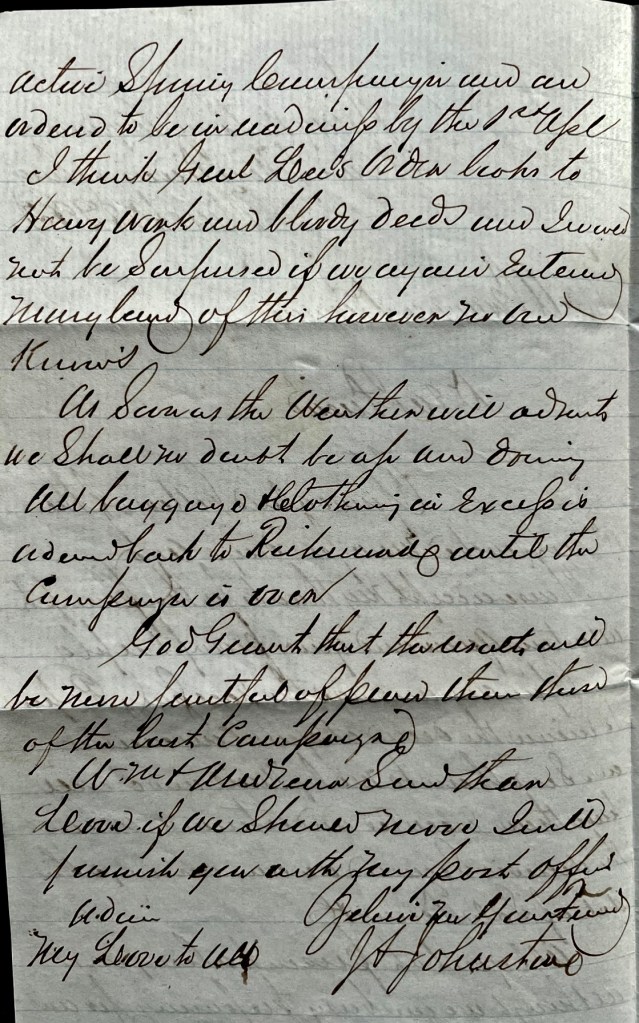
All quiet at present along our [front] although we are busy preparing for an active Spring Campaign and are ordered to be in readiness by the 1st of April. I think Gen. Lee’s Order looks to heavy work and bloody deeds and I would not be surprised if we again entered Maryland. Of this, however, no one knows. As soon as the weather will allow, we shall no doubt be up and doing. All baggage and clothing in excess is ordered back to Richmond until the campaign is over. God grant that the result will be more fruitful of peace than those of the last campaign.
William and Andrew send their love. If we should move, I shall furnish you with the post office. Adieu. My love to all. Believe me your friend, — J. A. Johnston
I couldn’t find a photograph of James but here’s a 1/9th plate tintype of a soldier thought to be from Co. C, 101st Pennsylvania Infantry (Ronn Palm Collection)
This letter was written by James Baker (1831-1864) of Co. C, 101st Pennsylvania Infantry. James enlisted as a private on 20 December 1861 for three years. He re-enlisted as a veteran in the winter of 1863-64 and was one among many of his regiment surrendered at the Battle of Plymouth on 18 April 1864 and taken to Andersonville Prison. He died there four months later on 20 August 1864 and was buried in grave 6061. Also mentioned in this letter was John H. Baker who was also taken prisoner at Plymouth and who died at Florence, S. C., on 15 February 1865.
The men in Co. C of the regiment were recruited principally in Lawrence and Beaver counties of Pennsylvania. James was the son of Richard Wesley Baker (1799-1882) and Catherine Thompson (1807-1884) of Beaver county. He was married to Mary Millison (1825-1870) in June 1845 and together they had several children: Samuel Baker (1847-1935), Mandana R. Baker (1849-1900), William Oliver Baker (b. 1853), Catherine Baker (1855-1905), Isabella Baker (1860-1948), and Mary Ann Elizabeth Baker (1862-1878). The Bakers were living in New Castle, Lawrence county, Pennsylvania, at the time of the 1860 US Census.
This letter is from the private collection of Greg Herr and was transcribed and published on Spared & Shared by express consent.
Transcription
Camp near New Bern, N. C. February 21, 1863
My dear wife and children.
I sit down this morning with my pen and paper to write you a few lines to let you know that I am well as can be expected and hope that these few lines will find you enjoying the same. I received on the 16th inst. one pair of mittens and three papers and one letter from you. I was so glad when I got them. you. say in your letter that you have had hard getting along this winter. you say you have had to carry all your wood this winter. I am sorry to hear this. I am away here in North Carolina far from you enduring the hardships of a soldier. We have to lay on the ground every night and the hardships that we have to endure you at home know nothing about but I thank God that He has spared me till this time. Thank God that He protected me in battle when the bullets flew around us like hail. But what is to become of us in the future, I can’t tell. I had thought we would get home this spring but it is doubtful as there is a very dark cloud hanging over us. I feel like staying it out till it is over, let it be long or short. You wouldn’t want me to come home a coward.
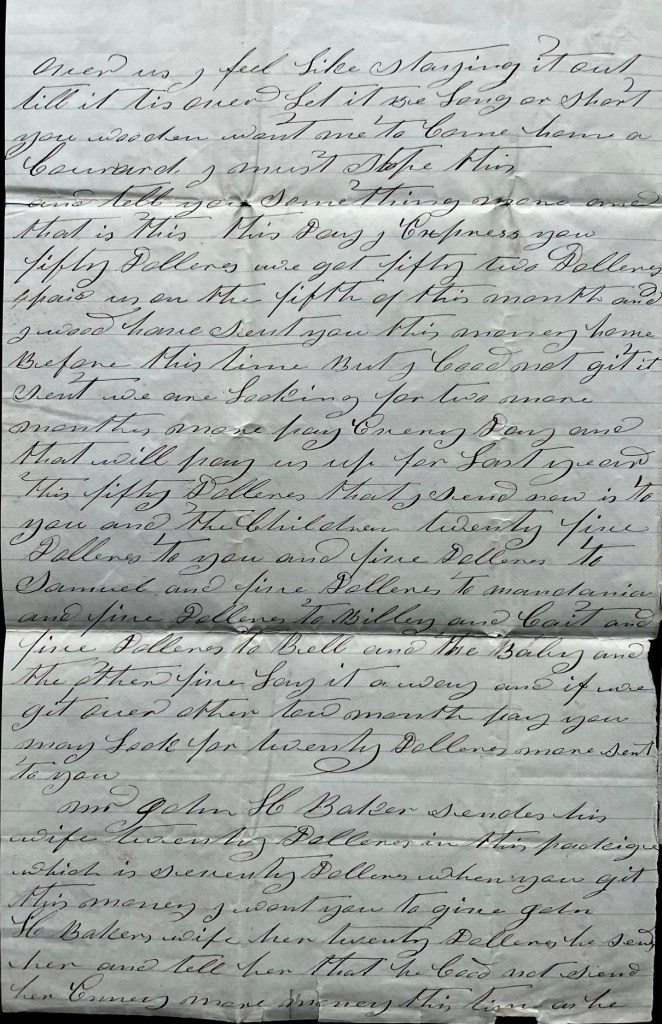
I must stop this and tell you something more and that is this. This day, I express you fifty dollars. We got fifty-two dollars paid us on the fifth of this month and I would have sent you this money home before this time but I could not get it sent. We are looking for two more months more pay every day and that will pay us up for last year. This fifty dollars that I send now is to you and the children, twenty-five dollars to you, and five dollars to Samuel and five dollars to Mandana and five dollars to Belle and the baby and the other five lay it away and if we get our other two months pay you may look for twenty dollars more sent to you.
Mr. John H. Baker sends his wife twenty dollars in this package which is seventy dollars. When you get this money, I want you to give John H. Baker’s wife her twenty dollars to send her and tell her that he could not send her any more money this time as he has been wounded and it costs a wounded or a sick man something here to keep him. He can’t live on the rations that we get here. A well man can hardly live on it so you want to tell her that is the reason he did not send her more money home htis time. Tell her that we are looking for two months more pay every day and when he gets it he will send her twenty dollars more.
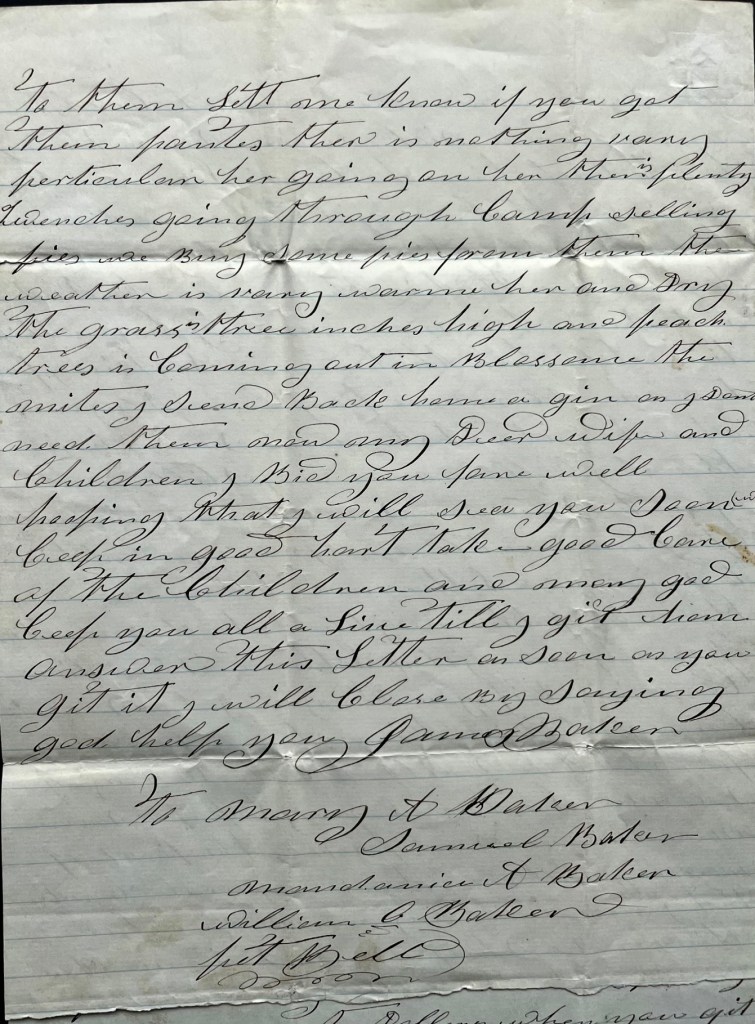
I still want you to send me some more New Castle papers and tell Mr. Granis I want him to send me a letter and let me know the news of the neighborhood. I want to know of you if you got a letter with a fine comb in it. If you did, you got a secesh comb. I got it in Kinston when we fought the battle on the 14th day of December last. You may look for some more things sent to you the first of March. I will send home my great coat that I wore that day and some other things. Be sure and send me them names so as I can send them grape [paper torn] to them. Let me know if you got them pants.
There is nothing very particular here going on. There is plenty of wenches going through camp selling pies. We buy some pies from them. The weather is very warm here and dry. The grass is three inches high and peach trees is coming out in blossom. The mittens I send back home again as I don’t need them now. My dear wife and children, I bid you farewell hoping that I will see you soon. Keep in good heart. Take good care of the children and may God keep you all alive till I get home. Answer this letter as soon as you get it. I will close by saying, God help you. — James Baker
To Mary A. Baker, Samuel Baker, Mandana Baker, William O. Baker, and Pet Bell
The following letter was written by Edwin Collins Gaskill (1844-1889) of Mendon, Massachusetts, who enlisted in October 1861 at age 18 to serve in Co. B, 25th Massachusetts infantry. After he re-enlisted in January 1864, he was discharged in February 1864 to accept a commission as 2nd Lt. in Co. C, 36th USCT. Edwin served in the same regiment as his older brother Leonard Taft Gaskill (1843-1928). He was severely wounded in the Battle of Chaffin’s farm in Virginia on 29 September 1864 and lost his left arm. A report on the battle claims that, “First Lieut. Edwin C. Gaskill, Thirty-sixth U.S. Colored Troops, rushed in front of his regiment, and, waving his sword, called on the men to follow. At this moment he was shot through the arm, within twenty yards of the enemy’s works.”
Edwin was the son of Micajah Collins Gaskill (1816-1894) and Hannah Mariah Taft (1824-1844).
It being a wet day, and I not having much to do, I thought I would answer your letter. We were very glad to hear from you, as we always are to hear from home. I suppose you have received Leonard’s letter before now if it has gone through right, but there is considerable many letters that get miscarried.
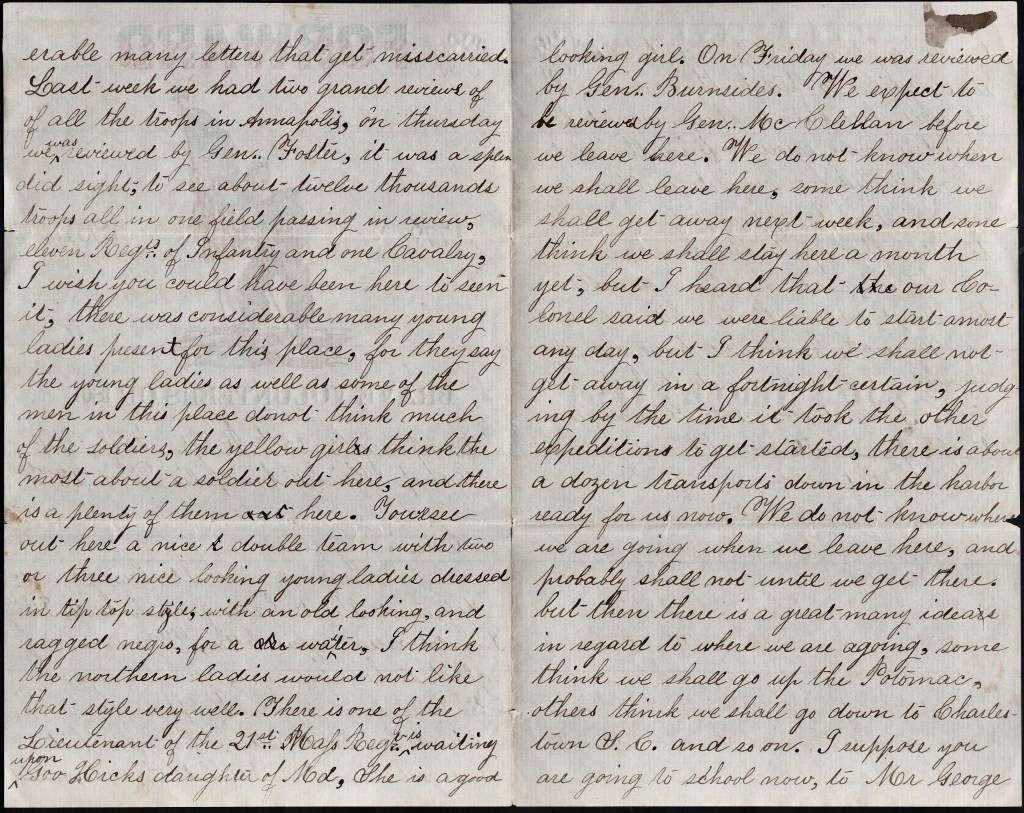
Last week we had two grand reviews of all the troops in Annapolis. On Thursday we was reviewed by Gen. Foster. It was a splendid sight to see about twelve thousand troops all in one field passing in review—eleven regiments of infantry and one cavalry. I wish you. could have been here to seen it. There was considerable many young ladies as well as some of the men in this place do not think much of the soldiers. The yellow girls think the most about a soldier out here and there is a plenty of them here. you see out here a nice double team with two or three nice looking young ladies dressed in tip top style, with an old looking and ragged negro for a waiter. I think the northern ladies would not like that style very well.
There is one of the Lieutenants of the 21st Massachusetts Regiment is waiting upon Gov. Hicks’ daughter of Maryland. She is a good looking girl.
On Friday we was reviewed by Gen. Burnsides. We expect to be reviewed by Gen. McClellan before we leave here. We do not know when we shall leave here. Some think we shall get away next week and some think we shall stay here a month yet. But I heard that our Colonel said we were liable to start amost any day. But I think we shall not get away in a fortnight certain judging by the time it took the other expeditions to get started. There is about a dozen transports down in the harbor ready for us now. We do not know where we are going when we leave here, and probably shall not until we get there. But then there is a great many ideas in regard to where we are agoing. Some think we shall go up the Potomac; others think we shall go down to Charleston, S. C. and so on.
I suppose you are going to school now to Mr. George. I was very much surprised to hear e was agoing to teach the school. I should not think there would be hardly room enough in the old school house for him to walk around conveniently. I suppose he makes them tread right up to the mark as they did Davis and myself. I saw Mr. Comings several times while we were at Worcester. He would have hardly known me if I had not spoken to him first. I must now close. Give my love to all. Please write soon. From your cousin, — Edwin
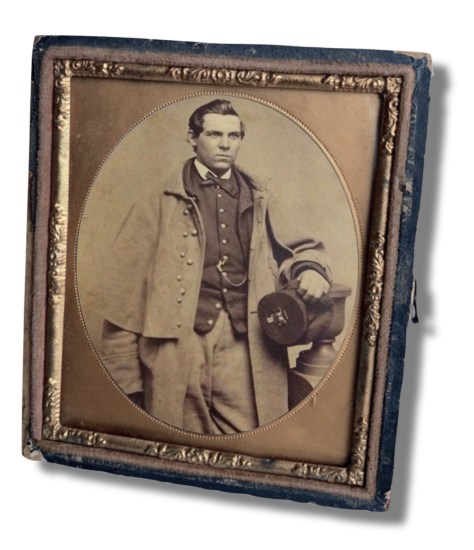
I could not find an image of Henry but here is an unidentified member of Co. B wearing the winter uniform of the 22nd Massachusetts (Al & Claudia Niemiec Collection)
The following letters were written by Henry Thomas Fitts (1842-1919), the son of Daniel French Fitts (1805-1883) and Susan Fellows (1805-18xx) of Haverhill, Essex county, Massachusetts.
Henry was a 19 year-old shoe cutter from Haverhill when he enlisted in September 1861 as a private in Co. H, 22nd Massachusetts Infantry. He transferred to the 216th Company of the Veteran Reserve Corps, 1st Battalion, in April 1864 and mustered out of the service in October 1864. Muster rolls inform us that he was reported missing at the Battle of Gaines’ Mill on 27 June 1862.
Letter 1
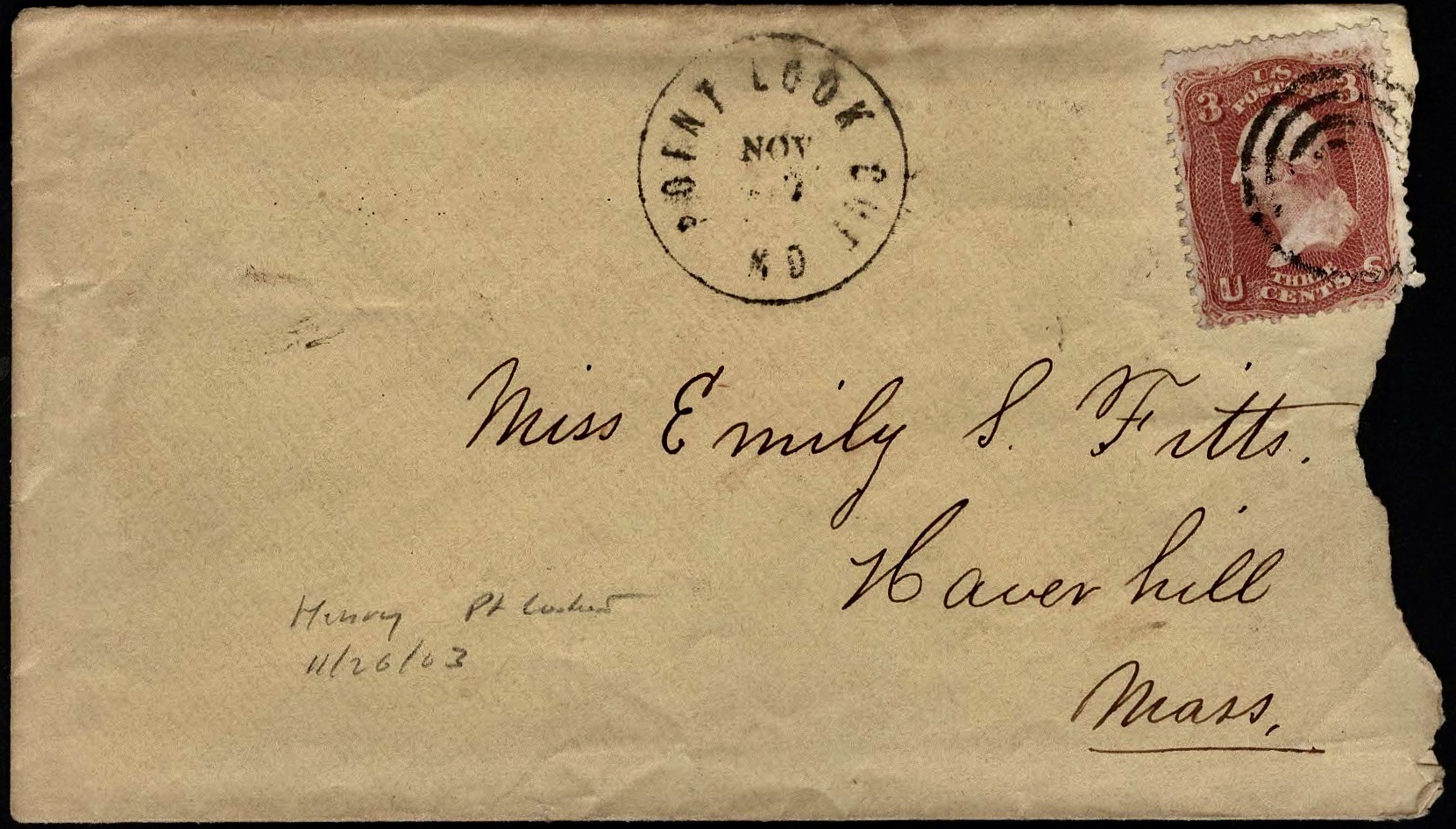
Addressed to Miss Emily S. Fitts, Haverhill, Massachusetts
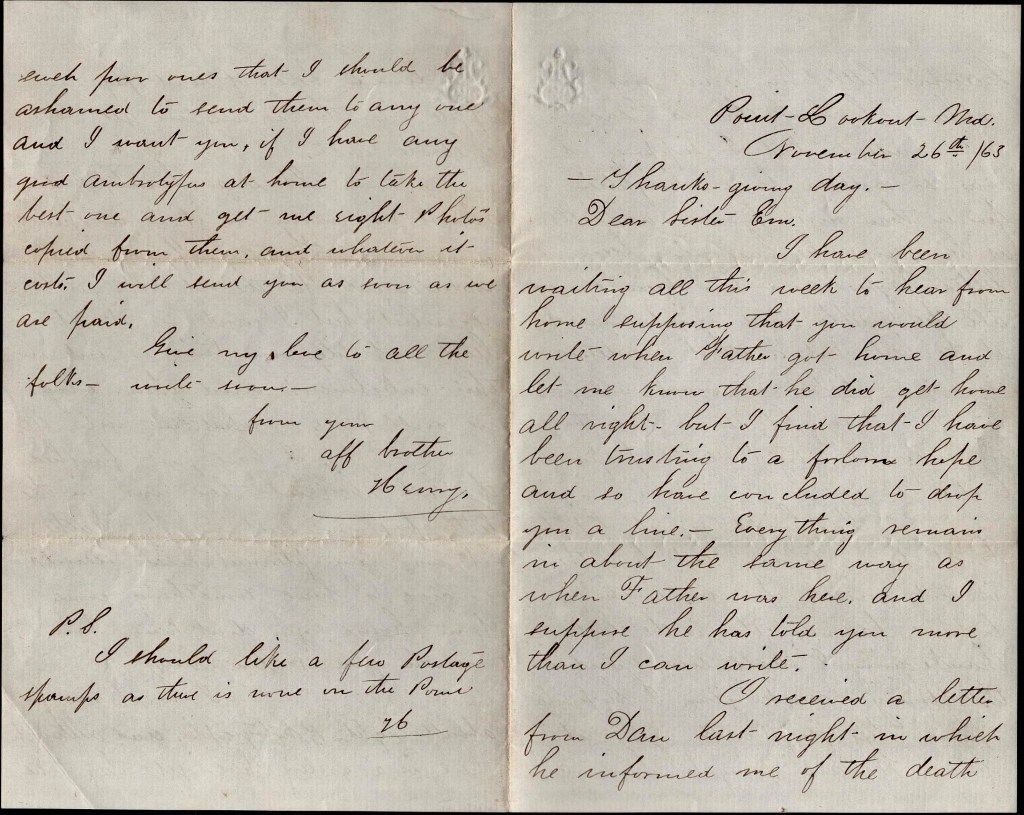
Point Lookout, Maryland November 26th 1863 Thanksgiving Day
Dear Sister Em,
I have been waiting all this week to hear from home supposing that you would write when Father got home and let me know that he did get home all right, but I find that I have been trusting to a forlorn hope and so have concluded to drop you a line. Everything remains in about the same way as when Father was here and I suppose he has told you more than I can write.
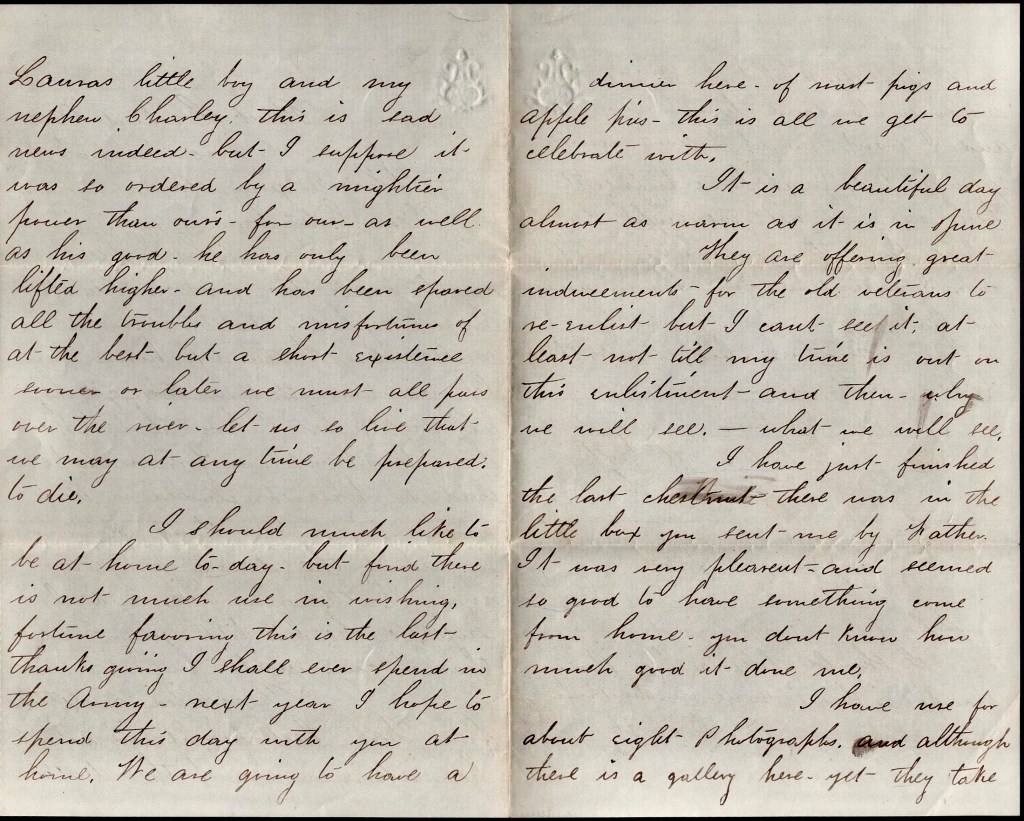
I received a letter from Dan last night in which he informed me of the death of Laura’s little boy and my nephew Charley. This is sad news indeed but I suppose it was so ordered by a mightier power than ours, for our—as well as his good. He has only been lifted higher and has been spared all the troubles and misfortunes of at the best, but a short existence sooner or later we must all pass over the river. Let us so live that we may at any time be prepared to die.
I should much like to be at home today but find there is not much use in wishing, fortune favoring this is the last Thanksgiving I shall ever spend in the Army. Next year I hope to spend this day with you at home. We are going to have a dinner here of roast pigs and apple pies. This is all we get to celebrate with,
It is a beautiful day—almost as warm as it is in June.
They are offering great inducements for the old veterans to re-enlist but I can’t see it—at least not till my time is out on this enlistment, and then—why, we will see, what we will see.
I have just finished the last chestnut there was in the little box you sent me by Father. It was very pleasant and seemed so good to have something come from home. You don’t know how much good it done me.
I have use for eight photographs and although there is a gallery here, yet they take such poor ones that I should be ashamed to send them to any one and I want you, if I have any good ambrotypes at home, to take the best one and get me eight photos copied from them, and whatever it costs I will send you as soon as we are paid.
Give my love to all the folks. Write soon. From your affectionate brother, — Henry
P. S. I should like a few postage stamps as there is none in the Point.
Letter 2
Point Lookout January 15th 1864
My Dear Mother,
The reason I have not written home for so long, I have just returned from a trip to Washington where I was sent by the Dr. in charge of the hospital on business connected with the laundry. I was to have been gone four days but while there the cold snap came on (Which I see you have had at home) and froze up the river so we could not get back till yesterday although we started Tuesday—four days on the trip which is usually performed in 8 or 9 hours.
“I send you a piece of bark which I peeled from a tree just in front of Washington’s tomb.”
The first day we came 18 miles, then stopped for the night and in the morning we were froze in hard and fast. We layed at this place one day and two nights. It was just opposite Mount Vernon and all in board took advantage of the time and visited the historical place. I send you a piece of bark which I peeled from a tree just in front of Washington’s tomb.
I haven’t time to write much now, and the room is so awful cold that I can hardly hold my pen. Will write again tomorrow after I get settled. Till then, I am your affectionate son, — Henry
P. S. I haven’t got the box yet but expect it today.
Letter 3
Point Lookout, Maryland June 1st 1864
My dear sister,
It is now some time since I have written to you but it has been however no fault of mine. We have had very busy times for the last three weeks receiving wounded from the late battles day and night which has kept us hard at work. The poor fellows suffer much this warm weather but you hardly hear a complaint from one of them. As many as five a day have been buried ever since their arrival which is a large percentage on so few—eighteen hundred.
The weather has been intensely hot for the last two days—the thermometer ranging as high as 90 degrees in the shade. It is some war, you may believe. If I was at home now, we would begin to think of going to the Bluff—that place of credit and renown so celebrated in the annals of Haverhill history. I am just writing this at a late hour, nearly eleven o’clock. “Taps” have log since sounded warning all good soldiers to put out their lights and go to bed. So you see I am trespassing on Uncle Sam’s time in writing this dull letter.
All the regiments which have been stationed here have left for the front and their places supplied by the Veteran Reserve Corps. We have also had many additions to our prisoners having 15,000 privates and 700 officers, making quite a small army in themselves.
I see by the Publishers which you sent me that old H[averhill] has again been “shaken by drafts alarms” and among the names I noticed, that of Seymour. I suppose that is the Rev. Gent of the Episcopal Church. I am glad to see it for Grant needs all the men he can get and that puts me in mind that the army has got back to McClellan’s old ground of the Peninsular—the same place which was the scene of the military exploits of your humble brother, that is, what few he performed. God speed him is my prayer.
My time is rapidly growing shorter. I am now a three months man and that will soon slip away. I sent you a package of specimens the other day. write if you get them all right. I enclose two in this letter. I did not suppose when I sat down that I should write on more than half of this sheet, but find that I have nearly filled the four sides. And as I am growing sleepy, had better stop. Give love to all friends. from your affectionate brother, — Henry
Good night.
Letter 4
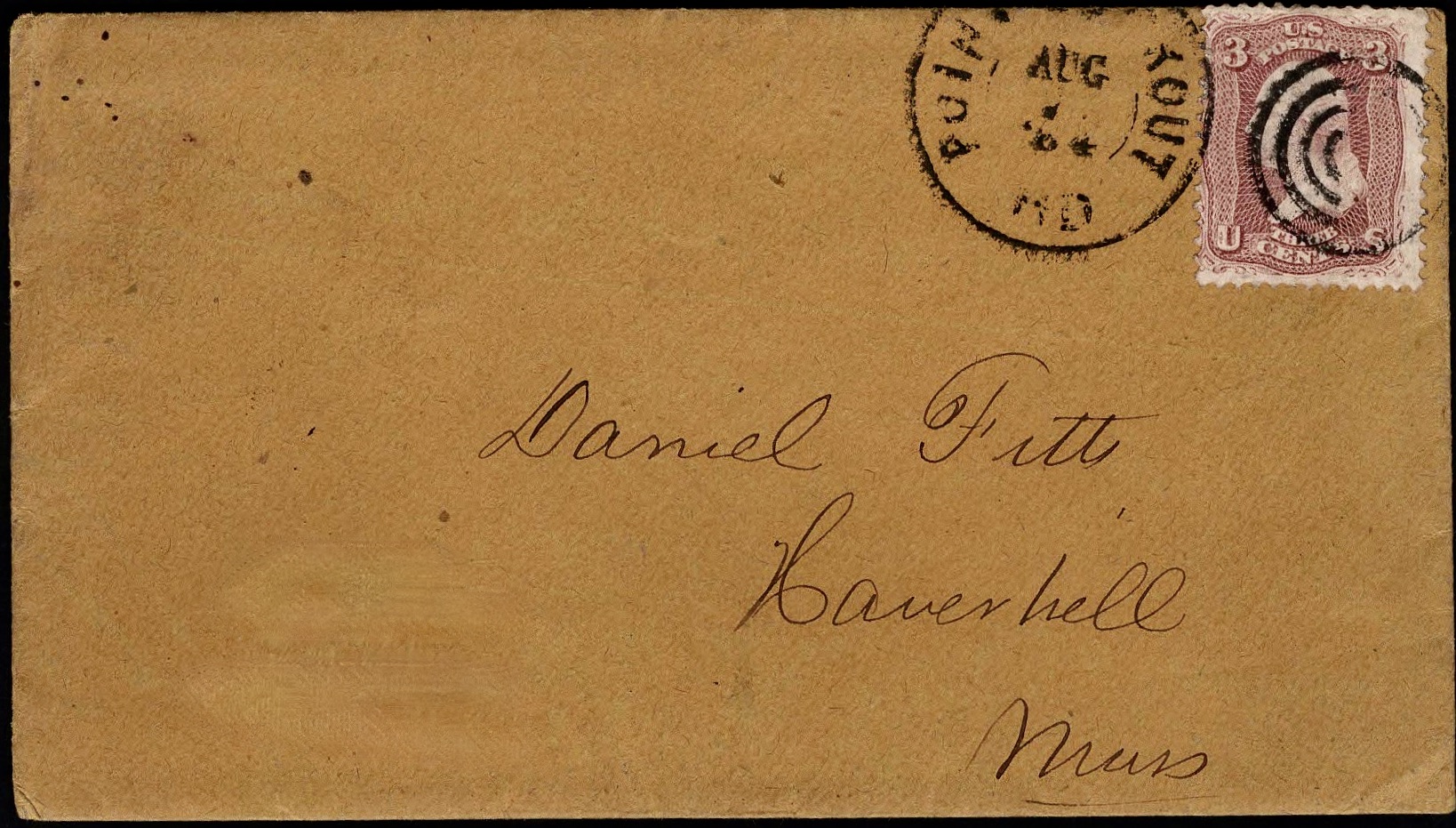
Addressed to Daniel Fitts, Haverhill, Mass.
Point Lookout August 7, 1864
Dear Brother,
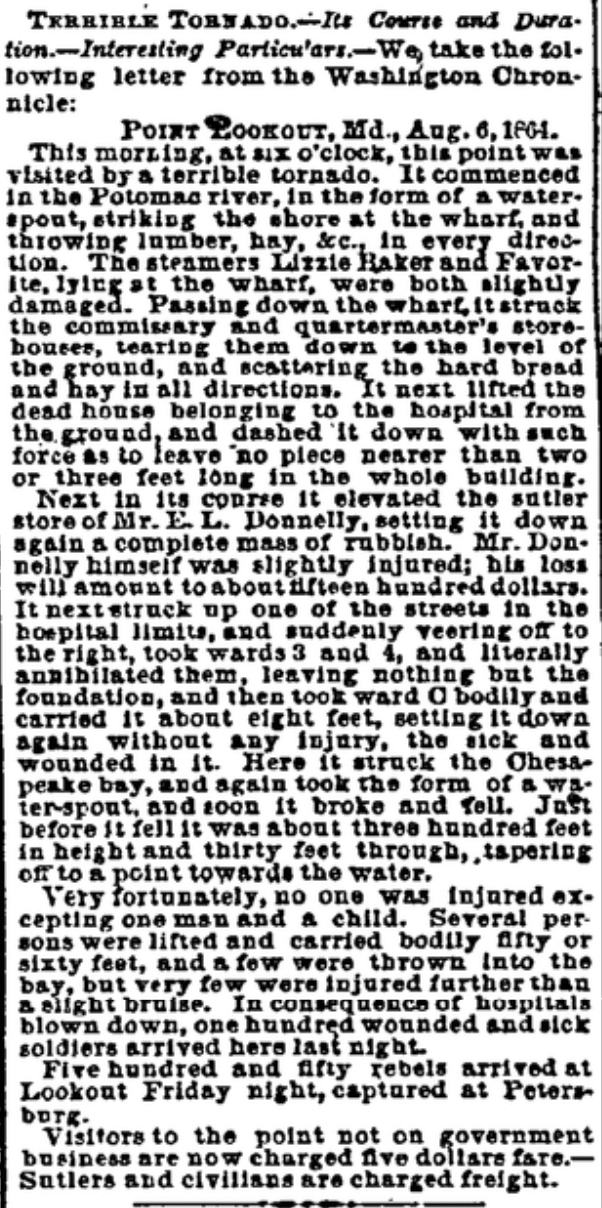
The Baltimore Sun, 8 August 1864
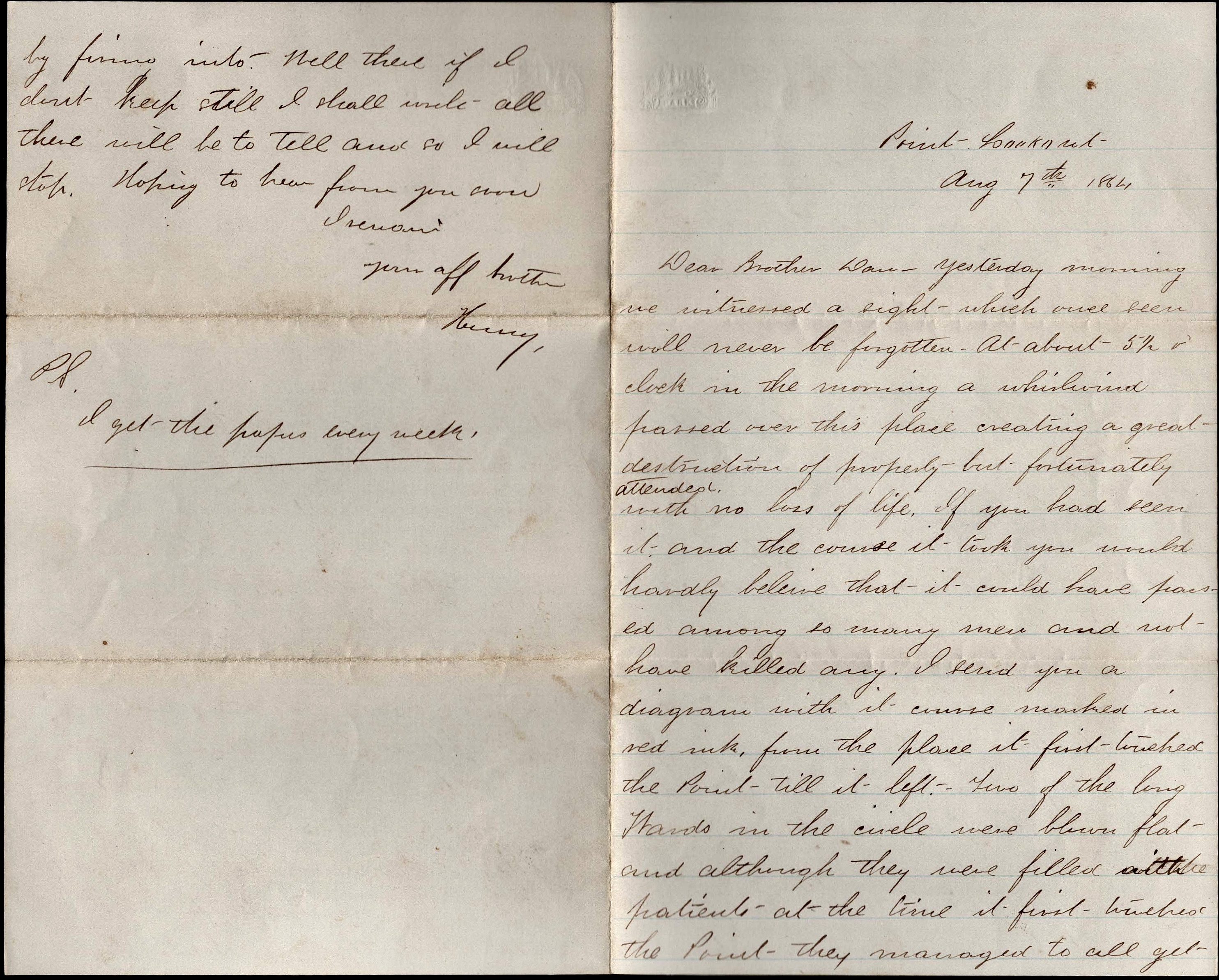
Yesterday morning, we witnessed a sight which, once seen, will never be forgotten. At about 5:30 o’clock in the morning, a whirlwind passed over this place creating a great destruction of property but fortunately attended with no loss of life. If you had seen it and the course it took, you would hardly believe that it could have passed among so many men and not have killed any. I send you a diagram with its course marked in red ink from the place it first touched the Point till it left. Two of the long Wards in the circle were blown flat and although they were filled with patients at the time it first touched the Point, they managed to all get out to a place of safety and not a man in either Ward was injured. Six other buildings belonging to the Commissary Department were completely demolished besides the sutler shop and Dead House in the Hospital.
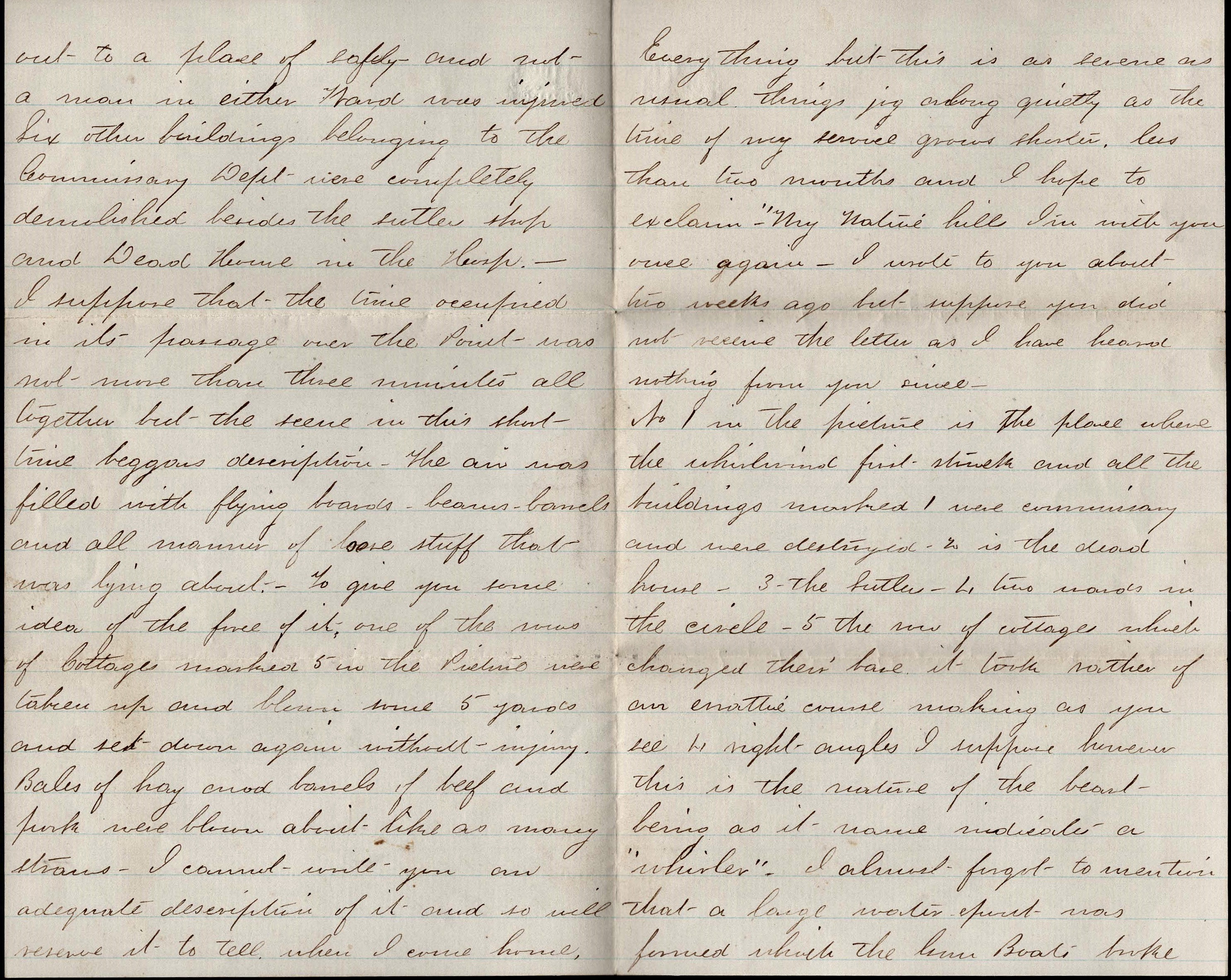
I suppose that the time occupied in its passage over the Point was not more than three minutes all together but the scene in this short time beggars description. The air was filled with flying boards, beams, barrels, and all manner of loose stuff that was lying about. To give you some idea of the force of it, one of the rows of cottages marked 5 in the picture were taken up and blown some 5 yards and set down again without injury. Bales of hay and barrels of beef and pork were blown about like as many straws.
I cannot write you an adequate description of it and so will reserve it to tell when I come home. Everything but this is as serene as usual. Things jog along quietly as the time of my service grows shorter. Less than two months and I hope to exclaim, “My native hills, I’m with you once again.” I wrote to you about two weeks ago but suppose you did not receive the letter as I have heard nothing from you since.
The View of Hammond General Hospital, Point Lookout, Maryland, with Henry’s red markings.
No. 1 in the picture is the place where the whirlwind first struck and all the buildings marked 1 were commissary and were destroyed. 2 is the Dead House. 3 is the sutler’s. 4 is two Wards in the circle. 5 is the row of cottages which “changed their base.” It took rather of an erratic course making as you see four right angles. I suppose, however, this is the nature of the beast being as its name indicates—a “whirler.” I almost forgot to mention that a large water spout was formed which the gun boats broke by firing into.
Well there, if I don’t keep still, I shall write all there will be to tell and so I will stop. Hoping to. hear from you soon. I remain your affectionate brother, — Henry
A Carte-de-visit of Elliott W. Mudge of Co. A and the 2.5×4 inch diary of William Henry Hughes of Co. H, 1st Louisiana (Confederate) Cavalry.
The following diary was sent to me for transcription by Sarah Prathers of Ringgold, Georgia, who found it among her great-grandmother’s possessions. She did not know who wrote it. Circumstantial evidence derived from the diary in question leads me to assert that it was maintained during the American Civil War by William Henry Hughes (1846-1917), the progeny of Dr. James Neville Hughes (1804-1874) and Louisa Adaline Russell (1805-1856). Henry’s father, a graduate of Transylvania University in Lexington in 1824, served as a surgeon for the Confederacy. By 1850, he was residing in Louisville, where he practiced medicine and held three enslaved individuals within his household.
From the diary and Confederate Muster Rolls we learn that Henry enlisted in Co. H, 1st Louisiana Cavalry while Bragg’s army occupied Frankfort in mid-September 1863.
Seeking additional corroboration, I asked my friend Dan Masters to read the first few pages of the diary after I had transcribed them, which included the Battle of Stones River, and he told me that, “the accounts seem consistent with a trooper in the 1st Louisiana Cavalry which was attached to General John Pegram’s brigade during the Stones River campaign. They also marched into Kentucky with Kirby Smith’s army in August and his diary accounts square with a soldier in mid Kentucky, likely with Kirby Smith’s army. His mention of witnessing the inauguration of Richard Hawes [in Frankfort] cinched it for me.”
The following obituary was found for Henry, written by his sister: “He was born at what is now Pendleton Station in Henry county, Kentucky in February 1846. At the age of 14, he left the home of his brother in Evansville, Indiana, and went to reside with his oldest sister on the Hughes Plantation in Jefferson county, Kentucky. The unhappy war between the states was then imminent, secession ordinances having been passed by several of the Southern commonwealths, and we were all ardently in sympathy with them—none more than William or “Billy” as he was always called in the home circle. He sought permission to join the Confederate army, but this my father refused, saying that when the services of mere boys were needed old men would would likewise be in demand and they, father and son, would enlist together. The youth did not regard this as very emphatic prohibition, or perhaps he felt that with or without parental consent he must emulate his ancestors and let his country’s call take precedence of every other. At all events, he left Kentucky in the first regiment of volunteers commanded by Colonel Blanton Duncan, and was in a camp of instruction at Richmond, Va., when the first conflict between the armies took place at Big Bethel. His term of enlistment was for one year, and the end of which time he was discharged and made his way home alone and on foot, from Abingdon, Va., a distance of four hundred miles…The only engagement in which he participated in Virginia was at Dranesville, hostilities then having been practically suspended after the defeat of the Federal forces at Bull Run until June 1862. He remained in retirement for several months—for in defiance of her proclaiming neutrality Kentucky had been occupied by U. S. troops for some time and wearers of the gray were by no means safe there, while breaking through the lines into the Confederacy was extremely hazardous.
The 2.5×4″ diary of Billy Hughes, Co. H, 1st Louisiana Cavalry
He re-enlisted during the Bragg invasion of Kentucky, this time in the First Louisiana Regiment of Cavalry, and remained in the service until the end of the war, though he was transferred by request into the First Kentucky Cavalry Regiment in _____, his officers being Col. William Campbell Preston Breckinridge of Williams’ Division; Wheeler’s Corps. He participated in the Battles of Perryville, Murfreesboro, Chickamauga, Missionary Ridge, Resaca, Dalton, and Atlanta and was with Breckinridge’s and Ivison’s command when they captured the Federal Gen. Stoneman—a brilliant feat, beside the smaller engagements at Saltville, where he received a slight wound, and at Bentonville, the last conflict of the shameful, because unnecessary conflict. He was among the very youngest soldiers in Southern army being only a little past nineteen when mustered out of the service. Col. Breckinridge pronounced him and my cousin, George T. Smith, the best soldiers in his command.”
Though the account predates Hughes’ enlistment in the regiment, readers are referred to an article published by Derrick Lindow entitled, “Riding with Scott’s Louisiana Cavalry” on 6 December 2022.
Diary
September 16, 1862—Joined with B. Russell’s Company cavalry regiment, Gen. Humphrey Wright’s Brigade. Heard the rumor that Stonewall Jackson had been defeated 3 times with a loss of 15 thousand killed and wounded and prisoners and had been driven from Maryland. Gen. Lee wounded. Gen. Reno killed. Also that Gen. Buckner had been defeated at Munfordville with a loss of 800.
September 18, 1862—Nothing unusual. Conflicting rumors with respect to the movements of the armies. Lieutenant James McGimsey [Co. H, 1st Louisiana Cavalry]
September 19, 1862—Nothing definite with regard to news from Virginia. Number of killed at Munfordville 36, wounded 241. Capt. said 4,000 prisoners, arms, accoutrements, and camp equipage. Federal loss unknown. Succeed in having the old engine to go and getting her ready for use. Called on Uncle S. Sneed and [stayed] to dinner. All strong now aside from that very agreeable people.
September 20, 1862—First train started for Lexington at 9 o’clock. Took supper with cousin Billy Russell [illegible]
September 21, 1862—Nothing unusual today. Supper with cousin [ ] Russell.
September 22, 1862—Heard rumor that Stonewall Jackson had been defeated with a loss of 19,000 killed and wounded and 20,000 prisoners. Federal loss unknown. Talked with a young man from Florida—very patriotic indeed. Col. Jesse returned from New Castle with two prisoners [and] about small arms, accoutrements 23 and paroled about 45 prisoners and lost two men killed, 5 wounded. Attended the hop at the ___pitch Hotel. All the southern ladies of Frankfort present.
September 23, 1862—Preston Smith’s men pass through town on the way to join Bragg.
September 24, 1862—Read Lincoln’s proclamation of the [date] to free all the slaves in [illegible]. Heard in town that Lee is on Arlington Heights with his army and the white flag is flying over the Capitol at Washington.
September 25, 1862—Started for Christian [ ] with [ ] Russell and John Rodman. Took supper in…with a clever Southern Rights man. Had a wagon and two horses. We arrived to Christian 10 o’clock at night.
September 26, 1862—Stayed with an [illegible]. Took dinner with a Mr. Hall and supper also. Found several person who were formerly acquainted with—Pa amongst them. Mrs. Hall who was a Miss Merrick. Made the acquaintance of Miss Marshall, an ultra rebel and gloried in the name. Visited Thornton Meriwether [Shelby county]. Staid in [ ].
September 27, 1862—Lodged last night with Mr. Hall in [ ] Left about 8 o’clock…on the way with [ ]. Mr. Hall did not go…I was today presented with a little black mule formerly the property of Uncle Sam.
September 28, 1862—Stayed last night with Mr. Levi Smith, and old acquaintance of us. [ ] Mrs. Garrett, an old friend of M____ also, Miss Smith—a very good looking young lady. Went over to the valley in the evening.
September 29, 1862—Rode over to [ ] on my little black mule. Left [ ] for [___ville] and arrived there about dark. Found Uncle…
September 30, 1862—Lodged at Uncle J____’s again last night. Skirmished… In the evening, left Simpsonville for Frankfort and rode until 4 o’clock and stopped at [ ].
October 1, 1862—Arrived at Frankfort about 2 o’clock. Collins and Stevensons’ Divisions passed through the town. Citizens held a [ ], eating well; addressed by Juda [?]. John Rodman, S. I. ___ and Capt. G_____, about 25 new volunteers amongst them… Gen. Kirby Smith, Stevenson, _____ and William P. arrived from Lexington.
October 2, 1862—Gen. Bragg and staff arrived in town.
Portrait of Kentucky Confederate Governor Richard Hawes, painted by Harold Collins
October 3, 1862—Witnessed the inauguration of the provisional government at the State House and heard Harris Marshall speak [ ] on which…
October 4, 1862—Arrived at Versailles.
October 5, 1862—Ate breakfast in town….turned on the Harrodsburg Pike.
October 6, 1862—Camped last night under the “broad canopy of Heaven.” Got breakfast with a Mr. Hill and started. Forded Kentucky River. Passed through Pleasant Hill, the seat of high society called ____.
October 7, 1862—Lodged last night with Dr. Campbell four miles from Hebron.
October 8, 1862—Wednesday. Starting for Camp Dick Robinson.
October 9, 1862—Thursday. Arrived at Camp Robinson. Was aroused from our slumber to find the Federal….
October 10, 1862—Nothing unusual. Cold rain.
October 11, 1862—Saturday. Returned to camp. Nothing unusual.
October 12, 1862—Sunday. Talked with some Yankee prisoners…
October 13, 1862—…parts unknown….night and camped…two miles of Crab tree.
October 14, 1862—Tuesday. Rose early. Fed my mule and started on the way again…
October 15, 1862—Wednesday. Left early in the morning . Stopped a few miles of town and fed our horses.
October 16, 1862—Thursday. Henry Hughes
October 17, 1862—Friday. Started back on the same…well before day, took on foot. Passed through town a little before dusk. Found the country underused.
October 18, 1862—Saturday. Left camp early for Montville. Still on foot. Pass through Stubenville and Montville and camped a mile…
October 19, 1862—Sunday…in the afternoon.
October 21, 1862—Tuesday. Passed through Livingston on the way to Sparta.
October 22, 1862—Wednesday. Marched about 15 miles and camped.
October 23, 1862—Thursday. Nothing unusual.
October 24, 1862—Friday. …Capt. Robinson and Lt. Harper. Archibald Rober[ ]…
October 31, 1862—Friday. Started early and arrived at camp about..
November 1st. Marched about 5 miles and camped near Winkertown [?].
November 2, 1862—Sunday. Relieved from guard…
November 24, 1862—Monday. Started for South ___ville. Arrived in there at 4 o’clock p.m. Had a brush with the Federals, took one prisoner and returned to the camp last …marched 35 miles.
November 25, 1862—Tuesday. Started at [ ] o’clock for Burkesville…
November 25th 1862—Wednesday. Crossed the…on the edge of Monroe county, Ky.
November 27th 1862—Thursday. Marched about 20 miles and camped.
November 28, 1862—Friday. Detailed for picket guard. Alex Laughlin.
November 29, 1862—Saturday. Marched about 20 miles and camped.
November 30, 1862—Sunday. Marched about 9 miles.
December 1, 1862–Monday. Rained all night.
December 2, 1862—Tuesday..
December 4, 1862—Thursday. Cold and clear. We marched through a fine country…Camped within two miles of Murfreesboro.
December 5, 1862—Friday. Through Murfreesboro and camped two miles on the Nashville Pike.
December 6, 1862—Saturday. Went back to N and turned [ ] the Lebanon Pike.
December 7th 1862—Nothing.
December 8, 1862—Nothing happened unusual.
December 9, 1862—Moved camp 5 miles.
December 13, 1862—On picket.
December 16, 1862—Tuesday.
December 17, 1862—Still on picket.
December 19, 1862—Friday. Passed by the scene of a recent skirmish between 4 thousand Feds and 1 company of Wheeler’s cavalry.
December 23, 1862—Tuesday. Heard the glorious news from Virginia. Buoyed us up considerably.
December 25, 1862—Thursday. Passed off quietly. Heard heavy firing towards Lavergne on the 26th.
January 6, 1863—Since date of last [ ] we have been in a constant whirl of excitement. Only two nights of sleep and the whole time the rest spent on picket [ ] in time of battle. Ominous silence prevailed along the whole line on the 29th and on the 31st our cavalry made a charge on the Federal camp capturing 9 army wagons which with provisions, two ambulances and about 280 prisoners with the loss of 9 men wounded and three horses.
On Friday the 2nd the company was on picket and while we were out, the regiment engaged the enemy for about two hours, losing about 6 men wounded. In the first part of the engagement, the Federals were driven about a mile leaving the corn field covered with overcoats, blankets, &c. but they received reinforcements and forced the Rebels back to the former position. On Saturday night 3rd, the army commenced retreating. It is impossible to give an estimate of the loss of either side during the different engagements. It is said that we captured 48 pieces of artillery in all and 4500 prisoners and if this is approximately the truth, we have gained a brilliant victory on the whole.
January 6th. We encountered [ ] Mullin’s regiment or we learned from a party [. ] taken afterwards [ ] with him. We had a smashing little fight yesterday about 6 miles from ____ow lasting over three hours. In our regiment, [ ] killed, 9 wounded, 13 taken prisoners…3 good shots at them about 2 [pencil smudged and illegible]…that about 300 Fed. Cavalry were between us and our army but it turned out they are not scott free.
January 7th [1863]—Ordered to East Tennessee.
January 22nd [1863]—Thursday. Have been at Kingston, Tenn. nearly a week. Crossed two ranges of mountains on the way here. Forage is very scarce for horses. Nearly starved. Men living on corn bread and beef.
January 31st [1863]—Saturday. Camped out of the world in East Tennessee.
February 5, 1863—[smudged and illegible].
March 31st, 1863—Tuesday. Got a terrible whipping at Somerset [Kentucky]. [See Battle of Somerset (or Dutton’s Hill)] Escaped with about 100 others and after roaming through the woods about an hour, found ourselves cut off.
General Pegram led approximately 1,550 cavalry supported by a three-piece battery of artillery across the Cumberland River at Stigall’s Ferry on March 22. The Confederate column consisted of the 1st Louisiana, 1st Georgia, 1st and 2nd Tennessee Regiments, 16th Battalion Tennessee Cavalry, (less two companies left behind in Tennessee), 1st Florida Cavalry (3 mounted companies), and Huwald’s Tennessee Battery of mule-drawn mountain howitzers. By making an orderly march through Somerset, the populace was led to believe that Pegram was leading the forefront of a Confederate invasion of central Kentucky.
April 1, 1863—Wednesday. Crossed the [ ] River after [ ] all night and marched to the South Fork.
April 2, 1863—Thursday. Crossed the South Fork and marched to within [ ] miles of Monterey.
April 3, 1863—Friday. Arrived at camp on foot much to the surprise of all.
April 5, 1863—Sunday. Looked over the diary of the war up to the battle of Galveston Front… to be 24,000 at Fredericksburg, 21,400 at Sharpsburg. 20,241 [ ], 14,555 Shiloh. 19357 2nd Battle of Manassas, 15,600 at Seven Pines, 10,667 at Berryville, 6100 Boonsboro Gap, 6600 Corinth, 5770 Manassas, 5052 Fort Donelson, 4438, and Vicksburg 1170. From this it appears that the battle of Murfreesboro is the bloodiest one of the war thus far.
April 6, 1863—Monday. Difficulties between Gen. Pegram and Col. Scott. Col. Scott goes to Knoxville today to be tried by court martial trial. 1 On guard today.
1 After the Battle of Dutton’s Hill, General Pegram ordered the arrest of Colonel Scott, court-martialing him for cursing a superior officer. Although found guilty, Colonel Scott received a light reprimand from General S. B. Buckner before being returned to command a brigade of cavalry.
April 9, 1863—Thursday. Moved camp 10 miles. Got on a bender and thereby received punishment in the shape of double extra duty.
April 11, 1863—Saturday. Marching up again yesterday. Still….on guard…
April 16th 1863—Thursday. Moved camp again yesterday.
April 18, 1863—Saturday. Had a mess of ____tion for breakfast.
April 21st, 1863—Tuesday. At Albany on the retreat from Kentucky on foot with my feet blistered and in bad spirits.
April 22nd 1863—Wednesday. Bought a horse for 900 dollars and lost him in less than four hours. On guard.
April 27, 1863—Monday. Heard firing in the direction of Celina [TN].
April 28, 1863—Tuesday. Left Albany [KY], Marched about 12 miles and camped. Mr. Dyer came into camp. Brought letters from home. First since leaving there.
May 1st 1863—Friday. Was a beautiful day. The birds caroled sweetly from trees…Madam Rumor says the great battle which was ended last January by the retreat of the Confederate forces has been reversed. We all have confidence in Bragg’s abilities and are expecting every day to hear good news from Murfreesboro and Virginia.
May 7th 1863—Thursday. Camped at Clinton, Tenn. Rumored that our armies in Virginia had gained a glorious victory [at Chancellorsville]. Stonewall Jackson and [ ] wounded.
May 12, 1863—Tuesday. Entered Kentucky. The following appeared in the ____ville Register of March 24th.
SOLDIERS and SURGEONS of Hospitable. Please notice my son William Henry Hughes, a lad of 17, left Louisville, Kentucky, and went to Frankfort in September last to enlist in the Confederate Army since which time I have heard nothing of him. He is doubtless in the army somewhere unless he has been killed in battle or has gone into some hospital. I could never learn what regiment he joined. Any friend of mine or person who can give me any information of this boy will do me a great kindness and relieve the anxiety of an affectionate mother and sister by writing to me concerning him and directing to Ringgold, Georgia. — Jas. N. Hughes, Asst. Surgeon Bragg Hospital
May 15, 1863—Friday. Encamped within 13 miles Monticello. Living on corn bread and bacon.
May 19th, 1863—Tuesday. Reading “the Ruby Cross” by Emma Gamon [?]
May 20th 1863—Wednesday. Various rumors are afloat in camp which are all too good to be true. One is that Lee has given the Yankees an awful drubbing, that “Stonewall” is dead, and that the federal loss was 40,000 very moderate. I wish it had been 140,000. Another rumor says that Price whipped them soundly in Missouri. The latest says Kirby Smith defeated the enemy at Alexandria.
May 21, 1863—Thursday. Report of the capture of Port Hudson and Jackson, Mississippi by federals.
May 25th 1863—On picket at Newell’s Ferry. Yankee pickets in sight on the opposite bank of the river. reported capture of 14,400 prisoners at Jackson by Joseph E. Johnston.
May 28, 1863—Thursday. Relieved from picket and returned to camp.
May 29, 1863—Friday. Read the federal account of the battle at Vicksburg in the Cincinnati Commercial. Also heard that a dispatch arrived to Gen. Pegram stating that 16,000 federal prisoners had been captured and that Grant’s army was hemmed in closely on all sides. Don’t know which to believe.
May 30, 1863—Saturday. Yankees crossed the river and captured about 20 of our pickets.
May 31, 1863—Sunday. Started for East Tennessee.
June 3rd 1863—Wednesday. arrived at Kingston.
June 19th 1863—Friday. Marched to Lenoir Station in pursuit of the federals. They captured about 75 prisoners and burnt the depot commissary stores and ammunition. About 10 o’clock a gun was fired in front which frightened the horses and men being nearly all asleep. A stampede ensued the like of which I never seen or heard of. About 50 men were thrown and the rest run about a mile before they could be rallied. It was the first time I lost my gun on the [ ].
June 20, 1863—Saturday. Marched to Knoxville. arrived there after the fight was lover. Left Knoxville after dark and camped about 8 miles from town.
June 21st, 1863—Sunday. This morning I found my horse back to man in Knoxville to proceed so started back to Kingston. Stopped for the night with Mr. Maroney, one of a few Southern Rights men in this country.
June 22nd 1863—Monday. Arrived at Camp worn out.
June 29, 1863—Left Kingston for [ ] in the wagon.
July 19th 1863—Released from the [ ].
July 22, 1863—Heard that Richmond had fallen into the hands…
July 28th 1863—Monday. Encamped at ___ord, Tenn. Thhe regiment left Jacksboro on the 17th for Kentucky via Big Creek Gap.
July 30, 1863—Heard of Nancy’s death. Also of a fight at Manassas Gap.
August 7th 1863—Started for Rville. Left Russellville for Sneedville.
August 9th, 1863—Sunday. Arrived at Sneedville. Do not know the object of our trip.
August 14, 1863—Thursday. Left Sneedville. Arrived at Russellville.
August 16, 1863—Marched to Morristown.
August 17, 1863—Took the cars for Knoxville and arrived there at dark.
August 18, 1863—Took cars for Concord and marched from [ ] Spring and stopped for night.
August 19, 1863—Arrived at camp. Casualties on the last trip in Co. H, wounded 20, missing don’t know who among the missing are killed and wounded.
August 25th—Tuesday. Moved camp to Robertsville.
August 26th—Wednesday. Started for Loudon. Crossed river at Black’s Ford. Camped near Campbell’s Station.
August 21st 1863—Turned my horse over to the government.
August 30th 1863—Heard a sermon from Mr. Swindle [?], our chaplain.
September 1st 1863—Monday. Passed through Sweet Water and Athens.
September 2, 1863—Arrived at Charleston 3 o’clock in p.m. Loudon Bridge….skirmishers.
September 3rd 1863—Drew a horse and reported to the regiment 7 miles from town on the Athens Road.
September 5th, 1863—Saturday. Regiment in line of battle all night. Detailed as sharpshooter.
September 6th 1863—Sunday. In line of battle again last night. Fell back to Charleston. Col. Scott skirmishing with the Yanks at Sweet Water.
September7th 1863—Monday. In line of battle till 12 o’clock last night. Hear that Scott was falling back [ ] place.
September 8th 1863—Tuesday. Burnt the [ ] bridge at Potylock [?] this morning and retreated to Cleveland. Fall back to U____ and laid in line of battle till 12 o’clock. Detailed as artillery guard. Marched to Georgeville Gap [?].
September 9th. Detailed as courier for Gen. Johnston. Carried a dispatch to Gen. [Alexander] Stewart.
September 10th, 1863—Thursday. Reported to the regiment. Found the Yankees ahead of us.
September 11th 1863—Friday. On picket last night. Had some heavy skirmishing with the enemy.
September 12th 1863—Saturday. Rear guard again. Marched into LaGrange and…
September 13th 1863—Sunday. Whipped [Thomas L.] Crittenden out. Heard that [Alexander M.] McCook was on the Rome Road.
September 14, 1863—Monday. No fighting.
September 17, 1863—Thursday. Left camp and marched 10 miles on the Chattanooga road.
September 18, 1863—Cavalry of our….
September 19, 1863—Hard fight at Chickamauga. Lost two horses in our regiment and several men and horses struck by spent missiles. Heard gen. Preston Smith was killed.
September 20, 1863—Sunday. Fighting again. Gen. Hood lost a leg. Gens. [William B.] Bate and [Helm?] killed. Gen. Garland mortally wounded. Captured the enemy fortifications.
September 21st 1863—Monday. No fighting. Guard prisoners to the rear. Enemy retreating.
September 22, 1863—Tuesday. Enemy making a stand at Chattanooga. No fighting. Skirmish near Chattanooga.
September 23, 1863—Wednesday. Camped in same spot.
September 28, 1863—Monday. Started on a hunt for stragglers. Camped near Ringgold.
October 1st 1863—Thursday. Marched to Villanova.
October 3, 1853—Saturday. Camped near Fulton.
October 5, 1863—Monday. Returned to camp on Missionary Ridge.
October 8, 1863—Thursday. Detailed courier for Longstreet.
Entry for 10 October 1863—“Escorted Pres. Davis on a review of the Army Tenn.”Davis traveled to Missionary Ridge to personally review the troops and to praise their bravery at Chickamauga. When Davis arrived at the headquarters of the Army of Tennessee overlooking Chattanooga on October 9, 4 of Bragg’s corps commanders called for his replacement. Addressing the army the next day, Davis reminded them that “obedience was the first duty of a soldier” and “prompt, unquestioning obedience” of superiors “could not be too highly commended.” He then confidently predicted that the Army of Tennessee would soon “plant our banners permanently on the banks of the Ohio.”
October 10, 1863—Saturday. Escorted President Davis on a review of the Army of Tennessee.
October 17, 1863—Went to Dalton to drive cattle.
October 20, 1863—Sunday. Returned to Tennessee with 400 head.
October 28, 1863—Wednesday. Gen. Jenkins engaged the enemy for three hours and a half. Finally repulsed losing [ ]00 men.
October 29, 1863—Thursday. Shelled the enemy from Lookout Mountain.
November 5, 1863—Thursday. Reported to the regiment.
November 12, 1863—Thursday. Heavy firing towards Chattanooga.
November 13, 1863—Friday. Paid off.
November 23, 1863—Monday. Reported to Gen. Bragg.
November 24, 1863—Tuesday. Sent to Gen. Hardee for duty. Picketed on the Cleveland Railroad.
November 25, 1863—Wednesday. The Yankees charged our position and were repulsed three times but finally forced us to retire to the top of the hill. Loss two men wounded. Fell back to the station.
November 26, 1863—Thursday. Marched to Ringgold.
November 27, 1863—Friday. Drove the Yankees back with a real loss variously estimated at 1500 to 2500.
Saturday and Sunday on picket between Ringgold and Tenn. Hill [?].
November 30, 1863—Monday. Marched to Dalton.
December 1, 1863—Tuesday. Went to [ ] to recruit our horses and have them shod.
December 25, 1863—Saturday. Passes away with unnatural. Chicken and biscuits.
December 29th 1863—Wednesday. Joseph E. Johnson took command of the Army of Tennessee. Moved camp and went into winter quarters.
January 29, 1864—Ordered to saddle up and be ready to march at a moment’s warning. Yanks were advancing in Rome.
January 30, 1864—Friday—Still in camp awaiting orders.
February 9, 1864—Left camp for the [ ] to [ ] our horses.
February 10, 1864—Wednesday. Passed through Calhoun. Voted for members of Congress. Passed through Adairsville and camped 4 miles below…
February 14, 1864—Saturday. Camped within two miles of [ ].
February 15, 1864—Sunday. Left M. for Jackson, Alabama. Camped in a wayside village, name unknown. On guard.
February 16, 1864—Monday. Granted a furlough for six days starting tomorrow.
February 17, 1864–[ ]
February 19, 1864—Left [ ] for camp.
February 20, 1864—Saturday. Around camp.
February 21, 1864—Sunday. Entered Alabama. Crossed [ ] river.
February 22, 1864— Rested all day.
February 23, 1864—Marched about [ ] miles, crossed Big T. river. J. W. Hughes had my clothes, saddle and blankets [ ]
February 24, 1864—Marched to the foot of [ ] Mountain.
February 25, 1864—Crossed [ ] Mountain. Are 5 miles of [ ].
February 29, 1864—Monday. Left Talladaga for [ ]. Marched about 13 miles…
March 1, 1864—Tuesday. Crossed the Coosa river. Cold rain accompanied by some unpleasant wind. Almost froze to death. Paif $2 for a two bladed pocket knife.
March 2, 1864—Wednesday. Weather clear and cold.
March 3, 1864—Thursday. Had an [ ] change of “base” which we enjoyed “____”.
March 4, 1864—Slight rain.
March 6, 1864—Sunday. Washed and changed clothes.
March 7, 1864—Monday. Slight rain.
March 14, 1864—Monday. Attended the grand military ball at the Harpersville [?] Masonic Hall. 15 ladies present…
May 1, 1864—Sunday. Rained last night and today. Returned to camp.
May 2, 1864—Monday. Yankees advanced on Tunnel Hill but retired after a little skirmishing.
May 3, 1864—Tuesday. Firing in front.
May 4, 1864—Wednesday. In line of battle. Also on the 5th.
May 6, 1864—Saddled and awaiting orders.
May 7, 1864—Saturday. Had a sharp little fight at Tunnel Hill. Nobody hurt. Started in the direction of Lafayette. Camped near Dalton.
May 8, 1864—Sunday. Went to Dug Hollow Gap at ten o’clock. The Yankees attacked the Gap at about 3 o’clock with a largely superior force, ours consisting of the 2nd and 1st Arkansas, and [Breckenridge’s dismounted cavalry]. They were repulsed four times when night put an end to the conflict. We then marched to Resaca and from there on the 9th to Snake [Creek] Gap where we [ ] in large force and kept up a running fight of about two hours, we retreating upon Resaca, which place the Yankees attacked about 5 o’clock a.m. but were repulsed. Out on picket.
Cavalrymen exchange shots during the fighting near Snake Creek Gap. Library of Congress
May 10, 1864—Tuesday. In line of battle 2.5 miles from Resaca. Heavy rain.
May 11, 1864—Wednesday. In line of battle all night in the rain. Marched 5 Res [?] about three o’clock unsaddled and rested all night.
May 12, 1864—Thursday. Yankees advanced in the morning. Heavy firing in the direction of Dalton. [illegible] Yankees advanced to the [ ] near Resaca. Unsaddled [ ] all night.
May 13, 1864—Friday. In line of battle near Resaca. Fight opened about seven thirty. Yankees charging our pickets. We fought them four hours and retired across the river, turned the Yanks over to the infantry. Lieutenant one one man in my company wounded. Heavy skirmishing in front of Resaca in the evening.
May 14, 1864—Saturday. Detailed to [ ]. Skirmishing in front. The Yankees were repulsed on the right by [Benjamin F.] Cheatham’s and [Patrick] Cleburne’s Divisions. Brigade on picket near Calhoun.
The Battle of Resaca by James Walker was stored for many years in various locations, but was re-discovered in 2010.
May 15, 1864—Sunday. Look about after stragglers through the wagon camps. Yanks captured [Gen.] Hindman’s [Division] Hospital.
May 16, 1864—Monday. Army on retreat. Light skirmishing near Calhoun. Yankees repulsed. Went to Adairsville.
May 17, 1864—Tuesday. Heavy firing in the rear.
May 18, 1864—Wednesday. Army falls back to Kingston.
May 19, 1864—Thursday. Went to Cassville [ ].
May 20, 1864—Went to Altoona and camped.
May 21, 1864—Saturday. At Altoona.
May 24, 1864—Tuesday. Left Altoona and arched in the direction of Dallas and Powder Springs. Heard firing towards the new front.
May 25, 1864—Wednesday. Went to [ ]. Skirmishing.
May 26, 1864—Thursday. [ ] prisoners.
May 27, 1864—Friday. Skirmishing heavily in the evening. Came near being [ ].
May 28, 1864—Saturday. Skirmishing again…
May 30, 1864—Monday. The enemy opened [ ] of artillery and musketry about 9 o’clock last night which was [ ]. Quiet reigned along the line all day.
May 31, 1864—Tuesday. Opened about 6 o’clock on the left but with unimportant results.
June 1, 1864—Wednesday. Brisk cannonading.
June 2, 1864—Thursday. Light skirmishing. Yanks moving.
June 3, 1864—Friday. Light skirmishing. Heavy rain…
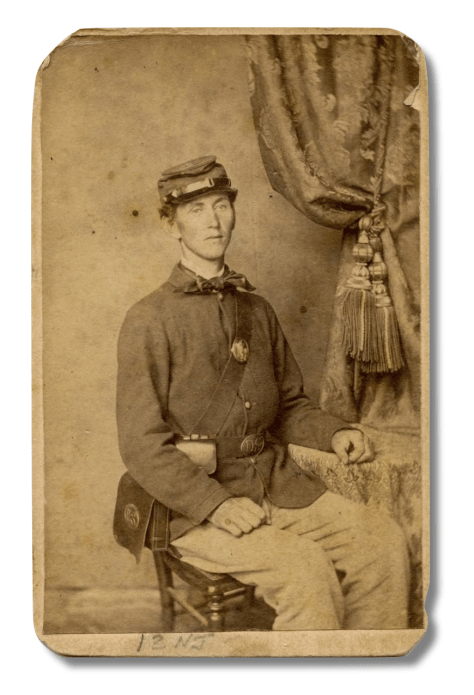
I could not find an image of Edward but here is one of John C. Jackson of Co. F, 12th New Jersey Infantry (Chris N Julie Maldonado Collection)
The following letters were written by Edward L. Brick (1845-1892), the son of John Hartley Brick (1806-1879) and Patience M. Crim (1820-1901) of Camden county, New Jersey. Edward enlisted in Co. G, 12th New Jersey Infantry in August 1862. An obituary notice informs us that “While in the service he was taken down with typhoid fever and sent to the hospital in Newark, New Jersey, and after regaining his health he again joined his regiment. He was in the battle of Gettysburg and was one of the men detailed from the 12th New Jersey to charge the Bliss barn and dislodge the rebel sharpshooters who were concealed in the barn and dealing out certain death with almost every gun fired. At the Battle of Cold Harbor, he was wounded in the neck and sent to the hospital at Camp Parole, Annapolis, Maryland, where he remained until well when he again joined his regiment. He was honorably discharged on June 4, 1865.”
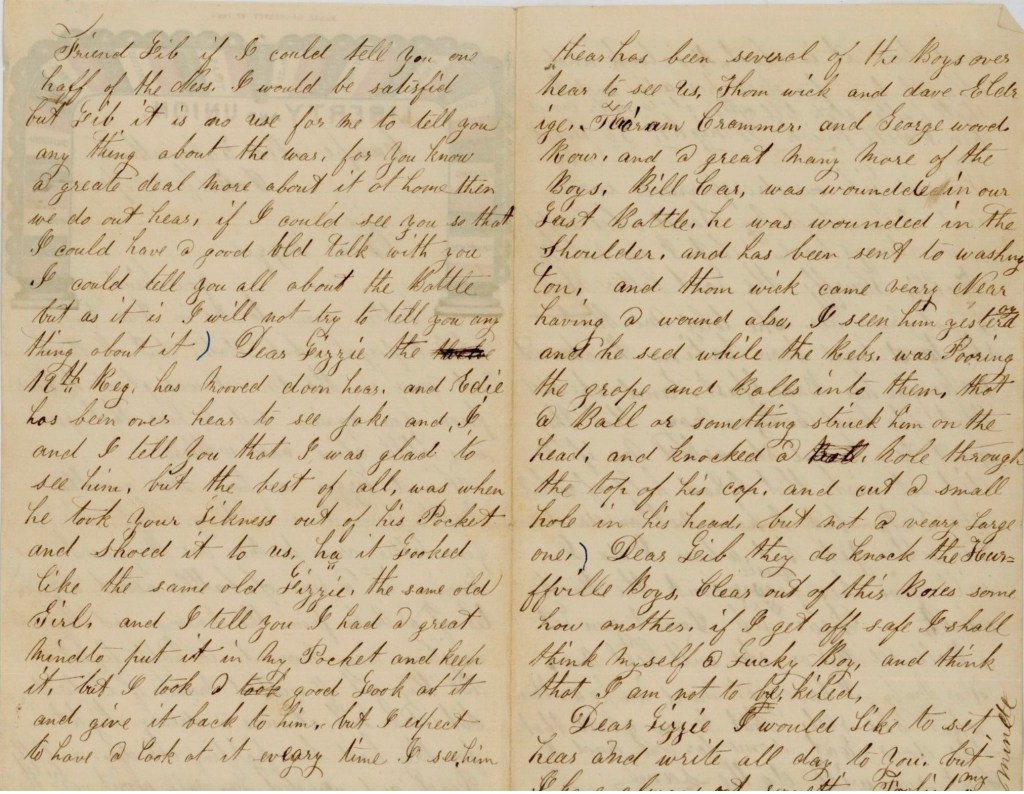
Letter 1
Camp near Falmouth, Va. December 23, 1862
Dear Lizzie,
Your kind letter came to me in due time but I forgot what date, but I think it was on the 13th. I was glad to hear from you again, and to hear that you was still alive and well.
Friend Lizzie, we have seen another battle since I wrote to you last. When your letter came to me, our regiment was laying in a line of battle about a quarter of a mile from the enemy and they was awaiting every moment to have to fight. But they got off without much of it to do but, dear Lib, it was a dreary night for they had been fighting all day and the dead and wounded lay all about over the field.
Friend Lib, if I could tell. you one half of the news, I would be satisfied. But Lib, it is no use for me to tell you anything about the war for you know a great deal more about it at home than we do out here. If I could see you so that I could have a good old talk with you, I could tell you all about the battle, but as it is, I will not try to tell you anything about it.
Dear Lizzie, the 19th Regiment has moved down here and Edie has been over here to see Jake and I, and I tell you that I was glad to see him. But the best of all was when he took your likeness out of his pocket and showed it to us. Ha! it looked like the same old Lizzie—the same old girl. And I tell you, I had a great mind to put it in my pocket and keep it. But I took a good look at it and give it back to him. But I expect to have a look at it every time I see him.
There has been several of the boys over here to see us. Tom Wick and Dave Eldridge, Hiram Cramer, and George Woodrow and a great many more of the Boys.
Bill Carr was wounded in our last battle. He was wounded in the shoulder and has been sent to Washington, and Tom Wick came very near having a wound also. I seen him yesterday and he said while the Rebs was pouring the grape and balls into them, that a ball or something struck him on the head and knocked a hole through the top of his cap and cut a small hole in his head—but not a very large one. Dear Lib, they do knock the Hurffville Boys clear out of this boxes somehow another. If I get safe, I shall think myself a lucky boy and think that I am not to be killed.
Dear Lizzie, I would like to sit here and write all day to you but I have almost [ ] my mind and now it is about 4 o’clock and almost time for dress parade and I shall have to. stop till it is over and then I will finish tonight. So goodbye.
Friend Lib, our dress parade is over and I have had my good old supper as we always have. But I am not like Mollie Hurff. The last letter that I got from her, she told me that she had been eating buckwheat cakes for her breakfast and she said that she had eat so many that they hurt her and she asked me if I did not wish that I had half of what she eat. But I have not answered her letter yet, but when I do, I will give her Jessie about the buckwheat.
Dear Lib, don’t you let Mell see this or she will kill me for maybe I have got more in here than what she see’s. But I am glad that she does eat some for me and I hope that you will do the same.
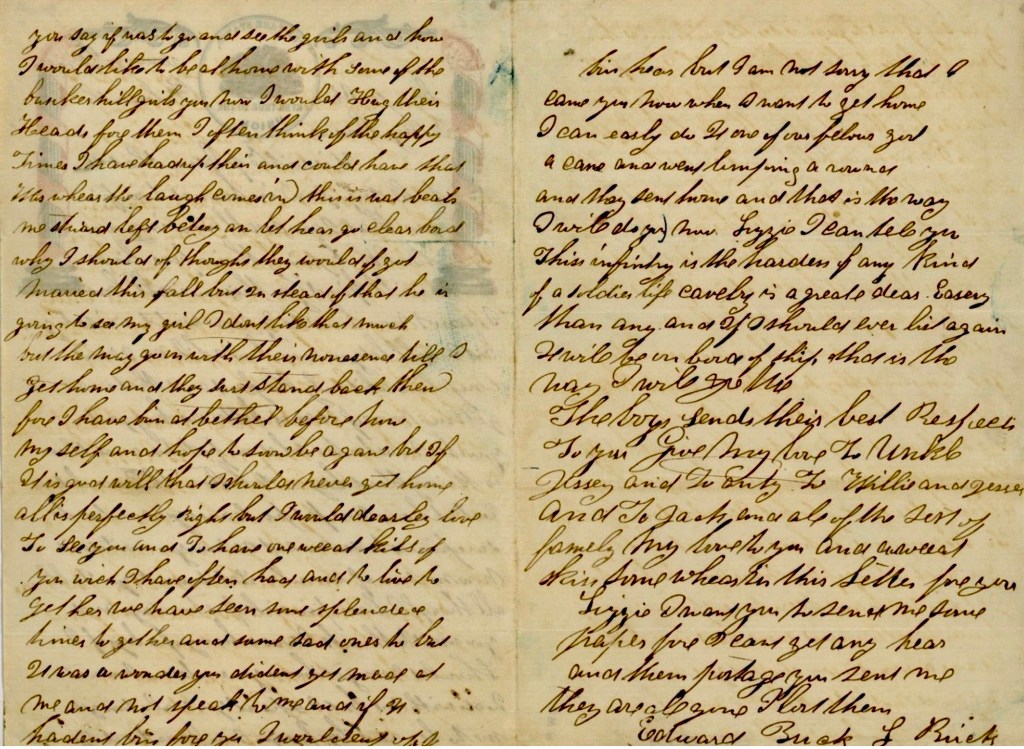
Letter 2
Addressed to Miss Lizzie Brick, Hurffville, Camden county, New Jersey
Camp near Falmouth January 15th 1863
To my cousin,
It is with pleasure that I take my pen in hand to inform you that I am well and in good health, hoping these few lines will find you the same. Well, cousin, I don’t now hardly know what to write to you but I will let you know I like it. I can’t complain a bit—only the food and that we are getting more of it and better. Our brigade quartermaster he sold our potatoes and them is things that I begin to like which I wouldn’t eat at home, nor fat pork and you would be surprised to see me eat it. Now you wouldn’t. Now we [ ] if I would sit down to your table although I have been sick for two days and you used to think I was a harry of a boy. If I should ever get home, you wouldn’t know what to do with me. But I expect you would soon get me to be a good boy for you know I would do just as you say if I was to go and see the girls, and how I would like to be at home with some of the Bunker Hill girls. You know I would hug their heads for them. I often think of the happy times I have had up there and could have. That was where the laugh comes in. This is what beats me…
Now Lizzie, I can tell you this. Infantry is the hardest of any kind of a soldier’s life, cavalry is a great deal easier than any. And if I should ever enlist again, it will be on board of a ship. That is the way I will go.
The boys send their best respects to you. Give my love to Uncle Jessie and to Aunty, to Willie, and Jessie’s family. My love to you and a sweet kiss somewhere in this letter for you. Lizzie, I want you to send me some paper for I can’t get any here and them postage you sent me are all gone. I lost them. — Edward Brick
The following letters were written by John C. Redline, a 19 year-old mason from Columbia county, Pennsylvania, who enlisted in Co. E, 15th US Regular Infantry, on 22 September 1862. He died of chronic diarrhea at Chattanooga, Tennessee on 17 January 1864.
The 15th Regular Infantry was activated during the Civil War on 3 May 1861 by General Order No. 33. It was one of nine new Regular Army regiments, numbered 11 through 19, which were organized into three 8 company battalions. The battalions often operated independently of each other.
Its headquarters first in Wheeling, West Virginia then Cleveland, Ohio, then on to Newport Barracks, Kentucky and finally ending up in Fort Adams, Rhode Island in September 1862. Fort Adams served as the regiment’s training depot were new recruits were trained and organized into companies before being sent to the front lines.
Letter 1
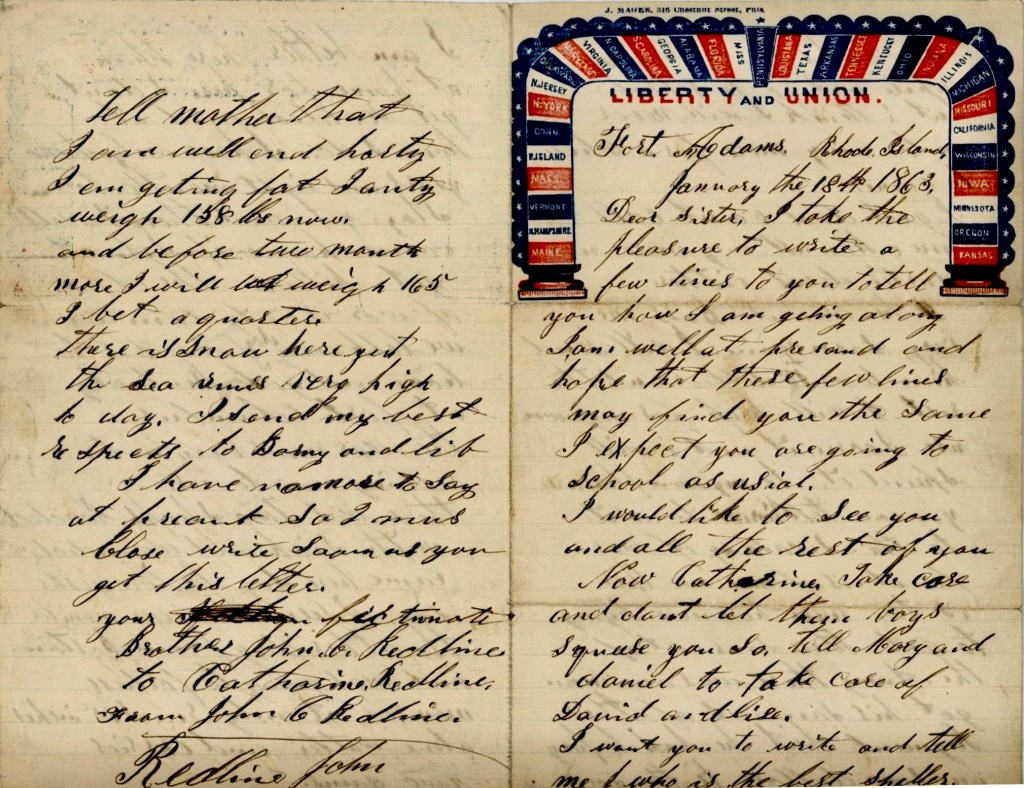
Fort Adams, Rhode Island January 18th 1863
Dear sister,
I take the pleasure to write a few lines to you to tell you how I am getting along. I am well at present and hope that these few lines may find you the same. I expect you are going to school as usual. I would like to see you and all the rest of you. Now, Catharine, take care and don’t let those boys squeeze you so. Tell Mary and Daniel to take care of David and Lise. I want you to write and tell me who is the best speller.
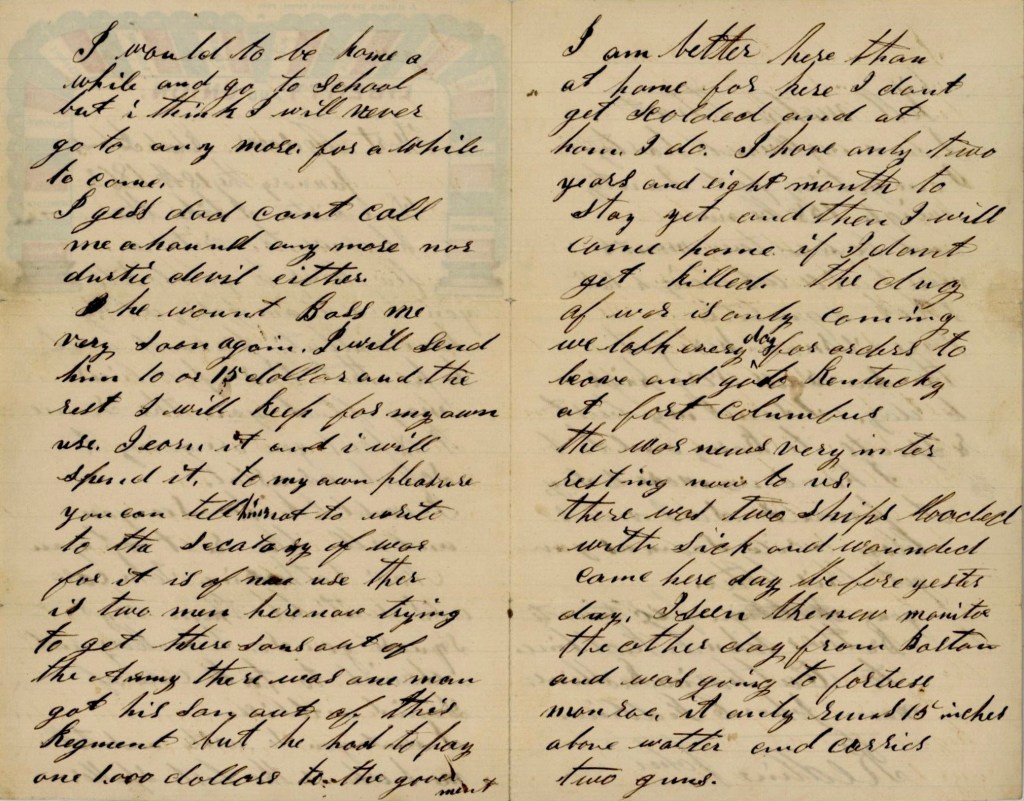
I would [like] to be home a while and go to school but I think I will never go to [school] any more for a while to come. I guess Dad can’t call me a hand any more nor dusty devil either. He won’t boss me very soon again. I will send him 10 or 15 dollars and the rest I will keep for my own use. I earn it and I will spend it to my own pleasure. You can tell him not to write to the Secretary of War for it is of no use. There is two men here now trying to get theirselves out of the army. There was one man got his sorry out of this regiment but he had to pay one thousand dollars to the government. I am better [off] here than at home for here I don’t get scolded and at home I do. I have only two years and eight months to stay yet and then I will come home if I don’t get killed.
The dogs of war is only coming. We look every day for orders to leave and go to Kentucky at Fort Columbus. The war news [is] very interesting. now to us. There was two ships loaded with sick and wounded came here day before yesterday. I seen the new monitor the other day from Boston and was going to Fortress Monroe. It only runs 15 inches above water an carries two guns.
Tell Mother that I am well and hearty. I am getting fat. I only weigh 158 lbs. now and before two moths more, I will weigh 165, I bet a quarter.
There is snow here yet. The sea surf is very high today. I send my best respects to [ ] and Lib. I have no more to say at present so I must close. Write soon as you. get this letter. Your affectionate brother, — John C. Redline
to Catherine redline.
Letter 2
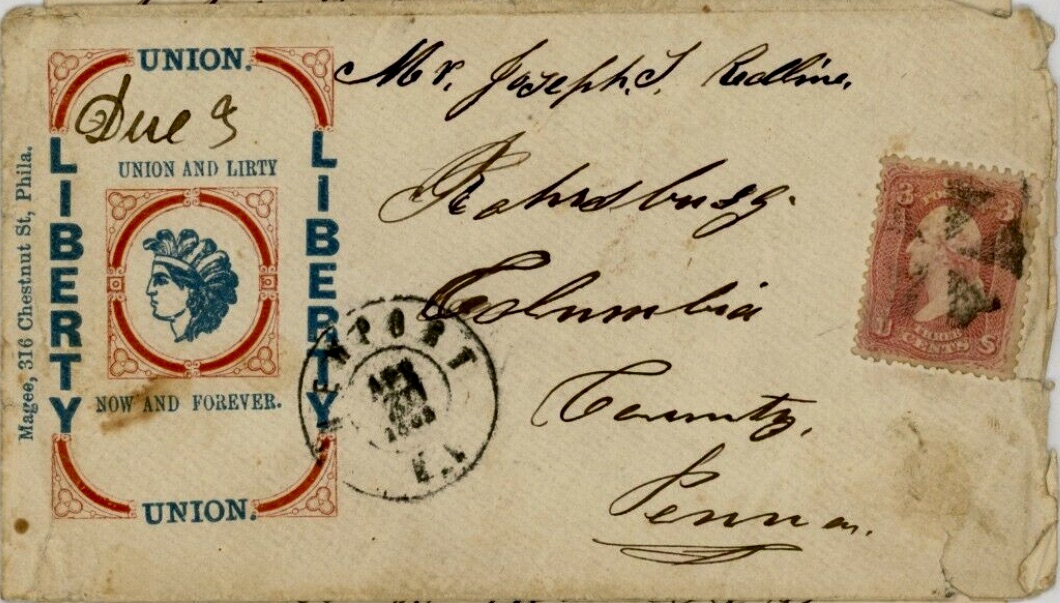
Addressed to Mr. Joseph S. Redline, Rohrsburg, Columbia County, Pennsylvania
Fort Adams, Rhode Island Headquarters of the 15th United States Infantry May the 20 1863
Dear Father,
I received your kind letter the 11th of May and I never took time to answer it until this morning. I am well and hope that these few lines may find you the same. You said that Catharine was sick. I hope she is well by this time. The reason that I did not write sooner for we had orders to leave and that is the reason that I did not write sooner. But I guess we will not leave now until fall. We have a new Colonel now. His name is Oliver L. Shephard. He is a better colonel than the other one [Fitz John Porter] was.
What is the reason that when you write that you never mention anything about James. You. said that Jolene worked good since I was gone. I guess I will come home next winter—that is, if I can get a furlough, and I think that I can. At least I will try for one anyhow. I got a letter from Jess Hanover the other day and he said that you was all well and them too.
We had a gay time last Tuesday. We was all over town to inaugurate a governor of Rhode Island.
I would like to know where you planted corn this year and where are you going to plant some buckwheat this summer and how much are you going to sow. I would like to know how much cloth you have woven yet and how does it go?
It is pretty nice weather here now—nice and warm. I am [line cut off]. You said that I should send you $13 and then you would be out of debt. I will try and send it to you when I get paid. We may be paid soon and we may not be paid before August. I don’t think that we will be paid for August and not then for all I know.
How has Aunt Mary been and is she as fat as she use to be? When I wrote before, I asked you how the peach trees are getting along. I would like to know where you are going mow this summer. How is the garden this summer? How many hens have you? I wish I had some mush and milk for supper. I had fat pork for my breakfast and beans for dinner, and will have bread and coffee for supper.
I just came in from drill and hain’t took of my belts yet. I think Fort Adams is the prettiest that ever I did see. There was a fellow shot today at Fort Trumbull for desertion.
Write soon and tell me how all the family is. From J. C. Redline





















 Spared & Shared 23