All posts by Griff

My passion is studying American history leading up to & including the Civil War. I particularly enjoy reading, transcribing & researching primary sources such as letters and diaries.

1864: William Henry Harrison Smith to his Sister

The following letter was written by William Henry Harrison Smith (1840-1933), the son of Thomas Thorburg Smith (1800-1881) and Catharine Geary (1812-1882) of Bluffton who enlisted on 16 August 1862 to serve in Co. B, 101st Indiana Infantry. He mustered out of the regiment on 24 June 1865. In his letter, William mentions his younger brother, Lucas Flattery Smith (1844-1924) who enlisted when he was 17 in Co. G, 101st Indiana Infantry.

William wrote the letter to his sister, Catharine L. Smith, Murray, Wells county, Indiana, though the envelope is addressed to his mother, also named Catharine.

William Henry Harrison Smith (at right) with son Artemus in Smith’s Drug Store, St. Helena, California.

Transcription

Camp 101st Regt. Indiana Vols.
Co. B, 2nd Brigade, 3rd Division
14th Army Corps
Rossville, Georgia
January 31st, 1864

Dear Sister,

I received your kind and welcome letter last Friday and I was glad to learn that you were all well. I am happy to say that this leaves me well. Lucas is going to write today and we will send our letters in one envelope. We are still at Rossville but do not know how long we will remain. We have pretty heavy duty here but we are now getting tolerable plenty rations and I don’t mind all the duty that I have to do if I have plenty to eat. We have quite a treat today. There was a lot of onions sent out here to our hospital and we are so lucky as to have no sick so they were issued to the regiment which is something of a rarity with us. Our regiment is in the best health now that they have been since we came out. I don’t know of a single case of sickness in the regiment.

We have had extremely beautiful weather here for the last two weeks. It was exactly such weather as we have there in May. The birds are singing and everything seems lively, but we see no sturdy plowman come forth to turn up the fresh ground nor no laborer seeking useful employment but all around is soldiers. I don’t care where you go, you will find soldiers.

The presents you sent us were gratefully received and in the package of paper that I took for mine I found a little revolver and Lucas found a small finger ring in his. I am going to send my revolver to Zack and he can shoot rats with it. You speak of sending a box to us but need not send any for we are not particular in want of anything. All that I would want would be some provision and it is so far and so many delays that provisions would be spoiled before it would get here, and we can get along very well now on what rations we have.

You speak of it being very cold back there New Year. Well, it was the same here. People that live here said that it was the coldest day they ever experienced. I was on picket that day. I think I will remember that day a long time. I don’t know what ails my leg. It is still sore and running some but it does not hurt me much. In fact, it is only by spells that I mind it at all.

You speak of some scandalous letters that were found in the post office there. Well, I believe that Smith Logan is the author of them for he sent a letter of the same kind to his brother John here, I read it and it did exceed anything that I ever heard. He swore that he did not own him as a brother and he hoped that he would never get home and wished him and his family in hell and swore that he hoped that the rebels would whip us in every battle and gain their independence. And if he would fight on either side, he said he would go to the rebs. John asked me what I thought of it and I told him that I would have it attended to so we took it and gave it to the Major. He copied it off and sent a copy back and I hope to hear of the villain getting justice which will be hanging. It was Smith’s own hand writing and his name signed to it.

Oh yes, you ask me if I have had a sleigh ride yet. No, we have not had snow enough to cover the ground and to go sleighing on the dry ground is a kind of riding I don’t like. Besides, I have not saw a sleigh since I left home. I will stop for this time. Excuse hurriedness. Your brother, — Wm. H. H. S.

Write soon. Goodbye.

1862: Samuel Alexander Richards to Harriet (Rundlett) Richards

I could not find an image of Samuel but here is Joseph A, Brown who also served in Co. H, 10th New Hampshire Infantry (Dave Morin Collection)

The following letter was written by 50 year-old Samuel Alexander Richards (1812-1882) who enlisted at Goffstown as a private on 8 August 1862 to serve in Co. H, 10th New Hampshire Infantry. Samuel remained in the service until 21 June 1865.

Samuel was married in 1844 to Harriet Rundlett (1828-1899). The couple lived at Goffstown, Hillsboro county, New Hampshire, where he earned a living as a farmer and carpenter.

The 10th New Hampshire Infantry left New Hampshire and moved to Washington, D. C., in late September 1862. They then moved to Frederick, Maryland. and about the 1st of October to Sandy Hook, Maryland, and on October 4th to Pleasant Valley October 6 where this letter was finished. They had duty at Pleasant Valley until October 27, 1862 when they made the march to Falmouth, Va., October 27-November 19 and where they fought their first battle at Fredericksburg, December 12-15.

Transcription

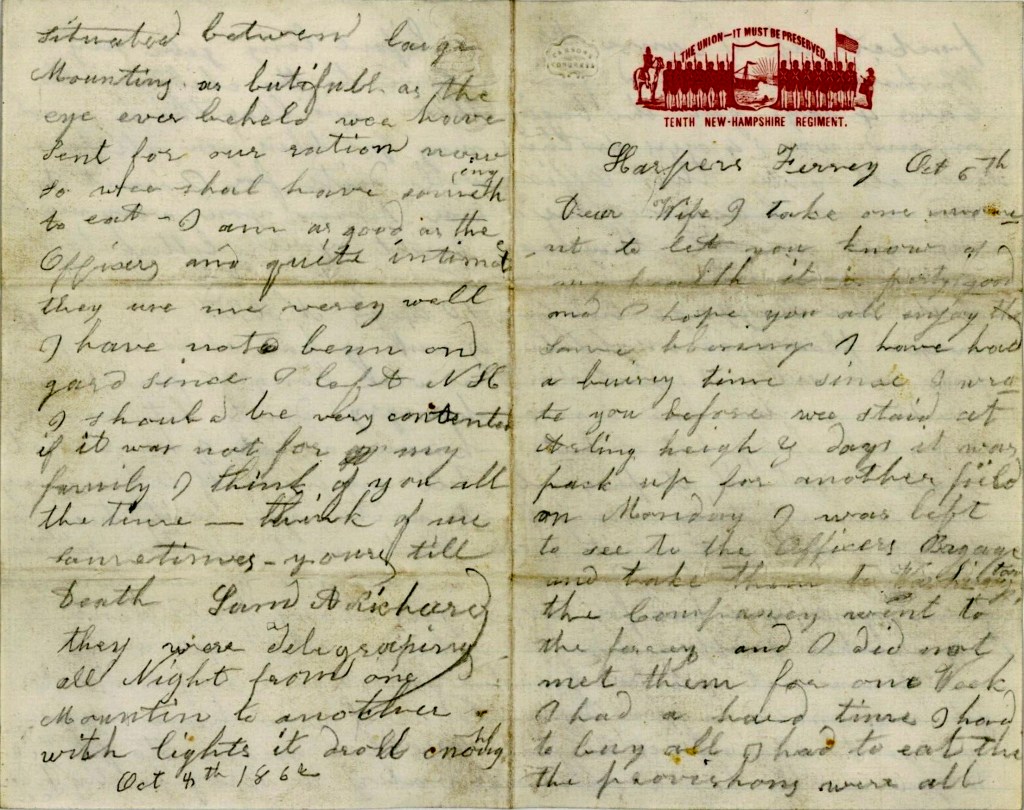
Patriotic letterhead of Samuel’s letter, “Tenth New Hampshire Regiment.”

Harpers Ferry [Virginia]
October 6th 1862

Dear Wife,

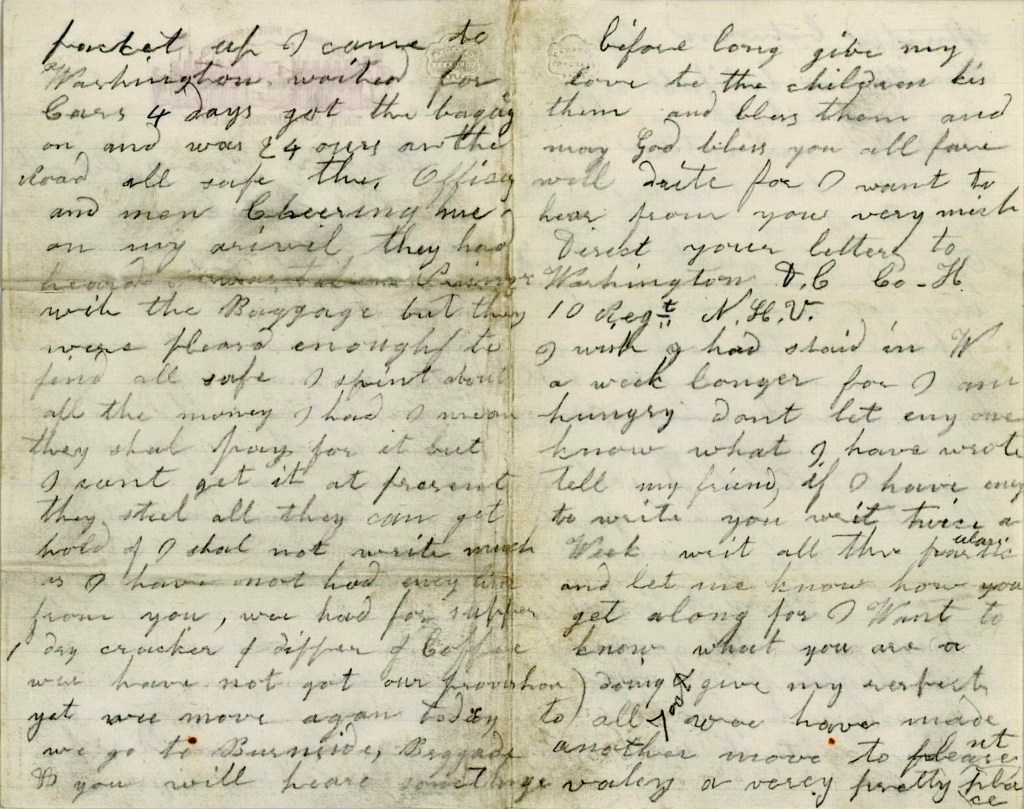
I take one moment to let you know of my health. It is pretty good and I hope you all enjoy the same blessing. I have had a busy time since I wrote to you before. We stayed at Arlington Heights two days. It was pack up for another field on Monday. I was left to see to the officer’s baggage and take them to Washington. The company went to the Ferry and I did not meet them for one week. I had a hard time. I had to buy all I had to eat. The provisions were all packed up. I came to Washington [and] waited for the cars four days, got the baggage on and was 24 hours on the road all safe, the officers and men cheering me on my arrival. They had heard I was taken prisoner with the baggage but they were pleased enough to find all safe. I spent about all the money I had. I mean they shall pay for it but I can’t get it at present. They steal all they can get hold of.
I should not write much as I have not had any line from you. We had for supper 1 dry cracker, 1 dipper of coffee. We have not got our provisions yet. We move again today. We go to Burnside’s Brigade & you will hear something before long.

Give my love to the children. Kiss them and bless them and may God bless you all. Farewell. Write for I want to hear from you very much. Direct your letters to Washington D. C., Co. H, 10th Regt. New Hampshire Volunteers.

I wish I had stayed in Washington a week longer for I am hungry. Don’t let anyone know what I have wrote. Tell my friends—if I have any—to write. You write twice a week. Write all the particulars and let me know how you get along for I want to know what you are a doing. Give my respects to all.

We have made another move to Pleasant Valley—a very pretty place situated between large mountains as beautiful as the eye ever beheld. We have sent for our rations now so we shall have something to eat. I am as good as the officers and quite intimate. They [treat] me very well. I have not been on guard since I left New Hampshire. I should be very contented if it was not for my family. I think of you all the time. Think of me sometimes. yours till death, — Sam A. Richards

They were telegraphing all night from one mountain to another with lights. It [ ] enough October 4th 1862

1864: Unidentified “George” to his friend Mary

This letter is only signed “George” but it was most definitely written by a member of Waterhouse’s Battery—Co. E, 1st Illinois Light Artillery. Not only was it written on stationery branded with the unit’s name on the letterhead, but the content of the letter is consistent with the Battery’s movements as well. Regrettably there are too many George’s in the unit who were unmarried to narrow it down to less than a handful of possible soldiers.

After participating in the siege of Vicksburg and then of Jackson, Mississippi, Battery E spent the remainder of the summer and fall in the vicinity of Bear Creek. On November 5 they took boat for Memphis, arriving there the 12th. During that winter they went to Lagrange, Tennessee and also, Corinth, Jack Creek, back again to Corinth, then finally back to Memphis via Lagrange. It was at this point in time the following letter was penned. Later in 1864 they would participate on the Meridian expedition and then in the disastrous Battle of Brice’s Crossroads where they performed some heroic actions.

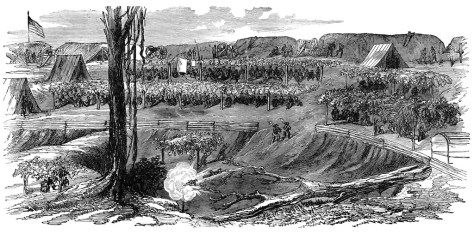
“Waterhouse’s Battery, Sherman’s Corps, before Vicksburg. The interior view of Waterhouse’s battery, in Tuttle’s division, shows the guns in position and the huts in which the men are crowded. These were built of canes tied together and covered with branches, the soldiers resorting to the style of dwelling of the Indians who dwelt there two centuries ago.”— Frank Leslie, 1896

Transcription

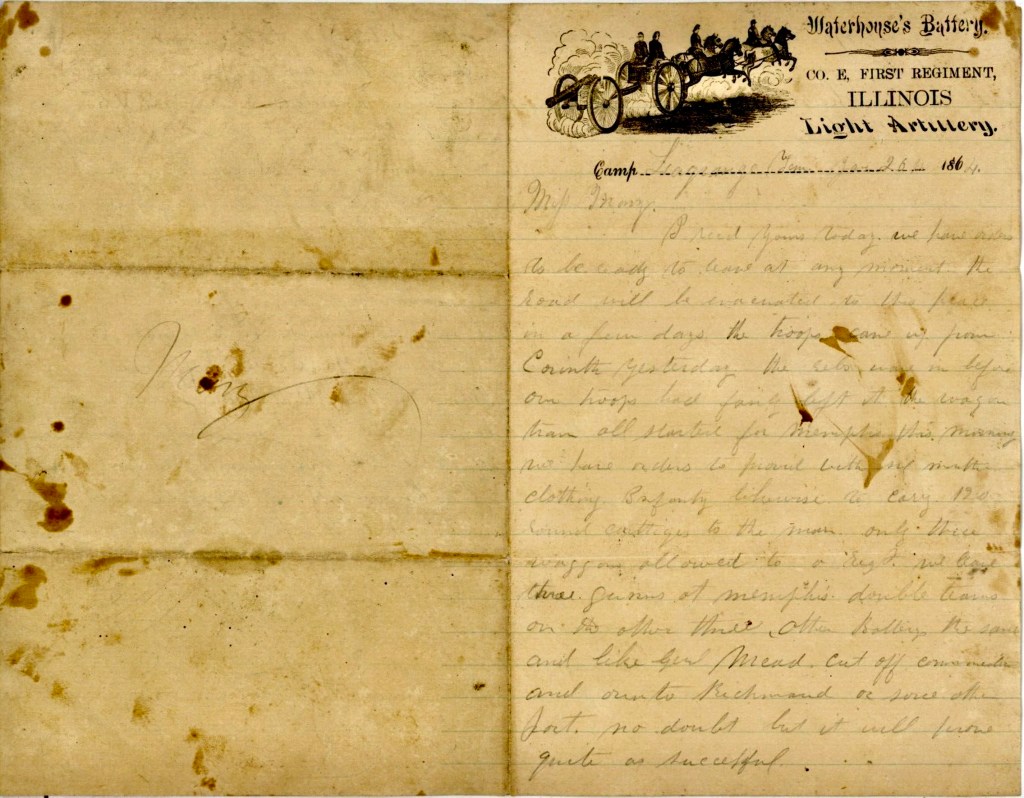
Stationery used for George’s letter with image of artillery and “Waterhouse’s Battery”

Waterhouses’s Battery
Co. E, 1st Regiment Illinois Light Artillery
Camp Lagrange, Tennessee
January 26, 1864

Miss Mary,

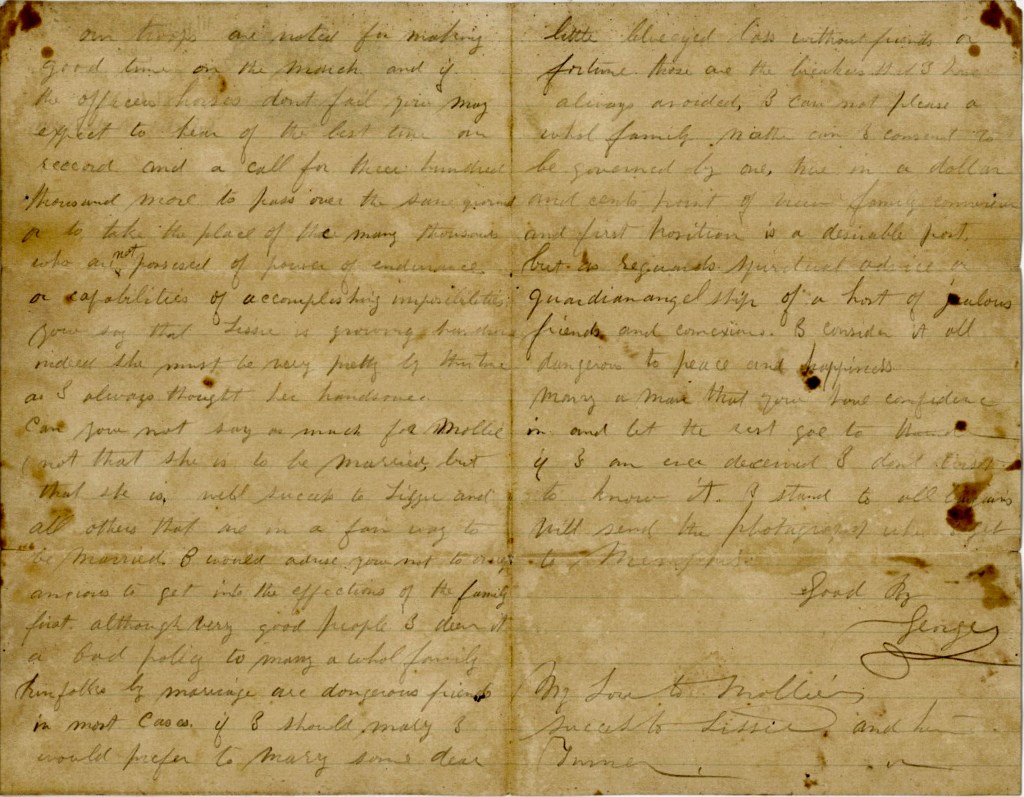
I received yours today. We have orders to be ready to leave at any moment. The road will be evacuated to this place in a few days. The troops came up from Corinth yesterday. The rebs were in before our troops had fairly left it. The wagon train all started for Memphis this morning. We have orders to provide [ ] clothing. Infantry likewise to carry 120 round cartridges to the man. Only three wagons allowed to a regiment. We leave three guns at Memphis, double teams on the other three. Other batteries the same and like Gen. Meade, cut off communication and over to Richmond or some other post, no doubt, but it will prove quite as successful.

Private James Bolton who served in Congress. E from 1862-1865.

Our troops are noted for making good time on the march and if the officers’ horses don’t fail, you may expect to hear of the best time on record and a call for three hundred thousand more to pass over the same ground or to take the place of the many thousands who are not possessed of power of endurance or capabilities of accomplishing impossibilities.

You say that Lizzie is growing handsome. Indeed, she must be very pretty by this time as I always thought her handsome. Can you not say as much for Mollie (not that she is to be married, but that she is.) Well success to Lizzie and all others that are in a fair way to be married. I would advise you not to be anxious to get into the affections of the family first, although very good people. I deem it a bad policy to many a whole family. Kinfolks by marriage are dangerous friends in most cases. If I should marry, I would prefer to marry some dear little, blue-eyed lass without friends or fortune. Those are the breakers that I have always avoided. I cannot please a whole family. Neither can I consent to be governed by one. True, in a dollar and cents point of view, family connections and first position is a desirable post, but as regards spiritual advice or guardian angel ship of a host of jealous friends and connections, I consider it all dangerous to peace and happiness.

Marry a man that you have confidence in and let the rest go to thunder. If I am ever deceived, I don’t wish to know it. I stand to all [ ]. Will send the photographs when I get to Memphis. Goodbye, — George

My love to Mollie. Success to Lizzie and Mr. Turner.

1863: Oscar Fox to Maria Fox

The following letter was written by Oscar Fox (1832-1897) who served in Independent Battery H, Pennsylvania Light Artillery (sometimes called John I. Nevin’s Battery). This unit was organized at Pittsburgh and served in the defenses of Washington D. C. from the fall of 1862 to the spring of 1863.

At the time Oscar penned this letter in June 1863, the Battery had recently come under the command of Captain William Barrowe, a seasoned U.S. Army Regular. In the fall of 1864, Barrowe faced court martial for forging documents and submitting false reports; when President Lincoln chose not to dismiss the charges against him, he was removed from his command on March 8, 1865, and dismissed from service on the same day. He was later reinstated as 1st Lieutenant in the Second Artillery in July 1865—a decision for which the Army would come to express deep regret. Four years later, while commanding an artillery unit in Alaska, he made the unjustifiable decision to shell an indigenous village, an act for which the U.S. Government continues to issue apologies (see Army will issue January apology for 1869 bombardment of Wrangell).

Battery H, Pennsylvania Light Artillery never saw any action though seven enlisted men in the battery died of disease during the war.

Transcription

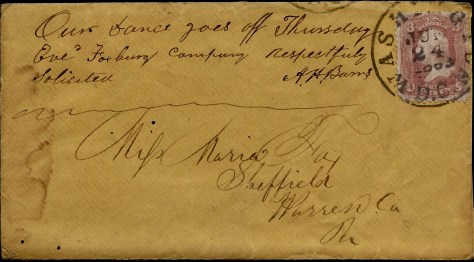
Addressed to Miss Maria Fox, Sheffield, Warren county, Pennsylvania

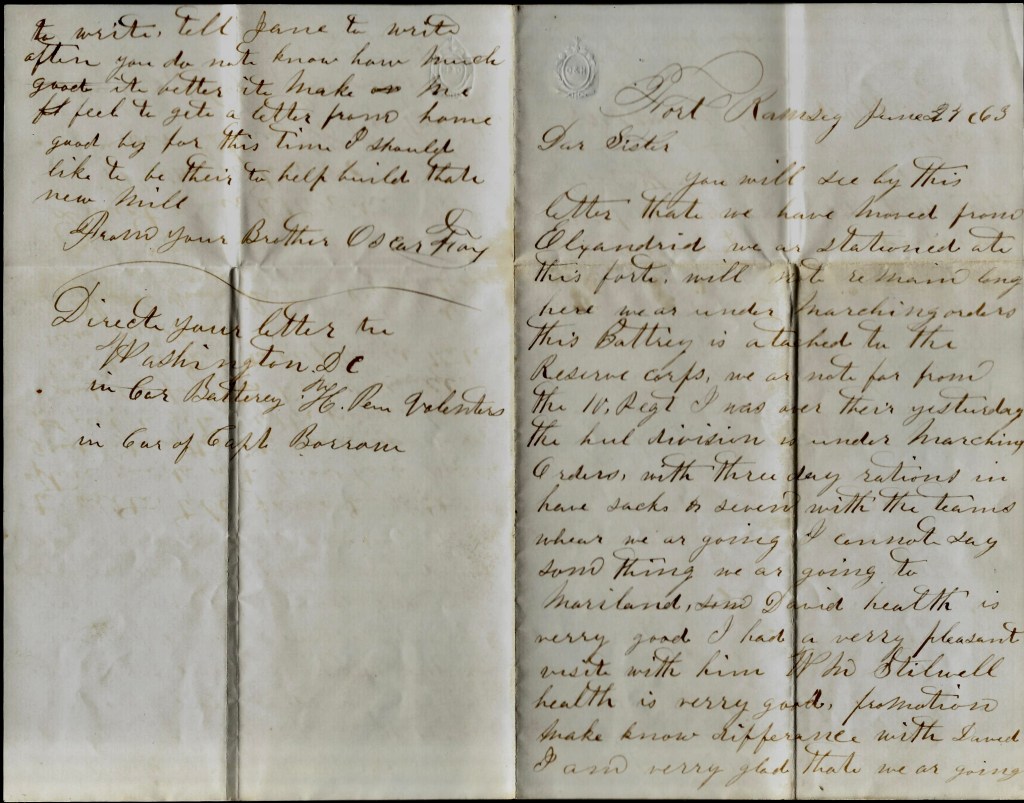
Fort Ramsey
June 24, 1863

Dear Sister,

You will see by this letter that we have moved from Alexandria. We are stationed at this fort [but] will not remain long here. We are under marching orders. This Battery is attached to the Reserve Corps. We are not far from the 10th Regiment. I was over there yesterday. The whole division is under marching orders with three days rations in haversacks & seven with the teams. Where we are going, I cannot say, Some think we are going to Maryland, some [unfinished sentence]

David’s health is very good. I had a very pleasant visit with him. William Stilwell’s health is very good. Promotion makes no difference with David. I am very glad that we are going to remain with the reserves, There is not much news to write. My health is not very good. I am excused from duty by the doctor.

I sent home money to Jane last week to 17 dollars. Have not heard anything from it yet. I saw the letter that James wrote to David yesterday—quite a sad accident occurred there. I guess they will be more careful in future how they ride and go onto the water to play. Olive came very near being drowned. Keep close watch over Willie and Mary. Tell Jane not to let them go to the mill unless someone is with them. Tell Jane to write soon. I have not received any letter from Erastus since I left Cliffburn Barracks. I wrote to him since I received any letter from him.

There was a fight going on in hearing of us last Sunday.

I cannot think of anything more to write. I have just been to the hospital after some medicine. I will write to James & Netty as soon as I can. We have been moving so often that I cannot find time to write. There is [always] something to do when we move. Write soon. Kiss the children and think of me. I have not seen Miss Mary’s brother since I left Washington. I saw him in the city a short time before we left. He was looking very well. Said his health was very good. Give my love to all of enquiring friends [but] reserve a large portion for the folks at home for I have lots on hand. I shall have to close this not very interesting letter for want of something to write. You do not know how much better it makes me feel to get a letter from home.

Goodbye for this time. I should like to be there to help build that new mill. From your brother, — Oscar Fox

Direct your letter to Washington D. C., in care of Battery H Pennsylvania Volunteers, in care of Capt. [William] Borrowe

1862. Charles Edward Davis to his Family

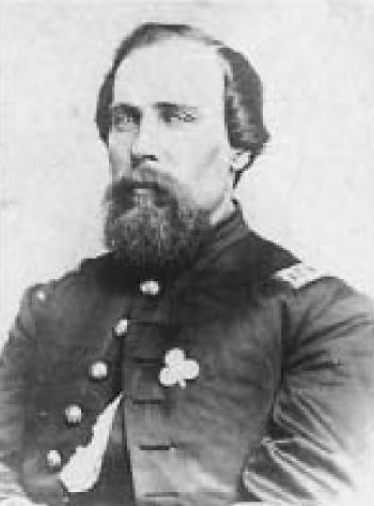
C. Edward Davis when he was captain of Co. E, 1st Minnesota Infantry

Though this letter was only signed “Edward,” the contents of this letter led me to the 1st Minnesota Infantry and the only officer named Edward who matched the profile. ” This letter can be safely attributed to Lt. Charles “Edward” Davis (1835-1885) of Co. I, 1st Minnesota Infantry. He later rose in rank to Captain of Co. E. There are a number of letters housed in the Minnesota Historical Society by Davis, a St. Paul (Minn.) resident who served in the First Minnesota Infantry in the Civil War. They were written to his father and siblings. In them, he comments on activities and officers of the regiment and the Army of the Potomac, and on attitudes of soldiers and civilians. There are a few letters discussing survey work for the Nebraska and Lake Superior Railroad Co. (1859-1860) and Davis’ participation in the Vermilion (Minn.) gold rush (1866). Though he signed this letter Edward, he was known to many of his friends as “Ned.”

I found a notice in the St. Paul Dispatch on 14 October 1868 in which it was announced that “Capt. C. Edward Davis” had been connected since the war with “Gen. [Gouverneur Kemble] Warren’s River Survey” but that he had been “ordered to Gettysburg to make a survey of the battlefield there. As Ned was in that battle [and was wounded there], he is a proper person to make the survey.”


Transcription

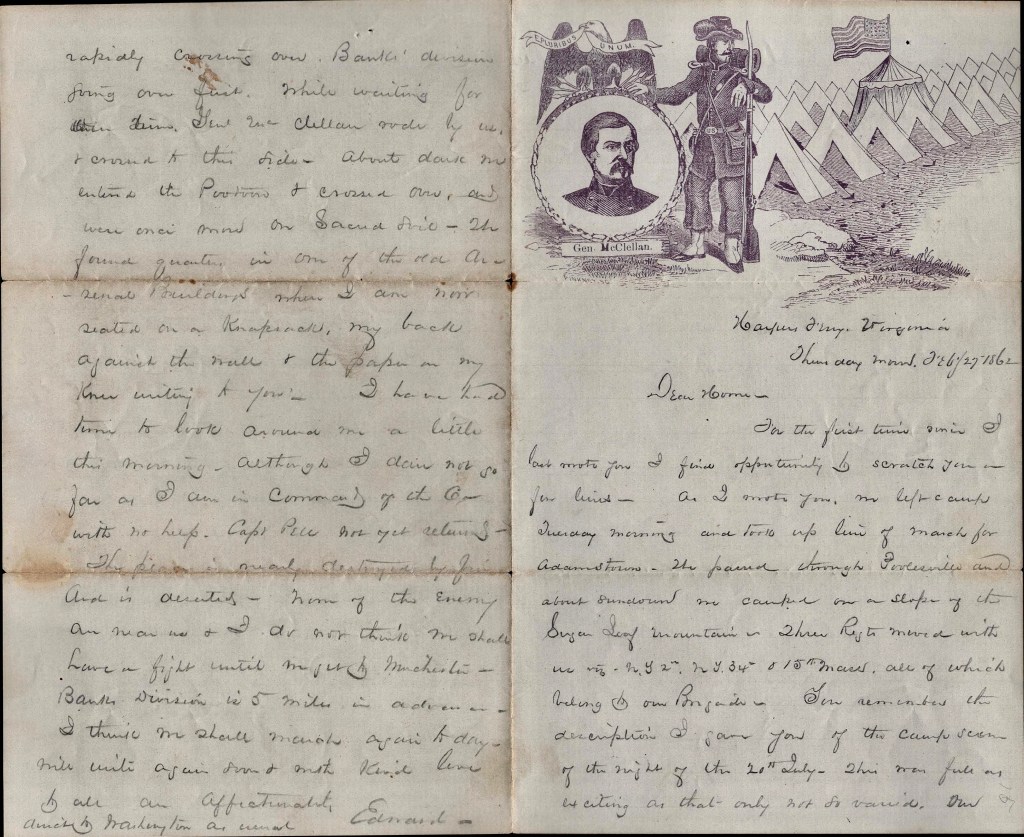
Patriotic stationery used by Edward in this letter home. Bust of Gen. McClellan.

Harpers Ferry, Virginia
Thursday Morning, Feb 27, 1862

Dear Home,

For the first time since I last wrote you I find opportunity to scratch you a few lines. As I wrote you, we left camp Tuesday morning and took up line of march for Adamstown. We passed through Poolesville and about sundown we camped on a slope of the Sugar Loaf Mountain. Three regiments moved with us, viz: the N. Y. 2nd, N. Y. 34th, & 15th Mass., all of which belong to our brigade. You remember the description I gave you of the camp of the night of the 20th July. This was full as exciting as that, only not so varied. Our regiment camped in a valley, while on the hill on our right were camped the Mass 15th. Along a gully running up the mountain the NY 2nd were encamped, while the other regiment was in close proximity. To attempt to delineate the grandeur of the scene and the many varied emotions that pass through the mind, they must be given while under their influence and I will only say that it was beautifully grand. Our band struck up “Home, Sweet, Home” and other tunes which sounded grandly among the hills and which was responded to by the band of the Mass 15th.

As we expected to reach Adamstown that night, I directed my servant to go with the teams and take my traps and blankets, in consequence of which I was left without any blanket to shelter me. But the boys looked out for that and I was well taken care of. We had bright camp fires which were kept up all night.

At 4 a.m. the call was sounded to get up & up we got—each one cooking his cup of coffee in his own tin cup as we had no cooking utensils along. At 5 the bugle sounds “to the colors” & we soon marched off, reaching Adamstown about 9 o’clock where we were detained about an hour or more, when we took the cars for Harper’s Ferry and reached Knoxville, Maryland (a little below the ferry) about 12 o’clock. We then got out of the cars and after marching around the streets and standing in the mud about 3 hours, we were ordered to climb a high hill and camp. Up we went and about 5 o’clock we had begun to get ready for the night. It had commenced raining and promised to be anything but pleasant. The boys were all busy getting wood when the order came to march. We was soon into line again & marched down the hill & up the bank of the river where our forces had built a pontoon bridge and were rapidly crossing over, Banks’ Division going over first.

While waiting for our turn, Genl. McClellan rode by us & crossed this side. About dark we entered the pontoon & crossed over and were once more on sacred soil. We found quarters in one of the old arsenal buildings where I am now seated on a knapsack, my back against the wall & the paper on my knee writing to you. I have had time to look around me a little this morning although I dare not go far as I am in command of the company with no help—Capt. [John H.] Pell not yet returned. The place is nearly destroyed by fire and is deserted. None of the enemy are near us & I do not think we shall have a fight until we get to Winchester. Banks’ Division is 5 miles in advance. I think we shall march again today. Will write again soon & with kind love to all and affectionately, — Edward

Direct to Washington as usual.

1864: Egbert Benson Buzby to his Father

The following letter was written by Egbert Benson Buzby (1842-1932), the son of John V. Buzby and Elizabeth Bruner.

Egbert enlisted at Norristown on 14 August 1862 and was mustered in the following day as a corporal in Co. A, 138th Pennsylvania Infantry for a three year term. He was wounded on 6 May 1864 in the Battle of the Wilderness but recovered and was appointed sergeant on 1 December 1864 and mustered out on 23 June 1865. At his enlistment, he gave his residence as Montgomery county and his occupation as “printer.” Indeed, in the 1860 US Census, “Egbert Busby” was enumerated in the household of printer, Robert Iredell, as one of the printer apprentices. Iredell was the proprietor of the Norristown Herald and Free Press.

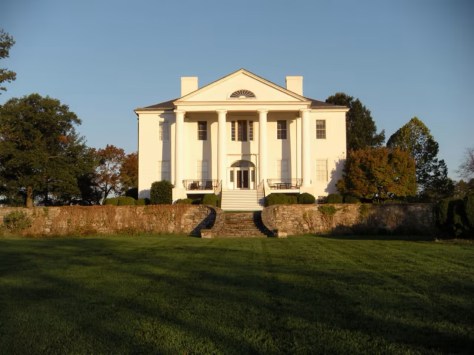
The manor house at Clifton Farm sits on a 411-acre estate at the north end of the Shenandoah Valley. THe house was finished in 1834.

Transcription

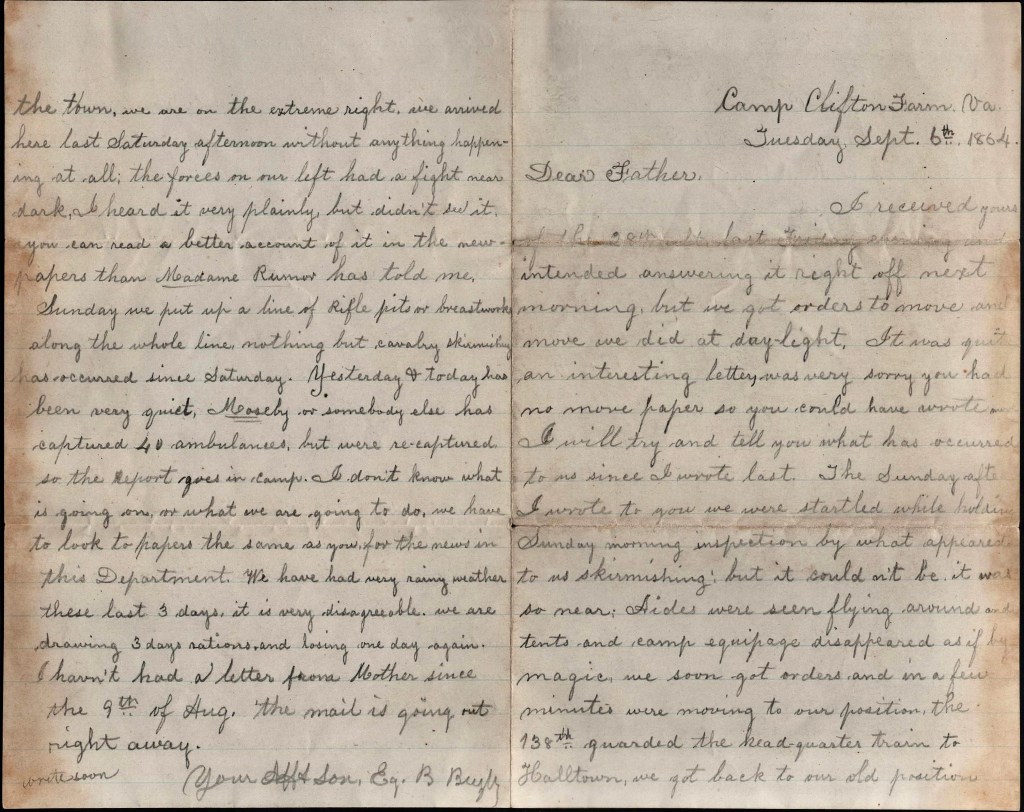
Camp Clifton Farm, Virginia
Tuesday, September 6th 1864

Dear Father,

I received yours of the 28th ult. last Friday evening and intended answering it right off net morning, but we got orders to move and move we did at daylight. It was quite an interesting letter. Was very sorry you had no more paper so you could have wrote me. I will try and tell you what has occurred to us since I last wrote.

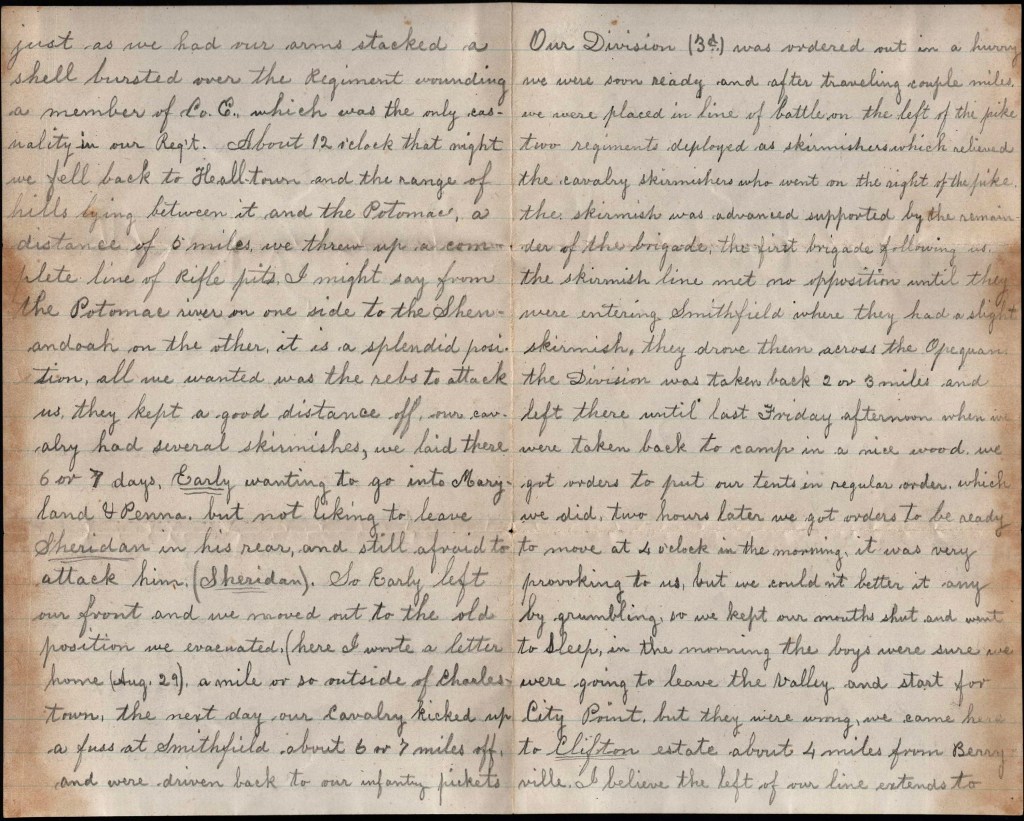
The Sunday after I wrote to you we were startled while holding Sunday morning inspection by what appeared to us skirmishing, but it couldn’t be—it was so near. Aides were seen flying around and tents and camp equipage disappeared as if by magic. We soon got orders and in a few minutes were moving to our position. The 138th guarded the headquarters train to Halltown. We got back to our old position. Just as we had our arms stacked, a shell bursted over the regiment wounding a member of Co. E which was the only casualty in our regiment.

About 12 o’clock that night we fell back to Halltown and the range of hills lying between it and the Potomac—a distance of five miles. We threw up a complete line of rifle pits, I might say from the Potomac river on one side to the Shenandoah on the other. It is a splendid position. All we wanted was the rebs to attack us [but] they kept a good distance off. Our cavalry had several skirmishes. We laid there 6 or 7 days, [Gen. Jubal] Early, wanting to go into Maryland & Pennsylvania, but not liking to leave Sheridan in his rear, and still afraid to attack him (Sheridan). So Early left our front and we moved out to the old position we evacuated (here I wrote a letter home on Aug. 29) a mile or so outside of Charlestown.

The next day our cavalry [led by Merritt] kicked up a fuss at Smithfield, about 6 or 7 miles off, and were driven back to our infantry pickets. Our Division (3d) was ordered out in a hurry. We were soon ready and after traveling couple miles, we were placed in line of battle on the left of the pike, two regiments deployed as skirmishers which relieved the cavalry skirmishers who went on the right of the pike. The skirmish [line] was advanced supported by the remainder of the brigade, the first brigade following us. The skirmish line met no opposition until they were entering Smithfield where they had a slight skirmish. They drove them across the Opequan. The Division was taken back 2 or 3 miles and left there until last Friday afternoon when we were taken back to camp in a nice wood. We got orders to put our tents in regular order which we did. Two hours later we got orders to be ready to move at 4 o’clock in the morning. It was very provoking to us but we couldn’t better it any by grumbling so we kept our mouths shut and went to sleep.

In the morning the boys were sure we were going to leave the Valley and start for City Point but they were wrong. We came here to Clifton estate about four miles from Berryville. I believe the left of our line extends to the town. We are on the extreme right. We arrived here last Saturday afternoon without anything happening at all. The forces on our left had a fight near dark. It heard it very plainly but didn’t see it. You can read a better account of it in the newspapers than Madame Rumor has told me.

Sunday we put up a line of rifle pits or breastworks along the whole line. Nothing but cavalry skirmishing has occurred since Saturday. Yesterday and today has been very quiet. Mosby or somebody else has captured 40 ambulances but were re-captured so the report goes in camp. I don’t know what is going on or what we are going to do. We have to look to papers the same as you for the news in this Department.

We have had very rainy weather these last three days. It is very disagreeable. We are drawing three days rations and losing one day again. I haven’t had a letter from Mother since the 9th of August. The mail is going out right away. Your affectionate son, — Eg. B. Buzby

Write soon.

1862-63: Adam Turney Kreps to his Relatives

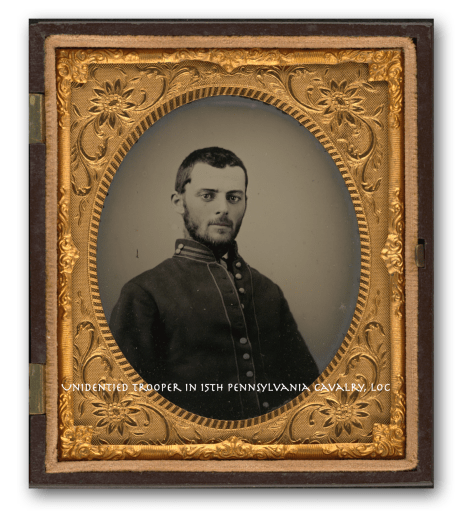
These letters were written by Adam (“Addy”) Turney Kreps (1842-1919), the son of Jacob Fordney Kreps (1806-1888) and Eliza E. Turney (1809-1887) of Greensburg, Westmoreland county, Pennsylvania. Adam began his service in the Civil War as a member of the Anderson’s Troop (15th Pennsylvania Cavalry). While with the 15th Pennsylvania Cavalry, Co. F, and later Co. H, he participated in the Battles of Antietam and Chancellorsville. In 1864 he was commissioned a 1st Lieutenant in the 3rd Missouri Colored Infantry but on 11 March 1864, orders were received renaming it the 67th US Colored Troop (USCT) Infantry.


Letter 1

Downsville, Maryland
September 19, [1862]

Dear Father,

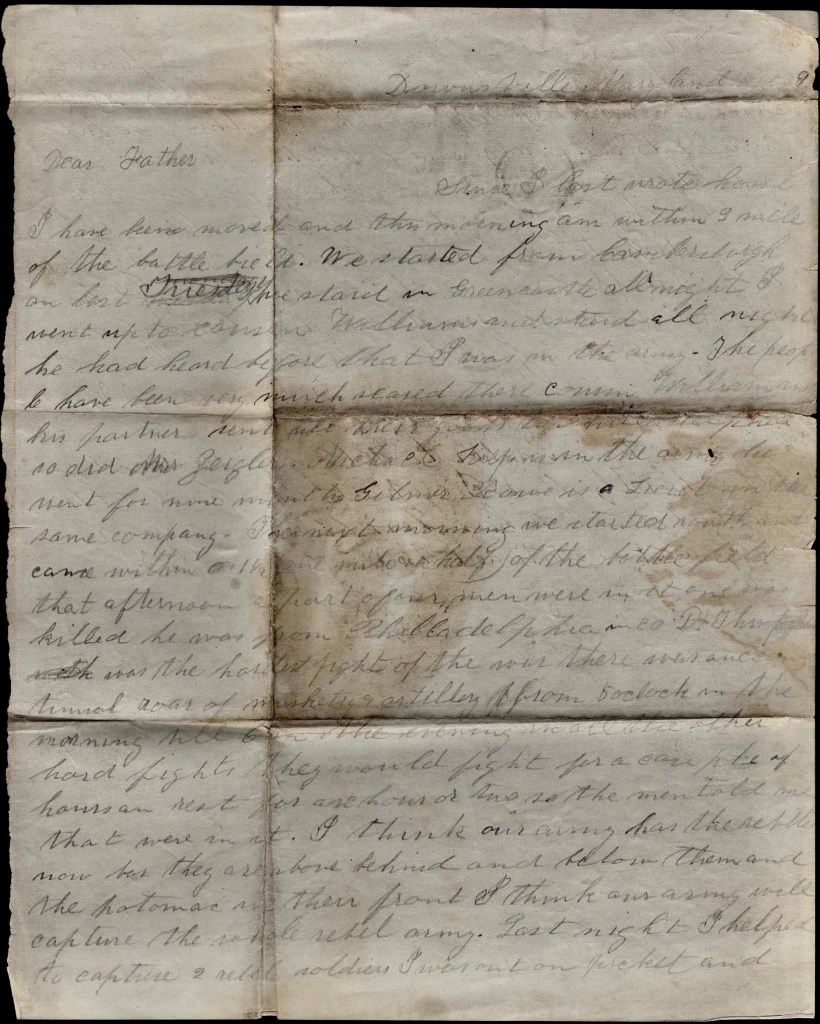
Since I last wrote home I have been moved and this morning am within three miles of the battlefield. We started from Chambersburg on last Tuesday. We stayed in Greencastle all night. I went up to cousin William’s and stayed all night. He had heard before that I was in the army. The people have been very much scared there. Cousin William and his partner sent all their goods to Philadelphia. So did Mr. Ziegler. Michael Kreps is in the army. He went for nine months. Gilmer Rowe is a Lieutenant in the same company.

The next morning we started south and came within one mile and a half of the battlefield. That afternoon a part of our men were in it. One was killed. He was from Philadelphia in Co. D. It was the hardest fight of the war. There was one continual roar of musketry & artillery from 5 o’clock in the morning till 6 in the evening. In all the other hard fights, they would fight for a couple of hours and rest for an hour or two, so the men told me that were in it. I think our army has the rebels now as they are above, behind, and below them and the Potomac in their front. I think our army will capture the whole rebel army.

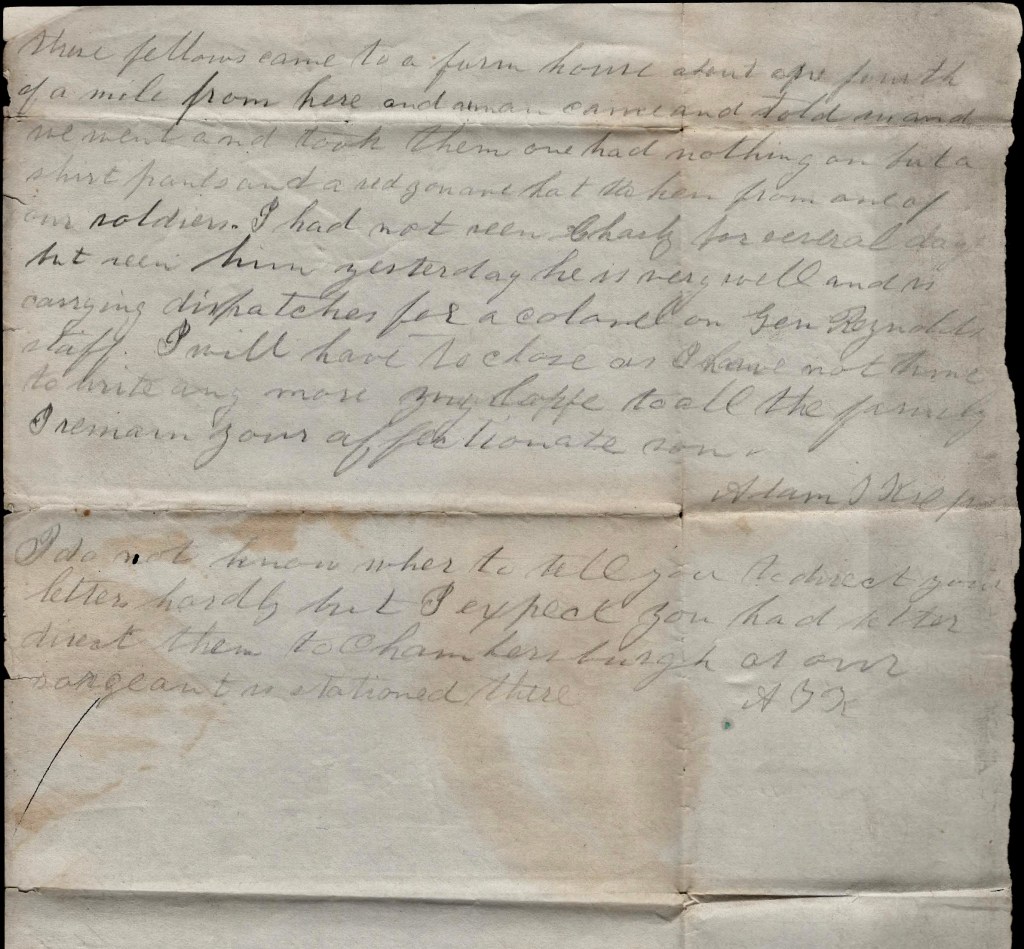
Last night I helped to capture two rebel soldiers. I was out on picket and these fellows came to a farm house about a fourth of a mile from here and a man came and told us and we went and took them. One had nothing on but a shirt, pants, and a red Zouave hat taken from one of our soldiers.

I had not seen Charley for several days but seen him yesterday. He is very well and is carrying dispatches for a colonel on Gen. Reynold’s staff. I will have to close as I have not time to write any more. My love to all the family. I remain your affectionate son, — Adam T. Kreps

I do not know where to tell you to direct your letters hardly but I expect you had better direct them to Chambersburg as our sergeant is stationed there. — A. T. K.


Letter 2

[Editor’s note: This letter was written from Chattanooga in the midst of the Battle of Lookout Mountain which began on November 23rd with the attack on and capture of Orchard Knob. It was followed by the final assault on Missionary Ridge on November 25th.]

Chattanooga, [Tennessee]
November 24, 1863

Dear cousin Frank,

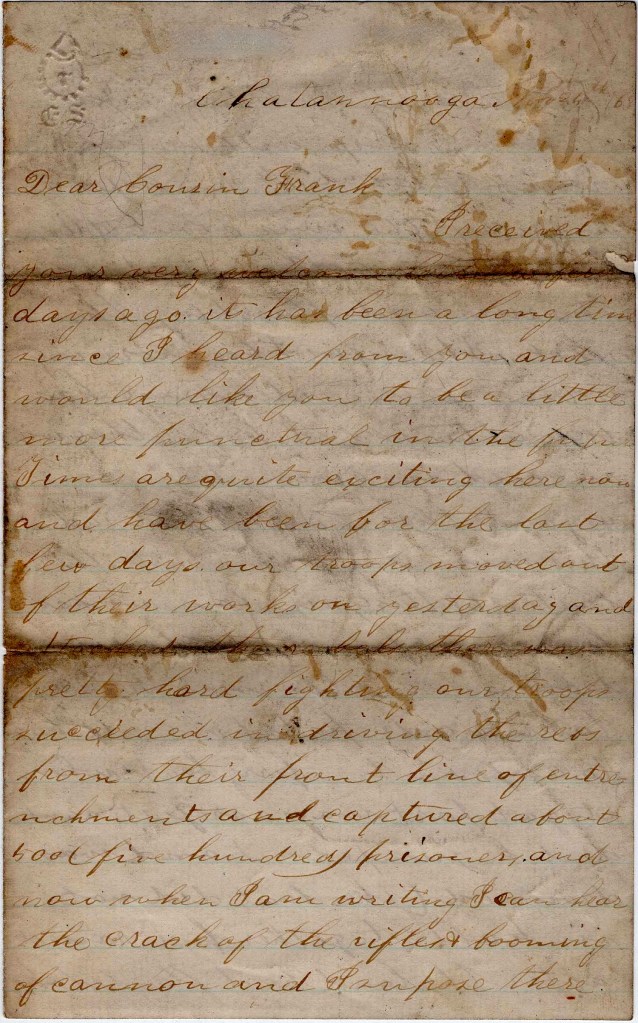
I received your very welcome letter five days ago. It has been a longtime since I heard from you and would like you to be a little more punctual in the future.

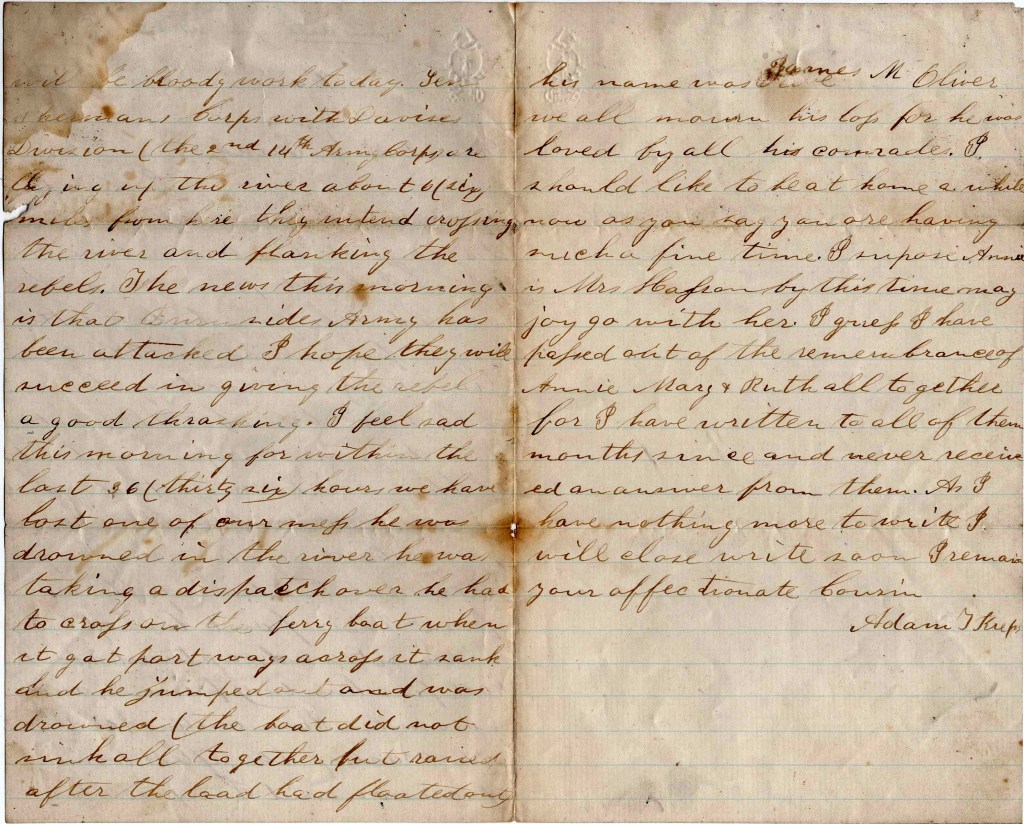
Times are quite exciting here now and have been for the last few days. Our troops moved out of their works on yesterday and attacked the rebels. There was pretty hard fighting. Our troops succeeded in driving the rebs from their front line of entrenchments and captured about 500 (five hundred) prisoners and now when I am writing, I can hear the crack of the rifles and booming of cannon and I suppose there will be bloody work today. Gen. Sherman’s Corps with Davis’s Division (the 2nd and 14th Army Corps) are lying up the river about 6 (six) miles from here. They intend crossing the river and flanking the rebels. The news this morning is that Burnside’s army has been attacked [at Knoxville]. I hope they will succeed in giving the rebels a good thrashing.

I feel sad this morning for within the last 36 (thirty-six) hours we have lost one of our mess. He was drowned in the river. He was taking a dispatch over. He had to cross on the ferry boat. When it got part ways across, it sank and he jumped and was drowned (the boat did not sink altogether but raised after the load had floated out). His name was James M. Oliver. We all mourn his loss for he was loved by all his comrades.

I should like to be at home a while now as you say you are having such a fine time. I suppose Annie is Mrs. Hafron by this time. May joy go with her. I guess I have passed out of the remembrance of Annie, Mary and Ruth altogether for I have written to all of them months since and never received an answer from them. As I have nothing more to write, I will close. Write soon. I remain your affectionate cousin, — Adam T. Kreps


Letter 3

Chattanooga [Tennessee]
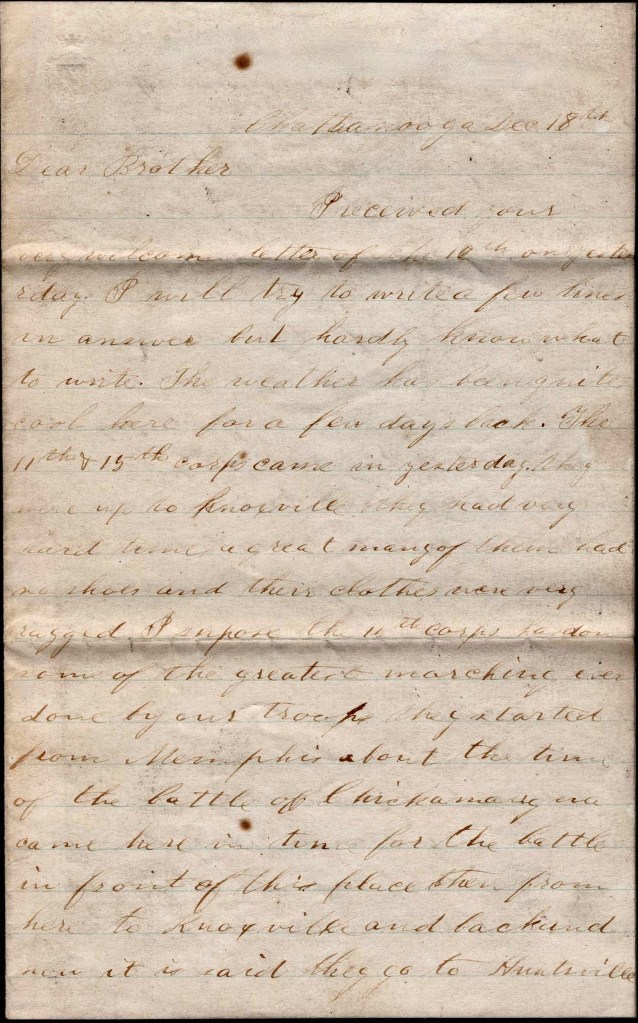
December 18th [1863]

Dear Brother,

I received your very welcome letter of the 10th only yesterday. I will try to write a few lines in answer but hardly know what to write. The weather has been quite cool here for a few days back. The 11th & 15th Corps came in yesterday. They were up to Knoxville. The had a very hard time. A great many of them had no shoes and their clothes were very ragged. I suppose the 11th Corps has done some of the greatest marching ever done by our troops. They started from Memphis about the time of the Battle of Chickamauga, came here in time for the battle in front of this place, then from here to Knoxville and back and now it is said they go to Huntsville.

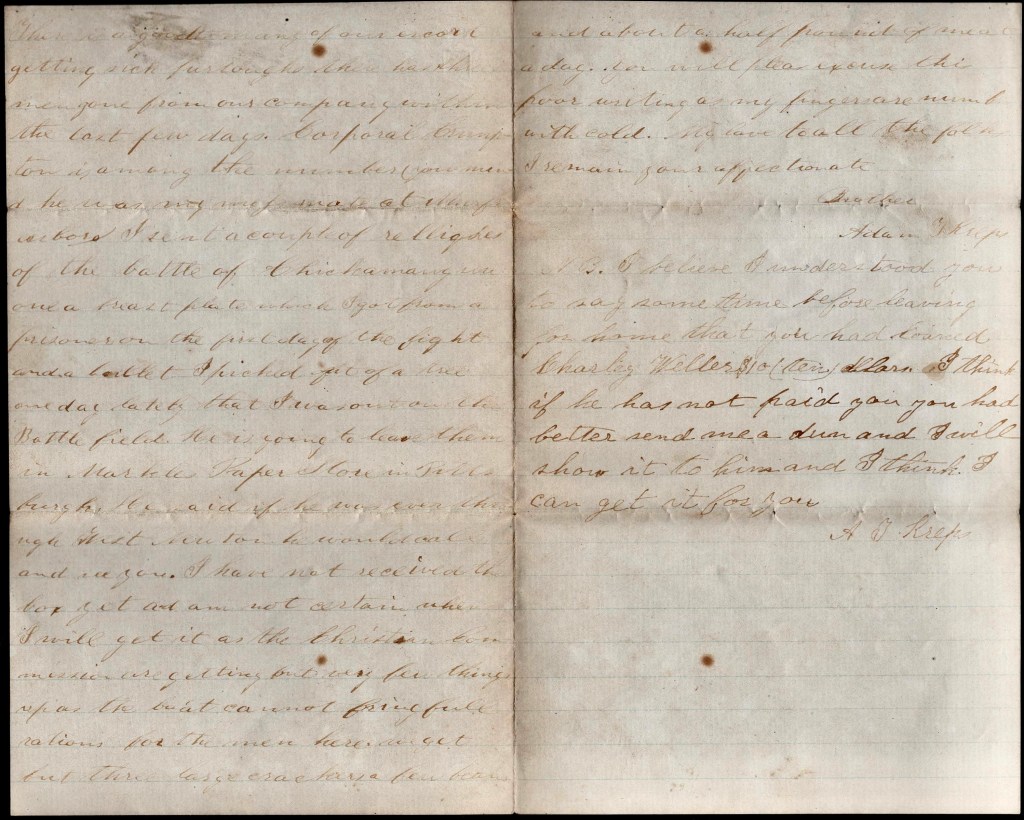
There is a good many of our escort getting sick furloughs. There has three men gone from our company within the last few days. Corporal Crumpton is among the number (you mind he was my mess mate at Murfreesboro). I sent [by him] a couple of relics of the Battle of Chickamauga—one a breastplate which I got from a prisoner on the first day of the fight, and a bullet I picked out of a tree—one day lately that I was out on the battlefield. He is going to leave them in Markle’s Paper Store in Pittsburgh. He said if he was ever through West Newton, he would call and see you.

I have not received the box yet and am not certain when I will get it as the Christian Commission are getting but very few things up as the boat cannot bring full rations for the men here. We get but three large crackers, a few beans, and about a half pound of meal a day. You will please excuse this poor writing as my fingers are numb with cold.

My love to all the folks. I remain your affectionate brother, — Adam T. Kreps

N. B. I believe I understood you to say some time before leaving for home that you had loaned Charley Weller $10 dollars. I think if he has not paid you, you had better send me a dun and I will show it to him and I think I can get it for you. — A. T. Kreps


1865: C. C. Wright to his friend William

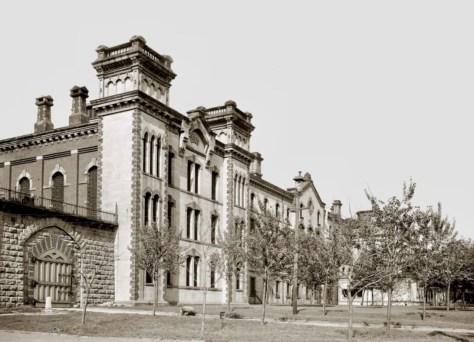
The following letter was signed by a civilian named C. C. Wright while employed as a guard at the State Prison in Columbus, Ohio, in October 1865. I was not able to identify him further but from the content of the letter it appears that he had spent some time in Sonoma county, California, prior to the war. Perhaps he came back East to enlist as a Union soldier. In any event, he was not in military service when he wrote this letter to his friend William who lived presumably in Sonoma county where the other people mentioned resided.

The second paragraph contains interesting content pertaining to Reconstruction. The author expresses disappointment that President Johnson was too lenient on the South—a widely held belief that caused resentment particularly among Union veterans. “It seems rather poor encouragement for a man that has been out for three or four years and come home with the loss of a leg, or an arm, to see those same rebels that he has been fighting, walk up to the ballot box and vote treason again, just by simply taking the oath when we all know that God Almighty is not capable of getting up an oath that is too sacred for them to break…It does seem as though he had better put them on trial for from 5 to 10 years and then if they would get humble enough to make good citizens, let them vote—but not before. But we have fought them in the field and I expect that we will have them to fight at the ballot box and I will try and not miss a shot!” he wrote his friend.

The Old Ohio State Prison in Columbus, Ohio

Transcription

Columbus Ohio
October 1st, 1865

My dear friend William,

I will now answer your letter of July 16th, which I received about 15th of September. I had began to think that I was not agoing to hear from California again, but I find that I yet have friends alive in California. You do not know how much good it did to me to hear from you, but I was sorry to hear the sad news of Mrs. [Lucy] Fike’s 1 & Henry Stephen’s death. I do not know how Mr. Fike can reconcile himself to live without her for Lucy was everything to him. Poor Henry. I was sorry to hear of his death. He did not have very good luck anymore than myself. I was afraid that his friends would be a little too sharp for him from what he had told me about them, but that is the way of the world, some make money and others get it. It is strange that I cannot get a letter from Brooks Beeson 2 for I have written to him three times since I have got an answer from him. But I suppose that he always finds something else to do. I am sorry that they have not got their place paid for yet.

Well, William, this wicked war is over and what do you think of old Andy’s way of reconstruction? It does look to me as though he was a little too soft with them. It may be for the best, but I cannot see it. It seems rather poor encouragement for a man that has been out for three or four years and come home with the loss of a leg, or an arm, to see those same rebels that he has been fighting, walk up to the ballot box and vote treason again, just by simply taking the oath when we all know that God Almighty is not capable of getting up an oath that is too sacred for them to break. They have been tried on all kinds of oaths and we have never found one yet that would hold them. It does seem as though he had better put them on trial for from 5 to 10 years and then if they would get humble enough to make good citizens, let them vote—but not before. But we have fought them in the field and I expect that we will have them to fight at the ballot box and I will try and not miss a shot.

I am at present at work at the Ohio State Prison as guard over the prisoners. The wages is 45 dollars per month & board. It is a very lazy job and for that reason, it does not suit me. I think that I will break for the frontier next spring—perhaps to Fort Leavenworth. I do not have any liking for Northern cities anymore.

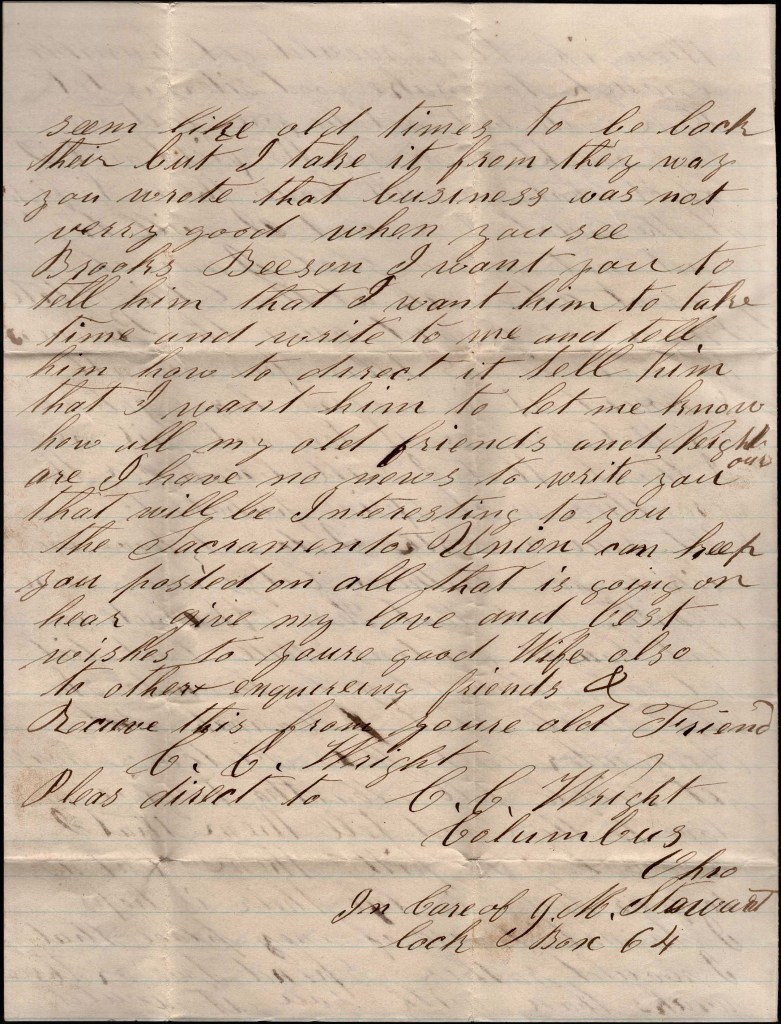
Martha wrote that Harry Alexander had bought Gordon’s Mill but did not say where old Gordon had gone to. She also wrote that Hannah Alexander and Miss Fletcher was yet single. Tell Martha to give my love to them and tell them that I know how to pity them, but as long as there is life, there is hope. I do not know of any place that I would rather spend two or three weeks than with you. It would seem like old times to be back there. But I take it from the way you wrote that business was not very good. When you see Brooks Beeson, I want you to tell him that I want him to take time and write to me and tell him how to direct it. Tell him that I want him to let me know how all my old friends and neighbors are. I have no news to write you that will be interesting to you. The Sacramento Union can keep you posted on all that is going on here. Give my love and best wishes to your good wife; also to other inquiring friends, and receive this from your old friend, C. C. Wright

Please direct to C.C. Wright, Columbus Ohio, in care of J. M. Stewart, Lock Box 64


1 Lucy R. Fike (1826-1864) died in near Healdsburg, Sonoma county, California on 19 May 1864. She was the wife of Nathan Fike, who was employed by the Internal Revenue Service in 1870.

2 John Brooks Beeson (1819-1875) of Healdsburg, Sonoma county, California was a member of the California Legislature in 1863. Before going to California, Brooks lived in New Boston, Mercer county, Illinois, where he was the postmaster. He was born in North Carolina.

1864: George William Yoe to Friend George

The following letter was written by a commissioned officer aboard the USS Thomas Freeborn in May 1864. He signed his name “George” and gave us few clues except that his letter suggests he was Baltimore, Maryland, and that he had a brother named “Gus”—probably Augustus. We know he was an officer because he mentions the possibility of tendering his resignation if the war did not end soon.

After reviewing Census and Naval Records, I’m inclined to attribute this letter to George William Yoe who enlisted in May 1861 as a Landsman, but was commissioned an Acting 3rd Assistant Engineer as of 8 August 1863. His naval record suggests he may have served on two or three ships before being assigned to the Thomas Freeborn.

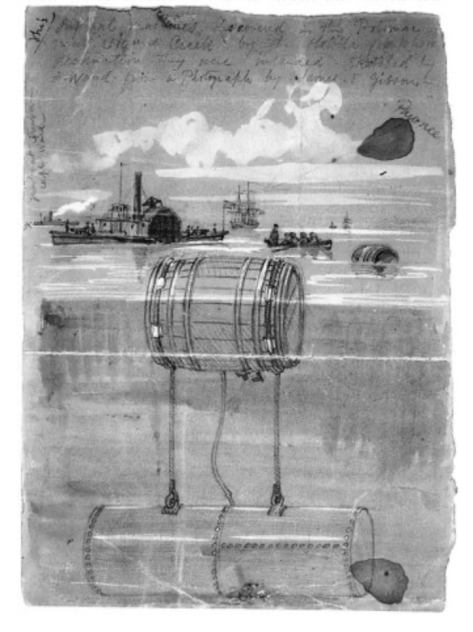
In his letter, George relates an accident that occurred to the Thomas Freeborn while ascending the Rappahannock river toward Fredericksburg on a mission to clear the river of torpedos and infernal machines. While en route, the pressurized cylinder of the steamboat’s engine ruptured with a loud noise and spewed hot steam into the vessel, causing injuries to the crew and disabling her.

I thought I might be able to confirm George’s identity beyond a doubt by finding his brother Gus in the naval records or census records but I could not. The explosion of the USS Gunboat Commodore Jones on which Gus served was so absolute, that the Navy did not have a list of the sailors that survived for weeks as the few survivors were picked up and hauled off on other vessels.

Sighting a gun on board the USS Thomas Freeborn, 1861 (LOC)

Transcription

U. S. Steamer Freeborn
Naval Station, Potomac River
May 21st 1864

Dear George!

Your kind and welcome letter of the 12th reached me this morning or rather reached the vessel, for I was not aboard at the time it came, having had big stroll over the country all day, visiting all the country taverns in St. Mary’s county engaged in filling ourselves with beer to our heart’s content. I am so damned tired now that I am hardly able to move, for I think that I travelled at least 30 miles during the last 12 hours, and I am not used to walking much anyhow.

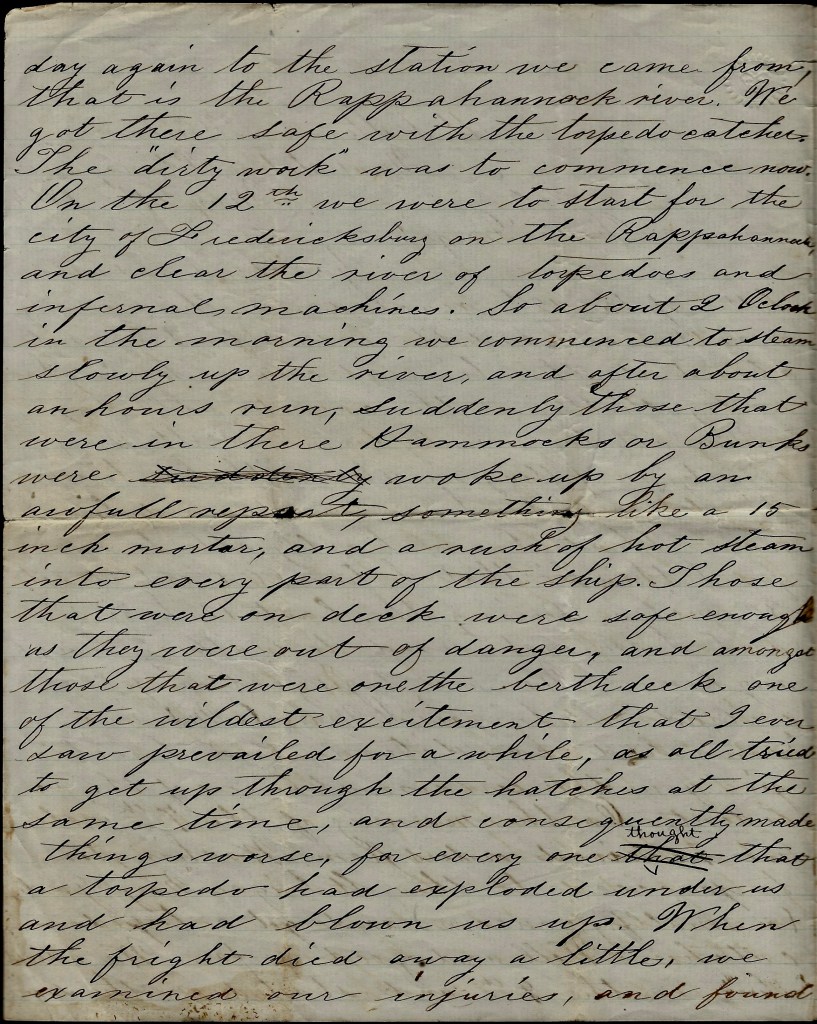
We are laying at a place called St. Inigoes, St. Mary’s county, Maryland, in a “smashed” condition, and I will give you the circumstances of the accident. On the morning of the 7th instant, we received orders from Washington to proceed to the St. Inigoes “Navy Yard” (a small concern) and get a torpedo catcher. Well and good so far. We arrived there on the 9th and started on the same day again to the station we came from—that is, the Rappahannock river. We got there safe with the torpedo catcher. The “dirty work” was to commence now.

A sketch by A. Waud depicting a launch from the Thomas Freeborn approaching a cask-floating mine. (LOC)

On the 12th we were to start for the City of Fredericksburg on the Rappahannock and clear the river of torpedos and infernal machines. So about two o’clock in the morning we commemced to steam slowly up the river and after about an hour’s run, suddenly those that were in their hammocks or bunks were woke up by an awful report—something like a 15-inch mortar—and a rush of hot steam into every part of the ship. Those that were on deck were safe enough as they were out of danger, and amongst those that were on the berth deck one of the wildest excitement that I ever saw prevailed for awhile as all tried to get up through the hatches at the same time and consequently made things worse for everyone thought that a torpedo had exploded under us and had blown us up.

When the fright died away a little, we examined our injuries and found that our cylinder had blown to pieces from some unknown cause. The cylinder is 52 inches diameter and 11 feet stroke and you can imagine the thunder it made when it bursted. A few men were slightly scalded and no other damage was done.

Well, this put an end to the expedition and the next day we were towed up to the Potomac by a steam tug. It might have been all for the best for we might have been blown up otherwise if we would have tried to get up the river. We are having a big thing of it now, but lose all sight of the fight that is going on now which we might have otherwise joined in.

Well, George, you asked me my opinion about Grant and the army. Well I think he is the best man in the army and has some chance of taking Richmond but I think he will have a hard job of it. As far as I am individually concerned, I don’t care a damned whether “school keeps or no,” for I am disgusted with the war, and I pray to God that it will end soon. If I don’t see any prospect of it ending this summer, I am going to resign for I think that I have done my share towards it, for a fellow is throwing his life away here. I am got the “blues” half of the time, and I believe a fellow might as well be in Hell as live discontented on board of a vessel. If I would try to get off now, I would most likely be sent to the Charleston fleet which would be like jumping from the frying pan into the fire so I will have to wait until the present campaign is over when I will stand a better chance of having my resignation accepted.

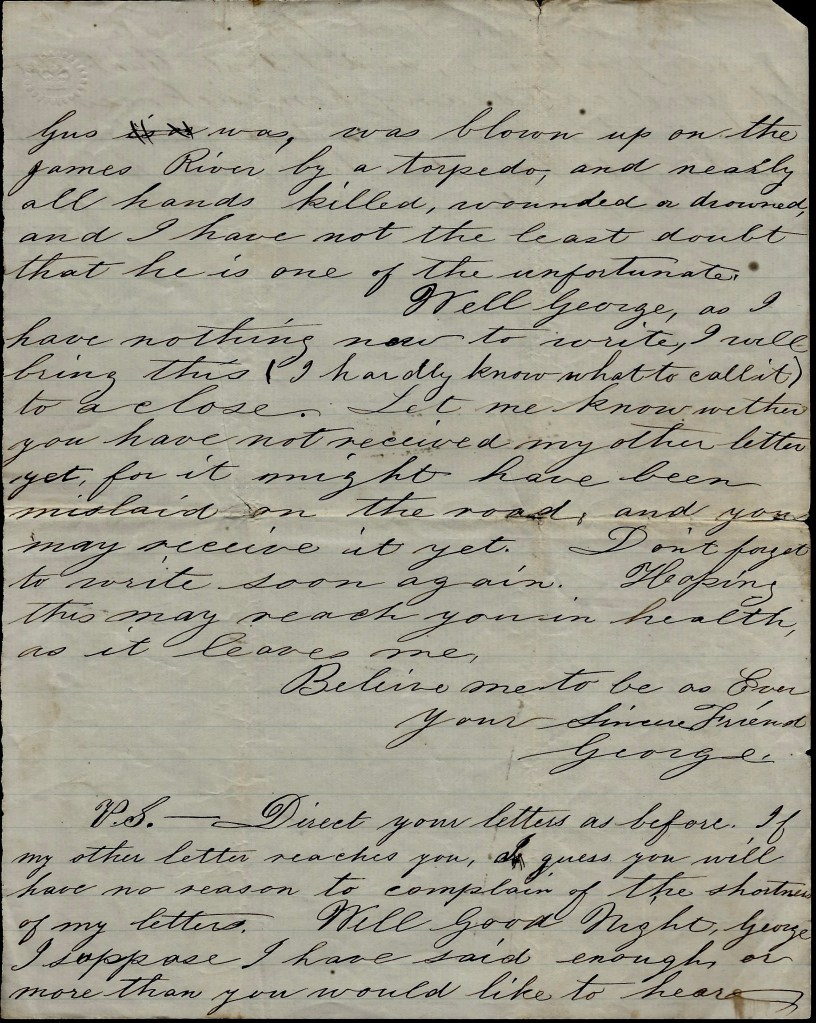
I received a letter from Punch about 15 days ago and he is well. I have not heard from Baltimore during the present month as some of my “correspondents” are getting pretty damned slack about writing, so I don’t hear much more from there than you do. I am very anxious to hear from home anyhow, as the Gunboat Commodore Jones 1 on which my brother Gus was, was blown up on the James river by a torpedo and nearly all hands killed, wounded, or drowned, and I have not the least doubt that he is one of the unfortunates.

Well, George, as I have nothing new to write, I will bring this (I hardly know what to call it) to a close. Let me know whether you have not received my other letter yet, for it might have been mislaid on the road, and you may receive it yet. Don’t forget to write soon again. Hoping this may reach you in health as it leaves me. Believe me to be as ever your sincere friend, — George

P. S. Direct your letter as before. If my other letter reaches you, I guess you will have no reason to complain of the shortness of my letters. Well good night, George. I suppose I have said enough, or more than you would like to hear. I think you look first rate in your picture ad I don’t think that it indicates any homesickness. I hardly think it is worth apologizing for bad writing as I might have done better and have no excuse for it. Yours, — George


1 The USS Commodore Jones was a side-wheel ferryboat acquired by the Union Navy, valued for its flat bottom and shallow draft that could navigate up rivers in the South. She performed picket and patrol duty, dragged for torpedoes (mines), skirmished with enemy cavalry, shelled shore installations, and captured contraband goods with her shore parties. She patrolled the James River frequently in the course of her service, and there on 6 May 1864, she was destroyed by an electrically fired, 2,000-pound torpedo. The explosion claimed 40 lives.

1864: Henry McKenzie to Phoebe B. Edy

The following letter pertains to Edwin Martin Whipple (1842-1904), the youngest son of Herman Whipple (1774-1842) and Phoebe Boa Lafferty (1816-1904) of Erie County, Pennsylvania. Edwin served in two different regiments during the Civil War. He first enlisted in enlisted in Co. C (the “Jackson Guards”) of the 23rd Illinois Infantry—the “Irish Brigade” led by Col. James A. Mulligan of Chicago. He marched with them on their expedition into Missouri and then was mustered out with the regiment in October 1861, after six months service. He then enlisted in late November 1861 to serve three years in Co. C, 111th Pennsylvania. As far as we know, Edwin remained with the regiment and was with them at the Battle of Gettysburg where he shot the hat off a rebel Colonel while skirmishing in the twilight of 2 July 1863. In the book, “Soldiers True; the story of the 111th Regiment Pennsylvania Veteran Volunteers” (page 181), Edwin is listed among the wounded at the Battle of Lookout Mountain on 24 November 1863. The company roster indicates he mustered out of the 111th in late November 1864.

The letter was penned by someone named Henry McKenzie who was most likely fulfilling the duties of a hospital warden or nurse. It appears that the content of the letter was dictated to him by Edwin and that he (Henry) was not a member of Edwin’s regiment. He may have been the sergeant in the 5th Ohio Infantry by that name who was transferred to the 2nd Battalion, Veteran Reserve Corps. It’s not possible to confirm his identity. The letter does provide us with more details of Edwin’s history following the Battle of Lookout Mountain, however. Edwin’s letters can be found at The Glorious Dead.


Transcription

Tullahoma, [Tennessee]
January 10th 1864

Mrs. Edy,

Madam, at the request of your son [Edwin], I address you to let you know how he is getting along. He received your letter of 30th December day before yesterday and was happy to learn that you were all in good health but thinks that Jim was foolish for enlisting.

I am sorry to inform you that his wound is much worse than it was. He got cold in it and in consequence, his shoulder is very much swollen. The doctor is under the impression that it will require to be lanced. He is unable to leave his bed but we hope that with the return of warm weather that he will speedily regain his strength. He wished you to write frequently to him and not await his replies as he is not personally able to do as yet. He wishes you to tell Jim to stay and see him as he passes. All the trains stop at Tullahoma and he cannot miss seeing the Hospital. It is the largest building here and immediately beside the Depot on the left hand side.

I remain, Madam, yours respectfully, — Henry McKenzie

P. S. He forgot to mention that he seen the Regiment going home but did not see Ben. He saw Capt. Todd and Jim Raymond of Co. H. Raymond would tell Ben the condition he was in when he saw him. — H. McK