My passion is studying American history leading up to & including the Civil War. I particularly enjoy reading, transcribing & researching primary sources such as letters and diaries.
The signature on this letter has been shaved off the bottom of the digitized image but enough of it remains and because I have transcribed a couple of his letters before, I can be confident this letter was penned by Elmore Yocum Warner who served as the Chaplain of the 3rd Ohio Cavalry from the time of its formation until August 1862 when he resigned. [See: Letter of 18 July 1862 from Woodville, Alabama] The following letter was written on 31 March 1862, just one week before the Battle of Shiloh.
Warner lived in North Fairfield, Huron county, Ohio. An obituary for Warner published in the Wayne County Democrat on 14 July 1886 said of him:
“This well-known minister of the North Ohio Conference of the Methodist Episcopal Church, and son of the late Rev. Jesse Warner, was born in Wayne County, July 3, 1833, and died in Norwalk, Oh., July 6, 1886, aged 53 years. Mr. Warner, after a faithful use of the educational advantages furnished by the common schools, entered the Ohio Wesleyan University and while he did not complete the course, he did lay the foundation of a respectable scholarship, which enabled him to pursue so intelligently his future studies in connection with his ministry that, subsequently, the Faculty and Trustee of the University felt justified in conferring upon him the honorary degree of Master of Arts. He was married in 1857 to Maria Lee, of Huron county, who survives, with five children, one of whom is also a minister, and represents the third generation of the same line in succession in the same Conference. During the Civil War, Warner served as chaplain of the 3rd Ohio Cavalry and was on the field of Shiloh; but the exposure in the service being too severe for a constitution not naturally robust, he secured his discharge, but had already laid the foundation of the disease to which, after heroic struggle for years, he had, at last, to yield….”
Transcription
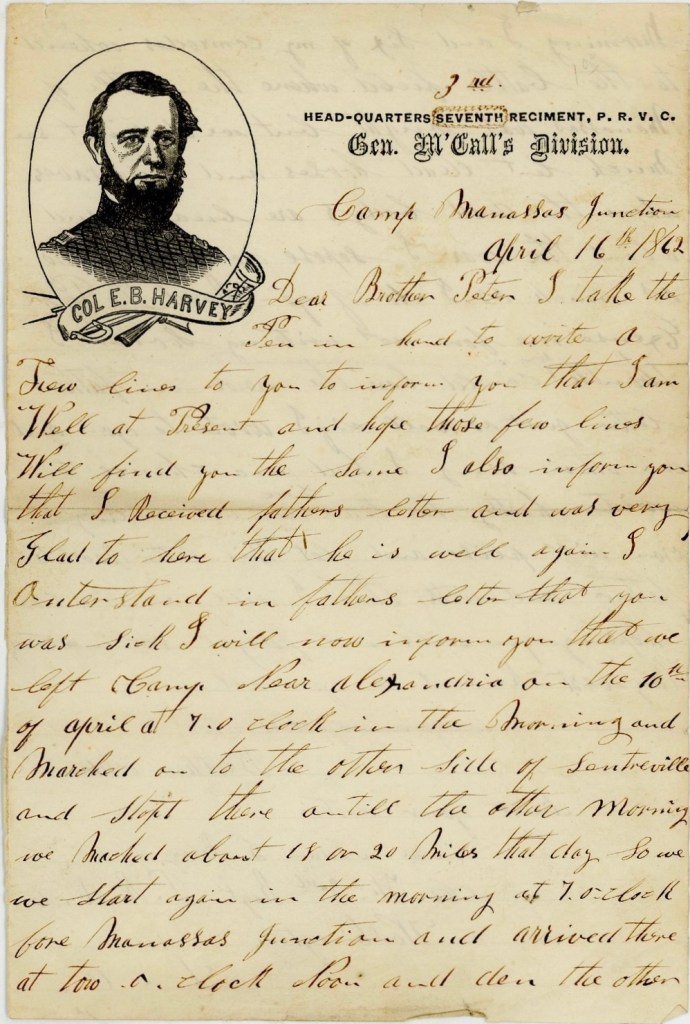
Patriotic stationery used
Camp near Columbia 3rd Ohio Volunteer Cavalry March 31, 1862
Dearest wife.
Longer time has elapsed since I wrote you than I intended should but with moving & changing I have been unable. We left Nashville last Saturday and have now marched three days on a very dusty pike lime dust which is suffocating almost. But I have stood it well and am able to eat my full rations. We have passed over a beautiful country.
Yesterday we passed through the town of Franklin in which Sidney and Benjamin Hildreth reside. Capt. Frank Hunt stopped at Ben’s house and said that Ben and his wife wished to be remembered to you. I see Frank and Bill Hunt everyday. As I told you, we are attached to the Sixth Division of Gen. Buell’s Army under Gen. Wood so you may know by this when you read of us. Gen. Wood has under him some fourteen thousand. These all march together. Then there are several divisions just before us.
There is perhaps 60,000 troops within two or three miles of this point. Gen. Nelson’s division is just ahead of us perhaps five to ten miles and perhaps not so far. I can’t ascertain where they are—only that they are a short distance before us. Tod is in that. I expect to see him yet but when I know not. That division is in the advance.
We all expect to participate in the great battle soon to come off near Corinth, Mississippi. I suppose it will be a desperate one and one that will decide the contest. I want to be at home but I am so far in the enemy country, if there is to be a battle, I want to see it. For your sake, I will try to keep out of danger but I expect if this conflict commences, I will feel like having a hand in it.
I dropped you a line the other day informing you of Jason going home. There were a number of reasons why I sent him. 1st, he seemed to want to go, yet was willing to stay. 2nd, his clothing was worn out and I could not get him any here. 3rd, I feared he might get sick and I would have to stay with him for I could not leave him in a hospital for he is his mother’s baby and I should feel bound to care for him. 4th, I thought it best for him to work where he would be learning something or else going to school. If you or Mother could find a place where he could do chores for his board and go to school, I think it would be well. Or if you can find a good place for him to work this summer, do so. I gave him twenty-five dollars when he left which would take him home and get him all the clothes he wants, perhaps more. If he has more than he wants, I told him to give it to you or Mother. Watch over him and try to keep him a good boy. I felt somewhat lonesome after he left. Sergt. Major [James Ransom] Hall is my room mate now. Your friend. He now sleeps on the ground while I am writing.
My dear wife, I have only received letters from you once. True, I received three at that time but it has been some time since the reception of them. Please try to write often. We get our mail very irregularly but it generally comes some time so write. I know you love me and will do anything you can to make me happy. Then write sweet letters of love and if I have done or said anything to afflict you, I beg pardon for it all. I have read and reread your letters with great interest. You ask in one if you are any comfort to me? Wife, you make my happiness next to God. you cannot imagine the comfort you are to me—how many thousand times I have been cheered by you. I love you with all my heart and now I miss you, I just realize how much I am dependent upon you for my happiness. I will send as often as I can.
Wife, if anything should happen to you—if you should be very sick or anything of that kind, try telegraphing first. But if you can’t reach me that way, send a messenger to me and I’ll pay the expenses. But I trust in God that nothing will happen to you. Oh God should be our trust constantly. Wife, spend hours in prayer. If the war don’t close in a couple of months, I think I shall resign and come home. But don’t tell anybody this.
I understand we are to march at half past three tomorrow morning in order to pass another division. Tod may be thirty miles ahead of us.
I must close. I never can close until I have filled my sheet when writing to you. Write often and direct to 3rd O. V. I., 6th Division, Gen. Wood, Nashville, Tennessee. Your loving husband, — E. Y. Warner A kiss.
The following letter was written by Edgar W. Irish (1838-1897), the son of George Irish (1810-1888) and Maria Edgerton Potter (1810-1844) of Little Genesse, Allegany county, New York. Edgar enlisted in Co. C, 85th New York Infantry with his younger brother George Hadwin Irish in September 1861. Edgar was made a corporal upon mustering into the regiment and was promoted to sergeant in April 1862. His beautiful penmanship no doubt earned him the rank of 1st Sergt. in August 1862—his highest rank.
1st Sergt. Edgar Walton Irish of Co. C, 85th New York Infantry
In April 1864, while garrisoning the forts at Plymouth, North Carolina, both Edgar and his brother George were taken prisoner with approximately 500 others when the town was surrendered. He and George were sent to Andersonville Prison, George. A source on Find-A-Grave claims that Edgar’s fine penmanship and bookkeeping skills earned him a job at the prison that enabled him to be kept separately and fed better than his fellow prisoners. All the while, however, he worried about his younger brother and after months of pleading, he was finally allowed to search for George but found that he was too late; George had passed away the day before of starvation and dysentery. Edgar was determined that the truth would be known about Andersonville, and seek revenge for his brother George. He found records and concealed them on himself when he was released from prison. Later this evidence was used at the trial of Capt. Wirz. Along with George 310 Soldiers from the 85th died as prisoners of war, the most men of any unit in the Northern Army. George Hadwin Irish is buried at Andersonville National Cemetary, Sumter County, Georgia, USA Site#4587, Findagrave Memorial#28873296.
There is a cenotaph in Edgar’s name at the West Genessee Cemetery that has the following inscription carved into the base: “He made, preserved and supplied the evidence that made possible the execution of Capt. Henry Wirz. The keeper of Anderson Prison.”
A lantern slide of the Wirz Execution in Washington D. C. (W. Griffing Collection)
Transcription
Camp Shephard Washington D. C. December 12th 1861
Dear Cousin Lottie,
It has been a long time since I have had a letter from you and longer since I have written to you. Now if you will forgive me for waiting so long and as I am temporarily located, I’ll set my quill to running. A letter would be quite a rarity to me now for I have not had one since I came from Christendom. Lottie, I have just been reading your last letter and I am sure I cannot write one to match it for interest. I have give almost my whole attention to military matters so long that I find it almost impossible to make a connected composition or even to reason clearly as I could once. All my thoughts by day and dreams by night are in some degree connected with this great rebellion.
Cousin Amy seems to censure our [Chief] Executive in very strong terms. Quite likely the President has made some mistakes but I think he has done as well as he knew how—and that is tolerable well. The case of General Fremont was not managed to suit me, or you of course, but I do not know it all and I am satisfied that there is something about it that which has never been made public. 1
“Uncle Sam” has a splendid army on the Potomac and if ready for defense and probably for offense when the proper moment arrives. Regiments are coming in here every day. One came today from Elmira (the N. Y. 64th State Militia). They pitched their tents next to ours. We are encamped under canvas and are doing as well as could be expected of backwoodsmen.
My health is getting quite good now. I was off duty on account of the measles till we left Elmira, since which I have done my part, I believe. I was very much pleased with your remarks concerning your cousin G. and I hope you may always have so good a counselor near you. I want you to give him my best respects and tell him that if I am spared to return to the North, I wish to gain his acquaintance.
It is quite warm here compared with Allegany Co. I am writing by candlelight in my tent without a fire though my fingers are cold. We arrived here last Thursday and have had but two or three frosty nights since. Some of the boys in the next tent have a copy of the Jubilee and an overhauling some of its familiar tunes which disturb me not a little.
Oh Lottie, I wish you could be here just long enough to see how our soldiers get along, to see and laugh over our cooking arrangements, to hear our martial music (at this moment the band is playing Dixie, and three or four times a day we have “Maggie Dear,” “The Girl I left behind me,” etc.) which makes the heart of every patriotic soldier or citizen thrill with joy, to see the glittering mass of bayonets as the men gaily fall into line. Oh, I am glad I’m in this army. Yes, I’m glad I’m [in] this army,” and we’re bound to win or die.
I’ll try and finish this tomorrow, Good night.
Sabbath morning, and I cannot make it seem like Sabbath at all. I did not get time to finish yesterday and have but a few moments now. I enclosed a card photograph which is a little better than none at all. The drum is sounding and I must close. Please write soon. My love to you all. Your brother cousin, — Edgar W.
1 In August 1861, General John Fremont imposed martial law in the state of Missouri and declared all rebel owned slaves to be free. Lincoln, fearing the loss of a loyal border state, rescinded Fremont’s order and relieved the General of his command.
The following letter was written by Sgt. William Buchanan of Monroe Township, Holmes county, Ohio, who served in Co. B, 16th Ohio Volunteer Infantry. Sgt. Buchanan (not to be confused with Capt. William H. Buchanan of Co. F) served until he was discharged for disability on June 19, 1863, having participated in the regiment’s most bloody battles. Buchanan later re-enlisted as a 2nd Lieutenant in Company A of the 166th Ohio Volunteer Infantry, serving from May 2 until September 9, 1864.
When he enlisted, William took stock of the professions/trades of those who served in his company. He found the following: 66 Farmers, 13 carpenters, 11 school teachers, 2 blacksmiths, 1 shoemaker, 1 miller, 1 minister, 1 student, 1 potter, 1 surveyor, 1 sawyer and engineer, 1 clerk, 1 saddle & harness-maker, 1 teamster.
Transcription
Patriotic Letterhead of William’s stationery, “Strike for the Memory of Washington.”
Cumberland Ford, Kentucky April the 23rd 1862
Cousin Em,
It has been so long since I wrote to you that no doubt you begin to think that something has happened me or that I have got away down Dixie & have forgotten Cousin Em. I often think of you & would like to see you & talk with you & east sugar & have such times as we had in times past & gone. But all this is very different from soldiering away down here.
Well, the reasons why I did not write sooner. I have so many persons to write to and have much to do as I act Orderly Sergeant. Sometimes we could hardly get writing material in this poor, forsaken country, and the troubles, trials, sickness & deaths at home called my anxieties to one place & the sad conclusion has come & home will never be as it was when I left. I take time to write home once a week for I know they must be very lonesome & as it is impossible for me to go home. I try to cheer & encourage them all that I can. I know they are anxious to hear from me often & I am thankful that I can tell them that my health is unusually good & that I have not been on the sick list since I came to camp. I have endured long, tiresome marches through the mud & rain, lay out all night in the rain, snow, and winter winds, lived on unsifted corn meal & old rusty bacon almost as strong as last year’s butter in Cuba, & sometimes half rations of that. But so long as I enjoy good health, I think I can endure these light afflictions cheerfully for the sake of a country & that a free country.
We have been camped here on the Cumberland river since the 12th of February. We have not pushed into Tennessee for two reasons. First, our provisions have to be hauled from Lexington and the roads were almost impassable during the Winter & Spring & sometimes we could hardly get enough this far to eat, and our force was too small to attack so formidable a place as the [Cumberland] Gap. The Gap is 13 miles from the Ford which is at the bend of the river where it approaches nearest the Gap. We have bee three trips to the Gap. The first & last time to reconnoiter & see the enemy’s works.
On the 21st of March, four regiments & two pieces of artillery were sent to take possession of the Gap as we heard that nearly all the rebels had left it & taking 8 of their cannon & had gone to try to capture a regiment of Union soldiers sent from our Brigade to Big Creek Gap, 35 or 40 miles southwest of Cumberland Gap. But when we got there, we found that the rebel force with their cannon & perhaps a reenforcement had come back and were waiting for us.
On the 22nd we concluded to tease them awhile before coming back to camp anyhow, so we marched up within gunshot & firing on both sides was pretty brisk most of the day. They threw shells, solid shot, & grape at us, but in the whole day they did not kill or wound one of our men—although many had hair breadth escapes. We got an 8-inch shell shot from a 64-pounder Columbiad gun which did not explode. But our Parrot guns (cannon) made them hunt their hiding place in double quick—if not quicker.
On the morning of the 23rd (Sunday), we did not fire a gun but prepared to come to camp. The enemy threw a number of shells at us. We since heard that the enemy were about to leave the Gap when we came away & that if we had stuck to them that day, the Gap would have been ours. It looks almost like an impossibility to take it, if the Rebels will fight. We lay out on the mountains both nights in the snow & it was quite cold. The first night I think I’ll not soon forget. I was so chilled that I shook as though I had the ague. I have grown fat and hearty on privations and toils that I used to think would kill me. I will try to get time to sketch an outline now of the Gap which will give you a better idea that I can give in writing. I have drawn a great many of them & some on a large scale, finished & ornamented.
Map of Cumberland Gap drawn by William Buchanan for John F. McClelland of Co. B, 16th Regt. O. V. (not enclosed with this letter but found on the internet)
I have so much writing to do in the Orderly Book at present that I cannot spend much time at anything else. I wish you could see the real Gap. It would be the greatest sight of scenery that you ever saw. Such sights are scarce in Hoosierdom. But perhaps you would not prefer to enjoy the sight while the shells and shot are whizzing around like hornets. There is to be a reinforcement of men & cannon here soon & then I think we will be in earnest the next time we pay them our compliments.
Please show this to Uncles. Please write to me and direct to Co. B, 16th O. V. via Louisville. In care of Capt. [Joseph] Edgar. Give my love & good wishes to the rest of the family and relations. Yours soldier cousin, — Wm. Buchanan
The following letter was written by Nathan Crawford (1841-1863), the son of Irish emigrants John Crawford (1810-1900) and his wife, Charlotte Saunders (1812-1888), who took up farming near Dover, Racine county, Wisconsin. Nathan enlisted on 4 September 1861 to serve three years in Co. C, 1st Wisconsin Infantry. He was killed in action at Chickamauga on 19 September 1863—“shot through the head in the first volley the Regiment received.” [Racine Weekly Advocate, 7 October 1863]. Although this letter is only signed “Nathan,” the content leads us to Co. C, 1st Wisconsin Infantry and he was the only one by that name on the roster.
Twenty-two of Nathan’s letters were offered for sale by “West Coast Civil War Collectors” recently which were described:
Ambrotype of Nathan Crawford and his sister Isabel
“During his term of service, Private Crawford corresponded with his sister, Isabella, with whom he appears in this 1/6th plate tintype. Housed in its original case, but missing its front cover, Crawford’s affection for his sister is evident. A grouping of twenty-two letters, mostly from Pvt. Crawford to “Bella,” accompanies the tintype. His descriptions of camp life, marching, and fighting are interspersed with loving advice for his younger sister regarding her affairs at home. Pvt. Crawford saw conflict at Martinsburg, the battles of Falling Waters, Perryville, Stone’s River and finally he was killed during the fighting at Chickamauga on September 19, 1863.
Over the ensuing months as Isabella mourned her brother’s death; she was outspoken against Confederate sympathizers in her township. Her fervor culminated in a memorable scene in the railway station near her home, when a Copperhead defamed the memory of her soldier/brother and drew her wrath. The incident made the newspapers. For her dedication, Isabella received notes of congratulations and gifts from local citizens and unknown admirers, also included in the group of twenty-two letters.”
This letter is not from that collection.
Transcription
Negley’s Brigade Green River [Kentucky] January 31st 1862
Dear Mother,
Patriotic imagery on Nathan’s stationery
I have been sick for two weeks but I am getting better now if I only continue for I tell you, it is a poor place for a sick man. We have no dry weather here scarcely, and it is very muddy all the time, and it is very unhealthy. We have moved into a different kind of tent. We are 17 and 18 in a tent. We have a little stove in it and it makes it quite comfortable. We are not allowed to cook our own victuals. Our Colonel [John C. Starkweather] said that we must have a company cook and that the men should not cook anything in their tents. I do not know whether there will be sickness with so many in a tent or not. Six and seven were the most that slept together in the other little tents. In the little tent, we had things more convenient than we can possibly have in these, for these are round and the others are square, and were not so low in the side. In these large tents we sleep with out feet all toward the center.
We would have fine times if we had dry weather all the time, but it is just the contrary and when anyone goes out he will have to tread mud till he comes in again, and when he does come in, he brings a god share of mud with him so it is almost impossible to keep the tent clean. It is a very unhealthy climate according to my notion.
I am very very much disappointed in my notions of Old Kentucky. My idea is that it is a poor place for either man or beast. My sickness commenced by a cold, and a loss of appetite, and when I would cough, I would puke up large quantities of bile. I would drink water very often and what little I did eat, would pass through me the same, only as thin as water which I drank was the occasion of that. I got some powders from the doctor which stopped my dysentery and also my puking up bile. My cold is better. I do not have a cough. My appetite is poor yet, but it is increasing. I am very weak yet but I am able to walk around. I hope I will soon get strong again and I think if I am very careful that I will.
We uses coffee for our drink at almost every meal and I think that it is not good for me for I think it increases the bile on my stomach very fast. We use the river water which is the best that we have. It is rather rolly sometimes. I do not drink coffee now. We have black tea sometimes and I drink that.
Co. C has lost more of its members. It is Mr. Isaac Grote of the Town of Waterford. 1 He was married and had one child. Before he left camp he wrote for his wife to come to Louisville to take care of him there. He was taken to Louisville the next day and he was then taken with typhoid fever and died in about three days after he left camp. Capt. Hill was with him when he died. He wanted the captain to read the Testament to him and told the captain when he was dying that it was the best medicine that they had given him. He was liked by all the boys in the company and his death was heard of with surprise and sorrow, but few take it as a warning to them to “be ready always for in such an hour as ye think not, the Son of Man cometh.” We ought to bless God for every hour of life that we enjoy instead of taking his name in vain every hour that we live (which is the way that the most of our men do). It is awful to hear what oaths are sworn in camp. It hurts my feelings to hear it. It is a wonder that some are not stricken down instantly.
Dear mother, I send my love to you and father and all my sisters and brothers, I am your living son, — Nathan
1 Isaac Grote (1837-1862) enlisted on 3 September 1861 to serve in Co. C, 1st Wisconsin Infantry. He died of typhoid fever at Louisville on 5 January 1862. He was married to Almira Jane Eastman in 1859 and had a son named Sherman A. Goat (1859-1940). His remains were sent home to Waterford.
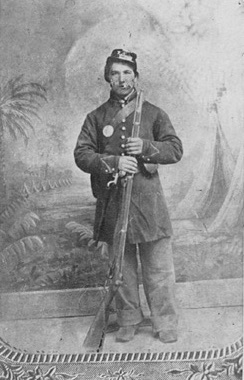
I could not find an image of Ed but here is one of Frank Snell of Co. E, 1st Massachusetts Heavy Artillery (LOC)
Inspired by the patriotic celebrations in his hometown of Danvers, Massachusetts, on the 4th of July 1861, Edward Calahan walked into the local recruiting office the following day and enlisted in Co. I of the 1st Massachusetts Heavy Artillery. He enlisted as a private and later rose to corporal. He was with his regiment when they were sent to the Virginia battle front to participate in Grant’s Overland campaign, joining the action just before the Battle of Spottsylvania Court House. He survived the action there, at North Anna River, at Totopotomoy Creek and at Cold Harbor but was wounded on 18 June 1864 in the first assault on Petersburg. He mustered out of the regiment three weeks later at the expiration of his term of service. His surname appears variously as Calahan or Callahan though he used the former spelling in this letter.
A sketch of Fort Runyon as it appeared in August 1861.
Transcription
Addressed to Miss Caroline Post, Wenham, Massachusetts
Fort Runyon 1 October 14th 1861
Dear friend Carrie,
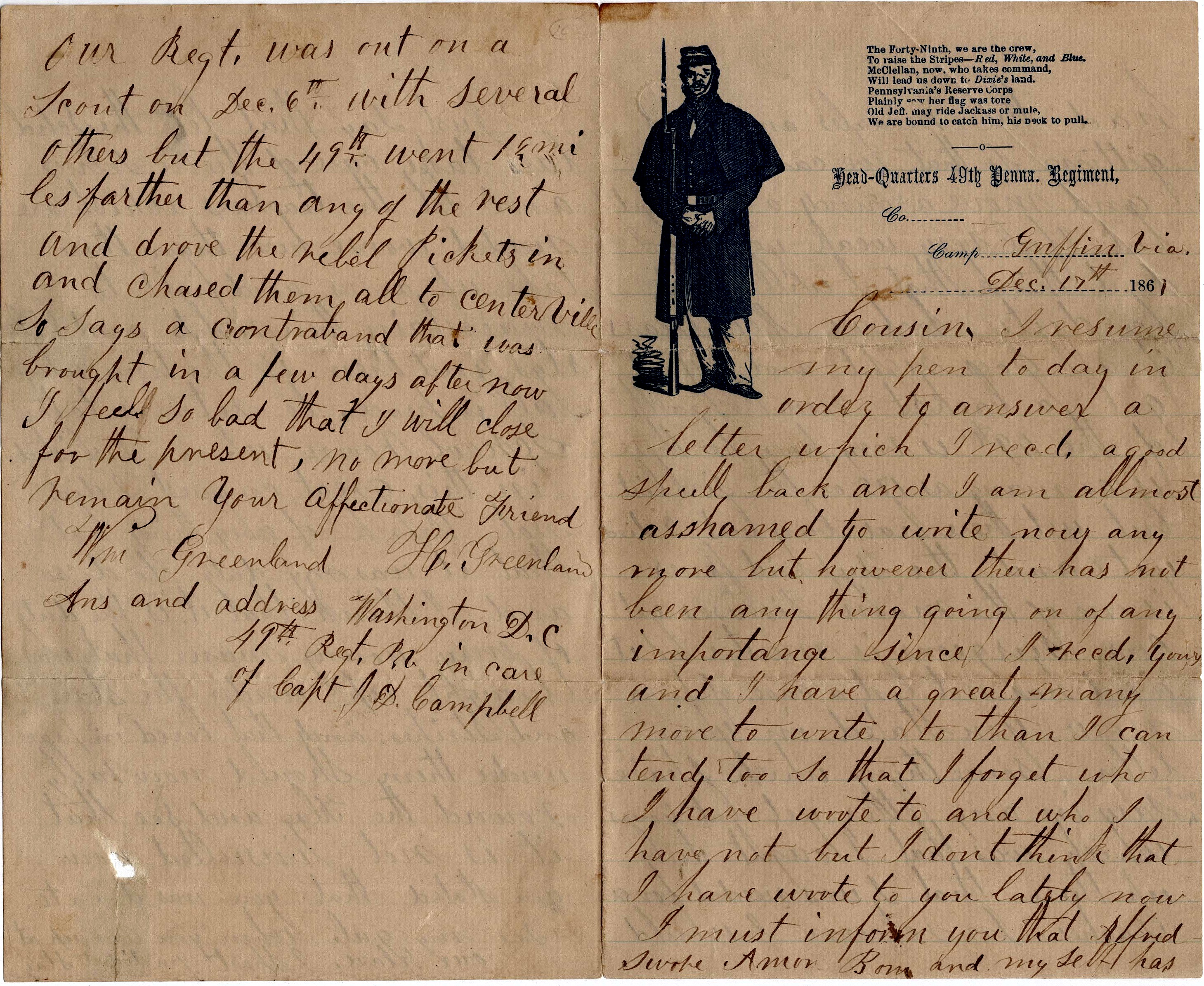
Patriotic letterhead on Ed’s stationery; Gen. George Washington holding sword with raised arm and foot on trail of cannon.
Having a few hours to spare and not finding anything to pass the time, I would write to you thinking perhaps that you would like to hear from an old friend and still I don’t think that I shall be able to write anything of interest to you—but I will try. I received your brother’s letter last night and was very glad to hear that you had not forgotten your old friend and the many happy moments that I have passed in your company. And I hope the day will come from when we shall meet again.
Well, to begin with, I hardly know what to say. About all the fellows in the tent are either playing cards or telling tough yarns. One is playing on what he calls an accordion [but] it seems as though he was trying to murder as many tunes as possible. Another is sawing on a violin. I think if he kills as many rebels as he does tunes, that the war will not last long.
“Another is sawing on a violin. I think if he kills as many rebels as he does tunes, that the war will not last long.”
— Edward Calahan, 1st Mass. H. A., 14 October 1861
The 22d Massachusetts Regiment passed through here today. They have gone to Baileys Cross Roads. I saw one of the Wenham boys in it. I don’t know his name. He used to live with Mr. Plummer. The Wenham boys in this regiment are all well at present. They all send their love.
Yesterday we had some fun getting possession of a couple of pigs. There was several got loose from the slaughter house and I wish you could see about five hundred of our boys take after them. Some of them were bare-headed and some with over coats on. We—our company—catched a good one. We had him killed and cut up before the Colonel knew anything about it. There, I suppose I have written enough on that strain yet. I don’t know what I shall write to interest [you].
There is some prospects of having a fight soon and I am glad of it for I want to have this settled as soon as possible for I am getting tired of laying still. I want you to write. I should like to hold correspondence with you. You and I always got along tip top together and I don’t see why we can’t continue to do so. Give my love to all the girls and fellows of my acquaintance and tell them to write. I must close now so good night and pleasant dreams—and believe me, I am your affectionate friend, — Edward Calahan
P. S. Please write soon as you get this.
1 Fort Runyon was built at the Virginia end of the Long Bridge to prevent access to Washington City by that route. The fort strategically sat astride two major thoroughfares, the Columbia and Washington-Alexandria Turnpikes, and adjacent to a major railroad line.
I could not find an image of Silas but here is a ninth plate tintype of Benjamin F. Rolph who was also a Sergeant in Co. B, 44th Illinois Infantry, a. k. a. “Northwestern Rifles” (Dan Binder Collection)
The following optimistic letter was written just three days before Gen. Curtis launched his Arkansas campaign from Lebanon, Missouri. The campaign ended with the capture of Helena, Arkansas on 12 July 1862. The army “marched quickly over the rough, frozen roads, and caught the Missouri State Guard, and its commander, Major General Sterling Price, by surprise. Price abandoned Springfield on February 13, and retreated south into Arkansas. The two armies fought a series of skirmishes along the way and on February 17, one week after beginning its campaign, Curtis triumphantly telegraphed Halleck, ‘The flag of our Union again floats in Arkansas.'”
But who was the “Sile” or Silas that wrote this letter? To narrow down the possibilities I searched through the infantry regiments that participated in the Arkansas Campaign of 1862, looking for any soldier named Silas who was a sergeant at the time, was single, and who had living parents. I found five candidates but only three of whom seemed to fit this profile completely. They were Silas B. Merchant of Co. G, 44th Illinois, Silas L. Parker of Co. B, 44th Illinois, and Silas Perry of Co. B, 35th Illinois. I could not learn from his record when Merchant was promoted to sergeant but think it may have been after the date of this letter which would rule him out. My hunch is that of the remaining two, the letter was most likely to have been written by Silas L. Parker as there are other letters of his in archives—one in the Bentley Historical Library at the University of Michigan and one in the Library at the University of Tennessee, though neither archive has made a digitized image of his letter on-line to allow for a handwriting comparison.
Silas L. Parker was from Coldwater, Michigan, and he first enlisted in Co. C, 1st Michigan Infantry as a musician on 24 April 1861. After that short term of enlistment ended, he reentered the service in Co. B, 44th Illinois Infantry as sergeant, August 21, 1861; promoted to second lieutenant, April 7, 1862, and captain of Co. B, August 15, 1862. He died January 19, 1863 of wounds received in action at Stones River, Tennessee. I’m going to attribute the letter to him in my list of transcribed letters with a [?] to indicate that I’m not absolutely certain of him being the author. The ambition he expresses in his letter and the popularity he obviously enjoyed with the officers of the regiment certainly point to him, however.
Transcription
Lebanon, Laclede County, Missouri February 7, 1862
Dear father, mother, brother & sister,
We reached the above place yesterday after a march of 6 days. It is situated about 70 miles from Rolla due west. You may think this is very little marching, but in the mountainous country in this season of the year when it is either hubs or mud, with a heavy knapsack and rifle, with accouterments complete, it is doing well.
Patriotic letterhead on letter with motto: “Washington. His Spirit Still Guides Us.”
I do not know but should judge from appearances that the army station[ed] here now would reach the number of 20,000 under the command of Gen’s Curtis, Sigel, Asboth, & Osterhaus. It is supposed here—to a certainty—that Price’s army is now at Springfield and determined to make a stand. If this is the case, we will probably soon call on him and I don’t much think he will admire the result of the visit which he is now inviting us to make. The Union machine is working well now. One or two more Somersets from the Ohio 9th, Kentucky 4th and Michigan Battery will make the doomed and damnedRebelsdevilishdizzy—damn them! I give it as my opinion that we will not have a brush with Price. I think he will either run or surrender. Probably he will do the latter as he would disgrace himself less in the end.
I am well and so far have stood marching well. Soldiering is hard, unpleasant business but in our case it is in a good cause. My reputation could not be better in this company and I look forward to something better than sergeant in the future. My conduct not only meets the approbation of the privates, but the captain and 1st lieutenant are great friends of mine.
I do not know how soon we will leave here but will endeavor to keep you posted as well as I can of our movements. It seems to be of but little use to ask you to write but I hope you may see fit to answer this for however you may doubt it, my anxiety to hear of your welfare is second to none. My respects to all friends. Your son and brother, — Sile
The following letter was written by Jacob J. Burnett (1829-Aft1900) of Co. C, 7th Indiana Infantry. The 7th Indiana was organized at Indianapolis and mustered in on 13 September 1861. It was ordered to Cheat Mountain, West Virginia in September, 1861 and first saw action at Greenbrier on 3-4 October 1861 where Union Gen. Joseph Reynolds advanced from Cheat Mountain with two brigades and attack the Confederate camp at Greenbrier River. After sporadic fighting and an abortive attempt to turn the enemy’s right flank, Reynolds withdrew to Cheat Mountain. In his letter, Burnett describes his company’s efforts to support a Union Battery in that artillery duel. There were less than 100 casualties total in the engagement. The engagement is sometimes referred to as the Battle of Camp Bartow.
According to muster records, Jacob was discharged for disability on 24 March 1863 after one and a half years of service. Jacob wrote the letter to his wife, Mary (Purdy) Burnett (1837-1875).
Four years ago today I transcribed account of the Battle of Camp Bartow by another member of the 7th Indiana Infantry named George Washington Sefton. His account was written in a letter dated 21 October 1861 which reads:
“I suppose you have heard that the 7th Regiment has been in one battle. If you ain’t, I will give you a description of it. The 3rd day of this month we was in a battle at Greenbriar about thirty miles from our camp. We started Wednesday evening. We marched till sundown and stopped for the night and at twelve o’clock we had orders to gather up and march in order to get there in the morning. It rained on us considerable that [night] but we did not care for that. About 9 in the morning we reached their camp. When we was [with]in about three miles of the camp, we double quicked from there to [the] battleground. The firing was kept up for three long hours. Their camp laid in the valley. It extended about 80 rods (~450 yards) in width and about the same in length. Their masked battery was on the side of the mountain. We marched up in the front of them. We undertook to flank them on the left of them under their fire which appeared to me like they might have cut us all to pieces. We was right in front of their cannons. The grapeshot just hailed round. It got so heavy that our old Colonel [Ebenezer Dumont] ordered us to take to the bushes for shelter which we obeyed. We stayed on the side of the side of the mountain for a half an hour. We being not drilled very well, we got scattered right smart but rallied and retreated under the fire without the loss of any man so that is all the particulars at the present.”
Transcription
Camp Reynolds Saturday, October the 5th [1861]
Dear Mary,
I once more take my pen in hand to inform you that I am well at present, hoping that these few lines may find you all enjoying the same blessing. Think not that I have been forgetful of you but I have been very busy and you have a much better chance to write than I have. I was appointed a corporal at Indianapolis. I have a mess of eleven men—one of the largest in the company. Every mess has to have a sergeant or corporal at the head of it. These are the names of my mess: John Magors, William Hare, John McKnight, Tom Campbell, James Fox, Frederick Schwertzfeger, three Kentucky boys—[Aaron] Eggleston, [Jonas] Tyler Delph and Willis Delph.
We come from Indianapolis to Webster in Virginia on the cars. We have marched on foot over a hundred miles. We marched over Cheat Mountain and attacked the secession forces at Camp Greenbrier commanded by General Anderson and ours by General [Joseph] Reynolds. Our 7th [Indiana] Regiment made double quick for about four miles when we went into battle. Our company and Co. K were detailed to protect two batteries of cannon—Howe’s and Lucas’ [Loomis’]. We lay down about twenty steps in front of and a little to the right of the cannon. We were in the most dangerous place in the battle. A cannon ball went close over my head as I lay on the grass and killed a horse that belonged to the artillery. We all lay on the ground and the balls and cannons whistled over our heads and burst in many pieces but I was no more afraid than when I was plowing. Our boys seemed to take it very cool. We had no one killed in our company and I believe only eleven in the whole command.
You don’t know how bad I want to see you and the children. Tell them that I love them and kiss them for me. Tell mother that I will never dishonor her in battle. I hope that I may see you all soon. Write and tell me what the children says about me and tell me how you are getting along and if you have made any arrangement about getting a house and how you get your wood and how the people treats you.
I believe I have the good will of both officers and men in general so get along very well. Now I will tell you why I did not send you my picture. I bought me a big knife and belt and they begged a great deal of tobacco from me but I saved enough to get it taken but when I was appointed corporal, I had to get two worsted stripes put on both of my roundabout sleeves so I borrowed a half dollar but we had to march so I had not time when we left and there is no chance here.
I want you to write often and tell the rest of them to write for I don’t get much time. We get but little news here from the war, I have made two pipes out of laurel roots and sold them for twenty-five cents apiece—one of them to the Captain. I have been offered a dollar to make one more. I guess I can make my tobacco money.
Write a whole sheet and tell me about all of them and write often. — Jacob J. Barnett
To Mary, my dear wife.
Direct to Beverly, Northwestern Virginia in care of Captain [Solomon] Waterman, 7th [Indiana] Regiment.
This letter only carries the signature “David” but the content leads me to the conclusion it was penned by David Spencer Sigler (1842-1892), the son of John Sigler (1804-1882) and Huldah Elsworth Wilson (1808-1849). In 1860, the Sigler family was living in Upper Sandusky, Wyandot county, Ohio. By that time, David’s father had remarried to Ursula C. Adams (in 1849). David was working then as a clerk and his older sister Samantha (mentioned in this letter) was employed as a school teacher. Davis wrote this letter to his only brother, Lyman Perry Sigler (1848-1911) who was at the time still living in Upper Sandusky. He and his father did not come west to live in Garden Grove, Iowa, until 1863.
Davis was living and working in Osceola, Iowa, when the Civil War began and so it was there that he chose to enlisted on 1 July 1861, as the Eighth Corporal in Co. B, 6th Iowa Infantry. They were mustered into service on 17 July 1861. He was then promoted to Seventh Corporal on 10 October 1861; to Sixth Corporal on 10 January 1862; to First Sergeant on 1 July 1862; and then commissioned a Second Lieutenant on 24 January 1863. He resigned his commission on 3 August 1864.
I could not find an image of David but here is one of Emmett Bostwick Woodward who helped raise Co. B, 6th Iowa Regiment, and who was promoted to Captain of the company following the Battle of Shiloh. (Iowa Civil War Images)
Transcription
Patriotic letterhead on David’s letter of 22 July 1861
Camp Warren Burlington, Iowa July 22, 1861
Dear Brother,
It is now about half past five a.m. & while some of the boys of our mess are getting breakfast, I will write. We are cooking for ourselves now. Commenced yesterday morning but was to town after breakfast all day so this is the second meal. We draw beef four days out of week, 2 days bacon. Our bread is cooked for us. We draw rice part of time. Sugar and coffee, salt & vinegar every morning. They give enough of latter victuals but bread is rather short owing to not being regulated yet. The word come to us that the bread house was broken into & a wagon load taken out last night by the soldiers. May be so. They are ripe for anything you might think of.
We commence drilling today. Have no uniforms—no guns—but just as we were. We have now about 2700 men. The 5th and 6th regiments is full and are filling up the 7th. The Osceola Company [Co. F] get along well enough. All well as the boys in this company are. Esau 1 was thrown out of that company. A Webster boy, Mr. Grey and some other fellow. Esau told me he was going with them as sergeant. I suppose though he will go in the ranks. They do not inspect rigid at all. With sound fingers and eyes you will pass. None of ours or [the] Osceola Company refused to swear but some did in other companies & they drummed and yelled them out of the camp which kept dozens from leaving. The last night we ate at tables together. Three groans were given for the quartermaster who feeds us, and such groans from 2500 all at one time! You might have heard it for a mile. It would be hard to imagine the noise it would make.
We have a guard of one hundred and sixty men to stand and relieve each other every day—one day from our regiment, next from 5th [Regiment] alternately. It will come my duty to act to put on and off soon. I’m glad I do not have to stand guard. We had dress parade last eve. Our regiment orders were read. Among them [was] one keeping them from playing cards Sunday. When your letter came yesterday, I was getting ready to go to town. I took a squad of six down to church as they can only go for that purpose & privates only with officers, commissioned or non-commissioned. Ate dinner at Fredrick. Have no chaplain yet. [Lt. John T.] Grimes is post master of our regiment. Keeps next door. Was into Kimball’s a week ago. Talk with Camberlin. Understood there was a dollar over your [ ] coming to you. He showed me over the establishment and was quite social.
The word is we are to open up the Mississippi river. Of course it is not known how soon we will march but I don’t think we will be here a great while. Illinois money is getting some better. How much, don’t know. Missouri discount at bank 15 percent at stores for 90 cents. Business is dull in Burlington. How is Daily feeling about this time? I wrote to Doc B. & told him his daughter had counted without her host. I left her as I did all acquaintances. She is like a good many others. Look at them and you are sworn to marry an event. I know will never happen in my own history.
I have wrote to Father and Samantha. Received no answer yet. I get along first rate. Am getting fat they say. Col. Adams gets drunk often. Oliver is well, I believe. Millard is going home because he could get no office tomorrow. Compliments to friends. Write soon. I write my letters thus because I thought it would interest most. — David
1 Possibly Esau McBride of Osceola, Iowa. He enlisted in mid-November 1861 and then again as a veteran in January 1864. He was taken prisoner while on a foraging detail in March 1865 but paroled and mustered out in July 1865.
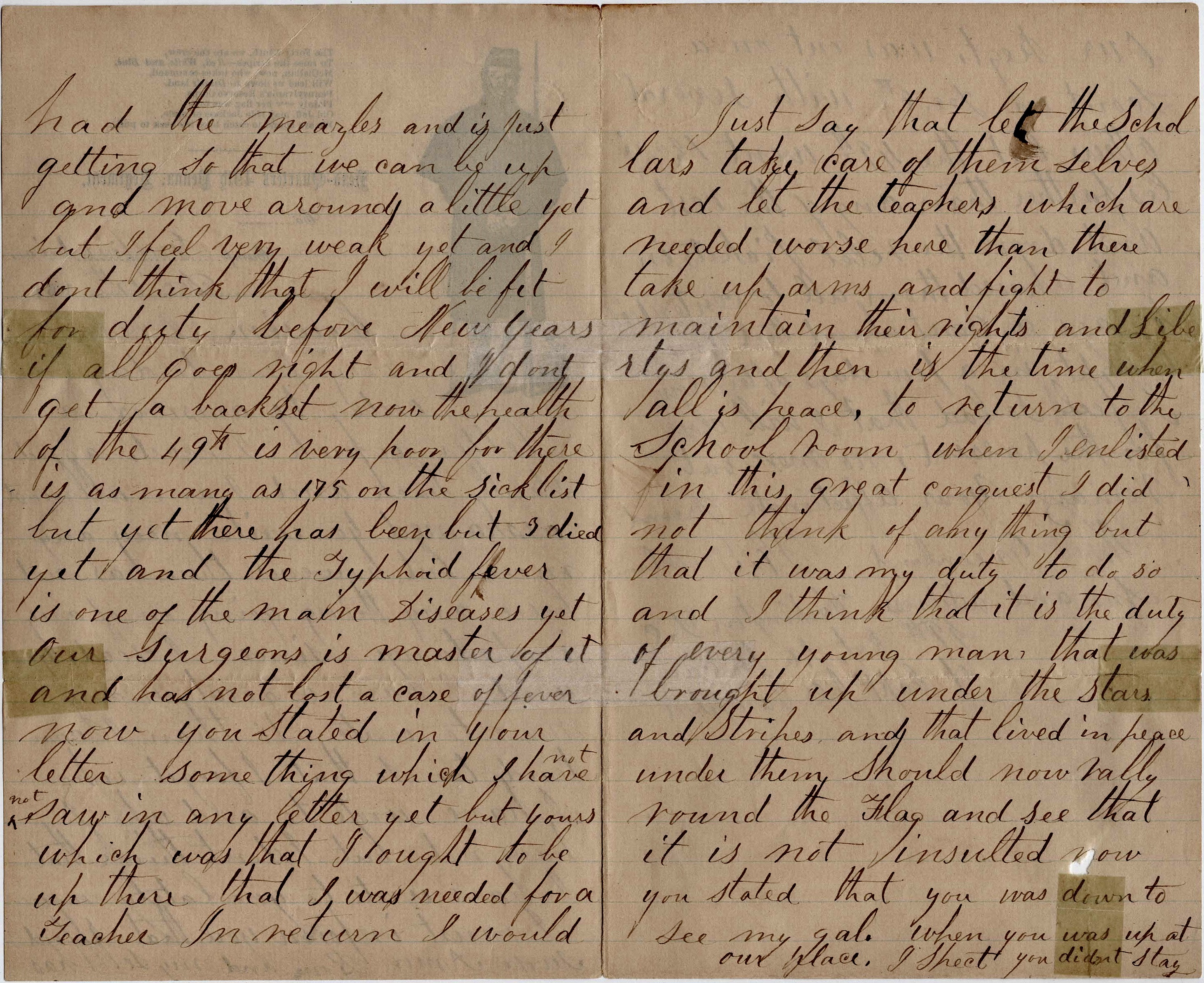
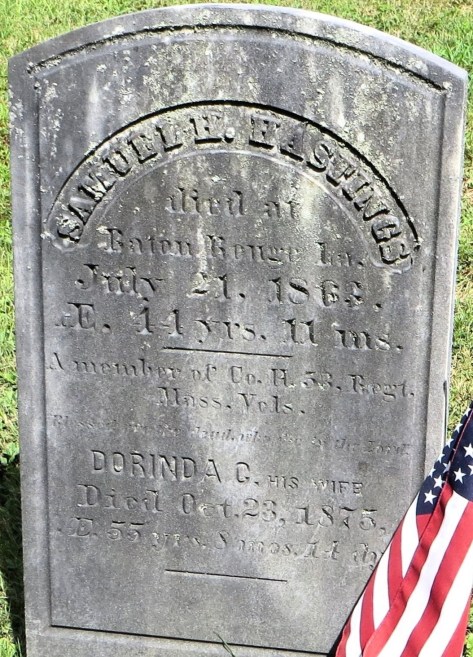
George W. Palmer (1838-1863) was a 23 year-old barber of Lynnfield, Essex county, Massachusetts, when he enlisted in the fall of 1861 as a private in Co. A, 19th Massachusetts Infantry. He was slightly wounded in the Battle of Antietam in September 1862 but fell ill in the winter of 1862-63. He died of “disease” at the USA Hospital on Islington Lane in Philadelphia on 26 February 1863 leaving a wife, Louisa (Mansfield) Palmer, and their five year-old daughter, Carrie, to grieve his loss. The disease was undoubtedly smallpox as the Hospital on Islington Lane was reserved for those soldiers suffering from contagious, or “eruptive” diseases. Such “loathsome” diseases may have also included measles, erysipelas, or scarlet fever, but the surgeon’s description of George’s symptoms point to smallpox. The purplish color of the skin is a sure symptom. Likewise. the surgeon’s concern with sending George’s personal effects home to his wife that might result in the transmission of the disease to her and her child also points to smallpox. It may even be that George’s wife was prohibited from visiting him in the hospital due to his being quarantined.
How common was smallpox during the Civil War? According to the National Museum of Civil War Medicine, “from May 1861 to June 1866, there were 12,236reported cases of smallpox among white troops in the Union army, or 5.5 per thousand men annually. In addition, there were 6,716 cases among the U.S. Colored Troops, or 36.6 per thousand men annually. The death rates from the disease were approximately 23 percent for the white troops and 35 percent for the colored troops.”
The Islington Lane Hospital was located one-third of a mile north of Ridge avenue and beyond the Old Glenwood Cemetery where George was first laid to rest. Prior to its being turned into a hospital, the 33 acre property was occupied by the Fleming family. The hospital was sited in the three-story stone building and a stone barn was used as an annex. Glenwood Cemetery was a 20-acre cemetery founded in 1850 at the corner of Ridge Road and Islington Lane in North Philadelphia. During the Civil War, Glenwood, along with other cemeteries in the city, became the resting place for Union soldiers who died in Philadelphia’s military camps and hospitals, with around 700 interred in Glenwood alone. In 1888, more than two decades after the end of the war, all of these soldiers’ remains, along with others, were moved to the newly formed Philadelphia National Cemetery.
Attending George as the Surgeon-in-charge of that hospital was Dr. Patterson—the sole physician—as well as one Matron, one Ward Master, and ten other subordinates. [Source: Sunday Dispatch, 18 October 1863. I could not find a biographical sketch for Dr. James V. Patterson although it appears he was a life-long resident of Philadelphia, having been born there about 1825, and he was working as a physician there when the war began, his office located at the corner of Chestnut and 13th Streets near the city center.
What is most incredible about these three letters is the sensitivity displayed by the physician pertaining to just one case of the hundreds of patients he must have seen during the war. I’ve seen similar letters but none that convey such compassion, and rarely penned by a physician as opposed to a matron or nurse.
Orphans decorating their fathers’ graves in Glenwood Cemetery, Philadelphia, on Decoration Day. The Illustrated London News, June 24, 1876. Courtesy of the Library of Congress.
Note: These letters are from the personal collection of Greg Herr and were offered for transcription and publication on Spared & Shared by express consent.
Letter 1
U. S. A. Hospital Islington Lane, Philadelphia February 25, 1863
Mrs. Louisa Palmer,
My dear Madam, it is with great anxiety I pen you these lines. When I last wrote your husband was doing as well as could be expected & I hoped for his recovery but within the last two days unfavorable symptoms have set in. His lungs are becoming congested. His face today has a purple color showing obstruction to the circulation & his whole appearance betokens anxiety and distress. I would not deceive you but tell you candidly & frankly that he is in a very critical condition.
My heart feels for you, deprived as you are of the consolation of being at his bedside & ministering to his wants. I asked him just now f he had any message to send home. He replied, no, and turned over upon his side and closed his eyes. May God grant us both assistance at this time. I, to do my duty by your husband, & you to bear all that he may see fit to place upon you.
Very respectfully yours, — J. V. Patterson, Surgeon in charge
U. S. A. Hospital Islington Lane, Philadelphia February 26, 1863
Mrs. Louisa Palmer,
My dear Madam, I mailed you a letter yesterday informing you of the critical condition of your husband. I have still a harder task today. My worst fears are realized. Your beloved husband is no more. He died this morning about 2 o’clock very quietly & with little suffering. The Matron read to him yesterday a couple of letters from home & he seemed much affected. She asked him if she should write for him, he dictating the words. He said, “Yes, tomorrow, not now.” Poor fellow, his tomorrow never came. Before that came round, his spirit had winged its immortal flight. Death has entered the happy circle of your household & taken away a loved one. In this dark hour of your better trial, heart-stricken & bereaved, there is but one source of consolation. We are in our Heavenly Father’s hands. “Even so Father, for so it seemeth good in thy” sight. The ways of Providence are mysterious & past finding out, but when we shall come to trace for ourselves in the mass of time the wisdom of all his inscrutable dealings, we shall be able to say, “Righteous art thou, oh Lord.”
I shall look over the personal effects of your husband and those that can be safely sent away from the Hospital without the fear of conveying the infection, I will carefully pack up & hold them subject to your further order.
Be pleased to accept my warmest sympathy for you & yours in this hour of sadness, & believe me, very truly yours, — J. V. Patterson, Surgeon in charge.
Letter 3
Addressed to Mrs. Louisa Palmer, Lynnfield, Essex county, Massachusetts
U. S. A. Hospital Islington Lane, Philadelphia March 13th 1863
Mrs. Louisa Palmer,
My dear Madam, I send you by Adams Express the personal effects of your late husband which I judge there will be no danger in transmitting to you. You will be kind enough to sign the receipt for the articles & transmit it by mail to me.
The remains of your husband have been interred in Glenwood Cemetery & his grave is numbered, “Section N, Row A, Grave No. 64” so that perhaps in some future time you may be permitted to look upon his last earthly resting place. Very sincerely yours, — J. V. Patterson, Surgeon in charge
The following letters were written by Edward W. Pierce (1842-1919), the son of Dr. David and Caroline Pierce of Pownal, Cumberland county, Maine.
From the history of the 3rd Massachusetts Cavalry, published in 1903, we learn that “Pierce was one of the youngest officers of the regiment. On account of gallantry and meritorious conduct, he rose from the ranks and was commissioned to command. Before the war he was a mechanic in Boston. At 21, he responded to his country’s call, entered the [41st Massachusetts] regiment and was made Sergeant June 4th 1862. [The regiment was converted to cavalry in mid-June 1863 and designated the 3rd Massachusetts Cavalry.] Pierce became Sergeant Major in 1864. He was commissioned 2nd Lieutenant August 7, 1864 and for a time served as acting Adjutant. At one time he commanded Company H and at another Company G. He was discharged June 12, 1865.”
Sergt. Edward W. Pierce, still wearing the uniform of a non-commissioned infantryman—possibly while serving as color sergeant in the 41st Massachusetts. The flag shown may have been the very flag he carried that was later cut into remnants for members of the company (see letter 3).
It should be noted that the first two letters were written while Edward served in Co. H, 41st Massachusetts Infantry. The last two letters were written after the regiment had been mounted and designated the 3rd Massachusetts Cavalry.
Letter 1
Baton Rouge, Louisiana February 16, 1863
Dear Mother
I have once more received some of Uncle Sam’s “Green Backs” which of course I received with great pleasure as I have not seen one for over three months. Was payed up to the first of January. Had been in the service about seven months up to that time but was payed one month’s pay $13 in advance with my bounty. That left most six months to be payed for and as my warrant dated from the 6th of August, I received 17.00 per month only from that time which was most five months – $83.00. The month before received but $13.00 – Total $96.00.
You will find enclosed $85.00 which you may do as you think best with. Would like to have it earn something if it could. Shall keep with me but $11.00 and $2.00 of that will go to pay the express on this. My other debts are about $3.00. That will leave me $6.00 to keep which I think is enough to have on hand at once. If I want more, I will send for it. Please immediately after receiving, write to me and let me know about its safety.
This makes four letters that I have written home since I have been here—two to you, one to Henry, and one to Jennie. Don’t know how many of them has been received. Hope all. I shall write often [and] hope you will do the same. It takes a long time for one to write and get an answer—nearly a month.
I came off picket yesterday (Sunday). The times out there are very exciting. We were the outer pickets. I had 20 men and a corporal and a mounted picket on my post. We were on a road that was very level and strait. A man could be seen in day time two or three miles ahead of us. It put me in mind of the road through Bear Range [in Maine] as we were in the woods too. We could now and then see the enemy’s pickets mounted which would startle the boys and make them keep their heads towards the enemy. This suits “Ye boy” [and] it keeps us from being too sleepy.
I will have to close as Sergt. Horton is going to the Express Office and is going to take this for me. Am in good health—happy as a King. Please write soon. Love to all. From your affectionate son, — Edward
Sergt. E. W. Pierce, Co. H, 41st Reg. Mass Vols., Banks Expedition, New Orleans, La.
Sometime has elapsed since I wrote to you last. Not having a decent chance, I delayed it till the present time. Did not think that 22 days had passed since I wrote last at Baton Rouge. Wrote to Henry the 18th inst. so it will do as well. Received a long and kind letter from Grandfather on the eighteenth which I was very happy to get, I assure you. Received yours of the 26th the same mail. Was happy to learn that health was good amongst the good people of West Pownal and vicinity—“long may they prosper.”
I suppose the minds of people are a little troubled about this time owing to the draft. I know there are many that have fathers, husbands, sons and brothers which are drafted and in fact ought not to leave their homes. I am sorry for such but why not they sacrifice some things for their country as well as the volunteers that came before them? There are but very few families at the North but what have more or less friends or relations in the Army. No doubt they hesitate about having anymore there. There are some—yes many—that are too noble to refuse their friends and relations to their country. Yes, I have a mother that comes under that head. I know that if she was young and single, she would have been in service as nurse or some other good purpose long before this. God protect her.
We moved inside the fort a few days ago. There are no regiments outside the fort at present. There are one regiment of cavalry, between one & two regiments of artillery, 5 and 6 regiments of infantry—[all] Louisiana Native Guards. There is no white regiments of Infantry here. [They are] all gone to Baton Rouge. There is to be two Army Corps in this department—one under the command of Gen. W. B. Franklin which will be the 19th Corp., and the other under Gen. Herron, one of Gen. Grant’s officers, and both to be under the command of Gen. N. P. Banks. This is the talk now. Some thinks Banks will have command of the Army of the Potomac in case Meade resigns. He can fill that place as well as any other general. Gen. Franklin is now in command of the forces at Baton Rouge—“19th” Corps.
The whole department, at least all of the regiments in the department, are to be filled immediately with conscripts, the rumor says. After reorganizing and drilling, we are to leave this state for Texas which no doubt will come to pass as winter appears. We expect the conscripts in a few weeks. Poor fellows—they little know what the duty of a soldier is. No one knows until he has tried it on. There are thousands in the service that would give all they possess if they could just get out of the Army. I think I am perfectly contented as I am. May I remain so until after war, which will never be. The present war must soon close.
We are doing picket duty some two miles out from fort. The enemy hover around our post as near as courage will allow them. They are trying to take all they can of our regiment for the sake of the arms. We are armed splendidly with carbines, Colts revolvers, and good sabers and with a good will. We took three Rebs last night. They were at the time, when taken, in a house sitting down enjoying themselves when along came Mr. Yankee and pins them.
My health is good. Our duty is pretty hard at present there are about 310 men for duty in the regiment. Our details are over 100 a day. When we are filled up, it will be easier. I stand it like a brick. Work don’t hurt this child here. They are discharging all sick men in this regiment and those that will not make good cavalrymen are to be taken out and put into infantry. One of our bravest men was laid under the sod the other day, making three that we have lost since we left Massachusetts. Had a letter from Sergt. [John T.] Ayers 1 that got taken prisoner at Baton Rouge belonging to our company. He is in Maryland in the parole camp. The rebs carried him through Alabama, Georgia, North & South Carolina into Richmond’s Libby Prison, from there to Fortress Monroe. He is not exchanged. I may follow him but shall not if I can help it. My last mail was the 18th. Expecting another soon. Love and respect to all. Your most affectionate son, — Ed’d
1 Sergt. John T. Ayers of Baintree, Massachusetts, died on 19 October 1864 of wounds received at the Battle of Cedar Creek, Virginia.
Letter 3
New Orleans, Louisiana February 29, 1864
Dear Mother,
As tonight is the last night of our stay in the city for some time to come, thought I would drop a line or so to you not knowing when I should have the chance again. We leave tomorrow morning at 5 o’clock a.m. to cross the river to Algiers. From thence we march to Franklin [and] from there I hardly know our destination but guess it is one of Banks feints on Texas to take Mobile. Our whole Brigade will go together under Acting Gen. Dudley. I suppose we shall see some Rebs before many days. If so, we will scatter them or they will us. Banks is bound to do something for his country ‘ere the next three months passes.
We had a General Review last Saturday of all the cavalry & artillery at this place by Gen. Banks and the ladies from New York, who are stopping at this place, presented our division with a splendid cavalry flag. Not long since the ladies from Massachusetts who are stopping at this City presented our brigade with a flag. When the Division flag was presented to us, Gen. Banks’ daughter was made Daughter of our Brigade.
Everything is turned topsy turvy here with us getting ready to move. Have got six days rations ready for ourselves and horses. Our teams have left to cross the river tonight.
“Enclosed I send a piece of our old flag—the one I carried many miles.”
Enclosed I send a piece of our old flag—the one I have carried many miles. It is now badly used up and I am going to give a small piece to each of the boys as we have got a new one. I have turned the honor of carrying it over to Sergt. Bates. I cannot, as I am [now] Orderly Sergeant. With this, I shall send a record of our company—one for you, one for Annie, one for Grandfather and the last for me. Shall send mine in your name. If you will get a frame for them, I will send the money as soon as paid. Shall want to show mine to my grandchildren you know. As I have not had time to open them, don’t know as they are perfect. Please let me know if they are. I had seventy five struck off so to let each man in the company have one and four for myself. They were got by your humble servant.
Health and spirits with me is good as usual. Everything lovely. We leave tomorrow with 60 men and we will see how many come back. As for myself, shall trust our Heavenly Father He doeth all things well.
The weather is fine at present. Growing warmer every week. I have written this in the midst of a great deal confusion so excuse. Well, Mother, shall write to you again soon. Please direct as before. Love to all. Your affectionate son, Ed’d
Preserved flag remnants identified by Sgt. Edward W. Pierce in his letter of 29 February 1864
Letter 4
Remount Camp, Maryland January 9th 1865
Dear Brother Henry,
Received a letter from you night before last. By its contents, should think you was in a “peck’ of trouble. Well Hen, am sorry you feel so bad. Then you think of leaving that part of the country and what? climb a tree? or go to Canada? Too bad that one little girl will make my little brother feel so worked up. Then you won’t own me as a brother if I write to your “doxy”? Think you are coming down on a fellow rather hard. Tell you what I will do with you, Hen. If you will write to me a little more regular than you have done of late, I won’t write to that little brunette girl of yours. I did not know what was the matter with you as you did not write, but now I have found out. So Hen, you know what to do to keep old things straight. Write to me often and I will not write to her. This thing don’t keep you awake nights, does it Hen? I should think it would. ha! ha!
You see I am in a different state now than when I wrote you last. Yes, we received orders from Our gallant Sheridan on Christmas to march to this camp for the purpose of being remounted again. Well, we are here as ordered, have already turned in our long guns to the Quartermaster’s Department, so at present we have no arms or horses. Nothing to do now but write home and read letters from there. Since we came here, we have put up a new set of log huts throughout—about one hundred and fifty in all. At present there are no horses here for us. So you can see we can lay by and enjoy ourselves as best we can. It makes it seem quite lonesome at times—nothing to do.
We have been on the move since the second day of March, making two campaigns via Red River and Shenandoah. They were both very hard fought battles. I was in them all, besides a great many more hard skirmishes. I can tell you something about them when I go home which I expect will be ‘ere long. Things are working quite well for me now. You may see me sometime next month. My leave of absence will be but for a few days at the longest [but] a few is better than none. That is the way I look at it, don’t you?
This camp is in Pleasant Valley but it is right the reverse of its name, for it is very unpleasant. It is three things here—sun, rain, and mud. Some mornings it will be clear and fine as we could wish and by noon it would be raining. As we have got pretty good huts, we don’t mind the weather so much as if we were in “Shelters” (thin fly tents). On the night the regiment arrived here, I was quite unwell, so I stayed at a hotel nearby and slept in a bed two nights—the first time since left home in July ’62. Guess I turned over about fifteen hundred times during each night. Thought I should have to get out and sleep on the floor several times.
No news of consequence with us. Believe the 19th Corps has gone to Baltimore to wait transportation—their destination I know not, perhaps Richmond. We do not belong to that Corps now but to the Cavalry Corps, Maj. Gen. Torbet commanding (formerly Sheridans Corps). We have not been assigned to a Brigade and Division yet but will be as soon as we get to the front again. I saw Aloin Lane just before leaving the other camp. Was looking nicely too. I am glad you like so well at South Paris. You like the place now much better than when you first went there. It ain’t to be wondered at. How is the sleighing at Paris about now?
I want you to have a team engaged by the time I come up there so we can have a ride. Have not been in a sleigh since ’62. Hen, what kind of business shall we go into after the war? You must look around and see what’s best. Don’t think it will be farming. I never liked that business very well. Perhaps we will go West into some new business. I think if I could join the Regular Army in my present rank, I should do it. The Army in time of peace is a dogs [life], after all. Will now close. Love to all. Remember, write often and I won’t write to that little girl. Your affectionate brother, — Eddy
Address Co “H” 3rd Mass Cavalry, Remount Camp, Near Sandy Hook, Md.