All posts by Griff

My passion is studying American history leading up to & including the Civil War. I particularly enjoy reading, transcribing & researching primary sources such as letters and diaries.

1864-65: Joseph Martin Reed to his Parents

The following fifteen letters were written by Joseph Martin Reed (1845-1927), the son of Joseph W. Reed (1821-1898) and Mehitable C. Wyman of Charlestown, Massachusetts. Joseph enlisted as a private on 29 December 1863 to serve in the 11th Massachusetts Battery. He survived the war and mustered out on 16 June 1865 at Camp Meigs, Readville, Massachusetts.

Joseph’s obituary states that he was born in Woburn and that he enlisted before he was 18 years old. After he was discharged, he returned to Massachusetts and was employed as a conductor on the Eastern Railroad, running from Boston to Rockport. He married Ellen Eames, daughter of Ezra Eames, a well-known granite magnate of his time, and made his home in Rockport. Joseph’s father worked as a teamster in Charlestown for most of his life. Joseph’s parents home at 20 Essex Street in Cambridge still stands, built in the 1850s.
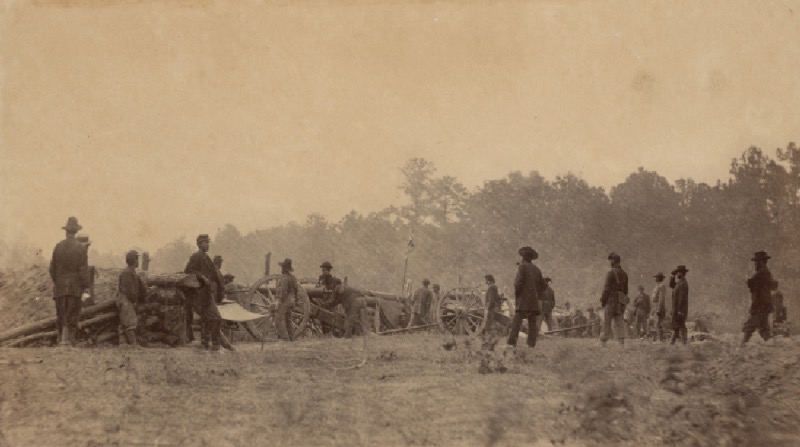
Jones’s 11th Massachusetts Battery before Petersburg, 1864. Mathew Brady.

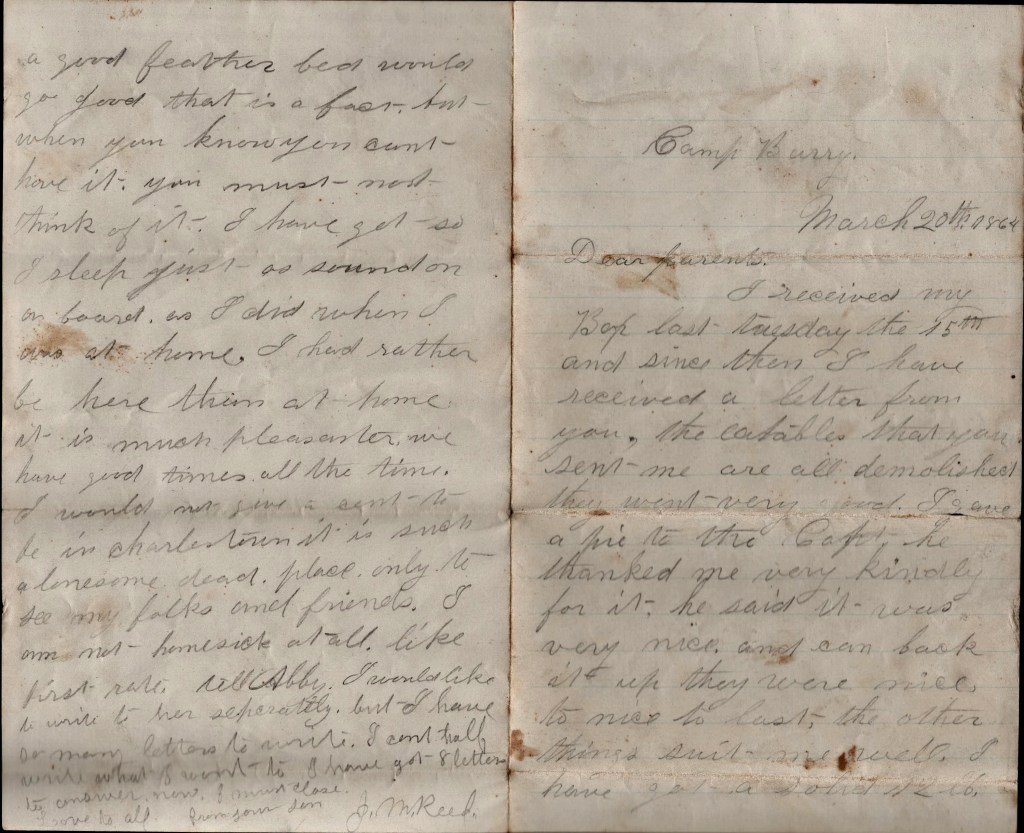
Letter 1

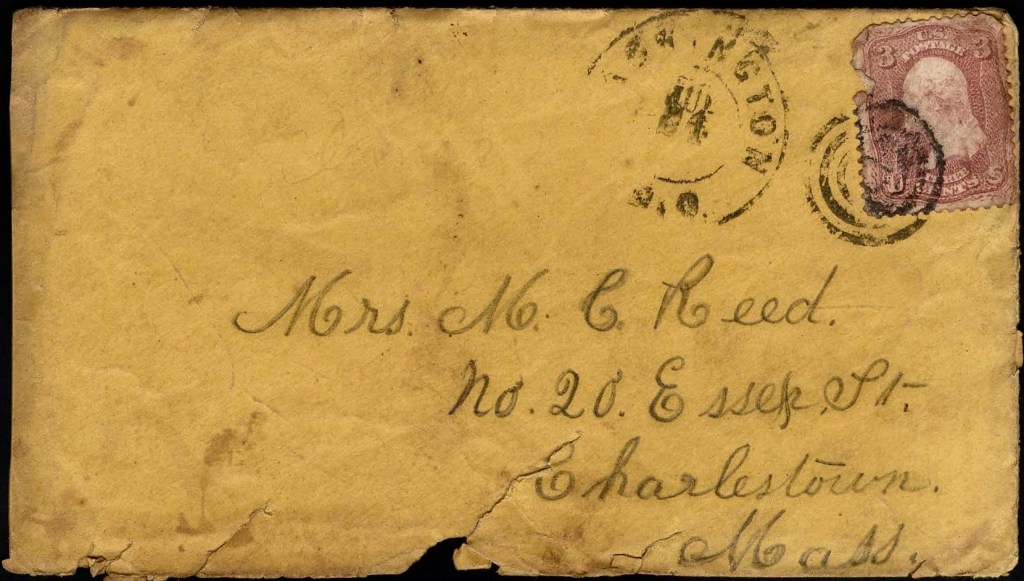
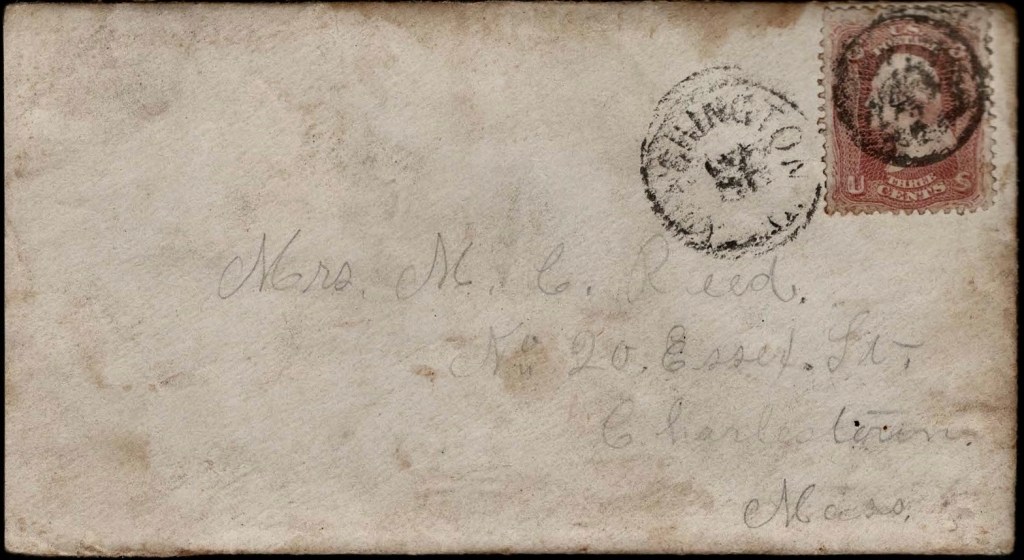
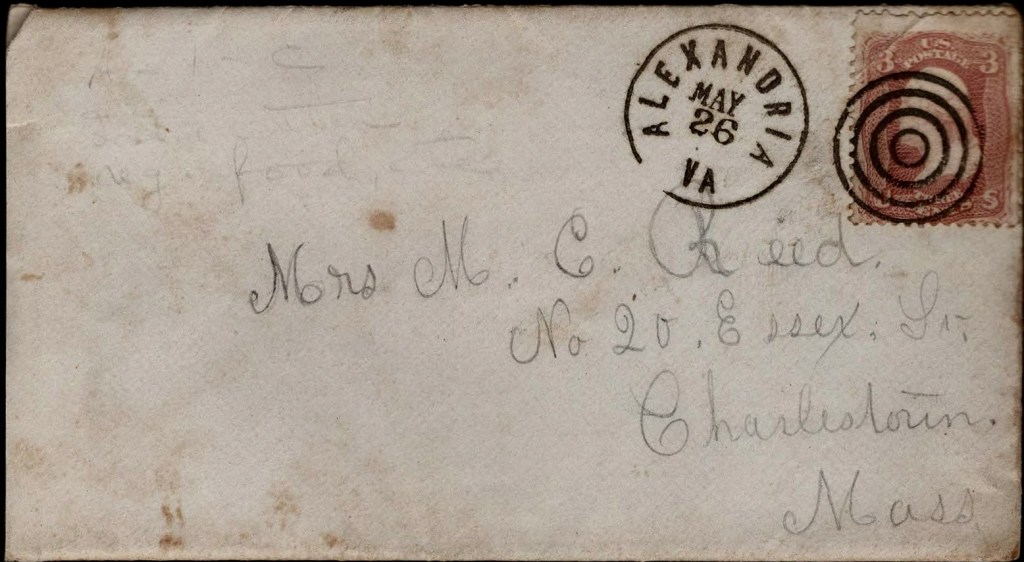
Addressed to Mrs. M. C. Reed. No. 20 Essex Street, Charlestown, Massachusetts

Camp Barry
March 20th, 1864

Dear Parents,

I received my box last Tuesday the 15th and since then I have received a letter from you. The eatables that you sent me are all demolished. They went very good. I gave a pie to the Captain. He thanked me very kindly for it. He said it was very nice and can back it up. They were nice—too nice to last. The other things suit me well. I have got a solid 12 lb. shot to send home as soon as I get some money. Also a piece of a spherical case shot.

We are situated on ground where the rebels have been and probably these were fired by them. Every thing that I got in the Box was very good except the tobacco—that is very poor. I wish father would get me some plug tobacco. That was what I wanted before; only it was cut up fine. If I was paid off, I would not ask you to get it, but I am not, and I don’t know when I shall. We have not got our Battery yet and they say we shall not get it until July. If we don’t, we will have to stay here a good while. We all want to go to the front as soon as possible where we shall live in tents and be more healthy. I was unwell for a few days, but nothing serious. I’m well now and a growing fat. I have got [ac]climated now and can guard myself from disease. I don’t want you to think I am not on good terms with George for we are just as fast as we ever were and are going to be. Don’t you feel alarmed about us. We are all right; both of us are well.

You wanted to know if I hadn’t rather sleep on a good soft feather bed than a soft pine board. A good feather bed would go good, that is a fact, but when you know you can’t have it, you must not think of it. I have got so I sleep just as sound on a board as I did when I was at home. I had rather be here than at home. It is much pleasanter. We have good times all the time. I would not give a cent to be in Charlestown. It is such a lonesome, dead place—only to see my folks and friends. I am not homesick at all. [I] like [it] first rate. Tell Abby I would like to write to her separately but I have so many letters to write, I can’t half write what I want to. I have got 8 letters to answer now. I must close. Love to all. From your son, –J. M. Reed

Letter 2

Battlefield ten miles from Ellson Green and fifteen from Richmond. We are beyond the Green. 1
May 31st. 1864

Amidst the flying of shells and the whizzing of bullets, I seat myself under a tree to write to you. Mother, I should really like to be at home tonight to supper—to get some hot biscuits and butter, and a cup of tea. Mother, how would you like to be a soldier without hardly anything to eat as I am? All I had yesterday was one “Hard-tack,” one spoonful of coffee, and one of sugar. Today I have neither. For a fortnight we have been drawing quarter rations but now we don’t get that. The reason is we are so far from our base of supply. Tomorrow the supply train will reach here I hope. We are agoing to draw whiskey rations—a gill a day. It makes the men hold out longer for we are so hard up. We are in good spirits. I have thought myself—although I never use the stuff—that a little whiskey would do me good, when we have been marching all day and night, no water to drink. I tell you, it makes a fellow think of home.

We have got so that we live cheap. I find no fault as long as we are so near Richmond and gaining ground every day. Last night our folks found the Rebs building breastworks. They waited till they had got it most finished and were putting their men behind them, when our boys charged on them and took it and hold it now. What an aggravation it must be for Rebs to work so hard for Feds.

We haven’t lost a man in our Battery but have had a few horses killed. One shell killed two. Tell Abby to tell Charley Blanchard that his brother was well the last time I saw him which was on the twelfth. Frank Knowles is safe and well—so be I.

Mother, you must not be discouraged if you do not get a letter for some time. I think it a blessing to get a chance to write. I would write every day if the mail could be sent but it is once in a great while that we get a mail or are allowed to send one. It makes me feel very bad to have you write [and ask] why I don’t let you know where I am and why I don’t write. I do the best I can to get you a letter. You must write me two letters a week certain and send lot of papers—daily papers preferred—and when the campaign is over and we get to camp, I will send for a box of eatables and see if I can’t have something to eat once, something in the shape of pies and cake, fried pies and doughnuts. I want you to have a lot of preserves made up this season so that I can have some when I send for it. I received that box all right. I bought me a rubber coat in Washington before we left.

Now Mother, write real often and let me know how the babies are getting along. Write often. Tell my friends to write. I shall write as often as I can. We are going to take Richmond. We expect to be at home next spring. Direct to J. N. Reed, 11th Massachusetts Battery, 2nd Division, 9th Corps. Washington D. C.

1 I have not been able to pinpoint this position but assume it was at or near Totopotomy Creek in which the 11th Massachusetts Battery played a part in the battle there on 29-31 May 1864.


Letter 3

At the siege of Petersburg
July 9, 1864

Dear parents,

I received a letter from you last night dated the 3rd stating that you were glad that I was in the rear. For my part, I had rather be up front. I feel more at home. But as it is not my place to be there, I shall do my duty as well as I can at the rear where I am doing duty as driver. Why don’t you keep drumming me about my money. What will come next. I don’t know. But every letter I get worrying about something. It makes me feel discouraged. I had as just as leave throw my life away here at the front than to be so discomforted. You cannot imagine one quarter wat a soldier has to suffer during a campaign—especially one like this. The privations, the hard marching, and the danger of his life is nought to make one feel down sometimes without having anything discouraging from home. You ought to cheer up the spirit of a soldier. I have never pitied anyone so much as I have the soldier.

Mr. Briggs, if he has been in the army, he has not seen any more of it than I have. I have seen very little gambling since I have been intimate that I have gambled my money away. It [rest of letter missing]

P. S. You can send me a dollar or two if you feel like it. — J. M. Reed


Letter 4

In front of Petersburg
July 22, 1864

Dear Parents,

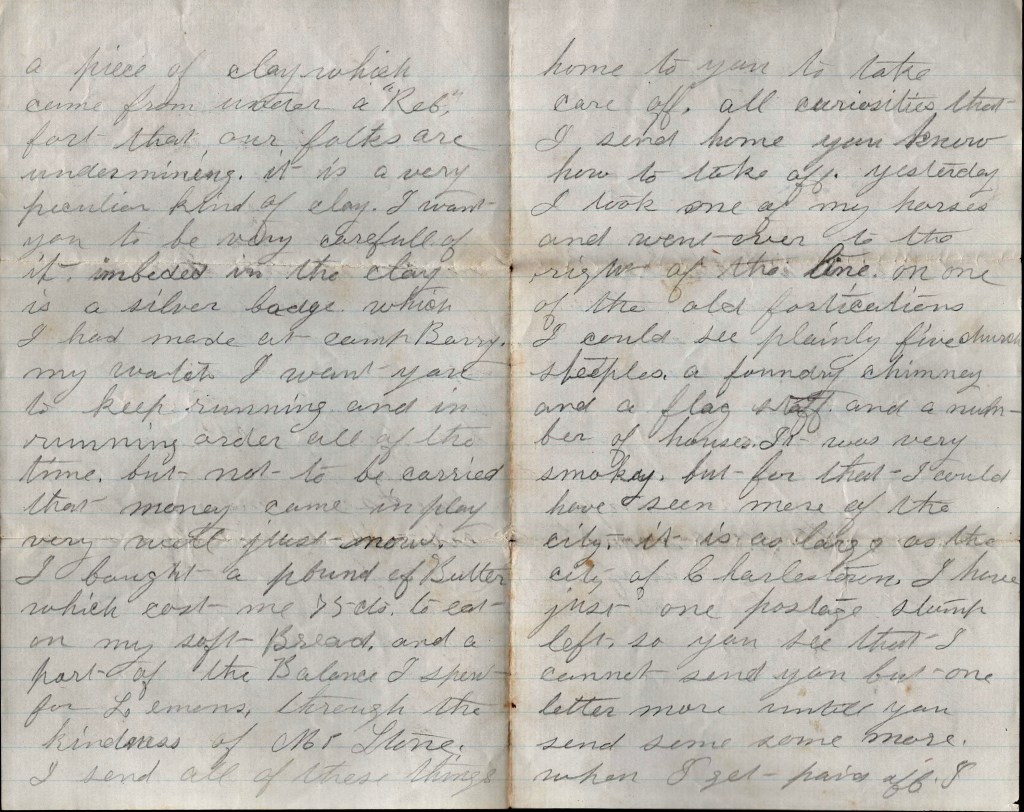
I received two letters from you last night with money, ginger, and mustard in them. They are all right. The rhubarb has not come yet. What is the reason? Did you put it in a letter or in the papers? I should like it very much. Mr. Stone of Charlestown, the policeman there, he is after his son who is very sick. This letter I send by him. Also my watch and a piece of clay which came from under a “Reb” fort that our folks are undermining. It is a very peculiar kind of clay. I want you to be very careful of it. Embedded in the clay is a silver badge which I had made at Camp Barry. My watch I want you to keep running and in running order all of the time, but not to be carried. That money came in play very well just now. I bought a pound of butter which cost 75 cts. to eat on my soft bread, and a part of the balance I spent for lemons. Through the kindness of Mr. Stone I send all of these things home to you to take care off. All curiosities that I send home, you know how to take [care] of.

Yesterday I took one of my horses and went over to the right of the line. On one of the old fortifications I could see plainly five church steeples, a foundry chimney, and a flag staff and a number of houses. It was very smoky. But for that, I could have seen more of the city [of Petersburg]. It is as large as the city of Charlestown. I have just one postage stamp left, so you see that I cannot send you but one letter more until you send some more. When I get paid off, I will not send home for anything. I shall send my money all home for you to take care of. Have it put to interest if you can. I kept my money the last time I was paid off and most of the boys sent theirs home but were sorry for it, for they have needed it. But now I am going to send mine home and the most of the boys are going to keep theirs for themselves. I shall keep a little by me to get stuff that I cannot do without out. I am well. So are the rest of the boys. I cannot write anymore now so goodbye. From your son, — J. M. Reed

You will find a piece from our Battery in Sunday Herald of the 17th of July.

P. S. We have excellent water here to drink—the clearest I think I ever drank, cool and nice. Also all we want to eat. — J. M. R.

Letter 5
Near Petersburg
July 24, 1864

Dear Parents,

I received the paper with the rhubarb in it, but it was too late. I am all well of the jaundice and partly of the diarrhea. However, it will come in play sometime.

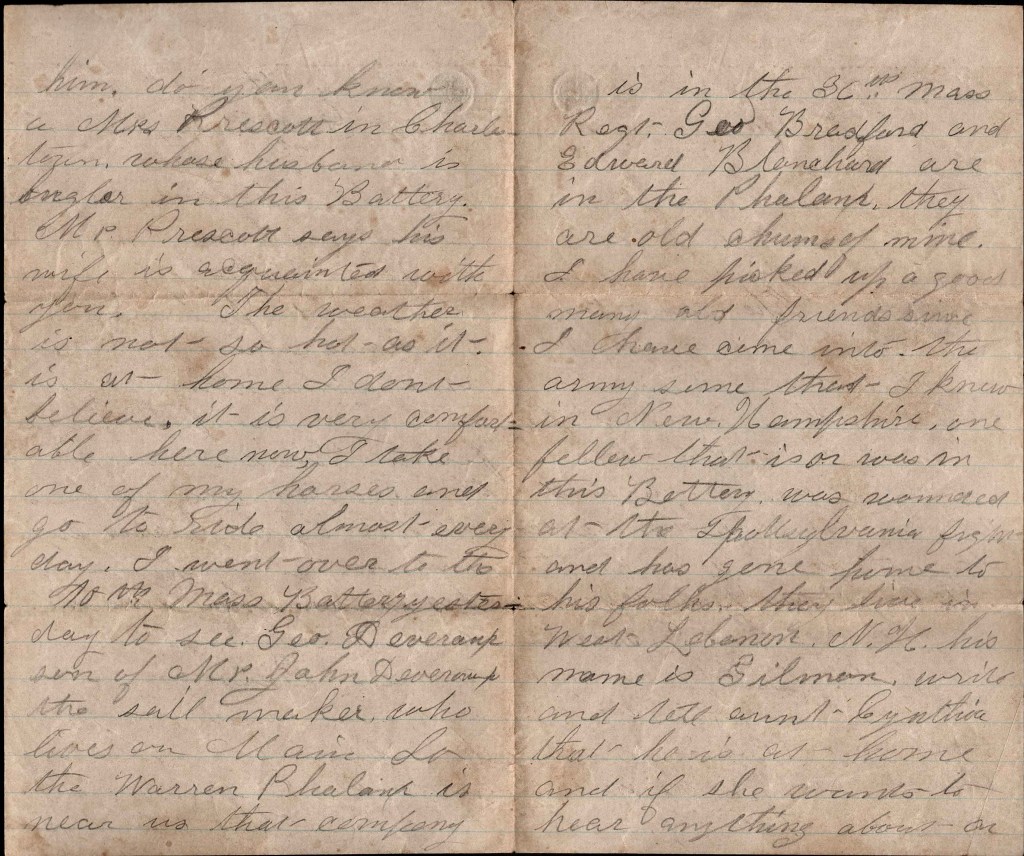
Mr. Stone is on his way home with [his] son. I wish I was in his place, don’t you? Only I should not like to be as sick as he has been. I have sent home my watch by him. Do you know a Mrs. Prescott in Charlestown whose husband is bugler in this Battery? Mr Prescott says his wife is acquainted with you.

The weather is not so hot as it is at home, I don’t believe. It is very comfortable here now. I take one of my horses and go to ride almost every day. I went over to the 10th Mass Battery yesterday to see George Deveraux, son of Mr. John Deveraux, the sail maker, who lives on Main Street. The Warren Phalanx is near us. That company is in the 36th Mass. Regiment. George Bradford and Edward Blanchard are in the Phalanx. They are old chums of mine. I have picked up a good many old friends since I have come into the army—some that I knew in New Hampshire. One fellow that is—or was—in this Battery was wounded at the Spottsylvania fight and has gone home to his folks. They live in West Lebanon, N. H. His name is Gilman. Write and tell Aunt Cynthia that he is at home and if she wants to hear anything about the engagements we have been in, he will tell her. I presume, if he is able, he can tell them about the marches we have had until he was wounded. Since then he cannot tell anything about the Battery.

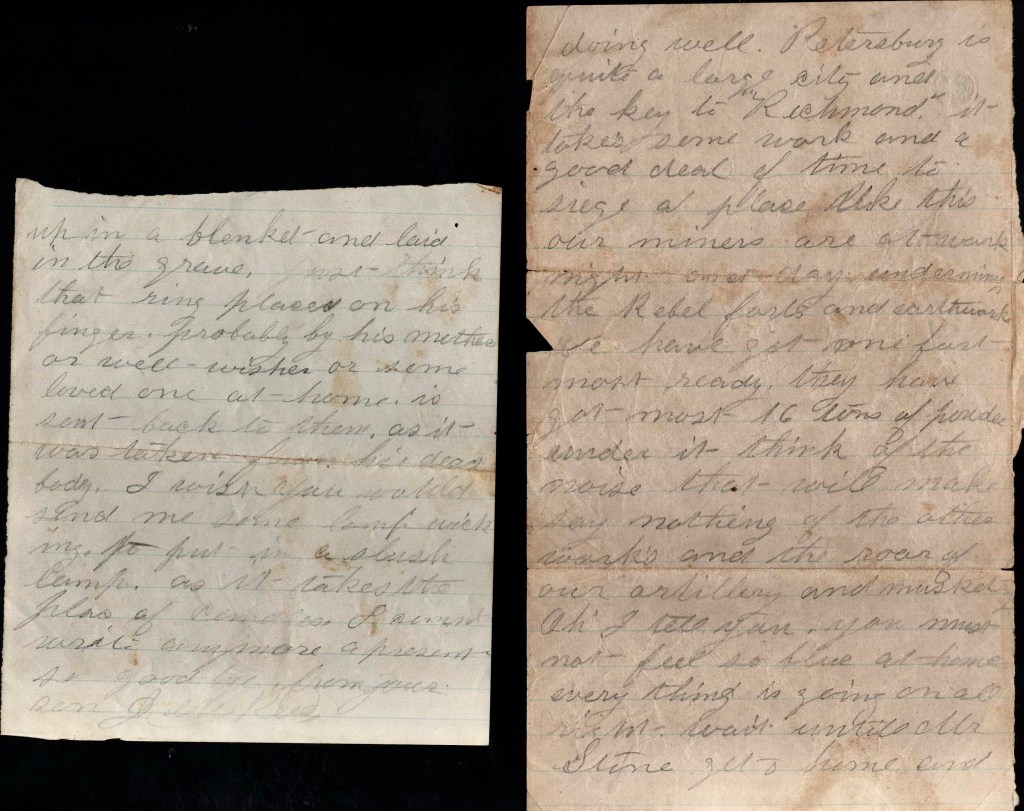
I want you to send me a pack of cards in some papers. Pack half a pack in one bundle of papers and half in another. Don’t think I want them to gamble with. I want them to pass the time away, for we have nothing to do. We stay here in the same old spot. I suppose you think that the army is not doing anything. I think we are doing well. Petersburg is quite a large city and the key to “Richmond.” It takes some work and a good deal of time to siege a place like this. Our miners are at work night and day undermining the Rebel forts and earthworks. We have got one fort most ready. They have got most 16 tons of powder under it. Think of the noise it will make, say nothing of the other works and the roar of our artillery and muskets.

Oh, I tell you, you must not feel so blue at home. Everything is going on all right. Wait until Mr. Stone gets home and he will tell you what he thinks about it. He said here that if the folks at the North knew what the army was doing, they would not complain about Grant and the army laying still.

As I came down from the front last night, I stopped to see a fellow soldier buried. He was brought to the edge of the hole on a stretcher and on removing the blanket from his face, I saw that he was shot in the head. And when he was removed from the stretcher, it was covered with blood and a part of his brains. They took a ring off of his finger and laid him in the grave. He was rolled up in a blanket and laid in the grave. Just think—that ring placed on his finger, probably by his mother or well wishers or some loved one at home, is sent back to them as it was taken from his dead body. I wish you would send me some lamp wicking to put in a slush lamp as it takes the place of candles. I cannot write anymore at present so good bye from your son. — J. M. Reed

P. S. Write as often as you can. Love to all, tell somebody to write. I am going to write uncle Frank in a day or two. Yours in haste — J. M. Reed

This is our Corps Badge. I wish you would get a lot of these envelopes and have then stamped like this one.

The Battle of the Crater took place just a week or so after Joseph wrote the last letter. He does not have an account of the battle but another member of his Battery named William Hazen Flanders described it in a letter to his friend, Millie E. Stevens of Boston. The letter was posted on The Siege of Petersburg website. It was then (2014) in the possession of Gary Skinner. The relevant portion reads:

“….You remember I have written you from time to time of the mining operations part of the ninth corps under a large rebel fort.  Last week the mining operations were finished, the powder was carried in (6 tons) on Thursday and Friday, and Saturday morning was fixed upon for an attack by our corps.

At 4:00 AM Saturday morning the fort was blown up, killing a large number of rebels, mostly South Carolina soldiers and dismantling their guns, throwing the dirt in all directions.  I was up to the front and I will never forget what a noise the explosion made, this was the signal for artillery to open, and immediately our batteries on the line, and others “some 200 guns” opened a terrific fire on the rebels and kept up our fire about 4 hours. In the meantime our infantry charged on the rebel works and took the 1st line, then charged on the 2nd . When the 4th  division of our corps (colored) were brought into position, everything indicated success for us, the rebels were leaving their guns and works, but when they saw the colored troops they charged on them, driving them in disorder back to our works, and they rushing back so it tended to confuse our white soldiers, and no commanding officers to be found to rally them for the simple reason that they were in the rear drunk, incapable of doing anything.  That our gallant boys were defeated with great loss in killed and wounded,  besides losing several stands of colors, and we are now in the same position we were before the attack.  It was an unfortunate affair, it being the first defeat  we have experienced in the Army of the Potomac since the campaign opened.  It was not the fault of our brave soldiers by no means, but can be summed up in 3 letters “rum was the cause of it.”

On Monday a flag of truce was sent out to bring off the wounded and bury the dead.  I went out onto the late battlefield and truly it was a sad sight to view—one I shall never forget.  Our wounded had been laying between the two lines for 48 hours in the hot sun, only 21 (one) alive for brought off the field and their wounds were alive with maggots.  You could not distinguish a white man from a colored one, all turned black, &c.

I saw the rebel general Hill and other officers. Hill is a splendid looking man.  It seemed odd to see our man and the Johnnies trading when only a short time before they were trying to kill each other.  I conversed was several of them and they all said if the colored troops had been kept out of the fight, we would have gained the day, but when they saw them they were determined not to surrender to them, but if some of the Generals commanding certain divisions had been in their right mind as they should have been, no such disaster would have occurred to us.  Our boys felt disheartened at first, but are ready to try again and I think we will not be so unlucky. I suppose the matter will be kept quiet as to the cause, but it will work out sooner or later by letters sent north from the soldiers. I trust the officers who are guilty will be punished as they deserve and receive the just merit due them for the conduct unbecoming in an officer and a gentleman.

General Burnside feels mortified at our defeat and I hear from good authority that several officers in the corps will be court martialed. I am happy to say although our batteries were under a severe fire from the rebel artillery and musketry, none of our boys were killed or wounded.  Since I wrote to you though, we have had a 3 men wounded severely. Probably one of them will lose the use of his left arm. The battery is still in position on the skirmish line of having been there since July 5th….”


Letter 6

Jones House near Petersburg
October 1, 1864

I have received two letters from you lately and one with a receipt for the box. The box has not got along yet but expect it as soon as the battle is over. We are having a big battle [see Battle of Vaughan Road]. I think that the Rebs have lost all this time. We are on the move again. There is a big battle going on now. Sheridan and Sherman are cooperating with this army. We have nearly surrounded Lee. Sherman is at Lynchburg and Sheridan is within two miles of Richmond. His pickets [are] within one mile and a half from the city. These are all rumors and we believe it.
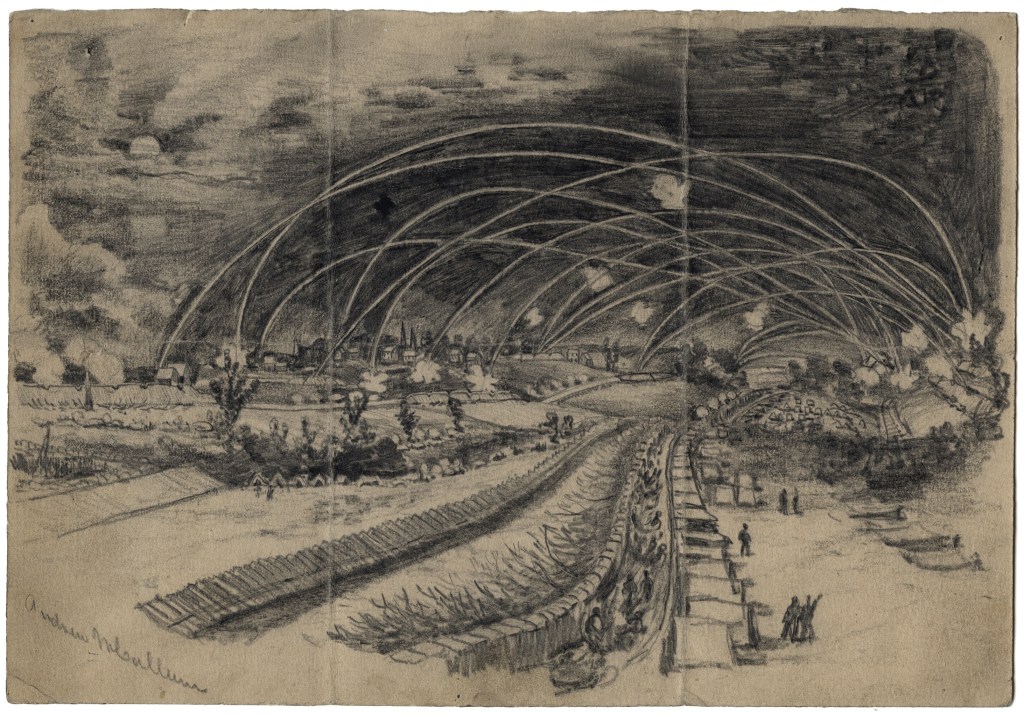
Siege of Petersburg, Andrew McCallum

Our pieces are in position in Fort Howard on the front line and our caissons were ordered to the rear about three miles and as I am a driver on one of them, I have to be at the rear. We were ordered to have four days rarions in our knapsacks but we did not get but about two and today is the third day and I feel a little kind of hungry and wish I had my box. Why didn’t you send a list of the articles that you sent in the box. I do not expect the box until this battle is over.

We have whipped them so far this battle which has been going on two days. I cannot write any more now.

I want another box about Thanksgiving time with a lot of good eatables—turkey, pies, cake, preserves. What did you send this time? I am well. — J. M. Reed

Don’t feel worried about me. I am all right.


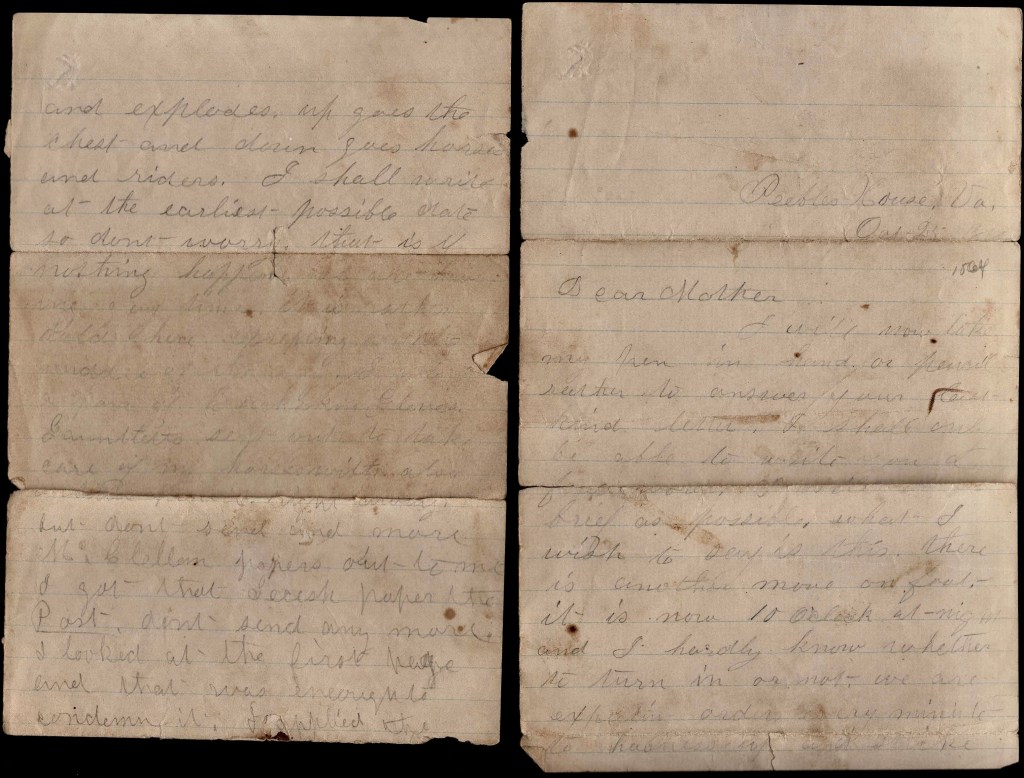
Letter 7

Peeble’s House, Va.
Oct. 25, 1864

Dear Mother,

I will now take my pen in hand—or pencil rather—to answer your last kind letter. I shall only be able to write you a few words. I will be as brief as possible. What I wish to say is that there is another move on foot. It is now 10 o’clock at night and I hardly know whether to turn in or not. We are expecting orders every minute to harness up and strike tents. Hark! I hear the tramp of a horse in front of Headquarters. It is an orderly with a furlough for one of the boys. Thank the Lord it is not an order to harness up. We have got orders to be ready at a moments notice and so we expect it every moment. We are going to push our lines to the Appomattox River across the Southside Railroad.

I am nearer danger now that I was a short time ago. I am now driver on the piece—the pole team. Before this I was driver on the caisson in the rear. If a shell strikes the limber chest and explodes, up goes the chest and down goes horses and riders. I shall write at the earliest possible date, so don’t worry—that is, if nothing happens. We are having a gay time. It is rather cold here excepting in the middle of the day. I want a pair of buckskin gloves [with] gauntlets sent out to take care of my horses with. Also [ ] right away, but don’t send anymore McClellan papers out to me. I got that secesh paper—the Post. Don’t send any more. I looked at the first page and that was enough to condemn it. I applied the torch to destroy it. Burn ye traitor’s editorial.

There is going to be a heavy battle fought in a few days and I hope I shall come out safe as I expect to have a hand at it. Some of the boys have got furloughs for not over 15 days. I shall not apply for one until winter, say about February, so to be at home on my birthday when I shall be of age. I shall want some preparations made to receive me and my friends if I do come. I don’t wish to come home yet awhile—not because I don’t want to see you all because I do. But it is because I am contented where [ ]. — J. M. R.

Letter 8

Peeble’s House, Va.
Oct. 28th 1864

Dear Parents,

I received your last letter on Thursday last. We were all packed up ready to move then and were waiting for the fight to commence. We lay outdoors all night long, our tents being packed on our horses. Oh, I tell you it was cold and cloudy—looked like rain. The next day the fight commenced. It lasted all day long and that night. Our loss was very small. We took a good many prisoners. We advanced our line about three miles. Our Battery was not engaged in this raid. One section (2 guns) of our Battery forms part of the garrison of Fort Sampson and the other two sections (4 guns) is the entire garrison of Fort Cummings. These forts are on the front line.

We were all ready to move out of our old camp by we didn’t have to move. What we have gained in this movement, I am not able to say as I have not learned the particulars. The heaviest fighting was way down on the right where Butler is and this move on the left was merely a feint to draw the Rebs from the right—to give Butler a chance to do something. I think that is what this move was for, for we heard heavy guns and [could] see the flashes of the guns in the night. 1

The line of works that we are on is about 30 miles long. Butler is on the right and we on the left, so you can imagine what a distance cannonading can be heard and see how far apart we are, and what a force of troops we have got to take Richmond with.

I want you to send me out a new portfolio, a lead pencil, and a pair of gloves—buckskin ones. It is very cold here nights. I wish I were at home just for Thanksgiving time, but I cannot come. I want you to send me a Thanksgiving box. Start it about the 10th of November and I shall get it by Thanksgiving; from the 10th to the 15th. I guess you didn’t send me much sugar. What you did send was soaked with candle grease. Send me a plug of navy tobacco such as you sent before by mail right away. Now don’t delay. I shall expect this and the gloves and lead pencil this week for I need them. Also send tobacco in the box—a lot of it. One plug don’t last a great while. I must have a pipe in my mouth. It is food and comfort. Kills time and drowns sorrow. Goodbye. — J. M. Reed
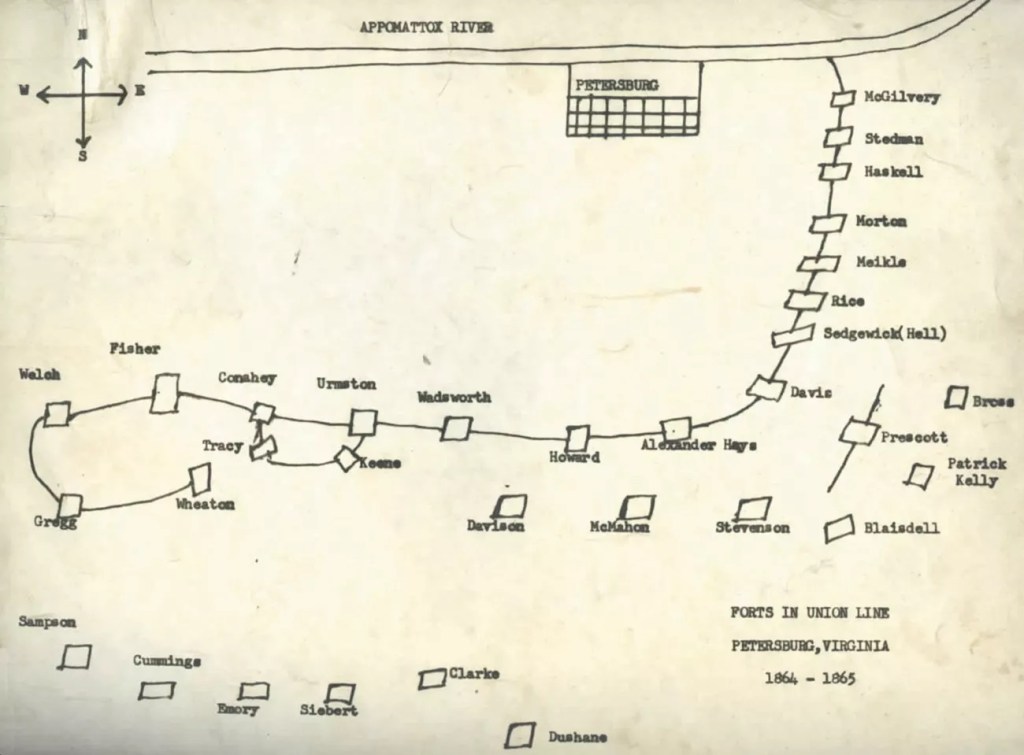
The National Park Service offers this crude sketch of the various forts in the Union line near Petersburg in 1864-65. Forts Sampson and Cummings, where the 11th Massachusetts Battery had its guns planted can be seen at the lower left.

1 The Union offensive described in this letter refers to Grant’s Sixth Offensive which was an effort to capture the South Side Railroad, cutting off a major supply line to the besieged cities of Petersburg and Richmond. If successful, it would have been a major Union victory prior to the Presidential election of 1864. A two pronged attack was launched, with Butler’s troops attacking the Richmond defenses north of the James River while elements of the 2nd, 5th, and 9th Corps skirted the rebel defenses southwest of Petersburg to get at the South Side Railroad. Fort Cummings, where 4 guns of the 11th Massachusetts Battery were planted, was the point in the Union defensive line from which the 5th and 9th Corps launched their marches. Joseph’s interpretation of events was incorrect; the attack on the right by Butler was intended to hold Confederate troops between Richmond and Petersburg into position while the main objective was to capture the South Ride Railroad on the left.
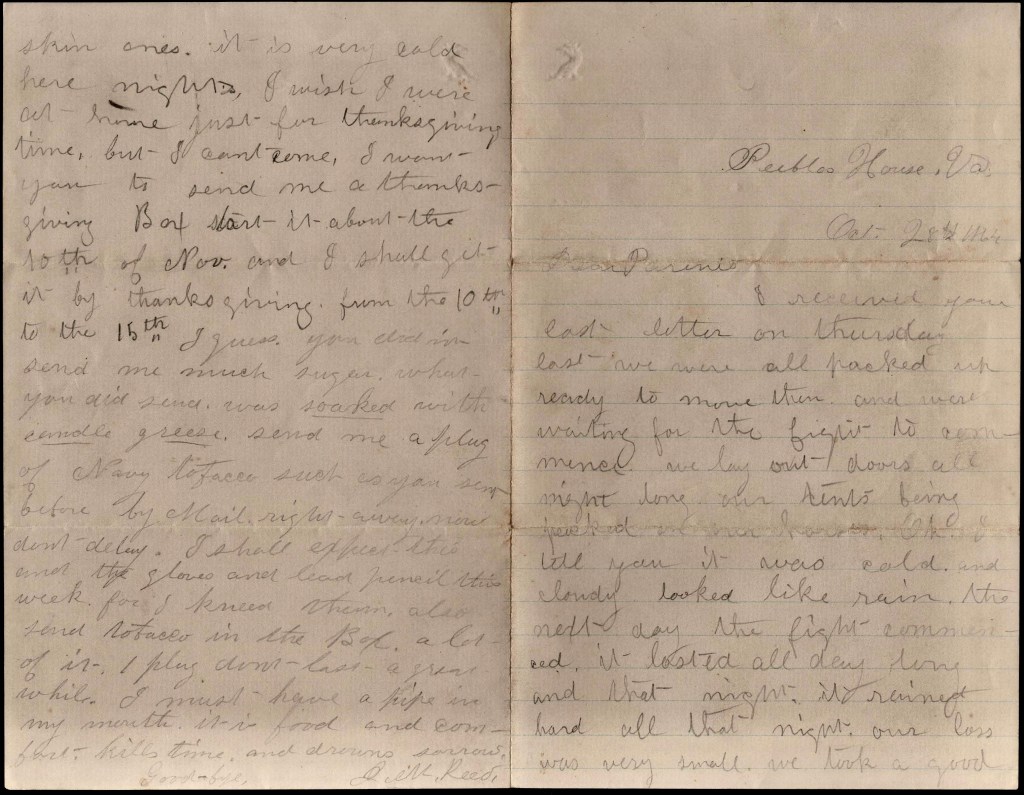

Letter 9

Peeble’s House, Virginia
November 1, 1864

Dear Mother,

I don’t know if you can read this note. This is the best I can do.

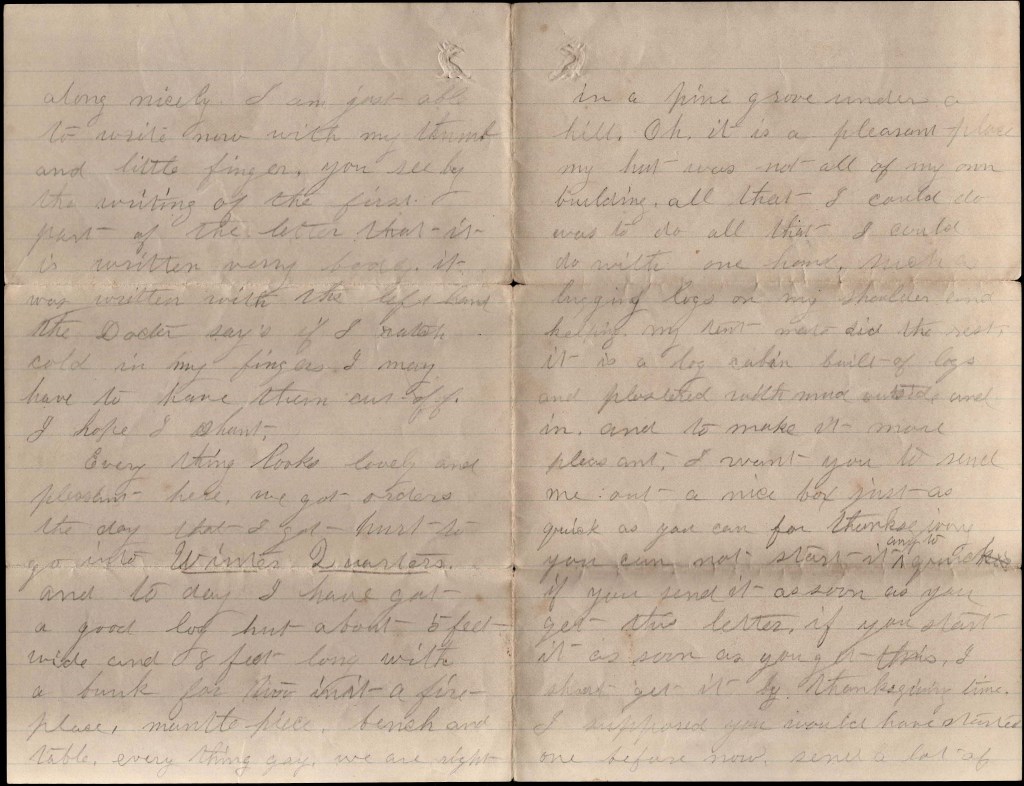
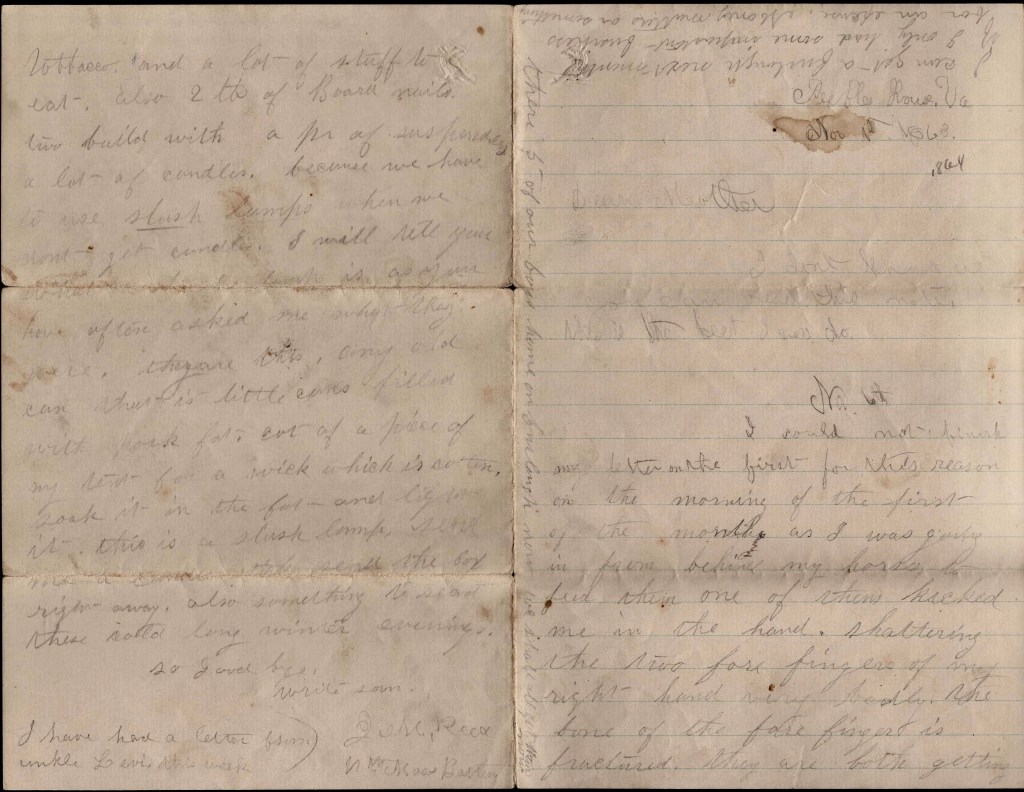
Nov. 6th. I could not finish my letter on the first for this reason. On the morning of the first of the month, as I was going in from behind my horses to feed them, one of them kicked me in the hand, shattering the forefinger of my right hand very badly. The bone of the forefinger is fractured. They are both getting along nicely. I am just able to write now with my thumb and little finger. You see by the writing of the first part of the letter that it is written very badly. It was written with the left hand. The doctor says if I catch cold in my fingers, I may have to have them cut off. I hope I shant.

Everything looks lovely and pleasant here. We got orders the day I got hurt to go into Winter Quarters and today I have got a good log hut about 5 feet wide and 8 feet long with a bunk for two in it, a fireplace, mantle piece, bench and table. Everything’s gay. We are right in a pine grove under a hill. Oh, it is a pleasant place. My hut was not all of my own building. All that I could do was to do all that I could do with one hand, such as lugging logs on my shoulder and helping. My tent mates did the rest. It is a log cabin built of logs and plastered with mud outside and in. And to make it more pleasant, I want you to send me out a nice box just as quick as you can for Thanksgiving. You cannot start it any too quickly. If you send it as soon as you get this letter, I shant get it by thanksgiving time. I supposed you would have started one before now. Send a lot of tobacco and a lot of stuff to eat. Also 2 lb. of board nails to build with, a pair of suspenders, a lot of candles because we have to use slush lamps 1 when we don’t get candles. I will tell you what a slush lamp is as you have often asked what they were. They are this—an old can that is little, filled with pork fat and a piece of my tent for a wick which is cotton, soak it in the fat, and light it. This is a slush lamp. Send me a candle stick. Send the box right away. Also something to read these long winter evenings. So goodbye. Write soon. — J. M. Reece, 11th Massachusetts Battery

I have had a letter from Uncle Levi this week. I can get a furlough next month if I only had some important business for an excuse. Money matters or something. There are 5 of our boys home on furlough now. We shall all get them now.
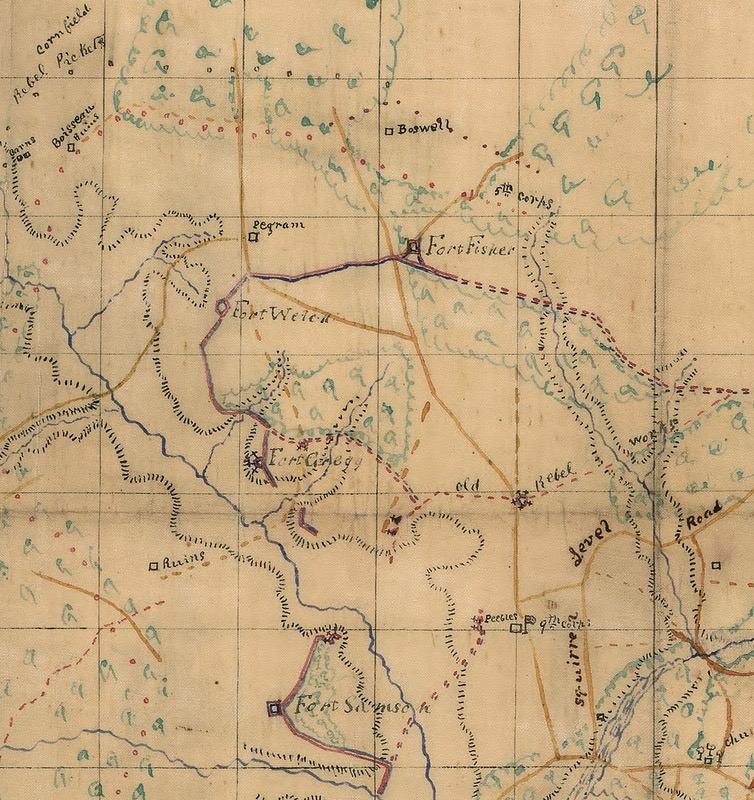
A closeup map of Fort Samson (bottom center) where Joseph’s Section (2-guns) of the 11th Massachusetts Battery was positioned. To the right of it on this map can be seen the “Peeble’s House”—Headquarters of the 9th Corps.

1 “Slush lamps” were made from cooking grease and a cloth wick when candles were scarce. 

Letter 10

Peebles Farm, Virginia
November 12th 1864

Dear Mother,

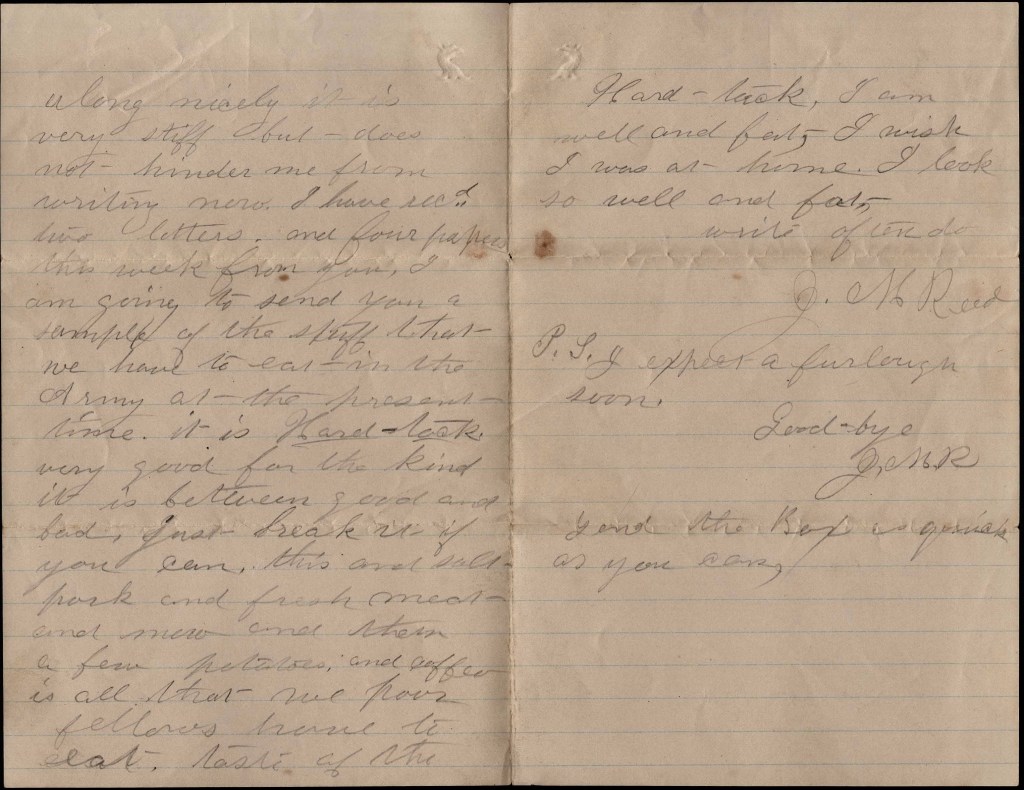
It is Saturday and I am on guard tonight so I thought I would write to you. You needn’t feel at all alarmed about my position for as long as our pieces stay in position, I shall be in the rear with my horses. I have got a better position than I had before. My finger is getting along nicely. It is very stiff but does not hinder me from writing now.

I have received two letters and four papers this week from you. I am going to send you a sample of the stuff that we have to eat in the army at the present time. It is Hard-tack—very good for the kind. It is between good and bad. Just break it, if you can. This and salt pork and fresh meat and m___ and then a few potatoes and coffee is all that we poor fellows have to eat. Taste of the hard-tack. I am well and fat. I wish I was at home. I look so well and fat. Write often do.

—J. M. Reed

P.S. I expect a furlough soon. Goodbye, J.M.R.

Send the Box as quickly as you can.


Letter 11
Winter Quarters, Peebles Farm, Va.
November 20, 1864

Dear Mother,

I received your last letter with recipe of box therein. Also a list of costs. I would like to know if the articles—pies, h___, molasses, salt, cranberry sauce, apples—I hope you bought on purpose to send me. If so, I will pay for them. If you didn’t, I don’t see why I should pay for them. But if you say I shall pay for them, I will do so. I shall get the box this week—just in time for Thanksgiving. I am very sorry you did not send me more tobacco. That will go but very little way. However, when I get paid off, I shall send home $5 to be spent for tobacco—all of it. That clay pipe you sent out to me I have smoked so much in it that it is as black as a coal.

Now there is an article that I want right away. I want it now. It is my watch. I want father to take it over to the Waltham Watch C0. on Washington St. and inquire for Charles Fuller, bookkeeper, a friend of mine, and tell him I want my watch put in good running order, perhaps cleaned, and a good key, and as pretty a steel chain as can be got. I guess Abby can get the chain. I don’t want one with a snap on the end to hook on to the watch, but a screw loop. I want it packed very nicely in cotton batten and put into a little paste board box and sent by Adams Express Co. Abby, I want you to get me a fancy steel chain with a bar on one end to put in the button hole of my vest and screw loop on the other end. Don’t get a big link chain.

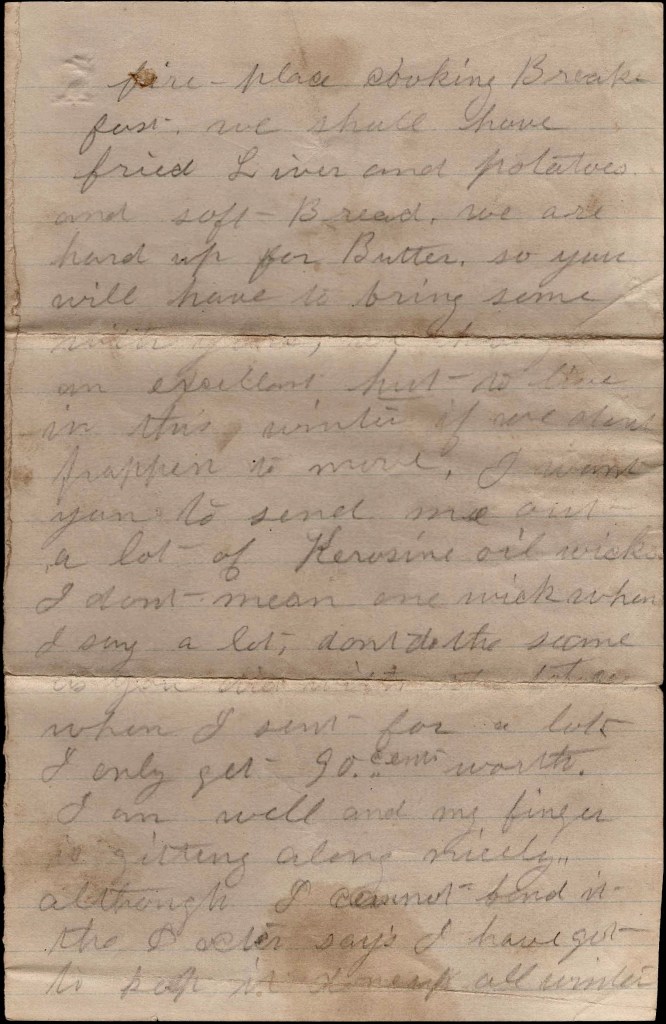
Now send the watch as quick as you can, and I will pay all damages when I get paid off. Also send my suspenders and a small rubber course pocket comb and a wallet by mail at different times. Now don’t forget these things, will you. I am all out of money at the present time. But for my tent mate, or my “old woman” wife as I call him, I should go hungry. He has got some money and as it is natural to soldiers not to go hungry when they can get anything to eat, we buy potatoes of the sutler at 10 cents a pound, and a whole liver at a time of the Brigade butcher. Now tomorrow morning, if you will call into my cabin, No. 14 Jones Row, at four o’clock, you will see my old woman in front of the fireplace cooking breakfast. We shall have fried liver and potatoes and soft bread. We are hard up for butter so you will have to bring some with you. We have an excellent hut to live in this winter if we don’t happen to move. I want you to send me out a lot of kerosine oil wicks [and] I don’t mean one wick when I say a lot. Don’t do the same as you did with the tobacco when I sent for a lot [and] I only got 90 cents worth.

I am well and my finger is getting along nicely although I cannot bend it. The doctor says I have got to keep it done up all winter. If I don’t and it froze, I shall lose my finger and perhaps my right arm. We have a doctor with our Battery now. I cannot write more now. Send that watch right away now as it is getting time to have a watch about me so when I go away, I shall know when to get back [and] to be on hand when the bugle blows. We are in camp now, you know, and have to have bugle calls. I will name some of them. Viz: reveille, stable call, feed call, water call, retreat—this retreat means police call, tattoo—when the sun’s down, retiring to rest, recalls from stable, taps in the far west, supper call.

Write soon, — J. M. Reed

Send the watch and pay the express on it. Be sure and have the value put down. Value $40 as that is what it is worth. It’s worth over 50 to me.


Letter 12

Popular Grove Church Va.
November 28th, 1864

Dear parents,

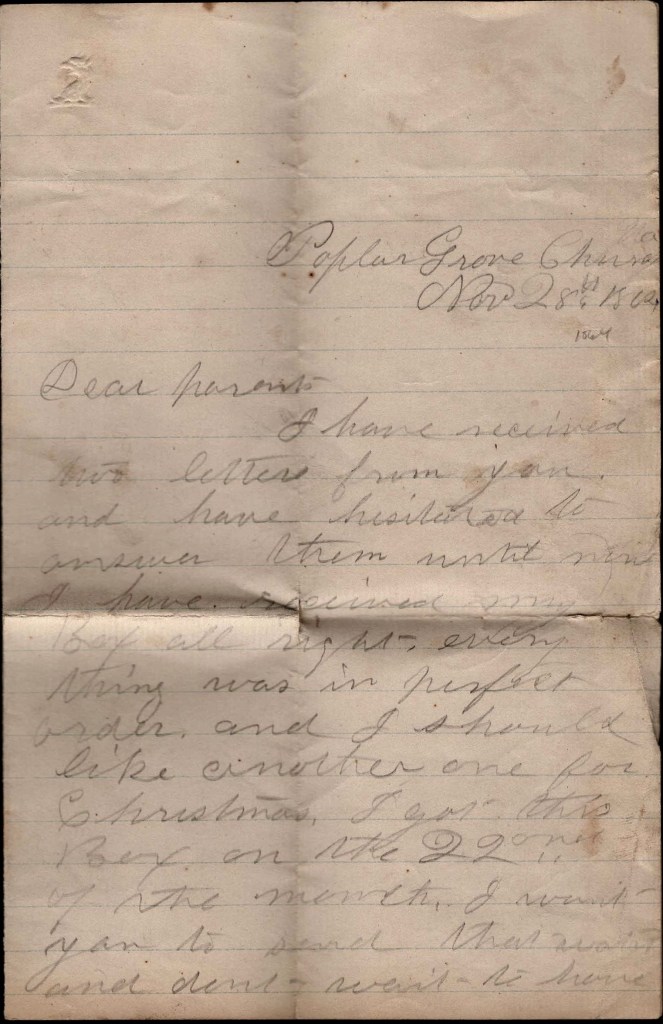
I have received two letters from you and have hesitated to answer them until now. I have received my box all right. Everything was in perfect order and I should like another one for Christmas. I got this box on the 22nd of the month. I want you to send that watch and don’t wait to have me send for it again as I need it very much.

I had a very good time Thanksgiving. Beans for breakfast, turkey for dinner, pie & cake, bread, butter, sauce for supper. Massachusetts soldiers did not get much of the stuff she sent out for Thanksgiving. I will tell you what her troops in this noble 11th Battery got. Viz: one lb. turkey, 2 apples, and half of a common size seed-cake to each man, and this the next day after Thanksgiving. The Old Bay State did well to send us the stuff. But the stuff was consumed mostly by officers, only giving the privates a very small share. Never mind; in two years more I hope to be out of this army. I am very well and living high all the time. I wish you could see me when I am eating my frugal meal. Ill bet you would laugh.

I am on guard tonight so I cannot write any more tonight. So I must bid you good bye hoping that you are all well. How are the babies? I will write more next time. So goodbye. — J. M. Reed

Letter 13

Breakers Ahead
Before Petersburg, Virginia
Near Birneys Station
December 4th 1864

Dear Pazents,

I received your kind letter last Thursday night. I am very sorry to say that we have left our good quarters on the extreme left and have marched below the city of Petersburg near Bermuda Hundred. We are right in sight of the city. It is a gay looking place. Oh, I tell you, they do throw the shells into our forts fearfully. I don’t know how soon I shall have to write you [of] the death of one of our numbers for we are in a very bad place. We are in Fort McGilvery on the extreme right of the Army of the Potomac. We have built us very comfortable quarters out of logs. We are not exactly in winter quarters [but] we were ordered to make ourselves as comfortable as possible, so we call it winter quarters. We are more comfortable than we were before. We are now 20 miles from where we were the left—where I wrote you last.

The National Park Service offers this crude sketch of the various forts in the Union line near Petersburg in 1864-65. Fort McCilvery can be seen in the upper right hand portion of the map, due East of Petersburg and very near. According to Joseph, the 11th Massachusetts Battery was relocated to this position in early December, 1864.

When I wrote you before, I sent for my watch and I never send and I never send for a thing without I want it. Now I want you to send that watch as soon as you get this letter. I don’t care if there is another campaign or not, I want the watch. Now you send it! If You don’t I shant write again. What do you suppose I sent for it for if I didn’t want it. I want you to send the watch as I directed you to and then I want you to send me out a Box for Christmas. And send me out two pairs under shirts and drawers and two pairs outside woolen shirts of the handsomest figure you can find in the market. Don’t make up any plain stuff now. Remember I want you to write me what they cost and I will send you the money as soon as I get paid off. Get some stout, fancy flannel—not very thick as the weather is moderate and I shall not need them thick. Also, send me the stuff I have sent for in previous letters. Read my letters more carefully and see what I write. Read them a second time if you cannot understand them the first. Don’t let me ask you to send my watch again, but send it this time and not delay. If you don’t I shall not write until you do send it. I want a comb and wallet and suspenders. Send box Christmas & New Years. 1

Write often, — Joseph M. Reed

P. S. My box came through all right. Not a thing was spoilt. Where is that box of books that somebody was going to send me? I wish the would send them now. Sed box of tobacco in my boxes.

1 It’s not often I feel compelled to share a personal observation, but I can’t help saying that this paragraph is perhaps the most rudely worded one among the thousands of soldier’s letters I’ve ever transcribed.


Letter 14

In front of Petersburg, [Va.]
December 14th 1864

Dear Mother,

I recieved about 10 days ago a splendid library from No 13 Cornhill, Boston, containing 26 very choice cloth bound books. They are all pious books. I tell you, it makes my cabin look gay. I have made a bookcase for them. There are 4 of us in the hut together. Our hut is built larger than the one we had up on the left. It is 12 x 8 feet, I think, with a splendid brick fireplace.

I will tell you what we had for supper tonight. It was fried liver, soft bread and butter, and coffee. Tomorrow evening we shall have hot biscuit and butter for tea. Please make a call in the afternoon and stop to supper. Bring you knitting work so to spend the evening by an old fashioned fireside. You would think you were in grandmother’s kitchen if you were in our hut. But don’t let me tantalize you with my story. I think I had rather sit by Grandmothers fireplace than this one. I will write more next time. I hope you have sent my watch. Love to all.

— J. M. R.


Letter 15
Near Fort Lyons
Alexandria, Virginia
May 26th 1865

Dear Mother,

I received your letter of the 24th inst. together with the pictures. The pictures were not taken very well. Do you think they were? How big and fleshy they were, I should not known them had I got home before she died.

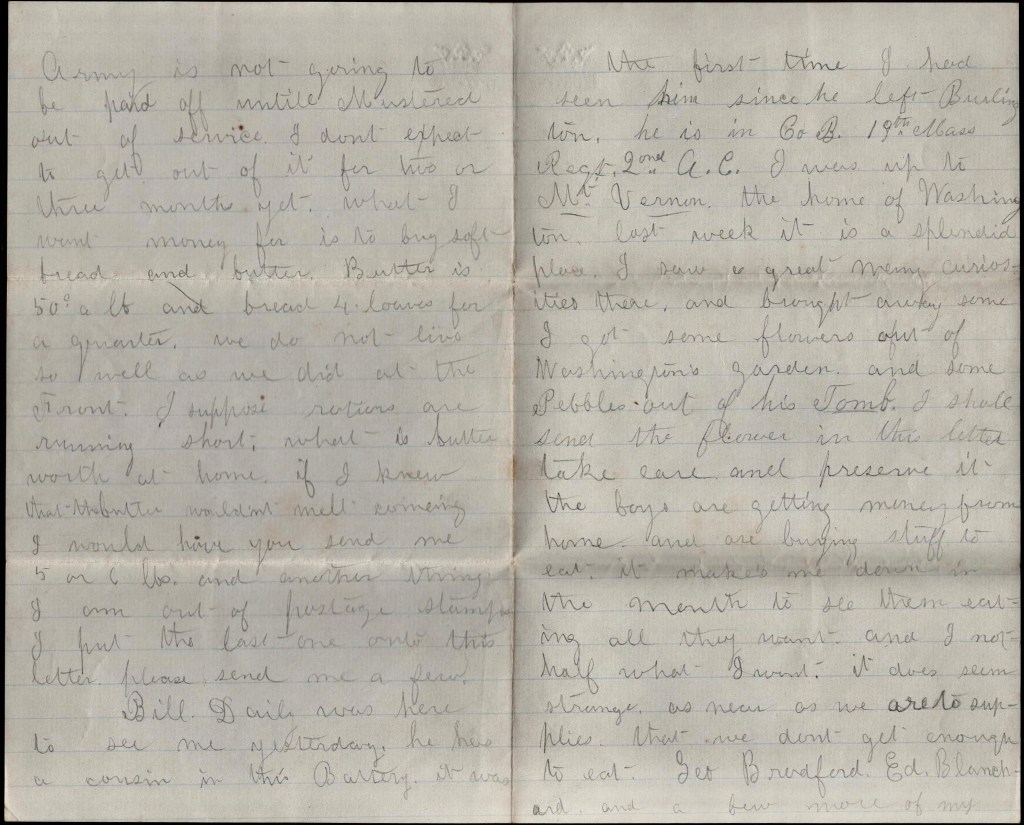
How is times at home? The two dollars you said you sent me has not reached me yet. I wish you would send me 5 or 6 dollars for I need it very much and the army is not going to be paid off until mustered out of service. I don’t expect to get out of it for two or three months yet. What I want money for is to buy soft bread and butter. Butter is 50 cents a pound and bread, four loaves for a quarter. We do not live so well as we did at the front. I suppose rations are running short. What is butter worth at home? If I knew that the butter wouldn’t melt coming, I would have you send me 5 or 6 pounds. And another thing, I am out of postage stamps. I put the last one onto this letter. Please send me a few.

Bill Daily was here to see me yesterday. He has a cousin in this Battery. It was the first time I had seen him since he left Burlington. He is in Co. B, 19th Massachusetts Regt, 2nd Army Corps.

I was up to Mount Vernon, the home of Washington, last week. It is a splendid place. I saw a great may curiosities there and brought away some. I got some flowers out of Washington’s garden and some pebbles out of his tomb. I shall send the flower in this letter. Take care and preserve it.

The boys are getting money from home and are buying stuff to eat. It makes me down in the mouth to see them eating all they want and I not half what I want. It does seem strange, as near as we are to supplies, that we don’t get enough to eat. George Bradford, Ed Blanchard, and a few more of my old schoolmates will be at home soon. They are in the 36th Regiment. Please send a greenback as soon as you get this. In haste. I am well. — J. M. Reed

1862: James Orrin Benson to his Sister

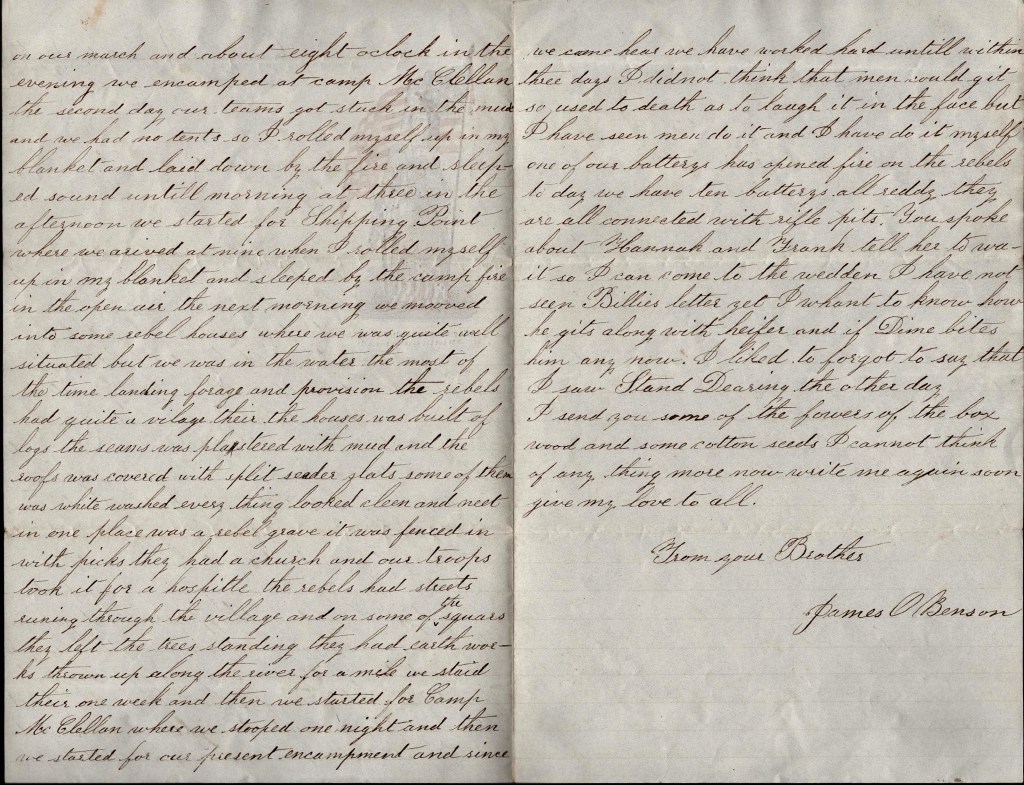
The following letter was written by James Orrin Benson (1838-1900), the son of Jotham Benson (1810-1885) and Elizabeth B. Wakefield (1810-1891) of Biddleford, Maine, who served as an artificer with the U. S. Army Corps of Engineers, Co. B, during the American Civil War. James enlisted on 26 November 1861 and was discharged from the service on 25 November 1864.

Yorktown, Va., vicinity. Gen. George B. McClellan’s tent, Camp Winfield Scott (LOC)

Transcription

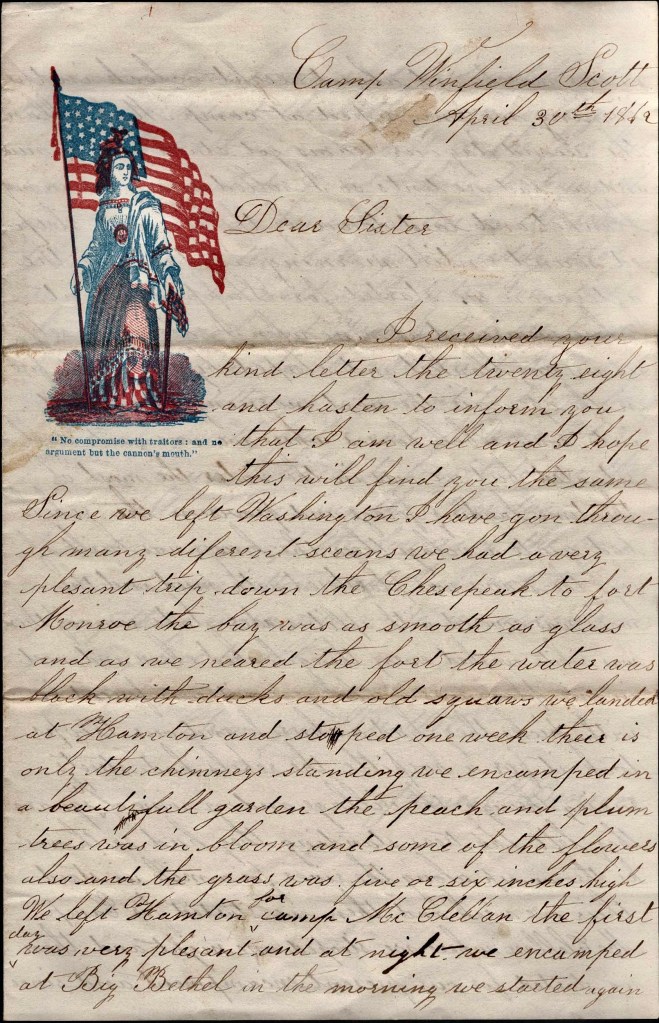
Camp Winfield Scott
April 30th 1862

Dear Sister,

I received your kind letter the 28th and hasten to inform you that I am well and I hope this will find you the same. Since we left Washington, I have gone through many different scenes. We had a very pleasant trip down the Chesapeake to Fort Monroe. The bay was as smooth as glass and as we neared the fort, the water was black with ducks and old squaws.

We landed at Hampton and stopped one week. There is only the chimneys standing. We encamped in a beautiful garden. The peach and plum trees was in bloom and some of the flowers also, and the grass was five or six inches high. We left Hampton for Camp McClellan. The first day was very pleasant and at night we encamped at Big Bethel. In the morning we started again on our march and about eight o’clock in the evening, we encamped at Camp McClellan. The second day our teams got stuck in the mud and we had no tents so I rolled myself up in my blanket and laid down by the fire and sleeped sound until morning.

At three in the afternoon, we started for Shipping Point where we arrived at nine when I rolled myself up in my blanket and sleeped by the camp fire in the open air. The next morning we moved into some rebel houses where we was quite well situated but we was in the water the most of the time landing forage and provision. The rebels had quite a village there. The houses was built of logs, the seams was plastered with mud, and the roofs was covered with split cedar slats. Some of them was white washed. Everything looked clean and neat. In one place was a rebel grave. It was fenced in with picks. They had a church and our troops took it for a hospital. The rebels had streets running through the village and on some of the squares they left the trees standing. They had earthworks thrown up along the river for a mile.

We staid there one week and then we started for Camp McClellan where we stopped one night and then we started for our present encampment. And since we came here, we have worked hard until within three days. I did not think that men could get so used to death as to laugh it in the face, but I have seen men do it, and I have [to] do it myself. One of our batteries has opened fire on the rebels today. We have ten batteries all ready. They are all connected with rifle pits.

You spoke about Hannah and Frank. Tell her to wait so I can come to the wedding. I have not seen Billie’s letter yet. I want to know how he gets along with heifer and [if] Dime bites him any now. I liked to forgot to say that I saw Stand Dearing the other day. I send you some cotton sees. I cannot think of anything more now. Write me again soon. Give my love to all. From your brother, — James O. Benson

1861: Moses Thompson to Elijah M. Morrison

Though unsigned due to its being a partial letter, I can confirm that it was written by Moses Thompson (b. 1835) of Co. E, 35th Ohio Volunteers (OVI). Moses entered the service as a private and mustered out as a sergeant. He was married to Mary Jane Morrison (1839-1865), the sister of Elijah M. Morrison (1836-1863), to whom the letter was addressed. Moses and Mary Jane were married in Preble county, Ohio in 1859.

The 35th Ohio Infantry was nicknamed the Persimmon Regiment. It was organized in Hamilton, Butler county, Ohio, and mustered in for three years on 20 September 1861 under the command of Col. Ferdinand Van Derveer. On September 26, 1861, the 35th departed Hamilton for Covington, Kentucky, arriving the same day. That evening, General O.M. Mitchel ordered the 35th onto a train on the Kentucky Central Railroad, placing detachments from the regiment at railroad bridges along the route in Harrison and Bourbon Counties, with the regiment headquarters being located at Cynthiana, Kentucky. The members of the 35th successfully protected the bridges from Confederate attacks. Upon completing this duty, the regiment moved to Paris, Kentucky, where the 35th remained until early December 1861, when it advanced to Somerset, Kentucky.

Transcription

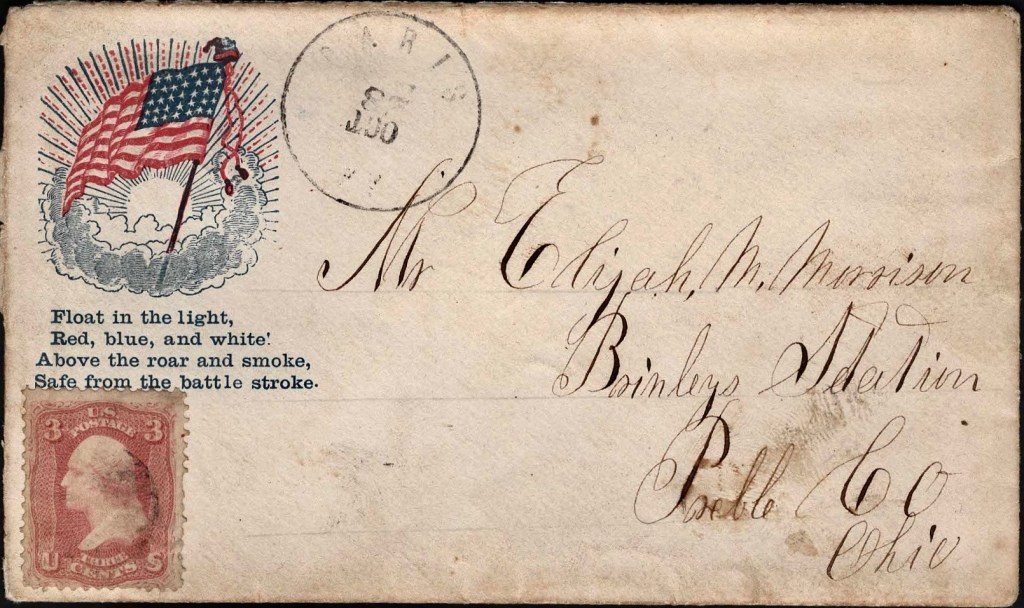
Addressed to Mr. Elijah M. Morrison, Brinley’s Station. Preble county, Ohio

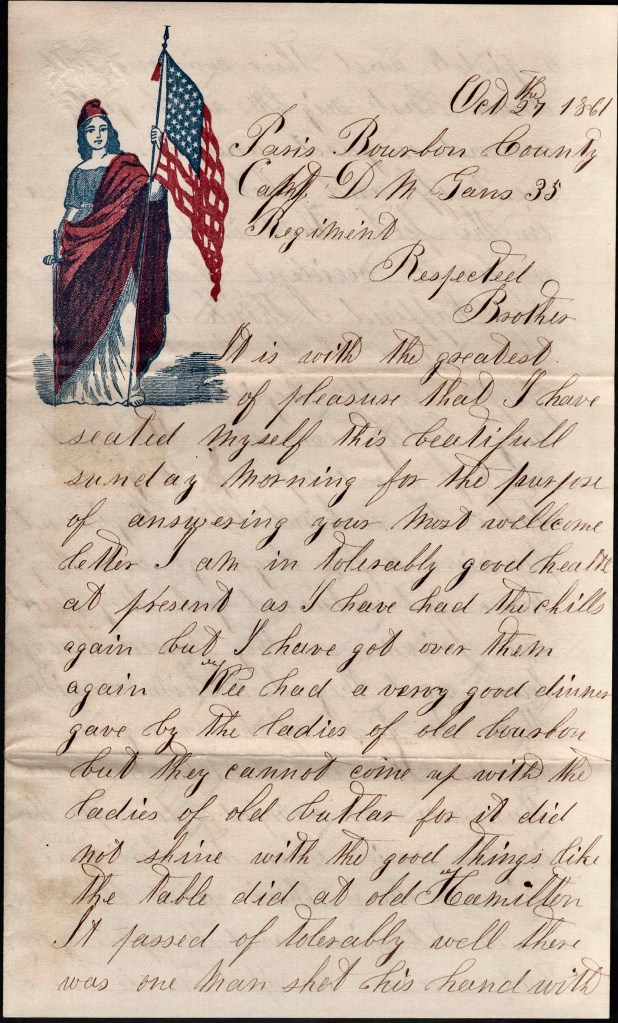
Paris, Bourbon County, [Kentucky]
October 27th 1861
Capt. D[avid] M. Gans
35th [Ohio] Regiment

Respected Brother,

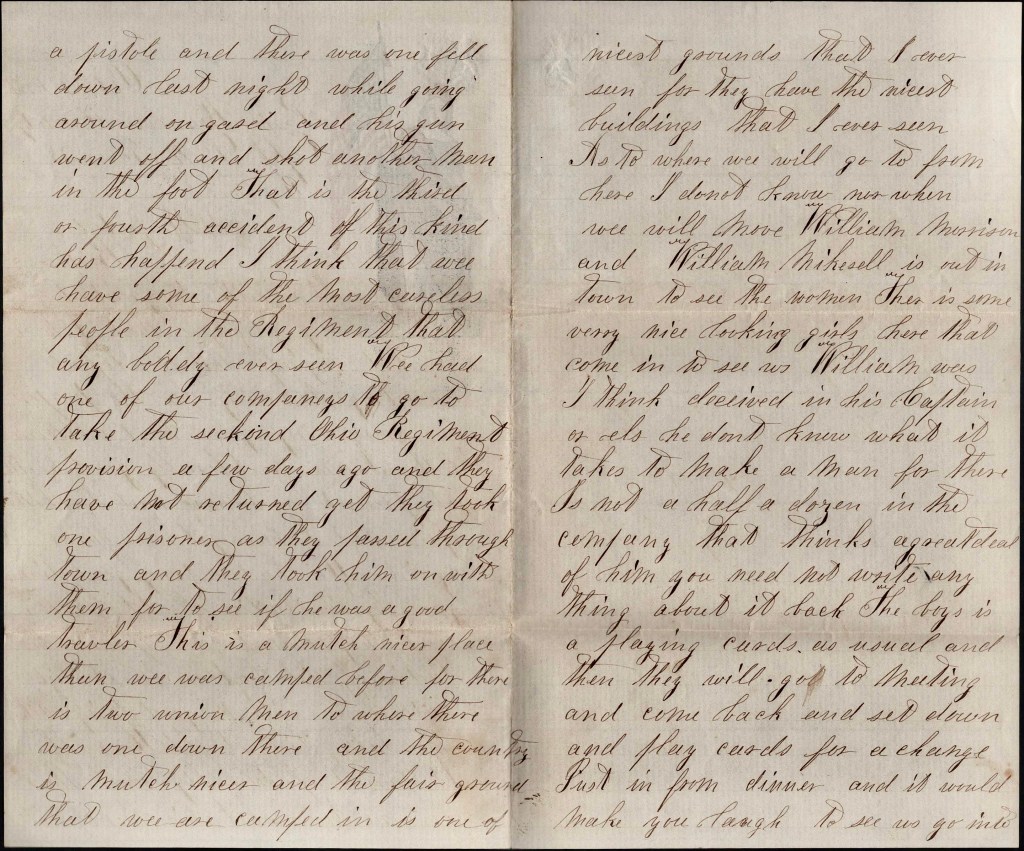
It is with the greatest of pleasure that I have seated myself this beautiful Sunday morning to the purpose of answering your most welcome letter. I am in tolerably good health at present as I have had the chills again but I have got over them again. We had a very good dinner gave by the ladies of Old Bourbon but they cannot come up with the ladies of Old Butler for it did not shine with the good things like the table did at Old Hamilton. It passed off tolerably well. There was one man shot his hand with a pistol and there was one fell down last night while going around on guard and his gun went off and shot another man in the foot. This is the third or fourth accident of this kind has happened. I think that we have some of the most careless people in the regiment that anybody ever seen.

We had one of our companies to go to take the 2nd Ohio Regiment provisions a few days ago and they have not returned yet. They took one prisoner as they passed through town and they took him on with them for to see if he was a good traveler.

This is a much nicer place than we was camped before for there is two Union men to where there was one down there and the country is much nicer and the fairground that we are camped in is one of nicest grounds that I ever seen for they have the nicest buildings that I ever seen. 1 As to where wee will go to from here, I do not know, nor when we will move.

William Morrison and William Mikesell is out in town to see the women. There is some very nice looking girls here that come in to see us. William was, I think, deceived in his Captain or else he don’t know what it takes to make a man, for there is not a half a dozen in the company that thinks a great deal of him. You need not write anything about it back The boys is a playing cards as usual and then they will go to Meeting and come back and sit down and play cards for a change. Just in from dinner, and it would make you laugh to see us go into…. [rest of letter is missing]

1 “Camp Bourbon is located at the Fair Grounds of the county of that name, within the vicinity of Paris, the county seat. It is a beautiful location for a camp, the ground being high and rolling and thickly sodded with blue grass. The buildings in the fair grounds are ample and of the most approved style for the purposes they were erected, far surpassing those of a like kind in our own Ohio. [Letter by member of the 35th OVI from Camp Bourbon on 2 November 1861]

1862: Calvin McGowan to William D. Tebay

The following letter was written by Calvin McGowan (1836-1892), the son of Archibald McGowan (1790-1858) and Hannah Tebay (1799-1870) of Fairview, Jones county, Iowa. According to regimental records, Calvin mustered into Co. B, 9th Iowa Infantry as a private on 27 September 1861 and mustered out three years later on 24 September 1864 when his term expired.

John Willard Niles was a sergeant in Co. B, 9th Iowa Infantry and was promoted to Lieutenant in 1863 and Captain in 1865. (Image from eBay)

“The last company was mustered September 24, 1861, and, two days later, the regiment, with an aggregate strength of 977 officers and enlisted men, was embarked on steamboats at Dubuque and transported to St. Louis, and, upon its arrival there, marched to Benton Barracks, where it received it first supply of arms, clothing and camp equipage. Here it remained until October 11th, receiving such instruction in military drill as could be given in so short a period of time. It was then ordered to proceed to Franklin, Mo., at which Place regimental headquarters were maintained, while companies were detached to different points for the purpose of guarding the railroad from Franklin toward Rolla, Mo. During the three months in which the regiment remained upon this duty, it suffered greatly from exposure to the inclement winter weather, and, like all new regiments, was subjected to much sickness on account of such exposure. On the last day of the year 1861, the official returns showed a death loss of 17, and 7 discharged on account of disability, total 24; but on the same date it had gained 38 by additional enlistment, and 4 by transfers making a net gain of 18, and an aggregate of 995. Of this number however many were on the sick list, and the hardships which the regiment was called upon to endure, during the active winter campaign which followed, still further reduced its fighting strength, and when it first went into battle it numbered but little more than half the aggregate above stated. January 21, 1862 the regiment was again consolidated, the companies on detached duty having been relieved, and was conveyed by rail to Rolla, Mo., and from there begins its first real campaign against the enemy. Marching to Lebanon, Mo., it joined the Army of the Southwest commanded by General Curtis. Colonel Vandever was placed in command of the brigade to which his regiment was attached, leaving Lieut. Col. Frank J. Herron in command of the regiment.

Upon the approach of the Union forces, the rebel General Price evacuated Springfield, which he had occupied during the winter, and began his retreat towards the Ozark Mountains. Then began that remarkable march of general Curtis’ army in pursuit of the enemy. The regiment started from Springfield on the 14th of February and, in less than one month, had marched over difficult roads, and much of the time through storms of alternating rain and snow, a distance of two hundred and fifty miles. Arriving at Cross Hollows, Ark., a detachment of three hundred of the regiment was sent upon an expedition to Huntsville, forty miles distant, with the purpose of surprising and capturing a detachment of the enemy stationed there as a guard for commissary stores; but, upon reaching Huntsville, they found the place abandoned, and learned that the rebel army under General Van Dorn was marching to the attack of General Curtis’ army, which had fallen back from Cross Hollows and taken up a new position at Pea Ridge. Realizing the danger of being cut off and captured by a superior force, the detachment of the Ninth Iowa at once started to rejoin the command and, after a continuous march of sixteen hours, covering a distance of forty-two miles, it reached the regiment at 8 P. M., March 6th. With only a few hours of rest after this exhausting march, these men went into the memorable battle of Pea Ridge at 10 A. M., March 7, 1862.”

Transcription

Camp Scott, Missouri
January 14th 1862

Dear Cousin,

Your kind letter of the 4th of this month has come to hand. I was glad to hear from you and sorry too. It was about seven o’clock in the evening when I received your letter. We was all sitting around a good fire and singing some old familiar songs when I read over your letter. I was surprised to hear of so many deaths among my old relations, but we must all die sooner or later. We must all come to that end. I hope us all will be willing to go when that day comes for to meet that solemn hour.

I have not much to write at this time. Price still roams through this county seeking whom he may devour but I think we will soon devour him. Jim Lane has got a job of cleaning Price out. He is going to start in a few days on pursuit of Price. There is two Iowa regiments going with him. We may be one of them and we may not. I hope we will. There is thirty thousand going with him. They have to be picked regiments.

There was a fight a few days ago on Silver Creek not far from this place—a complete victory for the Union men. When our men come up on them, they were in line of battle. Our men was all cavalry men. They rode right up and broke their line and put them all to flight. There was four hundred of our men and eleven hundred rebels. We killed thirty and wounded about forty. We lost three men and thirty wounded. That is a true account of the Battle of Silver Creek [see Battle of Roan’s Tan Yard, 8 January 1862] We took sixty horses and a great many wagons and two wagon loads of powder. The Union men burnt the wagons and kept the powder.

There was ten thousand cavalry started from Rolla a few days ago. They started the course of Springfield. We have not heard from them since they left. Price has possession of Springfield—at least he had a few days ago. Since I have commenced this letter, we have got further news. We leave this place tomorrow morning at seven o’clock. That is the orders now. I can’t tell you where we will go yet. That is not known yet. I did not know this when I commenced this letter. The orders may be countermanded before morning. I hope it will not. Our regiment is well fitted out for service. We have twelve cannons. Some of them is 18-pounders. I hope they will say something before long and do something. I would like to hear them howl and [the] rebels too.

We had news a few days ago that the big fleet had started from St. Louis last week to Columbus, Kentucky. I will say in conclusion that our company has not lost a man yet but our regiment has lost thirty since we left Dubuque, all by disease. We have got the best regiment in the State of Missouri and our company is the best company in the regiment—Co. B. I think we will see fun in a few days. That is the opinion of the officers this night. The sooner the better. We have got the best of guns. They will shoot nine hundred yards.

I must close for this evening. You must excuse this letter for there was 18 men in the same shanty where I was trying to write and it is impossible for any man to write. This leaves me hearty and in good spirits. I hope it will find you all the same. Give my love to all enquiring friends. I hope to see you all someday. Be sure and write as soon as you get this letter. Yours truly, — Calvin McGowan

Address Pacific City, Missouri, 9th Regiment Iowa Infantry, Co. B. in care of Capt. ]Don A.] Carpenter

to William D. Tebay

1861: Robert A. Dempster to his Friends

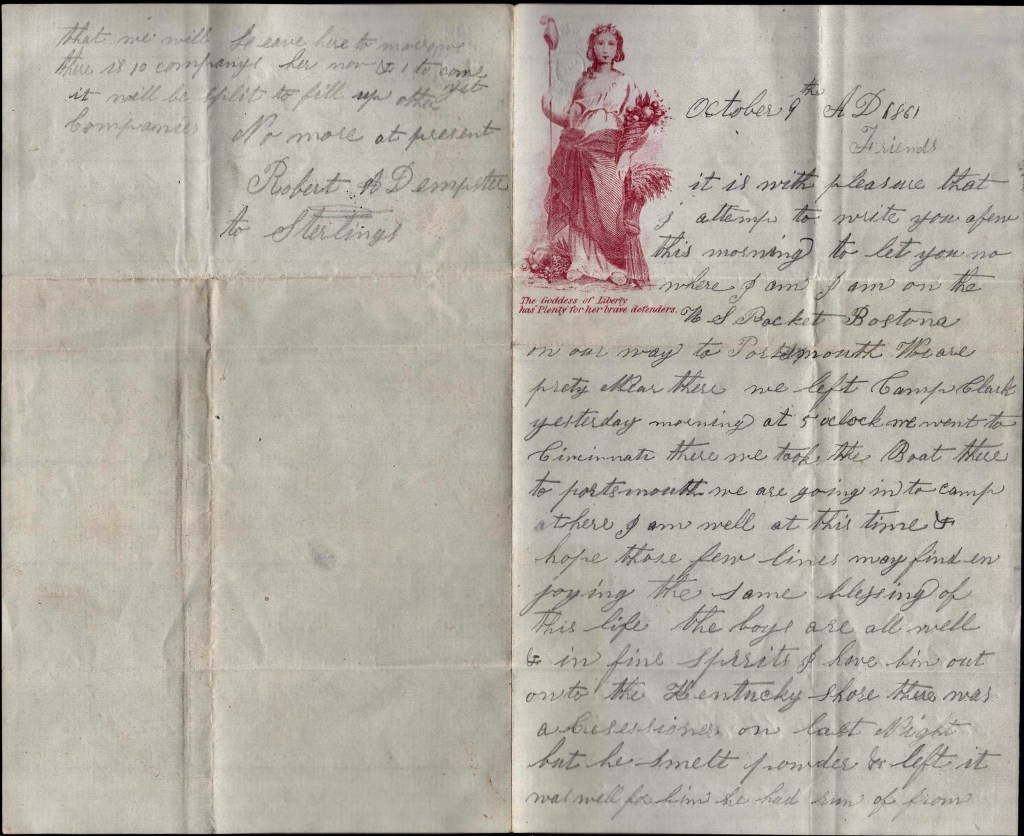
The following letter was written by Robert A. Dempster (1839-1912), the son of John Wesley Dempster (1817-1904) and Florania Huston (1820-1856) of Allen county, Ohio.

According to the 1890 Veterans Schedule, Robert served in Co. K, 33rd Ohio Infantry. The regiment was organized at Camp Morrow and in late October 1861 they were moved to Maysville, Kentucky where they spent the next two months pursuing Confederate Colonel John S. Williams’s command. Union forces eventually drove these Rebels out of Kentucky and into Virginia. The 33rd then boarded transports at Louisa, Kentucky on the Big Sandy River and traveled to Louisville, Kentucky, arriving here on December 1, 1861. At Louisville, the regiment was brigaded with the 10th Regiment Wisconsin Infantry, 2nd Regiment Ohio Volunteer Infantry, and the 21st Regiment Ohio Volunteer Infantry in Don Carlos Buell’s Army of the Ohio. The Army of the Ohio then advanced to Bacon Creek, Kentucky, where the 33rd remained until February 1862. After traveling further south into Tennessee and Alabama, the regiment participated in the Battle of Perryville where they entered the engagement with approximately four hundred men. The regiment had 129 men killed or wounded in the battle, nearly one-third of its total active strength.

The Ohio River Steamer Bostona (nearest shore) tied up at the Portsmouth Landing. It was owned and operated by William McClain and used as a regular mail packet between Portsmouth, Marysville and Cincinnati. Circa 1861. Portsmouth Public Library.

Transcription

[Camp Morrow at Portsmouth, Ohio]
October 9th 1861

Friend,

It is with pleasure that I attempt to write you a few [lines] this morning to let you know where I am. I am on the U. S. Packet Bostona on our way to Portsmouth. We are pretty near there.

We left Camp Clark [Springfield, Ohio] yesterday morning at 5 o’clock. We went to Cincinnati. There we took the boat there to Portsmouth. We are going into camp there. I am well at this time & hope these few lines may find [you] enjoying the same blessing of this life. The boys are all well & in fine spirits.

I have been out onto the Kentucky shore. There was a secessioner on last night but he smelt powder & left. It was well for him. He had run off from Kentucky about a week ago. He went back last night. When he got off, he said he would have to take the Oath of Allegiance before 12 today.

We did not get to go home when I wrote that we expected to, but the next evening after I wrote you that letter, Father came to see us. His visit was very unexpected to us for when we left, he did not think of coming to camp. He thought he could live in a place like that. The next morning there was 4 of the boys came down that we were acquainted with. Pap only stayed one night with us. Camp life agrees with me very well. I am cook.

The folks were all well then. Some of them has had the sore throat again. Mother was some better than we are just at past month.

Since I stopped, we have left the boat [and] marched to Camp Morrow. We are in sight of the Kentucky hills. The hills are very large. They look very low this morning. As we sailed along the shore of Kentucky, the men & boys, women & children were gathered on the shore in squads with music and the Stars & Stripes floating over them. As we passed, they would give the volunteers three hearty cheers, three for Lincoln, and then three for Kentucky. You’d better think they opened their mouths then. When we landed at Postsmouth, the people looked as though they had never seen anybody. I often think of home & of my home in Union. I think if ever I get home that I shall come to see you all. Tell the folks that I am well & that I like a soldier’s life.

Last night we slept on a bed for the first since we left home. Our trip from Springfield to Portsmouth will cost Uncle Sam over $300. You must give my respects to all enquiring friends. We don’t know how long we will stay here. Some of the boys here say that we will leave here tomorrow. There is ten companies here now & one to come. It will be split to fill up the other companies. No more at present. — Robert A. Dempster

To Sterlings

1862: Joseph Tucker Whitehouse to Mary Ann (Tucker) Whitehouse

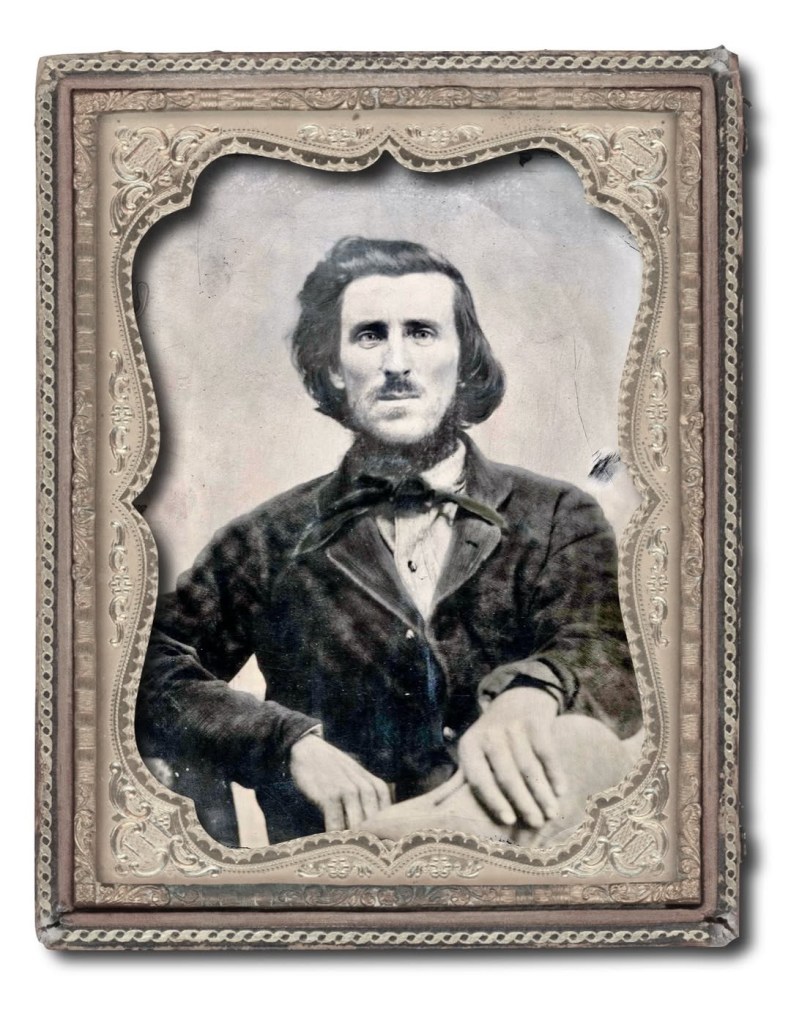
I could not find an image of Joseph but here is one of Pvt. James. A. G. Mann who served in Co. B, 42nd Massachusetts. (Dover Historical Society)

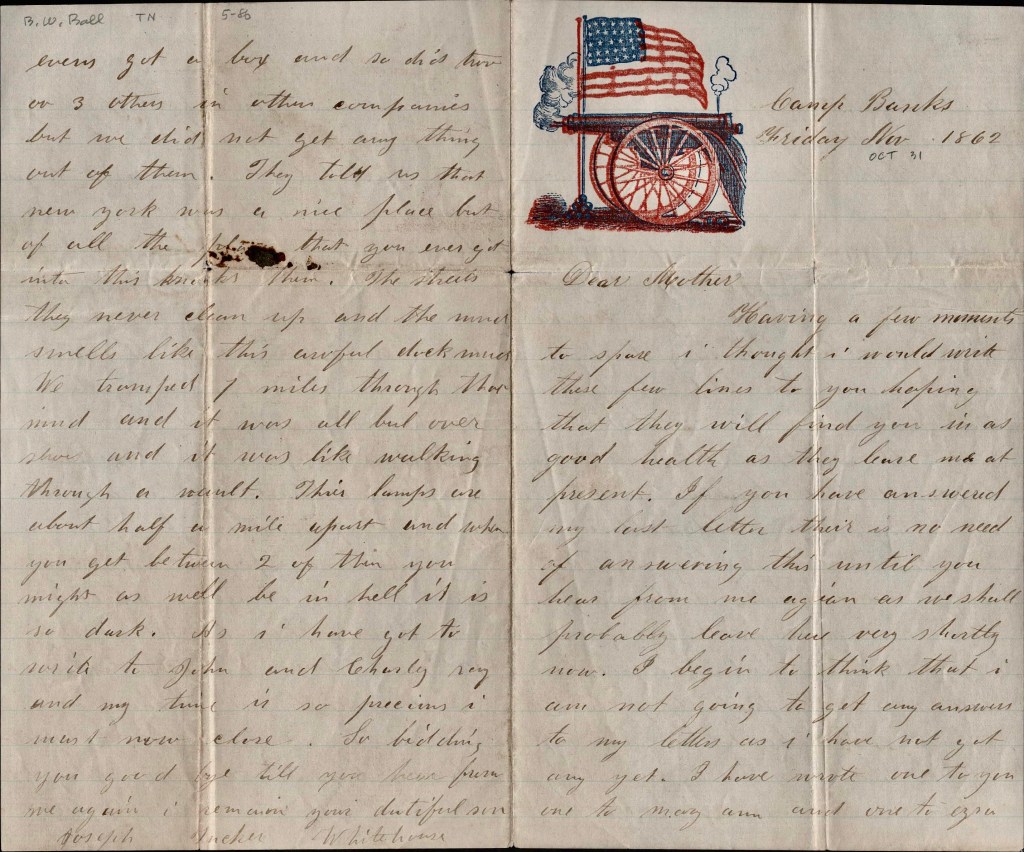
The following letter was written by 19 year-old Joseph Tucker Whitehouse (1843-1910) who enlisted in October 1862 as a private in Co. H. 42nd Massachusetts Infantry. He mustered out of the regiment on 20 August 1863. The various companies of the 42nd Massachusetts were mustered in between Sept. 13 and Oct. 14, 1862, while the field and staff were not mustered until Nov. 11. Under command of Colonel Isaac S. Burrell, the regiment left Nov. 21st for Camp Banks, Long Island, N. Y., where the “Banks Expedition” for Louisiana was being organized. From here on the 3d of December, it took transports for New Orleans.

Joseph was the son of David Whitehouse (1814-1890) and Mary A. Tucker (1810-1880) of Boston, Massachusetts.

Transcription

Camp Banks
Friday, [14] November 1862

Dear Mother,

Having a few moments to spare, I thought I would write these few lines to you hoping that they will find you in as good health as they leave me at present. If you have answered my last letter, there is no need of answering this until you hear from me again as we shall probably leave here very shortly now. I begin to think that I am not going to get any answers to my letters as I have not got any yet. I have wrote one to you, one to Mary Ann, and one to Ezra, and have received no answers yet. But they may get here yet before we leave. I want you to answer every letter that I send to you just as soon as you get it but you need not answer this one on account of our going away.

I have not been very well since I got here but I suppose it was owing to that awful march we had. But I am all well now. But I hate to go into the southern climate because the most that troubles me is dysentery. Them old belts are a regular humbug. They don’t do any good at all.

I don’t suppose that we shall go to war for 1 or 2 months yet but when we leave here, we shall probably go to Staten Island where Banks is himself. It is said now for a sure thing that we are going to attack Richmond in the rear. If it is so, we shall see some hard fighting. You must not expect me to write very often but I shall write to you just as often as I can. I have 6 to write to, 3 out of my own family and Ezra, John, and Charley Ray so every time I write, it costs me 18 cents a time and that will soon run me out of money to write very often. I have only got about 3 dollars left now. We meet such poor food that once in a while I buy a pie. They have pies here just about as big around as a saucer and charge a shilling for them. But a shil is only 12 cents here. But that is awful for a small pie without any insides to it at all.

I expected David’s box out here yesterday but it has not got here yet. Tom Evans got a box and so did two or three others in other companies, but we did not get anything out of them. They told us that New York was a nice place but of all the places you ever get into, this knocks them. The streets they never clean up and the mud smells like this awful duck mud. We tramped 7 miles through that mud and it was all but over shoes and it was like walking through a vault [?] Their camps are about half a mile apart and when you get between 2 of them you might as well be in hell—it is so dark.

I have got to write to John and Charley Ray and my time is so precious, I must now close. So bidding you goodbye till you hear from me again. I remain your dutiful son, — Joseph Tucker Whitehouse

1862: Edwin Miller Furry to Margaret Jane (Rowe) Furry

I could not find an image of Edwin but here is a pre-war image of George F. Lint who served in Co. E, 73rd OVI.

These letters were written by Edwin Miller Furry (1833-1862) who enlisted at the age of 28 to serve in Co. G, 73rd Ohio Volunteer Infantry (OVI). He was appointed 1st Sergeant on 8 March 1862 and died on 23 September 1862 from wounds received at the Second Battle of Bull Run on 30 August 1862.

Edwin was the son of David Montgomery Furry (1809-1875) and Ruth McVay (1812-1893) of Staunton, Fayette county, Ohio. Edwin’s parents eventually moved to Hamilton county, Indiana. Edwain was married in September 1858 to Margaret Jane Rowe (1839-1912) and they had one son, William (“Willie”) A. Furry (1859-1946) before Edwin went into the service.

The 73rd Ohio was organized in the fall of 1861 and had shipped out to fight from Chillicothe on 24 January 1862.  From their initial deployment at Camp Fetterman in Grafton, Virginia (now West Virginia) they began a campaign through the rugged mountains of Virginia where Edwin penned these letters to his wife in March 1862.

Letter 1

Clarksburg, Harrison county, Va.
Headquarters 73rd Regiment OV
March 2, 1862

Well Margy Jane, one more Sabbath has rolled around and I am seated in my tent to write you a few lines. Yesterday was a very fine day, the 1st of March. The General Inspector was here. We all passed through on inspection of arms & knapsacks. This morning it is raining and sleeting & very disagreeable. We are all housed in our tents while it rains.

We received our pay last Wednesday. We was paid up to the first of January, I had to buy a pair of boots which cost me $5. I will not send any of it home unless you need it. If you do, tell me in your next letter & I will send it to you & how much you want. I have went hungry several days since we left Camp Logan because I have not had the money to spare & I went to town yesterday & to get nicknacks for Sunday. All we could get was some molasses & some eggs. We had eggs, molasses & bread this morning for breakfast. This is something new to us here. It is thought that we would be at home by April or May.

We are receiving joyful news every day. There is no doubt but the rebellion will close in a short time. Margy Jane, I have not received but one letter from you since I have been here. The other boys get two or three letters a week & I have not got but two wince we left Tuterman. Margy Jane, I wish you would write oftener. If you write three times a week it [ ] at least. If you have not time in the day time, the nights are long. Write as often as you can. Margy Jane, it is a great satisfaction to get letters from home.

We are all doing the best we can, living on hard crackers and beef. I thought I would give a quarter for as many good light cakes as I could eat. I want to bring a lot of these crackers home to pave our yard. They will be as good as stone for their purpose.

We have not been received into any brigade yet. We had been in Rosecrans’ Division but from some cause, we are not in now. We are here now to guard this point. The 5th Virginia is here but leaves tomorrow. We will stay here some time probably and may come home from here if the rebels run as they have been for some time past. I have no idea that we will ever see any more fighting. We may be kept out some time to guard these points. There is several hundred horses here and wagons. This is headquarters of Rosecrans’ Division.

We have now been to dinner. We had buckwheat cakes, molasses and bread. One of the boys went out yesterday and got them buckwheat flour. Some of us gave him five cents for three cakes. This made a fine dinner for Sunday.

I will have my picture taken this week. Dwire [?] is going to resign on account of health. S. Fellers will take his place. D. L. Griner his place. You would be glad to know who will get Griner’s place. Well, I will tell you. Captain told me the other day that he was going to confer the favor on me. You may think it strange that I can be promoted in the service of the U. S. It is those that perform thir duty that are favored with promotions. This office will bring me $20 per month.

Give my respects to John S___ & Steep. Tell Steep that I have saw a rebel fall at the fire of our arms. You ought to see them turn up their heels before the Buckeye Boys.

This sheet you must keep to yourself. I write this to let you know the situation of our regiment. We have the measles among us. There is about 200 of our men have them at this time. There is as many that have got over them so as to be about but not so as to be on duty. There is but a small squad of us on dress parade to what there was at Camp Logan. Norman Hire has them. He is not bad at all. Mose and Joe went out and got some roots & made him some tea & the measles are out on him as thick as hail.

The rest of us Staunton boys—for this is the name we go by—are all as fat as a bear. Joe is as fat as Old Willis almost. We are all in good heart but think we would like to be at home a short time at least. Say a month. I think sometimes I would like to be at home making rails or boards, picking brush, or something of that kind. But the time will come after a while. Then we can be proud that we have turned out in defense of our lovely homes. We ought to ever be thankful that the sunny soil of Ohio has never been made a battlefield.

I will try to give you some idea of the way the citizens of Virginia have to live. In parts where there is no army station[ed], the Union men have to leave their homes. Them that do not have to lay out of doors at night to keep the rebels from taking them prisoners. There is no woman nor man can go to town with a little marketing without a pass. Just suppose you wanted to go to Staunton & you had to have a pass signed by the Colonel & you would pass along, say about VanPelt’s, and there there would be a guard. He would halt you & you would have to show your pass. That is the reason why there is so little produce brought to town. There is no rebel army near here but there is now and then are secesh [pass] through the country, ready to burn bridges or tear up the railroads or fire some Union man’s house or barn. This is the reason why there have to be guards all through the country.

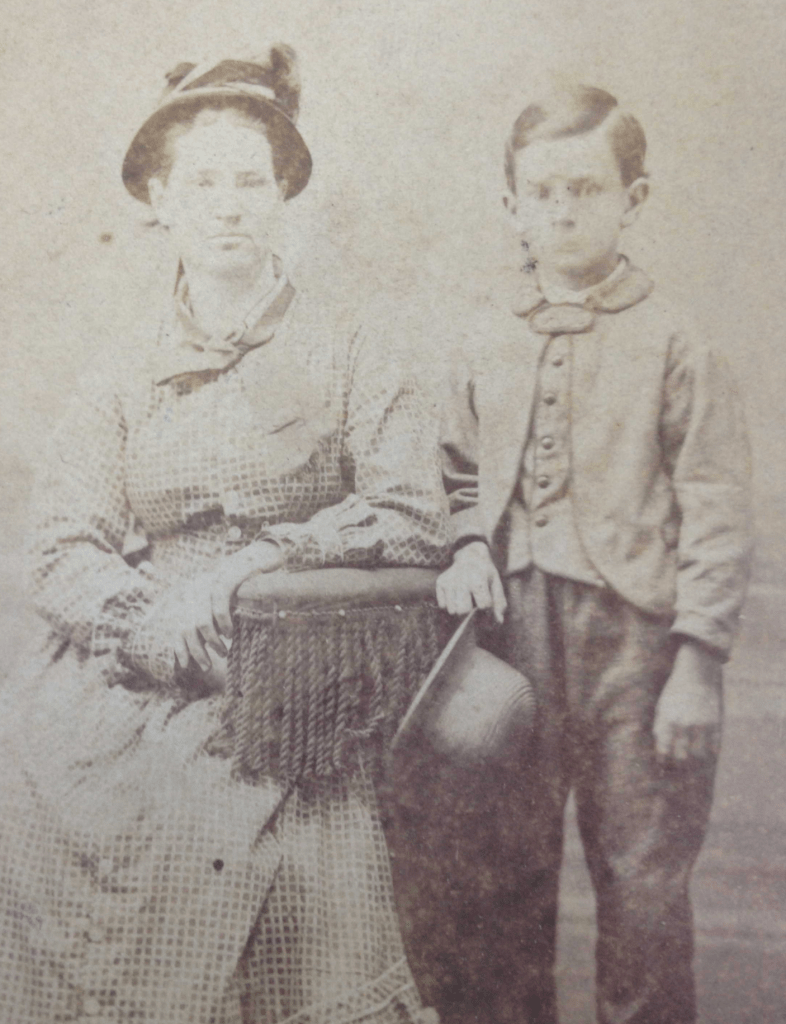
A post-war picture of Margaret Jane & Willie Furry

We have been to supper. Had coffee & had crackers. I shall have to have a new set of teeth or the old ones filled up for they are getting very dull. I think I can appreciate cornbread when I get home. It is dark. I must light a candle.

Did you ever get my overcoat & carpet sack that I sent from Camp Logan? You must not be uneasy when [you] see how many of our boys are sick. You know I have had the measles. You know there is no other disease in the regiment. I have understood since I commenced writing that we wil stay here till the first of April at least. If we do, we will in all probability come home from here. I hear the church bell ringing. It sounds very much like Old Staunton.

I hope this may find you all in good health as it leaves me. I must close. Let no one see how many sick there is in the regiment. It will make uneasiness when there need not be. All the Saunton boys are well. May the Lord bless you and Willey & [take] care of you until I get home.

Give my regards to all enquiring friends, if any such there be. Write soon. Write soon, Margy Jane. I still remain your affectionate husband until death.


Letter 2

Camp at Weston
Lewis County, Virginia
73rd Regiment Ohio Volunteers
March 21, 1862

Well, Marg. Jane, I received your kind letter of the 17th & was glad to hear from you all, but sorry to hear that your Mother had the sore throat. I hope she is well by this time.

It is almost too dark to write. I will have to light a candle soon. I received your letter today at 4 o’clock. It is time for roll call [and] I will have to stop awhile. I have lit a candle & am writing on a little box. It has been raining almost all day.

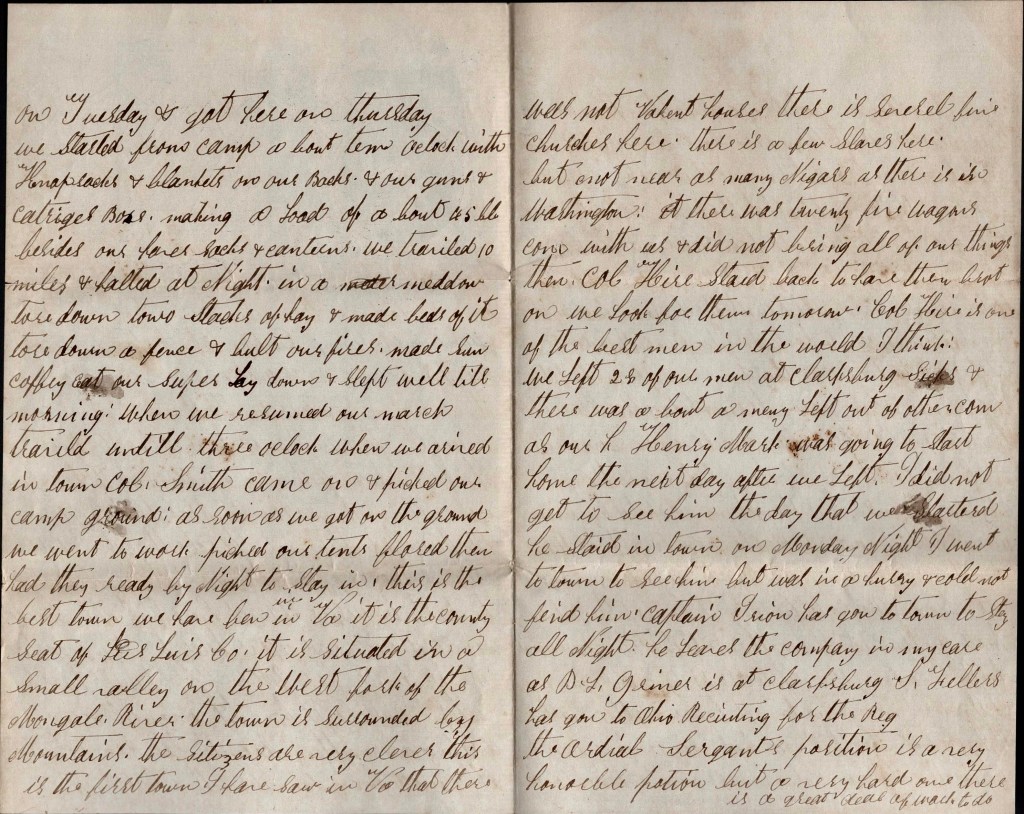
We Left Clarksburg on Tuesday & got here on Thursday. We started from camp about ten o’clock with knapsacks & blankets on our backs & our guns & cartridge boxes making a load of about 45 lbs. besides our haversacks & canteens. We traveled 10 miles & halted at night in a meadow, tore down two stacks of hay & made beds of it, tore down a fence & built our fires, made some coffee, eat our super, lay down & slept well till morning when we resumed our march. We traveled until three o’clock when we arrived in town. Col. Smith came on & picked our camp ground. As soon as we got on the ground, we net to work, pitched our tents, floored them, had them ready by night to stay in. This is the best town we have been in in Virginia. It is the county seat of Lewis County. It is situated in a small valley on the west fork of the Monongahela River. The town is surrounded by mountains.

The citizens are very clever. This is the first town I have saw in Virginia that there was not vacant houses. There is several fine churches here. There is a few slaves here but not near as many niggers as there is in Washington. There was twenty-five wagons come with us & did not bring all of our things then. Col. [Jacob] Hyer stayed back to have them brought on. We look for them tomorrow. Col. Hyer is one of the best men in the world, I think.

We left 28 of our men at Clarksburg sick & there was about as many left out of other companies as ours. Henry [M.] Marks was going to start home the next day after we left. I did not get to see him the day that we started. He stayed in town on Monday night. I went to town to see him but was in a hurry & could not find him. Captain [Silas] Irion has gone to town to stay all night. He leaves the company in my care as D[avid] L. Griner is at Clarksburg. S. Fellers has gone to Ohio recruiting for the regiment. The Orderly Sergeant’s position is a very honorable position but a very hard one. There is a great deal of work to do.

You said you would look for my picture. I will send it to you as soon as I can have it taken to look like anything. There is no place in this country that they can take pictures. There is some little one horse artists that will charge one three prices. I would have had it taken before this but thought you would not want it unless it looked like something.

More glorious news for us today. The Burnside Expedition has drove the rebels again in North Carolina. They are fleeing before our troops at every point. It is thought by all of the knowing men that the war will all be over by the middle of April. God speed the time that it may be over with. Soldiering is honorable but hard work. But I am thankful that I have had good health so far. The winter is pretty well over & I think I am going to get home well & hearty. I have not slept in a bed since you was in Chillicothe. I have eat four meals at a table—three I paid for & one I got for nothing.

I have taken my shirts & drawers out to a woman to have them washed. I have so much to do know that I have not time to do any washing myself. The Staunton boys are well… it is now time to blow out the lights. I will finish tomorrow. This is Saturday evening & it has been snowing & raining all day. The camp is all mud. I have just received a letter from you that you wrote the 17th. This was the last one that you wrote that day.

Well, Marg Jane, we have marching orders again to start on morning to go to Beverly, 45 miles distance from here. Then we will go to Cheat Mountain. From there to Staunton, Virginia. This is the supposition of us. There is some 30,000 troops ordered all on the same road. It is about 115 miles from here. It will take us about 4 weeks to get there. I will write again from Beverly & let you know all of the particulars of our travels.

You said you wanted me to be a good boy. I intend to do the best that I can, but it is hard for one to do right in the army. You see & hear all kinds of wickedness. Card playing is carried on all the time. I am thankful that I have never played any yet & never will while I live. You wanted to know if there was any disease in the regiment except the measles. There is none but the measles & mumps. I have had good health ever since I Left home. If I can have my health, it is all that I ask. I[saac J.] Sperry & myself stand it about the best of any of our company. Captain [Silas] Irion has gone to town again tonight. I think the captain will before we get to Cheat Mountain. I will get to see Syl. Davis when we get there. Captain Honeson is there. I saw his nigger the day before we left Clay on his way to Washington Ohio.

You wanted me to tell you when I would be at home. This I cannot tell. But the way things look & the way the rebels & are running, the war will be over this spring I think. By the first of May we will be at home. Keep in good heart Margy Jane. I will be at home e’re long & then. thank God, I can say that I left my home to fight for the flag of our country & our lovely homes. I will tell you what I. Sperry & J had for supper. We had eggs & light bread, molasses & beef. We thought it was bully.

This is Sunday morning. I had not time to finish my letter last night. It is now 9 o’clock. I suppose you are doing up the wash about now. Mose & Bill [Rowe] & Joseph Horseman are in the tent talking about our march, I think Bill would rather be at home. Moses [Rowe] is writing a letter home. I suppose Henry Mark is at home by this time. Margy Jane, I guess now had better direct your letter to Clarksburg as they will follow us. Direct them there then. Make some garden, Margaret, so we will have some when I get home. I have wrote all that I can think of now, I believe. Write soon, Give my respects to all.

Have you drawed any more money? Take no trouble about that letter that you wrote to me about my money. I hope ‘ere long I will see you. You will certainly not think I would get made at you for anything if you know how I feel towards you. When I get home, I intend to do my best to live comfortable the balance of our lives if hard work will do it. I know we can live in our little home. Ohio I want to live and die in. We know nothing of hard times there is you could see the way people live in Virginia.

I must close by saying I ever & ever remain your most sincere & affectionate husband until death. Kiss Willy for me. Bless his life. I would be so glad to see him. Take good care of him, Margy Jane. From E. M. Furry

To M. J. Furry, John & Mother. Write soon. Goodbye for this time. Give my respects to Nancy and everybody else & Jessie Rowe, John Levers.

I hear the church bell ringing. It sounds like Old Staunton. But it is not.

1863: Lewis Morton Hunter to Hattie E. Hunter

I could not find an image of Lewis but here is one of Robert Whittaker who served with him in Co. H, 37th Indiana Infantry

The following letter was written by Lewis Morton Hunter, the son of Lewis M. Hunter (1806-1859) and Maria Martin (1836-1914) of Jackson, Decatur county, Indiana. Lewis wrote the letter to his younger sister, Harriet (Hannah”) Elizabeth Hunter (1845-1920).

Lewis enlisted on 18 October 1861 as a private in Co. H, 37th Indiana Infantry. He survived the war and mustered out three years later on 27 October 1864. In his letter he refers to his brother Sgt. Joseph Hunter (1834-1880) who served in Co. E, 82nd Indiana Infantry.

In his letter, Lewis provides a brief sketch of the Battle of Stones River in which his regiment played a part, being in Negley’s Division of Rosecrans’ Army of the Cumberland. The 37th was up early in line of battle on the frosty morning of December 31st 1862, when “scarcely clear daylight…the awful roar of cannon, and the sharp rattle of thousands of rifles told us plainly that the battle had begun” on its right. In Dan Master’s recently published book, “Hell by the Acre,” (page 361): “Negley’s men spent the first few hours of the battle as spectators to the disaster on the right. As the roar of the battle ‘drew louder and louder, evidently directing itself somewhat at our rear. we began to choke in the throat, to think of home, and wondering if our turn would come soon,; recalled Henry Haynie of the 19th Illinois. ‘The right was not so far off and we could see the enemy doubling up the boys in blue. We could hear the hoarse shriek of the shell, the swift rattle of musketry, the sound of buzzing bullets. the impact of solid shot, the chug when human forms were hit, the yells of pain, cries of agony, the fearful groans and encouraging words and the death gasps of which told of those who had reported to the God of Battles.'”

It wasn’t long before the boys of the 37th saw a “great crowd of demoralized soldiers running to the rear” and they were ordered to pile knapsacks and form a line in a cedar thicket about one mile to the right of the Nashville Pike and ordered “to check, and hold in check the advancing enemy.” But the regiment “had scarcely got into position when the Confederates, flushed with their success on our right, assailed the 37th with all the pride and determination of the Southern soldiers. The conflict was fierce, close, and bloody.” After repulsing the enemy three times, the 37th fell back, “passing over the ground that had been fought over by troops in its rear, unknown to the regiment.” [Source: Regimental History by George H. Puntenney, 1896]

From the jacket cover of Dan Master’s book, “Hell by the Acre” published by Savas Beatie in 2024.

Transcription

Camp near Murfreesboro
January 25, 1863

Dear Sister,

I take this opportunity this Sabbath morning to write you a few lines to let you know that I am well and I sincerely hope that this will find you in the enjoyment of good health. It is raining today. It rains most of the time this winter. We have had very little snow this winter and very little cold weather.

The 82nd [Indiana Infantry] is camped close to us. I get to see Jos. often. He is well and looks well in soldier clothes. Captain Kendrick died yesterday with the fever. He was a brave and gallant man. I have remailed John’s letters to him and wrote to him but got no answer since the first letter that I got from him. He was then in the Convalescent Camp in Nashville.

January 26th. Joseph and Dan Baker come over and I stopped writing till today. Dan was just come from Nashville. He saw John in town. His health is some better. He has left the Convalescent Camp and I don’t know where he is now. If you write to him, direct to Nashville P. O., Tennessee. But perhaps he has written to you and that you know where he is.

But another subject. I will send my likeness to you as soon as I can get it taken but that may be a long time and military life is very uncertain. I will sed you money sometime for you to send me your likeness. I am glad that you got them rings that I sent to you. I made them. The red one I made in Alabama. I heard from John’s letter that you had gone out to Ripley to Mother’s so I will send this letter to Elrod’s. When you write, write a long letter and tell me how much you learned this winter at school and how you get along and all the news. You don’t know how bad I want to see you, my sister Hattie, but as a soldier, I must be contented with a soldier’s lot to be always at my post in defense of our glorious country.

You have heard of our fighting and of the great Battle of Stones River and how we whipped Braxton Bragg and the rebels and his retreat in the night and of our brave men that fell. The 37th [Indiana Infantry] fought on the last day of the old year and the second of the new. The last day that we fought, we charged on the rebels whipping them and drove them from the field with great slaughter. They was on both sides of the river. The Federals crossed the river on double quick, charged into the woods and captured the rebel battery. The day was ours. We whipped them badly. Our first day’s fight we come near being all captured. We was nearly surrounded. We passed over rebel dead to get out. I was in the hottest of the fight and the air was full of bullets but I did not get a scratch or a mark on me.

Farewell for this time. From L. M. Hunter

To his sister Hattie E. Hunter

1864: William Henry Lockwood to his Parents

Underlining the prevalence of draft resistance, and its echoes in broader American culture, the draftee in this cartoon says, “Doctor I’m weak in the back,” to which the examining surgeon replies, “Yes, I see it – can’t go – too delicate.”
Courtesy Library Company of Philadelphia.

The following letter was only signed “Henry” and though he gave his regiment as the 30th Indiana Infantry, the regimental roster does not include any late war draftees in it. The reorganized 30th Infantry, however, does and I was able to find him in Co. C of that reorganized regiment. He was William Henry Lockwood, born 1835, married in 1863, the son of Wesley Lockwood (1808-1881) and Mary Ann Philo (1809-1901) of Quincy, Branch county, Michigan.

It isn’t clear where Henry and his wife were living at the time of the 1864 draft but it’s presumed someplace in Indiana as he was subject to the draft there and he speaks of his wife “coming to Michigan” for a visit. According to the roster of the reorganized 30th Indiana, Henry was mustered into the service on 29 September 1864 and he was mustered out on 13 July 1865.

Transcription

Pulaski, Tennessee
November 17th 1864

Dear Parents, Brother & Sisters,

It is with pleasure that I improve the present time in penciling a few lines to let you know where I am. I am with the 30th Indiana Regiment which is at Pulaski now. How long we will stay here, I do not know. We are not assigned to any company yet so when you send me any letters, direct to Pulaski, Tennessee, 30th Regiment Indiana Volunteers, care of Captain Boydson, and they will come all right.

I am well at present except a bad cold. I had the diarrhea when I started from Indianapolis and it continued until I got here, but I am better now. The soldier’s life is no life for me. I used to think that I had hard times at home. I longed to be of age so that I could have liberty and do as I pleased, but I did not know what enjoyment was. Now I can see when I spent my happiest days. It was when I was young and had not a care on my mind, when I had kind parents to look at my welfare and take care of me when sick, to guard me from danger and give their advice in regard to my best interest. But how changed is the scene. I am in the army and surrounded by the evil influences that generally prevail in a camp life, and also exposed to the murderous fire of the enemy’s guns. In looking into the future all is dark in respect to things earthly. It is my prayer to God that I may be permitted to survive the dangers that the soldier is exposed [to] and meet with my friends on earth again. I spend a great many hours in thinking of home.

I did come with a willing mind. I hated [to] leave home and friends most dear and take a my life in my hand for the purpose of fighting to sustain this cruel war. [But] I could not get anyone to go in my place so I had to go, and I must make the best of it I can. If I fall in battle or by disease, it is my prayer that I may fall with the armor of Christ, my Redeemer, on. Pray for me.

When I think of my father and mother, brother and sisters and also my dear wife, tears will unbidden start in my eyes and I have to go out by myself and give vent to my feelings. Father, tell Libbeous not to be over anxious to get into the army [for] if once he gets in, he will wish himself out again. He is the best off to stay at home as long as he can. Jennie talked of coming to Michigan on a visit. Make her as contented and happy as you can. She had rather I would have let the last cent and last bed go for a substitute than had me go to the army, but that could not be done as substitutes were from 700 to 1,000 dollars and I could not raise that sum. The best way I could fix it, consequently, [was] I had to go myself. I hope that I will live to get home again.

The rebels are no where near us now. The weather is warm here now. There has not been frost enough to kill the blackberry leaves yet. The crickets are singing as merry as in June in Michigan. There are lots of grasshoppers and spiders running as lively as in summer up there. The country is desolate and dreary. Everything appears to be on a standstill. It is all high hills, deep gullies, and rocks. If what I have seen is an index of the Sunny South, it not worth half the money that has been spent to carry on this war—[to] say nothing about the lives lost and families broken up. I had no idea of the destruction of property until I came here and have not begun to see all yet. The railroad has been burned to the ground, fences used for firewood, and the whole country presents one almost unbroken commons. I will be glad for one when the end comes. When that will be, I do not know.

Direct your letters to Pulaski, Tennessee, 30th Regiment Indiana Volunteers, in care of Capt. Boydson and they will come all right. I want some of you to write as soon as you get this. I want to hear from home. I have [not] heard one word from any of my friends since I left. Do not delay 24 hours. One letter from home will do me a great deal of good. So write immediately. From your son, — Henry

Remember me to the throne of Grace. Best respects to all. Tell Horace to write. I have only one sheet.

1864: Gilbert Keene to Sophie Adorah Wheeler

I could not find an image of Gilbert but here is one of Aldebert A. Carrier of Co. H, 143rd New York Infantry (Tenn. State Library & Archives)

The following letter was written by Gilbert (“Gib”) Keene (1841-1888), the son of Joseph Keene (1815-1894) and Hannah Gray (1824-1899) of Rockland, Sullivan county, New York. Gilbert’s military records informs us that he enlisted on 15 August 1862 as a private in Co. A, 143rd New York Infantry. He served nearly three years, mustering out on 6 July 1865. Following his discharge he married Emma L. Rose (1844-1922) and the couple had at least five children before his death in 1888.

The 143rd New York served in the Eastern Theater of the Civil War until the fall of 1863 when they were transported to the Western Theater to serve in the Army of the Cumberland. They participated on Sherman’s Atlanta Campaign and the March to the Sea but Gilbert was apparently on detached duty at Moccasin Point, Tennessee, serving on the cracker line in the quartermaster’s office.

Gibert wrote the letter to Sophie Adorah Wheeler (1847-1887), the daughter of Leroy Moore Wheeler (1806-1880) and Martha Reed (1817-1887) of Rockland.

Transcription

Addressed to Miss Sophia Wheeler, Rockland P. O., Sullivan County, New York

Moccasin Point [Tennessee]
October 9th [1864]

Esteemed Friend,

Finding myself unemployed this morning & thinking that I will have to write again if I ever get a letter from you, I seat myself to write or at least to try the second time. There was a paper came to hand yesterday which I am very much (I am) indebted to you for. It brought me the news of the town with the Union State Ticket, & with all of the rest it said don’t vote for Little Mac which you may be sure I will not (no, not I). Old Abe is the man for me with the Governor of this State [Andy Johnson] to assist him. But by the way, I think I had better let politics go as I have a good mens questing [?] (as the Rev. Mr. Davies says) to ask & to compliment you on minding me so good when you hung out your sign for Lott. Oh, I can hear from you if you won’t write yourself, but Gib is not as well now as he was when he wrote before although he is better than he has been. I am sure he should not grumble much for he does just as he has a mind but coming home, & if he had his Descriptive Roll, you would see him. But perhaps you do not know who Gib is so I will have to tell you. He is my best friend & with all the rest, he has a way of resting the lamb.

Said I to him one day, “Gib, do you think Miss W. intends to send her photograph in return for yours?” Said I, “How should I know. I am sure I should dun her if it was me.” Said He, “I will do it if I live.” But by the by, you will see a Chattanooga paper up there which I think you should like to have—not for the news but for the keepsake that will be in it. And I think there will be some flower seed in it called Prince’s Feather. They are very nice. I do not know as I ever saw any up there though they may be.
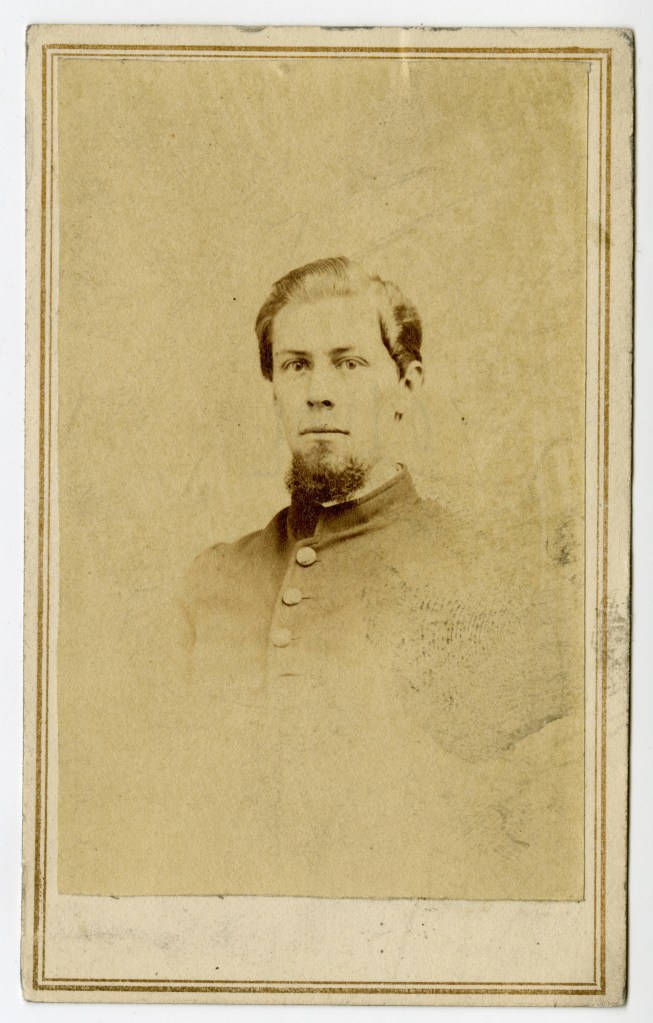
People is having fine luck up there getting married I hear but I do not know as they can go ahead of folks here. There is no end to the weddings here. The Tennessee girls is mighty fond of the Yankees (as they say). But I must tell you of the dance I was at the other evening that beat me where an old woman one hundred and eleven years old beat them all. What do you think of that? But Soph, Oh, I meant Miss Wheeler, I think it is time I closed for fear I will not get an answer to this. You will please write as soon as received. Give my regards to Lott & Mrs. Choeran, your Father & Mother my best wishes, & as for Soph, tell her I remain — G. Keene
Direct to Gilbert Keene, Chattanooga, Tenn. In care of Capt. Kirk, A. Q. M.