My passion is studying American history leading up to & including the Civil War. I particularly enjoy reading, transcribing & researching primary sources such as letters and diaries.
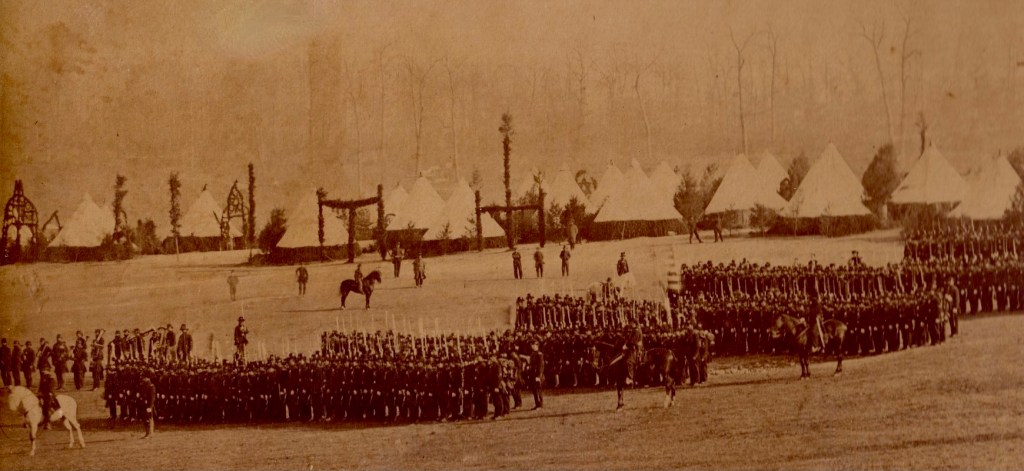
This letter was written by Andrew W. Perkins of Co. I, 17th New York Infantry. The 17th regiment — the “Westchester Chasseurs” — contained four companies from Westchester county, two from New York city, one from each of the counties of Rockland, Chenango, Wayne and Wyoming, and was mustered into the U. S. service at New York city, May 28, 1861, for a two years’ term. It went into camp at Camp Washington, Staten Island, until June 21, when it left for Washington and was stationed at Fort Ellsworth near Alexandria. With the 2nd brigade, 5th division, which was held in reserve, the regiment was present at Bull Run. In September it was posted at Fairfax seminary; in October was ordered to Hall’s hill, where it was assigned to Butterfield’s brigade, 1st division, 3d corps, and established permanent winter quarters.
Andrew was 35 years old when he enlisted on 10 May 1861 at Newark, Wayne county, New York. He was discharged for disability on 9 January 1862 after 8 months service. Andrew gave his residence as Sodus when he enlisted. Though it seems unlikely, since I was unable to find any record of Andrew after the Civil War, he may have been the same Andrew W. Perkins (same age) who enlisted on 1 March 1862 to serve in Co. A of the 11th Regular Army. This Andrew was later transferred to Co. E and during the fighting at Laurel Hill on 8 May 1864, was severely wounded. His left leg was amputated in an attempt to save his life but he died on 1 June 1864.
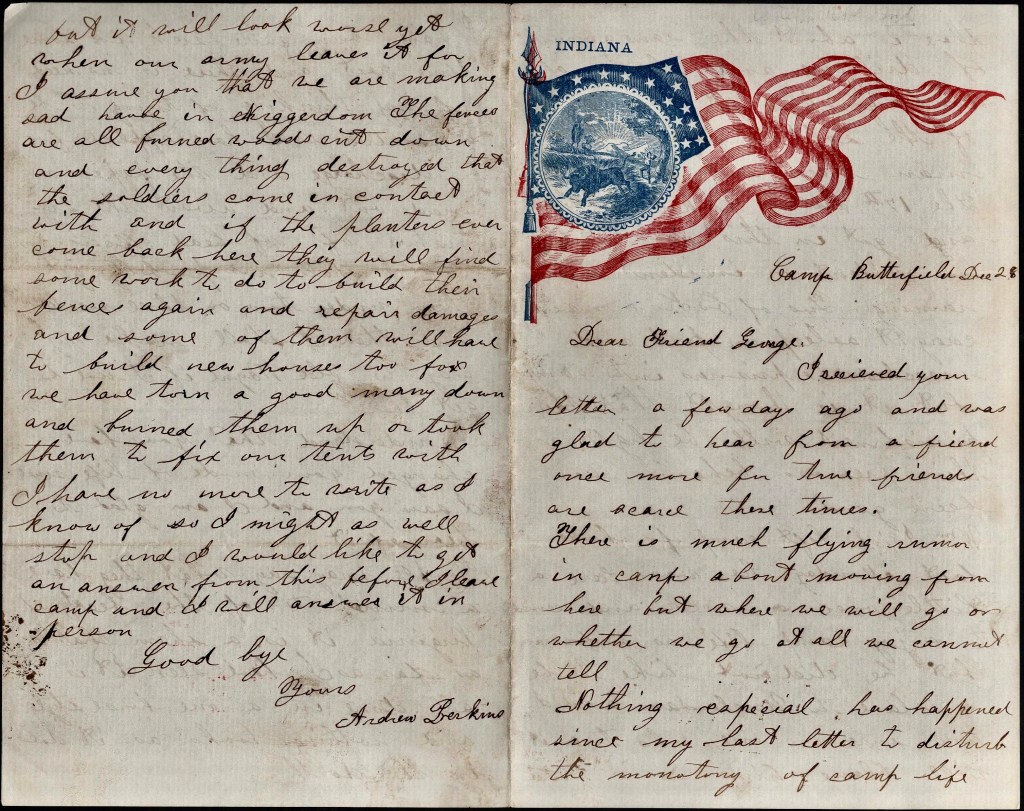
Note: Andrew’s letter was written on patriotic Indiana Stationery but of course had nothing to do with the State of Indiana.
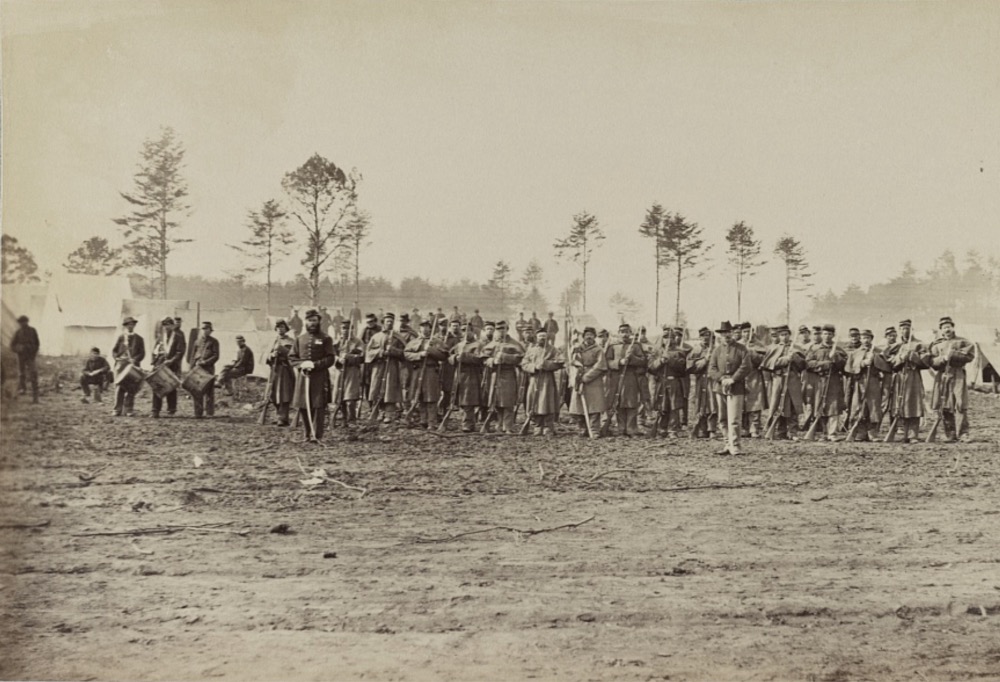
17th New York Infantry at Hall’s Hill, Virginia; Butterfield’s Brigade; Fitz John Porter’s Division
Transcription
Camp Butterfield [Hall’s Hill, Virginia] December 28 [1861]
Dear Friend George,
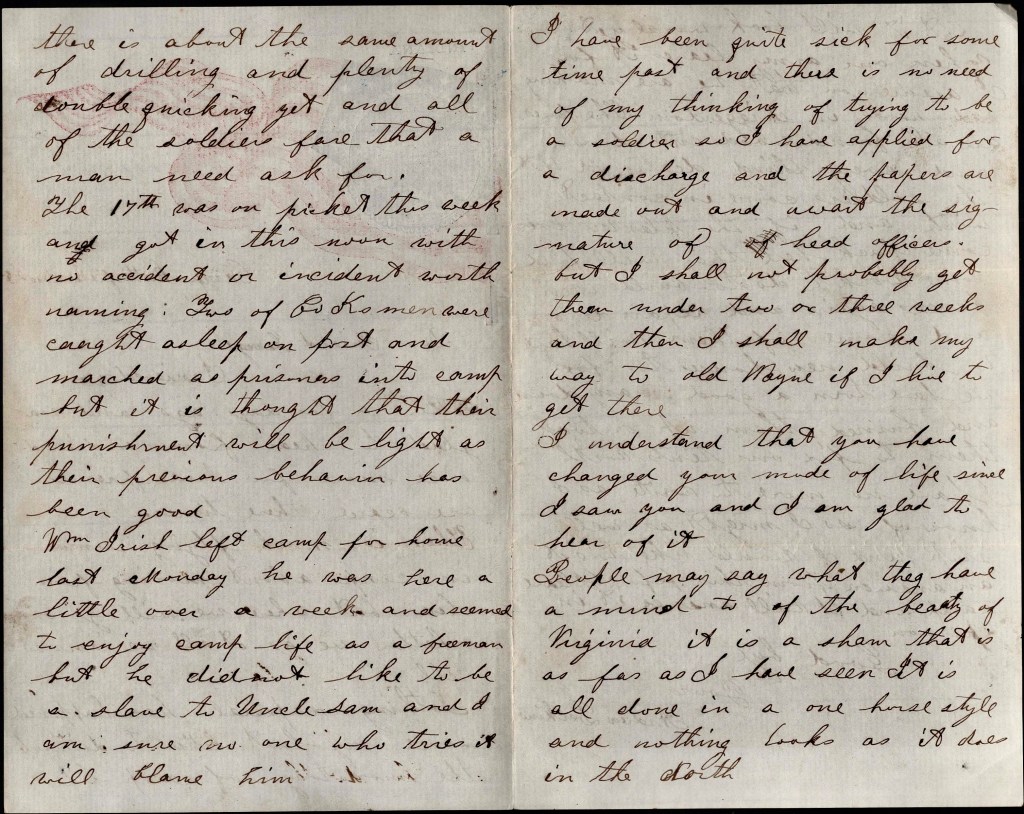
I received your letter a few days ago and was glad to hear from a friend once more for true friends are scarce these times. there is much flying rumor in camp about moving from here but where we will go or whether we go at all we cannot tell. Nothing especial has happened since my last letter to disturb the monotony of camp life. There is about the same amount of drilling and plenty of double quicking yet and all of the soldiers fare that a man need ask for.
The 17th was on picket this week and got in this noon with no accident or incident worth naming. Two of Co. K’s men were caught asleep on post and marched as prisoners into camp but it is thought that their punishment will be light as their previous behavior has been good.
William Irish left camp for home last Monday. He was here a little over a week and seemed to enjoy camp life as a free man but he did not like to be a slave to Uncle Sam and I am sure no one who tries it will blame him.
I have been quite sick for some time past and there is no need of my thinking of trying to be a soldier so I have applied for a discharge and the papers are made out and await the signature of head officers but I shall not probably get them under two or three weeks and then I shall make my way to Old Wayne if I live to get there.
I understand that you have changed your mode of life since I saw you and I am glad to hear of it.
People may say what they have a mind to of the beauty of Virginia. It is a sham—that is, as far as I have seen. It is all done in a one-horse style and nothing looks as it does in the North. But it will look worse yet when our army leaves it for I assure you that we are making sad havoc in Niggerdom. The fences are all burned, woods cut down, and everything destroyed that the soldiers come in contact with. And if the planters ever come back here, they will find some work to do to build their fences again and repair damages and some of them will have to build new houses too for we have torn a good many down and burned them up or took them to fix our tents with.
I have no more to write as I know of so I might as well stop and I would like to get an answer from this before I leave camp and I will answer it in person. Goodbye. Yours, — Andrew Perkins
The following letter was signed, “J. P. M.” (I think) and I believe it was written by Joseph Penn Marriott (1840-1863), the son of Henry Thomas Marriott (1807-1875) and Rebecca Penn (1807-1884) of Claibourne, Union county, Ohio. Joseph enlisted as a corporal in Co. B, 32nd Ohio Volunteer Infantry (OVI) and was with the regiment until his death of typhoid fever at Vicksburg, Mississippi, on 20 August 1863.
At the time that Joseph wrote this letter in mid-July 1862, the 32nd OVI was in Piatt’s Brigade, White’s Division, with provost and fatigue duty at Winchester, Va. where they were regularly abused by the women citizens whom he referred to as “she devils.”
Henry Thomas MarriottRebecca (Penn) Marriott
Joseph’s parents.
Transcription
Addressed to Will. J. Graham, Delaware, Delaware county, State of Ohio
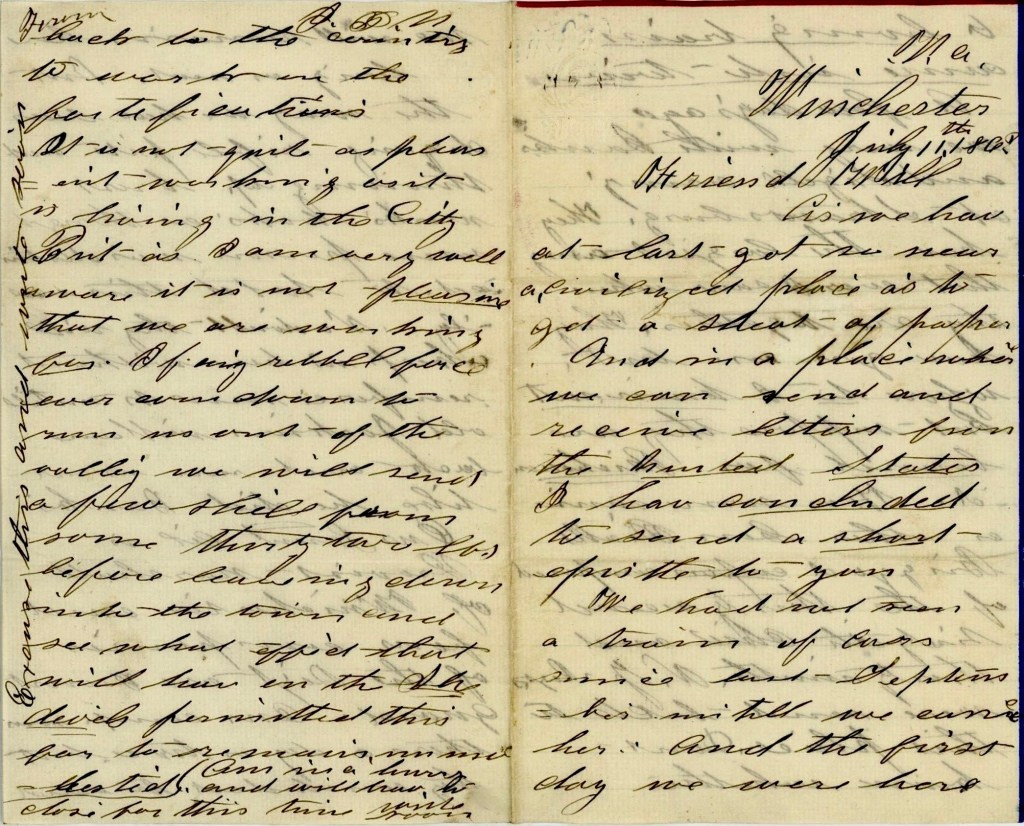
Winchester, Virginia July 11, 1862
Friend Will,
As we have at last go so near a civilized place as to get a sheet of paper, and in a place where we can send and receive letters from the United States. I have concluded to send a short epistle to you.
We had not seen a train of cars since last September until we came here. And the first day we were here, a long train came into town.
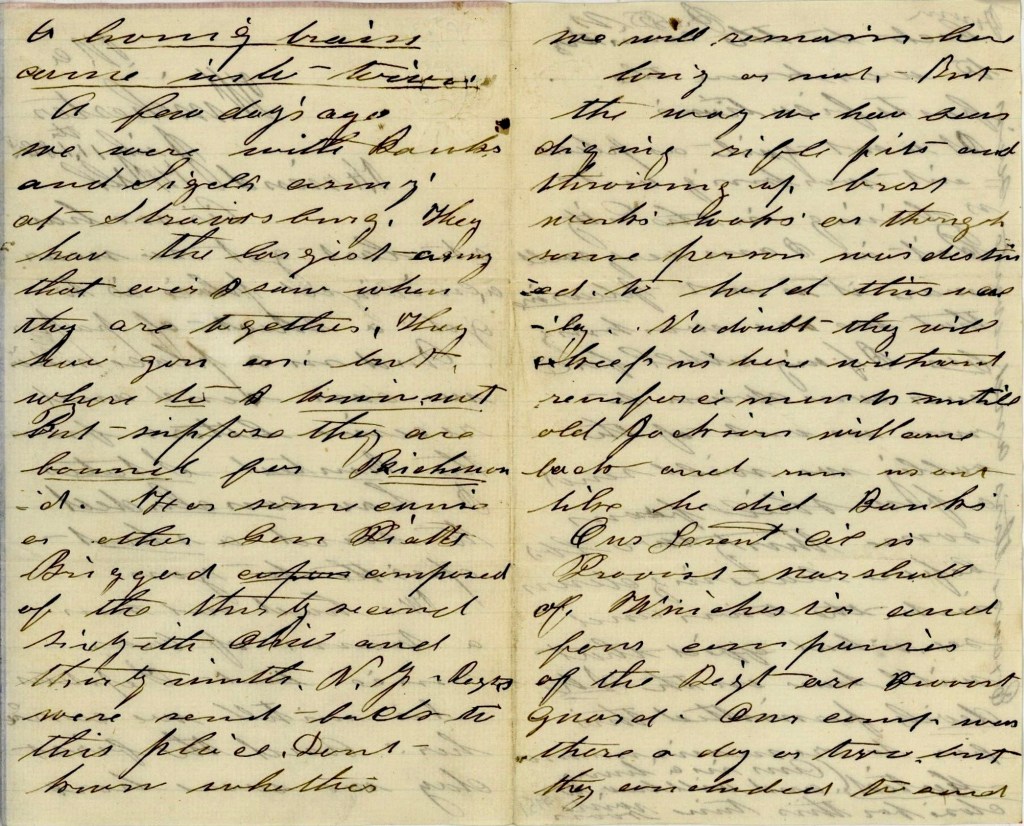
A few days ago we were with Banks and Sigel’s army at Strasburg. They have the largest army that ever I saw when they are together. They have gone on but where to, I know not, but suppose they are bound for Richmond. For some cause or other, Gen. [Abram S.] Piatt’s Brigade composed of the 32nd, 60th Ohio, and 39th New York Regiments were sent back to this place. Don’t know whether we will remain here long or not. But the way we have been digging rifle pits and throwing up breastworks looks as though some person was destined to hold this valley. No doubt they will keep us here without reinforcements until Old Jackson will come back and run us out like he did Banks.
Our Lieut. Col. [Ebenezer H. Swinney] is Provost Marshal of Winchester and four companies of the [32nd OVI] regiment are provost guard. Our camp was there a day or two but they concluded to send us back to the country to work in the fortifications. It is not quite as pleasant working as it is living in the city but as I am very well aware, it is not pleasure that we are working for. If any rebel force ever some down to run us out of the valley, we will send a few shell from some thirty-two pounders before leaving down into the town and see what effect that will have on the she devils permitted this far to remain unmolested.
Am in a hurry and will have to close for this time. Write soon. Excuse this and write soon. From J. P. M.
The following letters were written by 18 year-old John Parker to David Wentz (1806-1882) of Parryville, Carbon county, Pennsylvania. In the 1860 US Census, John was enumerated in the Wentz household and employed as a farm hand. In the 1870 US Census, John was enumerated in the household of Harrison Wentz in Franklin, Carbon county, Pa., and employed as a school teacher. John may have been an orphan and the Wentz family may have been relatives.
There were many John Parkers who served in the Union army during the Civil War but he was the one that served in Co. H, 81st Pennsylvania Infantry—a company that was raised in Carbon county, Pennsylvania, in August 1861. The 81st Pennsylvania participated in the Battle of Gettysburg as part of the 1st Brigade, of Caldwell’s First Division, in Hancock’s II Corps. They were engaged in the pursuit of Lee’s army following his defeat at Gettysburg and would have been in the vicinity of Funkstown, Maryland, at that time.
Letter 1
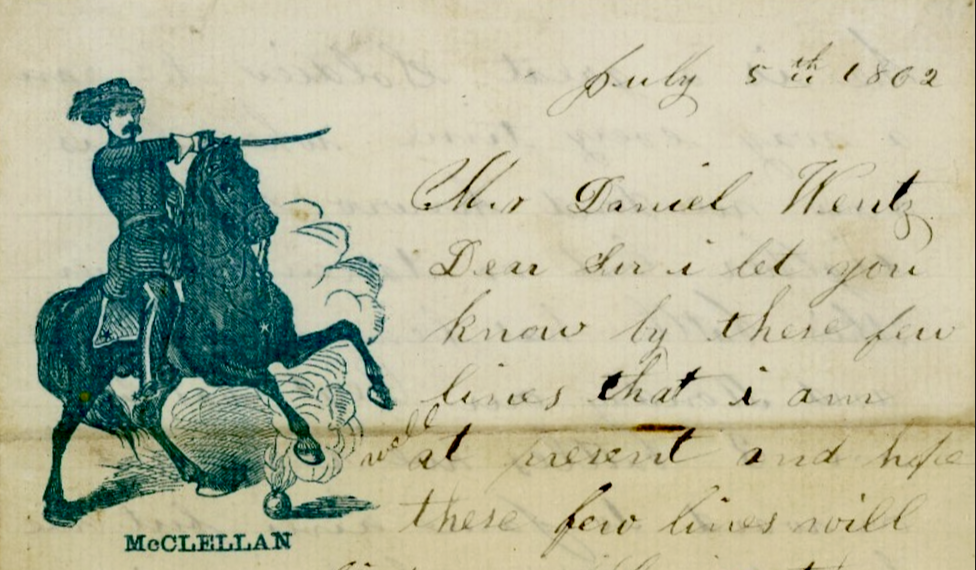
Patriotic header on letter featuring lithograph of McClellan on horseback.
[Harrison’s Landing] July 5th 1862
Mr. Daniel Wentz,
Dear sir, I let you know by these few lines that I am well at present and hope these few lines will find you all in the same state of health. Your letter dated June 21st came duly to hand yesterday and was very glad for it. I read it with much pleasure but I hope you don’t pity your old sawmill dam and the bumble bees has been flying again and our regiment is cut up very bad. Britten and A[lfred] Overolester, W. Bennet is safe.
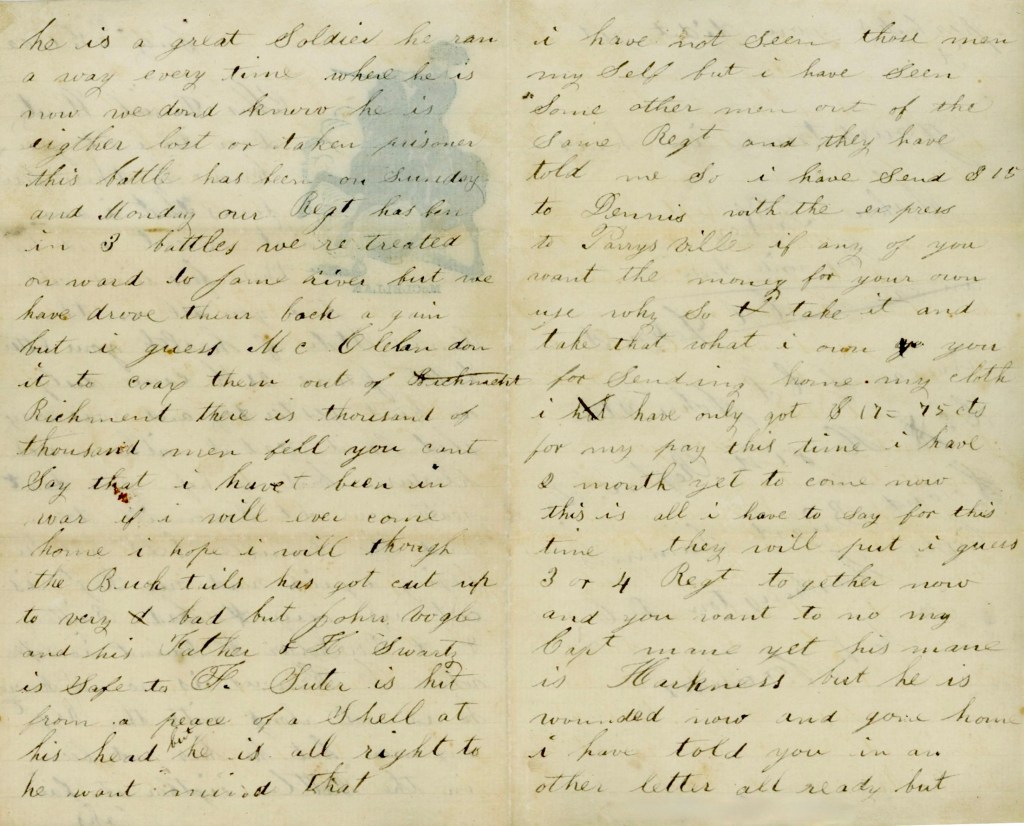
Where L. Knous is, no one knows. He is not along with the regiment anymore but he has not been in the battle either at Fair Oaks. He is a great soldier. He ran away every time. Where he is now, we don’t know. He is either lost or taken prisoner. This battle has been on Sunday and Monday our regiment has been in three battles. We retreated onward to James River but we have drove them back again. But I guess McClellan done it to coax them out of Richmond. There is thousands of thousands men fell. You can’t say that I haven’t been in war. If I will ever come home, I hope I will though the Bucktails has got cut up too very bad. But John Vogle and his Father & H. Swartz is safe too. F. Suter is hit from a piece of shell at his head but he is all right too. He won’t mind that. I have seen those men myself but I have seen some other men out of the same regiment and they have told me so.
I have sent $15 to Dennis with the Express to Parryville. If any of you want the money for your own use, why so take it and take that what I owe you for sending home my clothes. I have only got $17.75 for my pay this time. I have two months yet to come now. This is all I have to say for this time. They will put, I guess, three or four regiments together now and you want to know my Captain’s name yet. His name is [Thomas C.] Harkness but he is wounded now and gone home. I have told you in another letter already but perhaps you didn’t get it. Yours truly in hand, — John Parker
Please write soon in care of Col. John Stone, Co. H, 81st Regt. P. V., Howard Brigade, Sumner’s Corps, Washington D. C.
To be forwarded.
Letter 2
Patriotic stationery used by John Parker to write his letter in pencil, dated 11 July 1863
Funkstown, Maryland July 11th 1863
Mr. Daniel Wentz—dear sir,
I now let you know by these few lines that I received your letter on the 8th which was dated June 22nd and was glad to hear that you are all well as this leaves me. I am also well, hoping these few lines may find you enjoying the same blessing.
You have stated in your letter that Dennis & Harriet would think more of me at present than ever they did which I am glad to hear but the way he wrote in his letter, it did not seem so.
You have also stated about the rebels being in Pennsylvania which was true enough, but they are not in now at present for we have routed them out of it. They are now yet in Maryland but they would not be in here any more if they could cross the Potomac river. We have also had a battle at Gettysburg and are expecting another one here in Maryland.
I am still tending to the mail. We are at present laying at Funkstown in line of battle ready to pull the triggers at any minute and are very anxious to do it for fear the rebels will cross the river and we have to follow them again in Virginia. I have also received a letter from Harrison the same time. He has stated about me lending him some money. I will leave that to Dennis because he’s got it but for my part, he can have it if Dennis don’t use it himself. Dennis can now do as he likes. This is all I have to say for this time. — John Parker
The following letter was written by Samuel Williston (“Will”) Ludden (1841-1889), the son of Nathaniel Thayer Ludden (1808-1846) and Cornelia Johns (1817-1895) of Detroit, Michigan.
I could not find an image of Will but here is one of Burton Abbey who also served as a sergeant in Co. D, 13th Michigan Infantry (Ancestry.com)
Will enlisted as a private in Co. D, 13th Michigan Infantry in January 1862 for three years and mustered out as a sergeant. His older brother, Henry D. Ludden (1837-1891), served as a corporal in Chadwick’s Company Michigan Engineers.
There is no date on this letter but the regimental history informs us that the 13th Michigan was one of the first regiments to march into Chattanooga on the morning of the 13th of September. It then proceeded almost at once to Chickamauga, where it was engaged the 19th and 20th of September, coming in contact with the Confederate forces near the Lee and Gordon’s Mills, where before the close of the battle, it lost 107 killed, wounded and missing out of a total of 217 men, the numbers of officers and men the Regiment carried into the action. Since the envelope appears to bear a Nashville, TN, postmark of 25 September, it is presumed this letter was penned just prior to the Battle of Chickamauga, the battlefield being approximately 20 miles from Chattanooga.
Transcription
Addressed to Mrs. Cornelia Ludden, Box 9023, Detroit, Michigan. Envelope includes verse, “The Song My Mother Sang.”
Camp in the field, 14 miles in advance of Chattanooga September 1863
Dear Mother,
I have but a few minutes to let you know of my welfare as we expect to move camp in a few minutes & the mail is about going out. Well, I suppose you have heard of the downfall of Chattanooga. We marched in there three days ago, Wood’s Division being the first troops to enter the town, our Brigade in advance. I am now at Headquarters as Sergt. of Provost Guard. I have 18 men to see to. I took my squad & by a short cut was the first in Chattanooga. I wish you could of seen the Butternuts flew when we got within a mile of them. There was two or three regiments of cavalry left as rear guards & such a dust as they kicked up when they left you never saw. We took but a few prisoners but those that were captured seemed glad to get out of the service & were willing to take the Oath of Allegiance & become peaceable citizens.
We are moving toward Atlanta at which place we shall probably have a big fight. When you think of me, you may place me in the rear of the whole Division during a fight as it will probably be my business to take charge of prisoners so do not fret about us boys. Only 14 months longer & then for a happy time at home. Henry is well. He has at last picked up a horse so that walking & his has had a falling out. We are all well. I will write you a long letter as soon as I can find time. I will close with much love to all. Tell them all to write [and] not wait for me. With much love, I remain affectionately, your son, — Will Ludden
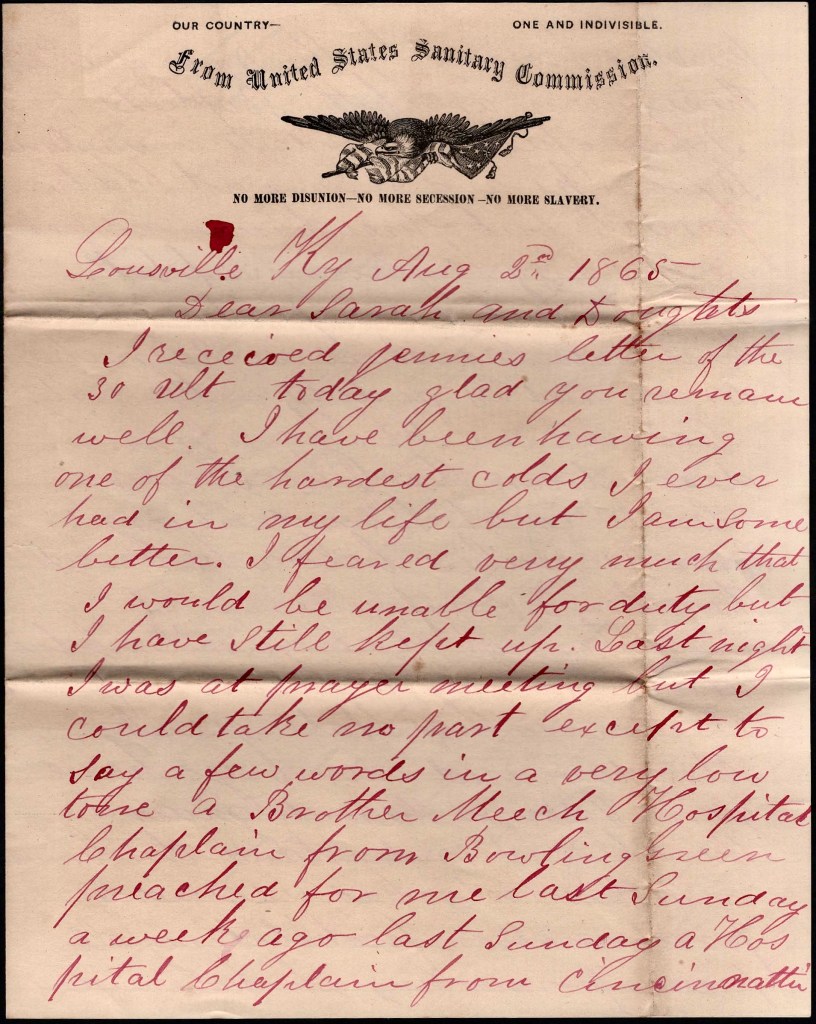
This letter was written by Smith Goodin (1819-1896), the son of Asa Goodin (1788-1857) and Margaret Sellars (1792-1870) of Perry county, Ohio. Asa was married to Sarah Salisbury (1817-1853) and after her death in 1853 he remarried with Sarah Maria Connett (1823-1901). The family was living in Wells county, Indiana, in July 1863. Smith was a Baptist minister and volunteered to serve as the chaplain of the 153rd Indiana Infantry when it was organized at Indianapolis, Indiana, in March 1865. The regiment was mustered out of the service on 4 September 1865 at Louisville, Kentucky. Goodin later served as the Superintendent of the Wells county public schools. Three of Goodin’s daughter are mentioned in the letter—Rebecca (“Beck”), Jennie, and Lydia (“Lyd”).
Transcription
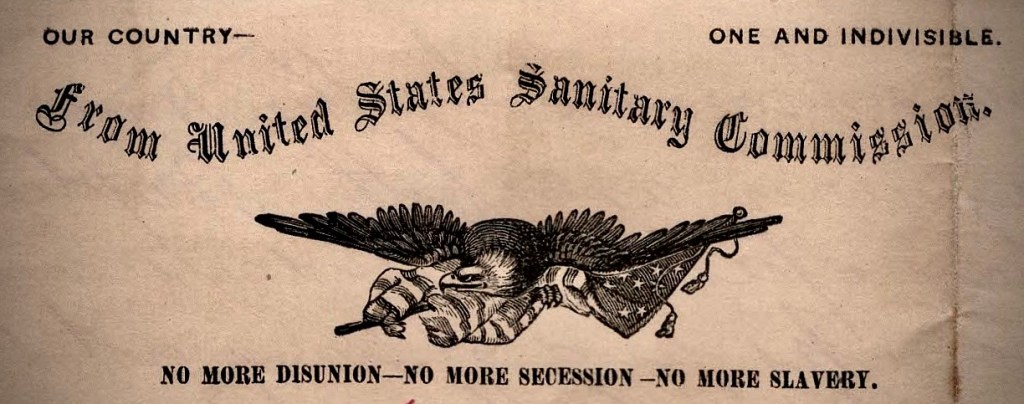
Goodin’s letter written on Stationery of the US Sanitary Commission with motto, “No more Disunion, No more Secession, No more Slavery. Our Country, one and indivisible.”These words are attributed to Rev. Henry Ward Beecher, from his Fort Sumter Celebration Speech in April 1865.
[Taylor Barracks] Louisville, Kentucky Aug 2nd 1865
Dear Sarah and Douglas,
I received Jennie’s letter of the 30 ult. today. Glad you remain well. I have been having one of the hardest colds I ever had in my life, but I am some better. I feared very much that I would be unable for duty but I have still kept up. Last night I was at prayer meeting but I could take no part except to say a few words in a very low tone. A Brother Meech, Hospital Chaplain from Bowling Green, preached for me last Sunday. A week ago last Sunday, a Hospital Chaplain from Cincinnati preached for me by the name of [William F.] Nelson. These men are both Baptists.
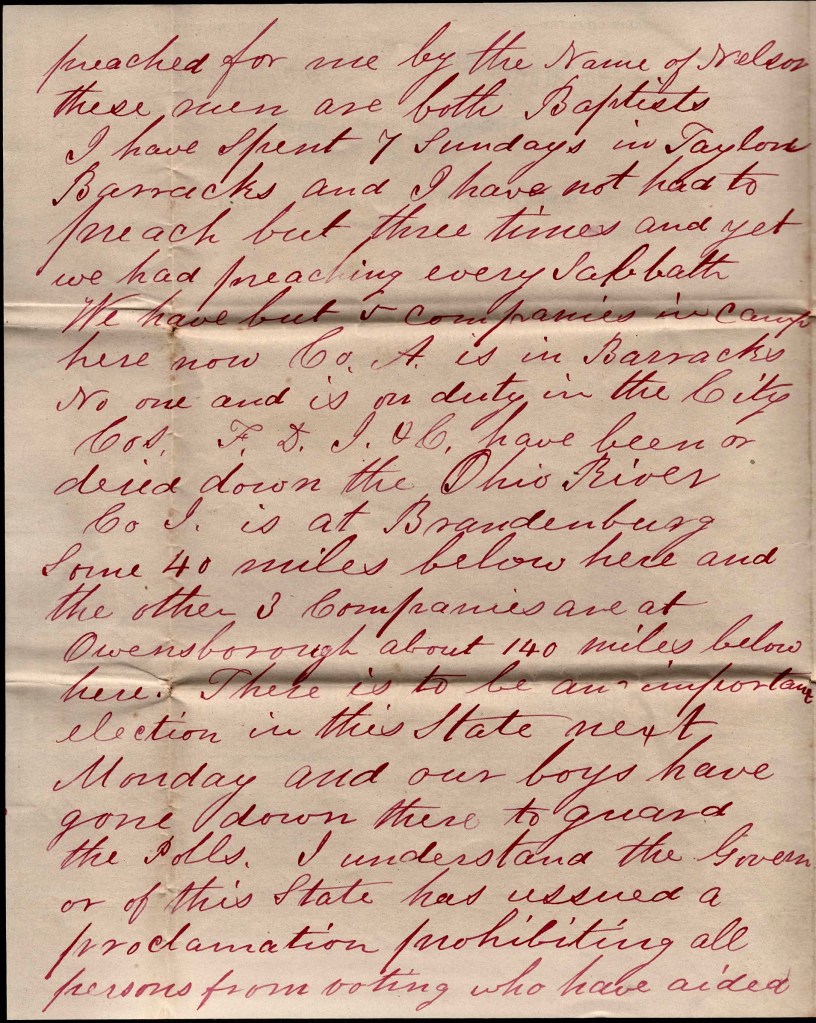
I have spent 7 Sundays in Taylor Barracks and I have not had to preach but three times, and yet we had preaching every Sabbath. We have but 5 companies in camp here now. Co. A is in Barracks no. one and is on duty in the city. Cos. F, D, I, & C have been ordered down the Ohio River. Co. I is at Brandenburg some 40 miles below here, and the other 3 companies are at Owensboro, about 140 miles below here. There is to be an important election in this State next Monday and our boys have gone down there to guard the polls. I understand the Governor of this State has issued a proclamation prohibiting all persons from voting who have aided the rebellion in any way.
My duties are increasing in addition to all I have heretofore done. I will now have to teach the colored people in the barracks. There is probably not less than 40 of them in all, but I will get extra pay. There has been an appropriation of 50 dollars for the purpose of buying some books and paying me for my labor. This is one of the warmest days we have had in a long time.
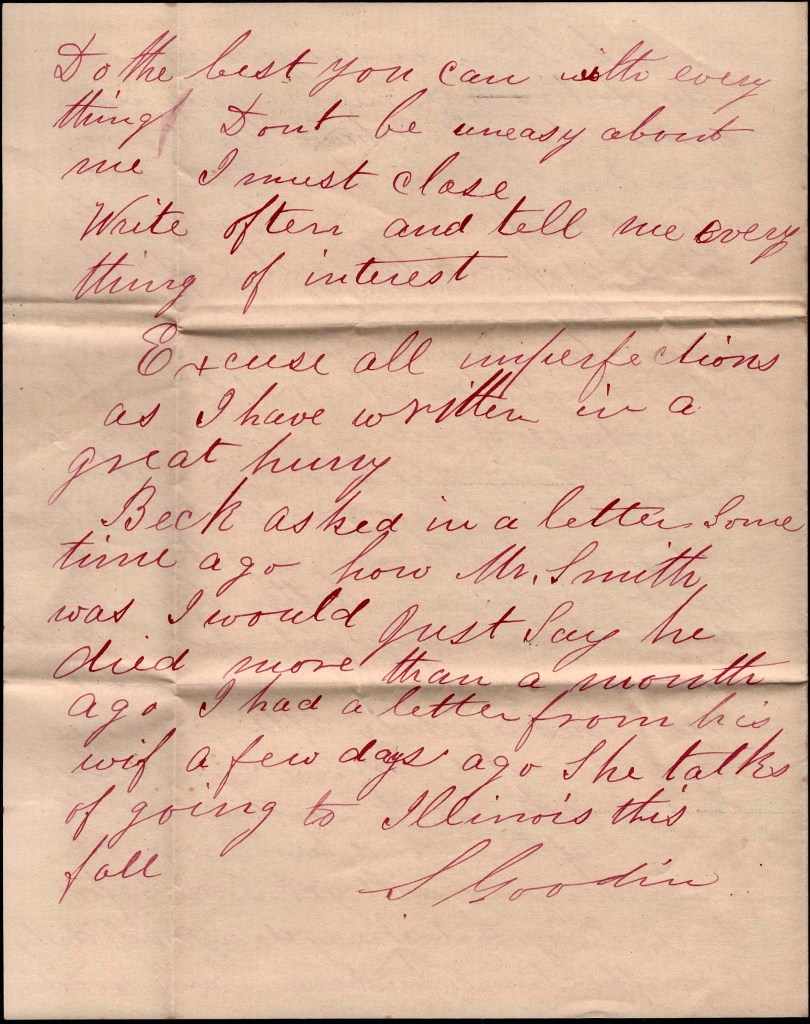
I got another quilt given to me—better than the first. I have bought two blankets [and] I can now sleep comfortably. There was a while after I came here I could not. I send Lyd and Beck each another book, “The Captain and his Orderly.” The other girls will get some before long. Pray that I may do my whole duty. Your affectionate husband, — Smith Goodin
Do the best you can with everything. Don’t be uneasy about me. I must close. Write often and tell me everything of interest. Excuse all imperfections as I have written in a great hurry. Beck asked in a letter some time ago how Mr. Smith was. I would just say he died more than a month ago. I had a letter from his wife a few days ago. She talks of going to Illinois this fall. — S. Goodin
The following letter was written by 52 year-old Cornelius Robbins (1810-1895) of Kingston, Luzerne county, Pennsylvania. Cornelus claimed he was only 40 years old when he enlisted in late November 1861 to serve in Co. E (later transferred to Co. I) of the 58th Pennsylvania Infantry. He mustered out of the service after three years on 7 December 1864, though he suffered from yellow fever during part of that time.
Cornelius was married to Hannah Wiggins (1808-1873) in 1830 and the couple lived in Owego, New York, for a time before taking up residence in Kingston. They had at least five children before 1850—three of who were still living at home with him at the time of the 1860 US Census. One of his sons, John Robbins (1833-1864), died while serving in Co. I, 143rd Pennsylvania Infantry.
The 58th Pennsylvania saw duty at Camp Hamilton, Va., until May 10, 1862. They then occupied Norfolk and Portsmouth from early May till October 11, 1862. They were then ordered to Suffolk, Va.and were on duty there until January, 1863.
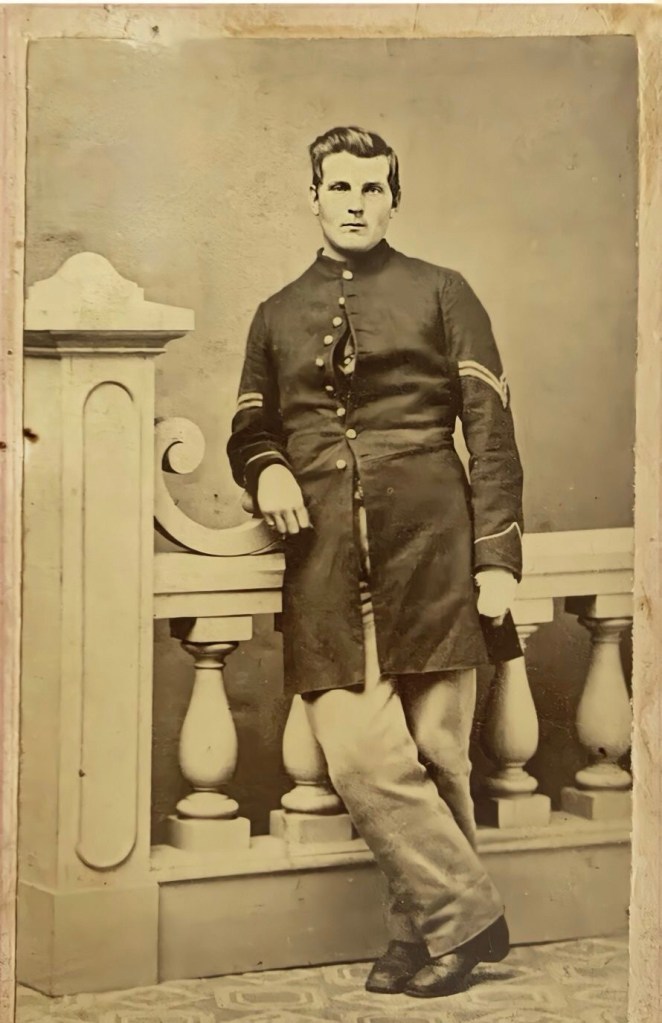
Cornelius Robbins in his GAR cap and coat. Luzerne county, Pennsylvania.
Transcription
Camp near Norfolk, Virginia July 9, 1862
My dear family and friends,
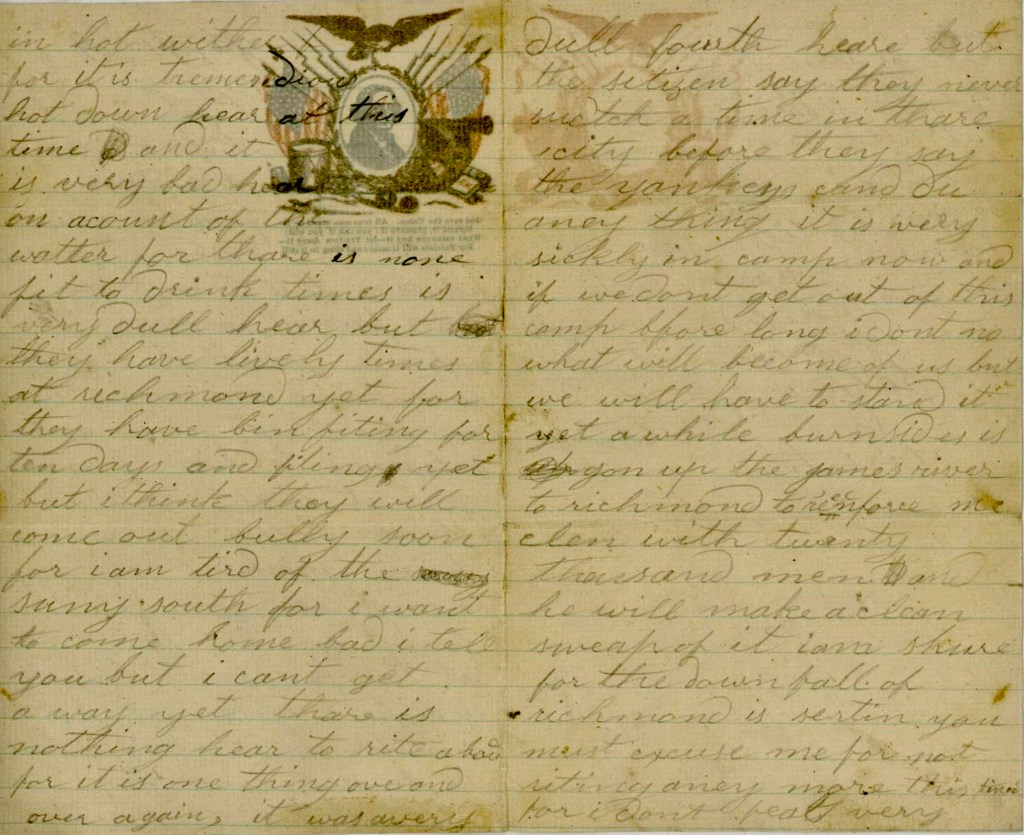
It is with pleasure that I embrace this present moment to inform you that I received your kind and welcome letter in the 8th inst. with great pleasure to hear from you. It does me great pleasure to read yours from home—especially when I can’t see you for it found me in poor health at the present. But I hope I will get better soon for it is a hard place to be sick down here in hot weather for it is tremendous hot down here at this time and it is very bad here on account of the water for there is none fit to drink.
Times is very dull here but they have lively times at Richmond yet for they have been fighting for ten days and fighting yet, But I think they will come out bully soon for I am tired of the Sunny South for I want to come home bad, I tell you. But I can’t get away yet. There is nothing here to write about for it is one thing over and over again. It was a very dull 4th [of July] here but the citizens say they never [had] such a time in their city before. They say the Yankees can’t do anything.
It is very sickly in camp now and if we don’t get out of this camp before long, I don’t know what will become of us. But we will have to stand it yet awhile. Burnsides is gone up the James river to Richmond to reinforce McClellan with twenty thousand men and he will make a clean sweep of it, I am sure, for the downfall of Richmond is certain.
You must excuse me for not writing any more this time for I don’t feel very smart. Write as soon as you get this, if not before. But write soon. Write often, and write immediately. So goodbye till you hear from me again and be good children till you see your husband and father, — C. Robbins
I could not find an image of Daniel but here is Corporal Alonzo Smith of Co. G, 16th Maine Infantry. He was wounded at Fredericksburg too. (Taj Patel Collection)
The following letter was written by Daniel F. Houghton (1841-1889), the son of Abel Houghton (1796-1890) and Elizabeth Parlin (1803-1881) of Weld, Maine. Daniel enlisted when he was 21 years old as a corporal in Co. E, 16th Maine Infantry on 14 August 1862. Daniel was severely wounded during the Battle of Fredericksburg on 13 December 1862 and to save his life, his left leg was amputated. He was discharged for disability on 15 May 1863. A history of the regiment reveals that during the Battle of Fredericksburg, its first engagement with the enemy, the 16th Maine, “unskilled and untrained though we were, to us belongs the credit of bull-dog fighting, until 54 percent of our number were killed or wounded.”
Adding a note at the end of Daniel’s letter was “Angie” whom I believe was Mary Angelia Leavitt (1841-1896), Daniel’s fiancé. The couple were married on 3 May 1866 in Weld, Maine, and they had at least eight children born between 1867 and 1883.
The letter was addressed to Daniel’s older sister, Mary Ann (Houghton) Greene (1828-1906) who married William K. Greene (1821-1889) in 1862.
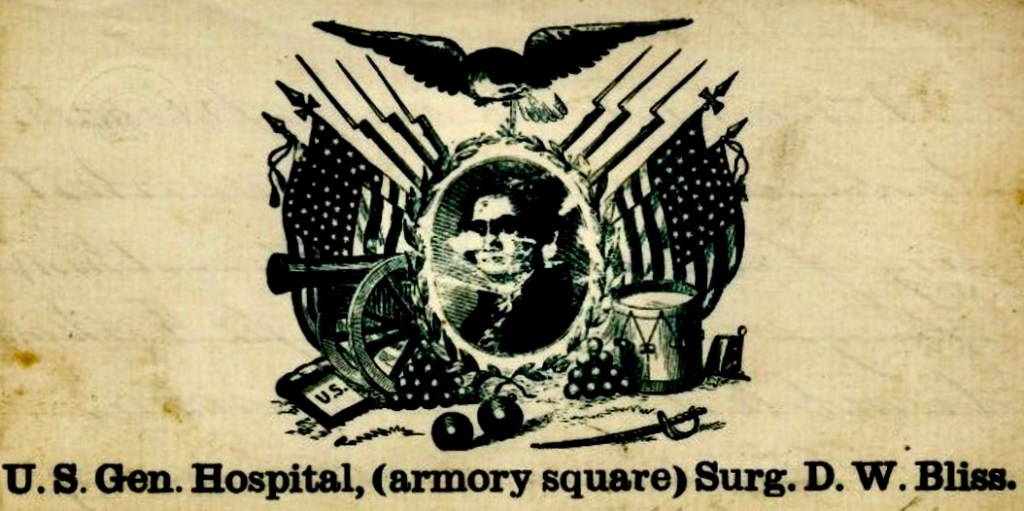
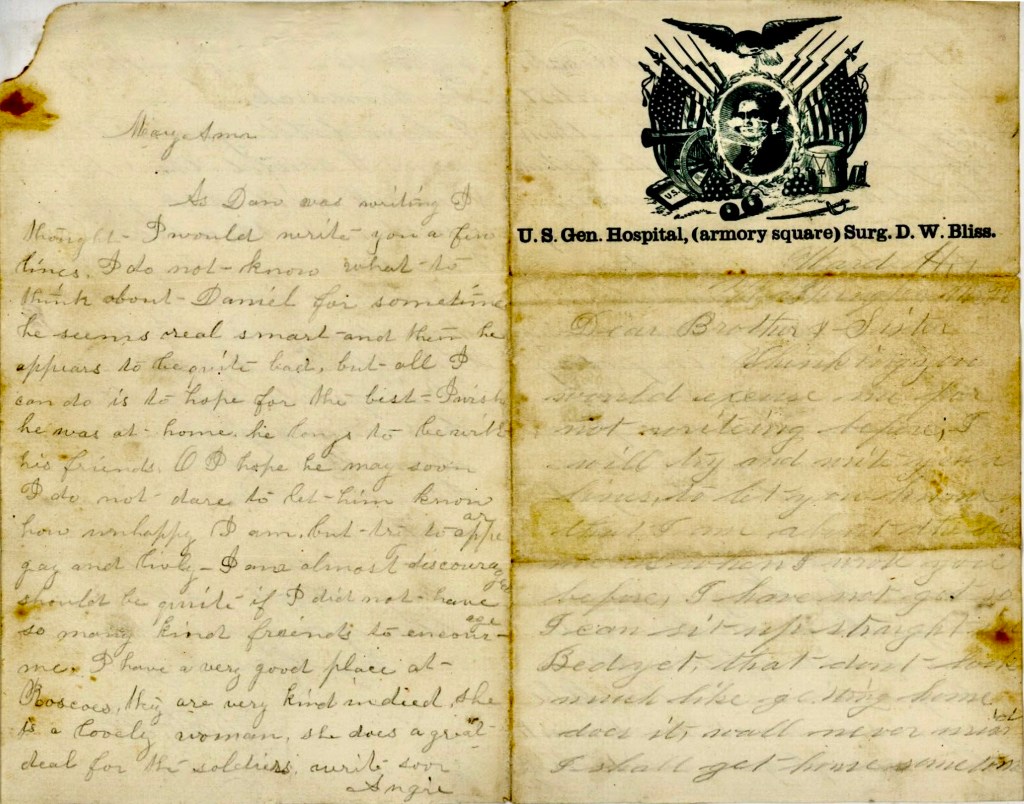
Rare patriotic letterhead labeled US General Hospital (armory square) Surg. D. W. Bliss
U.S. Gen. Hospital (armory square) Ward H, Washington [April 1863]
Dear Brother & Sister,
Thinking you would excuse me for not writing before, I will try and write you a [few] lines to let you know that I am about the same as when I wrote you before. I have not got so I can sit up straight in bed yet. That don’t look much like getting home, does it? Well never mind. I shall get home sometime. It would be very pleasant to be sent home and amongst my friends. I often think of you all & I hope I shall be able to see you soon.
There is but a very few here now that was here when I came here. There is new ones coming in here almost every day, We have some Union citizens here now from Virginia. They were taken prisoners & so exchanged.
Roscoe’s folks are all well. Mr. Cory is smart [ ] boy. He is in here with me quite often. Angie is well but she says she won’t write until some of you write to her. I guess she is getting to be homesick. I have told you all the news I could think of & now I will ask you a few questions & then close.
1—Is sleighing all gone there? 2—How does your leg hold out? 3—How does your stock look this spring? I presume it is quite high there? Has Minnie gone home yet? How does all your folks do? There I guess that will do.
Please write soon. May God watch over & bless you & your family. My love to you all, — D. F. Houghton
Mary Ann, as Dan was writing, I thought I would write you a few lines. I do not know what to think about Daniel for sometimes he seems real smart and then he appears to be quite bad, but all I can do is to hope for the best. I wish he was at home. He longs to be with his friends. Oh, I hope he may soon. I do not dare to let him know how unhappy I am, but try to appear gay and lively. I am almost discouraged. Should be quite if I did not have so many kind friends to encourage me. I have a very good place at Roscoe’s. They are very kind indeed. She is a lovely woman. She does a great deal for the soldiers. Write soon, — Angie
This letter was written by Robert Guyton (1838-1915), the son of John Guyton (1810-1886) and Elizabeth Jane Hazlett (1812-1890) of McCandless, Allegheny county, Pennsylvania. Robert enlisted in Co. F, 139th Pennsylvania Infantry on 1 September 1862. He was promoted from corporal to sergeant in June 1864 and mustered out with the company in June 1865. After the war, Robert returned home, married Nancy A. Robinson (1840-1888), and resumed farming.
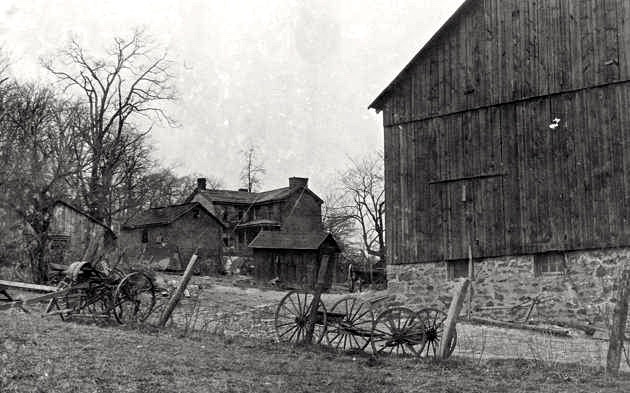
The Guyton Family Farm in Allegheny county, Pennsylvana
Letter 1
Camp near White Oak Church, Va. April 5th 1863
Dear Sister,
I received your kind letter of 28th of March an evening or two ago and one from Father this morning dated the 20th. I am very glad to hear that you have all got right well again. I am in very good health now and so is John Wallace and all the rest of the boys from our neighborhood. This is a very rough day here. It commenced to snow last evening about dark and last night was about as stormy a night as ever I saw but I think after this storm is past we will have good weather.
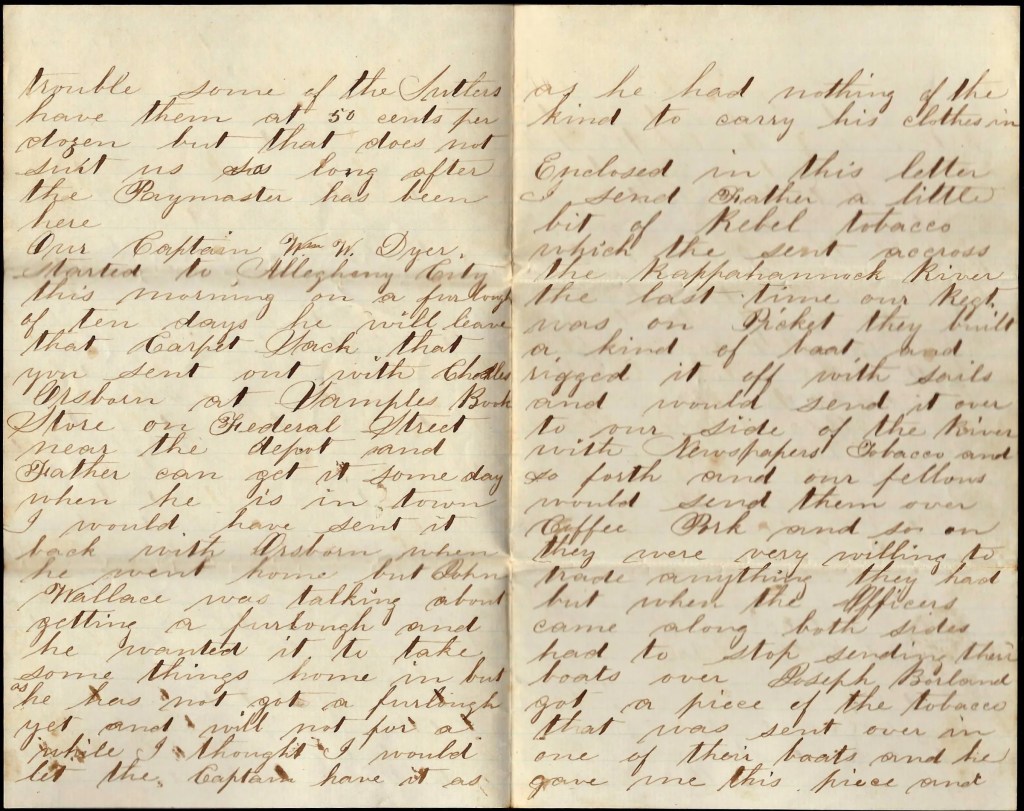
I suppose you are all busy eating eggs today. I would not care if I had a few here today. I think I could eat them without much trouble. Some of the sutlers have them at 50 cents per dozen but that does not suit us so long after the paymaster has been here.
Our Captain William W. Dyer ¹ started to Alleghany City this morning on a furlough of ten days. He will leave the carpet sack that you sent out with Charles Osborn at Sample’s Book Store on Federal Street near the depot and Father can get it someday when he is in town. I would have sent it back with Osborn when he went home but John Wallace ² was talking about getting a furlough and he wanted it to take some things home in but as has not got a furlough yet and will not for a while, I thought I would let the Captain have it as he had nothing of the kind to carry his clothes in.
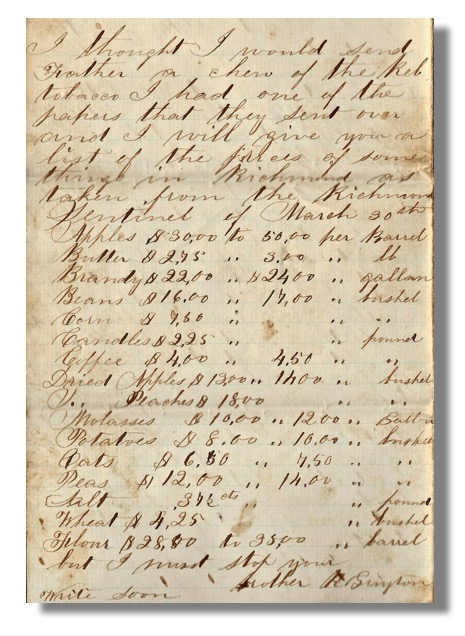
Price of commodities copied from the Richmond Sentinel, 30 March 1863
Enclosed in this letter I send Father a little bit of Rebel tobacco which the [Rebels] sent across the Rappahannock river the last time our regiment was on picket. They built a kind of boat and rigged it off with sails and would send it over to our side of the river with newspapers, tobacco, and so forth, and our fellows would sed them over coffee, pork, and so on. They were very willing to trade anything they had but when the officers came along, both sides had to stop sending their boats over. Joseph Borland got a piece of tobacco that was sent over in one of their boats and he gave me this piece and I thought I would send Father a chew of the Reb tobacco. I had one of the papers that they sent over and I will give you a list of the prices of some things in Richmond as taken from the Richmond Sentinel of March 30th.
But I must stop. Your brother, — R. Guyton
¹ Capt. William W. Dyer was promoted from 1st Lt. to the command of Co. F, 139th Pennsylvania on14 January 1863. He died on 13 June 1864 from wounds received at Cold Harbor on 2 June. He is buried in Uniondale Cemetery in Allegheny City, Pa.
² John Wallace enlisted as sergeant in Co. F, 139th Pennsylvania in September 1862. He was transferred to the Veteran Reserve Corps on 10 March 1864.
Letter 2
Note: This letter was written by Corp. Guyton as the 139th Pennsylvania force-marched to Gettysburg where they arrived on the evening of the 2nd day’s fighting just as the U.S. Regulars were being driven back from the Wheatfield. After the Regulars withdrew through their line, the 139th Pennsylvania counter-charged and halted the Confederate advance on Cemetery Ridge. On July 3rd, the 139th Pennsylvania advanced after Picket’s Charge and cleared the area along the Wheatfield Road where they recovered a cannon and three caissons of the 9th Massachusetts Battery that had been lost the previous day. [See Lt. Col. William H. Moody’s report]
Camp near Fairfax Court House Monday, June 22d 1863
Dear Mother,
I received your very welcome letter of June 15th on Saturday. I was very glad to hear that Father’s arm had got well again for I was afraid that it might have been from that old hurt.
We are all right well here — that is, all the boys from our neighborhood that are here. I have not heard from John Wallace ¹ or R[obert C.]. Anderson ² since they went to Washington. Our Captain [William W. Dyer] and 2d Lieutenant [Wilson Stuart] are in the hospital there too but I think likely they will all be up to the regiment again in a few days. We have been lying here since Thursday evening but it is very doubtful how long we may stay here. I thought yesterday that [we] would have had to move as there was heavy cannonading pretty near all day in the direction of the old Bull Run Battlefield [see Battle of Upperville] but I think from the sound of the cannon that the fighting was some distance beyond Bull’s Run. It [think] it is chiefly cavalry fighting yet but it will be very apt to end in a decisive battle without the Rebs fall back. There was several thousand cavalry passed here yesterday on their way to the scene of action but I have not heard any firing this morning yet and that makes me think that our men has driven them back.
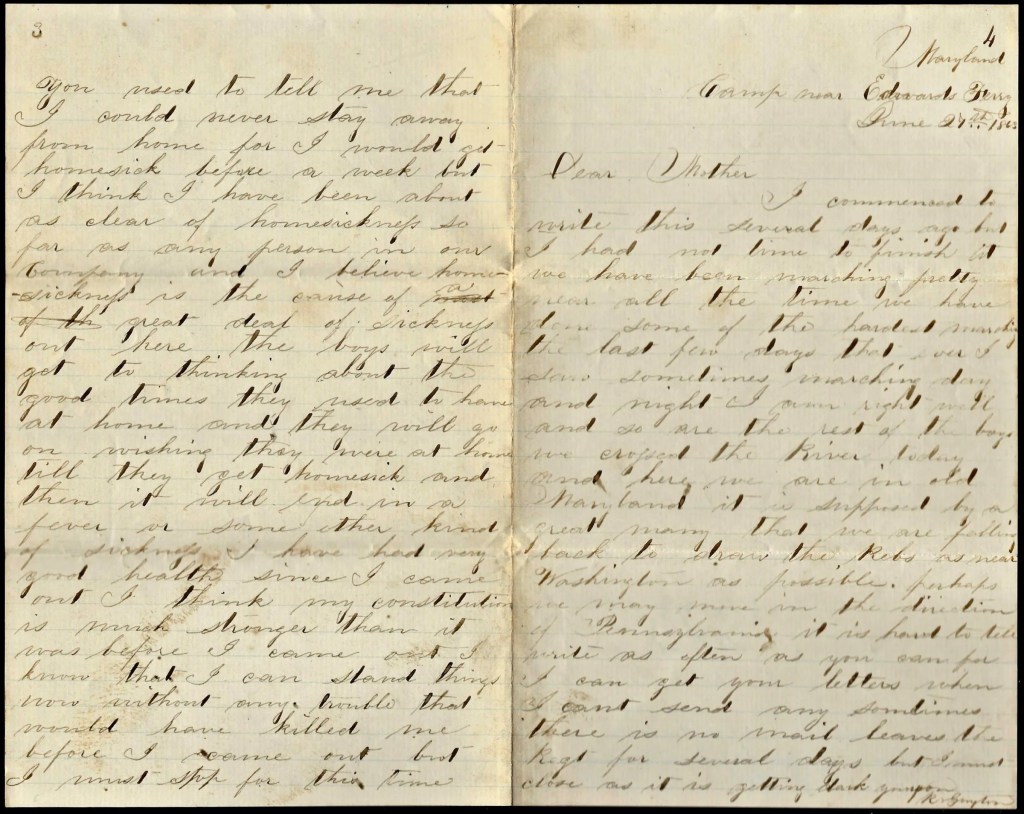
You wanted to know whether I was contented out here or not. I came to the conclusion that I might as well be contented as not when I came out here and I believe it is better for the health to be as happy and contented as possible than to be disappointed and homesick half the time. You used to tell me that I could never stay away from home for I would get homesick before a week but I think I have been about as clear of homesickness so far as any person in our company and I believe homesickness is the cause of a great deal of sickness out here. The boys will get to thinking about the good times they used to have at home and they will go on wishing they were at home till they get homesick and then it will end in a fever or some other kind of sickness. I have had very good health since I came out, I think my constitution is much stronger than it was before I came out. I know that I can stand things now without any trouble that would have killed me before I came out. But I must stop for this time.
Camp near Edward’s Ferry, Maryland June 27th 1863
Dear Mother — I commenced to write this several days ago but I had not time to finish it. We have been marching pretty near all the time. We have done some of the hardest marching the last few days that ever I saw — sometimes marching day and night. I am right well and so are the rest of the boys. We crossed the [Potomac] river today and here we are in Old Maryland. It is supposed by a great many that we are falling back to draw the Rebs as near Washington as possible. Perhaps we may move in the direction of Pennsylvania. It is hard to tell. Write as often as you can for i can get your letters when I can’t send any. Sometimes there is no mail leaves the regiment for several days but I must close as it is getting dark.
Your son, — R. Guyton
¹ Sergeant John Wallace was transferred to the Veteran Reserve Corps in March 1864.
² Corporal Robert C. Anderson was wounded at Spottsylvania Court House in May 1864.
A company of the 139th Pennsylvania
Letter 3
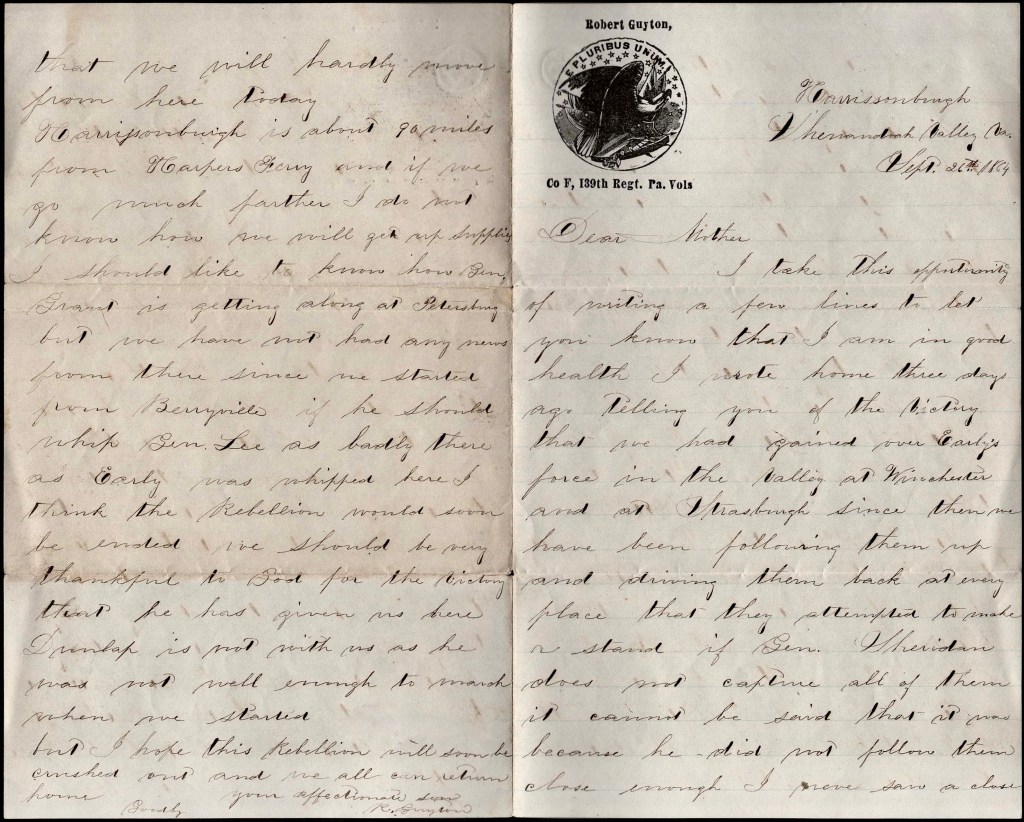
Note: This letter describes Sheridan’s September 1864 campaign to drive Confederates out of the Shenandoah Valley and render the area useless to the Southern cause by destroying all the crops and supplies.See Confederate General Jubal Early abandons Winchester, Virginia.
Robert’s personalized stationery—quite rare
Harrisonburg, Shenandoah Valley, Va. Sept. 20th 1864
Dear Mother,
I take this opportunity of writing a few lines to let you know that I am in good health.
I wrote home three days ago telling you of the victory that we had gained over [Jubal A.] Early’s force in the Valley at Winchester and at Strasburg. Since then we have been following them up and driving them back at every place that they attempted to make a stand. If Gen. Sheridan does not capture all of them, it cannot be said that it was because he did not follow them close enough. I never saw a closer pursuit of a retreating army since I joined the service. On Saturday they made a stand at Mount Jackson, but we soon drove them out of that and drove them so close for five or six miles that our advance was skirmishing with them all the time.
I will try and tell you how we followed them so close. First, we had a heavy line of skirmishers or rather two lines, then a line of Battle and just behind the line of Battle, there was several Batteries of Artillery, and whenever the Artillery would come to any high ground they would unlimber and fire a few shots into the Rebs, then limber up and gallop to another piece of high ground and fire a few more, then away again. And behind the first line of Battle there was eight or ten heavy columns of troops reaching as far as you could see, ready to wheel into line of Battle at a moments notice. It was as beautiful a sight as ever I saw. We followed them in that manner till dark when we halted for the night and they made such good use of the darkness that we have not seen them since.
I do not think Early’s force will make a stand in this part of the Valley unless they are reenforced as they are badly demoralized and scattered through the mountains and woods. We halted here last evening and I think from present appearances that we will hardly move from here today.
Harrisonburg is about 90 miles from Harpers Ferry and if we go much farther, I do not know how we will get up supplies. I should like to know how Gen. Grant is getting along at Petersburg but we have not had any news from there since we started from Berryville. If he should whip Gen. Lee as badly there as Early was whipped here, I think the Rebellion would soon be ended. We should be very thankful to God for the victory that he has given us here. Dunlap is not with us as he was not well enough to march when we started but I hope this Rebellion will soon be crushed out and we all can return home Goodby. Your affectionate son, — R. Guyton
Some of Robert Guyton’s personal items on display at the McCandless/Northern Allegheny Heritage & Cultural Center in November 2023.
I could not find an image of Michael but here is a tintype of Edwin Eugene Tubbs who served in Congress. D, 117th New York Infantry (Al & Claudia Niemiec Collection)
This letter was written by Michael G. Gephart (1842-1926) of Ava, Oneida county, New York. Michael enlisted on 21 August 1862 to serve three years in Co. I, 117th New York Infantry—sometimes called the “4th Oneida Regiment.” He was promoted to a corporal on 20 August 1862; was wounded in action, 16 May 1864, at Drewry’s Bluff, Va.; returned to the ranks on 20 January 1865; was promoted sergeant on 1 March 1865; and mustered out with his company on 8 June 1865, at Raleigh, N. C.
In the 1860 US Census, Michael was enumerated in the household of John C. Flint of Ava, New York, working as a farm laborer. Emma, to whom this letter was addressed, was John’s daughter and wound have been 15 when this letter was written in March 1863. The 1900 US Census informs us that Michael’s parents were immigrants from Germany.
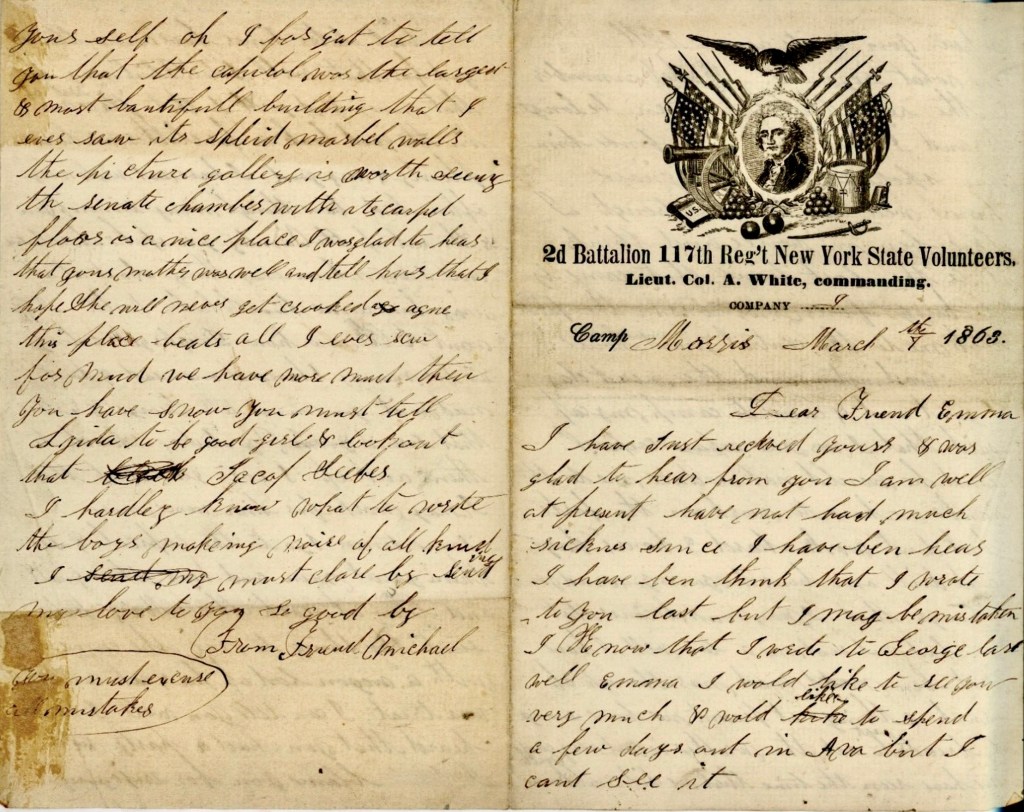
TRANSCRIPTION
2nd Battalion, 117th Reg. New York State Vols., Co. I Camp Morris [Near D. C.] March 7th 1863
Dear Friend Emma,
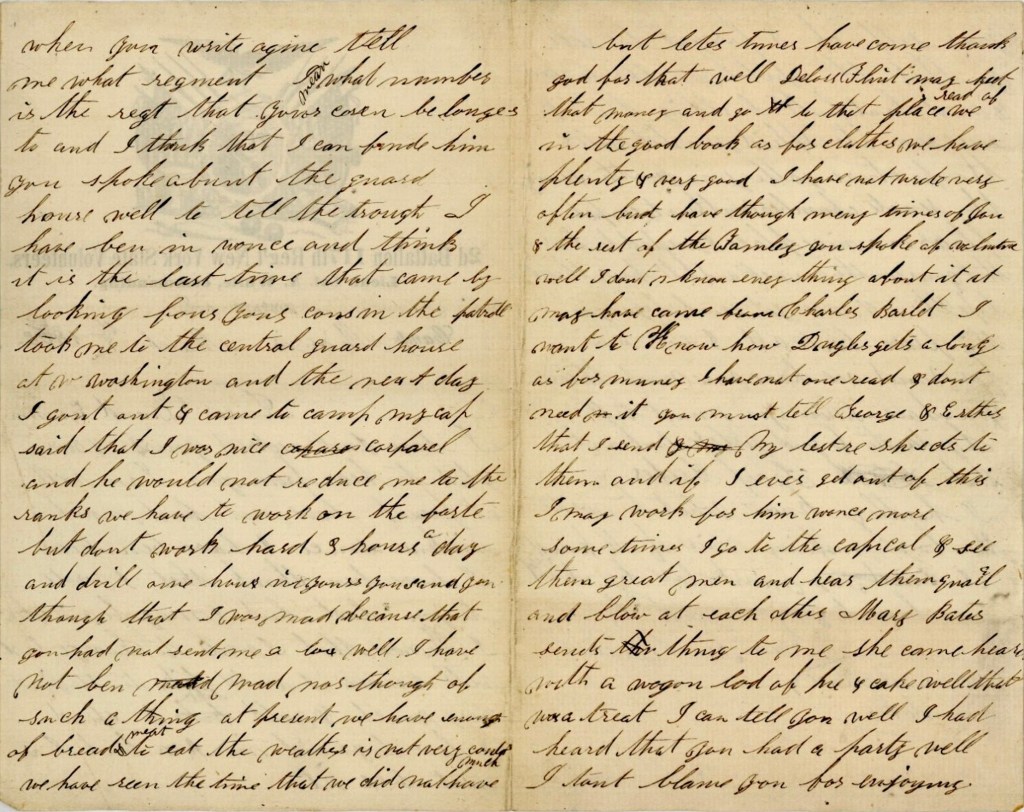
I have just received yours & was glad to hear from you. I am well at present. Have not had much sickness since I have been here. I have been thing[ing] that I wrote to you last but I may be mistaken. I know that I wrote to George last. Well, Emma, I would like to see you very much & would like to spend a few days out in Ava but I can’t see it. When you write again, tell me what regiment—I mean what number is the regiment that your cousin belongs to and I think that I can find him.
You spoke about the guard house. Well, to tell the truth, I have been in once and I think it is the last time. That came by looking for your cousin. The patrol took me to the central guard house at Washington and the next day I got out & came to camp. My captain said that I was a nice corporal and he would not reduce me to the ranks. We have to work on the fort but don’t work hard—three hours a day. And we drill one hour.
In yours you said you thought that I was mad because you had not sent me a box. Well, I have not been made nor thought of such a thing. At present, we have enough meat to eat. The weather is not very cold. We have seen the time that we did not have much but better times have come, thank God for that.
Well, Delos Flint may keep that money and go to that place we read of in the good book. As for clothes, we have plenty of& very good. I have not wrote very often but have thought many times of you and the rest of the family. You spoke of valentine. Well I don’t know anything about it. It may have come from Charles Barlet. I want to know how Douglas gets along.
As for money, I have not one red [cent]. I don’t need it. You must tell George & Ester that I send my best respects to them and if I ever get out of this, I may work for him once more.
Sometimes I got to the Capitol and see them great men and hear them quarrel and blow at each other. Mary Bates sends things to me. She came here with a wagon load of pies and cakes. Well that was a treat, I can tell you. Well, I had heard that you had a party. Well, I can’t blame you for enjoying yourself. Oh! I forgot to tell you that the Capitol was the largest and most beautiful building that I ever saw [with] its splendid marble walls. The picture gallery is worth seeing. The Senate Chamber with its carpet floor is a nice place.
I was glad to hear that your mother was well and tell her that I hope she will never get crooked again. This place beats all I ever saw for mud. We have more mud than you have snow. You must tell Lida to be a good girl & look out that Jacob Seefer. I hardly know what to write, the boys making noise of all kind. I must close by seng my love to you, so goodbye. From friend, — Michael
The following letter was written by Gerard Lindsley McEntee (1847-1913), the son of James Smith McEntee (1800-1887) and Sarah Jane Goetchius (1805-1883) of Kingston, Ulster county, New York. Gerard had several notable siblings—Jervis McEntee (1828-1891), a Hudson River School Landscape Artist; Mary Swan McEntee (1830-1892), the wife of Calvert Vaux, Landscape architect of NYC who worked with Frederick Law Olmstead in the design of NYC’s Central Park; Lt. Maurice Wurts McEntee (1836-1883), 20th NY State Militia, and later Acting Master in US Navy.
When he was only 13 years old, Gerard signed on as a drummer boy in Co. F of the 20th New York State Militia for three months. This was the same unit that his brother Maurice was in. This unit served from 23 April 1861 to 2 August 1861. Gerard’s letter was written just 10 days after the Battle of Bull Run—referred to as the “sad news” within the letter.
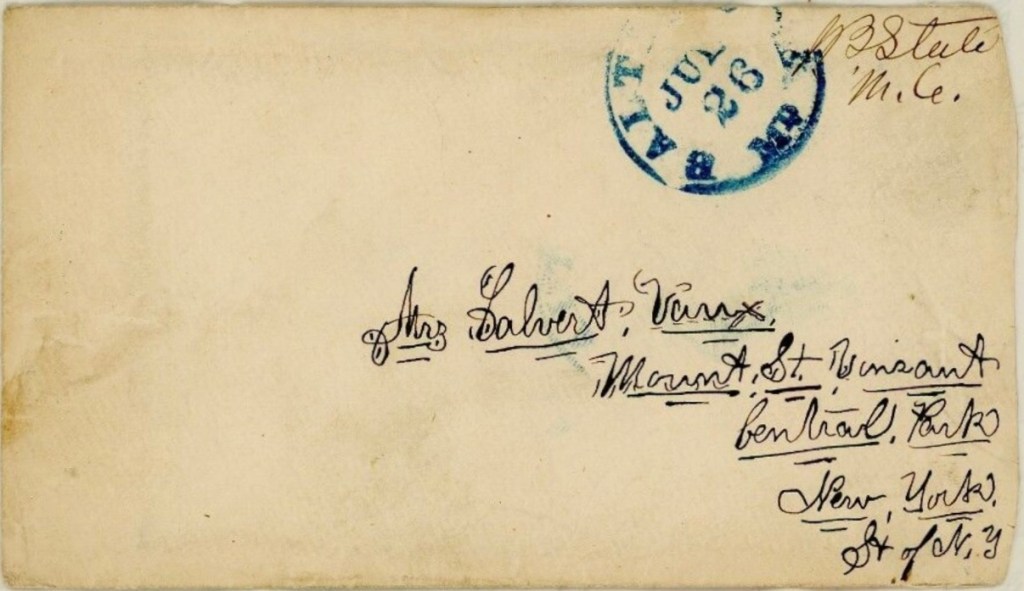
Addressed to Mrs. Calvery Vaux, Mount St. Vincent, Central Park, New York, State of NY
Transcription
Camp Banks Baltimore, [Maryland] July 31st [1861]
Dear Sister Mary,
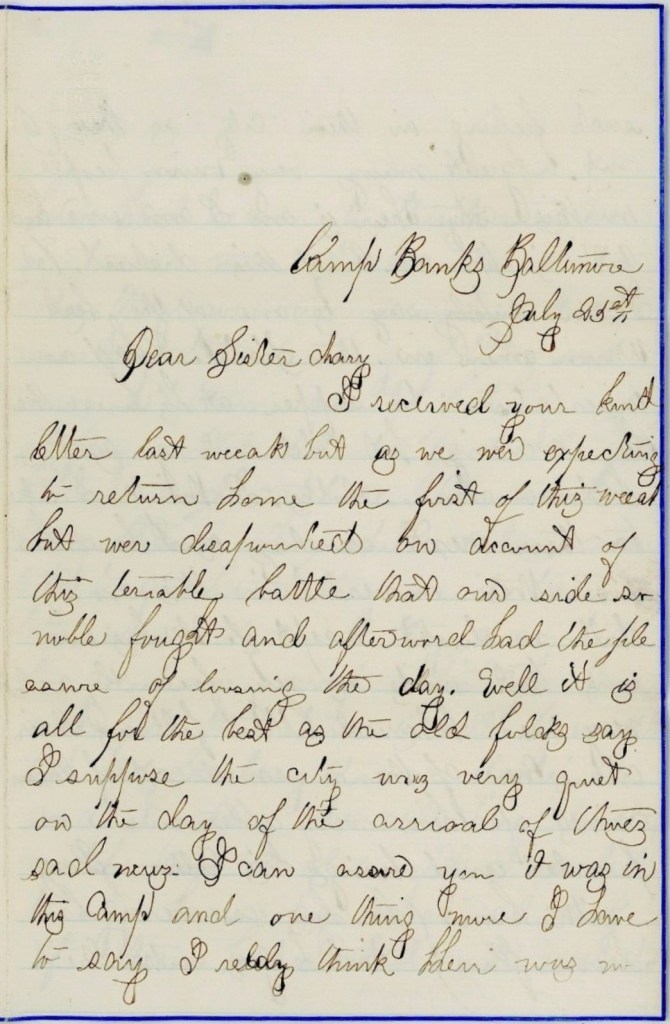
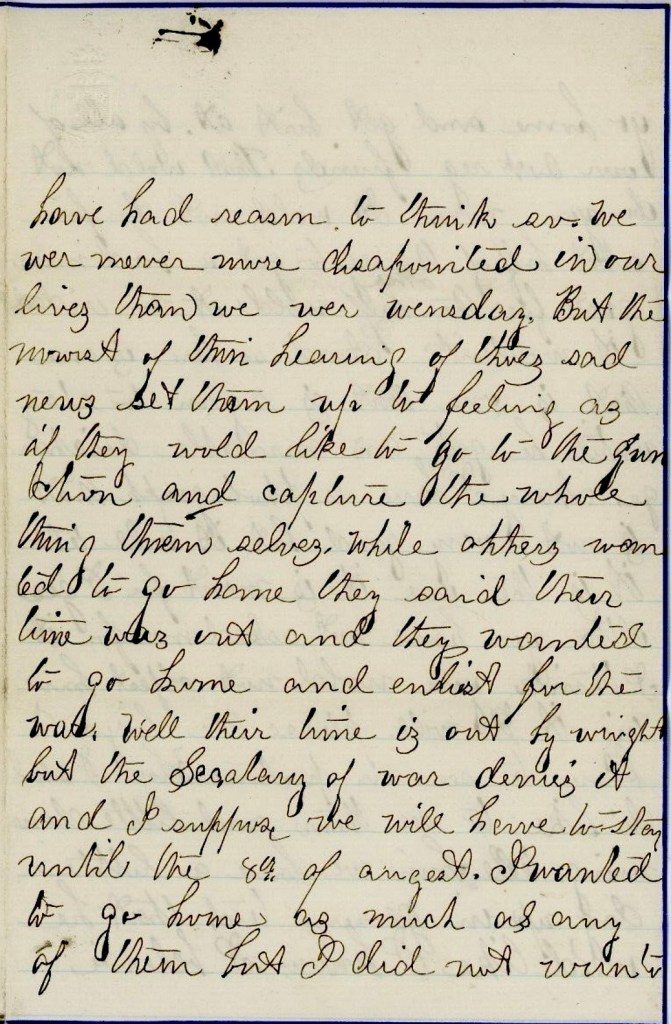
I received your kind letter last week but as we were expecting to return home the first of this week, but were disappointed on account of this terrible battle that our side so noble fought and afterward had the pleasure of losing the day. Well, it is all for the best as the old folks say, I suppose. The city was very quiet on the day of the arrival of the sad news, I can assure you. I was in the camp and one thing more I have to say, I really think there was no [page missing]….have had reason to think so. We were never more disappointed in our lives than we were Wednesday. But the worst of them, hearing of this sad news, set them up to feeling as if they would like to go to the [Manassas] Junction and capture the whole thing themselves while others wanted to go home. They said their time was out and they wanted to go home and enlist for the war. Well their time is out by right but the Secretary of War denies it and I suppose ew will have to stay until the 8th of August.
Gerard Lindsley McEntee
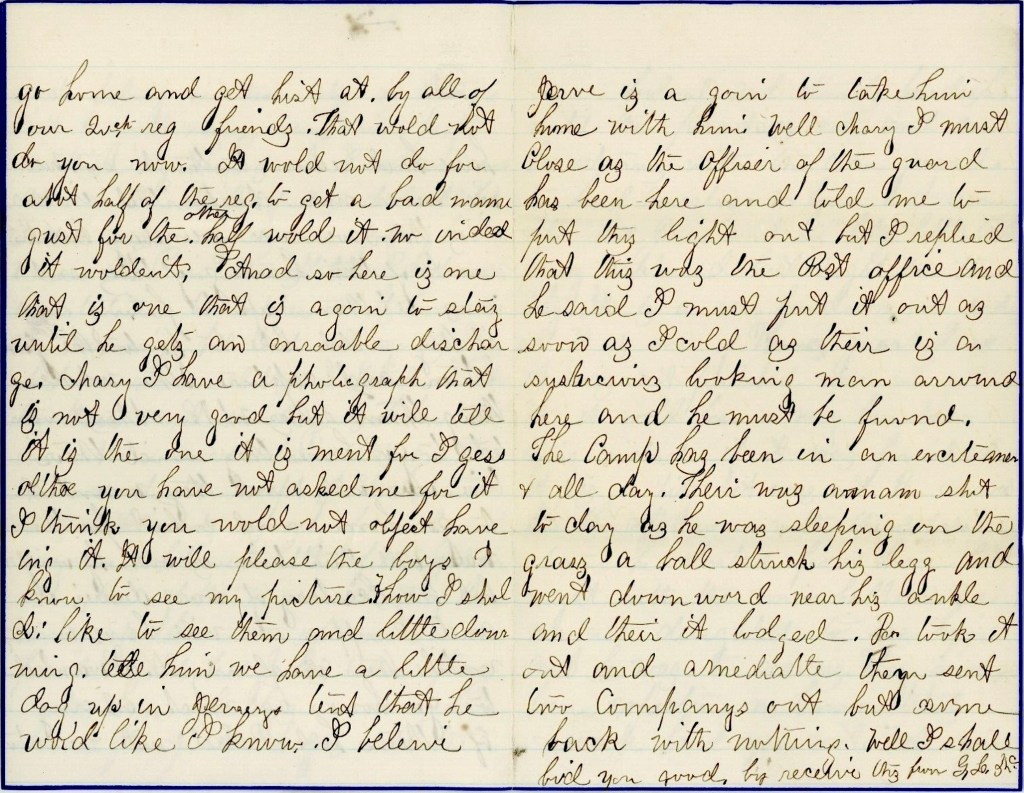
I wanted to go home as much as any of them but I did not want to go home and get hissed at by all of our 20th Regiment friends. That would not do, you know. It would not do for about half of the regiment to get a bad name just for the other half, would it? No indeed it wouldn’t. And so here is one that is a goin’ to stay until he gets an honorable discharge.
Mary, I have a photograph that is not very good but it will tell. It is the one it is meant for I guess. Although you have not asked me for it, I think you would not object having it. It will please the boys, I know, to see my picture. How I should like to see them and little Downing. 1 Tell him we have a little dog up in Jervy’s tent that he would like, I know. I believe Jerve is a going to take him home with him.
Well Mary, I must close as the officer of the guard has been here and told me to put this light out but I replied that this was the Post Office and he said I must put it out as soon as I could as there is a suspicious looking man around here and he must be found.
The camp has been in an excitement all day. There was a man shot today as he was sleeping on the grass. A ball struck his leg and went downward near his ankle and there it lodged. Dr. took it out and immediately they sent two companies out but came back with nothing. Well I shall bid you goodbye. This from G. L. Mc.
1 Downing Vaux was born in 1857.Downing’s brother Calvin was a couple years older.
















 Spared & Shared 23