Category Archives: Sheridan’s Valley Campaign of 1864

1864: Henry Nathaniel Fairbanks to Parents

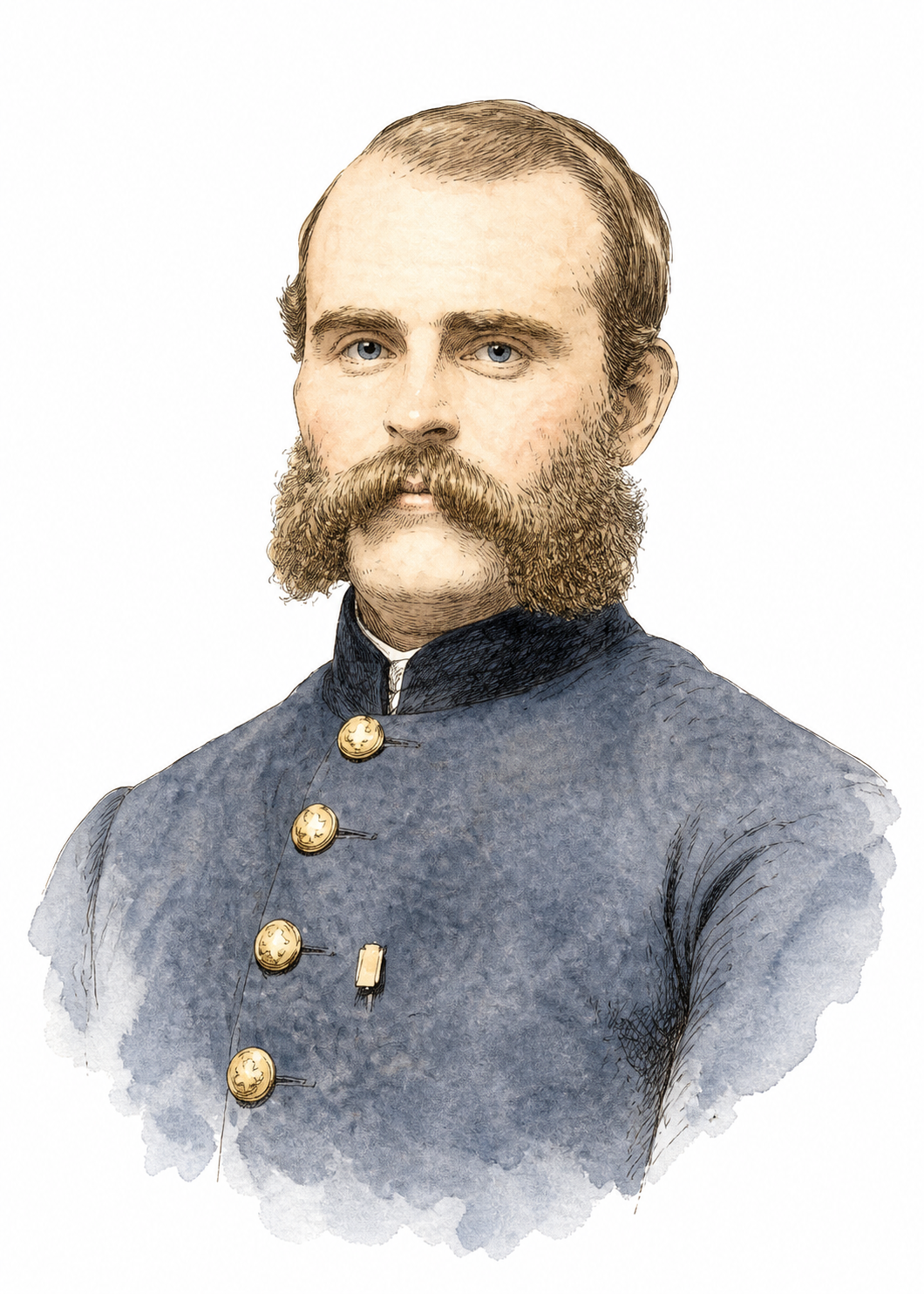
Henry Nathaniel Fairbanks, Co. E, 30th Maine Infantry (watercolor based on image in Maine Historical Society)

Henry Nathaniel Fairbanks (1838-1913) of Wayne, Kennebec county, Maine, wrote the following letters to his father while serving in Co. E of the 30th Maine. According to a biographical sketch newspaper clipping appearing on Find-A-Grave, Henry first served as a band member in the 3rd Maine Infantry. He then did home duty in the 44th Massachusetts at the time of the draft riots in Boston, and then enlisted as a sergeant in November 1863 at age 25. He participated in the Red River expedition where he was slightly wounded in the arm and later with Sheridan in the Shenandoah Valley. He was promoted to 2nd lieutenant on April 9, 1864 and was discharged on August 20, 1865.

I had previously encountered Henry N. Fairbanks of the 30th Maine while researching a letter pertaining to the 19th Texas Infantry Regiment. See 1862: Fanny Benners’ Speech to 19th Texas Infantry. That research yielded memoirs of the Red River Expedition of 1864 written by Henry.

Both of Henry’s letters were written in August 1864 when the 30th Maine Infantry was attached to the Army of the Shenandoah in Virginia and actively involved in Sheridan’s Shenandoah Valley Campaign. During this period, the regiment was heavily engaged in detached duty, which included securing supply trains and protecting stores as they moved through the region. Unfortunately the second letter is only partial and missing the signature page, but Henry mentions hearing the fighting on 21 August 1864 when Early and Anderson launched a converging attack on Sheridan’s army at Cameron’s Depot.
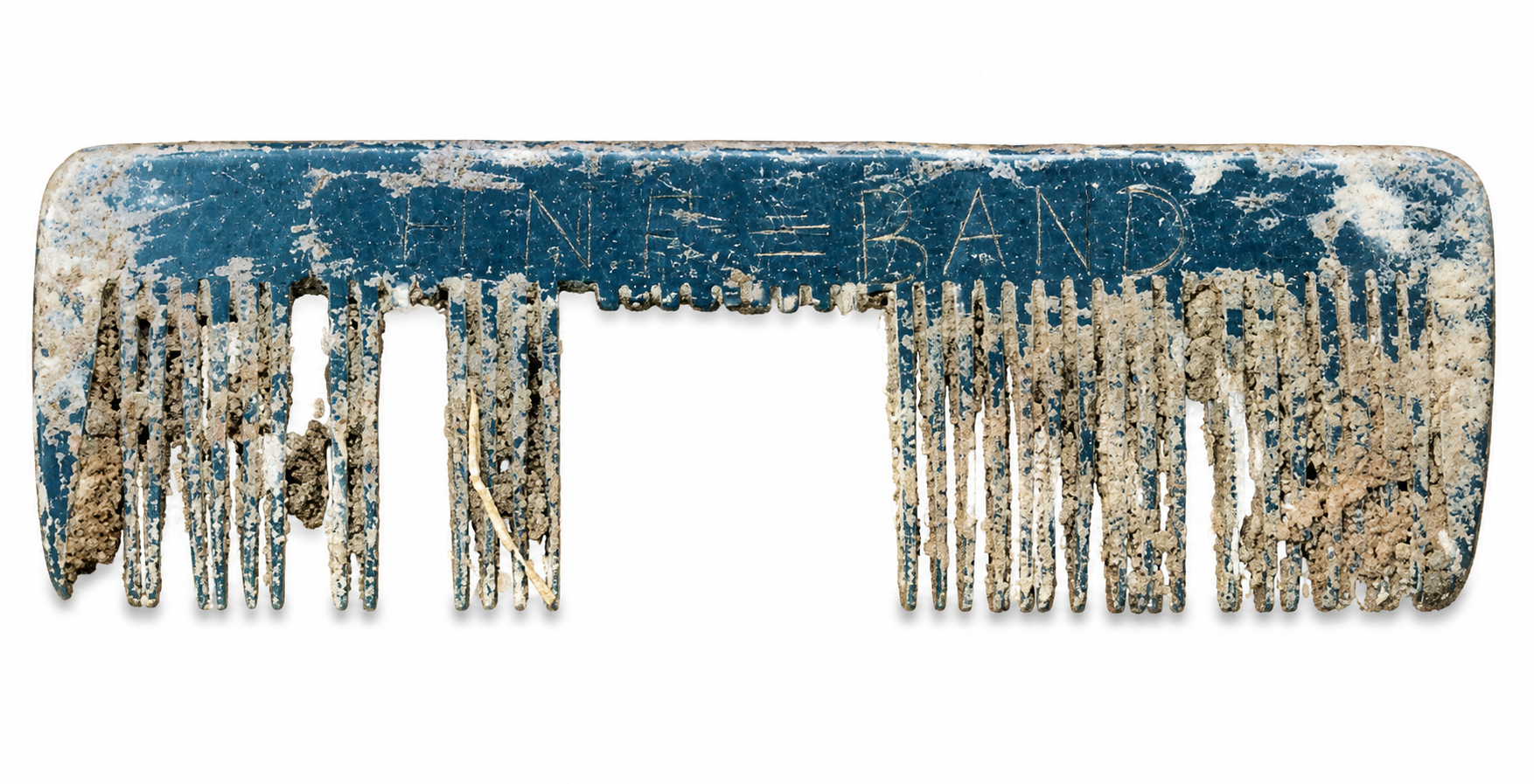
A vulcanized rubber comb made by Goodyear found at a site that was the winter camp of a Union regiment near Falmouth, Virginia. It has the initials “H. N. F. = BAND” etched into it which has been traced to Henry Nathaniel Fairbanks who served in the 3rd Maine Infantry Band. It was found that Henry returned home prior to the establishment of this particular winter camp on disability leave so the assumption is that the comb was borrowed (with or without permission), traded, sold, or lost and picked up by someone else in the regiment. Through a process of elimination, Henry is the only band member with all three initials, rank/regimental band, state of origin, and corps/location of camp. See story of relic.

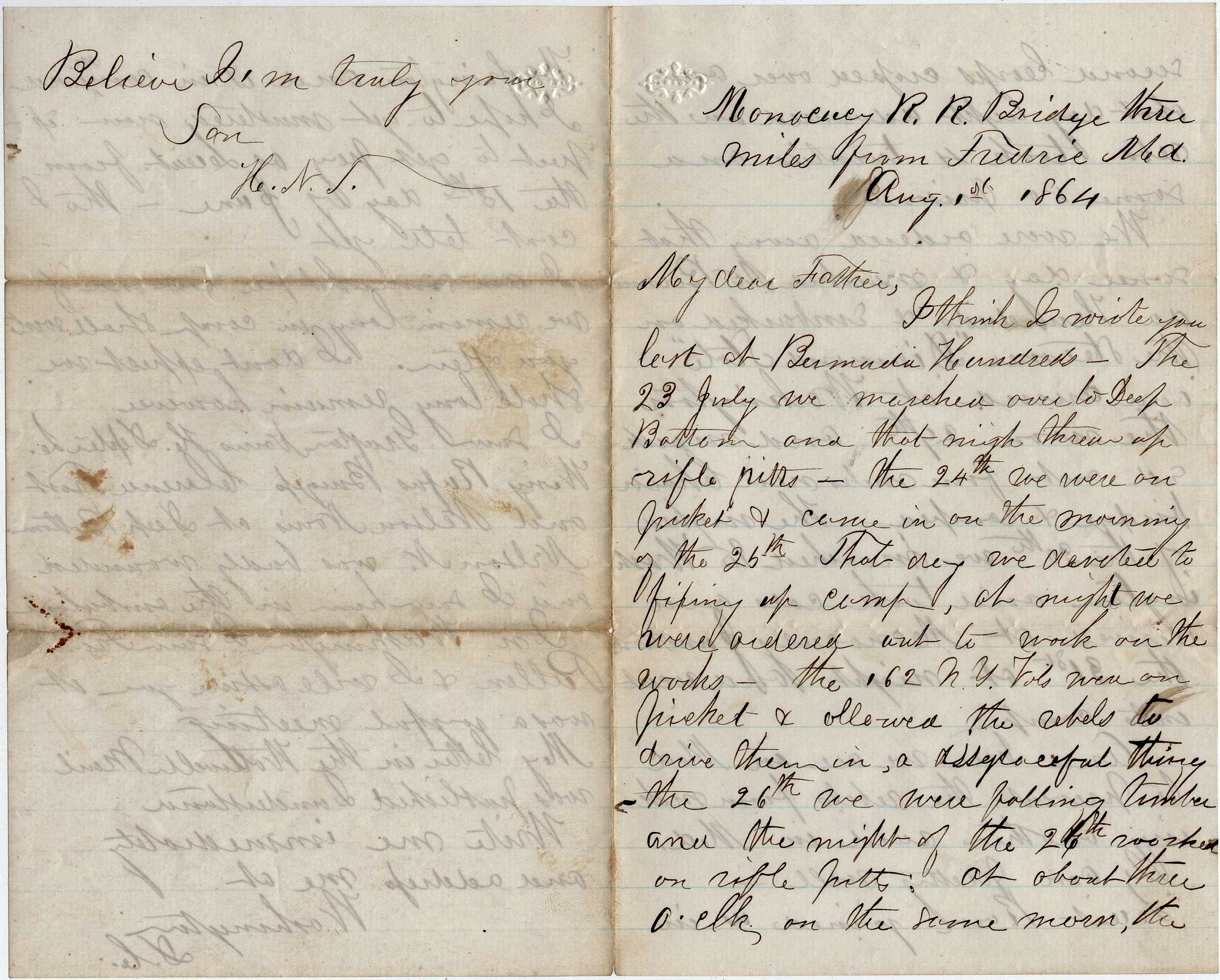
Letter 1

Monocacy Railroad Bridge
Three miles from Frederick, Maryland
August 1st 1864

My dear Father,

I think I wrote you last at Bermuda Hundred, The 23rd July we marched over to Deep Bottom and that night threw up rifle pits. The 24th we were on picket & cami in on the morning of the 25th. That day we devoted to fixing up camp. At night we were ordered out to work on the works. The 162nd New York Vols. were on picket & allowed the rebels to drive them in—a disgraceful thing. The 26th we were falling timber and the night of the 26th worked on rifle pits. At about 3 o’clock on the same morn, the Second Corps crossed over and about daylight advanced on the Rebs, took 4 twenties and some 50 prisoners.

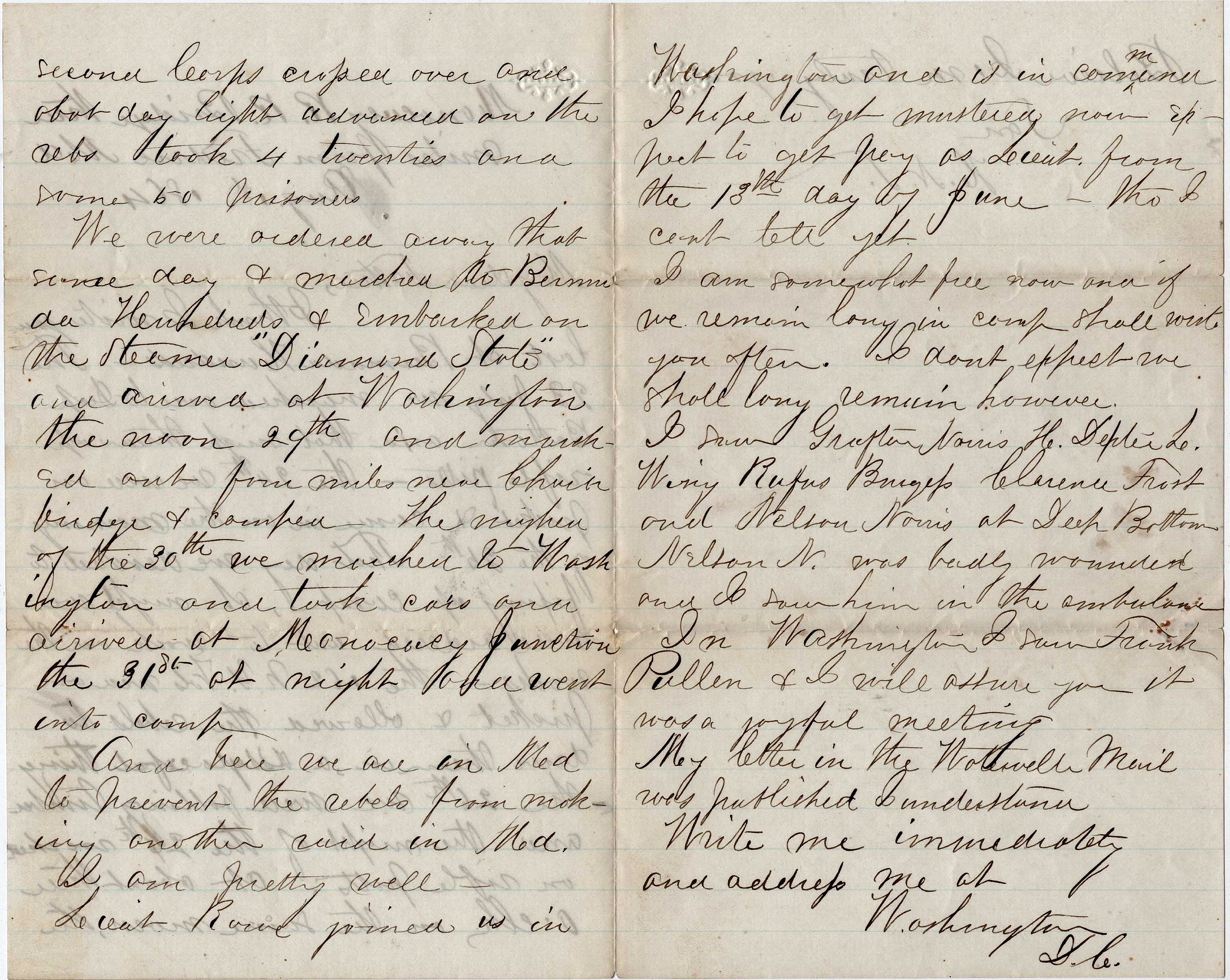
We were ordered away that same day & marched to Bermuda Hundred & embarked on the steamer “Diamond State” and arrived at Washington the noon 29th and marched out four miles near Chain Bridge & camped. The night of the 30th we marched to Washington and took cars and arrived at Monocacy Junction the 31st at night and went into camp. And here we are in Maryland to prevent the rebels from making another rain in Maryland.

I am pretty well. Lieut. Rowe joined us in Washington and is in command. I hope to get mustered now. Expect to get pay as Lieutenant from the 13th day of June though I can’t tell yet. I am somewhat free now and if we remain long in camp, shall visit you often. I don’t expect we shall long remain, however.

I saw Grafton Norris H, Dexter L., We___ Rufus Burgess, Clarence Frost, and Nelson Norris at deep Bottom. Nelson Norris was badly wounded and I saw him in the ambulance. In Washington, I saw Frank Pullen & I will assure you it was a joyful meeting.

My letter in the Waterville Mail was published I understand. Write me immediately and address me at Washington D. C. Believe I ‘s truly your son, — H. N. F.
Letter 2

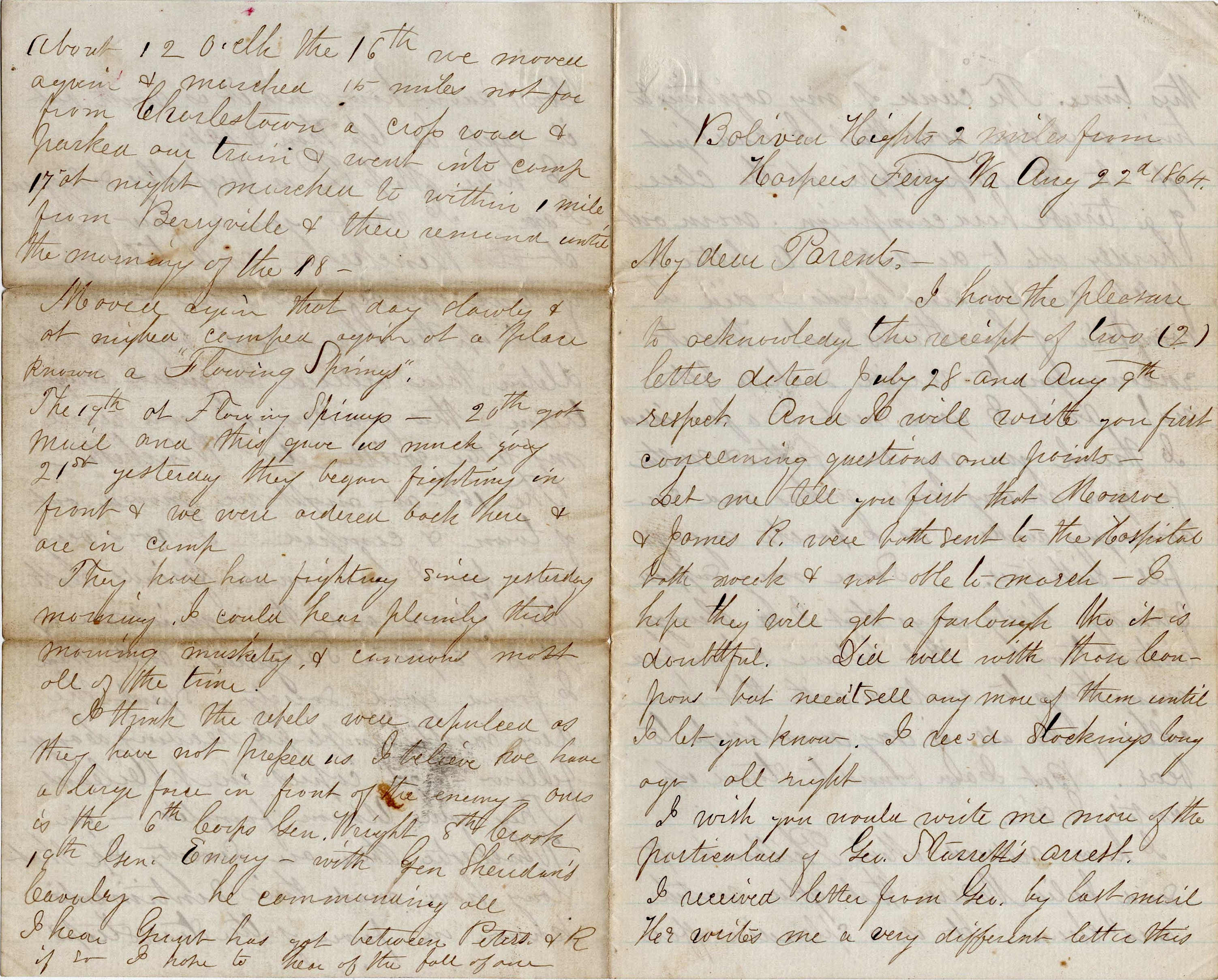
Bolivar Heights
2 Miles from Harpers Ferry, Va.
August 22, 1864

My dear Parents,

I have the pleasure to acknowledge the receipt of two letters dated July 28th and August 9th respectively. And I will write you first concerning questions and points.

Let me twoo you first that Morroe & James R. were both sent to the hospital, both weak and not able to march. I hope they will get a furlough though it is doubtful. Did well with those coupons but needn’t sell any more of them until I let you know. I received stockings long ago all right.

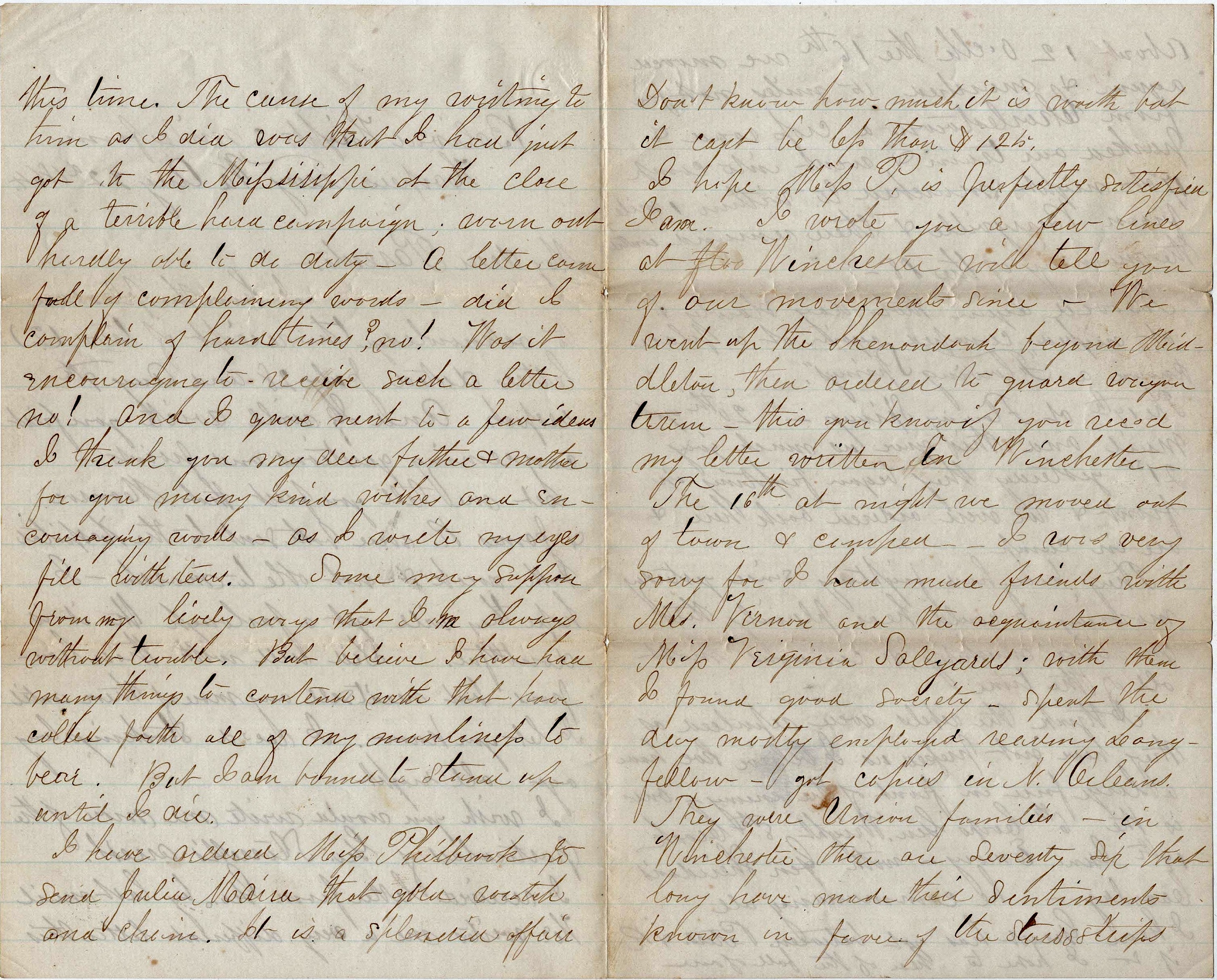
I wish you would write me more of the particulars of George Starrett’s arrest. I received a letter from George by last mail. He writes me a very different letter this time. The cause of my writing to him as I did was that I had just got to the Mississippi at the close of a terrible hard campaign; worn out [and] hardly able to do duty. A letter came full of complaining words—did I complain of hard times? No! Was it encouraging to receive such a letter? No! And I gave vent to a few ideas.

I thank you my dear father and mother for your many kind wishes and encouraging words. As I write, my eyes fill with tears. Some may suppose from my lively ways that I’m always without trouble. But believe I have had many things to contend with that have called forth all of my manliness to bear. But I am bound to stand up until I die.

I have ordered Miss Philbrook to send Julia Maira that gold watch and chain. It is a splendid affair. Don’t know how much it is worth but it can’t be less than $125. I hope Miss Philbrook is perfectly satisfied. I am. I wrote you a few lines at Winchester. Will tell you of our movements since.

We went up the Shenandoah beyond Middletown, then ordered to guard wagon train. This you know if you received my letter written in Winchester. The 16th at night, we moved out of town & camped. I was very sorry for I had made friends with Mrs. Vernon and the acquaintance of Miss Virginia Sallyards. With them I found good society. Spent the day mostly employed reading Longfellow. Got copies in New Orleans. They were Union families. In Winchester there are seventy-six that long have made their sentiments known in favor of the stars & stripes.

About 12 o’clock the 16th we moved again & marched 15 miles, not far from Charlestown, a cross road, and parked out train & went into camp. 17th at night we marched to within one mile from Berryville & there remained until the morning of the 18th.

Moved again that day slowly & at night camped again at a place known as “Flowing Springs.” The 19th at Flowing Springs. 20th got mail and this gave us much joy. 21st yesterday they began fighting in front and we were ordered back here & are in camp. They have had fighting since yesterday morning. I could hear plainly this morning musketry & cannons most all of the time.

I think the rebels were repulsed as they have not pressed us. I believe we have a large force in front of the enemy. One is the 6th Corps, Gen. Wright, 8th Crook, 19th Gen. Emory with Gen. Sheridan’s Cavalry—he commanding all. I hear Grant has got between Petersburg and Richmond. If so, I hope to hear of the fall of our [rest of letter missing]
1863-64: Robert Guyton to his Family

This letter was written by Robert Guyton (1838-1915), the son of John Guyton (1810-1886) and Elizabeth Jane Hazlett (1812-1890) of McCandless, Allegheny county, Pennsylvania. Robert enlisted in Co. F, 139th Pennsylvania Infantry on 1 September 1862. He was promoted from corporal to sergeant in June 1864 and mustered out with the company in June 1865. After the war, Robert returned home, married Nancy A. Robinson (1840-1888), and resumed farming.

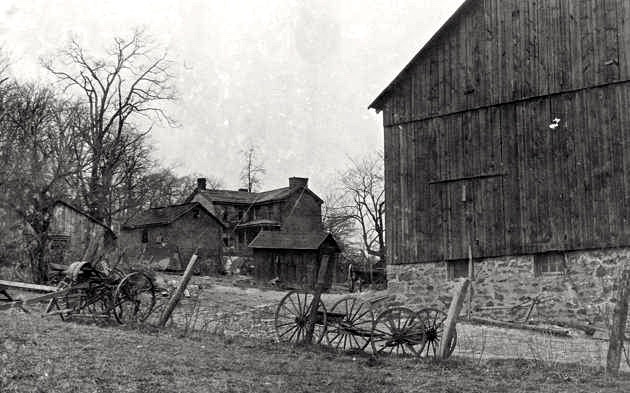
The Guyton Family Farm in Allegheny county, Pennsylvana

Letter 1

Camp near White Oak Church, Va.
April 5th 1863

Dear Sister,

I received your kind letter of 28th of March an evening or two ago and one from Father this morning dated the 20th. I am very glad to hear that you have all got right well again. I am in very good health now and so is John Wallace and all the rest of the boys from our neighborhood. This is a very rough day here. It commenced to snow last evening about dark and last night was about as stormy a night as ever I saw but I think after this storm is past we will have good weather.

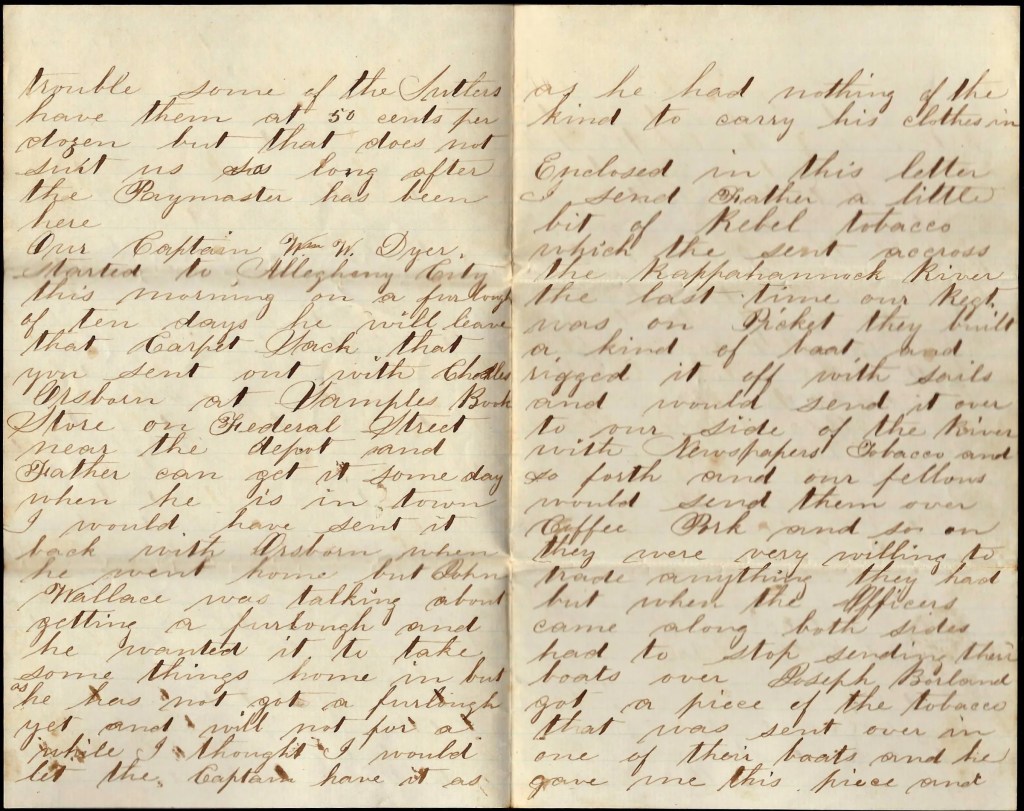
I suppose you are all busy eating eggs today. I would not care if I had a few here today. I think I could eat them without much trouble. Some of the sutlers have them at 50 cents per dozen but that does not suit us so long after the paymaster has been here.

Our Captain William W. Dyer ¹ started to Alleghany City this morning on a furlough of ten days. He will leave the carpet sack that you sent out with Charles Osborn at Sample’s Book Store on Federal Street near the depot and Father can get it someday when he is in town. I would have sent it back with Osborn when he went home but John Wallace ² was talking about getting a furlough and he wanted it to take some things home in but as has not got a furlough yet and will not for a while, I thought I would let the Captain have it as he had nothing of the kind to carry his clothes in.

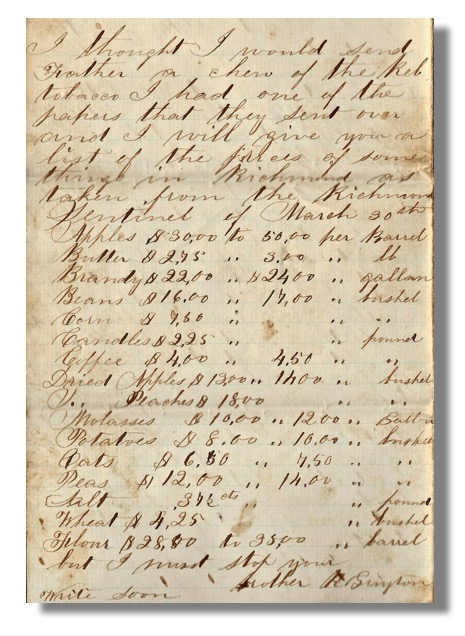
Price of commodities copied from the Richmond Sentinel, 30 March 1863

Enclosed in this letter I send Father a little bit of Rebel tobacco which the [Rebels] sent across the Rappahannock river the last time our regiment was on picket. They built a kind of boat and rigged it off with sails and would send it over to our side of the river with newspapers, tobacco, and so forth, and our fellows would sed them over coffee, pork, and so on. They were very willing to trade anything they had but when the officers came along, both sides had to stop sending their boats over. Joseph Borland got a piece of tobacco that was sent over in one of their boats and he gave me this piece and I thought I would send Father a chew of the Reb tobacco. I had one of the papers that they sent over and I will give you a list of the prices of some things in Richmond as taken from the Richmond Sentinel of March 30th.

But I must stop. Your brother, — R. Guyton


¹ Capt. William W. Dyer was promoted from 1st Lt. to the command of Co. F, 139th Pennsylvania on14 January 1863. He died on 13 June 1864 from wounds received at Cold Harbor on 2 June. He is buried in Uniondale Cemetery in Allegheny City, Pa.

² John Wallace enlisted as sergeant in Co. F, 139th Pennsylvania in September 1862. He was transferred to the Veteran Reserve Corps on 10 March 1864.


Letter 2

Note: This letter was written by Corp. Guyton as the 139th Pennsylvania force-marched to Gettysburg where they arrived on the evening of the 2nd day’s fighting just as the U.S. Regulars were being driven back from the Wheatfield. After the Regulars withdrew through their line, the 139th Pennsylvania counter-charged and halted the Confederate advance on Cemetery Ridge. On July 3rd, the 139th Pennsylvania advanced after Picket’s Charge and cleared the area along the Wheatfield Road where they recovered a cannon and three caissons of the 9th Massachusetts Battery that had been lost the previous day. [See Lt. Col. William H. Moody’s report]

Camp near Fairfax Court House
Monday, June 22d 1863

Dear Mother,

I received your very welcome letter of June 15th on Saturday. I was very glad to hear that Father’s arm had got well again for I was afraid that it might have been from that old hurt.

We are all right well here — that is, all the boys from our neighborhood that are here. I have not heard from John Wallace ¹ or R[obert C.]. Anderson ² since they went to Washington. Our Captain [William W. Dyer] and 2d Lieutenant [Wilson Stuart] are in the hospital there too but I think likely they will all be up to the regiment again in a few days. We have been lying here since Thursday evening but it is very doubtful how long we may stay here. I thought yesterday that [we] would have had to move as there was heavy cannonading pretty near all day in the direction of the old Bull Run Battlefield [see Battle of Upperville] but I think from the sound of the cannon that the fighting was some distance beyond Bull’s Run. It [think] it is chiefly cavalry fighting yet but it will be very apt to end in a decisive battle without the Rebs fall back. There was several thousand cavalry passed here yesterday on their way to the scene of action but I have not heard any firing this morning yet and that makes me think that our men has driven them back.

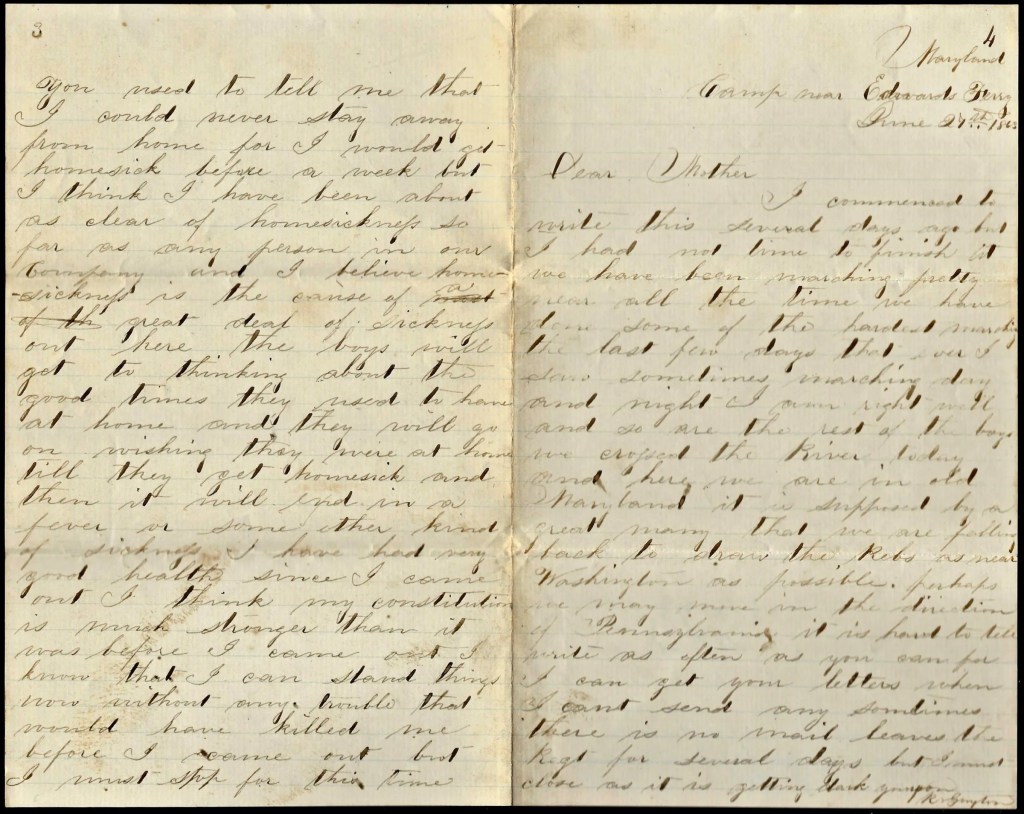
You wanted to know whether I was contented out here or not. I came to the conclusion that I might as well be contented as not when I came out here and I believe it is better for the health to be as happy and contented as possible than to be disappointed and homesick half the time. You used to tell me that I could never stay away from home for I would get homesick before a week but I think I have been about as clear of homesickness so far as any person in our company and I believe homesickness is the cause of a great deal of sickness out here. The boys will get to thinking about the good times they used to have at home and they will go on wishing they were at home till they get homesick and then it will end in a fever or some other kind of sickness. I have had very good health since I came out, I think my constitution is much stronger than it was before I came out. I know that I can stand things now without any trouble that would have killed me before I came out. But I must stop for this time.

Camp near Edward’s Ferry, Maryland
June 27th 1863

Dear Mother  — I commenced to write this several days ago but I had not time to finish it. We have been marching pretty near all the time. We have done some of the hardest marching the last few days that ever I saw — sometimes marching day and night. I am right well and so are the rest of the boys. We crossed the [Potomac] river today and here we are in Old Maryland. It is supposed by a great many that we are falling back to draw the Rebs as near Washington as possible. Perhaps we may move in the direction of Pennsylvania. It is hard to tell. Write as often as you can for i can get your letters when I can’t send any. Sometimes there is no mail leaves the regiment for several days but I must close as it is getting dark.

Your son, — R. Guyton

¹ Sergeant John Wallace was transferred to the Veteran Reserve Corps in March 1864.

² Corporal Robert C. Anderson was wounded at Spottsylvania Court House in May 1864.


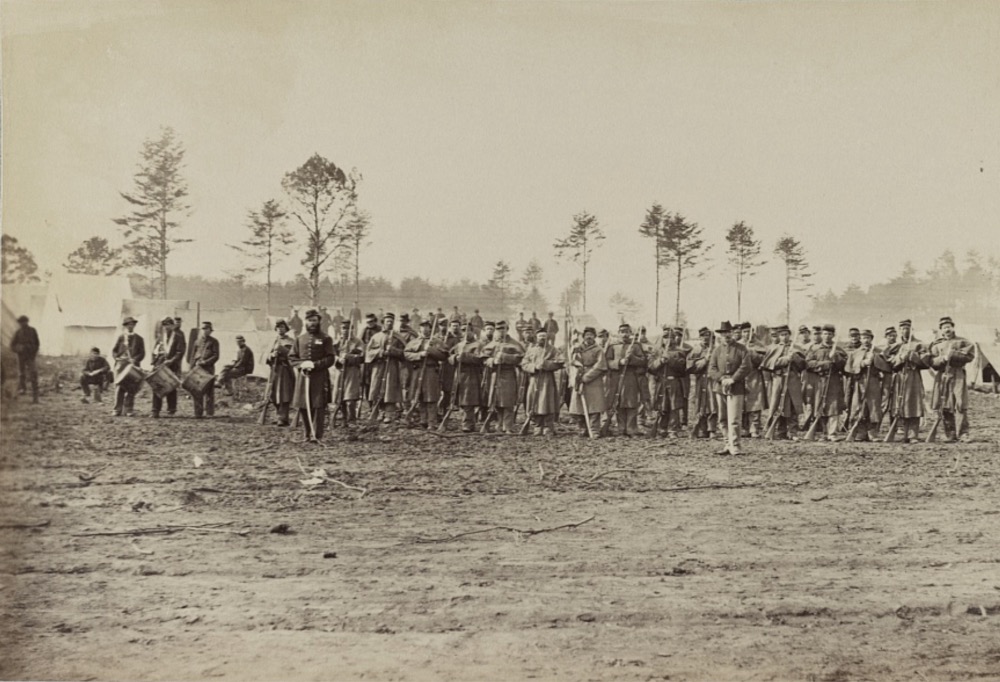
A company of the 139th Pennsylvania

Letter 3

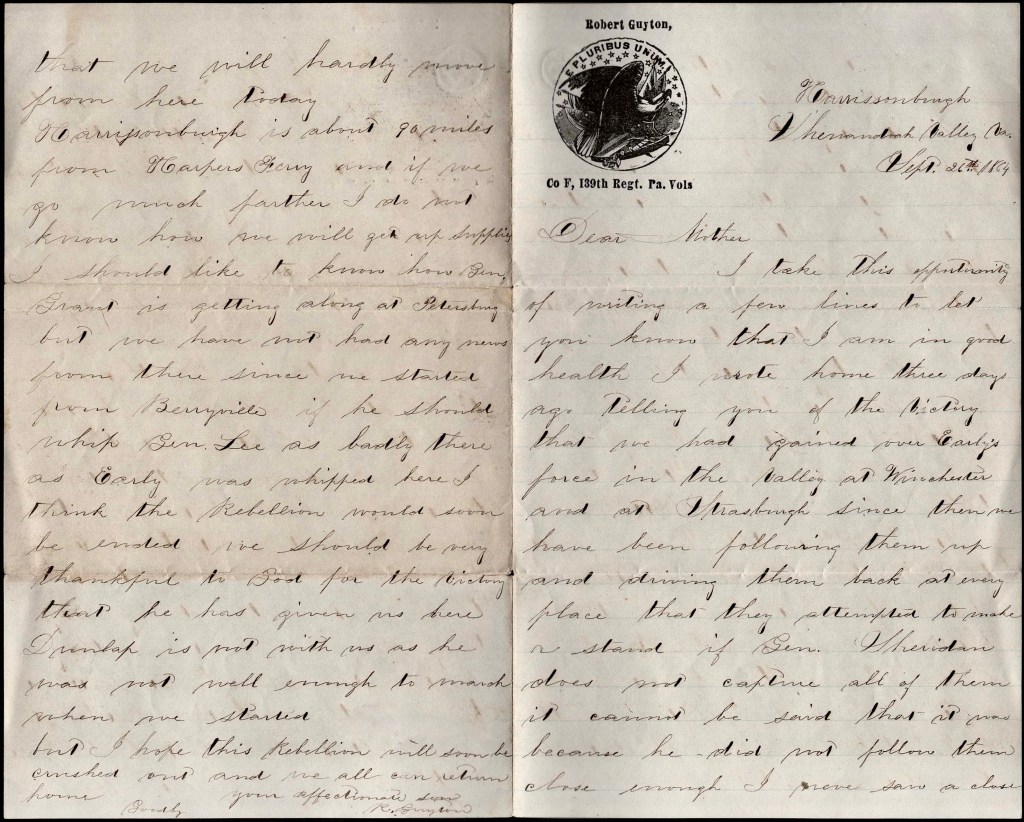
Note: This letter describes Sheridan’s September 1864 campaign to drive Confederates out of the Shenandoah Valley and render the area useless to the Southern cause by destroying all the crops and supplies. See Confederate General Jubal Early abandons Winchester, Virginia.

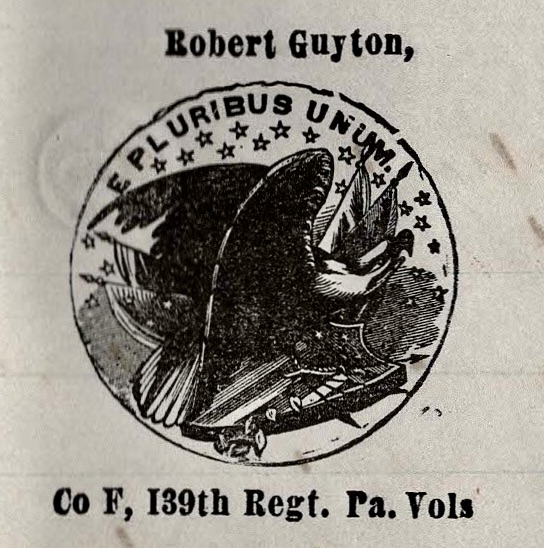
Robert’s personalized stationery—quite rare

Harrisonburg, Shenandoah Valley, Va.
Sept. 20th 1864

Dear Mother,

I take this opportunity of writing a few lines to let you know that I am in good health.

I wrote home three days ago telling you of the victory that we had gained over [Jubal A.] Early’s force in the Valley at Winchester and at Strasburg. Since then we have been following them up and driving them back at every place that they attempted to make a stand. If Gen. Sheridan does not capture all of them, it cannot be said that it was because he did not follow them close enough. I never saw a closer pursuit of a retreating army since I joined the service. On Saturday they made a stand at Mount Jackson, but we soon drove them out of that and drove them so close for five or six miles that our advance was skirmishing with them all the time.

I will try and tell you how we followed them so close. First, we had a heavy line of skirmishers or rather two lines, then a line of Battle and just behind the line of Battle, there was several Batteries of Artillery, and whenever the Artillery would come to any high ground they would unlimber and fire a few shots into the Rebs, then limber up and gallop to another piece of high ground and fire a few more, then away again. And behind the first line of Battle there was eight or ten heavy columns of troops reaching as far as you could see, ready to wheel into line of Battle at a moments notice. It was as beautiful a sight as ever I saw. We followed them in that manner till dark when we halted for the night and they made such good use of the darkness that we have not seen them since.

I do not think Early’s force will make a stand in this part of the Valley unless they are reenforced as they are badly demoralized and scattered through the mountains and woods. We halted here last evening and I think from present appearances that we will hardly move from here today.

Harrisonburg is about 90 miles from Harpers Ferry and if we go much farther, I do not know how we will get up supplies. I should like to know how Gen. Grant is getting along at Petersburg but we have not had any news from there since we started from Berryville. If he should whip Gen. Lee as badly there as Early was whipped here, I think the Rebellion would soon be ended. We should be very thankful to God for the victory that he has given us here. Dunlap is not with us as he was not well enough to march when we started but I hope this Rebellion will soon be crushed out and we all can return home Goodby. Your affectionate son, — R. Guyton

Some of Robert Guyton’s personal items on display at the McCandless/Northern Allegheny Heritage & Cultural Center in November 2023.