My passion is studying American history leading up to & including the Civil War. I particularly enjoy reading, transcribing & researching primary sources such as letters and diaries.
A forage cap from Co. G, 12th Pennsylvania Reserves
The following letters were written by George W. Smith (1819-1896), the son of Jacob & Susan Smith. He married Elizabeth “Betsy” Knaub (1823-1891) in the early 1840s and fathered Silas (b. @1847), Morris or Maurice K. (b. 01/23/50), Mary E. (b. 02/15/53), Bence (b. @1856), George M. D. (b. 09/15/58), and Anna (b. 02/19/64). In 1860, he was a carpenter living in Lewisberry, York County, Pennsylvania, and stood 5′ 5″ tall with black hair and black eyes.
George enlisted at Harrisburg on June 25, 1861, and mustered into federal service there August 10 as a private with Co. G, 12th Pennsylvania Reserves (41st Pennsylvania Infantry), serving for some period as company cook. While guarding the wagon train at White Oak Swamp, Virginia, on June 29, 1862, he became snagged on a branch, fell forward onto a stump, and suffered a rupture. As a result, he was discharged by surgeon’s certificate to date October 18, 1862, at Fort Ellsworth, Virginia.
George wrote both letters to his friend and neighbor, Dr. Robert Nebinger (1796-1867) of Lewisberry, York county, Pennsylvania.
Letter 1
Camp Pierpont, Virginia Sunday, October 27th 1861
Dr. R. Nebinger, dear sir,
I received yours Friday evening. Also Miss Rosa Shanley’s & my son Silas. What satisfaction it gives to receive, as I have received, in those three letters. All had something new. It clears the sky, makes everything bright. It nourishes, gives vigor to the mind, and I may almost say strength to the body. In fact, it makes a new person.
Now I will give you a brief detail of our situation. We lay within half a mile of Langly town. The town consists of about five houses, two taverns, and grocery & Blacksmith shop. The country is very fine—soil rich, produces well, but only half farmed, land rolling. Houses are all vacated, occupied by us, headquarters of Generals, and hospitals. The corn is very good. Husk that and feed the horses. You ought to see the horses now. They look as slick as eels and as nimble as bees. The government does not give hay and oats enough for the stock, With all the plunder, it only keeps them in good order for working. There is nothing doing now. All quiet. How long, no one knows. All laying around lazy. We call the whole thing a grand humbug. We have been dead heads all the time.
But under the circumstances, how of the Resolutions passed by the Committee of Safety of York County. We will not be dead heads here a great while because we married men with large families entered the service with the full assurance that the county would pay a certain amount per week, according to the number of children &c. during the time you. were in the service to each of our wives. Now, by God, that’s so, And are we to be gulled by a set of political tricksters, on demand robbers. No, by God. Never! We are determined to desert to a man if death is our portion & disgrace upon our families, rather than have our poor families wanting when there was ample provision made.
We mustered under that provision and they all had sufficient by adding our wages to it. And now to be cut out of that, we will cut out too & be home guards too. But we will not guard that North Central Railroad. If there is not loyal men enough in the State of Maryland to guard the road and bridges, let the Rebels burn it up. Itis the home guards that is guarding that railroad, principally all out of York county, and it is them that has cut off the sustenance guaranteed us weekly to be drawn by our wives to assist keeping our families while we were in the service down in the land of Dixie enduring the perils & hardships of a soldier trying to consolidate our once glorious Union again.
We will be content two weeks for a firm answer whether we are to be humbugged out of the county money or not. If so, farewell army at the risk of life. Doctor, them are the true sentiments of us poor men with families & we will strictly adhere to them. Are we right? Please answer me by Tuesday weeks mail. Ambrose Ensminger & myself are well. Please let my family know it. your sincere friend, — G. W. Smith
Too mad to write any more.
Letter 2
Camp Pierpont November 13th 1861
Dr. R. Nebinger, dear sir,
I received yours Monday evening and it came in the right spirit—that is, stick to the Stars & Stripes al all hazards. Let the county committee stick their safety fund. We have since I had written my last to you, assurances that our families should not be in extreme want. Now we pitch in and that in a unit to put down these Rebel devils, and that by extermination of the whole Southern race if on no other terms. They are actually a set of blood thirty demons. At Balls Bluff they actually run the bayonet as much as three times through wounded Federal soldiers. Also cutting the throats of a great many others. [Just] wait. Ball’s Bluff will be remembered as the stabbing match of Paoli was. The cry will be “Mind Balls Bluff Boys—They will catch hell sooner or later.”
The soldiers are crossing into Virginia. Thousands upon thousands all the time. You don’t see it published in the papers but I assure you, it is the fact. Any time at all you go on any bluff, you will see new camps spring up. It just seems [as] if soldiers grows here. There will undoubtedly be a big battle before many days. The regiments are drilled very hard every day to have them in good order for the big licks. From the best information the rebels have at their Gibraltar, Manassas Junction, about one hundred and ten thousand fighting men. Well now, they ain’t a going to make another Bulls Run affair. “We have this advantage. If they won’t give us an open field fight and back into their Gibraltar, we can cut off all their supplies and starve them out to fight or surrender.
Doctor, we knock the spots out of anything like desertion—money or no money. I do swear by God, my creator, that I will fight as long as I have breath and strength. It does not make one dot of difference whether I die in Virginia or any other Southern State when in a cause to regain a Second Independence of just as much value in my estimation as it was to gain the first. It is nonsense for me to say anymore. You can judge my sentiments. I am true to the Union. I am proud and thankful to my creator that my family keeps in good health.
I am well and hearty except my lower jaw [is] fractured in two places, right straight up from the chin & on the right side half way back. A splint raised. I lost one lower tooth in front. I did not get the least bruise on the head, neck or body or any place at all that it was almost a miraculous affair under the circumstances. It happened this day two weeks ago, the 30th October. You know what stage it is in. It is knitting together all right. It is just as straight as ever, only minus a tooth. I am attending to the cooking. I just look after it. I never was laid up a minute with it. It stings a good bit by spells but that don’t bother any. I was not a going to let you know anything of the accident until the last of this week but some shit ass had to write home in the neighborhood & give the information. Now please, the very next person that writes to me, tell them to let me know from what place the information hailed from. I can make it pay back with interest. They were all cautioned to be mum—not to let my family know it for at least two weeks. What I write is the God’s truth. I am well & hearty, except the little pain by spells. Just like needles jagging in my jaw.
Ambrose [Ensminger] is hearty & [Washington] Laird also. Please read to my family. It won’t hurt. Give my love to all. I have not received the pay yet. I hear this evening that we don’t get paid off until next Wednesday or Thursday. The paymaster went up to Banks Division to pay it off. As soon as I receive it, I will express it direct to my wife to be drawn at Harrisburg. I will write to Silas Sunday. He will get it next Wednesday. No more. But your obedient servant, — G. W. Smith
This letter appears to have been written by “N. A. Kaufman” and though I cannot find her in the genealogical chart of the Isaac Kaufman (1806-1867) and Eliza Smith (1811-1863), she appears to have been a sister of their children who are mentioned in her letter. They include George “Willis”) Kaufaman (b. 1842), Abraham David Kaufman (b. 1846), and Theodore S. Kaufman (1844-1908) of Boiling Springs, Pennsylvania.
Your letter dated October 16th was received by me in due time. It came unexpected but not unwelcomed. Indeed it seems so long since I have written to you that I have forgotten how long it is. I am not waiting as long to answer as you did, for I want to tell you if you have any notion of coming to see us this fall, you had better come soon or it will be winter. Really it felt like winter today but I think we will have some pleasant weather yet before winter sets in and I hope we may for our Quarterly Meeting is to be held next Saturday & your old favorite Mr. Burd is expected to be there. I have been interrupted in my writing this evening by some company coming in to spend the evening & as I don’t want to leave any letter lay over for another mail, I will try and finish it yet.
You ask about Bennet’s school. He never had much of a one & now he has none. The scholars all left before harvest except two or three & the teacher (a copperhead of course) went to Canada for fear the draft might hit him. I don’t suppose there will even be a school there while Bennett lives & owns the Church.
No doubt you have heard that Theodore has gone to be a soldier, but perhaps you have not heard Brother Will & Abe have gone also. Yes, they have gone and I have now not one brother at home. What a terrible thing is it that homes must be left desolate for such a cruel business as war. “Oh if the God of battles were not our strength and stay, Mothers and wives and sisters where would we turn today. But knowing is power extendeth wherever his children are, trusting we pray, God keep them gone, gone to the war.”
Abe Kaufaman was in the 100 day service and came home last week. He lookjs very well. Willis came home a few weeks ago. He had the ague before he came and has not entirely recovered yet.
I forgot to ask Sadie about writing to you. Sadie Whisler and her brother were down at Kaufman’s last Saturday. Ella has grown to be quite a big girl. She goes up to he grandpa’s by herself. She has not forgotten you entirely yet. We would be very glad to see you again. I almost forgot to tell you that we had moved about two months ago. We are now living in Front Street in a house built since you were here. If you come down in the cars, you must be sure and write long enough before us to meet you in Carlisle unless you would know of some other way of getting out. Our mail is the same as when you were here.
The Methodists are going to commence a protracted meeting here on next Saturday a week (Nov 26th). As it is late, I must close hoping to see or hear from you soon. Good night. From your affectionate friend, — M. A. Kaufman
I have not been able to identify the author of this partial letter but I believe he was a member of the 5th Kansas Cavalry, possibly in Co. C which included several men from Decatur County, Iowa.
Transcription
Note: Camp Denver was located approximately three miles east of Barnesville, Kan., in north eastern Bourbon County within a few miles of the Missouri/Kansas state line.
Camp Denver, Kansas January 7th 1862
Dear Ann,
I embrace the present time of answering your kind letter of the 25th December which I received the 3rd inst. and was truly glad to hear from you once more and to hear that you was well and doing as well as you are. I am still well and I hope that this may find you enjoying the same blessing with me. You spoke of the baby not being well. I am sorry for that but still I am in hopes that she is well before this time.
We are quartered near the Osage river at this time and are still in our tents and I expect that we will stay in them all winter. We have had three snows here this winter and some cold of course. Where there is snow, there is some cold weather. We also have some mud too.
You know that we have heard a great deal about Kansas now. I have traveled near three hundred miles in Kansas and I have seen some nice country but it does not suit me as well as Iowa. [For] one thing, there is not much timber here and the air is more oppressive that there so in the whole, I do not like it as well as I might and I do not think that it is as healthy as some other country I have seen.
You spoke of my playing cards. Now Ann, I want you [to] know that I do not play cards for money or anything else. I did play when I first came out but not for anything, nor will I as long as I have a dear family at home, so you need not give yourself any uneasiness about that for I know that my family needs all that I can get without my spending it playing cards. I have not got any money as yet but I expect that I will soon and when I get it, then I expect if nothing happens, to go home and see you and the children once more.
Jim Lane has got the command of the western division of the army and then I expect that we will have to go to work—that is, we will have to go South [and] put down rebellion as we go. You said that you wanted me to tell when we were going to fight. That I cannot do for there is nothing here to fight unless we fight one and an other and that is done sometimes but does not amount to much.
Now, for something else. You remember Elmore Stricklin [Strickland] 1 who worked at Docks with Sid and me. Well he is here in Co. D with Capt. Harvey. I saw Sam Keller yesterday. He is well and hearty and saw hard times. I was sent out last Saturday to fetch in a fellow that had been out two or three days. I took two men with me and I found him 15 miles from camp and stayed all night with him and then fetched… [rest of letter missing]
1 Elmore Strickland (1836-1911) was born in Lorain county, Ohio, and was living in Linn county, Iowa, in 1850 with his parents Nathan Strickland and Druscilla Hobbs. In 1854, Nathan was enumerated in Jackson, Keokuk county, Iowa. Elmore (“Elmer”) enlisted in Co. B, 6th Kansas Cavalry in August 1861 and mustered out in April 1865. He was taken a POW at Mazzard’s Prairoe, Arkansas on 27 July 1864.
The following letter was written by Samuel B. Salsburg (b. 1842), the son of John Salsburg and Anna M. Hooven of Norristown, Montgomery county, Pennsylvania. Samuel was working as a cigar maker when he enlisted on 20 August 1862 as a corporal in Co. C, 138th Pennsylvania Infantry. He was wounded on 9 July 1864 at Monacacy, Maryland, but recovered and was promoted to sergeant in March 1865. He mustered out in June 1865 at Washington D. C.
Capt. James H. Walter of Co. G, 138th P. V. stands at center. Lt. George W. Mullen stands at left holding his sword laterally. Lt. George W. Wilson stands at right holding sword vertically. Sergeants William Cline and Nicholas Wilson stand behind. Photograph taken at the Relay House in Maryland in 1862. Library of Congress.
Transcription
Addressed to Miss Mary Ann Salsburg, Pennsylvania Street above Green, Norristown, Montgomery county, Pennsylvania
Camp 5 miles below Relay House, Maryland September 7th 1862
Dear sister,
I thought as I had wrote two letters home before this one and have had no answer, that I would write the third one thinking that perhaps you did not get the ones that I wrote, or that you answered them and I did not get them, I wrote one to Mother the day we left Harrisburg and I wrote one to you on the 1st of September from camp near the Relay House. We got orders last Thursday afternoon to pack our knapsacks and get ready to leave. That was when we were at Camp Relay. Well companies A, B, and C, and I forgot the other company started down to the railroad and got in the cars and rode to where we are now stationed which is 5 miles below Relay House. We are here to guard the railroad that runs to Washington. Company A is about two miles below us and Company B about 2 miles above us. We are quartered in the barracks along the railroad.
There is plenty secesh about this part but they have got keep down, It is a pretty nice part of the country where we are now encamped. This morning a crowd of us started to go to church, Well, it was the biggest tramp I ever had to go to church. We was at a Methodist Church. It is about three miles from here and such a crooked old road through the woods. Well after I come back, I thought I would write this letter to you so I got my pen and paper and an now laying under an apple tree here in the orchard which is right back of us and am writing this to you. When you answer this, tell me when you got the last letter from me or whether you got one since we left Camp Curtin.
I don’t know how long we will stay here for we never know until we get orders to leave. We have got a good regiment and a good Colonel, I guess, as far as I know, and bully oficers in our company and a first rate set of fellows. And I like soldiering first rate so far. I am well and hope to remain so far. I want to see every rebel in the South put down and this rebellion crushed which I hope will be before long.
It is now getting late in the afternoon. I guess I will close for the present. Give my love to Mother and Pop and all the rest of the family, not forgetting Ben and Kate. Please answer this soon and tell me whether you got the other one. We have not got our bounty yet but that is good enough and when I get it, I will send it home. Hoping to hear from you soon, I will now close. So goodbye, Mary Ann, for the present.
Direct your letters to Samuel B. Salsburg, In care of Captain G[eorge] W[ashington] Guss, Company C, 138th Regiment P. V., Relay Post Office, Maryland
From your affectionate brother, — Samuel B. Salsburg
The following letter was written on most unusual stationery by Stewart C. Allen (1843-1918), the son of Edward Allen (1799-1848) and Harriet Ann Foland (1811-1885) of Hudson, Columbia county, New York.
Stewart enlisted on 14 February 1862 as a private in Co. B, 93rd New York Infantry. He received a severe wound in the right shoulder during the Battle of Spottsylvania Court House on 10 May 1864 and wrote this letter while recuperating from that wound at Campbell General Hospital in Washington D. C.
The letter was a pre-formatted letter, written in prose, enabling the soldier to merely fill in a few blanks and then add a personal note as a post script. Stewart’s post script begs his mother to explain why he should address letters to his younger brother (Arthur M. Allen, b. 1845) by some name other than his given name. Apparently he was operating under an alias for some reason.
I have searched for the poem on the internet and could not find it published so have transcribed it in entirety.
As a matter of curiosity, Stewart did not marry until 1899 when he was 46 years old. He married 22 year-old Edith Carter and she lived on her husband’s war pension until her death in 1968.
[Note: The bold lettered font is what Stewart wrote; the italicized font was pre-printed.]
Transcription
Campbell Hospital Ward Nine October 30th1864
DearMother and Sister,
As writing materials often are scarce, I purpose to write you a letter in verse; To condense my ideas, save paper and time, Is my object for writing the letter in rhyme. Of course you will now it is one of my pranks! It will take but a minute to fill up the blanks.
I received your kind letter justone dayago, Which found me a member of “Uncle Sam’s Show,” And fortwo monthsor better, expect to remain, Unless like full many, I chance to be slain; Should this be my fate, the last boon I crave Is to mark on my tomb-stone, “A Patriot’s Grave!”
In the hist’ry of wars, as we carefully scan, Since the first one was waged by man against man, In all the fierce conflicts no records remain Which will be compared to the present campaign. The war has been general, on both land and sea, And many have fallen for “Liberty’s Tree!” It would fill many volumes to pass in review What our various armies this year have been through, Though my space is not large, yet ’twill not be amiss To give a slight sketch on a small sheet like this.
The Potomac’s great army has nobly with stood The wile’s of the traitors, and written in blood The route it has taken, o’er mountain and plain, Through forests and rivers, in hot sun and rain; And now like a giant, aware of his power, Aims a death-blow at Secession’s “left bower!”
In the siege of Atlanta and Charleston too, What subjects for history’s pages we view! Generations to come will exult in the name of which their fore-fathers carved in the records of fame.
At the Gulf, on the flank of Secession’s domain, From the shores of “Red River” our brave comrades slain Are calling for vengeance; Ah! traitors shall feel A full share of this in the siege of Mobile. The reb who surrender’d the stronghold Fort Gaines, We aver, was possessed of less valor than brains!
Our heroes at sea have had plenty to do: The ports to blockade, and pirates subdue; Let the famed Tallahassee beware of the day When our “Yankee Tars” meet her in battle array! I am sure they have not forgotten so soon, the victory we gained on the 10th of June.
Thus we see every part of our army so grand, In the “War for the Union,” on sea and on land, Are working in concert, our cause to maintain, To crush the rebellion, and end the campaign.
I have the honor to be yourobedient son. Signed,Stewart C. Allen
P. S. on next page.
Mother, you said you wanted me to write to Arthur and to direct his letters Robert E. Allen. His name is Arthur M. Allen and not Robert E. Allen. Now I want you to write to me soon as you read this to answer it immediately and tell me why I shall direct Arthur letters, “Robert E. Allen.” I cannot see into it. Just explain to me what you mean by Robert E. Allen when his name is Arthur M. Allen. Please send me some Hudson papers so I will know the news. I am getting along slowly. Write to me today. Now don’t forget.
The following letter was written by Chester Joseph Rouech (1843-1881), the son of Azel Nicholas Rouech, Sr. (1820-1897) and Mary Anna Derrick (1819-1896) of Bay City, Michigan. He wrote the letter to his sister, Josephine (“Josey”) Olive Rouech (1846-1925).
Chester enlisted on 14 April 1864 at Forester, Michigan, to serve as a private in Co. A, 15th Michigan Infantry. He mustered out as a corporal at Little Rock, Arkansas, on 13 August 1865. Let’s hope he was a better soldier than he was a poet.
Signaling the Assault on Fort McAllister by Don Troiani. December 13, 1864 MG William T. Sherman and MG O. O. Howard are shown preparing for the land attack on Fort McAlister, the last major battle of the Savannah Campaign.
Transcription
General Sherman’s Army 15th Michigan, 2nd Div., 15th Army Corps 1865
Attention, valiant soldiers and listen to my strain, concerning the 2d division throughout this late campaign: Success has crowned their efforts in every battle fray, and in every battle fought they nobly won the day.
At Tunnel Hill and Buzzard Roost, twas there they made a charge, and drove the rebel traitors, a force nearly twice as large; also at the battle of Resaca, they gained a world of praise, and they fought most heroically for two successive days.
At Altoona and Kenesaw Mountain, twas there they scaled the works, with bayonets fixed they drove them out their strongest forts; and at the fall of Atlanta in words I cannot tell, the way they fought the rebels, though many of them fell.
The 116th Illinois boys do fight with earnest zeal, and the 30th Ohioans are boys that never yield; the gallant 6th Missourians would give your hearts delight, to see them wading into five the rebels fight.
The 47th and 54th Ohio we know, was never known to run when facing the rebel foe: the 111th Illinoisians, God bless their gallant crew, no lads will fight more braver rebellion to subdue.
The 90th Illinois boys and 40th gives proof, that they are tigers in fighting and they never stand aloof: The 70th Ohioians and the 15th Michigan, have done some noble fighting throughout this great campaign.
On the 13th day of December, eighteen sixty-four, the guns of Fort McAllister most heavily did roar twas there this brave command most nobly fought that day, and gained for them a name that will never fade away.
Under a galling deathly fire, they formed in solid mass, and marched in line of battle before the cannon’s blast: yet onward moved their column resolved to do or die, beneath the starry banners its enemies to defy.
The rebs were and conquered in fifteen minutes time, after orders came to charge and form in battle line: The general knew their courage before he made the move, for in many a battle fray, their bravery did prove.
The gallant 3d brigade were first brigade were first to reach the fort, and plant the stars and stripes upon the enemy’s works: the 1st and 2d brigades brought up the left and right, beneath the rebel fire, and like tigers did they fight.
The rebels fought like fury and made a desperate stand, yet our troops did march upon them and fought them hand to hand: and sixty of those heroes were slain upon the field, who fought for fame and honor and would rather die than yield.
Now peace to those brave heroes that slumber in their grave, who fought our country’s battles our government to save: their names will glory in history to read in coming years, as a brave and glorious division of the western volunteers.
Now to you, brave soldiers, a farewell word I give, May your efforts be successful as long as you may live: and when this war is over, we’ll join our friends at home, in fancy dream o’er past events, our memories will roam.
This is a song concerning our division and brigade. You learn it by the time I get home so I can hear you sing it.
This letter was written by Abraham (“Abram”) Eikenberry (1842-1897), the son of Isaac Eikenberry (1804-1887) and Dally Neff (1804-1887) of Gratis, Preble county, Ohio. Abraham wrote the letter while serving in Co. H, 93rd Ohio Volunteer Infantry along with his brothers, Reuben Eikenberry (1837-1922) and Joseph Eikenberry (1847-1921). According to the 1890 Veteran’s Schedule, Abram suffered two gunshot wounds during the war. Abraham wrote this letter to Sallie Ann Young )1843-1924) but he did not marry her. After the war, in November 1866, he married Maria E. Furrey (1844-1917). Sallie, on the other hand, married Joseph Furrey (1839-1925)—Maria’s brother—so Abram and Sallie eventually became in-law siblings.
I could not find an image of Abram but here is Pvt. John Gotlieb Weckel of Co. A, 93rd OVI (Collection of Nancy Weckel)
The 93rd Ohio Infantry was organized in the fall of 1862 and was ordered to Kentucky and afterwards to Nashville. It participated in the battle of Stone River with severe loss, and also in the battle of Chickamauga, where it charged a Rebel battery and captured all the guns. During the engagement on Saturday the Regiment lost 124 officers and men. On Sunday it expended one hundred rounds of ammunition per man, killing 300 Rebels in its front. In November the Regiment assaulted Mission Ridge and afterwards moved to East Tennessee. In May, 1864, it joined the Atlanta campaign, fighting at Buzzard’s Roost, Resaca, Dallas, Kenesaw and Atlanta. After the fall of Atlanta it joined General Thomas’ army in Tennessee and engaged the enemy at Nashville. It followed in the pursuit of Hood to the Tennessee River, then went into camp at Huntsville. In March, 1865, the Regiment marched into East Tennessee, then to Ashville, N.C., then returned to Nashville, where it was mustered out June 8, 1865.
Transcription
Addressed to Miss Sallie A. Young, Camden, Preble county, Ohio
[Somewhere in] Georgia October 21, 1864
Dearest friend Sallie,
It is with the greatest of pleasure that I again seat myself to drop you a few lines in answer to your kind and welcome letter which I received a few days ago. I suppose you will think the answer is slow a coming as I haven’t had a moment’s time to write until today. We have been marching every day for two weeks and they give us this day to rest so I thought I would answer your letter.
“I can’t help but pity the innocent for they can’t help what the guilty does, let me tell you. The Union people has to suffer in this country. The rebs has no mercy on them.”
–Abram Eikenberry, Co. H, 94rd OVI, 21 October 1864
Sallie, I will tell you that I saw one of the most pitifullest things I ever saw since I’ve been in the army. I stopped at a house yesterday as I passed along and saw an old lady and three little children. One of the little children was crying and I asked it what was the matter. It said they had nothing to eat. The old lady said the rebs has taken everything they had to eat. All the flour they had was taken. I give them half of what I had and several of the boys divided with her. The little children eat just like if they haven’t had anything for a week. I can’t help but pity the innocent for they can’t help what the guilty does, let me tell you. The Union people has to suffer in this country. The rebs has no mercy on them.
While we was at Atlanta, the rebs got between us and Chattanooga and destroyed 25 miles of the railroad, It stopped our communication. We fell back and fought over the same ground where they got whipped bad once before and this last time they lost six hundred dead on the field besides the wounded, It is no trouble for us to whip them, We can whip three to one and have done it more than once.
Something about that photo. I have had several chances to show it to the rebs but I can whip them without showing it. I wouldn’t want to disgrace the picture. I think more of the picture than all the whole Southern Confederacy.
Sallie, you stated in your letter that I was a going to get married by what you heard. I should be very glad to learn who she is if I am. I don’t know anything about it. Please tell me who told you and then I will tell you all I know.
Well, I will bring my scribbling to a close hoping you will excuse all bad spelling and poor writing and hoping to hear from you soon. I remain your true friend as ever, –A. Eikenberry
The following letter was written by Isabella (Batchelder) James (1819-1901), the daughter of cotton manufacturer Samuel Batchelder, Jr. (1784-1879) and Mary Montgomery (1790-1869) of New Ipswich, New Hampshire. Isabella married botanist and wholesale druggist Thomas Potts James (1803-1882) in December 1851. She became an outspoken abolitionist, and during the Civil War she offered her house in Philadelphia as a hospital to Massachusetts volunteers and worked in the hospitals and as laborer in the Sanitary Commission. At the Great Centennial Fair in Philadelphia in 1864, she was the head of the Department of Relics and Curiosities which raised money for wounded soldiers. It was during the gathering of these relics that she wrote the following letter in May 1864.
After the war, Isabella became the head of the Women’s Freedman’s Commission which sponsored teachers in the South.
Isabella wrote the letter to Benson J. Lossing (1813-1891), an engraver who “focused on creating pictorial histories that recorded history through firsthand accounts and drawings of people, artifacts, and the actual locations where the events occurred. In 1847, he began publishing works of history and biography, creating his own illustrations. Eventually, Lossing established a publishing company and oversaw authorship of all aspects – texts, sketches, and engravings. Among the most popular were his PictorialField-Bookof the American Revolution and Pictorial Field-Book of the War of 1812. According to Gregory Pfitzer, in Picturing the Past: Illustrated Histories and the American Imagination, 1840 – 1900, Lossing’s specialty, field books, were “illustrated travelogues based on visits to scenes of historical importance.” In this genre, Lossing functioned as both historical observer and artistic interpreter. For Pictorial Field Book of the American Revolution (1850 to 1852), Lossing traveled more than 8,000 miles in the United States and Canada, collecting information and sketching scenes that he later made into wood block engravings. Published by Harper and Brothers, the field book sold tens of thousands of copies. Twenty-five years later, Publisher’s Weekly deemed the two-volume set remained the most “salable” work on the subject of the American Revolution.
During the next thirty-five years, Lossing worked tirelessly, publishing more than forty titles, of which he was either author or editor. From 1872 to 1874, Lossing edited the American Historical Record and Repertory of Notes and Queries. ”
400 South 9th Street Philadelphia [Pennsylvania] May 4th 1864
Mr. Lossing Dear Sir,
I received your letter & the parcel of engavings yesterday for which accept my thanks. Some of them will I think be of use. Lawson & Nicholson, the celebrated bookbinders here, are preparing the album under my direction. Lawson inlays most exquisitely & has already done the border of Sinclair’s coat of arms of the Washington’s family on a fresh white sheet for a title page, on which a gentleman friend will illuminate the lettering. Another set of the emblazoned arms will be bound in the volume.
William McIlvaine’s water color of White House [on] Pamunkey River in Virginia, 1864
I have been fortunate in securing many fine Washington engravings from F[erdinand] J. Dreer, T. A. McAllister, Kline & others. Wm. McIlvaine, the artist, has painted thirteen beautiful water color sketches of scenes in Virginia, among them two views of the White House where according to your account in the Mt. Vernon Memorial, Washington was married, but according to Mr. McIlvaine, the wedding took place in St. Peters church of which he was sent three pictures—one of the exterior, one of the curious town (large size) and one of the interior. Now before these are labeled to go down to posterity, I wish you would inform me accurately about this matter as the Washington’s appear to a have adhered strenuously to English customs. I supposed it more probable that they were married in church as it was not far from the White house, but as I conclude you have examined some second record of the marriage, will you write it out for me, as in affairs of this sort the accuracy should be obtained. Washington must often have attended St. Peters church during the three months he lived at White house after his marriage.
WilliamMcIlvaine’s water color of St. Peters Church, near White House, Virginia(inscribed “Where Washington was married.”(LOC)
I received yesterday from a woman living in the midst of the rebels in Missouri a pair of curious glass salt cellars which she writes were presented to her grandmother on the occasion of her marriage in 1788, by Gen. Washington. I have no doubt they are from the manufactory of Ameburg mentioned in the 190# page of your Mt. Vernon. They are of heavy white glass, the bottom of an emerald green with gilding. As they are for sale, what do you think they should bring at the Fair? This poor woman has also sent a bed bed quilt pieced by her great grandmother at the house of Washington’s mother in 1777 [made] out of Mary & Martha Washington’s dresses & George Washington’s shirts. It bears intrinsic marks of authenticity. This woman—Mrs. Elizabeth Fray 1 of Philadelphia, Missouri, is in the midst of Rebels & has had her children taken from her by her Rebel neighbors. She thinks if she could get money to go to the commanding officer of the district, she could obtain justice, but is too poor, for the Rebels have taken her money. She appears very loyal although says she is related (and gives the genealogy) to the notorious [Turner] Ashby. She sends some patriotic poetry (not very good) & asks if I could sell any of it for her. Now I feel quite interested for this heroic-hearted widow in the midst of perils loyal to her government & to the Union parting with treasures associated with Washington’s memory for the benefit of the Sanitary Fair. Can you give me any advice & do you think you could in any way aid her?
I have written in great haste a long letter. Pray let me hear from you soon in regard to the place of Washington’s marriage. And believe me truly yours, — Isabella James
Chair of Committee on relics, curiosities, and autographs.
P. S. I do not know that I mentioned that it has been suggested that the Washington album be subscribed & presented to Edward Everett. 2 I have not had either of the pictures of Mt. Vernon in your book. Could your publisher furnish them? I have had an impression from the original book place of Washington given me & a piece of the harpsichord mentioned in your book which will be carved a pendant to one of the markers.
1 Elizabeth Huldah (Hopwood) Fray appears in the 1860 US Census in Philadelphia, Marion county, Missouri, as a 42 year-old seamstress. She was married in Marion county to Reuben Fray in March 1852. In the 1890 Veterans Schedules, Elizabeth identified her deceased husband as having served as a Marine during the Civil War but she could not remember the name of the vessel he served on nor the dates (the recorder annotated her entry by saying, “I don’t believe her statement.”) A genealogical record gives her parents as James E. and Harriett Hopwood of Virginia.
2 It appears that the “Washington Album” was presented to Edward Everett in June 1864 for his work helping to preserve Mount Vernon.
The following letters were written by Canadian-born Henry Nacey Nolop (1834-1916), of Pole Grove, Jackson County, Wisconsin. He immigrated to the US in 1861 and enlisted in the Wisconsin Volunteers in February 1864 as a private in the 4th Wisconsin Cavalry Co. I. He mustered out in August 1865. After the Civil War, he returned home and was a farmer and a blacksmith. Henry wrote the letters to his wife, Elizabeth (Gard) Nolop (1834-1909), a native of England with whom he married in 1854. Their children, born before Henry entered the service included, Fannie (b. 1855), Carrie (b. 1857), George (b. 1859), Harriet (b. 1861), and Alma (b. 1863).
Pvt. Charles Baker of Co. I wearing the typical uniform of the 4th Wisconsin Cavalry
Letter 1
Camp Randall Madison, [Wisconsin] March 7, 1864
Dear Elizabeth,
I take a few minutes to write to you a few lines to let you know how I am, We got here in Saturday night at 7 o’clock, went into camp, and this morning we was examined and the doctor said we would make good soldiers. He said he was as sound as a bell. We are stationed in a good, new house and expect we will get our clothes this week sometime. We may not get our pay until next week for we have to take our turn. There is any amount of men here. The Major said he would get the money this week.
We may have to stop here a month, I cannot tell. I will write every two or three days. Show this to Mr. Burto and tell him we passed all right. As soon as we get our clothes, I will get a receipt from the Adjutant General and send to him. Tell him to get you one. I will send this in the care of Mr. Adkins. We drew our blankets today. We get good board and plenty of it. If we had got here 1 week sooner, we could have got our pay tomorrow.
[Daniel] Coffey, the miller, is with us. The Second Infantry left here this morning. Yesterday they were all out on dress parade and the Major examined all the men. This is all the news I have—all but to tell you I am well and Dan is too. We like [it] well. We have seen a lot that we know. We have a good bed to sleep on.
Give my love to all the children and kiss them for me and little George twice and tell him I will send him a present as soon as I get my pay. I will send my likeness as soon as I get my clothes. I gave the order for the chairs to Mr. Wells, the preacher. Write soon. Direct to Henry Nolop, Camp Randall, Madison, 4th Wisconsin Vols.
So no more at present. Write as soon as you get this. From your dear husband, — Henry Nolop
Give my love to all enquiring friends. I hope you will live in peace until you move. Be good to the children till I come back. Be sure to write as soon as you get this. — Henry Nolop
Letter 2
Camp Randall, Madison March 10th 1864
Dear companion,
It is another leisurely day but I feel first rate. Nothing to do but to read and walk about. I went today up into the city for to see the Major and he told me he would have mustered and our clothes got as soon as he could. I don’t think of any more at present—only I hope that you are all well and the baby is fine. My love to them. From Henry Nolop
March 11th 1864, I feel very well today. Last night it snowed a little. It is a damp day today. Nothing doing today but hope you are all well. From your dear [husband], — Henry Nolop
March 12, 1864—dear family. I take a few minutes this morning to write you a few lines to let you know that I am very well and hope that they will find you the same. There is not much doing today. We hear this morning that we would get mustered today in the afternoon but it is hard to tell and it is hard to tell if ever they will send us South for they have kept the volunteers here this two months and there is no sign of them going yet. The men is used very good here. The men that was drafted has the best place in camp ground. Their barracks is as clean as can be with spit boxes in it. They take good care of them.
I send a little tract to you. I sent you two little books and two papers and I hope you will read them. I will send you some tracts when I get them. There is men going round distributing them through the camp every day. There is 112 men in the barracks that we are in. You could not believe the number of volunteers that is a coming in every day. I don’t think of any more so God bless you. Goodbye. Tell father to write to me and you send me one. Direct to Henry Nolop, Camp Randall, 4th Cavalry Wisconsin Vols. Madison
Letter 3
Chicago, Illinois April 1, 1864
Dear Elizabeth and children,
Private Henry C. Stafford and 1st Lieutenant Isaac N. Earl of Co. I, 4th Wisconsin Cavalry Wisconsin Historical Society
I take a few minutes to write you a few lines to let you know that we have started for Baton Rouge. We left Camp Randall this morning. We arrived here tonight on the cars. We had a good time, I tell you. We was received well here. The ladies of Chicago gave us a good supper—as good as I ever sat down to. We was cheered all the way down. The women would wave their white flags and cheer us on. We will leave here in the morning on the cars.
You must write, Henry Nolop, Baton Rouge, Louisiana, 4th Wisconsin Cavalry, Co. I. We are tonight at the Soldier’s Home in Chicago. I sent you three letters yesterday with two likenesses in them. You must write as soon as you get this to Baton Rouge. I will write in a day or two again. I am very well and I hope this will find you the same. Kiss the children for me. So goodbye from your dear [husband], — Henry Nolop, 4th Wis. Cav. Co. I
I am glad we have got started at last, Chicago, April 1st 1864, 10 o’clock at night.
Letter 4
On board the steamboat [Sultana] near Cairo [Illinois] April 8th 1864
Dear Elizabeth and children,
I hope these few lines will find you all well. I am very well. I never felt better in health in my life than I do now. It seems to do me good to come out here. I wish and pray that you are in as good health as I am and so is Dan as well.
I must tell you what I am a doing. I am detailed to give out rations to 150 men on board the steamer. The boat is the Sultana. She is 300 feet long. They wanted put me in [as] Orderly Sergeant but I would not take it. I do not want to be an officer. I would rather be a private. The officers and me are on good terms. They are good Christians and they think a good deal of a man that tries to do what is right.
It will take us a week to get to Baton Rouge yet—we are so heavy loaded. I sent you a lot of papers and books and a letter from St. Louis. They was given me there by the Tract Society and I took a lot with me to read. I hope you have got moved by this time. Tell Mr. [John H.] Curran that I sent him two letters and I have not got any from him yet. You must tell me if you got all the money I sent you and all the things I sent you. Tell Father I want him to write me a letter and I will send him one in two or three days. Tell Mother that we send our love to her, hoping she is well. And to Father and George Fowler, and Henrietta, tell them to write me a letter for I like to hear from home.
Charley King is with us on the boat and Moses Fuller and Pat Beole [?]. Charley King is as fat as a hog. I weighed 11 pounds more than when I left home. Tell little George that his papa is gettin’ fat and you kiss him for me and tell Fanny and Caroline to kiss you for me. And tell them I sent them some books. Kiss all the children for me. I send this from Cairo to you. So goodbye and God bless you. I am yours, – Henry Nolop, 4th Wisconsin Cavalry
Letter 5
Baton Rouge, Louisiana May 29th 1864
Dear Elizabeth and children
I take a few minutes time to write you a few lines hoping they will find you all well. I feel well myself now. I had a spell of the diarrhea but I have got over it now. I have got nothing to do for there is no horse for me at present. The regiment has not got more than half enough horses and there is a talk of dismounting hte regiment, giving us muskets and send us up to the mouth of Red River about 70 miles north of this. But I cannot [learn] anything of it yet. If we do go there, it will be for to guard a fort—easy times that.
We have signed the pay roll and we will get our pay next Tuesday afternoon. I will get forty dollars of my bounty then and I will send it home by express to Pole Grove Post Office, I think, in Mr. Akin’s name. But I don’t know yet. Alonzo and Win Stevens are a going to send theirs too and we will send all together.
I got a letter from Father on Wednesday night and I wrote to him on Friday last. I am glad you got so many potatoes planted and to hear that you was all well at home, but sorry to hear that you did not get a letter from me in so long a time. I have wrote every week to you and I think you have got some before now from me.
There is no news here. I wish I had the likeness of you and the children. When you get the money, you must send them to me. I have not got a letter from you in a month. Kiss the children for me and tell them I send my love to them and not forget yourself. So goodbye and God bless you. Yours, — Henry Nolop
I will write in four days to you again and tell you about the money. Give my love to all my friends in Trumblo [?]. Tell them I am well and like it here. Only it is a little too hot here.
Letter 6
Baton Rouge, Louisiana June 2, 1864
Dear Elizabeth and children,
I received a letter from you yesterday dated May 11th and I got the things you sent with young Allen on Monday last. The veterans got back then. I am glad to hear that you are well at home. You said Hicks had not got the papers to get your money. Now if you can get one from the woman there and tell Hicks to fill it out and tell him to send to Mr. [Samuel Dexter] Hastings, the State Treasurer, and he will send them to you. But Hicks ought to keep them himself by right for the woman. I will write o Madison tomorrow and tell them to send you some of the papers to you and you had better get your money every two months. I will see that you get the papers too and you get Father to write to Mr. Hastings, State Treasurer, and tell him to send you same. And tell him where to send them and that I enlisted the 26th day of February in the 4th Wisconsin Cavalry.
You wanted to know how I was. I’m very well now and I have nothing to do. I have had the diarrhea but I am well of it now. We are not going to have any fighting down here for the Rebs are afraid of us. The cough that I used to have is well. I have not had it here at all, nor a cold neither. Alonzo Stevens is sick but he is a gettin’ better.
Tell little George that I go to bed every night at nine o’clock and I go to meeting every time I can. The chaplain of our regiment gets me some good books to read. Tell Fanny that I will come home next winter for this war will soon be over now. The fighting is done here in the Gulf, I think.
Now you must not feel lonely for all will be right soon. You said that you wanted to join the church there. You can if you like, and if they will take you. It is no matter to me. Suit yourself and you will suit e. I am glad that your garden is planted and that Father and Mother is so kind to you and the children. Give them my love, Give my love to Cate. Tell her to write me a letter. Tell me what you are a goin’ to do with the calf. Tell me if you got my little pocket book in the box.
We have not got our pay yet. I heard today that the pay master was coming. I will send it by express to Black River Falls, I think, or to Pole Grove if the express goes there. The two Stevens [boys] will send [paper excised]…
The men are in good health in general. There has only three died out of 1250 men in this last two months and that is not much, I know. This afternoon it has rained a good shower and it is the first in six weeks that we have had. It was very dry and hot. There is lots of blackberries here. There will be lots of peaches here in July. I have wrote to you every week since I came here but I have been four weeks that I got none from you. I tell you, it is the opinion of all here that this war will be over by the first of November and I think so too. I will look up some tracts and send you. Give my love to all the children and give them a kiss for me. Give my love to Old Mr. Mortiboy and the Old Lady. Tell them I am well. Also to my friends in Hixton and God bless you all is the prayer of Henry Nolop.
Letter 7
Morganza [Louisiana] July 1st 1864
Dear Elizabeth and children,
I got a letter from you yesterday just as I was goin’ out on picket and I was glad to hear from you and that you are all well. I am very well, I can tell you, and I hope that this will find you all well at home.
On Monday last at 9 o’clock, we got orders to be ready at 12 o’clock to start to Morganza 50 miles up the river to get 600 horses for us to mount the rest of the men so we got on board a boat and got there the next morning and we are a goin’ up the river further. I cannot tell how far but I think to Vicksburg.
Today I sent my clothes home by express to Black River Falls in Father’s name. Daniel sent his too in the same box and Winslow Stevens sent his in the same box with ours. I valued the box at fifty dollars and I paid the freight on it. My clothes is all marked with my name on them. Daniel’s is all tied up and his name on them with a envelope on them and so is Stevens’. I sent my overcoat, jacket, one pair of drawers, one shirt, one blanket, some books for you and the children, and some sea shells, one spoon, for I do not want them here this hot summer and I cannot carry them on my horse. I have got one coat, 3 blankets, two pair of pants, two shirts, and a rubber blanket yet. Tomorrow I will send you two blankets, one pair of pants, one pair of drawers to you. They will be sent to Mr. Akins along with Mr. McCloughlin. He is a goin’ to send his home. He went for the town of Hixton with me. His wife lives up by Allens’. When you get them, you must pay one half of the freight to Mr. Akins for I have not got any money now. The government owes me two months pay now. I gave a dollar apiece for the blankets and I thought they would come good at home. We are not allowed to carry so much clothes with us.
You told me to be on guard all the time and to read the 5th Chapter of Matthew that Fanny learned. “Blessed are they that morn for they shall be comforted,” and I tell you to read the 14th Chapter of John, “Let not your heart be troubled, neither let it be afraid. Believe in God, believe also in me. I shall come to you again.”
You thought I did not go to meeting but I do and we have good ones too. I think we will go to Vicksburg to guard a railroad with General Bailey.
Daniel has got the jaundice. There is a good many got them. I think it is with drinking so much coffee. He is not very bad with them. He will soon get over them. I have got a letter from Mr. Curran yesterday. He told me the oxen looked well. I am glad of it for they will fetch a good price in the fall. Mr. Curran told me that you had got a kitchen built to the house. I hope you have.
We are camped out on a cotton plantation that belongs to a man by the name of Morgan. 1 He is a rebel. I had some green corn for supper. There is a great many troops here. Mr. Walker and his son tents with us now. They are well. So is Mr. Burnett. Mr. Burnett and me goes to meeting together on Sundays. There is lots of property destroyed here. The farms is desolate. We make a great show when we go out on inspection. Ours is the best regiment I have seen yet. We want to go up the river [rest of letter is missing]
1 The owner of the “Morganza Plantation” was Charles Morgan who died in 1848 although the property was still held, I believe, by his widow and their children. The mansion on the property was burned on 1 October 1863. The plantation was located near the mouth of the Red River in Louisiana. In 1850, there were as many as 187 slaves working on the plantation.
“Morganzawas once a place of some note, possessing as it does a fine landing for boats, and having a number of large plantations contiguous; but, like most of Southern towns, it is, or rather was small, it having been destroyed about a year ago by our gunboats. At the North it would be scarcely called a hamlet.” —member 175th New York Battalion, 29 May 1864
Letter 8
Morganza, Louisiana July 7th 1864
Dear Elizabeth and children,
One more I take my pen to write you a few lines to let you know that these few lines leaves me in good health. I feel first rate and I hope that they will find you the same. I sent you a letter last week to tell you that I sent my clothes home in two boxes. I came off picket on the 4th of July and that night I was detailed to go on a scout to hunt the Rebs up to Red River. So the next morning 25 out of our company and 250 out of the regiment and about 500 cavalrymen out of other regiments and we started at 4 o’clock in the morning up to Red River and we had a good time of it for we went in the Rebels houses and helped ourselves to what we wanted to eat and drink. We got one rebel captain before we got up there.
When we got there, the Rebs run for life into the woods. We went from there to the Chafiler River and chased them for their life across the river and we destroyed there boat and took seven prisoners and the next day we started for home with our rebel prisoners. We seen some more, maybe 50 in all, and we fired on them but I do not know if there was any killed for it was in the woods. I like to chase them for it is fun for us. They are such cowards—they run when they see any of us.
This is a very level country. I got a letter from the State Treasurer Mr. Hastings. He wanted a receipt from the officer in command of my company for you to get your pay. We will send it today to you and you can send it to Madison to him and get your pay if you have not got it yet.
Daniel is sick with the jaundice. He is very peevish when he is a little sick. I have not heard from you about the money that I sent to you yet and I tell you I would like to very much. We have lots of green corn now. The peaches is just getting ripe now. We have had watermelon this two weeks.
I told you in my last letter that I did not know where we was a goin’ to and I do not know yet. I know that we will not stay here long but when we will move, you shall know it. I send in this letter two monthly roses and the flower leaf of the laurel tree. It is the best flower that I ever smelled. Kiss the children for me and give them my love and do not forget yourself. I must close so goodbye and God bless you and the children. Yours, — Henry Nolop, 4th Wisconsin Cavalry, Co. I.
Morganza, July 8th. Today I am on camp guard and I feel very well and I hope you are all well at home. I thought I would not send this off till today. There is nothing new here today. I sent the last box to Mr. Akins with my clothes in and I sent him a letter to tell him about it. I will write a letter to Father today. You must not forget to write to me for I look every time the mail comes to us. You must send me your likeness as soon as you can, and the children too. I think we shall get our pay soon again. It is due the first of this month. I an a goin’ to send you and the children some papers today and you will find them good ones too, So no more. Goodbye. Yours, — Henry Nolop
Letter 9
Morganza, Louisiana July 15th, 1864
Dear Elizabeth and children,
I take a few minutes to write to you a few lines to let you know that I am very well indeed and I hope that this will find you the same. I think a good deal of you and I long to hear from you and the children. It is two weeks yesterday since I got a letter from you. I think we will get a mail tomorrow. We heard that the mail ship from New York was lost with the mail. I want to know if you got the money I sent you by the letter and by express for I want to know in sixty days from the time that I sent it so that I can make the company pay it. I want you to tell me all the news at home and how you are a gettin’ along and how the children gets along and if you have plenty to eat and to wear for I have plenty and I am a doin’ well.
I was on picket yesterday and on a little scout with the Colonel last night. The other day we moved camp to the bank of the river and we are in a good place now. We have three springs of water close by. We get fresh beef four days out of ten and the rest of the time we get smoked bacon.
I think we will stay here two or three months now. The talk was that we was goin’ to Franklin, but that is knocked in the head now. This place is called Morganza Bend. They are a buildin’ a fort here. They have two regiments of Niggers to work on it. 1 We get a rebel once in a while but not many for there is not many here to catch. The most that we have to do is to stand picket. I have to stand about four hours in a week and I have nothing to do but take care of my horse and scout a little—maybe once a week.
Alonzo Stevens in very sick at Baton Rouge and they think that he will not get better. I think he brought the most of it on himself. All the rest of the men from Hixton is well. Daniel has got better so that he can do his duty again.
You must tell me when you get the box with the clothes in. I will send you another if that goes home safe for I can get lots of them here. I will send you a half dozen more blankets if the rest gets there safe. I sent you a bundle of papers the other day and some little books in them for the children. I wish you would send your likeness and the children. If I had you and the children in my pocket, I would feel all right. I will send you mine too as soon as I get paid off again. There is two months pay due me now. I sent my receipt of muster into the regiment to Hastings, the State Treasurer, for you. I told you I would sign it to you but I had to send it to him. You must give the children two kisses for me this time. Tell them that Pa is well and that I will come to them. Again, I like it here very well, I tell you. I wish you all was here with me. It is bed time and I must stop so goodbye till I write again and God bless you and the children. From your dear husband, — Henry Nolop, 4th Wisconsin Cavalry, Co. I
1 The 65th and 67th USCT regiments were dispatched in March of 1864 from Missouri to Morganza Bend, Louisiana (a.k.a. Morganzia), a low-lying Mississippi river town nearly thirty miles from Port Hudson; the 62nd, which was sent to Baton Rouge initially, arrived in Morganza in June. Port Hudson had been the scene of a stirring Union victory, in which the U.SC.T. had played a heroic role, in July of 1863. But the Missouri regiments at Morganza saw very little action, aside from some skirmishing by detachments. Their lot was to do garrison duty as an occupation force—building fortifications and gun emplacements, standing guard, cutting roads, repairing levees, and generally maintaining the camp defenses, in an oppressively hot and humid, muddy, mosquito-infested terrain.“ [From Carter’s Mountain to Morganza Bend, Elizabeth R. Varon]
Letter 10
Morganza, Louisiana July 25, 1864
Dear Elizabeth and children,
Once more I sit down to write to you to let you know that I am very well indeed. I feel well every way. I got a letter from you last week. It is the first I got in two weeks. It is ten days since I wrote to you. The reason was that I have been on picket and on scouts all the time. But I hope these few lines will find you and the children in good health, safe and sound. Give them a kiss for me and tell little George to give his mama a kiss for his papa.
I was sent with 18 men to bring a dispatch to Captain Baker 12 miles from here. He was out in Rebeldom and when we came back we seen three of the Rebs and we fired on them but they got in the woods in spite of us. We get a good time of it here. We have got the place well fortified and no rebels to disturb us. If there was 50,000 to come here, they could not come in here. We are camped between the river and the levee. The levee is like a canal bank.
I think the war will be settled this fall and we can go home. I like it better down here every day. It has been nice and cool here for the last three days. Dan has got over his sick spell. Winslow Stevens is in the hospital at New Orleans. He seems to be poorly and Alonzo Stevens is dead. He died on the 12th of July at Baton Rouge. I think he fretted himself to death. He was very thin when he died, do they say. It is a month since I seen him, He had the typhoid fever at first but he got over that. You can send word to his wife if she has not heard of it.
I hope that your cow is a doing well this summer. Things is very dear here, I will tell you. I seen a watermelon sold for a dollar and a half. Butter is a dollar a pound. But we do not buy any of these things. I wish we would get paid again so that I could send you some more money. If we do not get paid till the first of September, there will be one hundred dollars coming to us. I wish I had your likeness and the children. If you have not sent them when you get this, send them. Tell me if you have heard from Oliver Martin lately and tell me if he is well and where is Cate? And tell me how Father is and Mother and give my love to Old Mr. Mortiboy and his old lady. And tell me if you get the papers I sent you and some books for the children. And if George Williams gave you something for the children. Ad if you got my clothes that I sent home.
There is very little farming done down here—nothing but a little cotton and a little corn. Bernette and the boys from Hixson is all well. We catch lots of catfish here. Last night we caught four on one line at once and they weighed 50 pounds apiece and we got one more about 30 pounds. Tell me how you get along and how fast the children learn and all the news in the valley. Tell Mr. Curran to sell my oxen when he can get market for them. He know best. You did not tell me how much your kitchen cost you.
I must close and may God bless you and the children. Put your trust in Him and He does all things well. From your dear husband, — Henry Nolop, 4th Wisconsin Cavalry, Co. I
Letter 11
Baton Rouge, Louisiana August 11th 1864
Dear Elizabeth and children,
Once more I sit down to write to you and the babies to let you know that I am very well indeed and fatter than ever and I hope and pray that these few lines will find you all the same. I got a letter from you yesterday and I was glad to hear from you and the little ones. I got [in] the last mail one letter from you and one from Father and one from George and one from Winslow Stevens. He is in the Grant’s General U. S. Hospital and he is gettin’ better.
Gen. William Plummer Benton
On Tuesday last we got orders to march to Baton Rouge again and we was sent on board the Nebraska steamboat and came into camp in Baton Rouge again. Yesterday we was inspected at Morganza by the Inspection Officer of the Dept. of the Gulf and he said that we were the best regiment in the Department—both of men and horses, and for cleanliness. And just as we sat down to eat dinner, we was ordered by General [William Plummer] Benton to come out on inspection and he said we done well. How long we will stay here, I do not know but I heard today that we was a goin’ to drill here for a while. Maybe we will go on an expedition but it is too hard to say. I hope that we will stay here and drill for then we can go to church more than when we are on a march.
I am sorry that the crops is so bad up home this year. I hope that your garden stuff will turn out well for I shall be home to help [eat] some of it, I think, for it is the general opinion in the South that the war will be over this winter. I like it down here first rate—better every day. We have only lost one man out of our company of a hundred and thirteen men and that is Alonzo Stevens.
The Old Darky that I told you that I was a learning, he learns very fast, I tell you. I will send you some more blankets before long, just as soon as I get my pay again. I think you have got your State pay by this time and the clothes I sent you by express. It is no use for you to send me any papers for I get more papers than any man in Hixton. The Christian Commission sends us all we want. Daniel Coffey is not very well just now. We sent him yesterday to the hospital. He will soon be well again. I do not think that we get paid until the first of September. I was on a good many scouts this last two weeks and I had all the peaches that I could use. I gobbled some fine turkeys and geese from the rebels and Daniel and me had some fine times eatin’ them, I tell you. We use the rebels poultry pretty bad when we go out on a scout.
George W. Honey, chaplain of the 4th Wisconsin Cavalry
Our general of this post—his name is Benton. He is a dark complected stern man. The citizens has offered the general 50,000 dollars if he would leave the 4th Wisconsin Regiment here to guard this place. I have good times a chattin’ with the chaplain of our regiment of times past and of the time to come and of heaven and so on.
I will write in a day or two again. I got all the stamps you sent to me and I was glad to get them. Send them when you can.
But I must close and may God bless you and the children. Kiss them for me. From your dear husband, — Henry Nolop, 4th Wisconsin Cav. Co. I. Baton Rouge, La.
Letter 12
Baton Rouge, La. August 13th to 17th 1864
Dear Elizabeth and children,
Once more I sit down to write to you a few lines to let you know that I am very well indeed. We are still at Baton Rouge. I hope that these few lines find you and the children all very well. I hope so anyway.
We are fixin’ up for a raid somewhere but we do not know where. Maybe we will stay here but I think we will go on the raid and how soon, I don’t know but just as soon as we get orders to go, I will write to you for if we go, I cannot write to you till we come back nor I can’t get any letters from you. We may be gone two weeks and we may be gone a month. We are a goin’ to destroy and confiscate rebel property. We will have a fine time. There will be six thousand cavalry and two batteries and five or six thousand infantry soldiers. But the citizens want our regiment to stay here and scout and guard Baton Rouge. If we go on the raid, we can get a good lot of stuff for ourselves. But I will write to you and let you know if we go.
Baton Rouge, La., August 17th, 1864. Dear Elizabeth and children. Once ore I sit down to write to you to let you know that I am very hearty and fat once more. We have moved camp. We moved yesterday about one mile and a half from here to a grove called the Magnolia. This is a nice place. The trees are large and hung with large white flowers. This is a lovely place. I was on picket yesterday. This morning when I came off picket, I brought two bags full of melons and squash. There was a few rebs around here but ours gave the chase and got three of theirs but no men. You would [have] laughed to see. The Niggers won’t come to our lines and tell us the trouble. They had to leave the Rebs. But our regiment could not see any of them. But all is quiet today. There is no fighting to do here, The rebels is few and far between.
We have had a loss in our company again—that is, Daniel Coffey is dead. He died on Sunday the 14th day of August of congestive chills. He was not sick long—only a few days. We buried him on Monday p.m. at 4 o’clock. He had six white horses. I rode one of them as pall bearer. The escort to the grave yard was a good one, We all felt bad to think that we lost Coffey but he is gone and his works do follow him. A Church of England minister was the one that officiated at the funeral. Daniel was a good boy. We have got a Lodge of Good Templars in our regiment and I am the worthy right hand reporter of the lodge and it is a growing fast. The chaplain of the regiment is there every night.
I hope these few lines will find you and the children very well and comfortable. We got good news the day before yesterday. There was a salute fired for the downfall of Mobile. This thing is near done. This fall will tell the story.
The next letter I write to you I will write about the oxen. I think that you had better look out for some beef for the winter. You may do as you like about the cow. Make beef of her or do as Mr. Curran thinks best. As soon as I get time, I will write you. God bless you and the children. Yours in love, — Henry Nolop, 4th Wisconsin Cavalry, Co. I.
Kiss the children for me—all of them. George twice for his papa. This is little George’s birthday. Kiss [him] for me. This is written bad for I had no table to write on.
Letter 13
Baton Rouge, La. October 5th 1864
Dear Elizabeth and children,
I am glad to sit down to write a few lines to you hoping that they will find you and children well at home for this leaves me very well indeed. I got your letter of the 13th of September and the likenesses and I was so glad, I tell you, that I felt good. I got them on the 1st day of October and I done nothing all afternoon but look at them. Fanny [looks] so nice and so does Caroline and Hattie too—looks so cunning just as they did when I left home. And little George, he is so pretty—just as he did when I left home. The dear little boy! I had to kiss the picture. and the baby is such a fat lump. But I think you have got thin since I left home. But tell me who was with you when you had the likenesses taken for I seen the hand of somebody.
You wanted to know if I heard that you got the money that I sent to you. I did. You told me in two or three letters. I am glad to hear that you have let Mr. Akins have some money. We have not got paid yet. It is too bad for we want our pay. I want to send a box of clothes home just as soon as I get paid. You spoke of trading the wagon for a cow. You had better see what Mr. Curran thinks of it. If it is a good one, you can do just as you see fit, but do as Mr. Curran think ss best.
But I must stop for while I was writing this, the regiment is ordered on a scout for two days and in a half hour we must start. I believe that we are a going to get some cotton. As soon as I get back, I will write again. Write to me for it makes me feel good to hear from you. So goodbye and God bless you and the children. From your Henry Nolop, 4th Wisconsin Cavalry, Co. I.
The Camp of the 4th Wisconsin Cavalry at Baton Rouge, taken on 25 October 1864
Letter 14
Baton Rouge, Louisiana October 16, 1864
Dear Elizabeth and children,
Once more I sit down with pleasure to write you a few lines to let you know that I am very well and I hope that this will find you and the children all well at home. I got a letter from you today and I was glad to hear that you was all well but the baby. I hope that she will soon get well. I got the likeness and I am so glad to see them. They look like life to me. They all look so nice and my boy looks right at his papa. God bless the children and keep them in His care and you too is my prayer. Since I got the likeness, I have sent you three letters. One of them I told you all about the raid that we had and that I got fifteen dollars in greenbacks and eleven in Rebel money that is no good. I sent in the last letter a two-dollar greenback and a five-dollar Confederate bill. I want you to write to me as soon as you get them. I will send a box home in a few days. I have got some nice books to send home. I have got a splendid double-barreled gun that I captured on the raid. I also captured two horses and I took four Rebel prisoners. One of them was a doctor. We had a good time of it, I tell you, for four days.
You told me that you sold the cow to Mr. Downer. That is all right. Buy all the meat that you can for you will need it. You know that I am a big meat eater and the war will be over this winter and I will be home, God be willing. If father wants the wagon, he can have it. Tell him to write to me. Use used to but I have not got a letter from him in a good while. Tell him that I will write a letter to him tomorrow if I can get time.
We have got a good deal of picket duty to do just now. We are dressed very well & I got another over coat and it is a good one. I have two other coats, two pair of pants, 3 pair of socks, 3 shirts, 2 pair of drawers, one pair of boots, two blankets.
You must write and tell me all the news. Write often. I thought that you had forgot to write to me for it was so long between the letters and father promied to write to me the next week but it is a month since I got a letter from him. I do not know what is the matter. Tell father and mother that I send my love to them.
I must here tell you that on the raid that I was on, we got about one hundred and fifty prisoners and about two hundred niggers came in with. We have not been paid yet. In two weeks more, there will be a hundred and thirty-six dollars coming to me. That will give you a good start in the money line. I think that you can let some of it out when you get it home. I will express it just as soon as I get it. Daniel is very well now. He rides one of the horses that I captured on the raid.
But I must stop. Give my love to old Mr. Mortiboy and his Old Lady. And all my old neighbors/ Tell them that I am very well and that I like it very well down here—better than I thought I would. Give the children a kiss for me. So goodbye and may God bless you and the children and keep you in HIs care is my prayer. Yours in faith, — Henry Nolop, 4th Wisconsin, Co. I, Baton Rouge, La.
Letter 15
Baton Rouge, Louisiana October 19th 1864
Dear Elizabeth and children,
Itis with pleasure that I take my pen to write you a few lines to let you know that I am very well indeed and I hope that these few lines will find you and all the children the same. I wrote a letter to you on the 16th and one a few days before that with two dollars in and a five-dollar Confederate bill. I wish that you would write oftener. I write just as often as I can. I told you in the letter that had the money in it all about the raid that I was on and if you should not get it, I wrote a letter to father last night and told him all about it. Tell him to read it to you. I have not been on picket nor a scout this week for I have got such a big boil that I cannot ride my horse. I must tell you that when I was on the raid, I took four rebels prisoners.
October 20th 1864. I thought that I would wait until today for I thought that we would get a mail today but I was disappointed for we did not get any. There is nothing new today—only that I am very well and I hope that you and the children are all well at home. I think that I will send a box of clothes to you in about ten days and let you pay the freight on it when it gets there. And I am a going to send Fanny a new dictionary for being such a good girl to learn so fast and I want her to take good care of it for it is a good one for her to learn in school after a little. I have got two or three other good books that I got on the raid. One of them is Summers on Baptism. I will send my boy something too. I do not know yet what it will be and some to Caroline and Hatty. They all look so nice in the picture.
Butter is 80 cents a pound here but I must tell you the price of things among the Rebs where we was the other day. Sugar was fifteen dollars a pound. A good plug of tobacco ten dollars. A pair of shoes that would fit Caroline was 15 dollars and poor at that. Flour worth two dollars a pound. That is the price in Confederate money. Sugar they could buy for one dollar a pound in green backs—that is the difference they make in our money and there’s one dollar of our money they value as good as fifteen of theirs.
Daniel went on picket this morning. I will try to send my gun home if I can get a permit to do so. I have to get a permit from the Provost Marshal to send anything home. I think that the nights are just as cold down here as they are in Wisconsin now. Give this reward picture to Fanny for a book mark. Here is two pieces of pottery for you. So I must close my letter for this time and may God add His blessing to you and the children and ever keep you under His wing. Kiss all the children for me and little George twice. Tell him that I say that he is my boy. So no more. I will write in three or four days again. From your dear husband, — Henry Nolop
Letter 16
Baton Rouge, La. November 6, 1864
Dear Elizabeth and children,
Once more I sit down to write you a few lines to let you know that I am very well and I hope that this will find you all well at home. I wrote a letter to you on Monday last. It was a short one just to let you know that I was well and I must do the same this time. I told you that I was just detailed to go up the river for two days but I have just got back today. We have bee six days gone. We went for lumber to build us houses. We had a good time of it.
I told you that I would tell you about the scout that we had last week for four days. We left Baton Rouge at 9 o’clock at night and went to Port Hudson. We got there at 4 o’clock in the morning and lay there all day that day and till the next day at 2 o’clock in the afternoon and then we moved three miles and stopped till dark. And then we started and went to Bayou Sarah. We got there at 4 o’clock in the morning. This is a town held by the rebels but we went in without firing a shot for the rebs had gone. As soon as it got daylight, we searched some of the houses and the first thing that I got was a half dollar piece of money and the next a good blanket, linen for two new shirts, and one fine white shirt all ready made. A pair of pants, two silk handkerchiefs, and a new carpet bag and a necktie. And the next place I found a rebel gunsmith shop and a lot of guns. I got two splendid rifles there, almost new. I brought them to camp with me. I wish I had them home. I would not take 50 dollars for them. I am a going to sell one of them here and the other I will take home with me. I can get sixteen dollars for one of them here.
Daniel was with me on this scout and I got another white blanket and that is all. At 9 o’clock we got on a steamer and crossed the river and went within 15 miles of Baton Rouge and stopped all night and the next day, we came to camp. This was Saturday night and on Monday morning we went on this last scout for lumber. But I must tell you about the swapping of hats with a reb. He had a nice new white hat and mine was getting old so I rode up to him and give him [my] old one and took his new one and then I traded it to a corporal for a good black one and I got a $1.50 to boot. This is the way that business is done down here.
But I must stop and I will write the day after tomorrow to you again and tell you something about home. I write this in the Captain’s tent. So no more at this time. Write often and may God bless you and the children. Kiss them for me. Amen. From your dear Henry Nolop
Letter 17
West Pascagoula, Mississippi December 15, 1864
Dear Elizabeth and children,
Once more I take my pen to write a few lines to you joping that this will find you and the children all well at home. We have had a long and hard march through the pine wood for 280 miles and now we are camped on the sea shore. But we are to start for Baton Rouge in a day or two by way of New Orleans. We did not have any fighting to do at all. We only went to draw the Rebs from another force. We was 17 days on the march but the worst of it was I was taken with the erysipelas in my arms and legs and I was swollen, I tell you. But the swelling is gone out of my legs and my right arm and it is a going out of my left arm just as soon as we can get transportation.
I believe that Daniel sent a box of clothes for me to you. I will write more to you in a day or two and tell you all about the march and all the news. But I must close now for it makes my hand ache to write. But I am so much better than I was. I have not been sick at all with it and thank God for it. This is the first time that we could send a letter since we started. Write soon. So goodbye and God bless you and the children is my prayer. Yours in love, — Henry Nolop
Letter 18
Baton Rouge, Louisiana January 7, 1865
Dear Elizabeth and children,
I take my [pen] once more to write a few lines to let you know that I am very well and I hope that this will find you all well at home. I got here from New Orleans on the 5th and I was glad to get back here. I found Daniel very well and as fat as a hog. I also got five letters from you and one from Lowell Kidder. I was sorry to hear that the baby was so sick. I was also glad to hear that she is gotten better. I also got the little letter that Fanny wrote to me with the verses in and glad am I to see how good a girl she is to learn. May God bless her. Yes, may God bless her young heart. Kiss her for me, Kiss all the children for me. I will send them something next week, all of them.
I have just heard that we will get paid on Monday next. The pay master is here now. I will express you the money right off.
You wanted to know all the news. I have not got much—only that there was a man hung here yesterday and another one was hung a week ago yesterday for murder. There will be another one hung next Friday. They took all the soldiers out to witness the sight. The weather is just nice here now. Today is pretty warm, There is two hundred and eight dollars a coming to me but I do not know how much that I will get of it.
You never told me how my little dog gets along. I am glad that father sees that you have your wood chopped. I have not had a letter from him in 7 weeks. Nor Daniel neither.
Daniel sent the box of clothes to Mr. Akins. I sent two blankets to you, one overcoat, two old pair of pants, one black coat, and some old shirts and a blouse jacket new, some white cotton, and a handkerchief. They were in the sleeve of the overcoat that I sent. Last you can for twelve dollars. They are very dear now and they will wear well. The box is yours. I gave a dollar for it and I think some drawers. Tell little George that his papa will send him something pretty. I will write a letter to Fanny for the one she sent me. Tell her that I will keep some books and papers for her.
I came up from New Orleans in the steamer Landis—a Marine boat. Our doctor wants me to drive one of the ambulances for him but I do not know yet. The captain would rather have me stop in the company. But I will tell you more about it in two weeks. I took a saddle blanket that I took from a rebel and I sold it to our doctor for two dollars. But I must close my letter for this time. So no more at present. Goodbye and may God bless you all. Good night from your dear husband, — Henry Bolop
I will write a letter to Lowell Kidder tomorrow.
Letter 19
Baton Rouge, Louisiana January 16, 1865
Dear Elizabeth and children,
I take my pen at this time to write you a few lines to let you now that I am very well at this time and I hope that this will find you all the same at ome. I look for a letter from you today. I hope that I will get one for it always makes me feel better when I get a letter from you. I wrote to you the other day and told you that I got four months pay. That was one hundred and four dollars and I sent $91 dollars to you. I sent it to Mr. Akins for you and I sent him a letter to tell him of it.
I said that the next letter I would send some presents to the children but I have not been down town yet. But I will send them something as soon as I can. Tell me if you got the box yet that we sent. Daniel is very well.
You wanted me to send and tell you something of Mr. Burnett. He is in the company but he does not do any duty. I have nothing to say about anyone in the company—that is, to write home about them, for it only makes hard feelings. Let each one write for himself. But I[rvin] McClallin is in the General Hospital sick. It is hard to say if he will get well. Some people gives up so easy. There is no news of any account here. Only there is good news from the East. We had inspection yesterday by the colonel. He said that my carbine was kept in the best order of any of them. I like to be a number one if I can.
You must tell me all about the folks in the valley. Give my love to Old Mr. and Mrs. Mortiboy. Tell them that I am all right yet and tell me what the folks think of the draft that is to come off there. You must kiss all the children for me and tell them that is from papa. I wrote a letter to father today. Tell me if you hear from Oliver now. Give my love to Gerry Martin and to Mr. Sly. Tell him not to forget me in his prayers for I need them. Tell him. Give my love to Mr. Curran. Tell him that I will write to him soon and for him to think of me at a throne of grace. You must not forget me in your prayers either. We will stem the storm. It won’t be long.
But I must close now and take a ride with the captain to see the pickets. So no more but God bless you and the children is my earnest prayer. Write as soon as you get this, Goodbye. From your dear husband, — Henry Nolop
Letter 20
Baton Rouge, Louisiana January 31, 1865
Dear Elizabeth and children,
Once more I sit down to write you a few lines to let you know that I am very well and I hope that this will find you all the same at home. I have been a looking for a letter from you for two weeks and I have not got one yet. I am very uneasy about it. I am afraid that there is something the matter but I hope not.
In my last letter I told you that I would send you my photograph in this one but I cannot. The weather is so cloudy that they cannot take them. The first sun shiney day I will have it taken for you and I will send it right off. I do not know what to write to you this time. If I only had a letter from you. But one thing I will tell you and that is that the war will be over this spring. There is nothing new here—only that we have got our stable built and I heard that John Nolop had enlisted at Black River Falls for one year. Daniel has got as fat as a hog. The boys all look well, We got four recruits in our company and one of them came from Canada. He is a brother-in-law to Dick Dell from the Governor’s Road that used to be to Finger’s Mill when we were there and Dick Dell’s brother is a coming here too. He is in Madison now.
We have just heard some good news come from the rebels. It is that a white flag or flags is a floating over Richmond and that will end the war if it is true and I think it is. We have good times here now. We drill every day. We have but very little duty to do. We only come on picket once in ten days. I would like to know how the children are and what they thought of their pictures. You must kiss them for me. God bless the little dears.
I was to the Good Templars Meeting last night and I go to Singing School too when I can get a chance and also to Meeting. We can get to meeting just when we want to. Give my love to Old Mr. and Mrs. Mortiboy and all inquiring friends. I hope that you get along well for wood. Tell me how father gets along and mother and if you see Cate at all. But tell me if you got the money that I sent you yet. Be faithful till I come home. So no more at present. I will write soon again. Yours in love, — H. Nolop
Letter 21
Baton Rouge, Louisiana February 10th 1864 [should be 1865]
Dear Elizabeth and children,
Once more I sit down to write you a few lines to let you know that I am very well indeed and I hope this will [find] you all well at home. I have not got a letter from you since a week ago last Monday and I feel lonesome on account of it for it makes me feel well when I get the news from you every week and I would like to know if you got the money that I sent you in your last letter. You told me that you thought that the war would [last] my three years out but I think solemnly that the war will be over in less than three months. We are bound to have our rights and then we will come home.
There is nothing doing here of any account and I do not think that there will be this winter. We have had a long wet spell here and last night it froze pretty hard here too.
I was out with the company today to guard some negroes while they cut some cord wood. Cotton sold here the other day for twenty-five centsa pound and four months ago in the same shop it sold for one dollar and ninety-five cents. See what a difference there is?
You must tell me how Fanny is and how fast she learns and tell me how Caroline learns and if she is a good girl and says her prayers night and morning. And tell me all about little George. You must make him a coat and pants out of that overcoat that you cut up. And tell me all about Hatty and if she is as cunning as ever. And how the baby [Alma] is. You must give them all a kiss for me. God bless the children. I will fetch them something nice when I come.
I have stayed from meeting tonight for to write this letter to you. We have drill every day ow and our horses look very well. We are very comfortable here now and clean too. Maybe you would like to know what clothing I have now. I have got two pair of pants, four shirts, 3 pair of socks, one overcoat, one new jacket, and one blouse coat, two blankets, and one quilt and a good carpet bag. And I have got plenty to eat too and the work that we have got to do is only exercise for us.
We got good news tonight again from the East. The end of this war is at hand. The daylight begins to appear. God has only been putting us through the furnace. Daniel is the same old thing—always finding [fault] with the army and the officers. Forget not to remember me in your prayers. Give my love to Mother and Father and to Old Mr. & Mrs. Mortiboy and all the rest of the my friends, and not forget Cate. Tell her to write to me for I wrote to her last. Tell me if Mr. Cummins preaches there yet. But it is time that I should stop for it will be roll call soon. Write soon. So good night and God bless you and the children is my prayer. From your dear husband, — Henry Nolop, 4th Wisconsin, Co. I.
I wrote a letter to Fanny last night. I will write soon again. Fear not little flock, is the word of the Savior.
Letter 22
Baton Rouge, Louisiana February 24th 1864 [should be 1865]
Dear Elizabeth and children,
Once more I take my pen to write you a few lines to let you know that I am very well and I hope that this will find you and the children the same at home. I was on picket on Tuesday and there I got two letters from you and I was real glad to hear that you all was well. One of the letters was wrote on the first of the month and the other on the 5th and both of them mailed on the same day. I am glad that you heard from the money. You wanted to know what I thought of buying a cow. Well I think it will do very well. I do not know what they cost up there now but speak to Mr. Curran and tell him to look for one for you. Get a good one if you can. Do the best you can about it.
You spoke about the box that we sent—Daniel and me. We’ll see to that. It has rained here these last three days very hard. I came off picket today and I got a letter from father too. But I promised to send you my photograph in this letter and I feel so sorry about it that I have not got it. I went downtown today for it and it was not done. I have to get it taken over again for it is not good. It has got spoiled so I cannot get it for a week yet. But tell the children that it will come. I have paid for it. It cost me four dollars for six of them.
While I am a sitting and writing this letter, we got word that we was to go on another raid to Liberty. It will take about 8 days. I hope that we will for I want to get something if I can. But how soon that we shall go, I do not know for the roads is so bad—the roads is so bad there has been so much rain her this last few days. I will let you know if we go. We may not go at all.
I am sorry that the little dog is dead. I will write in two or three days again. Must close now for I was up all last night on picket and it is almost 8 o’clock p.m. now and I must go to bed. But I must tell you that Daniel has joined the Good Templars. We have preaching every night here now. There is some good doing here by it. Give my love to all and tell them all that I am well. I will write to Cate just as soon as I can. Kiss the children for me. Tell Fanny I got her letters and that I will write to her. I send a tract in this one to you to read. So goodbye dear. Write soon, and God bless you and the children and keep you in His care. From your dear husband, — Henry Nolop, 4th Wisconsin Cavalry, Co. I. Baton Rouge
I will send the baby a picture of herself. Love, purity, and fidelity.
To Mrs. Elizabeth Nolop, Pole Grove, Jackson county, Wisconsin
Letter 23
Camp near Spanish Fort, Alabama April 7th 1865
Dear Elizabeth and children.
It affords me great pleasure to write you a few lines this afternoon to let you know that I am very well and Daniel too, and I hope that this will find you all well at home. I got a letter from you last Monday and one from father and one from Cate and I was glad to hear that you was all well.
We was at Carrollton then and on Monday night we got orders to go to Lakeport and take the steamer N. P. Banks to go to Mobile Bay so we started at 8 o’clock p.m. for Lakeport. We got there at 12 and in the morning went on board the steamer and it was 4 o’clock in the afternoon when we started from Lakeport with a fair wind to cross Lake Pontchartrain. We had a nice trip and we landed this morning about 4 miles from Spanish Fort in Mobile Bay. This fort lays right opposite Mobile across the bay. There is good sized fleet laying here. The gunboats are a shelling the fort pretty brisk and the army is in the rear of it. Our artillery and infantry is within thirty rods of the fort so that they can talk with the rebs, John Nolop is there so I heard. I have not seen him. The 14th Regiment is there. There is 11 Wis. Regt. here. I can see Mobile from here. I think it will soon be ours. The rebs is a deserting very fast. This is the prettiest place that I have been in yet. It is so much like home and it lays so good and high and the bay is so pretty. The cannons are a roaring all the time from the fort and from our gunboats. You had ought to see the stir that there is here—boats unloading rations and forage for the army. And our camp is in such a good place and the boys all feel well and hearty.
You told me that you thought that I looked thinner than I did when I left home by looking at my photograph but you are mistaken. It is only because my whiskers are short. But I tell you that I am fatter than when I left home and I feel so well now too. Now I will tell you that this war will soon be over and I think that some time in May or the first of June will see the end of it and maybe before that.
The other day there was a whole regiment of rebs came in and gave themselves up. They were Florida men and they took the oath and enlisted right off and they are now fighting with us. They say that the war is almost over, They say they cannot stand it long.
I do not know when we will get our pay but I think that we will get it in three or four weeks. You need not fret about me so much for I will take care of myself. I seen a rebel gunboat today a flirting about the bay and this afternoon one of our gunboats fired a shot into her and she sank in a little while.
The 18th New York Battery is a playing on Spanish Fort and the Rebs knocked down one of their guns and then the Rebs hollered to them to put it up again and they would knock it down again.
I will write as soon as I can again. write as often as you can. This I wrote on my knee. But I must stop now and bid you all goodbye and God bless you all is my prayer. Yours truly, — Henry Nolop
Here is four candies for the children in this.
Letter 24
Vicksburg, Mississippi June 11th 1865
Dear Elizabeth and children,
It is with pleasure that I sit down to write you a few lines to let you know that I am very well at present and I hope that this will find you all the same at home. I got a letter from you this week. It was wrote on the 3rd of May. I think that you want to know the news that we have here and what is a going on here so I will tell you. There is more camp stories than we have ever had before. No one can come into camp but the boys gather around him to hear if there is any news at all and they tell all sorts of stories about gong home. But we have to wait for our turn to come and all the troops will be home this summer—that is sure. All cannot get home right off for there is rebel property to take care of. We heard that there is an order to discharge all the men now but it has not got to us yet. We are a working under an order of May the 8th. It is said that we are to go to Texas to get some government property. That was an order before the surrender of Kirby Smith. They said that six regiments was to go and one of them was ours and they have been a fitting us up to go and the inspecting officer came from New Orleans last night. He told us that he thought that we should not go now but that we should go home soon. We was told today that we would not get any pay till we got to our state but we must wait a while and it will come all right for there is a lot of men to go home and it takes a good while to ship them all. But all will be right soon and we will be home soon I think without a doubt.
The weather is very hot here now and it has not rained for two months. The boys is all well and the excitement of going home is what keeps them in health. I think that our big officers could get us home sooner if they was to try. Well, I want to get home in time to cut hay for myself. Write as soon as you get this and tell me all the news. In this letter I will send a gold dollar to you for a present and in the next I will send another to you. I got them in Egypt, the land of corn in the state of Mississippi. Tell the children that I will bring them a nice present and for them to be good till I come.
Today I will send two little books home to you. The colonel is gone to New Orleans for our boxes with our clothes. I have got plenty of clothing. Give my love to all inquiring friends. Tell them that I think that I will shortly be with them. Give my love to Cate. Tell if you hear anything of Oliver. Don’t forget to remember me to Old Mr. and Mts. Mortiboy. Kiss the children for me and God bless them and keep them in his care. So goodbye for this time and God bless you in the prayer of your loving husband, — Henry Nolop.
Direct to Vicksburg, Miss.
Letter 25
Vicksburg, Mississippi June 13, 1865
Dear Elizabeth and children,
It is with pleasure that I sit down to write you a few lines to let you know that I am very well and so is Daniel and I hope that this will find you and the children the same at home. Today I got three letters from you and one from father. I was very sorry to hear that you did fret so about me and that you did not get a letter from me in so long a time but the reason was we were on a march and we had no chance to write. But I wrote you a letter when I was in Montgomery and one to you from Columbus and one the other day. These were the only places that there was a mail that could get to us. This was the longest march that has been made since the war broke out. It was twelve hundred miles of a march under General [Benjamin H.] Grierson in a land of peace and plenty.
I will write to you every week while I am gone from you if there is any chance to do so for I have done so all the time since I left you. You must not think that I have forgot you or the children for I think of you and them often when you are all asleep.
In the last letter that I sent to you, I sent a gold dollar to you in it and I will send one in this one to you to keep for little George. I will bring some silver to the rest of the children. You told me that you heard that Daniel was wounded but it is not so. He is very well indeed. There is no war now—peace once more is in the land. The rebs are as docile as can be. They are as glad as we are that the war is over and more so. The volunteers will soon be home just as soon as they get the government property together. Some of them are again home now. We will all be home in less than three months. We thought that we was a going right home but we have got orders to go to Shreveport to get some of the Rebel property. How long we will be gone, I do not know. We may not go but I think that we will. Most of the officers think that we will not go but there is an order for us to go but there has been so many orders that we cannot depend on them. But if we do go, I will let you know it right off.
You said that you had no wood. You must buy some if you can. Surely somebody will bring it to you. If not, some of them will have to cast up accounts for it. Tell me how the cow gets along with you and if Mrs. Marsh lives there yet. I sent you two little books by mail. One of them is a hymn book and the other is called “The Soldier’s Foe.” As soon as I get time, I will tell you all about the march.
This place is almost awful hilly. Vicksburg is all hills, The weather has been very hot. Here the boys are most all of them well. But they are all down on the Colonel. I told you that I thought we would go to Shreveport. That is in Louisiana on Red River. Tell father that I wrote him a letter yesterday and that he must not believe all that Pat Dunn tells. I feel very hearty and I think that I shall till I get home. Three months will see all the boys home. You can depend on that. Give my love to Cate and tell me if she got a photograph that sent to her. I shall buy a farm when I get home, But I must stop for it is almost midnight and I must go to bed. So goodbye for this time and God bless you and the children is my prayer. Kiss them for me. Good night from your dear husband. — Henry Nolop
Letter 26
Vicksburg, Mississippi June 23rd 1865
Dear Elizabeth and children,
Once more I take me pen to write you a few lines to let you know that I am very well and I hope that this will find you and the little ones the same at home. Yesterday I got six months pay and I sent you ninety-six dollars and fifty cents ($96.50). I sent it by Express. It is sent to you and you must get somebody to get it for you. There is $95 in five dollar bills and a 50 cent silver piece for Fanny and the gold dollar is for little George. Take one dollar and five it to Caroline to buy a doll. I tried to get one for her but I could not. Give some to Hatty. I paid the charges on the package. It was $3.
Today I have packed up my trunk and I am just a going to put it in the Express office to send it to you. It is full. There is two overcoats of mine in it, one jacket, three pair of pants, one short, one blanket, one quilt, one blouse, a little box that I want you to take care of just as it is. There is a saddle bag too and in it is a silver sppon. Leave all the rest in it till I come home. There is one overcoat for Dan in it and his name on it and a little bundle of shirts for father. His name is on it. There is a little parcel to give to Burnett’s. All the rest is mine. I have locked up the trunk. The key I must keep for my carpet bag and you must try to borrow a key to unlock it with.
The governor was here last night to see us and he told us that we would soon be home in two months and I will come home if I can on a furlough. I would like to be with the regiment when they are mustered out for we will get something. I got one hundred and twelve dollars pay this time and I sent you 96 and I paid three dollars express on it. The rest I have in my pocket. I will have a lot more clothes to take home when I go. There is a little coffee in the trunk for you and there is a pair of spurs in it and a book on the top that I want you to keep for me. It is a sermon on the death if the President. I gave twenty-five cents for it.
Afternoon. I have just come from the Express office. I sent the trunk to Mr. Curran. You must tell him about it and you will have to pay the freight on it. I will write in a few days again and then I will tell you the rest of the news—if we get any. But I must say here that a part of the regiment is gone to Shreveport and I think that we will go tomorrow. So no more this time. Goodbye and God bless you all. Give my love to all. From your dear husband, — Henry Nolop
Direct to Vicksburg, Mississippi. Write as soon as you get this. In this I send a ring to Fanny.
I could not find an image of Ira but here is one of Charles A. Hosmer who served in Co. E, 27th New York Infantry (Photo Sleuth)
The following letter was written by Ira Hobbs (1842-1893), the eldest child of Aaron T. Hobbs (1813-1892) and Priscilla Hobbs (1820-1877) of Carlton, Orleans county, New York. Ira enlisted as a private on 5 September 1861 for a two-year term in Co. K, 27th New York Infantry. He was discharged on 31 May 1863. He later enlisted in Co. E, 2nd Regiment New York Vol. Mounted Rifles, entering as a corporal in January 1864 and exiting as a sergeant in August 1865. He was described as a 6’1″, black-haired carpenter.
While the 27th New York Infantry participated the Battle of Bull Run in July 1861, it should be noted that Ira did not join the regiment until September 1861 so he had not yet had “a brush with the rebels yet” as he states in his letter.
Transcription
Camp Clara [3 miles from Alexandria, Va.] January 18, 1862
Friend Orren,
I received your letter yesterday bearing date January 5th. I had just come in from picket when I got it. We had been out four days and a half. It was very stormy but we had a good time of it. It snowed most of the time—the first snow we have seen here. We was ten miles from camp, within three miles from enemy’s picket. We did not see anything.
We are camped three miles from Alexandria up the river eight miles from Washington, &c. We heard the firing of cannon down the river all night last night. It is the report this morning that there was a battle down the river. I do not remember what place now so I won’t tell. 1
Oscar [L. Doane] is in the hospital to work. He gets 20 dollars a month. He is well and is fatter than a fattened hog. That is the case with us all. Ora is on guard today. He sends his best respects to you and all the rest of the friends. Bobby sits here blabbing away and says that if he had some old Len Lee’s whiskey, he could stand soldiering better than he does now. He says by golly he must have some to drink when he goes into battle to make him fight better of them though lucky for them we did not.
I was glad to hear from you and the rest of the friends. This leaves myself and the rest of the boys all well as usual, hoping it will find you enjoying the same. It is raining while I am writing. I have not much news to write to you this time and that ain’t all. I feel ashamed to you as I have not written to you as I agreed to when I left you at work on George’s house. But I hope you will excuse me this time and I will do better in the future.
We are drilling most of the time in the manual of arms, &c. We have not had any brush with the rebels yet but expect to before long. Then is the time to give them our blue pills, I think. The talk is now that we are a going to make an advance towards Manassas. I hope so.
I don’t think of anything more to write just now and I must begin to draw my letter to a close. We are getting our pay today. The pay master is paying off the companies now. Ours is the fifth one and he is paying the fifth now and I must hurry to a close. Give my respects to all of the friends of your place. Write often as you can and I will try and answer them. No more at present. With it my best respects to you and family. Goodbye. Excuse all bad spelling and writing. This is from your friend, Ira Hobbs
To Orrin Acheron, Esq.
1 Similar reports were observed at Camp Franklin near Alexandria. Believed to be ships trying to break through the river blockade on the Potomac river.

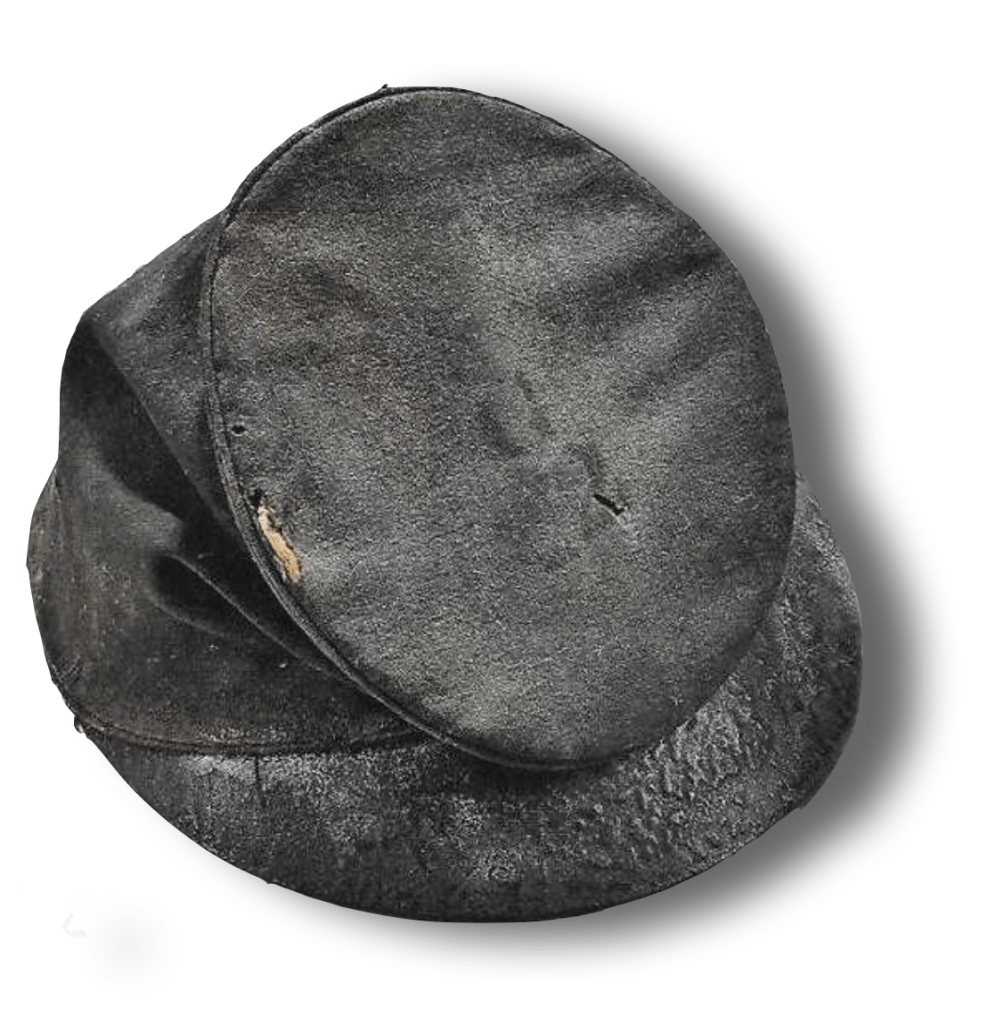


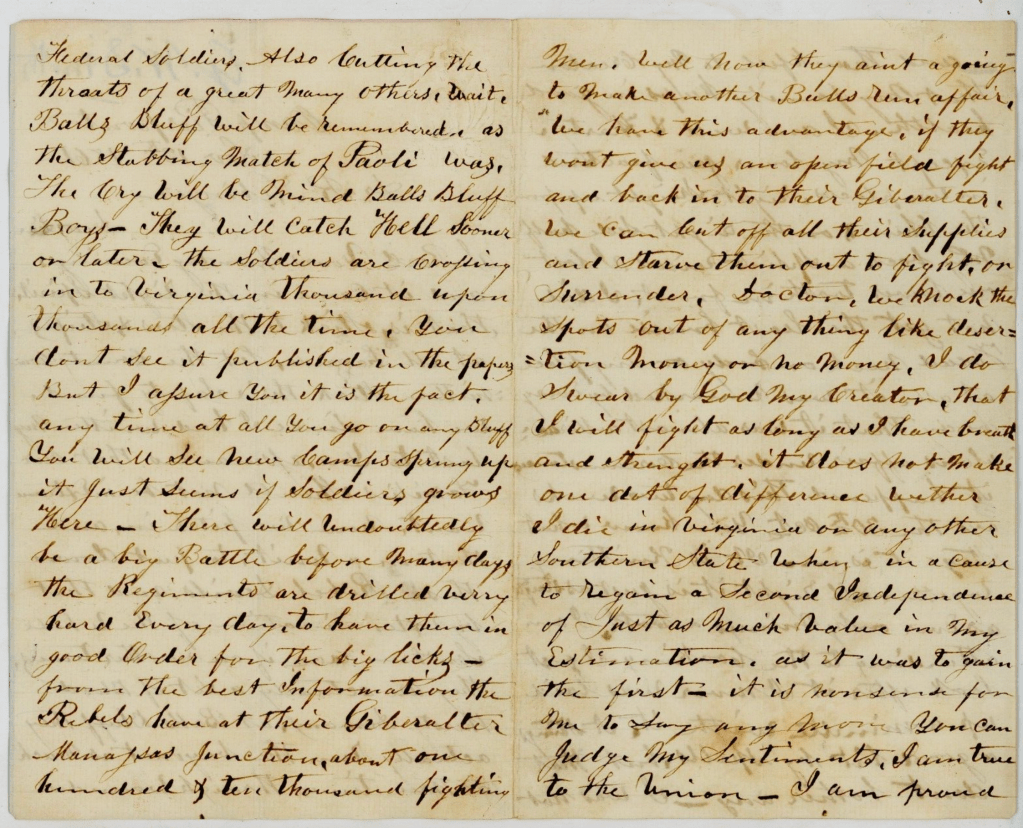
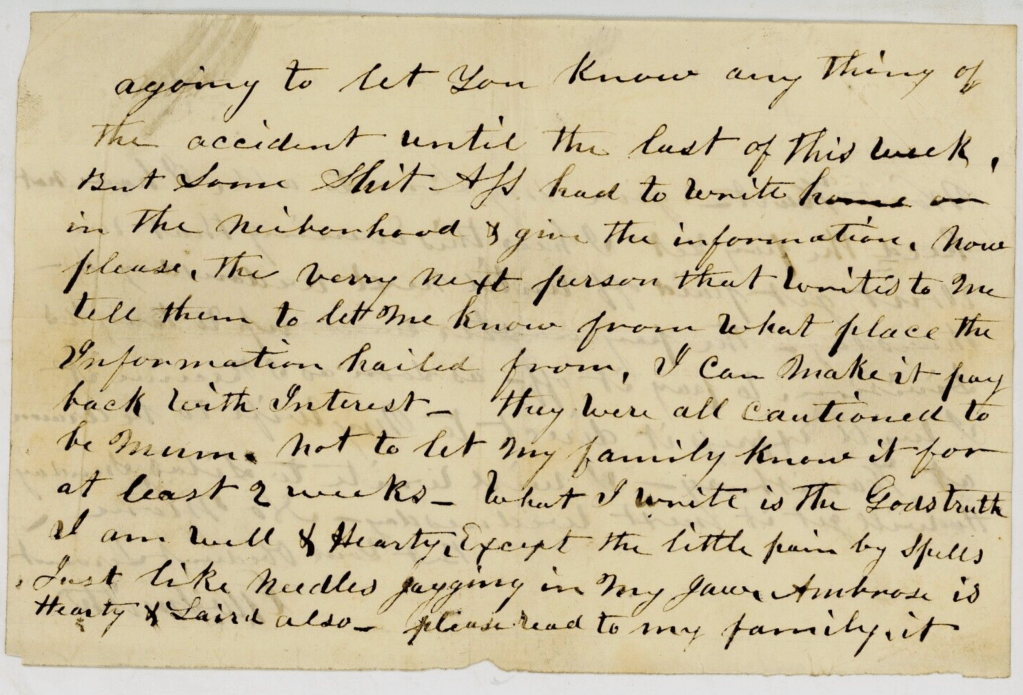
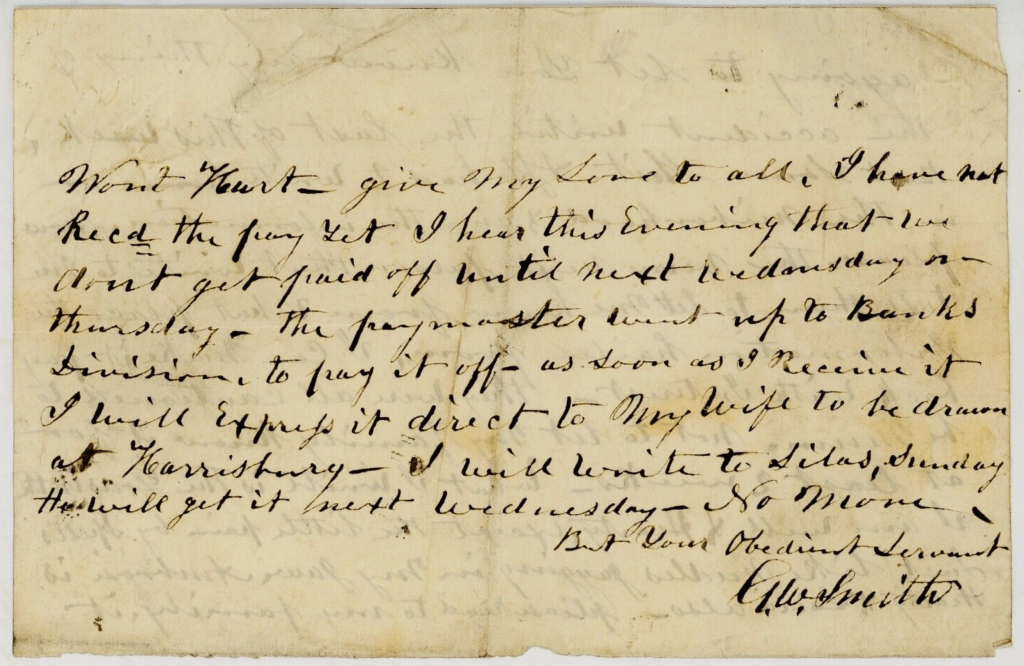

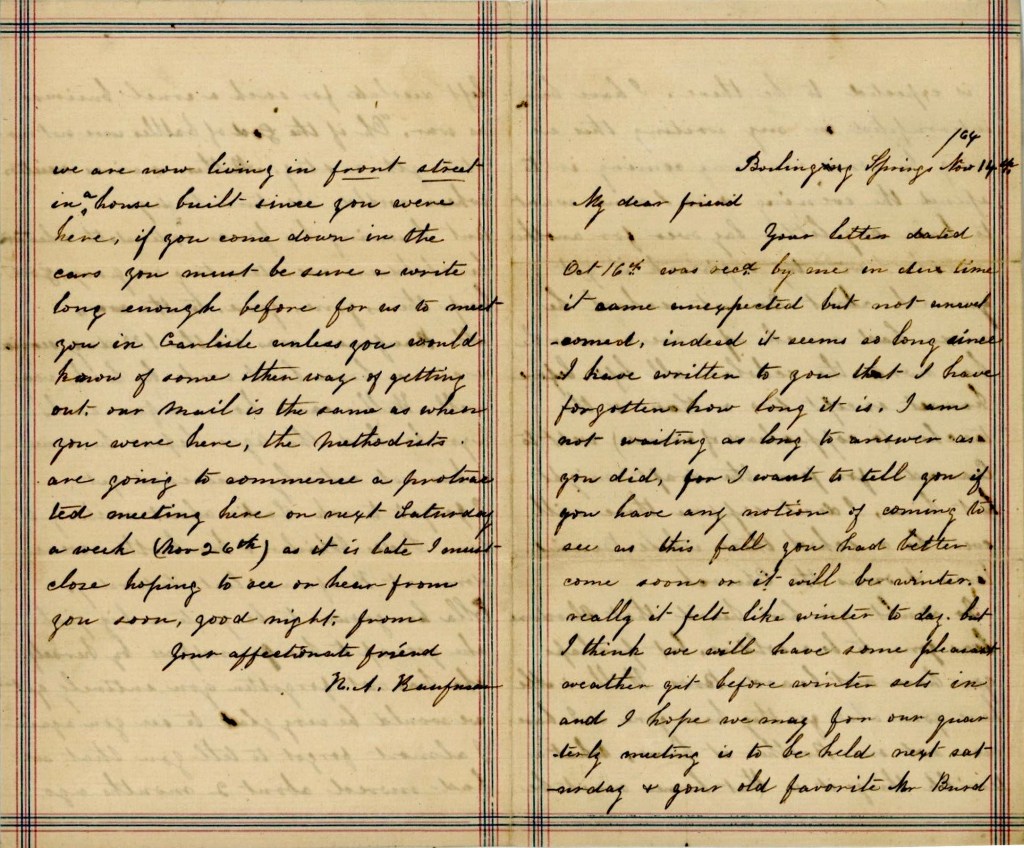

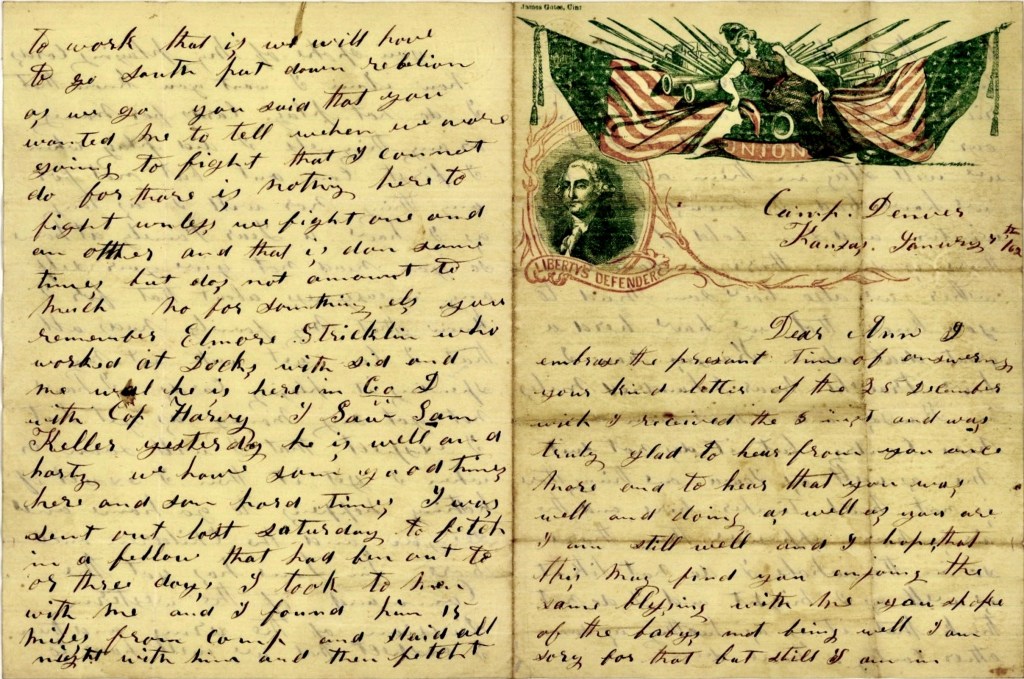

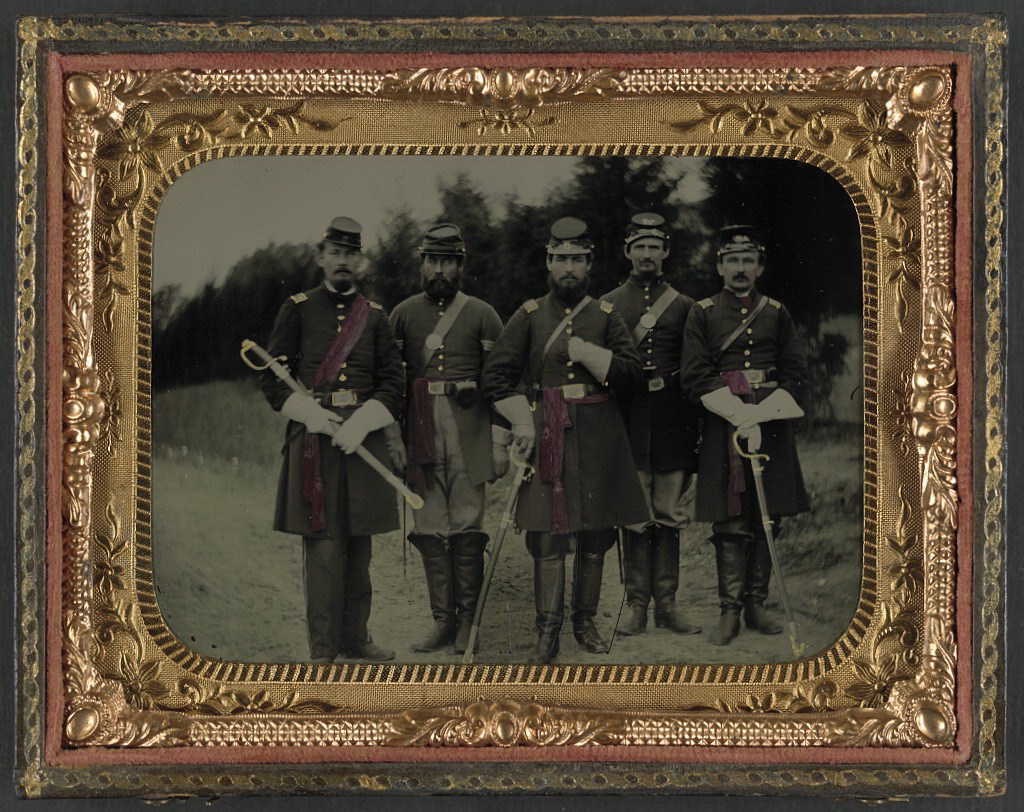
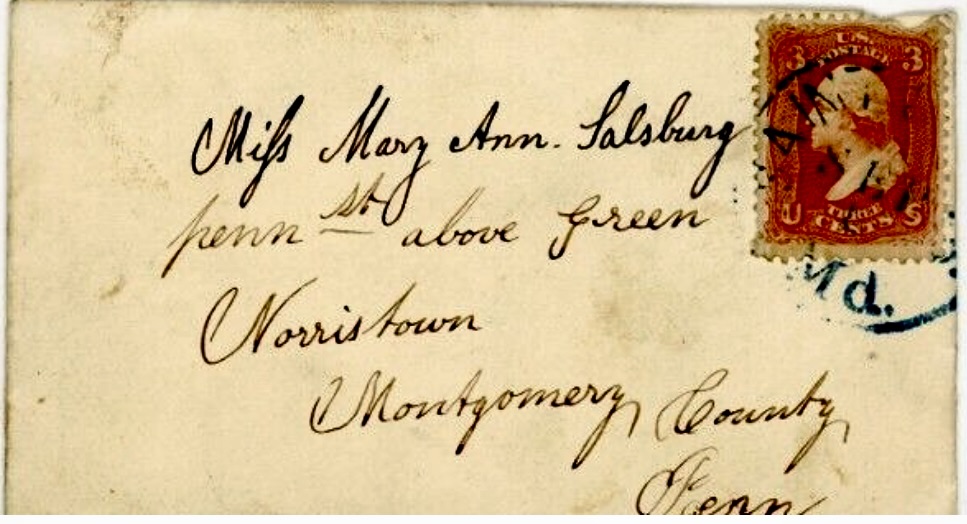
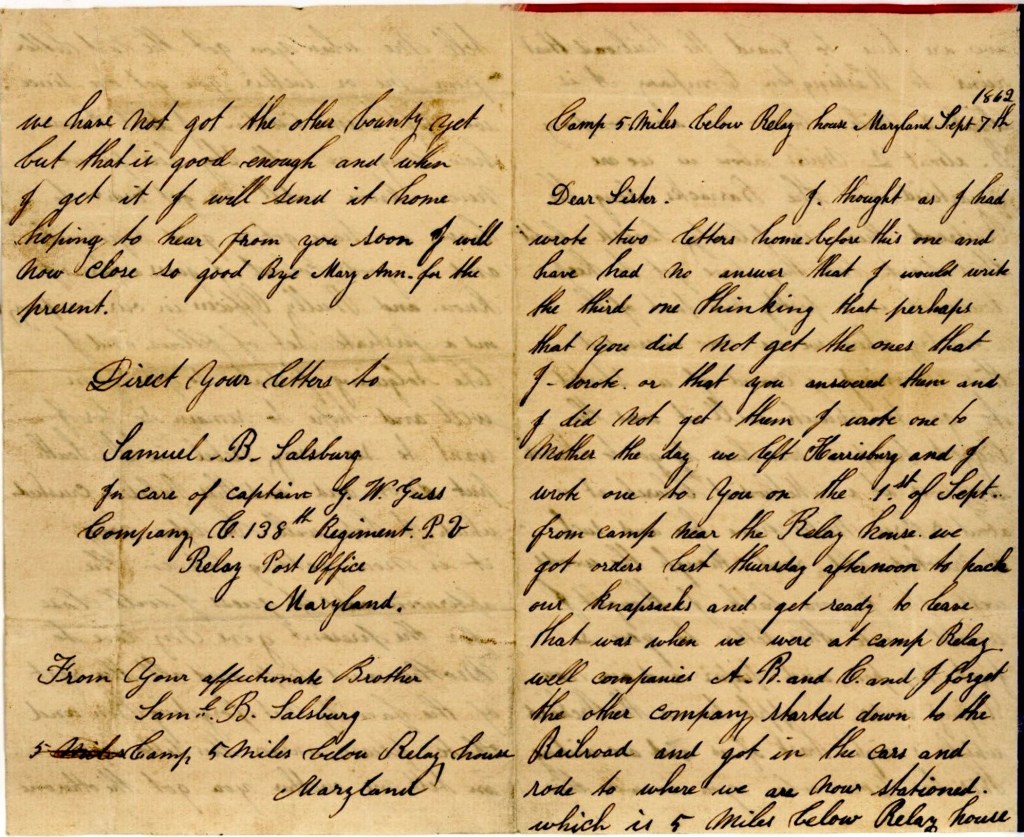
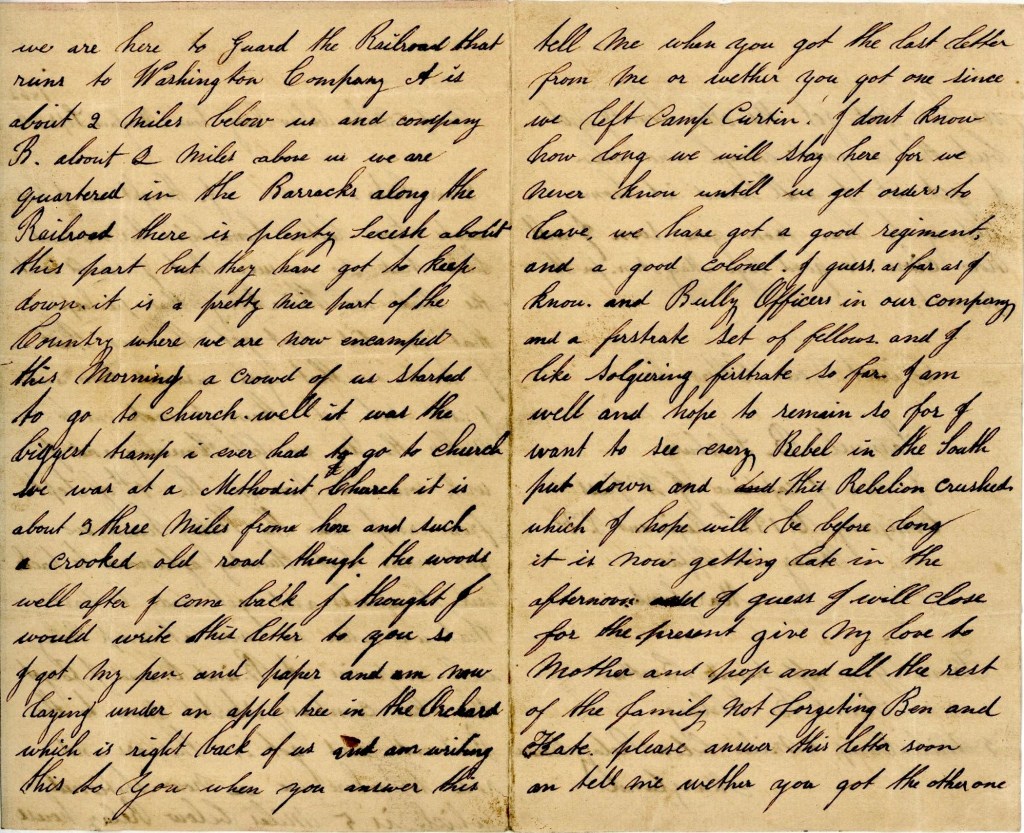

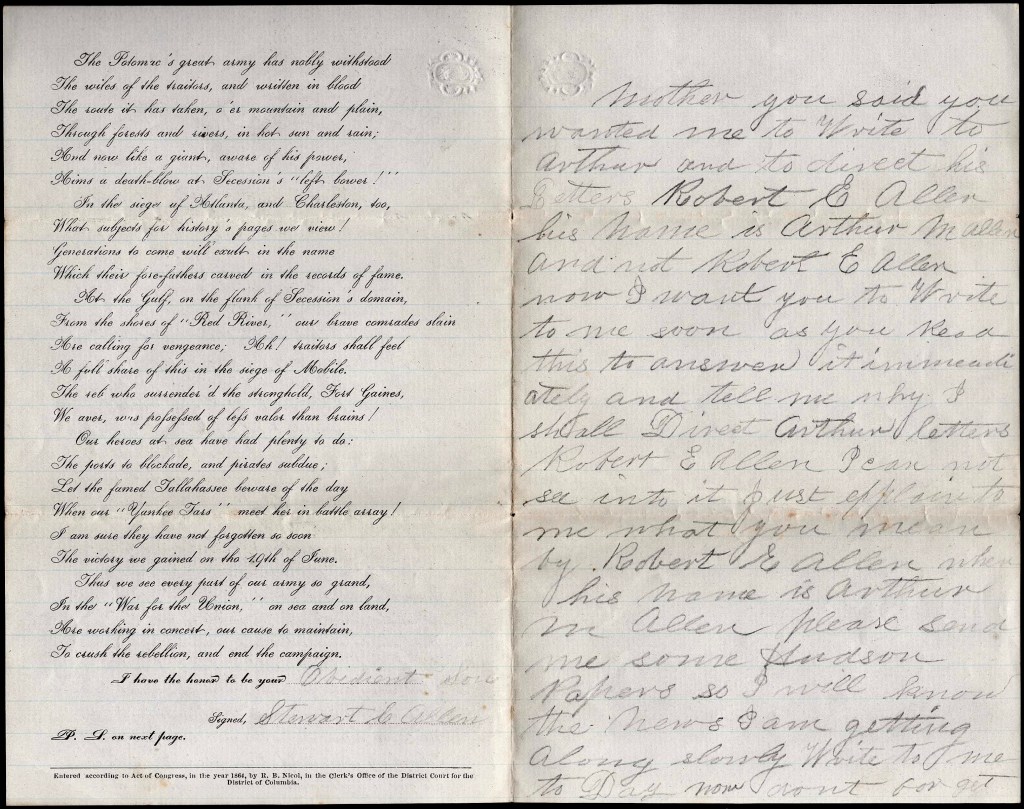
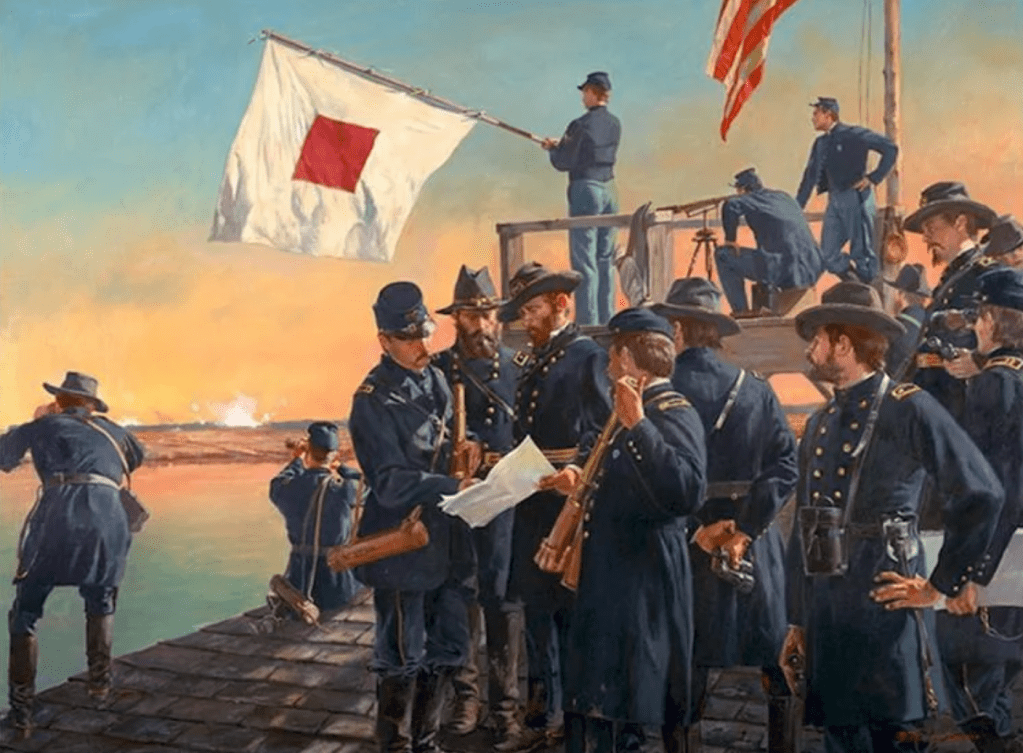


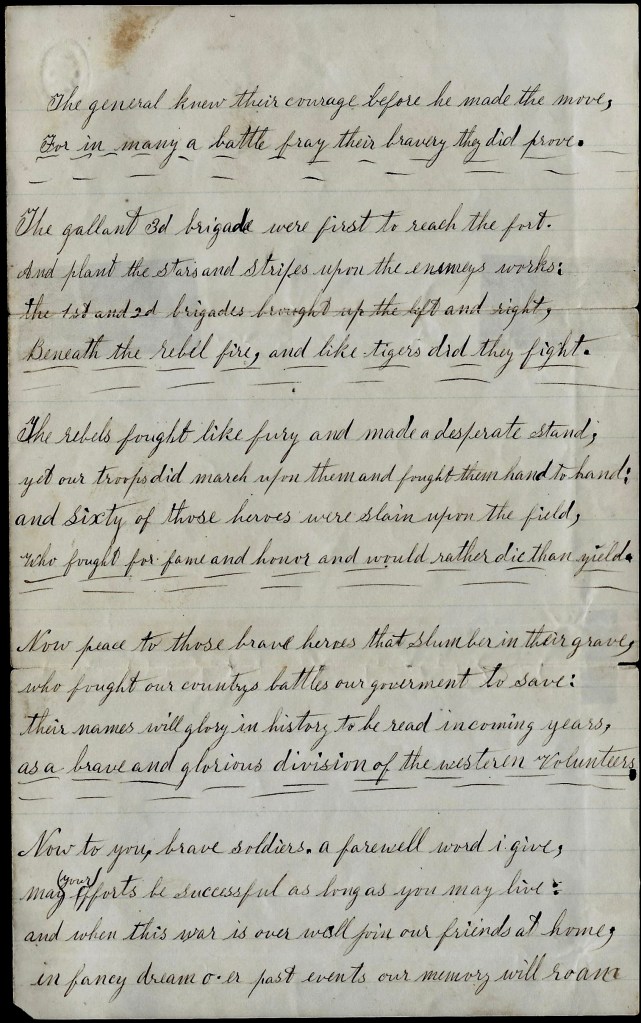
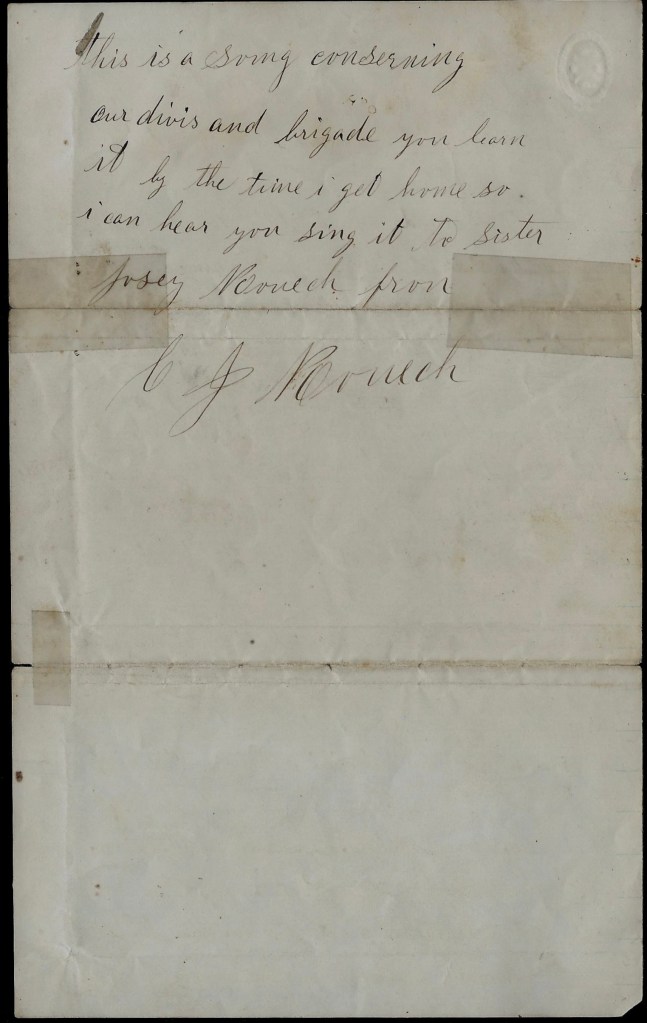
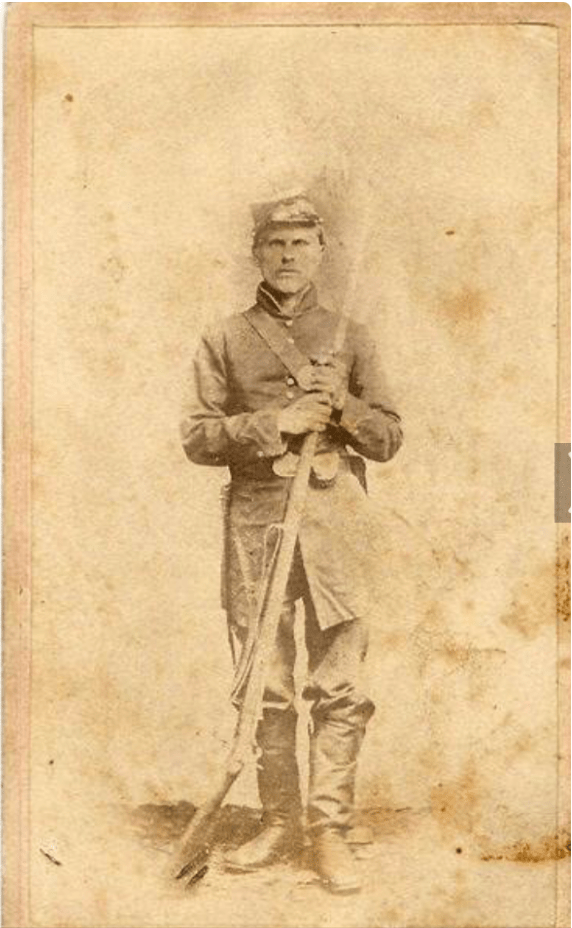

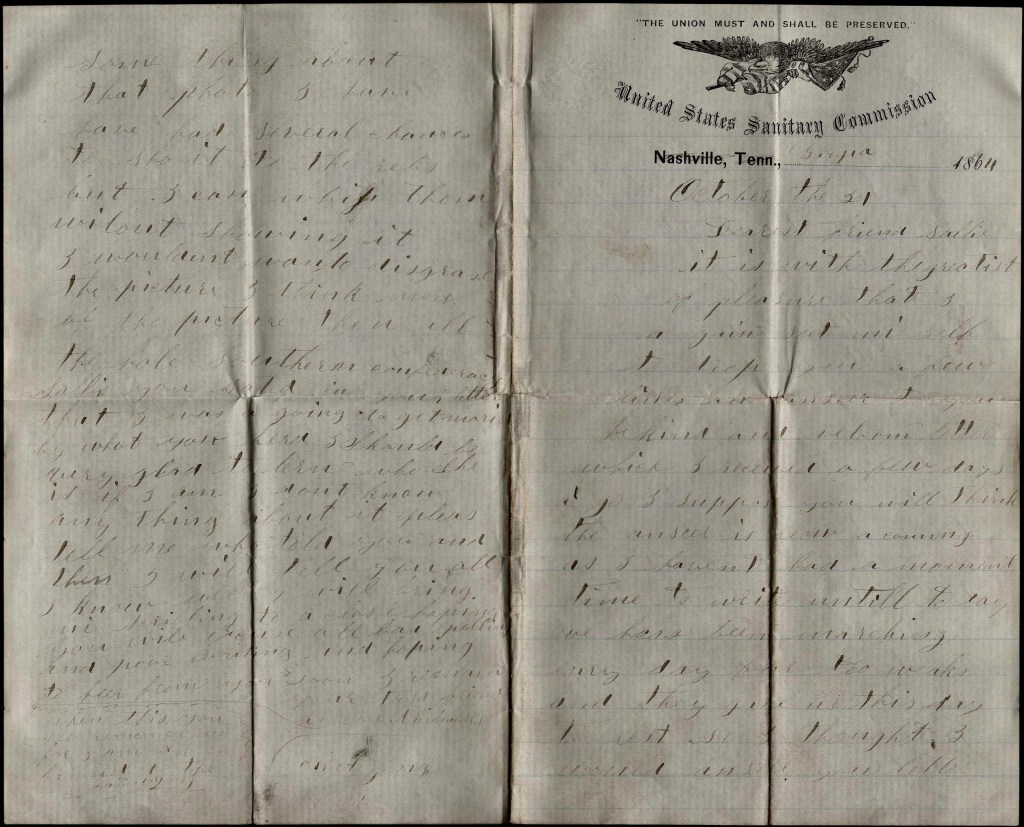

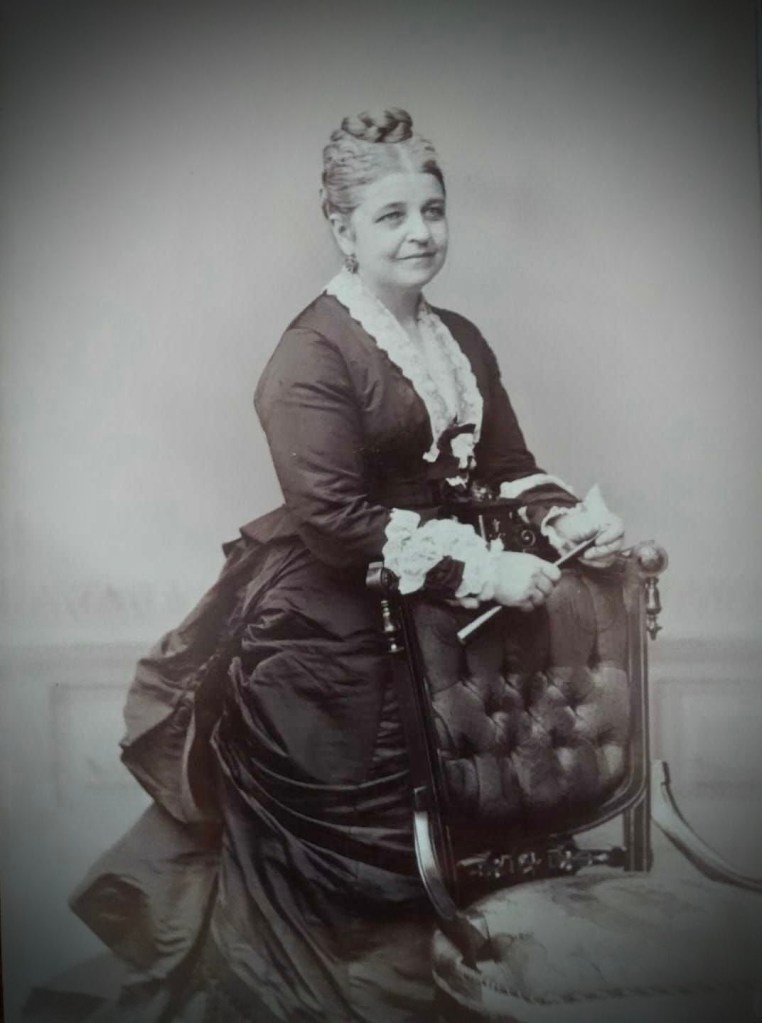


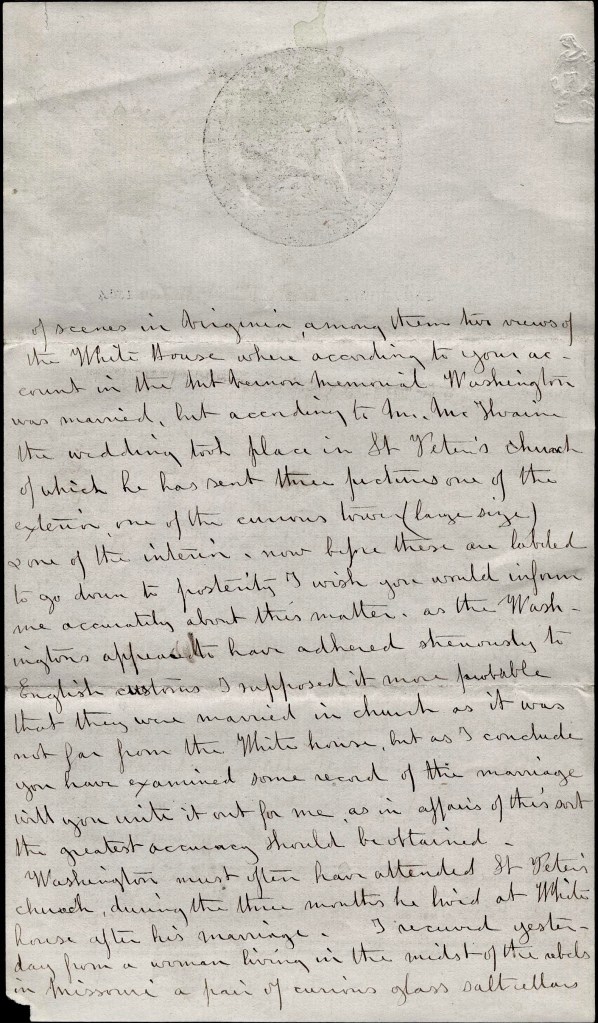

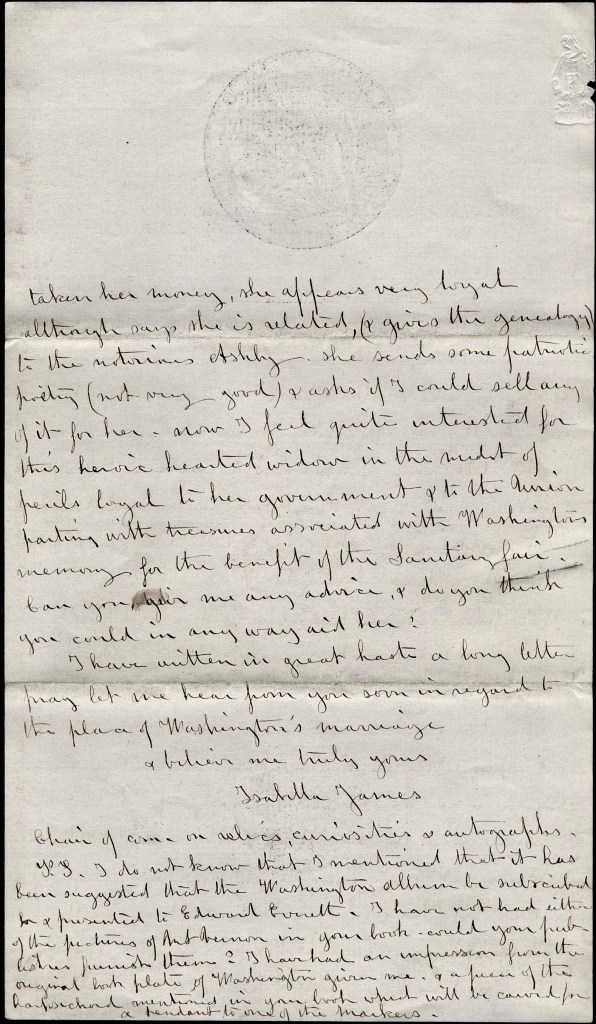
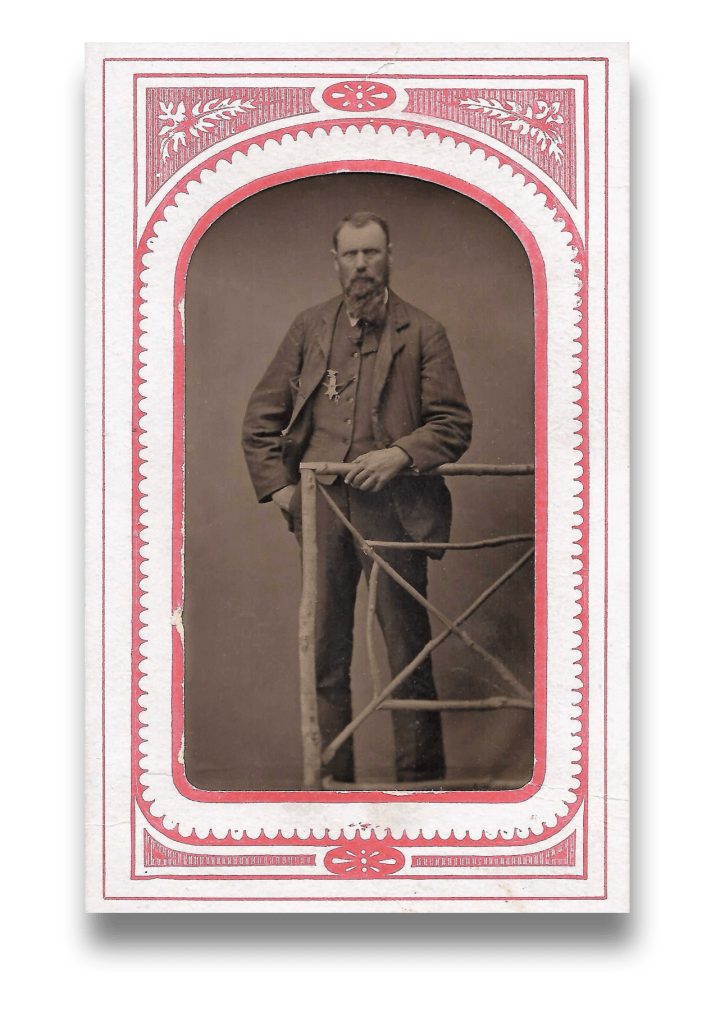


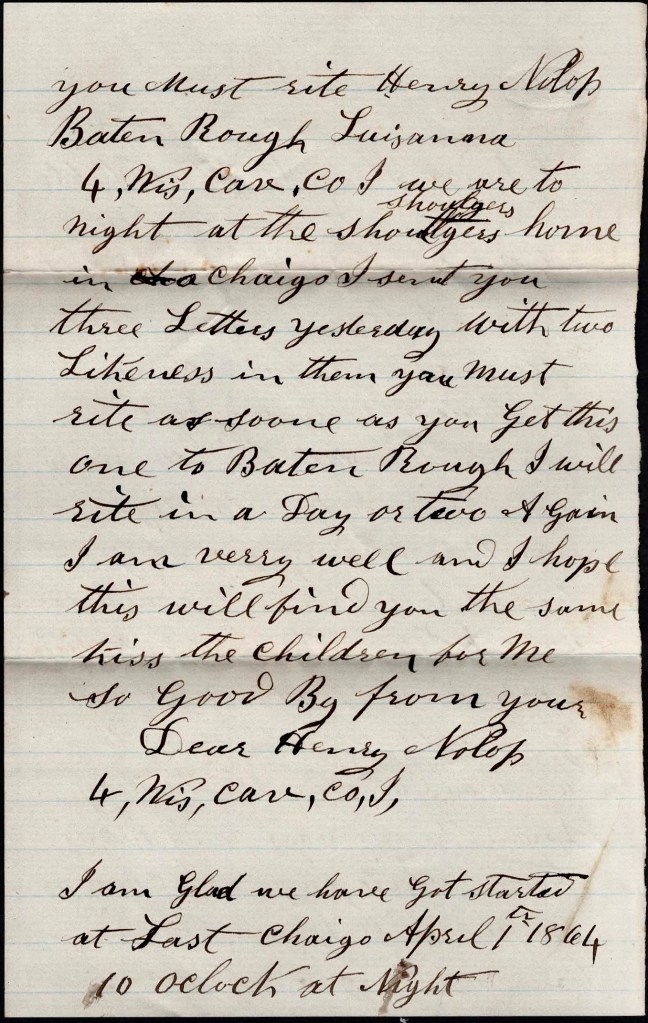


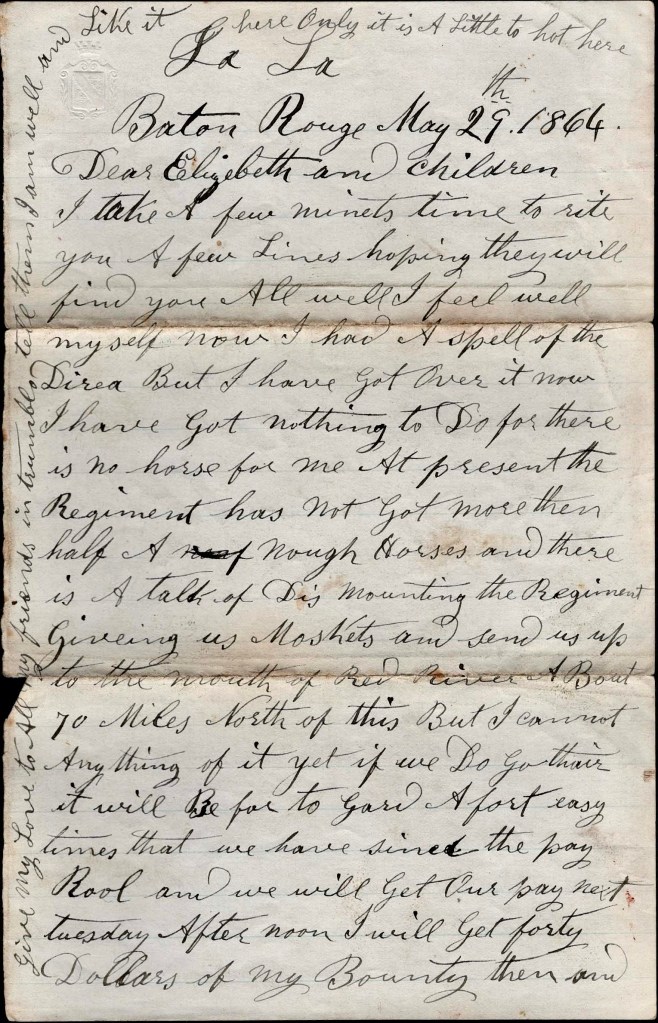
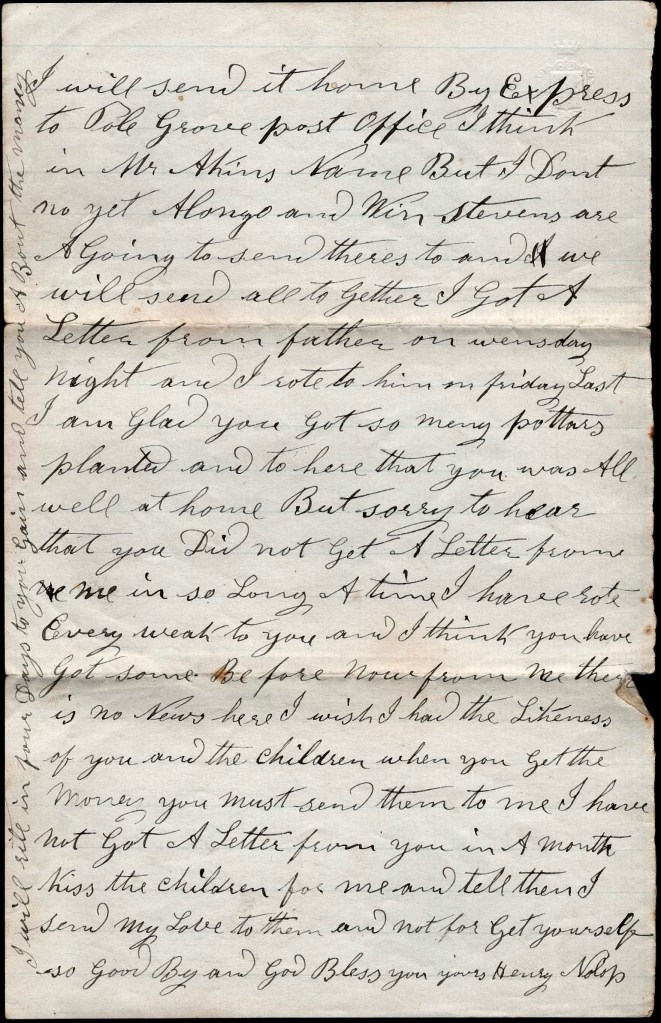
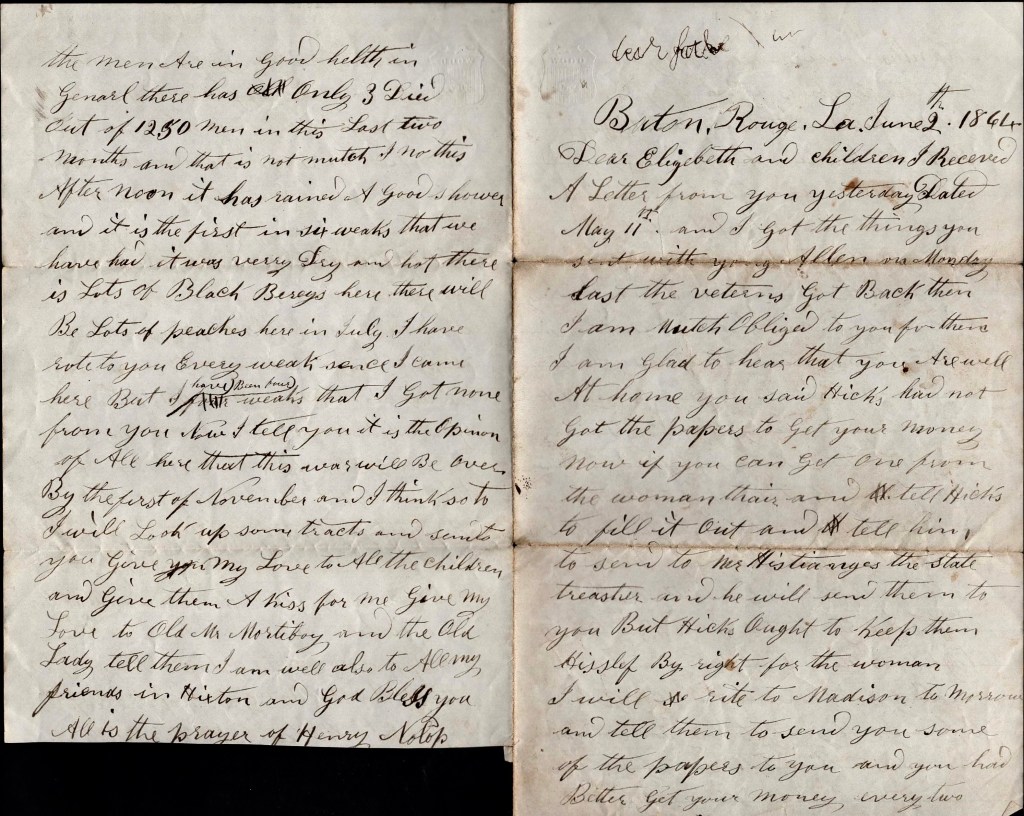

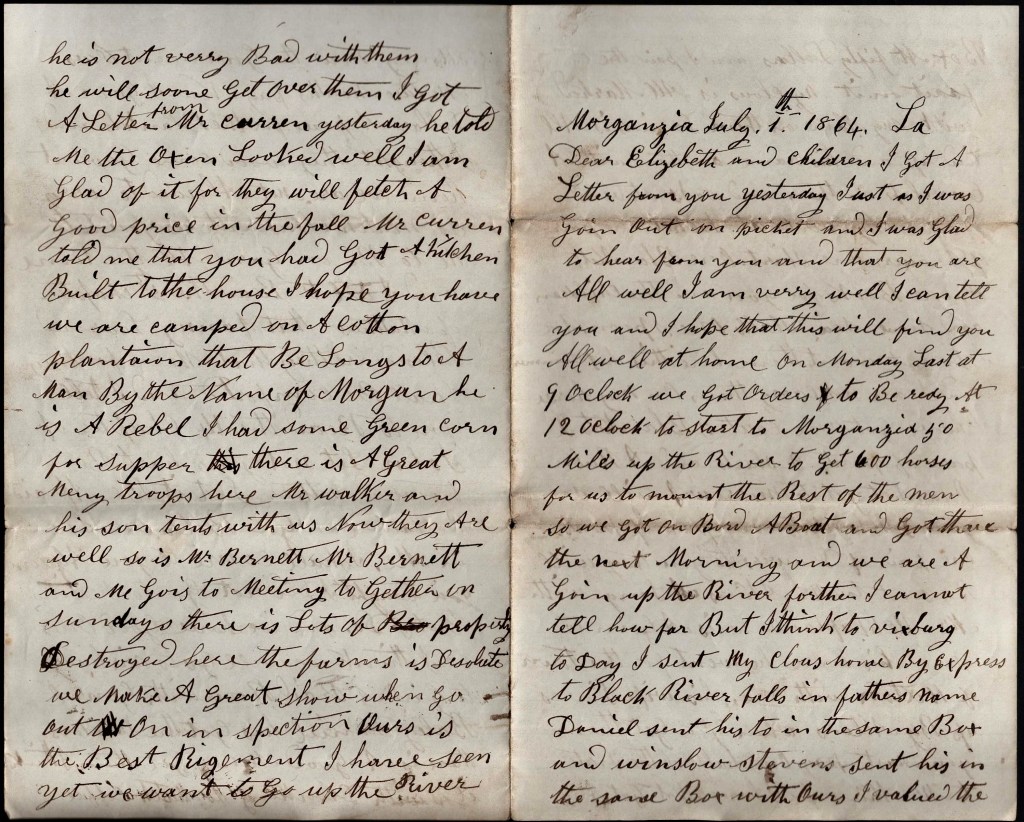


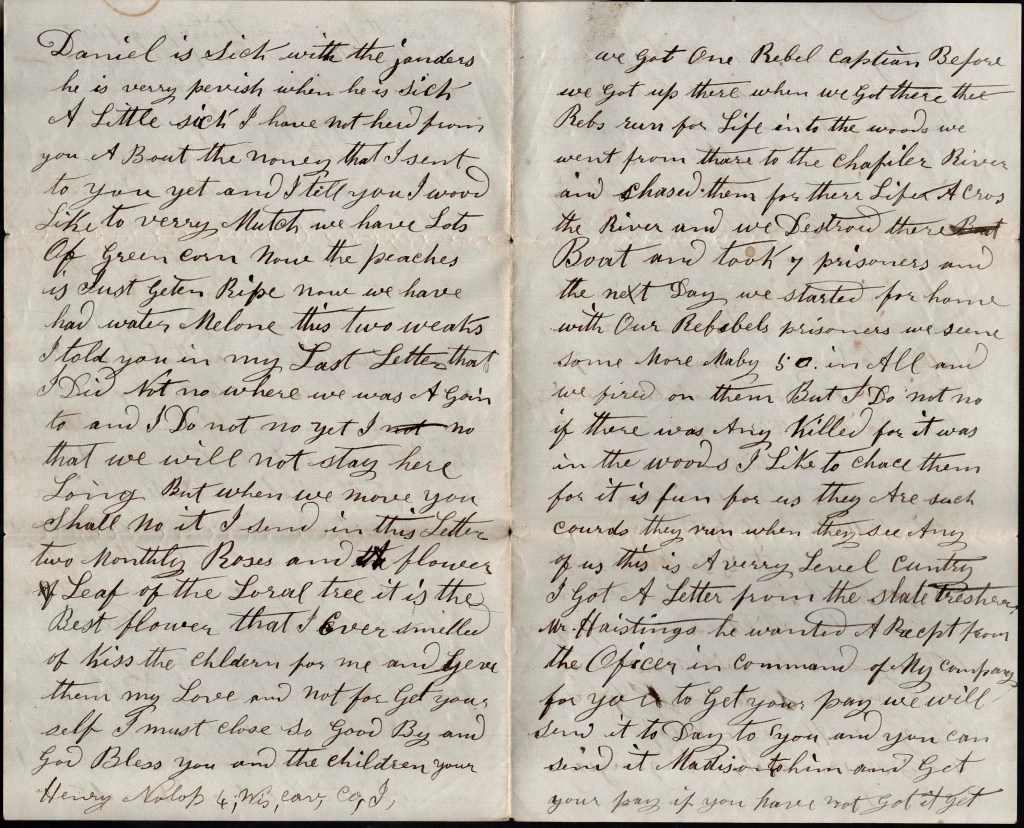


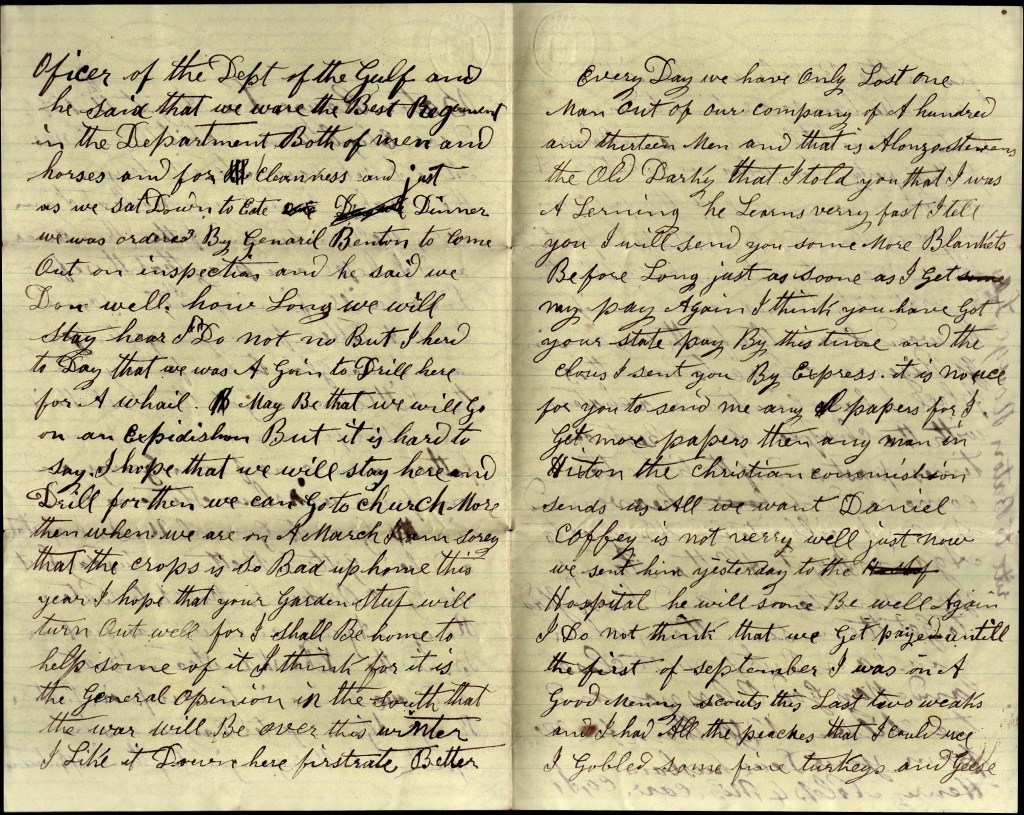

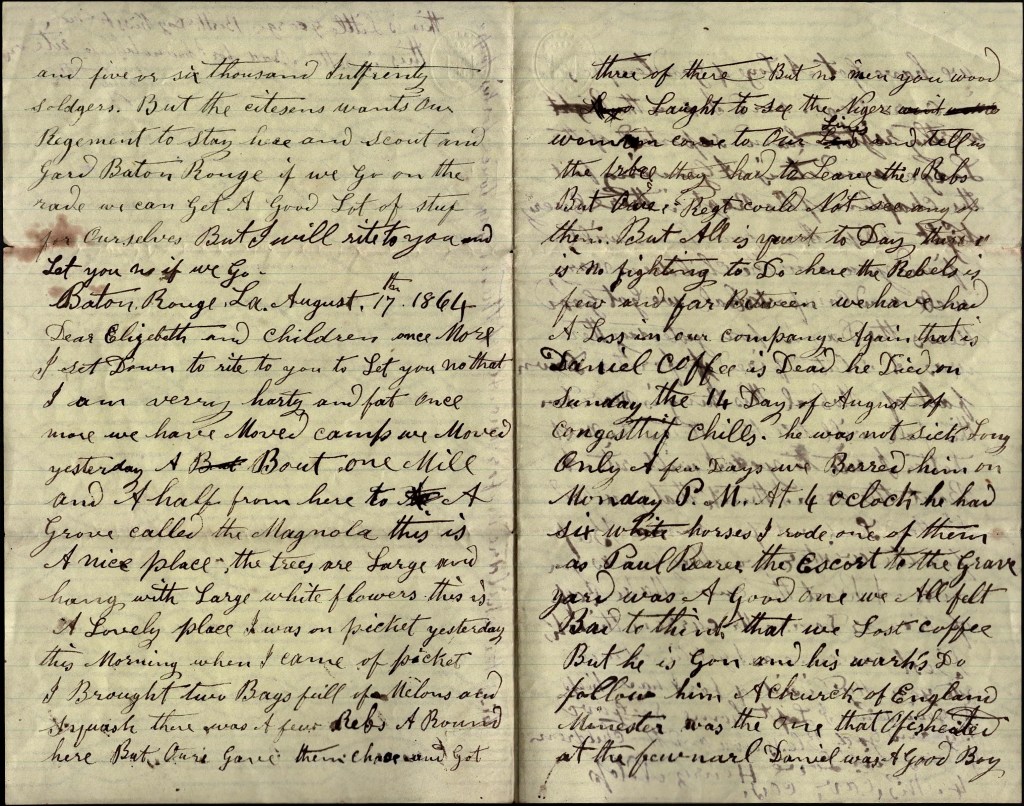
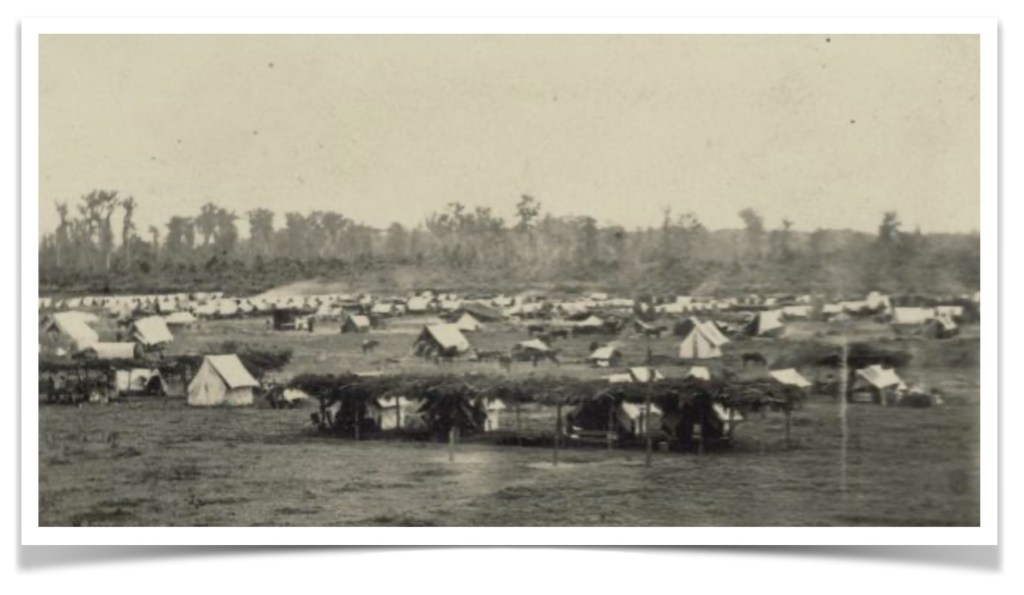
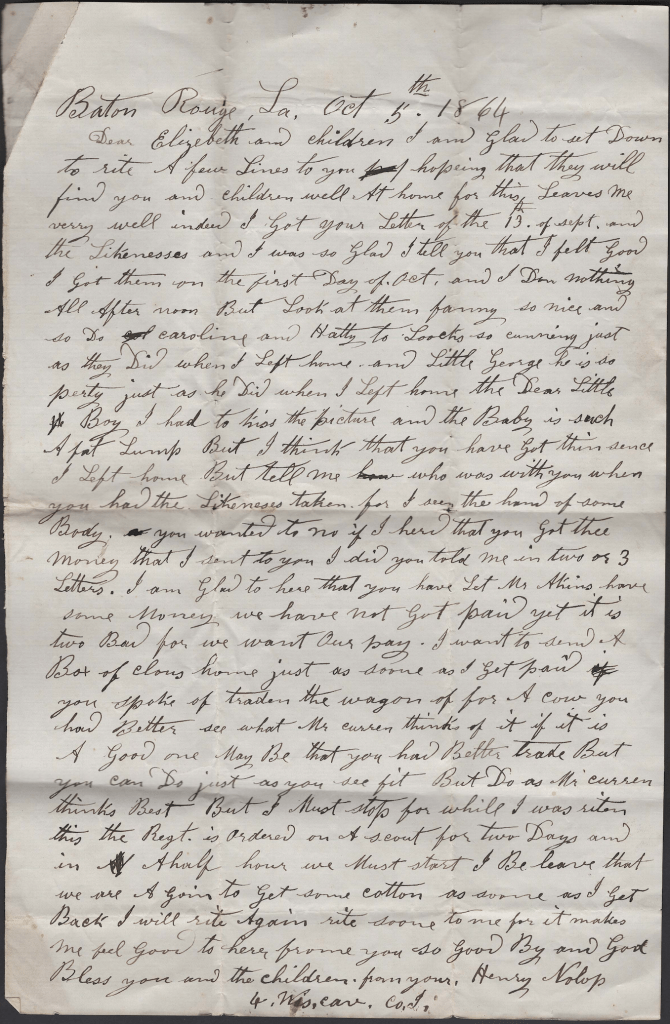
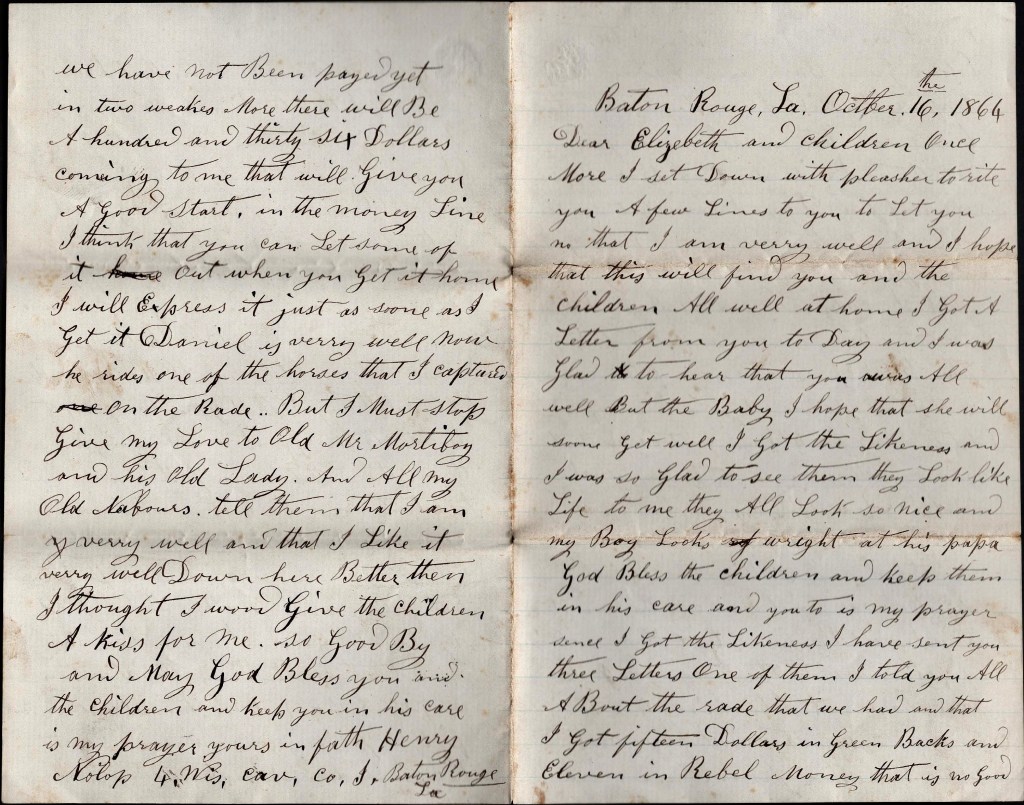


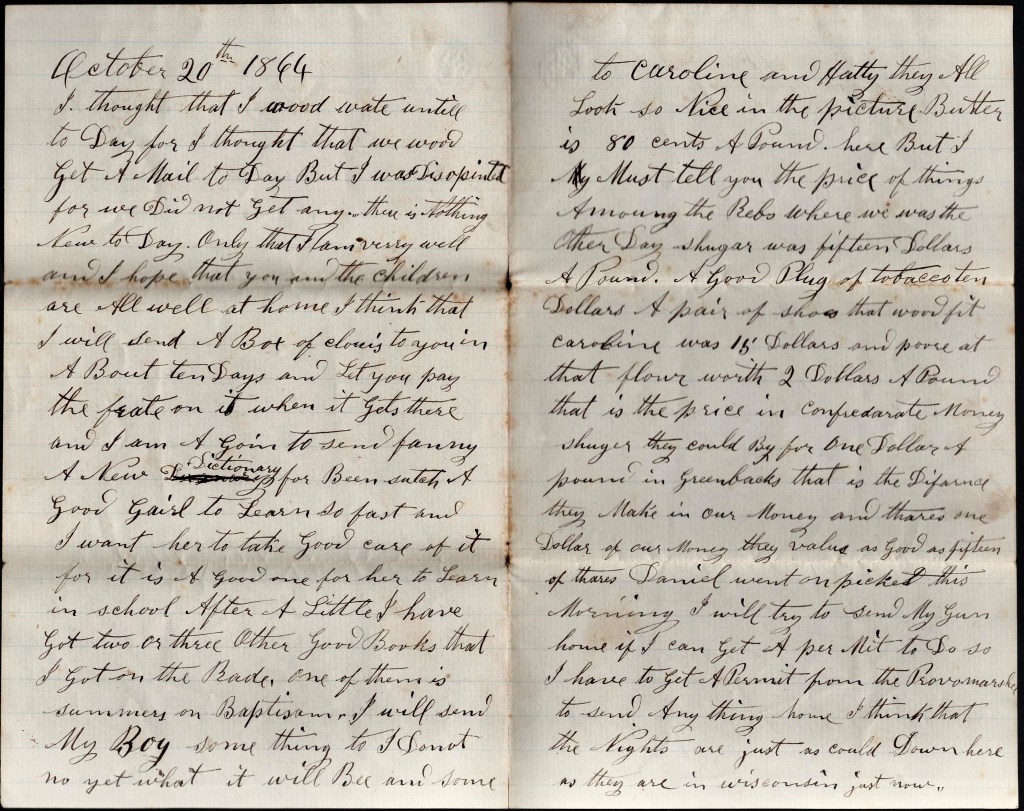
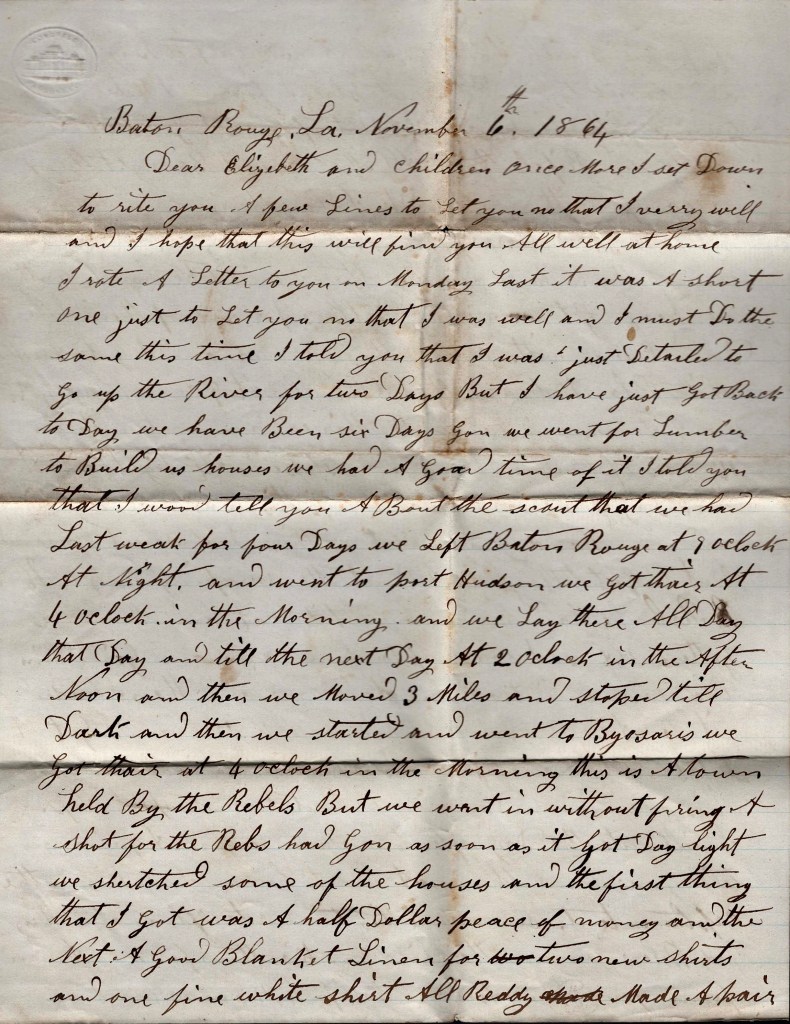


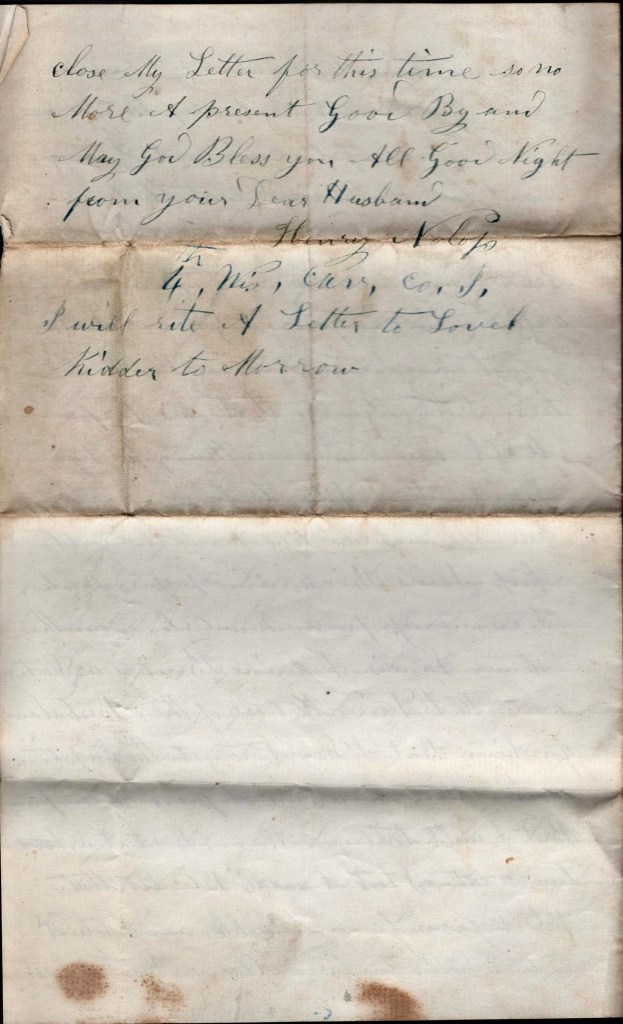


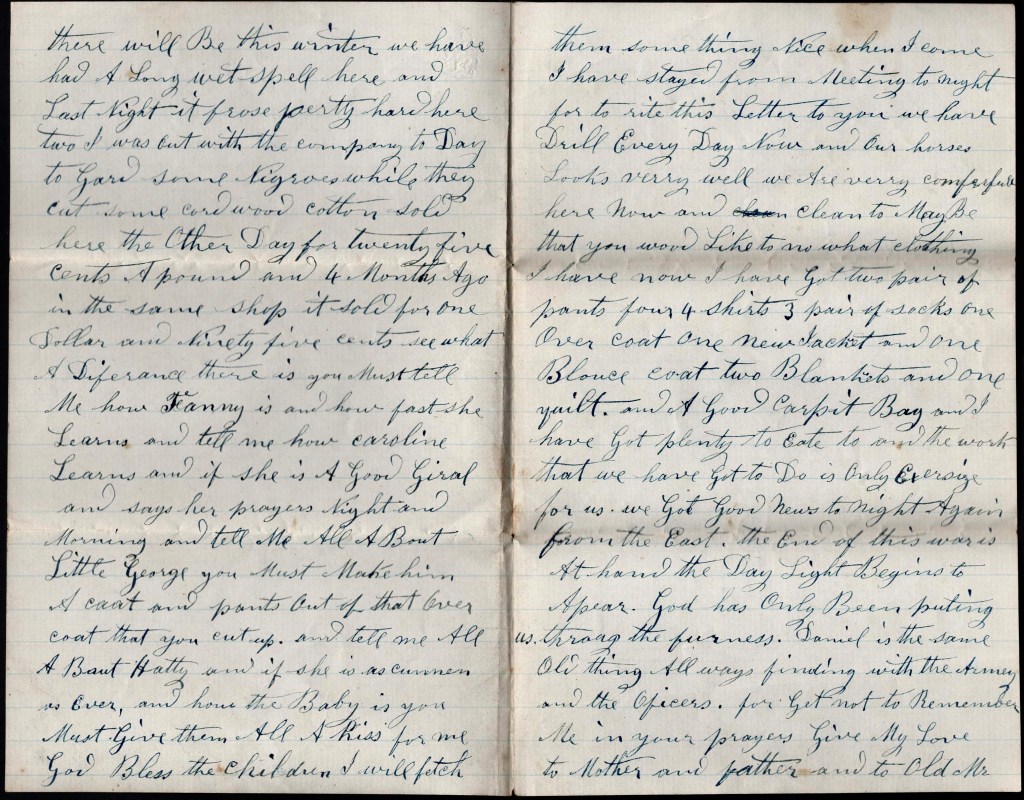
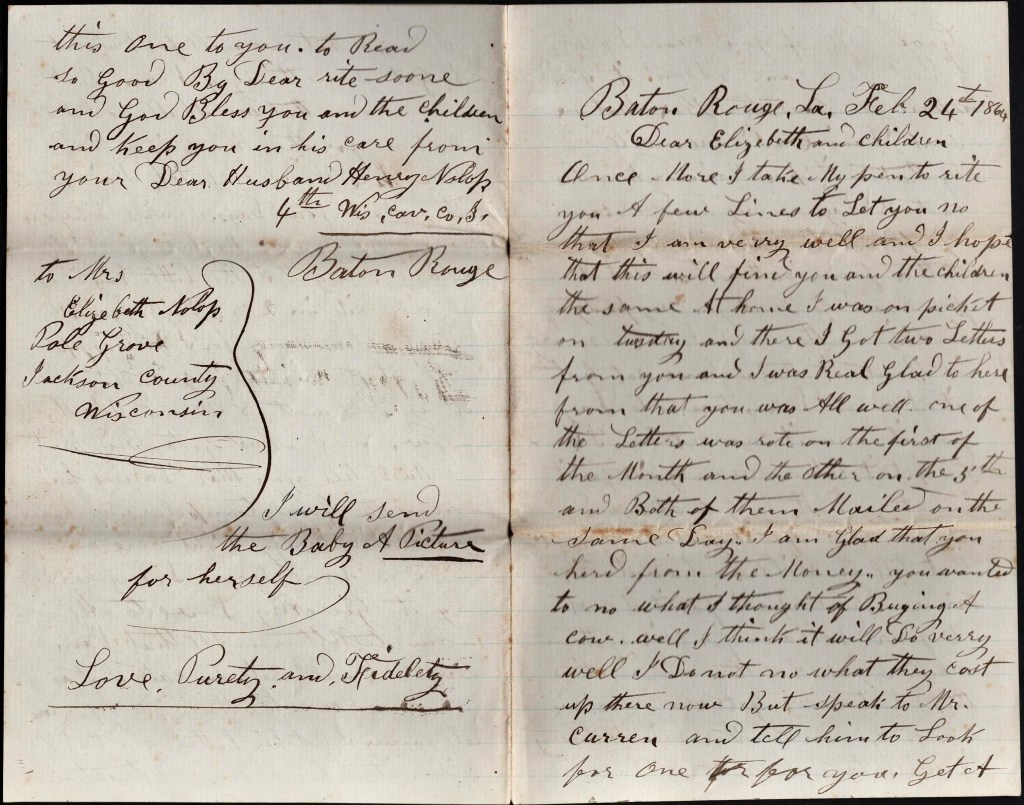


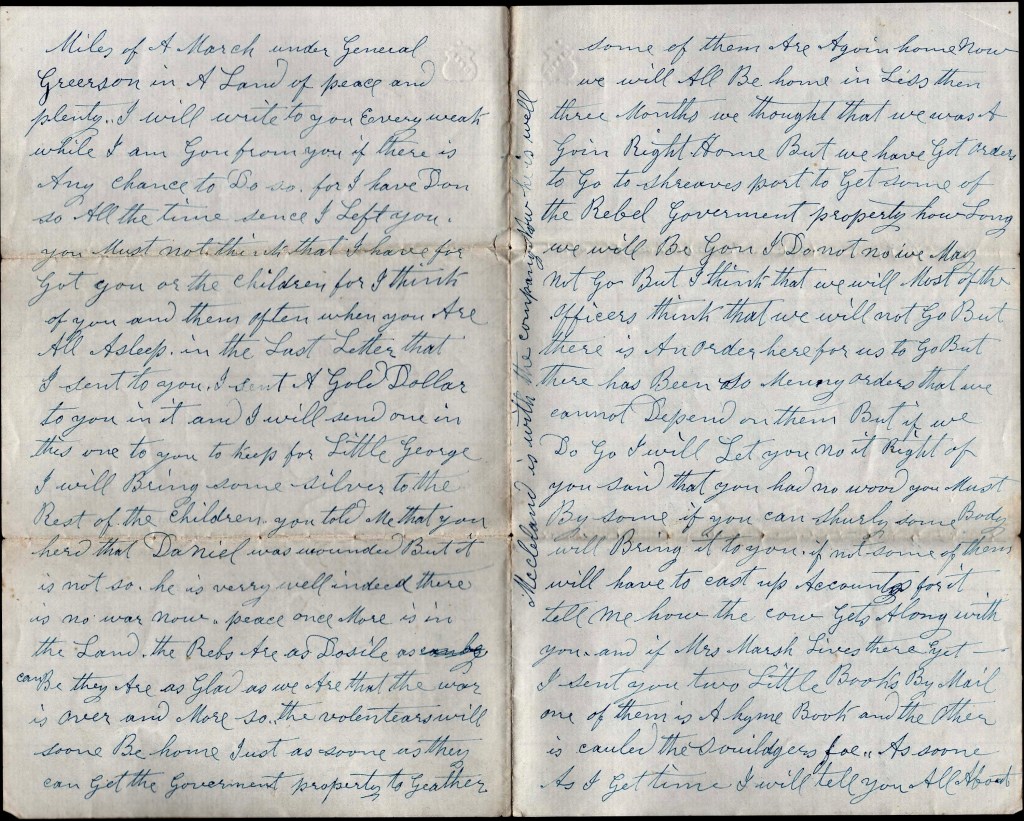

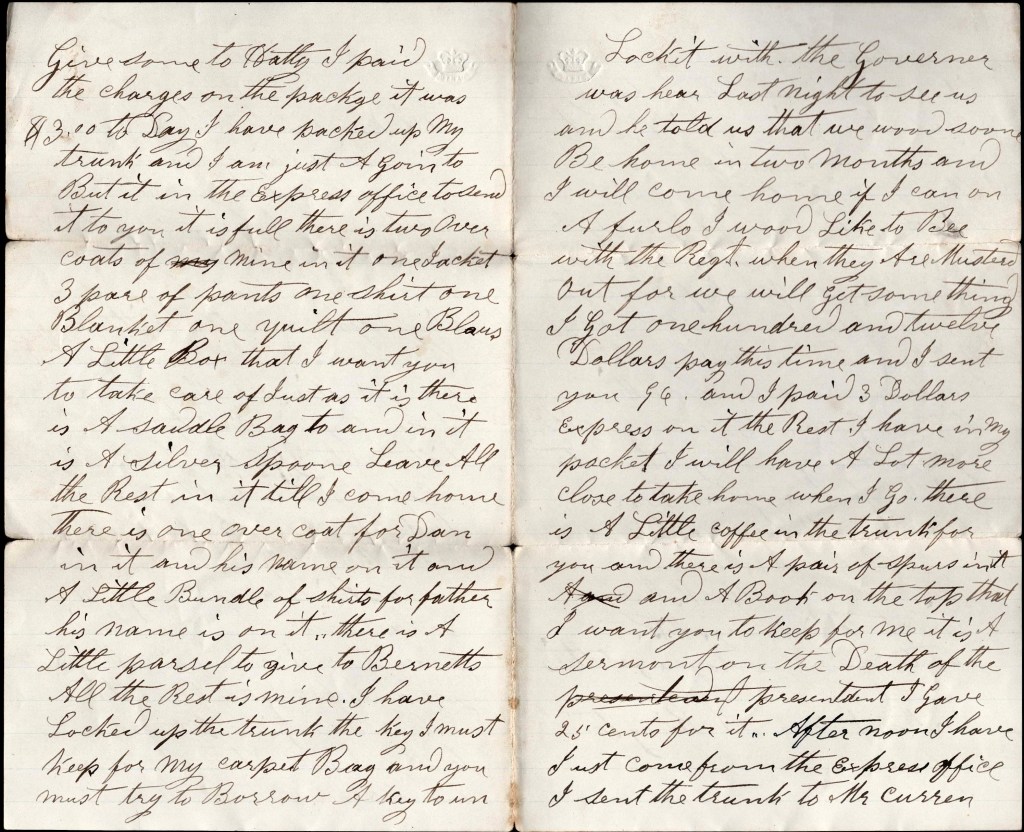
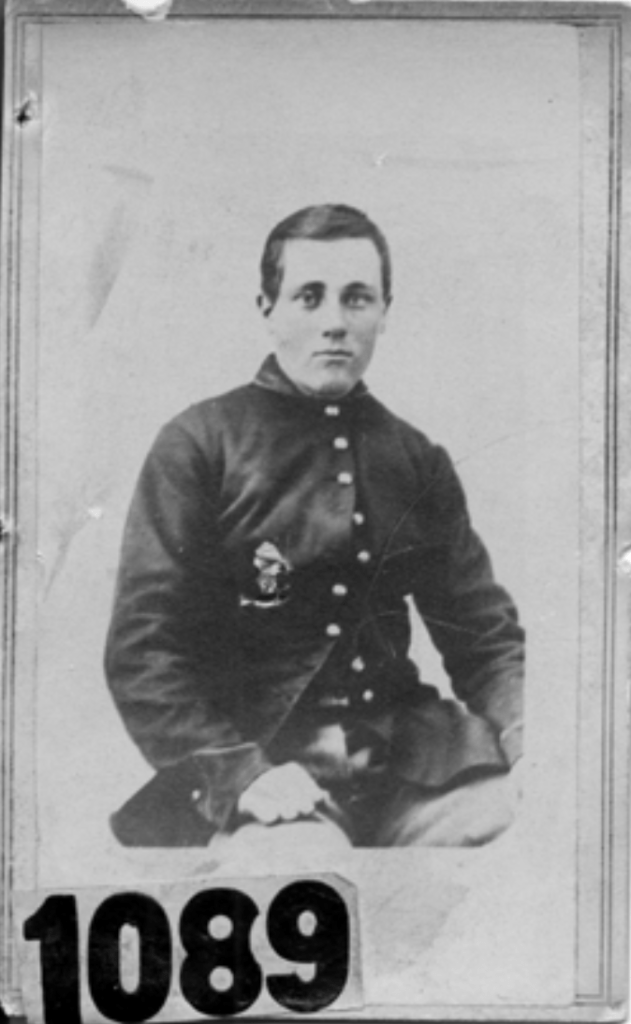


 Spared & Shared 23