My passion is studying American history leading up to & including the Civil War. I particularly enjoy reading, transcribing & researching primary sources such as letters and diaries.
The following letter was written by an indignant 18-year-old Alexander Derr Peebles (1843-1913), the son of Robert E. Peebles and Eliza Derr from Pana, Shelby County, Illinois. In May 1865, he entered into matrimony with Amy Downs in Shelby County, and in 1882, they moved to a farm in Kansas, ultimately establishing their residence in Eureka, Greenwood County, Kansas.
Alexander wrote the letter to his friend, Pvt. Matthew H. Karr (1839-1862) of Co. B, 14th Illinois Infantry. Most likely Matthew received this letter, but it may have been his last. He died from injuries and exposure on the battlefield at Shiloh on 11 April 1862. His parents were Charles and Jerusha (Harvey) Kerr of Shelby county, Illinois. Mathew’s sister Nancy Karr (b. 1845) is mentioned in the letter.
Transcription
Shelby county, Illinois March 10, 1862
Mr. M. H. Karr—sir,
I take my pen in hand to let you know that I am well at this time and hope these few lines may find you. the same. John Rhoads was married the next Sunday after you left here. 1 Nancy is well. I was up there yesterday. I had a fine time with her.
Now I must tell you what happened last night. Dick Riggs was up to see Jane, the God-damned Sarl top. I wish he was in hell. I got the mitten by God from her. He is a God damned greenhorn as well as myself. I wish you had a been here last night and seen the fun. Almon Simmons is here on a furlough but it going back this week to Fort Donelson.
I don’t think Jane wanted to slight me but I think she was put up to it by that God damned pewter bollocks Dick Riggs. If he did that, I will break his neck. He was there all day with her. I thought [it] strange that she was not at meeting with the girls. I began to smell a mice so I went up to see what was up and they all looked as mad as hell. Jane looked like she did not know what to do. When I asked here if I could stay, she could not say at first and at last she whispered no. So I left.
I have not much to write. I will write to you again. So no more at present but write soon. — A. D. Peebles
Direct [to] Pana, [Illinois]
To M. H. Karr
1 Shelby county marriage records inform us that John Rhodes was married to Lurany Myers on 23 February 1862.
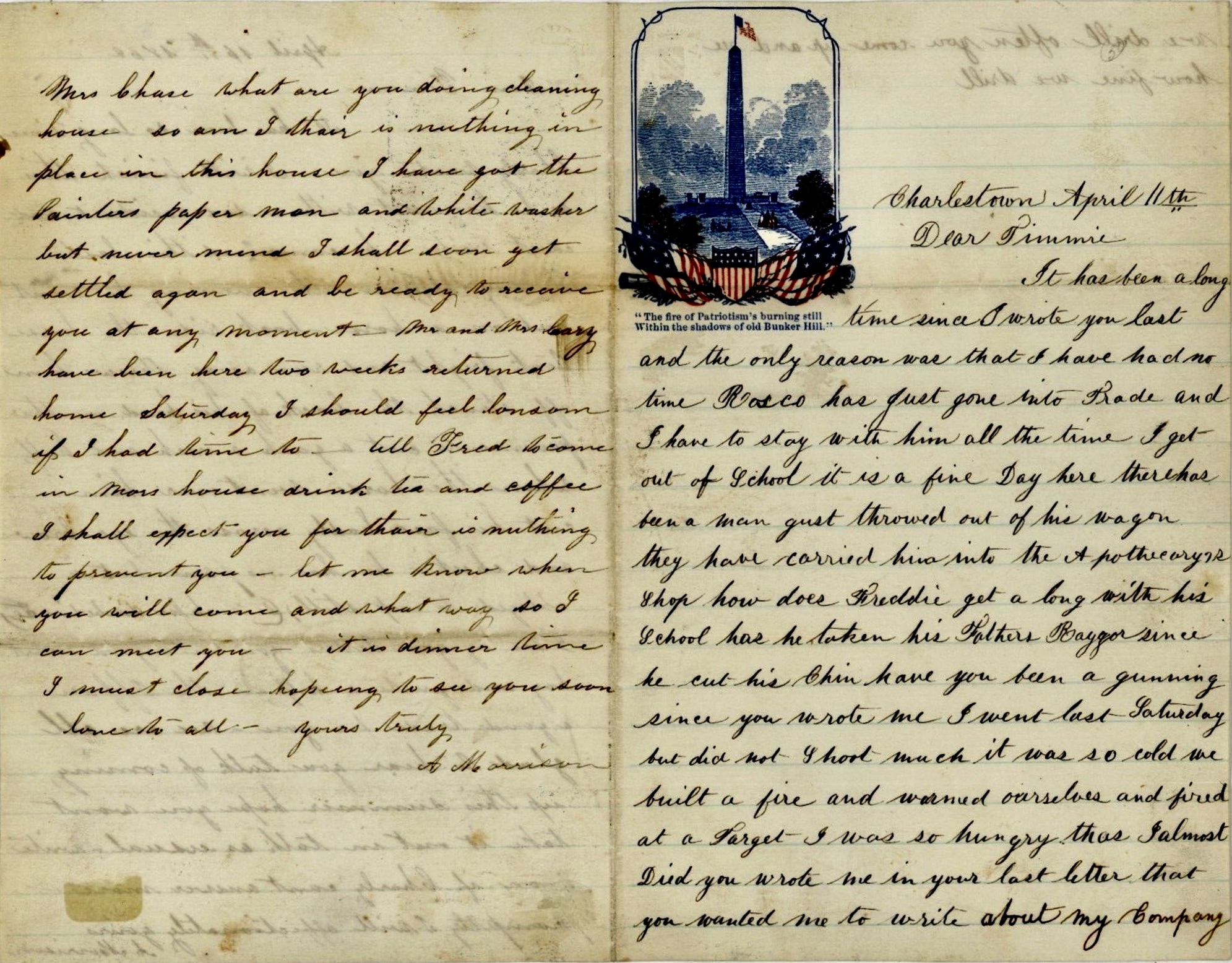
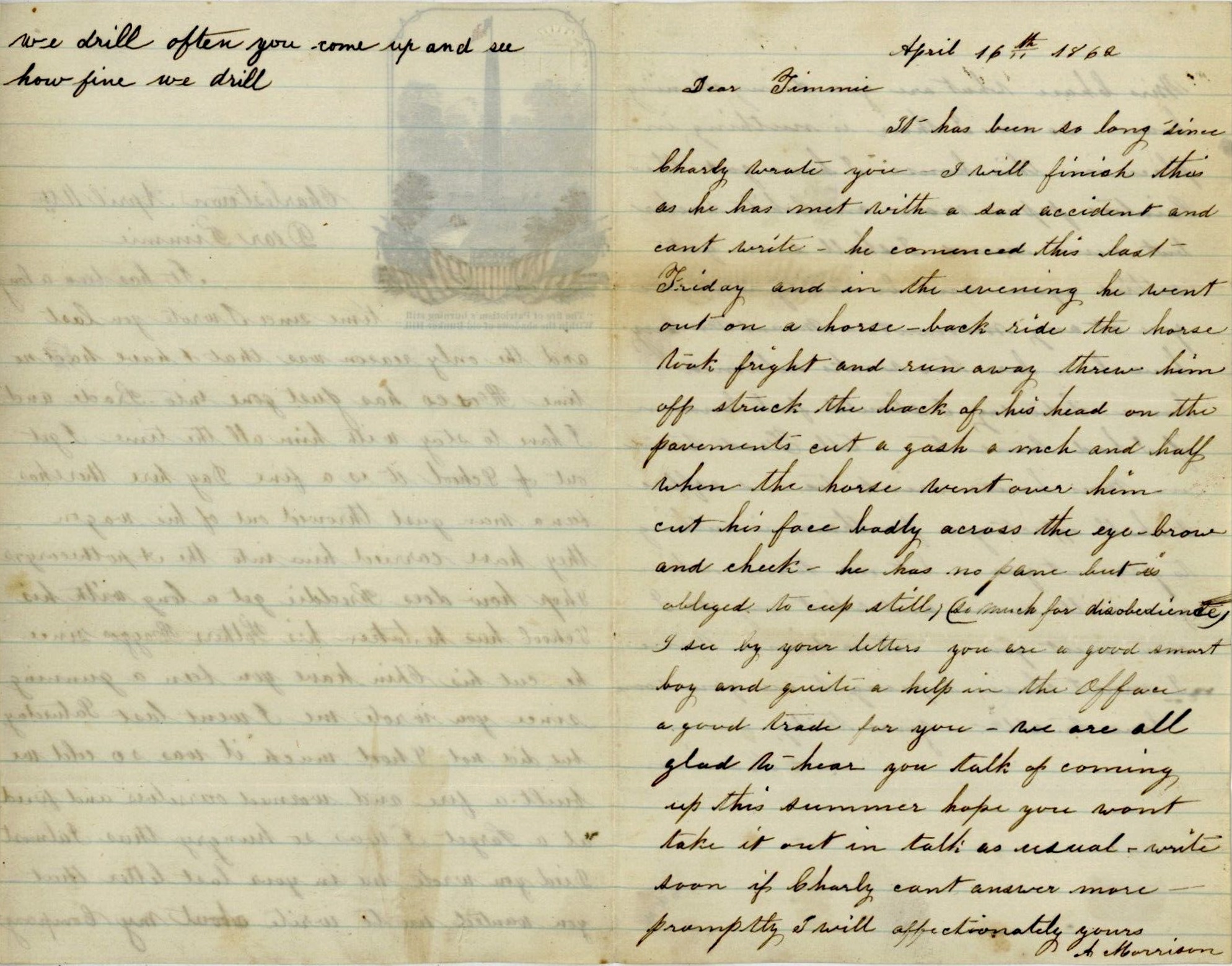
The following letter was initiated by 13 year-old Charles (“Charley”) H. Morrison (1848-1868), the son of Calvin Morrison (1812-Aft1880) and Ann Maria Dodge (1822-1903) of Charlestown, Middlesex county, Massachusetts. It was concluded by Charley’s mother, Ann. Also mentioned in the letter is Charley’s older brother, James “Roscoe” Morrison (b. 1842). Charley’s father was employed as a teamster in Charlestown in 1860. According to Massachusetts Death Records, Charley died of consumption in 1868.
Charley wrote the letter to his friend, Timothy Chase.
Transcription
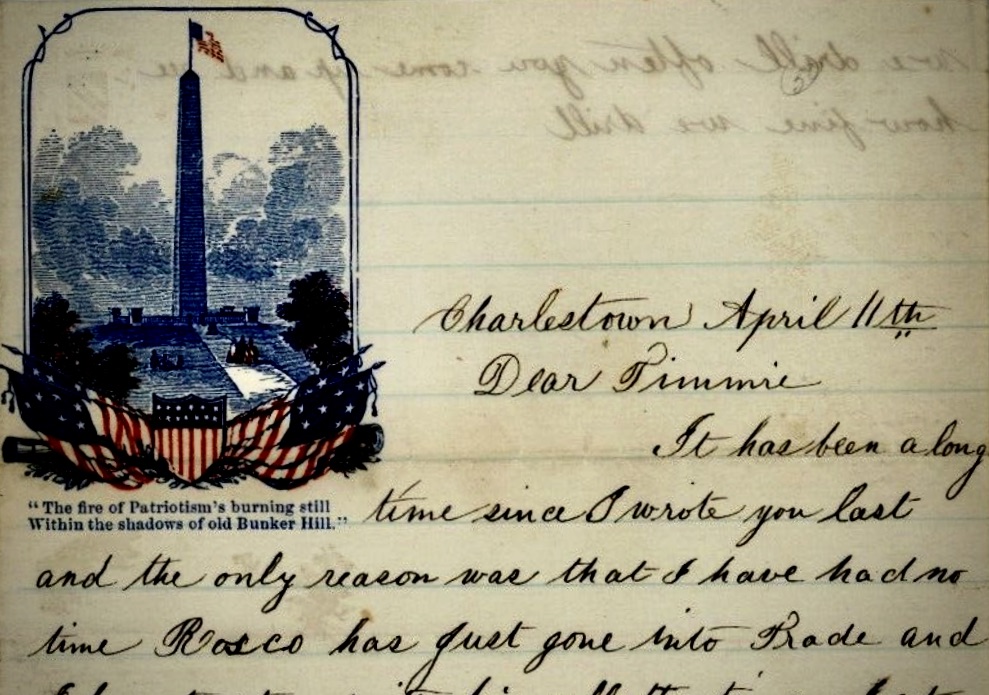
Patriotic stationery with image of Bunker Hill, “The fire of Patriotism’s burning still…”
Charlestown [Massachusetts] April 11th [1862]
Dear Timmie,
It has been a long time since I wrote you last and the only reason was that I have had no time. Rosco has just gone into trade and I have to stay with him all the time. I got out of school. It is a fine day here. There has been a man just throwed out of his wagon. They have carried him into the Apothecary’s Shop.
How does Freddie get along with his school? Has he taken his Father’s razor since he cut his chin? Have you been a gunning since you wrote me? I went out last Saturday but did not shoot much. It was so cold we built a fire and warmed ourselves and fired at a target. I was so hungry that I almost died. You wrote me in your last letter that you wanted me to write about my company. We drill often. You come up and see how fine we drill.
April 16, 1862
Dear Timmie,
It has been so long since Charley wrote you. I will finish this as he has met with a sad accident and can’t write. He commenced this last Friday and in the evening he went out on a horseback ride. The horse took fright and run away, threw him off, struck the back of his head on the pavements, cut a gash an inch and a half, when the horse went over him, cut his face badly across the eyebrow and cheek. He has no pain but it obliged to keep still (so much for disobedience).
I see by your letters you are a good smart boy and quite a help in the office—a good trade for you. We are all glad to hear you talk of coming up this summer. Hope you won’t take it out in talk as usual. Write soon. If Charley can’t answer more prompletly, I will. Affectionately yours, — A. Morrison
Mrs. Chase, what are you doing cleaning house? So am I. There is nothing in place in this house. I have got the painters, paper man and white washer, but never mind. I shall soon get settled again and be ready to receive you at any moment. Mr. and Mrs. Cary have been here two weeks. Returned home Saturday. I should feel lonesome if I had time to. Tell Fred to come in Mors house, drink tea and coffee. I shall expect you for there is nothing to prevent you. Let me know when you will come and what way so I can meet you. It is dinner time. I must close hoping to see you soon. Love to all. Yours truly, — A. Morrison
The following letter was written by Waldo Spear (1843-1907), the son of Hiram Spear (1810-1872) and Lucy C. Ripley (1806-1893) of Springfield, Bradford county, Pennsylvania. Waldo enlisted in Co. C, 7th Pennsylvania Cavalry on 1 November 1861. He was taken prisoner at Gallatin on 25 August 1862 and was paroled due to his injuries. Following his release, he was detailed a courier of the 2nd Cavalry Division, Army of the Cumberland. He continued in this capacity until he was discharged in November 1864.
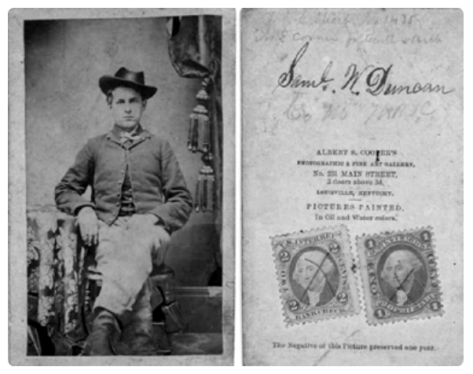
I could not find an image of Waldo but here is one of PVT. Samuel W. Duncan of Co. M, 7th Pennsylvania Cavalry (Photo Sleuth)
Waldo’s letter gives us an account of the Battle of Lebanon—a relatively small affair that took place in and near Lebanon, Tennessee on May 5, 1862. We learn that Waldo was not a witness to the event because he had been detailed to guard the baggage, but he relates how the regiment won the praise of General Ebenezer Dumont led the Union troopers into Lebanon and then pursued Colonel John Hunt Morgan’s Confederate cavalry all the way to the Tennessee river. Dumont’s force consisted of detachments from the 1st Kentucky Cavalry under Colonel Frank Lane Wolford, the 4th Kentucky Cavalry under Colonel Green Clay Smith, and the 7th Pennsylvania Cavalry under Colonel Wynkoop. Morgan’s force was the 2nd Kentucky Cavalry Regiment. Dumont surprised Morgan early on the morning of May 5, 1862. A 15-mile running battle ensued in which the Confederates were forced to retreat. During the fighting Confederate sympathizers in the town fired upon the Union Cavalry. Many of the remaining Confederates barricaded within the buildings surrendered when Dumont threatened to set the town on fire.
Note: This letter is from the personal collection of Greg Herr and was transcribed and published on Spared & Shared by express consent.
Transcription
Murfreesboro [Tennessee] May 9th, [1862]
Dear Parents,
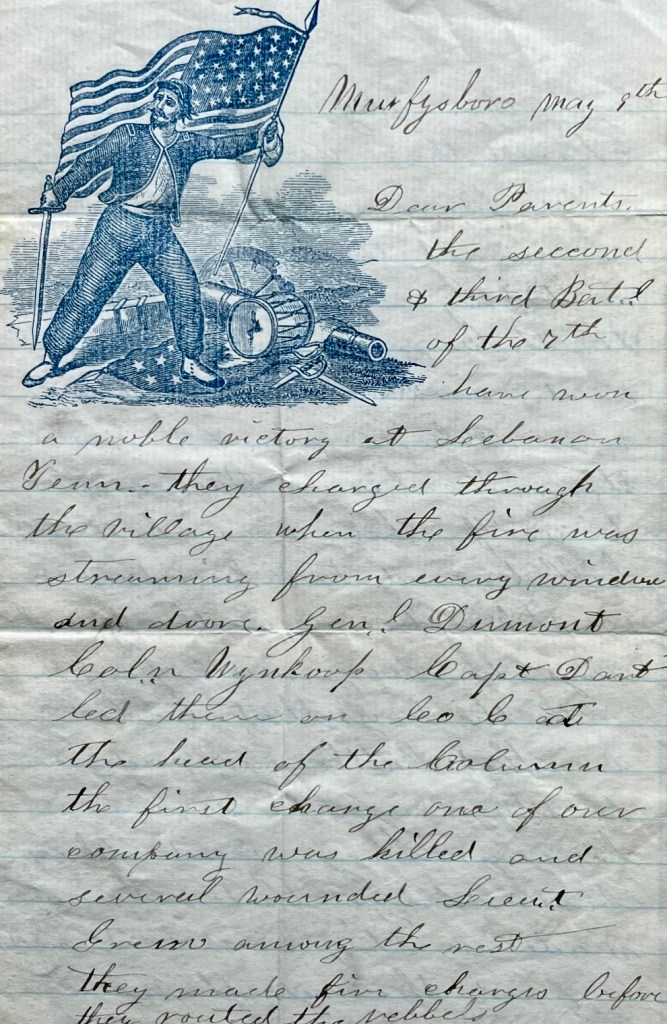
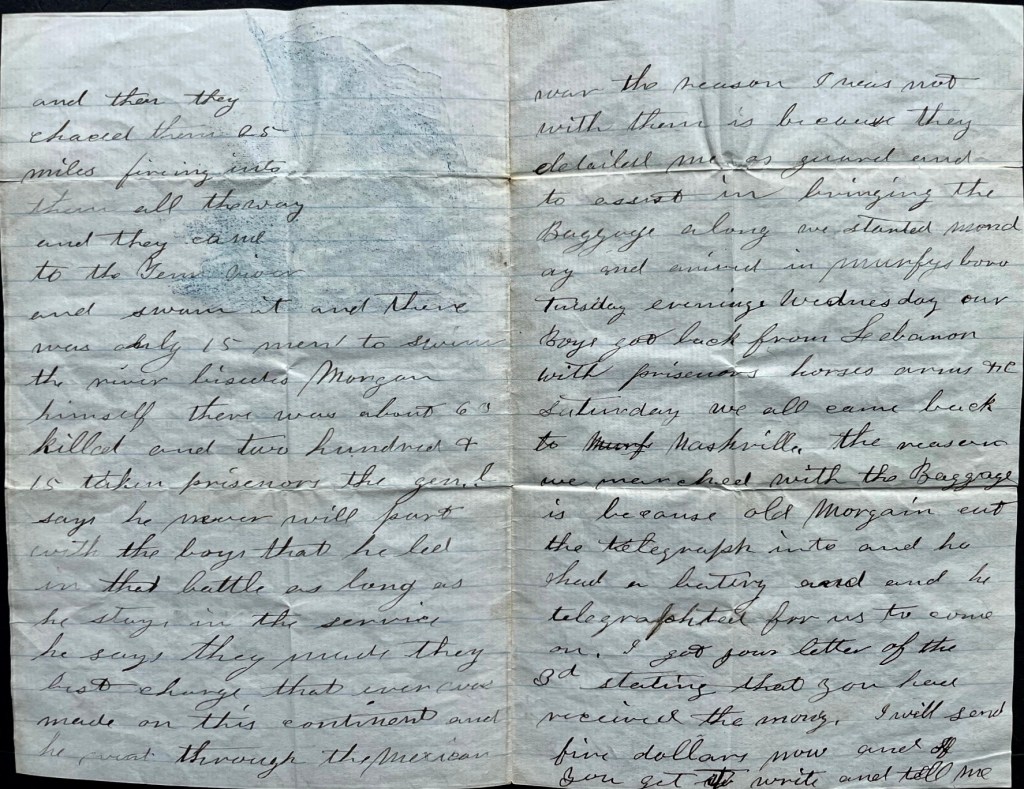
The second and third Battalion of the 7th have won a noble victory at Lebanon, Tennessee. They charged through the village when the fire was streaming from every window and door. Gen. Dumont, Colonel Wynkoop, Capt. Dartt led them on, Company C at the head of the column. The first charge one of our company was killed and several wounded—Lieut. Greir among the rest. They made five charges before they routed the rebels and then they chased them 25 miles, firing into them all the way and they came to the Tennessee River and swam it and there was only 15 men to swim the river besides Morgan himself. There was about 63 killed and two hundred & 15 taken prisoners. The General says he never will part with the boys that he led in that battle as long as he stays in the service. He says they made the best charge that ever was made on this continent and he went through the Mexican War.
The reason I was not with them is because they detailed me as guard and to assist in bringing the baggage along. We started Monday and arrived in Murfreesboro Tuesday evening. Wednesday our Boys got back from Lebanon with prisoners, horses, arms, &c. Saturday we all came back to Nashville. The reason we marched with the baggage is because Old Morgan cut the telegraph in two and he had a battery and he telegraphed for us to come on.
I got a letter of the 3rd stating that you have received the money. I will send five dollars now and if you get it, write and tell me. If I can get a paper, I will send it to you if it has an account of the battle in it. I am enjoying good health and living in hopes that we may see more fighting before the war is closed for I will not die in the battlefield unless I was born to.
This is the most even country I have ever seen. We saw one range of mountains just before we got to Murfreesboro. They must have been 30 miles from us at least. The forest trees are oak, spruce, and some maple. If you get any account of our battle in the papers, I wish you would send it. — Waldo Spear, Co. C, 7th Pennsylvania Vol. [Cavalry]. Camp Worth, Nashville.
The following letter was written by Augustus Smith (1839-1864), the son of Harry Smith (1802-1887) and Almira Naramore (1806-1899). He was born in Underhill, Vermont.
Augustus was a single, 22 year-old farmer residing in New Ipswich, New Hampshire when he enlisted on 23 December 1861 in Co. M, 1st New England Cavalry (1st Rhode Island) under Capt. William P. Ainsworth. He was sick in General Hospital from May 1862 until Aug. 1862; June 18, 1863, taken prisoner near Middleburg, VA; subsequently paroled at Annapolis, MD; Jan. 5, 1864, re – mustered as a veteran volunteer at Catlett’s Station, VA and transferred to New Hampshire Cavalry by order dated Jan. 7, 1864; died Oct. 6, 1864 at Columbia Furnace, Shenandoah Co. VA, age 25y, 3m; burial at Church Street Cemetery, Swanton Franklin Co. Vermont.
Transcription
Camp Arnold Pawtucket, Rhode Island February 16, 1862
Sister Jane,
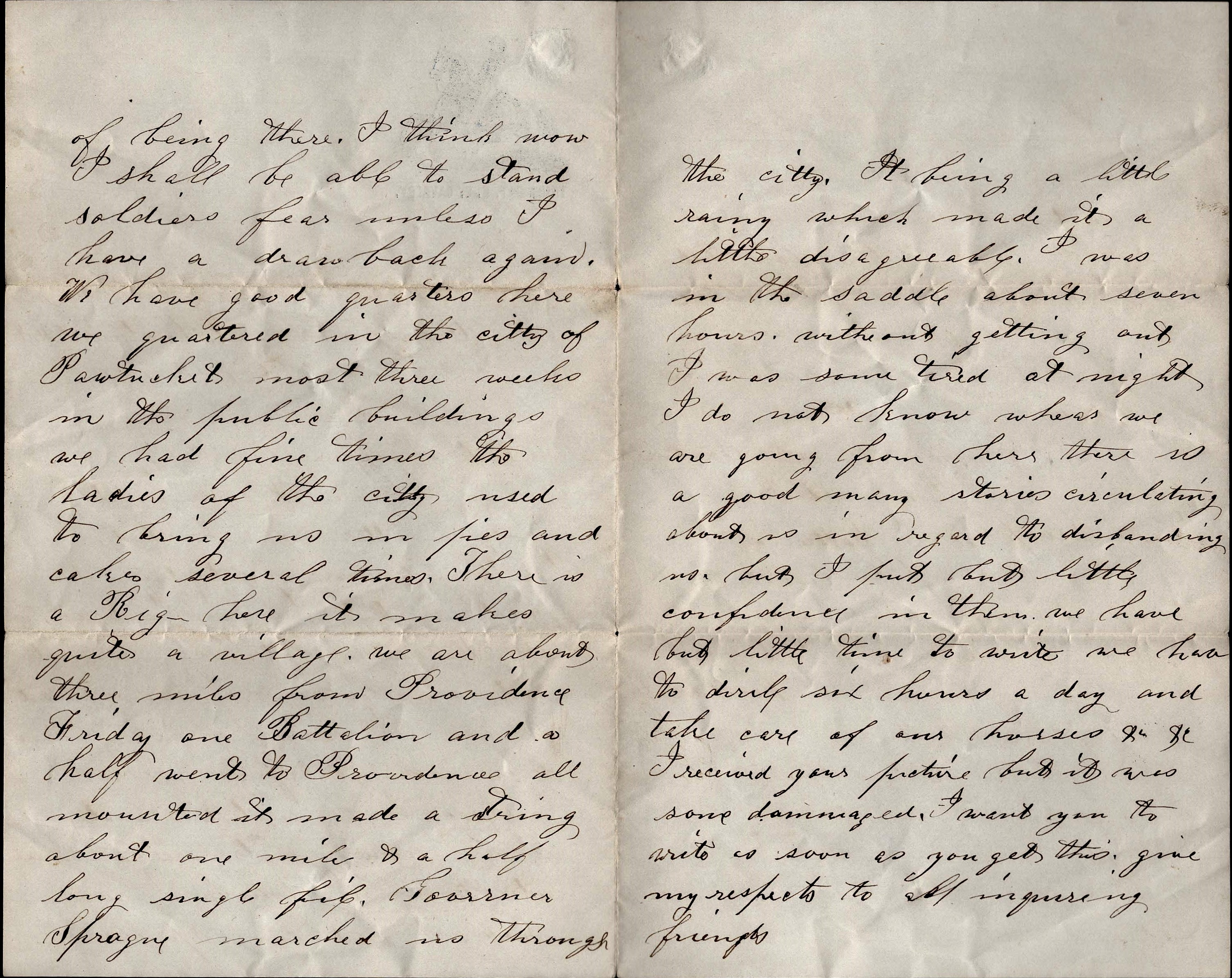
I received your letter of the 9th with pleasure yesterday. I had waited long and anxious. I have nothing to write but our camp news as that is all I hear. I have been sick about five weeks since I enlisted but am now quite well. I was at Rollins while I was sick. I had two spells of being there. I think now I shall be able to stand soldier’s fare unless I have a draw back again.
We have good quarters here. We quartered in the city of Pawtucket most three weeks in the public buildings. We had fine times. The ladies of the city used to bring us in pies and cakes several times. There is a regiment here. It makes quite a village. We are about three miles from Providence.
Friday one battalion and a half went to Providence all mounted. It made a string about one mile & a half long single file. Governor Sprague marched us through the city. It being a little rainy which made it a little disagreeable. I was in the saddle about seven hours without getting out. I was some tired at night. I do not know where we are going from here. There is a good many stories circulating about us in regard to disbanding us but I put but little confidence in them. We have but little time to write. We have to drill six hours a day and take care of our horses &c., &c.
I received your picture but it was some damaged. I want you to write as soon as you get this. Give my respects to all inquiring friends. Write all the news and a good long letter for that is what we soldiers like. Yours as ever, — Augustus
Address: Camp Arnold, Pawtucket, R.I. Troop M, 3rd Battalion, N.E. Cavalry, Commanded by Capt. Wm. P. Ainsworth
The following letter was written by Samuel Hall (1836-1863) of Marshall, Marshall county, Iowa. Samuel was married in Fulton county, Indiana to Mary Elizabeth Meredith (1831-1899) in 1855 and in the 1860 US Census he was enumerated in Jefferson township of Marshall county with his wife Mary and two sons, Isaac (age 2) and Leonard (age 7 months). He was a farmer. Samuel enlisted in 13 August 1862 and was mustered in as a private in Co. K, 23rd Iowa Infantry on 1 September 1862. He became ill in the service and in an attempt to see his wife and children before he died, he battled his way home and, according to family tradition, knocked on the door and died on the threshold. His date of death was recorded as 27 August 1863. He was 27 years old.
I could not find an image of Samuel but here is one of George W. Grigsby who served in Co. B, 23rd Iowa Infantry. (Iowa Civil War Images)
The 23rd Iowa was organized at Des Moines and ordered to St. Louis, Missouri, where they were attached to the Department of Missouri. Their duty was at Camp Patterson when this letter was written in November 1862. In his letter, Samuel describes the march from Camp Patterson to Pitman’s Ferry on the Current River, the skirmish there with Confederates, and the march to Pocahontas before marching back to Camp. Patterson. The Skirmish at Pitman’s Ferry is described below from official reports:
On October 27, 1862, Union Colonel William Dewey surprised Confederate Colonel John Q. Burbridge’s Brigade at Pitman’s Ferry (Randolph County). Dewey’s rapid combined-arms attack temporarily won control of the ferry and allowed for the reconnoitering of the Pocahontas (Randolph County) area.
“Near 8:00 a.m. October 27, the Confederate force reported to be Burbridge’s Brigade aligned for battle on the Arkansas side of the river. Dewey formed his line straddling the road about 100 yards from the ferry in Missouri. Deploying his artillery in the center, Federal troops began firing on the Confederate artillery deploying over the river, effectively scattering it and weakening the determination of the defenders. The Twenty-third Iowa positioned itself on the bank to deliver cover fire for the Twenty-fifth Missouri, which crossed the river and lightly skirmished with the Confederates, forcing them to retreat.
In possession of the ferry, Dewey ordered his exhausted men into camp, as they had covered sixty-five miles in two and a half days. On October 29, Dewey linked with Lazear at Bollinger’s Mill, about fifteen miles inside Randolph County, before sending reconnoitering parties toward Pocahontas. On October 30, Dewey began his return to Camp Patterson, reaching the site on November 2.” [Source: Skirmish at Pitman’s Ferry, October 27, 1862, Encyclopedia Arkansas]
Transcription
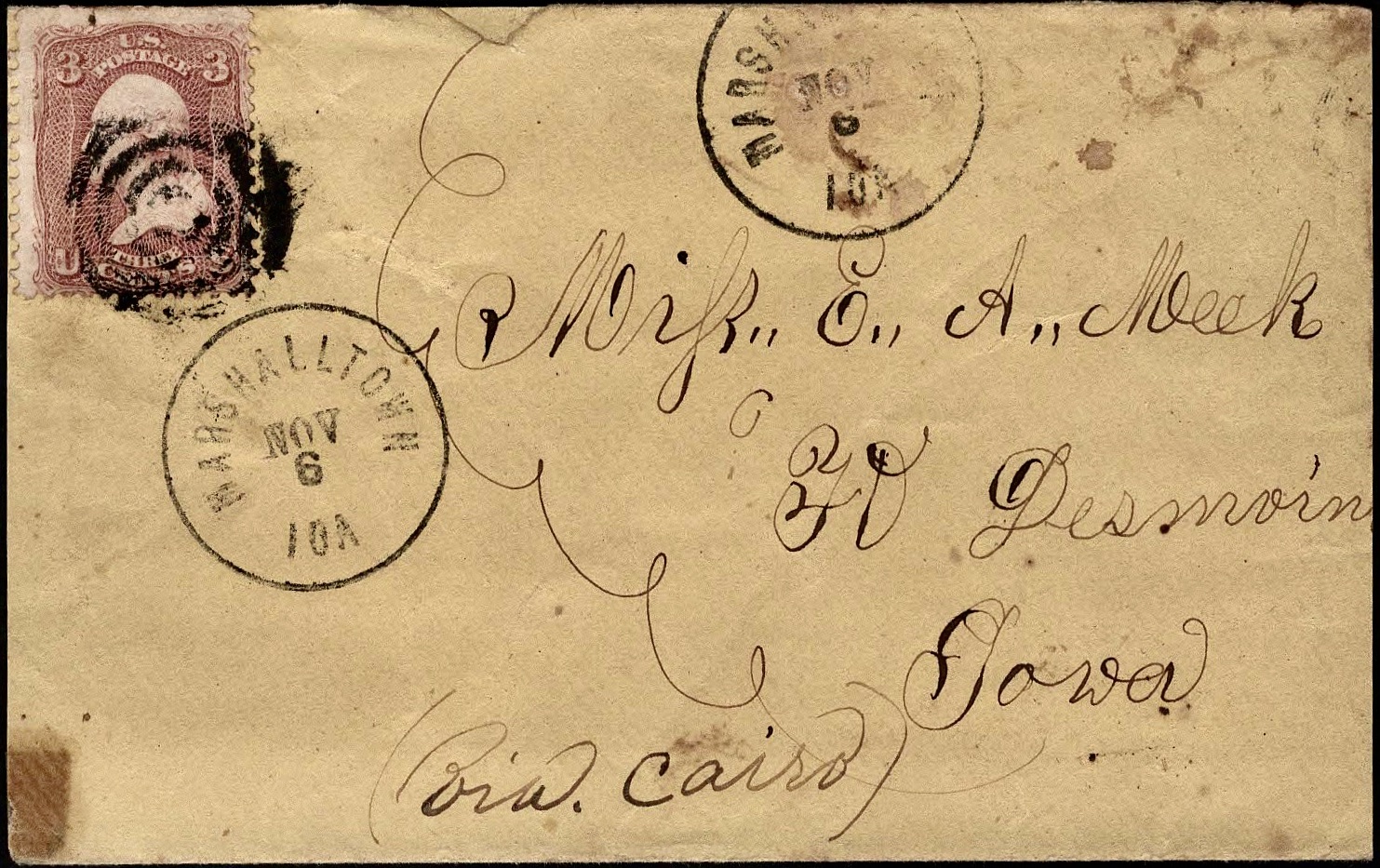
Addressed to Miss E. A. Meek, Des Moines, Iowa (via Cairo)
Camp Patterson November 4, 1862
I once more sit down to let you know that I am well at present and I hope this letter will find you the same.
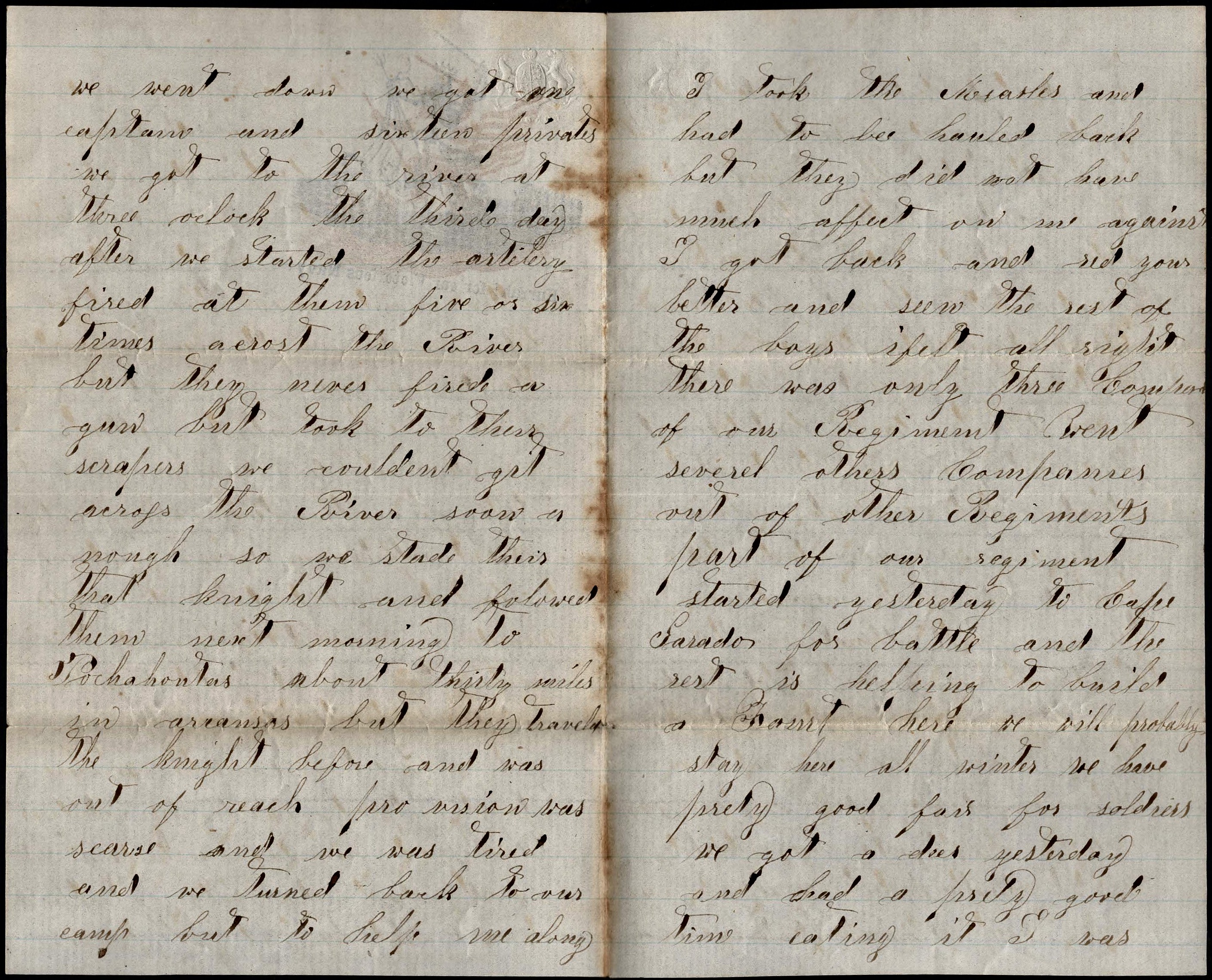
We left this camp the 25th of October for Pitman’s Ferry on Current River 80 miles from camp. We was called up in the night about twelve o’clock and they told us to fix for eight days march to rout four thousand Rebels. We marched night and day till we got there. We took their pickets as we went down. We got one Captain and sixteen privates. We got to the river at three o’clock the third day after we started. The artillery fired at them five or six times across the river but they never fired a gun but took to their scrapers. We couldn’t get across the river soon enough so we stayed there that night and followed them next morning to Pocahontas about thirty miles in Arkansas, but they traveled the night before and was out of reach. Provision was scarce and we was tired and we turned back to our camp. But to help me along, I took the measles adn had to be hauled back. But they did not have much effect on me against I got back and read your letter and seen the rest of the boys. I felt alright. There was only three companies of our regiment went.
Several other companies out of other regiments [with] part of our regiment started yesterday to Cape Girardeau for battle and the rest is helping to build a fort here. We will probably stay here all winter. We have pretty good fare for soldiers. We got a deer yesterday and had a pretty good time eating it. I was weighed today and I weighed 150 pounds. My weight is 150 for common. I wrote to William and you not long ago. I am going to write to George Randle this evening if I can. I would like to see the folks and would like to have been at that little bust up at our house. How I would [have] made them [funnybeans?] fly. But that [is] nothing.
The Colonel had a dance and I was there and the girls was all over in a minute and back again. Who wouldn’t be a soldier? But that isn’t half. Write soon. — Samuel H. to Miss Meeks
The following letter was written by Charles Frederick Urban (1838-1916) of Co. H, 13th Pennsylvania Reserves (42nd Pennsylvania Infantry), also known as the 1st Pennsylvania Rifles, Kane’s Rifles, or simply the “Bucktails.” Charles enlisted on 1 August 1861. He was wounded on 19 August 1864 in the fighting at Weldon Railroad and was taken prisoner. He was released in March 1865.
Charles was born in Saxony (Germany) and was laboring as a stone mason in Lebanon, Lebanon county, Pennsylvania, when he volunteered to fight for the stars and stripes. He was barely literate and I had to interpolate a bit to make any sense of his letter.
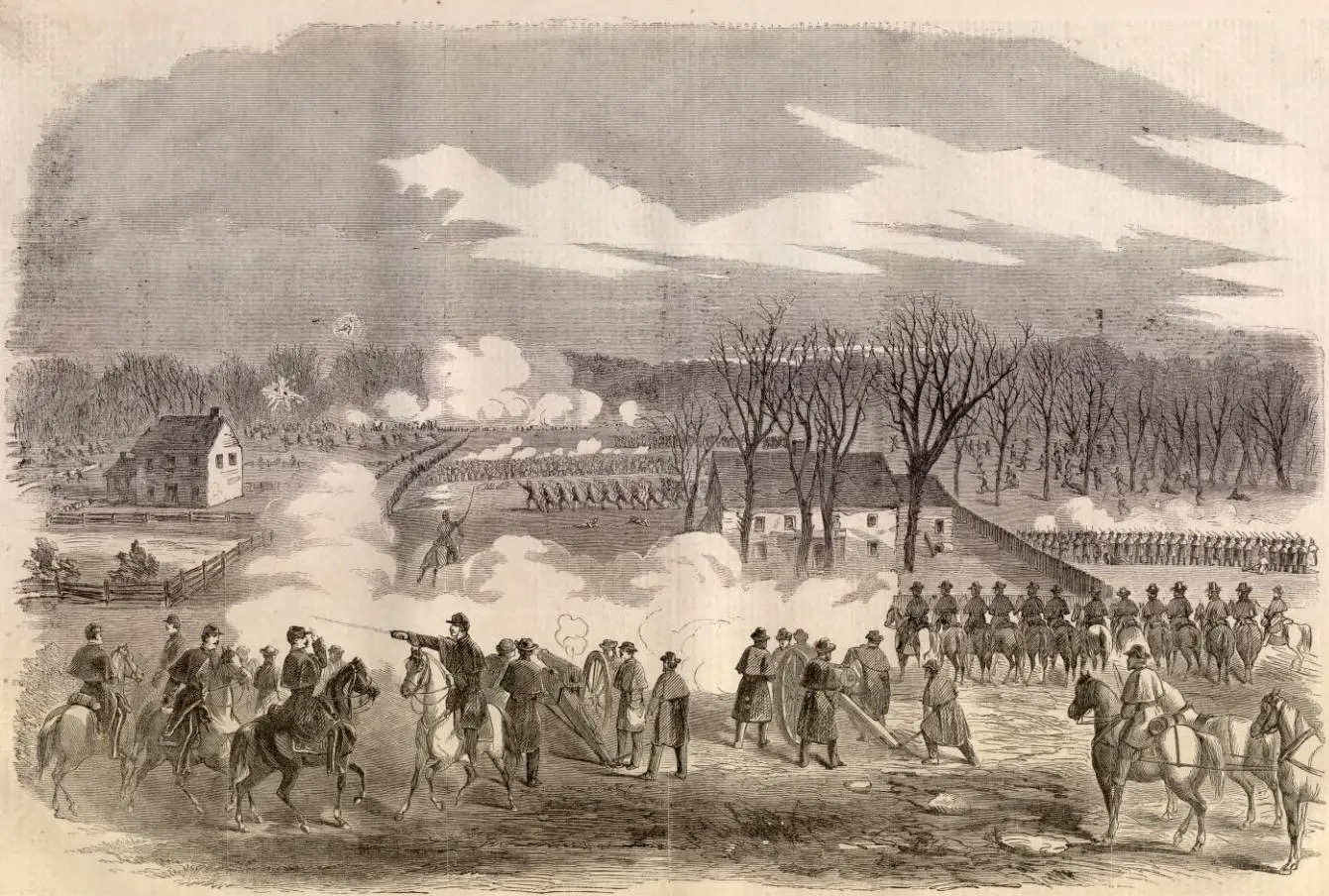
The letter appears to have been datelined from Pierpont on December 1 but I suspect the fighting described refers to the Battle of Dranesville which occurred on 20 December 1861. It was in that battle that Col. Thomas L. Kane was wounded (though not in the penis, that I am aware of).
The Battle of Dranesville
Transcription
Camp Pierpont [near Langley, Va.] December 1, [1861]
Dear friend,
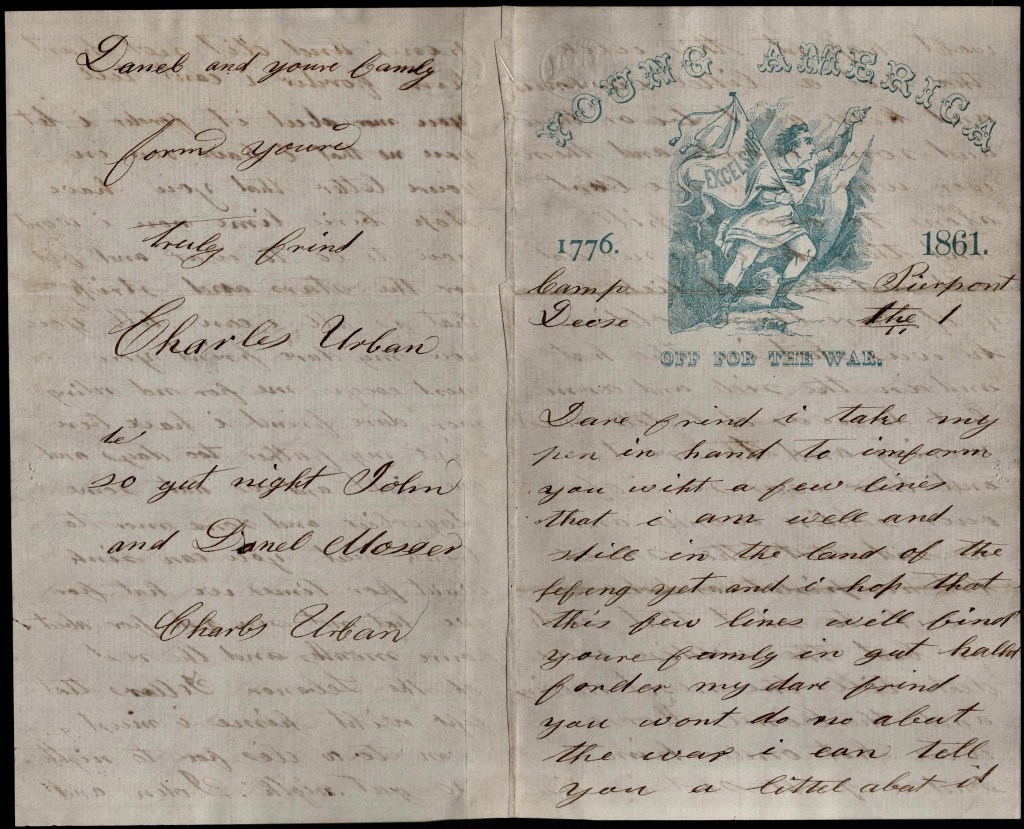
I take my pen in hand to inform you with a few lines that I am well and still in the land of the living yet and I hope that this few lines will find your family in good health.
My dear friend, you wanted to know about the war. I can tell you a little about it what happened this week. They had a little [ ] and killed two or three and some wounded and them that were wounded we carried along to our hospital and when he was near dead, said he could lick four of our Union Soldiers. He was shot in the head and in the side and arm, but he was dead the next morning and the rest [too]. There was one of our soldiers wounded and he said that they should get his pistol and shoot that secesh but the soldier was dead the next morning. The Colonel’s horse was shot under him and a [ ] shot in his penis and did not hurt him further. I cant tell you more about it.
Further, I let you know that I have seen in your letter that you have stopped berry time now [and] I want you to come to war and fight for the stars and stripes. That is all I can tell you now, my dear friend. You must excuse me for not writing more. Dear friend, I have been with my father two days and one night and we had some Lager beer and some more to drink, but you can see what fun times we had for we have not seen each other for about four months and the rest of the Lebanon fellers that left with him.
I must come to a close for tonight. So good night John and Danel and your family. From your true friend, — Charles Urban
The following letter was written by Homer Sargent Bean (1833-1862) of Co. B, 3rd Maine Infantry, who gives an account of the Battle of Bull Run which took place on Sunday, 21 July 1861. The 3rd Maine Infantry was attached to Howard’s Brigade, Heintzelman’s Division of McDowell’s Army of Northeastern Virginia. Though the regiment entered into the battle, they suffered few battle casualties. The official records—2 killed, 4 wounded, 25 captured, 2 deserted, for a total of 33.
I could not find an image of Homer but here is one of Herman S. Webber of Co. B, 3rd Maine Infantry (1861)
Composed primarily of Kennebec lumbermen, the 3rd Maine was mustered in at Augusta for a three-year term of service on June 4, 1861, departing for the front lines the following day. It has been posited that “perhaps no regiment from the state saw more fighting or rendered more distinguished service.” From the First Battle of Bull Run to the Battle of Cold Harbor, the regiment participated in numerous significant battles and military movements. During the first Bull Run, the 3rd was under the command of Colonel Oliver O. Howard (1830–1909), who rapidly ascended to the rank of Major General and emerged as a prominent national figure. At the Battle of Fair Oaks, the 3rd sustained losses of nearly a third of its forces, and Howard suffered the loss of his right arm.
Homer was the son of Jeremiah Robinson Bean (1806-1880) and Sarah Cammett (1801-1857) of Augusta, Kennebec county, Maine. He did not survive the war. He died of disease on 22 November 1862 and was buried in the US Soldiers’ and Airmens’ Home National Cemetery, Site D 4441.
The 3rd Maine Encampment at Clermont, Fairfax county, Va.
Transcription
Clermont, Fairfax county, Virginia 1 August 4th 1861
Dear Father and Mother,
It is with pleasure that I seat myself to converse with you a few moments by the silent movings of the pen to inform you of my health which is good—only I had the toothache the other day and I went to the doctor and had it pulled out and my jaw has ached ever since. But it is easy today.
George is well and sends his love to you. Frank is well and sends his love to you.
I suppose you have heard about the battle we had with the rebels. It was two weeks ago today. We had a hard time of it. We were called into ranks at half past one o’clock a.m. and at an hour later, we started. But on account of being the last brigade, we had in the commencement a very slow march and laid exposed to the burning rays of the sun without the least shade for several hours.
Finally we had orders to advance and were drove with such haste that a good many had to give out and fall back, and we were almost beat out by running until we reached the battlefield. What was the worst of it was the scarcity of water. We were real glad to find mud puddles which at home we would not offer to our horses or cattle and quenched our thirst with them for the heat was awful and not the slightest breeze stirring. The consequence was that we were defeated and returned in somewhat confusion until we reached our camp we left in the morning. We halted here for a few hours and then retreated from there in good order back to Alexandria where we stopped about a day and a half and then went out again to the place where our tents was pitched and [have] remained here ever since.
We suffered a good deal in them two days and a good many of us have not got over it yet but we have now time enough to rest and think we shall get over it soon. Our duty now is nothing more than common camp duty such as standing guard and drilling and we are favored as much as possible, but the weather is very not here and that causes us considerable sweating.
Give my love to all inquiring friends. I cannot think of any more to write now. Write as soon as you get this. Write all of the news. Now I must close by bidding you goodbye till I hear from you.
— H. S. Bean
Write how Piggy gets along and tell Cluckey to lay a lot of eggs for I want some when I get home. — H. S. Bean
1 The 3rd Maine Infantry’s encampment was at F. Forrest’s plantation, Clermont, a quarter of a mile south of Bush Hill, Scott’s farm, Fairfax county, Virginia.
The following letter was written by Alexander F. Swartwout (b. 1822) who first served for three months in the 20th New York State Militia early in the Civil War. This regiment was later reorganized in as the 80th New York Infantry; Alexander was in Co. B. He was actually serving in the 80th NY Infantry at the time he wrote this letter in February 1862 although he gave his unit designation as the 20th NYSM.
Alexander was a cheese-maker by profession. He was described as standing 5′ 4.5″ tall, with blue eyes and sandy hair. He mustered out of the regiment on 29 January 1866.
A post published comment received by reader who presumably knows more than I do so I share: “The 20th New York State Militia never mustered into Federal service under any other number. The attempted number change by the nefarious Governor Morgan was merely a political ploy. The 20th was paid under this number by the Federal Government. The regiment was never issued rifled muskets from Prussia—-the 90 day soldiers carried model 1842 Springfields and at the writing by Swarthout, the regiment had been issued .54 caliber Austrian Lorenz rifled muskets which proved to be fine and were still in service at Gettysburg. Late in 1863 and after the 20th were issued Springfields.”
Transcription
Upton Hill, Virginia February 3, 1862
My dear friend,
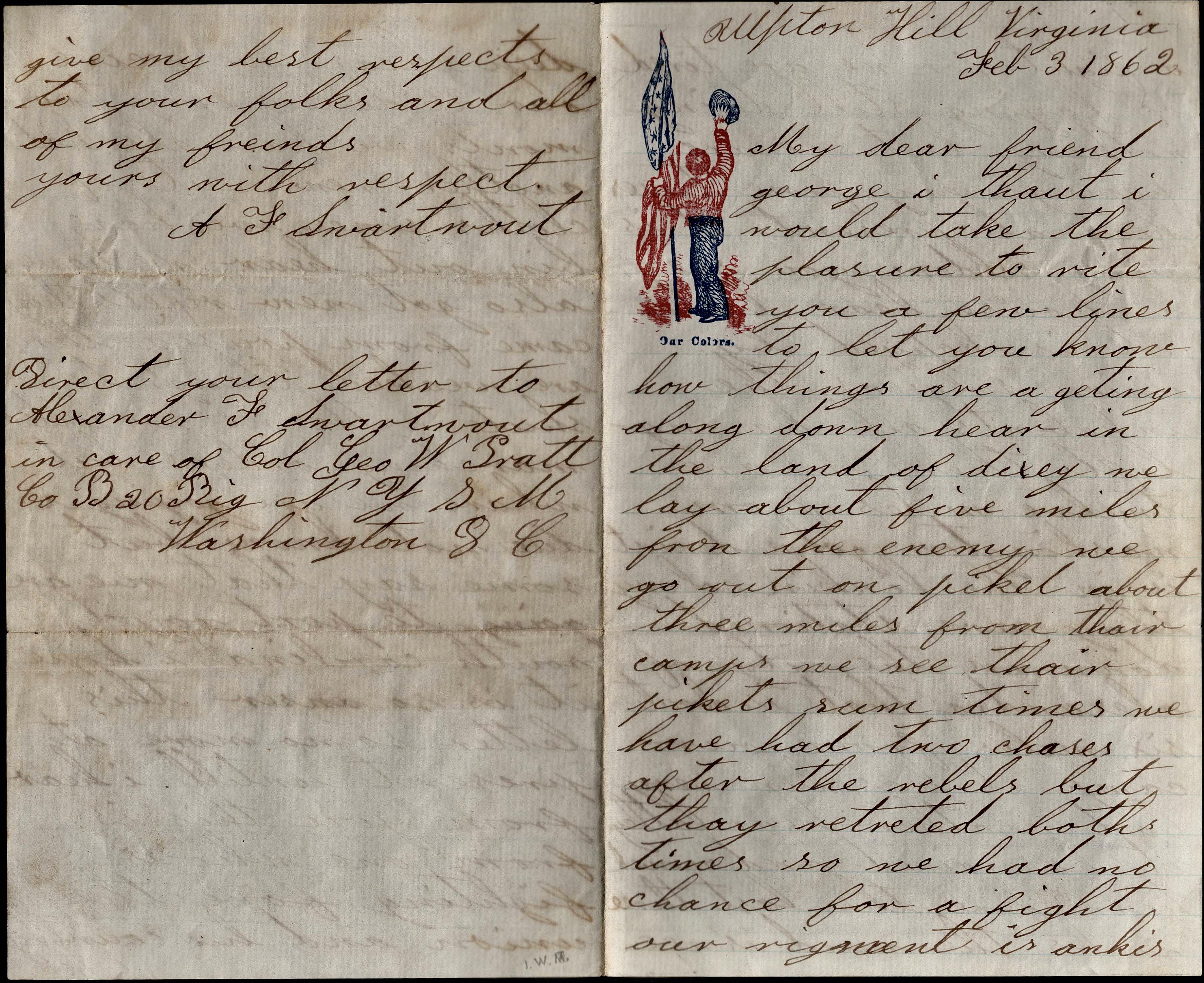
George, I thought I would take the pleasure to write you a few lines to let you know how things are a getting along down here in the land of Dixie. We lay about five miles from the enemy. We go out on picket about three miles from their camps. We see their pickets sometimes. We have had two chases after the rebels but they retreated both times so we had no chance for a fight.
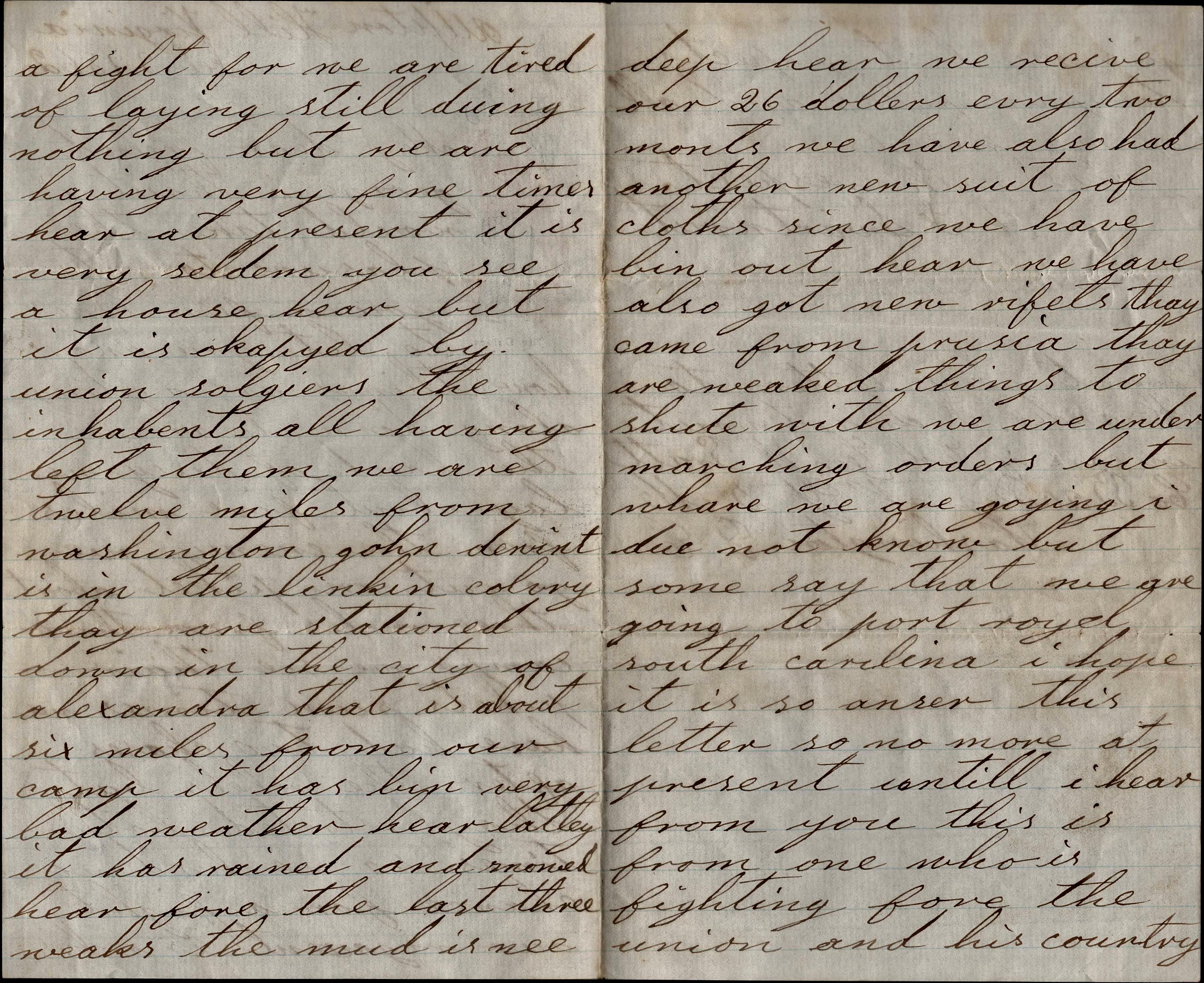
Our regiment is anxious [for] a fight for we are tired of laying still doing nothing but we are having very fine times here at present. It is very seldom you see a house here but it is occupied by Union soldiers, the inhabitants all having left them. We are twelve miles from Washington.
John D____nt is in the Lincoln Cavalry. They are stationed down in the city of Alexandria. That is about six miles from our camp. It has been very bad weather here lately. It has rained and snowed here for the last three weeks. The mud is knee deep here.
We receive our 26 dollars every two months. We have also had another new suit of clothes since we have been out here. We have also got new rifles. They came from Prussia. They are wicked things to shoot with. 1 We are under marching orders but where we are going, I do not know but some say that we are going to Port Royal, South Carolina. I hope it is so.
Answer this letter. So no more at present until I hear from you. This is from one who is fighting for the Union and his country. Give my best respects to your folks and all of my friends. Yours with respect. — A. F. Swartwout
Direct your letter to Alexander F. Swartwout in care of Col. George W. Pratt, Co. B, 20 Regiment, N. Y. S. M., Washington D. C.
1 Alexander states that the 80th New York Infantry had been issued “Prussian Rifles” that were “wicked” to shoot. An article by Dan Masters entitled, “Arming the Empire State: Arms Issued to the New York Regiments in 1861” states that “the 80th New York, the old 20th New York State Militia, left the state with the flank companies armed with rifle and the line companies armed with Model 1842s. This image of six soldiers dates from 1862 when it was part of General Irvin McDowell’s First Army Corps.”It isn’t clear from Alexander’s statement whether the entire regiment was issued Prussian Rifles or not, and if so, what model they received. If they received the Dreyse Needle Rifle, it may explain why he considered them “wicked.”
The following letter was written by Reuben Wheeler (1819-1882), the son of Charles Wheeler (1783-1843) and Lucy Winch of Natick, Massachusetts. Reuben was married in Natick in 1841 and relocated with his family to Depere, Brown county, Wisconsin, prior to 1850. In September 1861, Reuben volunteered to serve as a corporal in Co. F (“Depere Rifles”), 14th Wisconsin Infantry. This regiment was sometimes called the “Northwestern Regiment” or the “Wisconsin Regulars” for their gallantry on the battlefield. Reuben was wounded at Vicksburg on 22 May 1863 but survived and was commissioned a 2nd Lieutenant before war’s end.
Transcription
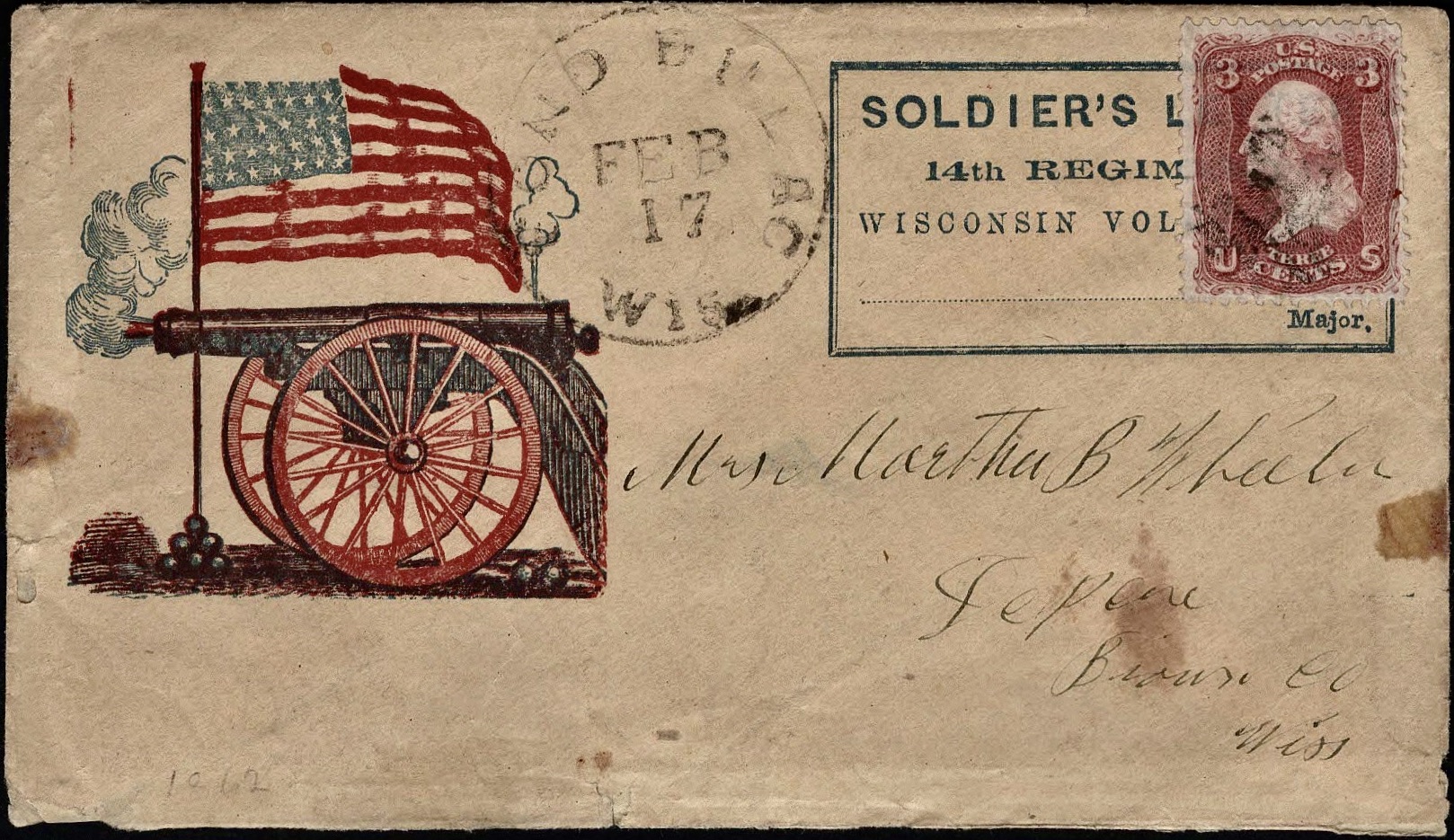
Addressed to Mrs. Martha B. Wheeler, Depere, Brown county, Wisconsin
Camp Wood [Fond Du Lac, Wisconsin] February 16, 1862
Dear Wife,
I received your letter of the 13th and 15th and was glad to hear that Herbert was getting so much better. I hope your breast will not trouble you again. You must be careful and not do anything to irritate it.
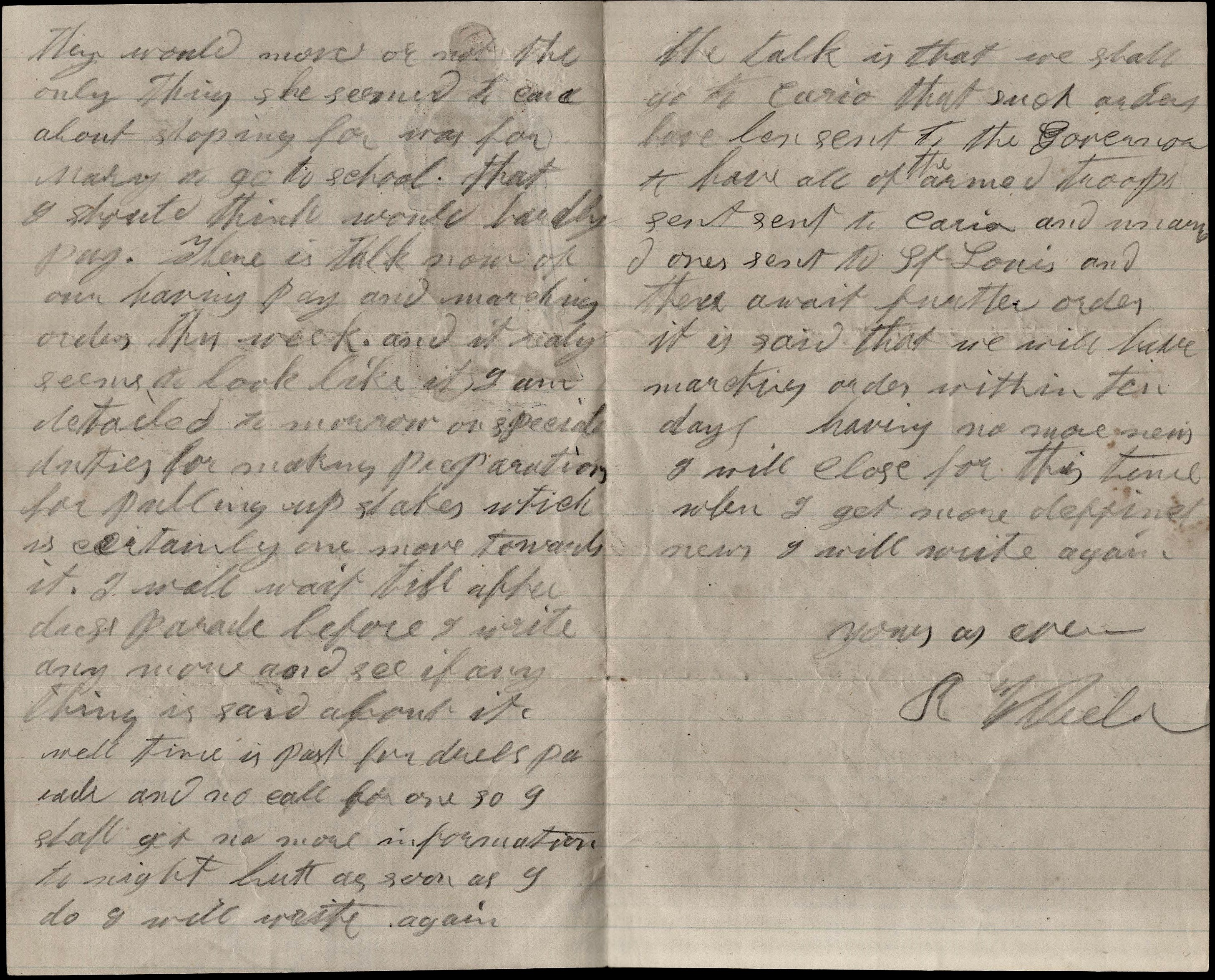
It has been very cold here for a few days, but is more moderate now. I was doing guard duty on Friday. I think it was as cold at 12 o’clock that night as I ever saw it. It seems that Mr. Blake is really a going to move. I called on them when I was coming up. Mrs. Blake did not seem to know whether they would move or not. The only thing she seemed to care about stopping for was for Mary to go to school. That I should think would hardly pay.
There is talk now of having pay and marching orders this week and it really seems to look like it. I am detailed tomorrow on special duties for making preparations for pulling up stakes which is certainly one move towards it. I will wait till after dress parade before I write any more and see if anything else is said about it.
Well, time is past for dress parade and no call for one so I shall get no more information tonight, but as soon as I do I will write again. The talk is that we shall go to Cairo—that such orders have been sent to the Governor to have all of the armed troops sent to Cairo and the remaining ones sent to St. Louis and there await further orders. It is said that we will have marching orders within ten days.
Having no more news I will close this time. When I get more definite news, I will write again.
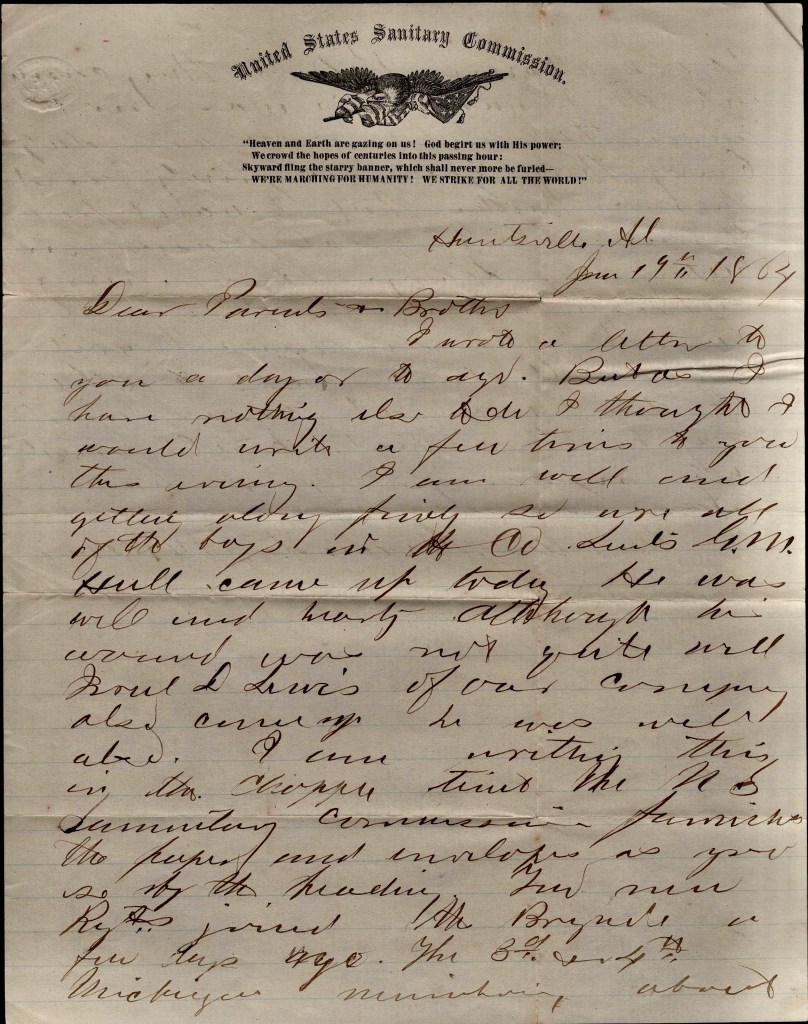
The following letter was written by Cpl. Ovando M. Messer (1842-1938) of Co. C, 19th Ohio Infantry. Ovando was the son of Loren Sanborn Messer (1816-1890) and Chestina Waterbury Cook (1815-1892) of Warren, Ohio.
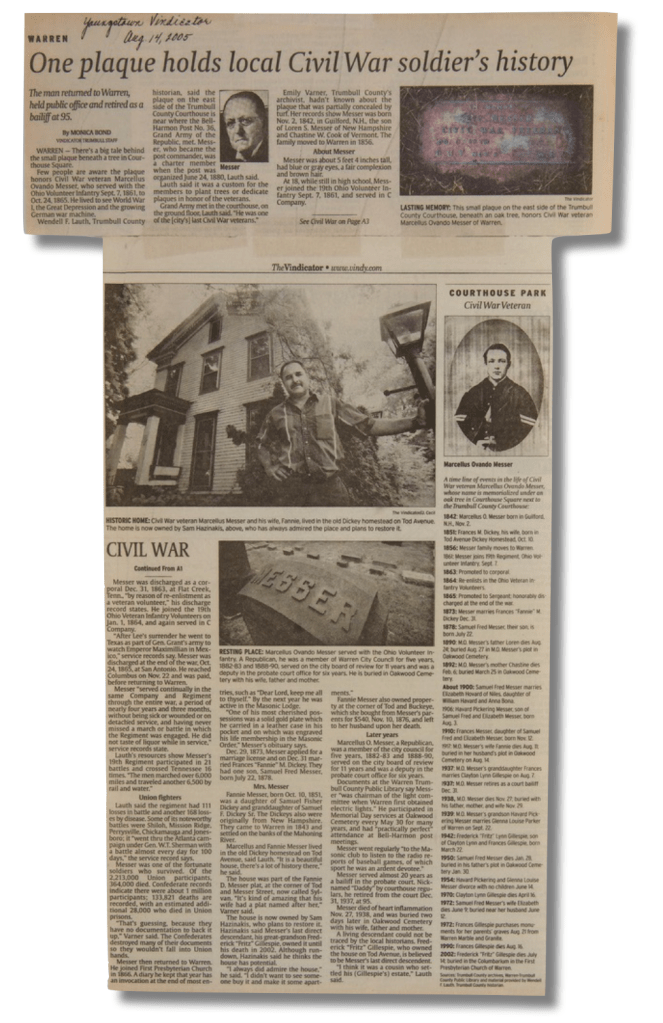
Marcellus Ovando Messer (who variously signed his letters Ovando Messer, Ovando M. Messer, or M. Ovando Messer) was born on 2 November 1842 in Guilford, Belknap County, New Hampshire. In 1856 he moved with his family to Warren, Trumbull County, Ohio, and in September 1861 was mustered in to Company C, 19th Ohio Volunteer Infantry. He would remain with Co. C of the 19th Ohio to the end of the war (and beyond), serving in the Army of the Ohio (to November1862), the Army of the Cumberland (to October 1863), IV Corps (to August 1865), and the Department of Texas (to October 1865), reenlisting on January 1, 1864.
Messer served in many of the major campaigns of the war’s western theater, mainly in Tennessee and Georgia. He was present at a number of significant engagements, including the battles of Shiloh, Murfreesboro, Chickamauga, and Nashville. He served in Sherman’s Atlanta campaign. In the summer of 1865 he and the 19th Ohio were among the troops sent to Texas to keep an eye on Emperor Maximilian I in Mexico. He was mustered out in San Antonio on 21 October 1865. Though Messer’s letters report a number of close calls, he concluded his four years of service without serious injury or illness. He married Frances M. “Fannie” Dickey in 1873 and remained in Warren, Ohio until his death on 27 November 1938.
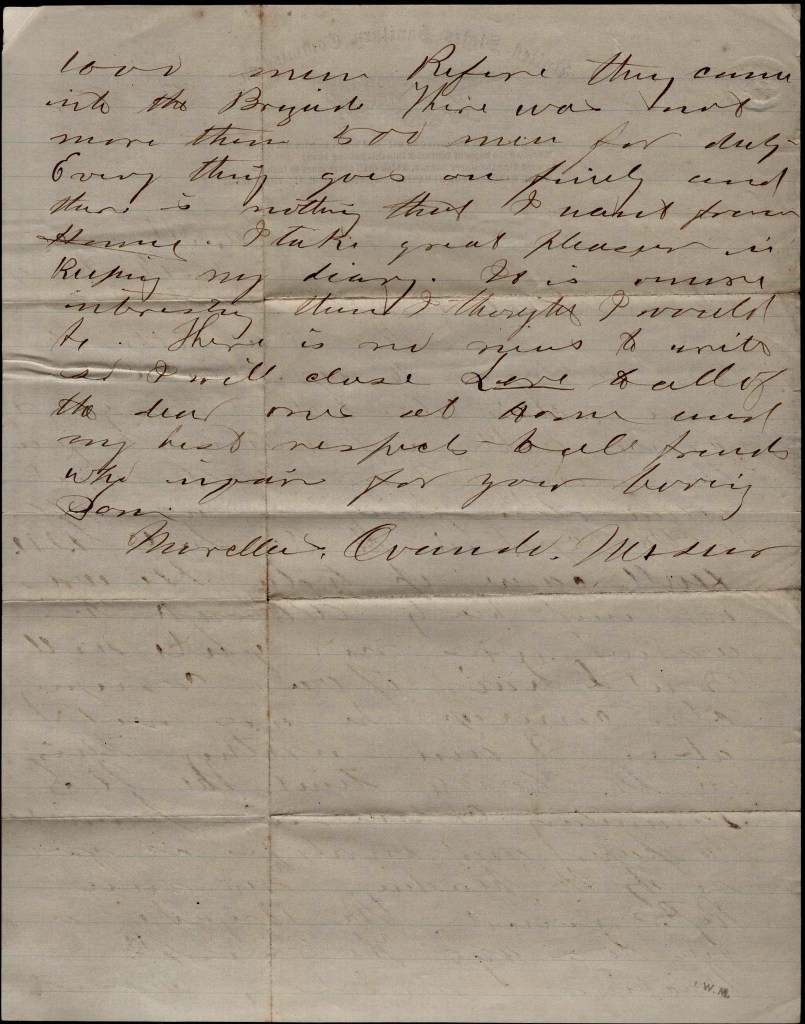
I wrote a letter to you a day or two ago, but as I have nothing else to do, I thought I would write a few lines to you this evening. I am well and getting along finely. So are all the boys in the company. Lieut. G. M. Hull came up today. He was well and hearty although his wound was not quite well. Israel D. Lewis of our company also came up. He was well also. I am writing this in the chapel [ ]. The U.S. Sanitary Commission furnishes the paper and envelopes as you see by the heading. Two new regiments joined the Brigade a few days ago—the 3rd & 4th Michigan—numbering about 1,000 men. Before they came into the Brigade, there was not more than 500 men [fit] for duty. Everything goes on finely and there is nothing that I want from home.
I take great pleasure in keeping my diary. It is more interesting than I thought it would be. There is no news to write so I will close.
Love to all of the dear ones at home and my best respects to all friends who enquire for your boring son. — Marcella Ovando Masur
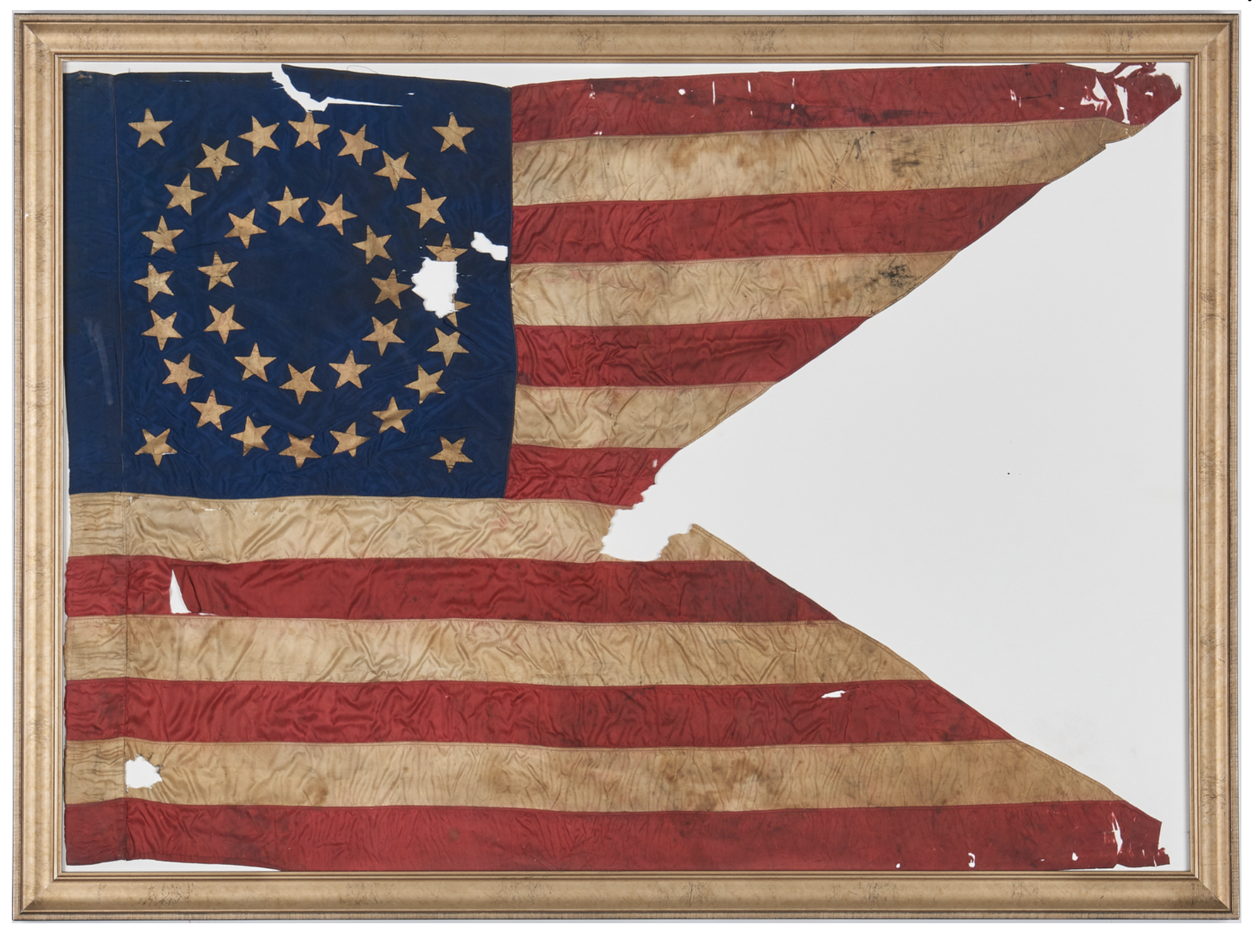
Civil War Union Cavalry Swallowtail Guidon Flag belonging to Corporal Marcellus Ovando Messer (1842-1938), 19th Regt., Ohio Volunteer Infantry, Company C. The silk flag has a double wreath of 35 gilt-painted stars, indicating use between the admission of West Virginia as a state in 1863, and the admission of Nevada in 1865; canton and stripes are pieced and treadle-sewn. 26 14″ x 36 3/4″ sight, 30″ x 40″ framed. Note: according to flag historian Greg Biggs, the U.S. contracted for more of these guidons than the cavalry could use, so standards like this one were issued to infantry regiments as guide flags, which were placed on the left and right flanks of the regiment to help form their line of battle. The battles in which the 19th Ohio engaged were among the war’s most infamous and included Shiloh, Missionary Ridge, and Chickamauga. They also participated in the Atlanta campaign, under General William Tecumseh Sherman. In all, the 19th regiment participated in 21 battles and crossed Tennessee 16 times, marching over 6,000 miles and traveling another 6,500 by rail and water. Cpl. Messer was born Nov. 2, 1842 in Guilford, New Hampshire. His family moved to Warren, Ohio when he was 14. When the Civil War broke out, Messer joined the 19th Ohio Volunteer Infantry, Company C., on Sept. 7, 1861 and was promoted to Corporal in 1863. According to his discharge record, he was discharged as a corporal on Dec. 31, 1863 at Flat Creek, Tennessee “by reason of re-enlistment as a veteran volunteer” and again served in C Company.
After Lee’s surrender, he went to Texas as part of General Grant’s army to monitor Mexican Emperor Maximillian. He was discharged Oct. 24, 1865 at San Antonio. According to his records, he “served continually in the same Company and Regiment through the entire war… without being sick or wounded or on detached service, and having never missed a battle in which the regiment was engaged. He did not taste of liquor while in the service.”
After the war, Messer returned to Warren, Ohio, and married Frances “Frannie” M. Dickey. They had one son and lived in the old Dickey homestead. Messer, a Republican, went on to serve as a member of the city council for five years in the 1880s and on other municipal boards. He also served as a bailiff in the Probate Court for more than 20 years.
Note: Some of this biographical information comes from a newspaper article on Messer in the Youngstown OH Vindicator newspaper, August 14, 2005. A copy of the article is included with this lot. Provenance: by descent in the Messer family to present consignor. Note: remnants of a box formerly used to store the flag bore this inscription: “A regimental flag of the 19 O.V.I. carried during Nov. 1861-65.” CONDITION: 4 1/4″ tear upper center canton, with two holes – 2″ diameter and 1 1/2″ L – at center right edge of canton. Two 1″ to 1 1/2″ L holes to stripes along sleeve. Center with 3″ hole/loss; each tip with losses and fraying. Several other small holes and slits; light fading, staining, discoloration and creasing throughout. Flag has been mounted (not glued down) atop white matting, under acrylic, and framed in a molded giltwood frame.