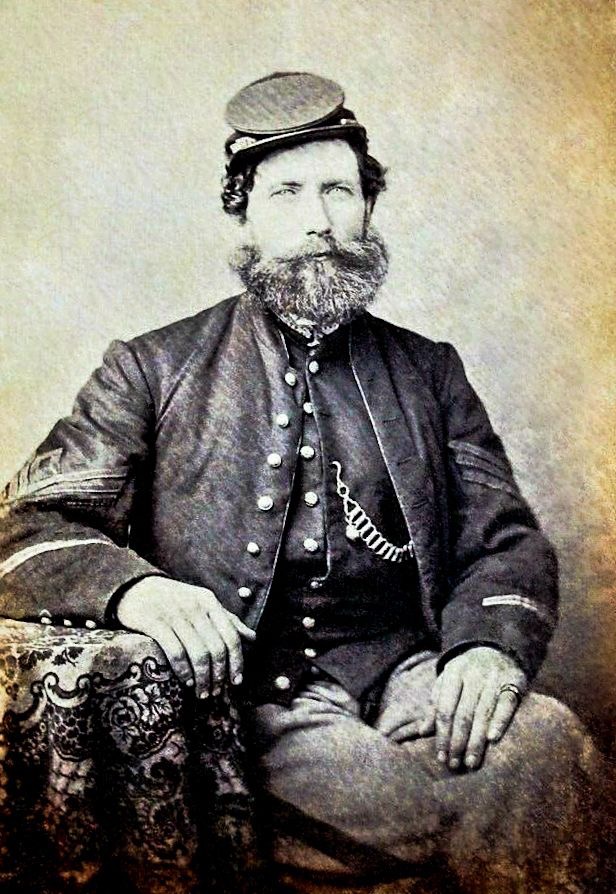
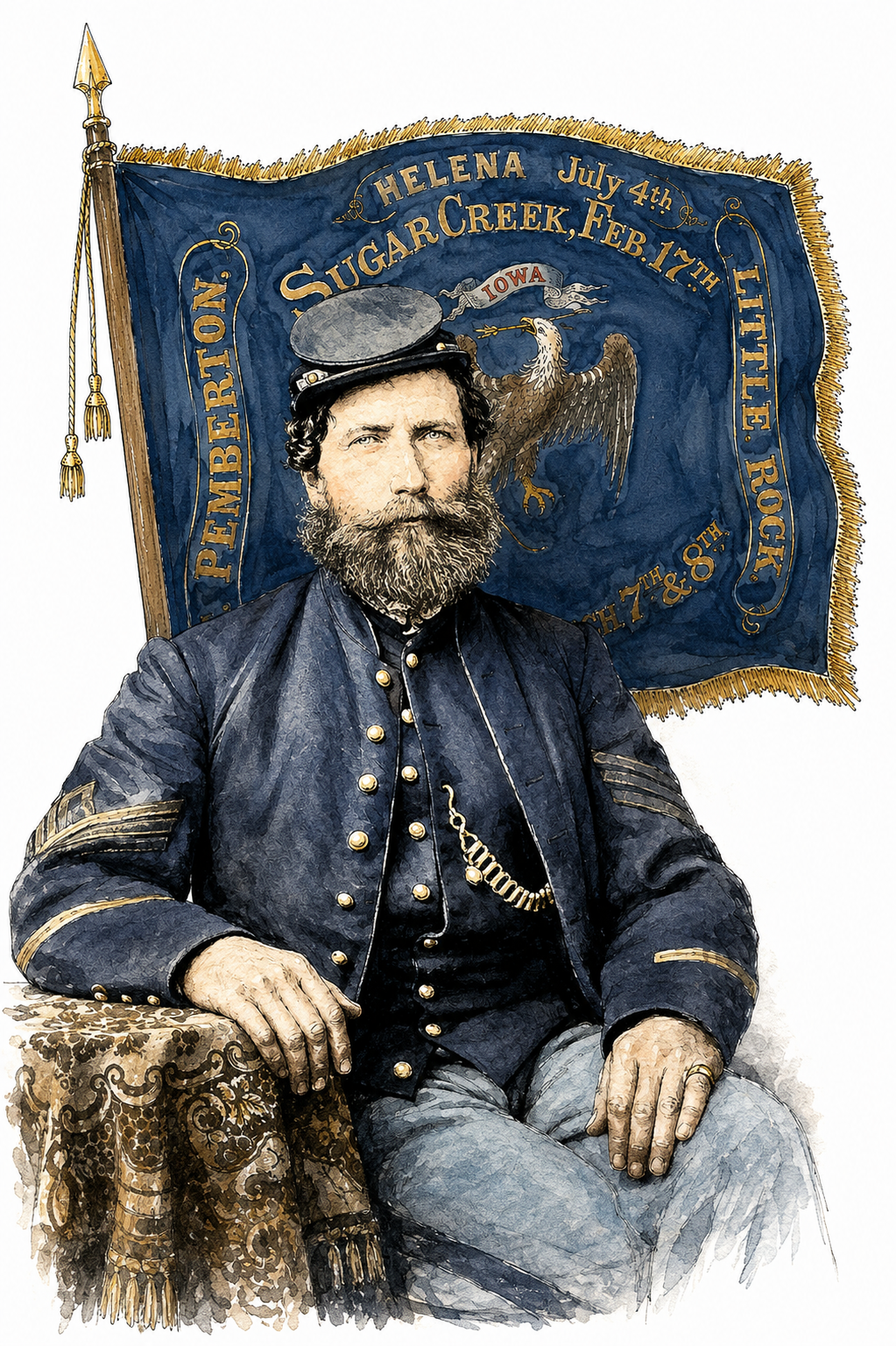
The following letters were written by Hiland Homer Weaver (1833-1915), who lost his parents Hiram Vanarden Weaver (1809-1841) and Minerva Doud (1811-1844) at an early age. From his younger brother Orland’s obituary we learn that their father was killed by the caving in of a well; their mother by disease. They lived with the Samuel Orr family in Hillsdale county, Michigan, until Hiram married Harriet (“Hattie”) Arlie Johnson (1831-1907) in 1854 and settled in Beaver, Butler, Iowa, prior to the Civil War.
During the Civil War, Weaver enlisted in the 3rd Independent Iowa Battery (the “Dubuque” battery) on August 28, 1861. The Battery remained in the western theater of the war until it was disbanded and its members discharged on October 23, 1865. One source says he entered the service as a sergeant and left the service as a 1st Sergeant. Another source says he was commissioned a Lieutenant prior to leaving the service. Though he entertained thoughts of remaining in the army, Weaver left for Michigan, where Hattie lived during the war, and settled in Reading. Weaver worked as a carpenter following his military service, and died on January 23, 1915. He and Hattie had at least three children: Hiram (b. 1857), Jay (b. 1860), and Jennie (b. 1866).
These letters were once part of a very large collection of Weaver’s letters, sold at auction by Raynor’s Historical Collectible Auctions. Other quotes from Hiland Weaver’s letters found on line include one written at Little Rock, Arkansas on 10 January 1864 which reads: “…There was a fleet started for here some time ago to come up the Arkansas River and it is over due but the ice I presume has kept it back. I hope it will get here soon if it does not we will lose the most of our horses, they are dying almost daily for want of proper food…think of a horse going five months with only one feed of hay and a good deal of the time but very little grain…I wrote to you about the catching of a spy at this place, he was tried and sentenced to be hanged until he was dead and sentence was executed on Friday…there was a large crowd of soldiers and citizens present, I among the rest, he was hung at three o.c. p.m. in front of the St. John’s College. He was about twenty years of age, smart and good looking, he had some relatives living here at this place, he had been raised here and had attended college several terms in the building in front of which he was executed. Little did he think when attending school that he would be hung on that beautiful ground where he had seen so many pleasant hours but such is the fate of spies when caught. He seemed to be perfectly reconciled to his fate, he died like a man should and for which I respect him. Hattie I can see in an enemy his good qualities as well as in a friend, although sometimes it is rather hard to acknowledge it…I will give you his name it is David O. Dodd…I think I wrote in my last that there was a rumor in camp that Old Price was coming to make us a visit. If it were true I think this cold had whipped him and saved us the trouble and as far as I am concerned I would as soon cold weather would whip him as to have to use powder and lead, and as far as his coming here if I do not see another battle until the rebs come here to fight I do not think I shall ever see another…”
Also: [Camp Union, Sept. 25, 1861]…we have got an order to…march…for St. Louis…the boys are…in a hurry to have a fight…[Camp Heron, Dec. 5, 1861]…we have great times drilling…we have got our guns…[and] are making great progress in drilling…as soon as the rebels find out that the Dubuque Battery is ready for the field there will not be any sesesh in Missouri…[Camp Heron, Dec. 14, 1861 on “Not a star shall fall” patriotic stationery]…there will be a large battle fought near here before long…most of the boys are anxious to have a hand in it…there has been several thousand soldiers through here in the last week. The Iowa 11 and 18 regiment have past here…[Dec. 27, 61 on Washington patriotic stationery]…there is…twenty seven men on the sick list…we have loaded our guns on the cars…we are going to Rolly [Rolla, Misouri?]…about 80 miles from here south west…[n. p., March 14, 1862 on battle of Pea Ridge, eight pages but partial]…the country is all hills… the grass is getting green…it will not come to soon for inhabitants around here where our army has been…it is hard to see the destruction…when an army passes through a country. The houses are torn down for fire wood and the fences are all burnt up…where the hardest of the battle was there was a splendid orchard and the trees were all shot to pieces. There was a large house and barn…and there was not a building…several [had] cannon shots through them. There was a family in the cellar during the two days…the house was filled with dead and wounded…we had to get up and scadadle from Camp Halleck at Cross Hollows…we were enjoying ourselves as well as soldiers could…about nine o’c. at night…the men were in bed when orders came for us to be ready…there was some confusion but we got ready…and we left just in time…[or] we would have been taken…those that showed the white flag in the morning were very much ashamed after the battle…after the battle…our cavalry were running them off. We went into camp on the battlefield…I had a chance to look over the battlefield and…it was too heartrending…there was men with their heads shot off and some shot all to pieces, some [?], some asking for quarters…one of the rebel Lieut. Col. lay on the field with all of his head shot off by a cannon ball. There was…four dead rebels to one of our men…for miles around was filled with dead rebels…it is the hardest thing…to see women and children crying for us not to take the last bit of corn that they have…I cannot see a woman crying and stay around a great while…if our army stays in one place forty eight hours we clean out the country…I this last battle…the Iowa 9 reg. and the Iowa 4 reg and the Iowa 3 reg of cavalry…was very badly cut to pieces…the federal loss in killed wounded and taken will come very near fifteen hundred…[Little Rock, Oct. 16, 1864]…I am tired of running around the country and if Old Abe is reelected…we will have this war brought to a close in less than six months [the war ended almost six months to the day of this letter!]…Old Price is up in Mo. doing his best…we have a large force after him…they will take him…[Little Rock, Oct. 26]…three cheers for Old Abe…[Little Rock, Dec. 11, 1864]…it gives me sad thoughts to know you are in need of money…I never saw a time but once [where] I could not get fifty dollars in our company…I have got forty cents and…tht is far above average…[on rare printed stationery, reading, “Ordnance Office, 1st Division, 7th Army Corps, and post of Little Rock, Little Rock, Ark,” June 5, 1865]…I am shure the war is over…I have been thinking…of going into the regular service but I have not been before the board yet…Gen. Solomon is President of board…[on rare printed stationery, reading, “Ordnance Office, 1st Division, 7th Army Corps, and post of Little Rock, Little Rock, Ark,” June 27, 1865]…now about my going with the Regular Service I do not think I shall…there is too many chances for me to be sent where I could not take my family with me…[Willoughby, Iowa, Nov. 3, 1865]…I thought I would write you a few lines so you would know that I am not dead…and shall start for home in the morning…”
Some of Weaver’s letters have ended up in the archives at the University of Michigan (see Hiland H. Weaver papers, 1861, 1864-65), and some at the Butler Center for Arkansas Studies at Little Rock (see Hiland H. Weaver Collection MSS.08055.)
Letter 1
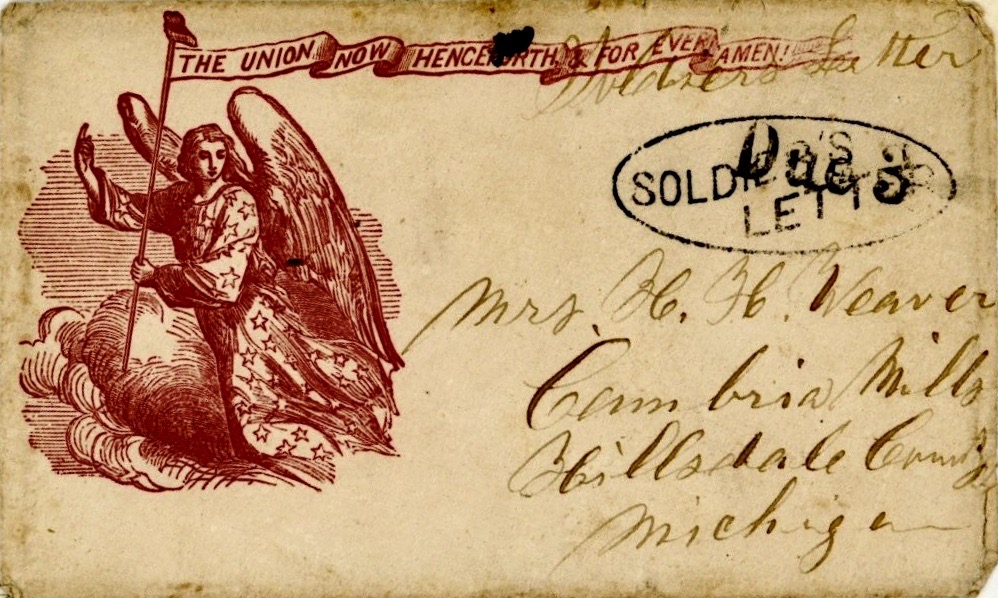
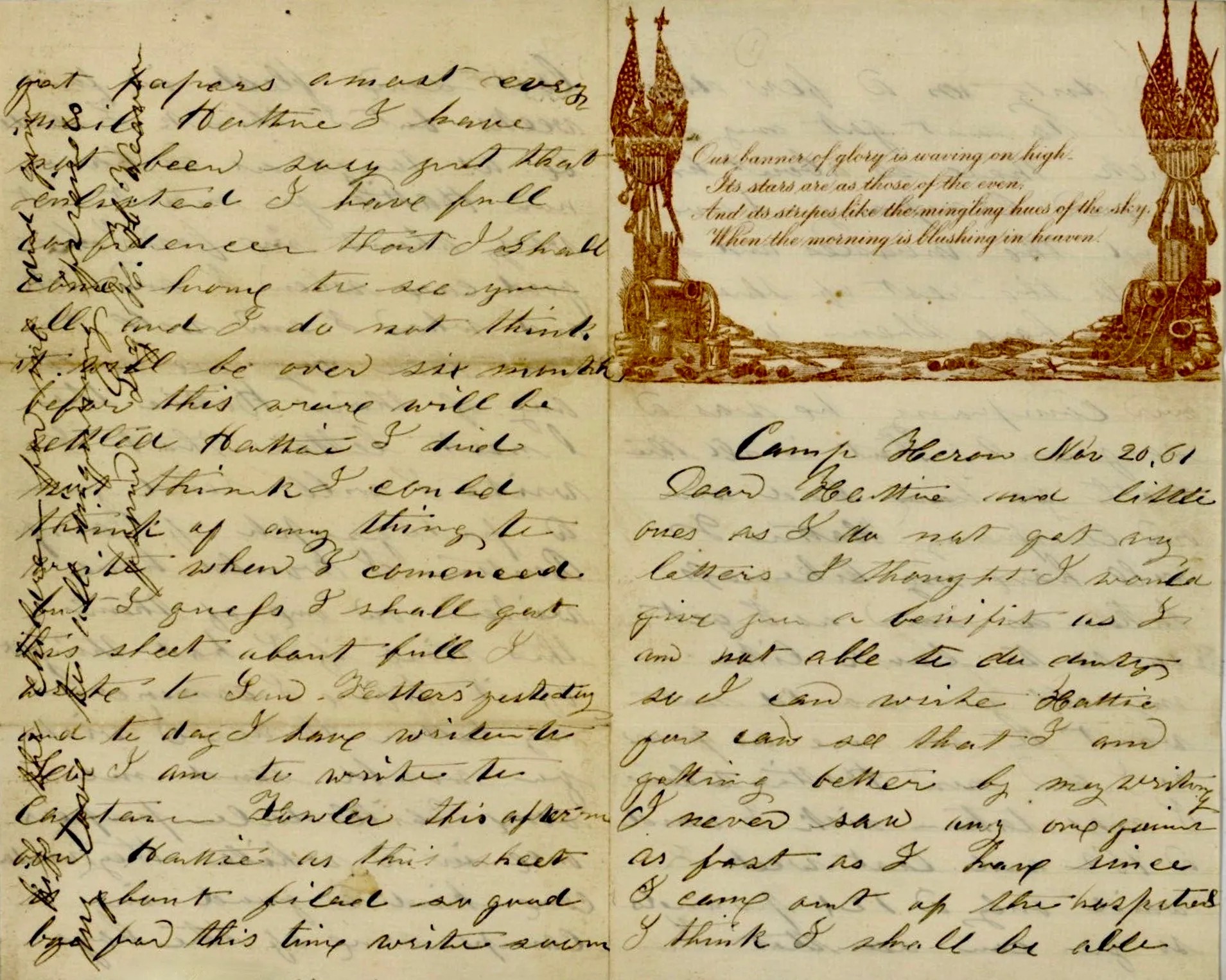
Camp Herron [Davenport, Iowa]
November 20, 1861
Dear Hattie and little ones,
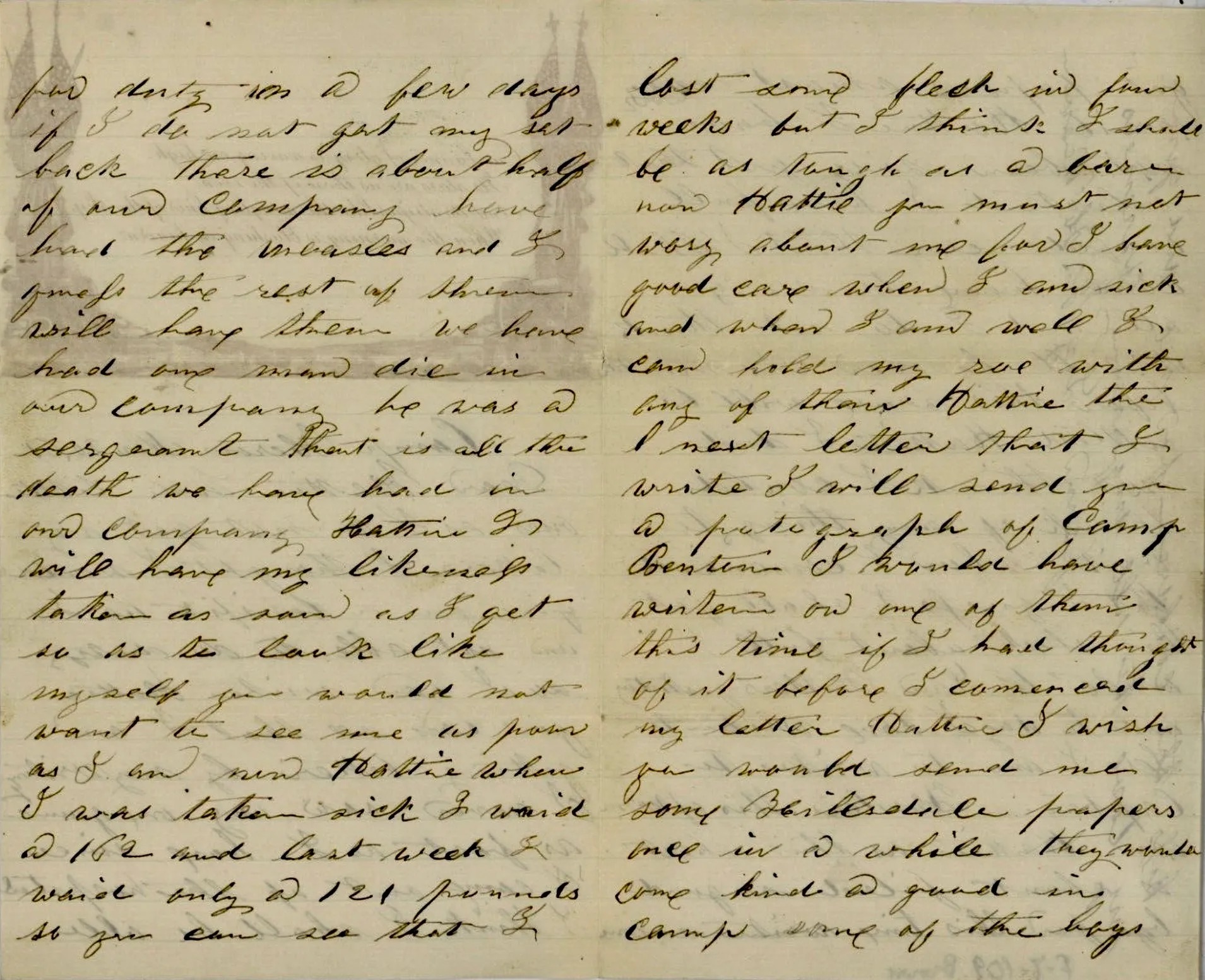
As I do not get any letters, I thought I would give you a benefit as I am not able to do duty so I can write. Hattie, you can see that I am getting better by my writing. I never saw any one gain so fast as I have since I came out of the hospital. I think I shall be able for duty in a few days if I do not get my setback. There is about half of our company have had the measles and I guess the rest of them will have them. We have had one man die in our company. He was a sergeant. That is all the deaths we have had in our company.
Hattie, I will have my likeness taken as soon as I get so as to look like myself. you would not want to see me as poor as I am now. Hattie, when I was taken sick, I weighed 162 and last week I weighed only 121 pounds. So you can see that I lost some flesh in four weeks. But I think I shall be as tough as a bear now.
Hattie, you must not worry about me for I have good care when I am sick and when I am well, I can hold my row with any of them. Hattie, the next letter that I write, I will send you a photograph of Camp Benton. I would have written on one of them this time if I had thought of it before I commenced my letter. Hattie, I wish you would send me some Hillsdale papers once in a while. They would come kind a good in camp. Some of the boys got papers a most every mail. Hattie, I have not been sorry yet that I enlisted. I have full confidence that I shall come home to see you all and I do not think it will be over in six months before this war will be settled. Hattie, I did not think I could think of anything to write when I commenced but I guess I shall get this sheet about full. I wrote to Sam Ketters yesterday and today I have written to Captain Fowler this afternoon.
Hattie, as this sheet is about filled, do goodbye for this time. Write soon. Kiss the children for me and give my love to all enquiring friends, from [ ] H. H. Weaver
Letter 2
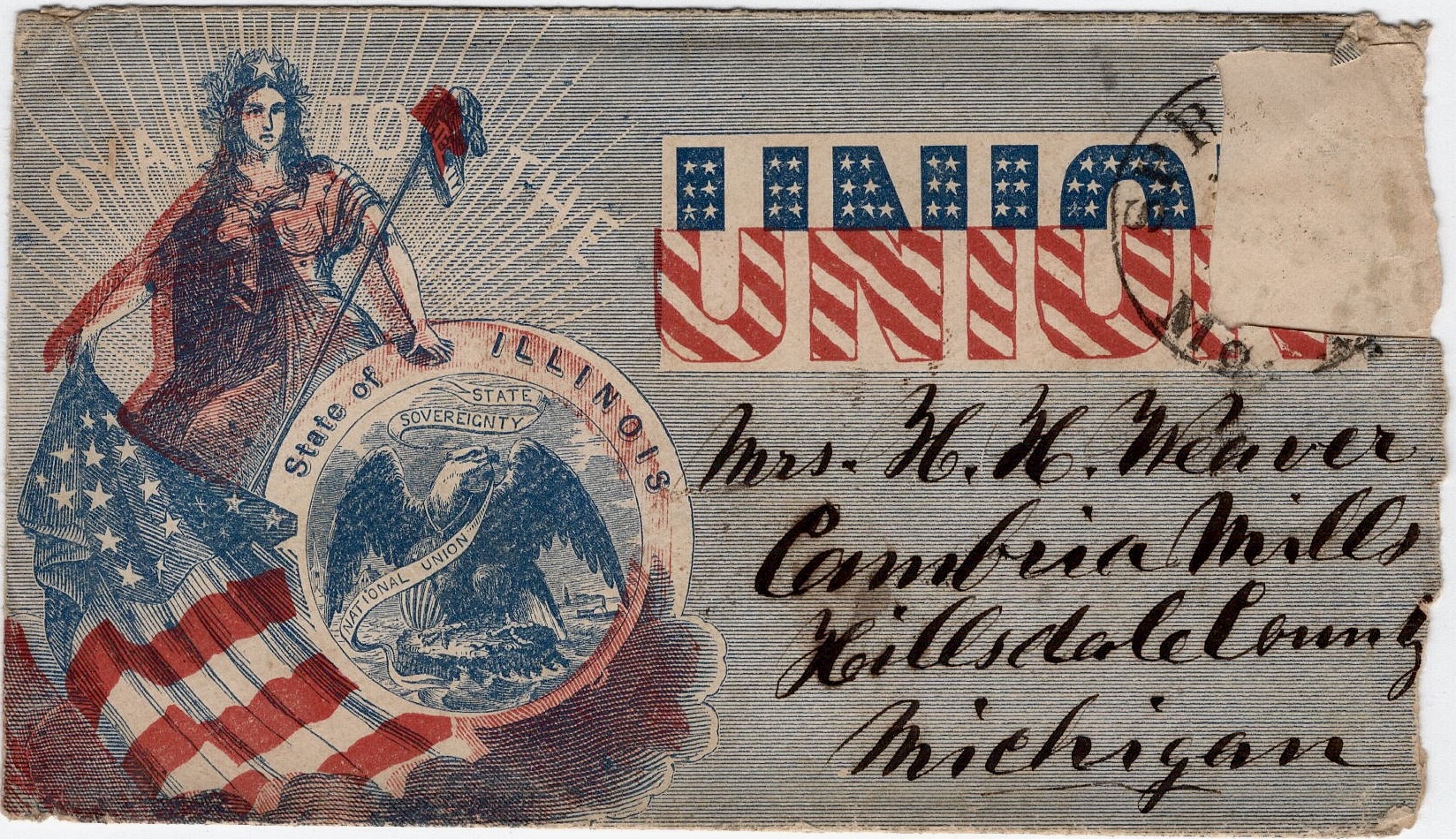
Camp Halleck
Cross Hollows
Benton county, Arkansas
February 26, 1862
Dear Hattie and little ones,
How do you do this afternoon? I wish I could be with you today instead of sitting here on the ground writing to you over a thousand miles away. We have camped here to recruit. I do not know how long we may stay here—not over ten days I hope for I want to be on the move so as to get home as soon as possible for it is getting to be hot weather here. It is as warm here now as June in Iowa. I wrote to you a few days ago but I do not think you will ever get it for I understand that our train was taken by the rebels and the mail was with it. But I hope it is not so.
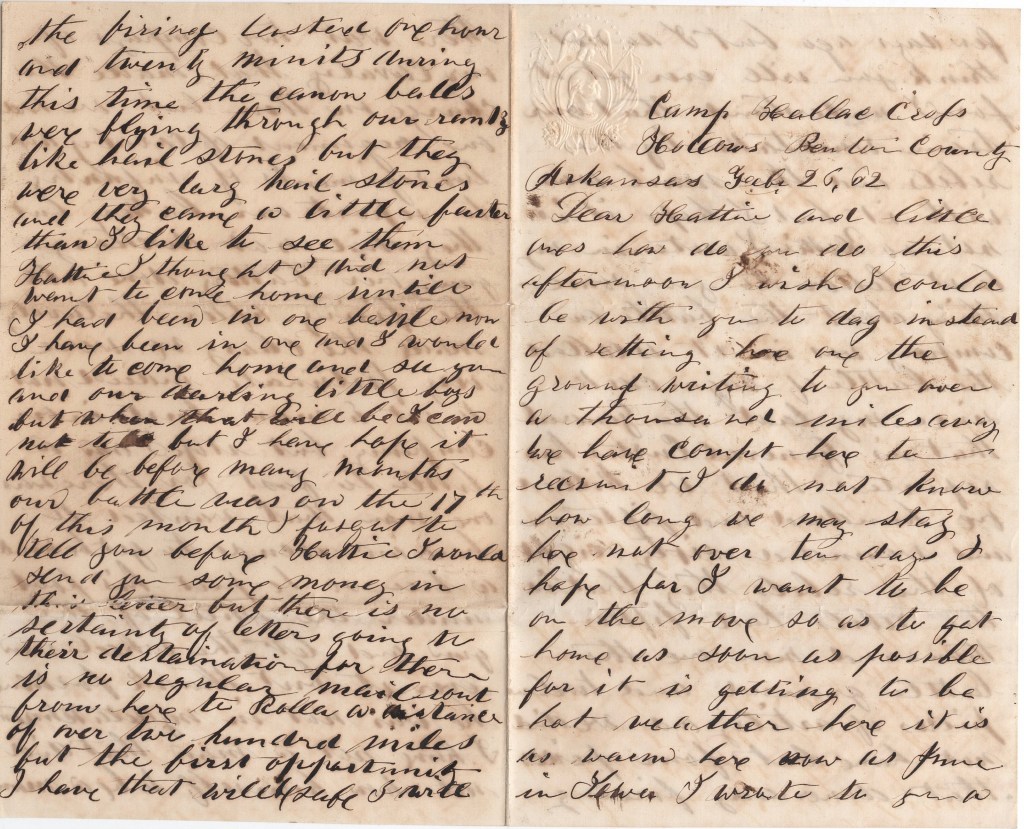
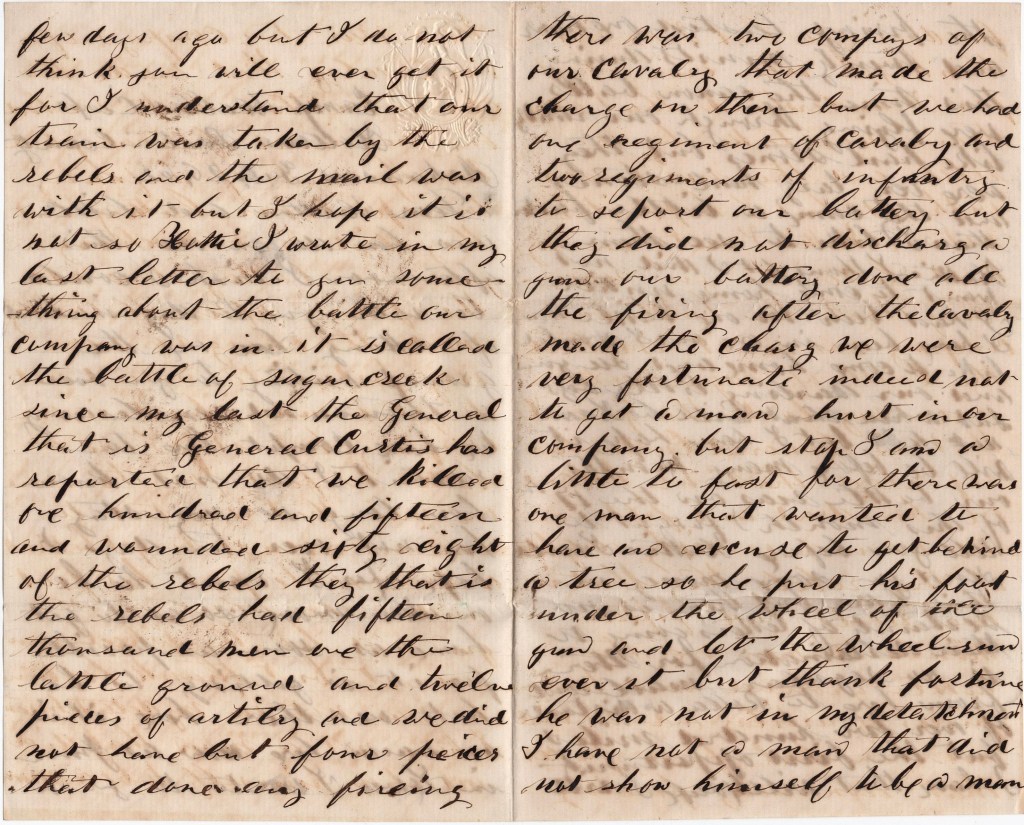
Hattie, I wrote in my last letter to you something about the battle our company was in. It is called the Battle of Sugar Creek. 1 Since my last, the General—that is, General [Samuel R.] Curtis—has reported that we killed one hundred and fifteen and wounded sixty-eight of the rebels. They—that is, the rebels—had fifteen thousand men on the battle ground and twelve pieces of artillery and we did not have but four pieces that done any firing. There was two companies of our cavalry that made the charge on them but we had one regiment of cavalry and two regiments of infantry to support our battery. But they did not discharge a round. Our battery done all the firing. After the cavalry made the charge, we were very fortunate indeed not to get a man hurt in our company but stop. I am a little too fast for there was man that wanted to have an excuse to get behind a tree so he put his foot under the wheel of the gun and let the wheel run over it. But thank fortune he was not in my detachment. I have not a man that did not show himself to be a man.
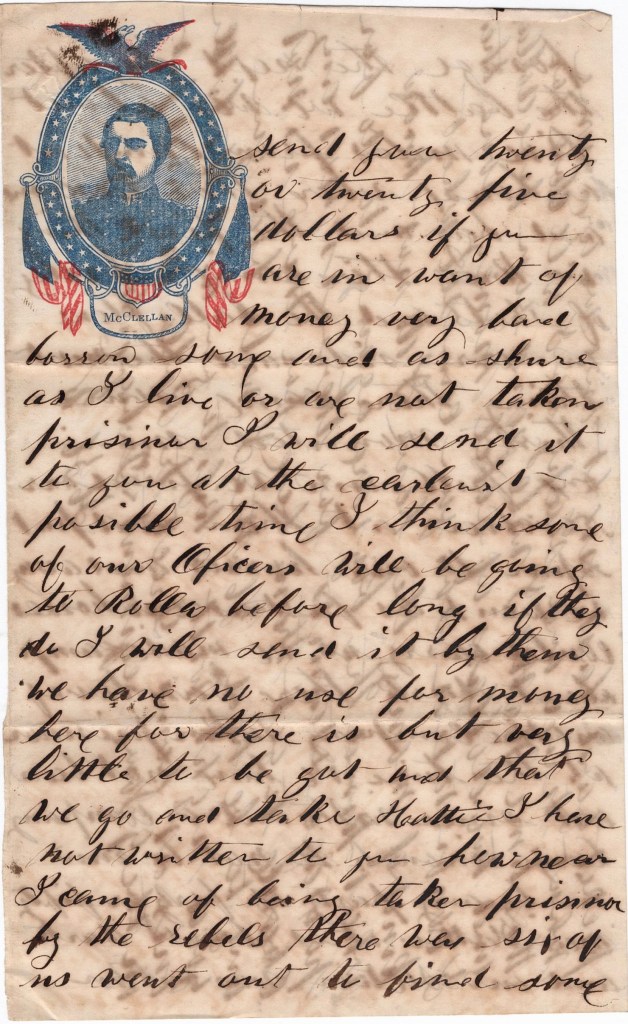
The firing lasted one hour and twenty minutes. During this time the cannon balls were flying through our ranks like hail stones but they were very large hail stones and they came a little faster than I like to see them. Hattie, I did not want to come home until I had been in one battle. Now I have been in one and I would like to come home and see you and our darling little boys. But when that will be, I cannot tell. But I have hope it will be before many months. Our battle was on the 17th of this month. I forgot to tell you before, Hattie, I would send you some money in this letter but there is no certainty of letters going to their destination for there is no regular mail out from here to Rolla—a distance of over two hundred miles. But the first opportunity I have that will be safe, I will send you twenty or twenty-five dollars. If you are in want of money very bad, borrow some and as sure as I live or we not taken prisoner, I will send it to you at the earliest possible time. I think some of our officers will be going to Rolla before long. If they do, I will send it by them. We have no use for money here for there is but very little to be got and that we go and take.
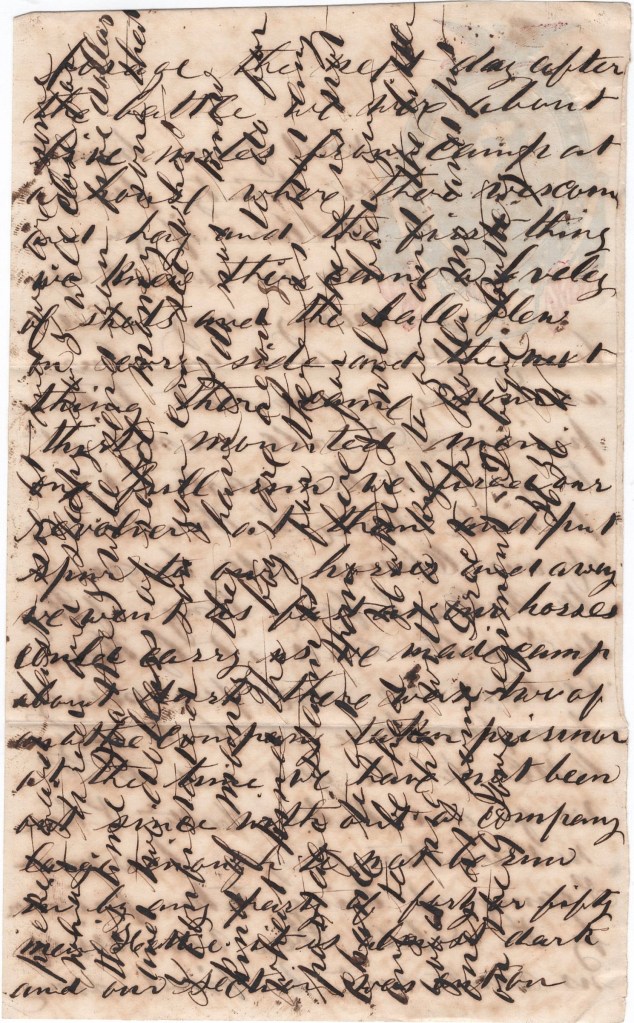
Hsattie, I have not written to you how near I came of being taken prisoner by the rebels. There was six of us went out to find some forage the next day after the battle. We were about five miles from camp at a house where there was corn and hay and the first thing we knew, there came a volley of shots and the balls flew on every side and the next thing there came some thirty mounted men on full run. We fired our revolvers at them and put spur to our horses and away we went as fast as our horses could carry us. We made camp about dark. There was two of the company taken prisoner at the time. We have not been out since without a company large enough to not be run in by any party of forty or fifty men.
Hattie, it is almost dark and our section was out on picket guard last night and we are somewhat tired and sleepy so I will close for this time. Hattie, I will send you five dollars and two dollars of rebel money—some that I confiscated so you can see what kind of money they have. I do not know what the boys are a going to do for postage stamps for there is not any chance to get them here for there is not any to be had. Hattie, I will bid you good night with a kiss to you and the little ones at home. Direct to Rolla, Mo. and put on the 9th Iowa Regiment, Dubuque Battery. — H. H. W.
1 The Battle of Sugar Grove, fought on 17 February 1862, was also called the Battle of Dunagin’s Farm—an early skirmish in the Pea Ridge Campaign.
Letter 3
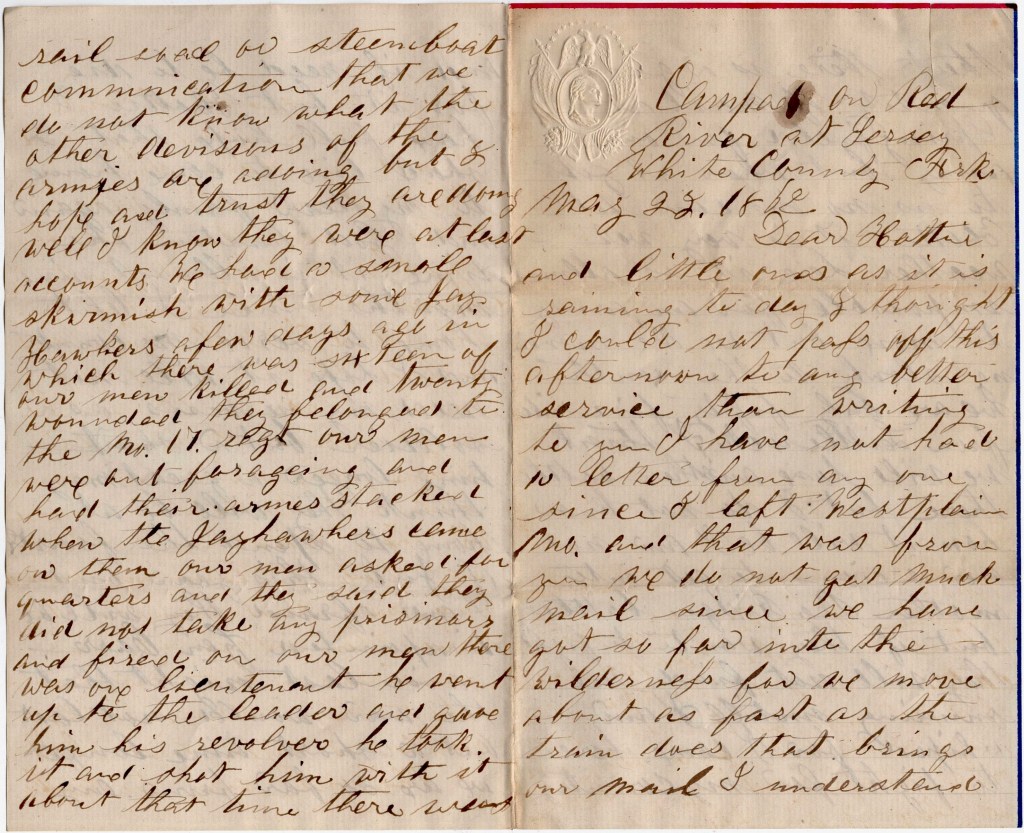
Camp on Red River at Searcy
White county, Arkansas
May 22, 1862
Dear Hattie and little ones,
As it is raining today, I thought I could not pass off this afternoon to any better service than writing to you. I have not had a letter from anyone since I left West Plain, Missouri, and that was from you. We do not get much mail since we have got so far into the wilderness for we move about as fast as the train does that brings our mail. I understand that there is a great quantity of mail at Springfield for our army but when it gets to us, no one can tell.
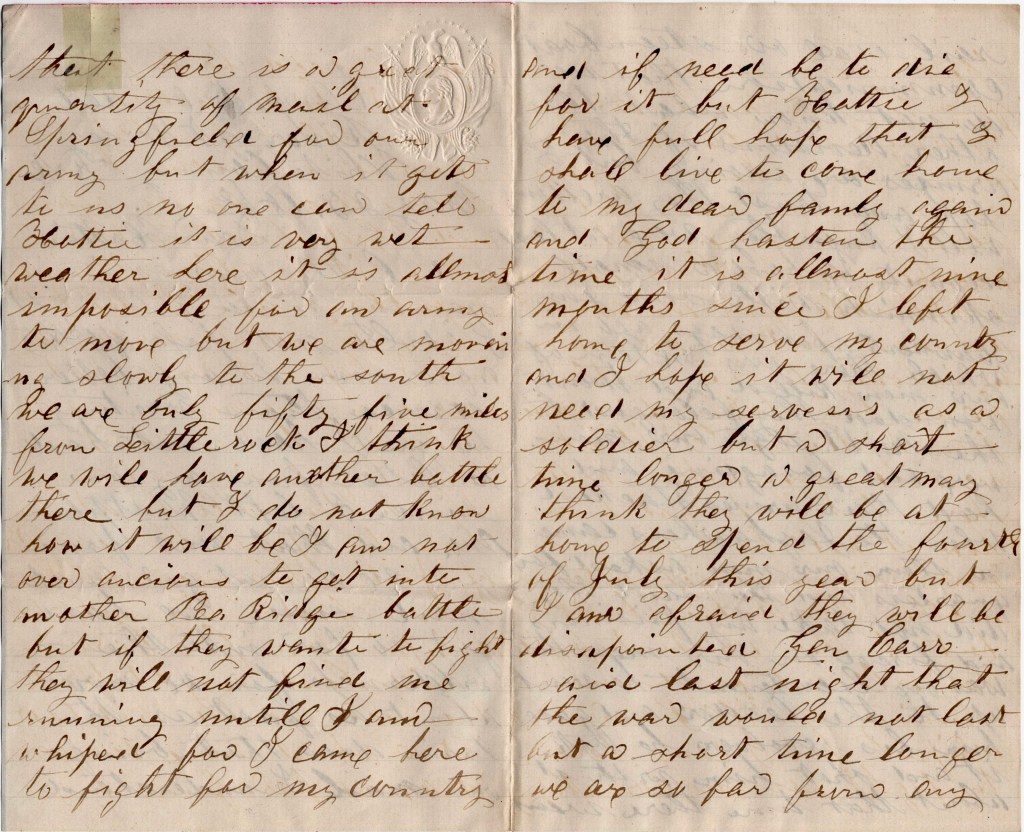
Hattie, it is very wet weather here. It is almost impossible for an army to move but we are moving slowly to the south. We are but fifty-five miles from Little Rock. I think we will have another battle there but I do not know how it will be. I am not over anxious to get into another Pea Ridge battle but if they want to fight, they will not find me running until I am shipped for I came here to fight for my country and if need be, to die for it. But Hattie, I have full hope that I shall live to come home to my dear family again and God hasten the time. It is almost nine months since I left home to serve my country and I hope it will not need my services as a soldier but a short time longer. A great many think they will be at home to spend the 4th of July this year but I am afraid they will be disappointed.
Gen. Carr said last night that the war would not last but a short time longer. We are so far from any railroad or steamboat communication that we do not know what the other divisions of the armies are doing but I hope and trust they are doing well. I know they were at last accounts.
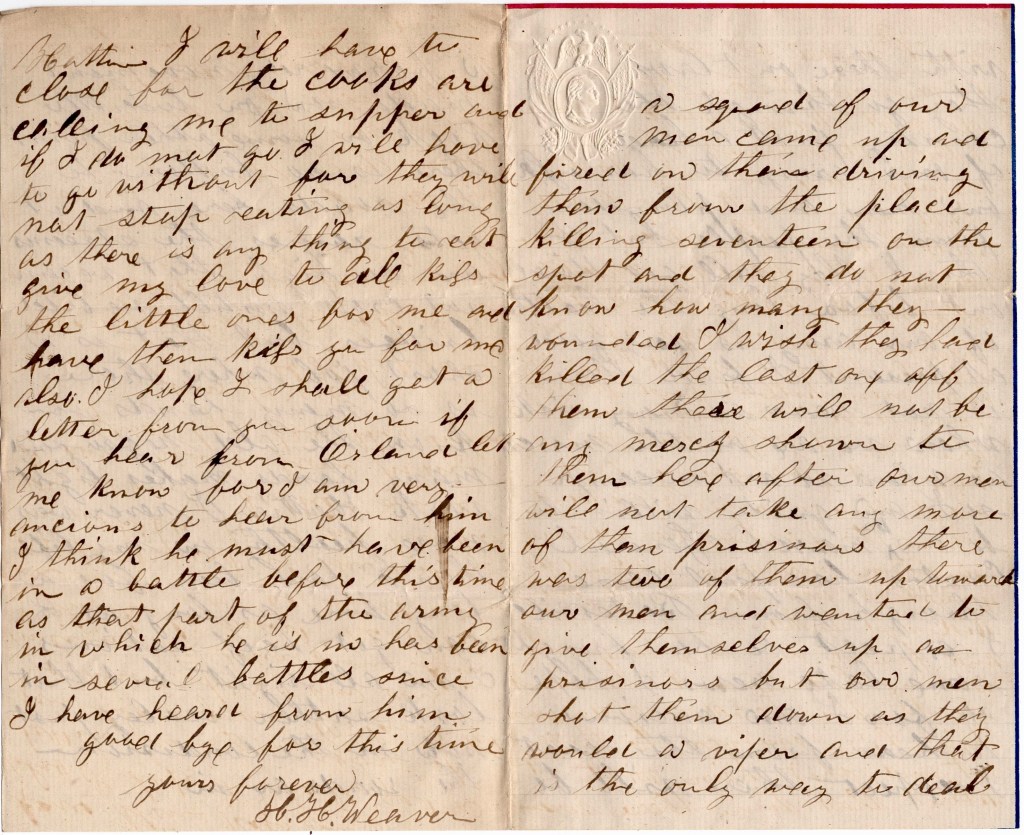
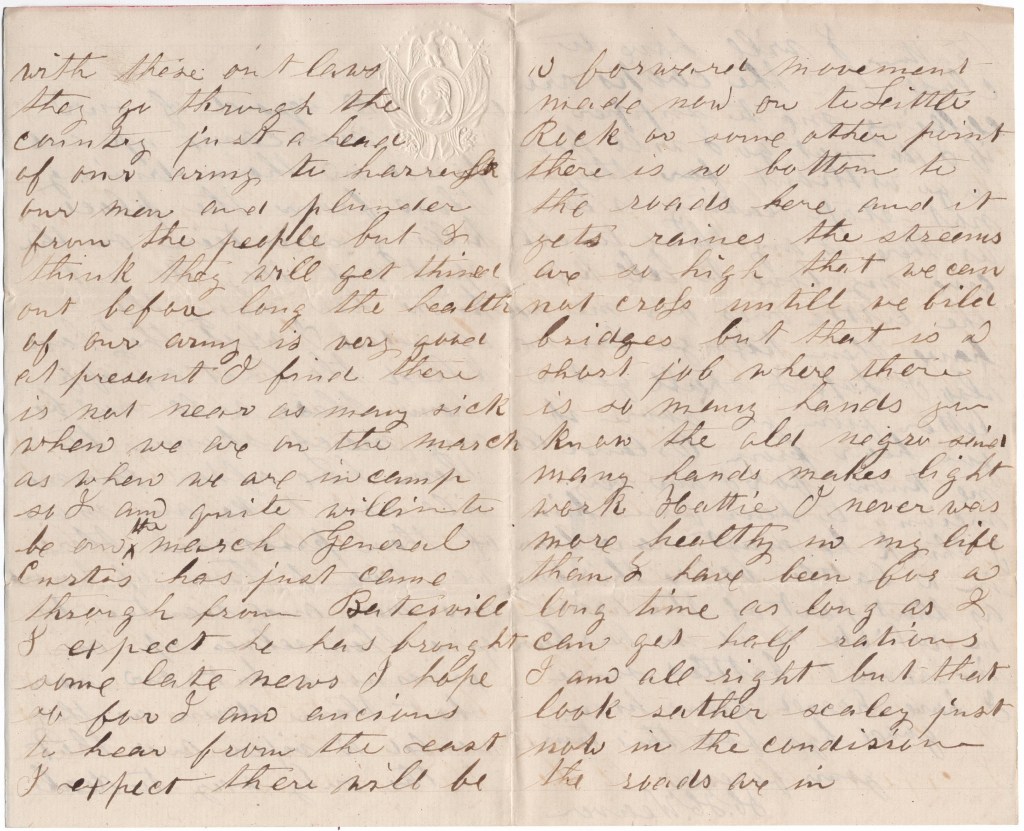
We had a small skirmish with some Jayhawkers a few days ago in which there was sixteen of our men killed and twenty wounded. They [our men] belonged to the Missouri 17th Regiment. Our men were out foraging and had their arms stacked when the Jayhawkers came on them. Our men asked for quarters and they said they did not take any prisoners and fired on our men. There was one lieutenant, he went up to the leader and gave him his revolver. He took it and shot him with it. About that time there was a squad of our men came up and fired on them, driving them from the field, killing seventeen on the spot and they do not know how many they wounded. I wish they had killed the last one of them. There will not be any mercy shown to them hereafter. Our men will not take any more of them prisoners. There was two of them up toward our men and wanted to give themselves up as prisoners but our men shot them down as they would a viper and that is the only way to deal with these outlaws. They go through the country just ahead of our army to harass our men and plunder from the people but I think they will get thinned out before long. 1
The health of our army is very good at present. I find there is not near as many sick when we are on the march as when we are in camp so I am quite willing to be on the march. General Curtis has just come through from Batesville. I expect he has brought some late news. I hope so for I am anxious to hear from the East. I expect there will be a forward movement made now on to Little Rock or some other point. There is no bottom to the roads here and it yet rains. The streams are so high that we cannot cross until we build bridges but that is a short job where there is so many hands. You know the old negro said many hands makes light work.
Hattie, I never was more healthy in my life than I have been for a long time—as long as I can get half rations, I am alright. But that looks rather scaly just now in the condition the roads are in.
Hattie, I will have to close for the cooks are calling me to supper and if I do not go, I will have to go without for they will not stop eating as long as there is anything to eat. Give my love to all. Kiss the little ones for me and have them kiss you for me also. I hope I shall get a letter from you soon. If you hear from [brother] Orland [in 4th Michigan infantry], let me know for I am very anxious to hear from him. I think he must have been in a battle before this time as that part of the army in which he is in has been in several battles since I have heard from him. Goodbye for this time. Yours forever, — H. H. Weaver
1 The incident that Sgt. Weaver refers to was called the Battle of Whitney’s Lane (also known as the action at Searcy Landing) in Arkansas on May 19, 1862, when a foraging party by members of the 17th Missouri (Union) Infantry was ambushed by a force of bushwhackers under Confederate Colonel Emory Rogers. The foraging party lost 22 killed, 33 wounded, and two missing. Weaver’s account of “no quarter” is confirmed by other accounts. The foraging parties became a necessity due to the bad roads which limited Curtis’s supply lines. This was one of the primary reasons he shifted his objective from Little Rock to Helena, Arkansas. Weaver refers to the bushwackers as “jayhawkers” though this was a name generally only applied to pro-Union marauders.
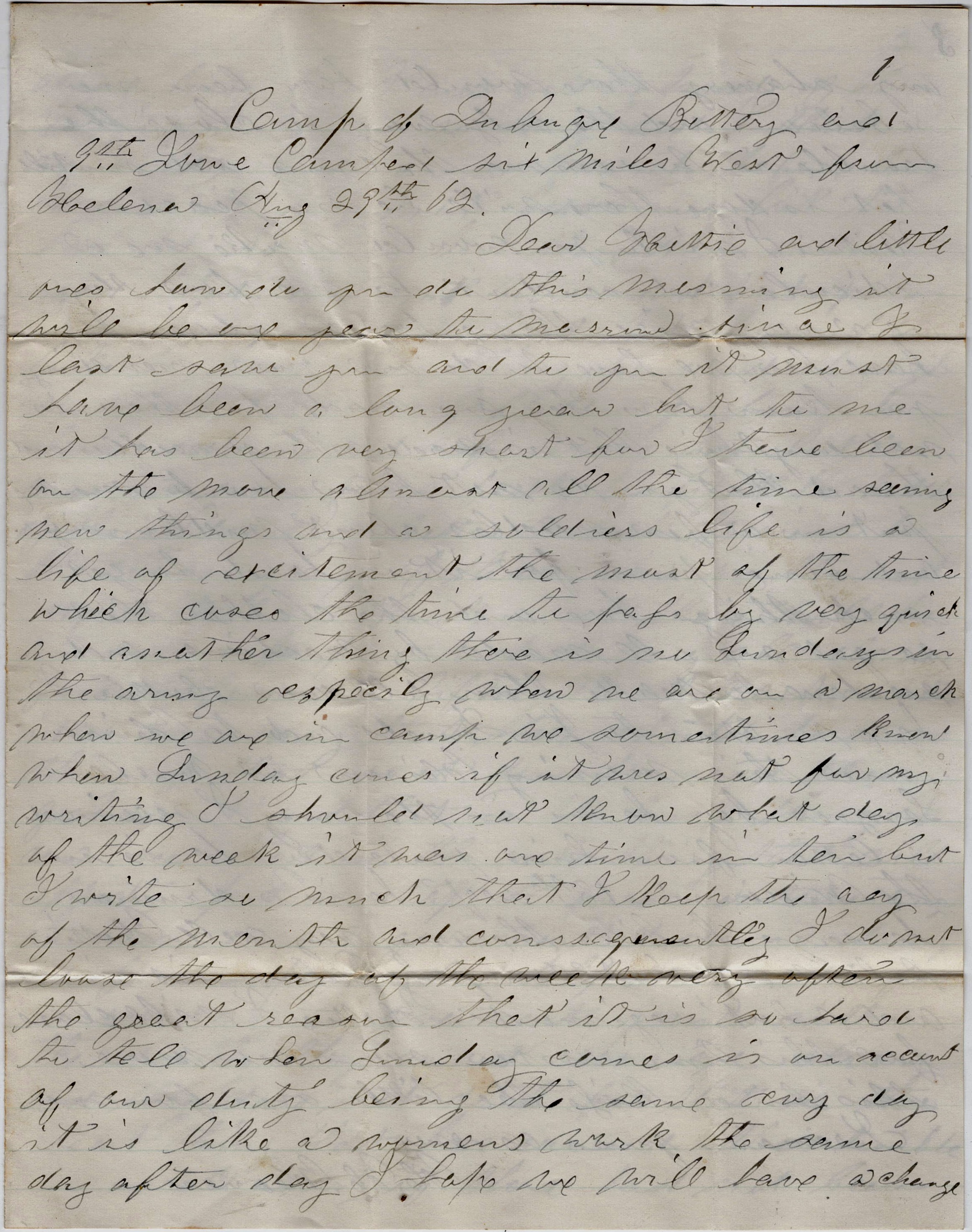
Letter 4
Camp of Dubuque Battery and 9th Iowa
Camped six miles west from Helena
August 29th 1862
Dear Hattie and little ones,
How do you do this morning? It will be one year tomorrow since I last saw you and to you it must have been a long year. But to me it has been very short for I have been on the move almost all the time, seeing new things and a soldier’s life is a life of excitement the most of the time which causes the time to pass by very quick. And another thing, there is no Sundays in the army—especially when we are on a march. When we are in camp, we sometimes know when Sunday comes [but] if it were not for my writing, I should not know what day of the week it was one time in ten. But I write so much that i keep the day of the month and consequently I do not lose the day of the week very often. The great reason that it is so hard to tell when Sunday comes is on account of our duty being the same every day. It is like a woman’s work—the same day after day.
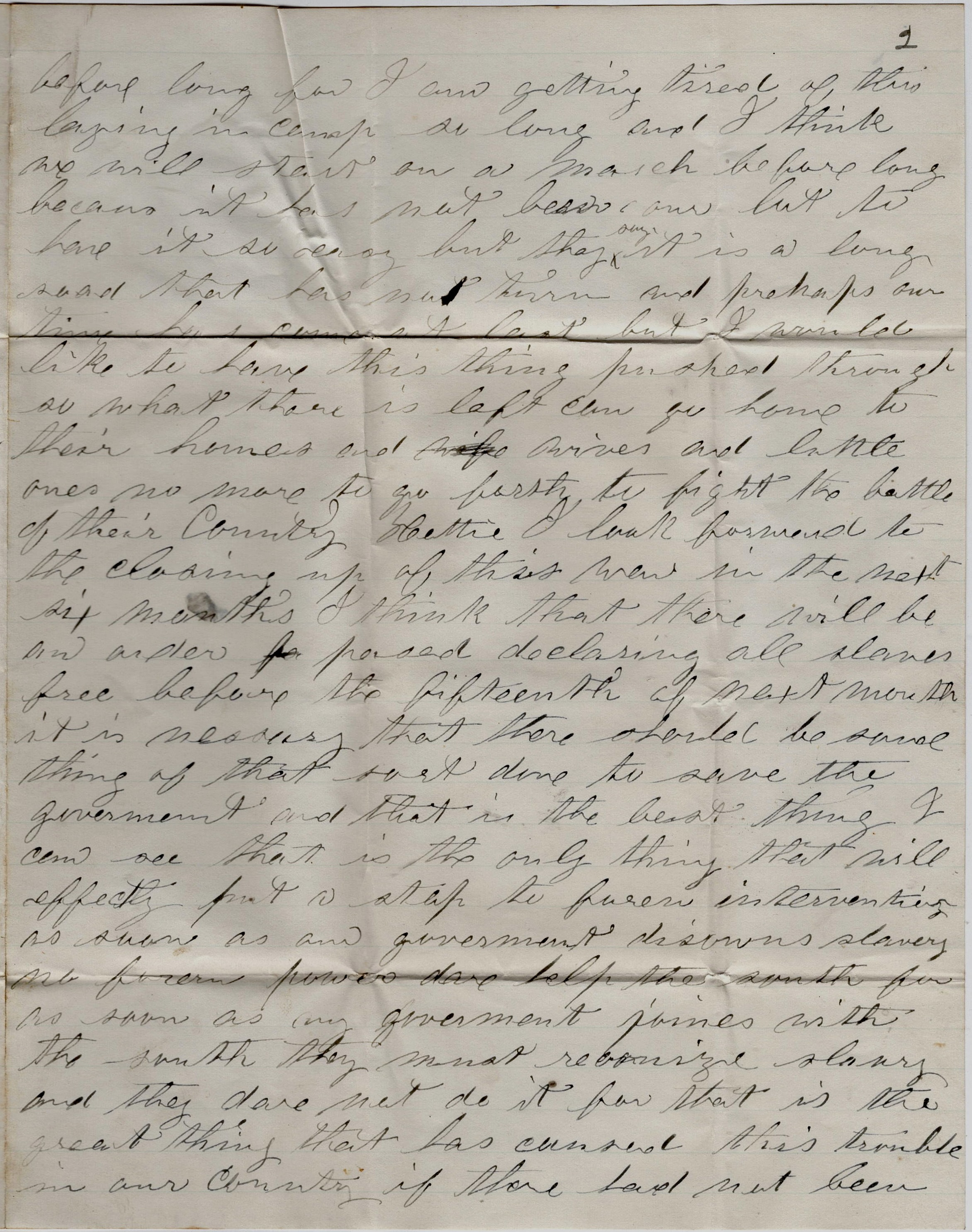
I hope we will have a change before long for I am getting tired of this laying in camp so long and I think we will start on a march before long because it has not been our lot to have it so easy. But they say it is a long road that has no turn and perhaps our time has come at last. But I would like to have the thing pushed through so what there is left can go home to their homes and wives and little ones, no more to go forth to fight the battle of their country.
Hattie, I look forward to the closing up of this war in the next six months. I think that there will be an order passed declaring all slaves free before the 15th of next month. It is necessary that there should be something of that sort done to save the government and that is the least thing I can see that is the only thing that will effectively put a stop to foreign intervention. As soon as our government disowns slavery, no foreign powers dare help the South for as soon as any government joins with the South, they must recognize slavery and they dare not do it for that is the great thing that has caused this trouble in our country. If there had not been any slavery, there would have been no rebellion. And the only way to close the trouble, is to remove the cause. And until that is done, there will be no peace.
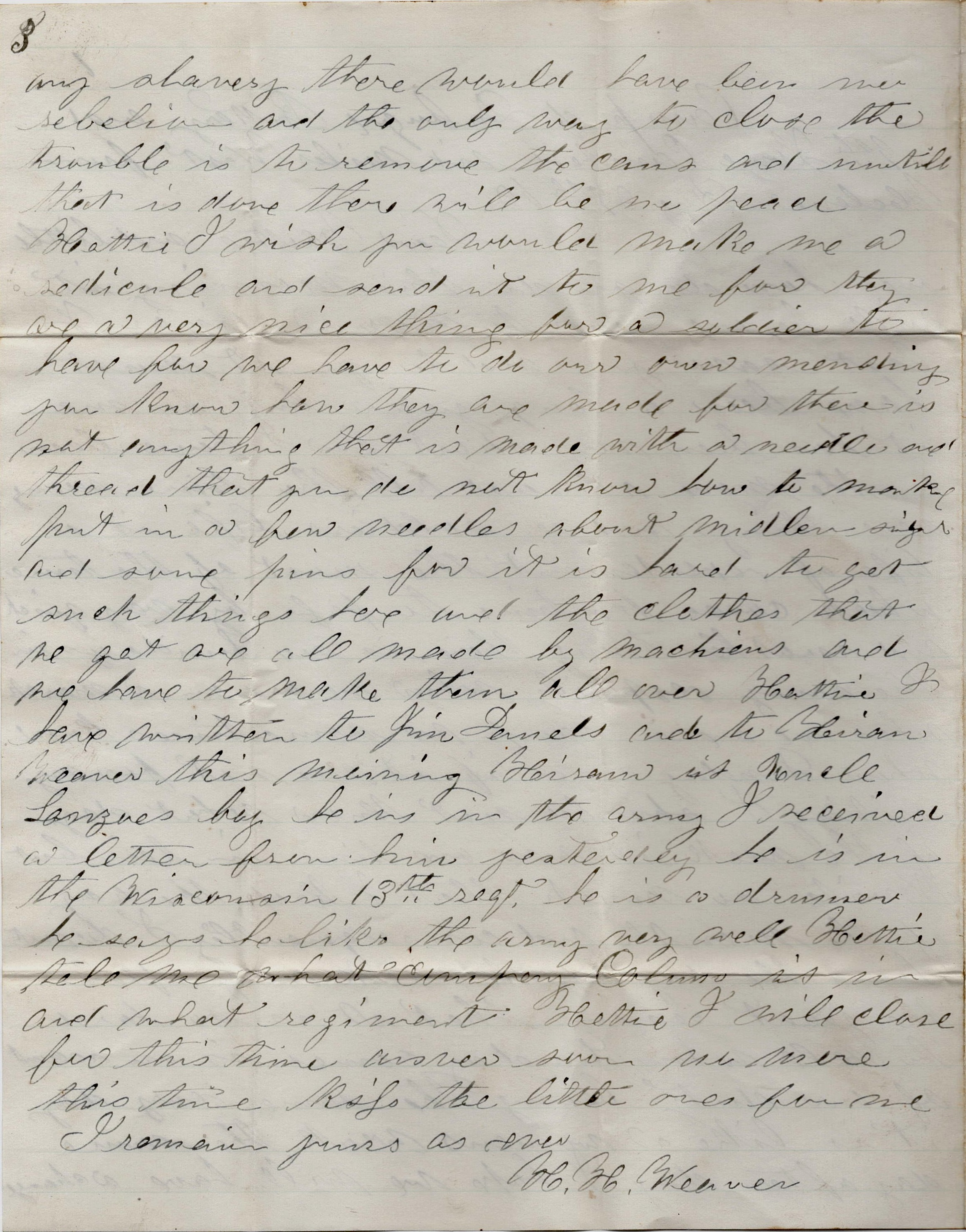
Hattie, I wish you would make me a sedicule [probably a “housewife”?] and send it to me for they are a very nice thing for a soldier to have for we have to do our own mending. You know how they are made for there is not anything that is made with a needle and thread that you do not know how to make. Put in a few needles about middle size and some pins for it hard to get such things here and the clothes that we get are all made by machines and we have to make them all over.
Hattie, I have written to Jim Daniels and to Hiram Weaver this morning. Hiram and Uncle Lanzes’ [?] boy. He is in the army. I received a letter from him yesterday. He is in the Wisconsin 13th Regiment. He is a drummer. He says he likes the army very well. Hattie, tell me what company Coluno is in and what regiment. Hattie, I will close for this time. Answer soon. No more this time. Kiss the little ones for me. I remain yours as ever, — H. H. Weaver