My passion is studying American history leading up to & including the Civil War. I particularly enjoy reading, transcribing & researching primary sources such as letters and diaries.
This letter only carries the signature “David” but the content leads me to the conclusion it was penned by David Spencer Sigler (1842-1892), the son of John Sigler (1804-1882) and Huldah Elsworth Wilson (1808-1849). In 1860, the Sigler family was living in Upper Sandusky, Wyandot county, Ohio. By that time, David’s father had remarried to Ursula C. Adams (in 1849). David was working then as a clerk and his older sister Samantha (mentioned in this letter) was employed as a school teacher. Davis wrote this letter to his only brother, Lyman Perry Sigler (1848-1911) who was at the time still living in Upper Sandusky. He and his father did not come west to live in Garden Grove, Iowa, until 1863.
Davis was living and working in Osceola, Iowa, when the Civil War began and so it was there that he chose to enlisted on 1 July 1861, as the Eighth Corporal in Co. B, 6th Iowa Infantry. They were mustered into service on 17 July 1861. He was then promoted to Seventh Corporal on 10 October 1861; to Sixth Corporal on 10 January 1862; to First Sergeant on 1 July 1862; and then commissioned a Second Lieutenant on 24 January 1863. He resigned his commission on 3 August 1864.
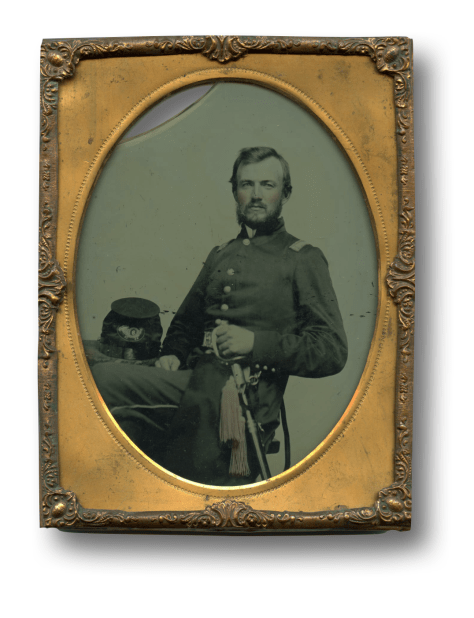
I could not find an image of David but here is one of Emmett Bostwick Woodward who helped raise Co. B, 6th Iowa Regiment, and who was promoted to Captain of the company following the Battle of Shiloh. (Iowa Civil War Images)
Transcription
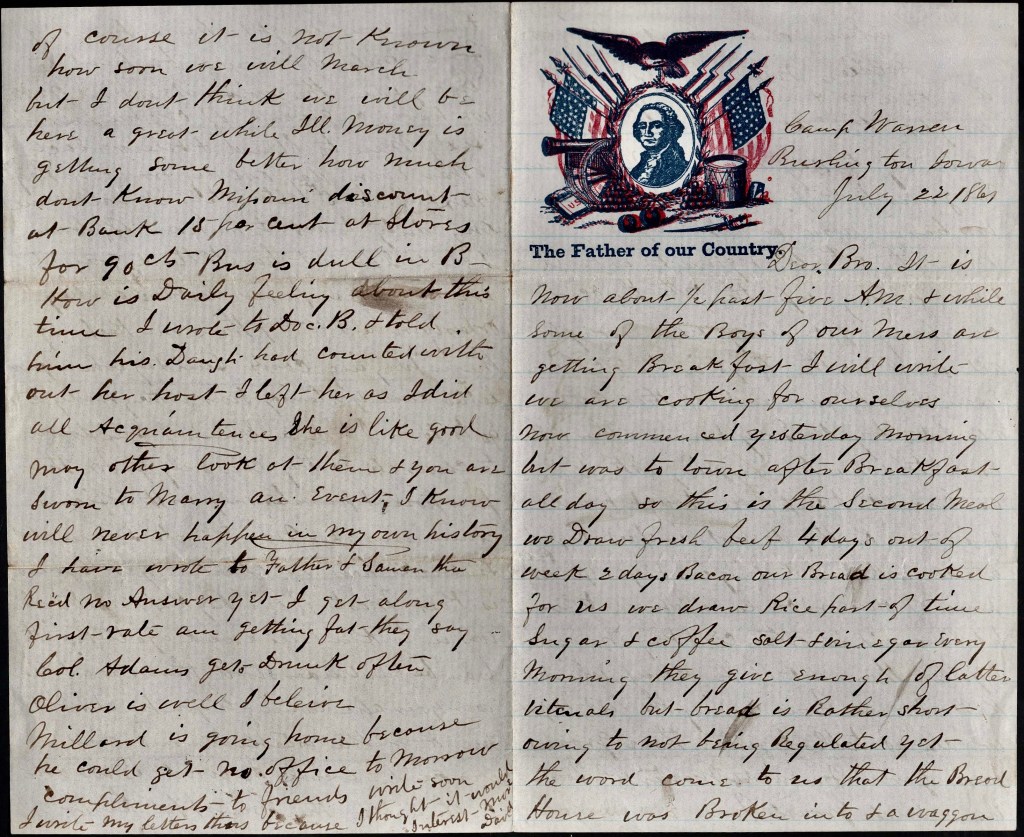
Patriotic letterhead on David’s letter of 22 July 1861
Camp Warren Burlington, Iowa July 22, 1861
Dear Brother,
It is now about half past five a.m. & while some of the boys of our mess are getting breakfast, I will write. We are cooking for ourselves now. Commenced yesterday morning but was to town after breakfast all day so this is the second meal. We draw beef four days out of week, 2 days bacon. Our bread is cooked for us. We draw rice part of time. Sugar and coffee, salt & vinegar every morning. They give enough of latter victuals but bread is rather short owing to not being regulated yet. The word come to us that the bread house was broken into & a wagon load taken out last night by the soldiers. May be so. They are ripe for anything you might think of.
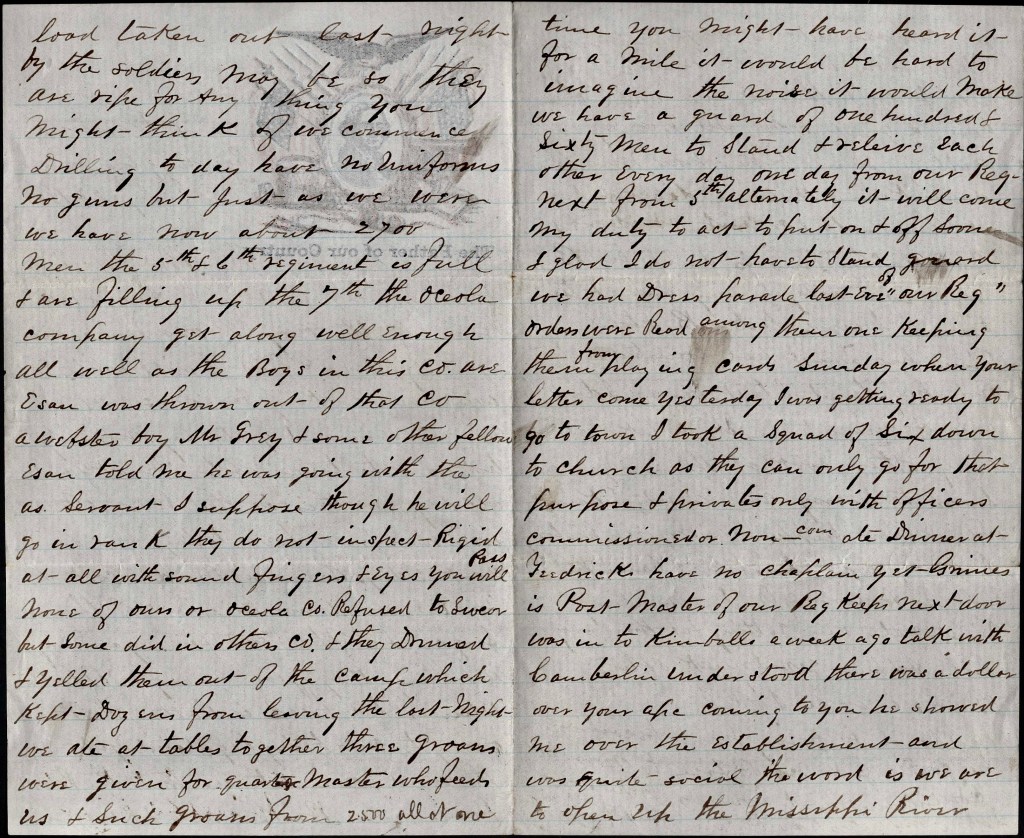
We commence drilling today. Have no uniforms—no guns—but just as we were. We have now about 2700 men. The 5th and 6th regiments is full and are filling up the 7th. The Osceola Company [Co. F] get along well enough. All well as the boys in this company are. Esau 1 was thrown out of that company. A Webster boy, Mr. Grey and some other fellow. Esau told me he was going with them as sergeant. I suppose though he will go in the ranks. They do not inspect rigid at all. With sound fingers and eyes you will pass. None of ours or [the] Osceola Company refused to swear but some did in other companies & they drummed and yelled them out of the camp which kept dozens from leaving. The last night we ate at tables together. Three groans were given for the quartermaster who feeds us, and such groans from 2500 all at one time! You might have heard it for a mile. It would be hard to imagine the noise it would make.
We have a guard of one hundred and sixty men to stand and relieve each other every day—one day from our regiment, next from 5th [Regiment] alternately. It will come my duty to act to put on and off soon. I’m glad I do not have to stand guard. We had dress parade last eve. Our regiment orders were read. Among them [was] one keeping them from playing cards Sunday. When your letter came yesterday, I was getting ready to go to town. I took a squad of six down to church as they can only go for that purpose & privates only with officers, commissioned or non-commissioned. Ate dinner at Fredrick. Have no chaplain yet. [Lt. John T.] Grimes is post master of our regiment. Keeps next door. Was into Kimball’s a week ago. Talk with Camberlin. Understood there was a dollar over your [ ] coming to you. He showed me over the establishment and was quite social.
The word is we are to open up the Mississippi river. Of course it is not known how soon we will march but I don’t think we will be here a great while. Illinois money is getting some better. How much, don’t know. Missouri discount at bank 15 percent at stores for 90 cents. Business is dull in Burlington. How is Daily feeling about this time? I wrote to Doc B. & told him his daughter had counted without her host. I left her as I did all acquaintances. She is like a good many others. Look at them and you are sworn to marry an event. I know will never happen in my own history.
I have wrote to Father and Samantha. Received no answer yet. I get along first rate. Am getting fat they say. Col. Adams gets drunk often. Oliver is well, I believe. Millard is going home because he could get no office tomorrow. Compliments to friends. Write soon. I write my letters thus because I thought it would interest most. — David
1 Possibly Esau McBride of Osceola, Iowa. He enlisted in mid-November 1861 and then again as a veteran in January 1864. He was taken prisoner while on a foraging detail in March 1865 but paroled and mustered out in July 1865.
George W. Palmer (1838-1863) was a 23 year-old barber of Lynnfield, Essex county, Massachusetts, when he enlisted in the fall of 1861 as a private in Co. A, 19th Massachusetts Infantry. He was slightly wounded in the Battle of Antietam in September 1862 but fell ill in the winter of 1862-63. He died of “disease” at the USA Hospital on Islington Lane in Philadelphia on 26 February 1863 leaving a wife, Louisa (Mansfield) Palmer, and their five year-old daughter, Carrie, to grieve his loss. The disease was undoubtedly smallpox as the Hospital on Islington Lane was reserved for those soldiers suffering from contagious, or “eruptive” diseases. Such “loathsome” diseases may have also included measles, erysipelas, or scarlet fever, but the surgeon’s description of George’s symptoms point to smallpox. The purplish color of the skin is a sure symptom. Likewise. the surgeon’s concern with sending George’s personal effects home to his wife that might result in the transmission of the disease to her and her child also points to smallpox. It may even be that George’s wife was prohibited from visiting him in the hospital due to his being quarantined.
How common was smallpox during the Civil War? According to the National Museum of Civil War Medicine, “from May 1861 to June 1866, there were 12,236reported cases of smallpox among white troops in the Union army, or 5.5 per thousand men annually. In addition, there were 6,716 cases among the U.S. Colored Troops, or 36.6 per thousand men annually. The death rates from the disease were approximately 23 percent for the white troops and 35 percent for the colored troops.”
The Islington Lane Hospital was located one-third of a mile north of Ridge avenue and beyond the Old Glenwood Cemetery where George was first laid to rest. Prior to its being turned into a hospital, the 33 acre property was occupied by the Fleming family. The hospital was sited in the three-story stone building and a stone barn was used as an annex. Glenwood Cemetery was a 20-acre cemetery founded in 1850 at the corner of Ridge Road and Islington Lane in North Philadelphia. During the Civil War, Glenwood, along with other cemeteries in the city, became the resting place for Union soldiers who died in Philadelphia’s military camps and hospitals, with around 700 interred in Glenwood alone. In 1888, more than two decades after the end of the war, all of these soldiers’ remains, along with others, were moved to the newly formed Philadelphia National Cemetery.
Attending George as the Surgeon-in-charge of that hospital was Dr. Patterson—the sole physician—as well as one Matron, one Ward Master, and ten other subordinates. [Source: Sunday Dispatch, 18 October 1863. I could not find a biographical sketch for Dr. James V. Patterson although it appears he was a life-long resident of Philadelphia, having been born there about 1825, and he was working as a physician there when the war began, his office located at the corner of Chestnut and 13th Streets near the city center.
What is most incredible about these three letters is the sensitivity displayed by the physician pertaining to just one case of the hundreds of patients he must have seen during the war. I’ve seen similar letters but none that convey such compassion, and rarely penned by a physician as opposed to a matron or nurse.
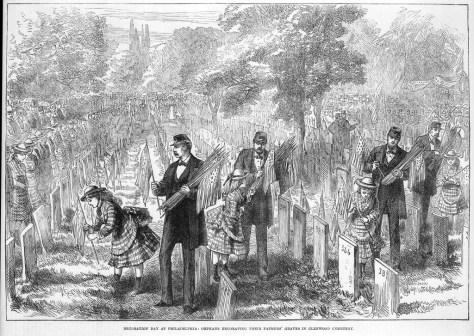
Orphans decorating their fathers’ graves in Glenwood Cemetery, Philadelphia, on Decoration Day. The Illustrated London News, June 24, 1876. Courtesy of the Library of Congress.
Note: These letters are from the personal collection of Greg Herr and were offered for transcription and publication on Spared & Shared by express consent.
Letter 1
U. S. A. Hospital Islington Lane, Philadelphia February 25, 1863
Mrs. Louisa Palmer,
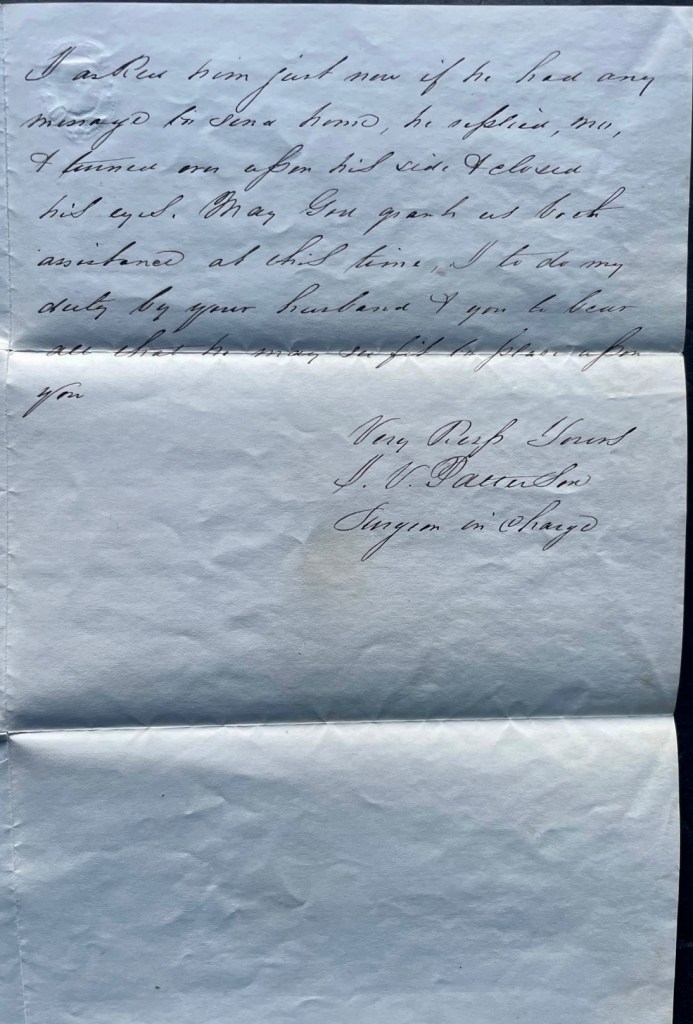
My dear Madam, it is with great anxiety I pen you these lines. When I last wrote your husband was doing as well as could be expected & I hoped for his recovery but within the last two days unfavorable symptoms have set in. His lungs are becoming congested. His face today has a purple color showing obstruction to the circulation & his whole appearance betokens anxiety and distress. I would not deceive you but tell you candidly & frankly that he is in a very critical condition.
My heart feels for you, deprived as you are of the consolation of being at his bedside & ministering to his wants. I asked him just now f he had any message to send home. He replied, no, and turned over upon his side and closed his eyes. May God grant us both assistance at this time. I, to do my duty by your husband, & you to bear all that he may see fit to place upon you.
Very respectfully yours, — J. V. Patterson, Surgeon in charge
U. S. A. Hospital Islington Lane, Philadelphia February 26, 1863
Mrs. Louisa Palmer,
My dear Madam, I mailed you a letter yesterday informing you of the critical condition of your husband. I have still a harder task today. My worst fears are realized. Your beloved husband is no more. He died this morning about 2 o’clock very quietly & with little suffering. The Matron read to him yesterday a couple of letters from home & he seemed much affected. She asked him if she should write for him, he dictating the words. He said, “Yes, tomorrow, not now.” Poor fellow, his tomorrow never came. Before that came round, his spirit had winged its immortal flight. Death has entered the happy circle of your household & taken away a loved one. In this dark hour of your better trial, heart-stricken & bereaved, there is but one source of consolation. We are in our Heavenly Father’s hands. “Even so Father, for so it seemeth good in thy” sight. The ways of Providence are mysterious & past finding out, but when we shall come to trace for ourselves in the mass of time the wisdom of all his inscrutable dealings, we shall be able to say, “Righteous art thou, oh Lord.”
I shall look over the personal effects of your husband and those that can be safely sent away from the Hospital without the fear of conveying the infection, I will carefully pack up & hold them subject to your further order.
Be pleased to accept my warmest sympathy for you & yours in this hour of sadness, & believe me, very truly yours, — J. V. Patterson, Surgeon in charge.
Letter 3
Addressed to Mrs. Louisa Palmer, Lynnfield, Essex county, Massachusetts
U. S. A. Hospital Islington Lane, Philadelphia March 13th 1863
Mrs. Louisa Palmer,
My dear Madam, I send you by Adams Express the personal effects of your late husband which I judge there will be no danger in transmitting to you. You will be kind enough to sign the receipt for the articles & transmit it by mail to me.
The remains of your husband have been interred in Glenwood Cemetery & his grave is numbered, “Section N, Row A, Grave No. 64” so that perhaps in some future time you may be permitted to look upon his last earthly resting place. Very sincerely yours, — J. V. Patterson, Surgeon in charge
The following letters were written by Edward W. Pierce (1842-1919), the son of Dr. David and Caroline Pierce of Pownal, Cumberland county, Maine.
From the history of the 3rd Massachusetts Cavalry, published in 1903, we learn that “Pierce was one of the youngest officers of the regiment. On account of gallantry and meritorious conduct, he rose from the ranks and was commissioned to command. Before the war he was a mechanic in Boston. At 21, he responded to his country’s call, entered the [41st Massachusetts] regiment and was made Sergeant June 4th 1862. [The regiment was converted to cavalry in mid-June 1863 and designated the 3rd Massachusetts Cavalry.] Pierce became Sergeant Major in 1864. He was commissioned 2nd Lieutenant August 7, 1864 and for a time served as acting Adjutant. At one time he commanded Company H and at another Company G. He was discharged June 12, 1865.”
Sergt. Edward W. Pierce, still wearing the uniform of a non-commissioned infantryman—possibly while serving as color sergeant in the 41st Massachusetts. The flag shown may have been the very flag he carried that was later cut into remnants for members of the company (see letter 3).
It should be noted that the first two letters were written while Edward served in Co. H, 41st Massachusetts Infantry. The last two letters were written after the regiment had been mounted and designated the 3rd Massachusetts Cavalry.
Letter 1
Baton Rouge, Louisiana February 16, 1863
Dear Mother
I have once more received some of Uncle Sam’s “Green Backs” which of course I received with great pleasure as I have not seen one for over three months. Was payed up to the first of January. Had been in the service about seven months up to that time but was payed one month’s pay $13 in advance with my bounty. That left most six months to be payed for and as my warrant dated from the 6th of August, I received 17.00 per month only from that time which was most five months – $83.00. The month before received but $13.00 – Total $96.00.
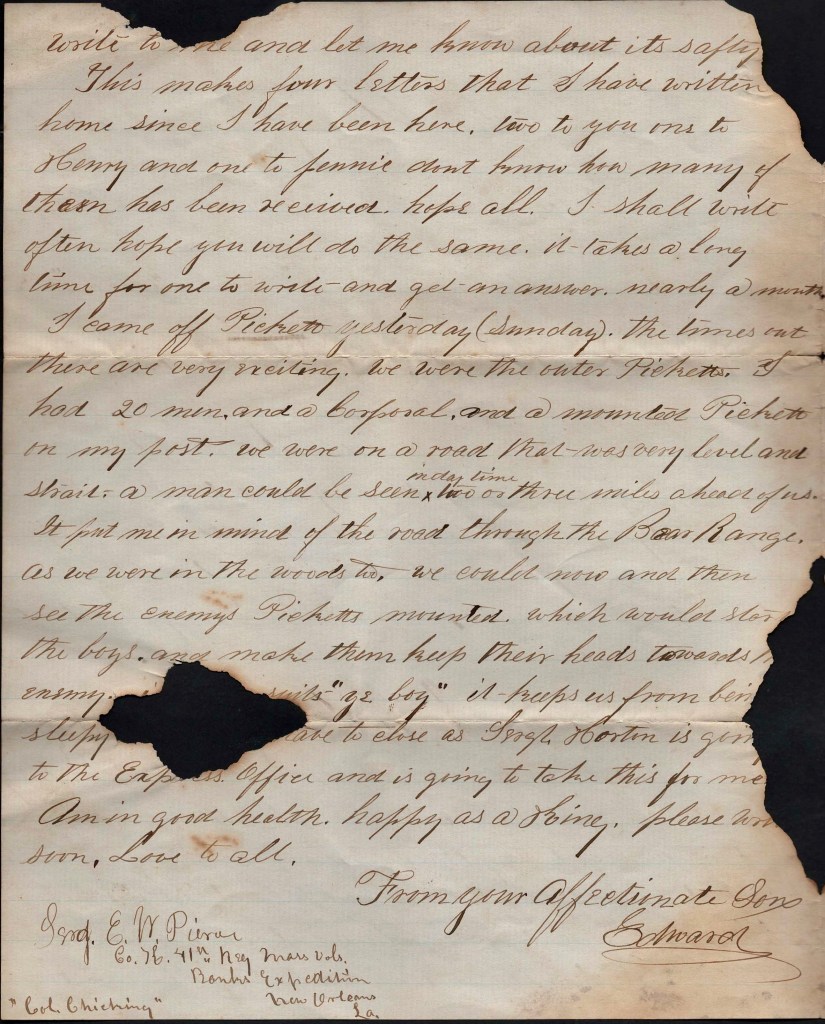
You will find enclosed $85.00 which you may do as you think best with. Would like to have it earn something if it could. Shall keep with me but $11.00 and $2.00 of that will go to pay the express on this. My other debts are about $3.00. That will leave me $6.00 to keep which I think is enough to have on hand at once. If I want more, I will send for it. Please immediately after receiving, write to me and let me know about its safety.
This makes four letters that I have written home since I have been here—two to you, one to Henry, and one to Jennie. Don’t know how many of them has been received. Hope all. I shall write often [and] hope you will do the same. It takes a long time for one to write and get an answer—nearly a month.
I came off picket yesterday (Sunday). The times out there are very exciting. We were the outer pickets. I had 20 men and a corporal and a mounted picket on my post. We were on a road that was very level and strait. A man could be seen in day time two or three miles ahead of us. It put me in mind of the road through Bear Range [in Maine] as we were in the woods too. We could now and then see the enemy’s pickets mounted which would startle the boys and make them keep their heads towards the enemy. This suits “Ye boy” [and] it keeps us from being too sleepy.
I will have to close as Sergt. Horton is going to the Express Office and is going to take this for me. Am in good health—happy as a King. Please write soon. Love to all. From your affectionate son, — Edward
Sergt. E. W. Pierce, Co. H, 41st Reg. Mass Vols., Banks Expedition, New Orleans, La.
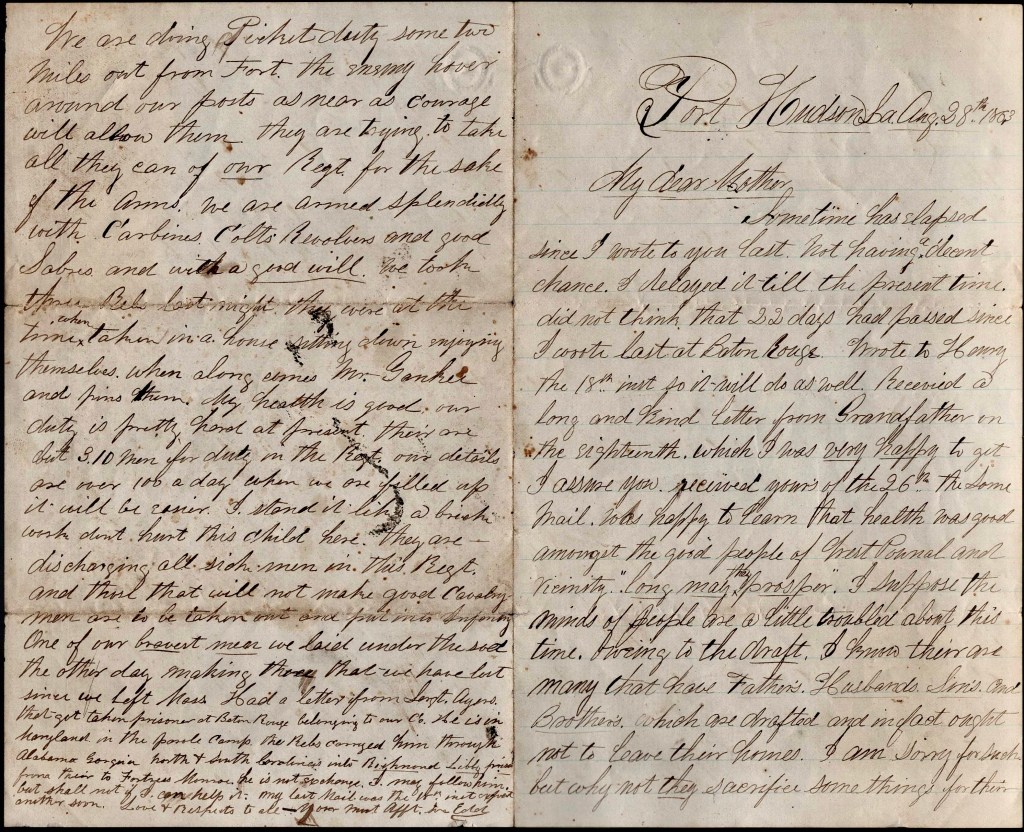
Sometime has elapsed since I wrote to you last. Not having a decent chance, I delayed it till the present time. Did not think that 22 days had passed since I wrote last at Baton Rouge. Wrote to Henry the 18th inst. so it will do as well. Received a long and kind letter from Grandfather on the eighteenth which I was very happy to get, I assure you. Received yours of the 26th the same mail. Was happy to learn that health was good amongst the good people of West Pownal and vicinity—“long may they prosper.”
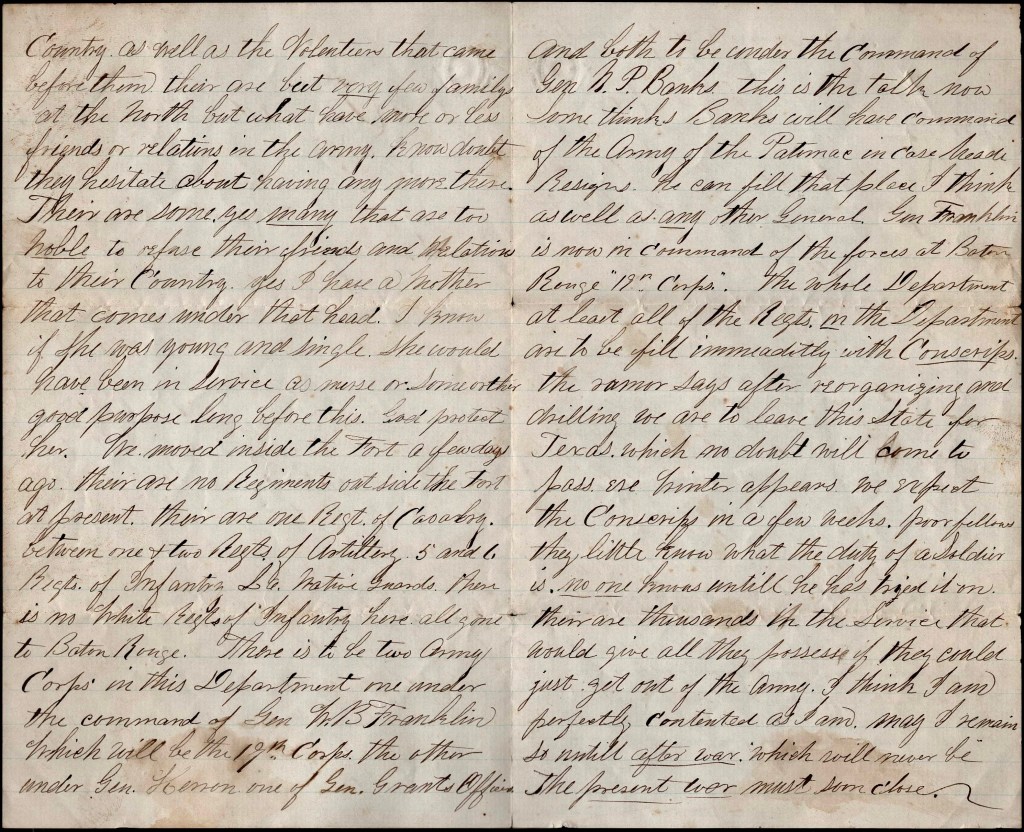
I suppose the minds of people are a little troubled about this time owing to the draft. I know there are many that have fathers, husbands, sons and brothers which are drafted and in fact ought not to leave their homes. I am sorry for such but why not they sacrifice some things for their country as well as the volunteers that came before them? There are but very few families at the North but what have more or less friends or relations in the Army. No doubt they hesitate about having anymore there. There are some—yes many—that are too noble to refuse their friends and relations to their country. Yes, I have a mother that comes under that head. I know that if she was young and single, she would have been in service as nurse or some other good purpose long before this. God protect her.
We moved inside the fort a few days ago. There are no regiments outside the fort at present. There are one regiment of cavalry, between one & two regiments of artillery, 5 and 6 regiments of infantry—[all] Louisiana Native Guards. There is no white regiments of Infantry here. [They are] all gone to Baton Rouge. There is to be two Army Corps in this department—one under the command of Gen. W. B. Franklin which will be the 19th Corp., and the other under Gen. Herron, one of Gen. Grant’s officers, and both to be under the command of Gen. N. P. Banks. This is the talk now. Some thinks Banks will have command of the Army of the Potomac in case Meade resigns. He can fill that place as well as any other general. Gen. Franklin is now in command of the forces at Baton Rouge—“19th” Corps.
The whole department, at least all of the regiments in the department, are to be filled immediately with conscripts, the rumor says. After reorganizing and drilling, we are to leave this state for Texas which no doubt will come to pass as winter appears. We expect the conscripts in a few weeks. Poor fellows—they little know what the duty of a soldier is. No one knows until he has tried it on. There are thousands in the service that would give all they possess if they could just get out of the Army. I think I am perfectly contented as I am. May I remain so until after war, which will never be. The present war must soon close.
We are doing picket duty some two miles out from fort. The enemy hover around our post as near as courage will allow them. They are trying to take all they can of our regiment for the sake of the arms. We are armed splendidly with carbines, Colts revolvers, and good sabers and with a good will. We took three Rebs last night. They were at the time, when taken, in a house sitting down enjoying themselves when along came Mr. Yankee and pins them.
My health is good. Our duty is pretty hard at present there are about 310 men for duty in the regiment. Our details are over 100 a day. When we are filled up, it will be easier. I stand it like a brick. Work don’t hurt this child here. They are discharging all sick men in this regiment and those that will not make good cavalrymen are to be taken out and put into infantry. One of our bravest men was laid under the sod the other day, making three that we have lost since we left Massachusetts. Had a letter from Sergt. [John T.] Ayers 1 that got taken prisoner at Baton Rouge belonging to our company. He is in Maryland in the parole camp. The rebs carried him through Alabama, Georgia, North & South Carolina into Richmond’s Libby Prison, from there to Fortress Monroe. He is not exchanged. I may follow him but shall not if I can help it. My last mail was the 18th. Expecting another soon. Love and respect to all. Your most affectionate son, — Ed’d
1 Sergt. John T. Ayers of Baintree, Massachusetts, died on 19 October 1864 of wounds received at the Battle of Cedar Creek, Virginia.
Letter 3
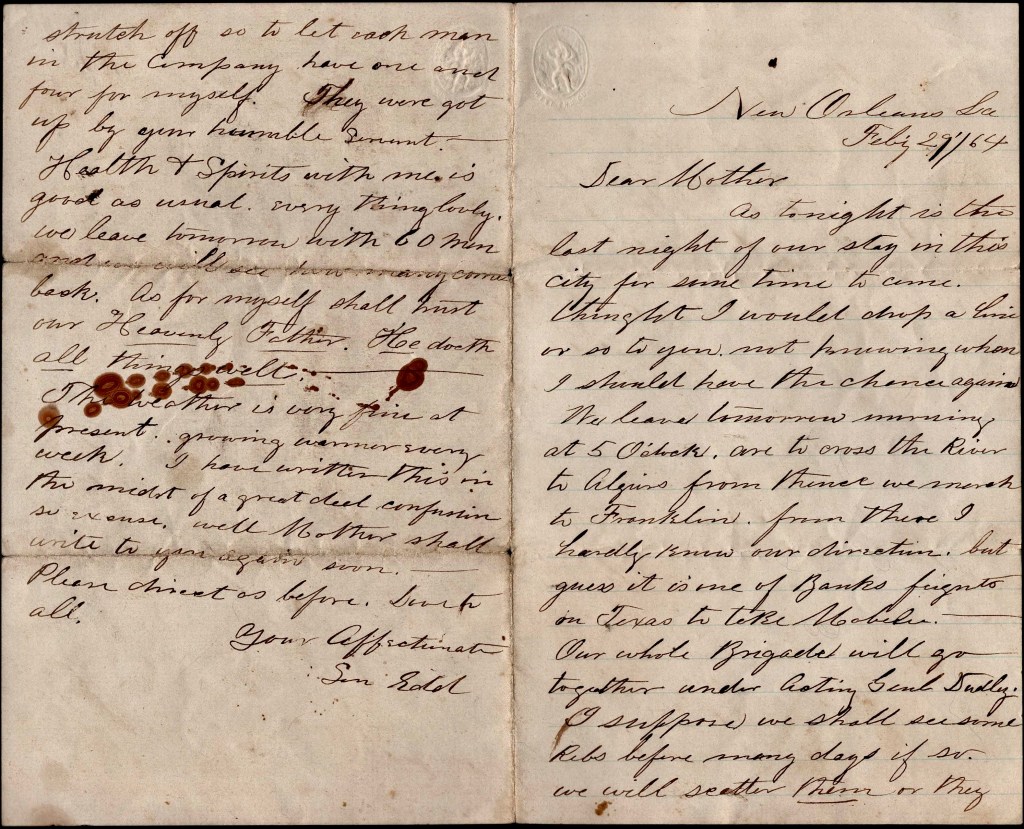
New Orleans, Louisiana February 29, 1864
Dear Mother,
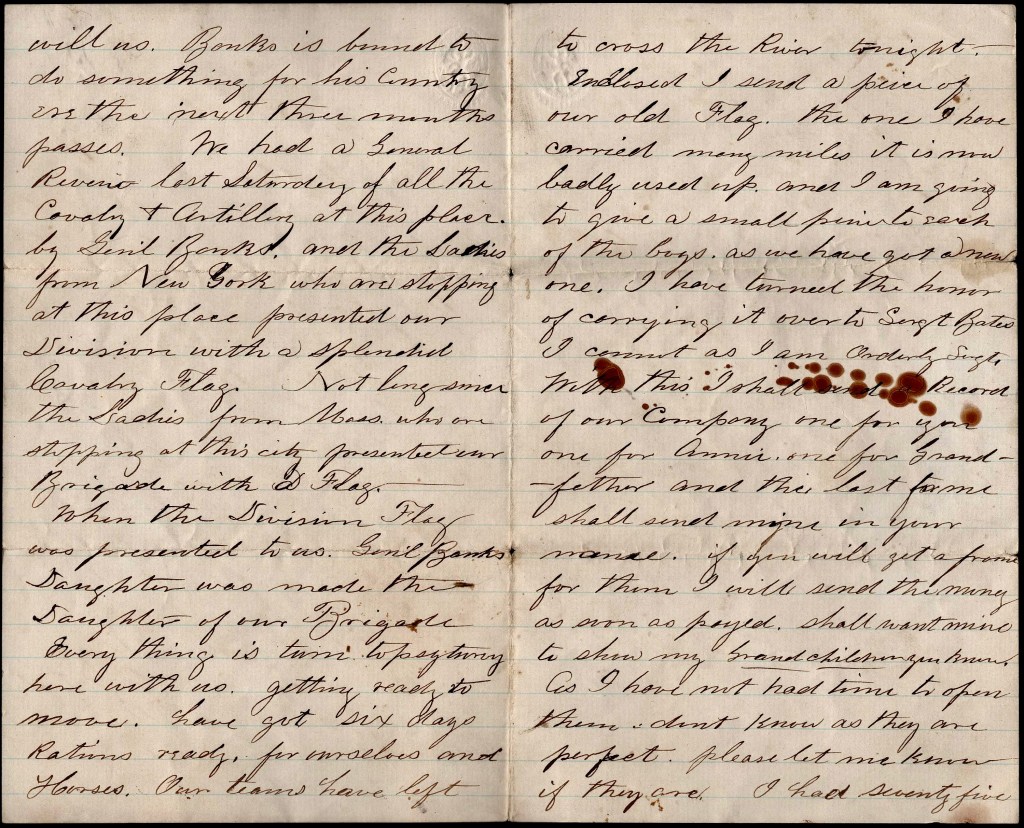
As tonight is the last night of our stay in the city for some time to come, thought I would drop a line or so to you not knowing when I should have the chance again. We leave tomorrow morning at 5 o’clock a.m. to cross the river to Algiers. From thence we march to Franklin [and] from there I hardly know our destination but guess it is one of Banks feints on Texas to take Mobile. Our whole Brigade will go together under Acting Gen. Dudley. I suppose we shall see some Rebs before many days. If so, we will scatter them or they will us. Banks is bound to do something for his country ‘ere the next three months passes.
We had a General Review last Saturday of all the cavalry & artillery at this place by Gen. Banks and the ladies from New York, who are stopping at this place, presented our division with a splendid cavalry flag. Not long since the ladies from Massachusetts who are stopping at this City presented our brigade with a flag. When the Division flag was presented to us, Gen. Banks’ daughter was made Daughter of our Brigade.
Everything is turned topsy turvy here with us getting ready to move. Have got six days rations ready for ourselves and horses. Our teams have left to cross the river tonight.
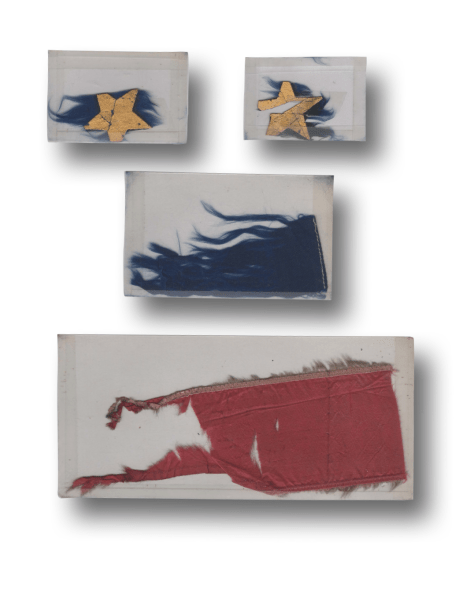
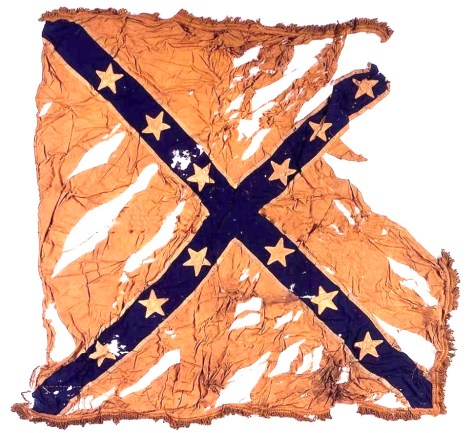
“Enclosed I send a piece of our old flag—the one I carried many miles.”
Enclosed I send a piece of our old flag—the one I have carried many miles. It is now badly used up and I am going to give a small piece to each of the boys as we have got a new one. I have turned the honor of carrying it over to Sergt. Bates. I cannot, as I am [now] Orderly Sergeant. With this, I shall send a record of our company—one for you, one for Annie, one for Grandfather and the last for me. Shall send mine in your name. If you will get a frame for them, I will send the money as soon as paid. Shall want to show mine to my grandchildren you know. As I have not had time to open them, don’t know as they are perfect. Please let me know if they are. I had seventy five struck off so to let each man in the company have one and four for myself. They were got by your humble servant.
Health and spirits with me is good as usual. Everything lovely. We leave tomorrow with 60 men and we will see how many come back. As for myself, shall trust our Heavenly Father He doeth all things well.
The weather is fine at present. Growing warmer every week. I have written this in the midst of a great deal confusion so excuse. Well, Mother, shall write to you again soon. Please direct as before. Love to all. Your affectionate son, Ed’d
Preserved flag remnants identified by Sgt. Edward W. Pierce in his letter of 29 February 1864
Letter 4
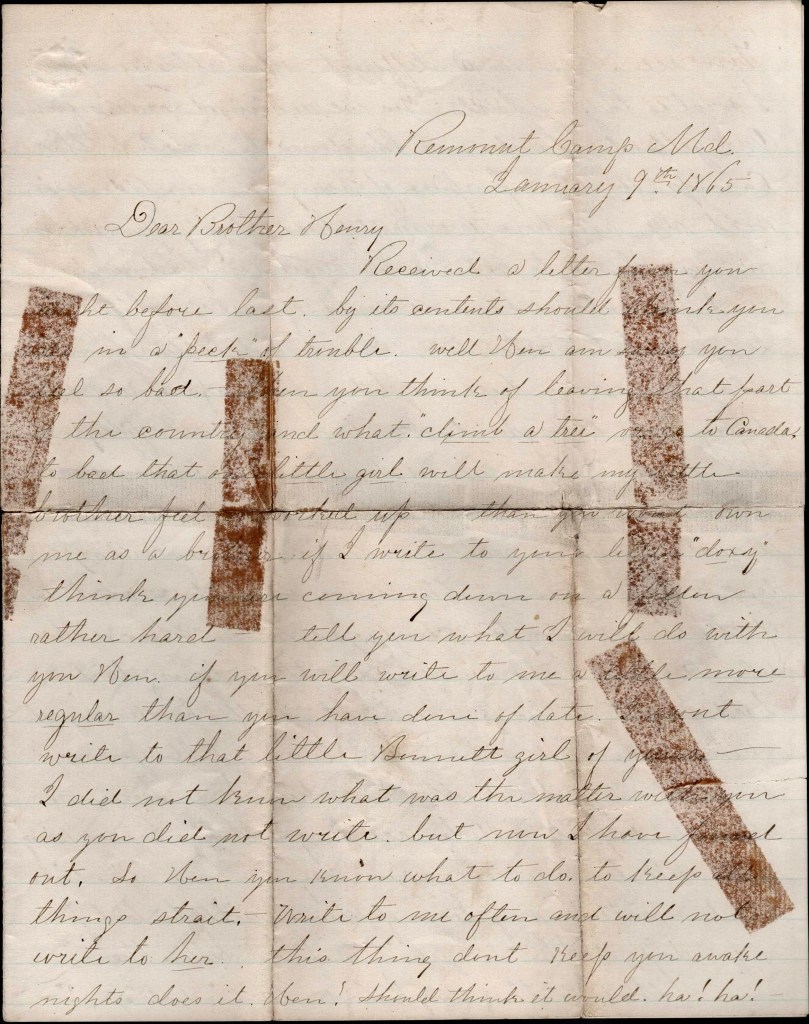
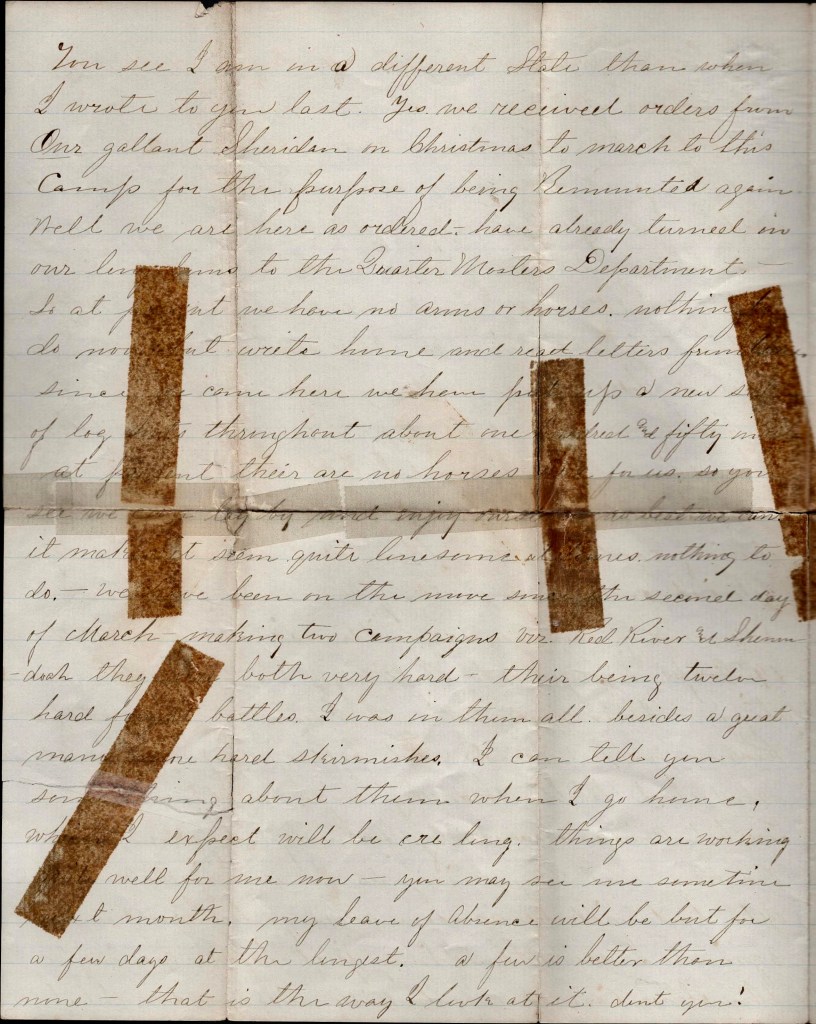
Remount Camp, Maryland January 9th 1865
Dear Brother Henry,
Received a letter from you night before last. By its contents, should think you was in a “peck’ of trouble. Well Hen, am sorry you feel so bad. Then you think of leaving that part of the country and what? climb a tree? or go to Canada? Too bad that one little girl will make my little brother feel so worked up. Then you won’t own me as a brother if I write to your “doxy”? Think you are coming down on a fellow rather hard. Tell you what I will do with you, Hen. If you will write to me a little more regular than you have done of late, I won’t write to that little brunette girl of yours. I did not know what was the matter with you as you did not write, but now I have found out. So Hen, you know what to do to keep old things straight. Write to me often and I will not write to her. This thing don’t keep you awake nights, does it Hen? I should think it would. ha! ha!
You see I am in a different state now than when I wrote you last. Yes, we received orders from Our gallant Sheridan on Christmas to march to this camp for the purpose of being remounted again. Well, we are here as ordered, have already turned in our long guns to the Quartermaster’s Department, so at present we have no arms or horses. Nothing to do now but write home and read letters from there. Since we came here, we have put up a new set of log huts throughout—about one hundred and fifty in all. At present there are no horses here for us. So you can see we can lay by and enjoy ourselves as best we can. It makes it seem quite lonesome at times—nothing to do.
We have been on the move since the second day of March, making two campaigns via Red River and Shenandoah. They were both very hard fought battles. I was in them all, besides a great many more hard skirmishes. I can tell you something about them when I go home which I expect will be ‘ere long. Things are working quite well for me now. You may see me sometime next month. My leave of absence will be but for a few days at the longest [but] a few is better than none. That is the way I look at it, don’t you?
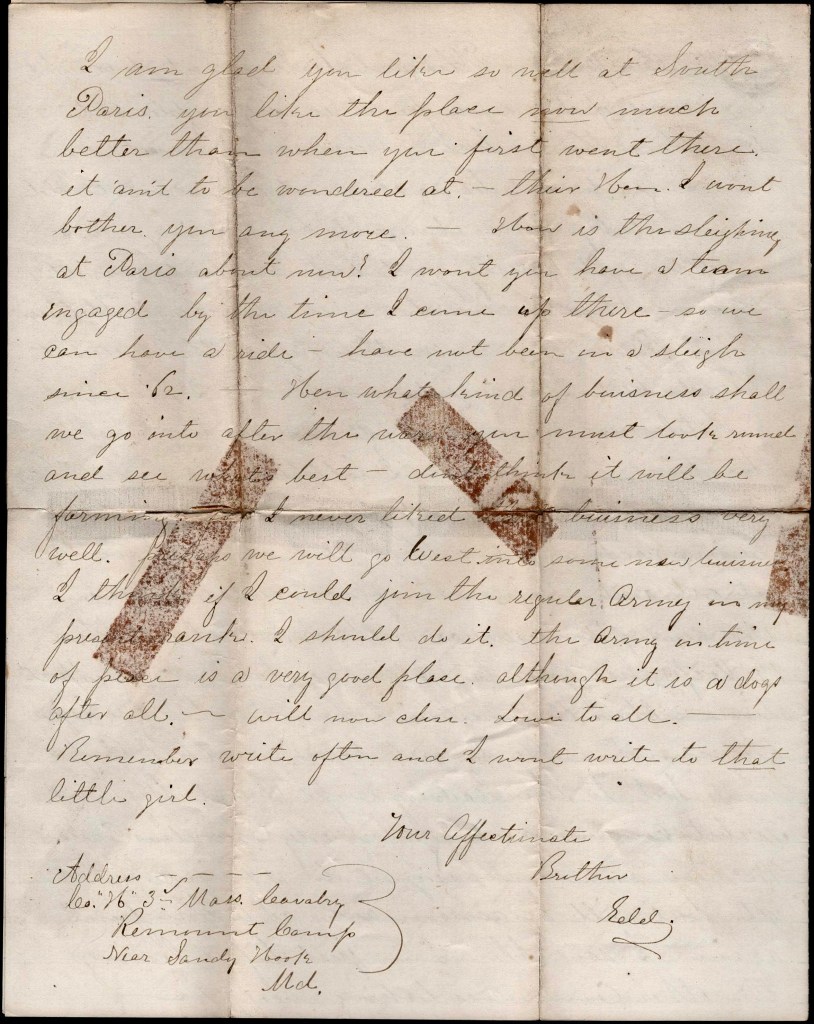
This camp is in Pleasant Valley but it is right the reverse of its name, for it is very unpleasant. It is three things here—sun, rain, and mud. Some mornings it will be clear and fine as we could wish and by noon it would be raining. As we have got pretty good huts, we don’t mind the weather so much as if we were in “Shelters” (thin fly tents). On the night the regiment arrived here, I was quite unwell, so I stayed at a hotel nearby and slept in a bed two nights—the first time since left home in July ’62. Guess I turned over about fifteen hundred times during each night. Thought I should have to get out and sleep on the floor several times.
No news of consequence with us. Believe the 19th Corps has gone to Baltimore to wait transportation—their destination I know not, perhaps Richmond. We do not belong to that Corps now but to the Cavalry Corps, Maj. Gen. Torbet commanding (formerly Sheridans Corps). We have not been assigned to a Brigade and Division yet but will be as soon as we get to the front again. I saw Aloin Lane just before leaving the other camp. Was looking nicely too. I am glad you like so well at South Paris. You like the place now much better than when you first went there. It ain’t to be wondered at. How is the sleighing at Paris about now?
I want you to have a team engaged by the time I come up there so we can have a ride. Have not been in a sleigh since ’62. Hen, what kind of business shall we go into after the war? You must look around and see what’s best. Don’t think it will be farming. I never liked that business very well. Perhaps we will go West into some new business. I think if I could join the Regular Army in my present rank, I should do it. The Army in time of peace is a dogs [life], after all. Will now close. Love to all. Remember, write often and I won’t write to that little girl. Your affectionate brother, — Eddy
Address Co “H” 3rd Mass Cavalry, Remount Camp, Near Sandy Hook, Md.
The author of this letter is identified only by the name of “Henry.” I have a hunch that he served in the 2nd Rhode Island Infantry which was performing guard duty in Fort Slocum in October 1861 but I can’t narrow his identity down any further than that.
Transcription
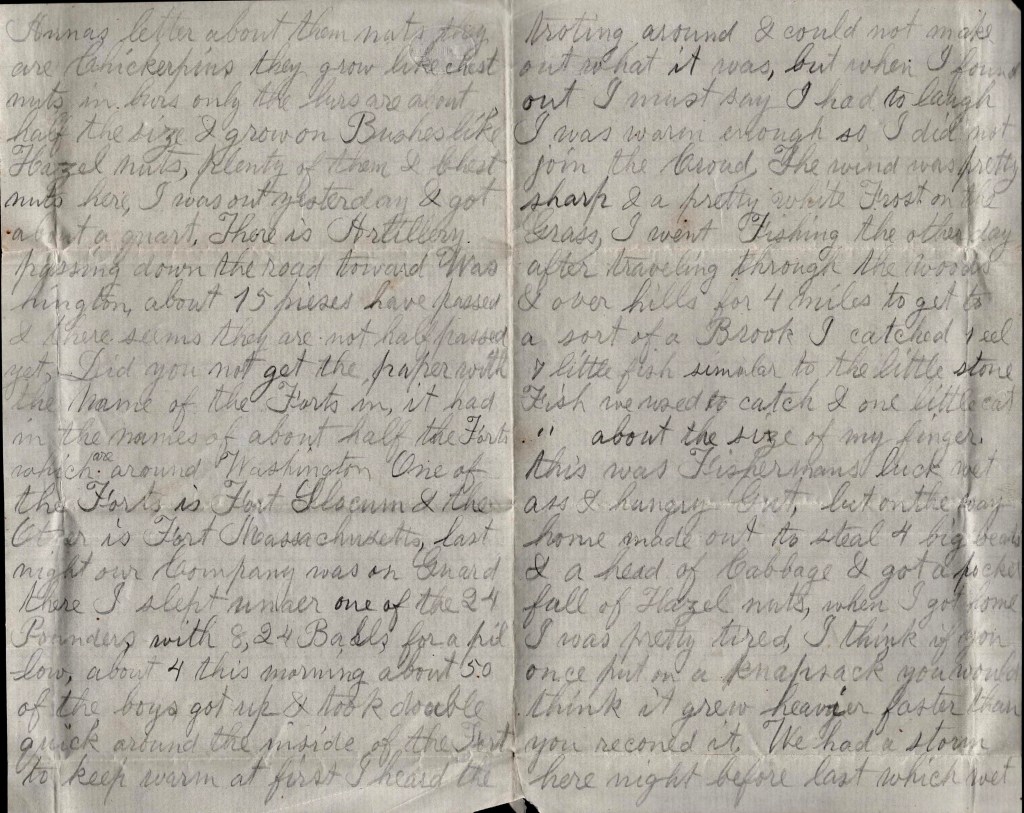
Washington October 19, 1861
Dear Brother,
I received your letter yesterday and was glad to hear that you were all well at home. I am much obliged for the stamps you sent. They are very acceptable. I received all the papers. Do you get the papers I send? I get them every morning. They come in camp. “Franked” mails are played out. Can’t get anymore.
There is considerable in the different encampments of the old excitement which I used to see at home about election. The troops will vote just the same as though they were at home. Well, how would you like to vote this year?
I wrote in Anna’s letter about them nuts. They are chinquapins. They grow like chestnuts in burs only the burs are about half the size of & grow on bushes like hazelnuts. Plenty of them and chestnuts here. I was out yesterday and got about a quart.
There is artillery passing down the road toward Washington. About 15 pieces have passed & there seems they are not half passed yet. Did you not get the paper with the names of the forts in? It had the names of about half the forts which are around Washington. One of the forts is Fort Slocum & the other is Fort Massachusetts. Last night our company was on guard there. I slept under of the 24-pounders with eight 24 balls for a pillow. About 4 this morning, about 50 of the boys got up and took double quick around the inside of the fort to keep warm. At first I heard the trotting around and could not make out what it was, but when I found out, I must say I had to laugh. I was warm enough so I did not join the crowd. The wind was pretty sharp & a pretty white frost on the grass.
I went fishing the other day. After traveling through the woods & over hills for 4 miles to get to a sort of a brook, I catched 1 eel, 7 little fish similar to the little stone fish we used to catch, & one little catfish about the size of my finger. This was fisherman’s luck, wet ass, and hungry gut. But on the way home made out to steal 4 big beets and a head of cabbage & got a pocket full of hazel nuts. When I got home, I was pretty tired. I think if you once put on a knapsack, you would think it grew heavier faster than you reckoned it.
We had a storm here night before last which wet everything through. Some of our forts almost come down & the water went through all ways. I never saw it rain harder. It was a pretty looking sight to see the boys creep out in the morning. Most of them looked like drowned rats. Well, this is a soldier’s life.
Monday after we were to have a review by Gen. McClellan so in the morning all hands—that is, the whole regiment—marched down to the quartermaster’s to get their whiskey and go to work on the whole camp. Some [were] sweeping, others cleaning up around the tents and making things look shipshape. Our company were among the sweepers. There was at least 600 who had cedar brooms in their hands at once. It would make some of you folks at home [laugh] to see some of the performances we have to go through. I have learned many trades since I have been here. I was over to the fort with the company & 4 of us started a well & dug it four feet in three hours. It was 8 feet in diameter. You had ought to see me handle the pick & shovel.
Don’t send the Budget of fun. It is full of darn’d nonsense & nothing else. I will send for what I will want, I think, after it gets colder. I will let you send me a box. There is some little things I will want when it gets a little colder. — Henry
I received a letter from Hon. Hueston. He is well. I will see him as soon as I can.
The following letter was written by Willard Simpson Wells (1835-1865), the son of Willis Lea Wells (1805-1887) and Druscilla D. Sexton (1813-1888) of Stone Mountain, DeKalb county, Georgia. “Simpson” Wells served in Co. D, 38th Georgia Infantry during the Civil War. He wrote this letter to his brother, George Riley Wells (1838-1919) who served as a Lieutenant in the same company until he was captured at Spottsylvania and spent the remainder of the war in a Union prison. George was also the only one of five brothers who survived their service in the Confederate army. Simpson’s health did not allow for active service late in the war and he was detailed as nurse in Rome, Georgia, for many months late in the war. He died at a hospital in Macon, Georgia, on 16 April 1865 just as the war was coming to a close.
With pleasure I embrace the present opportunity of writing you a line, although I have nothing important to write you. We still have very bad weather here and prospect for another snow. And judging by the weather here, I guess it very bad in Virginia. I am afraid that you have had to leave your comfortable quarters from what i heard, and turn out to marching again in the cold. But I hope you have not yet. I heard recently that Longstreet’s Corps was traveling to the South. I wish Jackson’s would move to the South too for I never want to come to Virginia anymore. My furlough expires on the twenty-fifth of March and I shall need another extension, but I fear I shall not be able to get it for I have done over one extension and I don’t think the same Board will be willing to give me another.
We have been almost jubilant about the ending of the war but I am afraid it was all for nothing for I don’t see much prospect now of its ending soon. At any rate, I am afraid that there will be a great deal of hard fighting to do yet before the end.
I wish you could get a furlough and come home but then it would not be much pleasure to you to see the hard times that are in this country for it really looks like starvation is almost inevitable all over the whole country.
I am sorry that you made the trade with Rhenny for you have bought a dear bargain from accounts, but maybe you can trade it to someone and save yourself. I am not ready to give up my transfer business yet, and I have passed an examination and expect to get my papers approved in a short time and will then send them to the Captain and I shall want you to do all you can for me. I don’t think my health will be sufficient to return to Virginia very soon. My health is very poor yet, but I hope I am improving some for I have not strength to walk but very little at one time and I can’t get up on a horse by the stirrup in consequence of my muscular power having failed and I am utterly worthless to myself or Jeff Davis either now.
Our vaccination sores are hurting us all very bad here. We have been vaccinated with something that we can’t get well of and it’s almost as bad as smallpox itself. I am afraid we are badly bitten in our efforts to prevent the smallpox.
All Joe Brown’s commissioned officers are ordered to Savannah. I don’t know what it is for but I guess the Yankees are trying to make a demonstration in that direction, but I hope they will not be able to take the city.
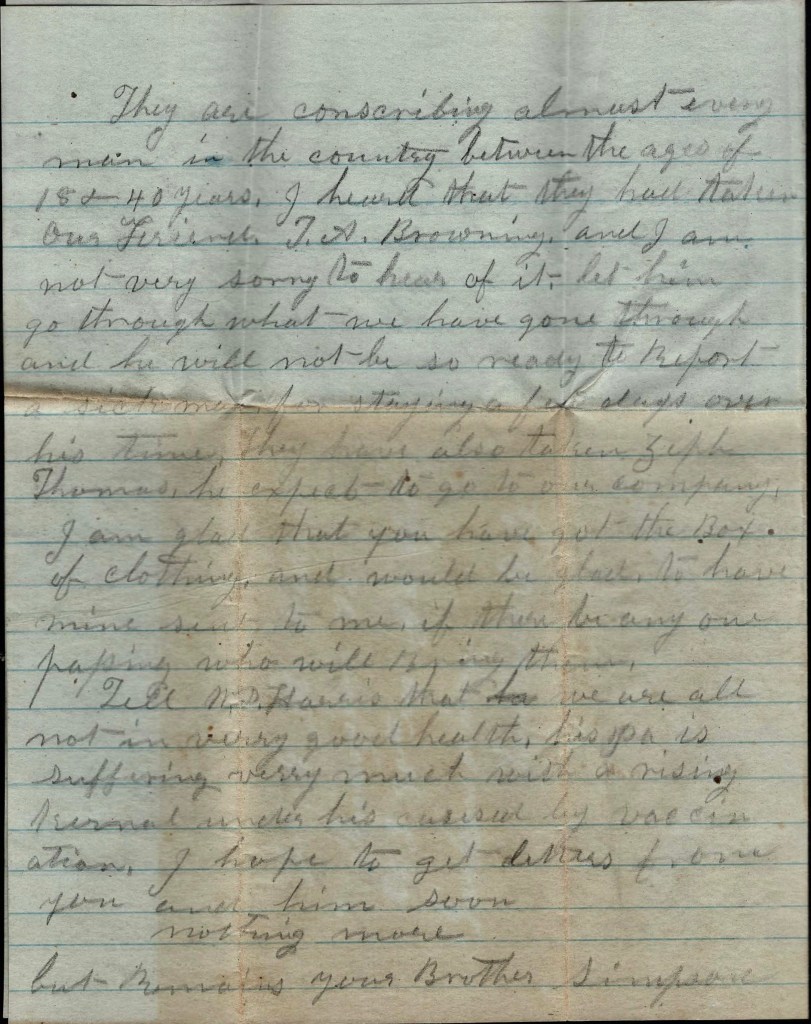
They are conscribing almost every man in the country between the ages of 18 and 40 years. I heard that they had taken our friend, T. A. Browning, and I am not very sorry to hear of it. Let him go through what we have gone through and he will not be so ready to report a sick man for staying a few days over his time. They have also taken Ziph Thomas. He expects to go to our company.
I am glad that you have got the box of clothing and would be glad to have mine sent to me if there be anyone passing who will bring them.
Tell W. D. Harris that we are all not in very good health. His pa is suffering very much with a rising kernal under his [c____ed] by vaccination. I hope to get letters from you and him soon. Nothing more but remain your brother, — Simpson
I could not find an image of Thomas but here is one of Frank J. Wilder of Co. A, 12th Rhode Island. He died of typhoid fever in January 1863 at age 17. (Rob Grandchamp Collection)
The following letter was written by Pvt. Thomas M. Johnson (1843-1917) who enlisted on 23 September 1862 in Co. A, 12th Rhode Island Infantry—a 9-months Regiment. He mustered out of the regiment at Providence on 29 July 1863. Thomas was from East Greenwich, Rhode Island. Prior to the Civil War, Thomas had attended the Providence Conference Seminary Musical Institute.
Thomas was the son of John H. Johnson (1810-1886) and Julia A. Tiffany (1810-1902) of East Greenwich, Kent county, Rhode Island. After his time in the service, Thomas settled in Providence and was employed as a carpenter. He married Adelaide E. Clark.
Letter 1
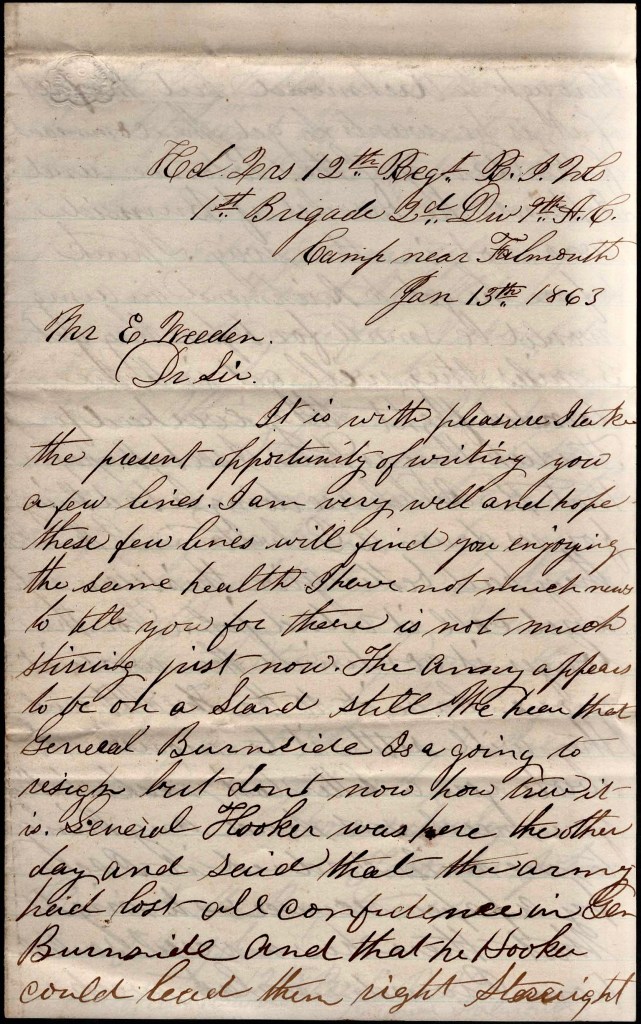
Headquarters 12th Regt. Rhode Island Volunteers 1st Brigade, 2nd Division, 9th Army Corps Camp near Falmouth [Virginia] January 13th 1863
Mr. E. Weeden, dear sir,
It is with pleasure I take the present opportunity of writing you a few lines. I am very well and hope these few lines will find you enjoying the same health. I have not much now to tell you for there is not much stirring just now. The Army appears to be on a stand still. We hear that General Burnside is a going to resign but don’t know how true it is. General Hooker was here the other day and said that the army had lost all confidence in Gen. Burnside and that he—Hooker—could lead them right straight through to Richmond. But the facts of it is he wants to get the command of the Army of the Potomac and I think he would if Burnside was not in the way. I think before he got to Richmond his army would be small for before they get three miles, they will get into the darndest fight they ever had for Fredericksburg is there.
I see by the paper that the Rebels are doing a bad thing for us down to Galveston. I think they had better give this war up and call it a bad job for the longer it continues, the worse it goes. Leave it to the wealth and they will settle it tomorrow.
I wrote you a letter last week stating you need not send anything to me unless I ordered it. I see by a paper received tonight that there has a vessel sailed from Providence last week with vegetables and boxes for the different regiments in the Army and also that there is another one to sail soon. Now if you will get me up a box and send it out, I shall be much obliged to you for I should like very much to receive something from Rhode Island once more—anything but army eatables are very scarce out here. If you send me a box, you can charge it to me and take it out of my money. I have not time to write anymore this evening. Give my love to your family and the boys. I send a note to Jim. Yours truly, — Thomas Johnson
Direct the box to me. T. M. Johnson, 12th Regt. R. I. Vols. in care of Col. Brown, to near Falmouth
Letter 2
Headquarters 12th Regiment Rhode Island Vols. Newport News, Va. February 22nd 1863
Dear Eben,
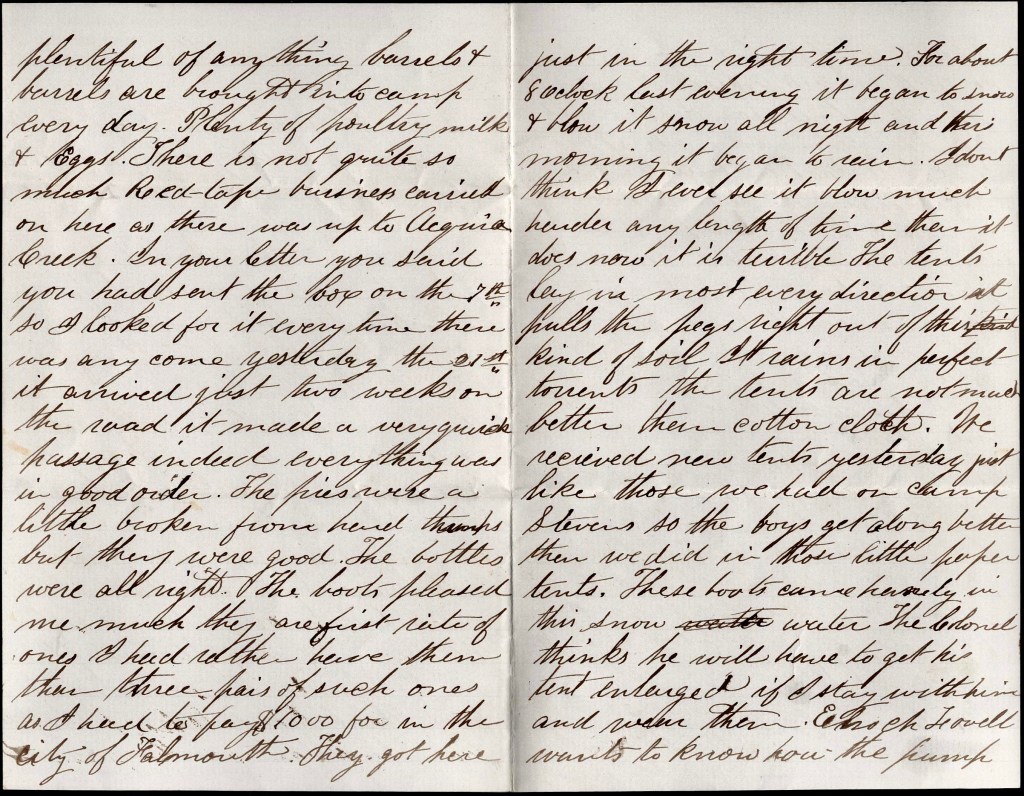
I take the present opportunity of writing you a few lines to let you know that I am well & hope these few lines will find you enjoying the same health. I received your letter and was very glad to hear from you. I never received it until we had arrived here in our new camp. I suppose you have heard before this that we had moved either by letter or papers. We are in a very pleasant place on the James River 100 miles from Richmond. Everything is plenty here. Oysters are the most plentiful of anything. Barrels & barrels are brought into camp everyday. Plenty of poultry, milk and eggs. There is not quite so much red tape business carried on here as there was up to Aquia Creek.
In your letter you said you had sent the box the 7th so I looked for it every time there was any come. Yesterday, the 21st, it arrived, just two weeks on the road. It made a very quick passage indeed. Everything was in good order. The pies were a little broken from hard thumps but they were good. The bottles were all right. The boots pleased me much. They are first rate of ones. I had rather have them than three pairs of such ones as I had to pay $10 for in the City of Falmouth. They got here just in the right time for about 8 o’clock last evening it began to snow and blow. It snowed all night and this morning it began to rain. I don’t think I ever see it blow much harder any length of time than it does now. It is terrible. The tents lay in most every direction. It pulls the pegs right out of this kind of soil. It rains in perfect torrents. The tents are not much better than cotton cloth. We received new tents yesterday just like those we had on Camp Stevens so the boys get along better than we did in those little paper tents. These boots came [ ly] in this snow and water. The Colonel thinks he will have to get his tent enlarged if I stay with him and wear them.
Enoch Lovell wants to know how the pump is. He is out of a job & wants me to send his best respects to you. John Healy is around here yet. They keep him at work at his trade. He has been building a bake house the last week. Wants to know how Daniel Burdick is. I haven’t heard since I have been here. I think by the appearance that we shall stay here some time. Our time will be half out the last of this week. This would be a very pleasant place to stay the rest of the time.
I have not much news to write for there does not anything happen worthy of notice. What has become of Tim? Give my best respects to him. Give my love to all your family. Have you done anything at farming yet? Write as soon as you receive this. — T. M. J., Care of Col. Browne, 12th Rhode Island Vols., Washington D. C.
The following letter was written by Albert Clark Cooke (1840-1862), the son of Joseph Clark Cooke (1813-1882) and Amey Wade (1815-1873) of Putnam, Windham county, Connecticut. Albert was born in Rhode Island but moved with his family to Bureau county, Illinois, (where they were enumerated in 1850) before moving to Putnam, Connecticut.
Albert enlisted in Co. A, 6th Connecticut Infantry. He died at Beaufort, South Carolina, on Christmas day, 1862. His cause of death is rather unspecific. The surgeon recorded that he was “admitted with debility.” He was 22.
The 6th Connecticut Infantry was stationed in Beaufort, South Carolina, from September 1862 to March 1863 under the command of Colonel John Lyman Chatfield.
Letter 1
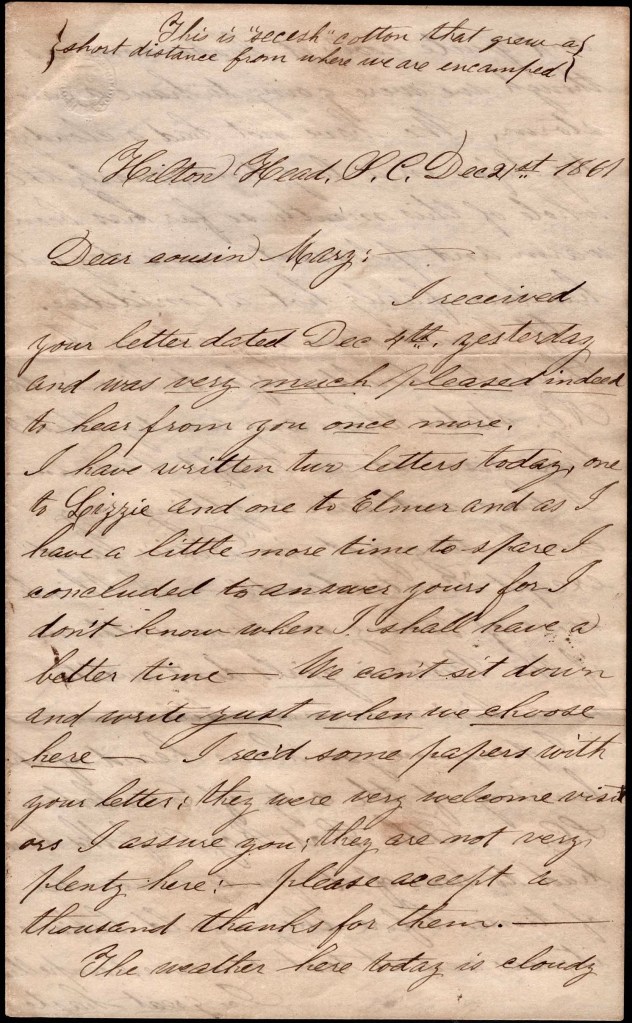
Hilton Head, South Carolina December 21st 1861
Dear cousin Mary,
I received your letter dated December 4th yesterday and was very much pleased indeed to hear from you once more. I have written two letters today, one to Lizzie and one to Elmer and as I have a little more time to spare, I concluded to answer yours for I don’t know when I shall have a better time. We can’t sit down and write just when we choose here. I received some papers with your letter; they were very welcome visitors, I assure you. They are not very plenty here. Please accept a thousand thanks for them.
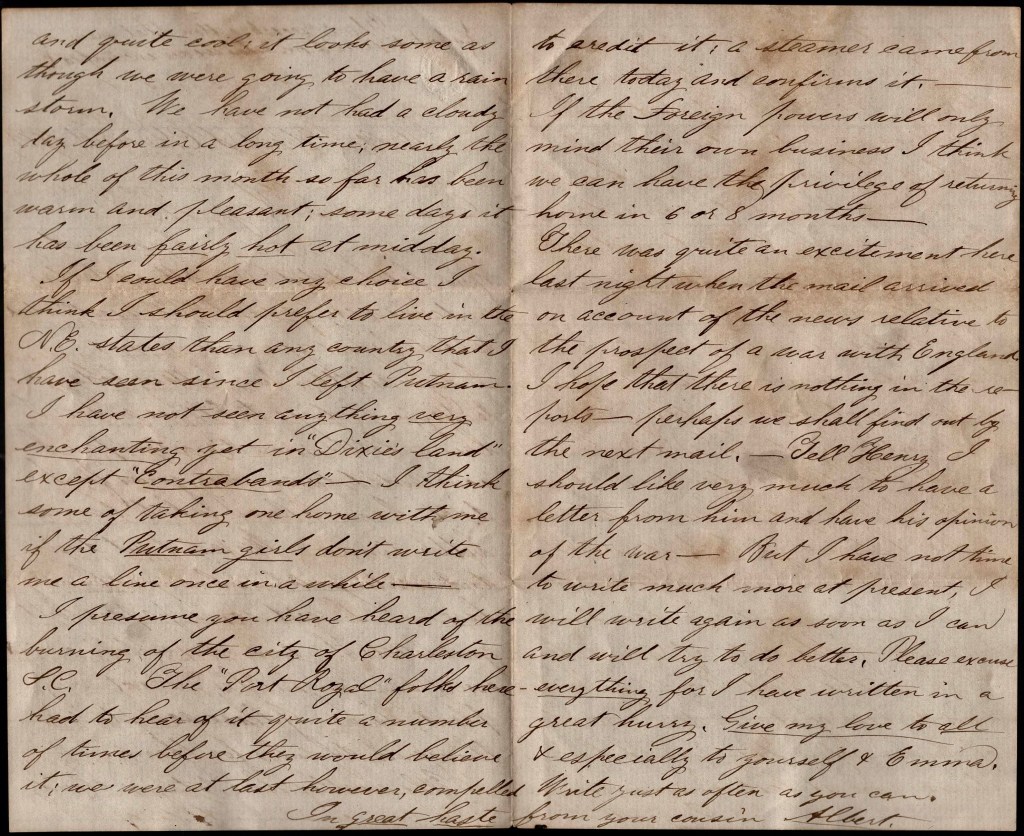
The weather here today is cloudy and quite cool. It looks some as though we were going to have a rain storm. We have not had a cloudy day before in a long time. Nearly the whole month so far has been warm and pleasant. Some days it has been fairly hot at midday.
If I could have my choice I think I should prefer to live in the New England states than any country that I have seen since I left Putnam. I have not seen anything very enchanting yet in “Dixie’s Land” except “contrabands.” I think some of taking one home with me if the Putnam girls don’t write me a line once in a while.
I presume you have heard of the burning of the City of Charleston, S. C. The “Port Royal” folks here had to hear of it quite a number of times before they would believe it. We were at last, however, compelled to credit it. A steamer came from there today and confirms it. If the foreign powers will only mind their own business, I think we can have the privilege of returning home in 6 or 8 months.
There was quite an excitement here last night when the mail arrived on account of the news relative to the prospect of a war with England, I hope that there is nothing in the reports. Perhaps we shall find out by the next mail.
Tell Henry I should like very much to have a letter from him and have his opinion of the war. But I have not time to write much more at present. I will write again as soon as I can and will try to do better. Please excuse everything for I have written in a great hurry. Give my love to all & especially to yourself & Emma. Write just as often as you can. In haste. From your cousin, — Albert
This is “secesh” cotton that grew a short distance from where we are encamped.
Letter 2
Beaufort, South Carolina September 30th 1862
Dear cousin Mary,
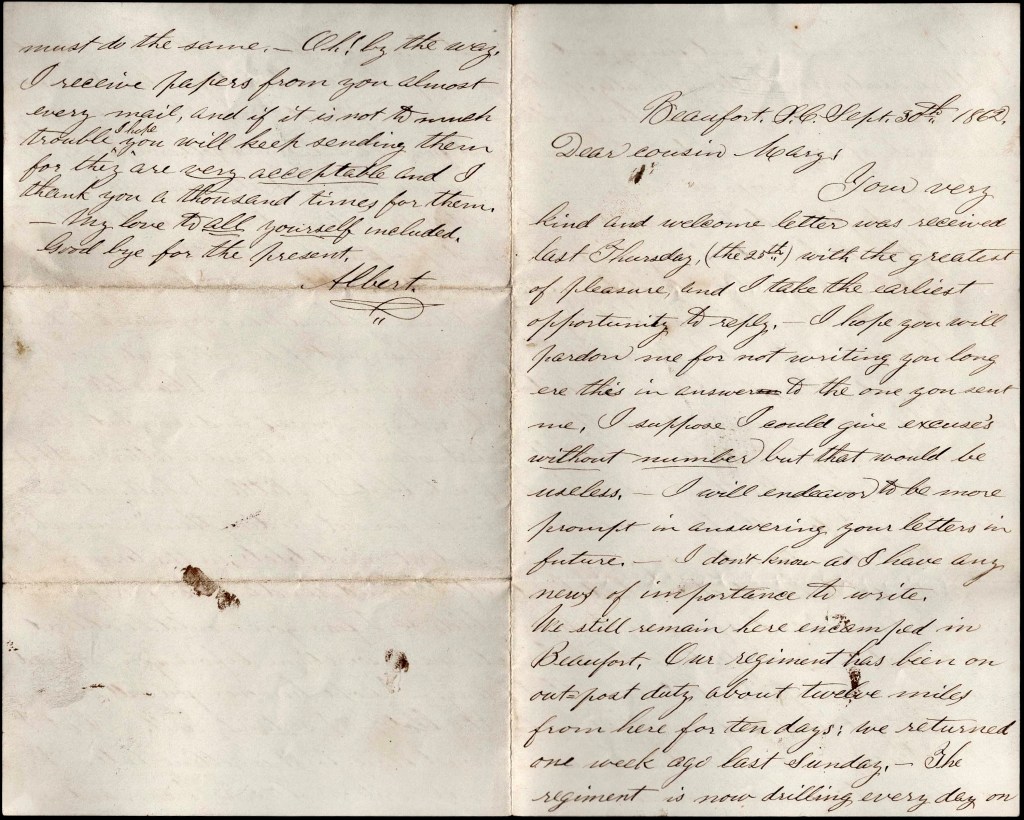
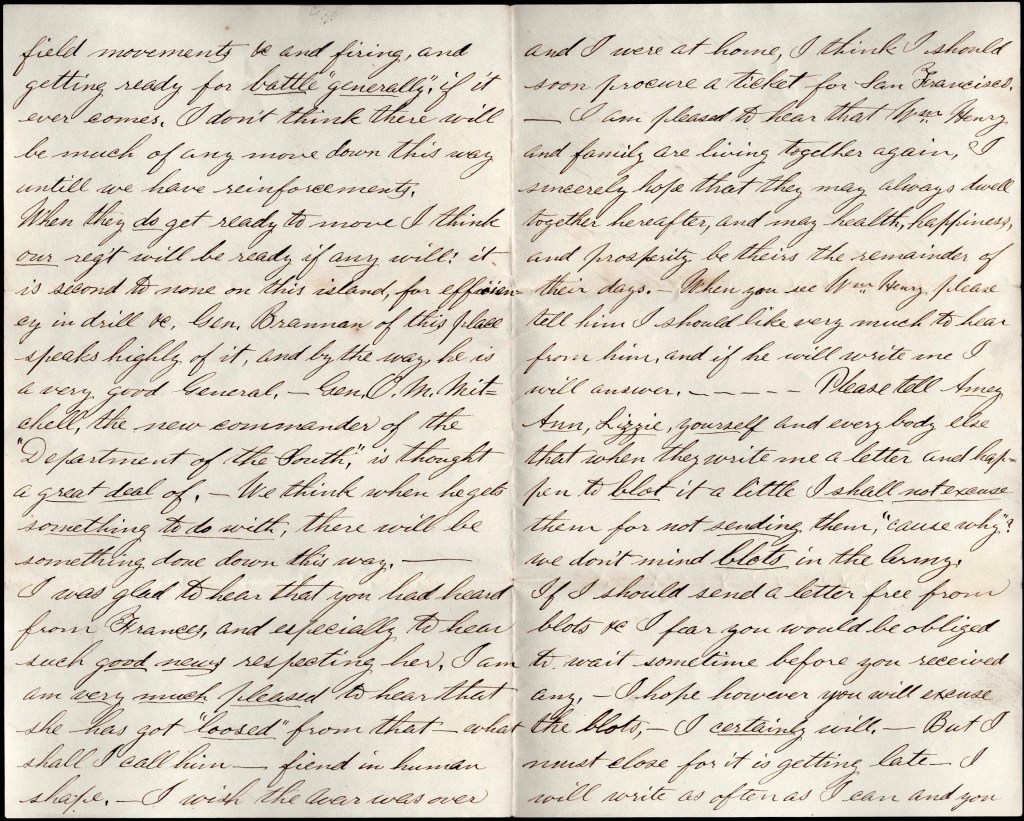
Your very kind, welcome letter was received last Thursday (the 25th) with the greatest of pleasure, and I take the earliest opportunity to reply. I hope you will pardon me for not writing you long ere this in answer to the one you sent me. I suppose I could give excuses without number but that would be useless. I will endeavor to be more prompt inn answering your letters in future. I don’t know as I have any news of importance to write. We still remain here encamped in Beaufort. Our regiment has been on outpost duty about twelve miles from here for ten days. We returned one week ago last Sunday. The regiment is drilling every day on field movements &c. and firing and getting ready for battle “generally”—if it ever comes. I don’t think there will be much of any move down this way until we have reinforcements. When they do get ready to move, I think our regiment will be ready if any will. It is second to none on this island for efficiency in drill, &c. Gen. Brannan of this place speaks highly of it, and by the way, he is a very good general. Gen. O. M. Mitchell, the new commander of the “Department of the South,” is thought a great deal of. We think when he gets something to do with, there will be something done down this way.
I am glad to hear that you had heard from Frances and especially to hear such good news respecting her. I am very much pleased to hear that she has got “loosed” from that—what shall I call him—-friend in human shape. I wish the war was over and I was at home. I think I should soon procure a ticket for San Francisco. I am pleased to hear that Wm. Henry and family are living together again. I sincerely hope that they may always dwell together hereafter, and may health, happiness, and prosperity be theirs the remainder of their days. When you see Wm. Henry, please tell him I should like very much to hear from him, and if he will write me, I will answer.
Please tell Amey, Ann, Lizzie, yourself and everybody else that when they write me a letter and happen to blot it a little, I shall not excuse them for not sending them. “Cause why?” We don’t mind blots in the army. If I should send a letter free from blots &c., I fear you would be obliged to wait some time before you received any. I hope, however, you will excuse the blots. I certainly will. But I must close for it is getting late. I will write as often as I can and you must do the same. Oh! by the way, I receive papers from you almost every mail and if it is not too much trouble, I hope you will keep sending them for they are very acceptable and I thank you a thousand times for them. My love to all—yourself included. Goodbye for the present. — Albert
The following letter was written by Adelbert M. Spencer (1840-1902), the son of Jeremiah and Anna (Blackstone) Spencer of Woodstock, Windham county, Connecticut. Adelbert enlisted on 25 October 1861 to serve in Co. H, 11th Connecticut Infantry. He was a private in the ranks until December 1863 when he was reassigned as a wagoner. He mustered out on 21 December 1865 at Hartford, Connecticut.
The 11th Connecticut has been with Burnside on his expedition to the Carolinas early in the war and returned to Virginia and the Army of the Potomac to participate in the Battle of Fredericksburg and the Mud March, although we learn that Adelbert avoided much of the latter by being on guard duty. Adelbert’s letter speaks of the demoralization of the army after its setbacks on the Rappahanock and of the thinning of the ranks.
Transcription
Camp near Fredericksburg, Virginia January 25, 1863
Dear Uncle,
I received a letter in Sarah’s from you and was glad to get one from you and I hope these few lines will find you well and all the rest of the folks. I am in good health but I have got tired of this humbug war and there is a good many more than I. There was two or three Corps went down to the river about six miles from the city and the pontoons, got one boat in the river and soon then got stuck in the mud so they could not get along and the Rebels happened to get their artillery planted for us and our men lost horses and broke their wagons down. They had to hitch 30 horses on one gun to get along and they found out that they could get along and the officers told their men to break ranks and they started for their camps.
The 11th [Connecticut] Regiment was on picket and we had a wet time and hain’t got our blankets dry yet. We expected to march when we got to the camp. I guess we shall have to stay here a spell. I guess that we won’t get to Richmond this winter. The Rebels blackguard our men about Burnside stuck in the mud and they told our boys that if they wanted any help, that they would come over and lay the bridge so that we could get along. It is hard work to face those breastworks. If they could come out in an open field, we could give them all they wanted.
Our army is getting small very fast. There is a good many of our men [who] desert every day and there is a good many of their times run out in the spring and then this war has got to come to a close. I wish it could be today.
I am on guard today and when I get off guard tomorrow, I will go over to the 12th [Connecticut] Regiment and see the boys. I have been thinking of going over. Is William Burdick in Greenwich. If he is, give him my best respects.
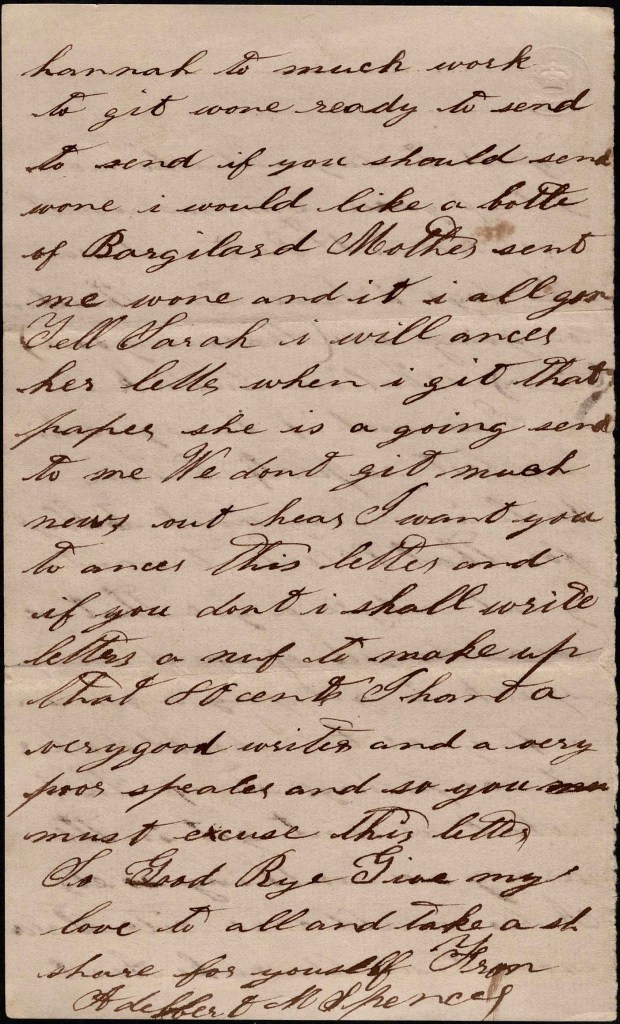
Uncle, I am very much obliged for that 80 cents. It wasn’t a great while ago that we were paid off and we expect to get pay again in a day or two. I should rather it was postage stamps. That’s what we can’t get in the army, or something else. A box would come right through now. It would make Aunt Hannah too much work to get one ready to send. If you should send one, I would like a bottle of Borgilard. Mother sent me one and it is all gone.
Tell Sarah I will answer her letter when I get that paper she is a going to send to me. We don’t get much news out here. I want you to answer this letter and if you don’t, I shall write letters enough to make up that 80 cents. I hain’t a very good writer and a very poor speller and so you must excuse this letter. So goodbye. Give my love to all and take a share for yourself. From Adelbert M. Spencer
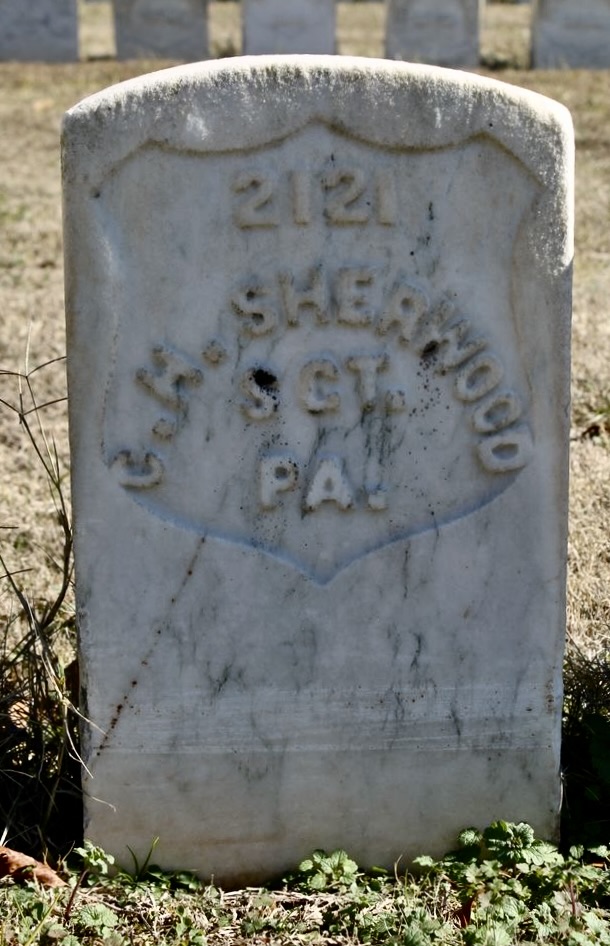
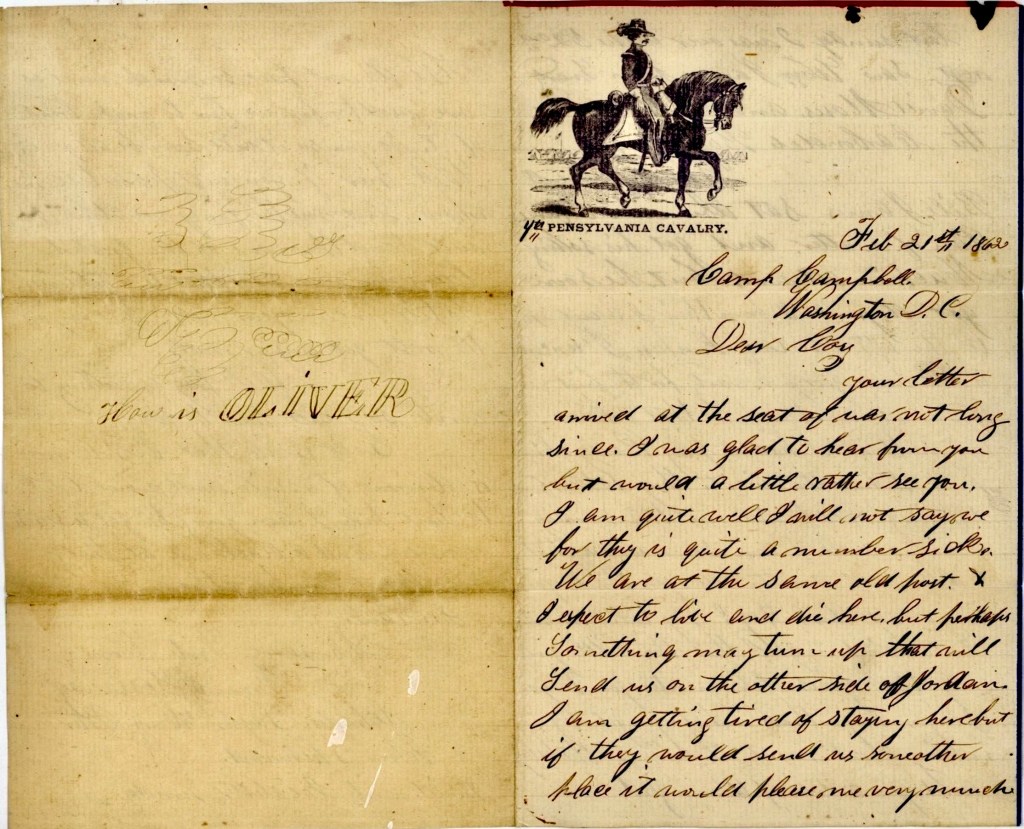
The following letter was written by Charles H. Sherwood of Co. M, 4th Pennsylvania Cavalry (64th Pennsylvania Volunteers) who enlisted on 30 October 1861 and died at Andersonville Prison on 7 June 1864 (Grave 2121). Charles H Sherwood, was born about 1842, to Zelotus and Abagail Sherwood. Charles entered the service with friends from Carbondale, Luzerne (Lackawana) County, Pennsylvania. Sgt. Sherwood was present at many Civil War battles. He fought at Gettysburg and his name is engraved on the Pennsylvania Memorial there. Sgt. Sherwood was captured October 12, 1863, at White Sulphur Springs,Virginia, along with 300 other Union troops from the Pennsylvania Fourth and Thirteenth Cavalry. Initially, he was probably imprisoned at Belle Island, Richmond, Virginia, and later transferred to Andersonville, Georgia, about March 1864. He died that June of dysentery. Five of Charles’s Carbondale enlistee friends also died at Andersonville.
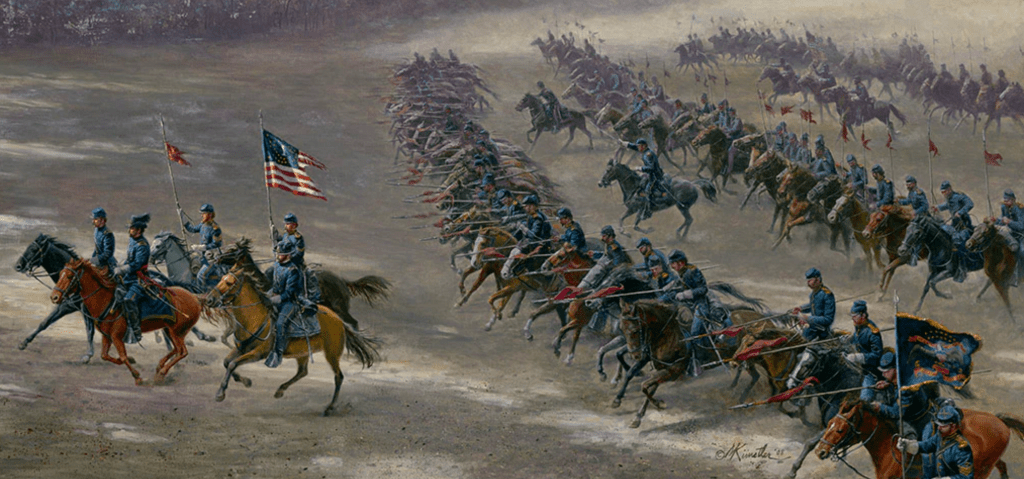
Sherwood’s letter refers to Rush’s Lancers (Mort Künstler Painting).
Transcription
Camp Campbell Washington D. C. February 21, 1862
Dear Cory,
Your letter arrived at the seat of war not long since. I was glad to hear from you but would a little rather see you. I am quite well. I will not say “we” for there is quite a number sick. We are at the same old post & I expect to live and die here but perhaps something may turn up that will send us on the other side of Jordan. I am getting tired of staying here but if they would send us some other place, it would please me very much.
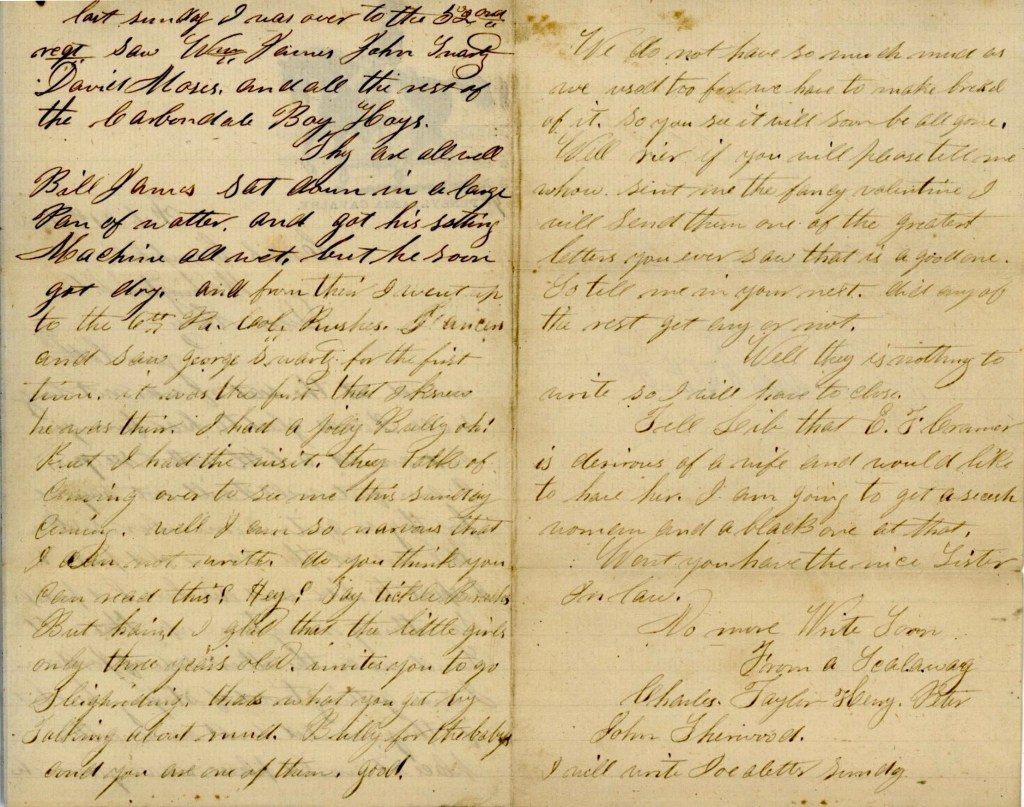
Last Sunday I was over to the 52nd [Pennsylvania] Regiment. Saw William James, John Swartz, David Moses, and all the rest of the Carbondale boy hoys. They are all well. Bill James say down in a large pan of water and got hissitting machine all wet. but he soon got dry. And from this I went up to the 7th Pennsylvania—Col. Rush’s Lancers—and saw George Swartz for the first time. It was the first that I knew he was there. I had a jolly bully [time]. Oh! but I had the visit. They talk of coming over to see me this Sunday evening. Well, I am so nervous that I cannot write. Do you think you can read this? Hey! Say tickle Brooks. But hain’t I glad that the little girls only three years old invites you to go sleigh riding. That’s what you get by talking about mud. Bully for the baby and you are one of them. Good.
We do not have so much mud as we used to for we have to makebread of it. So you see it will soon be all gone. Well, [ ] if you will please tell me who sent me the fancy valentine, I will send them one of the greatest letters you ever saw that is a good one. So tell me in your next. Did any of the rest get any or not?
Well, there is nothing to write so I will have to close. Tell Lib that E[dgar] F. Cramer is desirous of a wife and would like to have her. I am going to get a secesh woman and a black one at that. Won’t you have the nice sister in law?
No more. Write soon. From a scalawag, Charles Taylor Henry Peter John Sherwood
The following letter was written by Wesley Sever who enlisted 25 June 1862 as a private in the U. S. Marines. He was listed as serving on a number of vessels throughout the war including the Uncle Sam, and the Black Hawk. Nothing more was found.
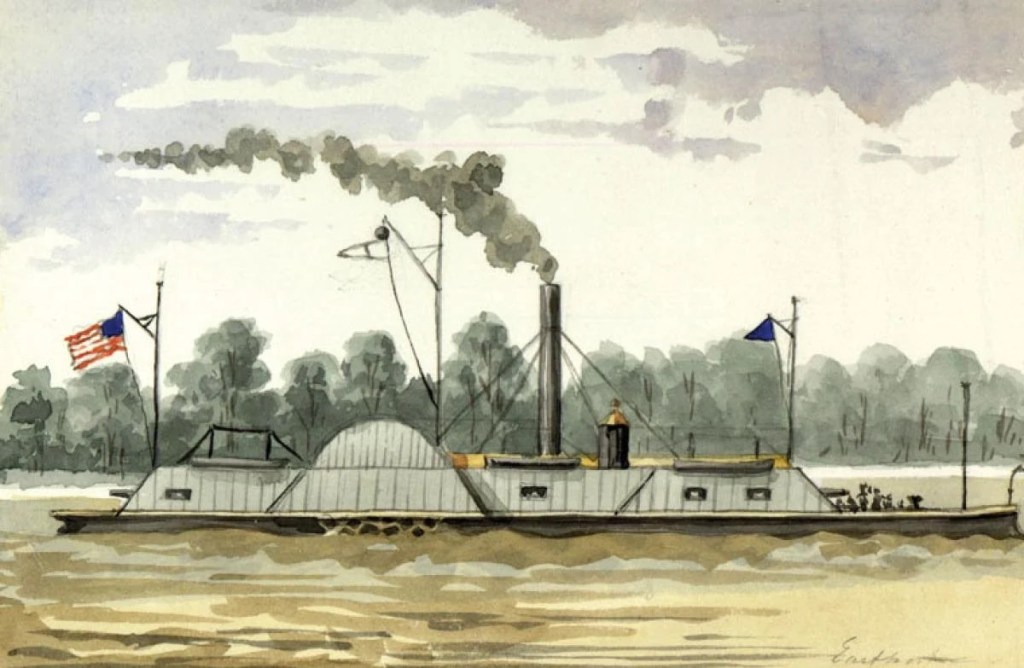
Eastport, a well modeled, fast Mississippi River steamer built at New Albany, Ind., in 1852, was acquired by Navy in January 1862 and underwent conversion to an ironclad gunboat at Cerro Gordo on the Tennessee River prior to duty with Lt. I. N. Brown’s flotilla. Her alterations were about half completed when on 7 February 1862 she was captured by the Union gunboats, Conestoga, Tyler, and Lexington, together with the materials to finish the job.
Eastport was sent in to Cairo, Illinois, and her conversion finished. She then served with the Union Army until 1 October 1862 when the ships of the Western Flotilla were turned over to the Navy and renamed the Mississippi Squadron. There were high hopes for the Eastport when she first joined the fleet but she was so heavily armored, slow and cumbersome, that she was unable to navigate shallow rivers in the Western theater. She steamed on western waters until sunk on 15 April 1864 in the Red River by a Confederate torpedo. Efforts to salvage her failed and she was blown up and destroyed to prevent capture on 26 April 1864.
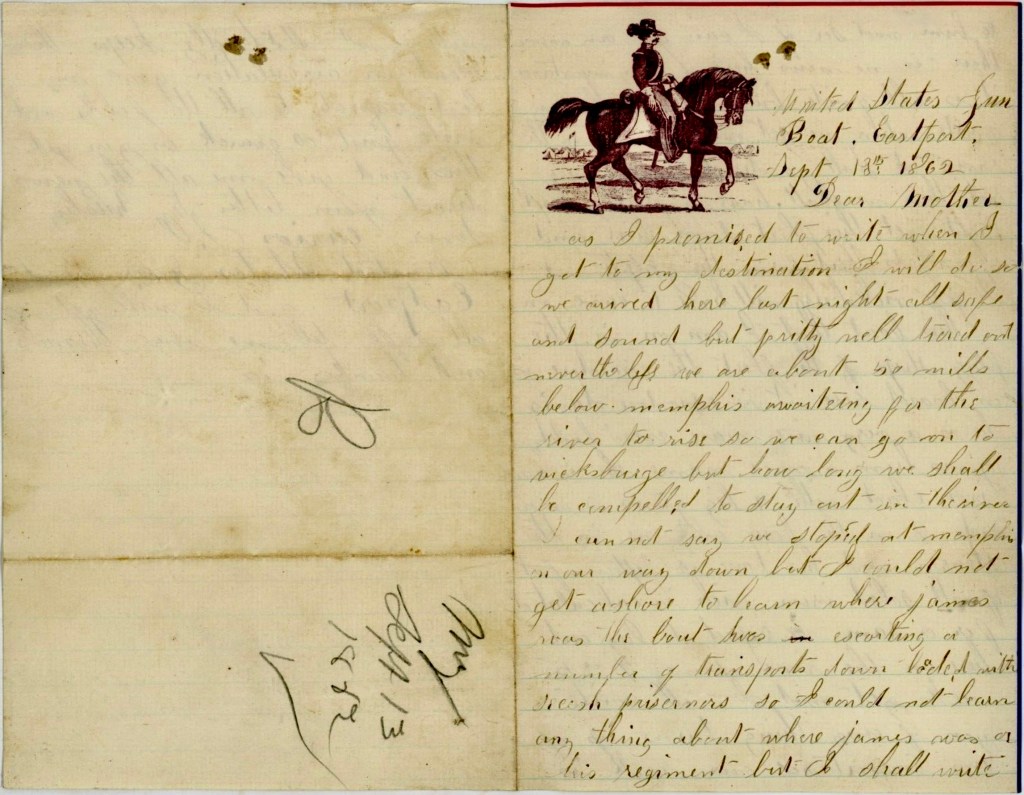
Transcription
United States Gunboat Eastport September 13th 1862
Dear Mother,
As I promised to write when I got to my destination, I will do so. We arrived here last night all safe and sound but pretty well tired out nevertheless. We are about 50 miles below Memphis waiting for the river to rise so we can go on to Vicksburg. But how long we shall be compelled to stay out in the river I cannot say. We stopped at Memphis on our way down but I could not get ashore to learn where James was. The boat was escorting a number of transports down loaded with secesh prisoners so I could not learn anything about where James was or his regiment but I shall write to him and see if I can get an answer.
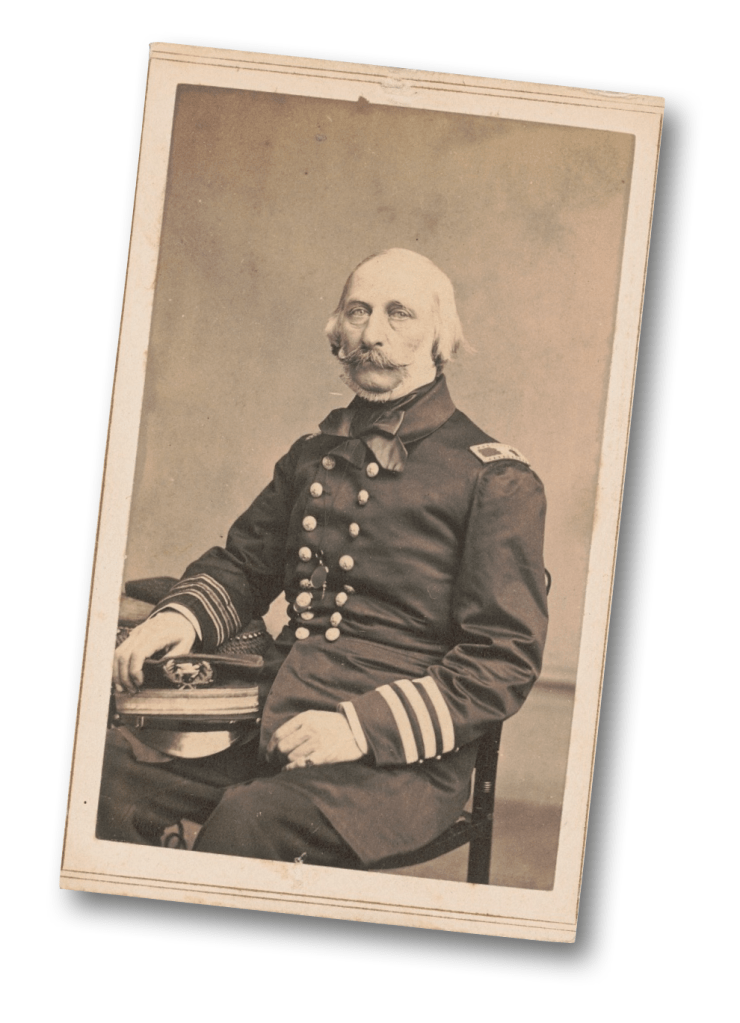
Commodore Charles Henry Davis
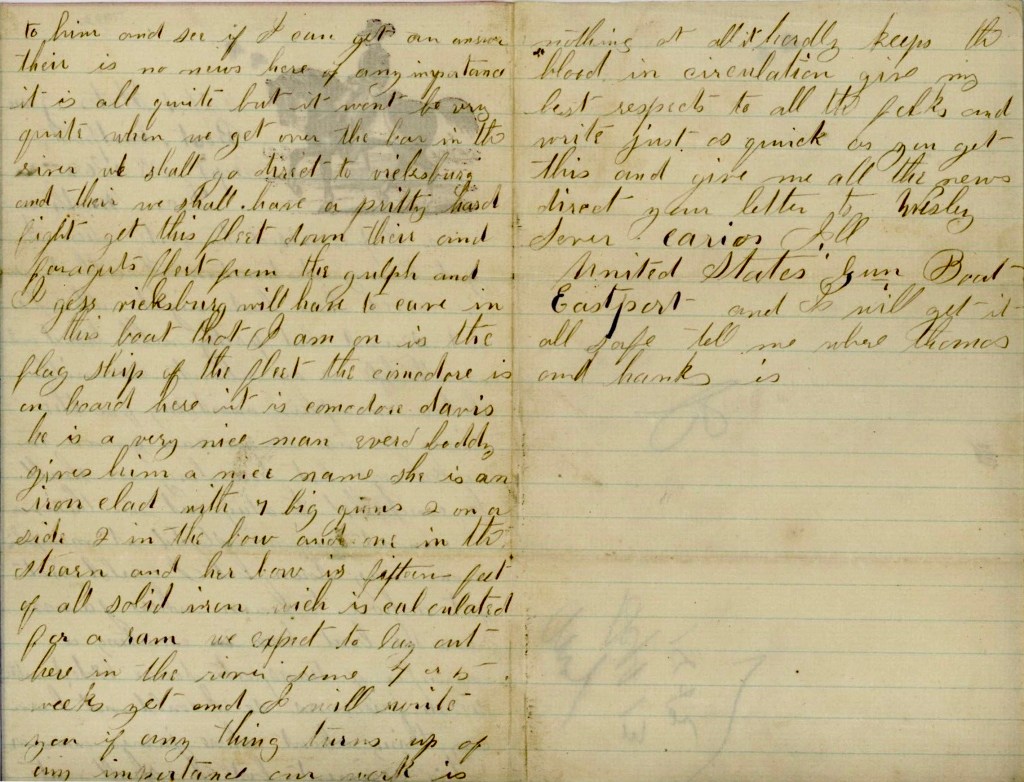
There is no news here of any importance. It is all quiet. But it won’t be very quiet when we get over the bar in the river. We shall go direct to Vicksburg and there we shall have a pretty hard fight. Get this fleet down there and Farragut’s fleet from the Gulf and I guess Vicksburg will have to cave in.
This boat that I am on is the flag ship of the fleet. The Commodore is on board here. It is Commodore [Charles Henry] Davis. He is a very nice man. Everybody gives him a nice name. She is an iron clad with seven big guns, two on a side, two in the bow, and one in the stern, and her bow is fifteen feet of all solid iron which is calculated for a ram. We expect to lay out here in the river some four or five weeks yet and I will write you if anything turns up of any importance. Our work is nothing at all. It hardly keeps the blood in circulation.
Give my best respects to all the folks and write just as quick as you get this and give me all the news. Direct your letter to Wesley Sever, Cairo, Illinois, United States Gun Boat Eastport and I will get it all safe. Tell me where Thomas and Hank is.















 Spared & Shared 23