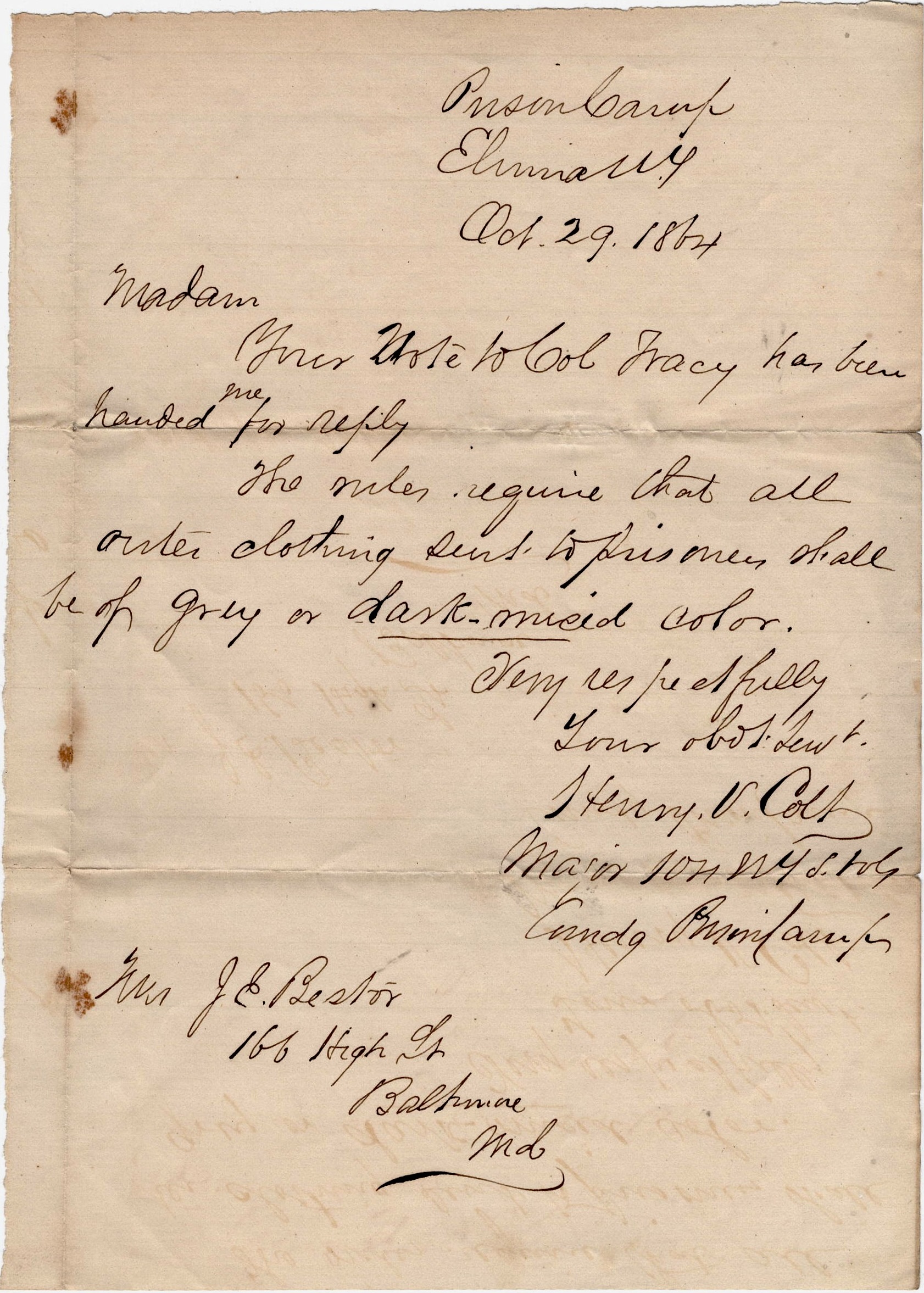
This letter was written by Henry VanSchaick Colt (1826-1906), the son of Charles Colt (1793-1866) and Ann Smith (1798-1853), and the brother of the famous firearms manufacturer, Samuel Colt. During the Civil War, Henry served as the Major of the 104th New York Infantry and was assigned to command the Elmira Prison Camp in July 1864 after suffering an accidental injury. He was the commandant from July 1864 through December 1864.
This letter is historic for it communicates the highly controversial policy established by the camp requiring that only “grey or dark-mixed color” outer clothing could be worn by the prisoners confined at Elmira Prison. Even during the brutal winter of 1864-65 when Confederate prisoners were exposed to sub-freezing temperatures, prison officials burned clothing that did not conform to the rule. This strict policy led to an unnecessarily high mortality rate.
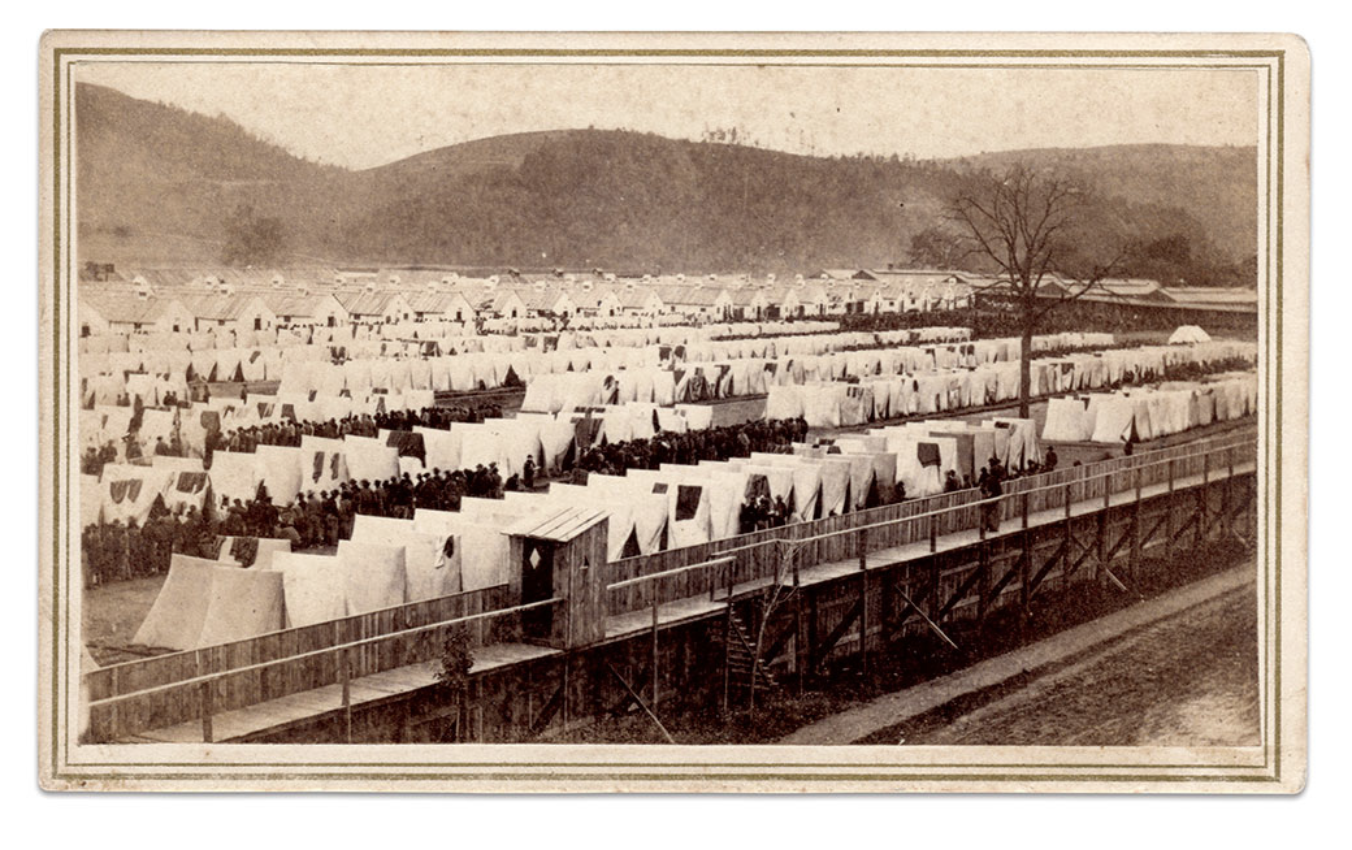
Elmira Prison in August 1864. (Richard Leisenring, Jr. Collection)
T R A N S C R I P T I O N
Prison Camp, Elmira, New York October 29, 1864
Madam,
Your note to Col. [Benjamin F.] Tracy has been handed me for reply.
The rules require that all outer clothing sent to prisoners shall be of grey or dark-mixed color.
Very respectfully, your obedient servant, — Henry V. Colt, Major, 104th NYS Vols., Commanding Prison Camp
Mrs. J. E. Bestor, 166 High Street, Baltimore, Maryland
This letter was written by William Hussen [or Hussong] who enlisted at the age of 19 on 23 January 1862 to serve three years in Co. F, 104th New York Infantry. William was the son of Christian Conrad Hussong (1809-1879) and Dorothea E. Linsner (1810-1890) of Granger, Allegany county, New York. He was wounded in Miller’s Cornfield on 17 September 1862 at Antietam and then mortally wounded in action on July 3, 1863 at Gettysburg while fighting near the cemetery on Cemetery Ridge. He died on 4 July 1863 on the battlefield.
T R A N S C R I P T I O N
Virginia May 11th, 1862
As we have moved, I thought I would sit down to let you know that I am still well and hope that you are the same. We have moved 12 miles beyond Manassas Junction about 50 miles from Washington. We had glorious sights on the road. We started from camp yesterday at noon and there was nothing to speak of until about one mile from Manassas Junction and then you could begin to see the rebel camp where they camped through the winter. And when we got a little further and we began to see their entrenchments and where their batteries was, but they destroyed everything as they went—railroad station and all. And they left their dead horses and everything else.
They have repaired the railroad for about 14 miles. It was night but the moon shone bright and we arrived at our camp about 12 o’clock in the night and we got off the cars and unpacked our blankets and laid down on the ground and took a good sleep.
This morning I was detailed to go out on picket about one mile from the camp where we have to keep our eyes skinned but nevertheless I don’t feel skart yet. I have forty rounds of cartridges in my box and plenty of caps. The more we move, the further we go, the better I like it. I have seen a great sight since I left home.
It is very nice weather here but houses are very scarce here. You can go 1 mile and see no house. But the houses are very nice and well got up. But enough of this.
As to pay. We could not get it. We was a going to get it in a few days but our marching orders we got about two hours. We got them at 9 o’clock and started at 12 o’clock and so the pay was put off but expect to get it before long.
I begin to like it every day better for I am broke into it. We may stay here a week and not one. We are to be ready at any moment’s call. There is no generals here but the scouting parties is what we look for. But my relief is a going out and so I must close for this time for I am on picket. All letters must be sent to Washington the same as before and then they are sent on to the regiment.
Give my love to all, to you and all my old comrades of Granger. Your friend truly, — William Husson