Category Archives: 10th New York Cavalry

1863: Manning Austin to Julia Etta Austin

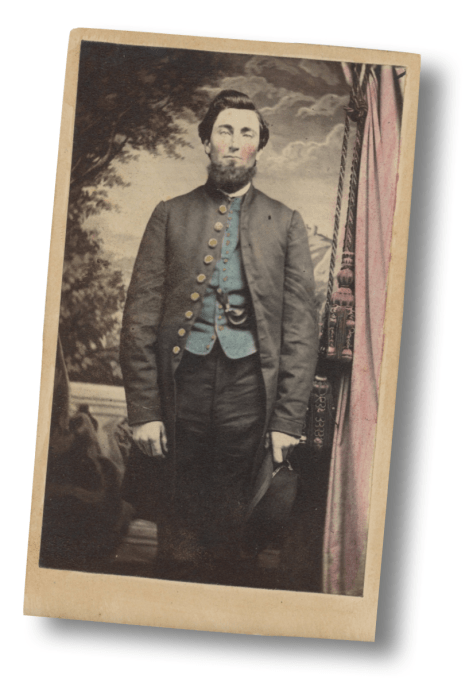
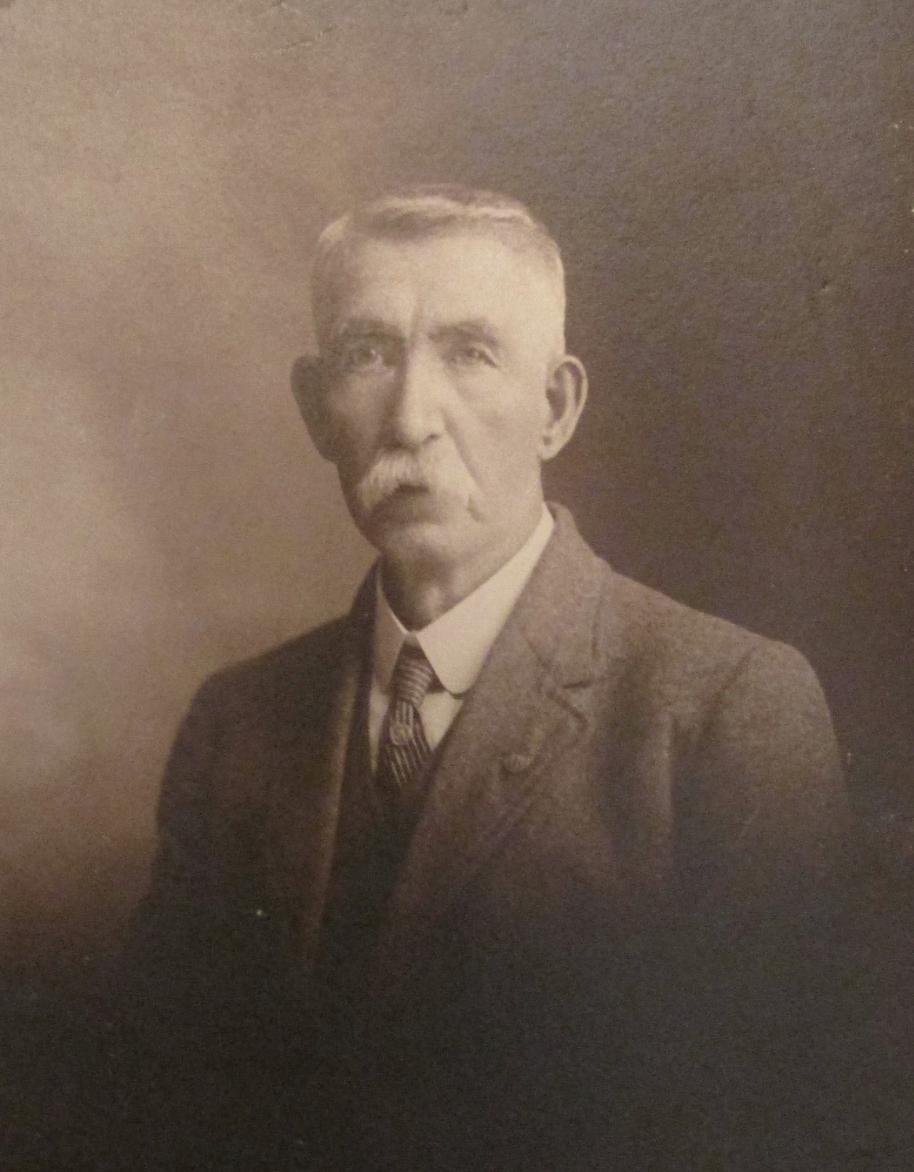
The old veteran—Manning Austin

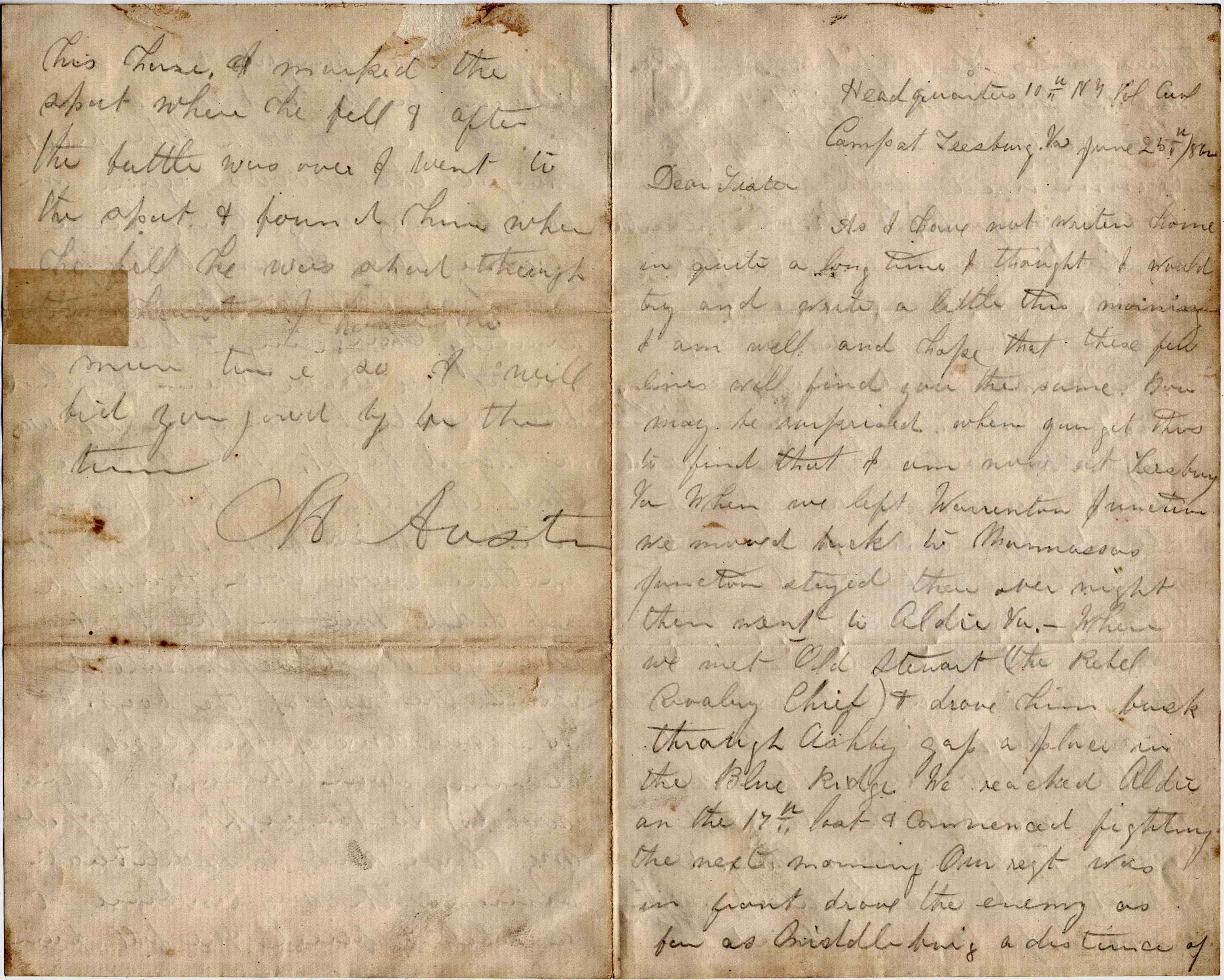
This letter was written by Manning Austin (1843-1921) who enlisted at North Landing, Tompkins county, New York, as a private in Co. G, 10th New York Cavalry on 6 October 1861. He reenlisted as a veteran corporal in December 1863 and was later transfered to Co. I, 2nd Regiment, V. R. C. Interesting quotations from several of Manning Austin’s letters appear on a webpage of the 10th New York Cavalry published by Ken Morris. He cites the source of these letters as having been posted on-line on January 2001 by David G. Phillips Co., Inc. Sale #106 but that link is no longer active.

Manning was the son of Wisner D. Austin (1811-1879) and Eliza Giltner (1806-1894) of Lansing, Tompkins county, New York.

Manning Austin’s letter gives us a riveting account of the Battle of Middleburg, Virginia, on 19 June 1863, in which three squadrons (including his own) spearheaded a daring mounted charge that broke Confederate lines, successfully pushing JEB Stuart’s dismounted cavalry out of the woods and taking the town. The cavalry engagements in Loudon county successfully delayed Stuart’s cavalry from being of greater assistance to Lee in his invasion of Pennsylvania in 1863.
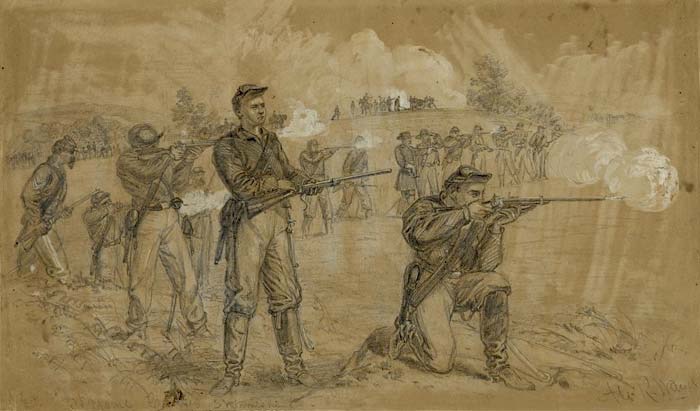
“First Maine Cavalry Skirmishing”

T R A N S C R I P T I O N

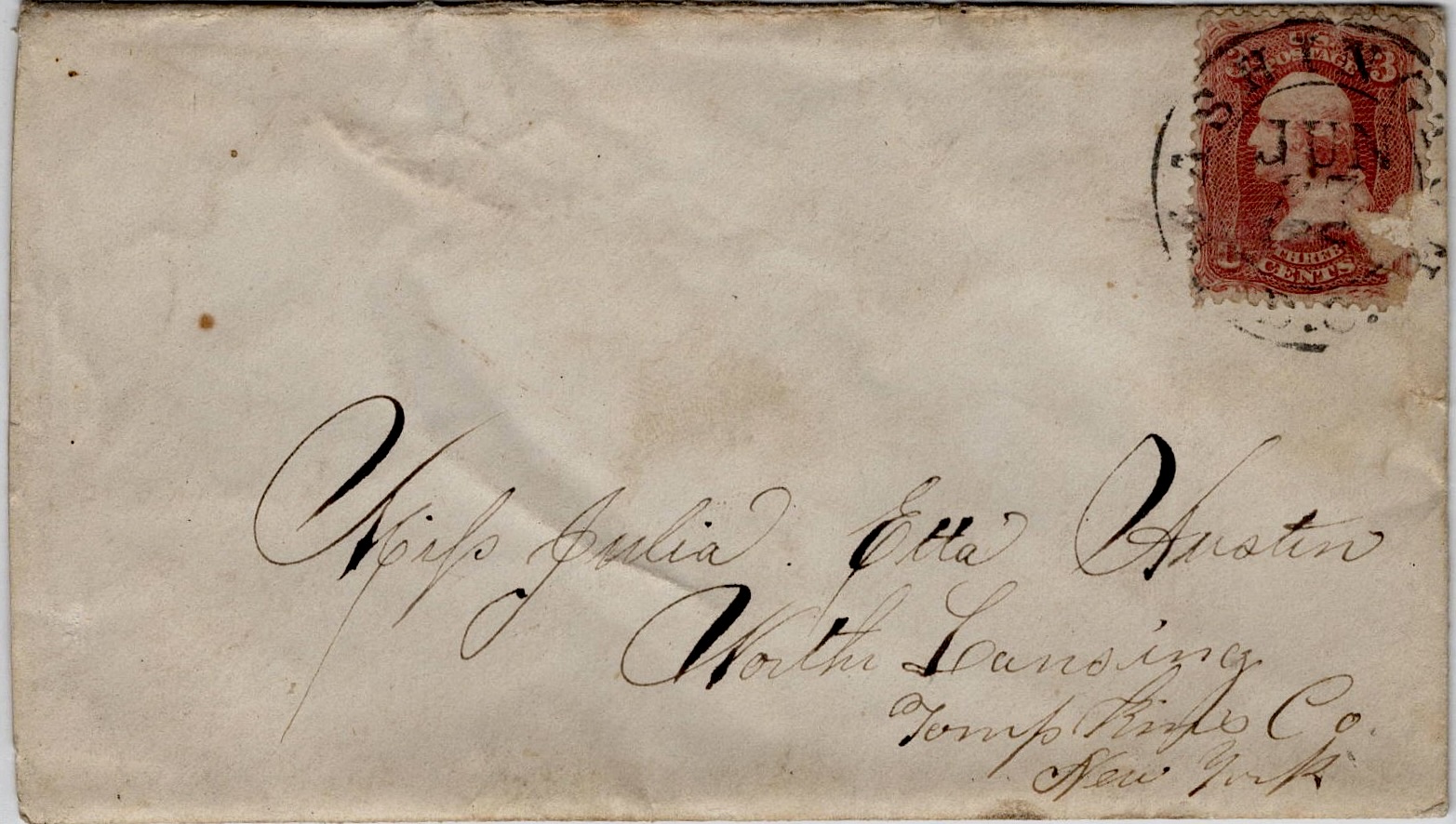
Addressed to Miss Julia Etta Austin, North Landing, Tompkins county, New York

Headquarters 10th N. Y. Vol. Cavalry
Camp at Leesburg, Virginia
June 25, 1863

Dear Sister,

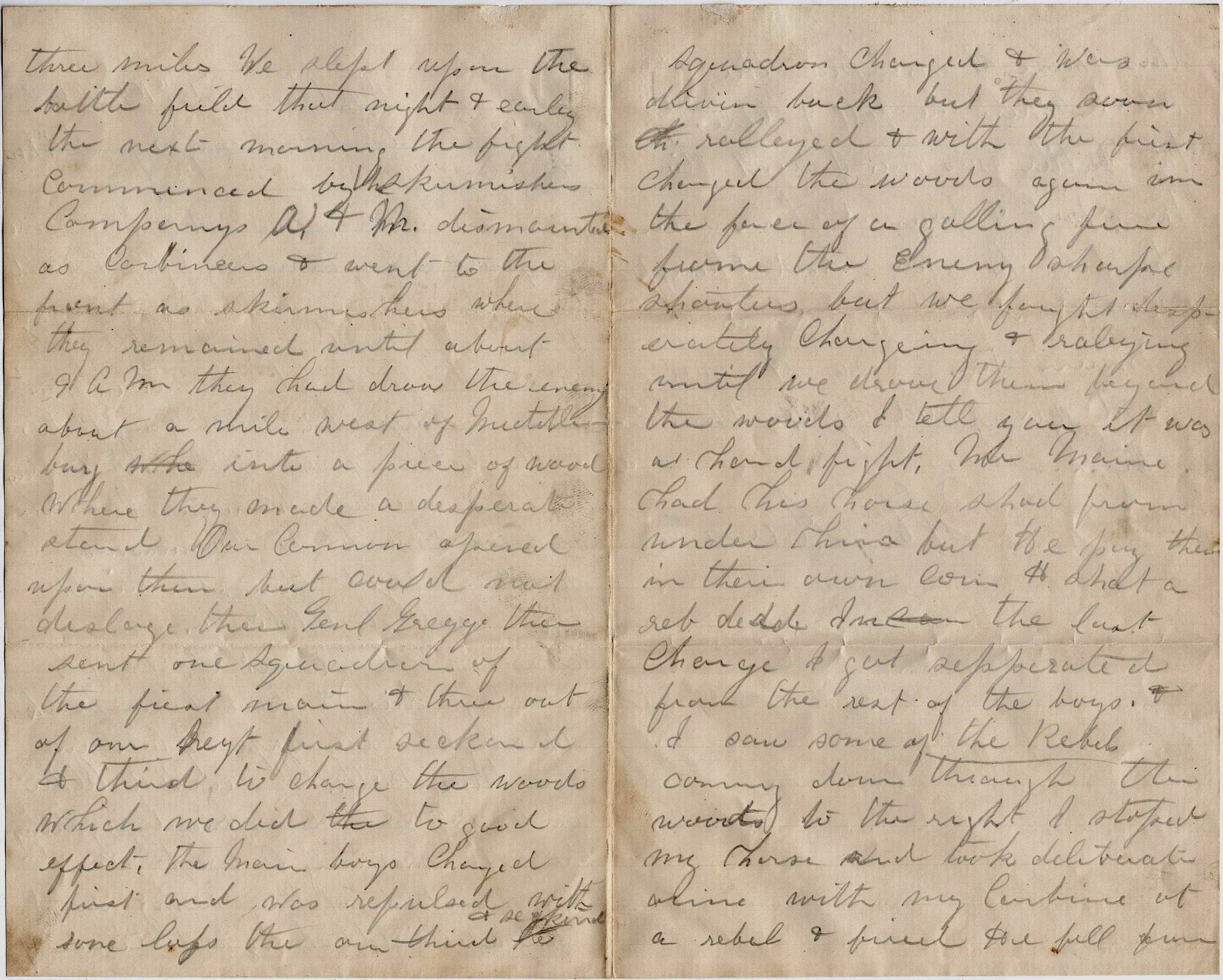
As I have not written home in quite a longtime, I thought I would try and write a little this morning. I am well and hope that these few lines will find you the same. You may be surprised when you get htis to find that I am now at Leesburg, Va. When we left Warrenton Junction, we moved back to Manassas Junction, stayed there over night, then went to Aldie, Va. where we met Old Stewart [J. E. B. Stuart], (the Rebel Cavalry Chief) & drove him back through Ashby Gap—a place in the Blue Ridge. We reached Aldie on the 17th last and commenced fighting the next morning. Our regiment was in front, drove the enemy as far as Middleburg, a distance of three miles. We slept upon the battlefield that night & early the next morning the fight commencedby skirmishers. Companies A and M dismounted as Carbineers and went to the front as skirmishers where they remained until about 9 a.m. they had drove the enemy about a mile west of Middleburg into a piece of wood where they made a desperate stand.

Our cannon opened upon them but could not dislodge them. Gen. Gregg then sent one squadron of the 1st Maine & three out of our regiment, 2st, 2nd, and 3rd, to charge the woods which we did to good effect. The Maine boys charged first and was repulsed with some loss. Then our 3rd and 2nd squadron charged & was driven back but they soon rallied and with the 1st [squadron] charged to woods again in the face of a galling fire from the enemy sharpshooters but we fought desperately, charging & rallying until we drove them beyond the woods. It tell you, it was a hard fight.

Mr. Maine had his horse shot from under him but he paid that [back] in their own coin. He shot a reb dead. In the last charge, I got separated from the rest of the boys. I saw some of the Rebels coming down through the woods to the right. I stopped my horse and took deliberate aim with my carbine at a rebel & fired. He fell from his horse. I marked the spot where he fell & after the battle was over I went to the spot and found him where he fell. He was shot through the heart.

I have no more time so I will bid you goodbye for this time. — M Austin
1862: James Perry Cowles to Lois Ann (Browning) Cowles

The following letter was written by James Perry Cowles (1830-1913) who enlisted on 7 November 1861 at the age of 31 as a bugler in Co. H, 10th New York Cavalry to serve three years. He was captured at Sulphur Springs, Virginia, on 12 October 1863; paroled prisoner, April 28, 1865; mustered out, July 1, 1865. at New York city.

James wrote the letter to his mother, Lois Ann (Browning) Cowles of Orwell, Bradford county, Pennsylvania.

T R A N S C R I P T I O N

Havre de Grace
Camp Shields, Co. H
April [May] 5, 1862

Dear Mother,

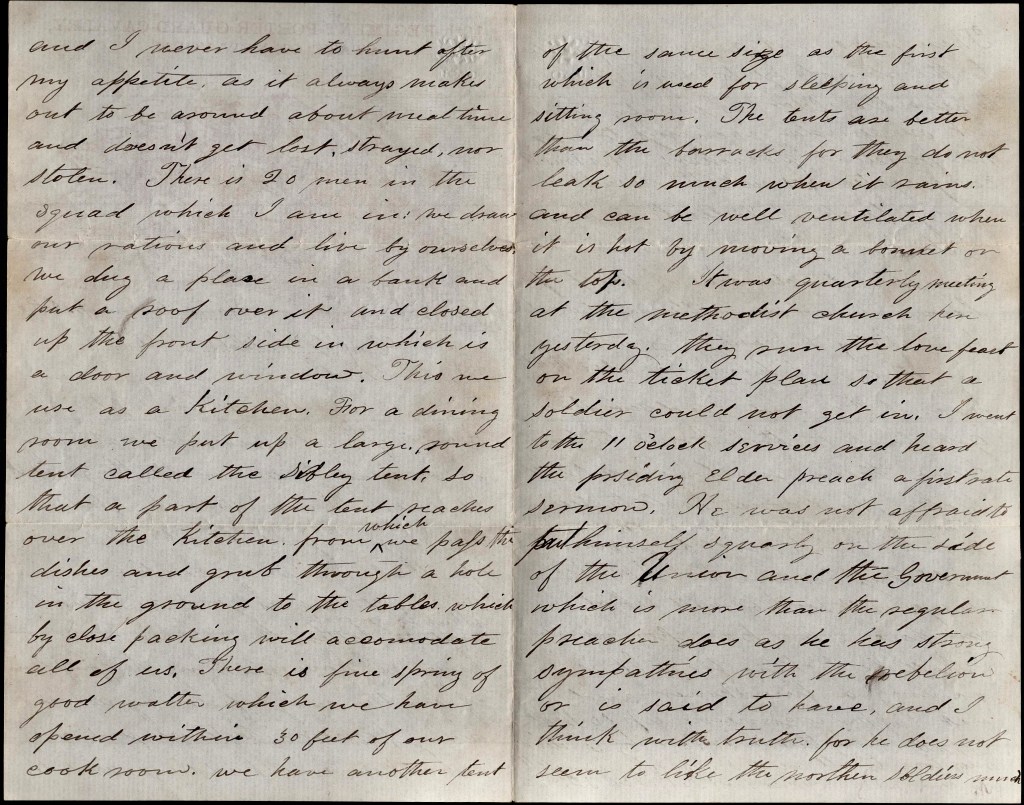
Your kind letter of April 29th was received Saturday and read by me with the greatest pleasure. I was extremely glad to hear of your good health and sincerely hope that it may continue. My health is as good as usual which is generally better than when I was at home. I have nothing to complain of in the way of living as our army provisions tastes as good as cakes, pies and puddings used to and I never have to hunt after my appetite as it always makes out to be around about meal time and doesn’t get lost, strayed, nor stolen.

There is twenty men in the squad which I am in. We draw our rations and live by ourselves. We dug a place in a bank and put a roof over it and closed up the front side in which is a door and window. This we use as a kitchen. For a dining room we put up a large round tent called the Sibley tent, so that a part of the tent reaches over the kitchen, from which we pass the dishes and grub through a hole in the ground to the tables which by close packing will accommodate all of us. There is a fine spring of good water which we have opened within 30 feet of our cook room. We have another tent of the same size as the first which is used for sleeping and sitting room. The tents are better than the barracks for they do not leak so much when it rains and can be well ventilated when it is hot by moving a bonnet on the top.

It was quarterly meeting at the Methodist Church here yesterday. They run the love feast on the ticket plan so that a soldier could not get in. I went to the 11 o’clock services and heard the Presiding Elder preach a first rate sermon. He was not afraid to put himself squarely on the side of the Union and the Government which is more than the regular preacher does as he has strong sympathies with the rebellion or is said to have, and I think with truth for he does not seem to like the northern soldiers much. There was not as many people to the church yesterday forenoon to hear the Elder as usually turns out on Sunday evenings to hear the resident preacher. His small congregation was not the result of any lack of talent on his part but probably comes from the secession tendencies of the people here.

I had a letter last week from Betsy & heard of your being in that neighborhood. Also that Grandpa and Grandma had got back to their house to live. Give them my love and tell that I shall come back to see them when the war is over which I think will be soon. Tell Miss Emma that I hope that her eyes will soon be well so that I can have a line from her which I shall be looking for. It is raining a fine shower and our supper is coming up so that I shall bring this to a close by sending my love to all and subscribe myself your most dutiful son, — J. P. Cowles

1863: Unidentified Trooper in 10th New York Cavalry

Sgt. Norman R. Gifford, Co. D, 10th New York Cavalry (Kyle M. Stetz Collection)

This four-page letter was penned by a trooper in the 10th New York Cavalry who unfortunately did not sign it though there are a number of possible clues to his identity if more research time were available. The letter was written over a five-day period in June 1863 as the Gettysburg Campaign began to unfold. A reference to the Battle of Brandy Station is made in the first paragraph though he offers no account of it. The last paragraph was written on the day before the Battle of Middleburg in which Col. John Irvin Gregg’s 3rd Brigade engaged three brigades of J. E. B. Stuart’s cavalry.

Transcription

On picket near Warrenton, Va.
June 13th, 1863

Dear Brother & Sister,

As I have a little leisure, I will commence another letter even if I did send you one yesterday. I sent you half of a Wash. Chron. that had something of an account of the cavalry fight [at Brandy Station] but I am looking for an official account. If it comes out, I’ll send it.

Yesterday our regiment got two months pay, up to the first of May, and I’ll send you in this letter twenty dollars. I guess you had better take up the $10 note that I gave you, S. S. Southwick, bearing date of May 31st 1862, and a note of $5 that I gave Uncle Isaac Allen the 28th of last August & what there is left pay where you think best.

You wrote that Ross had been paid fifty dollars and that the $10 Joseph left was just paid to Spencer but you don’t say anything about the 16 dollars that the heifer was sold for. Where is that? I want you to reckon up & let me know how much more it neds to pay up all my debts except yours, Harriet, and Aunt Lydia’s, or how much more than enough you’ll have, which ever way it is. And also tell me what the face of your note is, Harriet against me, when it was given and when it’s due. I can buy envelopes here for 25 cents per pack but they are poor ones and so I am going to ask you to send me some more. One package at a time is enough. Send about such quality as this one, only a little larger and they won’t jam up as thinner ones wil. I have paper enough for the present.

I am glad fruit is going to be so plenty again there. So it is here. Cherries and strawberries are ripe here now. I picked my first strawberry today.

I don’t know but you will get sick of hearing the same thing over and over so many times or in every letter I send “that I am well; that I am tough & hearty,” but if I say anything about myself, I have to say that I think I am as fleshy as I ever was and my bedfellow Joseph is tough and fat and says he would not give a cent to feel any better than he now does. William, Joseph, and I a few days ago had as nice a double barrel shot gun of London manufacture & silver mounted as you ever saw, but we had no way to get it home & could not lug it around so we gave it to our captain. If I can ever get hold of an extra revolver, I’ll get it home. T’would make your eye water to see how they will shoot.

Tuesday Morn, June 16th. We are now at Union Mills, four miles from Centerville and 22 from Alexandria. We broke camp at Warrenton Junction yesterday and left there at one o’clock p.m. I don’t know where we are going & I don’t worry about it for I know I shall go with the crowd unless my horse gives out. Yesterday was a very hot day but we marched nearly 30 miles after one. I got hurt some when returning to camp from picket. My horse backed into a ditch and fell on me and caught my right leg under him and the horse could not get up nor I could not get up. It lamed me some but I am about over it now.

I received a letter from you the 14th, No. 35.  The laurel grows in dry and in wet soil too but it looks the thriftiest along the banks of a stream. It is now in blossom. I’ll send some home as soon as I can. We do wear our nightcaps, but the nights are not cold now. I would as leave you would have the gray colt as anyone.  You need not talk flax to me any more. I read your letter to Joe & took up May’s to read & Joe says now we will get the news. May always write some news that I don’t hear any other way. I never saw anyone improve in writing so fast as May.

It is awful dry here. We have had no rain since we returned from the raid and now the dust flies awfully when we march, but where can, we go in the lots. I bought me a watch this morning—a patent lever Hunter cased, for $9.50.

The news in today’s papers is that the rebs are marching into Pennsylvania. I am glad of it. I hope t’will put a stop to Northern men talking about resisting the draft.

June the 18th, near Aldie. We marched to here yesterday. I think all of the calvary of the Army of the Potomac is here. Pleasanton commands. We are now in the 2nd division, 3rd brigade. The 1st Maine, the 4th & 16th Pennsylvania are in a brigade with us. We have a new brigadier, a brother to Gen. Greggs.  At 4 p.m. yesterday we came upon the enemy, gave battle for 2 hours, drove him several miles but with considerable loss.  Our regiment was not in. I suppose it’s the rear of the Reb army that have gone north that we have fell in with.

The 18th. I didn’t send this letter because I am afraid the Rebs will get it. I shall wait till the coast is clear.