Category Archives: 129th New York Infantry

1862: William Bonnett to Abel Rice

A watercolor of Pvt. James M. Warren who also served in Co. C, 129th New York Infantry

This letter was written by 22 year-old William Bonnett, a native of England, who was residing in the household of Abel Rice in Orleans County, New York, at the time of his enlistment in Co. C of the 129th New York Infantry in August 1862. This regiment was organized at Lockport, New York, and ordered to Fort Federal Hill in Baltimore, Maryland, where they had just arrived when William wrote this letter to Abel. William’s enlistment was for three years but he barely lived three months. He died of typhoid fever in the regimental hospital at Baltimore on 2 November 1862. A month later, the 129th New York Infantry was converted into an artillery unit and was renamed the 8th New York Heavy Artillery.

The original letter was kept by Abel Rice and eventually passed down to his descendants. Scans of the letter were made available for transcription and publication on Spared & Shared by Aimee Albanese. She informed me that a Widow’s Pension record for William Bonnett’s service was filed by Mary Jane (nee loper) Bonnett. In the 22 page document, Mary Jane Loper and William Bonnett Jr were married in the Town of Barre, NY on 06/01/1861 by Reverend Mason (Methodist).  When widowed, she had no children.  In an affidavit, William Bonnett Jr’s parents, William Bonnett and Ann Mary (nee Clark) Bonnett testified to this marriage.

T R A N S C R I P T I O N

[Fort Federal Hill]
August 31, 1862

A. Rice,

My friend, I now take my pen to write to you hoping to find you well as it leaves me at present. We got news that we got Stonewall Jackson and six thousand men—that is ten regiments—in here. We are in Baltimore, Maryland, on Federal Hill. It is a nice place here. I send my best respects to all the boys round there. I like it here. This is a very hilly country here.

I sent $87 home. There was 15 men went out of this regiment to Washington for prisoners. I got so that I can lay down and sleep. We fire good enough there. There’s six [Columbiads and] 40 [other] cannon here. There is one fort [Fort Marshall] east of us about four miles from us. We can see all of the City of Baltimore. There is a fire in the city most every night.

We was called up the other night and distributed ten rounds for we though that we would have to fight a little, but we hain’t had to yet. We sleep in bunks. There was about 50 of [us] boys on guard last night. We had all of our guns loaded. And we went out this morning and shot them to a mark and there was eight balls hit the mark. There was one of the boys got shot through the hip. I guess that he will get well. ‘Twas a boy out of Company K. 1

We have good arms. It is just as Milton said, a man will get used to eating grub [?]

Fort Federal Hill
Baltimore, Maryland

William Bonnett,

Co. C, [New York] Regiment [1]29

1 Typically, when guards carried loaded weapons over night, they would discharge their weapons the next morning by taking target practice.

1862: Henry L. Smith to Ruth Ann (Spoor) Smith

I could not find an image of Henry but here is one of Oscar S. Holcomb of Co. H, 8th NY Heavy Artillery )Photo Sleuth)

This letter was written by Henry L. Smith (1833-1864) of Hartland, Niagara county, New York. He enlisted on 4 August 1862 at Lockport, New York, as a private in Co. D, 129th New York Infantry. On the very day that Henry wrote this letter, the regiment was designated the 8th New York Heavy Artillery. He served in the defenses at Baltimore until 1864 when his regiment was sent to the Virginia battlefront and used as infantrymen. He was seriously wounded in the Battle of Cold Harbor on 3 June and died of his wounds on 16 June 1864 at Lincoln General Hospital in Washington D. C.

Henry was born in Le Roy, New York. When he enlisted, he was described as a 31 year-old farmer, who stood 5 foot 8 inches tall, with black eyes and dark hair. He was married to Ruth Ann Spoor and had two daughters, Celia and Melva, when he enlisted.

Transcription

Baltimore, Maryland
October 19, 1862

Dear Companion,

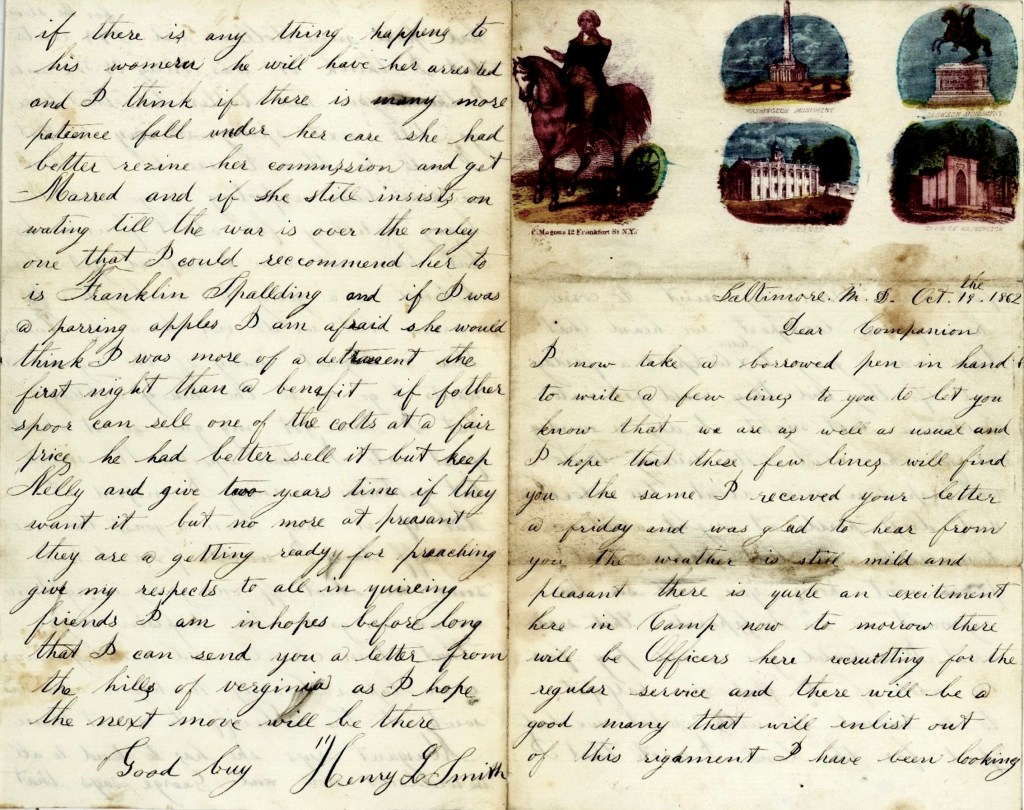
I now take a borrowed pen in hand to write a few lines to you to let you know that we are as well as usual and I hope that these few lines will find you the same. I received your letter a Friday and was glad to hear from you. The weather is still mild and pleasant.

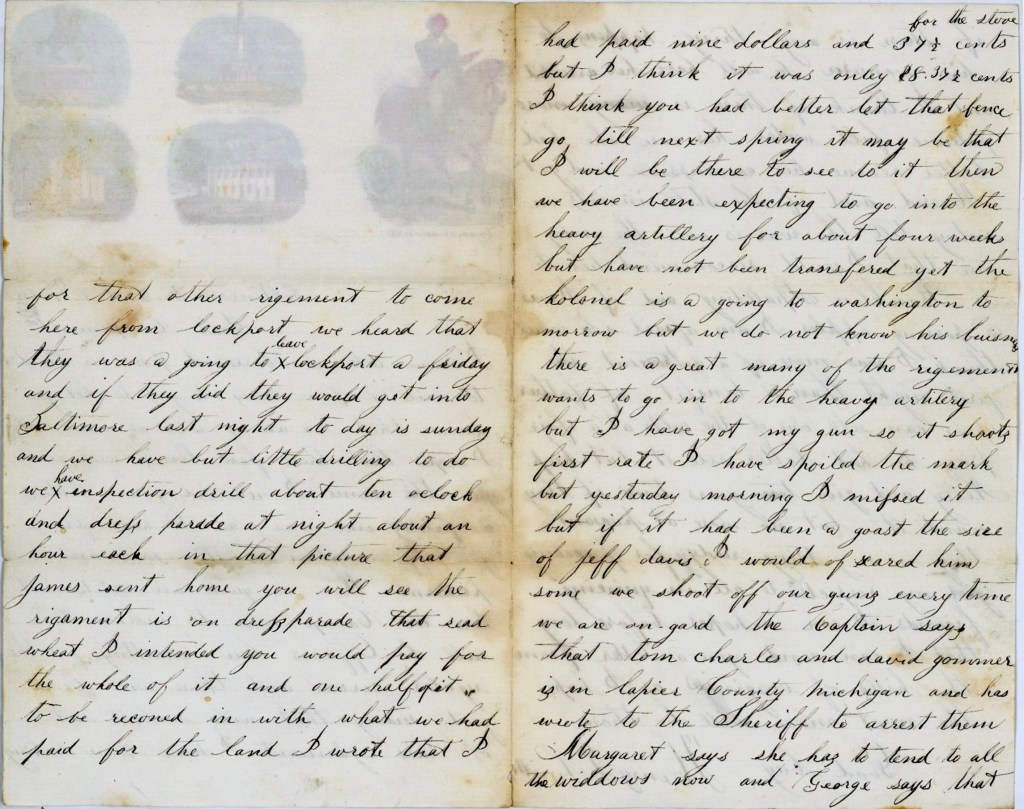
There is quite an excitement here in camp now. Tomorrow there will be officers here recruiting for the regular service and there will be a good many that will enlist out of this regiment. I have been looking for that other regiment to come here from Lockport. We heard they was a going to leave Lockport a Friday and if they did, they would get into Baltimore last night. Today is Sunday and we have but little drilling to do. We have inspection drill about ten o’clock and dress parade at night about an hour each.

In the picture that James sent home you will see the regiment is on dress parade.

That seed wheat I intended you would pay for the whole of it and one half of it to be reckoned in with what we had paid for the land. I wrote that I had paid nine dollars and 37.5 cents for the stove but I thin kit was only $8.37 and a half cents. I think you had better let that fence go till next spring. It may be that I will be there to see to it then.

We have been expecting to go into the heavy artillery for about four weeks but have not been transferred yet. The Colonel is a going to Washington tomorrow but we do not know his business. There is a great many of the regiment wants to go into the heavy artillery but I have got my gun so it shoots first rate. I have spoiled the mark but yesterday morning I missed it. But if it had been a ghost the size of Jeff Davis, I would of scared him some. We shoot off our guns every time we are on guard. The Captain says that Tom Charles and David [D.] Ganmer is in Lapeer county, Michigan, and he has wrote to the sheriff to arrest them.

Margaret says she has to tend to all the widow’s now and George says that if there is anything happens to his woman, he will have her arrested and I think if there is any more patients fall under her care, she had better resign her commission and get married. And if she still insists on waiting till the war is over, the only one that I could recommend her to is Franklin Spalding. And if I was a paring apples, I am afraid she would think I was more of a detriment the first night than a benefit. If father Spoor can sell one of the colts at a fair price, he had better sell it. But keep Nelly and give two years time if they want it.

But no more at present. They are a getting ready for preaching. Give my respects to all enquiring friends. I am in hopes before long that I can send you a letter from the hills of Virginia as I hope the next move will be there. Goodbye, — Henry L. Smith