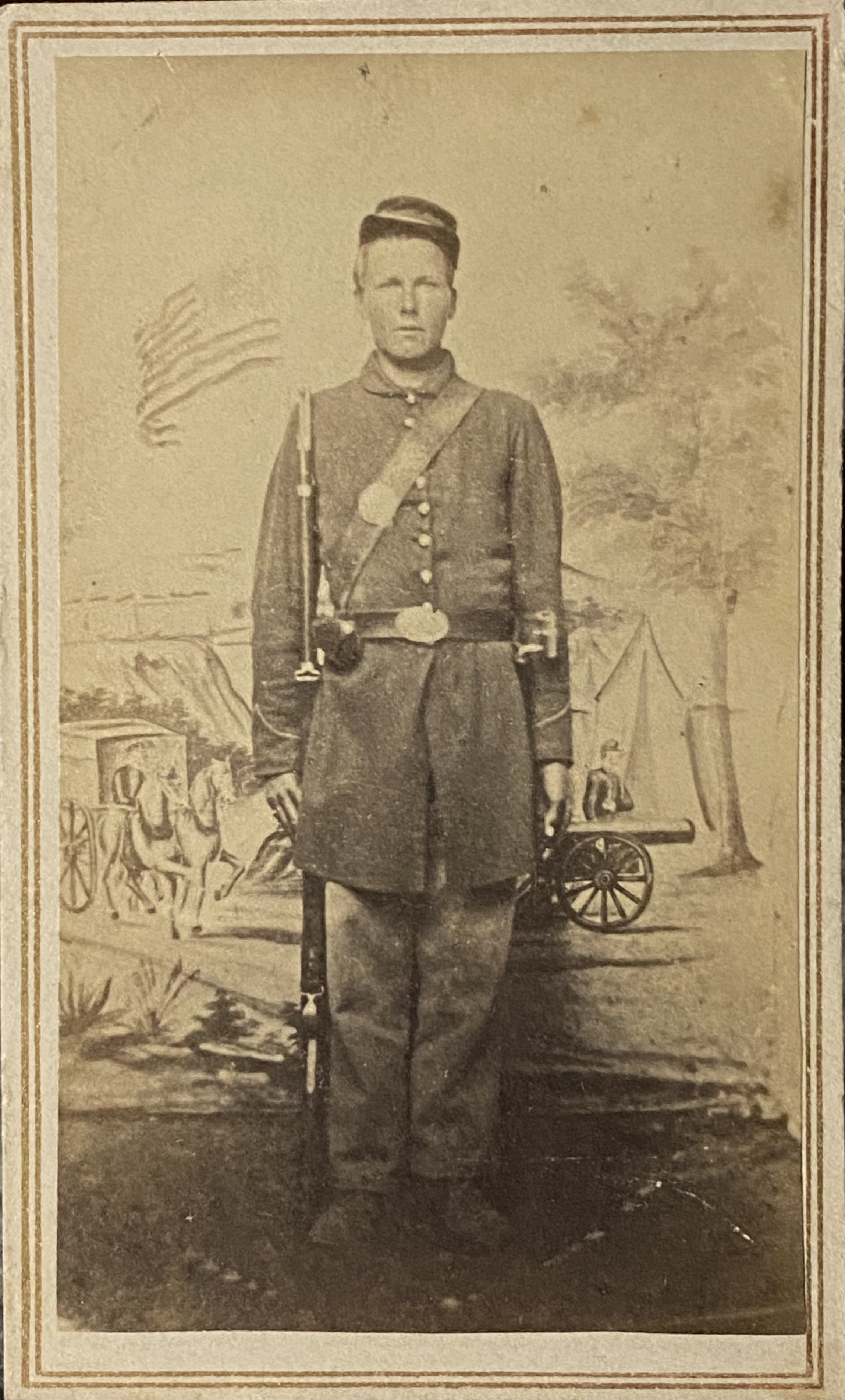
Silas C. Doolittle was born on August 14, 1843, in Butler, New York, to Loren Doolittle (1790-1860) and Phebe Worth (1805-1872). His father was a lawyer who owned $550 of personal property in 1860. Doolittle grew up and attended school in Wolcott, New York, and by 1860, he was working as a farmer.
He enlisted in the Union army on September 21, 1861, and mustered in as a private in Co. H of the 75th New York Infantry on November 26. According to his service records, he was 5 feet, 6 inches tall, with light hair and light eyes. The regiment spent most of the war stationed in Alabama and Mississippi. The army transferred the men to Virginia in 1864, and they took part in the Third Battle of Winchester, the Battle of Fisher’s Hill, and the Battle of Cedar Creek. He voted for Abraham Lincoln in the election of 1864, explaining that, “as long as I am trying to put down Treason in the field, I cannot countenance it at the Polls.”
He later declared that he “want[ed] to see those southern traitors humbled like dogs and then banished from the country as being too false to live among civilized people.” He fiercely opposed African American enlistment, insisting in March 1865 that “it is an insult to U.S. soldiers to put the uniform on Orang-ou-tangs.” He became a regimental musician on November 19, 1864, and he mustered out in Savannah, Georgia, on August 31, 1865.
Doolittle moved to Michigan after the war, and he married Julia M. Foster on January 12, 1867. They had at least four children: Frank, born around 1868; Elsie, born around 1870; Loren, born around 1875; and Carrie, born around 1880. By 1870, he was working as a mason in Dowagiac, Michigan, and he owned $800 of real estate and $500 of personal property. He applied for a federal pension in February 1893 and eventually secured one. They moved to Wayne, Michigan, in the early 1900s, and he died there on April 22, 1911. [Source: Quoted from Letters Home, Silas C. Doolittle, John L. Nau, III Center for Civil War History]
T R A N S C R I P T I O N
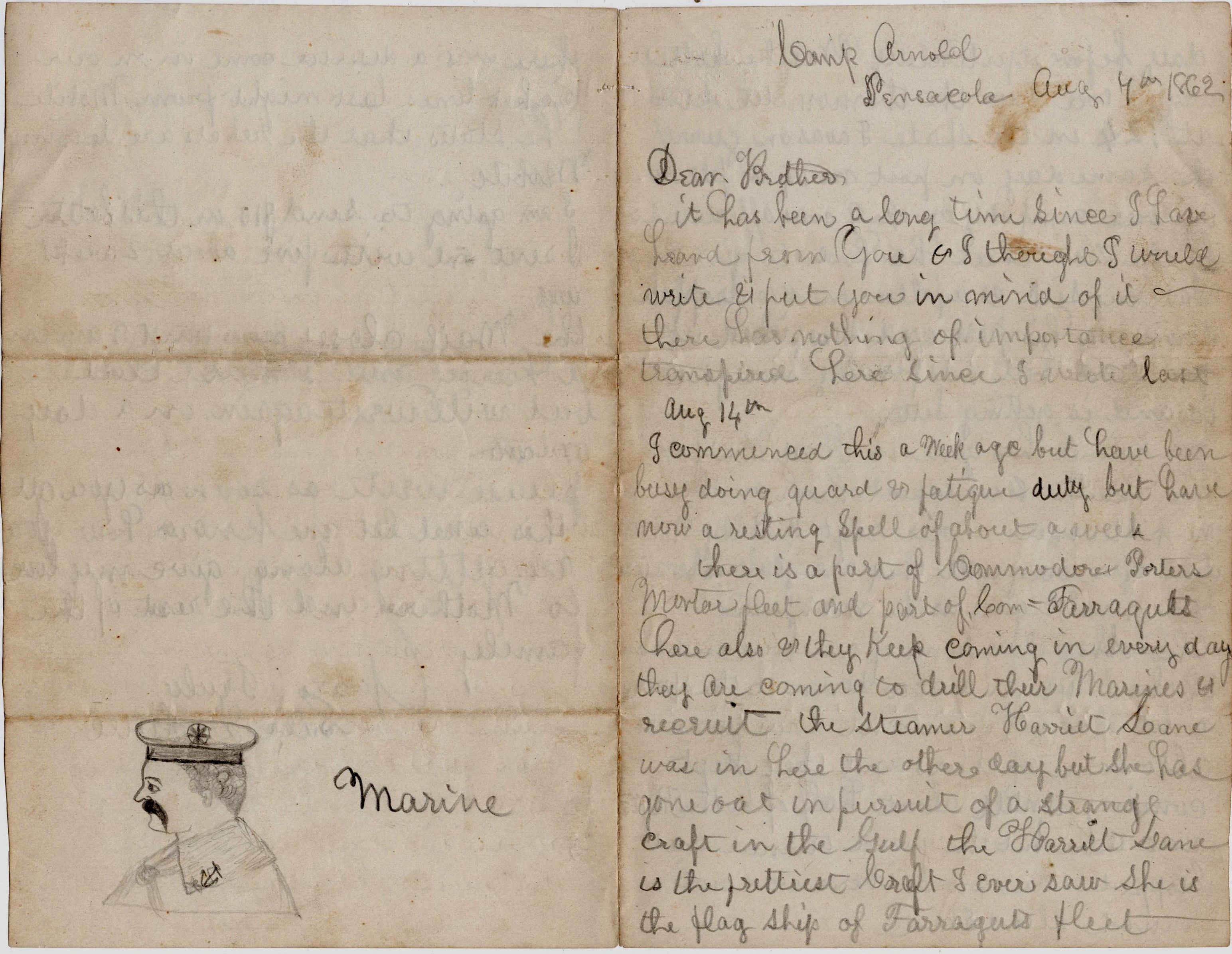
Camp Arnold
Pensacola [Florida]
August 7th 1862
Dear Brother,
It has been a long time since I have heard from you & I thought I would write & put you in mind of it. There has nothing of importance transpired here since I wrote last.
August 14th. I commenced this a week ago but have been busy doing guard & fatigue duty but have now a resting spell of about a week.
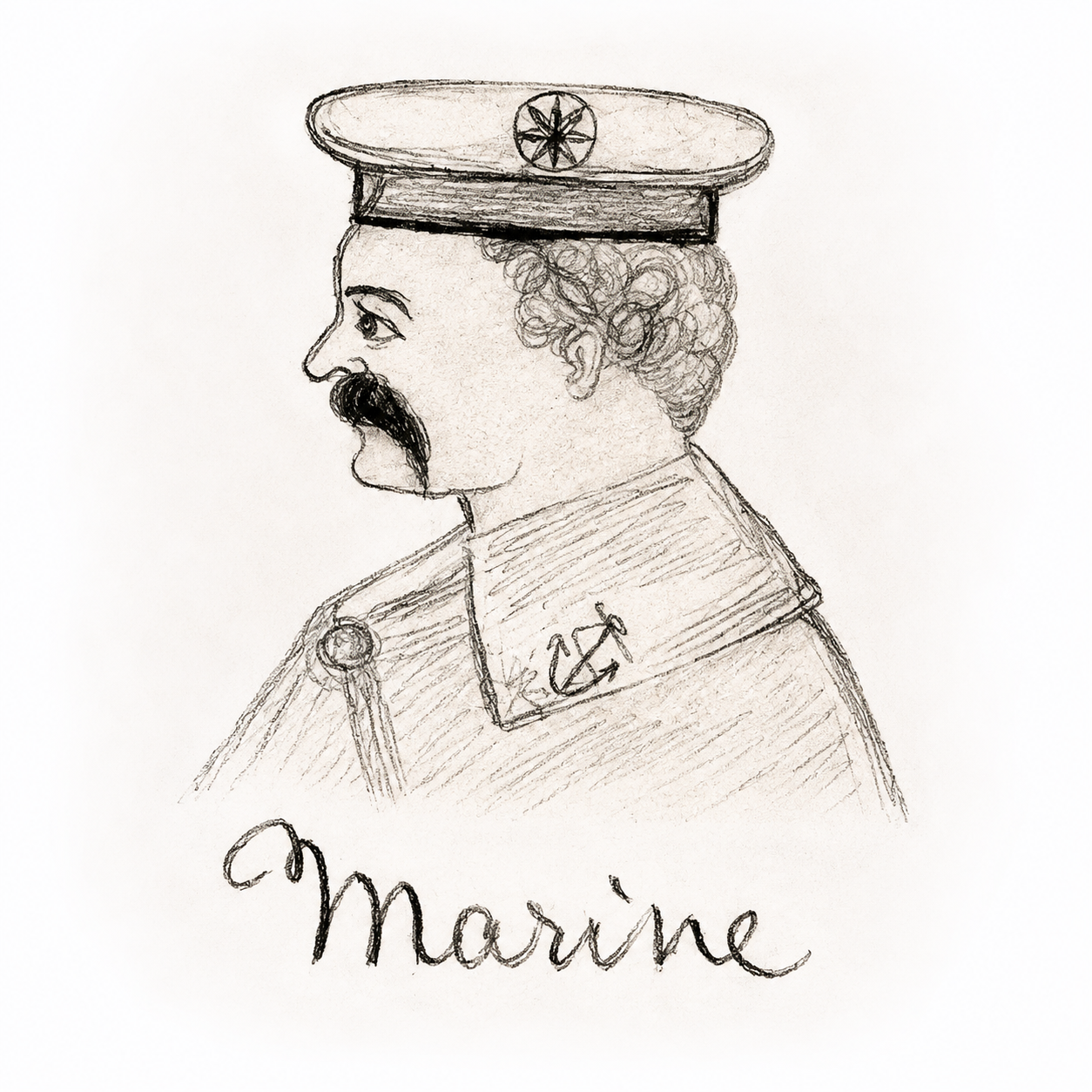
There is a part of Commodore Porter’s Mortar Fleet and part of Commodore Farragut’s here also & they keep coming in every day. They are coming to drill their Marines & recruits. The steamer Harriet Lane was in here the other day but she has gone out in pursuit of a strange craft in the Gulf. The Harriet Lane is the prettiest craft I ever saw. She is the flag ship of Farragut’s fleet.
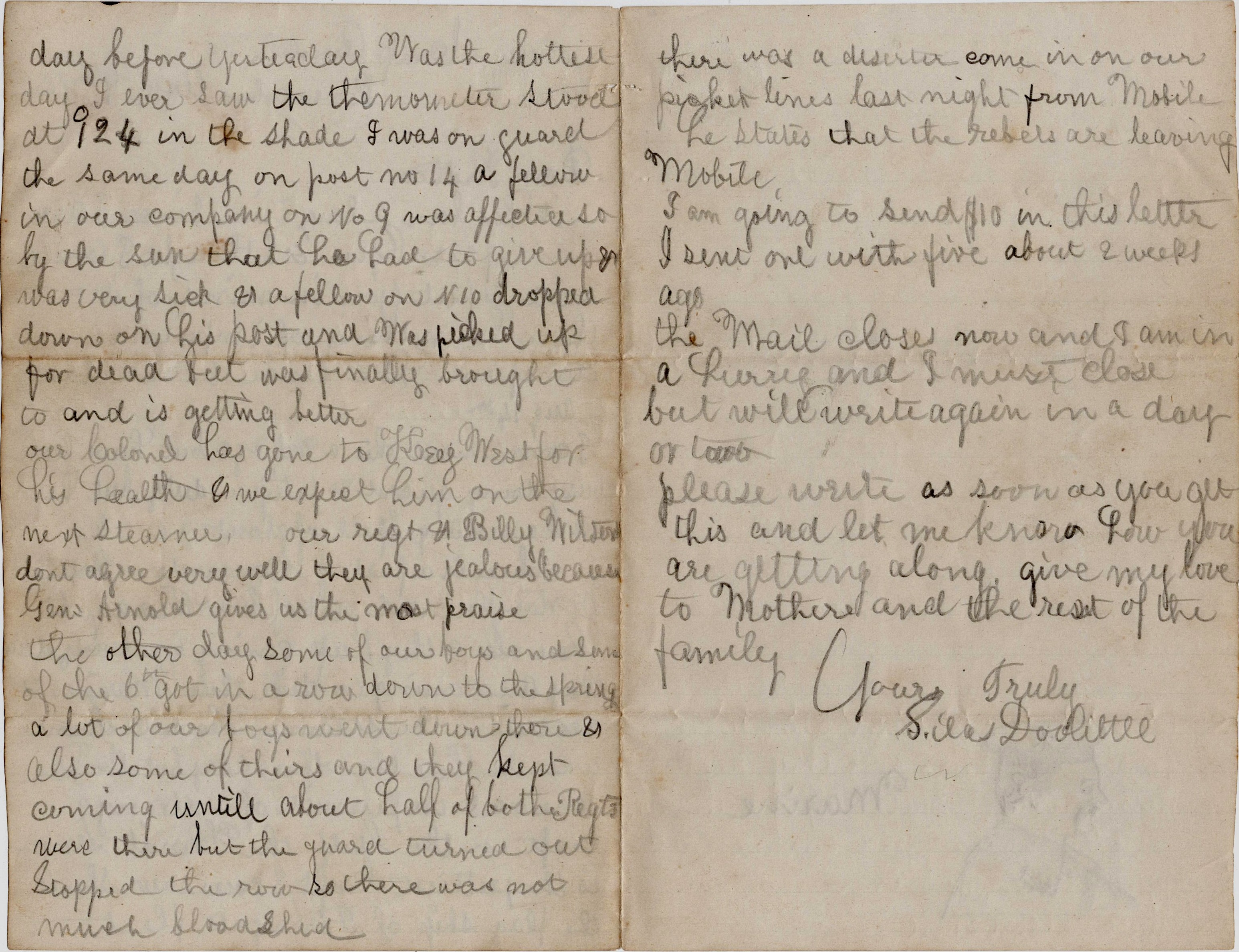
Day before yesterday was the hottest day I ever saw. The thermometer stood at 124o in the shade. I was on guard the same day on Post No. 14. A fellow in our company on No. 9 was affected so by the sun that he had to give up & was very sick & a fellow on No. 10 dropped down on his post and was picked up for dead but was finally brought to and is getting better.
Our Colonel [John A. Dodge] has gone to Key West for his health & we expect him on the next steamer. Our regiment & Billy Wilson’s [regiment] don’t agree very well. They are jealous because Gen. [Lewis G.] Arnold gives us the most praise. The other day some of our boys and some of the 6th [New York Zouaves] got in a row down to the springs. A lot of our boys went down there & also some of theirs and they kept coming until about half of both regiments were there. But the guard turned out [and] stopped the row so there was not much bloodshed. 1
There was a deserter come in our picket lines last night from Mobile. He states that the rebels are leaving Mobile.
I am going to send $10 in this letter. I sent one with five about two weeks ago. The mail closes now & I am in a hurry and I must close but will write again in a day or two. Please write as soon as you get this and let me know how you are getting along. Give my love to Mother and the rest of the family. Yours truly, — Silas Doolittle
1 Billy Wilson’s 6th New York Zouaves, many of them former firemen from NYC, had a reputation for drunkenness, theft and dereliction of duty. These “roughs” were as likely to pick a fight with Union men and Confederate soldiers.