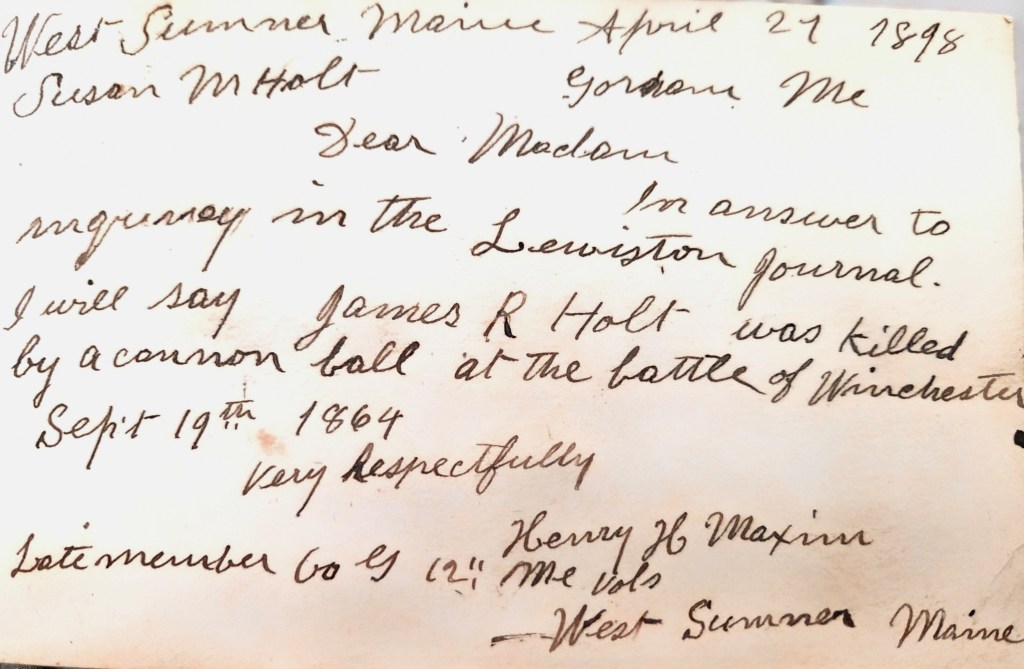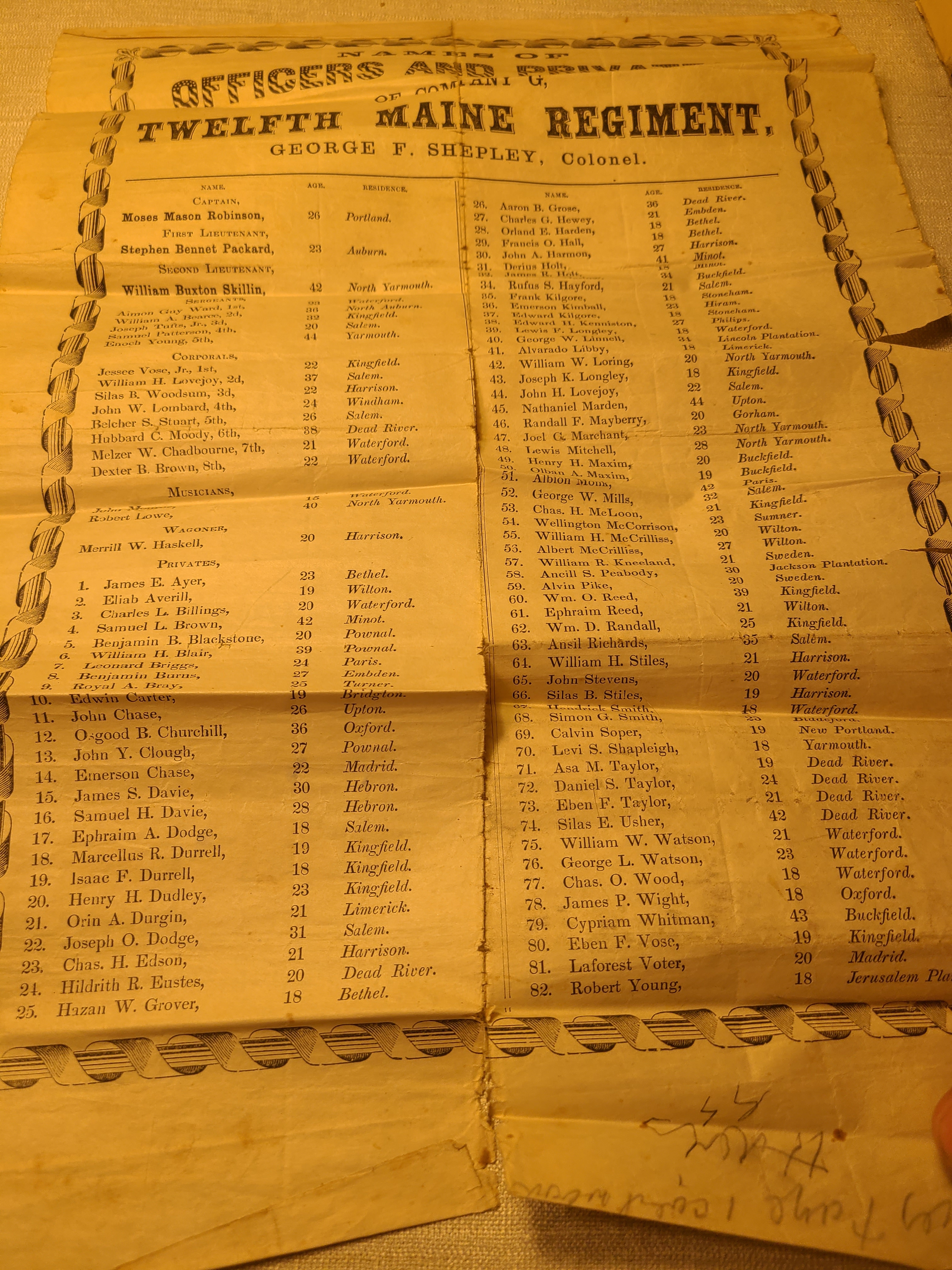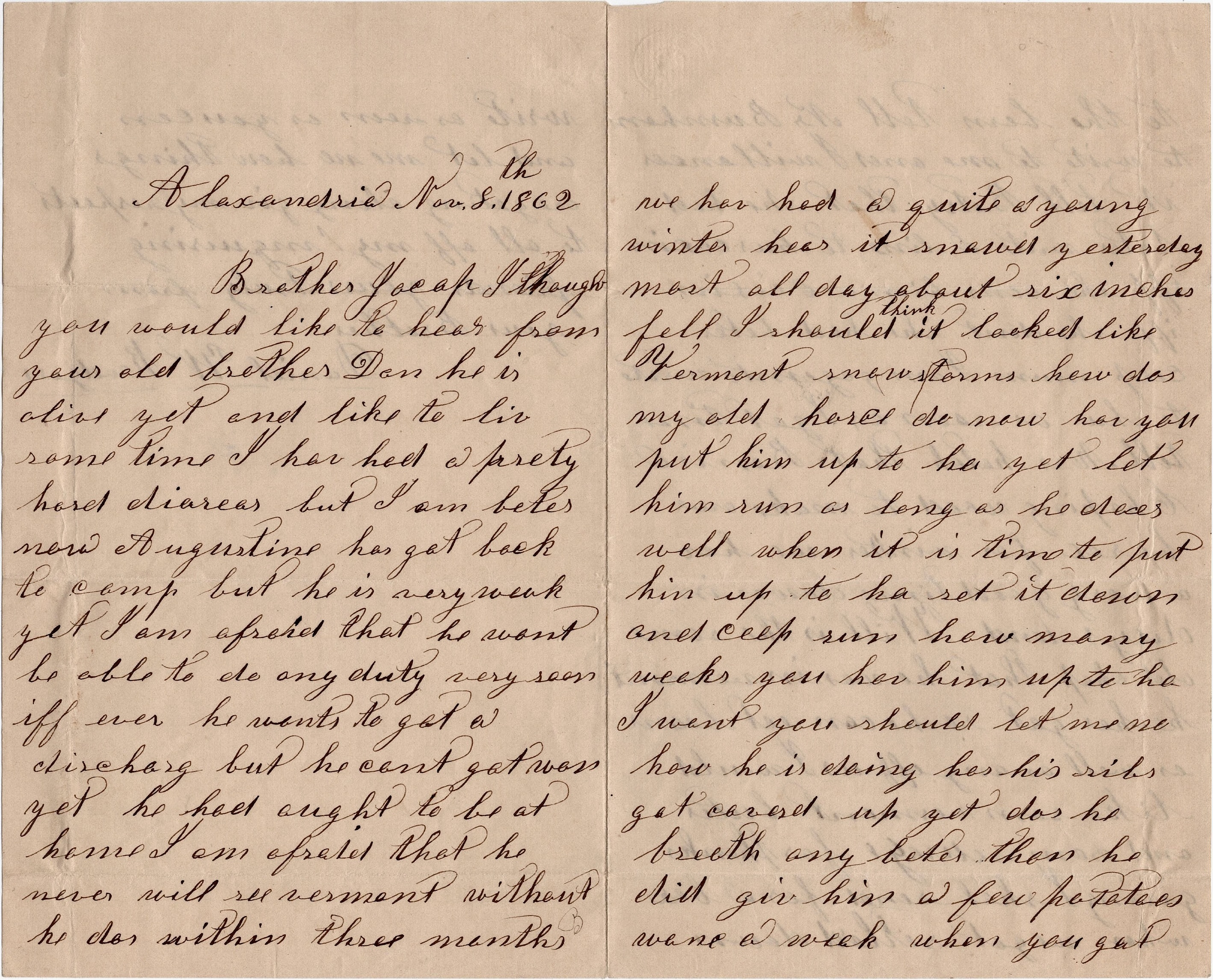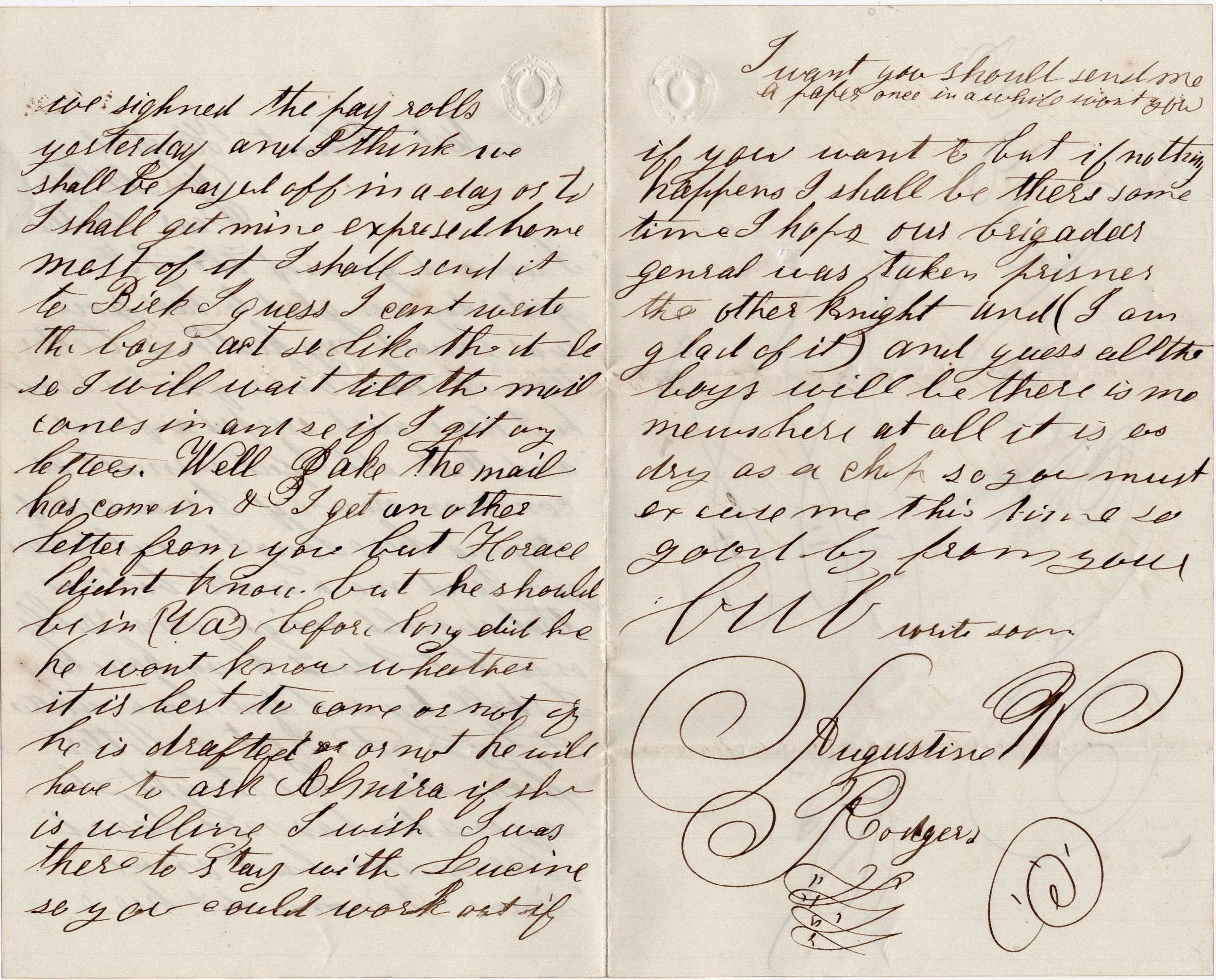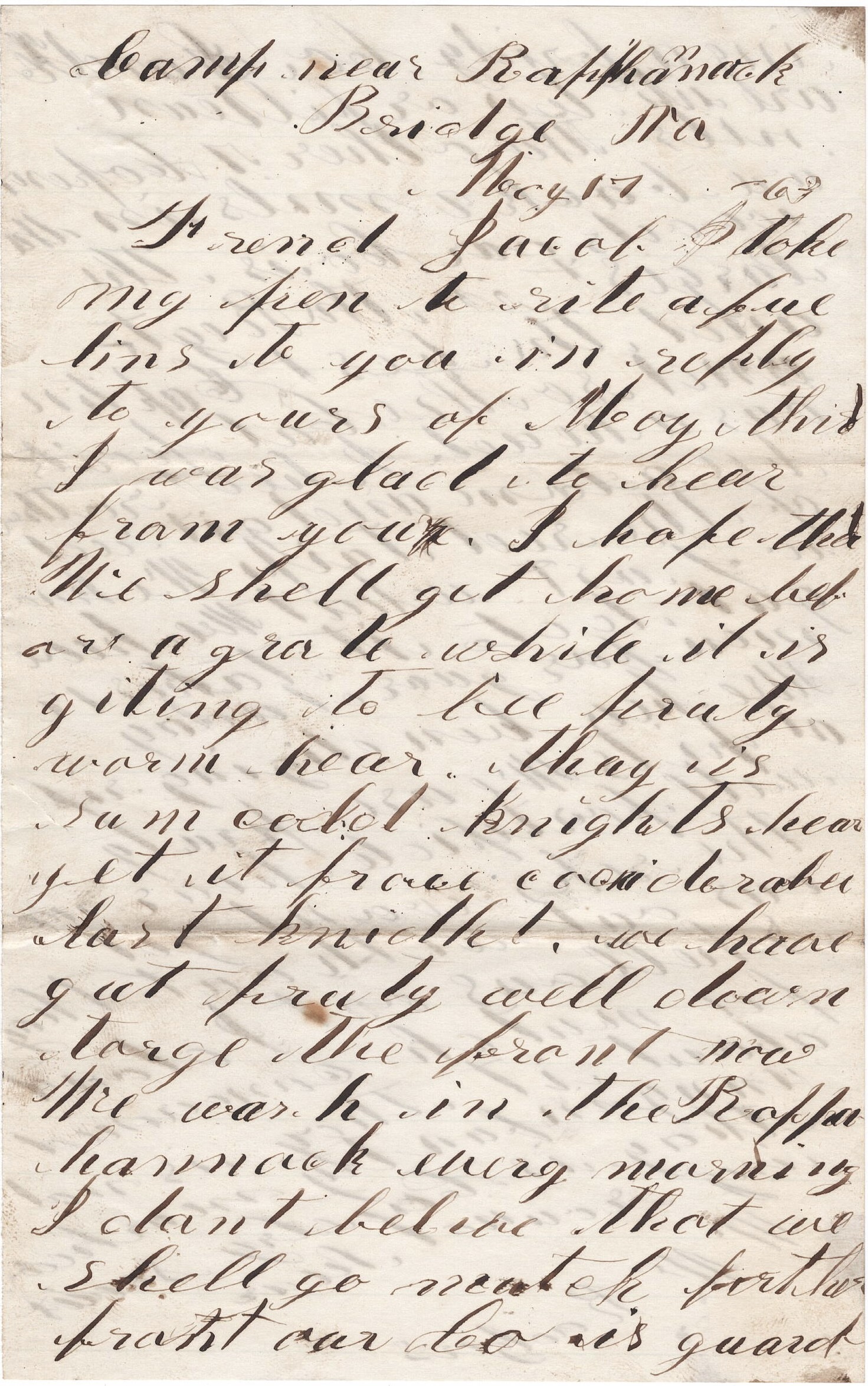
The letters penned by Pvt. James Redlon Holt (1845-1864), a 16 year-old youngster who enlisted on 15 November 1861 with Co. G, 12th Maine Infantry, tell a haunting story of sacrifice and valor. This young man, the son of Rev. Dudley Barker Holt and Susan M. Redlon from Gorham, Maine, found himself swept into the chaos of war. In the sweltering heat of Louisiana, where the 12th Maine was stranded for most of its service, he poured his heart onto paper. Just as the light at the end of the tunnel seemed near, with mustering out on the horizon, fate had a cruel twist in store. The regiment was called back East, only to face the brutal carnage of the 3rd Battle of Winchester in September 1864, where James met a tragic end on 19 September 1864—“killed by a cannon ball”—just two months before completing his three-year enlistment. What a visceral reminder of the brutality of war and the fragility of life!
Serving with James and mentioned in some of his letters was his Uncle Darius Holt (1820-1875) who enlisted at the age of 42 and served several months until his health failed and he was discharged for disability. Darius was living in Minot with his wife, Mercy Ann (Lord) Holt (1828-1902) and six children when he enlisted.
These letters are from the private collection of a Holt family descendant and were sent to me for transcription and publication on Spared & Shared by express consent.

Letter 1

[New Orleans]
July 27, 1862
Dearest Annie,
My father says that you say I must write to you. Well now, ain’t you ashamed to be fishing after a fellow in that way. Well I suppose you think it’s war times & the young ladies must court for themselves. Well if I did not think my poor Annie had waited so long for a letter & went away to her room & wept every time the mail brought a letter for her father or Leroy & none for her, I wouldn’t write. You mustn’t think that I have forgotten you dearest, for James still loves his Annie best of all, proof of which I send you this pretty picture. You see I’ve marked the place where we stay now (the Mint). We are expecting to leave the mint in a few days & go to a school house uptown. I’be been on picket the last few days. My health is tip top. Darius is about the same. Tom is nearly well. There is no news I think of. I want to see you all. My love to you and the rest. Write soon. From your own, — Jamie

Letter 2
New Orleans, [Louisiana]
August 25, 1862
Dear Father,
As Uncle Darius expects to leave in a day or two for home, I thought I would write you a few lines. My health is very good & I never felt better in my life except that I’ve been & am still troubled with boils—one on my forehead which though not very painful makes my eyes swell so that they feel mighty queer. And now my left eye is a fine-looking object.
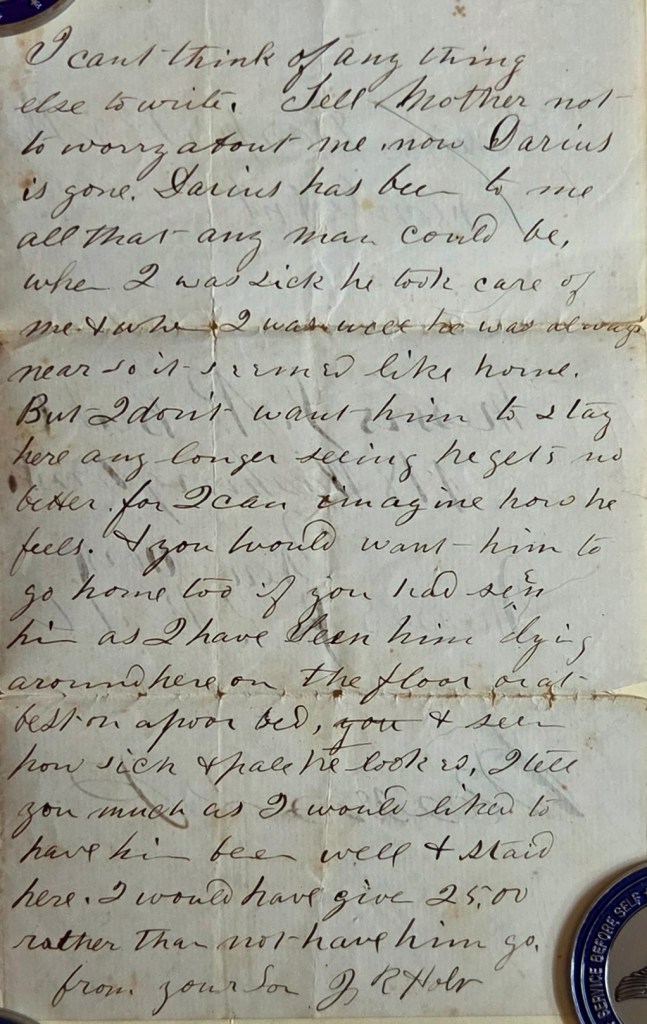
Everything goes on pleasantly. I still reain here at the railroad station. There was a policeman shot here a few days ago & though we turned out from our beds in no time, we couldn’t find out who it was. It was probably someone who had a grudge against him. Why don’t you send me more papers? I want you to send $1 to D. T. Pike, Augusta, Maine, for The Age for six months & $1 to Harper’s Brothers, Franklin Square, New York for “Harper’s Weekly” for 20 weeks. If you will do this, I will send you the money to pay for them when we are paid off out of my spending money. You can have them sent to you & read them, then send to me. Now be sure & do it for I want something to read.
I can’t think of anything else to write. Tell Mother not to worry about me now Darius is gone. Darius has been to me all that any man could be. When I was sick, he took care of me & when I was well, he was always near so it seemed like home. But I don’t want him to stay here any longer seeing he gets no better for I can imagine how he feels & you would want him to go home too if you had seen him lying around here on the floor or at best, on a poor bed, and seen how sick and pale he looked. I tell you, much as I would liked to have him been well & stayed here, I would have give $25 rather than not have him go.
From your son, — J. R. Holt


Letter 3
New Orleans [Louisiana]
September 8, 1862
Dear Father,
I received yours of the 15th & Mothers of the 21st a day or two ago & was glad to learn that you were well though sorry to find that my curious letter has made you feel bad for I did not intend it should. I love you as well as my odd nature can, though I don’t take so much pains as I ought to share it & wish never to cause you sad feelings so I’ll tell you why I wrote it.
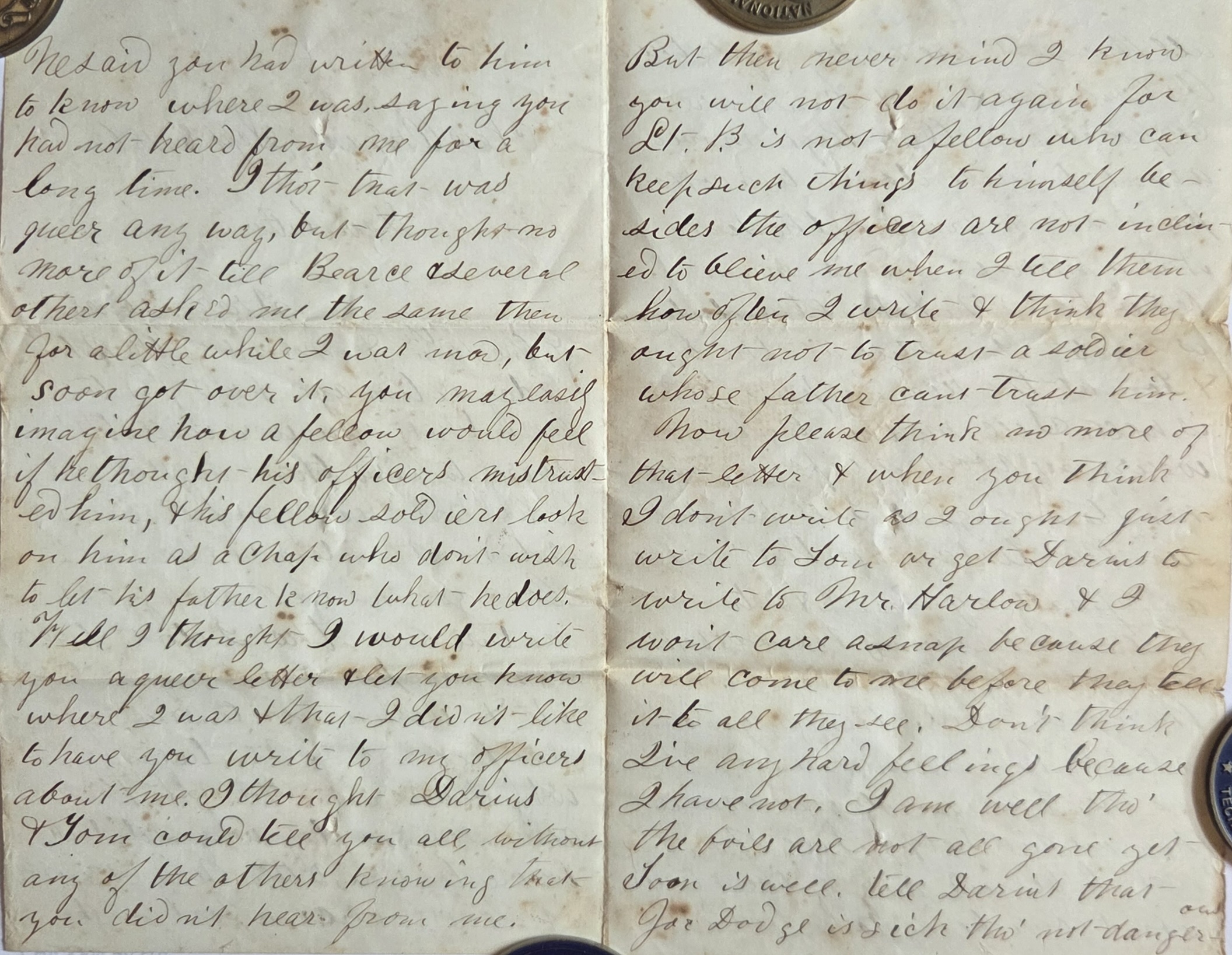
Lt. [Stephen B.] Packard 1 asked me one day why I didn’t write to you. I told him I wrote at least once a fortnight. He said you had written to him to know where I was, saying you had not heard from me for a long time. I thought that was queer anyway, but thought no more of it till [Sgt. William A.] Bearce & several others asked me the same. Then for a little while I was mad, but soon got over it. You may easily imagine how a fellow would feel if he thought his officers mistrusted him & his fellow soldiers look on him as a chap who don’t wish to let his father know what he does. Well, I thought I would write you a queer letter & let you know where I was & that I didn’t like to have you write to my officers about me. I thought Darius & Tom could tell you all without any of the others knowing that you didn’t hear from me.
But then, never mind. I know you will not do it again for Lt. B. is not a fellow who can keep such things to himself. Besides, the officers are not inclined to believe me when I tell them how often I write and think they ought not to trust a soldier whose father can’t trust him. Now please, think no more of that letter & when you think I don’t write as I ought, just write to Tom or get Darius to write to Mr. [Nathaniel] Harlow & I won’t care a snap because they will come to me before they tell it to all they see. Don’t think I’ve any hard feelings because I have not.
I am well though the boils are not all gone yet. Tom is well. Tell Darius that Joe Dodge is sick though not dangerous. All the rest are as he left them. Alf and Mahlin & Finley are corporals now. Our regiment moved about 1 mile down to a cotton press which fronts on the levee. It is a monster and is much better than the Hotel & the duty is lighter. I’m still at the Depot & Tom at the Reading Press. 2 William is well. Tell mother to stop worrying about me for it will not do any good. Tell her I’ve read the Testament through once and partly again.
As to [Gen.] Butler’s observing the Sabbath, I can’t say for in the army there are none. Things go on about the same one day as another though we do no more than we can help. Tell her not to believe any of the stories about our being taken [prisoners] for it [is not true].
[Remainder of letter missing?]
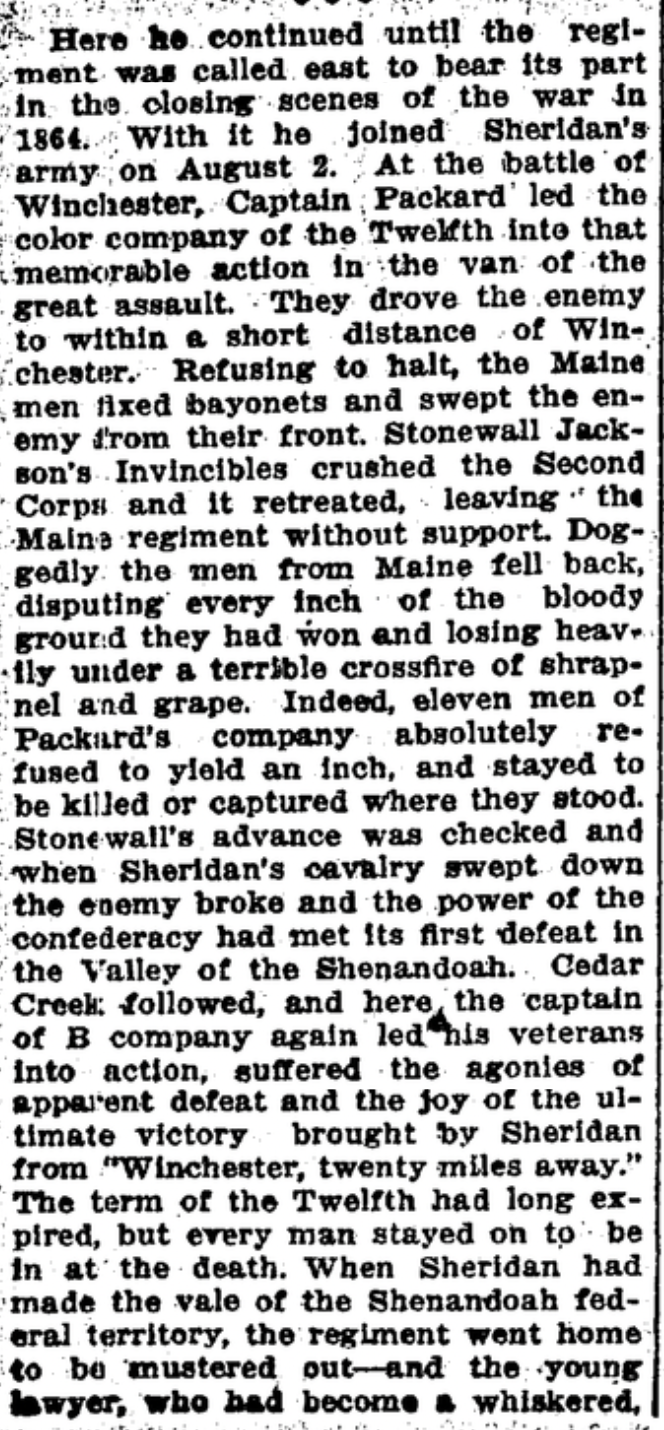
1 There is seems to be a descrepancy in the rank of Stephen B. Packard at the time. The following story of Stephen B. Packard and his wife, Emma Frances Steele, whom he married on 31 December 1863, appeared in the Evening Times-Republican of Marshalltown, Iowa, in 12 November 1907 following Emma’s death:


There is also this article on Packard that was oublished in the same paper on 23 May 1908 following his death.



2 The “Reading Press” in New Orleans during the Civil War was not a printing mechanism or a newspaper, but rather a prominent riverfront cotton press and warehouse located near the foot of Erato Street. After Union forces captured the city in April 1862, these large industrial structures were used by the Union army and navy to store munitions, coal, and other critical supplies.


Letter 4
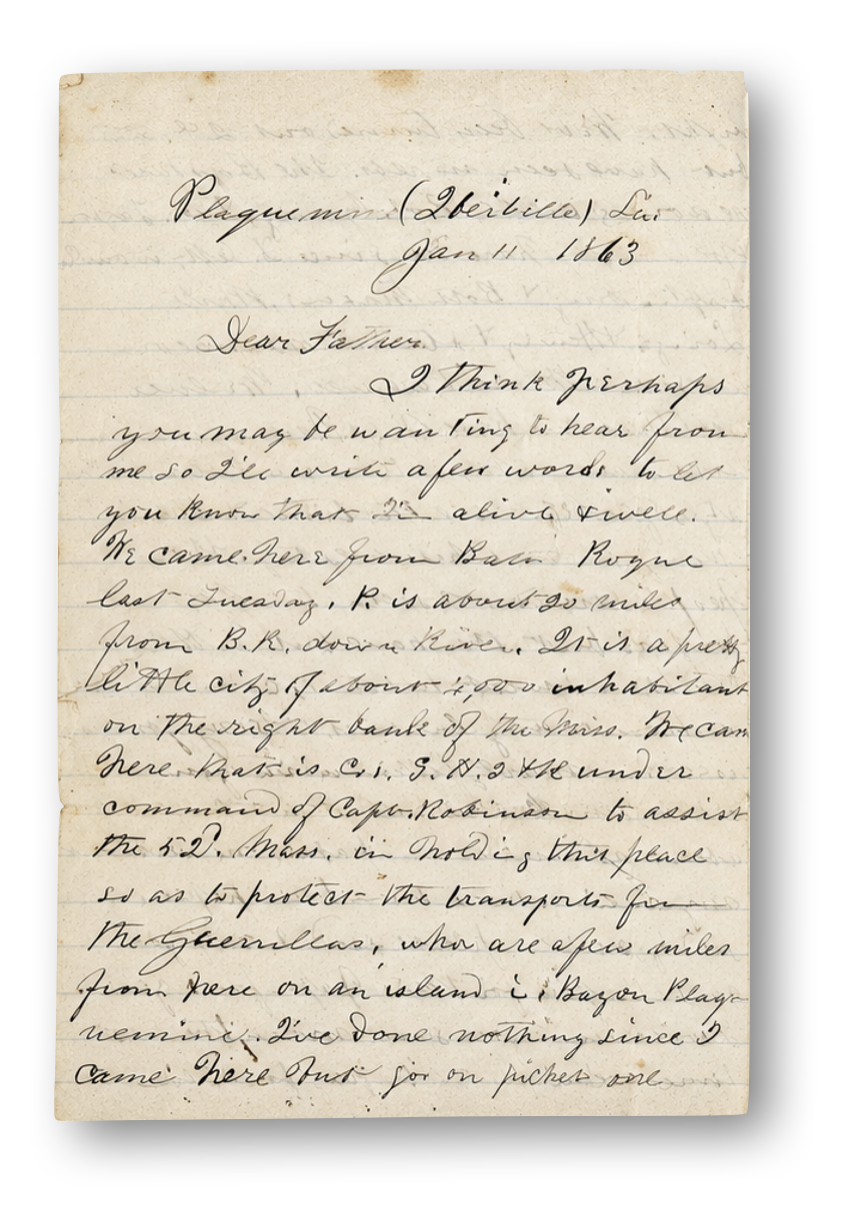
Plaquemine (Iberville) Louisiana
January 11, 1863
Dear Father,
I think perhaps you may be wanting to hear from me so I’ll write a few words to let you know that I’m alive & well. We came here from Baton Rouge last Tuesday. P[laquemine] is about 20 miles from B[aton] R[ouge] down river. It is a pretty little city of about 4,000 inhabitants on the right bank of the Mississippi. We came here—that is, Companies G, H, I, & K under command of Capt. Robinson to assist the 52nd Massachusetts in holding this place so as to protect the transports from the guerrillas who are a few miles from here on an island in Bayou Plaquemine. I’ve done nothing since I came here but go on picket one night. We’ve been turned out twice but have seen no rebs.
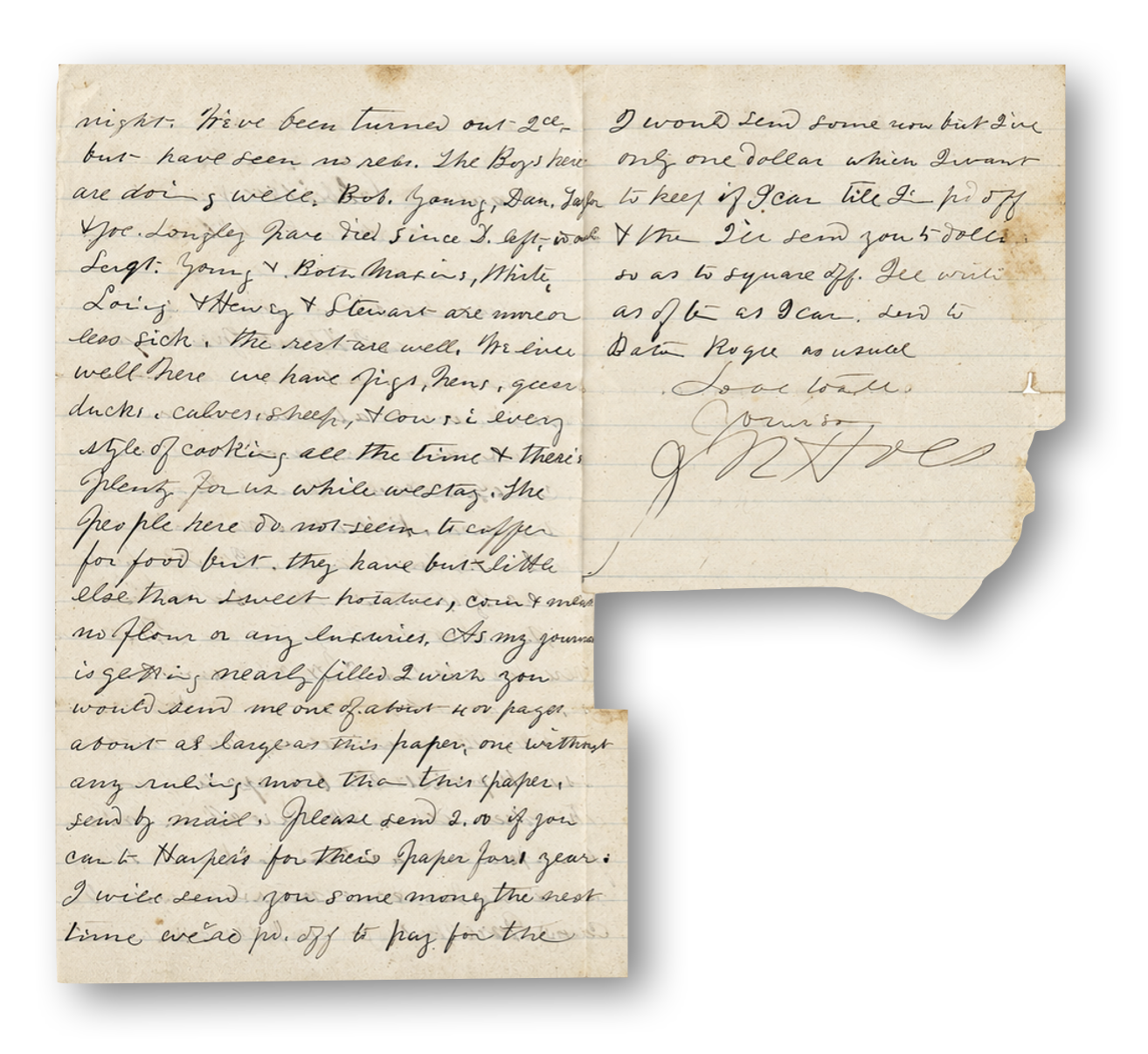
The Boys here are doing well. Bob Young, Dan Taylor, & Joe Longley have died since I left. In our company, Sergeant Young & both [Henry & Olban] Maxims, White, [William W.] Loring, and Henry & Stewart are more or less sick. The rest are well. We live well here. We have pigs, hens, geese, ducks, calves, sheep & cows in every style of cooking all the time & there’s plenty for us while we stay.
The people here do not seem to suffer for food but they have but little else than sweet potatoes, corn & meat. No flour or any luxuries.
As my journal is getting nearly filled, I wish you would send me one of about 400 pages, about as large as this paper—one without any ruling more than this paper. Send by mail. Please send $3 if you can to Harper’s for their paper for 1 year. I will send you some money the next time we’re paid off to pay for them. I would send some now but I’ve only one dollar which I want to keep if I can till I’m paid off & then I’ll send you 5 dollars so as to square off. I’ll write as often as I can. Send to Baton Rouge as usual. Love to all. Your son, — J. R. Holt
Letter 5
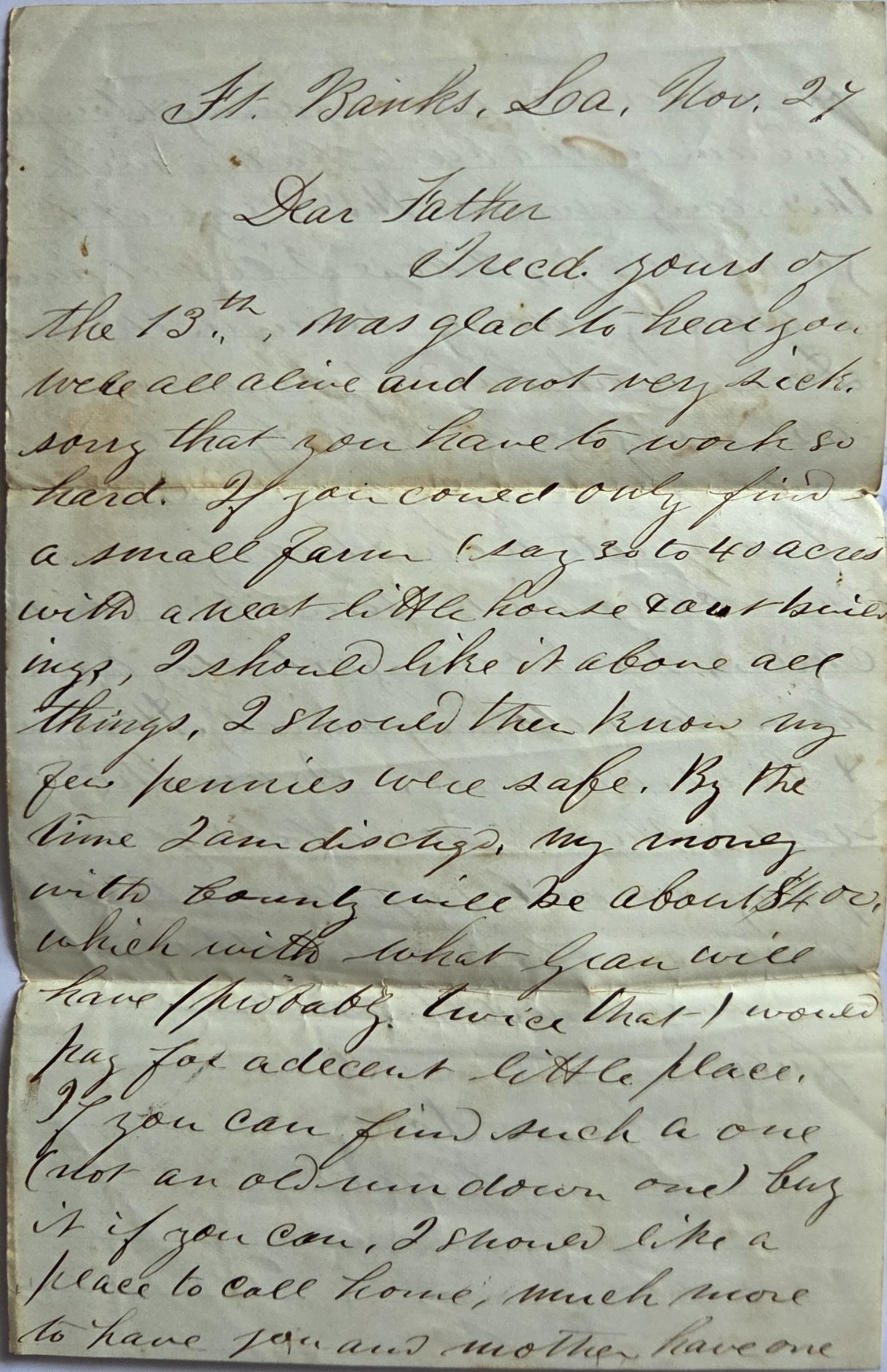
Fort Banks, Louisiana
November 27 [1863]
Dear Father,
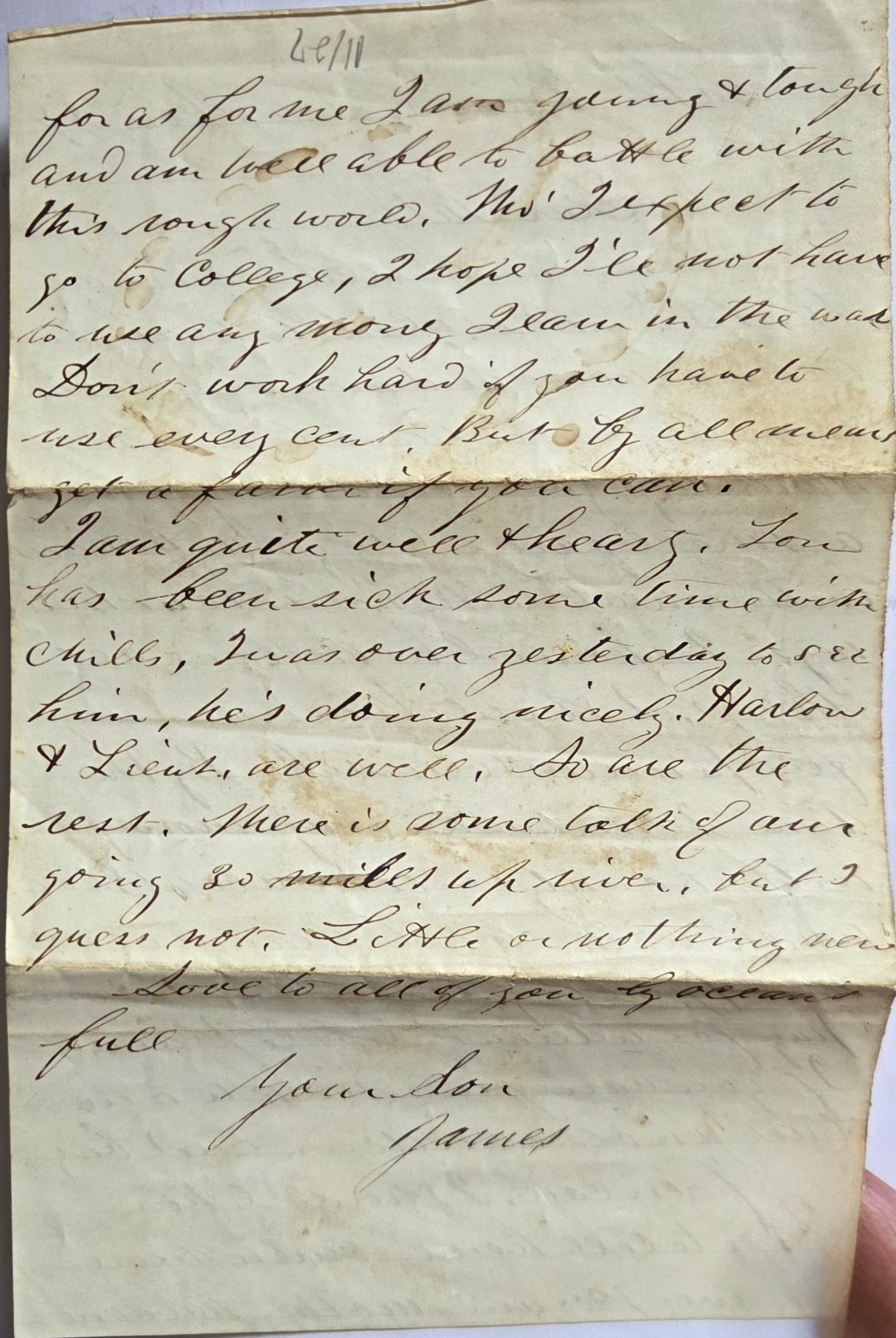
I received yours of the 13th. Was glad to hear you were all alive and not very sick. Sorry that you have to work so hard. If you could only find a small farm (say 30 to 40 aces) with a neat little house & out buildings, I should like it above all things. I should then know my few pennies were safe. But the time I am discharged my money with bounty will be about $400 which with what Gran will have (probably twice that) would pay for a decent little place. If you can find such a one (not an old run down one), buy it if you can. I should like a place to call home, much more to have you and mother have one for as for me, I am young and tough and am well able to battle with this rough world. Though I expect to go to college, I hope I’ll not have to use any money I earn in the war. Don’t work hard [even] if you have to use every cent. But by all means, get a farm if you can.
I am quite well and hearty. Tom has been sick some time with chills. I was over yesterday to see him. He’s doing nicely. [Nathaniel] Harlow & Lieut. are well. So are the rest. There is some talk of our going 30 miles upriver but I guess not. Little or nothing new. Love to all of you. Your son, — James
Letter 6
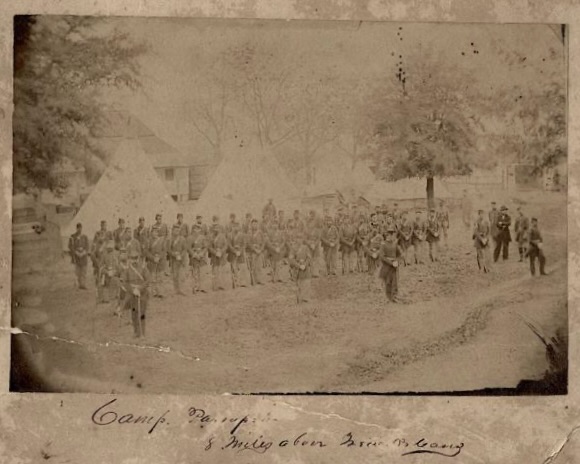
Camp Parapet, Louisiana
December 15, 1863
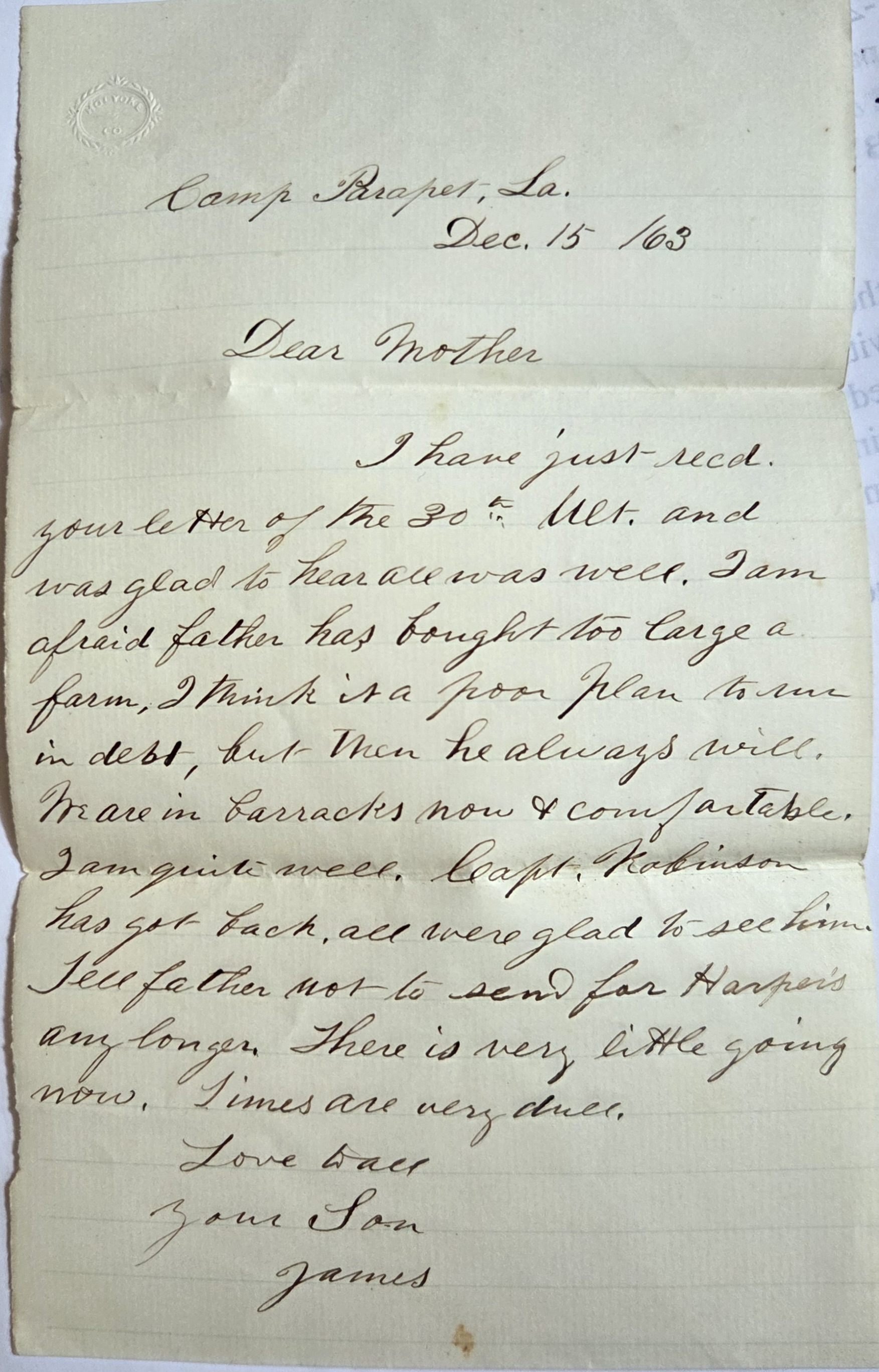
Dear Mother,
I have just received your letter of the 30th ult. and was glad to hear all was well. I am afraid father has bought too large a farm. I think it a poor plan to be in debt, but then he always will.
We are in barracks now & comfortable. I am quite well. Capt. Robinson has got back. All were glad to see him. Tell father not to send for Harper’s any longer. There is very little going now. Times are very dull. Love to all. Your son, — James
Letter 7
Proctorville, Louisiana
January 8, 1864
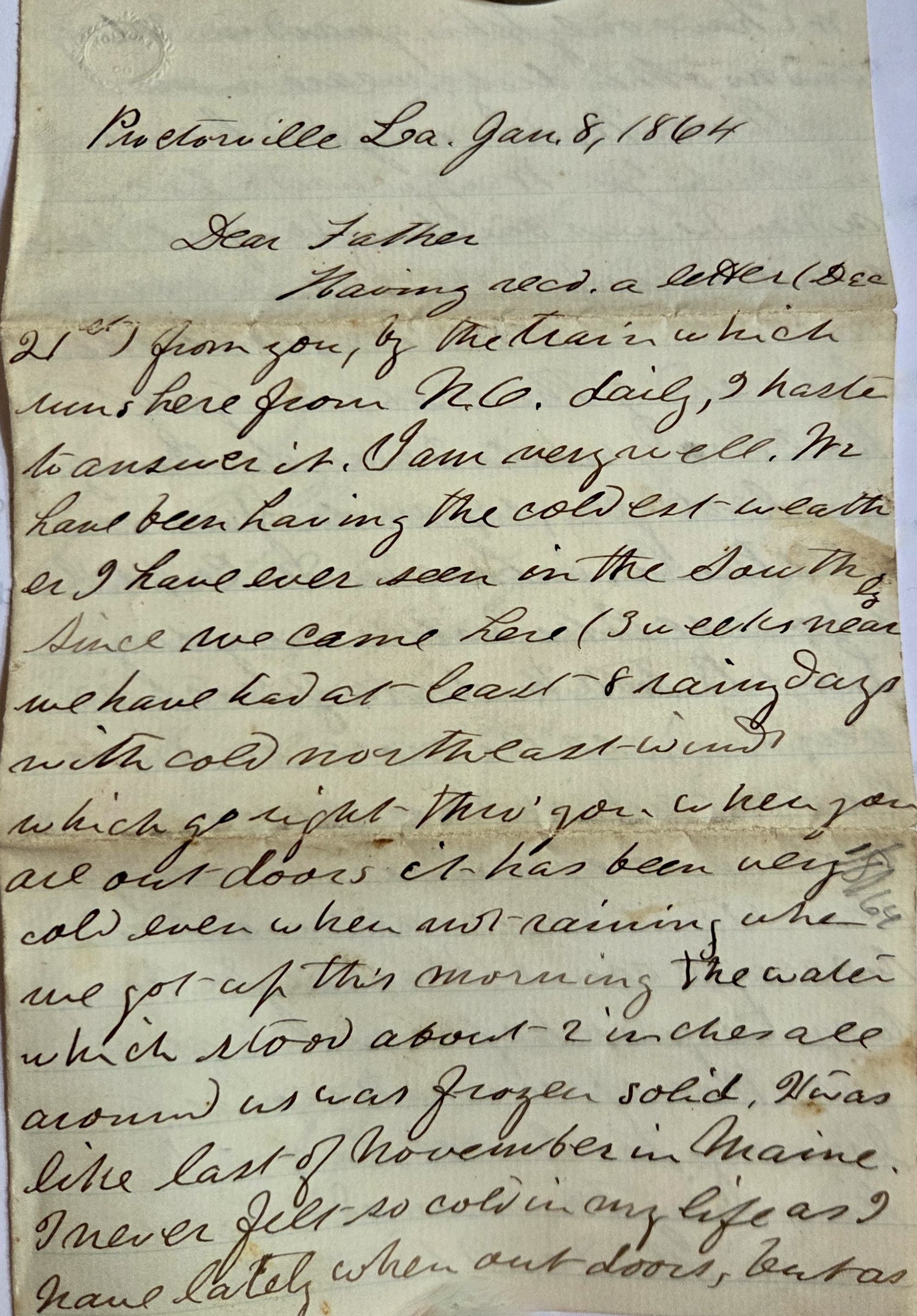
Dear Father,
Having received a letter (Dec. 21st) from you, by the train which runs here from New Orleans daily, I hasten to anwser it. I am very well. We have been having the coldest weather I have ever seen in the South. Since we came here (3 weeks nearly) we have had at least 8 rainy days with cold northeast winds which go right through you when you are out doors. It has been very cold even when not raining. When we got up this morning, the water which stood about two inches all around us was frozen solid. It was like last of November in Maine. I never felt so cold in my life as I have lately when out doors, but as we have only 4 hours guard in 3 days and no other duty, we are in[side] most of the time. We have a good house in which Gen. [Godfrey] Weitzel used to live when he was building the fort 1 here which is unfinished still, not being touched since 1860. We are at the lake end of the Mexican Gulf Railroad, while I was at the City end last year, 27 miles from here. All the company is here under Capt. [Moses M.] R[obinson] whom all like better every day.
Lieut. B. took the death of his child very hard all the more so since the mail which brought your letter brought an acceptance to the resignation which he was allowed to make to escape court martial for being too antic just before we left the fort. That spree was the cause of our leaving. The company all hate him and knowing that made her death much harder. I pitied him, but knew not how to comfort him. He came to me just after the cars came in and handed me your letter but he felt too bad to talk. He walked the room all night. He is a good fellow when he is himself, but he is very easily led astray. I really like him though I think he wil stay here till we go home. You had better not tell his wife about this or anyone else for two reasons. First, it would only hurt him and make him worse and make his wife feel bad. Second, it might still cause hard feelings between him and I and as I like him, I shouldn’t like that. So please don’t say anything to anyone.
I received a Herald & Harper’s [Weekly]. There are several Harper’s I never got. I know not if you have sent them. If not, all right. Tell me next time if you have ever received the Magazine I told you awhile ago I sent for—Leslie’s, I mean.
The regiment is off on an expedition to Pontchartrain [led by Col. W. K.] Kimball with several other regiments. 2 I haven’t seen Tom lately. [Nathaniel] Harlow is well. I am glad to know that you have a home at last and are in fair way of paying for it. It is what I have long wanted—to have you in a sure home of your own where I could come and go often as I will. Yes, too glad. What little money I had cheerfully and gladly I gve to you. Never trouble about it. I’ll not want it, I hope. If I could give everything in the world, I should still fell in debt to you.
Love to you and Mother and all. Yours son who really love you, — James
1 The unfinished fort was Fort Proctor.
2 On January 3, 1864, a Federal expeditionary force led by Colonel W.K. Kimball of the 12th Maine Infantry successfully crossed Lake Pontchartrain and occupied Madisonville, Louisiana. The mission aimed to disrupt Confederate smuggling and secure raw materials for the Union Department of the Gulf.


Letter 8
Proctorville, Louisiana
January 20, 1864
Dear Mother,
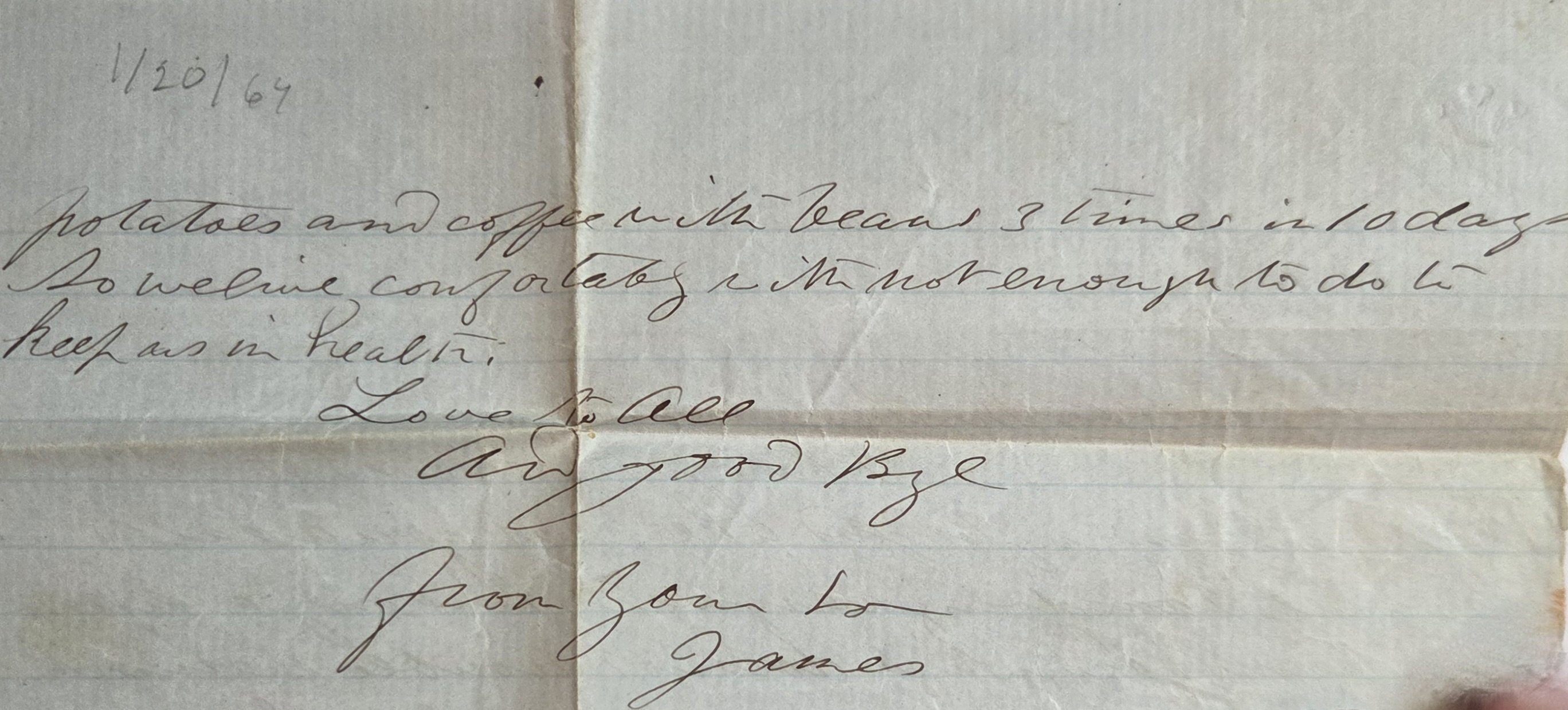
I have just received your letter and am right glad to hear that you are all so well. I am doing very well. Have only a slight cold in my head which does not trouble me much. [Nathaniel] Harlow is well. I suppose [Sgt. William A.] Bearce will be at home before this but I don’t know. Tom is well and has gone and done [enlisted] for three years more to the tune of $902 bounty [paper creased] and bounty $402 Govt., $100 State and $300 town of Paris. He’ll probably have $1500 or more at the end of his time if he lives. Very good for him. 10 have done the same in our company and about 160 in the regiment. But I think that 3 years service [volunteering] before I was old enough to fear the draft is about as much as I owe the government, don’t you? The money is no temptation. Yet I would [re]enlist were it not that I should be getting too old for college. I shall keep out of it. Those who have [re]enlisted have gone to the City to be mustered.
It is very pleasant here now—just like May or rather October, for we have heavy frosts & chilly mornings. Tell Leroy I don’t understand French but guell I’ll learn it this summer. I could give him a bit of Dutch [German], Latin, or Greek if he wanted it, but no French. If we all live and do well, 10 months from today will see us in the same state unless there is a battle here about that time, which I guess will not be the case. I want to get home and have some good bread and milk. Yet we live well here—good biscuits, meat, fresh fish, potatoes and coffee with beans 3 times in 10 days. So we live comfortably with not enough to do to keep us in health. Love to all and goodbye. From your son, — James

Letter 9
Proctorville, Louisiana
February 21, 1864
Dear Mother,
I have just received your letter & was right glad to hear you are all well. I am tough & hearty as I could wish, live well & feel equal. About 17 men have reenlisted in our company and near 200 in the regiment. I’ll keep out sure—don’t worry at all about it. I have received two magazines lately Haven’t heard from Tom since I wrote before. D[arius]’s regiment is in Algiers, opposite New Orleans, and will go to Franklin, 150 miles nearly from there. I should go & see him but it is too far for my means. We expect pay soon & perhaps I may see him. Surely shall if he don’t go before.

The State is in no little excitement about the coming election. There are three parties: 1st, Free State men who are opposed to giving negroes same rights as white men but want them free & made to work for pay as [Gen. Nathaniel] Banks does it. 2nd, men who want them to have same privileges as whites, amalgamation and all. 3rd, Copperheads who are few. [Michael] Hahn of the 1st party will be Governor, I think. Hope so anyway. I’m in for giving slaves freedom but don’t want them to vote, hold office, be officers, or marry whites. They’re so lazy they won’t do anything if they can help it. I’ve seen how the thing works and like [Gen.] Banks’ plan best of any. That gives them all they deserve though Abolitionists don’t like it.
We’ve had a bit of snow a few days ago which melted as it fell. Ice was an inch thick or more. We are pretty cold, I tell you, & mighty windy too.
[Nathaniel] Harlow and all are well. He’s not been listed. I’ve got my studies so well along that I can enter college any time. Guess I’ll do it in the fall of ’65, if I live. I’m a none-month’s man & glad of it too. Yes, 9 months from yesterday will end my soldier’s life without doubt. I hope so. Love to you and all. Your son, — James


Letter 10
New Orleans, Louisiana
April 22, 1864
Dear Father,
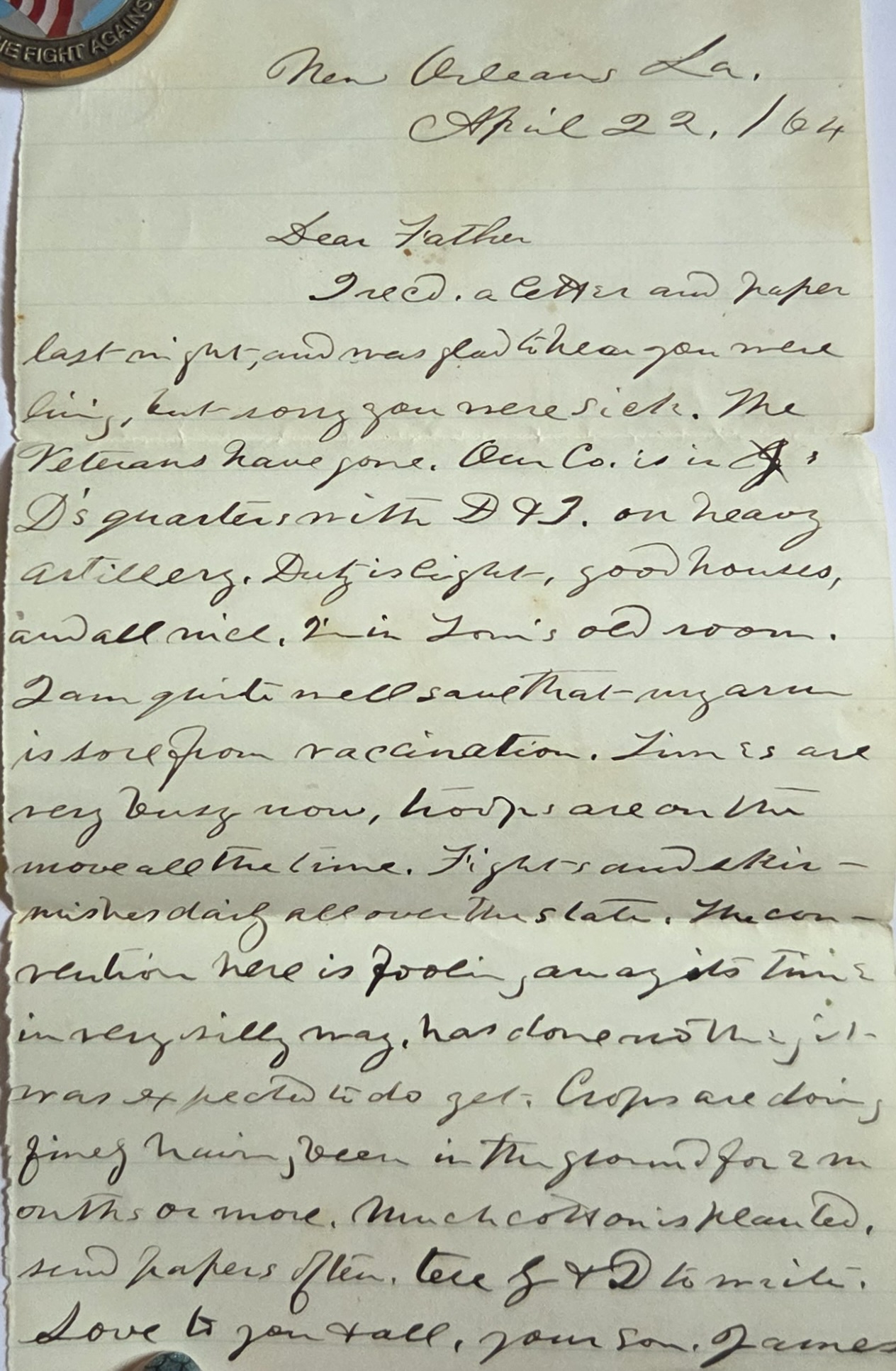
I received a letter and paper last night and was glad to hear you were living but sorry you were sick. The veterans have gone. Our company is in D’s quarters with D & I on heavy artillery. Duty is light, good houses, and all nice. I’m in Tom’s old room. I am quite well save that my arm is sore from [smallpox] vaccination. 1
Times are very busy now. Troops are on the move all the time. Fights and skirmishes daily all over the state. The convention here is fooling away its time in a very silly way—has done nothing it was expected to do yet. 2
Crops are doing finely having been in the ground for 2 months or more. Much cotton is planted. Send papers often. Tell G & D to write. Love to you & all. Your son, — James
1 A devastating smallpox epidemic swept through New Orleans in 1864 and 1865, taking thousands of lives of freedmen and soldiers in the region.
2 The Louisiana Constitutional Convention convened at Libery Hall in New Orleans on 6 April 1864. The convention was called by President Lincoln for the purpose of drafting a new state constitution to include the abolishment of slavery. It ultimately finished its work in late July, granting Black citizenship rights but denied them the right to vote.
Letter 11
Hickock’s Landing, La. 1
May 18, 1864
Dear Father,
I write his to let you know that I am well as ever. We came here the 16th. It is at the lake end of the shell road where all the New Orleans highbucks drive with their ladies. It is a pleasant place. We were paid a day or two ago and I’ll enclose 15 if I don’t let D[arius] have it. I am going to see him today and think he’ll want to borrow it and pay you when he gets home. I was very glad of those [Portland] Transcripts you sent. Send more and Leslie’s [Illustrated]. Love to all. Your son, — James
1 “Hickock’s Landing,” or “Port Hickock,” was situated on the southern shore of Lake Pontchartrain, Louisiana, at the terminus of the New Orleans shell road.

Letter 12
Algiers, Louisiana
July 13, 1864
Dear Father,
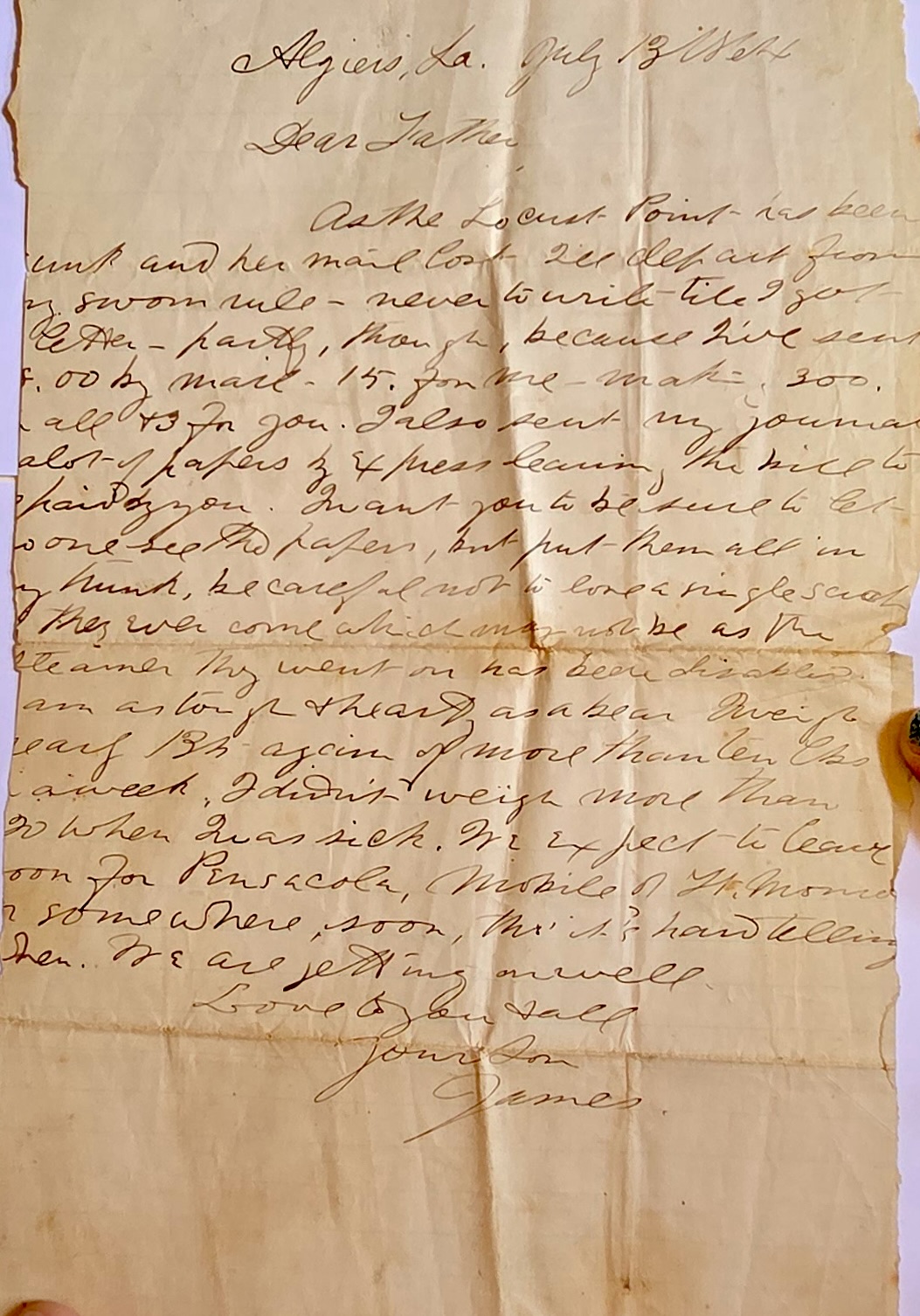
As the Locust Point has been sunk and her mail lost, I’ll depart from my sworn rule never to write till I got a letter. Partly, though, because I’ve sent $18 by mail, 15 for me—making 300 in all—and 3 for you. I also sent my journal and a lot of papers by Express leaving the bill to be paid by you. I want you to be sure to let no one see the papers, but put them all in my trunk. Be careful not to lose a single scrap—that is, if they ever come, which may not be as the steamer they went on has been disabled.
I am as tough & hearty as a bear. I weigh near 135 again of more than ten lbs. in a week. I didn’t weigh more than 120 when I was sick. We expect to leave soon for Pensacola, Mobile, or Fort Monroe or somewhere soon though it is hard telling when. We are getting on well.
Love to all. Your son, — James
The following postcard was sent to James’ mother, Susan Holt, in 1898. It was sent to her in response to an ad she placed in the newspaper as she continued to gather additional evidence or testimony to validate her pension claim—33 years after her son’s death! The pension records in Washington D. C. may have some interesting material in it—possibly even some of James’ letters.