The author of this letter was William B. Elrod (1825-Aft1873), the son of Samuel Elrod (1797-1885) and Mildred (“Milly”) Gurthey (1799-1888) of Mountain Springs, Anderson County, South Carolina. William enlisted in Co. D, 18th South Carolina Infantry late in 1861. In signing the letter, William added the name of Drury “Edward” King (1839-1915), a comrade in Co. D who served as his 2nd Lt. and came from the same vicinity in Anderson county. Samuel’s Last Will & Testament (Ancestry.com), signed in 1873 by his mark, confirms that both William B. and Benjamin (“Ben”) Douthit Elrod (1831-1879) were his sons and Drury Edward King was his son-in-law. Drury married Nellie Caroline (“Carrie”) Elrod (1839-1917) in 1866. A letter written by Edward King to his aunt, Elizabeth Barkley is housed at the Atlanta History Center. It speaks of the hardships endured by the soldiers towards the end of the war.
The 18th South Carolina was part of Elliott’s South Carolina Brigade Brigade which belonged to Brig. Gen. Bushrod Johnson’s Division. The content of this letter pertains to the movements of the regiment as Confederate troops were shifted south towards Petersburg from the Howlett line to confront Grant’s flank movement across the James River at Weyanoke Point on 14 June 1864. Some six weeks later the 18th South Carolina, alongside the 22nd South Carolina, would find themselves holding Elliott’s Salient in the Petersburg defenses when the Union Army detonated the mine beneath their works, disabling more than 200 of its men and killing 108 from the 18th South Carolina alone. [See Co. D Roster]
I have previously transcribed one other letter by a member of this same company. See—1862: Martin Van Buren Barkley to Josiah M. Barkley.
I wish to thank my friend Brett Schulte of The Siege of Petersburg Facebook page for assistance in nailing down the regiment and the identities of the two soldiers who signed their names to this letter. He tells me that he used the new Google Gemini Argon as his research tool for this task.
T R A N S C R I P T I O N
Petersburg, Virginia
June 21st 1864
Dear Father, Mother, Sisters & Friends,
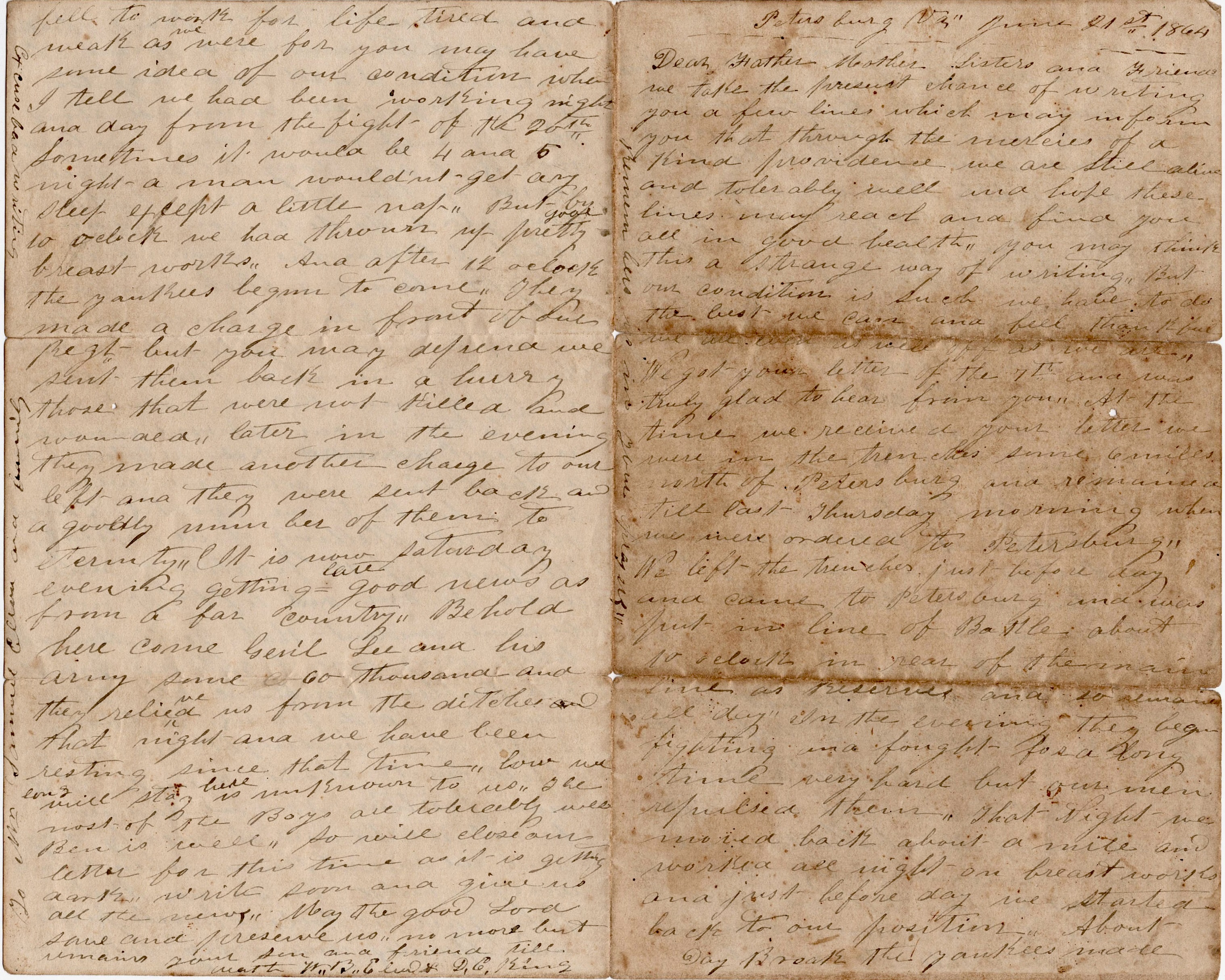
We take the present chance of writing you a few lines which may inform you that through the mercies of a kind Providence we are still alive and tolerably well and hope these lines may reach and find you all in good health. You may think this a strange way of writing, but our condition is such we have to do the best we can and feel thankful we are even as well off as we are. We got your letter of the 7th and was truly glad to hear from you. At the time we received your letter, we were in the trenches some 6 miles north of Petersburg and remained till last Thursday morning [16 June] when we were ordered to Petersburg.
We left the trenches just before day and came to Petersburg and was put in line of battle about 10 o’clock in rear of the main line as reserves and so remained all day. In the evening they began fighting and fought for a long time very hard but our men repulsed them. That night we moved back about a mile and worked all night on breastworks and just before dat we started back to our position.
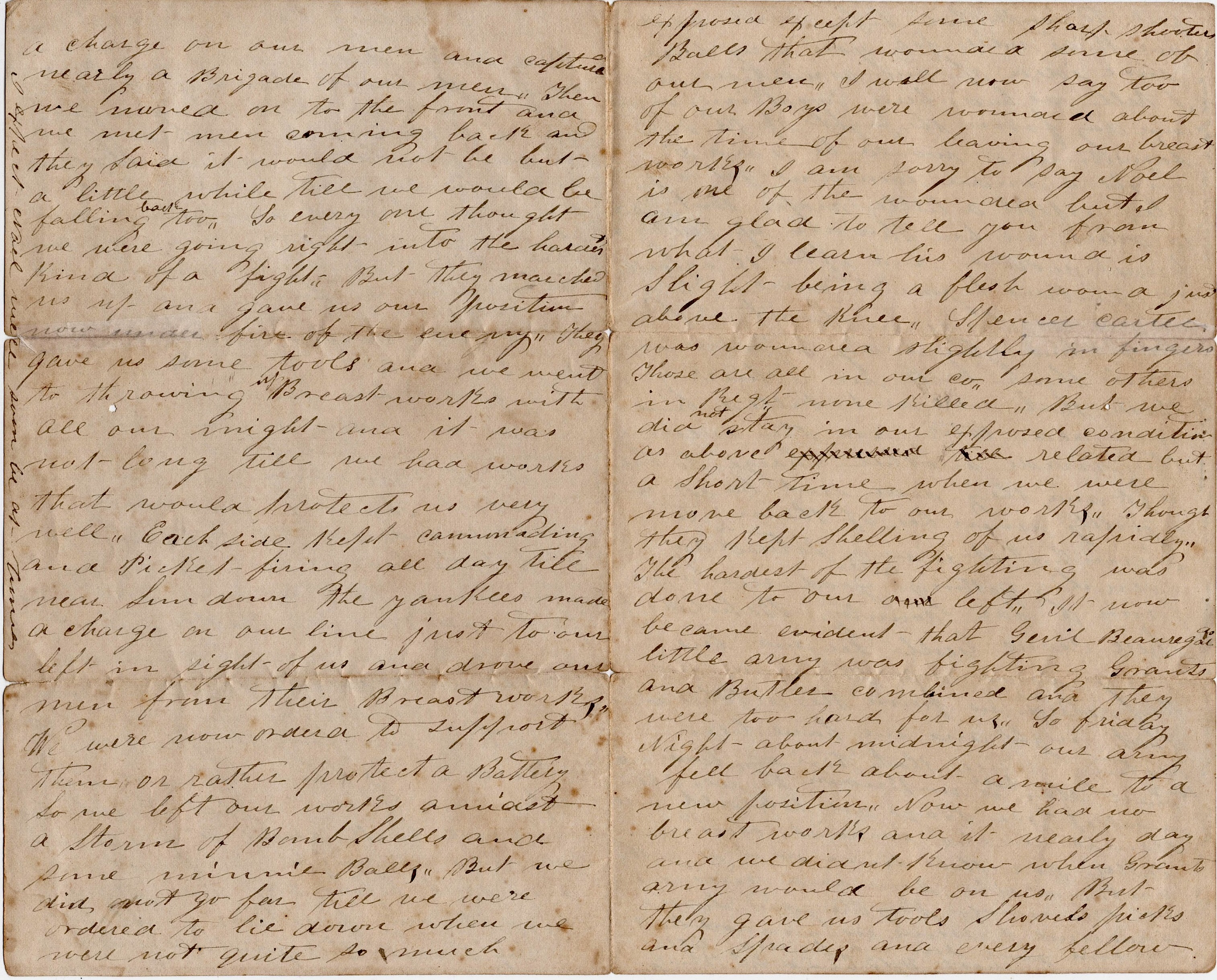
About day break [17 June] the Yankees made a charge on our men and captured nearly a brigade of our men. 1 Then we moved on to the front and we met men coming back and they said it would not be but a little while till we would be falling back too. So everyone thought we were going right into the hardest kind of a fight. But they marched us up and gave us our position now under fire of the enemy. They gave us some tools and we went to throwing up breastworks with all our might and it was not long till we had our works that would protect us very well. Each side kept cannonading and picket firing all day till near sun down. The Yankees made a charge on our line just to our left in sight of us and drove our men from their breastworks. We are now ordered to support them, or rather protect a battery. So we left our works amidst a storm of bomb shells and come minié balls. But we did not go far till we were ordered to lie down where we were not quite so much exposed except some sharpshooters balls that wounded some of our men
I will now say two of our boys were wounded about the time of our leaving our breastworks. I am sorry to say Noel is one of the wounded but I am glad to tell you from what I learn, his wound is slight—being a flesh wound just above the knee. Spencer Carter 2 was wounded slightly in fingers. Those are all [the wounded] in our company. Some others in the regiment were killed.
But we did not stay in our exposed condition as above related but a short time when we were moved back to our works though they kept shelling of us rapidly. The hardest of the fighting was done to our left. It now became evident that Gen. Beauregard’s little army was fighting Grant’s and Butler’s combined [army] and they were too hard for us. So Friday night [17 June], about midnight, our army fell back about a mile to a new position.
Now we had no breastworks and it [was] nearly day [break on 18 June] and we didn’t know when Grant’s army would be on us. But they gave us tools—shovels, picks, and spades—and every fellow fell to work for life, tired and weak as we were for you may have some idea of our condition when I tell you we had been working night and day from the fight of the 20th. 3 Sometimes it would 4 and 5 nights a man wouldn’t get any sleep except a little nap. But by 10 o’clock we had thrown up pretty good breastworks. And after 12 o’clock the Yankees begun to come. They made a charge in front of our regiment but you may depend we sent them back in a hurry—those that were not killed and wounded. Later in the evening they made another charge to our left and they were sent back and a goodly number of them to eternity.
It is now late Saturday evening [and we are] getting good news as from a far country. Behold, here comes General Lee and his army—some 60,000—and they relieved us from the ditches that night and we have been resting since that time. How long we will stay here is unknown to us. The most of the boys are tolerably well. [Brother] Ben [Elrod] is well.
So will close our letter for this time as it is getting dark. Write soon and give us all the news. May the good Lord save and preserve us. No more but remain your son and friend till death. — W. B. Elrod & D. E. King
Remember us in your prayers. Excuse bad writing. I expect Noel will soon be at home.
1 This is undoubtedly a reference to the dawn attack of June 17, 1864 in which Union troops under General James H. Potter (of the 9th Corps) broke through Confederate lines at Hickory Hill and captured roughly 600 individual Confederate prisoners, four cannons, and five flags.
2 Thomas “Spencer” Carter (1832-1907) served as a private in Co. D, 18th South Carolina. He’s a little hard to track down because his name, apparently, was actually Thomas Spencer Cartee but frequently spelled in civil and military records as Carter. An image of Spencer (with all of his fingers) and his family can be found on Find-A-Grave. That site gives his parents as Caleb Wade Cartee (1790-1871) and Elizabeth Slaton (1800-1879).
3 Probably a reference to the fighting at Ware Bottom Church on May 20, 1864.