A post war AI-generated watercolor of Martin Van Buren Waite based on a very poor resolution image on Ancestry.com
The following letter was written by Martin Van Buren Waite (1841-1923), the son of Martin Waite (1809-1897) and Lavina Louise Adams (1816-1850) of Ellington, Outagamie, Wisconsin. He wrote the letter to his sister, Esther Waite (b. 1843) while serving in Co. D, 1st Wisconsin Infantry. Muster rolls reveal that he mustered into the company on 5 September 1861 and remained with the company until 19 September 1863 when he was taken prisoner at the Battle of Chickamauga. He mustered out of the regiment at Milwaukee on 14 October 1864.
In his letter, written less than a month before the Battle of Chickamauga where he was taken prisoner. Martin wrote his sister of his hunch that “There is a big battle to come off before long.”
This letter is from the private collection of Evan Hammon and was made available for transcription and publication on Spared & Shared by express consent.
T R A N S C R I P T I O N
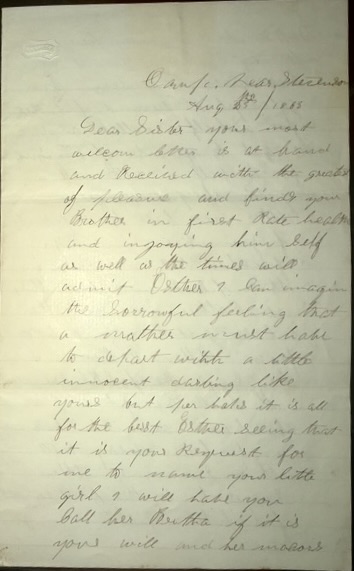
Camp near Stevenson, [Alabama] [Sunday] August 23, 1863
Dear Sister,
Your most welcome letter is at hand and received with the greatest pleasure and finds your brother in first rate health and enjoying himself as well as the times will admit. Esther, I can imagine the sorrowful feeling that a mother must have to depart with a little innocent darling like yours but perhaps it is all for the best. Esther, seeing that it is your request for me to name your little girl, I will have you call her Bertha if it is your will and her Maker’s.
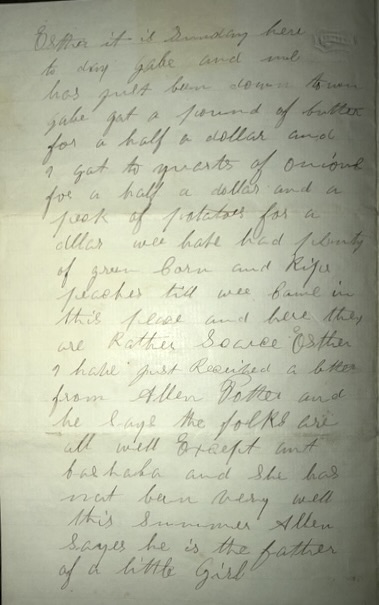
Esther, it is Sunday here today, Gabe [Gabriel Cornish] and me has just been down town. Gabe got a pound of butter for a half dollar and I got a quart of onion for a half a dollar and a peck of potatoes for a dollar. We have had plenty of green corn and ripe peaches till we came in this place and here they are rather scarce.
Esther, I have just received a letter from Allen Potter 1 and he said the folks are all well except Aunt Bathsheba [Waite Potter] and she has not been very well this summer. Allen says he is the father of a little girl.
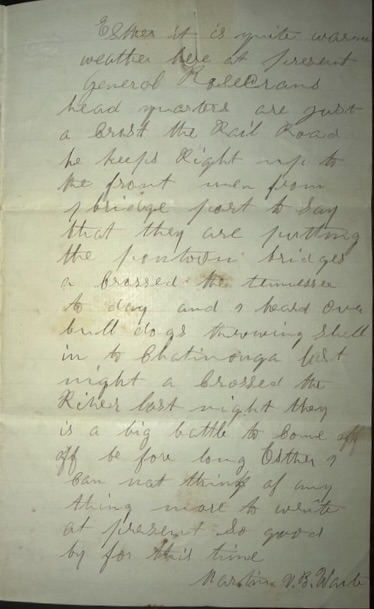
Esther, it is quite warm weather here at present. General Rosecrans’ Headquarters are just across the railroad. He keeps right up to the front. Men from Bridgeport say that they are putting the pontoon bridges across the Tennessee [River] today and I heard [ ] bull dogs throwing shells into Chattanooga last night across the river last night. There is a big battle to come off before long.
Esther, I cannot think of anything more to write at present so goodbye for this time. — Martin V. B. Waite
1 Allen Potter (1839-1913) was Martin’s cousin, the son of William Potter (1809-1875) ad Bathsheba Waite (1811-1876) of Leon, Cattaraugus county, New York.
The following letter was written by Nathan Crawford (1841-1863), the son of Irish emigrants John Crawford (1810-1900) and his wife, Charlotte Saunders (1812-1888), who took up farming near Dover, Racine county, Wisconsin. Nathan enlisted on 4 September 1861 to serve three years in Co. C, 1st Wisconsin Infantry. He was killed in action at Chickamauga on 19 September 1863—“shot through the head in the first volley the Regiment received.” [Racine Weekly Advocate, 7 October 1863]. Although this letter is only signed “Nathan,” the content leads us to Co. C, 1st Wisconsin Infantry and he was the only one by that name on the roster.
Twenty-two of Nathan’s letters were offered for sale by “West Coast Civil War Collectors” recently which were described:
Ambrotype of Nathan Crawford and his sister Isabel
“During his term of service, Private Crawford corresponded with his sister, Isabella, with whom he appears in this 1/6th plate tintype. Housed in its original case, but missing its front cover, Crawford’s affection for his sister is evident. A grouping of twenty-two letters, mostly from Pvt. Crawford to “Bella,” accompanies the tintype. His descriptions of camp life, marching, and fighting are interspersed with loving advice for his younger sister regarding her affairs at home. Pvt. Crawford saw conflict at Martinsburg, the battles of Falling Waters, Perryville, Stone’s River and finally he was killed during the fighting at Chickamauga on September 19, 1863.
Over the ensuing months as Isabella mourned her brother’s death; she was outspoken against Confederate sympathizers in her township. Her fervor culminated in a memorable scene in the railway station near her home, when a Copperhead defamed the memory of her soldier/brother and drew her wrath. The incident made the newspapers. For her dedication, Isabella received notes of congratulations and gifts from local citizens and unknown admirers, also included in the group of twenty-two letters.”
This letter is not from that collection.
Transcription
Negley’s Brigade Green River [Kentucky] January 31st 1862
Dear Mother,
Patriotic imagery on Nathan’s stationery
I have been sick for two weeks but I am getting better now if I only continue for I tell you, it is a poor place for a sick man. We have no dry weather here scarcely, and it is very muddy all the time, and it is very unhealthy. We have moved into a different kind of tent. We are 17 and 18 in a tent. We have a little stove in it and it makes it quite comfortable. We are not allowed to cook our own victuals. Our Colonel [John C. Starkweather] said that we must have a company cook and that the men should not cook anything in their tents. I do not know whether there will be sickness with so many in a tent or not. Six and seven were the most that slept together in the other little tents. In the little tent, we had things more convenient than we can possibly have in these, for these are round and the others are square, and were not so low in the side. In these large tents we sleep with out feet all toward the center.
We would have fine times if we had dry weather all the time, but it is just the contrary and when anyone goes out he will have to tread mud till he comes in again, and when he does come in, he brings a god share of mud with him so it is almost impossible to keep the tent clean. It is a very unhealthy climate according to my notion.
I am very very much disappointed in my notions of Old Kentucky. My idea is that it is a poor place for either man or beast. My sickness commenced by a cold, and a loss of appetite, and when I would cough, I would puke up large quantities of bile. I would drink water very often and what little I did eat, would pass through me the same, only as thin as water which I drank was the occasion of that. I got some powders from the doctor which stopped my dysentery and also my puking up bile. My cold is better. I do not have a cough. My appetite is poor yet, but it is increasing. I am very weak yet but I am able to walk around. I hope I will soon get strong again and I think if I am very careful that I will.
We uses coffee for our drink at almost every meal and I think that it is not good for me for I think it increases the bile on my stomach very fast. We use the river water which is the best that we have. It is rather rolly sometimes. I do not drink coffee now. We have black tea sometimes and I drink that.
Co. C has lost more of its members. It is Mr. Isaac Grote of the Town of Waterford. 1 He was married and had one child. Before he left camp he wrote for his wife to come to Louisville to take care of him there. He was taken to Louisville the next day and he was then taken with typhoid fever and died in about three days after he left camp. Capt. Hill was with him when he died. He wanted the captain to read the Testament to him and told the captain when he was dying that it was the best medicine that they had given him. He was liked by all the boys in the company and his death was heard of with surprise and sorrow, but few take it as a warning to them to “be ready always for in such an hour as ye think not, the Son of Man cometh.” We ought to bless God for every hour of life that we enjoy instead of taking his name in vain every hour that we live (which is the way that the most of our men do). It is awful to hear what oaths are sworn in camp. It hurts my feelings to hear it. It is a wonder that some are not stricken down instantly.
Dear mother, I send my love to you and father and all my sisters and brothers, I am your living son, — Nathan
1 Isaac Grote (1837-1862) enlisted on 3 September 1861 to serve in Co. C, 1st Wisconsin Infantry. He died of typhoid fever at Louisville on 5 January 1862. He was married to Almira Jane Eastman in 1859 and had a son named Sherman A. Goat (1859-1940). His remains were sent home to Waterford.